EP1077540A1 - Transmitting/receiving device - Google Patents
Transmitting/receiving device Download PDFInfo
- Publication number
- EP1077540A1 EP1077540A1 EP00906651A EP00906651A EP1077540A1 EP 1077540 A1 EP1077540 A1 EP 1077540A1 EP 00906651 A EP00906651 A EP 00906651A EP 00906651 A EP00906651 A EP 00906651A EP 1077540 A1 EP1077540 A1 EP 1077540A1
- Authority
- EP
- European Patent Office
- Prior art keywords
- communication
- transmission
- transmission timing
- reception
- distance
- Prior art date
- Legal status (The legal status is an assumption and is not a legal conclusion. Google has not performed a legal analysis and makes no representation as to the accuracy of the status listed.)
- Withdrawn
Links
Images


Classifications
-
- H—ELECTRICITY
- H04—ELECTRIC COMMUNICATION TECHNIQUE
- H04L—TRANSMISSION OF DIGITAL INFORMATION, e.g. TELEGRAPHIC COMMUNICATION
- H04L1/00—Arrangements for detecting or preventing errors in the information received
- H04L1/12—Arrangements for detecting or preventing errors in the information received by using return channel
- H04L1/16—Arrangements for detecting or preventing errors in the information received by using return channel in which the return channel carries supervisory signals, e.g. repetition request signals
- H04L1/18—Automatic repetition systems, e.g. Van Duuren systems
- H04L1/1867—Arrangements specially adapted for the transmitter end
- H04L1/1887—Scheduling and prioritising arrangements
Definitions
- the present invention relates to a transmission/reception apparatus and its transmission timing control method used for a mobile communication based on a system, which performs transmission/reception by assigning time varying from one user to another such as a TDMA system or CDMA/TDD system in particular.
- a TDMA-based or CDMA/TDD-based mobile communication specifies a slot, which is an arbitrary unit time, assigns a user to each slot and switches between transmission and reception for every frame, which consists of a plurality of slots.
- FIG.1 is a main block diagram showing an outlined configuration of a conventional transmission/reception apparatus.
- antenna 1 transmits/receives a radio signal
- duplexer 2 switches between input and output of a transmission/reception signal to/from antenna 1 and reception RF section 3 performs reception processing on a reception signal.
- Matched filter (hereinafter referred to as "MF") 4 calculates a correlation value in a known symbol interval of the reception signal using a preset known symbol, detects a channel estimated value of the reception signal and outputs the channel estimated value to demodulation section 6, which will be described later.
- Sliding correlator (hereinafter referred to as "SC") 5 performs despreading processing on the reception signal using an intrinsic code.
- Demodulation section 6 performs a complex multiplication on the channel estimated value for each despread reception signal, compensates phase rotation and amplitude variation and demodulates.
- CRC check section 7 decides whether demodulation is performed on the demodulated reception signal correctly or not.
- Modulation section 8 performs modulation on the decision result, which is the output of CRC check section 7, that is, the decision result as to whether reception has been performed correctly or not, and transmission RF section 9 performs transmission processing on the decision result subjected to modulation processing and transmits the decision result from antenna 1 via duplexer 2.
- This transmitted decision result is, in other words, a retransmission request and the other end of communication which receives this signal continues transmission if the decision result of the reception condition shows that reception has been acceptable with no error and retransmits a transmission signal if the decision result shows that reception includes some errors and has not been performed correctly.
- the conventional transmission/reception apparatus sends a retransmission request to the other end of communication in the case where reception has not been performed correctly.
- FIG.2 is a schematic diagram showing how slot reception is performed in the conventional transmission/reception apparatus.
- each data piece is extracted as shown in FIG.2, by the reception system operating only in a desired data interval and turning off in data intervals for other users.
- the transmission/reception apparatus receives a radio signal from each user by changing the reception interval for every user.
- each slot is normally provided with guard times containing no data so that reception is possible within the reception interval even if a delay is produced in the reception signal.
- a reception interval has a length adding up the user data length and the guard time length and the guard time serves as a margin interval in the case where a delay is produced in the reception signal.
- the entire slot can fit in the reception interval as long as the delay time is within the guard time length, and therefore the entire slot is received correctly.
- FIG.3 is a schematic diagram showing slot reception in the conventional transmission/reception apparatus.
- FIG.3A shows a case where the delay time is shorter than the guard time length and, as shown in the figure, the one entire slot fits in the reception interval and all data is received.
- FIG.3B shows a case where the delay time is longer than the guard time length and the rear end of the data symbol does not fin in the reception interval, preventing the area beyond the reception interval from being received.
- this delay is considered attributable to a long distance between the communication stations, this propagation delay is considered to continue almost constantly, repeating retransmission requests; hence the problem of being unable to continue communications indefinitely.
- a main subject of the present invention is for a transmission/reception apparatus to monitor the number of retransmission requests sent from the other end of communication and advance the transmission timing of a transmission signal in the case where propagation delays exceeding the guard time length are considered to continue.
- the transmission/reception apparatus changes the transmission timing based on the number of retransmission requests consecutively received from the other end of communication.
- this embodiment decides that a delay time is exceeding the guard time length consecutively and advances the transmission timing.
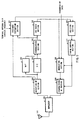
- FIG.4 is a main block diagram showing an outlined configuration of the transmission/reception apparatus according to Embodiment 1 of the present invention.
- antenna 101 transmits/receives a radio signal
- duplexer 102 switches between input and output of a transmission/reception signal to/from antenna 101 and reception RF section 103 performs reception processing on the reception signal.
- MF 104 calculates a correlation value for a known symbol interval of the reception signal using a preset known symbol, detects a channel estimated value of the reception signal and outputs the channel estimated value to demodulation section 306, which will be described later.
- SC 105 performs despreading processing on the reception signal using an intrinsic code.
- Demodulation section 106 performs a complex multiplication by the channel estimated value, which is the output of MF 104, on the despread reception signal, compensates phase rotation and amplitude variation and demodulates.
- CRC check section 107 decides whether demodulation is performed on the demodulated reception signal correctly or not.
- Modulation section 108 performs modulation processing on the transmission signal and the decision result, which is the output of CRC check section 107, that is, the decision result as to whether reception has been performed correctly or not.
- Transmission RF section 109 performs transmission processing on the transmission signal subjected to modulation processing and transmits the transmission signal from antenna 101 via duplexer 102.
- This decision result transmitted is, in other words, a retransmission request and the other end of communication which receives this signal continues transmission if the decision result of the reception condition shows that reception has been performed correctly with no error and retransmits a transmission signal if the decision result shows that reception includes some errors and has not been performed correctly.
- Decision section 110 extracts a retransmission request, that is, the decision result that the other end of communication has not received a communication correctly, from the reception signal after the CRC check, which is the output of CRC check section 107, counts it and decides whether the number of retransmission requests consecutively received reaches an arbitrary threshold or not.
- decision section 110 decides that the own station is far from the other end of communication; a propagation delay at the ether end of communication exceeds the guard time length; the propagation delay will not be changed even if transmission continues further; and communications will be disabled with retransmission requests simply being repeated, and instructs timing control section 111, which will be described later, to change the transmission timing.
- Timing control section 111 advances the transmission timing based on the instruction of decision section 110 and sets a new transmission timing in modulation section 108 and transmission RF section 109. That is, when decision section 110 decides that the propagation delay when a transmission signal from the own station arrives at the other end of communication exceeds the guard time length, decision section 110 advances the timing at which the transmission signal from the own station is sent.
- the width of the advancing step can be arbitrarily decided.
- a radio signal from the other end of communication is received by antenna 101, passed through duplexer 102 and subjected to reception processing by reception RF section 103.
- MF 104 calculates a correlation value of a signal of a known symbol interval of the reception signal, detects a channel estimated value of the reception signal and outputs the channel estimated value to demodulation section 106.
- SC 105 performs despreading processing on the reception signal.
- Demodulation section 106 compensates phase rotation and amplitude variation for the despread reception signal using a channel estimated value and performs demodulation processing.
- the reception signal subjected to demodulation processing is decided by CRC check section 107 if reception has been performed correctly or not.
- the reception signal after the CRC check is input to decision section 110.
- Decision section 110 extracts and counts retransmission requests in the reception signal. When the number of retransmission requests consecutively received reaches an arbitrary threshold, this information is transmitted by decision section 110 to timing control section 111 and timing control section 111 advances the transmission timing at modulation section 108 and transmission RF section 109.
- this embodiment can suppress a propagation delay to advance the transmission timing and improve the reception condition at the other end of communication. That is, this embodiment detects a situation in which the delay time consecutively exceeds the guard time length based on the number of retransmission requests consecutively received from the other end of communication, suppresses the propagation delay to advance the transmission timing and thus can improve the reception condition at the other end of communication.
- the transmission/reception apparatus has the same configuration as that of Embodiment 1 except that the transmission timing is changed based on the number of retransmission requests consecutively received from the other end of communication and an estimated distance from the other end of communication.
- this embodiment monitors not only the number of retransmission requests consecutively received but also an estimated distance from the other end of communication and advances the transmission timing when the number of retransmission requests consecutively received reaches a threshold and at the same time the estimated distance exceeds a threshold.
- the transmission/reception apparatus is used by a communication terminal apparatus, which is performing a radio communication with a base station apparatus.
- distance d can be estimated from transmit power (including antenna gain) at the base station and reception power (subtracting antenna gain) at the communication terminal.
- an estimated distance between the communication stations can be easily calculated from information easily available at the reception system in this way, it is possible to advance the transmission timing only when the estimated distance between the communication stations exceeds a threshold and improve the accuracy of detecting the situation in which the delay time consecutively exceeds the guard time length.
- FIG.5 is a main block diagram showing an outlined configuration of the transmission/reception apparatus according to Embodiment 2 of the present invention.
- the parts with the same configuration as that in Embodiment 1 will be assigned the same reference numerals and their detailed explanations will be omitted.
- distance estimation section 201 receives the reception level from reception RF section 103 and the transmission level of the base station apparatus, which is the other end of communication, obtained from a control signal in a demodulated reception signal and also receives a known terminal antenna gain and carrier frequency, and calculates an estimated distance between the communication stations from these values based on the aforementioned expression.
- Decision section 202 extracts a retransmission request from the reception signal after the CRC check, which is the output of CRC check section 107, counts it and decides whether the number of retransmission requests consecutively received reaches an arbitrary threshold or not.
- Decision section 202 decides whether the calculated estimated distance between the communication stations, which is the output of distance estimation section 201, exceeds an arbitrary threshold or not.
- decision section 110 instructs timing control section 111 to change the transmission timing.
- this embodiment advances the transmission timing only when the estimated distance between the communication stations exceeds a threshold, it is possible to improve the accuracy of detecting a situation in which a delay time consecutively exceeds the guard time length.
- the transmission/reception apparatus of the present invention can be applied to a communication terminal apparatus in a mobile communication and allows the communication terminal apparatus to autonomously detect that it is too far from the base station apparatus for the communication terminal apparatus to communicate, advance the transmission timing and improve the reception condition at the base station apparatus, which is the other end of communication.
- the present invention can be applied to a communication terminal apparatus or base station apparatus in a digital radio communication system.
- the present invention can suppress the propagation delays exceeding the guard time length and improve the reception condition at the other end of communication.
- the present invention advances the transmission timing at the own station and thus can suppress propagation delays exceeding the guard time length.
- the present invention can be applied to a communication terminal apparatus or base station apparatus in a digital radio communication system.
Landscapes
- Engineering & Computer Science (AREA)
- Computer Networks & Wireless Communication (AREA)
- Signal Processing (AREA)
- Mobile Radio Communication Systems (AREA)
- Time-Division Multiplex Systems (AREA)
- Synchronisation In Digital Transmission Systems (AREA)
Abstract
Description
Claims (12)
- A transmission/reception apparatus comprising:receiving means for receiving a signal sent by the other end of communication including a reception condition decision result for every arbitrary unit time at the other end of communication; andtransmission timing controlling means for deciding whether or not to advance the timing for sending the transmission signal based on said decision result received by this receiving means.
- The transmission/reception apparatus according to claim 1, said transmission timing controlling means comprising:a counting section that counts the number of times it is consecutively decided that the reception condition of the received signal including said decision result is not acceptable at the other end of communication; anda consecutive count decision section that decides whether the consecutive count counted by this counting section has reached a predetermined value or not, wherein in the case where said consecutive count has reached the predetermined value, the transmission timing is advanced.
- The transmission/reception apparatus according to claim 1, said transmission timing controlling means comprising:a count decision section that decides whether the number of times it is decided that the reception condition of the signal including said decision result is not acceptable at the other end of communication has reached a predetermined value within a predetermined time, wherein in the case where said number of times has reached the predetermined value within the predetermined time, the transmission timing is advanced.
- The transmission/reception apparatus according to claim 2, said transmission timing controlling means comprising:a distance estimation section that estimates a distance from the other end of communication, wherein in the case where the distance estimated by this distance estimation section is equal to or smaller than a predetermined value, the transmission timing is not advanced.
- The transmission/reception apparatus according to claim 4, wherein said distance estimation section has a preset arithmetic expression for calculating propagation loss from a distance between the communication stations, the height of the antenna and carrier frequency of the other end of communication and estimates the distance from the other end of communication from the reception level at the own station, the transmission level and the height of the antenna of the other end of communication obtained from a control signal received and the preset antenna gain and carrier frequency at the own station using said arithmetic expression.
- A communication terminal apparatus comprising the transmission/reception apparatus according to claim 1.
- A base station apparatus carrying out a radio communication with the communication terminal apparatus according to claim 6.
- A transmission timing control method comprising:the receiving step of receiving a signal sent by the other end of communication including a reception condition decision result for every arbitrary unit time at the other end of communication; andthe transmission timing controlling step of deciding whether or not to advance the timing for sending the transmission signal based on said decision result received by this receiving step.
- The transmission timing control method according to claim 8, wherein said transmission timing controlling step counts the number of times it is consecutively decided that the reception condition of the received signal including said decision result is not acceptable at the other end of communication and advances the transmission timing in the case where this consecutive count has reached a predetermined value.
- The transmission timing control method according to claim 8, wherein said transmission timing controlling step advances the transmission timing in the case where the number of times it is decided that the reception condition of the signal including said decision result is not acceptable at the other end of communication has reached a predetermined value within a predetermined time.
- The transmission timing control method according to claim 9, said transmission timing controlling step comprising:the distance estimating step of estimating a distance from the other end of communication, wherein in the case where this estimated distance is equal to or smaller than a predetermined value, the transmission timing is not advanced.
- The transmission timing control method according to claim 11, wherein said distance estimating step substitutes into an arithmetic expression for calculating propagation loss from a distance between the communication stations, the height of the antenna and carrier frequency of the other end of communication, the reception level at the own station, the transmission level and the height of the antenna of the other end of communication obtained from a control signal received and the preset antenna gain and carrier frequency at the own station and estimates the distance from of the other end of communication.
Applications Claiming Priority (3)
| Application Number | Priority Date | Filing Date | Title |
|---|---|---|---|
| JP10304699 | 1999-03-06 | ||
| JP10304699A JP3968191B2 (en) | 1999-03-06 | 1999-03-06 | Transceiver |
| PCT/JP2000/001254 WO2000054436A1 (en) | 1999-03-06 | 2000-03-03 | Transmitting/receiving device |
Publications (2)
| Publication Number | Publication Date |
|---|---|
| EP1077540A1 true EP1077540A1 (en) | 2001-02-21 |
| EP1077540A4 EP1077540A4 (en) | 2006-10-04 |
Family
ID=14343738
Family Applications (1)
| Application Number | Title | Priority Date | Filing Date |
|---|---|---|---|
| EP00906651A Withdrawn EP1077540A4 (en) | 1999-03-06 | 2000-03-03 | TRANSMITTER RECEIVER |
Country Status (6)
| Country | Link |
|---|---|
| US (1) | US6842482B1 (en) |
| EP (1) | EP1077540A4 (en) |
| JP (1) | JP3968191B2 (en) |
| CN (1) | CN1121763C (en) |
| AU (1) | AU2826600A (en) |
| WO (1) | WO2000054436A1 (en) |
Families Citing this family (24)
| Publication number | Priority date | Publication date | Assignee | Title |
|---|---|---|---|---|
| US8175120B2 (en) | 2000-02-07 | 2012-05-08 | Ipr Licensing, Inc. | Minimal maintenance link to support synchronization |
| US6222832B1 (en) | 1998-06-01 | 2001-04-24 | Tantivy Communications, Inc. | Fast Acquisition of traffic channels for a highly variable data rate reverse link of a CDMA wireless communication system |
| US9525923B2 (en) | 1997-12-17 | 2016-12-20 | Intel Corporation | Multi-detection of heartbeat to reduce error probability |
| US7221664B2 (en) | 1998-06-01 | 2007-05-22 | Interdigital Technology Corporation | Transmittal of heartbeat signal at a lower level than heartbeat request |
| US8155096B1 (en) | 2000-12-01 | 2012-04-10 | Ipr Licensing Inc. | Antenna control system and method |
| US6954448B2 (en) | 2001-02-01 | 2005-10-11 | Ipr Licensing, Inc. | Alternate channel for carrying selected message types |
| US7551663B1 (en) | 2001-02-01 | 2009-06-23 | Ipr Licensing, Inc. | Use of correlation combination to achieve channel detection |
| ES2624979T3 (en) | 2001-06-13 | 2017-07-18 | Intel Corporation | Apparatus for transmitting a heartbeat signal at a lower level than the heartbeat request |
| US7580712B2 (en) * | 2005-06-03 | 2009-08-25 | Telefonaktiebolaget Lm Ericsson (Publ) | Wireless high-speed data network planning tool |
| US8483616B1 (en) | 2005-11-01 | 2013-07-09 | At&T Intellectual Property Ii, L.P. | Non-interference technique for spatially aware mobile ad hoc networking |
| US8355410B2 (en) | 2007-08-17 | 2013-01-15 | At&T Intellectual Property I, L.P. | Location-based mobile gaming application and method for implementing the same using a scalable tiered geocast protocol |
| US8213451B2 (en) | 2006-03-01 | 2012-07-03 | Nec Corporation | Wireless communication terminal, transmission function adjusting method and transmission function control program for use in wireless communication terminal |
| JP4791345B2 (en) * | 2006-12-27 | 2011-10-12 | 京セラ株式会社 | Base station and slot allocation method |
| JP4386108B2 (en) | 2007-07-11 | 2009-12-16 | 日本電気株式会社 | Time division multiplexing system and transmission timing control method thereof |
| JP4447028B2 (en) * | 2007-08-10 | 2010-04-07 | 富士通株式会社 | Communication control method, transmission apparatus, and computer program |
| US8213391B2 (en) * | 2007-10-05 | 2012-07-03 | Via Telecom, Inc. | Time synchronization of femtocell |
| JP2009207004A (en) * | 2008-02-28 | 2009-09-10 | Sanyo Electric Co Ltd | Handover control method and terminal deice using the same |
| JP5111193B2 (en) * | 2008-03-27 | 2012-12-26 | 京セラ株式会社 | Wireless communication system, mobile station, base station, and wireless communication method |
| JP2011133274A (en) * | 2009-12-22 | 2011-07-07 | Panasonic Electric Works Co Ltd | Obstacle monitoring device for vehicle |
| US9319842B2 (en) | 2011-06-27 | 2016-04-19 | At&T Intellectual Property I, L.P. | Mobile device configured point and shoot type weapon |
| US9161158B2 (en) | 2011-06-27 | 2015-10-13 | At&T Intellectual Property I, L.P. | Information acquisition using a scalable wireless geocast protocol |
| US8744419B2 (en) * | 2011-12-15 | 2014-06-03 | At&T Intellectual Property, I, L.P. | Media distribution via a scalable ad hoc geographic protocol |
| US9071451B2 (en) | 2012-07-31 | 2015-06-30 | At&T Intellectual Property I, L.P. | Geocast-based situation awareness |
| US9660745B2 (en) | 2012-12-12 | 2017-05-23 | At&T Intellectual Property I, L.P. | Geocast-based file transfer |
Family Cites Families (9)
| Publication number | Priority date | Publication date | Assignee | Title |
|---|---|---|---|---|
| US5276911A (en) * | 1990-11-02 | 1994-01-04 | Motorola, Inc. | Contention reducing technique for a radio frequency communication system |
| JP2876517B2 (en) | 1994-02-16 | 1999-03-31 | 松下電器産業株式会社 | CDMA / TDD base station apparatus, CDMA / TDD mobile station apparatus, CDMA / TDD wireless communication system, and CDMA / TDD wireless communication method |
| NZ272084A (en) * | 1994-06-08 | 1997-02-24 | Alcatel Australia | Tdma mobile radio: extended range with adjacent located transceivers |
| US5640396A (en) * | 1995-09-06 | 1997-06-17 | Motorola, Inc. | Apparatus and method for synchronizing a rural wireless fixed access unit into a TDMA system |
| US5710758A (en) * | 1995-09-29 | 1998-01-20 | Qualcomm Incorporated | Wireless network planning tool |
| EP0820167A3 (en) * | 1996-07-18 | 1998-07-22 | Matsushita Electric Industrial Co., Ltd. | Control method for selective repeat retransmission protocols |
| US6101176A (en) | 1996-07-24 | 2000-08-08 | Nokia Mobile Phones | Method and apparatus for operating an indoor CDMA telecommunications system |
| US6138003A (en) * | 1997-11-26 | 2000-10-24 | Ericsson Inc. | System and method for authorization of location services |
| US6282427B1 (en) * | 1999-07-14 | 2001-08-28 | Telefonaktiebolaget L M Ericsson (Publ) | Selection of location measurement units for determining the position of a mobile communication station |
-
1999
- 1999-03-06 JP JP10304699A patent/JP3968191B2/en not_active Expired - Fee Related
-
2000
- 2000-03-02 US US09/674,251 patent/US6842482B1/en not_active Expired - Fee Related
- 2000-03-03 EP EP00906651A patent/EP1077540A4/en not_active Withdrawn
- 2000-03-03 AU AU28266/00A patent/AU2826600A/en not_active Abandoned
- 2000-03-03 CN CN00800264A patent/CN1121763C/en not_active Expired - Fee Related
- 2000-03-03 WO PCT/JP2000/001254 patent/WO2000054436A1/en not_active Ceased
Also Published As
| Publication number | Publication date |
|---|---|
| WO2000054436A1 (en) | 2000-09-14 |
| JP2000261371A (en) | 2000-09-22 |
| CN1121763C (en) | 2003-09-17 |
| CN1296678A (en) | 2001-05-23 |
| AU2826600A (en) | 2000-09-28 |
| US6842482B1 (en) | 2005-01-11 |
| JP3968191B2 (en) | 2007-08-29 |
| EP1077540A4 (en) | 2006-10-04 |
Similar Documents
| Publication | Publication Date | Title |
|---|---|---|
| EP1077540A1 (en) | Transmitting/receiving device | |
| EP1230751B1 (en) | Method and system for maintaining uplink synchronization in cdma based mobile communication systems | |
| EP1358721B1 (en) | Method and system for controlling device transmit power in a wireless communication network | |
| EP2986066B1 (en) | Access probe acknowledgment with collision detection | |
| EP0932996B1 (en) | Random access in a mobile telecommunications system | |
| JP3346415B2 (en) | Mobile communication system, base station and communication control method | |
| EP0931387B1 (en) | Method and apparatus for measuring link quality in a spread spectrum communication system | |
| US20030087605A1 (en) | Variable rate channel quality feedback in a wireless communication system | |
| US20050174968A1 (en) | Apparatus and Method for Transmission | |
| US6771616B2 (en) | Sequential combined QPCH demodulation | |
| US6895058B2 (en) | Dual paging channel receiver for a wireless communications system | |
| US6539211B1 (en) | Efficient system and method for facilitating quick paging channel demodulation via an efficient offline searcher in a wireless communications system | |
| EP1096822A2 (en) | Apparatus and method for TDMA-TDD based transmission/reception | |
| EP1257075B1 (en) | Transmitting device and transmitting method | |
| US7009954B2 (en) | Wireless communications receiver employing a unique combination of quick paging channel symbols to facilitate detection of a primary paging channel | |
| AU4291599A (en) | Apparatus and method for radio communications | |
| US6507743B1 (en) | Wireless communications receiver employing quick paging channel symbols and noise power estimates to facilitate detection of a primary paging channel | |
| JP3858985B2 (en) | Path diversity receiving apparatus and method for spread spectrum communication system | |
| EP1065798A1 (en) | Receiver and method of reception | |
| AU2793801A (en) | Wireless communications receiver employing quick paging channel symbols | |
| KR100674806B1 (en) | Physical Layer Collision Detection Device in Mobile Communication System | |
| JP2001069073A (en) | Transmission power control circuit and control method | |
| JP3612498B2 (en) | Channel access control apparatus in wireless packet communication system | |
| JP2001358637A (en) | Spread spectrum communication system having interference wave carrier detecting function | |
| HK1221595B (en) | Access probe acknowledgment with collision detection |
Legal Events
| Date | Code | Title | Description |
|---|---|---|---|
| PUAI | Public reference made under article 153(3) epc to a published international application that has entered the european phase |
Free format text: ORIGINAL CODE: 0009012 |
|
| 17P | Request for examination filed |
Effective date: 20001201 |
|
| AK | Designated contracting states |
Kind code of ref document: A1 Designated state(s): AT BE CH CY DE DK ES FI FR GB GR IE IT LI LU MC NL PT SE |
|
| AX | Request for extension of the european patent |
Free format text: AL;LT;LV;MK;RO;SI |
|
| RBV | Designated contracting states (corrected) |
Designated state(s): DE FI FR GB SE |
|
| A4 | Supplementary search report drawn up and despatched |
Effective date: 20060906 |
|
| RIC1 | Information provided on ipc code assigned before grant |
Ipc: H04B 7/26 20060101AFI20000920BHEP Ipc: H04L 1/18 20060101ALI20060831BHEP |
|
| 17Q | First examination report despatched |
Effective date: 20070824 |
|
| STAA | Information on the status of an ep patent application or granted ep patent |
Free format text: STATUS: THE APPLICATION IS DEEMED TO BE WITHDRAWN |
|
| 18D | Application deemed to be withdrawn |
Effective date: 20080105 |