EP1077383A2 - Positron imaging - Google Patents
Positron imaging Download PDFInfo
- Publication number
- EP1077383A2 EP1077383A2 EP00307041A EP00307041A EP1077383A2 EP 1077383 A2 EP1077383 A2 EP 1077383A2 EP 00307041 A EP00307041 A EP 00307041A EP 00307041 A EP00307041 A EP 00307041A EP 1077383 A2 EP1077383 A2 EP 1077383A2
- Authority
- EP
- European Patent Office
- Prior art keywords
- coincident
- gamma ray
- pairs
- ray pairs
- randoms
- Prior art date
- Legal status (The legal status is an assumption and is not a legal conclusion. Google has not performed a legal analysis and makes no representation as to the accuracy of the status listed.)
- Granted
Links
Images



Classifications
-
- G—PHYSICS
- G01—MEASURING; TESTING
- G01T—MEASUREMENT OF NUCLEAR OR X-RADIATION
- G01T1/00—Measuring X-radiation, gamma radiation, corpuscular radiation, or cosmic radiation
- G01T1/29—Measurement performed on radiation beams, e.g. position or section of the beam; Measurement of spatial distribution of radiation
- G01T1/2914—Measurement of spatial distribution of radiation
- G01T1/2985—In depth localisation, e.g. using positron emitters; Tomographic imaging (longitudinal and transverse section imaging; apparatus for radiation diagnosis sequentially in different planes, steroscopic radiation diagnosis)
-
- G—PHYSICS
- G01—MEASURING; TESTING
- G01T—MEASUREMENT OF NUCLEAR OR X-RADIATION
- G01T1/00—Measuring X-radiation, gamma radiation, corpuscular radiation, or cosmic radiation
- G01T1/16—Measuring radiation intensity
- G01T1/17—Circuit arrangements not adapted to a particular type of detector
- G01T1/172—Circuit arrangements not adapted to a particular type of detector with coincidence circuit arrangements
-
- A—HUMAN NECESSITIES
- A61—MEDICAL OR VETERINARY SCIENCE; HYGIENE
- A61B—DIAGNOSIS; SURGERY; IDENTIFICATION
- A61B6/00—Apparatus or devices for radiation diagnosis; Apparatus or devices for radiation diagnosis combined with radiation therapy equipment
- A61B6/02—Arrangements for diagnosis sequentially in different planes; Stereoscopic radiation diagnosis
- A61B6/03—Computed tomography [CT]
- A61B6/037—Emission tomography
Definitions
- the present invention relates to the field of positron imaging.
- the invention is especially applicable to the field of positron emission tomography.
- the invention is also applicable to other fields in which it is necessary to estimate the contribution of "randoms" (random events) in data indicative of positron coincidence events.
- Positron emission tomography is a branch of nuclear medicine in which a positron-emitting radiopharmaceutical such as 18 F-fluorodeoxyglucose (FDG) is introduced into the body of a patient. Each emitted positron reacts with an electron in what is known as an annihilation event, thereby simultaneously generating a pair of 511 keV gamma rays.
- the gamma rays are emitted in directions approximately 180° apart, i.e. in opposite directions.
- a pair of detectors registers the position and energy of the respective gamma rays, thereby providing information as to the position of the annihilation event and hence the positron source. Because the gamma rays travel in opposite directions, the positron annihilation is said to have occurred along a line of response (LOR) connecting the detected gamma rays. A number of such events are collected and used to reconstruct a clinically useful image.
- LOR line of response
- a random event is one in which a pair of gamma rays from two unrelated annihilation events are detected in coincidence.
- the acquired coincidence data includes both true and random events (or coincidences). Because the LORs for the random events do not represent actual positron annihilations, the randoms introduce noise into the acquired data, thereby degrading image quality.
- Another technique for estimating the contribution of randoms is to delay the signal from one of the detectors by an amount longer than the coincidence timing window prior to applying the coincidence check. Due to the delay, events which are detected by a pair of detectors within the coincidence timing window (i.e., in coincidence) represent randoms. The collected events are rebinned and used to correct the acquired coincidence data.
- a particular drawback to such a delayed correction technique is that the rate of randoms collection is the same as that of the true event collection. This technique also has a deleterious effect on image noise characteristics.
- Yet another technique is to determine the random coincidence rate based on the singles rates of the system's detectors and the length of the coincidence timing window.
- the system detectors have been treated as a plurality of virtual subdetectors, and the singles rate for each of the subdetectors has been measured.
- the singles rates for the various combinations of subdetectors has in turn been used to generate a randoms sinogram.
- One disadvantage to such a technique is that it is necessary to collect data additional to the desired coincidence data.
- Yet another disadvantage is that improving the accuracy of the estimation requires that the detectors be divided into arbitrarily small subdetectors.
- a method of position imaging includes receiving data indicative of a plurality of detected coincident gamma ray pairs, said pairs including positron annihilation gamma ray pairs and random gamma ray pairs, re-pairing gamma rays from the detected coincident gamma ray pairs so as to generate non-coincident gamma ray pairs, and using the coincident gamma ray pairs and the non-coincident gamma ray pairs to generate a randoms corrected image.
- the step of receiving includes receiving a list of detected coincident gamma ray pairs and the step of re-pairing includes re-pairing gamma rays from the list of detected coincident gamma ray pairs.
- step of re-pairing includes pairing each of a plurality of gamma rays with a non-coincident gamma ray.
- the invention includes pairing each of a plurality of gamma rays with a plurality of non-coincident gamma rays.
- the non-coincident gamma rays may be paired in all possible combinations.
- the step of receiving includes receiving data indicative of coincident gamma ray pairs detected over a time period T.
- the method also includes rebinning the non-coincident gamma ray pairs and rescaling the rebinned non-coincident gamma ray pairs to generate T*R pairs, where R is a randoms rate.
- the method includes combining the coincident and non-coincident gamma ray pairs and generating an image indicative of the combined coincident and non-coincident gamma ray pairs.
- the method may also include rebinning the coincident gamma ray pairs, rebinning the non-coincident gamma ray pairs, subtracting the rebinned non-coincident gamma ray pairs from the rebinned coincident gamma ray pairs to generate corrected coincidence data, and generating an image indicative of the corrected coincidence data.
- the method includes using first and second detectors to detect coincident gamma ray pairs.
- the step of re-pairing includes pairing gamma rays detected by the first detector with non-coincident gamma rays detected by the second detector.
- the method may include using first, second, and third detectors to detect coincident gamma rays and wherein the step of re-pairing includes pairing gamma rays detected by the first detector with gamma rays detected by the third detector and pairing gamma rays detected by the second detector with gamma rays detected by the third detector.
- a method of randoms-corrected imaging includes detecting coincident gamma ray pairs, said pairs including positron annihilation gamma ray pairs and random gamma ray pairs, generating non-coincident gamma ray pairs, and using the coincident gamma ray pairs and the non-coincident gamma ray pairs to generate a randoms corrected image.
- the step of generating non-coincident gamma ray pairs includes detecting a plurality of single gamma rays and pairing each of a plurality of the single gamma rays with a non-coincident single gamma ray.
- the method may include detecting coincident gamma ray pairs for a time period T, establishing a randoms rate R, and detecting at least 2*T*R single gamma rays.
- the method may include pairing each of a plurality of the gamma rays with a plurality of non-coincident gamma rays.
- the method may include detecting coincident gamma ray pairs for time period T, determining a randoms rate R, and rescaling the non-coincident gamma ray pairs to generate T*R pairs.
- the method may include rebinning the coincident gamma ray pairs, combining the rebinned non-coincident event pairs with the rebinned coincident gamma ray pairs to generate randoms corrected data, and generating an image from the randoms corrected data.
- the step of detecting includes using first, second and third detectors to detect the coincident gamma ray pairs.
- the method also includes establishing a randoms rate for the first and third detectors, a randoms rate for the first and second detectors, and a randoms rate for the second and third detectors.
- the step of generating includes re-pairing gamma rays from the coincident gamma ray pairs to generate non-coincident gamma ray pairs.
- the method may include pairing each of a plurality of gamma rays with a non-coincident gamma ray.
- the method may also include pairing each of a plurality of gamma rays with a plurality of non-coincident gamma rays, or in all possible non-coincident combinations.
- the method includes rebinning the non-coincident gamma ray pairs and rescaling the rebinned non-coincident gamma ray pairs.
- the method includes rebinning the coincident gamma ray pairs, combining the rebinned coincident gamma ray pairs and the rebinned non-coincident event pairs to generate randoms corrected data, and generating an image from the randoms corrected data.
- the method may also include generating a list of the coincident gamma ray pairs and including re-pairing gamma rays from the list of coincident gamma ray pairs to generate non-coincident event pairs.
- an apparatus includes means for detecting coincident gamma ray pairs, said pairs including detected positron annihilation gamma ray pairs and detected gamma ray pairs; means for generating non-coincident gamma ray pairs, and means for generating a randoms corrected image based on the coincident gamma ray pairs and the non-coincident gamma ray pairs.
- the apparatus includes means for detecting a plurality of single gamma rays and means for pairing the single gamma rays to generate a plurality of non-coincident gamma ray pairs.
- the apparatus includes means for generating a list of the detected gamma ray pairs and means for re-pairing gamma ray pairs from the list of coincident gamma ray pairs so as to generate non-coincident gamma ray pairs.
- the means for detecting comprises three radiation sensitive detectors disposed about an examination region.
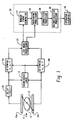
- a gamma camera includes a pair of radiation sensitive detectors 10a, 10b mounted to a gantry.
- the detectors 10a, 10b are located in opposed positions about an examination region 11.
- the examination region 11 is sized to accept an object being imaged, for example a human patient 12.
- a patient support 13 supports the patient within the examination region.
- a drive selectively rotates the detectors 10a, 10b about the examination region 11 so as to permit acquisition of radiation data from a plurality of angular positions (p relative to the patient.
- the detectors 10a, 10b may be movable radially and/or tangentially with respect to the examination region 11, or movable to more than one angular position with respect to each other.
- Each detector 10a, 10b includes a NaI(Tl) scintillator crystal, an x, y array of photomultiplier tubes (PMTs), and processing electronics.
- Axial septa disposed between the scintillator crystal and the examination region limit the axial acceptance angle of gamma radiation which reaches the scintillator. Energy from gamma rays striking the scintillator crystal is converted to light which is detected by one or more PMTs, thereby signaling a detected event.
- Coincidence logic 14 determines whether events detected by both detectors 10a, lOb occurred simultaneously. More specifically, the coincidence logic determines whether both detectors detect a gamma ray within a coincidence time interval ⁇ , for example on the order of 15 nS. In coincidence imaging, events which are detected outside the coincidence time interval are ordinarily rejected and not processed further.
- a selectable delay circuit 20 delays the signals from one of the detectors by an amount longer than that of the coincidence time interval, for example, on the order of 1 ⁇ S.
- the delay circuit 20 is ordinarily disabled during the acquisition of coincidence data but may be selectively enabled as described more fully below.
- each detector 10a, 10b is energy and position determining circuitry 18a, 18b which determines the position x, y and energy E of the detected events.
- a list mode processor 22 generates a list of the detected events. Some of the events may be rejected prior to or after list mode processing based on the energy E of the gamma rays or other criteria as is known in the art.
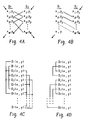
- the list contains a plurality of coincident gamma ray pairs and can be represented as follows: D i (x 1 , y 1 ); D j (x 1 , y 1 ) D i (x 2 , y 2 ); D j (x 2 y 2 ) D i (x 3 , y 3 ); D j (x 3 , y 3 ) . . . D i (x N , y N ); D j (x N , y N ) where D x identifies the detector 10a, 10b, and x, y are the coordinates of the gamma ray.
- additional or different data may be included in the list or in associated headers and used in further processing.
- the output of the list mode processor 22 is preferably stored in a memory for further processing at a convenient time, for example, after data acquisition for a particular patient has been completed.
- a rebinning processor 24 sorts coincident gamma ray pairs based on the x, y locations of the detected gamma rays and angular position ⁇ of the detectors 10 to generate sinograms.
- a point such as the centre 27 of the imaging region is defined.
- the transverse coordinates x 1 , x 2 are used to calculate a transverse coordinate X relation to the centre 27 and transverse angle ⁇ in relation to a defined stationary coordinate system. While other rebinning techniques may be employed, the foregoing facilitates the generation of conventional sinograms.
- the gamma ray pairs are preferably rebinned in the axial direction using a single slice rebinning technique, although other axial rebinning techniques may be employed.
- a random event generator 21 generates non-coincident gamma ray pairs based on the acquired radiation data.
- the non-coincident pairs are rebinned by the rebinning processor 24 in a manner analogous to that described above for the coincident gamma ray pairs.
- a randoms correction processor 28 accepts the rebinned coincident ray pairs and non-coincident gamma ray pairs and generates randoms corrected data.
- a reconstruction processor 32 processes the corrected data using techniques such as filtered back projection or iterative reconstruction to generate images indicative of the detected events. For example, a plurality of axial tomographic image slices may be generated. Other techniques such as focal plane imaging may also be employed.
- An operator interface 34 such as a monitor or printer is used to display the images in human readable form.
- a suitable gamma camera having two detectors 10a, 10b is an AxisTM with ⁇ PETTM option gamma camera available from Marconi Medical Systems International, Inc. of Highland Heights, Ohio.
- a suitable imaging computer is the OdysseyTM FX computer also available from Marconi Medical Systems International, Inc.
- coincident gamma ray pairs are acquired for time period T with the delay circuit 20 disabled to acquire a total of N coincident pairs.
- the acquired data includes gamma ray pairs indicative of positron annihilation events as well as random gamma ray pairs.
- List mode data indicative of the acquired coincident gamma ray pairs is generated, and the randoms rate R is determined. This process is repeated with the detectors 10 located at a plurality of angular positions ⁇ .
- the generated list mode data is preferably stored until scanning of the patient is completed.
- the list mode data is rebinned for further processing.
- Non-coincident gamma ray pairs are generated, rebinned, and rescaled (if necessary) so that T*R non-coincident pairs are created.
- the rebinned non-coincident gamma ray pairs are subtracted from the rebinned gamma ray pairs to correct for randoms in the acquired coincident data.
- the resultant corrected data is used to reconstruct an image.
- the delay circuit 20 is unnecessary and need not be included in the system when operating in list mode.
- the randoms rate R and/or the singles rate S x may be determined by the gamma camera and passed on to the imaging computer in a header or otherwise as part of the list mode data.
- randoms data may be generated based on the coincident gamma ray pairs acquired during data acquisition.
- the gamma rays in the list of coincident gamma ray pairs may be paired with gamma rays from other gamma ray pairs in the list.
- each of a plurality of gamma rays detected by detector D i is paired with a plurality of gamma rays detected by detector D j . All possible pairings, with the exception of gamma rays within each coincident pair (which are likely to represent trues), are generated. This technique yields approximately N 2 -N random events. Alternately, each of the plurality of gamma rays detected by detector D i may be paired with a plurality, but less than all, of the gamma rays detected by detector D j .
- FIG. 4B Another technique for generating randoms data based on the acquired coincidence data is shown in Figure 4B.
- Each of a plurality of gamma rays detected by detector D i is paired with a gamma ray detected by detector D j .
- Figure 4B shows each gamma ray paired with one gamma ray from the next coincident pair in the list (i.e. an offset of 1)
- other offsets may be used to increase the temporal offset between the individual events which make up the pair. For example, an offset of approximately 10 yields a temporal offset on the order of several microseconds, depending on the coincidence count rate of the gamma camera and the activity of the source. This technique yields N random combinations.
- the events may be paired based on a random or other algorithm.
- Each of the non-coincident gamma ray pairs is characterized by a LOR analogous to that of the coincident gamma ray pairs.
- the non-coincident pairs are rebinned as described above for the acquired coincidence events.
- the generated randoms are rescaled so that the total number of randoms is equal to T*R, and the rescaled random data is used to correct the acquired coincident mode data.
- an appropriate rescaling factor is T*R N 2 - N
- an appropriate rescaling factor is T*R N
- Randoms data may also be generated based on acquired single gamma rays.
- coincident gamma ray pairs are acquired for period N and a list of the coincident pairs is generated.
- Single gamma rays are likewise acquired and a list of the singles is generated.
- acquisition of singles data is may be interleaved with acquisition of the coincidence data.
- the coincidence logic circuitry is disabled and singles data is collected until 2*T*R events (or another desired number) have been acquired. If the gamma camera system is capable of detecting singles data during the coincidence acquisition, the coincidence circuitry need not be disabled and the singles data may be collected concurrently with the collection of the coincidence data. Poisson noise can be reduced by acquiring a larger number of singles. Because the singles data is acquired relatively quickly, a suitable data set may also be collected by acquiring singles over a relatively short fixed time period, for example on the order of one second. The detectors are rotated to the next angular position, and the process repeated until data has been acquired at each of the desired angular positions.
- non-coincident gamma ray pairs are generated by pairing non-coincident events, rebinning and (if necessary) rescaling.
- the non-coincident pairs are subtracted from the coincident pairs and used to reconstruct an image.
- the list mode singles data may be visualized as follows: D i (x, y), ⁇ D j (x, y), ⁇ D j (x, y), ⁇ D i (x, y), ⁇ D i (x, y), ⁇ D j (x, y), ⁇ . . . D j (x, y), ⁇ D i (x, y), ⁇
- the acquired singles data may be used to generate randoms data in a manner analogous to that described in connection with Figure 4A above.
- Each of a plurality of singles detected by detector D i is paired with a plurality of singles detected by detector D j . All possible pairings, with the exception of those based on singles which were detected in temporal proximity (and are therefore likely to represent true coincidence events) are generated. Assuming that each detector receives an equal number of events, this technique yields somewhat less than N 2 - N 2 random events, where N is the number of detected singles.
- each of a plurality of the gamma rays detected by D i may be paired with a plurality, but less than all, of the non-coincident gamma rays detected by detector D j .
- the acquired singles data may be used to generate randoms data in a manner analogous to that described in connection with Figure 4B above.
- Each of a plurality of single gamma rays detected by detector D i is paired with a single detected by detector D j .
- Figure 4 again with a temporal offset to avoid generating trues. While the offset is shown as being one for ease of illustration, other offsets can be used. This technique yields N/2 random combinations.
- the events may be paired based on a random or other algorithm.
- the generated randoms data contains a plurality of paired events.
- Each paired event is characterized by a LOR analogous to that of the acquired coincidence events. Accordingly, these events are rebinned in a manner analogous to that described above for the acquired coincidence events. While other rebinning techniques may be employed, the foregoing facilitates the generation of conventional sinograms.
- the non-coincident pairs are used to correct the coincident pairs.
- the rebinned non-coincident pairs are subtracted from the rebinned coincidence pair sinogram prior to image reconstruction.
- separate coincidence and generated randoms images may be generated, and the randoms images subtracted from the coincidence image to generate a randoms free image.
- the randoms rate R may be estimated for each pair of detectors ( e.g. , D 1 D 2 , D 2 D 3 , D 1 D 3 ) by selectively applying a delay line to two of the three detectors in sequence and counting the coincidence rate with respect to the undelayed detectors.
- Random events are likewise generated in a manner analogous to that described above for a two detector system, except that randoms data is generated for each combination of detectors (e.g., D 1 D 2 , D 1 D 3 , D 2 D 3 ).
- the technique is also not limited to systems operating in the list mode and may be implemented where data is rebinned using the so-called "on the fly” method.
- the coincidence data is acquired and rebinned in the normal fashion.
- the non-coincident pairs may be generated by temporarily storing events from one of the detectors 10 and pairing each stored event with a subsequent event from another of the detectors 10.
- the m th event detected by detector D i may be paired with the (m+n) th event detected by detector D j , where n is a desired temporal offset.
- the generated events are rebinned as described above on an on the fly basis in a separate sinogram which is rescaled (if necessary) and subtracted from the coincidence data subtracted from (rather than added to) the coincidence data to generated a corrected data set.
Landscapes
- Physics & Mathematics (AREA)
- Health & Medical Sciences (AREA)
- Life Sciences & Earth Sciences (AREA)
- General Physics & Mathematics (AREA)
- High Energy & Nuclear Physics (AREA)
- Molecular Biology (AREA)
- Spectroscopy & Molecular Physics (AREA)
- Nuclear Medicine (AREA)
- Image Processing (AREA)
- Measurement Of Radiation (AREA)
- Medicines Containing Antibodies Or Antigens For Use As Internal Diagnostic Agents (AREA)
Abstract
Description
Claims (16)
- A method of randoms-corrected imaging comprising: detecting coincident gamma ray pairs, said pairs including positron annihilation gamma ray pairs and random gamma ray pairs; generating non-coincident gamma ray pairs; using the coincident gamma ray pairs and the non-coincident gamma ray pairs to generate a randoms corrected image.
- A method as claimed in claim 1, wherein the step of generating non-coincident gamma ray pairs includes detecting a plurality of single gamma rays; and pairing each of a plurality of the single gamma rays with a non-coincident single gamma ray.
- A method as claimed in claim 2, including detecting coincident gamma ray pairs for a time period T; establishing a randoms rate R; detecting at least 2*T*R single gamma rays.
- A method as claimed in claim 3, including pairing each of a plurality of the gamma rays with a plurality of non-coincident gamma rays.
- A method as claimed in any one of claims 1 to 4, including detecting coincident gamma ray pairs for time period T; determining a randoms rate R; rescaling the non-coincident gamma ray pairs to generate T*R pairs.
- A method as claimed in claim 5, including rebinning the coincident gamma ray pairs; combining the rebinned non-coincident event pairs with the rebinned coincident gamma ray pairs to generate randoms corrected data; generating an image from the randoms corrected data.
- A method as claimed in any one of claims 1 to 6, wherein the step of detecting includes using first, second and third detectors to detect the coincident gamma ray pairs and including establishing a randoms rate for the first and third detectors, a randoms rate for the first and second detectors, and a randoms rate for the second and third detectors.
- A method as claimed in claim 1, wherein the step of generating the non-coincident gamma ray pairs includes re-pairing gamma rays from the coincident gamma ray pairs to generate non-coincident gamma ray pairs.
- A method as claimed in claim 8, including pairing each of a plurality of gamma rays with a non-coincident gamma ray.
- A method as claimed in claim 9, including pairing each of a plurality of gamma rays with a plurality of non-coincident gamma rays.
- A method as claimed in any one of claims 8 to 10, including rebinning the non-coincident gamma ray pairs; rescaling the rebinned non-coincident gamma ray pairs.
- A method as claimed in claim 11, including rebinning the coincident gamma ray pairs; combining the rebinned coincident gamma ray pairs and the rebinned non-coincident event pairs to generate randoms corrected data; generating an image from the randoms corrected data.
- A method as claimed in any one of claims 8 to 12, including generating a list of the coincident gamma ray pairs and including re-pairing gamma rays from the list of coincident gamma ray pairs to generate non-coincident event pairs.
- Apparatus comprising: means (10a, 10b, 14) for detecting coincident gamma ray pairs, said pairs including detected positron annihilation gamma ray pairs and detected gamma ray pairs; means (21) for generating non-coincident gamma ray pairs; means (24, 28, 32) for generating a randoms corrected image based on the coincident gamma ray pairs and the non-coincident gamma ray pairs.
- Apparatus as claimed in claim 14, including means for detecting a plurality of single gamma rays; means for pairing the single gamma rays to generate a plurality of non-coincident gamma ray pairs.
- Apparatus as claimed in claim 14, including means (22) for generating a list of the detected gamma ray pairs; means (21) for re-pairing gamma ray pairs from the list of coincident gamma ray pairs so as to generate non-coincident gamma ray pairs.
Applications Claiming Priority (2)
| Application Number | Priority Date | Filing Date | Title |
|---|---|---|---|
| US377009 | 1999-08-18 | ||
| US09/377,009 US6294788B1 (en) | 1999-08-18 | 1999-08-18 | Randoms correction in positron imaging |
Publications (3)
| Publication Number | Publication Date |
|---|---|
| EP1077383A2 true EP1077383A2 (en) | 2001-02-21 |
| EP1077383A3 EP1077383A3 (en) | 2002-01-02 |
| EP1077383B1 EP1077383B1 (en) | 2008-01-16 |
Family
ID=23487397
Family Applications (1)
| Application Number | Title | Priority Date | Filing Date |
|---|---|---|---|
| EP00307041A Expired - Lifetime EP1077383B1 (en) | 1999-08-18 | 2000-08-17 | Positron imaging |
Country Status (5)
| Country | Link |
|---|---|
| US (1) | US6294788B1 (en) |
| EP (1) | EP1077383B1 (en) |
| JP (1) | JP2001356172A (en) |
| AT (1) | ATE384272T1 (en) |
| DE (1) | DE60037779T2 (en) |
Cited By (3)
| Publication number | Priority date | Publication date | Assignee | Title |
|---|---|---|---|---|
| DE102006024243B3 (en) * | 2006-05-23 | 2007-11-22 | Siemens Ag | Radiation dose controlling method for use in e.g. positron emission tomography, involves continuously detecting counting rate of X-ray quanta, and determining applied radiation dose during time intervals from process of counting rate |
| EP2163201A1 (en) * | 2008-09-15 | 2010-03-17 | Westfälische Wilhelms-Universität Münster | List mode-based respiratory and cardiac gating in positron emission tomography |
| EP1802999A4 (en) * | 2004-10-22 | 2011-01-19 | Photodetection Systems Inc | Diversity processing of coincidence data |
Families Citing this family (13)
| Publication number | Priority date | Publication date | Assignee | Title |
|---|---|---|---|---|
| US6727502B1 (en) * | 2001-06-27 | 2004-04-27 | Koninklijke Philips Electronics, N.V. | Calibration technique for coincidence imaging systems |
| CN100498376C (en) * | 2003-11-11 | 2009-06-10 | 皇家飞利浦电子股份有限公司 | Device and method for determining the concentration of a tracer in blood |
| JP2005257335A (en) * | 2004-03-09 | 2005-09-22 | Sumitomo Heavy Ind Ltd | Pet diagnostic system, detector, data processor, and pet diagnostic program for user terminal |
| EP1733253A2 (en) * | 2004-03-19 | 2006-12-20 | Triumf, operating as a joint venture by the Governors of the Universities of Alberta, | A method and apparatus for vetoing random coincidences in positron emission tomographs |
| CN101080652B (en) * | 2004-12-17 | 2011-06-29 | 皇家飞利浦电子股份有限公司 | Gantry system |
| JP2008539414A (en) * | 2005-04-27 | 2008-11-13 | コーニンクレッカ フィリップス エレクトロニクス エヌ ヴィ | Temporal sampling of ECG gates in the modeling of cardiac dynamics |
| US7381959B2 (en) * | 2005-08-17 | 2008-06-03 | General Electric Company | Technique for reconstructing PET scan images |
| CN101479626B (en) * | 2006-08-08 | 2012-02-29 | 株式会社岛津制作所 | Positron CT device |
| US9291725B2 (en) * | 2012-05-16 | 2016-03-22 | Kabushiki Kaisha Toshiba | Random coincidence reduction in positron emission tomography using tangential time-of-flight mask |
| CN103417235B (en) * | 2013-07-31 | 2015-09-30 | 沈阳东软医疗系统有限公司 | A kind of bearing calibration of random noise and device |
| CN103559391B (en) * | 2013-10-23 | 2016-10-05 | 沈阳东软医疗系统有限公司 | Judge random coincidence event and judge the method and device of true coincidence event |
| CN105814454B (en) * | 2013-12-04 | 2019-11-05 | 皇家飞利浦有限公司 | For rebuilding the reconstructing device of PET image |
| US20250139851A1 (en) * | 2023-10-26 | 2025-05-01 | Shanghai United Imaging Healthcare Co., Ltd. | Pet imaging method, device, storage medium, and program product |
Family Cites Families (18)
| Publication number | Priority date | Publication date | Assignee | Title |
|---|---|---|---|---|
| US4181855A (en) * | 1978-01-30 | 1980-01-01 | Beckman Instruments, Inc. | Method and apparatus for determining random coincidence count rate in a scintillation counter utilizing the coincidence technique |
| JPS57131087A (en) * | 1981-02-05 | 1982-08-13 | Agency Of Ind Science & Technol | Simultaneous counter in positron ct system |
| JPH0210185A (en) * | 1988-06-29 | 1990-01-12 | Hitachi Medical Corp | Simultaneous counting circuit for position ct device |
| JP2811718B2 (en) * | 1989-02-28 | 1998-10-15 | 株式会社島津製作所 | Positron CT system |
| JPH0627822B2 (en) * | 1990-12-18 | 1994-04-13 | 浜松ホトニクス株式会社 | Simultaneous counting device |
| JPH06342075A (en) * | 1993-05-31 | 1994-12-13 | Shimadzu Corp | Positron CT system |
| JP2535762B2 (en) * | 1993-10-14 | 1996-09-18 | 東北大学長 | Simultaneous Scattering Counting Method with Gamma Absorber in Positron Tomography Equipment and Positron Tomography Equipment |
| JPH07318654A (en) * | 1994-05-26 | 1995-12-08 | Hitachi Medical Corp | Positron CT system |
| US5608221A (en) * | 1995-06-09 | 1997-03-04 | Adac Laboratories | Multi-head nuclear medicine camera for dual SPECT and PET imaging with monuniform attenuation correction |
| FR2753279B1 (en) * | 1996-09-09 | 1998-11-13 | Smv Int | PROCESS FOR TREATING PULSES DELIVERED BY A GAMMA CAMERA AND GAMMA CAMERA IMPLEMENTING THIS METHOD |
| US5969358A (en) * | 1996-11-26 | 1999-10-19 | Picker International, Inc. | Whole body scan coincidence imaging |
| US5793045A (en) | 1997-02-21 | 1998-08-11 | Picker International, Inc. | Nuclear imaging using variable weighting |
| US5834779A (en) | 1997-05-30 | 1998-11-10 | Adac Laboratories | Method and apparatus for performing correction for random coincidences in a medical imaging system |
| US6008493A (en) * | 1997-05-30 | 1999-12-28 | Adac Laboratories | Method and apparatus for performing correction of emission contamination and deadtime loss in a medical imaging system |
| US5900636A (en) * | 1997-05-30 | 1999-05-04 | Adac Laboratories | Dual-mode gamma camera system utilizing single-photon transmission scanning for attenuation correction of PET data |
| IL122357A0 (en) * | 1997-11-27 | 1998-04-05 | Elgems Ltd | Calibration of pet cameras |
| US5998793A (en) * | 1998-04-17 | 1999-12-07 | Adac Laboratories | Method and apparatus for correcting for random coincidences in a nuclear medicine imaging system |
| US6198104B1 (en) * | 1998-10-23 | 2001-03-06 | Adac Laboratories | Randoms correction using artificial trigger pulses in a gamma camera system |
-
1999
- 1999-08-18 US US09/377,009 patent/US6294788B1/en not_active Expired - Lifetime
-
2000
- 2000-08-17 AT AT00307041T patent/ATE384272T1/en not_active IP Right Cessation
- 2000-08-17 EP EP00307041A patent/EP1077383B1/en not_active Expired - Lifetime
- 2000-08-17 DE DE60037779T patent/DE60037779T2/en not_active Expired - Lifetime
- 2000-08-18 JP JP2000289575A patent/JP2001356172A/en active Pending
Cited By (5)
| Publication number | Priority date | Publication date | Assignee | Title |
|---|---|---|---|---|
| EP1802999A4 (en) * | 2004-10-22 | 2011-01-19 | Photodetection Systems Inc | Diversity processing of coincidence data |
| DE102006024243B3 (en) * | 2006-05-23 | 2007-11-22 | Siemens Ag | Radiation dose controlling method for use in e.g. positron emission tomography, involves continuously detecting counting rate of X-ray quanta, and determining applied radiation dose during time intervals from process of counting rate |
| US7807987B2 (en) | 2006-05-23 | 2010-10-05 | Siemens Aktiengesellschaft | Device and method for locally resolved control of a radiation dose |
| EP2163201A1 (en) * | 2008-09-15 | 2010-03-17 | Westfälische Wilhelms-Universität Münster | List mode-based respiratory and cardiac gating in positron emission tomography |
| WO2010029182A3 (en) * | 2008-09-15 | 2010-11-11 | Universität Münster | List mode-based respiratory and cardiac gating in positron emission tomography |
Also Published As
| Publication number | Publication date |
|---|---|
| EP1077383A3 (en) | 2002-01-02 |
| DE60037779D1 (en) | 2008-03-06 |
| ATE384272T1 (en) | 2008-02-15 |
| US6294788B1 (en) | 2001-09-25 |
| DE60037779T2 (en) | 2009-01-08 |
| JP2001356172A (en) | 2001-12-26 |
| EP1077383B1 (en) | 2008-01-16 |
Similar Documents
| Publication | Publication Date | Title |
|---|---|---|
| JP5220617B2 (en) | Random reduction via TOFFOV | |
| EP2748641B1 (en) | Data-driven optimization of event acceptance/rejection logic | |
| EP1077383B1 (en) | Positron imaging | |
| EP0863410B1 (en) | Nuclear imaging method | |
| US7381959B2 (en) | Technique for reconstructing PET scan images | |
| US5923038A (en) | Partial angle tomography scanning and reconstruction | |
| US7402807B2 (en) | Method for reducing an electronic time coincidence window in positron emission tomography | |
| EP0172929A1 (en) | Three dimensional time-of-flight positron emission camera system | |
| US8625868B2 (en) | Radiation diagnostic apparatus and image reconstructing method | |
| Patton et al. | Coincidence imaging with a dual-head scintillation camera | |
| US5532489A (en) | Positron imaging apparatus | |
| US7138634B2 (en) | Nuclear medical diagnostic apparatus | |
| WO2012069960A2 (en) | Pet calibrations with varying coincidence windows | |
| US5998792A (en) | Positron emission tomography with variable detector geometry | |
| CN111568452A (en) | PET system state detection method, PET system state detection device, computer equipment and storage medium | |
| US7329873B2 (en) | Coincidence counting method of γ ray and nuclear medicine diagnostic apparatus | |
| Jha et al. | Performance characteristic evaluation of a bismuth germanate-based high-sensitivity 5-ring discovery image quality positron emission tomography/computed tomography system as per National Electrical Manufacturers Association NU 2-2012 | |
| KR101595929B1 (en) | Interaction positioning method for Positron Emission Tomography and system using the same | |
| Yamada et al. | Development of a small animal PET scanner using DOI detectors | |
| US5424946A (en) | Adaptive angular transmission filter for pet scanner | |
| Saha | Data Acquisition and Corrections | |
| GB2164230A (en) | Three-dimensional time-of-flight positron emission camera system | |
| WO2025089176A1 (en) | Image acquisition device and image acquisition method | |
| CN119790323A (en) | Image acquisition device and image acquisition method |
Legal Events
| Date | Code | Title | Description |
|---|---|---|---|
| PUAI | Public reference made under article 153(3) epc to a published international application that has entered the european phase |
Free format text: ORIGINAL CODE: 0009012 |
|
| AK | Designated contracting states |
Kind code of ref document: A2 Designated state(s): AT BE CH CY DE DK ES FI FR GB GR IE IT LI LU MC NL PT SE |
|
| AX | Request for extension of the european patent |
Free format text: AL;LT;LV;MK;RO;SI |
|
| PUAL | Search report despatched |
Free format text: ORIGINAL CODE: 0009013 |
|
| RIC1 | Information provided on ipc code assigned before grant |
Free format text: 7G 01T 1/29 A, 7G 01T 1/164 B |
|
| AK | Designated contracting states |
Kind code of ref document: A3 Designated state(s): AT BE CH CY DE DK ES FI FR GB GR IE IT LI LU MC NL PT SE |
|
| AX | Request for extension of the european patent |
Free format text: AL;LT;LV;MK;RO;SI |
|
| 17P | Request for examination filed |
Effective date: 20020702 |
|
| AKX | Designation fees paid |
Free format text: AT BE CH CY DE DK ES FI FR GB GR IE IT LI LU MC NL PT SE |
|
| RAP1 | Party data changed (applicant data changed or rights of an application transferred) |
Owner name: PHILIPS MEDICAL SYSTEMS (CLEVELAND), INC. |
|
| RAP1 | Party data changed (applicant data changed or rights of an application transferred) |
Owner name: KONINKLIJKE PHILIPS ELECTRONICS N.V. |
|
| 17Q | First examination report despatched |
Effective date: 20040602 |
|
| GRAP | Despatch of communication of intention to grant a patent |
Free format text: ORIGINAL CODE: EPIDOSNIGR1 |
|
| GRAS | Grant fee paid |
Free format text: ORIGINAL CODE: EPIDOSNIGR3 |
|
| GRAA | (expected) grant |
Free format text: ORIGINAL CODE: 0009210 |
|
| AK | Designated contracting states |
Kind code of ref document: B1 Designated state(s): AT BE CH CY DE DK ES FI FR GB GR IE IT LI LU MC NL PT SE |
|
| REG | Reference to a national code |
Ref country code: GB Ref legal event code: FG4D |
|
| REG | Reference to a national code |
Ref country code: CH Ref legal event code: EP |
|
| REG | Reference to a national code |
Ref country code: IE Ref legal event code: FG4D |
|
| REF | Corresponds to: |
Ref document number: 60037779 Country of ref document: DE Date of ref document: 20080306 Kind code of ref document: P |
|
| PG25 | Lapsed in a contracting state [announced via postgrant information from national office to epo] |
Ref country code: NL Free format text: LAPSE BECAUSE OF FAILURE TO SUBMIT A TRANSLATION OF THE DESCRIPTION OR TO PAY THE FEE WITHIN THE PRESCRIBED TIME-LIMIT Effective date: 20080116 |
|
| NLV1 | Nl: lapsed or annulled due to failure to fulfill the requirements of art. 29p and 29m of the patents act | ||
| PG25 | Lapsed in a contracting state [announced via postgrant information from national office to epo] |
Ref country code: LI Free format text: LAPSE BECAUSE OF FAILURE TO SUBMIT A TRANSLATION OF THE DESCRIPTION OR TO PAY THE FEE WITHIN THE PRESCRIBED TIME-LIMIT Effective date: 20080116 Ref country code: FI Free format text: LAPSE BECAUSE OF FAILURE TO SUBMIT A TRANSLATION OF THE DESCRIPTION OR TO PAY THE FEE WITHIN THE PRESCRIBED TIME-LIMIT Effective date: 20080116 Ref country code: ES Free format text: LAPSE BECAUSE OF FAILURE TO SUBMIT A TRANSLATION OF THE DESCRIPTION OR TO PAY THE FEE WITHIN THE PRESCRIBED TIME-LIMIT Effective date: 20080427 Ref country code: CH Free format text: LAPSE BECAUSE OF FAILURE TO SUBMIT A TRANSLATION OF THE DESCRIPTION OR TO PAY THE FEE WITHIN THE PRESCRIBED TIME-LIMIT Effective date: 20080116 |
|
| REG | Reference to a national code |
Ref country code: CH Ref legal event code: PL |
|
| PG25 | Lapsed in a contracting state [announced via postgrant information from national office to epo] |
Ref country code: AT Free format text: LAPSE BECAUSE OF FAILURE TO SUBMIT A TRANSLATION OF THE DESCRIPTION OR TO PAY THE FEE WITHIN THE PRESCRIBED TIME-LIMIT Effective date: 20080116 |
|
| ET | Fr: translation filed | ||
| PG25 | Lapsed in a contracting state [announced via postgrant information from national office to epo] |
Ref country code: PT Free format text: LAPSE BECAUSE OF FAILURE TO SUBMIT A TRANSLATION OF THE DESCRIPTION OR TO PAY THE FEE WITHIN THE PRESCRIBED TIME-LIMIT Effective date: 20080616 Ref country code: BE Free format text: LAPSE BECAUSE OF FAILURE TO SUBMIT A TRANSLATION OF THE DESCRIPTION OR TO PAY THE FEE WITHIN THE PRESCRIBED TIME-LIMIT Effective date: 20080116 |
|
| PG25 | Lapsed in a contracting state [announced via postgrant information from national office to epo] |
Ref country code: SE Free format text: LAPSE BECAUSE OF FAILURE TO SUBMIT A TRANSLATION OF THE DESCRIPTION OR TO PAY THE FEE WITHIN THE PRESCRIBED TIME-LIMIT Effective date: 20080416 Ref country code: DK Free format text: LAPSE BECAUSE OF FAILURE TO SUBMIT A TRANSLATION OF THE DESCRIPTION OR TO PAY THE FEE WITHIN THE PRESCRIBED TIME-LIMIT Effective date: 20080116 |
|
| PLBE | No opposition filed within time limit |
Free format text: ORIGINAL CODE: 0009261 |
|
| STAA | Information on the status of an ep patent application or granted ep patent |
Free format text: STATUS: NO OPPOSITION FILED WITHIN TIME LIMIT |
|
| 26N | No opposition filed |
Effective date: 20081017 |
|
| PG25 | Lapsed in a contracting state [announced via postgrant information from national office to epo] |
Ref country code: MC Free format text: LAPSE BECAUSE OF NON-PAYMENT OF DUE FEES Effective date: 20080831 |
|
| GBPC | Gb: european patent ceased through non-payment of renewal fee |
Effective date: 20080817 |
|
| PG25 | Lapsed in a contracting state [announced via postgrant information from national office to epo] |
Ref country code: IE Free format text: LAPSE BECAUSE OF NON-PAYMENT OF DUE FEES Effective date: 20080818 Ref country code: CY Free format text: LAPSE BECAUSE OF FAILURE TO SUBMIT A TRANSLATION OF THE DESCRIPTION OR TO PAY THE FEE WITHIN THE PRESCRIBED TIME-LIMIT Effective date: 20080116 |
|
| PG25 | Lapsed in a contracting state [announced via postgrant information from national office to epo] |
Ref country code: IT Free format text: LAPSE BECAUSE OF FAILURE TO SUBMIT A TRANSLATION OF THE DESCRIPTION OR TO PAY THE FEE WITHIN THE PRESCRIBED TIME-LIMIT Effective date: 20080116 |
|
| PG25 | Lapsed in a contracting state [announced via postgrant information from national office to epo] |
Ref country code: GB Free format text: LAPSE BECAUSE OF NON-PAYMENT OF DUE FEES Effective date: 20080817 |
|
| PG25 | Lapsed in a contracting state [announced via postgrant information from national office to epo] |
Ref country code: LU Free format text: LAPSE BECAUSE OF NON-PAYMENT OF DUE FEES Effective date: 20080817 |
|
| PG25 | Lapsed in a contracting state [announced via postgrant information from national office to epo] |
Ref country code: GR Free format text: LAPSE BECAUSE OF FAILURE TO SUBMIT A TRANSLATION OF THE DESCRIPTION OR TO PAY THE FEE WITHIN THE PRESCRIBED TIME-LIMIT Effective date: 20080417 |
|
| REG | Reference to a national code |
Ref country code: DE Ref legal event code: R082 Ref document number: 60037779 Country of ref document: DE Representative=s name: VOLMER, GEORG, DIPL.-ING., DE |
|
| REG | Reference to a national code |
Ref country code: DE Ref legal event code: R082 Ref document number: 60037779 Country of ref document: DE Representative=s name: VOLMER, GEORG, DIPL.-ING., DE Effective date: 20140328 Ref country code: DE Ref legal event code: R081 Ref document number: 60037779 Country of ref document: DE Owner name: KONINKLIJKE PHILIPS N.V., NL Free format text: FORMER OWNER: KONINKLIJKE PHILIPS ELECTRONICS N.V., EINDHOVEN, NL Effective date: 20140328 Ref country code: DE Ref legal event code: R082 Ref document number: 60037779 Country of ref document: DE Representative=s name: MEISSNER, BOLTE & PARTNER GBR, DE Effective date: 20140328 Ref country code: DE Ref legal event code: R082 Ref document number: 60037779 Country of ref document: DE Representative=s name: MEISSNER BOLTE PATENTANWAELTE RECHTSANWAELTE P, DE Effective date: 20140328 |
|
| REG | Reference to a national code |
Ref country code: FR Ref legal event code: CA Effective date: 20141126 Ref country code: FR Ref legal event code: CD Owner name: KONINKLIJKE PHILIPS N.V., NL Effective date: 20141126 |
|
| REG | Reference to a national code |
Ref country code: FR Ref legal event code: PLFP Year of fee payment: 16 |
|
| PGFP | Annual fee paid to national office [announced via postgrant information from national office to epo] |
Ref country code: FR Payment date: 20150831 Year of fee payment: 16 |
|
| REG | Reference to a national code |
Ref country code: DE Ref legal event code: R082 Ref document number: 60037779 Country of ref document: DE Representative=s name: MEISSNER, BOLTE & PARTNER GBR, DE Ref country code: DE Ref legal event code: R082 Ref document number: 60037779 Country of ref document: DE Representative=s name: MEISSNER BOLTE PATENTANWAELTE RECHTSANWAELTE P, DE |
|
| REG | Reference to a national code |
Ref country code: FR Ref legal event code: ST Effective date: 20170428 |
|
| PG25 | Lapsed in a contracting state [announced via postgrant information from national office to epo] |
Ref country code: FR Free format text: LAPSE BECAUSE OF NON-PAYMENT OF DUE FEES Effective date: 20160831 |
|
| PGFP | Annual fee paid to national office [announced via postgrant information from national office to epo] |
Ref country code: DE Payment date: 20181031 Year of fee payment: 19 |
|
| REG | Reference to a national code |
Ref country code: DE Ref legal event code: R119 Ref document number: 60037779 Country of ref document: DE |
|
| PG25 | Lapsed in a contracting state [announced via postgrant information from national office to epo] |
Ref country code: DE Free format text: LAPSE BECAUSE OF NON-PAYMENT OF DUE FEES Effective date: 20200303 |