EP1077240A1 - Aqueous dispersion for chemical mechanical polishing - Google Patents
Aqueous dispersion for chemical mechanical polishing Download PDFInfo
- Publication number
- EP1077240A1 EP1077240A1 EP00117719A EP00117719A EP1077240A1 EP 1077240 A1 EP1077240 A1 EP 1077240A1 EP 00117719 A EP00117719 A EP 00117719A EP 00117719 A EP00117719 A EP 00117719A EP 1077240 A1 EP1077240 A1 EP 1077240A1
- Authority
- EP
- European Patent Office
- Prior art keywords
- aqueous dispersion
- polymer particles
- polymer
- polishing
- particles
- Prior art date
- Legal status (The legal status is an assumption and is not a legal conclusion. Google has not performed a legal analysis and makes no representation as to the accuracy of the status listed.)
- Granted
Links
Images
Classifications
-
- C—CHEMISTRY; METALLURGY
- C09—DYES; PAINTS; POLISHES; NATURAL RESINS; ADHESIVES; COMPOSITIONS NOT OTHERWISE PROVIDED FOR; APPLICATIONS OF MATERIALS NOT OTHERWISE PROVIDED FOR
- C09K—MATERIALS FOR MISCELLANEOUS APPLICATIONS, NOT PROVIDED FOR ELSEWHERE
- C09K3/00—Materials not provided for elsewhere
- C09K3/14—Anti-slip materials; Abrasives
-
- C—CHEMISTRY; METALLURGY
- C09—DYES; PAINTS; POLISHES; NATURAL RESINS; ADHESIVES; COMPOSITIONS NOT OTHERWISE PROVIDED FOR; APPLICATIONS OF MATERIALS NOT OTHERWISE PROVIDED FOR
- C09K—MATERIALS FOR MISCELLANEOUS APPLICATIONS, NOT PROVIDED FOR ELSEWHERE
- C09K3/00—Materials not provided for elsewhere
- C09K3/14—Anti-slip materials; Abrasives
- C09K3/1454—Abrasive powders, suspensions and pastes for polishing
- C09K3/1463—Aqueous liquid suspensions
-
- C—CHEMISTRY; METALLURGY
- C09—DYES; PAINTS; POLISHES; NATURAL RESINS; ADHESIVES; COMPOSITIONS NOT OTHERWISE PROVIDED FOR; APPLICATIONS OF MATERIALS NOT OTHERWISE PROVIDED FOR
- C09G—POLISHING COMPOSITIONS; SKI WAXES
- C09G1/00—Polishing compositions
- C09G1/02—Polishing compositions containing abrasives or grinding agents
-
- H—ELECTRICITY
- H10—SEMICONDUCTOR DEVICES; ELECTRIC SOLID-STATE DEVICES NOT OTHERWISE PROVIDED FOR
- H10P—GENERIC PROCESSES OR APPARATUS FOR THE MANUFACTURE OR TREATMENT OF DEVICES COVERED BY CLASS H10
- H10P52/00—Grinding, lapping or polishing of wafers, substrates or parts of devices
- H10P52/40—Chemomechanical polishing [CMP]
- H10P52/403—Chemomechanical polishing [CMP] of conductive or resistive materials
-
- Y—GENERAL TAGGING OF NEW TECHNOLOGICAL DEVELOPMENTS; GENERAL TAGGING OF CROSS-SECTIONAL TECHNOLOGIES SPANNING OVER SEVERAL SECTIONS OF THE IPC; TECHNICAL SUBJECTS COVERED BY FORMER USPC CROSS-REFERENCE ART COLLECTIONS [XRACs] AND DIGESTS
- Y10—TECHNICAL SUBJECTS COVERED BY FORMER USPC
- Y10S—TECHNICAL SUBJECTS COVERED BY FORMER USPC CROSS-REFERENCE ART COLLECTIONS [XRACs] AND DIGESTS
- Y10S134/00—Cleaning and liquid contact with solids
- Y10S134/902—Semiconductor wafer
Definitions
- the present invention relates to an aqueous dispersion composition for chemical mechanical polishing (hereunder referred to as "aqueous dispersion”) that is useful in the manufacture of semiconductor devices. More specifically, the invention relates to an aqueous dispersion prepared by dispersing in water polymer particles having functional groups that can react with the metals of polishing surfaces (particularly functional groups that can form cations), which is suitable for polishing of working films and the like in semiconductor devices.
- CMP chemical mechanical polishing
- the abrasive particles have high hardness and have therefore presented the problem of creating scratches and dishing on polishing wafer surfaces, thus lowering the reliability of the LSI.
- a particularly emphasized area of research is focused on control of scratches and the like in porous insulator films with low hardness that are currently being studied for use.
- Japanese Laid-open Patent Publication No. 270400 of 1998 describes a polishing material for manufacture of semiconductor devices that comprises an aqueous emulsion containing vinyl compound polymer particles obtainable by emulsion polymerization.
- 2,2-azobis(2-aminopropane) hydrochloride is mentioned as an example of the polymerization initiator for emulsion polymerization.
- This compound is only given as an example of a polymerization initiator, and there is no mention whatsoever regarding whether it has any other effects.
- 168431 of 1998 discloses a polishing slurry containing abrasive particles coated with a polyelectrolyte.
- the abrasive particles are inorganic particles.
- the polishing rate is reduced when the particles are totally covered with the polyelectrolyte.
- the object of the invention is to provide an aqueous dispersion that produces no scratches or the like on polishing surfaces, whether they are metal surfaces such as copper that have low hardness or porous insulator films of low hardness, and that provides both suitable etching rate and adequate polishing rate and is useful for polishing of working films and the like in semiconductor devices.
- the aqueous dispersion for CMP according to the first aspect of the invention is characterized by comprising polymer particles and water, wherein the polymer particles are composed of a polymer with a functional group in the molecule that can react with the metal of the polishing surface.
- react means to form a chemical bond such as a covalent bond, ionic bond or coordinated bond.
- metal of the polishing surface will differ depending on the purpose for which the aqueous dispersion of the invention is used, and it may be a pure metal, an alloy or a metal oxide, metal nitride or another metal compound.
- the type of “functional group” is not particularly restricted so long as it can react with the metal of the polishing surface, and for example, a functional group that can form a cation is preferred.
- the aqueous dispersion for CMP according to the second aspect of the invention is characterized by comprising polymer particles and water, wherein the polymer particles are composed of a polymer with a functional group in the molecule that can form a cation.
- can form a cation means that when used in the aqueous dispersion of the invention, at least a portion of the functional group is ionized to form a cation.
- the polymer may be one having a crosslinked structure.
- the aqueous dispersion of the invention may also be one containing a complexing agent, one containing a compound that can form a passivation film on polishing surfaces, or one that contains an oxidizing agent.
- the functional group may also be specified as at least one type from among amino, pyridyl and acrylamide groups.
- the polymer used is preferably one obtained using a polymerization initiator and/or monomer that allows introduction of the functional group into the molecule.
- the aqueous dispersion for CMP of the invention allows polishing at a sufficient rate, particularly when polishing semiconductor device working films and the like (for example, copper films and low permittivity insulator films), without creating scratches on the polishing surface.
- the mean particle size of the polymer particles in the aqueous dispersion of the invention is preferably 0.01-10 ⁇ m, more preferably 0.01-5 ⁇ m and even more preferably 0.01-3 ⁇ m. If the mean particle size of the polymer particles is less than 0.01 ⁇ m the polishing rate will be reduced. On the other hand, if the mean particle size is greater than 10 ⁇ m, the polymer particles precipitate more readily, making it difficult to obtain a stable aqueous dispersion. Their mean particle size may be measured by observation with a transmission electron microscope and the like.
- the polymer particles are made of a polymer "having a crosslinked structure" as according to Claim 3
- the polymer may be synthesized, for example, by copolymerization of a crosslinkable monomer and another monomer.
- crosslinkable monomer there may be used a compound having two or more copolymerizable double bonds in the molecule, for example, a divinyl compound of which divinylbenzene is representative, or a polyvalent acrylate compound of which ethyleneglycol diacrylate, ethyleneglycol dimethacrylate, trimethylolpropane triacrylate and trimethylolpropane trimethacrylate are representative.
- divinyl compound of which divinylbenzene is representative
- polyvalent acrylate compound of which ethyleneglycol diacrylate, ethyleneglycol dimethacrylate, trimethylolpropane triacrylate and trimethylolpropane trimethacrylate are representative.
- polyvalent acrylate compound there may be used any of the following ones in addition to those mentioned above.
- Trimethylolethane triacrylate Trimethylolethane triacrylate, tetramethylolmethane triacrylate.
- Diethyleneglycol dimethacrylate triethyleneglycol dimethacrylate, polyethyleneglycol dimethacrylate, 1,3-butyleneglycol dimethacrylate, 1,4-butyleneglycol dimethacrylate, 1,6-hexaneglycol dimethacrylate, neopentylglycol dimethacrylate, dipropyleneglycol dimethacrylate, polypropyleneglycol dimethacrylate, 2,2'-bis(4-methacryloxydiethoxyphenyl)propane.
- the “other monomer” to be copolymerized with the crosslinkable monomer there may be mentioned vinyl aromatic compounds such as styrene and ⁇ -methylstyrene; unsaturated carboxylic compounds such as acrylic acid and methacrylic acid; and unsaturated dicarboxylic acid anhydrides such as maleic anhydride.
- acrylic acid esters such as methyl acrylate, ethyl acrylate and 2-ethylhexyl acrylate
- methacrylic acid esters such as methyl methacrylate, ethyl methacrylate and 2-ethylhexyl methacrylate.
- the other monomer may be one type used alone, or a combination of two or more types.
- the copolymerization of the crosslinkable monomer with the other monomer may be accomplished by any of various methods including solution polymerization, emulsion polymerization and suspension polymerization.
- the polymerization temperature, polymerization time and other polymerization conditions may be appropriately selected depending on the type of monomers to be copolymerized and other factors such as the desired molecular weight.
- the reaction may also be carried out with addition of the crosslinkable monomer to the reaction system all at once from the start of copolymerization, or gradual addition to the polymerization system as polymerization progresses.
- the total monomer content of the crosslinkable monomer used for the copolymerization is preferably 5-80 wt% (hereunder abbreviated to "%"), more preferably 5-60% and even more preferably 7-60%.
- the polymer with a crosslinked structure may be one having the structure of a random copolymer, a graft copolymer or a block copolymer.
- the “complexing agent” according to Claim 4 may be a heterocyclic compound such as benzotriazole, tolyltriazole, thiourea, benzimidazole, benzofloxane, 2,1,3-benzothiadiazole, 2-mercaptobenzothiazole, 2-mercaptobenzothiadiazole, 2-mercaptobenzooxazole or melamine.
- benzotriazole tolyltriazole
- thiourea benzimidazole
- benzofloxane 2,1,3-benzothiadiazole
- 2-mercaptobenzothiazole 2-mercaptobenzothiadiazole
- 2-mercaptobenzooxazole or melamine 2-mercaptobenzooxazole or melamine.
- salicylaldoxime o-phenylenediamine, m-phenylenediamine, catechol and o-aminophenol may also be used.
- complexing agents may be used in an amount of, with respect to 100 parts by weight of the aqueous dispersion, 0.001-2 parts by weight (hereunder abbreviated to "part(s)”), preferably 0.01-1 part, and more preferably 0.02-0.5 part.
- the "compound that can form a passivation film on polishing surfaces" according to Claim 5 may be selected from the same ones mentioned for the complexing agent described in Claim 4.
- the "oxidizing agent" according to Claim 6 may be potassium persulfate, ammonium persulfate, hydrogen peroxide, nitric acid, sulfuric acid or the like, with potassium persulfate being particularly preferred.
- the oxidizing agent may be used in an amount of, with respect to 100 parts of the aqueous dispersion, 0.01-5 parts, preferably 0.1-4 parts and more preferably 0.3-3 parts.
- the functional group of the polymer composing the polymer particles of the invention (hereunder referred to as "polymer of the invention") is preferably an amino group, pyridyl group or acrylamide group as specified in Claim 7, with amino being particularly preferred among these.
- the functional group may also be a cationic group not mentioned in Claim 7.
- the polymer of the invention is preferably one synthesized using a specific polymerization initiator that allows introduction of the functional group into the molecule.
- polymerization initiators there may be mentioned 2,2'-azobis-(2-amidinopropane) dihydrochloride (for example, product name "V-50”), 2,2'-azobis-(2-aminopropane) dihydrochloride, azobisisobutyronitrile (for example, product name "V-60"), 1,1'-azobis-(cyclohexane-1-carbonitrile) (for example, product name "V-40"), 2,2'-azobis-(2,4-dimethylvaleronitrile), 2,2'-azobis-(4-methoxy-2,4-dimethylvaleronitrile) (for example, product name "V-70”), and the like. All of the polymerization initiators indicated above by product names are by Wako Junyaku Kogyo Co., Ltd.
- vinyl aromatic compounds such as styrene and ⁇ -methylstyrene
- unsaturated carboxylic compounds such as acrylic acid and methacrylic acid
- unsaturated dicarboxylic acid anhydrides such as maleic anhydride
- acrylic acid esters such as methyl acrylate, ethyl acrylate and 2-ethylhexyl acrylate
- methacrylic acid esters such as methyl methacrylate, ethyl methacrylate and 2-ethylhexyl methacrylate.
- the synthesis of the polymer using the polymerization initiator specified above may be carried out in the presence of other polymer particles as core particles.
- the core particles used may particles made of homopolymers or copolymers of the monomers mentioned above, and specific examples include polymer particles made of polystyrene, polymethyl methacrylate and the like.
- the amount of the specific polymerization initiator to be used may be 0.1-7 parts, preferably 0.5-4 parts and more preferably 0.5-3 parts, with respect to a total of 100 parts of the monomers used to synthesize the polymer and the polymer particles optionally used as core particles. If the specific polymerization initiator is used at less than 0.1 part, the polishing rate will not be adequately improved. On the other hand, an adequate effect is achieved if the polymerization initiator is used at 7 parts, and there is no need to use a greater amount.
- the polymer may also be synthesized using a specific monomer having a functional group as the polymerizing component or copolymerizing component. This will result in a polymer having the specific functional group introduced into the molecule.
- These specified monomers may be used alone or in combinations of two or more types. These specific monomers may also be used with any of the monomers mentioned as monomers to be used for synthesis of the polymer in the description of Claim 8.
- the polymerization initiator used may be potassium persulfate, ammonium persulfate, 2,2'-azobisisobutyronitrile, hydrogen peroxide or the like. There may also be used any of the polymerization initiators mentioned as the specific polymerization initiator to be used for synthesis of the polymer in the description of Claim 8.
- the amount of the polymerization initiator to be used may be 0.1-5 parts, preferably 0.5-4 parts and more preferably 1-3 parts, with respect to 100 parts the monomers used to synthesize the polymer.
- the synthesis of the polymer using the aforementioned specific monomer may be carried out in the presence of other polymer particles as core particles.
- the core particles used may particles made of homopolymers or copolymers of the various monomers mentioned in Claim 8, such as polystyrene, polymethyl methacrylate and the like.
- the amount of the specific monomer to be used may be 0.1-5 parts, preferably 0.5-4 parts and more preferably 1-3 parts, with respect to a total of 100 parts of the monomers used to synthesize the polymer and the polymer particles optionally used as core particles. If the amount of the specific monomer is less than 0.1 part the polishing rate will not be adequately improved. On the other hand, an adequate effect is achieved if the monomer is used at 5 parts, and there is no need to use a greater amount.
- the polymer according to Claim 8 or 9 may be produced by any of various common methods such as solution polymerization, emulsion polymerization and suspension polymerization.
- the polymerization temperature, polymerization time and other polymerization conditions may be appropriately selected depending on the type of monomers used and other factors such as the desired molecular weight.
- the method of preparing the polymer particles according to the invention there are no particular restrictions on the method of preparing the polymer particles according to the invention, but there may be mentioned a method in which the polymer is produced using an aqueous medium or organic solvent, and the resulting polymer is pulverized to make particles of the desired size. There may also be mentioned a method in which the monomer is finely dispersed in an aqueous medium or the like during production of the polymer, and polymer particles of the desired size are made therefrom.
- the simplest method for preparing the aqueous dispersion for CMP of the invention is a method in which an aqueous medium is used to produce polymer particles of the desired size, and the aqueous dispersion is used directly in that form. Alternatively, after being separated from the aqueous medium, the produced polymer particles may be redispersed in the medium. This method facilitates adjustment of the amount (concentration) of polymer particles in the aqueous dispersion for CMP. Even when the polymer is produced using an organic solvent, so long as the resulting polymer is in particle form, an aqueous dispersion can be easily prepared by removing the organic solvent by distillation or the like and replacing it with water or an aqueous medium.
- the "aqueous medium” may be water or a mixture of water and methanol or the like, but water alone is preferred.
- the amount of polymer particles in the aqueous dispersion for CMP is preferably 0.1-20 parts, more preferably 0.2-15 parts and even more preferably 0.3-10 parts, with respect to the aqueous dispersion as 100 parts.
- the polymer particles functioning as abrasive particles preferably have a spherical shape, where a spherical shape means having a roughly spherical shape with no acute angle sections, but it does not necessarily need to be nearly spherical. By using spherical polymer particles it is advantageous to achieve polishing at a sufficient rate while consistently reducing scratches in the polishing surface.
- inorganic particles made of a metal oxide such as silica, alumina, titania, zirconia, ceria, iron oxide or manganese oxide may be included so long as scratches and the like are still adequately inhibited.
- a metal oxide with oxidizing power such as iron oxide or manganese oxide is used as the inorganic particles, the metal oxide functions as an oxidizing agent. The amount of the oxidizing agent described in Claim 6 may therefore be reduced, or it may be rendered unnecessary.
- the polishing film to be polished by an aqueous dispersion for CMP according to the invention may be any of various working films formed on semiconductor wafers during the manufacturing process for semiconductor devices such as VLSIs, or barrier metal layers made of metals such as tantalum, titanium or the like and their oxides and nitrides.
- working films formed on semiconductor wafers there may be mentioned silicon oxide films, amorphous silicon films, polycrystalline silicon films, single-crystal silicon films, silicon nitride films, pure tungsten films, pure aluminum films or pure copper films, as well as alloy films of tungsten, aluminum or copper with another metals.
- the aqueous dispersion of the invention is particularly useful for polishing of pure copper films and other low hardness films, among the various types of working films.
- interlayer insulation films comprising silsesquioxane (permittivity: approximately 2.6-3.0), fluorine-containing SiO 2 (permittivity: approximately 3.3-3.5), polyimide-based resins (permittivity: approximately 2.4-3.6, trade name "PIQ” by Hitachi Chemical Industries Co., Ltd.; trade name “FLARE” by Allied Signal Corp. and the like), benzocyclobutene (permittivity: approximately 2.7, trade name "BCB” by Dow Chemical Corp.
- silsesquioxane permittivity: approximately 2.6-3.0
- fluorine-containing SiO 2 permittivity: approximately 3.3-3.5
- polyimide-based resins permittivity: approximately 2.4-3.6, trade name "PIQ” by Hitachi Chemical Industries Co., Ltd.; trade name “FLARE” by Allied Signal Corp. and the like
- benzocyclobutene permittivity: approximately 2.7, trade name "BCB” by Dow Chemical Corp.
- the polishing of a working film in the manufacturing process for a semiconductor device can be accomplished with a commercially available CMP apparatus (such as Model “LGP510” or “LGP552” by Lapmaster SFT Corporation), which has been used in conventional methods employing inorganic particles as abrasive particles.
- a commercially available CMP apparatus such as Model “LGP510” or “LGP552” by Lapmaster SFT Corporation
- the particle removal can be accomplished by a common washing method, and in the case of polymer particles the polishing surface can be heated at high temperature in the presence of oxygen to burn the particles for their removal.
- the method for burning there may be mentioned exposure to oxygen plasma, or ashing treatment with plasma whereby oxygen radicals are supplied in a downflow; these allow the residual polymer particles to be easily removed from the polishing surface.
- the aqueous dispersion of the invention may also contain various additives as necessary in addition to the polymer particles. This can improve the stability of the dispersion, increase the polishing rate and allow adjustment for different polishing rates in cases where two or more types of polishing films of different hardness are to be polished. Specifically, addition of an alkali metal hydroxide, ammonia, an inorganic acid or an organic acid for adjustment of the pH can improve the dispersability and stability of the aqueous dispersion.
- polystyrene particles core particles with a mean particle size of 200 nm
- 50 parts of methyl methacrylate, 0.1 part of lauryltrimethylammonium chloride, 2 parts of "V-50" and 400 parts of ion-exchanged water in a 2-liter volume flask
- the polymer particles consisted of a polystyrene/polymethyl methacrylate compound polymer wherein the polymethyl methacrylate with amino groups introduced at the ends of the molecule chains were attached to the surface of the polystyrene particles.
- the mean particle size of the polymer particles was 0.27 ⁇ m.
- the polymethyl methacrylate polymerization yield was 97%.
- polystyrene particles core particles with a mean particle size of 200 nm
- 0.1 part of potassium ascorbate and 400 parts of ion-exchanged water in a 2-liter volume flask the contents were heated to 70°C while stirring under a nitrogen gas atmosphere for 6 hours of polymerization, to obtain polymer particles.
- the polymer particles consisted of a compound polymer of polystyrene/methacrylate-based copolymer, wherein the methacrylate-based copolymer with amino groups in the molecule chains were attached to the surface of the polystyrene particles.
- the mean particle size of the polymer particles was 0.25 ⁇ m.
- the methacrylate-based copolymer polymerization yield was 98%.
- polymerization was carried out for 2 hours to obtain particles composed of a compounded polymer with a crosslinked structure, wherein the polymethyl methacrylate with amino groups introduced at the ends of the molecule chains were attached to the surface of the polystyrene particles.
- the mean particle size of the polymer particles was 0.20 ⁇ m.
- the polymethyl methacrylate polymerization yield was 95%.
- Polymer particles were obtained in the same manner as Synthesis Example 1, except that ammonium persulfate was used as the polymerization initiator instead of "V-50", and ammonium lauryl sulfate was used instead of lauryltrimethylammonium chloride.
- the mean particle size of the polymer particles was 0.25 ⁇ m.
- the polymethyl methacrylate polymerization yield was 98%.
- Polymer particles were obtained in the same manner as Synthesis Example 2, except that ammonium persulfate was used as the polymerization initiator instead of "V-50", and ammonium lauryl sulfate was used instead of lauryltrimethylammonium chloride.
- the mean particle size of the polymer particles was 0.24 ⁇ m.
- the polymethyl methacrylate polymerization yield was 97%.
- Polymer particles were obtained in the same manner as Synthesis Example 3, except that acrylic acid was used instead of 3-amino-2-hydroxypropyl methacrylate and ammonium lauryl sulfate was used instead of lauryltrimethylammonium chloride.
- the mean particle size of the polymer particles was 0.23 ⁇ m.
- the methyl methacrylate-acrylic acid copolymer polymerization yield was 97%.
- Polymer particles composed of a polymer with a crosslinked structure were obtained in the same manner as Synthesis Example 5, except that ammonium persulfate was used as the polymerization initiator instead of "V-50", and ammonium lauryl sulfate was used instead of lauryltrimethylammonium chloride.
- the mean particle size of the polymer particles was 0.25 ⁇ m.
- the polymethyl methacrylate polymerization yield was 98%.
- Polymer particles composed of a polymer with a crosslinked structure were obtained in the same manner as Synthesis Example 6, except that ammonium persulfate was used as the polymerization initiator instead of "V-50", and ammonium lauryl sulfate was used instead of lauryltrimethylammonium chloride.
- the mean particle size of the polymer particles was 0.24 ⁇ m.
- the polymethyl methacrylate polymerization yield was 97%.
- An insulator film for a polishing test was formed on an ITO wafer by the following method.
- a mixed solution comprising 101.5 g of methyltrimethoxysilane, 276.8 g of methyl methoxypropionate and 9.7 g of tetralsopropoxytitanium/ethyl acetoacetate complex was heated to 60°C, and a mixture of 112.3 g of ⁇ -butyrolactone and water (weight ratio: 4.58) was added to the mixed solution dropwise over an hour. After completion of the dropwise addition, reaction was conducted at 60°C for one hour to obtain a polysiloxane sol.
- the mixture was coated onto an ITO wafer by spin coating to form a coating with a thickness of 1.39 ⁇ m. This was heated at 80°C for 5 minutes and then at 200°C for 5 minutes, and then heated at 340°C, 360°C and 380°C for 30 minutes each in that order under vacuum and finally heated at 450°C for one hour to form a colorless transparent coating.
- Example 1 (Aqueous dispersion containing polymer particles of Synthesis Example 1)
- the polymer particles obtained in Synthesis Example 1 were mixed with ion-exchanged water to a concentration of 2.0 wt% (hereunder abbreviated to "%"), and then potassium persulfate was added to a concentration of 0.5% and the pH was adjusted to 8.2 with potassium hydroxide to prepare an aqueous dispersion.
- Example 2-[1] and [2] (Aqueous dispersions containing polymer particles of Synthesis Example 1)
- An aqueous dispersion was prepared having a different polymer particle content than Example 1.
- an aqueous dispersion was prepared in the same manner as Example 1 except that the polymer particles obtained in Synthesis Example 1 were added to concentrations of 1.0% (Example 2-[1]) and 3.0% (Example 2-[2]).
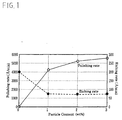
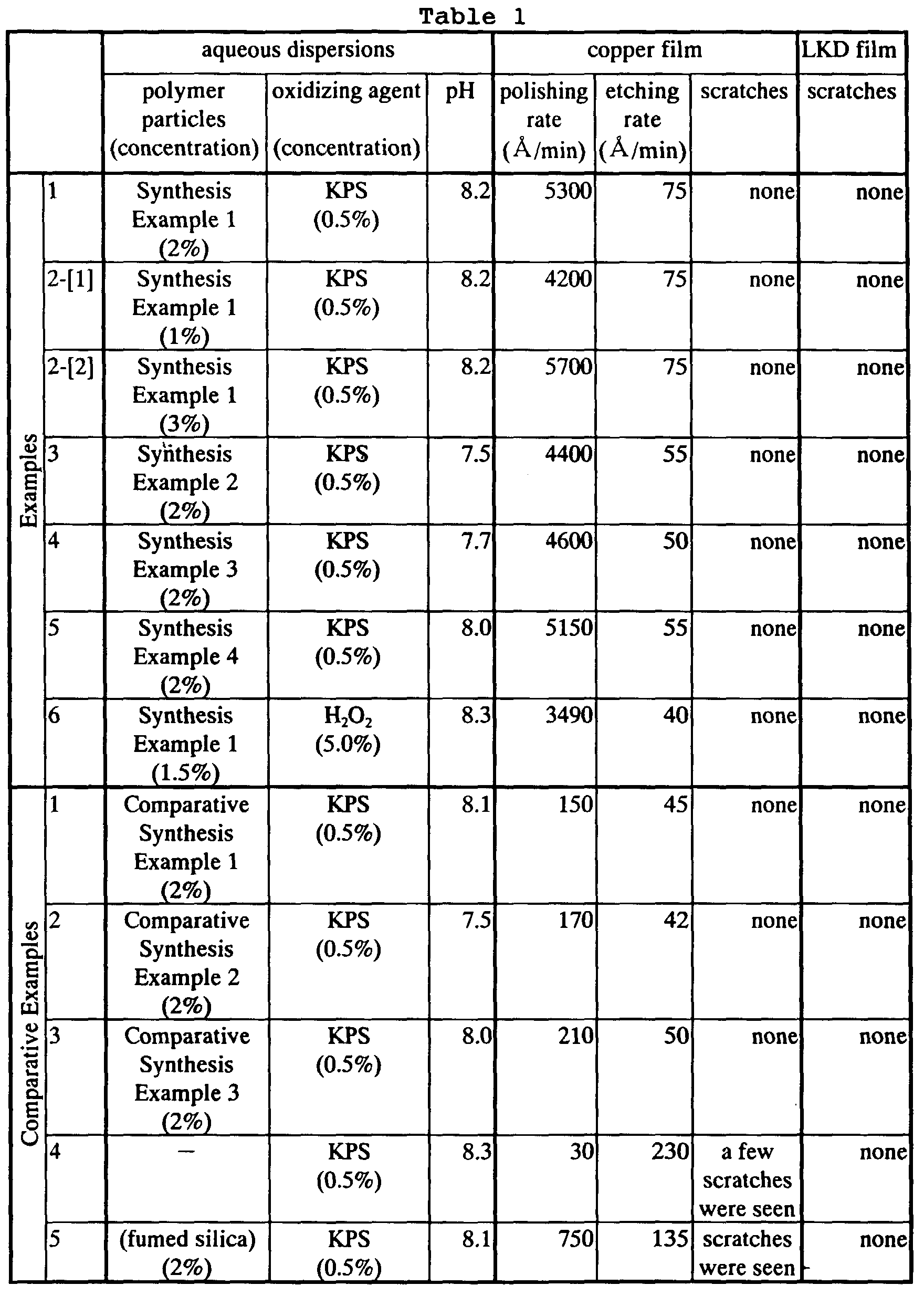
- a copper film-coated wafer (film thickness: 15,000 ⁇ ) was polished using the aqueous dispersions prepared in Example 1, Example 2-[1] and Example 2-[2], and the presence of scratches, the polishing rate and the etching rate were evaluated by the methods described below. The results are shown in Table 1 and Fig. 1.
- the polishing surface was washed and dried, and the presence of any scratches was confirmed with a differential interference microscope.
- a small-sized CMP apparatus (Model “LM-15” by Lapmaster SFT Corporation) was used for polishing under the following conditions (Polishing conditions (A)) and the polishing rate was calculated according to the formula given below.
- Etching rate ( ⁇ /min) [(thickness of copper film before immersion) - (thickness of copper film after immersion)]/(immersing time)
- the LKD film formed by the above-mentioned method was set in a CMP apparatus (Model “LPG510” by Lapmaster SFT Corporation), and a porous polyurethane polishing pad (Product No. "IC1000” by Rodel-Nitta Corporation) was used for one minute of polishing under a load of 0.03 MPa. The polishing surface was washed and dried, and the presence of any scratches was confirmed in the same manner as the copper film.
- the polymer particles obtained in Synthesis Examples 2-4 and potassium persulfate were added to ion-exchanged water to concentrations of 2% and 0.5% respectively, and the pH was adjusted with potassium hydroxide as shown in Table 1 to prepare aqueous dispersions.
- Example 6 (Aqueous dispersion containing polymer particles of Synthesis Example 1)
- the polymer particles obtained in Synthesis Example 1 were added to ion-exchanged water to a concentration of 1.5%. Hydrogen peroxide water was added instead of potassium persulfate to a hydrogen peroxide concentration of 5% in the aqueous dispersion, and the pH was adjusted with potassium hydroxide to prepare an aqueous dispersion.
- the polymer particles obtained in Comparative Synthesis Examples 1-3 were used, the polymer particles and potassium persulfate were added to ion-exchanged water to concentrations of 2% and 0.5% respectively, and the pH was adjusted with potassium hydroxide to prepare aqueous dispersions.
- Potassium persulfate was added to ion-exchanged water to a concentration of 0.5%, and the pH was adjusted to 8.3 with potassium hydroxide to prepare an aqueous dispersion. This aqueous dispersion contained no particles.
- fumed silica particles product name: "Aerosil #50", Nihon Aerosil CO., LTD.
- 500 g of ion-exchanged water was added and the particles were dispersed with an ultrasonic disperser to prepare an aqueous dispersion containing fumed silica particles.
- 167 g of a 3% potassium persulfate aqueous solution the mixture was thoroughly stirred.
- the pH was then adjusted to 8.0 with a potassium hydroxide aqueous solution, and ion-exchanged water was charged in to an amount giving a total of 1 kg. This was then thoroughly stirred and filtered with a 5- ⁇ m pore filter to obtain an aqueous dispersion.
- aqueous dispersions of Examples 3-6 and Comparative Examples 1-5 were used to evaluate the presence of any scratches and the etching rate, in the same manner as Examples 1 and 2.
- a CMP apparatus (Model “ LGP510” by Lapmaster SFT Corporation) was used to polish a copper-coated wafer under the following conditions (Polishing conditions (B)), and the polishing rate was calculated according to the formula given above.
- Example 7 (Preparation of aqueous dispersion containing polymer particles of Synthesis Example 5)
- the polymer particles obtained in Synthesis Example 5 were added to ion-exchanged water to a concentration of 2.0%, and then potassium persulfate and salicylaldoxime were added to concentrations of 0.5% and 0.1% respectively and the pH was adjusted to 8.3 with potassium hydroxide to prepare an aqueous dispersion.
- Example 8 (Preparation of aqueous dispersion containing polymer particles of Synthesis Example 6)
- An aqueous dispersion was prepared in the same manner as Example 7, except that the polymer particles of Synthesis Example 6 were used instead of the polymer particles of Synthesis Example 5, and benzotriazole was added to a concentration of 0.02% instead of salicylaldoxime.
- An aqueous dispersion was prepared in the same manner as Example 7, except that the polymer particles of Synthesis Example 5 were added to a concentration of 3.5%, quinaldinic acid was added to a concentration of 0.5% instead of salicylaldoxime, and the pH was adjusted to 9.1.
- An aqueous dispersion was prepared in the same manner as Example 9, except that the polymer particles of Synthesis Example 5, potassium persulfate and quinaldinic acid were added to concentrations of 0.5%, 0.8% and 0.4% respectively, and the pH was adjusted to 9.0.
- Example 11 (Preparation of aqueous dispersion containing polymer particles of Synthesis Example 6)
- the polymer particles obtained in Synthesis Example 6 were added to ion-exchanged water to a concentration of 2.0%, and then potassium persulfate and 7-hydroxy-5-methyl-1,3,4-triazaindolizine were added to concentrations of 0.5% and 0.4% respectively and the pH was adjusted to 8.6 with potassium hydroxide to prepare an aqueous dispersion.
- Example 12 (Preparation of aqueous dispersion containing polymer particles of Synthesis Example 5)
- An aqueous dispersion was prepared in the same manner as Example 11, except that the polymer particles of Synthesis Example 5 were used in instead of the polymer particles of Synthesis Example 6, hydrogen peroxide water was used instead of potassium persulfate to a hydrogen peroxide concentration of 5% in the aqueous dispersion, and the pH was adjusted to 8.9.
- the polymer particles obtained in Synthesis Example 1 were added to ion-exchanged water to a concentration of 2.0%, and then potassium persulfate and quinaldinic acid were added to concentrations of 1.0% and 0.3% respectively and the pH was adjusted to 9.0 with potassium hydroxide to prepare an aqueous dispersion.
- An aqueous dispersion was prepared in the same manner as Example 13, except that the polymer particles of Synthesis Example 2 were added to a concentration of 3.0% instead of the polymer particles of Synthesis Example 1, 7-hydroxy-5-methyl-1,3,4-triazaindolizine was added to a concentration of 0.5% instead of quinaldinic acid, and the pH was adjusted to 8.5.
- An aqueous dispersion was prepared in the same manner as Example 13, except that the polymer particles of Synthesis Example 3 were used instead of the polymer particles of Synthesis Example 1, salicylaldoxime was added to a concentration of 0.2% instead of quinaldinic acid, and the pH was adjusted to 8.5.
- Example 16 (Preparation of aqueous dispersion containing polymer particles of Synthesis Example 4)
- An aqueous dispersion was prepared in the same manner as Example 13, except that the polymer particles of Synthesis Example 4 were added to a concentration of 3.0% instead of the polymer particles of Synthesis Example 1, the quinaldic acid concentration was 0.2%, and the pH was adjusted to 9.1.
- Comparative Example 6 (Preparation of aqueous dispersion containing polymer particles of Comparative Synthesis Example 4)
- An aqueous dispersion was prepared in the same manner as Example 7, except that the polymer particles obtained in Comparative Synthesis Example 4 were used, and no salicylaldoxime was added.
- Comparative Example 7 (Preparation of aqueous dispersion containing polymer particles of Comparative Synthesis Example 5)
- An aqueous dispersion was prepared in the same manner as Example 8, except that the polymer particles obtained in Comparative Synthesis Example 5 were used, and no benzotriazole was added.
- a copper film-coated wafer (film thickness: 15,000 ⁇ ) was polished in the same manner as Examples 1 and 2 using the aqueous dispersions of Examples 7-16 and Comparative Examples 6 and 7, and the polishing rate, etching rate and presence of scratches under polishing conditions (A) were evaluated.
- An LKD film was also polished in the same manner as Example 1, and the presence of any scratches was confirmed. The evaluation results are shown in Table 2.
- the copper film thickness was determined by measuring the sheet resistance by the direct current 4-probe method using a resistivity measuring instrument (Model " ⁇ -5" by NPS Corp.) and calculating the thickness from the sheet resistance value and the copper resistivity based on the following formula.
- Copper film thickness ( ⁇ ) [sheet resistance value ( ⁇ /cm 2 ) x copper resistivity ( ⁇ /cm)] x 10 8
- the aqueous dispersion of the invention contains water and polymer particles composed of a polymer with a specific functional group, and it may also contain a complexing agent, a compound that forms a passivation film on polishing surfaces and/or an oxidizing agent.
- the specific functional group is a functional group that can react with the metals of polishing surfaces or that can form a cation, and it is preferably selected from among amino, pyridyl and acrylamide groups.
- the polymer can be obtained using a initiator and/or monomer possessing the specific functional group.
- the polymer may also have a crosslinked structure.
Landscapes
- Chemical & Material Sciences (AREA)
- Organic Chemistry (AREA)
- Engineering & Computer Science (AREA)
- Materials Engineering (AREA)
- Mechanical Treatment Of Semiconductor (AREA)
- Finish Polishing, Edge Sharpening, And Grinding By Specific Grinding Devices (AREA)
- Addition Polymer Or Copolymer, Post-Treatments, Or Chemical Modifications (AREA)
Abstract
Description

Claims (9)
- An aqueous dispersion for chemical mechanical polishing, characterized by comprising polymer particles and water, wherein said polymer particles are composed of a polymer with a functional group in the molecule that can react with the metal of a polishing surface.
- An aqueous dispersion for chemical mechanical polishing, characterized by comprising polymer particles and water, wherein said polymer particles are composed of a polymer with a functional group in the molecule that can form a cation.
- An aqueous dispersion for chemical mechanical polishing according to Claim 1 or 2, wherein said polymer has a crosslinked structure.
- An aqueous dispersion for chemical mechanical polishing according to any one of Claims 1 through 3, which further contains a complexing agent.
- An aqueous dispersion for chemical mechanical polishing according to any one of Claims 1 through 3, which further contains a compound that can form a passivation film on the polishing surface.
- An aqueous dispersion for chemical mechanical polishing according to any one of Claims 1 through 5, which further contains an oxidizing agent.
- An aqueous dispersion for chemical mechanical polishing according to any one of Claims 1 through 6, wherein said functional group is at least one type from among amino, pyridyl and acrylamide groups.
- An aqueous dispersion for chemical mechanical polishing according to any one of Claims 1 through 7, wherein said polymer is obtained using a polymerization initiator capable of introducing said functional group into the molecule.
- An aqueous dispersion for chemical mechanical polishing according to any one of Claims 1 through 8, wherein said polymer is obtained using a monomer capable of introducing said functional group into the molecule.
Applications Claiming Priority (4)
| Application Number | Priority Date | Filing Date | Title |
|---|---|---|---|
| JP23166999 | 1999-08-18 | ||
| JP23166899A JP4038943B2 (en) | 1999-08-18 | 1999-08-18 | Aqueous dispersion for chemical mechanical polishing |
| JP23166999A JP4352519B2 (en) | 1999-08-18 | 1999-08-18 | Aqueous dispersion for chemical mechanical polishing |
| JP23166899 | 1999-08-18 |
Publications (2)
| Publication Number | Publication Date |
|---|---|
| EP1077240A1 true EP1077240A1 (en) | 2001-02-21 |
| EP1077240B1 EP1077240B1 (en) | 2006-11-08 |
Family
ID=26530017
Family Applications (1)
| Application Number | Title | Priority Date | Filing Date |
|---|---|---|---|
| EP00117719A Expired - Lifetime EP1077240B1 (en) | 1999-08-18 | 2000-08-17 | Aqueous dispersion for chemical mechanical polishing |
Country Status (5)
| Country | Link |
|---|---|
| US (1) | US7153369B2 (en) |
| EP (1) | EP1077240B1 (en) |
| KR (1) | KR100427002B1 (en) |
| DE (1) | DE60031745T2 (en) |
| TW (1) | TWI254070B (en) |
Cited By (7)
| Publication number | Priority date | Publication date | Assignee | Title |
|---|---|---|---|---|
| EP1138733A3 (en) * | 2000-03-27 | 2001-10-24 | JSR Corporation | Aqueous dispersion for chemical mechanical polishing of insulating films |
| US6375545B1 (en) | 1999-01-18 | 2002-04-23 | Kabushiki Kaisha Toshiba | Chemical mechanical method of polishing wafer surfaces |
| US6632259B2 (en) | 2001-05-18 | 2003-10-14 | Rodel Holdings, Inc. | Chemical mechanical polishing compositions and methods relating thereto |
| US7182798B2 (en) | 2004-07-29 | 2007-02-27 | Rohm And Haas Electronic Materials Cmp Holdings, Inc. | Polymer-coated particles for chemical mechanical polishing |
| CN100373556C (en) * | 2003-05-28 | 2008-03-05 | 日立化成工业株式会社 | Polishing agent and polishing method |
| US7709053B2 (en) | 2004-07-29 | 2010-05-04 | Rohm And Haas Electronic Materials Cmp Holdings, Inc. | Method of manufacturing of polymer-coated particles for chemical mechanical polishing |
| US9005472B2 (en) | 2010-02-24 | 2015-04-14 | Basf Se | Aqueous polishing agent and graft copolymers and their use in a process for polishing patterned and unstructured metal surfaces |
Families Citing this family (15)
| Publication number | Priority date | Publication date | Assignee | Title |
|---|---|---|---|---|
| JP2001267273A (en) | 2000-01-11 | 2001-09-28 | Sumitomo Chem Co Ltd | Abrasive for metal, polishing composition and polishing method |
| US20030162398A1 (en) | 2002-02-11 | 2003-08-28 | Small Robert J. | Catalytic composition for chemical-mechanical polishing, method of using same, and substrate treated with same |
| DE10214035A1 (en) * | 2002-03-27 | 2003-10-09 | Mettler Toledo Gmbh | Polymer electrolyte, half cell for electrochemical measurements and their use |
| EP1566420A1 (en) * | 2004-01-23 | 2005-08-24 | JSR Corporation | Chemical mechanical polishing aqueous dispersion and chemical mechanical polishing method |
| US20070272270A1 (en) * | 2004-12-27 | 2007-11-29 | Kun-Yuan Liao | Single-wafer cleaning procedure |
| US8460414B2 (en) * | 2005-04-14 | 2013-06-11 | Mitsui Chemicals, Inc. | Polishing slurry and polishing material using same |
| JP5240478B2 (en) * | 2008-02-18 | 2013-07-17 | Jsr株式会社 | Chemical mechanical polishing aqueous dispersion and chemical mechanical polishing method |
| WO2010127938A1 (en) | 2009-05-06 | 2010-11-11 | Basf Se | An aqueous polishing agent comprising solid polymer particles and two complexing agents and its use in a process for polishing patterned and unstructured metal surfaces |
| KR101793288B1 (en) | 2009-05-06 | 2017-11-02 | 바스프 에스이 | An aqueous metal polishing agent comprising a polymeric abrasiv containing pendant functional groups and its use in a cmp process |
| US10208104B2 (en) * | 2015-12-11 | 2019-02-19 | The Chinese University Of Hong Kong | Fast and efficient conjugation method based on thiourea-catechol coupling |
| KR102570173B1 (en) * | 2017-11-29 | 2023-08-25 | 솔브레인 주식회사 | Chemical mechanical polishing slurry composition for polycrystalline silicon polishing |
| KR102434937B1 (en) | 2021-12-16 | 2022-08-22 | 주식회사 지아이 | Barbell lifting exercise apparatus |
| KR102434939B1 (en) | 2021-12-16 | 2022-08-22 | 주식회사 지아이 | Bench press |
| KR102522850B1 (en) | 2022-02-10 | 2023-04-18 | 주식회사 지아이 | Barbell exercise apparatus |
| KR200499069Y1 (en) | 2022-03-03 | 2025-04-21 | 전대성 | Leg stretching exercise equipment |
Citations (3)
| Publication number | Priority date | Publication date | Assignee | Title |
|---|---|---|---|---|
| EP0919602A1 (en) * | 1997-11-25 | 1999-06-02 | Sumitomo Chemical Company, Limited | Metal polishing agent and process for polishing metal using same |
| EP1020501A2 (en) * | 1999-01-18 | 2000-07-19 | Kabushiki Kaisha Toshiba | Aqueous chemical mechanical polishing dispersion composition, wafer surface polishing process and manufacturing process of a semiconductor device |
| EP1036836A1 (en) * | 1999-03-18 | 2000-09-20 | Kabushiki Kaisha Toshiba | Aqueous dispersion for chemical mechanical polishing |
Family Cites Families (15)
| Publication number | Priority date | Publication date | Assignee | Title |
|---|---|---|---|---|
| US3070510A (en) * | 1959-11-03 | 1962-12-25 | Procter & Gamble | Dentifrice containing resinous cleaning agents |
| GB1430368A (en) * | 1972-08-04 | 1976-03-31 | Ici Ltd | Quinoline-2-carboxylic acids and their use in the extraction of metals |
| US4947591A (en) * | 1990-01-09 | 1990-08-14 | Avonite, Inc. | Dry paint stripping method |
| KR100571892B1 (en) * | 1997-04-30 | 2006-04-18 | 미네소타 마이닝 앤드 매뉴팩춰링 캄파니 | Planarization method of semiconductor wafer upper surface |
| KR19990023544A (en) | 1997-08-19 | 1999-03-25 | 마쯔모또 에이찌 | Aqueous dispersion of inorganic particles and preparation method thereof |
| US6432828B2 (en) * | 1998-03-18 | 2002-08-13 | Cabot Microelectronics Corporation | Chemical mechanical polishing slurry useful for copper substrates |
| ATE474899T1 (en) * | 1998-10-23 | 2010-08-15 | Fujifilm Electronic Materials | A CHEMICAL-MECHANICAL POLISHING SLURRY CONTAINING AN ACCELERATOR SOLUTION |
| JP4366735B2 (en) * | 1998-11-05 | 2009-11-18 | Jsr株式会社 | Abrasives containing polymer particles |
| KR100447551B1 (en) * | 1999-01-18 | 2004-09-08 | 가부시끼가이샤 도시바 | Composite Particles and Production Process Thereof, Aqueous Dispersion, Aqueous Dispersion Composition for Chemical Mechanical Polishing, and Process for Manufacture of Semiconductor Apparatus |
| US6238592B1 (en) * | 1999-03-10 | 2001-05-29 | 3M Innovative Properties Company | Working liquids and methods for modifying structured wafers suited for semiconductor fabrication |
| JP4505891B2 (en) | 1999-09-06 | 2010-07-21 | Jsr株式会社 | Chemical mechanical polishing aqueous dispersion used in the manufacture of semiconductor devices |
| US6440856B1 (en) * | 1999-09-14 | 2002-08-27 | Jsr Corporation | Cleaning agent for semiconductor parts and method for cleaning semiconductor parts |
| TW572980B (en) * | 2000-01-12 | 2004-01-21 | Jsr Corp | Aqueous dispersion for chemical mechanical polishing and chemical mechanical polishing process |
| JP2001269859A (en) * | 2000-03-27 | 2001-10-02 | Jsr Corp | Aqueous dispersion for chemical mechanical polishing |
| JP4078787B2 (en) * | 2000-03-31 | 2008-04-23 | Jsr株式会社 | Aqueous dispersion for chemical mechanical polishing |
-
2000
- 2000-08-10 TW TW089116140A patent/TWI254070B/en not_active IP Right Cessation
- 2000-08-17 EP EP00117719A patent/EP1077240B1/en not_active Expired - Lifetime
- 2000-08-17 DE DE60031745T patent/DE60031745T2/en not_active Expired - Lifetime
- 2000-08-17 KR KR20000047368A patent/KR100427002B1/en not_active Expired - Fee Related
-
2002
- 2002-07-23 US US10/200,504 patent/US7153369B2/en not_active Expired - Fee Related
Patent Citations (3)
| Publication number | Priority date | Publication date | Assignee | Title |
|---|---|---|---|---|
| EP0919602A1 (en) * | 1997-11-25 | 1999-06-02 | Sumitomo Chemical Company, Limited | Metal polishing agent and process for polishing metal using same |
| EP1020501A2 (en) * | 1999-01-18 | 2000-07-19 | Kabushiki Kaisha Toshiba | Aqueous chemical mechanical polishing dispersion composition, wafer surface polishing process and manufacturing process of a semiconductor device |
| EP1036836A1 (en) * | 1999-03-18 | 2000-09-20 | Kabushiki Kaisha Toshiba | Aqueous dispersion for chemical mechanical polishing |
Cited By (9)
| Publication number | Priority date | Publication date | Assignee | Title |
|---|---|---|---|---|
| US6375545B1 (en) | 1999-01-18 | 2002-04-23 | Kabushiki Kaisha Toshiba | Chemical mechanical method of polishing wafer surfaces |
| EP1020501A3 (en) * | 1999-01-18 | 2004-01-07 | Kabushiki Kaisha Toshiba | Aqueous chemical mechanical polishing dispersion composition, wafer surface polishing process and manufacturing process of a semiconductor device |
| EP1138733A3 (en) * | 2000-03-27 | 2001-10-24 | JSR Corporation | Aqueous dispersion for chemical mechanical polishing of insulating films |
| US7087530B2 (en) | 2000-03-27 | 2006-08-08 | Jsr Corporation | Aqueous dispersion for chemical mechanical polishing |
| US6632259B2 (en) | 2001-05-18 | 2003-10-14 | Rodel Holdings, Inc. | Chemical mechanical polishing compositions and methods relating thereto |
| CN100373556C (en) * | 2003-05-28 | 2008-03-05 | 日立化成工业株式会社 | Polishing agent and polishing method |
| US7182798B2 (en) | 2004-07-29 | 2007-02-27 | Rohm And Haas Electronic Materials Cmp Holdings, Inc. | Polymer-coated particles for chemical mechanical polishing |
| US7709053B2 (en) | 2004-07-29 | 2010-05-04 | Rohm And Haas Electronic Materials Cmp Holdings, Inc. | Method of manufacturing of polymer-coated particles for chemical mechanical polishing |
| US9005472B2 (en) | 2010-02-24 | 2015-04-14 | Basf Se | Aqueous polishing agent and graft copolymers and their use in a process for polishing patterned and unstructured metal surfaces |
Also Published As
| Publication number | Publication date |
|---|---|
| EP1077240B1 (en) | 2006-11-08 |
| TWI254070B (en) | 2006-05-01 |
| US20020193451A1 (en) | 2002-12-19 |
| KR100427002B1 (en) | 2004-04-13 |
| DE60031745T2 (en) | 2007-09-20 |
| US7153369B2 (en) | 2006-12-26 |
| DE60031745D1 (en) | 2006-12-21 |
| KR20010039817A (en) | 2001-05-15 |
Similar Documents
| Publication | Publication Date | Title |
|---|---|---|
| EP1077240B1 (en) | Aqueous dispersion for chemical mechanical polishing | |
| CN1325591C (en) | Anionic abrasive particles treated with positively charged polyelectrolytes for cmp | |
| US7183211B2 (en) | Process for chemical mechanical polishing of semiconductor substrate and aqueous dispersion for chemical mechanical polishing | |
| US12234382B2 (en) | CMP composition including anionic and cationic inhibitors | |
| TW580514B (en) | A polishing composition including an inhibitor of tungsten etching | |
| TWI268954B (en) | Coated metal oxide particles for CMP | |
| KR100445447B1 (en) | Aqueous dispersion for chemical mechanical polishing | |
| US20060096179A1 (en) | CMP composition containing surface-modified abrasive particles | |
| TWI500722B (en) | Chemical mechanical polishing (CMP) composition comprising inorganic particles and polymer particles | |
| TW200902612A (en) | Compositions for polishing aluminum/copper and titanium in damascene structures | |
| KR20090033013A (en) | Polishing liquid and polishing method | |
| KR20000053504A (en) | Aqueous Dispersion, Chemical Mechanical Polishing Aqueous Dispersion Composition, Wafer Surface Polishing Process and Manufacturing Process of a Semiconductor Apparatus | |
| JP2007088424A (en) | Chemical mechanical polishing aqueous dispersion, kit for preparing the aqueous dispersion, chemical mechanical polishing method, and semiconductor device manufacturing method | |
| JP2005340755A (en) | Abrasive compound and polishing method | |
| JP4038943B2 (en) | Aqueous dispersion for chemical mechanical polishing | |
| JP4151178B2 (en) | Process for producing aqueous dispersion for chemical mechanical polishing | |
| JP4352519B2 (en) | Aqueous dispersion for chemical mechanical polishing | |
| JP2008034864A (en) | Aqueous dispersion for chemical mechanical polishing | |
| JPH10275789A (en) | Abrasive and polishing method | |
| JP4012643B2 (en) | Chemical mechanical polishing aqueous dispersion for use in semiconductor device manufacture and method for manufacturing semiconductor device | |
| JP2004168931A (en) | Abrasive | |
| JP2000239651A (en) | Abrasive for manufacturing semiconductor devices and polishing method using the abrasive |
Legal Events
| Date | Code | Title | Description |
|---|---|---|---|
| PUAI | Public reference made under article 153(3) epc to a published international application that has entered the european phase |
Free format text: ORIGINAL CODE: 0009012 |
|
| AK | Designated contracting states |
Kind code of ref document: A1 Designated state(s): DE FR GB NL |
|
| AX | Request for extension of the european patent |
Free format text: AL;LT;LV;MK;RO;SI |
|
| 17P | Request for examination filed |
Effective date: 20010821 |
|
| AKX | Designation fees paid |
Free format text: DE FR GB NL |
|
| RAP1 | Party data changed (applicant data changed or rights of an application transferred) |
Owner name: JSR CORPORATION |
|
| 17Q | First examination report despatched |
Effective date: 20040611 |
|
| GRAP | Despatch of communication of intention to grant a patent |
Free format text: ORIGINAL CODE: EPIDOSNIGR1 |
|
| GRAS | Grant fee paid |
Free format text: ORIGINAL CODE: EPIDOSNIGR3 |
|
| GRAA | (expected) grant |
Free format text: ORIGINAL CODE: 0009210 |
|
| AK | Designated contracting states |
Kind code of ref document: B1 Designated state(s): DE FR GB NL |
|
| REG | Reference to a national code |
Ref country code: GB Ref legal event code: FG4D |
|
| REF | Corresponds to: |
Ref document number: 60031745 Country of ref document: DE Date of ref document: 20061221 Kind code of ref document: P |
|
| ET | Fr: translation filed | ||
| PLBE | No opposition filed within time limit |
Free format text: ORIGINAL CODE: 0009261 |
|
| STAA | Information on the status of an ep patent application or granted ep patent |
Free format text: STATUS: NO OPPOSITION FILED WITHIN TIME LIMIT |
|
| 26N | No opposition filed |
Effective date: 20070809 |
|
| PGFP | Annual fee paid to national office [announced via postgrant information from national office to epo] |
Ref country code: NL Payment date: 20130815 Year of fee payment: 14 |
|
| PGFP | Annual fee paid to national office [announced via postgrant information from national office to epo] |
Ref country code: GB Payment date: 20130821 Year of fee payment: 14 |
|
| REG | Reference to a national code |
Ref country code: NL Ref legal event code: V1 Effective date: 20150301 |
|
| GBPC | Gb: european patent ceased through non-payment of renewal fee |
Effective date: 20140817 |
|
| PG25 | Lapsed in a contracting state [announced via postgrant information from national office to epo] |
Ref country code: NL Free format text: LAPSE BECAUSE OF NON-PAYMENT OF DUE FEES Effective date: 20150301 |
|
| PG25 | Lapsed in a contracting state [announced via postgrant information from national office to epo] |
Ref country code: GB Free format text: LAPSE BECAUSE OF NON-PAYMENT OF DUE FEES Effective date: 20140817 |
|
| REG | Reference to a national code |
Ref country code: FR Ref legal event code: PLFP Year of fee payment: 16 |
|
| PGFP | Annual fee paid to national office [announced via postgrant information from national office to epo] |
Ref country code: DE Payment date: 20150821 Year of fee payment: 16 |
|
| PGFP | Annual fee paid to national office [announced via postgrant information from national office to epo] |
Ref country code: FR Payment date: 20150820 Year of fee payment: 16 |
|
| REG | Reference to a national code |
Ref country code: DE Ref legal event code: R119 Ref document number: 60031745 Country of ref document: DE |
|
| REG | Reference to a national code |
Ref country code: FR Ref legal event code: ST Effective date: 20170428 |
|
| PG25 | Lapsed in a contracting state [announced via postgrant information from national office to epo] |
Ref country code: FR Free format text: LAPSE BECAUSE OF NON-PAYMENT OF DUE FEES Effective date: 20160831 Ref country code: DE Free format text: LAPSE BECAUSE OF NON-PAYMENT OF DUE FEES Effective date: 20170301 |