EP1074537A1 - Process for preparing cycloalkanone - Google Patents
Process for preparing cycloalkanone Download PDFInfo
- Publication number
- EP1074537A1 EP1074537A1 EP00902151A EP00902151A EP1074537A1 EP 1074537 A1 EP1074537 A1 EP 1074537A1 EP 00902151 A EP00902151 A EP 00902151A EP 00902151 A EP00902151 A EP 00902151A EP 1074537 A1 EP1074537 A1 EP 1074537A1
- Authority
- EP
- European Patent Office
- Prior art keywords
- group
- component
- catalyst
- separated
- cycloalkane
- Prior art date
- Legal status (The legal status is an assumption and is not a legal conclusion. Google has not performed a legal analysis and makes no representation as to the accuracy of the status listed.)
- Granted
Links
- 0 CC(C(C)[N+](*1*)[O-])[N+]1[O-] Chemical compound CC(C(C)[N+](*1*)[O-])[N+]1[O-] 0.000 description 2
Images

Classifications
-
- B—PERFORMING OPERATIONS; TRANSPORTING
- B01—PHYSICAL OR CHEMICAL PROCESSES OR APPARATUS IN GENERAL
- B01J—CHEMICAL OR PHYSICAL PROCESSES, e.g. CATALYSIS OR COLLOID CHEMISTRY; THEIR RELEVANT APPARATUS
- B01J31/00—Catalysts comprising hydrides, coordination complexes or organic compounds
- B01J31/40—Regeneration or reactivation
-
- B—PERFORMING OPERATIONS; TRANSPORTING
- B01—PHYSICAL OR CHEMICAL PROCESSES OR APPARATUS IN GENERAL
- B01J—CHEMICAL OR PHYSICAL PROCESSES, e.g. CATALYSIS OR COLLOID CHEMISTRY; THEIR RELEVANT APPARATUS
- B01J31/00—Catalysts comprising hydrides, coordination complexes or organic compounds
- B01J31/006—Catalysts comprising hydrides, coordination complexes or organic compounds comprising organic radicals, e.g. TEMPO
-
- B—PERFORMING OPERATIONS; TRANSPORTING
- B01—PHYSICAL OR CHEMICAL PROCESSES OR APPARATUS IN GENERAL
- B01J—CHEMICAL OR PHYSICAL PROCESSES, e.g. CATALYSIS OR COLLOID CHEMISTRY; THEIR RELEVANT APPARATUS
- B01J31/00—Catalysts comprising hydrides, coordination complexes or organic compounds
- B01J31/02—Catalysts comprising hydrides, coordination complexes or organic compounds containing organic compounds or metal hydrides
- B01J31/0234—Nitrogen-, phosphorus-, arsenic- or antimony-containing compounds
- B01J31/0235—Nitrogen containing compounds
- B01J31/0245—Nitrogen containing compounds being derivatives of carboxylic or carbonic acids
- B01J31/0247—Imides, amides or imidates (R-C=NR(OR))
-
- C—CHEMISTRY; METALLURGY
- C07—ORGANIC CHEMISTRY
- C07C—ACYCLIC OR CARBOCYCLIC COMPOUNDS
- C07C29/00—Preparation of compounds having hydroxy or O-metal groups bound to a carbon atom not belonging to a six-membered aromatic ring
- C07C29/48—Preparation of compounds having hydroxy or O-metal groups bound to a carbon atom not belonging to a six-membered aromatic ring by oxidation reactions with formation of hydroxy groups
- C07C29/50—Preparation of compounds having hydroxy or O-metal groups bound to a carbon atom not belonging to a six-membered aromatic ring by oxidation reactions with formation of hydroxy groups with molecular oxygen only
-
- C—CHEMISTRY; METALLURGY
- C07—ORGANIC CHEMISTRY
- C07C—ACYCLIC OR CARBOCYCLIC COMPOUNDS
- C07C45/00—Preparation of compounds having >C = O groups bound only to carbon or hydrogen atoms; Preparation of chelates of such compounds
- C07C45/27—Preparation of compounds having >C = O groups bound only to carbon or hydrogen atoms; Preparation of chelates of such compounds by oxidation
- C07C45/32—Preparation of compounds having >C = O groups bound only to carbon or hydrogen atoms; Preparation of chelates of such compounds by oxidation with molecular oxygen
- C07C45/33—Preparation of compounds having >C = O groups bound only to carbon or hydrogen atoms; Preparation of chelates of such compounds by oxidation with molecular oxygen of CHx-moieties
-
- C—CHEMISTRY; METALLURGY
- C07—ORGANIC CHEMISTRY
- C07C—ACYCLIC OR CARBOCYCLIC COMPOUNDS
- C07C45/00—Preparation of compounds having >C = O groups bound only to carbon or hydrogen atoms; Preparation of chelates of such compounds
- C07C45/78—Separation; Purification; Stabilisation; Use of additives
- C07C45/81—Separation; Purification; Stabilisation; Use of additives by change in the physical state, e.g. crystallisation
- C07C45/82—Separation; Purification; Stabilisation; Use of additives by change in the physical state, e.g. crystallisation by distillation
-
- B—PERFORMING OPERATIONS; TRANSPORTING
- B01—PHYSICAL OR CHEMICAL PROCESSES OR APPARATUS IN GENERAL
- B01J—CHEMICAL OR PHYSICAL PROCESSES, e.g. CATALYSIS OR COLLOID CHEMISTRY; THEIR RELEVANT APPARATUS
- B01J2231/00—Catalytic reactions performed with catalysts classified in B01J31/00
- B01J2231/70—Oxidation reactions, e.g. epoxidation, (di)hydroxylation, dehydrogenation and analogues
-
- C—CHEMISTRY; METALLURGY
- C07—ORGANIC CHEMISTRY
- C07C—ACYCLIC OR CARBOCYCLIC COMPOUNDS
- C07C2601/00—Systems containing only non-condensed rings
- C07C2601/12—Systems containing only non-condensed rings with a six-membered ring
- C07C2601/14—The ring being saturated
-
- Y—GENERAL TAGGING OF NEW TECHNOLOGICAL DEVELOPMENTS; GENERAL TAGGING OF CROSS-SECTIONAL TECHNOLOGIES SPANNING OVER SEVERAL SECTIONS OF THE IPC; TECHNICAL SUBJECTS COVERED BY FORMER USPC CROSS-REFERENCE ART COLLECTIONS [XRACs] AND DIGESTS
- Y02—TECHNOLOGIES OR APPLICATIONS FOR MITIGATION OR ADAPTATION AGAINST CLIMATE CHANGE
- Y02P—CLIMATE CHANGE MITIGATION TECHNOLOGIES IN THE PRODUCTION OR PROCESSING OF GOODS
- Y02P20/00—Technologies relating to chemical industry
- Y02P20/50—Improvements relating to the production of bulk chemicals
- Y02P20/584—Recycling of catalysts
Definitions
- co-oxidizing agent examples include metal compounds, such as transition metal element-containing compounds and compounds containing a Group 13 element of the Periodic Table of Elements (e.g., boron B, Aluminum Al) typified by a boron compound.
- the co-oxidizing agent can be used either singly or in combination with other co-oxidizing agents.
- the heteropolyacid is thought to participate in a hydrogen abstraction reaction, and a cobalt-containing compound or a boron-containing compound are thought to participate in the decomposition of a peroxide.
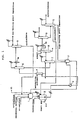
- the catalytic solution prepared in such manner is fed to an oxidizing reactor 2.
- cycloalkane there may be exemplified C 4-20 cycloalkanes (preferably C 4-16 cycloalkanes, more preferably C 4-10 cycloalkanes), such as cyclobutane, cyclopentane, cyclohexanes, cycloheptane, cyclooctane, methylcyclohexanes, ethylcyclohexanes, dimethylcyclohexanes, chlorocyclohexanes, methoxycyclohexanes, cyclooctane, cyclononane, cyclododecane, cyclopentadecane, and cyclooctadecane.
- cycloalkanes can be used either singly or in combination.
- cycloalkanes include C 4-10 cycloalkanes (preferably, C 5-8 cycloalkanes), such as cyclohexane, methylcyclohexanes, and cyclooctane. Usually, cyclohexane is employed.
- the molecular oxygen used for the oxidation of the cycloalkane is not particularly restricted, and oxygen diluted with an inert gas such as nitrogen, helium, argon, or carbon dioxide may be employed as well as pure oxygen. From the view points of not only operability and safety but also economy, air is preferably used.
- the quantity of molecular oxygen is usually, relative to 1 mol of the cycloalkane, 0.5 mol or more (e.g., 1 mol or more), preferably about 1 to 100 mol, and more preferably about 2 to 50 mol. In many instances, an excess mol of molecular oxygen is used relative to the amount of the cycloalkane.
- cyclohexane as the substrate and a solvent makes possible an oxidizing reaction which does not require a solvent be additionally employed and, consequently, a solvent recovering step is omitted.
- the amount of the imide compound of the formula (I) can be selected from within a wide range, and may for example be about 0.001 mol (0.1 mol%) to 1 mol (100 mol%), preferably about 0.01 mol (1 mol%) to 0.5 mol (50 mol%), and more preferably about 0.05 mol to 0.30 mol relative to 1 mol of the cycloalkane, with about 0.05 to 0.25 mol of the imide compound practically employed.
- either one of the cycloalkane or molecular oxygen (or a gas containing molecular oxygen), or both components may be supplied from one or a plurality of supply ports. Further, the port(s) from which the reaction components are supplied may be made in the form of a nozzle for raising the mixing efficiency. The order of addition of the components is not particularly restricted and these can be added in any order.
- the reactor may be constituted of a single or more than two vessels connected serially.
- the catalyst is separable by a conventional means (e.g., filtration, distillation, crystallization).
- the extraction may be conducted by distillation (extraction distillation).
- extraction distillation extraction distillation
- use can be made of an apparatus which is commonly employed, and such apparatus may be employed singly or in combination with other ones.
- the reaction mixture in the oxidizing reactor 2 contains the lower-boiling point component (comprised of, e.g., the cycloalkane left unreacted, water, solvent, lower-boiling point impurities) and the higher-boiling point component (comprised of, e.g., cycloalkanone, cycloalkanol, higher-boiling point impurities).
- the lower-boiling point component (comprised of, e.g., the cycloalkane left unreacted, water, solvent, lower-boiling point impurities)
- the higher-boiling point component comprised of, e.g., cycloalkanone, cycloalkanol, higher-boiling point impurities.
- separation of the lower-boiling point component (containing lower-boiling point impurities) from the reaction mixture from which the acid component has been eliminated is effected using one or a plurality
- a component containing the cycloalkanone and cycloalkanol (higher-boiling point component) and a distillate containing the lower-boiling point component constituted of the cycloalkane, water, and the like are distilled off from the bottom and the overhead of the first distilling column 5, respectively.
- a distillate from the overhead of the first distilling column 5 is separated into the cycloalkane which is distilled from the bottom and the lower-boiling point impurities which is distilled from the overhead.
- the distillate from the overhead of the first distilling column 5 is fed to the distilling column 6 via the decanter 5a for separation of water.
- the cycloalkane separated in the second distilling column 6 is recycled to the mixing vessel 1 or oxidizing reactor 2.
- the water separated in the decanter 5a may be drained, but it may be used as extracting water for recovering the nitrogen oxide in the production step of the raw material (hydroxylamine) of the catalyst.
- the number of plates of the distilling column may for example be about 5 to 80, preferably about 20 to 60.
- the distilling operation may be conducted at an overhead temperature of about 5 to 180°C (preferably, about 40 to 120°C), a bottom temperature of about 50 to 250°C (preferably, about 70 to 150°C) and at a pressure of 1 mmHg to 20 atm (preferably, about 100 mmHg to 5 atm), depending on the species of the cycloalkane.
- the distilling operation is conducted in a conventional manner, e.g., by refluxing the distillate at a suitable reflux ratio (e.g., about 0.1 to 50, preferably about 1 to 20).
- a conventional separation means may be employed, such as condensation, distillation, evaporation, and extraction, or a combination thereof.
- the lower-boiling point component may be separated from the reaction mixture by azeotropy.
- the lower-boiling point component can be separated from the reaction mixture merely by distilling the reaction mixture and the separation may be carried out in a single separation step, a multiple separating step is advantageous for separating the cycloalkane.
- water and the cycloalkane cut may be separated from each other by cooling the cut (lower-boiling point component) distilled in the distilling column 5 and then liquid-separating the water contained in the cut (using a decanter or the like).
- the cycloalkane cut is reusable as a raw material for the oxidizing reaction system even without purification, the cycloalkane cut, which is made much purer by removing impurities therefrom, is also reusable as a raw material for the reaction.
- the mixture from which the lower-boiling point component has been separated by the first distilling column 5 sometimes contains a derivative (e.g., esters) of the higher-boiling point acid component (e.g., carboxylic acids) by-produced in the oxidizing reaction, and the like.
- a derivative e.g., esters
- the higher-boiling point acid component e.g., carboxylic acids
- the reaction mixture from which the lower-boiling point component has been separated is subjected to an impurities separating step.
- a cycloalkane and cycloalkanol of higher purity are yielded through such operation.
- the reaction mixture from which the lower-boiling point component has been separated is fed to a hydrolyzing column 7 for hydrolyzing treatment.
- the treated solution is neutralized and/or saponified using an alkali or a salt thereof in a neutralizing and/or saponifying column 8.
- the aqueous phase in the hydrolyzing column 7 sometimes contains higher-boiling point impurities (e.g., catalystic component(s))
- the aqueous phase is fed to a catalyst-recovering unit 11, and the organic phase (the reaction mixture from which impurities have been removed) in the neutralizing and/or saponifying column 8 is subjected to a higher-boiling point component separating step after moisture has been separated from the phase by a liquid-separator (decanter 8a).
- the temperature for saponification is about 50 to 200°C, preferably about 80 to 150°C.
- the pressure is about 0.001 to 20 atm, preferably about 0.1 to 15 atm.
- alkaline metals e.g., lithium, sodium, potassium
- alkaline earth metals magnesium, calcium
- alkaline metal hydroxides e.g., lithium hydroxide, sodium hydroxide, potassium hydroxide
- alkaline metal hydrogencarbonates e.g., lithium hydrogencarbonate, sodium hydrogencarbonate, potassium hydrogencarbonate
- alkaline metal carbonates e.g., lithium carbonate, sodium carbonate, potassium carbonate
- alkaline earth metal hydroxides e.g., magnesium hydroxide, calcium hydroxide
- alkaline earth metal carbonates e.g., magensium carbonate, calcium carbonate
- ammonia or an organic base e.g., amines
- Preferred alkalis are alkaline metal hydroxides (e.g., lithium hydroxide, sodium hydroxide, potassium hydroxide).
- an aqueous solution (or slurry) of the alkali usually, use can be made of an aqueous solution having a pH of about 7 or higher (preferably about 7 to 10).
- the concentration of the alkaline solution can be selected from within a wide range, it is usually selected from within the range in which handling easiness is kept good.
- the concentration is, e.g., about 1 to 90% by weight, preferably about 5 to 60% by weight, and more preferably about 10 to 30% by weight.
- the reaction mixture from which the lower-boiling point component and impurities have been removed contains the cycloalkanone and the cycloalkanol, and impurities having higher-boiling points, such as the by-product(s) and the catalyst (including the co-catalyst), may sometimes be left. Therefore, the reaction mixture is subjected to a higher-boiling point component separating step (separating step using distilling columns 9 and 10) to separate the reaction mixture into the cycloalkanone, cycloalkanol, and the higher-boiling point impurities (e.g., by-product, oxidizing catalyst, co-oxidizing agent).
- a higher-boiling point component separating step separating step using distilling columns 9 and 10.
- the higher-boiling point components are separated by supplying the distillate from the bottom of the first distilling column 9 to the second distilling column 10 and distilling off the cycloalkanone and the higher-boiling point impurities from the overhead and the bottom, respectively.
- the cycloalkanol is separated by side-cut (e.g., from a plate positioning at a height of 10 to 80% of the number of plates from the bottom).
- the cycloalkanol separated by the distilling column 10 is recycled to the reaction system in the reactor 2 to be converted into a cycloalkanone there. Accordingly, it is possible to form cycloalkanones efficiently without a dehydrogenating step.
- lower-boiling point impurities contained in the organic phase in the saponifying step are distilled from the overhead of the first distilling column 9.
- the moderate-boiling point impurities are removable in advance of the separation of the cycloalkanone and cycloalkanol.
- the number of plates of the distilling column may be about 5 to 80, preferably about 20 to 60.
- the distilling operation can be conducted at an overhead temperature of about 5 to 200°C (preferably, 40 to 120°C), a bottom temperature of about 50 to 250°C (preferably, about 70 to 150°C) and a pressure of about 1 mmHg to 20 atm (preferably, 100 mmHg to 5 atm), and the choice depends on the species of the cycloalkanone.
- the distillation may be performed in a conventional manner, for example, by refluxing the distillate at a suitable reflux ratio (e.g., about 0.1 to 50, preferably about 1 to 20).
- the co-oxidizing agent contained therein can be made reusable by supplying the higher-boiling point impurities to a catalyst-recovering unit 11 for separation.
- the higher-boiling point component may be separated in a single or a multiple distilling or separating step.
- the catalytic component in the reaction mixture is separated at the catalyst-separating step (B1), the impurities-separating steps (B1 and B2), and the higher-boiling point component separating step (C2).
- the separated oxidizing catalyst is supplied to a catalyst-recycling unit 13 to be regenerated there.
- the oxidizing catalyst denatured or deteriorated in activation by the reaction can be regenerated by treating or reacting the catalyst with hydroxylamine or an acid, because the denatured oxidizing catalyst is mainly constituted of a polycarboxylic acid corresponding to the imide compound, or an acid anhydride thereof (e.g., phthalic acid imide, phthalic anhydride).
- the hydroxylamine prepared in the hydroxylamine-producing step may be used.
- free hydroxylamine or a salt of hydroxylamine e.g., sulfates
- the regenerating reaction may be effected by reactively distilling the reaction mixture while removing ammonium resulting from the reaction.
- the acid are hydrogen halides typified by hydrogen chloride and hydrogen bromide; inorganic acids typified by hydrofluoric acid, hydrochloric acid, hydrobromic acid, sulfuric acid, nitric acid, and phosphoric acid; and sulfonic acids typified by benzenesulfonic acid and p-toluenesulfonic acid. It is preferred that the acid is anhydrous.
- the reaction as in the oxidizing catalyst-producing step, can be effected in a conventional manner, such as in a batch-system, semi-batch system, or a continuous system.
- a reactor which is similar to the one used above can be employed, and the reactor can be used either singly or in combination with other reactors.
- any conventional apparatus can serve as the reactor, and the reactor used in the catalyst-producing step may be utilized as it is.
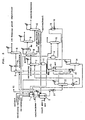
- FIG. 2 is a flow chart showing another embodiment of the present invention. Except for the catalyst-regenerating process for regenerating the catalyst denatured or deteriorated in activity by the reaction, the process of this embodiment is basically common to the process shown in Figure 1. That is, the catalytic component separated from the reaction mixture by means of the catalyst-separation unit 3 such as filter is fed to the catalyst-regenerating unit 13.
- the catalytic component e.g., a polycarboxylic acid corresponding to the imide compound, or an acid anhydride thereof (phthalic imide, phthalic anhydride, or the like] denatured or deteriorated in activity is recycled by treating or reacting with hydroxylamine.
- the recycling reaction is carried out while supplying oxygen or air and removing ammonia which is produced in the reaction.
- the hydroxylamine can be obtained in the following manner. That is to say, in an ammonia oxidizing unit 14, ammonia (this may be ammonia which is produced in the catalyst-regenerating unit 13) is oxidized with molecular oxygen to form a nitrogen oxide NOx. As a catalyst for this oxidizing reaction, a platinum-based catalyst is generally employed. The nitrogen oxide NOx is recovered in a recovering column 15. The NOx can be recovered through an extracting operation using an extracting solvent (e.g., water), a crystallizing operation, or a distilling operation. Hydroxylamine is produced by hydrogenating the recovered nitrogen oxide NOx in a reactor 16. The hydroxylamine thus obtained is fed to the catalyst-regenerating unit 13.
- an extracting solvent e.g., water
- the catalyst (imide compound) recycled in the catalyst-recycling unit 13 is separated by a separation unit 17 such as a filter, mixed with a cycloalkane if needed, and then reserved in a tank 18.
- a separation unit 17 such as a filter
- a non-catalytic component separated by the separation unit 17 is supplied to a distilling column 20, and the distillate (lower-boiling point component) from the overhead can be subjected to the separating step of the lower-boiling point component.
- the solvent may be separated and recovered in a suitable step (e.g., the lower-boiling point- or higher-boiling point component separating step), or it may be separated and recovered by additionally employing a solvent-recovering unit.
- the separated solvent may be recycled to the reaction system, or may be used for preparation of the above-mentioned catalytic solution.
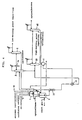
- FIG. 3 is a flow chart showing still another embodiment of the present invention.
- a process for separating and recovering a solvent for the case where a solvent having a boiling point higher than that of a lower-boiling point distillate (e.g., acetic acid) such as a cycloalkane is used.
- a solvent having a boiling point higher than that of a lower-boiling point distillate e.g., acetic acid
- a cycloalkane e.g., cycloalkane
- the higher-boiling point component from which the catalytic component has been removed by the catalyst-separating unit 3 is subjected to, via the hydrolyzing column 7 and the saponifying column 8, a higher-boiling point component separating step similar to the one described above.
- part of a distillate from the overhead of the desolventing column 22 is recycled to the reaction system for use as a solvent and, in a mixing tank 23, the rest of the distillate is mixed with the catalyst regenerated in the catalyst-regenerating unit 13 and the distillate from the bottom of the first distilling column 5 of the lower-boiling point component-separating step. Thereafter, the resultant mixture in the mixing tank 23 is fed to a distilling column 24 for recovering and dehydrating the catalytic component.
- a distillate from the overhead of the distilling column 24 is subjected to the above-described lower-boiling point component separating step, and a distillate from the bottom of the distilling column 24 is fed to the above-described mixing vessel for the preparation the catalytic solution.
- a solvent having a boiling point equal to or lower than the boiling point of a lower-boiling point component such as the cycloalkane it is possible to recover the solvent in the lower-boiling point component separating step (e.g., by the first distilling column) and reuse as the reaction solvent.
- a component containing the solvent may be subjected to the oxidation step or catalytic solution preparing step after the cycloalkanone and cycloalkanol have been separated.
- the reaction mixture of the oxidizing reactor 2 may be separated into the lower-boiling point component containing the cycloalkane and the higher-boiling point component containing the cycloalkanone and cycloalkanol without being subjected to the catalyst-separating step.
- Figure 4 is a flow chart illustrating another embodiment of the present invention.
- the reaction mixture in the oxidizing reactor 2 is supplied to a distilling column 32 for separating the mixture into the lower-boiling component and the higher-boiling component.
- a lower-boiling point cut from the overhead of the distilling column 32 is fed to the first distilling column 5 and the second distilling column 6 for separating the cycloalkane and the lower-boiling point impurities from each other, and subjected to the lower-boiling point component-separating step (C1).
- a higher-boiling point distillate from the bottom of the distilling column 32 (catalytic component, higher-boiling point component) is, if needed, cooled and filtrated by a single or a plurality of filters 33 thereby to filter off the precipitated catalyst.
- the resultant reaction mixture from which the catalytic component has been removed is fed to the distilling column 39 for separating the higher-boiling point component and the higher-boiling point impurities from each other.
- a distillate from the overhead of the distilling column 39 is supplied to a distilling column 40 and subjected to the higher-boiling point component separating step (C2) for separating the cycloalkanone and cycloalkanol from each other.
- the separated cycloalkanol is recycled to the reactor 2.
- higher-boiling point impurities from the bottom of a distilling column 39 contains the catalyst, a higher-boiling point acid component or a derivative thereof. Therefore, in this embodiment, the cut having a higher-boiling point distilled from the bottom of the distilling column 39 is supplied to a catalyst recovering unit 41. Similar to the above, the higher-boiling point impurities may be subjected to the separation steps for separation into the catalyst and acid component or a derivative thereof.
- the hydroxylamine-producing step, oxidizing catalyst-producing step, catalytic solution-preparing step, lower-boiling point component separating step, catalyst-regenerating step, and the solvent-removing or recovering step is not necessarily required, but a combination of the steps (A)(B)(C) with the lower-boiling point component separating step is advantageous for providing cycloalkanones with high efficiency and the catalytic solution-preparing step makes it possible to provide cycloalkanones steadily.
- the order of the steps is not particularly restricted and the order may be different from the process described above.
- from the resultant mixture may be separated the catalyst, the acid component or a derivative thereof, and the higher-boiling point component, followed by the separation of the cycloalkane from the higher-boiling poing component.
- the cycloalkane, the cycloalkanol, and the catalyst are not necessarily recycled.
- distilling columns and extraction-distilling column there may be used a plate column, a perforated-plate column, a packed tower (regular packed tower, irregular packed tower), a bubble tower, or a valve tower.
- the extractor there may be exemplified conventional ones, such as mixer-settlers, perforated-plate columns, spray towers, packed towers, ring & plate towers, rotary-disc extraction column, and curl columns.
- a catalytic solution was prepared in proportions of cyclohexane 10,000 g/H, N-hydroxyphthalimide 10 g/H, and cotaltacetonato 64 g/H.
- the catalytic solution prepared in the above proportion, cyclohexane, and air were fed to a reactor 2 at rates of supply of 840g/H and 1.3 Nm 3 /H, respectively, and the mixture was reacted at 160°C and 40 atm for a residence time of two hours.
- the cyclohexane was converted into a cyclohexanone and a cyclohexanol at selectivities of 40% and 49%, respectively.
- the crude reaction mixture was cooled to 20°C, and the catalyst was separated by filtration at a rate of 9.8 g/H.
- the separated catalyst was treated by incineration to recover the cobalt contained therein and then recycled to the reaction system for reuse.
- the filtrate was subjected to an extraction step with water at 20°C to extract an acid having a higher-boiling point and the like.
- a perforated-plate column 5 with 30 column plates the organic phase was separated into cyclohexane/cyclohexanol (KA oil) and the higher-boiling point component by means of azeotropy of water and cyclohexane.
- the distillate was separated into the aqueous phase and the cyclohexane phase by a decanter, and then water was removed.
- the lower-boiling point component was separated from the cyclohexane phase. The cyclohexane from the bottom was recycled to the reaction system.
- an ester having a higher-boiling point was hydrolyzed, using an acidic aqueous solution of the acid having a higher-boiling point obtained above and a perforated-plate column 7 with 30 column plates, to separate part of the higher-boiling point acid.
- the separated acid was then incinerated.
- the distillate using a perforated-plate column 8 with 40 column plates and a solution comprised of 5% by weight of a sodium hydroxide aqueous solution and 5% by weight of sodium carbonate aqueous solution mixed in a ratio of 1 to 1, the acid and ester having higher-boiling points were then saponified or neutralized and removed.
- the distillate was separated into the aqueous phase and the KA oil phase by using a decanter, and the water separated was refluxed.
- the moderate-boiling point component was separated using a bubble tower 9 with 20 column plates.
- the product cyclohexanone was collected from the reaction mixture comprised of the KA oil and the higher-boiling point component. According to this process, the purification efficiency was 90%, and the purity of the product was 99%.
- cyclohexanol collected from the 50th column plate from the top and recycled to the reaction system was capable of easily converting cyclohexanone in a 98% yield.
- the higher-boiling point component from the bottom of a perforated-plate column 10 was incinerated for disposal.
- the crude reaction mixture was cooled to 20°C, and the catalyst was separated by filtration at a rate of 158 g/H.
- the filtrate was subjected to an extraction step with water at 20°C to extract an acid having a higher-boiling point and the like.
- a perforated-plate column 25 with 30 column plates the organic phase was separated into KA oil and the higher-boiling point component by means of azeotropy of water and cyclohexane.
- the distillate was separated into the aqueous phase and the cyclohexane phase by a decanter.
- the lower-boiling point component was separated from the cyclohexane phase. The cyclohexane from the bottom was recycled to the reaction system for reuse.
- an ester having a higher-boiling point was hydrolyzed, using an acidic aqueous solution of the acid having a higher-boiling point obtained above and a perforated-plate column with 30 column plates, to separate part of the higher-boiling point acid.
- the separated acid was then incinerated.
- the distillate using a perforated-plate column with 40 column plates and a solution comprised of 5% by weight of a sodium hydroxide aqueous solution and 5% by weight of sodium carbonate aqueous solution mixed in a ratio of 1 to 1, the acid and ester having higher-boiling points were then saponified or neutralized and then removed.
- the distillate was separated into the aqueous phase and the KA oil phase by using a decanter, and the water separated was refluxed.
- the moderate-boiling point component was separated using a bubble tower 29 with 20 column plates.
- the product cyclohexanone was collected from the reaction mixture comprised of the KA oil and the higher-boiling point component.
- the purification yield of was 91% and the purity of the product was 99%.
- Cyclohexanol collected from the 50th column plate from the top and then recycled to the reaction system, was capable of easily converting cyclohexanone in a 97% yield.
- a dehydrogenator which is conventionally required, was no longer necessary.
- the higher-boiling point component was incinerated to recover the cobalt contained therein and then recycled to the reaction system for reuse.
- the catalyst was regenerated using hydroxylamine and a perforated-plate column with 30 column plates (regeneration rate: 95%).
- the regenerated catalyst was recycled to the reaction system after moisture has been eliminated therefrom by a perforated-plate column with 30 column plates, and then reused.
- the cyclohexane in the catalyst was also recycled to the reaction system for reuse.
- the hydroxylamine which is used when regenerating the catalyst and producing the catalyst it was produced by effecting an oxidizing reaction in which, using a platinum-based catalyst, ammonia by-produced upon the regeneration of the catalyst is oxidized in a tube reactor to form an NO x (e.g., NO 2 , N 2 O 3 , N 2 O 5 ), absorbing the NO x with rings & plates using the water separated in the lower-boiling point component separating step, and then carrying out a hydrogenating reaction.
- an NO x e.g., NO 2 , N 2 O 3 , N 2 O 5
- the catalytic solution prepared in the above proportion, cyclohexane, and air were fed to a reactor 32 at rates of supply of 840g/H and 1.3 Nm 3 /H, respectively, and the mixture was reacted at 75°C and 40 atm for a residence time of 4 hours.
- the cyclohexane was converted into a cyclohexanone and a cyclohexanol at selectivities of 90% and 5%, respectively.
- the crude reaction mixture was separated into the lower-boiling point component comprised of cyclohexane, water and others, and the higher-boiling point component comprised of acetic acid, the KA oil, the catalyst and others.
- the lower-boiling point component comprised of cyclohexane, water and others
- the higher-boiling point component comprised of acetic acid, the KA oil, the catalyst and others.
- water and the cyclohexane were separated from the lower-boiling point component by azeotropy, and the resultant mixture was separated into the aqueous phase and the cyclohexane phase by using a decanter.
- a lower-boiling point component was separated from the cyclohexane phase in a perforated-plate column with 30 plates and the cyclohexane from the bottom was recycled to the reaction system for reuse.
- Acetic acid was separated from the higher-boiling component comprised of acetic acid, the KA oil, the catalyst and others using a perforated-plate column with 30 column plates, and recycled to the reaction system for reuse.
- the higher-boiling point component comprised of the KA oil, catalyst and others was cooled to 20°C, and then the catalyst was separated by filtration at a rate of 158 g/H.
- the ester with a higher-boiling point contained in the filtrate was hydrolyzed with water to separate part of the higher-boiling point acid, and the separated acid was subjected to incineration treatment.
- distillate using a perforated-plate column with 40 column plates and a solution comprised of 5% by weight of a sodium hydroxide aqueous solution and 5% by weight of sodium carbonate aqueous solution mixed in a ratio of 1 to 1, the acid and the ester each having a higher-boiling point were saponified or neutralized, and then removed.
Landscapes
- Chemical & Material Sciences (AREA)
- Organic Chemistry (AREA)
- Chemical Kinetics & Catalysis (AREA)
- Engineering & Computer Science (AREA)
- Materials Engineering (AREA)
- Crystallography & Structural Chemistry (AREA)
- Organic Low-Molecular-Weight Compounds And Preparation Thereof (AREA)
- Catalysts (AREA)
- Low-Molecular Organic Synthesis Reactions Using Catalysts (AREA)
Abstract
Description



Claims (20)
- a process for producing a cycloalkanone from a cycloalkane by using an oxidizing catalyst having an imide unit represented by the following formula (I):wherein X represents oxygen atom or hydroxyl group,
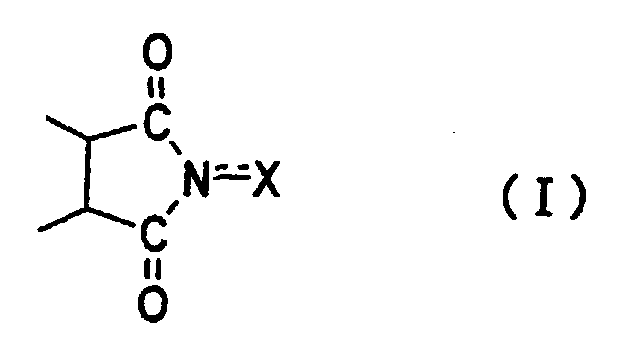 which comprises (A) a step for bringing the cycloalkane into contact with molecular oxygen in the presence of the oxidizing catalyst, (B) a step for separating the catalyst, and a by-produced acid component or a derivative thereof from the reaction mixture, and (C) steps for separating the cycloalkane, a cycloalkanol, and a cycloalkanone from the reaction mixture.
 - A process according to Claim 1, wherein a first component containing the cycloalkane and a second component which has a boiling point higher than that of the first component and contains the cycloalkanone and the cycloalkanol are separated from the reaction mixture, and the cycloalkanone and the cycloalkanol are separated from the second component.
- A process according to Claim 2, wherein the cycloalkane and impurities are separated from the first component; and the cycloalkanone, the cycloalkanol, and impurities are separated from the second component.
- A process according to Claim 1, wherein an acid component or a derivative thereof is separated by at least one means selected from the group consisting of extraction, hydrolysis, saponification, and neutralization.
- A process according to Claim 1, wherein the cycloalakanone and the cycloalkanol are separated from a component containing a product resulted from the extraction, hydrolysis, saponification, or netralization.
- A process according to Claim 1, which comprises at least one step selected from the group consisting of:a step for producing hydroxylamine;a step for producing an oxidizing catalyst recited in Claim 1;a step for preparing a catalytic solution containing an oxidizing catalyst recited in Claim 1; anda step for regenerating the catalyst subjected to the reaction.
- A process according to Claim 1, wherein the cycloalkane is a C4-10cycloalkane.
- A process according to Claim 1, wherein the cycloalkane is cyclohexane.
- A process according to Claim 1, wherein the reaction is carried out in the presence of a solvent, and the solvent is separated from the reaction mixture.
- A process according to Claim 1, which comprises the following steps (i), (ii), and (iii):(i) a step for separating the first component containing the cycloalkane, the second component containing the cycloalkanone and the cycloalkanol, and a component containing the oxidizing catalyst, by-produced acid component and a derivative thereof, at which the first component and the second component are separated from each other by distillation;(ii) a step for separating the cycloalkane from the first component and then recycling the separated cycloalkane to the oxidizing reaction system; and(iii) a step for separating the cycloalkanol from the second component and then recycling the separated cycloalkanol to the oxidizing reaction system.
- A process according to Claim 10, wherein the oxidizing catalyst is separated from the component containing the oxidizing catalyst, the by-produced acid component, and a derivative thereof.
- A process according to Claim 10, wherein the reaction is carried out in the presence of a solvent, the solvent is separated from the reaction mixture, and the separated oxidizing catalyst is recycled to the oxidizing reaction system.
- A process according to Claim 10, wherein by-produced water is separated from the first component, with which water the acid component or a derivative thereof is treated by at least one means selected from extraction, hydrolysis, saponification, and neutralization.
- A process according to Claim 10, wherein a step for supplying the cycloalakne and the catalyst, a step for carrying out the oxidizing reaction, the step (i), the step (ii), and the step (iii) are conducted continuously.
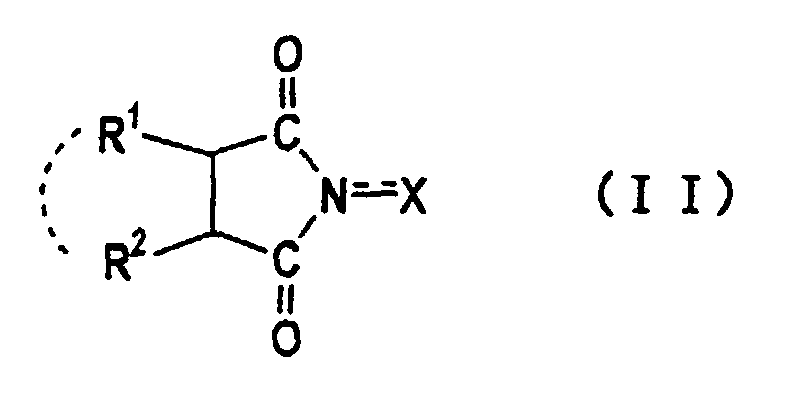
- A process according to Claim 1, wherein the oxidizing catalyst is an imide compound represented by the formula (II):wherein R1 and R2 are the same or different, each representing a hydrogen atom, a halogen atom, an alkyl group, an aryl group, a cycloalkyl group, a hydroxyl group, an alkoxy group, a carboxyl group, an alkoxycarbonyl group, or an acyl group; R1 and R2 may be coupled together to form a double bond or an aromatic- or non-aromatic ring; the aromatic- or non-aromatic ring composed of R1 and R2 may have at least one imide unit represented by the aforementioned formula (I); and X has the same meaning as defined above.

- A process according to Claim 1, wherein the oxidizing catalyst is at least one compound selected from the group consisting of N-hydroxysuccinimide, N-hydroxymaleimide, N-hydroxyhexahydrophthalimide, N,N'-dihydroxycyclohexanetetracarboximide, N-hydroxyphthalimide, N-hydroxytetrabromophthalimide, N-hydroxytetrachlorophthalimide, N-hydroxyhetimide, N-hydroxyhimimide, N-hydroxytrimellitimide, N,N'-dihydroxypyromellitimide, N,N'-dihydroxynaphthalenetetracarboximide.
- A process according to Claim 1, wherein the amount of the oxidizing catalyst is 0.001 to 1 mol relative to 1 mol of the cycloalkane.
- A process according to Claim 1, which further employs a co-oxidizing agent.
- A process according to Claim 18, wherein the co-oxidizing agent is a compound containing at least one element selected from the group consisting of Group 3 elements, Group 4 elements, Group 5 elements, Group 6 elements, Group 7 elements, Group 8 elements, Group 9 elements, Group 10 elements, Group 11 elements, and Group 13 elements.
- A process according to Claim 18, wherein the amount of the co-oxidizing agent is 0.001 to 0.7 mol relative to 1 mol of the cycloalkane.
Applications Claiming Priority (3)
| Application Number | Priority Date | Filing Date | Title |
|---|---|---|---|
| JP4210699 | 1999-02-19 | ||
| JP04210699A JP4451939B2 (en) | 1999-02-19 | 1999-02-19 | Method for producing cycloalkanone |
| PCT/JP2000/000690 WO2000048975A1 (en) | 1999-02-19 | 2000-02-08 | Process for preparing cycloalkanone |
Publications (3)
| Publication Number | Publication Date |
|---|---|
| EP1074537A1 true EP1074537A1 (en) | 2001-02-07 |
| EP1074537A4 EP1074537A4 (en) | 2002-04-24 |
| EP1074537B1 EP1074537B1 (en) | 2004-06-16 |
Family
ID=12626726
Family Applications (1)
| Application Number | Title | Priority Date | Filing Date |
|---|---|---|---|
| EP00902151A Expired - Lifetime EP1074537B1 (en) | 1999-02-19 | 2000-02-08 | Process for preparing cycloalkanone |
Country Status (10)
| Country | Link |
|---|---|
| US (1) | US6528658B1 (en) |
| EP (1) | EP1074537B1 (en) |
| JP (1) | JP4451939B2 (en) |
| KR (1) | KR100613309B1 (en) |
| CN (1) | CN1252019C (en) |
| DE (1) | DE60011525T2 (en) |
| ID (1) | ID28724A (en) |
| MY (1) | MY126601A (en) |
| TW (1) | TW541297B (en) |
| WO (1) | WO2000048975A1 (en) |
Cited By (7)
| Publication number | Priority date | Publication date | Assignee | Title |
|---|---|---|---|---|
| EP1238704A3 (en) * | 2001-03-09 | 2004-01-02 | Daicel Chemical Industries, Ltd. | Catalyst comprising a cyclic imide compound and process for producing organic compounds using the catalyst |
| EP1707553A3 (en) * | 2005-03-31 | 2006-12-13 | Sumitomo Chemical Company, Limited | Method for manufacturing cycloalkanol and/or cycloalkanone |
| WO2011066037A1 (en) * | 2009-11-25 | 2011-06-03 | Exxonmobil Chemical Patents Inc. | Oxidation of hydrocarbons |
| CN102666482A (en) * | 2009-11-25 | 2012-09-12 | 埃克森美孚化学专利公司 | Oxidation of hydrocarbons |
| WO2013087298A1 (en) * | 2011-12-16 | 2013-06-20 | Evonik Industries Ag | Method for producing trisilylamine from chlorosilane and ammonia using an inert solvent |
| TWI419866B (en) * | 2007-10-31 | 2013-12-21 | Exxonmobil Chem Patents Inc | Oxidation of hydrocarbons |
| US9617155B2 (en) | 2011-12-16 | 2017-04-11 | Evonik Degussa Gmbh | Production of trisilylamine from monochlorosilane and ammonia by use of inert solvent |
Families Citing this family (16)
| Publication number | Priority date | Publication date | Assignee | Title |
|---|---|---|---|---|
| JP4618867B2 (en) * | 2000-11-13 | 2011-01-26 | ダイセル化学工業株式会社 | Method for producing organic peroxide |
| JP2006069977A (en) * | 2004-09-03 | 2006-03-16 | Sumitomo Chemical Co Ltd | Process for producing cycloalkanol and / or cycloalkanone |
| US8487138B2 (en) * | 2007-08-22 | 2013-07-16 | Exxonmobil Chemical Patents Inc. | Oxidation of hydrocarbons |
| WO2011031374A2 (en) | 2009-08-28 | 2011-03-17 | Exxonmobil Chemical Patents Inc. | Oxidation of hydrocarbons |
| US8658839B2 (en) * | 2007-10-31 | 2014-02-25 | Exxonmobil Chemical Patents Inc. | Oxidation of hydrocarbons |
| US8461397B2 (en) * | 2008-10-10 | 2013-06-11 | Exxonmobil Chemical Patents Inc. | Oxidation of hydrocarbons |
| KR20140015548A (en) * | 2008-12-15 | 2014-02-06 | 엑손모빌 케미칼 패턴츠 인코포레이티드 | Oxidation of alkylaromatic compounds |
| CN104039763A (en) * | 2009-04-01 | 2014-09-10 | 埃克森美孚化学专利公司 | Process for preparing n-substituted cyclic imides |
| TWI415830B (en) * | 2009-11-26 | 2013-11-21 | China Petrochemical Dev Corp Taipei Taiwan | Liquid - phase Oxidation of Hydrocarbons |
| WO2012036824A1 (en) * | 2010-09-14 | 2012-03-22 | Exxonmobil Chemical Patents Inc. | Oxidation of alkylbenzenes and cycloalkylbenzenes |
| CN102491889B (en) * | 2011-12-14 | 2013-12-11 | 黄燕 | Method for removing hexaldehyde and 2-heptanone in cyclohexanone |
| SG11201706920VA (en) * | 2015-02-27 | 2017-09-28 | Gcp Applied Tech Inc | Modifying cementitious compositions using ketone alcohol oil waste |
| JP2018127398A (en) * | 2015-05-12 | 2018-08-16 | 株式会社ダイセル | Reactor for oxidation, and production method of oxide |
| JP6771549B2 (en) | 2015-10-01 | 2020-10-21 | アドバンシックス・レジンズ・アンド・ケミカルズ・リミテッド・ライアビリティ・カンパニーAdvansix Resins & Chemicals Llc | Nanoparticle catalyst for converting cyclohexanol to cyclohexanone |
| WO2018075176A1 (en) * | 2016-10-18 | 2018-04-26 | Exxonmobil Chemical Patents Inc. | Cyclic imide slurry compositions |
| PL233939B1 (en) * | 2018-01-22 | 2019-12-31 | Politechnika Slaska Im Wincent | The method of oxidation of cycloalkanes |
Family Cites Families (6)
| Publication number | Priority date | Publication date | Assignee | Title |
|---|---|---|---|---|
| JPH06104637B2 (en) * | 1990-04-06 | 1994-12-21 | 三菱化成株式会社 | Method for removing impurities from a mixture of cyclohexanone and cyclohexanol |
| JPH0987215A (en) * | 1995-09-19 | 1997-03-31 | Ube Ind Ltd | Process for producing cycloalkanol and cycloalkanone |
| WO1997028897A1 (en) | 1996-02-07 | 1997-08-14 | Daicel Chemical Industries, Ltd. | Oxidation catalyst system and process for oxidation with the same |
| JPH1027215A (en) | 1996-07-09 | 1998-01-27 | Nippon Telegr & Teleph Corp <Ntt> | Character pattern recognition processing method and apparatus |
| JP4756719B2 (en) * | 1997-02-17 | 2011-08-24 | ダイセル化学工業株式会社 | Oxidation catalyst system, oxidation method and oxide production method |
| JP4004595B2 (en) | 1997-03-11 | 2007-11-07 | ダイセル化学工業株式会社 | Method for oxidizing branched aliphatic hydrocarbon and method for producing oxide |
-
1999
- 1999-02-19 JP JP04210699A patent/JP4451939B2/en not_active Expired - Fee Related
-
2000
- 2000-02-08 DE DE60011525T patent/DE60011525T2/en not_active Expired - Lifetime
- 2000-02-08 EP EP00902151A patent/EP1074537B1/en not_active Expired - Lifetime
- 2000-02-08 KR KR1020007011574A patent/KR100613309B1/en not_active Expired - Fee Related
- 2000-02-08 CN CNB00800160XA patent/CN1252019C/en not_active Expired - Fee Related
- 2000-02-08 ID IDW20002401A patent/ID28724A/en unknown
- 2000-02-08 WO PCT/JP2000/000690 patent/WO2000048975A1/en not_active Ceased
- 2000-02-08 US US09/673,568 patent/US6528658B1/en not_active Expired - Lifetime
- 2000-02-16 TW TW089102593A patent/TW541297B/en not_active IP Right Cessation
- 2000-02-17 MY MYPI20000579 patent/MY126601A/en unknown
Cited By (14)
| Publication number | Priority date | Publication date | Assignee | Title |
|---|---|---|---|---|
| EP1238704A3 (en) * | 2001-03-09 | 2004-01-02 | Daicel Chemical Industries, Ltd. | Catalyst comprising a cyclic imide compound and process for producing organic compounds using the catalyst |
| US6998491B2 (en) | 2001-03-09 | 2006-02-14 | Daicel Chemical Industries, Ltd. | Catalyst comprising a cyclic imide compound |
| US7368615B2 (en) | 2001-03-09 | 2008-05-06 | Daicel Chemical Industries, Ltd. | Catalyst comprising a cyclic imide compound and process for producing organic compounds using the catalyst |
| EP1707553A3 (en) * | 2005-03-31 | 2006-12-13 | Sumitomo Chemical Company, Limited | Method for manufacturing cycloalkanol and/or cycloalkanone |
| US7358401B2 (en) | 2005-03-31 | 2008-04-15 | Sumitomo Chemical Company, Limited | Method for manufacturing cycloalkanol and/or cycloalkanone |
| TWI419866B (en) * | 2007-10-31 | 2013-12-21 | Exxonmobil Chem Patents Inc | Oxidation of hydrocarbons |
| CN102666482A (en) * | 2009-11-25 | 2012-09-12 | 埃克森美孚化学专利公司 | Oxidation of hydrocarbons |
| WO2011066037A1 (en) * | 2009-11-25 | 2011-06-03 | Exxonmobil Chemical Patents Inc. | Oxidation of hydrocarbons |
| CN102666482B (en) * | 2009-11-25 | 2015-03-04 | 埃克森美孚化学专利公司 | Oxidation of hydrocarbons |
| WO2013087298A1 (en) * | 2011-12-16 | 2013-06-20 | Evonik Industries Ag | Method for producing trisilylamine from chlorosilane and ammonia using an inert solvent |
| KR20140113907A (en) * | 2011-12-16 | 2014-09-25 | 에보닉 인두스트리에스 아게 | Method for producing trisilylamine from chlorosilane and ammonia using an inert solvent |
| US9120673B2 (en) | 2011-12-16 | 2015-09-01 | Evonik Industries Ag | Production of trisilylamine from monochlorosilane and ammonia by use of inert solvent |
| US9359205B2 (en) | 2011-12-16 | 2016-06-07 | Evonik Degussa Gmbh | Production of trisilylamine from monochlorosilane and ammonia by use of inert solvent |
| US9617155B2 (en) | 2011-12-16 | 2017-04-11 | Evonik Degussa Gmbh | Production of trisilylamine from monochlorosilane and ammonia by use of inert solvent |
Also Published As
| Publication number | Publication date |
|---|---|
| US6528658B1 (en) | 2003-03-04 |
| EP1074537A4 (en) | 2002-04-24 |
| EP1074537B1 (en) | 2004-06-16 |
| CN1294572A (en) | 2001-05-09 |
| JP4451939B2 (en) | 2010-04-14 |
| WO2000048975A1 (en) | 2000-08-24 |
| TW541297B (en) | 2003-07-11 |
| DE60011525D1 (en) | 2004-07-22 |
| ID28724A (en) | 2001-06-28 |
| DE60011525T2 (en) | 2004-09-30 |
| KR20010042818A (en) | 2001-05-25 |
| JP2000239211A (en) | 2000-09-05 |
| KR100613309B1 (en) | 2006-08-21 |
| CN1252019C (en) | 2006-04-19 |
| MY126601A (en) | 2006-10-31 |
Similar Documents
| Publication | Publication Date | Title |
|---|---|---|
| EP1074537B1 (en) | Process for preparing cycloalkanone | |
| EP1074536B1 (en) | Oxidation method | |
| US5859301A (en) | Process for preparing alkanones and alkanols | |
| KR100529204B1 (en) | Method of processing reaction mixture obtained from the oxidation of cyclohexane | |
| JP5345266B2 (en) | Method for producing carboxylic acid | |
| KR100994660B1 (en) | Method for producing carboxylic acid | |
| JP4436905B2 (en) | Method for producing dicarboxylic acid | |
| JP4216941B2 (en) | Method for producing cycloalkanone | |
| JP4005558B2 (en) | Hydrocarbon oxidation to acids | |
| JPH05977A (en) | Method for purifying mixture of cyclododecanol and cyclododecanone | |
| JP2001335549A (en) | Method for producing cycloalkanone oxime | |
| JP4039846B2 (en) | Production method of hydrogen peroxide | |
| EP0713846A1 (en) | Process for producing cycloalkanol and cycloalkanone | |
| WO2000040536A1 (en) | Process for the production of ketoisophorone derivatives and equipment therefor | |
| KR100641623B1 (en) | Method for producing carboxylic acid | |
| JP2006026504A (en) | Method for recovering metal catalyst and method for producing carboxylic acid including the recovery method | |
| CA1078857A (en) | Process for producing per-p-toluic acid and utilizing the same | |
| WO2002038538A1 (en) | Process for preparing organic peroxides | |
| JP2001122808A (en) | Method for producing aromatic compound | |
| SU218761A1 (en) | Method of producing cycloalkanols and cycloalkanones | |
| JP2007223933A (en) | Preparation of cycloalkanol and cycloalkanone | |
| JP2002053556A (en) | Method for producing pyridinecarboxylic acid | |
| JP2006504780A (en) | Method for producing carboxylic acid | |
| JPH0977704A (en) | Process for producing cycloalkanol and cycloalkanone | |
| JP2007112743A (en) | Preparation of cycloalkanol and cycloalkanone |
Legal Events
| Date | Code | Title | Description |
|---|---|---|---|
| PUAI | Public reference made under article 153(3) epc to a published international application that has entered the european phase |
Free format text: ORIGINAL CODE: 0009012 |
|
| 17P | Request for examination filed |
Effective date: 20001114 |
|
| AK | Designated contracting states |
Kind code of ref document: A1 Designated state(s): AT BE CH CY DE DK ES FI FR GB GR IE IT LI LU MC NL PT SE |
|
| A4 | Supplementary search report drawn up and despatched |
Effective date: 20020313 |
|
| AK | Designated contracting states |
Kind code of ref document: A4 Designated state(s): AT BE CH CY DE DK ES FI FR GB GR IE IT LI LU MC NL PT SE |
|
| 17Q | First examination report despatched |
Effective date: 20030408 |
|
| GRAP | Despatch of communication of intention to grant a patent |
Free format text: ORIGINAL CODE: EPIDOSNIGR1 |
|
| GRAS | Grant fee paid |
Free format text: ORIGINAL CODE: EPIDOSNIGR3 |
|
| GRAA | (expected) grant |
Free format text: ORIGINAL CODE: 0009210 |
|
| AK | Designated contracting states |
Kind code of ref document: B1 Designated state(s): DE FR GB |
|
| REG | Reference to a national code |
Ref country code: GB Ref legal event code: FG4D |
|
| REF | Corresponds to: |
Ref document number: 60011525 Country of ref document: DE Date of ref document: 20040722 Kind code of ref document: P |
|
| REG | Reference to a national code |
Ref country code: IE Ref legal event code: FG4D |
|
| ET | Fr: translation filed | ||
| PLBE | No opposition filed within time limit |
Free format text: ORIGINAL CODE: 0009261 |
|
| STAA | Information on the status of an ep patent application or granted ep patent |
Free format text: STATUS: NO OPPOSITION FILED WITHIN TIME LIMIT |
|
| 26N | No opposition filed |
Effective date: 20050317 |
|
| REG | Reference to a national code |
Ref country code: FR Ref legal event code: PLFP Year of fee payment: 17 |
|
| PGFP | Annual fee paid to national office [announced via postgrant information from national office to epo] |
Ref country code: DE Payment date: 20160202 Year of fee payment: 17 |
|
| PGFP | Annual fee paid to national office [announced via postgrant information from national office to epo] |
Ref country code: FR Payment date: 20160108 Year of fee payment: 17 |
|
| PGFP | Annual fee paid to national office [announced via postgrant information from national office to epo] |
Ref country code: GB Payment date: 20170208 Year of fee payment: 18 |
|
| REG | Reference to a national code |
Ref country code: DE Ref legal event code: R119 Ref document number: 60011525 Country of ref document: DE |
|
| REG | Reference to a national code |
Ref country code: FR Ref legal event code: ST Effective date: 20171031 |
|
| PG25 | Lapsed in a contracting state [announced via postgrant information from national office to epo] |
Ref country code: DE Free format text: LAPSE BECAUSE OF NON-PAYMENT OF DUE FEES Effective date: 20170901 Ref country code: FR Free format text: LAPSE BECAUSE OF NON-PAYMENT OF DUE FEES Effective date: 20170228 |
|
| GBPC | Gb: european patent ceased through non-payment of renewal fee |
Effective date: 20180208 |
|
| PG25 | Lapsed in a contracting state [announced via postgrant information from national office to epo] |
Ref country code: GB Free format text: LAPSE BECAUSE OF NON-PAYMENT OF DUE FEES Effective date: 20180208 |