BACKGROUND OF THE INVENTION
1. Field of the Invention
The present invention relates to a phosphate-treated steel
plate with a substrate of zinc-base plated steel plate, which
is used for body plates of automobiles and for household electric
appliances, and the like.
2. Description of the Related Arts
Main stream of surface-treated steel plates for body plates
of automobiles in prior art was electrolytic Zn-Ni alloy plated
steel plates, organic composite coating steel plates
(electrolytic Zn-Ni alloy plating + chromate coating + organic
coating), and alloyed hot dip galvanized steel plates. In recent
years, automobile manufacturers have tried to use inexpensive
100% zinc plated steel plates as the body plates of automobiles
in view of cost reduction. The 100% zinc plated steel plates
have, however, a plating layer in soft and with low melting point,
so that the 100% zinc plated steel plates tend to induce fusion
between plating layer and tool during press-forming, which
raises a problem of easy occurrence of press-crack at portions
of complex shapes. Accordingly, development of materials having
superior lubrication performance was waited. In this regard,
there have been introduced responding technologies given below.
The above-described conventional zinc phosphate-treated
steel plates have, however, problems given below. That is, the
zinc phosphate-treated steel plates in the Prior Arts 3 and 4
use ordinary zinc phosphate coating, so that these steel plates
have no coating adhesiveness that is required as the steel plates
for automobiles. In addition, the organic sealing which is
disclosed in these prior arts is dissolved or degraded owing to
the contact with alkaline or acidic solution met in the process
of automobile body assembly: [shearing → pressing → welding →
alkali degreasing → chemical conversion → electrodeposition
coating → intermediate coating and top coating]. As a result,
the corrosion resistance of these steel plates is poor.
The zinc phosphate-treated steel plate of the Prior Art 5
uses ordinary zinc phosphate coating, similar with that of the
Prior Arts 3 and 4, so that the steel plate has no coating
adhesiveness that is required as the steel plates for
automobiles. In addition, since the organic coating is very
thin, 5 to 10 µm, the spot welding is very difficult, and the
coating is easily peeled during the press-forming stage owing
to the bending and unbending at bead portions, (resulting in poor
anti-powdering performance), further the peeled coating
degrades the lubricant performance, which results in poor
press-formability.
Consequently, prior arts fail to satisfy all of the required
performance of: corrosion resistance, anti-powdering
performance, lubrication, coating adhesiveness, and
weldability.
SUMMARY OF THE INVENTION
An object of the present invention is to provide an
environmentally friendly surface-treated steel plate which has
excellent corrosion resistance, anti-powdering performance,
lubrication, coating adhesiveness, and weldability, and which
contains no chromium.
To achieve the above-given object, the present invention
provides a phosphate-treated steel plate which comprises: a
zinc-base plated steel plate; a zinc phosphate coating layer
formed on the surface of the zinc-base plated steel plate; and
an organic coating formed on the zinc phosphate coating layer.
The zinc phosphate coating layer contains at least one
substance selected from the group consisting of nickel,
manganese, and magnesium, at coating weights of from 0.2 to 2.5
g/m2.
The organic coating consists of at least one organic resin
selected from the group consisting of an ethylene-base resin,
an epoxy-base resin, a urethane-base resin, and an acrylic-base
resin.
The epoxy-base resin is preferably a block urethane-modified
resin prepared by mixing a modified epoxy resin (A)
comprising an epoxy resin, a multifunctional amine, and a
monoisocyanate, and a block urethane (B) comprising a polyol,
a polyisocyanate, and a block agent, at mixing rates (A/B) of
from 95/5 to 50/50 (weight ratio of nonvolatile matter).
The epoxy-base resin is preferably an epoxy-base resin
prepared by mixing 5 to 80 parts by weight (solid content) of
a polyisocyanate compound having at least two isocyanate groups
in a single molecule thereof, and 100 parts by weight (solid
content) of a substrate resin in which at least one basic nitrogen
atom and at least two primary hydroxide groups are added to a
terminal of the molecular chain of the epoxy resin.
The present invention provides a phosphate-treated steel
plate which comprises: a zinc-base plated steel plate; a zinc
phosphate coating formed on the zinc-base plated steel plate;
and a phosphate coating formed on the zinc phosphate coating.
The zinc phosphate coating consists mainly of zinc
phosphate. The phosphate coating consists mainly of a phosphate
of at least one metal selected from the group consisting of Mg,
Al, Co, Mn, and Ca.
DESCRIPTION OF THE PREFERRED EMBODIMENT
PREFERRED EMBODIMENT 1
The inventors of the present invention investigated the
zinc phosphate composite treated steel plates focusing on the
relation of coating in terms of structure, corrosion resistance,
anti-powdering performance, lubrication, coating adhesiveness,
and weldability. Thus, the investigation derived the
following-described findings.
The present invention was established on the basis of
above-described findings, and the present invention is
characterized in the constitution described in the following.
That is, the present invention provides a zinc phosphate
composite treated steel plate having excellent corrosion
resistance, anti-powdering performance, lubrication, and
coating adhesiveness, which steel plate comprises: a zinc-base
plated steel plate; a first layer of zinc phosphate coating layer
having coating weights of from 0.2 to 2.5 g/m2, containing at
least one substance selected from the group consisting of nickel,
manganese, and magnesium, formed on the surface of the zinc-base
plated steel plate; and a second layer of an organic coating
consisting mainly of at least one organic resin selected from
the group consisting of an ethylene-base resin, an epoxy-base
resin, a urethane-base resin, and an acrylic-base resin, formed
on the zinc phosphate coating layer.
The content of at least one substance selected from the
group consisting of nickel, manganese, and magnesium, in the zinc
phosphate coating is preferably in a range of from 0.5 to 8.5
mass% as the total thereof.
The organic coating as the second layer preferably contains
a solid lubricant and/or a rust-preventive additive as
components other than the organic resin.
The rust-preventive additive is preferably at least one
substance selected from the group consisting of a silica and a
phosphate. The silica is preferably at least one substance
selected from the group consisting of ion-exchanged silica,
fumed silica, and colloidal silica. Furthermore, the ion-exchanged
silica is preferably Ca-exchanged silica.
The phosphate is preferably at least one substance selected
from the group consisting of a phosphate of calcium, aluminum,
and zinc.
The solid lubricant is preferably at least one substance
selected from the group consisting of polyethylene wax,
tetrafluoroethylene resin, and boron nitride. The average
particle size of the solid lubricant is preferably in a range
of from 0.05 to 25 µm. The polyethylene wax preferably has a
softening point in a range of from 100 to 135°C.
The content of the rust-preventive additive in the organic
coating is preferably in a range of from 1 to 100 parts by weight
as solid content to 100 parts by weight of the organic resin.
And the content of the solid lubricant is preferably in a range
of from 1 to 80 parts by weight as solid content to 100 parts
by weight of the organic resin.
The coating weight of the organic coating film is preferably
in a range of from 0.05 to 1.5 g/m2.
As the uppermost layer, a rust-preventive oil film layer
as the third layer is preferably formed at coating weights of
from 0.01 to 10 g/m2.
The surface-treated steel plates according to the present
invention are applicable not only to automobiles and household
electric appliances, but also to building materials and the like.
The detail of the present invention is described in the
following giving the reasons to limit the specification.
The steel plates which become the substrate of the zinc-base
plated steel plates according to the present invention include:
all kinds of cold-rolled steel plates for soft-working, such as
cold-rolled steel plates for general working (CQ), cold-rolled
steel plates for deep drawing (DQ), cold-rolled steel plates for
very deep drawing (DDQ), and cold-rolled steel plates for ultra
deep drawing (EDDQ); all kinds of high tension steel plates
ranging from high tension steel plates of relatively low strength
level having baking-hardening property to general high tension
steel plates having more than 390 MPa of tensions; and de-scaled
hot-rolled steel plates.
Examples of the plating layers of the zinc-base plated steel
plates are Zn plating, Zn-Ni alloy plating (10 to 15 mass% of
Ni content), Zn-Fe ally plating (5 to 25 mass% or 60 to 90 mass%
of Fe content), Zn-Mn alloy plating (30 to 80 mass% of Mn
content), Zn-Co alloy plating (0.5 to 15 mass% of Co), Zn-Cr ally
plating (5 to 30 mass% of Cr), Zn-Al alloy plating (3 to 60 mass%
of Al content). Each of the above-given plating compositions
may further include alloying element such as Co, Fe, Ni, and Cr,
and oxide or salt of silica, alumina, slightly soluble chromate,
or the like, and polymer. Among the above-described plating
layers, two or more layers of the same kind or different kind
may be applied to form a composite layer.
The plated steel plate may be the one prepared by applying
plating of Ni or the like at a small coating weight onto the steel
plate, followed by applying various kinds of plating given above.
The various kinds of plating described above may be formed
by either one of electrolytic method, fusion method, and vapor
phase method. A preferred coating weight of plating is not less
than 10 g/m2. Less than 10 g/m2 of coating weight induces problems
because of poor corrosion resistance. In the case of Zn-Ni alloy
plating, Zn-Fe alloy plating, Zn-Mn alloy plating, Zn-Co alloy
plating, and Zn-Cr alloy plating, the anti-powdering performance
degrades when the coating weight exceeds 60 g/m2, so the coating
weight is preferably in a range of from 10 to 60 g/m2. For further
improved corrosion resistance and anti-powdering performance,
the coating weight is preferably in a range of from 15 to 60 g/m2.
To prevent generation of film defects and irregularity on
the surface of the zinc phosphate composite coating on the
plating film, which processing is described later, it is possible
to apply treatment of alkaline degreasing, solvent degreasing,
and surface preparation treatment on the plating film, in
advance. These pre-treatments include (1) the treatment using
an acidic or alkaline aqueous solution containing at least one
metallic ion selected from the group consisting of Ni ion, Co
ion, and Fe ion, (2) the treatment contacting with a titanium
colloid aqueous solution, and (3) the treatment to etch the top
layer of the metallic oxide formed on the surface of the plated
steel plate using an inorganic acid, an organic acid, or a
cheleting compound such as EDTA and NTA. The effect of the
present invention is available with any of these kinds of steel
plates as the substrate.
On the above-described zinc-base plated steel plates, a
zinc phosphate coating is formed as the first layer, and an
organic coating is formed as the second layer on the first layer.
The zinc-phosphate coating of the first layer improves the
coating adhesiveness owing to the anchor effect, and contributes
to the improvement of lubrication by preventing the direct
contact between the steel plate and the tools during sliding
actions.
According to the present invention, a zinc phosphate
coating containing at least one substance selected from the group
consisting of nickel, manganese, and magnesium is applied. The
coating exists presumably in a form that a portion of zinc in
the zinc phosphate coating is substituted by the above-described
metal contained in the coating. That form of coating induces
the interaction with the organic coating as the top layer, thus
providing excellent corrosion resistance, anti-powdering
performance, lubrication, and coating adhesiveness.
The content of at least one substance selected from the
group consisting of nickel, manganese, and magnesium, in the zinc
phosphate coating is preferably in a range of from 0.5 to 8.5
mass% as the total. By specifying the total content of these
metals in the coating in that range, the corrosion resistance,
the lubrication, and the coating adhesiveness are further
improved. When particularly superior corrosion resistance and
coating adhesiveness are required, it is more preferable to
specify the total content of nickel, manganese, and magnesium
to a range of from 3 to 6 mass%. The corrosion resistance and
the coating adhesiveness are drastically improved by the
coexistence of nickel and manganese, nickel and magnesium, or
nickel and manganese and magnesium, in the zinc phosphate
coating.
The coating weight of the zinc phosphate coating as the
first layer is preferably in a range of from 0.2 to 2.5 g/m2.
If the coating weight thereof is less than 0.2 g/m2, the coating
adhesiveness and the corrosion resistance degrade. If the
coating weight thereof exceeds 2.5 g/m2, the spot weldability
degrades, and the powdering under sliding condition increases,
and the lubrication also degrades. In view of lubrication,
coating adhesiveness, corrosion resistance, and weldability,
more preferable range of coating weight is from 0.5 to 1.5 g/m2,
and most preferably from 0.5 to 1.0 g/m2. The method of zinc
phosphate treatment for forming the zinc phosphate coating may
be either one of reaction type treatment, coating type treatment,
and electrolytic type treatment.
An example of the reaction type treatment is that a plated
steel plate is subjected to degreasing, washing with water, and
surface preparation treatment, followed by contacting with a
treatment solution of an aqueous solution consisting mainly of:
phosphoric acid ion, nitric acid ion, and zinc ion, and at least
one substance selected from the group consisting of nickel ion,
manganese ion, and magnesium ion; further containing, at need,
(1) and (2) given below, then washing with water and drying.
Regarding the coating type treatment, at least one side of
the plated steel plate is coated with a zinc phosphate treatment
solution consisting mainly of phosphoric acid ion, nitric acid
ion, and zinc ion, and at least one substance selected from the
group consisting of nickel ion, manganese ion, and magnesium ion.
Any kind of coating method is applicable. That is, coating by
roll-coater method, coating by immersion method or spray method
followed by applying air-knife method or roll-squeezing method
to adjust the coating weight may be used. After coating a zinc
phosphate treatment solution onto the surface of the plated steel
plate, drying may be given using a drier, a hot air furnace, a
high frequency induction heating furnace, or an infrared furnace
to form the zinc phosphate coating.
The drying temperature is preferably in a range of from 70
to 400°C as the ultimate plate temperature. If the drying
temperature is less than 70°C, the drying of coating becomes
insufficient, which induces stickiness of the coating and
degradation in coating adhesiveness, and induces irregular
coating on forming the organic coating of the second layer. If
the ultimate plate temperature exceeds 400°C, the effect
saturates, which not only is uneconomical but also degrades
corrosion resistance owing to the tendency of defect occurrence
in coating. Accordingly, more preferable baking temperature is
in a range of from 100 to 300°C, and most preferable one is from
120 to 170°C.
The organic coating formed as the second layer on the zinc
phosphate coating is described below. According to the present
invention, the organic coating formed on the above-described
zinc phosphate coating is an organic coating consisting mainly
of at least one organic resin selected from the group consisting
of an ethylene-base resin, an epoxy-base resin, a urethane-base
resin, and an acrylic-base resin. By using these resins, the
favorable coating adhesiveness and corrosion resistance are
attained. Examples of these resins are the following.
Examples of the ethylene-base resin are: an ethylene-base
copolymer such as ethylene-acrylic acid copolymer, ethyelen-methacrylic
acid copolymer, and carboxyl-modified polyolefin
resin; an ethylene-unsaturated carboxylic acid copolymer; an
ethylene-base ionomer; and resins prepared by modifying those
resins with alkyd resin, epoxy resin, phenolic resin, and the
like.
Examples of the epoxy resin are: aromatic epoxy resins which
are prepared either by introducing glycidyl group through the
reaction between a polyphenol such as Bisphenol A, Bisphenol B,
Bisphenol F, and novorak type phenol and an epihalohydrin such
as epichlorohydrin, or by increasing their molecular weight
through further reaction between the product of glycidyl
group-introduction reaction and a polyphenol; aliphatic epoxy
resins; and alicyclic epoxy resins. Among these epoxy resins,
perticularly when film-forming is required at a low temperature,
the epoxy resins having not less than 1,500 of average molecular
weight are preferred.
In addition, resins prepared by reacting various kinds of
modifiers with the epoxy group or the hydroxyl group in the
above-described epoxy resins may be applied. Examples of these
resins are: an epoxy-ester resin prepared by reacting with a
drying oil fatty acid; an epoxy-acrylate resin prepared by
modifying using a polymerizable unsaturated monomer component
containing acrylic acid, methacrylic acid, and the like; a
urethane-modified epoxy resin prepared by reacting with an
isocyanate compound; a polybasic acid-modified epoxy resin; an
acrylic resin-modified epoxy resin; an alkyd (or polyester)-modified
epoxy resin; a polybutadiene-modified epoxy resin; a
phenol-modified epoxy resin; and an amine or polyamine-modified
epoxy resin.
Examples of the acrylic-base resin are: polyacrylic acid
and its copolymer; polyacrylic acid ester and its copolymer;
polymethacrylic acid and its copolymer; polymethacrylic acid
ester and its copolymer; urethane-acrylic acid copolymer (or
urethane-modified acrylic resin); styrene-acrylic acid
copolymer; and resins prepared by modifying those resins with
other alkyd resin, epoxy resin, phenol resin, and the like.
Examples of the urethane-base resin are: a
polycarbonate-base polyurethane resin; a polyester-base
polyurethane resin; and a polyether-base polyurethane resin.
According to the present invention, the above-described
organic resins may be applied separately or mixing two or more
of them. When particularly superior coating adhesiveness and
corrosion resistance are required, it is preferred to use an
epoxy-base resin, an ethylene-base resin, or an acrylic-base
resin. These organic resins may be either one of water-soluble
type, water-dispersing type, organic solvent-soluble type, and
organic solvent-dispersing type.
According to the present invention, the organic coating may
include a rust-preventive additive or a solid lubricant, or both
of them, at need.
When particularly superior corrosion resistance is
required, the addition of a rust-preventive additive is
effective. Examples of preferred rust-preventive additive
according to the present invention are a silica, a phosphate,
a molybdate, a phosphomolybdate (for example, aluminum
phosphomolybdate), an organic phosphoric acid and its salt (for
example, phytic acid, phosphonic acid, and their metallic salt,
alkali metal salt, alkali earth metallic salt); an organic
inhibitor (for example, hydrazine derivative, thiol compound).
These rust-preventive additives may be used separately or mixing
two or more of them.
Among these rust-preventive additives, silica and
phosphate are more preferable. Examples of the silica are
ion-exchanged silica prepared by fixing a metallic ion of
calcium, magnesium, and the like, onto the surface of the porous
silica gel powder; fumed silica; colloidal silica; and
organosilica sol. These silicas may be used separately or two
or more of them together. Among these silicas, more preferable
ones are the ion-exchanged silica, the fumed silica having
primary particle sizes of from 5 to 50 nm, and the colloidal
silica, and most preferable one is the calcium ion-exchanged
silica having 1 mass% or more of calcium concentration.
The phosphate according to the present invention is not
limited by the skeleton and the degree of condensation of the
phosphoric acid ions, and it may be either one of normal salt,
dihydrogen salt, monohydrogen salt, and phosphite. The normal
salt includes orthophosphate, all kinds of condensed phosphate
such as polyphosphate (for example, zinc phosphate, calcium
phosphate, aluminum dihydrogen phosphate, zinc phosphite).
Among them, more preferable ones are at least one phosphate
selected from the group consisting of phosphate of zinc, of
calcium, and of aluminum. Use of above-given silica and
phosphate together provides particularly superior corrosion
resistance.
According to the present invention, mixing a solid
lubricant in the organic coating provides further superior
lubrication performance. Examples of the solid lubricant
preferred in the present invention are the following.
When particularly superior lubrication is required, it is
preferable to use at least one compound selected from the group
consisting of polyethylene wax, polytetrafluoroethylene resin,
and boron nitride. Use of polyethylene wax and
polytetrafluoroethylene resin together provides further
superior lubrication performance.
The average particle size of the solid lubricant is
preferably in a range of from 0.05 to 25 µm. If the particle
size is less than 0.05 µm, the surface concentration of the
lubricant is enriched to widen the occupied area of lubricant
on the uppermost surface layer of the organic coating, which
degrades the coating adhesiveness. On the other hand, if the
particle size exceeds 25 µm, the lubricant separates from the
organic coating, which fails to attain the required lubrication,
also results in poor corrosion resistance. To obtain excellent
coating adhesiveness, corrosion resistance, lubrication, and
anti-powdering performance, the average particle size is
preferably in a range of from 1 to 15 µm, and most preferably
from 3 to 10 µm. By regulating the softening point of
polyethylene wax to a range of from 100 to 135°C, more preferably
from 110 to 130°C, the lubrication and the anti-powdering
performance are further improved.
A preferable content of lubricant and/or rust-preventive
additive in the organic coating is in a range of from 1 to 100
parts by weight of the rust-preventive additive as solid content
to 100 parts by weight of the organic resin, and in a range of
from 1 to 80 parts by weight of the solid lubricant as solid
content to 100 parts by weight of the organic resin.
If the content of the rust-preventive additive is less than
1 part by weight to 100 parts by weight of the organic resin,
the improvement in corrosion resistance becomes insufficient.
If the content of the rust-preventive additive exceeds 100 parts
by weight to 100 parts by weight of the organic resin, the coating
adhesiveness and the lubrication degrade. Accordingly, a
preferable range of the content is from 10 to 80 parts by weight,
most preferably from 20 to 70 parts by weight, in view of coating
adhesiveness, lubrication, and corrosion resistance.
On the other hand, if the content of the solid lubricant
is less than 1 part by weight to 100 parts by weight of the organic
resin, the improvement effect of the lubrication is not
sufficient. If the content exceeds 80 parts by weight, the
coating adhesiveness and the corrosion resistance degrade.
Thus, a preferable range of the content is from 3 to 50 parts
by weight, and most preferably from 5 to 35 parts by weight, in
view of coating adhesiveness, lubrication, and corrosion
resistance.
The organic coating according to the present invention
consists mainly of the above-described organic resin and, at
need, the rust-preventive additive and/or the solid lubricant.
Adding to those components, other components may further be added
to the organic coating unless they do not give bad influence to
the quality and performance of the organic coating. Examples
of other applicable components are: an organic resin (for
example; alkyd-base resin; fluorine-base resin; acrylic-silicone
resin; silicone resin, phenol-base resin; melamine-base
resin, amino-base resin); fine oxide particles such as those
of alumina and zirconia; a conductive pigment; a color pigment
(for example, condensed polycyclic organic pigment,
phthalocyanine-base pigment); a color dye (for example, azo-base
dye, azo-base metallic complex salt dye); a curing agent
(for example, polyamine-base curing agent, acid anhydride curing
agent, methylol group-contained initial condensate,
polyisocyanate compound having at least two isocyanate groups
in a single molecule); a film-forming assistant; a
dispersion-improving agent; and a defoaming agent. These other
components may be added separately or two or more thereof
together.
A preferable range of coating weight of the organic coating
is from 0.05 to 1.5 g/m2. If the coating weight is less than 0.05
g/m2, the corrosion resistance and the lubrication degrade. If
the coating weight exceeds 1.5 g/m2, the weldability degrades.
Thus, a preferable range of the coating weight is from 0.1 to
1.0 g/m2, and most preferably from 0.2 to 0.6 g/m2, in view of
lubrication, corrosion resistance, coating adhesiveness, and
weldability.
According to the present invention, the method for forming
the organic coating comprises the steps of: applying a coating
composition consisting mainly of the above-described organic
resin and, at need, the above-described rust-preventive additive
and/or the lubricant on to at least one side of the surfaces of
the steel plate coated with the above-described zinc phosphate
coating; drying the coating composition to form the coating.
Before applying the coating composition, it is possible to
arbitrarily give a preliminary treatment such as washing with
water and drying the steel plate on which the zinc phosphate
coating was formed.
Any type of method for applying the coating composition onto
the steel plate may be adopted. Normally, the application is
done by roll-coater method. However, it is possible to, after
applying by immersion method and spray method, adjust the coating
weight by air-knife method or roll-squeezing method.
The drying after applied the coating composition may be done
by a drier, a hot-air furnace, a high frequency induction heating
furnace, or an infrared furnace. A preferred drying temperature
is in a range of from 50 to 300°C as the ultimate plate
temperature. If the drying temperature is lower than 50°C, the
coating is insufficiently dried to induce stickiness on the
coating, and the coating is damaged on touching to rolls after
drying, which degrades the coating adhesiveness, the corrosion
resistance, and the lubrication performance. If the ultimate
plate temperature exceeds 300°C, further effect cannot be
expected, and the production cost becomes unfavorable. In this
respect, a preferable range of baking temperature is from 100
to 200°C, most preferably from 120 to 170°C.
The present invention deals with a steel plate having the
above-described coating structure on both sides or on one side
thereof. Consequently, examples of the mode for carrying out
the present invention are the following.
- (1) One side
- : Steel plate surface + Zinc phosphate
composite coating + Organic coating
- The other side
- : Steel plate surface + Zinc phosphate
composite coating
- (2) One side
- : Steel plate surface + Zinc phosphate
composite coating + Organic coating
- The other side
- : Steel plate surface
- (3) Both sides
- : Steel plate surface + Zinc phosphate
composite coating + Organic coating
According to the present invention, the organic coating may
further be covered with a rust-preventive oil layer as the third
layer. The rust-preventive oil consists mainly of a rust-preventive
additive (for example, oil-soluble surfactant), a
petroleum-base base material (for example, mineral oil,
solvent), an oil film adjuster (for example, mineral oil,
crystallizing material, a viscous material), an antioxidizing
agent (for example, phenol-base antioxidant), a lubricant (for
example, extreme-pressure additive). Examples of the rust-preventive
oil are a normal rust-preventive oil, a cleaning
rust-preventive oil, a lubrication rust-preventive oil.
Examples of the normal rust-preventive oil are a finger print
removal type rust-preventive oil which is prepared by dissolving
and decomposing a base material in a petroleum-base solvent, a
solvent cutback type rust-preventive oil, a lubricant oil type
rust-preventive oil using petrolactam and wax as the base
materials, and a volatile rust-preventive oil.
A preferable coating weight of the rust-preventive oil film
is in a range of from 0.01 to 10 g/m2. If the coating weight
is less than 0.01 g/m2, the effect of rust-preventive oil
application cannot be attained. If the coating weight exceeds
10 g/m2, the degreasing ends insufficiently, which results in
poor coating adhesiveness. For attaining further superior
corrosion resistance and coating adhesiveness, the coating
weight is preferably in a range of from 0.5 to 3 g/m2.
Embodiments
Cold-rolled steel plates each having a plate thickness of
0.7mm and a surface roughness (Ra) of 1.0 µm were used to prepare
plated steel plates by applying plating of zinc-base coating.
Thus prepared plated steel plates were subjected to alkali
degreasing, washing with water, and surface preparation
treatment, then were brought into contact with a zinc phosphate
treatment solution, followed by washing with water and drying,
thus obtaining the zinc phosphate-treated steel plates. Onto
the zinc phosphate-treated steel plates, respective coating
compositions were applied using the roll coater method, which
were then dried without washing with water. Then, a rust-preventive
oil or a cleaning oil was applied to the dried steel
plates. The obtained surface-treated steel plates were tested
to determine lubrication performance, anti-powdering
performance, coating adhesiveness, and weldability. Individual
conditions are described below.
(Example 1)
(1) Plated steel plates
Table 1 shows the kinds of plating and the coating weights
applied onto the zinc-base plated steel plates used in Example
1.
(2) Zinc phosphate composite treatment
Each of the plated steel plates was treated by degreasing
and washing with water to clean the surface. The composition,
the treatment temperature, and the treatment time for the
surface-preparation solution and the zinc phosphate treatment
solution were adjusted. The zinc phosphate composite-treated
steel plates listed in Table 2 were prepared, each of which gives
different coating weight and coating composition. The following
is an example of the method for preparing the zinc
phosphate-treated steel plates.
[Zinc phosphate composite coating steel plate 1]
A plated steel plate (A in Table 1) was treated by degreasing
(FCL 4480, produced by Nihon Parkerizing Co., Ltd., 18 g/litter
(hereinafter denote to "g/l"), 45°C, 120 seconds spraying), then
by washing with water (20 seconds spraying). The steel plate
was further treated by surface preparation treatment (PREPAREN
Z, produced by Nihon Parkerizing Co., Ltd., 1.5 g/l, room
temperature, 2 seconds spraying). Thus treated steel plate was
immersed in a zinc phosphate treatment solution (described
below) at 45°C for 1 second, followed by washing with water and
drying, to obtain the zinc phosphate composite coating steel
plate 1.
[Zinc phosphate treatment solution 1]
- Phosphoric acid ion
- : 20 g/l
- Nitric acid ion
- : 3 g/l
- Fluorine ion
- : 1.5 g/l
- Zinc ion
- : 1.3 g/l
- Nickel ion
- : 0.5 g/l
- Manganese ion
- : 0.5 g/l
- Nitrite ion
- : 0.3 g/l
- Acid ratio (total acid / free acid)
- : 21
[Zinc phosphate composite coating steel plate 2]
The same treatment as in the zinc phosphate composite
coating steel plate 1 was applied except that the plated steel
plate of above-described zinc phosphate composite coating steel
plate 1 was B in Table 1 instead of A in Table 1.
[Zinc phosphate composite coating steel plate 3]
The same treatment as in the zinc phosphate composite
coating steel plate 1 was applied except that the plated steel
plate of above-described zinc phosphate composite coating steel
plate 1 was C in Table 1 instead of A in Table 1, and that the
time for zinc phosphate treatment was selected to 4 seconds.
(3) coating composition
(3-1) Organic resin
Table 3 shows the organic resins used in the coating
compositions.
(3-2) Rust-preventive additive
Table 4 shows the rust-preventive additives used in the
coating compositions.
(3-3) Lubricant
Table 5 shows the solid lubricants used in the coating
compositions.
(3-4) Coating composition
Table 6 shows the coating compositions used in Example 1.
In Table 6, *1 through *4 denote the following.
- *1
- : organic resin given in Table 3.
- *2
- : rust-preventive additive given in Table 4.
- *3
- : parts by weight to 100 parts by weight of the organic
resin (solid content).
- *4
- : lubricant given in Table 5.
(4) Rust-preventive oil
Table 7 shows the rust-preventive oils used in Example 1.
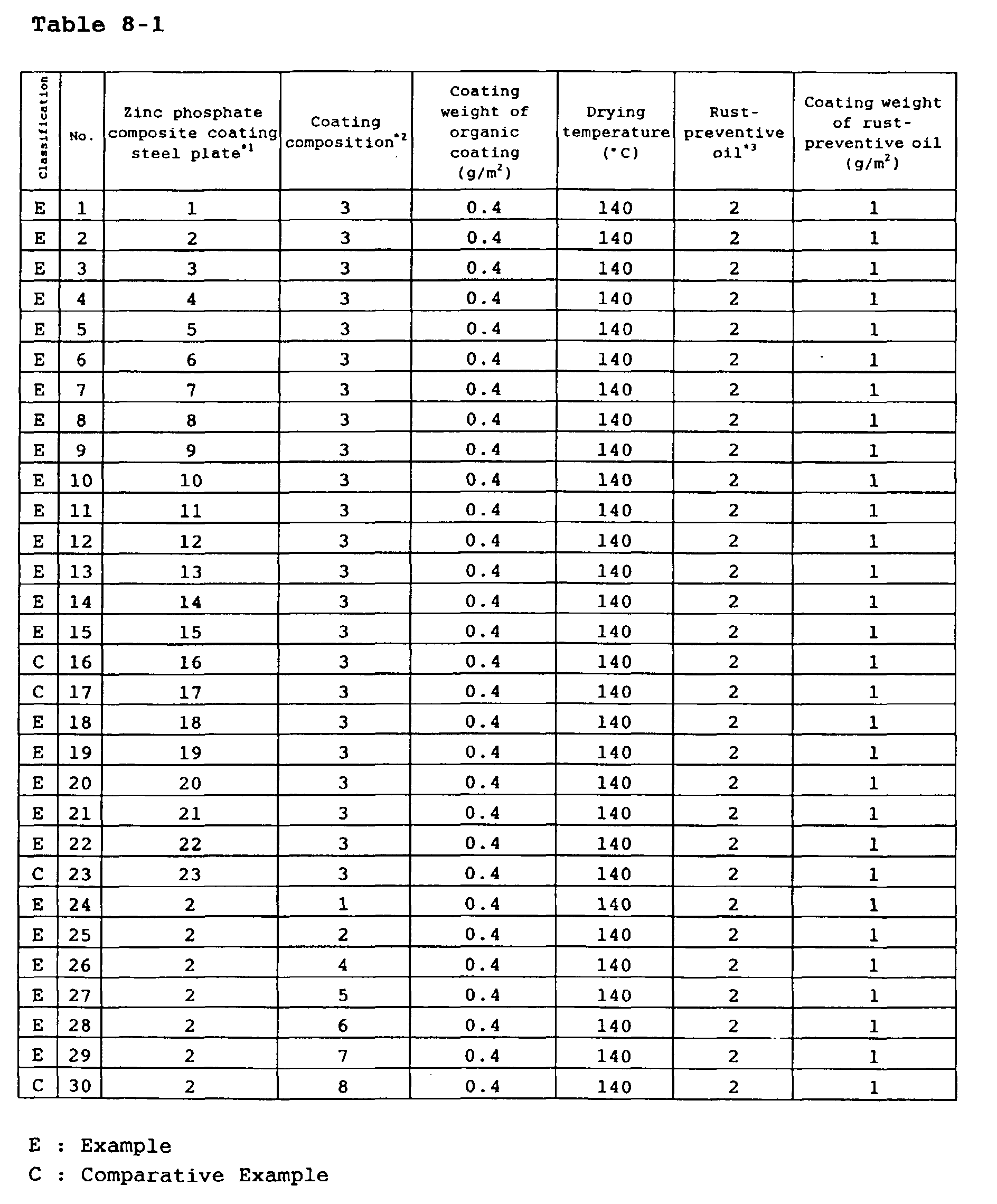
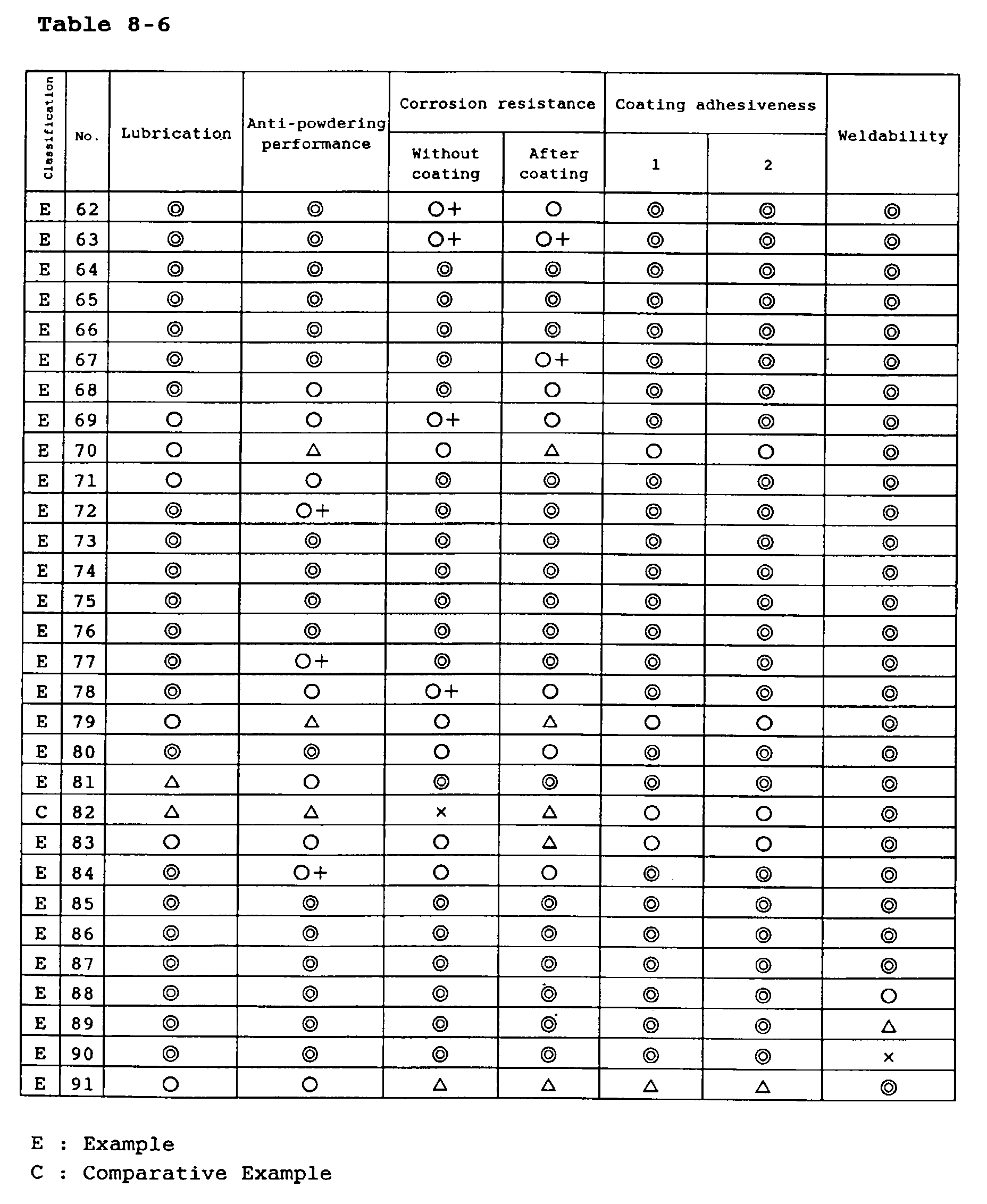
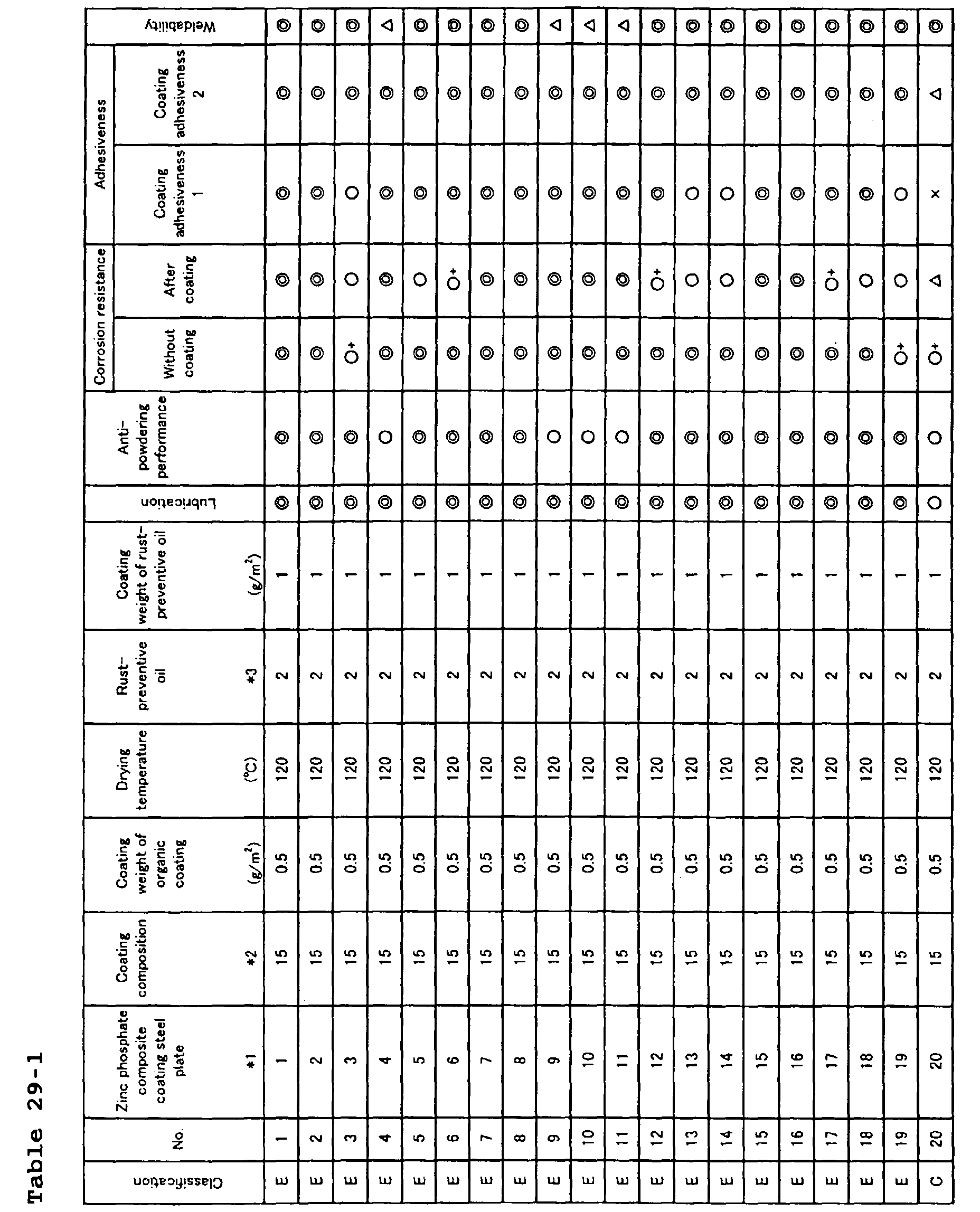
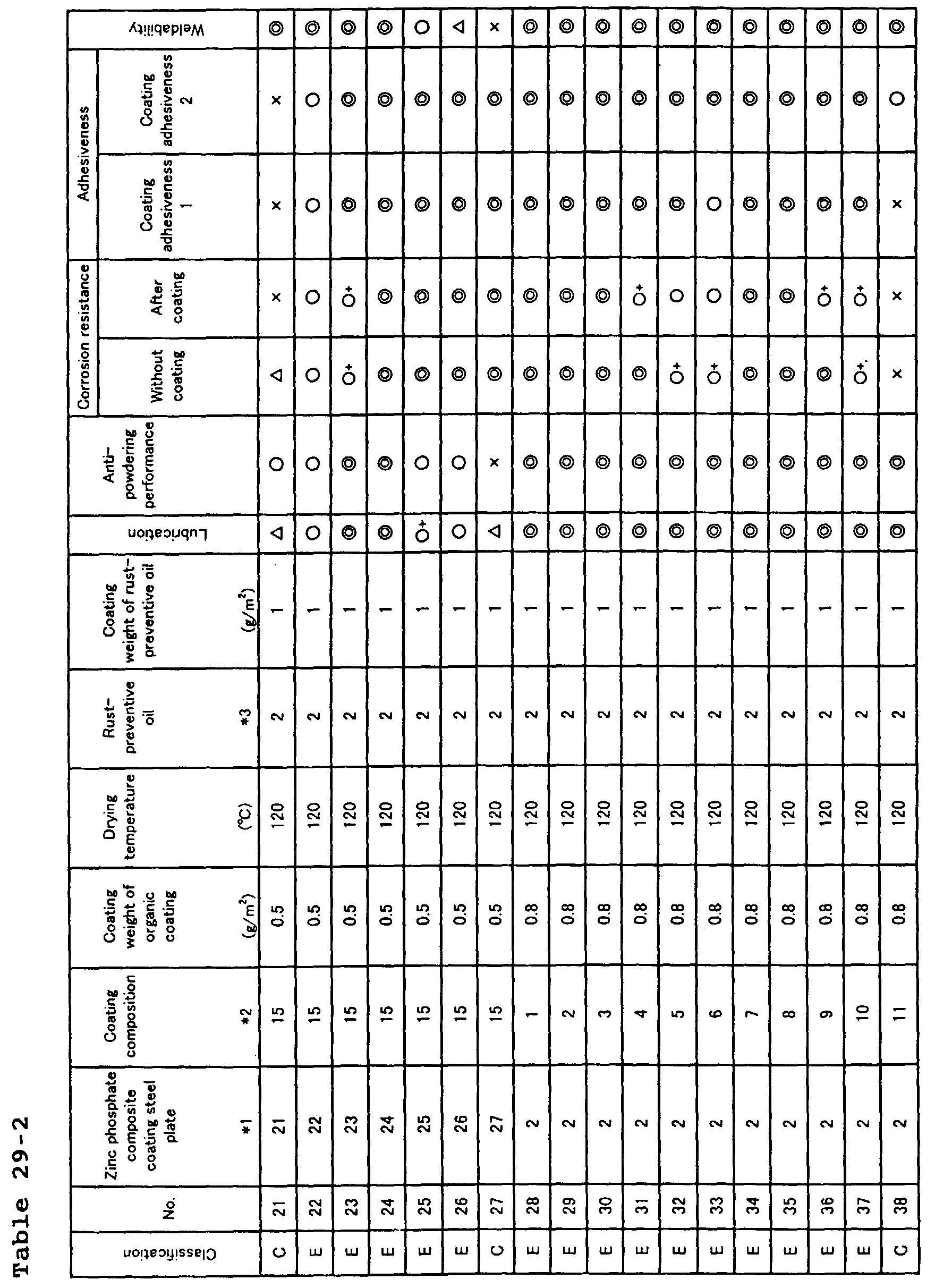
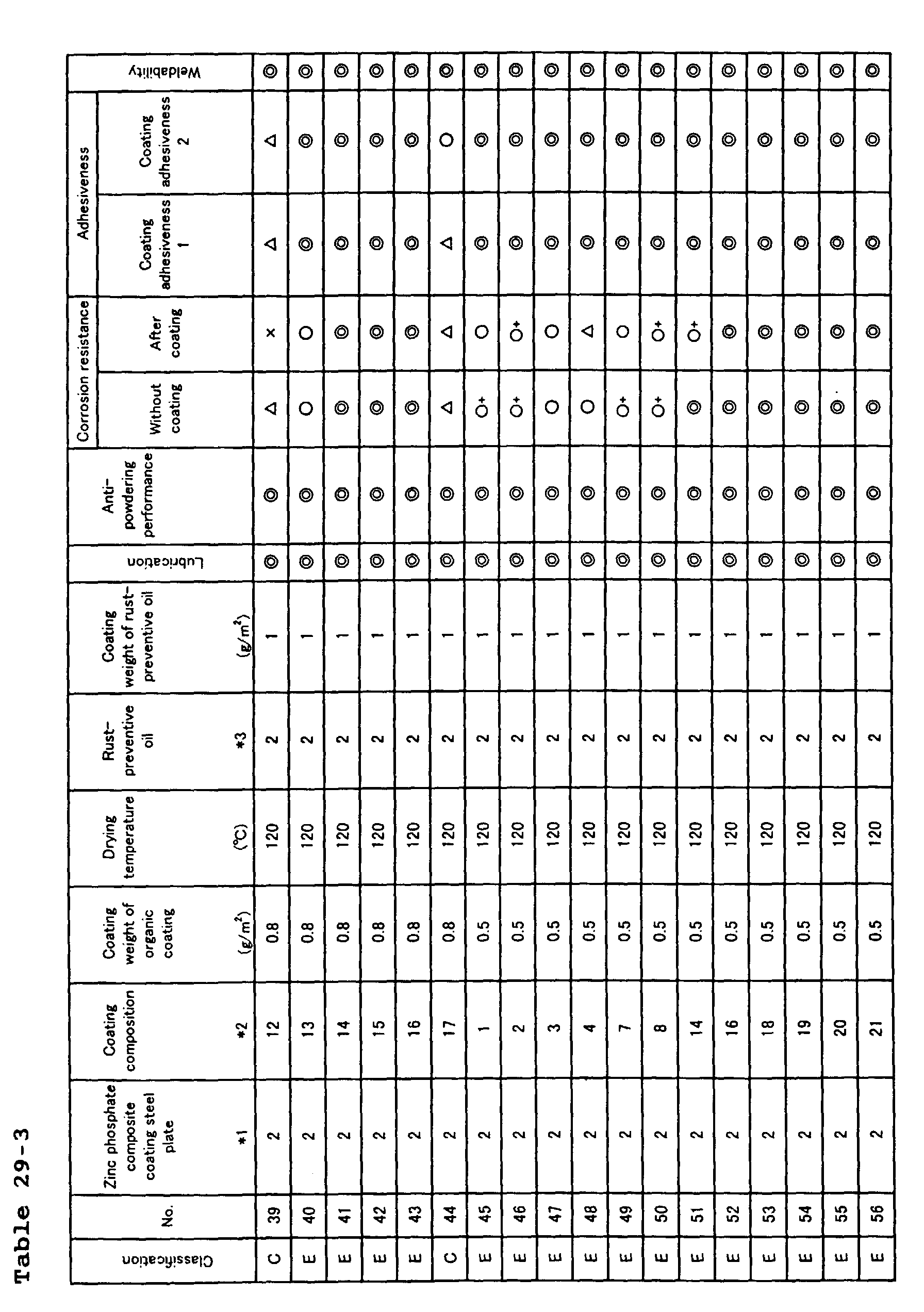
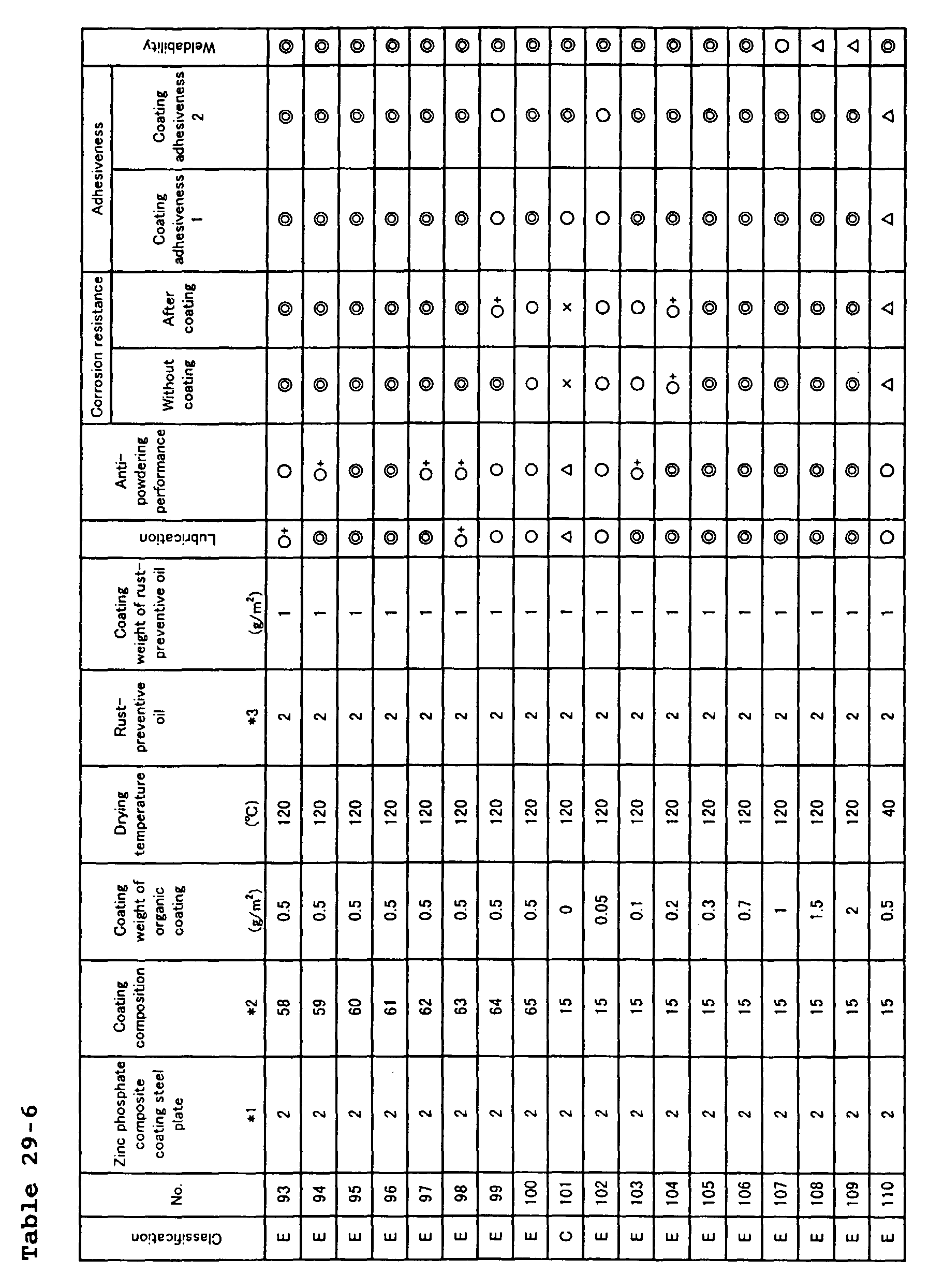
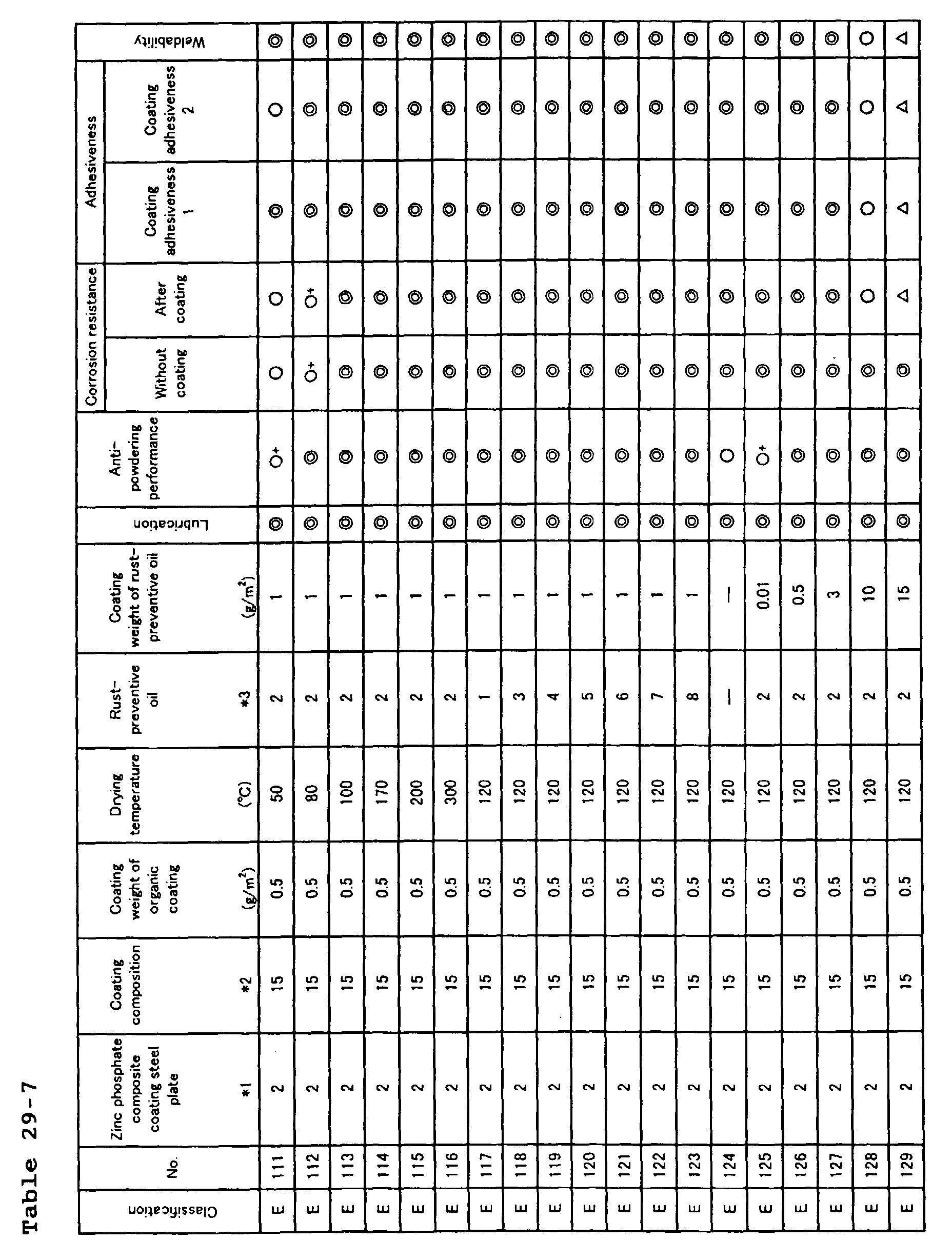
Table 8 shows the kinds of thus prepared surface-treated
steel plates and their tested performance of lubrication,
anti-powdering performance, corrosion resistance, and coating
adhesiveness. In Table 8, *1 through *3 denote the following.
- *1
- : zinc phosphate composite coating steel plate given in
Table 2.
- *2
- : coating composition given in Table 6.
- *3
- : rust-preventive oil given in Table 7.
The method for evaluating each characteristic is described
below.
Lubrication
A pull-out force was determined under the sliding condition
given below, to give evaluation using the formula of:
Friction factor = (Pull-out force)/(Applied force)
The evaluation criteria are the following.
(Sliding condition)
- Tool contact area
- : 50 x 10 mm
- Tool material
- : SKD 11
- Applied pressure
- : 400 kgf
- Sliding speed
- : 0.2 m/min
(Evaluation criteria)
- o○
- : not more than 0.15
- ○
- : more than 0.15 and more than 0.17
- ▵
- : more than 0.15 and not more than 0.20
- X
- : more than 0.20
Anti-powdering performance
A specimen was sheared to 30 mm in width, then was tested
by draw-bead test under the conditions of a tip radius of bead
of 0.5 mm, a bead height of 4 mm, a pressing force of 500 kgf,
a pull-out speed of 200 mm/min. After that, the portion of the
bead subjected to sliding was tested by adhesive-tape peeling,
thus determining the peeled amount of coating per unit area
before and after the test. The evaluation criteria are the
following.
- o○
- : less than 2 g/m2
- ○+
- : more less than 2 g/m2 and less than 3 g/m2
- ○
- : not less than 3 g/m2 and less than 4 g/m2
- ▵
- : not less than 4 g/m2 and less than 6 g/m2
- X
- : not less than 6 g/m2
Corrosion resistance
1) Exposed corrosion resistance
A specimen was treated by degreasing (FCL 4460, produced
by Nihon Parkerizing Co., Ltd., 45°C, immersion for 120 seconds).
Edges and rear face of the specimen were sealed by adhesive tape.
Then the accelerated corrosion test with cycles of combined
corrosion test described below was applied to the specimen. The
evaluation was given by the degree of rust generation after 10
cycles using the evaluation criteria given below.
〈Combined corrosion test cycle〉
- Salt spray
- : 35°C, 2 hours
- → Drying
- : 60°C, 4 hours
- → 95% RH humidification
- : 50°C, 2 hours
〈Evaluation criteria〉
- o○
- : no generation of rust
- ○+
- : rust area less than 25%
- ○
- : rust area not less than 25% and less than 50%
- ▵
- : rust area not less than 50% and less than 75%
- X
- : rust area not less than 75%
2) Corrosion resistance after coating
A specimen was applied by 3 coat coating described below.
Then cross-cut was given on the specimen using a cutter knife.
After sealed on both edges and rear face of the specimen with
adhesive tape, the accelerated corrosion test with cycles of
combined corrosion test described below was applied to the
specimen. The evaluation was given by the single-side bulging
width at the cross-cut section after 180 cycles using the
evaluation criteria given below.
Coating (3 coat)
- Zinc phosphate treatment
- : SD 6500 MZ (standard condition)
- Electrodeposition coating
- : V20, film thickness 20 µm
- Intermediate coating
- : OT0870 (white color sealer),
film thickness 35 µm
- Top coating
- : OT0647PT (shush white), film
thickness 35 µm
〈Combined corrosion test cycle〉
Salt spray 1 hour → Drying 6 hours → Humidifying 1 hour
〈Evaluation criteria〉
- o○
- : less than 1 mm
- ○+
- : not less than 1 mm and less than 2 mm
- ○
- : not less than 2 mm and less than 4 mm
- ▵
- : not less than 4 mm and less than 6 mm
- X
- : not less than 6 mm
Coating adhesiveness 1
A specimen was applied by 3 coat coating described below,
and was allowed to stand for 24 hours or more. Then, the specimen
was immersed in an ion-exchanged water at 50°C for 240 hours.
Within 30 minutes after the specimen was taken out from the water,
100 grid cuts were given to the coating at 2 mm of spacing.
Adhesive tapes were attached to the grids, and were peeled off
from the grids to determine the residual coating rate. The
evaluation criteria are the following.
Coating (3 coat)
- Zinc phosphate treatment
- : SD 6500 MZ (standard condition)
- Electrodeposition coating
- : V20, film thickness 20 µm
- Intermediate coating
- : OT0870 (white color sealer),
film thickness 35 µm
- Top coating
- : OT0647PT (shush white), film
thickness 35 µm
Evaluation criteria
- o○
- : no peeling occurred
- ○
- : peeling rate less than 3%
- ▵
- : peeling rate not less than 3% and less than 10%
- X
- : peeling rate not less than 10%
Coating adhesiveness 2
A specimen was treated by degreasing, then was coated with
a commercial coating DELICON 700 at a thickness of 0 µm. The
specimen was immersed in boiling water for 120 minutes, then 100
grid cuts were given to the coating at 1 mm of spacing. The
Erichsen extrusion to 5 mm was applied to the specimen. Adhesive
tapes were attached to the grids, and were peeled off from the
grids to determine the residual coating rate. The evaluation
criteria are the following.
Evaluation criteria
- o○
- : no peeling occurred
- ○
- : peeling rate less than 3%
- ▵
- : peeling rate not less than 3% and less than 10%
- X
- : peeling rate not less than 10%
Weldability
A specimen was tested by successive spot welding under the
conditions of a pressing force of 200 kgf, a current-applying
time of 14 cycle/50 Hz, and a welding current of 9 KA. The
evaluation was given by the number of successive spot welding.
The evaluation criteria are the following.
- o○
- : not less than 2500
- ○
- : not less than 1500 and less than 2500
- ▵
- : not less than 500 and less than 1500
- X
- : less than 500
| A | Alloyed hot dip galvanized steel plate (coating weight: 60 g/m2) |
| B | Electrolytically galvanized steel plate (coating weight: 30 g/m2) |
| C | Electrolytically Zn-11%Ni alloy plated steel plate (coating weight: 20 g/m2) |
| D | Hot dip galvanized steel plate (coating weight: 90 g/m2) |
| E | Electrolytically Zn-1%Co alloy plated steel plate (coating weight: 30 g/m2) |
| F | Two-layer alloyed hot dip galvanized steel plate (coating weight: 5g/m2 for upper layer; 60 g/m2 for lower layer) |
| G | Hot dip Zn-5%Al-0.5%Mo alloy plated steel plate (coating weight: 90 g/m2) |
| H | Hot dip Zn-55%Al-1.6%Si alloy plated steel plate (coating weight: 75 g/m2) |
| I | Hot dip Zn-0.5%Mn alloy plated steel plate (coating weight: 150 g/m2) |
| No. | Plated steel plate | Coating weight of zinc phosphate coating (g/m2) | Ni content in zinc phosphate coating (mass %) | Mn content in zinc phosphate coating (mass %) |
| 1 | A | 0.4 | 0.06 | 0.5 |
| 2 | B | 0.7 | 1.0 | 2.8 |
| 3 | C | 0.6 | 0.2 | 1.8 |
| 4 | D | 1.0 | 2.0 | 3.0 |
| 5 | E | 1.0 | 0.9 | 2.5 |
| 6 | F | 1.0 | 2.7 | 3.0 |
| 7 | G | 1.0 | 2.8 | 3.2 |
| 8 | H | 1.0 | 2.1 | 3.2 |
| 9 | I | 1.0 | 2.8 | 3.2 |
| 10 | B | 1.0 | 3.0 | - |
| 11 | B | 1.0 | - | 3.5 |
| 12 | B | 0.5 | 0.1 | 0.5 |
| 13 | B | 1.0 | 0.4 | 0.6 |
| 14 | B | 1.0 | 3.0 | 5.0 |
| 15 | B | 1.1 | 4.9 | 5.6 |
| 16 | B | 1.0 | - | - |
| 17 | B | 0.0 | - | - |
| 18 | B | 0.2 | 0.9 | 2.4 |
| 19 | B | 0.5 | 1.0 | 2.7 |
| 20 | B | 1.5 | 2.8 | 3.1 |
| 21 | B | 2.0 | 2.8 | 3.1 |
| 22 | B | 2.5 | 2.8 | 3.1 |
| 23 | B | 3.0 | 2.8 | 3.1 |
| A | Vinyl acetate-acrylic acid copolymer |
| B | Styrene-acrylic acid copolymer |
| C | Ethylene-acrylic acid copolymer, and Na neutralized ionomer resin |
| D | Ethylene-methacrylic acid copolymer, and Na neutralized ionomer resin |
| E | Ethylene-acrylic acid copolymer |
| F | Urethane resin |
| G | Epoxy resin |
| H | Phenol resin |
| I | Polyester resin |
| J | Allyl-silicon resin |
| K | Alkyd resin |
| No. | Rust-preventive additive |
| 1 | Zinc phosphate |
| 2 | Calcium phosphate |
| 3 | Fine silica powder "AEROSILR-811", produced by Nippon Aerosil Co., Ltd. |
| 4 | Fine silica powder "AEROSIL 200", produced by Nippon Aerosil Co., Ltd. |
| 5 | Fine silica powder "AEROSIL 300", produced by Nippon Aerosil Co., Ltd. |
| 6 | Fine silica powder "SNOWTEX OS", produced by Nissan Chemical Industries Co., Ltd. |
| 7 | Ion-exchanged silica: Ca-exchanged silica "SHIELDEX C303" (Ca concentration: 3 wt.%), produced by W.R.Grace & Co. |
| 8 | Aluminum phosphomolybdate |
| 9 | Aluminum phosphate |
| No. | Lubricant | Particle size (µm) | Softening point (°C) |
| 1 | Tungsten disulfide | 3 | - |
| 2 | Molybdenum disulfide | 3 | - |
| 3 | Graphite | 3 | - |
| 4 | Boron nitride | 3 | - |
| 5 | Polyethylene | 0.05 | 120 |
| 6 | Polyethylene | 1 | 120 |
| 7 | Polyethylene | 8 | 125 |
| 8 | Polyethylene | 3 | 125 |
| 9 | Polyethylene | 5 | 130 |
| 10 | Polyethylene | 10 | 130 |
| 11 | Polyethylene | 15 | 130 |
| 12 | Polyethylene | 25 | 130 |
| 13 | Polyethylene | 30 | 130 |
| 14 | Tetrafluoroethylene resin | 3 | - |
| 15 | Polypropylene | 3 | - |
| 16 | Polyethylene | 8 | 100 |
| 17 | Polyethylene | 8 | 110 |
| 18 | Polyethylene | 8 | 130 |
| 19 | Polyethylene | 8 | 135 |
| 20 | Polyethylene | 8 | 137 |
| No. | Resin*1 | Rust-preventive additive*2 | Content*3 | Lubricant*4 | Content*3 |
| 1 | A | 5 | 20 | 7 | 10 |
| 2 | B | 5 | 20 | 7 | 10 |
| 3 | C | 5 | 20 | 7 | 10 |
| 4 | D | 5 | 20 | 7 | 10 |
| 5 | E | 5 | 20 | 7 | 10 |
| 6 | F | 5 | 20 | 7 | 10 |
| 7 | G | 5 | 20 | 7 | 10 |
| 8 | H | 5 | 20 | 7 | 10 |
| 9 | I | 5 | 20 | 7 | 10 |
| 10 | J | 5 | 20 | 7 | 10 |
| 11 | K | 5 | 20 | 7 | 10 |
| 12 | C | 1 | 20 | 7 | 10 |
| 13 | C | 2 | 20 | 7 | 10 |
| 14 | C | 3 | 20 | 7 | 10 |
| 15 | C | 4 | 20 | 7 | 10 |
| 16 | C | 6 | 20 | 7 | 10 |
| 17 | C | 7 | 20 | 7 | 10 |
| 18 | C | 8 | 20 | 7 | 10 |
| 19 | C | 9 | 20 | 7 | 10 |
| 20 | C | 5 | 20 | 1 | 10 |
| 21 | C | 5 | 20 | 2 | 10 |
| 22 | C | 5 | 20 | 3 | 10 |
| 23 | C | 5 | 20 | 4 | 10 |
| 24 | C | 5 | 20 | 5 | 10 |
| 25 | C | 5 | 20 | 6 | 10 |
| 26 | C | 5 | 20 | 8 | 10 |
| 27 | C | 5 | 20 | 9 | 10 |
| 28 | C | 5 | 20 | 10 | 10 |
| 29 | C | 5 | 20 | 11 | 10 |
| 30 | C | 5 | 20 | 12 | 10 |
| No. | Resin*1 | Rust-preventive additive*2 | Content*3 | Lubricant*4 | Content*3 |
| 31 | C | 5 | 20 | 13 | 10 |
| 32 | C | 5 | 20 | 14 | 10 |
| 33 | C | 5 | 20 | 15 | 10 |
| 34 | C | 5 | 20 | 16 | 10 |
| 35 | C | 5 | 20 | 17 | 10 |
| 36 | C | 5 | 20 | 18 | 10 |
| 37 | C | 5 | 20 | 19 | 10 |
| 38 | C | 5 | 20 | 20 | 10 |
| 39 | C | - | - | - | - |
| 40 | C | 5 | 1 | 7 | 10 |
| 41 | C | 5 | 10 | 7 | 10 |
| 42 | C | 5 | 30 | 7 | 10 |
| 43 | C | 5 | 40 | 7 | 10 |
| 44 | C | 5 | 70 | 7 | 10 |
| 45 | C | 5 | 80 | 7 | 10 |
| 46 | C | 5 | 90 | 7 | 10 |
| 47 | C | 5 | 100 | 7 | 10 |
| 48 | C | 5 | 150 | 7 | 10 |
| 49 | C | 5 | 20 | 7 | 1 |
| 50 | C | 5 | 20 | 7 | 3 |
| 51 | C | 5 | 20 | 7 | 5 |
| 52 | C | 5 | 20 | 7 | 10 |
| 53 | C | 5 | 20 | 7 | 20 |
| 54 | C | 5 | 20 | 7 | 35 |
| 55 | C | 5 | 20 | 7 | 50 |
| 56 | C | 5 | 20 | 7 | 80 |
| 57 | C | 5 | 20 | 7 | 100 |
| 58 | C | - | - | 7 | 10 |
| 59 | C | 5 | 20 | - | - |
| No. | Name |
| 1 | Rust-preventive oil "NOX-RUST 530F", produced by PERKER KOUSAN |
| 2 | Rust-preventive oil "DAPHNIS OIL COAT SK", produced by Nippon Oil Co., Ltd. |
| 3 | Cleaning rust-preventive oil "PRETON R303P", produced by SUGIMURA CHEMICAL |
| 4 | Cleaning rust-preventive oil "PRETON R303P" produced by SUGIMURA CHEMICAL |
| 5 | Cleaning rust-preventive oil "RUSTCLEAN K", produced by Nippon Oil Co., Ltd. |
| 6 | Cleaning rust-preventive oil "P-1600B", produced by Nippon Oil Co., Ltd. |
| 7 | Lubrication rust-preventive oil "NOX-RUST 550HN", produced by PERKER KOUSAN |
| 8 | Lubrication rust-preventive oil "NOX-RUST Mu-10", produced by PERKER KOUSAN |
(Example 2)
(1) Plated steel plates
Electrolytically galvanized steel plates each having a
thickness of 0.7 mm, a surface roughness (Ra) of 1.0 µm, and a
coating weight of 20 g/m2 were used in Example 2.
(2) Zinc phosphate composite treatment
In accordance with the steps given below, zinc phosphate
composite coating steel plates shown in Table 2 were prepared
as the specimens.
1) Degreasing → 2) Washing with water → 3) Surface
preparation treatment → 4) Phosphate treatment → 5) Washing
with water → 6) Drying
Respective conditions in each treatment step are the
following.
(3) Coating composition
(3-1) Organic resin
Table 3 shows the organic resins used in the coating
compositions.
(3-2) Rust-preventive additive
Table 4 shows the rust-preventive additives used in the
coating compositions.
(3-3) Lubricant
Table 5 shows the solid lubricants used in the coating
composition.
(3-4) Coating composition
Table 6 shows the coating compositions used in Example 2.
(4) Rust-preventive oils
Table 7 shows the rust-preventive oils used in Example 2.
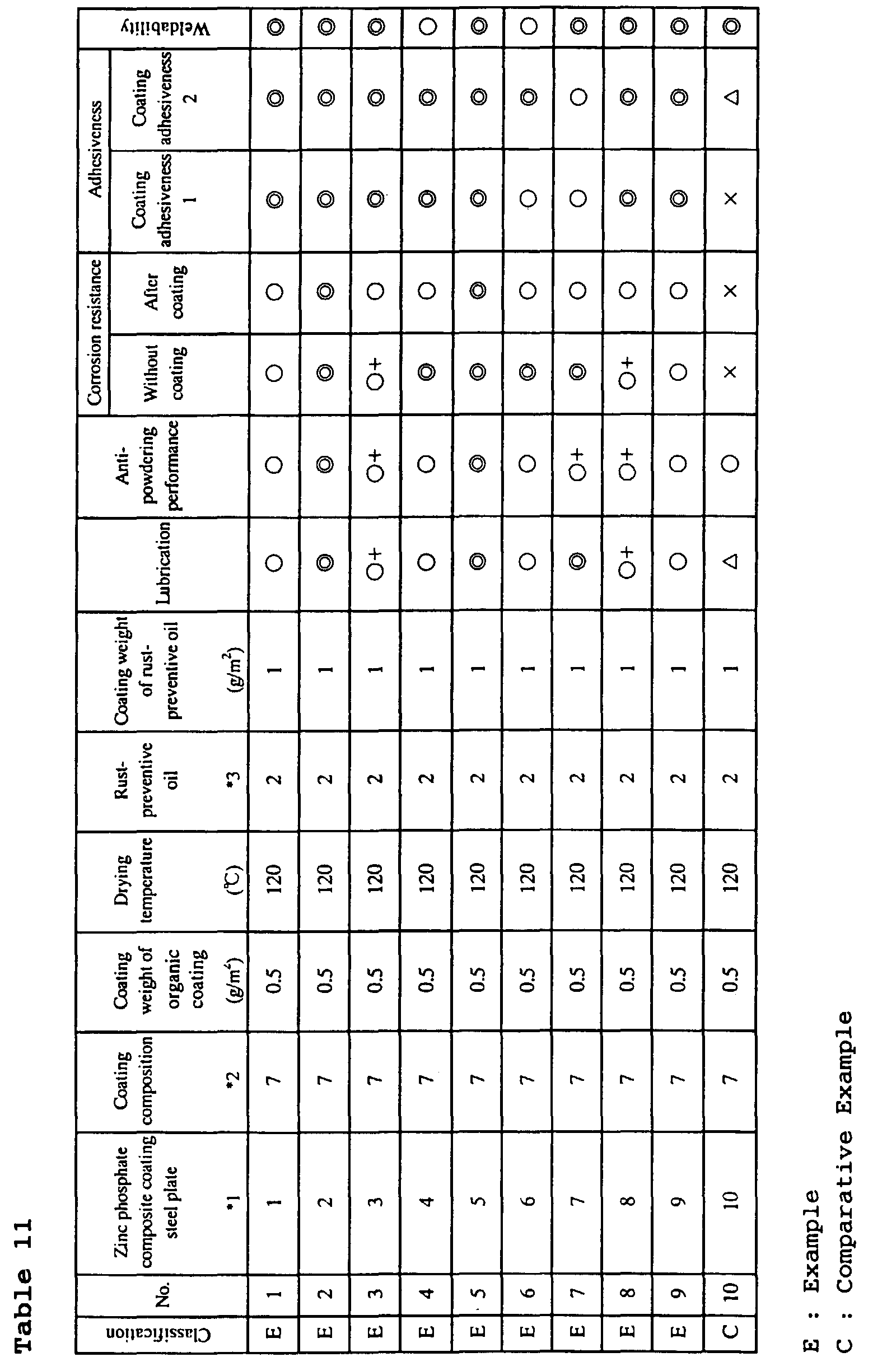
Table 11 shows the kinds of thus prepared surface-treated
steel plates and their tested performance of lubrication,
anti-powdering performance, corrosion resistance, and coating
adhesiveness. In Table 11, *1 through *3 denote the following.
- *1
- : zinc phosphate composite coating steel plate given in
Table 10.
- *2
- : coating composition given in Table 6.
- *3
- : rust-preventive oil given in Table 7.
The method for evaluating each characteristic is the same
as in Example 1.
| No. | Composition of phosphate treatment solution (g/l) | Acid ratio (Total acid/Free acid) |
| | Zn | Mg | Ni | PO4 | NO3 | F |
| 1 | 0.8 | 0.5 | 2.9 | 15 | 3 | 0.5 | 15 |
| 2 | 0.8 | 0.6 | 2.4 | 19 | 5 | 0.2 | 12.5 |
| 3 | 0.6 | 0.1 | 2 | 15 | 8 | 0.9 | 17 |
| 4 | 1.4 | 0.7 | 3.2 | 12.5 | 13 | 0.5 | 10 |
| 5 | 0.8 | - | 3.6 | 12 | 5 | 0.5 | 17 |
| 6 | 0.8 | 1 | - | 15 | 2 | 0.2 | 10 |
| 7 | 0.6 | 0.3 | 1.5 | 12.5 | 14 | 0.5 | 15 |
| 8 | 0.6 | 0.08 | 3.8 | 5 | 3 | 0.3 | 12.5 |
| 9 | 1.2 | 0.9 | 2.2 | 12 | 0.2 | 0.5 | 12.5 |
| No | Activation treatment | Treatment solution No. | Treatment time (seconds) | Treatment solution temperature (°C) | Coating weight (g/m2) | Ni content (mass %) | Mg content (mass %) |
| 1 | A | 1 | 3 | 50 | 0.3 | 6.2 | 0.5 |
| 2 | B | 2 | 5 | 50 | 0.5 | 5 | 0.5 |
| 3 | C | 3 | 2 | 60 | 0.4 | 7.1 | 0.3 |
| 4 | A | 3 | 5 | 70 | 1.9 | 6.1 | 0.2 |
| 5 | A | 4 | 4 | 60 | 0.9 | 5.6 | 0.3 |
| 6 | A | 5 | 5 | 70 | 1.8 | 9 | - |
| 7 | B | 6 | 6 | 50 | 0.7 | - | 0.7 |
| 8 | C | 7 | 2 | 60 | 0.4 | 2.7 | 0.2 |
| 9 | A | 8 | 3 | 50 | 0.3 | 2.4 | 0.1 |
| 10 | A | 9 | 0.5 | 40 | 0.05 | 2.1 | 0.1 |
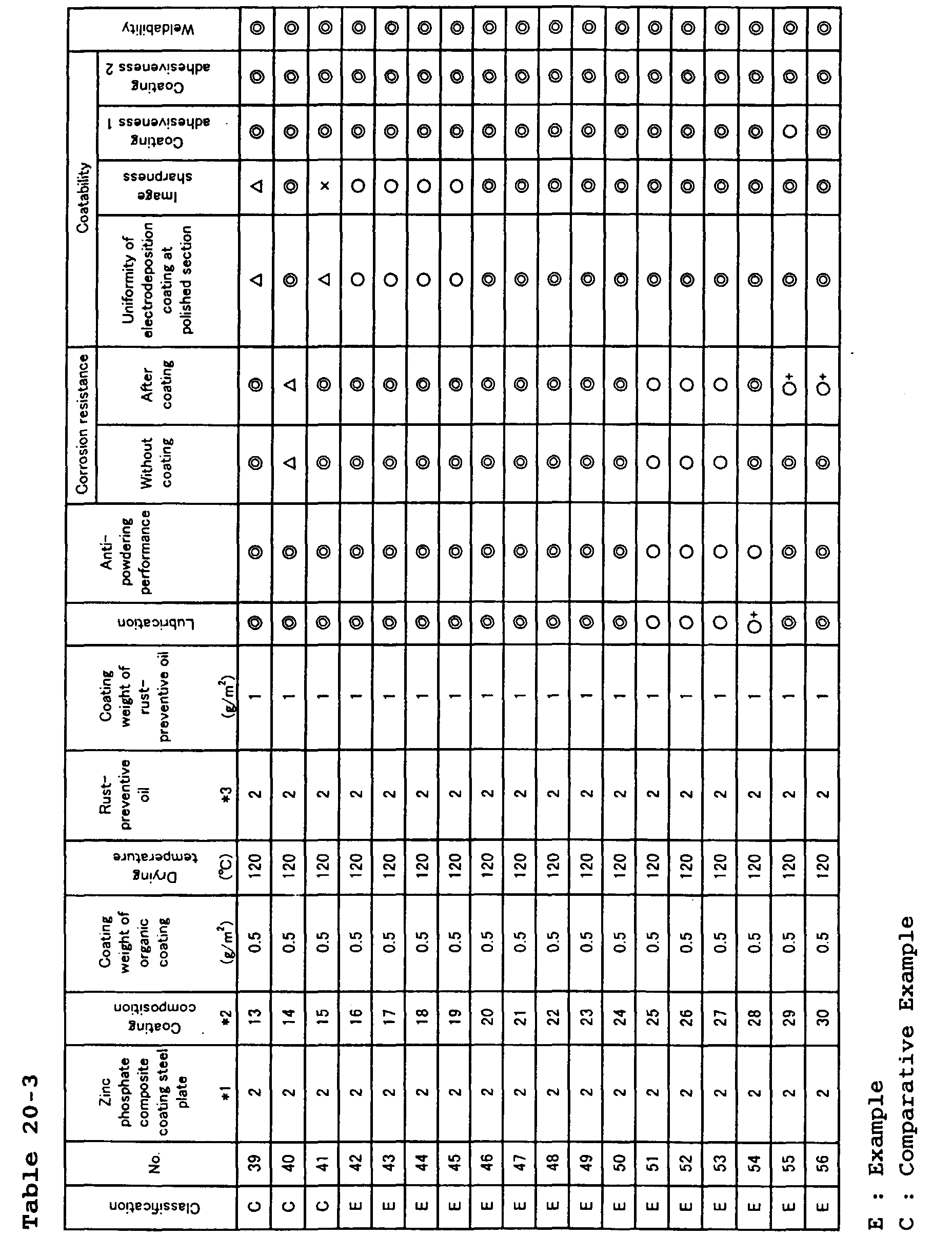
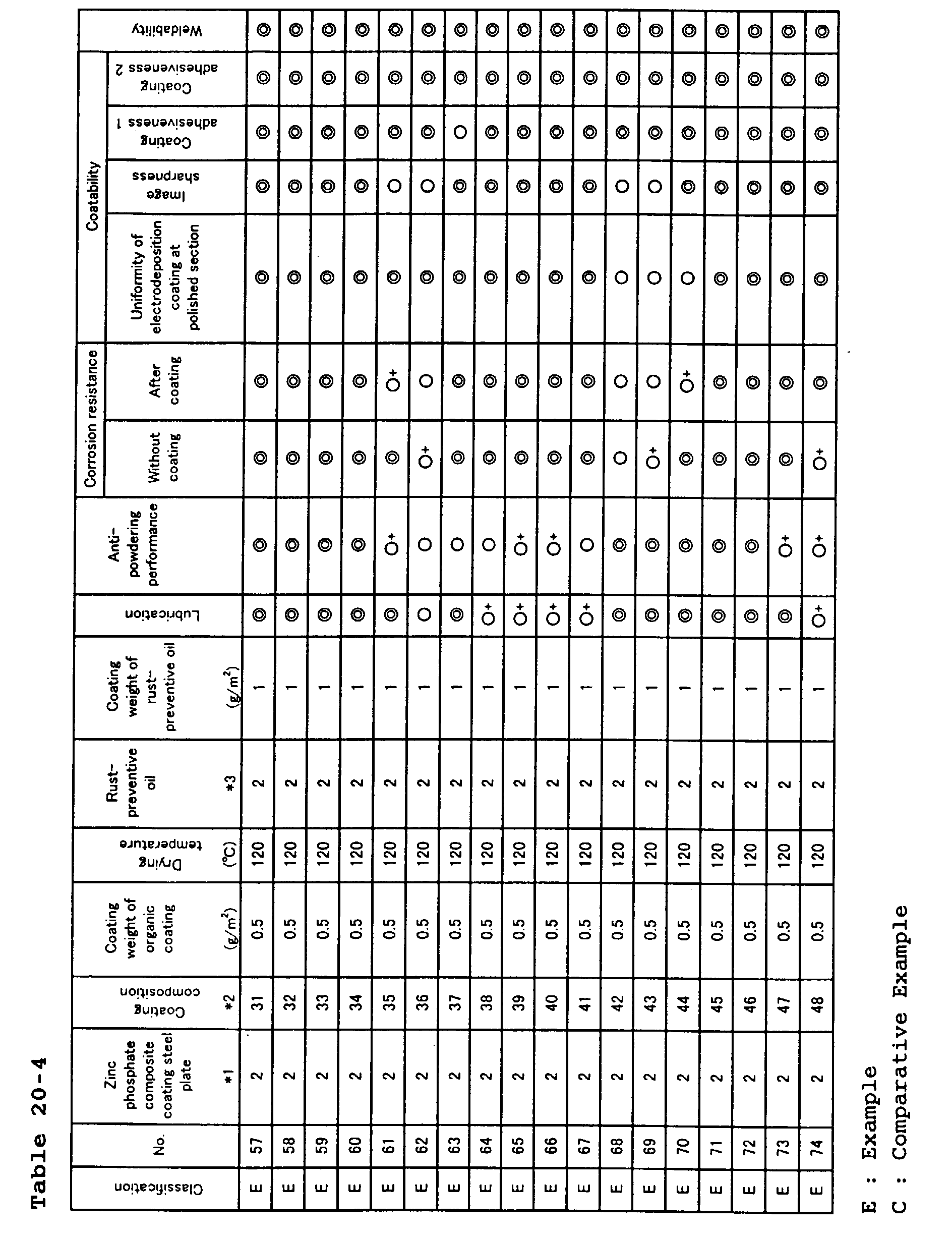
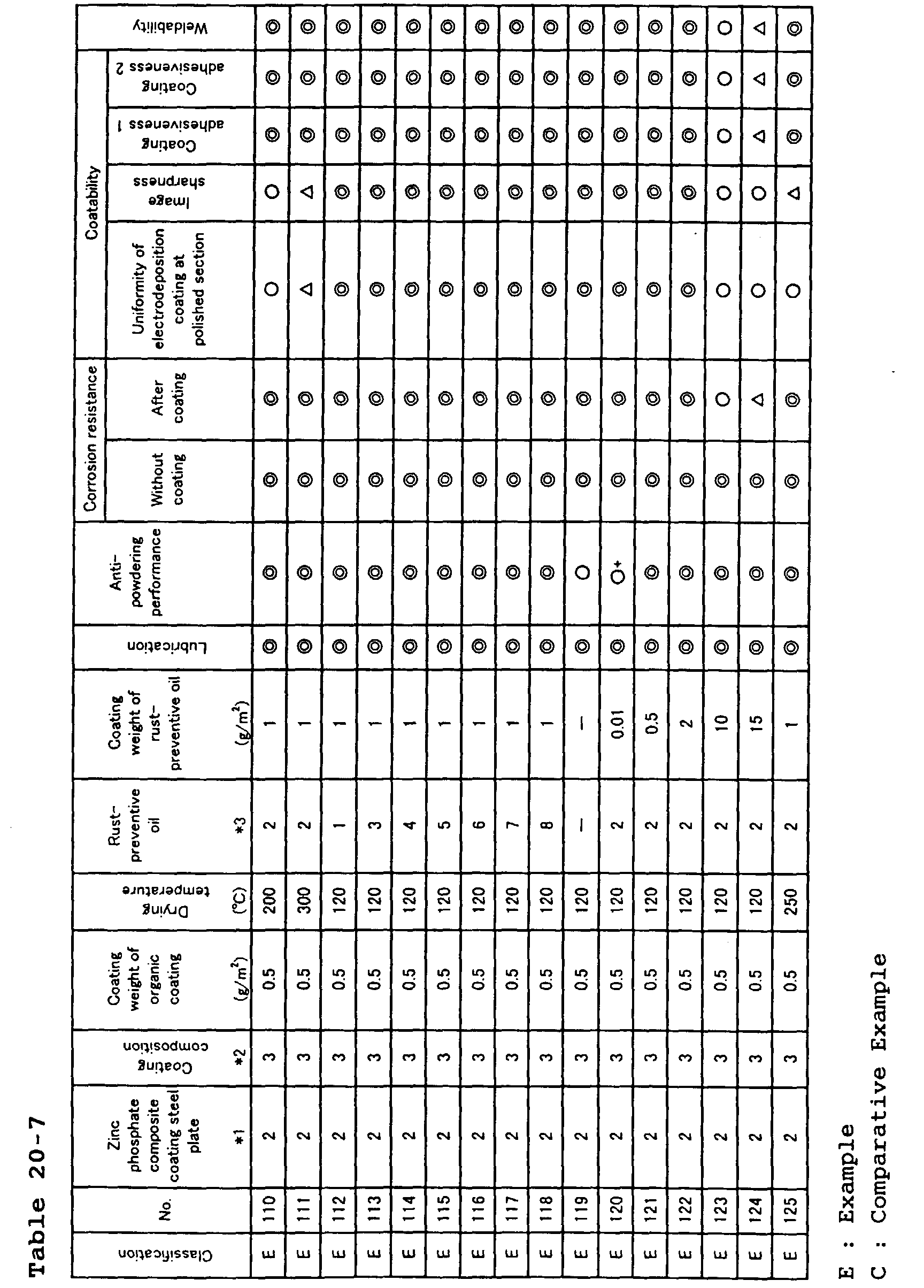
The inventors of the present invention investigated the
zinc phosphate composite treated steel plates focusing on the
relation of coating in terms of structure, corrosion resistance,
anti-powdering performance, lubrication, coating adhesiveness,
and weldability. Thus, the inventors derived the following-described
findings.
The present invention was established on the basis of
above-described findings, and the present invention is
characterized in the constitution described in the following.
That is, the present invention provides a zinc phosphate
composite treated steel plate having excellent corrosion
resistance, anti-powdering performance, lubrication, and
coatability, which steel plate comprises: a zinc-base plated
steel plate; a first layer of zinc phosphate composite coating
layer having coating weights of from 0.2 to 2.5 g/m2, containing
at least one substance selected from the group consisting of
nickel, manganese, and magnesium, formed on the surface of the
zinc-base plated steel plate; and a second layer of an organic
coating consisting mainly of organic resins described in (1) in
the following.
(1) A block urethane-modified resin prepared by mixing a
modified epoxy resin (A) comprising an epoxy resin, a
multifunctional amine, and a monoisocyanate, and a block
urethane (B) comprising a polyol, a polyisocyanate, and a
block-forming agent, at mixing rates (A/B) of from 95/5 to 50/50
(weight ratio of nonvolatile matter).
According to the present invention, the content of at least
one substance selected from the group consisting of nickel,
manganese, and magnesium, in the zinc phosphate composite
coating is preferably in a range of from 0.5 to 8.5 mass% as the
total thereof.
The organic coating preferably contains a solid lubricant
and/or a rust-preventive additive as components. The content of
the rust-preventive additive in the organic coating is
preferably in a range of from 1 to 100 parts by weight as solid
content to 100 parts by weight of the block urethane-modified
epoxy resin as solid content. And the content of the solid
lubricant is preferably in a range of from 1 to 80 parts by weight
as solid content to 100 parts by weight of the block
urethane-modified epoxy resin as solid content.
According to the present invention, the rust-preventive
additive preferably contains a hydrophilic silica. The
rust-preventive additive preferably contains a silica at
specific surface areas of from 20 to 1000 m2/g.
The solid lubricant is preferably at least one substance
selected from the group consisting of polyethylene wax
(preferably having softening points of from 100 to 135°C),
tetrafluoroethylene resin, and boron nitride. The average
particle size of the solid lubricant is preferably in a range
of from 0.05 to 25 µm.
The coating weight of the organic coating is preferably in
a range of from 0.05 to 1.5 g/m2.
According to the present invention, the uppermost layer
preferably has a rust-preventive film layer at coating weights
of from 0.01 to 10 g/m2.
The detail of the present invention is described in the
following giving the reasons to limit the specification.
The steel plates which become the substrate of the zinc-base
plated steel plates according to the present invention include:
all kinds of cold-rolled steel plates for soft-working, such as
cold-rolled steel plates for general working (CQ), cold-rolled
steel plates for deep drawing (DQ), cold-rolled steel plates for
very deep drawing (DDQ) and cold-rolled steel plates for ultra
deep drawing (EDDQ); all kinds of high tension steel plates
ranging from high tension steel plates of relatively low strength
level having baking-hardening property to general high tension
steel plates having more than 390 MPa of tensions; and de-scaled
hot-rolled steel plates.
Examples of the plating layers of the zinc-base plated steel
plates are Zn plating, Zn-Ni alloy plating (10 to 15 mass% of
Ni content), Zn-Fe ally plating (5 to 25 mass% or 60 to 90 mass%
of Fe content), Zn-Mn alloy plating (30 to 80 mass% of Mn
content), Zn-Co alloy plating (0.5 to 15 mass% of Co), Zn-Cr ally
plating (5 to 30 mass% of Cr), Zn-Al alloy plating (3 to 60 mass%
of Al content). Each of the above-given plating compositions
may further include alloying element such as Co, Fe, Ni, and Cr,
and oxide or salt of silica, alumina, slightly soluble chromate,
or the like, and polymer. Among the above-described plating
layers, two or more layers of the same kind or different kind
may be applied to form a composite layer.
The plated steel plate may be the one prepared by applying
plating of Ni or the like at a small coating weight onto the steel
plate, followed by applying various kinds of plating given above.
The plated steel plate may be the one prepared by applying
plating of Ni or the like at a small coating weight onto the steel
plate, followed by applying various kinds of plating given above.
The plating described above may be formed by either one of
electrolytic method, fusion method, and vapor phase method.
A preferred coating weight of plating is not less than 10
g/m2. Less than 10 g/m2 of coating weight induces problems
because of poor corrosion resistance. In the case of Zn-Ni alloy
plating, Zn-Fe alloy plating, Zn-Mn alloy plating, Zn-Co alloy
plating, and Zn-Cr alloy plating, the anti-powdering performance
degrades when the coating weight exceeds 60 g/m2, so the coating
weight is preferably in a range of from 10 to 60 g/m2. For further
improved corrosion resistance and anti-powdering performance,
the coating weight is preferably in a range of from 15 to 60 g/m2.
To prevent generation of film defects and irregularity on
the surface of the zinc phosphate composite coating on the
plating film, which processing is described later, it is possible
to apply treatment of alkaline degreasing, solvent degreasing,
and surface preparation treatment on the plating film, in
advance. These pre-treatments include (1) the treatment using
an acidic or alkaline aqueous solution containing at least one
metallic ion selected from the group consisting of Ni ion, Co
ion, and Fe ion, (2) the treatment contacting with a titanium
colloid aqueous solution, and (3) the treatment to etch the top
layer of the metallic oxide formed on the surface of the plated
steel plate using an inorganic acid, an organic acid, or a
cheleting compound such as EDTA and NTA. The effect of the
present invention is available with any of these kinds of steel
plates as the substrate.
As for the zinc phosphate composite-treated steel plate,
according to the present invention, a zinc phosphate coating is
formed as the first layer on the above-described zinc-base plated
steel plates, and an organic coating is formed as the second layer
on the first layer. The zinc-phosphate coating of the first layer
improves the coating adhesiveness owing to the anchor effect,
and contributes to the improvement of lubrication by preventing
the direct contact between the steel plate and the tools during
sliding actions.
According to the present invention, a zinc phosphate
coating containing at least one substance selected from the group
consisting of nickel, manganese, and magnesium is applied. The
coating exists presumably in a form that a portion of zinc in
the zinc phosphate coating is substituted by the above-described
metal contained in the coating. That form of coating induces
the interaction with the organic coating as the top layer, thus
providing excellent corrosion resistance, anti-powdering
performance, lubrication, and coating adhesiveness.
The content of at least one substance selected from the
group consisting of nickel, manganese, and magnesium, in the zinc
phosphate coating is preferably in a range of from 0.5 to 8.5
mass% as the total. By specifying the total content of these
metals in the coating to that range, the corrosion resistance,
the lubrication, and the coating adhesiveness are further
improved. When particularly superior corrosion resistance and
coating adhesiveness are required, it is more preferable to
specify the total content of nickel, manganese, and magnesium
to a range of from 2.5 to 7 mass%. The corrosion resistance and
the coating adhesiveness are drastically improved by the
existence of nickel as the essential component in a range of from
1 to 5.5 mass%, and manganese and/or magnesium in a range of
from 0.5 to 4 mass% as the total.
The coating weight of the zinc phosphate composite coating
as the first layer is preferably in a range of from 0.2 to 2.5
g/m2. If the coating weight thereof is less than 0.2 g/m2, the
coating adhesiveness and the corrosion resistance degrade. If
the coating weight thereof exceeds 2.5 g/m2, powdering increases
under sliding conditions, thus degrading the lubrication and
resulting in poor spot weldability, uniformity in
electrodeposition coating at polished portions, and image
sharpness. In view of lubrication, coatability, corrosion
resistance, and weldability, more preferable range of coating
weight is from 0.5 to 2.0 g/m2, and most preferably from 0.7 to
1.5 g/m2.
The method of zinc phosphate treatment for forming the zinc
phosphate coating layer may be either one of reaction type
treatment, coating type treatment, and electrolytic type
treatment.
An example of the reaction type treatment is that a plated
steel plate is subjected to degreasing, washing with water, and
surface preparation treatment, followed by contacting with a
treatment solution of an aqueous solution consisting mainly of:
phosphoric acid ion, nitric acid ion, and zinc ion, and at least
one substance selected from the group consisting of nickel ion,
manganese ion, and magnesium ion; further containing, at need,
(1) and (2) given below, then washing with water and drying.
Regarding the coating type treatment, at least one side of
the plated steel plate is coated with a zinc phosphate treatment
solution consisting mainly of phosphoric acid ion, nitric acid
ion, and zinc ion, and at least one substance selected from the
group consisting of nickel ion, manganese ion, and magnesium ion.
Any kind of coating method is applicable. That is, coating by
roll-coater method, coating by immersion method or spray method
followed by applying air-knife method or roll-squeezing method
to adjust the coating weight may be used. After coating a zinc
phosphate treatment solution onto the surface of the plated steel
plate, drying may be given using a drier, a hot air furnace, a
high frequency induction heating furnace, or an infrared furnace
to form the zinc phosphate coating.
Drying temperature of the coating in the case that the
coating is formed by the coating method is preferably in a range
of from 70 to 400°C as the ultimate plate temperature. If the
drying temperature is less than 70°C, the drying of coating
becomes insufficient, which induces stickiness of the coating
and degradation in coating adhesiveness, and induces irregular
coating on forming the organic coating of the second layer. If
the ultimate plate temperature exceeds 400°C, the effect
saturates, which not only is uneconomical but also degrades
corrosion resistance owing to the tendency of defect occurrence
in coating. Accordingly, more preferable baking temperature is
in a range of from 100 to 300°C, and most preferable one is from
120 to 170°C.
The organic coating formed as the upper layer on the zinc
phosphate composite coating is described below. According to the
present invention, the organic coating formed on the zinc
phosphate coating layer consisting mainly of a block
urethane-modified epoxy resin prepared by mixing a modified
epoxy resin (A) comprising an epoxy resin, a multifunctional
amine, and a monoisocyanate, and a block urethane (B) comprising
a polyol, a polylsocyanate, and a block-forming agent, at mixing
rates (A/B) of from 95/5 to 50/50 (weight ratio of nonvolatile
matter).
Examples of the epoxy resin are: an epoxy resin prepared
by glycidil-etherification of Bisphenol A, Bisphenol F, and
Novolak; and an epoxy resin prepared by glycidil-etherfication
of Bisphenol A with the addition of propylene oxide or ethylene
oxide. Furthermore, an aliphatic epoxy resin, an alicyclic epoxy
resin, and a polyether-base epoxy resin may be applied. Two or
more of these epoxy resins may be applied. In view of corrosion
resistance, the epoxy resins preferably have epoxy equivalents
of not less than 400.
The modified epoxy resin (A) according to the present
invention is an epoxy resin modified by a multifunctional amine
and a monoisocyanate.
Modification of epoxy resin by a multifunctional amine is
conducted by reacting the glycidil group in the epoxy resin with
a multifunctional amine. Examples of the multifunctional amine
are: a primary alkanol amine such as ethanol amine, propanol
amine, isopropanol amine, and butanol amine; a primary alkyl
amine such as propyl amine, butyl amine, octyl amine, and decyl
amine; an amine having two or more of active hydrogens in a single
molecule, such as ethylene diamime, diethylene triamine,
tetraethylene pentamine, xylene diamine, aminoethyl pyperadine,
and norbornane diaminomethyl. Two or more of these amines may
be applied together. In view of corrosion resistance and coating
adhesiveness, alkanol amine is preferred.
The corrosion resistance is further improved by modifying
an epoxy resin by monoisocyanate. The monoisocyanate may be the
one prepared by reacting phosgene with an aliphatic monoamine
or an aromatic monoamine. Alternatively, a monoisocyanate may
be the one prepared by reacting an isocyanate group at a molecular
terminal of diisocyanate compound with either one of an aliphatic
alcohol, an aromatic alcohol, and an alicyclic alcohol. The
alcohol is preferably the one having 4 or more of carbon atoms
in view of solubility with the epoxy resin. Examples of the
diisocyanate are: an aliphatic isocyanate such as hexamethylene
dilsocyanate and trimethyihexamethylene diisocyanate; an
aromatic isocyanate such as xylylene diisocyanate, 2,4-tolylene
diisocyanate, and 2,6-tolylene diisocyanate; and an alicyclic
isocyanate such as isophorone diisocyanate and norbornane
diisocyanate methyl. These compounds may be applied mixing two
or more of them.
An example of synthesis of the modified epoxy resin (A) is
the following. To a glycidil group in an epoxy resin, the active
hydrogen in a multifunctional amine is mixed at ratios of 1.1
to 1.8 equivalent. The mixture is reacted at temperatures of
from 70 to 150°C for 4 to 10 hours. Further monoisocyanate is
added to the reacting mixture at equivalents of from 0.7 to 2.0
to the active hydrogen in the residual amine, to continue the
reaction at temperatures of from 30 to 100°C.
The block urethane according to the present invention is
prepared by protecting a highly active isocyanate group in the
isocyanate compound using an adequate compound, and the block
urethane dissociates the block-forming agent under heating, thus
readily regenerates the activity of the isocyanate group. That
is, the block urethane plays a role of a curing agent of the
modified epoxy resin.
Examples of polyol are: a secondary alcohol such as ethylene
glycol, propylene glycol, 1,6-hexane diol, diethylene glycol,
and triethylene glycol; a tertiary alcohol such as glycerin and
trimethylol propane; a low molecular weight polyol such as
pentaerythritol; a polyester polyol prepared from caprolactone
or low molecular weight polyol and dicarboxylic acid; and a high
molecular weight polyol such as polyethylene glycol.
polypropylene glycol, and polytetramethylene glycol, which have
400 or higher molecular weight. Two or more of these polyols
may be used together. Use of a high molecular weight polyol as
the polyol gives the organic coating adequate hydrophilicity,
which improves the compatibility with a cationic
electrodeposition coating to give a smooth coating surface, thus
providing superior image sharpness after intermediate and top
coating and superior uniformity of electrodeposition coating at
polished portions.
Applicable polyisocyanates include all the above-described
dilsocyanates, their mixtures, and their polynuclei bodies.
Examples of block-forming agent are: a phenol-base compound such
as phenol; a lactam-base compound such as ε-caprolactam; an
oxime-base compound such as methylethylketone; and an imine-base
compound such as ethyleneimine. Two or more of these
compounds may be used together. The block urethane (B) may be
prepared by mixing and reacting a polyisocyanate with a polyol
at a ratio that the isocyanate group in the polyisocyanate is
in excess amount to the amount of hydroxyl group of the polyol
to synthesize a prepolymer, then by protecting the residual
isocyanate groups in the prepolymer using a block-forming agent.
The reaction temperature is preferably in a range of from 30 to
100°C.
The block urethane-modified epoxy resin may be prepared by
mixing the above-described modified epoxy resin (A) and the block
urethane (B). The mixing ratio (A/B) is in a range of from 95/5
to 50/50 as weight ratio of nonvolatile matter. If the ratio
of the modified epoxy resin (A) exceeds 95/5, the image sharpness
after intermediate and top coating and the uniformity of
electrodeposition coating at polished portions become poor. If
the ratio of the modified epoxy resin (A) is less than 50/50,
the corrosion resistance degrades. To attain further superior
image sharpness, uniformity of electrodeposition coating at
polished portions, and corrosion resistance, the value of (A/B)
is preferably in a range of from 90/10 to 60/40.
According to the present invention, the organic coating may
further contain, at need, a rust-preventive additive or a solid
lubricant, or both of them, to attain further superior
performance.
According to the present invention, further superior
corrosion resistance and coatability are attained by adjusting
the content of the rust-preventive additive in the organic
coating on the weight basis of nonvolatile matter to a range of
preferably from 1 to 10 parts by weight to 100 parts by weight
of the above-described block urethane-modified epoxy resin.
If the content of the rust-preventive additive is less than
1 part by weight to 100 parts by weight of the block
urethane-modified epoxy resin, the improvement effect of
corrosion resistance is not sufficient. If the content thereof
exceeds 100 parts by weight, peeling of coating likely occurs
under sliding conditions, thus degrading the anti-powdering
performance and the lubrication. In view of attaining further
superior corrosion resistance, lubrication, anti-powdering
performance, and coating adhesiveness, a preferable range of
mixing is from 10 to 80 parts by weight, more preferably from
20 to 70 parts by weight.
Examples of preferred rust-preventive additive according
to the present invention are a silica, a phosphate, a molybdate,
a phosphomolybdate (for example, aluminum phosphomolybdate), an
organic phosphoric acid and its salt (for example, phytic acid,
phosphonic acid, and their metallic salt, alkali metal salt,
alkali earth metallic salt); an organic inhibitor (for example,
hydrazine derivative, thiol compound). These rust-preventive
additives may be used separately or mixing two or more of them.
Among these rust-preventive additives, silica and phosphate are
more preferable.
Examples of applicable silica according to the present
invention are: a dry silica (for example, AEROSIL 130, AEROSIL
200, AEROSIL 300, AEROSIL 380, AEROSIL 972, AEROSIL R811, AEROSIL
R805, produced by JAPAN AEROSIL CO., LTD.); an organosilica sol
(for example, MA-CT, IPA-ST, NBA-ST, IBA-ST, EG-ST, XBA-ST,
ETC-ST, DMAC-ST, produced by Nissan Chemical Industries, Ltd.);
a wet silica prepared by sedimentation method (for example,
T-32(S), K-41, F-80, produced by Tokuyama Corp.); a wet silica
prepared by gel method (for example, SILOID 244, SILOID 150,
SILOID 72, SILOID 65, SHIELDEX, produced by FUJI DAVIDSON
CHEMICAL. Two or more of these silicas may be used together.
When the surface of silica is hydrophobicized through the
substitution of
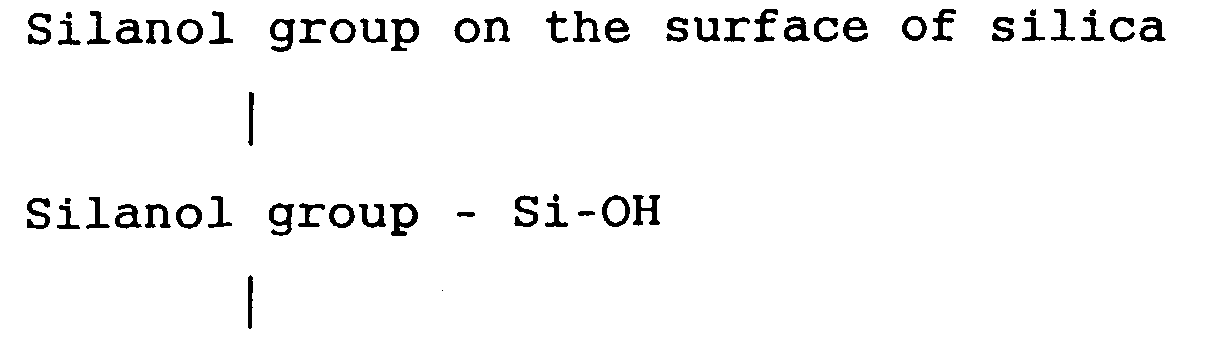
by methyl group or the like, then thus prepared hydrophobic
silica is added to the epoxy resin, the organic coating gives
poor compatibility with a cationic electrodeposition coating
which is a water-base coating, which fails to obtain smooth
electrodeposition coating surface to result in poor image
sharpness after intermediate and top coating and poor smoothness
on the surface of electrodeposition coating at polished
portions. Accordingly, to attain superior image sharpness and
uniformity in electrodeposition coating at polished portions,
a silica which is not hydrophobicized on the surface thereof (or
a hydrophilic silica) is preferred. As a method to attain further
improvement of the corrosion resistance of silica according to
the present invention, a silica which is ion-exchanged using a
cation (for example, ion of calcium, zinc, cobalt, lead,
strontium, lithium, barium, and manganese) having a function to
prevent rust-generation from silica may be used. These kinds
of cations presumably exchange ions from protons in a corrosive
environment, then are released from the silica to form stable
corrosion products on the surface of metal, which products
suppress the corrosion.
A preferred applicable silica according to the present
invention has specific surface areas of from 20 to 1000 m2/g
(determined by the BET method). If the specific surface area
is less than 20 m2/g, the improvement effect of corrosion
resistance is not sufficient, the smoothness of the surface of
electrodeposition coating degrades, and the uniformity of
electrodeposition coating at polished portions degrades. If the
specific surface area exceeds 1000 m2/g, the thixotropic
property of coating composition containing silica increases,
which degrades the workability of coating using a roll coater
and the like.
According to the present invention, further superior
lubrication and anti-powdering performance are attained by
introducing 1 to 80 parts by weight of the solid lubricant as
nonvolatile matter into the organic coating to 100 parts by
weight of the block urethane-modified epoxy resin.
If the content of the solid lubricant is less than 1 part
by weight to 100 parts by weight of the block urethane-modified
epoxy resin, the improvement in lubrication and anti-powdering
performance is not expected. If the content exceeds 80 parts
by weight, the coating adhesiveness, the corrosion resistance,
and the coatability degrade. In view of the coating
adhesiveness, the lubrication, the corrosion resistance, and the
coatability, particularly preferred content is in a range of from
5 to 50 parts by weight, most preferably from 15 to 35 parts by
weight.
Examples of the solid lubricant preferred in the present
invention are the following.
When particularly superior lubrication is required, it is
preferable to use at least one compound selected from the group
consisting of polyethylene wax, polytetrafluoroethylene resin,
and boron nitride. Use of polyethylene wax and
polytetrafluoroethylene resin together provides further
superior lubrication performance.
According to the present invention, the average particle
size of the solid lubricant is preferably in a range of from 0.05
to 25 µm. If the particle size is less than 0.05 µm, the surface
concentration of the lubricant is enriched to widen the occupied
area of lubricant on the uppermost surface layer of the organic
coating, which degrades the coating adhesiveness. On the other
hand, if the particle size exceeds 25 µm, the image sharpness
degrades owing to fine irregularity on the coating surface,
further the lubricant separates from the organic coating, which
degrades lubrication and corrosion resistance. To obtain
particularly superior image sharpness, corrosion resistance,
lubrication, and anti-powdering performance, the average
particle size is preferably in a range of from 1 to 15 µm, and
most preferably from 3 to 10 µm.
By regulating the softening point of polyethylene wax to
a range of from 100 to 135°C, more preferably from 110 to 130°C,
the lubrication and the anti-powdering performance are further
improved.
The organic coating according to the present invention
consists mainly of the above-described organic resin, the
rust-preventive additive, and the solid lubricant. Adding to
those components, other components may further be added to the
organic coating unless they do not give bad influence to the
quality and performance of the organic coating. Examples of
other applicable components are: an organic resin (for example;
acrylic resin, urethane resin, alkyd-base resin, fluororesin,
acrylic-silicone resin, silicone resin, phenol resin,
melamine-base resin, amino-base resin); fine oxide particles
such as those of alumina and zirconia; a conductive pigment; a
color pigment (for example, condensed polycyclic organic
pigment, phthalocyanine-base pigment); a color dye (for example,
azo-base dye, azo-base metallic complex salt dye); a film-forming
assistant; a dispersion-improving agent; and a defoaming
agent. These other components may be added separately or two
or more thereof together.
A preferable range of coating weight of the organic coating
is from 0.05 to 1.5 g/m2. If the coating weight is less than 0.05
g/m2, the corrosion resistance and the lubrication degrade. If
the coating weight exceeds 1.5 g/m2, the weldability, the
uniformity of electrodeposition coating at polished portions,
and the image sharpness degrade. Thus, a preferable range of the
coating weight is from 0.2 to 1.0 g/m2, and most preferably from
0.3 to 0.7 g/m2, in view of lubrication, corrosion resistance,
weldability, uniformity of electrodeposition coating at
polished portions, and image sharpness.
An example of the method for forming the organic coating
according to the present invention is to apply a coating
composition which is prepared by dissolving or dispersing the
above-described individual components in an organic solvent onto
at least one side of the steel plate covered with the above-described
zinc phosphate coating, followed by drying to form the
coating.
Uniform thin coating is available by adding an organic
solvent at concentrations of from 70 to 95 mass% to the coating
composition to be applied. If the solvent content in the coating
composition is less than 70 mass%, the viscosity of the coating
becomes high and the thixotropic property is strong, which
results in difficulty in forming a uniform and thin coating, and
a problem of the coating workability arises. If the solvent
content exceeds 95 mass%, the solid concentration becomes
unnecessarily low level, which fails in attaining a specified
coating weight on applying the coating composition using a roll
coater or the like. A preferable organic solvent according to
the present invention is the one containing diacetone alcohol
and/or diethylene glycol monobutylether.
The reason of the selection of that kind of organic solvent
is described below. According to the present invention, most
preferable means to attain superior image sharpness is to add
a silica which is not treated by hydrophobicizing the surface
thereof, (or a hydrophilic silica) as the rust-preventive
additive to the above-described specific block urethane-modified
resin. However, if excessive amount of silica which
is not treated by hydrophobicizing the surface thereof is added
to the coating composition, the viscosity of the coating becomes
extremely high, which induces a problem of easy-formation of
irregularity in thin-film coating using a roll coater and the
like. For reducing the viscosity of coating, normally a solvent
having strong hydrogen-bonding property is used, for example,
water and alcohol-base solvent. That type of solvent has,
however, excessively strong polarity to the block urethane-modified
epoxy resins according to the present invention, so they
have no solubility, and are not able to be applied. In addition,
even when a ketone-base organic solvent is used together with
water and alcohol-base solvent aiming to provide solubility
against the block urethane-modified epoxy resin, the use amount
of water and alcohol-base solvent within a range to maintain the
solubility is limited, so that the amount is not sufficient to
reduce the viscosity, and the system cannot be applied to the
coating composition of the present invention.
The inventors of the present invention investigated these
kinds of solvent, and found that diacetone alcohol and/or
diethylene glycol monobutylether has solubility to the block
urethane-modified epoxy resin according to the present
invention, and prevents the viscosity increase in the coating.
That is, the use of the solvents allows to form uniform thin film
by roll coater or the like without increasing the viscosity of
the coating even when large amount of silica which is not treated
by hydrophobicization of the surface thereof is added to the
coating composition. The presumable reason is that that kind
of solvent contains carbonyl group or ether group in the molecule
so that the solvent has solubility to the block urethane-modified
epoxy resin according to the present invention, also the primary
hydroxyl group therein establishes hydrogen bonding with the
silanol group on the surface of silica, and that these solvent
molecules act as steric hindrance, thus to suppress the formation
of three-dimensional network structure caused from coagulation
of silica.
A preferable range of the content of diacetone alcohol
and/or diethylene glycol monobutylether is 50 mass% or more in
the organic solvent of the coating composition. If the content
is less than 50 mass%, the effect of suppressing the increase
in viscosity of the sample becomes insufficient, and
irregularity on thin coating by a roll coater and the like is
likely induced. In view of economy, other inexpensive organic
solvent such as xylene, cyclohexane, and isopropyl glycol may
be used in parallel within a range of less than 50 mass%.
Before applying the coating composition, it is possible to
arbitrarily give preliminary treatment such as washing with
water, drying, and the like to the steel plate on which a zinc
phosphate coating is formed.
Any type of method for applying the coating composition onto
the steel plate may be adopted. Normally, the application is
done by roll-coater method. However, it is possible to, after
applying by immersion method and spray method, adjust the coating
weight by air-knife method or roll-squeezing method.
The drying after applied the coating composition may be done
by a drier, a hot-air furnace, a high frequency induction heating
furnace, or an infrared furnace.
A preferred drying temperature is in a range of from 50 to
250°C as the ultimate plate temperature. If the drying
temperature is lower than 50°C, the coating is insufficiently
dried to induce stickiness on the coating, and the coating is
damaged on touching to rolls after drying, which degrades the
coating adhesiveness, the corrosion resistance, and the
lubrication performance. If the ultimate plate temperature
exceeds 250°C, the coatability degrades, and the production cost
becomes unfavorable. In this respect, a preferable range of
baking temperature is from 80 to 200°C, most preferably from 100
to 140°C.
The present invention deals with a steel plate having the
above-described coating structure on both sides or on one side
thereof. Consequently, examples of the mode for carrying out
the present invention are the following.
The other side: Steel plate surface + Zinc phosphate
composite coating (2) One side: Steel plate surface + Zinc phosphate composite
coating + Organic coating
The other side: Steel plate surface (3) Both sides: Steel plate surface + Zinc phosphate
composite coating + Organic coating
According to the present invention, the organic coating may
further be covered with a rust-preventive oil layer. The
rust-preventive oil consists mainly of a rust-preventive
additive (for example, oil-soluble surfactant), a petroleum-base
base material (for example, mineral oil, solvent), an oil
film adjuster (for example, mineral oil, crystallizing material,
a viscous material), an antioxidizing agent (for example,
phenol-base antioxidant), a lubricant (for example, extreme-pressure
additive). Examples of the rust-preventive oil are a
normal rust-preventive oil, a cleaning rust-preventive oil, a
lubrication rust-preventive oil. Examples of the normal
rust-preventive oil are a finger print removal type rust-preventive
oil which is prepared by dissolving and decomposing
a base material in a petroleum-base solvent, a solvent cutback
type rust-preventive oil, a lubricant oil type rust-preventive
oil using petrolactam and wax as the base materials, and a
volatile rust-preventive oil.
A preferable coating weight of the rust-preventive oil film
is in a range of from 0.01 to 10 g/m2. If the coating weight
is less than 0.01 g/m2, the effect of rust-preventive oil
application cannot be attained. If the coating weight exceeds
10 g/m2, the degreasing ends insufficiently, which results in
poor coating adhesiveness. For attaining further superior
corrosion resistance and coating adhesiveness, the coating
weight is preferably in a range of from 0.5 to 3 g/m2.
The surface-treated steel plates according to the present
invention are applicable not only to automobiles and household
electric appliances, but also to building materials.
Embodiments
Cold-rolled steel plates each having a plate thickness of
0.7 mm and a surface roughness (Ra) of 1.0 µm were used to prepare
plated steel plates by applying plating of zinc-base coating.
Thus prepared plated steel plates were subjected to alkali
degreasing, washing with water, and surface preparation
treatment, then were brought into contact with a zinc phosphate
treatment solution, followed by washing with water and drying,
thus obtaining the zinc phosphate-treated steel plates. Onto
the zinc phosphate-treated steel plates, respective coating
compositions were applied using the roll coater method, which
were then dried without washing with water. Then, a rust-preventive
oil or a cleaning oil was applied to the dried steel
plates. The obtained surface-treated steel plates were tested
to determine lubrication performance, anti-powdering
performance, corrosion resistance (non-coating corrosion
resistance, after coating corrosion resistance), coatability
(coating adhesiveness, uniformity of electrodeposition coating
at polished portions, and image sharpness), and weldability.
Individual conditions are described below.
(1) Plated steel plates
Table 13 shows the kinds of plating and the coating weights
applied onto the zinc-base plated steel plates used in the
example.
(2) Zinc phosphate composite treatment
Each of the plated steel plates was treated by degreasing
and washing with water to clean the surface. The composition,
the treatment temperature, and the treatment time for the
surface-preparation solution and the zinc phosphate treatment
solution were adjusted. The zinc phosphate composite-treated
steel plates listed in Table 14 were prepared, each of which gives
different coating weight and coating composition. The following
is an example of the method for preparing the zinc
phosphate-treated steel plates.
[Zinc phosphate composite coating steel plate 1]
A plated steel plate (A in Table 13) was treated by
degreasing (FCL 4480, produced by Nihon Parkerizing Co., Ltd.,
18 g/litter (hereinafter denote to "g/l"), 45°C, 120 seconds
spraying), then by washing with water (20 seconds spraying). Thus
treated steel plate was immersed in a zinc phosphate treatment
solution 1 given in Table 12, heated to 50°C, for 10 second,
followed by washing with water and drying, to obtain the zinc
phosphate composite coating steel plate 1.
[Zinc phosphate composite coating steel plate 2]
A plated steel plate (B in Table 13) was treated by
degreasing (FCL 4480, produced by Nihon Parkerizing Co., Ltd.,
18 g/l, 45°C, 120 seconds spraying), then by washing with water
(20 seconds spraying). The steel plate was further treated by
surface preparation treatment (PREPAREN Z, produced by Nihon
Parkerizing Co., Ltd., 1.5 g/l, room temperature, 2 seconds
spraying). Thus treated steel plate was immersed in a zinc
phosphate treatment solution 2 given in Table 12, heated to 45°C
for 1 second, followed by washing with water and drying, to obtain
the zinc phosphate composite coating steel plate 2.
[Zinc phosphate composite coating steel plate 3]
The same treatment as in the zinc phosphate composite
coating steel plate 2 was applied except that the plated steel
plate of above-described zinc phosphate composite coating steel
plate 2 was C in Table 13 instead of B in Table 13.
[Zinc phosphate composite coating steel plate 5]
A plated steel plate (B in Table 2) was treated by degreasing
(FCL 4480, produced by Nihon Parkerizing Co., Ltd., 18 g/l, 45°C,
120 seconds spraying), then by washing with water (20 seconds
spraying). The steel plate was further treated by surface
preparation treatment (PREPAREN ZN, produced by Nihon
Parkerizing Co., Ltd., 1.5 g/l, room temperature, 2 seconds
spraying). Thus treated steel plate was subjected to 4 seconds
of spraying a zinc phosphate treatment solution 3 given in Table
12, heated to 60°C, followed by washing with water and drying,
to obtain the zinc phosphate composite coating steel plate 5.
| | Composition of zinc phosphate treatment solution (g/l) | Acid ratio (Total acid/Free acid) |
| | Zn | Ni | Mn | Mg | Ca | PO4 | NO3 | F | NO2 |
| Phosphate treatment solution 1 | 0.8 | 3 | 0.5 | - | 0.5 | 10 | 7 | 2 | 0.5 | 17 |
| Phosphate treatment solution 2 | 1.3 | 0.5 | 0.5 | - | - | 20 | 3 | 1.5 | 0.3 | 21 |
| Phosphate treatment solution 3 | 1.4 | 3.2 | - | 0.7 | - | 12.5 | 13 | 0.5 | - | 10 |
Table 15 shows the organic resins used in the organic
coatings in the example. The block urethane-modified resins
listed in the table were prepared by the method given below.
(a) Modified epoxy resin (A)
To a reactor provided with a condenser, an agitator, and
a thermometer, each of 500 parts by weight of Bisphenol A type
epoxy resin (having an epoxy equivalent of 1500), 385 parts by
weight of xylene, and 385 parts by weight of cyclohexanone was
put thereinto, then the mixture was heated to dissolve under
agitation. Further, 20 parts by weight of isopropanolamine was
added to the mixture, which mixture was then reacted at 100°C
for 5 hours. Furthermore, 65 parts by weight of monoisocyanate
of an adduct of 2,4-tolylene diisocyanate (containing 13% of
isocyanate (NCO %)) and of octyl alcohol was added to the mixture
to react them at 60°C for 5 hours, thus obtaining a modified epoxy
resin A containing 40% resin.
(b) Block urethane (B)
To a reactor provided with a condenser, an agitator, and
a thermometer, each of 440 parts by weight of polyethylene glycol
having a molecular weight of about 1000, and 125 parts by weight
of xylene was put thereinto, then the mixture was heated to 60°C
under agitation. Further, 153 parts by weight of 2,6-tolylene
diisocyanate was added to the mixture. The obtained intermediate
product showed 4.8% of NCO%. Furthermore, 106 parts by weight
of ε-caprolactam was added to the mixture to continue the
reaction. After confirmed the NCO% of zero, 175 parts by weight
of butanol was added to the mixture, thus obtained the block
urethane B1 having a resin content of 70%. Using the similar
apparatus and conditions, and from 500 parts by weight of
polypropylene glycol having a molecular weight of 4000, 300 parts
by weight of xylene, and 42 parts by weight of hexamethylene
diisocyanate, an intermediate product having an NCO% of 1.2% was
obtained. Furthermore, 23 parts by weight of
methylethyleketoxime was added to the mixture to let the reaction
continue. After confirmed the zero NCO%, 77 parts by weight of
butanol was added to the mixture, and the block urethane B2 having
a resin content of 60% was obtained.
(3-2) Rust-preventive additive
Table 16 shows the solid lubricants used in the coating
compositions.
(3-3) Lubricant
Table 17 shows the lubricants used in the coating
compositions.
(3-4) Coating composition
Table 18 shows the coating compositions used in the example.
In Table 18, the coating workability of the coating compositions
was evaluated as follows.
[Evaluation of coating workability]
When the coating has strong thixotropic property, the
coating once applied by a roll coater is difficult to flow, so
that the trace of roll travel is likely left behind, and smooth
coating is difficult to attain. To this point, the degree of
thixotropy of the coating was determined to evaluate the coating
workability through the measurement of TI values (Thixotropy
index: 6 rpm, viscosity rate at 6 rpm) which is given on the
non-Newtonian evaluation using a rotational viscometer, a
reference test defined by JIS K5400, 4.5.3 (1990).
- o○
- : not less than 0.9 and less than 1.3
- ○
- : not less than 1.3 and less than 1.6
- ▵
- : not less than 1.6 and less than 3.6
- X
- : not less than 3.6
(4) Rust-preventive oil
Table 19 shows the rust-preventive oils used in the example.
| A | Alloyed hot dip galvanized steel plate (coating weight: 60 g/m2) |
| B | Electrolytically galvanized steel plate (coating weight: 30 g/m2) |
| C | Electrolytically Zn-11%Ni alloy plated steel plate (coating weight: 20 g/m2) |
| D | Hot dip galvanized steel plate (coating weight: 90 g/m2) |
| E | Electrolytically Zn-1%Co alloy plated steel plate (coating weight: 30 g/m2) |
| F | Two-layer alloyed hot dip galvanized steel plate (coating weight: 5 g/m2 for upper layer; 60 g/m2 for lower layer) |
| G | Hot dip Zn-5%Al-0.5%Mo alloy plated steel plate (coating weight: 90 g/m2) |
| H | Hot dip Zn-55%Al-1.6%Si alloy plated steel plate (coating weight: 75 g/m2) |
| I | Hot dip Zn-0.5%Mn alloy plated steel plate (coating weight: 150 g/m2) |
| No. | Plated steel plate | Coating weight (g/m2) | Ni content (mass %) | Mn content (mass %) | Mg content (mass %) |
| 1 | A | 1.1 | 2.6 | 2.8 | - |
| 2 | B | 0.7 | 1.0 | 2.8 | - |
| 3 | C | 0.6 | 0.2 | 1.8 | - |
| 4 | D | 1.0 | 2.0 | 3.0 | - |
| 5 | B | 0.9 | 5.6 | - | 0.3 |
| 6 | B | 1.0 | 5.5 | - | 0.5 |
| 7 | E | 1.0 | 1.0 | 2.5 | - |
| 8 | F | 1.0 | 2.7 | 3.0 | - |
| 9 | G | 1.0 | 2.8 | 3.2 | - |
| 10 | H | 1.0 | 2.8 | 3.2 | - |
| 11 | I | 1.0 | 2.1 | 3.2 | - |
| 12 | B | 1.0 | 3.0 | - | - |
| 13 | B | 1.0 | - | 3.5 | - |
| 14 | B | 0.7 | 0.1 | 0.5 | - |
| 15 | B | 1.0 | 2.0 | 0.5 | - |
| 16 | B | 1.1 | 3.0 | 4.0 | - |
| 17 | B | 1.1 | 0.5 | 5.5 | - |
| 18 | B | 1.0 | 4.5 | 4.0 | - |
| 19 | B | 1.1 | 5.5 | 4.0 | - |
| 20 | B | 1.0 | - | - | - |
| 21 | B | - | - | - | - |
| 22 | B | 0.2 | 1 | 2.4 | - |
| 23 | B | 0.5 | 1 | 2.7 | - |
| 24 | B | 1.5 | 2.8 | 3.1 | - |
| 25 | B | 2.0 | 2.8 | 3.1 | - |
| 26 | B | 2.5 | 2.8 | 3.1 | - |
| 27 | B | 3.0 | 2.8 | 3.1 | - |
| No. | Modified epoxy resin (A) | Block urethane (B) | A/B |
| 1 | Modified epoxy resin A | Block urethane B1 | 95/5 |
| 2 | Modified epoxy resin A | Block urethane B1 | 90/10 |
| 3 | Modified epoxy resin A | Block urethane B1 | 70/30 |
| 4 | Modified epoxy resin A | Block urethane B1 | 60/40 |
| 5 | Modified epoxy resin A | Block urethane B1 | 50/50 |
| 6 | Modified epoxy resin A | Block urethane B2 | 95/5 |
| 7 | Modified epoxy resin A | Block urethane B2 | 90/10 |
| 8 | Modified epoxy resin A | Block urethane B2 | 70/30 |
| 9 | Modified epoxy resin A | Block urethane B2 | 60/40 |
| 10 | Modified epoxy resin A | Block urethane B2 | 50/50 |
| 11 | Modified epoxy resin A | Block urethane B1 | 97/3 |
| 12 | Modified epoxy resin A | Block urethane B1 | 45/55 |
| 13 | Modified epoxy resin A | Block urethane B2 | 97/3 |
| 14 | Modified epoxy resin A | Block urethane B2 | 45/55 |
| 15 | Amine-modified epoxy resin (No. 2 of Table 3 in JP-A-8033(1989)) |
| No. | Name |
| 1 | AEROSIL R811 (dry silica, hydrophobic), produced by JAPAN AEROSIL CO., LTD. |
| 2 | AEROSIL R974 (dry silica, hydrophobic), produced by JAPAN AEROSIL CO., LTD. |
| 3 | AEROSIL R805 (dry silica, hydrophobic), produced by JAPAN AEROSIL CO., LTD. |
| 4 | AEROSIL R202 (dry silica, hydrophobic), produced by JAPAN AEROSIL CO., LTD. |
| 5 | AEROSIL 200 (dry silica, hydrophilic), produced by JAPAN AEROSIL CO., LTD. |
| 6 | AEROSIL 380 (dry silica, hydrophilic), produced by JAPAN AEROSIL CO., LTD. |
| 7 | ETC-ST (organosilica sol, hydrophilic), produced by Nissan Chemical Industries Co., Ltd. |
| 8 | FINESEAL T-32(S) (wet silica prepared by sedimentation method, hydrophilic), produced by Tokuyama Corp. |
| 9 | SILOID 244 (wet silica prepared by gel method, hydrophilic), produced by FUJI DAVIDSON CHEMICAL |
| 10 | SHIELDEX (calcium-exchanged silica, hydrophilic), produced by FUJI DAVIDSON CHEMICAL |
| No. | Lubricant | Average particle size (µm) | Softening point (°C) |
| 1 | Tungsten disulfide | 3 | - |
| 2 | Molybdenum disulfide | 3 | - |
| 3 | Graphite | 3 | - |
| 4 | Boron nitride | 3 | - |
| 5 | Polyethylene | 0.05 | 110 |
| 6 | Polyethylene | 1 | 110 |
| 7 | Polyethylene | 3 | 115 |
| 8 | Polyethylene | 7 | 110 |
| 9 | Polyethylene | 7 | 130 |
| 10 | Polyethylene | 9 | 130 |
| 11 | Polyethylene | 10 | 130 |
| 12 | Polyethylene | 15 | 125 |
| 13 | Polyethylene | 25 | 125 |
| 14 | Tetrafluoroethylene resin | 3 | - |
| 15 | Polyethylene | 7 | 97 |
| 16 | Polyethylene | 7 | 100 |
| 17 | Polyethylene | 7 | 135 |
| 18 | Polyethylene | 7 | 137 |

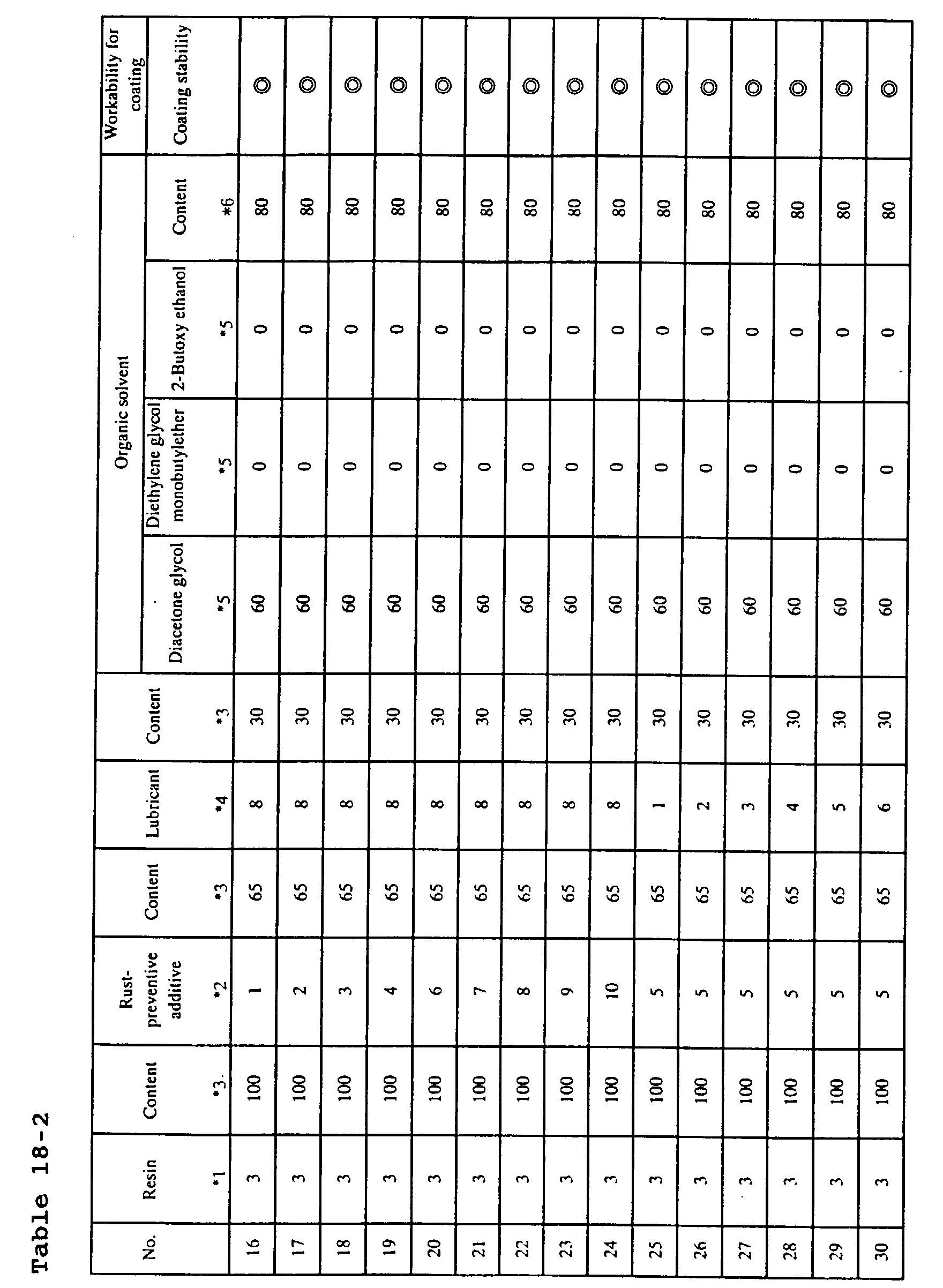


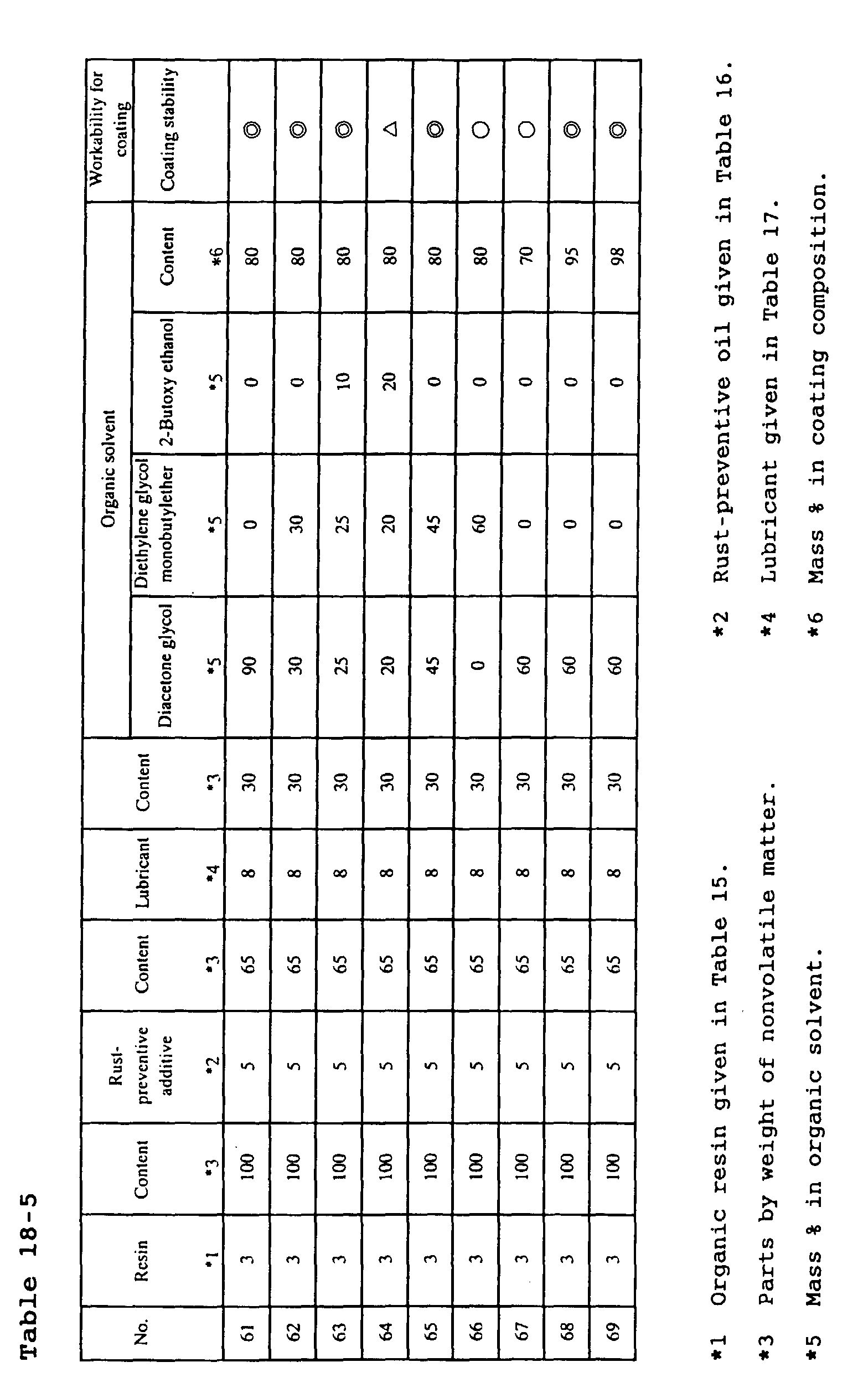
| No. | Name |
| 1 | Rust-preventive oil "NOX-RUST 530F", produced by PERKER KOUSAN |
| 2 | Rust-preventive oil "DAPHNIS OIL COAT SK", produced by Nippon Oil Co., Ltd. |
| 3 | Cleaning rust-preventive oil "PRETON R303P", produced by SUGIMURA CHEMICAL |
| 4 | Cleaning rust-preventive oil "PRETON R352L", produced by SUGIMURA CHEMICAL |
| 5 | Cleaning rust-preventive oil "RUSTCLEAN K", produced by Nippon Oil Co., Ltd. |
| 6 | Cleaning rust-preventive oil "P-1600B", produced by Nippon Oil Co., Ltd. |
| 7 | Lubrication rust-preventive oil "NOX-RUST 550HN", produced by PERKER KOUSAN |
| 8 | Lubrication rust-preventive oil "NOX-RUST Mu-10", produced by PERKER KOUSAN |
Table 20 shows the kinds of thus prepared surface-treated
steel plates and their tested performance of lubrication,
anti-powdering performance, corrosion resistance (non-coating
corrosion resistance and after coating corrosion resistance),
coatability (coating adhesiveness, uniformity of
electrodeposition coating at polished portions, and image
sharpness), and weldability.
The method for evaluating each characteristic is described
below.
Lubrication
A pull-out force was determined under the sliding condition
given below, to give evaluation using the formula of:
Friction factor = (Pull-out force)/(Applied force)
The evaluation criteria are the following.
(Sliding condition)
Tool contact area: 50 x 10 mm
Tool material: SKD 11
Applied pressure: 400 kgf
Sliding speed: 0.2 m/min
(Evaluation criteria)
- o○
- : not more than 0.15
- ○
- : more than 0.15 and not more than 0.17
- ▵
- : more than 0.15 and not more than 0.20
- X
- : more than 0.20
Anti-powdering performance
A specimen was sheared to 30 mm in width, then was tested
by draw-bead test under the conditions of a tip radius of bead
of 0.5 mm, a bead height of 4 mm, a pressing force of 500 kgf,
a pull-out speed of 200 mm/min. After that, the portion of the
bead subjected to sliding was tested by adhesive-tape peeling,
thus determining the peeled amount of coating per unit area
before and after the test. The evaluation criteria are the
following.
- o○
- : less than 2 g/m2
- ○+
- : more less than 2 g/m2 and less than 3 g/m2
- ○
- : not less than 3 g/m2 and less than 4 g/m2
- ▵
- : not less than 4 g/m2 and less than 6 g/m2
- X
- : not less than 6 g/m2
Corrosion resistance
1) Non-coating corrosion resistance
A specimen was treated by degreasing (FCL 4460, produced
by Nihon Parkerizing Co., Ltd., 45°C, immersion for 120 seconds).
Edges and rear face of the specimen were sealed by adhesive tape.
Then the accelerated corrosion test with cycles of combined
corrosion test described below was applied to the specimen. The
evaluation was given by the degree of rust generation after 6
cycles using the evaluation criteria given below.
(Combined corrosion test cycle)
- Salt spray
- : 35°C, 2 hours
- → Drying
- : 60°C, 4 hours
- → 95% RH humidification
- : 50°C, 2 hours
(Evaluation criteria)
- o○
- : no generation of rust
- ○+
- : rust area less than 25%
- ○
- : rust area not less than 25% and less than 50%
- ▵
- : rust area not less than 50% and less than 75%
- X
- : rust area not less than 75%
2) Corrosion resistance after coating
A specimen was applied by 3 coat coating described below.
Then cross-cut was given on the specimen using a cutter knife.
After sealed on both edges and rear face of the specimen with
adhesive tape, the accelerated corrosion test with cycles of
combined corrosion test described below was applied to the
specimen. The evaluation was given by the single-side maximum
bulging width at the cross-cut section after 300 cycles using
the evaluation criteria given below.
Coating (3 coat)
- Zinc phosphate treatment
- : SD 6500 MZ (standard condition)
- Electrodeposition coating
- : V20, film thickness 20 µm
- Intermediate coating
- : OT0870 (white color sealer),
film thickness 35 µm
- Top coating
- : OT0647PT (SHUST WHITE), film
thickness 35 µm
(Combined corrosion test cycle)
Salt spray 10 minutes → Drying 155 minutes → Humidifying
75 minutes → Drying 160 minutes → Humidifying 80 minutes
(Evaluation criteria)
- o○
- : less than 3 mm
- ○+
- : not less than 3 mm and less than 4 mm
- ○
- : not less than 4 mm and less than 5 mm
- ▵
- : not less than 5 mm and less than 6 mm
- X
- : not less than 6 mm
Coatability
(1-1) Coating adhesiveness 1
A specimen was treated by degreasing, then was coated with
a commercial coating DELICON 700 at a thickness of 30 µm. The
specimen was immersed in boiling water for 120 minutes, then 100
grid cuts were given to the coating at 1 mm of spacing. The
Erichsen extrusion to 5 mm was applied to the specimen. Adhesive
tapes were attached to the grids, and were peeled off from the
grids to determine the residual coating rate. The evaluation
criteria are the following.
(Evaluation criteria)
- o○
- : no peeling occurred
- ○
- : peeling rate less than 3%
- ▵
- : peeling rate not less than 3% and less than 10%
- X
- : peeling rate not less than 10%
(1-2) Coating adhesiveness 2
A specimen was applied by 3 coat coating described below,
and was allowed to stand for 24 hours or more. Then, the specimen
was immersed in an ion-exchanged water at 50°C for 240 hours.
Within 30 minutes after the specimen was taken out from the water,
100 grid cuts were given to the coating at 1 mm of spacing.
Adhesive tapes were attached to the grids, and were peeled off
from the grids to determine the residual coating rate. The
evaluation criteria are the following.
Coating (3 coat)
- Zinc phosphate treatment
- : SD 6500 MZ (standard condition)
- Electrodeposition coating
- : V20, film thickness 20 µm
- Intermediate coating
- : OT0870 (white color sealer),
film thickness 35 µm
- Top coating
- : OT0647PT (SHUST WHITE), film
thickness 35 µm
(Evaluation criteria)
- o○
- : no peeling occurred
- ○
- : peeling rate less than 3%
- ▵
- : peeling rate not less than 3% and less than 10%
- X
- : peeling rate not less than 10%
(2) Uniformity of electrodeposition coating at polished
portions
Half area of a specimen was polished by an emery paper to
completely remove the prephos and the sealing film to make the
primary plated steel plate fully exposed. Then the specimen was
subjected to chemical conversion (SD6500 MZ) and
electrodeposition coating (V-20). Thus treated sample was
tested to determine the coating thickness at polished portion
and non-polished portion. The evaluation was given by the
difference in electrodeposition coating thickness [(the
thickness of electrodeposition coating at non-polished portion)
- (the thickness of electrodeposition coating at polished
portion)]. The evaluation criteria are the following.
(Evaluation criteria)
- o○
- : less than 0.5 µm
- ○
- : not less than 0.5 µm and less than 1 µm
- ▵
- : not less than 1 µm and less than 3 µm
- X
- : not less than 3 µm
(3) Image sharpness
A specimen was subjected to 3 coat coating given below. Then
the evaluation on the image sharpness using an image performance
tester (ICM-2DP) produced by SUGA MACHINE applying a slit of 0.5
mm in width. The evaluation criteria are the following.
Coating (3 coat)
- Zinc phosphate treatment
- : PB-L3020 (standard condition)
- Electrodeposition coating
- : U-600, film thickness 20 µm
- Intermediate coating
- : KPX-36, film thickness 35 µm
- Top coating
- : RUGABERG B531 film thickness 35
µm
(Evaluation criteria)
- o○
- : not less than 80
- ○
- : not less than 75 and less than 80
- ▵
- : not less than 70 and less than 75
- X
- : less than 70
Weldability
A specimen and a mild steel plate were tested by successive
spot welding under mixed spot welding of 25 points for each of
them. The test conditions were: a CF type electrode having a tip
diameter of 4.5 mm; a pressing force of 250 kgf; a squeeze time
of 36 cycles/60 Hz; a current applying time of 14 cycles/60 Hz;
and a welding current of the current immediately before the
generation of expulsion and surface flash. The evaluation
criteria are the following.
- o○
- : not less than 1500 spots
- ○
- : not less than 1000 and less than 1500
- ▵
- : not less than 500 and less than 1000
- X
- : less than 500
PREFERRED EMBODIMENT 3
The inventors of the present invention investigated the
zinc phosphate composite treated steel plates focusing on the
relation of coating in terms of structure, corrosion resistance,
lubrication, coating adhesiveness, and weldability. Thus, the
inventors derived the following-described findings.
The present invention was established on the basis of
above-described findings, and the present invention is
characterized in the constitution described in the following.
That is, the present invention provides a zinc phosphate
composite treated steel plate having excellent corrosion
resistance, anti-powdering performance, lubrication, and
coating adhesiveness, which steel plate comprises: a zinc-base
plated steel plate; a first layer of zinc phosphate composite
coating layer having coating weights of from 0.2 to 2.5 g/m2,
containing at least one substance selected from the group
consisting of nickel, manganese, and magnesium, formed on the
surface of the zinc-base plated steel plate; and a second layer
of an organic coating consisting mainly of organic resins
described in (1) in the following.
(1) An epoxy-base resin prepared by mixing 100 parts by
weight of a substrate resin (as solid content) in which at least
one basic nitrogen atom and at least two primary hydroxyl groups
are added to a terminal of molecular chain of the epoxy resin
and 5 to 80 parts by weight of a polyisocyanate compound (as solid
content) having at least two isocyanate groups in a single
molecule.
According to the present invention, the content of at least
one substance selected from the group consisting of nickel,
manganese, and magnesium, in the zinc phosphate coating is
preferably in a range of from 0.5 to 8.5 mass% as the total
thereof.
The organic coating preferably contains a rust-preventive
additive and/or a solid lubricant.
The rust-preventive additive is preferably at least one
substance selected from the group consisting of a silica and a
phosphate. The silica preferably contains dry silica or Ca-exchanged
silica. The silica preferably has specific surface
areas of from 20 to 1000 m2/g. The phosphate is preferably at least
one substance selected from the group consisting of a phosphate
of calcium, aluminum, and zinc.
The solid lubricant is preferably at least one substance
selected from the group consisting of polyethylene wax
(preferably having softening points of from 100 to 135°C),
tetrafluoroethylene resin, and boron nitride. The average
particle size of the solid lubricant is preferably in a range
of from 0.05 to 25 µm.
According to the present invention, the polyisocyanate
compound contained in the organic resin (1) is a multifunctional
polyisocyanate compound having three or more isocyanate groups
in a single molecule thereof, more preferably four or more of
them, and most preferably six or more of them, and the compound
may be a multifunctional body of hexamethylene diisocyanate
having six or more isocyanate groups in a single molecule
thereof.
According to the present invention, the content of the
rust-preventive additive in the organic coating is preferably
in a range of from 1 to 100 parts by weight as solid content to
100 parts of weight as solid content of the organic resin (1),
and the content of the solid lubricant is preferably in a range
of from 1 to 80 parts by weight as solid content to 100 parts
by weight as solid content of the organic resin (1).
The coating weight of the organic coating is preferably in
a range of from 0.05 to 1.5 g/m2.
The uppermost layer preferably has a rust-preventive film
layer at coating weights of from 0.01 to 10 g/m2.
The detail of the present invention is described in the
following giving the reasons to limit the specification.
The steel plates which become the substrate of the zinc-base
plated steel plates according to the present invention include:
all kinds of cold-rolled steel plates for soft-working, such as
cold-rolled steel plates for general working (CQ), cold-rolled
steel plates for deep drawing (DQ), cold-rolled steel plates for
very deep drawing (DDQ), and cold-rolled steel plates for ultra
deep drawing (EDDQ); all kinds of high tension steel plates
ranging from high tension steel plates of relatively low strength
level having baking-hardening property to general high tension
steel plates having more than 390 MPa of tensions; and de-scaled
hot-rolled steel plates.
Examples of the plating layers of the zinc-base plated steel
plates are Zn plating, Zn-Ni alloy plating (9 to 15 mass% of Ni
content), Zn-Fe ally plating (5 to 25 mass% or 60 to 90 mass%
of Fe content), Zn-Mn alloy plating (30 to 80 mass% of Mn
content), Zn-Co alloy plating (0.5 to 15 mass% of Co), Zn-Cr ally
plating (5 to 30 mass% of Cr), Zn-Al alloy plating (3 to 60 mass%
of Al content). Each of the above-given plating compositions
may further include alloying element such as Co, Fe, Ni, and Cr,
and oxide or salt of silica, alumina, slightly soluble chromate,
or the like, and polymer. Among the above-described plating
layers, two or more layers of the same kind or different kind
may be applied to form a composite layer.
The plated steel plate may be the one prepared by applying
plating of Ni or the like at a small coating weight onto the steel
plate, followed by applying various kinds of plating thereon.
The plating described above may be formed by either one of
electrolytic method, fusion method, and vapor phase method.
A preferred coating weight of plating is not less than 10
g/m2. Less than 10 g/m2 of coating weight induces problems
because of poor corrosion resistance. In the case of Zn-Ni alloy
plating, Zn-Fe alloy plating, Zn-Mn alloy plating, Zn-Co alloy
plating, and Zn-Cr alloy plating, the anti-powdering performance
degrades when the coating weight exceeds 60 g/m2, so the coating
weight is preferably in a range of from 10 to 60 g/m2. For further
improved corrosion resistance and anti-powdering performance,
the coating weight is preferably in a range of from 15 to 60 g/m2.
To prevent generation of film defects and irregularity on
the surface of the zinc phosphate composite coating on the
plating film, which processing is described later, it is possible
to apply treatment of alkaline degreasing, solvent degreasing,
and surface preparation treatment on the plating film, in
advance. These pre-treatments include (1) the treatment using
an acidic or alkaline aqueous solution containing at least one
metallic ion selected from the group consisting of Ni ion, Co
ion, Fe ion, and Zn ion, (2) the treatment contacting with a
titanium colloid aqueous solution, and (3) the treatment to etch
the top layer of the metallic oxide formed on the surface of the
plated steel plate using an inorganic acid, an organic acid, or
a cheleting compound such as EDTA and NTA. The effect of the
present invention is available with any of these kinds of steel
plates as the substrate.
As for the zinc phosphate composite-treated steel plate,
according to the present invention, a zinc phosphate coating is
formed as the first layer on the above-described zinc-base plated
steel plates, and an organic coating is formed as the second layer
on the first layer. The zinc-phosphate coating of the first layer
improves the coating adhesiveness owing to the anchor effect,
and contributes to the improvement of lubrication by preventing
the direct contact between the steel plate and the tools during
sliding actions.
According to the present invention, a zinc phosphate
coating containing at least one substance selected from the group
consisting of nickel, manganese, and magnesium is applied. The
coating exists presumably in a form that a portion of zinc in
the zinc phosphate coating is substituted by the above-described
metal contained in the coating. That form of coating induces
the interaction with the organic coating as the top layer, thus
providing excellent corrosion resistance, anti-powdering
performance, lubrication, and coating adhesiveness.
The content of at least one substance selected from the
group consisting of nickel, manganese, and magnesium, in the zinc
phosphate coating is preferably in a range of from 0.5 to 8.5
mass% as the total. By specifying the total content of these
metals in the coating to that range, the corrosion resistance,
the lubrication, and the coating adhesiveness are further
improved. When particularly superior corrosion resistance and
coating adhesiveness are required, it is more preferable to
specify the total content of nickel, manganese, and magnesium
to a range of from 2.5 to 7 mass%. The corrosion resistance and
the coating adhesiveness are drastically improved by the
existence of nickel as the essential component in a range of from
1 to 5.5 mass%, and manganese and/or magnesium in a range of
from 0.5 to 4 mass% as the total.
The coating weight of the zinc phosphate composite coating
as the first layer is preferably in a range of from 0.2 to 2.5
g/m2. If the coating weight thereof is less than 0.2 g/m2, the
coating adhesiveness and the corrosion resistance degrade. If
the coating weight thereof exceeds 2.5 g/m2, powdering increases
under sliding conditions, thus degrading the lubrication and
resulting in poor spot weldability. In view of lubrication,
coating adhesiveness, corrosion resistance, and weldability,
more preferable range of coating weight is from 0.5 to 2.0 g/m2,
and most preferably from 0.7 to 1.5 g/m2.
The method of zinc phosphate treatment for forming the zinc
phosphate coating layer may be either one of reaction type
treatment, coating type treatment, and electrolytic type
treatment.
An example of the reaction type treatment is that a plated
steel plate is subjected to degreasing, washing with water, and
surface preparation treatment, followed by contacting with a
treatment solution of an aqueous solution consisting mainly of:
phosphoric acid ion, nitric acid ion, and zinc ion, and at least
one substance selected from the group consisting of nickel ion,
manganese ion, and magnesium ion; further containing, at need,
(1) and (2) given below, then washing with water and drying.
Regarding the coating type treatment, at least one side of
the plated steel plate is coated with a zinc phosphate treatment
solution consisting mainly of phosphoric acid ion, nitric acid
ion, and zinc ion, and at least one substance selected from the
group consisting of nickel ion, manganese ion, and magnesium ion.
Any kind of coating method is applicable. That is, coating by
roll-coater method, coating by immersion method or spray method
followed by applying air-knife method or roll-squeezing method
to adjust the coating weight may be used. After coating a zinc
phosphate treatment solution onto the surface of the plated steel
plate, drying may be given using a drier, a hot air furnace, a
high frequency induction heating furnace, or an infrared furnace
to form the zinc phosphate coating.
Drying temperature of the coating in the case that the
coating is formed by the coating method is preferably in a range
of from 70 to 400°C as the ultimate plate temperature. If the
drying temperature is less than 70°C, the drying of coating
becomes insufficient, which induces stickiness of the coating
and degradation in coating adhesiveness, and induces irregular
coating on forming the organic coating of the second layer. If
the ultimate plate temperature exceeds 400°C, the effect
saturates, which not only is uneconomical but also degrades
corrosion resistance owing to the tendency of defect occurrence
in coating. Accordingly, more preferable baking temperature is
in a range of from 100 to 300°C, and most preferable one is from
120 to 170°C.
The following is the description on the organic coating
formed on the zinc phosphate coating. According to the present
invention, the organic coating formed on the above-described
zinc phosphate coating consists mainly of an epoxy-base resin
prepared by mixing a substrate resin, in which at least one basic
nitrogen atom and at least two primary hydroxyl groups are added
to a terminal of molecule of an epoxy resin, with a
multifunctional polyisocyanate compound having at least two
isocyanate groups in a single molecule thereof, at a specific
mixing ratio. With the use of the epoxy-base resin, preferable
coating adhesiveness and corrosion resistance are attained.
The epoxy resin applied to the organic coating preferably
consists mainly of a condensate prepared by condensation of
Bisphenol A and epichlorohydrin. Examples of the epoxy resin
are the one made by solely aliphatic structure or alicyclic
structure, such as epoxydated oil and epoxy-polybutadiene. To
attain superior corrosion resistance, however, it is preferred
to use an epoxy resin consisting mainly of the above-described
condensate. Examples of the epoxy resin are Epicoat 828, 1001,
1004, 1007, 1009, and 1010 (produced by Shell Chemicals, Inc.)
When particularly hardening at low temperatures is required, the
epoxy resin preferably has number average molecular weights of
1500 or more. The above-described Epicoats may be used
separately or mixing with other kinds of epoxy resins.
For introducing a basic nitrogen atom and a primary hydroxyl
group to the epoxy resin to form a substrate resin, an example
of applicable method is to add alkanol amine and/or alkyl alkanol
amine to an oxirane group in the epoxy resin. Examples of the
amine are monoethanolamine, diethanolamine, dimethylamino
ethanol, monopropanolamine, dipropanolamine, and
dibutanolamine. These amines may be used separately or mixing
two or more of them together.
The aim of using the above-described substrate resins is
the following. That is, by using an epoxy resin prepared by
condensation of Bisphenol A and epichlorohydrin, as the base
resin, superior adhesiveness with cationic electrodeposition
coating generally used as rust-preventive agent on automobile
body is expected. In addition, by introducing at least one basic
nitrogen atom and at least two primary hydroxyl groups to a
terminal of molecule of the epoxy resin, as the resin structure,
(1) the coating damage by alkali generated during the cationic
electrodeposition is prevented, thus stabilizing the
adhesiveness between the primary coating of zinc phosphate and
the cationic electrodeposition coating, (2) a primary hydroxyl
group and a selected organic solvent composition (described
later) enhance the low temperature reactivity with a cross-linking
agent (isocyanate), (3) the introduction of two moles
or more of hydroxyl groups to a single molecule of the epoxy resin
provides a coating having satisfactorily dense cross-linked
structure. Below two moles of the introduced hydroxyl groups
cannot provide satisfactory cross linking.
Alternatively, the epoxy resin may be partly modified by
other compound. In that case, however, it is necessary that a
single molecule of the epoxy resin contains two moles or more
of primary hydroxyl groups as average. Examples of the methods
of partial modification of epoxy resin are the following.
A modification method using a dicarboxylic acid (for
example, adipic acid and sebatic acid) may be applied. The method
is, however, not an adequate one to prepare the coating according
to the present invention because the epoxy resin becomes
excessively high molecular weight, because the reaction control
to keep the molecular weight distribution to a constant level
is difficult, and because the improvement in corrosion
resistance cannot be expected.
A preferred method for curing the organic coating according
to the present invention is to conduct urethanation reaction
between hydroxyl group in the substrate resin and isocyanate
group in the polyisocyanate as the curing agent. For storing
the coating composition before forming a film in a stable state,
it is necessary to protect the isocyanate before curing. A method
for protecting the isocyanate may be a protection method in which
the protect group is released during heating treatment, thus
regenerating the isocyanate group.
Examples of isocyanate compound according to the present
invention, in view of improvement in corrosion resistance, are:
an aliphatic, alicyclic (including heterocyclic), or aromatic
isocyanate compound having at least two isocyanate groups in a
single molecule thereof; a compound prepared from partial
reaction of above-listed compound with polyalcohol; and a
compound of the above-listed compounds in burette type adduct
or in isocyanuric ring type adduct. That is:
That is, a monoisocyanate compound having a single
isocyanate group in a single molecule thereof cannot provide
satisfactory corrosion resistance. In particular, under a
severe corrosive environment where iron rust coexists therein,
or in a state of low coating weight domains giving not more than
0.6 g/m2 of organic coating weight, the barrier performance of
resin in the organic coating gives significant contribution to
the suppression of corrosion. In that case, superior corrosion
resistance is attained by using a multifunctional polyisocyanate
compound having preferably three or more of isocyanate groups,
more preferably four or more of them, and most preferably six
or more of them.
Examples of the multifunctional polyisocyanate compound
having at least three isocyanate groups in a single molecule
thereof are: a compound having at least three isocyanate groups
in a single molecule thereof, a compound prepared by reacting
a compound having at least two isocyanate groups in a single
molecule thereof, with a polyhydric alcohol; or their burette
type adduct, or their isocyanuric ring type adduct. Examples
of these multifunctional polyisocyanate compound are: a
polyisocyanate compound having three or more of isocyanate
group, including triphenylmethane-4,4',4''-triisocyanate,
1,3,5-triisocyanate benzene, 2,4,6-triisocyanate toluene,
4,4'-dimethylphenylmethane-2,2',5,5'-tetraisocyanate; an
adduct prepared by reaction between a polyisocyanate compound
and a polyol, at an excess amount of isocyanate groups in the
polyisocyanate compound compared with the amount of hydroxyl
groups in the polyol, examples of the polyol being ethylene
glycol, propylene glycol, 1,4-butylene glycol, polyalkylene
glycol, trimethylol propane, and hexane triol; a burette type
adduct and an isocyanuric ring type adduct, such as hexamethylene
diisocyanate, isophorone diisocyanate, tolylene diisocyanate,
xylylene diisocyanate, 4,4'-diphenylmethane diisocyanate,
4,4'-methylene bis (cyclohexylisocyanate).
In the above-described adduct prepared by reacting the
polyol hydroxyl groups with the polyisocynanate compound having
excess amount of isocyanate groups against the amount of polyol
hydroxyl groups, examples of the polyisocyanate compound are:
an aliphatic diisocyanate compound such as above-described
polyisocyanate compound having three or more of isocyanate
groups, hexamethylene diisocyanate, 1,4-tetramethylene
diisocyanate, dimer acid diisocyanate, and lysine diisocyanate;
an alicyclic diisocyanate compound such as isophorone
diisocyanate, 4,4'-methylene bis(cyclohexyl isocyanate),
methylcyclohexane-2,4-(or -2,6-)diisocyanate, 1,3- (or
1,4-)di(isocyanatemethyl)cyclohexane; and an aromatic
diisocyanate such as xylylene diisocyanate, diphenylmethane
diisocyanate, bis(4-isocyanatephenyl)sulfone.
Among multifunctional polyisocyanate compounds having at
least six isocyanate groups in a single molecule thereof,
(hexa-functional polyisocyanate compounds), particularly a
multifunctional body of hexamethylene dilsocyanate shows most
effective performance to increase in corrosion resistance. The
multifunctional polyisocyanate compounds according to the
present invention may be a mixture of the same group compounds
having different number of isocyanate groups in a single
molecular thereeach. Two or more of the above-described
multifunctional polyiisocyanate compounds may be used together.
As described before, a method for protecting the isocyanate
in the curing agent for stably storing the formed film may be
a protection method in which the protective group (block-forming
agent) is released during heating and curing period, thus
regenerating the isocyanate group. Examples of the protective
agent (block-forming agent) are the following. By reacting one
or more of the protective agents with the above-described
polyisocyanate compound, an isocyanate compound which is stably
protected at least at normal temperature is attained.
The polyisocyanate compound as the curing agent is mixed
in a range of from 5 to 80 parts by weight (as solid content)
to 100 parts by weight (as solid content) of the substrate resin,
preferably from 10 to 40 parts by weight (as solid content). If
the mixing rate of the curing agent is less than 5 parts by weight,
the cross-linking density of thus formed coating becomes
insufficient, and the improvement effect of corrosion resistance
is less. If the mixing rate thereof exceeds 80 parts by weight,
the unreacted residual isocyanate absorbs water, which degrades
the corrosion resistance and the coating adhesiveness.
Furthermore, as the cross-linking agent, an
alkyletherified amino resin may be used along with an isocyanate
compound, which alkyletherified amino resin is prepared by
reacting a part or total of a methylol compound derived from the
reaction of at least one compound selected from the group
consisting of melamine, urea, and benzoguanamine with
formaldehyde, with a monohydric alcohol having 1 to 5 carbon
atoms. The resin is fully cross-linked by the above-described
cross-linking agent. For further improvement of low temperature
cross-linking property, it is preferred to use a known cross-link
enhancing catalyst. Examples of the cross-link enhancing
catalyst are N-ethylmorpholine, dibutyltin dilaurate, cobalt
naphthenate, tin(IV) chloride, zinc naphthenate, and bismuth
sulfate. Aiming at slight increase of the physical
characteristics, the above-described resin composition may be
used along with a known acrylic, alkyd, and polyester resins.
The coating composition according to the present invention
may be used by neutralizing the base of epoxy resin as the
substrate resin using a low molecular weight acid, and by
dispersing it in water or by forming a water-soluble composition.
When, however, low temperature drying at plate temperatures of
250°C or below, particularly very low temperature drying at 170°C
or below, is requested as the coating material for BH steel plate,
the above-described neutralization is not given, and it is
preferable to use the composition as a composition of dissolved
in an organic solvent. That is, a water-soluble composition or
an aqueous composition shows rather poor corrosion resistance
and coating adhesiveness because the acidic compound necessary
for making the composition soluble in water forms a salt in the
coating, which induces ready absorption of water into coating
and under the coating in a humid environment, and also the low
temperature drying conditions cannot give sufficiently rigid
coating.
That type of organic solvents may be a single organic
solvent used in normal coating industry or may be two or more
of these organic solvents mixed together. To do this, it is
preferable to avoid the use of high boiling point alcohol-base
solvents. That kinds of high boiling point alcohol-base solvents
include ethylene glycol, diethylene glycol, monoalkylether, and
alcohol including primary hydroxyl group of C5 or more. That
kind of solvents inhibits the curing reaction of coating.
Preferable solvents are hydrocarbon, ketone, ester, ether
solvents. Also low molecular weight alcohols of C4 or less, or
alcohols having secondary or tertiary hydroxyl group are
preferable.
According to the present invention, addition of a rust-preventive
additive or a solid lubricant to the organic coating,
at need, may be applied. Both of them may be added together.
Addition of a rust-preventive additive is effective
particularly when superior corrosion resistance is required.
Examples of preferred rust-preventive additive according
to the present invention are a silica, a phosphate, a molybdate,
a phosphomolybdate (for example, aluminum phosphomolybdate), an
organic phosphoric acid and its salt (for example, phytic acid,
phosphonic acid, and their metallic salt, alkali metal salt,
alkali earth metallic salt); an organic inhibitor (for example,
hydrazine derivative, thiol compound). These rust-preventive
additives may be used separately or mixing two or more of them.
Among these rust-preventive additives, silica and/or
phosphate are more preferable.
Examples of applicable silica according to the present
invention are: a dry silica (for example, AEROSIL 130, AEROSIL
200, AEROSIL 300, AEROSIL 380, AEROSIL 972, AEROSIL R811, AEROSIL
R805, produced by JAPAN AEROSIL CO., LTD.); an organosilica sol
(for example, MA-CT, IPA-ST, NBA-ST, IBA-ST, EG-ST, XBA-ST,
ETC-ST, DMAC-ST, produced by Nissan Chemical Industries, Ltd.);
a wet silica prepared by sedimentation method (for example,
T-32(S), K-41, F-80, produced by Tokuyama Corp.); a wet silica
prepared by gel method (for example. SILOID 244, SILOID 150,
SILOID 72, SILOID 65, SHIELDEX, produced by FUJIDAVIDSON
CHEMICAL. Among them, dry silica is preferred in view of
corrosion resistance.
According to the present invention, to attain further
superior corrosion resistance of silica, a silica which is
ion-exchanged using a cation (for example, ion of calcium, zinc,
cobalt, lead, strontium, lithium, barium, and manganese) having
a function to prevent corrosion may be used. These kinds of
cations presumably exchange ions from protons in a corrosive
environment, then are released from the silica to form stable
corrosion products on the surface of metal, which products
suppress the corrosion. Among them, most preferable silica is
calcium-exchanged silica in view of corrosion resistance.
A preferred applicable silica according to the present
invention has specific surface areas of from 20 to 1000 m2/g
(determined by the BET method). If the specific surface area
is less than 20 m2/g, the improvement effect of corrosion
resistance is not sufficient. If the specific surface area
exceeds 1000 m2/g, the thixotropic property of coating
composition containing silica increases, which degrades the
workability of coating using a roll coater and the like.
The phosphate according to the present invention is not
limited by the skeleton and the degree of condensation of the
phosphoric acid ions, and it may be either one of normal salt,
dihydrogen salt, monohydrogen salt, and phosphite. The normal
salt includes orthophosphate, all kinds of condensed phosphate
such as polyphosphate (for example, zinc phosphate, calcium
phosphate, aluminum dihydrogen phosphate, zinc phosphite).
Among them, more preferable ones are at least one phosphate
selected from the group consisting of phosphate of zinc, of
calcium, and of aluminum. Use of above-given silica and
phosphate together provides particularly superior corrosion
resistance.
According to the present invention, mixing a solid
lubricant in the organic coating provides further superior
lubrication performance.
Examples of the solid lubricant preferred in the present
invention are the following.
When particularly superior lubrication is required, it is
preferable to use at least one compound selected from the group
consisting of polyethylene wax, polytetrafluoroethylene resin,
and boron nitride. Use of polyethylene wax and
polytetrafluoroethylene resin together provides further
superior lubrication performance.
The average particle size of the solid lubricant according
to the present invention is preferably in a range of from 0.05
to 25 µm. If the particle size is less than 0.05 µm, the surface
concentration of the lubricant is enriched to widen the occupied
area of lubricant on the uppermost surface layer of the organic
coating, which degrades the coating adhesiveness. On the other
hand, if the particle size exceeds 25 µm, the lubricant separates
from the organic coating, which fails to attain the required
lubrication, also results in poor corrosion resistance. To
obtain excellent coating adhesiveness, corrosion resistance,
lubrication, and anti-powdering performance, the average
particle size is preferably in a range of from 1 to 15 µm, and
most preferably from 3 to 10 µm.
By regulating the softening point of polyethylene wax to
a range of from 100 to 135°C, more preferably from 110 to 130°C,
the lubrication and the anti-powdering performance are further
improved.
A preferable content of lubricant and/or rust-preventive
additive in the organic coating is in a range of from 1 to 100
parts by weight of the rust-preventive additive as solid content
to 100 parts by weight of the organic resin (1) as solid content,
and in a range of from 1 to 80 parts by weight of the solid
lubricant as solid content to 100 parts by weight of the organic
resin (1) as solid content.
If the content of the rust-preventive additive is less than
1 part by weight to 100 parts by weight of the organic resin (1),
the improvement in corrosion resistance becomes insufficient.
If the content of the rust-preventive additive exceeds 100 parts
by weight to 100 parts by weight of the organic resin, the coating
adhesiveness and the lubrication degrade. Accordingly, a
preferable range of the content is from 10 to 80 parts by weight,
most preferably from 20 to 70 parts by weight, in view of coating
adhesiveness, lubrication, and corrosion resistance.
On the other hand, if the content of the solid lubricant
is less than 1 part by weight to 100 parts by weight of the organic
resin (1), the improvement effect of the lubrication is not
sufficient. If the content exceeds 80 parts by weight, the
coating adhesiveness and the corrosion resistance degrade.
Thus, a preferable range of the content is from 5 to 50 parts
by weight, and most preferably from 15 to 35 parts by weight,
in view of coating adhesiveness, lubrication, and corrosion
resistance.
The organic coating according to the present invention
consists mainly of the above-described organic resin and, at
need, the rust-preventive additive and/or the solid lubricant.
Adding to those components, other components may further be added
to the organic coating unless they do not give bad influence to
the quality and performance of the organic coating. Examples
of other applicable components are: an organic resin (for
example, acrylic resin, urethane resin, alkyd-base resin,
fluorine-base resin; acrylic-silicone resin; silicone resin,
phenol-base resin, melamine-base resin, amino-base resin); fine
oxide particles such as those of alumina and zirconia; a
conductive material; a color pigment (for example, condensed
polycyclic organic pigment, phthalocyanine-base pigment); a
color dye (for example, azo-base dye, azo-base metallic complex
salt dye); a film-forming assistant; a dispersion-improving
agent; and a defoaming agent. These other components may be added
separately or two or more thereof together.
A preferable range of coating weight of the organic coating
is from 0.05 to 1.5 g/m2. If the coating weight is less than 0.05
g/m2, the corrosion resistance and the lubrication degrade. If
the coating weight exceeds 1.5 g/m2, the weldability degrades.
Thus, a preferable range of the coating weight is from 0.2 to
1.0 g/m2, and most preferably from 0.3 to 0.7 g/m2, in view of
lubrication, corrosion resistance, coating adhesiveness, and
weldability.
According to the present invention, the method for forming
the organic coating comprises the steps of: applying a coating
composition consisting mainly of the above-described organic
resin and, at need, the above-described rust-preventive additive
and/or the lubricant on to at least one side of the surfaces of
the steel plate coated with the above-described zinc phosphate
coating; drying the coating composition to form the coating.
Before applying the coating composition, it is possible to
arbitrarily give a preliminary treatment such as washing with
water and drying the steel plate on which the zinc phosphate
coating was formed.
Any type of method for applying the coating composition onto
the steel plate may be adopted. Normally, the application is
done by roll-coater method. However, it is possible to, after
applying by immersion method and spray method, adjust the coating
weight by air-knife method or roll-squeezing method.
The drying after applied the coating composition may be done
by a drier, a hot-air furnace, a high frequency induction heating
furnace, or an infrared furnace.
A preferred drying temperature is in a range of from 50 to
250°C as the ultimate plate temperature. If the drying
temperature is lower than 50°C, the coating is insufficiently
dried to induce stickiness on the coating, and the coating is
damaged on touching to rolls after drying, which degrades the
coating adhesiveness, the corrosion resistance, and the
lubrication performance. If the ultimate plate temperature
exceeds 250°C, further effect cannot be expected, and the
production cost becomes unfavorable. In this respect, a
preferable range of baking temperature is from 80 to 200°C, most
preferably from 100 to 170°C.
The present invention deals with a steel plate having the
above-described coating structure on both sides or on one side
thereof. Consequently, examples of the mode for carrying out
the present invention are the following.
- (1) One side
- : Steel plate surface + Zinc phosphate
composite coating + Organic coating
- The other side
- : Steel plate surface + Zinc phosphate
composite coating
- (2) One side
- : Steel plate surface + Zinc phosphate
composite coating + Organic coating
- The other side
- : Steel plate surface
- (3) Both sides
- : Steel plate surface + Zinc phosphate
composite coating + Organic coating
According to the present invention, the organic coating may
further be covered with a rust-preventive oil layer as the third
layer. The rust-preventive oil consists mainly of a rust-preventive
additive (for example, oil-soluble surfactant), a
petroleum-base base material (for example, mineral oil,
solvent), an oil film adjuster (for example, mineral oil,
crystallizing material, a viscous material), an antioxidizing
agent (for example, phenol-base antioxidant), a lubricant (for
example, extreme-pressure additive). Examples of the rust-preventive
oil are a normal rust-preventive oil, a cleaning
rust-preventive oil, a lubrication rust-preventive oil.
Examples of the normal rust-preventive oil are a finger print
removal type rust-preventive oil which is prepared by dissolving
and decomposing a base material in a petroleum-base solvent, a
solvent cutback type rust-preventive oil, a lubricant oil type
rust-preventive oil using petrolactam and wax as the base
materials, and a volatile rust-preventive oil.
A preferable coating weight of the rust-preventive oil film
is in a range of from 0.01 to 10 g/m2. If the coating weight is
less than 0.01 g/m2, the effect of rust-preventive oil
application cannot be attained. If the coating weight exceeds
10 g/m2, the degreasing ends insufficiently, which results in
poor coating adhesiveness. For attaining further superior
corrosion resistance and coating adhesiveness, the coating
weight is preferably in a range of from 0.5 to 3 g/m2.
The surface-treated steel plates according to the present
invention are applicable not only to automobiles and household
electric appliances but also to building materials.
Embodiment
Cold-rolled steel plates each having a plate thickness of
0.7 mm and a surface roughness (Ra) of 1.0 µm were used to prepare
plated steel plates by applying plating of zinc-base coating.
Thus prepared plated steel plates were subjected to alkali
degreasing, washing with water, and surface preparation
treatment, then were brought into contact with a zinc phosphate
treatment solution, followed by washing with water and drying,
thus to obtain the zinc phosphate-treated steel plates. Onto
the zinc phosphate-treated steel plates, respective coating
compositions were applied using the roll coater method, which
were then dried without washing with water. Then, a rust-preventive
oil or a cleaning oil was applied to the dried steel
plates. The obtained surface-treated steel plates were tested
to determine lubrication performance, anti-powdering
performance, coating adhesiveness, and weldability. Individual
conditions are described below.
(1) Plated steel plates
Table 22 shows the kinds of plating and the coating weights
applied onto the zinc-base plated steel plates used in the
embodiment.
(2) Zinc phosphate composite treatment
Each of the plated steel plates was treated by degreasing
and washing with water to clean the surface. The composition,
the treatment temperature, and the treatment time for the
surface-preparation solution and the zinc phosphate treatment
solution were adjusted. The zinc phosphate composite-treated
steel plates listed in Table 23 were prepared, each of which gives
different coating weight and coating composition.
The following is an example of the method for preparing the
zinc phosphate-treated steel plates.
[Zinc phosphate composite coating steel plate 1]
A plated steel plate (A in Table 2) was treated by degreasing
(FCL 4480, produced by Nihon Parkerizing Co., Ltd., 18 g/l, 45°C,
120 seconds spraying), then by washing with water (20 seconds
spraying). Thus treated steel plate was immersed in a zinc
phosphate treatment solution 1 given in Table 21, heated to 50°C,
for 10 second, followed by washing with water and drying, to
obtain the zinc phosphate composite coating steel plate 1.
[Zinc phosphate composite coating steel plate 2]
A plated steel plate (B in Table 22) was treated by
degreasing (FCL 4480, produced by Nihon Parkerizing Co., Ltd.,
18 g/l, 45°C, 120 seconds spraying), then by washing with water
(20 seconds spraying). The steel plate was further treated by
surface preparation treatment (PREPAREN Z, produced by Nihon
Parkerizing Co., Ltd., 1.5 g/l, room temperature, 2 seconds
spraying). Thus treated steel plate was immersed in a zinc
phosphate treatment solution 2 given in Table 1 (given later),
heated to 45°C for 1 second, followed by washing with water and
drying, to obtain the zinc phosphate composite coating steel
plate 2.
[Zinc phosphate composite coating steel plate 3]
The same treatment as in the zinc phosphate composite
coating steel plate 2 was applied except that the plated steel
plate of above-described zinc phosphate composite coating steel
plate 2 was C in Table 22 instead of B in Table 22.
[Zinc phosphate composite coating steel plate 5]
A plated steel plate (B in Table 2) was treated by degreasing
(FCL 4480, produced by Nihon Parkerizing Co., Ltd., 18 g/l, 45°C,
120 seconds spraying), then by washing with water (20 seconds
spraying). The steel plate was further treated by surface
preparation treatment (PREPAREN ZN, produced by Nihon
Parkerizing Co., Ltd., 1.5 g/l, room temperature, 2 seconds
spraying). Thus treated steel plate was subjected to 4 seconds
of spraying a zinc phosphate treatment solution 3 given in Table
1 (given later), heated to 60°C, followed by washing with water
and drying, to obtain the zinc phosphate composite coating steel
plate 5.
| | Composition of zinc phosphate treatment solution (g/l) | Acid ratio (Total acid/Free acid) |
| | Zn | Ni | Mn | Mg | Ca | PO4 | NO3 | F | NO2 |
| Phosphate treatment solution 1 | 0.8 | 3 | 0.5 | - | 0.5 | 10 | 7 | 2 | 0.5 | 17 |
| Phosphate treatment solution 2 | 1.3 | 0.5 | 0.5 | - | - | 20 | 3 | 1.5 | 0.3 | 21 |
| Phosphate treatment solution 3 | 1.4 | 3.2 | - | 0.7 | - | 12.5 | 13 | 0.5 | - | 10 |
Table 24 shows the organic resins (1) (substrate resin +
curing agent) used in the organic coatings. The substrate resins
A and B, and the curing agents a through e (polyisocyanate
compounds) listed in the table were prepared by the method given
below.
[Substrate resin]
(I) To a reactor provided with a reflux condenser, an
agitator, a thermometer, and a nitrogen gas injector, 1600 g of
Epicoat 1004 (an epoxy resin having molecular weight of about
1600, produced by Shell Chemical, Inc.), 57 g of pelargonic acid
(reagent), and 80 g of xylene were poured. The mixture was
reacted at 170°C. Then, the xylene was removed under a reduced
pressure to obtain an intermediate reactant [A].
(II) To a reactor provided with a reflux condenser, an
agitator, a thermometer, and a liquid dropping unit, 1880 g (0.5
mole) of Epicoat 1009 (an epoxy resin having molecular weight
of about 3750, produced by Shell Chemical, Inc.) and 1000 g of
mixed solvent of methylisobutylketone/xylene = 1/1 (weight
ratio) were poured. The mixture was heated under agitation to
uniformly dissolve the contents at the boiling point of the
solvent. After that, the mixture was cooled to 70°C. A 70 g
of di(n-propanol)amine which had been prepared in a liquid
dropping unit was added dropwise to the mixture for 30 minutes.
During the dropwise addition of the di(n-propanol)amine, the
reaction temperature was kept to 70°C. After finished the
dropwise addition, the mixture was kept to 120°C for 2 hours to
complete the reaction. The reaction product was named the resin
A. The effective ingredients of the resin A was 66%.
(III) To the same reactor as used in (II), 1650 g of the
intermediate reactant [A] obtained in (I) and 1000 g of xylene
were poured. The mixture was heated to 100°C. A 65 g of
diethanolamine and 30 g of monoethanolamine, which had been
prepared in a liquid-dropping unit, were added dropwise to the
mixture for 30 minutes. After that, the mixture was kept to 120°C
for 2 hours to finish the reaction. The reaction product was
named as the resin B. The effective ingredients of the resin
B was 63%.
[Curing agent]
(a) Hexafunctional isocyanate (Curing agent a)
To a reactor provided with a thermometer, an agitator, and
a reflux condenser with dropping funnel, 222 parts by weight of
isophorone diisocyanate and 34 parts by weight of
methylisobutylketone were poured to let them fully dissolved.
Then, 87 parts by weight of methylethylketone oxime was added
dropwise from the dropping funnel to the isocyanate solution
which was kept to 70°C under agitation, for a period of 2 hours.
After that, 30.4 parts by weight of sorbitol was added to
the mixture, which mixture was then heated to 120°C to continue
the reaction at that temperature. After the reaction, the
reacted product was analyzed by IR measurement to confirm the
absence of absorption of isocyanate group in a range of from 2250
to 2270 cm-1. Then, 50.4 parts by weight of butyl cellosolve was
added to the mixture to obtain the curing agent a. The effective
ingredients of the curing agent a was 80%.
(b) Tetrafunctional isocyanate (Curing agent b)
To a reactor provided with a thermometer, an agitator, and
a reflux condenser with dropping funnel, 222 parts by weight of
isophorone diisocyanate and 34 parts by weight of
methylisobutylketone were poured to let them fully dissolved.
Then, 87 parts by weight of methylethylketone oxime was added
dropwise from the dropping funnel to the isocyanate solution
which was kept to 70°C under agitation, for a period of 2 hours.
After that, 34 parts by weight of pentaerythritol was added to
the mixture, which mixture was heated to 120°C to continue the
reaction at that temperature. After the reaction, the reacted
product was analyzed by IR measurement to confirm the absence
of absorption of isocyanate group in a range of from 2250 to 2270
cm-1. Then, 52 parts by weight of butyl cellosolve to obtain the
curing agent b. The effective ingredients of the curing agent
b was 80%.
(c) Trifunctional isocyanate (Curing agent c)
To a reactor provided with a thermometer, an agitator, and
a reflux condenser with dropping funnel, 550 parts by weight of
Duranate TPA-100 (isocyanuric ring type of HMDI, produced by
Asahi Chemical Industry Co., Ltd.) and 34 parts by weight of
methylisobutylketone were poured to let them uniformly dissolve.
Then, 270 parts by weight of methylethylketone oxime was added
dropwise through the dropping funnel to the isocyanate solution
which was kept to 70°C under agitation for 2 hours. After the
reaction, the reacted product was analyzed by IR measurement to
confirm the absence of absorption of isocyanate group in a range
of from 2250 to 2270 cm-1. Then, 47 parts by weight of butyl
cellosolve to obtain the curing agent c. The effective
ingredients of the curing agent c was 90%.
(d) Difunctional isocyanate (Curing agent d)
Takenate B-870N (MEK oxime block body of IPDI, produced by
Takeda Chemical Industries, Ltd.) was used as the curing agent
d.
(e) Hexamethylene diisocyanate-base hexafunctional isocyanate
(Curing agent e)
Duranate MF-B80M (an oxime block body of hexafunctional
isocyanate of HMDI, produced by Asahi Chemical Industries, Ltd.)
which is a hexafunctional isocyanate compound of hexamethylene
diisocyanate-base was used as the curing agent e.
(3-2) Rust-preventive additive
Table 25 shows the rust-preventive additives used in the
coating compositions.
(3-3) Lubricant
Table 26 shows the solid lubricants used in the coating
compositions.
(3-4) Coating composition
Table 27 shows the coating compositions used in the example.
(4) Rust-preventive oil
Table 28 shows the rust-preventive oils used in the example.
| A | Alloyed hot dip galvanized steel plate (coating weight: 60 g/m2) |
| B | Electrolytically galvanized steel plate (coating weight: 30 g/m2) |
| C | Electrolytically Zn-11%Ni alloy plated steel plate (coating weight: 20 g/m2) |
| D | Hot dip galvanized steel plate (coating weight: 90 g/m2) |
| E | Electrolytically Zn-1%Co alloy plated steel plate (coating weight: 30 g/m2) |
| F | Two-layer alloyed hot dip galvanized steel plate (coating weight: 5 g/m2 for upper layer; 60 g/m2 for lower layer) |
| G | Hot dip Zn-5%Al-0.5%Mo alloy plated steel plate (coating weight: 90 g/m2) |
| H | Hot dip Zn-55%Al-1.6%Si alloy plated steel plate (coating weight: 75 g/m2) |
| I | Hot dip Zn-0.5%Mn alloy plated steel plate (coating weight: 150 g/m2) |
| No. | Plated steel plate | Coating weight (g/m2) | Ni content (mass %) | Mn content (mass %) | Mg content (mass %) |
| 1 | A | 1.1 | 2.6 | 2.8 | - |
| 2 | B | 0.7 | 1.0 | 2.8 | - |
| 3 | C | 0.6 | 0.2 | 1.8 | - |
| 4 | D | 1.0 | 2.0 | 3.0 | - |
| 5 | B | 0.9 | 5.6 | - | 0.3 |
| 6 | B | 1.0 | 5.5 | - | 0.5 |
| 7 | E | 1.0 | 1.0 | 2.5 | - |
| 8 | F | 1.0 | 2.7 | 3.0 | - |
| 9 | G | 1.0 | 2.8 | 3.2 | - |
| 10 | H | 1.0 | 2.8 | 3.2 | - |
| 11 | I | 1.0 | 2.1 | 3.2 | - |
| 12 | B | 1.0 | 3.0 | - | - |
| 13 | B | 1.0 | - | 3.5 | - |
| 14 | B | 0.7 | 0.1 | 0.5 | - |
| 15 | B | 1.0 | 2.0 | 0.5 | - |
| 16 | B | 1.1 | 3.0 | 4.0 | - |
| 17 | B | 1.1 | 0.5 | 5.5 | - |
| 18 | B | 1.0 | 4.5 | 4.0 | - |
| 19 | B | 1.1 | 5.5 | 4.0 | - |
| 20 | B | 1.0 | - | - | - |
| 21 | B | - | - | - | - |
| 22 | B | 0.2 | 1 | 2.4 | - |
| 23 | B | 0.5 | 1 | 2.7 | - |
| 24 | B | 1.5 | 2.8 | 3.1 | - |
| 25 | B | 2.0 | 2.8 | 3.1 | - |
| 26 | B | 2.5 | 2.8 | 3.1 | - |
| 27 | B | 3.0 | 2.8 | 3.1 | - |
| No. | Substrate resin | Curing agent | Catalyst and content | Classification |
| | Kind | Content | Kind | Content |
| 1 | A | 100 parts | a | 5 parts | Dibutyltin-dilaurate 0.2 part | Example |
| 2 | A | 100 parts | a | 25 parts | Dibutyltin-dilaurate 1.0 part | Example |
| 3 | A | 100 parts | b | 25 parts | - | Example |
| 4 | A | 100 parts | b | 50 parts | Dibutyltin-dilaurate 2.0 part | Example |
| 5 | A | 100 parts | c | 50 parts | Dibutyltin-dilaurate 3.0 part | Example |
| 6 | A | 100 parts | c | 80 parts | Dibutyltin-dilaurate 4.0 part | Example |
| 7 | A | 100 parts | b | 25 parts | Cobalt naphthenate 1.0 part | Example |
| 8 | B | 100 parts | a | 10 parts | Cobalt naphthenate 2.0 part | Example |
| 9 | B | 100 parts | b | 50 parts | Tin(II)chloride 1.0 part | Example |
| 10 | B | 100 parts | c | 25 parts | N-Ethylmorpholine 2.0 parts | Example |
| 11 | B | 100 parts | - | - | - | Comparative Example |
| 12 | A | 100 parts | a | 100 parts | Dibutyltin-dilaurate 1.0 part | Comparative Example |
| 13 | A | 100 parts | d | 25 parts | Dibutyltin-dilaurate 1.0 part | Example |
| 14 | A | 100 parts | e | 5 parts | Dibutyltin-dilaurate 0.2 part | Example |
| 15 | A | 100 parts | e | 25 parts | Dibutyltin-dilaurate 1.0 part | Example |
| 16 | A | 100 parts | e | 10 parts | Cobalt naphthenate 2.0 parts | Example |
| 17 | A | 100 parts | e | 100 parts | Dibutyltin-dilaurate 1.0 part | Comparative Example |
| No. | Name |
| 1 | AEROSIL R811 (dry silica, hydrophobic), produced by JAPAN AEROSIL CO., LTD. |
| 2 | AEROSIL R974 (dry silica, hydrophobic), produced by JAPAN AEROSIL CO., LTD. |
| 3 | AEROSIL R805 (dry silica, hydrophobic), produced by JAPAN AEROSIL CO., LTD. |
| 4 | AEROSIL R202 (dry silica, hydrophobic), produced by JAPAN AEROSIL CO., LTD. |
| 5 | AEROSIL 200 (dry silica, hydrophilic), produced by JAPAN AEROSIL Co., LTD. |
| 6 | AEROSIL 380 (dry silica, hydrophilic), produced by JAPAN AEROSIL Co., LTD. |
| 7 | ETC-ST (organosilica sol, hydrophilic), produced by Nissan Chemical Industries Co., Ltd. |
| 8 | FINESEAL T-32(S) (wet silica prepared by sedimentation method, hydrophilic), produced by Tokuyama Corp. |
| 9 | SILOID 244 (wet silica prepared by gel method, hydrophilic), produced by FUJIDAVIDSON CHEMICAL |
| 10 | SHIELDEX (calcium-exchanged silica, hydrophilic), produced by FUJI DAVIDSON CHEMICAL |
| 11 | Zinc phosphate |
| 12 | Calcium phosphate |
| 13 | SHIELDEX C303 (Ca concentration: 3 mass %), produced by W.R.Grace & Co. |
| 14 | Aluminum phosphomolybdate |
| 15 | Aluminum phosphate |
| No. | Lubricant | Particle size (µm) | Softening point (°C) |
| 1 | Tungsten disulfide | 3 | - |
| 2 | Molybdenum disulfide | 3 | - |
| 3 | Graphite | 3 | - |
| 4 | Boron nitride | 3 | - |
| 5 | Polyethylene | 0.05 | 110 |
| 6 | Polyethylene | 1 | 110 |
| 7 | Polyethylene | 3 | 115 |
| 8 | Polyethylene | 7 | 110 |
| 9 | Polyethylene | 7 | 130 |
| 10 | Polyethylene | 9 | 130 |
| 11 | Polyethylene | 10 | 130 |
| 12 | Polyethylene | 15 | 125 |
| 13 | Polyethylene | 25 | 125 |
| 14 | Tetrafluoroethylene resin | 3 | - |
| 15 | Polypropylene | 7 | 97 |
| 16 | Polyethylene | 7 | 100 |
| 17 | Polyethylene | 7 | 135 |
| 18 | Polyethylene | 7 | 137 |
| No. | Kind of resin | Content | Kind of rust-preventive agent | Content | Kind of lubricant | Content |
| 1 | 1 | 100 | 5 | 65 | 8 | 30 |
| 2 | 2 | 100 | 5 | 65 | 8 | 30 |
| 3 | 3 | 100 | 5 | 65 | 8 | 30 |
| 4 | 4 | 100 | 5 | 65 | 8 | 30 |
| 5 | 5 | 100 | 5 | 65 | 8 | 30 |
| 6 | 6 | 100 | 5 | 65 | 8 | 30 |
| 7 | 7 | 100 | 5 | 65 | 8 | 30 |
| 8 | 8 | 100 | 5 | 65 | 8 | 30 |
| 9 | 9 | 100 | 5 | 65 | 8 | 30 |
| 10 | 10 | 100 | 5 | 65 | 8 | 30 |
| 11 | 11 | 100 | 5 | 65 | 8 | 30 |
| 12 | 12 | 100 | 5 | 65 | 8 | 30 |
| 13 | 13 | 100 | 5 | 65 | 8 | 30 |
| 14 | 14 | 100 | 5 | 65 | 8 | 30 |
| 15 | 15 | 100 | 5 | 65 | 8 | 30 |
| 16 | 16 | 100 | 5 | 65 | 8 | 30 |
| 17 | 17 | 100 | 5 | 65 | 8 | 30 |
| 18 | 15 | 100 | 1 | 65 | 8 | 30 |
| 19 | 15 | 100 | 2 | 65 | 8 | 30 |
| 20 | 15 | 100 | 3 | 65 | 8 | 30 |
| 21 | 15 | 100 | 4 | 65 | 8 | 30 |
| 22 | 15 | 100 | 6 | 65 | 8 | 30 |
| 23 | 15 | 100 | 7 | 65 | 8 | 30 |
| 24 | 15 | 100 | 8 | 65 | 8 | 30 |
| 25 | 15 | 100 | 9 | 65 | 8 | 30 |
| 26 | 15 | 100 | 10 | 65 | 8 | 30 |
| 27 | 15 | 100 | 11 | 65 | 8 | 30 |
| 28 | 15 | 100 | 12 | 65 | 8 | 30 |
| 29 | 15 | 100 | 13 | 65 | 8 | 30 |
| 30 | 15 | 100 | 14 | 65 | 8 | 30 |
| 31 | 15 | 100 | 15 | 65 | 8 | 30 |
| 32 | 15 | 100 | 5 | 65 | 1 | 30 |
| 33 | 15 | 100 | 5 | 65 | 2 | 30 |
| 34 | 15 | 100 | 5 | 65 | 3 | 30 |
| No. | Kind of resin | Content | Kind of rust-preventive agent | Content | Kind of lubricant | Content |
| 35 | 15 | 100 | 5 | 65 | 4 | 30 |
| 35 | 15 | 100 | 5 | 65 | 5 | 30 |
| 37 | 15 | 100 | 5 | 65 | 6 | 30 |
| 38 | 15 | 100 | 5 | 65 | 7 | 30 |
| 39 | 15 | 100 | 5 | 65 | 9 | 30 |
| 40 | 15 | 100 | 5 | 65 | 10 | 30 |
| 41 | 15 | 100 | 5 | 65 | 11 | 30 |
| 42 | 15 | 100 | 5 | 65 | 12 | 30 |
| 43 | 15 | 100 | 5 | 65 | 13 | 30 |
| 44 | 15 | 100 | 5 | 65 | 14 | 30 |
| 45 | 15 | 100 | 5 | 65 | 15 | 30 |
| 46 | 15 | 100 | 5 | 65 | 16 | 30 |
| 47 | 15 | 100 | 5 | 65 | 17 | 30 |
| 48 | 15 | 100 | 5 | 65 | 18 | 30 |
| 49 | 15 | 100 | - | - | 8 | 30 |
| 50 | 15 | 100 | 5 | 1 | 8 | 30 |
| 51 | 15 | 100 | 5 | 10 | 8 | 30 |
| 52 | 15 | 100 | 5 | 20 | 8 | 30 |
| 53 | 15 | 100 | 5 | 70 | 8 | 30 |
| 54 | 15 | 100 | 5 | 80 | 8 | 30 |
| 55 | 15 | 100 | 5 | 100 | 8 | 30 |
| 56 | 15 | 100 | 5 | 120 | 8 | 30 |
| 57 | 15 | 100 | 5 | 65 | - | - |
| 58 | 15 | 100 | 5 | 65 | 8 | 1 |
| 59 | 15 | 100 | 5 | 65 | 8 | 5 |
| 60 | 15 | 100 | 5 | 65 | 8 | 15 |
| 61 | 15 | 100 | 5 | 65 | 8 | 35 |
| 62 | 15 | 100 | 5 | 65 | 8 | 50 |
| 63 | 15 | 100 | 5 | 65 | 8 | 80 |
| 64 | 15 | 100 | 5 | 65 | 8 | 100 |
| 65 | 15 | 100 | - | - | - | - |
| No. | Name |
| 1 | Rust-preventive oil "NOX-RUST 530F", produced by PERKER KOUSAN |
| 2 | Rust-preventive oil "DAPHNIS OIL COAT SK", produced by Nippon Oil Co., Ltd. |
| 3 | Cleaning rust-preventive oil "PRETON R303P", produced by SUGIMURA CHEMICAL |
| 4 | Cleaning rust-preventive oil "PRETON R352L", produced by SUGIMURA CHEMICAL |
| 5 | Cleaning rust-preventive oil "RUSTCLEAN K", produced by Nippon Oil Co., Ltd. |
| 6 | Cleaning rust-preventive oil "P-1600B", produced by Nippon Oil Co., Ltd. |
| 7 | Lubrication rust-preventive oil "NOX-RUST 550HN", produced by PERKER KOUSAN |
| 8 | Lubrication rust-preventive oil "NOX-RUST Mu-10", produced by PERKER KOUSAN |
Table 29 shows the kinds of thus prepared surface-treated
steel plates and their tested performance of lubrication,
anti-powdering performance, corrosion resistance, and coating
adhesiveness.
The method for evaluating each characteristic is described
below.
Lubrication
A pull-out force was determined under the sliding condition
given below, to give evaluation using the formula of:
Friction factor = (Pull-out force)/(Applied force)
The evaluation criteria are the following.
(Sliding condition)
Tool contact area: 50 x 10 mm
Tool material: SKD 11
Applied pressure: 400 kgf
Sliding speed: 0.2 m/min
(Evaluation criteria)
- o○
- : not more than 0.15
- ○
- : more than 0.15 and not more than 0.17
- ▵
- : more than 0.15 and not more than 0.20
- X
- : more than 0.20
Anti-powdering performance
A specimen was sheared to 30 mm in width, then was tested
by draw-bead test under the conditions of a tip radius of bead
of 0.5 mm, a bead height of 4 mm, a pressing force of 500 kgf,
a pull-out speed of 200 mm/min. After that, the portion of the
bead subjected to sliding was tested by adhesive-tape peeling,
thus determining the peeled amount of coating per unit area
before and after the test. The evaluation criteria are the
following.
- o○
- : less than 2 g/m2
- ○+
- : more less than 2 g/m2 and less than 3 g/m2
- ○
- : not less than 3 g/m2 and less than 4 g/m2
- ▵
- : not less than 4 g/m2 and less than 6 g/m2
- X :
- not less than 6 g/m2
Corrosion resistance
1) Non-coating corrosion resistance
A specimen was treated by degreasing (FCL 4460, produced
by Nihon Parkerizing Co., Ltd., 45°C, immersion for 120 seconds).
Edges and rear face of the specimen were sealed by adhesive tape.
Then the accelerated corrosion test with cycles of combined
corrosion test described below was applied to the specimen. The
evaluation was given by the degree of rust generation after 6
cycles using the evaluation criteria given below.
(Combined corrosion test cycle)
- Salt spray
- : 35°C, 4 hours
- → Drying
- : 60°C, 2 hours
- → 95% RH humidification
- : 50°C, 4 hours
(Evaluation criteria)
- o○
- : no generation of rust
- ○+
- : rust area less than 25%
- ○
- : rust area not less than 25% and less than 50%
- ▵
- : rust area not less than 50% and less than 75%
- X
- : rust area not less than 75%
2) Corrosion resistance after coating
A specimen was applied by 3 coat coating described below.
Then cross-cut was given on the specimen using a cutter knife.
After sealed on both edges and rear face of the specimen with
adhesive tape, the accelerated corrosion test with cycles of
combined corrosion test described below was applied to the
specimen. The evaluation was given by the single-side maximum
bulging width at the cross-cut section after 300 cycles using
the evaluation criteria given below.
(Coating (3 coat))
- Zinc phosphate treatment
- : SD 6500 MZ (standard condition)
- Electrodeposition coating
- : V20, film thickness 20 µm
- Intermediate coating
- : OT0870 (white color sealer),
film thickness 35 µm
- Top coating
- : OT0647PT (SHUST WHITE white),
film thickness 35 µm
(Combined corrosion test cycle)
Salt spray 10 minutes → Drying 155 minutes → Humidifying
75 minutes → Drying 160 minutes → Humidifying 80 minutes
(Evaluation criteria)
- o○
- : less than 3 mm
- ○+
- : not less than 3 mm and less than 4 mm
- ○
- : not less than 4 mm and less than 5 mm
- ▵
- : not less than 5 mm and less than 6 mm
- X
- : not less than 6 mm
Coatability
1) Coating adhesiveness 1
A specimen was treated by degreasing, then was coated with
a commercial coating DELICON 700 at a thickness of 30 µm. The
specimen was immersed in boiling water for 120 minutes, then 100
grid cuts were given to the coating at 1 mm of spacing. The
Erichsen extrusion to 5 mm was applied to the specimen. Adhesive
tapes were attached to the grids, and were peeled off from the
grids to determine the residual coating rate. The evaluation
criteria are the following.
- o○
- : no peeling occurred
- ○
- : peeling rate less than 3%
- ▵
- : peeling rate not less than 3% and less than 10%
- X
- : peeling rate not less than 10%
2) Coating adhesiveness 2
A specimen was applied by 3 coat coating described below,
and was allowed to stand for 24 hours or more. Then, the specimen
was immersed in an ion-exchanged water at 50°C for 240 hours.
Within 30 minutes after the specimen was taken out from the water,
100 grid cuts were given to the coating at 1 mm of spacing.
Adhesive tapes were attached to the grids, and were peeled off
from the grids to determine the residual coating rate. The
evaluation criteria are the following.
Coating (3 coat)
- Zinc phosphate treatment
- : SD 6500 MZ (standard condition)
- Electrodeposition coating
- : V20, film thickness 20 µm
- Intermediate coating
- : OT0870 (white color sealer),
film thickness 35 µm
- Top coating
- : OT0647PT (SHUST WHITE), film
thickness 35 µm
(Evaluation criteria)
- o○
- : no peeling occurred
- ○
- : peeling rate less than 3%
- ▵
- : peeling rate not less than 3% and less than 10%
- X
- : peeling rate not less than 10%
Weldability
A specimen and a mild steel plate were tested by successive
spot welding under mixed spot welding of 25 points for each of
them. The test conditions were: a CF type electrode having a tip
diameter of 4.5 mm; a pressing force of 250 kgf; a squeeze time
of 36 cycles/60 Hz; a current applying time of 14 cycles/60 Hz;
and a welding current of the current immediately before the
generation of expulsion and surface flash. The evaluation
criteria are the following.
- o○
- : not less than 1500 spots
- ○
- : not less than 1000 and less than 1500
- ▵
- : not less than 500 and less than 1000
- X
- : less than 500
PTREFERRED EMBODIMENT 4
The inventors of the present invention investigated the
zinc phosphate composite treated steel plates focusing on the
relation of coating in terms of structure, corrosion resistance,
lubrication, and coating adhesiveness. Thus, the inventors
derived the following-described findings.
The present invention was established on the basis of
above-described findings, and the present invention is
characterized in the constitution described in the following.
That is, the present invention provides a phosphate
composite coating steel plate having excellent corrosion
resistance, lubrication, and coating adhesiveness, which steel
plate comprises: a zinc-base plated steel plate; a zinc phosphate
coating layer consisting mainly of zinc phosphate, formed on at
least one side of the steel plate; and a phosphate coating layer
consisting mainly of a phosphate of at least one metal selected
from the group consisting of Mg, Al, Co, Mn, and Ca, formed on
the zinc phosphate coating layer.
According to the present invention, the phosphate coating
preferably contains a phosphate of Mg and/or Al metal as the main
component, and further preferably contains a phosphate of Mg at
molar ratios Mg/P of from 0.4/2 to 1/2, and/or a phosphate of
Al at molar ratios of Mg/P of from 0.4/2 to 1/2.
Furthermore, the phosphate coating preferably contains a
silica at molar ratios Si/P of from 0.01 to 1.
According to the present invention, the zinc phosphate
coating preferably contains at least one metal selected from the
group consisting of Ni, Ca, Mg, and Mn in a range of from 0.1
to 7 wt.%.
The total coating weight including that of above-described
zinc phosphate and phosphate is preferably in a range of from
0.5 to 4 g/m2. The rate of the coating weight of the zinc
phosphate and the phosphate coatings, or (phosphate
coating)/(zinc phosphate coating), is preferably in a range of
from 1/100 to 100/100.
Furthermore, the present invention provides a phosphate
composite coating steel plate having a rust-preventive oil layer
at uppermost layer thereof at coating weights of from 0.01 to
10 g/m2.
The detail of the present invention is described in the
following giving the reasons to limit the specification.
The steel plates which become the substrate of the zinc-base
plated steel plates according to the present invention include:
all kinds of cold-rolled steel plates for soft-working, such as
cold-rolled steel plates for general working (CQ), cold-rolled
steel plates for deep drawing (DQ), cold-rolled steel plates for
very deep drawing (DDQ), and cold-rolled steel plates for ultra
deep drawing (EDDQ); all kinds of high tension steel plates
ranging from high tension steel plates of relatively low strength
level having baking-hardening property to general high tension
steel plates having more than 390 MPa of tensions; and de-scaled
hot-rolled steel plates.
Examples of the plating layers of the zinc-base plated steel
plates are Zn plating, Zn-Ni alloy plating (9 to 15 wt.% of Ni
content), Zn-Fe ally plating (5 to 25 wt.% or 60 to 90 wt.% of
Fe content), Zn-Mn alloy plating (30 to 80 wt.% of Mn content),
Zn-Co alloy plating (0.5 to 15 wt.% of Co), Zn-Cr ally plating
(5 to 30 wt.% of Cr), Zn-Al alloy plating (3 to 60 wt.% of Al
content). Each of the above-given plating compositions may
further include alloying element such as Co, Fe, Ni, and Cr, and
oxide or salt of silica, alumina, slightly soluble chromate, or
the like, and polymer. Among the above-described plating layers,
two or more layers of the same kind or different kind may be
applied to form a composite layer. The plating described above
may be formed by either one of electrolytic method, fusion
method, and vapor phase method.
A preferred coating weight of plating is not less than 10
g/m2. Less than 10 g/m2 of coating weight induces problems
because of poor corrosion resistance. In the case of Zn-Ni alloy
plating, Zn-Fe alloy plating, Zn-Mn alloy plating, Zn-Co alloy
plating, and Zn-Cr alloy plating, the anti-powdering performance
degrades when the coating weight exceeds 70 g/m2, so the coating
weight is preferably in a range of from 10 to 70 g/m2. For further
improved corrosion resistance and anti-powdering performance,
the coating weight is preferably in a range of from 15 to 60 g/m2.
A phosphate composite coating steel plate provided by the
present invention comprises: a zinc-base plated steel plate; a
zinc phosphate coating layer consisting mainly of zinc
phosphate, formed on the steel plate; and a coating layer of a
phosphate of a specified metal, formed on the zinc phosphate
coating layer. When, however, the zinc phosphate coating as the
lower layer is small in coating weight, the coating may fail to
fully cover the surface of zinc-base plated steel plate,
resulting in exposed plated portions. Even when the zinc
phosphate coating has a coating weight to some extent, since the
zinc phosphate coating itself has a porous coating structure,
the exposed plated portions are left to a significant degree.
Therefore, the upper layer of the zinc phosphate coating
according to the present invention means not only the upper layer
of the zinc phosphate coating itself but also containing the
upper layer of the exposed plated portions which are not covered
with the zinc phosphate coating.
The zinc-phosphate coating formed on the surface of the
zinc-base steel plate improves the coating adhesiveness owing
to the anchor effect, and contributes to the improvement of
lubrication by preventing the direct contact between the steel
plate and the tools during sliding actions.
The zinc phosphate coating according to the present
invention is not specifically limited if only the coating
contains zinc phosphate as a main component. Nevertheless, when
further superior coating adhesiveness, corrosion resistance,
and lubrication are required, it is preferable to contain at
least one metal selected from the group consisting of Ni, Ca,
Mg, and Mn, as a component other than Zn, to a range of from 0.1
to 7 wt.%. In particular, addition of Ni of from 1 to 4 wt.%
and of Mn of from 1 to 4 wt.% significantly increases the
corrosion resistance and the coating adhesiveness.
The method of zinc phosphate treatment for forming the zinc
phosphate coating may be either one of reaction type treatment,
coating type treatment, and electrolytic type treatment.
An example of the reaction type treatment is that a plated
steel plate is subjected to degreasing, washing with water, and
surface preparation treatment, followed by contacting with a
treatment solution of an aqueous solution consisting mainly of:
phosphoric acid ion, nitric acid ion, and zinc ion; further
containing, at need, (1) and (2) given below, then washing with
water and drying.
By applying the phosphate coating consisting mainly of a
specific metallic phosphate onto the upper layer of the
above-described zinc phosphate layer, the corrosion resistance
can be improved. Furthermore, by adding a silica to the phosphate
coating, the corrosion resistance and the coating adhesiveness
are further improved.
The phosphate coating is characterized in the phosphate
coating consisting mainly of a phosphate of at least one metal
selected from the group consisting of Mg, Al, Co, Mn, and Ca.
By forming a phosphate coating of these metals, superior
corrosion resistance can be obtained.
For further improving the corrosion resistance and the
coating adhesiveness, the phosphate coating preferably contains
a phosphate of Mg and/or Al as a main component, and particularly
preferable to contain a phosphate of Mg and/or a phosphate of
Al at molar ratio of Mg/P in a range of from 0.4/2 to 1/2, and
at molar ratio of Al/P in a range of from 0.3/3 to 1/3. If the
molar ratio Mg/P is less than 0.4/2 or the molar ratio Al/P is
less than 0.3/3, the coating contains large amount of water-soluble
precipitates, which degrades the corrosion resistance
and the coating adhesiveness. If the molar ratio Mg/P exceeds
1/2 or the molar ratio A/P exceeds 1/3, the stability of the
treatment solution to form the coating degrades. In view of
non-coating corrosion resistance and coating adhesiveness, the
phosphate coating further preferably contains the phosphate of
Mg at a molar ratio Mg/P in a range of from 0.6/2 to 1/2, and
most preferably from 0.8/2 to 1/2. In the similar view, phosphate
coating further preferably contains the phosphate of Al at a
molar ratio Al/P in a range of from 0.6/3 to 1/3, and most
preferably from 0.6/3 to 1/3.
According to the present invention, the above-described
phosphate coating further increases the non-coated corrosion
resistance and the coating adhesiveness by adding a silica
thereto. In view of corrosion resistance, coating adhesiveness,
and lubrication, the content of silica as molar ratio Si/P is
preferably in a range of from 0.01 to 1, further preferably from
0.1 to 0.6.
Applicable silica according to the present invention is not
specifically limited if only the silica is dispersible in an
aqueous solution of phosphate. Nevertheless, in view of
stability of chemicals, colloidal silica is preferred. The
average particle size of the applied silica is not specifically
limited. However, in view of lubrication and anti-powdering
performance, the size is preferably in a range of from 5 to 50
nm, and further preferably from 10 to 30 nm.
According to the present invention, the above-described
silica becomes a main additive to the phosphate coating.
Additives other than silica, however, may be mixed in the
phosphate coating unless they give bad influence to the quality
and the performance of the product. Examples of these additives
are: a water-soluble or water-dispersible resin; an oxide
colloid or powder of alumina, titania, and zirconia; an acid
and/or its salt, including molybdic acid, tungstic acid, vanadic
acid, boric acid, and the like; a fluoride such as zircofluoride,
silicofluoride, titanfluoride; a conductive fine powder of iron
phosphide, graphite, antimony-dope type tin oxide, antimony-dope
type tin oxide coating titanium, antimony-dope type indium
oxide, carbon black, metallic powder. These additives may be
used separately or mixing two or more thereof together.
Formation of coating according to the present invention may
be conducted by applying a chemical solution consisting mainly
of the above-described phosphate onto at least one side of the
surface of a steel plate, followed by drying. The total coating
weight of the zinc phosphate coating and the phosphate coating
is preferably in a range of from 0.5 to 4 g/m2 per single side
of the steel plate. If the total coating weight is less than
0.5 g/m2, the corrosion resistance, the lubrication, and the
coating adhesiveness degrade. If the total coating weight
exceeds 4 g/m2, the powdering increases and the lubrication
degrades. In view of lubrication, corrosion resistance, and
coating adhesiveness, a further preferable range of the total
coating weight is from 0.8 to 2.5 g/m2, and most preferable range
is from 1.0 to 2.0 g/m2.
According to the present invention, the ratio of coating
weight of the zinc phosphate coating to the phosphate coating,
or (phosphate coating)/(zinc phosphate coating), is preferably
in a range of from 1/100 to 100/100. If the ratio is less than
1/100, the corrosion resistance degrades. If the ratio exceeds
100/100, the coating adhesiveness and the lubrication become
poor. Further preferable range of the ratio is from 5/100 to
50/100.
The method for forming a phosphate coating is not
specifically limited. An example of forming the phosphate
coating is the following. Normally, the application of aqueous
solution of phosphate onto the surface of a steel plate is done
by roll-coater method. However, it is possible to, after
applying by immersion method and spray method, adjust the coating
weight by air-knife method or roll-squeezing method. The drying
after applied the coating may be done by a drier, a hot-air
furnace, a high frequency induction heating furnace, or an
infrared furnace. A preferred drying temperature is in a range
of from 40 to 300°C as the ultimate plate temperature. If the
drying temperature is lower than 40°C, the coating is
insufficiently dried to induce stickiness on the coating, and
the coating is damaged on touching to rolls after drying, which
degrades the coating adhesiveness and the corrosion resistance.
If the ultimate plate temperature exceeds 300°C, further effect
cannot be expected, and the production cost becomes unfavorable.
In this respect, a preferable range of baking temperature is from
50 to 200°C, most preferably from 100 to 150°C.
The present invention deals with a steel plate having the
above-described coating structure on both sides or on one side
thereof. Consequently, examples of the mode for carrying out
the present invention are the following.
The other side: Steel plate surface + Zinc phosphate
composite coating (2) One side: Steel plate surface + Zinc phosphate composite
coating + Organic coating
The other side: Steel plate surface (3) Both sides: Steel plate surface + Zinc phosphate
composite coating + Organic coating
According to the present invention, the phosphate coating
layer may further be covered with a rust-preventive oil layer
to further improve the corrosion resistance and the lubrication.
Examples of the rust-preventive oil are a normal rust-preventive
oil, a cleaning rust-preventive oil, a lubrication rust-preventive
oil, which consist mainly of a rust-preventive
additive (for example, oil-soluble surfactant), a petroleum-base
base material (for example, mineral oil, solvent), an oil
film adjuster (for example, mineral oil, crystallizing material,
a viscous material), an antioxidizing agent (for example,
phenol-base antioxidant), a lubricant (for example, extreme-pressure
additive). Examples of the normal rust-preventive oil
are a finger print removal type rust-preventive oil which is
prepared by dissolving and decomposing a base material in a
petroleum-base solvent, a solvent cutback type rust-preventive
oil, a lubricant oil type rust-preventive oil using petrolactam
and wax as the base materials, and a volatile rust-preventive
oil. A preferable coating weight of the rust-preventive oil film
is in a range of from 0.01 to 10 g/m2. If the coating weight
is less than 0.01 g/m2, the effect of rust-preventive oil
application cannot be attained. If the coating weight exceeds
10 g/m2, the degreasing ends insufficiently, which results in
poor coating adhesiveness. For attaining further superior
corrosion resistance and coating adhesiveness, the coating
weight is preferably in a range of from 0.5 to 3 g/m2.
To the phosphate composite coating steel plate according
to the present invention, further zinc phosphate treatment
thereon may be applied to perform the effect of the present
invention as an applicable constitution.
The effect of the present invention is described referring
to embodiments in the following.
On a TI-B added IF steel plate having a plate thickness of
0.8 mm and a surface roughness (Ra) of 1.0 µm, zinc-base coating
was applied to prepare a zinc-base plated steel plate having the
performance of JIS SPCD equivalent. The zinc-base plated steel
plate was treated by alkali degreasing and washing with water,
then was subjected to surface preparation treatment (PREPAREN
Z, produced by Nihon Parkerizing Co., Ltd.) Thus treated steel
plate was brought into contact with a zinc phosphate treatment
solution, followed by washing with water and drying to prepare
the zinc phosphate-treated steel plate. A phosphate aqueous
solution was applied onto the zinc phosphate-treated steel plate
using a roll coater, which was then dried without washing with
water. A rust-preventive oil or a cleaning oil was further
applied. Thus obtained phosphate composite coating steel plate
was tested to determine the lubrication, the anti-powdering
performance, the corrosion resistance, and the coating
adhesiveness.
Individual conditions are described below.
(1) Zinc-base plated steel plates
Table 30 shows the kinds of plating and the coating weights
applied onto the zinc-base plated steel plates used in the
example.
(2) Zinc phosphate treatment
Each of the zinc-base plated steel plates was treated by
spraying by and/or immersing in a zinc phosphate treatment
solution having the following-given composition while adjusting
the coating weight thereof by changing the treatment temperature
and the treatment time. Thus, the zinc phosphate-treated steel
plates shown in Table 31 were prepared.
In Table 31, *1 through *4 designate the following.
- *1:
- Zinc plated steel plate listed in Table 30.
- *2:
- Zinc phosphate treatment solution described in Example (2)
Zinc phosphate treatment.
- *3:
- The coating weight was determined by the method given below.
- (1) Original weight of the specimen was weighed. (W1)
- (2) The specimen was immersed in a de-ionized aqueous solution
containing 20 g/l of ammonium bichromate and 490 g/l of 25%
ammonia water, at normal temperature for 15 minutes, thus
removing the zinc phosphate coating.
- (3) The specimen was weighed (W2) after forming the zinc
phosphate coating. The weight of the coating per unit area
is calculated: (W1 - W2)
- *4:
- Fluorescent X-ray method was applied to determine the
contents of the coating weight at respective stages.
Zinc phosphate treatment solution 1
Phosphoric acid ion 20 g/l, nitric acid ion 3 g/l, fluorine
ion 1.5 g/l, zinc ion 1.3 g/l, nickel ion 0.5 g/l, manganese ion
0.5 g/l, nitrous ion 0.3 g/l, acid ratio (total acid / free acid)
21.
Zinc phosphate treatment solution 2
Phosphoric acid ion 20 g/l, nitric acid ion 3 g/l, fluorine
ion 1.5 g/l, zinc ion 2.0 g/l, nickel ion 2.5 g/l, nitrous ion
0.3 g/l, acid ratio (total acid / free acid) 17.
Zinc phosphate treatment solution 3
Phosphoric acid ion 30 g/l, nitric acid ion 8 g/l, fluorine
ion 2.5 g/l, zinc ion 1.3 g/l, calcium ion 0.4 g/l, manganese
ion 0.5 g/l, acid ratio (total acid / free acid) 9.
Zinc phosphate treatment solution 4
Phosphoric acid ion 20 g/l, nitric acid ion 3 g/l, fluorine
ion 1.5 g/l, zinc ion 1.3 g/l, nitrous ion 0.3 g/l, acid ratio
(total acid / free acid) 21.
(3) Phosphate treatment
(3-1) Silica
Table 32 shows the silica used in the phosphate aqueous
solution.
(3-2) Phosphate treatment aqueous solution
Table 33 shows the compositions of the phosphate treatment
aqueous solution.
(4) Rust-preventive oil
Table 34 shows the rust-preventive oils used in the
embodiment.
Table 35 shows the kinds of thus prepared phosphate
composite coating steel plates and their tested performance of
lubrication, anti-powdering performance, corrosion resistance,
and coating adhesiveness.
The method for evaluating each characteristic is described
below.
[Lubrication]
A pull-out force was determined under the sliding condition
given below, to give evaluation using the formula of:
Friction factor = (Pull-out force)/(Applied force)
The evaluation criteria are the following.
(Sliding condition)
Tool contact area: 50 x 10 mm
Tool material: SKD 11
Applied pressure: 400 kgf
Sliding speed: 0.2 m/min
(Evaluation criteria)
- o○
- : not more than 0.15
- ○
- : more than 0.15 and not more than 0.17
- ▵
- : more than 0.15 and not more than 0.20
- X
- : more than 0.20
[Anti-powdering performance]
A specimen was sheared to 30 mm in width, then was tested
by draw-bead test under the conditions of a tip radius of bead
of 0.5 mm, a bead height of 0.4 mm, a pressing force of 500 kgf,
a pull-out speed of 200 mm/min. After that, the portion of the
bead subjected to sliding was tested by adhesive-tape peeling,
thus determining the peeled amount of coating per unit area
before and after the test. The evaluation criteria are the
following.
(Evaluation criteria)
- o○
- : less than 2 g/m2
- ○+
- : more less than 2 g/m2 and less than 3 g/m2
- ○
- : not less than 3 g/m2 and less than 4 g/m2
- ▵
- : not less than 4 g/m2 and less than 6 g/m2
- X
- : not less than 6 g/m2
[Corrosion resistance]
1) Degreasing applied
A specimen was treated by degreasing (FCL 4460, produced
by Nihon Parkerizing Co., Ltd., 45°C, immersion for 120 seconds).
Edges and rear face of the specimen were sealed by adhesive tape.
Then the accelerated corrosion test with cycles of combined
corrosion test described below was applied to the specimen. The
evaluation was given by the degree of rust generation after 10
cycles using the evaluation criteria given below.
2) Without applying degreasing
Edges and rear face of the specimen were sealed by adhesive
tape. Then the accelerated corrosion test with cycles of
combined corrosion test described below was applied to the
specimen. The evaluation was given by the degree of rust
generation after 10 cycles using the evaluation criteria given
below.
(Combined corrosion test cycle)
- Salt spray
- : 35°C, 2 hours
- → Drying
- : 60°C, 4 hours
- → 95% RH humidification
- : 50°C, 2 hours
(Evaluation criteria)
- o○
- : no generation of rust
- ○+
- : rust area less than 25%
- ○
- : rust area not less than 25% and less than 50%
- ▵
- : rust area not less than 50% and less than 75%
- X
- : rust area not less than 75%
[Coating adhesiveness 1]
A specimen was applied by 3 coat coating described below,
and was allowed to stand for 24 hours or more. Then, the specimen
was immersed in an ion-exchanged water at 50°C for 240 hours.
Within 30 minutes after the specimen was taken out from the water,
100 grid cuts were given to the coating at 2 mm of spacing.
Adhesive tapes were attached to the grids, and were peeled off
from the grids to determine the residual coating rate. The
evaluation criteria are the following.
(Coating (3 coat))
- Zinc phosphate treatment
- : SD 6500 MZ (standard condition)
- Electrodeposition coating
- : V20, film thickness 20 µm
- Intermediate coating
- : OT0870 (white color sealer),
film thickness 35 µm
- Top coating
- : OT0647PT (SHUST WHITE), film
thickness 35 µm
(Evaluation criteria)
- o○
- : no peeling occurred
- ○
- : peeling rate less than 3%
- ▵
- : peeling rate not less than 3% and less than 10%
- X
- : peeling rate not less than 10%
[Coating adhesiveness 2]
A specimen was treated by degreasing, then was coated with
a commercial coating DELICON 700 to a thickness of 30 µm. The
specimen was immersed in boiling water for 120 minutes, then 100
grid cuts were given to the coating at 1 mm of spacing. The
Erichsen extrusion to 5 mm was applied to the specimen. Adhesive
tapes were attached to the grids, and were peeled off from the
grids to determine the residual coating rate. The evaluation
criteria are the following.
(Evaluation criteria)
- o○
- : no peeling occurred
- ○
- : peeling rate less than 3%
- ▵
- : peeling rate not less than 3% and less than 10%
- X
- : peeling rate not less than 10%
[Comparative Example]
As a comparative example, the zinc phosphate coating steel
plate same with that used in the Example was used. Specimens
were prepared: one was coated with a phosphate coating layer
formed by respective phosphate treatment solutions described in
Nos. 17 through 21 of Table 33; another one had no coating layer;
still another one is treated by the organic treatment solutions
1, 2 described below. The zinc phosphate coating steel plate
which was treated by organic material was prepared by immersing
the zinc phosphate-treated steel plate in the organic treatment
solution 1 or 2 for 30 seconds, followed by drying in a 100°C
hot air furnace for 3 seconds.
(Organic treatment solution)
- Organic treatment solution 1
- : Oxy-benzoic acid aqueous
solution 1/100 mole/l.
- Organic treatment solution 2
- : 3-methyl-5-pyrazone 1% aqueous
solution 1/100 mole/l.
| |
Kind of plating |
Coating weight |
| A |
Alloyed hot dip galvanized steel plate |
60 |
| B |
Electrolytically galvanized steel plate |
50 |
| C |
Hot dip galvanized steel plate |
90 |
| D |
Electrolytically Zn-11%Ni alloy plated steel plate |
20 |
| E |
Electrolytically Zn-1%Co alloy plated steel plate |
30 |
| F |
Two-layer alloyed hot dip galvanized steel plate |
5 g/m2 for upper layer |
| 60 g/m2 for lower layer |
| G |
Hot dip Zn-5%Al-0.5%Mo alloy plated steel plate |
90 |
| H |
Hot dip Zn-55%Al-1.6%Si alloy plated steel plate |
| No. |
Plated steel plate *1 |
Zinc phosphate treatment solution *2 |
Coating weight *3 (g/m2) |
Ni content *4 (wt.%) |
Co content *4 (wt.%) |
Mg content *4 (wt.%) |
Mn content *4 (wt.%) |
| 1 |
A |
1 |
0.40 |
0.05 |
- |
- |
0.5 |
| 2 |
B |
1 |
1.00 |
1.20 |
- |
- |
2.7 |
| 3 |
B |
1 |
0.70 |
1.10 |
- |
- |
2.7 |
| 4 |
C |
4 |
1.20 |
- |
- |
- |
- |
| 5 |
D |
1 |
0.60 |
0.20 |
- |
- |
1.9 |
| 6 |
E |
1 |
0.70 |
1.10 |
- |
- |
2.8 |
| 7 |
F |
4 |
1.20 |
- |
- |
- |
- |
| 8 |
G |
4 |
1.20 |
- |
- |
- |
- |
| 9 |
H |
4 |
1.20 |
- |
- |
- |
- |
| 10 |
B |
2 |
2.00 |
3.9 |
- |
- |
- |
| 11 |
B |
3 |
1.00 |
- |
1.6 |
- |
2.2 |
| 12 |
B |
4 |
0.20 |
- |
- |
- |
- |
| 13 |
B |
4 |
0.40 |
- |
- |
- |
- |
| 14 |
B |
4 |
0.56 |
- |
- |
- |
- |
| 15 |
B |
4 |
0.80 |
- |
- |
- |
- |
| 16 |
B |
4 |
1.60 |
- |
- |
- |
- |
| 17 |
B |
4 |
2.00 |
- |
- |
- |
- |
| 18 |
B |
4 |
3.20 |
- |
- |
- |
- |
| 19 |
B |
4 |
3.60 |
- |
- |
- |
- |
| No. |
Kind of silica |
Average particle size (µm) |
| 1 |
SNOWTEX OXS, produced by Nissan Chemical Industries Co., Ltd. |
6 to 8 |
| 2 |
SNOWTEX OS, produced by Nissan Chemical Industries Co., Ltd. |
8 to 10 |
| 3 |
SNOWTEX O, produced by Nissan Chemical Industries Co., Ltd. |
12 to 14 |
| 4 |
SNOWTEX OL, produced by Nissan Chemical Industries Co., Ltd. |
40 to 50 |
| 5 |
SNOWTEX OZL, produced by Nissan Chemical Industries Co., Ltd. |
70 to 90 |
| |
Kind of metal |
Metal/P (mole ratio) |
Kind of silica |
Si/P (mole ratio) |
| 1 |
Mg |
0.35/2 |
2 |
0.5 |
| 2 |
Mg |
0.4/2 |
2 |
0.5 |
| 3 |
Mg |
0.6/2 |
2 |
0.5 |
| 4 |
Mg |
0.8/2 |
2 |
0.5 |
| 5 |
Mg |
0.9/2 |
2 |
0.5 |
| 6 |
Mg |
0.95/2 |
2 |
0.5 |
| 7 |
Mg |
1.1/2 |
2 |
0.5 |
| 8 |
Al |
0.27/3 |
2 |
0.5 |
| 9 |
Al |
0.3/3 |
2 |
0.5 |
| 10 |
Al |
0.6/3 |
2 |
0.5 |
| 11 |
Al |
0.8/3 |
2 |
0.5 |
| 12 |
Al |
0.96/3 |
2 |
0.5 |
| 13 |
Al |
1.1/3 |
2 |
0.5 |
| 14 |
Co |
1.8/2 |
2 |
0.5 |
| 15 |
Mn |
0.68/2 |
2 |
0.5 |
| 16 |
Ca |
0.14/2 |
2 |
0.5 |
| 17 |
Ni |
1/2 |
2 |
0.5 |
| 18 |
Cu |
0.96/2 |
2 |
0.5 |
| 19 |
Fe |
0.8/2 |
2 |
0.5 |
| 20 |
Zn |
0.7/2 |
2 |
0.5 |
| 21 |
Sr |
0.74/2 |
2 |
0.5 |
| 22 |
Mg |
0.9/2 |
- |
- |
| 23 |
Mg |
0.9/2 |
2 |
0.01 |
| 24 |
Mg |
0.9/2 |
2 |
0.1 |
| 25 |
Mg |
0.9/2 |
2 |
0.6 |
| 26 |
Mg |
0.9/2 |
2 |
1 |
| 27 |
Mg |
0.9/2 |
2 |
1.2 |
| 28 |
Mg |
0.9/2 |
1 |
0.5 |
| 29 |
Mg |
0.9/2 |
3 |
0.5 |
| 30 |
Mg |
0.9/2 |
4 |
0.5 |
| 31 |
Mg |
0.9/2 |
5 |
0.5 |
| No. |
Name |
| 1 |
Rust-preventive oil "NOX-RUST 530F", produced by PERKER KOUSAN |
| 2 |
Rust-preventive oil "DAPHNIS OIL COAT SK", produced by Nippon Oil Co., Ltd. |
| 3 |
Cleaning rust-preventive oil "PRETON R303P", produced by SUGIMURA CHEMICAL |
| 4 |
Cleaning rust-preventive oil "PRETON R352L", produced by SUGIMURA CHEMICAL |
| 5 |
Cleaning rust-preventive oil "RUSTCLEAN K", produced by Nippon Oil Co., Ltd. |
| 6 |
Cleaning rust-preventive oil "P-1600B", produced by Nippon Oil Co., Ltd. |
| 7 |
Lubrication rust-preventive oil "NOX-RUST 550HN", produced by PERKER KOUSAN |
| 8 |
Lubrication rust-preventive oil "NOX-RUST Mu-10", produced by PERKER KOUSAN |