EP1073870B1 - Cryogenic processor for liquid feed preparation of a free-flowing frozen product and method for freezing liquid composition - Google Patents
Cryogenic processor for liquid feed preparation of a free-flowing frozen product and method for freezing liquid composition Download PDFInfo
- Publication number
- EP1073870B1 EP1073870B1 EP99921390A EP99921390A EP1073870B1 EP 1073870 B1 EP1073870 B1 EP 1073870B1 EP 99921390 A EP99921390 A EP 99921390A EP 99921390 A EP99921390 A EP 99921390A EP 1073870 B1 EP1073870 B1 EP 1073870B1
- Authority
- EP
- European Patent Office
- Prior art keywords
- gas diffusion
- chamber
- freezing chamber
- processor
- freezing
- Prior art date
- Legal status (The legal status is an assumption and is not a legal conclusion. Google has not performed a legal analysis and makes no representation as to the accuracy of the status listed.)
- Expired - Lifetime
Links
- 238000007710 freezing Methods 0.000 title claims abstract description 79
- 230000008014 freezing Effects 0.000 title claims abstract description 79
- 239000007788 liquid Substances 0.000 title claims abstract description 67
- 239000000203 mixture Substances 0.000 title claims abstract description 43
- 238000002360 preparation method Methods 0.000 title claims abstract description 7
- 238000000034 method Methods 0.000 title claims description 24
- 239000003507 refrigerant Substances 0.000 claims abstract description 51
- 238000009792 diffusion process Methods 0.000 claims abstract description 39
- 239000012080 ambient air Substances 0.000 claims abstract description 27
- 238000004519 manufacturing process Methods 0.000 claims abstract description 20
- 230000001105 regulatory effect Effects 0.000 claims abstract description 3
- 239000011324 bead Substances 0.000 claims description 18
- 239000003570 air Substances 0.000 claims description 14
- 239000012530 fluid Substances 0.000 claims description 9
- 238000009413 insulation Methods 0.000 claims description 5
- 230000001276 controlling effect Effects 0.000 claims description 3
- 238000007599 discharging Methods 0.000 claims description 2
- 238000013022 venting Methods 0.000 claims 8
- 238000004891 communication Methods 0.000 claims 6
- 230000005484 gravity Effects 0.000 claims 2
- 238000012544 monitoring process Methods 0.000 claims 2
- 238000001816 cooling Methods 0.000 abstract description 6
- 238000000926 separation method Methods 0.000 abstract description 4
- 239000007789 gas Substances 0.000 description 15
- 230000015572 biosynthetic process Effects 0.000 description 6
- 238000012986 modification Methods 0.000 description 6
- 230000004048 modification Effects 0.000 description 6
- 230000000712 assembly Effects 0.000 description 4
- 238000000429 assembly Methods 0.000 description 4
- 235000015243 ice cream Nutrition 0.000 description 4
- 239000002699 waste material Substances 0.000 description 4
- 230000008901 benefit Effects 0.000 description 3
- 230000007423 decrease Effects 0.000 description 3
- 238000004806 packaging method and process Methods 0.000 description 3
- 230000008569 process Effects 0.000 description 3
- 235000013618 yogurt Nutrition 0.000 description 3
- IJGRMHOSHXDMSA-UHFFFAOYSA-N Atomic nitrogen Chemical compound N#N IJGRMHOSHXDMSA-UHFFFAOYSA-N 0.000 description 2
- 102000004190 Enzymes Human genes 0.000 description 2
- 108090000790 Enzymes Proteins 0.000 description 2
- 239000000654 additive Substances 0.000 description 2
- 235000013365 dairy product Nutrition 0.000 description 2
- 238000009826 distribution Methods 0.000 description 2
- 238000001704 evaporation Methods 0.000 description 2
- 230000008020 evaporation Effects 0.000 description 2
- 238000000605 extraction Methods 0.000 description 2
- 230000006872 improvement Effects 0.000 description 2
- 241000894006 Bacteria Species 0.000 description 1
- 240000004808 Saccharomyces cerevisiae Species 0.000 description 1
- 238000009825 accumulation Methods 0.000 description 1
- 239000008280 blood Substances 0.000 description 1
- 210000004369 blood Anatomy 0.000 description 1
- 230000001627 detrimental effect Effects 0.000 description 1
- 238000011161 development Methods 0.000 description 1
- 230000000694 effects Effects 0.000 description 1
- 238000005516 engineering process Methods 0.000 description 1
- 230000002349 favourable effect Effects 0.000 description 1
- 235000013305 food Nutrition 0.000 description 1
- 230000036541 health Effects 0.000 description 1
- 230000003116 impacting effect Effects 0.000 description 1
- 235000021581 juice product Nutrition 0.000 description 1
- 238000005259 measurement Methods 0.000 description 1
- 229910052757 nitrogen Inorganic materials 0.000 description 1
- 230000001737 promoting effect Effects 0.000 description 1
- 238000012216 screening Methods 0.000 description 1
- 238000007493 shaping process Methods 0.000 description 1
- 239000007787 solid Substances 0.000 description 1
- 239000000126 substance Substances 0.000 description 1
- 238000010792 warming Methods 0.000 description 1
- XLYOFNOQVPJJNP-UHFFFAOYSA-N water Substances O XLYOFNOQVPJJNP-UHFFFAOYSA-N 0.000 description 1
Images

Classifications
-
- A—HUMAN NECESSITIES
- A23—FOODS OR FOODSTUFFS; TREATMENT THEREOF, NOT COVERED BY OTHER CLASSES
- A23G—COCOA; COCOA PRODUCTS, e.g. CHOCOLATE; SUBSTITUTES FOR COCOA OR COCOA PRODUCTS; CONFECTIONERY; CHEWING GUM; ICE-CREAM; PREPARATION THEREOF
- A23G9/00—Frozen sweets, e.g. ice confectionery, ice-cream; Mixtures therefor
- A23G9/04—Production of frozen sweets, e.g. ice-cream
-
- A—HUMAN NECESSITIES
- A23—FOODS OR FOODSTUFFS; TREATMENT THEREOF, NOT COVERED BY OTHER CLASSES
- A23B—PRESERVATION OF FOODS, FOODSTUFFS OR NON-ALCOHOLIC BEVERAGES; CHEMICAL RIPENING OF FRUIT OR VEGETABLES
- A23B2/00—Preservation of foods or foodstuffs, in general
- A23B2/80—Freezing; Subsequent thawing; Cooling
- A23B2/803—Materials being transported through or in the apparatus, with or without shaping, e.g. in the form of powders, granules or flakes
-
- A—HUMAN NECESSITIES
- A23—FOODS OR FOODSTUFFS; TREATMENT THEREOF, NOT COVERED BY OTHER CLASSES
- A23B—PRESERVATION OF FOODS, FOODSTUFFS OR NON-ALCOHOLIC BEVERAGES; CHEMICAL RIPENING OF FRUIT OR VEGETABLES
- A23B2/00—Preservation of foods or foodstuffs, in general
- A23B2/80—Freezing; Subsequent thawing; Cooling
- A23B2/85—Freezing; Subsequent thawing; Cooling with addition of or treatment with chemicals
- A23B2/88—Freezing; Subsequent thawing; Cooling with addition of or treatment with chemicals with direct contact between the food and the chemical, e.g. liquid N2 at cryogenic temperature
-
- A—HUMAN NECESSITIES
- A23—FOODS OR FOODSTUFFS; TREATMENT THEREOF, NOT COVERED BY OTHER CLASSES
- A23G—COCOA; COCOA PRODUCTS, e.g. CHOCOLATE; SUBSTITUTES FOR COCOA OR COCOA PRODUCTS; CONFECTIONERY; CHEWING GUM; ICE-CREAM; PREPARATION THEREOF
- A23G9/00—Frozen sweets, e.g. ice confectionery, ice-cream; Mixtures therefor
- A23G9/04—Production of frozen sweets, e.g. ice-cream
- A23G9/06—Production of frozen sweets, e.g. ice-cream characterised by using carbon dioxide or carbon dioxide snow or other cryogenic agents as cooling medium
-
- A—HUMAN NECESSITIES
- A23—FOODS OR FOODSTUFFS; TREATMENT THEREOF, NOT COVERED BY OTHER CLASSES
- A23G—COCOA; COCOA PRODUCTS, e.g. CHOCOLATE; SUBSTITUTES FOR COCOA OR COCOA PRODUCTS; CONFECTIONERY; CHEWING GUM; ICE-CREAM; PREPARATION THEREOF
- A23G9/00—Frozen sweets, e.g. ice confectionery, ice-cream; Mixtures therefor
- A23G9/04—Production of frozen sweets, e.g. ice-cream
- A23G9/14—Continuous production
-
- F—MECHANICAL ENGINEERING; LIGHTING; HEATING; WEAPONS; BLASTING
- F25—REFRIGERATION OR COOLING; COMBINED HEATING AND REFRIGERATION SYSTEMS; HEAT PUMP SYSTEMS; MANUFACTURE OR STORAGE OF ICE; LIQUEFACTION SOLIDIFICATION OF GASES
- F25C—PRODUCING, WORKING OR HANDLING ICE
- F25C1/00—Producing ice
Definitions
- the present invention relates generally to a frozen product preparation apparatus and, more particularly, to a cryogenic processor for liquid feed preparation of a free-flowing frozen product and a method for its use in freezing a liquid composition.
- Patent number US 4 655 047 discloses cryogenic processor.
- the patented method involves delivering flavored liquid dairy and other alimentary compositions to a feed tray and then dripping the composition into a freezing chamber.
- the feed tray comprises a plurality of orifices through which liquid composition passes so that droplets form and fall into the freezing chamber.
- Each orifice may also have a corresponding feed dropper which is downwardly disposed in relation to the tray such that the liquid composition passes from the tray through an orifice and then through an associated feed dropper where a droplet is formed.
- feed assemblies The orifices or combination of orifices and feed droppers will hereinafter be referred to collectively as feed assemblies.
- the falling droplets of liquid composition freeze rapidly in the freezing chamber due to the presence of both gaseous and liquid refrigerant in the area between the orifices and the bottom of the freezing chamber, thereby forming solid beads of flavored ice cream, yogurt or other alimentary products, such as flavored ice.
- the frozen beads are removed from the freezing chamber and packed for distribution and later consumption.
- a need is identified to sufficiently pre-cool the falling droplets prior to contacting the liquid refrigerant in the freezing chamber while ensuring that the flow channels of the feed assemblies remain unobstructed of frozen feed composition which could otherwise inhibit the free flow of droplets. Therefore, improving the pre-cooling characteristics of the freezing chamber while preventing liquid composition from freezing in the feed assembly flow channels will result in improving the efficiency of frozen beaded product manufacture.
- the present invention is generally directed to an improved cryogenic processor for liquid feed preparation of a free-flowing frozen product and a method for its use. It has been determined through experimentation that structural modifications can be made to the prior art apparatus to bring about the desired result.
- a primary object of the present invention is to provide an improved cryogenic processor incorporating a gas diffusion chamber that will substantially eliminate the formation of frozen product in the feed assembly during the production of the free-flowing frozen product.
- An additional object of the present invention is to provide an increased falling distance for the formed droplets measured from the feed assembly to the freezing chamber, so that the droplets will be provided with additional cooling time, so that a reduced amount of refrigerant is required to cool each droplet.
- the cryogenic processor comprises a tray that receives liquid feed composition from a delivery source.
- the liquid composition may be mixed with other substances in predetermined amounts in a premixing device.
- a plurality of orifices or combination of orifices and feed droppers, hereinafter feed assembly, associated with the tray are specifically arranged and adapted for discharging uniformly sized droplets of the liquid composition from the tray.
- a regulated flow of ambient air is provided to the feed assembly by a venturi assembly or other source of partial vacuum.
- the vacuum assembly allows ambient air to be pulled into the cryogenic processor and across the feed assembly which prevents liquid composition from freezing and accumulating in the flow channels of the feed assembly, thus allowing continuous formation of uniformly sized beads.
- Adjustable door inlets are also adapted and arranged as a means to control the flow of incoming ambient air, as well as the flow of outgoing gaseous refrigerant. The ambient air also can be filtered for specific applications.
- the vacuum assembly described above is incorporated in the exit port of a gas diffusion chamber which is arranged between the feed assembly and the freezing chamber.
- the gas diffusion chamber not only facilitates ambient air flow, it also provides the additional separation between the feed assembly and the freezing chamber to allow for pre-cooling of the falling droplets prior to contacting the liquid refrigerant in the freezing chamber therebelow.
- the height of the gas diffusion chamber also can be adjusted during manufacture depending on the liquid to be frozen. The height of the chamber can be critical for proper bead formation because some liquids have a tendency to form non-uniform beads when the drop height is too high.
- liquids such as those with a high water content and low levels of sugar or other solutes, may require a higher drop height in order to allow the droplets to fall through the refrigerant vapor for a longer period of time so that the center of the droplet is pre-cooled sufficiently prior to the exterior of the droplet contacting the liquid refrigerant. If the center of a droplet is not sufficiently pre-cooled prior to the outer frozen crust of the droplet impacting the liquid refrigerant, the improperly pre-cooled center of the drop can expand at a sufficiently rapid rate to crack, rupture or otherwise deform the uniformity of the frozen droplet.
- the gas diffusion chamber also incorporates an ambient air inlet port, arranged at substantially 90° to 180° from the exit port, which communicates with the vacuum assembly. Both the exit port and the ambient air inlet port are adapted to adjust the height of the gaseous refrigerant in the gas diffusion chamber as well as the volume of incoming ambient air passing across the feed assembly. The velocity of the incoming ambient air can also be varied by adjusting the strength of the vacuum produced by the vacuum assembly. However, if excess vacuum is generated without the proper addition of ambient air, then excess evaporation of the liquid refrigerant is achieved which can be detrimental to freezing efficiency.
- the temperature of the gaseous refrigerant is unnecessarily raised resulting in a decrease in droplet pre-cooling efficiency, as well as a decrease in post-cooling efficiency for processes using the exit gases. Therefore, for maximum efficiency, temperatures must be monitored closely at various locations in the gas diffusion chamber. This configuration limits the amount of refrigerant required to carry out the freezing function while promoting formation of a uniform frozen beaded product, thereby reducing production costs. Additionally, increased conical shaping of the freezing chamber allows for increased output rates of frozen beaded product at the outlet of the freezing chamber due to the efficient accumulation of frozen beads at the bottom of the freezing chamber.
- the invention herein disclosed also contemplates control by automatic means.
- Sensor inputs may include, among others: freezer chamber refrigerant level; freezer chamber temperatures at various points; gas diffusion chamber temperatures at various points; liquid composition levels and rates of flow; and, frozen product output measurements.
- Sensor signals are transmitted to a control device which interprets the data through appropriate means and supplies control output signals directed to individual processor components in order to facilitate a continuous and automated or semi-automated production process.
- the present invention is equally well suited to a variety of applications other than producing frozen dairy and other food products.
- Industries utilizing forms of freezing technology such as: the pharmaceutical industry, which flash freezes enzymes and additives; the animal feed industry, which flash freezes yeast products, bacteria and enzymes; and, the health care industry which freezes blood and other fluids, may all utilize this device.
- FIG. 1 showing an improved cryogenic processor constructed in accordance with the preferred embodiment of the present invention to produce free-flowing frozen product in the form of small beads.
- the fundamental method utilized to produce the product is described in detail in U.S. Patent No. 5,126,156, and will be summarized below in order to facilitate an understanding of this unique production process.
- the apparatus as depicted in FIG. 1 enhances the efficiency of the prior art production process and increases product yield as described below.
- Cryogenic processor 10 includes a freezing chamber 12 that is most preferably in the form of a conical tank that holds a liquid refrigerant therein.
- Freezing chamber 12 incorporates an inner shell 14 and an outer shell 16. Insulation 18 is disposed between the inner shell 14 and outer shell 16 in order to increase the thermal efficiency of the chamber 12. Vents 20 are also provided to ventilate the insulated area formed between the shells 14 and 16.
- the freezing chamber 12, as shown in FIG. 1, is a free-standing unit supported by legs 22. Alternatively, the freezing chamber 12 may be disposed in a frame that is specially built to support the processor 10 while in use.
- Refrigerant 24 preferably liquid nitrogen in view of its known freezing capabilities, enters the freezing chamber 12 by means of refrigerant inlet 26.
- Refrigerant 24 entering chamber 12 through inlet 26 is used to maintain a predetermined level of liquid refrigerant in the freezing chamber and must be added to replace refrigerant 24 that is lost by evaporation or by other means incidental to production.
- Gaseous refrigerant that has evaporated from the surface of the liquid refrigerant 24 in freezing chamber 12 primarily vents to the atmosphere through exit port 29 which cooperates with the vacuum assembly 30, which can be in the form of a venturi nozzle. Extraction of the frozen beads occurs through product outlet 32 adapted at the base of the freezing chamber 12.
- a swirling or cyclonic motion of refrigerant 24 may form in freezing chamber 12 depending on the amount of refrigerant 24 allowed to enter through inlet 26 and the flow velocity of the incoming refrigerant 24.
- This cyclonic motion is not favorable to the production process because the frozen beads awaiting extraction at the bottom of freezing chamber 12 may be swept into the swirling refrigerant and thus prevented from falling to the bottom of the freezing chamber for collection.
- a non-uniform beaded product can also be produced in this turbulent environment.
- This unwanted cyclonic motion of the incoming refrigerant is prevented by baffles 34 mounted to interior surface 36 of inner shell 14. Baffles 34 extend inwardly from interior surface 36 in the vicinity of the refrigerant inlet 26. Additionally, the baffles 34 are oriented so that their lengths are substantially vertical within the freezing chamber 12.
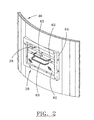
- An ambient air inlet port 28 with adjustment doors 38 and exit port 29 with adjustment doors 39 are provided to adjust the level of gaseous refrigerant which evaporates from the surface of the liquid refrigerant 24 so that excessive pressure is not built up within the processor 10 and freezing of the liquid composition in the feed assembly 40 does not occur.
- a feed tray 48 receives liquid composition from a delivery source 50.
- a pump (not shown) drives the liquid composition through a delivery tube 52 into the feed tray 48.
- a premixing device 54 allows several compositions, not all of which must be liquid, such as powdered flavorings or other additives of a size small enough not to cause clogging in the feed assembly 40, to be mixed in predetermined concentrations for delivery to the feed tray 48.
- uniformly sized droplets 58 of liquid composition are required to be fed through gas diffusion chamber 46 to freezing chamber 12.
- the feed tray 48 is designed with feed assembly 40 that forms droplets 58 of the desired character.
- the frozen product takes the form of beads that are formed when the droplets 58 of liquid composition contact the refrigerant vapor in the gas diffusion chamber 46, and subsequently the liquid refrigerant 24 in the freezing chamber 12. After the beads 56 are formed, they fall to the bottom of chamber 12.
- a transport system connects to the bottom of chamber 12 at outlet 32 to carry the beads 56 to a packaging and distribution network for later delivery and consumption.
- the preferred embodiment is designed with an incorporated vacuum assembly 30 which can take the form of a venturi.
- the vacuum assembly 30 cooperates with air inlet 28 and adjustment doors 38 so that an ambient air flow passes through the inlet and around feed assembly 40 to ensure that no liquid composition freezes therein. This is accomplished by mounting the vacuum assembly 30 and air inlet 28 on opposing sides of the gas diffusion chamber 46 such that the incoming ambient air drawn by the vacuum assembly 30 is aligned with the feed assembly. In this configuration, ambient air flows around the feed assembly warming it to a sufficient temperature to inhibit the formation of frozen liquid composition in the feed assembly flow channels.
- Air source 60 typically in the form of an air compressor, is attached to vacuum assembly 30 to provide appropriate suction to create the ambient air flow required.
- air inlet 28 incorporates adjustment doors 38 for controlling the amount of incoming ambient air.
- the preferred embodiment of the doors 38 is a series of slidable door segments 62 mounted within a frame 64. This configuration provides for numerous adjustment combinations so that the desired flow rates may be achieved between a full open setting where the doors 38 expose a maximum size inlet opening and a full closed setting where the doors completely block the inlet 28, thereby preventing ambient air flow.
- numerous other embodiments of the inlet doors 38 may be used for achieving the desired results, i.e. a variable flow nozzle, or an adjustable inlet vent, to mention but a few.
- sensors 66 may be incorporated to measure numerous operating values, such as freezing chamber temperature, refrigerant level, etc. These sensors each provide an input signal to control device 68 which monitors the production process and provides control output signals 70 to facilitate automatic production of the frozen beads. For purposes of illustration, these sensors have been included in FIG. 1 simply as dots. It will be appreciated, however, that the actual structure of the sensors will vary in accordance with the actual implementation.
- the present invention prevents the liquid from freezing in the feed assembly.
- the production process may continue uninterrupted.
- improperly frozen liquid composition represents waste which must be screened and removed from the uniform beaded product prior to packaging.
- the present invention eliminates this waste. By use of the novel gas diffusion chamber and vacuum assembly, the need for a separation requirement is successfully eliminated, thus the prior art screening components and the power utilized to operate them are no longer required.
Landscapes
- Engineering & Computer Science (AREA)
- Life Sciences & Earth Sciences (AREA)
- Chemical & Material Sciences (AREA)
- Food Science & Technology (AREA)
- Polymers & Plastics (AREA)
- Zoology (AREA)
- Wood Science & Technology (AREA)
- Physics & Mathematics (AREA)
- Mechanical Engineering (AREA)
- Thermal Sciences (AREA)
- General Engineering & Computer Science (AREA)
- Chemical Kinetics & Catalysis (AREA)
- Manufacturing & Machinery (AREA)
Abstract
Description
Claims (26)
- A cryogenic processor (10) for liquid feed preparation of a free-flowing frozen product comprising:a freezing chamber (12) having a substantially conical shape;a gas diffusion chamber (46) formed above said freezing chamber (12); anda feed tray (48) overlying said gas diffusion chamber (46) arranged and adapted to receive liquid composition from a delivery source, (50) said tray (48) having a plurality of orifices for regulating discharge of uniformly sized droplels (58) of said composition from said tray (48), said plurality of orifices having an associated plurality of feed droppers for producing droplets (58) from the liquid composition, whereby said droplets (58) are delivered by gravity through said gas diffusion chamber (86) and then into said freezing chamber (12) therebelow, characterized in thatsaid gas diffusion chamber (46) having a vacuum assembly (30) and an air inlet (28) both in fluid communication with said gas diffusion chamber (41), said vacuum assembly (30) arranged and adapted to draw ambient air through said air inlet (28) and into said gas diffusion chamber (46) to establish a controlled air flow about said orifices to prevent liquid composition from freezing in said orifices or their associated feed droppers, said air inlet (28) having a means for adjustment (38), such that said means for adjustment (38) regulates the amount of incoming ambient air.
- A cryogenic processor (10) as in claim 1, in which said freezing chamber (12) is further defined as having an interior surface and a means for baffling (34) fluid flow, said means for baffling (34) arranged and attached to said interior surface of said freezing chamber (12) such that incoming liquid refrigerant is prevented from creating a disruptive cyclonic flow within the freezing chamber (12).
- A cryogenic processor (10) as in claim 2, in which said freezing chamber (12) is further defined by an inner shell (14) and an outer shell (16), and thermal insulation (18) disposed between said inner shell (14) and said outer shell (16).
- A cryogenic processor (10) as in claim 3, in which said gas diffusion chamber (46) is further defined by an inner shell and an outer shell, and thermal insulation disposed between said inner shell and said outer shelf.
- A cryogenic processor (10) as in claim 4, in which said inner shell (16) and said outer shell (16) of said freezing chamber (12) are further defined as having a means for venting an area formed between said shells.
- A cryogenic processor (10) as in claim 5, in which said inner shell and said outer shell of said gas diffusion chamber (46) are further defined as having a means for venting (28, 29) an area formed between said shells.
- A cryogenic processor (10) as in claim 6, in which said processor is further defined as having a delivery source (50) capable of providing liquid composition to the tray (48) of said cryogenic processor (10).
- A cryogenic processor (10) as in claim 7, in which said processor (10) is further defined as having a premixing device (54) capable of combining a plurality of compositions in desired concentrations and providing the mixed combination to the delivery source (52) of said cryogenic processor (10).
- A cryogenic processor (10) as in claim 8, further comprising: a control device (68) having a plurality of sensors (66), said sensors (66) attached to said cryogenic processor (10) such that numerous operating values are measured and sent to said control device (68) as input signals, said input signals interpreted by an appropriate algorithm in a control device (68) such that an output signal (70) is created and sent from the control device (68) to said cryogenic processor (10) which allows for automatic monitoring and production of frozen beaded product (56).
- A method of feeding liquid composition to a freezing chamber (12) containing a refrigerant to form beads (56) of frozen product, comprising the steps of:delivering a liquid feed composition from a source (50) to a feed tray (48);discharging said liquid feed composition from said feed tray through a plurality of orifices in the form of droplets, via gravity, into a gas diffusion chamber (46) disposed immediately below said plurality of orifices, said plurality of orifices having an associated plurality or feed droppers for producing droplets (58) from the liquid composition;delivering said droplets (58) into a freezing chamber (12) disposed immediately below said gas diffusion chamber (46);providing an intensely cold environment in said gas diffusion chamber (46) and in said freezing chamber (12), whereby the droplets (58) become substantially pre-cooled during a free fall, characterized byproviding an ambient air flow through said gas diffusion chamber (46) and about said plurality of orifices by utilizing a vacuum assembly (30) and an air inlet (28) both in fluid communication with said gas diffusion chamber (46), said vacuum assembly (30) arranged and adapted to draw ambient air through said air inlet (28) and into said gas diffusion chamber (46) to establish a controlled air flow about the orifices to prevent liquid composition from freezing in said orifices, said air inlet (28) having a means for adjustment (38), such that said means for adjustment (38) regulates the amount of incoming ambient air.
- The method as in claim 10, in which said freezing chamber is further defined as having an interior surface and a means for baffling (34) fluid flow, said means for baffling (34) arranged and attached to said interior surface of said freezing chamber (12) such that incoming refrigerant is prevented from creating a disruptive cyclonic flow within the freezing chamber (12).
- The method as in claim 11, in which said freezing chamber is further defined by an inner shell (14) and an outer shell (16), and thermal insulation (18) disposed between said inner shell (14) and said outer shell (16).
- The method as in claim 12, in which said gas diffusion chamber (46) is further defined by an inner shell and an outer shell, and thermal insulation disposed between said inner shell and said outer shell.
- The method as in claim 13, in which said inner shell (14) and said outer shell (16) of said freezing chamber (12) are further defined as having a means for venting an area formed between said shells.
- The method as in claim 14, in which said inner shell and said outer shell of said gas diffusion chamber (46) are further defined as having a means for venting (28, 29) an area formed between said shells.
- The method as in claim 15, in which said processor is further defined as having a delivery source (50) capable of providing liquid composition to the tray (48) of said cryogenic processor (10).
- The method as in claim 16, in which said processor (10) is further defined as having a premixing device (54) capable of combining a plurality of compositions in desired concentrations and providing the mixed combination to the delivery source (50) of said cryogenic processor (10).
- The method as in claim 17, further comprising the step of:automatically controlling the production of frozen beaded product by incorporating a control device (68) capable of monitoring several operating parameters selected from the group consisting of freezer chamber liquid refrigerant level, rate of refrigerant input, freezer chamber temperature, gas diffusion chamber temperature, rate of incoming ambient air, rate of liquid composition input, and rate of frozen product output; and providing control output signals (70) from said control device (68) capable of adjusting the operating parameters of the processor (10).
- A cryogenic processor (10) as in claim 1, wherein said means for adjustment (38) comprises at least one door (38) adjustable between a full open setting and a full closed setting such that adjustment of said door (38) regulates the amount of incoming ambient air.
- A cryogenic processor (10) as in claim 2, wherein said means for baffling (34) comprises at least one baffle (34) arranged and attached to said interior surface of said freezing chamber (12) and extending into an interior of said freezing chamber such that incoming refrigerant is prevented from creating a disruptive cyclonic flow within the freezing chamber (12).
- A cryogenic processor (10) as in claim 5, wherein said means for venting an area formed between said shells of said freezing chamber (12) comprises at least one vent in fluid communication between said area formed between said shells of said freezing chamber (12) and an exterior of said cryogenic processor (10).
- A cryogenic processor (10) as in claim 6, wherein said means for venting (28, 29) an area formed between said shells of said gas diffusion chamber (46) comprises said area formed between said shells of said gas diffusion chamber (46) and said area formed between said shells ofsaid freezing chamber (12) being in fluid communication with each other.
- The method as in claim 10, wherein said means for adjustment (38) comprises at least one door (38) adjustable between a full open setting and a full closed setting such that adjustment of said door (38) regulates the amount of incoming ambient air.
- The method as in claim 11, wherein said means for baffling (34) comprises at least one baffle (34) arranged and attached to said interior surface of said freezing chamber (12) and extending into an interior of said freezing chamber (12) such that incoming refrigerant is prevented from creating a disruptive cyclonic flow within the freezing chamber (12).
- The method as in claim 14, wherein said means for venting an area formed between said shells of said freezing chamber (12) comprises at least one vent in fluid communication between said area formed between said shells of said freezing chamber (12) and an exterior of said cryogenic processor (10).
- The method as in claim 15, wherein said means for venting (28, 29) an area formed between said shells of said gas diffusion chamber (46) comprises said area formed between said shells of said gas diffusion chamber (46) and said area formed between said shells of said freezing chamber (12) being in fluid communication with each other.
Applications Claiming Priority (3)
| Application Number | Priority Date | Filing Date | Title |
|---|---|---|---|
| US09/066,140 US6000229A (en) | 1998-04-24 | 1998-04-24 | Cryogenic processor for liquid feed preparation of a free-flowing frozen product and method for freezing liquid composition |
| US66140 | 1998-04-24 | ||
| PCT/US1999/008300 WO1999055169A2 (en) | 1998-04-24 | 1999-04-15 | Cryogenic processor and method for liquid feed preparation of a free-flowing frozen product |
Publications (3)
| Publication Number | Publication Date |
|---|---|
| EP1073870A2 EP1073870A2 (en) | 2001-02-07 |
| EP1073870A4 EP1073870A4 (en) | 2003-06-04 |
| EP1073870B1 true EP1073870B1 (en) | 2005-10-12 |
Family
ID=22067494
Family Applications (1)
| Application Number | Title | Priority Date | Filing Date |
|---|---|---|---|
| EP99921390A Expired - Lifetime EP1073870B1 (en) | 1998-04-24 | 1999-04-15 | Cryogenic processor for liquid feed preparation of a free-flowing frozen product and method for freezing liquid composition |
Country Status (7)
| Country | Link |
|---|---|
| US (2) | US6000229A (en) |
| EP (1) | EP1073870B1 (en) |
| AT (1) | ATE306647T1 (en) |
| AU (1) | AU3861699A (en) |
| DE (1) | DE69927680D1 (en) |
| TW (1) | TW376302B (en) |
| WO (1) | WO1999055169A2 (en) |
Cited By (1)
| Publication number | Priority date | Publication date | Assignee | Title |
|---|---|---|---|---|
| USD667028S1 (en) | 2011-09-22 | 2012-09-11 | Headley Sr Donn | Apparatus for dispensing droplets of liquid food products into a freezing media |
Families Citing this family (46)
| Publication number | Priority date | Publication date | Assignee | Title |
|---|---|---|---|---|
| US6494049B1 (en) * | 1998-04-24 | 2002-12-17 | Dippin' Dots, Inc. | Control system for cryogenic processor for liquid feed preparation of free-flowing frozen product |
| US6000229A (en) * | 1998-04-24 | 1999-12-14 | Dippin' Dots, Inc. | Cryogenic processor for liquid feed preparation of a free-flowing frozen product and method for freezing liquid composition |
| US6209329B1 (en) * | 1998-04-24 | 2001-04-03 | Dippin' Dots, Inc. | Cryogenic processor for liquid feed preparation of a free-flowing frozen product |
| US6510890B1 (en) * | 2000-04-14 | 2003-01-28 | Iowa State University Research Foundation, Inc. | Continuous system and method for producing frozen food products |
| US6354091B1 (en) * | 2001-02-01 | 2002-03-12 | Spectral Diagnostics, Inc. | Apparatus and method for the production of frozen beads |
| DE10107124A1 (en) * | 2001-02-15 | 2002-09-12 | Wild Gmbh & Co Kg Rudolf | Device and method for producing particles from a food mass, in particular a chocolate mass |
| US6349549B1 (en) | 2001-03-04 | 2002-02-26 | Nicholas W. Angus | Method of rapidly producing cryogenically frozen dessert particles |
| US6539743B2 (en) | 2001-03-13 | 2003-04-01 | Dippin′ Dots, Inc. | Transport assembly for transporting free flowing frozen product away from a cryogenic processor |
| US6555154B2 (en) * | 2001-04-06 | 2003-04-29 | Dippin' Dots, Inc. | Method and apparatus for making a popcorn-shaped frozen product |
| EP1249487B1 (en) * | 2001-04-14 | 2005-11-23 | Franz Zentis Gmbh & Co. | Method and use of an apparatus for making chocolate particles |
| DE10124471A1 (en) * | 2001-05-19 | 2002-11-28 | Zentis Gmbh & Co Franz | Device for producing particles of a food |
| US7147884B2 (en) * | 2001-12-27 | 2006-12-12 | Jones Curt D | Method for making a novelty frozen food product |
| US6915896B2 (en) * | 2003-02-25 | 2005-07-12 | Dippin' Dots, Inc. | Cleaning drain apparatus for an auger assembly |
| EP2888948B1 (en) | 2003-04-11 | 2018-02-28 | Cargill, Incorporated | Pellet systems for preparing beverages |
| US7464564B2 (en) | 2003-09-22 | 2008-12-16 | Dippin' Dots, Inc. | Method and apparatus for combining cookie dough and ice cream |
| KR20060131603A (en) * | 2003-09-24 | 2006-12-20 | 디핀 다츠 인코포레이티드 | Apparatus and method for mixing food particles and ice cream |
| MXPA05012940A (en) * | 2003-10-07 | 2006-02-13 | Dippin Dots Inc | Combined particulate and traditional ice cream. |
| US7062924B2 (en) * | 2003-11-21 | 2006-06-20 | Irvine J David | Method and apparatus for the manipulation and management of a cryogen for production of frozen small volumes of a substance |
| US7316122B1 (en) | 2004-01-06 | 2008-01-08 | Dippin' Dots, Inc. | Tray for producing particulate food products |
| US20100062134A1 (en) * | 2004-02-26 | 2010-03-11 | David Hart Melvin | Alcohol based frozen dessert product |
| US7687094B2 (en) * | 2004-02-26 | 2010-03-30 | Frozen North Trading, Inc. | Frozen dessert product |
| US7353657B2 (en) * | 2004-04-06 | 2008-04-08 | H Randall Craig | Control of liquid droplet stream with flow nebulizer |
| US7318324B2 (en) * | 2004-06-21 | 2008-01-15 | Ulrich Connie D | Combined particulate and conventional ice cream |
| US20060093714A1 (en) * | 2004-11-01 | 2006-05-04 | Dippin' Dots, Inc. | Particulate ice cream dot cake |
| US8679566B1 (en) | 2005-05-12 | 2014-03-25 | Jerry Hancock | Method of making frozen confections |
| AU2006270320A1 (en) * | 2005-07-18 | 2007-01-25 | Dippin' Dots, Inc. | Method and apparatus for combining particulate and soft-serve ice cream |
| US7938061B2 (en) * | 2006-07-13 | 2011-05-10 | Tom Timmons | Method and apparatus for combining particulate and soft-serve ice cream |
| DE112008001095B4 (en) * | 2007-04-26 | 2014-02-06 | Panasonic Corporation | Refrigerator and electrical device |
| US7861551B2 (en) | 2007-11-30 | 2011-01-04 | Whirlpool Corporation | Method and device for producing ice droplets on demand |
| AU2009235628A1 (en) * | 2008-04-11 | 2009-10-15 | Nestec S.A. | Ice containing particles for use in making frozen ice drinks |
| BRPI0911872A2 (en) | 2008-04-11 | 2015-08-18 | Nestec Sa | Aerated frozen confectionery particles for cold drinks |
| US20100034949A1 (en) * | 2008-08-11 | 2010-02-11 | Curt Jones | Method and system for flash freezing coffee-flavored liquid and making warm coffee-based beverages |
| US9107444B2 (en) * | 2009-05-14 | 2015-08-18 | Robert Lynn | Method and apparatus for flash frozen drinks mixes |
| US9151532B2 (en) * | 2009-11-23 | 2015-10-06 | Air Liquide Industrial U.S. Lp | Recirculating liquid nitrogen immersion bath and method for freezing a product therein |
| US9339051B2 (en) | 2010-08-10 | 2016-05-17 | Gelato Fresco, Inc. | Alcohol containing frozen dessert product |
| ITBS20110076A1 (en) * | 2011-05-25 | 2012-11-26 | K190 S R L | APPARATUS AND PROCEDURE FOR THE PREPARATION OF ICE CREAM OR SIMILAR FOOD PRODUCTS |
| JP6068466B2 (en) | 2011-07-12 | 2017-01-25 | ドール・パッケージド・フーズ・エルエルシー | Yogurt smoothie kit and method for making the same |
| US9392808B2 (en) | 2012-06-15 | 2016-07-19 | Gelato Fresco, Inc. | Process and composition for making an alcohol-containing frozen comestible |
| US9528737B2 (en) | 2013-10-31 | 2016-12-27 | Pepsico, Inc. | Ice making and harvesting |
| US9933197B2 (en) | 2013-12-31 | 2018-04-03 | Air Liquide Canada, Inc. | Vertical counter-flow immersion freezer |
| ES2703551T3 (en) * | 2014-10-17 | 2019-03-11 | Linde Ag | Apparatus, system and method to treat a fluid product |
| US20170354290A1 (en) * | 2016-06-13 | 2017-12-14 | Curt Jones | Preparation of Heated Beverages |
| JP6574525B2 (en) * | 2016-08-26 | 2019-09-11 | 株式会社カネカ | Frozen raw yeast molded body and method for producing the same |
| WO2019051058A1 (en) | 2017-09-08 | 2019-03-14 | Dippin Dots, L.L.C. | Particulate frozen cream |
| US20200375216A1 (en) * | 2017-12-18 | 2020-12-03 | Dippin' Dots Cryogenics, L.L.C. | System for cryogenic freezing of viscous feed |
| FR3081684B1 (en) * | 2018-06-04 | 2021-08-06 | Genialis | PROCESS FOR OBTAINING A PRODUCT IN THE FORM OF FROZEN PELLETS, PARTICLES OR BALLS RICH IN DISSOLVED GAS AND ASSOCIATED EQUIPMENT |
Family Cites Families (40)
| Publication number | Priority date | Publication date | Assignee | Title |
|---|---|---|---|---|
| US1538730A (en) * | 1924-08-07 | 1925-05-19 | Obersohn Albert | Device for converting liquids into uniform drops |
| US1612167A (en) * | 1925-03-09 | 1926-12-28 | Calco Chemical Company | Dinitrobenzene pellet |
| US2708055A (en) * | 1951-03-30 | 1955-05-10 | George G Alexander | Ice cream packing equipment |
| US2715484A (en) * | 1952-01-25 | 1955-08-16 | George G Alexander | Ice cream packing nozzle |
| US2875588A (en) * | 1953-06-11 | 1959-03-03 | Ohio Commw Eng Co | Preservation of red blood cells |
| US3228838A (en) * | 1959-04-23 | 1966-01-11 | Union Carbide Corp | Preservation of biological substances |
| US3023171A (en) * | 1959-08-13 | 1962-02-27 | Universal Oil Prod Co | Apparatus for the manufacture of spherical particles |
| US3060510A (en) * | 1961-06-12 | 1962-10-30 | Koppers Co Inc | Process for converting fusible materials, solid at ordinary temperatures, into spherical granules |
| US3276847A (en) * | 1961-08-31 | 1966-10-04 | Cooke Engineering Company | Tubular dropper for micro-titration |
| US3162019A (en) * | 1962-11-16 | 1964-12-22 | Bethlehem Steel Corp | Method and apparatus for freezing liquids to be used in a freeze-drying process |
| US3344617A (en) * | 1965-02-25 | 1967-10-03 | Union Carbide Corp | Apparatus for the preservation of biological substances |
| US3662104A (en) * | 1968-04-25 | 1972-05-09 | Us Navy | Electronic area correlator with multiple input signals |
| US3857974A (en) * | 1969-11-24 | 1974-12-31 | Canadian Patents Dev | Process for the production of frozen eggs |
| CA964921A (en) * | 1971-05-11 | 1975-03-25 | Gordon E. Timbers | Frozen food substance from egg, its production and apparatus therefor |
| JPS53138049A (en) * | 1977-05-09 | 1978-12-02 | Ricoh Kk | Method of insulating electric parts |
| JPS5417353A (en) * | 1977-07-08 | 1979-02-08 | Hitachi Ltd | Detecting method for coil diameter of coiler |
| JPS5750465Y2 (en) * | 1978-05-27 | 1982-11-04 | ||
| JPS5564761A (en) * | 1978-11-09 | 1980-05-15 | Ohayoo Nyugyo Kk | Preparation of granular ice and its device |
| US4251547A (en) * | 1979-06-13 | 1981-02-17 | Liggett James J | Fish bait and methods for its preparation |
| GB2092880B (en) * | 1981-01-27 | 1985-04-03 | Boc Ltd | Freezing a liquid |
| US4468727A (en) * | 1981-05-14 | 1984-08-28 | Honeywell Inc. | Integrated cellular array parallel processor |
| US4565100A (en) * | 1981-10-02 | 1986-01-21 | Culture-Tek | Pipette device |
| US4479363A (en) * | 1983-02-10 | 1984-10-30 | The Boc Group Plc | Freezing a liquid |
| US4687672A (en) * | 1983-11-07 | 1987-08-18 | L'air Liquide, Societe Anonyme Pour L'etude Et L'exploitation Des Procedes Georges Claude | Method and apparatus for preparing frozen free-flowing food particles |
| JPS60195706A (en) * | 1984-03-16 | 1985-10-04 | Victor Co Of Japan Ltd | Digital signal reproducing device |
| US4655047A (en) * | 1985-03-25 | 1987-04-07 | I.Q.F. Inc. | Process for freezing or chilling |
| US4704873A (en) * | 1985-11-14 | 1987-11-10 | Taiyo Sanso Co., Ltd. | Method and apparatus for producing microfine frozen particles |
| CA1273498A (en) * | 1986-02-25 | 1990-09-04 | Peter Harrold Gibson | Freezing apparatus |
| EP0266859A1 (en) * | 1986-10-06 | 1988-05-11 | Taiyo Sanso Co Ltd. | Method and apparatus for producing microfine frozen particles |
| US5000921A (en) * | 1986-10-24 | 1991-03-19 | Hanaway Richard W | Multiple pipette samples |
| GB8802142D0 (en) * | 1988-02-01 | 1988-03-02 | Air Prod & Chem | Method of freezing liquid & pasty products & freezer for carrying out said method |
| JPH02205121A (en) * | 1989-02-03 | 1990-08-15 | Nec Corp | Automatic controller for impedance matching |
| US5126156A (en) * | 1989-03-06 | 1992-06-30 | Jones Curt D | Method of preparing and storing a free flowing, frozen alimentary dairy product |
| US5077592A (en) * | 1990-08-06 | 1991-12-31 | California Institute Of Technology | Front-illuminated CCD with open pinned-phase region and two-phase transfer gate regions |
| US5250824A (en) * | 1990-08-29 | 1993-10-05 | California Institute Of Technology | Ultra low-noise charge coupled device |
| DE4329110C1 (en) * | 1993-08-30 | 1994-10-20 | Buse Gase Gmbh & Co | Process and apparatus for pellet freezing of pelletisable liquids |
| US5499195A (en) * | 1994-04-19 | 1996-03-12 | Hughes Aircraft Company | Fine-grained multi-planar clutter rejection processor |
| DE4419010C1 (en) * | 1994-05-31 | 1995-04-27 | Buse Gase Gmbh & Co | Process and apparatus for granulating granulable and/or pelletable materials |
| MX9707372A (en) * | 1995-03-29 | 1998-03-31 | Curt D Jones | MOUNTING DROPPER TO FEED A LIQUID AND METHOD OF FEEDING THE LIQUID COMPOSITION TO A REFRIGERATION CHAMBER. |
| US6000229A (en) * | 1998-04-24 | 1999-12-14 | Dippin' Dots, Inc. | Cryogenic processor for liquid feed preparation of a free-flowing frozen product and method for freezing liquid composition |
-
1998
- 1998-04-24 US US09/066,140 patent/US6000229A/en not_active Expired - Lifetime
-
1999
- 1999-04-15 EP EP99921390A patent/EP1073870B1/en not_active Expired - Lifetime
- 1999-04-15 AU AU38616/99A patent/AU3861699A/en not_active Abandoned
- 1999-04-15 AT AT99921390T patent/ATE306647T1/en not_active IP Right Cessation
- 1999-04-15 DE DE69927680T patent/DE69927680D1/en not_active Expired - Lifetime
- 1999-04-15 WO PCT/US1999/008300 patent/WO1999055169A2/en not_active Ceased
- 1999-04-26 TW TW088106500A patent/TW376302B/en active
- 1999-11-30 US US09/451,046 patent/US6223542B1/en not_active Expired - Lifetime
Cited By (1)
| Publication number | Priority date | Publication date | Assignee | Title |
|---|---|---|---|---|
| USD667028S1 (en) | 2011-09-22 | 2012-09-11 | Headley Sr Donn | Apparatus for dispensing droplets of liquid food products into a freezing media |
Also Published As
| Publication number | Publication date |
|---|---|
| WO1999055169A2 (en) | 1999-11-04 |
| EP1073870A2 (en) | 2001-02-07 |
| US6000229A (en) | 1999-12-14 |
| DE69927680D1 (en) | 2006-02-23 |
| EP1073870A4 (en) | 2003-06-04 |
| HK1034562A1 (en) | 2001-10-26 |
| ATE306647T1 (en) | 2005-10-15 |
| US6223542B1 (en) | 2001-05-01 |
| TW376302B (en) | 1999-12-11 |
| WO1999055169A3 (en) | 1999-12-16 |
| AU3861699A (en) | 1999-11-16 |
Similar Documents
| Publication | Publication Date | Title |
|---|---|---|
| US6000229A (en) | Cryogenic processor for liquid feed preparation of a free-flowing frozen product and method for freezing liquid composition | |
| US6209329B1 (en) | Cryogenic processor for liquid feed preparation of a free-flowing frozen product | |
| US6494049B1 (en) | Control system for cryogenic processor for liquid feed preparation of free-flowing frozen product | |
| US6539743B2 (en) | Transport assembly for transporting free flowing frozen product away from a cryogenic processor | |
| US6555154B2 (en) | Method and apparatus for making a popcorn-shaped frozen product | |
| US5664422A (en) | Dropper assembly for liquid feed and method of feeding liquid composition to a freezing chamber | |
| JP6426166B2 (en) | Air-cooled microdroplet capsule manufacturing line | |
| JP2004523228A (en) | Food cooling method and device | |
| US8272226B2 (en) | System and method for making dot clumps | |
| HK1034562B (en) | Cryogenic processor for liquid feed preparation of a free-flowing frozen product and method for freezing liquid composition | |
| US20200375216A1 (en) | System for cryogenic freezing of viscous feed | |
| KR100483329B1 (en) | Apparatus for producing liquid frozen particles | |
| HK1057086A (en) | Cryogenic processor for liquid feed preparation of a free-flowing frozen product | |
| WO2019236379A1 (en) | Cryogenic meat processor | |
| HK1056770B (en) | Cryogenic processor for liquid feed preparation of a free-flowing frozen product, system for controlling the operation of the same, and a method of feeding liquid composition to a freezing chamber containing a refrigerant to form beads of frozen product | |
| AU694027C (en) | Dropper assembly for liquid feed and method of feeding liquid composition to a freezing chamber | |
| HK1009373B (en) | Dropper assembly for liquid feed and method of feeding liquid composition to a freezing chamber |
Legal Events
| Date | Code | Title | Description |
|---|---|---|---|
| PUAI | Public reference made under article 153(3) epc to a published international application that has entered the european phase |
Free format text: ORIGINAL CODE: 0009012 |
|
| 17P | Request for examination filed |
Effective date: 20001023 |
|
| AK | Designated contracting states |
Kind code of ref document: A2 Designated state(s): AT BE CH CY DE DK ES FI FR GB GR IE IT LI LU MC NL PT SE |
|
| A4 | Supplementary search report drawn up and despatched |
Effective date: 20030422 |
|
| RIC1 | Information provided on ipc code assigned before grant |
Ipc: 7A 23G 9/14 B Ipc: 7A 23L 3/375 B Ipc: 7A 23L 3/36 B Ipc: 7F 25C 1/00 B Ipc: 7F 17C 1/00 B Ipc: 7F 25D 17/02 A |
|
| GRAP | Despatch of communication of intention to grant a patent |
Free format text: ORIGINAL CODE: EPIDOSNIGR1 |
|
| GRAS | Grant fee paid |
Free format text: ORIGINAL CODE: EPIDOSNIGR3 |
|
| GRAA | (expected) grant |
Free format text: ORIGINAL CODE: 0009210 |
|
| AK | Designated contracting states |
Kind code of ref document: B1 Designated state(s): AT BE CH CY DE DK ES FI FR GB GR IE IT LI LU MC NL PT SE |
|
| PG25 | Lapsed in a contracting state [announced via postgrant information from national office to epo] |
Ref country code: LI Free format text: LAPSE BECAUSE OF FAILURE TO SUBMIT A TRANSLATION OF THE DESCRIPTION OR TO PAY THE FEE WITHIN THE PRESCRIBED TIME-LIMIT Effective date: 20051012 Ref country code: IT Free format text: LAPSE BECAUSE OF FAILURE TO SUBMIT A TRANSLATION OF THE DESCRIPTION OR TO PAY THE FEE WITHIN THE PRESCRIBED TIME-LIMIT;WARNING: LAPSES OF ITALIAN PATENTS WITH EFFECTIVE DATE BEFORE 2007 MAY HAVE OCCURRED AT ANY TIME BEFORE 2007. THE CORRECT EFFECTIVE DATE MAY BE DIFFERENT FROM THE ONE RECORDED. Effective date: 20051012 Ref country code: FI Free format text: LAPSE BECAUSE OF FAILURE TO SUBMIT A TRANSLATION OF THE DESCRIPTION OR TO PAY THE FEE WITHIN THE PRESCRIBED TIME-LIMIT Effective date: 20051012 Ref country code: CH Free format text: LAPSE BECAUSE OF FAILURE TO SUBMIT A TRANSLATION OF THE DESCRIPTION OR TO PAY THE FEE WITHIN THE PRESCRIBED TIME-LIMIT Effective date: 20051012 Ref country code: BE Free format text: LAPSE BECAUSE OF FAILURE TO SUBMIT A TRANSLATION OF THE DESCRIPTION OR TO PAY THE FEE WITHIN THE PRESCRIBED TIME-LIMIT Effective date: 20051012 Ref country code: AT Free format text: LAPSE BECAUSE OF FAILURE TO SUBMIT A TRANSLATION OF THE DESCRIPTION OR TO PAY THE FEE WITHIN THE PRESCRIBED TIME-LIMIT Effective date: 20051012 |
|
| REG | Reference to a national code |
Ref country code: GB Ref legal event code: FG4D |
|
| REG | Reference to a national code |
Ref country code: CH Ref legal event code: EP |
|
| REG | Reference to a national code |
Ref country code: IE Ref legal event code: FG4D |
|
| REG | Reference to a national code |
Ref country code: HK Ref legal event code: GR Ref document number: 1034562 Country of ref document: HK |
|
| PG25 | Lapsed in a contracting state [announced via postgrant information from national office to epo] |
Ref country code: SE Free format text: LAPSE BECAUSE OF FAILURE TO SUBMIT A TRANSLATION OF THE DESCRIPTION OR TO PAY THE FEE WITHIN THE PRESCRIBED TIME-LIMIT Effective date: 20060112 Ref country code: GR Free format text: LAPSE BECAUSE OF FAILURE TO SUBMIT A TRANSLATION OF THE DESCRIPTION OR TO PAY THE FEE WITHIN THE PRESCRIBED TIME-LIMIT Effective date: 20060112 Ref country code: DK Free format text: LAPSE BECAUSE OF FAILURE TO SUBMIT A TRANSLATION OF THE DESCRIPTION OR TO PAY THE FEE WITHIN THE PRESCRIBED TIME-LIMIT Effective date: 20060112 |
|
| PG25 | Lapsed in a contracting state [announced via postgrant information from national office to epo] |
Ref country code: DE Free format text: LAPSE BECAUSE OF FAILURE TO SUBMIT A TRANSLATION OF THE DESCRIPTION OR TO PAY THE FEE WITHIN THE PRESCRIBED TIME-LIMIT Effective date: 20060113 |
|
| PG25 | Lapsed in a contracting state [announced via postgrant information from national office to epo] |
Ref country code: ES Free format text: LAPSE BECAUSE OF FAILURE TO SUBMIT A TRANSLATION OF THE DESCRIPTION OR TO PAY THE FEE WITHIN THE PRESCRIBED TIME-LIMIT Effective date: 20060123 |
|
| REF | Corresponds to: |
Ref document number: 69927680 Country of ref document: DE Date of ref document: 20060223 Kind code of ref document: P |
|
| PG25 | Lapsed in a contracting state [announced via postgrant information from national office to epo] |
Ref country code: PT Free format text: LAPSE BECAUSE OF FAILURE TO SUBMIT A TRANSLATION OF THE DESCRIPTION OR TO PAY THE FEE WITHIN THE PRESCRIBED TIME-LIMIT Effective date: 20060313 |
|
| REG | Reference to a national code |
Ref country code: CH Ref legal event code: PL |
|
| PG25 | Lapsed in a contracting state [announced via postgrant information from national office to epo] |
Ref country code: MC Free format text: LAPSE BECAUSE OF NON-PAYMENT OF DUE FEES Effective date: 20060430 |
|
| PLBE | No opposition filed within time limit |
Free format text: ORIGINAL CODE: 0009261 |
|
| STAA | Information on the status of an ep patent application or granted ep patent |
Free format text: STATUS: NO OPPOSITION FILED WITHIN TIME LIMIT |
|
| 26N | No opposition filed |
Effective date: 20060713 |
|
| PG25 | Lapsed in a contracting state [announced via postgrant information from national office to epo] |
Ref country code: FR Free format text: LAPSE BECAUSE OF FAILURE TO SUBMIT A TRANSLATION OF THE DESCRIPTION OR TO PAY THE FEE WITHIN THE PRESCRIBED TIME-LIMIT Effective date: 20061020 |
|
| EN | Fr: translation not filed | ||
| PG25 | Lapsed in a contracting state [announced via postgrant information from national office to epo] |
Ref country code: LU Free format text: LAPSE BECAUSE OF NON-PAYMENT OF DUE FEES Effective date: 20060415 |
|
| PGFP | Annual fee paid to national office [announced via postgrant information from national office to epo] |
Ref country code: IE Payment date: 20080424 Year of fee payment: 10 |
|
| PG25 | Lapsed in a contracting state [announced via postgrant information from national office to epo] |
Ref country code: FR Free format text: LAPSE BECAUSE OF FAILURE TO SUBMIT A TRANSLATION OF THE DESCRIPTION OR TO PAY THE FEE WITHIN THE PRESCRIBED TIME-LIMIT Effective date: 20051012 Ref country code: CY Free format text: LAPSE BECAUSE OF FAILURE TO SUBMIT A TRANSLATION OF THE DESCRIPTION OR TO PAY THE FEE WITHIN THE PRESCRIBED TIME-LIMIT Effective date: 20051012 |
|
| REG | Reference to a national code |
Ref country code: IE Ref legal event code: MM4A |
|
| PG25 | Lapsed in a contracting state [announced via postgrant information from national office to epo] |
Ref country code: IE Free format text: LAPSE BECAUSE OF NON-PAYMENT OF DUE FEES Effective date: 20090415 |
|
| PGFP | Annual fee paid to national office [announced via postgrant information from national office to epo] |
Ref country code: NL Payment date: 20120425 Year of fee payment: 14 |
|
| PGFP | Annual fee paid to national office [announced via postgrant information from national office to epo] |
Ref country code: GB Payment date: 20120419 Year of fee payment: 14 |
|
| REG | Reference to a national code |
Ref country code: NL Ref legal event code: V1 Effective date: 20131101 |
|
| GBPC | Gb: european patent ceased through non-payment of renewal fee |
Effective date: 20130415 |
|
| PG25 | Lapsed in a contracting state [announced via postgrant information from national office to epo] |
Ref country code: GB Free format text: LAPSE BECAUSE OF NON-PAYMENT OF DUE FEES Effective date: 20130415 |
|
| PG25 | Lapsed in a contracting state [announced via postgrant information from national office to epo] |
Ref country code: NL Free format text: LAPSE BECAUSE OF NON-PAYMENT OF DUE FEES Effective date: 20131101 |