EP1073795B1 - High bulk paper - Google Patents
High bulk paper Download PDFInfo
- Publication number
- EP1073795B1 EP1073795B1 EP99916495A EP99916495A EP1073795B1 EP 1073795 B1 EP1073795 B1 EP 1073795B1 EP 99916495 A EP99916495 A EP 99916495A EP 99916495 A EP99916495 A EP 99916495A EP 1073795 B1 EP1073795 B1 EP 1073795B1
- Authority
- EP
- European Patent Office
- Prior art keywords
- roll
- sheet
- steam
- bulk
- firmness
- Prior art date
- Legal status (The legal status is an assumption and is not a legal conclusion. Google has not performed a legal analysis and makes no representation as to the accuracy of the status listed.)
- Expired - Lifetime
Links
- 238000004049 embossing Methods 0.000 claims description 29
- 238000000034 method Methods 0.000 claims description 20
- 238000005507 spraying Methods 0.000 claims description 10
- 238000010025 steaming Methods 0.000 claims description 9
- 229910000831 Steel Inorganic materials 0.000 claims description 5
- 238000004519 manufacturing process Methods 0.000 claims description 5
- 239000010959 steel Substances 0.000 claims description 5
- 238000004804 winding Methods 0.000 claims description 3
- 239000000123 paper Substances 0.000 description 35
- 239000000047 product Substances 0.000 description 25
- 239000007921 spray Substances 0.000 description 10
- 239000011122 softwood Substances 0.000 description 9
- 230000003020 moisturizing effect Effects 0.000 description 8
- 239000000523 sample Substances 0.000 description 7
- 238000001035 drying Methods 0.000 description 5
- 238000012360 testing method Methods 0.000 description 5
- 102100031260 Acyl-coenzyme A thioesterase THEM4 Human genes 0.000 description 4
- 101000638510 Homo sapiens Acyl-coenzyme A thioesterase THEM4 Proteins 0.000 description 4
- 210000000481 breast Anatomy 0.000 description 4
- 239000004744 fabric Substances 0.000 description 4
- 239000000835 fiber Substances 0.000 description 3
- 238000012546 transfer Methods 0.000 description 3
- LSNNMFCWUKXFEE-UHFFFAOYSA-N Sulfurous acid Chemical compound OS(O)=O LSNNMFCWUKXFEE-UHFFFAOYSA-N 0.000 description 2
- 238000009833 condensation Methods 0.000 description 2
- 230000005494 condensation Effects 0.000 description 2
- 230000001419 dependent effect Effects 0.000 description 2
- 238000013461 design Methods 0.000 description 2
- 238000010586 diagram Methods 0.000 description 2
- 238000006073 displacement reaction Methods 0.000 description 2
- 239000002655 kraft paper Substances 0.000 description 2
- 230000035515 penetration Effects 0.000 description 2
- 230000001105 regulatory effect Effects 0.000 description 2
- 229920001131 Pulp (paper) Polymers 0.000 description 1
- 239000000853 adhesive Substances 0.000 description 1
- 230000001070 adhesive effect Effects 0.000 description 1
- 238000003490 calendering Methods 0.000 description 1
- 238000006243 chemical reaction Methods 0.000 description 1
- 230000000694 effects Effects 0.000 description 1
- 239000012467 final product Substances 0.000 description 1
- 239000011121 hardwood Substances 0.000 description 1
- 238000005259 measurement Methods 0.000 description 1
- 238000003825 pressing Methods 0.000 description 1
- 229910001220 stainless steel Inorganic materials 0.000 description 1
- 239000010935 stainless steel Substances 0.000 description 1
- 239000000126 substance Substances 0.000 description 1
- 238000011144 upstream manufacturing Methods 0.000 description 1
- 238000012795 verification Methods 0.000 description 1
Images


Classifications
-
- D—TEXTILES; PAPER
- D21—PAPER-MAKING; PRODUCTION OF CELLULOSE
- D21H—PULP COMPOSITIONS; PREPARATION THEREOF NOT COVERED BY SUBCLASSES D21C OR D21D; IMPREGNATING OR COATING OF PAPER; TREATMENT OF FINISHED PAPER NOT COVERED BY CLASS B31 OR SUBCLASS D21G; PAPER NOT OTHERWISE PROVIDED FOR
- D21H5/00—Special paper or cardboard not otherwise provided for
- D21H5/0092—Post-treated paper
-
- B—PERFORMING OPERATIONS; TRANSPORTING
- B31—MAKING ARTICLES OF PAPER, CARDBOARD OR MATERIAL WORKED IN A MANNER ANALOGOUS TO PAPER; WORKING PAPER, CARDBOARD OR MATERIAL WORKED IN A MANNER ANALOGOUS TO PAPER
- B31F—MECHANICAL WORKING OR DEFORMATION OF PAPER, CARDBOARD OR MATERIAL WORKED IN A MANNER ANALOGOUS TO PAPER
- B31F1/00—Mechanical deformation without removing material, e.g. in combination with laminating
- B31F1/12—Crêping
- B31F1/122—Crêping the paper being submitted to an additional mechanical deformation other than crêping, e.g. for making it elastic in all directions
-
- B—PERFORMING OPERATIONS; TRANSPORTING
- B31—MAKING ARTICLES OF PAPER, CARDBOARD OR MATERIAL WORKED IN A MANNER ANALOGOUS TO PAPER; WORKING PAPER, CARDBOARD OR MATERIAL WORKED IN A MANNER ANALOGOUS TO PAPER
- B31F—MECHANICAL WORKING OR DEFORMATION OF PAPER, CARDBOARD OR MATERIAL WORKED IN A MANNER ANALOGOUS TO PAPER
- B31F1/00—Mechanical deformation without removing material, e.g. in combination with laminating
- B31F1/07—Embossing, i.e. producing impressions formed by locally deep-drawing, e.g. using rolls provided with complementary profiles
-
- D—TEXTILES; PAPER
- D21—PAPER-MAKING; PRODUCTION OF CELLULOSE
- D21H—PULP COMPOSITIONS; PREPARATION THEREOF NOT COVERED BY SUBCLASSES D21C OR D21D; IMPREGNATING OR COATING OF PAPER; TREATMENT OF FINISHED PAPER NOT COVERED BY CLASS B31 OR SUBCLASS D21G; PAPER NOT OTHERWISE PROVIDED FOR
- D21H25/00—After-treatment of paper not provided for in groups D21H17/00 - D21H23/00
- D21H25/005—Mechanical treatment
-
- B—PERFORMING OPERATIONS; TRANSPORTING
- B31—MAKING ARTICLES OF PAPER, CARDBOARD OR MATERIAL WORKED IN A MANNER ANALOGOUS TO PAPER; WORKING PAPER, CARDBOARD OR MATERIAL WORKED IN A MANNER ANALOGOUS TO PAPER
- B31F—MECHANICAL WORKING OR DEFORMATION OF PAPER, CARDBOARD OR MATERIAL WORKED IN A MANNER ANALOGOUS TO PAPER
- B31F2201/00—Mechanical deformation of paper or cardboard without removing material
- B31F2201/07—Embossing
- B31F2201/0707—Embossing by tools working continuously
- B31F2201/0715—The tools being rollers
- B31F2201/0723—Characteristics of the rollers
- B31F2201/0728—Material
-
- B—PERFORMING OPERATIONS; TRANSPORTING
- B31—MAKING ARTICLES OF PAPER, CARDBOARD OR MATERIAL WORKED IN A MANNER ANALOGOUS TO PAPER; WORKING PAPER, CARDBOARD OR MATERIAL WORKED IN A MANNER ANALOGOUS TO PAPER
- B31F—MECHANICAL WORKING OR DEFORMATION OF PAPER, CARDBOARD OR MATERIAL WORKED IN A MANNER ANALOGOUS TO PAPER
- B31F2201/00—Mechanical deformation of paper or cardboard without removing material
- B31F2201/07—Embossing
- B31F2201/0756—Characteristics of the incoming material, e.g. creped, embossed, corrugated
-
- B—PERFORMING OPERATIONS; TRANSPORTING
- B31—MAKING ARTICLES OF PAPER, CARDBOARD OR MATERIAL WORKED IN A MANNER ANALOGOUS TO PAPER; WORKING PAPER, CARDBOARD OR MATERIAL WORKED IN A MANNER ANALOGOUS TO PAPER
- B31F—MECHANICAL WORKING OR DEFORMATION OF PAPER, CARDBOARD OR MATERIAL WORKED IN A MANNER ANALOGOUS TO PAPER
- B31F2201/00—Mechanical deformation of paper or cardboard without removing material
- B31F2201/07—Embossing
- B31F2201/0758—Characteristics of the embossed product
-
- B—PERFORMING OPERATIONS; TRANSPORTING
- B31—MAKING ARTICLES OF PAPER, CARDBOARD OR MATERIAL WORKED IN A MANNER ANALOGOUS TO PAPER; WORKING PAPER, CARDBOARD OR MATERIAL WORKED IN A MANNER ANALOGOUS TO PAPER
- B31F—MECHANICAL WORKING OR DEFORMATION OF PAPER, CARDBOARD OR MATERIAL WORKED IN A MANNER ANALOGOUS TO PAPER
- B31F2201/00—Mechanical deformation of paper or cardboard without removing material
- B31F2201/07—Embossing
- B31F2201/0779—Control
-
- B—PERFORMING OPERATIONS; TRANSPORTING
- B31—MAKING ARTICLES OF PAPER, CARDBOARD OR MATERIAL WORKED IN A MANNER ANALOGOUS TO PAPER; WORKING PAPER, CARDBOARD OR MATERIAL WORKED IN A MANNER ANALOGOUS TO PAPER
- B31F—MECHANICAL WORKING OR DEFORMATION OF PAPER, CARDBOARD OR MATERIAL WORKED IN A MANNER ANALOGOUS TO PAPER
- B31F2201/00—Mechanical deformation of paper or cardboard without removing material
- B31F2201/07—Embossing
- B31F2201/0784—Auxiliary operations
-
- D—TEXTILES; PAPER
- D21—PAPER-MAKING; PRODUCTION OF CELLULOSE
- D21H—PULP COMPOSITIONS; PREPARATION THEREOF NOT COVERED BY SUBCLASSES D21C OR D21D; IMPREGNATING OR COATING OF PAPER; TREATMENT OF FINISHED PAPER NOT COVERED BY CLASS B31 OR SUBCLASS D21G; PAPER NOT OTHERWISE PROVIDED FOR
- D21H27/00—Special paper not otherwise provided for, e.g. made by multi-step processes
-
- Y—GENERAL TAGGING OF NEW TECHNOLOGICAL DEVELOPMENTS; GENERAL TAGGING OF CROSS-SECTIONAL TECHNOLOGIES SPANNING OVER SEVERAL SECTIONS OF THE IPC; TECHNICAL SUBJECTS COVERED BY FORMER USPC CROSS-REFERENCE ART COLLECTIONS [XRACs] AND DIGESTS
- Y10—TECHNICAL SUBJECTS COVERED BY FORMER USPC
- Y10T—TECHNICAL SUBJECTS COVERED BY FORMER US CLASSIFICATION
- Y10T428/00—Stock material or miscellaneous articles
- Y10T428/24—Structurally defined web or sheet [e.g., overall dimension, etc.]
- Y10T428/24355—Continuous and nonuniform or irregular surface on layer or component [e.g., roofing, etc.]
-
- Y—GENERAL TAGGING OF NEW TECHNOLOGICAL DEVELOPMENTS; GENERAL TAGGING OF CROSS-SECTIONAL TECHNOLOGIES SPANNING OVER SEVERAL SECTIONS OF THE IPC; TECHNICAL SUBJECTS COVERED BY FORMER USPC CROSS-REFERENCE ART COLLECTIONS [XRACs] AND DIGESTS
- Y10—TECHNICAL SUBJECTS COVERED BY FORMER USPC
- Y10T—TECHNICAL SUBJECTS COVERED BY FORMER US CLASSIFICATION
- Y10T428/00—Stock material or miscellaneous articles
- Y10T428/24—Structurally defined web or sheet [e.g., overall dimension, etc.]
- Y10T428/24355—Continuous and nonuniform or irregular surface on layer or component [e.g., roofing, etc.]
- Y10T428/24446—Wrinkled, creased, crinkled or creped
- Y10T428/24455—Paper
-
- Y—GENERAL TAGGING OF NEW TECHNOLOGICAL DEVELOPMENTS; GENERAL TAGGING OF CROSS-SECTIONAL TECHNOLOGIES SPANNING OVER SEVERAL SECTIONS OF THE IPC; TECHNICAL SUBJECTS COVERED BY FORMER USPC CROSS-REFERENCE ART COLLECTIONS [XRACs] AND DIGESTS
- Y10—TECHNICAL SUBJECTS COVERED BY FORMER USPC
- Y10T—TECHNICAL SUBJECTS COVERED BY FORMER US CLASSIFICATION
- Y10T428/00—Stock material or miscellaneous articles
- Y10T428/24—Structurally defined web or sheet [e.g., overall dimension, etc.]
- Y10T428/24355—Continuous and nonuniform or irregular surface on layer or component [e.g., roofing, etc.]
- Y10T428/24446—Wrinkled, creased, crinkled or creped
- Y10T428/24455—Paper
- Y10T428/24463—Plural paper components
-
- Y—GENERAL TAGGING OF NEW TECHNOLOGICAL DEVELOPMENTS; GENERAL TAGGING OF CROSS-SECTIONAL TECHNOLOGIES SPANNING OVER SEVERAL SECTIONS OF THE IPC; TECHNICAL SUBJECTS COVERED BY FORMER USPC CROSS-REFERENCE ART COLLECTIONS [XRACs] AND DIGESTS
- Y10—TECHNICAL SUBJECTS COVERED BY FORMER USPC
- Y10T—TECHNICAL SUBJECTS COVERED BY FORMER US CLASSIFICATION
- Y10T428/00—Stock material or miscellaneous articles
- Y10T428/31504—Composite [nonstructural laminate]
- Y10T428/31971—Of carbohydrate
- Y10T428/31993—Of paper
Definitions
- a creped base sheet is commonly produced on a tissue machine and wound into a parent roll. Thereafter, in converting operations, the parent roll is unwound and embossed in order to increase the bulk of the towel.
- the designs of the embossing patterns can vary greatly, but often they are embossing patterns which substantially cover the entire sheet and may be referred to as overall patterns.
- embossing towel base sheets a common problem associated with embossing towel base sheets is that, upon being wound into the final roll form of the product, the sheet embossments cause the roll to be somewhat soft and "mushy" This effect, which can be quantified by measuring the roll firmness, becomes more pronounced as the bulk of the roll is increased by imparting embossments to the base sheet which have greater z-direction dimensions. At the same time, increasing the bulk of the base sheet also typically degrades the strength of the sheet.
- EP 0428136 discloses a method for increasing the bulk of creped tissue.
- US 4921034 and US 5693403 disclose methods of embossing paper and tissue.
- rolls of creped paper towels can be made to have a high level of bulk, firmness and strength by embossing the creped basesheet in a manner which maintains more of the basesheet strength during the embossing process.
- the invention resides in a method of making a high bulk paper sheet comprising spraying a dry creped paper sheet with steam and immediately thereafter embossing the steamed sheet between matched steel embossing rolls and winding the steamed embossed sheet into a roll. It has been found that steaming the sheet just prior to embossing can increase the roll firmness (as compared to the unsteamed embossed sheet) about 15 percent or greater, more specifically from about 20 to about 50 percent, and still more specifically from about 20 to about 35 percent. As will be discussed below, "increasing" the roll firmness results in a lowering of the roll firmness value, which is measured by the extent to which a probe penetrates the roll during testing.
- steaming in accordance with this invention can increase the strength of the sheet, as measured by the cross-machine direction (CD) tensile strength, about 10 percent or greater, more specifically from about 10 to about 30 percent, and still more specifically from about 10 to about 20 percent (as compared to the unsteamed embossed sheet).
- CD cross-machine direction
- the invention resides in a roll of creped paper, such as a roll of kitchen toweling, as claimed in claim 1.
- the roll has a roll bulk of about 13 cubic centimeters per gram (cc/g) or greater, a roll firmness of 10 millimeters (mm) or less and a CD tensile strength of about 2000 or greater grams-force per 7.6 cm (3 inches) of sample width.
- the roll bulk can be about 15 cc/g or greater, more specifically about 16 cc/g or greater, still more specifically from about 14 cc/g to about 20 cc/g, and still more specifically from about 15 cc/g to about 17 cc/g.
- the roll firmness can be about 9 mm or less, still more specifically from about 6 to about 10, and most specifically from about 7 to about 9.
- the CD tensile strength can be about 2500 grams or greater, more specifically from about 2200 to about 3500 grams, and still more specifically from about 2300 to about 3200 grams.
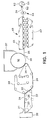
- FIG. 1 one example of a method of making a creped base sheet suitable for subsequent steaming and embossing is disclosed.
- a head box 20 delivers a furnish 21 onto a forming fabric 22 wrapped around a vacuum breast roll 23.
- the furnish preferably is at a fiber consistency of from about 0.08% to about 0.6% and, more preferably, at a fiber consistency of from about 0.1 % to about 0.5%, and most preferably at a fiber consistency of from about 0.1 % to about 0.2%-
- forming fabric 22 passes over the vacuum box 26 to further dewater the web 24.
- headbox used is not critical to the practice of the method of the present invention. Any headbox which delivers a well-formed sheet may be employed. Further, although the embodiments discussed herein and depicted in Figure 1 utilizes a vacuum breast roll, this too is not critical to the practice of the method of the present invention. The method may be used with breast roll formers, twin wire formers and fourdriniers, as well as variations thereof.
- the web and the forming fabric then pass through a transfer zone wherein the web 24 is transferred to a felt 30.
- the transfer is made with a pickup device 32 such as a vacuum pick-up roll or transfer shoe.
- the felt 30 carries the web to the nip formed between a vacuum press roll 34 and a Yankee dryer 36 where the vacuum press roll is used to press the felt against the Yankee with the web restrained therebetween.
- the amount of pressing of the press roll against the Yankee can be in the range of 200-500 pli (91-227 kg per lineal 2.5 cm).
- the web 24 releases from the felt 30 and is adhered to the Yankee Creping adhesives and release chemicals can be sprayed onto the Yankee just prior to the vacuum press roll to control the amount of adhesion of the web to the Yankee.
- the web When the web leaves the vacuum press roll/Yankee nip, the web has a consistency of about 30% or greater, more preferably greater than 35% and most preferably 38% to 43%.
- the web is at least partially dried on the Yankee and drying may be aided by the use of a gas-fired high temperature hood 37.
- a moisturizing spray to the air side of the tissue Neb may be added as illustrated in U.S. 4,992,140 issued February 12, 1991 to Anderson et al . entitled "Method For Creping A Paper Web and Product Produced Thereby".
- the web just prior to the creping doctor 38 should have a dryness of from about 40 to about 99 percent, more preferably from about 45 to about 65 percent.
- the can drying assembly 40 comprises a plurality of can dryers. The exact number of can dryers may vary depending on the desired increase in dryness of the web 24, machine speed, basis weight, and similar factors.
- the web 24 is transported across an open draw from the creping doctor 38 to the can drying assembly and is sandwiched between the sheet carrying fabrics (felts) 42 and 43.
- the web 24 is dried to a final consistency of about 94 percent or greater in the can drying assembly and is thereafter transported to a reel 50 and a reel spool 51 where the web is wound onto the reel spool to form a roll 52 for subsequent conversion into the final product form.
- the web 24 Prior to being wound onto the reel spool, can be carried through one or more optional fixed gap embossing or calendering nips 54.
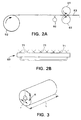
- Figure 2A illustrates the off line steaming and embossing method of this invention. Shown is a parent roll 52 of creped base sheet being unwound and passed over a steam boom 60 prior to being embossed between matched steel embossing rolls 61 and 62. The resulting embossed sheet 63 is then wound into rolls as needed for subsequent converting to the final rolled product.
- FIG. 2B illustrates a specific design of the steam application boom.
- the steam system supply piping is designed to supply high quality steam to the steam application boom.
- Target steam pressure at the boom is preferably between 5 and 10 psi (34.5 to 68.9 kPa).
- the number and size of valves, traps and filters between the steam header and steam application boom control the pressure drop within the piping system.
- the supply pressure is high enough that the pressure at the application boom can be controlled to a range which encompasses the target pressure.
- the steam supply should come off of a header with 30 to 50 lbs (13.6 to 22.7 kg) of steam pressure.
- a pressure gauge is located on the downleg of the steam header which allows for verification of header pressure. After the pressure gauge, there is a globe or gate valve which allows for shutting off the steam flow in order to work on the system.
- steam filter which removes dirt from the steam. The filter should feed either tubing or pipe which leads to a drain.
- a solenoid valve Past the filter there is a solenoid valve, a steam trap, and a gate valve. The solenoid valve opens and closes as the converting equipment starts and stops. The steam trap is in place to allow condensation, which builds up while the equipment is down, to be removed from the steam.
- the gate valve is in place to allow for steam to flow through the system to the drain for condensate removal purposes after extended shutdowns.
- piping leads to the steam application boom.
- a pressure regulating valve may be placed between the application boom and the solenoid valve if desired. The pressure regulator dampens any swings in the header pressure and provides a control knob for steam pressure at the application boom. If a pressure regulating valve is not installed, the shut off valve can be used for pressure regulation at the steam application boom.
- a flexible hose between the piping and the application boom allows for rotational and positional adjustment of the application boom.
- a piece of tubing comes off of the application boom and is route to the drain.
- a valve is installed in the tubing to allow for controllable steam flow through the tubing to the drain in order to remove condensate from the application boom piping
- the steam application boom is constructed out of a stainless steel pipe between one and two inches (2.5 to 5.1 cm) in diameter (ID).
- ID The pipe is capped on one or both ends depending on where steam is fed into the pipe. Steam can be fed to the pipe from the middle or the end, whichever is most convenient.
- a pressure equalization pipe can be attached to the bottom side of one end of the boom and run the length of the boom for attachment at the opposite end of the boom as illustrated in Figure 2B . This configuration allows for more equal pressure along the length of the application boom.
- One end of the steam application pipe is fitted with a steam pressure gauge to measure the pressure in the boom. Steam flow out of the boom is dependent on the open area of the nozzles 7 and the steam pressure at the boom.
- a preferred embodiment has nozzles placed every three inches (7.6 cm) along the length of the application boom. Size Q, R, U, or V blow off nozzles from Spraying Systems Co., Wheaton, Illinois have been used. The fan of the nozzle is oriented such that it results in maximum coverage of the sheet.
- the appropriate combination of the number of nozzles and spray tip size should be chosen so that sufficient steam pressure is available in the boom to apply steam at the rate of from about 0.3 to about 2.0 lb, steam/ 3000 sq. ft. (4.8-31.9 mPa) of paper, more specifically at a rate of from about 0.8 to about 1.5 lb. steam /3000 sq. ft. (12.8-23.9 mPa) of paper, and still more specifically at a rate of about 1 lb steam / 3000 ft 2 (16.0 mPa) of paper.
- the steam application boom should be positioned under the sheet so that any condensation does not drip onto the moving sheet and cause a break.
- the steam is applied to the sheet from about 6 to about 18 inches (15.2 to 45.7 cm) upstream of the embossing rolls. At the speeds associated with converting lines, this provides that the embossing will follow the steaming within less than a second or two. Preferably, the sheet will ride from about one to about two inches (2.5 to 5.1 cm) above the steam spray nozzles.
- the application boom should be rotated such that the steam application is perpendicular or slightly toward the direction of sheet travel into the embossing nip.
- the moisture content of the sheet after steaming can be increased by as much as 4%.
- the sheet rapidly reaches equilibrium moisture after steaming and embossing such that the finished product moisture is dependent on the ambient relative humidity.
- the embossing rolls are matched rolls, such as matched steel embossing rolls.
- a suitable example is illustrated in U.S. 4,921,034 issued May 1, 1990 to Burgess et al . entitled “Embossed Paper Having Alternating High and Low Strain Regions".
- the term "matched” is used loosely to mean that the male and female elements of the embossing rolls intermesh. It is not necessary that the male and female elements be identical mirror images of each other, although they can be.
- the embossing element heights can be any dimension typically used to engrave matched steel rolls. A preferred range of element heights can be from about 0.030 to about 0.080 inch (0.076 to 0.203 cm), more preferably from about 0.045 to about 0.070 inch (0.114 to 0.178 cm).
- FIG 3 illustrates a typical roll product having a core, around which the paper product is wound.
- the radius of the roll product is designated as "R”
- the radius of the core is designated as “r”
- the width or length of the roll is designated as “L”. All measurements are expressed as “centimeters”.
- the product roll weight "W” is the weight of the roll minus the weight of the core, measured in grams (g).
- Roll bulk expressed in cc/g” is "RV” divided by "W”.
- FIG. 4 illustrates the apparatus used for determining roll firmness.
- the apparatus is available from Kershaw Instrumentation, Inc., Swedesboro, NJ and is known as a Model RDT-101 Roll Density Tester. Shown is a towel roll 80 being measured, which is supported on a spindle 81.
- a traverse table 82 begins to more toward the roll.
- a sensing probe 83 Mounted to the traverse table is a sensing probe 83.
- the motion of the traverse table causes the sensing probe to make contact with the towel roll.
- the instant the sensing probe contacts the roll the force exerted on the load cell will exceed the low set point of 6. grams and the displacement display will be zeroed and begin indicating the penetration of the probe.
- the traverse table will stop and the displacement display will indicate the penetration in millimeters.
- the tester will record this reading.
- the tester will rotate the towel roll 90° on the spindle and repeat the test.
- the roll firmness value is the average of the two readings.
- the test needs to be performed in a controlled environment of 73.4 ⁇ 1.8°F (23 ⁇ 1°C) and 50 ⁇ 2% relative humidity. The rolls to be tested need to be introduced to this environment at least 4 hours before testing.
- Example 1 A roll of paper towelling was made as described in relation to Figures 1 and 2 . More specifically, a non-layered single-ply towel was made in which the furnish was comprised of 40% softwood (SW) bleached chemi-thermomechanical pulp (BCTMP) and 60% northern softwood sulfite (NSWS) slush pulp- The web was creped at a dryness between 45 and 55 percent while employing the moisturizing spray described in the above-mentioned Anderson et al. patent. Thereafter, the web was can-dried and wound into a parent roll as illustrated in Figure 1 .
- SW softwood
- BCTMP chemi-thermomechanical pulp
- NSWS northern softwood sulfite
- the parent roll was unwound, steamed and embossed as illustrated in Figure 2 .
- the steam application nozzles were spaced apart by 6 inches (15.2 cm) and employed V size nozzles from Spraying Systems. The nozzles were 1.75 inches (4.4 cm) from the sheet and the steam pressure was 1.75 psi (12.1 kPa). The nozzles applied steam in a direction perpendicular to the travel of the sheet. The steam velocity was 121 ft/min (36.9 m/min) and the rate of steam application was 8500ft 2 paper/lb steam (789.7 m 2 paper/0.45 kg steam).
- the embossing rolls were as described in the above-mentioned Burgess et al. patent. More specifically, the embossing rolls were as described at column 5, lines 10-35 of Burgess et al_
- the resulting product had a roll bulk of 13.2 cc/gm, a roll firmness of 6.88, and a CD tensile strength of 3100 grams.
- Example 2 A roll of paper toweling was made as described in Example 1, except the furnish was 30% SW chemi-thermomechanical (CTMP) and 70% northern softwood sulfite (NSWS) slush pulp. The sheet was creped off of the Yankee at a dryness between 48 and 53 percent employing the moisturizing spray described in Anderson et al.
- CTMP SW chemi-thermomechanical
- NSWS northern softwood sulfite
- the sheet was creped off of the Yankee at a dryness between 48 and 53 percent employing the moisturizing spray described in Anderson et al.
- the steam application nozzles were spaced apart by 6 inches (15.2 cm) and employed U size nozzles from Spraying Systems. The nozzles were 1,5 inches (3.8 cm) from the sheet and the steam pressure was 4.5 psi (31.0 kPa). The nozzles applied steam in a direction perpendicular to the travel of the sheet.
- the steam velocity was 366 ft/min (111.6 m/min) and the rate of steam application was 3371 ft 2 paper/ lb steam (313.2 m 2 paper/0.45 kg steam).
- the resulting product had a roll bulk of 15.6 cc/gm, a roll firmness of 7.7, and a CD tensile strength of 2217 grams.
- Example 3 A roll of paper toweling was made as described in Example 1. except the furnish was 30% SW CTMP and 70% southern softwood kraft (SSWK) baled pulp. The sheet was creped off of the Yankee dryer at a creping dryness between 58 and 63 percent without the use of the moisturizing spray.
- the steam application nozzles were spaced by 6 inches (15.2 cm) and employed V size nozzles from spraying systems. The nozzles were 1.75 inches (4.4 cm) from the sheet and the steam pressure was 1.75 psi (2.1 kPa). The nozzles applied steam in a direction perpendicular to the travel of the sheet.
- the steam velocity was 121 ft/min (36.9 m/min) and the rate of steam application was 8500ft 2 paper/lb steam (789.7 m 2 paper/0.45 kg steam).
- the resulting product had a roll bulk of 16.1 cc/gm, a roll firmness of 6.2, and a CD tensile strength of 2348 grams.
- Example 4 A roll of paper toweling was made as described in Example 1, except the furnish was 100% SSWK slush pulp.
- the sheet was creped off of the Yankee at a creping dryness between 60 and 65 percent while employing the moisturizing spray described in Anderson et al.
- the steam application nozzles were spaced apart by 3 inches (7.6 cm) and employed Q size nozzles from spraying systems.
- the nozzles were 2.0 inches (5.1 cm) from the sheet and the steam pressure was 6.0 psi (41.4 kPa). The nozzles applied steam in a direction perpendicular to the travel of the sheet.
- the steam velocity was 113 ft/min (34.4 m/min) and the rate of steam application was 3500 ft 2 paper/lb steam (325.2 m 2 paper/0.45 kg steam).
- the resulting product had a roll bulk of 15.76 cc/gm, a roll firmness of 7.0, and a CD tensile strength of 2565 grams.
- Example 5 A roll of paper toweling was made as described in Example 1, except the furnish was 20% SW CTMP. 15% southern hardwood kraft (SHWK) slush pulp and 65% SSWK slush pulp. The creping dryness was between 55 and 65 percent and the moisturizing spray was not used.
- the steam application nozzles were spaced apart by 6 inches (15.2 cm) and employed V size nozzles from Spraying Systems. The nozzles were 1.75 inches (4.4 cm) from the sheet and the steam pressure was 1.75 psi (12.1 kPa). The nozzles applied steam in a direction perpendicular to the travel of the sheet.
- the steam velocity was 121 ft/min (36.9 m/min) and the rate of steam application was 8500 ft 2 paper/ lb steam (789.7 m 2 paper/0.45 kg steam).
- the resulting product had a roll bulk of 15.1cc/gm, a roll firmness of 7.4, and a CD tensile strength of 3179 grams.
- Example 6 A roll of paper toweling was made as described in Example 1. except the furnish was 15% SHWK slush pulp and 85% SSWK slush pulp. The creping dryness was between 55 and 65 percent and the moisturizing spray was not used.
- the steam application nozzles were spaced apart by 6 inches (15.2 cm) and employed V size nozzles from Spraying Systems. The nozzles were 1.75 inches (4.4 cm) from the sheet and the steam pressure was 1.75 psi (12.1 kPa). The nozzles applied steam in a direction perpendicular to the travel of the sheet.
- the steam velocity was 121 ft/min (36.9 m/min) and the rate of steam application was 8500 ft 2 paper/lb steam (789.7 m 2 paper/0.45 kg steam).
- the resulting product had a roll bulk of 155 cc/gm, a roll firmness of 6.5, and a CD tensile strength of 2827 grams.
- Example 7 A roll of paper toweling was made as described in Example 1, except the furnish was 30% SW CTMP, 15% SSWK baled pulp and 55% SSWK wet lap pulp. The creping dryness was between 58 and 65 percent. The moisturizing spray was not used.
- the steam application nozzles were spaced apart by 6 inches (15.2 cm) and employed U size nozzles from Spraying Systems. The nozzles were 1.5 inches (4.4 cm) from the sheet and the steam pressure was 6.5 psi (44.8 kPa). The nozzles applied steam in a direction perpendicular to the travel of the sheet.
- the steam velocity was 470 ft/min (143.3 m/min) and the rate of steam application was 2460 ft 2 paper/lb steam (228.5 m 2 paper/0.45 kg steam).
- the resulting product had a roll bulk of 16.2 cc/gm, a roll firmness of 7.7, and a CD tensile strength of 2041 grams.
- Example 8 -13 The roll bulk, roll firmness and CD tensile strength of six different brands of commercial kitchen towel products were measured. The results are set forth in the Table below: Table (Commercial Products) Product Roll Bulk Roll Firmness CD Tensile Brawny® 12.39 10.08 2425 Mardi Gras® 12.66 6.67 2185 Scott® Towels 13.04 13.58 982 Sparkle® 13.44 10.15 2325 Bounty® 16.07 11.62 2208 Hi-Dri® 18.16 13.63 1123
Landscapes
- Engineering & Computer Science (AREA)
- Mechanical Engineering (AREA)
- Paper (AREA)
- Sanitary Thin Papers (AREA)
- Machines For Manufacturing Corrugated Board In Mechanical Paper-Making Processes (AREA)
- Cleaning Implements For Floors, Carpets, Furniture, Walls, And The Like (AREA)
Description
- In the manufacture and production of rolled paper towels, such as kitchen towels, a creped base sheet is commonly produced on a tissue machine and wound into a parent roll. Thereafter, in converting operations, the parent roll is unwound and embossed in order to increase the bulk of the towel. The designs of the embossing patterns can vary greatly, but often they are embossing patterns which substantially cover the entire sheet and may be referred to as overall patterns. However, a common problem associated with embossing towel base sheets is that, upon being wound into the final roll form of the product, the sheet embossments cause the roll to be somewhat soft and "mushy" This effect, which can be quantified by measuring the roll firmness, becomes more pronounced as the bulk of the roll is increased by imparting embossments to the base sheet which have greater z-direction dimensions. At the same time, increasing the bulk of the base sheet also typically degrades the strength of the sheet.
- Therefore there is a need for a means of producing rolls of embossed, creped paper towels having a high roll bulk and a high degree of roll firmness with adequate strength.
-
EP 0428136 discloses a method for increasing the bulk of creped tissue. -
US 4921034 andUS 5693403 disclose methods of embossing paper and tissue. - It has now been discovered that rolls of creped paper towels can be made to have a high level of bulk, firmness and strength by embossing the creped basesheet in a manner which maintains more of the basesheet strength during the embossing process.
- Hence, in one aspect, the invention resides in a method of making a high bulk paper sheet comprising spraying a dry creped paper sheet with steam and immediately thereafter embossing the steamed sheet between matched steel embossing rolls and winding the steamed embossed sheet into a roll. It has been found that steaming the sheet just prior to embossing can increase the roll firmness (as compared to the unsteamed embossed sheet) about 15 percent or greater, more specifically from about 20 to about 50 percent, and still more specifically from about 20 to about 35 percent. As will be discussed below, "increasing" the roll firmness results in a lowering of the roll firmness value, which is measured by the extent to which a probe penetrates the roll during testing. Furthermore, steaming in accordance with this invention can increase the strength of the sheet, as measured by the cross-machine direction (CD) tensile strength, about 10 percent or greater, more specifically from about 10 to about 30 percent, and still more specifically from about 10 to about 20 percent (as compared to the unsteamed embossed sheet).
- In another aspect, the invention resides in a roll of creped paper, such as a roll of kitchen toweling, as claimed in claim 1. The roll has a roll bulk of about 13 cubic centimeters per gram (cc/g) or greater, a roll firmness of 10 millimeters (mm) or less and a CD tensile strength of about 2000 or greater grams-force per 7.6 cm (3 inches) of sample width.
- More specifically with regard to the roll bulk, the roll bulk can be about 15 cc/g or greater, more specifically about 16 cc/g or greater, still more specifically from about 14 cc/g to about 20 cc/g, and still more specifically from about 15 cc/g to about 17 cc/g.
- More specifically with regard to the roll firmness, the roll firmness can be about 9 mm or less, still more specifically from about 6 to about 10, and most specifically from about 7 to about 9.
- More specifically with regard to the CD tensile strength, the CD tensile strength can be about 2500 grams or greater, more specifically from about 2200 to about 3500 grams, and still more specifically from about 2300 to about 3200 grams.
-
Figure 1 is a schematic process diagram illustrating a method for making the creped base sheets suitable for purposes of the embossing method of this invention. -
Figure 2A is a schematic process flow diagram of the off-line steaming and embossing aspects of this invention. -
Figure 2B is a schematic representation of the steam application boom illustrated inFigure 2A . -
Figure 3 is a perspective view of a roll of tissue or toweling for illustrating the calculation of roll bulk. -
Figure 4 is a schematic illustration of the apparatus used for determining roll firmness. -
Figure 5 is a plot of roll bulk and roll firmness for several commercial paper towel products and the examples of products made in accordance with this invention. - Referring to
Figure 1 , one example of a method of making a creped base sheet suitable for subsequent steaming and embossing is disclosed. Shown is a schematic of the preferred embodiment of the present invention wherein ahead box 20 delivers afurnish 21 onto a formingfabric 22 wrapped around avacuum breast roll 23. The furnish preferably is at a fiber consistency of from about 0.08% to about 0.6% and, more preferably, at a fiber consistency of from about 0.1 % to about 0.5%, and most preferably at a fiber consistency of from about 0.1 % to about 0.2%- Immediately after thevacuum breast roll 23, formingfabric 22 passes over thevacuum box 26 to further dewater theweb 24. - It should be noted that the type of headbox used is not critical to the practice of the method of the present invention. Any headbox which delivers a well-formed sheet may be employed. Further, although the embodiments discussed herein and depicted in
Figure 1 utilizes a vacuum breast roll, this too is not critical to the practice of the method of the present invention. The method may be used with breast roll formers, twin wire formers and fourdriniers, as well as variations thereof. - The web and the forming fabric then pass through a transfer zone wherein the
web 24 is transferred to a felt 30. The transfer is made with apickup device 32 such as a vacuum pick-up roll or transfer shoe. The felt 30 carries the web to the nip formed between avacuum press roll 34 and a Yankeedryer 36 where the vacuum press roll is used to press the felt against the Yankee with the web restrained therebetween. The amount of pressing of the press roll against the Yankee can be in the range of 200-500 pli (91-227 kg per lineal 2.5 cm). In the nip, theweb 24 releases from the felt 30 and is adhered to the Yankee Creping adhesives and release chemicals can be sprayed onto the Yankee just prior to the vacuum press roll to control the amount of adhesion of the web to the Yankee. When the web leaves the vacuum press roll/Yankee nip, the web has a consistency of about 30% or greater, more preferably greater than 35% and most preferably 38% to 43%. The web is at least partially dried on the Yankee and drying may be aided by the use of a gas-firedhigh temperature hood 37. A moisturizing spray to the air side of the tissue Neb may be added as illustrated inU.S. 4,992,140 issued February 12, 1991 to Anderson et al . entitled "Method For Creping A Paper Web and Product Produced Thereby". The web just prior to the crepingdoctor 38 should have a dryness of from about 40 to about 99 percent, more preferably from about 45 to about 65 percent. - After the leaving the Yankee the partially dried
web 24 is subsequently transferred to a can dryingassembly 40 specifically configured to maintain or increase the bulk of the web and to remove moisture and dry the web. The can dryingassembly 40 comprises a plurality of can dryers. The exact number of can dryers may vary depending on the desired increase in dryness of theweb 24, machine speed, basis weight, and similar factors. - The
web 24 is transported across an open draw from the crepingdoctor 38 to the can drying assembly and is sandwiched between the sheet carrying fabrics (felts) 42 and 43. Theweb 24 is dried to a final consistency of about 94 percent or greater in the can drying assembly and is thereafter transported to areel 50 and areel spool 51 where the web is wound onto the reel spool to form aroll 52 for subsequent conversion into the final product form. Prior to being wound onto the reel spool, theweb 24 can be carried through one or more optional fixed gap embossing or calenderingnips 54. - It is emphasized that the manner in which the basesheet is made is not significant for the practice of Applicants invention. Any creped web or sheet can be used. The foregoing process description is merely illustrative of one suitable method.
-
Figure 2A illustrates the off line steaming and embossing method of this invention. Shown is aparent roll 52 of creped base sheet being unwound and passed over asteam boom 60 prior to being embossed between matchedsteel embossing rolls sheet 63 is then wound into rolls as needed for subsequent converting to the final rolled product. -
Figure 2B illustrates a specific design of the steam application boom. Although not shown, the steam system supply piping is designed to supply high quality steam to the steam application boom. Target steam pressure at the boom is preferably between 5 and 10 psi (34.5 to 68.9 kPa). The number and size of valves, traps and filters between the steam header and steam application boom control the pressure drop within the piping system. Ideally the supply pressure is high enough that the pressure at the application boom can be controlled to a range which encompasses the target pressure. - In a specific embodiment, the steam supply should come off of a header with 30 to 50 lbs (13.6 to 22.7 kg) of steam pressure. A pressure gauge is located on the downleg of the steam header which allows for verification of header pressure. After the pressure gauge, there is a globe or gate valve which allows for shutting off the steam flow in order to work on the system. Next, there is steam filter which removes dirt from the steam. The filter should feed either tubing or pipe which leads to a drain. Past the filter there is a solenoid valve, a steam trap, and a gate valve. The solenoid valve opens and closes as the converting equipment starts and stops. The steam trap is in place to allow condensation, which builds up while the equipment is down, to be removed from the steam. The gate valve is in place to allow for steam to flow through the system to the drain for condensate removal purposes after extended shutdowns. Beyond the solenoid valve, piping leads to the steam application boom. A pressure regulating valve may be placed between the application boom and the solenoid valve if desired. The pressure regulator dampens any swings in the header pressure and provides a control knob for steam pressure at the application boom. If a pressure regulating valve is not installed, the shut off valve can be used for pressure regulation at the steam application boom. A flexible hose between the piping and the application boom allows for rotational and positional adjustment of the application boom. A piece of tubing comes off of the application boom and is route to the drain. A valve is installed in the tubing to allow for controllable steam flow through the tubing to the drain in order to remove condensate from the application boom piping
- The steam application boom is constructed out of a stainless steel pipe between one and two inches (2.5 to 5.1 cm) in diameter (ID). The pipe is capped on one or both ends depending on where steam is fed into the pipe. Steam can be fed to the pipe from the middle or the end, whichever is most convenient. A pressure equalization pipe can be attached to the bottom side of one end of the boom and run the length of the boom for attachment at the opposite end of the boom as illustrated in
Figure 2B . This configuration allows for more equal pressure along the length of the application boom. One end of the steam application pipe is fitted with a steam pressure gauge to measure the pressure in the boom. Steam flow out of the boom is dependent on the open area of the nozzles 7 and the steam pressure at the boom. A preferred embodiment has nozzles placed every three inches (7.6 cm) along the length of the application boom. Size Q, R, U, or V blow off nozzles from Spraying Systems Co., Wheaton, Illinois have been used. The fan of the nozzle is oriented such that it results in maximum coverage of the sheet. The appropriate combination of the number of nozzles and spray tip size should be chosen so that sufficient steam pressure is available in the boom to apply steam at the rate of from about 0.3 to about 2.0 lb, steam/ 3000 sq. ft. (4.8-31.9 mPa) of paper, more specifically at a rate of from about 0.8 to about 1.5 lb. steam /3000 sq. ft. (12.8-23.9 mPa) of paper, and still more specifically at a rate of about 1 lb steam / 3000 ft2 (16.0 mPa) of paper. - The steam application boom should be positioned under the sheet so that any condensation does not drip onto the moving sheet and cause a break. The steam is applied to the sheet from about 6 to about 18 inches (15.2 to 45.7 cm) upstream of the embossing rolls. At the speeds associated with converting lines, this provides that the embossing will follow the steaming within less than a second or two. Preferably, the sheet will ride from about one to about two inches (2.5 to 5.1 cm) above the steam spray nozzles. The application boom should be rotated such that the steam application is perpendicular or slightly toward the direction of sheet travel into the embossing nip.
- The moisture content of the sheet after steaming can be increased by as much as 4%. In practice, the sheet rapidly reaches equilibrium moisture after steaming and embossing such that the finished product moisture is dependent on the ambient relative humidity.
- With regard to the embossing step, the embossing rolls are matched rolls, such as matched steel embossing rolls. A suitable example is illustrated in
U.S. 4,921,034 issued May 1, 1990 to Burgess et al . entitled "Embossed Paper Having Alternating High and Low Strain Regions". As used herein, the term "matched" is used loosely to mean that the male and female elements of the embossing rolls intermesh. It is not necessary that the male and female elements be identical mirror images of each other, although they can be. The embossing element heights can be any dimension typically used to engrave matched steel rolls. A preferred range of element heights can be from about 0.030 to about 0.080 inch (0.076 to 0.203 cm), more preferably from about 0.045 to about 0.070 inch (0.114 to 0.178 cm). - Referring now to
Figure 3 , the calculation of roll bulk will be explained.Figure 3 illustrates a typical roll product having a core, around which the paper product is wound. The radius of the roll product is designated as "R", whereas the radius of the core is designated as "r". The width or length of the roll is designated as "L". All measurements are expressed as "centimeters". The product roll volume "RV", expressed in cubic centimeters (cc), is the volume of the product minus the volume of the core, namely RV = (πR2L) - (πr2L). The product roll weight "W" is the weight of the roll minus the weight of the core, measured in grams (g). "Roll bulk", expressed in cc/g" is "RV" divided by "W". -
Figure 4 illustrates the apparatus used for determining roll firmness. The apparatus is available from Kershaw Instrumentation, Inc., Swedesboro, NJ and is known as a Model RDT-101 Roll Density Tester. Shown is atowel roll 80 being measured, which is supported on aspindle 81. When the test begins a traverse table 82 begins to more toward the roll. Mounted to the traverse table is asensing probe 83. The motion of the traverse table causes the sensing probe to make contact with the towel roll. The instant the sensing probe contacts the roll, the force exerted on the load cell will exceed the low set point of 6. grams and the displacement display will be zeroed and begin indicating the penetration of the probe. When the force exerted on the sensing probe exceeds the high set point of 687 grams, the traverse table will stop and the displacement display will indicate the penetration in millimeters. The tester will record this reading. Next the tester will rotate the towel roll 90° on the spindle and repeat the test. The roll firmness value is the average of the two readings. The test needs to be performed in a controlled environment of 73.4 ± 1.8°F (23 ± 1°C) and 50 ± 2% relative humidity. The rolls to be tested need to be introduced to this environment at least 4 hours before testing. - Example 1. A roll of paper towelling was made as described in relation to
Figures 1 and2 . More specifically, a non-layered single-ply towel was made in which the furnish was comprised of 40% softwood (SW) bleached chemi-thermomechanical pulp (BCTMP) and 60% northern softwood sulfite (NSWS) slush pulp- The web was creped at a dryness between 45 and 55 percent while employing the moisturizing spray described in the above-mentioned Anderson et al. patent. Thereafter, the web was can-dried and wound into a parent roll as illustrated inFigure 1 . - Thereafter in converting, the parent roll was unwound, steamed and embossed as illustrated in
Figure 2 . The steam application nozzles were spaced apart by 6 inches (15.2 cm) and employed V size nozzles from Spraying Systems. The nozzles were 1.75 inches (4.4 cm) from the sheet and the steam pressure was 1.75 psi (12.1 kPa). The nozzles applied steam in a direction perpendicular to the travel of the sheet. The steam velocity was 121 ft/min (36.9 m/min) and the rate of steam application was 8500ft2 paper/lb steam (789.7 m2 paper/0.45 kg steam). - The embossing rolls were as described in the above-mentioned Burgess et al. patent. More specifically, the embossing rolls were as described at column 5, lines 10-35 of Burgess et al_
- The resulting product had a roll bulk of 13.2 cc/gm, a roll firmness of 6.88, and a CD tensile strength of 3100 grams.
- Example 2. A roll of paper toweling was made as described in Example 1, except the furnish was 30% SW chemi-thermomechanical (CTMP) and 70% northern softwood sulfite (NSWS) slush pulp. The sheet was creped off of the Yankee at a dryness between 48 and 53 percent employing the moisturizing spray described in Anderson et al. In converting, the steam application nozzles were spaced apart by 6 inches (15.2 cm) and employed U size nozzles from Spraying Systems. The nozzles were 1,5 inches (3.8 cm) from the sheet and the steam pressure was 4.5 psi (31.0 kPa). The nozzles applied steam in a direction perpendicular to the travel of the sheet. The steam velocity was 366 ft/min (111.6 m/min) and the rate of steam application was 3371 ft2 paper/ lb steam (313.2 m2 paper/0.45 kg steam). The resulting product had a roll bulk of 15.6 cc/gm, a roll firmness of 7.7, and a CD tensile strength of 2217 grams.
- Example 3. A roll of paper toweling was made as described in Example 1. except the furnish was 30% SW CTMP and 70% southern softwood kraft (SSWK) baled pulp. The sheet was creped off of the Yankee dryer at a creping dryness between 58 and 63 percent without the use of the moisturizing spray. In converting, the steam application nozzles were spaced by 6 inches (15.2 cm) and employed V size nozzles from spraying systems. The nozzles were 1.75 inches (4.4 cm) from the sheet and the steam pressure was 1.75 psi (2.1 kPa). The nozzles applied steam in a direction perpendicular to the travel of the sheet. The steam velocity was 121 ft/min (36.9 m/min) and the rate of steam application was 8500ft2 paper/lb steam (789.7 m2 paper/0.45 kg steam). The resulting product had a roll bulk of 16.1 cc/gm, a roll firmness of 6.2, and a CD tensile strength of 2348 grams.
- Example 4. A roll of paper toweling was made as described in Example 1, except the furnish was 100% SSWK slush pulp. The sheet was creped off of the Yankee at a creping dryness between 60 and 65 percent while employing the moisturizing spray described in Anderson et al. In converting, the steam application nozzles were spaced apart by 3 inches (7.6 cm) and employed Q size nozzles from spraying systems. The nozzles were 2.0 inches (5.1 cm) from the sheet and the steam pressure was 6.0 psi (41.4 kPa). The nozzles applied steam in a direction perpendicular to the travel of the sheet. The steam velocity was 113 ft/min (34.4 m/min) and the rate of steam application was 3500 ft2 paper/lb steam (325.2 m2 paper/0.45 kg steam). The resulting product had a roll bulk of 15.76 cc/gm, a roll firmness of 7.0, and a CD tensile strength of 2565 grams.
- Example 5. A roll of paper toweling was made as described in Example 1, except the furnish was 20% SW CTMP. 15% southern hardwood kraft (SHWK) slush pulp and 65% SSWK slush pulp. The creping dryness was between 55 and 65 percent and the moisturizing spray was not used. In converting, the steam application nozzles were spaced apart by 6 inches (15.2 cm) and employed V size nozzles from Spraying Systems. The nozzles were 1.75 inches (4.4 cm) from the sheet and the steam pressure was 1.75 psi (12.1 kPa). The nozzles applied steam in a direction perpendicular to the travel of the sheet. The steam velocity was 121 ft/min (36.9 m/min) and the rate of steam application was 8500 ft2 paper/ lb steam (789.7 m2 paper/0.45 kg steam). The resulting product had a roll bulk of 15.1cc/gm, a roll firmness of 7.4, and a CD tensile strength of 3179 grams.
- Example 6. A roll of paper toweling was made as described in Example 1. except the furnish was 15% SHWK slush pulp and 85% SSWK slush pulp. The creping dryness was between 55 and 65 percent and the moisturizing spray was not used. In converting, the steam application nozzles were spaced apart by 6 inches (15.2 cm) and employed V size nozzles from Spraying Systems. The nozzles were 1.75 inches (4.4 cm) from the sheet and the steam pressure was 1.75 psi (12.1 kPa). The nozzles applied steam in a direction perpendicular to the travel of the sheet. The steam velocity was 121 ft/min (36.9 m/min) and the rate of steam application was 8500 ft2 paper/lb steam (789.7 m2 paper/0.45 kg steam). The resulting product had a roll bulk of 155 cc/gm, a roll firmness of 6.5, and a CD tensile strength of 2827 grams.
- Example 7. A roll of paper toweling was made as described in Example 1, except the furnish was 30% SW CTMP, 15% SSWK baled pulp and 55% SSWK wet lap pulp. The creping dryness was between 58 and 65 percent. The moisturizing spray was not used. In converting, the steam application nozzles were spaced apart by 6 inches (15.2 cm) and employed U size nozzles from Spraying Systems. The nozzles were 1.5 inches (4.4 cm) from the sheet and the steam pressure was 6.5 psi (44.8 kPa). The nozzles applied steam in a direction perpendicular to the travel of the sheet. The steam velocity was 470 ft/min (143.3 m/min) and the rate of steam application was 2460 ft2 paper/lb steam (228.5 m2 paper/0.45 kg steam). The resulting product had a roll bulk of 16.2 cc/gm, a roll firmness of 7.7, and a CD tensile strength of 2041 grams.
- Example 8 -13. The roll bulk, roll firmness and CD tensile strength of six different brands of commercial kitchen towel products were measured. The results are set forth in the Table below:
Table (Commercial Products) Product Roll Bulk Roll Firmness CD Tensile Brawny® 12.39 10.08 2425 Mardi Gras® 12.66 6.67 2185 Scott® Towels 13.04 13.58 982 Sparkle® 13.44 10.15 2325 Bounty® 16.07 11.62 2208 Hi-Dri® 18.16 13.63 1123 - Referring to
Figure 5 , the roll bulk and the roll firmness for the products of this invention described in the Examples (labelled "I") and the commercial products identified above are plotted. As shown, the products of this invention are unique in their properties by having a high bulk and a high degree of roll firmness. - It will be appreciated that the foregoing examples, given for purposes of illustration, are not to be construed as limiting the scope of this invention, which is defined by the following claims.
Claims (18)
- A roll of creped paper having a roll bulk of 13 cubic centimeters per gram or greater, a roll firmness of 10 millimeters or less and a cross-machine direction tensile strength of 2000 grams or greater per 7.6 cm of width, wherein said roll is formed by steaming and immediately thereafter embossing a creped paper sheet (24) and winding said sheet into said roll.
- The roll of claim 1 having a roll bulk of 15 cc/g or greater.
- The roll of claim 1 having a roll bulk of 16 cc/g or greater.
- The roll of claim 1 having a roll bulk of from 14 to 20 cc/g.
- The roll of claim 1 having a roll bulk of from 15 to 17 cc/g.
- The roll of any preceding claim having a roll firmness of 9 mm or less.
- The roll of any of claims 1 to 5 having a roll firmness of from 6 to 10 mm.
- The roll of any of claims 1 to 5 having a roll firmness of from 7 to 9 mm.
- The roll of any preceding claim having cross-machine direction tensile strength of 2500 grams or greater.
- The roll of any of claims 1 to 8 having a cross-machine direction tensile strength of from 2200 to 3500 grams.
- The roll of any of claims 1 to 8 having a cross-machine direction tensile strength of from 2300 to 3200 grams.
- A method of making a high bulk paper sheet comprising spraying a dry, creped paper sheet (24) with steam, characterised by immediately thereafter embossing the steamed sheet between matched steel embossing rolls (61,62) and winding the steamed/embossed sheet (68) into a roll (80).
- The method of claim 12 wherein the roll firmness of the roll (80) is increased by 15 percent or greater relative to the same roll wound with an embossed sheet that has not been steamed.
- The method of claim 12 wherein the roll firmness of the roll (80) is increased from 20 to 50 percent relative to the same roll wound with an embossed sheet that has not been steamed.
- The method of claim 12 wherein the roll firmness of the roll (80) is increased from 20 to 35 percent relative to the same roll wound with an embossed sheet that has not been steamed.
- The method of any of claims 12 to 15 wherein the cross-machine direction tensile strength of the sheet wound into a roll (80) is increased 10 percent or greater relative to the same roll wound with an embossed sheet that has not been steamed.
- The method of any of claims 12 to 15 wherein the cross-machine direction tensile strength of the sheet wound into a roll (80) is increased from 10 to 30 percent relative to the same roll wound with an embossed sheet that has not been steamed.
- The method of any of claims 12 to 15 wherein the cross-machine direction tensile strength of the sheet wound into a roll (80) is increased from 10 to 20 percent relative to the same roll wound with an embossed sheet that has not been steamed.
Applications Claiming Priority (3)
| Application Number | Priority Date | Filing Date | Title |
|---|---|---|---|
| US60485 | 1998-04-15 | ||
| US09/060,485 US6077590A (en) | 1998-04-15 | 1998-04-15 | High bulk paper towels |
| PCT/US1999/007685 WO1999053140A1 (en) | 1998-04-15 | 1999-04-08 | High bulk paper |
Publications (2)
| Publication Number | Publication Date |
|---|---|
| EP1073795A1 EP1073795A1 (en) | 2001-02-07 |
| EP1073795B1 true EP1073795B1 (en) | 2010-10-20 |
Family
ID=22029783
Family Applications (1)
| Application Number | Title | Priority Date | Filing Date |
|---|---|---|---|
| EP99916495A Expired - Lifetime EP1073795B1 (en) | 1998-04-15 | 1999-04-08 | High bulk paper |
Country Status (18)
| Country | Link |
|---|---|
| US (1) | US6077590A (en) |
| EP (1) | EP1073795B1 (en) |
| JP (1) | JP2002511537A (en) |
| KR (1) | KR100606303B1 (en) |
| CN (1) | CN1138894C (en) |
| AR (1) | AR019056A1 (en) |
| AU (1) | AU736946B2 (en) |
| BR (1) | BR9909526B1 (en) |
| CR (1) | CR6007A (en) |
| DE (1) | DE69942873D1 (en) |
| ES (1) | ES2350629T3 (en) |
| ID (1) | ID26932A (en) |
| IL (1) | IL138560A0 (en) |
| PL (1) | PL343414A1 (en) |
| TR (1) | TR200002978T2 (en) |
| TW (1) | TW467987B (en) |
| WO (1) | WO1999053140A1 (en) |
| ZA (1) | ZA200004959B (en) |
Families Citing this family (74)
| Publication number | Priority date | Publication date | Assignee | Title |
|---|---|---|---|---|
| US7935409B2 (en) * | 1998-08-06 | 2011-05-03 | Kimberly-Clark Worldwide, Inc. | Tissue sheets having improved properties |
| ZA200007449B (en) | 1998-08-06 | 2001-06-14 | Kimberly Clark Co | Rolls of tissue sheets having improved properties. |
| US6746569B1 (en) | 2000-10-31 | 2004-06-08 | Kimberly-Clark Worldwide, Inc. | Nested rolled paper product |
| US7235156B2 (en) * | 2001-11-27 | 2007-06-26 | Kimberly-Clark Worldwide, Inc. | Method for reducing nesting in paper products and paper products formed therefrom |
| US6787490B2 (en) * | 2001-12-26 | 2004-09-07 | Kimberly-Clark Worldwide, Inc. | Glove donning delivery system |
| US8757533B2 (en) | 2002-02-28 | 2014-06-24 | Kimberly-Clark Worldwide, Inc. | Center/surface rewinder and winder |
| US7909282B2 (en) * | 2002-02-28 | 2011-03-22 | Kimberly-Clark Worldwide, Inc. | Center/surface rewinder and winder |
| US6802937B2 (en) * | 2002-06-07 | 2004-10-12 | Kimberly-Clark Worldwide, Inc. | Embossed uncreped throughdried tissues |
| US6887348B2 (en) * | 2002-11-27 | 2005-05-03 | Kimberly-Clark Worldwide, Inc. | Rolled single ply tissue product having high bulk, softness, and firmness |
| TWI268972B (en) * | 2002-11-27 | 2006-12-21 | Kimberly Clark Co | Rolled tissue products having high bulk, softness, and firmness |
| US20040115451A1 (en) * | 2002-12-09 | 2004-06-17 | Kimberly-Clark Worldwide, Inc. | Yellowing prevention of cellulose-based consumer products |
| US20040110017A1 (en) * | 2002-12-09 | 2004-06-10 | Lonsky Werner Franz Wilhelm | Yellowing prevention of cellulose-based consumer products |
| US6877634B2 (en) * | 2002-12-31 | 2005-04-12 | Kimberly-Clark Worldwide, Inc. | High capacity dispensing carton |
| US7004313B2 (en) * | 2002-12-31 | 2006-02-28 | Kimberly-Clark Worldwide, Inc. | Disposable dispenser with fragrance delivery system |
| FI121674B (en) * | 2003-01-09 | 2011-02-28 | Metso Paper Inc | Method and apparatus for wetting a moving paper or cardboard web |
| US6896767B2 (en) * | 2003-04-10 | 2005-05-24 | Kimberly-Clark Worldwide, Inc. | Embossed tissue product with improved bulk properties |
| US7048143B2 (en) | 2003-04-16 | 2006-05-23 | Kimberly-Clark Worldwide, Inc. | Container and cartridge for dispensing paper products |
| US7314663B2 (en) * | 2003-09-29 | 2008-01-01 | The Procter + Gamble Company | Embossed multi-ply fibrous structure product and process for making same |
| US7374638B2 (en) * | 2003-09-29 | 2008-05-20 | The Procter & Gamble Company | High bulk strong absorbent single-ply tissue-towel paper product |
| US20050247397A1 (en) * | 2003-09-29 | 2005-11-10 | The Procter & Gamble Company | Process for producing embossed products |
| US7127951B2 (en) * | 2003-11-07 | 2006-10-31 | Kimberly-Clark Worldwide, Inc. | Roll firmness measuring system and process |
| US7470345B2 (en) * | 2003-12-30 | 2008-12-30 | Kimberly-Clark Worldwide, Inc. | Rolled paper product having high bulk and softness |
| JP2007521888A (en) * | 2004-02-17 | 2007-08-09 | ザ プロクター アンド ギャンブル カンパニー | Deep nest embossed paper products |
| ITFI20040102A1 (en) | 2004-04-29 | 2004-07-29 | Guglielmo Biagiotti | METHOD AND DEVICE FOR THE PRODUCTION OF TISSUE PAPER |
| JP4585231B2 (en) * | 2004-05-17 | 2010-11-24 | 大王製紙株式会社 | Household tissue paper |
| US7435313B2 (en) * | 2004-05-21 | 2008-10-14 | The Procter & Gamble Company | Process for producing deep-nested embossed paper products |
| US7413629B2 (en) * | 2004-05-21 | 2008-08-19 | The Procter & Gamble Company | Process for producing deep-nested embossed paper products |
| US7104031B2 (en) * | 2004-12-20 | 2006-09-12 | Kimberly-Clark Worldwide, Inc. | Variable position constant force packaging system and process for using same |
| US7524399B2 (en) * | 2004-12-22 | 2009-04-28 | Kimberly-Clark Worldwide, Inc. | Multiple ply tissue products having enhanced interply liquid capacity |
| US7591396B2 (en) | 2005-05-27 | 2009-09-22 | Kimberly-Clark Worldwide, Inc. | Restrictor and dispensing system |
| US7428978B2 (en) * | 2005-05-27 | 2008-09-30 | Kimberly-Clark Worldwide, Inc. | Sheet material dispenser |
| US20060273101A1 (en) * | 2005-06-07 | 2006-12-07 | Kimberly-Clark Worldwide, Inc. | Container and cartridge for dispensing paper products |
| US7785696B2 (en) * | 2005-06-08 | 2010-08-31 | The Procter & Gamble Company | Embossed product including discrete and linear embossments |
| US7435316B2 (en) * | 2005-06-08 | 2008-10-14 | The Procter & Gamble Company | Embossing process including discrete and linear embossing elements |
| US7694433B2 (en) | 2005-06-08 | 2010-04-13 | The Procter & Gamble Company | Web handling apparatus and process for providing steam to a web material |
| US7524404B2 (en) * | 2005-06-08 | 2009-04-28 | The Procter & Gamble Company | Embossing process including discrete and linear embossing elements |
| JP4431995B2 (en) * | 2005-06-09 | 2010-03-17 | 高知県 | Manufacturing method of embossed crepe paper |
| US7799167B2 (en) | 2005-06-09 | 2010-09-21 | Kawano Paper Co., Ltd. | Embossed crepe paper and its manufacturing method |
| US7597777B2 (en) | 2005-09-09 | 2009-10-06 | The Procter & Gamble Company | Process for high engagement embossing on substrate having non-uniform stretch characteristics |
| ITFI20050218A1 (en) * | 2005-10-20 | 2007-04-21 | Guglielmo Biagiotti | IMPROVEMENT OF METHODS AND DEVICES FOR THE PRODUCTION OF TISSUE PAPERS AND PAPER VEIL FROM THESE DERIVATIVES |
| US8066847B2 (en) * | 2005-12-29 | 2011-11-29 | Nalco Corporation | Creping adhesives comprising blends of polyaminoamide epihalolhydrin resins and polyamides |
| US7871493B2 (en) * | 2008-06-26 | 2011-01-18 | Kimberly-Clark Worldwide, Inc. | Environmentally-friendly tissue |
| US8535780B2 (en) | 2009-10-06 | 2013-09-17 | Kimberly-Clark Worldwide, Inc. | Coreless tissue rolls and method of making the same |
| US8364290B2 (en) | 2010-03-30 | 2013-01-29 | Kimberly-Clark Worldwide, Inc. | Asynchronous control of machine motion |
| WO2012087211A1 (en) * | 2010-12-22 | 2012-06-28 | Sca Hygiene Products Ab | A stack of plurality of cellulose-containing absorbent towels and a process for manufacturing the stack. |
| US8574399B2 (en) | 2011-09-21 | 2013-11-05 | Kimberly-Clark Worldwide, Inc. | Tissue products having a high degree of cross machine direction stretch |
| US8481133B2 (en) * | 2011-09-21 | 2013-07-09 | Kimberly-Clark Worldwide, Inc. | High bulk rolled tissue products |
| US20130153597A1 (en) * | 2011-12-20 | 2013-06-20 | Robert Michael Hill | Wipes Dispenser with Angled Dispensing |
| US8940376B2 (en) * | 2012-02-07 | 2015-01-27 | Kimberly-Clark Worldwide, Inc. | High bulk tissue sheets and products |
| US20140004307A1 (en) | 2012-06-29 | 2014-01-02 | The Procter & Gamble Company | Textured Fibrous Webs, Apparatus And Methods For Forming Textured Fibrous Webs |
| US9212435B2 (en) * | 2012-06-29 | 2015-12-15 | Weyerhaeuser NRCompany | Pulp and fibrillated fiber composite |
| KR102006051B1 (en) | 2012-11-30 | 2019-07-31 | 킴벌리-클라크 월드와이드, 인크. | Smooth and bulky tissue |
| US8702905B1 (en) | 2013-01-31 | 2014-04-22 | Kimberly-Clark Worldwide, Inc. | Tissue having high strength and low modulus |
| US8753751B1 (en) | 2013-01-31 | 2014-06-17 | Kimberly-Clark Worldwide, Inc. | Absorbent tissue |
| US10060062B2 (en) | 2013-02-22 | 2018-08-28 | The Procter & Gamble Company | Equipment and processes for the application of atomized fluid to a web substrate |
| US8858213B2 (en) | 2013-02-22 | 2014-10-14 | The Procter & Gamble Company | Equipment and processes for the application of atomized fluid to a web substrate |
| BR112016003101B1 (en) | 2013-08-28 | 2022-03-08 | Kimberly-Clark Worldwide, Inc | TISSUE ROLLED PAPER PRODUCT |
| EP3073880B1 (en) | 2013-11-27 | 2019-01-09 | Kimberly-Clark Worldwide, Inc. | Rolled tissue product |
| US9352921B2 (en) | 2014-03-26 | 2016-05-31 | Kimberly-Clark Worldwide, Inc. | Method and apparatus for applying adhesive to a moving web being wound into a roll |
| JP2016037379A (en) * | 2014-08-11 | 2016-03-22 | 株式会社リコー | Binding device and image forming apparatus |
| US20160137398A1 (en) | 2014-11-17 | 2016-05-19 | Georgia-Pacific Consumer Products Lp | Compressed Hollow Coreless Re-Formable Roll Products |
| AU2015389952B2 (en) | 2015-03-31 | 2020-06-11 | Kimberly-Clark Worldwide, Inc. | Smooth and bulky rolled tissue products |
| EP3371368B1 (en) | 2015-11-03 | 2021-03-17 | Kimberly-Clark Worldwide, Inc. | Paper tissue with high bulk and low lint |
| USD813480S1 (en) | 2016-02-18 | 2018-03-20 | Kimberly-Clark Worldwide, Inc. | Wiper substrate |
| CN106696362B (en) * | 2016-11-22 | 2018-08-28 | 重庆三好纸业有限公司 | Toilet paper is embossed perfume sprayer |
| US12331465B2 (en) | 2017-04-28 | 2025-06-17 | Kimberly-Clark Worldwide, Inc. | Foam-formed fibrous sheets with crimped staple fibers |
| MX2020004101A (en) | 2017-11-29 | 2020-07-24 | Kimberly Clark Co | Fibrous sheet with improved properties. |
| CN112469857B (en) | 2018-07-25 | 2022-06-17 | 金伯利-克拉克环球有限公司 | Method for producing three-dimensional foam-laid nonwovens |
| US11447916B2 (en) * | 2018-10-26 | 2022-09-20 | The Procter & Gamble Company | Paper towel rolls |
| CA3060185A1 (en) | 2018-10-26 | 2020-04-26 | The Procter & Gamble Company | Sanitary tissue product rolls |
| US12152347B2 (en) | 2018-10-26 | 2024-11-26 | The Procter & Gamble Company | Sanitary tissue product rolls |
| US11633076B2 (en) | 2018-10-26 | 2023-04-25 | The Procter & Gamble Company | Sanitary tissue product rolls |
| USD897117S1 (en) | 2019-01-14 | 2020-09-29 | Kimberly-Clark Worldwide, Inc. | Absorbent sheet |
| MX2022015935A (en) | 2020-07-03 | 2023-01-24 | Essity Hygiene & Health Ab | Coreless rolls of a tissue paper product and methods of manufacturing coreless rolls. |
Family Cites Families (8)
| Publication number | Priority date | Publication date | Assignee | Title |
|---|---|---|---|---|
| US4921034A (en) * | 1988-04-22 | 1990-05-01 | Scott Paper Company | Embossed paper having alternating high and low strain regions |
| US4992140A (en) * | 1989-04-06 | 1991-02-12 | Scott Paper Company | Method for creping a paper web and product produced thereby |
| US4994144A (en) * | 1989-11-13 | 1991-02-19 | Kimberly-Clark Corporation | Method for increasing the bulk of creped tissue |
| DE69218805D1 (en) * | 1991-01-15 | 1997-05-15 | James River Corp | Tissue paper with great softness |
| AU646746B2 (en) * | 1991-02-22 | 1994-03-03 | Kimberly-Clark Worldwide, Inc. | Method for embossing webs |
| US5356364A (en) * | 1991-02-22 | 1994-10-18 | Kimberly-Clark Corporation | Method for embossing webs |
| US5693403A (en) * | 1995-03-27 | 1997-12-02 | Kimberly-Clark Worldwide, Inc. | Embossing with reduced element height |
| US5851353A (en) * | 1997-04-14 | 1998-12-22 | Kimberly-Clark Worldwide, Inc. | Method for wet web molding and drying |
-
1998
- 1998-04-15 US US09/060,485 patent/US6077590A/en not_active Expired - Lifetime
-
1999
- 1999-04-07 CR CR6007A patent/CR6007A/en not_active Application Discontinuation
- 1999-04-08 CN CNB998050873A patent/CN1138894C/en not_active Expired - Fee Related
- 1999-04-08 WO PCT/US1999/007685 patent/WO1999053140A1/en not_active Ceased
- 1999-04-08 ES ES99916495T patent/ES2350629T3/en not_active Expired - Lifetime
- 1999-04-08 TR TR2000/02978T patent/TR200002978T2/en unknown
- 1999-04-08 JP JP2000543678A patent/JP2002511537A/en active Pending
- 1999-04-08 AU AU34806/99A patent/AU736946B2/en not_active Expired
- 1999-04-08 DE DE69942873T patent/DE69942873D1/en not_active Expired - Lifetime
- 1999-04-08 IL IL13856099A patent/IL138560A0/en unknown
- 1999-04-08 ID IDW20002060A patent/ID26932A/en unknown
- 1999-04-08 KR KR1020007011379A patent/KR100606303B1/en not_active Expired - Fee Related
- 1999-04-08 PL PL99343414A patent/PL343414A1/en unknown
- 1999-04-08 TW TW088105572A patent/TW467987B/en not_active IP Right Cessation
- 1999-04-08 EP EP99916495A patent/EP1073795B1/en not_active Expired - Lifetime
- 1999-04-08 BR BRPI9909526-2A patent/BR9909526B1/en not_active IP Right Cessation
- 1999-04-13 AR ARP990101697A patent/AR019056A1/en active IP Right Grant
-
2000
- 2000-09-18 ZA ZA200004959A patent/ZA200004959B/en unknown
Also Published As
| Publication number | Publication date |
|---|---|
| KR20010042676A (en) | 2001-05-25 |
| JP2002511537A (en) | 2002-04-16 |
| KR100606303B1 (en) | 2006-07-28 |
| US6077590A (en) | 2000-06-20 |
| EP1073795A1 (en) | 2001-02-07 |
| AR019056A1 (en) | 2001-12-26 |
| ES2350629T3 (en) | 2011-01-25 |
| AU3480699A (en) | 1999-11-01 |
| AU736946B2 (en) | 2001-08-09 |
| TR200002978T2 (en) | 2001-02-21 |
| CN1297502A (en) | 2001-05-30 |
| CR6007A (en) | 2000-01-05 |
| BR9909526A (en) | 2000-12-26 |
| CN1138894C (en) | 2004-02-18 |
| ID26932A (en) | 2001-02-22 |
| WO1999053140A1 (en) | 1999-10-21 |
| PL343414A1 (en) | 2001-08-13 |
| IL138560A0 (en) | 2001-10-31 |
| DE69942873D1 (en) | 2010-12-02 |
| TW467987B (en) | 2001-12-11 |
| ZA200004959B (en) | 2001-07-25 |
| BR9909526B1 (en) | 2009-01-13 |
Similar Documents
| Publication | Publication Date | Title |
|---|---|---|
| US6077590A (en) | High bulk paper towels | |
| EP2794992B1 (en) | Tissue sheets having enhanced cross-direction properties | |
| EP1448363B1 (en) | Method for reducing nesting in paper products and paper products formed therefrom | |
| JP4465111B2 (en) | Tissue sheet roll manufacturing method and tissue sheet roll manufactured using the same | |
| CA1093879A (en) | Forming absorbent tissue paper products with fine mesh fabrics | |
| US6187137B1 (en) | Method of producing low density resilient webs | |
| ZA200007449B (en) | Rolls of tissue sheets having improved properties. | |
| EP1324688B1 (en) | Thin, soft bath tissue | |
| AU2002211414A1 (en) | Thin, soft bath tissue | |
| US4992140A (en) | Method for creping a paper web and product produced thereby | |
| MXPA00010001A (en) | High bulk paper | |
| MXPA00011250A (en) | Rolls of tissue sheets having improved properties | |
| AU1005402A (en) | Rolls of tissue sheets having improved properties |
Legal Events
| Date | Code | Title | Description |
|---|---|---|---|
| PUAI | Public reference made under article 153(3) epc to a published international application that has entered the european phase |
Free format text: ORIGINAL CODE: 0009012 |
|
| 17P | Request for examination filed |
Effective date: 20001106 |
|
| AK | Designated contracting states |
Kind code of ref document: A1 Designated state(s): DE ES FR GB IT |
|
| 17Q | First examination report despatched |
Effective date: 20031106 |
|
| GRAP | Despatch of communication of intention to grant a patent |
Free format text: ORIGINAL CODE: EPIDOSNIGR1 |
|
| GRAS | Grant fee paid |
Free format text: ORIGINAL CODE: EPIDOSNIGR3 |
|
| GRAA | (expected) grant |
Free format text: ORIGINAL CODE: 0009210 |
|
| AK | Designated contracting states |
Kind code of ref document: B1 Designated state(s): DE ES FR GB IT |
|
| REG | Reference to a national code |
Ref country code: GB Ref legal event code: FG4D |
|
| REF | Corresponds to: |
Ref document number: 69942873 Country of ref document: DE Date of ref document: 20101202 Kind code of ref document: P |
|
| REG | Reference to a national code |
Ref country code: ES Ref legal event code: FG2A Effective date: 20110113 |
|
| PLBI | Opposition filed |
Free format text: ORIGINAL CODE: 0009260 |
|
| PLAX | Notice of opposition and request to file observation + time limit sent |
Free format text: ORIGINAL CODE: EPIDOSNOBS2 |
|
| 26 | Opposition filed |
Opponent name: GEORGIA-PACIFIC CONSUMER PRODUCTS LP Effective date: 20110720 |
|
| REG | Reference to a national code |
Ref country code: DE Ref legal event code: R026 Ref document number: 69942873 Country of ref document: DE Effective date: 20110720 |
|
| REG | Reference to a national code |
Ref country code: DE Ref legal event code: R119 Ref document number: 69942873 Country of ref document: DE |
|
| REG | Reference to a national code |
Ref country code: DE Ref legal event code: R119 Ref document number: 69942873 Country of ref document: DE |
|
| PLBP | Opposition withdrawn |
Free format text: ORIGINAL CODE: 0009264 |
|
| PLBB | Reply of patent proprietor to notice(s) of opposition received |
Free format text: ORIGINAL CODE: EPIDOSNOBS3 |
|
| REG | Reference to a national code |
Ref country code: FR Ref legal event code: ST Effective date: 20111230 |
|
| PG25 | Lapsed in a contracting state [announced via postgrant information from national office to epo] |
Ref country code: FR Free format text: LAPSE BECAUSE OF NON-PAYMENT OF DUE FEES Effective date: 20110502 |
|
| PLBD | Termination of opposition procedure: decision despatched |
Free format text: ORIGINAL CODE: EPIDOSNOPC1 |
|
| PLBM | Termination of opposition procedure: date of legal effect published |
Free format text: ORIGINAL CODE: 0009276 |
|
| STAA | Information on the status of an ep patent application or granted ep patent |
Free format text: STATUS: OPPOSITION PROCEDURE CLOSED |
|
| 27C | Opposition proceedings terminated |
Effective date: 20121029 |
|
| PG25 | Lapsed in a contracting state [announced via postgrant information from national office to epo] |
Ref country code: DE Free format text: LAPSE BECAUSE OF NON-PAYMENT OF DUE FEES Effective date: 20111031 |
|
| PGFP | Annual fee paid to national office [announced via postgrant information from national office to epo] |
Ref country code: GB Payment date: 20170427 Year of fee payment: 19 |
|
| PGFP | Annual fee paid to national office [announced via postgrant information from national office to epo] |
Ref country code: IT Payment date: 20170421 Year of fee payment: 19 Ref country code: ES Payment date: 20170503 Year of fee payment: 19 |
|
| GBPC | Gb: european patent ceased through non-payment of renewal fee |
Effective date: 20180408 |
|
| PG25 | Lapsed in a contracting state [announced via postgrant information from national office to epo] |
Ref country code: GB Free format text: LAPSE BECAUSE OF NON-PAYMENT OF DUE FEES Effective date: 20180408 |
|
| PG25 | Lapsed in a contracting state [announced via postgrant information from national office to epo] |
Ref country code: IT Free format text: LAPSE BECAUSE OF NON-PAYMENT OF DUE FEES Effective date: 20180408 |
|
| REG | Reference to a national code |
Ref country code: ES Ref legal event code: FD2A Effective date: 20190911 |
|
| PG25 | Lapsed in a contracting state [announced via postgrant information from national office to epo] |
Ref country code: ES Free format text: LAPSE BECAUSE OF NON-PAYMENT OF DUE FEES Effective date: 20180409 |