EP1073639B1 - Quinoline derivatives - Google Patents
Quinoline derivatives Download PDFInfo
- Publication number
- EP1073639B1 EP1073639B1 EP99947036A EP99947036A EP1073639B1 EP 1073639 B1 EP1073639 B1 EP 1073639B1 EP 99947036 A EP99947036 A EP 99947036A EP 99947036 A EP99947036 A EP 99947036A EP 1073639 B1 EP1073639 B1 EP 1073639B1
- Authority
- EP
- European Patent Office
- Prior art keywords
- ethyl
- methyl
- propyl
- quinoline
- iso
- Prior art date
- Legal status (The legal status is an assumption and is not a legal conclusion. Google has not performed a legal analysis and makes no representation as to the accuracy of the status listed.)
- Expired - Lifetime
Links
- 0 CC(N(*)C(C(C(C[C@@]1C=*)=O)=C(*)c2c1ccc(*)c2*)=O)=CC=C* Chemical compound CC(N(*)C(C(C(C[C@@]1C=*)=O)=C(*)c2c1ccc(*)c2*)=O)=CC=C* 0.000 description 1
Classifications
-
- C—CHEMISTRY; METALLURGY
- C07—ORGANIC CHEMISTRY
- C07D—HETEROCYCLIC COMPOUNDS
- C07D215/00—Heterocyclic compounds containing quinoline or hydrogenated quinoline ring systems
- C07D215/02—Heterocyclic compounds containing quinoline or hydrogenated quinoline ring systems having no bond between the ring nitrogen atom and a non-ring member or having only hydrogen atoms or carbon atoms directly attached to the ring nitrogen atom
- C07D215/16—Heterocyclic compounds containing quinoline or hydrogenated quinoline ring systems having no bond between the ring nitrogen atom and a non-ring member or having only hydrogen atoms or carbon atoms directly attached to the ring nitrogen atom with hetero atoms or with carbon atoms having three bonds to hetero atoms with at the most one bond to halogen, e.g. ester or nitrile radicals, directly attached to ring carbon atoms
- C07D215/20—Oxygen atoms
- C07D215/22—Oxygen atoms attached in position 2 or 4
-
- A—HUMAN NECESSITIES
- A61—MEDICAL OR VETERINARY SCIENCE; HYGIENE
- A61P—SPECIFIC THERAPEUTIC ACTIVITY OF CHEMICAL COMPOUNDS OR MEDICINAL PREPARATIONS
- A61P1/00—Drugs for disorders of the alimentary tract or the digestive system
-
- A—HUMAN NECESSITIES
- A61—MEDICAL OR VETERINARY SCIENCE; HYGIENE
- A61P—SPECIFIC THERAPEUTIC ACTIVITY OF CHEMICAL COMPOUNDS OR MEDICINAL PREPARATIONS
- A61P11/00—Drugs for disorders of the respiratory system
-
- A—HUMAN NECESSITIES
- A61—MEDICAL OR VETERINARY SCIENCE; HYGIENE
- A61P—SPECIFIC THERAPEUTIC ACTIVITY OF CHEMICAL COMPOUNDS OR MEDICINAL PREPARATIONS
- A61P11/00—Drugs for disorders of the respiratory system
- A61P11/06—Antiasthmatics
-
- A—HUMAN NECESSITIES
- A61—MEDICAL OR VETERINARY SCIENCE; HYGIENE
- A61P—SPECIFIC THERAPEUTIC ACTIVITY OF CHEMICAL COMPOUNDS OR MEDICINAL PREPARATIONS
- A61P17/00—Drugs for dermatological disorders
- A61P17/06—Antipsoriatics
-
- A—HUMAN NECESSITIES
- A61—MEDICAL OR VETERINARY SCIENCE; HYGIENE
- A61P—SPECIFIC THERAPEUTIC ACTIVITY OF CHEMICAL COMPOUNDS OR MEDICINAL PREPARATIONS
- A61P25/00—Drugs for disorders of the nervous system
-
- A—HUMAN NECESSITIES
- A61—MEDICAL OR VETERINARY SCIENCE; HYGIENE
- A61P—SPECIFIC THERAPEUTIC ACTIVITY OF CHEMICAL COMPOUNDS OR MEDICINAL PREPARATIONS
- A61P25/00—Drugs for disorders of the nervous system
- A61P25/28—Drugs for disorders of the nervous system for treating neurodegenerative disorders of the central nervous system, e.g. nootropic agents, cognition enhancers, drugs for treating Alzheimer's disease or other forms of dementia
-
- A—HUMAN NECESSITIES
- A61—MEDICAL OR VETERINARY SCIENCE; HYGIENE
- A61P—SPECIFIC THERAPEUTIC ACTIVITY OF CHEMICAL COMPOUNDS OR MEDICINAL PREPARATIONS
- A61P29/00—Non-central analgesic, antipyretic or antiinflammatory agents, e.g. antirheumatic agents; Non-steroidal antiinflammatory drugs [NSAID]
-
- A—HUMAN NECESSITIES
- A61—MEDICAL OR VETERINARY SCIENCE; HYGIENE
- A61P—SPECIFIC THERAPEUTIC ACTIVITY OF CHEMICAL COMPOUNDS OR MEDICINAL PREPARATIONS
- A61P3/00—Drugs for disorders of the metabolism
- A61P3/08—Drugs for disorders of the metabolism for glucose homeostasis
- A61P3/10—Drugs for disorders of the metabolism for glucose homeostasis for hyperglycaemia, e.g. antidiabetics
-
- A—HUMAN NECESSITIES
- A61—MEDICAL OR VETERINARY SCIENCE; HYGIENE
- A61P—SPECIFIC THERAPEUTIC ACTIVITY OF CHEMICAL COMPOUNDS OR MEDICINAL PREPARATIONS
- A61P37/00—Drugs for immunological or allergic disorders
-
- A—HUMAN NECESSITIES
- A61—MEDICAL OR VETERINARY SCIENCE; HYGIENE
- A61P—SPECIFIC THERAPEUTIC ACTIVITY OF CHEMICAL COMPOUNDS OR MEDICINAL PREPARATIONS
- A61P37/00—Drugs for immunological or allergic disorders
- A61P37/02—Immunomodulators
-
- A—HUMAN NECESSITIES
- A61—MEDICAL OR VETERINARY SCIENCE; HYGIENE
- A61P—SPECIFIC THERAPEUTIC ACTIVITY OF CHEMICAL COMPOUNDS OR MEDICINAL PREPARATIONS
- A61P43/00—Drugs for specific purposes, not provided for in groups A61P1/00-A61P41/00
-
- A—HUMAN NECESSITIES
- A61—MEDICAL OR VETERINARY SCIENCE; HYGIENE
- A61P—SPECIFIC THERAPEUTIC ACTIVITY OF CHEMICAL COMPOUNDS OR MEDICINAL PREPARATIONS
- A61P9/00—Drugs for disorders of the cardiovascular system
- A61P9/10—Drugs for disorders of the cardiovascular system for treating ischaemic or atherosclerotic diseases, e.g. antianginal drugs, coronary vasodilators, drugs for myocardial infarction, retinopathy, cerebrovascula insufficiency, renal arteriosclerosis
Definitions
- Autoimmune diseases e.g., multiple sclerosis (MS), insulin-dependent diabetes mellitus (IDDM), systemic lupus erythematosus (SLE), rheumatoid arthritis (RA), inflammatory bowel disease (IBD) and psoriasis represent assaults by the body's immune system which may be systemic in nature, or else directed at individual organs in the body. They appear to be diseases in which the immune system makes mistakes and, instead of mediating protective functions, becomes the aggressor (1).
- MS multiple sclerosis
- IDDM insulin-dependent diabetes mellitus
- SLE systemic lupus erythematosus
- RA rheumatoid arthritis
- IBD inflammatory bowel disease
- psoriasis represent assaults by the body's immune system which may be systemic in nature, or else directed at individual organs in the body. They appear to be diseases in which the immune system makes mistakes and, instead of mediating protective functions, becomes the aggressor (1)
- MS affects the central nervous system and involves a demyelination process, i.e. the myelin sheaths are lost whereas the axons are preserved.
- Myelin provides the isolating material that enables rapid nerve impulse conduction. Evidently, in demyelination, this property is lost.
- pathogenic mechanisms responsible for MS are not understood, several lines of evidence indicate that demyelination has an immunopathologic basis.
- the pathologic lesions, the plaques, are characterised by infiltration of immunologically active cells such as macrophages and activated T cells (2).
- the compounds of general formula (I) may exist in different tautomeric forms and all such forms are included herein.
- R 4 is hydrogen or sodium
- R 5 is ethyl, methoxy, chloro or bromo
- R 5 and R 6 taken together are methylenedioxy
- R is ethyl or n-propyl, especially ethyl.
- autoimmune diseases in man have experimental models that are spontaneously occurring in certain strains of laboratory animals or can be induced in laboratory animals by immunisation with specific antigen(s) from the target organ.
- BPS Beagle Pain Syndrome
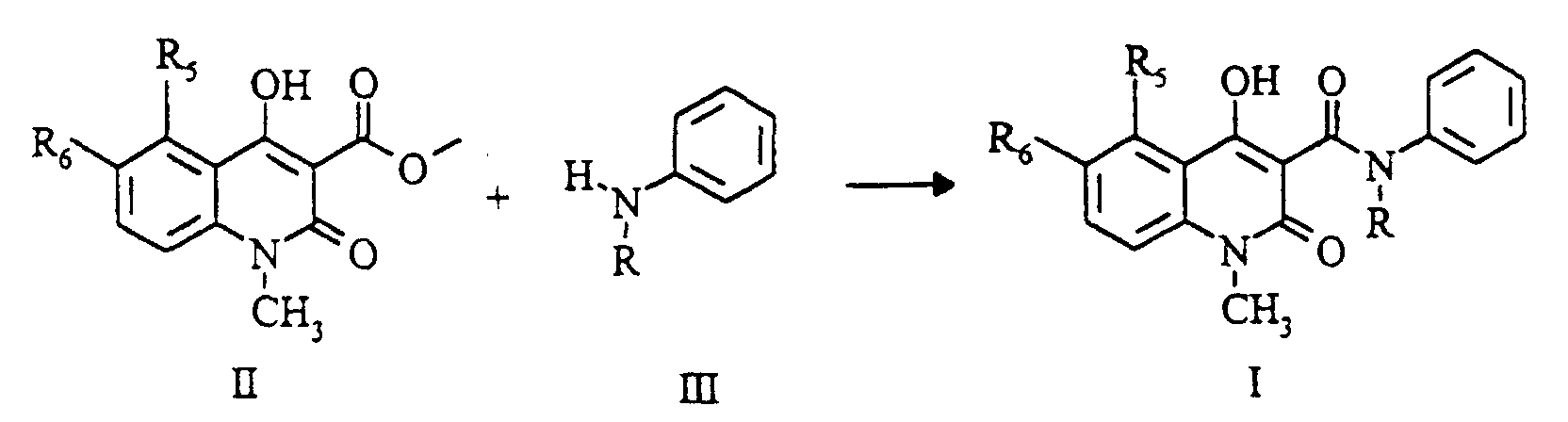
- the compounds of formula (I) may be prepared by known methods, for example, by reaction of an ester derivative of the quinoline carboxylic acid (II) with an aniline (III) in a suitable solvent such as toluene, xylene and the like.
- Suitable esters are methyl and ethyl esters.
- a solution of 5 M sodium hydroxide was prepared by dilution of a 50 weight-% sodium hydroxide solution (10.0 g) with sterile water to the total volume of 25 ml.
- N-Ethyl-N-phenyl-1,2-dihydro-4-hydroxy-5-chloro-1-methyl-2-oxo-quinoline-3-carboxamide (10.0 g) was suspended in ethanol (150 ml) and the previously prepared 5 M sodium hydroxide solution was added to pH 8-12 (5.6 ml). The reaction mixture was stirred for another 30 minutes at ambient temperature. The resulting precipitation was filtered off and rapidly washed twice with ethanol (2 ⁇ 150 ml).
- the anhydride was added slowly in portions to a mixture of sodium hydride (5.5 g, 0.18 mol) in 300 ml of N,N-dimethylformamide. After stirring at room temperature for 1 hour, methyl iodide (26 g, 0.18 mol) was added dropwise and stirring was continued for 21 ⁇ 2 hours. The mixture was then added to 3 1 of an ice/water slurry and the precipitate was collected and dried to yield the N-methylated isatoic anhydride (24.9 g, 0.118 mol).
- N-methylated anhydride was heated to 65°C with sodium methoxide (6.3 g, 0.117 mol) in 130 ml of methanol for 1 hour. The solvents were evaporated. Water and dichloromethane were added and the organic layer was separated, dried and concentrated to yield an oily residue (22.7 g, 0.114 mol).
- the syrup was dissolved in 100 ml of anhydrous ethanol and sodium methoxide (5.4 g, 0.1 mol) was added. After 1 hour, the solvent was removed and the residue worked up with dichloromethane and water. The quinoline derivative formed was carefully dried and then suspended in chilled anhydrous tetrahydrofuran (250 ml). Sodium hydride (4 g, 0.125 mol) and then methyl iodide (10 ml, 0.15 mol) was slowly added. The mixture was heated under reflux for 6 hours, quenched with water and worked up with diethyl ether. The solvents were removed and the residue (17.3 g) was dissolved in a mixture of ethanol (50 ml) and conc.
- the solution was refluxed at 150°C overnight, cooled to room temperature and the pH adjusted to 4 with conc. hydrochloric acid. The precipitate was collected by filtration, washed with water (50 ml) and dried under vacuum.
- the white solid, 5-methoxy-anthranilic acid (32 g, 0.18 mol), and sodium bicarbonate (38 g, 0.45 mol) were suspended in 1,4-dioxane (500 ml) and then phosgene (25 ml, 0.45 mol) was slowly added under cooling in an ice bath. The mixture was warmed at 40°C for 1 hour, cooled to 15°C, water (150 ml) was added and the white solid collected by filtration.
- the ester was dissolved in dichloromethane (400 ml) and cooled on an ice-bath. Ethyl malonyl chloride (21 g, 0.14 mol) was added and then, after 30 minutes, triethylamine (22 ml, 0.16 mol). After being stirred for 1 hour at room temperature the cloudy mixture was washed with 0.5 M hydrochloric acid and then bicarbonate. The organic phase was carefully dried and concentrated under vacuum. The residue was then dissolved in dry ethanol (200 ml) and sodium methoxide (17 g, 0.32 mol) was added. The mixture was stirred for 1 hour and water was added (300 ml).
- the isonitrosoacetanilide (10.0 g, 0.05 mol), was added portionwise to a mixture of water (9 ml) and conc. sulphuric acid (60 ml) prewarmed to 50°C, maintaining the temperature between 50-55 °C. When the addition was completed, the mixture was heated to 80°C and kept at this temperature for 10 minutes. The reaction mixture was then cooled on an ice-bath and poured on 10-12 times the reaction volume of crushed ice. The mixture was then left standing for about one hour. The water suspension was extracted with dichloromethane which was dried and evaporated resulting in an mixture of the two analogues 4-ethyl and 6-ethyl isatins approximately 0.68:1 (7.6 g), yield 84 %.
- AAE Acute experimental autoimmune encephalomyelitis
- Mouse spinal cord homogenate (MSCH) was obtained from 8 to 12 weeks-old C57Bl/6 female mice. The tissue was homogenised on ice and diluted in cold PBS. Incomplete Freund's containing 1 mg/ml M. tuberculosis hominis H37Ra was emulsified with an equal volume of MSCH to give a final concentration of 10 mg/ml of MSCH. The inoculum volume of 0.1 ml was injected intradermally at the base of the tail. Pertussis toxin was injected i.p. at day 0 and 3 after immunization.
- MSCH Mouse spinal cord homogenate
- Treatment was given per os daily either at day 3 to 12 post-immunization or days 3 to 7 and 10 to 12.
- Control animals received saline.
- the animals, eight per dose group, were scored for clinical signs of paralytic disease on a scale from 0 to 5 in the following way: 0, normal; 1, limp tail; 2, hind limb paresis; 3 hind limb paralysis and limp foreleg; 4, bilateral hind and fore limb paralysis; 5, death.
- Clinical scores were monitored at day 7 and daily from day 9 until the end of the experiment at day 14. Treatment effects were calculated as percent inhibition of clinical scores compared to saline treated controls.
- mice between 8 to 10 weeks of age were used for the experiments.
- the treatment was given per os daily on days 3 to 7, 10 to 14, 17 to 21, 24 to 28 and 31 to 35.
- Fifteen days after immunization mice were inspected for signs of arthritis. The animals were inspected three times a week.
- mice C57Bl/6 female mice between 10 to 14 weeks of age were used for the experiments, 10 mice /group.
- the mice were sensitized with ovalbumin (OA) in aluminium hydroxide in a volume of 0.2 ml, inoculated ip. Treatment was given at day 0 to day 16.
- Control mice received saline.
- Fourteen days after the OA sensitization mice were exposed for 20 minutes to an aerosol of 1.5% w/v, of OA in saline produced by a nebulizer. Vehicle-challenged control mice were exposed to saline.
- OA ovalbumin
- mice Seventy-two hours after OA/vehicle challenge, mice were anaesthetised and bronchoalveolar lavage was performed by instilling 0.5 ml ice-cold phosphate buffered saline (PBS) into the lungs twice. Total cell counts were determined and differential counts were made based on identification of eosinophils, monocytes/alveolar macrophages, lymphocytes and neutrophils. Eosinophil infiltration into the lung tissue was evaluated by histochemical methods on frozen lung sections using diaminobenzidine tetrahydrochloride (DAB).
- DAB diaminobenzidine tetrahydrochloride
- the compounds were administrated subcutaneously to female rats during day 8 to 14 of pregnancy.
- the rats were caesarean sectioned and necropsied on day 20 after fertilisation.
- the foetuses were examined for external and internal abnormalities.
- BPS Beagle Pain Syndrome
- the compounds were administrated intravenously to beagle dogs.
- the dosage was given for five consecutive days.
- the dogs were evaluated for clinical and laboratory signs of the pain syndrome, e.g., fever, increased erythrocyte sedimentation rate (ESR), alkaline phosphate (AP), induction of acute phase proteins and vasculitis.
- ESR erythrocyte sedimentation rate
- AP alkaline phosphate
- Preferred compounds are N-ethyl-N-phenyl-1,2-dihydro-4-hydroxy-5-chloro-1-methyl-2-oxo-quinoline-3-carboxamide, N-ethyl-N-phenyl-1,2-dihydro-4-hydroxy-5-methoxy-1-methyl-2-oxo-quinoline-3-carboxamide, N-ethyl-N-phenyl-1,2-dihydro-4-hydroxy-5-bromo-1-methyl-2-oxo-quinoline-3-carboxamide and N-ethyl-N-phenyl-1,2-dihydro-4-hydroxy-5,6-methylenedioxy-1-methyl-2-oxo-quinoline-3-carboxamide hereinafter called Compound B, C, D and E, respectively.
- Effective quantities of the compounds of formula (I) are preferably administered to a patient in need of such treatment according to usual routes of administration and formulated in usual pharmaceutical compositions comprising an effective amount of the active ingredient and a suitable pharmaceutically acceptable carrier.
- Such compositions may take a variety of forms, e.g. solutions, suspensions, emulsions, tablets, capsules, and powders prepared for oral administration, sterile solutions for parental administration, suppositories for rectal administration or suitable topical formulations.
- Conventional procedures for the selection and preparation of suitable pharmaceutical formulations are described, for example, in "Pharmaceuticals - The Science of Dosage Form Design", M.B. Aulton, Churchill Livingstone, 1988.
- a suitable daily dose for use in the treatment of MS is contemplated to vary between 0.0005 mg/kg to about 10 mg/kg body weight, in particular between 0.005 mg/kg to 1 mg/kg body weight, depending upon the specific condition to be treated, the age and weight of the specific patient, and the specific patient's response to the medication.
- the exact individual dosage, as well as the daily dosage, will be determined according to standard medical principles under the direction of a physician.
- the pharmaceutical composition may also contain additional therapeutically useful substances other than a compound of formula (I).
Landscapes
- Health & Medical Sciences (AREA)
- Chemical & Material Sciences (AREA)
- Organic Chemistry (AREA)
- Engineering & Computer Science (AREA)
- Bioinformatics & Cheminformatics (AREA)
- Veterinary Medicine (AREA)
- Animal Behavior & Ethology (AREA)
- Public Health (AREA)
- Chemical Kinetics & Catalysis (AREA)
- General Chemical & Material Sciences (AREA)
- Medicinal Chemistry (AREA)
- Nuclear Medicine, Radiotherapy & Molecular Imaging (AREA)
- General Health & Medical Sciences (AREA)
- Pharmacology & Pharmacy (AREA)
- Life Sciences & Earth Sciences (AREA)
- Biomedical Technology (AREA)
- Neurosurgery (AREA)
- Pulmonology (AREA)
- Neurology (AREA)
- Immunology (AREA)
- Diabetes (AREA)
- Endocrinology (AREA)
- Hospice & Palliative Care (AREA)
- Hematology (AREA)
- Obesity (AREA)
- Emergency Medicine (AREA)
- Urology & Nephrology (AREA)
- Vascular Medicine (AREA)
- Pain & Pain Management (AREA)
- Rheumatology (AREA)
- Heart & Thoracic Surgery (AREA)
- Psychiatry (AREA)
- Cardiology (AREA)
- Dermatology (AREA)
- Pharmaceuticals Containing Other Organic And Inorganic Compounds (AREA)
- Plural Heterocyclic Compounds (AREA)
- Quinoline Compounds (AREA)
- Nitrogen Condensed Heterocyclic Rings (AREA)
Abstract
Description
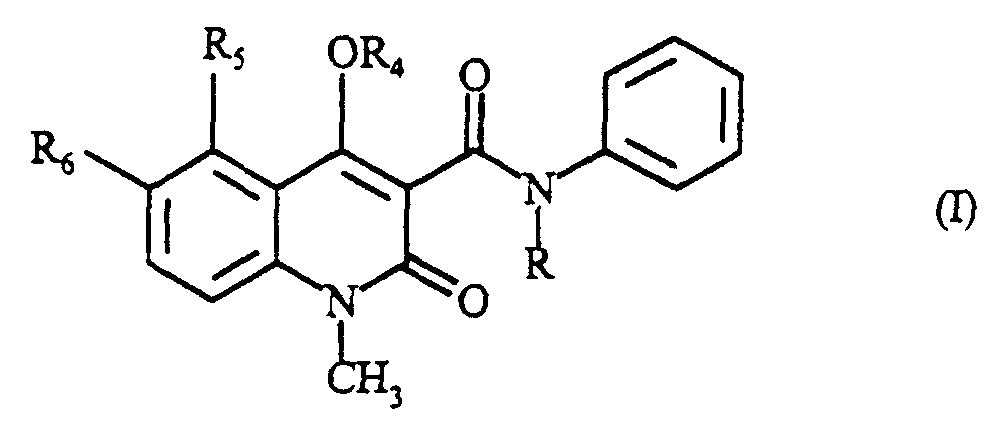
R is selected from ethyl, n-propyl, iso-propyl, n-butyl, iso-butyl, sec.-butyl and allyl;
R4 is selected from hydrogen and pharmaceutically acceptable inorganic cations, such as sodium, potassium and calcium, and organic cations such as monoethanolamine, diethanolamine, dimethylaminoethanol, morpholine and the like;
R5 is selected from methyl, ethyl, n-propyl, iso-propyl, methoxy, ethoxy, chloro, bromo, CF3, and OCHxFy;
wherein
R5 and R6 taken together are methylenedioxy;
are unexpectedly effective and specific in the treatment of individuals suffering from autoimmune and inflammatory diseases.

1H NMR (CDCl3) δ 1.26 (3H, t), 3.50 (3H, s), 3.97 (2H, q), 4.03 (3H, s), 6.67 (1H, d), 6.87 (1H, d), 7.12-7.25 (3H, m), 7.36-7.44 (3H, m).
13C NMR (CDCl3) δ 13.0 (CH3), 29.6 (CH3), 43.8 (CH2), 56.8 (CH3), 103.2 (CH), 104.2 (C), 108.3 (CH), 110.5 (C), 127.3 (2CH), 127.4 (CH), 128.5 (2CH), 131.2 (CH), 141.1 (C), 141.9 (C), 156.9 (C), 157.1 (C), 160.2 (C), 164.4 (C).
ESI MS/MS [M+H]+ 353, fragments 232 and 122.
1H NMR (CDCl3) δ 1.21 (3H, t), 2.83 (3H, s). 3.23 (3H, s), 3.98 (2H, q), 6.97 (1H, d), 7.02 (1H, d), 7.10-7.25 (5H, m), 7.39 (1H, t), 13.08 (1H, s).
13C NMR (CDCl3) δ12.9 (CH3), 24.4 (CH3), 29.5 (CH3), 45.9 (CH2), 102.8 (C), 112.2 (CH), 114.3 (C), 125.5 (CH), 126.4 (2CH), 126.4 (CH), 128.4 (2CH), 131.7 (CH), 139.6 (C), 142.0 (C), 142.4 (C), 158.1 (C), 169.7 (C), 170.1 (C).
ESI MS/MS [M+H]+ 337, fragments 216 and 122.
1H NMR (CDCl3) δ 1.20 (3H, t), 3.28 (3H, s), 3.97 (2H, q), 7.08-7.25 (7H, m), 7.39 (1H, t), 12.6 (1H, s).
13C NMR (CDCl3) δ 12.9 (CH3), 29.8 (CH3), 45.7 (CH2), 105,0 (C), 112.7 (C), 113.3 (CH), 125.4 (CH), 126.7 (2CH), 126.8 (CH), 128.5 (2CH), 131.6 (CH), 132.7 (C), 142.0 (C), 142.6 (C), 157.9 (C), 165.6 (C), 168.7 (C).
ESI MS/MS [M+H]+ 357, fragments 236 and 122.
1H NMR (CDCl3 + TFA) δ 1.28 (3H, t), 3.66 (3H, s), 3.93-4.05 (2H, m), 7.11 (1H, q), 7.26-7.37 (6H, m), 7.68 (1H, q), 11.42 (1H, s).
13C NMR (CDCl3 + TFA) δ 12.6 (CH3), 31.4 (CH3), 46.4 (CH2), 104.4+104.5 (C), 108.7 (C), 110.4+110.5 (CH), 112.7+112.8 (CH), 126.8 (2CH), 129.7 (CH), 129.8 (2CH), 134.1+134.2 (CH), 139.9 (C), 141.0 (C), 158.0 (C), 159.3+161.3 (C), 161.4 (C), 166.8 (C); (Some peaks are doublets due to F-coupling).
ESI MS/MS [M+H]+ 341, fragments 220 and 122.
1H NMR (CDCl3 + TFA) δ 1.21 (3H, t), 3.30 (3H, s), 3.99 (2H, q), 7.10-7.25 (5H, m), 7.42 (1H, d), 7.60 (1H, t), 7.67 (1H, d), 13.05 (1H, s).
13C NMR (CDCl3 + TFA) δ 12.5 (CH3), 31.1 (CH3), 46.2 (CH2), 106.4 (C), 113.0 (C), 119.5 (CH), 120+122.2+124.4 (CF3), 123.4 (CH), 126.6 (2CH), 128.1 (CH), 128.1+128.3 (C), 129.1 (2CH), 132.1 (CH), 140.5 (C), 141.4 (C), 159.3 (C), 163.7 (C), 167.8 (C).
ESI MS/MS [M+H]+ 391, fragments 270 and 122.
1H NMR (CDCl3) δ 3.33 (3H, s), 4.57 (2H, m), 5.22 (1H, d), 5.38 (1H, d), 6.0 (1H, m), 7.13-7.30 (7H, m), 7.44 (1H, t), 12.45 (1H, s).
1H NMR (CDCl3) δ 3.52 (3H, s), 4.04 (3H, s), 4.52 (2H, m), 5.20 (1H, d), 5.37 (1H, d), 6.02 (1H, m), 6.67 (1H, d), 6.88 (1H, d). 7.10-7.23 (3H, m), 7.38-7.45 (3H, m), 9.82 (1H, s).
1H NMR (CDCl3) δ 1.0 (3H, t), 1.65 (2H, m), 3.48 (3H, s), 3.9 (2H, t), 4.01 (3H, s), 6.65 (1H, d), 6.83 (1H, d), 7.1-7.25 (3H, m). 7.3-7.45 (3H, m), 9.8 (1H, s).
1H NMR (CDCl3) δ 1.15-1.22 (3H, broad signal), 3.25 (3H, s), 3.95 (2H, s broad), 7.08-7.31 (7H, m), 7.43-7.50 (1H, m).
1H NMR (CDCl3 + TFA) δ 1.27 (3H, t), 3.57 (3H, s), 3.98 (2H, q), 6.23 (2H, s), 6.86 (1H, d), 7.19 (1H, d), 7.25-7.35 (5H, m), 10.3 (1H, s broad).
13C NMR (CDCl3 + TFA) δ 12.4 (CH3), 30.9 (CH3), 46.0 (CH2), 101.6 (C), 103.7 (CH2), 107.4 (C), 108.4 (CH), 113.7 (CH), 126.7 (2CH), 128.8 (CH), 129.3 (2CH), 134.1 (C), 140.1 (C), 143.1+143.2 (2C), 157.3 (C), 160.9 (C), 166.3 (C).
ESI MS/MS [M+H]+ 367, fragments 246 and 122.
1H NMR (CDCl3) δ 1.26 (3H, t), 1.31 (3H, t), 3.20-3.34 (5H, m), 4.0 (2H, q), 7.02-7.07 (2H, m), 7.13-7.28 (5H, m), 7.44 (1H, t) 13.2 (1H, s broad).
13C NMR (CDCl3) δ 13.2 (CH3), 16.8 (CH3), 29.8+30.2 (CH3+CH2), 46.1 (CH2), 103.3 (C), 112.5 (CH), 113.9 (C), 124.6 (CH), 126.7+126.7 (3CH), 128.6 (2CH), 132.1 (CH), 142.3 (C), 142.6 (C), 146.2 (C), 158.3 (C), 169.3 (C), 170.4 (C).
ESI MS/MS [M+H]+ 351, fragments 230 and 122.
1H NMR (CDCl3) δ 1.24 (6H, d), 3.38 (3H, s broad), 5.09 (1H, broad signal), 7.08 (1H, d), 7.15 (1H, d), 7.15-7.34 (5H, m), 7.34 (1H, t), 11.1 (1H, s broad).
13C NMR (CDCl3) δ 21.0 (2CH3), 29.9 (CH3), 48.2 (CH), 109.4 (C), 112.4 (C), 113.5 (CH), 125.1 (CH), 127.9 (2CH), 127.9 (CH), 129.6 (2CH), 131.1 (CH), 131.6 (C), 137.9 (C broad), 142.1 (C), 158.6 (C), 160.6 (C), 167.5 (C).
1H NMR (CDCl3) δ 0.95 (3H, t), 1.58-1.69 (2H, m), 3.29 (3H, s broad), 3.88 (2H, broad), 7.08-7.26 (7H, m), 7.41 (1H, t), 12.5 (1H, s broad).
1H NMR (D2O). Two isomers in ratio 1:4. δ 0.90 (3H, t, minor form), 1.10 (3H, t, major form), 3.21 (3H, s, major form), 3.50 (3H, s, minor form), 3.50-3.70 (2H, m, minor form), 3.70-3.85 (2H, m, major form), 6.92-7.51 (8H, m, both forms).
1H NMR (CDCl3) δ 1.46 (3H, t), 3.63 (3H, s), 4.49 (2H, q), 7.23 (1H, d), 7.27 (1H, d), 7.49 (1H, t), 15.0 (1H, s).
1H NMR (CDCl3) δ 1.46 (3H, t), 3.68 (3H, s), 4.50 (2H, q), 7.58 (1H, m), 7.71 (2H, m), 15.0 (1H, s).
1H NMR (CDCl3) δ 1.43 (t, 3H), 3.62(s, 3H), 3.96(s, 3H), 4.45(q, 2H), 6.70(d, 1H), 6.92(d, 1H), 7.55(t, 1H), 13.5(s, 1H).
1H NMR (CDCl3) δ 1.45 (3H, t), 3.58 (3H, s), 4.48 (2H, q), 6.17 (2H, s), 6.71 (1H, d), 7,14 (1H, d).
1H NMR ((CDCl3) δ 3.73 (3H, s) 4.02 (3H, s), 6.82 (1H, d), 7.02 (1H, d), 7.62 (1H, t).
1H NMR (DMSO-d6 ) δ 1.12 (3H, t), 3.02 (2H, q), 6.98 (1H, d), 7.05 (1H, d), 7,58 (1H, t), 11.6 (1H, broad).
| aEAE inhibition | ||||
| Dose, mg/kg p.o. | % aEAE Inhibition | |||
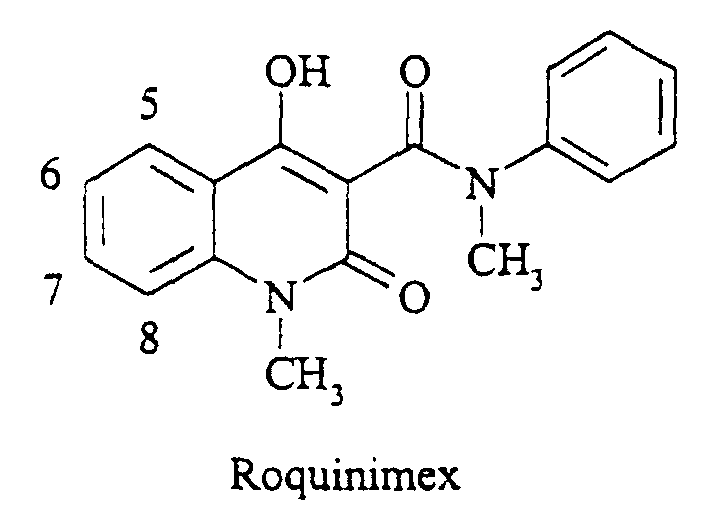
| Compound B (invention) | Compound C (invention) | Compound F | Roquinimex | |
| 0.04 | 60 | 48 | not tested | not tested |
| 0.2 | 74 | 71 | not tested | 35 |
| 1 | 98 | 73 | not tested | 40 |
| 5 | 96 | 90 | 63 | 69 |
| Arthritic score, type II collagen induced arthritis | ||
| Compound (dose 5 mg/kg p.o.) | Incidence (%) day 35 | Mean score day 35 |
| D (invention) | 30 | 0.4 |
| E (invention) | 10 | 0.1 |
| Roquinimex | 50 | 1.7 |
| Embryotoxicity - external malformations | |||
| Dose, mg/kg (route) | % malformed foetuses | ||
| Compound B (invention) | Compound G | Roquinimex | |
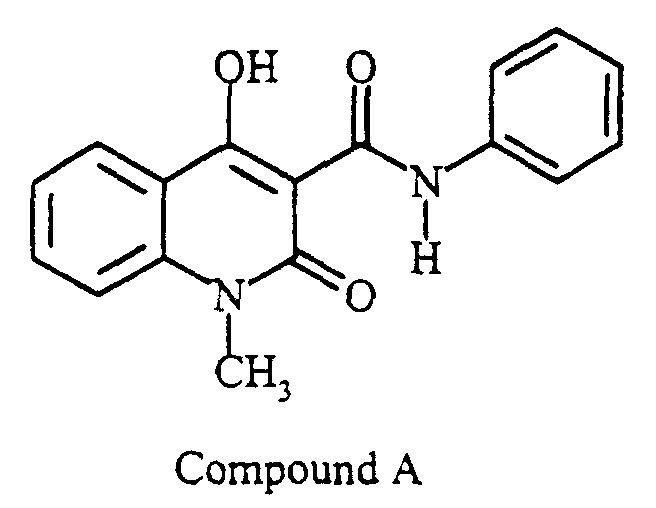
| 6 | 0 | 37 | |
| 10 | 9 | ||
| 30 | 1 | Not tested | 30 |
Claims (16)
- Compounds of general formula (I)wherein

R is selected from ethyl, n-propyl, iso-propyl, n-butyl, iso-butyl, sec.-butyl and allyl;
R4 is selected from hydrogen and pharmaceutically acceptable inorganic and organic cations;
R5 is selected from methyl, ethyl, n-propyl, iso-propyl, methoxy, ethoxy, chloro, bromo, CF3, and OCHxFy;
whereinR6 is hydrogen; orx = 0 - 2,y = 1 - 3 with the proviso thatx + y = 3;
R5 and R6 taken together are methylenedioxy;
and any tautomer thereof. - Compounds according to claim 1 wherein the pharmaceutically acceptable inorganic cations are derived from sodium, potassium and calcium, and the organic cations are derived from monoethanolamine, diethanolamine, dimethylaminoethanol, morpholine and the like.
- Compounds according to claim 1 and 2 wherein R5 is methyl, ethyl, methoxy, chloro, bromo.
- Compounds according to claim 3 wherein R is ethyl and n-propyl.
- Compounds according to claim 4 wherein R4 is selected from hydrogen and sodium.
- The compound according to claims 1 and 2, N-ethyl-N-phenyl-1,2-dihydro-4-hydroxy-5-methyl-1-methyl-2-oxo-quinoline-3-carboxamide.
- The compound according to claims 1 and 2, N-ethyl-N-phenyl-1,2-dihydro-4-hydroxy-5-ethyl-1-methyl-2-oxo-quinoline-3-carboxamide.
- The compound according to claims 1 and 2, N-ethyl-N-phenyl-1,2-dihydro-4-hydroxy-5-methoxy- 1-methyl-2-oxo-quinoline-3-carboxamide.
- The compound according to claims 1 and 2, N-ethyl-N-phenyl-1,2-dihydro-4-hydroxy-5-chloro-1-methyl-2-oxo-quinoline-3-carboxamide or its sodium salt.
- The compound according to claims 1 and 2, N-ethyl-N-phenyl-1,2-dihydro-4-hydroxy-5-bromo-1-methyl-2-oxo-quinoline-3-carboxamide.
- The compound according to claims 1 and 2, N-ethyl-N-phenyl-1,2-dihydro-4-hydroxy-5,6-methylenedioxy-1-methyl-2-oxo-quinoline-3-carboxamide.
- Compounds according to any of the preceding claims to be used as therapeuticum.
- Pharmaceutical compositions containing as active ingredient a compound having the general formula (I)wherein
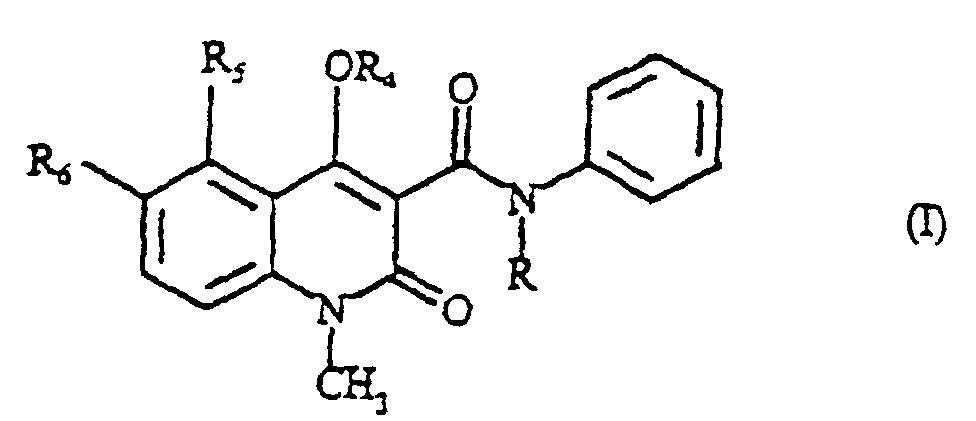
R is selected from ethyl, n-propyl, iso-propyl, n-butyl, iso-butyl, sec.-butyl and allyl;
R4 is selected from hydrogen and pharmaceutically acceptable inorganic and organic canons;
R5 is selected from methyl, ethyl, n-propyl, iso-propyl, methoxy, ethoxy, chloro, bromo, CF3, and OCHxFy;
whereinR6 is hydrogen; orx = 0 - 2,y = 1 - 3 with the proviso thatx + y = 3;
R5 and R6 taken together are methylenedioxy;
and any tautomer thereof together with a pharmaceutically acceptable carrier. - Pharmaceutical compositions according to claim 13 contaning other pharmacologically active substances.
- Pharmaceutical compositions according to claims 13 and 14 to be used as a therapeuticum in a daily dose of the active substance of 0.0005 mg/kg to about 10 mg/kg body weight, in particular 0.005 to 1 mg/kg body weight.
- A process for manufacturing of a compound of general formula (I)wherein
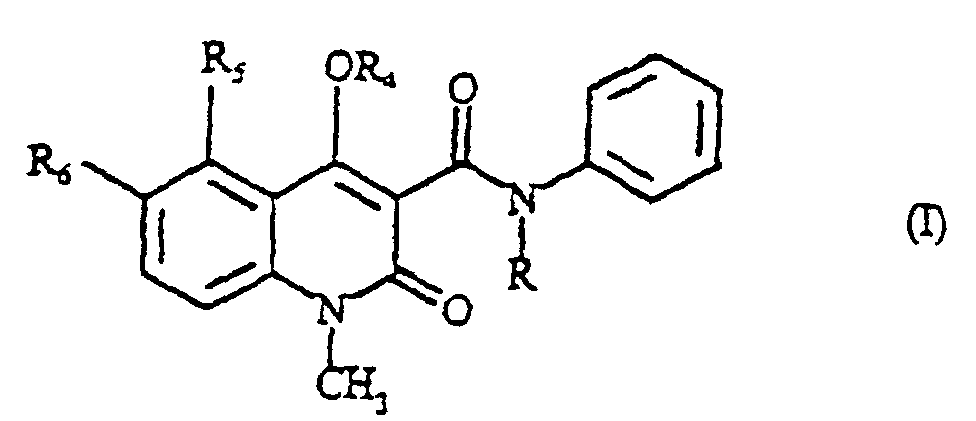
R is selected from ethyl, n-propyl, iso-propyl, n-butyl, iso-butyl, sec.-butyl and allyl;
R4 is selected from hydrogen and pharmaceutically acceptable inorganic and organic canons;
R5 is selected from methyl, ethyl, n-propyl, iso-propyl, methoxy, ethoxy, chloro, bromo, CF3, and OCHxFy;
whereinR6 is hydrogen; orx = 0 - 2,y = 1 - 3 with the proviso thatx + y = 3;
R5 and R6 taken together are methylenedioxy;
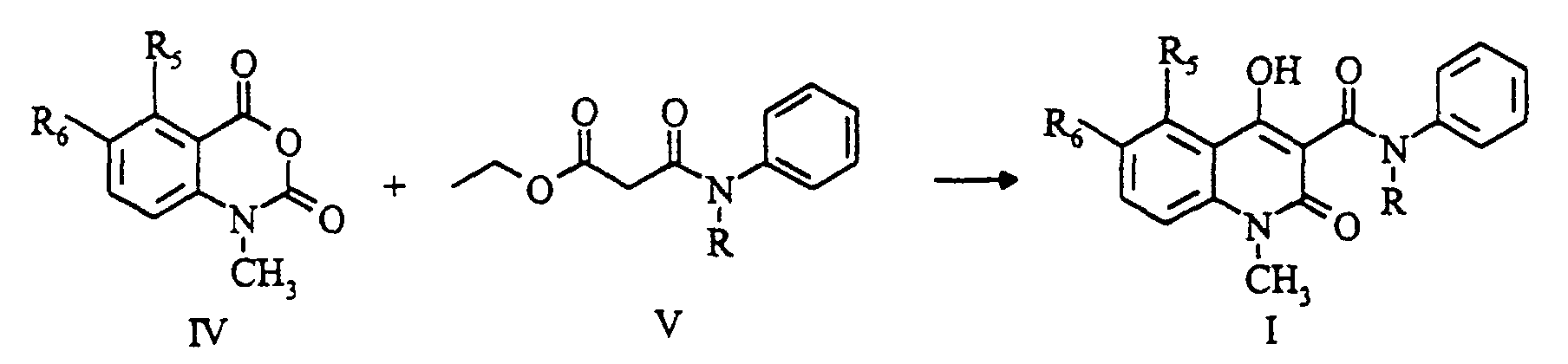
and any tautomer thereof byusing a suitable coupling reagent, preferably a carbodiimide or thionyl chloride in the presence of triethylamine and a suitable solvent such as dichloromethane.(A) reacting an ester derivative of the quinoline carboxylic acid of formula (II),preferably the methyl or ethyl ester, with an aniline of formula (III) in a suitable solvent such as toluene, xylene and the like; or (B) reacting an isatoic anhydride of formula (IV), with an N-alkyl-N-phenylcarbamoyl acetic acid alkyl ester of formula (V),preferably the methyl or ethyl ester, using a strong base, e.g., sodium hydride, in a suitable solvent such as N,N-dimethylacetamide; or
 (C) reacting a quinoline carboxylic acid of formula (VI) with an aniline of formula (III),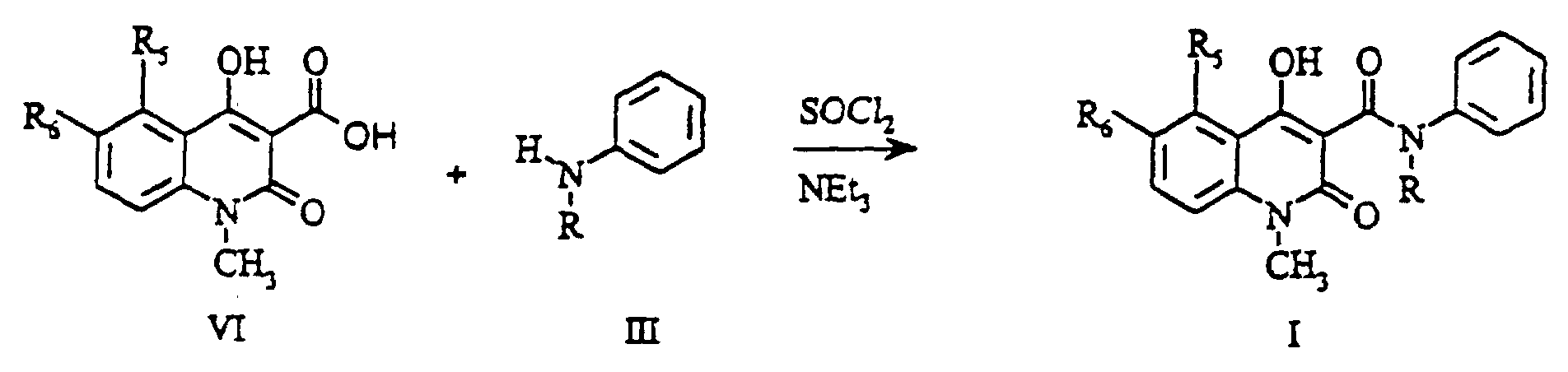
Applications Claiming Priority (3)
| Application Number | Priority Date | Filing Date | Title |
|---|---|---|---|
| SE9801474 | 1998-04-27 | ||
| SE9801474A SE9801474D0 (en) | 1998-04-27 | 1998-04-27 | Quinoline Derivatives |
| PCT/SE1999/000676 WO1999055678A1 (en) | 1998-04-27 | 1999-04-26 | Quinoline derivatives |
Publications (2)
| Publication Number | Publication Date |
|---|---|
| EP1073639A1 EP1073639A1 (en) | 2001-02-07 |
| EP1073639B1 true EP1073639B1 (en) | 2002-11-27 |
Family
ID=20411103
Family Applications (1)
| Application Number | Title | Priority Date | Filing Date |
|---|---|---|---|
| EP99947036A Expired - Lifetime EP1073639B1 (en) | 1998-04-27 | 1999-04-26 | Quinoline derivatives |
Country Status (32)
| Country | Link |
|---|---|
| EP (1) | EP1073639B1 (en) |
| JP (1) | JP4045069B2 (en) |
| KR (1) | KR100571534B1 (en) |
| CN (1) | CN1113057C (en) |
| AP (1) | AP1293A (en) |
| AT (1) | ATE228505T1 (en) |
| AU (1) | AU747550B2 (en) |
| BR (1) | BR9909925B1 (en) |
| CA (1) | CA2329788C (en) |
| CZ (1) | CZ297439B6 (en) |
| DE (1) | DE69904162T2 (en) |
| DK (1) | DK1073639T3 (en) |
| EE (1) | EE04275B1 (en) |
| ES (1) | ES2188242T3 (en) |
| HR (1) | HRP20000726B1 (en) |
| HU (1) | HU227709B1 (en) |
| ID (1) | ID26277A (en) |
| IL (2) | IL138160A0 (en) |
| IS (1) | IS2082B (en) |
| ME (1) | ME00870B (en) |
| NO (1) | NO315606B1 (en) |
| NZ (1) | NZ506641A (en) |
| OA (1) | OA11547A (en) |
| PL (1) | PL190441B1 (en) |
| PT (1) | PT1073639E (en) |
| RS (1) | RS50029B (en) |
| RU (1) | RU2197481C2 (en) |
| SE (1) | SE9801474D0 (en) |
| TR (1) | TR200003061T2 (en) |
| UA (1) | UA60354C2 (en) |
| WO (1) | WO1999055678A1 (en) |
| ZA (1) | ZA200004601B (en) |
Cited By (1)
| Publication number | Priority date | Publication date | Assignee | Title |
|---|---|---|---|---|
| US9161935B2 (en) | 2012-02-03 | 2015-10-20 | Teva Pharmaceutical Industries, Ltd. | Use of laquinimod for treating Crohn's disease patients who failed first-line anti-TNF therapy |
Families Citing this family (46)
| Publication number | Priority date | Publication date | Assignee | Title |
|---|---|---|---|---|
| SE0002320D0 (en) * | 1999-10-25 | 2000-06-21 | Active Biotech Ab | Malignant tumors |
| SE0201778D0 (en) * | 2002-06-12 | 2002-06-12 | Active Biotech Ab | Process for the manufacture of quinoline derivatives |
| KR100908655B1 (en) | 2002-11-27 | 2009-07-21 | 엘지디스플레이 주식회사 | Modulation method of data supply time and driving method and device of liquid crystal display device using the same |
| SE0400235D0 (en) * | 2004-02-06 | 2004-02-06 | Active Biotech Ab | New composition containing quinoline compounds |
| SE0401578D0 (en) * | 2004-06-18 | 2004-06-18 | Active Biotech Ab | Novel compounds |
| US7838522B2 (en) | 2004-11-17 | 2010-11-23 | Ares Trading S.A. | Benzothiazole formulations and use thereof |
| RS52193B (en) | 2004-12-21 | 2012-10-31 | Merck Serono Sa. | CYCLIC DERIVATIVES OF SULFONYL AMINE AND THEIR USE |
| UA86862C2 (en) | 2005-01-31 | 2009-05-25 | Лаборатуар Сероно С.А. | N-hydroxyamide derivatives and use thereof |
| KR20080044836A (en) | 2005-07-15 | 2008-05-21 | 라보라뚜와르 세로노 에스. 에이. | KUN inhibitors for the treatment of endometriosis |
| BRPI0613042A2 (en) | 2005-07-15 | 2010-12-14 | Serono Lab | jnk inhibitors for the treatment of endometriosis |
| JP2009507003A (en) | 2005-09-01 | 2009-02-19 | アレス トレーディング ソシエテ アノニム | Treatment of optic neuritis |
| SG10201508623RA (en) * | 2005-10-19 | 2015-11-27 | Teva Pharma | Crystals of laquinimod sodium, and process for the manufacture thereof |
| KR20150065951A (en) * | 2006-06-12 | 2015-06-15 | 테바 파마슈티컬 인더스트리즈 리미티드 | Stable laquinimod preparations |
| WO2009082471A1 (en) | 2007-12-20 | 2009-07-02 | Teva Pharmaceutical Industries, Ltd. | Stable laquinimod preparations |
| MX2011002033A (en) | 2008-09-03 | 2011-05-02 | Teva Pharma | 2-oxo-1,2-dihydro-quinoline modulators of immune function. |
| ES2564931T3 (en) | 2009-07-30 | 2016-03-30 | Teva Pharmaceutical Industries Ltd. | Crohn's disease treatment with laquinimod |
| CA2771203C (en) * | 2009-08-10 | 2019-04-09 | Teva Pharmaceutical Industries Ltd. | Treatment of bdnf-related disorders using laquinimod |
| US20110217295A1 (en) * | 2010-03-03 | 2011-09-08 | Asi Haviv | Treatment of lupus arthritis using laquinimod |
| MX2012010066A (en) * | 2010-03-03 | 2012-10-03 | Teva Pharma | Treatment of rheumatoid arthritis with a combination of laquinimod and methotrexate. |
| WO2011109526A1 (en) | 2010-03-03 | 2011-09-09 | Teva Pharmaceutical Industries Ltd. | Treatment of lupus nephritis using laquinimod |
| WO2011116091A1 (en) | 2010-03-17 | 2011-09-22 | Novartis Ag | Dispenser |
| EP2590949B1 (en) | 2010-07-09 | 2015-11-25 | Active Biotech AB | Method for manufacturing of quinoline-3-carboxamides |
| EA201390074A1 (en) * | 2010-07-09 | 2013-06-28 | Тева Фармасьютикал Индастриз Лтд. | 5-HLOR-4-HYDROXY-1-METHIL-2-OXO-N-PHENYL-1,2-DIHYDROCHINOLIN-3-CARBOXAMID, ITS SALT AND APPLICATIONS |
| CN104610144A (en) | 2010-07-09 | 2015-05-13 | 泰华制药工业有限公司 | Deuterated n-ethyl-n-phenyl-1,2-dihydro-4-hydroxy-5-chloro-1-methyl-2-oxoquinoline-3-carboxamide, salts and uses thereof |
| EP2444086A1 (en) | 2010-10-22 | 2012-04-25 | Almirall, S.A. | Combinations comprising DHODH inhibitors and COX inhibitors |
| EP2766020A4 (en) | 2011-10-12 | 2015-04-01 | Teva Pharma | Treatment of multiple sclerosis with combination of laquinimod and fingolimod |
| MX2014009889A (en) | 2012-02-16 | 2014-11-13 | Teva Pharma | N-ethyl-n-phenyl-1,2-dihydro-4,5-di-hydroxy-1-methyl-2-oxo-3-qui noline carboxamide, preparation and uses thereof. |
| TW201350467A (en) | 2012-05-08 | 2013-12-16 | Teva Pharma | N-ethyl-4-hydroxyl-1-methyl-5-(methyl(2,3,4,5,6-pentahydroxyhexyl)amino)-2-oxo-N-phenyl-1,2-dihydroquinoline-3-carboxamide |
| TW201400117A (en) * | 2012-06-05 | 2014-01-01 | Teva Pharma | Treatment of ocular inflammation with laquinimod |
| TW201410244A (en) | 2012-08-13 | 2014-03-16 | Teva Pharma | Laquinimod for treatment of GABA mediated disorders |
| MX2015005632A (en) * | 2012-11-07 | 2016-02-05 | Teva Pharma | Amine salts of laquinimod. |
| RU2545056C2 (en) * | 2012-12-10 | 2015-03-27 | Государственное бюджетное образовательное учреждение высшего профессионального образования "Пермская государственная фармацевтическая академия" Министерства здавоохранения и социального развития Российской Федерации (ГБОУ ВПО ПГФА Минздравсоцразвития России) | Anti-inflammatory and analgesic agent of 1,2-dihydro-1h-2-oxocinchoninic acid isopropylamide |
| WO2014127139A1 (en) * | 2013-02-15 | 2014-08-21 | Teva Pharmaceutical Industries Ltd. | Treatment of multiple sclerosis with laquinimod |
| EP2970129A2 (en) | 2013-03-14 | 2016-01-20 | Teva Pharmaceutical Industries Ltd. | Crystals of laquinimod sodium and improved process for the manufacture thereof |
| KR20170005434A (en) | 2014-04-29 | 2017-01-13 | 테바 파마슈티컬 인더스트리즈 리미티드 | Laquinimod for the treatment of relapsing-remitting multiple sclerosis (rrms) patients with a high disability status |
| WO2016042112A1 (en) | 2014-09-23 | 2016-03-24 | Active Biotech Ab | Quinoline carboxamides for use in the treatment of multiple myeloma |
| ES2663836T3 (en) | 2014-11-19 | 2018-04-17 | Active Biotech Ab | Quinoline Carboxamides for use in the treatment of leukemia |
| EP3886858B1 (en) | 2019-12-19 | 2022-05-11 | Active Biotech AB | Compounds for treatment of eye diseases associated with excessive vascularisation |
| CA3168070A1 (en) | 2020-03-03 | 2021-09-10 | Active Biotech Ab | Tasquinimod or a pharmaceutically acceptable salt thereof for use in combination therapy |
| AU2021275994A1 (en) * | 2020-05-21 | 2022-12-22 | Stemsynergy Therapeutics, Inc. | Notch inhibitors and uses thereof |
| AU2021313388A1 (en) | 2020-07-23 | 2023-01-19 | Erasmus University Medical Center Rotterdam (Erasmus Mc) | S100 proteins as novel therapeutic targets in myeloproliferative neoplasms |
| PL4277628T3 (en) | 2021-01-18 | 2026-02-09 | Active Biotech Ab | Tasquinimod or a pharmaceutically acceptable salt thereof for use in the treatment of myelodysplastic syndrome |
| JP2024520307A (en) | 2021-05-25 | 2024-05-24 | アクティブ バイオテック エイビー | Tasquinimod particles and uses thereof |
| JP2024524158A (en) | 2021-07-02 | 2024-07-05 | アクティブ バイオテック エイビー | Pharmaceutical products containing tasquinimod and methods for assessing the purity of said products |
| EP4452946A4 (en) * | 2021-12-20 | 2025-11-26 | Univ Johns Hopkins | Compounds for treatment of cancer |
| WO2025083549A1 (en) | 2023-10-16 | 2025-04-24 | Sun Pharma Advanced Research Company Limited | Methods and combinations of inhibitors of il-23 pathway and modulators of s1p signaling pathway for the treatment of autoimmune disorders |
Family Cites Families (6)
| Publication number | Priority date | Publication date | Assignee | Title |
|---|---|---|---|---|
| IE52670B1 (en) * | 1981-03-03 | 1988-01-20 | Leo Ab | Heterocyclic carboxamides,compositions containing such compounds,and processes for their preparation |
| SU1735288A1 (en) * | 1990-03-05 | 1992-05-23 | Харьковский государственный фармацевтический институт | Method for synthesis of n-r-substituted amides of hydroxyquinolone-2-carboxylic- 3-acid |
| GB9108547D0 (en) * | 1991-04-22 | 1991-06-05 | Fujisawa Pharmaceutical Co | Quinoline derivatives |
| DE4120646A1 (en) * | 1991-06-22 | 1992-12-24 | Bayer Ag | 7-ISOINDOLINYL-CHINOLONE AND NAPHTHYRIDONE CARBONIC ACID DERIVATIVES |
| US5428040A (en) * | 1993-08-31 | 1995-06-27 | The Du Pont Merck Pharmaceutical Company | Carbocyclic fused-ring quinolinecarboxylic acids useful as immunosuppressive agents |
| SE9400810D0 (en) * | 1994-03-10 | 1994-03-10 | Pharmacia Ab | New use of quinoline-3-carboxamide compounds |
-
1998
- 1998-04-27 SE SE9801474A patent/SE9801474D0/en unknown
-
1999
- 1999-04-26 KR KR1020007011944A patent/KR100571534B1/en not_active Expired - Fee Related
- 1999-04-26 AP APAP/P/2000/001933A patent/AP1293A/en active
- 1999-04-26 IL IL13816099A patent/IL138160A0/en active IP Right Grant
- 1999-04-26 CA CA002329788A patent/CA2329788C/en not_active Expired - Fee Related
- 1999-04-26 CZ CZ20003849A patent/CZ297439B6/en not_active IP Right Cessation
- 1999-04-26 HR HR20000726A patent/HRP20000726B1/en not_active IP Right Cessation
- 1999-04-26 ID IDW20002183A patent/ID26277A/en unknown
- 1999-04-26 DE DE69904162T patent/DE69904162T2/en not_active Expired - Lifetime
- 1999-04-26 RS YUP-612/00A patent/RS50029B/en unknown
- 1999-04-26 EE EEP200000613A patent/EE04275B1/en unknown
- 1999-04-26 EP EP99947036A patent/EP1073639B1/en not_active Expired - Lifetime
- 1999-04-26 WO PCT/SE1999/000676 patent/WO1999055678A1/en not_active Ceased
- 1999-04-26 JP JP2000545838A patent/JP4045069B2/en not_active Expired - Lifetime
- 1999-04-26 ES ES99947036T patent/ES2188242T3/en not_active Expired - Lifetime
- 1999-04-26 PL PL99343420A patent/PL190441B1/en unknown
- 1999-04-26 TR TR2000/03061T patent/TR200003061T2/en unknown
- 1999-04-26 HU HU0102084A patent/HU227709B1/en not_active IP Right Cessation
- 1999-04-26 AT AT99947036T patent/ATE228505T1/en active
- 1999-04-26 RU RU2000129672/04A patent/RU2197481C2/en not_active IP Right Cessation
- 1999-04-26 CN CN99805581A patent/CN1113057C/en not_active Expired - Fee Related
- 1999-04-26 BR BRPI9909925-0A patent/BR9909925B1/en not_active IP Right Cessation
- 1999-04-26 NZ NZ506641A patent/NZ506641A/en not_active IP Right Cessation
- 1999-04-26 UA UA2000085078A patent/UA60354C2/en unknown
- 1999-04-26 ME MEP-2000-612A patent/ME00870B/en unknown
- 1999-04-26 AU AU43013/99A patent/AU747550B2/en not_active Ceased
- 1999-04-26 DK DK99947036T patent/DK1073639T3/en active
- 1999-04-26 PT PT99947036T patent/PT1073639E/en unknown
- 1999-04-26 OA OA1200000301A patent/OA11547A/en unknown
-
2000
- 2000-08-30 IL IL138160A patent/IL138160A/en not_active IP Right Cessation
- 2000-08-31 IS IS5615A patent/IS2082B/en unknown
- 2000-09-01 ZA ZA200004601A patent/ZA200004601B/en unknown
- 2000-10-19 NO NO20005254A patent/NO315606B1/en not_active IP Right Cessation
Cited By (1)
| Publication number | Priority date | Publication date | Assignee | Title |
|---|---|---|---|---|
| US9161935B2 (en) | 2012-02-03 | 2015-10-20 | Teva Pharmaceutical Industries, Ltd. | Use of laquinimod for treating Crohn's disease patients who failed first-line anti-TNF therapy |
Also Published As
Similar Documents
| Publication | Publication Date | Title |
|---|---|---|
| US6077851A (en) | Quinoline derivatives | |
| CA2329788C (en) | Quinoline derivatives | |
| EP1095021B1 (en) | Quinoline derivatives | |
| US6593343B2 (en) | Quinoline derivatives | |
| EP1097139B1 (en) | Quinoline derivatives | |
| HK1036618B (en) | Quinoline derivatives | |
| HK1035715B (en) | Quinoline derivatives | |
| MXPA00009954A (en) | Quinoline derivatives | |
| KR20010043066A (en) | Quinoline derivatives | |
| MXPA01000388A (en) | Quinoline derivatives | |
| HK1035716B (en) | Quinoline derivatives |
Legal Events
| Date | Code | Title | Description |
|---|---|---|---|
| PUAI | Public reference made under article 153(3) epc to a published international application that has entered the european phase |
Free format text: ORIGINAL CODE: 0009012 |
|
| 17P | Request for examination filed |
Effective date: 20000829 |
|
| AK | Designated contracting states |
Kind code of ref document: A1 Designated state(s): AT BE CH CY DE DK ES FI FR GB GR IE IT LI LU MC NL PT SE |
|
| AX | Request for extension of the european patent |
Free format text: LT PAYMENT 20000824;LV PAYMENT 20000824;RO PAYMENT 20000824 |
|
| 17Q | First examination report despatched |
Effective date: 20010912 |
|
| GRAG | Despatch of communication of intention to grant |
Free format text: ORIGINAL CODE: EPIDOS AGRA |
|
| GRAG | Despatch of communication of intention to grant |
Free format text: ORIGINAL CODE: EPIDOS AGRA |
|
| GRAG | Despatch of communication of intention to grant |
Free format text: ORIGINAL CODE: EPIDOS AGRA |
|
| GRAH | Despatch of communication of intention to grant a patent |
Free format text: ORIGINAL CODE: EPIDOS IGRA |
|
| GRAH | Despatch of communication of intention to grant a patent |
Free format text: ORIGINAL CODE: EPIDOS IGRA |
|
| GRAA | (expected) grant |
Free format text: ORIGINAL CODE: 0009210 |
|
| AK | Designated contracting states |
Kind code of ref document: B1 Designated state(s): AT BE CH CY DE DK ES FI FR GB GR IE IT LI LU MC NL PT SE |
|
| AX | Request for extension of the european patent |
Free format text: LT PAYMENT 20000824;LV PAYMENT 20000824;RO PAYMENT 20000824 |
|
| REF | Corresponds to: |
Ref document number: 228505 Country of ref document: AT Date of ref document: 20021215 Kind code of ref document: T |
|
| REG | Reference to a national code |
Ref country code: GB Ref legal event code: FG4D |
|
| REG | Reference to a national code |
Ref country code: CH Ref legal event code: EP |
|
| REG | Reference to a national code |
Ref country code: IE Ref legal event code: FG4D |
|
| REF | Corresponds to: |
Ref document number: 69904162 Country of ref document: DE Date of ref document: 20030109 |
|
| REG | Reference to a national code |
Ref country code: CH Ref legal event code: NV Representative=s name: NOVAGRAAF INTERNATIONAL SA |
|
| REG | Reference to a national code |
Ref country code: DK Ref legal event code: T3 |
|
| REG | Reference to a national code |
Ref country code: GR Ref legal event code: EP Ref document number: 20030400755 Country of ref document: GR |
|
| REG | Reference to a national code |
Ref country code: PT Ref legal event code: SC4A Free format text: AVAILABILITY OF NATIONAL TRANSLATION Effective date: 20030218 |
|
| REG | Reference to a national code |
Ref country code: ES Ref legal event code: FG2A Ref document number: 2188242 Country of ref document: ES Kind code of ref document: T3 |
|
| ET | Fr: translation filed | ||
| PLBE | No opposition filed within time limit |
Free format text: ORIGINAL CODE: 0009261 |
|
| STAA | Information on the status of an ep patent application or granted ep patent |
Free format text: STATUS: NO OPPOSITION FILED WITHIN TIME LIMIT |
|
| 26N | No opposition filed |
Effective date: 20030828 |
|
| REG | Reference to a national code |
Ref country code: CH Ref legal event code: PFA Owner name: ACTIVE BIOTECH AB Free format text: ACTIVE BIOTECH AB#BOX 724#220 07 LUND (SE) -TRANSFER TO- ACTIVE BIOTECH AB#BOX 724#220 07 LUND (SE) |
|
| REG | Reference to a national code |
Ref country code: FR Ref legal event code: PLFP Year of fee payment: 18 |
|
| REG | Reference to a national code |
Ref country code: FR Ref legal event code: PLFP Year of fee payment: 19 |
|
| PGFP | Annual fee paid to national office [announced via postgrant information from national office to epo] |
Ref country code: NL Payment date: 20170418 Year of fee payment: 19 |
|
| PGFP | Annual fee paid to national office [announced via postgrant information from national office to epo] |
Ref country code: FR Payment date: 20170412 Year of fee payment: 19 Ref country code: CY Payment date: 20170424 Year of fee payment: 19 Ref country code: GR Payment date: 20170424 Year of fee payment: 19 Ref country code: CH Payment date: 20170419 Year of fee payment: 19 Ref country code: IE Payment date: 20170419 Year of fee payment: 19 Ref country code: DE Payment date: 20170412 Year of fee payment: 19 Ref country code: MC Payment date: 20170414 Year of fee payment: 19 Ref country code: DK Payment date: 20170424 Year of fee payment: 19 |
|
| PGFP | Annual fee paid to national office [announced via postgrant information from national office to epo] |
Ref country code: FI Payment date: 20170419 Year of fee payment: 19 Ref country code: AT Payment date: 20170421 Year of fee payment: 19 Ref country code: PT Payment date: 20170407 Year of fee payment: 19 Ref country code: LU Payment date: 20170420 Year of fee payment: 19 Ref country code: IT Payment date: 20170419 Year of fee payment: 19 Ref country code: BE Payment date: 20170418 Year of fee payment: 19 |
|
| PGFP | Annual fee paid to national office [announced via postgrant information from national office to epo] |
Ref country code: GB Payment date: 20180321 Year of fee payment: 20 |
|
| PGFP | Annual fee paid to national office [announced via postgrant information from national office to epo] |
Ref country code: SE Payment date: 20180206 Year of fee payment: 20 |
|
| PGFP | Annual fee paid to national office [announced via postgrant information from national office to epo] |
Ref country code: ES Payment date: 20180502 Year of fee payment: 20 |
|
| REG | Reference to a national code |
Ref country code: DE Ref legal event code: R119 Ref document number: 69904162 Country of ref document: DE |
|
| REG | Reference to a national code |
Ref country code: LT Ref legal event code: MM9D Effective date: 20180426 Ref country code: DK Ref legal event code: EBP Effective date: 20180430 |
|
| PG25 | Lapsed in a contracting state [announced via postgrant information from national office to epo] |
Ref country code: MC Free format text: LAPSE BECAUSE OF NON-PAYMENT OF DUE FEES Effective date: 20180430 |
|
| REG | Reference to a national code |
Ref country code: CH Ref legal event code: PL |
|
| REG | Reference to a national code |
Ref country code: NL Ref legal event code: MM Effective date: 20180501 |
|
| REG | Reference to a national code |
Ref country code: AT Ref legal event code: MM01 Ref document number: 228505 Country of ref document: AT Kind code of ref document: T Effective date: 20180426 |
|
| REG | Reference to a national code |
Ref country code: BE Ref legal event code: MM Effective date: 20180430 |
|
| REG | Reference to a national code |
Ref country code: IE Ref legal event code: MM4A |
|
| PG25 | Lapsed in a contracting state [announced via postgrant information from national office to epo] |
Ref country code: DE Free format text: LAPSE BECAUSE OF NON-PAYMENT OF DUE FEES Effective date: 20181101 Ref country code: NL Free format text: LAPSE BECAUSE OF NON-PAYMENT OF DUE FEES Effective date: 20180501 Ref country code: AT Free format text: LAPSE BECAUSE OF NON-PAYMENT OF DUE FEES Effective date: 20180426 Ref country code: GR Free format text: LAPSE BECAUSE OF NON-PAYMENT OF DUE FEES Effective date: 20181106 Ref country code: LU Free format text: LAPSE BECAUSE OF NON-PAYMENT OF DUE FEES Effective date: 20180426 Ref country code: PT Free format text: LAPSE BECAUSE OF NON-PAYMENT OF DUE FEES Effective date: 20181026 Ref country code: FI Free format text: LAPSE BECAUSE OF NON-PAYMENT OF DUE FEES Effective date: 20180426 |
|
| PG25 | Lapsed in a contracting state [announced via postgrant information from national office to epo] |
Ref country code: LI Free format text: LAPSE BECAUSE OF NON-PAYMENT OF DUE FEES Effective date: 20180430 Ref country code: CH Free format text: LAPSE BECAUSE OF NON-PAYMENT OF DUE FEES Effective date: 20180430 Ref country code: BE Free format text: LAPSE BECAUSE OF NON-PAYMENT OF DUE FEES Effective date: 20180430 |
|
| PG25 | Lapsed in a contracting state [announced via postgrant information from national office to epo] |
Ref country code: CY Free format text: LAPSE BECAUSE OF NON-PAYMENT OF DUE FEES Effective date: 20180426 Ref country code: FR Free format text: LAPSE BECAUSE OF NON-PAYMENT OF DUE FEES Effective date: 20180430 Ref country code: IE Free format text: LAPSE BECAUSE OF NON-PAYMENT OF DUE FEES Effective date: 20180426 Ref country code: IT Free format text: LAPSE BECAUSE OF NON-PAYMENT OF DUE FEES Effective date: 20180426 |
|
| REG | Reference to a national code |
Ref country code: GB Ref legal event code: PE20 Expiry date: 20190425 |
|
| REG | Reference to a national code |
Ref country code: SE Ref legal event code: EUG |
|
| PG25 | Lapsed in a contracting state [announced via postgrant information from national office to epo] |
Ref country code: DK Free format text: LAPSE BECAUSE OF NON-PAYMENT OF DUE FEES Effective date: 20180430 |
|
| PG25 | Lapsed in a contracting state [announced via postgrant information from national office to epo] |
Ref country code: PT Free format text: LAPSE BECAUSE OF EXPIRATION OF PROTECTION Effective date: 20190506 |
|
| PG25 | Lapsed in a contracting state [announced via postgrant information from national office to epo] |
Ref country code: GB Free format text: LAPSE BECAUSE OF EXPIRATION OF PROTECTION Effective date: 20190425 |
|
| REG | Reference to a national code |
Ref country code: ES Ref legal event code: FD2A Effective date: 20200904 |
|
| PG25 | Lapsed in a contracting state [announced via postgrant information from national office to epo] |
Ref country code: ES Free format text: LAPSE BECAUSE OF EXPIRATION OF PROTECTION Effective date: 20190427 |