EP1073629B1 - Anion-complexing compound, method of preparing the same, an ion-selective membrane and a sensor provided with such a compound or membrane - Google Patents
Anion-complexing compound, method of preparing the same, an ion-selective membrane and a sensor provided with such a compound or membrane Download PDFInfo
- Publication number
- EP1073629B1 EP1073629B1 EP99913743A EP99913743A EP1073629B1 EP 1073629 B1 EP1073629 B1 EP 1073629B1 EP 99913743 A EP99913743 A EP 99913743A EP 99913743 A EP99913743 A EP 99913743A EP 1073629 B1 EP1073629 B1 EP 1073629B1
- Authority
- EP
- European Patent Office
- Prior art keywords
- compound
- formula
- group
- groups
- substituted
- Prior art date
- Legal status (The legal status is an assumption and is not a legal conclusion. Google has not performed a legal analysis and makes no representation as to the accuracy of the status listed.)
- Expired - Lifetime
Links
- 150000001875 compounds Chemical class 0.000 title claims abstract description 63
- 239000012528 membrane Substances 0.000 title claims abstract description 10
- 238000000034 method Methods 0.000 title claims abstract description 10
- NINIDFKCEFEMDL-UHFFFAOYSA-N Sulfur Chemical compound [S] NINIDFKCEFEMDL-UHFFFAOYSA-N 0.000 claims abstract description 5
- 239000005864 Sulphur Substances 0.000 claims abstract description 3
- 125000004430 oxygen atom Chemical group O* 0.000 claims abstract description 3
- 125000000217 alkyl group Chemical group 0.000 claims description 17
- 125000003118 aryl group Chemical group 0.000 claims description 9
- 125000004391 aryl sulfonyl group Chemical group 0.000 claims description 6
- UMGDCJDMYOKAJW-UHFFFAOYSA-N thiourea Chemical group NC(N)=S UMGDCJDMYOKAJW-UHFFFAOYSA-N 0.000 claims description 6
- 125000002252 acyl group Chemical group 0.000 claims description 5
- 125000003545 alkoxy group Chemical group 0.000 claims description 5
- 239000012876 carrier material Substances 0.000 claims description 5
- 239000000460 chlorine Substances 0.000 claims description 4
- CTSLXHKWHWQRSH-UHFFFAOYSA-N oxalyl chloride Chemical compound ClC(=O)C(Cl)=O CTSLXHKWHWQRSH-UHFFFAOYSA-N 0.000 claims description 3
- ZAMOUSCENKQFHK-UHFFFAOYSA-N Chlorine atom Chemical compound [Cl] ZAMOUSCENKQFHK-UHFFFAOYSA-N 0.000 claims description 2
- PXGOKWXKJXAPGV-UHFFFAOYSA-N Fluorine Chemical compound FF PXGOKWXKJXAPGV-UHFFFAOYSA-N 0.000 claims description 2
- JCXJVPUVTGWSNB-UHFFFAOYSA-N Nitrogen dioxide Chemical compound O=[N]=O JCXJVPUVTGWSNB-UHFFFAOYSA-N 0.000 claims description 2
- 229910005948 SO2Cl Inorganic materials 0.000 claims description 2
- 229910052801 chlorine Inorganic materials 0.000 claims description 2
- 239000011737 fluorine Substances 0.000 claims description 2
- 229910052731 fluorine Inorganic materials 0.000 claims description 2
- 150000004820 halides Chemical class 0.000 claims description 2
- 239000013067 intermediate product Substances 0.000 claims description 2
- OKKJLVBELUTLKV-UHFFFAOYSA-N Methanol Chemical compound OC OKKJLVBELUTLKV-UHFFFAOYSA-N 0.000 description 18
- ZMXDDKWLCZADIW-UHFFFAOYSA-N N,N-Dimethylformamide Chemical compound CN(C)C=O ZMXDDKWLCZADIW-UHFFFAOYSA-N 0.000 description 12
- 239000000126 substance Substances 0.000 description 10
- 239000000047 product Substances 0.000 description 9
- 238000004458 analytical method Methods 0.000 description 8
- 239000001257 hydrogen Substances 0.000 description 8
- 229910052739 hydrogen Inorganic materials 0.000 description 8
- 229910019142 PO4 Inorganic materials 0.000 description 7
- 238000006073 displacement reaction Methods 0.000 description 7
- 150000001450 anions Chemical class 0.000 description 5
- IAZDPXIOMUYVGZ-WFGJKAKNSA-N Dimethyl sulfoxide Chemical compound [2H]C([2H])([2H])S(=O)C([2H])([2H])[2H] IAZDPXIOMUYVGZ-WFGJKAKNSA-N 0.000 description 4
- 125000004122 cyclic group Chemical group 0.000 description 4
- FMCAFXHLMUOIGG-JTJHWIPRSA-N (2s)-2-[[(2r)-2-[[(2s)-2-[[(2r)-2-formamido-3-sulfanylpropanoyl]amino]-3-methylbutanoyl]amino]-3-(4-hydroxy-2,5-dimethylphenyl)propanoyl]amino]-4-methylsulfanylbutanoic acid Chemical compound O=CN[C@@H](CS)C(=O)N[C@@H](C(C)C)C(=O)N[C@@H](C(=O)N[C@@H](CCSC)C(O)=O)CC1=CC(C)=C(O)C=C1C FMCAFXHLMUOIGG-JTJHWIPRSA-N 0.000 description 3
- XSQUKJJJFZCRTK-UHFFFAOYSA-N Urea Chemical compound NC(N)=O XSQUKJJJFZCRTK-UHFFFAOYSA-N 0.000 description 3
- 238000006243 chemical reaction Methods 0.000 description 3
- NBIIXXVUZAFLBC-UHFFFAOYSA-M dihydrogenphosphate Chemical compound OP(O)([O-])=O NBIIXXVUZAFLBC-UHFFFAOYSA-M 0.000 description 3
- 230000002349 favourable effect Effects 0.000 description 3
- 238000001914 filtration Methods 0.000 description 3
- 150000002500 ions Chemical class 0.000 description 3
- AGJSNMGHAVDLRQ-IWFBPKFRSA-N methyl (2s)-2-[[(2s)-2-[[(2s)-2-[[(2r)-2-amino-3-sulfanylpropanoyl]amino]-3-methylbutanoyl]amino]-3-(4-hydroxy-2,3-dimethylphenyl)propanoyl]amino]-4-methylsulfanylbutanoate Chemical compound SC[C@H](N)C(=O)N[C@@H](C(C)C)C(=O)N[C@H](C(=O)N[C@@H](CCSC)C(=O)OC)CC1=CC=C(O)C(C)=C1C AGJSNMGHAVDLRQ-IWFBPKFRSA-N 0.000 description 3
- DGTNSSLYPYDJGL-UHFFFAOYSA-N phenyl isocyanate Chemical compound O=C=NC1=CC=CC=C1 DGTNSSLYPYDJGL-UHFFFAOYSA-N 0.000 description 3
- 238000002360 preparation method Methods 0.000 description 3
- 239000007787 solid Substances 0.000 description 3
- SBKYNTOJIZXYGE-UHFFFAOYSA-N 1,1-bis(sulfanyl)urea Chemical class NC(=O)N(S)S SBKYNTOJIZXYGE-UHFFFAOYSA-N 0.000 description 2
- RTTZISZSHSCFRH-UHFFFAOYSA-N 1,3-bis(isocyanatomethyl)benzene Chemical compound O=C=NCC1=CC=CC(CN=C=O)=C1 RTTZISZSHSCFRH-UHFFFAOYSA-N 0.000 description 2
- -1 1,3-bis(methylene(N'-2-nitrophenylureylene))-4,6-diisopropyl-m-xylene Chemical group 0.000 description 2
- XKRFYHLGVUSROY-UHFFFAOYSA-N Argon Chemical compound [Ar] XKRFYHLGVUSROY-UHFFFAOYSA-N 0.000 description 2
- 0 CC(*)(C=C1)C=CC([N+]([O-])=O)=C1NC(N*NC(NC(C=CC(C)(*)C=C1)=C1[N+]([O-])=O)=*)=* Chemical compound CC(*)(C=C1)C=CC([N+]([O-])=O)=C1NC(N*NC(NC(C=CC(C)(*)C=C1)=C1[N+]([O-])=O)=*)=* 0.000 description 2
- YMWUJEATGCHHMB-UHFFFAOYSA-N Dichloromethane Chemical compound ClCCl YMWUJEATGCHHMB-UHFFFAOYSA-N 0.000 description 2
- NBIIXXVUZAFLBC-UHFFFAOYSA-N Phosphoric acid Chemical compound OP(O)(O)=O NBIIXXVUZAFLBC-UHFFFAOYSA-N 0.000 description 2
- WYURNTSHIVDZCO-UHFFFAOYSA-N Tetrahydrofuran Chemical compound C1CCOC1 WYURNTSHIVDZCO-UHFFFAOYSA-N 0.000 description 2
- 230000000536 complexating effect Effects 0.000 description 2
- 238000010168 coupling process Methods 0.000 description 2
- 239000012043 crude product Substances 0.000 description 2
- 230000004927 fusion Effects 0.000 description 2
- IKDUDTNKRLTJSI-UHFFFAOYSA-N hydrazine hydrate Chemical compound O.NN IKDUDTNKRLTJSI-UHFFFAOYSA-N 0.000 description 2
- 230000003993 interaction Effects 0.000 description 2
- 150000002678 macrocyclic compounds Chemical class 0.000 description 2
- 230000007935 neutral effect Effects 0.000 description 2
- QKFJKGMPGYROCL-UHFFFAOYSA-N phenyl isothiocyanate Chemical compound S=C=NC1=CC=CC=C1 QKFJKGMPGYROCL-UHFFFAOYSA-N 0.000 description 2
- 239000002904 solvent Substances 0.000 description 2
- XLYOFNOQVPJJNP-UHFFFAOYSA-N water Substances O XLYOFNOQVPJJNP-UHFFFAOYSA-N 0.000 description 2
- OVBFMUAFNIIQAL-UHFFFAOYSA-N 1,4-diisocyanatobutane Chemical compound O=C=NCCCCN=C=O OVBFMUAFNIIQAL-UHFFFAOYSA-N 0.000 description 1
- JRVZITODZAQRQM-UHFFFAOYSA-N 1-isocyanato-2-nitrobenzene Chemical compound [O-][N+](=O)C1=CC=CC=C1N=C=O JRVZITODZAQRQM-UHFFFAOYSA-N 0.000 description 1
- OQURWGJAWSLGQG-UHFFFAOYSA-N 1-isocyanatopropane Chemical compound CCCN=C=O OQURWGJAWSLGQG-UHFFFAOYSA-N 0.000 description 1
- 238000005160 1H NMR spectroscopy Methods 0.000 description 1
- 241000208199 Buxus sempervirens Species 0.000 description 1
- UXVMQQNJUSDDNG-UHFFFAOYSA-L Calcium chloride Chemical compound [Cl-].[Cl-].[Ca+2] UXVMQQNJUSDDNG-UHFFFAOYSA-L 0.000 description 1
- 239000004215 Carbon black (E152) Substances 0.000 description 1
- VEXZGXHMUGYJMC-UHFFFAOYSA-M Chloride anion Chemical compound [Cl-] VEXZGXHMUGYJMC-UHFFFAOYSA-M 0.000 description 1
- IAZDPXIOMUYVGZ-UHFFFAOYSA-N Dimethylsulphoxide Chemical compound CS(C)=O IAZDPXIOMUYVGZ-UHFFFAOYSA-N 0.000 description 1
- UFHFLCQGNIYNRP-UHFFFAOYSA-N Hydrogen Chemical compound [H][H] UFHFLCQGNIYNRP-UHFFFAOYSA-N 0.000 description 1
- 238000005481 NMR spectroscopy Methods 0.000 description 1
- 239000007868 Raney catalyst Substances 0.000 description 1
- NPXOKRUENSOPAO-UHFFFAOYSA-N Raney nickel Chemical compound [Al].[Ni] NPXOKRUENSOPAO-UHFFFAOYSA-N 0.000 description 1
- 229910000564 Raney nickel Inorganic materials 0.000 description 1
- FDLQZKYLHJJBHD-UHFFFAOYSA-N [3-(aminomethyl)phenyl]methanamine Chemical compound NCC1=CC=CC(CN)=C1 FDLQZKYLHJJBHD-UHFFFAOYSA-N 0.000 description 1
- TXDDGKOFUGSHES-UHFFFAOYSA-N [5-(aminomethyl)-2,4-di(propan-2-yl)phenyl]methanamine Chemical compound CC(C)C1=CC(C(C)C)=C(CN)C=C1CN TXDDGKOFUGSHES-UHFFFAOYSA-N 0.000 description 1
- 229910052786 argon Inorganic materials 0.000 description 1
- 239000012300 argon atmosphere Substances 0.000 description 1
- 239000001110 calcium chloride Substances 0.000 description 1
- 229910001628 calcium chloride Inorganic materials 0.000 description 1
- 239000004202 carbamide Substances 0.000 description 1
- 125000004432 carbon atom Chemical group C* 0.000 description 1
- 230000003197 catalytic effect Effects 0.000 description 1
- 230000008878 coupling Effects 0.000 description 1
- 238000005859 coupling reaction Methods 0.000 description 1
- 238000001514 detection method Methods 0.000 description 1
- 150000004985 diamines Chemical class 0.000 description 1
- 229960001760 dimethyl sulfoxide Drugs 0.000 description 1
- 230000000694 effects Effects 0.000 description 1
- 238000001704 evaporation Methods 0.000 description 1
- 230000008020 evaporation Effects 0.000 description 1
- 229930195733 hydrocarbon Natural products 0.000 description 1
- 150000002430 hydrocarbons Chemical class 0.000 description 1
- 239000012948 isocyanate Substances 0.000 description 1
- 150000002513 isocyanates Chemical class 0.000 description 1
- NONOKGVFTBWRLD-UHFFFAOYSA-N isocyanatosulfanylimino(oxo)methane Chemical class O=C=NSN=C=O NONOKGVFTBWRLD-UHFFFAOYSA-N 0.000 description 1
- 125000001449 isopropyl group Chemical group [H]C([H])([H])C([H])(*)C([H])([H])[H] 0.000 description 1
- 238000005259 measurement Methods 0.000 description 1
- AGJSNMGHAVDLRQ-HUUJSLGLSA-N methyl (2s)-2-[[(2r)-2-[[(2s)-2-[[(2r)-2-amino-3-sulfanylpropanoyl]amino]-3-methylbutanoyl]amino]-3-(4-hydroxy-2,3-dimethylphenyl)propanoyl]amino]-4-methylsulfanylbutanoate Chemical compound SC[C@H](N)C(=O)N[C@@H](C(C)C)C(=O)N[C@@H](C(=O)N[C@@H](CCSC)C(=O)OC)CC1=CC=C(O)C(C)=C1C AGJSNMGHAVDLRQ-HUUJSLGLSA-N 0.000 description 1
- 239000000203 mixture Substances 0.000 description 1
- 239000002808 molecular sieve Substances 0.000 description 1
- 238000000655 nuclear magnetic resonance spectrum Methods 0.000 description 1
- 229940117953 phenylisothiocyanate Drugs 0.000 description 1
- NBIIXXVUZAFLBC-UHFFFAOYSA-K phosphate Chemical compound [O-]P([O-])([O-])=O NBIIXXVUZAFLBC-UHFFFAOYSA-K 0.000 description 1
- 125000002467 phosphate group Chemical group [H]OP(=O)(O[H])O[*] 0.000 description 1
- 238000000926 separation method Methods 0.000 description 1
- 239000002002 slurry Substances 0.000 description 1
- URGAHOPLAPQHLN-UHFFFAOYSA-N sodium aluminosilicate Chemical compound [Na+].[Al+3].[O-][Si]([O-])=O.[O-][Si]([O-])=O URGAHOPLAPQHLN-UHFFFAOYSA-N 0.000 description 1
- 125000001424 substituent group Chemical group 0.000 description 1
- SSGGNFYQMRDXFH-UHFFFAOYSA-N sulfanylurea Chemical compound NC(=O)NS SSGGNFYQMRDXFH-UHFFFAOYSA-N 0.000 description 1
- DZLFLBLQUQXARW-UHFFFAOYSA-N tetrabutylammonium Chemical class CCCC[N+](CCCC)(CCCC)CCCC DZLFLBLQUQXARW-UHFFFAOYSA-N 0.000 description 1
- YLQBMQCUIZJEEH-UHFFFAOYSA-N tetrahydrofuran Natural products C=1C=COC=1 YLQBMQCUIZJEEH-UHFFFAOYSA-N 0.000 description 1
- 150000003585 thioureas Chemical class 0.000 description 1
Images

Classifications
-
- C—CHEMISTRY; METALLURGY
- C07—ORGANIC CHEMISTRY
- C07C—ACYCLIC OR CARBOCYCLIC COMPOUNDS
- C07C335/00—Thioureas, i.e. compounds containing any of the groups, the nitrogen atoms not being part of nitro or nitroso groups
- C07C335/04—Derivatives of thiourea
- C07C335/16—Derivatives of thiourea having nitrogen atoms of thiourea groups bound to carbon atoms of six-membered aromatic rings of a carbon skeleton
- C07C335/20—Derivatives of thiourea having nitrogen atoms of thiourea groups bound to carbon atoms of six-membered aromatic rings of a carbon skeleton being further substituted by nitrogen atoms, not being part of nitro or nitroso groups
-
- C—CHEMISTRY; METALLURGY
- C07—ORGANIC CHEMISTRY
- C07C—ACYCLIC OR CARBOCYCLIC COMPOUNDS
- C07C275/00—Derivatives of urea, i.e. compounds containing any of the groups, the nitrogen atoms not being part of nitro or nitroso groups
- C07C275/28—Derivatives of urea, i.e. compounds containing any of the groups, the nitrogen atoms not being part of nitro or nitroso groups having nitrogen atoms of urea groups bound to carbon atoms of six-membered aromatic rings of a carbon skeleton
- C07C275/40—Derivatives of urea, i.e. compounds containing any of the groups, the nitrogen atoms not being part of nitro or nitroso groups having nitrogen atoms of urea groups bound to carbon atoms of six-membered aromatic rings of a carbon skeleton being further substituted by nitrogen atoms not being part of nitro or nitroso groups
-
- C—CHEMISTRY; METALLURGY
- C07—ORGANIC CHEMISTRY
- C07D—HETEROCYCLIC COMPOUNDS
- C07D259/00—Heterocyclic compounds containing rings having more than four nitrogen atoms as the only ring hetero atoms
Definitions
- the present invention relates to an anion-complexing compound with the formula I, wherein R1 is a rest selected from the group of rests with the formulas II, III, and IV; of which the ring may or may not be substituted with 1 to 3 R2 groups which may or may not be different from each other, wherein R2 represents alkyl or alkoxy; Y' represents a -NHC(X)NH-group, and Y" represents a rest selected from the group -NHC(X')-, -C(X')NH- and -NHC(X')NH-, wherein X and X', independently of one another, represent a sulphur or oxygen atom; the R3 groups, independently of each other, represent alkyl, alkoxy, NO 2 , or a halide selected from the group consisting of fluorine and chlorine; p is 0, 1 or2; and R4, R4' are either
- Alkyl in the present application is to be understood to be a hydrocarbon rest which may or may not be branched, having a chain length of 1 to 15 carbon atoms.
- alkoxy is understood to mean an -OR group, wherein R is an alkyl as previously defined.
- Aryl is understood to be a group according to formula v, wherein R is as previously defined.
- An acyl group is understood to be -C(O)R or an -C(O)Ar, wherein R stands for alkyl and Ar for aryl, both as previously defined.
- Nishizawa, S. et al (ref. 1) describe anion recognition by neutral urea and thiourea compounds with an anion-complexing activity. These compounds differ from the compounds according to the present invention in particular, through the smaller number of hydrogen bonds provided by the (thio)urea groups (2).
- R1 which links the (thio)urea group, a rest derived from 1,3-bis(amino methyl) benzene is described.
- Buehlmann P. et al. (ref. 2; same authors as ref. 1) have described neutral bis-(thio)urea compounds.
- the compounds differ from the compounds of the present invention in particular in the smaller number of hydrogen bonds provided by the (thio)urea groups (2).
- R 1 which binds the (thio)urea groups, is a 2,7-di-tert.-butyl-9,9-dimethyl-4,5-xanthene diamine-derived rest.
- Xiao, K.P. et al. (ref. 4, co-authors are among others Nishizawa and Buehlmann) describe the use of the bis-thio-ureaxanthene derivative described in ref. 2 in a membrane for a chloride-ion-selective electrode.
- All the above-described prior art compounds relate to bis(thio)urea compounds capable of donating four hydrogen bonds for binding negatively charged ions.
- the compounds according to the present invention differ from the known compounds in particular in the larger number (6 or more) of hydrogen bonds provided. Despite the fact that negatively charged ions are still bound by maximally four hydrogen bonds from (thio)urea, the compounds according to the present invention have surprisingly been shown to possess a strong affinity for (dihydrogen) phosphate ions.
- Y" represents a (thio)urea group
- R4 and R4' an aryl group
- At least one of X and X' is a sulphur atom.
- R1 is substituted with two R2 groups.
- Suitable R2 groups are, for example, isopropyl groups.
- a method of preparing an anion-complexing compound with formula I wherein a compound selected from the group comprising the compounds VI, VII and VIII and R2 is as previously defined, is reacted with, in respect of the number of NH 2 groups, a stoichiometric amount of a compound with the formula IX, wherein R3 is as previously defined, yielding an intermediate product with the formula X, with R1 representing the corresponding rest having one of the formulas II, III and IV; the compound with the formula X is reduced yielding a compound with the formula XI; and the compound with the formula XI is reacted with a compound selected from the group comprising R5NCX', R5COCl, R5SO 2 Cl, R6(NCX') 2 , R6(COCl) 2 , and R6(SO 2 Cl) 2 , wherein R5 represents an aryl which may or may not be substituted with 1 or 2 R3 groups, an alkyl, an acyl and an arylsulphon
- the invention further relates to an ion-selective membrane comprising a compound according to the invention which is incorporated in a polymeric carrier material.
- Such a membrane may be utilized for carrying out separations, analyses, and in particular for sensors.
- a suitable polymeric carrier material is, for instance, PVC.
- the compound according to the invention may in accordance with coupling techniques that are known in the art, be coupled to the polymeric carrier material.
- the compound may also be dissolved in the polymeric carrier material.
- the groups R2 and R3 could be suitably chosen for this purpose and may, for example, be alkyl.
- the invention also relates to a sensor provided with a compound or a membrane according to the invention.
- the sensor itself may be any suitable sensor known in the art, such as an ISFET.
- the compound may be applied, optionally covalently, to the surface of the sensor, using techniques for coupling molecules to a surface which are generally known in the art.
- Example 1 The method of Example 1 is repeated, except that in step c) propyl isocyanate is used instead of phenyl isocyanate. Yield 0.08 g (60%). The substance decomposed at 245°C. Chemical analysis for C 36 H 50 N 8 O 4 .MeOH Calculated C: 64.3 H: 7.9 N: 16.2 Found C: 64.6 H: 1.5 N: 16.5
- Example 1 step b Starting with 0.25 g (0.51 mmol) of the product obtained in Example 1 step b), the title compound is obtained by dissolving the starting product in 50 ml dry DMF and adding 0.51 mmol 1,3-bis(isocyanatomethyl)benzene. The solution is stirred overnight, the solvent is evaporated and the crude product is stirred with methanol. After filtering the title product is obtained as a white solid. Yield 0.29 g (85%). The product decomposed at 230°C. Chemical analysis for C 38 H 44 N 8 O 4 Calculated C: 67.4 H: 6.6 N: 16.6 Found C: 67.7 H: 6.6 N: 16.5
- Example 4 The method described in Example 4 was repeated while replacing 1,3-bis(isocyanatomethyl)benzene with 1,4-diisocyanatobutane. 0.30 g product was obtained (yield 85%) which decomposed at 280°C. Chemical analysis for C 34 H 44 N 8 O 4 Calculated C: 65.0 H: 7.1 N: 17.8 Found C: 65.2 H: 7.2 N: 18.1
- Tetrakisthiourea compound XIV gives an association constant comparable with XIII, the upper limit of the method of detection used (not shown). Cl - was shown to bind to XIV at a ratio of 1:1 and the association constant was determined at 250 M -1 .
- Fig. 2b shows that the compound according to Example 2 (XVII, in which R4 is an alkyl group), binds dihydrogen phosphate as a 1:1 complex but also as a 1:2 complex (the Job-plot shows a maximum at 0.56). Due to this it is not possible to accurately calculate an association constant.
- Fig. 2c shows that the macro cyclic tetrakisurea compound XV of Example 4 binds H 2 PO 4 - exclusively in a 1:1 stoichiometry. Based on the displacement measured, an association constant of 2.5x10 3 M -1 was measured. This compound's complexing of Cl - results in a displacement of 0.08 ppm at total complexing for the aromatic urea protons at 7.93 and 7.89 ppm. For Cl- an association constant of 500 M -1 was calculated.
- the macro cyclic tetrakisurea compound XVI of Example 5 is shown to have a comparable binding strength for H 2 PO 4 - (4.0x10 3 M -1 ), but the binding of Cl - is considerably lower (K a ⁇ 50 M -1 ) (not shown). Consequently, the compound according to Example binds 5 H 2 PO 4 - at least 100 times more selective than Cl - .
Landscapes
- Chemical & Material Sciences (AREA)
- Organic Chemistry (AREA)
- Organic Low-Molecular-Weight Compounds And Preparation Thereof (AREA)
- Manufacture Of Macromolecular Shaped Articles (AREA)
- Heterocyclic Carbon Compounds Containing A Hetero Ring Having Oxygen Or Sulfur (AREA)
Abstract
Description
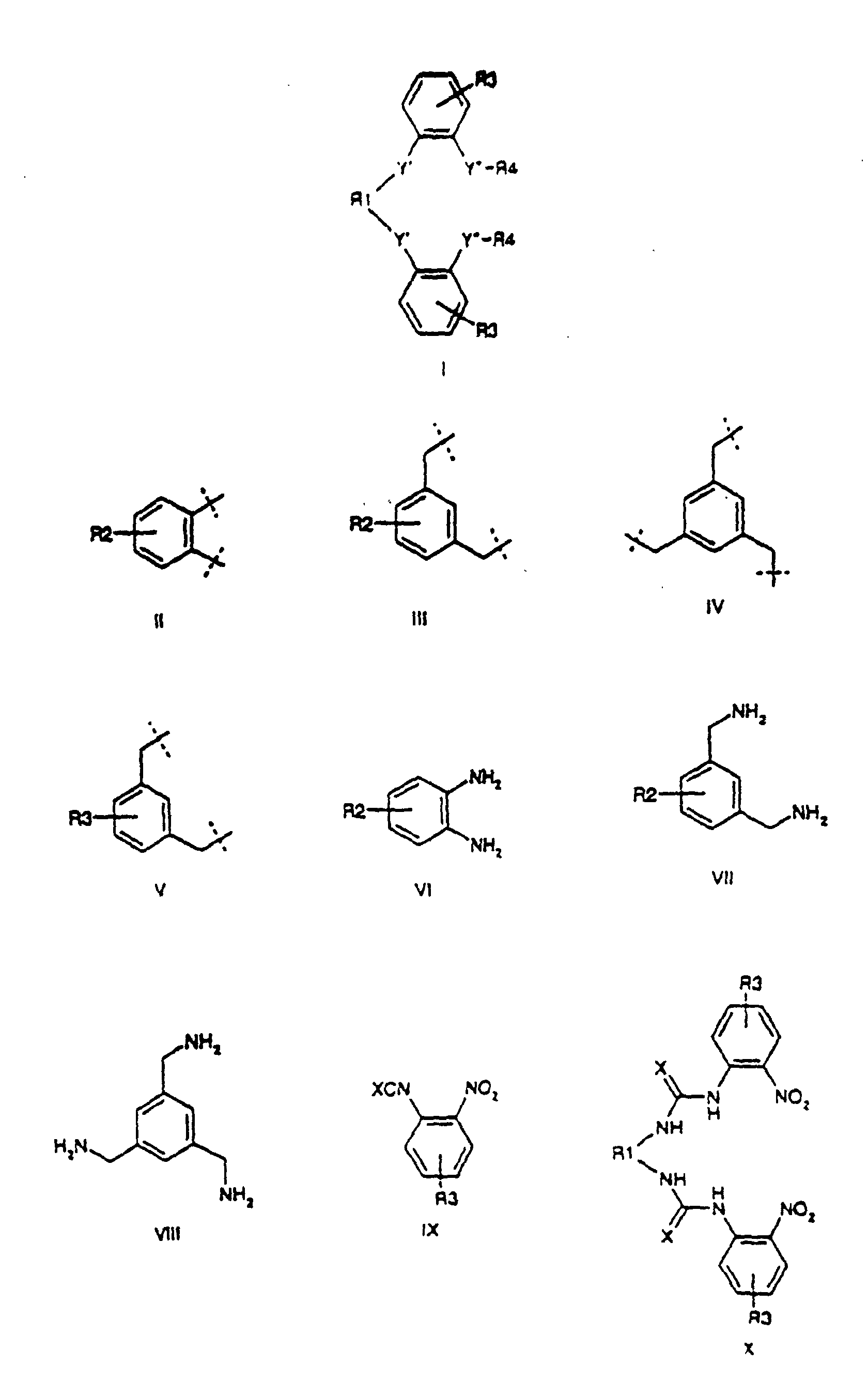
- The present invention relates to an anion-complexing compound with the formula I, whereinR1 is a rest selected from the group of rests with the formulas II, III, and IV;
 of which the ring may or may not be substituted with 1 to 3 R2 groups which may or may not be different from each other, wherein R2 represents alkyl or alkoxy;
Y' represents a -NHC(X)NH-group, and
Y" represents a rest selected from the group -NHC(X')-, -C(X')NH- and -NHC(X')NH-, wherein
X and X', independently of one another, represent a sulphur or oxygen atom;
the R3 groups, independently of each other, represent alkyl, alkoxy, NO2, or a halide selected from the group consisting of fluorine and chlorine; p is 0, 1 or2; and R4, R4' are either - a) identical, representing aryl that may or may not
be substituted with 1 or 2 R3 groups, an alkyl, an acyl
and an aryl sulphonyl which may or may not be substituted
with 1 or 2 R3 groups;
and an aryl sulphonyl which may or may not be substituted
with 1 or 2 R3 groups;
or - b) together form a single rest, which rest is
selected from the group of a rest with the formula V,
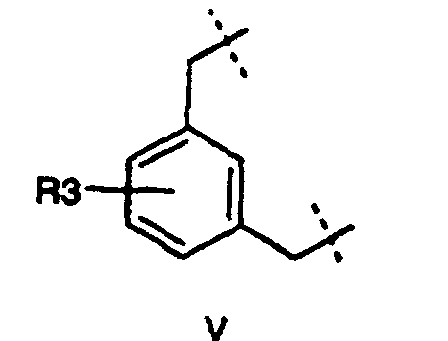 which may or may not be substituted with 1 or 2 R3 groups,
and an alkyl group with the formula -(CH2)n- wherein n is 2
to 6.
which may or may not be substituted with 1 or 2 R3 groups,
and an alkyl group with the formula -(CH2)n- wherein n is 2
to 6. -
- Alkyl in the present application is to be understood to be a hydrocarbon rest which may or may not be branched, having a chain length of 1 to 15 carbon atoms. The term alkoxy is understood to mean an -OR group, wherein R is an alkyl as previously defined. Aryl is understood to be a group according to formula v, wherein R is as previously defined. An acyl group is understood to be -C(O)R or an -C(O)Ar, wherein R stands for alkyl and Ar for aryl, both as previously defined.
- Nishizawa, S. et al (ref. 1) describe anion recognition by neutral urea and thiourea compounds with an anion-complexing activity. These compounds differ from the compounds according to the present invention in particular, through the smaller number of hydrogen bonds provided by the (thio)urea groups (2). As R1, which links the (thio)urea group, a rest derived from 1,3-bis(amino methyl) benzene is described.
- Buehlmann P. et al. (ref. 2; same authors as ref. 1) have described neutral bis-(thio)urea compounds. The compounds differ from the compounds of the present invention in particular in the smaller number of hydrogen bonds provided by the (thio)urea groups (2). Also described as R1, which binds the (thio)urea groups, is a 2,7-di-tert.-butyl-9,9-dimethyl-4,5-xanthene diamine-derived rest.
- Nishizawa, S. et al. (ref. 3) describe the application of compounds disclosed in Ref. 1 for an anion-selective electrode.
- Xiao, K.P. et al. (ref. 4, co-authors are among others Nishizawa and Buehlmann) describe the use of the bis-thio-ureaxanthene derivative described in ref. 2 in a membrane for a chloride-ion-selective electrode.
- All the above-described prior art compounds relate to bis(thio)urea compounds capable of donating four hydrogen bonds for binding negatively charged ions. The compounds according to the present invention differ from the known compounds in particular in the larger number (6 or more) of hydrogen bonds provided. Despite the fact that negatively charged ions are still bound by maximally four hydrogen bonds from (thio)urea, the compounds according to the present invention have surprisingly been shown to possess a strong affinity for (dihydrogen) phosphate ions.
- According to a favourable embodiment, Y" represents a (thio)urea group, and R4 and R4' an aryl group.
- Surprisingly, a compound according to the present invention in which R4 and R4' are aryl sulphonyl, but in particular aryl, has been found to bind two (dihydrogen) phosphate groups, with the phosphate groups interacting together by means of a hydrogen bond. Without the intention of being bound to any theory, it is believed that said interaction leads to an increased affinity constant that was observed.
- According to a further favourable embodiment at least one of X and X' is a sulphur atom.
- Such compounds were shown to exhibit higher affinity constants for (dihydrogen)phosphate ions.
- According to a further favourable embodiment R1 is substituted with two R2 groups.
- It has been found that such compounds are better able to bind anions. Without wishing to be tied to any theory, it is believed that the substituents help to prevent mutual interactions between molecules of the compounds according to the invention, such as hydrogen bonds and π-π stacks, resulting in hydrogen bonds being no longer available for binding anions. Suitable R2 groups are, for example, isopropyl groups.
- A method of preparing an anion-complexing compound with formula I, wherein a compound selected from the group comprising the compounds VI, VII and VIIIand R2 is as previously defined, is reacted with, in respect of the number of NH2 groups, a stoichiometric amount of a compound with the formula IX,
 wherein R3 is as previously defined, yielding an intermediate product with the formula X,
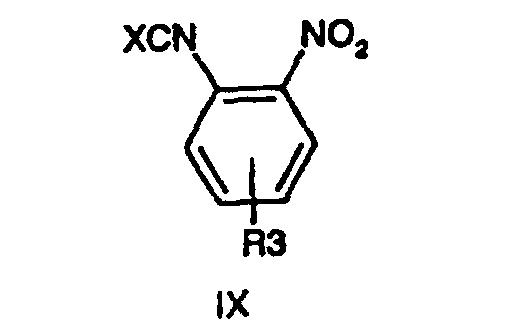 with R1 representing the corresponding rest having one of the formulas II, III and IV;
the compound with the formula X is reduced yielding a compound with the formula XI;and
the compound with the formula XI is reacted with a compound selected from the group comprising R5NCX', R5COCl, R5SO2Cl, R6(NCX')2, R6(COCl)2, and R6(SO2Cl)2, wherein R5 represents an aryl which may or may not be substituted with 1 or 2 R3 groups, an alkyl, an acyl and an arylsulphonyl which may or may not be substituted with 1 or 2 R3 groups; and R6 represents a rest selected from the group of a rest with the formula V, which may or may not be substituted with 1 or 2 R3 groups, and an alkyl group with the formula -(CH2)n- in which n is 2 to 6, yielding a compound with the formula I. - With respect to the last step it is observed that the reaction with an R5-comprising compound results in non-macro cyclic compounds, and those with an R6-comprising compound result in macro cyclic compounds with the formula I.
- The invention further relates to an ion-selective membrane comprising a compound according to the invention which is incorporated in a polymeric carrier material.
- Such a membrane may be utilized for carrying out separations, analyses, and in particular for sensors. A suitable polymeric carrier material is, for instance, PVC. The compound according to the invention may in accordance with coupling techniques that are known in the art, be coupled to the polymeric carrier material. Alternatively, the compound may also be dissolved in the polymeric carrier material. In particular the groups R2 and R3 could be suitably chosen for this purpose and may, for example, be alkyl.
- Therefore the invention also relates to a sensor provided with a compound or a membrane according to the invention.
- The sensor itself may be any suitable sensor known in the art, such as an ISFET. The compound may be applied, optionally covalently, to the surface of the sensor, using techniques for coupling molecules to a surface which are generally known in the art.
- The present invention will now be explained with reference to the exemplary embodiments and the illustration below, in which
- Fig. 1 represents a reaction scheme for the preparation of compounds according to the invention; and
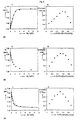
- Fig. 2a, 2b and 2c each show two graphs for a total of three compounds according to the invention. In the left-hand graph the NMR-measured chemical displacement is plotted against the concentration of dihydrogen phosphate. The right-hand graph is a Job-plot of the left-hand graph.
-
- For the preparation of the compounds below, which preparation is schematically illustrated in Fig. 1, and R1, R3, R4, R5, R6, X, X' and Y' have the above definitions, the dimethyl formamide (DMF) used has been distilled in the presence of CaCl2 and stored over molecular sieves (4 Å). Reactions with (thio)isocyanates were performed under argon.
-
- a) 1,3-bis(methylene(N'-2-nitrophenylureylene))-4,6-diisopropyl-m-xylene
2.3
mmol 1,3-bis(aminomethyl)-4,6-diisopropylbenzene obtained by the method described in ref. 5) is stirred with 2.6 mmol 2-nitrophenyl isocyanate under a dry argon atmosphere for 4 hours in 200 ml dry CH2Cl2. The precipitated yellow solid was obtained by filtration and dried under vacuum, yielding the title product.
Yield 1.0 g (80%). Fusion point 258°C.Chemical analysis for C28H32N6O6 Calculated C: 61.3 H: 5.9 N: 15.3 Found C: 61.2 H: 5.9 N: 15.1 - b) 1,3-bis(methylene(N'-aminophenylureylene))-4,6-diisopropyl-m-xylene
The bisnitro derivative was dissolved in a 1:1
mixture of tetrahydrofuran and methanol (100 ml). 0.44 ml
hydrazine monohydrate was added as well as a catalytic
amount (2.5 g; 50% slurry in water) of Raney nickel, and
the solution was refluxed overnight. The solution was filtered
over Hyflo (Fluka, Buchs, Switzerland) and the solvent
evaporated, yielding the title product.
Yield 100%. The product decomposed at 290°C.Chemical analysis for C28H36N6O2. Calculated C: 68.8 H: 7.4 N: 17.2 Found C: 69.0 H: 7.5 N: 17.4 - c) to 0.10 g (0.2 mmol) of the diamine obtained in
the previous step in 10 ml dry dimethylformamide 0.5 mmol
phenylisocyanate is added. The solution is stirred during
the night at room temperature. Water is added to eliminate
the excess isocyanate and the solution is concentrated by
evaporation. The crude product is stirred with methanol.
Filtration yielded the title product as white solid.
Yield 0.11g (75%). De substance decomposed at 247°C.Chemical analysis for C42H46N8O4.0.5 MeOH Calculated C: 68.7 H: 6.5 N: 15.1 Found C: 68.9 H: 6.5 N: 15.1 -
- The method of Example 1 is repeated, except that in step c) propyl isocyanate is used instead of phenyl isocyanate.
Yield 0.08 g (60%). The substance decomposed at 245°C.Chemical analysis for C36H50N8O4.MeOH Calculated C: 64.3 H: 7.9 N: 16.2 Found C: 64.6 H: 1.5 N: 16.5 - The
steps 2 a) and 2 b) are identical with the steps a) and b) of Example 1. - c) bisurea-bisthiourea compound XIV.
- This step was identical with step c) of Example 1, while replacing phenylisocyanate with phenylisothiocyanate.
Yield 0.09 g (60%). Fusion point: 163 - 166°C.Chemical analysis for C42H46N8O2S2. MeOH Calculated C: 65.3 H: 6.4 N: 14.2 S: 8.1 Found C: 65.1 H: 6.1 N: 14.3 S: 8.3 -

- Starting with 0.25 g (0.51 mmol) of the product obtained in Example 1 step b), the title compound is obtained by dissolving the starting product in 50 ml dry DMF and adding 0.51 mmol 1,3-bis(isocyanatomethyl)benzene. The solution is stirred overnight, the solvent is evaporated and the crude product is stirred with methanol. After filtering the title product is obtained as a white solid. Yield 0.29 g (85%). The product decomposed at 230°C.
Chemical analysis for C38H44N8O4 Calculated C: 67.4 H: 6.6 N: 16.6 Found C: 67.7 H: 6.6 N: 16.5 -

- The method described in Example 4 was repeated while replacing 1,3-bis(isocyanatomethyl)benzene with 1,4-diisocyanatobutane. 0.30 g product was obtained (yield 85%) which decomposed at 280°C.
Chemical analysis for C34H44N8O4 Calculated C: 65.0 H: 7.1 N: 17.8 Found C: 65.2 H: 7.2 N: 18.1 - The ability to bind anions was studied with the aid of 250 MHz 1H-NMR spectroscopy in dimethylsulphoxide. To this end 12.5 mmol of a compound according to one of the Examples 1, 2 and 4 were dissolved in 5 ml DMSO-d6. A solution of tetrabutyl ammonium salts of Cl-, Br-, NO3 -, HSO4 - and H2PO4 - (2.5 mmol per litre) in DMSO-d6 was added. The observed displacement of a proton of R1 was plotted against the concentration dihydrogen phosphate (left-hand graphs in Fig. 2). Also, a Job-plot was made based on the measurements.
- The Job-plot of the H2PO4 --complexing of tetrakisurea compound XIII shows that a maximum complex concentration occurs at a value indicating a ratio of bound H2PO4 - : XIII of 1.9. Assuming a 2:1 stoichiometry for the complex, an association constant of 5x10⁷ M-2 is calculated. Such an association constant is the upper limit that can be measured with the aid of the used NMR technique. Neither Br- nor NO3 - or HSO4 - induce a displacement in the NMR spectrum. One equivalent Cl- only results in a small displacement (approximately 0.02 ppm) of the urea protons. The displacements induced by H2PO4 are much greater. Tetrakisthiourea compound XIV gives an association constant comparable with XIII, the upper limit of the method of detection used (not shown). Cl- was shown to bind to XIV at a ratio of 1:1 and the association constant was determined at 250 M-1.
- Fig. 2b shows that the compound according to Example 2 (XVII, in which R4 is an alkyl group), binds dihydrogen phosphate as a 1:1 complex but also as a 1:2 complex (the Job-plot shows a maximum at 0.56). Due to this it is not possible to accurately calculate an association constant.
- Fig. 2c shows that the macro cyclic tetrakisurea compound XV of Example 4 binds H2PO4 - exclusively in a 1:1 stoichiometry. Based on the displacement measured, an association constant of 2.5x10³ M-1 was measured. This compound's complexing of Cl- results in a displacement of 0.08 ppm at total complexing for the aromatic urea protons at 7.93 and 7.89 ppm. For Cl- an association constant of 500 M-1 was calculated.
- The macro cyclic tetrakisurea compound XVI of Example 5 is shown to have a comparable binding strength for H2PO4 - (4.0x10³ M-1), but the binding of Cl- is considerably lower (Ka <50 M-1) (not shown). Consequently, the compound according to Example binds 5 H2PO4 - at least 100 times more selective than Cl-.

-
- 1. Nishizawa, S. et al. Tetrahedron Letters, 36(36), pp. 6483-6486 (1995).
- 2. Buehlmann, P. et al. Tetrahedron, 53(5), pp. 1647-1654 (1997).
- 3. Nishizawa, S. et al. Analytica Chimica Acta, 358, pp. 35-44 (1998).
- 4. Xiao, P.K. et al. Anal. Chem. 69, pp. 1038-1044 (1997)
- 5. Seto, C.T. et al. J. Am. Chem. Soc. 115, pp. 1321-1329 (1993).
-
Claims (7)
- An anion-complexing compound with the formula Iwherein

R1 is a rest selected from the group of rests with the formulas II, III, and IVof which the ring may or may not be substituted with 1 to 3 R2 groups which may or may not be different from each other, wherein R2 represents alkyl or alkoxy;
Y' represents a -NHC(X)NH-group, and
Y" represents a rest selected from the group -NHC(X')-, -C(X')NH- and -NHC(X')NH-, wherein
X and X', independently of one another, represent a sulphur or oxygen atom;
the R3 groups, independently of each other, represent alkyl, alkoxy, NO2, or a halide selected from the group consisting of fluorine and chlorine; p is 0, 1 or 2; and R4, R4' are eitherwhich may or may not be substituted with 1 or 2 R3 groups, and an alkyl group with the formula -(CH2)n- wherein n is 2 to 6.a) identical, representing aryl that may or may not be substituted with 1 or 2 R3 groups, an alkyl, an acyl and an aryl sulphonyl which may or may not be substituted with 1 or 2 R3 groups;
orb) together form a single rest, which rest is selected from the group of a rest with the formula v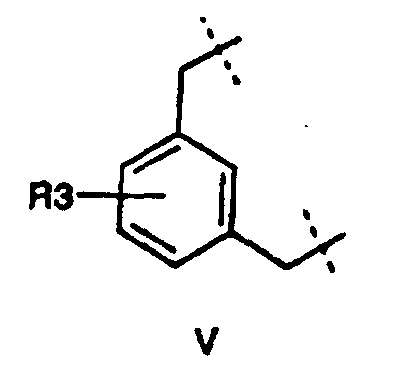
- A compound according to claim 1, characterized in that Y" represents a (thio)urea group, and R4 and R4' an aryl group.
- A compound according to claim 1 or 2, characterized in that at least one of X and X' is a sulphur atom.
- A compound according to one of the preceding claims, characterized in that R1 is substituted with R2 groups.
- A method of preparing an anion-complexing compound with formula Iwherein a compound selected from the group comprising the compounds VI, VII and VIII
 and R2 is as previously defined, is reacted with, in respect of the number of NH2 groups, a stoichiometric amount of a compound with the formula IX
 wherein R3 is as previously defined, yielding an intermediate product with the formula X
 with R1 representing the corresponding rest having one of the formulas II, III and IV;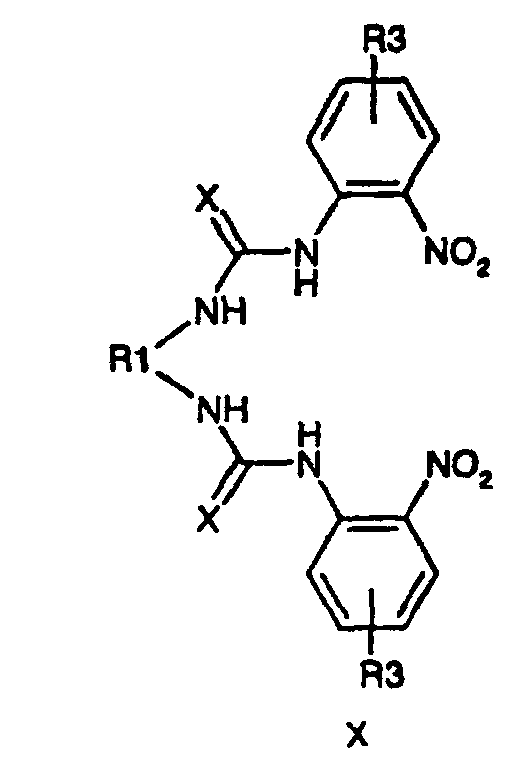
the compound with the formula X is reduced yielding a compound with the formula XIand
the compound with the formula XI is reacted with a compound selected from the group comprising R5NCX', R5COCl, R5SO2Cl, R6(COCl)2, R6(COCl)2, and R6(SO2Cl)2, wherein R5 represents an aryl which may or may not be substituted with 1 or 2 R3 groups, an alkyl, an acyl and an arylsulphonyl which may or may not be substituted with 1 or 2 R3 groups; and R6 represents a rest selected from the group of a rest with the formula V, which may or may not be substituted with 1 or 2 R3 groups, and an alkyl group with the formula -(CH2)n- in which n is 2 to 6, yielding a compound with the formula I. - An ion-selective membrane comprising a compound according to one of the claims 1 to 4 which is incorporated in a polymeric carrier material.
- A sensor provided with a compound according to one of the claims 1 to 4 or a membrane according to claim 6.
Applications Claiming Priority (3)
| Application Number | Priority Date | Filing Date | Title |
|---|---|---|---|
| NL1008789A NL1008789C2 (en) | 1998-04-02 | 1998-04-02 | Anion complexing compound, method for its preparation, an ion-selective membrane as well as a sensor provided with such a compound or membrane. |
| NL1008789 | 1998-04-02 | ||
| PCT/NL1999/000196 WO1999051570A1 (en) | 1998-04-02 | 1999-04-01 | Anion-complexing compound, method of preparing the same, an ion-selective membrane and a sensor provided with such a compound or membrane |
Publications (2)
| Publication Number | Publication Date |
|---|---|
| EP1073629A1 EP1073629A1 (en) | 2001-02-07 |
| EP1073629B1 true EP1073629B1 (en) | 2004-02-25 |
Family
ID=19766882
Family Applications (1)
| Application Number | Title | Priority Date | Filing Date |
|---|---|---|---|
| EP99913743A Expired - Lifetime EP1073629B1 (en) | 1998-04-02 | 1999-04-01 | Anion-complexing compound, method of preparing the same, an ion-selective membrane and a sensor provided with such a compound or membrane |
Country Status (9)
| Country | Link |
|---|---|
| US (1) | US6468406B1 (en) |
| EP (1) | EP1073629B1 (en) |
| JP (1) | JP2002510672A (en) |
| AT (1) | ATE260245T1 (en) |
| AU (1) | AU3173899A (en) |
| CA (1) | CA2326844A1 (en) |
| DE (1) | DE69915048D1 (en) |
| NL (1) | NL1008789C2 (en) |
| WO (1) | WO1999051570A1 (en) |
Families Citing this family (9)
| Publication number | Priority date | Publication date | Assignee | Title |
|---|---|---|---|---|
| US7432371B2 (en) | 2002-02-07 | 2008-10-07 | Covalent Partners, Llc | Nanofilm and membrane compositions |
| AU2003212974B2 (en) | 2002-02-07 | 2008-08-14 | Covalent Partners, Llc | Macrocyclic module compositions |
| US20040106741A1 (en) | 2002-09-17 | 2004-06-03 | Kriesel Joshua W. | Nanofilm compositions with polymeric components |
| EP1667965A2 (en) | 2003-08-06 | 2006-06-14 | Covalent Partners, LLC | Bridged macrocyclic module compositions |
| US20170184535A1 (en) * | 2014-03-17 | 2017-06-29 | Board Of Regents, The University Of Texas System | Conducting polymers for direct sensing of metal ions |
| JP7427449B2 (en) * | 2017-03-15 | 2024-02-05 | ノヴォ・ノルディスク・リサーチ・センター・オックスフォード・リミテッド | macrocyclic compound |
| CN113164764B (en) | 2018-09-19 | 2025-07-29 | 诺和诺德牛津研究中心有限公司 | Glucose-sensitive insulin and use thereof |
| GB202201000D0 (en) * | 2022-01-26 | 2022-03-09 | Carbometrics Ltd | Saccharide sensing systems |
| CN119613418B (en) * | 2024-12-09 | 2025-10-24 | 北京理工大学 | A dodecanurea cage molecule, preparation method and application |
Family Cites Families (2)
| Publication number | Priority date | Publication date | Assignee | Title |
|---|---|---|---|---|
| JP2903077B2 (en) * | 1990-09-11 | 1999-06-07 | 科学技術振興事業団 | Urea derivative, urea derivative-containing composition and functional thin film |
| US5180481A (en) * | 1992-03-24 | 1993-01-19 | Clifton Carey | Phosphate selective composition and electrode |
-
1998
- 1998-04-02 NL NL1008789A patent/NL1008789C2/en not_active IP Right Cessation
-
1999
- 1999-04-01 CA CA002326844A patent/CA2326844A1/en not_active Abandoned
- 1999-04-01 AU AU31738/99A patent/AU3173899A/en not_active Abandoned
- 1999-04-01 JP JP2000542292A patent/JP2002510672A/en active Pending
- 1999-04-01 US US09/647,818 patent/US6468406B1/en not_active Expired - Fee Related
- 1999-04-01 WO PCT/NL1999/000196 patent/WO1999051570A1/en not_active Ceased
- 1999-04-01 EP EP99913743A patent/EP1073629B1/en not_active Expired - Lifetime
- 1999-04-01 DE DE69915048T patent/DE69915048D1/en not_active Expired - Lifetime
- 1999-04-01 AT AT99913743T patent/ATE260245T1/en not_active IP Right Cessation
Also Published As
| Publication number | Publication date |
|---|---|
| ATE260245T1 (en) | 2004-03-15 |
| AU3173899A (en) | 1999-10-25 |
| JP2002510672A (en) | 2002-04-09 |
| WO1999051570A1 (en) | 1999-10-14 |
| DE69915048D1 (en) | 2004-04-01 |
| CA2326844A1 (en) | 1999-10-14 |
| US6468406B1 (en) | 2002-10-22 |
| EP1073629A1 (en) | 2001-02-07 |
| NL1008789C2 (en) | 1999-10-05 |
Similar Documents
| Publication | Publication Date | Title |
|---|---|---|
| US7160466B2 (en) | Uses of cucurbituril devices | |
| Behr et al. | Molecular receptors. Structural effects and substrate recognition in binding of organic and biogenic ammonium ions by chiral polyfunctional macrocyclic polyethers bearing amino‐acid and other side‐chains | |
| US20030212268A1 (en) | Water-and organic-soluble cucurbituril derivatives, their preparation methods, their separation methods and uses | |
| US6468406B1 (en) | Anion-complexing compound, method of preparing the same, an ion-selective membrane and a sensor provided with such a compound or membrane | |
| Beer et al. | Anion recognition by acyclic redox-responsive amide-linked cobaltocenium receptors | |
| Hathcock et al. | Electron donating substituent effects on redox and spin state properties of iron (II) bis-terpyridyl complexes | |
| Schindler et al. | Syntheses, structures, and properties of copper (II) and copper (I) complexes of the new binucleating ligand 1, 3-bis [bis (2-pyridylmethyl) amino] benzene | |
| Nakamura et al. | Reactivity of oxomolybdenum (VI),-(V), and-(IV) compounds as controlled by sulfur chelate ligands | |
| US6664408B2 (en) | Process for preparing organically-substituted polyoxometalates | |
| Boitrel et al. | Characterization and application of a new diprotected cyclam: a novel two-step synthesis of linked tetraazamacrocycles | |
| Micheletti et al. | New electron-donor and-acceptor architectures from benzofurazans and sym-triaminobenzenes: Intermediates, products and an unusual nitro group shift | |
| Sawtschenko et al. | Electrochemical and spectroelectrocemical studies of dihydro-tetra-azapentacene as a model of polyazaacene | |
| Maas et al. | Dication disulfides by reaction of thioureas and related compounds with trifluoromethanesulfonic anhydride. The role of triflic anhydride as an oxidizing agent | |
| US3594349A (en) | Substituted polymeric as-triazines | |
| Kowallick et al. | Metal Complexes with Macrocyclic Ligands. PartXLV Axial coordination tendency in reinforced tetraazamacrocyclic complexes | |
| US4076724A (en) | Polycyclic macrocyclic compounds | |
| Otsuki et al. | A bis-crown ether derivative of triaminotriazine: Synthesis and behavior of the ion-selective and hydrogen-bonding responsive rotamers | |
| Alper et al. | Exceedingly Mild Desulfurization of Thiols by Sodium Triethylhydroborate and Transition Metal Chlorides | |
| Stewart et al. | Host-guest complexation. 40. Synthesis and complexation of macrocyclic hosts containing cyclic ureas, anisyls, and steric barriers | |
| Lukyanenko et al. | Novel cryptands containing thiourea units as a part of the macrocyclic framework | |
| Hassan et al. | Bis-urea anion receptors: influence of receptor structure and anion nature on binding affinity and stability | |
| EP1240150A1 (en) | Macrocyclic compounds and their use | |
| KR102654654B1 (en) | Synthesis of triple hydrogen-bonding donor bearing n-triflylphosphoramide and derivatives thereof | |
| Ocak et al. | The synthesis and characterization of a new (E, E)-dioxime and its homo-and heterotrinuclear complexes containing a hexaoxadiaza macrobicycle moiety | |
| Yamamoto | ISOLATION OF BIS (TRISDIMETHYLAMINOPHOSPHONIUMMETHYLIDE) GOLD (I) CHLORIDE |
Legal Events
| Date | Code | Title | Description |
|---|---|---|---|
| PUAI | Public reference made under article 153(3) epc to a published international application that has entered the european phase |
Free format text: ORIGINAL CODE: 0009012 |
|
| 17P | Request for examination filed |
Effective date: 20001006 |
|
| AK | Designated contracting states |
Kind code of ref document: A1 Designated state(s): AT BE CH DE DK FR GB LI NL SE |
|
| RAP1 | Party data changed (applicant data changed or rights of an application transferred) |
Owner name: PRIVA HOLDING B.V. |
|
| 17Q | First examination report despatched |
Effective date: 20020826 |
|
| GRAP | Despatch of communication of intention to grant a patent |
Free format text: ORIGINAL CODE: EPIDOSNIGR1 |
|
| GRAS | Grant fee paid |
Free format text: ORIGINAL CODE: EPIDOSNIGR3 |
|
| GRAA | (expected) grant |
Free format text: ORIGINAL CODE: 0009210 |
|
| AK | Designated contracting states |
Kind code of ref document: B1 Designated state(s): AT BE CH DE DK FR GB LI NL SE |
|
| PG25 | Lapsed in a contracting state [announced via postgrant information from national office to epo] |
Ref country code: NL Free format text: LAPSE BECAUSE OF FAILURE TO SUBMIT A TRANSLATION OF THE DESCRIPTION OR TO PAY THE FEE WITHIN THE PRESCRIBED TIME-LIMIT Effective date: 20040225 Ref country code: LI Free format text: LAPSE BECAUSE OF FAILURE TO SUBMIT A TRANSLATION OF THE DESCRIPTION OR TO PAY THE FEE WITHIN THE PRESCRIBED TIME-LIMIT Effective date: 20040225 Ref country code: FR Free format text: LAPSE BECAUSE OF FAILURE TO SUBMIT A TRANSLATION OF THE DESCRIPTION OR TO PAY THE FEE WITHIN THE PRESCRIBED TIME-LIMIT Effective date: 20040225 Ref country code: CH Free format text: LAPSE BECAUSE OF FAILURE TO SUBMIT A TRANSLATION OF THE DESCRIPTION OR TO PAY THE FEE WITHIN THE PRESCRIBED TIME-LIMIT Effective date: 20040225 Ref country code: BE Free format text: LAPSE BECAUSE OF FAILURE TO SUBMIT A TRANSLATION OF THE DESCRIPTION OR TO PAY THE FEE WITHIN THE PRESCRIBED TIME-LIMIT Effective date: 20040225 Ref country code: AT Free format text: LAPSE BECAUSE OF FAILURE TO SUBMIT A TRANSLATION OF THE DESCRIPTION OR TO PAY THE FEE WITHIN THE PRESCRIBED TIME-LIMIT Effective date: 20040225 |
|
| REG | Reference to a national code |
Ref country code: GB Ref legal event code: FG4D |
|
| REG | Reference to a national code |
Ref country code: CH Ref legal event code: EP |
|
| REF | Corresponds to: |
Ref document number: 69915048 Country of ref document: DE Date of ref document: 20040401 Kind code of ref document: P |
|
| PG25 | Lapsed in a contracting state [announced via postgrant information from national office to epo] |
Ref country code: SE Free format text: LAPSE BECAUSE OF FAILURE TO SUBMIT A TRANSLATION OF THE DESCRIPTION OR TO PAY THE FEE WITHIN THE PRESCRIBED TIME-LIMIT Effective date: 20040525 Ref country code: GB Free format text: LAPSE BECAUSE OF NON-PAYMENT OF DUE FEES Effective date: 20040525 Ref country code: DK Free format text: LAPSE BECAUSE OF FAILURE TO SUBMIT A TRANSLATION OF THE DESCRIPTION OR TO PAY THE FEE WITHIN THE PRESCRIBED TIME-LIMIT Effective date: 20040525 |
|
| PG25 | Lapsed in a contracting state [announced via postgrant information from national office to epo] |
Ref country code: DE Free format text: LAPSE BECAUSE OF FAILURE TO SUBMIT A TRANSLATION OF THE DESCRIPTION OR TO PAY THE FEE WITHIN THE PRESCRIBED TIME-LIMIT Effective date: 20040526 |
|
| NLV1 | Nl: lapsed or annulled due to failure to fulfill the requirements of art. 29p and 29m of the patents act | ||
| REG | Reference to a national code |
Ref country code: CH Ref legal event code: PL |
|
| PLBE | No opposition filed within time limit |
Free format text: ORIGINAL CODE: 0009261 |
|
| STAA | Information on the status of an ep patent application or granted ep patent |
Free format text: STATUS: NO OPPOSITION FILED WITHIN TIME LIMIT |
|
| GBPC | Gb: european patent ceased through non-payment of renewal fee |
Effective date: 20040525 |
|
| EN | Fr: translation not filed | ||
| 26N | No opposition filed |
Effective date: 20041126 |