EP1073137A2 - Battery grids - Google Patents
Battery grids Download PDFInfo
- Publication number
- EP1073137A2 EP1073137A2 EP00113408A EP00113408A EP1073137A2 EP 1073137 A2 EP1073137 A2 EP 1073137A2 EP 00113408 A EP00113408 A EP 00113408A EP 00113408 A EP00113408 A EP 00113408A EP 1073137 A2 EP1073137 A2 EP 1073137A2
- Authority
- EP
- European Patent Office
- Prior art keywords
- grid
- positive
- web
- thickness
- cast
- Prior art date
- Legal status (The legal status is an assumption and is not a legal conclusion. Google has not performed a legal analysis and makes no representation as to the accuracy of the status listed.)
- Withdrawn
Links
Images

Classifications
-
- H—ELECTRICITY
- H01—ELECTRIC ELEMENTS
- H01M—PROCESSES OR MEANS, e.g. BATTERIES, FOR THE DIRECT CONVERSION OF CHEMICAL ENERGY INTO ELECTRICAL ENERGY
- H01M4/00—Electrodes
- H01M4/02—Electrodes composed of, or comprising, active material
- H01M4/64—Carriers or collectors
- H01M4/70—Carriers or collectors characterised by shape or form
- H01M4/72—Grids
-
- H—ELECTRICITY
- H01—ELECTRIC ELEMENTS
- H01M—PROCESSES OR MEANS, e.g. BATTERIES, FOR THE DIRECT CONVERSION OF CHEMICAL ENERGY INTO ELECTRICAL ENERGY
- H01M4/00—Electrodes
- H01M4/02—Electrodes composed of, or comprising, active material
- H01M4/64—Carriers or collectors
- H01M4/70—Carriers or collectors characterised by shape or form
- H01M4/72—Grids
- H01M4/73—Grids for lead-acid accumulators, e.g. frame plates
-
- Y—GENERAL TAGGING OF NEW TECHNOLOGICAL DEVELOPMENTS; GENERAL TAGGING OF CROSS-SECTIONAL TECHNOLOGIES SPANNING OVER SEVERAL SECTIONS OF THE IPC; TECHNICAL SUBJECTS COVERED BY FORMER USPC CROSS-REFERENCE ART COLLECTIONS [XRACs] AND DIGESTS
- Y02—TECHNOLOGIES OR APPLICATIONS FOR MITIGATION OR ADAPTATION AGAINST CLIMATE CHANGE
- Y02E—REDUCTION OF GREENHOUSE GAS [GHG] EMISSIONS, RELATED TO ENERGY GENERATION, TRANSMISSION OR DISTRIBUTION
- Y02E60/00—Enabling technologies; Technologies with a potential or indirect contribution to GHG emissions mitigation
- Y02E60/10—Energy storage using batteries
-
- Y—GENERAL TAGGING OF NEW TECHNOLOGICAL DEVELOPMENTS; GENERAL TAGGING OF CROSS-SECTIONAL TECHNOLOGIES SPANNING OVER SEVERAL SECTIONS OF THE IPC; TECHNICAL SUBJECTS COVERED BY FORMER USPC CROSS-REFERENCE ART COLLECTIONS [XRACs] AND DIGESTS
- Y02—TECHNOLOGIES OR APPLICATIONS FOR MITIGATION OR ADAPTATION AGAINST CLIMATE CHANGE
- Y02P—CLIMATE CHANGE MITIGATION TECHNOLOGIES IN THE PRODUCTION OR PROCESSING OF GOODS
- Y02P70/00—Climate change mitigation technologies in the production process for final industrial or consumer products
- Y02P70/50—Manufacturing or production processes characterised by the final manufactured product
-
- Y—GENERAL TAGGING OF NEW TECHNOLOGICAL DEVELOPMENTS; GENERAL TAGGING OF CROSS-SECTIONAL TECHNOLOGIES SPANNING OVER SEVERAL SECTIONS OF THE IPC; TECHNICAL SUBJECTS COVERED BY FORMER USPC CROSS-REFERENCE ART COLLECTIONS [XRACs] AND DIGESTS
- Y10—TECHNICAL SUBJECTS COVERED BY FORMER USPC
- Y10T—TECHNICAL SUBJECTS COVERED BY FORMER US CLASSIFICATION
- Y10T29/00—Metal working
- Y10T29/10—Battery-grid making
Definitions
- This invention relates to lead-acid batteries and more particularly to cast grids for these batteries and a method and apparatus of making continuously cast grids.
- the lead grids of the positive plates are subject to far more corrosion and growth than are the grids of the negative plates.
- the lead in the positive plates corrodes or erodes away and disappears which decreases and eventually ends the useful life or life cycle of the battery.
- the lead grids of the positive plates also grow and expand or elongate, particularly in length and height, on the order of 5% to 15% of their original length and height. This tends to cause the positive grid plates to pierce their separators or envelopes and short or ground out with an adjacent negative plate. This growth also tends to limit the design or pattern of the wires of the positive grids because diagonal wires are longer and hence have a greater absolute increase in length and hence a greater tendency to pierce a separator and short out.
- lead battery grids may be made by (1) continuous casting of a web having a plurality of interconnected grids which are subsequently separated, (2) book molding or casting an individual grid or a panel of two grids in a mold usually of cast iron or steel which is water cooled or (3) by an expanded metal process. It has been found that compared to book molded grids, when continuous cast grids are utilized in positive plates, they are subject to greater growth and significantly increased corrosion which results in a useful life in service of about one-half to two-thirds of book molded grids as determined by SAE J-240 life cycle tests. Consequently, for many lead-acid battery applications, such as automotive batteries, continuously cast grids are unsatisfactory for positive battery plates or electrodes. Nevertheless, primarily due to reduced manufacturing and assembly costs, continuously cast lead grids are utilized in the negative plates or electrodes of many automotive batteries.
- a plurality of grids are cast as a continuous strip or web of lead which may be washed to remove molding compounds and lubricants and is usually coiled for inspection and storage before further processing. Subsequently, the web is uncoiled, passed through a continuous pasting machine, cut into individual pasted grids or plates which are passed through a drying oven to remove excess moisture from the paste, and then stacked in piles of individual plates by a stacker for subsequent processing and assembly as negative plates in lead acid batteries.
- Suitable continuous casting machines are disclosed in U.S. Pat. Nos.
- U.S. Pat. No. 5,611,128 discloses a method and apparatus for improving the performance of continuously cast battery positive grids by reducing the thickness of the grids by about 4 to 1.
- the reduction in thickness provides increased tensile strength and resistance to corrosion to extend the life of a battery containing these grids, and provides a lighter battery grid comparable to gravity cast grids which require less material to form and assemble and thereby reduces the cost to form a battery containing the grids.
- the grids formed according to the present invention require a very thick as cast thickness and when made thinner by mechanical reduction, the wires become undesirably wide.
- the grids so formed, while lighter than previous continuously cast positive grids remain relatively heavy. Still further, while the strength and corrosion resistance of grids formed according to the method of this patent may be increased, the large reduction tends to cause more distortion in diagonal grid designs.
- a battery positive grid is continuously cast of lead and cold worked to reduce its cross sectional thickness and elongate it to change the microstructure of the lead and provide enhanced corrosion resistance, tensile strength after age hardening and other properties needed for positive grids.
- the as cast thickness of the positive grids is reduced by not more than 2.5:1, and preferably in the range of about 1.5:1 to 2:1, to produce an improved positive grid which improves the life of a battery in which it is used.
- a battery negative grid is continuously cast of lead and thereafter cold worked to reduce its cross sectional thickness and elongate it to increase the ultimate tensile strength needed for a lighter negative grid.
- the as cast thickness of the negative grids is reduced in the range of about 1.2:1 to 2.0:1 and preferably 1.2:1 to 1.5:1 to produce the desired properties for negative grids after age hardening.
- the positive and negative grids are made by continuous casting an elongate web of a plurality of grid blanks, preferably washing the web to remove molding compounds, and then passing the web through the nip of one or more pairs of compression rollers to reduce the thickness of the web.
- the thickness of the web is usually reduced within 24 hours, desirably within 12 hours, preferably within 4 hours and more preferably right after being continuously cast and washed or cleaned. This reduction in thickness also significantly increases the length of the web and grid wires extending parallel to the direction of travel of the web through the rollers and substantially increases the width of the grid wires extending transversely to the direction of travel of the web through the rollers.
- the web is pasted, preferably cut into wet pasted grids or plates, dried to remove moisture and at least begin curing the paste, preferably at an elevated temperature in a drying oven, and usually stacked in piles for subsequent assembly as positive and negative plates or electrodes of a lead acid battery.
- Objects, features and advantages of this invention are to provide continuously cast battery positive grids which have greatly improved corrosion resistance and significantly reduced growth in use, and to provide continuously cast positive and negative grids which have a longer in service useful life, fewer short outs and premature failures, require less lead, can be readily produced with a wide variety of wire configurations, have improved tolerances and dimensional control, are produced with less scrap, improved quality, and at higher production rates, can be easily produced by automated manufacturing processes and equipment, and are stable, rugged, durable, reliable and of relatively simple design, economical manufacture and assembly.
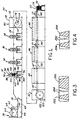
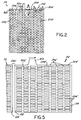
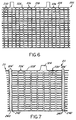
- FIG. 1 illustrates a production line 20 for utilizing the method of this invention to make battery positive grids 22 (FIG. 5) and negative grids 23 (FIG. 7), and battery plates or electrodes of this invention.
- a web 24 of a plurality of interconnected successive grid blanks is continuously cast from a molten lead composition by a continuous casting machine 28.
- the moving web 24 is reduced in cross section and elongated in the direction of travel by a series of compression roller machines 32, 34, 36 & 38 and wound on a drum or reel in a coiling machine 40 for inspection, handling and any storage before further processing.
- the web is unwound from the reel in an uncoiling machine 42, passes through a continuous pasting machine 44, which applies battery paste to the web and a cutting machine 46 which cuts individual pasted grids or plates from the web.
- the individual pasted plates pass in succession through a drying oven 48 which removes moisture from the paste and through a stacking machine 50 which deposits the individual plates in piles or stacks 52 which are removed for any further processing and assembly into a lead-acid battery as plates or electrodes of the battery.
- the casting machine 28 casts the web 24 of lead with a plurality of successive grid blanks in a continuous manner.
- molten lead is supplied to a mold cavity in a rotating cylindrical drum 60 under superatmospheric pressure through an orifice slot 62 in a shoe 64 with an arcuate segment bearing on the peripheral surface of the drum.
- a grid pattern is machined in the peripheral surface of the drum 60 to form a mold cavity in which the lead rapidly solidifies as it is advanced beyond the orifice slot 62 which opens onto the drum.
- the solidified web 24 is stripped from the rotating drum and preferably passed through a water bath 66 to rapidly quench and cool it and under a guide roller 68.
- the web is continuously cast at a rate of about 50 to 200 lineal feet per minute.
- the cross sectional thickness of the web 24 is reduced and the web is elongated in its direction of travel in each of the succeeding roller stands 32, 34, 36 and 38. Since each of the roller stands has essentially the same construction and arrangement, only the first roller stand 32 will be described in detail.
- each stand has a pair of compression rollers 84 and 86 each journalled for rotation in bearings received in axially spaced apart pairs of carrier blocks 88 and 90.
- the lower roller 86 is driven by an electric motor 96 through a timing belt 98 and complementary cog pulleys mounted on the motor drive shaft 100 and the shaft 102 of the roller 86.
- the upper roller 84 is driven by a gear 103 mounted on its roller shaft 104 which meshes with a complimentary gear 105 mounted on the lower roller shaft 102.
- the motor 96 is a variable speed electric motor to facilitate driving the rollers 84 and 86 at the proper peripheral surface speed to feed the web 24 through the nip of the compression rollers.
- This surface speed differs for each stand 32-38 because each time the web is reduced in thickness, it is elongated in the direction of travel of the web thereby requiring that the rollers in each succeeding stand be driven at a higher peripheral surface speed.
- the rollers 84 and 86 are driven at a constant peripheral surface speed substantially equal to the speed of the web as it enters the stand.
- the moving web After the moving web emerges from the last roller stand 38, it enters a coiler machine 40.
- the reduced web 24' passes over a guide roller 110 and is wound in a coil on a reel 112 received on a pair of arbors 113 carried by a pair of upright end plates 114 fixed to the face of the coiler machine.
- the reel 112 is rotated by a variable speed electric motor (not shown) at a rotary speed which decreases as the diameter of the coil 116 increases to take up the reduced web 24' at the rate it emerges from the last roller stand 38.
- the uncoiling machine 42 has essentially the same construction as the coiler 40 with a coil 120 of a reduced web 24' wound on a reel 122 which is received on arbors in the unwinder.
- the reel 122 is rotated to unwind the coil 120 by a variable speed motor (not shown).
- the motor increases the speed at which the reel is rotated as the coil 120 unwinds and hence its diameter decreases.
- a web coiler 40 and uncoiler 42 are used in the production line so that the casting, washing and rolling steps can be carried out independently of the pasting, cuffing, drying and stacking steps.
- This provides greater flexibility in production operations and readily accommodates the differential between the lineal speed at which the reduced web 24' emerges from the last roller stand 38 (100 to 250 lineal feet per minute) relative to the much slower speed at which it is supplied to the pasting machine (typically 50-200 lineal feet per minute).
- This also permits inspection, storage, and, if desired, age hardening of the reduced web 24' before it is further processed. This also permits either portion of the line to be repaired or serviced while the other portion is in production and either portion to be idle when it is not needed for production.
- An electro-chemically active paste is applied to the reduced web 24' as it passes through the pasting machine 44. All of the interstices or open spaces between the wires of the web are filled with the paste, and preferably the web is "over pasted" so that the wires are completely embedded in and surrounded by the paste and the paste extends outwardly from both the top and bottom faces of the web and has a thickness greater than the thickness of the web.
- the paster applies a strip of paper to both the top and bottom exposed faces of the paste which prevents the paste from sticking to the equipment and facilitates downstream handling and processing of the pasted web 24''.
- a suitable machine for continuously pasting the web is disclosed in U.S. Pat. No. 4,606,383, the disclosure of which is incorporated herein by reference and hence the paster 44 will not be described in greater detail.
- the pasted web 24'' is advanced by a powered belt conveyor 130 into the cutting machine 46 which cuts or severs the pasted web 24'' into individual pasted plates 131.
- the cutter has appropriate synchronizing circuitry so that the web is cut through the center of a double width transversely extending frame wire to produce, as shown FIG. 5, the trailing frame wire 132 of the grid 22 of one pasted plate and the leading frame wire 134 of the grid 22 of the immediately succeeding pasted grid.
- the individual pasted plates 131 are received on a belt conveyor 140 which moves them through the flash drying oven 48.
- the conveyor 140 is driven at a greater lineal speed than the lineal speed of the individual plates 131 emerging from the cutting machine 46.
- oven 48 merely dries or removes moisture from the outer layer or skin of the faces of the paste which temporarily strengthens and solidifies the skins while the central portion of the paste remains relatively soft and pliable and retains substantial moisture.
- this oven is optional.
- this is a direct flame gas fired convection oven which may be of conventional construction and hence will not be described in further detail.
- the individual plates emerging from the oven 48 are advanced by an entry conveyor 142 into the stacker mechanism 50.
- a stream of successive individual pasted plates 131 moving at a high rate of speed are continuously piled in stacks 52 each having a plurality of superimposed plates.
- the stacks of plates are removed and subsequently assembled as plates or electrodes in lead-acid batteries.
- a suitable battery plate stacker is disclosed in U.S. Pat. No. 4,973,218, the disclosure of which is incorporated herein by reference and hence the stacker 50 will not be described in greater detail.
- the desired properties of continuously cast positive grids are achieved when the thickness of the as cast web 24 is reduced by between 1.5:1 and 2.5:1 and preferably 1.5:1 to 2:1.
- the final thickness of continuously cast positive grids after reduction is desirably between about 0.015 of an inch and 0.035 of an inch.
- the maximum reduction in thickness is not greater than about 25% to 35% for each pass through one pair of rollers. Therefore, to achieve an overall reduction ratio of about 2 to 1, it is preferable to reduce the as cast web in at least two passes and preferably through three or four successive pairs of rollers.
- the first, second and third reductions can be 0.007 of an inch each and the fourth reduction 0.004 of an inch.
- These four reductions can be accomplished by passing the web through the successive roller stands 32, 34, 36 & 38 to reduce the web thickness respectively to 0.043, 0.036, 0.029 and 0.025 of an inch.
- the length of the web increases in the direction of rolling or longitudinally of the web.
- the overall length of the web increases about 1.20:1 to 1.30:1 in the direction of rolling.
- Rolling to reduce the thickness of the web has little affect on its transverse width which usually increases less than 1%.
- Aging of as cast webs before rolling has an affect on the ratio and particularly the uniformity of the increase in length of the webs when they are being rolled to reduce their thickness.
- the increase in length is larger and significantly more variable if as cast webs are aged for more than 36 hours before rolling.
- an as cast web should be rolled to reduce its thickness within 24 hours after continuous casting, desirably within 4 hours after continuous casting, preferably within 30 minutes after continuous casting, and most preferably within 15 minutes after continuous casting.
- Suitable rollers for reducing the web thickness may have a diameter of at least 2.5 inches and be made of hardened and ground tool steel with a surface finish of about 15-20 micro inches and a peripheral surface hardness of about 64-65 Rockwell on the C Scale.
- the continuously cast and rolled positive grids may be made from a lead alloy containing about 0.03% to 0.12% calcium and about 0% to 2.5% tin.
- a lead alloy containing about 0.03% to 0.12% calcium and about 0% to 2.5% tin.
- webs and grids of this lead alloy have a small and large random and non-uniform grain microstructure, a tensile strength of about 6,000 to 6,500 psi after age hardening for 30 days at room temperature, and relatively poor corrosion resistance and significant growth in use as grids of positive plates in a lead acid battery.
- continuously cast webs and grids which were reduced in thickness by between 1.5:1 and 2.5:1 by cold working utilizing the process of this invention have a microstructure with smaller and more uniform grains which appear to be oriented and aligned generally parallel to the direction of deformation and travel of the web during rolling.
- These webs and grids of this alloy as produced by this process have greatly increased tensile strength of about 10,000 to 11,000 psi after full age hardening (for 30 days at room temperature) and greatly improved corrosion resistance and reduced growth in use as grids of positive plates in a lead-acid battery.
- Webs and grids of this lead alloy as produced by this process also have maximum rupture strength after full age hardening at room temperature which is dramatically greater than the rupture strength of webs and grids of this alloy as continuously cast and aged for at least 30 days at room temperature.
- continuously cast negative grids are achieved utilizing essentially the same process as described for making positive grids with the exception of the differences described below.
- the desired properties of continuously cast negative grids are achieved when the thickness of the as cast web 24 is reduced at least about 17% or about 1.2:1 to 50% or 2:1 and preferably about 1.2:1 to 1.5:1.
- the primary benefit of reducing the thickness of the as cast web for use in negative battery plates is to achieve a stronger cold worked grid with a higher tensile strength permitting a thinner, and hence, a lighter weight negative grid while still maintaining sufficient strength and stiffness to permit subsequent handling, pasting, processing and assembly into lead-acid batteries.
- the final thickness of continuously cast negative grids after reduction is desirably not greater than 0.022 of an inch, preferably not greater than 0.020 of an inch, and in many applications most preferably about 0.010 of an inch.
- the maximum reduction in thickness through any pair of rollers is not greater than about 75%, although the total reduction is possible in one rolling station. Therefore, to achieve an overall reduction ratio of about 1.5:1 or about 33%, it is preferable to reduce the as cast web in at least two passes or possibly through three successive pairs of rollers. For example, if a continuous web as cast has a thickness of .030 of an inch and is reduced 1.5:1 to a final thickness of 0.020 of an inch, the first reduction is preferably about 0.007 of an inch, the second reduction is about 0.003 of an inch, for a desired total reduction of 0.010 of an inch resulting in the final thickness of 0.020 of an inch.
- the length of the web increases in the direction of rolling of the web for each reduction in thickness.
- the length of the web increases about 1.15 to 1 in the direction of rolling.
- the negative as cast web be rolled to reduce its thickness within 24 hours after continuous casting and most preferably within 15 minutes after continuous casting.
- the temperature range for the cold working process for the negative web should also be in the same range as for the positive web and preferably about 50 degrees F. to 80 degrees F.
- a cold worked as cast web having a 1.5:1 reduced thickness provides a negative grid of equivalent strength, stiffness and durability and about 10% to 25% lighter, and also thinner than a negative grid that is simply continuous cast and age hardened for at least 30 days.
- a 1.75:1 thickness reduction provides an equivalent negative grid about 5% to 15% lighter, and also thinner than simply a continuous cast and age hardened negative grid.
- the continuously cast and rolled negative grids may be made from a lead alloy similar to the material used to produce the positive grids according to this invention.
- the process yields an ultimate tensile strength of about 10,250 to 10,600 psi after full age hardening at room temperature.
- Webs and grids of this lead alloy as produced by this process for negative grids also have maximum rupture strength after full age hardening at room temperature. This is dramatically greater than the rupture strength of webs and grids of this alloy merely continuously cast and aged for 30 days at room temperature.
- a lead-acid battery 300 embodying the grids and plates of this invention is shown in FIG. 8.
- the battery 300 has an outer rectangular case 302 and a top cover 304 constructed from a material such as polypropylene. Within the case are a number of integrally molded battery cell dividers 306 defining a number of separate battery cell wells 308.
- the outer case construction herein described is merely for illustrative purposes and may take on a number of configurations and constructions without departing from the scope and spirit of the invention.
- a battery cell 310 is disposed within each of the wells 308 between the cell dividers 306 within the case 302.
- a battery cell 310 has a set of positive plates 312 constructed as previously described and a set of negative plates 314 also constructed as previously described.
- the battery plates 312, 314 of the cell are assembled in a plate book positioned in an alternating sequence of positive and negative plates.
- a separator 316 constructed from a microporous electrically insulating material is disposed between each positive and negative plate for preventing plates of different polarity from touching, thereby preventing a short circuit within any particular cell 310 of the battery 300.
- the separator 316 sometimes takes the form of an envelope, as shown, into which each positive plate 312 or negative plate 314 is placed.
- each cell 310 has a positive strap 320 and a negative strap 322 disposed on top of the plate book.
- an intercell connector 326 made of lead is disposed between each cell 310 for connecting the positive plate straps 320 and negative plate straps 322 of adjoining cells in series.
- the positive strap 320 of the first cell is connected to a positive lead battery post 330 and the negative strap 322 of the last cell is connected to negative lead battery post 332, respectively, forming the positive and negative lead-acid battery terminals.
- a dilute sulfuric acid solution fills a majority of the remaining space to the desired level within each well 308 and is the electrolyte necessary to produce the chemical reactions which take place within each battery cell 310.
- a typical battery such as an automotive type battery has six of such cells each producing a potential of about two volts of electrical energy thereby forming a typical 12 volt battery as depicted in FIG. 8.
- a battery having plates constructed according to this invention is lighter in weight than prior art batteries and has improved battery life in that the positive plates have improved corrosion resistance. Further, the as cast thickness of the wires can be reduced compared to some prior art grids and after being cold-formed, the wires do not become undesirably wide.
- a battery formed according to the present invention having a 45Ah (ampere hour) rating at 400 CCA (cold cranking amperes) with 80 minutes of reserve capacity, and formed from positive grid plates of 0.06% Ca, 1.3% Sn alloy with a thickness of about 0.032 inches after a reduction of not more than 2:1 according to the present invention had a significantly longer life in a SAE J-240 life cycle test as compared to other batteries with calcium alloy positive grids and the same negative grids and overall assembly and construction.
- the battery according to the present invention completed 2,887 cycles while the best prior art battery tested survived only 1,576 cycles.
- the battery according to the present invention showed no growth or corrosion problems during the life cycle test.
Landscapes
- Chemical & Material Sciences (AREA)
- Chemical Kinetics & Catalysis (AREA)
- Electrochemistry (AREA)
- General Chemical & Material Sciences (AREA)
- Cell Electrode Carriers And Collectors (AREA)
- Secondary Cells (AREA)
- Battery Electrode And Active Subsutance (AREA)
Abstract
Description
Claims (27)
- A positive grid for a positive plate of a lead-acid battery comprising a grid continuous cast of molten lead as part of a web and having a substantially uniform thickness and a plurality of interconnected wires with interstices between them, and the grid being cold worked to reduce the thickness of the as cast grid by not more than 2:1 to provide a continuous cast positive grid for a positive plate of a lead-acid battery having substantially increased corrosion resistance and increased tensile strength after age hardening for 30 days.
- The positive grid as defined in claim 1 wherein the cold worked and reduced thickness positive grid has a microstructure with a substantially smaller grain size and a more uniform grain structure than that of the as cast continuous grid of the web.
- The positive grid as defined in claim 1 wherein the thickness of the as cast grid is reduced in the range of 2:1 to 1.5:1.
- The positive grid as defined in claim 1 which also comprises the grid being cold worked to increase the longitudinal length of the cast grid at least 1.2:1.
- The positive grid as defined in claim 1 wherein the cold worked positive grid has a tensile strength of at least 9,000 psi after fully age hardening at room temperature after being cold worked.
- The positive grid as defined in claim 1 wherein the grid is cold worked to reduce the thickness of the grid within 24 hours of the continuous casting of the grid.
- The positive grid as defined in claim 1 which also comprises electro-chemically active paste applied to the reduced grid to at least substantially fill the interstices with the paste.
- The positive grid as defined in claim 1 wherein the cold worked and reduced thickness positive grid has a thickness of not greater than about 0.035 of an inch.
- The positive grid as defined in claim 1 wherein the cold worked and reduced thickness positive grid has a thickness of not greater than about 0.025 of an inch.
- The positive grid of claim 1 made by the method of continuous casting of molten lead in an elongate web having a plurality of successive grid blanks having a substantially uniform thickness and a plurality of spaced apart and interconnected wires having interstices between them, cold working the grid blanks of the continuous cast web to reduce the thickness of the cast web by not more than 2:1, and cutting positive grids from the cold worked web to provide positive grids having substantially increased corrosion resistance in use in positive plates in a lead-acid battery.
- The method as defined in claim 10 which also comprises cold working the continuous cast web to increase the longitudinal length of the cast web in the range of about 1.2:1 to 1.3:1.
- The method as defined in claim 10 wherein the cold working of the continuous cast web occurs at a peak metal temperature in the range of about 35 degrees F. to 180 degrees F.
- The method as defined in claim 10 wherein the cold working of the continuous cast web occurs at a peak metal temperature in the range of about 50 degrees F. to 90 degrees F.
- The method as defined in claim 10 wherein cold working to reduce the thickness of the cast web by not more than 2:1 occurs within 4 hours of continuous casting of the web.
- The method as defined in claim 10 wherein cold working to reduce the thickness of the cast web occurs within 1/4 hour of continuous casting of the web.
- The method as defined in claim 10 which also comprises applying electro-chemically active paste to the web to at least substantially fill the interstices of the web with the paste after the cold working of the cast web, and cutting the positive grids from the pasted web to provide positive plates for lead-acid batteries.
- The method as defined in claim 10 wherein cold working to reduce the thickness of the continuous cast web comprises passing the cast web through the nip of at least one pair of compression rollers to reduce the thickness of the web.
- The method as defined in claim 17 wherein the cast web is reduced in thickness by not more than about 35% as the web passes through the nip of each pair of rollers.
- The method as defined in claim 10 wherein the cold worked and reduced thickness positive grid has a thickness of not greater than about 0.035 of an inch.
- The method as defined in claim 10 wherein the cold worked and reduced thickness positive grid has a thickness of not greater than about 0.025 of an inch.
- The positive grid as defined in claim 1 in each of a book of positive plates of a lead-acid battery comprising, a casing, a plurality of separate cells within said casing, each cell comprising a book of positive plates and negative plates, insulating separators disposed between adjacent plates of different polarity, an active paste applied to said plates, positive connectors joining each of said positive plates together and being connected to a positive battery terminal, and negative connectors joining each of said negative plates together and being connected to a negative battery terminal.
- The lead-acid battery as defined in claim 21 wherein said cold worked positive grid has a tensile strength of at least 9,000 psi after full age hardening.
- The lead-acid battery as defined in claim 21 wherein the cold worked and reduced thickness positive grid has a thickness of not greater than about 0.035 of an inch.
- The lead-acid battery as defined in claim 21 wherein said negative plates comprise a negative grid continuous cast of molten lead as part of a web and having a substantially uniform thickness and a plurality of interconnected wires with interstices between them and being cold worked to reduce the thickness of said as cast negative grid in the range of about 1.2:1 to 2.1 to provide a continuous cast negative grid having increased tensile strength after full age hardening.
- The lead-acid battery as defined in claim 24 wherein the cold worked and reduced thickness negative grids have a thickness not greater than about 0.022 of an inch.
- A method of making a negative grid for a negative plate of a lead-acid battery comprising, continuous casting of molten lead in an elongate web having a plurality of successive grid blanks having a substantially uniform thickness and a plurality of spaced apart and interconnected wires having interstices between them, cold working the grid blanks of the continuous cast web to reduce the thickness of the cast web by not more than 1.5:1 and cutting negative grids from the cold worked web.
- A method of making positive grids and negative grids for perspective positive plates and negative plates of a lead-acid battery comprising, continuous casting of molten lead in separate elongate webs having a plurality successive grid blanks having a substantially uniform thickness and a plurality of spaced apart and interconnected wires having interstices between them, cold working the grid blanks of the continuous cast web for the positive grids to reduce the thickness of the cast web by not more than 2:1, and cutting positive grids from the cold worked web to provide positive grids having substantially increased corrosion resistance in use in positive plates in a lead-acid battery, and cold working the grid blanks of the continuous cast web for the negative grids to reduce the thickness of the cast web by not more than 1.5:1, and cutting negative grids from the cold worked web.
Applications Claiming Priority (2)
| Application Number | Priority Date | Filing Date | Title |
|---|---|---|---|
| US36463999A | 1999-07-30 | 1999-07-30 | |
| US364639 | 1999-07-30 |
Publications (2)
| Publication Number | Publication Date |
|---|---|
| EP1073137A2 true EP1073137A2 (en) | 2001-01-31 |
| EP1073137A3 EP1073137A3 (en) | 2005-08-31 |
Family
ID=23435415
Family Applications (1)
| Application Number | Title | Priority Date | Filing Date |
|---|---|---|---|
| EP00113408A Withdrawn EP1073137A3 (en) | 1999-07-30 | 2000-06-23 | Battery grids |
Country Status (7)
| Country | Link |
|---|---|
| US (1) | US6895644B2 (en) |
| EP (1) | EP1073137A3 (en) |
| JP (1) | JP2001052713A (en) |
| KR (1) | KR20010049933A (en) |
| AU (1) | AU777119B2 (en) |
| MX (1) | MXPA00007254A (en) |
| TW (1) | TW461134B (en) |
Cited By (5)
| Publication number | Priority date | Publication date | Assignee | Title |
|---|---|---|---|---|
| GB2398424A (en) * | 2004-02-13 | 2004-08-18 | Cell Systems Rechargeable | Rechargeable cell system |
| WO2006125238A3 (en) * | 2005-05-25 | 2007-02-15 | Banner Gmbh | Method and device for the production of a grid for an electrode, and grid produced according to said method |
| EP2124274A1 (en) | 2008-05-21 | 2009-11-25 | Wirtz Manufacturing Co., Inc. | Reformed battery grids |
| CN107891139A (en) * | 2017-10-27 | 2018-04-10 | 超威电源有限公司 | The cooling water flow control device and control method of a kind of board casting machine for lead-acid battery |
| CN115608976B (en) * | 2022-11-22 | 2023-03-07 | 河北利通行汽车配件有限公司 | Forming device for electrode column of automobile battery |
Families Citing this family (18)
| Publication number | Priority date | Publication date | Assignee | Title |
|---|---|---|---|---|
| WO2004101281A1 (en) * | 2003-05-19 | 2004-11-25 | Digital Internet Transport System, S.L. | Method and machine for conditioning paper printed with the aid of digital printing systems |
| WO2006000839A1 (en) * | 2004-06-25 | 2006-01-05 | Sarosi Gyoergy Andras | Method and arrangement for manufacturing grid for lead battery plate |
| US8533973B2 (en) * | 2008-12-02 | 2013-09-17 | Mac Engineering And Equipment Company, Inc. | Contact flash dryer and method of contact flash drying |
| CN102439757B (en) * | 2009-06-01 | 2015-08-12 | 株式会社杰士汤浅国际 | The manufacture method of battery pack and battery pack |
| US9761883B2 (en) | 2011-11-03 | 2017-09-12 | Johnson Controls Technology Company | Battery grid with varied corrosion resistance |
| US9397331B2 (en) | 2012-09-24 | 2016-07-19 | Wirtz Manufacturing Company, Inc. | Battery grid pasting machine and system |
| CN103316936B (en) * | 2013-05-30 | 2015-03-04 | 江苏先特能源装备有限公司 | Device and method for processing lead acid battery grid |
| DE202013012569U1 (en) | 2013-10-08 | 2017-07-17 | Johnson Controls Autobatterie Gmbh & Co. Kgaa | Grid arrangement for a plate-shaped battery electrode of an electrochemical accumulator and accumulator |
| DE102013111667A1 (en) | 2013-10-23 | 2015-04-23 | Johnson Controls Autobatterie Gmbh & Co. Kgaa | Grid arrangement for a plate-shaped battery electrode and accumulator |
| CN119315041A (en) | 2017-01-27 | 2025-01-14 | Cps科技控股有限公司 | Battery grid |
| JP2020520811A (en) | 2017-05-19 | 2020-07-16 | アイキュー パワー ライセンシング アーゲー | Equipment for casting electrode carriers for lead acid batteries |
| US11936032B2 (en) | 2017-06-09 | 2024-03-19 | Cps Technology Holdings Llc | Absorbent glass mat battery |
| WO2018227162A1 (en) | 2017-06-09 | 2018-12-13 | Johnson Controls Technology Company | Lead-acid battery |
| US20200259218A1 (en) * | 2019-02-13 | 2020-08-13 | Wirtz Manufacturing Company, Inc. | Battery grid lead scrap melting apparatus and method |
| EP4438200A1 (en) | 2019-03-19 | 2024-10-02 | Wirtz Manufacturing Co., Inc. | Battery electrode continuous casting shoe, machine and method |
| EP3972755A4 (en) | 2019-04-26 | 2023-05-31 | Wirtz Manufacturing Co., Inc. | ACCUMULATOR GRID CONTINUOUS CASTING METHOD AND MACHINE |
| CN111180675A (en) * | 2020-03-11 | 2020-05-19 | 江苏东顺新能源科技有限公司 | Production method of continuous grid and lead-acid storage battery plate |
| US20240313231A1 (en) * | 2023-01-30 | 2024-09-19 | Wirtz Manufacturing Company, Inc. | Method of making plates with pure lead grids for lead-acid battery manufacture |
Family Cites Families (19)
| Publication number | Priority date | Publication date | Assignee | Title |
|---|---|---|---|---|
| US4109358A (en) * | 1971-04-21 | 1978-08-29 | Esb Ray-O-Vac Management Corporation | Method for making storage battery grid from lead-tin-zinc alloy |
| US3953244A (en) * | 1973-01-31 | 1976-04-27 | St. Joe Minerals Corporation | Method of fabricating stable wrought lead-calcium-tin alloys by means of cold working |
| US3947936A (en) * | 1974-08-12 | 1976-04-06 | General Motors Corporation | Coining expanded metal positive lead-acid battery grids |
| US4228580A (en) * | 1978-09-11 | 1980-10-21 | General Motors Corporation | Process for making wrought, lead-calcium battery grid alloy having high temperature tensile strength stability |
| FR2431547A1 (en) * | 1978-07-17 | 1980-02-15 | Scal Gp Condit Aluminium | Continuous casting and rolling of lead alloys - esp. lead contg. calcium and opt. tin, and used for lead accumulator plates |
| US4358518A (en) * | 1980-05-27 | 1982-11-09 | General Motors Corporation | Wrought lead-calcium-strontium-tin (±barium) alloy for battery components |
| JPS58113659A (en) | 1981-12-26 | 1983-07-06 | Toyota Motor Corp | Fixing structure for change gear and shaft in speed change gear for automobile |
| US4544014A (en) | 1982-05-20 | 1985-10-01 | Wirtz Manufacturing Company, Inc. | Machine for continuously casting battery grids |
| US4415016A (en) | 1982-05-20 | 1983-11-15 | Wirtz Manufacturing Company, Inc. | Machine for continuously casting battery grids |
| US4534404A (en) | 1982-05-20 | 1985-08-13 | Wirtz Manufacturing Company, Inc. | Machine for continuously casting battery grids |
| US4606383A (en) | 1983-12-15 | 1986-08-19 | Wirtz Manufacturing Company, Inc. | Battery grid pasting machine |
| US4543863A (en) | 1984-01-16 | 1985-10-01 | Wirtz Manufacturing Company, Inc. | Controlled severing of a continuous web |
| US4583437A (en) | 1984-04-02 | 1986-04-22 | Rader Robert R | Rotary cutter |
| US4658623A (en) * | 1984-08-22 | 1987-04-21 | Blanyer Richard J | Method and apparatus for coating a core material with metal |
| US4973218A (en) | 1988-06-22 | 1990-11-27 | Wirtz Manufacturing Company, Inc. | Battery plate stacker |
| US5120620A (en) * | 1990-08-24 | 1992-06-09 | Gates Energy Products, Inc. | Binary lead-tin alloy substrate for lead-acid electrochemical cells |
| US5611128A (en) * | 1995-04-28 | 1997-03-18 | Wirtz Manufacturing Co., Inc. | Battery grids, method and apparatus |
| KR19990044429A (en) * | 1996-07-09 | 1999-06-25 | 난 에버하르트 | How to Make Lead Grid Members |
| FR2766622B1 (en) * | 1997-07-25 | 1999-10-22 | Metaleurop Sa | PROCESS FOR THE CONTINUOUS MANUFACTURE OF POSITIVE BATTERY GRIDS, AND POSITIVE GRID OBTAINED ACCORDING TO SUCH A METHOD |
-
2000
- 2000-06-16 AU AU40895/00A patent/AU777119B2/en not_active Ceased
- 2000-06-23 EP EP00113408A patent/EP1073137A3/en not_active Withdrawn
- 2000-06-23 TW TW089112336A patent/TW461134B/en not_active IP Right Cessation
- 2000-07-17 JP JP2000215385A patent/JP2001052713A/en not_active Withdrawn
- 2000-07-25 MX MXPA00007254A patent/MXPA00007254A/en unknown
- 2000-07-29 KR KR1020000043974A patent/KR20010049933A/en not_active Ceased
-
2002
- 2002-03-28 US US10/109,224 patent/US6895644B2/en not_active Expired - Lifetime
Cited By (9)
| Publication number | Priority date | Publication date | Assignee | Title |
|---|---|---|---|---|
| GB2398424A (en) * | 2004-02-13 | 2004-08-18 | Cell Systems Rechargeable | Rechargeable cell system |
| WO2006125238A3 (en) * | 2005-05-25 | 2007-02-15 | Banner Gmbh | Method and device for the production of a grid for an electrode, and grid produced according to said method |
| EP2124274A1 (en) | 2008-05-21 | 2009-11-25 | Wirtz Manufacturing Co., Inc. | Reformed battery grids |
| US8875361B2 (en) | 2008-05-21 | 2014-11-04 | Wirtz Manufacturing Co., Inc. | Reformed battery grids |
| EP3024072A1 (en) * | 2008-05-21 | 2016-05-25 | Wirtz Manufacturing Co., Inc. | Reformed battery grids |
| US9755242B2 (en) | 2008-05-21 | 2017-09-05 | Wirtz Manufacturing Co., Inc. | Reformed battery grids |
| CN107891139A (en) * | 2017-10-27 | 2018-04-10 | 超威电源有限公司 | The cooling water flow control device and control method of a kind of board casting machine for lead-acid battery |
| CN107891139B (en) * | 2017-10-27 | 2019-08-06 | 超威电源有限公司 | A kind of the cooling water flow control device and control method of board casting machine for lead-acid battery |
| CN115608976B (en) * | 2022-11-22 | 2023-03-07 | 河北利通行汽车配件有限公司 | Forming device for electrode column of automobile battery |
Also Published As
| Publication number | Publication date |
|---|---|
| US20020182487A1 (en) | 2002-12-05 |
| EP1073137A3 (en) | 2005-08-31 |
| US6895644B2 (en) | 2005-05-24 |
| AU777119B2 (en) | 2004-09-30 |
| AU4089500A (en) | 2001-02-08 |
| MXPA00007254A (en) | 2002-06-04 |
| KR20010049933A (en) | 2001-06-15 |
| JP2001052713A (en) | 2001-02-23 |
| TW461134B (en) | 2001-10-21 |
Similar Documents
| Publication | Publication Date | Title |
|---|---|---|
| US5604058A (en) | Battery grids, method and apparatus | |
| US6895644B2 (en) | Battery grids | |
| US12132209B2 (en) | Battery grid with varied corrosion resistance | |
| EP0655792B1 (en) | Method of making positive battery plates, plates produced thereby and batteries using such plates. | |
| EP2122725B1 (en) | Negative grid for battery | |
| EP0884792A1 (en) | Lead-acid batteries and grids therefore | |
| EP2124274A1 (en) | Reformed battery grids | |
| CN107112543B (en) | Positive electrode grid for lead storage battery, method for manufacturing positive electrode grid for lead storage battery, and lead storage battery | |
| KR20250143083A (en) | Method for manufacturing plates having pure lead grids for the manufacture of lead-acid batteries | |
| EP1367665B1 (en) | Method for manufacturing of a rechargeable galvanic element with a negative lithium/indium electrode | |
| WO2000035036A1 (en) | Lead-acid cells, batteries and battery grids | |
| JPH1154129A (en) | Lead storage battery | |
| JPH10321237A (en) | Lead storage battery | |
| JP2001110426A (en) | Manufacturing method of rolled lead alloy sheet for lead-acid battery grid and manufacturing method of lead storage battery using the rolled lead alloy sheet | |
| JP2004273308A (en) | Method of manufacturing grid for lead-acid battery and lead-acid battery | |
| JPH0320020B2 (en) | ||
| JPH10134822A (en) | Method for producing rolled sheet for lead-acid battery |
Legal Events
| Date | Code | Title | Description |
|---|---|---|---|
| PUAI | Public reference made under article 153(3) epc to a published international application that has entered the european phase |
Free format text: ORIGINAL CODE: 0009012 |
|
| AK | Designated contracting states |
Kind code of ref document: A2 Designated state(s): AT BE CH CY DE DK ES FI FR GB GR IE IT LI LU MC NL PT SE |
|
| AX | Request for extension of the european patent |
Free format text: AL;LT;LV;MK;RO;SI |
|
| PUAL | Search report despatched |
Free format text: ORIGINAL CODE: 0009013 |
|
| AK | Designated contracting states |
Kind code of ref document: A3 Designated state(s): AT BE CH CY DE DK ES FI FR GB GR IE IT LI LU MC NL PT SE |
|
| AX | Request for extension of the european patent |
Extension state: AL LT LV MK RO SI |
|
| RIC1 | Information provided on ipc code assigned before grant |
Ipc: 7H 01M 4/73 B Ipc: 7H 01M 4/84 A |
|
| AKX | Designation fees paid | ||
| STAA | Information on the status of an ep patent application or granted ep patent |
Free format text: STATUS: THE APPLICATION IS DEEMED TO BE WITHDRAWN |
|
| 18D | Application deemed to be withdrawn |
Effective date: 20060301 |
|
| REG | Reference to a national code |
Ref country code: DE Ref legal event code: 8566 |