EP1073052A2 - Musical apparatus - Google Patents
Musical apparatus Download PDFInfo
- Publication number
- EP1073052A2 EP1073052A2 EP00306236A EP00306236A EP1073052A2 EP 1073052 A2 EP1073052 A2 EP 1073052A2 EP 00306236 A EP00306236 A EP 00306236A EP 00306236 A EP00306236 A EP 00306236A EP 1073052 A2 EP1073052 A2 EP 1073052A2
- Authority
- EP
- European Patent Office
- Prior art keywords
- music
- data
- music data
- digital
- stored
- Prior art date
- Legal status (The legal status is an assumption and is not a legal conclusion. Google has not performed a legal analysis and makes no representation as to the accuracy of the status listed.)
- Withdrawn
Links
Images


Classifications
-
- G—PHYSICS
- G11—INFORMATION STORAGE
- G11B—INFORMATION STORAGE BASED ON RELATIVE MOVEMENT BETWEEN RECORD CARRIER AND TRANSDUCER
- G11B27/00—Editing; Indexing; Addressing; Timing or synchronising; Monitoring; Measuring tape travel
- G11B27/02—Editing, e.g. varying the order of information signals recorded on, or reproduced from, record carriers
- G11B27/022—Electronic editing of analogue information signals, e.g. audio or video signals
- G11B27/028—Electronic editing of analogue information signals, e.g. audio or video signals with computer assistance
-
- G—PHYSICS
- G11—INFORMATION STORAGE
- G11B—INFORMATION STORAGE BASED ON RELATIVE MOVEMENT BETWEEN RECORD CARRIER AND TRANSDUCER
- G11B27/00—Editing; Indexing; Addressing; Timing or synchronising; Monitoring; Measuring tape travel
- G11B27/02—Editing, e.g. varying the order of information signals recorded on, or reproduced from, record carriers
- G11B27/031—Electronic editing of digitised analogue information signals, e.g. audio or video signals
- G11B27/034—Electronic editing of digitised analogue information signals, e.g. audio or video signals on discs
-
- G—PHYSICS
- G11—INFORMATION STORAGE
- G11B—INFORMATION STORAGE BASED ON RELATIVE MOVEMENT BETWEEN RECORD CARRIER AND TRANSDUCER
- G11B27/00—Editing; Indexing; Addressing; Timing or synchronising; Monitoring; Measuring tape travel
- G11B27/10—Indexing; Addressing; Timing or synchronising; Measuring tape travel
- G11B27/34—Indicating arrangements
-
- G—PHYSICS
- G11—INFORMATION STORAGE
- G11B—INFORMATION STORAGE BASED ON RELATIVE MOVEMENT BETWEEN RECORD CARRIER AND TRANSDUCER
- G11B20/00—Signal processing not specific to the method of recording or reproducing; Circuits therefor
- G11B20/10—Digital recording or reproducing
-
- G—PHYSICS
- G11—INFORMATION STORAGE
- G11B—INFORMATION STORAGE BASED ON RELATIVE MOVEMENT BETWEEN RECORD CARRIER AND TRANSDUCER
- G11B2220/00—Record carriers by type
- G11B2220/20—Disc-shaped record carriers
-
- G—PHYSICS
- G11—INFORMATION STORAGE
- G11B—INFORMATION STORAGE BASED ON RELATIVE MOVEMENT BETWEEN RECORD CARRIER AND TRANSDUCER
- G11B2220/00—Record carriers by type
- G11B2220/20—Disc-shaped record carriers
- G11B2220/21—Disc-shaped record carriers characterised in that the disc is of read-only, rewritable, or recordable type
- G11B2220/215—Recordable discs
- G11B2220/218—Write-once discs
-
- G—PHYSICS
- G11—INFORMATION STORAGE
- G11B—INFORMATION STORAGE BASED ON RELATIVE MOVEMENT BETWEEN RECORD CARRIER AND TRANSDUCER
- G11B2220/00—Record carriers by type
- G11B2220/20—Disc-shaped record carriers
- G11B2220/25—Disc-shaped record carriers characterised in that the disc is based on a specific recording technology
- G11B2220/2525—Magneto-optical [MO] discs
- G11B2220/2529—Mini-discs
-
- G—PHYSICS
- G11—INFORMATION STORAGE
- G11B—INFORMATION STORAGE BASED ON RELATIVE MOVEMENT BETWEEN RECORD CARRIER AND TRANSDUCER
- G11B2220/00—Record carriers by type
- G11B2220/20—Disc-shaped record carriers
- G11B2220/25—Disc-shaped record carriers characterised in that the disc is based on a specific recording technology
- G11B2220/2537—Optical discs
- G11B2220/2545—CDs
-
- G—PHYSICS
- G11—INFORMATION STORAGE
- G11B—INFORMATION STORAGE BASED ON RELATIVE MOVEMENT BETWEEN RECORD CARRIER AND TRANSDUCER
- G11B2220/00—Record carriers by type
- G11B2220/60—Solid state media
- G11B2220/61—Solid state media wherein solid state memory is used for storing A/V content
-
- G—PHYSICS
- G11—INFORMATION STORAGE
- G11B—INFORMATION STORAGE BASED ON RELATIVE MOVEMENT BETWEEN RECORD CARRIER AND TRANSDUCER
- G11B2220/00—Record carriers by type
- G11B2220/90—Tape-like record carriers
-
- G—PHYSICS
- G11—INFORMATION STORAGE
- G11B—INFORMATION STORAGE BASED ON RELATIVE MOVEMENT BETWEEN RECORD CARRIER AND TRANSDUCER
- G11B2220/00—Record carriers by type
- G11B2220/90—Tape-like record carriers
- G11B2220/91—Helical scan format, wherein tracks are slightly tilted with respect to tape direction, e.g. VHS, DAT, DVC, AIT or exabyte
- G11B2220/913—Digital audio tape [DAT] format
Definitions
- the present invention relates to a musical apparatus for storing and managing large quantities of digitized music data, which were previously recorded on a variety of recording media, while maintaining the data as digital signals, i.e., as digital data, and that for output, converts stored digital data into digital data having a different form, so that music data can be digitally copied to recording media other than those on which they were originally recorded.
- PC personal computers
- Home PCs can not only be used for clerical work, such as word processing and spread sheet calculations, but can also be used to obtain enormous quantities of information, such as game software data, via the Internet, and to store these data on built-in hard disks.
- information such as game software data
- the two background factors that have contributed the most to the present wide employment of PCs is the reduction in the prices of the computers and the increase in the memory capacities of the hard disks that are available for use with them.
- each family member owns a number of music CDS, or MDs, and invests a great deal of effort in the management of these disks. Further, in an average home rental music CDs are dubbed to other recording media, such as MDs.
- an object of the invention to provide a home-use musical apparatus that employs large-capacity storage means, such as a hard disk drive.
- a musical apparatus comprises:
- the storage means is a predetermined storage area in large-capacity storage means that is provided for the music apparatus.
- the music apparatus further comprises: a music data converter for performing a predetermined conversion of the music data stored in the storage means in order to obtain digital music data signals having a different form.
- the digital music data signals, obtained by the music data converter, that have the different form are stored in a storage area that differs from the predetermined storage area in the large-capacity storage means.
- a music apparatus comprises:
- the music data converter alters the music data to obtain digital music data signals having a form, or having one of several forms, that differs from the input form.
- the music data converter performs the conversion of the music data in parallel to the input of the music data to the music apparatus.
- the music data converter performs the conversion of the music data during a period in which manipulation of the music data by a user does not occur.
- the digital music data signals are received by the music data input unit and are stored in the storage means, and the output of the music data in the input form is inhibited.
- the digital signals of music data that are input can be prevented from being output unchanged.
- the music data converter is provided for the music apparatus, it can perform a predetermined conversion of the music data stored in a predetermined area of the storage means, and can obtain digital music data signals having a different form. Therefore, digital copying can be easily performed.
- the music apparatus 50 of the invention stores the obtained music data on an incorporated hard disk drive 22, which will be described later, and then outputs the stored data as digital data having a form that differs from the form used for the data when it was stored on the hard disk drive 22.
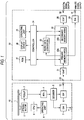
- Fig. 1 is a diagram showing the circuit structures of the music apparatus 50 of the invention and of the CD reproduction device 15. The processing for reproducing the music recorded on a CD 1 will be explained in order to provide a description of the operation used to record digital music data on the hard disk drive 22.
- the CD reproduction device 15 comprises: a spindle motor 2, for rotating the music CD 1, the recording medium on which digital music data signals are recorded; an optical pickup 3, for reading data recorded as a bit string on the music CD 1 and for outputting the data as an RF signal; an RF amplifier 4, for amplifying the RF signal; a decoder 5, for performing EFM demodulation and CIRC decoding; a digital interface (DIF) 6, for outputting, unchanged, digital signals produced by the decoder 5, i.e., for outputting digital data; a D/A converter 7, for converting the digital data output by the decoder 5 into analog data; a CPU 9, for controlling the CD reproduction device 15; and an operating unit 8.
- a spindle motor 2 for rotating the music CD 1, the recording medium on which digital music data signals are recorded
- an optical pickup 3 for reading data recorded as a bit string on the music CD 1 and for outputting the data as an RF signal
- an RF amplifier 4 for amplifying the RF signal
- a spindle error signal, a focus error signal and a tracking error signal are generated, and servo means (not shown) controls the rotational speed of the music CD 1 and drives the optical pickup 3.
- the digital data output by the decoder 5 are transmitted via the DIF 6 through a digital output terminal 10, while the digital data are converted into analog data by the D/A converter 7 and the analog data are output through an analog output terminal 11.
- the music apparatus 50 comprises: a digital input terminal 20 and a digital audio interface (DAIF) 21, which are music data input units for receiving digital music data signals; a hard disk drive 22, which is a large-capacity storage means; a music data converter 23, for compressing and converting digital data into digital data having a different form; a controller 24, for providing overall control for the music apparatus 50; an operating unit 25, for issuing an operating instructions; a display device 26, for displaying the contents of an instruction or the contents of an operation that is currently being executed by the controller 24; a ROM 27, in which an operating program for the music apparatus 50 is stored in advance; a digital data interface (DDIF) 28, for outputting the digital data obtained by the music data converter 23; and a D/A converter 29, for converting the digital data into analog data.
- DDIF digital data interface
- the internal storage area of the hard disk drive 22 is separated into a primary memory area 22a and a secondary memory area 22b.
- the digital data received from the digital input terminal 20 are temporarily stored in the primary memory area 22a, and under the control of the controller 24, which will be described later, are read from the primary memory area 22a and are transmitted to the music data converter 23.
- the music data converter 23 has available a plurality of compression functions, such as the MP3 (MPEG Audio Layer-3) compression technique and the ATRAC compression technique, which is used by an MD player.
- the music data converter 23 employs one of these compression functions to convert the digital data from compressed digital data into a different form (hereinafter referred to as compressed data), and stores the compressed data and information concerning the type of compression method used in the secondary memory area 22b.
- the MP3 technique in accordance with the international "MPEG-1" standard used for specifying compression techniques, such as for sound and moving images, is an audio compression technique that can produce compressed music data that, while approximately 1/10 the size of the original data, can provide the same reproduction quality as does data recorded on a CD.
- the digital data stored in the primary memory area 22a of the hard disk drive 22 are converted into analog data by the D/A converter 29, and the analog data are output through an analog output terminal 31.
- the digital data stored in the primary memory area 22a, which are managed by the controller 24, can be output only to the music data converter 23 or to the D/A converter 29, and can not be output by the music apparatus 50 unchanged, in the form in which they were input.
- the compressed data stored in the secondary memory area 22b of the hard disk drive 22 can be output, via the digital data interface 28, through a digital output terminal 30. That is, the music apparatus 50 of this invention is designed so that the output in its original form of the digital music data stored on the hard disk drive 22 is inhibited, and so that digital music data output by the music apparatus 50 has a different form, obtained by compressing the digital data that is input.
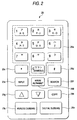
- the operating unit 25 of the music apparatus 50 includes number keys 25a, into which letters of the alphabet and kana characters that are one of Japanese characters are carved, and various other manipulation keys, as is shown in Fig. 2.
- these keys are used to input not only TOC information for the music CD 1, but also the names of musical pieces, the names of musicians and the musical genres, and to search for the names of musical pieces, the names of musicians, and the music genres that were stored in advance on the hard disk drive 22.
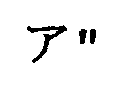
- not only the numeral "1" but also a kana letter " and the letters of the alphabet, "A-E,” are carved into the "1" key of the number keys 25a.
- the number keys 25a can be used to enter or display the names of musical pieces, the names of musicians and the music genres, or the number keys 25a can be used to enter data for a search.
- the operating unit 25 includes: a "*" key 25c, for sorting music numbers or for separating the name of a musician and a genre; a "#" key 25d, for indicating the end of the operation; an "input” key 25e, for selecting an input mode for the entry of the name of a musical piece, the name of a musician and the music genre; a “search” key 25f, for searching for the names of musical pieced, musician names and music genres that were stored in advance on the hard disk drive 22; a " ⁇ ” key 25g, for scrolling music names; a "COPY” key 25h, for storing musical pieces on the music CD 1 on the hard disk drive 22; an "analog dubbing” key 25j, for dubbing music data in an analog form; and a "digital dubbing” key 25k for dubbing compressed data.
- a "*" key 25c for sorting music numbers or for separating the name of a musician and a genre
- a "#" key 25d for indicating the end of
- signals output by the operating unit 25 may be transmitted to the music apparatus 50 from a distance using infrared rays (not shown). If the operating unit 25 is integrally formed with the music apparatus 50, signals are transmitted directly from the operating unit 25 to the music apparatus 50.
- Figs. 3A and 3B are matrix tables showing the relationship between the kana characters and letters of the alphabet that are entered using the number keys 25a.
- Fig. 3A the relationship between the kana characters and the number key 25a is shown
- Fig. 3B the relationship between the letters of the alphabet and the number key 25a is shown.
- One kana character or one letter is selected by entering two digits.
- kana characters when kana characters are being used, to select for display on the display device 26, since the kana character as is shown in Fig. 3A, is located in the first column of the first row in the table, the "1" of the number keys 25a must be depressed two times to bring the character up.
- the "*" key 25c used to indicate the musician's name
- the "input” key 25g for indicating the input mode
- the "kana/alphabet” key 25b for changing the kana characters
- the "1" of the number keys 25a and the "#” key 25d for indicating the end of the operation are depressed in the named order.
- the display device 26 Since the entry of letters of the alphabet can be performed in the same manner, the name of the music selection, the musician's name and the music genre can be stored on the hard disk drive 22, together with the digital music data, using either kana characters or letter of the alphabet.
- the user When the user desires to perform dubbing for a plurality of desired musical pieces selected from among those displayed on the display device 26, the user enters the music numbers using the number keys 25a of the operating unit 25, and then depresses the "*" key 25c.
- the controller 24 assumes a music number is “12" when the "1" and “2" number keys 25a are depressed sequentially, or assumes music numbers are “1” and “2” when “1,” "*” and “2" are depressed.
- the digital data for musical pieces are read from the secondary memory area 22b, in the order in which the music numbers were designated, and are output through the digital signal output terminal 30 via the digital data interface 28.
- the digital data for musical pieces are read from the primary memory area 22a, in the order in which the music numbers were designated, and are converted into analog data by the D/A converter 29. The analog data are then output through the analog output terminal 31.
- the music CD 1 loaded into the CD reproduction device 15 is rotated as the user manipulates the operating unit 8.
- the optical pickup 3 irradiates the rotating music CD 1 with a laser beam, detects the reflected light to read the data that are recorded as pits on the music CD 1, and transmits the data to the RF amplifier 4.
- the RF signal is amplified by the RF amplifier 4 and is then transmitted to the decoder 5.
- the decoder 5 performs the EMF demodulation and CIRC decoding for the RF signal, and outputs the results through the digital output terminal 10 via the digital interface 6. If the user sets, for example, the "ALL COPY" mode, the CD reproduction device 15 sequentially reproduces all the musical pieces recorded on the music CD 1, and outputs them as digital data.
- the user manipulates the operating unit 25 of the music apparatus in the above described manner to enter the name of a musical selection, the name of a musician and the musical genre, using kana characters or letters of the alphabet, in the order in which the musical pieces are recorded on the music CD 1.
- the controller 24 of the music apparatus 50 detects the manipulation by the user of the "COPY" key 25h of the operating unit 25, the controller 24 issues an instruction for the digital data read from the music CD 1, which are received at the digital input terminal 20 and retransmitted via the digital audio interface 21, to be stored in the primary memory area 22a of the hard disk drive 22, and for the digital information for the name of the musical selection, the name of the musician and the musical genre entered by the user to be stored in the primary memory area 22a in consonance with the order in which the data for the musical piece are received.
- the user employs the CD reproduction device 15 to reproduce multiple music CDs 1 owned by family members, as well as rental CDs 1, and performs the above described manipulation sequences to store, on the hard disk drive 22 of the music apparatus 50, not only the digital data read from the music CDs 1, but also digital data for the names of musical pieces, the names of musicians and the musical genres.
- the music apparatus 50 can be set up to serve as a music bank that facilitates, from among a large number of musical pieces stored on the hard disk drive 22, the immediate selection of a desired musical rendition.
- Musical reproduction choices can also be effected by employing the names of musicians and musical genres. And regardless of how selected, musical pieces can be reproduced in a specified, desired order.
- a user selects a plurality of desired musical pieces, from among those listed on the display device 26, before he or she depresses the "digital dubbing" key 25k or the “analog dubbing” key 25j.
- the processing performed while referring to the flowchart is for an operating program, stored in advance in the ROM 27, that is executed in response to the manipulation by a user of the operating unit 25.
- step S1 the controller 24 of the music apparatus 50 continuously monitors the operating unit 25 to determine whether a user has manipulated the "digital dubbing" key 25k or the "analog dubbing" key 25j.
- step S2 it is determined that a user has manipulated the "digital dubbing" key 25k or the "analog dubbing” key 25j (YES)
- step S2 the controller 24 determines whether the user has depressed the "digital dubbing" key 25k.
- program control shifts to step S8.
- step S8 the controller 24 reads, from the primary memory area 22a, the digital data for selected musical pieces in the order designated by the user, and program control advances to step S9.
- step S9 the controller 24 transmits, to the D/A converter 29, the digital data for the selected musical pieces that are read from the primary memory area 22a.
- the D/A converter 29 converts the digital data into analog data, and outputs the analog data through the analog output terminal 31.
- the obtained analog signal is dubbed to an analog recording/reproduction device (not shown).
- program control advances to step S10.
- step S10 the controller 24 performs monitoring to determine whether the dubbing of all the musical pieces selected by the user has been is completed.
- step S10 the controller 24 ascertains that the dubbing of all the musical pieces has been completed (YES), the dubbing operation is terminated.
- step S2 When, at step S2, the controller 24 ascertains that the user has depressed the "digital dubbing" key 25k (YES), program control advances to step S3.
- step S3 the controller 24 determines whether the data for the musical pieces that have been selected by the user have already been converted, by the music data converter 23, into a compressed data form specified by the user, and whether the compressed data have been stored in the secondary memory 22b. If the data for the selected musical pieces are not compressed data stored in the secondary memory 22b (NO), program control advances to step S4.
- step S4 the controller 24 reads from the primary memory area 22a, in the designated order, the digital data for the musical pieces that have been selected.
- the music data converter 23 compresses the digital data read from the primary memory area 22a into a desired form, as specified by the user, and stores, in the secondary memory area 22b, the compressed data and relevant information.
- the user may specify a form to be used for the compressed data at the same time as he or she depresses the "digital dubbing" key 25k, or may instead specify a form to be used in advance.
- step S6 the controller 24 reads the compressed data for the selected musical pieces from the secondary memory area 22b, and outputs the data through the digital output terminal 30 via the digital interface 28.
- Program control thereafter advances to step S7.
- the digital output terminal 30 is connected to a digital recording/reproduction device (not shown), in which the compressed data for the selected musical pieces are stored.
- step S7 the controller 24 determines whether the dubbing of all the musical pieces selected by the user has been completed. When the dubbing has not yet been completed (NO), program control returns to step S3 and the processing at step S3 and the following steps is repeated. However, when it is determined at step S7 that the dubbing of all the musical pieces has been completed (YES), the dubbing process is terminated. Returning now to step S3, if the controller 24 ascertains that all the musical pieces selected by the user have already been converted into compressed data (YES), program control is advanced to step S6, and the processing performed at step S6 and the following steps is performed.
- the digital data for the musical pieces recorded on the music CD 1 are temporarily stored in the primary memory area 22a of the hard disk drive 22. Then, when a user depresses the "digital dubbing" key 25k, the digital data stored in the primary memory area 22a are compressed by the music data converter 23 using provide a desired form, as specified by the user, and the compressed data are stored in the secondary memory area 22b. Then, the compressed data are read from the secondary memory area 22b and are output.
- the digital data for the musical pieces recorded on the music CD 1 may be input to the music apparatus 50, and may concurrently be compressed using a desired form, as specified by a user, and may subsequently be output by the music apparatus 50.
- the controller 24 stores the digital music data to be transmitted by the music apparatus 50, i.e., the controller 24 temporarily stores the digital data for the musical pieces read from the music CD 1 in the primary memory area 22a of the hard disk 22.
- the music apparatus 50 may also output digital data having a different form, i.e., the music data converter 23 may compress the digital data stored in the primary memory area 22a to provide a desired form, as designated by the user, and store the compressed data in the secondary memory area 22b, and the music apparatus 50 may then output the compressed data.
- the storing of data in the primary memory area 22a for each musical piece, the data compression performed by the music data converter 23, and the storing of data in the secondary memory 22b may all be performed at the same time.
- the controller 24 monitors the status of the employment by the user for the music apparatus 50.
- the controller 24 may permit the music data converter 23 to compress, into a desired form, the digital data stored in the primary memory area 22a, and may automatically store the obtained compressed data in the secondary memory area 22b. Therefore, a busy period during which the controller 24 must provide a variety of commands for the music apparatus 50 can be avoided, and the compression/conversion process for the digital data can be completed within a short period of time.
- the compression/conversion operation performed at this time is the conversion of data into a compressed form that the user designated in advance for the music apparatus 50.
- the digital recording/reproduction device is a very small recording/reproduction device that includes an MP3 decoder for which a flash EEPROM, for example, is employed as a recording medium.
- the MP3 compression technique can produce compressed music data that, while approximately 1/10 the size of the original data, can provide the same reproduction quality as do the musical selections recorded on a CD. Also, many musical pieces can be dubbed by using the flash EEPROM as a recording medium. Further, since the recording media are very compact, the size of the reproduction device can be reduced.
- the MP3 compression technique or the ATRAC compression technique is employed when the music data converter 23 converts digital data stored in the primary memory area 22a of the hard disk drive 22. Note, however, that there is no limit on the digital data conversion forms that can be used, and the application of compression techniques that are developed in the future is contemplated.
- a hard disk drive a large-capacity storage medium
- an enormous amount of digital data such as the contents of multiple music CDs and music MDs that may be accumulated by the occupants of a home, can be stored and managed, and a desired musical piece can be immediately requested and output in a compressed data form, thus obviating the possibility that deterioration of data will occur.
Landscapes
- Engineering & Computer Science (AREA)
- Multimedia (AREA)
- General Engineering & Computer Science (AREA)
- Signal Processing For Digital Recording And Reproducing (AREA)
- Electrophonic Musical Instruments (AREA)
Abstract
Description
wherein the music data stored in the storage means are inhibited from being output in the same form in which input.









Claims (8)
- A musical apparatus comprising:a music data input unit for receiving music data in the form of digital signals; andstorage means for storing the music data,
wherein the music data stored in the storage means are inhibited from being output in the form of the music data received. - The music apparatus according to claim 1, wherein the storage means is a predetermined storage area in a large-capacity storage unit that is provided for the music apparatus.
- The music apparatus according to claim 1, further comprising:a music data converter for performing a predetermined conversion of the music data stored in the storage means to obtain digital music data signals having a different form.
- The music apparatus according to claim 3, wherein the digital music data signals obtained by the music data converter and having the different form are stored in a storage area that differs from the predetermined storage area in the large-capacity storage unit.
- A music apparatus comprising:a music data input unit for receiving music data that in the form of digital signals;storage means for storing the music data; anda music data converter for converting the music data stored in the storage means into digital music data signals having a form that differs from that of the data input.
- The music apparatus according to claim 5, wherein the music data converter alters the music data to obtain digital music data signals having a form, or having one of several forms, that differs from the input form.
- The music apparatus according to claim 5, wherein the music data converter performs the conversion of the music data in parallel to the input of the music data to the music apparatus.
- The music apparatus according to claim 5, wherein the music data converter performs the conversion of the music data during a period in which manipulation of the music data by a user does not occur.
Applications Claiming Priority (2)
| Application Number | Priority Date | Filing Date | Title |
|---|---|---|---|
| JP11215971A JP2001043603A (en) | 1999-07-29 | 1999-07-29 | Music equipment |
| JP21597199 | 1999-07-29 |
Publications (2)
| Publication Number | Publication Date |
|---|---|
| EP1073052A2 true EP1073052A2 (en) | 2001-01-31 |
| EP1073052A3 EP1073052A3 (en) | 2002-07-03 |
Family
ID=16681282
Family Applications (1)
| Application Number | Title | Priority Date | Filing Date |
|---|---|---|---|
| EP00306236A Withdrawn EP1073052A3 (en) | 1999-07-29 | 2000-07-21 | Musical apparatus |
Country Status (3)
| Country | Link |
|---|---|
| US (1) | US6573444B1 (en) |
| EP (1) | EP1073052A3 (en) |
| JP (1) | JP2001043603A (en) |
Cited By (1)
| Publication number | Priority date | Publication date | Assignee | Title |
|---|---|---|---|---|
| EP1262980A3 (en) * | 2001-05-31 | 2003-10-15 | Pioneer Corporation | Information recording/reproducing apparatus |
Families Citing this family (8)
| Publication number | Priority date | Publication date | Assignee | Title |
|---|---|---|---|---|
| JP3823705B2 (en) * | 2000-08-30 | 2006-09-20 | ヤマハ株式会社 | Audio data mixing device including pad, control method thereof, and storage medium |
| US20020042754A1 (en) * | 2000-10-10 | 2002-04-11 | Del Beccaro David J. | System and method for receiving broadcast audio/video works and for enabling a consumer to purchase the received audio/video works |
| US20030044989A1 (en) * | 2001-09-04 | 2003-03-06 | Guerra Francisco Javier | Apparatus and method for testing a beverage for a clandestine illicit substance |
| US7484215B2 (en) * | 2003-10-30 | 2009-01-27 | International Business Machines Corporation | Method, system and program product for processing a transaction |
| WO2006030616A1 (en) * | 2004-09-16 | 2006-03-23 | Konica Minolta Photo Imaging, Inc. | Recording program and recorder |
| US7297860B2 (en) * | 2004-11-12 | 2007-11-20 | Sony Corporation | System and method for determining genre of audio |
| JP2007080370A (en) * | 2005-09-13 | 2007-03-29 | Sony Corp | Recording method, recording apparatus, and program |
| CN113131972B (en) * | 2021-04-13 | 2022-04-15 | Oppo广东移动通信有限公司 | Method, device, electronic equipment and storage medium for receiving and transmitting audio data packet |
Family Cites Families (15)
| Publication number | Priority date | Publication date | Assignee | Title |
|---|---|---|---|---|
| US4622877A (en) * | 1985-06-11 | 1986-11-18 | The Board Of Trustees Of The Leland Stanford Junior University | Independently controlled wavetable-modification instrument and method for generating musical sound |
| US5329062A (en) * | 1990-07-31 | 1994-07-12 | Casio Computer Co., Ltd. | Method of recording/reproducing waveform and apparatus for reproducing waveform |
| GB2257606B (en) | 1991-06-28 | 1995-01-18 | Sony Corp | Recording and/or reproducing apparatuses and signal processing methods for compressed data |
| JPH0612833A (en) * | 1992-06-29 | 1994-01-21 | Sony Corp | Mastering device |
| JP2819948B2 (en) * | 1992-07-16 | 1998-11-05 | ヤマハ株式会社 | Music signal recording and playback device |
| US5756915A (en) * | 1992-10-19 | 1998-05-26 | Kabushiki Kaisha Kawai Gakki Seisakusho | Electronic musical instrument having a search function and a replace function |
| JP3427410B2 (en) * | 1993-02-24 | 2003-07-14 | ソニー株式会社 | Optical disk recording device and optical disk reproducing device |
| JPH06342291A (en) * | 1993-06-02 | 1994-12-13 | Kawai Musical Instr Mfg Co Ltd | Electronic musical instrument |
| JP2948090B2 (en) * | 1994-03-04 | 1999-09-13 | 日本コロムビア株式会社 | Optical carrier recording device |
| US5728962A (en) * | 1994-03-14 | 1998-03-17 | Airworks Corporation | Rearranging artistic compositions |
| JPH08129386A (en) * | 1994-10-31 | 1996-05-21 | Yamaha Corp | Electronic musical instrument |
| US5567901A (en) * | 1995-01-18 | 1996-10-22 | Ivl Technologies Ltd. | Method and apparatus for changing the timbre and/or pitch of audio signals |
| US5808225A (en) * | 1996-12-31 | 1998-09-15 | Intel Corporation | Compressing music into a digital format |
| JPH1166823A (en) * | 1997-08-08 | 1999-03-09 | Sony Corp | Audio dubbing system |
| JP3152196B2 (en) * | 1998-01-07 | 2001-04-03 | ヤマハ株式会社 | Tone generator |
-
1999
- 1999-07-29 JP JP11215971A patent/JP2001043603A/en active Pending
-
2000
- 2000-07-21 EP EP00306236A patent/EP1073052A3/en not_active Withdrawn
- 2000-07-25 US US09/625,347 patent/US6573444B1/en not_active Expired - Fee Related
Cited By (2)
| Publication number | Priority date | Publication date | Assignee | Title |
|---|---|---|---|---|
| EP1262980A3 (en) * | 2001-05-31 | 2003-10-15 | Pioneer Corporation | Information recording/reproducing apparatus |
| US6885626B2 (en) | 2001-05-31 | 2005-04-26 | Pioneer Corporation | Information recording/reproducing apparatus |
Also Published As
| Publication number | Publication date |
|---|---|
| EP1073052A3 (en) | 2002-07-03 |
| US6573444B1 (en) | 2003-06-03 |
| JP2001043603A (en) | 2001-02-16 |
Similar Documents
| Publication | Publication Date | Title |
|---|---|---|
| CN100414639C (en) | Method and apparatus for providing information to supplement information stored in compact disc | |
| EP0962929B1 (en) | Recording medium, recording apparatus and reproduction apparatus for selecting reproduction order of only specific digital data | |
| US20020129036A1 (en) | System and method for storing and manipulating multi-media | |
| US20080080322A1 (en) | Recording apparatus | |
| US20070233714A1 (en) | Reproducing apparatus, content selection method, and program | |
| KR100745995B1 (en) | Metadata management device and method | |
| CN100573533C (en) | Media information search apparatus and media information search method | |
| EP1367590A2 (en) | Music recording/reproducing apparatus, list generation method, and information recording medium | |
| US6573444B1 (en) | Music data compression apparatus and method | |
| JP2002343067A (en) | Equipment with MP3 playback function | |
| JP2002023771A (en) | Audio player | |
| JP2001243748A (en) | Information recording controller | |
| JP4587014B2 (en) | Audio playback system | |
| JP2004079085A (en) | Optical disc playback device | |
| JP4068018B2 (en) | Audio equipment | |
| JP4168566B2 (en) | Information recording control device | |
| JPH09185863A (en) | Disk device | |
| JP2001266551A (en) | On-vehicle reproducing device and folder display method | |
| KR100310162B1 (en) | How to manage / record audio menu data on rewritable recording media | |
| JP4252525B2 (en) | Music player | |
| JP2003178568A (en) | Playback device | |
| KR20030069279A (en) | Optical disc player for selecting MP3 files by a unit of directory and method thereof | |
| JP4776661B2 (en) | Information processing apparatus and information processing method | |
| KR20060068661A (en) | How to Search MP3 Files by Category in the DVD Recording / Playback System | |
| JP2001243709A (en) | Controller for information recording |
Legal Events
| Date | Code | Title | Description |
|---|---|---|---|
| PUAI | Public reference made under article 153(3) epc to a published international application that has entered the european phase |
Free format text: ORIGINAL CODE: 0009012 |
|
| AK | Designated contracting states |
Kind code of ref document: A2 Designated state(s): AT BE CH CY DE DK ES FI FR GB GR IE IT LI LU MC NL PT SE |
|
| AX | Request for extension of the european patent |
Free format text: AL;LT;LV;MK;RO;SI |
|
| PUAL | Search report despatched |
Free format text: ORIGINAL CODE: 0009013 |
|
| AK | Designated contracting states |
Kind code of ref document: A3 Designated state(s): AT BE CH CY DE DK ES FI FR GB GR IE IT LI LU MC NL PT SE |
|
| AX | Request for extension of the european patent |
Free format text: AL;LT;LV;MK;RO;SI |
|
| 17P | Request for examination filed |
Effective date: 20021212 |
|
| AKX | Designation fees paid |
Designated state(s): DE FR GB |
|
| 17Q | First examination report despatched |
Effective date: 20030425 |
|
| 17Q | First examination report despatched |
Effective date: 20030425 |
|
| GRAP | Despatch of communication of intention to grant a patent |
Free format text: ORIGINAL CODE: EPIDOSNIGR1 |
|
| STAA | Information on the status of an ep patent application or granted ep patent |
Free format text: STATUS: THE APPLICATION IS DEEMED TO BE WITHDRAWN |
|
| 18D | Application deemed to be withdrawn |
Effective date: 20080515 |