EP1072256A1 - Tablets quickly disintegrating in the oral cavity and process for producing the same - Google Patents

Tablets quickly disintegrating in the oral cavity and process for producing the same Download PDF

Info

Publication number
EP1072256A1
EP1072256A1 EP98947827A EP98947827A EP1072256A1 EP 1072256 A1 EP1072256 A1 EP 1072256A1 EP 98947827 A EP98947827 A EP 98947827A EP 98947827 A EP98947827 A EP 98947827A EP 1072256 A1 EP1072256 A1 EP 1072256A1
Authority
EP
European Patent Office
Prior art keywords
tablet
sugar
amorphous
drug
present
Prior art date
Legal status (The legal status is an assumption and is not a legal conclusion. Google has not performed a legal analysis and makes no representation as to the accuracy of the status listed.)
Withdrawn
Application number
EP98947827A
Other languages
German (de)
French (fr)
Other versions
EP1072256A4 (en
Inventor
Takao Yamanouchi Pharmaceutical Co. Ltd MIZUMOTO
Yoshinori Yamanouchi Pharma. Co. Ltd. MASUDA
Atsushi Yamanouchi Pharma. Co. Ltd. KAJIYAMA
Masahiro Yamanouchi Pharma. Co. Ltd. YANAGISAWA
Janaki Ram Yamanouchi Pharma Tech. Inc NYSHADHAM
Current Assignee (The listed assignees may be inaccurate. Google has not performed a legal analysis and makes no representation or warranty as to the accuracy of the list.)
Astellas Pharma Inc
Astellas Pharma Technologies Inc
Original Assignee
Yamanouchi Pharmaceutical Co Ltd
Shaklee Corp
Priority date (The priority date is an assumption and is not a legal conclusion. Google has not performed a legal analysis and makes no representation as to the accuracy of the date listed.)
Filing date
Publication date
Application filed by Yamanouchi Pharmaceutical Co Ltd, Shaklee Corp filed Critical Yamanouchi Pharmaceutical Co Ltd
Publication of EP1072256A1 publication Critical patent/EP1072256A1/en
Publication of EP1072256A4 publication Critical patent/EP1072256A4/en
Withdrawn legal-status Critical Current

Links

Images

Classifications

    • A—HUMAN NECESSITIES
    • A61—MEDICAL OR VETERINARY SCIENCE; HYGIENE
    • A61K—PREPARATIONS FOR MEDICAL, DENTAL OR TOILETRY PURPOSES
    • A61K9/00—Medicinal preparations characterised by special physical form
    • A61K9/20—Pills, tablets, discs, rods
    • H—ELECTRICITY
    • H04—ELECTRIC COMMUNICATION TECHNIQUE
    • H04L—TRANSMISSION OF DIGITAL INFORMATION, e.g. TELEGRAPHIC COMMUNICATION
    • H04L12/00—Data switching networks
    • H04L12/28—Data switching networks characterised by path configuration, e.g. LAN [Local Area Networks] or WAN [Wide Area Networks]
    • H04L12/44—Star or tree networks
    • A—HUMAN NECESSITIES
    • A61—MEDICAL OR VETERINARY SCIENCE; HYGIENE
    • A61K—PREPARATIONS FOR MEDICAL, DENTAL OR TOILETRY PURPOSES
    • A61K9/00—Medicinal preparations characterised by special physical form
    • A61K9/0012—Galenical forms characterised by the site of application
    • A61K9/0053—Mouth and digestive tract, i.e. intraoral and peroral administration
    • A61K9/0056—Mouth soluble or dispersible forms; Suckable, eatable, chewable coherent forms; Forms rapidly disintegrating in the mouth; Lozenges; Lollipops; Bite capsules; Baked products; Baits or other oral forms for animals
    • A—HUMAN NECESSITIES
    • A61—MEDICAL OR VETERINARY SCIENCE; HYGIENE
    • A61K—PREPARATIONS FOR MEDICAL, DENTAL OR TOILETRY PURPOSES
    • A61K9/00—Medicinal preparations characterised by special physical form
    • A61K9/20—Pills, tablets, discs, rods
    • A61K9/2004—Excipients; Inactive ingredients
    • A61K9/2013—Organic compounds, e.g. phospholipids, fats
    • A61K9/2018—Sugars, or sugar alcohols, e.g. lactose, mannitol; Derivatives thereof, e.g. polysorbates
    • H—ELECTRICITY
    • H04—ELECTRIC COMMUNICATION TECHNIQUE
    • H04L—TRANSMISSION OF DIGITAL INFORMATION, e.g. TELEGRAPHIC COMMUNICATION
    • H04L67/00—Network arrangements or protocols for supporting network services or applications
    • H04L67/01—Protocols
    • H04L67/12—Protocols specially adapted for proprietary or special-purpose networking environments, e.g. medical networks, sensor networks, networks in vehicles or remote metering networks
    • H—ELECTRICITY
    • H04—ELECTRIC COMMUNICATION TECHNIQUE
    • H04L—TRANSMISSION OF DIGITAL INFORMATION, e.g. TELEGRAPHIC COMMUNICATION
    • H04L67/00—Network arrangements or protocols for supporting network services or applications
    • H04L67/50—Network services
    • H04L67/55—Push-based network services
    • H—ELECTRICITY
    • H04—ELECTRIC COMMUNICATION TECHNIQUE
    • H04L—TRANSMISSION OF DIGITAL INFORMATION, e.g. TELEGRAPHIC COMMUNICATION
    • H04L9/00—Cryptographic mechanisms or cryptographic arrangements for secret or secure communications; Network security protocols
    • H04L9/40—Network security protocols
    • A—HUMAN NECESSITIES
    • A61—MEDICAL OR VETERINARY SCIENCE; HYGIENE
    • A61K—PREPARATIONS FOR MEDICAL, DENTAL OR TOILETRY PURPOSES
    • A61K9/00—Medicinal preparations characterised by special physical form
    • A61K9/20—Pills, tablets, discs, rods
    • A61K9/2095—Tabletting processes
    • H—ELECTRICITY
    • H04—ELECTRIC COMMUNICATION TECHNIQUE
    • H04L—TRANSMISSION OF DIGITAL INFORMATION, e.g. TELEGRAPHIC COMMUNICATION
    • H04L69/00—Network arrangements, protocols or services independent of the application payload and not provided for in the other groups of this subclass
    • H04L69/08—Protocols for interworking; Protocol conversion
    • H—ELECTRICITY
    • H04—ELECTRIC COMMUNICATION TECHNIQUE
    • H04L—TRANSMISSION OF DIGITAL INFORMATION, e.g. TELEGRAPHIC COMMUNICATION
    • H04L69/00—Network arrangements, protocols or services independent of the application payload and not provided for in the other groups of this subclass
    • H04L69/30—Definitions, standards or architectural aspects of layered protocol stacks
    • H04L69/32—Architecture of open systems interconnection [OSI] 7-layer type protocol stacks, e.g. the interfaces between the data link level and the physical level
    • H04L69/322—Intralayer communication protocols among peer entities or protocol data unit [PDU] definitions
    • H04L69/329—Intralayer communication protocols among peer entities or protocol data unit [PDU] definitions in the application layer [OSI layer 7]

Definitions

  • a mixture of the following is formed into a tablet: a drug, a sugar (A), and an amorphous sugar (B) which is obtainable by dissolving a crystalline sugar capable of becoming amorphous in a medicinally permitted solvent and spraying and drying the solution, and the tablet is humidified and dried.
  • the tablet of the present invention was obtained.

Landscapes

  • Health & Medical Sciences (AREA)
  • Engineering & Computer Science (AREA)
  • Life Sciences & Earth Sciences (AREA)
  • General Health & Medical Sciences (AREA)
  • Veterinary Medicine (AREA)
  • Computer Networks & Wireless Communication (AREA)
  • Signal Processing (AREA)
  • Epidemiology (AREA)
  • Public Health (AREA)
  • Animal Behavior & Ethology (AREA)
  • Pharmacology & Pharmacy (AREA)
  • Medicinal Chemistry (AREA)
  • Chemical & Material Sciences (AREA)
  • Physiology (AREA)
  • Nutrition Science (AREA)
  • Computing Systems (AREA)
  • Zoology (AREA)
  • Medical Informatics (AREA)
  • Biophysics (AREA)
  • Molecular Biology (AREA)
  • Computer Security & Cryptography (AREA)
  • Medicinal Preparation (AREA)

Abstract

The present invention relates to a quick disintegrating tablet in buccal cavity; comprising: a mixture, comprising a drug, a sugar (A), and an amorphous sugar (B), and after it is forming a tablet, it is humidified and dried. In particularly, the present invention relates to a quick disintegrating tablet in buccal cavity comprising: a mixture; comprising a drug, a sugar (A), and an amorphous sugar (B) which an amorphous-forming sugar in crystalline state is dissolved in a medicinally permitted solvent, the amorphous sugar is obtained from this solution by removing the solvent, and after it is forming a tablet, and it is humidified and dried. The tablet in the present invention is to provide stability against moisture at preserved, because the amorphous sugar changed to the crystalline state in a nonreversible reaction after it is humidified and dried in a manufacturing process. The tablet in the present invention is to further provide a design for the pharmaceutical preparation with respect to the stability of a drug, because the tablet is manufactured by one kind of a sugar and an amorphous sugar. Furthermore, the tablet in the present invention is to provide a production process by utilizing a common granulating machine and by utilizing a common tablet machine.

Description

TECHNICAL FEILD
The present invention relates to a quick disintegrating tablet in buccal cavity and production process thereof.
BACKGROUND OF THE INVENTION
As for the pharmaceutical dosage forms for oral use, a tablet, a capsule, a granule, a powder and the like are mentioned. However, these dosage forms will have some issues if a patient takes them. For instance, regarding a tablet or a capsule, if the patient is a person of advanced age or a child, there are some cases that they dislike to take the pharmaceutical preparation because it is difficult for them to swallow it or the preparation will stick in the throat or the esophagus of them. In addition, regarding a granule or a powder, in some cases they dislike to take the preparation under the reason that it is difficult for them to swallow it with its remaining in buccal cavity or the reason that they will choke when taking the dosage. Since a compliance to take the pharmaceutical preparation is caused to fall in these cases, it is desired to take easily the pharmaceutical dosage forms, and as a result a disintegrating preparation in buccal cavity has been studied and developed.
For instance, "Zydis®" has been developed up to the product by R. P. Schere Corp. However, since this preparation is produced by means of lyophilization method, a special manufacturing equipment such as a lyophilization machine is needed. Additionally, this preparation cannot be taken over from the pocket of PTP, "Press Through Package", under the reason that the tablet strength is small. Furthermore, it is so difficult for the aged to take out the preparation from package that it is not satisfied with the aged.
Several quick disintegrating tablets in buccal cavity, which is manufactured by means not of lyophilization method but of tableting method, have been reported. For instance, JP 6-218028-A (Corresponding to EP 590,963) discloses a quick disintegrating tablet in buccal cavity which is manufactured by compressing the moisturized powder being mixed with a drug, an excipient, a binder agent and the like using water or the like, afterwards by drying the compression molding. However, it is necessary to have a special tableting machine spraying a fluidizer on the surface of a tablet before compression for the avoidance of the issues at the compression molding. JP 5-271054-A (corresponding to EP 553,777) discloses a quick disintegrating tablet in buccal cavity which is manufactured by compressing the mixture comprising a drug, a sugar and water which is added so much as to moisture said sugar at low compression pressure, and by drying said tablet. WO93/15724 (corresponding to EP 627,218) also discloses a quick disintegrating tablet, which is manufactured by compression with humidification and drying. However, there are some issues in these methods, for instance, a sticking at compressing with moisture.
In addition, WO95/20380 (corresponding to US 5,576,014) discloses a quick disintegrating tablet in buccal cavity in which the invention has been made by one of the present inventors. This tablet is manufactured by means that a small moldability sugar is granulated by a high moldability sugar and afterwards that these granules are compressed by an ordinal tableting machine. It is thought that there is little trouble in practice by this production method, however, it is necessary to utilize at least two kinds of sugars, if there is a case that there is a restriction to a kind of sugar added, for the counter action between a drug and said sugar (for example, degradation of drug). Therefore, a new quick disintegrating tablet in buccal cavity and production process thereof are desired even at this present, for instance, this tablet is manufactured and to obtain by using one kind of sugars.
Furthermore, regarding a quick disintegrating tablet in buccal cavity, a patent application or an article discloses the following production process proposed.
For instance, JP 9-48726-A discloses the method which a composition of the mixture consisting of a drug, a sugar and/or hydrophilic polymer is taken into a molding, and the mixture is compressed at low compression pressure, and the molding is under humidification and drying. However, this method is to improve the strength of tablet surface in particular by moisture of water-soluble polymer, it is possible to introduce the adhesion between tablets.
A method that a mixture consisting of an amorphous sucrose which is obtained by lyophilization method utilizing a sucrose solution, a drug and mannitol is molded into a tablet by a rotally tableting machine, and the obtained tablet is preserved under the controlled circumstance (at 25°C, 34 %RH) is proposed (abstract of the 13th Japan pharmacological pharmacy, p.113, published March 5, 1998). However, a sugar is an amorphous sugar that is manufactured in further detail by lyophilization method, but sugars outsides sucrose is not described in the article.
DISCLOSURE OF THE INVENTION
An object of the present invention is to provide a quick disintegrating tablet in buccal cavity and production thereof in which tablets are manufactured with the normal granulator and tablet machine, with tablet strength being heightened to make a more stable formulation.
The present inventors examined the physiological characterization of sugar in a result to find that a kind of sugars can be changed to an amorphous state when the sugar solution is spray-dried, or the sugar solution is used in granulation as a binding agent. The present inventors further investigated to find that when an amorphous sugar was treated under humidification and drying, the tablet strength was increased by changing the amorphous sugar to a crystal state and that a disintegrating preparation in buccal cavity with the desired tablet strength was obtained and have completed the present invention.
That is, the present invention relates to a quick disintegrating tablet in the buccal cavity; comprising: a drug, a sugar (A), and an amorphous sugar (B), in which, after forming the tablet, it is humidified and dried. In more detail, the present invention relates to a quick disintegrating tablet in the buccal cavity, comprising: a mixture, comprising: a drug, a sugar (A), and an amorphous sugar (B) which is obtained by dissolving a crystalline sugar capable of becoming amorphous in a medicinally permitted solvent and then removing the solvent from the solution and drying, in which after forming the tablet, it is humidified and then dried. Furthermore, the present invention relates to a quick disintegrating tablet in the buccal cavity, comprising: a mixture, comprising: a drug, a sugar (A), and an amorphous sugar (B) which is obtained by dissolving a crystalline sugar capable of becoming amorphous in a medicinally permitted solvent, and the solution is then sprayed and dried, and after forming the tablets, it is humidified and then dried. In particular, the present invention relates to a quick disintegrating tablet in buccal cavity, comprising: a crystalline sugar capable of becoming amorphous is dissolved in a medicinally permitted solvent; the solution is sprayed on a drug and/or a sugar (A) to coat and/or granulate; and after forming a tablet, it is humidified and dried.
For the drug to be used in the present invention, there are no particular limitations as long as it is a substance which is used as a pharmaceutical active ingredient. Examples of pharmaceutical active ingredients include: sedative hypnotics, sleep inducers, anti-anxiety drugs, anti-epileptics, anti-depressants, anti-Parkinson drugs, psychoneural drugs, drugs acting on the central nervous system, local anesthetics, skeletal muscle relaxants, autonomic nervous system drugs, anti-fever analgesics anti-inflammatory drugs, anti-convulsants, anti-vertigenous drugs, cardiac drugs, drugs for arrhythmia, diuretics, blood pressure lowering drugs, vasoconstrictors, vasodilators, drugs for circulatory organs, hyperlipidemia drugs, respiratory stimulant, anti-tussive, expectorants, anti-tussive expectorants, bronchodilators, stegnotic, peptic ulcer drugs, stomach digestive drugs, antacids, laxatives, choleretics, drugs for the digestive tract, adrenal hormone drugs, hormone drugs, urinary tract drugs, vitamins, hemostatic drugs, liver drugs, gout treatment drugs, drugs for diabetes, anti-histamines, antibiotics, antibacterial agents, anti-malignant tumor drugs, chemotherapy drugs, multi-purpose cold medicines, tonic medicines, osteoporosis drugs, and the like. There are no particular limitations on the amount of these drugs to be mixed as long as it is the usual effective treatment amount. It should be around 50 weight/ weight % or below of the entire tablet, and is preferably 20 weight/ weight % or below.
In case that the present invention is applied to a drug having unpleasant taste, the drug is preferred to be treated in a preferably taste masking method (for instance, WO92/09275).
In case of that the present invention is performed for a drug desired to be sustained, the drug is preferred to be treated in a preferably sustained-release method (for instance, CA2038400-0), to obtain a particle which is controlled a drug release in a known manner in itself.
Furthermore, the preparation of the present invention can be also applied to a drug which is needed to be absorbed through a membrane of buccal cavity, since the preparation of the present invention is taken by a patient with disintegrating and dissolving in buccal cavity.
There are no particular limitations on sugar (A) which is to be used in the present invention as long as it is one which is normally medicinally permitted. Sugar (A) is preferably a sugar or sugar-alcohol which dissolves in the mouth. Examples include lactose, glucose, trehalose, mannitol, erythritol, and the like. Sugar (A) can be one type or two or more types combined. Furthermore, since sugar (A) functions as an excipient which dissolves inside the buccal cavity, the amount of sugar (A) to be added to the quick disintegrating tablet of the present invention is not particularly limited as long as it is an effective amount in order to achieve this function in the quick disintegrating tablet. The amount of sugar (A) to be added is dependent on the amount of drug and can be adjusted appropriately. In other words, when the amount of drug is small, the amount of sugar (A) to be added becomes large, and if the amount of drug is large, the amount of sugar (A) to be added becomes small. The amount of sugar (A) to be added is also dependent on the size of the tablet. The amount of sugar (A) can be adjusted as a ratio with the other excipients.
The "amorphous sugar (B)" of the present invention signifies a sugar which is medicinally usually permitted and which is amorphous or which is capable of becoming amorphous. For example, an amorphous sugar (B) can be obtained by dissolving a crystalline sugar capable of becoming amorphous in a medicinally permitted solvent such as water and alcohol and the like, and then obtained by removing the solvent from this solution, and drying. There are no particular limitations for the method of removing the solvent as long as it is a method normally implemented in the pharmaceutical manufacturing process. For example, these methods include spray drying method, freeze-drying method, or various granulating methods such as fluidized-bed granulating method, vertical granulating method, tumbling granulating method. From a production standpoint, spray drying method or the various granulating methods are preferred. Among the various granulating methods, a method is preferred wherein: a crystalline sugar capable of becoming amorphous in a medicinally permitted solvent such as water, alcohol, and the like; this is used as a binding agent; this becomes amorphous when it is sprayed by a twin fluid nozzle and coats and/or granulates the drug and/or the sugar. Here, a crystalline sugar capable of becoming amorphous can be dissolved in a medicinally permitted solvent. This solution can be sprayed against the drug and/or the sugar (A), and they can be coated and granulated with an amorphous sugar (B). Examples of amorphous sugars (B) include glucose, lactose, maltose, sorbitol, trehalose, lactitol, fructose, and the like. This amorphous sugar (B) can be of one type or be a combination of two or more types. In the present invention, "amorphous sugar" signifies a sugar which is materially amorphous or which is capable of becoming amorphous. In the process of becoming amorphous, the present invention also includes states where a portion is not amorphous. The amount of amorphous sugar (B) to be added is 2 - 20 weight/weight % with respect to the previous sugar (A), or 2 - 20 weight/weight % of the entire tablet.
As for the advantage for utilizing an amorphous sugar in the present invention, it is easy to increase tablet strength by steps of humidification and drying. Since an amorphous sugar has a low critical moisture, the tablet can be treated at the low moisture level such that an amorphous sugar can adsorb. In addition, the moisture absorbed in a humidification process dissolve a part of surface of sugar particles around, afterwards in a drying process, the tablet strength can increase because of the re-attachment of between sugar particles. On the other hand, to the contrally to the present invention, it is easily to be predicted that the production process has some difficulties, for instance, in case that the sugar consists of sugars in a crystalline state, since the sufficient moisture adsorption will not happen at a low humidification condition, the tablet strength will not increase, in case at a high humidification condition, the adhesion of between tablets will happen and it is easily predictable for actual manufacturing to have difficulty.
As for the other advantage for utilizing amorphous sugar in the present invention, since a sugar in amorphous state is changed to a crystalline state in a humidification and drying process unreversibly, a dried tablet has a high critical moisture point. As a result, said tablet can maintain a tablet strength against the moisture in the stored condition. Furthermore, since one kind of sugar consisting of crystalline state and amorphous state can manufacture a quick disintegrating tablet in buccal cavity to avoid a restriction for choosing a sugar which do not happen the changes against a drug.
In the present invention, "forming" signifies forming into a tablet or the like with a pressure equal to or greater than the pressure required to maintain the desired shape. In the forming process, a normal tablet machines can be used. Examples include a single tablet machine or rotary tablet machine.
In the present invention, "humidifying", when implemented in combination with the next step of drying, is for increasing the tablet strength, the humidifying conditions being determined by the apparent critical relative humidity of the mixture of a drug, a sugar (A), an amorphous sugar (B), and signifies increasing the humidity to greater than or equal to the critical relative humidity of this mixture. For example, the humidity is 30 - 100 RH%, and is preferably 50 - 90 RH%. At this time, temperature is 15-50°C, and preferably 20-40°C. The point of the humidifying process of the present invention is to convert sugar in the amorphous state to a crystalline state, to heighten the tablet strength, and to make the tablet more stable.
In the present invention, "drying" is implemented in order to remove the water absorbed by the humidifying the amorphous sugar. There are no particular limitations for the drying conditions as long as they are the usual conditions for removing water content. For example, it should be 10-100°C and is preferably 20-60°C.
The quick disintegrating tablet in buccal cavity can contain various medicinally permitted excipients such as disintegrating agents, stabilization agents, binding agents, diluting agents, lubricating agents, and the like.
The production method of the quick disintegrating tablet in buccal cavity is described below.
For the production method of the present invention, a drug, a sugar (A), and an amorphous sugar (B) are mixed, and after forming the mixture into a tablet, it is humidified and dried. In more detail, in the production method of the present invention, a mixture of the following is formed: a drug, a sugar (A), and an amorphous sugar (B) which is obtainable by dissolving a crystalline sugar capable of becoming amorphous in a medicinally permitted solvent and removing the solvent from the solution and drying, and the tablet is humidified and dried. Furthermore, in the production method of the present invention, a mixture of the following is formed into a tablet: a drug, a sugar (A), and an amorphous sugar (B) which is obtainable by dissolving a crystalline sugar capable of becoming amorphous in a medicinally permitted solvent and spraying and drying the solution, and the tablet is humidified and dried. In particular, in the production method of the present invention, after dissolving a crystalline sugar capable of becoming amorphous in a medicinally permitted solvent and by using a binding agent, the solution is sprayed with a twin fluid nozzle or the like against a drug and/or sugar (A), and after forming a coated product and/or granulated product by coating and/or granulating with an amorphous sugar (B), and after forming a tablet, it is humidified and dried.
Here, the definitions and the preferred embodiments of the "drug", "sugar (A), and "amorphous sugar (B)", as well as the processing steps for the production of quick disintegrating tablet in buccal cavity including "forming ", "humidifying", and "drying" are described previously.
Furthermore, as a method for removing the solvent in the present invention, there are no particular limitations as long as it is a method implemented in the normal manufacturing process. For this method, examples include spray drying method, freeze-drying method, or various granulating methods such as fluidized-bed granulating method, vertical granulating method, tumbling granulating method, or the like. From the standpoint of production, the spray drying method or the various granulating methods are preferred. Among these, in the various granulating methods, a method is preferred, wherein: a crystalline sugar capable of becoming amorphous and which is dissolved in a medicinally permitted solvent such as water or alcohol is used as a binding agent, and it becomes amorphous when spraying and coating or granulating with a twin fluid nozzle or the like against drug and/or sugar (A). Here, crystalline sugar which is capable of becoming amorphous can be dissolved in a medicinally permitted silvent, and the solution can be sprayed, and the drug and/or sugar (A) can be coated and granulated with amorphous sugar (B).
In the production method of the present invention, various medicinally permitted excipients such as disintegrating agents, stabilizing agents, binding agents, diluents, lubricants, or the like can be added to any of the production steps.
BREIF DESCRIPTION OF DRAWINGS
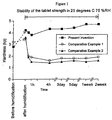
  • Figure 1 shows the stability of the tablet strength in the present invention. In the figure, the horizontal axis represents to time and the vertical axis represents to tablet strength.
  • BEST MODE FOR CARRYING OUT THE INVENTION
    The present invention will be explained further by citing examples. The present invention is not limited to these embodiments. Furthermore, regarding the tablet of the present invention, the tablet strength and time of disintegration in the buccal cavity have been evaluated. Because it is considered to have little influence on the evaluation categories, the drug is not always included.
    [Example 1]
    Mannitol 602 g and lactose 602 g were mixed. This was passed through a sieve (14 mesh). 433 g of glucose solution (15 w/v %) was used as a binding agent for this mixture, and the mixture was granulated in a fluidized-bed granulator. Up to 157 g of the solution was used to coat the above mixture at a spray pressure of 2.5 kg/cm2. Afterwards, it was granulated with spray pressure 1.5 kg/cm2. After drying the granule, peppermint flavor 10g, stearic acid 12g, magnesium stearate 10g were combined. Rotary tablet machine was used to manufacture tablets which were 540 mg per one tablet (tablet hardness 1.4 kp (n=5)). Next, this tablet was humidified and heated for 20 minutes in a thermo-hygrostat at 35°C, 85%RH. Afterwards, it was dried for 15 minutes at 50°C (humidity 30%), and the tablet of the present invention was achieved. The obtained tablet had hardness of 9.1 kp, and buccal cavity disintegrating time of 17 seconds.
    [Example 2]
    175 g of a lactose solution (10 w/v %) was a binding agent for 350 g of lactose (Domo milk Corp.). This was granulated in a fluidized-bed granulator (Ohkawara Seisakusho). Up to 70 g of the previous solution was used to coat the lactose with a spray pressure of 2.5 kg/cm2. Afterwards, it was granulated with a spray pressure 1 kg/cm2. After drying the granule, 0.5 % magnesium stearate was mixed with the granule. Tablets ((phi 10 mm, 10 mmR), tablet hardness 23 kp (n=5)) of 300 mg per tablet were produced using a rotary tablet machine. Next, the tablet was stored under heated humidified conditions of 25°C / 70 % RH for 19 hours, using a thermo-hygrostat (Tabiespec Corp., PR-35C). Afterwards it was dried for 2 hours at 25°C (humidity 50%). The tablet of the present invention was obtained. The obtained tablet had a hardness of 4.1 kp (n=5) and a buccal cavity disintegration time of 20 seconds.
    [Example 3]
    378 g of mannitol (Towa Chemical Industry Corp.) was passed through a sieve (20 mesh). Afterwards, this was granulated in a fluidized bed granulator (Ohkawara Seisakusho) with 133 g of an aqueous solution of hydrated crystalline glucose (Nippon Shokuhin Kako Corp.) (15 w/v%) as a binding agent. Up to 50 g of the previous solution was used to coat the mannitol with a spray pressure of 2.5 kg/cm2. Afterwards, it was granulated with a spray pressure 1.5 kg/cm2. At this time, the disappearance of the absorption peak derived from glucose crystals (i.e. glucose is amorphous) was confirmed using a differential scanning calorimeter (DSC for short). 0.5 % magnesium stearate was mixed with the granule. Tablets ((phi 8 mm, 9.6 mmR), tablet hardness 2.0 kp (n=5)) of 150 mg per tablet were produced using a rotary tablet machine with a compression pressure of approximately 0.18 ton/punch. Next, the tablet was stored under heated humidified conditions of 25°C / 70 % RH for 24 hours, using a thermo-hygrostat (Tabiespec Corp., PR-35C). Afterwards it was dried for 2 hours at 30°C (humidity 40 %). The tablet of the present invention was obtained. The obtained tablet had a hardness of 5.4 kp (n=5) and a buccal cavity disintegration time of 20 seconds. Furthermore, by measuring the obtained tablet with DSC, it was confirmed that an absorption peak derived from glucose crystals was present and glucose had crystallized.
    [Example 4]
    425.25 g of erythritol (Nikken Chemical Corp.) was passed through a sieve (20 mesh). Afterwards, this was granulated with a fluidized-bed granulator (Ohkawara Seisakusho) with 150 g of maltose (Product name Sanmalt-S, Hayashibara Shoji Corp.) aqueous solution (15 w/v %) as a binding agent. Up to 60 g of the previous solution was used to coat erythritol with a spray pressure of 8.0 kg/cm2. Afterwards, it was granulated with a spray pressure 1.4 kg/cm2. 0.5 % magnesium stearate was mixed with the granule. Tablets ((phi 8 mm, 9.6 mmR), tablet hardness 2.0 kp (n=5)) of 150 mg per tablet were produced using a rotary tablet machine with a compression pressure of approximately 0.3 ton/punch. Next, the tablet was stored under heated humidified conditions of 25°C / 70% RH for 24 hours, using a thermo-hygrostat (Tabiespec Corp., PR-35C). Afterwards, it was dried for 2 hours at 30°C (humidity 40 %). The tablet of the present invention was obtained. The obtained tablet had a hardness of 7.6 kp (n=5) and a buccal cavity disintegration time of 20 seconds.
    [Example 5]
    360 g of mannitol (Towa Chemical Industry) was passed through a sieve (20 mesh). Afterwards, this was granulated in a fluidized-bed granulator (Ohkawara Seisakusho) with 266 g of fructose (Hayashibara Shoji Company) aqueous solution (15 w/v%) as a binding agent. With respect to this granule, it was confirmed by DSC that the absorption peak derided from fructose crystals disappeared and the fructose was amorphous. 0.5 % magnesium stearate was mixed with the granule. Tablets ((phi 8 mm, 9.6 mmR), tablet hardness 1.1 kp (n=5)) of 150 mg per tablet were produced using a rotary tablet machine with a compression pressure of approximately 0.06 ton/ punch. Next, the tablet was stored under heated humidified conditions of 25°C / 70 % RH for 12 hours, using a thermo-hygrostat (Tabaiespec Corp., PR-35C). Afterwards, it was dried for 2 hours at 40°C. The tablet of the pressure invention was obtained. The obtained tablet had a hardness of 5.6 kp (n=5) and a buccal cavity disintegration time of 15 seconds.
    [Example 6]
    133 g of a lactitol (Towa Chemical Industry Corp., Milhen) aqueous solution (15 w/v %) was a binding agent for 380 g of lactose (Domo milk Corp.). This was granulated with a fluidized-bed granulator (Ohkawara Seisakusho). With respect to this granule, it was confirmed by DSC that the absorption peak derived from lactitol crystals disappeared had the lactitol was amorphous. 0.5 % magnesium stearate was mixed with the granule. Tablets ((phi 8 mm, 9.6 mmR), tablet hardness 1.0 kp (n=5)) of 150 mg per tablet were produced using a rotary tablet machine with a compression pressure of approximately 0.1 ton/punch. Next, the tablet was stored under heated humidified conditions of 25°C / 70 % RH for 12 hours, using a thermo-hygrostat (Tabaiespec Company, PR-35C). Afterwards it was dried for 2 hours at 40°C. The tablet of the present invention was obtained. The obtained tablet had a hardness of 3.7 kp (n=5) and a buccal cavity disintegration time of 15 seconds. Furthermore, by measuring the obtained tablet with DSC, it was confirmed that an absorption peak derived from lactitol crystals was present and lactitol had crystallized.
    [Example 7]
    133 g of a trehalose (Hayashibara Shoji) aqueous solution (15 w/v %) was a binding agent for 380 g of hydrated crystalline glucose (Nippon Shokuhin). This was granulated with a fluidized-bed granulator (Ohkawara Seisakusho). 0.5 % magnesium stearate was mixed with the granule. Tablets ((phi 8 mm, 9.6 mmR), tablet hardness 1.0 kp (n=5)) of 150 mg per tablet were produced using a rotary tablet machine with a compression pressure of approximately 0.1 ton/punch. Next, the tablet was stored under heated humidified conditions of 25°C / 70 % RH for 12 hours, using a thermo-hygrostat (Tabaiespec Cor., PR-35C). Afterwards, it was dried for 2 hours at 40°C. The tablet of the present invention was obtained. The obtained tablet had a hardness of 4.3 kp (n=5) and a buccal cavity disintegration time of 20 seconds.
    [Example 8]
    40 g famotidine, 336.8 g of erythritol (Nikken Chemical Corp.) were passed through a sieve (20 mesh). Afterwards, this was granulated with a fluidized-bed granulator (Ohkawara Seisakusho) with 100 g of a lactitol (Towa Chemical Industry Corp.) aqueous solution (20 w/v%) as a binding agent. 0.8 % calcium stearate was mixed with the granule. Tablets ((phi 8.5 mm, 10.2 mmR), tablet hardness 1.1 kp (n=5)) of 200 mg per tablet were produced using a rotary tablet machine with a compression pressure of approximately 0.14 ton/punch. Next, the tablet was stored under heated humidified conditions of 25°C /80 % RH for 12 hours, using a thermo-hygrostat (Tabaiespec Company, PR-35C). Afterwards, it was dried for 2 hours at 30°C (humidity 40 %). The tablet of the present invention was obtained. The obtained tablet had a hardness of 6.2 kp (n=5) and a buccal cavity disintegration time of 20 seconds.
    [Example 9]
    100 g acetaminophen, 227 g lactose (Domo milk Company) were passed through a sieve (20 mesh). Afterwards, this was granulated in a fluidized-bed granulator (Ohkawara Seisakusho) with 100 g of a trehalose (Hayashibara Shoji) solution (20 w/v %) as a biding agent. 0.5 % magnesium stearate was mixed with the granule. Tablets ((phi 8.5 mm, 10.2 mmR), tablet hardness 1.4 kp (n=5)) of 200 mg per tablet were produced using a rotary tablet machine with a compression pressure of approximately 0.3 ton/punch. Next, the tablet was stored under heated humidified conditions of 25°C / 80 % RH for 12 hours, using a thermo-hygrostat (Tabaiespec Companu, PR-35C). Afterwards, it was dried for 2 hours at 30°C (humidity 40 %). The tablet of the present invention was obtained. The obtained tablet had a hardness of 3.1 kp (n=5) and a buccal cavity disintegration time of 25 seconds.
    [Example 10]
    An aqueous solution (25 w/v %) of trehalose (Hayashibara Shoji) was spray dried using a spray dryer (Daiwa Kagaku DL-41). An amorphous trehalose powder was obtained. 5 parts trehalose powder to 95 parts mannitol (Towa Chemical Industry Corp.) were mixed in a mortar. This mixture was made into tablets of one tablet 150 mg ((phi 8 mm, 9.6 mmR), tablet hardness 1.1 kp (n=5)) using an oil press device. Next, the tablet was stored under heated humidified conditions of 25°C / 80 % RH for 12 hours, using a thermo-hygrostat (Tabaiespec Corp., PR-35C). Afterwards, it was dried for 2 hours at 30°C (humidity 40 %). The tablet of the present invention was obtained. The obtained tablet bad a hardness of 6.1 kp (n=5) and a buccal cabity disintegration time of 15 seconds.
    [Example 11]
    380 g of mannitol (Towa Chemical Industry) was passed through a sieve (20 mesh). Afterwards, this was granulated in a fluidized-bed granulator (Ohkawara Seisakusho) with 133 g of trehalose (Hayashibara Shoji Company) aqueous solution (15 w/v%) as a binding agent. 0.5 % magnesium stearate was mixed with the granule. Tablets ((phi 8 mm, 9.6 mmR), tablet hardness 2.8 kp (n=5)) of 150 mg per tablet were produced using a rotary tablet machine with a compression pressure of approximately 0.4 ton/ punch. Next, the tablet was stored under heated humidified conditions of 25°C / 70 % RH for 12 hours, using a thermo-hygrostat (Tabaiespec Corp., PR-35C). Afterwards, it was dried for 2 hours at 30°C (humidity 40 %). The tablet of the pressure invention was obtained. The obtained tablet had a hardness of 3.9 kp (n=5).
    [Comparative Example 1]
    A sugar (B) is utilized xyritol which does not change into amorphous state in replacing trehalose in Example 11. In particularly, 380 g of a mannitol (Towa Chemical Industry Corp.) was passed through a sieve (20 mesh). Afterwards, this was granulated in a fluidized-bed granulator (Ohkawara Seisakusho) with 130 g of a xyritol (Towa Chemical Industry Corp.) aqueous solution (15 w/v %) as a binding agent. With respect to this granule, it was confirmed by DSC that the absorption peak derided from xyritol crystals remained and the xyritol was in crystalline state. 0.5 % magnesium stearate was mixed with the granule. This was granulated with a fluidized-bed granulator (Ohkawara Seisakusbo). 0.5 % magnesium stearate was mixed with the granule. Tablets ((phi 8 mm, 9.6 mmR), tablet hardness 3.2 kp (n=5)) of 150 mg per tablet were produced using a rotary tablet machine with a compression pressure of approximately 0.8 ton/punch. Next, the tablet was stored under heated humidified conditions of 25°C / 70 % RH for 12 hours, using a thermo-hygrostat (Tabaiespec Cor., PR-35C). Afterwards, it was dried for 2 hours at 30°C (humidity 40 %). The tablet of the Comparative Example was obtained. The obtained tablet had a hardness of 3.5 kp (n=5). In case of utilizing a sugar which did not change to amorphous state, it was confirmed that a tablet strength did not show a large increasing by a humidification and drying process.
    [Experiment 1]
    A stability of the tablet strength at a stored condition in the present invention was under examination. In the present experiment, the obtained tablet in Example 11 in the present invention was examined as the present invention tablet. To the contrally, regarding the obtained tablet in Comparative Example 1, the tablet was under a humidification and drying process to obtain a tablet (Example 1), or the tablet was before a humidification and drying process (Comparative Example 2). The condition for stored was at 25°C (humidity 75%). Figure 1 shows the result of the Experiment. Figure 1 suggested that the preparation in the present invention has a stability of showing little changes in tablet strength under the stored at a moisture condition. To the contrally, it was found that the tablet strength in the Comparative Examples decreased down to the half of the initial strength by gradient from the time the experiment started. Therefore, the present invention is to provide a more stability against the moisture under the stored.
    INDUSTRIAL FEASIBILITY
    After the tablet of the present invention is processed by humidification and drying during the production process, the amorphous sugar irreversibly changes to crystalline state. It is stable with respect to the storage humidity. The tablet strength can be maintained in a stable manner. Furthermore, in the tablet of the present invention, it is possible to produce the sugar and the amorphous sugar of the present invention from one type of sugar. As a result, it is possible to design a tablet which takes into account the stability of the drug. Furthermore, in the tablet of the present invention, it is possible to provide a production method which uses the standard granulator and tablet machine.
    In particular, in the production method of the present invention, wherein: sugar which is capable of becoming amorphous is dissolved in a medicinally permitted solvent; the solution is sprayed against drug and/or sugar (A); this is coated and/or granulated, a freeze dryer is not necessary. The present invention uses the granulator and tablet machine which is a widely accepted part tablet forming process. As a result, this is a valuable method because of its high production effeciency.

    Claims (8)

    1. A quick disintegrating tablet in buccal cavity, comprising:
      a mixture, comprising: a drug; a sugar (A); and an amorphous sugar (B);
      and after forming a tablet, it being humidified and dried.
    2. The quick disintegrating tablet in buccal cavity according to Claim 1, comprising:
      a mixture, comprising:
      a drug;
      a sugar (A); and
      an amorphous sugar (B) which can be obtained by dissolving a crystalline sugar capable of becoming amorphous in a medicinally permitted solvent and removing said solvent from said solution and drying; and
      after forming a tablet, it being humidified and dried.
    3. The quick disintegrating tablet in buccal cavity according to Claim 1 or Claim 2, comprising:
      a mixture, comprising:
      a drug;
      a sugar (A); and
      an amorphous sugar (B) which can be obtained by dissolving a crystalline sugar capable of becoming amorphous in a medicinal permitted solvent and spray-drying said solution;
      in which, after forming a tablet, said tablet being humidified and dried.
    4. The quick disintegrating table in buccal cavity according to Claim 1 or Claim 2, comprising:
      a crystalline sugar capable of becoming amorphous is dissolved in a medicinally permitted solvent;
      said solution is sprayed on a drug and/or a sugar (A) to coat and/or granulate, and after forming a tablet, it is humidified and dried.
    5. The quick disintegrating tablet in buccal cavity according to any one of Claims 1 through 4, wherein said drug is present in an amount effective to cure a patient, wherein said amorphous sugar (B) is not less than 2 weight/weight % per preparation weight, and wherein said sugar (A) is in an amount of the total 100 w/w% of the preparation consisting essentially of the drug, the sugar (A) and the amorphous sugar (B).
    6. The quick disintegrating tablet in buccal cavity according to any one of Claims 1 through 5, wherein the condition for humidification is performed at not less than an apparent critical relative humidity of a mixture consisting of a drug, a sugar (A), and an amorphous sugar (B).
    7. The quick disintegrating tablet in buccal cavity according to any one of Claims 1 through 6, wherein the condition for humidity is 30 to 100 RH%, and wherein said condition is 15 to 50°C.
    8. The quick disintegrating tablet in buccal cavity according to any one of Claims 1 through 7, wherein said amorphous sugar (B) is obtained by lyophilization and/or various granulating methods.
    EP98947827A 1998-03-16 1998-10-13 QUICKLY DISINTEGRATED TABLETS IN ORAL CAVITY AND THEIR PRODUCTION METHOD Withdrawn EP1072256A4 (en)

    Applications Claiming Priority (3)

    Application Number Priority Date Filing Date Title
    US7876198P 1998-03-16 1998-03-16
    US78761P 1998-03-16
    PCT/JP1998/004592 WO1999047124A1 (en) 1998-03-16 1998-10-13 Tablets quickly disintegrating in the oral cavity and process for producing the same

    Publications (2)

    Publication Number Publication Date
    EP1072256A1 true EP1072256A1 (en) 2001-01-31
    EP1072256A4 EP1072256A4 (en) 2004-03-31

    Family

    ID=22146068

    Family Applications (1)

    Application Number Title Priority Date Filing Date
    EP98947827A Withdrawn EP1072256A4 (en) 1998-03-16 1998-10-13 QUICKLY DISINTEGRATED TABLETS IN ORAL CAVITY AND THEIR PRODUCTION METHOD

    Country Status (13)

    Country Link
    US (3) US6589554B1 (en)
    EP (1) EP1072256A4 (en)
    JP (1) JP4396033B2 (en)
    KR (1) KR100655627B1 (en)
    CN (1) CN1196476C (en)
    AU (1) AU756488B2 (en)
    CA (1) CA2323734C (en)
    HU (1) HUP0101282A3 (en)
    NO (1) NO20004617L (en)
    NZ (1) NZ506903A (en)
    PL (1) PL207953B1 (en)
    RU (1) RU2204996C2 (en)
    WO (1) WO1999047124A1 (en)

    Cited By (7)

    * Cited by examiner, † Cited by third party
    Publication number Priority date Publication date Assignee Title
    WO2002002083A1 (en) 2000-06-30 2002-01-10 Yamanouchi Pharmaceutical Co., Ltd. Tablet rapidly disintegrating in mouth and process for producing the same
    WO2003009831A1 (en) 2001-07-27 2003-02-06 Yamanouchi Pharmaceutical Co., Ltd. Compositions containing sustained-release fine grains for tablets quickly disintegrable in the oral cavity and process for producing the same
    US6656492B2 (en) 2000-06-30 2003-12-02 Yamanouchi Pharmaceutical Co., Ltd. Quick disintegrating tablet in buccal cavity and manufacturing method thereof
    US6872405B2 (en) 2001-05-10 2005-03-29 Yamanouchi Pharmaceutical Co., Ltd. Quick-disintegrating tablet in buccal cavity and manufacturing method thereof
    US6998139B2 (en) * 2001-03-15 2006-02-14 Astellas Pharma Inc. Bitterness-reduced intrabuccally quick disintegrating tablets and method for reducing bitterness
    EP1620075A4 (en) * 2003-05-07 2012-03-28 Samyang Corp HIGH PELLETS OF PLASTIC, FOR THE MANUFACTURE OF RAPID DISSOLUTION COMPRESSES
    EP2665364B1 (en) 2011-01-19 2016-05-18 N.V. Nutricia Method for producing solid milks

    Families Citing this family (37)

    * Cited by examiner, † Cited by third party
    Publication number Priority date Publication date Assignee Title
    KR100655627B1 (en) * 1998-03-16 2006-12-12 아스텔라스세이야쿠 가부시키가이샤 Tablets that disintegrate rapidly in the oral cavity
    GB2353933A (en) * 1999-09-09 2001-03-14 British Sugar Plc Compositions comprising trehalose for forming tablets
    EP1238661A1 (en) * 1999-10-12 2002-09-11 Kaken Pharmaceutical Co., Ltd. Powdery inhalational preparations and process for producing the same
    DE10026698A1 (en) * 2000-05-30 2001-12-06 Basf Ag Self-emulsifying active ingredient formulation and use of this formulation
    DE60130657T2 (en) * 2000-07-20 2008-07-03 Campina Nederland Holding B.V. METHOD FOR PREPARING A CRYSTALLINE TABLETANT AID, THE AGENT THEREOF, AND ITS USE
    US7510728B2 (en) * 2000-10-06 2009-03-31 Takeda Pharmaceutical Company Limited Solid preparations
    CN100337628C (en) * 2002-08-07 2007-09-19 王登之 Nimodipine oral disintegrant tablet for curing dementia and its preparation method
    AU2003298776A1 (en) * 2002-11-25 2004-06-18 Purdue Research Foundation Mannose-based fast dissolving tablets
    US20080213363A1 (en) * 2003-01-23 2008-09-04 Singh Nikhilesh N Methods and compositions for delivering 5-HT3 antagonists across the oral mucosa
    US8377952B2 (en) 2003-08-28 2013-02-19 Abbott Laboratories Solid pharmaceutical dosage formulation
    US8025899B2 (en) * 2003-08-28 2011-09-27 Abbott Laboratories Solid pharmaceutical dosage form
    US20060286084A1 (en) * 2003-09-30 2006-12-21 Yoshikazu Morita Agent for promoting osteogenesis and/or inhibiting bone resorption
    KR20050118775A (en) * 2004-06-15 2005-12-20 주식회사 태평양 Orally disintegrating tablet utilizing crystallized solid bridge between sugars and drug particles
    US8158152B2 (en) * 2005-11-18 2012-04-17 Scidose Llc Lyophilization process and products obtained thereby
    US20100062063A1 (en) 2006-09-15 2010-03-11 Astellas Pharma Inc. Light-stable solid pharmaceutical composition of ramosetron
    US20090060983A1 (en) * 2007-08-30 2009-03-05 Bunick Frank J Method And Composition For Making An Orally Disintegrating Dosage Form
    KR101560176B1 (en) * 2007-10-31 2015-10-14 맥네일-피피씨, 인코포레이티드 Orally disintegrated dosage form
    US8323262B2 (en) 2008-07-08 2012-12-04 Hyperbranch Medical Technology, Inc. Self-contained medical applicators for multiple component formulations, and methods of use thereof
    JP5515074B2 (en) * 2008-12-08 2014-06-11 杏林製薬株式会社 Orally rapidly disintegrating tablets
    JP5549443B2 (en) * 2009-07-15 2014-07-16 ライオン株式会社 Orally disintegrating tablet and method for producing the same
    US8313768B2 (en) 2009-09-24 2012-11-20 Mcneil-Ppc, Inc. Manufacture of tablet having immediate release region and sustained release region
    US8858210B2 (en) 2009-09-24 2014-10-14 Mcneil-Ppc, Inc. Manufacture of variable density dosage forms utilizing radiofrequency energy
    US20110070286A1 (en) * 2009-09-24 2011-03-24 Andreas Hugerth Process for the manufacture of nicotine-comprising chewing gum and nicotine-comprising chewing gum manufactured according to said process
    US8343533B2 (en) 2009-09-24 2013-01-01 Mcneil-Ppc, Inc. Manufacture of lozenge product with radiofrequency
    WO2012039789A1 (en) 2010-09-22 2012-03-29 Mcneil-Ppc, Inc. Manufacture of variable density dosage forms utilizing radiofrequency energy
    AU2011306065B2 (en) 2010-09-22 2015-03-19 Mcneil-Ppc, Inc. Manufacture of tablets from energy-applied powder blend
    KR20130076015A (en) 2011-12-28 2013-07-08 주식회사 삼양바이오팜 Highly robust fast disintegrating tablet and process for manufacturing the same
    EP2807177B1 (en) 2012-01-27 2019-11-13 The Regents of The University of California Stabilization of biomolecules using sugar polymers
    US9511028B2 (en) 2012-05-01 2016-12-06 Johnson & Johnson Consumer Inc. Orally disintegrating tablet
    US9233491B2 (en) 2012-05-01 2016-01-12 Johnson & Johnson Consumer Inc. Machine for production of solid dosage forms
    US9445971B2 (en) 2012-05-01 2016-09-20 Johnson & Johnson Consumer Inc. Method of manufacturing solid dosage form
    KR101352689B1 (en) * 2012-12-31 2014-01-17 (주) 에프엔지리서치 Microgranule preparations comprising agglumerate units consisting of discontinuous phase and continuous phase
    CN103721265A (en) * 2013-12-16 2014-04-16 扬子江药业集团广州海瑞药业有限公司 Orally disintegrating composition with desloratadine citrate disodium
    US9789066B2 (en) 2014-01-10 2017-10-17 Johnson & Johnson Consumer Inc. Process for making tablet using radiofrequency and lossy coated particles
    US20180147153A1 (en) 2016-11-28 2018-05-31 Johnson & Johnson Consumer Inc. Process for making a coated dosage form
    US10493026B2 (en) 2017-03-20 2019-12-03 Johnson & Johnson Consumer Inc. Process for making tablet using radiofrequency and lossy coated particles
    JP2023125300A (en) * 2022-02-28 2023-09-07 アルフレッサファーマ株式会社 Molded tablets and methods for producing wet tablets

    Family Cites Families (8)

    * Cited by examiner, † Cited by third party
    Publication number Priority date Publication date Assignee Title
    JPS5119017B2 (en) 1972-04-12 1976-06-14
    PH20837A (en) 1983-04-29 1987-05-08 Pennwalt Corp Rapid dissolving uniform drug compositon
    DE3506276C1 (en) 1985-02-22 1986-04-24 Meggle Milchindustrie Gmbh & Co Kg, 8094 Reitmehring Direct tableting
    ATE172637T1 (en) * 1991-12-24 1998-11-15 Yamanouchi Pharma Co Ltd INTRABUCCAL DISINTEGRATION PREPARATION AND PRODUCTION THEREOF
    US5576014A (en) 1994-01-31 1996-11-19 Yamanouchi Pharmaceutical Co., Ltd Intrabuccally dissolving compressed moldings and production process thereof
    NZ278678A (en) * 1994-01-31 1998-03-25 Yamanouchi Pharma Co Ltd Compressed moulded tablet with quick disintegration/dissolution in the mouth, mixture of low and high moldable saccharides as carriers
    JPH0948726A (en) 1995-08-07 1997-02-18 Tanabe Seiyaku Co Ltd Orally rapidly disintegrating preparation and method for producing the same
    KR100655627B1 (en) * 1998-03-16 2006-12-12 아스텔라스세이야쿠 가부시키가이샤 Tablets that disintegrate rapidly in the oral cavity

    Cited By (10)

    * Cited by examiner, † Cited by third party
    Publication number Priority date Publication date Assignee Title
    WO2002002083A1 (en) 2000-06-30 2002-01-10 Yamanouchi Pharmaceutical Co., Ltd. Tablet rapidly disintegrating in mouth and process for producing the same
    US6656492B2 (en) 2000-06-30 2003-12-02 Yamanouchi Pharmaceutical Co., Ltd. Quick disintegrating tablet in buccal cavity and manufacturing method thereof
    US7074428B2 (en) 2000-06-30 2006-07-11 Astellas Pharma Inc. Quick disintegrating tablet in buccal cavity and manufacturing method thereof
    US6998139B2 (en) * 2001-03-15 2006-02-14 Astellas Pharma Inc. Bitterness-reduced intrabuccally quick disintegrating tablets and method for reducing bitterness
    US6872405B2 (en) 2001-05-10 2005-03-29 Yamanouchi Pharmaceutical Co., Ltd. Quick-disintegrating tablet in buccal cavity and manufacturing method thereof
    WO2003009831A1 (en) 2001-07-27 2003-02-06 Yamanouchi Pharmaceutical Co., Ltd. Compositions containing sustained-release fine grains for tablets quickly disintegrable in the oral cavity and process for producing the same
    US7575762B2 (en) * 2001-07-27 2009-08-18 Astellas Pharma Inc. Composition comprises sustained-release fine particles and manufacturing method thereof
    EP1620075A4 (en) * 2003-05-07 2012-03-28 Samyang Corp HIGH PELLETS OF PLASTIC, FOR THE MANUFACTURE OF RAPID DISSOLUTION COMPRESSES
    EP2665364B1 (en) 2011-01-19 2016-05-18 N.V. Nutricia Method for producing solid milks
    EP2665365B1 (en) 2011-01-19 2016-05-18 N.V. Nutricia Method for producing solid milks

    Also Published As

    Publication number Publication date
    PL207953B1 (en) 2011-02-28
    HUP0101282A3 (en) 2005-03-29
    KR20010041894A (en) 2001-05-25
    EP1072256A4 (en) 2004-03-31
    NO20004617D0 (en) 2000-09-15
    CA2323734C (en) 2007-04-17
    AU9459698A (en) 1999-10-11
    US6803054B2 (en) 2004-10-12
    JP4396033B2 (en) 2010-01-13
    US20030203022A1 (en) 2003-10-30
    US6589554B1 (en) 2003-07-08
    NZ506903A (en) 2003-01-31
    CA2323734A1 (en) 1999-09-23
    CN1286631A (en) 2001-03-07
    KR100655627B1 (en) 2006-12-12
    RU2204996C2 (en) 2003-05-27
    AU756488B2 (en) 2003-01-16
    US20050100598A1 (en) 2005-05-12
    NO20004617L (en) 2000-09-15
    HUP0101282A1 (en) 2001-08-28
    PL342928A1 (en) 2001-07-16
    CN1196476C (en) 2005-04-13
    WO1999047124A1 (en) 1999-09-23

    Similar Documents

    Publication Publication Date Title
    US6589554B1 (en) Tablets quickly disintegrating in the oral cavity and process for producing the same
    JPWO1999047124A1 (en) Orally rapidly disintegrating tablets and their manufacturing method
    EP1145711B1 (en) Flash-melt oral dosage formulation
    EP0914818B1 (en) Intraorally rapidly disintegrable tablet
    KR100490969B1 (en) Solid pharmaceutical preparation
    AU708197B2 (en) Improved rapidly disintegratable multiparticulate tablet
    KR100642976B1 (en) Intraoral rapid disintegrating tablets and preparation method thereof
    US20050019391A1 (en) Orodispersible tablet having high homogeneity and the preparation method thereof
    WO2002032403A1 (en) Medicinal compositions quickly disintegrating in the oral cavity and process for producing the same
    JP2005519865A (en) Process for producing rapidly dissolving dosage forms
    JPWO2002002083A1 (en) Orally rapidly disintegrating tablets and their manufacturing method
    EP0473431B1 (en) Rotogranulations and taste masking coatings for preparation of chewable pharmaceutical tablets
    US6413541B1 (en) Disintegrating tablet in oral cavity and production thereof
    KR20040047588A (en) Medicinal compositions
    MXPA00009104A (en) Tablets quickly disintegrating in the oral cavity and process for producing the same
    JPH1112162A (en) Oral quick disintegrating tablet and method for producing the same
    KR20050118775A (en) Orally disintegrating tablet utilizing crystallized solid bridge between sugars and drug particles
    HK1074009A (en) Flash-melt oral dosage formulation

    Legal Events

    Date Code Title Description
    PUAI Public reference made under article 153(3) epc to a published international application that has entered the european phase

    Free format text: ORIGINAL CODE: 0009012

    17P Request for examination filed

    Effective date: 20001005

    AK Designated contracting states

    Kind code of ref document: A1

    Designated state(s): AT BE CH DE DK ES FI FR GB GR IE IT LI LU NL PT SE

    RAP1 Party data changed (applicant data changed or rights of an application transferred)

    Owner name: YAMANOUCHI PHARMA TECHNOLOGIES, INC.

    Owner name: YAMANOUCHI PHARMACEUTICAL CO. LTD.

    RAP1 Party data changed (applicant data changed or rights of an application transferred)

    Owner name: YAMANOUCHI PHARMA TECHNOLOGIES, INC.

    Owner name: YAMANOUCHI PHARMACEUTICAL CO. LTD.

    RIC1 Information provided on ipc code assigned before grant

    Ipc: 7A 61K 9/20 A

    A4 Supplementary search report drawn up and despatched

    Effective date: 20040213

    RAP1 Party data changed (applicant data changed or rights of an application transferred)

    Owner name: YAMANOUCHI PHARMA TECHNOLOGIES, INC.

    Owner name: ASTELLAS PHARMA INC.

    17Q First examination report despatched

    Effective date: 20070821

    STAA Information on the status of an ep patent application or granted ep patent

    Free format text: STATUS: THE APPLICATION IS DEEMED TO BE WITHDRAWN

    18D Application deemed to be withdrawn

    Effective date: 20121030