EP1071972B1 - Tragbares gerät zur bestimmung von substanzen durch neutronenstrahlung - Google Patents
Tragbares gerät zur bestimmung von substanzen durch neutronenstrahlung Download PDFInfo
- Publication number
- EP1071972B1 EP1071972B1 EP98920837A EP98920837A EP1071972B1 EP 1071972 B1 EP1071972 B1 EP 1071972B1 EP 98920837 A EP98920837 A EP 98920837A EP 98920837 A EP98920837 A EP 98920837A EP 1071972 B1 EP1071972 B1 EP 1071972B1
- Authority
- EP
- European Patent Office
- Prior art keywords
- neutron
- probe
- spectrum
- gamma ray
- generator
- Prior art date
- Legal status (The legal status is an assumption and is not a legal conclusion. Google has not performed a legal analysis and makes no representation as to the accuracy of the status listed.)
- Expired - Lifetime
Links
Images





Classifications
-
- G—PHYSICS
- G01—MEASURING; TESTING
- G01V—GEOPHYSICS; GRAVITATIONAL MEASUREMENTS; DETECTING MASSES OR OBJECTS; TAGS
- G01V5/00—Prospecting or detecting by the use of ionising radiation, e.g. of natural or induced radioactivity
- G01V5/20—Detecting prohibited goods, e.g. weapons, explosives, hazardous substances, contraband or smuggled objects
-
- G—PHYSICS
- G01—MEASURING; TESTING
- G01V—GEOPHYSICS; GRAVITATIONAL MEASUREMENTS; DETECTING MASSES OR OBJECTS; TAGS
- G01V5/00—Prospecting or detecting by the use of ionising radiation, e.g. of natural or induced radioactivity
- G01V5/20—Detecting prohibited goods, e.g. weapons, explosives, hazardous substances, contraband or smuggled objects
- G01V5/22—Active interrogation, i.e. by irradiating objects or goods using external radiation sources, e.g. using gamma rays or cosmic rays
- G01V5/234—Measuring induced radiation, e.g. thermal neutron activation analysis
Definitions
- the present invention relates to a method and portable apparatus which is used to detect substances, such as explosives and drugs, by neutron irradiation. More particularly, the present invention is directed towards an apparatus which utilizes gamma ray detection, said gamma rays emitted by the interrogated object after subjecting it to a neutron burst thereby providing the ability to calculate the concentration of an element in the object of interest.
- High explosives and illicit drugs are primarily composed of the chemical elements of hydrogen, carbon, nitrogen and oxygen.
- Systems for the detection of these elements are fairly well known. These systems utilize the irradiation of such material by neutrons and detection of gamma photons emitted by the materials after subjecting them to said neutron burst.
- One technique of such detection is neutron activation analysis.
- neutron activation analysis utilizes the known effect of gamma ray emission from the nucleus of the objects being interrogated after irradiation. The concentration of these gamma rays can be detected by gamma ray detectors and the signals analyzed to determine the concentrations of chemical elements which make up the object being interrogated.
- the process of producing gamma photons by the interaction of the nucleus of the inspected material with neutrons from a neutron generator can be affected by either of three processes. These include fast neutron, thermal neutron and neutron activation reactions.
- Thermal neutron reactions occur by the capture of a neutron by a nucleus producing an isotope which is de-excited by the emission of gamma radiation.
- Fast neutron reactions result in the inelastic scattering of a neutron on a nucleus which is de-excited by the emission of prompt gamma radiation, this interaction occurring only with fast neutrons having a high enough energy which is at least equal to that of the prompt gamma radiation.
- neutron activation reactions occur by the activation of a nucleus by a thermal or fast neutron which creates a radioactive nucleus having a certain life and which disintegrates thereby emitting activation gamma radiation.
- the present invention is for a portable apparatus for detection of particular elements by neutron irradiation.
- the apparatus utilises a portable self-contained probe which contains gamma rays detectors and associated electronics, a neutron generator and a power supply and shielding material which isolates the detectors from the neutron generator.
- the probe is small and is of such design that it may be placed in between or near interrogated objects.
- the probe additionally contains appropriate high voltage and low voltage power supplies in addition to associated data collection electronics.
- the probe is remotely connected to a low voltage power supply controller and a controller which properly maintains and controls the neutron generator. Further, the probe is remotely connected to a data acquisition computer which detects the appropriate signals generated by the gamma ray detectors and converts them to digital values. These values are then analysed by elemental characterisation software which determines in real time which constituent elements are present in the interrogated object.
- a portable pulsed neutron detection system for detection of specific elements in an object, comprising: a portable probe, said probe having a pulsed neutron generator and at least one gamma ray detector; a controller operably connected to said pulsed neutron generator for varying the intensity and pulse characteristics of said pulsed neutron generator so as to emit a beam of neutrons from said generator; a data acquisition system operably connected to said at least one gamma ray detector for collecting data measured by said detector; characterised by: means to analyse said data corresponding to fast neutron reactions, thermal neutron reactions and activation neutron reactions to determine the chemical composition of said object.
- the method and apparatus for a neutron based portable system for detection of specific elements is described herein.
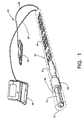
- the apparatus is shown schematically in Figure 1 wherein each of the separate elements of the portable apparatus 10 are shown.
- the portable pulsed neutron detection system 10 is comprised of multiple elements including the probe 10, low voltage power supply 32, portable computer 30, data and power lines 25 and 26.
- the entire apparatus is lightweight and easily movable which allows the apparatus 10 to be used in many different environments without the need of a heavy, permanently placed stand alone apparatus.
- the probe 20 is constructed of multiple elements.
- the probe 20 is encased in a stainless steel cylindrical housing 27 and has a diameter of less than 5 cm.
- the probe has a length of around 2 meters and weighs around 36-45 kg.
- Inside the housing 27 is found the electronics and other apparatus for emitting, detecting and controlling the probe.
- gamma ray detectors 21 At the distal end of the probe housing are found gamma ray detectors 21 for detection of the gamma rays emitted from the interrogated object after subjecting it to pulsed neutrons.
- shielding material 22 which separates the neutron emitter 23 from the detectors 21.
- the pulsed neutron generator is found adjacent to the shielding material and emits pulses of neutrons at 14MeV.
- the gamma ray detectors 21 found at the distal end of the probe 20 are high efficiency detectors made of Bismuth Germanate or Gadolinium Orthosilicate.
- the gamma ray detectors 21 are organized in linear geometry.
- the materials which constitute these gamma ray detectors are important in the operation of the present apparatus and should therefore be able to detect low intensities of the gamma rays.
- the orientation of the actual detectors within the probe does not particularly affect the efficiency of detection of levels corresponding to carbon, nitrogen and oxygen and a linear orientation is set forth herein for explanatory purposes. Many different orientations are possible as long as the probe calibration is adjusted appropriately.
- detectors are temperature stabilized to avoid any changes in the light collection efficiency.
- the analog amplitude of the signal generated from the gamma ray detectors 21 does not deviate for a given gamma ray detected.
- the temperature stabilization is accomplished through a thermo-electrically controlled jacket which surrounds each detector.
- Each detector is connected to a photomultiplier which changes the optical or light output of the detector to a voltage signal.
- a resistor chain and preamplifier provide high voltage to the photomultiplier and shape and pre-amplify the analog photomultiplier output.
- the resistor chain is connected to the base of the photomultiplier tube.
- each gamma ray signal detected by the detectors 21 is sent through the data link 25 to the data acquisition system or computer 30.
- the data acquisition system 30 is comprised of multiple parts consisting of an amplifier, an analog to digital converter, voltage stabilizers and live-time correction.
- the live-time correction of the gamma-ray detection signals acts to correct for the delay in which the analog to digital converter is busy analyzing and converting data.
- the analog signals provided by the photomultiplier representing the counts of gamma photons detected by detectors 21 during a specified time period are amplified and converted to representative digital values by an analog to digital converter.
- the amplitudes of the signals received by the computer 30 fluctuate within a range of 0-10 Volts and correspond to the energy channel or level of each gamma ray detected by the gamma ray detectors 21.
- the analog to digital converter utilized in the data acquisition system converts these amplitude values to digital values for use in the data deconvolution and object identification steps detailed herein.
- the digital value converted from this amplitude signal represents the number of detected gamma rays.
- the neutron generator 23 is a sealed tube deuterium tritium neutron generator and provides pulsed neutrons at 14MeV. Each pulse is several microseconds wide and has a frequency of between 10 kHz and 14kHz. The pulse separation, depending on the pulse width and pulse frequency, varies between 85 and 90 microseconds. These pulsed neutrons initiate the fast neutron reactions described above within the object being interrogated. Outgoing gamma rays emitted by the object are detected by the gamma ray detectors 21 for a specified time period. The gamma rays are measured and recorded as a single spectrum of data during that time period in the data acquisition system 30.
- the fast neutrons are thermalized at which point they initiate neutron capture reactions with the object.
- the gamma rays from these reactions are detected again by the detectors 21 and they are stored similarly as with the prior spectrum data.
- this spectrum data is offset within the computer systems 30 memory so as to have two distinct spectrum data from separate time periods.
- the present apparatus and method utilizes data collected from a third spectrum from the activation analysis.
- the neutron generator bombards the object under interrogation for a few minutes or a few seconds, depending on the material being detected. For example, phosphorus must be bombarded for proper detection for about 5 minutes while sodium only requires about 30 seconds.
- the generator is then turned off and the activation gamma rays are acquired for a time equal to the bombardment time.
- the activation data is then further utilized to determine the material contained within the object under interrogation.
- Radiation shielding 22 and 29 is provided and comprised of a high atomic number material such as lead or bismuth.
- the shielding 22 separates the gamma ray detectors within the probe from the neutron generator 23.
- Additional shielding 29 is also provided concentrically around each of the detectors 21, surrounding it through at least 125 degrees, and preferably around 235 degrees. This shielding prevents detection of gamma rays emitted from the generator tube 23 and from materials in the background.
- the concentric shielding 29 provided on the detectors 21 allows the probe to differentiate the contents of two objects when the probe 20 is placed between them. One spectrum of data may be taken with the concentrical shielding 29 towards one of the objects and another is measured with the shielding towards another object.
- the preferred embodiment of the probe construction contains shielding about 235 degrees of the detector as is shown in Figure 8.
- Voltage supply 24 provides 6V, 12V and 24V low voltage for the detectors electronics and the neutron generator electronics.
- the voltage supply 24 also provides 900V to 1300V high voltage for the detectors 21. Differing values of the supplied voltage may be required due to varying requirements from the specific type of detector utilized. Three thousand volts (3,000V) are provided for the pulsing of the neutron beam and 110,000V high voltage is provided for the deuterium acceleration within the neutron generator.
- the probe 20 can also operate with a high voltage power supply residing external of the cylindrical probe 20 thereby reducing the size of probe 20. Such external connection to a high voltage supply would require a high voltage connector between the probe and supply.
- Neutron generator controller 32 controls the pulsing of the neutron generator 23 and is designed according to the specific design requirements of the particular application.
- the controller 32 additionally provides controlling logic for the low voltage supplied by voltage supply 24. Additionally, controller 32 can contain diagnostic electronics for the operation of probe 20.
- Computer 30 is powered by the low voltage power supply 24 and is connected to the probe via data link 25.
- Computer 30 conducts the appropriate amplification and conversion of the analog data signals generated by the gamma ray detectors 21.
- Computer 30 also produces the appropriate offset of the gamma ray spectra so that the same analog to digital converter can be used for the separate acquisition of gamma rays produced from both fast and thermal neutrons on the same detector.
- the computer 30 additionally contains the appropriate software for data reduction and elemental characterization which allow real time analysis of the data.
- Data link cables 25 and 26 are coaxial shielded cables that provide the probe with the necessary voltages and carry to the controller 32 and computer 30 the detector signals and diagnostic signals.
- the cables can have a length of up to 17m allowing the operation of the probe from varying distances.
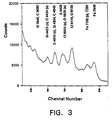
- FIGS 2, 3 and 4 Shown in Figures 2, 3 and 4 are gamma ray spectra from fast neutron, thermal neutron and neutron activation reactions. Each spectrum contains several gamma-rays produced from chemical elements contained in the interrogated object. The peaks in the spectrum, of Figures 2-6, represent particular elements present in the sample while the numbers associated with the peaks represent the energy, in kiloelectron volts, of the respective gamma rays. Data is collected for the specific probe geometry or detector configuration utilized in probe 20. Each probe is required to be properly calibrated based upon actual physical configuration of detectors 21, size of detectors, shielding geometry and position of the generator relative to the detectors.
- each chemical element produces a characteristic gamma ray spectrum which is called a response spectrum.
- Figure 5 shows a response spectrum produced from a carbon sample placed in front of the gamma ray detector bombarded with fast neutrons from the neutron generator 23.
- a gamma ray spectrum from any innocuous material or from a suspect drug or explosive will contain several chemical elements including hydrogen, carbon, nitrogen and oxygen. Depending on the packaging and surrounding materials, it can also contain elements such as silicon, chlorine, iron, lead or other elements.
- the detector 21 will record gamma rays emanating from the materials surrounding the detector as well as from the materials inside and around the neutron generator 23.
- flit is the number of counts in the i-th energy channel of the fitted spectrum
- c k is the multiplication coefficient for the response spectrum of the k-th element
- m k [i] is the number of counts in the i-th energy channel of the response spectrum of the k-th element
- ⁇ is the multiplication coefficient of the background
- bg[i] is the number of counts in the i-th energy channel of the background.
- the m k [i]'s are determined by measuring the spectrum of a sample containing only one chemical element (the response spectrum).
- response functions are measured for all the major and minor chemical elements (hydrogen, oxygen, chlorine, etc.) that are expected to be detected.
- a sample containing primarily the chemical element of interest is placed in front of the detector.
- the neutron generator is turned on and a spectrum is accumulated.
- the response spectrum is due primarily to thermal energy neutrons. In this case the response spectrum will be used for the analysis of data from this particular neutron energy.
- a gamma ray response spectrum can be formed from both fast neutron and thermal neutron reactions.
- the gamma ray response from thermal, fast neutron and activation reactions may all be utilized. All these response spectra are stored as a library in the computer. As long as the probe configuration is not altered, these spectra can be used irrespective of the locality where the probe is used and the type of object being interrogated.
- the probe When the probe is to be used for specific interrogation, the probe is placed at the position where the measurement is to take place. Without placing in front of the detector the object to be interrogated, the probe is turned on and a spectrum is taken under the exact same conditions (pulsing frequency, time interval of data accumulation) as it would be used for the measurement of the object under interrogation. In the case of an object that cannot be removed, a spectrum is taken at a distance from the object but in its vicinity. This spectrum is called the background spectrum. Since separate spectra are accumulated for fast neutron and thermal neutron induced reactions, these are two distinct background spectra recorded. While the response spectra remain the same for a given probe configuration, irrespective of where the probe is used, the background spectrum is specific to the measurement. Prior to the initiation of the measurement, the background spectrum is examined, the major and minor chemical elements present in it are recognized and recorded.
- the data de-convolution software uses the information generated, utilizes equations (1) and (2) and provides a best fit to the data.
- equations (1) and (2) provide a best fit to the data.
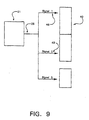
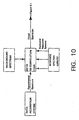
- the de-convolution code assumes certain amounts of each element of interest in the sample being interrogated. These assumed amounts are then utilized to generate a fitted spectrum utilizing the above referenced equations. Multiple iterations of adjusting the amounts of the assumed elements are then attempted by the de-convolution code until a best fit of the experimental spectrum is produced. This process is represented in the schematic of Figure 10.
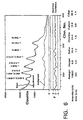
- the results of the best fit can be displayed as shown in Figure 6.
- the figure contains the experimental spectrum, the fitted spectrum and the background spectrum.
- the de-convolution software provides information on the chemical elements contained in the interrogated object. This information is utilized in several ways depending on the environment of the object under interrogation. If the investigation is of same size objects under standard geometry conditions, the probe 20 can be calibrated absolutely so that the gamma ray counts for each element would correspond to a specific elemental content. This interrogation would correspond to a fixed probe configuration for interrogation of same-sized objects placed at a fixed position relative to the probe. To calibrate the probe for each element, samples with specific elemental composition are analyzed, and measured gamma ray counts versus elemental concentrations are established. An example of such analysis would be the examination of projectiles of similar size containing the same amount of explosives of differing composition.
- elemental ratios can be uniquely determined. Ratios such as carbon to oxygen and carbon to nitrogen can be measured irrespective of the size of an object and position of the probe relative to the object.
- drugs hidden within innocuous materials such as coffee or sugar can be found by placing the probe close to the material and measuring the carbon to oxygen ratio.
- the carbon to oxygen ratio is 1.1, for coffee it is 1.8, while for heroin and cocaine, it is 4.2. If the calculated number differs from the ratio expected for coffee or sugar by an amount larger than 3 ⁇ , one can say with 99% confidence that the material contains something different than coffee or sugar.
Landscapes
- Physics & Mathematics (AREA)
- High Energy & Nuclear Physics (AREA)
- Life Sciences & Earth Sciences (AREA)
- General Life Sciences & Earth Sciences (AREA)
- General Physics & Mathematics (AREA)
- Geophysics (AREA)
- Analysing Materials By The Use Of Radiation (AREA)
Claims (11)
- Tragbares, pulsierende Neutronen verwendendes, Nachweissystem (10) flir den Nachweis spezifischer Elemente in einem Objekt, das umfasst:eine tragbare Sonde (20), wobei besagte Sonde einen Impulsneutronengenerator (23) und wenigstens einen Gammastrahlungsdetektor (21) aufweist;ein Steuergerät (32), das zur Änderung der Intensitäts- und Impulskenndaten des besagten Impulsneutronengenerators bedienbar an den Impulsneutronengenerator angeschlossen ist, um einen Neutronenstrahl ab besagtem Generator zu emittieren;ein Datenerfassungssystem, das bedienbar an besagten wenigstens einen Gammastrahlungsdetektor zum Sammeln der vom besagten Detektor gemessenen Daten angeschlossen ist; dadurch gekennzeichnet, dass:Mittel zum Analysieren besagter Daten, die schnellen Neutronenreaktionen, thermischen Neutronenreaktionen und Aktivierungs-Neutronenreaktionen entsprechen, um die chemische Zusammensetzung des besagten Objekts zu bestimmen.
- System nach Anspruch 1, wobei besagte Sonde weiter umfasst:ein zylindrisches Gehäuse (27), das besagten Neutronengenerator und besagten wenigstens einen Gammastrahlungsdetektor enthält;Abschirmmaterial (22), das besagten Gammastrahlungsdetektor und besagten Neutronengenerator trennt.
- System nach Anspruch 2, wobei besagte Abschirmung ca. 235 Grad um besagten wenigstens einen Gammastrahlungsdetektor herum positioniert ist.
- System nach Anspruch 2, wobei besagte Sonde in ein zylindrisches Gehäuse aus Edelstahl eingeschlossen ist.
- System nach Anspruch 1, wobei besagtes Datenerfassungssystem weiter einen Computer (30) zum Verarbeiten der von besagtem wenigstens einem Gammastrahlungsdetektor gelieferten Signale umfässt.
- System nach Anspruch 9, wobei besagter Computer ein angepasstes Spektrum von Gammastrahlen an jedem Energiekanal durch folgende Gleichung generiert:
- System nach Anspruch 10, wobei besagte mk [i]'s durch Messen des Spektrums einer Probe bestimmt werden, die nur ein Element enthält.
- System nach Anspruch 10, wobei besagte Koeffizienten ck und % durch die Fehlerquadratmethode bestimmt werden, was die allgemeine Gleichung x2 minimiert:
- System nach Anspruch 1, wobei besagtes Steuergerät Impulse vom besagten Neutronengenerator durch zwischen 85 und 90 Mikrosekunden trennt.
- System nach Anspruch 1, wobei besagter Generator Neutronen mit ca. 14MeV emittiert.
- System nach Anspruch 1, wobei besagter Generator Impulse zwischen ca. 10 kHz und 14 kHz erzeugt.
Applications Claiming Priority (1)
| Application Number | Priority Date | Filing Date | Title |
|---|---|---|---|
| PCT/US1998/007343 WO1999053344A1 (en) | 1998-04-13 | 1998-04-13 | Method and portable apparatus for the detection of substances by use of neutron irradiation |
Publications (2)
| Publication Number | Publication Date |
|---|---|
| EP1071972A1 EP1071972A1 (de) | 2001-01-31 |
| EP1071972B1 true EP1071972B1 (de) | 2003-03-12 |
Family
ID=22266823
Family Applications (1)
| Application Number | Title | Priority Date | Filing Date |
|---|---|---|---|
| EP98920837A Expired - Lifetime EP1071972B1 (de) | 1998-04-13 | 1998-04-13 | Tragbares gerät zur bestimmung von substanzen durch neutronenstrahlung |
Country Status (4)
| Country | Link |
|---|---|
| EP (1) | EP1071972B1 (de) |
| AU (1) | AU7358598A (de) |
| DE (1) | DE69812185D1 (de) |
| WO (1) | WO1999053344A1 (de) |
Families Citing this family (1)
| Publication number | Priority date | Publication date | Assignee | Title |
|---|---|---|---|---|
| DK1882929T3 (da) | 2006-07-28 | 2012-01-23 | Sage Innovations Inc | Detektionssystem og detektionsfremgangsmåde baseret på pulserede virksomme partikler |
Family Cites Families (6)
| Publication number | Priority date | Publication date | Assignee | Title |
|---|---|---|---|---|
| US4264823A (en) * | 1979-06-29 | 1981-04-28 | Halliburton Services | Well logging digital neutron generator control system |
| US5124554A (en) * | 1990-02-20 | 1992-06-23 | Rolls-Royce And Associates Limited | Explosives detector |
| US5200626A (en) * | 1990-03-28 | 1993-04-06 | Martin Marietta Energy Systems, Inc. | Hidden explosives detector employing pulsed neutron and x-ray interrogation |
| US5235185A (en) * | 1992-01-09 | 1993-08-10 | Schlumberger Technology Corporation | Formation sigma measurement from thermal neutron detection |
| US5446288A (en) * | 1993-10-25 | 1995-08-29 | Tumer; Tumay O. | Integrated substance detection instrument |
| US5440118A (en) * | 1994-03-31 | 1995-08-08 | Schlumberger Technology Corporation | Methods and apparatus for determining formation lithology by gamma ray spectroscopy |
-
1998
- 1998-04-13 DE DE69812185T patent/DE69812185D1/de not_active Expired - Lifetime
- 1998-04-13 AU AU73585/98A patent/AU7358598A/en not_active Abandoned
- 1998-04-13 EP EP98920837A patent/EP1071972B1/de not_active Expired - Lifetime
- 1998-04-13 WO PCT/US1998/007343 patent/WO1999053344A1/en not_active Ceased
Also Published As
| Publication number | Publication date |
|---|---|
| WO1999053344A1 (en) | 1999-10-21 |
| DE69812185D1 (de) | 2003-04-17 |
| AU7358598A (en) | 1999-11-01 |
| EP1071972A1 (de) | 2001-01-31 |
Similar Documents
| Publication | Publication Date | Title |
|---|---|---|
| US5982838A (en) | Method and portable apparatus for the detection of substances by use of neutron irradiation | |
| JP5264724B2 (ja) | パルス高エネルギー粒子に基づく検出システム及び検出方法 | |
| EP0470226B1 (de) | Vorrichtung und verfahren zum nachweis von schmuggelware unter verwendung einer aktivierung schneller neutronen | |
| EP0425662B1 (de) | Verwendung der kernresonanzen in der aktivierungsanalyse, insbesondere zum nachweis der anwesenheit von auf stickstoffbasierten sprengstoffen in gepäck | |
| US5606167A (en) | Contraband detection apparatus and method | |
| US5479023A (en) | Method and apparatus for detecting concealed substances | |
| US3124679A (en) | Nuclear determination of | |
| US8954300B2 (en) | Screening method and apparatus | |
| US4882121A (en) | Apparatus for the detection of E. G. explosive substances | |
| US20110112810A1 (en) | Method and apparatus for borehole logging | |
| US6438189B1 (en) | Pulsed neutron elemental on-line material analyzer | |
| JP2001517298A (ja) | 単一エネルギーの中性子を用いた物体検出装置 | |
| US8748837B2 (en) | Non-intrusive method for detection of chemical elements | |
| US20020150194A1 (en) | Method and device for non-invasive soil carbon content and distribution measurements | |
| US5666394A (en) | Thickness measurement gauge | |
| WO1999053344A1 (en) | Method and portable apparatus for the detection of substances by use of neutron irradiation | |
| US5008067A (en) | Method of downhole neutron monitoring | |
| US5506406A (en) | Method and apparatus for determining the concentration of a heavy element in a rock face | |
| US5229604A (en) | Self-filling and self-purging apparatus for detecting spontaneous radiation from substances in fluids | |
| Rhodes et al. | APSTNG: neutron interrogation for detection of explosives, drugs, and nuclear and chemical warfare materials | |
| US11061164B1 (en) | System, algorithm, and method using short pulse interrogation with neutrons to detect and identify matter | |
| Macey et al. | Determination of oxygen and nitrogen in gases by prompt gamma ray measurement | |
| Vourvopoulos | PELAN-a transportable, neutron-based UXO identification technique | |
| Wilhelmsen et al. | Fast-neutron analysis at the Swedish Defence Research Agency | |
| Smith et al. | Canadian high-energy neutron spectrometry system (CHENSS) |
Legal Events
| Date | Code | Title | Description |
|---|---|---|---|
| PUAI | Public reference made under article 153(3) epc to a published international application that has entered the european phase |
Free format text: ORIGINAL CODE: 0009012 |
|
| 17P | Request for examination filed |
Effective date: 20001031 |
|
| AK | Designated contracting states |
Kind code of ref document: A1 Designated state(s): BE CH DE FR GB IT LI NL |
|
| 17Q | First examination report despatched |
Effective date: 20010903 |
|
| RTI1 | Title (correction) |
Free format text: PORTABLE APPARATUS FOR THE DETECTION OF SUBSTANCES BY USE OF NEUTRON IRRADIATION |
|
| RTI1 | Title (correction) |
Free format text: PORTABLE APPARATUS FOR THE DETECTION OF SUBSTANCES BY USE OF NEUTRON IRRADIATION |
|
| GRAG | Despatch of communication of intention to grant |
Free format text: ORIGINAL CODE: EPIDOS AGRA |
|
| GRAG | Despatch of communication of intention to grant |
Free format text: ORIGINAL CODE: EPIDOS AGRA |
|
| GRAH | Despatch of communication of intention to grant a patent |
Free format text: ORIGINAL CODE: EPIDOS IGRA |
|
| RIN1 | Information on inventor provided before grant (corrected) |
Inventor name: SUDAR, SANDOR Inventor name: VOURVOPOULOS, GEORGE |
|
| RIN1 | Information on inventor provided before grant (corrected) |
Inventor name: SUDAR, SANDOR Inventor name: VOURVOPOLIS, GEORGE |
|
| GRAH | Despatch of communication of intention to grant a patent |
Free format text: ORIGINAL CODE: EPIDOS IGRA |
|
| GRAA | (expected) grant |
Free format text: ORIGINAL CODE: 0009210 |
|
| AK | Designated contracting states |
Designated state(s): BE CH DE FR GB IT LI NL |
|
| PG25 | Lapsed in a contracting state [announced via postgrant information from national office to epo] |
Ref country code: NL Free format text: LAPSE BECAUSE OF FAILURE TO SUBMIT A TRANSLATION OF THE DESCRIPTION OR TO PAY THE FEE WITHIN THE PRESCRIBED TIME-LIMIT Effective date: 20030312 Ref country code: LI Free format text: LAPSE BECAUSE OF FAILURE TO SUBMIT A TRANSLATION OF THE DESCRIPTION OR TO PAY THE FEE WITHIN THE PRESCRIBED TIME-LIMIT Effective date: 20030312 Ref country code: IT Free format text: LAPSE BECAUSE OF FAILURE TO SUBMIT A TRANSLATION OF THE DESCRIPTION OR TO PAY THE FEE WITHIN THE PRESCRIBED TIME-LIMIT;WARNING: LAPSES OF ITALIAN PATENTS WITH EFFECTIVE DATE BEFORE 2007 MAY HAVE OCCURRED AT ANY TIME BEFORE 2007. THE CORRECT EFFECTIVE DATE MAY BE DIFFERENT FROM THE ONE RECORDED. Effective date: 20030312 Ref country code: FR Free format text: LAPSE BECAUSE OF FAILURE TO SUBMIT A TRANSLATION OF THE DESCRIPTION OR TO PAY THE FEE WITHIN THE PRESCRIBED TIME-LIMIT Effective date: 20030312 Ref country code: CH Free format text: LAPSE BECAUSE OF FAILURE TO SUBMIT A TRANSLATION OF THE DESCRIPTION OR TO PAY THE FEE WITHIN THE PRESCRIBED TIME-LIMIT Effective date: 20030312 Ref country code: BE Free format text: LAPSE BECAUSE OF FAILURE TO SUBMIT A TRANSLATION OF THE DESCRIPTION OR TO PAY THE FEE WITHIN THE PRESCRIBED TIME-LIMIT Effective date: 20030312 |
|
| REG | Reference to a national code |
Ref country code: GB Ref legal event code: FG4D |
|
| REG | Reference to a national code |
Ref country code: CH Ref legal event code: EP |
|
| REF | Corresponds to: |
Ref document number: 69812185 Country of ref document: DE Date of ref document: 20030417 Kind code of ref document: P |
|
| PG25 | Lapsed in a contracting state [announced via postgrant information from national office to epo] |
Ref country code: DE Free format text: LAPSE BECAUSE OF FAILURE TO SUBMIT A TRANSLATION OF THE DESCRIPTION OR TO PAY THE FEE WITHIN THE PRESCRIBED TIME-LIMIT Effective date: 20030613 |
|
| NLV1 | Nl: lapsed or annulled due to failure to fulfill the requirements of art. 29p and 29m of the patents act | ||
| REG | Reference to a national code |
Ref country code: CH Ref legal event code: PL |
|
| PLBE | No opposition filed within time limit |
Free format text: ORIGINAL CODE: 0009261 |
|
| STAA | Information on the status of an ep patent application or granted ep patent |
Free format text: STATUS: NO OPPOSITION FILED WITHIN TIME LIMIT |
|
| EN | Fr: translation not filed | ||
| 26N | No opposition filed |
Effective date: 20031215 |
|
| PGFP | Annual fee paid to national office [announced via postgrant information from national office to epo] |
Ref country code: GB Payment date: 20090429 Year of fee payment: 12 |
|
| GBPC | Gb: european patent ceased through non-payment of renewal fee |
Effective date: 20100413 |
|
| PG25 | Lapsed in a contracting state [announced via postgrant information from national office to epo] |
Ref country code: GB Free format text: LAPSE BECAUSE OF NON-PAYMENT OF DUE FEES Effective date: 20100413 |