EP1071956B1 - Assays for autoantibodies - Google Patents
Assays for autoantibodies Download PDFInfo
- Publication number
- EP1071956B1 EP1071956B1 EP99951000A EP99951000A EP1071956B1 EP 1071956 B1 EP1071956 B1 EP 1071956B1 EP 99951000 A EP99951000 A EP 99951000A EP 99951000 A EP99951000 A EP 99951000A EP 1071956 B1 EP1071956 B1 EP 1071956B1
- Authority
- EP
- European Patent Office
- Prior art keywords
- antigen
- immobilised
- antibody
- substrate
- autoantibodies
- Prior art date
- Legal status (The legal status is an assumption and is not a legal conclusion. Google has not performed a legal analysis and makes no representation as to the accuracy of the status listed.)
- Expired - Lifetime
Links
Images
Classifications
-
- G—PHYSICS
- G01—MEASURING; TESTING
- G01N—INVESTIGATING OR ANALYSING MATERIALS BY DETERMINING THEIR CHEMICAL OR PHYSICAL PROPERTIES
- G01N33/00—Investigating or analysing materials by specific methods not covered by groups G01N1/00 - G01N31/00
- G01N33/48—Biological material, e.g. blood, urine; Haemocytometers
- G01N33/50—Chemical analysis of biological material, e.g. blood, urine; Testing involving biospecific ligand binding methods; Immunological testing
- G01N33/53—Immunoassay; Biospecific binding assay; Materials therefor
- G01N33/564—Immunoassay; Biospecific binding assay; Materials therefor for pre-existing immune complex or autoimmune disease, i.e. systemic lupus erythematosus, rheumatoid arthritis, multiple sclerosis, rheumatoid factors or complement components C1-C9
-
- A—HUMAN NECESSITIES
- A61—MEDICAL OR VETERINARY SCIENCE; HYGIENE
- A61P—SPECIFIC THERAPEUTIC ACTIVITY OF CHEMICAL COMPOUNDS OR MEDICINAL PREPARATIONS
- A61P37/00—Drugs for immunological or allergic disorders
- A61P37/02—Immunomodulators
- A61P37/06—Immunosuppressants, e.g. drugs for graft rejection
-
- G—PHYSICS
- G01—MEASURING; TESTING
- G01N—INVESTIGATING OR ANALYSING MATERIALS BY DETERMINING THEIR CHEMICAL OR PHYSICAL PROPERTIES
- G01N33/00—Investigating or analysing materials by specific methods not covered by groups G01N1/00 - G01N31/00
- G01N33/48—Biological material, e.g. blood, urine; Haemocytometers
- G01N33/50—Chemical analysis of biological material, e.g. blood, urine; Testing involving biospecific ligand binding methods; Immunological testing
- G01N33/53—Immunoassay; Biospecific binding assay; Materials therefor
- G01N33/543—Immunoassay; Biospecific binding assay; Materials therefor with an insoluble carrier for immobilising immunochemicals
- G01N33/54366—Apparatus specially adapted for solid-phase testing
- G01N33/54386—Analytical elements
- G01N33/54387—Immunochromatographic test strips
- G01N33/54388—Immunochromatographic test strips based on lateral flow
-
- G—PHYSICS
- G01—MEASURING; TESTING
- G01N—INVESTIGATING OR ANALYSING MATERIALS BY DETERMINING THEIR CHEMICAL OR PHYSICAL PROPERTIES
- G01N33/00—Investigating or analysing materials by specific methods not covered by groups G01N1/00 - G01N31/00
- G01N33/48—Biological material, e.g. blood, urine; Haemocytometers
- G01N33/50—Chemical analysis of biological material, e.g. blood, urine; Testing involving biospecific ligand binding methods; Immunological testing
- G01N33/74—Chemical analysis of biological material, e.g. blood, urine; Testing involving biospecific ligand binding methods; Immunological testing involving hormones or other non-cytokine intercellular protein regulatory factors such as growth factors, including receptors to hormones and growth factors
- G01N33/76—Human chorionic gonadotropin including luteinising hormone, follicle stimulating hormone, thyroid stimulating hormone or their receptors
-
- G—PHYSICS
- G01—MEASURING; TESTING
- G01N—INVESTIGATING OR ANALYSING MATERIALS BY DETERMINING THEIR CHEMICAL OR PHYSICAL PROPERTIES
- G01N2800/00—Detection or diagnosis of diseases
- G01N2800/24—Immunology or allergic disorders
-
- Y—GENERAL TAGGING OF NEW TECHNOLOGICAL DEVELOPMENTS; GENERAL TAGGING OF CROSS-SECTIONAL TECHNOLOGIES SPANNING OVER SEVERAL SECTIONS OF THE IPC; TECHNICAL SUBJECTS COVERED BY FORMER USPC CROSS-REFERENCE ART COLLECTIONS [XRACs] AND DIGESTS
- Y10—TECHNICAL SUBJECTS COVERED BY FORMER USPC
- Y10S—TECHNICAL SUBJECTS COVERED BY FORMER USPC CROSS-REFERENCE ART COLLECTIONS [XRACs] AND DIGESTS
- Y10S435/00—Chemistry: molecular biology and microbiology
- Y10S435/81—Packaged device or kit
-
- Y—GENERAL TAGGING OF NEW TECHNOLOGICAL DEVELOPMENTS; GENERAL TAGGING OF CROSS-SECTIONAL TECHNOLOGIES SPANNING OVER SEVERAL SECTIONS OF THE IPC; TECHNICAL SUBJECTS COVERED BY FORMER USPC CROSS-REFERENCE ART COLLECTIONS [XRACs] AND DIGESTS
- Y10—TECHNICAL SUBJECTS COVERED BY FORMER USPC
- Y10S—TECHNICAL SUBJECTS COVERED BY FORMER USPC CROSS-REFERENCE ART COLLECTIONS [XRACs] AND DIGESTS
- Y10S435/00—Chemistry: molecular biology and microbiology
- Y10S435/971—Capture of complex after antigen-antibody reaction
-
- Y—GENERAL TAGGING OF NEW TECHNOLOGICAL DEVELOPMENTS; GENERAL TAGGING OF CROSS-SECTIONAL TECHNOLOGIES SPANNING OVER SEVERAL SECTIONS OF THE IPC; TECHNICAL SUBJECTS COVERED BY FORMER USPC CROSS-REFERENCE ART COLLECTIONS [XRACs] AND DIGESTS
- Y10—TECHNICAL SUBJECTS COVERED BY FORMER USPC
- Y10S—TECHNICAL SUBJECTS COVERED BY FORMER USPC CROSS-REFERENCE ART COLLECTIONS [XRACs] AND DIGESTS
- Y10S435/00—Chemistry: molecular biology and microbiology
- Y10S435/973—Simultaneous determination of more than one analyte
-
- Y—GENERAL TAGGING OF NEW TECHNOLOGICAL DEVELOPMENTS; GENERAL TAGGING OF CROSS-SECTIONAL TECHNOLOGIES SPANNING OVER SEVERAL SECTIONS OF THE IPC; TECHNICAL SUBJECTS COVERED BY FORMER USPC CROSS-REFERENCE ART COLLECTIONS [XRACs] AND DIGESTS
- Y10—TECHNICAL SUBJECTS COVERED BY FORMER USPC
- Y10S—TECHNICAL SUBJECTS COVERED BY FORMER USPC CROSS-REFERENCE ART COLLECTIONS [XRACs] AND DIGESTS
- Y10S435/00—Chemistry: molecular biology and microbiology
- Y10S435/975—Kit
-
- Y—GENERAL TAGGING OF NEW TECHNOLOGICAL DEVELOPMENTS; GENERAL TAGGING OF CROSS-SECTIONAL TECHNOLOGIES SPANNING OVER SEVERAL SECTIONS OF THE IPC; TECHNICAL SUBJECTS COVERED BY FORMER USPC CROSS-REFERENCE ART COLLECTIONS [XRACs] AND DIGESTS
- Y10—TECHNICAL SUBJECTS COVERED BY FORMER USPC
- Y10S—TECHNICAL SUBJECTS COVERED BY FORMER USPC CROSS-REFERENCE ART COLLECTIONS [XRACs] AND DIGESTS
- Y10S436/00—Chemistry: analytical and immunological testing
- Y10S436/805—Optical property
-
- Y—GENERAL TAGGING OF NEW TECHNOLOGICAL DEVELOPMENTS; GENERAL TAGGING OF CROSS-SECTIONAL TECHNOLOGIES SPANNING OVER SEVERAL SECTIONS OF THE IPC; TECHNICAL SUBJECTS COVERED BY FORMER USPC CROSS-REFERENCE ART COLLECTIONS [XRACs] AND DIGESTS
- Y10—TECHNICAL SUBJECTS COVERED BY FORMER USPC
- Y10S—TECHNICAL SUBJECTS COVERED BY FORMER USPC CROSS-REFERENCE ART COLLECTIONS [XRACs] AND DIGESTS
- Y10S436/00—Chemistry: analytical and immunological testing
- Y10S436/815—Test for named compound or class of compounds
-
- Y—GENERAL TAGGING OF NEW TECHNOLOGICAL DEVELOPMENTS; GENERAL TAGGING OF CROSS-SECTIONAL TECHNOLOGIES SPANNING OVER SEVERAL SECTIONS OF THE IPC; TECHNICAL SUBJECTS COVERED BY FORMER USPC CROSS-REFERENCE ART COLLECTIONS [XRACs] AND DIGESTS
- Y10—TECHNICAL SUBJECTS COVERED BY FORMER USPC
- Y10S—TECHNICAL SUBJECTS COVERED BY FORMER USPC CROSS-REFERENCE ART COLLECTIONS [XRACs] AND DIGESTS
- Y10S436/00—Chemistry: analytical and immunological testing
- Y10S436/824—Immunological separation techniques
Definitions
- the present invention is concerned with assays for screening a sample of body fluid for autoantibodies to various antigens.
- the present invention is concerned with screening a sample of body fluid for autoantibodies associated with autoimmune thyroid disease.
- Autoimmune diseases are characterised by the presence of circulating autoantibodies and in autoimmune thyroid disease, for example, the autoantibodies are directed to three different thyroid proteins, namely thyroid peroxidase (TPO), thyroglobulin (Tg) and the receptor for thyroid stimulating hormone (TSHR).
- TPO thyroid peroxidase
- Tg thyroglobulin
- TSHR receptor for thyroid stimulating hormone
- thyroid function is controlled by a feedback system involving the pituitary gland.
- the pituitary secretes the hormone thyroid stimulating hormone (TSH) into the circulating blood.
- TSH thyroid stimulating hormone
- TSHR TSH receptors
- thyroid disease In thyroid disease, however, the above feedback system is often distorted. For example, when the thyroid is under-active (hypothyroidism), thyroid hormone levels are lower than normal and because these low levels do not suppress TSH release, circulating TSH levels are high. In the case of thyroid over-activity (hyperthyroidism), thyroid levels are higher than normal and these high levels cause TSH release to be suppressed more than normal and circulating TSH levels are low.
- hypothyroidism hypothyroidism
- thyroid levels are higher than normal and these high levels cause TSH release to be suppressed more than normal and circulating TSH levels are low.
- TPO and Tg Two different thyroid proteins
- Screening for autoantibodies to TPO and/or autoantibodies to Tg is important in the diagnosis and management of the various forms of autoimmune hypothyroidism, including post-partum thyroiditis and the like.
- This screening for TPO autoantibodies and/or Tg autoantibodies complements monitoring of circulating TSH levels or thyroid hormone levels which reflect the extent of thyroid under-activity and effectiveness of treatment.
- Hyperthyroidism is also often caused by autoimmune attack on the thyroid but in this condition, autoantibodies are formed to the TSHR. These TSHR autoantibodies mimic the effects of TSH and cause circulating thyroid hormone levels to be high. Such high thyroid hormone levels act on the pituitary and suppress circulating TSH levels and consequently TSH levels are lower than normal. Screening for autoantibodies to the TSHR is important in the diagnosis of autoimmune hyperthyroidism. As with autoimmune hypothyroidism, screening for TSHR autoantibodies complements monitoring of circulating TSH levels or thyroid hormone levels which reflect the extent of thyroid over-activity and effectiveness of treatment.
- Tg levels are usually measured by assays which depend on monoclonal and/or polyclonal antibodies to Tg but if autoantibodies to Tg are present in patient test samples, these autoantibodies can interfere with the Tg assays, giving erroneous results. Consequently, screening for autoantibodies to Tg is often carried out at the same time as detection and monitoring of circulating Tg levels.
- autoimmune diseases such as type 1 diabetes (where autoantibodies are formed to insulin, glutamic acid decarboxylase and to the islet cell protein ICA512 or IA2), celiac disease (where autoantibodies are formed to tissue transglutaminase), myasthenia gravis (where autoantibodies are formed to the acetylcholine receptor and to calcium channels), systemic lupus erythematosus (where autoantibodies are formed to DNA and to various nuclear proteins), and the like.
- type 1 diabetes where autoantibodies are formed to insulin, glutamic acid decarboxylase and to the islet cell protein ICA512 or IA2
- celiac disease where autoantibodies are formed to tissue transglutaminase
- myasthenia gravis where autoantibodies are formed to the acetylcholine receptor and to calcium channels
- systemic lupus erythematosus where autoantibodies are formed to DNA and to various nuclear proteins
- ELISA sandwich type enzyme linked immunosorbent assays
- Antibodies in particular autoantibodies, such as autoantibodies against thyroid peroxidase (TPO) are determined by a procedure in which the sample to be investigated is reacted with two further, in particular monoclonal antibodies and an antigen.
- the two further antibodies are an immobilised antibody (Akimm) and a non-immobilised labelled antibody (Ak*) against the antigen (Ag), and the latter is preferably used in the form of a crude, natural antigen, for example in the form of an organ extract.
- the presence of the antibodies (Ak) to be determined is evident as a disturbance of the formation of a sandwich of the two added antibodies (Akimm and Ak*) with the added antigen (Ag) and as a consequent reduction in the binding of the label to the solid phase.
- US 4690907 discloses an immunoassay method which employs a capillary tube for detection of a target substance by immuno-reaction.
- a list of analyte target substances is provided.
- the target substance and a labelled immuno-reactive reagent are caused to move through the capillary tube either in unreacted form or as an immuno-complex.
- the thus formed immuno-complex, or the unreacted immuno-reactive reagent is then combined with a substance ("uptaking" substance) which has been packed in the capillary tube and immobilised thereto, and which is adapted to take up the labelled immuno-reactive reagent.
- the amount of the thus-immobilised labelled substance is then measured.
- a method of in vitro screening of a sample of body fluid for at least first and second autoantibodies to at least one antigen comprises:
- a method according to the present invention is particularly suitable for use in screening for at least one autoantibody associated with autoimmune thyroid disease and where the antigen comprises a thyroid protein.
- the thyroid protein is selected from the group consisting of thyroid peroxidase (TPO), thyroglobulin (Tg) and thyroid stimulating hormone receptor (TSHR), and even more advantageously the thyroid protein is selected from the group consisting of TPO and Tg.
- a method according to the present invention preferably further comprises screening, in addition to the autoantibody screening, for at least one further biological marker present in a sample of body fluid from a patient, which marker is indicative of an autoimmune (typically thyroid) disease.
- Suitable biological markers can be selected from the group consisting of thyroid stimulating hormone (TSH), thyroxine, tri-iodothyronine, thyroglobulin (Tg) and the like.
- TSH thyroid stimulating hormone
- Tg thyroglobulin
- a method according to the present invention therefore, preferably further comprises screening for the presence of at least one of the group consisting of TSH, thyroxine, tri-iodothyronine, Tg and the like, in a sample of body fluid obtained from a patient being tested for an autoimmune thyroid disease.
- Such screening for the presence of a further biological marker or markers can in the case of at least thyroxine and/or tri-iodothyronine, comprise screening for total or free (circulating) thyroxine and/or total or free (circulating) tri-iodothyronine. It may be desirable for means for screening for the presence of such a further biological marker or markers to be provided to the substrate employed in the present invention. Alternatively, means for screening for the presence of such a further biological marker or markers may be provided remote from the substrate substantially as hereinbefore described and suitably such remote screening means can be provided by a separate kit.
- a method according to the present invention is also suitable for use in screening for at least one autoantibody associated with non-thyroid autoimmune disease, such as autoantibodies associated with type 1 diabetes, celiac disease, myasthenia gravis, systemic lupus erythematosus and the like.
- autoantibody associated with non-thyroid autoimmune disease such as autoantibodies associated with type 1 diabetes, celiac disease, myasthenia gravis, systemic lupus erythematosus and the like.
- monitoring in step (f) of a method according to the present invention comprises observing a colorimetric change dependent on the binding of the autoantibodies and the antigen present in the mixture obtained by step (d).
- the labelling means can comprise a colorimetric label selected from the group consisting of colloidal gold, colloidal carbon, coloured latex, dyed polymers and the like.
- the colorimetric label comprises colloidal gold.
- the labelling means can further comprise a linker by which the colorimetric label, such as colloidal gold, may be attached to the non-immobilised antibody to be labelled.
- a suitable linker can include -biotin-antibiotin-, -biotin- strepavidin- (SA) or the like.
- SA -biotin-antibiotin-, -biotin- strepavidin-
- the labelling means may be applied to the non-immobilised antibody to be labelled substantially remote from the substrate.
- the labelling means may be provided to the substrate and such labelling means may be applied to the non-immobilised antibody to be labelled when the antibody has also been provided to the substrate.
- Advantageously monitoring in step (f) of a method according to the present invention can further comprise providing a positive control that is present in the presence or absence of the autoantibodies being screened.
- the positive control may comprise, attaching to the substrate, a capture reagent for a colorimetric label, such as colloidal gold or the like.
- the positive control may comprise attaching to the substrate at least one control antibody to the antigen, which control antibody binds to a site on the antigen distinct to a binding site thereof for the autoantibodies being screened.
- the control antibody is preferably attached to the substrate employed in a method according to the present invention at a location of the substrate downstream relative to the immobilised antibody.
- a further alternative positive control can comprise attaching to the substrate at least one control agent that can bind to the non-immobilised antibody.
- the control agent can be selected from the group consisting of anti-mouse IgG, anti-human IgG or the like, and is typically attached to the substrate downstream relative to the immobilised antibody.
- a method according to the present invention comprises allowing a mixture obtained in step (d) to flow along the substrate and interact with the antibody immobilised to the substrate. It is preferred that at least the sample of body fluid is contacted with an application zone of the substrate, which application zone is provided upstream on the substrate relative to the immobilised antibody, and wherein the mixture is allowed to flow from the application zone along the substrate so as to interact with the immobilised antibody.
- the application zone can include the source of the antigen of step (c), and the mixture in step (d) is obtained by contacting the sample of body fluid with the antigen of the application zone.
- the application zone can further include the non-immobilised antibody, and the mixture in step (d) can be obtained by contacting the sample of body fluid and the antigen with the non-immobilised antibody present in the application zone.
- the mixture of step (d) can be provided by contacting the antigen source of step (a) and the sample of body fluid substantially remote from the substrate and the mixture is subsequently contacted with the application zone of the substrate.
- the antigen source of step (a), the sample of body fluid and the non-immobilised antibody are contacted substantially remote from the substrate so as to provide the mixture of step (d), and the mixture is subsequently contacted with the application zone of the substrate.
- substantially non-immobilised antibody denotes an antibody that when provided in the mixture obtained in step (d) can be allowed to flow relative to the substrate employed in the present invention.
- the non-immobilised antibody is provided in purified form and may comprise a monoclonal antibody or an autoantibody to the antigen.
- the immobilised antibody can comprise a first autoantibody to the antigen and the non-immobilised antibody can comprise a second autoantibody to the antigen.
- kit for use in screening a sample of body fluid for at least first and second autoantibodies to at least one antigen comprises:
- kits according to the present invention are particularly suitable for use in screening for at least one autoantibody associated with autoimmune (typically thyroid) disease and where the antigen comprises a thyroid protein.
- the thyroid protein is selected from the group consisting of thyroid peroxidase (TPO), thyroglobulin (Tg) and thyroid stimulating hormone receptor (TSHR), and even more advantageously the thyroid protein is selected from the group consisting of TPO and Tg.
- kits according to the present invention further comprises means for screening for at least one further biological marker present in patient, which marker is indicative of an autoimmune (typically thyroid) disease.
- Suitable biological markers can be selected from the group consisting of thyroid stimulating hormone (TSH), thyroxine, tri-iodothyronine, thyroglobulin (Tg) and the like.
- TSH thyroid stimulating hormone
- thyroxine tri-iodothyronine
- Tg thyroglobulin
- a kit according to the present invention further comprises means for screening for the presence of at least one of TSH, thyroxine, tri-iodothyronine, Tg and the like in the sample of body fluid.
- the monitoring means employed in a kit according to the present invention comprise means for observing a colorimetric change dependent on the binding of the autoantibodies and the antigen present in the mixture substantially as hereinbefore described, although other monitoring means can be employed also substantially as hereinbefore described.
- the labelling means can comprise a colorimetric label, such as colloidal gold substantially as hereinbefore described and a linker can be provided for attaching the colorimetric label to the non-immobilised antibody to be labelled again substantially as hereinbefore described.
- the substrate may be provided with the labelling means for subsequent application.
- the substrate of a kit according to the present invention can further comprise a positive control substantially as hereinbefore described with reference to a method according to the present invention.
- the substrate of a kit according to the present invention can comprise an application zone provided upstream on the substrate relative to the immobilised antibody, whereby the mixture is allowed to flow from the application zone along the substrate so as to interact with the immobilised antibody.
- that application zone can include the source of the antigen, and the mixture is obtained by contacting the sample of body fluid with the antigen of the application zone.
- the application zone can further include the non-immobilised antibody, and means are provided whereby the mixture is obtained by contacting the sample of body fluid and the antigen with the non-immobilised antibody present in the application zone.
- kits according to the present invention can comprise means whereby the antigen source and the sample of body fluid are contacted substantially remote from the substrate so as to provide the mixture and means whereby the mixture is subsequently contacted with the application zone.
- typically means can be provided whereby the antigen source, the sample of body fluid and / or the non-immobilised antibody are contacted substantially remote from the substrate so as to provide the mixture, and means whereby the mixture is subsequently contacted with the application zone.
- a kit according to the present invention preferably further comprises wick means arranged downstream relative to the immobilised antibody so as to permit or potentiate flow of at least the sample of body fluid towards the immobilised antibody.
- Non-immobilised and immobilised antibodies employed in methods or kits according to the present invention are generally provided in substantially purified form and can comprise monoclonal antibodies, polyclonal antibodies, recombinant antibodies, antibody fragments, synthetic antibodies, substances mimicking antibodies, autoantibodies or the like.
- Preferred aspects of the present invention comprise the non-immobilised antibody and/or the immobilised antibody comprising an autoantibody, which may preferably be a monoclonal antibody, and/or the non-immobilised antibody and/or the immobilised antibody can comprise a monoclonal antibody.
- first and / or second autoantibodies in the presence of first and / or second autoantibodies being screened for in a sample of body fluid, generally binding of the first and / or second autoantibodies with the antigen precludes or reduces binding of the latter with the immobilised and / or non-immobilised antibodies.
- a colorimetric label is employed, substantially no colour change or reduced colour change due to binding of antigen to the immobilised and / or non-immobilised antibodies is thus seen in the presence of the first and / or second autoantibodies.
- a strong colour change is seen due to binding of antigen to the immobilised and non-immobilised antibodies.
- an antigen employed in methods or kits of the present invention can comprise recombinant antigen, native antigen (autoantigen), synthetic antigen, antigen fragments, substances mimicking antigen or the like.
- a substrate for use in the present invention can comprise a membrane of nitrocellulose, cellulose acetate, a polyamide or the like.
- the present invention comprises screening a sample of blood, plasma, serum or urine for at least one autoantibody.
- the present invention further provides use of a kit substantially as hereinbefore described in screening a sample of body fluid for at least first and second autoantibodies to at least one antigen again substantially as hereinbefore described.
- Kit (26) for the screening of first and second autoantibodies to TPO (autoantibodies TPO-AAb1 and TPO-AAb2 respectively).
- Kit (26) comprises zone (2) for receiving a sample of body fluid, pad (3), nitrocellulose membrane (6) and wick (8).
- Non-immobilised antibody TPO-Ab1-gold denotes non-immobilised antibody TPO-Ab1 previously labelled with -biotin-antibiotin-colloidal gold and subsequently applied to pad (3).
- TPO (28) is dried to nitrocellulose membrane (6).
- Purified second antibody to TPO (29) is immobilised (immobilised antibody TPO-Ab2) to nitrocellulose membrane (6) and is located downstream of non-immobilised antibody TPO-Ab2-gold (27) and TPO (28).
- Non-immobilised antibody TPO-Ab1-gold binds to the same site of TPO (28) as autoantibody TPO-AAb2.
- Immobilised antibody TPO-Ab2 binds to the same site of TPO (28) as autoantibody TPO-AAb1.
- kit (26) shown in Figures 1a 1b, 2a and 2b in a screening method according to the present invention.
- the first step comprises applying a sample of blood or the like to receiving zone (2).
- the sample will then flow towards wick (8).
- the blood cells are retained in zone (2).
- the plasma then flows through pad (3) and forms a mixture with non-immobilised antibody TPO-Ab1-gold (27) and this mixture flows towards TPO (28).
- step 2 The mixture of step 2 reaches TPO (28) and TPO (28) also dissolves in the mixture.
- Non-immobilised antibody TPO-Ab1-gold binds with TPO (28) in the mixture, unless autoantibody TPO-AAb1 is present in the plasma. In the presence of autoantibody TPO-AAb1 in the plasma, autoantibody TPO-AAb1 and non-immobilised antibody TPO-Ab1-gold (27) compete for binding with TPO (28) in the mixture.
- the mixture of plasma, non-immobilised antibody TPO-Ab1-gold (27) and TPO (28) reach immobilised antibody TPO-Ab2 (29).
- TPO-AAb1 and TPO-AAb2 The reaction in the absence of autoantibodies TPO-AAb1 and TPO-AAb2 to TPO in the plasma allows TPO (28) to bind to non-immobilised antibody TPO-Ab1-gold (27) and immobilised antibody TPO-Ab2 (29).
- the reaction in the presence of autoantibody TPO-AAb1 and / or autoantibody TPO-AAb2 in the plasma sets up a competition reaction wherein binding of autoantibodies TPO-AAb1 and/or TPO-AAb2 competes with binding of non-immobilised antibody TPO-Ab1-gold (27) and immobilised antibody TPO-Ab2 (29) with TPO (28).
- binding of autoantibodies TPO-AAb1 and /or TPO-AAb2 competes with binding of non-immobilised antibody TPO-Ab1-gold (27) and immobilised antibody TPO-Ab2 (29) with TPO (28).
- TPO-AAb1 and / or TPO-AAb2 prevent binding of TPO (28) with non-immobilised antibody TPO-Ab1-gold (27) and / or immobilised antibody TPO-Ab2 (29)
- no red gold line is seen as illustrated in Figure 2b.
- the Example describes screening for autoantibodies to TPO using a kit as illustrated in Figures 1 and 2.
- Table 1 (a) Results obtained in whole blood or plasma obtained from 30 healthy blood donors plasma whole blood (reference method cannot be used with whole blood) TPO autoantibody positive by reference radioactive test 3/30 - TPO autoantibody positive by a method according to the present invention employing a kit as illustrated in Figures 1 and 2 3/30 3/30 TPO autoantibody negative by reference radioactive test 27/30 - TPO autoantibody negative by a method according to the present invention employing a kit as illustrated in Figures 1 and 2 27/30 27/30 Table 2: (b) Results obtained in sera from patients with suspected autoimmune thyroid disease Suspected autoimmune thyroid disease TPO autoantibody positive by reference radioactive test 10/13 TPO autoantibody positive by a method according to the present invention employing a kit as illustrated in figures 9 and 10 10/13 TPO autoantibody negative by reference radioactive test 3/13 TPO autoantibody negative by a method according to the present invention employing a kit as illustrated in figures 1 and 2 3/13
- TPO autoantibodies can detect TPO autoantibodies in (a) healthy blood donors or (b) patients suspected of having autoimmune thyroid disease at the same prevalence as the reference radioactive test.
Landscapes
- Health & Medical Sciences (AREA)
- Life Sciences & Earth Sciences (AREA)
- Immunology (AREA)
- Engineering & Computer Science (AREA)
- Hematology (AREA)
- Molecular Biology (AREA)
- Chemical & Material Sciences (AREA)
- Biomedical Technology (AREA)
- Urology & Nephrology (AREA)
- General Health & Medical Sciences (AREA)
- Medicinal Chemistry (AREA)
- Biotechnology (AREA)
- Food Science & Technology (AREA)
- Microbiology (AREA)
- Physics & Mathematics (AREA)
- Analytical Chemistry (AREA)
- Biochemistry (AREA)
- Cell Biology (AREA)
- General Physics & Mathematics (AREA)
- Pathology (AREA)
- Endocrinology (AREA)
- Rehabilitation Therapy (AREA)
- Rheumatology (AREA)
- Reproductive Health (AREA)
- Bioinformatics & Cheminformatics (AREA)
- Public Health (AREA)
- Chemical Kinetics & Catalysis (AREA)
- General Chemical & Material Sciences (AREA)
- Nuclear Medicine, Radiotherapy & Molecular Imaging (AREA)
- Organic Chemistry (AREA)
- Pharmacology & Pharmacy (AREA)
- Animal Behavior & Ethology (AREA)
- Transplantation (AREA)
- Veterinary Medicine (AREA)
- Peptides Or Proteins (AREA)
- Medicines That Contain Protein Lipid Enzymes And Other Medicines (AREA)
- Investigating Or Analysing Biological Materials (AREA)
- Transition And Organic Metals Composition Catalysts For Addition Polymerization (AREA)
- Measuring Or Testing Involving Enzymes Or Micro-Organisms (AREA)
- Ultra Sonic Daignosis Equipment (AREA)
Abstract
Description
- The present invention is concerned with assays for screening a sample of body fluid for autoantibodies to various antigens. In particular, the present invention is concerned with screening a sample of body fluid for autoantibodies associated with autoimmune thyroid disease.
- Autoimmune diseases are characterised by the presence of circulating autoantibodies and in autoimmune thyroid disease, for example, the autoantibodies are directed to three different thyroid proteins, namely thyroid peroxidase (TPO), thyroglobulin (Tg) and the receptor for thyroid stimulating hormone (TSHR).
- In the absence of thyroid disease, thyroid function is controlled by a feedback system involving the pituitary gland. The pituitary secretes the hormone thyroid stimulating hormone (TSH) into the circulating blood. TSH then acts on TSH receptors (TSHR) on the surfaces of thyroid cells in such a way as to stimulate the synthesis and release of thyroid hormones (which stimulate metabolic processes in almost all cells). As circulating thyroid hormone levels rise these hormones act back on the pituitary to inhibit TSH release. This causes blood TSH levels to fall with the effect of lowering blood thyroid hormone levels. This feedback mechanism allows circulating thyroid hormone levels to be maintained within close limits, thus ensuring good control over metabolic activity.
- In thyroid disease, however, the above feedback system is often distorted. For example, when the thyroid is under-active (hypothyroidism), thyroid hormone levels are lower than normal and because these low levels do not suppress TSH release, circulating TSH levels are high. In the case of thyroid over-activity (hyperthyroidism), thyroid levels are higher than normal and these high levels cause TSH release to be suppressed more than normal and circulating TSH levels are low.
- Hypothyroidism is often caused by autoimmune attack on the thyroid and this attack is associated with the formation of autoantibodies to two different thyroid proteins (autoantigens), namely TPO and Tg. Screening for autoantibodies to TPO and/or autoantibodies to Tg is important in the diagnosis and management of the various forms of autoimmune hypothyroidism, including post-partum thyroiditis and the like. This screening for TPO autoantibodies and/or Tg autoantibodies (which indicates the likely cause of thyroid underactivity) complements monitoring of circulating TSH levels or thyroid hormone levels which reflect the extent of thyroid under-activity and effectiveness of treatment.
- Hyperthyroidism is also often caused by autoimmune attack on the thyroid but in this condition, autoantibodies are formed to the TSHR. These TSHR autoantibodies mimic the effects of TSH and cause circulating thyroid hormone levels to be high. Such high thyroid hormone levels act on the pituitary and suppress circulating TSH levels and consequently TSH levels are lower than normal. Screening for autoantibodies to the TSHR is important in the diagnosis of autoimmune hyperthyroidism. As with autoimmune hypothyroidism, screening for TSHR autoantibodies complements monitoring of circulating TSH levels or thyroid hormone levels which reflect the extent of thyroid over-activity and effectiveness of treatment.
- In patients with thyroid cancer, screening for circulating levels of Tg is often used as an indicator of the presence of any residual malignant thyroid tumour cells after treatment. Tg levels are usually measured by assays which depend on monoclonal and/or polyclonal antibodies to Tg but if autoantibodies to Tg are present in patient test samples, these autoantibodies can interfere with the Tg assays, giving erroneous results. Consequently, screening for autoantibodies to Tg is often carried out at the same time as detection and monitoring of circulating Tg levels.
- Many examples of other (i.e. non thyroid) autoimmune diseases are known, such as type 1 diabetes (where autoantibodies are formed to insulin, glutamic acid decarboxylase and to the islet cell protein ICA512 or IA2), celiac disease (where autoantibodies are formed to tissue transglutaminase), myasthenia gravis (where autoantibodies are formed to the acetylcholine receptor and to calcium channels), systemic lupus erythematosus (where autoantibodies are formed to DNA and to various nuclear proteins), and the like.
- Currently, several types of assay have been used to measure autoantibodies. These include methods using, for example, radioactive labels in which the labelled antigen binds directly to the respective autoantibody, or methods using radioactive labels in competition assays. Several non-radioactive assays have also been used, including those based on agglutination of particles coated with antigen. In addition, sandwich type enzyme linked immunosorbent assays (ELISA) are available. These sandwich type enzyme linked immunosorbent assays have used ELISA plates coated with antigen in combination with an anti-human IgG reagent conjugated with an enzyme such as horseradish peroxidase.
- However, there have been some major limitations associated with current assay methods for autoantibodies, for example:-
- the current assays can only be carried out away from the patient in specially equipped laboratories; and
- the current assays can only be carried out by experienced personnel and take several hours to complete.
- US 5,501,955 discloses an immunoassay method employing the following features: Antibodies (Ak), in particular autoantibodies, such as autoantibodies against thyroid peroxidase (TPO), are determined by a procedure in which the sample to be investigated is reacted with two further, in particular monoclonal antibodies and an antigen. The two further antibodies are an immobilised antibody (Akimm) and a non-immobilised labelled antibody (Ak*) against the antigen (Ag), and the latter is preferably used in the form of a crude, natural antigen, for example in the form of an organ extract. The presence of the antibodies (Ak) to be determined is evident as a disturbance of the formation of a sandwich of the two added antibodies (Akimm and Ak*) with the added antigen (Ag) and as a consequent reduction in the binding of the label to the solid phase.
- However, US 5,501,955 does not disclose an assay format comprising a technical feature of the present invention represented by step (e) of
claims 1 and 26. - US 4690907 discloses an immunoassay method which employs a capillary tube for detection of a target substance by immuno-reaction. A list of analyte target substances is provided. The target substance and a labelled immuno-reactive reagent are caused to move through the capillary tube either in unreacted form or as an immuno-complex. The thus formed immuno-complex, or the unreacted immuno-reactive reagent, is then combined with a substance ("uptaking" substance) which has been packed in the capillary tube and immobilised thereto, and which is adapted to take up the labelled immuno-reactive reagent. The amount of the thus-immobilised labelled substance is then measured.
- The list of analyte substances suitable for detection in accordance with US 4690907 (
columns 2 and 3) is extremely long. Whilst the list does refer to autoantibodies, (line 30, column 3), and antithyroglobulin antibody (line 36, column 3), there is no specific or enabling disclosure in US 4690907 of an assay method or kit for the detection of autoantibodies, and in particular US 4690907 does not disclose or teach a strip assay format that would enable the characteristically low concentration of autoantibody in a patient sample to be detected with sufficient sensitivity to enable rapid and reliable diagnosis to be carried out at the point of patient care. - It is therefore the aim of the present invention to provide an improved assay system which alleviates some of the aforementioned problems.
- It is a further object of the present invention to provide simple and rapid assay methods for the monitoring of autoantibodies and also to provide diagnostic kits for use in the simple and rapid detection of autoantibodies for the diagnosis of autoimmune diseases. It is a further object of the present invention to provide an assay method that can be carried out near the point of patient care by personnel who do not have experience in laboratory procedures, and that the assay would be of sufficient sensitivity to enable the characteristically low concentration of autoantibody in a patient sample to be reliably detected at the point of patient care.
- According to the present invention, therefore, there is provided a method of in vitro screening of a sample of body fluid for at least first and second autoantibodies to at least one antigen, which method comprises:
- (a) providing a substrate having immobilised thereon at least one antibody to the antigen and which immobilised antibody binds a first binding site of the antigen;
- (b) providing at least one non-immobilised antibody to the antigen, which (i) flows along the substrate according to step (e), (ii) binds a second binding site of the antigen and (iii) is provided with labelling means so as to permit monitoring of binding of the first and / or second autoantibodies to the antigen;
- (c) providing a source of the at least one antigen, the antigen including a first binding site to which either the first autoantibody or the immobilised antibody can bind, and a second binding site to which either the second autoantibody or the non-immobilised antibody can bind;
- (d) contacting the antigen source of step (c), the sample of body fluid and the non-immobilised antibody, so as to obtain a mixture wherein the antigen is allowed to bind with the first and / or second autoantibodies when present in the sample and / or the non-immobilised antibody;
- (e) allowing the mixture obtained in step (d) to flow relative to the substrate of step (a) so as to allow the mixture to contact the antibody immobilised to the substrate; and
- (f) monitoring the binding so as to provide an indication of the presence of the first and / or second autoantibodies in the sample of body fluid;
- A method according to the present invention is particularly suitable for use in screening for at least one autoantibody associated with autoimmune thyroid disease and where the antigen comprises a thyroid protein. Advantageously the thyroid protein is selected from the group consisting of thyroid peroxidase (TPO), thyroglobulin (Tg) and thyroid stimulating hormone receptor (TSHR), and even more advantageously the thyroid protein is selected from the group consisting of TPO and Tg.
- A method according to the present invention preferably further comprises screening, in addition to the autoantibody screening, for at least one further biological marker present in a sample of body fluid from a patient, which marker is indicative of an autoimmune (typically thyroid) disease. Suitable biological markers can be selected from the group consisting of thyroid stimulating hormone (TSH), thyroxine, tri-iodothyronine, thyroglobulin (Tg) and the like. A method according to the present invention, therefore, preferably further comprises screening for the presence of at least one of the group consisting of TSH, thyroxine, tri-iodothyronine, Tg and the like, in a sample of body fluid obtained from a patient being tested for an autoimmune thyroid disease.
- Such screening for the presence of a further biological marker or markers, can in the case of at least thyroxine and/or tri-iodothyronine, comprise screening for total or free (circulating) thyroxine and/or total or free (circulating) tri-iodothyronine. It may be desirable for means for screening for the presence of such a further biological marker or markers to be provided to the substrate employed in the present invention. Alternatively, means for screening for the presence of such a further biological marker or markers may be provided remote from the substrate substantially as hereinbefore described and suitably such remote screening means can be provided by a separate kit.
- A method according to the present invention is also suitable for use in screening for at least one autoantibody associated with non-thyroid autoimmune disease, such as autoantibodies associated with type 1 diabetes, celiac disease, myasthenia gravis, systemic lupus erythematosus and the like.
- Preferably monitoring in step (f) of a method according to the present invention comprises observing a colorimetric change dependent on the binding of the autoantibodies and the antigen present in the mixture obtained by step (d). Suitably the labelling means can comprise a colorimetric label selected from the group consisting of colloidal gold, colloidal carbon, coloured latex, dyed polymers and the like. Preferably the colorimetric label comprises colloidal gold.
- In the case where a colorimetric label is employed substantially as described above, the labelling means can further comprise a linker by which the colorimetric label, such as colloidal gold, may be attached to the non-immobilised antibody to be labelled. For example, a suitable linker can include -biotin-antibiotin-, -biotin- strepavidin- (SA) or the like. The labelling means may be applied to the non-immobilised antibody to be labelled substantially remote from the substrate. Alternatively, the labelling means may be provided to the substrate and such labelling means may be applied to the non-immobilised antibody to be labelled when the antibody has also been provided to the substrate.
- Advantageously monitoring in step (f) of a method according to the present invention can further comprise providing a positive control that is present in the presence or absence of the autoantibodies being screened.
- For example, the positive control may comprise, attaching to the substrate, a capture reagent for a colorimetric label, such as colloidal gold or the like. Alternatively, the positive control may comprise attaching to the substrate at least one control antibody to the antigen, which control antibody binds to a site on the antigen distinct to a binding site thereof for the autoantibodies being screened. The control antibody is preferably attached to the substrate employed in a method according to the present invention at a location of the substrate downstream relative to the immobilised antibody. A further alternative positive control can comprise attaching to the substrate at least one control agent that can bind to the non-immobilised antibody. Suitably the control agent can be selected from the group consisting of anti-mouse IgG, anti-human IgG or the like, and is typically attached to the substrate downstream relative to the immobilised antibody.
- Suitably, a method according to the present invention comprises allowing a mixture obtained in step (d) to flow along the substrate and interact with the antibody immobilised to the substrate. It is preferred that at least the sample of body fluid is contacted with an application zone of the substrate, which application zone is provided upstream on the substrate relative to the immobilised antibody, and wherein the mixture is allowed to flow from the application zone along the substrate so as to interact with the immobilised antibody.
- Aptly, the application zone can include the source of the antigen of step (c), and the mixture in step (d) is obtained by contacting the sample of body fluid with the antigen of the application zone. Suitably, the application zone can further include the non-immobilised antibody, and the mixture in step (d) can be obtained by contacting the sample of body fluid and the antigen with the non-immobilised antibody present in the application zone.
- Alternatively, the mixture of step (d) can be provided by contacting the antigen source of step (a) and the sample of body fluid substantially remote from the substrate and the mixture is subsequently contacted with the application zone of the substrate. Suitably, the antigen source of step (a), the sample of body fluid and the non-immobilised antibody are contacted substantially remote from the substrate so as to provide the mixture of step (d), and the mixture is subsequently contacted with the application zone of the substrate.
- The term "substantially non-immobilised antibody" as used herein denotes an antibody that when provided in the mixture obtained in step (d) can be allowed to flow relative to the substrate employed in the present invention. Preferably, the non-immobilised antibody is provided in purified form and may comprise a monoclonal antibody or an autoantibody to the antigen. Suitably, the immobilised antibody can comprise a first autoantibody to the antigen and the non-immobilised antibody can comprise a second autoantibody to the antigen.
- There is also provided by the present invention a kit for use in screening a sample of body fluid for at least first and second autoantibodies to at least one antigen, which kit comprises:
- (a) a substrate having at least one antibody to the antigen immobilised thereon and which immobilised antibody binds a first binding site of the antigen;
- (b) at least one non-immobilised antibody to the antigen, which (i) flows along the substrate according to paragraph (e), (ii) binds a second binding site of the antigen and (iii) is provided with labelling means so as to permit monitoring of binding of the first and / or second autoantibodies to the antigen;
- (c) a source of the at least one antigen, the antigen including a first binding site to which either the first autoantibody or the immobilised antibody can bind, and a second binding site to which either the second autoantibody or the non-immobilised antibody can bind;
- (d) means for contacting the antigen source with the sample of body fluid, so as to obtain a mixture wherein the antigen is allowed to bind with the first and / or second autoantibodies when present in the sample and / or the non-immobilised antibody;
- (e) means for allowing the mixture to flow relative to the substrate so as to allow the mixture to contact the antibody immobilised to the substrate; and
- (f) means for monitoring the binding so as to provide an indication of the presence of the first and / or second autoantibodies in the sample of body fluid;
- Substantially as hereinbefore described with reference to a method of screening according to the present invention, a kit according to the present invention is particularly suitable for use in screening for at least one autoantibody associated with autoimmune (typically thyroid) disease and where the antigen comprises a thyroid protein. Advantageously the thyroid protein is selected from the group consisting of thyroid peroxidase (TPO), thyroglobulin (Tg) and thyroid stimulating hormone receptor (TSHR), and even more advantageously the thyroid protein is selected from the group consisting of TPO and Tg.
- Substantially as hereinbefore described with reference to a method of screening according to the present invention a kit according to the present invention further comprises means for screening for at least one further biological marker present in patient, which marker is indicative of an autoimmune (typically thyroid) disease. Suitable biological markers can be selected from the group consisting of thyroid stimulating hormone (TSH), thyroxine, tri-iodothyronine, thyroglobulin (Tg) and the like. Preferably, therefore, a kit according to the present invention further comprises means for screening for the presence of at least one of TSH, thyroxine, tri-iodothyronine, Tg and the like in the sample of body fluid.
- Advantageously, the monitoring means employed in a kit according to the present invention comprise means for observing a colorimetric change dependent on the binding of the autoantibodies and the antigen present in the mixture substantially as hereinbefore described, although other monitoring means can be employed also substantially as hereinbefore described. Suitably the labelling means can comprise a colorimetric label, such as colloidal gold substantially as hereinbefore described and a linker can be provided for attaching the colorimetric label to the non-immobilised antibody to be labelled again substantially as hereinbefore described. In the case where labelling means are applied to the non-immobilised antibody following application thereof to the substrate, the substrate may be provided with the labelling means for subsequent application.
- Preferably the substrate of a kit according to the present invention can further comprise a positive control substantially as hereinbefore described with reference to a method according to the present invention.
- Preferably the substrate of a kit according to the present invention can comprise an application zone provided upstream on the substrate relative to the immobilised antibody, whereby the mixture is allowed to flow from the application zone along the substrate so as to interact with the immobilised antibody.
- Suitably, that application zone can include the source of the antigen, and the mixture is obtained by contacting the sample of body fluid with the antigen of the application zone. Typically, the application zone can further include the non-immobilised antibody, and means are provided whereby the mixture is obtained by contacting the sample of body fluid and the antigen with the non-immobilised antibody present in the application zone.
- Alternatively, a kit according to the present invention can comprise means whereby the antigen source and the sample of body fluid are contacted substantially remote from the substrate so as to provide the mixture and means whereby the mixture is subsequently contacted with the application zone. In this case, typically means can be provided whereby the antigen source, the sample of body fluid and / or the non-immobilised antibody are contacted substantially remote from the substrate so as to provide the mixture, and means whereby the mixture is subsequently contacted with the application zone.
- A kit according to the present invention preferably further comprises wick means arranged downstream relative to the immobilised antibody so as to permit or potentiate flow of at least the sample of body fluid towards the immobilised antibody.
- Non-immobilised and immobilised antibodies employed in methods or kits according to the present invention are generally provided in substantially purified form and can comprise monoclonal antibodies, polyclonal antibodies, recombinant antibodies, antibody fragments, synthetic antibodies, substances mimicking antibodies, autoantibodies or the like. Preferred aspects of the present invention comprise the non-immobilised antibody and/or the immobilised antibody comprising an autoantibody, which may preferably be a monoclonal antibody, and/or the non-immobilised antibody and/or the immobilised antibody can comprise a monoclonal antibody.
- It is understood that in accordance with screening methods and kits according to the present invention, in the presence of first and / or second autoantibodies being screened for in a sample of body fluid, generally binding of the first and / or second autoantibodies with the antigen precludes or reduces binding of the latter with the immobilised and / or non-immobilised antibodies. In the case where a colorimetric label is employed, substantially no colour change or reduced colour change due to binding of antigen to the immobilised and / or non-immobilised antibodies is thus seen in the presence of the first and / or second autoantibodies. Alternatively, in the absence of first and second autoantibodies, a strong colour change is seen due to binding of antigen to the immobilised and non-immobilised antibodies.
- Suitably an antigen employed in methods or kits of the present invention can comprise recombinant antigen, native antigen (autoantigen), synthetic antigen, antigen fragments, substances mimicking antigen or the like.
- A substrate for use in the present invention can comprise a membrane of nitrocellulose, cellulose acetate, a polyamide or the like.
- Generally the present invention comprises screening a sample of blood, plasma, serum or urine for at least one autoantibody.
- The present invention further provides use of a kit substantially as hereinbefore described in screening a sample of body fluid for at least first and second autoantibodies to at least one antigen again substantially as hereinbefore described.
- The present invention will now be illustrated with reference to the accompanying figures, which are given by way of example only.
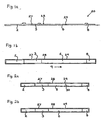
- Figure 1a is a side view of a kit according to the present invention for screening for first and second autoantibodies to TPO (autoantibodies TPO-AAb1 and TPO-AAb2);
- Figure 1b is a top view of the kit shown in Figure 1a; and
- Figures 2a and 2b are top views of the kit shown in Figures 1a and 1b and show the results obtained in the absence and presence of first and/or second autoantibodies to TPO (autoantibodies TPO-AAb1 and TPO-AAb2).
- Referring to Figures 1a and 1b, there is shown a kit (26) for the screening of first and second autoantibodies to TPO (autoantibodies TPO-AAb1 and TPO-AAb2 respectively). Kit (26) comprises zone (2) for receiving a sample of body fluid, pad (3), nitrocellulose membrane (6) and wick (8). Non-immobilised first antibody to TPO, labelled with colloidal gold, (non-immobilised antibody TPO-Ab1-gold) (27), is provided on pad (3) and is provided adjacent to zone (2). Non-immobilised antibody TPO-Ab1-gold (27) denotes non-immobilised antibody TPO-Ab1 previously labelled with -biotin-antibiotin-colloidal gold and subsequently applied to pad (3). TPO (28) is dried to nitrocellulose membrane (6). Purified second antibody to TPO (29) is immobilised (immobilised antibody TPO-Ab2) to nitrocellulose membrane (6) and is located downstream of non-immobilised antibody TPO-Ab2-gold (27) and TPO (28).
- Non-immobilised antibody TPO-Ab1-gold binds to the same site of TPO (28) as autoantibody TPO-AAb2. Immobilised antibody TPO-Ab2 binds to the same site of TPO (28) as autoantibody TPO-AAb1.
- The following series of steps illustrate the use of kit (26) shown in Figures 1a 1b, 2a and 2b in a screening method according to the present invention.
- The first step comprises applying a sample of blood or the like to receiving zone (2). The sample will then flow towards wick (8).
- The blood cells are retained in zone (2). The plasma then flows through pad (3) and forms a mixture with non-immobilised antibody TPO-Ab1-gold (27) and this mixture flows towards TPO (28).
- The mixture of
step 2 reaches TPO (28) and TPO (28) also dissolves in the mixture. - Non-immobilised antibody TPO-Ab1-gold (27) binds with TPO (28) in the mixture, unless autoantibody TPO-AAb1 is present in the plasma. In the presence of autoantibody TPO-AAb1 in the plasma, autoantibody TPO-AAb1 and non-immobilised antibody TPO-Ab1-gold (27) compete for binding with TPO (28) in the mixture.
- The mixture of plasma, non-immobilised antibody TPO-Ab1-gold (27) and TPO (28) reach immobilised antibody TPO-Ab2 (29).
- The reaction in the absence of autoantibodies TPO-AAb1 and TPO-AAb2 to TPO in the plasma allows TPO (28) to bind to non-immobilised antibody TPO-Ab1-gold (27) and immobilised antibody TPO-Ab2 (29). A red gold line (30) at the location of immobilised antibody TPO-Ab2 (29) indicates the absence of autoantibodies TPO-AAb1 and TPO-AAb2 in the plasma, as illustrated in Figure 2a.
- The reaction in the presence of autoantibody TPO-AAb1 and / or autoantibody TPO-AAb2 in the plasma sets up a competition reaction wherein binding of autoantibodies TPO-AAb1 and/or TPO-AAb2 competes with binding of non-immobilised antibody TPO-Ab1-gold (27) and immobilised antibody TPO-Ab2 (29) with TPO (28). In the case where autoantibodies TPO-AAb1 and / or TPO-AAb2 prevent binding of TPO (28) with non-immobilised antibody TPO-Ab1-gold (27) and / or immobilised antibody TPO-Ab2 (29), no red gold line is seen as illustrated in Figure 2b. Alternatively, where competition exists as above in the presence of autoantibodies TPO-AAb1 and TPO-AAb2, there may still be some binding of TPO (28) with non-immobilised antibody TPO-Ab1-gold (27) and immobilised antibody TPO-Ab2 (29), but such binding will be to a lesser extent compared to that of
step 6, and a qualitative measure of the quantity of autoantibodies TPO-AAb1 and TPO-AAb2 in the sample will be obtained. - The present invention will now be further illustrated by the following Example, which does not limit the scope of the invention in any way.
- The Example describes screening for autoantibodies to TPO using a kit as illustrated in Figures 1 and 2.
- 90 µl of plasma (or sera) or 30 µl of whole blood plus 60 µl of a diluent buffer (150 mM NaCl; 20 mM Tris pH 7.6) were used. Results were obtained after 10 minutes. Prior art reference radioactive method was based on that of Beever et al Clinical Chemistry 35 (1989) 1949-1954.
Table 1: (a) Results obtained in whole blood or plasma obtained from 30 healthy blood donors plasma whole blood (reference method cannot be used with whole blood) TPO autoantibody positive by reference radioactive test 3/30 - TPO autoantibody positive by a method according to the present invention employing a kit as illustrated in Figures 1 and 2 3/30 3/30 TPO autoantibody negative by reference radioactive test 27/30 - TPO autoantibody negative by a method according to the present invention employing a kit as illustrated in Figures 1 and 2 27/30 27/30 Table 2: (b) Results obtained in sera from patients with suspected autoimmune thyroid disease Suspected autoimmune thyroid disease TPO autoantibody positive by reference radioactive test 10/13 TPO autoantibody positive by a method according to the present invention employing a kit as illustrated in figures 9 and 10 10/13 TPO autoantibody negative by reference radioactive test 3/13 TPO autoantibody negative by a method according to the present invention employing a kit as illustrated in figures 1 and 2 3/13 - The above data indicates that a method for screening TPO autoantibodies according to the present invention can detect TPO autoantibodies in (a) healthy blood donors or (b) patients suspected of having autoimmune thyroid disease at the same prevalence as the reference radioactive test.
Claims (50)
- A method of in vitro screening of a sample of body fluid for at least first and second autoantibodies to at least one antigen, which method comprises:(a) providing a substrate having immobilised thereon at least one antibody to said antigen and which immobilised antibody binds a first binding site of said antigen;(b) providing at least one non-immobilised antibody to said antigen, which (i) flows along said substrate according to step (e), (ii) binds a second binding site of said antigen and (iii) is provided with labelling means so as to permit monitoring of binding of said first and / or second autoantibodies to said antigen;(c) providing a source of said at least one antigen, said antigen including a first binding site to which either said first autoantibody or said immobilised antibody can bind, and a second binding site to which either said second autoantibody or said non-immobilised antibody can bind;(d) contacting said antigen source of step (c), said sample of body fluid and said non-immobilised antibody, so as to obtain a mixture wherein said antigen is allowed to bind with said first and / or second autoantibodies when present in said sample and / or said non-immobilised antibody;(e) allowing said mixture obtained in step (d) to flow relative to said substrate of step (a) so as to allow said mixture to contact said antibody immobilised to said substrate; and(f) monitoring said binding so as to provide an indication of the presence of said first and / or second autoantibodies in said sample of body fluid;further characterised in that said first and / or second autoantibodies when present in said sample bind with said first and second binding sites of said antigen in step (d) so that respective binding of said immobilised and / or non-immobilised antibodies with said first and second binding sites of said antigen is inhibited, due to competitive binding of said first and / or second autoantibodies to said antigen, whereby said labelling means are not detectable on said substrate, or are detectable to a reduced level compared to screening in the absence of said first and second autoantibodies wherein antigen binds non-competitively to both said immobilised antibody and said non-immobilised antibody.
- A method according to claim 1, wherein said antigen comprises a thyroid protein.
- A method according to claim 2, wherein said thyroid protein is selected from the group consisting of thyroid peroxidase, thyroglobulin and thyroid stimulating hormone receptor.
- A method according to claim 3, wherein said thyroid protein is selected from the group consisting of thyroid peroxidase and thyroglobulin.
- A method according to any preceding claim, which further comprises screening for the presence of at least one of thyroid stimulating hormone, thyroxine, tri-iodothyronine and thyroglobulin in said sample of body fluid.
- A method according to any of claims 1 to 5, wherein said non-immobilised antibody is provided in purified form.
- A method according to any of claims 1 to 6, wherein said non-immobilised antibody comprises a monoclonal antibody.
- A method according to any of claims 1 to 6, wherein said non-immobilised antibody comprises an autoantibody to said antigen.
- A method according to claim 8, wherein said immobilised antibody comprises a first autoantibody to said antigen and said non-immobilised antibody comprises a second autoantibody to said antigen.
- A method according to any preceding claim, wherein said monitoring in step (f) comprises observing a colorimetric change dependent on said binding of said autoantibodies and said antigen present in said mixture of step (d).
- A method according to claim 10, wherein said labelling means include colloidal gold.
- A method according to any preceding claim, which further comprises providing a positive control that is present in the presence or absence of the autoantibodies being screened.
- A method according to claim 12, wherein said positive control comprises attaching to the substrate at least one control antibody to the antigen, which control antibody binds to a site on the antigen distinct to a binding site thereof for autoantibodies being screened.
- A method according to claim 12, wherein the positive control comprises attaching to the substrate at least one control agent that can bind to the at least one non-immobilised antibody.
- A method according to any preceding claim, wherein said mixture obtained in step (d) is allowed to flow along said substrate and interact with said antibody immobilised to said substrate.
- A method according to claim 15, wherein at least said sample of body fluid is contacted with an application zone of said substrate, which application zone is provided upstream on said substrate relative to said immobilised antibody, and wherein said mixture is allowed to flow from said application zone along said substrate so as to interact with said immobilised antibody.
- A method according to claim 16, wherein said application zone includes said source of said antigen of step (a), and said mixture in step (d) is obtained by contacting said sample of body fluid with said antigen of said application zone.
- A method according to claim 16 or 17, wherein said application zone further includes said non-immobilised antibody, and said mixture in step (d) is obtained by contacting said sample of body fluid and said antigen with said non-immobilised antibody present in said application zone.
- A method according to claim 16, wherein said antigen source of step (c) and said sample of body fluid are contacted remote from said substrate so as to provide said mixture of step (d), and said mixture is subsequently contacted with said application zone.
- A method according to claim 19, wherein said antigen source of step (c), said sample of body fluid and said non-immobilised antibody are contacted remote from said substrate so as to provide said mixture of step (d), and said mixture is subsequently contacted with said application zone.
- A method according to any preceding claim, wherein said substrate comprises a membrane of nitrocellulose, cellulose acetate or a polyamide.
- A method according to any preceding claim, wherein said immobilised antibody is in purified form.
- A method according to any of claims 1 to 8, and 10 to 22, wherein said immobilised antibody comprises an autoantibody to said antigen.
- A method according to any of claims 1 to 8, and 10 to 23, wherein said immobilised antibody comprises a monoclonal antibody.
- A method according to any preceding claim, wherein said sample of body fluid comprises blood, plasma, serum or urine.
- A kit for use in screening a sample of body fluid for at least first and second autoantibodies to at least one antigen, which kit comprises:(a) a substrate having at least one antibody to said antigen immobilised thereon and which immobilised antibody binds a first binding site of said antigen;(b) at least one non-immobilised antibody to said antigen, which (i) flows along said substrate according to paragraph (e), (ii) binds a second binding site of said antigen and (iii) is provided with labelling means so as to permit monitoring of binding of said first and / or second autoantibodies to said antigen;(c) a source of said at least one antigen, said antigen including a first binding site to which either said first autoantibody or said immobilised antibody can bind, and a second binding site to which either said second autoantibody or said non-immobilised antibody can bind;(d) means for contacting said antigen source with said sample of body fluid, so as to obtain a mixture wherein said antigen is allowed to bind with said first and / or second autoantibodies when present in said sample and / or said non-immobilised antibody;(e) means for allowing said mixture to flow relative to said substrate so as to allow said mixture to contact said antibody immobilised to said substrate; and(f) means for monitoring said binding so as to provide an indication of the presence of said first and / or second autoantibodies in said sample of body fluid;further characterised in that said first and / or second autoantibodies when present in said sample bind with said first and second binding sites of said antigen according to paragraph (d) so that respective binding of said immobilised and / or non-immobilised antibodies with said first and second binding sites of said antigen is inhibited, due to competitive binding of said first and / or second autoantibodies to said antigen, whereby said labelling means are not detectable on said substrate, or are detectable to a reduced level compared to screening in the absence of said first and second autoantibodies wherein antigen binds non-competitively to both said immobilised antibody and said non-immobilised antibody.
- A kit according to claim 26, wherein said antigen comprises a thyroid protein.
- A kit according to claim 27, wherein said thyroid protein is selected from the group consisting of thyroid peroxidase, thyroglobulin and thyroid stimulating hormone receptor.
- A kit according to claim 28, wherein said thyroid protein is selected from the group consisting of thyroid peroxidase and thyroglobulin.
- A kit according to any of claims 26 to 29, which further comprises means for screening for the presence of at least one of thyroid stimulating hormone, thyroxine, tri-iodothyronine and thyroglobulin in said sample of body fluid.
- A kit according to any of claims 26 to 30, wherein said non-immobilised antibody is provided in purified form.
- A kit according to any of claims 26 to 31, wherein said non-immobilised antibody comprises a monoclonal antibody.
- A kit according to any of claims 26 to 31, wherein said non-immobilised antibody comprises an autoantibody to said antigen.
- A kit according to claim 33, wherein said immobilised antibody comprises a first autoantibody to said antigen and said non-immobilised antibody comprises a second autoantibody to said antigen.
- A kit according to any of claims 26 to 34, wherein said monitoring means comprise means for observing a colorimetric change dependent on said binding of said autoantibodies and said antigen present in said mixture.
- A kit according to claim 35, wherein said labelling means include colloidal gold.
- A kit according to any of claims 26 to 36, which further comprises a positive control that is present in the presence or absence of the autoantibodies being screened.
- A kit according to claim 37, wherein the positive control comprises attaching to the substrate at least one control antibody to the antigen, which control antibody binds to a site on the antigen distinct to a binding site thereof for autoantibodies being screened.
- A kit according to claim 37, wherein the positive control comprises attaching to the substrate at least one control agent that can bind to the at least one non-immobilised antibody.
- A kit according to any of claims 26 to 39, wherein said substrate comprises an application zone for at least said sample of body fluid, which application zone is provided upstream on said substrate relative to said immobilised antibody, whereby said mixture is allowed to flow from said application zone along said substrate so as to interact with said immobilised antibody.
- A kit according to claim 40, wherein said application zone includes said source of said antigen, and said mixture is obtained by contacting said sample of body fluid with said antigen of said application zone.
- A kit according to claim 40 or 41, wherein said application zone further includes said non-immobilised antibody, and means whereby said mixture is obtained by contacting said sample of body fluid and said antigen with said non-immobilised antibody present in said application zone.
- A kit according to claim 40, wherein means are provided whereby said antigen source and said sample of body fluid are contacted remote from said substrate so as to provide said mixture and means whereby said mixture is subsequently contacted with said application zone.
- A kit according to claim 43, wherein means are provided whereby said antigen source, said sample of body fluid and said non-immobilised antibody are contacted remote from said substrate so as to provide said mixture, and means whereby said mixture is subsequently contacted with said application zone.
- A kit according to any of claims 26 to 44, wherein said substrate comprises a membrane of nitrocellulose, cellulose acetate or a polyamide.
- A kit according to any of claims 26 to 45, wherein said immobilised antibody is provided in purified form.
- A kit according to any of claims 26 to 33 and 35 to 46, wherein said immobilised antibody comprises an autoantibody to said antigen.
- A kit according to any of claims 26 to 33 and 35 to 47, wherein said immobilised antibody comprises a monoclonal antibody.
- A kit according to any of claims 26 to 48, wherein said sample of body fluid comprises blood, plasma, serum or urine.
- Use of a kit according to any of claims 26 to 49, in screening a sample of body fluid for at least first and second autoantibodies to at least one antigen.
Applications Claiming Priority (3)
| Application Number | Priority Date | Filing Date | Title |
|---|---|---|---|
| GB9823397 | 1998-10-27 | ||
| GBGB9823397.6A GB9823397D0 (en) | 1998-10-27 | 1998-10-27 | Assays for thyroid autoantibodies |
| PCT/GB1999/003548 WO2000025137A1 (en) | 1998-10-27 | 1999-10-27 | Assays for autoantibodies |
Publications (2)
| Publication Number | Publication Date |
|---|---|
| EP1071956A1 EP1071956A1 (en) | 2001-01-31 |
| EP1071956B1 true EP1071956B1 (en) | 2006-04-12 |
Family
ID=10841298
Family Applications (1)
| Application Number | Title | Priority Date | Filing Date |
|---|---|---|---|
| EP99951000A Expired - Lifetime EP1071956B1 (en) | 1998-10-27 | 1999-10-27 | Assays for autoantibodies |
Country Status (7)
| Country | Link |
|---|---|
| US (1) | US7001775B1 (en) |
| EP (1) | EP1071956B1 (en) |
| JP (1) | JP4426110B2 (en) |
| AT (1) | ATE323286T1 (en) |
| DE (1) | DE69930843T2 (en) |
| GB (1) | GB9823397D0 (en) |
| WO (1) | WO2000025137A1 (en) |
Families Citing this family (8)
| Publication number | Priority date | Publication date | Assignee | Title |
|---|---|---|---|---|
| ES2736165T3 (en) * | 2001-08-23 | 2019-12-26 | Rsr Ltd | Epitope regions of a thyrotropin receptor (TSH), its uses and antibodies to them |
| WO2008103292A1 (en) * | 2007-02-16 | 2008-08-28 | Genzyme Corporation | Method of identifying risk for thyroid disorder |
| US20090286329A1 (en) * | 2008-05-19 | 2009-11-19 | Abbott Laboratoires | Isolated human autoantibodies to natriuretic peptides and methods and kits for detecting human autoantibodies to natriuretic peptides |
| US20090286256A1 (en) * | 2008-05-19 | 2009-11-19 | Abbott Laboratories | Isolated human autoantibodies to natriuretic peptides and methods and kits for detecting human autoantibodies to natriuretic peptides |
| WO2011085057A2 (en) * | 2010-01-06 | 2011-07-14 | The Regents Of The University Of Colorado, A Body Corporate | Methods for detecting insulin autoantibody |
| WO2020010009A1 (en) * | 2018-07-02 | 2020-01-09 | Siemens Healthcare Diagnostics Inc. | Direct immunoassay measurement of autoantibodies |
| US12163956B2 (en) * | 2019-02-21 | 2024-12-10 | Takeda Pharmaceutical Company Limited | Lateral flow immunoassay for measuring functional C1-esterase inhibitor (C1-INH) in plasma samples |
| EP4585924A3 (en) * | 2019-04-12 | 2025-10-22 | Takeda Pharmaceutical Company Limited | Lateral flow immunoassay for measuring functional c1-esterase inhibitor (c1-inh) in plasma samples |
Family Cites Families (23)
| Publication number | Priority date | Publication date | Assignee | Title |
|---|---|---|---|---|
| US5622871A (en) * | 1987-04-27 | 1997-04-22 | Unilever Patent Holdings B.V. | Capillary immunoassay and device therefor comprising mobilizable particulate labelled reagents |
| US3654090A (en) | 1968-09-24 | 1972-04-04 | Organon | Method for the determination of antigens and antibodies |
| NL7501215A (en) * | 1975-02-01 | 1976-08-03 | Akzo Nv | METHOD FOR DETERMINING AND DETERMINING AN ANTIGEN OR ANTIBODY. |
| US4094647A (en) | 1976-07-02 | 1978-06-13 | Thyroid Diagnostics, Inc. | Test device |
| US4281061A (en) * | 1979-07-27 | 1981-07-28 | Syva Company | Double antibody for enhanced sensitivity in immunoassay |
| US4486530A (en) * | 1980-08-04 | 1984-12-04 | Hybritech Incorporated | Immunometric assays using monoclonal antibodies |
| US4444879A (en) * | 1981-01-29 | 1984-04-24 | Science Research Center, Inc. | Immunoassay with article having support film and immunological counterpart of analyte |
| DE3484505D1 (en) | 1983-12-19 | 1991-05-29 | Daiichi Pure Chemicals Co Ltd | IMMUNTEST. |
| US4999285A (en) | 1984-11-15 | 1991-03-12 | Syntex (U.S.A.) Inc. | Chromatographic cassette |
| DE3445816C1 (en) | 1984-12-15 | 1986-06-12 | Behringwerke Ag, 3550 Marburg | Flat diagnostic agent |
| GB8526741D0 (en) | 1985-10-30 | 1985-12-04 | Boots Celltech Diagnostics | Binding assay device |
| US5120643A (en) * | 1987-07-13 | 1992-06-09 | Abbott Laboratories | Process for immunochromatography with colloidal particles |
| US5206177A (en) * | 1988-01-21 | 1993-04-27 | Boehringer Mannheim Corporation | Apparatus for determining an analyte and method therefor |
| US5077198A (en) * | 1988-04-14 | 1991-12-31 | Eastman Kodak Company | Diagnostic kit and method for rapid detection of antibodies |
| WO1991003483A1 (en) | 1989-09-08 | 1991-03-21 | New England Medical Center Hospitals, Inc. | Tsh receptor |
| CA2110920A1 (en) * | 1991-06-13 | 1992-12-23 | Sinfu Tzeng | Assay for the detection of specific ligands |
| DE4120412C1 (en) * | 1991-06-20 | 1993-01-07 | Henning Berlin Gmbh Chemie- Und Pharmawerk, 1000 Berlin, De | |
| US5229073A (en) * | 1992-02-27 | 1993-07-20 | Abbott Laboratories | One-step competitive immunoassay for the semiquantitative determination of plasma lipoprotein(a) |
| US5998153A (en) | 1992-05-19 | 1999-12-07 | The Regents Of The University Of Michigan | Thyroid peroxidase epitopic regions |
| WO1994012878A1 (en) | 1992-11-27 | 1994-06-09 | Gec-Marconi Limited | Separation method |
| DE4328070C1 (en) * | 1993-08-20 | 1994-11-24 | Henning Berlin Gmbh | Method for the determination of an analyte in a volume of a liquid sample, and its use for the determination of anti-TSH receptor autoantibodies in a patient's serum |
| EP0719858A3 (en) | 1994-12-27 | 1997-12-29 | Tosoh Corporation | Myeloma cell line expressing recombinant human thyroid stimulating hormone receptor |
| AU4996796A (en) | 1995-02-28 | 1996-09-18 | Joel R.L. Ehrenkranz | Rapid, self-performing tsh immunoassay |
-
1998
- 1998-10-27 GB GBGB9823397.6A patent/GB9823397D0/en not_active Ceased
-
1999
- 1999-10-27 DE DE69930843T patent/DE69930843T2/en not_active Expired - Lifetime
- 1999-10-27 WO PCT/GB1999/003548 patent/WO2000025137A1/en not_active Ceased
- 1999-10-27 EP EP99951000A patent/EP1071956B1/en not_active Expired - Lifetime
- 1999-10-27 AT AT99951000T patent/ATE323286T1/en active
- 1999-10-27 US US09/582,524 patent/US7001775B1/en not_active Expired - Lifetime
- 1999-10-27 JP JP2000578660A patent/JP4426110B2/en not_active Expired - Lifetime
Non-Patent Citations (2)
| Title |
|---|
| ANDONOPOULOS A.P. ET AL: "THYROID FUNCTION AND IMMUNE PROFILE IN RHEUMATOID ARTHRITIS. A CONTROLLED STUDY", CLINICAL RHEUMATOLOGY, vol. 15, no. 6, 1996, ACTA MEDICA BELGICA, BRUXELLES, BE, pages 599 - 603, XP008043275 * |
| BALAZS C.; KISS E.: "SOLUBLE INTERCELLULAR ADHESION MOLECULE-1 (SICAM-1) IN GRAVE'S DISEASE", ACTA MICROBIOLOGICA POLONICA, vol. 41, no. 4, 1994, PANSTWOWE WYDAWNICTWO NAUKOWE, WARSZAWA, PL, pages 451 - 456, XP008043278 * |
Also Published As
| Publication number | Publication date |
|---|---|
| US7001775B1 (en) | 2006-02-21 |
| WO2000025137A1 (en) | 2000-05-04 |
| GB9823397D0 (en) | 1998-12-23 |
| EP1071956A1 (en) | 2001-01-31 |
| DE69930843D1 (en) | 2006-05-24 |
| JP2002528722A (en) | 2002-09-03 |
| DE69930843T2 (en) | 2006-11-30 |
| JP4426110B2 (en) | 2010-03-03 |
| ATE323286T1 (en) | 2006-04-15 |
Similar Documents
| Publication | Publication Date | Title |
|---|---|---|
| O'sullivan et al. | Enzyme immunoassay: a review | |
| Yolken | Enzyme-linked immunosorbent assay (ELISA): a practical tool for rapid diagnosis of viruses and other infectious agents | |
| US10481156B2 (en) | Detection of autoantibodies reactive with pancreatic islet cell antigenic molecules and/or insulin | |
| Ishikawa | Development and clinical application of sensitive enzyme immunoassay for macromolecular antigens—a review | |
| WO1994017408A1 (en) | Assays and kits for detecting analytes in the presence of cross-reacting substances | |
| US6905835B2 (en) | Assay for anti transglutaminase antibodies detection useful in celicac disease diagnosis | |
| US5814461A (en) | Method for the determination of anti-TSH receptor autoantibodies | |
| CN109187971A (en) | Neuronspecific enolase chemiluminescence immune detection reagent kit and preparation method thereof | |
| US6537760B1 (en) | Receptor binding assay for detecting TSH-receptor auto-antibodies | |
| CN109100519A (en) | Determining islet cell antibody kit and preparation method thereof | |
| US7001775B1 (en) | Assays for autoantibodies | |
| US6686167B2 (en) | Test device for detecting semen and method of use | |
| EP1021721B1 (en) | Assays for tsh receptor autoantibodies | |
| CN112166323A (en) | Direct immunoassay measurement of autoantibodies | |
| EP0106615B1 (en) | Assay for the free portion of substances in biological fluids | |
| US8021849B2 (en) | Methods and kits for the determination of sirolimus in a sample | |
| EP0627081B1 (en) | Assay method for the determination of autoantibodies in biological fluids | |
| JPS6353511B2 (en) | ||
| JPH01224666A (en) | Method of measuring immune complex | |
| Simple et al. | PROCEEDINGS OF CSCC CONVENTION |
Legal Events
| Date | Code | Title | Description |
|---|---|---|---|
| PUAI | Public reference made under article 153(3) epc to a published international application that has entered the european phase |
Free format text: ORIGINAL CODE: 0009012 |
|
| 17P | Request for examination filed |
Effective date: 20000912 |
|
| AK | Designated contracting states |
Kind code of ref document: A1 Designated state(s): AT BE CH CY DE DK ES FI FR GB GR IE IT LI LU MC NL PT SE |
|
| 17Q | First examination report despatched |
Effective date: 20040503 |
|
| GRAP | Despatch of communication of intention to grant a patent |
Free format text: ORIGINAL CODE: EPIDOSNIGR1 |
|
| GRAS | Grant fee paid |
Free format text: ORIGINAL CODE: EPIDOSNIGR3 |
|
| GRAA | (expected) grant |
Free format text: ORIGINAL CODE: 0009210 |
|
| AK | Designated contracting states |
Kind code of ref document: B1 Designated state(s): AT BE CH CY DE DK ES FI FR GB GR IE IT LI LU MC NL PT SE |
|
| PG25 | Lapsed in a contracting state [announced via postgrant information from national office to epo] |
Ref country code: NL Free format text: LAPSE BECAUSE OF FAILURE TO SUBMIT A TRANSLATION OF THE DESCRIPTION OR TO PAY THE FEE WITHIN THE PRESCRIBED TIME-LIMIT Effective date: 20060412 Ref country code: IT Free format text: LAPSE BECAUSE OF FAILURE TO SUBMIT A TRANSLATION OF THE DESCRIPTION OR TO PAY THE FEE WITHIN THE PRE;WARNING: LAPSES OF ITALIAN PATENTS WITH EFFECTIVE DATE BEFORE 2007 MAY HAVE OCCURRED AT ANY TIME BEFORE 2007. THE CORRECT EFFECTIVE DATE MAY BE DIFFERENT FROM THE ONE RECORDED.SCRIBED TIME-LIMIT Effective date: 20060412 Ref country code: FI Free format text: LAPSE BECAUSE OF FAILURE TO SUBMIT A TRANSLATION OF THE DESCRIPTION OR TO PAY THE FEE WITHIN THE PRESCRIBED TIME-LIMIT Effective date: 20060412 Ref country code: BE Free format text: LAPSE BECAUSE OF FAILURE TO SUBMIT A TRANSLATION OF THE DESCRIPTION OR TO PAY THE FEE WITHIN THE PRESCRIBED TIME-LIMIT Effective date: 20060412 |
|
| REG | Reference to a national code |
Ref country code: GB Ref legal event code: FG4D |
|
| REG | Reference to a national code |
Ref country code: CH Ref legal event code: EP |
|
| REF | Corresponds to: |
Ref document number: 69930843 Country of ref document: DE Date of ref document: 20060524 Kind code of ref document: P |
|
| REG | Reference to a national code |
Ref country code: IE Ref legal event code: FG4D |
|
| PG25 | Lapsed in a contracting state [announced via postgrant information from national office to epo] |
Ref country code: SE Free format text: LAPSE BECAUSE OF FAILURE TO SUBMIT A TRANSLATION OF THE DESCRIPTION OR TO PAY THE FEE WITHIN THE PRESCRIBED TIME-LIMIT Effective date: 20060712 Ref country code: DK Free format text: LAPSE BECAUSE OF FAILURE TO SUBMIT A TRANSLATION OF THE DESCRIPTION OR TO PAY THE FEE WITHIN THE PRESCRIBED TIME-LIMIT Effective date: 20060712 |
|
| PG25 | Lapsed in a contracting state [announced via postgrant information from national office to epo] |
Ref country code: ES Free format text: LAPSE BECAUSE OF FAILURE TO SUBMIT A TRANSLATION OF THE DESCRIPTION OR TO PAY THE FEE WITHIN THE PRESCRIBED TIME-LIMIT Effective date: 20060723 |
|
| REG | Reference to a national code |
Ref country code: CH Ref legal event code: NV Representative=s name: E. BLUM & CO. PATENTANWAELTE |
|
| PG25 | Lapsed in a contracting state [announced via postgrant information from national office to epo] |
Ref country code: PT Free format text: LAPSE BECAUSE OF FAILURE TO SUBMIT A TRANSLATION OF THE DESCRIPTION OR TO PAY THE FEE WITHIN THE PRESCRIBED TIME-LIMIT Effective date: 20060912 |
|
| NLV1 | Nl: lapsed or annulled due to failure to fulfill the requirements of art. 29p and 29m of the patents act | ||
| PG25 | Lapsed in a contracting state [announced via postgrant information from national office to epo] |
Ref country code: MC Free format text: LAPSE BECAUSE OF NON-PAYMENT OF DUE FEES Effective date: 20061031 |
|
| ET | Fr: translation filed | ||
| PLBE | No opposition filed within time limit |
Free format text: ORIGINAL CODE: 0009261 |
|
| STAA | Information on the status of an ep patent application or granted ep patent |
Free format text: STATUS: NO OPPOSITION FILED WITHIN TIME LIMIT |
|
| 26N | No opposition filed |
Effective date: 20070115 |
|
| REG | Reference to a national code |
Ref country code: CH Ref legal event code: PFA Owner name: RSR LIMITED Free format text: RSR LIMITED#AVENUE PARK#PENTWYN, CARDIFF CF2 7HE (GB) -TRANSFER TO- RSR LIMITED#AVENUE PARK#PENTWYN, CARDIFF CF2 7HE (GB) |
|
| PG25 | Lapsed in a contracting state [announced via postgrant information from national office to epo] |
Ref country code: GR Free format text: LAPSE BECAUSE OF FAILURE TO SUBMIT A TRANSLATION OF THE DESCRIPTION OR TO PAY THE FEE WITHIN THE PRESCRIBED TIME-LIMIT Effective date: 20060713 |
|
| PG25 | Lapsed in a contracting state [announced via postgrant information from national office to epo] |
Ref country code: LU Free format text: LAPSE BECAUSE OF NON-PAYMENT OF DUE FEES Effective date: 20061027 |
|
| REG | Reference to a national code |
Ref country code: CH Ref legal event code: NV Representative=s name: ISLER & PEDRAZZINI AG |
|
| PG25 | Lapsed in a contracting state [announced via postgrant information from national office to epo] |
Ref country code: CY Free format text: LAPSE BECAUSE OF FAILURE TO SUBMIT A TRANSLATION OF THE DESCRIPTION OR TO PAY THE FEE WITHIN THE PRESCRIBED TIME-LIMIT Effective date: 20060412 |
|
| REG | Reference to a national code |
Ref country code: FR Ref legal event code: PLFP Year of fee payment: 17 |
|
| REG | Reference to a national code |
Ref country code: FR Ref legal event code: PLFP Year of fee payment: 18 |
|
| REG | Reference to a national code |
Ref country code: FR Ref legal event code: PLFP Year of fee payment: 19 |
|
| REG | Reference to a national code |
Ref country code: FR Ref legal event code: PLFP Year of fee payment: 20 |
|
| PGFP | Annual fee paid to national office [announced via postgrant information from national office to epo] |
Ref country code: DE Payment date: 20181026 Year of fee payment: 20 Ref country code: IE Payment date: 20181003 Year of fee payment: 20 Ref country code: AT Payment date: 20181010 Year of fee payment: 20 |
|
| PGFP | Annual fee paid to national office [announced via postgrant information from national office to epo] |
Ref country code: GB Payment date: 20181002 Year of fee payment: 20 Ref country code: CH Payment date: 20181011 Year of fee payment: 20 Ref country code: FR Payment date: 20181026 Year of fee payment: 20 Ref country code: IT Payment date: 20181005 Year of fee payment: 20 |
|
| REG | Reference to a national code |
Ref country code: DE Ref legal event code: R071 Ref document number: 69930843 Country of ref document: DE |
|
| REG | Reference to a national code |
Ref country code: CH Ref legal event code: PL |
|
| REG | Reference to a national code |
Ref country code: GB Ref legal event code: PE20 Expiry date: 20191026 |
|
| REG | Reference to a national code |
Ref country code: IE Ref legal event code: MK9A |
|
| REG | Reference to a national code |
Ref country code: AT Ref legal event code: MK07 Ref document number: 323286 Country of ref document: AT Kind code of ref document: T Effective date: 20191027 |
|
| PG25 | Lapsed in a contracting state [announced via postgrant information from national office to epo] |
Ref country code: GB Free format text: LAPSE BECAUSE OF EXPIRATION OF PROTECTION Effective date: 20191026 Ref country code: IE Free format text: LAPSE BECAUSE OF EXPIRATION OF PROTECTION Effective date: 20191027 |