EP1071553B1 - Method for preparation of test bodies - Google Patents
Method for preparation of test bodies Download PDFInfo
- Publication number
- EP1071553B1 EP1071553B1 EP00909846A EP00909846A EP1071553B1 EP 1071553 B1 EP1071553 B1 EP 1071553B1 EP 00909846 A EP00909846 A EP 00909846A EP 00909846 A EP00909846 A EP 00909846A EP 1071553 B1 EP1071553 B1 EP 1071553B1
- Authority
- EP
- European Patent Office
- Prior art keywords
- test pieces
- test
- casting
- mould
- resin
- Prior art date
- Legal status (The legal status is an assumption and is not a legal conclusion. Google has not performed a legal analysis and makes no representation as to the accuracy of the status listed.)
- Expired - Lifetime
Links
- 238000000034 method Methods 0.000 title claims abstract description 19
- 238000002360 preparation method Methods 0.000 title claims abstract description 4
- 238000005266 casting Methods 0.000 claims abstract description 32
- 239000002344 surface layer Substances 0.000 claims abstract description 23
- 229920005989 resin Polymers 0.000 claims abstract description 21
- 239000011347 resin Substances 0.000 claims abstract description 21
- 238000000465 moulding Methods 0.000 claims abstract description 7
- 239000007788 liquid Substances 0.000 claims abstract description 4
- 239000004033 plastic Substances 0.000 claims abstract description 4
- 238000003825 pressing Methods 0.000 claims abstract description 3
- 239000004593 Epoxy Substances 0.000 description 10
- 239000003822 epoxy resin Substances 0.000 description 3
- 229920000647 polyepoxide Polymers 0.000 description 3
- 229920001342 Bakelite® Polymers 0.000 description 2
- 239000004637 bakelite Substances 0.000 description 2
- 238000010348 incorporation Methods 0.000 description 2
- 239000010410 layer Substances 0.000 description 2
- 230000015572 biosynthetic process Effects 0.000 description 1
- 238000005470 impregnation Methods 0.000 description 1
- 239000000463 material Substances 0.000 description 1
- 239000000206 moulding compound Substances 0.000 description 1
- 230000007903 penetration ability Effects 0.000 description 1
- ISWSIDIOOBJBQZ-UHFFFAOYSA-N phenol group Chemical group C1(=CC=CC=C1)O ISWSIDIOOBJBQZ-UHFFFAOYSA-N 0.000 description 1
- 229920001568 phenolic resin Polymers 0.000 description 1
- 239000002861 polymer material Substances 0.000 description 1
- 229920001343 polytetrafluoroethylene Polymers 0.000 description 1
- 230000009467 reduction Effects 0.000 description 1
Images
Classifications
-
- B—PERFORMING OPERATIONS; TRANSPORTING
- B29—WORKING OF PLASTICS; WORKING OF SUBSTANCES IN A PLASTIC STATE IN GENERAL
- B29C—SHAPING OR JOINING OF PLASTICS; SHAPING OF MATERIAL IN A PLASTIC STATE, NOT OTHERWISE PROVIDED FOR; AFTER-TREATMENT OF THE SHAPED PRODUCTS, e.g. REPAIRING
- B29C43/00—Compression moulding, i.e. applying external pressure to flow the moulding material; Apparatus therefor
- B29C43/02—Compression moulding, i.e. applying external pressure to flow the moulding material; Apparatus therefor of articles of definite length, i.e. discrete articles
- B29C43/18—Compression moulding, i.e. applying external pressure to flow the moulding material; Apparatus therefor of articles of definite length, i.e. discrete articles incorporating preformed parts or layers, e.g. compression moulding around inserts or for coating articles
-
- B—PERFORMING OPERATIONS; TRANSPORTING
- B29—WORKING OF PLASTICS; WORKING OF SUBSTANCES IN A PLASTIC STATE IN GENERAL
- B29C—SHAPING OR JOINING OF PLASTICS; SHAPING OF MATERIAL IN A PLASTIC STATE, NOT OTHERWISE PROVIDED FOR; AFTER-TREATMENT OF THE SHAPED PRODUCTS, e.g. REPAIRING
- B29C43/00—Compression moulding, i.e. applying external pressure to flow the moulding material; Apparatus therefor
- B29C43/006—Pressing and sintering powders, granules or fibres
-
- G—PHYSICS
- G01—MEASURING; TESTING
- G01N—INVESTIGATING OR ANALYSING MATERIALS BY DETERMINING THEIR CHEMICAL OR PHYSICAL PROPERTIES
- G01N1/00—Sampling; Preparing specimens for investigation
- G01N1/28—Preparing specimens for investigation including physical details of (bio-)chemical methods covered elsewhere, e.g. G01N33/50, C12Q
- G01N1/36—Embedding or analogous mounting of samples
-
- B—PERFORMING OPERATIONS; TRANSPORTING
- B29—WORKING OF PLASTICS; WORKING OF SUBSTANCES IN A PLASTIC STATE IN GENERAL
- B29C—SHAPING OR JOINING OF PLASTICS; SHAPING OF MATERIAL IN A PLASTIC STATE, NOT OTHERWISE PROVIDED FOR; AFTER-TREATMENT OF THE SHAPED PRODUCTS, e.g. REPAIRING
- B29C2791/00—Shaping characteristics in general
- B29C2791/001—Shaping in several steps
-
- B—PERFORMING OPERATIONS; TRANSPORTING
- B29—WORKING OF PLASTICS; WORKING OF SUBSTANCES IN A PLASTIC STATE IN GENERAL
- B29C—SHAPING OR JOINING OF PLASTICS; SHAPING OF MATERIAL IN A PLASTIC STATE, NOT OTHERWISE PROVIDED FOR; AFTER-TREATMENT OF THE SHAPED PRODUCTS, e.g. REPAIRING
- B29C2791/00—Shaping characteristics in general
- B29C2791/004—Shaping under special conditions
- B29C2791/006—Using vacuum
-
- B—PERFORMING OPERATIONS; TRANSPORTING
- B29—WORKING OF PLASTICS; WORKING OF SUBSTANCES IN A PLASTIC STATE IN GENERAL
- B29C—SHAPING OR JOINING OF PLASTICS; SHAPING OF MATERIAL IN A PLASTIC STATE, NOT OTHERWISE PROVIDED FOR; AFTER-TREATMENT OF THE SHAPED PRODUCTS, e.g. REPAIRING
- B29C41/00—Shaping by coating a mould, core or other substrate, i.e. by depositing material and stripping-off the shaped article; Apparatus therefor
- B29C41/02—Shaping by coating a mould, core or other substrate, i.e. by depositing material and stripping-off the shaped article; Apparatus therefor for making articles of definite length, i.e. discrete articles
- B29C41/14—Dipping a core
-
- B—PERFORMING OPERATIONS; TRANSPORTING
- B29—WORKING OF PLASTICS; WORKING OF SUBSTANCES IN A PLASTIC STATE IN GENERAL
- B29K—INDEXING SCHEME ASSOCIATED WITH SUBCLASSES B29B, B29C OR B29D, RELATING TO MOULDING MATERIALS OR TO MATERIALS FOR MOULDS, REINFORCEMENTS, FILLERS OR PREFORMED PARTS, e.g. INSERTS
- B29K2061/00—Use of condensation polymers of aldehydes or ketones or derivatives thereof, as moulding material
- B29K2061/04—Phenoplasts
-
- B—PERFORMING OPERATIONS; TRANSPORTING
- B29—WORKING OF PLASTICS; WORKING OF SUBSTANCES IN A PLASTIC STATE IN GENERAL
- B29K—INDEXING SCHEME ASSOCIATED WITH SUBCLASSES B29B, B29C OR B29D, RELATING TO MOULDING MATERIALS OR TO MATERIALS FOR MOULDS, REINFORCEMENTS, FILLERS OR PREFORMED PARTS, e.g. INSERTS
- B29K2063/00—Use of EP, i.e. epoxy resins or derivatives thereof, as moulding material
-
- B—PERFORMING OPERATIONS; TRANSPORTING
- B29—WORKING OF PLASTICS; WORKING OF SUBSTANCES IN A PLASTIC STATE IN GENERAL
- B29L—INDEXING SCHEME ASSOCIATED WITH SUBCLASS B29C, RELATING TO PARTICULAR ARTICLES
- B29L2031/00—Other particular articles
- B29L2031/40—Test specimens ; Models, e.g. model cars ; Probes
-
- G—PHYSICS
- G01—MEASURING; TESTING
- G01N—INVESTIGATING OR ANALYSING MATERIALS BY DETERMINING THEIR CHEMICAL OR PHYSICAL PROPERTIES
- G01N1/00—Sampling; Preparing specimens for investigation
- G01N1/28—Preparing specimens for investigation including physical details of (bio-)chemical methods covered elsewhere, e.g. G01N33/50, C12Q
- G01N1/36—Embedding or analogous mounting of samples
- G01N2001/364—Embedding or analogous mounting of samples using resins, epoxy
-
- Y—GENERAL TAGGING OF NEW TECHNOLOGICAL DEVELOPMENTS; GENERAL TAGGING OF CROSS-SECTIONAL TECHNOLOGIES SPANNING OVER SEVERAL SECTIONS OF THE IPC; TECHNICAL SUBJECTS COVERED BY FORMER USPC CROSS-REFERENCE ART COLLECTIONS [XRACs] AND DIGESTS
- Y10—TECHNICAL SUBJECTS COVERED BY FORMER USPC
- Y10T—TECHNICAL SUBJECTS COVERED BY FORMER US CLASSIFICATION
- Y10T428/00—Stock material or miscellaneous articles
- Y10T428/249921—Web or sheet containing structurally defined element or component
- Y10T428/249953—Composite having voids in a component [e.g., porous, cellular, etc.]
- Y10T428/249955—Void-containing component partially impregnated with adjacent component
-
- Y—GENERAL TAGGING OF NEW TECHNOLOGICAL DEVELOPMENTS; GENERAL TAGGING OF CROSS-SECTIONAL TECHNOLOGIES SPANNING OVER SEVERAL SECTIONS OF THE IPC; TECHNICAL SUBJECTS COVERED BY FORMER USPC CROSS-REFERENCE ART COLLECTIONS [XRACs] AND DIGESTS
- Y10—TECHNICAL SUBJECTS COVERED BY FORMER USPC
- Y10T—TECHNICAL SUBJECTS COVERED BY FORMER US CLASSIFICATION
- Y10T428/00—Stock material or miscellaneous articles
- Y10T428/8305—Miscellaneous [e.g., treated surfaces, etc.]
-
- Y—GENERAL TAGGING OF NEW TECHNOLOGICAL DEVELOPMENTS; GENERAL TAGGING OF CROSS-SECTIONAL TECHNOLOGIES SPANNING OVER SEVERAL SECTIONS OF THE IPC; TECHNICAL SUBJECTS COVERED BY FORMER USPC CROSS-REFERENCE ART COLLECTIONS [XRACs] AND DIGESTS
- Y10—TECHNICAL SUBJECTS COVERED BY FORMER USPC
- Y10T—TECHNICAL SUBJECTS COVERED BY FORMER US CLASSIFICATION
- Y10T442/00—Fabric [woven, knitted, or nonwoven textile or cloth, etc.]
- Y10T442/10—Scrim [e.g., open net or mesh, gauze, loose or open weave or knit, etc.]
- Y10T442/102—Woven scrim
- Y10T442/172—Coated or impregnated
-
- Y—GENERAL TAGGING OF NEW TECHNOLOGICAL DEVELOPMENTS; GENERAL TAGGING OF CROSS-SECTIONAL TECHNOLOGIES SPANNING OVER SEVERAL SECTIONS OF THE IPC; TECHNICAL SUBJECTS COVERED BY FORMER USPC CROSS-REFERENCE ART COLLECTIONS [XRACs] AND DIGESTS
- Y10—TECHNICAL SUBJECTS COVERED BY FORMER USPC
- Y10T—TECHNICAL SUBJECTS COVERED BY FORMER US CLASSIFICATION
- Y10T442/00—Fabric [woven, knitted, or nonwoven textile or cloth, etc.]
- Y10T442/10—Scrim [e.g., open net or mesh, gauze, loose or open weave or knit, etc.]
- Y10T442/184—Nonwoven scrim
- Y10T442/198—Coated or impregnated
Definitions
- the invention relates to a method for preparation of test bodies for analysis of porous, preferably thermally sprayed, surface layers which are incorporated by casting in plastic.
- test bodies To be able to analyze thermally sprayed surface layers, so called test bodies have to be produced, which are lapped and examined and evaluated with the use of a microscope with regard to the structure of the surface layer. It is when the test body is lapped that the problem arises in that the surface layer is "smeared out", which will give a false structure.
- test bodies are produced by incorporating by casting a test piece under vacuum in a specific two-component resin of epoxy type with very good penetration ability into porous layers, i.e. the surface of the test pieces are wetted very well. Since the epoxy resin will fill out all pin-holes and voids in the surface layer, said surface layer can be lapped after curing the epoxy resin with a very good result without any smearing of said surface layer, whereby a true structure is obtained which can be evaluated with use of a microscope.
- test bodies are produced in the way that a sample of the surface layer is incorporated by casting in a pulverized phenoiic plastic, preferably bakelite, it a pressure of about 5-15 kN and a temperature of about 150°C in a so called Pronto-press.
- a pulverized phenoiic plastic preferably bakelite
- Pronto-press a pressure of about 5-15 kN and a temperature of about 150°C in a so called Pronto-press.
- This method has the advantage that the incorporation by casting is very fast, about 15 minutes, and that the cost per body is very low.
- the drawback is that the bakelite does not penetrate into the pin-holes and voids in the porous surface layer, whereby the result of the lapping of the surface layer is non-useable, since there is a great risk for "smearing" of the surface layer, which will produce a false structure.
- VS 4 655 700 discloses an apparatus for impregnation of porous samples for material matters.
- the object of the invention is to eliminate the drawbacks of the above-mentioned methods.
- two test pieces of the surface layer 10 attached to backing 11, which test pieces are to be examined, are mounted opposite to each other with a net of polymer material (12), preferably polytetraflouro ethylene, placed between the same, by one or several mounting clips.
- the purpose of the net is on one hand to achieve the necessary distance between the two surface layers 10, so that they will not rub against each other during the casting, and on the other hand to absorb possible shrinking stresses, when the resin cures.
- test body 1 shall have cylindrical form, and the test pieces are placed parallel with the longitudinal axis of said test body 1 on a fixed mutual distance.
- test pieces prepared in this way are then placed in a mould (not shown) which is placed in a vacuum chamber (not shown), and the air pressure is lowered to under 3000 Pa (30 mbar). Thereafter one waits about 30 sec., whereupon the ready-mixed, liquid casting resin of epoxy type, preferably Epoxy Pack 301 obtainable from Logitech Ltd., is poured into the mould with the test pieces, whereafter air is let into the vacuum chamber to atmospheric pressure. Both of the porous surface layers 10 are, in this way, covered with casting resin of a type which will fill all pin-holes and voids in the same. Then, the mounted test pieces are lifted out of the mould and excess amount of epoxy is allowed to drip from the test pieces over the mould. This means that the amount of casting resin of epoxy type used in this embodiment will be reduced from about 18 g in the known cold moulding method to about 0.8.
- Epoxy Pack 301 obtainable from Logitech Ltd.
- the casting resin left in the mould has a curing time of several hours it can be used for several more test bodies.
- test pieces from which the casting resin has dripped, are then placed in a known hot moulding press (Pronto-press) and a suitable amount of pulverized phenolic plastic, preferably Phenolic Moulding Compound available from Perstorp AB, is filled into the press cavity, the lid of which is closed and the incorporation by casting is started in known manner, the test pieces being incorporated by casting under a pressure of about 5-15 kN and a temperature of about 150°C to form the test body 1.
- a suitable amount of pulverized phenolic plastic preferably Phenolic Moulding Compound available from Perstorp AB
- test body 1 is then cut at one end at right angles to the longitudinal direction of the same for producing a circular end surface containing the surface layers 10 to be analyzed.
- the circular end surface is then lapped and the surface layers are analyzed and evaluated with the use of a microscope. Since the pin-holes and the voids in the porous surface layer now are filled with epoxy, a true structure is obtained.
- the method according to the invention results in cost reductions, since the amount of casting resin of epoxy type is very low (about 0,8 g), and is more or less as fast as the known hot moulding method, but with the desired properties of the cold moulding method.
Landscapes
- Engineering & Computer Science (AREA)
- Mechanical Engineering (AREA)
- Physics & Mathematics (AREA)
- Health & Medical Sciences (AREA)
- Life Sciences & Earth Sciences (AREA)
- Chemical & Material Sciences (AREA)
- Analytical Chemistry (AREA)
- Biochemistry (AREA)
- General Health & Medical Sciences (AREA)
- General Physics & Mathematics (AREA)
- Immunology (AREA)
- Pathology (AREA)
- Sampling And Sample Adjustment (AREA)
- Casting Or Compression Moulding Of Plastics Or The Like (AREA)
Abstract
Description
- The invention relates to a method for preparation of test bodies for analysis of porous, preferably thermally sprayed, surface layers which are incorporated by casting in plastic.
- To be able to analyze thermally sprayed surface layers, so called test bodies have to be produced, which are lapped and examined and evaluated with the use of a microscope with regard to the structure of the surface layer. It is when the test body is lapped that the problem arises in that the surface layer is "smeared out", which will give a false structure.
- There are two known methods for incorporating by casting of test bodies, viz. on one hand a cold casting method and on the other hand a warm casting method, which will be described below.
- In the cold casting method, test bodies are produced by incorporating by casting a test piece under vacuum in a specific two-component resin of epoxy type with very good penetration ability into porous layers, i.e. the surface of the test pieces are wetted very well. Since the epoxy resin will fill out all pin-holes and voids in the surface layer, said surface layer can be lapped after curing the epoxy resin with a very good result without any smearing of said surface layer, whereby a true structure is obtained which can be evaluated with use of a microscope.
- This method suffers from the drawbacks that on one hand the curing time for the epoxy system used at room temperature amounts to several hours and that on the other hand the epoxy resin used is very expensive, which means that the costs can be very high at a large number of tests.
- In the other method, i.e. the hot casting method, test bodies are produced in the way that a sample of the surface layer is incorporated by casting in a pulverized phenoiic plastic, preferably bakelite, it a pressure of about 5-15 kN and a temperature of about 150°C in a so called Pronto-press. This method has the advantage that the incorporation by casting is very fast, about 15 minutes, and that the cost per body is very low. However, the drawback is that the bakelite does not penetrate into the pin-holes and voids in the porous surface layer, whereby the result of the lapping of the surface layer is non-useable, since there is a great risk for "smearing" of the surface layer, which will produce a false structure.
- VS 4 655 700 discloses an apparatus for impregnation of porous samples for material évaluation.
- The object of the invention is to eliminate the drawbacks of the above-mentioned methods.
- This is achieved according to the invention by:
- a) placing one or more test pieces of the surface layer in a mould introduced into a vacuum chamber, the pressure of which is lowered,
- b) pouring a ready-mixed, liquid casting resin into the mould containing the test pieces,
- c) again letting the air into the chamber,
- d) lifting the test pieces out of the casting resin and allowing excess of casting resin to drip from the test pieces, and after that they are placed in a mould cavity of a hot moulding press,
- e) filling said mould cavity together with the test pieces with a pulverized resin, and
- f) applying pressure and heat to the mould cavity for a predetermined period of time, whereupon the test body is ready to be taken out and lapped.
-
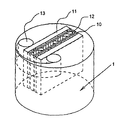
- A non-limiting example of the invention will now be described with reference to the accompanying drawing, which shows the structure of a ready-made test body with sprayed layers incorporated by casting with the method according to the invention.
- As seen in the drawing, in the preferred embodiment two test pieces of the
surface layer 10 attached to backing 11, which test pieces are to be examined, are mounted opposite to each other with a net of polymer material (12), preferably polytetraflouro ethylene, placed between the same, by one or several mounting clips. The purpose of the net is on one hand to achieve the necessary distance between the twosurface layers 10, so that they will not rub against each other during the casting, and on the other hand to absorb possible shrinking stresses, when the resin cures. Some surface layers can be incorporated by casting without the net. - In the present embodiment the
test body 1 shall have cylindrical form, and the test pieces are placed parallel with the longitudinal axis of saidtest body 1 on a fixed mutual distance. - The test pieces prepared in this way are then placed in a mould (not shown) which is placed in a vacuum chamber (not shown), and the air pressure is lowered to under 3000 Pa (30 mbar). Thereafter one waits about 30 sec., whereupon the ready-mixed, liquid casting resin of epoxy type, preferably Epoxy Pack 301 obtainable from Logitech Ltd., is poured into the mould with the test pieces, whereafter air is let into the vacuum chamber to atmospheric pressure. Both of the
porous surface layers 10 are, in this way, covered with casting resin of a type which will fill all pin-holes and voids in the same. Then, the mounted test pieces are lifted out of the mould and excess amount of epoxy is allowed to drip from the test pieces over the mould. This means that the amount of casting resin of epoxy type used in this embodiment will be reduced from about 18 g in the known cold moulding method to about 0.8. - Since the casting resin left in the mould has a curing time of several hours it can be used for several more test bodies.
- The test pieces, from which the casting resin has dripped, are then placed in a known hot moulding press (Pronto-press) and a suitable amount of pulverized phenolic plastic, preferably Phenolic Moulding Compound available from Perstorp AB, is filled into the press cavity, the lid of which is closed and the incorporation by casting is started in known manner, the test pieces being incorporated by casting under a pressure of about 5-15 kN and a temperature of about 150°C to form the
test body 1. - Due to the high temperature the casting resin of epoxy type cures very quickly and no formation of blisters will occur in the epoxy, probably due to the high surrounding pressure of about 5-15 kN. After about 15 minutes the test body is ready to be taken out.
- The so produced
test body 1 is then cut at one end at right angles to the longitudinal direction of the same for producing a circular end surface containing thesurface layers 10 to be analyzed. The circular end surface is then lapped and the surface layers are analyzed and evaluated with the use of a microscope. Since the pin-holes and the voids in the porous surface layer now are filled with epoxy, a true structure is obtained. - The method according to the invention results in cost reductions, since the amount of casting resin of epoxy type is very low (about 0,8 g), and is more or less as fast as the known hot moulding method, but with the desired properties of the cold moulding method.
Claims (1)
- Method for preparation of test bodies for analysis of porous, preferably thermally sprayed, surface layers, which are incorporated by casting in plastic, characterized bya) placing one or more test pieces of the surface layer (10) in a mould introduced into a vacuum chamber, the pressure of which is lowered,b) pouring a ready-mixed, liquid casting resin into the mould containing the test pieces,c) again letting the air in into the chamber,d) lifting the test pieces out of the casting resin and allowing excess of casting resin to drip from the test pieces, and after that they are placed in a mould cavity of a hot moulding press,e) filling said mould cavity together with the test pieces with a pulverized resin, andf) applying pressure and heat to the mould cavity for a predetermined period of time, whereupon the test body (1) is ready to be taken out and lapped.
Applications Claiming Priority (3)
| Application Number | Priority Date | Filing Date | Title |
|---|---|---|---|
| SE9900538A SE513921C2 (en) | 1999-02-17 | 1999-02-17 | Method of making test pads |
| SE9900538 | 1999-02-17 | ||
| PCT/SE2000/000280 WO2000048811A1 (en) | 1999-02-17 | 2000-02-11 | Method for preparation of test bodies |
Publications (2)
| Publication Number | Publication Date |
|---|---|
| EP1071553A1 EP1071553A1 (en) | 2001-01-31 |
| EP1071553B1 true EP1071553B1 (en) | 2002-06-19 |
Family
ID=20414503
Family Applications (1)
| Application Number | Title | Priority Date | Filing Date |
|---|---|---|---|
| EP00909846A Expired - Lifetime EP1071553B1 (en) | 1999-02-17 | 2000-02-11 | Method for preparation of test bodies |
Country Status (8)
| Country | Link |
|---|---|
| US (2) | US6547998B1 (en) |
| EP (1) | EP1071553B1 (en) |
| JP (1) | JP4271870B2 (en) |
| CA (1) | CA2328099C (en) |
| DE (1) | DE60000221T2 (en) |
| ES (1) | ES2176167T3 (en) |
| SE (1) | SE513921C2 (en) |
| WO (1) | WO2000048811A1 (en) |
Families Citing this family (3)
| Publication number | Priority date | Publication date | Assignee | Title |
|---|---|---|---|---|
| ITMI20030320U1 (en) * | 2003-07-09 | 2005-01-10 | Elesa Spa | SCREW IN PLASTIC MATERIAL LIMITED TO TIGHTENING, IN PARTICULAR FOR FIXING THE COLUMN ELEMENTS OF INDICATOR DEVICES FOR THE LEVEL OF LIQUIDS AND FOR THE FEEDING OF LIQUIDS WITH THESE ELEMENTS |
| CA2690579C (en) * | 2009-01-21 | 2015-06-02 | Par Aide Products Co. | Cold casting method and apparatus |
| JP5807462B2 (en) * | 2011-09-12 | 2015-11-10 | 凸版印刷株式会社 | Method for embedding cross-section observation sample |
Family Cites Families (18)
| Publication number | Priority date | Publication date | Assignee | Title |
|---|---|---|---|---|
| US3379603A (en) * | 1959-04-24 | 1968-04-23 | Barnette Stanley Ronald | Cast plastic laminates and cast plastic articles of manufacture |
| US3761554A (en) * | 1959-04-24 | 1973-09-25 | S Barnette | Method of making plastic articles with a substantially enveloped core |
| US3596317A (en) * | 1969-08-15 | 1971-08-03 | Donald C Nicholson | Apparatus for making plastic-embedded specimens |
| US3886248A (en) * | 1969-08-15 | 1975-05-27 | Donald C Nicholson | Method of making plastic embedded specimens |
| DK125217B (en) * | 1970-02-23 | 1973-01-15 | Struers Chem Labor | Abrasive or polishing blank with associated sample holder for use in grinding or polishing for micro-examination purposes. |
| US3733768A (en) * | 1971-02-12 | 1973-05-22 | B Carls | Storage of histology specimens |
| US3994763A (en) * | 1975-02-06 | 1976-11-30 | Robert Sheath | Method of making a decorative article containing encapsulated material |
| JPS5527975A (en) | 1978-08-21 | 1980-02-28 | Power Reactor & Nuclear Fuel Dev Corp | Embedding solid sample |
| US4419314A (en) * | 1981-05-26 | 1983-12-06 | Core Laboratories, Inc. | Method of coating core samples |
| US4655700A (en) * | 1982-11-08 | 1987-04-07 | Buehler Ltd. | Apparatus for impregnation of porous samples for materials evaluation |
| GB2144366A (en) | 1983-07-30 | 1985-03-06 | Parke Davis & Co | Casting mould for specimen bodies |
| US4724110A (en) * | 1983-11-28 | 1988-02-09 | Arnold Ben A | Method of making a test phantom |
| US4681718A (en) * | 1984-05-09 | 1987-07-21 | Hughes Aircraft Company | Method of fabricating composite or encapsulated articles |
| US4623500A (en) * | 1984-06-08 | 1986-11-18 | Buehler Ltd. | Method of mounting a plurality of coupons in molded material and polishing surfaces thereof for cross-sectional analysis of printed circuit boards |
| US4681716A (en) * | 1986-03-03 | 1987-07-21 | Celanese Corporation | Process for the preparation of polybenzimidazole foams |
| US5269999A (en) * | 1992-03-31 | 1993-12-14 | Gas Research Institute | Preparation of core samples |
| DE4400815A1 (en) * | 1994-01-13 | 1995-07-20 | Mls Gmbh | Method and device for embedding an object, in particular a sample material, in an investment material |
| JP3049537B2 (en) * | 1995-02-03 | 2000-06-05 | 悌二 竹崎 | Fixation support method for biopsy sample, fixation support agent and embedding cassette |
-
1999
- 1999-02-17 SE SE9900538A patent/SE513921C2/en not_active IP Right Cessation
-
2000
- 2000-02-11 ES ES00909846T patent/ES2176167T3/en not_active Expired - Lifetime
- 2000-02-11 JP JP2000599576A patent/JP4271870B2/en not_active Expired - Lifetime
- 2000-02-11 WO PCT/SE2000/000280 patent/WO2000048811A1/en not_active Ceased
- 2000-02-11 CA CA002328099A patent/CA2328099C/en not_active Expired - Fee Related
- 2000-02-11 US US09/647,746 patent/US6547998B1/en not_active Expired - Fee Related
- 2000-02-11 DE DE60000221T patent/DE60000221T2/en not_active Expired - Lifetime
- 2000-02-11 EP EP00909846A patent/EP1071553B1/en not_active Expired - Lifetime
-
2003
- 2003-01-27 US US10/351,445 patent/US6960542B2/en not_active Expired - Fee Related
Also Published As
| Publication number | Publication date |
|---|---|
| EP1071553A1 (en) | 2001-01-31 |
| ES2176167T3 (en) | 2002-12-01 |
| JP2002537548A (en) | 2002-11-05 |
| DE60000221T2 (en) | 2002-10-24 |
| SE9900538L (en) | 2000-08-18 |
| JP4271870B2 (en) | 2009-06-03 |
| US20030124274A1 (en) | 2003-07-03 |
| US6547998B1 (en) | 2003-04-15 |
| WO2000048811A1 (en) | 2000-08-24 |
| CA2328099C (en) | 2008-12-23 |
| US6960542B2 (en) | 2005-11-01 |
| SE513921C2 (en) | 2000-11-27 |
| CA2328099A1 (en) | 2000-08-24 |
| SE9900538D0 (en) | 1999-02-17 |
| DE60000221D1 (en) | 2002-07-25 |
| WO2000048811A8 (en) | 2000-11-23 |
Similar Documents
| Publication | Publication Date | Title |
|---|---|---|
| US5799667A (en) | Sampler applicator | |
| US4051296A (en) | Silicone rubber mold | |
| EP1417472B9 (en) | Process and apparatus for preparing and presenting a tissue sample for histological study | |
| CN1172529A (en) | Method of fixedly supporting biopsy specimen, fixedly supporting agent, and embedding cassette | |
| US6547998B1 (en) | Method for preparation of test bodies | |
| US3755517A (en) | Method of making porous applicator structures | |
| CN112786270B (en) | Preparation method of magnetic powder particle transmission electron microscope sample | |
| GB2267457A (en) | Manufacture of components from composite material | |
| CA2731881A1 (en) | Container for receiving lab samples, and use of a device for taking samples | |
| CN117532789B (en) | Method for preparing tensile specimens of epoxy ultra-low temperature structural adhesive and vibration curing device | |
| EP3476820A1 (en) | Ceramic composite and production method for ceramic composite | |
| An et al. | Principles of embedding and common protocols | |
| JPH0712605B2 (en) | Molding method for prototype for sintering | |
| Sinkankas | High pressure epoxy impregnation of porous materials for thin-section and microprobe analysis | |
| JPH0217852Y2 (en) | ||
| US1917413A (en) | Process for manufacturing chemical resisting articles | |
| IE55036B1 (en) | Mouldable composition and shaped product produced therefrom | |
| JPS5825075B2 (en) | Manufacturing method for polymer-impregnated concrete products | |
| CN122042345A (en) | Manufacturing method of grinding clamp for deformed sample after thermal simulation experiment | |
| Curson | Specimen preparation | |
| JPH0478088B2 (en) | ||
| JP2014202725A (en) | Closely holding member of biological tissue, and container equipped with the same | |
| JPH0740116U (en) | Vacuum casting machine | |
| Willoughby et al. | Preparation of large thin sections from polyethylene glycol impregnated soil samples | |
| Steinhardt et al. | Micromorphological Analysis of Selected Indiana Soils |
Legal Events
| Date | Code | Title | Description |
|---|---|---|---|
| PUAI | Public reference made under article 153(3) epc to a published international application that has entered the european phase |
Free format text: ORIGINAL CODE: 0009012 |
|
| 17P | Request for examination filed |
Effective date: 20000916 |
|
| AK | Designated contracting states |
Kind code of ref document: A1 Designated state(s): AT BE CH CY DE DK ES FI FR GB GR IE IT LI LU MC NL PT SE |
|
| GRAG | Despatch of communication of intention to grant |
Free format text: ORIGINAL CODE: EPIDOS AGRA |
|
| 17Q | First examination report despatched |
Effective date: 20010816 |
|
| GRAG | Despatch of communication of intention to grant |
Free format text: ORIGINAL CODE: EPIDOS AGRA |
|
| GRAH | Despatch of communication of intention to grant a patent |
Free format text: ORIGINAL CODE: EPIDOS IGRA |
|
| GRAH | Despatch of communication of intention to grant a patent |
Free format text: ORIGINAL CODE: EPIDOS IGRA |
|
| GRAA | (expected) grant |
Free format text: ORIGINAL CODE: 0009210 |
|
| AK | Designated contracting states |
Kind code of ref document: B1 Designated state(s): CH DE ES FR GB IT LI |
|
| REG | Reference to a national code |
Ref country code: GB Ref legal event code: FG4D |
|
| REG | Reference to a national code |
Ref country code: CH Ref legal event code: EP |
|
| REG | Reference to a national code |
Ref country code: CH Ref legal event code: NV Representative=s name: E. BLUM & CO. PATENTANWAELTE |
|
| REG | Reference to a national code |
Ref country code: IE Ref legal event code: FG4D |
|
| REF | Corresponds to: |
Ref document number: 60000221 Country of ref document: DE Date of ref document: 20020725 |
|
| ET | Fr: translation filed | ||
| REG | Reference to a national code |
Ref country code: ES Ref legal event code: FG2A Ref document number: 2176167 Country of ref document: ES Kind code of ref document: T3 |
|
| PLBE | No opposition filed within time limit |
Free format text: ORIGINAL CODE: 0009261 |
|
| STAA | Information on the status of an ep patent application or granted ep patent |
Free format text: STATUS: NO OPPOSITION FILED WITHIN TIME LIMIT |
|
| 26N | No opposition filed |
Effective date: 20030320 |
|
| REG | Reference to a national code |
Ref country code: IE Ref legal event code: MM4A |
|
| REG | Reference to a national code |
Ref country code: CH Ref legal event code: PFA Owner name: VOLVO AERO CORPORATION Free format text: VOLVO AERO CORPORATION# #46181 TROLLHAETTAN (SE) -TRANSFER TO- VOLVO AERO CORPORATION# #46181 TROLLHAETTAN (SE) |
|
| PGFP | Annual fee paid to national office [announced via postgrant information from national office to epo] |
Ref country code: CH Payment date: 20120214 Year of fee payment: 13 Ref country code: FR Payment date: 20120221 Year of fee payment: 13 |
|
| PGFP | Annual fee paid to national office [announced via postgrant information from national office to epo] |
Ref country code: DE Payment date: 20120208 Year of fee payment: 13 |
|
| PGFP | Annual fee paid to national office [announced via postgrant information from national office to epo] |
Ref country code: GB Payment date: 20120208 Year of fee payment: 13 Ref country code: IT Payment date: 20120221 Year of fee payment: 13 |
|
| PGFP | Annual fee paid to national office [announced via postgrant information from national office to epo] |
Ref country code: ES Payment date: 20120307 Year of fee payment: 13 |
|
| REG | Reference to a national code |
Ref country code: CH Ref legal event code: PL |
|
| GBPC | Gb: european patent ceased through non-payment of renewal fee |
Effective date: 20130211 |
|
| PG25 | Lapsed in a contracting state [announced via postgrant information from national office to epo] |
Ref country code: LI Free format text: LAPSE BECAUSE OF NON-PAYMENT OF DUE FEES Effective date: 20130228 Ref country code: CH Free format text: LAPSE BECAUSE OF NON-PAYMENT OF DUE FEES Effective date: 20130228 |
|
| REG | Reference to a national code |
Ref country code: FR Ref legal event code: ST Effective date: 20131031 |
|
| REG | Reference to a national code |
Ref country code: DE Ref legal event code: R119 Ref document number: 60000221 Country of ref document: DE Effective date: 20130903 |
|
| PG25 | Lapsed in a contracting state [announced via postgrant information from national office to epo] |
Ref country code: IT Free format text: LAPSE BECAUSE OF NON-PAYMENT OF DUE FEES Effective date: 20130211 |
|
| PG25 | Lapsed in a contracting state [announced via postgrant information from national office to epo] |
Ref country code: DE Free format text: LAPSE BECAUSE OF NON-PAYMENT OF DUE FEES Effective date: 20130903 Ref country code: GB Free format text: LAPSE BECAUSE OF NON-PAYMENT OF DUE FEES Effective date: 20130211 Ref country code: FR Free format text: LAPSE BECAUSE OF NON-PAYMENT OF DUE FEES Effective date: 20130228 |
|
| REG | Reference to a national code |
Ref country code: ES Ref legal event code: FD2A Effective date: 20140409 |
|
| PG25 | Lapsed in a contracting state [announced via postgrant information from national office to epo] |
Ref country code: ES Free format text: LAPSE BECAUSE OF NON-PAYMENT OF DUE FEES Effective date: 20130212 |