EP1070580A2 - Method of attaching an article to the inside of a tyre cavity - Google Patents
Method of attaching an article to the inside of a tyre cavity Download PDFInfo
- Publication number
- EP1070580A2 EP1070580A2 EP00306134A EP00306134A EP1070580A2 EP 1070580 A2 EP1070580 A2 EP 1070580A2 EP 00306134 A EP00306134 A EP 00306134A EP 00306134 A EP00306134 A EP 00306134A EP 1070580 A2 EP1070580 A2 EP 1070580A2
- Authority
- EP
- European Patent Office
- Prior art keywords
- adhesive
- layer
- tyre
- article
- attaching
- Prior art date
- Legal status (The legal status is an assumption and is not a legal conclusion. Google has not performed a legal analysis and makes no representation as to the accuracy of the status listed.)
- Granted
Links
Images
Classifications
-
- B—PERFORMING OPERATIONS; TRANSPORTING
- B60—VEHICLES IN GENERAL
- B60C—VEHICLE TYRES; TYRE INFLATION; TYRE CHANGING; CONNECTING VALVES TO INFLATABLE ELASTIC BODIES IN GENERAL; DEVICES OR ARRANGEMENTS RELATED TO TYRES
- B60C23/00—Devices for measuring, signalling, controlling, or distributing tyre pressure or temperature, specially adapted for mounting on vehicles; Arrangement of tyre inflating devices on vehicles, e.g. of pumps or of tanks; Tyre cooling arrangements
- B60C23/02—Signalling devices actuated by tyre pressure
- B60C23/04—Signalling devices actuated by tyre pressure mounted on the wheel or tyre
- B60C23/0491—Constructional details of means for attaching the control device
- B60C23/0493—Constructional details of means for attaching the control device for attachment on the tyre
-
- B—PERFORMING OPERATIONS; TRANSPORTING
- B29—WORKING OF PLASTICS; WORKING OF SUBSTANCES IN A PLASTIC STATE IN GENERAL
- B29C—SHAPING OR JOINING OF PLASTICS; SHAPING OF MATERIAL IN A PLASTIC STATE, NOT OTHERWISE PROVIDED FOR; AFTER-TREATMENT OF THE SHAPED PRODUCTS, e.g. REPAIRING
- B29C65/00—Joining or sealing of preformed parts, e.g. welding of plastics materials; Apparatus therefor
- B29C65/48—Joining or sealing of preformed parts, e.g. welding of plastics materials; Apparatus therefor using adhesives, i.e. using supplementary joining material; solvent bonding
- B29C65/4805—Joining or sealing of preformed parts, e.g. welding of plastics materials; Apparatus therefor using adhesives, i.e. using supplementary joining material; solvent bonding characterised by the type of adhesives
- B29C65/483—Reactive adhesives, e.g. chemically curing adhesives
- B29C65/485—Multi-component adhesives, i.e. chemically curing as a result of the mixing of said multi-components
-
- B—PERFORMING OPERATIONS; TRANSPORTING
- B29—WORKING OF PLASTICS; WORKING OF SUBSTANCES IN A PLASTIC STATE IN GENERAL
- B29C—SHAPING OR JOINING OF PLASTICS; SHAPING OF MATERIAL IN A PLASTIC STATE, NOT OTHERWISE PROVIDED FOR; AFTER-TREATMENT OF THE SHAPED PRODUCTS, e.g. REPAIRING
- B29C66/00—General aspects of processes or apparatus for joining preformed parts
- B29C66/01—General aspects dealing with the joint area or with the area to be joined
- B29C66/02—Preparation of the material, in the area to be joined, prior to joining or welding
- B29C66/026—Chemical pre-treatments
-
- B—PERFORMING OPERATIONS; TRANSPORTING
- B29—WORKING OF PLASTICS; WORKING OF SUBSTANCES IN A PLASTIC STATE IN GENERAL
- B29C—SHAPING OR JOINING OF PLASTICS; SHAPING OF MATERIAL IN A PLASTIC STATE, NOT OTHERWISE PROVIDED FOR; AFTER-TREATMENT OF THE SHAPED PRODUCTS, e.g. REPAIRING
- B29C66/00—General aspects of processes or apparatus for joining preformed parts
- B29C66/01—General aspects dealing with the joint area or with the area to be joined
- B29C66/05—Particular design of joint configurations
- B29C66/10—Particular design of joint configurations particular design of the joint cross-sections
- B29C66/11—Joint cross-sections comprising a single joint-segment, i.e. one of the parts to be joined comprising a single joint-segment in the joint cross-section
- B29C66/112—Single lapped joints
- B29C66/1122—Single lap to lap joints, i.e. overlap joints
-
- B—PERFORMING OPERATIONS; TRANSPORTING
- B29—WORKING OF PLASTICS; WORKING OF SUBSTANCES IN A PLASTIC STATE IN GENERAL
- B29C—SHAPING OR JOINING OF PLASTICS; SHAPING OF MATERIAL IN A PLASTIC STATE, NOT OTHERWISE PROVIDED FOR; AFTER-TREATMENT OF THE SHAPED PRODUCTS, e.g. REPAIRING
- B29C66/00—General aspects of processes or apparatus for joining preformed parts
- B29C66/50—General aspects of joining tubular articles; General aspects of joining long products, i.e. bars or profiled elements; General aspects of joining single elements to tubular articles, hollow articles or bars; General aspects of joining several hollow-preforms to form hollow or tubular articles
- B29C66/51—Joining tubular articles, profiled elements or bars; Joining single elements to tubular articles, hollow articles or bars; Joining several hollow-preforms to form hollow or tubular articles
- B29C66/53—Joining single elements to tubular articles, hollow articles or bars
- B29C66/532—Joining single elements to the wall of tubular articles, hollow articles or bars
- B29C66/5326—Joining single elements to the wall of tubular articles, hollow articles or bars said single elements being substantially flat
-
- B—PERFORMING OPERATIONS; TRANSPORTING
- B29—WORKING OF PLASTICS; WORKING OF SUBSTANCES IN A PLASTIC STATE IN GENERAL
- B29C—SHAPING OR JOINING OF PLASTICS; SHAPING OF MATERIAL IN A PLASTIC STATE, NOT OTHERWISE PROVIDED FOR; AFTER-TREATMENT OF THE SHAPED PRODUCTS, e.g. REPAIRING
- B29C66/00—General aspects of processes or apparatus for joining preformed parts
- B29C66/50—General aspects of joining tubular articles; General aspects of joining long products, i.e. bars or profiled elements; General aspects of joining single elements to tubular articles, hollow articles or bars; General aspects of joining several hollow-preforms to form hollow or tubular articles
- B29C66/61—Joining from or joining on the inside
-
- B—PERFORMING OPERATIONS; TRANSPORTING
- B29—WORKING OF PLASTICS; WORKING OF SUBSTANCES IN A PLASTIC STATE IN GENERAL
- B29D—PRODUCING PARTICULAR ARTICLES FROM PLASTICS OR FROM SUBSTANCES IN A PLASTIC STATE
- B29D30/00—Producing pneumatic or solid tyres or parts thereof
- B29D30/06—Pneumatic tyres or parts thereof (e.g. produced by casting, moulding, compression moulding, injection moulding, centrifugal casting)
- B29D30/0601—Vulcanising tyres; Vulcanising presses for tyres
- B29D30/0662—Accessories, details or auxiliary operations
-
- B—PERFORMING OPERATIONS; TRANSPORTING
- B60—VEHICLES IN GENERAL
- B60C—VEHICLE TYRES; TYRE INFLATION; TYRE CHANGING; CONNECTING VALVES TO INFLATABLE ELASTIC BODIES IN GENERAL; DEVICES OR ARRANGEMENTS RELATED TO TYRES
- B60C19/00—Tyre parts or constructions not otherwise provided for
-
- B—PERFORMING OPERATIONS; TRANSPORTING
- B29—WORKING OF PLASTICS; WORKING OF SUBSTANCES IN A PLASTIC STATE IN GENERAL
- B29C—SHAPING OR JOINING OF PLASTICS; SHAPING OF MATERIAL IN A PLASTIC STATE, NOT OTHERWISE PROVIDED FOR; AFTER-TREATMENT OF THE SHAPED PRODUCTS, e.g. REPAIRING
- B29C66/00—General aspects of processes or apparatus for joining preformed parts
- B29C66/70—General aspects of processes or apparatus for joining preformed parts characterised by the composition, physical properties or the structure of the material of the parts to be joined; Joining with non-plastics material
- B29C66/71—General aspects of processes or apparatus for joining preformed parts characterised by the composition, physical properties or the structure of the material of the parts to be joined; Joining with non-plastics material characterised by the composition of the plastics material of the parts to be joined
-
- B—PERFORMING OPERATIONS; TRANSPORTING
- B29—WORKING OF PLASTICS; WORKING OF SUBSTANCES IN A PLASTIC STATE IN GENERAL
- B29D—PRODUCING PARTICULAR ARTICLES FROM PLASTICS OR FROM SUBSTANCES IN A PLASTIC STATE
- B29D30/00—Producing pneumatic or solid tyres or parts thereof
- B29D30/0061—Accessories, details or auxiliary operations not otherwise provided for
- B29D2030/0072—Attaching fasteners to tyres, e.g. patches, in order to connect devices to tyres
-
- B—PERFORMING OPERATIONS; TRANSPORTING
- B29—WORKING OF PLASTICS; WORKING OF SUBSTANCES IN A PLASTIC STATE IN GENERAL
- B29D—PRODUCING PARTICULAR ARTICLES FROM PLASTICS OR FROM SUBSTANCES IN A PLASTIC STATE
- B29D30/00—Producing pneumatic or solid tyres or parts thereof
- B29D30/0061—Accessories, details or auxiliary operations not otherwise provided for
- B29D2030/0077—Directly attaching monitoring devices to tyres before or after vulcanization, e.g. microchips
-
- B—PERFORMING OPERATIONS; TRANSPORTING
- B29—WORKING OF PLASTICS; WORKING OF SUBSTANCES IN A PLASTIC STATE IN GENERAL
- B29L—INDEXING SCHEME ASSOCIATED WITH SUBCLASS B29C, RELATING TO PARTICULAR ARTICLES
- B29L2030/00—Pneumatic or solid tyres or parts thereof
Definitions
- the present invention relates to a method of attaching an article to the inside of a tyre cavity. Specifically the invention relates to a method of attaching an electronic microchip to the innerlining of a pneumatic tyre.
- Attaching such a microchip to the outer surface of the tyre, such as the sidewall, is clearly not a particularly viable option in view of the likelihood of damage due to physical impact or exposure to water or the like.
- the alternative of attaching the electronic component to the inside of the tyre is also problematic since the innerliners of modern tubeless pneumatic tyres invariably comprise one or more of a number of highly saturated butyl rubbers which in the cured state exhibit insufficient chemical reactivity to most practical adhesive systems to generate a reliable bond.
- an object of the present invention to provide a method of securely adhering an article such as an electronic microchip component to the inside of a tubeless pneumatic tyre.
- a method of attaching an article to the inside surface of a pneumatic tyre comprising coating an area of the inner surface of an uncured tyre carcass with a first layer of flexible adhesive, covering the first layer of adhesive with a removable masking layer comprising a flexible and heat resistant material, curing the tyre carcass in a heated tyre mould, removing the cured tyre from the mould and removing the masking layer to expose the first layer of adhesive, coating a face of the article with a second layer of flexible adhesive and attaching the article to the tyre by bringing together the first and second layers of adhesive.
- the present invention relates to the problem of adhering an article such as a microchip to the inner surface of a tyre.
- Microchips and similar electronic devices are invariably housed in rigid plastic cases in order to protect the delicate electronics.
- a flexible adhesive capable of withstanding the inevitable shearing forces generated as the tyre deforms in use.
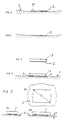
- Shown in Figure 1 is a first layer of adhesive 1 applied to an area of the surface 5 of the rubber innerliner of a tubeless pneumatic tyre.
- the adhesive may be applied by any practical means such as knife spreading or roller coating.
- the first adhesive layer 1 After application to the tyre inner surface 5 the first adhesive layer 1 is completely covered by a masking layer (M) of a flexible heat resistant material which has the further property of only limited adhesion to the adhesive of the first layer 1 such that it can be subsequently removed.
- M masking layer
- the first layer of adhesive may alternatively be pre-applied to the masking layer and then both applied to the inside surface of the tyre.
- the tyre with the first layer of adhesive 1 and masking layer M is then cured in a heated mould in the conventional manner.
- the presence of the masking layer M thus prevents the adhesive layer from being contaminated on the moulding process and from adhering to the moulding bladder and also discourages the adhesive layer from further spreading under the influence of the applied moulding pressure.
- the tyre is demoulded and the masking layer M is removed to expose the first adhesive layer as shown in Figure 2.
- the thickness of the masking layer M and the pressure applied in moulding the adhesive layer may be left on the tyre surface a shown or may be partially or completely impressed into the rubber or even lie below the level of the surrounding rubber.
- a surface of the microchip 3 is coated with a second layer of adhesive 2. Again the coating may be done by a conventional means.
- the second layer of adhesive 2 is brought into contact with the first adhesive layer 1 to adhere the microchip 3 to the tyre innerliner surface 5 as shown in Figure 4.
- a non-curing acrylic adhesive available from 3M as " VHB” A10 is particularly suitable for adhering to halo-butyl (chlorobutyl and bromobutyl) innerliners commonly used in tyres.
- This material is flexible and is said to be stable over an operating temperature range of -30° to +260° with a maximum continuous operating temperature of 150° and is therefore well suited to enduring a tyre curing process which typically reaches temperatures of 170-180°C.
- the thickness of the layer may be in the range 0.05 mm to 2.0 mm, but is preferably 0.25 mm.
- a masking layer M of a polyester film such as that available under the trade name MYLAR having a thickness in the range of 0.03 mm to 0.2 mm has been found suitable.
- Such a polyester film is believed to have a melting temperature in excess of 230°C.
- VHB flexible non-curing acrylic adhesive available from 3M as " VHB " 4918F
- VHB flexible non-curing acrylic adhesive available from 3M as " VHB " 4918F
- This adhesive is believed to be stable over an operating temperature range of -30° to 150°C with a lower maximum continuous operating temperature of 93°C.
- the thickness of this second layer may be in the range 0.5 mm to 4.0 mm but is preferably 2.0 mm. Whilst the above embodiment employs two different adhesives, the materials of both the first and second layers of adhesive may however be the same material.
- the thicknesses of the first and second layers are selected such that the adhered microchip is held from the tyre surface by a minimum distance of between 2% and 8%, preferably 4%, of its maximum linear dimension along the adhered surface, i.e. the surface to which the second adhesive layer is applied.
- Figure 5 shows a plan view (5a) and front and side views (5b,5c) of a microchip (3) mounted on a tyre surface (S).
- the microchip (3) is held from the tyre surface (5) by a distance (d) which is between 2% and 8% of the maximum dimension (D) of the microchip module along its adhering surface which since this is rectangular in shape is the diagonal.
- first adhesive layer may be initially utilised in adhering a microchip.
- the remainder of the adhesive layer may be left unexposed for subsequent use in adhering another microprocessor perhaps performing a different function or a replacement microchip for example if the tyre is retreaded.
- two or more such areas of first layer of adhesive may be provided for similar subsequent additional microprocessors.
- the present invention provides a method by which a microchip may be conveniently and securely attached to the inner surface of a tubeless pneumatic tyre for the purpose of monitoring its operating parameters.
Landscapes
- Engineering & Computer Science (AREA)
- Mechanical Engineering (AREA)
- Chemical & Material Sciences (AREA)
- Chemical Kinetics & Catalysis (AREA)
- General Chemical & Material Sciences (AREA)
- Tyre Moulding (AREA)
- Tires In General (AREA)
- Lining Or Joining Of Plastics Or The Like (AREA)
- Adhesives Or Adhesive Processes (AREA)
Abstract
Description
Claims (10)
- A method of attaching an article (3) to the inside surface (S) of a pneumatic tyre characterised by coating an area of the inner surface of an uncured tyre carcass with a first layer (1) of adhesive, covering the first layer (1) of adhesive with a removable masking layer (M) comprising a flexible and heat resistant material, curing the tyre carcass in a heated tyre mould, removing the cured tyre from the mould and removing the masking layer (M) to expose the first layer (1) of adhesive, coating a face of the article (3) with a second layer of adhesive (2) and attaching the article to the tyre by bringing together the first (1) and second (2) layers of adhesive.
- A method according to claim 1, characterised in that the first layer (1) of adhesive remains unchanged by the curing of the tyre.
- A method according to either of claims 1 or 2, characterised in that the first layer (1) of adhesive comprises a non-curing acrylic adhesive material being stable at temperatures up to 200°C.
- A method according to any of claims 1 to 3, characterised in that the second layer (2) of adhesive comprises a non-curing adhesive material being stable at temperatures up to 150°C.
- A method according to any of claims 1 or 4, characterised in that the first and second layers (1,2) of adhesive are the same adhesive.
- A method in accordance with any of claims 1 to 5, characterised in that the adhered article (3) is separated by the adhesive layers (1,2) from the surrounding rubber surface (S) by a minimum distance (d) equal to between 2% and 8% of the maximum linear distance (D) along the adhering surface of the article (3).
- A method according to any of claims 1 to 6, characterised in that the first layer (1) of adhesive has a thickness in the range of 0.05 mm to 2.0 mm.
- A method according to any of claims 1 to 7, characterised in that the second layer (2) of adhesive has a thickness of 0.5 mm to 4.0 mm.
- A method according to any of claims 1 to 8, characterised in that the masking layer (M) comprises a polyester film.
- A method according to any of claims 1 to 9, characterised in that the masking layer (M) has a thickness in the range of 0.03 mm to 0.2 mm.
Applications Claiming Priority (2)
| Application Number | Priority Date | Filing Date | Title |
|---|---|---|---|
| GB9916914 | 1999-07-20 | ||
| GBGB9916914.6A GB9916914D0 (en) | 1999-07-20 | 1999-07-20 | Method of attaching an article to the inside of a tyre cavity |
Publications (3)
| Publication Number | Publication Date |
|---|---|
| EP1070580A2 true EP1070580A2 (en) | 2001-01-24 |
| EP1070580A3 EP1070580A3 (en) | 2002-07-17 |
| EP1070580B1 EP1070580B1 (en) | 2004-11-17 |
Family
ID=10857517
Family Applications (1)
| Application Number | Title | Priority Date | Filing Date |
|---|---|---|---|
| EP00306134A Expired - Lifetime EP1070580B1 (en) | 1999-07-20 | 2000-07-19 | Method of attaching an article to the inside of a tyre cavity |
Country Status (5)
| Country | Link |
|---|---|
| US (1) | US6524415B1 (en) |
| EP (1) | EP1070580B1 (en) |
| JP (1) | JP4550974B2 (en) |
| DE (1) | DE60015868T2 (en) |
| GB (1) | GB9916914D0 (en) |
Cited By (11)
| Publication number | Priority date | Publication date | Assignee | Title |
|---|---|---|---|---|
| EP1400378A1 (en) * | 2002-09-18 | 2004-03-24 | Continental Aktiengesellschaft | Transponder for tire |
| EP1459911A1 (en) * | 2003-03-19 | 2004-09-22 | Morgan Adhesives Company | Tag attachment for tires and method of attaching tags to tires |
| WO2004110794A1 (en) * | 2003-06-12 | 2004-12-23 | Pirelli Pneumatici S.P.A. | Tyre equipped with a monitoring device, and method for installing the device onto the inner surface of the tyre |
| US7108761B2 (en) * | 2002-02-18 | 2006-09-19 | Bridgestone Firestone North American Tire, Llc | Tire and method of securing an object thereto |
| WO2006122595A1 (en) * | 2005-05-18 | 2006-11-23 | Continental Aktiengesellschaft | Vehicle tyre |
| EP1677993A4 (en) * | 2003-09-30 | 2008-03-05 | Schrader Bridgeport Int Inc | Method for attachment of tire pressure sensor |
| WO2009013267A1 (en) * | 2007-07-24 | 2009-01-29 | Societe De Technologie Michelin | Tyre equipped for attaching an object to the wall thereof and fastener therefor |
| WO2009013269A1 (en) * | 2007-07-24 | 2009-01-29 | Societe De Technologie Michelin | Tyre equipped for attaching an object to the wall thereof and method for making same |
| WO2011047791A1 (en) | 2009-10-21 | 2011-04-28 | Rema Tip Top Gmbh | Fastening system for attaching retainers to elastomer components |
| WO2017220896A1 (en) | 2016-06-21 | 2017-12-28 | Compagnie Generale Des Etablissements Michelin | Tyre provided with a member attached to the surface thereof |
| FR3058677A1 (en) * | 2016-11-17 | 2018-05-18 | Compagnie Generale Des Etablissements Michelin | PNEUMATIC READY TO RECEIVE AN ORGAN ON ITS SURFACE |
Families Citing this family (21)
| Publication number | Priority date | Publication date | Assignee | Title |
|---|---|---|---|---|
| US7161476B2 (en) | 2000-07-26 | 2007-01-09 | Bridgestone Firestone North American Tire, Llc | Electronic tire management system |
| ES2381940T3 (en) | 2000-07-26 | 2012-06-01 | Bridgestone Americas Tire Operations, Llc | Electronic tire management system |
| US8266465B2 (en) | 2000-07-26 | 2012-09-11 | Bridgestone Americas Tire Operation, LLC | System for conserving battery life in a battery operated device |
| CA2517822C (en) * | 2004-09-06 | 2009-10-27 | Honda Motor Co., Ltd. | Seat mount structure for saddle ride vehicle |
| JP4599150B2 (en) | 2004-12-14 | 2010-12-15 | 住友ゴム工業株式会社 | Pneumatic tire with electronic parts storage |
| JP4732788B2 (en) * | 2005-04-26 | 2011-07-27 | 株式会社ブリヂストン | Protective member, electronic monitoring device and pneumatic tire |
| US7419557B2 (en) * | 2005-09-08 | 2008-09-02 | The Goodyear Tire & Rubber Company | Method for protecting tire innerliner using thermoformable film coated with pressure-sensitive adhesive |
| US20070107824A1 (en) * | 2005-11-16 | 2007-05-17 | Hahn Bruce R | Rubber formulation with adhesive-compatible surface |
| US7598877B2 (en) * | 2006-05-30 | 2009-10-06 | The Goodyear Tire & Rubber Company | Transponder carrier for a tire |
| US8136562B2 (en) | 2006-12-29 | 2012-03-20 | Bridgestone Firestone North American Tire, Llc | Tire bead insulation |
| JP4989449B2 (en) * | 2007-12-25 | 2012-08-01 | 横浜ゴム株式会社 | Pneumatic tire manufacturing method and pneumatic tire |
| US8776851B2 (en) | 2008-08-29 | 2014-07-15 | The Goodyear Tire & Rubber Company | Film to keep tire surface clean and simultaneously prime for better adhesion of balance pad |
| US8157172B2 (en) | 2008-10-30 | 2012-04-17 | The Goodyear Tire & Rubber Company | RFID tag package and tire assembly |
| US8430142B2 (en) * | 2009-02-25 | 2013-04-30 | The Goodyear Tire & Rubber Company | Environmentally resistant assembly containing an electronic device for use in a tire |
| US20110041309A1 (en) * | 2009-08-24 | 2011-02-24 | Peter Ross Shepler | Method of installing tire electronics in a tire |
| US8561659B2 (en) * | 2009-08-24 | 2013-10-22 | The Goodyear Tire & Rubber Company | Tire and electronic device assembly |
| US20140130357A1 (en) | 2012-11-09 | 2014-05-15 | The Goodyear Tire & Rubber Company | Securing to a pneumatic tire |
| FR3030558B1 (en) * | 2014-12-19 | 2016-12-23 | Michelin & Cie | PNEUMATIC READY TO RECEIVE AN ORGAN ON ITS SURFACE |
| FR3035024A1 (en) * | 2015-04-20 | 2016-10-21 | Michelin & Cie | PNEUMATIC READY TO RECEIVE AN ORGAN ON ITS SURFACE |
| DE102019205298A1 (en) * | 2019-04-12 | 2020-10-15 | Continental Reifen Deutschland Gmbh | tires |
| WO2024150107A1 (en) * | 2023-01-09 | 2024-07-18 | Bridgestone Europe Nv/Sa | Method to join a support for an electronic device to a vulcanised tyre |
Family Cites Families (7)
| Publication number | Priority date | Publication date | Assignee | Title |
|---|---|---|---|---|
| US4808657A (en) * | 1984-03-08 | 1989-02-28 | The Goodyear Tire & Rubber Company | Rubbery adhesive cements |
| US5500065A (en) * | 1994-06-03 | 1996-03-19 | Bridgestone/Firestone, Inc. | Method for embedding a monitoring device within a tire during manufacture |
| US5971046A (en) * | 1997-09-17 | 1999-10-26 | Bridgestone/Firestone, Inc. | Method and apparatus for bonding an active tag to a patch and a tire |
| ZA996762B (en) * | 1998-12-04 | 2001-04-30 | Bridgestone Firestone Inc | Patch for preparing an innerliner of a pneumatic tire for the quick bonding of an electronic monitoring device. |
| US6244104B1 (en) * | 1998-12-04 | 2001-06-12 | Bridgestone/Firestone Research, Inc. | Method for preparing an innerliner of a pneumatic tire for the quick bonding of an electronic monitoring device |
| US6208244B1 (en) * | 1999-04-29 | 2001-03-27 | Bridgestone/Firestone Research, Inc. | Combination monitoring device and patch for a pneumatic tire and method of installing the same with a coupled antenna |
| US6388567B1 (en) * | 1999-04-29 | 2002-05-14 | Bridgestone/Firestone North American Tire, Llc | Combination monitoring device and patch for a pneumatic tire and method of installing the same |
-
1999
- 1999-07-20 GB GBGB9916914.6A patent/GB9916914D0/en not_active Ceased
-
2000
- 2000-07-04 JP JP2000202580A patent/JP4550974B2/en not_active Expired - Lifetime
- 2000-07-19 EP EP00306134A patent/EP1070580B1/en not_active Expired - Lifetime
- 2000-07-19 DE DE60015868T patent/DE60015868T2/en not_active Expired - Lifetime
- 2000-07-19 US US09/619,711 patent/US6524415B1/en not_active Expired - Fee Related
Cited By (23)
| Publication number | Priority date | Publication date | Assignee | Title |
|---|---|---|---|---|
| US7108761B2 (en) * | 2002-02-18 | 2006-09-19 | Bridgestone Firestone North American Tire, Llc | Tire and method of securing an object thereto |
| US8657975B2 (en) | 2002-02-18 | 2014-02-25 | Bridgestone Americas Tire Operations, Llc | Tire and method of securing an object thereto |
| EP1400378A1 (en) * | 2002-09-18 | 2004-03-24 | Continental Aktiengesellschaft | Transponder for tire |
| EP1459911A1 (en) * | 2003-03-19 | 2004-09-22 | Morgan Adhesives Company | Tag attachment for tires and method of attaching tags to tires |
| WO2004110794A1 (en) * | 2003-06-12 | 2004-12-23 | Pirelli Pneumatici S.P.A. | Tyre equipped with a monitoring device, and method for installing the device onto the inner surface of the tyre |
| EP1677993A4 (en) * | 2003-09-30 | 2008-03-05 | Schrader Bridgeport Int Inc | Method for attachment of tire pressure sensor |
| WO2006122595A1 (en) * | 2005-05-18 | 2006-11-23 | Continental Aktiengesellschaft | Vehicle tyre |
| US9539777B2 (en) | 2007-07-24 | 2017-01-10 | Compagnie Generale Des Etablissements Michelin | Tyre equipped for attaching an object to the wall thereof and method for making same |
| WO2009013267A1 (en) * | 2007-07-24 | 2009-01-29 | Societe De Technologie Michelin | Tyre equipped for attaching an object to the wall thereof and fastener therefor |
| FR2919225A1 (en) * | 2007-07-24 | 2009-01-30 | Michelin Soc Tech | TIRE EQUIPPED FOR ATTACHING AN OBJECT TO ITS WALL AND ATTACHING THE SAME |
| US9895855B2 (en) | 2007-07-24 | 2018-02-20 | Compagnie Generale Des Etablissements Michelin | Tyre equipped for attaching an object to the wall thereof and method for making same |
| CN101801693B (en) * | 2007-07-24 | 2012-10-10 | 米其林企业总公司 | Tyre equipped for attaching an object to the wall thereof and method for making same |
| CN101801694B (en) * | 2007-07-24 | 2013-01-02 | 米其林企业总公司 | Tire equipped to mount object to its wall and fasteners for mounting object to tire wall |
| FR2919226A1 (en) * | 2007-07-24 | 2009-01-30 | Michelin Soc Tech | TIRE EQUIPPED FOR ATTACHING AN OBJECT TO ITS WALL AND METHOD OF MANUFACTURING THE SAME. |
| US8439090B2 (en) | 2007-07-24 | 2013-05-14 | Compagnie Generale Des Etablissements Michelin | Tyre equipped for attaching an object to the wall thereof and fastener therefor |
| WO2009013269A1 (en) * | 2007-07-24 | 2009-01-29 | Societe De Technologie Michelin | Tyre equipped for attaching an object to the wall thereof and method for making same |
| US8636042B2 (en) | 2007-07-24 | 2014-01-28 | Compagnie Generale Des Etablissements Michelin | Tyre equipped for attaching an object to a wall thereof |
| US9003873B2 (en) | 2009-10-21 | 2015-04-14 | Rema Tip Top Ag | Fastening system for attaching retainers to elastomer components |
| AU2010310210B2 (en) * | 2009-10-21 | 2015-04-30 | Rema Tip Top Ag | Fastening system for attaching retainers to elastomer components |
| WO2011047791A1 (en) | 2009-10-21 | 2011-04-28 | Rema Tip Top Gmbh | Fastening system for attaching retainers to elastomer components |
| WO2017220896A1 (en) | 2016-06-21 | 2017-12-28 | Compagnie Generale Des Etablissements Michelin | Tyre provided with a member attached to the surface thereof |
| FR3058677A1 (en) * | 2016-11-17 | 2018-05-18 | Compagnie Generale Des Etablissements Michelin | PNEUMATIC READY TO RECEIVE AN ORGAN ON ITS SURFACE |
| WO2018091826A1 (en) * | 2016-11-17 | 2018-05-24 | Compagnie Generale Des Etablissements Michelin | Tyre ready to receive a member on the surface thereof |
Also Published As
| Publication number | Publication date |
|---|---|
| JP4550974B2 (en) | 2010-09-22 |
| US6524415B1 (en) | 2003-02-25 |
| EP1070580A3 (en) | 2002-07-17 |
| GB9916914D0 (en) | 1999-09-22 |
| EP1070580B1 (en) | 2004-11-17 |
| DE60015868D1 (en) | 2004-12-23 |
| DE60015868T2 (en) | 2005-10-20 |
| JP2001030369A (en) | 2001-02-06 |
Similar Documents
| Publication | Publication Date | Title |
|---|---|---|
| US6524415B1 (en) | Method of attaching an article to the inside of a tire cavity | |
| KR100672613B1 (en) | Method for manufacturing inner liner of pneumatic tire for fast adhesion of electronic monitor device | |
| EP1762373B1 (en) | Method for protecting tire innerliner using thermoformable film coated with pressure-sensitive adhesive | |
| US5358772A (en) | Indication label to be adhered to rubber tire and material of label | |
| EP1426200A3 (en) | Cured applique or label with protective film on arcuate sidewall or tread of pneumatic tire | |
| WO2019091388A1 (en) | Pneumatic tire with noise damper | |
| JP4205274B2 (en) | Innerliner pretreatment patch | |
| ZA200706961B (en) | Patch for repairing tyres by vulcanisation | |
| CN103998262B (en) | For by the suite of tools of the support member of electronic installation temporary attachment to cover tire and method | |
| US20060096386A1 (en) | Apparatus and method for testing tire liner surface adhesion capability | |
| US5824383A (en) | Methods of securing splices in curable rubber articles | |
| US20080083482A1 (en) | Method for adhering an electronic device to a tire inner liner | |
| JP7058179B2 (en) | Tire manufacturing method | |
| JP2008230143A (en) | Method for producing tire | |
| KR101843270B1 (en) | Sensor unit having an air tube and tire including the same | |
| ITMI20001785A1 (en) | METHOD FOR FIXING AN ARTICLE INSIDE THE CAVITY OF A TIRE | |
| JP6959122B2 (en) | Tires and tire manufacturing methods | |
| JP2002105917A (en) | Road marking member and layered body (rolled body) | |
| KR20150127521A (en) | Tire tread and tire retreading method using this | |
| JP2519491Z (en) | ||
| US20090110923A1 (en) | Method For Sealing a Wheel Rim | |
| JP2007024723A (en) | Rubber patch for attaching electronic component, and tire with rubber patch | |
| JP2004360765A (en) | Rubber roller | |
| JPH0957871A (en) | Manufacture of precured tread for retreated tire and manufacture of retreated tire using the same | |
| MXPA99010020A (en) | Patch for preparing an interior lining of a tire, for fast union of an electronic verification device |
Legal Events
| Date | Code | Title | Description |
|---|---|---|---|
| PUAI | Public reference made under article 153(3) epc to a published international application that has entered the european phase |
Free format text: ORIGINAL CODE: 0009012 |
|
| AK | Designated contracting states |
Kind code of ref document: A2 Designated state(s): AT BE CH CY DE DK ES FI FR GB GR IE IT LI LU MC NL PT SE |
|
| AX | Request for extension of the european patent |
Free format text: AL;LT;LV;MK;RO;SI |
|
| PUAL | Search report despatched |
Free format text: ORIGINAL CODE: 0009013 |
|
| AK | Designated contracting states |
Kind code of ref document: A3 Designated state(s): AT BE CH CY DE DK ES FI FR GB GR IE IT LI LU MC NL PT SE |
|
| AX | Request for extension of the european patent |
Free format text: AL;LT;LV;MK;RO;SI |
|
| AKX | Designation fees paid |
Designated state(s): DE FR GB SE |
|
| 17P | Request for examination filed |
Effective date: 20030108 |
|
| 17Q | First examination report despatched |
Effective date: 20030804 |
|
| GRAP | Despatch of communication of intention to grant a patent |
Free format text: ORIGINAL CODE: EPIDOSNIGR1 |
|
| GRAS | Grant fee paid |
Free format text: ORIGINAL CODE: EPIDOSNIGR3 |
|
| GRAA | (expected) grant |
Free format text: ORIGINAL CODE: 0009210 |
|
| AK | Designated contracting states |
Kind code of ref document: B1 Designated state(s): DE FR GB SE |
|
| REG | Reference to a national code |
Ref country code: GB Ref legal event code: FG4D |
|
| REG | Reference to a national code |
Ref country code: IE Ref legal event code: FG4D |
|
| REF | Corresponds to: |
Ref document number: 60015868 Country of ref document: DE Date of ref document: 20041223 Kind code of ref document: P |
|
| PG25 | Lapsed in a contracting state [announced via postgrant information from national office to epo] |
Ref country code: SE Free format text: LAPSE BECAUSE OF FAILURE TO SUBMIT A TRANSLATION OF THE DESCRIPTION OR TO PAY THE FEE WITHIN THE PRESCRIBED TIME-LIMIT Effective date: 20050217 |
|
| PLBE | No opposition filed within time limit |
Free format text: ORIGINAL CODE: 0009261 |
|
| STAA | Information on the status of an ep patent application or granted ep patent |
Free format text: STATUS: NO OPPOSITION FILED WITHIN TIME LIMIT |
|
| ET | Fr: translation filed | ||
| 26N | No opposition filed |
Effective date: 20050818 |
|
| PGFP | Annual fee paid to national office [announced via postgrant information from national office to epo] |
Ref country code: GB Payment date: 20130717 Year of fee payment: 14 Ref country code: FR Payment date: 20130724 Year of fee payment: 14 |
|
| GBPC | Gb: european patent ceased through non-payment of renewal fee |
Effective date: 20140719 |
|
| REG | Reference to a national code |
Ref country code: FR Ref legal event code: ST Effective date: 20150331 |
|
| PG25 | Lapsed in a contracting state [announced via postgrant information from national office to epo] |
Ref country code: FR Free format text: LAPSE BECAUSE OF NON-PAYMENT OF DUE FEES Effective date: 20140731 Ref country code: GB Free format text: LAPSE BECAUSE OF NON-PAYMENT OF DUE FEES Effective date: 20140719 |
|
| PGFP | Annual fee paid to national office [announced via postgrant information from national office to epo] |
Ref country code: DE Payment date: 20190710 Year of fee payment: 20 |
|
| REG | Reference to a national code |
Ref country code: DE Ref legal event code: R071 Ref document number: 60015868 Country of ref document: DE |