EP1070537A2 - Oxygen-selective adsorbents - Google Patents
Oxygen-selective adsorbents Download PDFInfo
- Publication number
- EP1070537A2 EP1070537A2 EP00306096A EP00306096A EP1070537A2 EP 1070537 A2 EP1070537 A2 EP 1070537A2 EP 00306096 A EP00306096 A EP 00306096A EP 00306096 A EP00306096 A EP 00306096A EP 1070537 A2 EP1070537 A2 EP 1070537A2
- Authority
- EP
- European Patent Office
- Prior art keywords
- group
- mixtures
- adsorbent
- metal complex
- nitro
- Prior art date
- Legal status (The legal status is an assumption and is not a legal conclusion. Google has not performed a legal analysis and makes no representation as to the accuracy of the status listed.)
- Granted
Links
- 239000003463 adsorbent Substances 0.000 title claims abstract description 43
- 229910052760 oxygen Inorganic materials 0.000 title claims abstract description 24
- QVGXLLKOCUKJST-UHFFFAOYSA-N atomic oxygen Chemical compound [O] QVGXLLKOCUKJST-UHFFFAOYSA-N 0.000 title claims abstract description 21
- 239000001301 oxygen Substances 0.000 title claims abstract description 21
- 239000000203 mixture Substances 0.000 claims abstract description 32
- 150000004696 coordination complex Chemical class 0.000 claims abstract description 27
- VYPSYNLAJGMNEJ-UHFFFAOYSA-N Silicium dioxide Chemical compound O=[Si]=O VYPSYNLAJGMNEJ-UHFFFAOYSA-N 0.000 claims abstract description 20
- 229920000642 polymer Polymers 0.000 claims abstract description 19
- 239000007787 solid Substances 0.000 claims abstract description 17
- 239000011148 porous material Substances 0.000 claims abstract description 15
- 150000007530 organic bases Chemical class 0.000 claims abstract description 13
- 238000001179 sorption measurement Methods 0.000 claims abstract description 13
- 239000007789 gas Substances 0.000 claims abstract description 11
- 239000000741 silica gel Substances 0.000 claims abstract description 10
- 229910002027 silica gel Inorganic materials 0.000 claims abstract description 10
- 229910052739 hydrogen Inorganic materials 0.000 claims description 21
- 125000000449 nitro group Chemical group [O-][N+](*)=O 0.000 claims description 21
- 238000000034 method Methods 0.000 claims description 19
- -1 perfluoalkyl Chemical group 0.000 claims description 19
- 125000000217 alkyl group Chemical group 0.000 claims description 15
- 230000008569 process Effects 0.000 claims description 10
- 125000003118 aryl group Chemical group 0.000 claims description 9
- OKTJSMMVPCPJKN-UHFFFAOYSA-N Carbon Chemical compound [C] OKTJSMMVPCPJKN-UHFFFAOYSA-N 0.000 claims description 8
- 229910007161 Si(CH3)3 Inorganic materials 0.000 claims description 6
- 125000002887 hydroxy group Chemical group [H]O* 0.000 claims description 6
- 125000005010 perfluoroalkyl group Chemical group 0.000 claims description 5
- CWYNVVGOOAEACU-UHFFFAOYSA-N Fe2+ Chemical compound [Fe+2] CWYNVVGOOAEACU-UHFFFAOYSA-N 0.000 claims description 4
- WAEMQWOKJMHJLA-UHFFFAOYSA-N Manganese(2+) Chemical compound [Mn+2] WAEMQWOKJMHJLA-UHFFFAOYSA-N 0.000 claims description 4
- XLJKHNWPARRRJB-UHFFFAOYSA-N cobalt(2+) Chemical compound [Co+2] XLJKHNWPARRRJB-UHFFFAOYSA-N 0.000 claims description 4
- 239000013335 mesoporous material Substances 0.000 claims description 4
- 229920000049 Carbon (fiber) Polymers 0.000 claims description 3
- PNEYBMLMFCGWSK-UHFFFAOYSA-N aluminium oxide Inorganic materials [O-2].[O-2].[O-2].[Al+3].[Al+3] PNEYBMLMFCGWSK-UHFFFAOYSA-N 0.000 claims description 3
- 239000004917 carbon fiber Substances 0.000 claims description 3
- 150000004820 halides Chemical class 0.000 claims description 3
- VNWKTOKETHGBQD-UHFFFAOYSA-N methane Chemical compound C VNWKTOKETHGBQD-UHFFFAOYSA-N 0.000 claims description 3
- 229920002717 polyvinylpyridine Polymers 0.000 claims description 3
- 229910052717 sulfur Inorganic materials 0.000 claims description 3
- 229920000592 inorganic polymer Polymers 0.000 claims 1
- 239000002184 metal Substances 0.000 abstract description 33
- 229910052751 metal Inorganic materials 0.000 abstract description 33
- OKKJLVBELUTLKV-UHFFFAOYSA-N Methanol Chemical compound OC OKKJLVBELUTLKV-UHFFFAOYSA-N 0.000 description 24
- YXFVVABEGXRONW-UHFFFAOYSA-N Toluene Chemical compound CC1=CC=CC=C1 YXFVVABEGXRONW-UHFFFAOYSA-N 0.000 description 18
- 238000004519 manufacturing process Methods 0.000 description 10
- 238000002360 preparation method Methods 0.000 description 10
- 230000015572 biosynthetic process Effects 0.000 description 9
- 239000002131 composite material Substances 0.000 description 9
- 239000000047 product Substances 0.000 description 9
- VHYFNPMBLIVWCW-UHFFFAOYSA-N 4-Dimethylaminopyridine Chemical compound CN(C)C1=CC=NC=C1 VHYFNPMBLIVWCW-UHFFFAOYSA-N 0.000 description 8
- QTBSBXVTEAMEQO-UHFFFAOYSA-N Acetic acid Chemical compound CC(O)=O QTBSBXVTEAMEQO-UHFFFAOYSA-N 0.000 description 6
- IJGRMHOSHXDMSA-UHFFFAOYSA-N Atomic nitrogen Chemical compound N#N IJGRMHOSHXDMSA-UHFFFAOYSA-N 0.000 description 6
- 229910052681 coesite Inorganic materials 0.000 description 5
- 229910052906 cristobalite Inorganic materials 0.000 description 5
- 239000000463 material Substances 0.000 description 5
- VLKZOEOYAKHREP-UHFFFAOYSA-N n-Hexane Chemical compound CCCCCC VLKZOEOYAKHREP-UHFFFAOYSA-N 0.000 description 5
- 239000008188 pellet Substances 0.000 description 5
- 239000000377 silicon dioxide Substances 0.000 description 5
- 229910052682 stishovite Inorganic materials 0.000 description 5
- 229910052905 tridymite Inorganic materials 0.000 description 5
- VZHHNBNSMNNUAD-UHFFFAOYSA-N cobalt 2-[2-[(2-hydroxyphenyl)methylideneamino]ethyliminomethyl]phenol Chemical compound [Co].OC1=CC=CC=C1C=NCCN=CC1=CC=CC=C1O VZHHNBNSMNNUAD-UHFFFAOYSA-N 0.000 description 4
- 239000000539 dimer Substances 0.000 description 4
- 239000003446 ligand Substances 0.000 description 4
- 238000011068 loading method Methods 0.000 description 4
- 238000010992 reflux Methods 0.000 description 4
- 238000000926 separation method Methods 0.000 description 4
- 239000002904 solvent Substances 0.000 description 4
- HEMHJVSKTPXQMS-UHFFFAOYSA-M Sodium hydroxide Chemical compound [OH-].[Na+] HEMHJVSKTPXQMS-UHFFFAOYSA-M 0.000 description 3
- 239000002585 base Substances 0.000 description 3
- 239000011324 bead Substances 0.000 description 3
- 239000003153 chemical reaction reagent Substances 0.000 description 3
- 230000008878 coupling Effects 0.000 description 3
- 238000010168 coupling process Methods 0.000 description 3
- 238000005859 coupling reaction Methods 0.000 description 3
- 238000003795 desorption Methods 0.000 description 3
- 229910052757 nitrogen Inorganic materials 0.000 description 3
- 238000012856 packing Methods 0.000 description 3
- 239000000126 substance Substances 0.000 description 3
- 238000003786 synthesis reaction Methods 0.000 description 3
- DPZSNGJNFHWQDC-ARJAWSKDSA-N (z)-2,3-diaminobut-2-enedinitrile Chemical compound N#CC(/N)=C(/N)C#N DPZSNGJNFHWQDC-ARJAWSKDSA-N 0.000 description 2
- VEUMANXWQDHAJV-UHFFFAOYSA-N 2-[2-[(2-hydroxyphenyl)methylideneamino]ethyliminomethyl]phenol Chemical compound OC1=CC=CC=C1C=NCCN=CC1=CC=CC=C1O VEUMANXWQDHAJV-UHFFFAOYSA-N 0.000 description 2
- RRIQVLZDOZPJTH-UHFFFAOYSA-N 3,5-di-tert-butyl-2-hydroxybenzaldehyde Chemical compound CC(C)(C)C1=CC(C=O)=C(O)C(C(C)(C)C)=C1 RRIQVLZDOZPJTH-UHFFFAOYSA-N 0.000 description 2
- 229960000549 4-dimethylaminophenol Drugs 0.000 description 2
- CSCPPACGZOOCGX-UHFFFAOYSA-N Acetone Chemical compound CC(C)=O CSCPPACGZOOCGX-UHFFFAOYSA-N 0.000 description 2
- XKRFYHLGVUSROY-UHFFFAOYSA-N Argon Chemical compound [Ar] XKRFYHLGVUSROY-UHFFFAOYSA-N 0.000 description 2
- YMWUJEATGCHHMB-UHFFFAOYSA-N Dichloromethane Chemical compound ClCCl YMWUJEATGCHHMB-UHFFFAOYSA-N 0.000 description 2
- IAZDPXIOMUYVGZ-WFGJKAKNSA-N Dimethyl sulfoxide Chemical compound [2H]C([2H])([2H])S(=O)C([2H])([2H])[2H] IAZDPXIOMUYVGZ-WFGJKAKNSA-N 0.000 description 2
- LFQSCWFLJHTTHZ-UHFFFAOYSA-N Ethanol Chemical compound CCO LFQSCWFLJHTTHZ-UHFFFAOYSA-N 0.000 description 2
- 238000005033 Fourier transform infrared spectroscopy Methods 0.000 description 2
- JUJWROOIHBZHMG-UHFFFAOYSA-N Pyridine Chemical compound C1=CC=NC=C1 JUJWROOIHBZHMG-UHFFFAOYSA-N 0.000 description 2
- 239000002262 Schiff base Substances 0.000 description 2
- 150000004753 Schiff bases Chemical class 0.000 description 2
- PPBRXRYQALVLMV-UHFFFAOYSA-N Styrene Chemical compound C=CC1=CC=CC=C1 PPBRXRYQALVLMV-UHFFFAOYSA-N 0.000 description 2
- HEDRZPFGACZZDS-MICDWDOJSA-N Trichloro(2H)methane Chemical compound [2H]C(Cl)(Cl)Cl HEDRZPFGACZZDS-MICDWDOJSA-N 0.000 description 2
- 238000004458 analytical method Methods 0.000 description 2
- 238000013459 approach Methods 0.000 description 2
- 230000009286 beneficial effect Effects 0.000 description 2
- 229910052799 carbon Inorganic materials 0.000 description 2
- 238000000576 coating method Methods 0.000 description 2
- GDUDPOLSCZNKMK-UHFFFAOYSA-L cobalt(2+);diacetate;hydrate Chemical compound O.[Co+2].CC([O-])=O.CC([O-])=O GDUDPOLSCZNKMK-UHFFFAOYSA-L 0.000 description 2
- 238000002425 crystallisation Methods 0.000 description 2
- 230000008025 crystallization Effects 0.000 description 2
- 150000004985 diamines Chemical class 0.000 description 2
- HNPSIPDUKPIQMN-UHFFFAOYSA-N dioxosilane;oxo(oxoalumanyloxy)alumane Chemical class O=[Si]=O.O=[Al]O[Al]=O HNPSIPDUKPIQMN-UHFFFAOYSA-N 0.000 description 2
- 230000009977 dual effect Effects 0.000 description 2
- 238000000921 elemental analysis Methods 0.000 description 2
- 229910010272 inorganic material Inorganic materials 0.000 description 2
- 239000011147 inorganic material Substances 0.000 description 2
- 239000012528 membrane Substances 0.000 description 2
- 239000002808 molecular sieve Substances 0.000 description 2
- 230000037361 pathway Effects 0.000 description 2
- 239000002243 precursor Substances 0.000 description 2
- 230000001737 promoting effect Effects 0.000 description 2
- SMQUZDBALVYZAC-UHFFFAOYSA-N salicylaldehyde Chemical compound OC1=CC=CC=C1C=O SMQUZDBALVYZAC-UHFFFAOYSA-N 0.000 description 2
- URGAHOPLAPQHLN-UHFFFAOYSA-N sodium aluminosilicate Chemical compound [Na+].[Al+3].[O-][Si]([O-])=O.[O-][Si]([O-])=O URGAHOPLAPQHLN-UHFFFAOYSA-N 0.000 description 2
- 239000008247 solid mixture Substances 0.000 description 2
- 238000002411 thermogravimetry Methods 0.000 description 2
- AYEKOFBPNLCAJY-UHFFFAOYSA-O thiamine pyrophosphate Chemical compound CC1=C(CCOP(O)(=O)OP(O)(O)=O)SC=[N+]1CC1=CN=C(C)N=C1N AYEKOFBPNLCAJY-UHFFFAOYSA-O 0.000 description 2
- 238000005160 1H NMR spectroscopy Methods 0.000 description 1
- 125000004070 6 membered heterocyclic group Chemical group 0.000 description 1
- PIICEJLVQHRZGT-UHFFFAOYSA-N Ethylenediamine Chemical compound NCCN PIICEJLVQHRZGT-UHFFFAOYSA-N 0.000 description 1
- 238000005481 NMR spectroscopy Methods 0.000 description 1
- 229910008051 Si-OH Inorganic materials 0.000 description 1
- 229910006358 Si—OH Inorganic materials 0.000 description 1
- VMHLLURERBWHNL-UHFFFAOYSA-M Sodium acetate Chemical compound [Na+].CC([O-])=O VMHLLURERBWHNL-UHFFFAOYSA-M 0.000 description 1
- 238000001994 activation Methods 0.000 description 1
- 125000002015 acyclic group Chemical group 0.000 description 1
- 239000003963 antioxidant agent Substances 0.000 description 1
- 230000003078 antioxidant effect Effects 0.000 description 1
- 229910052786 argon Inorganic materials 0.000 description 1
- POVMLHUBPOZMEP-UHFFFAOYSA-N azanide;cobalt(2+) Chemical compound [NH2-].[NH2-].[Co+2] POVMLHUBPOZMEP-UHFFFAOYSA-N 0.000 description 1
- 230000003197 catalytic effect Effects 0.000 description 1
- 239000011248 coating agent Substances 0.000 description 1
- 230000000295 complement effect Effects 0.000 description 1
- 239000012043 crude product Substances 0.000 description 1
- 238000009792 diffusion process Methods 0.000 description 1
- 239000006185 dispersion Substances 0.000 description 1
- 125000006575 electron-withdrawing group Chemical group 0.000 description 1
- 238000002330 electrospray ionisation mass spectrometry Methods 0.000 description 1
- 238000005516 engineering process Methods 0.000 description 1
- 238000001914 filtration Methods 0.000 description 1
- 239000012535 impurity Substances 0.000 description 1
- 230000002401 inhibitory effect Effects 0.000 description 1
- 230000003993 interaction Effects 0.000 description 1
- 239000007788 liquid Substances 0.000 description 1
- 150000002678 macrocyclic compounds Chemical class 0.000 description 1
- 239000013110 organic ligand Substances 0.000 description 1
- 230000003647 oxidation Effects 0.000 description 1
- 238000007254 oxidation reaction Methods 0.000 description 1
- 239000002245 particle Substances 0.000 description 1
- 239000002861 polymer material Substances 0.000 description 1
- 238000006116 polymerization reaction Methods 0.000 description 1
- 150000004032 porphyrins Chemical class 0.000 description 1
- 239000000843 powder Substances 0.000 description 1
- 238000000746 purification Methods 0.000 description 1
- UMJSCPRVCHMLSP-UHFFFAOYSA-N pyridine Natural products COC1=CC=CN=C1 UMJSCPRVCHMLSP-UHFFFAOYSA-N 0.000 description 1
- 125000005372 silanol group Chemical group 0.000 description 1
- 239000002002 slurry Substances 0.000 description 1
- 239000001632 sodium acetate Substances 0.000 description 1
- 235000017281 sodium acetate Nutrition 0.000 description 1
- 238000007669 thermal treatment Methods 0.000 description 1
- XLYOFNOQVPJJNP-UHFFFAOYSA-N water Substances O XLYOFNOQVPJJNP-UHFFFAOYSA-N 0.000 description 1
- 239000010457 zeolite Substances 0.000 description 1
Images

Classifications
-
- C—CHEMISTRY; METALLURGY
- C07—ORGANIC CHEMISTRY
- C07D—HETEROCYCLIC COMPOUNDS
- C07D487/00—Heterocyclic compounds containing nitrogen atoms as the only ring hetero atoms in the condensed system, not provided for by groups C07D451/00 - C07D477/00
- C07D487/22—Heterocyclic compounds containing nitrogen atoms as the only ring hetero atoms in the condensed system, not provided for by groups C07D451/00 - C07D477/00 in which the condensed system contains four or more hetero rings
-
- B—PERFORMING OPERATIONS; TRANSPORTING
- B01—PHYSICAL OR CHEMICAL PROCESSES OR APPARATUS IN GENERAL
- B01D—SEPARATION
- B01D53/00—Separation of gases or vapours; Recovering vapours of volatile solvents from gases; Chemical or biological purification of waste gases, e.g. engine exhaust gases, smoke, fumes, flue gases, aerosols
- B01D53/02—Separation of gases or vapours; Recovering vapours of volatile solvents from gases; Chemical or biological purification of waste gases, e.g. engine exhaust gases, smoke, fumes, flue gases, aerosols by adsorption, e.g. preparative gas chromatography
-
- B—PERFORMING OPERATIONS; TRANSPORTING
- B01—PHYSICAL OR CHEMICAL PROCESSES OR APPARATUS IN GENERAL
- B01J—CHEMICAL OR PHYSICAL PROCESSES, e.g. CATALYSIS OR COLLOID CHEMISTRY; THEIR RELEVANT APPARATUS
- B01J20/00—Solid sorbent compositions or filter aid compositions; Sorbents for chromatography; Processes for preparing, regenerating or reactivating thereof
- B01J20/22—Solid sorbent compositions or filter aid compositions; Sorbents for chromatography; Processes for preparing, regenerating or reactivating thereof comprising organic material
-
- B—PERFORMING OPERATIONS; TRANSPORTING
- B01—PHYSICAL OR CHEMICAL PROCESSES OR APPARATUS IN GENERAL
- B01J—CHEMICAL OR PHYSICAL PROCESSES, e.g. CATALYSIS OR COLLOID CHEMISTRY; THEIR RELEVANT APPARATUS
- B01J20/00—Solid sorbent compositions or filter aid compositions; Sorbents for chromatography; Processes for preparing, regenerating or reactivating thereof
- B01J20/22—Solid sorbent compositions or filter aid compositions; Sorbents for chromatography; Processes for preparing, regenerating or reactivating thereof comprising organic material
- B01J20/26—Synthetic macromolecular compounds
-
- C—CHEMISTRY; METALLURGY
- C01—INORGANIC CHEMISTRY
- C01B—NON-METALLIC ELEMENTS; COMPOUNDS THEREOF; METALLOIDS OR COMPOUNDS THEREOF NOT COVERED BY SUBCLASS C01C
- C01B13/00—Oxygen; Ozone; Oxides or hydroxides in general
- C01B13/02—Preparation of oxygen
- C01B13/0229—Purification or separation processes
- C01B13/0248—Physical processing only
- C01B13/0259—Physical processing only by adsorption on solids
- C01B13/0262—Physical processing only by adsorption on solids characterised by the adsorbent
-
- C—CHEMISTRY; METALLURGY
- C07—ORGANIC CHEMISTRY
- C07C—ACYCLIC OR CARBOCYCLIC COMPOUNDS
- C07C255/00—Carboxylic acid nitriles
- C07C255/01—Carboxylic acid nitriles having cyano groups bound to acyclic carbon atoms
- C07C255/24—Carboxylic acid nitriles having cyano groups bound to acyclic carbon atoms containing cyano groups and singly-bound nitrogen atoms, not being further bound to other hetero atoms, bound to the same saturated acyclic carbon skeleton
-
- C—CHEMISTRY; METALLURGY
- C07—ORGANIC CHEMISTRY
- C07C—ACYCLIC OR CARBOCYCLIC COMPOUNDS
- C07C255/00—Carboxylic acid nitriles
- C07C255/01—Carboxylic acid nitriles having cyano groups bound to acyclic carbon atoms
- C07C255/30—Carboxylic acid nitriles having cyano groups bound to acyclic carbon atoms containing cyano groups and singly-bound nitrogen atoms, not being further bound to other hetero atoms, bound to the same unsaturated acyclic carbon skeleton
-
- B—PERFORMING OPERATIONS; TRANSPORTING
- B01—PHYSICAL OR CHEMICAL PROCESSES OR APPARATUS IN GENERAL
- B01D—SEPARATION
- B01D2253/00—Adsorbents used in seperation treatment of gases and vapours
- B01D2253/20—Organic adsorbents
- B01D2253/202—Polymeric adsorbents
-
- B—PERFORMING OPERATIONS; TRANSPORTING
- B01—PHYSICAL OR CHEMICAL PROCESSES OR APPARATUS IN GENERAL
- B01D—SEPARATION
- B01D2257/00—Components to be removed
- B01D2257/10—Single element gases other than halogens
- B01D2257/104—Oxygen
-
- C—CHEMISTRY; METALLURGY
- C01—INORGANIC CHEMISTRY
- C01B—NON-METALLIC ELEMENTS; COMPOUNDS THEREOF; METALLOIDS OR COMPOUNDS THEREOF NOT COVERED BY SUBCLASS C01C
- C01B2210/00—Purification or separation of specific gases
- C01B2210/0043—Impurity removed
- C01B2210/0046—Nitrogen
-
- Y—GENERAL TAGGING OF NEW TECHNOLOGICAL DEVELOPMENTS; GENERAL TAGGING OF CROSS-SECTIONAL TECHNOLOGIES SPANNING OVER SEVERAL SECTIONS OF THE IPC; TECHNICAL SUBJECTS COVERED BY FORMER USPC CROSS-REFERENCE ART COLLECTIONS [XRACs] AND DIGESTS
- Y10—TECHNICAL SUBJECTS COVERED BY FORMER USPC
- Y10S—TECHNICAL SUBJECTS COVERED BY FORMER USPC CROSS-REFERENCE ART COLLECTIONS [XRACs] AND DIGESTS
- Y10S95/00—Gas separation: processes
- Y10S95/90—Solid sorbent
Definitions
- the present invention is directed to novel solid state O 2 -selective metal complex-based adsorbents and the processes for separating oxygen from air or other gas mixtures to produce high purity nitrogen and/or argon utilizing these adsorbents.
- the present invention relates to four-coordinate O 2 -selective metal complexes including oligomeric/polymeric metal complexes, and those organic-inorganic hybrid O 2 -selective adsorbents containing such metal complexes.
- Another feature of the adsorbents of the present invention is that four-coordinate O 2 -selective metal complexes may be combined with organic base-containing polymers and porous supports.
- the cryogenic process supplies oxygen and nitrogen products as liquid and/or gas from centralized plants or small on-site plants.
- the non-cryogenic process includes pressure swing adsorption (PSA) or temperature swing adsorption, (TSA) and membrane separation to produce the gas products at ambient temperature from small on-site plants.
- PSA pressure swing adsorption
- TSA temperature swing adsorption
- N 2 -selective synthetic zeolites and O 2 -selective carbon molecular sieves are being used as solid adsorbents for non-cryogenic air separation.
- Synthetic zeolites and carbon molecular sieves (CMS) have been used in PSA processes for the production of either enriched nitrogen or oxygen.
- CMS carbon molecular sieves
- metal complex-based materials have been examined as possible candidates for O 2 selective adsorbents because they can reversibly adsorb oxygen at or below ambient temperatures. These types of materials may have significant advantages over known adsorbents because of their high selectivity to oxygen and the ease with which their molecular structures may be modified.
- metal complex-based adsorbents in the solid-state offers several advantages compared to their use in dilute solution.
- Metal complex-containing solutions have serious problems relating to metal complex solubility, solvent loss, and viscosity.
- solid-state adsorbents owing to unfavorable molecular packing resulting in restricted access of oxygen molecules to vacant oxygen selective sites, solid-state adsorbents have been generally beset by insufficient oxygen capacities and slow oxygen uptake rates. Therefore, it is essential to create solid-state O 2 -selective metal complex-based adsorbents with genuinely inherent microporous structures to decrease the mass transfer resistance.
- US Patent 5,294,418 and EP-A-0 853 976 disclose two solid-state O 2 -selective metal complex-based adsorbents. However, both of these adsorbents have disadvantages because of either unclear lifetimes or high costs of manufacture.
- the present invention describes novel solid state O 2 -selective metal complex-based adsorbents which do not have these problems.
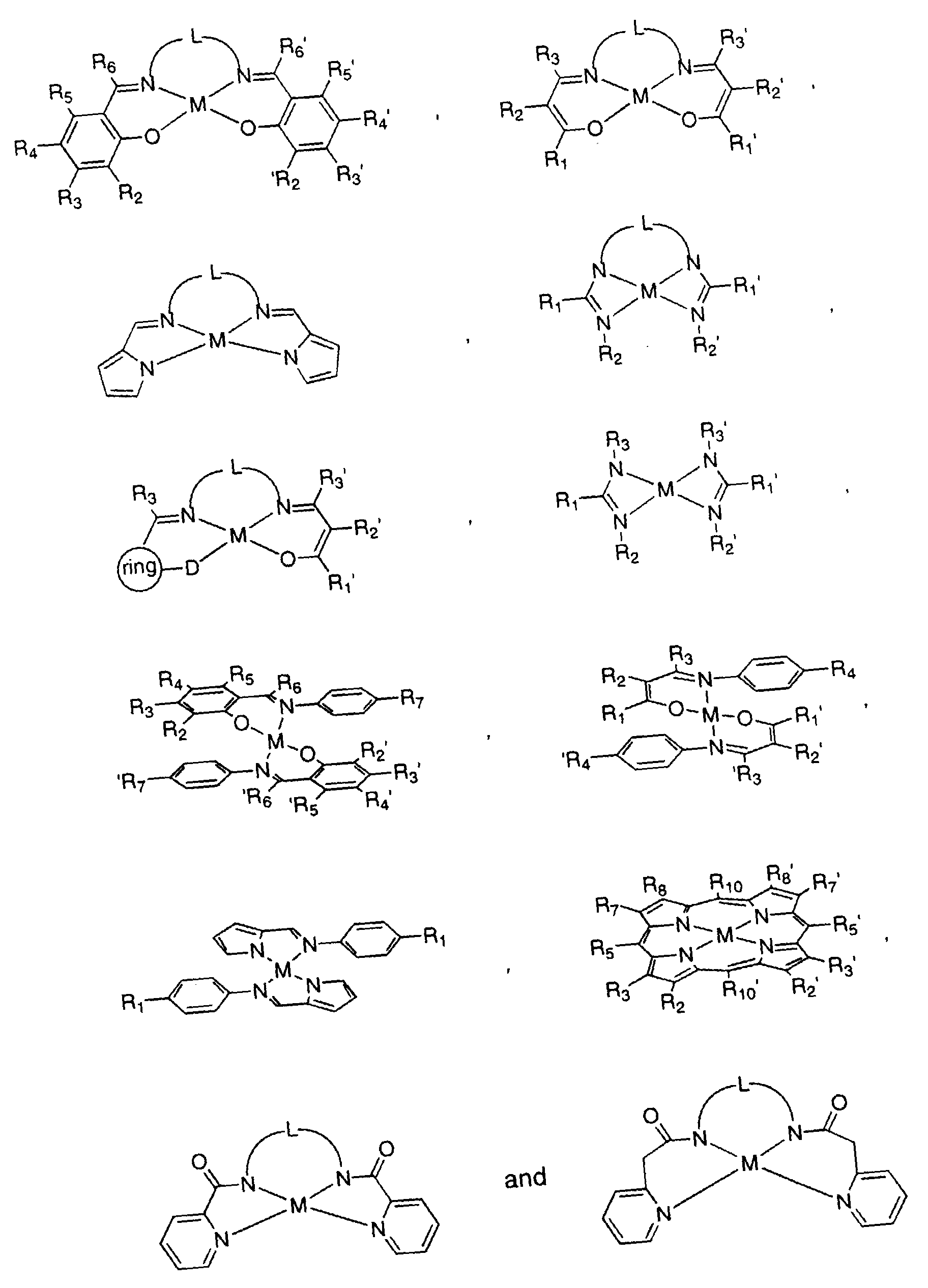
- an adsorbent in the form of a solid state four co-ordinate metal complex preferably selected from the group consisting of wherein
- the ring is selected from the group consisting of 6-substituted phenoxide, 2 - methoxy-6-substituted phenoxide, 3, 5-di- tert -butyl-6-substituted phenoxide, 5-substituted pyrrole;
- the four-coordinate metal complexes are loaded onto a dual component support comprising organic base-containing polymer and porous material. Coordination of organic base-containing polymer to the metal complexes forms side-chain polymeric five-coordinate deoxy metal complex sites required for oxygen binding, and distributes O 2 -selective metal complexes to improve mass transfer properties of the solid-state adsorbents.
- the porous material in a dual component support disperses the five-coordinate deoxy metal complex sites to further improve mass transfer properties, promoting heat transfer associated with adsorption and desorption, and facilitating the fabrication of secondary structured forms such as pellets or beads that may be desirable for their practicable use in commercial applications.
- Porous materials suitable for the present invention include silica gel, alumina, activated carbon, carbon fiber, MCM-type mesoporous materials, and any other fibrous supports including polymers or inorganic materials.
- fibrous supports can be also laminated to achieve short transport pathways for gas transport in such composites.
- DMAP represents 4-dimethyl-aminopyridine.
- This invention relates to solid state O 2 -selective metal complex-based adsorbents and PSA, TSA or PSA/TSA adsorption processes that utilize these adsorbents.
- the adsorbents of the present invention comprise:
- the new four-coordinate O 2 -selective metal complexes of the present invention with low molecular mass significantly enhance the interaction of oxygen with O 2 -selective metal centers owing to stronger electron donating ability of N 4 coordinating site.
- Some of the complexes also contain strong electron-withdrawing groups, e.g . CN, NO 2 , in close proximity to O 2 -selective metal centers to increase oxidation resistance of metal complex systems, including organic ligand and O 2 -selective metal centers.
- strong electron-withdrawing groups e.g CN, NO 2
- bulky molecular moieties were built in to inhibit the formation of ⁇ -peroxo dimer.
- the above features give significant advantages over prior art materials with respect to tuning metal complex structures, oxygen loading capacity and rate, inhibiting formation of ⁇ -peroxo dimer, chemical stability, and synthesis cost.
- the adsorbents of the present invention are expected to show good performance in promoting heat transfer associated with adsorption and desorption, and facilitating the fabrication of secondary structured forms such as pellets or beads, etc ., that may be desirable for commercial applications.
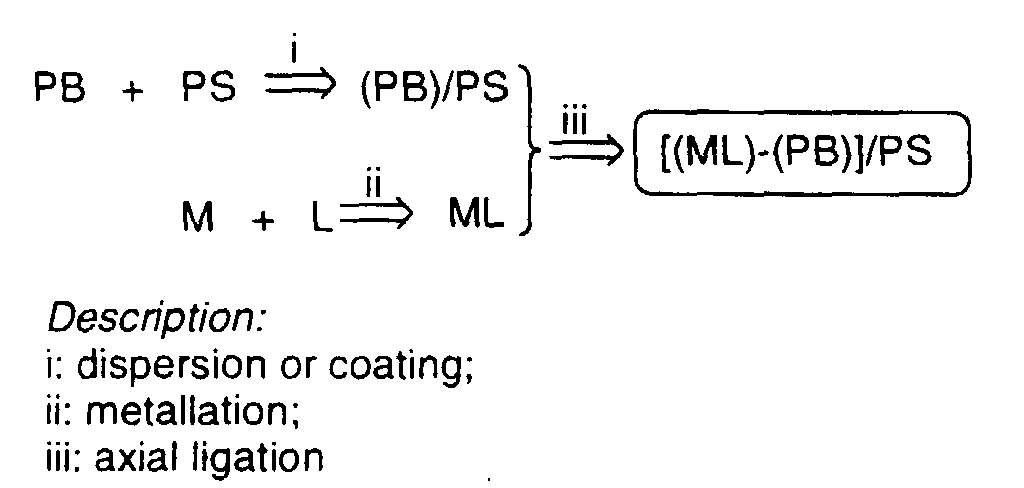
- Procedure 1 set forth below outlines one general production process for the manufacture of solid-state O 2 -selective metal complex-based adsorbents of the present invention starting from monomeric four-coordinate metal complexes (ML).
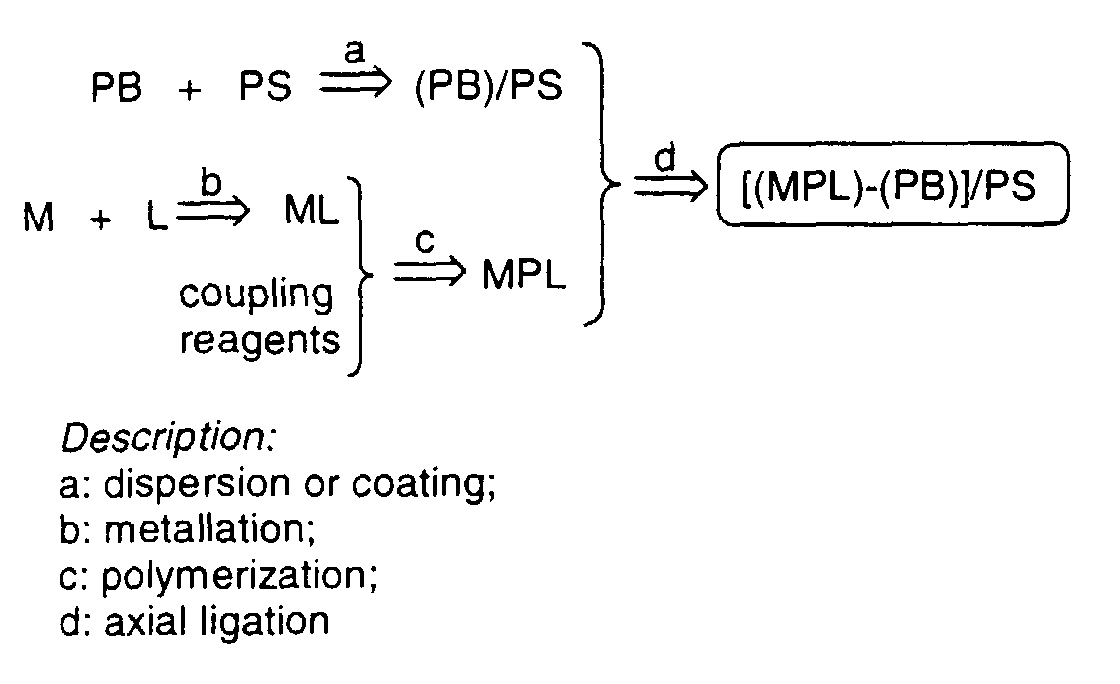
- Procedure 2 also set forth below shows one general production process using oligomeric/polymeric four-coordinate metal complexes (MPL).
- the first ratio is weight ratio between porous materials and organic base-containing polymers (PB).
- the porous material should be kept to a minimum to achieve a workable oxygen loading in PSA, TSA or PSA/TSA process.
- the weight ratio can be from 1:1 to 1:3, and the preferred ratio is 1:2.
- the second ratio is the mole ratio between metal complexes (ML or MPL) and PB required to provide five-coordinate deoxy metal complex O 2 -selective sites, which should be greater than one due to the usage of the base residues of said polymers in dispersion or coating processes.
- the mole ratio can be from 1:2 to 1:4, and the preferred one is 1:3.
- N 2 O 2 - and N 4 -type chelating ligands including macrocycles and acyclic bidentate, tetradentate and other multidentate systems are used for developing solid state O 2 -selective metal complex-based adsorbents.
- They can be porphyrins, Schiff bases and related ligand derivatives, five/six-membered heterocycle-containing ligand systems, and amidnate-type ligand systems.
- the solid state O 2 selective metal complex adsorbent is selected from the group consisting of: wherein
- Procedure 3 shows three examples of metalloporphyrin-containing main-chain oligomeric/polymeric metal complexes used in this invention.
- Other metalloporphyrin precursors and coupling reagents are also included in this invention.
- Procedure 4 shows one example of metal shiff base-containing main-chain oligomeric/polymeric metal complexes used in this invention.
- Other simialr metal Shiff base precursors are also included in this invention.
- Br(CH 2 ) n Br can also serve as a coupling reagent in polymerization.
- One embodiment of the invention uses organic-base-containing polymers to load O 2 -selective metal complexes, and control molecular packing in the solid state. By doing so, formation of highly crystalline phases of metal complexes is suppressed, and vacant O 2 -selective sites become more accessible, which results in high oxygen loading at equilibrium.
- the polymer network may provide a certain porosity into the adsorbents, and a beneficial molecular packing to inhibit ⁇ -peroxo dimer formation.
- Typical examples of organic base-containing polymers for production of solid-state O 2 -selective metal complex-based adsorbents are polyvinylpyridine (PVPy) and its derivatives.
- This invention uses porous materials to further improve mass transfer properties of the solid-state adsorbents, to conduct heat transfer associated with adsorption and desorption, and to facilitate the fabrication of secondary structured forms such as pellets or beads that may be desirable for commercial applications.
- the porous materials include silica gel, alumina, activated carbon, carbon fiber, MCM-type mesoporous materials, and any other fibrous supports either polymers or inorganic materials. They can be laminated to achieve short diffusion pathways for gas transport.
- the comparatively large pore size and surface area of such materials are used in this invention to maximally disperse metal complex-containing polymers into porous materials. However, they should be kept to a minimum to achieve a workable oxygen loading in PSA process.
- thermal treatment is applied for removing adsorbed water molecules, and condensing the vicinal silanol groups or all surface Si-OH groups before use.
- This activation process offers a beneficial effect on dispersing or coating organic base-containing polymers on its surface.
- Diaminomaleonitrile (0.55 g, 5.09 mmol) was dissolved into toluene (20 ml). To it, a trace amount of acetic acid was added. It was found that diaminomaleonitrile was not completely soluble in toluene. Then, 3,5-di- tert -butylsalicylaldehyde (2.40 g, 10.24 mmol) dissolved into toluene (30 ml) was dropwise added into the above solution. The resulting solution was then heated at reflux under N 2 overnight. Next, all solvent was evaporated to dryness. The crude product was then purified by crystallization from CH 2 Cl 2 /hexane to give a yellow material. It was dried under vacuum.
- poly(4-vinylpyridine-co-styrene) (0.22 g, 1.91 mmol of Py) was added under N 2 .
- anhydrous methanol (30 ml) was added into the solution.
- the resulting solution was stirred at room temperature for 3 days. After removing all solvents, a black powder was obtained. It was dried under vacuum.
- the product contained sodium acetate as an impurity.
- Ethylenediamine (5.71 g, 0.095 mmol) was dissolved into toluene (60 ml). To it, a catalytic amount of acetic acid was added. Then, salicylaldehyde (23.20 g, 0.190 mmol) dissolved into toluene (60 ml) was dropwise added into the above solution. The resulting solution was then stirred at room temperature overnight. A yellowish crystalline product was precipitated. It was filtered, washed with ethanol, and dried. The yield was 23.7 g (93%).
- the styrene content in poly(4-vinylpyridine- co -styrene) was 10 %.
- the specifications of silica gel used in the preparation were particle size, 70-230 mesh, pore size, 100 ⁇ , and surface area 300 m 2 /g. It was activated at 200°C under N 2 for 10 hours.
- Silica gel 200 g and poly(4-vinylpyridine- co -styrene) (PVPy- co -styrene, 100 g) were well pre-mixed in solid state. The solid mixture was shaken at 80°C overnight. Then toluene (1.4 liter) was added into the mixture, and the resulting mixture was continously shaken at room temperature overnight, forming a composite of poly(4-vinylpyridine- co -styrene) with silica gel. The composite was filtered and dried at 80°C under vacuum. It was directly used for preparation of [Co(Salen)-(PVPy-co-styrene)] / SiO 2 .
Landscapes
- Chemical & Material Sciences (AREA)
- Organic Chemistry (AREA)
- Analytical Chemistry (AREA)
- Chemical Kinetics & Catalysis (AREA)
- Inorganic Chemistry (AREA)
- Engineering & Computer Science (AREA)
- General Chemical & Material Sciences (AREA)
- Oil, Petroleum & Natural Gas (AREA)
- Solid-Sorbent Or Filter-Aiding Compositions (AREA)
- Gas Separation By Absorption (AREA)
Abstract
Description
-C6H4-, -C6H2(CH3)2, -C6H10-;

-C6H4-, -C6H2(CH3)2, -C6H10-;


Claims (10)
- An adsorbent comprising a solid state four-coordinate metal complex.
- An adsorbent as claimed in claim 1, wherein said solid state four-coordinate metal complex is selected from the group consisting ofwherein:
 R1 and R1', are selected from the group consisting of H, alkyl, perfluoroalkyl, aryl, alkyoxy, and mixtures thereof;R2 and R2' are selected from the group consisting of H, hydroxy group, alkyl, perfluoalkyl, aryl, Si(CH3)3, Br, nitro, and mixtures thereof;R3 and R3' are selected from the group consisting of H, hydroxyl group, alkyl, perfluoroalkyl, aryl, Si(CH3)3, Br, nitro, and mixtures thereof;R4 and R4' are selected from the group consisting of H, alkyl, alkyoxy, nitro, halide, and mixtures thereof;R5 and R5' are selected from the group consisting of H, -C6F5, -C6H4(p- and o-OH), -C6H2(2, 4, 6 trimethyl), -C6H3(2,6 di-Cl), -C6H4(p-But), -C6H4(p- and o-NO2), and mixtures thereof;R6 and R6' are H;R7 and R7' are selected from the group consisting of H, alkyl, alkyoxy, Br, nitro, and mixtures thereof;R8 and R8' are selected from the group consisting of H, Br, nitro, and mixtures thereof;R10 and R10' are selected from the group consisting of -C6F5, -C6H4(p- and o-OH), -C6H2(2, 4, 6 trimethyl), -C6H3(2, 6 di-Cl), -C6H4(p-But), -C6H4(p- and o-NO2);The ring is selected from the group consisting of 6-substituted phenoxide, 2 - methoxy-6-substituted phenoxide, 3,5-di-tert-butyl-6-substituted phenoxide, 5-substituted pyrrole;L is selected from the group consisting of -C(CN)C(CN)-,-CH2CH2-, -C6H4, -C6H2(CH3)2, -C6H10-;M is selected from the group consisting of Co2+, Fe2+, and Mn2+;D equals O, S, or N.
 - An adsorbent according to claim 1 or claim 2, wherein said solid state four-coordinate metal complex is selected from the group consisting ofand;
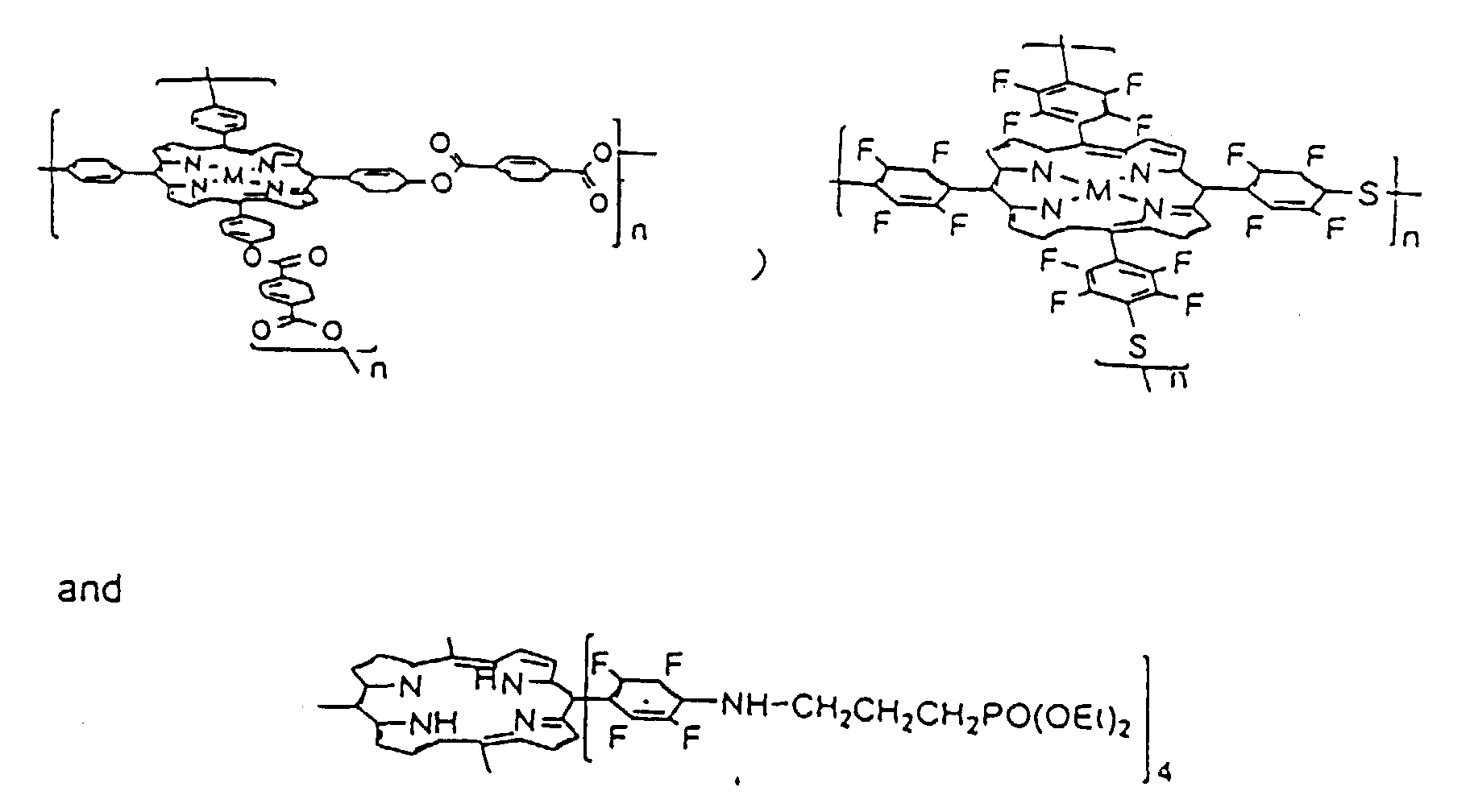
wherein M is Mn(II), Co(II), Fe(II), and Ni(II). - An adsorbent as claimed in any one of the preceding claims wherein said adsorbent is oxygen selective.
- An adsorbent composition comprising an adsorbent as claimed in any of claims 1 to 4, an organic base-containing polymer and a porous material.
- An adsorbent composition as claimed in claim 5, wherein said organic base-containing polymer is selected from the group consisting of polyvinylpyridine and its derivatives.
- An adsorbent composition as claimed in claim 5, wherein said organic base-containing polymer is an organic base supported on an inorganic polymer selected from the group consisting of silica gel and MCM-type mesoporous materials.
- An adsorbent composition as claimed in claim 5, wherein said porous material is selected from the group consisting of silica gel, alumina, activated carbon, carbon fiber, and MCM-type mesoporous materials.
- A process for the adsorption of oxygen from a feed gas comprising contacting said feed gas with a solid state four-coordinate metal complex as claimed in any one of claims 1 to 4.
- A process for the adsorption of oxygen from a feed gas comprising contacting said feed gas with an adsorbent composition as discussed in any one of claims 5 to 8.
Applications Claiming Priority (4)
| Application Number | Priority Date | Filing Date | Title |
|---|---|---|---|
| US14513099P | 1999-07-22 | 1999-07-22 | |
| US145130P | 1999-07-22 | ||
| US592351 | 2000-06-12 | ||
| US09/592,351 US6436171B1 (en) | 1999-07-22 | 2000-06-12 | Oxygen-selective adsorbents |
Publications (3)
| Publication Number | Publication Date |
|---|---|
| EP1070537A2 true EP1070537A2 (en) | 2001-01-24 |
| EP1070537A3 EP1070537A3 (en) | 2001-11-14 |
| EP1070537B1 EP1070537B1 (en) | 2007-04-25 |
Family
ID=26842689
Family Applications (1)
| Application Number | Title | Priority Date | Filing Date |
|---|---|---|---|
| EP00306096A Expired - Lifetime EP1070537B1 (en) | 1999-07-22 | 2000-07-18 | Oxygen-selective adsorbents |
Country Status (4)
| Country | Link |
|---|---|
| US (1) | US6436171B1 (en) |
| EP (1) | EP1070537B1 (en) |
| AT (1) | ATE360477T1 (en) |
| DE (1) | DE60034514T2 (en) |
Cited By (4)
| Publication number | Priority date | Publication date | Assignee | Title |
|---|---|---|---|---|
| EP1106245A3 (en) * | 1999-12-10 | 2002-09-04 | Praxair Technology, Inc. | Intermolecularly bound transition metal complexes for oxygen-selective adsorption |
| US6989044B2 (en) | 1999-12-10 | 2006-01-24 | Praxair Technology, Inc. | Intermolecularly bound transition element complexes for oxygen-selective adsorption |
| WO2008063310A3 (en) * | 2006-10-13 | 2009-01-15 | Archer Daniels Midland Co | Use of cell surface displays in yeast cell catalyst supports |
| CN116351396A (en) * | 2023-03-29 | 2023-06-30 | 湖北大学 | A kind of preparation method and application of gas adsorbent |
Families Citing this family (48)
| Publication number | Priority date | Publication date | Assignee | Title |
|---|---|---|---|---|
| US6652627B1 (en) * | 2002-10-30 | 2003-11-25 | Velocys, Inc. | Process for separating a fluid component from a fluid mixture using microchannel process technology |
| GB2397067B (en) * | 2002-12-23 | 2005-05-11 | Destiny Pharma Ltd | Porphin & azaporphin derivatives with at least one cationic-nitrogen-containing meso-substituent for use in photodynamic therapy & in vitro sterilisation |
| GB2415372A (en) | 2004-06-23 | 2005-12-28 | Destiny Pharma Ltd | Non photodynamical or sonodynamical antimicrobial use of porphyrins and azaporphyrins containing at least one cationic-nitrogen-containing substituent |
| US7959720B2 (en) | 2007-05-18 | 2011-06-14 | Exxonmobil Research And Engineering Company | Low mesopore adsorbent contactors for use in swing adsorption processes |
| US8444750B2 (en) | 2007-05-18 | 2013-05-21 | Exxonmobil Research And Engineering Company | Removal of CO2, N2, or H2S from gas mixtures by swing adsorption with low mesoporosity adsorbent contactors |
| US8529663B2 (en) | 2007-05-18 | 2013-09-10 | Exxonmobil Research And Engineering Company | Process for removing a target gas from a mixture of gases by swing adsorption |
| US8529662B2 (en) | 2007-05-18 | 2013-09-10 | Exxonmobil Research And Engineering Company | Removal of heavy hydrocarbons from gas mixtures containing heavy hydrocarbons and methane |
| MY154251A (en) * | 2007-11-12 | 2015-05-29 | Exxonmobil Upstream Res Co | Methods of generating and utility gas |
| CA2721724C (en) | 2008-04-30 | 2016-06-28 | Exxonmobil Upstream Research Company | Method and apparatus for removal of oil from utility gas stream |
| US8268048B2 (en) * | 2008-10-14 | 2012-09-18 | University Of Kansas | Oxygen binding of nanoparticulate metal complexes |
| WO2011149640A1 (en) | 2010-05-28 | 2011-12-01 | Exxonmobil Upstream Research Company | Integrated adsorber head and valve design and swing adsorption methods related thereto |
| TWI495501B (en) | 2010-11-15 | 2015-08-11 | Exxonmobil Upstream Res Co | Kinetic fractionators, and cycling processes for fractionation of gas mixtures |
| US9162175B2 (en) | 2011-03-01 | 2015-10-20 | Exxonmobil Upstream Research Company | Apparatus and systems having compact configuration multiple swing adsorption beds and methods related thereto |
| EP2680954B1 (en) | 2011-03-01 | 2018-09-12 | Exxonmobil Upstream Research Company | Methods of removing contaminants from a hydrocarbon stream by pressure swing adsorption and related apparatus and systems |
| CA2842928A1 (en) | 2011-03-01 | 2012-11-29 | Exxonmobil Upstream Research Company | Apparatus and systems having a rotary valve assembly and swing adsorption processes related thereto |
| US9017457B2 (en) | 2011-03-01 | 2015-04-28 | Exxonmobil Upstream Research Company | Apparatus and systems having a reciprocating valve head assembly and swing adsorption processes related thereto |
| WO2012118758A1 (en) | 2011-03-01 | 2012-09-07 | Exxonmobil Upstream Research Company | Methods of removing contaminants from a hydrocarbon stream by swing adsorption and related apparatus and systems |
| EP2680948A4 (en) | 2011-03-01 | 2015-05-06 | Exxonmobil Upstream Res Co | Apparatus and systems having a rotary valve assembly and swing adsorption processes related thereto |
| CN103429339B (en) | 2011-03-01 | 2015-06-10 | 埃克森美孚上游研究公司 | Apparatus and system with closed adsorbent contactor and swing adsorption process associated therewith |
| US9034078B2 (en) | 2012-09-05 | 2015-05-19 | Exxonmobil Upstream Research Company | Apparatus and systems having an adsorbent contactor and swing adsorption processes related thereto |
| WO2016014232A1 (en) | 2014-07-25 | 2016-01-28 | Exxonmobil Upstream Research Company | Apparatus and system having a valve assembly and swing adsorption processes related thereto |
| AU2015347232B2 (en) | 2014-11-11 | 2018-02-01 | Exxonmobil Upstream Research Company | High capacity structures and monoliths via paste imprinting |
| AU2015361102B2 (en) | 2014-12-10 | 2018-09-13 | Exxonmobil Research And Engineering Company | Adsorbent-incorporated polymer fibers in packed bed and fabric contactors, and methods and devices using same |
| AU2015370106B2 (en) | 2014-12-23 | 2019-01-03 | Exxonmobil Upstream Research Company | Structured adsorbent beds, methods of producing the same and uses thereof |
| CA2979869C (en) | 2015-05-15 | 2019-12-03 | Exxonmobil Upstream Research Company | Apparatus and system for swing adsorption processes related thereto comprising mid-bed purge systems |
| WO2016186726A1 (en) | 2015-05-15 | 2016-11-24 | Exxonmobil Upstream Research Company | Apparatus and system for swing adsorption processes related thereto |
| CA2996139C (en) | 2015-09-02 | 2021-06-15 | Exxonmobil Upstream Research Company | Process and system for swing adsorption using an overhead stream of a demethanizer as purge gas |
| US10124286B2 (en) | 2015-09-02 | 2018-11-13 | Exxonmobil Upstream Research Company | Apparatus and system for swing adsorption processes related thereto |
| CA3002648A1 (en) | 2015-10-27 | 2017-05-04 | Exxonmobil Upstream Research Company | Apparatus and system for swing adsorption processes related thereto having a plurality of valves |
| JP6615373B2 (en) | 2015-10-27 | 2019-12-04 | エクソンモービル アップストリーム リサーチ カンパニー | Apparatus and system for swing adsorption process with active controlled feed poppet valve and passively controlled product valve |
| EA201891041A1 (en) | 2015-10-27 | 2018-09-28 | Эксонмобил Апстрим Рисерч Компани | DEVICE AND SYSTEM FOR PROCESSES OF SHORT-CYCLE ADSORPTION HAVING A VARIETY VARIETY |
| US10744449B2 (en) | 2015-11-16 | 2020-08-18 | Exxonmobil Upstream Research Company | Adsorbent materials and methods of adsorbing carbon dioxide |
| WO2017130833A1 (en) * | 2016-01-27 | 2017-08-03 | シャープ株式会社 | Liquid having oxygen absorbing ability, method for producing same, and complex solution containing same |
| JP2019508245A (en) | 2016-03-18 | 2019-03-28 | エクソンモービル アップストリーム リサーチ カンパニー | Apparatus and system for swing adsorption process |
| WO2017209860A1 (en) | 2016-05-31 | 2017-12-07 | Exxonmobil Upstream Research Company | Apparatus and system for swing adsorption processes |
| EP3463620A1 (en) | 2016-05-31 | 2019-04-10 | ExxonMobil Upstream Research Company | Apparatus and system for swing adsorption processes |
| US10434458B2 (en) | 2016-08-31 | 2019-10-08 | Exxonmobil Upstream Research Company | Apparatus and system for swing adsorption processes related thereto |
| US10603626B2 (en) | 2016-09-01 | 2020-03-31 | Exxonmobil Upstream Research Company | Swing adsorption processes using zeolite structures |
| US10328382B2 (en) | 2016-09-29 | 2019-06-25 | Exxonmobil Upstream Research Company | Apparatus and system for testing swing adsorption processes |
| JP7021227B2 (en) | 2016-12-21 | 2022-02-16 | エクソンモービル アップストリーム リサーチ カンパニー | Self-supporting structure with active material |
| JP7021226B2 (en) | 2016-12-21 | 2022-02-16 | エクソンモービル アップストリーム リサーチ カンパニー | Self-supporting structure with foamed geometry and active material |
| US11331620B2 (en) | 2018-01-24 | 2022-05-17 | Exxonmobil Upstream Research Company | Apparatus and system for swing adsorption processes |
| US11413567B2 (en) | 2018-02-28 | 2022-08-16 | Exxonmobil Upstream Research Company | Apparatus and system for swing adsorption processes |
| CN109225227B (en) * | 2018-09-12 | 2021-08-31 | 濮阳市盛源能源科技股份有限公司 | Ordered mesoporous carbon catalyst for preparing hexahydrophthalic anhydride and preparation method thereof |
| US11318410B2 (en) | 2018-12-21 | 2022-05-03 | Exxonmobil Upstream Research Company | Flow modulation systems, apparatus, and methods for cyclical swing adsorption |
| US11376545B2 (en) | 2019-04-30 | 2022-07-05 | Exxonmobil Upstream Research Company | Rapid cycle adsorbent bed |
| WO2021071755A1 (en) | 2019-10-07 | 2021-04-15 | Exxonmobil Upstream Research Company | Adsorption processes and systems utilizing step lift control of hydraulically actuated poppet valves |
| WO2021076594A1 (en) | 2019-10-16 | 2021-04-22 | Exxonmobil Upstream Research Company | Dehydration processes utilizing cationic zeolite rho |
Family Cites Families (26)
| Publication number | Priority date | Publication date | Assignee | Title |
|---|---|---|---|---|
| US2450276A (en) | 1944-07-07 | 1948-09-28 | Little Inc A | Process for production of oxygen |
| US2508490A (en) | 1946-08-17 | 1950-05-23 | Univ California | Cobalt salicylaldehydeethylenediimine and method of production |
| US4888032A (en) * | 1980-01-23 | 1989-12-19 | The Ohio State University Research Foundation | Salts of cationic-metal dry cave complexes |
| US4654053A (en) * | 1984-07-27 | 1987-03-31 | University Patents, Inc. | Oxygen sorbent |
| US4514522A (en) | 1984-07-27 | 1985-04-30 | University Patents, Inc. | Oxygen sorbent |
| US4948506A (en) | 1986-07-07 | 1990-08-14 | Bend Research, Inc. | Physicochemically functional ultrathin films by interfacial polymerization |
| US4800188A (en) | 1987-03-20 | 1989-01-24 | Hoechst Celanese Corp. | Method for supporting metalloporphyrins on polybenzimidazole porous articles |
| DE3871462D1 (en) * | 1987-08-22 | 1992-07-02 | Agency Ind Science Techn | GAS SEPARATION MEMBRANE. |
| US4952289A (en) * | 1988-05-09 | 1990-08-28 | Aquanautics Corporation | Macrocyclic amine complexes for ligand extraction and generation |
| US6139603A (en) * | 1989-02-22 | 2000-10-31 | L'air Liquide, Societe Anonyme Pour L'etude Et L'exploitation Des Procedes Georges Claude | Process for recovering oxygen |
| JPH0660187B2 (en) | 1989-06-19 | 1994-08-10 | 財団法人生産開発科学研究所 | Porphyrin metal complex |
| US5114688A (en) * | 1990-01-23 | 1992-05-19 | L'air Liquide, Societe Anonyme Pour L'etude Et Exploitation Des Procedes Georges Claude | Binuclear metal macrocyclic and macrobicyclic complexes for oxygen separation and transport |
| US5266283A (en) | 1990-05-11 | 1993-11-30 | Bend Research, Inc. | Sterically hindered, regenerable Schiff base complexes, solutions thereof and process using the same |
| JPH0657308B2 (en) | 1990-08-15 | 1994-08-03 | ユニオン・カーバイド・インダストリアル・ガセズ・テクノロジー・コーポレーション | Oxygen separation porous membrane |
| US5141725A (en) * | 1991-03-15 | 1992-08-25 | Air Products And Chemicals, Inc. | Process using cyanocobaltate complexes for removing oxygen from a stream |
| US5208335A (en) | 1991-03-19 | 1993-05-04 | Air Products And Chemicals, Inc. | Reversible oxygen sorbent compositions |
| US5126466A (en) * | 1991-03-19 | 1992-06-30 | Air Products And Chemicals, Inc. | Cyanocobaltate oxygen adducts |
| US5294418A (en) | 1991-03-19 | 1994-03-15 | Air Products And Chemicals, Inc. | Process for reversibly binding oxygen |
| US6136222A (en) * | 1991-12-11 | 2000-10-24 | Bend Research, Inc. | Liquid absorbent solutions for separating nitrogen from natural gas |
| US5382280A (en) | 1993-11-16 | 1995-01-17 | Air Products And Chemicals, Inc. | Two stage pressure swing adsorption process for producing the less strongly adsorbed component of a feed gas mixture |
| FR2725382B1 (en) * | 1994-10-05 | 1997-01-03 | Commissariat Energie Atomique | POLYAZACYCLOALCANES, TRI-, TETRA- OR PENTAAZAMACROCYCLIC COMPLEXES, PROCESS FOR MANUFACTURING SUCH SUBSTITUTED OR NON-SUBSTITUTED POLYAZACYCLOALCANES AND GRAFTS ON A SUPPORT AND USES OF POLYAZACYCLOALCANES |
| ES2134985T3 (en) | 1994-11-14 | 1999-10-16 | Praxair Technology Inc | SELECTIVE SORBENTS OF OXYGEN. |
| CA2165709A1 (en) | 1994-12-27 | 1996-06-28 | Tadatoshi Ogawa | Oxygen absorber |
| US5871565A (en) | 1997-01-15 | 1999-02-16 | Praxair Technology, Inc. | Vacuum/pressure swing adsorption (VPSA) for production of an oxygen enriched gas |
| US5735938A (en) | 1997-01-15 | 1998-04-07 | Praxair Technology, Inc. | Method for production of nitrogen using oxygen selective adsorbents |
| JPH10337471A (en) * | 1997-01-15 | 1998-12-22 | Praxair Technol Inc | Oxygen selectively sorbing agent |
-
2000
- 2000-06-12 US US09/592,351 patent/US6436171B1/en not_active Expired - Fee Related
- 2000-07-18 EP EP00306096A patent/EP1070537B1/en not_active Expired - Lifetime
- 2000-07-18 DE DE60034514T patent/DE60034514T2/en not_active Expired - Fee Related
- 2000-07-18 AT AT00306096T patent/ATE360477T1/en not_active IP Right Cessation
Cited By (6)
| Publication number | Priority date | Publication date | Assignee | Title |
|---|---|---|---|---|
| EP1106245A3 (en) * | 1999-12-10 | 2002-09-04 | Praxair Technology, Inc. | Intermolecularly bound transition metal complexes for oxygen-selective adsorption |
| US6989044B2 (en) | 1999-12-10 | 2006-01-24 | Praxair Technology, Inc. | Intermolecularly bound transition element complexes for oxygen-selective adsorption |
| WO2008063310A3 (en) * | 2006-10-13 | 2009-01-15 | Archer Daniels Midland Co | Use of cell surface displays in yeast cell catalyst supports |
| US8183030B2 (en) | 2006-10-13 | 2012-05-22 | Archer Daniels Midland Company | Use of cell surface displays in yeast cell catalyst supports |
| CN116351396A (en) * | 2023-03-29 | 2023-06-30 | 湖北大学 | A kind of preparation method and application of gas adsorbent |
| CN116351396B (en) * | 2023-03-29 | 2024-05-14 | 湖北大学 | Preparation method and application of gas adsorbent |
Also Published As
| Publication number | Publication date |
|---|---|
| US6436171B1 (en) | 2002-08-20 |
| EP1070537A3 (en) | 2001-11-14 |
| DE60034514D1 (en) | 2007-06-06 |
| DE60034514T2 (en) | 2007-12-27 |
| ATE360477T1 (en) | 2007-05-15 |
| EP1070537B1 (en) | 2007-04-25 |
Similar Documents
| Publication | Publication Date | Title |
|---|---|---|
| US6436171B1 (en) | Oxygen-selective adsorbents | |
| KR960003229B1 (en) | Reversible oxygen sorbent compositions | |
| Chen et al. | Dioxygen affinities of synthetic cobalt Schiff base complexes | |
| US12102956B2 (en) | Method for the adsorptive separation of ethylene and ethane using ultramicroporous metal-organic framework | |
| Maya et al. | Efficient cycloaddition of CO2 to epoxides using novel heterogeneous organocatalysts based on tetramethylguanidine-functionalized porous polyphenylenes | |
| Cheng et al. | New multifunctional 3D porous metal–organic framework with selective gas adsorption, efficient chemical fixation of CO 2 and dye adsorption | |
| AU2019260864B2 (en) | Synthesis of zinc MOF materials | |
| US20010003950A1 (en) | Intermolecularly bound transition element complexes for oxygen-selective adsorption | |
| KR101958997B1 (en) | Porous composite having metal-organic cluster dispersed in meso-pore of support and Method for Propylene/Propane separation using the same | |
| Valverde-Gonzalez et al. | Amino-functionalized zirconium and cerium MOFs: Catalysts for visible light induced aerobic oxidation of benzylic alcohols and microwaves assisted N-Alkylation of amines | |
| WO2011062412A2 (en) | Crystalline porous organic-inorganic hybrid material and a production method therefor | |
| Huang et al. | An indium–organic framework for the efficient storage of light hydrocarbons and selective removal of organic dyes | |
| CN117916014A (en) | Metal-doped covalent organic frameworks | |
| Rozveh et al. | The role of mixed ligand approach in enhancing catalytic activity of copper-based MOFs in knoevenagel condensation | |
| KR20190105459A (en) | Useof modified metal-organic framework for removing radioactive gas | |
| Liu et al. | Two solvent-dependent zinc (II) supramolecular isomers: structure analysis, reversible and nonreversible crystal-to-crystal transformation, highly selective CO 2 gas adsorption, and photoluminescence behaviors | |
| EP0583748A1 (en) | Method for recovering oxygen from oxygen-containing gaseous mixtures | |
| CA2327972C (en) | Intermolecularly bound transition element complexes for oxygen-selective adsorption | |
| Poschmann et al. | [M2 (μ‐OH) 2 (DHBQ) 3](M= Zr, Hf)‐Two New Isostructural Coordination Polymers based on the Unique M2O14 Inorganic Building Unit and 2, 5‐Dioxido‐p‐benzoquinone as Linker Molecule | |
| JPH10337471A (en) | Oxygen selectively sorbing agent | |
| KR20220036709A (en) | Method for preparing for multivariate metal-organic polyhedra and multivariate metal-organic polyhedra | |
| CN119350647B (en) | Preparation method of flexible two-dimensional zinc-based complex and application of flexible two-dimensional zinc-based complex in separation of low-carbon hydrocarbon | |
| JPS6393789A (en) | Schiff base based metal complex compound and oxygen adsorbent and oxygen-separating membrane consisting of said compound | |
| CN121378774A (en) | A bimetallic three-dimensional MOF material based on pyrazole ligand, its preparation method and application | |
| JPH06340683A (en) | Cobalt schiff base complex and process for separating oxygen using the same |
Legal Events
| Date | Code | Title | Description |
|---|---|---|---|
| PUAI | Public reference made under article 153(3) epc to a published international application that has entered the european phase |
Free format text: ORIGINAL CODE: 0009012 |
|
| AK | Designated contracting states |
Kind code of ref document: A2 Designated state(s): AT BE CH CY DE DK ES FI FR GB GR IE IT LI LU MC NL PT SE |
|
| AX | Request for extension of the european patent |
Free format text: AL;LT;LV;MK;RO;SI |
|
| RIN1 | Information on inventor provided before grant (corrected) |
Inventor name: FITCH, FRANK R. Inventor name: CONNOLLY, PHILIP Inventor name: LEMCOFF, NORBERTO O. Inventor name: BUELOW, MARTIN Inventor name: WANG, QING MIN Inventor name: LAU, MIU LING Inventor name: SHEN, DONGMIN |
|
| PUAL | Search report despatched |
Free format text: ORIGINAL CODE: 0009013 |
|
| AK | Designated contracting states |
Kind code of ref document: A3 Designated state(s): AT BE CH CY DE DK ES FI FR GB GR IE IT LI LU MC NL PT SE |
|
| AX | Request for extension of the european patent |
Free format text: AL;LT;LV;MK;RO;SI |
|
| RIC1 | Information provided on ipc code assigned before grant |
Free format text: 7B 01J 20/00 A, 7B 01J 20/32 B, 7B 01D 53/02 B, 7C 01B 13/02 B |
|
| 17P | Request for examination filed |
Effective date: 20020510 |
|
| AKX | Designation fees paid |
Free format text: AT BE CH CY DE DK ES FI FR GB GR IE IT LI LU MC NL PT SE |
|
| 17Q | First examination report despatched |
Effective date: 20030416 |
|
| GRAP | Despatch of communication of intention to grant a patent |
Free format text: ORIGINAL CODE: EPIDOSNIGR1 |
|
| GRAS | Grant fee paid |
Free format text: ORIGINAL CODE: EPIDOSNIGR3 |
|
| GRAA | (expected) grant |
Free format text: ORIGINAL CODE: 0009210 |
|
| AK | Designated contracting states |
Kind code of ref document: B1 Designated state(s): AT BE CH CY DE DK ES FI FR GB GR IE IT LI LU MC NL PT SE |
|
| PG25 | Lapsed in a contracting state [announced via postgrant information from national office to epo] |
Ref country code: CH Free format text: LAPSE BECAUSE OF FAILURE TO SUBMIT A TRANSLATION OF THE DESCRIPTION OR TO PAY THE FEE WITHIN THE PRESCRIBED TIME-LIMIT Effective date: 20070425 Ref country code: LI Free format text: LAPSE BECAUSE OF FAILURE TO SUBMIT A TRANSLATION OF THE DESCRIPTION OR TO PAY THE FEE WITHIN THE PRESCRIBED TIME-LIMIT Effective date: 20070425 Ref country code: FI Free format text: LAPSE BECAUSE OF FAILURE TO SUBMIT A TRANSLATION OF THE DESCRIPTION OR TO PAY THE FEE WITHIN THE PRESCRIBED TIME-LIMIT Effective date: 20070425 |
|
| REG | Reference to a national code |
Ref country code: GB Ref legal event code: FG4D |
|
| RIN1 | Information on inventor provided before grant (corrected) |
Inventor name: SHEN, DONGMIN Inventor name: FITCH, FRANK R. Inventor name: BUELOW, MARTIN Inventor name: LEMCOFF, NORBERTO O. Inventor name: LAU, MIU LING Inventor name: CONNOLLY, PHILIP Inventor name: WANG, QING MIN |
|
| REG | Reference to a national code |
Ref country code: IE Ref legal event code: FG4D |
|
| REG | Reference to a national code |
Ref country code: CH Ref legal event code: EP |
|
| REF | Corresponds to: |
Ref document number: 60034514 Country of ref document: DE Date of ref document: 20070606 Kind code of ref document: P |
|
| PG25 | Lapsed in a contracting state [announced via postgrant information from national office to epo] |
Ref country code: SE Free format text: LAPSE BECAUSE OF FAILURE TO SUBMIT A TRANSLATION OF THE DESCRIPTION OR TO PAY THE FEE WITHIN THE PRESCRIBED TIME-LIMIT Effective date: 20070725 |
|
| PG25 | Lapsed in a contracting state [announced via postgrant information from national office to epo] |
Ref country code: ES Free format text: LAPSE BECAUSE OF FAILURE TO SUBMIT A TRANSLATION OF THE DESCRIPTION OR TO PAY THE FEE WITHIN THE PRESCRIBED TIME-LIMIT Effective date: 20070805 |
|
| PG25 | Lapsed in a contracting state [announced via postgrant information from national office to epo] |
Ref country code: PT Free format text: LAPSE BECAUSE OF FAILURE TO SUBMIT A TRANSLATION OF THE DESCRIPTION OR TO PAY THE FEE WITHIN THE PRESCRIBED TIME-LIMIT Effective date: 20070925 |
|
| ET | Fr: translation filed | ||
| REG | Reference to a national code |
Ref country code: CH Ref legal event code: PL |
|
| NLV1 | Nl: lapsed or annulled due to failure to fulfill the requirements of art. 29p and 29m of the patents act | ||
| PG25 | Lapsed in a contracting state [announced via postgrant information from national office to epo] |
Ref country code: AT Free format text: LAPSE BECAUSE OF FAILURE TO SUBMIT A TRANSLATION OF THE DESCRIPTION OR TO PAY THE FEE WITHIN THE PRESCRIBED TIME-LIMIT Effective date: 20070425 |
|
| PG25 | Lapsed in a contracting state [announced via postgrant information from national office to epo] |
Ref country code: BE Free format text: LAPSE BECAUSE OF FAILURE TO SUBMIT A TRANSLATION OF THE DESCRIPTION OR TO PAY THE FEE WITHIN THE PRESCRIBED TIME-LIMIT Effective date: 20070425 |
|
| PG25 | Lapsed in a contracting state [announced via postgrant information from national office to epo] |
Ref country code: NL Free format text: LAPSE BECAUSE OF FAILURE TO SUBMIT A TRANSLATION OF THE DESCRIPTION OR TO PAY THE FEE WITHIN THE PRESCRIBED TIME-LIMIT Effective date: 20070425 Ref country code: DK Free format text: LAPSE BECAUSE OF FAILURE TO SUBMIT A TRANSLATION OF THE DESCRIPTION OR TO PAY THE FEE WITHIN THE PRESCRIBED TIME-LIMIT Effective date: 20070425 |
|
| PLBE | No opposition filed within time limit |
Free format text: ORIGINAL CODE: 0009261 |
|
| STAA | Information on the status of an ep patent application or granted ep patent |
Free format text: STATUS: NO OPPOSITION FILED WITHIN TIME LIMIT |
|
| 26N | No opposition filed |
Effective date: 20080128 |
|
| PG25 | Lapsed in a contracting state [announced via postgrant information from national office to epo] |
Ref country code: IT Free format text: LAPSE BECAUSE OF FAILURE TO SUBMIT A TRANSLATION OF THE DESCRIPTION OR TO PAY THE FEE WITHIN THE PRESCRIBED TIME-LIMIT Effective date: 20070425 Ref country code: MC Free format text: LAPSE BECAUSE OF NON-PAYMENT OF DUE FEES Effective date: 20070731 Ref country code: GR Free format text: LAPSE BECAUSE OF FAILURE TO SUBMIT A TRANSLATION OF THE DESCRIPTION OR TO PAY THE FEE WITHIN THE PRESCRIBED TIME-LIMIT Effective date: 20070726 |
|
| PG25 | Lapsed in a contracting state [announced via postgrant information from national office to epo] |
Ref country code: IE Free format text: LAPSE BECAUSE OF NON-PAYMENT OF DUE FEES Effective date: 20070718 |
|
| PG25 | Lapsed in a contracting state [announced via postgrant information from national office to epo] |
Ref country code: CY Free format text: LAPSE BECAUSE OF FAILURE TO SUBMIT A TRANSLATION OF THE DESCRIPTION OR TO PAY THE FEE WITHIN THE PRESCRIBED TIME-LIMIT Effective date: 20070425 |
|
| PG25 | Lapsed in a contracting state [announced via postgrant information from national office to epo] |
Ref country code: LU Free format text: LAPSE BECAUSE OF NON-PAYMENT OF DUE FEES Effective date: 20070718 |
|
| PGFP | Annual fee paid to national office [announced via postgrant information from national office to epo] |
Ref country code: FR Payment date: 20090710 Year of fee payment: 10 |
|
| PGFP | Annual fee paid to national office [announced via postgrant information from national office to epo] |
Ref country code: GB Payment date: 20090715 Year of fee payment: 10 Ref country code: DE Payment date: 20090716 Year of fee payment: 10 |
|
| GBPC | Gb: european patent ceased through non-payment of renewal fee |
Effective date: 20100718 |
|
| REG | Reference to a national code |
Ref country code: FR Ref legal event code: ST Effective date: 20110331 |
|
| PG25 | Lapsed in a contracting state [announced via postgrant information from national office to epo] |
Ref country code: DE Free format text: LAPSE BECAUSE OF NON-PAYMENT OF DUE FEES Effective date: 20110201 |
|
| REG | Reference to a national code |
Ref country code: DE Ref legal event code: R119 Ref document number: 60034514 Country of ref document: DE Effective date: 20110201 |
|
| PG25 | Lapsed in a contracting state [announced via postgrant information from national office to epo] |
Ref country code: FR Free format text: LAPSE BECAUSE OF NON-PAYMENT OF DUE FEES Effective date: 20100802 |
|
| PG25 | Lapsed in a contracting state [announced via postgrant information from national office to epo] |
Ref country code: GB Free format text: LAPSE BECAUSE OF NON-PAYMENT OF DUE FEES Effective date: 20100718 |