EP1069800A1 - Method for evaluating routes in a communication network - Google Patents
Method for evaluating routes in a communication network Download PDFInfo
- Publication number
- EP1069800A1 EP1069800A1 EP99110240A EP99110240A EP1069800A1 EP 1069800 A1 EP1069800 A1 EP 1069800A1 EP 99110240 A EP99110240 A EP 99110240A EP 99110240 A EP99110240 A EP 99110240A EP 1069800 A1 EP1069800 A1 EP 1069800A1
- Authority
- EP
- European Patent Office
- Prior art keywords
- aac
- information
- transmission path
- transmission
- utilization
- Prior art date
- Legal status (The legal status is an assumption and is not a legal conclusion. Google has not performed a legal analysis and makes no representation as to the accuracy of the status listed.)
- Withdrawn
Links
- 238000000034 method Methods 0.000 title claims description 32
- 238000004891 communication Methods 0.000 title claims description 14
- 230000005540 biological transmission Effects 0.000 claims abstract description 106
- 238000011156 evaluation Methods 0.000 claims description 42
- 238000012546 transfer Methods 0.000 description 12
- 230000007704 transition Effects 0.000 description 5
- 238000010586 diagram Methods 0.000 description 4
- 230000008569 process Effects 0.000 description 4
- 239000011159 matrix material Substances 0.000 description 3
- 235000008694 Humulus lupulus Nutrition 0.000 description 2
- 230000008901 benefit Effects 0.000 description 2
- 230000000903 blocking effect Effects 0.000 description 2
- 230000001419 dependent effect Effects 0.000 description 2
- 238000011161 development Methods 0.000 description 2
- 230000003068 static effect Effects 0.000 description 2
- 230000008859 change Effects 0.000 description 1
- 238000009795 derivation Methods 0.000 description 1
- 238000005516 engineering process Methods 0.000 description 1
- 238000012886 linear function Methods 0.000 description 1
- 230000005923 long-lasting effect Effects 0.000 description 1
- 230000011664 signaling Effects 0.000 description 1
- 210000002023 somite Anatomy 0.000 description 1
Images

Classifications
-
- H—ELECTRICITY
- H04—ELECTRIC COMMUNICATION TECHNIQUE
- H04Q—SELECTING
- H04Q3/00—Selecting arrangements
- H04Q3/64—Distributing or queueing
- H04Q3/66—Traffic distributors
-
- H—ELECTRICITY
- H04—ELECTRIC COMMUNICATION TECHNIQUE
- H04L—TRANSMISSION OF DIGITAL INFORMATION, e.g. TELEGRAPHIC COMMUNICATION
- H04L45/00—Routing or path finding of packets in data switching networks
- H04L45/02—Topology update or discovery
- H04L45/04—Interdomain routing, e.g. hierarchical routing
-
- H—ELECTRICITY
- H04—ELECTRIC COMMUNICATION TECHNIQUE
- H04L—TRANSMISSION OF DIGITAL INFORMATION, e.g. TELEGRAPHIC COMMUNICATION
- H04L45/00—Routing or path finding of packets in data switching networks
- H04L45/02—Topology update or discovery
- H04L45/10—Routing in connection-oriented networks, e.g. X.25 or ATM
-
- H—ELECTRICITY
- H04—ELECTRIC COMMUNICATION TECHNIQUE
- H04L—TRANSMISSION OF DIGITAL INFORMATION, e.g. TELEGRAPHIC COMMUNICATION
- H04L45/00—Routing or path finding of packets in data switching networks
- H04L45/12—Shortest path evaluation
- H04L45/123—Evaluation of link metrics
-
- H—ELECTRICITY
- H04—ELECTRIC COMMUNICATION TECHNIQUE
- H04Q—SELECTING
- H04Q2213/00—Indexing scheme relating to selecting arrangements in general and for multiplex systems
- H04Q2213/13148—Maximum profit routing
-
- H—ELECTRICITY
- H04—ELECTRIC COMMUNICATION TECHNIQUE
- H04Q—SELECTING
- H04Q2213/00—Indexing scheme relating to selecting arrangements in general and for multiplex systems
- H04Q2213/13164—Traffic (registration, measurement,...)
-
- H—ELECTRICITY
- H04—ELECTRIC COMMUNICATION TECHNIQUE
- H04Q—SELECTING
- H04Q2213/00—Indexing scheme relating to selecting arrangements in general and for multiplex systems
- H04Q2213/13166—Fault prevention
-
- H—ELECTRICITY
- H04—ELECTRIC COMMUNICATION TECHNIQUE
- H04Q—SELECTING
- H04Q2213/00—Indexing scheme relating to selecting arrangements in general and for multiplex systems
- H04Q2213/13204—Protocols
-
- H—ELECTRICITY
- H04—ELECTRIC COMMUNICATION TECHNIQUE
- H04Q—SELECTING
- H04Q2213/00—Indexing scheme relating to selecting arrangements in general and for multiplex systems
- H04Q2213/13209—ISDN
-
- H—ELECTRICITY
- H04—ELECTRIC COMMUNICATION TECHNIQUE
- H04Q—SELECTING
- H04Q2213/00—Indexing scheme relating to selecting arrangements in general and for multiplex systems
- H04Q2213/1329—Asynchronous transfer mode, ATM
-
- H—ELECTRICITY
- H04—ELECTRIC COMMUNICATION TECHNIQUE
- H04Q—SELECTING
- H04Q2213/00—Indexing scheme relating to selecting arrangements in general and for multiplex systems
- H04Q2213/13389—LAN, internet
Definitions
- Communication networks are usually called either packet-oriented or designed as line-oriented networks.
- packet-oriented networks are more for transmission of information without real-time character, e.g. Data, Email or files suitable while line-based Networks well on the transmission of real-time information such as. Speech or moving images designed are.
- networks are becoming increasingly common in packet-oriented networks also voice and moving image information transmitted.
- Exemplary from ATM is the packet-oriented network technology in the further explained.
- Packet-oriented is characteristic of packet-oriented networks Transmission of the information.
- the information is, for example, packets of equal length - also called “ATM cells” - divided the a 5-byte cell header and one Have 48 bytes of information (payload).
- the individual cells are determined by the cell heads
- Information flows - also "virtual connections" called - assigned.
- time slots assigned different types of data in advance are the information streams arriving at an ATM interface segmented into the mentioned 53 byte cells and then sequentially these cells in the order in which they were created.
- the TDMA at Coming multiplexing is also called “static Multiplexing "and that used at ATM as” statistical Multiplexing ".
- networks are independent of the load of the individual transmission paths. For example can along a route in a line-oriented network e.g. according to a TDM method 30 connections in dedicated time slots with 64 kbit / s capacity each can be performed, in any case, another Connection established if there are already 29 connections are established because the further connection because of their constant Data rate does not require a higher data rate than that 64 kbit / s remaining capacity available.
- Another Connection established if there are already 29 connections are established because the further connection because of their constant Data rate does not require a higher data rate than that 64 kbit / s remaining capacity available.
- the remaining capacity of 30 Mbit / s can only be used for connections be set up for which a data rate less than 30 Mbit / s has been requested. Connections with a higher However, data rates are rejected. Unless alternative Routes exist, they can be replaced along a route Alternative route set up with sufficient remaining capacity become. To determine an alternative route, however, is re-routing required.
- Routes in networks can be determined.
- source routing in which starting from a Initial switch node the complete route to a destination switch node is determined.
- PNNI Private Network-Network Interface
- Source routing required.
- the route from the initial switching node determined and then when establishing a connection the calculated route to the switching nodes transmitted along the route using signaling.
- hop-by-hop routing represents, from each switching node along a route the rest or the next section of the route is recalculated becomes. This procedure comes for example on the Internet or to be used in ATM networks without source routing.
- flooding methods are proposed in the PNNI specification. All switching nodes are to be defined Times the market values of the connected to them Transmission paths measured and to all other switching nodes passed on within a group. This information sharing is called "flooding".
- the flooding can also be initiated if the Significantly change the market values of the transmission routes - e.g. if the current utilization of a transmission path with a total capacity of 150 Mbit / s by more than 10 Mbit / s deviates from the last passed load. For example are in ATM networks within the PNNI specification Methods proposed using a routing algorithm the last in the switching nodes of the ATM network measured market values of those directly connected to them Make transmission paths available.
- Every transmission path on the top hierarchical level is occupied with connections that only require a single hop from their start switching node on the top hierarchy level to their destination switching node on the top hierarchy level.
- Link costs are determined using dynamic programming and a linear system of equations.
- v (i, j) z j - e.g. i
- the value w i is the blocking rate of the transmission path in state i
- BR is the total blocking rate of the transmission path, which is calculated from the matrix ⁇ .
- the system of equations thus quickly becomes very complex for high-capacity transmission paths. For example, for a transmission path with a capacity of 155 Mbit / s and a minimum average data rate of 64 kbit / s, the solution of an equation system with approx. 2422 equations is required.
- the evaluation rules are based only on bi-directional, symmetrical connections. When considering unidirectional connections, the number of equations continues to increase.
- the invention has for its object the evaluation of Improve transmission paths.
- the task is performed by the Features of claim 1 solved.
- the essential aspect of the invention is a method to evaluate transmission paths of a communication network, in which information transfers with different Data rates take place at which the assessment according to a valuation regulation, the valuation effort of which essentially linear from the capacity of the respective transmission path depends, takes place.
- the main advantage of the invention can be seen in the fact that the effort for the evaluation is limited by high capacity transmission paths.
- the invention is particularly well suited for use in contemporary packet-oriented networks, e.g. ATM networks, IP networks or the Internet, for the transmission of information are characterized by flexible data rates.
- the evaluations are made depending on at least one variable evaluation parameter - claim 2.
- the ratings are each dependent on one only variable evaluation parameters and all further evaluation parameters are constant - claim 3.
- the variable valuation parameter as the utilization of the Formed transmission path - claim 5.
- variable evaluation parameter is independent of given information delivery request - claim 4.
- the procedure provides for the evaluation of the transmission route in each case for workloads that are greater than this Threshold utilization, is designed such that along there is no additional transmission of information - Claim 6.
- the procedure is the threshold utilization of a transmission path each equal to its capacity minus the maximum average data rate required for information transfers required at most are - claim 7. This makes fairness advantageous Policy causes, according to, for all information transfers regardless of the data rates required for them gives the same rejection probability as before Exceed the threshold utilization of each of the information transfers and after exceeding the threshold utilization none of the information is transmitted.
- the evaluation takes place according to a given evaluation regulation at least depending on the utilization probabilities, given utilization and capacities, a cell rate margin and probabilities that a data rate of j bit / s is required for an information transmission
- a given evaluation regulation at least depending on the utilization probabilities, given utilization and capacities, a cell rate margin and probabilities that a data rate of j bit / s is required for an information transmission
- Different requirement profiles of the users of the communication network are advantageously taken into account in the evaluation.
- the duration and time distribution of the information transmissions are advantageously included in the evaluation. Since only probabilistic evaluation rules are used, the evaluations are determined in a very simple and efficient manner by the usually associated summation of weighted probability values, i.e. neither approximation methods nor the calculation-intensive solution of a large linear system of equations are required for the evaluation.
- the 'sum', 'multiplication' or 'division' operations used are generally supported very efficiently by modern processors.
- the often different characteristics of the individual transmission paths are advantageously incorporated into the evaluation.
- the evaluations advantageously take into account whether a transmission path is busy with frequently changing information transmissions - for example data traffic - which are subject to strong fluctuations in their data rates, or rather very evenly with long-lasting information transmissions - for example telephone traffic - which often require very similar data rates.
- the switching node K 1 is connected to the switching node K 2 by a transmission path U 12 and to the switching node K 3 by a transmission path U 13 ;
- the switching node K 4 is connected to the switching node K 2 by a transmission path U 24 and to the switching node K 3 by a transmission path U 34 ;
- a transmission path U 14 is also provided, which is shown in dotted lines in the drawing. This indicates that transmission paths U - for example transmission path U 14 - may be temporarily overloaded and / or interrupted.
- An arrow fed to the switching node K 1 also indicates that an information transmission request A - for example in a connection-oriented communication network KN along a connection V - to a connection destination VZ - for example the switching node K 4 - is transmitted to this switching node K 1 .
- the link cost L accordingly of this evaluation rule generally from the data rates the transmission of information, but neither of the requested Data rate from any other properties a currently pending information transfer request A depends.
- this valuation rule can only be solved by inserting parameters and to calculate the link cost L depending on one given utilization AAC only requires simple addition, multiplication or division operations, however not a solution to a complex system of equations.
- link cost is not literal in the Interpreted in the sense of "costs”. So you can go to education the link costs L in addition to the above assessment rule any other, for the transmission paths U or information transfers relevant values are used such as. Priority values or quality-of-service values.
- the parameter ⁇ n represents the probability that a jump from a load state n into the area protected by the fairness reservation threshold F will result in a rejection of a request for information transmission. This is shown, for example, as follows:
- the parameter ⁇ is the total request rate of the transmission path U; it is shortened in the evaluation rule according to the invention.
- AvCR (U 12 ) 20,000 kbit / s
- AvCR (U 13 ) 25,000 kbit / s
- AvCR (U 14 ) 5,000 kbit / s
- AvCR (U 24 ) 30,000 kbit / s
- AvCR (U 34 ) 25,000 kbit / s.
- Source routing is also to be used in the communication network.
- the switching node K 1 with an information transmission request A requests the establishment of a connection V to a connection destination VZ.
- This connection destination VZ is designed as the switching node K 4 , the connection V thus as the connection V 14 .
- route R 14 for this connection V 14 There are three suitable routes R 14 for this connection V 14 : 1) route R 14-1 along the transmission paths U 12 and U 24 , 2) route R 14-2 along the transmission paths U 13 and U 34 , and 3) route R 14-3 along the transmission path U 14 .
- the optimal route R MIN is determined from the point of view of the entire communication network KN, ie a route R MIN is initially set up along transmission paths U which may be more heavily loaded in comparison to other transmission paths U, provided this subsequently in the course of the route R MIN particularly "inexpensive" transmission paths can be achieved.
- the requested connection V 14 is set up along the connection-optimal route R MIN (V 14 ).
- any communication networks KN especially connectionless ones Communication networks KN such as the packet-oriented Internet is applicable.
- the Internet for example, everyone individual packet is transmitted along a packet-specific route R, i.e. the route of each packet of a virtual connection V is independent of the routes R the predecessor and Successor packets of the same virtual connection V; the Switching node K, for example as an Internet router are trained to determine one for each package virtual connection V only the next switching node K - also known as "hop" in the professional world. From each router according to the inventive method the transmission paths U connected to it evaluated. Depending on this evaluation, successive, belonging to the same virtual connection V. Packages according to the determined link costs L on the Transmission routes U distributed. Here it can e.g.
Landscapes
- Engineering & Computer Science (AREA)
- Computer Networks & Wireless Communication (AREA)
- Signal Processing (AREA)
- Data Exchanges In Wide-Area Networks (AREA)
Abstract
Description
Kommunikationsnetze werden üblicherweise entweder als paketorientierte oder als leitungsorientierte Netze ausgebildet. Hierbei sind paketorientierte Netze eher für die Übermittlung von Informationen ohne Echtzeitcharakter wie z.B. Daten, EMail oder Dateien geeignet, während leitungsorientierte Netze gut auf die Übermittlung von Informationen mit Echtzeitcharakter wie z.B. Sprache oder Bewegtbilder ausgelegt sind. Im Zuge der Konvergenz von leitungs- und paketorientierten Netzen werden jedoch in paketorientierten Netzen zunehmend auch Sprach- und Bewegtbildinformationen übermittelt. Beispiele für paketorientierte Netze sind das Internet oder ATM (= Asynchronous Transfer Modus), wobei die Bezeichnung ATM gelegentlich auch als Synonym für B-ISDN (= Broadband Integrated Services Digital Network) verwendet wird. Am Beispiel von ATM sei die paketorientierte Netztechnologie im weiteren näher erläutert.Communication networks are usually called either packet-oriented or designed as line-oriented networks. Here, packet-oriented networks are more for transmission of information without real-time character, e.g. Data, Email or files suitable while line-based Networks well on the transmission of real-time information such as. Speech or moving images designed are. In the course of the convergence of line and package oriented However, networks are becoming increasingly common in packet-oriented networks also voice and moving image information transmitted. Examples of packet-oriented networks are the Internet or ATM (= Asynchronous Transfer Mode), where the name ATM occasionally also as a synonym for B-ISDN (= Broadband Integrated Services Digital Network) is used. Exemplary from ATM is the packet-oriented network technology in the further explained.
Charakteristisch für paketorientierte Netze ist die paketorientierte Übermittlung der Informationen. In ATM-Netzen werden hierbei die Informationen beispielsweise in Pakete gleicher Länge - auch "ATM-Zellen" genannt - aufgeteilt, die einen 5 Bytes umfassenden Zellenkopf (Header) und einen 48 Bytes umfassenden Informationsteil (Payload) aufweisen. Dabei werden die einzelnen Zellen durch die Zellenköpfe bestimmten Informationsströmen - auch "virtuelle Verbindungen" genannt - zugeordnet. Im Gegensatz zu beispielsweise einem leitungsorientierten TDMA-Verfahren, bei welchem Zeitschlitze verschiedenen Typen von Datenverkehr im vorhinein zugeordnet sind, werden die bei einer ATM-Schnittstelle ankommenden Informationsströme in die erwähnten 53-Byte-Zellen segmentiert und anschließend diese Zellen sequentiell in der Reihenfolge, in der sie erzeugt wurden, weiter gesandt. Das bei TDMA zum Einsatz kommende Multiplexverfahren wird auch als "statisches Multiplexing" und das bei ATM zum Einsatz kommende als "statistisches Multiplexing" bezeichnet. In Folge der Flexibilität des statistischen Multiplexing können die Informationsströme bei ATM beliebige Datenraten aufweisen, während bei statischem Multiplexing die Datenrate der einzelnen Informationsströme - auch "Verbindungen" genannt - wegen der festen Zuordnung der Zeitschlitze zu den Informationsströmen festgelegt ist - z.B. auf 64 kbit/s bei ISDN.Packet-oriented is characteristic of packet-oriented networks Transmission of the information. In ATM networks the information is, for example, packets of equal length - also called "ATM cells" - divided the a 5-byte cell header and one Have 48 bytes of information (payload). The individual cells are determined by the cell heads Information flows - also "virtual connections" called - assigned. In contrast to, for example, one line-oriented TDMA method, in which time slots assigned different types of data in advance are the information streams arriving at an ATM interface segmented into the mentioned 53 byte cells and then sequentially these cells in the order in which they were created. The TDMA at Coming multiplexing is also called "static Multiplexing "and that used at ATM as" statistical Multiplexing ". Due to the flexibility statistical multiplexing can stream information at ATM have any data rates, while at static multiplexing the data rate of the individual information streams - also called "connections" - because of the fixed Assignment of the time slots to the information streams is defined is - e.g. to 64 kbit / s with ISDN.
In Folge dieses Unterschieds ist in paketorientierten Netzen das Routen einer beantragten Verbindung abhängig von der auf einer Route verfügbaren Restkapazität, während sie in leitungsorientierten Netzen prinzipiell unabhängig von der Auslastung der einzelnen Übertragungswege ist. Beispielsweise kann auf einer Route in einem leitungsorientierten Netz, entlang der z.B. gemäß einem TDM Verfahren 30 Verbindungen in fest zugeordneten Zeitschlitzen mit je 64 kbit/s Kapazität geführt werden können, auch dann in jedem Fall eine weitere Verbindung aufgebaut werden, wenn bereits 29 Verbindungen aufgebaut sind, da die weitere Verbindung wegen ihrer konstanten Datenrate keine höhere Datenrate erfordert als die noch verfügbare Restkapazität von 64 kbit/s. Entlang einer Route in einem paketorientierten Netz mit einer angenommenen Restkapazität von 30 Mbit/s können jedoch lediglich Verbindungen aufgebaut werden, für die eine Datenrate kleiner als 30 Mbit/s beantragt worden ist. Verbindungen mit einer höheren Datenrate werden jedoch zurückgewiesen. Sofern alternative Routen existieren, können sie ersatzweise entlang einer Alternativroute mit ausreichender Restkapazität aufgebaut werden. Zur Ermittlung einer Alternativroute ist jedoch ein erneutes Routen erforderlich.As a result of this difference is in packet-oriented networks routing a requested connection depending on the route remaining capacity while in line-oriented In principle, networks are independent of the load of the individual transmission paths. For example can along a route in a line-oriented network e.g. according to a TDM method 30 connections in dedicated time slots with 64 kbit / s capacity each can be performed, in any case, another Connection established if there are already 29 connections are established because the further connection because of their constant Data rate does not require a higher data rate than that 64 kbit / s remaining capacity available. Along one Route in a packet-oriented network with an assumed one The remaining capacity of 30 Mbit / s can only be used for connections be set up for which a data rate less than 30 Mbit / s has been requested. Connections with a higher However, data rates are rejected. Unless alternative Routes exist, they can be replaced along a route Alternative route set up with sufficient remaining capacity become. To determine an alternative route, however, is re-routing required.
Es sind verschiedene Routing-Verfahren bekannt, mit denen Routen in Netzen ermittelt werden können. Eine Möglichkeit ist das sog. "Source-Routing", bei dem ausgehend von einem Anfangs-Vermittlungsknoten die komplette Route zu einem Ziel-Vermittlungsknoten ermittelt wird. Für ATM-Netze ist beispielsweise seitens des ATM-Forums im Rahmen der sogenannten PNNI(= Private Network-Network Interface)-Spezifikation Source-Routing gefordert. Hierbei wird die Route von dem Anfangs-Vermittlungsknoten ermittelt und anschließend beim Verbindungsaufbau die berechnete Route an die Vermittlungsknoten entlang der Route mit Hilfe der Signalisierung übermittelt. Eine weitere Möglichkeit stellt das sog. "Hop-by-Hop-Routing" dar, bei dem von jedem Vermittlungsknoten entlang einer Route der Rest bzw. das nächste Teilstück der Route neu berechnet wird. Dieses Verfahren kommt beispielsweise im Internet oder in ATM-Netzen ohne Source-Routing zur Anwendung.Various routing methods are known with which Routes in networks can be determined. A possibility is the so-called "source routing", in which starting from a Initial switch node the complete route to a destination switch node is determined. For example, for ATM networks on the part of the ATM Forum within the framework of the so-called PNNI (= Private Network-Network Interface) specification Source routing required. Here, the route from the initial switching node determined and then when establishing a connection the calculated route to the switching nodes transmitted along the route using signaling. Another possibility is the so-called "hop-by-hop routing" represents, from each switching node along a route the rest or the next section of the route is recalculated becomes. This procedure comes for example on the Internet or to be used in ATM networks without source routing.
Um beim Routen diejenigen Routen auszuscheiden, die überlastete oder unterbrochene Übertragungswege verwenden würden, sind in der PNNI-Spezifikation sog. Flooding-Verfahren vorgeschlagen. Dabei werden von allen Vermittlungsknoten zu definierten Zeitpunkten die Verkehrswerte der an sie angeschlossenen Übertragungswege gemessen und an alle anderen Vermittlungsknoten innerhalb einer Gruppe weitergegeben. Diese Informationsweitergabe wird "Flooding" genannt. Das Flooding kann zusätzlich auch dann veranlaßt werden, wenn sich die Verkehrswerte der Übertragungswege signifikant verändern - z.B. wenn die aktuelle Auslastung eines Übertragungsweges mit einer Gesamtkapazität von 150 Mbit/s um mehr als 10 Mbit/s von der zuletzt weitergegebenen Auslastung abweicht. Beispielsweise sind in ATM-Netzen im Rahmen der PNNI-Spezifikation Verfahren vorgeschlagen, welche einem Routing-Algorithmus die in den Vermittlungsknoten des ATM-Netzes jeweils zuletzt gemessenen Verkehrswerte der direkt an diese angeschlossenen Übertragungswege zur Verfügung stellen.In order to exclude those routes that were overloaded when routing or would use interrupted transmission paths so-called flooding methods are proposed in the PNNI specification. All switching nodes are to be defined Times the market values of the connected to them Transmission paths measured and to all other switching nodes passed on within a group. This information sharing is called "flooding". The flooding can also be initiated if the Significantly change the market values of the transmission routes - e.g. if the current utilization of a transmission path with a total capacity of 150 Mbit / s by more than 10 Mbit / s deviates from the last passed load. For example are in ATM networks within the PNNI specification Methods proposed using a routing algorithm the last in the switching nodes of the ATM network measured market values of those directly connected to them Make transmission paths available.
Für das Routen in leitungs- und verbindungsorientierten Netzen
ist in K. R. Krishnan, Huebner-Szabo de Bucs, "Admission
Control and State-Dependent Routing for Multirate Circuit-Switched
Traffic", ITC-15, Seiten 1043-1054, 1997 ein dynamisches
Routing-Verfahren für Breitbandnetze offenbart, bei dem
deren Übertragungswege in Abhängigkeit von ihrer Belastung
durch Informationsübermittlungen bewertet werden. Hierzu werden
für die Übertragungswege Belegungswahrscheinlichkeiten in
Abhängigkeit von diesen zugeführten Verkehrsangeboten, deren
aktueller Auslastung sowie der für eine zusätzliche Informationsübermittlung
entlang einer weiteren Verbindung erforderlichen
Datenrate berechnet. Es wird ein weitgehend vollständig
vermaschtes Kommunikationsnetz vorausgesetzt, was in der
obersten Hierarchie-Ebene von hierarchisch strukturierten,
leitungsorientierten Telephonnetzen üblich ist. Somit ist jeder
Übertragungsweg auf der obersten Hierarchie-Ebene bis auf
wenige Ausnahmefälle mit Verbindungen belegt, die lediglich
einen einzigen Hop von ihrem Start-Vermittlungsknoten auf der
obersten Hierarchie-Ebene zu ihrem Ziel-Vermittlungsknoten
auf der obersten Hierarchie-Ebene erfordern. Bei der Ermittlung
der Belegungswahrscheinlichkeiten der einzelnen Übertragungswege
wird folglich für jeden der Übertragungswege lediglich
der angebotene Verkehr betrachtet, der direkt zwischen
den beiden Vermittlungsknoten, die mit dem Übertragungsweg
verbunden sind, übermittelt wird. Die Ermittlung der Linkkosten
erfolgt mit Hilfe von dynamischer Programmierung und
durch Lösung eines linearen Gleichungssystems. Es wird hierbei
die Matrix der Übergangsraten der möglichen Auslastungen
definiert als A ∧ = (a ∧ij), wobei das Matrixelement âij die Rate
des Übergangs von der Auslastung i zu der Auslastung j beschreibt.
Die Linkkostenfunktionen v(i,j) des Übergangs von
der Auslastung i zu der Auslastung j werden als
Der Erfindung liegt die Aufgabe zugrunde, die Bewertung von Übertragungswegen zu verbessern. Die Aufgabe wird durch die Merkmale des Patentanspruchs 1 gelöst.The invention has for its object the evaluation of Improve transmission paths. The task is performed by the Features of claim 1 solved.
Der wesentliche Aspekt der Erfindung besteht in einem Verfahren zur Bewertung von Übertragungswegen eines Kommunikationsnetzes, in dem Informationsübermittlungen mit unterschiedlichen Datenraten erfolgen, bei dem die Bewertung nach Maßgabe einer Bewertungsvorschrift, deren Bewertungsaufwand im wesentlichen linear von der Kapazität des jeweiligen Übertragungswegs abhängt, erfolgt. Der wesentliche Vorteil der Erfindung ist darin zu sehen, daß der Aufwand für die Bewertung von Übertragungswegen mit hoher Kapazität begrenzt ist. Zudem eignet sich die Erfindung besonders gut zur Verwendung in zeitgemäßen paketorientierten Netzen, z.B. ATM-Netzen, IP-Netzen oder dem Internet, für die Informationsübermittlungen mit flexiblen Datenraten kennzeichnend sind.The essential aspect of the invention is a method to evaluate transmission paths of a communication network, in which information transfers with different Data rates take place at which the assessment according to a valuation regulation, the valuation effort of which essentially linear from the capacity of the respective transmission path depends, takes place. The main advantage of the invention can be seen in the fact that the effort for the evaluation is limited by high capacity transmission paths. In addition the invention is particularly well suited for use in contemporary packet-oriented networks, e.g. ATM networks, IP networks or the Internet, for the transmission of information are characterized by flexible data rates.
Entsprechend einer Ausgestaltung des erfindungsgemäßen Verfahrens erfolgen die Bewertungen jeweils in Abhängigkeit von zumindest einem variablen Bewertungsparameter - Anspruch 2. Nach einer Variante des erfindungsgemäßen Verfahrens ist vorgesehen, daß die Bewertungen jeweils in Abhängigkeit von einem einzigen variablen Bewertungsparameter erfolgen und alle weiteren Bewertungsparameter konstant sind - Anspruch 3. Gemäß einer Ausgestaltung des erfindungsgemäßen Verfahrens ist der variable Bewertungsparameter jeweils als Auslastung des Übertragungswegs ausgebildet - Anspruch 5. Somit ist die Erfindung besonders schön in Netzen mit Flooding-Verfahren verwendbar.According to an embodiment of the method according to the invention The evaluations are made depending on at least one variable evaluation parameter - claim 2. According to a variant of the method according to the invention, that the ratings are each dependent on one only variable evaluation parameters and all further evaluation parameters are constant - claim 3. According an embodiment of the method according to the invention the variable valuation parameter as the utilization of the Formed transmission path - claim 5. Thus, the invention Particularly suitable for use in networks with flooding processes.
Nach einer weiteren Ausgestaltung des erfindungsgemäßen Verfahrens ist der variable Bewertungsparameter unabhängig von einer gegebenen Informationsübermittlungsanforderung - Anspruch 4. Gemäß einer Weiterbildung des erfindungsgemäßen Verfahrens ist vorgesehen, daß die Bewertung des Übertragungswegs jeweils bei Auslastungen, die größer sind als dessen Schwellauslastung, derart ausgebildet ist, daß entlang diesem keine zusätzlichen Informationsübermittlungen erfolgen - Anspruch 6. Nach einer Weiterbildung des erfindungsgemäßen Verfahrens ist die Schwellauslastung eines Übertragungswegs hierbei jeweils gleich seiner Kapazität abzüglich der maximalen durchschnittlichen Datenrate, die für die Informationsübermittlungen jeweils höchstens erforderlich sind - Anspruch 7. Hierdurch wird vorteilhaft eine Fairness Politik bewirkt, gemäß der sich für alle Informationsübermittlungen ungeachtet der für diese erforderlichen Datenraten die gleiche Zurückweisungswahrscheinlichkeit ergibt, da vor Überschreiten der Schwellauslastung jede der Informationsübermittlungen und nach Überschreiten der Schwellauslastung keine der Informationsübermittlungen erfolgt.According to a further embodiment of the method according to the invention the variable evaluation parameter is independent of given information delivery request - claim 4. According to a development of the invention The procedure provides for the evaluation of the transmission route in each case for workloads that are greater than this Threshold utilization, is designed such that along there is no additional transmission of information - Claim 6. After a further development of the invention The procedure is the threshold utilization of a transmission path each equal to its capacity minus the maximum average data rate required for information transfers required at most are - claim 7. This makes fairness advantageous Policy causes, according to, for all information transfers regardless of the data rates required for them gives the same rejection probability as before Exceed the threshold utilization of each of the information transfers and after exceeding the threshold utilization none of the information is transmitted.
Gemäß einer Ausgestaltung des erfindungsgemäßen Verfahrens erfolgt die Bewertung gemäß einer gegebenen Bewertungsvorschrift zumindest in Abhängigkeit von Auslastungswahrscheinlichkeiten, gegebenen Auslastungen und Kapazitäten, einer Cell Rate Margin und Wahrscheinlichkeiten, daß für eine Informationsübermittlung eine Datenrate von j bit/s erforderlich ist - Anspruch 8. Somit werden vorteilhaft unterschiedliche Anforderungsprofile der Nutzer des Kommunikationsnetzes bei der Bewertung berücksichtigt. Zudem werden Zeitdauer und zeitliche Verteilung der Informationsübermittlungen vorteilhaft in die Bewertung miteinbezogen. Da lediglich wahrscheinlichkeitstheoretische Bewertungsvorschriften zum Einsatz kommen, werden die Bewertungen durch die hiermit üblicherweise verbundene Summenbildung von gewichteten Wahrscheinlichkeitswerten auf sehr einfache und effiziente Weise ermittelt, d.h. zur Bewertung sind weder Näherungsverfahren noch die berechnungsintensive Lösung eines großen linearen Gleichungssystems erforderlich. Insbesondere werden die zur Anwendung kommenden Operationen 'Summe', 'Multiplikation' bzw. 'Division' von zeitgemäßen Prozessoren im allgemeinen sehr effizient unterstützt. Weiterhin fließt die häufig unterschiedliche Charakteristik der einzelnen Übertragungswege vorteilhaft in die Bewertung mit ein. Somit wird durch die Bewertungen vorteilhaft berücksichtigt, ob ein Übertragungsweg mit häufig wechselnden und in ihren Datenraten starken Schwankungen unterworfenen Informationsübermittlungen - z.B. Datenverkehr - ausgelastet oder eher sehr gleichmäßig mit lange andauernden, oft sehr ähnliche Datenraten erfordernden Informationsübermittlungen - z.B. Telephonverkehr - belastet ist.According to one embodiment of the method according to the invention, the evaluation takes place according to a given evaluation regulation at least depending on the utilization probabilities, given utilization and capacities, a cell rate margin and probabilities that a data rate of j bit / s is required for an information transmission Different requirement profiles of the users of the communication network are advantageously taken into account in the evaluation. In addition, the duration and time distribution of the information transmissions are advantageously included in the evaluation. Since only probabilistic evaluation rules are used, the evaluations are determined in a very simple and efficient manner by the usually associated summation of weighted probability values, i.e. neither approximation methods nor the calculation-intensive solution of a large linear system of equations are required for the evaluation. In particular, the 'sum', 'multiplication' or 'division' operations used are generally supported very efficiently by modern processors. Furthermore, the often different characteristics of the individual transmission paths are advantageously incorporated into the evaluation. Thus, the evaluations advantageously take into account whether a transmission path is busy with frequently changing information transmissions - for example data traffic - which are subject to strong fluctuations in their data rates, or rather very evenly with long-lasting information transmissions - for example telephone traffic - which often require very similar data rates.
Das erfindungsgemäße Verfahren wird im folgenden anhand von mehreren Figuren näher erläutert. Dabei zeigt
- Figur 1
- in einem Blockschaltbild ein Kommunikationsnetz mit Vermittlungsknoten und Übertragungswegen,
- Figur 2
- in einem Diagramm eine als Linkkostenfunktion ausgebildete Bewertung
- Figure 1
- in a block diagram a communication network with switching nodes and transmission paths,
- Figure 2
- in a diagram an evaluation designed as a link cost function
In Figur 1 ist ein Kommunikationsnetz KN mit vier Vermittlungsknoten Ki, 1 <= i <= 4 dargestellt. Der Vermittlungsknoten K1 ist mit dem Vermittlungsknoten K2 durch einen Übertragungsweg U12 und mit dem Vermittlungsknoten K3 durch einen Übertragungsweg U13 verbunden; der Vermittlungsknoten K4 ist mit dem Vermittlungsknoten K2 durch einen Übertragungsweg U24 und mit dem Vermittlungsknoten K3 durch einen Übertragungsweg U34 verbunden; zwischen den Vermittlungsknoten K1 und K4 ist zudem ein Übertragungsweg U14 vorgesehen, der in der Zeichnung gepunktet dargestellt ist. Hierdurch sei angedeutet, daß Übertragungswege U - beispielsweise der Übertragungsweg U14 - temporär überlastet und/oder unterbrochen sein können. Durch einen dem Vermittlungsknoten K1 zugeführten Pfeil wird zudem angedeutet, daß diesem Vermittlungsknoten K1 eine Informationsübermittlungsanforderung A - z.B. in einem verbindungsorientierten Kommunikationsnetz KN entlang einer Verbindung V - zu einem Verbindungsziel VZ - beispielsweise dem Vermittlungsknoten K4 - übermittelt wird.1 shows a communication network KN with four switching nodes K i , 1 <= i <= 4. The switching node K 1 is connected to the switching node K 2 by a transmission path U 12 and to the switching node K 3 by a transmission path U 13 ; the switching node K 4 is connected to the switching node K 2 by a transmission path U 24 and to the switching node K 3 by a transmission path U 34 ; Between the switching nodes K 1 and K 4 , a transmission path U 14 is also provided, which is shown in dotted lines in the drawing. This indicates that transmission paths U - for example transmission path U 14 - may be temporarily overloaded and / or interrupted. An arrow fed to the switching node K 1 also indicates that an information transmission request A - for example in a connection-oriented communication network KN along a connection V - to a connection destination VZ - for example the switching node K 4 - is transmitted to this switching node K 1 .
In Figur 2 sind in einem Diagramm mit Hilfe einer beispielsweise
als Linkkostenfunktion LCF ausgebildeten Bewertungsvorschrift
die Bewertungen dargestellt, die sich für einen bestimmten
Übertragungswegtyp in Abhängigkeit von dessen Auslastung
AAC ergeben. Hierbei sei ein Übertragungswegtyp beispielsweise
durch sein Verkehrsangebot VA und seine Kapazität
MaxCR gekennzeichnet. Das Verkehrsangebot VA sei beispielsweise
durch dessen Verkehrsangebotsrate λ und dessen charakteristischen
Verkehrsmix VM von Informationsübermittlungen,
die ggf. unterschiedlichen Verkehrsklassen VK zugeordnet
sind, bestimmt. Auf der Abszisse des Diagramms - auch
'x-Achse' genannt - ist die aktuell verfügbare Zellrate AvCR
des entsprechenden Übertragungswegs U, und auf der Ordinate -
auch 'y-Achse' genannt - sind die als Linkkosten L ausgebildeten
Bewertungen aufgetragen. Zudem ist auf der x-Achse eine
Schwellauslastung F - auch 'Fairness Reservation Threshold'
genannt - angedeutet. Die Auslastung AAC - auch Linkbelegung
genannt - kann mithilfe von der verfügbare Zellrate AvCR und
der Linkkapazität MaxCR beispielsweise wie folgt ausgedrückt
werden: 

- MaxCR
- (= Maximum Cell Rate) Kapazität des Übertragungswegs U,
- AAC
- (= Actual Allocated Capacity) Auslastung des Übertragungswegs U; die Auslastung AAC wird in Netzen mit Flooding regelmäßig von allen Vermittlungsknoten K für die an sie angeschlossenen Übertragungswege U ermittelt und anschließend allen anderen Vermittlungsknoten K mitgeteilt,
- MaxSCR
- (= Maximum Sustainable Cell Rate) Maximale durchschnittliche Zellrate, die für eine Informationsübermittlung erforderlich ist; hieraus läßt sich durch Multiplikation mit der Anzahl der Bits pro Zelle eine maximale durchschnittliche Datenrate ableiten, z.B. bei ATM-Zellen durch Multiplikation mit 424 bit/s (= 53 Byte pro Zelle * 8 Bit pro Byte),
- F
- (= Fairness Reservation Threshold) Schwellauslastung eines Übertragungswegs U, ab der keine weiteren Informationsübermittlungen zugelassen werden, auch dann nicht, wenn die angeforderte Datenrate kleiner ist als die noch verfügbare,
- P(x;y,F)
- Auslastungsfunktion mit stationären Wahrscheinlichkeiten (= Steady State Probability), wobei für x eine Auslastung AAC eingesetzt wird, y eine gegebene Kapazität MaxCR und F eine gegebene Schwellauslastung F sei,
- P(x;y)
- Auslastungsfunktion mit stationären Wahrscheinlichkeiten, wobei für x eine Auslastung AAC eingesetzt wird und y eine gegebene Kapazität MaxCR sei,
- CRM
- (= Cell Rate Margin) ist eine vom ATM-Forum für einen Übertragungsweg U geforderte Pufferkapazität, wobei die Summe von mittleren Zellraten SCR (= Sustainable Cell Rate) aller Informationsübermittlungen, die entlang eines Übertragungswegs U erfolgen plus die Pufferkapazität CRM kleiner als die maximale Kapazität MaxCR des Übertragungsweg U sein soll. Die Pufferkapazität CRM dient zum Ausgleich von Zellratenschwankungen und wird üblicherweise zumindest in Abhängigkeit von den Spitzenzellraten PCR (= Peak Cell Rate) der Informationsübermittlungen und dem davon abhängenden Varianzfaktor VF (= Variance Factor) bestimmt,
- pj
- Anforderungsfunktion mit Wahrscheinlichkeiten, daß eine Verbindung mit einer Datenrate von j bit/s angefordert wird, wobei durch (p 1,...,pMaxSCR ) ein normalisiertes Verbindungsanforderungshistogramm gegeben ist.
- MaxCR
- (= Maximum cell rate) capacity of the transmission path U,
- AAC
- (= Actual Allocated Capacity) Utilization of the transmission path U; In networks with flooding, the utilization AAC is regularly determined by all switching nodes K for the transmission paths U connected to them and then communicated to all other switching nodes K,
- MaxSCR
- (= Maximum Sustainable Cell Rate) Maximum average cell rate required for information transfer; a maximum average data rate can be derived from this by multiplication by the number of bits per cell, for example in the case of ATM cells by multiplication by 424 bit / s (= 53 bytes per cell * 8 bits per byte),
- F
- (= Fairness Reservation Threshold) Threshold utilization of a transmission path U, from which no further information transfers are permitted, even if the requested data rate is lower than the still available
- P ( x ; y , F )
- Utilization function with steady-state probabilities, where x is a utilization AAC, y is a given capacity MaxCR and F is a given threshold utilization F,
- P ( x ; y )
- Utilization function with stationary probabilities, where a utilization AAC is used for x and y is a given capacity MaxCR,
- CRM
- (= Cell Rate Margin) is a buffer capacity required by the ATM forum for a transmission path U, the sum of mean cell rates SCR (= Sustainable Cell Rate) of all information transmissions that take place along a transmission path U plus the buffer capacity CRM smaller than the maximum capacity MaxCR of the transmission path U should be. The buffer capacity CRM serves to compensate for cell rate fluctuations and is usually determined at least as a function of the peak cell rates PCR (= peak cell rate) of the information transmissions and the variance factor VF (= variance factor) dependent thereon.
- p j
- Request function with probabilities that a connection with a data rate of j bit / s is requested, whereby a normalized connection request histogram is given by ( p 1 , ..., p MaxSCR ).
Es sei darauf hingewiesen, daß die Linkkosten L entsprechend dieser Bewertungsvorschrift zwar allgemein von den Datenraten der Informationsübermittlungen, jedoch weder von der angeforderten Datenrate noch von irgendwelchen anderen Eigenschaften einer aktuell anstehenden Informationsübermittlungsanforderung A abhängt. Hierdurch wird vorteilhaft eine Fairness Politik bewirkt, gemäß der sich für alle Verkehrsklassen, d.h. für alle Informationsübermittlungen ungeachtet der angeforderten Datenrate, die gleiche Zurückweisungswahrscheinlichkeit ergibt, sofern vor Überschreiten der Schwellauslastung F jede Informationsübermittlung und nach Überschreiten der Schwellauslastung F keine Informationsübermittlung zugelassen wird. Weiter sei darauf hingewiesen, daß diese Bewertungsvorschrift alleinig durch Einsetzen von Parametern lösbar ist und zur Berechnung der Linkkosten L in Abhängigkeit von einer gegebenen Auslastung AAC lediglich einfache Additions-, Multiplikations- bzw. Divisionsoperationen erfordert, jedoch keine Lösung eines komplexen Gleichungssystems. Es sei zudem angemerkt, daß der Begriff "Linkkosten" nicht wörtlich im Sinne von "Kosten" interpretiert sei. So können zur Bildung der Linkkosten L in Erweiterung der obigen Bewertungsvorschrift noch beliebige, für die Übertragungswege U oder Informationsübermittlungen relevante Werte herangezogen werden wie z.B. Prioritätswerte oder Quality-of-Service-Werte.It should be noted that the link cost L accordingly of this evaluation rule generally from the data rates the transmission of information, but neither of the requested Data rate from any other properties a currently pending information transfer request A depends. This makes a fairness policy advantageous causes according to which for all traffic classes, i.e. for all information transfers regardless of the requested Data rate, the same rejection probability results, if F before the threshold utilization is exceeded any transmission of information and after exceeding the Threshold utilization F no information transmission allowed becomes. It should also be noted that this valuation rule can only be solved by inserting parameters and to calculate the link cost L depending on one given utilization AAC only requires simple addition, multiplication or division operations, however not a solution to a complex system of equations. It is also noted that the term "link cost" is not literal in the Interpreted in the sense of "costs". So you can go to education the link costs L in addition to the above assessment rule any other, for the transmission paths U or information transfers relevant values are used such as. Priority values or quality-of-service values.
Für das Ausführungsbeispiel sei angenommen, daß die möglichen
Auslastungen AAC des Übertragungsweges {1, 2, ..., MaxCR}
sind. Die durch Linkkostenfunktionen LCF bestimmten Bewertungen
- im weiteren auch als cost(i) bezeichnet - werden als
Funktion eines einzigen Bewertungsparameters i - z.B. der aktuellen
Auslastung AAC - gebildet. Die Bewertungen cost(i)
stehen hierbei mit den eingangs genannten Kosten v(i,j) nach
Krishnan in folgender Beziehung:
Für einen Übertragungsweg U mit einer Kapazität MaxCR, einer
Fairness Reservation Threshold F und einer Cell Rate Margin
CRM ergibt sich somit im Auslastungszustand 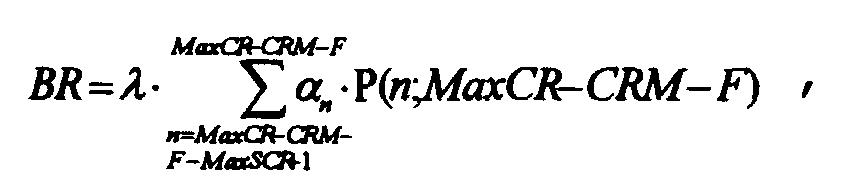

Hierbei repräsentiert der Parameter αn die Wahrscheinlichkeit,
daß bei einem Sprung von einem Auslastungszustand n in
den durch die Fairness Reservation Threshold F geschützten
Bereich eine Zurückweisung eines Informationsübermittlungswunsches
erfolgt. Dies wird beispielsweise wie folgt dargestellt:

Der Parameter λ ist die Gesamtanforderungsrate des Übertragungsweges U; er kürzt sich in der erfindungsgemäßen Bewertungsvorschrift.The parameter λ is the total request rate of the transmission path U; it is shortened in the evaluation rule according to the invention.
Für eine beispielhafte Verwendung der Erfindung in einem verbindungsorientierten Kommunikationsnetz KN, d.h. mit Informationsübermittlungen entlang von Verbindungen V, wird angenommen, daß die Übertragungswege U wie folgt ausgelastet seien: AvCR (U12) = 20.000 kbit/s, AvCR (U13) = 25.000 kbit/s, AvCR (U14) = 5.000 kbit/s, AvCR (U24) = 30.000 kbit/s und AvCR (U34) = 25.000 kbit/s. Hierfür ergeben sich gemäß der Linkkostenfunktion LCF die Linkkosten L (U12) = 0,175, L (U13) = 0,140, L (U14) = 0,421, L (U24) = 0,115 sowie L(U34) = 0,140. In dem Kommunikationsnetz soll zudem Source-Routing zur Anwendung kommen. Es werde von dem Vermittlungsknoten K1 mit einer Informationsübermittlungsanforderung A der Aufbau einer Verbindung V zu einem Verbindungsziel VZ angefordert. Dieses Verbindungsziel VZ sei als der Vermittlungsknoten K4, die Verbindung V somit als Verbindung V14 ausgebildet. Für diese Verbindung V14 ergeben sich drei geeignete Routen R14: 1) Route R14-1 entlang den Übertragungswegen U12 und U24, 2) Route R14-2 entlang den Übertragungswegen U13 und U34 , und 3) Route R14-3 entlang dem Übertragungsweg U14. Diese Routen R14 werden bewertet, indem die erfindungsgemäß ermittelten Linkkosten L der Übertragungswege U jeder der Routen addiert werden. Somit ergeben sich die Routekosten RK (R14-1) = 0,290, RK (R14-2) = 0,280 und RK (R14-3) = 0,421. Folglich ist die für die Verbindung V optimale Route RMIN (V14) die Route R14-2, d.h. die Verbindung V wird entlang der Route R14-2 mit 2 Hops und nicht entlang der Route R14-3 mit einem Hop aufgebaut. Die Tatsache, daß die Route R14-2 schwächer ausgelastet ist als die Route R14-3 fließt folglich stärker in die Bewertung der Routen R14 ein als die Tatsache, daß durch die größere Anzahl Hops eine geringfügig erhöhte Verzögerungszeit bewirkt wird. Zudem wird infolge des Source-Routens die optimale Route RMIN aus Sicht des gesamten Kommunikationsnetzes KN bestimmt, d.h. eine Route RMIN wird anfangs entlang von ggf. im Vergleich zu anderen Übertragungswegen U stärker belasteten Übertragungswegen U aufgebaut, sofern hierdurch im weiteren Verlauf der Route RMIN besonders "gunstige" Übertragungswege erreicht werden. Im Anschluß an das Routen wird die angeforderte Verbindung V14 entlang der verbindungsoptimalen Route RMIN (V14) aufgebaut.For an exemplary use of the invention in a connection-oriented communication network KN, ie with information transmissions along connections V, it is assumed that the transmission paths U are utilized as follows: AvCR (U 12 ) = 20,000 kbit / s, AvCR (U 13 ) = 25,000 kbit / s, AvCR (U 14 ) = 5,000 kbit / s, AvCR (U 24 ) = 30,000 kbit / s and AvCR (U 34 ) = 25,000 kbit / s. According to the link cost function LCF, the link costs L (U 12 ) = 0.175, L (U 13 ) = 0.140, L (U 14 ) = 0.421, L (U 24 ) = 0.115 and L (U 34 ) = 0.140 result. Source routing is also to be used in the communication network. The switching node K 1 with an information transmission request A requests the establishment of a connection V to a connection destination VZ. This connection destination VZ is designed as the switching node K 4 , the connection V thus as the connection V 14 . There are three suitable routes R 14 for this connection V 14 : 1) route R 14-1 along the transmission paths U 12 and U 24 , 2) route R 14-2 along the transmission paths U 13 and U 34 , and 3) route R 14-3 along the transmission path U 14 . These routes R 14 are evaluated by adding the link costs L, determined according to the invention, of the transmission paths U of each of the routes. This results in the route costs RK (R 14-1 ) = 0.290, RK (R 14-2 ) = 0.280 and RK (R 14-3 ) = 0.421. Consequently, the optimal route R MIN (V 14 ) for the connection V is the route R 14-2 , ie the connection V is established along the route R 14-2 with two hops and not along the route R 14-3 with one hop . The fact that the route R 14-2 is less heavily used than the route R 14-3 therefore flows more into the evaluation of the routes R 14 than the fact that a slightly increased delay time is caused by the larger number of hops. In addition, as a result of the source routing, the optimal route R MIN is determined from the point of view of the entire communication network KN, ie a route R MIN is initially set up along transmission paths U which may be more heavily loaded in comparison to other transmission paths U, provided this subsequently in the course of the route R MIN particularly "inexpensive" transmission paths can be achieved. Following the route, the requested connection V 14 is set up along the connection-optimal route R MIN (V 14 ).
Es sei darauf hingewiesen, daß die Erfindung natürlich auf beliebige Kommunikationsnetze KN, insbesondere verbindungslose Kommunikationsnetze KN wie z.B. das paketorientierte Internet anwendbar ist. Im Internet wird beispielsweise jedes einzelne Paket entlang einer paketindividuellen Route R übermittelt, d.h. die Route jedes Paketes einer virtuellen Verbindung V ist unabhängig von den Routen R der Vorgänger- und Nachfolger-Paketen derselben virtuellen Verbindung V; die Vermittlungsknoten K, die beispielsweise als Internet Router ausgebildet sind, ermitteln hierbei für jedes Paket einer virtuellen Verbindung V jeweils lediglich den nächsten Vermittlungsknoten K - in der Fachwelt auch als "Hop" bezeichnet. Von jedem Router werden gemäß dem erfindungsgemäßen Verfahren die an ihn angeschlossenen Übertragungswege U bewertet. In Abhängigkeit von dieser Bewertung werden ggf. aufeinanderfolgende, zur selben virtuellen Verbindung V gehörende Pakete entsprechend den ermittelten Linkkosten L auf die Übertragungswege U verteilt. Hierbei kann es z.B. durch unterschiedliche Laufzeiten der einzelnen Pakete zu Änderungen der ursprünglichen Reihenfolge der Pakete kommen. In diesem Fall wird im Empfänger die ursprüngliche Reihenfolge der Pakete der virtuellen Verbindung V durch eine höhere Protokollschicht wiederhergestellt. Hierfür sind mehrere Verfahren bekannt, z.B. das Transport Control Protocol TCP.It should be noted that the invention of course any communication networks KN, especially connectionless ones Communication networks KN such as the packet-oriented Internet is applicable. On the Internet, for example, everyone individual packet is transmitted along a packet-specific route R, i.e. the route of each packet of a virtual connection V is independent of the routes R the predecessor and Successor packets of the same virtual connection V; the Switching node K, for example as an Internet router are trained to determine one for each package virtual connection V only the next switching node K - also known as "hop" in the professional world. From each router according to the inventive method the transmission paths U connected to it evaluated. Depending on this evaluation, successive, belonging to the same virtual connection V. Packages according to the determined link costs L on the Transmission routes U distributed. Here it can e.g. by different Runtimes of the individual packages for changes the original order of the packages come. In this In the recipient's case, the original order of the packets the virtual connection V through a higher protocol layer restored. Several methods are known for this, e.g. the Transport Control Protocol TCP.
Beim Routen in Netzen mit Flooding-Verfahren - beispielsweise ATM-Netzen mit PNNI-Verfahren oder IP-Netzen mit OSPF-Verfahren - ergeben sich weitere schöne Vorteile. Hierbei erfolgt z.B. nach jedem Flooding in den Vermittlungsknoten K eine Neubewertung der Übertragungswege U. Hierzu werden erfindungsgemäß mit Hilfe der Linkkostenfunktionen LCF für die Übertragungswege U neue Linkkosten L in Abhängigkeit von den mit dem Flooding mitgeteilten Auslastungen AAC bestimmt. Anschließend werden die Routen R auf Basis der neu bestimmten Linkkosten L bewertet und angeforderte Verbindungen V entlang der für diese optimalen Routen RMIN (V) aufgebaut. Der Aufwand für Routen wird vorteilhaft weiter gesenkt, sofern überlastete und/oder unterbrochene Übertragungswege U zumindest während des Zeitraums der Überlastung und/oder Unterbrechung mit unendlich hohen Linkkosten L bewertet werden, womit sie für das Routen ausscheiden.When routing in networks with flooding processes - for example ATM networks with PNNI processes or IP networks with OSPF processes - there are other nice advantages. This is done e.g. after each flooding in the switching node K one Revaluation of the transmission paths U. For this purpose, according to the invention with the help of the link cost functions LCF for the Transmission paths U new link costs L depending on the determined with the flooding notified workloads AAC. Subsequently the routes R are based on the newly determined Link costs L rated and requested connections V along the RMIN (V) set up for these optimal routes. The effort for routes is advantageously further reduced if congested and / or interrupted transmission paths U at least during the period of overload and / or interruption with infinitely high link costs L, with which they for routing.
Claims (8)
dadurch gekennzeichnet,
characterized,
dadurch gekennzeichnet,
characterized,
dadurch gekennzeichnet,
characterized,
dadurch gekennzeichnet,
characterized,
dadurch gekennzeichnet,
characterized,
dadurch gekennzeichnet,
characterized,
dadurch gekennzeichnet,


- - cost
- die ermittelte Bewertung,
- - P(x;y,F)
- eine Auslastungswahrscheinlichkeit,
- - P(x;y)
- eine weitere Auslastungswahrscheinlichkeit,
- - x
- eine Auslastung,
- - y
- eine Kapazität,
- - CRM
- eine Cell Rate Margin, und
- - pj
- Wahrscheinlichkeit, daß für eine Informationsübermittlung eine Datenrate von j bit/s erforderlich ist.
characterized,
- - cost
- the determined evaluation,
- - P (x; y, F)
- a utilization probability,
- - P (x; y)
- another probability of utilization,
- - x
- an occupancy rate
- - y
- a capacity
- - CRM
- a cell rate margin, and
- - p j
- Probability that a data rate of j bit / s is required for information transmission.
Priority Applications (2)
| Application Number | Priority Date | Filing Date | Title |
|---|---|---|---|
| EP99110240A EP1069800A1 (en) | 1999-05-26 | 1999-05-26 | Method for evaluating routes in a communication network |
| CA002309396A CA2309396A1 (en) | 1999-05-26 | 2000-05-24 | Method for weighting transmission paths in a communications network |
Applications Claiming Priority (1)
| Application Number | Priority Date | Filing Date | Title |
|---|---|---|---|
| EP99110240A EP1069800A1 (en) | 1999-05-26 | 1999-05-26 | Method for evaluating routes in a communication network |
Publications (1)
| Publication Number | Publication Date |
|---|---|
| EP1069800A1 true EP1069800A1 (en) | 2001-01-17 |
Family
ID=8238248
Family Applications (1)
| Application Number | Title | Priority Date | Filing Date |
|---|---|---|---|
| EP99110240A Withdrawn EP1069800A1 (en) | 1999-05-26 | 1999-05-26 | Method for evaluating routes in a communication network |
Country Status (2)
| Country | Link |
|---|---|
| EP (1) | EP1069800A1 (en) |
| CA (1) | CA2309396A1 (en) |
-
1999
- 1999-05-26 EP EP99110240A patent/EP1069800A1/en not_active Withdrawn
-
2000
- 2000-05-24 CA CA002309396A patent/CA2309396A1/en not_active Abandoned
Non-Patent Citations (3)
| Title |
|---|
| MEHMET ALI M K ET AL: "NEURAL NETWORKS FOR SHORTEST PATH COMPUTATION AND ROUTING IN COMPUTER NETWORKS", IEEE TRANSACTIONS ON NEURAL NETWORKS, vol. 4, no. 6, 1 November 1993 (1993-11-01), pages 941 - 954, XP000441881, ISSN: 1045-9227 * |
| PAOLUCCI M ET AL: "A NEW COST FUNCTION TO SOLVE MULTI-ATTRIBUTE DECISION MAKING PROBLEMS WITH NON SEPARABLE ATTRIBUTES", DECISION AIDING FOR COMPLEX SYSTEMS, CHARLOTTESVILLE, VA., OCT. 13 - 16, 1991, vol. 3, 13 October 1991 (1991-10-13), INSTITUTE OF ELECTRICAL AND ELECTRONICS ENGINEERS, pages 1961 - 1965, XP002049219, ISBN: 0-7803-0233-8 * |
| YEONG-SUNG LIN ET AL: "THREE ALGORITHMS FOR ROUTING AND FLOW CONTROL IN VIRTUAL CIRCUIT NETWORKS", COMMUNICATIONS: CONNECTING THE FUTURE, SAN DIEGO, DEC. 2- 5, 1990, vol. 1, 2 December 1990 (1990-12-02), INSTITUTE OF ELECTRICAL AND ELECTRONICS ENGINEERS, pages 339 - 343, XP000218750, ISBN: 0-87942-632-2 * |
Also Published As
| Publication number | Publication date |
|---|---|
| CA2309396A1 (en) | 2000-11-26 |
Similar Documents
| Publication | Publication Date | Title |
|---|---|---|
| EP1593241B1 (en) | Access control for a packet-oriented network, taking into account resilience requirements | |
| DE69229900T2 (en) | Reallocation of resources for a forced traffic flow | |
| DE60032669T2 (en) | Apparatus and method for bandwidth monitoring | |
| DE69522401T2 (en) | Method and device for overload control in a packet communication network | |
| DE69530641T2 (en) | Traffic control system with distributed rate calculation and connection-based flow control | |
| EP1428408B1 (en) | Data transmission in a packet-oriented communication network | |
| DE69833588T2 (en) | Dynamic, speed-based scheduling for ATM networks | |
| DE69812375T2 (en) | COMMUNICATION NETWORK WORKING ACCORDING TO THE CONNECTIVE PRINCIPLE | |
| DE69415179T2 (en) | METHOD AND DEVICE FOR REGULATING THE DATA FLOW IN A CELL-BASED COMMUNICATION NETWORK | |
| DE60034120T2 (en) | ROUTING DEVICE | |
| DE69637027T2 (en) | CONTROL DEVICE FOR DYNAMIC TRANSMISSION RATES | |
| EP1529384A2 (en) | Access control for packet-oriented networks | |
| EP0862349A2 (en) | Switching device | |
| EP1133112B1 (en) | Method for balancing the data transfer load of a communication network and corresponding communication network | |
| EP1700434B1 (en) | Method for determining threshold values used for checking traffic in communication networks featuring access control | |
| EP1249154B1 (en) | Method and device for controlling access to a communications network | |
| WO2000072527A1 (en) | Method for selecting a route in a communications network | |
| DE60037361T2 (en) | Method and apparatus for medium access control for packet transmission via a buffer insertion ring | |
| EP1529385B1 (en) | Access control for packet-oriented networks | |
| DE69917336T2 (en) | SYSTEM AND METHOD FOR DETERMINING MINIMUM AND MAXIMUM VALUES USING LAST-EVENT AND SLIDING WIND TECHNOLOGIES | |
| DE69737249T2 (en) | Packet-switched communication system | |
| EP1266496B1 (en) | Method and arrangement for checking whether the use of a service is permissible | |
| EP1052859A1 (en) | Method for evaluating transmission paths in a communication network | |
| EP1050172B1 (en) | Method and device for establishing a connection path in a communications network | |
| DE19624108C1 (en) | Monitoring of usage parameters of ATM cells by fuzzy logic |
Legal Events
| Date | Code | Title | Description |
|---|---|---|---|
| PUAI | Public reference made under article 153(3) epc to a published international application that has entered the european phase |
Free format text: ORIGINAL CODE: 0009012 |
|
| AK | Designated contracting states |
Kind code of ref document: A1 Designated state(s): DE FR GB IT |
|
| AX | Request for extension of the european patent |
Free format text: AL;LT;LV;MK;RO;SI |
|
| 17P | Request for examination filed |
Effective date: 20010205 |
|
| AKX | Designation fees paid |
Free format text: DE FR GB IT |
|
| STAA | Information on the status of an ep patent application or granted ep patent |
Free format text: STATUS: THE APPLICATION IS DEEMED TO BE WITHDRAWN |
|
| 18D | Application deemed to be withdrawn |
Effective date: 20021203 |