EP1069767B1 - Quantity-of-light adjusting apparatus - Google Patents
Quantity-of-light adjusting apparatus Download PDFInfo
- Publication number
- EP1069767B1 EP1069767B1 EP00115144A EP00115144A EP1069767B1 EP 1069767 B1 EP1069767 B1 EP 1069767B1 EP 00115144 A EP00115144 A EP 00115144A EP 00115144 A EP00115144 A EP 00115144A EP 1069767 B1 EP1069767 B1 EP 1069767B1
- Authority
- EP
- European Patent Office
- Prior art keywords
- filter
- iris
- gain
- state
- microcomputer
- Prior art date
- Legal status (The legal status is an assumption and is not a legal conclusion. Google has not performed a legal analysis and makes no representation as to the accuracy of the status listed.)
- Expired - Lifetime
Links
- 230000003287 optical effect Effects 0.000 claims description 41
- 238000000034 method Methods 0.000 claims description 18
- 238000004590 computer program Methods 0.000 claims description 9
- 230000008859 change Effects 0.000 description 55
- 238000010586 diagram Methods 0.000 description 28
- 238000003780 insertion Methods 0.000 description 21
- 230000037431 insertion Effects 0.000 description 21
- 238000012545 processing Methods 0.000 description 21
- 238000001514 detection method Methods 0.000 description 17
- 230000007246 mechanism Effects 0.000 description 12
- 230000004044 response Effects 0.000 description 12
- 230000006870 function Effects 0.000 description 9
- 230000008569 process Effects 0.000 description 9
- 238000012937 correction Methods 0.000 description 8
- 238000006243 chemical reaction Methods 0.000 description 7
- 230000000694 effects Effects 0.000 description 5
- 230000003595 spectral effect Effects 0.000 description 3
- 238000004891 communication Methods 0.000 description 2
- 238000012986 modification Methods 0.000 description 2
- 230000004048 modification Effects 0.000 description 2
- 230000007935 neutral effect Effects 0.000 description 2
- 230000002441 reversible effect Effects 0.000 description 2
- 230000002123 temporal effect Effects 0.000 description 2
- 206010013911 Dysgeusia Diseases 0.000 description 1
- 239000008186 active pharmaceutical agent Substances 0.000 description 1
- 230000002238 attenuated effect Effects 0.000 description 1
- 230000005540 biological transmission Effects 0.000 description 1
- 239000003086 colorant Substances 0.000 description 1
- 238000010276 construction Methods 0.000 description 1
- 238000005286 illumination Methods 0.000 description 1
- 230000001788 irregular Effects 0.000 description 1
- 230000009467 reduction Effects 0.000 description 1
- 230000011514 reflex Effects 0.000 description 1
- 238000005070 sampling Methods 0.000 description 1
- 239000004065 semiconductor Substances 0.000 description 1
- 230000035945 sensitivity Effects 0.000 description 1
Images










Classifications
-
- H—ELECTRICITY
- H04—ELECTRIC COMMUNICATION TECHNIQUE
- H04N—PICTORIAL COMMUNICATION, e.g. TELEVISION
- H04N23/00—Cameras or camera modules comprising electronic image sensors; Control thereof
- H04N23/70—Circuitry for compensating brightness variation in the scene
- H04N23/75—Circuitry for compensating brightness variation in the scene by influencing optical camera components
Definitions
- the present invention relates to a quantity-of-light adjusting apparatus for an image pickup apparatus or the like using an ND (neutral-density) filter, a control method for the quantity-of-light adjusting apparatus, and a computer program product providing a control program for the quantity-of-light adjusting apparatus.
- ND neutral-density
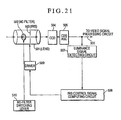
- Fig. 21 is a block diagram showing the arrangement of an image pickup apparatus, such as a video camera, serving as a first example of prior art.
- FIG. 21 there are illustrated an image forming lens 501, an ND filter 502 for attenuating light, an iris 503 for adjusting the quantity of light, an image sensor 504, such as a CCD, a CDS/AGC circuit (correlated-double-sampling/automatic-gain-control circuit) 505, and a route 506 leading to a video signal processing circuit for forming a television signal.
- an image sensor 504 such as a CCD, a CDS/AGC circuit (correlated-double-sampling/automatic-gain-control circuit) 505, and a route 506 leading to a video signal processing circuit for forming a television signal.
- a luminance signal detecting circuit 507 for detecting a luminance signal from a video signal outputted from the CDS/AGC circuit 505
- an iris control signal computing circuit 508 for forming a control signal for controlling the iris 503 according to luminance information outputted from the luminance signal detecting circuit 507
- a driver 509 for driving the iris 503
- an ND-filter switching lever 510 for switching between the insertion and detachment of the ND filter 502.
- a luminance signal for use in controlling an exposure there is used a luminance signal, including a high-frequency component, included in a video signal outputted from the CDS/AGC circuit 505.
- the luminance signal is detected by the luminance signal detecting circuit 507 and is, then, sent to the iris control signal computing circuit 508.
- the iris control signal computing circuit 508 computes an iris control signal by comparing the luminance signal with a predetermined reference value (a correct exposure level), in such a way as to make always constant the luminance signal detected by the luminance signal detecting circuit 507.
- the control signal as generated is supplied to the iris 503 through the driver 509.
- the response at which the exposure is controlled by the iris 503 (the amount of change of exposure per unit time) is set always constant. If such a response is either too fast or too slow, the user would be given an unnatural feeling, so that the tuning of the response is said to be a difficult point.
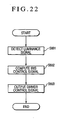
- a luminance signal, including a high-frequency component, included in a video signal outputted from the CDS/AGC circuit 505 is detected (step S601). Then, the detected luminance signal is compared with a predetermined reference value (a correct exposure level). If the luminance signal is not less than the reference value, such a control signal as to cause the iris 503 to operate in the closing direction is computed, and, if the luminance signal is less than the reference value, such a control signal as to cause the iris 503 to operate in the opening direction is computed (step S602). Then, the computed control signal is supplied to the iris 503 through the driver 509 (step S603).
- a predetermined reference value a correct exposure level
- the user is allowed to operate the ND-filter switching lever 510 so as to insert and detach the ND filter 502 into and from an optical path of the lens 501, thereby selecting the use or nonuse of the ND filter 502.
- the basic usage of the ND filter 502 resides in that, with the ND filter 502 inserted when the luminance of an object is high, it is possible to prevent the so-called small-aperture diffraction phenomenon due to the iris 503, and, with the ND filter 502 detached when the luminance of an object is low, it is possible to increase the sensitivity of the image pickup operation.
- the white balance control in image pickup apparatuses, such as video cameras.
- the second example of prior art is described with regard to the white balance control having such a presetting function as an outdoor mode (5600K mode) or an indoor mode (3200K mode) .
- Fig. 23 is a block diagram showing an interchangeable-lens-type image pickup system according to the second example of prior art.
- the interchangeable-lens-type image pickup system is composed of a lens unit 113 and a camera body 114 on which the lens unit 113 is detachably mounted.
- the lens unit 113 includes an image forming lens 101, an ND filter 102 for attenuating light, an iris 103 for adjusting the quantity of light, an ND-filter switching lever 112 for inserting and detaching the ND filter 102, and a lens microcomputer 111.
- the camera body 114 includes an image sensor 104, such as a CCD, a CDS/AGC circuit 105, an A/D converter 106 for converting an analog video signal into a digital video signal, a camera signal processing circuit 107, a route 108 for outputting a television signal formed by the camera signal processing circuit 107, a camera microcomputer 109, a communication line 110 for communication between the camera microcomputer 109 and the lens microcomputer 111, and a WB mode selection switch 115 for allowing the user to select the WB (white balance) mode, such as the outdoor mode or the indoor mode.
- the WB white balance
- the camera signal processing circuit 107 includes a luminance/chrominance signal forming circuit 120 for converting the digital video signal outputted from the A/D converter 106 into a high-frequency component YH of the luminance signal, a low-frequency component YL of the luminance signal and chrominance signals R and B, a gain control circuit 121 for the red signal R, a gain control circuit 122 for the blue signal B, a color-difference signal forming circuit 123 for forming color-difference signals R-Y and B-Y from the chrominance signals R' and B' gain-controlled by the gain control circuits 121 and 122 and the low-frequency component YL of the luminance signal, and an encoder 124 for forming the television signal from the color-difference signals R-Y and B-Y and the high-frequency component YH of the luminance signal.
- a luminance/chrominance signal forming circuit 120 for converting the digital video signal outputted from the A/D converter 106 into a high-frequency
- the lens unit 113 When the lens unit 113 is mounted on the camera body 114, electric power is supplied from the camera body 114 to the lens unit 113. Further, the user is allowed to operate the ND-filter switching lever 112 so as to insert and detach the ND filter 102 into and from an optical path of the lens 101, thereby selecting the use or nonuse of the ND filter 102.
- Optical image light from an object is made to pass through the lens 101, and is then attenuated by the ND filter 102. Then, after being adjusted by the iris 103 so as to make a correct exposure, the optical image light is imaged on the image sensor 104.
- a video signal obtained by the photoelectric conversion at the image sensor 104 is subjected to the noise-removing and gain-control process at the CDS/AGC circuit 105, and is then converted into a digital video signal by the A/D converter 106.
- the digital video signal is sent to the luminance/chrominance signal forming circuit 120 included in the camera signal processing circuit 107.
- the high-frequency component YH of the luminance signal, the low-frequency component YL of the luminance signal and the chrominance signals R and B are formed from the digital video signal.
- the red signal R and the blue signal B are respectively inputted to the gain control circuits 121 and 122, and are amplified there according to white balance control signals outputted from a gain control signal output circuit 125, so as to be outputted as chrominance signals R' and B', respectively.
- the chrominance signals R' and B' are supplied, together with the low-frequency component YL of the luminance signal, to the color-difference signal forming circuit 123, where the color-difference signals R-Y and B-Y are formed.
- the color-difference signals R-Y and B-Y are supplied, together with the high-frequency component YH of the luminance signal, to the encoder 124, where the standard television signal is formed and outputted.
- the camera microcomputer 109 reads the switching state of the WB mode selection switch 115 to make a check to find if the WB mode selection switch 115 is set to the outdoor mode (5600K mode) or the indoor mode (3200K mode) or the automatic mode.
- the camera microcomputer 109 forms, according to the mode as set, gain control signals for R gain and B gain which are beforehand stored in the camera microcomputer 109, and outputs the gain control signals to the gain control signal output circuit 125.
- the lens microcomputer 111 detects the ON/OFF-state of the ND-filter switching lever 112 to make a check to find if the ND filter 102 is in an ON-state (the state in which the ND filter 102 is inserted into the optical path of the lens 101) or in an OFF-state (the state in which the ND filter 102 is detached from the optical path of the lens 101) (step S801).
- the lens microcomputer 111 sets an ND-filter-ON status flag (step S802), and transmits the thus-set ND-filter-ON status flag to the camera microcomputer 109 (step S804).
- the lens microcomputer 111 clears the ND-filter-ON status flag (step S803), and transmits the thus-cleared ND-filter-ON status flag to the camera microcomputer 109 (step 5804).
- the camera microcomputer 109 receives the ND-filter-ON status flag from the lens microcomputer 111 (step S901). Then, the camera microcomputer 109 reads the switching state of the WB mode selection switch 115 to make a check to find if the WB (white balance) mode is the outdoor mode (5600K mode) (step S902). If a result of the check made at step S902 indicates "YES", the camera microcomputer 109 forms gain control signals for R gain and B gain which are beforehand determined correspondingly with the outdoor mode (step 5903), and outputs the gain control signals for R gain and B gain to the gain control signal output circuit 125 (step S907).
- step S902 If the result of the check made at step S902 indicates "NO”, the camera microcomputer 109 reads the switching state of the WB mode selection switch 115 to make a check to find if the WB mode is the indoor mode (3200K mode) (step S904). If a result of the check made at step S904 indicates "YES”, the camera microcomputer 109 forms gain control signals for R gain and B gain which are beforehand determined correspondingly with the indoor mode (step S905), and outputs the gain control signals for R gain and B gain to the gain control signal output circuit 125 (step S907).
- step S904 If the result of the check made at step S904 indicates "NO”, the camera microcomputer 109 judges the WB mode selection switch 115 to be in the automatic mode, and computes gain control values for R gain and B gain for the automatic mode (step S906). Then, the camera microcomputer 109 outputs, to the gain control signal output circuit 125, the computed gain control values as gain control signals for R gain and B gain (step S907).
- the outdoor mode is a WB (white balance) mode which is recommended to be used in picking up an image outdoors.
- Sunlight in the outdoors has generally high color temperature and is greatly bluish. Therefore, in the camera signal processing circuit 107, the R gain is controlled to become high and the B gain is controlled to become low, so that it becomes possible to reproduce the color close to that looked at even in the outdoors.
- the vector scope shown in Fig. 26(a) is obtained in a case where, with all surfaces of a light box of color temperature of 5600K made white, an image pickup operation is performed in the 5600K mode. As is understandable from this diagram, a color exists at the center of the vector scope. This means that it is possible to recognize an object to be white.
- the indoor mode is a WB mode which is recommended to be used in picking up an image indoors. Illumination light in the indoors has generally low color temperature and is greatly reddish. Therefore, in the camera signal processing circuit 107, the R gain is controlled to become low and the B gain is controlled to become high, so that it becomes possible to reproduce the color close to that looked at even in the indoors.
- the vector scope shown in Fig. 26(c) is obtained in a case where, with all surfaces of a light box of color temperature of 3200K made white, an image pickup operation is performed in the 3200K mode. As is understandable from this diagram, a color exists at the center of the vector scope. This means that it is possible to recognize an object to be white.
- the ND filter 102 is colorless. However, in actuality, when the ND filter 102 is mass-produced, the variance of spectral characteristics occurs, so that ND filters tinged with various colors, such as that tinged with red or tinged with blue, would be mass-produced.
- a picked-up image would be tinged due to the tinge of the ND filter 102 as shown in Fig. 26(b).
- the position of the bright point on the vector scope deviates from the center of the vector scope. This means that the picked-up image is tinged with orange.
- Fig. 26(d) which is similar to the case of Fig. 26(b), if the ND filter 102 is brought into the ON-state in such a state as shown in Fig. 26(c), a picked-up image would be tinged, so that the position of a bright point on the vector scope deviates from the center of the vector scope toward the direction of orange, in a manner similar to the case of Fig. 26(b). While Figs. 26(b) and 26(d) show a case where the ND filter is tinged with orange, as an example, the ND filter may be tinged with red or blue.
- a conventional image pickup apparatus such as a video camera, according to the third example of prior art is described with reference to Fig. 27 and Figs. 28(a) to 28 (c) .
- the image pickup apparatus includes a photographic lens 1, an iris 2, an image sensor 3, a CDS/AGC circuit 4, an A/D converter 5, a digital signal processing circuit 6, a D/A converter 7, a microcomputer 8 for performing a logical arithmetic operation, an IG meter 9, a Hall element 10, an iris encoder 11 and an iris driving circuit 12.
- An object image made incident on the image sensor 3 by the photographic lens 1 is photoelectrically converted into an electrical signal by the image sensor 3.
- the electrical signal is correlated-double-sampled and amplified to a suitable level by the CDS/AGC circuit 4.
- the thus-processed electrical signal is converted into a digital signal by the A/D converter 5.
- the digital signal is converted into a standardized video signal, such as that of the NTSC system, by the digital signal processing circuit 6.
- the video signal is then converted into an analog signal by the D/A converter 7 and is externally outputted.
- the rotational position of the IG meter 9 which is arranged to drive the iris 2 in the opening direction and in the closing direction, is magnetically detected by the Hall element 10.
- a result of detection of the rotational position of the IG meter 10 is amplified and offset-controlled to a suitable level by the iris encoder 11 and is then taken in the microcomputer 8 as data after A/D conversion.
- the microcomputer 8 reads information on the video signal level from the digital signal processing circuit 6 and information on the opening-and-closing state of the iris 2 from the iris encoder 11. Then, the microcomputer 8 computes a control signal for the iris 3 and outputs the control signal to the iris driving circuit 12 in such a way as to make the video signal level small if it is too large or in such a way as to make the video signal level large if it is too small.
- the iris driving circuit 12 drives the IG meter 9 according to the control signal.
- an iris mechanism composed of the iris 2, the IG meter 9 and the Hall element 10 operates in such a way as to make the brightness of an object image formed on the image sensor 3 constant.
- the aperture diameter of the iris 2 becomes very small. In this case, the sharpness of an object image formed on the image sensor 3 is sometimes lost due to the diffraction phenomenon of light.
- an ND filter serving as an achromatic light-attenuating filter, is made to be inserted into the space between the photographic lens 1 and the iris 2, so that the aperture diameter of the iris 2 is prevented from becoming smaller than a given value.
- the ND filter is arranged integrally with an iris blade, i.e., is stuck to a part of the iris blade.
- the iris mechanism includes iris blades 21 and 22, an ND filter 23 stuck to a part of the iris blade 21, and an IG meter 9, and a rotor 91 mounted on the rotary shaft of the IG meter 9.
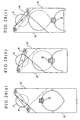
- Fig. 28(a) Assuming that, in the beginning, the iris 2 is in a fully-open state as shown in Fig. 28(a) and then begins to close, when the IG meter 9 is driven to cause the rotor 91 to rotate around the rotary shaft of the IG meter 9, the aperture of the iris mechanism comes to take such a shape as shown in Fig. 28(b) and, at the time of completion of closing of the iris mechanism, comes to take such a shape as shown Fig. 28(c).
- the ratio in area of the ND filter 23 to the aperture shape of the iris 2 becomes greater.
- the ND filter comes to cover the whole area of the aperture shape of the iris 2.
- EP-A-0 804 021 image signal processing is disclosed in which an image which is seen as a natural image can be attained in that resolution of a photographed image is kept substantially constant irrespective of any variation in condition of an optical system such as iris diaphragm diameter and zoom position.
- an MTF corresponding to a variation of iris diaphragm diameter is measured and then the gain of an output of an aperture control circuit capable of canceling a reduction of high frequency component of the image signal corresponding to the measured MTF.
- an iris diaphragm diameter varied during a photographing operation is detected, a gain set in response to the detected iris diaphragm diameter is applied to the aperture control circuit, whereby control is carried out such that the amplitude of the high frequency component of the brightness signal is kept substantially constant without having any relation with iris diaphragm.
- the shape of a circle of confusion for the object image is close to a true circle.
- the shape other than the one close to a true circle results in that the so-called taste of blurring is not good.
- the ND filter is not arranged integrally with the iris mechanism. Instead, there is provided a mechanism for inserting the ND filter from outside, or the camera body is provided with an external switch, such as a switching lever as described in the first and second examples of prior art, to enable the user to insert and detach the ND filter according to necessity.
- the image pickup apparatus since the image pickup apparatus according to the second example of prior art is of the interchangeable-lens type, when the lens unit is exchanged with another lens unit, ND filters change accordingly. In other words, the unevenness of the influence of the tinged ND filter makes it difficult to control the white balance mode on the side of the camera body.
- a lens device in an image pickup device comprising an ND filter for limiting incident light, an iris for limiting the incident light, a light receiving sensor and changing means for changing the state of limitation of incident light by the ND filter which is provided removably to an interchangeable lens section.
- an image pickup system including a camera body having an image conversion device and a signal processor and a detachable lens including a memory and circuitry for transmitting the memory content to the camera body signal processor.
- data representing the spectral characteristic of the lens and the image pickup element of the camera body transferred from the lens to the camera body are put into a system controller where they are computed as data supplied from a sensor, for wide balance.
- the outputs of the system controller are applied to a D/A-converter which then produces gain control signals for R and B amplifiers in form of voltages.
- the wide balance is corrected by taking into account even the spectral characteristic of the lens.
- this object is achieved by an apparatus according to claim 1 or 7, a control method according to claim 4 or 10, a computer program product according to claim 5 or 11, and a storage medium storing a computer program product according to claim 6 or 12.
- Fig. 1 is a block diagram showing the arrangement of an image pickup apparatus according to a first embodiment of the invention.
- parts corresponding to those shown in Fig. 21 are denoted by the same reference numerals 501 to 507, 509 and 510, and the duplicate description thereof is omitted here.
- the image pickup apparatus includes, in addition to the parts as mentioned above, an iris control signal computing circuit 511 for computing an iris control signal according to the luminance signal detected by the luminance signal detecting circuit 507, an iris high-speed control mode part 512 for causing the iris 503 to operate at a high speed, an iris low-speed control mode part 513 for causing the iris 503 to operate at a low speed, an ND-filter ON/OFF detection line 514 for detecting whether the ND filter 502 is in the ON-state or in the OFF-state, and an iris control mode selecting circuit 515 for selecting one of the iris high-speed control mode part 512 and the iris low-speed control mode part 513 by detecting, through the ND-filter ON/OFF detection line 514, information indicative of whether the ND filter 502 is in the ON-state or in the OFF-state.
- an iris control signal computing circuit 511 for computing an iris control signal according to the luminance signal detected by the luminance signal detecting circuit 507
- a luminance signal for use in controlling an exposure there is used a luminance signal, including a high-frequency component, included in a video signal outputted from the CDS/AGC circuit 505.
- the luminance signal is detected by the luminance signal detecting circuit 507 and is, then, sent to the iris control signal computing circuit 511.
- the iris control signal computing circuit 511 computes iris control signals by comparing the luminance signal with a predetermined reference value (a correct exposure level), in such a way as to make always constant the luminance signal detected by the luminance signal detecting circuit 507.
- the iris control signal computing circuit 511 forms two kinds of iris control signals, i.e., one for causing the iris 503 to operate at a high speed and the other for causing the iris 503 to operate at a low speed.
- the response at which the exposure is controlled by the iris 503 (the amount of change of exposure per unit time) is set always constant. In ordinary cases, the iris control signal for causing the iris 503 to operate at a low speed is used.
- the iris high-speed control mode part 512 is selected by the iris control mode selecting circuit 515 so as to make faster than in ordinary cases the response at which the exposure is controlled by the iris 503 (to make larger than in ordinary cases the amount of change of exposure per unit time). That is, the operation of the iris 503 is controlled in such a way as to make, as short as possible, a period of time required until a correct exposure is obtained.
- Fig. 5(a) and Fig. 5(b), which respectively correspond to the case of prior art and the case of the invention, show the change of a signal level occurring immediately after the ND filter 502 is changed from the OFF-state to the ON-state, as graphs with the vertical axis representing the signal level and the horizontal axis representing time.
- a period of time of change B in the signal level in the case of the invention (Fig. 5(b)) is shorter than a period of time of change A in the signal level in the case of prior art (Fig. 5(a))
- the magnitude of change D in the signal level in the case of the invention (Fig. 5(b)) is smaller than the magnitude of change C in the signal level in the case of prior art (Fig. 5(a)).
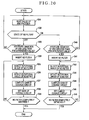
- a luminance signal, including a high-frequency component, included in a video signal outputted from the CDS/AGC circuit 505 is detected (step S201). Then, the detected luminance signal is compared with a predetermined reference value (a correct exposure level). If the luminance signal is not less than the reference value, such a control signal as to cause the iris 503 to operate in the closing direction is computed, and, if the luminance signal is less than the reference value, such a control signal as to cause the iris 503 to operate in the opening direction is computed (step S202).
- step S203 the state of the ND-filter switching lever 510 is inputted to the iris control mode selecting circuit 515 through the ND-filter ON/OFF detection line 514 (step S203).
- any change of the state of the ND filter 502 is detected (step S204), i.e., it is detected whether the ND filter 502 is stable in the ON-state, whether the ND filter 502 is stable in the OFF-state, whether the ND filter 502 is changed from the ON-state to the OFF-state, or whether the ND filter 502 is changed from the OFF-state to the ON-state.
- step S204 the flow branches from step S204 to step S206.
- step S206 the iris low-speed control mode part 513 is selected by the iris control mode selecting circuit 515, so that a control signal for controlling the iris 503 in the low-speed mode is selected. If the ND filter 502 is changed from the ON-state to the OFF-state, or if the ND filter 502 is changed from the OFF-state to the ON-state, the flow branches from step S204 to step S205.
- step S205 the iris high-speed control mode part 512 is selected by the iris control mode selecting circuit 515, so that a control signal for controlling the iris 503 in the high-speed mode is selected. Then, the control signal is outputted to the driver 509 to drive the iris 503 accordingly (step S207).
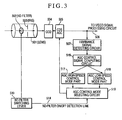
- Fig. 3 is a block diagram showing the arrangement of an image pickup apparatus according to a second embodiment of the invention.
- parts corresponding to those shown in Fig. 21 are denoted by the same reference numerals 501 to 507, 509 and 510, and the duplicate description thereof is omitted here.
- the image pickup apparatus includes, in addition to the parts as mentioned above, an AGC control signal computing circuit 516 for computing and forming an AGC control signal according to the luminance signal detected by the luminance signal detecting circuit 507, an AGC high-speed control mode part 517 for causing the AGC gain to operate at a high speed, an AGC low-speed control mode part 518 for causing the AGC gain to operate at a low speed, an ND-filter ON/OFF detection line 514 for detecting whether the ND filter 502 is in the ON-state or in the OFF-state, and an AGC control mode selecting circuit 519 for selecting one of the AGC high-speed control mode part 517 and the AGC low-speed control mode part 518 by detecting, through the ND-filter ON/OFF detection line 514, information indicative of whether the ND filter 502 is in the ON-state or in the OFF-state.
- an AGC control signal computing circuit 516 for computing and forming an AGC control signal according to the luminance signal detected by the luminance signal detecting
- a luminance signal for use in controlling an exposure there is used a luminance signal, including a high-frequency component, included in a video signal outputted from the CDS/AGC circuit 505.
- the luminance signal is detected by the luminance signal detecting circuit 507 and is, then, sent to the AGC control signal computing circuit 516.
- the AGC control signal computing circuit 516 computes AGC control signals by comparing the luminance signal with a predetermined reference value (a correct exposure level), in such a way as to make always constant the luminance signal detected by the luminance signal detecting circuit 507. In that instance, the AGC control signal computing circuit 516 forms two kinds of AGC control signals, i.e., one for causing the AGC gain to operate at a high speed and the other for causing the AGC gain to operate at a low speed.
- the response at which the exposure is controlled by the AGC gain (the amount of change of exposure per unit time) is set always constant. In ordinary cases, the AGC control signal for causing the AGC gain to operate at a low speed is used.
- the quantity of light passing through the lens 501 varies greatly to cause a large change of a video signal formed by the image sensor 504, so that a large change of luminance occurs to disturb an exposure state greatly.
- the AGC high-speed control mode part 517 is selected by the AGC control mode selecting circuit 519 so as to make faster than in ordinary cases the response at which the exposure is controlled by the AGC gain (to make larger than in ordinary cases the amount of change of exposure per unit time). That is, the AGC gain is controlled in such a way as to make, as short as possible, a period of time required until a correct exposure is obtained.
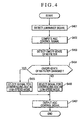
- a luminance signal, including a high-frequency component, included in a video signal outputted from the CDS/AGC circuit 505 is detected (step S401). Then, the detected luminance signal is compared with a predetermined reference value (a correct exposure level). If the luminance signal is not less than the reference value, such a control signal as to cause the AGC gain to lower is computed, and, if the luminance signal is less than the reference value, such a control signal as to cause the AGC gain to heighten is computed (step S402).
- step S404 any change of the state of the ND filter 502 is detected (step S404), i.e., it is detected whether the ND filter 502 is stable in the ON-state, whether the ND filter 502 is stable in the OFF-state, whether the ND filter 502 is changed from the ON-state to the OFF-state, or whether the ND filter 502 is changed from the OFF-state to the ON-state.
- step S404 the flow branches from step S404 to step S406.
- step S406 the AGC low-speed control mode part 518 is selected by the AGC control mode selecting circuit 519, so that a control signal for controlling the AGC gain in the low-speed mode is selected. If the ND filter 502 is changed from the ON-state to the OFF-state, or if the ND filter 502 is changed from the OFF-state to the ON-state, the flow branches from step S404 to step S405.
- step S405 the AGC high-speed control mode part 517 is selected by the AGC control mode selecting circuit 519, so that a control signal for controlling the AGC gain in the high-speed mode is selected. Then, the control signal for the AGC gain is outputted to the CDS/AGC circuit 505 accordingly (step S407).
- the operation of the iris or the operation of the AGC gain is controlled at a high speed in response to a change of the state of the ND filter, so that the disturbance of an exposure due to the insertion/detachment of the ND filter can be lessened, and a correct exposure can be speedily resumed.
- the first problem mentioned in the foregoing can be solved.
- Fig. 23 is a block diagram showing the arrangement of an interchangeable-lens type image pickup system according to a first unclaimed example.
- the arrangement of the interchangeable-lens type image pickup system according to the first unclaimed example is substantially the same as that according to the above-described second example of prior art.
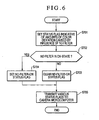
- Fig. 6 is a flow chart showing the processing operation of the lens microcomputer 111
- the lens microcomputer 111 sets a status flag serving as information indicative of the amounts of color deviation caused by the influence of the ND filter 102 (step S701).
- This status flag varies with individual ND filters 102 incorporated in the respective lens units 113, and is stored in the lens microcomputer 111 at the time of adjustment of each lens unit 113.
- the contents of that status flag are composed of values representing, with burst ratios, the amounts of deviation from the center position of the vector scope, such as the amount of color deviation 1001 in R-Y and the amount of color deviation 1002 in B-Y as shown in Fig. 26 (b).
- the lens microcomputer 111 detects the ON/OFF-state of the ND-filter switching lever 112 to make a check to find if the ND filter 102 is in an ON-state (the state in which the ND filter 102 is inserted into the optical path of the lens 101) or in an OFF-state (the state in which the ND filter 102 is detached from the optical path of the lens 101) (step S702). If it is found that the ND filter 102 is in the ON-state, the lens microcomputer 111 sets an ND-filter-ON status flag (step S704), and transmits the status flag obtained in step S701 and the ND-filter-ON status flag obtained in step S704 to the camera microcomputer 109 (step S705).
- the lens microcomputer 111 clears the ND-filter-ON status flag (step S703), and transmits the status flag obtained in step S701 and the ND-filter-ON status flag obtained in step S703 to the camera microcomputer 109 (step S705).
- Fig. 7 is a flow chart showing the processing operation of the camera microcomputer 109
- the camera microcomputer 109 receives, from the lens microcomputer 111, the status flags obtained in the steps S701 and S704 or in the steps S701 and S703 shown in Fig. 6 (step S301). Then, the camera microcomputer 109 reads the switching state of the WB mode selection switch 115 to make a check to find if the WB (white balance) mode is the 5600K mode (outdoor mode) (step S302). If a result of the check made at step S302 indicates "YES", the camera microcomputer 109 forms gain control signals for R gain and B gain which are beforehand determined correspondingly with the 5600K mode (step S303).
- the camera microcomputer 109 makes a check for the status flag indicative of the ON-state or the OFF-state of the ND filter 102 received in step S301 (step S305). If it is found that the ND filter 102 is in the OFF-state, the camera microcomputer 109 outputs the gain control signals for R gain and B gain formed at step S303 to control the gain control signal output circuit 125 (step S311).
- the camera microcomputer 109 adds, to the control signals for R gain and B gain formed in step S303, the amounts of offset (the amounts of color deviation) represented by the status flag indicative of the amounts of color deviation received in step S301, so as to form new control signals for R gain and B gain for the purpose of removing color deviation (step S308). Then, the camera microcomputer 109 outputs the gain control signals for R gain and B gain formed at step S308 to control the gain control signal output circuit 125 (step S311).
- step S302 If the result of the check made at step S302 indicates "NO”, the camera microcomputer 109 reads the switching state of the WB mode selection switch 115 to make a check to find if the WB mode is the 3200K mode (indoor mode) (step S304). If a result of the check made at step S304 indicates "YES”, the camera microcomputer 109 forms gain control signals for R gain and B gain which are beforehand determined correspondingly with the 3200K mode (step S306).
- the camera microcomputer 109 makes a check for the status flag indicative of the ON-state or the OFF-state of the ND filter 102 received in step S301 (step S309). If it is found that the ND filter 102 is in the OFF-state, the camera microcomputer 109 outputs the gain control signals for R gain and B gain formed at step S306 to control the gain control signal output circuit 125 (step S311).
- the camera microcomputer 109 adds, to the control signals for R gain and B. gain formed in step S306, the amounts of offset (the amounts of color deviation) represented by the status flag indicative of the amounts of color deviation received in step S301, so as to form new control signals for R gain and B gain for the purpose of removing color deviation (step S310). Then, the camera microcomputer 109 outputs the gain control signals for R gain and B gain formed at step 5310 to control the gain control signal output circuit 125 (step S311).
- the camera microcomputer 109 judges the WB mode selection switch 115 to be in the automatic mode, and computes gain control values for R gain and B gain for the automatic mode (step S307). Then, the camera microcomputer 109 outputs, to the gain control signal output circuit 125, the gain control values computed at step S307 as gain control signals for R gain and B gain (step S311).
- Fig. 8 is a block-diagram showing the arrangement of an interchangeable-lens type image pickup system according to a second unclaimed example.
- parts corresponding to those shown in Fig. 23 are denoted by the same reference numerals 101 to 115, and the duplicate description thereof is omitted here.
- the interchangeable-lens type image pickup system includes, in addition to the parts as mentioned above, an ECD (electrochromic element) 401, which is used in place of the ND filter 102 shown in Fig. 23, a color temperature change detecting circuit 402 for detecting, at all times, a change of color temperature taking place along with a change of the density of the ECD 401, and a driver 403 for changing the density of the ECD 401.
- the other parts are arranged substantially in the same manner as in Fig. 23.
- the lens microcomputer 111 sets a status flag indicative of the amounts of color deviation caused by the influence of the ECD 401 (step S601).
- This status flag is set to indicate the amount of change of color temperature taking place at the same time that the density of the ECD 401 is changed, which is detected by the color temperature change detecting circuit 402.
- the contents of that status flag are composed of values representing, with burst ratios, the amounts of deviation from the center position of the vector scope, such as the amount of color deviation 1001 in R-Y and the amount of color deviation 1002 in B-Y as shown in Fig. 26 (b).
- the lens microcomputer 111 transmits the status flag set in step S501 to the camera microcomputer 109 (step S502).
- the camera microcomputer 109 receives, from the lens microcomputer 111, the status flag set in the step S501 (step S601). Then, the camera microcomputer 109 reads the switching state of the WB mode selection switch 115 to make a check to find if the WB (white balance) mode is the 5600K mode (outdoor mode) (step S602). If a result of the check made at step S602 indicates "YES", the camera microcomputer 109 forms gain control signals for R gain and B gain which are beforehand determined correspondingly with the 5600K mode (step S603).
- the camera microcomputer 109 adds, to the control signals for R gain and B gain formed in step S603, the amounts of offset (the amounts of color deviation) represented by the status flag indicative of the amounts of color deviation received in step S601, so as to form new control signals for R gain and B gain for the purpose of removing color deviation (step S607). Then, the camera microcomputer 109 outputs the gain control signals for R gain and B gain formed at step S607 to control the gain control signal output circuit 125 (step S609).
- step S602 If the result of the check made at step S602 indicates "NO”, the camera microcomputer 109 reads the switching state of the WB mode selection switch 115 to make a check to find if the WB mode is the 3200K mode (indoor mode) (step S604) . If a result of the check made at step 5604 indicates "YES”, the camera microcomputer 109 forms gain control signals for R gain and B gain which are beforehand determined correspondingly with the 3200K mode (step S605).
- the camera microcomputer 109 adds, to the control signals for R gain and B gain formed in step S605, the amounts of offset (the amounts of color deviation) represented by the status flag indicative of the amounts of color deviation received in step S601, so as to form new control signals for R gain and B gain for the purpose of removing color deviation (step S608). Then, the camera microcomputer 109 outputs the gain control signals for R gain and B gain formed at step S608 to control the gain control signal output circuit 125 (step S609).
- step S604 If the result of the check made at step S604 indicates "NO”, the camera microcomputer 109 judges the WB mode selection switch 115 to be in the automatic mode, and computes gain control values for R gain and B gain for the automatic mode (step S606). Then, the camera microcomputer 109 outputs, to the gain control signal output circuit 125, the gain control values computed at step S606 as gain control signals for R gain and B gain (step S609).
- the control operation in the WB mode is performed in accordance with the tinge of the ND filter. Accordingly, even when the ND filter is used, the reproducibility of color is not deteriorated. Further, even in the case of the interchangeable-lens type image pickup system, since information indicative of the tinge of the ND filter is transmitted from the lens unit to the camera body, an appropriate color-correction can be performed an the side of the camera body whatever kind of ND filter is used. As a result, the second problem mentioned in the foregoing can be solved.
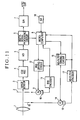
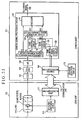
- Fig. 11 is a block diagram showing the arrangement of an image pickup apparatus according to a third embodiment of the invention.
- parts corresponding to those shown in Fig. 27 as the third example of prior art are denoted by the same reference numerals 1 to 12, and the duplicate description thereof is omitted here.
- the image pickup apparatus includes, in addition to the parts as mentioned above, an ND filter 1.3, an IG meter 14 for controlling the insertion of the ND filter 13, an ND-filter driving circuit 15, a Hall element 16 for detecting the position of the IG meter 14, an ND filter encoder 17., and an ND-filter switch 18.
- an object image made incident an the image sensor 3 by the photographic lens 1 is photoelectrically converted into an electrical signal by the image sensor 3.
- the electrical signal is processed by the CDS/AGC circuit 4, the A/D converter 5, the digital signal processing circuit 6, the D/A converter 7, etc., and is externally outputted as a video signal of the NTSC system or the like.
- the rotational position of the IG meter 9 which is arranged to drive the iris 2 in the opening direction and in the closing direction, is detected by the Hall element 10.
- a result of detection of the rotational position of the IG meter 9 is amplified and offset-controlled by the iris encoder 11 and is then taken in the microcomputer 8 as data.
- the microcomputer 8 reads information on the video signal level from the digital signal processing circuit 6 and information on the opening-and-closing state of the iris 2 from the iris encoder 11. Then, the microcomputer 8 computes a control signal for the iris 3 and outputs the control signal to the iris driving circuit 12 in such a way as to make the video signal level small if it is too large or in such a way as to make the video signal level large if it is too small.
- the iris driving circuit 12 drives the IG meter 9 according to the control signal.
- the IG meter 9 since the IG meter 9 itself is an inductance element, it has a temporal response lag with respect to an applied voltage. In order to compensate for this lag, the rotational position of the IG meter 9 detected by the Hall element 10 is fed back to the iris driving circuit 12 through the iris encoder 11 to control the rotational speed of the IG meter 9.
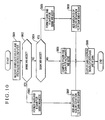
- the microcomputer 8 performs the following processing operation according to the flow chart shown in Fig. 12.
- the microcomputer 8 when detecting the operation of the ND-filter switch 18 (step S101), the microcomputer 8 sends to the ND-filter driving circuit 15 a signal for driving the ND filter 13 (step S102).
- the ND-filter driving circuit 15 supplies an electric current to the IG meter 14, so that the IG meter 14 rotates to insert the ND filter 13 into a space between the photographic lens 1 and the iris 2.
- the rotational position of the IG meter 14, which controls the insertion of the ND filter 13, is magnetically detected by the Hall element 16, in a manner similar to the IG meter 9 which drives the iris 2, is amplified and offset-controlled to a suitable level by the ND-filter encoder 17, and is then fed back to the ND-filter driving circuit 15 to control the rotational speed of the IG meter 14. Further, at the same time, a result of detection of the rotational position of the IG meter 14 is taken in the microcomputer 8 as data after A/D conversion through the ND-filter encoder 17 (step S103).
- a period of time required until the ND filter 13 is completely inserted into an optical path of the photographic lens 1 after the microcomputer 8 sends a driving signal to the ND-filter driving circuit 15 to start moving the ND filter 13 and a change of the quantity of light taking place during that period of time are uniquely determined by the constant of the ND-filter driving circuit 15 and the characteristics of the IG meter 14 and the Hall element 16.
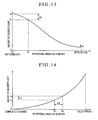
- Fig. 13 shows such a change of the quantity of light, and is a graph showing the relation between the rotational angle of the IG meter 14 and a quantity of light incident from the photographic lens 1 caused by the ND filter 13 being inserted by the rotation of the IG meter 14.
- the characteristics as shown in Fig. 13 are stored, as data, in the microcomputer 8.
- Fig. 14 is a graph showing the relation between the rotational angle of the IG meter 9 and a quantity of light incident from the photographic lens 1 caused by the iris 2 being driven by the rotation of the IG meter 9.
- the characteristics as shown in Fig. 14 also are stored, as data, in the microcomputer 8.
- the rotational angle of the IG meter 14 is 0°.
- the IG meter 14 starts rotating.
- the ND filter 13 starts covering the optical path of the photographic lens 1 and finally covers the whole thereof.
- a change of the quantity of light during the period between such two points of time becomes ⁇ L.
- the microcomputer 8 reads, through the ND-filter encoder 17, a result of detection of the rotational angle of the IG meter 14 by the Hall element 16, and, in the similar way, reads, through the iris encoder 11, a rotational angle ⁇ 2 of the IG meter 9 obtained at that point of time (step S104). Then, the microcomputer 8 computes, from beforehand-stored data, such a change of rotational angle ⁇ of the IG meter 9 as to cancel the change of the quantity of light ⁇ L at that point of time (step S105).
- the microcomputer 8 causes, an the basis of such a correction value, the iris driving circuit 12 to rotate the IG meter 9 by the angle ⁇ so as to the bring the IG meter 9 to a rotational position ⁇ 3 (step S106). Accordingly, the quantity of incident light defined by the iris 2 is changed from a value L 2 to a value L 3 with respect to the change of the quantity of light ⁇ L caused by the insertion of the ND filter 13, so that an exposure is appropriately corrected. A series of such actions is repeated at intervals of a predetermined period until the ND filter 13 is completely inserted (step S107).
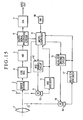
- Fig. 15 is a block diagram showing the arrangement of an image pickup apparatus according to a fourth embodiment of the invention.
- parts corresponding to those shown in Fig. 11 are denoted by the same reference numerals 1 to 18, and the duplicate description thereof is omitted here.
- Fig. 15 differs from that shown in Fig. 11 in that the microcomputer 8 controls the gain of the CDS/AGC circuit 4.
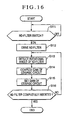
- the microcomputer 8 When the user judges from the brightness of an object that the ND filter 13 is necessary and operates the ND-filter switch 18, the microcomputer 8 performs the following processing operation according to the flow chart shown in Fig. 16.
- the ND-filter driving circuit 15 supplies an electric current to the IG meter 14, so that the IG meter 14 rotates to insert the ND filter 13 into a space between the photographic lens 1 and the iris 2.
- the rotational speed of the IG meter 14, which controls the insertion of the ND filter 13, is controlled by the ND-filter encoder 17 in a manner similar to that in the third embodiment, and a result of detection of the rotational position of the IG meter 14 is taken in the microcomputer 8 as data after A/D conversion (step S113).
- the characteristics indicative of changes of the quantity of light occurring until the ND filter 13 is completely inserted into an optical path of the photographic lens 1 after the ND filter 13 starts being moved by the operation of the ND-filter switch 18 are beforehand stored, as data, in the microcomputer 8, similarly to the third embodiment.
- a change of the quantity of light during the period between such two points of time becomes ⁇ L.
- the microcomputer 8 reads, through the ND-filter encoder 17, a result of detection of the rotational angle of the IG meter 14 by the Hall element 16, and computes such a gain of the CDS/AGC circuit as to cancel the change of the quantity of light ⁇ L (step S114).
- the microcomputer 8 controls the gain of the CDS/AGC circuit 4 an the basis of such a correction value (step S115), so as to compensate for a change of the quantity of light caused by the insertion of the ND filter 13 by changing the gain of the CDS/AGC circuit 4.
- a series of such actions is repeated at intervals of a predetermined period until the ND filter 13 is completely inserted (step S116).
- Fig. 17 is a block diagram showing the arrangement of an image pickup apparatus according to a fifth embodiment of the invention.
- Fig. 17 parts corresponding to those shown in Fig. 11 are denoted by the same reference numerals 1 to 17, and the duplicate description thereof is omitted here.
- Fig. 17 differs from that shown in Fig. 11 in that the ND-filter switch 18 is omitted.
- an object image made incident an the image sensor 3 by the photographic lens 1 is photoelectrically converted into an electrical signal by the image sensor 3.
- the electrical signal is processed by the CDS/AGC circuit 4, the A/D converter 5, the digital signal processing circuit 6, the D/A converter 7, etc., and is externally outputted as a video signal of the NTSC system or the like.
- the rotational position of the IG meter 9, which is arranged, to drive the iris 2 in the opening direction and in the closing direction, is detected by the Hall element 10.
- a result of detection of the rotational position of the IG meter 9 is taken in the microcomputer 8 as data through the iris encoder 11.
- the microcomputer 8 reads information an the video signal level-and information an the opening-and-closing state of the iris 2. Then, the microcomputer 8 computes a control signal according to the video signal level.
- the iris driving circuit 12 drives the IG meter 9 according to the control signal..In this instance, since the IG meter 9 itself is an inductance element, it has a temporal response lag with respect to an applied voltage. In order to compensate for this lag, the rotational position of the IG meter 9 detected by the Hall element 10 is fed back to the iris driving circuit 12 through the iris encoder 11 to control the rotational speed of the IG meter 9.
- Fig. 18 is a flow chart showing the contents of a program to be executed by the microcomputer 8 according to the fifth embodiment.
- the microcomputer 8 periodically reads the aperture state of the iris 2 by using the Hall element 10 and the iris encoder 11 (step S11). If, while the ND filter 13 is not inserted, the aperture diameter of the iris 2 becomes less than a predetermined value with the brightness of an object becoming very high (steps S12 and S13), the microcomputer 8 supplies a driving signal to the ND-filter driving circuit 15. Then, the ND-filter driving circuit 15 supplies an electric current to the IG meter 14. The IG meter 14 is then caused to rotate to insert the ND filter 13 into a space between the photographic lens 1 and the iris 2 (step S14).
- the rotational position of the IG meter 14, which controls the insertion of the ND filter 13, is magnetically detected by the Hall element 16, in a manner similar to the IG meter 9 which drives the iris 2, is amplified and offset-controlled to a suitable level by the ND-filter encoder 17, and is then fed back to the ND-filter driving circuit 15 to control the rotational speed of the IG meter 14. Further, at the same time, a result of detection of the rotational position of the IG meter 14 is taken in the microcomputer 8 as data after A/D conversion through the ND-filter encoder 17 (step S15).
- a period of time required until the ND filter 13 is completely inserted into an optical path of the photographic lens 1 after the ND filter 13 starts moving and a change of the quantity of light taking place during that period of time are uniquely determined by the constant of the ND-filter driving circuit 15 and the characteristics of the IG meter 14 and the Hall element 16.
- Fig. 13 shows such a change of the quantity of light, and is a graph showing the relation'between the rotational angle of the IG meter 14 and a change of the quantity of light incident from the photographic lens 1 caused by the ND filter 13 being inserted by the rotation of the IG meter 14.
- the characteristics as shown in Fig. 13 are stored, as data, in the microcomputer 8.
- Fig. 14 is a graph showing the relation between the rotational angle of the IG meter 9 and a change of the quantity of light incident from the photographic lens 1 caused by the iris 2 being driven by the rotation of the IG meter 9.
- the characteristics as shown in Fig. 14 also are stored, as data, in the microcomputer 8.
- the rotational angle of the IG meter 14 is 0°.
- the ND filter 13 accordingly starts covering the optical path of the photographic lens 1 and finally covers the whole thereof.
- a change of the quantity of light during the period between such two points of time becomes ⁇ L.
- the microcomputer 8 reads, through the ND-filter encoder 17, a result of detection of the rotational angle of the IG meter 14 by the Hall element 16, and, in the similar way, reads, through the iris encoder 11, a rotational angle ⁇ 2 of the IG meter 9 obtained at that point of time. Then, the microcomputer 8 computes, from beforehand-stored data, such a change of rotational angle ⁇ of the IG meter 9 as to cancel the change of the quantity of light ⁇ L at that point of time.
- the microcomputer 8 causes, on the basis of such a correction value, the iris driving circuit 12 to rotate the IG meter 9 by the angle ⁇ so as to compensate for a change of the quantity of light caused by the insertion of the ND filter 13 by changing the aperture diameter of the iris 2.
- a series of such actions is repeated at intervals of a predetermined period until the ND filter 13 is completely inserted (steps S15 to S19).
- the microcomputer 8 judges that the ND filter 13 is unnecessary, and supplies to the ND-filter driving circuit 15 a signal for detaching the ND filter 13. Then, the ND-filter driving circuit 15 reduces an electric current to be supplied to the IG meter 14. The IG meter 14 is then caused to rotate reversely so as to detach the ND filter 13 from the space between the photographic lens 1 and the iris 2 (steps S20 and S21).
- a period of time required until the ND filter 13 is completely detached from the optical path of the photographic lens 1 after the ND filter 13 starts being detached and a change of the quantity of light taking place during that period of time are uniquely determined, as in the event of the insertion of the ND filter 13, by the constant of the ND-filter driving circuit 15 and the characteristics of the IG meter 14 and the Hall element 16, and the characteristic shown in Fig. 13 applies as it is.
- this time conversely, the ND filter 13 takes the locus from the ON-state to the OFf-state.
- the microcomputer 8 computes, in a manner similar to that in the event of the insertion of the ND filter 13, such a change of rotational angle of the IG meter 9 as to cancel a change of the quantity of light caused by the movement of the IG meter 14. Then, the microcomputer 8 causes, on the basis of such a correction value, the iris driving circuit 12 to rotate the IG meter 9 by the angle corresponding to the correction value so as to compensate for a change of the quantity of light caused by the detachment of the ND filter 13 by changing the aperture diameter of the iris 2. A series of such actions is repeated at intervals of a predetermined period until the ND filter 13 is completely detached (steps S22 to S26).
- Fig. 19 is a block diagram showing the arrangement of an image pickup apparatus according to a sixth embodiment of the invention.
- parts corresponding to those shown in Fig. 17 are denoted by the same reference numerals 1 to 17, and the duplicate description thereof is omitted here.
- the arrangement shown in Fig. 19 differs from that shown in Fig. 17 in that the microcomputer 8 controls the gain of the CDS/AGC circuit 4.
- the process up to the operation in which the iris mechanism composed of the iris 2, the IG meter 9 and the Hall element 10 is operated to make constant the brightness of an object image formed an the image sensor 3 is the same as that described in the fifth embodiment.
- Fig. 20 is a flow chart showing the contents of a program to be executed by the microcomputer 8 according to the sixth embodiment.
- the microcomputer 8 periodically reads the aperture state of the iris 2 by using the Hall element 10 and the iris encoder 11 (step S31) . If, while the ND filter 13 is not inserted, the aperture diameter of the iris 2. becomes less than a predetermined value with the brightness of an object becoming very high, the microcomputer 8 supplies a driving signal to the ND filter driving circuit 15 (steps S32 to S34). Then, the ND-filter driving circuit 15 supplies an electric current to the IG meter 14. The IG meter 14 is then caused to rotate to insert the ND filter 13 into a space between the photographic lens 1 and the iris 2.
- the rotational speed of the IG meter 14, which controls the insertion of the ND filter 13, is controlled by the ND-filter encoder 17 similarly to the fifth embodiment. Further, a result of detection of the rotational position of the IG meter 14 is taken in the microcomputer 8 as data after A/D conversion through the ND-filter encoder 17.
- the characteristic of a change of the quantity of light taking place until the ND filter 13 is completely inserted into an optical path of the photographic lens 1 after the ND filter 13 starts moving is beforehand stored in the microcomputer 8 as data, similarly to the fifth embodiment.
- the microcomputer 8 reads, through the ND-filter encoder 17, a result of detection of the rotational angle of the IG meter 14 by the Hall element 16, and computes such a gain of the CDS/AGC circuit 4 as to cancel the change of the quantity of light ⁇ L shown in Fig. 13.
- the microcomputer 8 controls the gain of the CDS/AGC circuit 4 an the basis of such a correction value, so as to compensate for a change of the quantity of light caused by the insertion of the ND filter 13 by changing the gain of the CDS/AGC circuit 4.
- a series of such actions is repeated at intervals of a predetermined period until the ND filter 13 is completely inserted (steps S35 to S39).
- the microcomputer 8 judges that the ND filter 13 is unnecessary, and supplies to the ND-filter driving circuit 15 a signal for detaching the ND filter 13 (steps S40 and S41). Then, the ND-filter driving circuit 15 reduces an electric current to be supplied to the IG meter 14. The IG meter 14 is then caused to rotate reversely so as to detach the ND filter 13 from the space between the photographic lens 1 and the iris 2.
- a period of time required until the ND filter 13 is completely detached from the optical path of the photographic lens 1 after the ND filter 13 starts being detached and a change of the quantity of light taking place during that period of time are uniquely determined, as in the event of the insertion of the ND filter 13, by the constant of the ND-filter driving circuit 15 and the characteristics of the IG meter 14 and the Hall element 16, and the characteristic shown in Fig. 13 applies as it is.
- this time conversely, the ND filter 13 takes the locus from the ON-state to the OFF-state.
- the rotational angle of the IG meter 14 is ⁇ ON .
- the IG meter 14 starts rotating in the direction reverse to the direction used for the insertion of the ND filter 13
- the ND filter 13 accordingly starts being detached from the optical path of the photographic lens 1, and is finally detached completely.
- the microcomputer 8 computes, in a manner similar to that in the event of the insertion of the ND filter 13, such a gain of the C.DS/AGC circuit 4 as to cancel a change of the quantity of light caused by the movement of the IG meter 14.
- the microcomputer 8 controls the gain of the CDS/AGC circuit 4 an the basis of such a correction value, so as to compensate for a change of the quantity of light caused by the detachment of the ND filter 13 by changing the gain of the CDS/AGC circuit 4.
- a series of such actions is repeated at intervals of a predetermined period until the ND filter 13 is completely detached from the optical path of the photographic lens 1 (steps S42 to S46) .
- the ND filter is automatically inserted and detached according to the brightness of an object, i.e., an aperture value of the iris. Accordingly, it is not necessary for the user to pay attention to the brightness of an object or to operate the ND-filter switching lever or the ND-filter switch, so that the third problem mentioned in the foregoing can be solved.
- the iris or the gain is controlled according to the automatic insertion and detachment of the ND filter, the variation of a video signal can be suppressed to a minimum.
- a system according to each of the above-described first to sixth embodiments can be composed of hardware, it may be composed of a computer system using a camera microcomputer, a lens microcomputer or the like having a CPU and a memory. If the system is composed of a computer system, the memory included in each microcomputer constitutes a storage medium according to the invention. In the storage medium, there is stored a program for executing the operation and processing described in each of the flow charts according to the above-described first to sixth embodiments.
- the storage medium there may be used a semiconductor memory, such as a ROM or a RAM, an optical disk, a magneto-optical disk, a magnetic storage medium or the like, or these media may be used in the form of a CD-ROM, an FD, a magnetic card, a magnetic tape, a nonvolatile memory card or the like.
- the invention may be carried out by combining as necessary the embodiments or their technological elements described in the foregoing.
- the invention is applicable to cameras of varied kinds, including an electronic camera, such as a video camera, capable of picking up a moving image or a still image, a silver-halide camera, a single-lens reflex camera and a lens-shutter camera using a photographic film, a surveillance camera, etc., and is also applicable to an image pickup apparatus other than cameras, an image reading apparatus, an optical apparatus, and other apparatuses. Further, the invention is applicable to devices adapted for a camera, an image pickup apparatus; an image reading apparatus, an optical apparatuses, and the other apparatuses, component elements forming such apparatuses or devices, methods for controlling these apparatuses and devices, and computer program products providing such control methods.
- an electronic camera such as a video camera, capable of picking up a moving image or a still image, a silver-halide camera, a single-lens reflex camera and a lens-shutter camera using a photographic film, a surveillance camera, etc.
- an image pickup apparatus other than cameras
- the invention is applicable to devices
Landscapes
- Engineering & Computer Science (AREA)
- Multimedia (AREA)
- Signal Processing (AREA)
- Studio Devices (AREA)
- Exposure Control For Cameras (AREA)
- Microscoopes, Condenser (AREA)
- Exposure Of Semiconductors, Excluding Electron Or Ion Beam Exposure (AREA)
- Exposure And Positioning Against Photoresist Photosensitive Materials (AREA)
- Color Television Image Signal Generators (AREA)
Description
- The present invention relates to a quantity-of-light adjusting apparatus for an image pickup apparatus or the like using an ND (neutral-density) filter, a control method for the quantity-of-light adjusting apparatus, and a computer program product providing a control program for the quantity-of-light adjusting apparatus.
- Fig. 21 is a block diagram showing the arrangement of an image pickup apparatus, such as a video camera, serving as a first example of prior art.
- In Fig. 21, there are illustrated an
image forming lens 501, anND filter 502 for attenuating light, aniris 503 for adjusting the quantity of light, animage sensor 504, such as a CCD, a CDS/AGC circuit (correlated-double-sampling/automatic-gain-control circuit) 505, and aroute 506 leading to a video signal processing circuit for forming a television signal. - There are further illustrated a luminance
signal detecting circuit 507 for detecting a luminance signal from a video signal outputted from the CDS/AGC circuit 505, an iris controlsignal computing circuit 508 for forming a control signal for controlling theiris 503 according to luminance information outputted from the luminancesignal detecting circuit 507, adriver 509 for driving theiris 503, and an ND-filter switching lever 510 for switching between the insertion and detachment of theND filter 502. - Next, the operation of the image pickup apparatus shown in Fig. 21 is described.
- As a luminance signal for use in controlling an exposure, there is used a luminance signal, including a high-frequency component, included in a video signal outputted from the CDS/
AGC circuit 505. The luminance signal is detected by the luminancesignal detecting circuit 507 and is, then, sent to the iris controlsignal computing circuit 508. The iris controlsignal computing circuit 508 computes an iris control signal by comparing the luminance signal with a predetermined reference value (a correct exposure level), in such a way as to make always constant the luminance signal detected by the luminancesignal detecting circuit 507. - For example, with the comparison between the luminance signal detected by the luminance
signal detecting circuit 507 and the above-mentioned reference value, if the luminance signal is not less than the reference value, such a control signal as to cause theiris 503 to operate in the closing direction is generated, and, if the luminance signal is less than the reference value, such a control signal as to cause theiris 503 to operate in the opening direction is generated. The control signal as generated is supplied to theiris 503 through thedriver 509. The response at which the exposure is controlled by the iris 503 (the amount of change of exposure per unit time) is set always constant. If such a response is either too fast or too slow, the user would be given an unnatural feeling, so that the tuning of the response is said to be a difficult point. - Next, the operation for controlling the
iris 503 is described with reference to the flow chart of Fig. 22. - First, a luminance signal, including a high-frequency component, included in a video signal outputted from the CDS/
AGC circuit 505 is detected (step S601). Then, the detected luminance signal is compared with a predetermined reference value (a correct exposure level). If the luminance signal is not less than the reference value, such a control signal as to cause theiris 503 to operate in the closing direction is computed, and, if the luminance signal is less than the reference value, such a control signal as to cause theiris 503 to operate in the opening direction is computed (step S602). Then, the computed control signal is supplied to theiris 503 through the driver 509 (step S603). - Next, the
ND filter 502 is described. - The user is allowed to operate the ND-
filter switching lever 510 so as to insert and detach theND filter 502 into and from an optical path of thelens 501, thereby selecting the use or nonuse of theND filter 502. The basic usage of theND filter 502 resides in that, with theND filter 502 inserted when the luminance of an object is high, it is possible to prevent the so-called small-aperture diffraction phenomenon due to theiris 503, and, with theND filter 502 detached when the luminance of an object is low, it is possible to increase the sensitivity of the image pickup operation. - Next, a second example of prior art is described.
- Heretofore, a variety of proposals have been made about the white balance control in image pickup apparatuses, such as video cameras. In the following, the second example of prior art is described with regard to the white balance control having such a presetting function as an outdoor mode (5600K mode) or an indoor mode (3200K mode) .
- Fig. 23 is a block diagram showing an interchangeable-lens-type image pickup system according to the second example of prior art.
- Referring to Fig. 23, the interchangeable-lens-type image pickup system is composed of a
lens unit 113 and acamera body 114 on which thelens unit 113 is detachably mounted. - The
lens unit 113 includes animage forming lens 101, anND filter 102 for attenuating light, aniris 103 for adjusting the quantity of light, an ND-filter switching lever 112 for inserting and detaching theND filter 102, and alens microcomputer 111. - The
camera body 114 includes animage sensor 104, such as a CCD, a CDS/AGC circuit 105, an A/D converter 106 for converting an analog video signal into a digital video signal, a camerasignal processing circuit 107, aroute 108 for outputting a television signal formed by the camerasignal processing circuit 107, acamera microcomputer 109, acommunication line 110 for communication between thecamera microcomputer 109 and thelens microcomputer 111, and a WBmode selection switch 115 for allowing the user to select the WB (white balance) mode, such as the outdoor mode or the indoor mode. - The camera
signal processing circuit 107 includes a luminance/chrominancesignal forming circuit 120 for converting the digital video signal outputted from the A/D converter 106 into a high-frequency component YH of the luminance signal, a low-frequency component YL of the luminance signal and chrominance signals R and B, again control circuit 121 for the red signal R, again control circuit 122 for the blue signal B, a color-differencesignal forming circuit 123 for forming color-difference signals R-Y and B-Y from the chrominance signals R' and B' gain-controlled by thegain control circuits encoder 124 for forming the television signal from the color-difference signals R-Y and B-Y and the high-frequency component YH of the luminance signal. - Next, the operation of the interchangeable-lens-type image pickup system shown in Fig. 23 is described.
- When the
lens unit 113 is mounted on thecamera body 114, electric power is supplied from thecamera body 114 to thelens unit 113. Further, the user is allowed to operate the ND-filter switching lever 112 so as to insert and detach theND filter 102 into and from an optical path of thelens 101, thereby selecting the use or nonuse of theND filter 102. - Optical image light from an object is made to pass through the
lens 101, and is then attenuated by theND filter 102. Then, after being adjusted by theiris 103 so as to make a correct exposure, the optical image light is imaged on theimage sensor 104. A video signal obtained by the photoelectric conversion at theimage sensor 104 is subjected to the noise-removing and gain-control process at the CDS/AGC circuit 105, and is then converted into a digital video signal by the A/D converter 106. The digital video signal is sent to the luminance/chrominancesignal forming circuit 120 included in the camerasignal processing circuit 107. - At the luminance/chrominance
signal forming circuit 120, the high-frequency component YH of the luminance signal, the low-frequency component YL of the luminance signal and the chrominance signals R and B are formed from the digital video signal. The red signal R and the blue signal B are respectively inputted to thegain control circuits signal output circuit 125, so as to be outputted as chrominance signals R' and B', respectively. - The chrominance signals R' and B' are supplied, together with the low-frequency component YL of the luminance signal, to the color-difference
signal forming circuit 123, where the color-difference signals R-Y and B-Y are formed. The color-difference signals R-Y and B-Y are supplied, together with the high-frequency component YH of the luminance signal, to theencoder 124, where the standard television signal is formed and outputted. - The
camera microcomputer 109 reads the switching state of the WBmode selection switch 115 to make a check to find if the WBmode selection switch 115 is set to the outdoor mode (5600K mode) or the indoor mode (3200K mode) or the automatic mode. Thecamera microcomputer 109 forms, according to the mode as set, gain control signals for R gain and B gain which are beforehand stored in thecamera microcomputer 109, and outputs the gain control signals to the gain controlsignal output circuit 125. - Next, the operation of the interchangeable-lens-type image pickup system shown in Fig. 23 is further described with reference to the flow charts of Figs. 24 and 25. Referring to Fig. 24, the
lens microcomputer 111 detects the ON/OFF-state of the ND-filter switching lever 112 to make a check to find if theND filter 102 is in an ON-state (the state in which theND filter 102 is inserted into the optical path of the lens 101) or in an OFF-state (the state in which theND filter 102 is detached from the optical path of the lens 101) (step S801). If it is found that theND filter 102 is in the ON-state, thelens microcomputer 111 sets an ND-filter-ON status flag (step S802), and transmits the thus-set ND-filter-ON status flag to the camera microcomputer 109 (step S804). On the other hand, if it is found that theND filter 102 is in the OFF-state, thelens microcomputer 111 clears the ND-filter-ON status flag (step S803), and transmits the thus-cleared ND-filter-ON status flag to the camera microcomputer 109 (step 5804). - Subsequently, referring to Fig. 25, the
camera microcomputer 109 receives the ND-filter-ON status flag from the lens microcomputer 111 (step S901). Then, thecamera microcomputer 109 reads the switching state of the WBmode selection switch 115 to make a check to find if the WB (white balance) mode is the outdoor mode (5600K mode) (step S902). If a result of the check made at step S902 indicates "YES", thecamera microcomputer 109 forms gain control signals for R gain and B gain which are beforehand determined correspondingly with the outdoor mode (step 5903), and outputs the gain control signals for R gain and B gain to the gain control signal output circuit 125 (step S907). - If the result of the check made at step S902 indicates "NO", the
camera microcomputer 109 reads the switching state of the WBmode selection switch 115 to make a check to find if the WB mode is the indoor mode (3200K mode) (step S904). If a result of the check made at step S904 indicates "YES", thecamera microcomputer 109 forms gain control signals for R gain and B gain which are beforehand determined correspondingly with the indoor mode (step S905), and outputs the gain control signals for R gain and B gain to the gain control signal output circuit 125 (step S907). - If the result of the check made at step S904 indicates "NO", the
camera microcomputer 109 judges the WBmode selection switch 115 to be in the automatic mode, and computes gain control values for R gain and B gain for the automatic mode (step S906). Then, thecamera microcomputer 109 outputs, to the gain controlsignal output circuit 125, the computed gain control values as gain control signals for R gain and B gain (step S907). - Next, the WB mode is briefly described with reference to Figs. 26(a) to 26(d).
- The outdoor mode is a WB (white balance) mode which is recommended to be used in picking up an image outdoors. Sunlight in the outdoors has generally high color temperature and is greatly bluish. Therefore, in the camera
signal processing circuit 107, the R gain is controlled to become high and the B gain is controlled to become low, so that it becomes possible to reproduce the color close to that looked at even in the outdoors. - This arrangement can be verified by using a vector scope shown in Fig. 26(a). The vector scope shown in Fig. 26(a) is obtained in a case where, with all surfaces of a light box of color temperature of 5600K made white, an image pickup operation is performed in the 5600K mode. As is understandable from this diagram, a color exists at the center of the vector scope. This means that it is possible to recognize an object to be white.
- The indoor mode is a WB mode which is recommended to be used in picking up an image indoors. Illumination light in the indoors has generally low color temperature and is greatly reddish. Therefore, in the camera
signal processing circuit 107, the R gain is controlled to become low and the B gain is controlled to become high, so that it becomes possible to reproduce the color close to that looked at even in the indoors. - This arrangement can be verified by using a vector scope shown in Fig. 26(c). The vector scope shown in Fig. 26(c) is obtained in a case where, with all surfaces of a light box of color temperature of 3200K made white, an image pickup operation is performed in the 3200K mode. As is understandable from this diagram, a color exists at the center of the vector scope. This means that it is possible to recognize an object to be white.
- It is preferable that the
ND filter 102 is colorless. However, in actuality, when theND filter 102 is mass-produced, the variance of spectral characteristics occurs, so that ND filters tinged with various colors, such as that tinged with red or tinged with blue, would be mass-produced. - In a case where such a tinged ND filter is used, if the
ND filter 102 is brought into the ON-state, for example, in the so-called white state in which a bright point exists at the center of the vector scope as shown in Fig. 26(a), a picked-up image would be tinged due to the tinge of theND filter 102 as shown in Fig. 26(b). As is understandable from this diagram, the position of the bright point on the vector scope deviates from the center of the vector scope. This means that the picked-up image is tinged with orange. - In the case of Fig. 26(d), which is similar to the case of Fig. 26(b), if the
ND filter 102 is brought into the ON-state in such a state as shown in Fig. 26(c), a picked-up image would be tinged, so that the position of a bright point on the vector scope deviates from the center of the vector scope toward the direction of orange, in a manner similar to the case of Fig. 26(b). While Figs. 26(b) and 26(d) show a case where the ND filter is tinged with orange, as an example, the ND filter may be tinged with red or blue. - Next, a third example of prior art is described.
- A conventional image pickup apparatus, such as a video camera, according to the third example of prior art is described with reference to Fig. 27 and Figs. 28(a) to 28 (c) .
- Referring to Fig. 27, the image pickup apparatus according to the third example of prior art includes a photographic lens 1, an iris 2, an
image sensor 3, a CDS/AGC circuit 4, an A/D converter 5, a digitalsignal processing circuit 6, a D/A converter 7, amicrocomputer 8 for performing a logical arithmetic operation, anIG meter 9, aHall element 10, aniris encoder 11 and aniris driving circuit 12. - Next, the operation of the image pickup apparatus according to the third example of prior art is described.
- An object image made incident on the
image sensor 3 by the photographic lens 1 is photoelectrically converted into an electrical signal by theimage sensor 3. The electrical signal is correlated-double-sampled and amplified to a suitable level by the CDS/AGC circuit 4. The thus-processed electrical signal is converted into a digital signal by the A/D converter 5. The digital signal is converted into a standardized video signal, such as that of the NTSC system, by the digitalsignal processing circuit 6. The video signal is then converted into an analog signal by the D/A converter 7 and is externally outputted. - On the other hand, the rotational position of the
IG meter 9, which is arranged to drive the iris 2 in the opening direction and in the closing direction, is magnetically detected by theHall element 10. A result of detection of the rotational position of theIG meter 10 is amplified and offset-controlled to a suitable level by theiris encoder 11 and is then taken in themicrocomputer 8 as data after A/D conversion. - During the above-mentioned process, the
microcomputer 8 reads information on the video signal level from the digitalsignal processing circuit 6 and information on the opening-and-closing state of the iris 2 from theiris encoder 11. Then, themicrocomputer 8 computes a control signal for theiris 3 and outputs the control signal to theiris driving circuit 12 in such a way as to make the video signal level small if it is too large or in such a way as to make the video signal level large if it is too small. Theiris driving circuit 12 drives theIG meter 9 according to the control signal. - In the above-described process, an iris mechanism composed of the iris 2, the
IG meter 9 and theHall element 10 operates in such a way as to make the brightness of an object image formed on theimage sensor 3 constant. Here, in a case where the brightness of an object is extremely high, the aperture diameter of the iris 2 becomes very small. In this case, the sharpness of an object image formed on theimage sensor 3 is sometimes lost due to the diffraction phenomenon of light. - In order to prevent this problem, in general video cameras, an ND filter, serving as an achromatic light-attenuating filter, is made to be inserted into the space between the photographic lens 1 and the iris 2, so that the aperture diameter of the iris 2 is prevented from becoming smaller than a given value.
- In many cases, if the iris 2 is of a general twin-blade type, the ND filter is arranged integrally with an iris blade, i.e., is stuck to a part of the iris blade.
- An example of the iris mechanism using the ND filter is shown in Figs. 28(a) to 28(c).
- Referring to Figs. 28(a) to 28(c), the iris mechanism includes
iris blades ND filter 23 stuck to a part of theiris blade 21, and anIG meter 9, and arotor 91 mounted on the rotary shaft of theIG meter 9. - Assuming that, in the beginning, the iris 2 is in a fully-open state as shown in Fig. 28(a) and then begins to close, when the
IG meter 9 is driven to cause therotor 91 to rotate around the rotary shaft of theIG meter 9, the aperture of the iris mechanism comes to take such a shape as shown in Fig. 28(b) and, at the time of completion of closing of the iris mechanism, comes to take such a shape as shown Fig. 28(c). - As the aperture diameter of the iris 2 becomes smaller in such a progress as shown in Fig 28(a) to Fig. 28(c), the ratio in area of the
ND filter 23 to the aperture shape of the iris 2 becomes greater. When the aperture diameter of the iris 2 becomes small up to a certain degree, the ND filter comes to cover the whole area of the aperture shape of the iris 2. - In such an iris mechanism as described above in which the
ND filter 23 exists at a part of the aperture shape of the iris, no problem arises when an object image formed on the image pickup plane is in an in-focus state. However, when the object image is in an out-of-focus state, or when the object image is an image other than an aimed object, for example, a background, since the focusing state of the object image is uneven in many cases, the shape of a circle of confusion for the object image would become very irregular. - In
EP-A-0 804 021 , image signal processing is disclosed in which an image which is seen as a natural image can be attained in that resolution of a photographed image is kept substantially constant irrespective of any variation in condition of an optical system such as iris diaphragm diameter and zoom position. In case of iris diaphragm diameter, an MTF corresponding to a variation of iris diaphragm diameter is measured and then the gain of an output of an aperture control circuit capable of canceling a reduction of high frequency component of the image signal corresponding to the measured MTF. Then, an iris diaphragm diameter varied during a photographing operation is detected, a gain set in response to the detected iris diaphragm diameter is applied to the aperture control circuit, whereby control is carried out such that the amplitude of the high frequency component of the brightness signal is kept substantially constant without having any relation with iris diaphragm. - In general, when the object image is in an out-of-focus state, or when the object image is the one which is necessarily in an out-of-focus state, such as a background, it is preferable, from the viewpoint of observation, that the shape of a circle of confusion for the object image is close to a true circle. The shape other than the one close to a true circle results in that the so-called taste of blurring is not good.
- In the case of low-priced general video cameras, such a bad taste of blurring almost does not give rise to any problem. However, in the case of high-grade video cameras in which importance is attached to the image-quality function in some degree, it is a relatively important subject to improve the taste of blurring. Accordingly, in some of the high-grade video cameras, in order to improve the taste of blurring, the ND filter is not arranged integrally with the iris mechanism. Instead, there is provided a mechanism for inserting the ND filter from outside, or the camera body is provided with an external switch, such as a switching lever as described in the first and second examples of prior art, to enable the user to insert and detach the ND filter according to necessity.
- In the image pickup apparatus according to the first example of prior art as shown in Fig. 21, there is such a first problem that, since the ND filter causes the transmission factor for the quantity of light in the image pickup optical system to greatly decrease, when the ND filter is switched from the ON-state to the OFF-state or when the ND filter is switched from the OFF-state to the ON-state, the quantity of light made incident on the image sensor varies greatly before and after the switching of the ND filter, so that the variation of an exposure level occurs, it takes time until a correct exposure is obtained and stabilized, and an awkward image is picked up during that period of time.
- Further, in the image pickup system composed of the lens unit and the camera body according to the second example of prior art as shown in Fig. 23, there is such a second problem that, since the ND filter is tinged with some color, if the ND filter is inserted or detached when the 5600K mode or the 3200K mode is selected as the WB mode, the reproduction of color of an object image varies before and after the insertion or detachment of the ND filter.
- In addition, since the image pickup apparatus according to the second example of prior art is of the interchangeable-lens type, when the lens unit is exchanged with another lens unit, ND filters change accordingly. In other words, the unevenness of the influence of the tinged ND filter makes it difficult to control the white balance mode on the side of the camera body.
- Further, in the image pickup apparatus according to the third example of prior art as shown in Fig. 27, there is such a third problem, similar to the first problem, that, since the ND filter is mechanically inserted, when the ND filter is inserted in the process of an image pickup operation, an image plane becomes dark in that moment and, after a while, the iris control mechanism or the AGC control mechanism of the camera becomes operative, so that, when the same object image continues being picked up, a picked-up image gives an unnatural feeling to the user undesirably.
- In
JP-A-9 098 322 - Moreover, in
US-A-4 855 814 , an image pickup system is disclosed, including a camera body having an image conversion device and a signal processor and a detachable lens including a memory and circuitry for transmitting the memory content to the camera body signal processor. According to this system, data representing the spectral characteristic of the lens and the image pickup element of the camera body transferred from the lens to the camera body are put into a system controller where they are computed as data supplied from a sensor, for wide balance. The outputs of the system controller are applied to a D/A-converter which then produces gain control signals for R and B amplifiers in form of voltages. Thus, the wide balance is corrected by taking into account even the spectral characteristic of the lens. - Furthermore, in
US-A-5 387 958 , a camera is disclosed which has an electrochromic neutral density filter. - It is an object of the invention to provide a quantity-of-light adjusting apparatus, for an image pickup apparatus or the like, which is capable of, when a state of limitation of incident light is changed by an ND filter, making the variation of incident light due to that change appropriate, a control method for the quantity-of-light adjusting apparatus, and a computer program product providing a control program for the quantity-of-light adjusting apparatus.
- According to the present invention, this object is achieved by an apparatus according to
claim 1 or 7, a control method according toclaim claim claim - The above and other objects and aspects of the invention will become apparent from the following detailed description of preferred embodiments thereof taken in conjunction with the accompanying drawings.
-
- Fig. 1 is a block diagram showing the arrangement of an image pickup apparatus according to a first embodiment of the invention.
- Fig. 2 is a flow chart showing the operation of the image pickup apparatus according to the first embodiment of the invention.
- Fig. 3 is a block diagram showing the arrangement of an image pickup apparatus according to a second embodiment of the invention.
- Fig. 4 is a flow chart showing the operation of the image pickup apparatus according to the second embodiment.
- Figs. 5(a) and 5(b) are characteristic diagrams showing the advantageous effect obtained according to the first or second example as compared with prior art.
- Fig. 6 is a flow chart showing the operation of a lens microcomputer according to a first unclaimed example.
- Fig. 7 is a flow chart showing the operation of a camera microcomputer according to the first unclaimed example.
- Fig. 8 is a block diagram showing the arrangement of an interchangeable-lens type image pickup system according to a second unclaimed example.
- Fig. 9 is a flow chart showing the operation of a lens microcomputer according to the second unclaimed example.
- Fig. 10 is a flow chart showing the operation of a camera microcomputer according to the second unclaimed example.
- Fig. 11 is a block diagram showing the arrangement of an image pickup apparatus according to a third embodiment of the invention.
- Fig. 12 is a flow chart showing the operation of a microcomputer according to the third embodiment of the invention.
- Fig. 13 is a characteristic diagram showing the relation between the rotational angle of an IG meter for driving an ND filter and the variation of the quantity of light.
- Fig. 14 is a characteristic diagram showing the relation between the rotational angle of an IG meter for driving iris blades and the variation of the quantity of light.
- Fig. 15 is a block diagram showing the' arrangement of an image pickup apparatus according to a fourth embodiment of the invention.
- Fig. 16 is a flow chart showing the operation of a microcomputer according to the fourth embodiment of the invention.
- Fig. 17 is a block diagram showing the arrangement of an image pickup apparatus according to a fifth embodiment of the invention.
- Fig. 18 is a flow chart showing the operation of a microcomputer according to the fifth embodiment of the invention.
- Fig. 19 is a block diagram showing the arrangement of an image pickup apparatus according to a sixth embodiment of the invention.
- Fig. 20 is a flow chart showing the operation of a microcomputer according to the sixth embodiment of the invention.
- Fig. 21 is a block diagram showing the arrangement of an image pickup apparatus according to a first example of prior art.
- Fig. 22 is a flow chart showing the operation of the image pickup apparatus according to the first example of prior art.
- Fig. 23 is a block diagram showing the arrangement of an interchangeable-lens type image pickup system according to the first unclaimed example and according to a second example of prior art.
- Fig. 24 is a flow chart showing the operation of a lens microcomputer according to the second example of prior art.
- Fig. 25 is a flow chart showing the Operation of a camera microcomputer according to the second example of prior art.
- Figs. 26(a) to 26(d) are characteristic diagrams showing vector scopes for explaining the influence of an ND filter.
- Fig. 27 is a block diagram showing the arrangement of an image pickup apparatus according to a third example of prior art.
- Figs. 28 (a) to 28 (c) are constructional diagrams showing an example of a manner in which an ND filter is mounted an one of iris blades according to the third example of prior art, and the variation of an aperture formed by the opening/closing operation of the iris blades.
- Hereinafter, preferred embodiments of the invention will be described in detail with reference to the drawings.
- Fig. 1 is a block diagram showing the arrangement of an image pickup apparatus according to a first embodiment of the invention. In Fig. 1, parts corresponding to those shown in Fig. 21 are denoted by the
same reference numerals 501 to 507, 509 and 510, and the duplicate description thereof is omitted here. - In the following, parts different from those shown in Fig. 21 are mainly described with reference to Fig. 1.
- Referring to Fig. 1, the image pickup apparatus according to the first embodiment includes, in addition to the parts as mentioned above, an iris control
signal computing circuit 511 for computing an iris control signal according to the luminance signal detected by the luminancesignal detecting circuit 507, an iris high-speedcontrol mode part 512 for causing theiris 503 to operate at a high speed, an iris low-speedcontrol mode part 513 for causing theiris 503 to operate at a low speed, an ND-filter ON/OFF detection line 514 for detecting whether theND filter 502 is in the ON-state or in the OFF-state, and an iris controlmode selecting circuit 515 for selecting one of the iris high-speedcontrol mode part 512 and the iris low-speedcontrol mode part 513 by detecting, through the ND-filter ON/OFF detection line 514, information indicative of whether theND filter 502 is in the ON-state or in the OFF-state. - Next, the operation of the image pickup apparatus according to the first embodiment is described.
- As a luminance signal for use in controlling an exposure, there is used a luminance signal, including a high-frequency component, included in a video signal outputted from the CDS/
AGC circuit 505. The luminance signal is detected by the luminancesignal detecting circuit 507 and is, then, sent to the iris controlsignal computing circuit 511. The iris controlsignal computing circuit 511 computes iris control signals by comparing the luminance signal with a predetermined reference value (a correct exposure level), in such a way as to make always constant the luminance signal detected by the luminancesignal detecting circuit 507. - In that instance, the iris control
signal computing circuit 511 forms two kinds of iris control signals, i.e., one for causing theiris 503 to operate at a high speed and the other for causing theiris 503 to operate at a low speed. The response at which the exposure is controlled by the iris 503 (the amount of change of exposure per unit time) is set always constant. In ordinary cases, the iris control signal for causing theiris 503 to operate at a low speed is used. - On the other hand, when the user changes the state of insertion/detachment of the
ND filter 502 by switching the ND-filter switching lever 510 from the ON-state to the OFF-state or from the OFF-state to the ON-state, the quantity of light passing through thelens 501 varies greatly to cause a large change of a video signal formed by theimage sensor 504, so that a large change of luminance occurs to disturb an exposure state greatly. To solve this situation, the iris high-speedcontrol mode part 512 is selected by the iris controlmode selecting circuit 515 so as to make faster than in ordinary cases the response at which the exposure is controlled by the iris 503 (to make larger than in ordinary cases the amount of change of exposure per unit time). That is, the operation of theiris 503 is controlled in such a way as to make, as short as possible, a period of time required until a correct exposure is obtained. - Next, the advantageous effect to be obtainable by the above-described control operation is described with reference to Figs. 5(a) and 5(b).
- Fig. 5(a) and Fig. 5(b), which respectively correspond to the case of prior art and the case of the invention, show the change of a signal level occurring immediately after the
ND filter 502 is changed from the OFF-state to the ON-state, as graphs with the vertical axis representing the signal level and the horizontal axis representing time. - As is understood from Figs. 5 (a) and 5(b), a period of time of change B in the signal level in the case of the invention (Fig. 5(b)) is shorter than a period of time of change A in the signal level in the case of prior art (Fig. 5(a)), and the magnitude of change D in the signal level in the case of the invention (Fig. 5(b)) is smaller than the magnitude of change C in the signal level in the case of prior art (Fig. 5(a)). Thus, it is understood that if the
iris 503 is caused to operate at a high speed immediately after theND filter 502 is changed from the OFF-state to the ON-state, a change of luminance of a video signal becomes small and a correct exposure is speedily resumed. - Next, the operation of the image pickup apparatus according to the first embodiment is described with reference to the flow chart of Fig. 2.
- First, a luminance signal, including a high-frequency component, included in a video signal outputted from the CDS/
AGC circuit 505 is detected (step S201). Then, the detected luminance signal is compared with a predetermined reference value (a correct exposure level). If the luminance signal is not less than the reference value, such a control signal as to cause theiris 503 to operate in the closing direction is computed, and, if the luminance signal is less than the reference value, such a control signal as to cause theiris 503 to operate in the opening direction is computed (step S202). - Subsequently, the state of the ND-
filter switching lever 510 is inputted to the iris controlmode selecting circuit 515 through the ND-filter ON/OFF detection line 514 (step S203). According to information on the state of the ND-filter switching lever 510, any change of the state of theND filter 502 is detected (step S204), i.e., it is detected whether theND filter 502 is stable in the ON-state, whether theND filter 502 is stable in the OFF-state, whether theND filter 502 is changed from the ON-state to the OFF-state, or whether theND filter 502 is changed from the OFF-state to the ON-state. - If the
ND filter 502 is stable in the ON-state, or if theND filter 502 is stable in the OFF-state, the flow branches from step S204 to step S206. In step S206, the iris low-speedcontrol mode part 513 is selected by the iris controlmode selecting circuit 515, so that a control signal for controlling theiris 503 in the low-speed mode is selected. If theND filter 502 is changed from the ON-state to the OFF-state, or if theND filter 502 is changed from the OFF-state to the ON-state, the flow branches from step S204 to step S205. In step S205, the iris high-speedcontrol mode part 512 is selected by the iris controlmode selecting circuit 515, so that a control signal for controlling theiris 503 in the high-speed mode is selected. Then, the control signal is outputted to thedriver 509 to drive theiris 503 accordingly (step S207). - Fig. 3 is a block diagram showing the arrangement of an image pickup apparatus according to a second embodiment of the invention. In Fig. 3, parts corresponding to those shown in Fig. 21 are denoted by the
same reference numerals 501 to 507, 509 and 510, and the duplicate description thereof is omitted here. - In the following, parts different from those shown in Fig. 21 are mainly described with reference to Fig. 3.
- Referring to Fig. 3, the image pickup apparatus according to the second embodiment includes, in addition to the parts as mentioned above, an AGC control
signal computing circuit 516 for computing and forming an AGC control signal according to the luminance signal detected by the luminancesignal detecting circuit 507, an AGC high-speedcontrol mode part 517 for causing the AGC gain to operate at a high speed, an AGC low-speedcontrol mode part 518 for causing the AGC gain to operate at a low speed, an ND-filter ON/OFF detection line 514 for detecting whether theND filter 502 is in the ON-state or in the OFF-state, and an AGC controlmode selecting circuit 519 for selecting one of the AGC high-speedcontrol mode part 517 and the AGC low-speedcontrol mode part 518 by detecting, through the ND-filter ON/OFF detection line 514, information indicative of whether theND filter 502 is in the ON-state or in the OFF-state. - Next, the operation of the image pickup apparatus according to the second embodiment is described.
- As a luminance signal for use in controlling an exposure, there is used a luminance signal, including a high-frequency component, included in a video signal outputted from the CDS/
AGC circuit 505. The luminance signal is detected by the luminancesignal detecting circuit 507 and is, then, sent to the AGC controlsignal computing circuit 516. The AGC controlsignal computing circuit 516 computes AGC control signals by comparing the luminance signal with a predetermined reference value (a correct exposure level), in such a way as to make always constant the luminance signal detected by the luminancesignal detecting circuit 507. In that instance, the AGC controlsignal computing circuit 516 forms two kinds of AGC control signals, i.e., one for causing the AGC gain to operate at a high speed and the other for causing the AGC gain to operate at a low speed. - The response at which the exposure is controlled by the AGC gain (the amount of change of exposure per unit time) is set always constant. In ordinary cases, the AGC control signal for causing the AGC gain to operate at a low speed is used.
- On the other hand, when the user changes the state of insertion/detachment of the
ND filter 502 by switching the ND-filter switching lever 510 from the ON-state to the OFF-state or from the OFF-state to the ON-state, the quantity of light passing through thelens 501 varies greatly to cause a large change of a video signal formed by theimage sensor 504, so that a large change of luminance occurs to disturb an exposure state greatly. - To solve this situation, the AGC high-speed
control mode part 517 is selected by the AGC controlmode selecting circuit 519 so as to make faster than in ordinary cases the response at which the exposure is controlled by the AGC gain (to make larger than in ordinary cases the amount of change of exposure per unit time). That is, the AGC gain is controlled in such a way as to make, as short as possible, a period of time required until a correct exposure is obtained. - The advantageous effect to be obtainable by the above-described control operation is the same as that described with reference to Figs. 5(a) and 5(b). That is, a period of time of change in the signal level in the case of the second embodiment is shorter than in the case of prior art, and the magnitude of change in the signal level in the case of the second embodiment is smaller than in the case of prior art. Thus, it is understood that if the AGC gain is caused to operate at a high speed immediately after the
ND filter 502 is changed from the OFF-state to the ON-state or from the OFF-state to the ON-state, a change of luminance of a video signal becomes small and a correct exposure is speedily resumed. - Next, the operation of the image pickup apparatus according to the second embodiment is described with reference to the flow chart of Fig. 4.
- First, a luminance signal, including a high-frequency component, included in a video signal outputted from the CDS/
AGC circuit 505 is detected (step S401). Then, the detected luminance signal is compared with a predetermined reference value (a correct exposure level). If the luminance signal is not less than the reference value, such a control signal as to cause the AGC gain to lower is computed, and, if the luminance signal is less than the reference value, such a control signal as to cause the AGC gain to heighten is computed (step S402). - Subsequently, the state of the ND-
filter switching lever 510 is inputted to the AGC controlmode selecting circuit 519 through the ND-filter ON/OFF detection line 514 (step S403). According to information on the state of the ND-filter switching lever 510, any change of the state of theND filter 502 is detected (step S404), i.e., it is detected whether theND filter 502 is stable in the ON-state, whether theND filter 502 is stable in the OFF-state, whether theND filter 502 is changed from the ON-state to the OFF-state, or whether theND filter 502 is changed from the OFF-state to the ON-state. - If the
ND filter 502 is stable in the ON-state, or if theND filter 502 is stable in the OFF-state, the flow branches from step S404 to step S406. In step S406, the AGC low-speedcontrol mode part 518 is selected by the AGC controlmode selecting circuit 519, so that a control signal for controlling the AGC gain in the low-speed mode is selected. If theND filter 502 is changed from the ON-state to the OFF-state, or if theND filter 502 is changed from the OFF-state to the ON-state, the flow branches from step S404 to step S405. In step S405, the AGC high-speedcontrol mode part 517 is selected by the AGC controlmode selecting circuit 519, so that a control signal for controlling the AGC gain in the high-speed mode is selected. Then, the control signal for the AGC gain is outputted to the CDS/AGC circuit 505 accordingly (step S407). - According to the first or second embodiment described above, the operation of the iris or the operation of the AGC gain is controlled at a high speed in response to a change of the state of the ND filter, so that the disturbance of an exposure due to the insertion/detachment of the ND filter can be lessened, and a correct exposure can be speedily resumed. As a result, the first problem mentioned in the foregoing can be solved.
- Fig. 23 is a block diagram showing the arrangement of an interchangeable-lens type image pickup system according to a first unclaimed example. The arrangement of the interchangeable-lens type image pickup system according to the first unclaimed example is substantially the same as that according to the above-described second example of prior art.
- Next, the Operation of the interchangeable-lens type image pickup system according to the first unclaimed example is described with reference to the flow charts of Figs. 6 and 7.
- Referring to Fig. 6, which is a flow chart showing the processing operation of the
lens microcomputer 111, first, thelens microcomputer 111 sets a status flag serving as information indicative of the amounts of color deviation caused by the influence of the ND filter 102 (step S701). This status flag varies with individual ND filters 102 incorporated in therespective lens units 113, and is stored in thelens microcomputer 111 at the time of adjustment of eachlens unit 113. - The contents of that status flag are composed of values representing, with burst ratios, the amounts of deviation from the center position of the vector scope, such as the amount of
color deviation 1001 in R-Y and the amount ofcolor deviation 1002 in B-Y as shown in Fig. 26 (b). - Subsequently, the
lens microcomputer 111 detects the ON/OFF-state of the ND-filter switching lever 112 to make a check to find if theND filter 102 is in an ON-state (the state in which theND filter 102 is inserted into the optical path of the lens 101) or in an OFF-state (the state in which theND filter 102 is detached from the optical path of the lens 101) (step S702). If it is found that theND filter 102 is in the ON-state, thelens microcomputer 111 sets an ND-filter-ON status flag (step S704), and transmits the status flag obtained in step S701 and the ND-filter-ON status flag obtained in step S704 to the camera microcomputer 109 (step S705). - On the other hand, if it is found that the
ND filter 102 is in the OFF-state, thelens microcomputer 111 clears the ND-filter-ON status flag (step S703), and transmits the status flag obtained in step S701 and the ND-filter-ON status flag obtained in step S703 to the camera microcomputer 109 (step S705). - Next, referring to Fig. 7, which is a flow chart showing the processing operation of the
camera microcomputer 109, thecamera microcomputer 109 receives, from thelens microcomputer 111, the status flags obtained in the steps S701 and S704 or in the steps S701 and S703 shown in Fig. 6 (step S301). Then, thecamera microcomputer 109 reads the switching state of the WBmode selection switch 115 to make a check to find if the WB (white balance) mode is the 5600K mode (outdoor mode) (step S302). If a result of the check made at step S302 indicates "YES", thecamera microcomputer 109 forms gain control signals for R gain and B gain which are beforehand determined correspondingly with the 5600K mode (step S303). - Subsequently, the
camera microcomputer 109 makes a check for the status flag indicative of the ON-state or the OFF-state of theND filter 102 received in step S301 (step S305). If it is found that theND filter 102 is in the OFF-state, thecamera microcomputer 109 outputs the gain control signals for R gain and B gain formed at step S303 to control the gain control signal output circuit 125 (step S311). - On the other hand, if it is found that the
ND filter 102 is in the ON-state, thecamera microcomputer 109 adds, to the control signals for R gain and B gain formed in step S303, the amounts of offset (the amounts of color deviation) represented by the status flag indicative of the amounts of color deviation received in step S301, so as to form new control signals for R gain and B gain for the purpose of removing color deviation (step S308). Then, thecamera microcomputer 109 outputs the gain control signals for R gain and B gain formed at step S308 to control the gain control signal output circuit 125 (step S311). - If the result of the check made at step S302 indicates "NO", the
camera microcomputer 109 reads the switching state of the WBmode selection switch 115 to make a check to find if the WB mode is the 3200K mode (indoor mode) (step S304). If a result of the check made at step S304 indicates "YES", thecamera microcomputer 109 forms gain control signals for R gain and B gain which are beforehand determined correspondingly with the 3200K mode (step S306). - Subsequently, the
camera microcomputer 109 makes a check for the status flag indicative of the ON-state or the OFF-state of theND filter 102 received in step S301 (step S309). If it is found that theND filter 102 is in the OFF-state, thecamera microcomputer 109 outputs the gain control signals for R gain and B gain formed at step S306 to control the gain control signal output circuit 125 (step S311). - On the other hand, if it is found that the
ND filter 102 is in the ON-state, thecamera microcomputer 109 adds, to the control signals for R gain and B. gain formed in step S306, the amounts of offset (the amounts of color deviation) represented by the status flag indicative of the amounts of color deviation received in step S301, so as to form new control signals for R gain and B gain for the purpose of removing color deviation (step S310). Then, thecamera microcomputer 109 outputs the gain control signals for R gain and B gain formed at step 5310 to control the gain control signal output circuit 125 (step S311). - If the result of the check made at step 5309 indicates "NO", the
camera microcomputer 109 judges the WBmode selection switch 115 to be in the automatic mode, and computes gain control values for R gain and B gain for the automatic mode (step S307). Then, thecamera microcomputer 109 outputs, to the gain controlsignal output circuit 125, the gain control values computed at step S307 as gain control signals for R gain and B gain (step S311). - Fig. 8 is a block-diagram showing the arrangement of an interchangeable-lens type image pickup system according to a second unclaimed example. In Fig. 8, parts corresponding to those shown in Fig. 23 are denoted by the
same reference numerals 101 to 115, and the duplicate description thereof is omitted here. - In the following, parts different from those shown in Fig. 23 are mainly described with reference to Fig. 8.
- Referring to Fig. 8, the interchangeable-lens type image pickup system according to the second unclaimed example includes, in addition to the parts as mentioned above, an ECD (electrochromic element) 401, which is used in place of the
ND filter 102 shown in Fig. 23, a color temperaturechange detecting circuit 402 for detecting, at all times, a change of color temperature taking place along with a change of the density of theECD 401, and adriver 403 for changing the density of theECD 401. The other parts are arranged substantially in the same manner as in Fig. 23. - The operation of the interchangeable-lens type image pickup system according to the second unclaimed example is described with reference to the flow charts of Figs. 9 and 10.
- Referring to Fig. 9, which is a flow chart showing the processing operation of the
lens microcomputer 111, thelens microcomputer 111 sets a status flag indicative of the amounts of color deviation caused by the influence of the ECD 401 (step S601). This status flag is set to indicate the amount of change of color temperature taking place at the same time that the density of theECD 401 is changed, which is detected by the color temperaturechange detecting circuit 402. - The contents of that status flag are composed of values representing, with burst ratios, the amounts of deviation from the center position of the vector scope, such as the amount of
color deviation 1001 in R-Y and the amount ofcolor deviation 1002 in B-Y as shown in Fig. 26 (b). - Subsequently, the
lens microcomputer 111 transmits the status flag set in step S501 to the camera microcomputer 109 (step S502). - Referring to Fig. 10, which is a flow chart showing the processing operation of the
camera microcomputer 109, thecamera microcomputer 109 receives, from thelens microcomputer 111, the status flag set in the step S501 (step S601). Then, thecamera microcomputer 109 reads the switching state of the WBmode selection switch 115 to make a check to find if the WB (white balance) mode is the 5600K mode (outdoor mode) (step S602). If a result of the check made at step S602 indicates "YES", thecamera microcomputer 109 forms gain control signals for R gain and B gain which are beforehand determined correspondingly with the 5600K mode (step S603). - Subsequently, the
camera microcomputer 109 adds, to the control signals for R gain and B gain formed in step S603, the amounts of offset (the amounts of color deviation) represented by the status flag indicative of the amounts of color deviation received in step S601, so as to form new control signals for R gain and B gain for the purpose of removing color deviation (step S607). Then, thecamera microcomputer 109 outputs the gain control signals for R gain and B gain formed at step S607 to control the gain control signal output circuit 125 (step S609). - If the result of the check made at step S602 indicates "NO", the
camera microcomputer 109 reads the switching state of the WBmode selection switch 115 to make a check to find if the WB mode is the 3200K mode (indoor mode) (step S604) . If a result of the check made at step 5604 indicates "YES", thecamera microcomputer 109 forms gain control signals for R gain and B gain which are beforehand determined correspondingly with the 3200K mode (step S605). - Subsequently, the
camera microcomputer 109 adds, to the control signals for R gain and B gain formed in step S605, the amounts of offset (the amounts of color deviation) represented by the status flag indicative of the amounts of color deviation received in step S601, so as to form new control signals for R gain and B gain for the purpose of removing color deviation (step S608). Then, thecamera microcomputer 109 outputs the gain control signals for R gain and B gain formed at step S608 to control the gain control signal output circuit 125 (step S609). - If the result of the check made at step S604 indicates "NO", the
camera microcomputer 109 judges the WBmode selection switch 115 to be in the automatic mode, and computes gain control values for R gain and B gain for the automatic mode (step S606). Then, thecamera microcomputer 109 outputs, to the gain controlsignal output circuit 125, the gain control values computed at step S606 as gain control signals for R gain and B gain (step S609). - According to the first or second unclaimed example described above, the control operation in the WB mode is performed in accordance with the tinge of the ND filter. Accordingly, even when the ND filter is used, the reproducibility of color is not deteriorated. Further, even in the case of the interchangeable-lens type image pickup system, since information indicative of the tinge of the ND filter is transmitted from the lens unit to the camera body, an appropriate color-correction can be performed an the side of the camera body whatever kind of ND filter is used. As a result, the second problem mentioned in the foregoing can be solved.
- Fig. 11 is a block diagram showing the arrangement of an image pickup apparatus according to a third embodiment of the invention. In Fig. 11, parts corresponding to those shown in Fig. 27 as the third example of prior art are denoted by the same reference numerals 1 to 12, and the duplicate description thereof is omitted here.
- Referring to Fig. 11, the image pickup apparatus according to the third embodiment includes, in addition to the parts as mentioned above, an ND filter 1.3, an
IG meter 14 for controlling the insertion of theND filter 13, an ND-filter driving circuit 15, aHall element 16 for detecting the position of theIG meter 14, an ND filter encoder 17., and an ND-filter switch 18. - As mentioned in the foregoing with reference to Fig. 27, an object image made incident an the
image sensor 3 by the photographic lens 1 is photoelectrically converted into an electrical signal by theimage sensor 3. The electrical signal is processed by the CDS/AGC circuit 4, the A/D converter 5, the digitalsignal processing circuit 6, the D/A converter 7, etc., and is externally outputted as a video signal of the NTSC system or the like. - Further, the rotational position of the
IG meter 9, which is arranged to drive the iris 2 in the opening direction and in the closing direction, is detected by theHall element 10. A result of detection of the rotational position of theIG meter 9 is amplified and offset-controlled by theiris encoder 11 and is then taken in themicrocomputer 8 as data. - The
microcomputer 8 reads information on the video signal level from the digitalsignal processing circuit 6 and information on the opening-and-closing state of the iris 2 from theiris encoder 11. Then, themicrocomputer 8 computes a control signal for theiris 3 and outputs the control signal to theiris driving circuit 12 in such a way as to make the video signal level small if it is too large or in such a way as to make the video signal level large if it is too small. Theiris driving circuit 12 drives theIG meter 9 according to the control signal. - In this instance, since the
IG meter 9 itself is an inductance element, it has a temporal response lag with respect to an applied voltage. In order to compensate for this lag, the rotational position of theIG meter 9 detected by theHall element 10 is fed back to theiris driving circuit 12 through theiris encoder 11 to control the rotational speed of theIG meter 9. - Here, when the user judges from the brightness of an object that the
ND filter 13 is necessary and operates the ND-filter switch 18, themicrocomputer 8 performs the following processing operation according to the flow chart shown in Fig. 12. - Referring to Fig. 12, first, when detecting the operation of the ND-filter switch 18 (step S101), the
microcomputer 8 sends to the ND-filter driving circuit 15 a signal for driving the ND filter 13 (step S102). The ND-filter driving circuit 15 supplies an electric current to theIG meter 14, so that theIG meter 14 rotates to insert theND filter 13 into a space between the photographic lens 1 and the iris 2. - The rotational position of the
IG meter 14, which controls the insertion of theND filter 13, is magnetically detected by theHall element 16, in a manner similar to theIG meter 9 which drives the iris 2, is amplified and offset-controlled to a suitable level by the ND-filter encoder 17, and is then fed back to the ND-filter driving circuit 15 to control the rotational speed of theIG meter 14. Further, at the same time, a result of detection of the rotational position of theIG meter 14 is taken in themicrocomputer 8 as data after A/D conversion through the ND-filter encoder 17 (step S103). - A period of time required until the
ND filter 13 is completely inserted into an optical path of the photographic lens 1 after themicrocomputer 8 sends a driving signal to the ND-filter driving circuit 15 to start moving theND filter 13 and a change of the quantity of light taking place during that period of time are uniquely determined by the constant of the ND-filter driving circuit 15 and the characteristics of theIG meter 14 and theHall element 16. - Fig. 13 shows such a change of the quantity of light, and is a graph showing the relation between the rotational angle of the
IG meter 14 and a quantity of light incident from the photographic lens 1 caused by theND filter 13 being inserted by the rotation of theIG meter 14. The characteristics as shown in Fig. 13 are stored, as data, in themicrocomputer 8. - Fig. 14 is a graph showing the relation between the rotational angle of the
IG meter 9 and a quantity of light incident from the photographic lens 1 caused by the iris 2 being driven by the rotation of theIG meter 9. The characteristics as shown in Fig. 14 also are stored, as data, in themicrocomputer 8. - When the
ND filter 13 is not yet inserted, the rotational angle of theIG meter 14 is 0°. In response to the operation of the ND-filter switch 18, theIG meter 14 starts rotating. According to the rotation of theIG meter 14, theND filter 13 starts covering the optical path of the photographic lens 1 and finally covers the whole thereof. - As shown in Fig. 13, assuming that the quantity of light obtained when the
IG meter 14 starts rotating is L0 and the quantity of light obtained when theIG meter 14 has rotated as much as an angle θ1, is L1, a change of the quantity of light during the period between such two points of time becomes ΔL. Themicrocomputer 8 reads, through the ND-filter encoder 17, a result of detection of the rotational angle of theIG meter 14 by theHall element 16, and, in the similar way, reads, through theiris encoder 11, a rotational angle θ2 of theIG meter 9 obtained at that point of time (step S104). Then, themicrocomputer 8 computes, from beforehand-stored data, such a change of rotational angle Δθ of theIG meter 9 as to cancel the change of the quantity of light ΔL at that point of time (step S105). - The
microcomputer 8 causes, an the basis of such a correction value, theiris driving circuit 12 to rotate theIG meter 9 by the angle Δθ so as to the bring theIG meter 9 to a rotational position θ3 (step S106). Accordingly, the quantity of incident light defined by the iris 2 is changed from a value L2 to a value L3 with respect to the change of the quantity of light ΔL caused by the insertion of theND filter 13, so that an exposure is appropriately corrected. A series of such actions is repeated at intervals of a predetermined period until theND filter 13 is completely inserted (step S107). - Fig. 15 is a block diagram showing the arrangement of an image pickup apparatus according to a fourth embodiment of the invention. In Fig. 15, parts corresponding to those shown in Fig. 11 are denoted by the same reference numerals 1 to 18, and the duplicate description thereof is omitted here.
- The arrangement shown in Fig. 15 differs from that shown in Fig. 11 in that the
microcomputer 8 controls the gain of the CDS/AGC circuit 4. - The process up to the operation in which the iris mechanism composed of the iris 2, the
IG meter 9 and theHall element 10 is operated to make constant, the brightness of an object image formed an theimage sensor 3 is the same as that described in the third embodiment. - When the user judges from the brightness of an object that the
ND filter 13 is necessary and operates the ND-filter switch 18, themicrocomputer 8 performs the following processing operation according to the flow chart shown in Fig. 16. - Referring to Fig. 16, when detecting the operation of the ND=filter switch 18 (step S111), the
microcomputer 8 sends to the ND-filter driving circuit 15 a signal for driving the ND filter 13 (step S112). - The ND-
filter driving circuit 15 supplies an electric current to theIG meter 14, so that theIG meter 14 rotates to insert theND filter 13 into a space between the photographic lens 1 and the iris 2. The rotational speed of theIG meter 14, which controls the insertion of theND filter 13, is controlled by the ND-filter encoder 17 in a manner similar to that in the third embodiment, and a result of detection of the rotational position of theIG meter 14 is taken in themicrocomputer 8 as data after A/D conversion (step S113). - The characteristics indicative of changes of the quantity of light occurring until the
ND filter 13 is completely inserted into an optical path of the photographic lens 1 after theND filter 13 starts being moved by the operation of the ND-filter switch 18 are beforehand stored, as data, in themicrocomputer 8, similarly to the third embodiment. - Referring to Fig. 13, assuming that the quantity of light obtained when the
IG meter 14 starts rotating is L0 and the quantity of light obtained when theIG meter 14 has rotated as much as an angle θ1 is L1, a change of the quantity of light during the period between such two points of time becomes ΔL. Themicrocomputer 8 reads, through the ND-filter encoder 17, a result of detection of the rotational angle of theIG meter 14 by theHall element 16, and computes such a gain of the CDS/AGC circuit as to cancel the change of the quantity of light ΔL (step S114). - The
microcomputer 8 controls the gain of the CDS/AGC circuit 4 an the basis of such a correction value (step S115), so as to compensate for a change of the quantity of light caused by the insertion of theND filter 13 by changing the gain of the CDS/AGC circuit 4. - A series of such actions is repeated at intervals of a predetermined period until the
ND filter 13 is completely inserted (step S116). - According to the third or fourth embodiment described above, since the variation of a video signal is suppressed to a minimum, it is possible to solve such a problem, described in the third example of prior art shown in Fig. 17, that a picked-up image gives an unnatural feeling to the user when the ND filter is inserted.
- Fig. 17 is a block diagram showing the arrangement of an image pickup apparatus according to a fifth embodiment of the invention. In Fig. 17,parts corresponding to those shown in Fig. 11 are denoted by the same reference numerals 1 to 17, and the duplicate description thereof is omitted here.
- The arrangement shown in Fig. 17 differs from that shown in Fig. 11 in that the ND-
filter switch 18 is omitted. - The operation of the image pickup apparatus according to the fifth embodiment is described with reference to Fig. 17.
- As mentioned in the foregoing, an object image made incident an the
image sensor 3 by the photographic lens 1 is photoelectrically converted into an electrical signal by theimage sensor 3. The electrical signal is processed by the CDS/AGC circuit 4, the A/D converter 5, the digitalsignal processing circuit 6, the D/A converter 7, etc., and is externally outputted as a video signal of the NTSC system or the like. Further, the rotational position of theIG meter 9, which is arranged, to drive the iris 2 in the opening direction and in the closing direction, is detected by theHall element 10. A result of detection of the rotational position of theIG meter 9 is taken in themicrocomputer 8 as data through theiris encoder 11. - Further, in the above process, the
microcomputer 8 reads information an the video signal level-and information an the opening-and-closing state of the iris 2. Then, themicrocomputer 8 computes a control signal according to the video signal level. Theiris driving circuit 12 drives theIG meter 9 according to the control signal..In this instance, since theIG meter 9 itself is an inductance element, it has a temporal response lag with respect to an applied voltage. In order to compensate for this lag, the rotational position of theIG meter 9 detected by theHall element 10 is fed back to theiris driving circuit 12 through theiris encoder 11 to control the rotational speed of theIG meter 9. - Fig. 18 is a flow chart showing the contents of a program to be executed by the
microcomputer 8 according to the fifth embodiment. - The
microcomputer 8 periodically reads the aperture state of the iris 2 by using theHall element 10 and the iris encoder 11 (step S11). If, while theND filter 13 is not inserted, the aperture diameter of the iris 2 becomes less than a predetermined value with the brightness of an object becoming very high (steps S12 and S13), themicrocomputer 8 supplies a driving signal to the ND-filter driving circuit 15. Then, the ND-filter driving circuit 15 supplies an electric current to theIG meter 14. TheIG meter 14 is then caused to rotate to insert theND filter 13 into a space between the photographic lens 1 and the iris 2 (step S14). - The rotational position of the
IG meter 14, which controls the insertion of theND filter 13, is magnetically detected by theHall element 16, in a manner similar to theIG meter 9 which drives the iris 2, is amplified and offset-controlled to a suitable level by the ND-filter encoder 17, and is then fed back to the ND-filter driving circuit 15 to control the rotational speed of theIG meter 14. Further, at the same time, a result of detection of the rotational position of theIG meter 14 is taken in themicrocomputer 8 as data after A/D conversion through the ND-filter encoder 17 (step S15). - A period of time required until the
ND filter 13 is completely inserted into an optical path of the photographic lens 1 after theND filter 13 starts moving and a change of the quantity of light taking place during that period of time are uniquely determined by the constant of the ND-filter driving circuit 15 and the characteristics of theIG meter 14 and theHall element 16. - Fig. 13 shows such a change of the quantity of light, and is a graph showing the relation'between the rotational angle of the
IG meter 14 and a change of the quantity of light incident from the photographic lens 1 caused by theND filter 13 being inserted by the rotation of theIG meter 14. The characteristics as shown in Fig. 13 are stored, as data, in themicrocomputer 8. - Further, Fig. 14 is a graph showing the relation between the rotational angle of the
IG meter 9 and a change of the quantity of light incident from the photographic lens 1 caused by the iris 2 being driven by the rotation of theIG meter 9. The characteristics as shown in Fig. 14 also are stored, as data, in themicrocomputer 8. - When the
ND filter 13 is not yet inserted, the rotational angle of theIG meter 14 is 0°. When theIG meter 14 starts rotating, theND filter 13 accordingly starts covering the optical path of the photographic lens 1 and finally covers the whole thereof. - As shown in Fig. 13, assuming that the quantity of light obtained when the
IG meter 14 starts rotating is L0 and the quantity of light obtained when theIG meter 14 has rotated as much as an angle θ1 is L1, a change of the quantity of light during the period between such two points of time becomes ΔL. Themicrocomputer 8 reads, through the ND-filter encoder 17, a result of detection of the rotational angle of theIG meter 14 by theHall element 16, and, in the similar way, reads, through theiris encoder 11, a rotational angle θ2 of theIG meter 9 obtained at that point of time. Then, themicrocomputer 8 computes, from beforehand-stored data, such a change of rotational angle Δθ of theIG meter 9 as to cancel the change of the quantity of light ΔL at that point of time. - The
microcomputer 8 causes, on the basis of such a correction value, theiris driving circuit 12 to rotate theIG meter 9 by the angle Δθ so as to compensate for a change of the quantity of light caused by the insertion of theND filter 13 by changing the aperture diameter of the iris 2. A series of such actions is repeated at intervals of a predetermined period until theND filter 13 is completely inserted (steps S15 to S19). - On the other hand, if the aperture diameter of the iris 2 becomes greater than the predetermined value with the brightness of an object becoming low, the
microcomputer 8 judges that theND filter 13 is unnecessary, and supplies to the ND-filter driving circuit 15 a signal for detaching theND filter 13. Then, the ND-filter driving circuit 15 reduces an electric current to be supplied to theIG meter 14. TheIG meter 14 is then caused to rotate reversely so as to detach theND filter 13 from the space between the photographic lens 1 and the iris 2 (steps S20 and S21). - A period of time required until the
ND filter 13 is completely detached from the optical path of the photographic lens 1 after theND filter 13 starts being detached and a change of the quantity of light taking place during that period of time are uniquely determined, as in the event of the insertion of theND filter 13, by the constant of the ND-filter driving circuit 15 and the characteristics of theIG meter 14 and theHall element 16, and the characteristic shown in Fig. 13 applies as it is. Thus, this time, conversely, theND filter 13 takes the locus from the ON-state to the OFf-state. - When the
ND filter 13 is in the completely inserted state, the rotational angle of theIG meter 14 θON. When theIG meter 14 starts rotating in the direction reverse to the direction used for the insertion of theND filter 13, theND filter 13 accordingly starts being detached, and is finally detached completely. - The
microcomputer 8 computes, in a manner similar to that in the event of the insertion of theND filter 13, such a change of rotational angle of theIG meter 9 as to cancel a change of the quantity of light caused by the movement of theIG meter 14. Then, themicrocomputer 8 causes, on the basis of such a correction value, theiris driving circuit 12 to rotate theIG meter 9 by the angle corresponding to the correction value so as to compensate for a change of the quantity of light caused by the detachment of theND filter 13 by changing the aperture diameter of the iris 2. A series of such actions is repeated at intervals of a predetermined period until theND filter 13 is completely detached (steps S22 to S26). - Fig. 19 is a block diagram showing the arrangement of an image pickup apparatus according to a sixth embodiment of the invention. In Fig. 19, parts corresponding to those shown in Fig. 17 are denoted by the same reference numerals 1 to 17, and the duplicate description thereof is omitted here.
- The arrangement shown in Fig. 19 differs from that shown in Fig. 17 in that the
microcomputer 8 controls the gain of the CDS/AGC circuit 4. - The process up to the operation in which the iris mechanism composed of the iris 2, the
IG meter 9 and theHall element 10 is operated to make constant the brightness of an object image formed an theimage sensor 3 is the same as that described in the fifth embodiment. - Fig. 20 is a flow chart showing the contents of a program to be executed by the
microcomputer 8 according to the sixth embodiment. - The
microcomputer 8 periodically reads the aperture state of the iris 2 by using theHall element 10 and the iris encoder 11 (step S31) . If, while theND filter 13 is not inserted, the aperture diameter of the iris 2. becomes less than a predetermined value with the brightness of an object becoming very high, themicrocomputer 8 supplies a driving signal to the ND filter driving circuit 15 (steps S32 to S34). Then, the ND-filter driving circuit 15 supplies an electric current to theIG meter 14. TheIG meter 14 is then caused to rotate to insert theND filter 13 into a space between the photographic lens 1 and the iris 2. - The rotational speed of the
IG meter 14, which controls the insertion of theND filter 13, is controlled by the ND-filter encoder 17 similarly to the fifth embodiment. Further, a result of detection of the rotational position of theIG meter 14 is taken in themicrocomputer 8 as data after A/D conversion through the ND-filter encoder 17. - The characteristic of a change of the quantity of light taking place until the
ND filter 13 is completely inserted into an optical path of the photographic lens 1 after theND filter 13 starts moving is beforehand stored in themicrocomputer 8 as data, similarly to the fifth embodiment. Themicrocomputer 8 reads, through the ND-filter encoder 17, a result of detection of the rotational angle of theIG meter 14 by theHall element 16, and computes such a gain of the CDS/AGC circuit 4 as to cancel the change of the quantity of light ΔL shown in Fig. 13. - The
microcomputer 8 controls the gain of the CDS/AGC circuit 4 an the basis of such a correction value, so as to compensate for a change of the quantity of light caused by the insertion of theND filter 13 by changing the gain of the CDS/AGC circuit 4. A series of such actions is repeated at intervals of a predetermined period until theND filter 13 is completely inserted (steps S35 to S39). - On the other hand, if the aperture diameter of the iris 2 becomes greater than the predetermined value with the brightness of an object becoming low, the
microcomputer 8 judges that theND filter 13 is unnecessary, and supplies to the ND-filter driving circuit 15 a signal for detaching the ND filter 13 (steps S40 and S41). Then, the ND-filter driving circuit 15 reduces an electric current to be supplied to theIG meter 14. TheIG meter 14 is then caused to rotate reversely so as to detach theND filter 13 from the space between the photographic lens 1 and the iris 2. - A period of time required until the
ND filter 13 is completely detached from the optical path of the photographic lens 1 after theND filter 13 starts being detached and a change of the quantity of light taking place during that period of time are uniquely determined, as in the event of the insertion of theND filter 13, by the constant of the ND-filter driving circuit 15 and the characteristics of theIG meter 14 and theHall element 16, and the characteristic shown in Fig. 13 applies as it is. Thus, this time, conversely, theND filter 13 takes the locus from the ON-state to the OFF-state. - When the
ND filter 13 is in the completely-inserted state, the rotational angle of theIG meter 14 is θON. When theIG meter 14 starts rotating in the direction reverse to the direction used for the insertion of theND filter 13, theND filter 13 accordingly starts being detached from the optical path of the photographic lens 1, and is finally detached completely. Themicrocomputer 8 computes, in a manner similar to that in the event of the insertion of theND filter 13, such a gain of the C.DS/AGC circuit 4 as to cancel a change of the quantity of light caused by the movement of theIG meter 14. - The
microcomputer 8 controls the gain of the CDS/AGC circuit 4 an the basis of such a correction value, so as to compensate for a change of the quantity of light caused by the detachment of theND filter 13 by changing the gain of the CDS/AGC circuit 4. A series of such actions is repeated at intervals of a predetermined period until theND filter 13 is completely detached from the optical path of the photographic lens 1 (steps S42 to S46) . - According to the fifth or sixth embodiment described above, the ND filter is automatically inserted and detached according to the brightness of an object, i.e., an aperture value of the iris. Accordingly, it is not necessary for the user to pay attention to the brightness of an object or to operate the ND-filter switching lever or the ND-filter switch, so that the third problem mentioned in the foregoing can be solved.
- Further, since the iris or the gain is controlled according to the automatic insertion and detachment of the ND filter, the variation of a video signal can be suppressed to a minimum.
- Next, a storage medium according to a seventh embodiment of the invention is described.
- While a system according to each of the above-described first to sixth embodiments can be composed of hardware, it may be composed of a computer system using a camera microcomputer, a lens microcomputer or the like having a CPU and a memory. If the system is composed of a computer system, the memory included in each microcomputer constitutes a storage medium according to the invention. In the storage medium, there is stored a program for executing the operation and processing described in each of the flow charts according to the above-described first to sixth embodiments.
- Further, as the storage medium, there may be used a semiconductor memory, such as a ROM or a RAM, an optical disk, a magneto-optical disk, a magnetic storage medium or the like, or these media may be used in the form of a CD-ROM, an FD, a magnetic card, a magnetic tape, a nonvolatile memory card or the like.
- Accordingly, the same function and the same advantageous effect as that in each of the above-described embodiments can be realized and obtained to attain the object of the invention by using the above storage medium in a system or apparatus other than that described in each of the above-described embodiments and causing the System or apparatus to read and execute program codes stored in the storage medium.
- Further, the same function and the same advantageous effect as those in each of the above-described embodiments can be realized and obtained to attain the object of the invention even in a case where an OS (operating system) or the like operating on a computer is arranged to execute actual processes in part or'in their entirety, or even in a case where the program codes read out from the storage medium are written into a memory which is disposed within a function extending board inserted in the computer or a function extending unit connected to the computer, and, after that, actual processes are executed, either in part or in their entirety, on the basis of instructions of the program codes by a CPU or the like disposed in the function extending board or the function extending unit.
- The individual components shown in schematic or block form in the drawings are all well-known in the camera arts and their specific construction and operation are not critical to the operation or best mode for carrying out the invention.
- While the present invention has been described with respect to what is presently considered to be the preferred embodiments, it is to be understood that the invention is not limited to the disclosed embodiments. To the contrary, the invention is intended to cover various modifications and equivalent arrangements included within the scope of the appended claims. The scope of the following claims is to be accorded the broadest interpretation so as to encompass all such modifications and equivalent structures and functions.
- The software arrangement and the hardware arrangement in each of the embodiments described above are interchangeable as desired.
- The invention may be carried out by combining as necessary the embodiments or their technological elements described in the foregoing.
- The invention applies to cases where the arrangement of each embodiment described forms one apparatus or is used in combination with some other apparatuses or as a component element of an apparatus.
- Further, the invention is applicable to cameras of varied kinds, including an electronic camera, such as a video camera, capable of picking up a moving image or a still image, a silver-halide camera, a single-lens reflex camera and a lens-shutter camera using a photographic film, a surveillance camera, etc., and is also applicable to an image pickup apparatus other than cameras, an image reading apparatus, an optical apparatus, and other apparatuses. Further, the invention is applicable to devices adapted for a camera, an image pickup apparatus; an image reading apparatus, an optical apparatuses, and the other apparatuses, component elements forming such apparatuses or devices, methods for controlling these apparatuses and devices, and computer program products providing such control methods.
Claims (12)
- An apparatus comprising:(A) an ND filter (502) which limits incident light; and(B) an iris (503) which limits the incident light; said apparatus being characterized by further comprising:(C) changing means (509, 512, 513, 515) for changing a speed of changing of limitation of the incident light by said iris, so as to set the speed in a second case slower than that in a first case, the first case being a state when said ND filter is being moved into a position on an optical path or when said ND filter is being removed from the position on the optical path, the second case being a state when said ND filter is located on the position on the optical path or when said ND filter is not located on the position on the optical path.
- An apparatus according to claim 1, wherein said apparatus is an image pickup apparatus.
- An apparatus according to claim 1, wherein said apparatus is an optical apparatus.
- A control method for a quantity-of-light adjusting apparatus having an iris (503) and an ND filter (502) which limit incident light, said control method being characterized by comprising:changing a speed of changing of limitation of the incident light by said iris, so as to set the speed in a second case slower than that in a first case, the first case being a state when said ND filter is being moved into a position on an optical path or when said ND filter is being removed from the position on the optical path, the second case being a state when said ND filter is located on the position on the optical path or when said ND filter is not located on the position on the optical path.
- A computer program product for a computer comprising software code portions for performing all the steps of claim 4 when said product is run on the computer.
- A storage medium storing the computer program product according to claim 5.
- An apparatus comprising:(A) an ND filter (502) which limits incident light; and(B) a light receiving sensor (504) which receives the incident light; said apparatus being characterized by comprising:(C) changing means (505, 517, 518, 519) for changing a speed of changing of a gain of output of said light receiving sensor, so as to set the speed in a first case faster than that in a second case, the first case being a state when said ND filter is being moved into a position on an optical path or when said ND filter is being removed from the position on the optical path, the second case being a state when said ND filter is located on the position on the optical path or when said ND filter is not located on the position on the optical path.
- An apparatus according to claim 7, wherein said apparatus is an image pickup apparatus.
- An apparatus according to claim 7, wherein said apparatus is an optical apparatus.
- A control method for a quantity-of-light adjusting apparatus having an ND filter (502) which limits incident light and a light receiving sensor (504) which receives the incident light, said control method being characterized by comprising:changing a speed of changing of a gain of output of said light receiving sensor, so as to set the speed in a first case faster than that in a second case, the first case being a state when said ND filter is being moved into a position on an optical path or when said ND filter is being removed from the position on the optical path, the second case being a state when said ND filter is located on the position on the optical path or when said ND filter is not located on the position on the optical path.
- A computer program product for a computer comprising software code portions for performing all the steps of claim 10 when said product is run on the computer.
- A storage medium storing the computer program product according to claim 11.
Applications Claiming Priority (2)
| Application Number | Priority Date | Filing Date | Title |
|---|---|---|---|
| JP19953399 | 1999-07-13 | ||
| JP19953399 | 1999-07-13 |
Publications (3)
| Publication Number | Publication Date |
|---|---|
| EP1069767A2 EP1069767A2 (en) | 2001-01-17 |
| EP1069767A3 EP1069767A3 (en) | 2002-02-06 |
| EP1069767B1 true EP1069767B1 (en) | 2008-01-23 |
Family
ID=16409425
Family Applications (1)
| Application Number | Title | Priority Date | Filing Date |
|---|---|---|---|
| EP00115144A Expired - Lifetime EP1069767B1 (en) | 1999-07-13 | 2000-07-12 | Quantity-of-light adjusting apparatus |
Country Status (3)
| Country | Link |
|---|---|
| US (2) | US6930723B1 (en) |
| EP (1) | EP1069767B1 (en) |
| DE (1) | DE60037853T2 (en) |
Families Citing this family (26)
| Publication number | Priority date | Publication date | Assignee | Title |
|---|---|---|---|---|
| JP2004104508A (en) * | 2002-09-10 | 2004-04-02 | Canon Inc | Imaging device, imaging method, recording medium thereof, and program thereof |
| JP2005045648A (en) * | 2003-07-24 | 2005-02-17 | Sony Corp | Exposure control method for imaging apparatus |
| JP4210922B2 (en) * | 2003-10-27 | 2009-01-21 | ソニー株式会社 | Imaging apparatus and method |
| JP4047301B2 (en) * | 2004-05-18 | 2008-02-13 | キヤノン株式会社 | Imaging apparatus and control method thereof |
| EP1788348A4 (en) * | 2004-08-12 | 2008-10-22 | A4 Vision S A | Device for biometrically controlling a face surface |
| US7646896B2 (en) * | 2005-08-02 | 2010-01-12 | A4Vision | Apparatus and method for performing enrollment of user biometric information |
| CA2615316C (en) * | 2004-08-12 | 2013-02-12 | A4 Vision S.A. | Device for contactlessly controlling the surface profile of objects |
| JP4125298B2 (en) * | 2005-02-28 | 2008-07-30 | キヤノン株式会社 | Imaging device |
| US20070047774A1 (en) * | 2005-08-31 | 2007-03-01 | Artiom Yukhin | Method and apparatus for performing enrollment of 2D and 3D face biometrics |
| EP1876828B1 (en) * | 2006-07-03 | 2016-10-26 | Axis AB | Method and apparatus for configuring parameter values for cameras |
| JP4732264B2 (en) * | 2006-07-28 | 2011-07-27 | キヤノン株式会社 | Imaging device |
| JP4775172B2 (en) * | 2006-08-22 | 2011-09-21 | 株式会社ニコン | Electronic camera |
| JP4720771B2 (en) * | 2007-04-03 | 2011-07-13 | ソニー株式会社 | Imaging apparatus and imaging method |
| JP2009258618A (en) * | 2008-03-27 | 2009-11-05 | Olympus Corp | Filter switching device, photographing lens, camera and image pickup system |
| JP5391789B2 (en) * | 2008-06-27 | 2014-01-15 | 株式会社Jvcケンウッド | Imaging apparatus and exposure control method used therefor |
| US8125545B2 (en) * | 2008-10-14 | 2012-02-28 | International Business Machines Corporation | Photo sensor array using controlled motion |
| JP4678061B2 (en) * | 2009-04-02 | 2011-04-27 | 株式会社ニコン | Image processing apparatus, digital camera equipped with the same, and image processing program |
| EP2354843B1 (en) | 2010-02-09 | 2020-01-01 | Axis AB | Calibration of a Lense Device |
| US8908081B2 (en) | 2010-09-09 | 2014-12-09 | Red.Com, Inc. | Optical filter opacity control for reducing temporal aliasing in motion picture capture |
| EP2511761A3 (en) * | 2011-04-14 | 2014-08-27 | Canon Kabushiki Kaisha | Image pickup apparatus and ND filter |
| JP2013150167A (en) * | 2012-01-19 | 2013-08-01 | Sony Corp | Imaging apparatus, color correction method, and color correction program |
| EP2984520B1 (en) | 2013-04-05 | 2018-11-28 | Red.Com, Llc | Optical filtering for cameras |
| US10142558B2 (en) * | 2016-04-12 | 2018-11-27 | Canon Kabushiki Kaisha | Adaptor and camera system |
| DE102017215347A1 (en) * | 2017-09-01 | 2019-03-07 | Conti Temic Microelectronic Gmbh | Method for the predictable exposure control of at least a first vehicle camera |
| CN110876049B (en) * | 2018-08-29 | 2021-12-28 | 浙江宇视科技有限公司 | Image white balance processing method and device |
| US11199735B2 (en) * | 2019-03-28 | 2021-12-14 | Lumcolor | Smart optical filter for pixel-selectively adjusting light intensity |
Family Cites Families (20)
| Publication number | Priority date | Publication date | Assignee | Title |
|---|---|---|---|---|
| JPS5710583A (en) * | 1980-06-23 | 1982-01-20 | Nec Corp | Automatic diaphragm control method of solidstate image pickup device |
| US4855814A (en) | 1985-10-09 | 1989-08-08 | Canon Kabushiki Kaisha | Video camera body and detachable lens each containing a memory for storing signals indicative of spectral characteristics |
| US4794418A (en) * | 1986-12-12 | 1988-12-27 | Asahi Kogaku Kogyo Kabushiki Kaisha | Programmed shutter and apparatus for preventing foreign matter on lens from being photographed in a lens shutter type of camera |
| JPS63195315A (en) | 1987-02-09 | 1988-08-12 | Matsuoka Gijutsu Jimusho:Kk | Combustion chamber of direct injection diesel engine |
| JP2840744B2 (en) | 1988-04-06 | 1998-12-24 | ソニー株式会社 | Video camera |
| US4827348A (en) * | 1988-05-02 | 1989-05-02 | Polaroid Corporation | Exposure control system for dual mode electronic imaging camera |
| JPH04372935A (en) | 1991-06-24 | 1992-12-25 | Canon Inc | Exposure control device |
| JPH05219431A (en) | 1991-09-04 | 1993-08-27 | Fuji Photo Film Co Ltd | Exposure control device for video camera |
| US5455685A (en) * | 1991-09-04 | 1995-10-03 | Fuji Photo Film Co., Ltd. | Video camera exposure control apparatus for controlling iris diaphragm and automatic gain control operating speed |
| US5483280A (en) * | 1992-03-11 | 1996-01-09 | Sony Corporation | Arrangement for controlling an iris to regulate light in an optical system |
| US5387958A (en) | 1992-06-30 | 1995-02-07 | Sony Electronics, Inc. | Electro-optical control of light attenuation in the optical path of a camera |
| JP3105376B2 (en) * | 1993-03-31 | 2000-10-30 | 富士写真フイルム株式会社 | Video camera exposure control device |
| JPH077651A (en) * | 1993-06-18 | 1995-01-10 | Sony Corp | Exposure control circuit |
| JPH0998322A (en) | 1995-09-29 | 1997-04-08 | Canon Inc | Lens device and imaging device |
| JPH09298683A (en) * | 1996-04-26 | 1997-11-18 | Sony Corp | Video signal processing method and video signal processing apparatus |
| JPH09331474A (en) | 1996-06-12 | 1997-12-22 | Canon Inc | Lens device and imaging device |
| JP3755254B2 (en) * | 1997-08-25 | 2006-03-15 | ソニー株式会社 | Lens aperture adjusting device, imaging device, and light amount adjusting method |
| JP3663850B2 (en) * | 1997-09-11 | 2005-06-22 | ソニー株式会社 | Exposure control device and exposure control method |
| JP3909928B2 (en) | 1997-09-19 | 2007-04-25 | オリンパス株式会社 | Microscope system |
| JPH11202398A (en) | 1998-01-20 | 1999-07-30 | Canon Inc | Interchangeable lens system, lens unit and camera |
-
2000
- 2000-07-11 US US09/613,741 patent/US6930723B1/en not_active Expired - Lifetime
- 2000-07-12 EP EP00115144A patent/EP1069767B1/en not_active Expired - Lifetime
- 2000-07-12 DE DE60037853T patent/DE60037853T2/en not_active Expired - Lifetime
-
2005
- 2005-06-07 US US11/147,084 patent/US7557857B2/en not_active Expired - Lifetime
Also Published As
| Publication number | Publication date |
|---|---|
| EP1069767A3 (en) | 2002-02-06 |
| US6930723B1 (en) | 2005-08-16 |
| US20050225662A1 (en) | 2005-10-13 |
| US7557857B2 (en) | 2009-07-07 |
| DE60037853T2 (en) | 2009-01-22 |
| DE60037853D1 (en) | 2008-03-13 |
| EP1069767A2 (en) | 2001-01-17 |
Similar Documents
| Publication | Publication Date | Title |
|---|---|---|
| EP1069767A2 (en) | Quantity-of-light adjusting apparatus | |
| US7995138B2 (en) | Camera, aperture controlling method and apparatus, lens controlling method and apparatus, and edging amount controlling method and apparatus | |
| EP1133169A1 (en) | Image-sensing apparatus | |
| JP4042432B2 (en) | Imaging device | |
| GB2393876A (en) | Digital camera comprising electronic charge accumulation time program and program diagram | |
| US20080062289A1 (en) | Apparatus and method for processing image signal and imaging equipment | |
| US6707500B1 (en) | Image pickup apparatus with correction of held exposure parameters and lens spherical aberration correction | |
| US5483280A (en) | Arrangement for controlling an iris to regulate light in an optical system | |
| KR0185909B1 (en) | Exposure control apparatus for video camera | |
| JP5157597B2 (en) | Interchangeable lens digital camera, virtual shot image generation method, and virtual shot image display method | |
| JP3142603B2 (en) | White balance device for imaging equipment | |
| JP2001086400A (en) | Imaging device, lens device, iris control device, gain control device, control method therefor, and medium providing these control programs | |
| JP4378101B2 (en) | Imaging apparatus and control method thereof | |
| US7233357B1 (en) | Image pickup apparatus with image evaluation | |
| JP3441799B2 (en) | Imaging device | |
| EP0560288B1 (en) | Light amount control apparatus and method | |
| JP3277051B2 (en) | Automatic control device for digital camera | |
| JP2721385B2 (en) | Exposure control device | |
| KR930003569B1 (en) | Camcoder having multi-camera mode | |
| JP2006050040A (en) | Imaging device | |
| JP3063097B2 (en) | Imaging device | |
| JPH09186916A (en) | Imaging device | |
| JP2617801B2 (en) | camera | |
| JPH11331685A (en) | Digital camera | |
| JPH06292061A (en) | Video camera viewfinder device |
Legal Events
| Date | Code | Title | Description |
|---|---|---|---|
| PUAI | Public reference made under article 153(3) epc to a published international application that has entered the european phase |
Free format text: ORIGINAL CODE: 0009012 |
|
| AK | Designated contracting states |
Kind code of ref document: A2 Designated state(s): AT BE CH CY DE DK ES FI FR GB GR IE IT LI LU MC NL PT SE Kind code of ref document: A2 Designated state(s): DE FR GB |
|
| AX | Request for extension of the european patent |
Free format text: AL;LT;LV;MK;RO;SI |
|
| RIC1 | Information provided on ipc code assigned before grant |
Free format text: 7H 04N 5/238 A, 7G 03B 7/085 B, 7G 03B 7/095 B, 7H 04N 5/232 B, 7H 04N 5/235 B |
|
| PUAL | Search report despatched |
Free format text: ORIGINAL CODE: 0009013 |
|
| AK | Designated contracting states |
Kind code of ref document: A3 Designated state(s): AT BE CH CY DE DK ES FI FR GB GR IE IT LI LU MC NL PT SE |
|
| AX | Request for extension of the european patent |
Free format text: AL;LT;LV;MK;RO;SI |
|
| 17P | Request for examination filed |
Effective date: 20020620 |
|
| AKX | Designation fees paid |
Free format text: DE FR GB |
|
| 17Q | First examination report despatched |
Effective date: 20020916 |
|
| GRAP | Despatch of communication of intention to grant a patent |
Free format text: ORIGINAL CODE: EPIDOSNIGR1 |
|
| GRAS | Grant fee paid |
Free format text: ORIGINAL CODE: EPIDOSNIGR3 |
|
| 17Q | First examination report despatched |
Effective date: 20020916 |
|
| GRAA | (expected) grant |
Free format text: ORIGINAL CODE: 0009210 |
|
| AK | Designated contracting states |
Kind code of ref document: B1 Designated state(s): DE FR GB |
|
| REG | Reference to a national code |
Ref country code: GB Ref legal event code: FG4D |
|
| RIN1 | Information on inventor provided before grant (corrected) |
Inventor name: TSUDA, YUJI Inventor name: YAMADA, KUNIHIKO |
|
| REF | Corresponds to: |
Ref document number: 60037853 Country of ref document: DE Date of ref document: 20080313 Kind code of ref document: P |
|
| ET | Fr: translation filed | ||
| PLBE | No opposition filed within time limit |
Free format text: ORIGINAL CODE: 0009261 |
|
| STAA | Information on the status of an ep patent application or granted ep patent |
Free format text: STATUS: NO OPPOSITION FILED WITHIN TIME LIMIT |
|
| 26N | No opposition filed |
Effective date: 20081024 |
|
| PGFP | Annual fee paid to national office [announced via postgrant information from national office to epo] |
Ref country code: GB Payment date: 20130712 Year of fee payment: 14 Ref country code: FR Payment date: 20130726 Year of fee payment: 14 |
|
| GBPC | Gb: european patent ceased through non-payment of renewal fee |
Effective date: 20140712 |
|
| REG | Reference to a national code |
Ref country code: FR Ref legal event code: ST Effective date: 20150331 |
|
| PG25 | Lapsed in a contracting state [announced via postgrant information from national office to epo] |
Ref country code: GB Free format text: LAPSE BECAUSE OF NON-PAYMENT OF DUE FEES Effective date: 20140712 Ref country code: FR Free format text: LAPSE BECAUSE OF NON-PAYMENT OF DUE FEES Effective date: 20140731 |
|
| PGFP | Annual fee paid to national office [announced via postgrant information from national office to epo] |
Ref country code: DE Payment date: 20180928 Year of fee payment: 19 |
|
| REG | Reference to a national code |
Ref country code: DE Ref legal event code: R119 Ref document number: 60037853 Country of ref document: DE |
|
| PG25 | Lapsed in a contracting state [announced via postgrant information from national office to epo] |
Ref country code: DE Free format text: LAPSE BECAUSE OF NON-PAYMENT OF DUE FEES Effective date: 20200201 |