EP1069752A2 - Method and circuit for echo cancellation in a telecommunication system with non linear transmission paths - Google Patents
Method and circuit for echo cancellation in a telecommunication system with non linear transmission paths Download PDFInfo
- Publication number
- EP1069752A2 EP1069752A2 EP00440178A EP00440178A EP1069752A2 EP 1069752 A2 EP1069752 A2 EP 1069752A2 EP 00440178 A EP00440178 A EP 00440178A EP 00440178 A EP00440178 A EP 00440178A EP 1069752 A2 EP1069752 A2 EP 1069752A2
- Authority
- EP
- European Patent Office
- Prior art keywords
- echo
- networks
- suppressing
- downlink
- telecommunication system
- Prior art date
- Legal status (The legal status is an assumption and is not a legal conclusion. Google has not performed a legal analysis and makes no representation as to the accuracy of the status listed.)
- Withdrawn
Links
Images


Classifications
-
- H—ELECTRICITY
- H04—ELECTRIC COMMUNICATION TECHNIQUE
- H04M—TELEPHONIC COMMUNICATION
- H04M9/00—Arrangements for interconnection not involving centralised switching
- H04M9/08—Two-way loud-speaking telephone systems with means for conditioning the signal, e.g. for suppressing echoes for one or both directions of traffic
- H04M9/082—Two-way loud-speaking telephone systems with means for conditioning the signal, e.g. for suppressing echoes for one or both directions of traffic using echo cancellers
Definitions
- the speech quality is one essential quality feature.
- the sound, the naturalness, the completeness of the Voice transmission and intercom features for one subjectively perceived speech quality.
- the objective Transmission quality essentially depends on the control of disturbing echoes determined by unwanted coupling between one Reception path and a transmission path occur and the run times that greater than 50 ms are perceived as very annoying. Echoes occur for example by electrical coupling between the transmission path and the receive path as line echoes on 2 wire / 4 wire transitions of hybrid circuits and / or through the acoustic coupling between Speakers and microphone in a cellular phone, especially when for example, a sub-optimal hands-free device is available.
- Such echo cancellers are made with finite impulse response filters, short FIR filters, whose effect depends on the precise determination of the Filter coefficient is dependent, cf. DE-A-4430189. So much must reliably distinguish between echoes and local noises, between echoes from distant reflectors and echoes from near located reflectors and between received waveforms that allow sufficiently precise measurements, such as sufficient strong broadband signals and unsuitable for measurements Receive waveforms such as continuous sinusoidal tones.
- Circuits which dampen the echoes so much, that they are no longer perceptible to a participant.
- a Compander used with the transmission signals above a setpoint compresses a uniform level as far as they have the setpoint, amplified and as far as they are below the setpoint, dampened.
- the transmission characteristic of the compander is except one Coupling factor between transmission path and reception path and one of Noise level determined control signal from the received speech signal of the remote speaker controlled, cf. DE-A-196 11548.
- the essence of the invention is that known from the fixed network Echo cancellation circuits with nonlinear circuits from one Telecommunications network with speech coding devices for replication of the echo path combined and there existing signals for control be used.
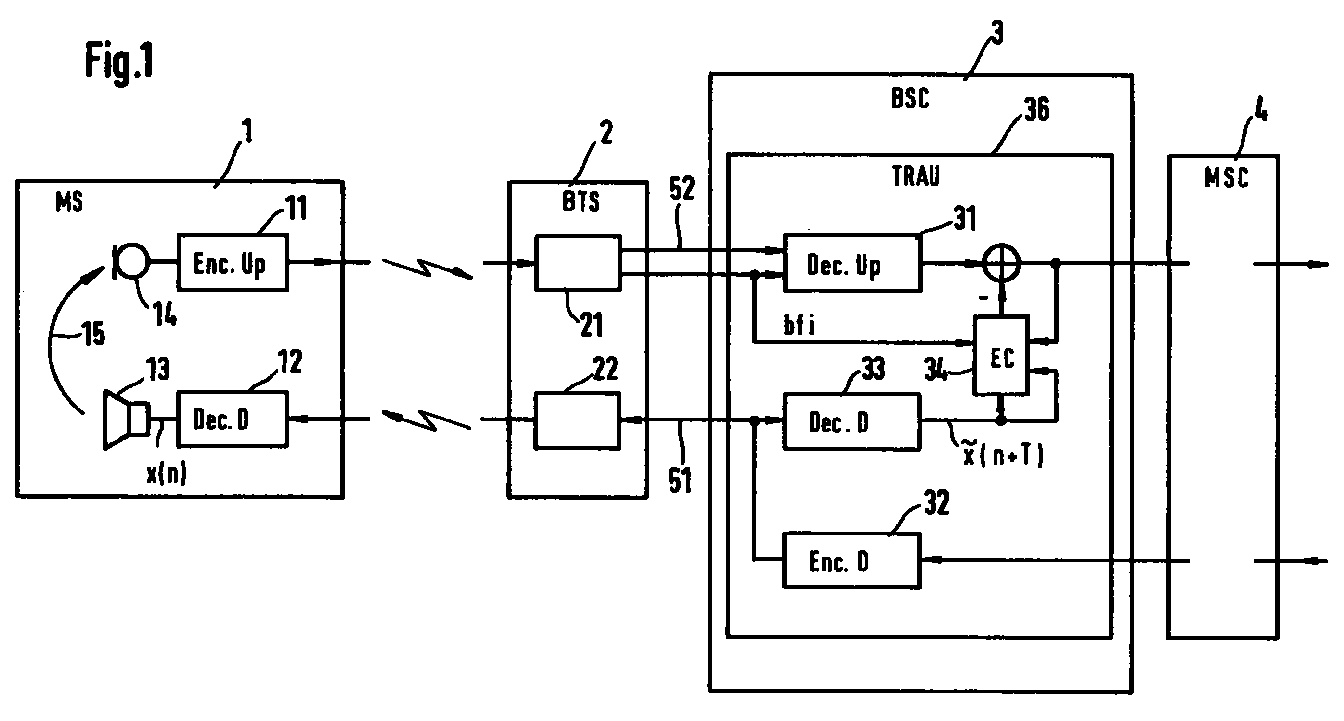
- the MS 1 shows the essential assemblies of a mobile radio system according to the GSM standard. These include a radio telephone 1.
- Mobile station MS a base station 2.
- Base transceiver station BTS a transcoder unit (36).
- Transcoder rate adaptation unit TRAU which is exemplified here in a functional unit 3 for controlling the base stations.
- Base station controller BSC is arranged and a mobile switching center 4, Engl. Mobile Switching Center MSC.
- the MS 1 contains a loudspeaker 13, a microphone 14 and an encoder 11 for the speech in the transmission direction. uplink, as well as a decoder 12 for the speech in the receiving direction. downlink.
- the BTS 2 includes an uplink channel decoder 21 and a downlink channel encoder 22.
- the TRAU 36 contains an uplink decoder 31, a downlink encoder 32 and now additionally an echo canceller 34 and a downlink decoder 33 1, 2 arrangement of the TRAU 36 in the BSC 3, the TRAU 36 can also be arranged between BSC 3 and MSC 4 or in the MSC 4.
- the speaker signal x ( n ) of the MS 1 is generated from the downlink data stream 51 present in the TRAU 36 as the output signal x ⁇ ( n + T ) of the downlink decoder 33, the speaker signal x ( n ) with respect to the output signal x réelles ( n + T ) of the downlink decoder 33 is delayed by the time T.
- the correlatable part of the echo originating from the acoustic coupling 15 between the loudspeaker 13 and the microphone 14 can now be compensated with the echo canceller 34, the echo canceller 34 being realized by an FIR filter.
- the bfi (bad frame indicator) signal already present in TRAU 36 can advantageously be used to improve the adaptation of the FIR filter.
- the calculation of the filter coefficients is interrupted when an uplink channel of poor quality is displayed by the bfi signal.
- an uplink encoder (not shown here), essentially identical in structure to the uplink encoder 11 in the MS 1 .
- the complexity of an encoder is about ten times greater than the complexity of a decoder. It makes sense for a cost-effective solution to model the influence of the non-linearities in the downlink channel and to make the setting of the echo canceller 34 dependent on the bfi signal of the uplink channel.
- Echo cancellation can be further improved if more Quality information, for example on the transmission quality in the downlink channel are available.
- Quality information for example on the transmission quality in the downlink channel are available.
- Such information is in the TRAU 36 available if future GSM-AMR (Adaptive Multi Rate) - Coders and decoders are used.
- GSM-AMR Adaptive Multi Rate
- an echo canceller in the MSC 4 to arrange.
- one for the Obtaining an echo canceller-compatible signal is one Chain connection from a downlink encoder and from a downlink decoder required, therefore a solution that is considerably more complex than is the solution according to the invention.
- the invention provides an inexpensive solution for a Echo compensation at the network level specified in mobile radio networks.
Landscapes
- Engineering & Computer Science (AREA)
- Signal Processing (AREA)
- Cable Transmission Systems, Equalization Of Radio And Reduction Of Echo (AREA)
- Telephone Function (AREA)
- Mobile Radio Communication Systems (AREA)
Abstract
In Festnetzen haben sich Echokompensatoren und Echodämpfungsglieder zur Unterdrückung von akustischen Echos und Leitungsechos bewährt, wenn nämlich Echosignal und beispielsweise das Eingangssignal eines digitalen Filters korrelieren. Um in Netzen, in denen eine Sprachcodierung verwendet wird, wie beispielsweise Mobilfunknetzen, eine vergleichbar gute Sprachqualität wie in Festnetzen zu erreichen, müssen entweder Echokompensationsmaßnahmen im Endgerät, beispielsweise im Funktelefon, vorgesehen sein oder im Mobilfunknetz, wenn nämlich wie in vielen praktischen Fällen die Echokompensation im Funktelefon (1) unzureichend ist.Echo cancellers and echo attenuators are found in fixed networks proven to suppress acoustic echoes and line echoes, if namely an echo signal and, for example, the input signal of a correlate digital filter. To in networks where speech coding a comparable good one is used, such as cellular networks To achieve voice quality as in fixed networks, either Echo compensation measures in the terminal, for example in Radiotelephone, be provided or in the cellular network, namely as in many practical cases, echo cancellation in the radio telephone (1) is insufficient.
Erfindungsgemäß wird aus vorhandenen Signalen (51, 52, bfi) in der
Transcodereinheit (36) und mit bekannten Komponenten (33) des
nichtlinearen Telekommunikationssystems der Einfluß der durch Codierer
(11) und Decodierer (12) hervorgerufenen Nichtlinearitäten im
Übertragungskanal nachgebildet, so daß danach bekannte
Echounterdrückungsmaßnahmen getroffen werden können.
Description
In modernen Telekommunikationssystemen ist die Sprachqualität ein wesentliches Gütemerkmal. Für einen Teilnehmer sind beispielsweise die Sprachverständlichkeit, der Klang, die Natürlichkeit, die Vollständigkeit der Sprachübertragung und die Gegensprechmöglichkeit Merkmale für eine subjektiv empfundene Sprachqualität. Objektiv wird die Übertragungsqualität wesentlich von der Beherrschung störender Echos bestimmt, die durch unerwünschte Kopplung zwischen einem Empfangspfad und einem Sendepfad auftreten und die bei Laufzeiten, die größer als 50 ms sind, als sehr störend empfunden werden. Echos treten beispielsweise durch elektrische Kopplung zwischen dem Sendepfad und dem Empfangspfad als Leitungsechos an 2 Draht-/4 Draht-Übergängen von Gabelschaltungen und/oder durch die akustische Kopplung zwischen Lautsprecher und Mikrofon in einem Funktelefon, besonders wenn beispielsweise eine suboptimale Freisprecheinrichtung vorhanden ist, auf.In modern telecommunication systems the speech quality is one essential quality feature. For a participant, for example Speech intelligibility, the sound, the naturalness, the completeness of the Voice transmission and intercom features for one subjectively perceived speech quality. The objective Transmission quality essentially depends on the control of disturbing echoes determined by unwanted coupling between one Reception path and a transmission path occur and the run times that greater than 50 ms are perceived as very annoying. Echoes occur for example by electrical coupling between the transmission path and the receive path as line echoes on 2 wire / 4 wire transitions of hybrid circuits and / or through the acoustic coupling between Speakers and microphone in a cellular phone, especially when for example, a sub-optimal hands-free device is available.
Es ist bekannt, die Wirkung der Echos durch Echokompensatoren weitgehend zu beseitigen, vgl. R. Wehrmann u.a.: Signalverarbeitungsverfahren zur Verbesserung der Sprachkommunikation über Freisprecheinrichtungen. Der Fernmelde-Ingenieur, Verlag für Wissenschaft und Leben Georg Heidecker GmbH, Erlangen, 48. Jahrgang, Oktober 1994, 10/94 Seite 27-28. Mit einem Echokompensator wird die Übertragungsfunktion eines realen Telekommunikationssystems möglichst genau nachgebildet. Das beim Teilnehmer eintreffende Signal durchläuft dann sowohl das reale als auch das durch den Echokompensator nachgebildete System und anschließend wird das Ausgangssignal des Echokompensators vom echobehafteten Signal des realen Systems subtrahiert, so daß somit das Echo weitgehend kompensiert wird.It is known the effect of the echoes through echo cancellers largely to be eliminated, cf. R. Wehrmann and others: Signal processing method to improve voice communication via hands-free devices. The telecommunications engineer, publisher for Science and Life Georg Heidecker GmbH, Erlangen, 48th year, October 1994, 10/94 pages 27-28. With an echo canceller Transfer function of a real telecommunication system if possible exactly replicated. The signal arriving at the subscriber runs through then both the real and the echo canceller simulated system and then the output signal of the Echo canceller from the echo signal of the real system subtracted so that the echo is thus largely compensated for.
Derartige Echokompensatoren werden mit Finite Impulse Response-Filtern, kurz FIR-Filtern, realisiert, deren Wirkung von der präzisen Bestimmung der Filterkoeffizienten abhängig ist, vgl. DE-A-4430189. So muß sehr zuverlässig unterschieden werden zwischen Echos und lokalen Geräuschen, zwischen Echos von weit entfernten Reflektoren und Echos von nahe befindlichen Reflektoren sowie zwischen Empfangssignalformen, die hinreichend präzise Messungen erlauben, wie beispielsweise hinreichend starke breitbandige Signale und für die Messungen ungeeignete Empfangssignalformen, wie beispielsweise sinusförmige Dauertöne.Such echo cancellers are made with finite impulse response filters, short FIR filters, whose effect depends on the precise determination of the Filter coefficient is dependent, cf. DE-A-4430189. So much must reliably distinguish between echoes and local noises, between echoes from distant reflectors and echoes from near located reflectors and between received waveforms that allow sufficiently precise measurements, such as sufficient strong broadband signals and unsuitable for measurements Receive waveforms such as continuous sinusoidal tones.
Weiterhin sind Schaltungen bekannt, die die Echos so stark bedämpfen, daß sie für einen Teilnehmer nicht mehr wahrnehmbar sind. Dazu wird ein Kompander eingesetzt, mit dem Sendesignale oberhalb eines Sollwertes auf einen einheitlichen Pegel komprimiert soweit sie den Sollwert aufweisen, verstärkt und soweit sie unterhalb des Sollwertes liegen, bedämpft werden. Dabei wird die Übertragungskennlinie des Kompanders außer von einem Kopplungsfaktor zwischen Sendepfad und Empfangspfad und einem vom Geräuschpegel bestimmten Steuersignal vom Empfangssprachsignal des fernen Sprechers gesteuert, vgl. DE-A-196 11548.Circuits are also known which dampen the echoes so much, that they are no longer perceptible to a participant. To do this, a Compander used, with the transmission signals above a setpoint compresses a uniform level as far as they have the setpoint, amplified and as far as they are below the setpoint, dampened. The transmission characteristic of the compander is except one Coupling factor between transmission path and reception path and one of Noise level determined control signal from the received speech signal of the remote speaker controlled, cf. DE-A-196 11548.
Um die Echounterdrückung durch die Verwendung eines Filters zu verbessern, ist es bekannt, zusätzlich zu einem Hauptfilter ein sogenanntes Hintergrundfilter einzusetzen, um die Bestimmung der Filterkoeffiezienten verbessern zu können. Dazu werden die von jedem Filter bewirkten Signaldifferenzen zwischen echobehaftetem Signal und Filterausgangssignal miteinander verglichen und aus dem Vergleichsergebnis wird ein Steuersignal zur verbesserten Einstellung der Filterkoeffizienten abgeleitet, vgl. EP-A-0 872 962.To reduce echo cancellation by using a filter improve, it is known, in addition to a main filter, a so-called Use background filters to determine the filter coefficients to be able to improve. To do this, those caused by each filter Signal differences between an echoed signal and Filter output signal compared and from the The comparison result is a control signal for improved setting of the Filter coefficients derived, cf. EP-A-0 872 962.
Die beschriebenen Lösungen haben sich zwar bei linearen Übertragungsfunktionen bewährt, wenn nämlich Echosignal und Eingangssignal des digitalen Filters korrelieren. Sie sind jedoch für Telekommunikationssysteme mit nichtlinearen Übertragungsstrecken ungeeignet, die immer dann entstehen, wenn sich im Übertragungspfad Verschlüsselungseinrichtung und/oder hoch komprimierende Sprach-Codierer/Decodierer befinden, wie es in Mobilfunksystemen nach dem GSM (Global System for Mobile Communication) -Standard oder dem AMPS (Advanced Mobile Phone System) -Standard der Fall ist. Um in Mobilfunknetzen eine vergleichbar gute Sprachqualität wie in Festnetzen zu erreichen, müssen auch dort Maßnahmen zur Echokompensation oder Echounterdrückung durchgeführt werden. Dazu können zwar bekannte Lösungen direkt in den Endgeräten der mobilen Teilnehmer eingesetzt werden, es gibt jedoch eine beträchtliche Anzahl von im Einsatz befindlichen Endgeräten, in denen keine oder wenig wirksame Echokompensationsmaßnahmen oder Echodämpfungsmaßnahmen vorgesehen sind und eine Nachrüstung derartiger Maßnahmen einen unvertretbar hohen Aufwand bedeuten würde, so daß nur Maßnahmen im Netz selbst getroffen werden können.The solutions described have been found to be linear Proven transfer functions, namely when echo signal and Correlate the input signal of the digital filter. However, they are for Telecommunication systems with non-linear transmission links unsuitable, which always arise when there is in the transmission path Encryption device and / or high compression speech encoder / decoder are, as it is in mobile radio systems after GSM (Global System for Mobile Communication) standard or the AMPS (Advanced Mobile Phone System) standard is the case. To in Mobile networks have a voice quality comparable to that in fixed networks must achieve measures for echo cancellation or Echo cancellation can be performed. Well-known Solutions used directly in the mobile devices' end devices However, there are a significant number of them in use located devices in which no or little effective Echo cancellation measures or echo attenuation measures are provided and a retrofit of such measures would mean unacceptably high effort, so that only measures in Network itself can be taken.
Daraus resultiert die Aufgabe, ein Verfahren und eine Schaltungsanordnung zur Echokompensation in einem nichtlinearen Telekommunikationssystem, insbesondere in einem Mobilfunksystem nach dem GSM-Standard, anzugeben.This results in the task, one procedure and one Circuit arrangement for echo compensation in a non-linear Telecommunications system, in particular in a mobile radio system the GSM standard.
Diese Aufgabe wird in einem im ersten Patentanspruch beschriebenen Verfahren und mit einer im vierten Patentanspruch beschriebenen Schaltungsanordnung gelöst.This object is described in one in the first claim Method and with one described in the fourth claim Circuit arrangement solved.
Das Wesen der Erfindung besteht darin, daß aus dem Festnetz bekannte Echokompensationsschaltungen mit nichtlinearen Schaltungen aus einem Telekommunikationsnetz mit Sprachcodiereinrichtungen zur Nachbildung des Echopfades kombiniert und dort vorhandene Signale zur Steuerung verwendet werden.The essence of the invention is that known from the fixed network Echo cancellation circuits with nonlinear circuits from one Telecommunications network with speech coding devices for replication of the echo path combined and there existing signals for control be used.
Die Erfindung wird nunmehr an einem Ausführungsbeispiel erläutert. In der dazugehörigen Zeichnung zeigen
- Fig. 1
- ein Blockschaltbild einer ersten Variante der erfindungsgemäßen Schaltungsanordnung und
- Fig. 2
- ein Blockschaltbild einer zweiten Variante der erfindungsgemäßen Schaltungsanordnung.
- Fig. 1
- a block diagram of a first variant of the circuit arrangement according to the invention and
- Fig. 2
- a block diagram of a second variant of the circuit arrangement according to the invention.
In Fig. 1 sind die wesentlichen Baugruppen eines Mobilfunksystems nach
dem GSM-Standard dargestellt. Dazu gehören ein Funktelefon 1, engl.
Mobile Station MS, eine Basisstation 2, engl. Base Transceiver Station BTS,
eine Transcodereinheit (36), engl. Transcoder Rate Adaption Unit TRAU, die
hier beispielhaft in einer Funktionseinheit 3 zur Steuerung der Basistationen,
engl. Base Station Controller BSC, angeordnet ist und eine
Mobilvermittlungsstelle 4, engl. Mobile Switching Centre MSC. Im
folgenden werden die Baugruppen mit ihren englischsprachigen
Abkürzungen bezeichnet. Die MS 1 enthält einen Lautsprecher 13, ein
Mikrofon 14 und einen Codierer 11 für die Sprache in Senderichtung, engl.
uplink, sowie einen Decodierer 12 für die Sprache in Empfangsrichtung,
engl. downlink. Zu der BTS 2 gehört ein uplink-Kanaldecodierer 21 und ein
downlink-Kanalcodierer 22. In der TRAU 36 befinden sich ein uplink-Decodierer
31, ein downlink-Codierer 32 und nunmehr zusätzlich ein
Echokompensator 34 und ein downlink-Decodierer 33. Abweichend von
der in Fig.1, 2 dargestellten Anordnung der TRAU 36 in der BSC 3 kann die
TRAU 36 auch zwischen BSC 3 und MSC 4 oder in der MSC 4 angeordnet
sein. Mit dem downlink-Decodierer 33 wird aus dem in der TRAU 36
vorhandenen downlink-Datenstrom 51 das Lautsprechersignal x(n) der MS
1 als Ausgangssignal x ∼ (n + T) des downlink-Decodierers 33 erzeugt, wobei
das Lautsprechersignal x(n) bezüglich des Ausgangssignals x ∼(n+T) des
downlink-Decodierers 33 um die Zeit T verzögert ist. Mit diesem
Ausgangssignal x ∼(n+T) kann nunmehr der korrelierbare Teil des von der
akustischen Kopplung 15 zwischen Lautsprecher 13 und Mikrofon 14
herrührenden Echos mit dem Echokompensator 34 kompensiert werden,
wobei der Echokompensator 34 durch ein FIR-Filter realisiert werden kann.
Vorteilhafterweise kann das ohnehin in der TRAU 36 vorhandene bfi (bad
frame indicator)-Signal zur Verbesserung der Adaption des FIR-Filters
verwendet werden. So wird die Berechnung der Filterkoeffizienten
beispielsweise unterbrochen, wenn von dem bfi-Signal ein uplink-Kanal
schlechter Qualität angezeigt wird. Ausgehend von dem uplink-Datenstrom
52 ist es möglich, mit einem hier nicht dargestellten uplink-Codierer, im
Aufbau im wesentlichen gleich dem uplink-Codierer 11 in der MS 1, den
Einfluß der Nichtlinearitäten in dem uplink-Kanal nachzubilden und die
Echokompensation zu verfeinern. Allerdings ist zu berücksichtigen, daß die
Komplexität eines Codierers etwa zehnmal größer ist als die Komplexität
eines Decodierers. So ist es für eine kostengünstige Lösung sinnvoll, den
Einfluß der Nichtlinearitäten im downlink-Kanal zu modellieren und die
Einstellung des Echokompensators 34 von dem bfi-Signal des uplink-Kanals
abhängig zu machen.1 shows the essential assemblies of a mobile radio system according to the GSM standard. These include a radio telephone 1. Mobile station MS, a
Die beschriebenen Vorteile werden in gleicher Weise bei Verwendung eines
Kompanders, der in der eingangs zitierten Schrift DE-A- 196 115 48
beschrieben ist, oder bei Verwendung der Kombination aus einem
Kompander mit einem FIR-Filter wirksam. In Fig. 2 ist die
Schaltungsanordnung bei Verwendung eines solchen
Echodämpfungsgliedes 35 dargestellt. Auch in diesem Fall ist es möglich,
die Nichtlinearitäten des uplink-Kanals mit bekannten Schaltungen und
vorhandenen Signalen zu modellieren.The advantages described are the same when using a
Kompanders, who in the initially cited document DE-A-196 115 48
is described, or when using the combination of a
Compander with an FIR filter effective. 2 is the
Circuit arrangement when using one
Die Echokompensation kann weiter verbessert werden, wenn weitere Qualitätsinformationen, beispielsweise zur Übertragungsqualität im downlink-Kanal zur Verfügung stehen. Derartige Informationen sind in der TRAU 36 vorhanden, wenn zukünftig GSM-AMR (Adaptive Multi Rate) - Codierer und -Decodierer eingesetzt werden.Echo cancellation can be further improved if more Quality information, for example on the transmission quality in the downlink channel are available. Such information is in the TRAU 36 available if future GSM-AMR (Adaptive Multi Rate) - Coders and decoders are used.
Grundsätzlich ist es auch möglich, einen Echokompensator im MSC 4 anzuordnen. Um hier die Nichtlinearitäten nachzubilden, um ein für den Echokompensator korrelierfähiges Signal zu erhalten, ist eine Kettenschaltung aus einem downlink-Codierer und aus einem downlink-Decodierer erforderlich, somit eine Lösung, die beträchtlich aufwendiger als die erfindungsgemäße Lösung ist.In principle, it is also possible to use an echo canceller in the MSC 4 to arrange. In order to simulate the nonlinearities here, one for the Obtaining an echo canceller-compatible signal is one Chain connection from a downlink encoder and from a downlink decoder required, therefore a solution that is considerably more complex than is the solution according to the invention.
Insgesamt wird mit der Erfindung eine kostengünstige Lösung für eine Echokompensation auf Netzebene in Mobilfunknetzen angegeben.Overall, the invention provides an inexpensive solution for a Echo compensation at the network level specified in mobile radio networks.
Claims (6)
dadurch gekennzeichnet, daß
eine Einrichtung zur Unterdrückung des Echos (34, 35) in der Transcodereinheit (36) angeordnet wird und eine Nachbildung des nichtlinearen Anteils des Echopfades mit in dem Telekommunikationssystem vorhandenen Funktionseinheiten vorgenommen wird.Method for suppressing an echo, caused by acoustic or electrical couplings between the transmission paths in a telecommunications system with non-linear transmission sections comprising a speech encoder and a speech decoder, in particular in a mobile radio system, which comprises a mobile station (1), a base station (2), a transcoder unit ( 36) and a functional unit for controlling the base station (3) and a mobile switching center (4),
characterized in that
a device for suppressing the echo (34, 35) is arranged in the transcoder unit (36) and the non-linear part of the echo path is simulated with functional units present in the telecommunication system.
Applications Claiming Priority (2)
| Application Number | Priority Date | Filing Date | Title |
|---|---|---|---|
| DE19928045 | 1999-06-18 | ||
| DE1999128045 DE19928045A1 (en) | 1999-06-18 | 1999-06-18 | Echo compensation of telecommunications system with non-linear transmission paths involves mounting suppression device in transcoder, emulating echo path non-linear component |
Publications (2)
| Publication Number | Publication Date |
|---|---|
| EP1069752A2 true EP1069752A2 (en) | 2001-01-17 |
| EP1069752A3 EP1069752A3 (en) | 2003-08-20 |
Family
ID=7911792
Family Applications (1)
| Application Number | Title | Priority Date | Filing Date |
|---|---|---|---|
| EP00440178A Withdrawn EP1069752A3 (en) | 1999-06-18 | 2000-06-16 | Method and circuit for echo cancellation in a telecommunication system with non linear transmission paths |
Country Status (5)
| Country | Link |
|---|---|
| EP (1) | EP1069752A3 (en) |
| JP (1) | JP2001036438A (en) |
| CN (1) | CN1278699A (en) |
| AU (1) | AU3785100A (en) |
| DE (1) | DE19928045A1 (en) |
Cited By (1)
| Publication number | Priority date | Publication date | Assignee | Title |
|---|---|---|---|---|
| WO2005032180A1 (en) * | 2003-09-22 | 2005-04-07 | Siemens Aktiengesellschaft | Telecommunication arrangement and method for signalling the deactivation of voice signal processing devices (echo- and noise-suppression) between a mobile station and a radio communication network |
Families Citing this family (1)
| Publication number | Priority date | Publication date | Assignee | Title |
|---|---|---|---|---|
| DE10137150B4 (en) * | 2001-07-30 | 2007-01-04 | Infineon Technologies Ag | Line driver for data transmission |
Family Cites Families (6)
| Publication number | Priority date | Publication date | Assignee | Title |
|---|---|---|---|---|
| EP0177239A3 (en) * | 1984-10-01 | 1987-06-03 | AT&T Corp. | Adaptive filter including signal path compensation |
| JP2794999B2 (en) * | 1991-08-14 | 1998-09-10 | 国際電信電話株式会社 | Echo cancellation method |
| DE4430189A1 (en) * | 1994-08-25 | 1996-02-29 | Sel Alcatel Ag | Adaptive echo cancellation method |
| US5790632A (en) * | 1994-09-30 | 1998-08-04 | Qualcom Incorporated | Method and apparatus for echo canceling accounting for companding induced quantization error |
| DE19611548A1 (en) * | 1996-03-23 | 1997-09-25 | Sel Alcatel Ag | Method and circuit arrangement for improving the transmission properties of an echo transmission line in a telecommunications network |
| US5835486A (en) * | 1996-07-11 | 1998-11-10 | Dsc/Celcore, Inc. | Multi-channel transcoder rate adapter having low delay and integral echo cancellation |
-
1999
- 1999-06-18 DE DE1999128045 patent/DE19928045A1/en not_active Withdrawn
-
2000
- 2000-06-01 AU AU37851/00A patent/AU3785100A/en not_active Abandoned
- 2000-06-05 JP JP2000167039A patent/JP2001036438A/en not_active Withdrawn
- 2000-06-16 EP EP00440178A patent/EP1069752A3/en not_active Withdrawn
- 2000-06-16 CN CN 00118611 patent/CN1278699A/en active Pending
Cited By (1)
| Publication number | Priority date | Publication date | Assignee | Title |
|---|---|---|---|---|
| WO2005032180A1 (en) * | 2003-09-22 | 2005-04-07 | Siemens Aktiengesellschaft | Telecommunication arrangement and method for signalling the deactivation of voice signal processing devices (echo- and noise-suppression) between a mobile station and a radio communication network |
Also Published As
| Publication number | Publication date |
|---|---|
| DE19928045A1 (en) | 2000-12-28 |
| CN1278699A (en) | 2001-01-03 |
| JP2001036438A (en) | 2001-02-09 |
| AU3785100A (en) | 2000-12-21 |
| EP1069752A3 (en) | 2003-08-20 |
Similar Documents
| Publication | Publication Date | Title |
|---|---|---|
| DE69633936T2 (en) | SUPPRESSION OF AN ACOUSTIC ECHO IN A DIGITAL MOBILE COMMUNICATION SYSTEM | |
| DE69728262T2 (en) | ECHOUNTERPRINTER AND NONLINEINE PROCESSOR OF AN ECHO COMPENSATOR | |
| DE68919807T2 (en) | Full duplex digital speakerphone. | |
| DE69132861T2 (en) | Voice signal improvement in a telephone network | |
| DE69129497T2 (en) | RESET Echo Cancellation | |
| DE60029147T2 (en) | QUALITY IMPROVEMENT OF AUDIO SIGNAL IN A DIGITAL NETWORK | |
| DE69324002T2 (en) | DEVICE FOR ESTIMATING THE FEEDBACK LEVEL BETWEEN SPEAKER AND MICROPHONE | |
| CN101262530B (en) | A device for eliminating echo of mobile terminal | |
| DE69636570T2 (en) | Echo cancellation and cancellation | |
| EP1255398A2 (en) | Method for masking noise and noise modulation reduction during speech transmission | |
| DE19848588B4 (en) | Nonlinear processor for acoustic echo cancellers | |
| DE19935808A1 (en) | Echo suppression device for suppressing echoes in a transmitter / receiver unit | |
| DE60220995T2 (en) | NETWORK ECHOUNTERPRESSION IN MOBILE STATIONS | |
| EP0797339B1 (en) | Method and circuit for improving the transmission properties of a transmission link subjected to echo in a telecommunication network | |
| DE10000009A1 (en) | Echo signal reduction-correction procedure for telecommunication network, involves detecting quality values of each terminal based on which countermeasures for echo reduction is estimated | |
| EP0843455B1 (en) | Method and apparatus for adaptive echo cancellation | |
| WO2004059962A1 (en) | Echo suppression for compressed speech, comprising only partial transcoding of the uplink user data stream | |
| DE2856789A1 (en) | ECHO CANCELLATION CIRCUIT | |
| DE19848641B4 (en) | Double-talk-insensitive NLMS algorithm | |
| DE19600965C2 (en) | Mobile telephone device | |
| DE19928045A1 (en) | Echo compensation of telecommunications system with non-linear transmission paths involves mounting suppression device in transcoder, emulating echo path non-linear component | |
| EP0949767A2 (en) | Multichannel echo canceller with compander | |
| Ayad et al. | Optimization of a noise reduction preprocessing in an acoustic echo and noise controller | |
| DE3510352C1 (en) | Intercom transmission device | |
| Jeannes et al. | How to reduce the noise influence in a joint system developed for echo and noise cancellation |
Legal Events
| Date | Code | Title | Description |
|---|---|---|---|
| PUAI | Public reference made under article 153(3) epc to a published international application that has entered the european phase |
Free format text: ORIGINAL CODE: 0009012 |
|
| AK | Designated contracting states |
Kind code of ref document: A2 Designated state(s): AT BE CH CY DE DK ES FI FR GB GR IE IT LI LU MC NL PT SE |
|
| AX | Request for extension of the european patent |
Free format text: AL;LT;LV;MK;RO;SI |
|
| PUAL | Search report despatched |
Free format text: ORIGINAL CODE: 0009013 |
|
| AK | Designated contracting states |
Designated state(s): AT BE CH CY DE DK ES FI FR GB GR IE IT LI LU MC NL PT SE |
|
| AX | Request for extension of the european patent |
Extension state: AL LT LV MK RO SI |
|
| AKX | Designation fees paid |
Designated state(s): AT BE CH CY DE DK ES FI FR GB GR IE IT LI LU MC NL PT SE |
|
| STAA | Information on the status of an ep patent application or granted ep patent |
Free format text: STATUS: THE APPLICATION IS DEEMED TO BE WITHDRAWN |
|
| 18D | Application deemed to be withdrawn |
Effective date: 20040102 |