EP1069719A2 - Optical system - Google Patents
Optical system Download PDFInfo
- Publication number
- EP1069719A2 EP1069719A2 EP00305996A EP00305996A EP1069719A2 EP 1069719 A2 EP1069719 A2 EP 1069719A2 EP 00305996 A EP00305996 A EP 00305996A EP 00305996 A EP00305996 A EP 00305996A EP 1069719 A2 EP1069719 A2 EP 1069719A2
- Authority
- EP
- European Patent Office
- Prior art keywords
- adm
- optical
- tributary
- communications system
- node
- Prior art date
- Legal status (The legal status is an assumption and is not a legal conclusion. Google has not performed a legal analysis and makes no representation as to the accuracy of the status listed.)
- Ceased
Links
Images


Classifications
-
- H—ELECTRICITY
- H04—ELECTRIC COMMUNICATION TECHNIQUE
- H04J—MULTIPLEX COMMUNICATION
- H04J14/00—Optical multiplex systems
- H04J14/08—Time-division multiplex systems
-
- H—ELECTRICITY
- H04—ELECTRIC COMMUNICATION TECHNIQUE
- H04J—MULTIPLEX COMMUNICATION
- H04J14/00—Optical multiplex systems
- H04J14/02—Wavelength-division multiplex systems
- H04J14/0201—Add-and-drop multiplexing
- H04J14/0202—Arrangements therefor
- H04J14/0213—Groups of channels or wave bands arrangements
-
- H—ELECTRICITY
- H04—ELECTRIC COMMUNICATION TECHNIQUE
- H04J—MULTIPLEX COMMUNICATION
- H04J14/00—Optical multiplex systems
- H04J14/02—Wavelength-division multiplex systems
- H04J14/0201—Add-and-drop multiplexing
- H04J14/0215—Architecture aspects
- H04J14/0219—Modular or upgradable architectures
-
- H—ELECTRICITY
- H04—ELECTRIC COMMUNICATION TECHNIQUE
- H04J—MULTIPLEX COMMUNICATION
- H04J14/00—Optical multiplex systems
- H04J14/02—Wavelength-division multiplex systems
- H04J14/0201—Add-and-drop multiplexing
- H04J14/0215—Architecture aspects
- H04J14/022—For interconnection of WDM optical networks
Definitions
- the present invention relates to the field of wavelength multiplexed optical communications systems and, in particular, to systems for the switching of traffic between different wavelength multiplexed channels.
- optical communications systems are a substantial and fast-growing constituent of communications networks.
- optical communications system relates to any system that uses optical signals to convey information across an optical medium.
- optical systems include, but are not limited to, telecommunications systems, cable television systems, local, metropolitan and wide area networks (LANs, MANs and WANs).
- LANs, MANs and WANs local, metropolitan and wide area networks
- Optical systems are described in Gowar, Ed. Optical Communications Systems, (Prentice Hall, New York).
- the majority of optical communication systems are configured to carry a single optical channel in a relatively broad wavelength spectral band over an optical path consisting of one, or a series of, optical guides.
- To convey increased quantities of information e.g.
- wavelength division multiplexing WDM
- WDM wavelength division multiplexing
- optical guide is used to describe any suitable optical medium, including optical fibres and optical waveguides.
- WDM is usually used in combination with established time division multiplexing (TDM) techniques. Hence each WDM channel will typically be used for the transport of a plurality of different messages multiplexed together in the time domain.
- An add-drop multiplexer (ADM) provides a low cost means for accessing all or a part of the TDM traffic forming a data stream passing along a communications link, such as an optical guide. The traffic passing through the ADM does so via "line ports". Data or messages passing along the communications link are selectively time demultiplexed by switching circuitry in the ADM and passed via so-called tributary ports to their destination.
- the ADM includes photo-detectors and laser signal generators.
- optical communications networks are made up of rings or meshes comprising electrical repeater/ regenerator/ add/drop electronics linked together by means of optical communications links. These links typically comprise optical fibre.
- the nodes include a laser-based transmitter (electrical to optical converter) and a broad optical-band receiver (optical to electrical converter).
- WDM is currently becoming established for long haul line systems but has not penetrated the feeder network
- a 'feeder network' connects and gathers and consolidates traffic from users and delivers it to the MANs, WANs and LANs e.g. the Access network could be a 'feeder network'.
- the feeder network is made up of electronic nodes incorporating some switching capability, normally in the form of an electronic ADM.
- these nodes are designed to handle digital traffic according to the SDH or SONET telecommunications standard protocols but also increasingly ATM and IP protocols are becoming established.
- the node and path capacities are increased by upgrading these regions to handle higher rate TDM signals e.g. 155Mbit/s SDH and SONET standards (STM-1) are used widely and 622Mbit/s (STM-4), 2.4Gbit/s (STM-16) and 10 Gbit/s (STM-64), are used where necessary.
- a single fibre may be used to handle multiple WDM channels so that the net capacity of the segments is enhanced - means to achieve this are described in co-pending patent application (File No P/62000) in the name of Marconi Communications.
- the present invention provides an optical communications system for communication of a plurality of wavelength multiplexed channels; in which the communications system comprises a node; in which the a node comprises a plurality of add drop multiplex (ADM) means, one per channel; in which each ADM means comprises tributary means; in which the ADMs are interconnected by the tributary means.
- ADM add drop multiplex
- the present invention also provides a method for switching individual time division multiplexed messages between wavelength multiplexed channels of a optical communications system, comprising the steps of arranging switch means comprising a plurality of add drop multiplex (ADM) means, one per wavelength multiplex channel; in which each ADM means comprises tributary means, the method comprising the steps of interconnecting the ADMs means via the tributary means.
- ADM add drop multiplex
- the present invention also provides a method for switching individual time division multiplexed messages between a plurality of streams of time division multiplexed data; in which each stream of time division multiplexed data is comprised in a channel of a wavelength multiplexed optical communications system, the method comprising the steps of providing a node; providing the node with a plurality of add drop multiplex (ADM) means, one per wavelength multiplex channel; providing each ADM means with tributary means and interconnecting the ADM means via the tributary means.
- ADM add drop multiplex
- the present invention also provides a means for switching individual messages between a plurality of streams of time division multiplexed (TDM) data in a wavelength multiplexed optical communications system, the system for communication of a plurality of wavelength multiplexed channels; in which each channel comprises one of the streams of TDM data; in which the means comprises switch means; in which the switch means comprises a plurality of add drop multiplex (ADM) means, one per channel; in which each ADM means comprises tributary means; in which the ADMs are interconnected by the tributary means.
- TDM time division multiplexed
- FIG 1 shows a WDM optical communications system of the prior art comprising an optical communications path, e.g. an optical fibre comprising sections 2, 3, 4, ... where successive sections of fibre are joined by switch means 10, 30, m.
- Each switch means comprises a plurality of add-drop multiplexers 11, 12, ...1n; 31, 32, ...3n; m1, m2, ...mn; each ADM provided with a plurality of add-drop tributaries 31, 32,... 3n (see Figure 2).
- the WDM optical path 2, 3, 4, ... carries several optical channels by WDM, i.e. in which each channel occupies a different part of the spectrum.
- each of switch means 10, 30, ...m comprises an optical demultiplexer 25.
- Optical demultiplexer 25 separates each of the WDM channels received over the WDM optical path 2, 3, 4 ...into a different one of individual optical guides 21, 22, ...2n.
- Each one of individual optical guides 21, 22, ...2n feeds into a different one of ADMs 11, 12, ... 1n (in the case of switching node 10) where appropriate add/drop functions are performed, as described above.
- Each of switching nodes 10, 30, ...m also comprises an optical multiplexer 26.
- Optical multiplexer 26 re-multiplexes the outputs of each one of ADM's 11,12,...1n back into optical path 2, 3, 4...
- a source of a message 121 (see Figure 1) is in communication with an ADM that is connected to a first one of the optical channels, say the ⁇ 1 channel, and the intended destination m14 is connected to a switching node m that does not receive the ⁇ 1 channel, but only the ⁇ 2 , ⁇ 3 and ⁇ 4 channels. This even though all four channels, ⁇ 1 , ⁇ 2 ⁇ 3 and ⁇ 4 run through the same optical guide for part of their lengths.
- a colourising transponder which is capable of receiving a signal on the ⁇ 1 channel and transmitting it on the ⁇ 2 channel en bloc.
- a transponder comprises a photo detector sensitive in a wave band that includes ⁇ 1 (but may include all WDM wavelengths) and a high precision laser that transmits accurately in the ⁇ 2 waveband.
- Such transponders are expensive and their use results in the entire content of the ⁇ 1 channel being transferred to the ⁇ 2 channel whereas, typically, only a single message may need to be so transferred requiring an additional switching function to select the correct message for transfer between channels. This is what is currently done in the PMA8 photonic multiplexer from Marconi Communications. A need is now developing that was not apparent previously for an economical way to switch with fine granularity between WDM optical channels.
- FIG 3 shows a part of a switching node according to the present invention.
- the ADMs 11, 12, ...1n of switching node 10 are shown in more detail.
- the tributary connections 31, 32, 3n associated with each ADM are shown separated into two sub-groups.
- a first sub-group 311, 312, 313 from first ADM 11 are taken to the next ADM 12, thus allowing interchange of demultiplexed messages there-between.
- a second sub-group 310 from first ADM 11 function as before to communicate demultiplexed messages to users and to input messages from users to the ADM for multiplexing.
- each ADM is arranged to pass on messages received from an adjacent ADM via the tributary connections but intended for another ADM further along the "daisy chain” until that destination ADM is reached.
- the ADM On receiving a message via the tributary connections that is intended for a channel handled by that ADM, the ADM will remultiplex it into the message stream for that channel in a similar way to messages received from users via conventional tributary inputs.
- the switch node of Figure 3 advantageously allows messages from a first WDM channel to be converted to the electrical domain, demultiplexed using the conventional ADM circuitry and to be passed in its demultiplexed, electrical state to a selected other one of the ADMs of that switch node where it is multiplexed into the data stream of a second WDM channel using the conventional ADM circuitry and converted back into the optical domain in the appropriate waveband for the second WDM channel.
- messages of any level of granularity handled by the ADMs may be switched in this way.
- FIG. 3 shows a "daisy chain" interconnection of the ADMs of a node
- other interconnection patterns may be used according to preferred embodiments of the present invention, including a full mesh or partial, "nearest neighbours" mesh or ring.
- This interconnection may be implemented within a node in such a way that effective interconnectivity can be achieved in an incremental fashion as the equipping of a node progresses to accommodate increased traffic demand, e.g. by adding extra ADMs to a node as and when required.
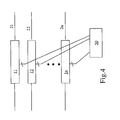
- the relevant tributaries could be interconnected via a separate switch unit 50 designed to provide the required switch connections and capacity.
- switch unit 50 is non-blocking.
- Non Blocking means that any connection from a first input I i to a first output O j cannot prevent any other connection from a different input I p to a different output O q being completed.
- Switch 50 could also be incrementally upgradable. This new switch element may be managed within an enhanced network management system.
- switch 50 may provide optical matrix switching to switch messages between interconnected tributaries, according to a further embodiment.
Landscapes
- Engineering & Computer Science (AREA)
- Computer Networks & Wireless Communication (AREA)
- Signal Processing (AREA)
- Optical Communication System (AREA)
- Use Of Switch Circuits For Exchanges And Methods Of Control Of Multiplex Exchanges (AREA)
- Time-Division Multiplex Systems (AREA)
- Small-Scale Networks (AREA)
Abstract
Description
Claims (22)
- An optical communications system for communication of a plurality of wavelength multiplexed channels; in which the communications system comprises a node; (10, 30,m) in which the node comprises a plurality of add drop multiplex (ADM) means (11, 12. . In) one per channel; in which each ADM means comprises tributary means; (310, 311, 312, 313, 320, 321, 322, 323, 3(n-1) 1, 3 (n-1) 2, 3 (n-1) 3, 3n) in which the ADMs are interconnected by the tributary means.
- The communications system as claimed in Claim 1 comprising a single optical guide (2, 3) for transmission of the plurality of wavelength multiplexed channels.
- The communications system as claimed in Claim 1 comprising a plurality of optical guides (21, 22, 2n) for transmission of the plurality of wavelength multiplexed channels between the first node of Claim 1 and an adjacent node.
- The communications system as claimed in any above claim in which the tributary means interconnect the ADM means in the form of a daisy chain.
- The communications system as claimed in any one of Claims 1 to 3 in which the tributary means interconnect the ADM means in the form of a mesh.
- The communications system as claimed in any one of Claims 1 to 3 in which the tributary means interconnect the ADM means in the form of a ring.
- The communications system as claimed in any one of Claims 1 to 3 comprising electrical non-blocking switch means for interconnecting the ADM means.
- The communications system as claimed in any above claim in which the tributary means comprise electrical to optical converter means , optical guide means and optical to electrical converter means for interconnecting the ADM means.
- The communications system as claimed Claim 8 in which the tributary means comprise optical switch means for interconnecting the ADM means.
- A method for switching individual time division multiplexed messages between wavelength multiplexed channels of a optical communications system, comprising the steps of arranging switch means comprising a plurality of add drop multiplex (ADM) means, one per wavelength multiplex channel; in which each ADM means comprises tributary means, the method comprising the step of interconnecting the ADMs means via the tributary mean
- A method for switching individual time division multiplexed messages between a plurality of streams of time division multiplexed data; in which each stream of time division multiplexed data is comprised in a channel of a wavelength multiplexed optical communications system, the method comprising the steps of providing a node; providing the node with a plurality of add drop multiplex (ADM) means, one per wavelength multiplex channel; providing each ADM means with tributary means and interconnecting the ADM means via the tributary means.
- A means for switching individual messages between a plurality of streams of time division multiplexed (TDM) data in a wavelength multiplexed optical communications system, the system for communication of a plurality of wavelength multiplexed channels; in which each channel comprises one of the streams of TDM data; in which the means comprises switch means; in which the switch means comprises a plurality of add drop multiplex (ADM) means, one per channel; in which each ADM means comprises tributary means; in which the ADMs are interconnected by the tributary means.
- The means as claimed in Claim 12 comprising a single optical guide for transmission of the plurality of wavelength multiplexed channels.
- The means as claimed in Claim 12 comprising a plurality of optical guides for transmission of the plurality of wavelength multiplexed channels between the first node of Claim 12 and an adjacent node.
- The means as claimed in any one of Claims 12 to 14 in which the tributary means interconnect the ADM means in the form of a daisy chain.
- The means as claimed in any one of Claims 12 to 14 in which the tributary means interconnect the ADM means in the form of a ring.
- The means as claimed in any one of Claims 12 to 14 in which the tributary means interconnect the ADM means in the form of a mesh.
- The means as claimed in any one of Claims 12 to 14 comprising electrical non-blocking switch means for interconnecting the ADM means.
- The means as claimed in any one of Claims 12 to 18 in which the tributary means comprise electrical to optical converter means, optical guide means and optical to electrical converter means for interconnecting the ADM means.
- The means as claimed Claim 19 in which the tributary means comprise optical switch means for interconnecting the ADM means.
- A means for switching individual messages between a plurality of streams of TDM data substantially as described with reference to and as illustrated in Figure 3 or 4 of the drawings.
- An optical communications system comprising the means of any one of Claim 12 to 21
Applications Claiming Priority (2)
| Application Number | Priority Date | Filing Date | Title |
|---|---|---|---|
| GB9916578A GB2352105B (en) | 1999-07-15 | 1999-07-15 | Optical system |
| GB9916578 | 1999-07-15 |
Publications (2)
| Publication Number | Publication Date |
|---|---|
| EP1069719A2 true EP1069719A2 (en) | 2001-01-17 |
| EP1069719A3 EP1069719A3 (en) | 2005-10-12 |
Family
ID=10857270
Family Applications (1)
| Application Number | Title | Priority Date | Filing Date |
|---|---|---|---|
| EP00305996A Ceased EP1069719A3 (en) | 1999-07-15 | 2000-07-14 | Optical system |
Country Status (8)
| Country | Link |
|---|---|
| US (1) | US6519061B1 (en) |
| EP (1) | EP1069719A3 (en) |
| JP (1) | JP4408542B2 (en) |
| CN (1) | CN1236578C (en) |
| AU (1) | AU4862100A (en) |
| GB (1) | GB2352105B (en) |
| NO (1) | NO20003611L (en) |
| RU (1) | RU2000118730A (en) |
Cited By (4)
| Publication number | Priority date | Publication date | Assignee | Title |
|---|---|---|---|---|
| WO2002071668A1 (en) * | 2001-03-06 | 2002-09-12 | Redfern Broadband Networks, Inc. | Optical traffic grooming |
| WO2003024010A1 (en) * | 2001-09-07 | 2003-03-20 | Redfern Broadband Networks, Inc. | Wdm network node module |
| KR20030028613A (en) * | 2001-09-20 | 2003-04-10 | 엘지전자 주식회사 | Optimum method for number of wavelength and add/drop multiplexer in wavelength-division multiplexing network |
| US6731830B2 (en) | 2001-01-05 | 2004-05-04 | Redfern Broadband Networks, Inc. | Asymmetric compatible network element |
Families Citing this family (3)
| Publication number | Priority date | Publication date | Assignee | Title |
|---|---|---|---|---|
| JP2001285322A (en) * | 2000-03-28 | 2001-10-12 | Fujitsu Ltd | Inter-LAN communication device and inter-LAN communication network using the same |
| KR100689503B1 (en) * | 2004-12-30 | 2007-03-02 | 삼성전자주식회사 | Wavelength Division Multiplexing Passive Optical Subscriber Network |
| JP2009267786A (en) | 2008-04-25 | 2009-11-12 | Nec Corp | Communication device, communication system and communication method |
Family Cites Families (9)
| Publication number | Priority date | Publication date | Assignee | Title |
|---|---|---|---|---|
| JP3117018B2 (en) * | 1990-10-29 | 2000-12-11 | 株式会社日立製作所 | Network equipment |
| IT1257543B (en) * | 1992-05-26 | 1996-01-30 | Cselt Centro Studi Lab Telecom | OPTICAL DEMULTIPLATION SYSTEM. |
| FR2715015B1 (en) * | 1994-01-07 | 1996-02-02 | Auffret Rene | Method and device for transmitting and routing packets in an optical network. |
| US5475679A (en) * | 1994-12-08 | 1995-12-12 | Northern Telecom Limited | Large capacity ATM switch |
| FR2735931B1 (en) * | 1995-06-21 | 1997-07-25 | Hamel Andre | RECONFIGURABLE DEVICE FOR WAVELENGTH INSERTION-EXTRACTION |
| AU4799897A (en) * | 1996-10-10 | 1998-05-05 | Tyco Submarine Systems Ltd. | Method and apparatus for combining add/drop optical signal lines from a plural ity of branching units |
| US5867289A (en) * | 1996-12-24 | 1999-02-02 | International Business Machines Corporation | Fault detection for all-optical add-drop multiplexer |
| EP0876018A3 (en) * | 1997-02-21 | 2004-05-26 | Siemens Aktiengesellschaft | Method and circuit for data transmission in a ringnet |
| EP0914015B1 (en) * | 1997-10-28 | 2006-12-20 | Nec Corporation | Optical add-drop multiplexer |
-
1999
- 1999-07-15 GB GB9916578A patent/GB2352105B/en not_active Expired - Lifetime
- 1999-09-08 US US09/391,758 patent/US6519061B1/en not_active Expired - Lifetime
-
2000
- 2000-07-13 NO NO20003611A patent/NO20003611L/en unknown
- 2000-07-14 EP EP00305996A patent/EP1069719A3/en not_active Ceased
- 2000-07-14 AU AU48621/00A patent/AU4862100A/en not_active Abandoned
- 2000-07-14 RU RU2000118730/09A patent/RU2000118730A/en not_active Application Discontinuation
- 2000-07-15 CN CNB001189921A patent/CN1236578C/en not_active Expired - Fee Related
- 2000-07-17 JP JP2000250335A patent/JP4408542B2/en not_active Expired - Lifetime
Cited By (4)
| Publication number | Priority date | Publication date | Assignee | Title |
|---|---|---|---|---|
| US6731830B2 (en) | 2001-01-05 | 2004-05-04 | Redfern Broadband Networks, Inc. | Asymmetric compatible network element |
| WO2002071668A1 (en) * | 2001-03-06 | 2002-09-12 | Redfern Broadband Networks, Inc. | Optical traffic grooming |
| WO2003024010A1 (en) * | 2001-09-07 | 2003-03-20 | Redfern Broadband Networks, Inc. | Wdm network node module |
| KR20030028613A (en) * | 2001-09-20 | 2003-04-10 | 엘지전자 주식회사 | Optimum method for number of wavelength and add/drop multiplexer in wavelength-division multiplexing network |
Also Published As
| Publication number | Publication date |
|---|---|
| GB2352105B (en) | 2001-09-26 |
| HK1032695A1 (en) | 2001-07-27 |
| NO20003611L (en) | 2001-01-16 |
| JP4408542B2 (en) | 2010-02-03 |
| CN1236578C (en) | 2006-01-11 |
| NO20003611D0 (en) | 2000-07-13 |
| RU2000118730A (en) | 2002-07-27 |
| US6519061B1 (en) | 2003-02-11 |
| AU4862100A (en) | 2001-01-18 |
| EP1069719A3 (en) | 2005-10-12 |
| CN1291833A (en) | 2001-04-18 |
| GB9916578D0 (en) | 1999-09-15 |
| JP2001218240A (en) | 2001-08-10 |
| GB2352105A (en) | 2001-01-17 |
Similar Documents
| Publication | Publication Date | Title |
|---|---|---|
| US6486988B1 (en) | Upgrading optical communications systems without traffic interruption | |
| EP1635489B1 (en) | Optical wavelength multiplex access system and optical network unit | |
| JP3008260B2 (en) | Ring network communication structure of optical transmission line and reconfigurable node for that structure | |
| EP0981870B1 (en) | Optical add/drop device | |
| US6205158B1 (en) | Network architectures with transparent transport capabilities | |
| US6198721B1 (en) | Method and system for data transmission in a ring network | |
| CN100361434C (en) | Optical Clock Signal Distribution System in WDM Network | |
| US5583855A (en) | Add/drop multiplexer apparatus | |
| EP1715610B1 (en) | Method and system for increasing a number of information channels carried by optical waveguides | |
| WO2002047307A1 (en) | Wdm optical communication network with data bridging plural optical channels between optical waveguides | |
| KR20030070903A (en) | Bidirectional wdm optical communication network with data bridging plural optical channels between bidirectional optical waveguides | |
| US6519061B1 (en) | Traffic switching between different wavelength multiplexed channels in optical communications systems | |
| EP1055298B1 (en) | Optical telecommunications network | |
| EP0977394A2 (en) | Bidirectional ring networks implemented on a single fiber | |
| US5694499A (en) | Optical crossconnect | |
| US7043159B1 (en) | Bidirectional optical networks | |
| US6493118B1 (en) | Add/drop capability for ultra-high speed dense wavelength division multiplexed systems using a wavelength bus architecture | |
| US6738579B2 (en) | Synchronous digital communications system | |
| EP1267587A2 (en) | Communications network | |
| KR101542217B1 (en) | Arrangement and method for converting wavelengths for bi-directional wavelength division multiplexing | |
| US7389017B2 (en) | Dense wavelength division multiplexing on coarse wavelength division multiplexing networks | |
| CA2261448C (en) | Network architectures with transparent transport capabilities | |
| KR20140070693A (en) | Method for communication using single optical communication line, remote node and ring network for the same |
Legal Events
| Date | Code | Title | Description |
|---|---|---|---|
| PUAI | Public reference made under article 153(3) epc to a published international application that has entered the european phase |
Free format text: ORIGINAL CODE: 0009012 |
|
| AK | Designated contracting states |
Kind code of ref document: A2 Designated state(s): AT BE CH CY DE DK ES FI FR GB GR IE IT LI LU MC NL PT SE |
|
| AX | Request for extension of the european patent |
Free format text: AL;LT;LV;MK;RO;SI |
|
| RAP1 | Party data changed (applicant data changed or rights of an application transferred) |
Owner name: MARCONI UK INTELLECTUAL PROPERTY LTD |
|
| PUAL | Search report despatched |
Free format text: ORIGINAL CODE: 0009013 |
|
| AK | Designated contracting states |
Kind code of ref document: A3 Designated state(s): AT BE CH CY DE DK ES FI FR GB GR IE IT LI LU MC NL PT SE |
|
| AX | Request for extension of the european patent |
Extension state: AL LT LV MK RO SI |
|
| 17P | Request for examination filed |
Effective date: 20060316 |
|
| AKX | Designation fees paid |
Designated state(s): AT BE CH CY DE DK ES FI FR GB GR IE IT LI LU MC NL PT SE |
|
| RAP1 | Party data changed (applicant data changed or rights of an application transferred) |
Owner name: M(DGP1) LTD |
|
| RAP1 | Party data changed (applicant data changed or rights of an application transferred) |
Owner name: ERICSSON AB |
|
| RAP1 | Party data changed (applicant data changed or rights of an application transferred) |
Owner name: ERICSSON AB |
|
| 17Q | First examination report despatched |
Effective date: 20071004 |
|
| RAP1 | Party data changed (applicant data changed or rights of an application transferred) |
Owner name: ERICSSON AB |
|
| STAA | Information on the status of an ep patent application or granted ep patent |
Free format text: STATUS: THE APPLICATION HAS BEEN REFUSED |
|
| 18R | Application refused |
Effective date: 20111109 |