EP1069498B1 - Apparatus for solving system of equations on finite field and apparatus for inverting element of extension field - Google Patents
Apparatus for solving system of equations on finite field and apparatus for inverting element of extension field Download PDFInfo
- Publication number
- EP1069498B1 EP1069498B1 EP00305405A EP00305405A EP1069498B1 EP 1069498 B1 EP1069498 B1 EP 1069498B1 EP 00305405 A EP00305405 A EP 00305405A EP 00305405 A EP00305405 A EP 00305405A EP 1069498 B1 EP1069498 B1 EP 1069498B1
- Authority
- EP
- European Patent Office
- Prior art keywords
- equation
- mod
- coefficient
- linear equations
- inverse
- Prior art date
- Legal status (The legal status is an assumption and is not a legal conclusion. Google has not performed a legal analysis and makes no representation as to the accuracy of the status listed.)
- Expired - Lifetime
Links
Images


Classifications
-
- G—PHYSICS
- G06—COMPUTING OR CALCULATING; COUNTING
- G06F—ELECTRIC DIGITAL DATA PROCESSING
- G06F7/00—Methods or arrangements for processing data by operating upon the order or content of the data handled
- G06F7/60—Methods or arrangements for performing computations using a digital non-denominational number representation, i.e. number representation without radix; Computing devices using combinations of denominational and non-denominational quantity representations, e.g. using difunction pulse trains, STEELE computers, phase computers
- G06F7/72—Methods or arrangements for performing computations using a digital non-denominational number representation, i.e. number representation without radix; Computing devices using combinations of denominational and non-denominational quantity representations, e.g. using difunction pulse trains, STEELE computers, phase computers using residue arithmetic
- G06F7/724—Finite field arithmetic
- G06F7/726—Inversion; Reciprocal calculation; Division of elements of a finite field
-
- G—PHYSICS
- G06—COMPUTING OR CALCULATING; COUNTING
- G06F—ELECTRIC DIGITAL DATA PROCESSING
- G06F17/00—Digital computing or data processing equipment or methods, specially adapted for specific functions
- G06F17/10—Complex mathematical operations
- G06F17/11—Complex mathematical operations for solving equations, e.g. nonlinear equations, general mathematical optimization problems
- G06F17/12—Simultaneous equations, e.g. systems of linear equations
Definitions
- the present invention relates to cryptographic and error correction techniques for information security, and in particular relates to computation techniques which use extension fields and systems of equations.
- Secret communication techniques allow communication to be performed without the communicated content being revealed to third parties.
- Digital signature techniques enable the recipient to verify whether the communicated content is valid or whether the information is from the stated sender.
- Such secret communication or digital signature techniques use a cryptosystem called public key cryptography.
- Public key cryptography provides a convenient method for managing the separate encryption keys of many users, and so has become a fundamental technique for performing communication with a large number of users.
- the elliptic curve discrete logarithm problem is the following.
- GF(q) is an extension field of a finite field GF(p) .
- a device 310 used by a user A (hereafter, "user A 310"), a management center 320, and a device 330 used by a user B (hereafter, “user B 330”) are connected via a network.
- p be a prime
- q p n
- n be a positive integer
- E be an elliptic curve over a finite field GF(q) , with G being a base point of E and r being the order of G .
- the management center 320 announces the finite field GF(q) , the elliptic curve E , and the base point G as system parameters, and reveals the public key Y A of the user A 310 to the user B 330 (S3, S4).
- the user A 310 sends the message m and the signature (R 1 ,s) to the user B 330 (S8).
- Elliptic curve exponentiation in the 2-tuple coordinate is known to involve inverse operations on the finite field GF(q) .
- Document 1 makes brief mention of a 3-tuple coordinate called projective coordinate.
- 2-tuple coordinates can be transformed into corresponding 3-tuple coordinates as shown by x 1 ⁇ y 1 ⁇ x 1 ⁇ y 1 ⁇ 1
- Elliptic curve exponentiation in the 3-tuple coordinate involves no inverse operations on the finite field GF(q) . Since inverting a finite field element generally takes considerable computation time, the 3-tuple coordinate is often used in elliptic curve exponentiation.
- step S6 in Fig. 9 for instance, after 2-tuple coordinates are transformed into 3-tuple coordinates, elliptic curve exponentiation is performed on the 3-tuple coordinates, and the resulting 3-tuple coordinates are transformed into corresponding 2-tuple coordinates. Inversion is needed in this transformation of the 3-tuple coordinates to the 2-tuple coordinates.
- Gaussian elimination A conventional method for solving a system of equations on the basic field GF(p) is described below. This method is called Gaussian elimination.
- Gaussian elimination For details on Gaussian elimination, see K. Mizugami (1985), Mathematical Calculations by Computers, Introduction to Programming Series, Asakura Shoten, pp.76-82 (hereafter "document 2").
- the matrix M and the vector v are triangular transformed so as to put the matrix M into upper triangular form, as a result of which a matrix M' and a vector v' are generated.
- the triangular transformation is such a transformation that changes all elements beneath the diagonal elements of a matrix to 0 , and such a transformed matrix is called an upper triangular matrix.
- counter j is set at 1 (S21).
- counter i is set at j+1 (S25).
- the matrix M' is a matrix whose diagonal elements are all 1 and whose elements beneath the diagonal elements are all 0 .
- n-1, ... , 1, 0 are set one by one in counter c in this order.
- GCD Greatest Common Divisor
- the constant vector 312 is also transformed into a constant vector 322, as a result of which a system of equations shown in Fig. 11(c) is obtained.
- the coefficient matrix 321 is transformed into a coefficient matrix 331 so that the element in the second column and row becomes 1 , and the constant vector 322 is transformed into a constant vector 332.
- the coefficient matrix 331 is transformed into a coefficient matrix 341 so that the elements in the second column and third to fifth rows become 0
- the constant vector 332 is transformed into a constant vector 342.
- a system of equations shown in Fig. 11(e) is obtained.
- the element in the third column and row is converted to 1 in a coefficient matrix 351 in Fig. 11(f), and the elements in the third column and fourth to fifth rows are converted to 0 in a coefficient matrix 361 in Fig. 11(g).
- the element in the fourth column and row is converted to 1 in a coefficient matrix 371 in Fig. 11(h), and the element in the fourth column and fifth row is converted to 0 in a coefficient matrix 381 in Fig. 11(i).
- the element in the fifth column and row is converted to 1 in a coefficient matrix 391 in Fig. 11(j).
- the coefficient matrix 301 is transformed into the upper triangular matrix 391.
- computational complexity of one multiplication on a basic field is measured as 1Mul and computational complexity of one inversion on the basic field is measured as 1Inv .
- step 1 in the prior art 3 computational complexity for one value of counter j can be broken down as follows.
- step 2 in the prior art 3 is as follows.
- an inverse of an element in an extension field can be computed by solving a system of equations on a finite field. Nevertheless, given that computational complexity of inversion needed in solving the system of equations is generally large, there still remains the demand to further reduce computational complexity of solving a system of equations on a finite field, and to thereby reduce computational complexity of inverting an extension field element.
- the present invention aims to provide an apparatus, method, and storage medium storing a program for solving a system of equations on a finite field with reduced computational complexity, an apparatus, method, and storage medium storing a program for inverting an element in an extension field with reduced computational complexity, and a communication system and a record medium reproducing apparatus that utilize these apparatuses and methods.
- each transformation process may have transformation subprocesses each for transforming a separate one of the object equations, wherein in each transformation subprocess the triangular transforming unit (a) chooses a nonzero coefficient from the pivotal equation and sets the chosen nonzero coefficient into the first coefficient group, (b) chooses a nonzero coefficient from the object equation, multiplies each of a constant and n coefficients in the pivotal equation by the nonzero coefficient chosen from the object equation, and sets n+1 values obtained by the multiplications into the second coefficient group, (c) changes the chosen nonzero coefficient in the object equation to 0 , and (d) multiplies each of a constant and n coefficients in the object equation by the nonzero coefficient in the first coefficient group, and subtracts the n+1 values in the second coefficient group respectively from the n+1 multiplication results.
- each transformation process may have a coefficient group calculation process and transformation subprocesses, performed following the coefficient group calculation process, each for transforming a separate one of the object equations, wherein in the coefficient group calculation process the triangular transforming unit (a) chooses m nonzero coefficients by taking one nonzero coefficient from each of the pivotal equation and the object equations, multiplies each combination of ( m-1 ) of the chosen nonzero coefficients, and sets the m multiplication results into the first coefficient group, m being a positive integer no smaller than 2 , and (b) multiplies each of a constant and n coefficients in the pivotal equation by a multiplication result in the first coefficient group for a combination of nonzero coefficients that does not include a nonzero coefficient chosen from the pivotal equation, and sets n+1 values obtained by the multiplications into the second coefficient group, and wherein in each of the transformation subprocesses following the coefficient group calculation process, the triangular transforming unit (a) changes a nonzero coefficient chosen from the object
- the diagonal element inverting unit may include
- the record medium reproducing apparatus can compute the inverse of the extension field element with reduced computational complexity.
- the inversion apparatus 100 is roughly made up of a parameter storing unit 200, an equation generating unit 201, an equation solving unit 202, an inverse computing unit 203, and an inverse storing unit 204.
- the inversion apparatus 100 is implemented by a computer system equipped with a microprocessor, a ROM, a RAM, a hard disk, and the like. Through execution of a computer program stored in the hard disk by the microprocessor, the equation generating unit 201, the equation solving unit 202, and the inverse computing unit 203 are realized.
- the parameter storing unit 200 is implemented by the hard disk.
- the parameter ⁇ of the generator polynomial, the root ⁇ , and the elements x 0 , x 1 , ... , x n-1 are stored in the parameter storing unit 200 beforehand.
- the parameters of the system of equations generated by the equation generating unit 201 are the matrix A and the vector B .
- the equation generating unit 201 outputs the generated matrix A and vector B to the equation solving unit 202.
- the equation generating unit 201 also outputs ⁇ read from the parameter storing unit 200, to the inverse computing unit 203.
- the equation solving unit 202 includes a constant storing unit 101, an equation transforming unit 102, an inverting unit 103, and an equation computing unit 104, as shown in Fig. 1.
- the constant storing unit 101 is implemented by the RAM.
- the constant storing unit 101 receives a matrix M and a vector v from the equation generating unit 201 and stores them.
- the matrix M is the matrix A and the vector v is the vector B .
- the equation transforming unit 102 transforms the matrix M into an upper triangular matrix without changing each diagonal element of the matrix M to 1 .
- the equation transforming unit 102 In each transformation process, the equation transforming unit 102 generates, from a system of linear equations in n unknowns, a coefficient matrix and a constant vector for a system of linear equations in n unknowns that is equivalent to the system of linear equations before the transformation.
- a system of linear equations in n unknowns before the transformation includes one linear equation as a pivotal equation serving as the transformation pivot and one or more linear equations as object equations to be transformed.
- Each transformation process has transformation subprocesses as many as the object equations in the system of linear equations, each for transforming a separate one of the object equations to an equation equivalent to the object equation.
- a first coefficient group and a second coefficient group are defined in each transformation subprocess.
- the first and second coefficient groups are each a group that contains at least one value related to the pivotal equation.
- the equation transforming unit 102 sets one nonzero coefficient of the pivotal equation into the first coefficient group. Also, the equation transforming unit 102 multiplies each of a constant and n coefficients of the pivotal equation by one nonzero coefficient of the object equation, and sets n+1 values obtained as a result into the second coefficient group.
- the equation transforming unit 102 changes the nonzero coefficient of the object equation to 0 .
- the equation transforming unit 102 then multiplies each of a constant and n coefficients of the object equation by the value in the first coefficient group, and subtracts the n+1 values in the second coefficient group respectively from the n+1 multiplication results. In so doing, the object equation is transformed into the equivalent equation where one of its nonzero coefficients has become 0 .
- the difference with the conventional triangular transformation lies in that the diagonal elements of the matrix M are not converted to 1 .
- the inverse computing unit 203 writes the calculated inverse I into the inverse storing unit 204.
- the inverse storing unit 204 is implemented by the hard disk and stores the inverse I of the element x of the extension field GF(q) .
- the equation generating unit 201 outputs the generated matrix A and vector B to the constant storing unit 101 in the equation solving unit 202, and outputs the root ⁇ to the inverse computing unit 203 (S101).
- the equation transforming unit 102 reads the matrix M and the vector v from the constant storing unit 101 (S111), and sets counter j at 1 (S112).
- the equation transforming unit 102 searches the j th column of the matrix M from the j th to nth rows for an element which is not 0 on GF(p) , and sets the row number of a nonzero element found first as k (S113).
- k k ⁇ j (S114)
- the equation transforming unit 102 changes places between the k th row and the j th row in the matrix M (S115), and changes places between the k th row and the j th row in the vector v (S116).
- this triangular transformation includes transformation processes which correspond to the separate values of counter j , and each of the transformation processes includes transformation subprocesses which correspond to the separate values of counter i .
- M in and v in be a matrix and a vector before the transformation
- M out and V out be a matrix and a vector after the transformation
- L i and L j be the i th and j th row vectors of the matrix M in .
- the equation transforming unit 102 calculates a jj ⁇ L i - a ij ⁇ L j and, having set the resulting row vector as the ith row of the matrix M out , calculates a jj ⁇ b i - a ij ⁇ b j the outcome of which is set as the i th row of the vector v out .
- the matrix can be triangular transformed without the solutions of the system of linear equations being altered.
- step S118 computational complexity for one value of counter i (step S118) is broken down as shown below.
- the computational complexity of the inverting unit 103 can be broken down as follows.
- the computational complexity of the equation solving unit 202 of the invention is much smaller than that of the prior art.
- Such an equation solving unit bears huge practical value, as it enables an apparatus to solve a system of equations on a finite field with reduced computational complexity.
- such an equation solving unit enables an apparatus to compute an inverse I of an element x in an extension field GF(q) of a predetermined finite field GF(p) with reduced computational complexity.
- each transformation process has one coefficient group calculation process and subsequent transformation subprocesses as many as object equations, each for transforming a separate one of the object equations.
- the equation transforming unit 102a chooses m nonzero coefficients by taking one nonzero coefficient from each of the pivotal equation and the object equations in the coefficient matrix consisting of n rows and n columns, multiplies each combination of (m-1) of the chosen nonzero coefficients, and sets the m multiplication results into a first coefficient group.
- the equation transforming unit 102a then multiplies each of a constant and n coefficients of the pivotal equation by the multiplication result in the first coefficient group for a combination of nonzero coefficients that does not include the nonzero coefficient of the pivotal equation, and sets n+1 values obtained as a result into a second coefficient group.
- the equation transforming unit 102a changes a nonzero coefficient chosen from an object equation to 0 , multiplies each of a constant and n coefficients of the object equation by the multiplication result in the first coefficient group for a combination of nonzero coefficients that does not include the nonzero coefficient of the object equation, and subtracts the n+1 values in the second coefficient group respectively from the n+1 multiplication results.
- step S118c for one value of counter i , computational complexity is as follows.
Landscapes
- Engineering & Computer Science (AREA)
- Physics & Mathematics (AREA)
- General Physics & Mathematics (AREA)
- Computational Mathematics (AREA)
- Mathematical Analysis (AREA)
- Mathematical Optimization (AREA)
- Mathematical Physics (AREA)
- Pure & Applied Mathematics (AREA)
- Theoretical Computer Science (AREA)
- General Engineering & Computer Science (AREA)
- Data Mining & Analysis (AREA)
- Operations Research (AREA)
- Software Systems (AREA)
- Databases & Information Systems (AREA)
- Algebra (AREA)
- Computing Systems (AREA)
- Complex Calculations (AREA)
Description
- This application is based on applications
Nos. 11-203055 2000-140886 - The present invention relates to cryptographic and error correction techniques for information security, and in particular relates to computation techniques which use extension fields and systems of equations.
- Secret communication or digital signature techniques have increasingly been used in data communication in recent years.
- Secret communication techniques allow communication to be performed without the communicated content being revealed to third parties. Digital signature techniques, meanwhile, enable the recipient to verify whether the communicated content is valid or whether the information is from the stated sender. Such secret communication or digital signature techniques use a cryptosystem called public key cryptography. Public key cryptography provides a convenient method for managing the separate encryption keys of many users, and so has become a fundamental technique for performing communication with a large number of users.
- In the public key cryptography, different keys are used for encryption and decryption, with the decryption key being kept secret and the encryption key being made public. Here, one of the founding principles for the security of public key cryptography is the so-called discrete logarithm problem. Representative examples of the discrete logarithm problem are problems based on finite fields and problems based on elliptic curves. Such problems are described in detail in Neal Koblitz (1987), A Course in Number Theory and Cryptography, Springer-Verlag.
- The elliptic curve discrete logarithm problem is the following.
- Let E be an elliptic curve defined over a finite field GF(q) (q=pn, p a prime, n a positive integer), with a point G on the elliptic curve E, given when the order of E is divisible by a large prime, being set as a base point. This being so, the problem is to find an integer x such that

where Y is a given point on E, if such an integer x exists. - In this specification, the operator * represents elliptic curve exponentiation, so that x*G means G is added to itself x times on E. Also, GF(q) is an extension field of a finite field GF(p). For details about extension fields, see T. Okamoto & H. Yamamoto (1997), Modern Encryption, Mathematics of Information Sciences Series, Sangyo Tosho, pp.26-28.
- The ElGamal signature scheme using the elliptic curve discrete logarithm problem is described below with reference to Fig. 9.
- In the figure, a
device 310 used by a user A (hereafter, "user A 310"), amanagement center 320, and adevice 330 used by a user B (hereafter, "user B 330") are connected via a network. - Let p be a prime, q=pn, n be a positive integer, and E be an elliptic curve over a finite field GF(q), with G being a base point of E and r being the order of G. Which is to say, r is the smallest positive integer that satisfies
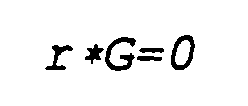
where 0 is the zero element in the additive group on the elliptic curve E. - First, the
management center 320 generates a public key YA of theuser A 310 using the user A's secret key xA which has been informed beforehand, according to the equation
(S1, S2). - The
management center 320 announces the finite field GF(q), the elliptic curve E, and the base point G as system parameters, and reveals the public key YA of theuser A 310 to the user B 330 (S3, S4). - The
user A 310 generates a random number k (S5), calculates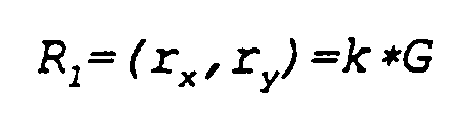
(S6), and finds s satisfying
(S7) where m is a message to be sent from theuser A 310 to theuser B 330. - The user A 310 sends the message m and the signature (R1,s) to the user B 330 (S8).
- The
user B 330 verifies the authenticity of theuser A 310 by judging whether
is true (S9). - This equation is derived from


- In this ElGamal digital signature scheme using the elliptic curve discrete logarithm problem, elliptic curve exponentiation is repeatedly performed to generate the public key and the signature and to verify the signature.
- For details on elliptic curve exponentiation, see "Efficient Elliptic Curve Exponentiation" in Miyaji, Ono & Cohen (1997), Advances in Cryptology-Proceedings of ICICS'97, Lecture Notes in Computer Science, Springer-Verlag, pp.282-290 (hereafter "
document 1"). - Let an elliptic curve be defined by an equation of the
form 
with some point P on the elliptic curve being represented by 2-tuple coordinates (x1,y1) called affine coordinates. - Elliptic curve exponentiation in the 2-tuple coordinate is known to involve inverse operations on the finite field GF(q).
-
Document 1 makes brief mention of a 3-tuple coordinate called projective coordinate. 2-tuple coordinates can be transformed into corresponding 3-tuple coordinates as shown by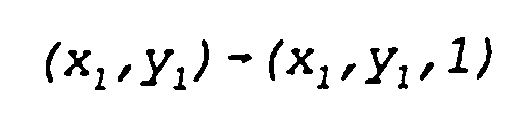
- Elliptic curve exponentiation in the 3-tuple coordinate involves no inverse operations on the finite field GF(q). Since inverting a finite field element generally takes considerable computation time, the 3-tuple coordinate is often used in elliptic curve exponentiation.
- However, when transforming 3-tuple coordinates into corresponding 2-tuple coordinates as shown by

inversion on the finite field GF(q) is necessary. - In step S6 in Fig. 9, for instance, after 2-tuple coordinates are transformed into 3-tuple coordinates, elliptic curve exponentiation is performed on the 3-tuple coordinates, and the resulting 3-tuple coordinates are transformed into corresponding 2-tuple coordinates. Inversion is needed in this transformation of the 3-tuple coordinates to the 2-tuple coordinates.
- A conventional inverse operation on an extension field GF(q) (q=pn, p a prime, n a positive integer) is performed in the following way.
- For simplicity's sake, a generator polynomial of the extension field GF(q) is set as f(g)=gn-β whose root is α, and an element of GF(q) to be inputted in the generator polynomial is set as

- Based on the element x of GF(q), a system of equations for yi (i=0,1,...,n-1)

is formed. - The solutions yk (k=0,1,...,n-1) of the system of equations are sought.
- From the solutions yk (k=0,1,...,n-1), the inverse

is calculated. Hence the inverse of the element x in the extension field GF(q) is obtained. - The validity of this inverse operation is shown below.
- If the inverse I and the element x satisfy the relationship

then

and also
- Accordingly,

which can be rearranged in ascending order of power of α into
- From this equation and the relationship xI=1, the system of equations in
step 1 is derived. - Therefore, calculating an inverse in the extension field GF(q) is equivalent to solving a system of equations on the basic field GF(p).
- Though the foregoing example uses the generator polynomial of the form gn-β for simplicity's sake, a system of equations can be formed by the same procedure for a generator polynomial of ordinary form.
- A conventional method for solving a system of equations on the basic field GF(p) is described below. This method is called Gaussian elimination. For details on Gaussian elimination, see K. Mizugami (1985), Mathematical Calculations by Computers, Introduction to Programming Series, Asakura Shoten, pp.76-82 (hereafter "
document 2"). - A system of equations for xk (k=0,1,2,...,n-1)

is solved by Gaussian elimination in the following manner. (Step 1) - A matrix M and a vector v are given respectively as


- Meanwhile, a vector X is given as

- Then the above system of equations can be simply written as

- The matrix M and the vector v are triangular transformed so as to put the matrix M into upper triangular form, as a result of which a matrix M' and a vector v' are generated. Here, the triangular transformation is such a transformation that changes all elements beneath the diagonal elements of a matrix to 0, and such a transformed matrix is called an upper triangular matrix.
- The procedure of this conventional triangular transformation is explained below with reference to Fig. 10.
- First, counter j is set at 1 (S21). Next, the inverse Ij of ajj is computed (S22), 1 is assigned to ajj (S23), and ajk =ajk ×Ij and bj=bj×Ij are set for j+1≤k≤n (S24). Then counter i is set at j+1 (S25).
- Following this, 0 is assigned to aij (S26), aik=aix-ajj×ajk is set for j+1≤k≤n (S27), and also bi=bi-aij×bj is set (S28). Then it is judged whether i=n (S29). If i≠n, counter i is incremented by 1 (S31) and the procedure returns to step S26. If i=n, it is judged whether j=n (S30). If j≠n, counter j is incremented by 1 and the procedure returns to step S22. If j=n, the procedure ends.
- As a result, the matrix M' and the vector v' are obtained. The matrix M' is a matrix whose diagonal elements are all 1 and whose elements beneath the diagonal elements are all 0.
- The system of equations M'X=v' and the system of equations MX=v have an equivalence relation.
- Let the matrix M' and the vector v' be written respectively as

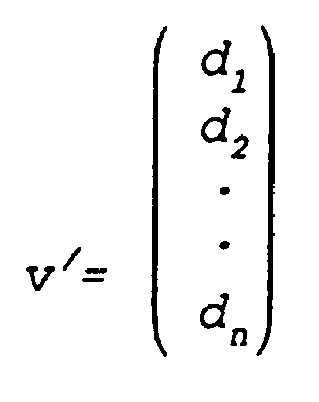
- The system of equations M'X=v' is solved using the generated matrix M' and vector v', in the following way.
- The values n-1, ... , 1, 0 are set one by one in counter c in this order. For counter c,

is calculated when c=n-1, and
is calculated when c≠n-1. - A concrete example of applying the
prior art 3 is presented below. - Note that this example is provided here only for facilitating the understanding of the triangular transformation, and is not an example of practical use in cryptographic communication or digital signature systems.
- When a prime p=31, a generator polynomial f(g)=g5-2, and an element x=5α4+29α3+6α2+19α+17 of GF(q) are given, the calculations


lead to a system of equations shown in Fig. 11(a), where acoefficient matrix 301 consists of 5 rows and 5 columns and aconstant vector 302 consists of 5 elements. - In the system of equations in Fig. 11(a), a
linear equation 
is called a pivotal equation that serves as the pivot of transformation, and the other linear equations are called object equations that are to be transformed. - First, the
inverse operation 
is performed, and then


are calculated. As a result, the system of equations is transformed as shown in Fig. 11(b), where the element in the first column and row has become 1 in acoefficient matrix 311. The elements enclosed with the boxes in thecoefficient matrix 311 andconstant vector 312 in Fig. 11(b) are those which have changed from thecoefficient matrix 301 andconstant vector 302 in Fig. 11(a). The same goes for the rest of Fig. 11. - Here, the above
inverse operation 1/17 mod 31 =11 is carried out by first seeking a which satisfies
by means of the extended GCD (Greatest Common Divisor), and then setting a as the inversion result. - In general, the extended GCD takes considerable computational complexity, as it involves repeated multiplications and additions. For details on the extended GCD, see H. Cohen (1996) "A Course in Computational Algebraic Number Theory" in Graduate Texts in Mathematics 138, Springer-Verlag, pp.16-19.
- Next,


are calculated to convert the element in the first column and second row in thecoefficient matrix 311 to 0, and in a like manner the elements in the first column and third to fifth rows in thecoefficient matrix 311 are converted to 0, thereby transforming thecoefficient matrix 311 in Fig. 11(b) into acoefficient matrix 321 shown in Fig. 11(c). Theconstant vector 312 is also transformed into aconstant vector 322, as a result of which a system of equations shown in Fig. 11(c) is obtained. - Next, the
coefficient matrix 321 is transformed into acoefficient matrix 331 so that the element in the second column and row becomes 1, and theconstant vector 322 is transformed into aconstant vector 332. Hence a system of equations shown in Fig. 11(d) is obtained. Further, thecoefficient matrix 331 is transformed into acoefficient matrix 341 so that the elements in the second column and third to fifth rows become 0, and theconstant vector 332 is transformed into aconstant vector 342. Hence a system of equations shown in Fig. 11(e) is obtained. - Likewise, the element in the third column and row is converted to 1 in a
coefficient matrix 351 in Fig. 11(f), and the elements in the third column and fourth to fifth rows are converted to 0 in acoefficient matrix 361 in Fig. 11(g). After this, the element in the fourth column and row is converted to 1 in acoefficient matrix 371 in Fig. 11(h), and the element in the fourth column and fifth row is converted to 0 in acoefficient matrix 381 in Fig. 11(i). Lastly, the element in the fifth column and row is converted to 1 in acoefficient matrix 391 in Fig. 11(j). - Thus, the
coefficient matrix 301 is transformed into the uppertriangular matrix 391. - Following this,


are computed. - The total computational complexity of the
prior art 3 is evaluated below. Here, computational complexity of one multiplication on a basic field is measured as 1Mul and computational complexity of one inversion on the basic field is measured as 1Inv. - In
step 1 in theprior art 3, computational complexity for one value of counter j can be broken down as follows. - (a) Step S22 involves one inversion, so that computational complexity is 1Inv.
- (b) Step S24 involves ((n-(j+1)+1)+1)=(n-j+1) multiplications, so that computational complexity is (n-j+1)Mul.
- (c) For one value of counter i, step S27 involves (n-(j+1)+1) multiplications and so computational complexity is (n-j)Mul (c1), and step S28 involves one multiplication and so computational complexity is 1Mul (c2). Since counter i changes from j+1 to n, (c1) and (c2) are repeated (n-(j+1)+1)=(n-j) times, which makes the computational complexity of for all values of counter c at ((n-j)(n-j+1))Mul.
- Summing (a), (b), and (c) together results in computational complexity of ((n-j+1)(n-j+1)Mul+1Inv.
- Since counter j changes from 1 to n, the total computational complexity of
step 1 is
- On the other hand, computational complexity of
step 2 in theprior art 3 is as follows. - For one value of counter c, (n-(c+1)+1)=(n-c) multiplications are necessary, so that computational complexity is (n-c)Mul.
- Since counter c changes from 1 to n, the total computational complexity of
step 2 is
- Therefore, the overall computational complexity of the
prior art 3 is
- It is known that in a general-purpose computer 1Inv=40Mul when n=5 and |q|=160 (|q| is the bit size of q). Accordingly, the overall computational complexity of the
prior art 3 is 265Mul. - A prior art method and apparatus are described in Hocher et al. "Systolic Gaussian Elimination over GF(p) with partial pivoting", IEEE Trans. on Comp. 38, 9/89, p1321-4.
- As described above, an inverse of an element in an extension field can be computed by solving a system of equations on a finite field. Nevertheless, given that computational complexity of inversion needed in solving the system of equations is generally large, there still remains the demand to further reduce computational complexity of solving a system of equations on a finite field, and to thereby reduce computational complexity of inverting an extension field element.
- In view of the stated demand, the present invention aims to provide an apparatus, method, and storage medium storing a program for solving a system of equations on a finite field with reduced computational complexity, an apparatus, method, and storage medium storing a program for inverting an element in an extension field with reduced computational complexity, and a communication system and a record medium reproducing apparatus that utilize these apparatuses and methods.
- The above object can be achieved by an apparatus for use in encryption or decryption, for solving a system of linear equations Ax=b in n unknowns on a finite field GF(p), where p is a prime, n is a positive integer, A is a coefficient matrix consisting of elements of n rows and n columns, x is a vector of unknowns consisting of n elements, and b is a constant vector consisting of n elements, the apparatus including: a parameter storing unit for storing the coefficient matrix A and the constant vector b; a triangular transforming unit for reading the coefficient matrix A and the constant vector b from the parameter storing unit, and transforming the read coefficient matrix A and constant vector b to generate a coefficient matrix C and a constant vector d for a system of linear equations Cx=d in n unknowns that is equivalent to the system of linear equations Ax=b, the coefficient matrix C consisting of elements of n rows and n columns and the constant vector d consisting of n elements, wherein the coefficient matrix A is triangular transformed into the coefficient matrix C of upper triangular form without diagonal elements of the coefficient matrix A being changed to 1; a diagonal element inverting unit for calculating inverses of diagonal elements of the generated coefficient matrix C on the finite field GF(p); and an equation computing unit for solving the system of linear equations Cx=d using the coefficient matrix C, the constant vector d, and the inverses of the diagonal elements of the coefficient matrix C, to thereby solve the system of linear equations Ax=b.
- With this construction, the system of linear equations can be solved with reduced computational complexity.
- Here, the triangular transforming unit may perform one or more successive transformation processes to generate the coefficient matrix C and the constant vector d of the system of linear equations Cx=d from the coefficient matrix A and the constant vector b of the system of linear equations Ax=b, wherein in each transformation process the triangular transforming unit transforms a coefficient matrix and a constant vector of a system of linear equations in n unknowns, into a coefficient matrix and a constant vector of a system of linear equations in n unknowns that is equivalent to the system of linear equations before the transformation, where the system of linear equations Ax=b is subjected to the first transformation process and the system of linear equations Cx=d is generated as a result of the last transformation process, wherein in each transformation process the system of linear equations in n unknowns that is subjected to the transformation includes one pivotal equation which is a linear equation serving as a pivot for the transformation and one or more object equations which are linear equations to be transformed, and the triangular transforming unit transforms each of the object equations into an equation equivalent to the object equation by defining a first coefficient group containing at least one value related to the pivotal equation and a second coefficient group containing n+1 values related to the pivotal equation, changing a nonzero coefficient in the object equation to 0, multiplying each of a constant and n coefficients in the object equation by the value in the first coefficient group, and subtracting the n+1 values in the second coefficient group respectively from the n+1 multiplication results.
- With this construction, the triangular transformation is carried out without the diagonal elements of the coefficient matrix of the system of linear equations being converted to 1.
- Here, each transformation process may have transformation subprocesses each for transforming a separate one of the object equations, wherein in each transformation subprocess the triangular transforming unit (a) chooses a nonzero coefficient from the pivotal equation and sets the chosen nonzero coefficient into the first coefficient group, (b) chooses a nonzero coefficient from the object equation, multiplies each of a constant and n coefficients in the pivotal equation by the nonzero coefficient chosen from the object equation, and sets n+1 values obtained by the multiplications into the second coefficient group, (c) changes the chosen nonzero coefficient in the object equation to 0, and (d) multiplies each of a constant and n coefficients in the object equation by the nonzero coefficient in the first coefficient group, and subtracts the n+1 values in the second coefficient group respectively from the n+1 multiplication results.
- Here, each transformation process may have a coefficient group calculation process and transformation subprocesses, performed following the coefficient group calculation process, each for transforming a separate one of the object equations, wherein in the coefficient group calculation process the triangular transforming unit (a) chooses m nonzero coefficients by taking one nonzero coefficient from each of the pivotal equation and the object equations, multiplies each combination of (m-1) of the chosen nonzero coefficients, and sets the m multiplication results into the first coefficient group, m being a positive integer no smaller than 2, and (b) multiplies each of a constant and n coefficients in the pivotal equation by a multiplication result in the first coefficient group for a combination of nonzero coefficients that does not include a nonzero coefficient chosen from the pivotal equation, and sets n+1 values obtained by the multiplications into the second coefficient group, and wherein in each of the transformation subprocesses following the coefficient group calculation process, the triangular transforming unit (a) changes a nonzero coefficient chosen from the object equation in the coefficient group calculation process, to 0 in the object equation, and (b) multiplies each of a constant and n coefficients in the object equation by a multiplication result in the first coefficient group for a combination of nonzero coefficients that does not include the nonzero coefficient chosen from the object equation, and subtracts the n+1 values in the second coefficient group respectively from the n+1 multiplication results.
- With these constructions, the equivalent system of linear equations can be obtained through the triangular transformation.
- Here, when the diagonal elements of the coefficient matrix C are denoted by mi (i=1,2,...,n) and the inverses of the diagonal elements mi (i=1,2,...,n) in the finite field GF(p) are denoted by Ii (i=1,2,...,n), the diagonal element inverting unit may include
- (a) a multiplying unit for computing

and
- (b) a first inverting unit for computing

- and (c) a second inverting unit for computing

- Here, the multiplying unit may calculate
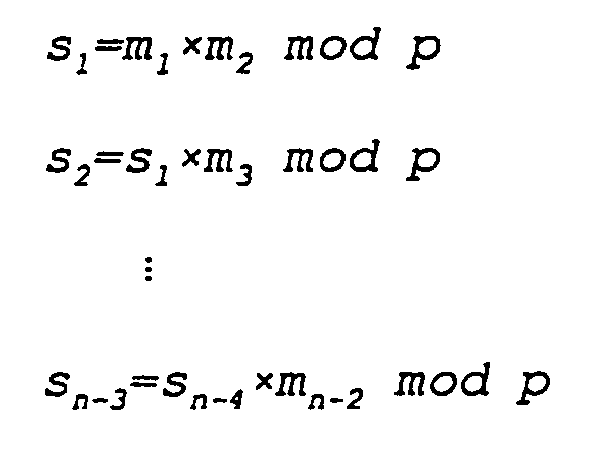
in the stated order, then calculate

in the stated order, and lastly calculate
for a value j chosen from a set of positive integers {1,2,...,n}. - With these constructions, the number of inverse operations needed to compute the inverses of the diagonal elements can be reduced.
- As a result, overall computational complexity of the apparatus for solving a system of equations on a finite field is reduced. Such an apparatus bears high practical value, as it enables high-speed cryptographic or digital signature processing.
- The above object can also be achieved by an apparatus for use in encryption or decryption, for computing an inverse I of an element y in GF(q) which is an extension field of a finite field GF(p), where p is a prime, q=pn, and n is a positive integer, the apparatus including: an equation generating unit for generating a coefficient matrix A and a constant vector b for a system of linear equations Ax=b in n unknowns, using the element y and all coefficients of a generator polynomial of GF(q) whose root is α; an equation solving unit for finding solutions of the system of linear equations Ax=b, the equation solving unit including the above apparatus for solving the system of linear equations Ax=b; and an inverse computing unit for computing the inverse I using the root α and the solutions found by the equation solving unit.
- With this construction, the inverse of the extension field element can be computed with reduced computational complexity.
- The above object can also be achieved by a record medium reproducing apparatus for computing, when copyrighted digital content has been encrypted using a discrete logarithm problem on an elliptic curve E over GF(q) as a basis for security and recorded on a record medium, an inverse I of an element y in GF(q) to decrypt the encrypted digital content recorded on the record medium, where GF(q) is an extension field of a finite field GF(p), p is a prime, q=pn, n is a positive integer, and G is a base point of the elliptic curve E, the record medium reproducing apparatus including: an equation generating unit for generating a coefficient matrix A and a constant vector b for a system of linear equations Ax=b in n unknowns, using the element y and all coefficients of a generator polynomial of GF(q) whose root is α; an equation solving unit for finding solutions of the system of linear equations Ax=b, the equation solving unit including the above apparatus for solving the system of linear equations Ax=b; and an inverse computing unit for computing the inverse I using the root α and the solutions found by the equation solving unit.
- With this construction, the record medium reproducing apparatus can compute the inverse of the extension field element with reduced computational complexity.
- These and other objects, advantages and features of the invention will become apparent from the following description thereofaken in conjunction with the accompanying drawings that illustrate a specific embodiment of the invention. In the drawings:
- Fig. 1 is a block diagram showing the construction of an inversion apparatus 100 according to an embodiment of the invention;
- Fig. 2 is a flowchart showing the general operation of the inversion apparatus 100;
- Fig. 3 is a flowchart showing the operation of triangular transforming a coefficient matrix of a system of equations by an
equation transforming unit 102 in the inversion apparatus 100; - Fig. 4 is a flowchart showing the operation of inverting diagonal elements of the coefficient matrix in the inversion apparatus 100;
- Fig. 5 is a flowchart showing the operation of solving the system of equations in the inversion apparatus 100;
- Fig. 6 shows an example of the triangular transformation by the
equation transforming unit 102; - Fig. 7 is a flowchart showing the operation of triangular transforming a coefficient matrix by an equation transforming unit 102a as a variant of the invention;
- Fig. 8 shows an example of the triangular transformation by the equation transforming unit 102a;
- Fig. 9 is a sequential view showing the procedure of the conventional ElGamal digital signature scheme;
- Fig. 10 is a flowchart showing the conventional triangular transformation of a coefficient matrix; and
- Fig. 11 shows an example of the conventional triangular transformation.
- The following is a description of an inversion apparatus 100 according to an embodiment of the present invention.
- The inversion apparatus 100 computes the inverse I of an element x on GF(q) (q=pn, p a prime, n a positive integer) which is an extension field of a predetermined finite field GF(p). In this embodiment, a generator polynomial of the extension field GF(q) is gn-β whose root is α, and the element x is such that x=x0+x1α+...+xn-1αn-1, where α is an element of GF(q) and β, x0, x1 , ... , xn-1 are elements of GF(p).
- As shown in Fig. 1, the inversion apparatus 100 is roughly made up of a
parameter storing unit 200, anequation generating unit 201, anequation solving unit 202, aninverse computing unit 203, and aninverse storing unit 204. - Specifically, the inversion apparatus 100 is implemented by a computer system equipped with a microprocessor, a ROM, a RAM, a hard disk, and the like. Through execution of a computer program stored in the hard disk by the microprocessor, the
equation generating unit 201, theequation solving unit 202, and theinverse computing unit 203 are realized. - The
parameter storing unit 200 is implemented by the hard disk. The parameter β of the generator polynomial, the root α, and the elements x0, x1, ... , xn-1 are stored in theparameter storing unit 200 beforehand. - The
equation generating unit 201 reads β, α, x0, x1, ... , xn-1 from theparameter storing unit 200, and generates parameters of the following system of equations of y i (i=0,1,2,...,n-1)
- This system of equations can be written simply as
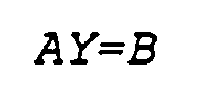


- The parameters of the system of equations generated by the
equation generating unit 201 are the matrix A and the vector B. Theequation generating unit 201 outputs the generated matrix A and vector B to theequation solving unit 202. - The
equation generating unit 201 also outputs α read from theparameter storing unit 200, to theinverse computing unit 203. - The
equation solving unit 202, when given parameters aij (i,j=1,2,...,n) and bk (k=1,2,...,n) of the following system of linear equations in n unknowns for xi (i=1,2,...,n) on a predetermined finite field GF(p) (p a prime), solves the system of linear equations in n unknowns on GF(p).
- The
equation solving unit 202 includes aconstant storing unit 101, anequation transforming unit 102, aninverting unit 103, and anequation computing unit 104, as shown in Fig. 1. - The
constant storing unit 101 is implemented by the RAM. Theconstant storing unit 101 receives a matrix M and a vector v from theequation generating unit 201 and stores them. Here, the matrix M and the vector v are respectively

- For example, the matrix M is the matrix A and the vector v is the vector B.
- The
equation transforming unit 102 reads the matrix M and the vector v from theconstant storing unit 101 and triangular transforms the read matrix M and vector v, to generate a matrix M' (a coefficient matrix consisting of n rows and n columns) and a vector v' (a constant vector consisting of n elements) for a system of linear equations M'x=v' in n unknowns that is equivalent to a system of linear equations Mx=v in n unknowns. - In the triangular transformation, the
equation transforming unit 102 transforms the matrix M into an upper triangular matrix without changing each diagonal element of the matrix M to 1. - Such generated matrix M' and vector v' are
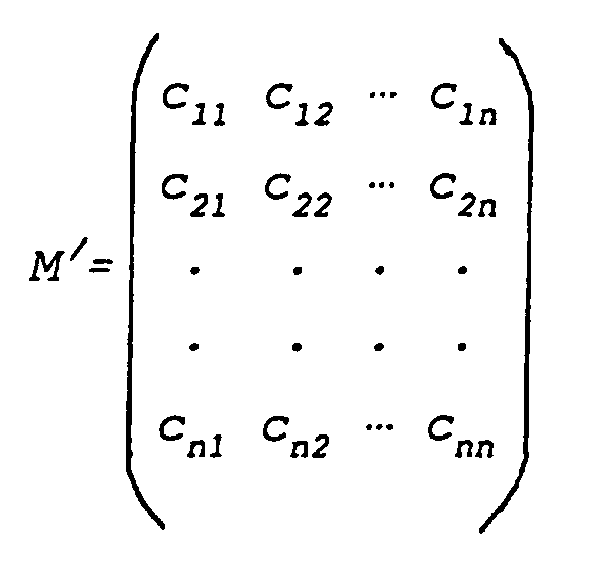

- This triangular transformation is carried out in the following way.
- In the triangular transformation, one or more successive transformation processes are performed to generate the matrix M' and vector v' of the system of linear equations M'x=v' from the system of linear equations Mx=v.
- In each transformation process, the
equation transforming unit 102 generates, from a system of linear equations in n unknowns, a coefficient matrix and a constant vector for a system of linear equations in n unknowns that is equivalent to the system of linear equations before the transformation. In this embodiment, a system of linear equations in n unknowns that is subjected to the initial transformation process is the system of linear equations Mx=v, whereas a system of linear equations in n unknowns that is obtained as a result of the last transformation process is the system of linear equations M'x=v'. - In each transformation process, a system of linear equations in n unknowns before the transformation includes one linear equation as a pivotal equation serving as the transformation pivot and one or more linear equations as object equations to be transformed.
- Each transformation process has transformation subprocesses as many as the object equations in the system of linear equations, each for transforming a separate one of the object equations to an equation equivalent to the object equation. Before transforming the object equation to the equivalent equation, a first coefficient group and a second coefficient group are defined in each transformation subprocess.
- The first and second coefficient groups are each a group that contains at least one value related to the pivotal equation. To be more specific, the
equation transforming unit 102 sets one nonzero coefficient of the pivotal equation into the first coefficient group. Also, theequation transforming unit 102 multiplies each of a constant and n coefficients of the pivotal equation by one nonzero coefficient of the object equation, and sets n+1 values obtained as a result into the second coefficient group. - Following this, the
equation transforming unit 102 changes the nonzero coefficient of the object equation to 0. Theequation transforming unit 102 then multiplies each of a constant and n coefficients of the object equation by the value in the first coefficient group, and subtracts the n+1 values in the second coefficient group respectively from the n+1 multiplication results. In so doing, the object equation is transformed into the equivalent equation where one of its nonzero coefficients has become 0. - This triangular transformation will be explained in greater detail later.
- The
equation transforming unit 102 outputs the generated matrix M' and vector v' to theequation computing unit 104, and outputs the diagonal elements cii (i=1,2,...,n) of the matrix M' to theinverting unit 103. - As described earlier, when transforming the matrix M into upper triangular form, the
equation transforming unit 102 also transforms the vector v so as not to alter the solutions of the system of linear equations Mx=v. The difference with the conventional triangular transformation lies in that the diagonal elements of the matrix M are not converted to 1. - The inverting
unit 103 receives the diagonal elements cii (i=1,2,...,n) of the matrix M' from theequation transforming unit 102. - For simplicity's sake, the diagonal elements cii (i=1,2,...,n) of the matrix M' are expressed as mi (i=1,2,...,n) here.
- The inverting
unit 103 solves
by first calculating

in this order. The invertingunit 103 then calculates
using a predetermined value k (chosen from a set of positive integers {1, 2, ... , n}), and thereby solves
- The inverting
unit 103 next computes
and finally obtains the inverses Ii (i=1,2,...,n) by
- The inverting
unit 103 outputs the inverses Ii (i=1,2,...,n) to theequation computing unit 104. - Thus, the inverting
unit 103 computes, on GF(p), the inverses Ii (i=1,2,...,n) of the diagonal elements cii (i=1,2,...,n) of the matrix M' which are given from theequation transforming unit 102. - The
equation computing unit 104 receives the matrix M' and the vector v' from theequation transforming unit 102, and also receives the inverses Ii (i=1,2,...,n) from the invertingunit 103. - The
equation computing unit 104 sets the values n-1, n-2, ... , 2, 1, 0 in counter j one at a time. For counter j, theequation computing unit 104 uses the matrix M', the vector v', and the inverses Ii (i=1,2,...,n) to compute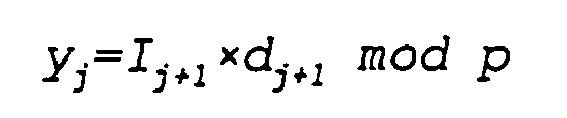
when j=n-1, and compute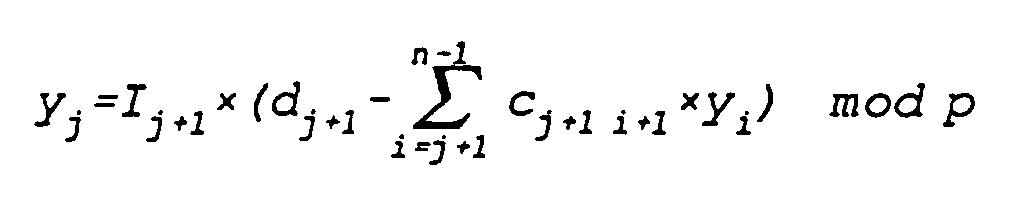
- The
equation computing unit 104 then outputs the solutions yj (j=0,1,2,...,n-1) to theinverse computing unit 203. - The reason that the solutions of the system of linear equations in n unknowns can be found by the
equation computing unit 104 is shown below. - Since the matrix M' received from the
equation transforming unit 102 is an upper triangular matrix, the system of linear equations M'x=v' can be written as
with the inverses of the diagonal elements cii (i=1,2,...,n) of the matrix M' being Ii (i=1,2,...,n). - Accordingly, the solution yn-1 of xn-1 is

the solution yn-2 of xn-2 is
and the solutions yj (j=n-3,n-4,...,0) of xj are
- The
inverse computing unit 203 receives the solutions yj (j=0,1,2,...,n-1) from theequation computing unit 104 in theequation solving unit 202, and receives the root α from theequation generating unit 201. Theinverse computing unit 203 calculates the inverse I according to the equation
using the received solutions yj (j=0,1,2,...,n-1) and root α. Theinverse computing unit 203 writes the calculated inverse I into theinverse storing unit 204. - Hence the inverse I of the element x in the extension field GF(q) is obtained.
- The
inverse storing unit 204 is implemented by the hard disk and stores the inverse I of the element x of the extension field GF(q). - The following is a description on the operation of the above constructed inversion apparatus 100.
- The general operation of the inversion apparatus 100 is explained below with reference to Fig. 2.
- The
equation generating unit 201 reads the parameter β, the root α, and x0, x1 , ... , xn-1 from theparameter storing unit 200, and uses them to generate the matrix A and the vector B as the parameters of the system of linear equations AY=B in n unknowns for yi (i=0,1,2,...,n-1). Theequation generating unit 201 outputs the generated matrix A and vector B to theconstant storing unit 101 in theequation solving unit 202, and outputs the root α to the inverse computing unit 203 (S101). - The
equation transforming unit 102 in theequation solving unit 202 reads the matrix M and the vector v from theconstant storing unit 101 and triangular transforms the read matrix M and vector v, as a result of which the matrix M' and the vector v' for the system of linear equations M'x=v' in n unknowns, that is equivalent to the system of linear equations Mx=v, are generated (S102). - The inverting
unit 103 in theequation solving unit 202 calculates the inverses Ii (i=1,2,...,n) of the diagonal elements cii (i=1,2,...,n) of the matrix M' (S103). - The
equation computing unit 104 in theequation solving unit 202, through the use of the matrix M', the vector v', and the inverses Ii (i=1,2,...,n), seeks the solutions yj (j=0,1,2,..., n-1) of the system of linear equations M'x=v', and outputs the solutions yj (j=0,1,2,...,n-1) to the inverse computing unit 203 (S104). - The
inverse computing unit 203 receives the solutions yj (j=0,1,2,...,n-1) from theequation computing unit 104 and the root α from theequation generating unit 201, finds the inverse I of the element x in the extension field GF(q) using the received solutions and root, and writes the inverse I into the inverse storing unit 204 (S105). - The operation of the triangular transformation by the
equation transforming unit 102 is explained in detail below with reference to Fig. 3. - The
equation transforming unit 102 reads the matrix M and the vector v from the constant storing unit 101 (S111), and sets counter j at 1 (S112). - The
equation transforming unit 102 searches the jth column of the matrix M from the jth to nth rows for an element which is not 0 on GF(p), and sets the row number of a nonzero element found first as k (S113). Here, if k≠j (S114), theequation transforming unit 102 changes places between the kth row and the jth row in the matrix M (S115), and changes places between the kth row and the jth row in the vector v (S116). - The
equation transforming unit 102 sets counter i at j+1 (S117), and makes the following settings using ajj (the element in the jth row and jth column of the matrix M) and aij :


(S118). - The
equation transforming unit 102 then judges whether i=n (S119). If i≠n, theequation transforming unit 102 increments counter i by 1 (S122) and returns to step S118. If i=n, theequation transforming unit 102 judges whether j=n-1 (S120). If j#n-1, theequation transforming unit 102 increments counter j by 1 (S123) and returns to step S113. If j=n-1, theequation transforming unit 102 sets the matrix M as the matrix M' and the vector v as the vector v', and completes the operation. - As described above, this triangular transformation includes transformation processes which correspond to the separate values of counter j, and each of the transformation processes includes transformation subprocesses which correspond to the separate values of counter i.
- The reason why the system of linear equations M'x=v' generated as a result of the triangular transformation by the
equation transforming unit 102 is equivalent to the system of linear equations Mx=v is given below. - In each transformation process of the triangular transformation, let Min and vin be a matrix and a vector before the transformation, Mout and Vout be a matrix and a vector after the transformation, and Li and Lj be the ith and jth row vectors of the matrix Min .
- The
equation transforming unit 102 calculates

the outcome of which is set as the ith row of the vector vout. The other elements of M out and the other elements of vout are respectively equal to the other elements of Min and the other elements of vin . This being the case, the system of linear equations
and the system of linear equations
have the same solutions, as demonstrated indocument 2. - Also, the
equation transforming unit 102 defines aij=0 for every i that satisfies j+1≤i≤n. Repeating this process from j=1 to j=n renders all elements in the lower triangle of thematrix 0. Thus, the matrix can be triangular transformed without the solutions of the system of linear equations being altered. - The operation of the
inverting unit 103 is explained in detail below with reference to Fig. 4. - The inverting
unit 103 receives the diagonal elements mi ( i=1,2,...,n) of the matrix M' from the equation transforming unit 102 (S141), and computes
(S142). The invertingunit 103 then computes
using the predetermined value k (S143), and also computes
(S144). The invertingunit 103 finally finds the inverses
(S145), and outputs the inverses Ii (i=1,2,...,n) to the equation computing unit 104 (S146). - The operation of the
equation computing unit 104 is explained in detail below with reference to Fig. 5. - The
equation computing unit 104 receives the matrix M' and the vector v' from theequation transforming unit 102, and receives the inverses Ii (i=1,2,...,n) from the inverting unit 103 (S161). Having set counter j at n-1 (S162), theequation computing unit 104 computes
when j=n-1, and computes
- The
equation computing unit 104 judges whether j=0 (S164). If j=0, theequation computing unit 104 outputs the solutions yj (j=0,1,2,...,n-1) to the inverse computing unit 203 (S166). Otherwise, theequation computing unit 104 decrements counter j by 1 (S165) and returns to step S163. - The computational complexity of the
equation solving unit 202 is evaluated below. - In the
equation transforming unit 102, computational complexity for one value of counter j (steps S113~S119 in Fig. 3) is the following. - First, computational complexity for one value of counter i (step S118) is broken down as shown below.
- (a) In step S118, the calculation aik=ajj×aik-aij×ajk is performed for j+1≤k≤n (k=j+1,j+2,...,n). This means two multiplications are repeated (n-(j+1)+1)=(n-j) times, so that computational complexity is (2×(n-j))Mul.
- (b) In step S118, the calculation bi=ajj×bi-aij×bj involves two multiplications, so that computational complexity is 2Mul.
- Since counter i changes from j+1 to n, the computational complexity of steps S113-S119 for one value of counter j is

- In steps S112~S120, counter j changes from 1 to n-1, so that the overall computational complexity of the
equation transforming unit 102 is
- The computational complexity of the
inverting unit 103 can be broken down as follows. - (a) Finding s1~sn-3 and tn requires n-2 multiplications, so that computational complexity is (n-2)Mul.
- (b) Finding tn-1 requires one multiplication, so that computational complexity is 1Mul.
- (c) Finding sn and tn-2, Sn-1 and tn-3 , ... , and s4 and t2 requires 2×(n-3) multiplications, so that computational complexity is (2×(n-3))Mul.
- (d) Finding t1 requires one multiplication, so that computational complexity is 1Mul.
- (e) Finding t requires one multiplication, so that computational complexity is 1Mul.
- (f) Finding u=1/t mod p requires one inversion, so that computational complexity is 1Inv.
- (g) Finding Ii=u×ti mod p (i=1,2,...,n) requires n multiplications, so that computational complexity is nMul.
- Summing these computational complexity gives the total computational complexity of the
inverting unit 103 as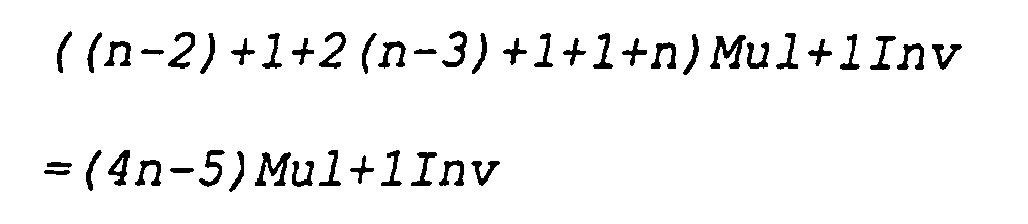
- In the
equation computing unit 104, computational complexity for one value of counter j (steps S163-S165 in Fig. 5) is as follows. - To compute
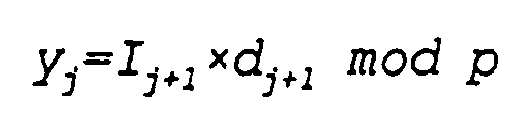
when j=n-1 and
when j≠n-1, one multiplication and (n-(j+1)+1) multiplications are needed, which makes the computational complexity of (n-j+1)Mul. - Since counter j changes from 1 to n, the total computational complexity of the
equation computing unit 104 is
- From the foregoing description, the total computational complexity of the
equation solving unit 202 is given by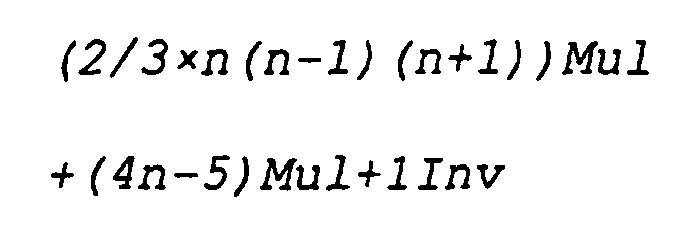

- Supposing 1Inv=40Mul in a general-purpose computer when n=5 and |q|=160 (|q| is the bit size of q), the total computational complexity of the
equation solving unit 202 can be estimated at 150Mul. - Thus, the computational complexity of the
equation solving unit 202 of the invention is much smaller than that of the prior art. Such an equation solving unit bears huge practical value, as it enables an apparatus to solve a system of equations on a finite field with reduced computational complexity. - Also, such an equation solving unit enables an apparatus to compute an inverse I of an element x in an extension field GF(q) of a predetermined finite field GF(p) with reduced computational complexity.
- The following is a concrete example of the operation of the
equation solving unit 202. - As with the
prior art 3, a prime p=31, a generator polynomial f(g)=g5-2, and an element x=5α4+29α3+6α2+19α+17 of GF(q) are given. A system of equations to be solved is the same as that in theprior art 3, as shown in Fig. 6(a). - The following calculations are performed:


- When j=1 (i=2), the system of equations is transformed as shown in Fig. 6(b). Here, the element in the first column and second row has become 0 in a
coefficient matrix 411. - As a result of the transformation process for j=1, the system of equations has become as shown in Fig. 6(c), where the elements in the first column and third to fifth rows are 0 in a
coefficient matrix 421. - As a result of the transformation process for j=2, the system of equations has become as shown in Fig. 6(d), where the elements in the second column and third to fifth rows are 0 in a
coefficient matrix 431. - As a result of the transformation process for j=3, the system of equations has become as shown in Fig. 6(e), where the elements in the third column and fourth to fifth rows are 0 in a
coefficient matrix 441. - As a result of the transformation process for j=4, the system of equations has become as shown in Fig. 6(f), where the element in the fourth column and fifth row is 0 in a
coefficient matrix 451. - Next, the diagonal elements in the coefficient matrix 451 are inverted by calculating





- Notice that u=1/t=1/12=13 mod 31 is the only inverse operation here.
- Lastly, the system of equations is solved in the following way:





- In application of the present invention to an actual communication system such as a cryptographic communication system, a digital signature communication system, or an error correction communication system, parameters such as follows are used.
- For a prime p=231-1, q=pn, n=5, a generator polynomial f(g) =g5-g-8, and an element x=x0+x1×α+x2×α2+x3×α3+x4×α4 of GF(q), a system of equations is defined as

where p, x0, ... , x4, and y0, ... , y4 are each 31 bits long, and q and x are each 155 bits long. - As a variant of the
equation transforming unit 102 in theequation solving unit 202, an equation transforming unit 102a is explained below. - In the equation transforming unit 102a, each transformation process has one coefficient group calculation process and subsequent transformation subprocesses as many as object equations, each for transforming a separate one of the object equations.
- In the coefficient group calculation process, the equation transforming unit 102a chooses m nonzero coefficients by taking one nonzero coefficient from each of the pivotal equation and the object equations in the coefficient matrix consisting of n rows and n columns, multiplies each combination of (m-1) of the chosen nonzero coefficients, and sets the m multiplication results into a first coefficient group. The equation transforming unit 102a then multiplies each of a constant and n coefficients of the pivotal equation by the multiplication result in the first coefficient group for a combination of nonzero coefficients that does not include the nonzero coefficient of the pivotal equation, and sets n+1 values obtained as a result into a second coefficient group.
- Following this, in each of the transformation subprocesses the equation transforming unit 102a changes a nonzero coefficient chosen from an object equation to 0, multiplies each of a constant and n coefficients of the object equation by the multiplication result in the first coefficient group for a combination of nonzero coefficients that does not include the nonzero coefficient of the object equation, and subtracts the n+1 values in the second coefficient group respectively from the n+1 multiplication results.
- The operation of the equation transforming unit 102a is explained below with reference to Fig. 7. The flowchart in Fig. 7 includes steps S118a~S118c instead of step S118 in Fig. 3.
- Since the other steps are the same as those in Fig. 3, the following explanation will focus on steps S118a~S118c.
- In step S118a, the equation transforming unit 102a computes
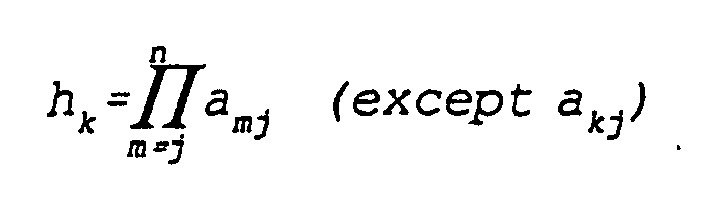
for each k that satisfies j≤k≤n (k=j,j+1,...,n). In step S118b, the equation transforming unit 102a computes

for each k that satisfies j+1≤k≤n (k=j+1,j+2,...,n). In step S118c, having set aij=0, the equation transforming unit 102a computes

for each k that satisfies j+1≤k≤n (k=j+1,j+2,...,n). (Concrete Example) - An example of the operation of the equation transforming unit 102a is shown below.
- As with the
prior art 3, a prime p=31, a generator polynomial f(g) =g5-2, and an element x=5α4+29α3+6α2+19α+17 of GF(q) are given. A system of equations to be solved is the same as that in theprior art 3, as shown in Fig. 8(a). - When j=1, the equation transforming unit 102a calculates


and then calculates




- When i=2 (j=1), the equation transforming unit 102a calculates


- According to this method, only one multiplication is needed to find aik unlike the first embodiment which needs two multiplications, so that computational complexity is further reduced.
- With the above computations, the system of equations is transformed as shown in Fig. 8(b), where the element in the first column and second row has become 0 in a
coefficient matrix 511. - As a result of the transformation process for j=1, the system of equations has become as shown in Fig. 8(c), where the elements in the first column and third to fifth rows are 0 in a
coefficient matrix 521. - Next, when j=2, the equation transforming unit 102a calculates




and then calculates



- As a result of the transformation process for j=2, the system of equations has become as shown in Fig. 8(d), where the elements in the second column and third to fifth rows are 0 in a
coefficient matrix 531. - Next, when j=3, the equation transforming unit 102a calculates


and then calculates


- As a result of the transformation process for j=3, the system of equations has become as shown in Fig. 8(e), where the elements in the third column and fourth to fifth rows are 0 in a
coefficient matrix 541. - Next, when j=4, the equation transforming unit 102a calculates


and then calculates

- As a result of the transformation process for j=4, the system of equations has become as shown in Fig. 8(f), where the element in the fourth column and fifth row is 0 in a
coefficient matrix 551. - Here, let C=A and D=B, and the diagonal elements are inverted by computing









- Notice that u=1/t=1/3=21 mod 31 is the only inverse operation here.
- Lastly, the system of equations is solved as follows:


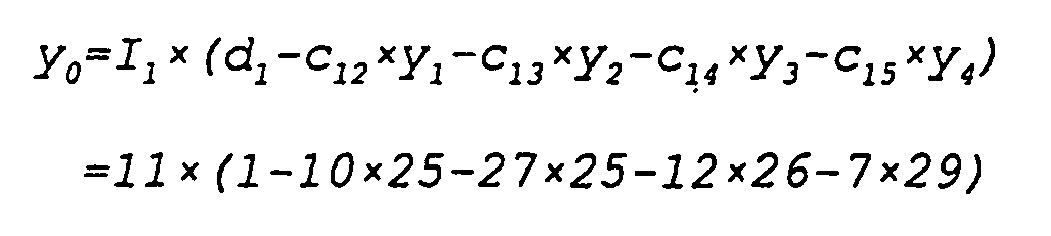

- Computational complexity of the equation transforming unit 102a for one value of counter j (steps S113~S119 in Fig. 7) is measured below.
- In step S118a, (3×(n-j+1)-6) multiplications are needed to find hk (k=j,j+1,...,n), so that computational complexity is (3×(n-j+1)-6)Mul.
- In step S118b, (n-(j+1)+1+1) multiplications are needed to find wk (k=j+1,j+2,...,n) and e, so that computational complexity is (n-j+1)Mul.
- In step S118c, for one value of counter i, computational complexity is as follows.
- (a) To compute aik=hixaik-wk for j+1≤k≤n (k=j+1,j+2, ... ,n), one multiplication is repeated (n-(j+1)+1)=(n-j) times, so that computational complexity is (n-j)Mul.
- (b) To compute bi=hi×bi-e, one multiplication is performed, so that computational complexity is 1Mul.
- Since counter i changes from j+1 to n, the computational complexity of step S118c for all values of counter i is

- Accordingly, the total computational complexity of steps S118a~S118c for one value of counter j is
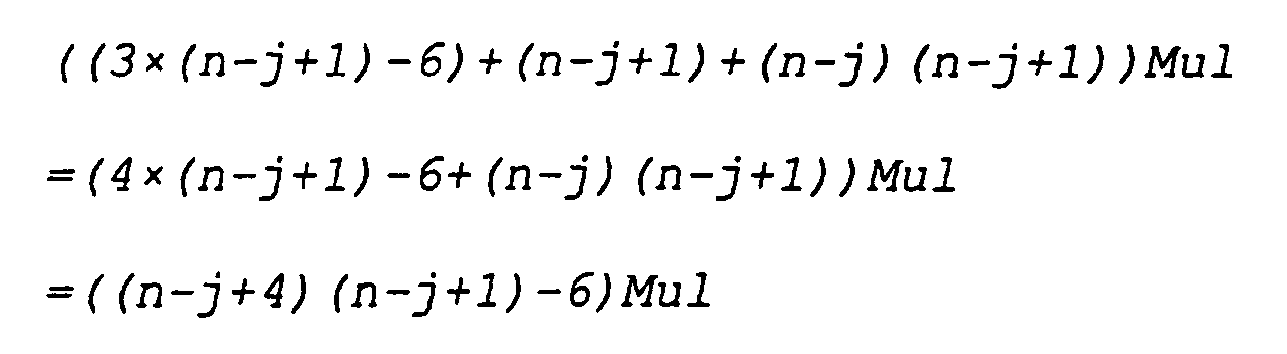
- Since counter j changes from 1 to n-1, the total computational complexity of the equation transforming unit 102a is
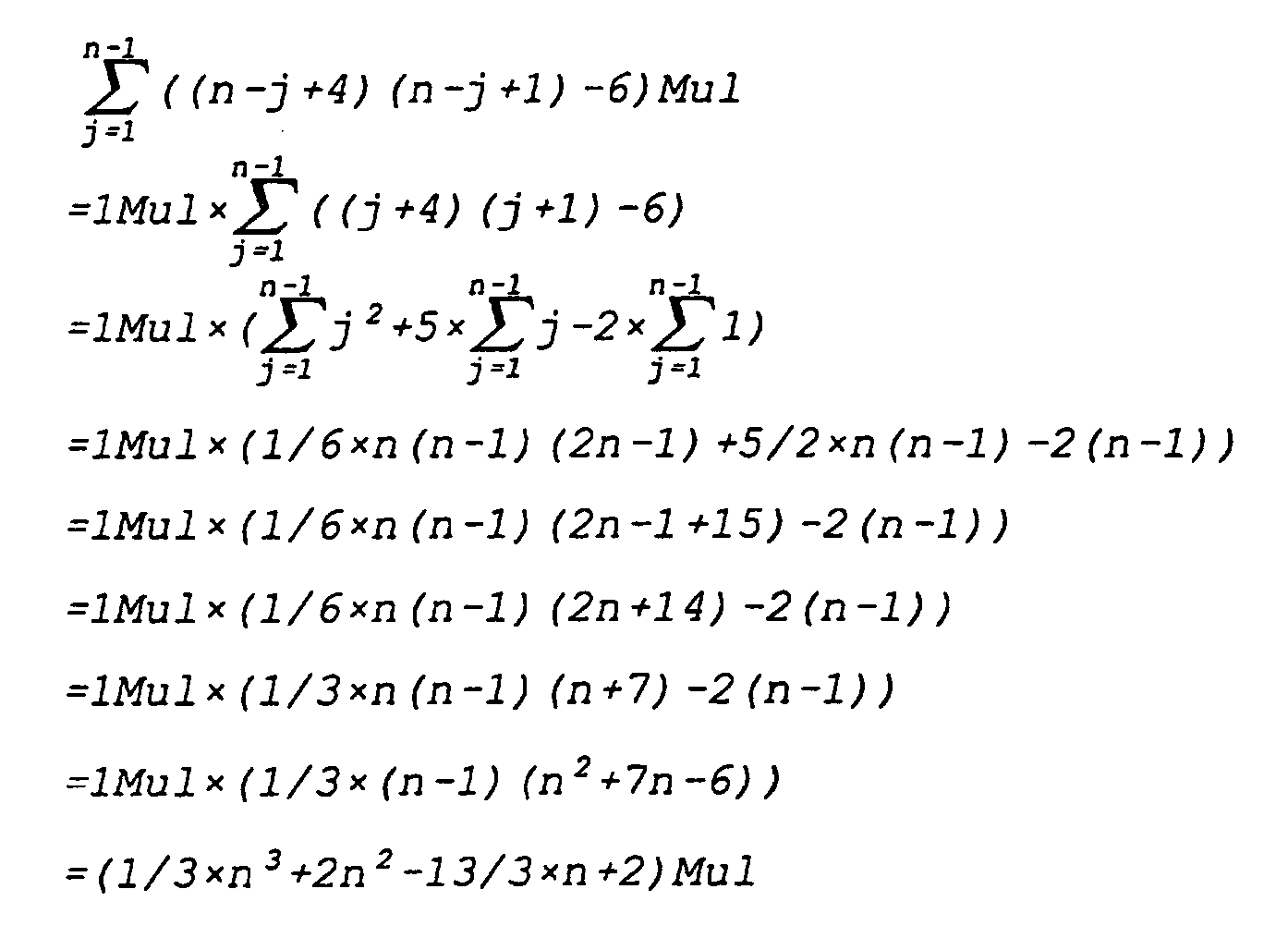
- Therefore, the overall computational complexity of the
equation solving unit 202 equipped with the equation transforming unit 102a is given by
- Supposing 1Inv=40Mul when n=5, the overall computational complexity can be estimated at 142Mul.
-
- (1) In a communication system, such as a cryptographic communication system, a digital signature communication system, or an error correction communication system, whose security is based on the discrete logarithm problem on an elliptic curve E over an extension field GF(q) of a finite field GF(p) where p is a prime, q=pn, n is a positive integer, and G is a base point of E, the equation solving unit and the inversion apparatus of the invention may be used to calculate inverses of elements in the extension field GF(q). One example of cryptographic communication systems is an e-mail system on the Internet whereby messages are encrypted before transmission. One example of digital signature communication systems is an electronic banking system. One example of error correction communication systems is an e-mail system whereby, in such cases that part of transmitted message is dropped due to deterioration in quality of a communication line, the error is detected and corrected.
Also, the equation solving unit and the inversion apparatus of the invention may be used for encryption in a recording apparatus that encrypts copyrighted digital content using the elliptic curve discrete logarithm problem as the basis for security and records the encrypted digital content into a record medium such as a DVD or a semiconductor memory, or decryption in a reproducing apparatus that decrypts the encrypted digital content stored in the record medium to reproduce the digital content.
By applying the invention to these systems, the inverses of extension field elements can be computed with small computational complexity.
In such applications, the equation solving unit and the inversion apparatus of the invention can be implemented, for example, as firmware stored in a mobile phone or a circuit board equipped in a personal computer. - (2) Though the generator polynomial of the form gn-β has been used in the above embodiment, for an ordinary generator polynomial of the nth degree such as

the inverse I of an element x in an extension field GF(q) (q=pn, n a positive integer) of a predetermined finite field GF(p) can be calculated in a similar manner.
Let an ordinary polynomial f(g) of the nth degree be the generator polynomial and α be the root of f(g). For an element x=x0+x1α+ · · · +xn-1αn-1 in the extension field GF(q), when the coefficient of αi-1 in (x×αj-1 mod f(α)) is denoted by aij, a system of linear equations in n unknowns can be written as

The reason that the system of linear equations in n unknowns can be written like this is given below.
The equations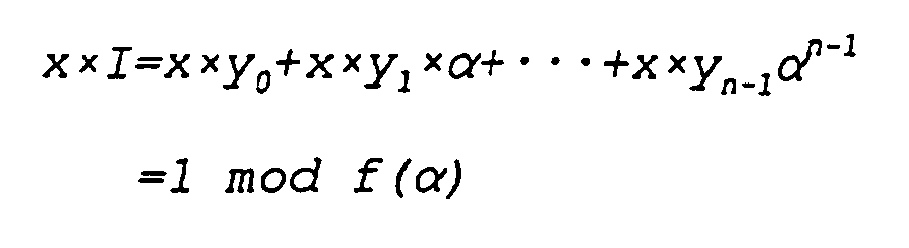
and
hold. The coefficient of αi-1 is given by
The coefficients of α i-1 (i>2) are all 0 and the coefficient of α0 (i=1) is 1. Hence the above system of linear equations in n unknowns is derived. - (3) The invention may be the equation solving method and the inversion method used in the above described equation solving unit and inversion apparatus. The invention may also be computer programs for implementing these methods, or digital signals for executing the computer programs.
Also, the invention may be computer-readable storage mediums, such as floppy disks, hard disks, CD-ROMs, MOs, DVDs, DVD-ROMs, DVD-RAMS, or semiconductor memories, that store the computer programs or the digital signals. Likewise, the invention may be the computer programs or digital signals stored in such storage mediums.
Also, the invention may be realized by transferring the computer programs or the digital signals on a carrier wave via a network such as a telecommunication network, a radio or cable communication network, or the Internet.
Further, the invention may be realized by distributing the computer programs or the digital signals stored in the storage mediums or transferring the computer programs or the digital signals on the carrier wave via the network so that they can be used in other computer systems. - (4) Various combinations of the embodiment and the modifications stated above are possible.
- Although the present invention has been fully described by way of examples with reference to the accompanying drawings, it is to be noted that various changes and modifications will be apparent to those skilled in the art. Therefore, unless such changes and modifications depart from the scope of the present invention, they should be construed as being included therein.
Claims (24)
- An apparatus for use in encryption or decryption, for solving a system of linear equations Ax=b in n unknowns on a finite field GF(p), where p is a prime, n is a positive integer, A is a coefficient matrix consisting of elements of n rows and n columns, x is a vector of unknowns consisting of n elements, and b is a constant vector consisting of n elements, the apparatus comprising:a parameter storing means for storing the coefficient matrix A and the constant vector b;triangular transforming means for reading the coefficient matrix A and the constant vector b from the parameter storing means, and transforming the read coefficient matrix A and constant vector b to generate a coefficient matrix C and a constant vector d for a system of linear equations Cx=d in n unknowns that is equivalent to the system of linear equations Ax=b, the coefficient matrix C consisting of elements of n rows and n columns and the constant vector d consisting of n elements, wherein the coefficient matrix A is triangular transformed into the coefficient matrix C of upper triangular form without all the diagonal elements of the coefficient matrix A necessarily being changed to 1;diagonal element inverting means for calculating inverses of diagonal elements of the generated coefficient matrix C on the finite field GF(p); andequation computing means for solving the system of linear equations Cx=d using the coefficient matrix C, the constant vector d, and the inverses of the diagonal elements of the coefficient matrix C, to thereby solve the system of linear equations Ax=bwherein when the diagonal elements of the coefficient matrix C are denoted by mi (i=1,2,...,n) and the inverses of the diagonal elements mi (i=1,2,...,n) in the finite field GF(p) are denoted by 1i (i=1,2,...,n), the diagonal element inverting means includes(a) a multiplying unit for computing

and (b) a first inverting unit for computing
 (c) a second inverting unit for computingto find the inverses Ii = (i=1,2,...,n).
- The apparatus of claim 1,
wherein the triangular transforming means performs one or more successive transformation processes to generate the coefficient matrix C and the constant vector d of the system of linear equations Cx=d from the coefficient matrix A and the constant vector b of the system of linear equations Ax=b,
wherein in each transformation process the triangular transforming means transforms a coefficient matrix and a constant vector of a system of linear equations in n unknowns, into a coefficient matrix and a constant vector of linear equations in n unknowns, into a coefficient matrix and a constant vector of a system of linear equations in n unknowns that is equivalent to the system of linear equations before the transformation, where the system of linear equations Ax=b is subjected to the first transformation process and the system of linear equations Cx=d is generated as a result of the last transformation process,
wherein in each transformation process the system of linear equations in n unknowns that is subjected to the transformation includes one pivotal equation which is a linear equation serving as a pivot for the transformation and one or more object equations which are linear equations to be transformed, and the triangular transforming means transforms each of the object equations into an equation equivalent to the object equation by
defining a first coefficient group containing at least one value related to the pivotal equation and a second coefficient group containing n+1 values related to the pivotal equation,
changing a nonzero coefficient in the object equation to 0, and
multiplying each of a constant and n coefficients in the object equation by the value in the first coefficient group,
and subtracting the n+1 values in the second coefficient group respectively from the n+1 multiplication results. - The apparatus of claim 2,
wherein each transformation process has transformation subprocesses each for transforming a separate one of the object equations,
wherein in each transformation subprocess the triangular transformation means(a) chooses a nonzero coefficient from the pivotal equation and sets the chosen nonzero coefficient into the first coefficient group,(b) chooses a nonzero coefficient from the object equation, multiplies each of a constant and n coefficients in the pivotal equation by the nonzero coefficient chosen from the object equation, and sets n+1 values obtained by the multiplications into the second coefficient group,(c) changes the chosen nonzero coefficient in the object equation to 0, and(d) multiplies each of a constant and n coefficients in the object equation by the nonzero coefficient in the first coefficient group, and subtracts the n+1 values in the second coefficient group respectively from the n+1 multiplication results. - The apparatus of claim 3,
wherein the multiplying unit calculates
in the stated order, the calculates
in the stated order, and lastly calculates
- The apparatus of claim 2,
wherein each transformation process has a coefficient group calculation process and transformation subprosses, performed following the coefficient group calculation process, each for transforming a separate one of the object equations,
wherein in the coefficient group calculation process the triangular transforming means(a) chooses m nonzero coefficients by taking one nonzero coefficient from each of the pivotal equation and the object equations, multiplies each combination of (m-1) of the chosen nonzero coefficients, and sets the m multiplication results into the first coefficient group, m being a positive integer no smaller than 2, and(b) multiplies each of a constant and n coefficients in the pivotal equation by multiplication result in the first coefficient group for a combination of nonzero coefficients that does not include nonzero coefficients that does not include a nonzero coefficient chosen from the pivotal equation, and sets n+1 values obtained by the multiplication into the second coefficient group, andwherein each of the transformation subprocesses following the coefficient group calculation process, the triangular transforming means(a) changes a nonzero coefficient chosen from the object equation in the coefficient group calculation process, to 0 in the object equation, and(b) multiplies each of a constant and n coefficients in the object equation by a multiplication result in the first coefficient group for a combination of nonzero coefficients that does not include the nonzero coefficient chosen from the object equation, and subtracts the n+1 values in the second coefficient group respectively from the n+1 multiplication results. - The apparatus of claim 5,
wherein the multiplying unit calculates
in the stated order, the calculates
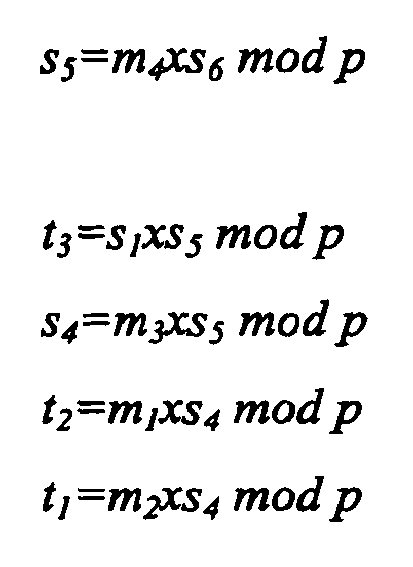
in the stated order, and lastly calculates
- An apparatus for use in encryption or decryption, for computing an inverse I of an element y in GF(q) which is an extension field GF(p), where p is a prime, q=p.., and n is a positive integer, the apparatus comprising:equation generating means for generating a coefficient matrix A and a constant vector b for a system of linear equations Ax=b in n unknowns, using the element y and all coefficients of a generator polynomial of GF(q) whose root is α;equation solving means for finding solutions of the system of linear equations Ax=b, the equation solving means including the apparatus of claim 1; andinverse computing means for computer the inverse I using the root α and the solutions found by the equation solving means.
- An apparatus for use in encryption or decryption, for computing an inverse I of an element y in GF(q) which is an extension field of a finite field GF(p), where p is a prime, q=pn, and n is a positive integer, the apparatus comprising:equation generating means for generating a coefficient matrix A and a constant vector b for a system of linear equations Ax=b in n unknowns, using the element y and all coefficients of a generator polynomial of GF(q) whose root is α;equation solving means for finding solutions of the system of linear equations Ax=b, the equation solving means including the apparatus of claim 2; andinverse computing means for computer the inverse I using the root α and the solutions found by the equation solving means.
- An apparatus for use in encryption or decryption, for computer an inverse I of an element y in GF(q) which is an extension field of a finite field GF(p), where p is a prime, q=pn , and n is a positive integer, the apparatus comprising:equation generating means for generating a coefficient matrix A and a constant vector b for a system of linear equations Ax=b in n unknowns, using the element y and all coefficients of a generator polynomial of GF(q) whose root is α;equation solving means for finding solutions to the system of linear equations Ax=b, the equation solving means including the apparatus of claim 3; andinverse computing means for computer the inverse I using the root α and the solutions found by the equation solving means.
- An apparatus for use in encryption or decryption, for computing an inverse I of an element y in GF(q) which is an extension field of a finite field GF(p), where p is a prime, q=pn, and n is a positive integer, the apparatus comprising:equation generating means for generating a coefficient matrix A and a constant vector b for a system of linear equations Ax=b in n unknowns, using the element y and all coefficients of a generator polynomial of GF(q) whose root is α;equation solving means for finding solutions of the system of linear equations Ax=b, the equation solving means including the apparatus of claim 4; andinverse computing means for computing the inverse I using the root α and the solutions found by the equations solving means.
- An apparatus for use in encryption or decryption, for computing an inverse I of an element y in GF(q) which is an extension field of a finite field GF(p), where p is a prime, q=pn, and n is a positive integer, the apparatus comprising:equation generating means for generating a coefficient matrix A and a constant vector b for a system of linear equations Ax=b in n unknowns, using the element y and all coefficients of a generator polynomial of GF(q) whose root is α;equation solving means for finding solutions of the system of linear equations Ax=b, the equation solving means including the apparatus of claim 5; andinverse computing means for computing the inverse I using the root α and the solutions found by the equation solving means.
- An apparatus for use in encryption or decryption, for computing an inverse I of an element y in GF(q) which is an extension field of a finite field GF(p), where p is a prime, q=pn, and n is a positive integer, the apparatus comprising:equation generating means for generating a coefficient matrix A and a constant vector b for a system of linear equations Ax=b in n unknowns, using the element y and all coefficients of a generator polynomial of GF(q) whose root is α;equation solving emans for finding solutions of the system of linear equations Ax=b, the equation solving means including the apparatus of claim 6; andinverse computing means for computing the inverse I using the root α and the solutions found by the equation solving means.
- A record medium reproducing apparatus for computing, when copyrighted digital content has been encrypted using a discrete logarithm problem on an elliptic curve E over GF(q) as a basis for security and recorded on a record medium, an inverse I of an element y in GF(q) to decrypt the encrypted digital content recorded on the record medium, where GF(q) is an extension field of a finite field GF(p), p is a prime, q=p2, n is a positive integer, and G is a base point of the elliptic curve E, the record medium reproducing apparatus comprising:equation generating means for generating a coefficient matrix A and a constant vector b for a system of linear equations Ax=b in n unknowns, using the element y and all coefficients of a generator polynomial of GF(q) whose root is α;equation solving means for finding solutions of the system of linear equations Ax=b, the equation solving means including the apparatus of claim 1; andinverse computing means for computing the inverse I using the root α and the solutions found by the equation solving means.
- A record medium reproducing apparatus for computing, when copyrighted digital content has been encrypted using a discrete logarithm problem on an elliptic curve E over GF(q) as a basis for security and recorded on a record medium, an inverse I of an element y in GF(q) to decrypt the encrypted digital content recorded on the record medium, where GF(q) is an extension field of a finite field GF(p), p is a prime q=p2, n is a positive integer, and G is a base point of the elliptic curve E, the record medium reproducing apparatus comprising:equation generating means for generating a coefficient matrix A and a constant vector b for a system of linear equations Ax=b in n unknowns, using the element y and all coefficients of a generator polynomial of GF(q) whose root is α;equation solving means for finding solutions of the system of linear equations Ax=b, the equation solving means including the apparatus of claim 2; andinverse computing means for computing the inverse I using the root α and the solutions found by the equation solving means.
- A record medium reproducing apparatus for computing, when copyrighted digital content has been encrypted using a discrete logarithm problem on an elliptic curve E over GF(q) as a basis for security and recorded on a record medium, an inverse I of an element y in GF(q) to decrypt the encrypted digital content recorded on the record medium, where GF(q) is an extension field of a finite field GF(p), p is a prime q=p2, n is a positive integer, and G is a base point of the elliptic curve E, the record medium reproducing apparatus comprising:equation generating means for generating a coefficient matrix A and a constant vector b for a system of linear equations Ax=b in n unknowns, using the element y and all coefficients of a generator polynomial of GF(q) whose root is α;equation solving means for finding solutions of the system of linear equations Ax=b, the equation solving means including the apparatus of claim 3; andinverse computing means for computing the inverse I using the root α and the solutions found by the equation solving means.
- A record medium reproducing apparatus for computing, when copyrighted digital content has been encrypted using a discrete logarithm problem on an elliptic curve E over GF(q) as a basis for security and recorded on a record medium, an inverse I of an element y in GF(q) to decrypt the encrypted digital content recorded on the record medium, where GF(q) is an extension field of a finite field GF(p), p is a prime, q=p2, n is a positive integer, and G is a base point of the elliptic curve E, the record medium reproducing apparatus comprising:equation generating means for generating a coefficient matrix A and a constant vector b for a system of linear equations Ax=b in n unknowns, using the element y and all coefficients of a generator polynomial of GF(q) whose root is α;equation solving means for finding solutions of the system of linear equations Ax=b, the equation solving means including the apparatus of claim 4; andinverse computing means for computing the inverse I using the root α and the solutions found by the equation solving means.
- A record medium reproducing apparatus for computing, when copyrighted digital content has been encrypted using a discrete logarithm problem on an elliptic curve E over GF(q) as a basis for security and recorded on a record medium, an inverse I of an element y in GF(q) to decrypt the encrypted digital content recorded on the record medium, where GF(q) is an extension field of a finite field GF(p), p is a prime, q=p2, n is a positive integer, and G is a base point of the elliptic curve E, the record medium reproducing apparatus comprising:equation generating means for generating a coefficient matrix A and a constant vector b for a system of linear equations Ax=b in n unknowns, using the element y and all coefficients of a generator polynomial of GF(q) whose root is α;equation solving means for finding solutions of the system of linear equations Ax=b, the equation solving means including the apparatus of claim 5; andinverse computing means for computing the inverse I using the root α and the solutions found by the equation solving means.
- A record medium reproducing apparatus for computing, when copyrighted digital content has been encrypted using a discrete logarithm problem on an elliptic curve E over GF(q) as a basis for security and recorded on a record medium, an inverse I of an element y in GF(q) to decrypt the encrypted digital content recorded on the record medium, where GF(q) is an extension field of a finite field GF(p), p is a prime, q=p2, n is a positive integer, and G is a base point of the elliptic curve E, the record medium reproducing apparatus comprising:equation generating means for generating a coefficient matrix A and a constant vector b for a system of linear equations Ax=b in n unknowns, using the element y and all coefficients of a generator polynomial of GF(q) whose root is α;equation solving means for finding solutions of the system of linear equations Ax=b, the equation solving means including the apparatus of claim 6; andinverse computing means for computing the inverse I using the root α and the solutions found by the equation solving means.
- A method for solving a system of linear equations Ax=b in n unknowns on a finite field GF(p) where p is a prime, n is a positive integer, A is a coefficient matrix consisting of elements of n rows and n columns, x is a vector of unknowns consisting of n elements, and b is a constant vector consisting of n elements, for use in encryption or decryption in an apparatus equipped with parameter storing means which stores the coefficient matrix A and the constant vector b, the method comprising of:a triangular transforming step for reading the coefficient matrix A and the constant vector b from the parameter storing means, and transforming the read coefficient matrix A and constant vector b to generate a coefficient matrix C and a constant vector d for a system of linear equations Cx=d in n unknowns that is equivalent to the system of linear equations Ax=b, the coefficient matrix C consisting of elements of n rows and n columns and the constant vector d consisting of n elements, wherein the coefficient matrix A is triangular transformed into the coefficient matrix C of upper triangular form without all the diagonal elements of the coefficient matrix A necessarily being changed to 1;a diagonal element inverting step for calculating inverses of diagonal elements of the generated coefficient matrix C on the finite field GF(p); andan equation computing step for solving the system of linear equations Cx=d using the coefficient matrix C, the constant vector d, and the inverses of the diagonal elements of the coefficient matrix C, to thereby solve the constant vector d, and the inverse of the diagonal elements of the coefficient matrix C, to thereby solve the system of linear equations Ax=bwherein when the diagonal elements of the coefficient matrix C are denoted by mi (i=1,2,...,n) and the inverses of the diagonal elements mi (i=1,2,...,n) in the finite field GF(p) are denoted by 1i (i=1,2, ...,n), the diagonal element inverting means includes(a) a multiplying substep for computing
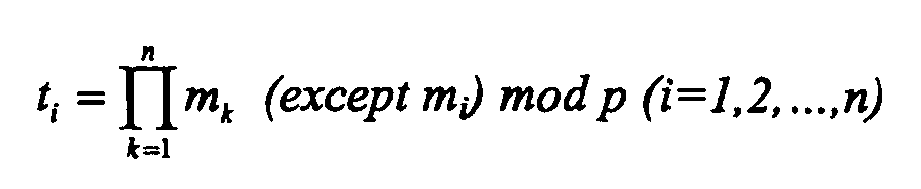
and (b) a first inverting substep for computing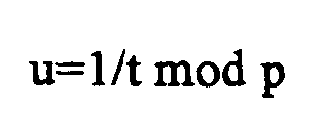
and(c) a second inverting substep for computingto find the inverses Ii = (i=1,2,...,n).
- The method of claim 19,
wherein the triangular transforming step includes one or more successive transformation processes to generate the coefficient matrix C and the constant vector d of the system of linear equations Cx=d from the coefficient matrix A and the constant vector b of the system of linear equations Ax=b,
wherein in each transformation process a coefficient matrix and a constant vector of a system of linear equations in n unknowns are transformed into a coefficient matrix and a constant vector of a system of linear equations in n unknowns that is equivalent to the system of linear equations before the transformation, where the system of linear equations Ax=b is subjected to the first transformation process and the system of linear equations Cx=d is generated as a result of the last transformation process,
wherein in each transformation process the system of linear equations in n unknowns that is subjected to the transformation includes one pivotal equation which is a linear equation serving as a pivot for the transformation and one or more object equations which are linear equations to be transformed, and each of the object equations is transformed into an equation equivalent to the object equation by
defining a first coefficient group containing at least one value related to the pivotal equation and a second coefficient group containing n+1 values related to the pivotal equation,
changing a nonzero coefficient in the object equation to 0, and
multiplying each of a constant and n coefficients in the object equation by the value in the first coefficient group, and subtracting the n+1 values in the second coefficient group respectively from the n+1 multiplication results. - The method of claim 20
wherein each transformation process has transformation subprocesses each for transforming a separate one of the object equations,
wherein in each transformation subprocess(a)a nonzero coefficient is chosen from the pivotal equation and set into the first coefficient group,(b) a nonzero coefficient is chosen from the object equation, each of a constant and n coefficients in the pivotal equation is multiplied by the nonzero coefficient chosen from the object equation, and n+1 values obtained by the multiplications are set into the second coefficient group,(c) the chosen nonzero coefficient in the object equation is changed to 0, and(d) each of a constant and n coefficients in the object equation is multiplied by the nonzero coefficient in the first coefficient group, and the n+1 values in the second coefficient group are subtracted respectively from the n+1 multiplication results. - The method of claim 21,
wherein the multiplying substep calculates
in the stated order, then calculates
in the stated order, and lastly calculates
- The method of claim 20,
wherein each transformation process includes a coefficient group calculation process and transformation subprocesses, performed following the coefficient group calculation process, each for transforming a separate one of the object equations,
wherein in the coefficient group calculation process(a) m nonzero coefficients are chosen by taking one nonzero coefficient from each of the pivotal equation and the object equations, each combination of (m-1) of the chosen nonzero coefficients is multiplied, and the m multiplication results are set into the first coefficient group, m being a positive integer no smaller than 2, and(b) each of a constant and n coefficients in the pivotal equation is multiplied by a multiplication result in the first coefficient group for a combination of nonzero coefficients that does not include a nonzero coefficient chosen from the pivotal equation, and n+1 values obtained by the multiplications are set into the second coefficient group,wherein in each of the transformation subprocesses following the coefficient group calculation process(a) a nonzero coefficient chosen from the object equation in the coefficient group calculation process is changed to 0 in the object equation, and(b) each of a constant and n coefficients in the object equation is multiplied by a multiplication result in the first coefficient group for a combination of nonzero coefficients that does not include the nonzero coefficient chosen from the object equation, and the n+1 valus in the second group are subtracted respectively from the n+1 multiplication results. - The method of claim 23,
wherein the multiplying substep calculates
in the stated order, the calculates
in the stated order, and lastly calculates
for a value j chosen from a set of positive integers (1,2,...,n).
Applications Claiming Priority (4)
| Application Number | Priority Date | Filing Date | Title |
|---|---|---|---|
| JP20305599 | 1999-07-16 | ||
| JP20305599 | 1999-07-16 | ||
| JP2000140886 | 2000-05-12 | ||
| JP2000140886A JP4354609B2 (en) | 1999-07-16 | 2000-05-12 | Simultaneous equation solving apparatus and inverse element computing apparatus on finite field |
Publications (3)
| Publication Number | Publication Date |
|---|---|
| EP1069498A2 EP1069498A2 (en) | 2001-01-17 |
| EP1069498A3 EP1069498A3 (en) | 2005-04-13 |
| EP1069498B1 true EP1069498B1 (en) | 2008-01-02 |
Family
ID=26513721
Family Applications (1)
| Application Number | Title | Priority Date | Filing Date |
|---|---|---|---|
| EP00305405A Expired - Lifetime EP1069498B1 (en) | 1999-07-16 | 2000-06-27 | Apparatus for solving system of equations on finite field and apparatus for inverting element of extension field |
Country Status (5)
| Country | Link |
|---|---|
| US (1) | US7092522B1 (en) |
| EP (1) | EP1069498B1 (en) |
| JP (1) | JP4354609B2 (en) |
| CN (1) | CN1281203A (en) |
| DE (1) | DE60037619T2 (en) |
Families Citing this family (12)
| Publication number | Priority date | Publication date | Assignee | Title |
|---|---|---|---|---|
| US7170997B2 (en) | 2000-12-07 | 2007-01-30 | Cryptico A/S | Method of generating pseudo-random numbers in an electronic device, and a method of encrypting and decrypting electronic data |
| ATE352830T1 (en) * | 2002-10-26 | 2007-02-15 | Additional Director Ipr Defenc | METHOD FOR ELLIPTIC CURVE ENCRYPTION |
| KR100564599B1 (en) * | 2003-12-24 | 2006-03-29 | 삼성전자주식회사 | Inverse calculation circuit, inverse calculation method, and storage medium encoded with computer-readable computer program code |
| CA2935823C (en) * | 2005-01-18 | 2019-01-15 | Blackberry Limited | Accelerated verification of digital signatures and public keys |
| US7801307B2 (en) * | 2005-07-28 | 2010-09-21 | Alcatel-Lucent Usa Inc. | Method of symmetric key data encryption |
| JP5677273B2 (en) * | 2011-11-18 | 2015-02-25 | 三菱電機株式会社 | Cryptographic processing system, cryptographic processing method, cryptographic processing program, and key generation apparatus |
| JP6059287B2 (en) * | 2015-05-12 | 2017-01-11 | 日本電信電話株式会社 | Matrix triangulation device and program |
| US12271500B2 (en) * | 2019-02-13 | 2025-04-08 | Agency For Science, Technology And Research | Method and system for determining an order of encrypted inputs |
| WO2020246018A1 (en) * | 2019-06-07 | 2020-12-10 | 日本電信電話株式会社 | Secret conjugate gradient method calculation system, secret calculation device, conjugate gradient method calculation device, secret conjugate gradient method calculation method, conjugate gradient method calculation method, and program |
| AU2019461061B2 (en) * | 2019-08-14 | 2023-03-30 | Ntt, Inc. | Secure gradient descent computation method, secure deep learning method, secure gradient descent computation system, secure deep learning system, secure computation apparatus, and program |
| CN115730176B (en) * | 2022-09-07 | 2025-10-10 | 安徽大学 | A method for inverting vertical column concentration of atmospheric ozone using ultraviolet hyperspectral data |
| CN116992730B (en) * | 2023-08-07 | 2024-07-19 | 西安电子科技大学 | A method for solving electromagnetic characteristics of rectangular waveguide drop mode |
Family Cites Families (2)
| Publication number | Priority date | Publication date | Assignee | Title |
|---|---|---|---|---|
| SE7714587L (en) * | 1977-12-21 | 1979-06-22 | Brendstrom Hugo | COMMUNICATION SYSTEM |
| US5375170A (en) * | 1992-11-13 | 1994-12-20 | Yeda Research & Development Co., Ltd. | Efficient signature scheme based on birational permutations |
-
2000
- 2000-05-12 JP JP2000140886A patent/JP4354609B2/en not_active Expired - Fee Related
- 2000-06-26 US US09/603,636 patent/US7092522B1/en not_active Expired - Lifetime
- 2000-06-27 DE DE60037619T patent/DE60037619T2/en not_active Expired - Fee Related
- 2000-06-27 EP EP00305405A patent/EP1069498B1/en not_active Expired - Lifetime
- 2000-07-17 CN CN00120117A patent/CN1281203A/en active Pending
Also Published As
| Publication number | Publication date |
|---|---|
| CN1281203A (en) | 2001-01-24 |
| US7092522B1 (en) | 2006-08-15 |
| JP4354609B2 (en) | 2009-10-28 |
| DE60037619D1 (en) | 2008-02-14 |
| EP1069498A3 (en) | 2005-04-13 |
| JP2001092807A (en) | 2001-04-06 |
| DE60037619T2 (en) | 2008-05-21 |
| EP1069498A2 (en) | 2001-01-17 |
Similar Documents
| Publication | Publication Date | Title |
|---|---|---|
| EP1160661B1 (en) | Method of calculating multiplication by scalars on an elliptic curve and apparatus using same | |
| EP0924895B1 (en) | Encryption and decryption devices for public-key cryptosystems and recording medium with their processing programs recorded thereon | |
| US8300810B2 (en) | Method for securely encrypting or decrypting a message | |
| US6910058B2 (en) | Method and device for constructing elliptical curves | |
| EP2350811B1 (en) | Method and apparatus for modulus reduction | |
| US11190340B2 (en) | Efficient unified hardware implementation of multiple ciphers | |
| US20110206201A1 (en) | Method of generating a cryptographic key, network and computer program therefor | |
| US7092522B1 (en) | Apparatus for solving system of equations on finite field and apparatus for inverting element of extension field | |
| JP4668931B2 (en) | Encryption processor with tamper resistance against power analysis attacks | |
| WO2018135566A1 (en) | Secure computing system, secure computing device, secure computing method, and program | |
| US20020154768A1 (en) | Generating RSA moduli including a predetermined portion | |
| WO2006054559A1 (en) | Encryption computing device | |
| Nguyen et al. | Lattice-based fault attacks on signatures | |
| US7903811B2 (en) | Cryptographic system and method for encrypting input data | |
| US9590805B1 (en) | Ladder-based cryptographic techniques using pre-computed points | |
| Koppermann et al. | 18 seconds to key exchange: Limitations of supersingular isogeny Diffie-Hellman on embedded devices | |
| EP3633656B1 (en) | Secret tampering detection system, secret tampering detection apparatus, secret tampering detection method, and program | |
| EP1873965A1 (en) | Signature generation device and signature verification device | |
| EP1578054B1 (en) | Cryptography-processing method, cryptography-processing apparatus and computer program | |
| KR20240117197A (en) | Apparatus and method for cryptography secure against side-channel attacks | |
| Hodjat et al. | A scalable and high performance elliptic curve processor with resistance to timing attacks | |
| Feng et al. | Efficient Comb Elliptic Curve Multiplication Methods Resistant to Power Analysis. | |
| Tao et al. | Modification and Performance Improvement of Paillier Homomorphic Cryptosystem | |
| US7684564B2 (en) | Method for solving Frobenius equations for elliptic-curve cryptography | |
| US20240106639A1 (en) | Method of Calculating Cipher and Electronic Device Performing the Method |
Legal Events
| Date | Code | Title | Description |
|---|---|---|---|
| PUAI | Public reference made under article 153(3) epc to a published international application that has entered the european phase |
Free format text: ORIGINAL CODE: 0009012 |
|
| AK | Designated contracting states |
Kind code of ref document: A2 Designated state(s): AT BE CH CY DE DK ES FI FR GB GR IE IT LI LU MC NL PT SE |
|
| AX | Request for extension of the european patent |
Free format text: AL;LT;LV;MK;RO;SI |
|
| PUAL | Search report despatched |
Free format text: ORIGINAL CODE: 0009013 |
|
| AK | Designated contracting states |
Kind code of ref document: A3 Designated state(s): AT BE CH CY DE DK ES FI FR GB GR IE IT LI LU MC NL PT SE |
|
| AX | Request for extension of the european patent |
Extension state: AL LT LV MK RO SI |
|
| 17P | Request for examination filed |
Effective date: 20050615 |
|
| AKX | Designation fees paid |
Designated state(s): DE FR GB |
|
| GRAP | Despatch of communication of intention to grant a patent |
Free format text: ORIGINAL CODE: EPIDOSNIGR1 |
|
| GRAS | Grant fee paid |
Free format text: ORIGINAL CODE: EPIDOSNIGR3 |
|
| GRAA | (expected) grant |
Free format text: ORIGINAL CODE: 0009210 |
|
| AK | Designated contracting states |
Kind code of ref document: B1 Designated state(s): DE FR GB |
|
| REG | Reference to a national code |
Ref country code: GB Ref legal event code: FG4D |
|
| REF | Corresponds to: |
Ref document number: 60037619 Country of ref document: DE Date of ref document: 20080214 Kind code of ref document: P |
|
| ET | Fr: translation filed | ||
| PLBE | No opposition filed within time limit |
Free format text: ORIGINAL CODE: 0009261 |
|
| STAA | Information on the status of an ep patent application or granted ep patent |
Free format text: STATUS: NO OPPOSITION FILED WITHIN TIME LIMIT |
|
| RAP2 | Party data changed (patent owner data changed or rights of a patent transferred) |
Owner name: PANASONIC CORPORATION |
|
| 26N | No opposition filed |
Effective date: 20081003 |
|
| PGFP | Annual fee paid to national office [announced via postgrant information from national office to epo] |
Ref country code: DE Payment date: 20090626 Year of fee payment: 10 Ref country code: GB Payment date: 20090624 Year of fee payment: 10 |
|
| GBPC | Gb: european patent ceased through non-payment of renewal fee |
Effective date: 20100627 |
|
| REG | Reference to a national code |
Ref country code: FR Ref legal event code: ST Effective date: 20110228 |
|
| PG25 | Lapsed in a contracting state [announced via postgrant information from national office to epo] |
Ref country code: DE Free format text: LAPSE BECAUSE OF NON-PAYMENT OF DUE FEES Effective date: 20110101 |
|
| PG25 | Lapsed in a contracting state [announced via postgrant information from national office to epo] |
Ref country code: FR Free format text: LAPSE BECAUSE OF NON-PAYMENT OF DUE FEES Effective date: 20100630 |
|
| PG25 | Lapsed in a contracting state [announced via postgrant information from national office to epo] |
Ref country code: GB Free format text: LAPSE BECAUSE OF NON-PAYMENT OF DUE FEES Effective date: 20100627 |
|
| PGFP | Annual fee paid to national office [announced via postgrant information from national office to epo] |
Ref country code: FR Payment date: 20090611 Year of fee payment: 10 |