EP1069436B1 - Directional high voltage detector - Google Patents
Directional high voltage detector Download PDFInfo
- Publication number
- EP1069436B1 EP1069436B1 EP99203602A EP99203602A EP1069436B1 EP 1069436 B1 EP1069436 B1 EP 1069436B1 EP 99203602 A EP99203602 A EP 99203602A EP 99203602 A EP99203602 A EP 99203602A EP 1069436 B1 EP1069436 B1 EP 1069436B1
- Authority
- EP
- European Patent Office
- Prior art keywords
- voltage
- conductor
- detector
- current
- directional
- Prior art date
- Legal status (The legal status is an assumption and is not a legal conclusion. Google has not performed a legal analysis and makes no representation as to the accuracy of the status listed.)
- Revoked
Links
- 239000004020 conductor Substances 0.000 claims abstract description 84
- 238000005259 measurement Methods 0.000 claims abstract description 8
- 238000004364 calculation method Methods 0.000 claims description 16
- 238000000034 method Methods 0.000 claims description 13
- 230000008878 coupling Effects 0.000 claims description 9
- 238000010168 coupling process Methods 0.000 claims description 9
- 238000005859 coupling reaction Methods 0.000 claims description 9
- 239000002184 metal Substances 0.000 claims description 9
- 229920001296 polysiloxane Polymers 0.000 claims description 8
- 239000003990 capacitor Substances 0.000 claims description 6
- 238000002955 isolation Methods 0.000 claims description 4
- 239000003989 dielectric material Substances 0.000 claims description 2
- 230000005540 biological transmission Effects 0.000 description 19
- 230000005672 electromagnetic field Effects 0.000 description 7
- 238000010276 construction Methods 0.000 description 4
- 238000001514 detection method Methods 0.000 description 3
- 238000005070 sampling Methods 0.000 description 3
- 241000282414 Homo sapiens Species 0.000 description 2
- 230000015556 catabolic process Effects 0.000 description 2
- 230000001939 inductive effect Effects 0.000 description 2
- 238000012546 transfer Methods 0.000 description 2
- 241001465754 Metazoa Species 0.000 description 1
- 239000003245 coal Substances 0.000 description 1
- 238000004891 communication Methods 0.000 description 1
- 230000007547 defect Effects 0.000 description 1
- 238000013461 design Methods 0.000 description 1
- 230000006866 deterioration Effects 0.000 description 1
- 238000006073 displacement reaction Methods 0.000 description 1
- 230000000694 effects Effects 0.000 description 1
- 239000000835 fiber Substances 0.000 description 1
- 238000007667 floating Methods 0.000 description 1
- 238000010438 heat treatment Methods 0.000 description 1
- 230000010354 integration Effects 0.000 description 1
- 229920002379 silicone rubber Polymers 0.000 description 1
- 239000004945 silicone rubber Substances 0.000 description 1
- XLYOFNOQVPJJNP-UHFFFAOYSA-N water Substances O XLYOFNOQVPJJNP-UHFFFAOYSA-N 0.000 description 1
Images



Classifications
-
- G—PHYSICS
- G01—MEASURING; TESTING
- G01R—MEASURING ELECTRIC VARIABLES; MEASURING MAGNETIC VARIABLES
- G01R15/00—Details of measuring arrangements of the types provided for in groups G01R17/00 - G01R29/00, G01R33/00 - G01R33/26 or G01R35/00
- G01R15/14—Adaptations providing voltage or current isolation, e.g. for high-voltage or high-current networks
- G01R15/16—Adaptations providing voltage or current isolation, e.g. for high-voltage or high-current networks using capacitive devices
-
- G—PHYSICS
- G01—MEASURING; TESTING
- G01R—MEASURING ELECTRIC VARIABLES; MEASURING MAGNETIC VARIABLES
- G01R19/00—Arrangements for measuring currents or voltages or for indicating presence or sign thereof
- G01R19/175—Indicating the instants of passage of current or voltage through a given value, e.g. passage through zero
Definitions
- the invention relates to a directional high voltage detector according to the preamble of claim 1 and method of detecting the direction of an energy flow in a high voltage conductor. A corresponding method according to claim 14 is also provided.
- a high voltage distribution or transmission system normally comprises numerous conductors directly or indirectly connecting a number of electrical energy generators and electrical energy consumers.
- the conductors in the distribution system can be in the form of overhead power lines and underground power cables or combinations of both.
- the electrical energy generators will normally be power plants such as nuclear, water or coal burning electrical power plants but also wind turbine plants and similar kinds of plants are possible.
- the energy consumers may be all kinds of electrical energy users in society such as electrical machinery in factories, electrical light in offices and electrical heating apparatus in private houses etc.
- Other kinds of electrical energy users are hospitals where e.g. life support machines are driven by electrical energy and airports where traffic system computers also are driven by electrical energy.
- the transmission and distribution system is especially vulnerable to different kind of faults because of its size. In order to detect and locate faults in a fast and reliable way, it is necessary to be able to survey the system continuously.
- the detectors report if they detect significant changes in voltage or current indicating that a fault has occurred in the transmission and distribution system. A large problem is, however, the fact that they lack the capability of indicating where the fault has occurred.
- the known detectors are voluminous and heavy in addition to being quite expensive. Especially the detectors using measuring methods including transformers or Rukowski coils will suffer from these drawbacks.
- Chinese patent application CN-A 1 195 775 disclose a method for recognizing a fault direction in a transmission line by integration of voltage and current values. At the end of the fault, the integrated sum of multiplied voltage and current values equals the amount of fault energy and the positive or negative value of the fault energy will indicate the fault direction in the transmission line.
- a directional high voltage detector for a high voltage conductor comprising at least one voltage measuring circuit for measuring voltage in said conductor, at least one current measuring circuit for measuring current in said conductor and means for deriving the energy flow in the conductor on the basis of measurements by said voltage measuring circuit and said current measuring circuit, it is possible not only to detect a fault in the conductor but also to indicate in which direction it has occurred from the detector.
- the voltage measuring circuit comprises at least one capacitive detector which forms a capacitive coupling with the conductor, it is possible to measure the high voltage without creating physical connection between the conductor and the measuring circuit. This is very important due to the high voltage being measured.
- the capacitive detector comprises a plate covering a section of the conductor partially or totally, it is possible to create a capacitive coupling which easy to design and adapt to different kinds of conductors or voltage values.
- the size of the plate can easily be changed as well as the distance between the plate and the conductor.
- the dielectric material between the plate and the conductor is silicone, which covers the surface of said detector partially or totally, it is possible to create a capacitor with an accurately defined dielectric constant.
- the silicone layer serves as an isolation layer between the high voltage potentials in said detector and the exterior, it is possible to protect e.g. human beings from the danger of life-threatening electric shock.
- the silicone also protects the circuits of the detector from humidity and aggressive gasses.
- the output voltage from the divider will be without phase displacement which makes it unnecessary to make any adjustments to the measured voltage or current values in the calculation while also making it possible to detect very low voltage levels.
- the measured value will moreover be a real-time image of the conductor voltage value and polarity.
- the reference potential is the ground-symmetrical potential of at least one conductor it is possible to measure the current proportionately to a fixed reference, ensuring a high degree of accuracy of measurement.
- the current measuring circuit comprises at least one detector for measuring of the magnetic field generated by the current in the conductor, it is possible to measure current without any physical connection between the conductor and the measuring circuit.
- the measured value will also be a real-time image of the value and polarity of the current in the conductor.
- the magnetic field detector comprises two hall elements, it is possible to cancel out an interference field by adding the two detected values for the interference field.
- the first hall element will detect the interference field in one direction and the second hall element will detect the interference field in the opposite direction.
- the supply lines for the magnetic field detectors and the calculation circuit comprise shields against magnetic fields, it is possible to avoid reading errors.
- the measured voltage is only a few millivolts and occurs in a very powerful electromagnetic field only a few milimeters from the high voltage in the conductor. This may easily result in reading errors as the slightest and seemingly insignificant capacitive coupling between the various components/supply lines and the conductor results in reading errors of the current as a result of the capacitive coupling from the conductor voltage.
- the electromagnetic fields from other conductors may also create reading errors.
- a directional high voltage detector for a high voltage conductor comprising at least one voltage measuring circuit for measuring a voltage in said conductor by means of at least one capacitive detector, at least one current measuring circuit for measuring current in said conductor by means of at least one magnetic field detector and means for deriving the energy flow in the conductor on basis of measurement by said voltage measuring circuit and said current measuring circuit, it is possible to detect the energy flow in the conductor in an advantageous manner.
- said means derives the energy flow direction on the basis of the polarity of the current and voltage between two preceding zero crossings of the voltage, it is possible to detect the direction of the energy flow in a fast and reliable way. Especially because of the measured voltage and current values being real-time images of the conductor voltage and current in value and polarity.
- an apparatus for measuring on a high voltage conductor comprising at least one voltage measuring circuit for measuring a voltage in said conductor by means of at least one capacitive detector, at least one current measuring circuit for measuring a current in said conductor by means of a magnetic field detector and means for deriving the energy flow in the conductor on basis of measurement by said voltage measuring circuit and said current measuring circuit, it is possible to indicate the direction of an energy flow in a high voltage conductor.
- an apparatus for measuring on a conductor comprising at least one voltage measuring circuit for measuring voltage in said conductor by means of at least one capacitive detector, at least one current measuring circuit for measuring a current in said conductor by means of at least one magnetic field detector and means for deriving the energy flow in the conductor on basis of measurement by said voltage measuring circuit and said current measuring circuit, it is possible to indicate the direction of an energy flow in a conductor.
- the magnetic field detector comprises at least one magnetic-resistive (magneto-resistive) detector it is possible to measure small current intensity in an advantageous manner.
- a high voltage fault detector for a high voltage conductor wherein the said detector comprises means to determine the direction of the energy flow in said conductor, it is possible not only to detect a fault in the high voltage conductor but also to indicate in which direction it is seen from the detector.
- a transmission and distribution system 2 consisting of overhead power lines or underground power cables, connecting one or more energy producers 1 with the energy users or loads enabling a transfer of electrical energy.
- the transfer of electrical energy will normally be at a high voltage, and especially AC voltage, to ensure a minimum of energy loss during the transport through the transmission and distribution system.
- the voltage will normally be a 3-phased voltage meaning that the power lines or cables consist of at least 3 conductors.
- the lines or cables of the transmission and distribution system are of considerable length which makes it vulnerable to faults of different kind.
- a short circuit 6 in the system may e.g. occur as a result of animal attacks, landslides and construction machinery working in wrong places. Deterioration of the cable isolation can be another reason to a short circuit.
- a number of directional detectors 5 are placed along the conductors of the transmission and distribution system. The detectors will on basis of voltage and current measurements determine the direction of the energy flow in the conductor. When a fault occurs, the directional detectors will point toward the location of the fault toward which the energy is flowing.
- the transmission and distribution system includes a high voltage cable or line Hv and a number of high voltage transformers Tr which on the low voltage side each are connected to one or more loads 4.
- a short circuit 6 has occurred on the high voltage side of a transformer Tr.
- the detectors 5 placed along the high voltage cable or line all points toward the location of the short circuit being to were the energy is floating.
- a directional high voltage detector 5 is displayed together with a conductor 10 in a transmission and distribution system 2.
- the directional detector comprises a voltage measuring circuit with a capacitive detector 11 and a current measuring circuit with one or more magnetic field detectors 14.
- the capacitive detector 11 forms a voltage divider together with a capacitor 12.
- the capacitor 12 is also connected to a reference potential 13 which may be chosen as the symmetrical point of origin of e.g. a 3-phase cable, which equals a ground potential.
- the divided measured voltage value and the measured current value are fed to a calculation circuit 17 which calculate a directional value for the energy flow in the conductor on the basis of the values.
- the capacitive measuring of the voltage is carried out through a capacitive coupling between a metal panel 20 and the conductor 10.
- the metal panel 20 is curved so that it follows the shape of the conductor 10 and is in close proximity ensuring a high capacitance in the capacitive coupling.
- the metal panel 20 is preferably rectangular with an area between 4 to 6 cm 2 of metal panel mounted a few millimeters over the conductor 10. Other shapes and area sizes of the metal panel 20 are naturally also possible.
- the current measuring circuit comprises one or more magnetic field detectors 14 for detecting the magnetic field generated by the current flow in the conductor 10.
- the magnetic field detector 14 is preferably a hall element 15, 16 placed in close proximity to the conductor.
- the hall element provides a voltage proportional to the current in the conductor.
- double hall elements instead of single. This will cancel out interference fields because the first hall element will detect the interference fields in one direction and the second hall element will detect the interference fields in the opposite direction resulting in a measured value of nil.
- Examples of external magnetic fields are the earth magnetic field and magnetic fields from conductors or components placed close to the detector.
- the detected values are led to the calculation circuit 17 placed on a circuit board 23.
- the lines are surrounded by shields 21 connected to a ground potential.
- the shields 21 also protect the circuit board 23 containing the calculation circuit 17.
- the isolation of the entire detector in relation to the high voltage is obtained by embedding the entire circuit in silicone rubber.
- the silicone is used as a dielectric between the metal panel and the conductor.
- the voltage providing cable and the ground cable from the construction are led through an isolating silicone tube into the silicone protected circuit.
- the construction becomes protected from an electrical point of view.
- the cables will normally be shielded to avoid any generation of interference magnetic fields in close proximity to the detectors.
- the calculation circuit 17 generates information concerning the energy direction either through an optic fibre to e.g. a control center or on a display 18 comprising e.g. a couple of light-emitting diodes (LEDs) indicating an energy flow in one direction or the other.
- an optic fibre to e.g. a control center or on a display 18 comprising e.g. a couple of light-emitting diodes (LEDs) indicating an energy flow in one direction or the other.
- LEDs light-emitting diodes
- the direction of the short circuit current is determined by the calculation circuit 17 within the first two periods after a current increase above a certain trigger level.
- the energy supply takes place from an external voltage source.
- This voltage source must provide a DC voltage of 9 to 12 volts in such a manner that the DC-ground is galvanically separated from the ground potential.
- the circuit also requires voltage in the short circuit situation where the voltage supply from the shortcircuited net cannot be expected. This is why the external voltage supply must feature a back-up battery. With the protected construction of the measuring unit, it is possible to replace the battery (approx. every 10 years) without interrupting the high voltage.
- the calculation circuit samples the signals a number of times per period, presently set at 20 times per period.
- the exact current I and voltage U meaning value and polarity, are read at each sampling. During the frequent samplings, it is possible to determine quite accurately when the zero crossing (phase change) of the voltage takes place. Once the voltage polarity has been determined, it is possible to determine the sample numbers of a period certain to provide a comparison of the polarity of the current and the voltage.
- the relative direction of the energy is determined by a simple mathematical multiplication of the polarity of the current and the voltage at a given point in time between the zero crossings.
- the detector will determine the direction of the energy flow when a high current above a certain limit is detected.
- the polarity of the current is measured and subsequently compared with the polarity of the voltage (whether actually measured or simulated) and the energy direction is determined.
- One or more of the zero crossings of the voltage or current can be simulated as well as measured.
- the algorithm is designed in such a manner that once the voltage is above the positive noise limit, it is checked if a zero crossing has taken place immediately before that. If the preceding voltage (at the preceding sampling) is below a positive noise limit, a closer examination is made. If the voltage is below the negative noise limit 4/20 periods earlier (4 samples ago), a zero crossing has taken place.
- the sample number for the exact zero crossing point in time must now be somewhere between the current sample X and the 4/20 previously made sample X-4. If the value of the sample X-3 is below the negative noise limit, the zero crossing is at X-1 or X-2. Of the two samples, the sample closest to zero is chosen irrespective of the noise limit. If the value for X-3 is above the negative noise limit, X-2 is chosen as the zero crossing value.
- the algorithm is capable of determining the zero crossing at a negative to positive voltage crossing (illustrated in fig. 6) as well as a positive to negative crossing.
- the present invention is not limited to the detection of energy flow direction in the event of a fault on a high voltage transmission and distribution system. Detection and indication of an energy flow direction in a normal working state is also possible as well as indication of an energy flow direction on other high voltage systems involving an energy flow in a conductor.
- a directional detector for low voltage systems are possible, such as portable detectors for household cabling, making it possible to trace defects in the cabling coursing higher current than in a normal working state.
- the current and voltage detectors may preferably be of different types than the ones described above. Especially because of the lower current values magnetic-resistive (magneto-resistive) detectors can with advantageously replace the hall elements.
- the method of measuring the voltage with a capacitive detector may also advantageously be replaced by methods involving direct contact to the conductor.
Landscapes
- Physics & Mathematics (AREA)
- General Physics & Mathematics (AREA)
- Measurement Of Current Or Voltage (AREA)
- Testing Of Short-Circuits, Discontinuities, Leakage, Or Incorrect Line Connections (AREA)
- Measuring Instrument Details And Bridges, And Automatic Balancing Devices (AREA)
- Details Of Television Scanning (AREA)
- Measurement Of Radiation (AREA)
Abstract
Description
- The invention relates to a directional high voltage detector according to the preamble of
claim 1 and method of detecting the direction of an energy flow in a high voltage conductor. A corresponding method according toclaim 14 is also provided. - A high voltage distribution or transmission system normally comprises numerous conductors directly or indirectly connecting a number of electrical energy generators and electrical energy consumers. The conductors in the distribution system can be in the form of overhead power lines and underground power cables or combinations of both. The electrical energy generators will normally be power plants such as nuclear, water or coal burning electrical power plants but also wind turbine plants and similar kinds of plants are possible.
- The energy consumers may be all kinds of electrical energy users in society such as electrical machinery in factories, electrical light in offices and electrical heating apparatus in private houses etc. Other kinds of electrical energy users are hospitals where e.g. life support machines are driven by electrical energy and airports where traffic system computers also are driven by electrical energy.
- The dependency of a society on a reliable electrical power supply and especially a reliable distribution or transmission system is indisputable and even shorter interruptions of the supply can have a significant economically effects on the society and also result in loss of human lives.
- The transmission and distribution system is especially vulnerable to different kind of faults because of its size. In order to detect and locate faults in a fast and reliable way, it is necessary to be able to survey the system continuously.
- Previously, surveillance has been performed by detectors shattered along the transmission and distribution system, with communication links to a surveillance centre. The detectors normally read the voltage or current in the system on the basis of different kinds of measuring methods such as inductive or capacitive methods. Combinations of inductive and capacitive detectors measuring both voltage and current are also known.
- The detectors report if they detect significant changes in voltage or current indicating that a fault has occurred in the transmission and distribution system. A large problem is, however, the fact that they lack the capability of indicating where the fault has occurred.
- At the same time, the known detectors are voluminous and heavy in addition to being quite expensive. Especially the detectors using measuring methods including transformers or Rukowski coils will suffer from these drawbacks.
- Chinese patent application CN-A 1 195 775 disclose a method for recognizing a fault direction in a transmission line by integration of voltage and current values. At the end of the fault, the integrated sum of multiplied voltage and current values equals the amount of fault energy and the positive or negative value of the fault energy will indicate the fault direction in the transmission line.
- When a directional high voltage detector for a high voltage conductor comprising at least one voltage measuring circuit for measuring voltage in said conductor, at least one current measuring circuit for measuring current in said conductor and means for deriving the energy flow in the conductor on the basis of measurements by said voltage measuring circuit and said current measuring circuit, it is possible not only to detect a fault in the conductor but also to indicate in which direction it has occurred from the detector.
- This is an important advance over the prior art because it makes it possible to locate a fault in the conductor faster and thereby restore the transmission and distribution system in its normal functional way sooner.
- When the voltage measuring circuit comprises at least one capacitive detector which forms a capacitive coupling with the conductor, it is possible to measure the high voltage without creating physical connection between the conductor and the measuring circuit. This is very important due to the high voltage being measured.
- When the capacitive detector comprises a plate covering a section of the conductor partially or totally, it is possible to create a capacitive coupling which easy to design and adapt to different kinds of conductors or voltage values. The size of the plate can easily be changed as well as the distance between the plate and the conductor.
- When the edges or corners of the plate are bent away from the conductor, it is possible to raise the breakdown voltage for the capacitive detector by increasing the distance from the plate to the conductor at the most likely places of a breakdown.
- When the dielectric material between the plate and the conductor is silicone, which covers the surface of said detector partially or totally, it is possible to create a capacitor with an accurately defined dielectric constant.
- When the silicone layer serves as an isolation layer between the high voltage potentials in said detector and the exterior, it is possible to protect e.g. human beings from the danger of life-threatening electric shock.
- The silicone also protects the circuits of the detector from humidity and aggressive gasses.
- When at least one capacitor is connected in a series connection to the capacitive coupling and a reference potential respectively, it is possible to create a purely capacitive voltage divider.
- Thereby, the output voltage from the divider will be without phase displacement which makes it unnecessary to make any adjustments to the measured voltage or current values in the calculation while also making it possible to detect very low voltage levels.
- The measured value will moreover be a real-time image of the conductor voltage value and polarity.
- When the reference potential is the ground-symmetrical potential of at least one conductor it is possible to measure the current proportionately to a fixed reference, ensuring a high degree of accuracy of measurement.
- When the current measuring circuit comprises at least one detector for measuring of the magnetic field generated by the current in the conductor, it is possible to measure current without any physical connection between the conductor and the measuring circuit.
- The measured value will also be a real-time image of the value and polarity of the current in the conductor.
- When the magnetic field detector comprises two hall elements, it is possible to cancel out an interference field by adding the two detected values for the interference field. The first hall element will detect the interference field in one direction and the second hall element will detect the interference field in the opposite direction.
- Hereby it is possible to e.g. cancel out a magnetic field from a conductor which is placed in proximity to a conductor equipped with a directional high voltage detector which should not affect the actual reading of the detector.
- When the supply lines for the magnetic field detectors and the calculation circuit comprise shields against magnetic fields, it is possible to avoid reading errors. The measured voltage is only a few millivolts and occurs in a very powerful electromagnetic field only a few milimeters from the high voltage in the conductor. This may easily result in reading errors as the slightest and seemingly insignificant capacitive coupling between the various components/supply lines and the conductor results in reading errors of the current as a result of the capacitive coupling from the conductor voltage. Furthermore, the electromagnetic fields from other conductors may also create reading errors.
- When a directional high voltage detector for a high voltage conductor comprising at least one voltage measuring circuit for measuring a voltage in said conductor by means of at least one capacitive detector, at least one current measuring circuit for measuring current in said conductor by means of at least one magnetic field detector and means for deriving the energy flow in the conductor on basis of measurement by said voltage measuring circuit and said current measuring circuit, it is possible to detect the energy flow in the conductor in an advantageous manner.
- When said means derives the energy flow direction on the basis of the polarity of the current and voltage between two preceding zero crossings of the voltage, it is possible to detect the direction of the energy flow in a fast and reliable way. Especially because of the measured voltage and current values being real-time images of the conductor voltage and current in value and polarity.
- When an apparatus for measuring on a high voltage conductor comprising at least one voltage measuring circuit for measuring a voltage in said conductor by means of at least one capacitive detector, at least one current measuring circuit for measuring a current in said conductor by means of a magnetic field detector and means for deriving the energy flow in the conductor on basis of measurement by said voltage measuring circuit and said current measuring circuit, it is possible to indicate the direction of an energy flow in a high voltage conductor.
- When an apparatus for measuring on a conductor comprising at least one voltage measuring circuit for measuring voltage in said conductor by means of at least one capacitive detector, at least one current measuring circuit for measuring a current in said conductor by means of at least one magnetic field detector and means for deriving the energy flow in the conductor on basis of measurement by said voltage measuring circuit and said current measuring circuit, it is possible to indicate the direction of an energy flow in a conductor.
- When the magnetic field detector comprises at least one magnetic-resistive (magneto-resistive) detector it is possible to measure small current intensity in an advantageous manner.
- When, as stated in
claim 17, a high voltage fault detector for a high voltage conductor wherein the said detector comprises means to determine the direction of the energy flow in said conductor, it is possible not only to detect a fault in the high voltage conductor but also to indicate in which direction it is seen from the detector. - The invention will be described below with reference to the drawings in which
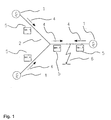
- fig. 1
- illustrates a transmission and distribution system equipped with a directional high voltage detector according to the invention,
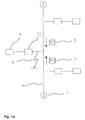
- fig. 1a
- illustrates a part of a transmission and a distribution system in details,
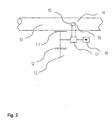
- fig. 2
- illustrates the basic elements in a directional high voltage detector,
- fig. 3
- illustrates a preferred embodiment of a directional high voltage detector according to the invention,
- fig. 4
- illustrates the preferred embodiment of a directional high voltage detector seen from another angle,
- fig. 5
- illustrates a representation of voltage and current values,
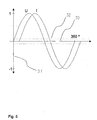
- fig. 6
- illustrates a fraction of the representation centred around a zero crossing for the voltage.
- Referring to fig. 1, a transmission and
distribution system 2 consisting of overhead power lines or underground power cables, connecting one ormore energy producers 1 with the energy users or loads enabling a transfer of electrical energy. The transfer of electrical energy will normally be at a high voltage, and especially AC voltage, to ensure a minimum of energy loss during the transport through the transmission and distribution system. Also the voltage will normally be a 3-phased voltage meaning that the power lines or cables consist of at least 3 conductors. - The lines or cables of the transmission and distribution system are of considerable length which makes it vulnerable to faults of different kind. A
short circuit 6 in the system may e.g. occur as a result of animal attacks, landslides and construction machinery working in wrong places. Deterioration of the cable isolation can be another reason to a short circuit. In order to determine the location of the fault a number ofdirectional detectors 5 are placed along the conductors of the transmission and distribution system. The detectors will on basis of voltage and current measurements determine the direction of the energy flow in the conductor. When a fault occurs, the directional detectors will point toward the location of the fault toward which the energy is flowing. - Referring to fig. 1a, a possible fault situation in a transmission and distribution system is illustrated. The transmission and distribution system includes a high voltage cable or line Hv and a number of high voltage transformers Tr which on the low voltage side each are connected to one or more loads 4. In this fault situation a
short circuit 6 has occurred on the high voltage side of a transformer Tr. Thedetectors 5 placed along the high voltage cable or line all points toward the location of the short circuit being to were the energy is floating. - Referring to fig. 2, a directional
high voltage detector 5 is displayed together with aconductor 10 in a transmission anddistribution system 2. The directional detector comprises a voltage measuring circuit with acapacitive detector 11 and a current measuring circuit with one or moremagnetic field detectors 14. Thecapacitive detector 11 forms a voltage divider together with acapacitor 12. Thecapacitor 12 is also connected to areference potential 13 which may be chosen as the symmetrical point of origin of e.g. a 3-phase cable, which equals a ground potential. - The divided measured voltage value and the measured current value are fed to a
calculation circuit 17 which calculate a directional value for the energy flow in the conductor on the basis of the values. - Referring to fig. 3, a preferred embodiment of the directional detector is illustrated. The capacitive measuring of the voltage is carried out through a capacitive coupling between a
metal panel 20 and theconductor 10. Themetal panel 20 is curved so that it follows the shape of theconductor 10 and is in close proximity ensuring a high capacitance in the capacitive coupling. Themetal panel 20 is preferably rectangular with an area between 4 to 6 cm2 of metal panel mounted a few millimeters over theconductor 10. Other shapes and area sizes of themetal panel 20 are naturally also possible. - The current measuring circuit comprises one or more
magnetic field detectors 14 for detecting the magnetic field generated by the current flow in theconductor 10. Themagnetic field detector 14 is preferably ahall element - To avoid or minimise interference from external magnetic fields it is preferred to use double hall elements instead of single. This will cancel out interference fields because the first hall element will detect the interference fields in one direction and the second hall element will detect the interference fields in the opposite direction resulting in a measured value of nil. Examples of external magnetic fields are the earth magnetic field and magnetic fields from conductors or components placed close to the detector.
- The detected values are led to the
calculation circuit 17 placed on acircuit board 23. To avoid any magnetic fields generating voltage in thesupply lines 22 for themagnetic field detectors 14 the lines are surrounded byshields 21 connected to a ground potential. Theshields 21 also protect thecircuit board 23 containing thecalculation circuit 17. - The isolation of the entire detector in relation to the high voltage is obtained by embedding the entire circuit in silicone rubber. At the same time, the silicone is used as a dielectric between the metal panel and the conductor. The voltage providing cable and the ground cable from the construction are led through an isolating silicone tube into the silicone protected circuit. Thus, the construction becomes protected from an electrical point of view.
- The cables will normally be shielded to avoid any generation of interference magnetic fields in close proximity to the detectors.
- The
calculation circuit 17 generates information concerning the energy direction either through an optic fibre to e.g. a control center or on adisplay 18 comprising e.g. a couple of light-emitting diodes (LEDs) indicating an energy flow in one direction or the other. - The voltage often falls out in case of short-circuiting. This is the reason why the
calculation circuit 17 simulates the voltage in 1 to 2 seconds subsequent to the detection of a fault on the conductor. In this manner, it is still possible to compare the polarity of the recorded short circuit current with the polarity of the voltage. The direction of the short circuit current is determined by thecalculation circuit 17 within the first two periods after a current increase above a certain trigger level. - The energy supply takes place from an external voltage source. This voltage source must provide a DC voltage of 9 to 12 volts in such a manner that the DC-ground is galvanically separated from the ground potential. The circuit also requires voltage in the short circuit situation where the voltage supply from the shortcircuited net cannot be expected. This is why the external voltage supply must feature a back-up battery. With the protected construction of the measuring unit, it is possible to replace the battery (approx. every 10 years) without interrupting the high voltage.
- Referring to fig. 5, the calculation circuit samples the signals a number of times per period, presently set at 20 times per period. The exact current I and voltage U, meaning value and polarity, are read at each sampling. During the frequent samplings, it is possible to determine quite accurately when the zero crossing (phase change) of the voltage takes place. Once the voltage polarity has been determined, it is possible to determine the sample numbers of a period certain to provide a comparison of the polarity of the current and the voltage.
- In a preferred embodiment of the invention, the relative direction of the energy is determined by a simple mathematical multiplication of the polarity of the current and the voltage at a given point in time between the zero crossings.
- The detector will determine the direction of the energy flow when a high current above a certain limit is detected.
- The polarity of the current is measured and subsequently compared with the polarity of the voltage (whether actually measured or simulated) and the energy direction is determined. One or more of the zero crossings of the voltage or current can be simulated as well as measured.
- Referring to fig. 6, the algorithm is designed in such a manner that once the voltage is above the positive noise limit, it is checked if a zero crossing has taken place immediately before that. If the preceding voltage (at the preceding sampling) is below a positive noise limit, a closer examination is made. If the voltage is below the
negative noise limit 4/20 periods earlier (4 samples ago), a zero crossing has taken place. - The sample number for the exact zero crossing point in time must now be somewhere between the current sample X and the 4/20 previously made sample X-4. If the value of the sample X-3 is below the negative noise limit, the zero crossing is at X-1 or X-2. Of the two samples, the sample closest to zero is chosen irrespective of the noise limit. If the value for X-3 is above the negative noise limit, X-2 is chosen as the zero crossing value.
- Despite the above-mentioned algorithm, there is still a minimal risk that the determination of the zero crossing may be incorrect in a noise-filled reading environment. This is the reason why the algorithm has a built-in phase-locked loop circuit so that two succeeding zero crossing points may not deviate more than certain period (e.g. 4/20) from each other in their respective period.
- With this algorithm, it is possible to make an accurate determination of the zero crossing point in time irrespective of the noise level in the measuring system.
- It is understood that the algorithm is capable of determining the zero crossing at a negative to positive voltage crossing (illustrated in fig. 6) as well as a positive to negative crossing.
- Those skilled in the art will appreciate that the present invention is not limited to the detection of energy flow direction in the event of a fault on a high voltage transmission and distribution system. Detection and indication of an energy flow direction in a normal working state is also possible as well as indication of an energy flow direction on other high voltage systems involving an energy flow in a conductor.
- Also a directional detector for low voltage systems are possible, such as portable detectors for household cabling, making it possible to trace defects in the cabling coursing higher current than in a normal working state. The current and voltage detectors may preferably be of different types than the ones described above. Especially because of the lower current values magnetic-resistive (magneto-resistive) detectors can with advantageously replace the hall elements. The method of measuring the voltage with a capacitive detector may also advantageously be replaced by methods involving direct contact to the conductor.
-
- 1.
- Generator
- 2.
- Transmission or distribution system consisting of underground cables or overhead lines
- 3.
- Electric users or loads
- 4.
- Directional indicators
- 5.
- Directional detectors
- 6.
- Electrical fault e.g. short circuit
- 10.
- Conductor
- 11.
- Capacitive detector
- 12.
- Capacitor
- 13.
- Reference potential e.g. ground potential
- 14.
- Electromagnetic field detector
- 15.
- First electromagnetic field detector element
- 16.
- Second electromagnetic field detector element
- 17.
- Calculating circuit
- 18.
- Directional indicator
- 20.
- Metal panel
- 21.
- Shield for electromagnetic field
- 22.
- Supply lines to the electromagnetic field detectors
- 23.
- Circuit board containing the calculation circuit
- 30.
- X-axis in degrees (°)
- 31.
- Y-axis in absolute values (U/U and I/I)
- 32.
- Noise level
- U.
- Voltage
- I.
- Current
- Tr.
- Transformer
- Hv.
- High voltage cable or line
- X, X-1, ...
- Samples of the X-axis
Claims (16)
- Directional high-voltage detector (5) for a high-voltage conductor (10) comprisingcharacterised in thatat least one voltage-measuring circuit for measuring voltage on said conductor (10) by means of at least one capacitive detector (11),at least one current-measuring circuit for measuring current in said conductor (10) by means of at least one magnetic field detector (14, 15, 16),and means for deriving the energy flow in the conductor (10) on the basis of measurements made by said voltage-measuring circuit and said current-measuring circuit,
said means determine the energy flow direction on the basis of the respective polarity of the current and voltage at a given point in time between two successive zero-crossings of the voltage. - Directional high-voltage detector according to claim 1, characterised in that the at least one capacitive detector (11) forms a capacitive coupling with the conductor (10).
- Directional high-voltage detector according to claim 2, characterised in that the capacitive detector (11) comprises a metal plate (20) covering a section of the conductor (10) partially or totally.
- Directional high-voltage detector according to claim 3, characterised in that the edges or corners of the plate are bent away from the conductor (10).
- Directional high-voltage detector according to claim 3, characterised in that the dielectric material between the metal plate (20) and the conductor (10) is silicone covering the surface of said detector partially or totally.
- Directional high-voltage detector according to claim 5, characterised in that the silicone serves as an isolation layer between the high-voltage potentials in said detector and the exterior, respectively.
- Directional high-voltage detector according to claim 2, characterised in that at least one capacitor (12) is connected serially to the capacitive coupling and a reference potential (13), respectively.
- Directional high-voltage detector according to claim 7, characterised in that the reference potential (13) is the ground potential of the conductor (10).
- Directional high-voltage detector according to claim 1, characterised in that the magnetic field detector (14) comprises two hall elements (15, 16).
- Directional high-voltage detector according to claim 1, characterised i n that the supply lines for the magnetic field detector (14) and the calculation circuit (17) comprise shields (21) against magnetic fields.
- Directional high-voltage detector according to claim 1, characterised in that the magnetic field detector (14) comprises at least one magnetoresistive detector.
- Method of determining the direction of the energy flow in a high-voltage conductor wherein at least one voltage-measuring circuit measures voltage on said conductor by means of at least one capacitive detector, at least one current-measuring circuit measures current in said conductor by means of a magnetic field detector and a calculation circuit calculating a directional value derived from the measured voltage and current on the basis of the respective polarity of the current and the voltage at a given point in time between two successive zero-crossings of the voltage.
- Method of determining the direction of the energy flow in a high-voltage conductor according to claim 12, characterised in that the calculation circuit calculates the directional value on the basis of the respective polarity the current and the voltage at a given point in time between two preceding successive zero-crossings of the voltage.
- Method of determining the direction of the energy flow in a high-voltage conductor according to claim 12, characterised in that the calculation circuit divides said voltage into a number of samples within a period of time and where said calculation circuit compares the first voltage sample value numerically larger than a constant value with the immediately preceding values to determine the sample value closest to zero voltage.
- Method of determining the direction of the energy flow in a high-voltage conductor according to claim 14, characterised in that the calculation circuit calculates the directional value on the basis of the respective polarity of the current and voltage at a given point in time between two preceding successive zero-crossings of the voltage.
- Method of determining the direction of the energy flow in a high-voltage conductor according to claim 15, characterised in that the constant value exceeds the noise level.
Priority Applications (2)
| Application Number | Priority Date | Filing Date | Title |
|---|---|---|---|
| AU58060/00A AU5806000A (en) | 1999-07-12 | 2000-07-07 | Directional high-voltage detector |
| PCT/DK2000/000376 WO2001004645A1 (en) | 1999-07-12 | 2000-07-07 | Directional high-voltage detector |
Applications Claiming Priority (2)
| Application Number | Priority Date | Filing Date | Title |
|---|---|---|---|
| DK991010 | 1999-07-12 | ||
| DKPA199901010 | 1999-07-12 |
Publications (2)
| Publication Number | Publication Date |
|---|---|
| EP1069436A1 EP1069436A1 (en) | 2001-01-17 |
| EP1069436B1 true EP1069436B1 (en) | 2004-06-09 |
Family
ID=8099992
Family Applications (1)
| Application Number | Title | Priority Date | Filing Date |
|---|---|---|---|
| EP99203602A Revoked EP1069436B1 (en) | 1999-07-12 | 1999-10-27 | Directional high voltage detector |
Country Status (3)
| Country | Link |
|---|---|
| EP (1) | EP1069436B1 (en) |
| AT (1) | ATE268910T1 (en) |
| DE (1) | DE69917892T2 (en) |
Families Citing this family (1)
| Publication number | Priority date | Publication date | Assignee | Title |
|---|---|---|---|---|
| US7449892B2 (en) | 2006-06-02 | 2008-11-11 | Cal-Tek 2000, Inc. | Stray voltage detecting |
Family Cites Families (5)
| Publication number | Priority date | Publication date | Assignee | Title |
|---|---|---|---|---|
| DE3129901A1 (en) * | 1981-07-24 | 1983-02-10 | Siemens AG, 1000 Berlin und 8000 München | HIGH VOLTAGE MEASURING DEVICE WITH A CAPACITIVE DIVIDER IN A TANK FILLED WITH INSULATING GAS |
| DE3145255A1 (en) * | 1981-11-14 | 1983-05-19 | Brown, Boveri & Cie Ag, 6800 Mannheim | Voltage measuring device for insulating-material-encapsulated areas in medium-voltage switchgear |
| FR2693275B1 (en) * | 1992-07-06 | 1994-08-19 | Alsthom Gec | Ground measurement device for high voltage overhead lines. |
| JPH09311146A (en) * | 1996-05-23 | 1997-12-02 | Makoto Yamamoto | Voltage measuring tool and voltage measuring method using the same |
| CN1195775A (en) * | 1997-12-23 | 1998-10-14 | 浙江大学 | Method and device for distinguishing transmission line fault direction |
-
1999
- 1999-10-27 DE DE69917892T patent/DE69917892T2/en not_active Expired - Lifetime
- 1999-10-27 EP EP99203602A patent/EP1069436B1/en not_active Revoked
- 1999-10-27 AT AT99203602T patent/ATE268910T1/en not_active IP Right Cessation
Also Published As
| Publication number | Publication date |
|---|---|
| DE69917892T2 (en) | 2005-06-30 |
| EP1069436A1 (en) | 2001-01-17 |
| ATE268910T1 (en) | 2004-06-15 |
| DE69917892D1 (en) | 2004-07-15 |
Similar Documents
| Publication | Publication Date | Title |
|---|---|---|
| AU2019232858B2 (en) | Mobile electric leakage detection device and method | |
| US5828219A (en) | Method of detecting faults in the insulation layer of an insulated concealed conductor | |
| EP0800652B1 (en) | Cable partial discharge location pointer | |
| KR101180237B1 (en) | The live line electroscope which uses the magnetic field | |
| KR100778089B1 (en) | Underground Low Voltage Line Exploration System and Method in Multiple Transformer Installation Sites | |
| KR102063097B1 (en) | Electrical leak detecting apparatus and electrical leak detecting method for improving the electrical leak detecting accuracy | |
| US8575942B2 (en) | Non-contacting method and apparatus for determining contact voltage sources and providing a warning for same | |
| KR101880583B1 (en) | The apparatus and method to locate the leaking point efficiently under TN-C environment | |
| KR100928006B1 (en) | Leakage current detection device in the water surrounding the flooded power unit | |
| KR20100037375A (en) | Apparatus for measuring earth resistance | |
| EP1069436A1 (en) | Directional high voltage detector | |
| WO2001004645A1 (en) | Directional high-voltage detector | |
| El-Sayed Gouda | Design parameters of electrical network grounding systems | |
| CA1277705C (en) | Apparatus for detecting faulty power line insulator | |
| CN212845973U (en) | Improved cable detector | |
| Farris et al. | Grid-induced telluric currents for non-contact load monitoring and fault detection | |
| RU2098847C1 (en) | Method for electric reconnaissance | |
| Bais et al. | Novel Techniques of High Voltage Detection and its Application for Enhancing Safety in Extra High Voltage System Operation and Maintenance | |
| McNulty | Voltage detection and indication by electric field measurement | |
| US11614476B2 (en) | Electrical utility multifunctional device | |
| Lackey et al. | Low-cost magnetometer sensing system for detecting geomagnetically induced currents in transmission lines | |
| JPH0644024B2 (en) | Ground resistance measuring device | |
| Tong et al. | Design and Testing of Non-Contact Voltage Detectors for Insulated Wires | |
| Wang et al. | Magnetic field measurement to detect and locate underground power cable | |
| Sorchini et al. | Live power line and lead proximity estimation via real-time electric field sensor |
Legal Events
| Date | Code | Title | Description |
|---|---|---|---|
| PUAI | Public reference made under article 153(3) epc to a published international application that has entered the european phase |
Free format text: ORIGINAL CODE: 0009012 |
|
| AK | Designated contracting states |
Kind code of ref document: A1 Designated state(s): AT BE CH CY DE DK ES FI FR GB GR IE IT LI LU MC NL PT SE |
|
| AX | Request for extension of the european patent |
Free format text: AL;LT;LV;MK;RO;SI |
|
| 17P | Request for examination filed |
Effective date: 20010618 |
|
| AKX | Designation fees paid |
Free format text: AT BE CH CY DE DK ES FI FR GB GR IE IT LI LU MC NL PT SE |
|
| 17Q | First examination report despatched |
Effective date: 20021216 |
|
| GRAP | Despatch of communication of intention to grant a patent |
Free format text: ORIGINAL CODE: EPIDOSNIGR1 |
|
| GRAS | Grant fee paid |
Free format text: ORIGINAL CODE: EPIDOSNIGR3 |
|
| GRAA | (expected) grant |
Free format text: ORIGINAL CODE: 0009210 |
|
| AK | Designated contracting states |
Kind code of ref document: B1 Designated state(s): AT BE CH CY DE DK ES FI FR GB GR IE IT LI LU MC NL PT SE |
|
| PG25 | Lapsed in a contracting state [announced via postgrant information from national office to epo] |
Ref country code: NL Free format text: LAPSE BECAUSE OF FAILURE TO SUBMIT A TRANSLATION OF THE DESCRIPTION OR TO PAY THE FEE WITHIN THE PRESCRIBED TIME-LIMIT Effective date: 20040609 Ref country code: LI Free format text: LAPSE BECAUSE OF FAILURE TO SUBMIT A TRANSLATION OF THE DESCRIPTION OR TO PAY THE FEE WITHIN THE PRESCRIBED TIME-LIMIT Effective date: 20040609 Ref country code: IT Free format text: LAPSE BECAUSE OF FAILURE TO SUBMIT A TRANSLATION OF THE DESCRIPTION OR TO PAY THE FEE WITHIN THE PRESCRIBED TIME-LIMIT;WARNING: LAPSES OF ITALIAN PATENTS WITH EFFECTIVE DATE BEFORE 2007 MAY HAVE OCCURRED AT ANY TIME BEFORE 2007. THE CORRECT EFFECTIVE DATE MAY BE DIFFERENT FROM THE ONE RECORDED. Effective date: 20040609 Ref country code: FI Free format text: LAPSE BECAUSE OF FAILURE TO SUBMIT A TRANSLATION OF THE DESCRIPTION OR TO PAY THE FEE WITHIN THE PRESCRIBED TIME-LIMIT Effective date: 20040609 Ref country code: ES Free format text: LAPSE BECAUSE OF FAILURE TO SUBMIT A TRANSLATION OF THE DESCRIPTION OR TO PAY THE FEE WITHIN THE PRESCRIBED TIME-LIMIT Effective date: 20040609 Ref country code: CY Free format text: LAPSE BECAUSE OF FAILURE TO SUBMIT A TRANSLATION OF THE DESCRIPTION OR TO PAY THE FEE WITHIN THE PRESCRIBED TIME-LIMIT Effective date: 20040609 Ref country code: CH Free format text: LAPSE BECAUSE OF FAILURE TO SUBMIT A TRANSLATION OF THE DESCRIPTION OR TO PAY THE FEE WITHIN THE PRESCRIBED TIME-LIMIT Effective date: 20040609 Ref country code: BE Free format text: LAPSE BECAUSE OF FAILURE TO SUBMIT A TRANSLATION OF THE DESCRIPTION OR TO PAY THE FEE WITHIN THE PRESCRIBED TIME-LIMIT Effective date: 20040609 Ref country code: AT Free format text: LAPSE BECAUSE OF FAILURE TO SUBMIT A TRANSLATION OF THE DESCRIPTION OR TO PAY THE FEE WITHIN THE PRESCRIBED TIME-LIMIT Effective date: 20040609 |
|
| REG | Reference to a national code |
Ref country code: GB Ref legal event code: FG4D |
|
| REG | Reference to a national code |
Ref country code: CH Ref legal event code: EP |
|
| REF | Corresponds to: |
Ref document number: 69917892 Country of ref document: DE Date of ref document: 20040715 Kind code of ref document: P |
|
| REG | Reference to a national code |
Ref country code: IE Ref legal event code: FG4D |
|
| PG25 | Lapsed in a contracting state [announced via postgrant information from national office to epo] |
Ref country code: SE Free format text: LAPSE BECAUSE OF FAILURE TO SUBMIT A TRANSLATION OF THE DESCRIPTION OR TO PAY THE FEE WITHIN THE PRESCRIBED TIME-LIMIT Effective date: 20040909 Ref country code: GR Free format text: LAPSE BECAUSE OF FAILURE TO SUBMIT A TRANSLATION OF THE DESCRIPTION OR TO PAY THE FEE WITHIN THE PRESCRIBED TIME-LIMIT Effective date: 20040909 Ref country code: DK Free format text: LAPSE BECAUSE OF FAILURE TO SUBMIT A TRANSLATION OF THE DESCRIPTION OR TO PAY THE FEE WITHIN THE PRESCRIBED TIME-LIMIT Effective date: 20040909 |
|
| PG25 | Lapsed in a contracting state [announced via postgrant information from national office to epo] |
Ref country code: LU Free format text: LAPSE BECAUSE OF NON-PAYMENT OF DUE FEES Effective date: 20041027 Ref country code: IE Free format text: LAPSE BECAUSE OF NON-PAYMENT OF DUE FEES Effective date: 20041027 |
|
| PG25 | Lapsed in a contracting state [announced via postgrant information from national office to epo] |
Ref country code: MC Free format text: LAPSE BECAUSE OF NON-PAYMENT OF DUE FEES Effective date: 20041031 |
|
| NLV1 | Nl: lapsed or annulled due to failure to fulfill the requirements of art. 29p and 29m of the patents act | ||
| REG | Reference to a national code |
Ref country code: CH Ref legal event code: PL |
|
| PLAQ | Examination of admissibility of opposition: information related to despatch of communication + time limit deleted |
Free format text: ORIGINAL CODE: EPIDOSDOPE2 |
|
| PLAR | Examination of admissibility of opposition: information related to receipt of reply deleted |
Free format text: ORIGINAL CODE: EPIDOSDOPE4 |
|
| PLBQ | Unpublished change to opponent data |
Free format text: ORIGINAL CODE: EPIDOS OPPO |
|
| PLBI | Opposition filed |
Free format text: ORIGINAL CODE: 0009260 |
|
| ET | Fr: translation filed | ||
| PLAQ | Examination of admissibility of opposition: information related to despatch of communication + time limit deleted |
Free format text: ORIGINAL CODE: EPIDOSDOPE2 |
|
| PLAR | Examination of admissibility of opposition: information related to receipt of reply deleted |
Free format text: ORIGINAL CODE: EPIDOSDOPE4 |
|
| PLAX | Notice of opposition and request to file observation + time limit sent |
Free format text: ORIGINAL CODE: EPIDOSNOBS2 |
|
| PLBQ | Unpublished change to opponent data |
Free format text: ORIGINAL CODE: EPIDOS OPPO |
|
| PLAB | Opposition data, opponent's data or that of the opponent's representative modified |
Free format text: ORIGINAL CODE: 0009299OPPO |
|
| 26 | Opposition filed |
Opponent name: NESA A/S Effective date: 20050309 |
|
| R26 | Opposition filed (corrected) |
Opponent name: NESA A/S Effective date: 20050309 |
|
| REG | Reference to a national code |
Ref country code: IE Ref legal event code: MM4A |
|
| PLBB | Reply of patent proprietor to notice(s) of opposition received |
Free format text: ORIGINAL CODE: EPIDOSNOBS3 |
|
| PLAY | Examination report in opposition despatched + time limit |
Free format text: ORIGINAL CODE: EPIDOSNORE2 |
|
| PLAH | Information related to despatch of examination report in opposition + time limit modified |
Free format text: ORIGINAL CODE: EPIDOSCORE2 |
|
| PLBC | Reply to examination report in opposition received |
Free format text: ORIGINAL CODE: EPIDOSNORE3 |
|
| PG25 | Lapsed in a contracting state [announced via postgrant information from national office to epo] |
Ref country code: PT Free format text: LAPSE BECAUSE OF NON-PAYMENT OF DUE FEES Effective date: 20041109 |
|
| RDAF | Communication despatched that patent is revoked |
Free format text: ORIGINAL CODE: EPIDOSNREV1 |
|
| APBP | Date of receipt of notice of appeal recorded |
Free format text: ORIGINAL CODE: EPIDOSNNOA2O |
|
| APAH | Appeal reference modified |
Free format text: ORIGINAL CODE: EPIDOSCREFNO |
|
| PLAB | Opposition data, opponent's data or that of the opponent's representative modified |
Free format text: ORIGINAL CODE: 0009299OPPO |
|
| APBQ | Date of receipt of statement of grounds of appeal recorded |
Free format text: ORIGINAL CODE: EPIDOSNNOA3O |
|
| APAL | Date of receipt of statement of grounds of an appeal modified |
Free format text: ORIGINAL CODE: EPIDOSCNOA3O |
|
| PGFP | Annual fee paid to national office [announced via postgrant information from national office to epo] |
Ref country code: DE Payment date: 20120411 Year of fee payment: 13 |
|
| PGFP | Annual fee paid to national office [announced via postgrant information from national office to epo] |
Ref country code: GB Payment date: 20120426 Year of fee payment: 13 Ref country code: FR Payment date: 20120515 Year of fee payment: 13 |
|
| APBU | Appeal procedure closed |
Free format text: ORIGINAL CODE: EPIDOSNNOA9O |
|
| RDAG | Patent revoked |
Free format text: ORIGINAL CODE: 0009271 |
|
| STAA | Information on the status of an ep patent application or granted ep patent |
Free format text: STATUS: PATENT REVOKED |
|
| 27W | Patent revoked |
Effective date: 20130119 |
|
| GBPR | Gb: patent revoked under art. 102 of the ep convention designating the uk as contracting state |
Effective date: 20130119 |
|
| REG | Reference to a national code |
Ref country code: DE Ref legal event code: R119 Ref document number: 69917892 Country of ref document: DE Effective date: 20130501 |