EP1069332A2 - Disk brake with improved caliper - Google Patents
Disk brake with improved caliper Download PDFInfo
- Publication number
- EP1069332A2 EP1069332A2 EP00305559A EP00305559A EP1069332A2 EP 1069332 A2 EP1069332 A2 EP 1069332A2 EP 00305559 A EP00305559 A EP 00305559A EP 00305559 A EP00305559 A EP 00305559A EP 1069332 A2 EP1069332 A2 EP 1069332A2
- Authority
- EP
- European Patent Office
- Prior art keywords
- caliper
- pistons
- disk brake
- disk
- disk rotor
- Prior art date
- Legal status (The legal status is an assumption and is not a legal conclusion. Google has not performed a legal analysis and makes no representation as to the accuracy of the status listed.)
- Granted
Links
- 238000005266 casting Methods 0.000 claims description 9
- 229910000838 Al alloy Inorganic materials 0.000 claims description 5
- 239000012530 fluid Substances 0.000 description 12
- 229910000831 Steel Inorganic materials 0.000 description 2
- 239000010959 steel Substances 0.000 description 2
- 238000005452 bending Methods 0.000 description 1
- 230000007423 decrease Effects 0.000 description 1
- 238000003754 machining Methods 0.000 description 1
- 230000003014 reinforcing effect Effects 0.000 description 1
Images


Classifications
-
- F—MECHANICAL ENGINEERING; LIGHTING; HEATING; WEAPONS; BLASTING
- F16—ENGINEERING ELEMENTS AND UNITS; GENERAL MEASURES FOR PRODUCING AND MAINTAINING EFFECTIVE FUNCTIONING OF MACHINES OR INSTALLATIONS; THERMAL INSULATION IN GENERAL
- F16D—COUPLINGS FOR TRANSMITTING ROTATION; CLUTCHES; BRAKES
- F16D55/00—Brakes with substantially-radial braking surfaces pressed together in axial direction, e.g. disc brakes
- F16D55/02—Brakes with substantially-radial braking surfaces pressed together in axial direction, e.g. disc brakes with axially-movable discs or pads pressed against axially-located rotating members
- F16D55/22—Brakes with substantially-radial braking surfaces pressed together in axial direction, e.g. disc brakes with axially-movable discs or pads pressed against axially-located rotating members by clamping an axially-located rotating disc between movable braking members, e.g. movable brake discs or brake pads
- F16D55/228—Brakes with substantially-radial braking surfaces pressed together in axial direction, e.g. disc brakes with axially-movable discs or pads pressed against axially-located rotating members by clamping an axially-located rotating disc between movable braking members, e.g. movable brake discs or brake pads with a separate actuating member for each side
-
- F—MECHANICAL ENGINEERING; LIGHTING; HEATING; WEAPONS; BLASTING
- F16—ENGINEERING ELEMENTS AND UNITS; GENERAL MEASURES FOR PRODUCING AND MAINTAINING EFFECTIVE FUNCTIONING OF MACHINES OR INSTALLATIONS; THERMAL INSULATION IN GENERAL
- F16D—COUPLINGS FOR TRANSMITTING ROTATION; CLUTCHES; BRAKES
- F16D55/00—Brakes with substantially-radial braking surfaces pressed together in axial direction, e.g. disc brakes
- F16D2055/0004—Parts or details of disc brakes
- F16D2055/0016—Brake calipers
-
- F—MECHANICAL ENGINEERING; LIGHTING; HEATING; WEAPONS; BLASTING
- F16—ENGINEERING ELEMENTS AND UNITS; GENERAL MEASURES FOR PRODUCING AND MAINTAINING EFFECTIVE FUNCTIONING OF MACHINES OR INSTALLATIONS; THERMAL INSULATION IN GENERAL
- F16D—COUPLINGS FOR TRANSMITTING ROTATION; CLUTCHES; BRAKES
- F16D55/00—Brakes with substantially-radial braking surfaces pressed together in axial direction, e.g. disc brakes
- F16D2055/0004—Parts or details of disc brakes
- F16D2055/0016—Brake calipers
- F16D2055/002—Brake calipers assembled from a plurality of parts
-
- F—MECHANICAL ENGINEERING; LIGHTING; HEATING; WEAPONS; BLASTING
- F16—ENGINEERING ELEMENTS AND UNITS; GENERAL MEASURES FOR PRODUCING AND MAINTAINING EFFECTIVE FUNCTIONING OF MACHINES OR INSTALLATIONS; THERMAL INSULATION IN GENERAL
- F16D—COUPLINGS FOR TRANSMITTING ROTATION; CLUTCHES; BRAKES
- F16D55/00—Brakes with substantially-radial braking surfaces pressed together in axial direction, e.g. disc brakes
- F16D2055/0075—Constructional features of axially engaged brakes
- F16D2055/0091—Plural actuators arranged side by side on the same side of the rotor
-
- F—MECHANICAL ENGINEERING; LIGHTING; HEATING; WEAPONS; BLASTING
- F16—ENGINEERING ELEMENTS AND UNITS; GENERAL MEASURES FOR PRODUCING AND MAINTAINING EFFECTIVE FUNCTIONING OF MACHINES OR INSTALLATIONS; THERMAL INSULATION IN GENERAL
- F16D—COUPLINGS FOR TRANSMITTING ROTATION; CLUTCHES; BRAKES
- F16D2200/00—Materials; Production methods therefor
- F16D2200/0004—Materials; Production methods therefor metallic
- F16D2200/0026—Non-ferro
- F16D2200/003—Light metals, e.g. aluminium
-
- F—MECHANICAL ENGINEERING; LIGHTING; HEATING; WEAPONS; BLASTING
- F16—ENGINEERING ELEMENTS AND UNITS; GENERAL MEASURES FOR PRODUCING AND MAINTAINING EFFECTIVE FUNCTIONING OF MACHINES OR INSTALLATIONS; THERMAL INSULATION IN GENERAL
- F16D—COUPLINGS FOR TRANSMITTING ROTATION; CLUTCHES; BRAKES
- F16D2250/00—Manufacturing; Assembly
- F16D2250/0007—Casting
Definitions
- This invention relates to a disk brake for use in motor vehicles such as automobiles, and particularly of a type having a one-piece caliper with opposed pistons.
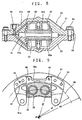
- a typical conventional opposed-piston type disk brake has a caliper 50 comprising separate inner and outer portions 51 and 52 as shown in Figs. 8 and 9.
- the inner and outer portions 51, 52 are secured together by bolts 54 with their flat surfaces 53 in close contact with each other.
- Each of the inner and outer portions 51, 52 are formed with a pair of close-bottomed cylinders 55.
- a piston 59 is received in each cylinder 55 with the gap between the piston and the cylinder liquid-tightly sealed by a piston seal 58.
- the caliper is formed with a groove 61 in which is received a disk rotor such that the rotor rotates with a predetermined clearance left between its outer perimeter and the inner wall of the caliper.
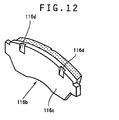
- Friction pads 60 are disposed between the disk rotor and the pistons 59 on both sides while hanging from pad pins 66 inserted through pin holes 65 formed in the pads and secured to the caliper 50.
- the pistons 59 on both sides are moved toward each other to press the pads 60 against the rotor, thereby applying braking force to the wheel.
- the caliper 50 is formed with torque bearing surfaces 62 at both ends of the pads 60 to bear braking torque.
- One way to increase the effective braking radius R2 without increasing the wheel inner radius R0 is to form the caliper as a one-piece member and thus to omit the bolts 54. But if the thickness of the bridge portion of such a one-piece caliper is reduced to increase the effective braking thickness R2, the outer portion of the caliper tends to bend outwardly due to stress concentration on the inner corner of the outer portion of the caliper, especially if the caliper is made of a aluminum alloy for reduced weight.
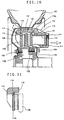
- ribs 118 are formed to extend across the inner corner X of the outer jaw 114. But actually, it would be impossible to use such ribs in a one-piece, opposed-piston type caliper because with this type of caliper the inner corners of the caliper are located much closer to the disk rotor than with the floating caliper because the opposed-piston type caliper needs torque bearing portions 62 (Fig. 8). Thus, if such ribs were provided along the inner corner of the outer portion of the caliper, they would interfere with the rotor.
- An object of the invention is to provide an opposed-piston type disk brake having a one-piece caliper and provided with a means for preventing the outer portion of the caliper from bending outwardly during braking.
- a disk brake comprising a one-piece caliper comprising an inner portion formed with a first cylinder and fastened to a stationary part of a vehicle, an outer portion formed with a second cylinder, and a bridge portion connecting the inner and outer portions together and having an annular inner surface defining a corner, pistons each received in one of the first and second cylinders, a disk rotor fastened to a wheel of the vehicle and disposed between the pistons, and friction pads disposed between the disk rotor and the pistons so as to be movable toward and away from the disk rotor, characterised in that the caliper is formed with a recess having an arcuate cross-section having a predetermined radius of curvature in the inner surface of the outer portion along the corner to extend in a direction in which the pistons are moved so as not to protrude radially inwardly of the annular inner surface of the bridge portion.
- the disk brake according to the present invention includes an integral type caliper 1 comprising an inner portion, an outer portion and a bridge portion 18 connecting the inner and outer portions together.
- the inner portion of the caliper has two legs 1a (Fig. 2) secured to a flange 102 of an axle housing as a non-rotating portion of the vehicle by bolts 104 as shown in Fig. 3A.
- the caliper defines a groove 14 in which is received a disk rotor 19 such that the rotor having a radius R rotates with a predetermined clearance left between its outer perimeter and the inner wall of the bridge portion 18.
- the disk rotor 19 is secured to a hub flange 106 integral with the wheel axle, not shown, by bolts 109, together with a wheel 108 carrying a tire 107.
- the inner and outer portions of the caliper 1 are formed with cylinders 3 and 2, respectively (Fig. 1).
- the cylinders 3 are through holes having their rear ends closed by threading plugs 4 having hexagonal recesses with O-rings 5 disposed therebetween.
- the cylinders 2 are blind holes formed by a tool inserted through the cylinders 3 before they are closed by the plugs 4. At their rear ends, the cylinders 2 are connected together by a passage 7 formed when the caliper is formed by casting.
- Obligue passages 6a and 6b extend from the backs of the respective cylinders 2 to openings at both ends of the caliper.
- Oblique passages 8a and 8b extend from the backs of the respective cylinders 3 to intermediate portions of the passages 6a and 6b, respectively, to connect the cylinders 3 with the cylinders 2.
- the passages 8a and 8b are formed by a drill inserted in the respective cylinders 3 before they are closed by the plugs 4. One of the openings is closed by a plug 9, and to the other opening 10 is connected an external fluid pressure source, not shown, to supply fluid pressure to pistons 12 received in the respective cylinders 2, 3 through the passages 6a, 6b, 8a, 8b and 7.
- Piston seals 11 seal fluid pressure.
- Friction pads 13a, 13b are disposed between the disk rotor and the pistons on both sides while hanging from pad pins 17 inserted through pin holes 16 formed in the pads (Fig. 2) and secured to the caliper.
- the pistons on both sides are moved toward each other to press the pads 13a, 13b against the rotor, thereby applying braking force to the disk rotor.
- the caliper is formed with torque bearing surfaces 15 at both ends of the pads to bear the braking torque.
- the wheel clearance is extremely slight at a part 1c of the outer portion close to the disk rotor. Due to the necessity of reducing the thickness of the bridge portion 18 to provide a required wheel clearance, the rigidity of the bridge portion 18 tends to be the lowest at part 1c.
- a recess 1d having an arcuate cross-section having a predetermined radius of curvature R is formed in the groove 14 in the inner surface of the outer portion of the caliper 1 along the inner corner between the inner portion and the bridge portion 18 of the caliper so as to extend in a direction in which the piston moves and not to protrude radially inwardly beyond the inner surface of the bridge portion 18.
- the recess 1d should preferably be formed black by casting because machining would form tool marks on the surface.
- the recess 1d prevents stress concentration on the inner corner between the outer portion and the bridge portion 18 of the caliper. This makes it possible to form the caliper from an aluminum alloy casting instead of steel casting and thus to reduce the weight of the caliper.
- the calipers tested were made of an aluminum alloy for casting known as [Type 4 CH], which is defined under JIS H 2211 and comprises 6.5-7.5 wt% Si, 0.20 wt% or less Ti, 0.15 wt% or less Fe, and Cu, Mg, Ni, etc. with the balance being Al.
- [Type 4 CH] which is defined under JIS H 2211 and comprises 6.5-7.5 wt% Si, 0.20 wt% or less Ti, 0.15 wt% or less Fe, and Cu, Mg, Ni, etc. with the balance being Al.
- Fig. 6 shows the relationship between the average of the stresses measured by the gauges and the input fluid pressure for the caliper having a recess 1d having a radius of curvature R of 8 mm (which means that the R/T ratio is greater than 0.4).
- R/T ratio is greater than 0.4.
- the stress at input pressure 140 kgf/cm 2 is still only 21.7 kgf/mm 2 , which is well within 80% of the maximum allowable stress of [Type 4 CH].
- Fig. 7 shows the relationship between the average of the stresses measured by the gauges and the R/T ratio when the input fluid pressure was 140 kgf/cm 2 .
- the graph clearly shows that the stress increases sharply as the R/T ratio decreases below 0.4. This shows that in order to prevent deflection of the bridge portion 18 near its groove 14, the R/T ratio should be equal to or greater than 0.4.
Landscapes
- Engineering & Computer Science (AREA)
- General Engineering & Computer Science (AREA)
- Mechanical Engineering (AREA)
- Braking Arrangements (AREA)
Abstract
Description
Claims (4)
- A disk brake comprising a one-piece caliper comprising an inner portion formed with a first cylinder and fastened to a stationary part of a vehicle, an outer portion formed with a second cylinder, and a bridge portion connecting said inner and outer portions together and having an annular inner surface defining a corner, pistons each received in one of said first and second cylinders, a disk rotor fastened to a wheel of the vehicle and disposed between said pistons, and friction pads disposed between said disk rotor and said pistons so as to be movable toward and away from said disk rotor, characterised in that said caliper is formed with a recess having an arcuate cross-section having a predetermined radius of curvature in the inner surface of said outer portion along said corner to extend in a direction in which said pistons are moved so as not to protrude radially inwardly of said annular inner surface of said bridge portion.
- The disk brake as claimed in claim 1 wherein said recess is formed black by casting.
- The disk brake as claimed in claim 1 or 2 wherein the ratio of said radius of curvature to the minimum thickness of said bridge portion is equal to or greater than 0.4.
- The disk brake as claimed in any of claims 1-3 wherein said caliper is formed by casting an aluminum alloy.
Applications Claiming Priority (2)
| Application Number | Priority Date | Filing Date | Title |
|---|---|---|---|
| JP20140899 | 1999-07-15 | ||
| JP11201408A JP2001027267A (en) | 1999-07-15 | 1999-07-15 | Caliper body |
Publications (3)
| Publication Number | Publication Date |
|---|---|
| EP1069332A2 true EP1069332A2 (en) | 2001-01-17 |
| EP1069332A3 EP1069332A3 (en) | 2002-11-20 |
| EP1069332B1 EP1069332B1 (en) | 2005-10-12 |
Family
ID=16440600
Family Applications (1)
| Application Number | Title | Priority Date | Filing Date |
|---|---|---|---|
| EP00305559A Expired - Lifetime EP1069332B1 (en) | 1999-07-15 | 2000-07-03 | Improved disk brake caliper |
Country Status (4)
| Country | Link |
|---|---|
| US (1) | US6367595B1 (en) |
| EP (1) | EP1069332B1 (en) |
| JP (1) | JP2001027267A (en) |
| DE (1) | DE60023070T2 (en) |
Cited By (7)
| Publication number | Priority date | Publication date | Assignee | Title |
|---|---|---|---|---|
| WO2002077483A1 (en) * | 2001-03-27 | 2002-10-03 | Delphi Technologies Inc | Method and apparatus for disc brake construction |
| WO2005064192A1 (en) * | 2003-12-30 | 2005-07-14 | Freni Brembo S.P.A. | Caliper for a disc-brake |
| WO2007000780A1 (en) * | 2005-06-28 | 2007-01-04 | Freni Brembo S.P.A. | A body of a disc brake caliper, a method for cast manufacturing it and a core for said cast manufacturing method |
| WO2007122100A1 (en) * | 2006-04-20 | 2007-11-01 | Continental Teves Ag & Co. Ohg | Disk brake |
| WO2009050226A1 (en) * | 2007-10-19 | 2009-04-23 | Continental Teves Ag & Co. Ohg | Disc brake |
| EP3396192A1 (en) * | 2017-04-26 | 2018-10-31 | Akebono Brake Industry Co., Ltd. | Brake caliper assembly |
| GB2701181A (en) * | 2024-09-09 | 2026-04-22 | Fox Factory Inc | Monoblock disc brake caliper |
Families Citing this family (18)
| Publication number | Priority date | Publication date | Assignee | Title |
|---|---|---|---|---|
| AUPS066802A0 (en) * | 2002-02-21 | 2002-03-14 | Pbr Australia Pty Ltd | Improved disc brake caliper |
| US7108109B1 (en) | 2003-09-25 | 2006-09-19 | Scott Wilkings | Mono-bloc brake caliper and evaporable pattern for casting same |
| JP2005163809A (en) * | 2003-11-28 | 2005-06-23 | Hitachi Ltd | Disc brake |
| US20060124404A1 (en) * | 2004-11-04 | 2006-06-15 | Eduardo Morais | Opposed piston caliper for use in a vehicle disc brake assembly and method for producing same |
| US8672100B2 (en) * | 2005-02-07 | 2014-03-18 | Hitachi, Ltd. | Cylinder apparatus and disk brake |
| JP4823716B2 (en) * | 2005-02-07 | 2011-11-24 | 日立オートモティブシステムズ株式会社 | Disc brake |
| JP4828255B2 (en) | 2006-02-24 | 2011-11-30 | 日立オートモティブシステムズ株式会社 | Disc brake |
| JP4757791B2 (en) * | 2006-12-28 | 2011-08-24 | 日立オートモティブシステムズ株式会社 | Monoblock caliper for disc brake and manufacturing method thereof |
| ITMI20071109A1 (en) * | 2007-05-31 | 2008-12-01 | Sunstar Engineering Pte Ltd | "METHOD FOR MANUFACTURE OF DISC BRAKE CALIPERS WITH FORCED CAP" |
| JP4832402B2 (en) * | 2007-10-22 | 2011-12-07 | 日立オートモティブシステムズ株式会社 | Disc brake and method of manufacturing disc brake |
| JP4818336B2 (en) * | 2008-02-20 | 2011-11-16 | 日信工業株式会社 | Caliper body for disc brakes for vehicles |
| JP5157816B2 (en) * | 2008-10-21 | 2013-03-06 | 株式会社アドヴィックス | Piston facing disc brake |
| JP4864986B2 (en) * | 2009-01-08 | 2012-02-01 | 日信工業株式会社 | Piston-opposed vehicle disc brake |
| KR101353720B1 (en) | 2011-06-23 | 2014-01-20 | 허종도 | A Caliper for Breaking System |
| EP2884131B1 (en) | 2012-08-10 | 2021-03-03 | Nippon Light Metal Co., Ltd. | Caliper for disc brakes |
| US8905200B2 (en) | 2012-09-14 | 2014-12-09 | Kenneth Eric Gutelius | Bracketless caliper |
| TWI752769B (en) * | 2020-12-25 | 2022-01-11 | 佳鎂科技股份有限公司 | Integrated disc brake caliper and method for producing same |
| WO2023040178A1 (en) * | 2021-09-18 | 2023-03-23 | 奥创动力传动(深圳)有限公司 | Friction disk and brake |
Family Cites Families (10)
| Publication number | Priority date | Publication date | Assignee | Title |
|---|---|---|---|---|
| GB818077A (en) * | 1956-04-10 | 1959-08-12 | Girling Ltd | Improvements relating to disc brakes for vehicles |
| AU521333B2 (en) * | 1978-03-01 | 1982-03-25 | Brake And Clutch Industries Australia Pty. Ltd. | Improved disc brake assembly |
| DE3026817A1 (en) * | 1980-07-16 | 1982-02-11 | Alfred Teves Gmbh, 6000 Frankfurt | FLOATING SADDLE PARTIAL DISC BRAKE, ESPECIALLY FOR MOTOR VEHICLES |
| GB9001565D0 (en) * | 1990-01-23 | 1990-03-21 | Gen Motors France | Disc brake |
| GB9120369D0 (en) * | 1991-09-25 | 1991-11-06 | Alcon Components Ltd | Brake caliper |
| GB9305795D0 (en) * | 1993-03-19 | 1993-05-05 | Automotive Products Plc | A brake disc |
| JP3518054B2 (en) * | 1995-05-26 | 2004-04-12 | 住友電気工業株式会社 | Vibration suppression device for disc brake |
| DE69605483T2 (en) * | 1995-06-13 | 2000-07-27 | Sumitomo Electric Industries, Ltd. | Disc brake with vibration damper |
| JPH1163041A (en) | 1997-08-27 | 1999-03-05 | Nissin Kogyo Kk | Caliper body of vehicle disc brake |
| US6000506A (en) * | 1998-02-23 | 1999-12-14 | General Motors Corporation | Disc brake caliper |
-
1999
- 1999-07-15 JP JP11201408A patent/JP2001027267A/en active Pending
-
2000
- 2000-07-03 EP EP00305559A patent/EP1069332B1/en not_active Expired - Lifetime
- 2000-07-03 DE DE60023070T patent/DE60023070T2/en not_active Expired - Fee Related
- 2000-07-06 US US09/610,956 patent/US6367595B1/en not_active Expired - Fee Related
Non-Patent Citations (1)
| Title |
|---|
| None |
Cited By (10)
| Publication number | Priority date | Publication date | Assignee | Title |
|---|---|---|---|---|
| WO2002077483A1 (en) * | 2001-03-27 | 2002-10-03 | Delphi Technologies Inc | Method and apparatus for disc brake construction |
| WO2005064192A1 (en) * | 2003-12-30 | 2005-07-14 | Freni Brembo S.P.A. | Caliper for a disc-brake |
| US8196716B2 (en) | 2003-12-30 | 2012-06-12 | Freni Brembo S.P.A. | Caliper for a disk-brake |
| WO2007000780A1 (en) * | 2005-06-28 | 2007-01-04 | Freni Brembo S.P.A. | A body of a disc brake caliper, a method for cast manufacturing it and a core for said cast manufacturing method |
| WO2007122100A1 (en) * | 2006-04-20 | 2007-11-01 | Continental Teves Ag & Co. Ohg | Disk brake |
| US8028810B2 (en) | 2006-04-20 | 2011-10-04 | Continental Teves Ag & Co. Ohg | Disk brake |
| WO2009050226A1 (en) * | 2007-10-19 | 2009-04-23 | Continental Teves Ag & Co. Ohg | Disc brake |
| EP3396192A1 (en) * | 2017-04-26 | 2018-10-31 | Akebono Brake Industry Co., Ltd. | Brake caliper assembly |
| US10302160B2 (en) | 2017-04-26 | 2019-05-28 | Akebono Brake Industry Co., Ltd. | Brake caliper assembly |
| GB2701181A (en) * | 2024-09-09 | 2026-04-22 | Fox Factory Inc | Monoblock disc brake caliper |
Also Published As
| Publication number | Publication date |
|---|---|
| DE60023070T2 (en) | 2006-06-22 |
| DE60023070D1 (en) | 2005-11-17 |
| JP2001027267A (en) | 2001-01-30 |
| EP1069332B1 (en) | 2005-10-12 |
| US6367595B1 (en) | 2002-04-09 |
| EP1069332A3 (en) | 2002-11-20 |
Similar Documents
| Publication | Publication Date | Title |
|---|---|---|
| EP1069332B1 (en) | Improved disk brake caliper | |
| US6116384A (en) | Disk brake | |
| EP2022999B2 (en) | a disc brake caliper body and a disc brake caliper comprising such a body | |
| US20060054425A1 (en) | Floating caliper-type disc brake | |
| WO2007087393A2 (en) | Symmetric brake clip | |
| US6000506A (en) | Disc brake caliper | |
| EP0826894B1 (en) | Disc brake device | |
| JP4651640B2 (en) | Opposite piston type disc brake | |
| JP2004286216A (en) | One piece sliding brake caliper | |
| US20090145702A1 (en) | Brake pad for a vehicle disc brake assembly | |
| US4762206A (en) | Disc brake | |
| EP1515061A2 (en) | Radially mounted disk brake | |
| JP2002213502A (en) | Caliper body of vehicle disc brake | |
| JPS634829Y2 (en) | ||
| JPH06341470A (en) | Opposing piston type caliper of disc brake | |
| US5735368A (en) | Disk brake mounting member | |
| JPH1163041A (en) | Caliper body of vehicle disc brake | |
| US5167303A (en) | Disc brake | |
| JP4076750B2 (en) | Opposite piston type disc brake | |
| JP4718422B2 (en) | Disc brake | |
| JP2572188Y2 (en) | Caliper body mounting structure for vehicle disc brakes | |
| GB2225396A (en) | Disc brake mounting structure | |
| JPH081304Y2 (en) | Disc brake | |
| JP4461082B2 (en) | Caliper body for disc brakes for vehicles | |
| CN218177791U (en) | Fixed aluminium system multi-piston caliper |
Legal Events
| Date | Code | Title | Description |
|---|---|---|---|
| PUAI | Public reference made under article 153(3) epc to a published international application that has entered the european phase |
Free format text: ORIGINAL CODE: 0009012 |
|
| AK | Designated contracting states |
Kind code of ref document: A2 Designated state(s): AT BE CH CY DE DK ES FI FR GB GR IE IT LI LU MC NL PT SE |
|
| AX | Request for extension of the european patent |
Free format text: AL;LT;LV;MK;RO;SI |
|
| PUAL | Search report despatched |
Free format text: ORIGINAL CODE: 0009013 |
|
| AK | Designated contracting states |
Kind code of ref document: A3 Designated state(s): AT BE CH CY DE DK ES FI FR GB GR IE IT LI LU MC NL PT SE |
|
| AX | Request for extension of the european patent |
Free format text: AL;LT;LV;MK;RO;SI |
|
| 17P | Request for examination filed |
Effective date: 20030211 |
|
| AKX | Designation fees paid |
Designated state(s): DE GB |
|
| 17Q | First examination report despatched |
Effective date: 20040211 |
|
| GRAP | Despatch of communication of intention to grant a patent |
Free format text: ORIGINAL CODE: EPIDOSNIGR1 |
|
| RTI1 | Title (correction) |
Free format text: IMPROVED DISK BRAKE CALIPER |
|
| GRAS | Grant fee paid |
Free format text: ORIGINAL CODE: EPIDOSNIGR3 |
|
| GRAA | (expected) grant |
Free format text: ORIGINAL CODE: 0009210 |
|
| AK | Designated contracting states |
Kind code of ref document: B1 Designated state(s): DE GB |
|
| REG | Reference to a national code |
Ref country code: GB Ref legal event code: FG4D |
|
| REF | Corresponds to: |
Ref document number: 60023070 Country of ref document: DE Date of ref document: 20051117 Kind code of ref document: P |
|
| PLBE | No opposition filed within time limit |
Free format text: ORIGINAL CODE: 0009261 |
|
| STAA | Information on the status of an ep patent application or granted ep patent |
Free format text: STATUS: NO OPPOSITION FILED WITHIN TIME LIMIT |
|
| 26N | No opposition filed |
Effective date: 20060713 |
|
| PGFP | Annual fee paid to national office [announced via postgrant information from national office to epo] |
Ref country code: GB Payment date: 20070627 Year of fee payment: 8 |
|
| PGFP | Annual fee paid to national office [announced via postgrant information from national office to epo] |
Ref country code: DE Payment date: 20080711 Year of fee payment: 9 |
|
| GBPC | Gb: european patent ceased through non-payment of renewal fee |
Effective date: 20080703 |
|
| PG25 | Lapsed in a contracting state [announced via postgrant information from national office to epo] |
Ref country code: GB Free format text: LAPSE BECAUSE OF NON-PAYMENT OF DUE FEES Effective date: 20080703 |
|
| PG25 | Lapsed in a contracting state [announced via postgrant information from national office to epo] |
Ref country code: DE Free format text: LAPSE BECAUSE OF NON-PAYMENT OF DUE FEES Effective date: 20100202 |