EP1069144B1 - Curable polyurethane polymer - Google Patents
Curable polyurethane polymer Download PDFInfo
- Publication number
- EP1069144B1 EP1069144B1 EP00115226A EP00115226A EP1069144B1 EP 1069144 B1 EP1069144 B1 EP 1069144B1 EP 00115226 A EP00115226 A EP 00115226A EP 00115226 A EP00115226 A EP 00115226A EP 1069144 B1 EP1069144 B1 EP 1069144B1
- Authority
- EP
- European Patent Office
- Prior art keywords
- isocyanate
- groups
- group
- weight
- polymer
- Prior art date
- Legal status (The legal status is an assumption and is not a legal conclusion. Google has not performed a legal analysis and makes no representation as to the accuracy of the status listed.)
- Expired - Lifetime
Links
- 229920000642 polymer Polymers 0.000 title claims abstract description 64
- 229920002635 polyurethane Polymers 0.000 title claims abstract description 55
- 239000004814 polyurethane Substances 0.000 title claims abstract description 54
- 150000001875 compounds Chemical class 0.000 claims abstract description 51
- 125000002887 hydroxy group Chemical group [H]O* 0.000 claims abstract description 45
- IQPQWNKOIGAROB-UHFFFAOYSA-N isocyanate group Chemical group [N-]=C=O IQPQWNKOIGAROB-UHFFFAOYSA-N 0.000 claims abstract description 34
- 125000000524 functional group Chemical group 0.000 claims abstract description 14
- 239000004815 dispersion polymer Substances 0.000 claims abstract description 12
- 229920000768 polyamine Polymers 0.000 claims abstract description 7
- 150000003839 salts Chemical class 0.000 claims abstract description 6
- 150000004985 diamines Chemical class 0.000 claims abstract description 4
- 239000006185 dispersion Substances 0.000 claims description 49
- 239000000203 mixture Substances 0.000 claims description 38
- 150000001252 acrylic acid derivatives Chemical class 0.000 claims description 26
- 229920000570 polyether Polymers 0.000 claims description 16
- 239000004721 Polyphenylene oxide Substances 0.000 claims description 15
- XLYOFNOQVPJJNP-UHFFFAOYSA-N water Substances O XLYOFNOQVPJJNP-UHFFFAOYSA-N 0.000 claims description 15
- 239000004593 Epoxy Substances 0.000 claims description 13
- 239000000758 substrate Substances 0.000 claims description 12
- 229920000728 polyester Polymers 0.000 claims description 11
- 239000007787 solid Substances 0.000 claims description 10
- 125000002924 primary amino group Chemical group [H]N([H])* 0.000 claims description 8
- 125000000467 secondary amino group Chemical group [H]N([*:1])[*:2] 0.000 claims description 7
- 239000008199 coating composition Substances 0.000 claims description 3
- 125000003277 amino group Chemical group 0.000 abstract description 8
- 239000011248 coating agent Substances 0.000 abstract description 8
- KWYUFKZDYYNOTN-UHFFFAOYSA-M Potassium hydroxide Chemical compound [OH-].[K+] KWYUFKZDYYNOTN-UHFFFAOYSA-M 0.000 description 58
- -1 acrylic ester diol Chemical class 0.000 description 27
- 238000002360 preparation method Methods 0.000 description 21
- 229920005862 polyol Polymers 0.000 description 16
- 150000003077 polyols Chemical class 0.000 description 16
- 238000000576 coating method Methods 0.000 description 15
- 239000005056 polyisocyanate Substances 0.000 description 13
- 229920001228 polyisocyanate Polymers 0.000 description 13
- CSCPPACGZOOCGX-UHFFFAOYSA-N Acetone Chemical compound CC(C)=O CSCPPACGZOOCGX-UHFFFAOYSA-N 0.000 description 12
- 239000003995 emulsifying agent Substances 0.000 description 12
- 238000004519 manufacturing process Methods 0.000 description 12
- 150000001412 amines Chemical class 0.000 description 11
- 125000004432 carbon atom Chemical group C* 0.000 description 11
- 235000019589 hardness Nutrition 0.000 description 11
- 238000000034 method Methods 0.000 description 11
- 150000001991 dicarboxylic acids Chemical class 0.000 description 10
- SMZOUWXMTYCWNB-UHFFFAOYSA-N 2-(2-methoxy-5-methylphenyl)ethanamine Chemical compound COC1=CC=C(C)C=C1CCN SMZOUWXMTYCWNB-UHFFFAOYSA-N 0.000 description 9
- WFDIJRYMOXRFFG-UHFFFAOYSA-N Acetic anhydride Chemical compound CC(=O)OC(C)=O WFDIJRYMOXRFFG-UHFFFAOYSA-N 0.000 description 9
- NIXOWILDQLNWCW-UHFFFAOYSA-M Acrylate Chemical compound [O-]C(=O)C=C NIXOWILDQLNWCW-UHFFFAOYSA-M 0.000 description 9
- LFQSCWFLJHTTHZ-UHFFFAOYSA-N Ethanol Chemical compound CCO LFQSCWFLJHTTHZ-UHFFFAOYSA-N 0.000 description 9
- CERQOIWHTDAKMF-UHFFFAOYSA-N Methacrylic acid Chemical compound CC(=C)C(O)=O CERQOIWHTDAKMF-UHFFFAOYSA-N 0.000 description 9
- ZMANZCXQSJIPKH-UHFFFAOYSA-N Triethylamine Chemical compound CCN(CC)CC ZMANZCXQSJIPKH-UHFFFAOYSA-N 0.000 description 9
- 239000000243 solution Substances 0.000 description 9
- NIXOWILDQLNWCW-UHFFFAOYSA-N 2-Propenoic acid Natural products OC(=O)C=C NIXOWILDQLNWCW-UHFFFAOYSA-N 0.000 description 8
- VHYFNPMBLIVWCW-UHFFFAOYSA-N 4-Dimethylaminopyridine Chemical compound CN(C)C1=CC=NC=C1 VHYFNPMBLIVWCW-UHFFFAOYSA-N 0.000 description 8
- 125000001931 aliphatic group Chemical group 0.000 description 8
- 125000002947 alkylene group Chemical group 0.000 description 8
- 229920003009 polyurethane dispersion Polymers 0.000 description 8
- PEDCQBHIVMGVHV-UHFFFAOYSA-N Glycerine Chemical compound OCC(O)CO PEDCQBHIVMGVHV-UHFFFAOYSA-N 0.000 description 7
- 239000002253 acid Substances 0.000 description 7
- 125000003118 aryl group Chemical group 0.000 description 7
- 239000007795 chemical reaction product Substances 0.000 description 7
- 239000000084 colloidal system Substances 0.000 description 7
- 150000002009 diols Chemical class 0.000 description 7
- 230000001681 protective effect Effects 0.000 description 7
- IAYPIBMASNFSPL-UHFFFAOYSA-N Ethylene oxide Chemical compound C1CO1 IAYPIBMASNFSPL-UHFFFAOYSA-N 0.000 description 6
- OKKJLVBELUTLKV-UHFFFAOYSA-N Methanol Chemical compound OC OKKJLVBELUTLKV-UHFFFAOYSA-N 0.000 description 6
- HEMHJVSKTPXQMS-UHFFFAOYSA-M Sodium hydroxide Chemical compound [OH-].[Na+] HEMHJVSKTPXQMS-UHFFFAOYSA-M 0.000 description 6
- 150000001298 alcohols Chemical class 0.000 description 6
- WERYXYBDKMZEQL-UHFFFAOYSA-N butane-1,4-diol Chemical compound OCCCCO WERYXYBDKMZEQL-UHFFFAOYSA-N 0.000 description 6
- 238000006243 chemical reaction Methods 0.000 description 6
- MTHSVFCYNBDYFN-UHFFFAOYSA-N diethylene glycol Chemical compound OCCOCCO MTHSVFCYNBDYFN-UHFFFAOYSA-N 0.000 description 6
- 125000003010 ionic group Chemical group 0.000 description 6
- 238000006116 polymerization reaction Methods 0.000 description 6
- 239000000126 substance Substances 0.000 description 6
- 239000005057 Hexamethylene diisocyanate Substances 0.000 description 5
- ZJCCRDAZUWHFQH-UHFFFAOYSA-N Trimethylolpropane Chemical compound CCC(CO)(CO)CO ZJCCRDAZUWHFQH-UHFFFAOYSA-N 0.000 description 5
- 150000007513 acids Chemical class 0.000 description 5
- 229910052783 alkali metal Inorganic materials 0.000 description 5
- 125000000129 anionic group Chemical group 0.000 description 5
- 239000002585 base Substances 0.000 description 5
- IISBACLAFKSPIT-UHFFFAOYSA-N bisphenol A Chemical compound C=1C=C(O)C=CC=1C(C)(C)C1=CC=C(O)C=C1 IISBACLAFKSPIT-UHFFFAOYSA-N 0.000 description 5
- 125000002091 cationic group Chemical group 0.000 description 5
- GYZLOYUZLJXAJU-UHFFFAOYSA-N diglycidyl ether Chemical class C1OC1COCC1CO1 GYZLOYUZLJXAJU-UHFFFAOYSA-N 0.000 description 5
- 239000002270 dispersing agent Substances 0.000 description 5
- 150000002118 epoxides Chemical group 0.000 description 5
- RTZKZFJDLAIYFH-UHFFFAOYSA-N ether Substances CCOCC RTZKZFJDLAIYFH-UHFFFAOYSA-N 0.000 description 5
- 150000002334 glycols Chemical class 0.000 description 5
- RRAMGCGOFNQTLD-UHFFFAOYSA-N hexamethylene diisocyanate Chemical compound O=C=NCCCCCCN=C=O RRAMGCGOFNQTLD-UHFFFAOYSA-N 0.000 description 5
- 238000006386 neutralization reaction Methods 0.000 description 5
- 239000000047 product Substances 0.000 description 5
- 238000003847 radiation curing Methods 0.000 description 5
- 229910052708 sodium Inorganic materials 0.000 description 5
- 239000011734 sodium Substances 0.000 description 5
- 239000007858 starting material Substances 0.000 description 5
- 125000001273 sulfonato group Chemical group [O-]S(*)(=O)=O 0.000 description 5
- 125000000542 sulfonic acid group Chemical group 0.000 description 5
- JYUXDXWXTPSAEL-UHFFFAOYSA-N 1,4-dioxane;oxolane Chemical compound C1CCOC1.C1COCCO1 JYUXDXWXTPSAEL-UHFFFAOYSA-N 0.000 description 4
- UPMLOUAZCHDJJD-UHFFFAOYSA-N 4,4'-Diphenylmethane Diisocyanate Chemical compound C1=CC(N=C=O)=CC=C1CC1=CC=C(N=C=O)C=C1 UPMLOUAZCHDJJD-UHFFFAOYSA-N 0.000 description 4
- PLIKAWJENQZMHA-UHFFFAOYSA-N 4-aminophenol Chemical compound NC1=CC=C(O)C=C1 PLIKAWJENQZMHA-UHFFFAOYSA-N 0.000 description 4
- QGZKDVFQNNGYKY-UHFFFAOYSA-N Ammonia Chemical compound N QGZKDVFQNNGYKY-UHFFFAOYSA-N 0.000 description 4
- LCFVJGUPQDGYKZ-UHFFFAOYSA-N Bisphenol A diglycidyl ether Chemical compound C=1C=C(OCC2OC2)C=CC=1C(C)(C)C(C=C1)=CC=C1OCC1CO1 LCFVJGUPQDGYKZ-UHFFFAOYSA-N 0.000 description 4
- VZCYOOQTPOCHFL-OWOJBTEDSA-N Fumaric acid Chemical compound OC(=O)\C=C\C(O)=O VZCYOOQTPOCHFL-OWOJBTEDSA-N 0.000 description 4
- MHAJPDPJQMAIIY-UHFFFAOYSA-N Hydrogen peroxide Chemical compound OO MHAJPDPJQMAIIY-UHFFFAOYSA-N 0.000 description 4
- 229920001730 Moisture cure polyurethane Polymers 0.000 description 4
- 229920003171 Poly (ethylene oxide) Polymers 0.000 description 4
- OFOBLEOULBTSOW-UHFFFAOYSA-N Propanedioic acid Natural products OC(=O)CC(O)=O OFOBLEOULBTSOW-UHFFFAOYSA-N 0.000 description 4
- GOOHAUXETOMSMM-UHFFFAOYSA-N Propylene oxide Chemical compound CC1CO1 GOOHAUXETOMSMM-UHFFFAOYSA-N 0.000 description 4
- 229920002472 Starch Polymers 0.000 description 4
- WYURNTSHIVDZCO-UHFFFAOYSA-N Tetrahydrofuran Chemical compound C1CCOC1 WYURNTSHIVDZCO-UHFFFAOYSA-N 0.000 description 4
- 150000001340 alkali metals Chemical class 0.000 description 4
- 150000008064 anhydrides Chemical class 0.000 description 4
- 238000001723 curing Methods 0.000 description 4
- 238000005516 engineering process Methods 0.000 description 4
- 150000002148 esters Chemical class 0.000 description 4
- 125000004435 hydrogen atom Chemical group [H]* 0.000 description 4
- 239000012948 isocyanate Substances 0.000 description 4
- 150000002513 isocyanates Chemical class 0.000 description 4
- 150000002596 lactones Chemical class 0.000 description 4
- 229910052751 metal Inorganic materials 0.000 description 4
- 239000002184 metal Substances 0.000 description 4
- 239000003973 paint Substances 0.000 description 4
- 238000010992 reflux Methods 0.000 description 4
- 239000002904 solvent Substances 0.000 description 4
- 239000008107 starch Substances 0.000 description 4
- 235000019698 starch Nutrition 0.000 description 4
- RUELTTOHQODFPA-UHFFFAOYSA-N toluene 2,6-diisocyanate Chemical compound CC1=C(N=C=O)C=CC=C1N=C=O RUELTTOHQODFPA-UHFFFAOYSA-N 0.000 description 4
- VZCYOOQTPOCHFL-UHFFFAOYSA-N trans-butenedioic acid Natural products OC(=O)C=CC(O)=O VZCYOOQTPOCHFL-UHFFFAOYSA-N 0.000 description 4
- 150000004072 triols Chemical class 0.000 description 4
- 125000004169 (C1-C6) alkyl group Chemical group 0.000 description 3
- OUPZKGBUJRBPGC-UHFFFAOYSA-N 1,3,5-tris(oxiran-2-ylmethyl)-1,3,5-triazinane-2,4,6-trione Chemical compound O=C1N(CC2OC2)C(=O)N(CC2OC2)C(=O)N1CC1CO1 OUPZKGBUJRBPGC-UHFFFAOYSA-N 0.000 description 3
- ALUPXDPWEZGCHJ-UHFFFAOYSA-N 2-(7,8-dioxatricyclo[4.1.1.01,6]octan-2-yl)acetic acid Chemical compound C1CC(C23C(C1)(O2)O3)CC(=O)O ALUPXDPWEZGCHJ-UHFFFAOYSA-N 0.000 description 3
- HZAXFHJVJLSVMW-UHFFFAOYSA-N 2-Aminoethan-1-ol Chemical compound NCCO HZAXFHJVJLSVMW-UHFFFAOYSA-N 0.000 description 3
- ZWEHNKRNPOVVGH-UHFFFAOYSA-N 2-Butanone Chemical compound CCC(C)=O ZWEHNKRNPOVVGH-UHFFFAOYSA-N 0.000 description 3
- QTBSBXVTEAMEQO-UHFFFAOYSA-N Acetic acid Chemical compound CC(O)=O QTBSBXVTEAMEQO-UHFFFAOYSA-N 0.000 description 3
- PIICEJLVQHRZGT-UHFFFAOYSA-N Ethylenediamine Chemical compound NCCN PIICEJLVQHRZGT-UHFFFAOYSA-N 0.000 description 3
- DGAQECJNVWCQMB-PUAWFVPOSA-M Ilexoside XXIX Chemical compound C[C@@H]1CC[C@@]2(CC[C@@]3(C(=CC[C@H]4[C@]3(CC[C@@H]5[C@@]4(CC[C@@H](C5(C)C)OS(=O)(=O)[O-])C)C)[C@@H]2[C@]1(C)O)C)C(=O)O[C@H]6[C@@H]([C@H]([C@@H]([C@H](O6)CO)O)O)O.[Na+] DGAQECJNVWCQMB-PUAWFVPOSA-M 0.000 description 3
- OWIKHYCFFJSOEH-UHFFFAOYSA-N Isocyanic acid Chemical compound N=C=O OWIKHYCFFJSOEH-UHFFFAOYSA-N 0.000 description 3
- ZMXDDKWLCZADIW-UHFFFAOYSA-N N,N-Dimethylformamide Chemical compound CN(C)C=O ZMXDDKWLCZADIW-UHFFFAOYSA-N 0.000 description 3
- XDODWINGEHBYRT-UHFFFAOYSA-N [2-(hydroxymethyl)cyclohexyl]methanol Chemical compound OCC1CCCCC1CO XDODWINGEHBYRT-UHFFFAOYSA-N 0.000 description 3
- 150000001414 amino alcohols Chemical class 0.000 description 3
- 150000003863 ammonium salts Chemical class 0.000 description 3
- 239000011230 binding agent Substances 0.000 description 3
- 125000003178 carboxy group Chemical group [H]OC(*)=O 0.000 description 3
- 150000007942 carboxylates Chemical group 0.000 description 3
- 150000001735 carboxylic acids Chemical class 0.000 description 3
- 239000003054 catalyst Substances 0.000 description 3
- 239000001913 cellulose Substances 0.000 description 3
- 229920002678 cellulose Polymers 0.000 description 3
- 229920001577 copolymer Polymers 0.000 description 3
- 125000005442 diisocyanate group Chemical group 0.000 description 3
- UAOMVDZJSHZZME-UHFFFAOYSA-N diisopropylamine Chemical compound CC(C)NC(C)C UAOMVDZJSHZZME-UHFFFAOYSA-N 0.000 description 3
- XBDQKXXYIPTUBI-UHFFFAOYSA-N dimethylselenoniopropionate Natural products CCC(O)=O XBDQKXXYIPTUBI-UHFFFAOYSA-N 0.000 description 3
- 125000003700 epoxy group Chemical group 0.000 description 3
- 238000001704 evaporation Methods 0.000 description 3
- 230000008020 evaporation Effects 0.000 description 3
- 235000011187 glycerol Nutrition 0.000 description 3
- NAQMVNRVTILPCV-UHFFFAOYSA-N hexane-1,6-diamine Chemical compound NCCCCCCN NAQMVNRVTILPCV-UHFFFAOYSA-N 0.000 description 3
- 239000003999 initiator Substances 0.000 description 3
- NIMLQBUJDJZYEJ-UHFFFAOYSA-N isophorone diisocyanate Chemical compound CC1(C)CC(N=C=O)CC(C)(CN=C=O)C1 NIMLQBUJDJZYEJ-UHFFFAOYSA-N 0.000 description 3
- 239000010985 leather Substances 0.000 description 3
- 150000002763 monocarboxylic acids Chemical class 0.000 description 3
- AFEQENGXSMURHA-UHFFFAOYSA-N oxiran-2-ylmethanamine Chemical compound NCC1CO1 AFEQENGXSMURHA-UHFFFAOYSA-N 0.000 description 3
- 229920000647 polyepoxide Polymers 0.000 description 3
- 239000003505 polymerization initiator Substances 0.000 description 3
- 229910052700 potassium Inorganic materials 0.000 description 3
- KCTAWXVAICEBSD-UHFFFAOYSA-N prop-2-enoyloxy prop-2-eneperoxoate Chemical compound C=CC(=O)OOOC(=O)C=C KCTAWXVAICEBSD-UHFFFAOYSA-N 0.000 description 3
- 239000002023 wood Substances 0.000 description 3
- DNIAPMSPPWPWGF-VKHMYHEASA-N (+)-propylene glycol Chemical compound C[C@H](O)CO DNIAPMSPPWPWGF-VKHMYHEASA-N 0.000 description 2
- NNOZGCICXAYKLW-UHFFFAOYSA-N 1,2-bis(2-isocyanatopropan-2-yl)benzene Chemical compound O=C=NC(C)(C)C1=CC=CC=C1C(C)(C)N=C=O NNOZGCICXAYKLW-UHFFFAOYSA-N 0.000 description 2
- YPFDHNVEDLHUCE-UHFFFAOYSA-N 1,3-propanediol Substances OCCCO YPFDHNVEDLHUCE-UHFFFAOYSA-N 0.000 description 2
- AZQWKYJCGOJGHM-UHFFFAOYSA-N 1,4-benzoquinone Chemical compound O=C1C=CC(=O)C=C1 AZQWKYJCGOJGHM-UHFFFAOYSA-N 0.000 description 2
- OVBFMUAFNIIQAL-UHFFFAOYSA-N 1,4-diisocyanatobutane Chemical compound O=C=NCCCCN=C=O OVBFMUAFNIIQAL-UHFFFAOYSA-N 0.000 description 2
- PTBDIHRZYDMNKB-UHFFFAOYSA-N 2,2-Bis(hydroxymethyl)propionic acid Chemical compound OCC(C)(CO)C(O)=O PTBDIHRZYDMNKB-UHFFFAOYSA-N 0.000 description 2
- JAHNSTQSQJOJLO-UHFFFAOYSA-N 2-(3-fluorophenyl)-1h-imidazole Chemical compound FC1=CC=CC(C=2NC=CN=2)=C1 JAHNSTQSQJOJLO-UHFFFAOYSA-N 0.000 description 2
- YZTJKOLMWJNVFH-UHFFFAOYSA-N 2-sulfobenzene-1,3-dicarboxylic acid Chemical compound OC(=O)C1=CC=CC(C(O)=O)=C1S(O)(=O)=O YZTJKOLMWJNVFH-UHFFFAOYSA-N 0.000 description 2
- VVBLNCFGVYUYGU-UHFFFAOYSA-N 4,4'-Bis(dimethylamino)benzophenone Chemical compound C1=CC(N(C)C)=CC=C1C(=O)C1=CC=C(N(C)C)C=C1 VVBLNCFGVYUYGU-UHFFFAOYSA-N 0.000 description 2
- YBRVSVVVWCFQMG-UHFFFAOYSA-N 4,4'-diaminodiphenylmethane Chemical compound C1=CC(N)=CC=C1CC1=CC=C(N)C=C1 YBRVSVVVWCFQMG-UHFFFAOYSA-N 0.000 description 2
- YEJRWHAVMIAJKC-UHFFFAOYSA-N 4-Butyrolactone Chemical compound O=C1CCCO1 YEJRWHAVMIAJKC-UHFFFAOYSA-N 0.000 description 2
- QGZKDVFQNNGYKY-UHFFFAOYSA-O Ammonium Chemical compound [NH4+] QGZKDVFQNNGYKY-UHFFFAOYSA-O 0.000 description 2
- CIWBSHSKHKDKBQ-JLAZNSOCSA-N Ascorbic acid Chemical compound OC[C@H](O)[C@H]1OC(=O)C(O)=C1O CIWBSHSKHKDKBQ-JLAZNSOCSA-N 0.000 description 2
- CPELXLSAUQHCOX-UHFFFAOYSA-M Bromide Chemical compound [Br-] CPELXLSAUQHCOX-UHFFFAOYSA-M 0.000 description 2
- FERIUCNNQQJTOY-UHFFFAOYSA-N Butyric acid Chemical compound CCCC(O)=O FERIUCNNQQJTOY-UHFFFAOYSA-N 0.000 description 2
- 239000004970 Chain extender Substances 0.000 description 2
- VEXZGXHMUGYJMC-UHFFFAOYSA-M Chloride anion Chemical compound [Cl-] VEXZGXHMUGYJMC-UHFFFAOYSA-M 0.000 description 2
- FBPFZTCFMRRESA-FSIIMWSLSA-N D-Glucitol Natural products OC[C@H](O)[C@H](O)[C@@H](O)[C@H](O)CO FBPFZTCFMRRESA-FSIIMWSLSA-N 0.000 description 2
- FBPFZTCFMRRESA-JGWLITMVSA-N D-glucitol Chemical compound OC[C@H](O)[C@@H](O)[C@H](O)[C@H](O)CO FBPFZTCFMRRESA-JGWLITMVSA-N 0.000 description 2
- ROSDSFDQCJNGOL-UHFFFAOYSA-N Dimethylamine Chemical compound CNC ROSDSFDQCJNGOL-UHFFFAOYSA-N 0.000 description 2
- BRLQWZUYTZBJKN-UHFFFAOYSA-N Epichlorohydrin Chemical compound ClCC1CO1 BRLQWZUYTZBJKN-UHFFFAOYSA-N 0.000 description 2
- 239000004386 Erythritol Substances 0.000 description 2
- UNXHWFMMPAWVPI-UHFFFAOYSA-N Erythritol Natural products OCC(O)C(O)CO UNXHWFMMPAWVPI-UHFFFAOYSA-N 0.000 description 2
- QUSNBJAOOMFDIB-UHFFFAOYSA-N Ethylamine Chemical compound CCN QUSNBJAOOMFDIB-UHFFFAOYSA-N 0.000 description 2
- LYCAIKOWRPUZTN-UHFFFAOYSA-N Ethylene glycol Chemical compound OCCO LYCAIKOWRPUZTN-UHFFFAOYSA-N 0.000 description 2
- 108010010803 Gelatin Proteins 0.000 description 2
- DHMQDGOQFOQNFH-UHFFFAOYSA-N Glycine Chemical compound NCC(O)=O DHMQDGOQFOQNFH-UHFFFAOYSA-N 0.000 description 2
- QIGBRXMKCJKVMJ-UHFFFAOYSA-N Hydroquinone Chemical compound OC1=CC=C(O)C=C1 QIGBRXMKCJKVMJ-UHFFFAOYSA-N 0.000 description 2
- WOBHKFSMXKNTIM-UHFFFAOYSA-N Hydroxyethyl methacrylate Chemical compound CC(=C)C(=O)OCCO WOBHKFSMXKNTIM-UHFFFAOYSA-N 0.000 description 2
- 239000005058 Isophorone diisocyanate Substances 0.000 description 2
- KFZMGEQAYNKOFK-UHFFFAOYSA-N Isopropanol Chemical compound CC(C)O KFZMGEQAYNKOFK-UHFFFAOYSA-N 0.000 description 2
- BAVYZALUXZFZLV-UHFFFAOYSA-N Methylamine Chemical compound NC BAVYZALUXZFZLV-UHFFFAOYSA-N 0.000 description 2
- LRHPLDYGYMQRHN-UHFFFAOYSA-N N-Butanol Chemical compound CCCCO LRHPLDYGYMQRHN-UHFFFAOYSA-N 0.000 description 2
- ALQSHHUCVQOPAS-UHFFFAOYSA-N Pentane-1,5-diol Chemical compound OCCCCCO ALQSHHUCVQOPAS-UHFFFAOYSA-N 0.000 description 2
- CDBYLPFSWZWCQE-UHFFFAOYSA-L Sodium Carbonate Chemical compound [Na+].[Na+].[O-]C([O-])=O CDBYLPFSWZWCQE-UHFFFAOYSA-L 0.000 description 2
- ULUAUXLGCMPNKK-UHFFFAOYSA-N Sulfobutanedioic acid Chemical compound OC(=O)CC(C(O)=O)S(O)(=O)=O ULUAUXLGCMPNKK-UHFFFAOYSA-N 0.000 description 2
- KKEYFWRCBNTPAC-UHFFFAOYSA-N Terephthalic acid Chemical compound OC(=O)C1=CC=C(C(O)=O)C=C1 KKEYFWRCBNTPAC-UHFFFAOYSA-N 0.000 description 2
- 238000003848 UV Light-Curing Methods 0.000 description 2
- YIMQCDZDWXUDCA-UHFFFAOYSA-N [4-(hydroxymethyl)cyclohexyl]methanol Chemical compound OCC1CCC(CO)CC1 YIMQCDZDWXUDCA-UHFFFAOYSA-N 0.000 description 2
- UKLDJPRMSDWDSL-UHFFFAOYSA-L [dibutyl(dodecanoyloxy)stannyl] dodecanoate Chemical compound CCCCCCCCCCCC(=O)O[Sn](CCCC)(CCCC)OC(=O)CCCCCCCCCCC UKLDJPRMSDWDSL-UHFFFAOYSA-L 0.000 description 2
- WNLRTRBMVRJNCN-UHFFFAOYSA-N adipic acid Chemical compound OC(=O)CCCCC(O)=O WNLRTRBMVRJNCN-UHFFFAOYSA-N 0.000 description 2
- 125000000217 alkyl group Chemical group 0.000 description 2
- 239000002168 alkylating agent Substances 0.000 description 2
- 229940100198 alkylating agent Drugs 0.000 description 2
- 229910021529 ammonia Inorganic materials 0.000 description 2
- 150000001450 anions Chemical class 0.000 description 2
- 239000012965 benzophenone Substances 0.000 description 2
- HTZCNXWZYVXIMZ-UHFFFAOYSA-M benzyl(triethyl)azanium;chloride Chemical compound [Cl-].CC[N+](CC)(CC)CC1=CC=CC=C1 HTZCNXWZYVXIMZ-UHFFFAOYSA-M 0.000 description 2
- UCMIRNVEIXFBKS-UHFFFAOYSA-N beta-alanine Chemical compound NCCC(O)=O UCMIRNVEIXFBKS-UHFFFAOYSA-N 0.000 description 2
- 229940106691 bisphenol a Drugs 0.000 description 2
- GZUXJHMPEANEGY-UHFFFAOYSA-N bromomethane Chemical compound BrC GZUXJHMPEANEGY-UHFFFAOYSA-N 0.000 description 2
- VHRGRCVQAFMJIZ-UHFFFAOYSA-N cadaverine Chemical compound NCCCCCN VHRGRCVQAFMJIZ-UHFFFAOYSA-N 0.000 description 2
- 235000013877 carbamide Nutrition 0.000 description 2
- PMMYEEVYMWASQN-IMJSIDKUSA-N cis-4-Hydroxy-L-proline Chemical compound O[C@@H]1CN[C@H](C(O)=O)C1 PMMYEEVYMWASQN-IMJSIDKUSA-N 0.000 description 2
- 238000004132 cross linking Methods 0.000 description 2
- LDHQCZJRKDOVOX-NSCUHMNNSA-N crotonic acid Chemical compound C\C=C\C(O)=O LDHQCZJRKDOVOX-NSCUHMNNSA-N 0.000 description 2
- 150000004292 cyclic ethers Chemical class 0.000 description 2
- FOTKYAAJKYLFFN-UHFFFAOYSA-N decane-1,10-diol Chemical compound OCCCCCCCCCCO FOTKYAAJKYLFFN-UHFFFAOYSA-N 0.000 description 2
- 239000012975 dibutyltin dilaurate Substances 0.000 description 2
- UNXHWFMMPAWVPI-ZXZARUISSA-N erythritol Chemical compound OC[C@H](O)[C@H](O)CO UNXHWFMMPAWVPI-ZXZARUISSA-N 0.000 description 2
- 229940009714 erythritol Drugs 0.000 description 2
- 235000019414 erythritol Nutrition 0.000 description 2
- 238000007046 ethoxylation reaction Methods 0.000 description 2
- 239000001530 fumaric acid Substances 0.000 description 2
- 229920000159 gelatin Polymers 0.000 description 2
- 239000008273 gelatin Substances 0.000 description 2
- 235000019322 gelatine Nutrition 0.000 description 2
- 235000011852 gelatine desserts Nutrition 0.000 description 2
- 125000003055 glycidyl group Chemical group C(C1CO1)* 0.000 description 2
- XXMIOPMDWAUFGU-UHFFFAOYSA-N hexane-1,6-diol Chemical compound OCCCCCCO XXMIOPMDWAUFGU-UHFFFAOYSA-N 0.000 description 2
- 229910052739 hydrogen Inorganic materials 0.000 description 2
- 239000003112 inhibitor Substances 0.000 description 2
- QQVIHTHCMHWDBS-UHFFFAOYSA-N isophthalic acid Chemical compound OC(=O)C1=CC=CC(C(O)=O)=C1 QQVIHTHCMHWDBS-UHFFFAOYSA-N 0.000 description 2
- 239000004922 lacquer Substances 0.000 description 2
- JVTAAEKCZFNVCJ-UHFFFAOYSA-N lactic acid Chemical compound CC(O)C(O)=O JVTAAEKCZFNVCJ-UHFFFAOYSA-N 0.000 description 2
- 229920002521 macromolecule Polymers 0.000 description 2
- VZCYOOQTPOCHFL-UPHRSURJSA-N maleic acid Chemical compound OC(=O)\C=C/C(O)=O VZCYOOQTPOCHFL-UPHRSURJSA-N 0.000 description 2
- 239000011976 maleic acid Substances 0.000 description 2
- FPYJFEHAWHCUMM-UHFFFAOYSA-N maleic anhydride Chemical compound O=C1OC(=O)C=C1 FPYJFEHAWHCUMM-UHFFFAOYSA-N 0.000 description 2
- LVHBHZANLOWSRM-UHFFFAOYSA-N methylenebutanedioic acid Natural products OC(=O)CC(=C)C(O)=O LVHBHZANLOWSRM-UHFFFAOYSA-N 0.000 description 2
- 239000000178 monomer Substances 0.000 description 2
- QJGQUHMNIGDVPM-UHFFFAOYSA-N nitrogen group Chemical group [N] QJGQUHMNIGDVPM-UHFFFAOYSA-N 0.000 description 2
- WXZMFSXDPGVJKK-UHFFFAOYSA-N pentaerythritol Chemical compound OCC(CO)(CO)CO WXZMFSXDPGVJKK-UHFFFAOYSA-N 0.000 description 2
- 150000002989 phenols Chemical class 0.000 description 2
- 125000001997 phenyl group Chemical group [H]C1=C([H])C([H])=C(*)C([H])=C1[H] 0.000 description 2
- XNGIFLGASWRNHJ-UHFFFAOYSA-N phthalic acid Chemical compound OC(=O)C1=CC=CC=C1C(O)=O XNGIFLGASWRNHJ-UHFFFAOYSA-N 0.000 description 2
- WLJVNTCWHIRURA-UHFFFAOYSA-N pimelic acid Chemical compound OC(=O)CCCCCC(O)=O WLJVNTCWHIRURA-UHFFFAOYSA-N 0.000 description 2
- 238000006068 polycondensation reaction Methods 0.000 description 2
- 229920000166 polytrimethylene carbonate Polymers 0.000 description 2
- BWHMMNNQKKPAPP-UHFFFAOYSA-L potassium carbonate Chemical compound [K+].[K+].[O-]C([O-])=O BWHMMNNQKKPAPP-UHFFFAOYSA-L 0.000 description 2
- 159000000001 potassium salts Chemical class 0.000 description 2
- BDERNNFJNOPAEC-UHFFFAOYSA-N propan-1-ol Chemical compound CCCO BDERNNFJNOPAEC-UHFFFAOYSA-N 0.000 description 2
- WGYKZJWCGVVSQN-UHFFFAOYSA-N propylamine Chemical compound CCCN WGYKZJWCGVVSQN-UHFFFAOYSA-N 0.000 description 2
- KIDHWZJUCRJVML-UHFFFAOYSA-N putrescine Chemical compound NCCCCN KIDHWZJUCRJVML-UHFFFAOYSA-N 0.000 description 2
- 238000005956 quaternization reaction Methods 0.000 description 2
- 230000005855 radiation Effects 0.000 description 2
- 238000005510 radiation hardening Methods 0.000 description 2
- 230000003678 scratch resistant effect Effects 0.000 description 2
- CXMXRPHRNRROMY-UHFFFAOYSA-N sebacic acid Chemical compound OC(=O)CCCCCCCCC(O)=O CXMXRPHRNRROMY-UHFFFAOYSA-N 0.000 description 2
- 239000000600 sorbitol Substances 0.000 description 2
- PFNFFQXMRSDOHW-UHFFFAOYSA-N spermine Chemical compound NCCCNCCCCNCCCN PFNFFQXMRSDOHW-UHFFFAOYSA-N 0.000 description 2
- TYFQFVWCELRYAO-UHFFFAOYSA-N suberic acid Chemical compound OC(=O)CCCCCCC(O)=O TYFQFVWCELRYAO-UHFFFAOYSA-N 0.000 description 2
- 150000005846 sugar alcohols Polymers 0.000 description 2
- BDHFUVZGWQCTTF-UHFFFAOYSA-M sulfonate Chemical compound [O-]S(=O)=O BDHFUVZGWQCTTF-UHFFFAOYSA-M 0.000 description 2
- XOAAWQZATWQOTB-UHFFFAOYSA-N taurine Chemical compound NCCS(O)(=O)=O XOAAWQZATWQOTB-UHFFFAOYSA-N 0.000 description 2
- YLQBMQCUIZJEEH-UHFFFAOYSA-N tetrahydrofuran Natural products C=1C=COC=1 YLQBMQCUIZJEEH-UHFFFAOYSA-N 0.000 description 2
- DHCDFWKWKRSZHF-UHFFFAOYSA-L thiosulfate(2-) Chemical compound [O-]S([S-])(=O)=O DHCDFWKWKRSZHF-UHFFFAOYSA-L 0.000 description 2
- DVKJHBMWWAPEIU-UHFFFAOYSA-N toluene 2,4-diisocyanate Chemical compound CC1=CC=C(N=C=O)C=C1N=C=O DVKJHBMWWAPEIU-UHFFFAOYSA-N 0.000 description 2
- LDHQCZJRKDOVOX-UHFFFAOYSA-N trans-crotonic acid Natural products CC=CC(O)=O LDHQCZJRKDOVOX-UHFFFAOYSA-N 0.000 description 2
- 150000003918 triazines Chemical class 0.000 description 2
- 239000013638 trimer Substances 0.000 description 2
- GETQZCLCWQTVFV-UHFFFAOYSA-N trimethylamine Chemical compound CN(C)C GETQZCLCWQTVFV-UHFFFAOYSA-N 0.000 description 2
- XFNJVJPLKCPIBV-UHFFFAOYSA-N trimethylenediamine Chemical compound NCCCN XFNJVJPLKCPIBV-UHFFFAOYSA-N 0.000 description 2
- MQLPUOPZIBQSJG-UHFFFAOYSA-N (2-ethyl-3-hydroxyhexyl) 2-methylprop-2-enoate Chemical compound CCCC(O)C(CC)COC(=O)C(C)=C MQLPUOPZIBQSJG-UHFFFAOYSA-N 0.000 description 1
- VGPBTNMZOCCNAK-UHFFFAOYSA-N (2-ethyl-3-hydroxyhexyl) prop-2-enoate Chemical compound CCCC(O)C(CC)COC(=O)C=C VGPBTNMZOCCNAK-UHFFFAOYSA-N 0.000 description 1
- MTCFGRXMJLQNBG-REOHCLBHSA-N (2S)-2-Amino-3-hydroxypropansäure Chemical compound OC[C@H](N)C(O)=O MTCFGRXMJLQNBG-REOHCLBHSA-N 0.000 description 1
- SZCWBURCISJFEZ-UHFFFAOYSA-N (3-hydroxy-2,2-dimethylpropyl) 3-hydroxy-2,2-dimethylpropanoate Chemical compound OCC(C)(C)COC(=O)C(C)(C)CO SZCWBURCISJFEZ-UHFFFAOYSA-N 0.000 description 1
- 125000004400 (C1-C12) alkyl group Chemical group 0.000 description 1
- 229920002818 (Hydroxyethyl)methacrylate Polymers 0.000 description 1
- BJEPYKJPYRNKOW-REOHCLBHSA-N (S)-malic acid Chemical compound OC(=O)[C@@H](O)CC(O)=O BJEPYKJPYRNKOW-REOHCLBHSA-N 0.000 description 1
- 125000002030 1,2-phenylene group Chemical group [H]C1=C([H])C([*:1])=C([*:2])C([H])=C1[H] 0.000 description 1
- 125000001989 1,3-phenylene group Chemical group [H]C1=C([H])C([*:1])=C([H])C([*:2])=C1[H] 0.000 description 1
- YGRYUBPXYFUNQB-UHFFFAOYSA-N 1,4-dihydroxybutane-2-sulfonic acid Chemical compound OCCC(CO)S(O)(=O)=O YGRYUBPXYFUNQB-UHFFFAOYSA-N 0.000 description 1
- ALQLPWJFHRMHIU-UHFFFAOYSA-N 1,4-diisocyanatobenzene Chemical compound O=C=NC1=CC=C(N=C=O)C=C1 ALQLPWJFHRMHIU-UHFFFAOYSA-N 0.000 description 1
- CDMDQYCEEKCBGR-UHFFFAOYSA-N 1,4-diisocyanatocyclohexane Chemical compound O=C=NC1CCC(N=C=O)CC1 CDMDQYCEEKCBGR-UHFFFAOYSA-N 0.000 description 1
- 125000001140 1,4-phenylene group Chemical group [H]C1=C([H])C([*:2])=C([H])C([H])=C1[*:1] 0.000 description 1
- SBJCUZQNHOLYMD-UHFFFAOYSA-N 1,5-Naphthalene diisocyanate Chemical compound C1=CC=C2C(N=C=O)=CC=CC2=C1N=C=O SBJCUZQNHOLYMD-UHFFFAOYSA-N 0.000 description 1
- ASUXVRTUKCAVDQ-UHFFFAOYSA-N 1,6-diisocyanato-2,3,3-trimethylhexane Chemical compound O=C=NCC(C)C(C)(C)CCCN=C=O ASUXVRTUKCAVDQ-UHFFFAOYSA-N 0.000 description 1
- VZXPHDGHQXLXJC-UHFFFAOYSA-N 1,6-diisocyanato-5,6-dimethylheptane Chemical compound O=C=NC(C)(C)C(C)CCCCN=C=O VZXPHDGHQXLXJC-UHFFFAOYSA-N 0.000 description 1
- PWGJDPKCLMLPJW-UHFFFAOYSA-N 1,8-diaminooctane Chemical compound NCCCCCCCCN PWGJDPKCLMLPJW-UHFFFAOYSA-N 0.000 description 1
- WAWYSJFTGINOCE-UHFFFAOYSA-N 1-(2-aminoethylamino)ethanesulfonic acid Chemical compound OS(=O)(=O)C(C)NCCN WAWYSJFTGINOCE-UHFFFAOYSA-N 0.000 description 1
- JRLAKNMVEGRRGK-UHFFFAOYSA-N 1-(ethylamino)butan-2-ol Chemical compound CCNCC(O)CC JRLAKNMVEGRRGK-UHFFFAOYSA-N 0.000 description 1
- GKQHIYSTBXDYNQ-UHFFFAOYSA-M 1-dodecylpyridin-1-ium;chloride Chemical compound [Cl-].CCCCCCCCCCCC[N+]1=CC=CC=C1 GKQHIYSTBXDYNQ-UHFFFAOYSA-M 0.000 description 1
- RTBFRGCFXZNCOE-UHFFFAOYSA-N 1-methylsulfonylpiperidin-4-one Chemical compound CS(=O)(=O)N1CCC(=O)CC1 RTBFRGCFXZNCOE-UHFFFAOYSA-N 0.000 description 1
- WJFKNYWRSNBZNX-UHFFFAOYSA-N 10H-phenothiazine Chemical compound C1=CC=C2NC3=CC=CC=C3SC2=C1 WJFKNYWRSNBZNX-UHFFFAOYSA-N 0.000 description 1
- QFGCFKJIPBRJGM-UHFFFAOYSA-N 12-[(2-methylpropan-2-yl)oxy]-12-oxododecanoic acid Chemical compound CC(C)(C)OC(=O)CCCCCCCCCCC(O)=O QFGCFKJIPBRJGM-UHFFFAOYSA-N 0.000 description 1
- VILCJCGEZXAXTO-UHFFFAOYSA-N 2,2,2-tetramine Chemical compound NCCNCCNCCN VILCJCGEZXAXTO-UHFFFAOYSA-N 0.000 description 1
- GQSZUUPRBBBHRI-UHFFFAOYSA-N 2,2-dimethylbutane-1,4-diol Chemical compound OCC(C)(C)CCO GQSZUUPRBBBHRI-UHFFFAOYSA-N 0.000 description 1
- PQXKWPLDPFFDJP-UHFFFAOYSA-N 2,3-dimethyloxirane Chemical compound CC1OC1C PQXKWPLDPFFDJP-UHFFFAOYSA-N 0.000 description 1
- SNCCNKWSGYFVMT-UHFFFAOYSA-N 2,5-dihydroxy-2,5-dimethylhexane-3-sulfonic acid Chemical compound CC(C)(O)CC(C(C)(C)O)S(O)(=O)=O SNCCNKWSGYFVMT-UHFFFAOYSA-N 0.000 description 1
- MCGUHCAGEHVXTR-UHFFFAOYSA-N 2-(2-hydroxyethylamino)prop-2-en-1-ol Chemical compound OCCNC(=C)CO MCGUHCAGEHVXTR-UHFFFAOYSA-N 0.000 description 1
- JWKUTPQLJHHBEZ-UHFFFAOYSA-N 2-(4-sulfophenoxy)terephthalic acid Chemical compound OC(=O)C1=CC=C(C(O)=O)C(OC=2C=CC(=CC=2)S(O)(=O)=O)=C1 JWKUTPQLJHHBEZ-UHFFFAOYSA-N 0.000 description 1
- CMWUSCNTMPWOKZ-UHFFFAOYSA-N 2-(methylamino)propan-2-ol Chemical compound CNC(C)(C)O CMWUSCNTMPWOKZ-UHFFFAOYSA-N 0.000 description 1
- SHKUUQIDMUMQQK-UHFFFAOYSA-N 2-[4-(oxiran-2-ylmethoxy)butoxymethyl]oxirane Chemical compound C1OC1COCCCCOCC1CO1 SHKUUQIDMUMQQK-UHFFFAOYSA-N 0.000 description 1
- UIUBDTHCAMOZSM-UHFFFAOYSA-N 2-[[4-(oxiran-2-ylmethoxy)cyclohexyl]oxymethyl]oxirane Chemical compound C1OC1COC(CC1)CCC1OCC1CO1 UIUBDTHCAMOZSM-UHFFFAOYSA-N 0.000 description 1
- UGIJCMNGQCUTPI-UHFFFAOYSA-N 2-aminoethyl prop-2-enoate Chemical compound NCCOC(=O)C=C UGIJCMNGQCUTPI-UHFFFAOYSA-N 0.000 description 1
- MWGATWIBSKHFMR-UHFFFAOYSA-N 2-anilinoethanol Chemical compound OCCNC1=CC=CC=C1 MWGATWIBSKHFMR-UHFFFAOYSA-N 0.000 description 1
- DSKYSDCYIODJPC-UHFFFAOYSA-N 2-butyl-2-ethylpropane-1,3-diol Chemical compound CCCCC(CC)(CO)CO DSKYSDCYIODJPC-UHFFFAOYSA-N 0.000 description 1
- QOOXGUCQYVVEFD-UHFFFAOYSA-N 2-butyl-2-methylpropane-1,3-diol Chemical compound CCCCC(C)(CO)CO QOOXGUCQYVVEFD-UHFFFAOYSA-N 0.000 description 1
- OMIGHNLMNHATMP-UHFFFAOYSA-N 2-hydroxyethyl prop-2-enoate Chemical compound OCCOC(=O)C=C OMIGHNLMNHATMP-UHFFFAOYSA-N 0.000 description 1
- VHSHLMUCYSAUQU-UHFFFAOYSA-N 2-hydroxypropyl methacrylate Chemical compound CC(O)COC(=O)C(C)=C VHSHLMUCYSAUQU-UHFFFAOYSA-N 0.000 description 1
- GWZMWHWAWHPNHN-UHFFFAOYSA-N 2-hydroxypropyl prop-2-enoate Chemical compound CC(O)COC(=O)C=C GWZMWHWAWHPNHN-UHFFFAOYSA-N 0.000 description 1
- QWGRWMMWNDWRQN-UHFFFAOYSA-N 2-methylpropane-1,3-diol Chemical compound OCC(C)CO QWGRWMMWNDWRQN-UHFFFAOYSA-N 0.000 description 1
- OORRCVPWRPVJEK-UHFFFAOYSA-N 2-oxidanylethanoic acid Chemical compound OCC(O)=O.OCC(O)=O OORRCVPWRPVJEK-UHFFFAOYSA-N 0.000 description 1
- KVZLHPXEUGJPAH-UHFFFAOYSA-N 2-oxidanylpropanoic acid Chemical compound CC(O)C(O)=O.CC(O)C(O)=O KVZLHPXEUGJPAH-UHFFFAOYSA-N 0.000 description 1
- RAADBCJYJHQQBI-UHFFFAOYSA-N 2-sulfoterephthalic acid Chemical compound OC(=O)C1=CC=C(C(O)=O)C(S(O)(=O)=O)=C1 RAADBCJYJHQQBI-UHFFFAOYSA-N 0.000 description 1
- ULKFLOVGORAZDI-UHFFFAOYSA-N 3,3-dimethyloxetan-2-one Chemical compound CC1(C)COC1=O ULKFLOVGORAZDI-UHFFFAOYSA-N 0.000 description 1
- VHNJXLWRTQNIPD-UHFFFAOYSA-N 3-hydroxybutyl 2-methylprop-2-enoate Chemical compound CC(O)CCOC(=O)C(C)=C VHNJXLWRTQNIPD-UHFFFAOYSA-N 0.000 description 1
- JRCGLALFKDKSAN-UHFFFAOYSA-N 3-hydroxybutyl prop-2-enoate Chemical compound CC(O)CCOC(=O)C=C JRCGLALFKDKSAN-UHFFFAOYSA-N 0.000 description 1
- QZPSOSOOLFHYRR-UHFFFAOYSA-N 3-hydroxypropyl prop-2-enoate Chemical compound OCCCOC(=O)C=C QZPSOSOOLFHYRR-UHFFFAOYSA-N 0.000 description 1
- VPWNQTHUCYMVMZ-UHFFFAOYSA-N 4,4'-sulfonyldiphenol Chemical class C1=CC(O)=CC=C1S(=O)(=O)C1=CC=C(O)C=C1 VPWNQTHUCYMVMZ-UHFFFAOYSA-N 0.000 description 1
- KSYGTCNPCHQRKM-UHFFFAOYSA-N 4-[2-(4-hydroxyphenyl)propan-2-yl]phenol Chemical compound C=1C=C(O)C=CC=1C(C)(C)C1=CC=C(O)C=C1.C=1C=C(O)C=CC=1C(C)(C)C1=CC=C(O)C=C1 KSYGTCNPCHQRKM-UHFFFAOYSA-N 0.000 description 1
- GZTKJFBKAZBXIB-UHFFFAOYSA-N 4-amino-4-methylpentan-2-ol Chemical compound CC(O)CC(C)(C)N GZTKJFBKAZBXIB-UHFFFAOYSA-N 0.000 description 1
- YKXAYLPDMSGWEV-UHFFFAOYSA-N 4-hydroxybutyl 2-methylprop-2-enoate Chemical compound CC(=C)C(=O)OCCCCO YKXAYLPDMSGWEV-UHFFFAOYSA-N 0.000 description 1
- NDWUBGAGUCISDV-UHFFFAOYSA-N 4-hydroxybutyl prop-2-enoate Chemical compound OCCCCOC(=O)C=C NDWUBGAGUCISDV-UHFFFAOYSA-N 0.000 description 1
- HBLRZDACQHNPJT-UHFFFAOYSA-N 4-sulfonaphthalene-2,7-dicarboxylic acid Chemical compound OS(=O)(=O)C1=CC(C(O)=O)=CC2=CC(C(=O)O)=CC=C21 HBLRZDACQHNPJT-UHFFFAOYSA-N 0.000 description 1
- WNKQDGLSQUASME-UHFFFAOYSA-N 4-sulfophthalic acid Chemical compound OC(=O)C1=CC=C(S(O)(=O)=O)C=C1C(O)=O WNKQDGLSQUASME-UHFFFAOYSA-N 0.000 description 1
- CARJPEPCULYFFP-UHFFFAOYSA-N 5-Sulfo-1,3-benzenedicarboxylic acid Chemical compound OC(=O)C1=CC(C(O)=O)=CC(S(O)(=O)=O)=C1 CARJPEPCULYFFP-UHFFFAOYSA-N 0.000 description 1
- XFOFBPRPOAWWPA-UHFFFAOYSA-N 6-hydroxyhexyl 2-methylprop-2-enoate Chemical compound CC(=C)C(=O)OCCCCCCO XFOFBPRPOAWWPA-UHFFFAOYSA-N 0.000 description 1
- OCIFJWVZZUDMRL-UHFFFAOYSA-N 6-hydroxyhexyl prop-2-enoate Chemical compound OCCCCCCOC(=O)C=C OCIFJWVZZUDMRL-UHFFFAOYSA-N 0.000 description 1
- 229930185605 Bisphenol Natural products 0.000 description 1
- 0 CC(c(c(C(O)=O)c1)cc(C(O*O)=O)c1C(O)=O)(O)O*O Chemical compound CC(c(c(C(O)=O)c1)cc(C(O*O)=O)c1C(O)=O)(O)O*O 0.000 description 1
- 229920002134 Carboxymethyl cellulose Polymers 0.000 description 1
- XDTMQSROBMDMFD-UHFFFAOYSA-N Cyclohexane Chemical compound C1CCCCC1 XDTMQSROBMDMFD-UHFFFAOYSA-N 0.000 description 1
- RPNUMPOLZDHAAY-UHFFFAOYSA-N Diethylenetriamine Chemical compound NCCNCCN RPNUMPOLZDHAAY-UHFFFAOYSA-N 0.000 description 1
- CWYNVVGOOAEACU-UHFFFAOYSA-N Fe2+ Chemical compound [Fe+2] CWYNVVGOOAEACU-UHFFFAOYSA-N 0.000 description 1
- WQZGKKKJIJFFOK-GASJEMHNSA-N Glucose Natural products OC[C@H]1OC(O)[C@H](O)[C@@H](O)[C@@H]1O WQZGKKKJIJFFOK-GASJEMHNSA-N 0.000 description 1
- WHUUTDBJXJRKMK-UHFFFAOYSA-N Glutamic acid Natural products OC(=O)C(N)CCC(O)=O WHUUTDBJXJRKMK-UHFFFAOYSA-N 0.000 description 1
- 239000004471 Glycine Substances 0.000 description 1
- 244000068988 Glycine max Species 0.000 description 1
- 239000004354 Hydroxyethyl cellulose Substances 0.000 description 1
- 229920000663 Hydroxyethyl cellulose Polymers 0.000 description 1
- AVXURJPOCDRRFD-UHFFFAOYSA-N Hydroxylamine Chemical class ON AVXURJPOCDRRFD-UHFFFAOYSA-N 0.000 description 1
- PMMYEEVYMWASQN-DMTCNVIQSA-N Hydroxyproline Chemical compound O[C@H]1CN[C@H](C(O)=O)C1 PMMYEEVYMWASQN-DMTCNVIQSA-N 0.000 description 1
- LKDRXBCSQODPBY-AMVSKUEXSA-N L-(-)-Sorbose Chemical compound OCC1(O)OC[C@H](O)[C@@H](O)[C@@H]1O LKDRXBCSQODPBY-AMVSKUEXSA-N 0.000 description 1
- XUJNEKJLAYXESH-REOHCLBHSA-N L-Cysteine Chemical compound SC[C@H](N)C(O)=O XUJNEKJLAYXESH-REOHCLBHSA-N 0.000 description 1
- ONIBWKKTOPOVIA-BYPYZUCNSA-N L-Proline Chemical compound OC(=O)[C@@H]1CCCN1 ONIBWKKTOPOVIA-BYPYZUCNSA-N 0.000 description 1
- QNAYBMKLOCPYGJ-REOHCLBHSA-N L-alanine Chemical compound C[C@H](N)C(O)=O QNAYBMKLOCPYGJ-REOHCLBHSA-N 0.000 description 1
- CKLJMWTZIZZHCS-REOHCLBHSA-N L-aspartic acid Chemical compound OC(=O)[C@@H](N)CC(O)=O CKLJMWTZIZZHCS-REOHCLBHSA-N 0.000 description 1
- WHUUTDBJXJRKMK-VKHMYHEASA-N L-glutamic acid Chemical compound OC(=O)[C@@H](N)CCC(O)=O WHUUTDBJXJRKMK-VKHMYHEASA-N 0.000 description 1
- AGPKZVBTJJNPAG-WHFBIAKZSA-N L-isoleucine Chemical compound CC[C@H](C)[C@H](N)C(O)=O AGPKZVBTJJNPAG-WHFBIAKZSA-N 0.000 description 1
- ROHFNLRQFUQHCH-YFKPBYRVSA-N L-leucine Chemical compound CC(C)C[C@H](N)C(O)=O ROHFNLRQFUQHCH-YFKPBYRVSA-N 0.000 description 1
- FFEARJCKVFRZRR-BYPYZUCNSA-N L-methionine Chemical compound CSCC[C@H](N)C(O)=O FFEARJCKVFRZRR-BYPYZUCNSA-N 0.000 description 1
- COLNVLDHVKWLRT-QMMMGPOBSA-N L-phenylalanine Chemical compound OC(=O)[C@@H](N)CC1=CC=CC=C1 COLNVLDHVKWLRT-QMMMGPOBSA-N 0.000 description 1
- AYFVYJQAPQTCCC-GBXIJSLDSA-N L-threonine Chemical compound C[C@@H](O)[C@H](N)C(O)=O AYFVYJQAPQTCCC-GBXIJSLDSA-N 0.000 description 1
- QIVBCDIJIAJPQS-VIFPVBQESA-N L-tryptophane Chemical compound C1=CC=C2C(C[C@H](N)C(O)=O)=CNC2=C1 QIVBCDIJIAJPQS-VIFPVBQESA-N 0.000 description 1
- OUYCCCASQSFEME-QMMMGPOBSA-N L-tyrosine Chemical compound OC(=O)[C@@H](N)CC1=CC=C(O)C=C1 OUYCCCASQSFEME-QMMMGPOBSA-N 0.000 description 1
- KZSNJWFQEVHDMF-BYPYZUCNSA-N L-valine Chemical compound CC(C)[C@H](N)C(O)=O KZSNJWFQEVHDMF-BYPYZUCNSA-N 0.000 description 1
- ROHFNLRQFUQHCH-UHFFFAOYSA-N Leucine Natural products CC(C)CC(N)C(O)=O ROHFNLRQFUQHCH-UHFFFAOYSA-N 0.000 description 1
- 229920000881 Modified starch Polymers 0.000 description 1
- SECXISVLQFMRJM-UHFFFAOYSA-N N-Methylpyrrolidone Chemical compound CN1CCCC1=O SECXISVLQFMRJM-UHFFFAOYSA-N 0.000 description 1
- WHNWPMSKXPGLAX-UHFFFAOYSA-N N-Vinyl-2-pyrrolidone Chemical compound C=CN1CCCC1=O WHNWPMSKXPGLAX-UHFFFAOYSA-N 0.000 description 1
- OPKOKAMJFNKNAS-UHFFFAOYSA-N N-methylethanolamine Chemical compound CNCCO OPKOKAMJFNKNAS-UHFFFAOYSA-N 0.000 description 1
- YVTVFZKHLXIJEY-UHFFFAOYSA-N OC(=O)C=C.OC(=O)C=C.C1OC1COCC1CO1 Chemical compound OC(=O)C=C.OC(=O)C=C.C1OC1COCC1CO1 YVTVFZKHLXIJEY-UHFFFAOYSA-N 0.000 description 1
- YGYAWVDWMABLBF-UHFFFAOYSA-N Phosgene Chemical compound ClC(Cl)=O YGYAWVDWMABLBF-UHFFFAOYSA-N 0.000 description 1
- NBIIXXVUZAFLBC-UHFFFAOYSA-N Phosphoric acid Chemical group OP(O)(O)=O NBIIXXVUZAFLBC-UHFFFAOYSA-N 0.000 description 1
- 229920001145 Poly(N-vinylacetamide) Polymers 0.000 description 1
- 239000004952 Polyamide Substances 0.000 description 1
- 229920002873 Polyethylenimine Polymers 0.000 description 1
- ONIBWKKTOPOVIA-UHFFFAOYSA-N Proline Natural products OC(=O)C1CCCN1 ONIBWKKTOPOVIA-UHFFFAOYSA-N 0.000 description 1
- WUGQZFFCHPXWKQ-UHFFFAOYSA-N Propanolamine Chemical compound NCCCO WUGQZFFCHPXWKQ-UHFFFAOYSA-N 0.000 description 1
- 239000005700 Putrescine Substances 0.000 description 1
- MTCFGRXMJLQNBG-UHFFFAOYSA-N Serine Natural products OCC(N)C(O)=O MTCFGRXMJLQNBG-UHFFFAOYSA-N 0.000 description 1
- UIIMBOGNXHQVGW-DEQYMQKBSA-M Sodium bicarbonate-14C Chemical compound [Na+].O[14C]([O-])=O UIIMBOGNXHQVGW-DEQYMQKBSA-M 0.000 description 1
- KDYFGRWQOYBRFD-UHFFFAOYSA-N Succinic acid Natural products OC(=O)CCC(O)=O KDYFGRWQOYBRFD-UHFFFAOYSA-N 0.000 description 1
- UCKMPCXJQFINFW-UHFFFAOYSA-N Sulphide Chemical class [S-2] UCKMPCXJQFINFW-UHFFFAOYSA-N 0.000 description 1
- AYFVYJQAPQTCCC-UHFFFAOYSA-N Threonine Natural products CC(O)C(N)C(O)=O AYFVYJQAPQTCCC-UHFFFAOYSA-N 0.000 description 1
- 239000004473 Threonine Substances 0.000 description 1
- GSEJCLTVZPLZKY-UHFFFAOYSA-N Triethanolamine Chemical compound OCCN(CCO)CCO GSEJCLTVZPLZKY-UHFFFAOYSA-N 0.000 description 1
- SLINHMUFWFWBMU-UHFFFAOYSA-N Triisopropanolamine Chemical compound CC(O)CN(CC(C)O)CC(C)O SLINHMUFWFWBMU-UHFFFAOYSA-N 0.000 description 1
- QIVBCDIJIAJPQS-UHFFFAOYSA-N Tryptophan Natural products C1=CC=C2C(CC(N)C(O)=O)=CNC2=C1 QIVBCDIJIAJPQS-UHFFFAOYSA-N 0.000 description 1
- KZSNJWFQEVHDMF-UHFFFAOYSA-N Valine Natural products CC(C)C(N)C(O)=O KZSNJWFQEVHDMF-UHFFFAOYSA-N 0.000 description 1
- XTXRWKRVRITETP-UHFFFAOYSA-N Vinyl acetate Chemical compound CC(=O)OC=C XTXRWKRVRITETP-UHFFFAOYSA-N 0.000 description 1
- 229920002522 Wood fibre Polymers 0.000 description 1
- KXBFLNPZHXDQLV-UHFFFAOYSA-N [cyclohexyl(diisocyanato)methyl]cyclohexane Chemical compound C1CCCCC1C(N=C=O)(N=C=O)C1CCCCC1 KXBFLNPZHXDQLV-UHFFFAOYSA-N 0.000 description 1
- 239000002250 absorbent Substances 0.000 description 1
- 230000002745 absorbent Effects 0.000 description 1
- PFLUPZGCTVGDLV-UHFFFAOYSA-N acetone azine Chemical compound CC(C)=NN=C(C)C PFLUPZGCTVGDLV-UHFFFAOYSA-N 0.000 description 1
- 238000007259 addition reaction Methods 0.000 description 1
- 239000000654 additive Substances 0.000 description 1
- 239000001361 adipic acid Substances 0.000 description 1
- 235000011037 adipic acid Nutrition 0.000 description 1
- 229960003767 alanine Drugs 0.000 description 1
- 235000004279 alanine Nutrition 0.000 description 1
- 150000008044 alkali metal hydroxides Chemical class 0.000 description 1
- 150000001447 alkali salts Chemical class 0.000 description 1
- 229910052784 alkaline earth metal Inorganic materials 0.000 description 1
- 150000001342 alkaline earth metals Chemical class 0.000 description 1
- 150000001336 alkenes Chemical class 0.000 description 1
- 150000008051 alkyl sulfates Chemical class 0.000 description 1
- BJEPYKJPYRNKOW-UHFFFAOYSA-N alpha-hydroxysuccinic acid Natural products OC(=O)C(O)CC(O)=O BJEPYKJPYRNKOW-UHFFFAOYSA-N 0.000 description 1
- 229940024606 amino acid Drugs 0.000 description 1
- QHOTVLWYQNKORC-UHFFFAOYSA-N aminomethyl prop-2-enoate Chemical compound NCOC(=O)C=C QHOTVLWYQNKORC-UHFFFAOYSA-N 0.000 description 1
- JFCQEDHGNNZCLN-UHFFFAOYSA-N anhydrous glutaric acid Natural products OC(=O)CCCC(O)=O JFCQEDHGNNZCLN-UHFFFAOYSA-N 0.000 description 1
- PYKYMHQGRFAEBM-UHFFFAOYSA-N anthraquinone Chemical class CCC(=O)c1c(O)c2C(=O)C3C(C=CC=C3O)C(=O)c2cc1CC(=O)OC PYKYMHQGRFAEBM-UHFFFAOYSA-N 0.000 description 1
- 150000004056 anthraquinones Chemical class 0.000 description 1
- RJGDLRCDCYRQOQ-UHFFFAOYSA-N anthrone Chemical compound C1=CC=C2C(=O)C3=CC=CC=C3CC2=C1 RJGDLRCDCYRQOQ-UHFFFAOYSA-N 0.000 description 1
- 235000010323 ascorbic acid Nutrition 0.000 description 1
- 229960005070 ascorbic acid Drugs 0.000 description 1
- 239000011668 ascorbic acid Substances 0.000 description 1
- 235000003704 aspartic acid Nutrition 0.000 description 1
- 229960005261 aspartic acid Drugs 0.000 description 1
- 125000000751 azo group Chemical group [*]N=N[*] 0.000 description 1
- WURBFLDFSFBTLW-UHFFFAOYSA-N benzil Chemical compound C=1C=CC=CC=1C(=O)C(=O)C1=CC=CC=C1 WURBFLDFSFBTLW-UHFFFAOYSA-N 0.000 description 1
- RWCCWEUUXYIKHB-UHFFFAOYSA-N benzophenone Chemical compound C=1C=CC=CC=1C(=O)C1=CC=CC=C1 RWCCWEUUXYIKHB-UHFFFAOYSA-N 0.000 description 1
- 150000008366 benzophenones Chemical class 0.000 description 1
- WQZGKKKJIJFFOK-VFUOTHLCSA-N beta-D-glucose Chemical compound OC[C@H]1O[C@@H](O)[C@H](O)[C@@H](O)[C@@H]1O WQZGKKKJIJFFOK-VFUOTHLCSA-N 0.000 description 1
- 229940000635 beta-alanine Drugs 0.000 description 1
- OQFSQFPPLPISGP-UHFFFAOYSA-N beta-carboxyaspartic acid Natural products OC(=O)C(N)C(C(O)=O)C(O)=O OQFSQFPPLPISGP-UHFFFAOYSA-N 0.000 description 1
- 230000015572 biosynthetic process Effects 0.000 description 1
- OHJMTUPIZMNBFR-UHFFFAOYSA-N biuret Chemical compound NC(=O)NC(N)=O OHJMTUPIZMNBFR-UHFFFAOYSA-N 0.000 description 1
- 229920001400 block copolymer Polymers 0.000 description 1
- RDHPKYGYEGBMSE-UHFFFAOYSA-N bromoethane Chemical compound CCBr RDHPKYGYEGBMSE-UHFFFAOYSA-N 0.000 description 1
- 230000001680 brushing effect Effects 0.000 description 1
- KDYFGRWQOYBRFD-NUQCWPJISA-N butanedioic acid Chemical compound O[14C](=O)CC[14C](O)=O KDYFGRWQOYBRFD-NUQCWPJISA-N 0.000 description 1
- AXCZMVOFGPJBDE-UHFFFAOYSA-L calcium dihydroxide Chemical compound [OH-].[OH-].[Ca+2] AXCZMVOFGPJBDE-UHFFFAOYSA-L 0.000 description 1
- 239000000920 calcium hydroxide Substances 0.000 description 1
- 229910001861 calcium hydroxide Inorganic materials 0.000 description 1
- BRPQOXSCLDDYGP-UHFFFAOYSA-N calcium oxide Chemical compound [O-2].[Ca+2] BRPQOXSCLDDYGP-UHFFFAOYSA-N 0.000 description 1
- 239000000292 calcium oxide Substances 0.000 description 1
- ODINCKMPIJJUCX-UHFFFAOYSA-N calcium oxide Inorganic materials [Ca]=O ODINCKMPIJJUCX-UHFFFAOYSA-N 0.000 description 1
- 229910052799 carbon Inorganic materials 0.000 description 1
- BVKZGUZCCUSVTD-UHFFFAOYSA-N carbonic acid Chemical class OC(O)=O BVKZGUZCCUSVTD-UHFFFAOYSA-N 0.000 description 1
- 150000004650 carbonic acid diesters Chemical class 0.000 description 1
- 239000001768 carboxy methyl cellulose Substances 0.000 description 1
- 235000010948 carboxy methyl cellulose Nutrition 0.000 description 1
- 150000001732 carboxylic acid derivatives Chemical class 0.000 description 1
- 125000002843 carboxylic acid group Chemical group 0.000 description 1
- 125000002057 carboxymethyl group Chemical group [H]OC(=O)C([H])([H])[*] 0.000 description 1
- 239000008112 carboxymethyl-cellulose Substances 0.000 description 1
- 239000011111 cardboard Substances 0.000 description 1
- WOWHHFRSBJGXCM-UHFFFAOYSA-M cetyltrimethylammonium chloride Chemical compound [Cl-].CCCCCCCCCCCCCCCC[N+](C)(C)C WOWHHFRSBJGXCM-UHFFFAOYSA-M 0.000 description 1
- 239000003795 chemical substances by application Substances 0.000 description 1
- NEHMKBQYUWJMIP-NJFSPNSNSA-N chloro(114C)methane Chemical compound [14CH3]Cl NEHMKBQYUWJMIP-NJFSPNSNSA-N 0.000 description 1
- HRYZWHHZPQKTII-UHFFFAOYSA-N chloroethane Chemical compound CCCl HRYZWHHZPQKTII-UHFFFAOYSA-N 0.000 description 1
- 239000007859 condensation product Substances 0.000 description 1
- 230000001143 conditioned effect Effects 0.000 description 1
- 239000000470 constituent Substances 0.000 description 1
- 238000001816 cooling Methods 0.000 description 1
- 125000004122 cyclic group Chemical group 0.000 description 1
- 125000000753 cycloalkyl group Chemical group 0.000 description 1
- QYQADNCHXSEGJT-UHFFFAOYSA-N cyclohexane-1,1-dicarboxylate;hydron Chemical compound OC(=O)C1(C(O)=O)CCCCC1 QYQADNCHXSEGJT-UHFFFAOYSA-N 0.000 description 1
- 229960002433 cysteine Drugs 0.000 description 1
- XUJNEKJLAYXESH-UHFFFAOYSA-N cysteine Natural products SCC(N)C(O)=O XUJNEKJLAYXESH-UHFFFAOYSA-N 0.000 description 1
- 235000018417 cysteine Nutrition 0.000 description 1
- YQLZOAVZWJBZSY-UHFFFAOYSA-N decane-1,10-diamine Chemical compound NCCCCCCCCCCN YQLZOAVZWJBZSY-UHFFFAOYSA-N 0.000 description 1
- 239000007857 degradation product Substances 0.000 description 1
- 239000008367 deionised water Substances 0.000 description 1
- 229910021641 deionized water Inorganic materials 0.000 description 1
- 230000006866 deterioration Effects 0.000 description 1
- JQZRVMZHTADUSY-UHFFFAOYSA-L di(octanoyloxy)tin Chemical compound [Sn+2].CCCCCCCC([O-])=O.CCCCCCCC([O-])=O JQZRVMZHTADUSY-UHFFFAOYSA-L 0.000 description 1
- 150000005690 diesters Chemical class 0.000 description 1
- 235000014113 dietary fatty acids Nutrition 0.000 description 1
- DENRZWYUOJLTMF-UHFFFAOYSA-N diethyl sulfate Chemical compound CCOS(=O)(=O)OCC DENRZWYUOJLTMF-UHFFFAOYSA-N 0.000 description 1
- 229940008406 diethyl sulfate Drugs 0.000 description 1
- HPNMFZURTQLUMO-UHFFFAOYSA-N diethylamine Chemical compound CCNCC HPNMFZURTQLUMO-UHFFFAOYSA-N 0.000 description 1
- 229940043279 diisopropylamine Drugs 0.000 description 1
- 238000010790 dilution Methods 0.000 description 1
- 239000012895 dilution Substances 0.000 description 1
- 125000000118 dimethyl group Chemical group [H]C([H])([H])* 0.000 description 1
- VAYGXNSJCAHWJZ-UHFFFAOYSA-N dimethyl sulfate Chemical compound COS(=O)(=O)OC VAYGXNSJCAHWJZ-UHFFFAOYSA-N 0.000 description 1
- VFHVQBAGLAREND-UHFFFAOYSA-N diphenylphosphoryl-(2,4,6-trimethylphenyl)methanone Chemical class CC1=CC(C)=CC(C)=C1C(=O)P(=O)(C=1C=CC=CC=1)C1=CC=CC=C1 VFHVQBAGLAREND-UHFFFAOYSA-N 0.000 description 1
- 238000007598 dipping method Methods 0.000 description 1
- WEHWNAOGRSTTBQ-UHFFFAOYSA-N dipropylamine Chemical compound CCCNCCC WEHWNAOGRSTTBQ-UHFFFAOYSA-N 0.000 description 1
- 239000004193 disodium 5'-ribonucleotide Substances 0.000 description 1
- PMMYEEVYMWASQN-UHFFFAOYSA-N dl-hydroxyproline Natural products OC1C[NH2+]C(C([O-])=O)C1 PMMYEEVYMWASQN-UHFFFAOYSA-N 0.000 description 1
- QFTYSVGGYOXFRQ-UHFFFAOYSA-N dodecane-1,12-diamine Chemical compound NCCCCCCCCCCCCN QFTYSVGGYOXFRQ-UHFFFAOYSA-N 0.000 description 1
- 239000000975 dye Substances 0.000 description 1
- 238000001227 electron beam curing Methods 0.000 description 1
- 238000004945 emulsification Methods 0.000 description 1
- 239000000839 emulsion Substances 0.000 description 1
- 238000007720 emulsion polymerization reaction Methods 0.000 description 1
- 238000006735 epoxidation reaction Methods 0.000 description 1
- 239000003822 epoxy resin Substances 0.000 description 1
- 230000032050 esterification Effects 0.000 description 1
- 238000005886 esterification reaction Methods 0.000 description 1
- UYMKPFRHYYNDTL-UHFFFAOYSA-N ethenamine Chemical class NC=C UYMKPFRHYYNDTL-UHFFFAOYSA-N 0.000 description 1
- UIWXSTHGICQLQT-UHFFFAOYSA-N ethenyl propanoate Chemical compound CCC(=O)OC=C UIWXSTHGICQLQT-UHFFFAOYSA-N 0.000 description 1
- UHESRSKEBRADOO-UHFFFAOYSA-N ethyl carbamate;prop-2-enoic acid Chemical compound OC(=O)C=C.CCOC(N)=O UHESRSKEBRADOO-UHFFFAOYSA-N 0.000 description 1
- SAZQYDIJRAMHOT-UHFFFAOYSA-N ethyl carbamate;prop-2-enoic acid;urea Chemical class NC(N)=O.OC(=O)C=C.CCOC(N)=O SAZQYDIJRAMHOT-UHFFFAOYSA-N 0.000 description 1
- 229960003750 ethyl chloride Drugs 0.000 description 1
- 238000011156 evaluation Methods 0.000 description 1
- 239000000194 fatty acid Substances 0.000 description 1
- 229930195729 fatty acid Natural products 0.000 description 1
- 150000004665 fatty acids Chemical class 0.000 description 1
- 229910001448 ferrous ion Inorganic materials 0.000 description 1
- 238000009472 formulation Methods 0.000 description 1
- 239000008103 glucose Substances 0.000 description 1
- 235000013922 glutamic acid Nutrition 0.000 description 1
- 239000004220 glutamic acid Substances 0.000 description 1
- 229960002989 glutamic acid Drugs 0.000 description 1
- 229960002449 glycine Drugs 0.000 description 1
- 229910052736 halogen Inorganic materials 0.000 description 1
- 150000002367 halogens Chemical class 0.000 description 1
- LNEPOXFFQSENCJ-UHFFFAOYSA-N haloperidol Chemical compound C1CC(O)(C=2C=CC(Cl)=CC=2)CCN1CCCC(=O)C1=CC=C(F)C=C1 LNEPOXFFQSENCJ-UHFFFAOYSA-N 0.000 description 1
- PWSKHLMYTZNYKO-UHFFFAOYSA-N heptane-1,7-diamine Chemical compound NCCCCCCCN PWSKHLMYTZNYKO-UHFFFAOYSA-N 0.000 description 1
- 125000000623 heterocyclic group Chemical group 0.000 description 1
- WJRBRSLFGCUECM-UHFFFAOYSA-N hydantoin Chemical compound O=C1CNC(=O)N1 WJRBRSLFGCUECM-UHFFFAOYSA-N 0.000 description 1
- 229940091173 hydantoin Drugs 0.000 description 1
- 239000001257 hydrogen Substances 0.000 description 1
- XMBWDFGMSWQBCA-UHFFFAOYSA-N hydrogen iodide Chemical compound I XMBWDFGMSWQBCA-UHFFFAOYSA-N 0.000 description 1
- 229940079826 hydrogen sulfite Drugs 0.000 description 1
- 230000007062 hydrolysis Effects 0.000 description 1
- 238000006460 hydrolysis reaction Methods 0.000 description 1
- 150000002432 hydroperoxides Chemical class 0.000 description 1
- 125000002768 hydroxyalkyl group Chemical group 0.000 description 1
- 235000019447 hydroxyethyl cellulose Nutrition 0.000 description 1
- GJIDOLBZYSCZRX-UHFFFAOYSA-N hydroxymethyl prop-2-enoate Chemical compound OCOC(=O)C=C GJIDOLBZYSCZRX-UHFFFAOYSA-N 0.000 description 1
- 229960002591 hydroxyproline Drugs 0.000 description 1
- 239000000976 ink Substances 0.000 description 1
- 229920000554 ionomer Polymers 0.000 description 1
- ZFSLODLOARCGLH-UHFFFAOYSA-N isocyanuric acid Chemical compound OC1=NC(O)=NC(O)=N1 ZFSLODLOARCGLH-UHFFFAOYSA-N 0.000 description 1
- 229960000310 isoleucine Drugs 0.000 description 1
- AGPKZVBTJJNPAG-UHFFFAOYSA-N isoleucine Natural products CCC(C)C(N)C(O)=O AGPKZVBTJJNPAG-UHFFFAOYSA-N 0.000 description 1
- JJWLVOIRVHMVIS-UHFFFAOYSA-N isopropylamine Chemical compound CC(C)N JJWLVOIRVHMVIS-UHFFFAOYSA-N 0.000 description 1
- 150000004658 ketimines Chemical class 0.000 description 1
- GKQPCPXONLDCMU-CCEZHUSRSA-N lacidipine Chemical compound CCOC(=O)C1=C(C)NC(C)=C(C(=O)OCC)C1C1=CC=CC=C1\C=C\C(=O)OC(C)(C)C GKQPCPXONLDCMU-CCEZHUSRSA-N 0.000 description 1
- 239000004310 lactic acid Substances 0.000 description 1
- 235000014655 lactic acid Nutrition 0.000 description 1
- 229960003136 leucine Drugs 0.000 description 1
- 239000000944 linseed oil Substances 0.000 description 1
- 235000021388 linseed oil Nutrition 0.000 description 1
- 229910052744 lithium Inorganic materials 0.000 description 1
- ZLNQQNXFFQJAID-UHFFFAOYSA-L magnesium carbonate Chemical compound [Mg+2].[O-]C([O-])=O ZLNQQNXFFQJAID-UHFFFAOYSA-L 0.000 description 1
- 239000001095 magnesium carbonate Substances 0.000 description 1
- 229910000021 magnesium carbonate Inorganic materials 0.000 description 1
- VTHJTEIRLNZDEV-UHFFFAOYSA-L magnesium dihydroxide Chemical compound [OH-].[OH-].[Mg+2] VTHJTEIRLNZDEV-UHFFFAOYSA-L 0.000 description 1
- 239000000347 magnesium hydroxide Substances 0.000 description 1
- 229910001862 magnesium hydroxide Inorganic materials 0.000 description 1
- 239000001630 malic acid Substances 0.000 description 1
- 235000011090 malic acid Nutrition 0.000 description 1
- 239000006224 matting agent Substances 0.000 description 1
- 239000000155 melt Substances 0.000 description 1
- 229930182817 methionine Natural products 0.000 description 1
- 229960004452 methionine Drugs 0.000 description 1
- 229940102396 methyl bromide Drugs 0.000 description 1
- 229920000609 methyl cellulose Polymers 0.000 description 1
- 239000001923 methylcellulose Substances 0.000 description 1
- 235000010981 methylcellulose Nutrition 0.000 description 1
- XKBGEWXEAPTVCK-UHFFFAOYSA-M methyltrioctylammonium chloride Chemical compound [Cl-].CCCCCCCC[N+](C)(CCCCCCCC)CCCCCCCC XKBGEWXEAPTVCK-UHFFFAOYSA-M 0.000 description 1
- 238000002156 mixing Methods 0.000 description 1
- 235000019426 modified starch Nutrition 0.000 description 1
- OHQOKJPHNPUMLN-UHFFFAOYSA-N n,n'-diphenylmethanediamine Chemical compound C=1C=CC=CC=1NCNC1=CC=CC=C1 OHQOKJPHNPUMLN-UHFFFAOYSA-N 0.000 description 1
- SLCVBVWXLSEKPL-UHFFFAOYSA-N neopentyl glycol Chemical compound OCC(C)(C)CO SLCVBVWXLSEKPL-UHFFFAOYSA-N 0.000 description 1
- SXJVFQLYZSNZBT-UHFFFAOYSA-N nonane-1,9-diamine Chemical compound NCCCCCCCCCN SXJVFQLYZSNZBT-UHFFFAOYSA-N 0.000 description 1
- 229920003986 novolac Polymers 0.000 description 1
- 239000003921 oil Substances 0.000 description 1
- 235000019198 oils Nutrition 0.000 description 1
- 150000001451 organic peroxides Chemical class 0.000 description 1
- 239000003960 organic solvent Substances 0.000 description 1
- 230000001590 oxidative effect Effects 0.000 description 1
- NWVVVBRKAWDGAB-UHFFFAOYSA-N p-methoxyphenol Chemical compound COC1=CC=C(O)C=C1 NWVVVBRKAWDGAB-UHFFFAOYSA-N 0.000 description 1
- 238000010422 painting Methods 0.000 description 1
- 239000000123 paper Substances 0.000 description 1
- 150000002978 peroxides Chemical class 0.000 description 1
- JRKICGRDRMAZLK-UHFFFAOYSA-L persulfate group Chemical group S(=O)(=O)([O-])OOS(=O)(=O)[O-] JRKICGRDRMAZLK-UHFFFAOYSA-L 0.000 description 1
- 239000000546 pharmaceutical excipient Substances 0.000 description 1
- 229950000688 phenothiazine Drugs 0.000 description 1
- COLNVLDHVKWLRT-UHFFFAOYSA-N phenylalanine Natural products OC(=O)C(N)CC1=CC=CC=C1 COLNVLDHVKWLRT-UHFFFAOYSA-N 0.000 description 1
- 229960005190 phenylalanine Drugs 0.000 description 1
- FAQJJMHZNSSFSM-UHFFFAOYSA-N phenylglyoxylic acid Chemical class OC(=O)C(=O)C1=CC=CC=C1 FAQJJMHZNSSFSM-UHFFFAOYSA-N 0.000 description 1
- UEZVMMHDMIWARA-UHFFFAOYSA-M phosphonate Chemical compound [O-]P(=O)=O UEZVMMHDMIWARA-UHFFFAOYSA-M 0.000 description 1
- ABLZXFCXXLZCGV-UHFFFAOYSA-N phosphonic acid group Chemical group P(O)(O)=O ABLZXFCXXLZCGV-UHFFFAOYSA-N 0.000 description 1
- 239000000049 pigment Substances 0.000 description 1
- 229920003023 plastic Polymers 0.000 description 1
- 239000004033 plastic Substances 0.000 description 1
- 229920000233 poly(alkylene oxides) Polymers 0.000 description 1
- 229920001490 poly(butyl methacrylate) polymer Polymers 0.000 description 1
- 229920003229 poly(methyl methacrylate) Polymers 0.000 description 1
- 229920000058 polyacrylate Polymers 0.000 description 1
- 229920002647 polyamide Polymers 0.000 description 1
- 239000004417 polycarbonate Substances 0.000 description 1
- 229920000515 polycarbonate Polymers 0.000 description 1
- 229920005906 polyester polyol Polymers 0.000 description 1
- 229920001451 polypropylene glycol Polymers 0.000 description 1
- 229920002689 polyvinyl acetate Polymers 0.000 description 1
- 229920002451 polyvinyl alcohol Polymers 0.000 description 1
- 235000019422 polyvinyl alcohol Nutrition 0.000 description 1
- 229920000036 polyvinylpyrrolidone Polymers 0.000 description 1
- 239000001267 polyvinylpyrrolidone Substances 0.000 description 1
- 235000013855 polyvinylpyrrolidone Nutrition 0.000 description 1
- 239000011591 potassium Substances 0.000 description 1
- 239000011736 potassium bicarbonate Substances 0.000 description 1
- 235000015497 potassium bicarbonate Nutrition 0.000 description 1
- 229910000028 potassium bicarbonate Inorganic materials 0.000 description 1
- 229910000027 potassium carbonate Inorganic materials 0.000 description 1
- 235000011181 potassium carbonates Nutrition 0.000 description 1
- TYJJADVDDVDEDZ-UHFFFAOYSA-M potassium hydrogencarbonate Chemical compound [K+].OC([O-])=O TYJJADVDDVDEDZ-UHFFFAOYSA-M 0.000 description 1
- USHAGKDGDHPEEY-UHFFFAOYSA-L potassium persulfate Chemical compound [K+].[K+].[O-]S(=O)(=O)OOS([O-])(=O)=O USHAGKDGDHPEEY-UHFFFAOYSA-L 0.000 description 1
- SGTITRIQYRNSIF-UHFFFAOYSA-N potassium;2-sulfoterephthalic acid Chemical compound [K].OC(=O)C1=CC=C(C(O)=O)C(S(O)(=O)=O)=C1 SGTITRIQYRNSIF-UHFFFAOYSA-N 0.000 description 1
- 239000002243 precursor Substances 0.000 description 1
- 230000002028 premature Effects 0.000 description 1
- 229960002429 proline Drugs 0.000 description 1
- 235000019260 propionic acid Nutrition 0.000 description 1
- AOHJOMMDDJHIJH-UHFFFAOYSA-N propylenediamine Chemical compound CC(N)CN AOHJOMMDDJHIJH-UHFFFAOYSA-N 0.000 description 1
- 235000018102 proteins Nutrition 0.000 description 1
- 108090000623 proteins and genes Proteins 0.000 description 1
- 102000004169 proteins and genes Human genes 0.000 description 1
- 230000017854 proteolysis Effects 0.000 description 1
- 230000005588 protonation Effects 0.000 description 1
- IUVKMZGDUIUOCP-BTNSXGMBSA-N quinbolone Chemical compound O([C@H]1CC[C@H]2[C@H]3[C@@H]([C@]4(C=CC(=O)C=C4CC3)C)CC[C@@]21C)C1=CCCC1 IUVKMZGDUIUOCP-BTNSXGMBSA-N 0.000 description 1
- 150000004053 quinones Chemical class 0.000 description 1
- 239000011541 reaction mixture Substances 0.000 description 1
- 238000005096 rolling process Methods 0.000 description 1
- 238000000926 separation method Methods 0.000 description 1
- 229960001153 serine Drugs 0.000 description 1
- 229910052709 silver Inorganic materials 0.000 description 1
- 239000004332 silver Substances 0.000 description 1
- 229910000029 sodium carbonate Inorganic materials 0.000 description 1
- 235000017550 sodium carbonate Nutrition 0.000 description 1
- KJERPKPRIWFPGO-UHFFFAOYSA-N sodium;2-sulfoterephthalic acid Chemical compound [Na].OC(=O)C1=CC=C(C(O)=O)C(S(O)(=O)=O)=C1 KJERPKPRIWFPGO-UHFFFAOYSA-N 0.000 description 1
- VBOFDBONKAERAE-UHFFFAOYSA-M sodium;sulfenatooxymethanol Chemical compound [Na+].OCOS[O-] VBOFDBONKAERAE-UHFFFAOYSA-M 0.000 description 1
- 239000011877 solvent mixture Substances 0.000 description 1
- 210000002023 somite Anatomy 0.000 description 1
- 239000003549 soybean oil Substances 0.000 description 1
- 235000012424 soybean oil Nutrition 0.000 description 1
- 230000002269 spontaneous effect Effects 0.000 description 1
- 238000005507 spraying Methods 0.000 description 1
- 238000003756 stirring Methods 0.000 description 1
- 150000003467 sulfuric acid derivatives Chemical class 0.000 description 1
- 238000010345 tape casting Methods 0.000 description 1
- 229960003080 taurine Drugs 0.000 description 1
- 125000003396 thiol group Chemical group [H]S* 0.000 description 1
- 229960002898 threonine Drugs 0.000 description 1
- FGMPLJWBKKVCDB-UHFFFAOYSA-N trans-L-hydroxy-proline Natural products ON1CCCC1C(O)=O FGMPLJWBKKVCDB-UHFFFAOYSA-N 0.000 description 1
- ZIBGPFATKBEMQZ-UHFFFAOYSA-N triethylene glycol Chemical compound OCCOCCOCCO ZIBGPFATKBEMQZ-UHFFFAOYSA-N 0.000 description 1
- IMNIMPAHZVJRPE-UHFFFAOYSA-N triethylenediamine Chemical compound C1CN2CCN1CC2 IMNIMPAHZVJRPE-UHFFFAOYSA-N 0.000 description 1
- RKBCYCFRFCNLTO-UHFFFAOYSA-N triisopropylamine Chemical compound CC(C)N(C(C)C)C(C)C RKBCYCFRFCNLTO-UHFFFAOYSA-N 0.000 description 1
- 229960004799 tryptophan Drugs 0.000 description 1
- 229960004441 tyrosine Drugs 0.000 description 1
- OUYCCCASQSFEME-UHFFFAOYSA-N tyrosine Natural products OC(=O)C(N)CC1=CC=C(O)C=C1 OUYCCCASQSFEME-UHFFFAOYSA-N 0.000 description 1
- 238000009281 ultraviolet germicidal irradiation Methods 0.000 description 1
- KLNPWTHGTVSSEU-UHFFFAOYSA-N undecane-1,11-diamine Chemical compound NCCCCCCCCCCCN KLNPWTHGTVSSEU-UHFFFAOYSA-N 0.000 description 1
- 150000003672 ureas Chemical class 0.000 description 1
- 229960004295 valine Drugs 0.000 description 1
- 239000004474 valine Substances 0.000 description 1
- 229920002554 vinyl polymer Polymers 0.000 description 1
- 239000002025 wood fiber Substances 0.000 description 1
- 239000008096 xylene Substances 0.000 description 1
- PAPBSGBWRJIAAV-UHFFFAOYSA-N ε-Caprolactone Chemical compound O=C1CCCCCO1 PAPBSGBWRJIAAV-UHFFFAOYSA-N 0.000 description 1
Classifications
-
- C—CHEMISTRY; METALLURGY
- C08—ORGANIC MACROMOLECULAR COMPOUNDS; THEIR PREPARATION OR CHEMICAL WORKING-UP; COMPOSITIONS BASED THEREON
- C08G—MACROMOLECULAR COMPOUNDS OBTAINED OTHERWISE THAN BY REACTIONS ONLY INVOLVING UNSATURATED CARBON-TO-CARBON BONDS
- C08G18/00—Polymeric products of isocyanates or isothiocyanates
- C08G18/06—Polymeric products of isocyanates or isothiocyanates with compounds having active hydrogen
- C08G18/28—Polymeric products of isocyanates or isothiocyanates with compounds having active hydrogen characterised by the compounds used containing active hydrogen
- C08G18/67—Unsaturated compounds having active hydrogen
- C08G18/671—Unsaturated compounds having only one group containing active hydrogen
- C08G18/672—Esters of acrylic or alkyl acrylic acid having only one group containing active hydrogen
- C08G18/673—Esters of acrylic or alkyl acrylic acid having only one group containing active hydrogen containing two or more acrylate or alkylacrylate ester groups
-
- C—CHEMISTRY; METALLURGY
- C08—ORGANIC MACROMOLECULAR COMPOUNDS; THEIR PREPARATION OR CHEMICAL WORKING-UP; COMPOSITIONS BASED THEREON
- C08G—MACROMOLECULAR COMPOUNDS OBTAINED OTHERWISE THAN BY REACTIONS ONLY INVOLVING UNSATURATED CARBON-TO-CARBON BONDS
- C08G18/00—Polymeric products of isocyanates or isothiocyanates
- C08G18/06—Polymeric products of isocyanates or isothiocyanates with compounds having active hydrogen
- C08G18/70—Polymeric products of isocyanates or isothiocyanates with compounds having active hydrogen characterised by the isocyanates or isothiocyanates used
- C08G18/72—Polyisocyanates or polyisothiocyanates
- C08G18/721—Two or more polyisocyanates not provided for in one single group C08G18/73 - C08G18/80
- C08G18/722—Combination of two or more aliphatic and/or cycloaliphatic polyisocyanates
-
- C—CHEMISTRY; METALLURGY
- C09—DYES; PAINTS; POLISHES; NATURAL RESINS; ADHESIVES; COMPOSITIONS NOT OTHERWISE PROVIDED FOR; APPLICATIONS OF MATERIALS NOT OTHERWISE PROVIDED FOR
- C09D—COATING COMPOSITIONS, e.g. PAINTS, VARNISHES OR LACQUERS; FILLING PASTES; CHEMICAL PAINT OR INK REMOVERS; INKS; CORRECTING FLUIDS; WOODSTAINS; PASTES OR SOLIDS FOR COLOURING OR PRINTING; USE OF MATERIALS THEREFOR
- C09D175/00—Coating compositions based on polyureas or polyurethanes; Coating compositions based on derivatives of such polymers
- C09D175/04—Polyurethanes
- C09D175/14—Polyurethanes having carbon-to-carbon unsaturated bonds
Definitions
- the present invention relates to a curable polyurethane polymer, which is at least one hydroxyl-containing prepolymer with at least one thermally or photochemically radical polymerizable ⁇ , ⁇ -ethylenically unsaturated double bond, contains polymerized.
- the invention further relates to a aqueous polymer dispersion containing such a curable polymer in dispersed form and the use of the polymer or the polymer dispersion for coating substrates.
- Aqueous polyurethane dispersions containing components with ethylenic contain unsaturated groups have found wide application. They are used primarily for the production of coatings on non-flexible substrates, such. As wood, and flexible Substrates, such. B. leather. Because of their ability to connect, In general, films are obtained from these dispersions with good performance properties, such. B. Chemical resistance and increased mechanical stability compared with non-crosslinkable polyurethane dispersions. For the production of coatings on substrates that are not or only slightly are thermally stable, are generally polyurethane dispersions used, which are radiation-curable.
- DE-A-34 37 918 describes aqueous oligourethane dispersions with incorporated, unsaturated groups and their use for Production of high-gloss paints on leather.
- EP-A-0 554 784 describes aqueous dispersions of a radiation-curable Polyurethane, which as constituent components Isocyanuratoder Biuret phenomenon containing polyisocyanates and polyols. After evaporation of the water is obtained from the aforementioned Polyurethane dispersions coatings, before radiation curing not yet mechanically resilient or sticky surfaces result.
- EP-A-0 209 684 describes aqueous emulsions on the basis ionic urethane urea acrylates.
- US-A-4,357,221 describes a method of coating electrically conductive parts, wherein an anionic polyurethane addition product is used, which ⁇ , ⁇ -ethylenically unsaturated, having radiation-curable double bonds.
- an anionic polyurethane addition product is used, which ⁇ , ⁇ -ethylenically unsaturated, having radiation-curable double bonds.
- This product is based on a polyurethane based solution an acrylic ester diol, a low or high molecular weight Chain extender and a polyisocyanate with a Mercaptocarbonklaresalz implemented.
- the introduction of the carboxylate group in the polyurethane is not carried out by addition of the mercapto group to an isocyanate group, but to one of the polyurethane existing double bonds to form a Mercaptoethermaschine.
- Component a) is not an acrylate-containing one Prepolymer.
- the prepolymers b) may be polyesters, Polyethers, polyepoxides or polyurethanes, which are the aqueous dispersions are added separately, so not are bonded to the polyurethane component a).
- the with the dispersions based on a mixture of a) and b) obtained coatings are in terms of their application properties improvement. So the pendulum hardness is the radiation-cured films of the embodiments maximum 115 s.
- the coatings obtained with these dispersions are in With regard to their performance properties, they could be improved. This is shown by the films that have not yet been radiation-cured too low a pendulum hardness, d. H. under mechanical stress the coated substrates adhere to each other and to others uncoated surfaces and in a subsequent Separation of the substrates may leave surface damage. This is particularly disadvantageous when the dispersions, such as previously described, used for coating surfaces become the shadow areas that are difficult to access during radiation curing exhibit. Even the cured films are related on their mechanical properties, especially a good one Surface hardness with simultaneous flexibility of the film, in need of improvement.
- the present invention is based on the object, a curable To provide polyurethane polymer which for the preparation of aqueous polymer dispersions with good performance Properties is suitable.
- the ratio of isocyanate group equivalents of the component F) to equivalents of isocyanate-reactive groups the components A) to E) is preferably in a range from about 0.45: 1 to 0.8: 1.
- the sum of the hydroxyl numbers of components A) and D) is preferably in a range of about 40 to 300 mg KOH / g. there the hydroxyl numbers of the components A) and D) of the invention Polymers z. In a range of about 40 to 120 mg KOH / g.
- the sum of the hydroxyl numbers the components A) and D) in a range of 121 to 300 mg KOH / g, more preferably 125 to 220 mg KOH / g, in particular 130 to 200 mg KOH / g.
- the use of a component D) in the Be dispensed polymers of the invention is then in a range from about 121 to 300 mg KOH / g, preferably about 123 to 220 mg KOH / g, in particular about 125 to 200 mg KOH / g.
- the polymers of the invention but also a prepolymer A) having a hydroxyl number of at least 121 mg KOH / g and additionally a component D) incorporated contain.
- the content of polymerizable, ⁇ , ⁇ -ethylenically unsaturated Double bonds is generally in a range of about 1.0 to 4.0 mol per 1000 g of polymer, preferably about 1.1 to 3.8 mol, in particular 1.2 to 3.5 mol per 1000 g of polymer.
- the content of polar functional groups of the invention Polymers are generally in the range of about 0.8 to 3.5 wt .-%, preferably from 0.9 to 3.3 wt .-%.
- polymers with a content of polar functional groups in the range of about 1.3 to 3.5% by weight are generally self-dispersible and, if desired, even without the addition of dispersing agents formulated to the polymer dispersions of the invention become.
- the K value of the prepolymer before dispersion and chain extension determined according to E. Fikentscher, Cellulose Chemistry 13 (1932), pp. 58-64, on a 1% solution in dimethylformamide, is in a range of about 20 to 70, preferably 30 to 60, especially 45 to 55.
- Hydroxyl tendency Anlagen wisen prepolymers A) with at least one thermally or photochemically radically polymerizable ⁇ , ⁇ -ethylenic unsaturated double bond are preferably selected polyester acrylates, polyether acrylates, polyurethane acrylates, Epoxy acrylates, and mixtures thereof.
- Suitable polyester acrylates are z.
- As ⁇ , ⁇ -ethylenic unsaturated mono- and / or dicarboxylic acids and their anhydrides can z.
- acrylic acid, methacrylic acid, fumaric acid, maleic acid, Maleic anhydride, crotonic acid, itaconic acid, etc be used. Preference is given to acrylic acid and methacrylic acid used.
- Suitable polyesterols are linear and branched Polymers with terminal OH groups, eg. For example, those with at least two OH end groups.
- the polyesterols can be in a simple By esterification of aliphatic, cycloaliphatic and aromatic di-, tri- and / or polycarboxylic acids with di-, tri- and / or Produce polyols.
- Suitable carboxylic acids are, for.
- sulfosuccinic acid and sulfoisophthalic acid are also suitable.
- the dicarboxylic acids can be used individually or used as mixtures.
- Suitable diols are z. B.
- Suitable triols and polyols have z. B. 3 to 25, preferably 3 up to 18 carbon atoms. These include z. Glycerin, trimethylolpropane, Erythritol, pentaerythritol, sorbitol and their alkoxilates etc.
- Suitable polyesterols can likewise be obtained by polymerization of lactones, e.g. B. lactones having from 3 to 20 carbon atoms, produce. As lactones for the production of polyesterols are suitable for. B. ⁇ , ⁇ -dimethyl- ⁇ -propiolactone, ⁇ -butyrolactone, ⁇ -caprolactone, etc.
- polyester acrylates are condensation products based on hydroxyl-containing esters of acrylic acid and / or methacrylic acid with at least dihydric alcohols. These include z. 2-hydroxyethyl acrylate, 2-hydroxyethyl methacrylate, 2-hydroxypropyl acrylate, 2-hydroxypropyl methacrylate, 3-hydroxybutyl acrylate, 3-hydroxybutyl methacrylate, 4-hydroxybutyl acrylate, 4-hydroxybutyl methacrylate, 6-hydroxyhexyl acrylate, 6-hydroxyhexyl methacrylate, 3-hydroxy-2-ethylhexyl acrylate, 3-hydroxy-2-ethylhexyl methacrylate, Di (meth) acrylic ester of 1,1,1-trimethylolpropane or glycerin. These hydroxyl-containing esters may be terminated with polyesterols having terminal carboxyl groups or the dicarboxylic acids and glycols forming these polyesterols Polyester acrylates are polycondensed
- Suitable polyether acrylates A) are, for.
- the polycondensation the aforementioned ⁇ , ⁇ -ethylenically unsaturated Monound / or Dicarboxylic acids and their anhydrides with polyetherols.
- polyetherols can thereby linear or branched terminal Hydroxyl-containing substances are used, the Contain ether bonds and have a molecular weight in the range of z. B. about 300 to 10,000, preferably from 400 to 5000, have.
- Suitable polyetherols can be easily obtained by polymerization of cyclic ethers, such as tetrahydrofuran or by reaction of one or more alkylene oxides of 2 to 4 carbon atoms in the alkyl group with a starter molecule containing two active hydrogens contains bound in the alkylene radical.
- alkylene oxides are ethylene oxide, 1,2-propylene oxide, Called epichlorohydrin, 1,2- and 2,3-butylene oxide.
- the Alkylene oxides can be used individually, alternately in succession or as Mixture be used.
- the aforementioned glycols, polyesterols, triols and polyols Amines such as ethylenediamine, hexamethylenediamine and 4,4'-diaminodiphenylmethane and amino alcohols, such as ethanolamine, into consideration.
- the polyetherols can also be used used alone or in mixtures.
- Suitable polyurethane acrylates A) are z.
- polyisocyanates are preferably diisocyanates, such as. B.
- TDI 2,4- and 2,6-toluene diisocyanate
- TMXDI tetramethylxylylene diisocyanate
- HDI hexamethylene diisocyanate
- IPDI isophorone diisocyanate
- H 12 MDI Dicyclohexylmethane diisocyanate
- XDI xylene diisocyanate
- MDI diphenylmethane diisocyanate
- Preferred hydroxyl-containing esters of acrylic acid and / or methacrylic acid are the abovementioned hydroxyalkyl (meth) acrylates, preferably hydroxymethyl acrylate, hydroxypropyl acrylate and hydroxyethyl methacrylate.
- Suitable epoxy acrylates A) are, for. B. the reaction products of Compounds having at least one epoxy group, with Compounds containing at least one ⁇ , ⁇ -ethylenically unsaturated Double bond and at least one reactive with epoxy groups Group per molecule.
- the latter are preferred selected from ⁇ , ⁇ -ethylenically unsaturated mono- and dicarboxylic acids and their anhydrides, in particular acrylic acid, methacrylic acid, Fumaric acid, maleic acid, maleic anhydride, crotonic acid and itaconic acid. Particularly preferred are acrylic acid and / or Methacrylic acid used.
- epoxide group-containing Compound selected from glycidyl ethers, glycidyl esters, epoxidized olefins, epoxidized cyclic ureas, epoxidized Triazines and mixtures thereof.
- the production of suitable Glycidyl ether takes place z.
- B. by reacting at least one aliphatic, cycloaliphatic or aromatic, dihydric or polyhydric alcohol with at least one epoxide compound, the ⁇ -position to the epoxide group is a suitable leaving group, such as As halogen has.
- Epoxide compound for Glycidetherherdian as well as for Glycidesterherdian and for the epoxidation of ureas and triazines, Epichlorohydrin used.
- the alcohol component for Glycidetherher ein at least one of the aforementioned Di-, tri- and / or polyols used, in particular 1,4-butanediol, 1,4-cyclohexanediol, 1,4-dimethylolcyclohexane, 1,6-dimethylolcyclohexane, bisphenol A, hydrogenated bisphenol A and Mixtures thereof.
- Suitable epoxy acrylates A) are furthermore based on epoxyacrylates of epoxy novolacs, epoxidized oils, such as soybean or linseed oil, Etc.
- Preferred epoxy acrylates A) are selected from among the reaction products of 1,4-butanediol diglycidyl ether, 1,4-cyclohexanediol diglycidyl ether, 1,4- and 1,6-dimethylolcyclohexane diglycidyl ether, bis-epoxycyclohexylmethylcarboxylate, Triglycidyl isocyanurate and bisphenol A diglycidyl ether with acrylic acid and / or methacrylic acid as well Mixtures of these reaction products.
- epoxy acrylates A) the reaction products of one mole of a bisphenol A diglycidyl ether (eg Epikote® 828 of the Fa.
- Polyester acrylates, polyether acrylates, polyurethane acrylates and Epoxy acrylates and their preparation are z.
- the polyurethane polymer according to the invention contains the component B), the at least one isocyanate-reactive Hydroxyl and / or amino group and additionally at least has a polar functional group, generally in one Proportion of about 0.1 to 30% by weight, preferably 1.0 to 25% by weight, in particular 2.0 to 20 wt .-%, based on the total weight of Components A) to F), copolymerized.
- Component B) is selected from among substances having at least one polar functional group selected from ionogenic and / or ionic Groups, and have polyether groups.
- ionogenic or ionic groups are preferably carboxylic acid groups, Phosphonic acid groups, phosphoric acid groups and / or sulfonic acid groups and / or nitrogen-containing groups (amines) or Carboxylate groups and / or sulfonate groups and / or quaternized or protonated groups.
- component B) can therefore z.
- hydroxycarboxylic acids such as hydroxyacetic acid (glycolic acid), Hydroxypropionic acid (lactic acid), malic acid and salts thereof, preferably dimethylolpropanoic acid and its Alkali metal and ammonium salts are used.
- Suitable compounds B) which contain at least one sulfonic acid group or a sulfonate as a polar functional group z.
- dicarboxylic acids may be z.
- Sulfosuccinic acid, 4-sulfophthalic acid, 5-sulfoisophthalic acid, sulfoterephthalic acid, 4-sulfonaphthalene-2,7-dicarboxylic acid, 5- (4-sulfophenoxy) terephthalic acid or the corresponding metal sulfonates be used.
- the alkali salts of the above sulfodicarboxylic acids in particular the sodium and potassium salts, used.
- Particularly preferred are 5-sodium sulfoisophthalic acid, 5-potassium sulfoisophthalic acid, sodium sulfoterephthalic acid and potassium sulfoterephthalic acid.
- Suitable compounds B) containing at least one sulfonic acid or sulfonate group are appropriately substituted straight-chain or branched aliphatic, cycloaliphatic or aromatic Diols. These include z. For example, 2-sulfo-1,4-butanediol, 2,5-dimethyl-3-sulfo-2,5-hexanediol and their sodium and potassium salts.
- component B Also useful as component B) are compounds of the formulas H 2 N (CH 2 ) n -NH- (CH 2 ) m -COO - M + H 2 N (CH 2 ) n -NH- (CH 2 ) m -SO 3 - M + wherein m and n are independently an integer from 1 to 8, especially 1 to 6, and M is hydrogen, Li, Na, K or ammonium.
- m and n are preferably 2.
- the amine of the above formula is taurine, N- (1,1-dimethyl-2-hydroxyethyl) -3-amino-2-hydroxypropanesulfonic or 2-aminoethylaminoethanesulfonic acid.
- ⁇ -, ⁇ - or ⁇ -amino acid for example Glycine, alanine, valine, leucine, isoleucine, phenylalanine, Tyrosine, proline, hydroxyproline, serine, threonine, methionine, cysteine, Tryptophan, ⁇ -alanine, aspartic acid or glutamic acid.
- the polyurethanes containing acid groups can be neutralized by neutralization (partially or completely) in a water-dispersible Form are transferred.
- alkali metal bases such as sodium hydroxide solution, potassium hydroxide solution, sodium carbonate, sodium bicarbonate, Potassium carbonate or potassium bicarbonate and alkaline earth metal bases such as calcium hydroxide, calcium oxide, magnesium hydroxide or magnesium carbonate, and ammonia and amines, such as Trimethylamine, triethylamine, triisopropylamine, etc. used become.
- Neutralization of polyurethanes containing acid groups can also be made with the help of mixtures of several bases be, for. B.
- an alkali metal hydroxide such as sodium hydroxide
- an amine such as.
- neutralization may be partial if desired z. B. 10 to 99%, such as. To 20 to 80% or completely, d. H. 100%.
- Charged cationic groups can be prepared from the present tertiary amine nitrogen atoms either by protonation, e.g. As with carboxylic acids such as acetic acid, propionic acid, butyric acid and lactic acid, or by quaternization, for. B. with alkylating agents such as C 1 - to produce C 4 alkyl halides or sulfates. Examples of such alkylating agents are ethyl chloride, ethyl bromide, methyl chloride, methyl bromide, dimethyl sulfate and diethyl sulfate.
- component B compounds which at least two isocyanate-reactive groups, such as z. B. amino and / or hydroxyl groups and at least one further have polar functional group.
- compounds B) can continue the previously as a component of Prepolymers A) described polyetherols based on cyclic Ethers and alkylene oxides are used. Farther are also ⁇ , ⁇ -diaminopolyether suitable z. B. by implementation the polyetherols are obtainable with ammonia. suitable Compounds B) are also z. B. alkoxylated at a hydroxyl group Trimethylolpropane, wherein the Alkoxylatrest a terminal Having carboxylate or sulfonate group. The alkoxylate residue can be z. For example, ethylene oxide, propylene oxide and mixtures thereof included included. The molecular weight of these compounds is in the range of about 500 to 2,000. B. as Tegomer® grades from Goldschmidt available.
- the polyurethanes contain as component C) at least one compound, which is selected from diamines, polyamines and mixtures thereof in a proportion of about 0.1 to 30% by weight, preferably 0.5 to 25 wt .-%, in particular 1 to 20 wt .-%, based on the total weight of components A) to F), copolymerized.
- Component C) contains no polar functional groups.
- Suitable amines C) are straight-chain and branched, aliphatic and cycloaliphatic amines having generally about 2 to 30, preferably about 2 to 20 carbon atoms. These include z.
- Suitable polyamines C) have generally a number average molecular weight of about 400 to 10,000, preferably about 500 to 8,000. These include z. B. polyamides having terminal, primary or secondary amino groups, Polyalkylenimines, preferably polyethyleneimines and by Hydrolysis of poly-N-vinylamides, such as. Poly-N-vinylacetamide, obtained vinylamines and the aforementioned ⁇ , ⁇ -diamines the basis of aminated polyalkylene oxides. Copolymers that ⁇ , ⁇ -ethylenically unsaturated monomers with corresponding functional Groups, e.g. B.
- aminomethyl acrylate, aminoethyl acrylate, (N-methyl) aminoethyl acrylate, (N-methyl) aminoethyl methacrylate, etc. contained in copolymerized form, are also suitable for the introduction of photochemical or radically curable double bonds in the polyurethanes.
- the polyurethanes can be used to further optimize the polymer properties optionally as component D) at least one further Compound with at least two opposite isocyanate groups reactive groups in a proportion of 0.01 to 10 wt .-%, preferably about 0.1 to 5 wt .-%, based on the total weight of Components A) to F), in copolymerized form.
- component D z.
- polyols are used, whose Molecular weight generally in a range of about 62 to 399 g / mol. These include z.
- diols having 2 to 18 carbon atoms, preferably 2 to 10 carbon atoms, such as 1,2-ethanediol, 1,3-propanediol, 1,4-butanediol, 1,6-hexanediol, 1,5-pentanediol, 1,10-decanediol, 2-methyl-1,3-propanediol, 2-methyl-2-butyl-1,3-propanediol, 2,2-dimethyl-1,3-propanediol, 2,2-dimethyl-1,4-butanediol, 2-ethyl-2-butyl-1,3-propanediol, hydroxypivalic acid neopentyl glycol ester, Diethylene glycol and triethylene glycol.
- suitable Triols and higher polyols are compounds with 3 to 25, preferably 3 to 18, particularly preferably 3 to 6 C atoms.
- Examples useful triols are glycerol or trimethylolpropane.
- As higher-grade polyols for example, erythritol, Pentaerythritol and sorbitol.
- Suitable components D) are furthermore amino alcohols having 2 to 16, preferably 3 to 6 carbon atoms, such as. Monoethanolamine, Methylisopropanolamine, ethylisopropanolamine, methylethanolamine, 3-aminopropanol, 1-ethylaminobutan-2-ol, methylenediethanolamine, 4-methyl-4-aminopentan-2-ol and N- (2-hydroxyethyl) -aniline and mixtures thereof.
- component D) also higher molecular weight polyols with a number average molecular weight in the range of about 400 to 6,000 g / mol, preferably 500 to 4,000 g / mol, are used. These include z.
- polyetherols obtained by polymerization of cyclic Ethern or by reaction of alkylene oxides with a Starter molecule are available.
- This also includes usual, polycarbonates having hydroxyl end groups known to those skilled in the art, by reacting the diols described above or also bisphenols, such as bisphenol A, with phosgene or carbonic acid diesters are available. Also suitable are ⁇ , ⁇ -polyamidols, ⁇ , ⁇ -polymethyl (meth) acrylate diols and / or ⁇ , ⁇ -polybutyl (meth) acrylate diols, such as B. MD-1000 and BD-1000 Fa. Goldschmidt.
- the aforementioned components D) can be used individually or as mixtures be used.
- the polyurethanes can as component E) at least one more Compound with only one isocyanate-reactive Group have. This group may be a hydroxyl group. or a primary or secondary amino group.
- the polyurethanes according to the invention, the component E) in a Amount of 0.01 to 10 wt .-%, preferably 0.1 to 5 wt .-%, based to the total amount of components A) to F), polymerized contain.
- component E) z.
- B monofunctional alcohols, such as z.
- Suitable components E) are also amines with a primary or secondary amino group, such as. Methylamine, ethylamine, n-propylamine, isopropylamine, dimethylamine, diethylamine, di-n-propylamine, Diisopropylamine etc.
- Component E) may also be monohydric polyether alcohols having a number average molecular weight in the range of about 500 to 10 000 g / mol, preferably from 1000 to 5000 g / mol, act.
- Monohydric polyether alcohols are obtained by alkoxylation of monovalent starter molecules, such as methanol, ethanol or n-butanol, available as an alkoxylating agent Ethylene oxide or mixtures of ethylene oxide with other alkylene oxides, especially propylene oxide.
- this component E) can thus in the polyurethanes, if appropriate in terminally and / or laterally arranged polyether chains, be incorporated polyethylene oxide segments present in the polyurethane next to the ionic groups the hydrophilic Character influence.
- the compounds of the type mentioned with within end- and / or Polyether chains arranged on the side present polyethylene oxide units are used in such quantities that in the polyurethane dispersions 0 to 10 wt .-%, preferably 0 to 5 wt .-%, arranged within terminal and / or laterally Polyether chains incorporated polyethylene oxide units in the Polyurethanes may be present.
- the total amount of hydrophilic Structural units (ionic groups and ethylene oxide units of the latter type) is generally chosen so that ensures the dispersibility of the polyurethanes in water is.
- the polyurethanes comprise as component F) at least one polyisocyanate in a proportion of about 10 to 65 wt .-%, preferably about 15 to 60 wt .-%, based on the total weight of the components A) to F), copolymerized.
- Suitable polyisocyanates F) are selected from compounds having 2 to 5 isocyanate groups, Isocyanate prepolymers having an average number of from 2 to 5 isocyanate groups, and mixtures thereof. These include z. For example, aliphatic, cycloaliphatic and aromatic di-, tri- and polyisocyanates. Suitable diisocyanates F) are z.
- Tetramethylene diisocyanate Hexamethylene diisocyanate, 2,3,3-trimethylhexamethylene diisocyanate, 1,4-cyclohexylene diisocyanate, isophorone diisocyanate, 1,4-phenylene diisocyanate, 2,4- and 2,6-toluene diisocyanate and their isomer mixtures (eg 80% 2,4- and 20% 2,6-isomer), 1,5-naphthylene diisocyanate, 2,4- and 4,4'-diphenylmethane diisocyanate.
- a suitable one Triisocyanate is z.
- isocyanate prepolymers and polyisocyanates by addition of the aforementioned isocyanates to polyfunctional hydroxyl or amine group-containing compounds available are.
- polyisocyanates by Biuret or isocyanurate formation arise. Preference is given to hexamethylene diisocyanate, trimerized hexamethylene diisocyanate, isophorone diisocyanate, 2,4-tolylene diisocyanate, 2,6-tolylene diisocyanate, and mixtures thereof.
- Another object of the invention are polymer dispersions, the at least one of the polymers described above in dispersed Form included.
- the preparation of the invention Polyurethane dispersions are carried out by customary methods known to the person skilled in the art Method. These are z. In Ullmann's Encyclopedia of Industrial Chemistry, 5th ed., Vol. A 21, VCH Weinheim, (1992), Pp. 678-680. This includes z. B. the spontaneous dispersion of polyurethane ionomers by the acetone process, prepolymer mixing process, Melt emulsion process, etc. This still counts the ketimine and ketazine method and the dispersion of Precursors in which hydrophilic oligomers are dispersed.
- the curable polyurethane polymers according to the invention can z.
- the components A), B), F) and optionally D) and / or E) first in the melt or in the presence an inert, water-miscible solvent to an isocyanate group-containing Polyurethane prepolymer can be implemented.
- preferred Solvents are z.
- the reaction temperature is generally in a range of about 20 to 160 ° C, preferably about 50 to 100 ° C. You can z. B. the approach below Heat ambient pressure to reflux.
- conventional catalysts such as. B.
- the copolymerized ionogenic Groups as described above for component B), by neutralization or quaternization are ionized.
- Is used for the production the polymers according to the invention as sole or additional component B) at least one compound with only one used against isocyanate groups reactive group, so their addition generally takes place towards the end or after Implementation of the remaining components.
- Is for the preparation of the inventive Polymers a component E) are used, the also only one isocyanate-reactive group has and thus acts as a stopper, it is added generally also towards the end or after the implementation of the remaining components, if necessary also after addition of the Component C).
- the prepolymer containing isocyanate groups with the Component C) to the invention essentially isocyanate-free Polyurethane implemented, with a molecular weight increase takes place.
- the Component C) together with at least part of the preparation required of the polymer dispersions of the invention Dispersing used.
- the isocyanate group-containing Polyurethane prepolymers either in the dispersing water, which contains the component C), be registered, or man gives a mixture of component C) and dispersing water to the Isocyanat phenomenon termed polyurethane prepolymers.
- the amount of Component C) is chosen so that a substantially Isocyanat phenomenonbuilds polyurethane is obtained.
- the solvent can be added after addition of the dispersing water be distilled off.
- the amount of dispersing water is measured that the resulting aqueous polyurethane dispersions a solids content of about 10 to 70 wt .-%, preferably about 20 to 60 wt .-%, have.
- the polyurethane polymers according to the invention are with a content of polar functional groups in the range of about 1.3 to 3.5 wt .-% self-dispersible, so that on the use a dispersing aid can be dispensed with. If desired, however, for their preparation usual, the One skilled in the art dispersing aids are used. To count z. As the following emulsifiers and protective colloids.
- the inventive Polymer dispersions additionally at least one dispersing aid.
- Suitable for the preparation of these polymer dispersions then also polyurethane polymers, a smaller proportion to compounds of component B) and thus to dispersing Groups included included.
- Preference is given to the preparation of these polymer dispersions used a polymer which the Component B) in an amount of about 0.1 to 15 wt .-%, preferably about 0.1 to 10 wt .-%, based on the total amount of the components A) to F), incorporated.
- At least one Dispersing aid according to the invention with polymer dispersions a higher solids content and / or a lower viscosity than in the case of corresponding dispersions without dispersing aid produce.
- the solids content of the inventive Polymer dispersions with dispersing aid at least 38 wt .-%, preferably at least 40 wt .-%.
- the polymer dispersions of the invention in Generally lower viscosities than based on dispersions of polyurethanes, in their preparation compared to isocyanate groups reactive groups have been implemented to 100%.
- a dispersing agent can be used commonly emulsifiers and / or protective colloids are used.
- the amount used is generally in a range of about 0.05 to 20 wt .-%, preferably about 0.1 to 15 wt .-%, based on the amount of curable Polyurethanpolymerisates.
- Suitable emulsifiers are those known to those skilled, usually in the aqueous emulsion polymerization as a dispersant used emulsifiers, such as. In Houben-Weyl, Methods of Organic Chemistry, Volume XIV / 1, Macromolecular Stoffe, Georg Thieme Verlag, Stuttgart, 1961, pp. 411-420 are. They are both anionic, cationic and nonionic emulsifiers suitable. Preferably, emulsifiers used, their relative molecular weights in difference to protective colloids are usually below 3500 daltons.
- nonionic emulsifiers are araliphatic or aliphatic nonionic emulsifiers, for example ethoxylated mono-, di- and trialkylphenols (EO degree: 3 to 50, alkyl radical: C 4 -C 10 ), ethoxylates of long-chain alcohols (EO degree: 3 to 50, alkyl radical : C 8 -C 36 ) and polyethylene oxide / polypropylene oxide block copolymers.
- ethoxylates of long-chain alkanols (alkyl radical C 10 -C 22 , average degree of ethoxylation 10 to 50) and particularly preferred those having a linear C 12 -C 18 -alkyl radical and a mean degree of ethoxylation of 10 to 50 and ethoxylated monoalkylphenols.
- Suitable anionic emulsifiers are, for example, alkali metal and ammonium salts of alkyl sulfates (alkyl radical: C 8 -C 22 ), of sulfuric monoesters of ethoxylated alkanols (EO degree: 2 to 50, alkyl radical: C 12 -C 18 ) and ethoxylated alkylphenols (EO degree: 3 to 50, alkyl radical: C 4 -C 9 ), of alkylsulfonic acids (alkyl radical: C 12 -C 18 ) and of alkylarylsulfonic acids (alkyl radical: C 9 -C 18 ).
- emulsifiers can be found in Houben-Weyl, Methods of Organic Chemistry, Volume XIV / 1, Macromolecular substances, Georg-Thieme-Verlag, Stuttgart, 1961, pp 192- 208.
- anionic emulsifiers are also bis (phenoylsulfonklare) ether or whose alkali metal or ammonium salts which carry a C 4 -C 24 -alkyl group on one or both aromatic rings are suitable. These compounds are well known, for. From US-A-4,269,749, and commercially available, for example as Dowfax® 2A1 (Dow Chemical Company).
- Suitable cationic emulsifiers are preferably quaternary ammonium halides, e.g. Trimethylcetylammonium chloride, methyltrioctylammonium chloride, benzyltriethylammonium chloride or quaternary compounds of NC 6 -C 20 -alkylpyridines, -morpholines or -imidazoles, e.g. B. N-Laurylpyridinium chloride.
- quaternary ammonium halides e.g. Trimethylcetylammonium chloride, methyltrioctylammonium chloride, benzyltriethylammonium chloride or quaternary compounds of NC 6 -C 20 -alkylpyridines, -morpholines or -imidazoles, e.g. B. N-Laurylpyridinium chloride.
- Suitable protective colloids are for. As polyvinyl alcohols and partially hydrolyzed Polyvinyl acetates, polyvinyl propionates, polyacrylates, Polyvinylpyrrolidone, copolymers of two or more of the aforementioned polymers forming monomers, cellulose and cellulose derivatives, such as Methylcellulose, hydroxyethylcellulose, Carboxymethylcellulose, starch and starch derivatives, such as. B. Cyanoalkyl ether starch, hydroxyalkyl ether starch and carboxymethyl starch, Proteins and protein degradation products, such as. Gelatin and Gelatin derivatives etc. A detailed description of protective colloids can be found in Houben-Weyl, Methods of Organic Chemie, Volume XIV / 1, Macromolecular substances, Georg-Thieme-Verlag, Stuttgart, 1961, p. 411-420.
- dispersing agents at least one protective colloid used.
- These are in particular copolymers vinylpyrrolidone and vinyl acetate or vinyl propionate, the z. B. available as Collacral® brands from BASF Aktiengesellschaft are.
- the curable aqueous polymer dispersions according to the invention are preferably suitable for the production of coatings, z. B. of flexible and optionally absorbent substrates such Paper, cardboard, leather or non-flexible metal substrates or plastic. Preferably, they are suitable for the production of high quality, scratch resistant and chemical resistant Lacquer coatings on wood. This will already after evaporation of water without crosslinking tack-free, dust-dry films with a good mechanical strength, such. B. a high Hardness and / or good flexibility. So is the Pendulum hardness, measured according to DIN 53157 of a 20 minutes at 60 ° C. dried film at least 20 s, preferably at least 25 s.
- the crosslinking of the polyurethanes can be carried out with high-energy radiation such as UV, electron, X-ray or ⁇ -radiation. there UV curing is particularly preferred.
- the amount of photoinitiators used is in Generally about 0.01 to 20 wt .-%, preferably 0.1 to 10 wt .-%, based on the solids content of the components to be cured.
- the curing of the aqueous polymer dispersions may, if desired also free-radical with the addition of the usual polymerization initiators respectively.
- These include all of the Curing conditions into compounds decomposing into radicals, such as z.
- peroxides hydroperoxides, hydrogen peroxide, persulfates, Azo compounds and the so-called redox catalysts.
- Prefers is the use of water-soluble initiators. It can also mixtures of different polymerization initiators, eg. B. Mixtures of hydrogen peroxide and sodium or potassium peroxodisulfate be used.
- Initiators suitable organic Peroxides are z. As described in EP-A-536 597.
- the amount used the polymerization initiator is generally about 0.01 to 5 wt .-%, based on the amount of the polymerized Polyurethanes.
- Initiators also include redox catalysts into consideration, the oxidizing component z. B. at least one the above Per compounds and as a reducing component z.
- Ascorbic acid glucose, sorbose, ammonium or alkali metal hydrogen sulfite, thiosulfate, hyposulfite, pyrosulfite or sulfide, metal salts such as ferrous ions or silver ions or sodium hydroxymethyl sulfoxylate.
- the pendulum hardness of a radiation-cured film is 1 hour after radiation curing generally at least 160 s.
- the obtained with the polyurethane dispersions according to the invention, UV-cured Filmings show essentially no deterioration the pendulum hardness after the radiation hardening. So the pendulum hardness is also 12 hours after the radiation hardening generally at least 160 s.
- the Erichsentiefung was determined according to DIN 53156. there are surprisingly also when using an aromatic Polyisocyanates, such as tolylene diisocyanate, as component F) films obtained with a good flexibility.
- the polymer according to the invention is then 24 hours after UV curing generally at least 4.0, preferably at least 5.0.
- the obtained from the inventive curable polymer dispersions Films are generally scratch resistant. So is the Pencil hardness of the films after radiation curing at least 3H, preferably at least 4H.
- the polymer dispersions of the invention can be by conventional Procedures, such as spraying, rolling, knife coating, pouring, brushing or apply dipping to a wide variety of substrates.
- coating compositions the at least one inventive polymer or an aqueous Polymer dispersion include.
- These coating agents can optionally a solvent mixture of water and at least having one of the aforementioned water-miscible solvents.
- these coating agents are substantially free of organic solvents.
- the hydroxyl number is defined as mg KOH / g product.
- a suitable one Method for determining the hydroxyl value is z. B. from J. Makes and J. Horky in color and lacquer, 94th year (1988), s. 898 ff., Described. The determination can also be titrimetric according to the following rule:
- the content of polar, functional groups, d. H. the carboxyl, Phosphonate, sulfonate content was determined by weight component B).
- the polyurethane solution was added with vigorous stirring to a mixture of ethylenediamine in water according to Table 2, spontaneously forming a dispersion.
- the acetone was then distilled off in vacuo at 40 ° C and the dispersion was finally adjusted by dilution with water to the desired solids content.
- the properties of the dispersions are shown in Table 3.
- the prepolymers have OH numbers greater than 120 mg KOH / g.
- the solids content of the aqueous polymer dispersions was determined according to DIN 53216 Part 1 (1 h, 125 ° C).
- the properties of the dispersions are shown in Table 3. Properties of the dispersions Example no. Solids content [%] Viscosity [mPas] V1 36 1667 1 40 3359 2 38 2986 V2 38 2289 3 40 55.5 V3 no stable dispersion could be obtained not definable 4 40 2065 V4 no stable dispersion could be obtained not definable 5 30 466.5 6 40 1,079.8 V5 47 not definable 7 50 544.2 V6 40 845.9 8th 40 119.5 9 40 91.7
- the polyurethane polymers according to the invention can be added Polymer dispersions with good performance properties formulate.
- these dispersions generally high solids contents and lower viscosities on as corresponding dispersions based on polymers, in their preparation, the opposite isocyanate groups reactive groups have been implemented to 100%.
- Polyurethane polymers also have good performance Properties, e.g. B. high pendulum hardness, high Pencil hardnesses and low Erichsen depth values.
Landscapes
- Chemical & Material Sciences (AREA)
- Organic Chemistry (AREA)
- Health & Medical Sciences (AREA)
- Chemical Kinetics & Catalysis (AREA)
- Medicinal Chemistry (AREA)
- Polymers & Plastics (AREA)
- Life Sciences & Earth Sciences (AREA)
- Engineering & Computer Science (AREA)
- Materials Engineering (AREA)
- Wood Science & Technology (AREA)
- Polyurethanes Or Polyureas (AREA)
- Compositions Of Macromolecular Compounds (AREA)
Abstract
Description
Die vorliegende Erfindung betrifft ein härtbares Polyurethanpolymerisat, welches wenigstens ein hydroxylgruppenhaltiges Präpolymer mit mindestens einer thermisch oder photochemisch radikalisch polymerisierbaren α,β-ethylenisch ungesättigten Doppelbindung, einpolymerisiert enthält. Die Erfindung betrifft weiterhin eine wässrige Polymerdispersion, die ein solches härtbares Polymerisat in dispergierter Form enthält und die Verwendung des Polymerisates bzw. der Polymerisatdispersion zur Beschichtung von Substraten.The present invention relates to a curable polyurethane polymer, which is at least one hydroxyl-containing prepolymer with at least one thermally or photochemically radical polymerizable α, β-ethylenically unsaturated double bond, contains polymerized. The invention further relates to a aqueous polymer dispersion containing such a curable polymer in dispersed form and the use of the polymer or the polymer dispersion for coating substrates.
Wässrige Polyurethandispersionen, die Komponenten mit ethylenisch ungesättigten Gruppen enthalten, haben eine breite Anwendung gefunden. Sie dienen vor allem der Herstellung von Beschichtungen auf nicht-flexiblen Substraten, wie z. B. Holz, und flexiblen Substraten, wie z. B. Leder. Auf Grund ihrer Fähigkeit zur Vernetzung, erhält man aus diesen Dispersionen im Allgemeinen Filme mit guten anwendungstechnischen Eigenschaften, wie z. B. Chemikalienbeständigkeit und erhöhter mechanischer Stabilität, verglichen mit nicht vernetzbaren Polyurethandispersionen. Zur Herstellung von Beschichtungen auf Substraten, die nicht oder nur gering thermisch belastbar sind, werden im Allgemeinen Polyurethandispersionen eingesetzt, die strahlungshärtbar sind. Eine wichtige Eigenschaft dieser durch UV-Bestrahlung oder mittels Elektronenstrahlung härtbaren Dispersionen ist, dass bereits nach dem Verdunsten des enthaltenen Wassers Filme resultieren, die eine möglichst klebfreie und gegebenenfalls bereits mechanisch beanspruchbare Oberfläche ergeben. Dies ermöglicht zum einen auch eine Beschichtung von Substraten, die auf Grund ihrer äußeren Form Strahlenschattenbereiche aufweisen und somit technisch bedingt nicht vollständig der Strahlungshärtung zugängig sind. Zum anderen können die Substrate so bereits vor der Härtung mechanisch bearbeitet werden. Dies ist insbesondere bei der Herstellung von Beschichtungen auf Holz wichtig, da hier die Oberflächen vor der Härtung im Allgemeinen geschliffen werden, z. B. um die aufgestellten Holzfasern zu entfernen und um in einem zweiten Lackierschritt eine glatte Fläche zu erhalten. Ein weiterer Vorteil liegt in der Klebfreiheit dieser Beschichtungen, so dass die Oberflächen, z. B. beim Stapeln, nicht aneinander kleben. Aqueous polyurethane dispersions containing components with ethylenic contain unsaturated groups have found wide application. They are used primarily for the production of coatings on non-flexible substrates, such. As wood, and flexible Substrates, such. B. leather. Because of their ability to connect, In general, films are obtained from these dispersions with good performance properties, such. B. Chemical resistance and increased mechanical stability compared with non-crosslinkable polyurethane dispersions. For the production of coatings on substrates that are not or only slightly are thermally stable, are generally polyurethane dispersions used, which are radiation-curable. An important Property of this by UV irradiation or by electron radiation curable dispersions is that already after evaporation The contained water results in movies that are as possible tack-free and possibly already mechanically stressable Surface yield. This also makes it possible a coating of substrates due to their outer Shape have shadow areas and thus technically conditioned not fully accessible to radiation curing. To the Others, the substrates so mechanically before curing to be edited. This is especially true in the production of coatings on wood important because here the surfaces be ground before curing in general, z. B. to the remove settled wood fibers and put in a second Painting step to get a smooth surface. Another advantage lies in the tackiness of these coatings, so that the Surfaces, z. B. when stacking, do not stick together.
Die DE-A-34 37 918 beschreibt wässrige Oligourethandispersionen mit eingebauten, ungesättigten Gruppen und ihre Verwendung zur Herstellung von hochglänzenden Lacken auf Leder. Die EP-A-0 554 784 beschreibt wässrige Dispersionen eines strahlungshärtbaren Polyurethans, welches als Aufbaukomponenten Isocyanuratoder Biuretgruppen aufweisende Polyisocyanate und Polyole enthält. Nach Verdunsten des Wassers erhält man aus den zuvor genannten Polyurethandispersionen Überzüge, die vor der Strahlungshärtung noch nicht mechanisch belastbar sind bzw. klebrige Oberflächen ergeben.DE-A-34 37 918 describes aqueous oligourethane dispersions with incorporated, unsaturated groups and their use for Production of high-gloss paints on leather. EP-A-0 554 784 describes aqueous dispersions of a radiation-curable Polyurethane, which as constituent components Isocyanuratoder Biuretgruppen containing polyisocyanates and polyols. After evaporation of the water is obtained from the aforementioned Polyurethane dispersions coatings, before radiation curing not yet mechanically resilient or sticky surfaces result.
Die EP-A-0 209 684 beschreibt wässrige Emulsionen auf der Basis ionischer Urethanharnstoffacrylate.EP-A-0 209 684 describes aqueous emulsions on the basis ionic urethane urea acrylates.
Keine der zuvor genannten Publikationen beschreibt Polymerdispersionen auf Basis von Polyurethanen, die hydroxylgruppenhaltige Präpolymere mit α,β-ethylenisch ungesättigten Doppelbindungen einpolymerisiert enthalten.None of the aforementioned publications describes polymer dispersions based on polyurethanes containing hydroxyl groups Prepolymers copolymerized with α, β-ethylenically unsaturated double bonds contain.
Die US-A-4,357,221 beschreibt ein Verfahren zur Beschichtung elektrisch leitender Teile, wobei ein anionisches Polyurethanadditionsprodukt eingesetzt wird, welches α,β-ethylenisch ungesättigte, strahlungshärtbare Doppelbindungen aufweist. Zur Herstellung dieses Produktes wird eine Lösung eines Polyurethans auf Basis eines Acrylesterdiols, eines nieder- oder hochmolekularen Kettenverlängerers und eines Polyisocyanates mit einem Mercaptocarbonsäuresalz umgesetzt. Die Einführung der Carboxylatgruppe in das Polyurethan erfolgt dabei nicht durch Addition der Mercaptogruppe an eine Isocyanatgruppe, sondern an eine der im Polyurethan vorhandenen Doppelbindungen unter Ausbildung einer Mercaptoetherbrücke.US-A-4,357,221 describes a method of coating electrically conductive parts, wherein an anionic polyurethane addition product is used, which α, β-ethylenically unsaturated, having radiation-curable double bonds. For the production This product is based on a polyurethane based solution an acrylic ester diol, a low or high molecular weight Chain extender and a polyisocyanate with a Mercaptocarbonsäuresalz implemented. The introduction of the carboxylate group in the polyurethane is not carried out by addition of the mercapto group to an isocyanate group, but to one of the polyurethane existing double bonds to form a Mercaptoetherbrücke.
Die DE-A-40 31 732 beschreibt strahlungshärtbare, wässrige Bindemitteldispersionen,
die
Bei der Komponente a) handelt es sich nicht um ein acrylathaltiges Präpolymer. Bei den Präpolymeren b) kann es sich um Polyester, Polyether, Polyepoxide oder Polyurethane handeln, die den wässrigen Dispersionen separat zugegeben werden, die also nicht an die Polyurethankomponente a) gebunden sind. Die mit den Dispersionen auf Basis einer Mischung aus a) und b) erhaltenen Beschichtungen sind in Bezug auf ihre anwendungstechnischen Eigenschaften verbesserungswürdig. So beträgt die Pendelhärte der strahlungsgehärteten Filme der Ausführungsbeispiele maximal 115 s.Component a) is not an acrylate-containing one Prepolymer. The prepolymers b) may be polyesters, Polyethers, polyepoxides or polyurethanes, which are the aqueous dispersions are added separately, so not are bonded to the polyurethane component a). The with the dispersions based on a mixture of a) and b) obtained coatings are in terms of their application properties improvement. So the pendulum hardness is the radiation-cured films of the embodiments maximum 115 s.
Die EP-A-0 392 352 beschreibt wässrige Dispersionen von strahlungshärtbaren
Polyurethanen aus
Die DE-A-195 25 489 beschreibt Polyesteracrylaturethan-Dispersionen
auf Basis von hydroxylgruppenhaltigen Polyesteracrylatpräpolymeren.
Die Herstellung dieser Dispersionen erfolgt durch Polyaddition
von
Die mit diesen Dispersionen erhaltenen Beschichtungen sind im Hinblick auf ihre anwendungstechnischen Eigenschaften verbesserungswürdig. So weisen die noch nicht strahlungsgehärteten Filme eine zu geringe Pendelhärte auf, d. h. unter mechanischer Belastung haften die beschichteten Substrate aneinander und an anderen unbeschichteten Oberflächen und bei einer anschließenden Trennung der Substrate können Oberflächenschäden zurückbleiben. Dies ist insbesondere von Nachteil, wenn die Dispersionen, wie zuvor beschrieben, zur Beschichtung von Oberflächen eingesetzt werden, die bei der Strahlungshärtung schlecht zugängige Schattenbereiche aufweisen. Auch die gehärteten Filme sind in Bezug auf ihre mechanischen Eigenschaften, insbesondere einer guten Oberflächenhärte bei gleichzeitiger Flexibilität des Films, verbesserungswürdig.The coatings obtained with these dispersions are in With regard to their performance properties, they could be improved. This is shown by the films that have not yet been radiation-cured too low a pendulum hardness, d. H. under mechanical stress the coated substrates adhere to each other and to others uncoated surfaces and in a subsequent Separation of the substrates may leave surface damage. This is particularly disadvantageous when the dispersions, such as previously described, used for coating surfaces become the shadow areas that are difficult to access during radiation curing exhibit. Even the cured films are related on their mechanical properties, especially a good one Surface hardness with simultaneous flexibility of the film, in need of improvement.
In keinem der zuvor genannten Dokumente sind härtbare Polyurethanpolymerisate beschrieben, bei denen das Molverhältnis von eingebauten isocyanatgruppenhaltigen Komponenten zu Komponenten mit gegenüber Isocyanatgruppen reaktiven Gruppen so gewählt ist, dass letztere nur zu maximal 90 % umgesetzt werden.In none of the aforementioned documents are curable polyurethane polymers described in which the molar ratio of built-in components containing isocyanate groups with isocyanate-reactive groups is chosen so that the latter can only be implemented to a maximum of 90%.
Der vorliegenden Erfindung liegt die Aufgabe zugrunde, ein härtbares Polyurethanpolymerisat zur Verfügung zu stellen, welches sich zur Herstellung wässriger Polymerdispersionen mit guten anwendungstechnischen Eigenschaften eignet. The present invention is based on the object, a curable To provide polyurethane polymer which for the preparation of aqueous polymer dispersions with good performance Properties is suitable.
Überraschenderweise wurde nun gefunden, dass die Aufgabe durch ein härtbares Polyurethanpolymerisat gelöst wird, bei dem das Verhältnis von Isocyanatgruppen-Äquivalenten der eingebauten isocyanatgruppenhaltigen Komponenten zu Äquivalenten von gegenüber Isocyanatgruppen reaktiven Gruppen der Komponenten mit aktiven wasserstoffatomen in einem Bereich von etwa 0,4:1 bis 0,9:1 liegt.Surprisingly, it has now been found that the task by a curable polyurethane polymer is dissolved in which the Ratio of isocyanate group equivalents of the incorporated isocyanate group-containing Components to equivalents of opposite Isocyanate groups reactive groups of the components with active hydrogen atoms in a range of about 0.4: 1 to 0.9: 1 lies.
Gegenstand der vorliegenden Erfindung ist daher ein härtbares Polyurethanpolymerisat,
welches
Das Verhältnis von Isocyanatgruppen-Äquivalenten der Komponente F) zu Äquivalenten von gegenüber Isocyanatgruppen reaktiven Gruppen der Komponenten A) bis E) liegt vorzugsweise in einem Bereich von etwa 0,45:1 bis 0,8:1.The ratio of isocyanate group equivalents of the component F) to equivalents of isocyanate-reactive groups the components A) to E) is preferably in a range from about 0.45: 1 to 0.8: 1.
Die Summe der Hydroxylzahlen der Komponenten A) und D) liegt vorzugsweise in einem Bereich von etwa 40 bis 300 mg KOH/g. Dabei können die Hydroxylzahlen der Komponenten A) und D) der erfindungsgemäßen Polymerisate z. B. in einem Bereich von etwa 40 bis 120 mg KOH/g liegen. Vorzugsweise liegt die Summe der Hydroxylzahlen der Komponenten A) und D) in einem Bereich von 121 bis 300 mg KOH/g, besonders bevorzugt 125 bis 220 mg KOH/g, insbesondere 130 bis 200 mg KOH/g.The sum of the hydroxyl numbers of components A) and D) is preferably in a range of about 40 to 300 mg KOH / g. there the hydroxyl numbers of the components A) and D) of the invention Polymers z. In a range of about 40 to 120 mg KOH / g. Preferably, the sum of the hydroxyl numbers the components A) and D) in a range of 121 to 300 mg KOH / g, more preferably 125 to 220 mg KOH / g, in particular 130 to 200 mg KOH / g.
Gewünschtenfalls kann auf den Einsatz einer Komponente D) in den erfindungsgemäßen Polymerisaten verzichtet werden. Vorzugsweise liegt die Hydroxylzahl des Präpolymers A) dann in einem Bereich von etwa 121 bis 300 mg KOH/g, bevorzugt etwa 123 bis 220 mg KOH/g, insbesondere etwa 125 bis 200 mg KOH/g. Nach einer möglichen Ausführungsform können die erfindungsgemäßen Polymerisate jedoch auch ein Präpolymer A) mit einer Hydroxylzahl von mindestens 121 mg KOH/g und zusätzlich eine Komponente D) eingebaut enthalten.If desired, the use of a component D) in the Be dispensed polymers of the invention. Preferably the hydroxyl value of the prepolymer A) is then in a range from about 121 to 300 mg KOH / g, preferably about 123 to 220 mg KOH / g, in particular about 125 to 200 mg KOH / g. After a possible Embodiment, the polymers of the invention but also a prepolymer A) having a hydroxyl number of at least 121 mg KOH / g and additionally a component D) incorporated contain.
Der Gehalt an polymerisierbaren, α,β-ethylenisch ungesättigten Doppelbindungen liegt im Allgemeinen in einem Bereich von etwa 1,0 bis 4,0 mol pro 1000 g Polymerisat, bevorzugt etwa 1,1 bis 3,8 mol, insbesondere 1,2 bis 3,5 mol pro 1 000 g Polymerisat.The content of polymerizable, α, β-ethylenically unsaturated Double bonds is generally in a range of about 1.0 to 4.0 mol per 1000 g of polymer, preferably about 1.1 to 3.8 mol, in particular 1.2 to 3.5 mol per 1000 g of polymer.
Der Gehalt an polaren funktionellen Gruppen der erfindungsgemäßen Polymerisate liegt im Allgemeinen in einem Bereich von etwa 0,8 bis 3,5 Gew.-%, bevorzugt von 0,9 bis 3,3 Gew.-%. Polymerisate mit einem Gehalt an polaren funktionellen Gruppen im Bereich von etwa 1,3 bis 3,5 Gew.-% sind im Allgemeinen selbstdispergierbar und können gewünschtenfalls auch ohne den Zusatz von Dispergierhilfsmitteln zu den erfindungsgemäßen Polymerdispersionen formuliert werden.The content of polar functional groups of the invention Polymers are generally in the range of about 0.8 to 3.5 wt .-%, preferably from 0.9 to 3.3 wt .-%. polymers with a content of polar functional groups in the range of about 1.3 to 3.5% by weight are generally self-dispersible and, if desired, even without the addition of dispersing agents formulated to the polymer dispersions of the invention become.
Der K-Wert des Präpolymers vor der Dispergierung und Kettenverlängerung bestimmt nach E. Fikentscher, Cellulose-Chemie 13 (1932), S. 58-64, an einer 1%igen Lösung in Dimethylformamid, liegt in einem Bereich von etwa 20 bis 70, bevorzugt 30 bis 60, insbesondere 45 bis 55. The K value of the prepolymer before dispersion and chain extension determined according to E. Fikentscher, Cellulose Chemistry 13 (1932), pp. 58-64, on a 1% solution in dimethylformamide, is in a range of about 20 to 70, preferably 30 to 60, especially 45 to 55.
Hydroxylgruppenhaltige Präpolymere A) mit mindestens einer thermisch oder photochemisch radikalisch polymerisierbaren α,β-ethylenisch ungesättigten Doppelbindung sind vorzugsweise ausgewählt unter Polyesteracrylaten, Polyetheracrylaten, Polyurethanacrylaten, Epoxyacrylaten, und Mischungen davon.Hydroxylgruppenhaltigen prepolymers A) with at least one thermally or photochemically radically polymerizable α, β-ethylenic unsaturated double bond are preferably selected polyester acrylates, polyether acrylates, polyurethane acrylates, Epoxy acrylates, and mixtures thereof.
Geeignete Polyesteracrylate sind z. B. die Polykondensationsprodukte von α,β-ethylenisch ungesättigten Mono- und/oder Dicarbonsäuren und deren Anhydriden mit Polyesterpolyolen. Als α,β-ethylenisch ungesättigte Mono- und/oder Dicarbonsäuren und deren Anhydride können z. B. Acrylsäure, Methacrylsäure, Fumarsäure, Maleinsäure, Maleinsäureanhydrid, Crotonsäure, Itaconsäure, etc eingesetzt werden. Bevorzugt werden Acrylsäure und Methacrylsäure eingesetzt. Geeignete Polyesterole sind lineare und verzweigte Polymere mit endständigen OH-Gruppen, z. B. solche mit mindestens zwei OH-Endgruppen. Die Polyesterole lassen sich in einfacher Weise durch Veresterung von aliphatischen, cycloaliphatischen und aromatischen Di-, Tri- und/oder Polycarbonsäuren mit Di-, Triund/oder Polyolen herstellen. Geeignete Carbonsäuren sind z. B. Dicarbonsäuren mit 2 bis 20 Kohlenstoffatomen, vorzugsweise 4 bis 15 Kohlenstoffatomen, beispielsweise Malonsäure, Bernsteinsäure, Adipinsäure, Glutarsäure, Pimelinsäure, Korksäure, Sebacinsäure, Dodecandisäure, Phthalsäure, Terephthalsäure, Isophthalsäure, Cyclohexandicarbonsäure etc. Geeignet sind auch Sulfobernsteinsäure und Sulfoisophthalsäure. Die Dicarbonsäuren können einzeln oder als Gemische eingesetzt werden. Geeignete Diole sind z. B. Glykole, bevorzugt Glykole mit 2 bis 25 Kohlenstoffatomen. Beispiele für geeignete Glykole sind z. B. 1,2-Ethandiol, 1,3-Propandiol, 1,4-Butandiol, 1,5-Pentandiol, 1,6-Hexandiol, 1,10-Decandiol, Diethylenglykol, 2,2,4-Trimethylpentandiol-1,5, 2,2-Dimethylpropandiol-1,3, 1,4-Cyclohexandiol, 1,4-Dimethylolcyclohexan, 1,6-Dimethylolcyclohexan und ethoxilierte/propoxilierte Produkte des 2,2-Bis- (4-hydroxyphenyl)-propan (Bisphenol-A), etc. Geeignete Triole und Polyole weisen z. B. 3 bis 25, bevorzugt 3 bis 18 Kohlenstoffatome auf. Dazu zählen z. B. Glycerin, Trimethylolpropan, Erythrit, Pentaerythrit, Sorbit und deren Alkoxilate etc. Geeignete Polyesterole lassen sich ebenfalls durch Polymerisation von Lactonen, z. B. Lactonen mit 3 bis 20 Kohlenstoffatomen, herstellen. Als Lactone für die Herstellung der Polyesterole eignen sich z. B. α,α-Dimethyl-β-propiolacton, γ-Butyrolacton, ε-Caprolacton, etc.Suitable polyester acrylates are z. As the polycondensation of α, β-ethylenically unsaturated mono- and / or dicarboxylic acids and their anhydrides with polyester polyols. As α, β-ethylenic unsaturated mono- and / or dicarboxylic acids and their anhydrides can z. As acrylic acid, methacrylic acid, fumaric acid, maleic acid, Maleic anhydride, crotonic acid, itaconic acid, etc be used. Preference is given to acrylic acid and methacrylic acid used. Suitable polyesterols are linear and branched Polymers with terminal OH groups, eg. For example, those with at least two OH end groups. The polyesterols can be in a simple By esterification of aliphatic, cycloaliphatic and aromatic di-, tri- and / or polycarboxylic acids with di-, tri- and / or Produce polyols. Suitable carboxylic acids are, for. B. Dicarboxylic acids having 2 to 20 carbon atoms, preferably 4 to 15 carbon atoms, for example malonic acid, succinic acid, Adipic acid, glutaric acid, pimelic acid, suberic acid, sebacic acid, Dodecanedioic acid, phthalic acid, terephthalic acid, isophthalic acid, Cyclohexanedicarboxylic acid, etc. Also suitable are sulfosuccinic acid and sulfoisophthalic acid. The dicarboxylic acids can be used individually or used as mixtures. Suitable diols are z. B. Glycols, preferably glycols having 2 to 25 carbon atoms. Examples for suitable glycols are z. B. 1,2-ethanediol, 1,3-propanediol, 1,4-butanediol, 1,5-pentanediol, 1,6-hexanediol, 1,10-decanediol, Diethylene glycol, 2,2,4-trimethylpentanediol-1,5, 2,2-dimethylpropanediol-1,3, 1,4-cyclohexanediol, 1,4-dimethylolcyclohexane, 1,6-dimethylolcyclohexane and ethoxylated / propoxylated products of 2,2-bis- (4-hydroxyphenyl) -propane (bisphenol-A), etc. Suitable triols and polyols have z. B. 3 to 25, preferably 3 up to 18 carbon atoms. These include z. Glycerin, trimethylolpropane, Erythritol, pentaerythritol, sorbitol and their alkoxilates etc. Suitable polyesterols can likewise be obtained by polymerization of lactones, e.g. B. lactones having from 3 to 20 carbon atoms, produce. As lactones for the production of polyesterols are suitable for. B. α, α-dimethyl-β-propiolactone, γ-butyrolactone, ε-caprolactone, etc.
Weitere geeignete Polyesteracrylate sind Kondensationsprodukte auf Basis von Hydroxylgruppen aufweisenden Estern der Acrylsäure und/oder Methacrylsäure mit mindestens zweiwertigen Alkoholen. Dazu zählen z. B. 2-Hydroxyethylacrylat, 2-Hydroxy-ethylmethacrylat, 2-Hydroxypropylacrylat, 2-Hydroxypropylmethacrylat, 3-Hydroxybutylacrylat, 3-Hydroxybutylmethacrylat, 4-Hydroxybutylacrylat, 4-Hydroxybutylmethacrylat, 6-Hydroxyhexylacrylat, 6-Hydroxyhexylmethacrylat, 3-Hydroxy-2-ethylhexylacrylat, 3-Hydroxy-2-ethylhexylmethacrylat, Di(meth)acrylsäureester des 1,1,1-Trimethylolpropans oder des Glycerins. Diese Hydroxylgruppen aufweisenden Ester können mit Polyesterolen mit endständigen Carboxylgruppen oder den diese Polyesterole bildenden Dicarbonsäuren und Glykolen zu Polyesteracrylaten polykondensiert werden.Further suitable polyester acrylates are condensation products based on hydroxyl-containing esters of acrylic acid and / or methacrylic acid with at least dihydric alcohols. These include z. 2-hydroxyethyl acrylate, 2-hydroxyethyl methacrylate, 2-hydroxypropyl acrylate, 2-hydroxypropyl methacrylate, 3-hydroxybutyl acrylate, 3-hydroxybutyl methacrylate, 4-hydroxybutyl acrylate, 4-hydroxybutyl methacrylate, 6-hydroxyhexyl acrylate, 6-hydroxyhexyl methacrylate, 3-hydroxy-2-ethylhexyl acrylate, 3-hydroxy-2-ethylhexyl methacrylate, Di (meth) acrylic ester of 1,1,1-trimethylolpropane or glycerin. These hydroxyl-containing esters may be terminated with polyesterols having terminal carboxyl groups or the dicarboxylic acids and glycols forming these polyesterols Polyester acrylates are polycondensed.
Geeignete Polyetheracrylate A) sind z. B. die Polykondensationsprodukte der zuvor genannten α,β-ethylenisch ungesättigten Monound/oder Dicarbonsäuren und deren Anhydride mit Polyetherolen. Als Polyetherole können dabei lineare oder verzweigte endständige Hydroxylgruppen aufweisende Substanzen eingesetzt werden, die Etherbindungen enthalten und ein Molekulargewicht im Bereich von z. B. etwa 300 bis 10 000, vorzugsweise von 400 bis 5000, besitzen. Geeignete Polyetherole können leicht durch Polymerisation von cyclischen Ethern, wie Tetrahydrofuran oder durch Umsetzung von einem oder mehreren Alkylenoxiden mit 2 bis 4 Kohlenstoffatomen im Alkylrest mit einem Startermolekül, das zwei aktive Wasserstoffatome im Alkylenrest gebunden enthält, hergestellt werden. Als Alkylenoxide seien beispielsweise Ethylenoxid, 1,2-Propylenoxid, Epichlorhydrin, 1,2- und 2,3-Butylenoxid genannt. Die Alkylenoxide können einzeln, alternierend nacheinander oder als Mischung eingesetzt werden. Als Startermolekül kommen z. B. Wasser, die zuvor genannten Glykole, Polyesterole, Triole und Polyole, Amine, wie Ethylendiamin, Hexamethylendiamin und 4,4'-Diaminodiphenylmethan sowie Aminoalkohole, wie Ethanolamin, in Betracht. Ebenso wie die Polyesterole können auch die Polyetherole allein oder in Mischungen verwendet werden.Suitable polyether acrylates A) are, for. As the polycondensation the aforementioned α, β-ethylenically unsaturated Monound / or Dicarboxylic acids and their anhydrides with polyetherols. As polyetherols can thereby linear or branched terminal Hydroxyl-containing substances are used, the Contain ether bonds and have a molecular weight in the range of z. B. about 300 to 10,000, preferably from 400 to 5000, have. Suitable polyetherols can be easily obtained by polymerization of cyclic ethers, such as tetrahydrofuran or by reaction of one or more alkylene oxides of 2 to 4 carbon atoms in the alkyl group with a starter molecule containing two active hydrogens contains bound in the alkylene radical. Examples of alkylene oxides are ethylene oxide, 1,2-propylene oxide, Called epichlorohydrin, 1,2- and 2,3-butylene oxide. The Alkylene oxides can be used individually, alternately in succession or as Mixture be used. As a starter molecule z. Water, the aforementioned glycols, polyesterols, triols and polyols, Amines such as ethylenediamine, hexamethylenediamine and 4,4'-diaminodiphenylmethane and amino alcohols, such as ethanolamine, into consideration. Like the polyesterols, the polyetherols can also be used used alone or in mixtures.
Geeignete Polyurethanacrylate A) sind z. B. die Polyadditionsprodukte der im Folgenden als Komponente F) beschriebenen Polyisocyanate mit den zuvor beschriebenen Hydroxylgruppen aufweisenden Estern aus Acryl- und/oder Methacrylsäure mit mindestens zweiwertigen Alkoholen. Als Polyisocyanate werden dabei bevorzugt Diisocyanate, wie z. B. 2,4- und 2,6-Toluylendiisocyanat (TDI) und Isomerengemische davon, Tetramethylxylylendiisocyanat (TMXDI), Tetramethylendiisocyanat, Hexamethylendiisocyanat (HDI) und dessen Trimere, Isophorondiisocyanat (IPDI), Trimethylhexamethylendiisocyanat, 1,3-Cyclohexandiisocyanat und dessen Trimere, Dicyclohexylmethandiisocyanat (H12MDI), Xylendiisocyanat (XDI) und Diphenylmethandiisocyanat (MDI) eingesetzt. Bevorzugte Hydroxylgruppen aufweisende Ester der Acrylsäure und/oder Methacrylsäure sind die zuvor genannten Hydroxyalkyl- (meth)acrylate, bevorzugt Hydroxymethylacrylat, Hydroxypropylacrylat und Hydroxyethylmethacrylat.Suitable polyurethane acrylates A) are z. Example, the polyaddition of the polyisocyanates described below as component F) with the above-described hydroxyl-containing esters of acrylic and / or methacrylic acid with at least dihydric alcohols. As polyisocyanates are preferably diisocyanates, such as. B. 2,4- and 2,6-toluene diisocyanate (TDI) and isomer mixtures thereof, tetramethylxylylene diisocyanate (TMXDI), tetramethylene diisocyanate, hexamethylene diisocyanate (HDI) and its trimers, isophorone diisocyanate (IPDI), trimethylhexamethylene diisocyanate, 1,3-cyclohexane diisocyanate and its trimers, Dicyclohexylmethane diisocyanate (H 12 MDI), xylene diisocyanate (XDI) and diphenylmethane diisocyanate (MDI) used. Preferred hydroxyl-containing esters of acrylic acid and / or methacrylic acid are the abovementioned hydroxyalkyl (meth) acrylates, preferably hydroxymethyl acrylate, hydroxypropyl acrylate and hydroxyethyl methacrylate.
Geeignete Epoxyacrylate A) sind z. B. die Umsetzungsprodukte von Verbindungen, die wenigstens eine Epoxidgruppe aufweisen, mit Verbindungen, die wenigstens eine α,β-ethylenisch ungesättigte Doppelbindung und wenigstens eine gegenüber Epoxidgruppen reaktive Gruppe pro Molekül aufweisen. Letztere sind vorzugsweise ausgewählt unter α,β-ethylenisch ungesättigten Mono- und Dicarbonsäuren und deren Anhydriden, insbesondere Acrylsäure, Methacrylsäure, Fumarsäure, Maleinsäure, Maleinsäureanhydrid, Crotonsäure und Itaconsäure. Besonders bevorzugt werden Acrylsäure und/oder Methacrylsäure eingesetzt. Bevorzugt ist die Epoxidgruppen-haltige Verbindung ausgewählt unter Glycidylethern, Glycidylestern, epoxidierten Olefinen, epoxidierten cyclischen Harnstoffen, epoxidierten Triazinen und Mischungen davon. Die Herstellung geeigneter Glycidylether erfolgt z. B. durch Umsetzung wenigstens eines aliphatischen, cycloaliphatischen oder aromatischen, ein-, zwei- oder mehrwertigen Alkohols mit wenigstens einer Epoxidverbindung, die in α-Position zur Epoxidgruppe eine geeignete Abgangsgruppe, wie z. B. Halogen, aufweist. Vorzugsweise wird als Epoxidverbindung zur Glycidetherherstellung, wie auch zur Glycidesterherstellung und zur Epoxidierung von Harnstoffen und Triazinen, Epichlorhydrin eingesetzt. Vorzugsweise wird als Alkoholkomponente zur Glycidetherherstellung wenigstens eines der zuvor genannten Di-, Tri- und/oder Polyole eingesetzt, insbesondere 1,4-Butandiol, 1,4-Cyclohexandiol, 1,4-Dimethylolcyclohexan, 1,6-Dimethylolcyclohexan, Bisphenol A, hydriertes Bisphenol A und Mischungen davon.Suitable epoxy acrylates A) are, for. B. the reaction products of Compounds having at least one epoxy group, with Compounds containing at least one α, β-ethylenically unsaturated Double bond and at least one reactive with epoxy groups Group per molecule. The latter are preferred selected from α, β-ethylenically unsaturated mono- and dicarboxylic acids and their anhydrides, in particular acrylic acid, methacrylic acid, Fumaric acid, maleic acid, maleic anhydride, crotonic acid and itaconic acid. Particularly preferred are acrylic acid and / or Methacrylic acid used. Preference is given to the epoxide group-containing Compound selected from glycidyl ethers, glycidyl esters, epoxidized olefins, epoxidized cyclic ureas, epoxidized Triazines and mixtures thereof. The production of suitable Glycidyl ether takes place z. B. by reacting at least one aliphatic, cycloaliphatic or aromatic, dihydric or polyhydric alcohol with at least one epoxide compound, the α-position to the epoxide group is a suitable leaving group, such as As halogen has. Preferably, as Epoxide compound for Glycidetherherstellung, as well as for Glycidesterherstellung and for the epoxidation of ureas and triazines, Epichlorohydrin used. Preferably, as the alcohol component for Glycidetherherstellung at least one of the aforementioned Di-, tri- and / or polyols used, in particular 1,4-butanediol, 1,4-cyclohexanediol, 1,4-dimethylolcyclohexane, 1,6-dimethylolcyclohexane, bisphenol A, hydrogenated bisphenol A and Mixtures thereof.
Bei der Umsetzung von zwei- oder mehrwertigen Alkoholen und Epoxidverbindungen,
die in α-Position zur Epoxidgruppe eine Abgangsgruppe
aufweisen, resultieren je nach Molmengenverhältnis von
Epoxidverbindung zu Alkoholkomponente Glycidether oder, mit zunehmender
Menge an Alkohol, höhermolekulare, hydroxylgruppenhaltige
Di- oder Polyepoxide. Im Allgemeinen eignen sich sowohl Glycidether
als auch höhermolekulare Produkte zur Herstellung von
erfindungsgemäß einsetzbaren Epoxyacrylaten A). Bevorzugte Glycidylester
zur Herstellung von Epoxyacrylaten A) sind z. B. die Umsetzungsprodukte
von aliphatischen, cycloaliphatischen oder aromatischen,
ein-, zwei- oder mehrwertigen Carbonsäuren mit wenigstens
einer Epoxidverbindung, die in α-Position zur Epoxidgruppe
eine Abgangsgruppe aufweisen. Vorzugsweise werden als Carbonsäurekomponente
zur Glycidesterherstellung Dicarbonsäuren, wie z. B.
dimerisierte Fettsäuren eingesetzt. Ein bevorzugter Glycidylester
zur Herstellung von erfindungsgemäß einsetzbaren Epoxyacrylaten
Geeignete Epoxyacrylate A) sind weiterhin Epoxyacrylate auf Basis von Epoxynovolacen, epoxidierten Ölen, wie Soja- oder Leinöl, etc.Suitable epoxy acrylates A) are furthermore based on epoxyacrylates of epoxy novolacs, epoxidized oils, such as soybean or linseed oil, Etc.
Bevorzugte Epoxyacrylate A) sind ausgewählt unter den Umsetzungsprodukten von 1,4-Butandioldiglycidether, 1,4-Cyclohexandioldiglycidether, 1,4- und 1,6-Dimethylolcyclohexandiglycidether, Bis-epoxycyclohexylmethylcarboxylat, Triglycidylisocyanurat und Bisphenol A-diglycidether mit Acrylsäure und/oder Methacrylsäure sowie Mischungen dieser Umsetzungsprodukte. Besonders bevorzugt werden als Epoxyacrylate A) die Umsetzungsprodukte aus einem Mol eines Bisphenol A-diglycidethers (z. B. Epikote® 828 der Fa. Shell) mit zwei Molen Acrylsäure oder Methacrylsäure eingesetzt. Die Hydroxylzahl von Epikote® 828-diacrylat beträgt dabei etwa 215 mg KOH/g. Besonders bevorzugt werden auch Mischungen von Epoxyacrylaten A) eingesetzt, die wenigstens ein Epoxyacrylat auf Basis eines Bisphenol A-diglycidethers enthalten.Preferred epoxy acrylates A) are selected from among the reaction products of 1,4-butanediol diglycidyl ether, 1,4-cyclohexanediol diglycidyl ether, 1,4- and 1,6-dimethylolcyclohexane diglycidyl ether, bis-epoxycyclohexylmethylcarboxylate, Triglycidyl isocyanurate and bisphenol A diglycidyl ether with acrylic acid and / or methacrylic acid as well Mixtures of these reaction products. Especially preferred are as epoxy acrylates A) the reaction products of one mole of a bisphenol A diglycidyl ether (eg Epikote® 828 of the Fa. Shell) with two moles of acrylic acid or methacrylic acid. The hydroxyl number of Epikote® 828-diacrylate is about 215 mg KOH / g. Particular preference is also given to mixtures of epoxyacrylates A) used, the at least one epoxy acrylate Base of a bisphenol A diglycidyl ether.
Nach einer bevorzugten Ausführungsform handelt es sich bei dem
Präpolymer A) um ein Reaktionsprodukt oder eine Mischung aus
Polyesteracrylate, Polyetheracrylate, Polyurethanacrylate und Epoxyacrylate und deren Herstellung werden z. B. in N. S. Allen, M. A. Johnson, P. Old-ring (Hrsg.) und M. S. Salim , Chemistry & Technology of UV&EB- Curing Formulations for Coatings, Inks & Paints, Vol. 2, SITA Technology, London 1991, beschrieben.Polyester acrylates, polyether acrylates, polyurethane acrylates and Epoxy acrylates and their preparation are z. In N.S. Allen, M.A. Johnson, P. Old-ring (ed.) And M.S. Salim, Chemistry & Technology of UV & EB Curing Formulations for Coatings, Inks & Paints, Vol. 2, SITA Technology, London 1991.
Das erfindungsgemäße Polyurethanpolymerisat enthält die Komponente B), die mindestens eine gegenüber Isocyanatgruppen reaktive Hydroxyl- und/oder Aminogruppe und zusätzlich wenigstens eine polare funktionelle Gruppe aufweist, im Allgemeinen in einem Anteil von etwa 0,1 bis 30 Gew.-%, bevorzugt 1,0 bis 25 Gew.-%, insbesondere 2,0 bis 20 Gew.-%, bezogen auf das Gesamtgewicht der Komponenten A) bis F), einpolymerisiert. Die Komponente B) ist dabei ausgewählt unter Substanzen, die wenigstens eine polare funktionelle Gruppe, ausgewählt unter ionogenen und/oder ionischen Gruppen, sowie Polyethergruppen aufweisen.The polyurethane polymer according to the invention contains the component B), the at least one isocyanate-reactive Hydroxyl and / or amino group and additionally at least has a polar functional group, generally in one Proportion of about 0.1 to 30% by weight, preferably 1.0 to 25% by weight, in particular 2.0 to 20 wt .-%, based on the total weight of Components A) to F), copolymerized. Component B) is selected from among substances having at least one polar functional group selected from ionogenic and / or ionic Groups, and have polyether groups.
Diese Gruppen begünstigen im Allgemeinen vorteilhafterweise die Dispergierung der Polyurethane in Wasser. Bei den ionogenen bzw. ionischen Gruppen handelt es sich vorzugsweise um Carbonsäuregruppen, Phosphonsäuregruppen, Phosphorsäuregruppen und/oder Sulfonsäuregruppen und/oder stickstoffhaltige Gruppen (Amine) bzw. Carboxylatgruppen und/oder Sulfonatgruppen und/oder quaternisierte oder protonierte Gruppen. Als Komponente B) können daher z. B. Hydroxycarbonsäuren, wie Hydroxyessigsäure (Glykolsäure), Hydroxypropionsäure (Milchsäure), Hydroxybernsteinsäure (Äpfelsäure) und Salze davon, bevorzugt Dimethylolpropansäure und deren Alkalimetall- und Ammoniumsalze, eingesetzt werden.These groups generally favorably favor the Dispersion of the polyurethanes in water. In the ionogenic or ionic groups are preferably carboxylic acid groups, Phosphonic acid groups, phosphoric acid groups and / or sulfonic acid groups and / or nitrogen-containing groups (amines) or Carboxylate groups and / or sulfonate groups and / or quaternized or protonated groups. As component B) can therefore z. B. hydroxycarboxylic acids, such as hydroxyacetic acid (glycolic acid), Hydroxypropionic acid (lactic acid), malic acid and salts thereof, preferably dimethylolpropanoic acid and its Alkali metal and ammonium salts are used.
Geeignete Verbindungen B), die wenigstens eine Sulfonsäuregruppe oder ein Sulfonat als polare funktionelle Gruppe aufweisen, sind z. B. die Diesterdiole oder Polyesterdiole von Dicarbonsäuren, die zusätzlich wenigstens eine Sulfonsäuregruppe oder Metallsulfonatgruppe aufweisen, mit den zuvor als Edukte der Präpolymere A) genannten Diolen. Als Dicarbonsäuren können dabei z. B. Sulfobernsteinsäure, 4-Sulfophthalsäure, 5-Sulfoisophthalsäure, Sulfoterephthalsäure, 4-Sulfonaphthalin-2,7-dicarbonsäure, 5-(4-Sulfophenoxy)terephthalsäure oder die entsprechenden Metallsulfonate eingesetzt werden. Vorzugsweise werden die Alkalisalze der zuvor genannten Sulfodicarbonsäuren, insbesondere die Natrium- und Kaliumsalze, eingesetzt. Besonders bevorzugt sind 5-Natriumsulfoisophthalsäure, 5-Kaliumsulfoisophthalsäure, Natriumsulfoterephthalsäure und Kaliumsulfoterephthalsäure. Weitere geeignete Verbindungen B), die wenigstens eine Sulfonsäure- oder Sulfonatgruppe aufweisen, sind entsprechend substituierte geradkettige oder verzweigte aliphatische, cycloaliphatische oder aromatische Diole. Dazu zählen z. B. 2-Sulfo-1,4-butandiol, 2,5-Dimethyl-3-sulfo-2,5-hexandiol und deren Natrium- und Kaliumsalze.Suitable compounds B) which contain at least one sulfonic acid group or a sulfonate as a polar functional group z. The diester or polyester diols of dicarboxylic acids, additionally at least one sulfonic acid group or metal sulfonate group having, previously as starting materials of the prepolymers A) mentioned diols. As dicarboxylic acids may be z. Sulfosuccinic acid, 4-sulfophthalic acid, 5-sulfoisophthalic acid, sulfoterephthalic acid, 4-sulfonaphthalene-2,7-dicarboxylic acid, 5- (4-sulfophenoxy) terephthalic acid or the corresponding metal sulfonates be used. Preferably, the alkali salts of the above sulfodicarboxylic acids, in particular the sodium and potassium salts, used. Particularly preferred are 5-sodium sulfoisophthalic acid, 5-potassium sulfoisophthalic acid, sodium sulfoterephthalic acid and potassium sulfoterephthalic acid. Other suitable compounds B) containing at least one sulfonic acid or sulfonate group are appropriately substituted straight-chain or branched aliphatic, cycloaliphatic or aromatic Diols. These include z. For example, 2-sulfo-1,4-butanediol, 2,5-dimethyl-3-sulfo-2,5-hexanediol and their sodium and potassium salts.
Brauchbar sind auch Verbindungen B) der Formeln
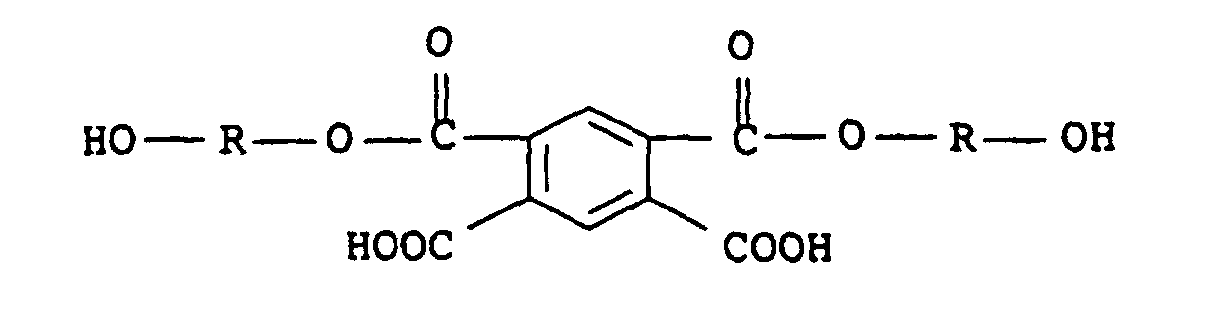

Als Komponente B) brauchbar sind auch Verbindungen der Formeln
Wenn man als Komponente B) Verbindungen mit stickstoffhaltigen
Gruppen verwendet, erhält man kationische Polyurethane. Brauchbare
Komponenten B) sind z. B. Verbindungen der allgemeinen Formeln



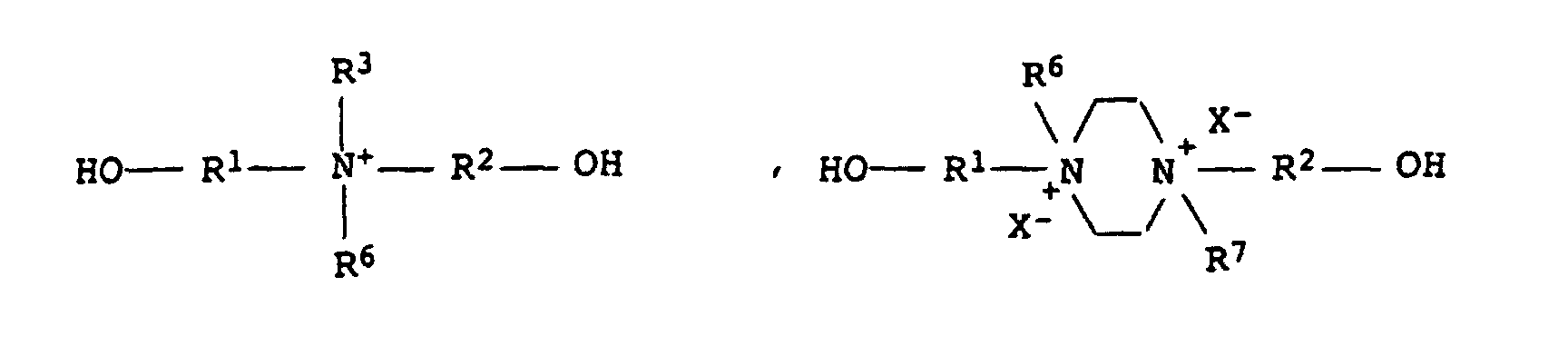
- R1 und R2,
- die gleich oder verschieden sein können, für C2-C8-Alkylen stehen,
- R3, R6 und R7,
- die gleich oder verschieden sein können, für C1-C6-Alkyl, Phenyl oder Phenyl-C1-C4-alkyl stehen,
- R4 und R5,
- die gleich oder verschieden sein können, für H oder C1-C6-Alkyl stehen,
- X-
- für ein Anion, bevorzugt für Chlorid, Bromid, Jodid, C1-C6-Alkylsulfat oder SO4 2- /2 steht.
- R 1 and R 2 ,
- which may be identical or different, represent C 2 -C 8 -alkylene,
- R 3 , R 6 and R 7 ,
- which may be identical or different, represent C 1 -C 6 -alkyl, phenyl or phenyl-C 1 -C 4 -alkyl,
- R 4 and R 5 ,
- which may be identical or different, represent H or C 1 -C 6 -alkyl,
- X -
- is an anion, preferably chloride, bromide, iodide, C 1 -C 6 alkyl sulfate or SO 4 2- / 2 stands.
Gemäß einer weiteren geeigneten Ausführungsform handelt es sich
bei der Komponente (B) um ein Amin der Formel:
- Y
- für o-, m- oder p-Phenylen oder geradkettiges oder verzweigtes C2-C6-Alkylen steht, das gegebenenfalls durch 1, 2 oder 3 Hydroxygruppen substituiert ist, und
- R10
- für ein Wasserstoffatom, eine C1-C12-Alkylgruppe (vorzugsweise C1-C10- und insbesondere C1-C6-Alkylgruppe) oder eine C5-C6-Cycloalkylgruppe steht, wobei die Alkylgruppe oder die Cycloalkylgruppe gegebenenfalls durch 1, 2 oder 3 Hydroxygruppen, Carboxylgruppen oder Sulfonsäuregruppen substituiert sein kann.
- Y
- is o-, m- or p-phenylene or straight-chain or branched C 2 -C 6 -alkylene which is optionally substituted by 1, 2 or 3 hydroxy groups, and
- R 10
- is a hydrogen atom, a C 1 -C 12 -alkyl group (preferably C 1 -C 10 - and in particular C 1 -C 6 -alkyl group) or a C 5 -C 6 -cycloalkyl group, where the alkyl group or the cycloalkyl group is optionally substituted by 1 , 2 or 3 hydroxy groups, carboxyl groups or sulfonic acid groups may be substituted.
Bevorzugt handelt es sich bei dem Amin der obigen Formel um Taurin, N-(1,1-Dimethyl-2-hydroxyethyl)-3-amino-2-hydroxypropansulfonsäure oder 2-Aminoethylaminoethansulfonsäure.Preferably, the amine of the above formula is taurine, N- (1,1-dimethyl-2-hydroxyethyl) -3-amino-2-hydroxypropanesulfonic or 2-aminoethylaminoethanesulfonic acid.
Gemäß einer weiteren geeigneten Ausführungsform handelt es sich bei dem Amin um eine übliche α-, β- oder γ-Aminosäure, beispielsweise Glycin, Alanin, Valin, Leucin, Isoleucin, Phenylalanin, Tyrosin, Prolin, Hydroxyprolin, Serin, Threonin, Methionin, Cystein, Tryptophan, β-Alanin, Asparaginsäure oder Glutaminsäure.According to another suitable embodiment, it is in the amine to a conventional α-, β- or γ-amino acid, for example Glycine, alanine, valine, leucine, isoleucine, phenylalanine, Tyrosine, proline, hydroxyproline, serine, threonine, methionine, cysteine, Tryptophan, β-alanine, aspartic acid or glutamic acid.
Die Säuregruppen enthaltenden Polyurethane können durch Neutralisation (teilweise oder vollständig) in eine wasserdispergierbare Form überführt werden. Als Base für die Neutralisation können Alkalimetallbasen wie Natronlauge, Kalilauge, Natriumcarbonat, Natriumhydrogencarbonat, Kaliumcarbonat oder Kaliumhydrogencarbonat und Erdalkalimetallbasen wie Calciumhydroxid, Calciumoxid, Magnesiumhydroxid oder Magnesiumcarbonat sowie Ammoniak und Amine, wie Trimethylamin, Triethylamin, Triisopropylamin etc., verwendet werden. Die Neutralisation der Säuregruppen enthaltenden Polyurethane kann auch mit Hilfe von Mischungen mehrerer Basen vorgenommen werden, z. B. Mischungen aus einem Alkalihydroxid, wie Natronlauge und einem Amin, wie z. B. Triethanolamin, Triisopropanolamin etc. Die Neutralisation kann gewünschtenfalls partiell z. B. 10 bis 99 %, wie z. B. zu 20 bis 80 % oder vollständig, d. h. zu 100 % erfolgen.The polyurethanes containing acid groups can be neutralized by neutralization (partially or completely) in a water-dispersible Form are transferred. As a base for the neutralization alkali metal bases such as sodium hydroxide solution, potassium hydroxide solution, sodium carbonate, sodium bicarbonate, Potassium carbonate or potassium bicarbonate and alkaline earth metal bases such as calcium hydroxide, calcium oxide, magnesium hydroxide or magnesium carbonate, and ammonia and amines, such as Trimethylamine, triethylamine, triisopropylamine, etc. used become. Neutralization of polyurethanes containing acid groups can also be made with the help of mixtures of several bases be, for. B. mixtures of an alkali metal hydroxide, such as sodium hydroxide and an amine, such as. For example, triethanolamine, triisopropanolamine etc. Neutralization may be partial if desired z. B. 10 to 99%, such as. To 20 to 80% or completely, d. H. 100%.
Geladene kationische Gruppierungen lassen sich aus den vorliegenden tertiären Aminstickstoffatomen entweder durch Protonierung, z. B. mit Carbonsäuren wie Essigsäure, Propionsäure, Buttersäure und Milchsäure, oder durch Quaternisierung, z. B. mit Alkylierungsmitteln wie C1- bis C4-Alkylhalogeniden oder -sulfaten erzeugen. Beispiele solcher Alkylierungsmittel sind Ethylchlorid, Ethylbromid, Methylchlorid, Methylbromid, Dimethylsulfat und Diethylsulfat.Charged cationic groups can be prepared from the present tertiary amine nitrogen atoms either by protonation, e.g. As with carboxylic acids such as acetic acid, propionic acid, butyric acid and lactic acid, or by quaternization, for. B. with alkylating agents such as C 1 - to produce C 4 alkyl halides or sulfates. Examples of such alkylating agents are ethyl chloride, ethyl bromide, methyl chloride, methyl bromide, dimethyl sulfate and diethyl sulfate.
Die als Komponente B) geeigneten Verbindungen, die nur eine gegenüber Isocyanatgruppen reaktive Gruppe aufweisen, wirken als Abstoppmittel, die die Polyaddition unterbrechen. Sie können bei der Herstellung der erfindungsgemäßen Polymerisate gewünschtenfalls am Ende der Polyadditionsreaktion zugegeben werden, um gegebenenfalls noch vorhandene freie Isocyanatgruppen, zumindest teilweise, umzusetzen. The compounds suitable as component B), which are only one opposite Having isocyanate groups reactive group, act as Abstoppmittel, which interrupt the polyaddition. You can join the preparation of the polymers according to the invention, if desired be added at the end of the polyaddition reaction, if necessary remaining free isocyanate groups, at least partly, to implement.
Bevorzugt werden als Komponente B) Verbindungen eingesetzt, die wenigstens zwei gegenüber Isocyanatgruppen reaktive Gruppen, wie z. B. Amino- und/oder Hydroxylgruppen und wenigstens eine weitere polare funktionelle Gruppe aufweisen.Preference is given to using as component B) compounds which at least two isocyanate-reactive groups, such as z. B. amino and / or hydroxyl groups and at least one further have polar functional group.
Als Verbindungen B) können weiterhin die zuvor als Komponente der Präpolymere A) beschriebenen Polyetherole auf der Basis von cyclischen Ethern und Alkylenoxiden eingesetzt werden. Weiterhin sind auch α,ω-Diaminopolyether geeignet, die z. B. durch Umsetzung der Polyetherole mit Ammoniak erhältlich sind. Geeignete Verbindungen B) sind auch z. B. an einer Hydroxylgruppe alkoxiliertes Trimethylolpropan, wobei der Alkoxylatrest eine endständige Carboxylat- oder Sulfonatgruppe aufweist. Der Alkoxylatrest kann dabei z. B. Ethylenoxid, Propylenoxid und Mischungen davon eingebaut enthalten. Das Molekulargewicht dieser Verbindungen liegt in einem Bereich von etwa 500 bis 2 000. Sie sind z. B. als Tegomer®-Marken der Fa. Goldschmidt erhältlich.As compounds B) can continue the previously as a component of Prepolymers A) described polyetherols based on cyclic Ethers and alkylene oxides are used. Farther are also α, ω-diaminopolyether suitable z. B. by implementation the polyetherols are obtainable with ammonia. suitable Compounds B) are also z. B. alkoxylated at a hydroxyl group Trimethylolpropane, wherein the Alkoxylatrest a terminal Having carboxylate or sulfonate group. The alkoxylate residue can be z. For example, ethylene oxide, propylene oxide and mixtures thereof included included. The molecular weight of these compounds is in the range of about 500 to 2,000. B. as Tegomer® grades from Goldschmidt available.
Die Polyurethane enthalten als Komponente C) wenigstens eine Verbindung, die ausgewählt ist unter Diaminen, Polyaminen und Mischungen davon in einem Anteil von etwa 0,1 bis 30 Gew.-%, bevorzugt 0,5 bis 25 Gew.-%, insbesondere 1 bis 20 Gew.-%, bezogen auf das Gesamtgewicht der Komponenten A) bis F), einpolymerisiert. Die Komponente C) enthält keine polaren funktionellen Gruppen.The polyurethanes contain as component C) at least one compound, which is selected from diamines, polyamines and mixtures thereof in a proportion of about 0.1 to 30% by weight, preferably 0.5 to 25 wt .-%, in particular 1 to 20 wt .-%, based on the total weight of components A) to F), copolymerized. Component C) contains no polar functional groups.
Geeignete Amine C) sind geradkettige und verzweigte, aliphatische und cycloaliphatische Amine mit im Allgemeinen etwa 2 bis 30, bevorzugt etwa 2 bis 20 Kohlenstoffatomen. Dazu zählen z. B. Ethylendiamin, 1,2-Diaminopropan, 1,3-Diaminopropan, 1,4-Diaminobutan, 1,5-Diaminopentan, 1,6-Diaminohexan, 1,7-Diaminoheptan, 1,8-Diaminooctan, 1,9-Diaminononan, 1,10-Diaminodecan, 1,11-Diaminoundecan, 1,12-Diaminododecan, Diethylentriamin, Triethylentetraamin, 4-Azaheptamethylendiamin, N,N'-Bis(3-aminopropyl)-butan-1,4-diamin, und Mischungen davon. Geeignete Polyamine C) weisen im Allgemeinen ein zahlenmittleres Molekulargewicht von etwa 400 bis 10 000, bevorzugt etwa 500 bis 8000 auf. Dazu zählen z. B. Polyamide mit endständigen, primären oder sekundären Aminogruppen, Polyalkylenimine, bevorzugt Polyethylenimine und durch Hydrolyse von Poly-N-vinylamiden, wie z. B. Poly-N-vinylacetamid, erhaltene Vinylamine sowie die zuvor genannten α,ω-Diamine auf der Basis von aminierten Polyalkylenoxiden. Copolymerisate, die α,β-ethylenisch ungesättigte Monomere mit entsprechenden funktionellen Gruppen, z. B. Aminomethylacrylat, Aminoethylacrylat, (N-Methyl)-aminoethylacrylat, (N-Methyl)-aminoethylmethacrylat etc., einpolymerisiert enthalten, eignen sich auch zur Einführung photochemisch oder radikalisch härtbarer Doppelbindungen in die Polyurethane.Suitable amines C) are straight-chain and branched, aliphatic and cycloaliphatic amines having generally about 2 to 30, preferably about 2 to 20 carbon atoms. These include z. For example, ethylenediamine, 1,2-diaminopropane, 1,3-diaminopropane, 1,4-diaminobutane, 1,5-diaminopentane, 1,6-diaminohexane, 1,7-diaminoheptane, 1,8-diaminooctane, 1,9-diaminononane, 1,10-diaminodecane, 1,11-diaminoundecane, 1,12-diaminododecane, diethylenetriamine, triethylenetetramine, 4-azaheptamethylenediamine, N, N'-bis (3-aminopropyl) -butane-1,4-diamine, and mixtures thereof. Suitable polyamines C) have generally a number average molecular weight of about 400 to 10,000, preferably about 500 to 8,000. These include z. B. polyamides having terminal, primary or secondary amino groups, Polyalkylenimines, preferably polyethyleneimines and by Hydrolysis of poly-N-vinylamides, such as. Poly-N-vinylacetamide, obtained vinylamines and the aforementioned α, ω-diamines the basis of aminated polyalkylene oxides. Copolymers that α, β-ethylenically unsaturated monomers with corresponding functional Groups, e.g. B. aminomethyl acrylate, aminoethyl acrylate, (N-methyl) aminoethyl acrylate, (N-methyl) aminoethyl methacrylate, etc. contained in copolymerized form, are also suitable for the introduction of photochemical or radically curable double bonds in the polyurethanes.
Die Polyurethane können zur weiteren Optimierung der Polymereigenschaften gegebenenfalls als Komponente D) wenigstens eine weitere Verbindung mit mindestens zwei gegenüber Isocyanatgruppen reaktiven Gruppen in einem Anteil von 0,01 bis 10 Gew.-%, bevorzugt etwa 0,1 bis 5 Gew.-%, bezogen auf das Gesamtgewicht der Komponenten A) bis F), einpolymerisiert enthalten.The polyurethanes can be used to further optimize the polymer properties optionally as component D) at least one further Compound with at least two opposite isocyanate groups reactive groups in a proportion of 0.01 to 10 wt .-%, preferably about 0.1 to 5 wt .-%, based on the total weight of Components A) to F), in copolymerized form.
Als Komponente D) können z. B. Polyole eingesetzt werden, deren Molekulargewicht im Allgemeinen in einem Bereich von etwa 62 bis 399 g/mol liegt. Dazu zählen z. B. Diole mit 2 bis 18 Kohlenstoffatomen, vorzugsweise 2 bis 10 C-Atomen, wie 1,2-Ethandiol, 1,3-Propandiol, 1,4-Butandiol, 1,6-Hexandiol, 1,5-Pentandiol, 1,10-Decandiol, 2-Methyl-1,3-propandiol, 2-Methyl-2-butyl-1,3-propandiol, 2,2-Dimethyl-1,3-propandiol, 2,2-Dimethyl-1,4-butandiol, 2-Ethyl-2-butyl-1,3-propandiol, Hydroxypivalinsäureneopentylglykolester, Diethylenglykol und Triethylenglykol. Geeignete Triole und höherwertige Polyole sind Verbindungen mit 3 bis 25, bevorzugt 3 bis 18, insbesondere bevorzugt 3 bis 6 C-Atomen. Beispiele für brauchbare Triole sind Glycerin oder Trimethylolpropan. Als höherwertige Polyole lassen sich beispielsweise Erythrit, Pentaerythrit und Sorbit einsetzen. Geeignet sind auch niedermolekulare Umsetzungsprodukte der Polyole, z. B. von Trimethylolpropan mit Alkylenoxiden, wie Ethylenoxid und/oder Propylenoxid. Diese niedermolekularen Polyole können einzeln oder als Gemische verwendet werden.As component D) z. As polyols are used, whose Molecular weight generally in a range of about 62 to 399 g / mol. These include z. B. diols having 2 to 18 carbon atoms, preferably 2 to 10 carbon atoms, such as 1,2-ethanediol, 1,3-propanediol, 1,4-butanediol, 1,6-hexanediol, 1,5-pentanediol, 1,10-decanediol, 2-methyl-1,3-propanediol, 2-methyl-2-butyl-1,3-propanediol, 2,2-dimethyl-1,3-propanediol, 2,2-dimethyl-1,4-butanediol, 2-ethyl-2-butyl-1,3-propanediol, hydroxypivalic acid neopentyl glycol ester, Diethylene glycol and triethylene glycol. suitable Triols and higher polyols are compounds with 3 to 25, preferably 3 to 18, particularly preferably 3 to 6 C atoms. Examples useful triols are glycerol or trimethylolpropane. As higher-grade polyols, for example, erythritol, Pentaerythritol and sorbitol. Are also suitable low molecular weight reaction products of polyols, eg. B. of trimethylolpropane with alkylene oxides, such as ethylene oxide and / or propylene oxide. These low molecular weight polyols can be used individually or as Mixtures are used.
Geeignete Komponenten D) sind weiterhin Aminoalkohole mit 2 bis 16, vorzugsweise 3 bis 6 Kohlenstoffatomen, wie z. B. Monoethanolamin, Methylisopropanolamin, Ethylisopropanolamin, Methylethanolamin, 3-Aminopropanol, 1-Ethylaminobutan-2-ol, Methylendiethanolamin, 4-Methyl-4-aminopentan-2-ol und N-(2-Hydroxyethyl)-anilin und Mischungen davon.Suitable components D) are furthermore amino alcohols having 2 to 16, preferably 3 to 6 carbon atoms, such as. Monoethanolamine, Methylisopropanolamine, ethylisopropanolamine, methylethanolamine, 3-aminopropanol, 1-ethylaminobutan-2-ol, methylenediethanolamine, 4-methyl-4-aminopentan-2-ol and N- (2-hydroxyethyl) -aniline and mixtures thereof.
Als Komponente D) können auch höhermolekulare Polyole mit einem zahlenmittleren Molekulargewicht im Bereich von etwa 400 bis 6 000 g/mol, bevorzugt 500 bis 4 000 g/mol, eingesetzt werden. Dazu zählen z. B. die zuvor bei der Komponente A) beschriebenen Polyesterole auf Basis von aliphatischen, cycloaliphatischen und/oder aromatischen Di-, Tri- und/oder Polycarbonsäuren mit Di-, Tri- und/oder Polyolen sowie die Polyesterole auf Lacton-Basis. Dazu zählen weiterhin die ebenfalls zuvor bei der Komponente A) beschriebenen Polyetherole, die durch Polymerisation von cyclischen Ethern oder durch Umsetzung von Alkylenoxiden mit einem Startermolekül erhältlich sind. Dazu zählen weiterhin auch übliche, dem Fachmann bekannte Polycarbonate mit endständigen Hydroxylgruppen, die durch Umsetzung der zuvor beschriebenen Diole oder auch von Bisphenolen, wie Bisphenol A, mit Phosgen oder Kohlensäurediestern erhältlich sind. Geeignet sind auch α,ω-Polyamidole, α,ω-Polymethyl(meth)acrylatdiole und/oder α,ω-Polybutyl(meth)acrylatdiole, wie z. B. MD-1000 und BD-1000 der Fa. Goldschmidt.As component D) also higher molecular weight polyols with a number average molecular weight in the range of about 400 to 6,000 g / mol, preferably 500 to 4,000 g / mol, are used. These include z. As those previously described in the component A) Polyesterols based on aliphatic, cycloaliphatic and / or aromatic di-, tri- and / or polycarboxylic acids with di-, Tri- and / or polyols as well as the lactone-based polyesterols. These also include those previously also in component A) described polyetherols obtained by polymerization of cyclic Ethern or by reaction of alkylene oxides with a Starter molecule are available. This also includes usual, polycarbonates having hydroxyl end groups known to those skilled in the art, by reacting the diols described above or also bisphenols, such as bisphenol A, with phosgene or carbonic acid diesters are available. Also suitable are α, ω-polyamidols, α, ω-polymethyl (meth) acrylate diols and / or α, ω-polybutyl (meth) acrylate diols, such as B. MD-1000 and BD-1000 Fa. Goldschmidt.
Die zuvor genannten Komponenten D) können einzeln oder als Gemische eingesetzt werden.The aforementioned components D) can be used individually or as mixtures be used.
Die Polyurethane können als Komponente E) wenigstens eine weitere Verbindung mit nur einer gegenüber Isocyanatgruppen reaktiven Gruppe aufweisen. Bei dieser Gruppe kann es sich um eine Hydroxyl- oder eine primäre oder sekundäre Aminogruppe handeln. Die erfindungsgemäßen Polyurethane können die Komponente E) in einer Menge von 0,01 bis 10 Gew.-%, bevorzugt 0,1 bis 5 Gew.-%, bezogen auf die Gesamtmenge der Komponenten A) bis F), einpolymerisiert enthalten.The polyurethanes can as component E) at least one more Compound with only one isocyanate-reactive Group have. This group may be a hydroxyl group. or a primary or secondary amino group. The polyurethanes according to the invention, the component E) in a Amount of 0.01 to 10 wt .-%, preferably 0.1 to 5 wt .-%, based to the total amount of components A) to F), polymerized contain.
Als Komponente E) können z. B. monofunktionelle Alkohole, wie z. B. Methanol, Ethanol, n-Propanol, Isopropanol etc., eingesetzt werden. Geeignete Komponenten E) sind auch Amine mit einer primären oder sekundären Aminogruppe, wie z. B. Methylamin, Ethylamin, n-Propylamin, Isopropylamin, Dimethylamin, Diethylamin, Di-n-propylamin, Diisopropylamin etc.As component E) z. B. monofunctional alcohols, such as z. As methanol, ethanol, n-propanol, isopropanol, etc. used become. Suitable components E) are also amines with a primary or secondary amino group, such as. Methylamine, ethylamine, n-propylamine, isopropylamine, dimethylamine, diethylamine, di-n-propylamine, Diisopropylamine etc.
Bei der Komponente E) kann es sich auch um einwertige Polyetheralkohole mit einem zahlenmittleren Molgewicht im Bereich von etwa 500 bis 10 000 g/mol, vorzugsweise von 1000 bis 5000 g/mol, handeln. Einwertige Polyetheralkohole sind durch Alkoxylierung von einwertigen Startermolekülen, wie beispielsweise Methanol, Ethanol oder n-Butanol, erhältlich, wobei als Alkoxylierungsmittel Ethylenoxid oder Gemische von Ethylenoxid mit anderen Alkylenoxiden, besonders Propylenoxid, eingesetzt werden.Component E) may also be monohydric polyether alcohols having a number average molecular weight in the range of about 500 to 10 000 g / mol, preferably from 1000 to 5000 g / mol, act. Monohydric polyether alcohols are obtained by alkoxylation of monovalent starter molecules, such as methanol, ethanol or n-butanol, available as an alkoxylating agent Ethylene oxide or mixtures of ethylene oxide with other alkylene oxides, especially propylene oxide.
Durch diese Komponente E) können in den Polyurethanen somit, gegebenenfalls in end- und/oder seitenständig angeordneten Polyetherketten, vorliegende Polyethylenoxidsegmente eingebaut sein, die im Polyurethan neben den ionischen Gruppen den hydrophilen Charakter beeinflussen.By this component E) can thus in the polyurethanes, if appropriate in terminally and / or laterally arranged polyether chains, be incorporated polyethylene oxide segments present in the polyurethane next to the ionic groups the hydrophilic Character influence.
Die Verbindungen der genannten Art mit innerhalb von end- und/oder seitenständig angeordneten Polyetherketten vorliegenden Polyethylenoxideinheiten werden in solchen Mengen eingesetzt, dass in den Polyurethan-Dispersionen 0 bis 10 Gew.-%, vorzugsweise 0 bis 5 Gew.-%, innerhalb von end- und/oder seitenständig angeordneten Polyetherketten eingebauten Polyethylenoxideinheiten in den Polyurethanen vorliegen können. Die Gesamtmenge der hydrophilen Struktureinheiten (ionische Gruppen und Ethylenoxideinheiten der zuletzt genannten Art) wird dabei im Allgemeinen so gewählt, dass die Dispergierbarkeit der Polyurethane in Wasser gewährleistet ist.The compounds of the type mentioned with within end- and / or Polyether chains arranged on the side present polyethylene oxide units are used in such quantities that in the polyurethane dispersions 0 to 10 wt .-%, preferably 0 to 5 wt .-%, arranged within terminal and / or laterally Polyether chains incorporated polyethylene oxide units in the Polyurethanes may be present. The total amount of hydrophilic Structural units (ionic groups and ethylene oxide units of the latter type) is generally chosen so that ensures the dispersibility of the polyurethanes in water is.
Die Polyurethane umfassen als Komponente F) wenigstens ein Polyisocyanat in einem Anteil von etwa 10 bis 65 Gew.-%, bevorzugt etwa 15 bis 60 Gew.-%, bezogen auf das Gesamtgewicht der Komponenten A) bis F), einpolymerisiert. Geeignete Polyisocyanate F) sind ausgewählt unter Verbindungen mit 2 bis 5 Isocyanatgruppen, Isocyanatpräpolymeren mit mittleren Anzahl von 2 bis 5 Isocyanatgruppen, und Mischungen davon. Dazu zählen z. B. aliphatische, cycloaliphatische und aromatische Di-, Tri- und Polyisocyanate. Geeignete Diisocyanate F) sind z. B. Tetramethylendiisocyanat, Hexamethylendiisocyanat, 2,3,3-Trimethylhexamethylendiisocyanat, 1,4-Cyclohexylendiisocyanat, Isophorondiisocyanat, 1,4-Phenylendiisocyanat, 2,4- und 2,6-Toluylendiisocyanat und deren Isomerengemische (z. B. 80 % 2,4- und 20 % 2,6-Isomer), 1,5-Naphthylendiisocyanat, 2,4- und 4,4'-Diphenylmethandiisocyanat. Ein geeignetes Triisocyanat ist z. B. Triphenylmethan-4,4',4''-triisocyanat. Weiterhin geeignet sind Isocyanatpräpolymere und Polyisocyanate, die durch Addition der zuvor genannten Isocyanate an polyfunktionelle hydroxyl- oder amingruppenhaltige Verbindungen erhältlich sind. Weiterhin geeignet sind Polyisocyanate, die durch Biuret- oder Isocyanuratbildung entstehen. Bevorzugt werden Hexamethylendiisocyanat, trimerisiertes Hexamethylendiisocyanat, Isophorondiisocyanat, 2,4-Toluylendiisocyanat, 2,6-Toluylendiisocyanat, und Mischungen davon, eingesetzt.The polyurethanes comprise as component F) at least one polyisocyanate in a proportion of about 10 to 65 wt .-%, preferably about 15 to 60 wt .-%, based on the total weight of the components A) to F), copolymerized. Suitable polyisocyanates F) are selected from compounds having 2 to 5 isocyanate groups, Isocyanate prepolymers having an average number of from 2 to 5 isocyanate groups, and mixtures thereof. These include z. For example, aliphatic, cycloaliphatic and aromatic di-, tri- and polyisocyanates. Suitable diisocyanates F) are z. Tetramethylene diisocyanate, Hexamethylene diisocyanate, 2,3,3-trimethylhexamethylene diisocyanate, 1,4-cyclohexylene diisocyanate, isophorone diisocyanate, 1,4-phenylene diisocyanate, 2,4- and 2,6-toluene diisocyanate and their isomer mixtures (eg 80% 2,4- and 20% 2,6-isomer), 1,5-naphthylene diisocyanate, 2,4- and 4,4'-diphenylmethane diisocyanate. A suitable one Triisocyanate is z. B. triphenylmethane-4,4 ', 4' '- triisocyanate. Also suitable are isocyanate prepolymers and polyisocyanates, by addition of the aforementioned isocyanates to polyfunctional hydroxyl or amine group-containing compounds available are. Also suitable are polyisocyanates by Biuret or isocyanurate formation arise. Preference is given to hexamethylene diisocyanate, trimerized hexamethylene diisocyanate, isophorone diisocyanate, 2,4-tolylene diisocyanate, 2,6-tolylene diisocyanate, and mixtures thereof.
Ein weiterer Gegenstand der Erfindung sind Polymerdispersionen, die wenigstens eines der zuvor beschriebenen Polymerisate in dispergierter Form enthalten. Die Herstellung der erfindungsgemäßen Polyurethandispersionen erfolgt nach üblichen, dem Fachmann bekannten Verfahren. Diese sind z. B. in Ullmann's Encyclopedia of Industrial Chemistry, 5. Aufl., Bd. A 21, VCH Weinheim, (1992), S. 678-680 beschrieben. Dazu zählt z. B. die Spontandispersion von Polyurethanionomeren nach dem Acetonverfahren, Präpolymer-Mischverfahren, Schmelzemulsionsverfahren, etc. Dazu zählt weiterhin das Ketimin- und Ketazin-Verfahren und die Dispersion von Precursoren, bei dem hydrophile Oligomere dispergiert werden.Another object of the invention are polymer dispersions, the at least one of the polymers described above in dispersed Form included. The preparation of the invention Polyurethane dispersions are carried out by customary methods known to the person skilled in the art Method. These are z. In Ullmann's Encyclopedia of Industrial Chemistry, 5th ed., Vol. A 21, VCH Weinheim, (1992), Pp. 678-680. This includes z. B. the spontaneous dispersion of polyurethane ionomers by the acetone process, prepolymer mixing process, Melt emulsion process, etc. This still counts the ketimine and ketazine method and the dispersion of Precursors in which hydrophilic oligomers are dispersed.
Zur Herstellung der erfindungsgemäßen härtbaren Polyurethanpolymerisate können z. B. die Komponenten A), B), F) und gegebenenfalls D) und/oder E) zunächst in der Schmelze oder in Gegenwart eines inerten, mit Wasser mischbaren Lösungsmittels zu einem isocyanatgruppenhaltigen Polyurethanpräpolymer umgesetzt werden. Bevorzugte Lösungsmittel sind z. B. Aceton, Tetrahydrofuran, Methylethylketon und N-Methylpyrrolidon. Die Reaktionstemperatur liegt im Allgemeinen in einem Bereich von etwa 20 bis 160 °C, bevorzugt etwa 50 bis 100 °C. Dabei kann man z. B. den Ansatz unter Umgebungsdruck zum Rückfluss erhitzen. Zur Beschleunigung der Additionsreaktion können übliche Katalysatoren, wie z. B. Dibutylzinndilaurat, Zinn-(II)-octoat, 1,4-Diazabicyclo[2.2.2]octan oder Amine, wie Triethylamin, eingesetzt werden. Um eine unerwünschte, vorzeitige Polymerisation der α,β-ethylenisch ungesättigten Gruppen zu vermeiden, können gegebenenfalls bei der Herstellung des Polyurethans Polymerisationsinhibitoren zugesetzt werden. Dafür eignen sich z. B. Chinone, Phenole oder Phenolderivate, wie p-Benzochinon, Hydrochinon, p-Methoxyphenol, Phenothiazin, 2,2,6,6-Tetramethylpiperidin-1-yloxy, 4-Hydroxy-2,2,6,6-tetramethylpiperidin- 1-yloxy etc. Geeignete Polymerisationsinhibitoren sind z. B. in Encyclopedia of Polymer Science & Technology, Bd. 7, 1967, S. 644-664, Verlag Wiley & Sons, New York-London-Sydney, beschrieben.For the preparation of the curable polyurethane polymers according to the invention can z. As the components A), B), F) and optionally D) and / or E) first in the melt or in the presence an inert, water-miscible solvent to an isocyanate group-containing Polyurethane prepolymer can be implemented. preferred Solvents are z. As acetone, tetrahydrofuran, methyl ethyl ketone and N-methylpyrrolidone. The reaction temperature is generally in a range of about 20 to 160 ° C, preferably about 50 to 100 ° C. You can z. B. the approach below Heat ambient pressure to reflux. To speed up the Addition reaction, conventional catalysts, such as. B. dibutyltin dilaurate, Tin (II) octoate, 1,4-diazabicyclo [2.2.2] octane or amines, such as triethylamine. To an unwanted, premature polymerization of the α, β-ethylenically unsaturated If necessary, avoid production groups the polyurethane polymerization inhibitors added become. For z. B. quinones, phenols or phenol derivatives, such as p-benzoquinone, hydroquinone, p-methoxyphenol, phenothiazine, 2,2,6,6-tetramethylpiperidin-1-yloxy, 4-hydroxy-2,2,6,6-tetramethylpiperidine 1-yloxy etc. Suitable polymerization inhibitors are z. In Encyclopedia of Polymer Science & Technology, Bd. 7, 1967, pp. 644-664, published by Wiley & Sons, New York-London-Sydney, described.
Nach der Herstellung des isocyanatgruppenhaltigen Polyurethanpräpolymers können gewünschtenfalls die einpolymerisierten ionogenen Gruppen, wie zuvor bei der Komponente B) beschrieben, durch Neutralisation oder Quaternisierung ionisiert werden. Wird zur Herstellung der erfindungsgemäßen Polymerisate als alleinige oder zusätzliche Komponente B) wenigstens eine Verbindung mit nur einer gegenüber Isocyanatgruppen reaktiven Gruppe eingesetzt, so erfolgt deren Zugabe im Allgemeinen erst gegen Ende oder nach der Umsetzung der übrigen Komponenten. Wird zur Herstellung der erfindungsgemäßen Polymerisate eine Komponente E) eingesetzt, die ebenfalls nur eine gegenüber Isocyanatgruppen reaktive Gruppe aufweist und somit als Abstopper wirkt, so erfolgt deren Zugabe im Allgemeinen auch erst gegen Ende oder nach der Umsetzung der übrigen Komponenten, gegebenenfalls auch erst nach Zugabe der Komponente C).After the preparation of the polyurethane prepolymer containing isocyanate groups If desired, the copolymerized ionogenic Groups, as described above for component B), by neutralization or quaternization are ionized. Is used for the production the polymers according to the invention as sole or additional component B) at least one compound with only one used against isocyanate groups reactive group, so their addition generally takes place towards the end or after Implementation of the remaining components. Is for the preparation of the inventive Polymers a component E) are used, the also only one isocyanate-reactive group has and thus acts as a stopper, it is added generally also towards the end or after the implementation of the remaining components, if necessary also after addition of the Component C).
Abschließend wird das isocyanatgruppenhaltige Präpolymer mit der Komponente C) zu dem erfindungsgemäßen, im Wesentlichen isocyanatgruppenfreien Polyurethan umgesetzt, wobei eine Molmassenerhöhung stattfindet. Nach einer bevorzugen Ausführungsform wird die Komponente C) gemeinsam mit wenigstens einem Teil des zur Herstellung der erfindungsgemäßen Polymerdispersionen erforderlichen Dispergierwasser eingesetzt. Dabei können die isocyanatgruppenhaltigen Polyurethanpräpolymere entweder in das Dispergierwasser, welches die Komponente C) enthält, eingetragen werden, oder man gibt eine Mischung aus Komponente C) und Dispergierwasser zu den isocyanatgruppenhaltigen Polyurethanpräpolymeren. Die Menge an Komponente C) wird dabei so gewählt, dass ein im Wesentlichen isocyanatgruppenfreies Polyurethan erhalten wird. Gewünschtenfalls kann das Lösungsmittel nach Zugabe des Dispergierwassers abdestilliert werden. Die Menge des Dispergierwassers wird so bemessen, dass die resultierenden wässrigen Polyurethandispersionen einen Feststoffgehalt von etwa 10 bis 70 Gew.-%, vorzugsweise etwa 20 bis 60 Gew.-%, aufweisen.Finally, the prepolymer containing isocyanate groups with the Component C) to the invention, essentially isocyanate-free Polyurethane implemented, with a molecular weight increase takes place. According to a preferred embodiment, the Component C) together with at least part of the preparation required of the polymer dispersions of the invention Dispersing used. The isocyanate group-containing Polyurethane prepolymers either in the dispersing water, which contains the component C), be registered, or man gives a mixture of component C) and dispersing water to the Isocyanatgruppenhaltigen polyurethane prepolymers. The amount of Component C) is chosen so that a substantially Isocyanatgruppenfreies polyurethane is obtained. If desired, the solvent can be added after addition of the dispersing water be distilled off. The amount of dispersing water is measured that the resulting aqueous polyurethane dispersions a solids content of about 10 to 70 wt .-%, preferably about 20 to 60 wt .-%, have.
Bei der Herstellung der erfindungsgemäßen Polymerisate wird das Mengenverhältnis der Komponenten A) bis F) so gewählt, dass das Verhältnis von Isocyanatgruppen-Äquivalenten der Komponente F) zu Äquivalenten von gegenüber Isocyanatgruppen reaktiven Gruppen der Komponenten A) bis E) in dem erfindungsgemäß eingesetzten Bereich von 0,4:1 bis 0,9:1 liegt.In the preparation of the polymers of the invention is the Amount ratio of components A) to F) chosen so that the Ratio of isocyanate group equivalents of component F) to Equivalents of isocyanate - reactive groups of Components A) to E) in the range used in the invention from 0.4: 1 to 0.9: 1.
Im Allgemeinen sind die erfindungsgemäßen Polyurethanpolymerisate mit einem Gehalt an polaren funktionellen Gruppen im Bereich von etwa 1,3 bis 3,5 Gew.-% selbstdispergierbar, so dass auf den Einsatz eines Dispergierhilfsmittels verzichtet werden kann. Gewünschtenfalls können zu ihrer Herstellung jedoch übliche, dem Fachmann bekannte Dispergierhilfsmittel eingesetzt werden. Dazu zählen z. B. die im Folgenden genannten Emulgatoren und Schutzkolloide.In general, the polyurethane polymers according to the invention are with a content of polar functional groups in the range of about 1.3 to 3.5 wt .-% self-dispersible, so that on the use a dispersing aid can be dispensed with. If desired, However, for their preparation usual, the One skilled in the art dispersing aids are used. To count z. As the following emulsifiers and protective colloids.
Nach einer geeigneten Ausführungsform enthalten die erfindungsgemäßen Polymerdispersionen zusätzlich wenigstens ein Dispergierhilfsmittel. Zur Herstellung dieser Polymerdispersionen eignen sich dann auch Polyurethanpolymerisate, die einen geringeren Anteil an Verbindungen der Komponente B) und somit an dispergieraktiven Gruppen eingebaut enthalten. Bevorzugt wird zur Herstellung dieser Polymerdispersionen ein Polymerisat eingesetzt, das die Komponente B) in einer Menge von etwa 0,1 bis 15 Gew.-%, bevorzugt etwa 0,1 bis 10 Gew.-%, bezogen auf die Gesamtmenge der Komponenten A) bis F), eingebaut enthält.According to a suitable embodiment, the inventive Polymer dispersions additionally at least one dispersing aid. Suitable for the preparation of these polymer dispersions then also polyurethane polymers, a smaller proportion to compounds of component B) and thus to dispersing Groups included included. Preference is given to the preparation of these polymer dispersions used a polymer which the Component B) in an amount of about 0.1 to 15 wt .-%, preferably about 0.1 to 10 wt .-%, based on the total amount of the components A) to F), incorporated.
Vorzugsweise werden zur Herstellung der Polymerdispersionen, die zusätzlich wenigstens ein Dispergiermittel enthalten, Polymerisate mit einem Gehalt an polaren funktionellen Gruppen in einen Bereich von etwa 0,8 bis 1,5 Gew.-%, insbesondere etwa 0,9 bis 1,3 Gew.-%, eingesetzt.Preferably, for the preparation of the polymer dispersions, the additionally contain at least one dispersant, polymers containing polar functional groups in one Range of about 0.8 to 1.5 wt .-%, in particular about 0.9 to 1.3 wt .-%, used.
Vorteilhafterweise lassen sich durch den Einsatz wenigstens eines Dispergierhilfsmittels erfindungsgemäße Polymerdispersionen mit einem höheren Feststoffgehalt und/oder einer geringeren Viskosität als bei entsprechenden Dispersionen ohne Dispergierhilfsmittel herstellen. Advantageously, by using at least one Dispersing aid according to the invention with polymer dispersions a higher solids content and / or a lower viscosity than in the case of corresponding dispersions without dispersing aid produce.
Vorzugsweise beträgt der Feststoffgehalt der erfindungsgemäßen Polymerdispersionen mit Dispergierhilfsmittel mindestens 38 Gew.-%, bevorzugt mindestens 40 Gew.-%.Preferably, the solids content of the inventive Polymer dispersions with dispersing aid at least 38 wt .-%, preferably at least 40 wt .-%.
Bevorzugt weisen die erfindungsgemäßen Polymerdispersionen im Allgemeinen geringere Viskositäten auf als Dispersionen auf Basis von Polyurethanen, bei deren Herstellung die gegenüber Isocyanatgruppen reaktiven Gruppen zu 100 % umgesetzt wurden.Preferably, the polymer dispersions of the invention in Generally lower viscosities than based on dispersions of polyurethanes, in their preparation compared to isocyanate groups reactive groups have been implemented to 100%.
Vorzugsweise beträgt die Viskosität der erfindungsgemäßen Polymerdispersionen mit Dispergierhilfsmittel, bestimmt nach DIN 53019 mit einem Rheomat 30 (23 °C, Schergefälle D = 250 s-1) höchstens 1 000 mPas, bevorzugt höchstens 700 mPas.Preferably, the viscosity of the polymer dispersions according to the invention with dispersing aid, determined according to DIN 53019 with a Rheomat 30 (23 ° C, shear rate D = 250 s -1 ) is at most 1,000 mPas, preferably at most 700 mPas.
Als Dispergierhilfsmittel können allgemein übliche Emulgatoren und/oder Schutzkolloide eingesetzt werden. Die Einsatzmenge liegt im Allgemeinen in einem Bereich von etwa 0,05 bis 20 Gew.-%, bevorzugt etwa 0,1 bis 15 Gew.-%, bezogen auf die Menge des härtbaren Polyurethanpolymerisates.As a dispersing agent can be used commonly emulsifiers and / or protective colloids are used. The amount used is generally in a range of about 0.05 to 20 wt .-%, preferably about 0.1 to 15 wt .-%, based on the amount of curable Polyurethanpolymerisates.
Geeignete Emulgatoren sind die dem Fachmann bekannten, üblicherweise bei der wässrigen Emulsionspolymerisation als Dispergiermittel eingesetzten Emulgatoren, wie sie z. B. in Houben-Weyl, Methoden der organischen Chemie, Band XIV/1, Makromolekulare Stoffe, Georg-Thieme-Verlag, Stuttgart, 1961, S. 411 - 420 beschrieben sind. Es sind sowohl anionische, kationische als auch nichtionische Emulgatoren geeignet. Vorzugsweise werden Emulgatoren eingesetzt, deren relative Molekulargewichte im Unterschied zu Schutzkolloiden üblicherweise unter 3500 Dalton liegen.Suitable emulsifiers are those known to those skilled, usually in the aqueous emulsion polymerization as a dispersant used emulsifiers, such as. In Houben-Weyl, Methods of Organic Chemistry, Volume XIV / 1, Macromolecular Stoffe, Georg Thieme Verlag, Stuttgart, 1961, pp. 411-420 are. They are both anionic, cationic and nonionic emulsifiers suitable. Preferably, emulsifiers used, their relative molecular weights in difference to protective colloids are usually below 3500 daltons.
Brauchbare nichtionische Emulgatoren sind araliphatische oder aliphatische nichtionische Emulgatoren, beispielsweise ethoxylierte Mono-, Di- und Trialkylphenole (EO-Grad: 3 bis 50, Alkylrest: C4-C10), Ethoxylate langkettiger Alkohole (EO-Grad: 3 bis 50, Alkylrest: C8-C36) sowie Polyethylenoxid/Polypropylenoxid-Blockcopolymere. Bevorzugt werden Ethoxylate langkettiger Alkanole (Alkylrest C10-C22, mittlerer Ethoxylierungsgrad 10 bis 50) und darunter besonders bevorzugt solche mit einem linearen C12-C18-Alkylrest und einem mittleren Ethoxylierungsgrad von 10 bis 50 sowie ethoxylierte Monoalkylphenole.Useful nonionic emulsifiers are araliphatic or aliphatic nonionic emulsifiers, for example ethoxylated mono-, di- and trialkylphenols (EO degree: 3 to 50, alkyl radical: C 4 -C 10 ), ethoxylates of long-chain alcohols (EO degree: 3 to 50, alkyl radical : C 8 -C 36 ) and polyethylene oxide / polypropylene oxide block copolymers. Preferred are ethoxylates of long-chain alkanols (alkyl radical C 10 -C 22 , average degree of ethoxylation 10 to 50) and particularly preferred those having a linear C 12 -C 18 -alkyl radical and a mean degree of ethoxylation of 10 to 50 and ethoxylated monoalkylphenols.
Geeignete anionische Emulgatoren sind beispielsweise Alkali- und Ammoniumsalze von Alkylsulfaten (Alkylrest: C8-C22), von Schwefelsäurehalbestern ethoxylierter Alkanole (EO-Grad: 2 bis 50, Alkylrest: C12-C18) und ethoxylierter Alkylphenole (EO-Grad: 3 bis 50, Alkylrest: C4-C9), von Alkylsulfonsäuren (Alkylrest: C12-C18) und von Alkylarylsulfonsäuren (Alkylrest: C9-C18). Weitere geeignete Emulgatoren finden sich in Houben-Weyl, Methoden der organischen Chemie, Band XIV/1, Makromolekulare Stoffe, Georg-Thieme-Verlag, Stuttgart, 1961, S. 192 - 208. Als anionische Emulgatoren sind ebenfalls Bis(phenoylsulfonsäure)ether bzw. deren Alkali- oder Ammoniumsalze, die an einem oder beiden aromatischen Ringen eine C4-C24-Alkylgruppe tragen, geeignet. Diese Verbindungen sind allgemein bekannt, z. B. aus der US-A-4,269,749, und im Handel erhältlich, beispielsweise als Dowfax® 2A1 (Dow Chemical Company).Suitable anionic emulsifiers are, for example, alkali metal and ammonium salts of alkyl sulfates (alkyl radical: C 8 -C 22 ), of sulfuric monoesters of ethoxylated alkanols (EO degree: 2 to 50, alkyl radical: C 12 -C 18 ) and ethoxylated alkylphenols (EO degree: 3 to 50, alkyl radical: C 4 -C 9 ), of alkylsulfonic acids (alkyl radical: C 12 -C 18 ) and of alkylarylsulfonic acids (alkyl radical: C 9 -C 18 ). Further suitable emulsifiers can be found in Houben-Weyl, Methods of Organic Chemistry, Volume XIV / 1, Macromolecular substances, Georg-Thieme-Verlag, Stuttgart, 1961, pp 192- 208. As anionic emulsifiers are also bis (phenoylsulfonsäure) ether or whose alkali metal or ammonium salts which carry a C 4 -C 24 -alkyl group on one or both aromatic rings are suitable. These compounds are well known, for. From US-A-4,269,749, and commercially available, for example as Dowfax® 2A1 (Dow Chemical Company).
Geeignete kationische Emulgatoren sind vorzugsweise quartäre Ammoniumhalogenide, z. B. Trimethylcetylammoniumchlorid, Methyltrioctylammoniumchlorid, Benzyltriethylammoniumchlorid oder quartäre Verbindungen von N-C6-C20-Alkylpyridinen, -morpholinen oder -imidazolen, z. B. N-Laurylpyridiniumchlorid.Suitable cationic emulsifiers are preferably quaternary ammonium halides, e.g. Trimethylcetylammonium chloride, methyltrioctylammonium chloride, benzyltriethylammonium chloride or quaternary compounds of NC 6 -C 20 -alkylpyridines, -morpholines or -imidazoles, e.g. B. N-Laurylpyridinium chloride.
Geeignete Schutzkolloide sind z. B. Polyvinylalkohole und teilverseifte Polyvinylacetate, Polyvinylpropionate, Polyacrylate, Polyvinylpyrrolidon, Copolymere aus zwei oder mehreren der die zuvor genannten Polymere bildenden Monomeren, Cellulose und Cellulosederivate, wie z. B. Methylcellulose, Hydroxyethylcellulose, Carboxymethylcellulose, Stärke und Stärkederivate, wie z. B. Cyanalkyletherstärke, Hydroxyalkyletherstärke und Carboxymethylstärke, Proteine und Proteinabbauprodukte, wie z. B. Gelatine und Gelatinederivate etc. Eine ausführliche Beschreibung von Schutzkolloiden findet sich in Houben-Weyl, Methoden der Organischen Chemie, Band XIV/1, Makromolekulare Stoffe, Georg-Thieme-Verlag, Stuttgart, 1961, S. 411-420.Suitable protective colloids are for. As polyvinyl alcohols and partially hydrolyzed Polyvinyl acetates, polyvinyl propionates, polyacrylates, Polyvinylpyrrolidone, copolymers of two or more of the aforementioned polymers forming monomers, cellulose and cellulose derivatives, such as Methylcellulose, hydroxyethylcellulose, Carboxymethylcellulose, starch and starch derivatives, such as. B. Cyanoalkyl ether starch, hydroxyalkyl ether starch and carboxymethyl starch, Proteins and protein degradation products, such as. Gelatin and Gelatin derivatives etc. A detailed description of protective colloids can be found in Houben-Weyl, Methods of Organic Chemie, Volume XIV / 1, Macromolecular substances, Georg-Thieme-Verlag, Stuttgart, 1961, p. 411-420.
Bevorzugt wird zur Herstellung der erfindungsgemäßen Polymerdispersionen mit Dispergierhilfsmitteln wenigstens ein Schutzkolloid eingesetzt. Dabei handelt es sich insbesondere um Copolymere aus vinylpyrrolidon und Vinylacetat oder Vinylpropionat, die z. B. als Collacral®-Marken der Firma BASF Aktiengesellschaft erhältlich sind.Preference is given to the preparation of the polymer dispersions of the invention with dispersing agents at least one protective colloid used. These are in particular copolymers vinylpyrrolidone and vinyl acetate or vinyl propionate, the z. B. available as Collacral® brands from BASF Aktiengesellschaft are.
Die erfindungsgemäßen härtbaren wässrigen Polymerdispersionen eignen sich vorzugsweise zur Herstellung von Beschichtungen, z. B. von flexiblen und gegebenenfalls saugfähigen Substraten wie Papier, Karton, Leder oder von nicht-flexiblen Substraten aus Metall oder Kunststoff. Vorzugsweise eignen sie sich zur Herstellung von hochwertigen, kratzfesten und chemikalienresistenten Lacküberzügen auf Holz. Dabei werden bereits nach dem Verdunsten des Wassers ohne Vernetzung klebfreie, staubtrockene Filme mit einer guten mechanischen Beanspruchbarkeit, wie z. B. einer hohen Härte und/oder einer guten Flexibilität, erhalten. So beträgt die Pendelhärte, gemessen nach DIN 53157 eines 20 Minuten bei 60 °C getrockneten Films mindestens 20 s, bevorzugt mindestens 25 s. The curable aqueous polymer dispersions according to the invention are preferably suitable for the production of coatings, z. B. of flexible and optionally absorbent substrates such Paper, cardboard, leather or non-flexible metal substrates or plastic. Preferably, they are suitable for the production of high quality, scratch resistant and chemical resistant Lacquer coatings on wood. This will already after evaporation of water without crosslinking tack-free, dust-dry films with a good mechanical strength, such. B. a high Hardness and / or good flexibility. So is the Pendulum hardness, measured according to DIN 53157 of a 20 minutes at 60 ° C. dried film at least 20 s, preferably at least 25 s.
Werden die noch nicht strahlengehärteten Filme auf ihre Klebfreiheit untersucht, so tritt im Wesentlichen keine Beschädigung der Beschichtung auf.Are the not yet radiation-cured films on their freedom from tackiness examined, there is essentially no damage to the Coating on.
Die Vernetzung der Polyurethane kann mit energiereicher Strahlung wie UV-, Elektronen-, Röntgen- oder γ-Strahlung erfolgen. Dabei ist die UV-Härtung besonders bevorzugt. Sie kann gewünschtenfalls in Gegenwart üblicher Photoinitiatoren, wie z. B. aromatischer Ketonverbindungen, wie Benzophenon, Alkylbenzophenonen, Michlers Keton, Anthron, halogenierten Benzophenonen, 2,4,6-Trimethylbenzoyldiphenylphosphinoxid, Phenylglyoxylsäureestern, Anthrachinon und seinen Derivaten, Benzilketalen, Hydroxyalkylphenonen, etc. erfolgen. Dabei können auch Gemische dieser Verbindungen eingesetzt werden. Die Einsatzmenge der Photoinitiatoren beträgt im Allgemeinen etwa 0,01 bis 20 Gew.-%, bevorzugt 0,1 bis 10 Gew.-%, bezogen auf den Festgehalt der zu härtenden Komponenten.The crosslinking of the polyurethanes can be carried out with high-energy radiation such as UV, electron, X-ray or γ-radiation. there UV curing is particularly preferred. You can if desired in the presence of conventional photoinitiators, such as. B. aromatic Ketone compounds, such as benzophenone, alkylbenzophenones, Michler's Ketone, anthrone, halogenated benzophenones, 2,4,6-trimethylbenzoyldiphenylphosphine oxide, Phenylglyoxylic acid esters, anthraquinone and its derivatives, benzil ketals, hydroxyalkylphenones, etc. respectively. In this case, mixtures of these compounds can be used become. The amount of photoinitiators used is in Generally about 0.01 to 20 wt .-%, preferably 0.1 to 10 wt .-%, based on the solids content of the components to be cured.
Die Härtung der wässrigen Polymerdispersionen kann gewünschtenfalls auch thermisch radikalisch unter Zusatz der üblichen Polymerisationsinitiatoren erfolgen. Dazu zählen sämtliche unter den Härtungsbedingungen in Radikale zerfallende Verbindungen, wie z. B. Peroxide, Hydroperoxide, Wasserstoffperoxid, Persulfate, Azoverbindungen und die sogenannten Redoxkatalysatoren. Bevorzugt ist der Einsatz von wasserlöslichen Initiatoren. Dabei können auch Mischungen verschiedener Polymerisationsinitiatoren, z. B. Mischungen aus Wasserstoffperoxid und Natrium- oder Kaliumperoxodisulfat eingesetzt werden. Als Initiatoren geeignete organische Peroxide sind z. B. in der EP-A-536 597 beschrieben. Die Einsatzmenge der Polymerisationsinitiatoren beträgt im Allgemeinen etwa 0,01 bis 5 Gew.-%, bezogen auf die Menge der zu polymerisierenden Polyurethane. Als Initiatoren kommen außerdem Redoxkatalysatoren in Betracht, die als oxidierende Komponente z. B. mindestens eine der oben angegebenen Per-Verbindungen und als reduzierende Komponente z. B. Ascorbinsäure, Glucose, Sorbose, Ammonium- oder Alkalimetallhydrogensulfit, -thiosulfat, -hyposulfit, -pyrosulfit oder -sulfid, Metallsalze wie Eisen-II-Ionen oder Silberionen oder Natriumhydroxymethylsulfoxylat enthalten.The curing of the aqueous polymer dispersions may, if desired also free-radical with the addition of the usual polymerization initiators respectively. These include all of the Curing conditions into compounds decomposing into radicals, such as z. As peroxides, hydroperoxides, hydrogen peroxide, persulfates, Azo compounds and the so-called redox catalysts. Prefers is the use of water-soluble initiators. It can also mixtures of different polymerization initiators, eg. B. Mixtures of hydrogen peroxide and sodium or potassium peroxodisulfate be used. Initiators suitable organic Peroxides are z. As described in EP-A-536 597. The amount used the polymerization initiator is generally about 0.01 to 5 wt .-%, based on the amount of the polymerized Polyurethanes. Initiators also include redox catalysts into consideration, the oxidizing component z. B. at least one the above Per compounds and as a reducing component z. As ascorbic acid, glucose, sorbose, ammonium or alkali metal hydrogen sulfite, thiosulfate, hyposulfite, pyrosulfite or sulfide, metal salts such as ferrous ions or silver ions or sodium hydroxymethyl sulfoxylate.
Die Pendelhärte eines strahlungsgehärteten Films beträgt 1 Stunde nach der Strahlungshärtung im Allgemeinen mindestens 160 s. Die mit den erfindungsgemäßen Polyurethandispersionen erhaltenen, UVgehärteten Verfilmungen zeigen im Wesentlichen keine Verschlechterung der Pendelhärte im Anschluss an die Strahlungshärtung. So beträgt die Pendelhärte auch 12 Stunden nach der Strahlungshärtung im Allgemeinen mindestens 160 s. Zur Bestimmung der Flexibilität wurde die Erichsentiefung nach DIN 53156 bestimmt. Dabei werden überraschenderweise auch bei Einsatz eines aromatischen Polyisocyanates, wie Toluylendiisocyanat, als Komponente F) Filme mit einer guten Flexibilität erhalten. Die Erichsentiefung eines strahlungsgehärteten Films einer Polymerdispersion auf Basis eines erfindungsgemäßen Polymerisats beträgt dann 24 Stunden nach der UV-Härtung im Allgemeinen mindestens 4,0, vorzugsweise mindestens 5,0.The pendulum hardness of a radiation-cured film is 1 hour after radiation curing generally at least 160 s. The obtained with the polyurethane dispersions according to the invention, UV-cured Filmings show essentially no deterioration the pendulum hardness after the radiation hardening. So the pendulum hardness is also 12 hours after the radiation hardening generally at least 160 s. To determine the flexibility the Erichsentiefung was determined according to DIN 53156. there are surprisingly also when using an aromatic Polyisocyanates, such as tolylene diisocyanate, as component F) films obtained with a good flexibility. The Erichsentiefung a radiation-cured film of a polymer dispersion based on a The polymer according to the invention is then 24 hours after UV curing generally at least 4.0, preferably at least 5.0.
Die aus den erfindungsgemäßen härtbaren Polymerdispersionen erhaltenen Filme sind im Allgemeinen kratzfest. So beträgt die Bleistifthärte der Filme nach der Strahlungshärtung mindestens 3H, bevorzugt mindestens 4H.The obtained from the inventive curable polymer dispersions Films are generally scratch resistant. So is the Pencil hardness of the films after radiation curing at least 3H, preferably at least 4H.
Die erfindungsgemäßen Polymerdispersionen lassen sich durch übliche Verfahren, wie Spritzen, Walzen, Rakeln, Gießen, Streichen oder Tauchen auf unterschiedlichste Substrate applizieren. Dabei können die erfindungsgemäßen Polymerdispersionen als alleiniges Lackbindemittel oder mit in der Lacktechnologie üblichen Zusatzstoffen, wie z. B. Bindemitteln, Hilfsstoffen, Pigmenten, Farbstoffen oder Mattierungsmitteln, kombiniert werden.The polymer dispersions of the invention can be by conventional Procedures, such as spraying, rolling, knife coating, pouring, brushing or apply dipping to a wide variety of substrates. there can the polymer dispersions of the invention as the sole Paint binders or additives customary in paint technology, such as As binders, excipients, pigments, dyes or matting agents.
Ein weiterer Gegenstand der Erfindung sind Beschichtungsmittel, die mindestens ein erfindungsgemäßes Polymerisat oder eine wässrige Polymerdispersion umfassen. Diese Beschichtungsmittel können gegebenenfalls ein Lösungsmittelgemisch aus Wasser und mindestens einem der zuvor genannten wassermischbaren Lösungsmittel aufweisen. Vorzugsweise sind diese Beschichtungsmittel im Wesentlichen frei von organischen Lösungsmitteln.Another object of the invention are coating compositions, the at least one inventive polymer or an aqueous Polymer dispersion include. These coating agents can optionally a solvent mixture of water and at least having one of the aforementioned water-miscible solvents. Preferably, these coating agents are substantially free of organic solvents.
Die Erfindung wird anhand der nachfolgenden, nicht einschränkenden Beispiele näher erläutert.The invention will be apparent from the following, non-limiting Examples explained in more detail.
Die Hydroxylzahl ist definiert als mg KOH/g Produkt. Ein geeignetes Verfahren zur Bestimmung der Hydroxylzahl wird z. B. von J. Makes und J. Horky in farbe und lack, 94. Jhrg. (1988), s. 898 ff., beschrieben. Die Bestimmung kann ebenfalls titrimetrisch nach folgender Vorschrift erfolgen:The hydroxyl number is defined as mg KOH / g product. A suitable one Method for determining the hydroxyl value is z. B. from J. Makes and J. Horky in color and lacquer, 94th year (1988), s. 898 ff., Described. The determination can also be titrimetric according to the following rule:
10 ml DMAP-Lösung werden mit dem Dosimaten in ein sauberes Becherglas gegeben und anschließend 5 ml Essigsäureanhydrid-Lösung dazugegeben. Dann lässt man 5 Minuten abgedeckt reagieren und gibt 1 ml vollentsalztes Wasser zu. Nach weiteren 10 Minuten werden 100 ml eines Gemisches aus THF-Dioxan (Verhältnis 1:1) zugegeben und anschließend mit einer 0,25 n methanolischen KOH titriert.10 ml of DMAP solution are used with the Dosimaten in a clean Add beaker and then 5 ml of acetic anhydride solution added. Then allow to react covered for 5 minutes and add 1 ml of deionized water. After another 10 minutes, 100 ml of a mixture of THF-dioxane (ratio 1: 1) and then with a 0.25 n methanolic KOH titrated.
Ca. 1 g Probe und 10 ml 4-Dimethylaminopyridin-Lösung werden mit dem Dosimaten 665 in ein Becherglas gegeben. Dann werden 5 ml Essigsäureanhydrid-Lösung zugegeben und die Lösungen 5 Minuten abdeckt reagieren gelassen. Nach Zugabe von 100 ml THF-Dioxan (Verhältnis 1:1) wird mit einer 0,25 n methanolischen KOH titrieren.Approximately 1 g of sample and 10 ml of 4-dimethylaminopyridine solution placed in a beaker with Dosimaten 665. Then be Add 5 ml of acetic anhydride solution and the solutions 5 minutes covering reacts left. After addition of 100 ml THF-dioxane (ratio 1: 1) is mixed with a 0.25 n methanolic Titrate KOH.
Der Gehalt an polaren, funktionellen Gruppen, d. h. der Carboxyl-, Phosphonat-, Sulfonatgehalt wurde bestimmt über die Einwaage der Komponente B).The content of polar, functional groups, d. H. the carboxyl, Phosphonate, sulfonate content was determined by weight component B).
In einem 4-Halskolben, der mit Rührer, Tropftrichter, Thermometer
und Rückflusskühler versehen war, wurden hydroxylgruppenhaltiges
ungesättigtes Präpolymer nach Tabelle 1 mit den
in Tabelle 2 angegebenen Mengen an Dimethylolpropionsäure,
gegebenenfalls Kettenverlängerer, Aceton und Dibutylzinndilaurat
vorgelegt und zum Rückfluss erhitzt. Dann wurde ein
Diisocyanat in einem Anteil nach Tabelle 2 innerhalb einer
Stunde zugetropft. Bei Rückflusstemperatur wurde das Reaktionsgemisch
so lange gerührt, bis der Isocyanatgruppengehalt
des Gemischs praktisch konstant blieb. Danach kühlte man auf
40 °C ab und neutralisierte mit der in Tabelle 2 angegebenen
Menge Triethylamin. Nach Abkühlen auf Umgebungstemperatur gab
man die Polyurethanlösung unter starkem Rühren in eine Mischung
aus Ethylendiamin in Wasser gemäß Tabelle 2, wobei
spontan eine Dispersion entstand. Das Aceton wurde dann im
Vakuum bei 40 °C abdestilliert und die Dispersion abschließend
durch Verdünnen mit Wasser auf den gewünschten Feststoffgehalt
eingestellt. Die Eigenschaften der Dispersionen
sind in Tabelle 3 wiedergegeben.
Die Präpolymere weisen OH-Zahlen auf, die größer als 120 mg KOH/g
sind.
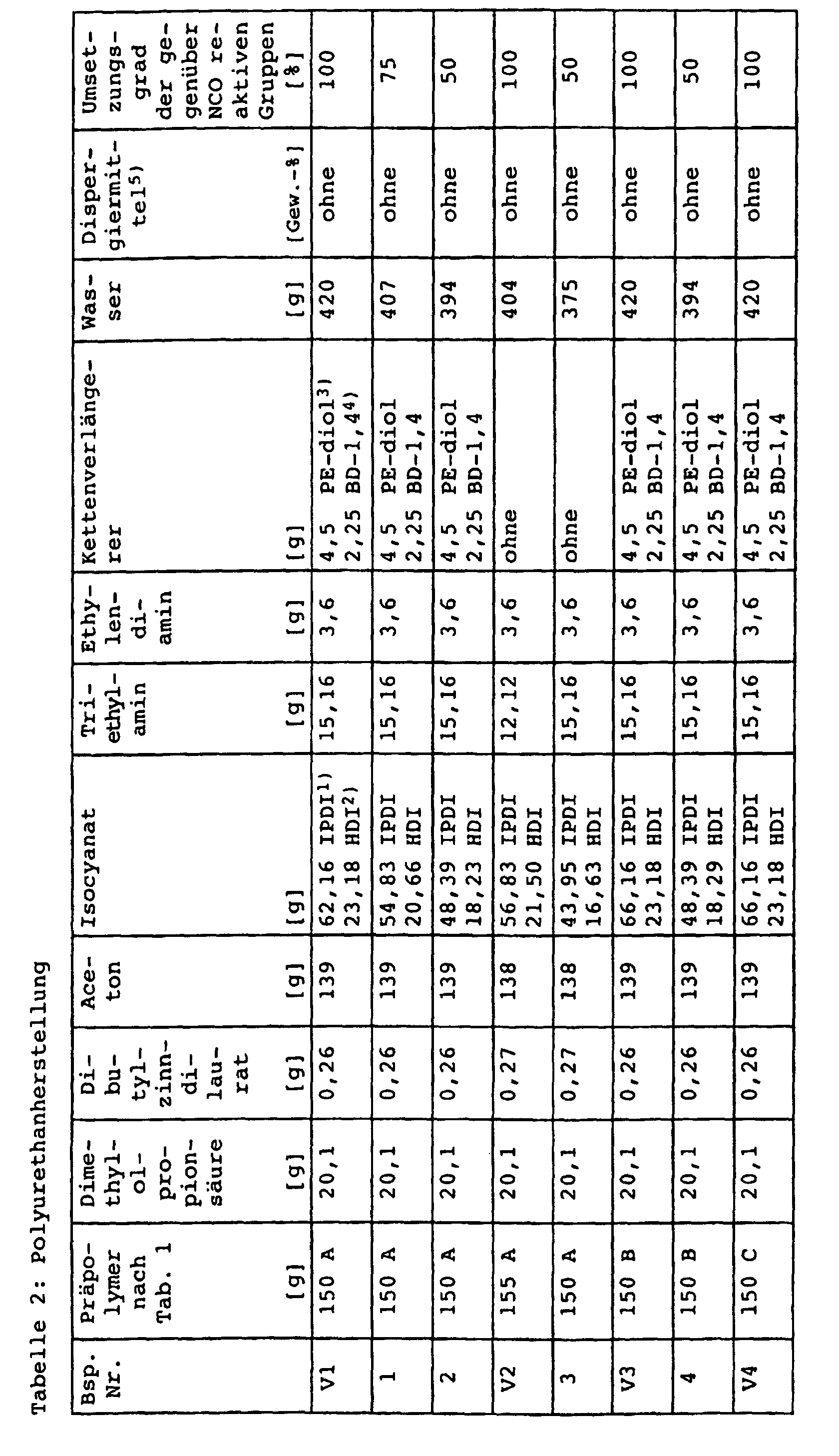
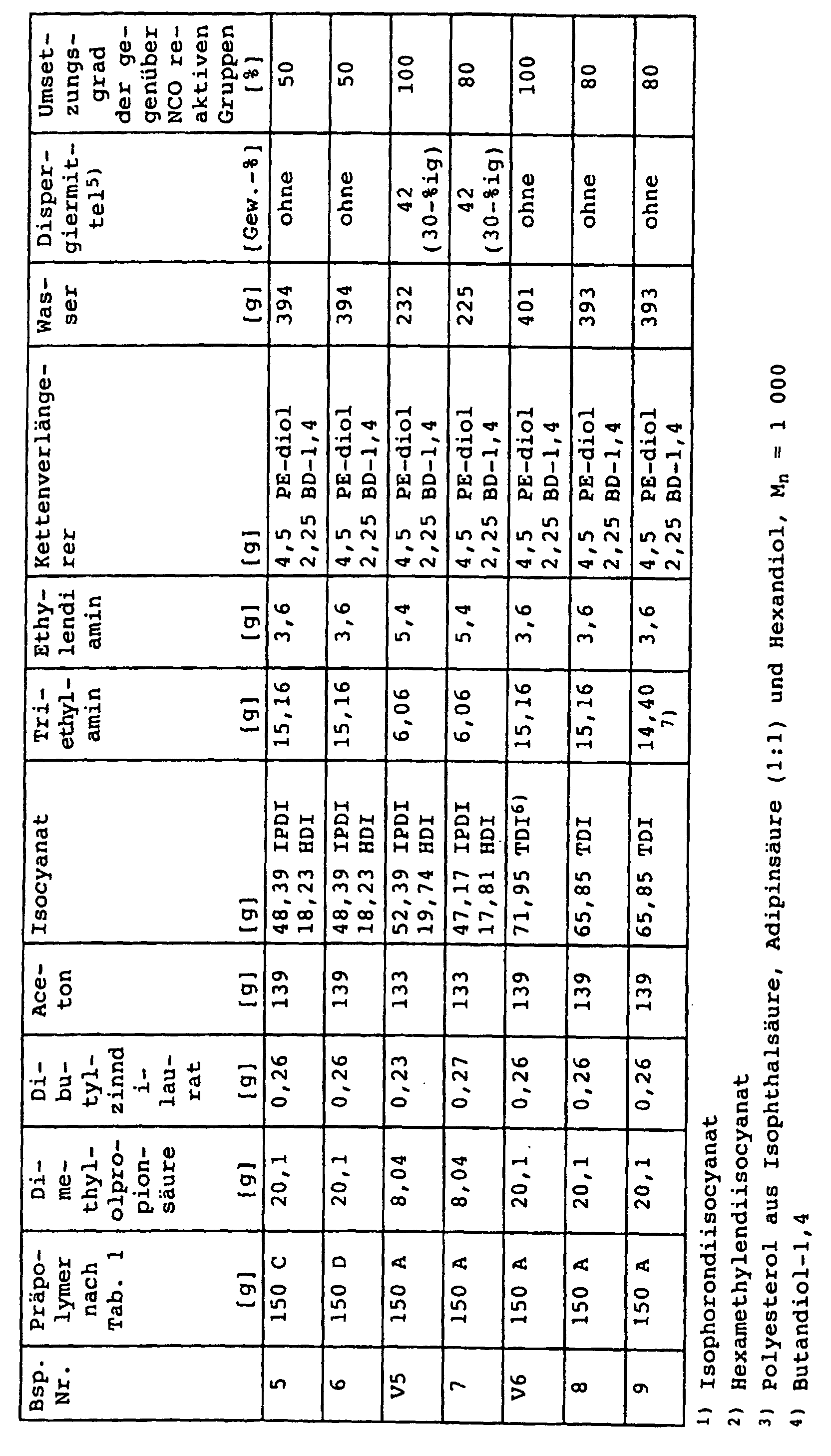

Der Feststoffgehalt der wässrigen Polymerdispersionen wurde bestimmt nach DIN 53216 Teil 1 (1 h, 125 °C).The solids content of the aqueous polymer dispersions was determined according to DIN 53216 Part 1 (1 h, 125 ° C).
Die Viskosität wurde in einem Rheomat 30 nach DIN 53019 bei einer Temperatur von 23 °C und einem Schergefälle D = 250 s-1 bestimmt.The viscosity was determined in a Rheomat 30 according to DIN 53019 at a temperature of 23 ° C. and a shear rate D = 250 s -1 .
Die Eigenschaften der Dispersionen sind in Tabelle 3 wiedergegeben.
Die erfindungsgemäßen Polyurethanpolymerisate lassen sich zu Polymerdispersionen mit guten anwendungstechnischen Eigenschaften formulieren. Insbesondere weisen diese Dispersionen im Allgemeinen hohe Feststoffgehalte und niedrigere Viskositäten auf als entsprechende Dispersionen auf Basis von Polymerisaten, bei deren Herstellung die gegenüber Isocyanatgruppen reaktiven Gruppen zu 100 % umgesetzt wurden.The polyurethane polymers according to the invention can be added Polymer dispersions with good performance properties formulate. In particular, these dispersions generally high solids contents and lower viscosities on as corresponding dispersions based on polymers, in their preparation, the opposite isocyanate groups reactive groups have been implemented to 100%.
Getrocknete und UV-gehärtete Filme auf Basis der erfindungsgemäßen Polyurethanpolymerisate weisen ebenfalls gute anwendungstechnische Eigenschaften, z. B. hohe Pendelhärten, hohe Bleistifthärten und geringe Erichsen-Tiefungswerte auf.Dried and UV-cured films based on the invention Polyurethane polymers also have good performance Properties, e.g. B. high pendulum hardness, high Pencil hardnesses and low Erichsen depth values.
Claims (10)
- A curable polyurethane polymer containing in copolymerized formor a salt thereof, wherein the ratio of isocyanate group equivalents of component F) to equivalents of isocyanate-reactive groups of components A) to E) is in a range from 0.4:1 to 0.9:1.A) from 10 to 60% by weight, based on the overall weight of components A) to F), of at least one hydroxyl-containing prepolymer having at least one thermally or photochemically polymerizable α,β-ethylenically unsaturated double bond,B) from 0.1 to 30% by weight, based on the overall weight of components A) to F), of at least one compound having at least one isocyanate-reactive hydroxyl group and/or primary or secondary amino group and, in addition, at least one polar functional group per molecule,C) from 0.1 to 30% by weight, based on the overall weight of components A) to F), of at least one compound selected from diamines, polyamines and mixtures thereof,D) from 0 to 10% by weight, based on the overall weight of components A) to F), of at least one further compound other than A), B), C) and E) having at least two isocyanate-reactive groups, which are hydroxyl groups and mixtures of hydroxyl groups with primary and/or secondary amino groups,E) from 0 to 20% by weight, based on the overall weight of components A) to F), of at least one compound having an isocyanate-reactive group,F) from 10 to 65% by weight, based on the overall weight of components A) to F), of at least one compound having at least two isocyanate groups,
- A polymer as claimed in claim 1, wherein the sum of the hydroxyl numbers of components A) and D) is in a range from 40 to 300 mg KOH/g, preferably from 121 to 300 mg KOH/g, in particular from 125 to 220 mg KOH/g.
- A polymer as claimed in either of the preceding claims, wherein the prepolymer A) is selected from the polyester acrylates, polyether acrylates, polyurethane acrylates, epoxy acrylates and mixtures thereof.
- A polymer dispersion comprising in dispersed form at least one curable polymer as claimed in any of claims 1 to 3.
- A polymer dispersion as claimed in claim 4, further comprising at least one dispersing auxiliary.
- A polymer dispersion as claimed in claim 5, whose solids content is at least 40% by weight, preferably at least 45% by weight.
- A polymer dispersion as claimed in any of claims 4 to 6 in the form of an aqueous dispersion.
- A coating composition comprising at least one polymer as claimed in any of claims 1 to 3.
- A water-based coating composition comprising at least one polymer dispersion as claimed in any of claims 4 to 7.
- The use of a polymer as claimed in any of claims 1 to 3 or polymer dispersion as claimed in any of claims 4 to 7 to coat substrates.
Applications Claiming Priority (2)
| Application Number | Priority Date | Filing Date | Title |
|---|---|---|---|
| DE19933012A DE19933012A1 (en) | 1999-07-14 | 1999-07-14 | Curable polyurethane polymer |
| DE19933012 | 1999-07-14 |
Publications (3)
| Publication Number | Publication Date |
|---|---|
| EP1069144A2 EP1069144A2 (en) | 2001-01-17 |
| EP1069144A3 EP1069144A3 (en) | 2001-10-17 |
| EP1069144B1 true EP1069144B1 (en) | 2005-06-08 |
Family
ID=7914780
Family Applications (1)
| Application Number | Title | Priority Date | Filing Date |
|---|---|---|---|
| EP00115226A Expired - Lifetime EP1069144B1 (en) | 1999-07-14 | 2000-07-13 | Curable polyurethane polymer |
Country Status (5)
| Country | Link |
|---|---|
| US (1) | US6538046B1 (en) |
| EP (1) | EP1069144B1 (en) |
| AT (1) | ATE297423T1 (en) |
| CA (1) | CA2313373A1 (en) |
| DE (2) | DE19933012A1 (en) |
Families Citing this family (23)
| Publication number | Priority date | Publication date | Assignee | Title |
|---|---|---|---|---|
| US20050003102A1 (en) * | 2003-06-20 | 2005-01-06 | Lockhart Aaron A. | UV-curable waterborne polyurethane dispersions for soft touch coatings |
| US7396875B2 (en) * | 2003-06-20 | 2008-07-08 | Bayer Materialscience Llc | UV-curable waterborne polyurethane dispersions for soft touch coatings |
| CN2689322Y (en) * | 2004-02-28 | 2005-03-30 | 鸿富锦精密工业(深圳)有限公司 | Fixer of host computer board |
| US20060047099A1 (en) * | 2004-08-25 | 2006-03-02 | Carmen Flosbach | Process for the production of polyurethane (meth)acrylates |
| US20070149704A1 (en) * | 2005-06-17 | 2007-06-28 | Reichhold, Inc. | Radiation curable polyurethane dispersions |
| KR100703854B1 (en) | 2006-01-13 | 2007-04-09 | 에스에스씨피 주식회사 | Solvent-free UV Curable Aqueous Coating Composition |
| DE102010003308A1 (en) | 2009-03-31 | 2011-01-13 | Basf Se | Mixture from urethane(meth)acrylate, preferably constructed from e.g. 1,6-hexamethylene diisocyanate, isophorone diisocyanate, (cyclo)aliphatic, preferably aliphatic polyesterdiol and (meth)acrylate, useful to coat e.g. wood and paper |
| JP2011034633A (en) * | 2009-07-31 | 2011-02-17 | Fujifilm Corp | Radiation-curable polyurethane resin composition and method for manufacturing the same, polyurethane resin, magnetic recording medium, and preservation stabilizer for radiation-curable polyurethane resin |
| US8263700B2 (en) | 2010-06-01 | 2012-09-11 | Ppg Industries Ohio, Inc. | Pigment dispersions, related coating compositions and coated substrates |
| EP2468830A1 (en) | 2010-12-27 | 2012-06-27 | Cytec Surface Specialties, S.A. | Radiation Curable Polyurethane Compositions |
| EP2468782A1 (en) * | 2010-12-27 | 2012-06-27 | Cytec Surface Specialties, S.A. | Radiation curable compositions |
| CN102816515B (en) * | 2012-08-14 | 2014-06-25 | 江苏大学 | Aqueous silicon dioxide-fluorinated acrylate polyurethane ultraviolet-curing coating, preparation method and application thereof |
| BR112015008811A2 (en) | 2012-10-24 | 2017-07-04 | Basf Se | compound, coating material, substrate, and method for coating a substrate |
| JP6436996B2 (en) | 2013-08-26 | 2018-12-12 | ビーエーエスエフ ソシエタス・ヨーロピアBasf Se | Radiation curable, water dispersible polyurethane (meth) acrylate |
| CN103834004B (en) * | 2014-01-27 | 2016-03-02 | 中国科学技术大学 | A kind of containing isocyanurate ring and hard section/the controlled heat resistant type flame retardant polyether polyol of soft section of ratio and preparation method thereof |
| US20180010004A1 (en) * | 2015-01-30 | 2018-01-11 | Hewlett-Packard Development Company, L.P. | Colorless radiation curable binder dispersion |
| US10364363B2 (en) | 2015-01-30 | 2019-07-30 | Hewlett-Packard Development Company, L.P. | Radiation curable binder dispersion |
| KR20180041165A (en) | 2015-08-17 | 2018-04-23 | 바스프 에스이 | An aqueous polymer composition comprising a polyurethane (meth) acrylate |
| PT3820927T (en) | 2018-07-13 | 2024-09-30 | Miwon Austria Forschung Und Entw Gmbh | Water-dispersible polyurethane (meth)acrylates for actinic radiation curable coatings |
| EP3870618B1 (en) | 2018-10-26 | 2023-07-12 | Basf Se | Aqueous binder formulation based on functionalized polyurethanes |
| CN110872372B (en) * | 2019-11-29 | 2021-08-03 | 鞍山润德精细化工有限公司 | Six-functional-group acrylic polyurethane containing triazine ring and preparation method and application thereof |
| CN113817126B (en) * | 2020-06-20 | 2022-11-08 | 万华化学集团股份有限公司 | Reactive viscosity adjusting composition suitable for two-component water-based epoxy system and preparation method and application thereof |
| BR112023000209A2 (en) | 2020-07-10 | 2023-01-31 | Basf Se | RESIN-IMPREGNATED FIBROUS MATERIAL IN THE FORM OF A PLATE OR SHEET, PROCESSES FOR PRODUCING A RESIN-IMPREGNATED FIBROUS MATERIAL AND FOR PROVIDING A PANEL WITH A PLASTIC SURFACE, USE OF RESIN-IMPREGNATED FIBROUS SHEET MATERIAL, AND, PANEL HAVING A SURFACE OF RESIN PLASTIC |
Family Cites Families (10)
| Publication number | Priority date | Publication date | Assignee | Title |
|---|---|---|---|---|
| DE3005034A1 (en) | 1980-02-11 | 1981-08-20 | Basf Ag, 6700 Ludwigshafen | METHOD FOR PRODUCING COVERS |
| DE3437918A1 (en) | 1984-10-17 | 1986-04-17 | Bayer Ag, 5090 Leverkusen | AQUEOUS OLIGOURETHANE DISPERSIONS WITH BUILT-IN, UNSATURATED GROUPS AND THEIR USE FOR THE PRODUCTION OF HIGH-GLOSSY PAINTS ON LEATHER FROM AQUEOUS PHASE |
| DE3526016A1 (en) | 1985-07-20 | 1987-01-22 | Huels Chemische Werke Ag | STORAGE-STABLE, RADIATION-HARDENABLE, NCO-FREE, AQUEOUS EMULSIONS |
| US5089376A (en) | 1986-12-08 | 1992-02-18 | Armstrong World Industries, Inc. | Photoimagable solder mask coating |
| JPH0655493B2 (en) | 1988-02-29 | 1994-07-27 | 帝人株式会社 | Easily adhesive polyester film and method for producing the same |
| DE3911827A1 (en) | 1989-04-11 | 1990-10-25 | Basf Ag | AQUEOUS DISPERSIONS OF POLYURETHANES CROSSLINKED BY THE ACTION OF ENERGY RADIATION |
| DE4031732A1 (en) | 1990-10-06 | 1992-04-09 | Basf Ag | RADIATION-RESISTABLE, AQUEOUS BINDER DISPERSIONS |
| US5306764A (en) | 1992-09-03 | 1994-04-26 | China Technical Consultants Inc. | Water dispersible polyurethane and process for preparation thereof |
| DE19525489A1 (en) | 1995-07-13 | 1997-01-16 | Wolff Walsrode Ag | Radiation-curable, aqueous dispersions, their preparation and use |
| DE19810793A1 (en) * | 1998-03-12 | 1999-09-16 | Basf Ag | Curable polyurethane polymer, dispersion based on this polymer, process for its preparation and its use |
-
1999
- 1999-07-14 DE DE19933012A patent/DE19933012A1/en not_active Withdrawn
-
2000
- 2000-07-04 CA CA002313373A patent/CA2313373A1/en not_active Abandoned
- 2000-07-11 US US09/614,169 patent/US6538046B1/en not_active Expired - Lifetime
- 2000-07-13 EP EP00115226A patent/EP1069144B1/en not_active Expired - Lifetime
- 2000-07-13 AT AT00115226T patent/ATE297423T1/en not_active IP Right Cessation
- 2000-07-13 DE DE50010494T patent/DE50010494D1/en not_active Expired - Lifetime
Also Published As
| Publication number | Publication date |
|---|---|
| CA2313373A1 (en) | 2001-01-14 |
| ATE297423T1 (en) | 2005-06-15 |
| US6538046B1 (en) | 2003-03-25 |
| EP1069144A3 (en) | 2001-10-17 |
| DE19933012A1 (en) | 2001-01-18 |
| EP1069144A2 (en) | 2001-01-17 |
| DE50010494D1 (en) | 2005-07-14 |
Similar Documents
| Publication | Publication Date | Title |
|---|---|---|
| EP0942022B1 (en) | Hardenable polyurethane polymerisate, dispersion based thereon, its preparation process and its use | |
| EP1069144A2 (en) | Curable polyurethane polymer | |
| EP0753531B1 (en) | Radiation-curable aqueous dispersions, their preparation and use | |
| EP0392352B1 (en) | Aqueous dispersions of high energy radiation curable polyurethanes | |
| EP0794204B1 (en) | Latently crosslinking aqueous polyurethane dispersions | |
| DE3124784C2 (en) | Resin-like coating composition | |
| EP0033896B1 (en) | Radiation curable aqueous binder dispersions, process for their preparation and their use | |
| EP2178939B1 (en) | Process for producing hard coating systems based on aqueous polyurethane dispersions | |
| EP1142947B1 (en) | Polyurethane dispersions | |
| EP0381862B1 (en) | Use of hydrophilic polyurethanes containing (meth)acryloyl groups as reactive emulsifying agents in radically hardening resins and aqueous coating compositions on the basis of a mixture of radically hardening resins | |
| DE102005019430A1 (en) | N-methylpyrrolidone-free polyurethane dispersions based on dimethylolpropionic acid | |
| US3931116A (en) | Curable amine-terminated polyurethane-urea-epoxide lacquers | |
| DE60223380T2 (en) | ACTIALLY HARDENABLE WATER VARNISH, PAINTED METAL AND METHOD FOR THE PRODUCTION THEREOF | |
| EP0181486B1 (en) | Aqueous oligourethane dispersions incorporating unsaturated groups | |
| EP1106633A2 (en) | Polyurethane emulsions | |
| DE10112390A1 (en) | Polyurethane dispersion for use as binder, e.g. in paint or adhesives, contains mixture of polymeric polyol, low-mol. wt. polyol, anionically-modifiable polymeth-acrylate-diol, polyisocyanate, neutralizing agent and water | |
| AT410213B (en) | WATER-DILUTABLE BINDER FOR '' SOFT-FEEL '' LACQUERS | |
| EP0807648B1 (en) | Latent curing aqueous polyurethane dispersions | |
| EP1556450B1 (en) | Aqueous non-ionically stabilised epoxy resins | |
| DE3150157A1 (en) | URETHANE RHEOLOGY MODIFIER, METHOD FOR THE PRODUCTION AND USE THEREOF | |
| EP0480251A1 (en) | Radiation curable aqueous binder dispersions | |
| DE19627826A1 (en) | New polyamines and their use in aqueous paints and coatings | |
| EP0709417A1 (en) | Reactive emulsifiers based on unsaturated polyurethanes | |
| EP0554784A2 (en) | Radiation-curable aqueous polyurethane dispersions | |
| DE4138384A1 (en) | SYNTHETIC RESIN |
Legal Events
| Date | Code | Title | Description |
|---|---|---|---|
| PUAI | Public reference made under article 153(3) epc to a published international application that has entered the european phase |
Free format text: ORIGINAL CODE: 0009012 |
|
| AK | Designated contracting states |
Kind code of ref document: A2 Designated state(s): AT BE CH CY DE DK ES FI FR GB GR IE IT LI LU MC NL PT SE |
|
| AX | Request for extension of the european patent |
Free format text: AL;LT;LV;MK;RO;SI |
|
| PUAL | Search report despatched |
Free format text: ORIGINAL CODE: 0009013 |
|
| AK | Designated contracting states |
Kind code of ref document: A3 Designated state(s): AT BE CH CY DE DK ES FI FR GB GR IE IT LI LU MC NL PT SE |
|
| AX | Request for extension of the european patent |
Free format text: AL;LT;LV;MK;RO;SI |
|
| RIC1 | Information provided on ipc code assigned before grant |
Free format text: 7C 08G 18/08 A, 7C 08G 18/67 B, 7C 09D 175/04 B, 7C 09D 175/14 B |
|
| 17P | Request for examination filed |
Effective date: 20020322 |
|
| AKX | Designation fees paid |
Free format text: AT BE CH CY DE DK ES FI FR GB GR IE IT LI LU MC NL PT SE |
|
| GRAP | Despatch of communication of intention to grant a patent |
Free format text: ORIGINAL CODE: EPIDOSNIGR1 |
|
| GRAS | Grant fee paid |
Free format text: ORIGINAL CODE: EPIDOSNIGR3 |
|
| GRAA | (expected) grant |
Free format text: ORIGINAL CODE: 0009210 |
|
| AK | Designated contracting states |
Kind code of ref document: B1 Designated state(s): AT BE CH CY DE DK ES FI FR GB GR IE IT LI LU MC NL PT SE |
|
| PG25 | Lapsed in a contracting state [announced via postgrant information from national office to epo] |
Ref country code: IT Free format text: LAPSE BECAUSE OF FAILURE TO SUBMIT A TRANSLATION OF THE DESCRIPTION OR TO PAY THE FEE WITHIN THE PRESCRIBED TIME-LIMIT;WARNING: LAPSES OF ITALIAN PATENTS WITH EFFECTIVE DATE BEFORE 2007 MAY HAVE OCCURRED AT ANY TIME BEFORE 2007. THE CORRECT EFFECTIVE DATE MAY BE DIFFERENT FROM THE ONE RECORDED. Effective date: 20050608 Ref country code: GB Free format text: LAPSE BECAUSE OF FAILURE TO SUBMIT A TRANSLATION OF THE DESCRIPTION OR TO PAY THE FEE WITHIN THE PRESCRIBED TIME-LIMIT Effective date: 20050608 Ref country code: NL Free format text: LAPSE BECAUSE OF FAILURE TO SUBMIT A TRANSLATION OF THE DESCRIPTION OR TO PAY THE FEE WITHIN THE PRESCRIBED TIME-LIMIT Effective date: 20050608 Ref country code: IE Free format text: LAPSE BECAUSE OF FAILURE TO SUBMIT A TRANSLATION OF THE DESCRIPTION OR TO PAY THE FEE WITHIN THE PRESCRIBED TIME-LIMIT Effective date: 20050608 Ref country code: FI Free format text: LAPSE BECAUSE OF FAILURE TO SUBMIT A TRANSLATION OF THE DESCRIPTION OR TO PAY THE FEE WITHIN THE PRESCRIBED TIME-LIMIT Effective date: 20050608 |
|
| REG | Reference to a national code |
Ref country code: GB Ref legal event code: FG4D Free format text: NOT ENGLISH |
|
| REG | Reference to a national code |
Ref country code: CH Ref legal event code: EP |
|
| PG25 | Lapsed in a contracting state [announced via postgrant information from national office to epo] |
Ref country code: AT Free format text: LAPSE BECAUSE OF NON-PAYMENT OF DUE FEES Effective date: 20050713 Ref country code: LU Free format text: LAPSE BECAUSE OF NON-PAYMENT OF DUE FEES Effective date: 20050713 Ref country code: CY Free format text: LAPSE BECAUSE OF FAILURE TO SUBMIT A TRANSLATION OF THE DESCRIPTION OR TO PAY THE FEE WITHIN THE PRESCRIBED TIME-LIMIT Effective date: 20050713 |
|
| REF | Corresponds to: |
Ref document number: 50010494 Country of ref document: DE Date of ref document: 20050714 Kind code of ref document: P |
|
| REG | Reference to a national code |
Ref country code: IE Ref legal event code: FG4D Free format text: LANGUAGE OF EP DOCUMENT: GERMAN |
|
| PG25 | Lapsed in a contracting state [announced via postgrant information from national office to epo] |
Ref country code: LI Free format text: LAPSE BECAUSE OF NON-PAYMENT OF DUE FEES Effective date: 20050731 Ref country code: MC Free format text: LAPSE BECAUSE OF NON-PAYMENT OF DUE FEES Effective date: 20050731 Ref country code: CH Free format text: LAPSE BECAUSE OF NON-PAYMENT OF DUE FEES Effective date: 20050731 |
|
| PG25 | Lapsed in a contracting state [announced via postgrant information from national office to epo] |
Ref country code: GR Free format text: LAPSE BECAUSE OF FAILURE TO SUBMIT A TRANSLATION OF THE DESCRIPTION OR TO PAY THE FEE WITHIN THE PRESCRIBED TIME-LIMIT Effective date: 20050908 Ref country code: DK Free format text: LAPSE BECAUSE OF FAILURE TO SUBMIT A TRANSLATION OF THE DESCRIPTION OR TO PAY THE FEE WITHIN THE PRESCRIBED TIME-LIMIT Effective date: 20050908 |
|
| PG25 | Lapsed in a contracting state [announced via postgrant information from national office to epo] |
Ref country code: ES Free format text: LAPSE BECAUSE OF FAILURE TO SUBMIT A TRANSLATION OF THE DESCRIPTION OR TO PAY THE FEE WITHIN THE PRESCRIBED TIME-LIMIT Effective date: 20050919 |
|
| REG | Reference to a national code |
Ref country code: SE Ref legal event code: TRGR |
|
| PG25 | Lapsed in a contracting state [announced via postgrant information from national office to epo] |
Ref country code: PT Free format text: LAPSE BECAUSE OF FAILURE TO SUBMIT A TRANSLATION OF THE DESCRIPTION OR TO PAY THE FEE WITHIN THE PRESCRIBED TIME-LIMIT Effective date: 20051114 |
|
| NLV1 | Nl: lapsed or annulled due to failure to fulfill the requirements of art. 29p and 29m of the patents act | ||
| GBV | Gb: ep patent (uk) treated as always having been void in accordance with gb section 77(7)/1977 [no translation filed] |
Effective date: 20050608 |
|
| REG | Reference to a national code |
Ref country code: IE Ref legal event code: FD4D |
|
| REG | Reference to a national code |
Ref country code: CH Ref legal event code: PL |
|
| ET | Fr: translation filed | ||
| PLBE | No opposition filed within time limit |
Free format text: ORIGINAL CODE: 0009261 |
|
| STAA | Information on the status of an ep patent application or granted ep patent |
Free format text: STATUS: NO OPPOSITION FILED WITHIN TIME LIMIT |
|
| 26N | No opposition filed |
Effective date: 20060309 |
|
| REG | Reference to a national code |
Ref country code: FR Ref legal event code: ST Effective date: 20150331 |
|
| PG25 | Lapsed in a contracting state [announced via postgrant information from national office to epo] |
Ref country code: FR Free format text: LAPSE BECAUSE OF NON-PAYMENT OF DUE FEES Effective date: 20140731 |
|
| REG | Reference to a national code |
Ref country code: FR Ref legal event code: PLFP Year of fee payment: 16 |
|
| REG | Reference to a national code |
Ref country code: FR Ref legal event code: D3 Effective date: 20150609 |
|
| PGRI | Patent reinstated in contracting state [announced from national office to epo] |
Ref country code: FR Effective date: 20150609 |
|
| REG | Reference to a national code |
Ref country code: FR Ref legal event code: PLFP Year of fee payment: 17 |
|
| REG | Reference to a national code |
Ref country code: FR Ref legal event code: PLFP Year of fee payment: 18 |
|
| REG | Reference to a national code |
Ref country code: FR Ref legal event code: PLFP Year of fee payment: 19 |
|
| PGFP | Annual fee paid to national office [announced via postgrant information from national office to epo] |
Ref country code: FR Payment date: 20180726 Year of fee payment: 19 |
|
| PGFP | Annual fee paid to national office [announced via postgrant information from national office to epo] |
Ref country code: SE Payment date: 20180731 Year of fee payment: 19 Ref country code: BE Payment date: 20180725 Year of fee payment: 19 |
|
| PGFP | Annual fee paid to national office [announced via postgrant information from national office to epo] |
Ref country code: DE Payment date: 20180928 Year of fee payment: 19 |
|
| REG | Reference to a national code |
Ref country code: DE Ref legal event code: R119 Ref document number: 50010494 Country of ref document: DE |
|
| REG | Reference to a national code |
Ref country code: SE Ref legal event code: EUG |
|
| REG | Reference to a national code |
Ref country code: BE Ref legal event code: MM Effective date: 20190731 |
|
| PG25 | Lapsed in a contracting state [announced via postgrant information from national office to epo] |
Ref country code: DE Free format text: LAPSE BECAUSE OF NON-PAYMENT OF DUE FEES Effective date: 20200201 Ref country code: SE Free format text: LAPSE BECAUSE OF NON-PAYMENT OF DUE FEES Effective date: 20190714 |
|
| PG25 | Lapsed in a contracting state [announced via postgrant information from national office to epo] |
Ref country code: BE Free format text: LAPSE BECAUSE OF NON-PAYMENT OF DUE FEES Effective date: 20190731 |
|
| PG25 | Lapsed in a contracting state [announced via postgrant information from national office to epo] |
Ref country code: FR Free format text: LAPSE BECAUSE OF NON-PAYMENT OF DUE FEES Effective date: 20190731 |