EP1068902A2 - Flask vent and method of making same - Google Patents
Flask vent and method of making same Download PDFInfo
- Publication number
- EP1068902A2 EP1068902A2 EP00302179A EP00302179A EP1068902A2 EP 1068902 A2 EP1068902 A2 EP 1068902A2 EP 00302179 A EP00302179 A EP 00302179A EP 00302179 A EP00302179 A EP 00302179A EP 1068902 A2 EP1068902 A2 EP 1068902A2
- Authority
- EP
- European Patent Office
- Prior art keywords
- closure
- sealing
- sealing means
- passageway
- plugs
- Prior art date
- Legal status (The legal status is an assumption and is not a legal conclusion. Google has not performed a legal analysis and makes no representation as to the accuracy of the status listed.)
- Withdrawn
Links
Images

Classifications
-
- C—CHEMISTRY; METALLURGY
- C12—BIOCHEMISTRY; BEER; SPIRITS; WINE; VINEGAR; MICROBIOLOGY; ENZYMOLOGY; MUTATION OR GENETIC ENGINEERING
- C12M—APPARATUS FOR ENZYMOLOGY OR MICROBIOLOGY; APPARATUS FOR CULTURING MICROORGANISMS FOR PRODUCING BIOMASS, FOR GROWING CELLS OR FOR OBTAINING FERMENTATION OR METABOLIC PRODUCTS, i.e. BIOREACTORS OR FERMENTERS
- C12M23/00—Constructional details, e.g. recesses, hinges
- C12M23/02—Form or structure of the vessel
- C12M23/12—Well or multiwell plates
-
- B—PERFORMING OPERATIONS; TRANSPORTING
- B01—PHYSICAL OR CHEMICAL PROCESSES OR APPARATUS IN GENERAL
- B01L—CHEMICAL OR PHYSICAL LABORATORY APPARATUS FOR GENERAL USE
- B01L3/00—Containers or dishes for laboratory use, e.g. laboratory glassware; Droppers
- B01L3/50—Containers for the purpose of retaining a material to be analysed, e.g. test tubes
- B01L3/508—Rigid containers without fluid transport within
- B01L3/5082—Test tubes per se
- B01L3/50825—Closing or opening means, corks, bungs
-
- B—PERFORMING OPERATIONS; TRANSPORTING
- B01—PHYSICAL OR CHEMICAL PROCESSES OR APPARATUS IN GENERAL
- B01L—CHEMICAL OR PHYSICAL LABORATORY APPARATUS FOR GENERAL USE
- B01L3/00—Containers or dishes for laboratory use, e.g. laboratory glassware; Droppers
- B01L3/50—Containers for the purpose of retaining a material to be analysed, e.g. test tubes
- B01L3/508—Rigid containers without fluid transport within
- B01L3/5085—Rigid containers without fluid transport within for multiple samples, e.g. microtitration plates
- B01L3/50853—Rigid containers without fluid transport within for multiple samples, e.g. microtitration plates with covers or lids
-
- B—PERFORMING OPERATIONS; TRANSPORTING
- B01—PHYSICAL OR CHEMICAL PROCESSES OR APPARATUS IN GENERAL
- B01L—CHEMICAL OR PHYSICAL LABORATORY APPARATUS FOR GENERAL USE
- B01L3/00—Containers or dishes for laboratory use, e.g. laboratory glassware; Droppers
- B01L3/56—Labware specially adapted for transferring fluids
- B01L3/567—Valves, taps or stop-cocks
-
- C—CHEMISTRY; METALLURGY
- C12—BIOCHEMISTRY; BEER; SPIRITS; WINE; VINEGAR; MICROBIOLOGY; ENZYMOLOGY; MUTATION OR GENETIC ENGINEERING
- C12M—APPARATUS FOR ENZYMOLOGY OR MICROBIOLOGY; APPARATUS FOR CULTURING MICROORGANISMS FOR PRODUCING BIOMASS, FOR GROWING CELLS OR FOR OBTAINING FERMENTATION OR METABOLIC PRODUCTS, i.e. BIOREACTORS OR FERMENTERS
- C12M23/00—Constructional details, e.g. recesses, hinges
- C12M23/02—Form or structure of the vessel
- C12M23/08—Flask, bottle or test tube
-
- C—CHEMISTRY; METALLURGY
- C12—BIOCHEMISTRY; BEER; SPIRITS; WINE; VINEGAR; MICROBIOLOGY; ENZYMOLOGY; MUTATION OR GENETIC ENGINEERING
- C12M—APPARATUS FOR ENZYMOLOGY OR MICROBIOLOGY; APPARATUS FOR CULTURING MICROORGANISMS FOR PRODUCING BIOMASS, FOR GROWING CELLS OR FOR OBTAINING FERMENTATION OR METABOLIC PRODUCTS, i.e. BIOREACTORS OR FERMENTERS
- C12M23/00—Constructional details, e.g. recesses, hinges
- C12M23/38—Caps; Covers; Plugs; Pouring means
-
- C—CHEMISTRY; METALLURGY
- C12—BIOCHEMISTRY; BEER; SPIRITS; WINE; VINEGAR; MICROBIOLOGY; ENZYMOLOGY; MUTATION OR GENETIC ENGINEERING
- C12M—APPARATUS FOR ENZYMOLOGY OR MICROBIOLOGY; APPARATUS FOR CULTURING MICROORGANISMS FOR PRODUCING BIOMASS, FOR GROWING CELLS OR FOR OBTAINING FERMENTATION OR METABOLIC PRODUCTS, i.e. BIOREACTORS OR FERMENTERS
- C12M37/00—Means for sterilizing, maintaining sterile conditions or avoiding chemical or biological contamination
- C12M37/02—Filters
-
- Y—GENERAL TAGGING OF NEW TECHNOLOGICAL DEVELOPMENTS; GENERAL TAGGING OF CROSS-SECTIONAL TECHNOLOGIES SPANNING OVER SEVERAL SECTIONS OF THE IPC; TECHNICAL SUBJECTS COVERED BY FORMER USPC CROSS-REFERENCE ART COLLECTIONS [XRACs] AND DIGESTS
- Y10—TECHNICAL SUBJECTS COVERED BY FORMER USPC
- Y10S—TECHNICAL SUBJECTS COVERED BY FORMER USPC CROSS-REFERENCE ART COLLECTIONS [XRACs] AND DIGESTS
- Y10S215/00—Bottles and jars
- Y10S215/03—Medical
Definitions
- the present invention relates to a closure for a vessel or well. More specifically, the present invention relates to a closure for allowing sterile gas exchange therethrough.
- closure devices for covering microbiological vessels, such as flasks, has been a widely accepted and longly used practice in microbiology. Closures are used in order to prevent the contamination of microorganisms being cultured or stored within the flasks by airborne contaminates or particulate matter. Additionally, these closures have been used to prevent the escape of microorganisms being cultured or stored in the flasks from being released from the flasks where they can become airborne and become contaminates themselves.
- microorganisms or cultures must be grown under sterile conditions. Likewise, such sterile conditions must be kept in cell cultures and present day genetic manipulations of cells and cell fractions.
- sterile conditions must be kept in cell cultures and present day genetic manipulations of cells and cell fractions.
- closures have been designed to accommodate the specific growth requirements for each of these types of microorganisms. For example, aerobic microorganisms are only able to live in the presence of oxygen whereas anaerobic microorganisms are capable of growing, and in some circumstances are unable to grow, in the presence of oxygen.
- a closure may be required which is capable of maintaining sterile conditions within the interior of the flask or vessel by preventing the introduction of contaminating microorganisms while at the same time preventing the entrance of oxygen into the container or vessel.
- the same issues relate to such genetic manipulations as cloning and hybridization.
- a microbiological vessel or flask closure Another requirement for a microbiological vessel or flask closure, is that while maintaining the sterility of the microorganisms or cultures being grown therein, the closure should provide free access into the container or flask to facilitate the addition or removal of contents from the vessel or flask, such as sterile removal of microbiological culture from the vessel or flask.
- cotton or gauze was formed into a plug and was inserted into the opening of a container or flask. These cotton or gauze plugs serve the general purpose of preventing contamination of the container or flask while simultaneously permitting the free exchange of oxygen with the atmosphere.
- This type of closure has many deficiencies such as it can be difficult to resterilize the plug for, subsequent use and after repeated usage, this type of plug tends to readily decompose.
- a cap is described in U.S. Patent No. 5,180,073 to Fay et al.
- This cap has an outer collar and an inner collar and the top portion includes a permeable section.
- this device does not disclose the use of a permeable section made from filter media nor does it disclose the method for making a cap including a sealing portion and filter media in a single step.
- closure assembly for use with microbiological containers or flasks in which the closure assembly includes a filter membrane and a seal which allows for creating an air and fluid tight seal between the closure and the container or flask and in which the closure assembly can be produced in a one step process thereby eliminating the complexity and lowering the cost of assembly and manufacture and eliminating the deficiencies described above for prior art closure devices. It would also be advantageous to apply this technology to multiwell plates.
- a closure for sealing a microorganism container which includes a resilient seal for sealing the container, a passageway extending through the seal, and a filter media extending across the passageway integrally molded to the seal for allowing sterile gas exchange therethrough.
- the present invention further provides a method of making a closure by molding a seal having a passageway extending therethrough while simultaneously sealing a peripheral edge of a filter media within the passageway.
- the present invention also provides a multiwell plate assembly, which includes a tray including a plurality of wells therein and a closure for sealing at least some of the wells, the closure includes a resilient framework having a plurality of sealings interconnected by the framework for sealing engagement with at least some of the wells into which the sealings are disposed, at least one of the sealings includes a passageway extending therethrough and filter media extending across the passageway for allowing sterile exchange therethrough in and out of the well in which the sealings are disposed.
- the present invention provides a closure for sealing a container which includes a resilient framework including a plurality of sealings interconnected by the framework with at least one of the sealings including a passageway extending therethrough and filter media extending across the passageway for allowing sterile exchange therethrough.
- the present invention further provides a plurality of plugs, each of the plugs including an opening extending therethrough defining a central axis for each of the plugs and a resilient framework interconnecting each of the plugs.
- the present invention also provides a closure member which includes a plurality of wells, each of the wells including an opening extending therethrough and a framework interconnecting the wells.
- a closure assembly for sealing a microorganism container 50 is generally shown and designated by the reference numeral 20.
- the closure assembly 20 includes a resilient seal or plug 24 for sealing the closure 20 to a container 50.
- the closure assembly 20 further includes filter media 28 integrally disposed and connected within the seal or plug 24 for allowing sterile gas exchange therethrough.
- the container 50 can be a flask, microtitre plate or other known type of container which retains liquids and microorganisms or cells, or cellular components therein for the purpose of propagating aerobic or anaerobic microorganisms or conducting other biological manipulations, such as hybridization, PCR, etc.
- the container 50 is preferably made of glass or pyrex®, plastic or other suitable materials which can withstand autoclaving or other such methods of sterilization.
- the closure 20 can also include a port or passageway 26 axially disposed within the seal or plug 24 which extends through the seal or plug 24 allowing fluid communication between the container 50 and the external atmosphere.
- the passageway or port 26 is defined by a cylindrical side wall 25.
- the seal or plug 24 is generally frustoconical in cross-section.
- the seal or plug 24 can be tapered and have a shape similar to a wedge.
- the closure assembly 20 forms an air and liquid-tight seal with an inner surface 52 of the container 50.
- the side wall 25 of the seal or plug 24 is graduated and, therefore, it can be inserted into containers 50 having variously sized openings therein and form an air and liquid-tight seal therewith.
- the cross-sectional diameter of the wall 25 of the seal or plug 24 increases in the direction opposite of the insertion end 42 of the seal or plug 24 as shown in Figures 1 and 4. Since an infinite number of diameters can be accommodated, the closure assembly 20 can be used with and create both air and liquid-tight seals with variously sized containers 50.
- the resilient seal or plug 24 is a generally unitary member formed of a resilient material which is capable of conforming and sealing to the contours of the openings of flasks or containers 50.
- the resilient seat or plug 24 is constructed of a material which is capable of deflecting and/or yielding to sealingly conform to or to sealingly engage with the inner surface 52 of a container such that both an air-and liquid-tight seal is formed and maintained therewith.
- the seal or plug 24 can be constructed or manufactured from suitable flexible and resilient materials, for example, silicones, natural synthetic rubber materials, polypropylenes, polyolefins, polyesters, polyamides, polycarbonates, polystyrenes, styrenes, co-polymers, and fluoroplastics. This list is not meant to be exhaustive and can include other suitable materials known to those skilled in the art without departing from the spirit of the present invention.
- the closure assembly 20 further includes at least one filter media 28 in the form of a filter having a top surface 29, a bottom surface 30, and a peripheral edge 31.
- the filter 28 is somewhat flat or disk-shaped.
- the peripheral edge 31 of the filter 28 is sealed within the port or passageway 26 which axially extends through the seal or plug 24.
- the seal between the peripheral edge 31 and the seal or plug 24 must be both air- and liquid-tight in order to maintain the integrity and/or sterility of the closure 20 and contents of the container 50.
- the filter media 28 must be positioned and affixed within the port or passageway 26 such that any fluids (gaseous or liquid) can only pass through the filter media 28 and not around the periphery of the filter media 28 thereby breaching the sterility of the closure 20/container 50 system.
- the peripheral edge 31 of the filter media 28 must be affixed to the plug or seal 24 in such a manner to form a seal therein such that when the closure 20 is in place in the opening of the container 50, fluid and/or gas exchange can only occur across the filter media 28 thereby maintaining the sterility of the container 50 and its contents.
- the filter 28 can be sealed within the passageway 26 of the seal or plug 24 by affixing or integrally molding the filter 28 within the port or passageway 26.
- the closure 20 has a generally cylindrical shape and is designed to fit over the container 50 and forms an air and liquid tight seal with an outer surface 54 of the container 50.
- the embodiment shown in Figure 4 can be made in any desired size and therefore can be constructed to fit any size container 50.
- a support 32 can be provided adjacent to the filter.
- the support can be disposed about and below the peripheral edge 31 of the filter 28.
- the support 32 can be disposed about the peripheral edge 31 at a position approximately level with the position of the peripheral edge 31.
- the support 32'' can be disposed about and above the peripheral edge 31 of the filter 28.
- the support 32 can be a ring molded or affixed to either the bottom of the peripheral edge 31, the top of the peripheral edge 31, or molded or affixed to the peripheral edge 31 in the same plane as the filter 28.
- the support can be constructed of any suitable materials including a metal, such as stainless steel, and plastic. The material comprising the support 32 must be able to withstand the temperatures and pressures encountered during autoclaving.
- the support can include a mesh-like matrix disposed on either the top 29 or bottom 30 of the filter 28 (not shown).
- the support member 32 can be constructed of any suitable material, such as the same material as comprises the closure 20.
- the filter 28 and the support 32 are positioned within the port or passageway 26 of the seal or plug 24 and can be fixed in place by means such as affixation during molding of the seal or plug 24 or can be positioned and fixed in place following molding of the seal or plug 24 such as by gluing or embedding the filter 28 and support 32, in the plug or seal 24 to the seal closure 20.
- a skirt 90 can be added around the outer perimeter at the support 32, as an additional measure to ensure proper seal closure.
- the filter 28 and the support 32 can be affixed to one another by means including molding or other types of affixation such as gluing, cementing ultrasonics, insert molding, heat sealing or UV curing.
- the filter media 28 can include any suitable materials or membranes such as depth media including HEPA or OPA rated glass microfiber, cotton wool, a steel plug, hydrophobic membranes such as polypropylenes, polytetrafluoroethylenes (PTFE), polysulfones, polyvinyldifluoride (PVOF), or any other porous material. Further, the filter material may be woven or non-woven and may contain multiple layers. These multiple layers may be made up of the same or different filter media 28. This list of materials is not intended to be exhaustive and other suitable materials known to these skilled in the art can be utilized without departing from the spirit of the present invention.
- the filter media 28 is made from a material which is capable of permitting the exchange of gas thereacross, but will not permit the passage of micro-organic contaminants.
- the closure assembly 20 can include at least one aperture or opening 36 extending therethrough to allow for the insertion of tubing, thermometer or the like therein. Since the aperture 36 is disposed within the seal or plug 24, the aperture 36 is able to conform and perfect a seal about any tubing or the like placed therein. The aperture 36 allows for sterile access to the interior of the container 50 and the contents therein without the risk of introducing any contamination.
- the present invention can be adapted to be an effective sealing device for a multiwell tray system.
- the closure assembly 20' can include a resilient framework 56 which contains therein a plurality of sealings 58 which are interconnected by the framework 56.
- This resilient framework 56 can be constructed of any suitable materials including metal, such as stainless steel and plastic. However, this list is not meant to be exhaustive and can include other suitable materials known to those skilled in the art without departing from the spirit of the present invention.
- the assembly can be a three part system.
- the system includes an upper member 90 and lower member 92.
- the sealings or plugs 58 are made up of a female portion 60 of the lower member 92 having at least one opening 70 extending therethrough and a male portion 68 also having an opening 71 extending therethrough.
- the male portion 68 of the upper member 90 is made such that it is disposed within the female portion 60 and the openings 70, 71 are properly aligned.
- Fitted between the female portion 60 and the male portion 68 is a filter media 28 which extends between the openings 70, 71.
- the filter media 28 is made from a material which is capable of permitting the exchange of gas thereacross, but will not permit the passage of microorganic contaminants, such media having been discussed above.
- the upper member 90 and the lower member 92 portions can be connected by any bonding technique which is capable of holding the two parts together, for example, glue, heat welding, suction force, ultrasonics or injection molding.
- the male portions 68 define the plugs which each have a wall 25 extending from the resilient framework 56 thus interconnecting the plugs 24.
- Each of these plugs 24 have a base portion 72 which includes at least one opening 71.
- each of the female portions 60 defines a well 74 having side walls 27 and a bottom base portion 64 which includes an opening 70.
- Each of the walls 25 of the plug 24 fit in sealing engagement with the side walls 27 of the well 74.
- Each of the side walls 25 of the plugs 24 also includes a shoulder 76 extending outwardly therefrom thus forming a sealing shoulder 76 about said wall portion 25, forming a perfect seal against the side walls 27 of the well 74.
- the shoulder 76 acts as a sealing ring to engage the well and further perfect a seal therewith. This sealing engagement forms a liquid tight seal which is maintained therewith.
- the seal or plug 24 can be constructed or manufactured from suitable, flexible and resilient materials, for example, silicones, natural or synthetic rubber materials, polyolefins, end fluoroplastics. This list is not meant to be exhaustive and can include other suitable materials known to those skilled in the art.
- the multiwell plate assembly can include a tray 80 including a plurality of wells 96 therein.
- the closure assembly 20' includes the resilient framework 56 which has therein the plurality of sealings 58 which are interconnected by the framework 56.
- the sealings 58 can be forced to sealing engagement with at least some of the wells 74 into which the sealings 58 are disposed.
- At least one of the sealings 58 includes a passageway 86 extending therethrough.
- filter media 28 extends across the passageway 86 for allowing sterile exchange of gas therethrough in and out of the well 74 upon which the sealing 58 is disposed.
- the closure assembly 20 can be a multiwell assembly made of a single piece of material.
- the assembly 20 is injection molded with the filter media 28 placed within the assembly 20 such that the peripheral edge 31 of the filter 28 is sealed within the passageway 26 in the seal plug 24 while the closure assembly 20 is being formed.
- the assembly can be formed into a single piece including plug sections 100 surrounded by gripping portions 102.
- the gripping portions sealingly engage the upper portion of walls 104 of the tray wells.
- Media 106 is integrally connected to the framework of the plug sections.
- the present invention further provides a method of making a flask closure 20 by molding the seal or plug 24 having the port or passageway 26 extending therethrough while simultaneously sealing the peripheral edge 31 of the filter media 28 within the port or passageway 26. That is, a one-piece, unitary closure assembly 20 is formed while simultaneously sealing the peripheral edge 31 of the filter 28 within the passageway 25 of the seal or plug 24.
- the molding step is accomplished by techniques well known to those skilled in the art.
- the present invention can be practiced with various shaped filter medias 28 as shown in Figure 1 and Figure 4 as long as the filter media 28 can be supported and the peripheral edge 31 of the filter media 28 is available for sealing affixation to the passageway 26 of the sealer plug 24. Additionally, the present invention can be practiced with multiple layers of filter media 28. These layers may be made up of Layers of the same or different filter media 28. Also, a single sheet of filter media 28 may be utilized for the entire assembly 20 by placing the filter media 28 inside the assembly 20 prior to an injection molding procedure.
- the method of forming the closure assembly 20 can also include the step of disposing the support 32 within the passageway 26 either during the molding step or following the molding step.
- the method generally includes sizing the filter media 28 to a desired size.
- the support 32 can also be specifically dimensioned.
- the filter media 28 and the support 32 can be loaded into a mold cavity and are held in place on top of core pins by locator pins.
- a suitable material, such as silicone can then be injected into the mold cavity.
- the silicone fills the mold cavity and encapsulates the filter media 28 and support 32 and can then be cured by means such as utilizing heat from the mold. After a suitable curing period, the closure assembly 20 can be removed from the mold.
- the closure assembly 20 is made by gluing or otherwise affixing a die cut filter 28 onto the support. Specifically, an activator, such as Loctite 770, is applied to the top surface at the support 32. This is allowed to dry for approximately three minutes or time as required for the activator. A bead of adhesive, such as Loctite 454, is then applied to the same surface onto which the filter media 28 is immediately pressed. After the adhesive has dried, the assembly 20 is ready for usage.
- an activator such as Loctite 770
- a bead of adhesive such as Loctite 454
Landscapes
- Health & Medical Sciences (AREA)
- Chemical & Material Sciences (AREA)
- Life Sciences & Earth Sciences (AREA)
- Zoology (AREA)
- Engineering & Computer Science (AREA)
- Bioinformatics & Cheminformatics (AREA)
- Organic Chemistry (AREA)
- Wood Science & Technology (AREA)
- Clinical Laboratory Science (AREA)
- General Health & Medical Sciences (AREA)
- Biomedical Technology (AREA)
- Sustainable Development (AREA)
- Biochemistry (AREA)
- General Engineering & Computer Science (AREA)
- Microbiology (AREA)
- Genetics & Genomics (AREA)
- Biotechnology (AREA)
- Chemical Kinetics & Catalysis (AREA)
- Analytical Chemistry (AREA)
- Hematology (AREA)
- Molecular Biology (AREA)
- Apparatus Associated With Microorganisms And Enzymes (AREA)
- Closures For Containers (AREA)
Abstract
Description
- The present invention relates to a closure for a vessel or well. More specifically, the present invention relates to a closure for allowing sterile gas exchange therethrough.
- The use of closure devices for covering microbiological vessels, such as flasks, has been a widely accepted and longly used practice in microbiology. Closures are used in order to prevent the contamination of microorganisms being cultured or stored within the flasks by airborne contaminates or particulate matter. Additionally, these closures have been used to prevent the escape of microorganisms being cultured or stored in the flasks from being released from the flasks where they can become airborne and become contaminates themselves.
- It is, generally, an absolute necessity that microorganisms or cultures must be grown under sterile conditions. Likewise, such sterile conditions must be kept in cell cultures and present day genetic manipulations of cells and cell fractions. Depending on the type of microorganism being cultured, either aerobic or anaerobic, closures have been designed to accommodate the specific growth requirements for each of these types of microorganisms. For example, aerobic microorganisms are only able to live in the presence of oxygen whereas anaerobic microorganisms are capable of growing, and in some circumstances are unable to grow, in the presence of oxygen. Therefore, for anaerobic organisms a closure may be required which is capable of maintaining sterile conditions within the interior of the flask or vessel by preventing the introduction of contaminating microorganisms while at the same time preventing the entrance of oxygen into the container or vessel. The same issues relate to such genetic manipulations as cloning and hybridization.
- Another requirement for a microbiological vessel or flask closure, is that while maintaining the sterility of the microorganisms or cultures being grown therein, the closure should provide free access into the container or flask to facilitate the addition or removal of contents from the vessel or flask, such as sterile removal of microbiological culture from the vessel or flask.
- Historically, cotton or gauze was formed into a plug and was inserted into the opening of a container or flask. These cotton or gauze plugs serve the general purpose of preventing contamination of the container or flask while simultaneously permitting the free exchange of oxygen with the atmosphere. This type of closure has many deficiencies such as it can be difficult to resterilize the plug for, subsequent use and after repeated usage, this type of plug tends to readily decompose.
- Another type of similar closure is described in United States Patent Number 3,326,401 to De Long this closure is adapted to fit over the open end of a microorganism container. The closure further includes a disposable plug made from a porous material which is positioned within the closure. This device has the deficiency that it does not allow for a seal between the closure and the container or flask to be established.
- Another more recent development in microbiological container or flask closures provides the advantage of a filtering device combined with a plug type closure. This closure is referred to as the Steri Plug (CTP Corp. Huntington, New York). This device is constructed of multiple components including a stopper portion, a filter, and associated gaskets and retainers. Because of its complex design, this type of closure is expensive and cumbersome to use.
- Additionally, a cap is described in U.S. Patent No. 5,180,073 to Fay et al. This cap has an outer collar and an inner collar and the top portion includes a permeable section. However, this device does not disclose the use of a permeable section made from filter media nor does it disclose the method for making a cap including a sealing portion and filter media in a single step.
- Therefore, it would be desirable to have a closure assembly for use with microbiological containers or flasks in which the closure assembly includes a filter membrane and a seal which allows for creating an air and fluid tight seal between the closure and the container or flask and in which the closure assembly can be produced in a one step process thereby eliminating the complexity and lowering the cost of assembly and manufacture and eliminating the deficiencies described above for prior art closure devices. It would also be advantageous to apply this technology to multiwell plates.
- In accordance with the present invention, there is provided a closure for sealing a microorganism container which includes a resilient seal for sealing the container, a passageway extending through the seal, and a filter media extending across the passageway integrally molded to the seal for allowing sterile gas exchange therethrough.
- The present invention further provides a method of making a closure by molding a seal having a passageway extending therethrough while simultaneously sealing a peripheral edge of a filter media within the passageway.
- The present invention also provides a multiwell plate assembly, which includes a tray including a plurality of wells therein and a closure for sealing at least some of the wells, the closure includes a resilient framework having a plurality of sealings interconnected by the framework for sealing engagement with at least some of the wells into which the sealings are disposed, at least one of the sealings includes a passageway extending therethrough and filter media extending across the passageway for allowing sterile exchange therethrough in and out of the well in which the sealings are disposed.
- The present invention provides a closure for sealing a container which includes a resilient framework including a plurality of sealings interconnected by the framework with at least one of the sealings including a passageway extending therethrough and filter media extending across the passageway for allowing sterile exchange therethrough.
- The present invention further provides a plurality of plugs, each of the plugs including an opening extending therethrough defining a central axis for each of the plugs and a resilient framework interconnecting each of the plugs.
- The present invention also provides a closure member which includes a plurality of wells, each of the wells including an opening extending therethrough and a framework interconnecting the wells.
- Other advantages of the present invention will be readily appreciated as the same becomes better understood by reference to the following detailed description when considered in connection with the accompanying drawings wherein:
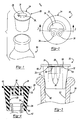
- Figure 1 is a side view of a closure assembly in accordance with the present invention;
- Figure 2 is a top view of a closure assembly in accordance with the present invention;
- Figure 3 is a cross-sectional view of Figure 2 taken along line 3-3;
- Figure 4 is a top view of a preferred embodiment of the present invention;
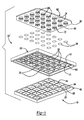
- Figure 5 is an exploded perspective view of a preferred embodiment of the present invention;
- Figure 6 is a side view in cross-section of a mold for making the present invention;
- Figure 7 is a side view in cross-section of a mold for making the present invention;
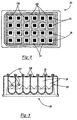
- Figure 8 is a top view of a further embodiment of the present invention; and
- Figure 9 is a side view of the further embodiment of the present invention.
-
- Referring to Figures 1 through 4, a closure assembly for sealing a
microorganism container 50 is generally shown and designated by thereference numeral 20. Referring specifically to Figure 1, theclosure assembly 20 includes a resilient seal orplug 24 for sealing theclosure 20 to acontainer 50. Theclosure assembly 20 further includesfilter media 28 integrally disposed and connected within the seal orplug 24 for allowing sterile gas exchange therethrough. - The
container 50 can be a flask, microtitre plate or other known type of container which retains liquids and microorganisms or cells, or cellular components therein for the purpose of propagating aerobic or anaerobic microorganisms or conducting other biological manipulations, such as hybridization, PCR, etc. Thecontainer 50 is preferably made of glass or pyrex®, plastic or other suitable materials which can withstand autoclaving or other such methods of sterilization. - The
closure 20 can also include a port orpassageway 26 axially disposed within the seal orplug 24 which extends through the seal orplug 24 allowing fluid communication between thecontainer 50 and the external atmosphere. The passageway orport 26 is defined by acylindrical side wall 25. - The seal or
plug 24 is generally frustoconical in cross-section. The seal orplug 24 can be tapered and have a shape similar to a wedge. When an insertion end 42 of the seal orplug 24 is inserted into thecontainer 50, theclosure assembly 20 forms an air and liquid-tight seal with aninner surface 52 of thecontainer 50. Theside wall 25 of the seal orplug 24 is graduated and, therefore, it can be inserted intocontainers 50 having variously sized openings therein and form an air and liquid-tight seal therewith. The cross-sectional diameter of thewall 25 of the seal orplug 24 increases in the direction opposite of theinsertion end 42 of the seal orplug 24 as shown in Figures 1 and 4. Since an infinite number of diameters can be accommodated, theclosure assembly 20 can be used with and create both air and liquid-tight seals with variously sizedcontainers 50. - The resilient seal or
plug 24 is a generally unitary member formed of a resilient material which is capable of conforming and sealing to the contours of the openings of flasks orcontainers 50. The resilient seat orplug 24 is constructed of a material which is capable of deflecting and/or yielding to sealingly conform to or to sealingly engage with theinner surface 52 of a container such that both an air-and liquid-tight seal is formed and maintained therewith. The seal orplug 24 can be constructed or manufactured from suitable flexible and resilient materials, for example, silicones, natural synthetic rubber materials, polypropylenes, polyolefins, polyesters, polyamides, polycarbonates, polystyrenes, styrenes, co-polymers, and fluoroplastics. This list is not meant to be exhaustive and can include other suitable materials known to those skilled in the art without departing from the spirit of the present invention. - The
closure assembly 20 further includes at least onefilter media 28 in the form of a filter having atop surface 29, abottom surface 30, and aperipheral edge 31. In a preferred embodiment, thefilter 28 is somewhat flat or disk-shaped. Theperipheral edge 31 of thefilter 28 is sealed within the port orpassageway 26 which axially extends through the seal orplug 24. The seal between theperipheral edge 31 and the seal orplug 24 must be both air- and liquid-tight in order to maintain the integrity and/or sterility of theclosure 20 and contents of thecontainer 50. Thefilter media 28 must be positioned and affixed within the port orpassageway 26 such that any fluids (gaseous or liquid) can only pass through thefilter media 28 and not around the periphery of thefilter media 28 thereby breaching the sterility of theclosure 20/container 50 system. In other words, theperipheral edge 31 of thefilter media 28 must be affixed to the plug or seal 24 in such a manner to form a seal therein such that when theclosure 20 is in place in the opening of thecontainer 50, fluid and/or gas exchange can only occur across thefilter media 28 thereby maintaining the sterility of thecontainer 50 and its contents. - The
filter 28 can be sealed within thepassageway 26 of the seal or plug 24 by affixing or integrally molding thefilter 28 within the port orpassageway 26. - Referring to Figure 4, another embodiment of the
closure assembly 20 is shown. In this embodiment, theclosure 20 has a generally cylindrical shape and is designed to fit over thecontainer 50 and forms an air and liquid tight seal with anouter surface 54 of thecontainer 50. The embodiment shown in Figure 4 can be made in any desired size and therefore can be constructed to fit anysize container 50. - In order to provide rigidity in support to the
filter 28, asupport 32 can be provided adjacent to the filter. The support can be disposed about and below theperipheral edge 31 of thefilter 28. Thesupport 32 can be disposed about theperipheral edge 31 at a position approximately level with the position of theperipheral edge 31. Referring specifically to Figure 6, the support 32'' can be disposed about and above theperipheral edge 31 of thefilter 28. Thesupport 32 can be a ring molded or affixed to either the bottom of theperipheral edge 31, the top of theperipheral edge 31, or molded or affixed to theperipheral edge 31 in the same plane as thefilter 28. The support can be constructed of any suitable materials including a metal, such as stainless steel, and plastic. The material comprising thesupport 32 must be able to withstand the temperatures and pressures encountered during autoclaving. - Alternatively, the support can include a mesh-like matrix disposed on either the top 29 or bottom 30 of the filter 28 (not shown). The
support member 32 can be constructed of any suitable material, such as the same material as comprises theclosure 20. - The
filter 28 and thesupport 32 are positioned within the port orpassageway 26 of the seal or plug 24 and can be fixed in place by means such as affixation during molding of the seal or plug 24 or can be positioned and fixed in place following molding of the seal or plug 24 such as by gluing or embedding thefilter 28 andsupport 32, in the plug or seal 24 to theseal closure 20. - A
skirt 90 can be added around the outer perimeter at thesupport 32, as an additional measure to ensure proper seal closure. - The
filter 28 and thesupport 32 can be affixed to one another by means including molding or other types of affixation such as gluing, cementing ultrasonics, insert molding, heat sealing or UV curing. - The
filter media 28 can include any suitable materials or membranes such as depth media including HEPA or OPA rated glass microfiber, cotton wool, a steel plug, hydrophobic membranes such as polypropylenes, polytetrafluoroethylenes (PTFE), polysulfones, polyvinyldifluoride (PVOF), or any other porous material. Further, the filter material may be woven or non-woven and may contain multiple layers. These multiple layers may be made up of the same ordifferent filter media 28. This list of materials is not intended to be exhaustive and other suitable materials known to these skilled in the art can be utilized without departing from the spirit of the present invention. Thefilter media 28 is made from a material which is capable of permitting the exchange of gas thereacross, but will not permit the passage of micro-organic contaminants. - The
closure assembly 20 can include at least one aperture oropening 36 extending therethrough to allow for the insertion of tubing, thermometer or the like therein. Since theaperture 36 is disposed within the seal or plug 24, theaperture 36 is able to conform and perfect a seal about any tubing or the like placed therein. Theaperture 36 allows for sterile access to the interior of thecontainer 50 and the contents therein without the risk of introducing any contamination. - The present invention can be adapted to be an effective sealing device for a multiwell tray system. As shown specifically in Figure 5, the closure assembly 20' can include a
resilient framework 56 which contains therein a plurality ofsealings 58 which are interconnected by theframework 56. Thisresilient framework 56 can be constructed of any suitable materials including metal, such as stainless steel and plastic. However, this list is not meant to be exhaustive and can include other suitable materials known to those skilled in the art without departing from the spirit of the present invention. - As shown in Figures 6 and 7, the assembly can be a three part system. The system includes an
upper member 90 andlower member 92. The sealings or plugs 58 are made up of afemale portion 60 of thelower member 92 having at least oneopening 70 extending therethrough and amale portion 68 also having anopening 71 extending therethrough. Themale portion 68 of theupper member 90 is made such that it is disposed within thefemale portion 60 and theopenings female portion 60 and themale portion 68 is afilter media 28 which extends between theopenings filter media 28 is made from a material which is capable of permitting the exchange of gas thereacross, but will not permit the passage of microorganic contaminants, such media having been discussed above. - The
upper member 90 and thelower member 92 portions can be connected by any bonding technique which is capable of holding the two parts together, for example, glue, heat welding, suction force, ultrasonics or injection molding. - More specifically, the
male portions 68 define the plugs which each have awall 25 extending from theresilient framework 56 thus interconnecting theplugs 24. Each of theseplugs 24 have abase portion 72 which includes at least oneopening 71. Additionally, each of thefemale portions 60 defines a well 74 havingside walls 27 and abottom base portion 64 which includes anopening 70. Each of thewalls 25 of theplug 24 fit in sealing engagement with theside walls 27 of the well 74. - Each of the
side walls 25 of theplugs 24 also includes ashoulder 76 extending outwardly therefrom thus forming a sealingshoulder 76 about saidwall portion 25, forming a perfect seal against theside walls 27 of the well 74. Theshoulder 76 acts as a sealing ring to engage the well and further perfect a seal therewith. This sealing engagement forms a liquid tight seal which is maintained therewith. - The seal or plug 24 can be constructed or manufactured from suitable, flexible and resilient materials, for example, silicones, natural or synthetic rubber materials, polyolefins, end fluoroplastics. This list is not meant to be exhaustive and can include other suitable materials known to those skilled in the art.
- Referring specifically to Figure 5, the multiwell plate assembly can include a
tray 80 including a plurality ofwells 96 therein. The closure assembly 20' includes theresilient framework 56 which has therein the plurality ofsealings 58 which are interconnected by theframework 56. Thesealings 58 can be forced to sealing engagement with at least some of thewells 74 into which thesealings 58 are disposed. At least one of thesealings 58 includes a passageway 86 extending therethrough. Additionally, filtermedia 28 extends across the passageway 86 for allowing sterile exchange of gas therethrough in and out of the well 74 upon which the sealing 58 is disposed. - Additionally, as shown in Figures 8 and 9, the
closure assembly 20 can be a multiwell assembly made of a single piece of material. Preferably, theassembly 20 is injection molded with thefilter media 28 placed within theassembly 20 such that theperipheral edge 31 of thefilter 28 is sealed within thepassageway 26 in theseal plug 24 while theclosure assembly 20 is being formed. - As shown in Figures 8 and 9, the assembly can be formed into a single piece including
plug sections 100 surrounded by grippingportions 102. The gripping portions sealingly engage the upper portion ofwalls 104 of the tray wells.Media 106 is integrally connected to the framework of the plug sections. - The present invention further provides a method of making a
flask closure 20 by molding the seal or plug 24 having the port orpassageway 26 extending therethrough while simultaneously sealing theperipheral edge 31 of thefilter media 28 within the port orpassageway 26. That is, a one-piece,unitary closure assembly 20 is formed while simultaneously sealing theperipheral edge 31 of thefilter 28 within thepassageway 25 of the seal or plug 24. The molding step is accomplished by techniques well known to those skilled in the art. - The present invention can be practiced with various shaped filter medias 28 as shown in Figure 1 and Figure 4 as long as the
filter media 28 can be supported and theperipheral edge 31 of thefilter media 28 is available for sealing affixation to thepassageway 26 of thesealer plug 24. Additionally, the present invention can be practiced with multiple layers offilter media 28. These layers may be made up of Layers of the same ordifferent filter media 28. Also, a single sheet offilter media 28 may be utilized for theentire assembly 20 by placing thefilter media 28 inside theassembly 20 prior to an injection molding procedure. - The method of forming the
closure assembly 20 can also include the step of disposing thesupport 32 within thepassageway 26 either during the molding step or following the molding step. The method generally includes sizing thefilter media 28 to a desired size. Thesupport 32 can also be specifically dimensioned. Thefilter media 28 and thesupport 32 can be loaded into a mold cavity and are held in place on top of core pins by locator pins. A suitable material, such as silicone, can then be injected into the mold cavity. The silicone fills the mold cavity and encapsulates thefilter media 28 andsupport 32 and can then be cured by means such as utilizing heat from the mold. After a suitable curing period, theclosure assembly 20 can be removed from the mold. - In another method embodiment of the present invention as shown in Figures 8 and 9, the
closure assembly 20 is made by gluing or otherwise affixing a die cutfilter 28 onto the support. Specifically, an activator, such as Loctite 770, is applied to the top surface at thesupport 32. This is allowed to dry for approximately three minutes or time as required for the activator. A bead of adhesive, such as Loctite 454, is then applied to the same surface onto which thefilter media 28 is immediately pressed. After the adhesive has dried, theassembly 20 is ready for usage. - The invention has been described in an illustrative manner, and it is to be understood the terminology used is intended to be in the nature of description rather than of limitation.
- Obviously, many modifications and variations of the present invention are possible in light of the above teachings. Therefore, it is to be understood that within the scope of the appended claims, reference numerals are merely for convenience and are not to be in any way limiting, the invention may be practiced otherwise than as specifically described.
Claims (15)
- A closure (20) for sealing a micro-organism container (50) said closure (20) comprising:resilient sealing means (24) for sealing the container (50);a passageway (26) extending through said sealing means (24); andat least one filter medium extending across said passageway (26) integrally moulded of material different from that of said resilient sealing means to said sealing means (24) for allowing sterile gas exchange therethrough.
- A closure (20) according to claim 1, wherein said filter medium includes a filter membrane (28), typically of a hydrophobic material.
- A closure (20) according to claim 2, wherein said filter membrane (28) includes at least one support means (32, 32', 32'', 32''') disposed adjacent to said filter membrane (28) for supporting said filter membrane (28).
- A closure (20) according to any of claims 1 to 3, wherein said sealing means (24) has a frustoconical cross section and/or wherein said sealing means (24) is a unitary member having a port (26) extending therethrough and said filter medium (28) integrally moulded within said port (26).
- A closure (20) according to any of claims 1 to 4, wherein said sealing means (24) includes at least one aperture (36) extending therethrough to allow insertion of tubing therein.
- A closure (20) according to any of claims 1 to 5, which includes a resilient framework including a plurality of said sealing means interconnected by said framework.
- A closure (20) according to claim 6, wherein each of said sealing means includes a female portion having at least one opening extending therethrough and a male portion including an opening extending therethrough, said male portion being disposed within said female portion whereby said openings are aligned, said filter media being contained between said male and female portions and extending between said opening.
- A closure (20) according to claim 7, wherein each of said male portions define plugs having a wall extending from a framework interconnecting said plugs, each of said plugs having a base portion including at least one of said openings, each of said female portions defining a well having side walls and a bottom base portion including one of said openings, each of said walls of said plugs fitting in sealing engagement with said side walls of said wells.
- A closure (20) according to claim 8, wherein each of said side walls of said plugs include a shoulder extending outwardly therefrom forming a sealing shoulder completely about said wall portion thereof for perfecting a seal against said side walls of said well.
- A method of making a closure by moulding a sealing member having a passageway extending therethrough while simultaneously sealing a peripheral edge of a filter medium within the passageway.
- A multiwell plate assembly comprising:a tray including a plurality of wells therein; anda closure for sealing at least some of said wells, said closure including a resilient framework having a plurality of sealing means interconnected by said framework for sealing engagement with at least some of said wells into which said sealing means is disposed, at least one of said sealing means including a passageway extending therethrough, and filter media extending across said passageway for allowing sterile exchange therethrough in and out of said well in which said sealing means is disposed.
- A closure for sealing a container, said closure comprising:a resilient framework including a plurality of sealing means interconnected by said framework, at least one of said sealing means including a passageway extending therethrough; andfilter media extending across said passageway for allowing sterile exchange therethrough.
- A closure member comprising:a plurality of plugs, each of said plugs including an opening extending therethrough defining a central axis for each of said plugs; anda resilient framework interconnecting each of said plugs.
- A closure member according to claim 13, wherein each of said plugs includes a side wall disposed about said axis and a base portion, said opening extending through said base portion, said side wall including a flange extending outwardly therefrom and completely thereabout.
- A closure member comprising:a plurality of wells, each of said wells including an opening extending therethrough; anda framework interconnecting said wells.
Priority Applications (1)
| Application Number | Priority Date | Filing Date | Title |
|---|---|---|---|
| EP00305590A EP1069181A3 (en) | 1999-07-13 | 2000-07-03 | Closure assembly for multiwell vessel |
Applications Claiming Priority (2)
| Application Number | Priority Date | Filing Date | Title |
|---|---|---|---|
| US352231 | 1999-07-13 | ||
| US09/352,231 US6193088B1 (en) | 1996-02-26 | 1999-07-13 | Flask vent and method of making same |
Publications (2)
| Publication Number | Publication Date |
|---|---|
| EP1068902A2 true EP1068902A2 (en) | 2001-01-17 |
| EP1068902A3 EP1068902A3 (en) | 2002-04-17 |
Family
ID=23384309
Family Applications (1)
| Application Number | Title | Priority Date | Filing Date |
|---|---|---|---|
| EP00302179A Withdrawn EP1068902A3 (en) | 1999-07-13 | 2000-03-17 | Flask vent and method of making same |
Country Status (4)
| Country | Link |
|---|---|
| US (1) | US6193088B1 (en) |
| EP (1) | EP1068902A3 (en) |
| JP (1) | JP2001031127A (en) |
| AU (1) | AU2081600A (en) |
Cited By (6)
| Publication number | Priority date | Publication date | Assignee | Title |
|---|---|---|---|---|
| WO2009043131A1 (en) * | 2007-10-05 | 2009-04-09 | Ricardo Pimenta Bertolla | Recipient device and method to protect in vitro cultured embryos and cells against atomospheric shock |
| NL2008737C2 (en) * | 2012-05-01 | 2013-11-04 | Consultatie Implementatie Tech Beheer B V | CLOSING ELEMENT FOR CLOSING A SAMPLE HOLDER. |
| WO2017072188A1 (en) | 2015-10-27 | 2017-05-04 | Alpla Werke Alwin Lehner Gmbh & Co. Kg | Plastic tube |
| EP3156478A4 (en) * | 2014-08-05 | 2017-08-16 | Yamaha Hatsudoki Kabushiki Kaisha | Object-holding device |
| US11021308B2 (en) | 2015-11-25 | 2021-06-01 | Alpla Werke Alwin Lehner Gmbh & Co. Kg | Container comprising a recess in the container wall |
| WO2023129147A1 (en) * | 2021-12-29 | 2023-07-06 | Tecan Genomics, Inc. | Receptacle for containers and container arrangements, and receptacle arrangement for containers |
Families Citing this family (25)
| Publication number | Priority date | Publication date | Assignee | Title |
|---|---|---|---|---|
| DE10009895A1 (en) * | 2000-03-01 | 2001-09-20 | Merck Patent Gmbh | Stopper consists of plastic part with covering wall, surge-proof wall, degassing vent, filter fleece, ridge, stopper frame and sealing ring |
| DE10013240A1 (en) * | 2000-03-09 | 2001-10-11 | Brand Gmbh & Co Kg | Arrangement for contamination-free processing of, in particular, molecular biological reaction sequences, closure carrier and individual closure for such an arrangement, and storage and dispensing arrangement for individual closures |
| ITVI20010180A1 (en) * | 2001-08-30 | 2003-03-02 | Marco Musaragno | CAP FOR THE BOTTLING OF PRECIOUS WINES, PARTICULARLY SUITABLE FOR THE STORAGE AND REFINING OF THE PRODUCT |
| US20030072686A1 (en) * | 2001-10-15 | 2003-04-17 | Marshall Barry J. | Systems for performing multiple diagnostic tests |
| IL159684A0 (en) * | 2001-10-19 | 2004-06-20 | Monogen Inc | Automated system and method for processing multiple liquid-based specimens |
| USD494408S1 (en) | 2002-05-06 | 2004-08-17 | Deborah A. Hinton | Brownie pan |
| US20040048392A1 (en) * | 2002-09-09 | 2004-03-11 | The Gov't Of The U.S.A As Represented By The Secretary Of The Dept.Of Health And Human Services | Container for drying biological samples, method of making such container, and method of using same |
| US7201287B2 (en) * | 2002-10-30 | 2007-04-10 | Entegris, Inc. | Drum vent |
| CN100343137C (en) * | 2002-10-30 | 2007-10-17 | 诚实公司 | Drum vent |
| US7169602B2 (en) * | 2002-12-04 | 2007-01-30 | Applera Corporation | Sample substrate for use in biological testing and method for filling a sample substrate |
| DE10260690B4 (en) * | 2002-12-23 | 2006-10-12 | Technische Universität München | Cover for a device, device covered thereby and method for the parallel, automated cultivation of cells under technical conditions |
| US8641987B2 (en) * | 2003-01-24 | 2014-02-04 | Applied Biosystems, Llc | Sample chamber array and method for processing a biological sample |
| US7332348B2 (en) * | 2003-02-28 | 2008-02-19 | Applera Corporation | Sample substrate having a divided sample chamber and method of loading thereof |
| US20040258563A1 (en) * | 2003-06-23 | 2004-12-23 | Applera Corporation | Caps for sample wells and microcards for biological materials |
| US7854343B2 (en) * | 2005-03-10 | 2010-12-21 | Labcyte Inc. | Fluid containers with reservoirs in their closures and methods of use |
| US8051998B1 (en) * | 2005-06-28 | 2011-11-08 | Csp Technologies, Inc. | Product container with integral selective membrane |
| US7851204B2 (en) * | 2006-06-09 | 2010-12-14 | Pall Microreactor Technologies, Inc. | Closure for milliliter scale bioreactor |
| TWI349579B (en) * | 2007-12-17 | 2011-10-01 | Agricultural Res Inst | Cover assembly and container set for tissue culture using the same |
| CN101556342B (en) * | 2008-04-11 | 2012-06-20 | 鸿富锦精密工业(深圳)有限公司 | Lens processing tool |
| CN203111734U (en) * | 2012-12-14 | 2013-08-07 | 鸿准精密模具(昆山)有限公司 | Packing mechanism |
| JP5944955B2 (en) * | 2014-07-24 | 2016-07-05 | 藤倉ゴム工業株式会社 | Ventilation impermeable device |
| CN107427625B (en) * | 2015-01-09 | 2020-06-19 | 维斯特医药服务有限公司 | Caps for drug container plunger arrays or plunger sleeves and packaging for cap and plunger sleeve assemblies |
| WO2016138338A1 (en) * | 2015-02-27 | 2016-09-01 | Corning Incorporated | Fitted lid for multi-well plate |
| US20190045957A1 (en) * | 2017-08-08 | 2019-02-14 | YourGreen2Go Inc. | Food Carrier System |
| US12546733B2 (en) * | 2019-05-08 | 2026-02-10 | Shimadzu Corporation | Cell evaluation device |
Citations (2)
| Publication number | Priority date | Publication date | Assignee | Title |
|---|---|---|---|---|
| US3326401A (en) | 1965-10-11 | 1967-06-20 | Bellco Glass Inc | Closure |
| US5180073A (en) | 1991-05-17 | 1993-01-19 | Biomedical Polymers, Inc. | Permeable cap for flask |
Family Cites Families (28)
| Publication number | Priority date | Publication date | Assignee | Title |
|---|---|---|---|---|
| US2153981A (en) | 1936-04-03 | 1939-04-11 | Winthrop Chem Co Inc | Medicinal container |
| US2191447A (en) * | 1937-04-21 | 1940-02-27 | Emery S Beardsley | Container closure |
| US2186908A (en) * | 1939-02-01 | 1940-01-09 | Burroughs Wellcome Co | Air filtering stopper |
| US3019932A (en) | 1958-12-12 | 1962-02-06 | Frank K Singiser | Universal cap |
| US3313712A (en) * | 1963-03-25 | 1967-04-11 | Marilyn E George | Apparatus for the detection of living microbial contaminants in petroleum products |
| US3744661A (en) * | 1971-06-11 | 1973-07-10 | Ciba Geigy | Tamperproof container for vials or the like |
| US4136796A (en) * | 1974-04-11 | 1979-01-30 | Greif Bros. Corporation | Vented closure |
| US3952902A (en) | 1974-04-26 | 1976-04-27 | Cutter Laboratories, Inc. | Closure cap for plasma receiving assembly |
| CH582541A5 (en) * | 1974-09-10 | 1976-12-15 | Infors Ag | Biological cultures vibrating system - in Erlenmeyer flasks with sterile filter in stopper and two independent air lines |
| US4034885A (en) * | 1976-08-12 | 1977-07-12 | Hunckler Products, Inc. | Parts storage and dispensing container |
| JPS54104986A (en) * | 1978-01-23 | 1979-08-17 | American Hospital Supply Corp | Closing member for pasteurized liquid container |
| FR2429431A1 (en) * | 1978-06-22 | 1980-01-18 | Eurand France | METHOD AND APPARATUS FOR MONITORING THE ACTIVITY AND TITLE OF MEDICAMENTS PRESENTED IN GALENIC FORMS WITH PROGRESSIVE RELEASE OF THE MEDICINAL PRODUCT |
| US4235344A (en) * | 1979-01-29 | 1980-11-25 | Baxter Travenol Laboratories, Inc. | Irrigation cap |
| US4271973A (en) * | 1979-03-19 | 1981-06-09 | United States Of America | Sterility testing vessel |
| US4253572A (en) * | 1979-04-30 | 1981-03-03 | Frank Halbich | Plastic pillbox |
| DE3685330D1 (en) * | 1985-10-19 | 1992-06-17 | Daikin Ind Ltd | CULTIVATING VESSEL. |
| DE3628930A1 (en) * | 1986-08-26 | 1988-05-05 | Greiner & Soehne C A | CONTAMINATION-SAFE CAP, IN PARTICULAR SCREW CAP FOR CELL CULTURE BOTTLES |
| US4935371A (en) * | 1986-12-31 | 1990-06-19 | American Sterilizer Company | Sterilizable gas permeable container for use in culturing living cells |
| US5011018A (en) * | 1990-07-24 | 1991-04-30 | Keffeler Paul J | Medication dispenser with removable liner |
| US5188628A (en) * | 1990-11-06 | 1993-02-23 | Sandoz Ltd. | Closure device for enteral fluid containers |
| US5071001A (en) * | 1991-04-03 | 1991-12-10 | Ryman Iii Raymond W | Beverage container storage and transport apparatus |
| US5395006A (en) | 1993-04-29 | 1995-03-07 | Verma; Kuldeep | Fermentation vessels and closures therefor |
| US5358872A (en) | 1993-08-12 | 1994-10-25 | Becton, Dickinson And Company | Vessel and closure assembly |
| AU2122395A (en) * | 1994-04-04 | 1995-10-23 | Ashok R. Sanadi | Method and apparatus for preventing cross-contamination of multi-well test plates |
| US5522769A (en) * | 1994-11-17 | 1996-06-04 | W. L. Gore & Associates, Inc. | Gas-permeable, liquid-impermeable vent cover |
| US6170684B1 (en) * | 1996-02-26 | 2001-01-09 | Monty E. Vincent | Flask vent and method of making same |
| US6027694A (en) * | 1996-10-17 | 2000-02-22 | Texperts, Inc. | Spillproof microplate assembly |
| US6106783A (en) * | 1998-06-30 | 2000-08-22 | Microliter Analytical Supplies, Inc. | Microplate assembly and closure |
-
1999
- 1999-07-13 US US09/352,231 patent/US6193088B1/en not_active Expired - Lifetime
-
2000
- 2000-03-10 AU AU20816/00A patent/AU2081600A/en not_active Abandoned
- 2000-03-17 EP EP00302179A patent/EP1068902A3/en not_active Withdrawn
- 2000-04-25 JP JP2000123451A patent/JP2001031127A/en active Pending
Patent Citations (2)
| Publication number | Priority date | Publication date | Assignee | Title |
|---|---|---|---|---|
| US3326401A (en) | 1965-10-11 | 1967-06-20 | Bellco Glass Inc | Closure |
| US5180073A (en) | 1991-05-17 | 1993-01-19 | Biomedical Polymers, Inc. | Permeable cap for flask |
Cited By (10)
| Publication number | Priority date | Publication date | Assignee | Title |
|---|---|---|---|---|
| WO2009043131A1 (en) * | 2007-10-05 | 2009-04-09 | Ricardo Pimenta Bertolla | Recipient device and method to protect in vitro cultured embryos and cells against atomospheric shock |
| NL2008737C2 (en) * | 2012-05-01 | 2013-11-04 | Consultatie Implementatie Tech Beheer B V | CLOSING ELEMENT FOR CLOSING A SAMPLE HOLDER. |
| US10046323B2 (en) | 2012-05-01 | 2018-08-14 | Enose Holding B.V. | Closing element for closing a container for samples for analysis |
| US11123737B2 (en) | 2012-05-01 | 2021-09-21 | Enose Holding B.V. | Closing element for closing a container for samples for analysis |
| EP3156478A4 (en) * | 2014-08-05 | 2017-08-16 | Yamaha Hatsudoki Kabushiki Kaisha | Object-holding device |
| US10138452B2 (en) | 2014-08-05 | 2018-11-27 | Yamaha Hatsudoki Kabushiki Kaisha | Object-holding device |
| WO2017072188A1 (en) | 2015-10-27 | 2017-05-04 | Alpla Werke Alwin Lehner Gmbh & Co. Kg | Plastic tube |
| US10494149B2 (en) | 2015-10-27 | 2019-12-03 | Alpla Werke Alwin Lehner Gmbh & Co. Kg | Plastic tube |
| US11021308B2 (en) | 2015-11-25 | 2021-06-01 | Alpla Werke Alwin Lehner Gmbh & Co. Kg | Container comprising a recess in the container wall |
| WO2023129147A1 (en) * | 2021-12-29 | 2023-07-06 | Tecan Genomics, Inc. | Receptacle for containers and container arrangements, and receptacle arrangement for containers |
Also Published As
| Publication number | Publication date |
|---|---|
| AU2081600A (en) | 2001-01-18 |
| EP1068902A3 (en) | 2002-04-17 |
| JP2001031127A (en) | 2001-02-06 |
| US6193088B1 (en) | 2001-02-27 |
Similar Documents
| Publication | Publication Date | Title |
|---|---|---|
| US6193088B1 (en) | Flask vent and method of making same | |
| EP2085463B1 (en) | Culture plate comprising a lid for lateral ventilation | |
| US20210269758A1 (en) | Cassette for sterility testing | |
| CN1329501C (en) | Culture dish and bioreactor system | |
| US6170684B1 (en) | Flask vent and method of making same | |
| EP1012327B1 (en) | Filtration assembly | |
| US10139322B2 (en) | Sample preparation device | |
| DE69806527T2 (en) | Growth device and method for its application | |
| DE69809824T2 (en) | Growth device and method for its application | |
| EP0267093B1 (en) | Container intended to receive one or more micro-organism culture mediums | |
| EP3086816B1 (en) | Sample preparation unit and sample preparation device | |
| RU2005128289A (en) | CONTAINER SYSTEM FOR INCUBATION AND / OR STORAGE AND METHOD | |
| US20040063169A1 (en) | Filtration assembly | |
| US5957822A (en) | Lid for closing vessels | |
| EP1069181A2 (en) | Closure assembly for multiwell vessel | |
| EP1383861B1 (en) | Filtration assembly | |
| JP2509691B2 (en) | Incubator | |
| US20240368514A1 (en) | Sbs-format single, or dual, deep well stackable cell culture disposable well plate and closure | |
| AU608840B2 (en) | Blood culture system |
Legal Events
| Date | Code | Title | Description |
|---|---|---|---|
| PUAI | Public reference made under article 153(3) epc to a published international application that has entered the european phase |
Free format text: ORIGINAL CODE: 0009012 |
|
| AK | Designated contracting states |
Kind code of ref document: A2 Designated state(s): AT BE CH CY DE DK ES FI FR GB GR IE IT LI LU MC NL PT SE |
|
| AX | Request for extension of the european patent |
Free format text: AL;LT;LV;MK;RO;SI |
|
| RIN1 | Information on inventor provided before grant (corrected) |
Inventor name: GIACOBBE, ROBERT A Inventor name: VINCENT, MONTY E Inventor name: COSTELLO, JOHN R JR. Inventor name: COLLINS, RALPH W Inventor name: LIPSKY, JONATHAN N |
|
| PUAL | Search report despatched |
Free format text: ORIGINAL CODE: 0009013 |
|
| AK | Designated contracting states |
Kind code of ref document: A3 Designated state(s): AT BE CH CY DE DK ES FI FR GB GR IE IT LI LU MC NL PT SE |
|
| AX | Request for extension of the european patent |
Free format text: AL;LT;LV;MK;RO;SI |
|
| RIC1 | Information provided on ipc code assigned before grant |
Free format text: 7B 01L 3/00 A, 7C 12M 1/24 B, 7C 12M 1/20 B |
|
| 17P | Request for examination filed |
Effective date: 20021010 |
|
| AKX | Designation fees paid |
Free format text: AT BE CH CY DE DK ES FI FR GB GR IE IT LI LU MC NL PT SE |
|
| 17Q | First examination report despatched |
Effective date: 20041130 |
|
| STAA | Information on the status of an ep patent application or granted ep patent |
Free format text: STATUS: THE APPLICATION IS DEEMED TO BE WITHDRAWN |
|
| 18D | Application deemed to be withdrawn |
Effective date: 20050611 |