EP1067119A1 - Method for isolation of n-protected s-phenylcysteine - Google Patents
Method for isolation of n-protected s-phenylcysteine Download PDFInfo
- Publication number
- EP1067119A1 EP1067119A1 EP00900854A EP00900854A EP1067119A1 EP 1067119 A1 EP1067119 A1 EP 1067119A1 EP 00900854 A EP00900854 A EP 00900854A EP 00900854 A EP00900854 A EP 00900854A EP 1067119 A1 EP1067119 A1 EP 1067119A1
- Authority
- EP
- European Patent Office
- Prior art keywords
- phenylcysteine
- protected
- salt
- group
- benzyloxycarbonyl
- Prior art date
- Legal status (The legal status is an assumption and is not a legal conclusion. Google has not performed a legal analysis and makes no representation as to the accuracy of the status listed.)
- Withdrawn
Links
- 238000000034 method Methods 0.000 title claims description 44
- 238000002955 isolation Methods 0.000 title claims description 16
- XYUBQWNJDIAEES-UHFFFAOYSA-N 2-azaniumyl-3-phenylsulfanylpropanoate Chemical compound OC(=O)C(N)CSC1=CC=CC=C1 XYUBQWNJDIAEES-UHFFFAOYSA-N 0.000 title description 2
- -1 N-protected S-phenylcysteine compounds Chemical class 0.000 claims abstract description 116
- 150000003839 salts Chemical class 0.000 claims abstract description 72
- 238000005185 salting out Methods 0.000 claims abstract description 41
- XLYOFNOQVPJJNP-UHFFFAOYSA-N water Substances O XLYOFNOQVPJJNP-UHFFFAOYSA-N 0.000 claims abstract description 36
- 150000001875 compounds Chemical class 0.000 claims abstract description 11
- 125000004435 hydrogen atom Chemical group [H]* 0.000 claims abstract description 5
- FAPWRFPIFSIZLT-UHFFFAOYSA-M Sodium chloride Chemical group [Na+].[Cl-] FAPWRFPIFSIZLT-UHFFFAOYSA-M 0.000 claims description 54
- 239000002585 base Substances 0.000 claims description 54
- 239000013078 crystal Substances 0.000 claims description 31
- 239000011780 sodium chloride Substances 0.000 claims description 27
- 229910017053 inorganic salt Inorganic materials 0.000 claims description 22
- 239000011541 reaction mixture Substances 0.000 claims description 22
- RMVRSNDYEFQCLF-UHFFFAOYSA-N thiophenol Chemical compound SC1=CC=CC=C1 RMVRSNDYEFQCLF-UHFFFAOYSA-N 0.000 claims description 21
- 239000003960 organic solvent Substances 0.000 claims description 15
- 239000000203 mixture Substances 0.000 claims description 13
- 239000002253 acid Substances 0.000 claims description 12
- 159000000000 sodium salts Chemical class 0.000 claims description 11
- 229910052783 alkali metal Inorganic materials 0.000 claims description 9
- 125000006239 protecting group Chemical group 0.000 claims description 8
- 125000001584 benzyloxycarbonyl group Chemical group C(=O)(OCC1=CC=CC=C1)* 0.000 claims description 6
- 150000001768 cations Chemical class 0.000 claims description 6
- 230000000694 effects Effects 0.000 claims description 5
- PMZURENOXWZQFD-UHFFFAOYSA-L Sodium Sulfate Chemical compound [Na+].[Na+].[O-]S([O-])(=O)=O PMZURENOXWZQFD-UHFFFAOYSA-L 0.000 claims description 4
- 239000012736 aqueous medium Substances 0.000 claims description 4
- 229910052751 metal Inorganic materials 0.000 claims description 4
- 239000002184 metal Substances 0.000 claims description 4
- 229910052938 sodium sulfate Inorganic materials 0.000 claims description 4
- 235000011152 sodium sulphate Nutrition 0.000 claims description 4
- 239000000356 contaminant Substances 0.000 claims description 3
- 238000004090 dissolution Methods 0.000 claims description 3
- 125000003754 ethoxycarbonyl group Chemical group C(=O)(OCC)* 0.000 claims description 3
- 125000001160 methoxycarbonyl group Chemical group [H]C([H])([H])OC(*)=O 0.000 claims description 3
- 125000005931 tert-butyloxycarbonyl group Chemical group [H]C([H])([H])C(OC(*)=O)(C([H])([H])[H])C([H])([H])[H] 0.000 claims description 3
- 125000004453 alkoxycarbonyl group Chemical group 0.000 claims description 2
- 125000005098 aryl alkoxy carbonyl group Chemical group 0.000 claims description 2
- 238000002156 mixing Methods 0.000 claims description 2
- 230000003472 neutralizing effect Effects 0.000 claims 1
- 229910052739 hydrogen Inorganic materials 0.000 abstract description 2
- 239000001257 hydrogen Substances 0.000 abstract description 2
- 235000002639 sodium chloride Nutrition 0.000 description 106
- ISBOGFMUFMJWEP-HNNXBMFYSA-N (2r)-2-(phenylmethoxycarbonylamino)-3-phenylsulfanylpropanoic acid Chemical compound C([C@@H](C(=O)O)NC(=O)OCC=1C=CC=CC=1)SC1=CC=CC=C1 ISBOGFMUFMJWEP-HNNXBMFYSA-N 0.000 description 60
- HEMHJVSKTPXQMS-UHFFFAOYSA-M Sodium hydroxide Chemical compound [OH-].[Na+] HEMHJVSKTPXQMS-UHFFFAOYSA-M 0.000 description 48
- YXFVVABEGXRONW-UHFFFAOYSA-N Toluene Chemical compound CC1=CC=CC=C1 YXFVVABEGXRONW-UHFFFAOYSA-N 0.000 description 31
- 239000007864 aqueous solution Substances 0.000 description 24
- 238000006243 chemical reaction Methods 0.000 description 22
- 239000011734 sodium Substances 0.000 description 18
- 229910052708 sodium Inorganic materials 0.000 description 18
- 239000000243 solution Substances 0.000 description 15
- CSCPPACGZOOCGX-UHFFFAOYSA-N Acetone Chemical compound CC(C)=O CSCPPACGZOOCGX-UHFFFAOYSA-N 0.000 description 12
- VEXZGXHMUGYJMC-UHFFFAOYSA-N Hydrochloric acid Chemical compound Cl VEXZGXHMUGYJMC-UHFFFAOYSA-N 0.000 description 12
- 238000003756 stirring Methods 0.000 description 11
- XEKOWRVHYACXOJ-UHFFFAOYSA-N Ethyl acetate Chemical compound CCOC(C)=O XEKOWRVHYACXOJ-UHFFFAOYSA-N 0.000 description 9
- OKKJLVBELUTLKV-UHFFFAOYSA-N Methanol Chemical compound OC OKKJLVBELUTLKV-UHFFFAOYSA-N 0.000 description 9
- MVYBNLGHYRBYQM-VIFPVBQESA-N (2r)-3-chloro-2-(phenylmethoxycarbonylamino)propanoic acid Chemical compound OC(=O)[C@H](CCl)NC(=O)OCC1=CC=CC=C1 MVYBNLGHYRBYQM-VIFPVBQESA-N 0.000 description 7
- 238000004128 high performance liquid chromatography Methods 0.000 description 7
- 239000012299 nitrogen atmosphere Substances 0.000 description 7
- 238000000967 suction filtration Methods 0.000 description 7
- XYUBQWNJDIAEES-QMMMGPOBSA-N (2r)-2-amino-3-phenylsulfanylpropanoic acid Chemical class OC(=O)[C@@H](N)CSC1=CC=CC=C1 XYUBQWNJDIAEES-QMMMGPOBSA-N 0.000 description 6
- QTBSBXVTEAMEQO-UHFFFAOYSA-N Acetic acid Chemical compound CC(O)=O QTBSBXVTEAMEQO-UHFFFAOYSA-N 0.000 description 6
- BZLVMXJERCGZMT-UHFFFAOYSA-N Methyl tert-butyl ether Chemical compound COC(C)(C)C BZLVMXJERCGZMT-UHFFFAOYSA-N 0.000 description 6
- WYURNTSHIVDZCO-UHFFFAOYSA-N Tetrahydrofuran Chemical compound C1CCOC1 WYURNTSHIVDZCO-UHFFFAOYSA-N 0.000 description 6
- 238000002425 crystallisation Methods 0.000 description 6
- 230000008025 crystallization Effects 0.000 description 6
- VLKZOEOYAKHREP-UHFFFAOYSA-N n-Hexane Chemical compound CCCCCC VLKZOEOYAKHREP-UHFFFAOYSA-N 0.000 description 6
- 239000002002 slurry Substances 0.000 description 6
- 230000000052 comparative effect Effects 0.000 description 5
- 239000000047 product Substances 0.000 description 5
- NLXLAEXVIDQMFP-UHFFFAOYSA-N Ammonia chloride Chemical compound [NH4+].[Cl-] NLXLAEXVIDQMFP-UHFFFAOYSA-N 0.000 description 4
- IMNFDUFMRHMDMM-UHFFFAOYSA-N N-Heptane Chemical compound CCCCCCC IMNFDUFMRHMDMM-UHFFFAOYSA-N 0.000 description 4
- 238000000862 absorption spectrum Methods 0.000 description 4
- 239000012535 impurity Substances 0.000 description 4
- DURPTKYDGMDSBL-UHFFFAOYSA-N 1-butoxybutane Chemical compound CCCCOCCCC DURPTKYDGMDSBL-UHFFFAOYSA-N 0.000 description 3
- QGZKDVFQNNGYKY-UHFFFAOYSA-N Ammonia Chemical compound N QGZKDVFQNNGYKY-UHFFFAOYSA-N 0.000 description 3
- WMFOQBRAJBCJND-UHFFFAOYSA-M Lithium hydroxide Chemical compound [Li+].[OH-] WMFOQBRAJBCJND-UHFFFAOYSA-M 0.000 description 3
- KWYUFKZDYYNOTN-UHFFFAOYSA-M Potassium hydroxide Chemical compound [OH-].[K+] KWYUFKZDYYNOTN-UHFFFAOYSA-M 0.000 description 3
- 150000004945 aromatic hydrocarbons Chemical class 0.000 description 3
- HSDAJNMJOMSNEV-UHFFFAOYSA-N benzyl chloroformate Chemical compound ClC(=O)OCC1=CC=CC=C1 HSDAJNMJOMSNEV-UHFFFAOYSA-N 0.000 description 3
- 125000004432 carbon atom Chemical group C* 0.000 description 3
- 238000000354 decomposition reaction Methods 0.000 description 3
- JMMWKPVZQRWMSS-UHFFFAOYSA-N isopropanol acetate Natural products CC(C)OC(C)=O JMMWKPVZQRWMSS-UHFFFAOYSA-N 0.000 description 3
- 229940011051 isopropyl acetate Drugs 0.000 description 3
- GWYFCOCPABKNJV-UHFFFAOYSA-N isovaleric acid Chemical compound CC(C)CC(O)=O GWYFCOCPABKNJV-UHFFFAOYSA-N 0.000 description 3
- 238000006386 neutralization reaction Methods 0.000 description 3
- UYWQUFXKFGHYNT-UHFFFAOYSA-N phenylmethyl ester of formic acid Natural products O=COCC1=CC=CC=C1 UYWQUFXKFGHYNT-UHFFFAOYSA-N 0.000 description 3
- YLQBMQCUIZJEEH-UHFFFAOYSA-N tetrahydrofuran Natural products C=1C=COC=1 YLQBMQCUIZJEEH-UHFFFAOYSA-N 0.000 description 3
- SBGGMGYRQWBQDQ-HNNXBMFYSA-N (2r)-2-(benzylamino)-3-phenylsulfanylpropanoic acid Chemical compound C([C@@H](C(=O)O)NCC=1C=CC=CC=1)SC1=CC=CC=C1 SBGGMGYRQWBQDQ-HNNXBMFYSA-N 0.000 description 2
- ZWEHNKRNPOVVGH-UHFFFAOYSA-N 2-Butanone Chemical compound CCC(C)=O ZWEHNKRNPOVVGH-UHFFFAOYSA-N 0.000 description 2
- ASBJGPTTYPEMLP-UHFFFAOYSA-N 3-chloroalanine Chemical compound ClCC(N)C(O)=O ASBJGPTTYPEMLP-UHFFFAOYSA-N 0.000 description 2
- QGZKDVFQNNGYKY-UHFFFAOYSA-O Ammonium Chemical compound [NH4+] QGZKDVFQNNGYKY-UHFFFAOYSA-O 0.000 description 2
- RTZKZFJDLAIYFH-UHFFFAOYSA-N Diethyl ether Chemical compound CCOCC RTZKZFJDLAIYFH-UHFFFAOYSA-N 0.000 description 2
- LFQSCWFLJHTTHZ-UHFFFAOYSA-N Ethanol Chemical compound CCO LFQSCWFLJHTTHZ-UHFFFAOYSA-N 0.000 description 2
- WCUXLLCKKVVCTQ-UHFFFAOYSA-M Potassium chloride Chemical compound [Cl-].[K+] WCUXLLCKKVVCTQ-UHFFFAOYSA-M 0.000 description 2
- CDBYLPFSWZWCQE-UHFFFAOYSA-L Sodium Carbonate Chemical compound [Na+].[Na+].[O-]C([O-])=O CDBYLPFSWZWCQE-UHFFFAOYSA-L 0.000 description 2
- UIIMBOGNXHQVGW-UHFFFAOYSA-M Sodium bicarbonate Chemical compound [Na+].OC([O-])=O UIIMBOGNXHQVGW-UHFFFAOYSA-M 0.000 description 2
- QAOWNCQODCNURD-UHFFFAOYSA-N Sulfuric acid Chemical compound OS(O)(=O)=O QAOWNCQODCNURD-UHFFFAOYSA-N 0.000 description 2
- 150000001338 aliphatic hydrocarbons Chemical class 0.000 description 2
- 229910000288 alkali metal carbonate Inorganic materials 0.000 description 2
- 150000008041 alkali metal carbonates Chemical class 0.000 description 2
- 150000008044 alkali metal hydroxides Chemical class 0.000 description 2
- 229910052784 alkaline earth metal Inorganic materials 0.000 description 2
- 125000003277 amino group Chemical group 0.000 description 2
- 235000019270 ammonium chloride Nutrition 0.000 description 2
- 230000015572 biosynthetic process Effects 0.000 description 2
- 239000007795 chemical reaction product Substances 0.000 description 2
- 239000012141 concentrate Substances 0.000 description 2
- 238000001212 derivatisation Methods 0.000 description 2
- 238000005516 engineering process Methods 0.000 description 2
- 150000002148 esters Chemical class 0.000 description 2
- 150000002170 ethers Chemical class 0.000 description 2
- 239000004030 hiv protease inhibitor Substances 0.000 description 2
- GPRLSGONYQIRFK-UHFFFAOYSA-N hydron Chemical compound [H+] GPRLSGONYQIRFK-UHFFFAOYSA-N 0.000 description 2
- 239000000543 intermediate Substances 0.000 description 2
- 150000002576 ketones Chemical class 0.000 description 2
- KWGKDLIKAYFUFQ-UHFFFAOYSA-M lithium chloride Chemical compound [Li+].[Cl-] KWGKDLIKAYFUFQ-UHFFFAOYSA-M 0.000 description 2
- 229910021645 metal ion Inorganic materials 0.000 description 2
- 230000003287 optical effect Effects 0.000 description 2
- KJIFKLIQANRMOU-UHFFFAOYSA-N oxidanium;4-methylbenzenesulfonate Chemical compound O.CC1=CC=C(S(O)(=O)=O)C=C1 KJIFKLIQANRMOU-UHFFFAOYSA-N 0.000 description 2
- 230000020477 pH reduction Effects 0.000 description 2
- BWHMMNNQKKPAPP-UHFFFAOYSA-L potassium carbonate Chemical compound [K+].[K+].[O-]C([O-])=O BWHMMNNQKKPAPP-UHFFFAOYSA-L 0.000 description 2
- 230000006340 racemization Effects 0.000 description 2
- 239000002904 solvent Substances 0.000 description 2
- 239000000126 substance Substances 0.000 description 2
- 239000000725 suspension Substances 0.000 description 2
- 150000003613 toluenes Chemical class 0.000 description 2
- IENJPSDBNBGIEL-DKWTVANSSA-N (2r)-2-amino-3-chloropropanoic acid;hydrochloride Chemical compound Cl.ClC[C@H](N)C(O)=O IENJPSDBNBGIEL-DKWTVANSSA-N 0.000 description 1
- VHUUQVKOLVNVRT-UHFFFAOYSA-N Ammonium hydroxide Chemical compound [NH4+].[OH-] VHUUQVKOLVNVRT-UHFFFAOYSA-N 0.000 description 1
- UXVMQQNJUSDDNG-UHFFFAOYSA-L Calcium chloride Chemical compound [Cl-].[Cl-].[Ca+2] UXVMQQNJUSDDNG-UHFFFAOYSA-L 0.000 description 1
- 238000010268 HPLC based assay Methods 0.000 description 1
- 125000002777 acetyl group Chemical group [H]C([H])([H])C(*)=O 0.000 description 1
- 125000003668 acetyloxy group Chemical group [H]C([H])([H])C(=O)O[*] 0.000 description 1
- 150000001298 alcohols Chemical class 0.000 description 1
- 229910001860 alkaline earth metal hydroxide Inorganic materials 0.000 description 1
- 239000012670 alkaline solution Substances 0.000 description 1
- 125000000217 alkyl group Chemical group 0.000 description 1
- 125000005278 alkyl sulfonyloxy group Chemical group 0.000 description 1
- 229910021529 ammonia Inorganic materials 0.000 description 1
- 150000003863 ammonium salts Chemical class 0.000 description 1
- BFNBIHQBYMNNAN-UHFFFAOYSA-N ammonium sulfate Chemical compound N.N.OS(O)(=O)=O BFNBIHQBYMNNAN-UHFFFAOYSA-N 0.000 description 1
- 229910052921 ammonium sulfate Inorganic materials 0.000 description 1
- 235000011130 ammonium sulphate Nutrition 0.000 description 1
- 238000004458 analytical method Methods 0.000 description 1
- 239000008346 aqueous phase Substances 0.000 description 1
- 125000003710 aryl alkyl group Chemical group 0.000 description 1
- 125000003118 aryl group Chemical group 0.000 description 1
- 125000005279 aryl sulfonyloxy group Chemical group 0.000 description 1
- 125000003236 benzoyl group Chemical group [H]C1=C([H])C([H])=C(C([H])=C1[H])C(*)=O 0.000 description 1
- 239000006227 byproduct Substances 0.000 description 1
- 239000001110 calcium chloride Substances 0.000 description 1
- 229910001628 calcium chloride Inorganic materials 0.000 description 1
- 235000011148 calcium chloride Nutrition 0.000 description 1
- 125000003178 carboxy group Chemical group [H]OC(*)=O 0.000 description 1
- 125000001309 chloro group Chemical group Cl* 0.000 description 1
- 238000001816 cooling Methods 0.000 description 1
- 230000032050 esterification Effects 0.000 description 1
- 238000005886 esterification reaction Methods 0.000 description 1
- 150000002168 ethanoic acid esters Chemical class 0.000 description 1
- PQVSTLUFSYVLTO-UHFFFAOYSA-N ethyl n-ethoxycarbonylcarbamate Chemical compound CCOC(=O)NC(=O)OCC PQVSTLUFSYVLTO-UHFFFAOYSA-N 0.000 description 1
- 239000000706 filtrate Substances 0.000 description 1
- 238000001914 filtration Methods 0.000 description 1
- 238000001879 gelation Methods 0.000 description 1
- 229910052736 halogen Inorganic materials 0.000 description 1
- 150000002367 halogens Chemical class 0.000 description 1
- 125000002887 hydroxy group Chemical group [H]O* 0.000 description 1
- 230000002452 interceptive effect Effects 0.000 description 1
- XGZVUEUWXADBQD-UHFFFAOYSA-L lithium carbonate Chemical compound [Li+].[Li+].[O-]C([O-])=O XGZVUEUWXADBQD-UHFFFAOYSA-L 0.000 description 1
- 229910052808 lithium carbonate Inorganic materials 0.000 description 1
- GLXDVVHUTZTUQK-UHFFFAOYSA-M lithium hydroxide monohydrate Substances [Li+].O.[OH-] GLXDVVHUTZTUQK-UHFFFAOYSA-M 0.000 description 1
- 229940040692 lithium hydroxide monohydrate Drugs 0.000 description 1
- 229910003002 lithium salt Inorganic materials 0.000 description 1
- 159000000002 lithium salts Chemical class 0.000 description 1
- 230000000873 masking effect Effects 0.000 description 1
- 125000005905 mesyloxy group Chemical group 0.000 description 1
- IHTLHYBTCCLDPR-INIZCTEOSA-N methyl (2r)-2-(phenylmethoxycarbonylamino)-3-phenylsulfanylpropanoate Chemical compound C([C@@H](C(=O)OC)NC(=O)OCC=1C=CC=CC=1)SC1=CC=CC=C1 IHTLHYBTCCLDPR-INIZCTEOSA-N 0.000 description 1
- 230000007935 neutral effect Effects 0.000 description 1
- 238000000655 nuclear magnetic resonance spectrum Methods 0.000 description 1
- 238000005191 phase separation Methods 0.000 description 1
- LFGREXWGYUGZLY-UHFFFAOYSA-N phosphoryl Chemical group [P]=O LFGREXWGYUGZLY-UHFFFAOYSA-N 0.000 description 1
- 125000000612 phthaloyl group Chemical group C(C=1C(C(=O)*)=CC=CC1)(=O)* 0.000 description 1
- XAEFZNCEHLXOMS-UHFFFAOYSA-M potassium benzoate Chemical compound [K+].[O-]C(=O)C1=CC=CC=C1 XAEFZNCEHLXOMS-UHFFFAOYSA-M 0.000 description 1
- 229910000028 potassium bicarbonate Inorganic materials 0.000 description 1
- 235000015497 potassium bicarbonate Nutrition 0.000 description 1
- 239000011736 potassium bicarbonate Substances 0.000 description 1
- 229910000027 potassium carbonate Inorganic materials 0.000 description 1
- 235000011181 potassium carbonates Nutrition 0.000 description 1
- 239000001103 potassium chloride Substances 0.000 description 1
- 235000011164 potassium chloride Nutrition 0.000 description 1
- TYJJADVDDVDEDZ-UHFFFAOYSA-M potassium hydrogencarbonate Chemical compound [K+].OC([O-])=O TYJJADVDDVDEDZ-UHFFFAOYSA-M 0.000 description 1
- 229940086066 potassium hydrogencarbonate Drugs 0.000 description 1
- OTYBMLCTZGSZBG-UHFFFAOYSA-L potassium sulfate Chemical compound [K+].[K+].[O-]S([O-])(=O)=O OTYBMLCTZGSZBG-UHFFFAOYSA-L 0.000 description 1
- 229910052939 potassium sulfate Inorganic materials 0.000 description 1
- 235000011151 potassium sulphates Nutrition 0.000 description 1
- 238000010926 purge Methods 0.000 description 1
- 239000012066 reaction slurry Substances 0.000 description 1
- 238000011084 recovery Methods 0.000 description 1
- 238000010992 reflux Methods 0.000 description 1
- 229920006395 saturated elastomer Polymers 0.000 description 1
- 229910000030 sodium bicarbonate Inorganic materials 0.000 description 1
- 235000017557 sodium bicarbonate Nutrition 0.000 description 1
- 229910000029 sodium carbonate Inorganic materials 0.000 description 1
- ZBBXJNJSVSWNCY-RSAXXLAASA-M sodium;(2r)-2-(phenylmethoxycarbonylamino)-3-phenylsulfanylpropanoate Chemical compound [Na+].C([C@@H](C(=O)[O-])NC(=O)OCC=1C=CC=CC=1)SC1=CC=CC=C1 ZBBXJNJSVSWNCY-RSAXXLAASA-M 0.000 description 1
- HWEXKRHYVOGVDA-UHFFFAOYSA-M sodium;3-trimethylsilylpropane-1-sulfonate Chemical compound [Na+].C[Si](C)(C)CCCS([O-])(=O)=O HWEXKRHYVOGVDA-UHFFFAOYSA-M 0.000 description 1
- 238000007711 solidification Methods 0.000 description 1
- 230000008023 solidification Effects 0.000 description 1
- 230000001502 supplementing effect Effects 0.000 description 1
- 238000003786 synthesis reaction Methods 0.000 description 1
- 125000002088 tosyl group Chemical group [H]C1=C([H])C(=C([H])C([H])=C1C([H])([H])[H])S(*)(=O)=O 0.000 description 1
- 125000005424 tosyloxy group Chemical group S(=O)(=O)(C1=CC=C(C)C=C1)O* 0.000 description 1
- 125000004044 trifluoroacetyl group Chemical group FC(C(=O)*)(F)F 0.000 description 1
- 238000010792 warming Methods 0.000 description 1
- 239000002351 wastewater Substances 0.000 description 1
- 238000005303 weighing Methods 0.000 description 1
Images


Classifications
-
- C—CHEMISTRY; METALLURGY
- C07—ORGANIC CHEMISTRY
- C07C—ACYCLIC OR CARBOCYCLIC COMPOUNDS
- C07C319/00—Preparation of thiols, sulfides, hydropolysulfides or polysulfides
- C07C319/26—Separation; Purification; Stabilisation; Use of additives
- C07C319/28—Separation; Purification
-
- Y—GENERAL TAGGING OF NEW TECHNOLOGICAL DEVELOPMENTS; GENERAL TAGGING OF CROSS-SECTIONAL TECHNOLOGIES SPANNING OVER SEVERAL SECTIONS OF THE IPC; TECHNICAL SUBJECTS COVERED BY FORMER USPC CROSS-REFERENCE ART COLLECTIONS [XRACs] AND DIGESTS
- Y02—TECHNOLOGIES OR APPLICATIONS FOR MITIGATION OR ADAPTATION AGAINST CLIMATE CHANGE
- Y02P—CLIMATE CHANGE MITIGATION TECHNOLOGIES IN THE PRODUCTION OR PROCESSING OF GOODS
- Y02P20/00—Technologies relating to chemical industry
- Y02P20/50—Improvements relating to the production of bulk chemicals
- Y02P20/55—Design of synthesis routes, e.g. reducing the use of auxiliary or protecting groups
Definitions
- the present invention relates to a method of isolating an N-protected-S-phenylcysteine of the following formula (1) [hereinafter referred to sometimes as N-protected-S-phenylcysteine (1)].
- N-protected-S-phenylcysteines such as N-benzyloxycarbonyl-S-phenyl-L-cysteine, are compounds of importance as synthetic intermediates of HIV-protease inhibitors as described in WO 96/23756 and EP 604185A1.
- R 1 represents an amino-protecting group
- R 2 represents hydrogen or, either independently of R 1 or taken together with R 1 , represents an amino-protecting group.
- N-protected-S-phenylcysteine (1) can be synthesized by, for example, treating a compound of the formula (2): (wherein R 1 and R 2 are as defined above; X represents a leaving group) with thiophenol under basic conditions as described in Japanese Application Hei-10-264397.
- N-benzyloxycarbonyl-S-phenylcysteine can be synthesized by treating N-benzyloxycarbonyl- ⁇ -chloroalanine with thiophenol in an aqueous alkaline solution.
- the N-protected-S-phenylcysteine (1) thus synthesized can be recovered typically by adding an acid to the basic aqueous solution thereof to precipitate the N-protected-S-phenylcysteine as a free acid.
- Japanese Kokai Publication Hei-10-29973 describes a process in which hydrochloric acid is added to an aqueous sodium hydroxide solution containing an N-benzyloxycarbonyl-S-phenylcysteine to cause the N-benzyloxycarbonyl-S-phenylcysteine to crystallize out as a free acid.
- N-benzyloxycarbonyl-S-phenylcysteine sodium salt which is readily soluble in water, is converted to the hardly-soluble free N-benzyloxycarbonyl-S-phenylcysteine by acidification.
- the process is not free from the disadvantage that, as pointed out in the same literature cited above, the free N-benzyloxycarbonyl-S-phenylcysteine tends to undergo gelation in the course of crystallization, and to fail in being crystallized in a good manner, in addition to the above problems, the process has also the problem that structurally related contaminant compounds cannot be easily removed.
- the methods heretofore known for crystallizing N-protected-S-phenylcysteine (1) as a free acid is not necessarily an effective isolation procedure.
- the present invention has for its object to provide a method of isolating N-protected-S-phenylcysteine (1) of high purity, expediently, efficiently and in good yield.
- the present invention is directed to a method of isolating N-protected-S-phenylcysteine (1) which comprises causing said N-protected-S-pheriylcysteine to be salted out in the form of a base salt in the presence of water.
- the present inventors have discovered for the first time that a water-soluble base salt of N-protected-S-phenylcysteine (1) can be easily salted out in the presence of water with efficiency and in good yield and high purity.
- base salt as used with reference to N-protected-S-phenylcysteine means a compound such that a cation such as a metal ion and an ammonium ion has been substituted for the hydrogen ion of the carboxyl group of an N-protected-S-phenylcysteine.
- free or “free acid” as used with reference to N-protected-S-phenylcysteine in this specification means that the N-protected-S-phenylcysteine has not formed a salt with any basic substance; stated differently that a hydrogen ion has been substituted for the cation, e.g. the metal ion or ammonium ion, of a base salt of N-protected-S-phenylcysteine or the compound in such condition.
- salting out means that the base salt of N-protected-S-phenylcysteine is caused to separate out from an aqueous solution containing the salt by causing another substance (chiefly an inorganic salt) to be present in said aqueous solution.
- R 1 represents an amino-protecting group.
- R 2 represents a hydrogen atom or, either independently of R 1 or taken together with R 1 , an amino-protecting group.
- amino-protecting group is not particularly restricted but may, for instance, be a group selected from among the protective groups mentioned in Protective Groups in Organic Synthesis, 2nd Ed., John Wiley & Sons (1991) as well as an alkyl, aralkyl or aryl group.
- an urethane-type or acyl-type protective group capable of masking the basicity of the amino group is preferably used.
- protective groups there can be mentioned benzyloxycarbonyl, ethoxycarbonyl, methoxycarbonyl, tert-butoxycarbonyl, acetyl, tosyl, benzoyl and phthaloyl, among others.
- (3S)-tetrahydrofuranyloxycarbonyl and 3-hydroxy-2-methylbenzoyl whose hydroxyl group may optionally be protected can also be selectively employed.
- urethane-type protective groups are preferred and aralkyloxycarbonyl and lower alkoxycarbonyl groups are still more preferred. More particularly, benzyloxycarbonyl, tert-butoxycarbonyl, methoxycarbonyl and ethoxycarbonyl are preferred and, among them, benzyloxycarbonyl is still more preferred.
- the amino-protecting group is a benzyloxycarbonyl group
- N-protected-S-phenylcysteine (1) is a compound of great importance as a synthetic intermediate of HIV-protease inhibitors as described in WO 96/23756 and EP 604185A1, for instance.
- N-protected-S-phenylcysteine (1) may be an optically active compound. Even when such an optically active compound is used in the present invention, the salting out can be achieved without detracting from optical purity.
- the base salt of N-protected-S-phenylcysteine (1) is not particularly restricted but includes, among others, the metal salts, such as alkali metal salts, e.g. lithium salt, sodium salt, potassium salt, etc., alkaline earth metal salts, and ammonium salts of N-protected-S-phenylcysteine (1).
- the metal salts are preferred, the alkali metal salts are particularly preferred, and the sodium salt is most preferred.
- the base for use in converting N-protected-S-phenylcysteine (1) to its base salt is not particularly restricted but includes alkali metal hydroxides, alkali metal carbonates, alkali metal hydrogencarbonates, alkaline earth metal hydroxides, alkaline earth metal carbonates, and ammonia, among others.
- alkali metal hydroxides, alkali metal carbonates and alkali metal hydrogencarbonates are particularly restricted. More particularly, sodium hydroxide, potassium hydroxide, lithium hydroxide, sodium carbonate, potassium carbonate, lithium carbonate, sodium hydrogencarbonate and potassium hydrogencarbonate can be mentioned. The most preferred is sodium hydroxide.
- the preferred method for converting N-protected-S-phenylcysteine (1) to a base salt comprises reacting the N-protected-S-phenylcysteine (1) with said base under neutral to basic conditions.
- the system should be maintained at not less than pH 7, preferably not less than pH 8, more preferably not less than pH 9, in order to retain the stability of the amino-protecting group.
- the reaction can be conducted with advantage in the neighborhood of pH 9 to 11.
- the use of a pH less than 7 is objectionable because such a pH level induces conversion of the base salt of N-protected-S-phenylcysteine to free N-protected-S-phenylcysteine.
- the amino-protecting group is a protective group which is not so stable under basic conditions, such as trifluoroacetyl, it is advisable to avoid strongly basic conditions, for example pH 12 or higher.
- said salting out is carried out in the presence of water. Generally, it is carried out in an aqueous solution of N-protected-S-phenylcysteine (1). Because N-protected-S-phenylcysteine (1) is caused to be present in the form of its salt with a base, this procedure is preferably carried out under basic conditions.
- said aqueous solution may contain an organic solvent or the like.
- the organic solvent mentioned just above is not particularly restricted but includes, among others, esters of acetic acid, such as ethyl acetate, isopropyl acetate, etc.; aromatic hydrocarbons represented by toluene; aliphatic hydrocarbons such as hexane, heptane, etc.; ethers such as methyl tert-butyl ether, di-n-butyl ether, tetrahydrofuran, etc.; alcohols such as methanol; and ketones such as acetone, 2-butanone and so on.
- the organic solvent may be caused to be present from the beginning of salting out or added when the salting out has progressed to a sufficient extent.
- the base salt of N-protected-S-phenylcysteine may be salted out, another salt must be caused to be present in the system.
- This salt is preferably an inorganic salt.
- the inorganic salt is not particularly restricted but includes alkali metal salts such as sodium chloride, potassium chloride, sodium sulfate, potassium sulfate, etc.; ammonium sulfate, ammonium chloride and calcium chloride, among others. From the standpoint of ease of use, alkali metal salts are preferred and sodium chloride and sodium sulfate are still more preferred.
- sodium chloride is most preferred in consideration of its low cost, the ease of handling, ease of waste water disposal, the efficiency of salting out the base salt of N-protected-S-phenylcysteine, and the properties of the salt obtained, among other factors.
- the salt mentioned above may be added to the system or, taking advantage of the neutralization reaction between an acid and a base, may be caused to form in the system.
- the cation of the salt to be used for salting out is preferably of the same species as the cation of the base salt of N-protected-S-phenylcysteine.
- N-benzyloxycarbonyl-S-phenylcysteine for instance, is preferably salted out as the sodium salt.
- the salt to be used for salting out is preferably a sodium salt such as sodium chloride, sodium sulfate and the like, and most preferred is sodium chloride.
- the amount of the salt to be used for this salting out procedure depends on species of the salt and species and amount of said base salt of N-protected-S-phenylcysteine, among other variables, and cannot be defined in general terms. However, it is preferred to use a sufficient amount of a salt to attain the objective salting out in good yield. More particularly, the inorganic salt is preferably caused to be present at the amount of about 5 weight % or more in terms of the concentration in water. The upper limit is generally the saturation point. Taking sodium chloride as an example, the salting out can be carried out with advantage at a concentration somewhere between about 5 weight % and the point of saturation.
- the concentration of the base salt of N-protected-S-phenylcysteine (1) for salting out is not particularly restricted but is generally not more than about 30 weight %, preferably within the range of 5 to 20 weight %, based on the water in the system.
- the base salt of N-protected-S-phenylcysteine may be salted out easily and efficiently, it is preferred to insure that the system contains both the base salt of N-protected-S-phenylcysteine and a salt used for salting out in effective amounts (sufficient amounts necessary for salting out).
- the salting out is effected by:
- the temperature of the salting out is not particularly restricted but may for example be somewhere between the solidification temperature of the system to about 100 °C, preferably about 0 °C to 60 °C. Particularly, the procedure can be followed with advantage within the range of about 10 °C to about 50 °C.
- seed crystals may be added to the system.
- Japanese Kokai Publication Hei-10-29973 discloses a technology wherein a basic (pH 10 to 11) aqueous solution containing a base salt (sodium salt) of N-benzyloxycarbonyl-S-phenylcysteine is acidified with hydrochloric acid to crystallize N-benzyloxycarbonyl-S-phenylcysteine as the free acid.
- a concentration of sodium chloride in said basic aqueous solution is as low as less than 3 weight % which is not sufficient to effect salting out.
- the base salt (sodium salt) of N-benzyloxycarbonyl-S-phenylcysteine is converted to the free acid before the amount of presence of the inorganic salt (sodium chloride) is increased by neutralization reaction so that the base salt of N-benzyloxycarbonyl-S-phenylcysteine is not salted out.
- the method of the present invention can be used for the purpose of purifying a free N-protected-S-phenylcysteine or a base salt of N-protected-S-phenylcysteine or for the purpose of separating an N-protected-S-phenylcysteine in the form of a base salt from the reaction mixture.
- an aqueous medium containing a sufficient amount of an inorganic salt for effecting salting out under basic conditions for instance, is used, the formation of the base salt of N-protected-S-phenylcysteine and the salting out of the thus-formed base salt of N-protected-S-phenylcysteine can be concurrently accomplished.
- the formation of the base salt of N-protected-S-phenylcysteine and, at the same time, the salting out thereof can be expedited by causing seed crystals to be present in the system.
- N-protected-S-phenylcysteine by carrying out the synthetic reaction under basic conditions and, at the same time, causing the resulting N-protected-S-phenylcysteine to be salted out from the reaction mixture in the form of a base salt.
- This procedure contributes to improvements in the yield and/or quality of N-protected-S-phenylcysteine because the decomposition and racemization of the N-protected-S-phenylcysteine which is not necessarily stable under basic conditions can be prevented.
- the base salt of N-protected-S-phenylcysteine can be selectively salted out from a reaction mixture containing structural analogs and other impurities capable of forming salts with the base used, with the result that the product can be purified by removing said impurities into an aqueous phase with high efficiency.
- the N-protected-S-phenylcysteine which is not necessarily stable enough under basic conditions is protected against decomposition and racemization, with the result that the N-protected-S-phenylcysteine of high purity can be obtained in high yield.
- the base, basic conditions, inorganic salt, etc. to be used in this process are the same as those mentioned hereinbefore.
- the leaving group represented by X is not particularly restricted but includes halogen, e.g. chloro; alkylsulfonyloxy groups containing 1 to 10 carbon atoms, e.g. mesyloxy; arylsulfonyloxy groups containing 6 to 10 carbon atoms, e.g. tosyloxy; aralkylsulfonyloxy groups containing 7 to 10 carbon atoms; acetyloxy, trihaloacetyloxy and phosphoryl, among others.
- halogen e.g. chloro
- alkylsulfonyloxy groups containing 1 to 10 carbon atoms e.g. mesyloxy
- arylsulfonyloxy groups containing 6 to 10 carbon atoms e.g. tosyloxy
- aralkylsulfonyloxy groups containing 7 to 10 carbon atoms acetyloxy, trihaloacetyloxy and phosphoryl
- the fat-soluble (lipophilic) contaminants can be dissolved and removed by supplementing the system with an organic solvent (an acetic acid ester, e.g. ethyl acetate, isopropyl acetate, etc.; an aromatic hydrocarbon, e.g. toluene; an aliphatic hydrocarbon, e.g. hexane, heptane, etc.; an ether, e.g. methyl tert-butyl ether, di-n-butyl ether, tetrahydrofuran, etc.; an alcohol, e.g. methanol; or a ketone, e.g.
- an organic solvent an acetic acid ester, e.g. ethyl acetate, isopropyl acetate, etc.
- an aromatic hydrocarbon e.g. toluene
- an aliphatic hydrocarbon e.g. hexane, heptane, etc.
- the base salt of N-protected-S-phenylcysteine as salted out by the method of the present invention can be recovered by a separatory procedure such as filtration.
- the recovered base salt of N-protected-S-phenylcysteine can be washed with water [e.g. cold water or water containing the salt used for salting out (e.g. an aqueous solution of sodium chloride) is preferred] or said organic solvent and, where necessary, the solvent such as water may be removed at atmospheric pressure or under reduced pressure.
- the salting out yield is usually not less then 80%, preferably not less than 90%, and more preferably approximately 100%.
- the resulting base salt of N-protected-S-phenylcysteine can be neutralized with an acid such as hydrochloric acid and sulfuric acid to provide the N-protected-S-phenylcysteine in the free form.
- an acid such as hydrochloric acid and sulfuric acid
- the organic solvent mentioned just above is not particularly restricted but includes esters of acetic acid, such as ethyl acetate, isopropyl acetate, etc.; aromatic hydrocarbons such as toluene etc.; and ethers such as methyl tert-butyl ether, di-n-butyl ether, tetrahydrofuran, etc., among other solvents.
- the neutralization with said acid can be carried out in the presence of said organic solvent.
- the thus-prepared mixture of an organic solvent with a free N-protected-S-phenylcysteine e.g. a mixture of toluene and free-N-protected-S-phenylcysteine
- can be used for further derivatization e.g. esterification with an alcohol).
- Example 2 The wet crystals of N-benzyloxycarbonyl-S-phenyl-L-cysteine sodium salt obtained in Example 1 (310.0 g) were dissolved in 700 ml of water and the water was then evaporated under reduced pressure at about 50 °C for concentration to 619.5 g to thereby cause crystals to separate out. The crystal crop was recovered by suction filtration and rinsed with 100 ml of water to give 208 g of wet crystals.
- the infrared absorption spectrum (KBr disk) of the above N-benzyloxycarbonyl-S-phenyl-L-cysteine sodium salt is presented in Fig. 1.
- an infrared absorption spectrum (KBr disk) of free N-benzyloxycarbonyl-S-phenyl-L-cysteine is presented in Fig. 2.
- Fig. 3 shows the time course of the percentage of remaining N-benzyloxycarbonyl-S-phenyl-L-cysteine sodium salt at 40 °C.
- reaction product N-benzyloxycarbonyl-S-phenyl-L-cysteine was crystallized as the sodium salt and the reaction mixture became slurry-like.
- N-benzyloxycarbonyl- ⁇ -chloroalanine To 5.0 g of purified N-benzyloxycarbonyl- ⁇ -chloroalanine were added 32 g of water, followed by addition of sodium chloride [A: 0.0 g (no addition) or B: 8.0 g (25 wt. % concentration based on water)]. To this solution, 3.2 g of thiophenol (1.5 moles per mole of N-benzyloxycarbonyl- ⁇ -chloroalanine) were added dropwise over 1 hour with constant stirring under nitrogen atmosphere at about 40 °C, with the reaction system being maintained at pH about 10 with a 30% aqueous solution of sodium hydroxide. The reaction was further continued for 20 hours and the N-benzyloxycarbonyl-S-phenyl-L-cysteine content of the reaction mixture was determined. The yield was then calculated.
- Example 3 To 145.34 g of the reaction slurry obtained in Example 3 (which contained 18.73 g of N-benzyloxycarbonyl-S-phenyl-L-cysteine) were added 65 ml of toluene, and the mixture was stirred at about 40 °C under nitrogen atmosphere for 1 hour. The resulting crystals were harvested by suction filtration and the wet crystals thus obtained were washed serially with toluene and saturated aqueous sodium chloride solution and dried in vacuo (1 to 30 mmHg, 20 to 40 °C, for 20 hours) to give 21.96 g of crystals.
- This crystal crop contained 19.67 g of N-benzyloxycarbonyl-S-phenyl-L-cysteine sodium salt (crystallization yield 99%) and its apparent purity on HPLC was 99.0 area %.
- the amount of impurity detected by HPLC was extremely small, indicating that N-benzyloxycarbonyl-S-phenyl-L-cysteine of high quality could be obtained in the form of a base salt.
- reaction mixture To the above reaction mixture were added 22.0 g (200.0 mmol) of thiophenol dropwise under nitrogen atmosphere with intense stirring. During this procedure, the reaction mixture was maintained at pH 9.7 to 10.3 by adding about 26 g of a 30 wt. % aqueous solution of sodium hydroxide dropwise. The internal temperature was then increased to 50 °C and the reaction was conducted under nitrogen atmosphere for 3.5 hours. During the reaction, the reaction mixture was maintained at pH 9.7 to 10.3 by adding about 1 g of a 30 wt. % aqueous solution of sodium hydroxide dropwise.
- the crystals of N-carbobenzyloxy-S-phenyl-L-cysteine were recovered by suction filtration, rinsed with 100 ml of water twice and drained thoroughly to give wet crystals of N-carbobenzyloxy-S-phenyl-L-cysteine [29.8 g (89.9 mmol) of pure N-carbobenzyloxy-S-phenyl-L-cysteine].
- the optical purity of the N-carbobenzyloxy-S-phenyl-L-cysteine obtained was 99.9% e.e.
- an N-protected-S-phenylcysteine of high quality can be isolated expediently and efficiently in good yield.
Landscapes
- Chemical & Material Sciences (AREA)
- Organic Chemistry (AREA)
- Organic Low-Molecular-Weight Compounds And Preparation Thereof (AREA)
- Low-Molecular Organic Synthesis Reactions Using Catalysts (AREA)
Abstract
High-quality N-protected S-phenylcysteine compounds represented by general formula (1) are easily, simply and efficiently isolated
in high yield by salting out the compounds as salts thereof with bases in the presence of water. In said formula R1 is an amino-protecting
group; and R2 is hydrogen or represents an amino-protecting group either independent of R1 or together therewith.
Description
- The present invention relates to a method of isolating an N-protected-S-phenylcysteine of the following formula (1) [hereinafter referred to sometimes as N-protected-S-phenylcysteine (1)]. N-protected-S-phenylcysteines, such as N-benzyloxycarbonyl-S-phenyl-L-cysteine, are compounds of importance as synthetic intermediates of HIV-protease inhibitors as described in WO 96/23756 and EP 604185A1.wherein R1 represents an amino-protecting group; R2 represents hydrogen or, either independently of R1 or taken together with R1, represents an amino-protecting group.

- N-protected-S-phenylcysteine (1) can be synthesized by, for example, treating a compound of the formula (2):(wherein R1 and R2 are as defined above; X represents a leaving group) with thiophenol under basic conditions as described in Japanese Application Hei-10-264397. By way of illustration, N-benzyloxycarbonyl-S-phenylcysteine can be synthesized by treating N-benzyloxycarbonyl-β-chloroalanine with thiophenol in an aqueous alkaline solution.

- The N-protected-S-phenylcysteine (1) thus synthesized can be recovered typically by adding an acid to the basic aqueous solution thereof to precipitate the N-protected-S-phenylcysteine as a free acid. As a version of this technology, Japanese Kokai Publication Hei-10-29973 describes a process in which hydrochloric acid is added to an aqueous sodium hydroxide solution containing an N-benzyloxycarbonyl-S-phenylcysteine to cause the N-benzyloxycarbonyl-S-phenylcysteine to crystallize out as a free acid. In this process, the base salt of N-benzyloxycarbonyl-S-phenylcysteine (in this case, N-benzyloxycarbonyl-S-phenylcysteine sodium salt), which is readily soluble in water, is converted to the hardly-soluble free N-benzyloxycarbonyl-S-phenylcysteine by acidification. However, the process is not free from the disadvantage that, as pointed out in the same literature cited above, the free N-benzyloxycarbonyl-S-phenylcysteine tends to undergo gelation in the course of crystallization, and to fail in being crystallized in a good manner, in addition to the above problems, the process has also the problem that structurally related contaminant compounds cannot be easily removed. Thus, the methods heretofore known for crystallizing N-protected-S-phenylcysteine (1) as a free acid is not necessarily an effective isolation procedure.
- Under the circumstances, the present invention has for its object to provide a method of isolating N-protected-S-phenylcysteine (1) of high purity, expediently, efficiently and in good yield.
- The present invention, therefore, is directed to a method of isolating N-protected-S-phenylcysteine (1)
which comprises causing said N-protected-S-pheriylcysteine to be salted out in the form of a base salt in the presence of water. - The present inventors have discovered for the first time that a water-soluble base salt of N-protected-S-phenylcysteine (1) can be easily salted out in the presence of water with efficiency and in good yield and high purity.
- The present invention is now described in detail.
- In the present specification, the term "base salt" as used with reference to N-protected-S-phenylcysteine means a compound such that a cation such as a metal ion and an ammonium ion has been substituted for the hydrogen ion of the carboxyl group of an N-protected-S-phenylcysteine. Moreover, the term "free" or "free acid" as used with reference to N-protected-S-phenylcysteine in this specification means that the N-protected-S-phenylcysteine has not formed a salt with any basic substance; stated differently that a hydrogen ion has been substituted for the cation, e.g. the metal ion or ammonium ion, of a base salt of N-protected-S-phenylcysteine or the compound in such condition.
- The term "salting out" (and "salt out") as used with reference to a base salt of N-protected-S-phenylcysteine in this specification means that the base salt of N-protected-S-phenylcysteine is caused to separate out from an aqueous solution containing the salt by causing another substance (chiefly an inorganic salt) to be present in said aqueous solution.
- In the above formula (1), R1 represents an amino-protecting group. R2 represents a hydrogen atom or, either independently of R1 or taken together with R1, an amino-protecting group.
- In the method of the present invention, it is essential that an amino-protecting group be present on S-phenylcysteine.
- The above-mentioned amino-protecting group is not particularly restricted but may, for instance, be a group selected from among the protective groups mentioned in Protective Groups in Organic Synthesis, 2nd Ed., John Wiley & Sons (1991) as well as an alkyl, aralkyl or aryl group.
- When a further derivatization of N-protected-S-phenylcysteine (1) is contemplated, an urethane-type or acyl-type protective group capable of masking the basicity of the amino group is preferably used. Among specific examples of such protective groups, there can be mentioned benzyloxycarbonyl, ethoxycarbonyl, methoxycarbonyl, tert-butoxycarbonyl, acetyl, tosyl, benzoyl and phthaloyl, among others. Moreover, (3S)-tetrahydrofuranyloxycarbonyl and 3-hydroxy-2-methylbenzoyl whose hydroxyl group may optionally be protected can also be selectively employed. Particularly, urethane-type protective groups are preferred and aralkyloxycarbonyl and lower alkoxycarbonyl groups are still more preferred. More particularly, benzyloxycarbonyl, tert-butoxycarbonyl, methoxycarbonyl and ethoxycarbonyl are preferred and, among them, benzyloxycarbonyl is still more preferred. When the amino-protecting group is a benzyloxycarbonyl group, N-protected-S-phenylcysteine (1) is a compound of great importance as a synthetic intermediate of HIV-protease inhibitors as described in WO 96/23756 and EP 604185A1, for instance.
- N-protected-S-phenylcysteine (1) may be an optically active compound. Even when such an optically active compound is used in the present invention, the salting out can be achieved without detracting from optical purity.
- The base salt of N-protected-S-phenylcysteine (1) is not particularly restricted but includes, among others, the metal salts, such as alkali metal salts, e.g. lithium salt, sodium salt, potassium salt, etc., alkaline earth metal salts, and ammonium salts of N-protected-S-phenylcysteine (1). Among them, the metal salts are preferred, the alkali metal salts are particularly preferred, and the sodium salt is most preferred.
- The base for use in converting N-protected-S-phenylcysteine (1) to its base salt is not particularly restricted but includes alkali metal hydroxides, alkali metal carbonates, alkali metal hydrogencarbonates, alkaline earth metal hydroxides, alkaline earth metal carbonates, and ammonia, among others. Preferred are alkali metal hydroxides, alkali metal carbonates and alkali metal hydrogencarbonates. More particularly, sodium hydroxide, potassium hydroxide, lithium hydroxide, sodium carbonate, potassium carbonate, lithium carbonate, sodium hydrogencarbonate and potassium hydrogencarbonate can be mentioned. The most preferred is sodium hydroxide.
- The preferred method for converting N-protected-S-phenylcysteine (1) to a base salt comprises reacting the N-protected-S-phenylcysteine (1) with said base under neutral to basic conditions. In terms of pH, the system should be maintained at not less than pH 7, preferably not less than
pH 8, more preferably not less than pH 9, in order to retain the stability of the amino-protecting group. Generally speaking, the reaction can be conducted with advantage in the neighborhood of pH 9 to 11. The use of a pH less than 7 is objectionable because such a pH level induces conversion of the base salt of N-protected-S-phenylcysteine to free N-protected-S-phenylcysteine. Moreover, when the amino-protecting group is a protective group which is not so stable under basic conditions, such as trifluoroacetyl, it is advisable to avoid strongly basic conditions, for example pH 12 or higher. - In the present invention, said salting out is carried out in the presence of water. Generally, it is carried out in an aqueous solution of N-protected-S-phenylcysteine (1). Because N-protected-S-phenylcysteine (1) is caused to be present in the form of its salt with a base, this procedure is preferably carried out under basic conditions.
- Within the range not interfering with the procedure, said aqueous solution may contain an organic solvent or the like. The organic solvent mentioned just above is not particularly restricted but includes, among others, esters of acetic acid, such as ethyl acetate, isopropyl acetate, etc.; aromatic hydrocarbons represented by toluene; aliphatic hydrocarbons such as hexane, heptane, etc.; ethers such as methyl tert-butyl ether, di-n-butyl ether, tetrahydrofuran, etc.; alcohols such as methanol; and ketones such as acetone, 2-butanone and so on. By causing such an organic solvent to be present in the system, the dissolution and removal of fat-soluble (lipophilic) impurity coexistent with said salt can be facilitated. The organic solvent may be caused to be present from the beginning of salting out or added when the salting out has progressed to a sufficient extent.
- In order that the base salt of N-protected-S-phenylcysteine may be salted out, another salt must be caused to be present in the system. This salt is preferably an inorganic salt. The inorganic salt is not particularly restricted but includes alkali metal salts such as sodium chloride, potassium chloride, sodium sulfate, potassium sulfate, etc.; ammonium sulfate, ammonium chloride and calcium chloride, among others. From the standpoint of ease of use, alkali metal salts are preferred and sodium chloride and sodium sulfate are still more preferred. Of all of them, sodium chloride is most preferred in consideration of its low cost, the ease of handling, ease of waste water disposal, the efficiency of salting out the base salt of N-protected-S-phenylcysteine, and the properties of the salt obtained, among other factors. The salt mentioned above may be added to the system or, taking advantage of the neutralization reaction between an acid and a base, may be caused to form in the system.
- The cation of the salt to be used for salting out is preferably of the same species as the cation of the base salt of N-protected-S-phenylcysteine. N-benzyloxycarbonyl-S-phenylcysteine, for instance, is preferably salted out as the sodium salt. In this case, the salt to be used for salting out is preferably a sodium salt such as sodium chloride, sodium sulfate and the like, and most preferred is sodium chloride.
- The amount of the salt to be used for this salting out procedure depends on species of the salt and species and amount of said base salt of N-protected-S-phenylcysteine, among other variables, and cannot be defined in general terms. However, it is preferred to use a sufficient amount of a salt to attain the objective salting out in good yield. More particularly, the inorganic salt is preferably caused to be present at the amount of about 5 weight % or more in terms of the concentration in water. The upper limit is generally the saturation point. Taking sodium chloride as an example, the salting out can be carried out with advantage at a concentration somewhere between about 5 weight % and the point of saturation.
- The concentration of the base salt of N-protected-S-phenylcysteine (1) for salting out is not particularly restricted but is generally not more than about 30 weight %, preferably within the range of 5 to 20 weight %, based on the water in the system.
- In order that the base salt of N-protected-S-phenylcysteine may be salted out easily and efficiently, it is preferred to insure that the system contains both the base salt of N-protected-S-phenylcysteine and a salt used for salting out in effective amounts (sufficient amounts necessary for salting out). Thus, it is preferred that the salting out is effected by:
- i) increasing the amount of presence of said base salt of N-protected-S-phenylcysteine with the amount of presence of said inorganic salt being kept constant,
- ii) increasing the amount of presence of said inorganic salt, with the amount of presence of said base salt of N-protected-S-phenylcysteine being kept constant, or
- iii) increasing the amount of said base salt of N-protected-S-phenylcysteine, with the amount of presence of said inorganic salt being simultaneously increased.
-
- The temperature of the salting out is not particularly restricted but may for example be somewhere between the solidification temperature of the system to about 100 °C, preferably about 0 °C to 60 °C. Particularly, the procedure can be followed with advantage within the range of about 10 °C to about 50 °C.
- If the base salt of N-protected-S-phenylcysteine (1) is not smoothly salted out, seed crystals may be added to the system.
- As mentioned above, Japanese Kokai Publication Hei-10-29973 discloses a technology wherein a basic (
pH 10 to 11) aqueous solution containing a base salt (sodium salt) of N-benzyloxycarbonyl-S-phenylcysteine is acidified with hydrochloric acid to crystallize N-benzyloxycarbonyl-S-phenylcysteine as the free acid. However, the concentration of sodium chloride in said basic aqueous solution is as low as less than 3 weight % which is not sufficient to effect salting out. Moreover, in acidification, the base salt (sodium salt) of N-benzyloxycarbonyl-S-phenylcysteine is converted to the free acid before the amount of presence of the inorganic salt (sodium chloride) is increased by neutralization reaction so that the base salt of N-benzyloxycarbonyl-S-phenylcysteine is not salted out. - The method of the present invention can be used for the purpose of purifying a free N-protected-S-phenylcysteine or a base salt of N-protected-S-phenylcysteine or for the purpose of separating an N-protected-S-phenylcysteine in the form of a base salt from the reaction mixture.
- When, for such purposes, an aqueous medium containing a sufficient amount of an inorganic salt for effecting salting out under basic conditions, for instance, is used, the formation of the base salt of N-protected-S-phenylcysteine and the salting out of the thus-formed base salt of N-protected-S-phenylcysteine can be concurrently accomplished. In this case, too, the formation of the base salt of N-protected-S-phenylcysteine and, at the same time, the salting out thereof can be expedited by causing seed crystals to be present in the system.
- Furthermore, it is possible to synthesize an N-protected-S-phenylcysteine by carrying out the synthetic reaction under basic conditions and, at the same time, causing the resulting N-protected-S-phenylcysteine to be salted out from the reaction mixture in the form of a base salt. This procedure contributes to improvements in the yield and/or quality of N-protected-S-phenylcysteine because the decomposition and racemization of the N-protected-S-phenylcysteine which is not necessarily stable under basic conditions can be prevented. Furthermore, the base salt of N-protected-S-phenylcysteine can be selectively salted out from a reaction mixture containing structural analogs and other impurities capable of forming salts with the base used, with the result that the product can be purified by removing said impurities into an aqueous phase with high efficiency.
- More particularly, in an aqueous medium in which an inorganic salt is present in a sufficient amount for effecting salting out under basic conditions, a compound of the formula (2):(wherein R1 and R2 are as defined above; X represents a leaving group) is treated with thiophenol to give an N-protected-S-phenylcysteine and, at the same time, the N-protected-S-phenylcysteine is salted out in the form of a base salt from the reaction mixtures (that is to say the N-protected-S-phenylcysteine is removed from the reaction system as the base salt). In this manner, the N-protected-S-phenylcysteine which is not necessarily stable enough under basic conditions is protected against decomposition and racemization, with the result that the N-protected-S-phenylcysteine of high purity can be obtained in high yield. Of course, the base, basic conditions, inorganic salt, etc. to be used in this process are the same as those mentioned hereinbefore.
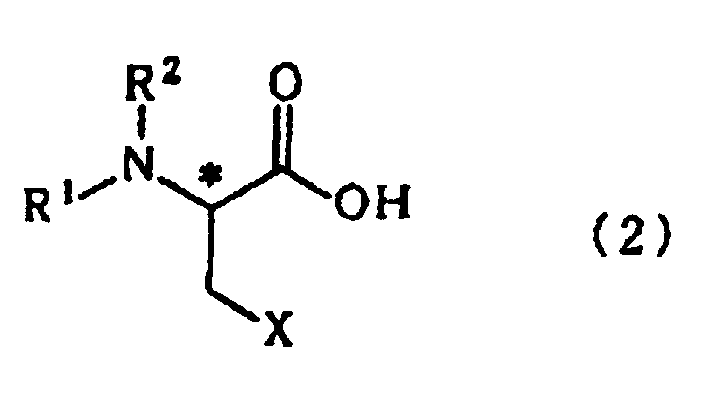
- The leaving group represented by X is not particularly restricted but includes halogen, e.g. chloro; alkylsulfonyloxy groups containing 1 to 10 carbon atoms, e.g. mesyloxy; arylsulfonyloxy groups containing 6 to 10 carbon atoms, e.g. tosyloxy; aralkylsulfonyloxy groups containing 7 to 10 carbon atoms; acetyloxy, trihaloacetyloxy and phosphoryl, among others.
- In carrying out the salting out for the purpose of improving the quality of the product, the fat-soluble (lipophilic) contaminants can be dissolved and removed by supplementing the system with an organic solvent (an acetic acid ester, e.g. ethyl acetate, isopropyl acetate, etc.; an aromatic hydrocarbon, e.g. toluene; an aliphatic hydrocarbon, e.g. hexane, heptane, etc.; an ether, e.g. methyl tert-butyl ether, di-n-butyl ether, tetrahydrofuran, etc.; an alcohol, e.g. methanol; or a ketone, e.g. acetone, 2-butanone, etc., among others). This practice is particularly effective for salting out from a reaction mixture such as a reactive crystallization, for instance. The organic solvent may be caused to be present from the beginning of salting out or added after the salting out has progressed fairly far enough.
- The base salt of N-protected-S-phenylcysteine as salted out by the method of the present invention can be recovered by a separatory procedure such as filtration. The recovered base salt of N-protected-S-phenylcysteine can be washed with water [e.g. cold water or water containing the salt used for salting out (e.g. an aqueous solution of sodium chloride) is preferred] or said organic solvent and, where necessary, the solvent such as water may be removed at atmospheric pressure or under reduced pressure. The salting out yield is usually not less then 80%, preferably not less than 90%, and more preferably approximately 100%.
- The resulting base salt of N-protected-S-phenylcysteine can be neutralized with an acid such as hydrochloric acid and sulfuric acid to provide the N-protected-S-phenylcysteine in the free form. By mixing this free N-protected-S-phenylcysteine with an organic solvent, said mixture of an organic solvent and free-N-protected-S-phenylcysteine can be obtained. The organic solvent mentioned just above is not particularly restricted but includes esters of acetic acid, such as ethyl acetate, isopropyl acetate, etc.; aromatic hydrocarbons such as toluene etc.; and ethers such as methyl tert-butyl ether, di-n-butyl ether, tetrahydrofuran, etc., among other solvents. Needless to say, the neutralization with said acid can be carried out in the presence of said organic solvent. The thus-prepared mixture of an organic solvent with a free N-protected-S-phenylcysteine (e.g. a mixture of toluene and free-N-protected-S-phenylcysteine) can be used for further derivatization (e.g. esterification with an alcohol).
-
- Fig. 1 is an infrared absorption spectrum (KBr disk) of the N-benzyloxycarbonyl-S-phenyl-L-cysteine sodium salt obtained.
- Fig. 2 is an infrared absorption spectrum (KBr disk) of free N-benzyloxycarbonyl-S-phenyl-L-cysteine.
- Fig. 3 is a graph showing the time course of the percentage of remaining N-benzyloxycarbonyl-S-phenyl-L-cysteine sodium salt at 40 °C.
- Fig. 4 is a graph showing the solubility of N-benzyloxycarbonyl-S-phenyl-L-cysteine sodium salt as plotted against sodium chloride concentration.
-
- The following examples, comparative and reference examples are intended to illustrate the present invention in further detail and should by no means be construed as defining the scope of the invention. The quantitative analyses performed for S-phenylcysteine derivatives in the following examples were invariably carried out using an HPLC equipped with a UV detector.
- To 137.8 g of N-benzyloxycarbonyl-S-phenyl-L-cysteine were added 56.4 g of a 30 wt. % solution of sodium hydroxide (1.0 mole per mole of N-benzyloxycarbonyl-S-phenyl-L-cysteine) in 300 ml of water, and the mixture was adjusted to pH 10.2 and stirred under warming at about 40 °C for 1 hour to prepare a clear solution. Then, 73.5 g of sodium chloride (22 wt. % based on water) were added and the stirring was continued for 1 hour, whereupon crystals separated out. The crystal crop was harvested by suction filtration to give 312.2 g of wet crystals of N-benzyloxycarbonyl-S-phenyl-L-cysteine. HPLC analysis showed that the crystallization yield was 100%.
- The wet crystals of N-benzyloxycarbonyl-S-phenyl-L-cysteine sodium salt obtained in Example 1 (310.0 g) were dissolved in 700 ml of water and the water was then evaporated under reduced pressure at about 50 °C for concentration to 619.5 g to thereby cause crystals to separate out. The crystal crop was recovered by suction filtration and rinsed with 100 ml of water to give 208 g of wet crystals.
- The whole amount of the wet crystals thus obtained was dissolved in 600 ml of water and the water was then evaporated under reduced pressure at about 50 °C to give 209.5 g of concentrate. This oily concentrate was crystallized by adding 1000 ml of acetone. The crystal crop was recovered by suction filtration and washed with 200 ml of acetone to give 88.8 g of wet crystals.
- These crystals were further dissolved in 400 ml of water and, then, recrystallized by adding 2800 ml of acetone. The resulting crystals were recovered by suction filtration, washed with 1300 ml of acetone, and finally dried in vacuo (1 to 30 mm Hg, 20 to 40 °C, 20 hr.) to give 44.5 g of crystals. This crystalline product contained 43.8 g of N-benzyloxycarbonyl-S-phenyl-L-cysteine sodium salt and its purity was 98.4 wt. % (as assayed by HPLC for free N-benzyloxycarbonyl-S-phenyl-L-cysteine and calculated as sodium salt).
- The 400 MHz nuclear magnetic resonance spectrum of this N-benzyloxycarbonyl-S-phenyl-L-cysteine sodium salt [D2O, sodium 3-(trimethylsilyl)-propanesulfonate as internal standard] was:
- δ (ppm): 3.19 (1H, dd, J=8.1, 13.9 Hz), 3.51 (1H, dd, J=3.4, 13.9 Hz), 4.15 (1H, dd, J=3.4, 8.1 Hz), 4.89-5.01 (2H, ABq, J=12.4 Hz), 7.2-7.4 (10H, m).
-
- The infrared absorption spectrum (KBr disk) of the above N-benzyloxycarbonyl-S-phenyl-L-cysteine sodium salt is presented in Fig. 1. As a reference, an infrared absorption spectrum (KBr disk) of free N-benzyloxycarbonyl-S-phenyl-L-cysteine is presented in Fig. 2.
- Using 3 g of the crystals of N-benzyloxycarbonyl-S-phenyl-L-cysteine sodium salt prepared in Reference Example 1, (A) a solution thereof in 30 ml of water and (B) a suspension thereof in 30 ml of a 20 wt. % aqueous solution of sodium chloride were prepared. The solution and suspension were respectively adjusted to pH 9.7 with a 3 wt. % aqueous solution of sodium hydroxide and stirred at 40 °C. Each solution was serially sampled and analyzed by HPLC for the concentration of N-benzyloxycarboriyl-S-phenyl-L-cysteine sodium salt in the sample to monitor the percentage of remaining N-benzyloxycarbonyl-S-phenyl-L-cysteine sodium salt.
- Fig. 3 shows the time course of the percentage of remaining N-benzyloxycarbonyl-S-phenyl-L-cysteine sodium salt at 40 °C.
- The above result indicates that the sodium salt of N-benzyloxycarbonyl-S-phenyl-L-cysteine which is unstable under basic conditions can be stabilized by the above salting out procedure.
- To 86.19 g of an aqueous solution containing 7.47 g of β-chloroalanine were added 11.35 g of benzyloxycarbonyl chloride (1.1 moles per mole of β-chloroalanine) dropwise over 1 hour under constant stirring at about 5 °C, with the reaction system being maintained at pH 9.7 with a 30% aqueous solution of sodium hydroxide. The reaction was further continued for 3 hours, at the end of which time the reaction mixture was washed with 50 ml of toluene. This washed reaction mixture, 89.53 g, contained 15.52 g (yield 100%) of N-benzyloxycarbonyl-β-chloroalanine.
- To 88.27 g of the above reaction mixture (which contained 15.30 g of N-benzyloxycarbonyl-β-chloroalanine) were added 13.95 g of sodium chloride (25 wt. % based on water), and, thereafter, 9.82 g of thiophenol (1.5 moles per mole of N-benzyloxycarbonyl-β-chloroalanine) were added dropwise over 1 hour with constant stirring under nitrogen atmosphere at about 40 °C, with the reaction system being maintained at pH about 10 with a 30% aqueous solution of sodium hydroxide. With progress of the reaction, the reaction product N-benzyloxycarbonyl-S-phenyl-L-cysteine was crystallized as the sodium salt and the reaction mixture became slurry-like. The slurry obtained after 20 hours of reaction, 148.97 g, contained 19.21 g (reaction yield 98%) of N-benzyloxycarbonyl-S-phenyl-L-cysteine.
- To 5.0 g of purified N-benzyloxycarbonyl-β-chloroalanine were added 32 g of water, followed by addition of sodium chloride [A: 0.0 g (no addition) or B: 8.0 g (25 wt. % concentration based on water)]. To this solution, 3.2 g of thiophenol (1.5 moles per mole of N-benzyloxycarbonyl-β-chloroalanine) were added dropwise over 1 hour with constant stirring under nitrogen atmosphere at about 40 °C, with the reaction system being maintained at pH about 10 with a 30% aqueous solution of sodium hydroxide. The reaction was further continued for 20 hours and the N-benzyloxycarbonyl-S-phenyl-L-cysteine content of the reaction mixture was determined. The yield was then calculated.
- The concentrations of sodium chloride in water and the corresponding yields of N-benzyloxycarbonyl-S-phenyl-L-cysteine are summarized in Table 1.
A B Concentration of sodium chloride (before reaction) 0 wt. % 25 wt. % Concentration of sodium chloride (after reaction) 3 wt. % 28 wt. % Yield of N-carbobenzoxy-S-phenyl-L-cysteine 89 mol % 97 mol % - In the absence of sodium chloride (A), the reaction system did not form a slurry. In contrast, a slurry was formed in the presence of sodium chloride (B).
- It can be seen from the above result that addition of sodium chloride promotes salting out of the N-benzyloxycarbonyl-S-phenyl-L-cysteine sodium salt formed to thereby purge it out from the reaction field and protect the product effectively against decomposition.
- To 141.22 g of a reaction product slurry obtained in the same manner as in Example 3 (which contained 18.41 g of N-benzyloxycarbonyl-S-phenyl-L-cysteine), 17.44 g (3.0 moles per mole of N-benzyloxycarbonyl-S-phenyl-L-cysteine) of concentrated hydrochloric acid were added dropwise over 5 hours under nitrogen atmosphere at about 25 °C with constant stirring so as to adjust the slurry to pH 3. The mixture was further stirred at the same temperature for 3 hours to effect a thorough crystallization. The crystals were harvested by suction filtration and rinsed with water to give 26.11 g of wet crystals. This crystal crop contained 18.19 g of N-benzyloxycarbonyl-S-phenyl-L-cysteine (crystallization yield 99%) and its apparent purity on HPLC was 74.8 area %.
- To 145.34 g of the reaction slurry obtained in Example 3 (which contained 18.73 g of N-benzyloxycarbonyl-S-phenyl-L-cysteine) were added 65 ml of toluene, and the mixture was stirred at about 40 °C under nitrogen atmosphere for 1 hour. The resulting crystals were harvested by suction filtration and the wet crystals thus obtained were washed serially with toluene and saturated aqueous sodium chloride solution and dried in vacuo (1 to 30 mmHg, 20 to 40 °C, for 20 hours) to give 21.96 g of crystals. This crystal crop contained 19.67 g of N-benzyloxycarbonyl-S-phenyl-L-cysteine sodium salt (crystallization yield 99%) and its apparent purity on HPLC was 99.0 area %. Compared with the case in which N-benzyloxycarbonyl-S-phenyl-L-cysteine was crystallized in the form of free acid (Comparative Example 1), the amount of impurity detected by HPLC was extremely small, indicating that N-benzyloxycarbonyl-S-phenyl-L-cysteine of high quality could be obtained in the form of a base salt.
- Under constant addition of sodium chloride to 190.89 g of an aqueous solution (pH 10.8) prepared from 20.04 g of N-benzyloxycarbonyl-S-phenyl-L-cysteine and 8.04 g (1.0 mole per mole of N-benzyloxycarbonyl-S-phenyl-L-cysteine) of sodium hydroxide, the solution was serially sampled and the weight % concentration (solubility) of N-benzyloxycarbonyl-S-phenyl-L-cysteine sodium salt in the filtrate remaining after removal of crystals was determined. The solubility of N-benzyloxycarbonyl-S-phenyl-L-cysteine sodium salt as plotted against the concentration of sodium chloride is shown in Fig. 4.
- In 20 ml of water were dissolved 2.05 g of N-benzyloxycarbonyl-S-phenyl-L-cysteine and 0.26 g (1.0 mole per mole of N-benzyloxycarbonyl-S-phenyl-L-cysteine) of lithium hydroxide monohydrate. To this solution were added 7.08 g (35 weight % based on water) of lithium chloride, and the mixture was shaken for 10 minutes. As a result, crystals separated out.
- In 20 ml of water was suspended 2.02 g of N-benzyloxycarbonyl-S-phenyl-L-cysteine, and 28 wt. % aqueous ammonia was added until complete dissolution occurred to give 21.93 g of an aqueous solution at pH 9.2. To this solution were added 1.01 g (5 wt. % based on water) of ammonium chloride, and the mixture was shaken for 10 minutes. As a result, crystals separated out.
- To 45.52 g of an aqueous solution (pH 10.8) containing 5.04 g of N-benzyl-S-phenylcysteine and 2.38 g of sodium hydroxide (1.0 mole per mole of N-benzyl-S-phenylcysteine) were added 9.71 g (24 wt. %/H2O) of sodium chloride, and the mixture was stirred for 1 hour. As a result, crystals separated out.
- To 46.85 g of an aqueous solution (pH 10.8) containing 5.12 g of S-phenyl-L-cysteine and 3.55 g of sodium hydroxide (1.0 mole per mole of S-phenyl-L-cysteine) were added 12.29 g (30 wt. %/H2O) of sodium chloride. As a result, there occurred no salting out of S-phenyl-L-cysteine sodium salt, nor any change induced in the state of the solution.
- The above result indicates that, in the present invention, the presence of a protective group on the amino group is indispensable.
- To 62.31 g of an aqueous solution containing 4.55 g of S-phenyl-L-cysteine and maintained at pH 11 with a 30% aqueous solution of sodium hydroxide under constant stirring at about 25 °C, 3.94 g of benzyloxycarbonyl chloride (1.0 mole per mole of S-phenyl-L-cysteine) were added dropwise over 1 hour. The mixture was allowed to react for a further 12 hours. The resulting reaction mixture weighed 67.19 g, had a pH value of 10.9, and contained 7.12 g of N-benzyloxycarbonyl-S-phenyl-L-cysteine (concentration 10.6 wt. %; yield 93%). The concentration of sodium chloride in the reaction mixture was 2.7 weight % (based on water). This reaction mixture showed no salting out of N-benzyloxycarbonyl-S-phenyl-L-cysteine sodium salt.
- To 14.98 g of the crystals of N-benzyloxycarbonyl-S-phenyl-L-cysteine sodium salt obtained in Example 5 (purity 13.42 g) were added 50 ml of water and 260 ml of toluene, and the mixture was adjusted to pH 1.8 with concentrated hydrochloric acid at about 40 °C with stirring. The aqueous layer was discarded after phase separation and the toluene layer weighing 236.65 g was recovered. This toluene solution contained 2.54 g (
recovery rate 100%) of N-benzyloxycarbonyl-S-phenyl-L-cysteine. - To 235.14 g of this toluene solution (which contained 12.46 g of N-benzyloxycarbonyl-S-phenyl-L-cysteine) was added 0.66 g of p-toluenesulfonic acid monohydrate, and using a total of 25.99 g of methanol, the reaction was carried out under reflux for 20 hours, with the byproduct water being azeotropically distilled off. This reaction mixture was cooled to about 30 °C to give 91.99 g of a reaction mixture. This reaction mixture contained 12.50 g of N-benzyloxycarbonyl-S-phenyl-L-cysteine methyl ester. The yield was 96%.
- In 160 ml of water were dissolved 15.7 g (98.1 mmol) of β-chloro-L-alanine hydrochloride. After cooling to an internal temperature of 0 to 5 °C, the solution was adjusted to
pH 10 by adding about 36 g of a 30 wt. % aqueous solution of sodium hydroxide dropwise with vigorous stirring. Then, with the internal temperature being maintained at 0 to 5 °C under vigorous stirring, 20.5 g (120.0 mmol) of benzyl chloroformate were added dropwise over 1 hour and the mixture was further stirred for 4 hours. During the reaction, the reaction mixture was maintained at pH 9.5 to 10.5 by adding about 16 g of a 30 wt. % aqueous solution of sodium hydroxide dropwise. HPLC assay showed that this reaction mixture contained 25.1 g (97.5 mmol) of N-carbobenzyloxy-β-chloro-L-alanine. - To the above reaction mixture were added 22.0 g (200.0 mmol) of thiophenol dropwise under nitrogen atmosphere with intense stirring. During this procedure, the reaction mixture was maintained at pH 9.7 to 10.3 by adding about 26 g of a 30 wt. % aqueous solution of sodium hydroxide dropwise. The internal temperature was then increased to 50 °C and the reaction was conducted under nitrogen atmosphere for 3.5 hours. During the reaction, the reaction mixture was maintained at pH 9.7 to 10.3 by adding about 1 g of a 30 wt. % aqueous solution of sodium hydroxide dropwise. During this reaction, the product N-carbobenzyloxy-S-phenyl-L-cysteine (N-benzyloxycarbonyl-S-phenyl-L-cysteine) was salted out in the form of sodium salt so that the reaction system became slurry-like. To this slurry were added about 20 g of concentrated hydrochloric acid gradually over 3 hours with vigorous stirring under nitrogen atmosphere until the system became pH 3. The crystals of N-carbobenzyloxy-S-phenyl-L-cysteine were recovered by suction filtration, rinsed with 100 ml of water twice and drained thoroughly to give wet crystals of N-carbobenzyloxy-S-phenyl-L-cysteine [29.8 g (89.9 mmol) of pure N-carbobenzyloxy-S-phenyl-L-cysteine]. The optical purity of the N-carbobenzyloxy-S-phenyl-L-cysteine obtained was 99.9% e.e.
- In accordance with the present invention constituted as above, an N-protected-S-phenylcysteine of high quality can be isolated expediently and efficiently in good yield.
Claims (21)
- A method for isolation of an N-protected-S-phenylcysteine represented by the following formula (1):wherein R1 represents an amino-protecting group; R2 represents a hydrogen atom or, either independently of R1 or taken together with R1, represents an amino-protecting group,

which comprises causing said N-protected-S-phenylcysteine to be salted out in the form of a base salt in the presence of water. - The method for isolation according to Claim 1
wherein the salting out is carried out under a basic condition. - The method for isolation according to Claim 1 or 2
wherein the salt used for the salting out is an inorganic salt. - The method for isolation according to Claim 3
wherein the inorganic salt is an alkali metal salt. - The method for isolation according to Claim 4
wherein the inorganic salt is sodium chloride or sodium sulfate. - The method for isolation according to Claim 1, 2, 3, 4 or 5
wherein the cation of the salt to be used for the salting out is the same species as the cation of the base salt of N-protected-S-phenylcysteine to be salted out. - The method for isolation according to Claim 3, 4, 5 or 6
wherein the inorganic salt is used in a sufficient amount to effect salting out. - The method for isolation according to Claim 7
wherein the inorganic salt is used in a concentration of not less than 5 weight % based on water. - The method for isolation according to claim 3, 4, 5, 6, 7 or 8
wherein the salting out of the base salt of N-protected-S-phenylcysteine in the presence of said inorganic salt is effected byi) increasing the amount of presence of said base salt of N-protected-S-phenylcysteine with the amount of presence of said inorganic salt being kept constant,ii) increasing the amount of presence of said inorganic salt, with the amount of presence of said base salt of N-protected-S-phenylcysteine being kept constant, oriii) increasing the amount of said base salt of N-protected-S-phenylcysteine, with the amount of presence of said inorganic salt being simultaneously increased. - The method for isolation according to Claim 7, 8 or 9
wherein the base salt of an N-protected-S-phenylcysteine is caused to form in an aqueous medium containing said inorganic salt in a sufficient amount to effect the salting out under a basic condition and, at the same time, the thus-formed N-protected-S-phenylcysteine salt is salted out. - The method for isolation according to Claim 10
wherein a compound of the following formula (2):wherein R1 represents an amino-protecting group, R2 represents a hydrogen atom or, either independently of R1 or taken together with R1, represents an amino-protecting group; X represents a leaving group,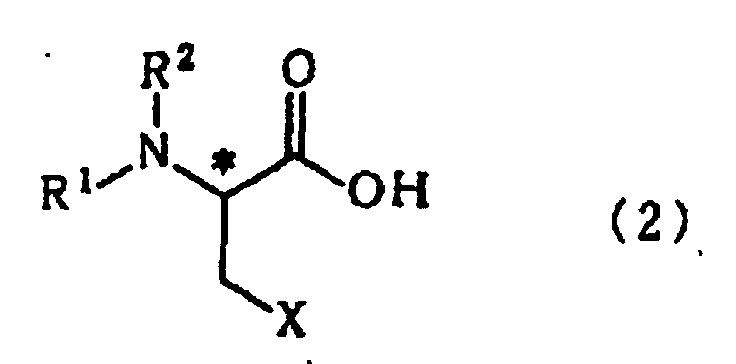 is treated with thiophenol in an aqueous medium containing said inorganic salt in a sufficient amount to effect salting out under a basic condition to give an N-protected-S-phenylcysteine and, at the same time, cause the base salt of N-protected-S-phenylcysteine formed to be salted out from the reaction mixture.
 - The method for isolation according to Claim 1, 2, 3, 4, 5, 6, 7, 8, 9, 10 or 11
wherein the salting out is carried out in the presence of a seed crystal. - The method for isolation according to Claim 1, 2, 3, 4, 5, 6, 7, 8, 9, 10, 11 or 12,
wherein an organic solvent is caused to be present at or after salting out for dissolution and removal of a fat-soluble contaminant. - A method of preparing a mixture of an organic solvent and a free N-protected-S-phenylcysteine
which comprises neutralizing, with an acid, the base salt of N-protected-S-phenylcysteine obtained by the method for isolation according to Claim 1, 2, 3, 4, 5, 6, 7, 8, 9, 10, 11, 12 or 13 to give the free N-protected-S-phenylcysteine and, then, mixing said free N-protected-S-phenylcysteine with an organic solvent. - The method according to Claim 1, 2, 3, 4, 5, 6, 7, 8, 9, 10, 11, 12, 13 or 14
wherein the base salt of N-protected-S-phenylcysteine is a metal salt of the N-protected-S-phenylcysteine. - The method according to Claim 15
wherein the metal salt of N-protected-S-phenylcysteine is an alkali metal salt of the N-protected-S-phenylcysteine. - The method according to Claim 16
wherein the alkali metal salt of N-protected-S-phenylcysteine is a sodium salt of the N-protected-S-phenylcysteine. - The method according to Claim 1, 2, 3, 4, 5, 6, 7, 8, 9, 10, 11, 12, 13, 14, 15, 16 or 17
wherein the amino-protecting group is an urethane-type protective group. - The method according to Claim 18
wherein the amino-protecting group is an aralkyloxycarbonyl group or a lower alkoxycarbonyl group. - The method according to Claim 19
wherein the amino-protecting group is a benzyloxycarbonyl group, a tert-butoxycarbonyl group, a methoxycarbonyl group or an ethoxycarbonyl group. - The method according to Claim 20
wherein the amino-protecting group is a benzyloxycarbonyl group.
Applications Claiming Priority (3)
| Application Number | Priority Date | Filing Date | Title |
|---|---|---|---|
| JP1338899 | 1999-01-21 | ||
| JP11013388A JP2000186069A (en) | 1998-07-01 | 1999-01-21 | Method for isolating N-protected-S-phenylcysteine |
| PCT/JP2000/000274 WO2000043360A1 (en) | 1999-01-21 | 2000-01-21 | Method for isolation of n-protected s-phenylcysteine |
Publications (2)
| Publication Number | Publication Date |
|---|---|
| EP1067119A1 true EP1067119A1 (en) | 2001-01-10 |
| EP1067119A4 EP1067119A4 (en) | 2003-07-02 |
Family
ID=11831731
Family Applications (1)
| Application Number | Title | Priority Date | Filing Date |
|---|---|---|---|
| EP00900854A Withdrawn EP1067119A4 (en) | 1999-01-21 | 2000-01-21 | Method for isolation of n-protected s-phenylcysteine |
Country Status (4)
| Country | Link |
|---|---|
| US (1) | US6320072B1 (en) |
| EP (1) | EP1067119A4 (en) |
| AU (1) | AU3075300A (en) |
| WO (1) | WO2000043360A1 (en) |
Families Citing this family (1)
| Publication number | Priority date | Publication date | Assignee | Title |
|---|---|---|---|---|
| US6801577B2 (en) * | 2002-01-24 | 2004-10-05 | Broadcom Corporation | Low voltage swing pad driver and receiver |
Family Cites Families (7)
| Publication number | Priority date | Publication date | Assignee | Title |
|---|---|---|---|---|
| DE4400751A1 (en) * | 1994-01-13 | 1995-07-20 | Hoechst Ag | Process for the release of acidic, organic compounds from their salts by means of carbon dioxide |
| JPH08325228A (en) * | 1995-05-29 | 1996-12-10 | Sumitomo Chem Co Ltd | Method for producing bicyclohexaneamine derivative |
| ATE258162T1 (en) * | 1996-03-08 | 2004-02-15 | Kaneka Corp | METHOD FOR CRYSTALLIZATION AND COLLECTION OF N-OMEGA-TRIFLUROACETYL-SUBSTITUTED BASIC AMINO ACIDS |
| JPH1029973A (en) * | 1996-07-17 | 1998-02-03 | Mitsui Petrochem Ind Ltd | Method for isolating N-carbobenzoxy-S-phenylcysteine |
| DE69824352T2 (en) * | 1997-01-14 | 2005-06-30 | Kaneka Corp. | PROCESS FOR THE PRODUCTION OF CYSTEIN DERIVATIVES |
| JP3790325B2 (en) * | 1997-04-08 | 2006-06-28 | 株式会社カネカ | Method for producing N-acetylcysteine derivative |
| JPH11335351A (en) * | 1998-05-20 | 1999-12-07 | Kanegafuchi Chem Ind Co Ltd | Method for purifying N-carbobenzoxy-S-phenylcysteine |
-
2000
- 2000-01-21 EP EP00900854A patent/EP1067119A4/en not_active Withdrawn
- 2000-01-21 US US09/646,702 patent/US6320072B1/en not_active Expired - Fee Related
- 2000-01-21 WO PCT/JP2000/000274 patent/WO2000043360A1/en not_active Ceased
- 2000-01-21 AU AU30753/00A patent/AU3075300A/en not_active Abandoned
Non-Patent Citations (2)
| Title |
|---|
| No further relevant documents disclosed * |
| See also references of WO0043360A1 * |
Also Published As
| Publication number | Publication date |
|---|---|
| AU3075300A (en) | 2000-08-07 |
| WO2000043360A1 (en) | 2000-07-27 |
| US6320072B1 (en) | 2001-11-20 |
| EP1067119A4 (en) | 2003-07-02 |
Similar Documents
| Publication | Publication Date | Title |
|---|---|---|
| US5936104A (en) | Process for producing 1,2-epoxy-3-amino-4-phenylbutane derivatives | |
| US6344572B1 (en) | Processes for the preparation of threo-1,2-epoxy-3-amino-4-phenylbutane derivatives | |
| EP1046634B1 (en) | Processes for producing beta-halogeno-alpha-amino-carboxylic acids and phenylcysteine derivatives and intermediates thereof | |
| US6320072B1 (en) | Method for isolation of n-protected s-phenylcysteine | |
| US6011170A (en) | Process for producing of cysteine derivatives | |
| JP2002020374A (en) | Method for producing triazine compound | |
| US6407281B1 (en) | Process for producing optically active cysteine derivatives | |
| MXPA00009168A (en) | Method for isolation of n-protected s-phenylcysteine | |
| JP2915306B2 (en) | Method for producing N-alkoxycarbonyl amino acid ester | |
| SI9620018A (en) | Process for producing n-(d-alpha-methyl-beta-mercaptopropionyl)-l-proline and its intermediate | |
| EP0889031B1 (en) | Simple process for producing high-quality captopril | |
| US5322963A (en) | Method for preparing α-amino-β, δ-diol derivatives | |
| US7057066B2 (en) | Process for producing 3-amino-2-hydroxypropionic acid derivatives | |
| JP2000186069A (en) | Method for isolating N-protected-S-phenylcysteine | |
| RU2090551C1 (en) | β-PHENYLISOSERINE-(2R, 3S) SODIUM SALT AND METHOD OF ITS SYNTHESIS | |
| US4814485A (en) | 4-aminobutanoic acid derivatives, process of preparation and use thereof | |
| CZ20003887A3 (en) | Method for isolating N-protected-S-phenylcysteine | |
| US5446198A (en) | 4-hydroxy-2,3,5-trifluorobenzoic acid and a process for its preparation | |
| JP4065652B2 (en) | How to store quaternary ammonium salts | |
| CZ37693A3 (en) | Process for preparing 1-£(2s)-methyl-3-mercaptopropionyl| - pyrrolidinecarboxylic acid | |
| EP0247808A2 (en) | Crystalline amino-protected amino acids and method of preparation | |
| JP2001114744A (en) | Method for producing N-hydrocarbon oxycarbonyl amino acid | |
| KR820000881B1 (en) | Preparation of Chiazolidine Derivatives | |
| JP2000297069A (en) | Method for producing amino acid ester | |
| JPH0710835A (en) | Method for purifying L-proline derivative |
Legal Events
| Date | Code | Title | Description |
|---|---|---|---|
| PUAI | Public reference made under article 153(3) epc to a published international application that has entered the european phase |
Free format text: ORIGINAL CODE: 0009012 |
|
| 17P | Request for examination filed |
Effective date: 20001016 |
|
| AK | Designated contracting states |
Kind code of ref document: A1 Designated state(s): AT BE CH CY DE DK ES FI FR GB GR IE IT LI LU MC NL PT SE |
|
| A4 | Supplementary search report drawn up and despatched |
Effective date: 20030519 |
|
| 17Q | First examination report despatched |
Effective date: 20030812 |
|
| STAA | Information on the status of an ep patent application or granted ep patent |
Free format text: STATUS: THE APPLICATION IS DEEMED TO BE WITHDRAWN |
|
| 18D | Application deemed to be withdrawn |
Effective date: 20041109 |