EP1067106A1 - Process for producing 1,1,1,3,3-pentafluoropropane - Google Patents
Process for producing 1,1,1,3,3-pentafluoropropane Download PDFInfo
- Publication number
- EP1067106A1 EP1067106A1 EP99902854A EP99902854A EP1067106A1 EP 1067106 A1 EP1067106 A1 EP 1067106A1 EP 99902854 A EP99902854 A EP 99902854A EP 99902854 A EP99902854 A EP 99902854A EP 1067106 A1 EP1067106 A1 EP 1067106A1
- Authority
- EP
- European Patent Office
- Prior art keywords
- hfc
- hydrogen fluoride
- tetrafluoropropene
- pentafluoropropane
- gas
- Prior art date
- Legal status (The legal status is an assumption and is not a legal conclusion. Google has not performed a legal analysis and makes no representation as to the accuracy of the status listed.)
- Granted
Links
Images
Classifications
-
- C—CHEMISTRY; METALLURGY
- C07—ORGANIC CHEMISTRY
- C07C—ACYCLIC OR CARBOCYCLIC COMPOUNDS
- C07C19/00—Acyclic saturated compounds containing halogen atoms
- C07C19/08—Acyclic saturated compounds containing halogen atoms containing fluorine
-
- C—CHEMISTRY; METALLURGY
- C07—ORGANIC CHEMISTRY
- C07C—ACYCLIC OR CARBOCYCLIC COMPOUNDS
- C07C17/00—Preparation of halogenated hydrocarbons
- C07C17/07—Preparation of halogenated hydrocarbons by addition of hydrogen halides
- C07C17/087—Preparation of halogenated hydrocarbons by addition of hydrogen halides to unsaturated halogenated hydrocarbons
-
- C—CHEMISTRY; METALLURGY
- C07—ORGANIC CHEMISTRY
- C07C—ACYCLIC OR CARBOCYCLIC COMPOUNDS
- C07C17/00—Preparation of halogenated hydrocarbons
- C07C17/093—Preparation of halogenated hydrocarbons by replacement by halogens
- C07C17/20—Preparation of halogenated hydrocarbons by replacement by halogens of halogen atoms by other halogen atoms
- C07C17/202—Preparation of halogenated hydrocarbons by replacement by halogens of halogen atoms by other halogen atoms two or more compounds being involved in the reaction
- C07C17/206—Preparation of halogenated hydrocarbons by replacement by halogens of halogen atoms by other halogen atoms two or more compounds being involved in the reaction the other compound being HX
-
- C—CHEMISTRY; METALLURGY
- C07—ORGANIC CHEMISTRY
- C07C—ACYCLIC OR CARBOCYCLIC COMPOUNDS
- C07C17/00—Preparation of halogenated hydrocarbons
- C07C17/38—Separation; Purification; Stabilisation; Use of additives
Definitions
- the present invention relates to a preparation method for 1, 1, 1, 3, 3-pentafluoropropane (hereinafter, sometimes referred to as HFC-245fa), which is of industrial importance as an HFC blowing agent, a refrigerant, and a jetting agent that does not destroy the ozone layer.
- HFC-245fa 1, 1, 1, 3, 3-pentafluoropropane
- the present inventors have investigated these preparation methods for HFC-245fa and found the existence of a component that is difficult to separate from HFC-245fa by distillation.
- the compound that is difficult to separate was carefully isolated followed by identification by NMR.
- the compound was identified to be the (E)-1233zd and the boiling point of (E)-1233zd was 20.8°C (observed value). Because the difference in boiling point between (E)-1233zd and HFC-245fa was 5.3°C and so extremely small, it was obvious that a large distillation column is required for separation by distillation, and this resulted in initiating a study to solve this problem.
- boiling point of (Z)-1233zd which is the other geometrical isomer of 1233zd is not less than 30°C, it is also difficult to separate because it forms an azeotropic composition with HF.
- the boiling points are given below.
- the object of the present invention is to provide a process for economically preparing HFC-245fa as well as avoiding the requirement for separating HFC-245fa and 1233zd.
- the present invention relates to a preparation method (hereinafter, referred to as the present inventive preparation method) of 1, 1, 1, 3, 3-pentafluoropropane (HFC-245fa) comprising: the first process which gives mainly 1, 3, 3, 3-tetrafluoropropene (hereinafter, sometimes referred to as 1234ze) by reacting 1-chloro-3, 3, 3-trifluoropropene (1233zd) with hydrogen fluoride in the gas phase; and subsequently a second process which gives 1, 1, 1, 3, 3-pentafluoropropane (HFC-245fa) by reacting 1, 3, 3, 3-tetrafluoropropene (1234ze), separated as a component that does not contain hydrogen chloride from crude products obtained by the above first process, with hydrogen fluoride in the gas phase.
- the first process which gives mainly 1, 3, 3, 3-tetrafluoropropene (hereinafter, sometimes referred to as 1234ze) by reacting 1-chloro-3, 3, 3-trifluoropropen
- this can avoid the separation of HFC-245fa and 1233zd which are difficult to separate from each other, avoiding any loss of the product related to chlorination treatment for conventional unavoidable separation.
- the present inventors have investigated methods for preparing HFC-245fa in order to solve the above conventional problems and found that equilibriums represented by the following schemes (1) and (2) exists among HFC-245fa, 1234ze and 1233zd in the gas phase reaction.
- the optimized process of the present invention has been completed by establishing the above second process as a reaction process without hydrogen chloride and compounds generating hydrogen chloride under the reaction conditions, in the final fluorination process for preparing HFC-245fa.
- 1234ze is supplied as a composition without hydrogen chloride and any molecules, which does not contain a chlorine atom in the molecule, leading to a process that does not generate 1233zd.
- HFC-245fa and 1234ze are readily separated because the boiling point of 1234ze is - 16°C.
- 1234ze was adopted as the material for the final reaction process, while if an alternative material, 1, 1, 3, 3-tetrafluoropropene is used, a preparation process for HFC-245fa that does not generate 1233zd as a by-product can be similarly constructed.
- 1233zd the starting material submitted to the first process, can be obtained by gas phase fluorination of 1, 1, 1, 3, 3-pentachloropropane (240fa). 1233zd may be obtained either as a sole product or as an azeotropic composition with hydrogen fluoride.
- This reaction can be carried out using either a fixed bed or a fluid bed.
- fluorinating catalysts are not limited; any of them can be used as long as they are capable of fluorinating 240fa to 1233zd.
- they include: fluorochromium oxide obtained by thermal fluorination of hydrate of chromium hydroxide (III) or chromium trifluoride (III) with hydrogen fluoride; aluminum fluoride, or fluorinated alumina produced by fluorinating alumina with hydrogen fluoride; a supported catalyst in which fluorinated alumina or active charcoal supports at least one element selected from Cr, Zn, Ti, V, Zr, Mo, Ge, Sn, and Pb.
- reaction conditions including the reaction temperature, reaction pressure and molar ratio of the starting material to hydrogen fluoride
- optimized values can be adopted for each catalyst in consideration of the lifetime of the catalyst, production efficiency, and selectivity of 1233zd.
- this fluorination process is conducted, for example, by the reaction described in Example 1, using 240fa as the material.
- the former compound after separation can be converted to 1233zd by recycling to the reactor followed by refluorination, leading to no loss.
- the above first process is a reaction process for preparing 1234ze by fluorination of 1233zd as the starting material, which subsequently is submitted to the above second process.
- 1233zd which is the starting material for this reaction process may be prepared either by gas phase fluorination of 240fa as described above or by another method.
- 1234ze may be obtained either as a sole product or as an azeotropic composition with hydrogen fluoride.
- the outlet compositions of this fluorination reaction process contain HFC-245fa as well as 1233zd of the starting material and the objective product 1234ze. These are unavoidably generated according to the above equilibrium schemes (1) and (2).
- HFC-245fa is the final object in the present process; however, purification after taking HFC-245fa from the reaction process is accompanied by the above-mentioned difficulty because separation of HFC-245fa and 1233zd is difficult as described above.
- the mixture containing HFC-245fa and the unreacted 1233zd can be transferred to the inlet of the first process to be recycled.
- 1234ze is separated from the crude products obtained from the first process, and 1233zd and HFC-245fa unseparated from each other are transferred to the first process to be recycled. Consequently, separation of HFC-245fa generated in the first process and 1233zd is not required.
- Recycled HFC-245fa is converted to 1234ze according to equilibrium scheme (2), leading to no loss in the process.
- the distillation process which purifies the outlet compositions of the first process can take only 1234ze as a lower boiling point component in all the organic materials generated, and the other organic materials, 1233zd and HFC-254fa without separation, as higher boiling point components, can be transferred to the inlet of the first process to be recycled.
- the advantage of the present process is that it enables separation using a smaller distillation column compared to that used to separate 1233zd and HFC-245fa.
- This reaction can be carried out using either a fixed bed or a fluid bed.
- fluorinating catalysts are not limited; any of them can be used as long as they have the capability of fluorinating 1233zd to 1234ze.
- they include: fluorochromium oxide obtained by thermal fluorination of hydrate of chromium hydroxide (III) or chromium trifluoride (III) with hydrogen fluoride; aluminum fluoride, or fluorinated alumina produced by fluorinating alumina with hydrogen fluoride; a supported catalyst in which fluorinated alumina or active charcoal supports at least one element selected from Cr, Zn, Ti, V, Zr, Mo, Ge, Sn, and Pb.
- optimized values can be adopted for the reaction conditions when using each catalyst, including the reaction temperature, reaction pressure and molar ratio of the material to hydrogen fluoride, in consideration of the lifetime of the catalyst, production efficiency, and selectivity of 1234ze.
- this first process is conducted, for example, by the reaction described in Example 2 using 1233zd as the material.
- 1233zd as the material.
- a mixture of 1233zd and HFC-245fa without further treatment can be introduced to the reactor to be recycled after separation of the objective product 1234ze by distillation.
- Typical methods include distillation, washing, membrane separation, and extractive distillation, and these may be combined for removing hydrogen chloride.
- the above second process includes a reaction process in which the final objective HFC-245fa is synthesized by fluorination of 1234ze as the starting material. It is no problem that 1234ze as the material is supplied as an azeotropic composition with hydrogen fluoride.
- the outlet organic compositions of this reactor for fluorination contain 1234ze and the final objective product HFC-245fa. These compounds can be readily separated by distillation and unreacted 1234ze is preferably introduced to the inlet of the second process to be recycled.
- This reaction can be carried out using either a fixed bed or a fluid bed.
- fluorinating catalysts are not limited; any of them can be used as long as they have the capability of fluorinating 1234ze to HFC- 245fa.
- they include: fluorochromium oxide obtained by fluorinating a thermally-treated hydrate of chromium hydroxide (III) or chromium trifluoride (III) with hydrogen fluoride; aluminum fluoride, or fluorinated alumina produced by fluorinating alumina with hydrogen fluoride; a supported catalyst in which fluorinated alumina or active charcoal supports at least one element selected from Cr, Zn, Ti, V, Zr, Mo, Ge, Sn, and Pb.
- optimized values can be adopted for the reaction conditions when using each catalyst, including the reaction temperature, reaction pressure and molar ratio of the material to hydrogen fluoride, in consideration of the lifetime of the catalyst, production efficiency, and selectivity of HFC-245fa.
- an optional method can be used. As shown later in the embodiment, this second process is conducted by the reaction as described in Example 3 using, for example, 1234ze as the material.
- the products include only 1234ze and HFC-245fa which can be readily separated by distillation.
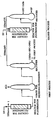
- Fig.1 shows an example of a plant that can be used to conduct the present inventive preparation method.
- 240fa of a material is readily obtained from an addition reaction of carbon tetrachloride with vinyl chloride (refer to Journal of Molecular Catalysis, Vol. 77, 51, 1992 and Journal of the Society of Industrial Chemistry, Vol. 72, No. 7, 156, 1969).
- Methods of synthesizing 1233zd using 240fa as the material are described in JP.Patent, 09-183740, A1, 1997, JP.Patent, 09-194404, A1, 1997 and USP No. 5710352.
- the known method using tetrachloropropene as the material is described in WO 97-08117.
- the present inventive preparation method in the final second process which prepares HFC-245fa significant for industry: 1234ze containing no chlorine atom in the molecule is used as the material; purification is performed so that hydrogen chloride is not contained in the reaction material followed by supplying; and the process is controlled so that 1233zd is not generated. Therefore, the separation of HFC-245fa and 1233zd being difficult to be separated from each other can be avoided, leading to no loss of the materials relating to chlorination treatment for the conventional unavoidable separation. Further, HFC-245fa is readily separated from 1234ze.
- 1233zd used as the starting material in the first process is useful as an intermediate for medicines and agricultural chemicals when introducing a trifluoropropyl group.
- a catalyst for fluorination was obtained by thermally treating chromium hydroxide precipitated from chromium nitrate solution using aqueous ammonia.
- the catalyst was fluorinated by independently passing hydrogen fluoride prior to the reaction.
- the gas generated was rectified to give 1, 3, 3, 3-tetrafluoropropene.
- 1, 3, 3, 3-tetrafluoropropene obtained as described above at 20 cc/min accompanied by hydrogen fluoride at 200 cc/min was passed into a similar reaction tube to the one above. The temperature was brought to 250°C.
- Example 1 1-chloro-3, 3, 3-trifluoropropene obtained by a similar method to Example 1 at 20 cc/min accompanied by hydrogen fluoride at 300 cc/min was passed into a similar reaction tube to the one in Example 1. The temperature was brought to 350°C.
- 1, 3, 3, 3-tetrafluoropropene obtained as described above at 20 cc/min accompanied by hydrogen fluoride at 200 cc/min was passed into a similar reaction tube to the one above. The temperature was brought to 230°C.
- Example 1 1-chloro-3, 3, 3-trifluoropropene obtained by a similar method to Example 1 at 10 cc/min accompanied by hydrogen fluoride at 150 cc/min was passed into a similar reaction tube to the one in Example 1 into which fluorinated alumina is charged. The temperature was brought to 350°C.
- the gas generated was rectified to give 1, 3, 3, 3-tetrafluoropropene.
- 1, 3, 3, 3-tetrafluoropropene obtained as described above at 10 cc/min accompanied by hydrogen fluoride at 100 cc/min was passed into a similar reaction tube to the one above. The temperature was brought to 230°C.
- the temperature of the first reactor was brought to 370°C shown in Example 1, and a stainless steel distillation column for dehydrochlorination and stainless steel rectifying equipment were installed at the outlet so as to enable rectification of the generated gas.
- the sample was analyzed by gas chromatography, which showed a purity of 1, 3, 3, 3-tetrafluoropropene not less than 99.6%; in addition, the gas did not contain 1-chloro-3, 3, 3-trifluoropropene as a starting material.
- the temperature of the second reactor was brought to 230°C shown in Example 1, and stainless steel rectifying equipment was installed at the outlet so as to enable rectification of the generated gas.
- 1, 3, 3, 3-tetrafluoropropene at 20 cc/min and hydrogen fluoride at 200 cc/min were introduced into the second reactor.
- the products were led to the rectitier, 1, 3, 3, 3-tetrafluoropropene was drawn off as organic material from the upper stage of the rectifier and transferred to the second reactor to be recycled.
- 1, 1, 1, 3, 3-pentafluoropropane which is an organic material was drawn off.
- excess hydrogen fluoride was drawn off. Both of these were transferred to the second reactor to be recycled.
- the amount of hydrogen fluoride introduced was reduced to stabilize the reaction system.
- the equipment used was similar to that of Example 4, except that an SUS distillation column for dehydrochlorination was not used. SUS rectifying equipment was installed so as to enable rectification of the generated gas.
Landscapes
- Chemical & Material Sciences (AREA)
- Organic Chemistry (AREA)
- Chemical Kinetics & Catalysis (AREA)
- Organic Low-Molecular-Weight Compounds And Preparation Thereof (AREA)
Abstract
Description
- 245fa
- 15.5°C
- (E)-1233zd
- 20.8°C
- (Z)-1233zd
- not less than 30°C
subsequently a second process which gives 1, 1, 1, 3, 3-pentafluoropropane (HFC-245fa) by reacting 1, 3, 3, 3-tetrafluoropropene (1234ze), separated as a component that does not contain hydrogen chloride from crude products obtained by the above first process, with hydrogen fluoride in the gas phase.


fluorochromium oxide obtained by fluorinating a thermally-treated hydrate of chromium hydroxide (III) or chromium trifluoride (III) with hydrogen fluoride; aluminum fluoride, or fluorinated alumina produced by fluorinating alumina with hydrogen fluoride; a supported catalyst in which fluorinated alumina or active charcoal supports at least one element selected from Cr, Zn, Ti, V, Zr, Mo, Ge, Sn, and Pb.
A catalyst for fluorination was obtained by thermally treating chromium hydroxide precipitated from chromium nitrate solution using aqueous ammonia. The catalyst was fluorinated by independently passing hydrogen fluoride prior to the reaction.
- 1, 3, 3, 3-tetrafluoropropene (1234ze)
- 0.3%
- 1, 3-dichloro-3, 3-difluoropropene
- 1.6%
- 1-chloro-3, 3, 3-trifluoropropene (1233zd)
- 98.1%
- 1, 3, 3, 3-tetrafluoropropene
- 45.6%
- 1, 1, 1, 3, 3-pentafluoropropane (HFC-245fa)
- 2.7%
- 1-chloro-3, 3, 3-trifluoropropene
- 51.6%
- 1, 3, 3, 3-tetrafluoropropene
- 33.7%
- 1, 1, 1, 3, 3-pentafluoropropane
- 66.3%
- 1, 3, 3, 3-tetrafluoropropene
- 47.1%
- 1, 1, 1, 3, 3-pentafluoropropane
- 7.0%
- 1-chloro-3, 3, 3-trifluoropropene
- 45.9%
- 1, 3, 3, 3-tetrafluoropropene
- 19.7%
- 1, 1, 1, 3, 3-pentafluoropropane
- 80.3%
- 1, 3, 3, 3-tetrafluoropropene
- 47.3%
- 1, 1, 1, 3, 3-pentafluoropropane
- 6.0%
- 1-chloro-3, 3, 3-trifluoropropene
- 46.7%
- 1, 3, 3, 3-tetrafluoropropene
- 18.8%
- 1, 1, 1, 3, 3-pentafluoropropane
- 81.2%
- 1, 3, 3, 3-tetrafluoropropene
- 48.3%
- 1, 1, 1, 3, 3-pentafluoropropane
- 2.8%
- 1-chloro-3, 3, 3-trifluoropropene
- 48.9%
- 1, 3, 3, 3-tetrafluoropropene
- 17.2%
- 1, 1, 1, 3, 3-pentafluoropropane
- 82.8%
- 1, 3, 3, 3-tetrafluoropropene
- 15.9%
- 1, 1, 1, 3, 3-pentafluoropropane
- 77.2%
- 1-chloro-3, 3, 3-trifluoropropene
- 6.9%
Claims (6)
- A preparation method for 1, 1, 1, 3, 3-pentafluoropropane comprising: a first process which gives mainly 1, 3, 3, 3-tetrafluoropropene by reacting 1-chloro-3, 3, 3-trifluoropropene with hydrogen fluoride in the gas phase; and
subsequently a second process which gives 1, 1, 1, 3, 3-pentafluoropropane by reacting 1, 3, 3, 3-tetrafluoropropene, separated as a component that does not contain hydrogen chloride from crude products obtained by the above first process, with hydrogen fluoride in the gas phase. - A preparation method claimed in claim 1 wherein 1, 3, 3, 3-tetrafluoropropene is separated from crude products obtained by said first process, and 1-chloro-3, 3, 3-trifluoropropene and 1, 1, 1, 3, 3-pentafluoropropane unseparated from each other are transferred to said first process to be recycled.
- A preparation method claimed in claim 1 or 2 wherein unreacted 1, 3, 3, 3-tetrafluoropropene is separated together with hydrogen fluoride in said second process followed by being transferred to said second process to be recycled.
- A preparation method claimed in any of claims 1 to 3 wherein 1, 3, 3, 3-tetrafluoropropene obtained by said first process is prepared as an azeotropic composition with hydrogen fluoride and submitted to the material in said second process.
- A preparation method claimed in any of claims 1 to 4 wherein 1-chloro-3, 3, 3-trifluoropropene which is obtained by reacting 1, 1, 1, 3, 3-pentachloropropane with hydrogen fluoride in the gas phase is submitted to the material in said first process.
- A preparation method claimed in claim 5 wherein said 1-chloro-3, 3, 3-trifluoropropene which is prepared as an azeotropic composition with hydrogen fluoride is submitted to the material in said first process.
Applications Claiming Priority (3)
| Application Number | Priority Date | Filing Date | Title |
|---|---|---|---|
| JP07362698A JP3518321B2 (en) | 1998-03-23 | 1998-03-23 | Method for producing 1,1,1,3,3-pentafluoropropane |
| JP7362698 | 1998-03-23 | ||
| PCT/JP1999/000537 WO1999048849A1 (en) | 1998-03-23 | 1999-02-05 | Process for producing 1,1,1,3,3-pentafluoropropane |
Publications (3)
| Publication Number | Publication Date |
|---|---|
| EP1067106A1 true EP1067106A1 (en) | 2001-01-10 |
| EP1067106A4 EP1067106A4 (en) | 2003-07-09 |
| EP1067106B1 EP1067106B1 (en) | 2006-04-26 |
Family
ID=13523725
Family Applications (1)
| Application Number | Title | Priority Date | Filing Date |
|---|---|---|---|
| EP99902854A Expired - Lifetime EP1067106B1 (en) | 1998-03-23 | 1999-02-05 | Process for producing 1,1,1,3,3-pentafluoropropane |
Country Status (5)
| Country | Link |
|---|---|
| US (1) | US6472573B1 (en) |
| EP (1) | EP1067106B1 (en) |
| JP (1) | JP3518321B2 (en) |
| DE (1) | DE69931043T2 (en) |
| WO (1) | WO1999048849A1 (en) |
Cited By (14)
| Publication number | Priority date | Publication date | Assignee | Title |
|---|---|---|---|---|
| WO2005012212A3 (en) * | 2003-07-25 | 2005-03-31 | Honeywell Int Inc | Process for the manufacture of 1,3,3,3 tetrafluoropropene |
| US7183448B2 (en) | 1998-11-13 | 2007-02-27 | Daikin Industries, Ltd. | Azeotropic composition, comprising 1, 1, 1, 3,3-pentafluoropropane and 1, 1, 1-trifluoro-3-chloro-2-propene, method of separation and purification of the same, and process for producing 1, 1, 1,3,3-pentafloropropane and 1, 1, 1-trifluoro-3-chloro-2-propene |
| WO2007053689A3 (en) * | 2005-11-01 | 2007-07-12 | Du Pont | Azeotrope compositions comprising e-1,3,3,3-tetrafluoropropene and hydrogen fluoride and uses thereof |
| EP1837323A1 (en) * | 2006-03-24 | 2007-09-26 | SOLVAY (Société Anonyme) | Process for the manufacture of 1,1,1,3,3-pentafluoropropane |
| EP2043979A1 (en) | 2006-06-27 | 2009-04-08 | E.I. Du Pont De Nemours And Company | Tetrafluoropropene production processes |
| US7829748B1 (en) | 2009-09-21 | 2010-11-09 | Honeywell International Inc. | Process for the manufacture of 1,3,3,3-tetrafluoropropene |
| WO2013074394A1 (en) * | 2011-11-18 | 2013-05-23 | Dow Global Technologies, Llc | Process for the production of chlorinated propanes and/or propenes |
| US8546623B2 (en) | 2006-10-03 | 2013-10-01 | Mexichem Amanco Holding S.A. De C.V. | Dehydrogenationhalogenation process for the production of C3 -C6-(hydro)fluoroalkenes |
| CN103483143A (en) * | 2006-08-24 | 2014-01-01 | 霍尼韦尔国际公司 | Integrated manufacture process of HFC trans-1234ZE |
| US8742181B2 (en) | 2007-04-11 | 2014-06-03 | Mexichem Amanco Holding S.A. De C.V. | Process for isomerizing A (hydro)fluoroalkene |
| EP1918269B2 (en) † | 2006-10-27 | 2019-01-02 | Honeywell International Inc. | Processes for geometric isomerization of halogenated olefins |
| US11406965B2 (en) | 2016-09-07 | 2022-08-09 | Mexichem Fluor S.A. De C.V. | Catalyst and process using the catalyst for manufacturing fluorinated hydrocarbons |
| US11452990B2 (en) | 2016-09-07 | 2022-09-27 | Mexichem Fluor S.A. De C.V. | Catalyst and process using the catalyst for manufacturing fluorinated hydrocarbons |
| WO2025021631A1 (en) * | 2023-07-27 | 2025-01-30 | Dehon | Method and facility for separating a mixture comprising at least one fluorinated fluid and one or more contaminants |
Families Citing this family (61)
| Publication number | Priority date | Publication date | Assignee | Title |
|---|---|---|---|---|
| ES2198385T3 (en) * | 2000-05-08 | 2004-02-01 | Atofina Chemicals, Inc. | PREPARATION OF 245FA. |
| US20050096246A1 (en) | 2003-11-04 | 2005-05-05 | Johnson Robert C. | Solvent compositions containing chlorofluoroolefins |
| JP2003055277A (en) * | 2001-08-16 | 2003-02-26 | Showa Denko Kk | Method for producing hexafluoroethane and use thereof |
| KR20030060611A (en) | 2002-01-10 | 2003-07-16 | 삼성전자주식회사 | Field emitter device comprising carbon nanotube with protective membrane |
| US9255046B2 (en) * | 2003-07-25 | 2016-02-09 | Honeywell International Inc. | Manufacturing process for HFO-1234ze |
| US6844475B1 (en) | 2003-08-08 | 2005-01-18 | Honeywell International Business Machines | Low temperature production of 1-chloro-3,3,3-trifluoropropene (HCFC-1233zd) |
| US8273928B2 (en) * | 2006-08-24 | 2012-09-25 | E I Du Pont De Nemours And Company | Processes for separation of fluoroolefins from hydrogen fluoride by azeotropic distillation |
| US7485760B2 (en) | 2006-08-24 | 2009-02-03 | Honeywell International Inc. | Integrated HFC trans-1234ze manufacture process |
| US8067650B2 (en) | 2006-08-24 | 2011-11-29 | Honeywell International Inc. | Process for the production of HFO trans-1234ze from HFC-245fa |
| KR102010208B1 (en) | 2008-05-07 | 2019-08-12 | 더 케무어스 컴퍼니 에프씨, 엘엘씨 | Compositions comprising 2,3-dichloro-1,1,1-trifluoropropane, 2-chloro-1,1,1-trifluoropropene, 2-chloro-1,1,1,2-tetrafluoropropane or 2,3,3,3-tetrafluoropropene |
| US20100016457A1 (en) * | 2008-07-16 | 2010-01-21 | Bowman James M | Hfo-1234ze mixed isomers with hfc-245fa as a blowing agent, aerosol, and solvent |
| FR2935700B1 (en) * | 2008-09-11 | 2013-05-10 | Arkema France | PROCESS FOR THE PREPARATION OF TRIFLUORO AND TETRAFLUORO COMPOUNDS |
| JP5338240B2 (en) * | 2008-10-06 | 2013-11-13 | セントラル硝子株式会社 | Method for separating hydrogen fluoride |
| BRPI0914033A2 (en) * | 2008-10-13 | 2015-11-03 | Dow Global Technologies Inc | One-step process for the production of chlorinated and fluorinated propenses and process for preparing 2,3,3,3-tetrafluorprop-1 ene (1,3,3,3-tetrafluorprop-1 ene (hfo-123ze) |
| US8410040B2 (en) * | 2008-10-31 | 2013-04-02 | Honeywell International Inc. | Azeotrope-like compositions of 1,1,1,2,3-pentachloropropane and hydrogen fluoride |
| CA2743842C (en) * | 2008-11-19 | 2016-02-09 | Arkema Inc. | Process for the manufacture of hydrofluoroolefins |
| US8288598B2 (en) | 2009-01-16 | 2012-10-16 | Honeywell International Inc. | Isomerization of 1,1,3,3-tetrafluoropropene |
| SI3812360T1 (en) * | 2009-09-09 | 2024-02-29 | Honeywell International Inc. | Monochlorotrifluoropropene compounds and compositions and methods using same |
| EP2485997B1 (en) | 2009-10-09 | 2015-09-09 | Dow Global Technologies LLC | Process for the production of chlorinated and/or fluorinated propenes and higher alkenes |
| JP5782038B2 (en) * | 2009-10-09 | 2015-09-24 | ダウ グローバル テクノロジーズ エルエルシー | Isothermal multitubular reactor and process incorporating the reactor |
| KR20120093857A (en) * | 2009-10-09 | 2012-08-23 | 다우 글로벌 테크놀로지스 엘엘씨 | Process for the production of chlorinated and/or fluorinated propenes |
| KR20120093202A (en) * | 2009-10-09 | 2012-08-22 | 다우 글로벌 테크놀로지스 엘엘씨 | Adiabatic plug flow reactors and process for producing a chlorinated and/or fluorinated propene and higher alkene |
| US9334207B2 (en) | 2010-09-03 | 2016-05-10 | Honeywell International Inc. | Integrated process to coproduce trans-1-chloro-3,3,3-trifluoropropene, trans-1,3,3,3-tetrafluoropropene, and 1,1,1,3,3-pentafluoropropane |
| US8518293B2 (en) * | 2010-09-03 | 2013-08-27 | Honeywell International Inc. | 1,3,3,3-tetrafluoropropene process azeotropes with HF |
| CN101913985B (en) * | 2010-09-07 | 2013-03-13 | 西安近代化学研究所 | Method for preparing 1,3,3,3-tetrafluoropropene by gas phase fluorination |
| JP5747684B2 (en) * | 2010-09-14 | 2015-07-15 | セントラル硝子株式会社 | Method for dehydrating hydrofluorocarbon or hydrochlorofluorocarbon, and method for producing 1,3,3,3-tetrafluoropropene using the dehydration method |
| JP5659658B2 (en) * | 2010-09-24 | 2015-01-28 | セントラル硝子株式会社 | Process for producing α, α-difluoroesters |
| US8378158B2 (en) * | 2010-12-03 | 2013-02-19 | Honeywell International Inc. | Azeotrope-like compositions of (Z)-1-chloro-3,3,3-trifluoropropene and hydrogen fluoride |
| US9156752B2 (en) | 2011-01-04 | 2015-10-13 | Honeywell International Inc. | High purity E-1-chloro-3,3,3-trifluoropropene and methods of making the same |
| CA2837292C (en) | 2011-05-31 | 2020-01-28 | Blue Cube Ip Llc | Process for the production of chlorinated propenes |
| CA2836493A1 (en) | 2011-05-31 | 2012-12-06 | Max Markus Tirtowidjojo | Process for the production of chlorinated propenes |
| ES2721451T3 (en) | 2011-06-08 | 2019-07-31 | Dow Agrosciences Llc | Procedure for the production of chlorinated and / or fluorinated propenes |
| CN103717559A (en) | 2011-08-07 | 2014-04-09 | 陶氏环球技术有限责任公司 | Process for producing chlorinated propylene |
| EP2739595B1 (en) | 2011-08-07 | 2018-12-12 | Blue Cube IP LLC | Process for the production of chlorinated propenes |
| JP5834791B2 (en) | 2011-11-11 | 2015-12-24 | セントラル硝子株式会社 | (E) Process for producing 1-chloro-3,3,3-trifluoropropene |
| CA2856271A1 (en) | 2011-11-21 | 2013-05-30 | Dow Global Technologies Llc | Process for the production of chlorinated alkanes |
| JP6059246B2 (en) | 2011-12-02 | 2017-01-11 | ブルー キューブ アイピー エルエルシー | Method for producing chlorinated alkane |
| IN2014CN04029A (en) | 2011-12-02 | 2015-10-23 | Dow Global Technologies Llc | |
| JP6170068B2 (en) | 2011-12-13 | 2017-07-26 | ブルー キューブ アイピー エルエルシー | Method for producing chlorinated propane and propene |
| EP2794528B1 (en) | 2011-12-22 | 2020-02-26 | Blue Cube IP LLC | Process for the production of tetrachloromethane |
| BR112014015123A2 (en) | 2011-12-23 | 2017-06-13 | Dow Global Technologies Llc | process for the production of one or more alkenes or aromatic compounds |
| US9938212B2 (en) | 2012-03-28 | 2018-04-10 | Honeywell International Inc. | Integrated process to coproduce trans-1-chloro-3,3,3-trifluoropropene, trans-1,3,3,3-tetrafluoropropene, and 1,1,1,3,3-pentafluoropropane |
| JP6107465B2 (en) * | 2012-06-29 | 2017-04-05 | セントラル硝子株式会社 | Process for producing 1-chloro-3,3,3-trifluoropropene |
| JP2015529247A (en) | 2012-09-20 | 2015-10-05 | ダウ グローバル テクノロジーズ エルエルシー | Process for the production of chlorinated propene |
| US9321707B2 (en) | 2012-09-20 | 2016-04-26 | Blue Cube Ip Llc | Process for the production of chlorinated propenes |
| WO2014052945A2 (en) | 2012-09-30 | 2014-04-03 | Dow Global Technologies, Llc | Weir quench and processes incorporating the same |
| JP6363610B2 (en) | 2012-10-26 | 2018-07-25 | ブルー キューブ アイピー エルエルシー | Mixer and process incorporating it |
| WO2014100066A1 (en) | 2012-12-18 | 2014-06-26 | Dow Global Technologies, Llc | Process for the production of chlorinated propenes |
| US9475740B2 (en) | 2012-12-19 | 2016-10-25 | Blue Cube Ip Llc | Process for the production of chlorinated propenes |
| EP2961722A2 (en) | 2013-02-27 | 2016-01-06 | Blue Cube IP LLC | Process for the production of chlorinated propenes |
| CN105026348A (en) | 2013-03-09 | 2015-11-04 | 蓝立方知识产权有限责任公司 | Process for the production of chlorinated alkanes |
| US20150259267A1 (en) | 2014-03-14 | 2015-09-17 | E.I. Du Pont De Nemours And Company | PROCESS FOR THE REDUCTION OF RfC=CX IMPURITIES IN FLUOROOLEFINS |
| US10995047B2 (en) | 2013-03-15 | 2021-05-04 | The Chemours Company Fc, Llc | Process for the reduction of RƒC≡CX impurities in fluoroolefins |
| US9029616B2 (en) | 2013-08-08 | 2015-05-12 | Honeywell International Inc. | Process for 1-chloro-3,3,3-trifluoropropene from trifluoromethane |
| JP6274314B2 (en) * | 2014-07-15 | 2018-02-07 | セントラル硝子株式会社 | Process for producing trans-1-chloro-3,3,3-trifluoropropene |
| CN105753642B (en) * | 2014-12-13 | 2018-06-08 | 西安近代化学研究所 | The preparation method of coproduction 1,3,3,3- tetrafluoropropenes and 2,3,3,3- tetrafluoropropenes |
| CN105753640B (en) * | 2014-12-13 | 2018-07-31 | 西安近代化学研究所 | A kind of preparation method of 1,3,3,3- tetrafluoropropenes |
| CN105753641B (en) * | 2014-12-13 | 2018-08-31 | 西安近代化学研究所 | The preparation method of 1,3,3,3- tetrafluoropropenes |
| WO2017038933A1 (en) * | 2015-09-04 | 2017-03-09 | 旭硝子株式会社 | Solvent composition, washing method, and coating film formation method |
| GB2580623A (en) | 2019-01-17 | 2020-07-29 | Mexichem Fluor Sa De Cv | Method |
| US12116332B2 (en) | 2021-12-03 | 2024-10-15 | Honeywell International Inc. | High purity HFO-E-1,3,3,3-tetrafluoropropene (trans-HFO-1234ze) and methods for producing same |
Family Cites Families (6)
| Publication number | Priority date | Publication date | Assignee | Title |
|---|---|---|---|---|
| JP3818398B2 (en) * | 1995-12-29 | 2006-09-06 | ダイキン工業株式会社 | Process for producing 1,1,1,3,3-pentafluoropropane |
| JPH09268139A (en) * | 1996-04-03 | 1997-10-14 | Central Glass Co Ltd | Production of 1,1,1,3,3-pentafluoropropane |
| JPH1017502A (en) * | 1996-07-01 | 1998-01-20 | Central Glass Co Ltd | Production of 1,1,1,3,3-pentafluoropropane |
| JP3465865B2 (en) * | 1996-06-20 | 2003-11-10 | セントラル硝子株式会社 | Method for producing 1,3,3,3-tetrafluoropropene |
| US5710352A (en) * | 1996-09-19 | 1998-01-20 | Alliedsignal Inc. | Vapor phase process for making 1,1,1,3,3-pentafluoropropane and 1-chloro-3,3,3-trifluoropropene |
| US5895825A (en) * | 1997-12-01 | 1999-04-20 | Elf Atochem North America, Inc. | Preparation of 1,1,1,3,3-pentafluoropropane |
-
1998
- 1998-03-23 JP JP07362698A patent/JP3518321B2/en not_active Expired - Fee Related
-
1999
- 1999-02-05 WO PCT/JP1999/000537 patent/WO1999048849A1/en not_active Ceased
- 1999-02-05 US US09/601,511 patent/US6472573B1/en not_active Expired - Lifetime
- 1999-02-05 DE DE69931043T patent/DE69931043T2/en not_active Expired - Fee Related
- 1999-02-05 EP EP99902854A patent/EP1067106B1/en not_active Expired - Lifetime
Cited By (29)
| Publication number | Priority date | Publication date | Assignee | Title |
|---|---|---|---|---|
| US7183448B2 (en) | 1998-11-13 | 2007-02-27 | Daikin Industries, Ltd. | Azeotropic composition, comprising 1, 1, 1, 3,3-pentafluoropropane and 1, 1, 1-trifluoro-3-chloro-2-propene, method of separation and purification of the same, and process for producing 1, 1, 1,3,3-pentafloropropane and 1, 1, 1-trifluoro-3-chloro-2-propene |
| WO2005012212A3 (en) * | 2003-07-25 | 2005-03-31 | Honeywell Int Inc | Process for the manufacture of 1,3,3,3 tetrafluoropropene |
| US7592494B2 (en) | 2003-07-25 | 2009-09-22 | Honeywell International Inc. | Process for the manufacture of 1,3,3,3-tetrafluoropropene |
| RU2466978C2 (en) * | 2005-11-01 | 2012-11-20 | Е.И.Дюпон Де Немур Энд Компани | Azeotropic compositions, which contain e-1,3,3,3-tetrafluoropropene and fluorohydrogen, and their application |
| WO2007053689A3 (en) * | 2005-11-01 | 2007-07-12 | Du Pont | Azeotrope compositions comprising e-1,3,3,3-tetrafluoropropene and hydrogen fluoride and uses thereof |
| EP1948580B1 (en) | 2005-11-01 | 2016-12-21 | The Chemours Company FC, LLC | Azeotrope compositions comprising e-1,3,3,3-tetrafluoropropene and hydrogen fluoride and uses thereof |
| US7423188B2 (en) | 2005-11-01 | 2008-09-09 | E. I. Du Pont De Nemours And Company | Azeotrope compositions comprising E-1,3,3,3-tetrafluoropropene and hydrogen fluoride and uses thereof |
| CN106905108A (en) * | 2005-11-01 | 2017-06-30 | 科慕埃弗西有限公司 | Azeotrope compositions and its application containing the tetrafluoropropenes of E 1,3,3,3 and hydrogen fluoride |
| CN106905108B (en) * | 2005-11-01 | 2024-06-07 | 科慕埃弗西有限公司 | Azeotropic compositions containing E-1, 3-tetrafluoropropene and hydrogen fluoride and uses thereof |
| EP2527313A1 (en) * | 2005-11-01 | 2012-11-28 | E. I. du Pont de Nemours and Company | Azeotrope compositions comprising E-1,3,3,3-tetrafluoropropene and hydrogen fluoride and uses thereof |
| WO2007110379A1 (en) * | 2006-03-24 | 2007-10-04 | Solvay (Société Anonyme) | Process for the manufacture of 1,1,1,3,3-pentafluoropropane |
| US7629495B2 (en) | 2006-03-24 | 2009-12-08 | Solvay (Societé Anonyme) | Process for the manufacture of 1,1,1,3,3-pentafluoropropane |
| EP1837323A1 (en) * | 2006-03-24 | 2007-09-26 | SOLVAY (Société Anonyme) | Process for the manufacture of 1,1,1,3,3-pentafluoropropane |
| EP2043979B2 (en) † | 2006-06-27 | 2025-02-26 | The Chemours Company FC, LLC | Tetrafluoropropene production processes |
| EP2043979A1 (en) | 2006-06-27 | 2009-04-08 | E.I. Du Pont De Nemours And Company | Tetrafluoropropene production processes |
| EP2043979B1 (en) | 2006-06-27 | 2015-04-29 | E.I. Du Pont De Nemours And Company | Tetrafluoropropene production processes |
| CN103483143A (en) * | 2006-08-24 | 2014-01-01 | 霍尼韦尔国际公司 | Integrated manufacture process of HFC trans-1234ZE |
| CN103483143B (en) * | 2006-08-24 | 2019-01-08 | 霍尼韦尔国际公司 | The integrin manufacturing method of HFC anti-form-1 234ZE |
| US9162946B2 (en) | 2006-10-03 | 2015-10-20 | Mexichem Amanco Holding S.A. De C.V. | Process for preparing C3-6 (hydro)fluoroalkenes by dehydrohalogenating C3-6 halo(hydro)fluoroalkanes in the presence of a zinc/chromia catalyst |
| US9567275B2 (en) | 2006-10-03 | 2017-02-14 | Mexichem Amanco Holding S.A. De C.V. | Process for preparing C3-6(hydro)fluoroalkenes by dehydrohalogenating C3-6 halo(hydro)fluoroalkanes in the presence of a zinc/chromia catalyst |
| US8546623B2 (en) | 2006-10-03 | 2013-10-01 | Mexichem Amanco Holding S.A. De C.V. | Dehydrogenationhalogenation process for the production of C3 -C6-(hydro)fluoroalkenes |
| EP1918269B2 (en) † | 2006-10-27 | 2019-01-02 | Honeywell International Inc. | Processes for geometric isomerization of halogenated olefins |
| US8742181B2 (en) | 2007-04-11 | 2014-06-03 | Mexichem Amanco Holding S.A. De C.V. | Process for isomerizing A (hydro)fluoroalkene |
| US7829748B1 (en) | 2009-09-21 | 2010-11-09 | Honeywell International Inc. | Process for the manufacture of 1,3,3,3-tetrafluoropropene |
| WO2013074394A1 (en) * | 2011-11-18 | 2013-05-23 | Dow Global Technologies, Llc | Process for the production of chlorinated propanes and/or propenes |
| US11406965B2 (en) | 2016-09-07 | 2022-08-09 | Mexichem Fluor S.A. De C.V. | Catalyst and process using the catalyst for manufacturing fluorinated hydrocarbons |
| US11452990B2 (en) | 2016-09-07 | 2022-09-27 | Mexichem Fluor S.A. De C.V. | Catalyst and process using the catalyst for manufacturing fluorinated hydrocarbons |
| WO2025021631A1 (en) * | 2023-07-27 | 2025-01-30 | Dehon | Method and facility for separating a mixture comprising at least one fluorinated fluid and one or more contaminants |
| FR3151590A1 (en) * | 2023-07-27 | 2025-01-31 | Dehon | PROCESS AND INSTALLATION FOR THE SEPARATION OF A MIXTURE COMPRISING AT LEAST ONE FLUORINATED FLUID AND ONE OR MORE CONTAMINANTS |
Also Published As
| Publication number | Publication date |
|---|---|
| US6472573B1 (en) | 2002-10-29 |
| JP3518321B2 (en) | 2004-04-12 |
| JPH11269105A (en) | 1999-10-05 |
| DE69931043D1 (en) | 2006-06-01 |
| WO1999048849A1 (en) | 1999-09-30 |
| EP1067106B1 (en) | 2006-04-26 |
| DE69931043T2 (en) | 2006-12-14 |
| EP1067106A4 (en) | 2003-07-09 |
Similar Documents
| Publication | Publication Date | Title |
|---|---|---|
| US6472573B1 (en) | Process for producing 1,1,1,3,3-pentafluoropropane | |
| KR100284250B1 (en) | Process for producing 1,1,1,3,3-pentafluoropropane | |
| US8952208B2 (en) | Method for prolonging a catalyst's life during hydrofluorination | |
| EP2630108B1 (en) | Process for the preparation of 2,3,3,3 tetrafluoropropene | |
| JP5788380B2 (en) | Separation of R-1233 from hydrogen fluoride | |
| JP5732062B2 (en) | Integrated method for producing fluoroolefins | |
| US9388099B2 (en) | Process for producing 2,3,3,3-tetrafluoropropene | |
| JP5884130B2 (en) | Process for producing 2-chloro-1,1,1,2-tetrafluoropropene by liquid phase fluorination of 2-chloro-3,3,3-trifluoropropene | |
| JP4523754B2 (en) | Novel process for producing 1,1,1-trifluoro-2,2-dichloroethane | |
| US8395001B2 (en) | Processes for producing 2-chloro-1,1,1,2-tetrafluoropropane and 2,3,3,3-tetrafluoropropene | |
| US7091388B2 (en) | Method of making 1,1,3,3,3-pentafluoropropene | |
| JP5146466B2 (en) | Method for producing pentafluoroethane | |
| TW574178B (en) | Process and plant for the preparation of 1,1,1-trifluoro-2,2-dichloroethane and pentafluoroethane | |
| EP3333145B1 (en) | Production method for composition containing 1,2-dichloro-3,3,3-trifluoropropene (hcfo-1223xd) and/or 1,1,2-trichloro-3,3,3-trifluoropropene (cfo-1213xa) | |
| JP3853397B2 (en) | Process for producing pentafluoroethane and composition suitable for conversion to pentafluoroethane | |
| JPH11180907A (en) | Method for producing 1,1,1,3,3-pentafluoropropane | |
| JP2016104789A (en) | Method for producing 2-chloro-1,1,1,2-tetrafluoro propene by liquid phase fluorination of 2-chloro-3,3,3-trifluoro propene |
Legal Events
| Date | Code | Title | Description |
|---|---|---|---|
| PUAI | Public reference made under article 153(3) epc to a published international application that has entered the european phase |
Free format text: ORIGINAL CODE: 0009012 |
|
| 17P | Request for examination filed |
Effective date: 20000829 |
|
| AK | Designated contracting states |
Kind code of ref document: A1 Designated state(s): BE DE ES FR GB IT |
|
| A4 | Supplementary search report drawn up and despatched |
Effective date: 20030528 |
|
| RIC1 | Information provided on ipc code assigned before grant |
Ipc: 7C 07C 17/38 B Ipc: 7C 07C 17/20 B Ipc: 7C 07C 17/087 B Ipc: 7C 07C 19/08 A |
|
| 17Q | First examination report despatched |
Effective date: 20040517 |
|
| GRAP | Despatch of communication of intention to grant a patent |
Free format text: ORIGINAL CODE: EPIDOSNIGR1 |
|
| RIN1 | Information on inventor provided before grant (corrected) |
Inventor name: SHIBANUMA, TAKASHI,YODOGAWA WORKS Inventor name: NAKADA, TATSUO,YODOGAWA WORKS Inventor name: SHIBATA, NORIAKI,YODOGAWA WORKS Inventor name: YAMAMOTO, AKINORI,YODOGAWA WORKS |
|
| GRAS | Grant fee paid |
Free format text: ORIGINAL CODE: EPIDOSNIGR3 |
|
| GRAA | (expected) grant |
Free format text: ORIGINAL CODE: 0009210 |
|
| AK | Designated contracting states |
Kind code of ref document: B1 Designated state(s): BE DE ES FR GB IT |
|
| PG25 | Lapsed in a contracting state [announced via postgrant information from national office to epo] |
Ref country code: IT Free format text: LAPSE BECAUSE OF FAILURE TO SUBMIT A TRANSLATION OF THE DESCRIPTION OR TO PAY THE FEE WITHIN THE PRE;WARNING: LAPSES OF ITALIAN PATENTS WITH EFFECTIVE DATE BEFORE 2007 MAY HAVE OCCURRED AT ANY TIME BEFORE 2007. THE CORRECT EFFECTIVE DATE MAY BE DIFFERENT FROM THE ONE RECORDED.SCRIBED TIME-LIMIT Effective date: 20060426 |
|
| REG | Reference to a national code |
Ref country code: GB Ref legal event code: FG4D |
|
| REF | Corresponds to: |
Ref document number: 69931043 Country of ref document: DE Date of ref document: 20060601 Kind code of ref document: P |
|
| PG25 | Lapsed in a contracting state [announced via postgrant information from national office to epo] |
Ref country code: ES Free format text: LAPSE BECAUSE OF FAILURE TO SUBMIT A TRANSLATION OF THE DESCRIPTION OR TO PAY THE FEE WITHIN THE PRESCRIBED TIME-LIMIT Effective date: 20060806 |
|
| ET | Fr: translation filed | ||
| PLBE | No opposition filed within time limit |
Free format text: ORIGINAL CODE: 0009261 |
|
| STAA | Information on the status of an ep patent application or granted ep patent |
Free format text: STATUS: NO OPPOSITION FILED WITHIN TIME LIMIT |
|
| 26N | No opposition filed |
Effective date: 20070129 |
|
| PGFP | Annual fee paid to national office [announced via postgrant information from national office to epo] |
Ref country code: IT Payment date: 20080226 Year of fee payment: 10 Ref country code: GB Payment date: 20080130 Year of fee payment: 10 Ref country code: DE Payment date: 20080131 Year of fee payment: 10 |
|
| PGFP | Annual fee paid to national office [announced via postgrant information from national office to epo] |
Ref country code: FR Payment date: 20080208 Year of fee payment: 10 |
|
| PGFP | Annual fee paid to national office [announced via postgrant information from national office to epo] |
Ref country code: BE Payment date: 20080415 Year of fee payment: 10 |
|
| BERE | Be: lapsed |
Owner name: *DAIKIN INDUSTRIES LTD Effective date: 20090228 |
|
| GBPC | Gb: european patent ceased through non-payment of renewal fee |
Effective date: 20090205 |
|
| REG | Reference to a national code |
Ref country code: FR Ref legal event code: ST Effective date: 20091030 |
|
| PG25 | Lapsed in a contracting state [announced via postgrant information from national office to epo] |
Ref country code: DE Free format text: LAPSE BECAUSE OF NON-PAYMENT OF DUE FEES Effective date: 20090901 |
|
| PG25 | Lapsed in a contracting state [announced via postgrant information from national office to epo] |
Ref country code: BE Free format text: LAPSE BECAUSE OF NON-PAYMENT OF DUE FEES Effective date: 20090228 |
|
| PG25 | Lapsed in a contracting state [announced via postgrant information from national office to epo] |
Ref country code: GB Free format text: LAPSE BECAUSE OF NON-PAYMENT OF DUE FEES Effective date: 20090205 Ref country code: FR Free format text: LAPSE BECAUSE OF NON-PAYMENT OF DUE FEES Effective date: 20090302 |
|
| PG25 | Lapsed in a contracting state [announced via postgrant information from national office to epo] |
Ref country code: IT Free format text: LAPSE BECAUSE OF NON-PAYMENT OF DUE FEES Effective date: 20090205 |