EP1066277B1 - Polyethoxylated ascorbic acid derivatives as a novel antioxidant and process for preparing thereof - Google Patents
Polyethoxylated ascorbic acid derivatives as a novel antioxidant and process for preparing thereof Download PDFInfo
- Publication number
- EP1066277B1 EP1066277B1 EP99909388A EP99909388A EP1066277B1 EP 1066277 B1 EP1066277 B1 EP 1066277B1 EP 99909388 A EP99909388 A EP 99909388A EP 99909388 A EP99909388 A EP 99909388A EP 1066277 B1 EP1066277 B1 EP 1066277B1
- Authority
- EP
- European Patent Office
- Prior art keywords
- formula
- compound
- ascorbic acid
- group
- peg
- Prior art date
- Legal status (The legal status is an assumption and is not a legal conclusion. Google has not performed a legal analysis and makes no representation as to the accuracy of the status listed.)
- Expired - Lifetime
Links
- 125000003289 ascorbyl group Polymers [H]O[C@@]([H])(C([H])([H])O*)[C@@]1([H])OC(=O)C(O*)=C1O* 0.000 title claims abstract description 6
- 238000004519 manufacturing process Methods 0.000 title claims 5
- 150000000996 L-ascorbic acids Polymers 0.000 title description 29
- 230000003078 antioxidant effect Effects 0.000 title description 6
- 239000003963 antioxidant agent Substances 0.000 title description 5
- 235000006708 antioxidants Nutrition 0.000 title description 5
- 238000000034 method Methods 0.000 claims abstract description 24
- 125000000217 alkyl group Chemical group 0.000 claims abstract description 7
- 125000004432 carbon atom Chemical group C* 0.000 claims abstract description 6
- 150000001875 compounds Chemical class 0.000 claims description 67
- 229920001223 polyethylene glycol Chemical group 0.000 claims description 33
- IAZDPXIOMUYVGZ-UHFFFAOYSA-N Dimethylsulphoxide Chemical compound CS(C)=O IAZDPXIOMUYVGZ-UHFFFAOYSA-N 0.000 claims description 26
- ZMXDDKWLCZADIW-UHFFFAOYSA-N N,N-Dimethylformamide Chemical compound CN(C)C=O ZMXDDKWLCZADIW-UHFFFAOYSA-N 0.000 claims description 21
- 239000002904 solvent Substances 0.000 claims description 21
- 239000002202 Polyethylene glycol Substances 0.000 claims description 19
- BWHMMNNQKKPAPP-UHFFFAOYSA-L potassium carbonate Chemical compound [K+].[K+].[O-]C([O-])=O BWHMMNNQKKPAPP-UHFFFAOYSA-L 0.000 claims description 12
- FJDQFPXHSGXQBY-UHFFFAOYSA-L caesium carbonate Chemical compound [Cs+].[Cs+].[O-]C([O-])=O FJDQFPXHSGXQBY-UHFFFAOYSA-L 0.000 claims description 11
- 229910000024 caesium carbonate Inorganic materials 0.000 claims description 11
- JOXIMZWYDAKGHI-UHFFFAOYSA-N toluene-4-sulfonic acid Chemical compound CC1=CC=C(S(O)(=O)=O)C=C1 JOXIMZWYDAKGHI-UHFFFAOYSA-N 0.000 claims description 10
- QTBSBXVTEAMEQO-UHFFFAOYSA-N Acetic acid Chemical compound CC(O)=O QTBSBXVTEAMEQO-UHFFFAOYSA-N 0.000 claims description 9
- KWYUFKZDYYNOTN-UHFFFAOYSA-M Potassium hydroxide Chemical compound [OH-].[K+] KWYUFKZDYYNOTN-UHFFFAOYSA-M 0.000 claims description 9
- HEMHJVSKTPXQMS-UHFFFAOYSA-M Sodium hydroxide Chemical compound [OH-].[Na+] HEMHJVSKTPXQMS-UHFFFAOYSA-M 0.000 claims description 9
- 239000003054 catalyst Substances 0.000 claims description 9
- VEXZGXHMUGYJMC-UHFFFAOYSA-N Hydrochloric acid Chemical compound Cl VEXZGXHMUGYJMC-UHFFFAOYSA-N 0.000 claims description 8
- CDBYLPFSWZWCQE-UHFFFAOYSA-L Sodium Carbonate Chemical compound [Na+].[Na+].[O-]C([O-])=O CDBYLPFSWZWCQE-UHFFFAOYSA-L 0.000 claims description 8
- 125000004435 hydrogen atom Chemical group [H]* 0.000 claims description 8
- 150000002334 glycols Chemical class 0.000 claims description 7
- FXHOOIRPVKKKFG-UHFFFAOYSA-N N,N-Dimethylacetamide Chemical compound CN(C)C(C)=O FXHOOIRPVKKKFG-UHFFFAOYSA-N 0.000 claims description 6
- QAOWNCQODCNURD-UHFFFAOYSA-N Sulfuric acid Chemical compound OS(O)(=O)=O QAOWNCQODCNURD-UHFFFAOYSA-N 0.000 claims description 6
- 239000003377 acid catalyst Substances 0.000 claims description 6
- GNOIPBMMFNIUFM-UHFFFAOYSA-N hexamethylphosphoric triamide Chemical compound CN(C)P(=O)(N(C)C)N(C)C GNOIPBMMFNIUFM-UHFFFAOYSA-N 0.000 claims description 6
- 229910000027 potassium carbonate Inorganic materials 0.000 claims description 6
- SECXISVLQFMRJM-UHFFFAOYSA-N N-Methylpyrrolidone Chemical compound CN1CCCC1=O SECXISVLQFMRJM-UHFFFAOYSA-N 0.000 claims description 5
- GUVUOGQBMYCBQP-UHFFFAOYSA-N dmpu Chemical compound CN1CCCN(C)C1=O GUVUOGQBMYCBQP-UHFFFAOYSA-N 0.000 claims description 5
- 238000006460 hydrolysis reaction Methods 0.000 claims description 5
- KDLHZDBZIXYQEI-UHFFFAOYSA-N Palladium Chemical compound [Pd] KDLHZDBZIXYQEI-UHFFFAOYSA-N 0.000 claims description 4
- KEAYESYHFKHZAL-UHFFFAOYSA-N Sodium Chemical compound [Na] KEAYESYHFKHZAL-UHFFFAOYSA-N 0.000 claims description 4
- 229910052794 bromium Inorganic materials 0.000 claims description 4
- 239000000460 chlorine Substances 0.000 claims description 4
- 229910052801 chlorine Inorganic materials 0.000 claims description 4
- 125000001495 ethyl group Chemical group [H]C([H])([H])C([H])([H])* 0.000 claims description 4
- 125000005843 halogen group Chemical group 0.000 claims description 4
- 125000002496 methyl group Chemical group [H]C([H])([H])* 0.000 claims description 4
- HNJBEVLQSNELDL-UHFFFAOYSA-N pyrrolidin-2-one Chemical compound O=C1CCCN1 HNJBEVLQSNELDL-UHFFFAOYSA-N 0.000 claims description 4
- 229910000029 sodium carbonate Inorganic materials 0.000 claims description 4
- 239000012312 sodium hydride Substances 0.000 claims description 4
- 229910000104 sodium hydride Inorganic materials 0.000 claims description 4
- BDHFUVZGWQCTTF-UHFFFAOYSA-M sulfonate Chemical compound [O-]S(=O)=O BDHFUVZGWQCTTF-UHFFFAOYSA-M 0.000 claims description 4
- ITMCEJHCFYSIIV-UHFFFAOYSA-M triflate Chemical compound [O-]S(=O)(=O)C(F)(F)F ITMCEJHCFYSIIV-UHFFFAOYSA-M 0.000 claims description 4
- MIOPJNTWMNEORI-GMSGAONNSA-N (S)-camphorsulfonic acid Chemical compound C1C[C@@]2(CS(O)(=O)=O)C(=O)C[C@@H]1C2(C)C MIOPJNTWMNEORI-GMSGAONNSA-N 0.000 claims description 3
- JXLHNMVSKXFWAO-UHFFFAOYSA-N azane;7-fluoro-2,1,3-benzoxadiazole-4-sulfonic acid Chemical group N.OS(=O)(=O)C1=CC=C(F)C2=NON=C12 JXLHNMVSKXFWAO-UHFFFAOYSA-N 0.000 claims description 3
- 229910052736 halogen Inorganic materials 0.000 claims description 3
- 150000002367 halogens Chemical group 0.000 claims description 3
- 230000007062 hydrolysis Effects 0.000 claims description 3
- 229910052740 iodine Inorganic materials 0.000 claims description 3
- WKBOTKDWSSQWDR-UHFFFAOYSA-N Bromine atom Chemical compound [Br] WKBOTKDWSSQWDR-UHFFFAOYSA-N 0.000 claims description 2
- ZAMOUSCENKQFHK-UHFFFAOYSA-N Chlorine atom Chemical compound [Cl] ZAMOUSCENKQFHK-UHFFFAOYSA-N 0.000 claims description 2
- GDTBXPJZTBHREO-UHFFFAOYSA-N bromine Substances BrBr GDTBXPJZTBHREO-UHFFFAOYSA-N 0.000 claims description 2
- UKVIEHSSVKSQBA-UHFFFAOYSA-N methane;palladium Chemical compound C.[Pd] UKVIEHSSVKSQBA-UHFFFAOYSA-N 0.000 claims description 2
- BASFCYQUMIYNBI-UHFFFAOYSA-N platinum Chemical compound [Pt] BASFCYQUMIYNBI-UHFFFAOYSA-N 0.000 claims description 2
- 238000005984 hydrogenation reaction Methods 0.000 claims 3
- ZCYVEMRRCGMTRW-UHFFFAOYSA-N 7553-56-2 Chemical compound [I] ZCYVEMRRCGMTRW-UHFFFAOYSA-N 0.000 claims 1
- 239000002253 acid Substances 0.000 claims 1
- YKIOKAURTKXMSB-UHFFFAOYSA-N adams's catalyst Chemical compound O=[Pt]=O YKIOKAURTKXMSB-UHFFFAOYSA-N 0.000 claims 1
- 239000011630 iodine Substances 0.000 claims 1
- 229910052763 palladium Inorganic materials 0.000 claims 1
- XLYOFNOQVPJJNP-UHFFFAOYSA-N water Substances O XLYOFNOQVPJJNP-UHFFFAOYSA-N 0.000 abstract description 12
- 239000007864 aqueous solution Substances 0.000 abstract description 8
- 239000003960 organic solvent Substances 0.000 abstract description 6
- 230000003064 anti-oxidating effect Effects 0.000 abstract description 5
- 230000000694 effects Effects 0.000 abstract description 5
- 230000005923 long-lasting effect Effects 0.000 abstract description 4
- 239000002537 cosmetic Substances 0.000 abstract description 3
- 235000013305 food Nutrition 0.000 abstract description 3
- 231100000053 low toxicity Toxicity 0.000 abstract description 2
- 239000000825 pharmaceutical preparation Substances 0.000 abstract description 2
- 229940127557 pharmaceutical product Drugs 0.000 abstract description 2
- CIWBSHSKHKDKBQ-JLAZNSOCSA-N Ascorbic acid Chemical compound OC[C@H](O)[C@H]1OC(=O)C(O)=C1O CIWBSHSKHKDKBQ-JLAZNSOCSA-N 0.000 description 100
- 229960005070 ascorbic acid Drugs 0.000 description 72
- 239000011668 ascorbic acid Substances 0.000 description 68
- OKKJLVBELUTLKV-UHFFFAOYSA-N Methanol Chemical compound OC OKKJLVBELUTLKV-UHFFFAOYSA-N 0.000 description 48
- YMWUJEATGCHHMB-UHFFFAOYSA-N Dichloromethane Chemical compound ClCCl YMWUJEATGCHHMB-UHFFFAOYSA-N 0.000 description 45
- 235000010323 ascorbic acid Nutrition 0.000 description 43
- 239000011541 reaction mixture Substances 0.000 description 24
- HEDRZPFGACZZDS-MICDWDOJSA-N Trichloro(2H)methane Chemical compound [2H]C(Cl)(Cl)Cl HEDRZPFGACZZDS-MICDWDOJSA-N 0.000 description 18
- 239000000243 solution Substances 0.000 description 18
- CSCPPACGZOOCGX-UHFFFAOYSA-N Acetone Chemical compound CC(C)=O CSCPPACGZOOCGX-UHFFFAOYSA-N 0.000 description 15
- 230000002401 inhibitory effect Effects 0.000 description 12
- LFQSCWFLJHTTHZ-UHFFFAOYSA-N Ethanol Chemical compound CCO LFQSCWFLJHTTHZ-UHFFFAOYSA-N 0.000 description 11
- VYPSYNLAJGMNEJ-UHFFFAOYSA-N Silicium dioxide Chemical compound O=[Si]=O VYPSYNLAJGMNEJ-UHFFFAOYSA-N 0.000 description 11
- 230000015572 biosynthetic process Effects 0.000 description 11
- 238000003786 synthesis reaction Methods 0.000 description 11
- 238000005160 1H NMR spectroscopy Methods 0.000 description 9
- KFZMGEQAYNKOFK-UHFFFAOYSA-N Isopropanol Chemical compound CC(C)O KFZMGEQAYNKOFK-UHFFFAOYSA-N 0.000 description 9
- 239000002211 L-ascorbic acid Substances 0.000 description 9
- 235000000069 L-ascorbic acid Nutrition 0.000 description 9
- 238000006243 chemical reaction Methods 0.000 description 9
- 239000000706 filtrate Substances 0.000 description 8
- 0 *C1(C2)[C@@]2C(CC2C3(CC3)CCC2)C1 Chemical compound *C1(C2)[C@@]2C(CC2C3(CC3)CCC2)C1 0.000 description 7
- 230000002292 Radical scavenging effect Effects 0.000 description 7
- 238000004440 column chromatography Methods 0.000 description 7
- ITASMGCDZDHSCS-GXSJLCMTSA-N (2r)-2-[(1s)-1,2-dihydroxyethyl]-4-hydroxy-3-phenylmethoxy-2h-furan-5-one Chemical compound OC[C@H](O)[C@H]1OC(=O)C(O)=C1OCC1=CC=CC=C1 ITASMGCDZDHSCS-GXSJLCMTSA-N 0.000 description 6
- WYURNTSHIVDZCO-UHFFFAOYSA-N Tetrahydrofuran Chemical compound C1CCOC1 WYURNTSHIVDZCO-UHFFFAOYSA-N 0.000 description 6
- 102000003425 Tyrosinase Human genes 0.000 description 6
- 108060008724 Tyrosinase Proteins 0.000 description 6
- -1 ascorbic acid ethers Chemical class 0.000 description 6
- FVAUCKIRQBBSSJ-UHFFFAOYSA-M sodium iodide Chemical compound [Na+].[I-] FVAUCKIRQBBSSJ-UHFFFAOYSA-M 0.000 description 6
- 238000010521 absorption reaction Methods 0.000 description 5
- DHKHKXVYLBGOIT-UHFFFAOYSA-N acetaldehyde Diethyl Acetal Natural products CCOC(C)OCC DHKHKXVYLBGOIT-UHFFFAOYSA-N 0.000 description 5
- 150000001241 acetals Chemical class 0.000 description 5
- 229940072107 ascorbate Drugs 0.000 description 5
- 229910052792 caesium Inorganic materials 0.000 description 5
- TVFDJXOCXUVLDH-UHFFFAOYSA-N caesium atom Chemical compound [Cs] TVFDJXOCXUVLDH-UHFFFAOYSA-N 0.000 description 5
- 238000001914 filtration Methods 0.000 description 5
- 239000003921 oil Substances 0.000 description 5
- 239000012044 organic layer Substances 0.000 description 5
- ZGSCRDSBTNQPMS-UJURSFKZSA-N 3-O-Ethylascorbic acid Chemical compound CCOC1=C(O)C(=O)O[C@@H]1[C@@H](O)CO ZGSCRDSBTNQPMS-UJURSFKZSA-N 0.000 description 4
- 229940120145 3-o-ethylascorbic acid Drugs 0.000 description 4
- CSNNHWWHGAXBCP-UHFFFAOYSA-L Magnesium sulfate Chemical compound [Mg+2].[O-][S+2]([O-])([O-])[O-] CSNNHWWHGAXBCP-UHFFFAOYSA-L 0.000 description 4
- UIIMBOGNXHQVGW-UHFFFAOYSA-M Sodium bicarbonate Chemical compound [Na+].OC([O-])=O UIIMBOGNXHQVGW-UHFFFAOYSA-M 0.000 description 4
- FAPWRFPIFSIZLT-UHFFFAOYSA-M Sodium chloride Chemical compound [Na+].[Cl-] FAPWRFPIFSIZLT-UHFFFAOYSA-M 0.000 description 4
- 125000001797 benzyl group Chemical group [H]C1=C([H])C([H])=C(C([H])=C1[H])C([H])([H])* 0.000 description 4
- 229910052681 coesite Inorganic materials 0.000 description 4
- 229910052906 cristobalite Inorganic materials 0.000 description 4
- HHEAADYXPMHMCT-UHFFFAOYSA-N dpph Chemical compound [O-][N+](=O)C1=CC([N+](=O)[O-])=CC([N+]([O-])=O)=C1[N]N(C=1C=CC=CC=1)C1=CC=CC=C1 HHEAADYXPMHMCT-UHFFFAOYSA-N 0.000 description 4
- 125000003827 glycol group Chemical group 0.000 description 4
- 239000000203 mixture Substances 0.000 description 4
- 239000008055 phosphate buffer solution Substances 0.000 description 4
- 239000000047 product Substances 0.000 description 4
- 230000035484 reaction time Effects 0.000 description 4
- 239000000377 silicon dioxide Substances 0.000 description 4
- 229910052682 stishovite Inorganic materials 0.000 description 4
- 229910052905 tridymite Inorganic materials 0.000 description 4
- ZWEHNKRNPOVVGH-UHFFFAOYSA-N 2-Butanone Chemical compound CCC(C)=O ZWEHNKRNPOVVGH-UHFFFAOYSA-N 0.000 description 3
- XEKOWRVHYACXOJ-UHFFFAOYSA-N Ethyl acetate Chemical compound CCOC(C)=O XEKOWRVHYACXOJ-UHFFFAOYSA-N 0.000 description 3
- YXFVVABEGXRONW-UHFFFAOYSA-N Toluene Chemical compound CC1=CC=CC=C1 YXFVVABEGXRONW-UHFFFAOYSA-N 0.000 description 3
- ZMANZCXQSJIPKH-UHFFFAOYSA-N Triethylamine Chemical compound CCN(CC)CC ZMANZCXQSJIPKH-UHFFFAOYSA-N 0.000 description 3
- 238000002835 absorbance Methods 0.000 description 3
- AGEZXYOZHKGVCM-UHFFFAOYSA-N benzyl bromide Chemical compound BrCC1=CC=CC=C1 AGEZXYOZHKGVCM-UHFFFAOYSA-N 0.000 description 3
- 239000012141 concentrate Substances 0.000 description 3
- 239000003112 inhibitor Substances 0.000 description 3
- 238000002360 preparation method Methods 0.000 description 3
- 239000000741 silica gel Substances 0.000 description 3
- 229910002027 silica gel Inorganic materials 0.000 description 3
- 239000007787 solid Substances 0.000 description 3
- YLQBMQCUIZJEEH-UHFFFAOYSA-N tetrahydrofuran Natural products C=1C=COC=1 YLQBMQCUIZJEEH-UHFFFAOYSA-N 0.000 description 3
- XNWFRZJHXBZDAG-UHFFFAOYSA-N 2-METHOXYETHANOL Chemical compound COCCO XNWFRZJHXBZDAG-UHFFFAOYSA-N 0.000 description 2
- YYROPELSRYBVMQ-UHFFFAOYSA-N 4-toluenesulfonyl chloride Chemical compound CC1=CC=C(S(Cl)(=O)=O)C=C1 YYROPELSRYBVMQ-UHFFFAOYSA-N 0.000 description 2
- CURLTUGMZLYLDI-UHFFFAOYSA-N Carbon dioxide Chemical compound O=C=O CURLTUGMZLYLDI-UHFFFAOYSA-N 0.000 description 2
- 102000004190 Enzymes Human genes 0.000 description 2
- 108090000790 Enzymes Proteins 0.000 description 2
- UFHFLCQGNIYNRP-UHFFFAOYSA-N Hydrogen Chemical compound [H][H] UFHFLCQGNIYNRP-UHFFFAOYSA-N 0.000 description 2
- OUYCCCASQSFEME-QMMMGPOBSA-N L-tyrosine Chemical compound OC(=O)[C@@H](N)CC1=CC=C(O)C=C1 OUYCCCASQSFEME-QMMMGPOBSA-N 0.000 description 2
- PMZURENOXWZQFD-UHFFFAOYSA-L Sodium Sulfate Chemical compound [Na+].[Na+].[O-]S([O-])(=O)=O PMZURENOXWZQFD-UHFFFAOYSA-L 0.000 description 2
- 238000003556 assay Methods 0.000 description 2
- 239000012490 blank solution Substances 0.000 description 2
- 238000009903 catalytic hydrogenation reaction Methods 0.000 description 2
- 238000005859 coupling reaction Methods 0.000 description 2
- XTHFKEDIFFGKHM-UHFFFAOYSA-N ethylene glycol dimethyl ether Natural products COCCOC XTHFKEDIFFGKHM-UHFFFAOYSA-N 0.000 description 2
- 239000012467 final product Substances 0.000 description 2
- 229910052739 hydrogen Inorganic materials 0.000 description 2
- 239000001257 hydrogen Substances 0.000 description 2
- 239000007788 liquid Substances 0.000 description 2
- VLKZOEOYAKHREP-UHFFFAOYSA-N n-Hexane Chemical compound CCCCCC VLKZOEOYAKHREP-UHFFFAOYSA-N 0.000 description 2
- 230000003389 potentiating effect Effects 0.000 description 2
- 238000011084 recovery Methods 0.000 description 2
- 229910000030 sodium bicarbonate Inorganic materials 0.000 description 2
- 235000017557 sodium bicarbonate Nutrition 0.000 description 2
- 239000011780 sodium chloride Substances 0.000 description 2
- 235000009518 sodium iodide Nutrition 0.000 description 2
- 229910052938 sodium sulfate Inorganic materials 0.000 description 2
- 235000011152 sodium sulphate Nutrition 0.000 description 2
- 239000000758 substrate Substances 0.000 description 2
- 230000002194 synthesizing effect Effects 0.000 description 2
- MZAGXDHQGXUDDX-JSRXJHBZSA-N (e,2z)-4-ethyl-2-hydroxyimino-5-nitrohex-3-enamide Chemical compound [O-][N+](=O)C(C)C(/CC)=C/C(=N/O)/C(N)=O MZAGXDHQGXUDDX-JSRXJHBZSA-N 0.000 description 1
- 235000001674 Agaricus brunnescens Nutrition 0.000 description 1
- 102000008186 Collagen Human genes 0.000 description 1
- 108010035532 Collagen Proteins 0.000 description 1
- QAQJMLQRFWZOBN-LAUBAEHRSA-N L-ascorbyl-6-palmitate Chemical compound CCCCCCCCCCCCCCCC(=O)OC[C@H](O)[C@H]1OC(=O)C(O)=C1O QAQJMLQRFWZOBN-LAUBAEHRSA-N 0.000 description 1
- 240000008415 Lactuca sativa Species 0.000 description 1
- ACFGRWJEQJVZTM-LEJBHHMKSA-L Magnesium L-ascorbic acid-2-phosphate Chemical compound [Mg+2].OC[C@H](O)[C@H]1OC(=O)C(OP([O-])([O-])=O)=C1O ACFGRWJEQJVZTM-LEJBHHMKSA-L 0.000 description 1
- 238000010934 O-alkylation reaction Methods 0.000 description 1
- ZLMJMSJWJFRBEC-UHFFFAOYSA-N Potassium Chemical compound [K] ZLMJMSJWJFRBEC-UHFFFAOYSA-N 0.000 description 1
- 102000004079 Prolyl Hydroxylases Human genes 0.000 description 1
- 108010043005 Prolyl Hydroxylases Proteins 0.000 description 1
- WETWJCDKMRHUPV-UHFFFAOYSA-N acetyl chloride Chemical compound CC(Cl)=O WETWJCDKMRHUPV-UHFFFAOYSA-N 0.000 description 1
- 239000012346 acetyl chloride Substances 0.000 description 1
- QVGXLLKOCUKJST-UHFFFAOYSA-N atomic oxygen Chemical compound [O] QVGXLLKOCUKJST-UHFFFAOYSA-N 0.000 description 1
- 238000010533 azeotropic distillation Methods 0.000 description 1
- 238000005574 benzylation reaction Methods 0.000 description 1
- 239000001569 carbon dioxide Substances 0.000 description 1
- 229910002092 carbon dioxide Inorganic materials 0.000 description 1
- 238000010531 catalytic reduction reaction Methods 0.000 description 1
- 229920001436 collagen Polymers 0.000 description 1
- 230000008878 coupling Effects 0.000 description 1
- 238000010168 coupling process Methods 0.000 description 1
- 238000000354 decomposition reaction Methods 0.000 description 1
- 229940093499 ethyl acetate Drugs 0.000 description 1
- 235000019439 ethyl acetate Nutrition 0.000 description 1
- 239000012065 filter cake Substances 0.000 description 1
- 238000004128 high performance liquid chromatography Methods 0.000 description 1
- 230000003301 hydrolyzing effect Effects 0.000 description 1
- 125000002887 hydroxy group Chemical group [H]O* 0.000 description 1
- 238000000338 in vitro Methods 0.000 description 1
- PNDPGZBMCMUPRI-UHFFFAOYSA-N iodine Chemical compound II PNDPGZBMCMUPRI-UHFFFAOYSA-N 0.000 description 1
- 125000000959 isobutyl group Chemical group [H]C([H])([H])C([H])(C([H])([H])[H])C([H])([H])* 0.000 description 1
- 238000002955 isolation Methods 0.000 description 1
- 125000001449 isopropyl group Chemical group [H]C([H])([H])C([H])(*)C([H])([H])[H] 0.000 description 1
- 239000010699 lard oil Substances 0.000 description 1
- 230000002045 lasting effect Effects 0.000 description 1
- 239000010410 layer Substances 0.000 description 1
- 230000007774 longterm Effects 0.000 description 1
- 238000005259 measurement Methods 0.000 description 1
- 125000004108 n-butyl group Chemical group [H]C([H])([H])C([H])([H])C([H])([H])C([H])([H])* 0.000 description 1
- 125000003136 n-heptyl group Chemical group [H]C([H])([H])C([H])([H])C([H])([H])C([H])([H])C([H])([H])C([H])([H])C([H])([H])* 0.000 description 1
- 125000001280 n-hexyl group Chemical group C(CCCCC)* 0.000 description 1
- 125000004123 n-propyl group Chemical group [H]C([H])([H])C([H])([H])C([H])([H])* 0.000 description 1
- MUMZUERVLWJKNR-UHFFFAOYSA-N oxoplatinum Chemical compound [Pt]=O MUMZUERVLWJKNR-UHFFFAOYSA-N 0.000 description 1
- 229910052760 oxygen Inorganic materials 0.000 description 1
- 239000001301 oxygen Substances 0.000 description 1
- 229910003446 platinum oxide Inorganic materials 0.000 description 1
- 239000011591 potassium Substances 0.000 description 1
- 229910052700 potassium Inorganic materials 0.000 description 1
- 239000002244 precipitate Substances 0.000 description 1
- 238000000746 purification Methods 0.000 description 1
- 238000006722 reduction reaction Methods 0.000 description 1
- 235000012045 salad Nutrition 0.000 description 1
- 230000002000 scavenging effect Effects 0.000 description 1
- 125000002914 sec-butyl group Chemical group [H]C([H])([H])C([H])([H])C([H])(*)C([H])([H])[H] 0.000 description 1
- HYHCSLBZRBJJCH-UHFFFAOYSA-M sodium hydrosulfide Chemical compound [Na+].[SH-] HYHCSLBZRBJJCH-UHFFFAOYSA-M 0.000 description 1
- 239000000126 substance Substances 0.000 description 1
- 125000001424 substituent group Chemical group 0.000 description 1
- 238000010189 synthetic method Methods 0.000 description 1
- 125000000999 tert-butyl group Chemical group [H]C([H])([H])C(*)(C([H])([H])[H])C([H])([H])[H] 0.000 description 1
- 229960004441 tyrosine Drugs 0.000 description 1
- 150000003700 vitamin C derivatives Chemical class 0.000 description 1
- 230000002087 whitening effect Effects 0.000 description 1
Classifications
-
- C—CHEMISTRY; METALLURGY
- C07—ORGANIC CHEMISTRY
- C07D—HETEROCYCLIC COMPOUNDS
- C07D307/00—Heterocyclic compounds containing five-membered rings having one oxygen atom as the only ring hetero atom
- C07D307/02—Heterocyclic compounds containing five-membered rings having one oxygen atom as the only ring hetero atom not condensed with other rings
- C07D307/34—Heterocyclic compounds containing five-membered rings having one oxygen atom as the only ring hetero atom not condensed with other rings having two or three double bonds between ring members or between ring members and non-ring members
- C07D307/56—Heterocyclic compounds containing five-membered rings having one oxygen atom as the only ring hetero atom not condensed with other rings having two or three double bonds between ring members or between ring members and non-ring members with hetero atoms or with carbon atoms having three bonds to hetero atoms with at the most one bond to halogen, e.g. ester or nitrile radicals, directly attached to ring carbon atoms
- C07D307/62—Three oxygen atoms, e.g. ascorbic acid
-
- A—HUMAN NECESSITIES
- A61—MEDICAL OR VETERINARY SCIENCE; HYGIENE
- A61P—SPECIFIC THERAPEUTIC ACTIVITY OF CHEMICAL COMPOUNDS OR MEDICINAL PREPARATIONS
- A61P39/00—General protective or antinoxious agents
- A61P39/06—Free radical scavengers or antioxidants
Definitions
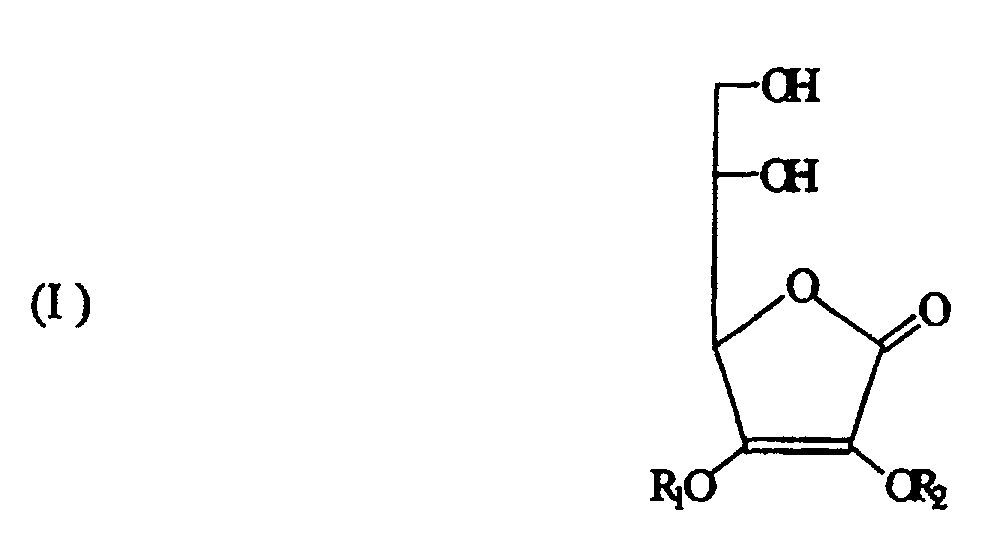
- the present invention relates to novel ascorbic acid derivatives and their synthetic method represented by the following general formula (I).
- R 1 and R 2 which are different, represents a hydrogen atom or a PEG moiety having the formula -CH 2 CH 2 -(O-CH 2 -CH 2 ) n -OR 3 obtainable from a polyethylene glycol derivative of the following general formula: R 3 -O-(CH 2 CH 2 O) n CH 2 CH 2 -X having a molecular weight of from 150 to 1000, wherein R 3 is a lower alkyl group having from 1 to 10 carbon atoms, X is a halogen or sulphonate, and n is an integer representing the number of repeating CH 2 CH 2 O units.
- L-ascorbic acid is one of the most potent compounds causing as an antioxidant in biological systems by scavenging active oxygen species and free radicals.
- L-ascorbic acid is a well-known water-soluble antioxidant that has a whitening effect and serves as a cofactor of prolinehydroxylase to promote synthesis of collagen (see. Quaglino, D. Jr., et al., J. Biol. Chem , p272-345, 1997).
- L-ascorbic acid is also used in various products requiring a long-term antioxidation effect. But, its usefulness for such products is not so reliable because it is susceptible to heat, light and air.
- L-ascorbic acid which is a water-soluble antioxidant, is almost insoluble in oil and fat (e.g., salad oil and lard oil).
- oil and fat e.g., salad oil and lard oil.
- vitamin C examples include L-ascorbic sold-6-palmitate, 2,6-dipalmitate, 6-stearate, L-ascorbic acid-3-O-ethyl and magnesium L-ascorbic acid-2-phosphate (see. Korean Patent No. 91-8733, and U.S. Patent Nos. 5,143,648; and 7,179,445).
- relatively fat-soluble derivatives of ascorbic acid are L-ascorbic acid-6-palmitate, 2,6-dipalmitate and 6-stearate.
- these derivatives still have a limitation in lasting their anti-oxidative activity because of their rapid decomposition in vitro.
- the inventors of this invention derive novel ascorbic acid derivatives having considerably high solubilities in both water and organic solvents due to a polyethylene glycol moiety introduced at the 2- or 3-hydroxyl group of L-ascorbic acid.
- the invention also includes a novel ascorbic acid derivative having high stability and long-lasting anti-oxidation effect.
- EP-0 146 121 A discloses ascorbic acid ethers in which the 2-hydroxyl is etherated with an organic residue having a molecular weight of 58 to 400.
- the present invention relates to a new stable ascorbic acid.
- an object of the present invention is to provide a novel ascorbic acid derivative that overcomes the drawbacks of the related art methods.
- the invention has solved the problems by introducing a polyethylene glycol moiety at the 2- or 3-hydroxyl group of L-ascorbic acid.
- the invention is also directed to an ascorbic acid derivative having a high solubility in both water and most organic solvents and an inhibitory activity against tyrosinase.
- the method includes: (i) reacting cesium ascorbate represented by the formula (V) with a derivative of polyethylene glycol represented by the formula (IV) in an appropriate solvent, wherein R 3 is a lower alkyl group having 1 to 10 carbon atoms; n is as defined above, and X is a halogen atom such Cl, Br and I, or sulfonate such as tosylate, triflate or tresylate.
- the method includes: (i) reacting the compound of the formula (V) with benzyl bromide in the presence of a solvent to form 3-O-benzyl ascorbic acid represented by the formula (VI); (ii) reacting 3-O-benzyl ascorbic acid of the formula (VI) with PEG-I in the presence of cesium carbonate in a solvent to form 3-O-benzyl-2-polyethyleneglycolyl-ascorbic acid represented by the formula (VII); and (iii) hydrogenating the compound of the formula (VII) in the presence of a catalyst.
- Bn is benzyl group
- PEG is CH 2 CH 2 -(O-CH 2 -CH 2 ) n -OR 3 , wherein n and R 3 are defined as above.
- a method for preparing a compound of the formula (I) includes: (i) reacting a compound represented by the formula (VIII) with a derivative of polyethylene glycol represented by the formula (IV) in the presence of a base in a solvent; and (ji) hydrolyzing the product in the presence of an acid catalyst, wherein R 4 and R 5 are the same or different and independently hydrogen atom, methyl group, ethyl group, or -(CH 2 ) m bonded to R 4 and R 5 , wherein m is 4 or 5; and R 6 is hydrogen atom, benzyl group or paramethoxybenzyl group.
- the invention relates to an ascorbic acid derivative which stability is improved by introducing of polyethylene glycol group at the 2- or 3-hydroxyl group of ascorbic acid.
- the novel ascorbic acid derivative can be prepared by two methods: (1) the one method involves preparing a 5,6-O-acetal or ketal of ascorbic acid, introducing a polyethylene glycol group at the 3-OH position of the protected ascorbic acid in the presence of a base, and then eliminating the acetal or ketal group; and (2) the other method involves direct coupling of non-protected ascorbic acid with a polyethoxylated intermediate.
- PEG is -CH 2 CH 2 -(O-CH 2 -CH 2 -O) n OR 3 , wherein n and R 3 are defined as above; wherein R 3 is a lower alkyl group having 1 to 10 carbon atoms; n is an integer from 2 to 400; and X is a halogen atom (e.g., Cl, Br or I) or sulfonate (e.g., tosylate, triflate or tresylate).
- halogen atom e.g., Cl, Br or I
- sulfonate e.g., tosylate, triflate or tresylate
- the compound represented by the formula (IV) is denoted by PEG N -X, where N is the average molecular weight of PEG.
- the solvent used in this reaction is selected from the group consisting of dimethylsulfoxide (DMSO), dimethylformamide (DMF), hexamethyl phosphoramide (HMPA), N-methylpyrrolidone, pyrrolidone, dimethylacetamide (DMAC), 1,3-dimetyl-3,4,5,6-tetrahydro-2(1H)-pyrimidinone (DMPU), and mixtures thereof.
- DMSO dimethylsulfoxide
- DMF dimethylformamide
- HMPA hexamethyl phosphoramide
- DMAC dimethylacetamide
- DMPU 1,3-dimetyl-3,4,5,6-tetrahydro-2(1H)-pyrimidinone
- the compound of the formula (V) as used herein is prepared by reacting ascorbic acid with cesium carbonate in water as a solvent and crystallizing the crude cesium ascorbate in isopropyl alcohol.
- the final product is obtained from non-protected ascorbic acid, the compound represented by the formula (V) reacts with benzyl bromide in a solvent to give 3-O-benzyl ascorbic acid represented by the formula (VI) and then the compound of formula (VI) is coupled with PEG-I in the presence of cesium carbonate, followed by catalytic hydrogenation, to give a compound represented by the formula (III).
- the solvent used in the above reaction is selected from the group consisting of dimethylsulfoxide (DMSO), dimethylformamide (DMF), hexamethyl phosphoramide (HMPA), N-methylpyrrolidone, pyrrolidone, dimethylacetamide (DMAC), 1,3-dimetyl-3,4,5,6-tetrahydro-2(1H)-Pyrimidinone (DMPU), and mixtures thereof.
- DMSO dimethylsulfoxide
- DMF dimethylformamide
- HMPA hexamethyl phosphoramide
- DMAC dimethylacetamide
- DMPU 1,3-dimetyl-3,4,5,6-tetrahydro-2(1H)-Pyrimidinone
- Another method for preparing a compound represented by the formula (I) involves synthesizing a 5,6-O-acetal or ketal of ascorbic acid , introducing a PEG group at the 3-hydroxyl position of ascorbic acid and eliminating the acetal or ketal group. More particularly, an ascorbic acid derivative represented by the formula (II) is prepared as follows.
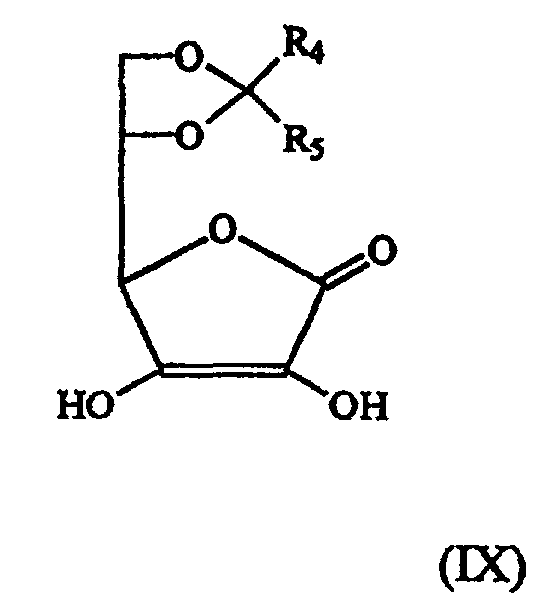
- a 5,6-O-acetal or ketal ascorbic acid derivative represented by the formula (IX) reacts with a derivative of polyethylene glycol represented by the formula (IV) in the presence of a base in a suitable solvent to produce a compound represented by the formula (X).
- a derivative of polyethylene glycol represented by the formula (IV) has a molecular weight of from150 to 20000, more preferably, 300 to 1000.
- alkyl group denoted by R 3 in the formula (IX) include methyl, ethyl, n-propyl, isopropyl, n-butyl, isobutyl, sec-butyl, t-butyl, n-methyl, n-hexyl, n-heptyl, n-octyl, n-nonyl and n-desyl
- the said halogen atom include chlorine, bromine and iodine
- examples of sulfonate include tosylate, triflate and tresylate.
- the 5,6-O-acetal or ketal ascorbic acid derivative represented by the formula (IX) is subjected to coupling reaction with the compound of the formula (IV) in the presence of a suitable base.
- a suitable base include sodium hydroxide, potassium hydroxide, sodium carbonate, potassium carbonate, cesium carbonate and sodium hydride.
- the suitable solvent include dimethylformamide, dimethylsulfoxide, hexamethyl phosphoramide, N-methylpyrrolidone, pyrrolidone and dimethylacetamide.
- the reaction temperature is from 10 to 90 °C and the reaction time is from 1 to 24 hours.
- the resulting compound is polyethoxylated ascorbic acid represented by the formula (II).
- the above hydrolysis reaction is performed in the presence of an acid catalyst
- the examples of the said catalyst include hydrochloric acid, sulfuric acid, p-toluenesulfonic acid, camphorsulfonic acid and acetic acid.
- the solvent include methanol, ethanol, methylene chloride, 1,2-methoxyethane and tetrahydrofuran.
- the reaction temperature is from 0 to 70 °C and the reaction time is from 1 to 12 hours.
- a ascorbic acid derivative represented by the formula (III) can be prepared by synthesizing 5,6-O-acetal or ketal of ascorbic acid, introducing PEG group at the 3-hydroxyl position of ascorbic acid, and eliminating the acetal or ketal.
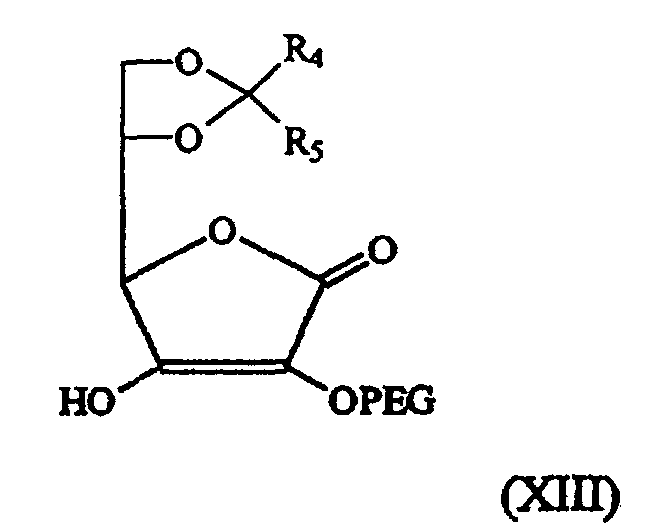
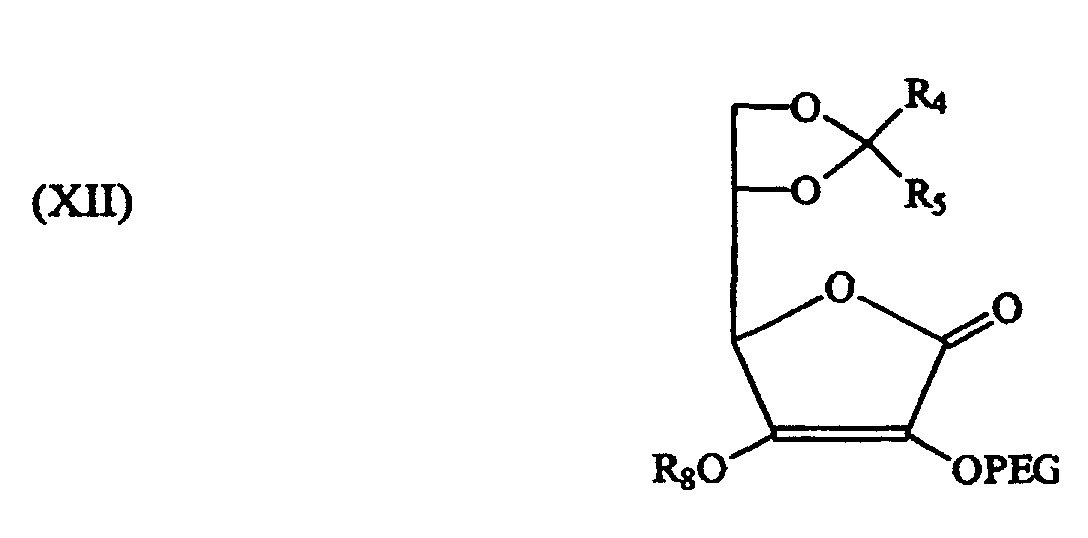
- This method is analogous to the above-stated preparing method for an ascorbic acid derivative represented by the formula (II). More specifically, the compound of the formula (IV) reacts with a derivative of polyethylene glycol represented by the formula (IV) in the presence of a base to produce a compound of the formula (XII), followed by catalytic hydrogenation, to give a compound of the formula (XIII).
- This compound is then hydrolyzed to produce a compound represented by the formula (III): wherein R 4 and R 5 are defined as above; and R 8 is benzyl or paramethoxybenzyl group; wherein R 4 , R 5 and PEG are defined as above; and
- the compound of the formula (XI) is obtained by selectively introducing at the 3-hydroxy position of an ascorbic acid with benzyl or paramethoxybenzyl group that can be easily removed through catalytic reduction.
- the selection of an appropriate solvent and reaction temperature is of importance.
- the solvent include dimethylformamide, dimethylsulfoxide, N-methylpyrrolidone, methylethylketone, acetone, methanol and tetrahydrofuran.
- Examples of the base used include sodium carbonate, potassium carbonate, cesium carbonate, sodium hydride and potassium t-butylalkoxide.
- the reaction temperature is from 5 to 50 °C and the reaction time is about from 1 to 12 hours.
- a compound of the formula (XII) is coupled with a compound of the formula (IV) in the presence of a suitable base.
- a suitable base include sodium hydroxide, potassium hydroxide, sodium carbonate, potassium carbonate, cesium carbonate and sodium hydride.
- the above hydrolysis reaction is performed in the presence of an acid catalyst
- the examples of the said catalyst include hydrochloric acid, sulfuric acid, p-toluenesulfonic acid, camphorsulfonic acid and acetic acid.
- the solvent used for the hydrolysis include methanol, ethanol, methylene chloride, 1,2-methoxyethane and tetrahydrofuran.
- the reaction temperature is from 0 to 70 °C and the reaction time is from I to 12 hours.
- the reduction is performed in the presence of a catalyst, e.g., palladium-carbon, platinum black and platinum oxide in an organic solvent, e.g., methanol, ethanol and ethylacetate.
- a catalyst e.g., palladium-carbon, platinum black and platinum oxide in an organic solvent, e.g., methanol, ethanol and ethylacetate.
- PEG 550 -Cl (3.1 g, 5.45 mmol), prepared from the existing literature (Zalipsky, S. et al., Eur. Polym. J . 19 , 1177, 1983) was dissolved in 5 ml of acetone, followed by the addition of sodium iodide. The reaction mixture was refluxed for 24 hours and cooled to room temperature. After removal of the solvent under reduced pressure, the concentrate was diluted with methylene chloride. The diluted solution was washed with 5% sodium hydrosulfide and the separated aqueous layer was extracted with methylene chloride again. The combined organic layer was dried over sodium sulfate and concentrated under reduced pressure to obtain 3.3 g of PEG 550 -I as an oil phase (yield 95%).
- Ascorbic acid (5 g, 28.4 mmol) was dissolved in 20 ml of water, followed by slow addition of cesium carbonate (4.63 g, 14.2 mmol) in the temperature range of 0 to 5 °C. 40 ml of isopropyl alcohol was slowly added to the reaction mixture when the generation of carbon dioxide completely stopped. After standing for several hours, the precipitate was filtered and washed with isopropyl alcohol, and dried to give 8.4 g of the cesium ascorbate as a white solid (yield 95%).
- Ascorbic acid (10 g, 56.8 mmol) was dissolved in 60 ml of dimethylsulfoxide, followed by addition pf cesium carbonate (9.25 g, 28.4 mmol). After 20 minutes, benzyl bromide (6.75 ml, 56.8 mmol) was added to the reaction mixture and heated to 50 °C for 18 hours. The reaction mixture was cooled down to the room temperature and diluted with 150 ml of dichloromethane to produce a solid. After filtration, the filtrate was concentrated under reduced pressure and purified by column chromatography on silica gel to give 7.2 g of the 3-O-benzyl ascorbic acid (yield 48%).
- 3-O-benzyl-ascorbic acid (0.5 g, 1.88 mmol), obtained from example 2-(1), was dissolved in 4 ml of dimethylsulfoxide, followed by addition of cesium carbonate (3.6 mg, 0.94 mmol). After 20 minutes, PEG 550 -I (1.12 g, 1.7 mmol) was added to the reaction mixture and heated to 60 °C for 1.5 hours. The reaction mixture was cooled down to the room temperature and extracted with methylene chloride. The organic layer was washed with water, dried over sodium sulfate and then concentrated under reduced pressure. The concentrate was purified by column chromatography on silica gel to give 830 mg of the 3-O-benzyl-2- PEG 550 -ascorbic acid as a waxy liquid (yield 61%).
- 3-O-benzyl-2-O-PEG 550 -ascorbic acid (4.04 g, 5 mmol), obtained from example 2-(2), was dissolved in 40 ml of methanol, followed by addition of palladium-charcoal (400 mg) and 10% Pd-C catalyst. The reaction mixture was stirred at the room temperature for 2 hours under the hydrogen atmosphere. The reaction mixture was then filtered and washed with methanol. The filtrate was concentrated under reduced pressure to give 3.0 g of the 3-O-benzyl-2- PEG 550 -ascorbic acid as a sticky oil (yield 85%).
- Tyrosinase extracted from mushrooms was purchases from Sigma Co.
- L-tyrosine as a substrate was dissolved in a 0.05M phosphate buffer solution (pH 6.8) to have a concentration of 1.5 mM.
- 0.01 ml of this solution was added to a 0.3ml spectrophotometer cuvette, followed by 0.01 ml of 0.06 mM dihydroxyphenylalamine (DOPA) as a cofactor.
- DOPA dihydroxyphenylalamine
- To this solution were added compounds of Formulas (II) and (III) and the phosphate buffer solution to have the total volume of 0.1 ml.
- 0.1 ml of enzyme solution containing 60 U/ml of tyrosinase in the phosphate buffer solution was added to the substrate solution.
- Inhibitory Rate (%) [(A-B)/A] ⁇ 100 wherein A is the absorbance at 475 nm in a solution containing no inhibitor, and B is the absorbance at 475 nm in a solution containing an inhibitor.
- Tyrosinase Inhibitory Activity Compound IC 50 ( ⁇ 10 -3 M) 3-O-PEG 350 -ascorbic acid 9.80 3-O-PEG 550 -ascorbic acid 7.06 2-O-PEG 350 -ascorbic acid 1.97 2-O-PEG 550 -ascorbic acid 7.06 3-O-Ethyl-ascorbic acid 9.80 Ascorbic acid 0.47
- DPPH 1,1-diphenyl-2-picrylhydrazyl
- the novel ascorbic acid derivatives of this invention were slightly inferior in the radical scavenging effect to a free ascorbic acid, which 2-OH and 3-OH group was not substituted, but much superior to a known ascorbic acid derivative, 3-O-ethyl-ascorbic acid.
- the compounds polyethoxylated at the 2-hydroxyl position of ascorbic acid such as 2-O-PEG 350 ascorbic acid and 2-O-PEG 550 ascorbic acid showed a potent radical scavenging effect in a short time irrespective of their molecular weight
- the compounds polyethoxylated at the 3-hydroxyl position of ascorbic acid such as 3-O-PEG 350 ascorbic acid and 3-O-PBG 550 ascorbic acid had a significant difference in the radical scavenging effect depending on their molecular weight and showed persistency, i.e., an increase in the radical scavenging effect with an elapse of time.
- the novel ascorbic acid derivatives of this invention had a long-lasting stability in an aqueous solution relative to free ascorbic acid.
- the novel ascorbic acid derivatives of this invention have excellent characteristics such as long-lasting anti-oxidation effect, high solubility in both water and organic solvents, and high stability in an aqueous solution. Furthermore, the novel ascorbic acid derivatives are useful for feed, food, cosmetic and pharmaceutical products due to their low toxicity and high thermal stability.
Landscapes
- Chemical & Material Sciences (AREA)
- Organic Chemistry (AREA)
- Health & Medical Sciences (AREA)
- Life Sciences & Earth Sciences (AREA)
- Pharmacology & Pharmacy (AREA)
- Public Health (AREA)
- Chemical Kinetics & Catalysis (AREA)
- General Chemical & Material Sciences (AREA)
- Medicinal Chemistry (AREA)
- Nuclear Medicine, Radiotherapy & Molecular Imaging (AREA)
- Biochemistry (AREA)
- Animal Behavior & Ethology (AREA)
- General Health & Medical Sciences (AREA)
- Toxicology (AREA)
- Veterinary Medicine (AREA)
- Cosmetics (AREA)
- Pharmaceuticals Containing Other Organic And Inorganic Compounds (AREA)
- Medicinal Preparation (AREA)
- Furan Compounds (AREA)
- Anti-Oxidant Or Stabilizer Compositions (AREA)
- Organic Low-Molecular-Weight Compounds And Preparation Thereof (AREA)
- Nitrogen Condensed Heterocyclic Rings (AREA)
Abstract
Description
- The present invention relates to novel ascorbic acid derivatives and their synthetic method represented by the following general formula (I).wherein R1 and R2, which are different, represents a hydrogen atom or a PEG moiety having the formula -CH2CH2-(O-CH2-CH2)n-OR3 obtainable from a polyethylene glycol derivative of the following general formula:

- L-ascorbic acid is one of the most potent compounds causing as an antioxidant in biological systems by scavenging active oxygen species and free radicals.
- L-ascorbic acid is a well-known water-soluble antioxidant that has a whitening effect and serves as a cofactor of prolinehydroxylase to promote synthesis of collagen (see. Quaglino, D. Jr., et al., J. Biol. Chem, p272-345, 1997).
- L-ascorbic acid is also used in various products requiring a long-term antioxidation effect. But, its usefulness for such products is not so reliable because it is susceptible to heat, light and air.
- As such, many studies have been made on the development of ascorbic acid derivatives with enhanced stability while maintaining the antioxidation activity. Notably, a common way to improve the stability of L-ascorbic acid is converting a 2- or 3-hydroxyl group of L-ascorbic acid to another substituent (see. U.S. Patent 5,143,648; 4,780,549; and 4,177,445, Japanese Patent Sho 52-18191, and Korean Patent No. 91-8733).
- L-ascorbic acid, which is a water-soluble antioxidant, is almost insoluble in oil and fat (e.g., salad oil and lard oil). Thus, there is a need of developing ascorbic acid derivatives that have a relatively high solubility in both water and organic solvents, for various use as an antioxidant in foods and cosmetics.
- Examples of commercially available derivatives of vitamin C include L-ascorbic sold-6-palmitate, 2,6-dipalmitate, 6-stearate, L-ascorbic acid-3-O-ethyl and magnesium L-ascorbic acid-2-phosphate (see. Korean Patent No. 91-8733, and U.S. Patent Nos. 5,143,648; and 7,179,445).
- Among these compounds, relatively fat-soluble derivatives of ascorbic acid are L-ascorbic acid-6-palmitate, 2,6-dipalmitate and 6-stearate. Despite the improved chemical stability, these derivatives still have a limitation in lasting their anti-oxidative activity because of their rapid decomposition in vitro.
- In an attempt to overcome these problems, the inventors of this invention derive novel ascorbic acid derivatives having considerably high solubilities in both water and organic solvents due to a polyethylene glycol moiety introduced at the 2- or 3-hydroxyl group of L-ascorbic acid. The invention also includes a novel ascorbic acid derivative having high stability and long-lasting anti-oxidation effect.
- EP-0 146 121 A discloses ascorbic acid ethers in which the 2-hydroxyl is etherated with an organic residue having a molecular weight of 58 to 400.
- The present invention relates to a new stable ascorbic acid.
- It is therefore an object of the present invention is to provide a novel ascorbic acid derivative that overcomes the drawbacks of the related art methods.
- The invention has solved the problems by introducing a polyethylene glycol moiety at the 2- or 3-hydroxyl group of L-ascorbic acid. The invention is also directed to an ascorbic acid derivative having a high solubility in both water and most organic solvents and an inhibitory activity against tyrosinase.
- It is another object of the present invention to provide a method for prepazing such an ascorbic acid derivatives.
- To achieve the above object, there is provided a novel ascorbic acid derivative represented by the formula (I) and a method for preparing the same:wherein R1 and R2, which are different, represents a hydrogen atom or a PEG moiety having the formula -CH2CH2-(O-CH2-CH2)n-OR3 obtainable from a polyethylene glycol derivative of the following general formula:

- There is also provided a method for preparing an ascorbic acid derivative represented by the formula (I), wherein R1 represents -CH2CH2-(O-CH2-CH2)n-OR3, wherein n and R3 are defined as above. The method includes: (i) reacting cesium ascorbate represented by the formula (V) with a derivative of polyethylene glycol represented by the formula (IV) in an appropriate solvent,
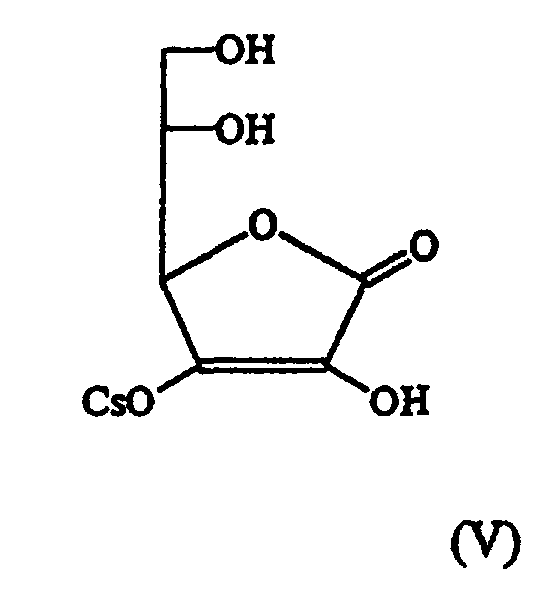 wherein R3 is a lower alkyl group having 1 to 10 carbon atoms; n is as defined above, and X is a halogen atom such Cl, Br and I, or sulfonate such as tosylate, triflate or tresylate.
- There is also provided a method for preparing a ascorbic acid derivative represented by the formula (I), wherein R1 is a hydrogen atom and R2 represents-CH2CH2-(O-CH2-CH2)n-OR3, wherein n and R3 are defined as above. More specifically, according to Scheme 1, the method includes: (i) reacting the compound of the formula (V) with benzyl bromide in the presence of a solvent to form 3-O-benzyl ascorbic acid represented by the formula (VI); (ii) reacting 3-O-benzyl ascorbic acid of the formula (VI) with PEG-I in the presence of cesium carbonate in a solvent to form 3-O-benzyl-2-polyethyleneglycolyl-ascorbic acid represented by the formula (VII); and (iii) hydrogenating the compound of the formula (VII) in the presence of a catalyst.
 wherein Bn is benzyl group; and PEG is CH2CH2-(O-CH2-CH2)n-OR3, wherein n and R3 are defined as above.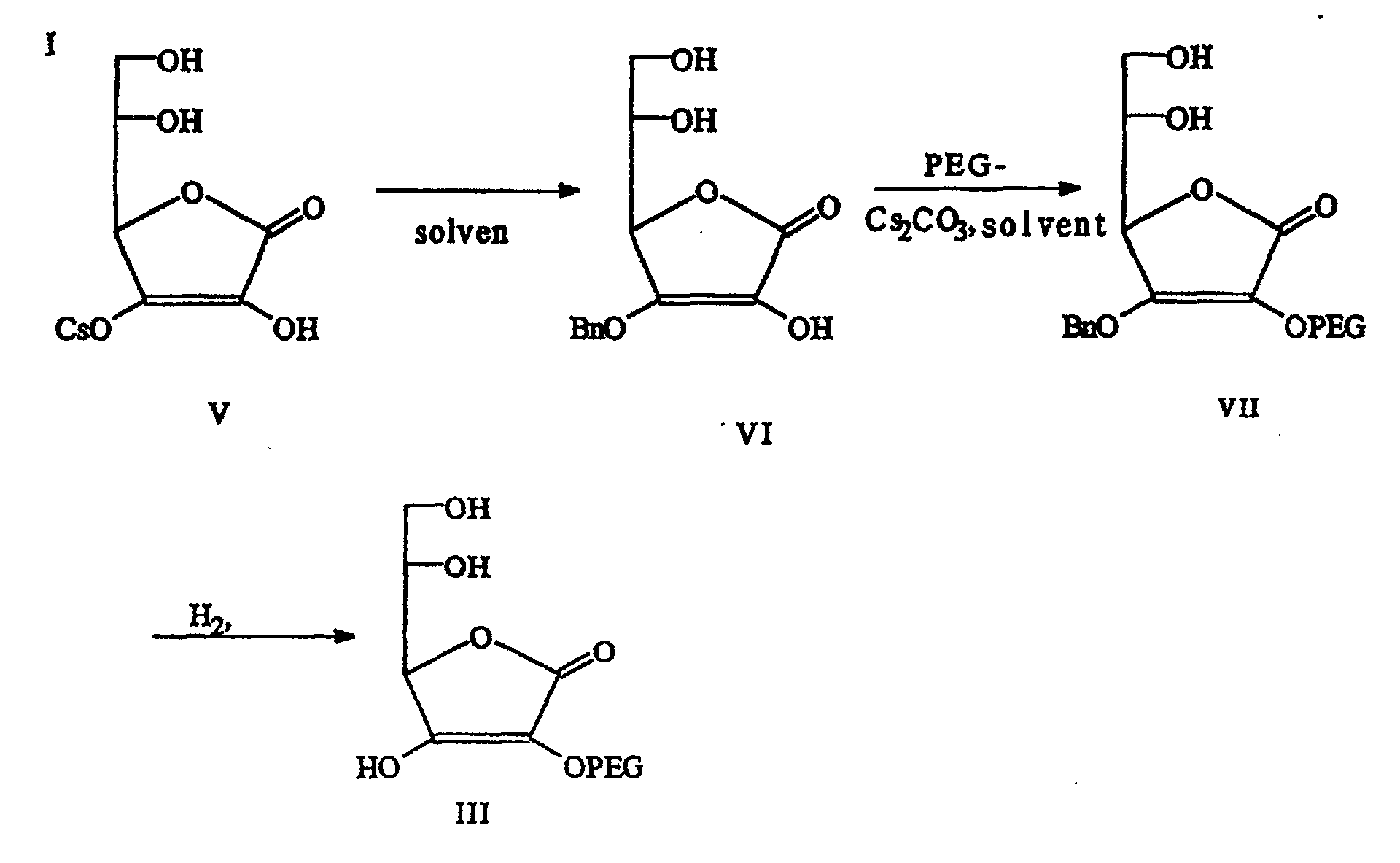
- Furthermore, a method for preparing a compound of the formula (I) includes: (i) reacting a compound represented by the formula (VIII) with a derivative of polyethylene glycol represented by the formula (IV) in the presence of a base in a solvent; and (ji) hydrolyzing the product in the presence of an acid catalyst,
 wherein R4 and R5 are the same or different and independently hydrogen atom, methyl group, ethyl group, or -(CH2)m bonded to R4 and R5, wherein m is 4 or 5; and R6 is hydrogen atom, benzyl group or paramethoxybenzyl group.
- Hereinafter, the present invention will be described in further detail.
- The invention relates to an ascorbic acid derivative which stability is improved by introducing of polyethylene glycol group at the 2- or 3-hydroxyl group of ascorbic acid.
- The novel ascorbic acid derivative can be prepared by two methods: (1) the one method involves preparing a 5,6-O-acetal or ketal of ascorbic acid, introducing a polyethylene glycol group at the 3-OH position of the protected ascorbic acid in the presence of a base, and then eliminating the acetal or ketal group; and (2) the other method involves direct coupling of non-protected ascorbic acid with a polyethoxylated intermediate.
- In the first method, in which the final product is obtained from non-protected ascorbic acid, cesium ascorbate represented by the formula (V) reacts with a derivative of polyethylene glycol represented by the formula (IV) in a suitable solvent to produce the compound represented by the formula (II).wherein PEG is -CH2CH2-(O-CH2-CH2-O)nOR3, wherein n and R3 are defined as above;
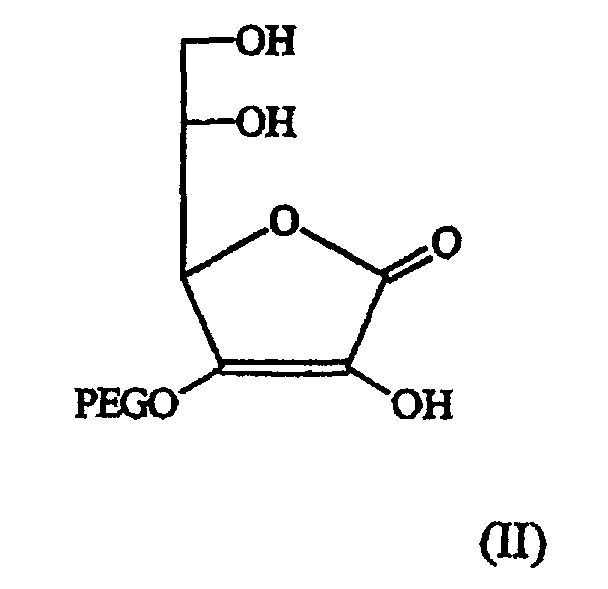 wherein R3 is a lower alkyl group having 1 to 10 carbon atoms; n is an integer from 2 to 400; and X is a halogen atom (e.g., Cl, Br or I) or sulfonate (e.g., tosylate, triflate or tresylate).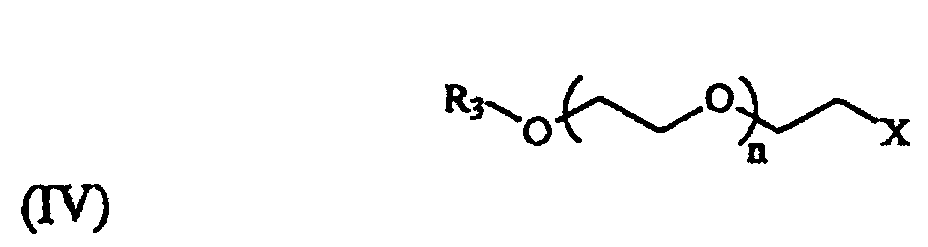

- The compound represented by the formula (IV) is denoted by PEGN-X, where N is the average molecular weight of PEG.
- The solvent used in this reaction is selected from the group consisting of dimethylsulfoxide (DMSO), dimethylformamide (DMF), hexamethyl phosphoramide (HMPA), N-methylpyrrolidone, pyrrolidone, dimethylacetamide (DMAC), 1,3-dimetyl-3,4,5,6-tetrahydro-2(1H)-pyrimidinone (DMPU), and mixtures thereof.
- The compound of the formula (V) as used herein is prepared by reacting ascorbic acid with cesium carbonate in water as a solvent and crystallizing the crude cesium ascorbate in isopropyl alcohol.
- In the second method, the final product is obtained from non-protected ascorbic acid, the compound represented by the formula (V) reacts with benzyl bromide in a solvent to give 3-O-benzyl ascorbic acid represented by the formula (VI) and then the compound of formula (VI) is coupled with PEG-I in the presence of cesium carbonate, followed by catalytic hydrogenation, to give a compound represented by the formula (III).
- The solvent used in the above reaction is selected from the group consisting of dimethylsulfoxide (DMSO), dimethylformamide (DMF), hexamethyl phosphoramide (HMPA), N-methylpyrrolidone, pyrrolidone, dimethylacetamide (DMAC), 1,3-dimetyl-3,4,5,6-tetrahydro-2(1H)-Pyrimidinone (DMPU), and mixtures thereof.
- Another method for preparing a compound represented by the formula (I) involves synthesizing a 5,6-O-acetal or ketal of ascorbic acid , introducing a PEG group at the 3-hydroxyl position of ascorbic acid and eliminating the acetal or ketal group. More particularly, an ascorbic acid derivative represented by the formula (II) is prepared as follows.
- First, a 5,6-O-acetal or ketal ascorbic acid derivative represented by the formula (IX) reacts with a derivative of polyethylene glycol represented by the formula (IV) in the presence of a base in a suitable solvent to produce a compound represented by the formula (X).
- Subsequently, an acetal or ketal group of the compound of the formula (X), is eliminated in the presence of an acid catalyst to obtain an ascorbic acid derivative represented by the formula (II):wherein R4 and R5 are defined as above; and
 wherein R4, R5 and PEG are defined as above.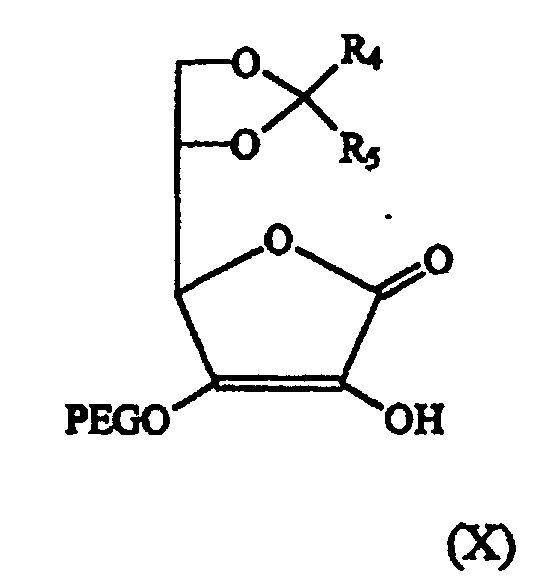
- Preferably, a derivative of polyethylene glycol represented by the formula (IV) has a molecular weight of from150 to 20000, more preferably, 300 to 1000. Examples of the alkyl group denoted by R3 in the formula (IX) include methyl, ethyl, n-propyl, isopropyl, n-butyl, isobutyl, sec-butyl, t-butyl, n-methyl, n-hexyl, n-heptyl, n-octyl, n-nonyl and n-desyl Examples of the said halogen atom include chlorine, bromine and iodine, and examples of sulfonate include tosylate, triflate and tresylate.
- To prepare the compound of the formula (X), the 5,6-O-acetal or ketal ascorbic acid derivative represented by the formula (IX) is subjected to coupling reaction with the compound of the formula (IV) in the presence of a suitable base. Examples of the said base include sodium hydroxide, potassium hydroxide, sodium carbonate, potassium carbonate, cesium carbonate and sodium hydride. Examples of the suitable solvent include dimethylformamide, dimethylsulfoxide, hexamethyl phosphoramide, N-methylpyrrolidone, pyrrolidone and dimethylacetamide. Preferably, the reaction temperature is from 10 to 90 °C and the reaction time is from 1 to 24 hours.
- The compound of the formula (X), obtained from O-alkylation at 3-position of the 5,6-acetal or ketal ascorbic acid derivative, is hydrolyzed to eliminate an acetal or ketal group present at hydroxyl groups at 5- and 6-positions of ascorbic acid, followed by appropriate isolation and purification. The resulting compound is polyethoxylated ascorbic acid represented by the formula (II).
- The above hydrolysis reaction is performed in the presence of an acid catalyst, the examples of the said catalyst include hydrochloric acid, sulfuric acid, p-toluenesulfonic acid, camphorsulfonic acid and acetic acid. Examples of the solvent include methanol, ethanol, methylene chloride, 1,2-methoxyethane and tetrahydrofuran. Preferably, the reaction temperature is from 0 to 70 °C and the reaction time is from 1 to 12 hours.
- Alternatively, a ascorbic acid derivative represented by the formula (III) can be prepared by synthesizing 5,6-O-acetal or ketal of ascorbic acid, introducing PEG group at the 3-hydroxyl position of ascorbic acid, and eliminating the acetal or ketal. This method is analogous to the above-stated preparing method for an ascorbic acid derivative represented by the formula (II). More specifically, the compound of the formula (IV) reacts with a derivative of polyethylene glycol represented by the formula (IV) in the presence of a base to produce a compound of the formula (XII), followed by catalytic hydrogenation, to give a compound of the formula (XIII). This compound is then hydrolyzed to produce a compound represented by the formula (III):wherein R4 and R5 are defined as above; and R8 is benzyl or paramethoxybenzyl group;
 wherein R4, R5 and PEG are defined as above; and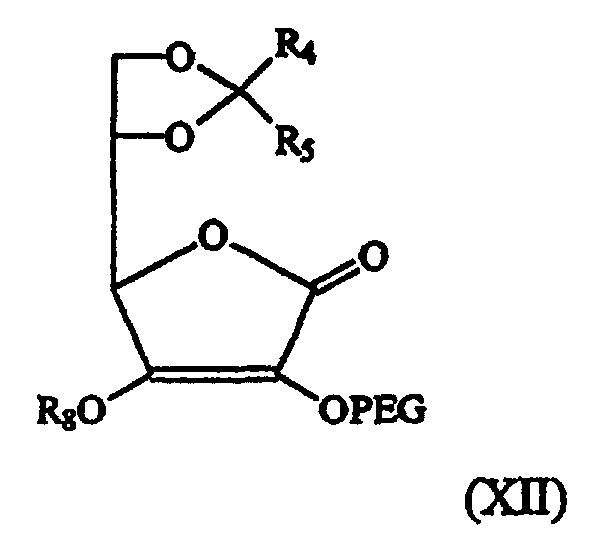
- The compound of the formula (XI) is obtained by selectively introducing at the 3-hydroxy position of an ascorbic acid with benzyl or paramethoxybenzyl group that can be easily removed through catalytic reduction. To enhance the selectivity of benzylation, the selection of an appropriate solvent and reaction temperature is of importance. Examples of the solvent include dimethylformamide, dimethylsulfoxide, N-methylpyrrolidone, methylethylketone, acetone, methanol and tetrahydrofuran.
- Examples of the base used include sodium carbonate, potassium carbonate, cesium carbonate, sodium hydride and potassium t-butylalkoxide.
- Preferably, the reaction temperature is from 5 to 50 °C and the reaction time is about from 1 to 12 hours.
- To prepare a compound of the formula (XII), a compound of the formula (XI) is coupled with a compound of the formula (IV) in the presence of a suitable base. Examples of the said base include sodium hydroxide, potassium hydroxide, sodium carbonate, potassium carbonate, cesium carbonate and sodium hydride.
- The resulting compound of the formula (XII) is reduced into a compound represented by the formula (XIII), which is then hydrolyzed to give a compound represented by the formula (III).
- The above hydrolysis reaction is performed in the presence of an acid catalyst, the examples of the said catalyst include hydrochloric acid, sulfuric acid, p-toluenesulfonic acid, camphorsulfonic acid and acetic acid. Examples of the solvent used for the hydrolysis include methanol, ethanol, methylene chloride, 1,2-methoxyethane and tetrahydrofuran. Preferably, the reaction temperature is from 0 to 70 °C and the reaction time is from I to 12 hours.
- The reduction is performed in the presence of a catalyst, e.g., palladium-carbon, platinum black and platinum oxide in an organic solvent, e.g., methanol, ethanol and ethylacetate.
- The present invention will be described below in further detail, which are not intended to limit the present invention.
- PEG550-Cl (3.1 g, 5.45 mmol), prepared from the existing literature (Zalipsky, S. et al., Eur. Polym. J. 19, 1177, 1983) was dissolved in 5 ml of acetone, followed by the addition of sodium iodide. The reaction mixture was refluxed for 24 hours and cooled to room temperature. After removal of the solvent under reduced pressure, the concentrate was diluted with methylene chloride. The diluted solution was washed with 5% sodium hydrosulfide and the separated aqueous layer was extracted with methylene chloride again. The combined organic layer was dried over sodium sulfate and concentrated under reduced pressure to obtain 3.3 g of PEG550-I as an oil phase (yield 95%).
- 1H-NMR(CDCl3): δ 3.76(t, J=6.9 Hz, 2H), 3.67 (bs, -OCH2CH2-), 3.56 (m, 2H), 3.38 (s, 3H), 3.27 (t, J=6.9 Hz, 2H)
- Ascorbic acid (5 g, 28.4 mmol) was dissolved in 20 ml of water, followed by slow addition of cesium carbonate (4.63 g, 14.2 mmol) in the temperature range of 0 to 5 °C. 40 ml of isopropyl alcohol was slowly added to the reaction mixture when the generation of carbon dioxide completely stopped. After standing for several hours, the precipitate was filtered and washed with isopropyl alcohol, and dried to give 8.4 g of the cesium ascorbate as a white solid (yield 95%).
- Ascorbic acid (560 mg, 3.18 mmol) was dissolved in 4 ml of dimethylsulfoxide, followed by addition of cesium carbonate (518 mg, 1.59 mmol). After 20 minutes, PEG550-I (1.94 g, 2.65 mmol, formula (TV)) obtained from Preparation Example 1 was added to the reaction mixture and heated to 60 °C for 18 hours. After removal of dimethylsulfoxide under reduced pressure, the resulting concentrated solution was diluted with methylene chloride and then followed by filtration. The filtrate was concentrated under reduced pressure and purified by column chromatography on silica gel to give 1.23 g of the title compound as a sticky oil (yield 66%).
- 1H-NMR(CDCl3): δ 4.78 (m, 1H), 4.67 (d, J=2.1 Hz, 1H), 4.45 (m, 1H), 4.00 (m, 1H), 3.8-3.5 (bs, -OCH2CH2-), 3.38 (s, 3H)
- Ascorbic acid (10 g, 56.8 mmol) was dissolved in 60 ml of dimethylsulfoxide, followed by addition pf cesium carbonate (9.25 g, 28.4 mmol). After 20 minutes, benzyl bromide (6.75 ml, 56.8 mmol) was added to the reaction mixture and heated to 50 °C for 18 hours. The reaction mixture was cooled down to the room temperature and diluted with 150 ml of dichloromethane to produce a solid. After filtration, the filtrate was concentrated under reduced pressure and purified by column chromatography on silica gel to give 7.2 g of the 3-O-benzyl ascorbic acid (yield 48%).
- 1H-NMR(CDCl3): δ 7.3 (m, 5H), 5.51 (d, J=11.7 Hz, 1H), 5.43 (d, J-11.7 Hz, 1H), 4.64 (d, J=1.8 Hz, 1H), 4.2-3.0 (m, 7H)
- 3-O-benzyl-ascorbic acid (0.5 g, 1.88 mmol), obtained from example 2-(1), was dissolved in 4 ml of dimethylsulfoxide, followed by addition of cesium carbonate (3.6 mg, 0.94 mmol). After 20 minutes, PEG550-I (1.12 g, 1.7 mmol) was added to the reaction mixture and heated to 60 °C for 1.5 hours. The reaction mixture was cooled down to the room temperature and extracted with methylene chloride. The organic layer was washed with water, dried over sodium sulfate and then concentrated under reduced pressure. The concentrate was purified by column chromatography on silica gel to give 830 mg of the 3-O-benzyl-2- PEG550-ascorbic acid as a waxy liquid (yield 61%).
- 1H-NMR(CDCl3): δ 7.4 (m, 5H), 5.62 (d, J=11.7 Hz, 1H), 5.56 (d, J-11.7 Hz, 1H), 4.70 (d, J=2.1 Hz, 1H), 4.40 (m, 1H, 4.20 (m, 1H). 3.98 (m, 1H), 3.8-3.5 (bs, -OCH2CH2-), 3.38 (s, 3H)
- 3-O-benzyl-2-O-PEG550-ascorbic acid (4.04 g, 5 mmol), obtained from example 2-(2), was dissolved in 40 ml of methanol, followed by addition of palladium-charcoal (400 mg) and 10% Pd-C catalyst. The reaction mixture was stirred at the room temperature for 2 hours under the hydrogen atmosphere. The reaction mixture was then filtered and washed with methanol. The filtrate was concentrated under reduced pressure to give 3.0 g of the 3-O-benzyl-2- PEG550-ascorbic acid as a sticky oil (yield 85%).
- 1H-NMR(CDCl3): δ 4.01 (br, J=4.8 Hz, 2H), 3.73 (m, 1H), 3.60 (br, t, 2H), 3.5 (bs, -OCH2CH2-), 3.23 (s, 3H)
-
- (1) 5,6-O-isopropylidene ascorbic acid (21.62 g, 0.1 mole) was dissolved in 150 ml of dimethylsulfoxide, followed by addition of potassium carbonate (8.29 g, 0.06 mole) and PEG350-I (46.0 g, 0.1 mole, Formula IV) at the room temperature. The reaction mixture was stirred at the room temperature for 1 hour and warmed to 50 °C for 4 hours. After cooled to the room temperature, the reaction mixture was diluted with 100 ml of dichloromethane. The diluted solution was washed with 50 ml of 10% aqueous sodium chloride solution three times and then dried over anhydrous magnesium sulfate, followed by filtration. The filtrate was concentrated under reduced pressure and purified on column chromatography (SiO2, 270-400 mesh, dichloromethane : methanol = 15:1, v/v), thus obtaining 44.95 g of 5,6-O-isopropylidene-3-O-PEG350-ascorbic acid (Formula X) as a sticky oi1 (yield 82%, purity 98%). 1H-NMR(CDCl3): δ 4.58 (m, 3H), 4.26 (m, 1H), 4.15 (t, 1H), 4.00 (m, 1H), 3.8-3.5 (bs, -OCH2CH2-), 338 (s, 3H), 1.35 (d, 6H)
- (2) 5,6-O-isopropylidene-3-O-PEG350-ascorbic acid (Formula X) (44.95 g, 0.082 mole) was dissolved in 140 ml of methanol and the reaction mixture was cooled to 0 °C. Then, 105 ml of 2M HCl was slowly added dropwise. The reaction mixture was slowly warmed to 25 °C and stirred at the room temperature for 3 hours. The reaction mixture was then neutralized with sodium bicarbonate and evaporated under reduced pressure to remove water and methanol. The concentrate was purified on column chromatography (SiO2, dichloromethane : methanol = 20:1, v/v) to give 37.50 g of 3-O-PEG350-ascorbic acid (Formula II) (yield 90%). 1H-NMR(CDCl3): δ 4.78 (m, 1H), 4.67 (d, 1H), 4.45 (m, 1H), 4.00 (m, 1H), 3.8-3.5 (bs, -OCH2CH2-), 338 (s, 3H)
- (3) 5,6-O-isopropylidene ascorbic acid (Formula IX) was prepared according to a known procedure specified in the literature [J. Med. Chem, 31, 793, 1988]. More specifically, 8.64 g (0.11 mole) of acetyl chloride was added to the mixture of 88.06g (0.5 mol) of L-ascorbic acid and acetone (500 g), and the reaction mixture was vigorously stirred at the room temperature for 12 hours, followed by filtration. The filter cake was washed with cold acetone and dried to obtain 84.51 g of 5,6-O-isopropylidene ascorbic acid as a while solid (yield: 78.2%).
- (4) PEG350-I (Formula IV) was prepared from polyethylene glycol monomethyl ether according to the following two-step synthesis: (i) polyethylene glycol monomethyl ether (350.0 g, 1.0 mole) was dissolved in 1 liter of toluene and dried by azeotropic distillation. 303.57 g (3.0 mole) of triethylamine was added to the solution and then 228.78 g (1.2 mole) of p-toluene sulfonyl chloride was slowly added at 10 °C. The reaction mixture was stirred for 1 hour at 10 °C and further 3.5 hours at 25 °C, followed by filtration. The filtrate was distilled under reduced pressure and diluted with 400 ml of water. The aqueous solution was extracted with 500 ml of n-hexane and further 1 liter of dichloromethane. The organic layer was dried over anhydrous magnesium sulfate, filtered and distilled under reduced pressure to obtain 494.10 g of PEG350OTs as a colorless liquid (yield 98%); and (ii) the resultant PEG350OTs (494.10 g, 0.98 mole) was dissolved in 850 ml of acetone and 218.87 g (1.47 mole) of sodium iodide was slowly added to the solution at the room temperature. The reaction mixture was heated to 50 °C and stirred for 8 hours to complete the reaction. The reaction mixture was cooled, filtered and distilled under reduced pressure. The residue was dissolved in dichloromethane and washed with water. The organic layer was dried over anhydrous magnesium sulfate, filtered and distilled under reduced pressure to obtain 432.72 g of PEG350I (yield 96.0%). 1H-NMR(CDCl3): δ 3.8-3.5 (bs, -OCH2CH2-), 3.38 (s, 3H), 3.24 (t, 2H)
-
-
- (1) 30.43 g (0.1 mole) of 5,6-O-isopropylidene-3-O-benzyl ascorbic acid (Formula XI) was dissolved in 150 ml of dimethylsulfoxide and 8.29 g (0.06 mole) of potassium carbonate was added to the solution. The reaction mixture was stirred for 30 minutes, followed by adding 46.0 g (0.1 mole) of PEG350-I. The reaction mixture was heated to 50 °C for 2 hours, cooled to the room temperature and diluted with 100 ml of dichloromethane. The diluted mixture was then washed with 50 ml of 10% aqueous sodium chloride solution three times. The organic layer was dried over anhydrous magnesium sulfate and filtered. The filtrate was distilled under reduced pressure and purified on column chromatography (SiO2, dichloromethane : methanol = 10:1, v/v) to give 54.9 g of 5,6-O-isopropylidene-3-O-benzyl-2-O-PEG350 ascorbic acid an oily product (Formula XII) (yield 86.0%).
- (2) 54.9 g (0.08 mole) of 5,6-O-isopropylidene-3-O-benzyl-2-O-PEG350 ascorbic acid (Formula XII) was dissolved in 80 ml of methanol and 10% pd-C (1.37 g) was added to the solution. The reaction mixture was stirred for 2 hours under hydrogen atmosphere and the catalyst was filtered out. The filtrate was concentrated under reduced pressure to give 43.14 g of 5,6-O-isopropylidene-2-O-PEG350 ascorbic acid (Formula XIII) (yield 91.5%).
- (3) 43.14 g (0.079 mole) of 5,6-O-isopropylidene-2-O- PEG350 ascorbic acid (Formula XIII) was dissolved in 140 ml of methanol, and 114 ml of 2M HCl was added to the solution at 0 °C. The reaction mixture was heated to 25 °C and stirred for 3 hours. The reaction mixture was neutralized with sodium bicarbonate and evaporated to remove water and ethanol under reduced pressure. The concentrated filtrate was purified on column chromatography (SiO2, dichloromethane : methanol = 20:1, v/v) to give 36.33 g of 2-O- PEG350 ascorbic acid (Formula III) (yield 90.5%). 1H-NMR(CDCl3): δ 4.0 (m, 2H), 3.73 (m, 1H), 3.60 (m, 2H), 3.5 (bs, -OCH2CH2-), 3.23 (s, 3H)
- (4) 5,6-O-isopropylidene-3-O-benzyl ascorbic acid (Formula XI) was prepared according to a known procedure specified in the literature (Terahedron, 52, 1293, 1996).
-
- Tyrosinase extracted from mushrooms was purchases from Sigma Co. First, L-tyrosine as a substrate was dissolved in a 0.05M phosphate buffer solution (pH 6.8) to have a concentration of 1.5 mM. 0.01 ml of this solution was added to a 0.3ml spectrophotometer cuvette, followed by 0.01 ml of 0.06 mM dihydroxyphenylalamine (DOPA) as a cofactor. To this solution were added compounds of Formulas (II) and (III) and the phosphate buffer solution to have the total volume of 0.1 ml. Then, 0.1 ml of enzyme solution containing 60 U/ml of tyrosinase in the phosphate buffer solution was added to the substrate solution. Meanwhile, a blank was prepared by adding only 0.1 ml of the phosphate buffer solution. The reaction was performed at 37 °C for 10 minutes. The absorbance was measured at 475 nm with a spectrophotometer (Beckman DU-7500) to determine the inhibitory rate against tyrosinase. IC50 value was determined as the concentration of the inhibitor whose inhibitory rate against the enzyme amounts to 50%. The inhibitory rate is calculated according to the following equation and the results are presented in Table 1.
Tyrosinase Inhibitory Activity (IC50) Compound IC50 (× 10-3 M) 3-O-PEG350-ascorbic acid 9.80 3-O-PEG550-ascorbic acid 7.06 2-O-PEG350-ascorbic acid 1.97 2-O-PEG550-ascorbic acid 7.06 3-O-Ethyl-ascorbic acid 9.80 Ascorbic acid 0.47 - The compounds prepared according to examples 1 to 4 were analyzed in regard to radical scavenging effect as follows.
- Measurement was made using the 1,1-diphenyl-2-picrylhydrazyl (DPPH) method [Blois, M.S. Nature, 1958, 181, 1190]. DPPH is a relatively stable radical with the maximum absorption at 517 nm. The absorption at this wavelength disappears upon removal of the radical. DPPH was purchased from Sigma Co. and dissolved in methanol to make the concentration of 0.5 mM.
- First, 100 µl of each solution (10-1 to 10-6 M) of the individual compounds prepared in examples 1 to 4 were placed in each well of a 96-well plate. After adding 100 µl of DPPH solution and standing the reaction mixture at the room temperature, the absorption at 517 nm was measured for each well using a micro plate reader (BioTeck EL-340). A blank solution was prepared to contain 100 µl of methanol instead of the above compounds. The concentration of the individual compounds was denoted by IC50 at the time when the absorption of the test sample becomes a half of that of the blank solution. The absorption was measured at 1 hour and at 24 hours after treatment. The results are presented in Table 2.
Radical Scavenging Effect Compound IC50 (× 10-3 M) After 1 hour After 24 hrs. 3-O-PEG350-ascorbic acid 78.7 5.9 3-O-PEG550-ascorbic acid 423.6 112.9 2-O-PEG350-ascorbic acid 7.9 5.9 2-O-PEG550-ascorbic acid 7.9 4.2 3-O-Ethyl-ascorbic acid 9.8 9.8 Ascorbic acid 3.4 3.4 - As shown in Table 2, the novel ascorbic acid derivatives of this invention were slightly inferior in the radical scavenging effect to a free ascorbic acid, which 2-OH and 3-OH group was not substituted, but much superior to a known ascorbic acid derivative, 3-O-ethyl-ascorbic acid. The compounds polyethoxylated at the 2-hydroxyl position of ascorbic acid, such as 2-O-PEG350 ascorbic acid and 2-O-PEG550 ascorbic acid showed a potent radical scavenging effect in a short time irrespective of their molecular weight Meanwhile, the compounds polyethoxylated at the 3-hydroxyl position of ascorbic acid, such as 3-O-PEG350 ascorbic acid and 3-O-PBG550 ascorbic acid had a significant difference in the radical scavenging effect depending on their molecular weight and showed persistency, i.e., an increase in the radical scavenging effect with an elapse of time.
- The compounds prepared in examples 1 to 4 were analyzed in regard to stability in an aqueous solution as follows.
- First, 0.1% aqueous solutions of the individual compounds of examples 1 to 4 and ascorbic acid were prepared. After 8 weeks, the changes in the contents of ascorbic acid derivatives depending on pH at 40 °C were measured by HPLC. The results are presented in Table 3 in terms of recovery rate (%) = (assay value after 8 weeks)/(initial assay value) × 100.
Stability in Aqueous Solution Compound Recovery Rate (%) pH 4 PH 5 PH 6 PH 7 3-O-PEG350-ascorbic acid 91.4 89.2 85.4 63.5 3-O-PEG550-ascorbic acid 78.5 70.8 61.3 42.5 2-O-PEG350-ascorbic acid 90.8 89.5 84.3 59.8 2-O-PEG550-ascorbic acid 91.1 89.9 85.7 62.4 3-O-Ethyl-ascorbic acid 91.0 89.1 86.0 65.0 Ascorbic acid 38.2 27.5 - - - As shown in Table 3, the novel ascorbic acid derivatives of this invention had a long-lasting stability in an aqueous solution relative to free ascorbic acid.
- As described above in detail, the novel ascorbic acid derivatives of this invention have excellent characteristics such as long-lasting anti-oxidation effect, high solubility in both water and organic solvents, and high stability in an aqueous solution. Furthermore, the novel ascorbic acid derivatives are useful for feed, food, cosmetic and pharmaceutical products due to their low toxicity and high thermal stability.
Claims (12)
- An ascorbic acid derivative represented by the following general formula (I):wherein R1 and R2, which are different, represents a hydrogen atom or a PEG moiety having the formula -CH2CH2-(O-CH2-CH2)n-OR3 obtainable from a polyethylene glycol derivative of the following general formula:
- The compound of claim 1, wherein X is a halogen atom selected from chlorine, bromine and iodine or a sulfonate selected from tosylate, triflate or tresylate.
- The compound of claim 1, wherein the compound represented by the formula (I) is a compound represented by the following formula (II):wherein PEG represents a PEG moiety of the formula -CH2CH2-(O-CH2-CH2)n-OR3 as defined in claim 1 or 2.

- The compound of claim 1, wherein said the compound represented by the formula (I) is a compound represented by the following formula (III):wherein PEG represents a PEG moiety of the formula -CH2CH2-(O-CH2-CH2)n-OR3 as defined in claim 1 or 2.

- A process for preparing the compound of formula (II) as defined in claim 3 which is characterized in that;
a compound of formula (V) :is reacted with a polyethylene glycol derivative of formula (IV) in the presence of a solvent wherein R3, n and X are as defined in claim 1 or 2.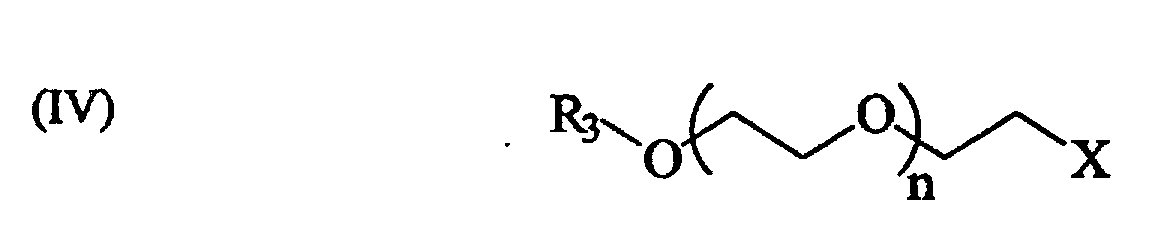
- A process for preparing the compound of formula (II) as defined in claim 3 which is characterized in that;
a compound of formula (IX):wherein R4 and R5, which are the same or different, are independently a hydrogen atom, a methyl group or an ethyl group , or when taken together represent the group -(CH2)m- in which m is 4 or 5 is reacted with a polyethylene glycol derivative of formula (IV) as defined in claim 5 in the presence of an appropriate base and a solvent to give a compound of the formula (X) followed by hydrolysis of the compound of formula (X) with an acid catalyst.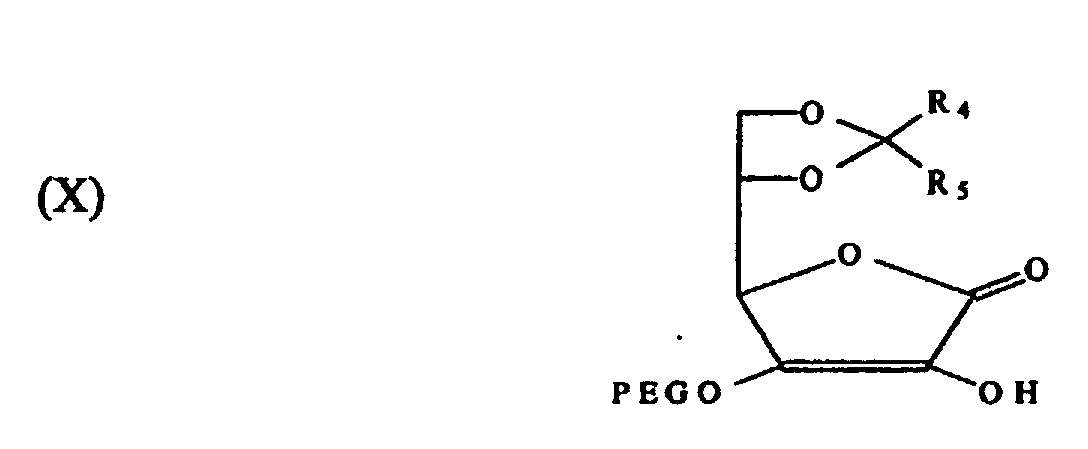
- A process for preparing the compound of formula (III) as defined in claim 4 which is characterized in that;
a compound of formula (VI):is reacted with a polyethylene glycol derivative of formula (IV) as defined in claim 5 in the presence of an appropriate base and a solvent to give the compound of formula (VII) followed by hydrogenation of the compound of formula (VII) in the presence of a catalyst.
- A process for preparing the compound of formula (III) as defined in claim 4 which is characterized in that;
a compound of formula (XI):wherein R4 and R5, which are the same or different, are independently a hydrogen atom, a methyl group or an ethyl group, or when taken together represent the group -(CH2)m- in which m is 4 or 5, R8 is benzyl gro up or paramethoxybenzyl group, is reacted with a polyethylene glycol derivative of formula (IV) as defined in claim 5 in the presence of an appropriate base and a solvent to give a compound of the following formula (XII),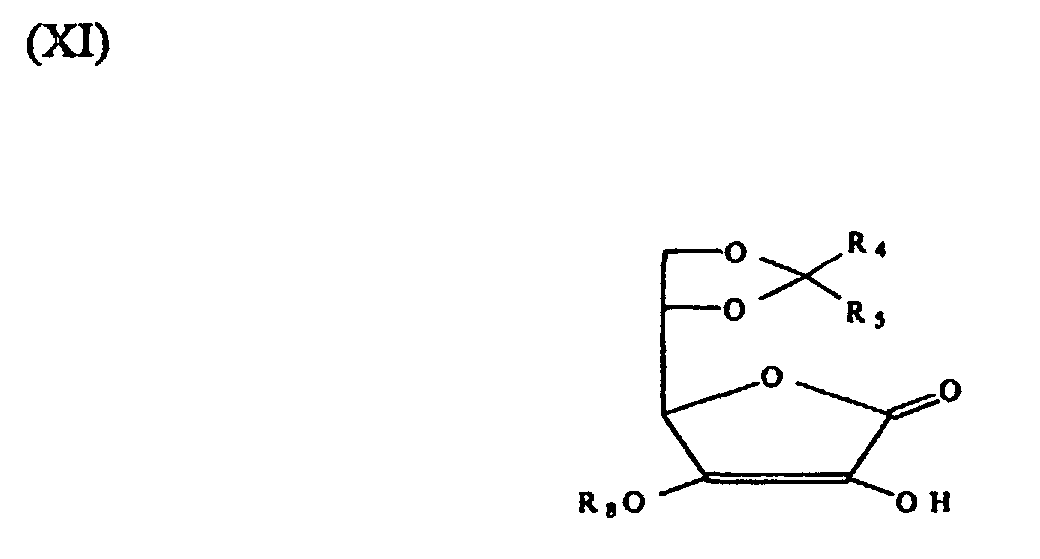 wherein R4, R5 and R8 are defined as above, followed by hydrogenation of the compound of formula (XII) in the presence of a catalyst to obtain a compound of the following formula (XIII)
 wherein R4, R5 are defined as above, followed by hydrolysis of the compound of formula (XIII) with an acid.
- The process according to claim 5-8, wherein the solvent is one or more selected from the group consisting of dimethylsulfoxide, dimethylformamide, hexamethyl phosphoramide, N-methylpyrrolidone, pyrrolidone, dimethylacetamide and 1,3-dimethyl-3,4,5,6-tetrahydro-2(1H)-pyrimidinone.
- The process according to claim 6 and claim 8, wherein the acid catalyst is selected from the group consisting of hydrochloric acid, sulfuric acid, p-toluenesulfonic acid, camphorsulfonic acid and acetic acid.
- The process according to claim 6-8, wherein the base is one or more selected from the group consisting of sodium hydroxide, potassium hydroxide, sodium carbonate, potassium carbonate, cesium carbonate and sodium hydride.
- The process according to claim 7 and claim 8, wherein the hydrogenation catalyst is selected from the group consisting of palladium, palladium-carbon, platinum black and platinum dioxide.
Applications Claiming Priority (5)
| Application Number | Priority Date | Filing Date | Title |
|---|---|---|---|
| KR1019980010752A KR100399348B1 (en) | 1998-03-27 | 1998-03-27 | Polyethoxylated vitamin c derivative and method for manufacturing the same |
| KR9810752 | 1998-03-27 | ||
| KR1019990008784A KR100334139B1 (en) | 1999-03-16 | 1999-03-16 | process for the preparation antioxidants, polyethoxylated ascorbic acid derivatives |
| KR9908784 | 1999-03-16 | ||
| PCT/KR1999/000148 WO1999050258A1 (en) | 1998-03-27 | 1999-03-27 | Polyethoxylated ascorbic acid derivatives as a novel antioxidant and process for preparing thereof |
Publications (2)
| Publication Number | Publication Date |
|---|---|
| EP1066277A1 EP1066277A1 (en) | 2001-01-10 |
| EP1066277B1 true EP1066277B1 (en) | 2003-07-09 |
Family
ID=26633546
Family Applications (1)
| Application Number | Title | Priority Date | Filing Date |
|---|---|---|---|
| EP99909388A Expired - Lifetime EP1066277B1 (en) | 1998-03-27 | 1999-03-27 | Polyethoxylated ascorbic acid derivatives as a novel antioxidant and process for preparing thereof |
Country Status (11)
| Country | Link |
|---|---|
| US (1) | US6444144B1 (en) |
| EP (1) | EP1066277B1 (en) |
| JP (1) | JP3440263B2 (en) |
| CN (1) | CN1295567A (en) |
| AT (1) | ATE244707T1 (en) |
| AU (1) | AU741933B2 (en) |
| BR (1) | BR9909168A (en) |
| CA (1) | CA2324306C (en) |
| DE (1) | DE69909455T2 (en) |
| NZ (1) | NZ506842A (en) |
| WO (1) | WO1999050258A1 (en) |
Families Citing this family (19)
| Publication number | Priority date | Publication date | Assignee | Title |
|---|---|---|---|---|
| KR100399348B1 (en) * | 1998-03-27 | 2004-03-22 | 주식회사 엘지생명과학 | Polyethoxylated vitamin c derivative and method for manufacturing the same |
| ATE244707T1 (en) | 1998-03-27 | 2003-07-15 | Lg Chem Investment Ltd | POLYETHOXYLATED ASCORBIC ACID DERIVATIVES AS NEW ANTIOXIDANTS AND METHOD FOR THEIR PRODUCTION |
| KR100629065B1 (en) * | 1999-09-14 | 2006-09-27 | 주식회사 엘지생활건강 | Cosmetic composition for skin whitening containing polyethoxylated vitamin C derivative |
| KR100450274B1 (en) * | 2001-07-30 | 2004-09-30 | 주식회사 엘지생명과학 | Feed additive compositions for animals comprising polyethoxylated ascorbic acid derivatives |
| US20040116564A1 (en) | 2002-11-27 | 2004-06-17 | Devlin Brian Gerrard | Stabilization of poly(oxyalkylene) containing polymeric materials |
| US20060093676A1 (en) * | 2002-12-07 | 2006-05-04 | Hebert Rolland F | Ascorbic acid stability |
| CN102503903A (en) | 2003-02-07 | 2012-06-20 | 詹森药业有限公司 | HIV inhibiting 1,2,4-triazines |
| US7228041B2 (en) * | 2004-05-08 | 2007-06-05 | The Board Of Trustees Of The Leland Stanford Junior University | Photonic-bandgap fiber with a core ring |
| KR101118600B1 (en) * | 2007-08-22 | 2012-04-12 | 세이와 카세이 콤파니 리미티드 | Ascorbic acid derivative or salt thereof, method for production the same, and cosmetic preparation |
| FR2955493B1 (en) * | 2010-01-28 | 2012-02-24 | Oreal | USE OF ASCORBIC ACID DERIVATIVES IN COLORATION OF HUMAN KERATINOUS FIBERS, COMPOSITION COMPRISING SAME, COLORING METHOD AND DEVICE |
| US20130096081A1 (en) | 2011-06-03 | 2013-04-18 | Allergan, Inc. | Dermal filler compositions |
| US9408797B2 (en) | 2011-06-03 | 2016-08-09 | Allergan, Inc. | Dermal filler compositions for fine line treatment |
| AU2012262047A1 (en) | 2011-06-03 | 2014-01-16 | Allergan, Inc. | Dermal filler compositions including antioxidants |
| US9393263B2 (en) | 2011-06-03 | 2016-07-19 | Allergan, Inc. | Dermal filler compositions including antioxidants |
| AU2012298791B2 (en) * | 2011-08-25 | 2015-09-24 | Allergan Industrie, Sas | Dermal filler compositions including antioxidants |
| CA2858366C (en) * | 2011-12-08 | 2020-01-21 | Allergan Industrie, Sas | Optically transparent dermal filler compositions comprising hyaluronic acid crosslinked with diamines or multiamines |
| KR101491728B1 (en) * | 2012-12-14 | 2015-02-11 | 주식회사 휴메딕스 | Conjugate of vitamin C with vitamin B3 and antioxidant comprising the same |
| CN110467689A (en) * | 2019-09-09 | 2019-11-19 | 山东众山生物科技有限公司 | A kind of derivatives of hyaluronic acids and preparation method thereof |
| EP4341273A4 (en) | 2021-05-20 | 2025-04-23 | Roc Opco Llc | Cosmetic compositions containing vitamin c compounds and uses thereof |
Family Cites Families (11)
| Publication number | Priority date | Publication date | Assignee | Title |
|---|---|---|---|---|
| JPS5857373A (en) * | 1981-10-01 | 1983-04-05 | Sunstar Inc | Preparation of l-ascorbic acid derivative |
| RO86439B (en) * | 1982-01-15 | 1985-03-31 | Eli Lilly And Company | PROCEDURE FOR PREPARING ANY DERIVATIVES OF ASCORBIC ACID |
| JPS60130582A (en) * | 1983-12-19 | 1985-07-12 | Takeda Chem Ind Ltd | Antioxidant for food, ascorbic acid derivative and its production |
| US4959362A (en) * | 1983-12-19 | 1990-09-25 | Takeda Chemical Industries, Inc. | Pharmaceutical compositions containing certain ascorbic acid derivatives useful in the prophylaxis and treatment of disorders of the circulatory system |
| JP2830268B2 (en) * | 1989-01-21 | 1998-12-02 | 武田薬品工業株式会社 | Method for producing ascorbic acid derivative |
| JPH02237983A (en) * | 1989-03-10 | 1990-09-20 | Dainippon Ink & Chem Inc | Production of l-ascorbic acid derivative |
| US5034543A (en) * | 1989-07-20 | 1991-07-23 | Nippon Hypox Laboratories Incorporated | Ascorbic acid derivative and use as antioxidants |
| JPH04149115A (en) * | 1990-10-11 | 1992-05-22 | Kanebo Ltd | Whitening cosmetic |
| JPH04149117A (en) * | 1990-10-12 | 1992-05-22 | Kanebo Ltd | Skin-beautifying cosmetic |
| US5587149A (en) * | 1995-02-06 | 1996-12-24 | R.P. Scherer Corporation | Topical application emulsions |
| ATE244707T1 (en) | 1998-03-27 | 2003-07-15 | Lg Chem Investment Ltd | POLYETHOXYLATED ASCORBIC ACID DERIVATIVES AS NEW ANTIOXIDANTS AND METHOD FOR THEIR PRODUCTION |
-
1999
- 1999-03-27 AT AT99909388T patent/ATE244707T1/en not_active IP Right Cessation
- 1999-03-27 NZ NZ506842A patent/NZ506842A/en unknown
- 1999-03-27 DE DE69909455T patent/DE69909455T2/en not_active Expired - Fee Related
- 1999-03-27 BR BR9909168-2A patent/BR9909168A/en not_active Application Discontinuation
- 1999-03-27 JP JP2000541162A patent/JP3440263B2/en not_active Expired - Fee Related
- 1999-03-27 CN CN99804461A patent/CN1295567A/en active Pending
- 1999-03-27 EP EP99909388A patent/EP1066277B1/en not_active Expired - Lifetime
- 1999-03-27 CA CA002324306A patent/CA2324306C/en not_active Expired - Fee Related
- 1999-03-27 WO PCT/KR1999/000148 patent/WO1999050258A1/en not_active Ceased
- 1999-03-27 AU AU28595/99A patent/AU741933B2/en not_active Ceased
-
2000
- 2000-09-27 US US09/671,094 patent/US6444144B1/en not_active Expired - Fee Related
Non-Patent Citations (2)
| Title |
|---|
| ZALIPSKY S. ET AL: "Attachment of drugs to polyethylene glycols", EUR. POLYM. J., vol. 19, no. 12, 1983, pages 1177 - 1183, XP024053502, DOI: doi:10.1016/0014-3057(83)90016-2 * |
| ZALIPSKY S.: "Chemistry of polyethylene glycol conjugates with biologically active molecules", ADVANCED DRUG DELIVERY REVIEWS, no. 16, 1995, pages 157 - 182, XP002079119, DOI: doi:10.1016/0169-409X(95)00023-Z * |
Also Published As
| Publication number | Publication date |
|---|---|
| EP1066277A1 (en) | 2001-01-10 |
| BR9909168A (en) | 2000-12-05 |
| AU741933B2 (en) | 2001-12-13 |
| CA2324306A1 (en) | 1999-10-07 |
| WO1999050258A1 (en) | 1999-10-07 |
| NZ506842A (en) | 2002-06-28 |
| AU2859599A (en) | 1999-10-18 |
| CA2324306C (en) | 2005-05-24 |
| DE69909455T2 (en) | 2004-04-15 |
| JP3440263B2 (en) | 2003-08-25 |
| JP2002509926A (en) | 2002-04-02 |
| ATE244707T1 (en) | 2003-07-15 |
| DE69909455D1 (en) | 2003-08-14 |
| CN1295567A (en) | 2001-05-16 |
| US6444144B1 (en) | 2002-09-03 |
Similar Documents
| Publication | Publication Date | Title |
|---|---|---|
| US6444144B1 (en) | Polyethoxylated ascorbic acid derivatives as a novel antioxidant and process for preparing thereof | |
| CA1339818C (en) | Antiviral purine derivatives | |
| FR2470774A1 (en) | NUCLEOSIDE DERIVATIVES, THEIR PREPARATION AND THEIR THERAPEUTIC USES | |
| Cope et al. | The Detosylation of 1, 4: 3, 6-Dianhydrohexitol Ditosylates and Syntheses of 1, 4: 2, 5: 3, 6-Trianhydro-D-Mannitol | |
| EP0047323B1 (en) | 1,4-naphthoquinone derivatives and use thereof | |
| JP4168170B2 (en) | Arbutin ester compound and method for producing the same | |
| KR100829890B1 (en) | Novel retinol derivatives, preparation method thereof and cosmetic composition for improving wrinkles | |
| KR100334139B1 (en) | process for the preparation antioxidants, polyethoxylated ascorbic acid derivatives | |
| US5008405A (en) | Selective etherification | |
| Kuramochi et al. | Synthesis and structure–activity relationships of dehydroaltenusin derivatives as selective DNA polymerase α inhibitors | |
| MXPA00009417A (en) | Polyethoxylated ascorbic acid derivatives as a novel antioxidant and process for preparing thereof | |
| KR100399348B1 (en) | Polyethoxylated vitamin c derivative and method for manufacturing the same | |
| KR20240004472A (en) | Method for synthesizing xanthohumol | |
| US3822274A (en) | Process for diels-alder product | |
| JP2620251B2 (en) | Method for producing chroman derivative | |
| US20020137950A1 (en) | Novel chiral derivatives of garcinia acid bearing lactone ring moiety and process for preparing the same | |
| JPH0995478A (en) | Sulfated 4-carbon sugar alcohol ether, method for producing the same, and shampoo composition | |
| KR100493726B1 (en) | Kojic acid derivatives, preparation method and use thereof | |
| JP2018070509A (en) | Novel tocopheryl derivative of ascorbic acid and method for producing same | |
| JP2006052186A (en) | New dihydroferulic acid condensate | |
| FR2655343A1 (en) | PROCESS FOR PREPARING SYNERGISTINE | |
| KR950001277B1 (en) | Process for the preparation of oxybenzene derivatives | |
| JPS6412269B2 (en) | ||
| SU716279A1 (en) | Method of producing derivatives of 2,4,5=trioxo-7-amino-9h-pyrido(2,3-d)pyridine | |
| JPH03251505A (en) | Plant germination inhibitor |
Legal Events
| Date | Code | Title | Description |
|---|---|---|---|
| PUAI | Public reference made under article 153(3) epc to a published international application that has entered the european phase |
Free format text: ORIGINAL CODE: 0009012 |
|
| 17P | Request for examination filed |
Effective date: 20001018 |
|
| AK | Designated contracting states |
Kind code of ref document: A1 Designated state(s): AT BE CH CY DE DK ES FI FR GB GR IE IT LI LU MC NL PT SE |
|
| 17Q | First examination report despatched |
Effective date: 20010307 |
|
| GRAH | Despatch of communication of intention to grant a patent |
Free format text: ORIGINAL CODE: EPIDOS IGRA |
|
| RAP1 | Party data changed (applicant data changed or rights of an application transferred) |
Owner name: LG CHEM INVESTMENT, LTD |
|
| GRAH | Despatch of communication of intention to grant a patent |
Free format text: ORIGINAL CODE: EPIDOS IGRA |
|
| GRAA | (expected) grant |
Free format text: ORIGINAL CODE: 0009210 |
|
| AK | Designated contracting states |
Designated state(s): AT BE CH CY DE DK ES FI FR GB GR IE IT LI LU MC NL PT SE |
|
| PG25 | Lapsed in a contracting state [announced via postgrant information from national office to epo] |
Ref country code: NL Free format text: LAPSE BECAUSE OF FAILURE TO SUBMIT A TRANSLATION OF THE DESCRIPTION OR TO PAY THE FEE WITHIN THE PRESCRIBED TIME-LIMIT Effective date: 20030709 Ref country code: LI Free format text: LAPSE BECAUSE OF FAILURE TO SUBMIT A TRANSLATION OF THE DESCRIPTION OR TO PAY THE FEE WITHIN THE PRESCRIBED TIME-LIMIT Effective date: 20030709 Ref country code: FI Free format text: LAPSE BECAUSE OF FAILURE TO SUBMIT A TRANSLATION OF THE DESCRIPTION OR TO PAY THE FEE WITHIN THE PRESCRIBED TIME-LIMIT Effective date: 20030709 Ref country code: CY Free format text: LAPSE BECAUSE OF FAILURE TO SUBMIT A TRANSLATION OF THE DESCRIPTION OR TO PAY THE FEE WITHIN THE PRESCRIBED TIME-LIMIT Effective date: 20030709 Ref country code: CH Free format text: LAPSE BECAUSE OF FAILURE TO SUBMIT A TRANSLATION OF THE DESCRIPTION OR TO PAY THE FEE WITHIN THE PRESCRIBED TIME-LIMIT Effective date: 20030709 Ref country code: BE Free format text: LAPSE BECAUSE OF FAILURE TO SUBMIT A TRANSLATION OF THE DESCRIPTION OR TO PAY THE FEE WITHIN THE PRESCRIBED TIME-LIMIT Effective date: 20030709 Ref country code: AT Free format text: LAPSE BECAUSE OF FAILURE TO SUBMIT A TRANSLATION OF THE DESCRIPTION OR TO PAY THE FEE WITHIN THE PRESCRIBED TIME-LIMIT Effective date: 20030709 |
|
| REG | Reference to a national code |
Ref country code: GB Ref legal event code: FG4D |
|
| REG | Reference to a national code |
Ref country code: CH Ref legal event code: EP |
|
| RAP2 | Party data changed (patent owner data changed or rights of a patent transferred) |
Owner name: LG LIFE SCIENCES LTD. |
|
| REF | Corresponds to: |
Ref document number: 69909455 Country of ref document: DE Date of ref document: 20030814 Kind code of ref document: P |
|
| REG | Reference to a national code |
Ref country code: IE Ref legal event code: FG4D |
|
| NLT2 | Nl: modifications (of names), taken from the european patent patent bulletin |
Owner name: LG LIFE SCIENCES LTD. |
|
| PG25 | Lapsed in a contracting state [announced via postgrant information from national office to epo] |
Ref country code: SE Free format text: LAPSE BECAUSE OF FAILURE TO SUBMIT A TRANSLATION OF THE DESCRIPTION OR TO PAY THE FEE WITHIN THE PRESCRIBED TIME-LIMIT Effective date: 20031009 Ref country code: GR Free format text: LAPSE BECAUSE OF FAILURE TO SUBMIT A TRANSLATION OF THE DESCRIPTION OR TO PAY THE FEE WITHIN THE PRESCRIBED TIME-LIMIT Effective date: 20031009 Ref country code: DK Free format text: LAPSE BECAUSE OF FAILURE TO SUBMIT A TRANSLATION OF THE DESCRIPTION OR TO PAY THE FEE WITHIN THE PRESCRIBED TIME-LIMIT Effective date: 20031009 |
|
| PG25 | Lapsed in a contracting state [announced via postgrant information from national office to epo] |
Ref country code: ES Free format text: LAPSE BECAUSE OF FAILURE TO SUBMIT A TRANSLATION OF THE DESCRIPTION OR TO PAY THE FEE WITHIN THE PRESCRIBED TIME-LIMIT Effective date: 20031020 |
|
| NLV1 | Nl: lapsed or annulled due to failure to fulfill the requirements of art. 29p and 29m of the patents act | ||
| PG25 | Lapsed in a contracting state [announced via postgrant information from national office to epo] |
Ref country code: PT Free format text: LAPSE BECAUSE OF FAILURE TO SUBMIT A TRANSLATION OF THE DESCRIPTION OR TO PAY THE FEE WITHIN THE PRESCRIBED TIME-LIMIT Effective date: 20031209 |
|
| REG | Reference to a national code |
Ref country code: CH Ref legal event code: PL |
|
| PG25 | Lapsed in a contracting state [announced via postgrant information from national office to epo] |
Ref country code: LU Free format text: LAPSE BECAUSE OF NON-PAYMENT OF DUE FEES Effective date: 20040327 |
|
| PG25 | Lapsed in a contracting state [announced via postgrant information from national office to epo] |
Ref country code: IE Free format text: LAPSE BECAUSE OF NON-PAYMENT OF DUE FEES Effective date: 20040329 |
|
| PG25 | Lapsed in a contracting state [announced via postgrant information from national office to epo] |
Ref country code: MC Free format text: LAPSE BECAUSE OF NON-PAYMENT OF DUE FEES Effective date: 20040331 |
|
| ET | Fr: translation filed | ||
| PLBE | No opposition filed within time limit |
Free format text: ORIGINAL CODE: 0009261 |
|
| STAA | Information on the status of an ep patent application or granted ep patent |
Free format text: STATUS: NO OPPOSITION FILED WITHIN TIME LIMIT |
|
| 26N | No opposition filed |
Effective date: 20040414 |
|
| REG | Reference to a national code |
Ref country code: IE Ref legal event code: MM4A |
|
| PGFP | Annual fee paid to national office [announced via postgrant information from national office to epo] |
Ref country code: FR Payment date: 20060308 Year of fee payment: 8 |
|
| PGFP | Annual fee paid to national office [announced via postgrant information from national office to epo] |
Ref country code: DE Payment date: 20060323 Year of fee payment: 8 |
|
| GBPC | Gb: european patent ceased through non-payment of renewal fee |
Effective date: 20070327 |
|
| PGFP | Annual fee paid to national office [announced via postgrant information from national office to epo] |
Ref country code: IT Payment date: 20070518 Year of fee payment: 9 |
|
| REG | Reference to a national code |
Ref country code: FR Ref legal event code: ST Effective date: 20071130 |
|
| PG25 | Lapsed in a contracting state [announced via postgrant information from national office to epo] |
Ref country code: DE Free format text: LAPSE BECAUSE OF NON-PAYMENT OF DUE FEES Effective date: 20071002 |
|
| PG25 | Lapsed in a contracting state [announced via postgrant information from national office to epo] |
Ref country code: GB Free format text: LAPSE BECAUSE OF NON-PAYMENT OF DUE FEES Effective date: 20070327 |
|
| PG25 | Lapsed in a contracting state [announced via postgrant information from national office to epo] |
Ref country code: FR Free format text: LAPSE BECAUSE OF NON-PAYMENT OF DUE FEES Effective date: 20070402 |
|
| PGFP | Annual fee paid to national office [announced via postgrant information from national office to epo] |
Ref country code: GB Payment date: 20060322 Year of fee payment: 8 |
|
| PG25 | Lapsed in a contracting state [announced via postgrant information from national office to epo] |
Ref country code: IT Free format text: LAPSE BECAUSE OF NON-PAYMENT OF DUE FEES Effective date: 20080327 |