EP1066020B1 - Aerosol hairspray composition - Google Patents
Aerosol hairspray composition Download PDFInfo
- Publication number
- EP1066020B1 EP1066020B1 EP99914518A EP99914518A EP1066020B1 EP 1066020 B1 EP1066020 B1 EP 1066020B1 EP 99914518 A EP99914518 A EP 99914518A EP 99914518 A EP99914518 A EP 99914518A EP 1066020 B1 EP1066020 B1 EP 1066020B1
- Authority
- EP
- European Patent Office
- Prior art keywords
- hairspray
- weight
- alkyl
- integers
- autophobic
- Prior art date
- Legal status (The legal status is an assumption and is not a legal conclusion. Google has not performed a legal analysis and makes no representation as to the accuracy of the status listed.)
- Revoked
Links
Classifications
-
- A—HUMAN NECESSITIES
- A61—MEDICAL OR VETERINARY SCIENCE; HYGIENE
- A61Q—SPECIFIC USE OF COSMETICS OR SIMILAR TOILETRY PREPARATIONS
- A61Q5/00—Preparations for care of the hair
- A61Q5/06—Preparations for styling the hair, e.g. by temporary shaping or colouring
-
- A—HUMAN NECESSITIES
- A61—MEDICAL OR VETERINARY SCIENCE; HYGIENE
- A61K—PREPARATIONS FOR MEDICAL, DENTAL OR TOILETRY PURPOSES
- A61K8/00—Cosmetics or similar toiletry preparations
- A61K8/02—Cosmetics or similar toiletry preparations characterised by special physical form
- A61K8/04—Dispersions; Emulsions
- A61K8/046—Aerosols; Foams
-
- A—HUMAN NECESSITIES
- A61—MEDICAL OR VETERINARY SCIENCE; HYGIENE
- A61K—PREPARATIONS FOR MEDICAL, DENTAL OR TOILETRY PURPOSES
- A61K8/00—Cosmetics or similar toiletry preparations
- A61K8/18—Cosmetics or similar toiletry preparations characterised by the composition
- A61K8/72—Cosmetics or similar toiletry preparations characterised by the composition containing organic macromolecular compounds
- A61K8/81—Cosmetics or similar toiletry preparations characterised by the composition containing organic macromolecular compounds obtained by reactions involving only carbon-to-carbon unsaturated bonds
- A61K8/8141—Compositions of homopolymers or copolymers of compounds having one or more unsaturated aliphatic radicals, each having only one carbon-to-carbon double bond, and at least one being terminated by only one carboxyl radical, or of salts, anhydrides, esters, amides, imides or nitriles thereof; Compositions of derivatives of such polymers
- A61K8/8158—Homopolymers or copolymers of amides or imides, e.g. (meth) acrylamide; Compositions of derivatives of such polymers
-
- A—HUMAN NECESSITIES
- A61—MEDICAL OR VETERINARY SCIENCE; HYGIENE
- A61K—PREPARATIONS FOR MEDICAL, DENTAL OR TOILETRY PURPOSES
- A61K8/00—Cosmetics or similar toiletry preparations
- A61K8/18—Cosmetics or similar toiletry preparations characterised by the composition
- A61K8/72—Cosmetics or similar toiletry preparations characterised by the composition containing organic macromolecular compounds
- A61K8/84—Cosmetics or similar toiletry preparations characterised by the composition containing organic macromolecular compounds obtained by reactions otherwise than those involving only carbon-carbon unsaturated bonds
- A61K8/89—Polysiloxanes
- A61K8/891—Polysiloxanes saturated, e.g. dimethicone, phenyl trimethicone, C24-C28 methicone or stearyl dimethicone
- A61K8/894—Polysiloxanes saturated, e.g. dimethicone, phenyl trimethicone, C24-C28 methicone or stearyl dimethicone modified by a polyoxyalkylene group, e.g. cetyl dimethicone copolyol
-
- Y—GENERAL TAGGING OF NEW TECHNOLOGICAL DEVELOPMENTS; GENERAL TAGGING OF CROSS-SECTIONAL TECHNOLOGIES SPANNING OVER SEVERAL SECTIONS OF THE IPC; TECHNICAL SUBJECTS COVERED BY FORMER USPC CROSS-REFERENCE ART COLLECTIONS [XRACs] AND DIGESTS
- Y10—TECHNICAL SUBJECTS COVERED BY FORMER USPC
- Y10S—TECHNICAL SUBJECTS COVERED BY FORMER USPC CROSS-REFERENCE ART COLLECTIONS [XRACs] AND DIGESTS
- Y10S424/00—Drug, bio-affecting and body treating compositions
- Y10S424/01—Aerosol hair preparation
-
- Y—GENERAL TAGGING OF NEW TECHNOLOGICAL DEVELOPMENTS; GENERAL TAGGING OF CROSS-SECTIONAL TECHNOLOGIES SPANNING OVER SEVERAL SECTIONS OF THE IPC; TECHNICAL SUBJECTS COVERED BY FORMER USPC CROSS-REFERENCE ART COLLECTIONS [XRACs] AND DIGESTS
- Y10—TECHNICAL SUBJECTS COVERED BY FORMER USPC
- Y10S—TECHNICAL SUBJECTS COVERED BY FORMER USPC CROSS-REFERENCE ART COLLECTIONS [XRACs] AND DIGESTS
- Y10S424/00—Drug, bio-affecting and body treating compositions
- Y10S424/02—Resin hair settings
Definitions
- the invention relates to an aerosol hairspray composition to achieve styling with improved sensory attributes at high water levels.
- Hairspray compositions must meet a number of functional requirements. These include good holding ability and curl retention without giving a harsh, brittle feeling to the hair.
- hydrocarbon propellants a problem with hydrocarbon propellants is that it becomes impossible to achieve a single phase system at high water levels.
- a problem with hydrocarbon propellants is that it becomes impossible to achieve a single phase system at high water levels.
- the composition separates into two phases - an aqueous phase and a hydrocarbon phase.
- the invention provides a single phase autophobic hairspray composition comprising:
- the hairspray resins employed in compositions of the present invention should be capable of forming a film and holding the hair of the user in place after evaporation of the volatile components of the hairspray composition.
- Hairspray resins are well known articles of commerce and many such resinous polymers are available commercially which contain moieties which render the polymers cationic, anionic, amphoteric or nonionic in nature.
- the polymers employed in hairspray compositions typically range in number average molecular weight of from 5,000 to 100,000 with 10,000 to 50,000 being more preferred.
- the amount of the resin may range from 0.5 to 10%, preferably 0.75 to 6% by weight of the total composition.
- anionic hairspray resins are:
- a suitable anionic hairspray resin is the emulsion polymerised terpolymer of methacrylic acid, n-butyl acrylate and ethyl acrylate (e.g. in a weight percent ratio of 31:42:27, respectively).
- Another specific example is Ultrahold® 8 (CTFA-Cosmetic, Toiletries and Fragrance Association designation of Acrylate/Acrylamide Copolymer).
- Suitable anionic hairspray resins include carboxylated polyurethanes.
- Carboxylated polyurethane resins are linear, hydroxyl-terminated copolymers having pendant carboxyl groups. They may be ethoxylated and/or propoxylated at least at one terminal end.
- the carboxyl group can be a carboxylic acid group or an ester group, wherein the alkyl moiety of the ester group contains one to three carbon atoms.
- the carboxylated polyurethane resin can also be a copolymer of polyvinylpyrrolidone and a polyurethane, having a CTFA designation PVP/polycarbamyl polyglycol ester.
- Suitable carboxylated polyurethane resins are disclosed in EP 0 619 111 A1 and US Patent No. 5,000,955.
- Other suitable hydrophilic polyurethanes are disclosed in US Patent Nos. 3,822,238; 4,156,066; 4,156,067; 4,255,550; and 4,743,673.
- Amphoteric polymers which can contain cationic groups derived from monomers such as t-butyl aminoethyl methacrylate as well as carboxyl groups derived from monomers such as acrylic acid or methacrylic acid can also be used in the present invention.
- an amphoteric hairspray resin is Amphomer® (octylacrylamide/acrylates/butylaminoethyl methacrylate copolymer) sold by the National Starch and Chemical Corporation.
- nonionic hairspray resins are homopolymers of N-vinylpyrrolidone and copolymers of N-vinylpyrrolidone with compatible nonionic monomers such as vinyl acetate and terpolymers of ethyl acrylate, butyl methacrylate and methyl methacrylate.
- Nonionic polymers containing N-vinylpyrrolidone in various weight average molecular weights are available commercially from ISP Corporation such as homopolymers of N-vinylpyrrolidone having an average molecular weight of about 630,000 sold by ISP (formerly GAF Corporation) under the tradename PVP K-90 and those having an average molecular weight of about 1,000,000 sold under the trademark of PVP K-120.
- cationic hairspray resins are copolymers of amino-functional acrylate monomers such as lower alkyl aminoalkyl acrylate or methacrylate monomers such as dimethylaminoethyl methacrylate with compatible monomers such as N-vinylpyrrolidone, vinyl caprolactam, or alkyl methacrylates such as methyl methacrylate and ethyl methacrylate and alkyl acrylates such as ethyl acrylate and n-butyl acrylate.
- amino-functional acrylate monomers such as lower alkyl aminoalkyl acrylate or methacrylate monomers such as dimethylaminoethyl methacrylate with compatible monomers such as N-vinylpyrrolidone, vinyl caprolactam, or alkyl methacrylates such as methyl methacrylate and ethyl methacrylate and alkyl acrylates such as ethyl acrylate and n-butyl
- N-vinylpyrrolidone are commercially available from ISP Corporation such as those sold under the trademarks of Copolymer 845 and Copolymer 937 (copolymers of N-vinylpyrrolidone and t-butylaminoethyl methacrylate of average molecular weight about 1,000,000) and Gafquat® 755 and 755N (quaternary ammonium polymers formed by the reaction of dimethyl sulfate and a copolymer of N- vinylpyrrolidone and dimethylaminoethyl methacrylate of average molecular weight about 1,000,000).
- Copolymer 845 and Copolymer 937 copolymers of N-vinylpyrrolidone and t-butylaminoethyl methacrylate of average molecular weight about 1,000,000
- Gafquat® 755 and 755N quaternary ammonium polymers formed by the reaction of dimethyl sulfate and a copolymer of
- Suitable neutralising agents include 2-amino-2-methyl-1, 3-propanediol (AMPD); 2-amino-2-ethyl-1,3-propanediol (AEPD); 2-amino-2-methyl-1-propanol (AMP); 2-amino-1-butanol (AB); monoethanolamine (MEA); diethanolamine (DEA); triethanolamine (TEA); monoisopropanolamine (MIPA); diisopropanol-amine (DIPA); triisopropanolamine (TIPA); and dimethyl stearamine (DMS).
- AMPD 2-amino-2-methyl-1, 3-propanediol
- AEPD 2-amino-2-ethyl-1,3-propanediol
- AMP 2-amino-2-methyl-1-propanol
- MEA monoethanolamine
- DEA diethanolamine
- TIPA triisopropanolamine
- a long chain amine neutralising agent such as lauramidopropyl dimethylamine may be employed, as is described in US 4,874,604. Mixtures of any of the above neutralising agents may be used. Amounts of the neutralising agents will range from about 0.001 to about 10% by weight of the total composition.
- the dialkyl ether is a di(C 1 -C 4 alkyl) ether, most preferably dimethyl ether.
- the hydrocarbon component of the propellant system will be a C 3 -C 5 alkane, especially one selected from propane, isobutane, n-butane and mixtures thereof.
- propane and isobutane such as A50 propellant commercially available from the Aeropress Corporation.
- Total amount of propellant will range from 3 to 50%, preferably from 5 to 45%, optimally from 25 to 45% by weight of the total composition.
- Weight ratios of total hydrocarbon to dialkyl ether will range from 5:1 to 1:10, preferably from 2:1 to 1:5, more preferably from 1:1 to 1:4, optimally about 1:2 by weight.
- an autophobic hairspray additive being a surfactant or polymer which imparts autophobic behaviour to the hairspray composition.
- Suitable autophobic hairspray additives may be selected from the group consisting of:
- alkyl-pendant silicone copolyols of formula (I) as referred to above are described in US 4,871,529.
- a preferred example is the ethoxylated dimethicone copolyol SILWET® L-7602, ex OSi Specialities.
- Dimethicone copolyols of formula (II) referred to above are sometimes designated as "ABA" type copolymers, due to the presence of alternating polyalkylene oxide and silicone blocks.
- Polydimethicone copolyols of formula (III) referred to above are sometimes designated as (AB)n type copolymers.
- the molecular weight of the copolyols of formulae (II) and (III) suitably ranges from 500 to 50,000.
- Suitable dimethicone copolyols of formula (II) are SILSOFT®900, sold by OSi Specialties, having a molecular weight of about 2000, with R being hydrogen and a being 0, and the materials sold by Goldschmidt as TEGOPREN® 3012 and 5830 respectively.
- Suitable polydimethicone copolyols of formula (III) are those described in US 4,242,466. Illustrative is the material sold by OSi Specialties as SILSOFT® 487, having a molecular weight of about 150,000, with a and b both greater than 0.
- alkyl ethoxylates examples include those of general formula (IV): C n H 2n+1 (OCH 2 CH 2 ) x OR
- GENAPOL® C-250 (ex Hoechst Celanese), which is coconut fatty alcohol (C8-C18, mainly C12-C14) ethoxylated with 25 moles of ethylene oxide
- DOBANOL® 91-5 (ex Shell), which is C9-C11 alcohol ethoxylated with 5 moles of ethylene oxide.
- Fluorosurfactants are surfactants in which the hydrophobic segment of the molecule contains fluorine. At least one hydrogen atom in the hydrophobic segment contains fluorine.
- the hydrophbbe can be fully fluorinated (perfluorinated) or partially fluorinated.
- fluorosurfactants can be classified into four types: anionic, cationic, amphoteric and nonionic. Their structural features are described in the book “Fluorinated Surfactants - Surfactant Science Series Vol.50" by Eric Kissa, Marcel Dekker Inc., 1994, Chapter 1.
- Suitable fluorosurfactant is the material sold by Dow/3M as L13564, of formula (V): where R f is a fluorine containing hydrophobe.
- compositions of the present invention include water.
- Typical water levels for an ethanol-based aerosol fixing spray are from 2 to 10%, usually about 2 to 6% by weight.
- hairsprays According to the present invention, they can be formulated with high water content, without prejudice to the autophobic effect.
- Hairsprays of the present invention can be formulated with a water content of up to 30%, even 45 to 55% , by weight of the total composition.
- the upper water content limit is not critical to the present invention, but in general is governed by the tendency of the hairspray formulation to impart a sticky feel to the hair if the level of water is too high.
- An optimum water level for hairsprays of the present invention is generally from 10 to 25%, e.g. around 15 to 20% by weight of the total composition.
- a preferred optional component in hairsprays of the invention is a conditioning agent selected from volatile and non-volatile silicone fluids.
- Volatile silicone fluids are preferably oils chosen from cyclic or linear polydimethyl siloxanes containing from 3 to 9, preferably from 4 to 5 silicon atoms.
- Cyclomethicone is the most preferred cyclic volatile silicone.
- Linear volatile silicone oils generally have viscosities less than about 5 centistokes at 25°C while cyclic fluids typically have viscosities of less than about 10 centistokes.
- Non-volatile silicone oils useful for the present invention include polyalkyl siloxanes, polyalkylaryl siloxanes and polyether siloxane copolymers.
- Non-volatile polyalkyl siloxanes useful herein include, for example, polydimethyl siloxanes with viscosities of from 5 to 100,000 centistokes at 25°C.
- the preferred non-volatile silicones are the polydimethyl siloxanes having viscosities from 10 to 400 centistokes at 25°C. These siloxanes are available, for example, from the General Electric Company as SF 1075 methyl phenyl fluid or from Dow Corning as 556 Cosmetic Grade Fluid.
- non-volatile polyalkylaryl siloxane fluids that may be used include, for example, polymethylphenylsiloxanes having viscosities of about 15 to 30,000 centistokes at 25°C.
- compositions of this invention also contain adjuvants suitable for hair care.
- adjuvants suitable for hair care Generally such ingredients are included individually at a level of up to 2%, preferably up to 1%, by weight of the total composition.
- Suitable hair care adjuvants are:
Landscapes
- Health & Medical Sciences (AREA)
- Life Sciences & Earth Sciences (AREA)
- Public Health (AREA)
- Veterinary Medicine (AREA)
- Animal Behavior & Ethology (AREA)
- General Health & Medical Sciences (AREA)
- Epidemiology (AREA)
- Birds (AREA)
- Chemical & Material Sciences (AREA)
- Dispersion Chemistry (AREA)
- Cosmetics (AREA)
- Compositions Of Macromolecular Compounds (AREA)
- Agricultural Chemicals And Associated Chemicals (AREA)
Description
In these systems, solid (including hairspray resin) deposited in fibre-fibre junctions is significantly spread along the fibres from the centre of the junction along the length of the fibres. In contrast, autophobic systems appear to localise deposition at fibre-fibre junctions, with a reduced coating of those fibre regions external to the junctions. This is consistent with the deposit being formed from a poorly wetting system, that is, the liquid makes a high contact angle with the fibre. The high contact angle droplet morphology of the dried autophobic system on crossed hair fibres can be viewed by magnifying lens.

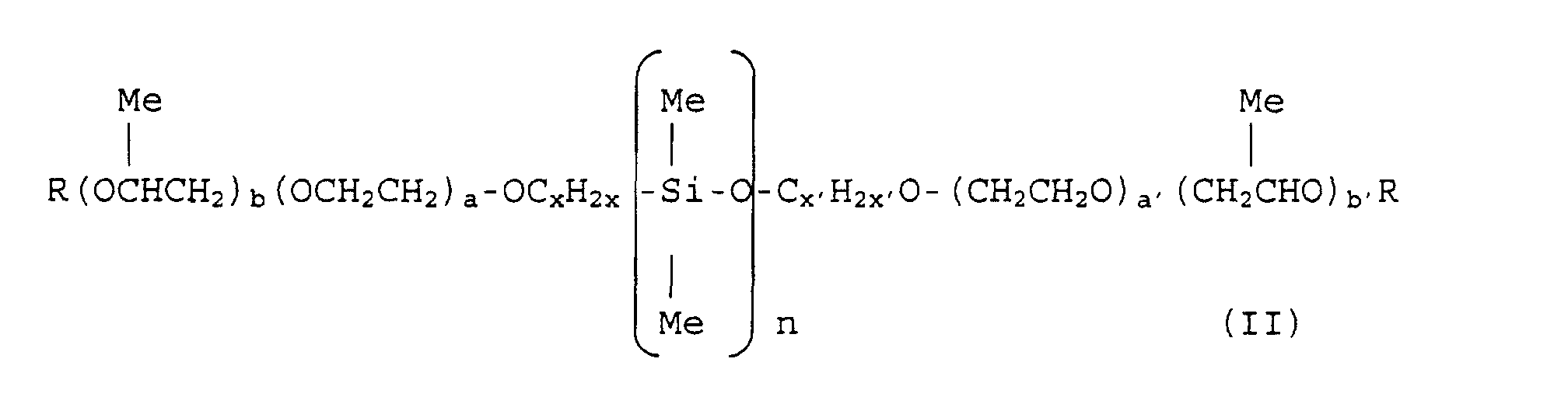
x and x' are integers of from 1 to 12;
a,a',b,b' are integers of from 0 to 50, and R is hydrogen or a C1-4 alkyl radical;

y is an integer of from 1 to 12, and
a and b are integers of from 0 to 50;

- ceramides, for moisturising the fibre and maintaining cuticle integrity. Ceramides are available by extraction from natural sources, or as synthetic ceramides and pseudoceramides. A preferred ceramide is Ceramide II, ex Quest. Mixtures of ceramides may also be suitable, such as Ceramides LS, ex Laboratoires Serobiologiques.
| INGREDIENT | WEIGHT % |
| Concentrate | |
| AMPHOMER® | 2.80 |
| Aminomethylpropanol | 0.46 |
| Perfume | 0.15 |
| Dextrose | 0.01 |
| Isoleucine | 0.01 |
| SILWET® L-7602 | 0.08 |
| DC345 | 0.08 |
| Sodium benzoate | 0.20 |
| Water | 17.00 |
| Alcohol | balance |
| Propellant | |
| Hydrocarbon 2.7B | 15.00 |
| Dimethyl Ether | 30.000 |
Claims (5)
- A single phase autophobic hairspray composition comprising:a) from 0.5 % to 10 % by weight of a film-forming hairspray resin;b) from 10 to 60% by weight of a propellant including a mixture of at least one hydrocarbon and a di(C1-C4 alkyl) ether in a weight ratio from 5:1 to 1:10;c) from 0.01% to 1.0% by weight of an autophobic hairspray additive, being a surfactant or polymer which imparts autophobic behaviour to the hairspray composition selected from the group consisting of:(i) alkyl-pendant silicone copolyols of formula (I):where m and n are integers of from 0 to 50, and x and y are integers chosen to give the copolyol a molecular weight of at least 600. Z is hydrogen or a C1-4 alkyl radical;
 (ii) dimethicone copolyols of formula (II):where n is an integer chosen to give the copolyol a molecular weight of at least 600;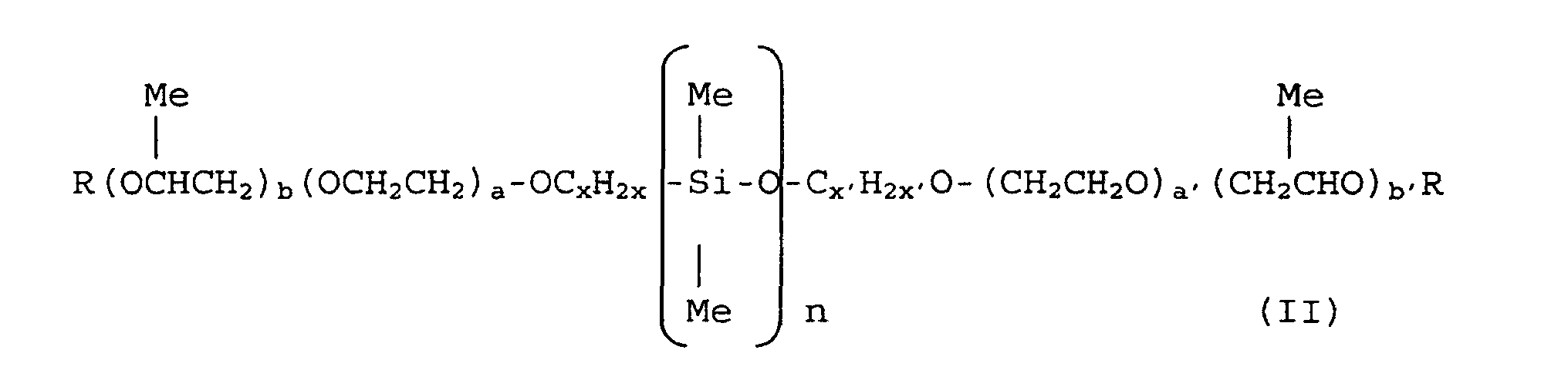
x and x' are integers of from 1 to 12;
a,a',b,b' are integers of from 0 to 50, and R is hydrogen or a C1-4 alkyl radical;(iii) polydimethicone copolyols of formula (III) :where x and n are integers chosen to give the copolyol a molecular weight of at least 500;
y is an integer of from 1 to 12, and
a and b are integers of from 0 to 50;(iv) alkyl ethoxylates; and(v) fluorosurfactants.d) water. - A hairspray composition according to claim 1, in which the film-forming hairspray resin is an amphoteric resin, preferably octylacrylamide/acrylates/butylaminoethyl methacrylate copolymer.
- A hairspray composition according to claim 3, in which the autophobic hairspray additive is a silicone copolyol of formula (I), preferably an ethoxylated dimethicone copolyol.
- A hairspray composition according to any preceding claim, in which the weight ratio of hydrocarbon and di(C1-C4 alkyl) ether is from from 1:1 to 1:4, preferably about 1:2.
- A hairspray composition according to any preceding claim, in which the water content is from 10 to 25%, preferably from 15 to 20% by weight of the total composition.
Applications Claiming Priority (3)
| Application Number | Priority Date | Filing Date | Title |
|---|---|---|---|
| GBGB9806295.3A GB9806295D0 (en) | 1998-03-24 | 1998-03-24 | Aerosol hairspray composition |
| GB9806295 | 1998-03-24 | ||
| PCT/EP1999/001632 WO1999048462A2 (en) | 1998-03-24 | 1999-03-12 | Aerosol hairspray composition |
Publications (2)
| Publication Number | Publication Date |
|---|---|
| EP1066020A2 EP1066020A2 (en) | 2001-01-10 |
| EP1066020B1 true EP1066020B1 (en) | 2005-08-10 |
Family
ID=10829169
Family Applications (1)
| Application Number | Title | Priority Date | Filing Date |
|---|---|---|---|
| EP99914518A Revoked EP1066020B1 (en) | 1998-03-24 | 1999-03-12 | Aerosol hairspray composition |
Country Status (14)
| Country | Link |
|---|---|
| US (1) | US6350433B1 (en) |
| EP (1) | EP1066020B1 (en) |
| JP (1) | JP2002507558A (en) |
| CN (1) | CN1180765C (en) |
| AR (1) | AR014760A1 (en) |
| AU (1) | AU735095B2 (en) |
| BR (1) | BR9909007A (en) |
| CA (1) | CA2322859A1 (en) |
| DE (1) | DE69926613T2 (en) |
| ES (1) | ES2245826T3 (en) |
| GB (1) | GB9806295D0 (en) |
| ID (1) | ID28022A (en) |
| IN (1) | IN192713B (en) |
| WO (1) | WO1999048462A2 (en) |
Cited By (1)
| Publication number | Priority date | Publication date | Assignee | Title |
|---|---|---|---|---|
| US7670388B2 (en) | 2005-10-14 | 2010-03-02 | Kao Corporation | Fiber-treating composition |
Families Citing this family (23)
| Publication number | Priority date | Publication date | Assignee | Title |
|---|---|---|---|---|
| AU2001260101A1 (en) * | 2000-03-24 | 2001-10-03 | Unilever Plc | Low voc hair spray compositions having enhanced styling benefits |
| US20040241104A1 (en) * | 2003-03-11 | 2004-12-02 | L'oreal | Aerosol device comprising a cosmetic composition comprising at least one polyurethane and at least one propellant comprising dimethyl ether and at least one C3-C5 hydrocarbon |
| FR2852239B1 (en) † | 2003-03-11 | 2006-08-11 | Oreal | AEROSOL DEVICE CONTAINING A COSMETIC COMPOSITION COMPRISING A POLYURTHANE AND A PROPELLANT COMPRISING DIMETHYLETHER AND AT LEAST ONE HYDROCARBON |
| FR2869798B1 (en) * | 2004-05-07 | 2008-06-27 | Oreal | COMPOSITION CONDITIONED IN AEROSOL DEVICE, COMPRISING ANIONIC-FIXING POLYMER, OXYALKYLENE SILICONE IN ALPHA AND OMEGA POSITIONS OF THE CHAIN |
| US8968707B2 (en) * | 2004-05-07 | 2015-03-03 | L'oreal | Composition packaged in an aerosol device, comprising at least one anionic fixing polymer, at least one silicone oxyalkylenated in the alpha and omega positions of the silicone chain, and at least one propellant |
| WO2007075969A1 (en) * | 2005-12-20 | 2007-07-05 | Schwarzkopf & Henkel, A Division Of Henkel Consumer Goods Inc. | Hair shine and styling hold composition and methods of forming and using same |
| GB0620714D0 (en) * | 2006-10-19 | 2006-11-29 | Suspended Ceiling Restoration | Improvements to ceiling repair |
| JP5346535B2 (en) * | 2008-09-30 | 2013-11-20 | 株式会社マンダム | Hair cosmetics |
| CN116194489B (en) | 2020-06-18 | 2026-03-31 | 营养与生物科学美国4公司 | Cationic polyα-1,6-glucan ethers and compositions comprising them |
| CN117616054A (en) | 2021-07-13 | 2024-02-27 | 营养与生物科学美国4公司 | Cationic dextran ester derivatives |
| WO2023081341A1 (en) | 2021-11-05 | 2023-05-11 | Nutrition & Biosciences USA 4, Inc. | Compositions comprising one cationic alpha- 1,6-glucan derivative and one alpha- 1,3-glucan |
| US20250032390A1 (en) | 2021-12-16 | 2025-01-30 | Nutrition & Biosciences USA 4, Inc. | Compositions comprising cationic alpha-glucan ethers in aqueous polar organic solvents |
| JP2025523007A (en) | 2022-07-11 | 2025-07-17 | ニュートリション・アンド・バイオサイエンシーズ・ユーエスエー・フォー,インコーポレイテッド | Amphiphilic glucan ester derivatives |
| JP2025534620A (en) | 2022-10-14 | 2025-10-17 | ニュートリション・アンド・バイオサイエンシーズ・ユーエスエー・フォー,インコーポレイテッド | Composition comprising water, a cationic α-1,6-glucan ether, and an organic solvent |
| US20250339361A1 (en) | 2022-11-02 | 2025-11-06 | Nutrition & Biosciences USA 4, Inc. | Compositions comprising xanthan gum and crystalline alpha-1,3-glucan |
| EP4634242A1 (en) | 2022-12-16 | 2025-10-22 | Nutrition & Biosciences USA 4, Inc. | Esterification of alpha-glucan comprising alpha-1,6 glycosidic linkages |
| WO2025072417A1 (en) | 2023-09-29 | 2025-04-03 | Nutrition & Biosciences USA 4, Inc. | Polysaccharide derivatives |
| WO2025072419A1 (en) | 2023-09-29 | 2025-04-03 | Nutrition & Biosciences Usa 1, Llc | Crosslinked alpha-glucan derivatives |
| WO2025072416A1 (en) | 2023-09-29 | 2025-04-03 | Nutrition & Biosciences USA 4, Inc. | Polysaccharide derivatives |
| WO2025117349A1 (en) | 2023-11-28 | 2025-06-05 | Nutrition & Biosciences USA 4, Inc. | Esterification of alpha-glucan comprising alpha-1,6 glycosidic linkages |
| WO2025199079A1 (en) | 2024-03-20 | 2025-09-25 | Nutrition & Biosciences USA 4, Inc. | Esterification of alpha-glucan comprising alpha-1,6 glycosidic linkages |
| WO2026024663A1 (en) | 2024-07-24 | 2026-01-29 | Nutrition & Biosciences USA 4, Inc. | Compositions comprising alpha-glucan with alpha-1,3 glycosidic linkages |
| WO2026039397A1 (en) | 2024-08-13 | 2026-02-19 | Nutrition & Biosciences USA 4, Inc. | Alpha-glucan graft copolymer derivatives |
Family Cites Families (23)
| Publication number | Priority date | Publication date | Assignee | Title |
|---|---|---|---|---|
| US3822238A (en) | 1972-08-02 | 1974-07-02 | Princeton Polymer Lab | Hydrophilic polyurethane polymers |
| US4156066A (en) | 1977-06-23 | 1979-05-22 | Tyndale Plains - Hunter Ltd. | Polyurethane polymers characterized by lactone groups and hydroxyl groups in the polymer backbone |
| US4255550A (en) | 1978-12-22 | 1981-03-10 | Tyndale Plains - Hunter Ltd. | Polyurethane polymers characterized by carboxylate groups and hydroxyl groups in the polymer backbone |
| US4743673A (en) | 1986-12-19 | 1988-05-10 | Tyndale Plains-Hunter, Ltd. | Hydrophilic carboxy polyurethanes |
| US4842852A (en) | 1988-03-10 | 1989-06-27 | National Starch And Chemical Corporation | Hydrocarbon tolerant hair fixing compositions |
| US4871529A (en) | 1988-06-29 | 1989-10-03 | S. C. Johnson & Son, Inc. | Autophobic silicone copolyols in hairspray compositions |
| US5000955A (en) | 1988-07-29 | 1991-03-19 | Tyndale Plains-Hunter Ltd. | Thermally reversible polyurethane hydrogels and cosmetic, biological and medical uses |
| US5021238A (en) | 1989-09-18 | 1991-06-04 | National Starch And Chemical Investment Holding Corporation | Water-based two-phase aerosol hairsprays |
| NZ243996A (en) * | 1991-08-19 | 1995-06-27 | Procter & Gamble | Hair-spray compositions with an ionic polymer and a salt |
| US5176898A (en) * | 1992-02-21 | 1993-01-05 | Revlon Consumer Products Corporation | Aerosol hairsprays containing low VOC content |
| US5413775A (en) * | 1992-09-29 | 1995-05-09 | Amerchol Corporation | Hairsprays and acrylic polymer compositions for use therein |
| DE69401230T3 (en) | 1993-04-06 | 2006-02-16 | National Starch And Chemical Investment Holding Corp., Wilmington | Use of polyurethanes containing carboxyl functional group for hair fixation |
| DE4421562C2 (en) * | 1994-06-20 | 1996-05-02 | Goldwell Gmbh | hair spray |
| US5435993A (en) | 1994-07-18 | 1995-07-25 | Isp Investments Inc. | 80% VOC, single phase aerosol hair spray composition |
| US5681546A (en) | 1996-03-18 | 1997-10-28 | Chesebrough-Pond's Usa Co., Division Of Conopco, Inc. | Hair styling mousse |
| US5840280A (en) * | 1996-05-30 | 1998-11-24 | Chesebrough-Pond's Usa Co., Division Of Conopco, Inc. | Silicone copolyol formulated hairspray compositions |
| US6132704A (en) * | 1996-09-20 | 2000-10-17 | Helene Curtis, Inc. | Hair styling gels |
| US6113881A (en) * | 1996-09-20 | 2000-09-05 | Helene Curtis, Inc. | Hair styling mousse compositions comprising carboxylated polyurethane resins |
| US6106809A (en) * | 1996-09-20 | 2000-08-22 | Helene Curtis, Inc. | Hair spray compositions containing carboxylated polyurethane resins |
| US6106808A (en) * | 1996-09-20 | 2000-08-22 | Helene Curtis, Inc. | Hair spray containing carboxylated polyurethane resins |
| US6284225B1 (en) * | 1997-09-29 | 2001-09-04 | Helene Curtis, Inc. | Propellant compositions comprising a hydrofluorocarbon and a hydrocarbon |
| US6056946A (en) * | 1997-10-03 | 2000-05-02 | Helene Curtis, Inc. | Heat-mediated conditioning from leave-on hair care compositions containing silicone |
| GB9721094D0 (en) * | 1997-10-03 | 1997-12-03 | Unilever Plc | Autophobic hairspray compositions |
-
1998
- 1998-03-24 GB GBGB9806295.3A patent/GB9806295D0/en not_active Ceased
-
1999
- 1999-03-12 DE DE69926613T patent/DE69926613T2/en not_active Expired - Fee Related
- 1999-03-12 ID IDW20001886A patent/ID28022A/en unknown
- 1999-03-12 EP EP99914518A patent/EP1066020B1/en not_active Revoked
- 1999-03-12 CN CNB998043435A patent/CN1180765C/en not_active Expired - Fee Related
- 1999-03-12 ES ES99914518T patent/ES2245826T3/en not_active Expired - Lifetime
- 1999-03-12 BR BR9909007-4A patent/BR9909007A/en not_active IP Right Cessation
- 1999-03-12 AU AU33308/99A patent/AU735095B2/en not_active Ceased
- 1999-03-12 CA CA002322859A patent/CA2322859A1/en not_active Abandoned
- 1999-03-12 WO PCT/EP1999/001632 patent/WO1999048462A2/en not_active Ceased
- 1999-03-12 JP JP2000537516A patent/JP2002507558A/en active Pending
- 1999-03-17 IN IN189BO1999 patent/IN192713B/en unknown
- 1999-03-23 AR ARP990101257A patent/AR014760A1/en not_active Application Discontinuation
- 1999-03-24 US US09/275,151 patent/US6350433B1/en not_active Expired - Fee Related
Cited By (2)
| Publication number | Priority date | Publication date | Assignee | Title |
|---|---|---|---|---|
| US7670388B2 (en) | 2005-10-14 | 2010-03-02 | Kao Corporation | Fiber-treating composition |
| EP1775373B2 (en) † | 2005-10-14 | 2013-06-19 | Kao Corporation | Fiber-treating composition |
Also Published As
| Publication number | Publication date |
|---|---|
| WO1999048462A3 (en) | 1999-12-16 |
| AU3330899A (en) | 1999-10-18 |
| ID28022A (en) | 2001-05-03 |
| GB9806295D0 (en) | 1998-05-20 |
| IN192713B (en) | 2004-05-15 |
| CA2322859A1 (en) | 1999-09-30 |
| CN1294508A (en) | 2001-05-09 |
| ES2245826T3 (en) | 2006-01-16 |
| US6350433B1 (en) | 2002-02-26 |
| DE69926613T2 (en) | 2006-04-13 |
| JP2002507558A (en) | 2002-03-12 |
| DE69926613D1 (en) | 2005-09-15 |
| EP1066020A2 (en) | 2001-01-10 |
| BR9909007A (en) | 2000-11-28 |
| AU735095B2 (en) | 2001-06-28 |
| AR014760A1 (en) | 2001-03-28 |
| CN1180765C (en) | 2004-12-22 |
| WO1999048462A2 (en) | 1999-09-30 |
Similar Documents
| Publication | Publication Date | Title |
|---|---|---|
| US6350433B1 (en) | Autophobic hair spray composition comprising film forming resin, propellant, and autophobic hair spray additive | |
| EP0705595B1 (en) | Hair styling compositions | |
| US6319489B1 (en) | Autophobic hairspray compositions | |
| JPH11217318A (en) | Agents to enhance hair deformability and gloss | |
| US5374420A (en) | Hair setting compositions | |
| EP0723433A1 (en) | Hair cosmetic compositions | |
| US20090104138A1 (en) | Aerosol Hairspray Composition | |
| US5853700A (en) | Hydro-alcoholic aerosol hair cosmetic compositions containing a hydrolytically stable silicone glycol block copolymer dispersion | |
| AU705329B2 (en) | Hair cosmetic compositions | |
| EP1121089A1 (en) | Hair styling composition | |
| JPH10273430A (en) | Hair setting agent | |
| WO1995000106A1 (en) | Hair cosmetic compositions | |
| JP3766441B2 (en) | Hair spray composition containing silicone copolyol | |
| MXPA00009308A (en) | Aerosol hairspray composition | |
| MXPA00003143A (en) | Autophobic hairspray compositions |
Legal Events
| Date | Code | Title | Description |
|---|---|---|---|
| PUAI | Public reference made under article 153(3) epc to a published international application that has entered the european phase |
Free format text: ORIGINAL CODE: 0009012 |
|
| 17P | Request for examination filed |
Effective date: 20000828 |
|
| AK | Designated contracting states |
Kind code of ref document: A2 Designated state(s): DE ES FR GB IT |
|
| 17Q | First examination report despatched |
Effective date: 20040923 |
|
| GRAP | Despatch of communication of intention to grant a patent |
Free format text: ORIGINAL CODE: EPIDOSNIGR1 |
|
| GRAS | Grant fee paid |
Free format text: ORIGINAL CODE: EPIDOSNIGR3 |
|
| GRAA | (expected) grant |
Free format text: ORIGINAL CODE: 0009210 |
|
| AK | Designated contracting states |
Kind code of ref document: B1 Designated state(s): DE ES FR GB IT |
|
| REG | Reference to a national code |
Ref country code: GB Ref legal event code: FG4D |
|
| REF | Corresponds to: |
Ref document number: 69926613 Country of ref document: DE Date of ref document: 20050915 Kind code of ref document: P |
|
| REG | Reference to a national code |
Ref country code: ES Ref legal event code: FG2A Ref document number: 2245826 Country of ref document: ES Kind code of ref document: T3 |
|
| PGFP | Annual fee paid to national office [announced via postgrant information from national office to epo] |
Ref country code: FR Payment date: 20060317 Year of fee payment: 8 |
|
| PGFP | Annual fee paid to national office [announced via postgrant information from national office to epo] |
Ref country code: ES Payment date: 20060327 Year of fee payment: 8 |
|
| PGFP | Annual fee paid to national office [announced via postgrant information from national office to epo] |
Ref country code: IT Payment date: 20060331 Year of fee payment: 8 |
|
| ET | Fr: translation filed | ||
| PGFP | Annual fee paid to national office [announced via postgrant information from national office to epo] |
Ref country code: DE Payment date: 20060502 Year of fee payment: 8 |
|
| PLBI | Opposition filed |
Free format text: ORIGINAL CODE: 0009260 |
|
| PLBI | Opposition filed |
Free format text: ORIGINAL CODE: 0009260 |
|
| PLAX | Notice of opposition and request to file observation + time limit sent |
Free format text: ORIGINAL CODE: EPIDOSNOBS2 |
|
| 26 | Opposition filed |
Opponent name: BEIERSDORF AG INTELLECTUAL PROPERTY - PATENTE Effective date: 20060510 Opponent name: KPSS-KAO PROFESSIONAL SALON SERVICES GMBH Effective date: 20060509 |
|
| 26 | Opposition filed |
Opponent name: HENKEL KOMMANDITGESELLSCHAFT AUF AKTIEN Effective date: 20060510 Opponent name: BEIERSDORF AG INTELLECTUAL PROPERTY - PATENTE Effective date: 20060510 Opponent name: KPSS-KAO PROFESSIONAL SALON SERVICES GMBH Effective date: 20060509 |
|
| GBPC | Gb: european patent ceased through non-payment of renewal fee |
Effective date: 20070312 |
|
| REG | Reference to a national code |
Ref country code: FR Ref legal event code: ST Effective date: 20071130 |
|
| PG25 | Lapsed in a contracting state [announced via postgrant information from national office to epo] |
Ref country code: DE Free format text: LAPSE BECAUSE OF NON-PAYMENT OF DUE FEES Effective date: 20071002 |
|
| RDAF | Communication despatched that patent is revoked |
Free format text: ORIGINAL CODE: EPIDOSNREV1 |
|
| PG25 | Lapsed in a contracting state [announced via postgrant information from national office to epo] |
Ref country code: GB Free format text: LAPSE BECAUSE OF NON-PAYMENT OF DUE FEES Effective date: 20070312 |
|
| RDAG | Patent revoked |
Free format text: ORIGINAL CODE: 0009271 |
|
| STAA | Information on the status of an ep patent application or granted ep patent |
Free format text: STATUS: PATENT REVOKED |
|
| REG | Reference to a national code |
Ref country code: ES Ref legal event code: FD2A Effective date: 20070313 |
|
| 27W | Patent revoked |
Effective date: 20080228 |
|
| PG25 | Lapsed in a contracting state [announced via postgrant information from national office to epo] |
Ref country code: FR Free format text: LAPSE BECAUSE OF NON-PAYMENT OF DUE FEES Effective date: 20070402 Ref country code: ES Free format text: LAPSE BECAUSE OF NON-PAYMENT OF DUE FEES Effective date: 20070313 |
|
| PGFP | Annual fee paid to national office [announced via postgrant information from national office to epo] |
Ref country code: GB Payment date: 20060329 Year of fee payment: 8 |
|
| PG25 | Lapsed in a contracting state [announced via postgrant information from national office to epo] |
Ref country code: IT Free format text: LAPSE BECAUSE OF NON-PAYMENT OF DUE FEES Effective date: 20070312 |