EP1065828A1 - Procédé d'interrogation à distance d'agents SNMP - Google Patents
Procédé d'interrogation à distance d'agents SNMP Download PDFInfo
- Publication number
- EP1065828A1 EP1065828A1 EP00401757A EP00401757A EP1065828A1 EP 1065828 A1 EP1065828 A1 EP 1065828A1 EP 00401757 A EP00401757 A EP 00401757A EP 00401757 A EP00401757 A EP 00401757A EP 1065828 A1 EP1065828 A1 EP 1065828A1
- Authority
- EP
- European Patent Office
- Prior art keywords
- instance
- filter
- identifier
- index
- snmp
- Prior art date
- Legal status (The legal status is an assumption and is not a legal conclusion. Google has not performed a legal analysis and makes no representation as to the accuracy of the status listed.)
- Granted
Links
Images
Classifications
-
- H—ELECTRICITY
- H04—ELECTRIC COMMUNICATION TECHNIQUE
- H04L—TRANSMISSION OF DIGITAL INFORMATION, e.g. TELEGRAPHIC COMMUNICATION
- H04L41/00—Arrangements for maintenance, administration or management of data switching networks, e.g. of packet switching networks
- H04L41/04—Network management architectures or arrangements
- H04L41/046—Network management architectures or arrangements comprising network management agents or mobile agents therefor
-
- H—ELECTRICITY
- H04—ELECTRIC COMMUNICATION TECHNIQUE
- H04L—TRANSMISSION OF DIGITAL INFORMATION, e.g. TELEGRAPHIC COMMUNICATION
- H04L41/00—Arrangements for maintenance, administration or management of data switching networks, e.g. of packet switching networks
- H04L41/02—Standardisation; Integration
- H04L41/0213—Standardised network management protocols, e.g. simple network management protocol [SNMP]
Definitions
- the present invention relates to a remote interrogation method SNMP agents in a computer system.
- SNMP Simple Network Management Protocol
- TCP / IP protocols TCP / IP protocols.
- SNMP Simple Network Management Protocol
- UDP port a port and an IP address.
- the SNMP agent manages SNMP objects characterized by attributes.
- CMIP Common Management Information Protocol
- Complex filters are in the form of a boolean search expression applied to object attributes, namely more precisely a set of conditions on the attributes (equality, order relations, inclusion of character strings %) combined together by any type of operator (AND, OR, NO, INVOLVED ).
- the SNMP protocol consists three rudimentary commands and a message (GET, GETNEXT, SET and TRAP). He only knows two types of requests allowing the retrieving information on object attributes: GET requests and GETNEXT.
- SNMP is called a simple protocol by opposition to complex protocols such as the CMIP protocol.
- the GET and GETNEXT commands are requests issued by the manager SNMP from one machine to an SNMP object from another machine through of a network.
- SNMP is too limited to support complex management operations of the CMIP type.
- An object of the present invention is to treat in a manner optimized any type of complex request addressed to an SNMP agent.
- the present invention also relates to the delivery system. work of said process.
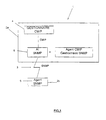
- the computer system 1 is distributed and composed of machines 2a, 2b organized in one or more networks 3.
- a machine 2 is a very broad conceptual unit, of a material and software.
- the machines can be very diverse, such as stations , servers, routers, specialized machines and gateways between networks. Only the components of machines 2 of system 1 characteristics of the present invention will be described, the other components being known to those skilled in the art.
- the system IT 1 includes a machine 2a called associated application machine at least one application and at least one machine 2b called machine resource capable of managing at least one resource.
- the machine 2a application comprises a complex protocol manager 4 of the CMIP type.
- the resource machine 2b has an SNMP 5 agent.
- the manager 4 dialogue with an agent integrator 6 using the complex protocol of the type CMIP.
- the term 'complex' will be explained later.
- the agent integrator 6 is part of the machine 2a application. Any other embodiment may be carried out and for example agent integrator 6 could be part of a machine independent of both machine 2a application and machine 2b resource.
- Agent 5 SNMP communicates with Agent Integrator 6 at across network 3 using the SNMP protocol.
- Agent integrator 6 translates the complex protocol to the SNMP protocol.
- the manager 4 transmits complex CMIP type requests to the agent integrator 6 which translates them into simple SNMP requests sent to the 5 SNMP agent concerned.
- an SNMP agent of a 2b resource machine manages a MIB, (Management Information Base - Information base administration) organizing in tree form SNMP attributes.
- An SNMP attribute is ordered in a tree by an OID identifier (Object Identifier); it is of a determined type such as integer, chain of characters, etc., and has a value at a given time.
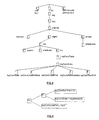
- Figure 2 represents a tree of identifiers: the attribute 'tcpConnState' has for identifier 1.3.6.1.2.1.6.13.1.1.
- An SNMP agent can manage global and unique SNMP objects, as the percentage of overall consumption of the processor (s) the resource machine, and multiple SNMP objects, such as the percentage CPU consumption of an application. In the latter case, there is as many instances managed by the SNMP agent of this type of SNMP object (percentage of CPU consumption of an application), that there is applications on the machine.
- the object is said to be multi-instantiated and is represented by an "SNMP table".
- the SNMP agent integrator queries SNMP tables with many instances, it uses a mechanism requests and responses.
- attribute is used to designate an SNMP object and a CMIS (Common Management) attribute Information Service - Service corresponding to the CMIP protocol); the term “table” to designate an SNMP table and a CMIS object.
- CMIS Common Management
- the identifier of an instance also designates the set of four indexes, without the name of the attribute. This identifier is used then to designate the instance of any attribute of the table.
- the identifier above is that of the 37 th instance of the tcpConnState attribute.
- the 1 st index corresponds to the value of the 37 th instance of the tcpConnLocalAddress index attribute; 2 nd index to the value of the 37th instance of the index attribute tcpConnLocalPort;
- the 3 rd index corresponds to the value of the 37 th instance of the tcpConnRemAddress index attribute;
- the 4th index the value of the 37th instance of the index attribute tcpConnRemPort.
- the last four components of the identifier of the tcpConnState attribute correspond to the values of the same instance of the four index attributes (called 1 st , 2 nd , 3 rd and 4 th index).
- the value of the index attributes is identical to the component of the identifier corresponding to the index attribute in question (i th index).
- the 37 th instance of the tcpConnLocalAddress index attribute whose identifier is: tcpConnLocalAddress. 219.182.165.53 .1021.219.182.165.55.513 has the value 219.182.165.53: this value is identical to the identifier component ( 1st index) corresponding to the index attribute tcpConnLocalAddress.
- the tcpConnState attribute is not an index attribute: it is ordered using index attributes.
- the tcpConnState attribute is of type integer and the first instance has a value equal to 1 at an instant t given.
- the SNMP manager issues a GET on the first instance of the tcpConnState attribute of the machine 2b resource
- SNMP agent of machine 2b resource responds that the value of the tcpConnState attribute is 1, that is to say that the state of the connection is closed.
- the SNMP manager can make a GETNEXT on the first instance of the tcpConnState attribute.
- the SNMP agent responds that the value sought is that of the attribute whose identifier (1.3.6.1.2.1.6.13.1.1.0.0.0.0.7.0.0.0.0.0) succeeds in ascending order to the identifier of the first instance of the tcpConnState attribute (1.3.6.1.2.1.6.13.1.1.0.0.0.0.0.0.0.0).
- the attribute, whose identifier succeeds the identifier of the first instance of the tcpConnState attribute is the second instance of the tcpConnState attribute.
- the SNMP agent installed on the resource machine 2b, replies that the value of the next instance, the second instance of the tcpConnState attribute is 2 and so on on all instances of the connection table until we pass to an identifier designating another type SNMP attribute such as, in this example, tcpConnLocalAdress.
- the GET command allows to read the value of one (or more) attribute (s) of which we already know the existence (known identifier). Only the GETNEXT command allows you to find other instances using the that all instances are ordered.
- the GETNEXT command allows to browse a whole table of instances by queries successive: from the start of the table, a first GETNEXT delivers the first existing instance; then a GETNEXT on this first instance gives the second instance, and so on until the end of the table.
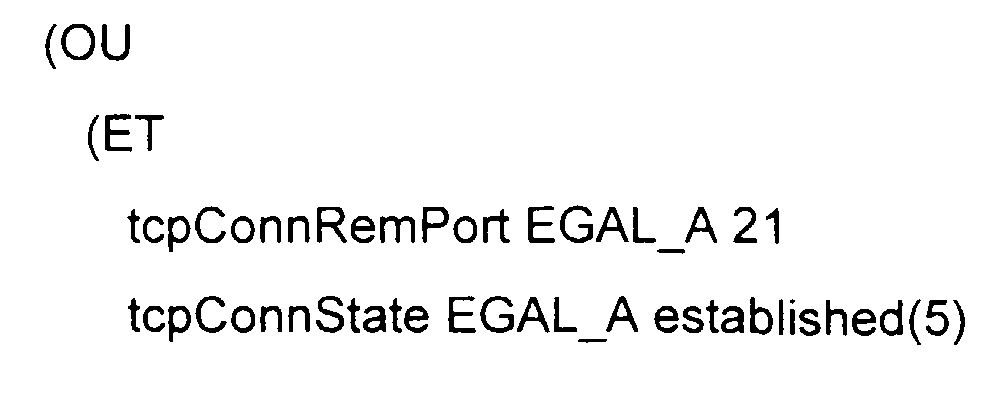
- a complex request on the TCP connection table has all of the following conditions: "the remote port number is 21 and the connection is active, or the local port number is greater than or equal to 1024".
- the complex filter can be represented as a tree as shown in figure 3.
- the nodes of the tree which are not followed other knots are called leaves.
- the sheets represent conditions on attributes while the other nodes represent boolean operations on one or more nodes.
- a complex request in this description is a request transmitted by a manager 4, relating to SNMP attributes managed by an agent 5 and capable of being represented by a complex filter constituted of any number of conditions on any number attributes, linked together by any number of operators such that AND, OR, NO, OR-EXCLUSIVE, etc.
- SNMP does not allow the SNMP 5 agent to respond to such complex requests, given the rudimentary commands which constitute the SNMP protocol, as seen above.
- the method according to the present invention consists in processing said request complex by means of the agent integrator 6 which translates said request complex (in the illustrated example of CMIP type) in SNMP requests, and optimize the number of SNMP requests transmitted on the network 3, by especially the number of GETNEXT requests.
- agent integrator 6 which translates said request complex (in the illustrated example of CMIP type) in SNMP requests, and optimize the number of SNMP requests transmitted on the network 3, by especially the number of GETNEXT requests.
- the first step is to build from an F1 filter from of a given complex request, in the illustrated example of CMIP type, a simplified F2 filter which only includes conditions relating to indexes.
- the agent integrator 6 transmits an empty response to the complex request transmitted by the manager 4.
- the method consists, by means of the agent integrator 6, in obtaining a simplified filter F2 of the following form:
- the method according to the invention transforms said operators into combinations of AND, OR and NOT using known rules on logical operators.
- the next step is to remove all conditions from the filter dealing with attributes that are not indexes. Note that if X is a condition relating to an attribute which is not an index, then it can exist attribute values for which X is true, and others for which (NON X) is true: all (NON X), pushed back to the leaves in the previous step, are replaced by the constant TRUE, then all the remaining X are replaced by the constant TRUE.
- This step ensures the matching characteristics.
- Rules are applied in this order or in a different order until none of the said rules are applicable.
- the agent integrator 6 responds to the complex filter with an empty response.
- the method consists in grouping all the OUs to the root of the filter: any OR operator contained in an AND operator is developed.
- Rules are applied in this order or in a different order until none of the said rules are applicable.
- the second step consists, by means of the agent integrator 6, in determine the first instance, called a potential instance, which checks the conditions of the simplified filter F2.
- the first potential instance verifying the filter F2 is the smallest of the first so-called "local" potential instances verifying each of the F2 (i) : the method therefore consists in finding the first instance which verifies a filter of the type (AND C1 (i) C2 (i) ... Cn (i) ). For all i, the identifier of the first "local" potential instance verifying F2 (i) is obtained by concatenating the first value I1_0 (i) verifying C1 (i) with the first value l2_0 (i) verifying C2 (i) , etc. until In_0 (i) verifying Cn (i) .
- the identifier of the local potential instance is l1_0 (i) .l2_0 (i) . ... .ln_0 (i) . If there is no condition on a given index k (k th index), the first possible value is taken for this index: 0 for an integer, 0.0.0.0 for an IP address, etc.
- the identifier of the potential instance is the smallest of the identifiers of the local zero potential instances obtained.
- agent integrator 6 knows the values of the indexes (as seen above) unlike the values of the attributes for which it must interrogate the agent 5 which manages the attribute concerned.
- the agent integrator 6 applies, in a third step, the request GETNEXT on the test identifier.
- agent integrator 6 responds to the complex request that there is no more reply. The treatment is finished: this constitutes the first case of termination.
- solution instance If an instance is obtained, it is called a solution instance. If Ik denotes the value of each of the indexes k of the solution instance, the identifier of the solution instance, called the solution identifier, is: I1.l2 ... ln.
- the agent integrator 6 applies the filter F1 complex to the so-called solution instance. If the answer is suitable, it is returned in response to the complex request. Whether the answer is suitable or no, the process continues processing.
- the method determines the first potential instance whose identifier is strictly greater than the solution identifier and which checks the simplified filter F2.
- This first potential instance is the smallest of the first local potential instances for each filter F2 (i) , whose identifier is strictly greater than the solution identifier and which checks the filter F2 (i) .
- I1.l2. ... .In is the solution identifier, as seen above.
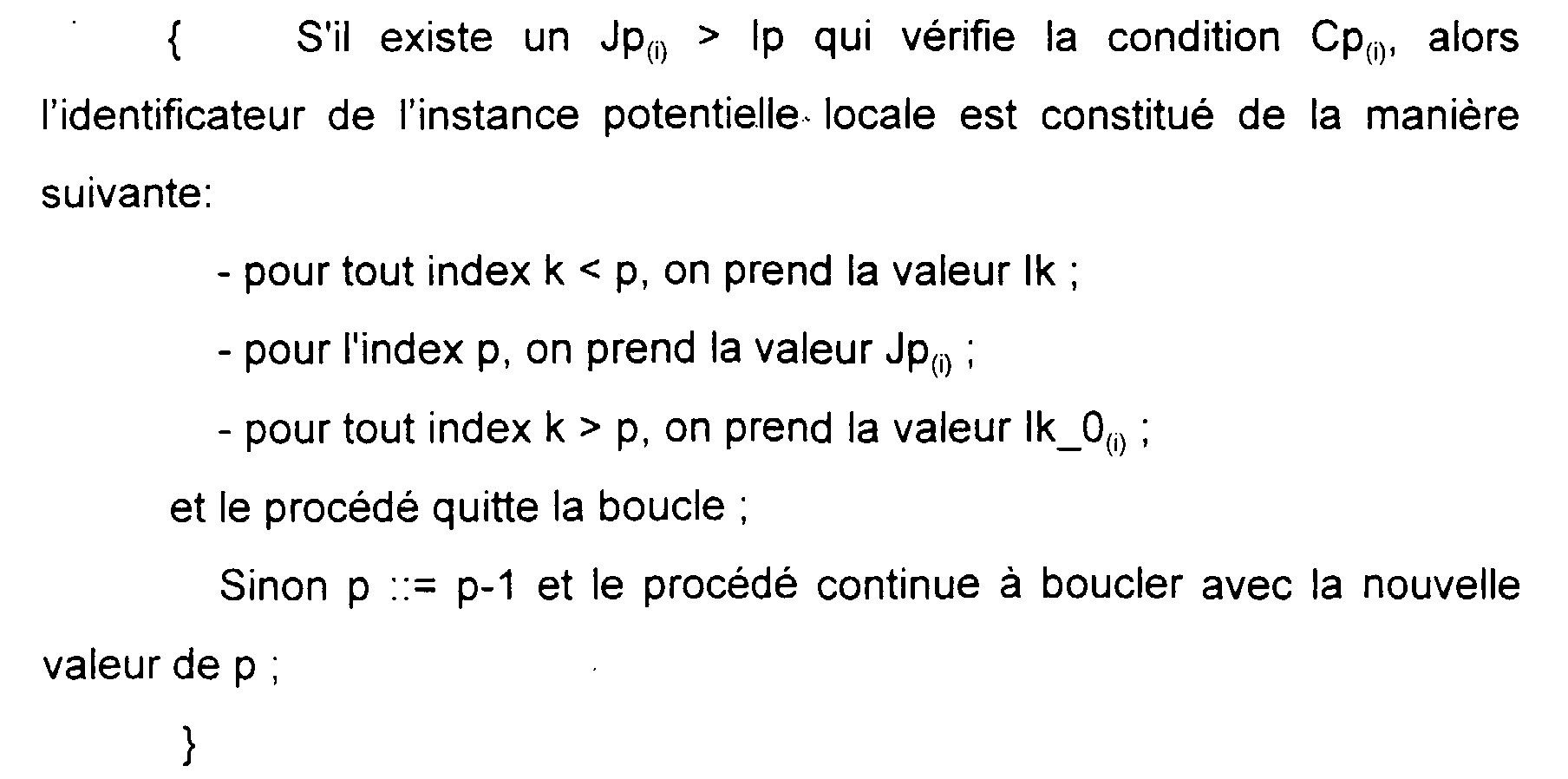
- the method performs the following loop as long as the index p> 0 and no instance has been found:
- the value lk_0 (i) corresponds to the identifier of the local potential instance zero at the start of the process (l1_0 (i) .l2_0 (i) . ... .ln_0 (i) ) (see above) ).
- the identifier of the potential instance is the smallest of the instance identifiers local potentials obtained.
- the identifier which is just less than the identifier of the potential instance is called the test identifier.
- Agent integrator 6 applies a GETNEXT on the test identifier and so on.
- the third, fourth and fifth steps are applied until the processing ends in one of the two termination cases presented previously.
- connection table The method according to the invention is described through the detailed example following.
- the values of the connection table are given in appendix 1.
- the complex filter F1 is as follows:
- the identifier of the local potential instance zero is obtained by concatenating the first value checking C1 (1) with the first value checking C2 (1) with the first value checking C3 (1) and the first value checking C4 (1) : I1_0 (1) .l2_0 (1) .l3_0 (1) .l4_0 (1) , i.e. 0.0.0.0.21.0.0.0.0.1024.
- the identifier obtained is the smallest and corresponds to the identifier of the potential instance.
- the test identifier is therefore 0.0.0.0.21.0.0.0.0.1023.
- the third step is to apply the first request GETNEXT on this test identifier.
- the result obtained (identifier solution 11.12.13.14) is 0.0.0.0.23.0.0.0.0.0.
- the filter F1 is applied to said result, to find out at the solution identifier.
- F1 filter fails on this instance (l4 ⁇ 1024 and tcpConnState equal to 2 other than 5).
- the new identifier of the potential instance is therefore I1.l2.l3.J4 (1) , i.e. 0.0.0.0.23.0.0.0.0.1024.
- the new test identifier is then 0.0.0.0.23.0.0.0.0.1023.
- the process resumes at the third step: the result of the second GETNEXT request on this test identifier gives 0.0.0.0.25.0.0.0.0.0 (solution identifier 11.12.13.14).
- the filter F1 fails on this instance (l4 ⁇ 1024, l2 different from 21 or 23 and tcpConnState equal to 2 different from 5).
- the new identifier of the potential instance is therefore J1 (1) .l2_0 (1) .l3_0 (1) .l4_0 (1) , i.e. 0.0.0.1.21.0.0.0.0.1024 (it is recalled that the identifier of l 'local zero instance at the start of the process l1_0 (1) .l2_0 (1) .l3_0 (1) .l4_0 (1) is equal to 0.0.0.0.21.0.0.0.0.1024).
- the new test identifier is then 0.0.0.1.21.0.0.0.0.1023.
- the result of the third GETNEXT on this test identifier gives 127.0.0.1.1026.127.0.0.1.2600 (solution identifier 11.12.13.14).
- the filter F1 fails on this solution identifier (12 different from 21 or 23).
- the new identifier for the potential instance is therefore J1 (1) .l2_0 (1) .l3_0 (1) .l4_0 (1) , i.e. 127.0.0.2.21.0.0.0.0.1024.
- the new test identifier is then 127.0.0.2.21.0.0.0.0.1023.
- the result of the fourth GETNEXT on this test identifier gives 219.182.165.53.23.219.182.165.55.4109 (solution identifier 11.12.13.14).
- the filter F1 succeeds on this solution identifier; a response is therefore sent to the complex request.
- the new identifier for the potential instance is therefore I1.l2.l3.J4 (1) , i.e. 219.182.165.53.23.219.182.165.55.4110.
- the new test identifier is then 219.182.165.53.23.219.182.165.55.4109.
- the result of the fifth GETNEXT on this test identifier gives 219.182.165.53.139.219.182.165.58.2278 (solution identifier I1.l2.l3.l4).
- the F1 filter fails on this solution identifier.
- the method consists in obtaining in the first step a simplified filter of the form:
- the process consists, to obtain the simplified filter F2, of checking prima facie if the complex filter meets rules defining filters which are not verified by any authority.
- the method consists in replacing the conditions X, in replacing the conditions X and NON X by the constant TRUE.
- the method consists, in the second step, in concatenating the first value checking C1 (i) with the first value checking C2 (i) up to Cn (i) to obtain the potential local instances zero l1_0 (i) . l2_0 (i) . ... ln_0 (i) , the first possible value in the absence of a condition on a given index being the null value, the potential instance corresponding to the smallest of the local potential instances zero.
- the method consists, in the second and fifth stages, in get the test identifier from the instance identifier potential, by subtracting 1 from its last digit if it is different from 0, or by deleting the latter digit if it is zero.
- the method also relates to the system for processing the complex request addressed to at least 5 SNMP agent of machine 2b computer system resource 1 from protocol manager 4 machine complex 2a application, each agent 5 managing tables of attributes belonging to the resource machine 2b, the instances of the tables being referenced by identifiers including indexes, the system comprising the integrating agent 6 allowing the implementation of the method previously described.
Landscapes
- Engineering & Computer Science (AREA)
- Computer Networks & Wireless Communication (AREA)
- Signal Processing (AREA)
- Computer And Data Communications (AREA)
- Data Exchanges In Wide-Area Networks (AREA)
Abstract
Description
- transformer un filtre F1 issu de la requête complexe en un filtre F2 simplifié ne comportant que des conditions sur des index, le filtre F2 respectant les caractéristiques de correspondance suivantes : le filtre F2 laisse passer toutes les requêtes SNMP dont les réponses pourraient vérifier le filtre F1, mais filtre toutes les requêtes SNMP dont les réponses ne peuvent en aucun cas vérifier le filtre F1 ;
- restreindre les requêtes SNMP à celles qui respectent le filtre F2, et appliquer le filtre F1 sur les réponses.
- la figure 1 est une vue schématique d'une forme de réalisation du système selon l'invention ;
- la figure 2 représente partiellement un arbre d'identificateurs d'attributs gérés par le système représenté sur la figure 1 ;
- la figure 3 représente un arbre correspondant à un filtre complexe particulier.
tcpConnState.219.182.165.53.1021.219.182.165.55.513 soit :
1.3.6.1.2.1.6.13.1.1 . 219.182.165.53 . 1021 . 219.182.165.55 . 513 tcpConnState 1er index 2ème index 3ème index 4ème index identificateur
tcpConnLocalAddress.219.182.165.53.1021.219.182.165.55.513 a pour valeur 219.182.165.53 : cette valeur est identique au composant de l'identificateur (1er index) correspondant à l'attribut d'index tcpConnLocalAddress. L'attribut tcpConnState n'est pas un attribut d'index : il est ordonné à l'aide des attributs d'index.
- l'identification de la table SNMP considérée ;
- un ensemble de conditions sur des attributs (y compris des index) de la table.
" le numéro de port distant est 21 et la connexion est active, ou le numéro de port local est supérieur ou égal à 1024 ".

- transformer un filtre F1 issu de la requête complexe en un filtre F2 simplifié ne comportant que des conditions sur des index, le filtre F2 respectant les caractéristiques de correspondance suivantes : le filtre F2 laisse passer toutes les requêtes SNMP dont les réponses pourraient vérifier le filtre F1, mais filtre toutes les requêtes SNMP dont les réponses ne peuvent en aucun cas vérifier le filtre F1 ;
- restreindre les requêtes SNMP à celles qui respectent le filtre F2, et appliquer le filtre F1 sur les réponses.
- s'il peut exister des valeurs d'attributs telles qu'une instance donnée de la table vérifie le filtre F1, alors cette instance vérifie le filtre F2;
- si une instance de la table ne peut pas vérifier le filtre F1 quelles que soient les valeurs d'attributs qui ne sont pas des index, alors cette instance ne vérifie pas le filtre F2.
" Si un filtre porte sur une valeur d'attribut V du type " V=a ET V>b " et si " a≤b " alors le filtre n'a pas de réponse ". C'est le cas par exemple lorsque V représente un numéro de port distant, a=22 et b=41.

(OU-EXCLUSIF A B) est équivalent à (OU (ET A (NON B)) (ET B (NON A))) ; (IMPLIQUE A B) est équivalent à (OU (NON A) B).
- remplacer (NON (OU A B C ...)) par (ET (NON A) (NON B) (NON C) ...)
- remplacer (NON (ET A B C ...)) par (OU (NON A) (NON B) (NON C) ...)
- remplacer (NON (NON A)) par A.
- Remplacer toutes les opérations ET ne contenant que des opérandes
VRAI par la constante VRAI.
Par exemple, remplacer (ET VRAI VRAI VRAI) par VRAI. - Retirer tous les opérandes VRAI des autres opérations ET.
Par exemple, remplacer (ET A B VRAI C VRAI) par (ET A B C). - Remplacer toutes les opérations OU contenant au moins un opérande
VRAI par la constante VRAI.
Par exemple, remplacer (OU A B VRAI C VRAI) par VRAI. - Remplacer les opérations ET et OU à un seul opérande par cet opérande. Par exemple, remplacer (ET A) par A.
- Factoriser les ET et OU imbriqués.
Par exemple, remplacer (OU A (OU B C) D) par (OU A B C D). - Regrouper les conditions concernant le même index. Dans la description
qui suit, des conditions, simples ou complexes, portant respectivement sur
l'index numéro 1, 2, 3, ... n seront appelées C1, C2, C3, ... Cn. De la
même manière, une condition quelconque portant sur un index
quelconque k, compris entre 1 et n sera appelée Ck.
Une condition du type (OU (ET Ck Ck) Ck (NON Ck)) est remplacée par une seule condition de type Ck un peu plus complexe. Ce type de transformation aura notamment pour effet de supprimer tous les opérateurs NON. - Lorsqu'une condition de type Ck est toujours vraie ou toujours fausse,
remplacer cette condition par la valeur VRAI ou FAUX, respectivement.
Selon une forme de réalisation du système 1, l'intégrateur d'agent 6 dispose d'une liste de règles telles que par exemple : - (index 3 < 22) ET (index 3 > 23) correspond à une condition FAUX ;
- (index 3 < 22) OU (index 3 > 21) correspond à une condition VRAI.
- Remplacer toutes les opérations OU ne contenant que des conditions
FAUX par la constante FAUX.
Par exemple, remplacer (OU FAUX FAUX FAUX) par FAUX. - Retirer toutes les conditions FAUX des autres opérations OU.
Par exemple, remplacer (OU A B FAUX C FAUX) par (OU A B C). - Remplacer toutes les opérations ET contenant au moins une condition
FAUX par la constante FAUX.
Par exemple, remplacer (ET A B FAUX C FAUX) par FAUX.
(ET C3 (OU C1 C2) C6) devient (OU (ET C3 C1 C6) (ET C3 C2 C6))
- Remplacer les opérations ET et OU à un seul opérande par cet opérande.
- Factoriser les ET et OU imbriqués.
- Regrouper les conditions concernant le même index.
- Lorsqu'une condition de type Ck est toujours vraie ou toujours fausse, remplacer cette condition par la valeur VRAI ou FAUX, respectivement.
- Remplacer toutes les opérations ET contenant au moins une condition FAUX par la constante FAUX.
- Remplacer toutes les opérations ET ne contenant que des conditions VRAI par la constante VRAI.
- Retirer toutes les conditions VRAI des autres opérations ET.
- Remplacer toutes les opérations OU contenant au moins une condition VRAI par la constante VRAI.
- Remplacer toutes les opérations OU ne contenant que des conditions FAUX par la constante FAUX.
- Retirer toutes les conditions FAUX des autres opérations OU.
- Si le dernier chiffre de l'identificateur de l'instance potentielle est
différent de 0, l'identificateur de test est identique à l'identificateur de
l'instance potentielle sauf au niveau du dernier chiffre qui est juste inférieur
au dernier chiffre de l'identificateur de l'instance potentielle.
Par exemple:
195.3.27.2 (identificateur de l'instance potentielle) -> 195.3.27.1 (identificateur de test) - Si le dernier chiffre de l'identificateur de l'instance potentielle est
égal à 0, l'identificateur de test correspond à l'identificateur de l'instance
potentielle sans son dernier chiffre.
Par exemple:
195.3.27.0 (identificateur de l'instance potentielle) -> 195.3.27 (identificateur de test).
I1.l2. ... .In est l'identificateur solution, comme vu plus haut.


p=4 : existe-t-il un J4(1) supérieur à I4=0 qui vérifie C4(1) ? Oui : J4(1)=1024
Le nouvel identificateur de l'instance potentielle est donc I1.l2.l3.J4(1), soit 0.0.0.0.23.0.0.0.0.1024. Le nouvel identificateur de test est alors 0.0.0.0.23.0.0.0.0.1023. Le procédé reprend à la troisième étape : le résultat de la deuxième requête GETNEXT sur cet identificateur de test donne 0.0.0.0.25.0.0.0.0.0 (identificateur solution 11.12.13.14). Le filtre F1 échoue sur cette instance (l4<1024, l2 différent de 21 ou 23 et tcpConnState égal à 2 différent de 5).
p=4 : existe-t-il un J4(1) supérieur à 14=4109 qui vérifie C4(1) ? Oui : J4(1)=4110
Le nouvel identificateur de l'instance potentielle est donc I1.l2.l3.J4(1), soit 219.182.165.53.23.219.182.165.55.4110. Le nouvel identificateur de test est alors 219.182.165.53.23.219.182.165.55.4109. Le résultat du cinquième GETNEXT sur cet identificateur de test donne 219.182.165.53.139.219.182.165.58.2278 (identificateur solution I1.l2.l3.l4). Le filtre F1 échoue sur cet identificateur solution.
- transformer un filtre F1 issu de la requête complexe en un filtre F2 simplifié ne comportant que des conditions sur des index, le filtre F2 respectant les caractéristiques de correspondance suivantes : le filtre F2 laisse passer toutes les requêtes SNMP dont les réponses pourraient vérifier le filtre F1, mais filtre toutes les requêtes SNMP dont les réponses ne peuvent en aucun cas vérifier le filtre F1 ;
- restreindre les requêtes SNMP à celles qui respectent le filtre F2, et appliquer le filtre F1 sur les réponses.


- à la seule condition VRAI, la table est parcourue dans son intégralité ;
- à la seule condition FAUX, aucune instance ne peut convenir.
- transformer le filtre complexe en une combinaison de conditions sur les attributs liées par les opérateurs logiques ET, OU et NON ;
- repousser les opérateurs NON vers les feuilles et supprimer les NON doubles (NON NON) ;
- supprimer les conditions X portant sur des attributs qui ne sont pas des index ;
- simplifier les opérations en résultant ;
- factoriser les ET et OU imbriqués ;
- regrouper les conditions concernant le même index ;
- regrouper tous les OU à la racine du filtre et simplifier à nouveau.
- remplacer les tests ET et OU à un seul opérande par cet opérande ;
- remplacer les opérations ET ne contenant que des opérandes VRAI par la constante VRAI et les opérations OU ne contenant que des opérandes FAUX par la constante FAUX ;
- retirer les conditions VRAI des autres opérations ET et les conditions FAUX des autres opérations OU ;
- remplacer les opérations OU contenant au moins un opérande VRAI par la constante VRAI et les opérations ET contenant au moins un opérande FAUX par la constante FAUX ;
- remplacer les conditions s'avérant être toujours VRAI ou FAUX par la constante VRAI ou FAUX ;
S'il existe un Jp(i) > Ip qui vérifie la condition Cp(i), alors l'instance potentielle locale est constituée de la manière suivante:
- pour tout index k < p, on prend la valeur Ik avec I1.l2. ... .ln l'identificateur de l'instance solution ;
- pour l'index p, on prend la valeur Jp(i) ;
- pour tout index k > p, on prend la valeur lk_0(i) ;
Claims (12)
- Procédé de traitement d'une requête complexe adressée à au moins un agent (5) SNMP d'une machine (2b) ressource d'un système informatique (1) à partir d'un gestionnaire (4) de protocole complexe d'une machine (2a) application, chaque agent (5) gérant des tables d'attributs appartenant à la machine (2b) ressource, les instances des tables étant référencées par des identificateurs comprenant des index, caractérisé en ce qu'il consiste à :transformer un filtre (F1) issu de la requête complexe en un filtre (F2) simplifié ne comportant que des conditions sur des index, le filtre (F2) respectant les caractéristiques de correspondance suivantes : le filtre (F2) laisse passer toutes les requêtes SNMP dont les réponses pourraient vérifier le filtre (F1), mais filtre toutes les requêtes SNMP dont les réponses ne peuvent en aucun cas vérifier le filtre (F1) ;restreindre les requêtes SNMP à celles qui respectent le filtre (F2), et appliquer le filtre (F1) sur les réponses.
- Procédé selon la revendication 1, caractérisé en ce qu'il consiste à :1) transformer le filtre (F1) issu de la requête complexe en filtre (F2) simplifié ;2) déterminer la première instance potentielle vérifiant le filtre (F2) simplifié ; l'identificateur qui est juste inférieur à l'identificateur de l'instance potentielle déterminée est appelé identificateur de test ;3) retrouver à partir d'une requête SNMP l'instance de la table ayant pour identificateur celui qui suit l'identificateur de test. Si aucune instance n'est retrouvée, le procédé de traitement est terminé. Si une instance est retrouvée, l'instance retrouvée est appelée instance solution ;4) appliquer le filtre complexe (F1) à l'instance solution ; si l'instance vérifie le filtre (F1), elle fait partie de la réponse à la requête complexe traitée ;5) déterminer la première instance potentielle dont l'identificateur est supérieur à l'identificateur de l'instance solution et vérifiant le filtre (F2) simplifié. Si aucune instance n'est retrouvée, le procédé de traitement est terminé. Si une instance est retrouvée, l'identificateur qui est juste inférieur à l'identificateur de l'instance potentielle est appelé identificateur de test et le procédé reprend à la troisième étape.
- Procédé selon la revendication 2, caractérisé en ce qu'il consiste à obtenir dans la première étape un filtre simplifié de la forme :

- Procédé selon l'une des revendications 2 ou 3, caractérisé en ce que si, dans la première étape, après simplification, le filtre se résume :à la seule condition VRAI, la table est parcourue dans son intégralité ;à la seule condition FAUX, aucune instance ne peut convenir.
- Procédé selon l'une des revendications 2 à 4, caractérisé en ce qu'il consiste, pour obtenir le filtre simplifié F2, à vérifier de prime abord si le filtre complexe répond à des règles définissant des filtres qui ne sont vérifiés par aucune instance.
- Procédé selon l'une des revendications 1 à 5, caractérisé en ce qu'il consiste, pour obtenir le filtre simplifié F2, à :transformer le filtre complexe en une combinaison de conditions sur les attributs liées par les opérateurs logiques ET, OU et NON ;repousser les opérateurs NON vers les feuilles et supprimer les NON doubles (NON NON) ;supprimer les conditions X portant sur des attributs qui ne sont pas des index ;simplifier les opérations en résultant ;factoriser les ET et OU imbriqués ;regrouper les conditions concernant le même index ;regrouper tous les OU à la racine du filtre et simplifier à nouveau.
- Procédé selon la revendication 6, caractérisé en ce qu'il consiste, pour supprimer les conditions X, à remplacer les conditions X et NON X par la constante VRAI.
- Procédé selon l'une des revendications 6 ou 7, caractérisé en ce qu'il consiste, pour simplifier les opérations, à :toutes ces opérations de simplification étant appliquées autant de fois qu'il est possible de le faire.remplacer les tests ET et OU à un seul opérande par cet opérande ;remplacer les opérations ET ne contenant que des opérandes VRAI par la constante VRAI et les opérations OU ne contenant que des opérandes FAUX par la constante FAUX ;retirer les conditions VRAI des autres opérations ET et les conditions FAUX des autres opérations OU ;remplacer les opérations OU contenant au moins un opérande VRAI par la constante VRAI et les opérations ET contenant au moins un opérande FAUX par la constante FAUX ;remplacer les conditions s'avérant être toujours VRAI ou FAUX par la constante VRAI ou FAUX ;
- Procédé selon l'une des revendications 2 à 8, caractérisé en ce qu'il consiste, dans la deuxième étape, à concaténer la première valeur vérifiant C1(i) à la première valeur vérifiant C2(i) jusqu'à Cn(i) pour obtenir les instances potentielles locales zéro l1_0(i), l2_0(i). ... ln_0(i) , la première valeur possible en l'absence de condition sur un index donné étant la valeur nulle, l'instance potentielle correspondant à la plus petite des instances potentielles locales zéro.
- Procédé selon la revendication 9, caractérisé en ce qu'il consiste, dans la cinquième étape, à effectuer pour tout i et tant que l'indice p est supérieur à 0 ou qu'aucune instance cherchée n'est trouvée, les opérations suivantes :
S'il existe un Jp(i) > Ip qui vérifie la condition Cp(i), alors l'instance potentielle locale est constituée de la manière suivante:Sinon p prend la valeur p-1 et le procédé reprend les opérations ci-dessus, l'instance potentielle correspondant à la plus petite des instances potentielles locales obtenues.pour tout index k < p, on prend la valeur Ik avec 11.12.... .ln l'identificateur de l'instance solution ;pour l'index p, on prend la valeur Jp(i) ;pour tout index k > p, on prend la valeur lk_0(i) ; - Procédé selon l'une des revendications 2 à 10, caractérisé en ce qu'il consiste, dans la deuxième et la cinquième étapes, à obtenir l'identificateur de test à partir de l'identificateur de l'instance potentielle, en soustrayant 1 à son dernier chiffre si celui-ci est différent de 0, ou en supprimant ce dernier chiffre s'il est nul.
- Système de traitement d'une requête complexe adressée à au moins un agent (5) SNMP d'une machine (2b) ressource d'un système informatique (1) à partir d'un gestionnaire (4) de protocole complexe d'une machine (2a) application, chaque agent (5) gérant des tables d'attributs appartenant à la machine (2b) ressource, les instances des tables étant référencées par des identificateurs comprenant des index, le système comprenant un agent intégrateur (6) permettant la mise en oeuvre du procédé de traitement selon l'une des revendications 1 à 11.
Applications Claiming Priority (2)
| Application Number | Priority Date | Filing Date | Title |
|---|---|---|---|
| FR9908250 | 1999-06-28 | ||
| FR9908250A FR2795580A1 (fr) | 1999-06-28 | 1999-06-28 | Procede d'interrogation a distance d'agents snmp |
Publications (2)
| Publication Number | Publication Date |
|---|---|
| EP1065828A1 true EP1065828A1 (fr) | 2001-01-03 |
| EP1065828B1 EP1065828B1 (fr) | 2007-11-21 |
Family
ID=9547392
Family Applications (1)
| Application Number | Title | Priority Date | Filing Date |
|---|---|---|---|
| EP00401757A Expired - Lifetime EP1065828B1 (fr) | 1999-06-28 | 2000-06-20 | Procédé d'interrogation à distance d'agents SNMP |
Country Status (4)
| Country | Link |
|---|---|
| US (1) | US7653709B1 (fr) |
| EP (1) | EP1065828B1 (fr) |
| DE (1) | DE60037160T2 (fr) |
| FR (1) | FR2795580A1 (fr) |
Cited By (2)
| Publication number | Priority date | Publication date | Assignee | Title |
|---|---|---|---|---|
| US7634446B2 (en) | 2000-11-08 | 2009-12-15 | Sprint Communications Company L.P. | Method and system for providing prepaid data service |
| US7653709B1 (en) | 1999-06-28 | 2010-01-26 | Thomson Licensing S.A. | Method for remote interrogation of SNMP agents |
Families Citing this family (5)
| Publication number | Priority date | Publication date | Assignee | Title |
|---|---|---|---|---|
| KR101672445B1 (ko) * | 2010-03-19 | 2016-11-04 | 삼성전자주식회사 | 컨텐츠 전송 시스템에서 컨텐츠 재생 제어 방법 및 장치 |
| US8392399B2 (en) * | 2010-09-16 | 2013-03-05 | Microsoft Corporation | Query processing algorithm for vertically partitioned federated database systems |
| US9413615B1 (en) | 2012-03-02 | 2016-08-09 | Juniper Networks, Inc. | Trap filtering within a device management protocol |
| US10382252B2 (en) * | 2012-06-26 | 2019-08-13 | Juniper Networks, Inc. | Filtering within device management protocol queries |
| US12166636B1 (en) | 2023-09-20 | 2024-12-10 | Insight Direct Usa, Inc. | Network protocol-based interrogation for network device characterization |
Citations (1)
| Publication number | Priority date | Publication date | Assignee | Title |
|---|---|---|---|---|
| EP0863645A2 (fr) * | 1997-03-05 | 1998-09-09 | Kokusai Denshin Denwa Co., Ltd | Méthode de contrÔle d'accès à une MIB dans la gestion OSI |
Family Cites Families (5)
| Publication number | Priority date | Publication date | Assignee | Title |
|---|---|---|---|---|
| KR100334689B1 (ko) * | 1994-02-28 | 2002-10-04 | 브리티쉬 텔리커뮤니케이션즈 파블릭 리미티드 캄퍼니 | 데이터기억장치 |
| US5541911A (en) * | 1994-10-12 | 1996-07-30 | 3Com Corporation | Remote smart filtering communication management system |
| US6212529B1 (en) * | 1996-11-13 | 2001-04-03 | Puma Technology, Inc. | Synchronization of databases using filters |
| US6212511B1 (en) * | 1997-10-31 | 2001-04-03 | Sun Microsystems, Inc. | Distributed system and method for providing SQL access to management information in a secure distributed network |
| FR2795580A1 (fr) | 1999-06-28 | 2000-12-29 | Bull Sa | Procede d'interrogation a distance d'agents snmp |
-
1999
- 1999-06-28 FR FR9908250A patent/FR2795580A1/fr active Pending
-
2000
- 2000-06-20 DE DE60037160T patent/DE60037160T2/de not_active Expired - Lifetime
- 2000-06-20 EP EP00401757A patent/EP1065828B1/fr not_active Expired - Lifetime
- 2000-06-28 US US09/604,919 patent/US7653709B1/en not_active Expired - Fee Related
Patent Citations (1)
| Publication number | Priority date | Publication date | Assignee | Title |
|---|---|---|---|---|
| EP0863645A2 (fr) * | 1997-03-05 | 1998-09-09 | Kokusai Denshin Denwa Co., Ltd | Méthode de contrÔle d'accès à une MIB dans la gestion OSI |
Non-Patent Citations (1)
| Title |
|---|
| MOORE B ET AL: "CMIP/SNMP INTEGRATION PROTOTYPE", PROCEEDINGS OF THE NETWORK OPERATIONS AND MANAGEMENT SYMPOSIUM (NOMS),US,NEW YORK, IEEE, vol. SYMP. 4, 1994, pages 257 - 267, XP000452410, ISBN: 0-7803-1812-9 * |
Cited By (2)
| Publication number | Priority date | Publication date | Assignee | Title |
|---|---|---|---|---|
| US7653709B1 (en) | 1999-06-28 | 2010-01-26 | Thomson Licensing S.A. | Method for remote interrogation of SNMP agents |
| US7634446B2 (en) | 2000-11-08 | 2009-12-15 | Sprint Communications Company L.P. | Method and system for providing prepaid data service |
Also Published As
| Publication number | Publication date |
|---|---|
| DE60037160T2 (de) | 2008-10-02 |
| EP1065828B1 (fr) | 2007-11-21 |
| FR2795580A1 (fr) | 2000-12-29 |
| US7653709B1 (en) | 2010-01-26 |
| DE60037160D1 (de) | 2008-01-03 |
Similar Documents
| Publication | Publication Date | Title |
|---|---|---|
| EP0599706B1 (fr) | Dispositif de traitement de l'information permettant la gestion d'une ressource informatique par un système d'administration | |
| EP2783500B1 (fr) | Procédé de traitement d'une requête dans un réseau de communication centré sur les informations | |
| FR2801697A1 (fr) | Procede d'acces selon divers protocoles a des objets d'un arbre representatif d'au moins une ressource de systeme | |
| EP0951155A1 (fr) | Procédé et système d'administration de réseaux et de systèmes | |
| EP1797696A1 (fr) | Procede et systeme de resolution dns distribuee | |
| EP0742514A1 (fr) | Procédé de contrÔle d'exécution d'un scénario de commande | |
| EP1977365B1 (fr) | Procede de gestion de documents electroniques | |
| FR2730327A1 (fr) | Outil de generation et d'execution de commandes a interface graphique | |
| FR2780529A1 (fr) | Procede pour l'optimisation des acces a une base de donnees | |
| EP1065828B1 (fr) | Procédé d'interrogation à distance d'agents SNMP | |
| EP0969625B1 (fr) | Agent de communication entre un administrateur et au moins une ressource d'un système informatique | |
| EP1501241B1 (fr) | Procédé d'approvisionnement de règles de politique dans un réseau géré à base de règles de politique | |
| FR2803405A1 (fr) | Procede d'administration d'un systeme informatique ouvert | |
| EP1503541A1 (fr) | Procédé et dispositif pour la mémorisation configurable de données d'équipements dans un systéme de gestion de réseau | |
| WO2024083978A1 (fr) | Procédé de traitement d'une requête d'exécution d'un service dans un réseau de communication, procédé de validation de la requête, entité intermédiaire, entité de validation, système et programme d'ordinateur correspondants | |
| EP1220524A2 (fr) | Procédé de synchronisation de données sur une liaison serie | |
| FR3019417A1 (fr) | Procede de traitement d'un message dans un dispositif d'interconnexion | |
| FR2786643A1 (fr) | Systeme et procede d'interrogation a distance d'agents snmp | |
| EP0977400A1 (fr) | Procédé de référencement dans une base d'information d'administration d'un ensemble d'instances d'objet | |
| WO2010023376A1 (fr) | Système informatique à serveur d'accès simplifié, et procédé correspondant | |
| EP3394814A1 (fr) | Procédé automatique et dispositif de détermination d'un parcours client dans un système de communication multicanal | |
| FR2864663A1 (fr) | Echange securise de donnees, notamment de donnees certifiees pour l'affacturage | |
| EP2786274B1 (fr) | Procede d'interrogation de base de donnees | |
| WO2000072511A1 (fr) | Procede de manipulation, dans un systeme informatique, d'objets d'un arbre de contenance | |
| FR3105477A3 (fr) | Système de distribution de contenu avec gestion de profil utilisateur |
Legal Events
| Date | Code | Title | Description |
|---|---|---|---|
| PUAI | Public reference made under article 153(3) epc to a published international application that has entered the european phase |
Free format text: ORIGINAL CODE: 0009012 |
|
| AK | Designated contracting states |
Kind code of ref document: A1 Designated state(s): DE FR GB |
|
| AX | Request for extension of the european patent |
Free format text: AL;LT;LV;MK;RO;SI |
|
| 17P | Request for examination filed |
Effective date: 20010703 |
|
| AKX | Designation fees paid |
Free format text: DE FR GB |
|
| RAP1 | Party data changed (applicant data changed or rights of an application transferred) |
Owner name: THOMSON LICENSING S.A. |
|
| RAP1 | Party data changed (applicant data changed or rights of an application transferred) |
Owner name: THOMSON LICENSING |
|
| GRAP | Despatch of communication of intention to grant a patent |
Free format text: ORIGINAL CODE: EPIDOSNIGR1 |
|
| GRAS | Grant fee paid |
Free format text: ORIGINAL CODE: EPIDOSNIGR3 |
|
| GRAJ | Information related to disapproval of communication of intention to grant by the applicant or resumption of examination proceedings by the epo deleted |
Free format text: ORIGINAL CODE: EPIDOSDIGR1 |
|
| GRAP | Despatch of communication of intention to grant a patent |
Free format text: ORIGINAL CODE: EPIDOSNIGR1 |
|
| GRAS | Grant fee paid |
Free format text: ORIGINAL CODE: EPIDOSNIGR3 |
|
| GRAA | (expected) grant |
Free format text: ORIGINAL CODE: 0009210 |
|
| AK | Designated contracting states |
Kind code of ref document: B1 Designated state(s): DE FR GB |
|
| REG | Reference to a national code |
Ref country code: GB Ref legal event code: FG4D Free format text: NOT ENGLISH |
|
| REF | Corresponds to: |
Ref document number: 60037160 Country of ref document: DE Date of ref document: 20080103 Kind code of ref document: P |
|
| GBT | Gb: translation of ep patent filed (gb section 77(6)(a)/1977) |
Effective date: 20080113 |
|
| PLBE | No opposition filed within time limit |
Free format text: ORIGINAL CODE: 0009261 |
|
| STAA | Information on the status of an ep patent application or granted ep patent |
Free format text: STATUS: NO OPPOSITION FILED WITHIN TIME LIMIT |
|
| 26N | No opposition filed |
Effective date: 20080822 |
|
| REG | Reference to a national code |
Ref country code: FR Ref legal event code: PLFP Year of fee payment: 17 |
|
| PGFP | Annual fee paid to national office [announced via postgrant information from national office to epo] |
Ref country code: GB Payment date: 20160617 Year of fee payment: 17 |
|
| PGFP | Annual fee paid to national office [announced via postgrant information from national office to epo] |
Ref country code: FR Payment date: 20160630 Year of fee payment: 17 |
|
| PGFP | Annual fee paid to national office [announced via postgrant information from national office to epo] |
Ref country code: DE Payment date: 20160614 Year of fee payment: 17 |
|
| REG | Reference to a national code |
Ref country code: DE Ref legal event code: R119 Ref document number: 60037160 Country of ref document: DE |
|
| GBPC | Gb: european patent ceased through non-payment of renewal fee |
Effective date: 20170620 |
|
| REG | Reference to a national code |
Ref country code: FR Ref legal event code: ST Effective date: 20180228 |
|
| PG25 | Lapsed in a contracting state [announced via postgrant information from national office to epo] |
Ref country code: DE Free format text: LAPSE BECAUSE OF NON-PAYMENT OF DUE FEES Effective date: 20180103 Ref country code: GB Free format text: LAPSE BECAUSE OF NON-PAYMENT OF DUE FEES Effective date: 20170620 |
|
| PG25 | Lapsed in a contracting state [announced via postgrant information from national office to epo] |
Ref country code: FR Free format text: LAPSE BECAUSE OF NON-PAYMENT OF DUE FEES Effective date: 20170630 |