EP1064951A2 - Erythropoietin derivatives - Google Patents
Erythropoietin derivatives Download PDFInfo
- Publication number
- EP1064951A2 EP1064951A2 EP00113115A EP00113115A EP1064951A2 EP 1064951 A2 EP1064951 A2 EP 1064951A2 EP 00113115 A EP00113115 A EP 00113115A EP 00113115 A EP00113115 A EP 00113115A EP 1064951 A2 EP1064951 A2 EP 1064951A2
- Authority
- EP
- European Patent Office
- Prior art keywords
- thr
- asn
- conjugate
- glycoprotein
- sequence
- Prior art date
- Legal status (The legal status is an assumption and is not a legal conclusion. Google has not performed a legal analysis and makes no representation as to the accuracy of the status listed.)
- Granted
Links
Classifications
-
- C—CHEMISTRY; METALLURGY
- C07—ORGANIC CHEMISTRY
- C07K—PEPTIDES
- C07K17/00—Carrier-bound or immobilised peptides; Preparation thereof
- C07K17/02—Peptides being immobilised on, or in, an organic carrier
- C07K17/08—Peptides being immobilised on, or in, an organic carrier the carrier being a synthetic polymer
-
- A—HUMAN NECESSITIES
- A61—MEDICAL OR VETERINARY SCIENCE; HYGIENE
- A61K—PREPARATIONS FOR MEDICAL, DENTAL OR TOILETRY PURPOSES
- A61K47/00—Medicinal preparations characterised by the non-active ingredients used, e.g. carriers or inert additives; Targeting or modifying agents chemically bound to the active ingredient
- A61K47/50—Medicinal preparations characterised by the non-active ingredients used, e.g. carriers or inert additives; Targeting or modifying agents chemically bound to the active ingredient the non-active ingredient being chemically bound to the active ingredient, e.g. polymer-drug conjugates
- A61K47/51—Medicinal preparations characterised by the non-active ingredients used, e.g. carriers or inert additives; Targeting or modifying agents chemically bound to the active ingredient the non-active ingredient being chemically bound to the active ingredient, e.g. polymer-drug conjugates the non-active ingredient being a modifying agent
- A61K47/56—Medicinal preparations characterised by the non-active ingredients used, e.g. carriers or inert additives; Targeting or modifying agents chemically bound to the active ingredient the non-active ingredient being chemically bound to the active ingredient, e.g. polymer-drug conjugates the non-active ingredient being a modifying agent the modifying agent being an organic macromolecular compound, e.g. an oligomeric, polymeric or dendrimeric molecule
- A61K47/59—Medicinal preparations characterised by the non-active ingredients used, e.g. carriers or inert additives; Targeting or modifying agents chemically bound to the active ingredient the non-active ingredient being chemically bound to the active ingredient, e.g. polymer-drug conjugates the non-active ingredient being a modifying agent the modifying agent being an organic macromolecular compound, e.g. an oligomeric, polymeric or dendrimeric molecule obtained otherwise than by reactions only involving carbon-to-carbon unsaturated bonds, e.g. polyureas or polyurethanes
- A61K47/60—Medicinal preparations characterised by the non-active ingredients used, e.g. carriers or inert additives; Targeting or modifying agents chemically bound to the active ingredient the non-active ingredient being chemically bound to the active ingredient, e.g. polymer-drug conjugates the non-active ingredient being a modifying agent the modifying agent being an organic macromolecular compound, e.g. an oligomeric, polymeric or dendrimeric molecule obtained otherwise than by reactions only involving carbon-to-carbon unsaturated bonds, e.g. polyureas or polyurethanes the organic macromolecular compound being a polyoxyalkylene oligomer, polymer or dendrimer, e.g. PEG, PPG, PEO or polyglycerol
-
- A—HUMAN NECESSITIES
- A61—MEDICAL OR VETERINARY SCIENCE; HYGIENE
- A61K—PREPARATIONS FOR MEDICAL, DENTAL OR TOILETRY PURPOSES
- A61K47/00—Medicinal preparations characterised by the non-active ingredients used, e.g. carriers or inert additives; Targeting or modifying agents chemically bound to the active ingredient
- A61K47/50—Medicinal preparations characterised by the non-active ingredients used, e.g. carriers or inert additives; Targeting or modifying agents chemically bound to the active ingredient the non-active ingredient being chemically bound to the active ingredient, e.g. polymer-drug conjugates
- A61K47/51—Medicinal preparations characterised by the non-active ingredients used, e.g. carriers or inert additives; Targeting or modifying agents chemically bound to the active ingredient the non-active ingredient being chemically bound to the active ingredient, e.g. polymer-drug conjugates the non-active ingredient being a modifying agent
- A61K47/62—Medicinal preparations characterised by the non-active ingredients used, e.g. carriers or inert additives; Targeting or modifying agents chemically bound to the active ingredient the non-active ingredient being chemically bound to the active ingredient, e.g. polymer-drug conjugates the non-active ingredient being a modifying agent the modifying agent being a protein, peptide or polyamino acid
-
- A—HUMAN NECESSITIES
- A61—MEDICAL OR VETERINARY SCIENCE; HYGIENE
- A61P—SPECIFIC THERAPEUTIC ACTIVITY OF CHEMICAL COMPOUNDS OR MEDICINAL PREPARATIONS
- A61P13/00—Drugs for disorders of the urinary system
- A61P13/12—Drugs for disorders of the urinary system of the kidneys
-
- A—HUMAN NECESSITIES
- A61—MEDICAL OR VETERINARY SCIENCE; HYGIENE
- A61P—SPECIFIC THERAPEUTIC ACTIVITY OF CHEMICAL COMPOUNDS OR MEDICINAL PREPARATIONS
- A61P25/00—Drugs for disorders of the nervous system
- A61P25/18—Antipsychotics, i.e. neuroleptics; Drugs for mania or schizophrenia
-
- A—HUMAN NECESSITIES
- A61—MEDICAL OR VETERINARY SCIENCE; HYGIENE
- A61P—SPECIFIC THERAPEUTIC ACTIVITY OF CHEMICAL COMPOUNDS OR MEDICINAL PREPARATIONS
- A61P31/00—Antiinfectives, i.e. antibiotics, antiseptics, chemotherapeutics
-
- A—HUMAN NECESSITIES
- A61—MEDICAL OR VETERINARY SCIENCE; HYGIENE
- A61P—SPECIFIC THERAPEUTIC ACTIVITY OF CHEMICAL COMPOUNDS OR MEDICINAL PREPARATIONS
- A61P31/00—Antiinfectives, i.e. antibiotics, antiseptics, chemotherapeutics
- A61P31/12—Antivirals
- A61P31/14—Antivirals for RNA viruses
- A61P31/18—Antivirals for RNA viruses for HIV
-
- A—HUMAN NECESSITIES
- A61—MEDICAL OR VETERINARY SCIENCE; HYGIENE
- A61P—SPECIFIC THERAPEUTIC ACTIVITY OF CHEMICAL COMPOUNDS OR MEDICINAL PREPARATIONS
- A61P35/00—Antineoplastic agents
-
- A—HUMAN NECESSITIES
- A61—MEDICAL OR VETERINARY SCIENCE; HYGIENE
- A61P—SPECIFIC THERAPEUTIC ACTIVITY OF CHEMICAL COMPOUNDS OR MEDICINAL PREPARATIONS
- A61P37/00—Drugs for immunological or allergic disorders
-
- A—HUMAN NECESSITIES
- A61—MEDICAL OR VETERINARY SCIENCE; HYGIENE
- A61P—SPECIFIC THERAPEUTIC ACTIVITY OF CHEMICAL COMPOUNDS OR MEDICINAL PREPARATIONS
- A61P7/00—Drugs for disorders of the blood or the extracellular fluid
-
- A—HUMAN NECESSITIES
- A61—MEDICAL OR VETERINARY SCIENCE; HYGIENE
- A61P—SPECIFIC THERAPEUTIC ACTIVITY OF CHEMICAL COMPOUNDS OR MEDICINAL PREPARATIONS
- A61P7/00—Drugs for disorders of the blood or the extracellular fluid
- A61P7/06—Antianaemics
-
- C—CHEMISTRY; METALLURGY
- C07—ORGANIC CHEMISTRY
- C07K—PEPTIDES
- C07K14/00—Peptides having more than 20 amino acids; Gastrins; Somatostatins; Melanotropins; Derivatives thereof
- C07K14/435—Peptides having more than 20 amino acids; Gastrins; Somatostatins; Melanotropins; Derivatives thereof from animals; from humans
- C07K14/475—Growth factors; Growth regulators
- C07K14/505—Erythropoietin [EPO]
Definitions
- Erythropoiesis is the production of red blood cells, which occurs to offset cell destruction. Erythropoiesis is a controlled physiological mechanism that enables sufficient red blood cells to be available for proper tissue oxygenation.
- Naturally occurring human erythropoietin (hEPO) is produced in the kidney and is the humoral plasma factor which stimulates red blood cell production (Carnot, P and Deflandre, C (1906) C.R. Acad. Sci. 143: 432; Erslev, AJ (1953 Blood 8: 349; Reissmann, KR (1950) Blood 5: 372; Jacobson, LO, Goldwasser, E, Freid, W and Pizak, LF (1957) Nature 179: 6331-4).
- Naturally occurring EPO stimulates the division and differentiation of committed erythroid progenitors in the bone marrow and exerts its biological activity by binding to receptors on erythroid precursors (Krantz, BS (1991) Blood 77: 419).
- Erythropoietin has been manufactured biosynthetically using recombinant DNA technology (Egrie, JC, Strickland,TW, Lane, J et al. (1986) Immunobiol. 72: 213-224) and is the product of a cloned human EPO gene inserted into and expressed in the ovarian tissue cells of the Chinese hamster (CHO cells).
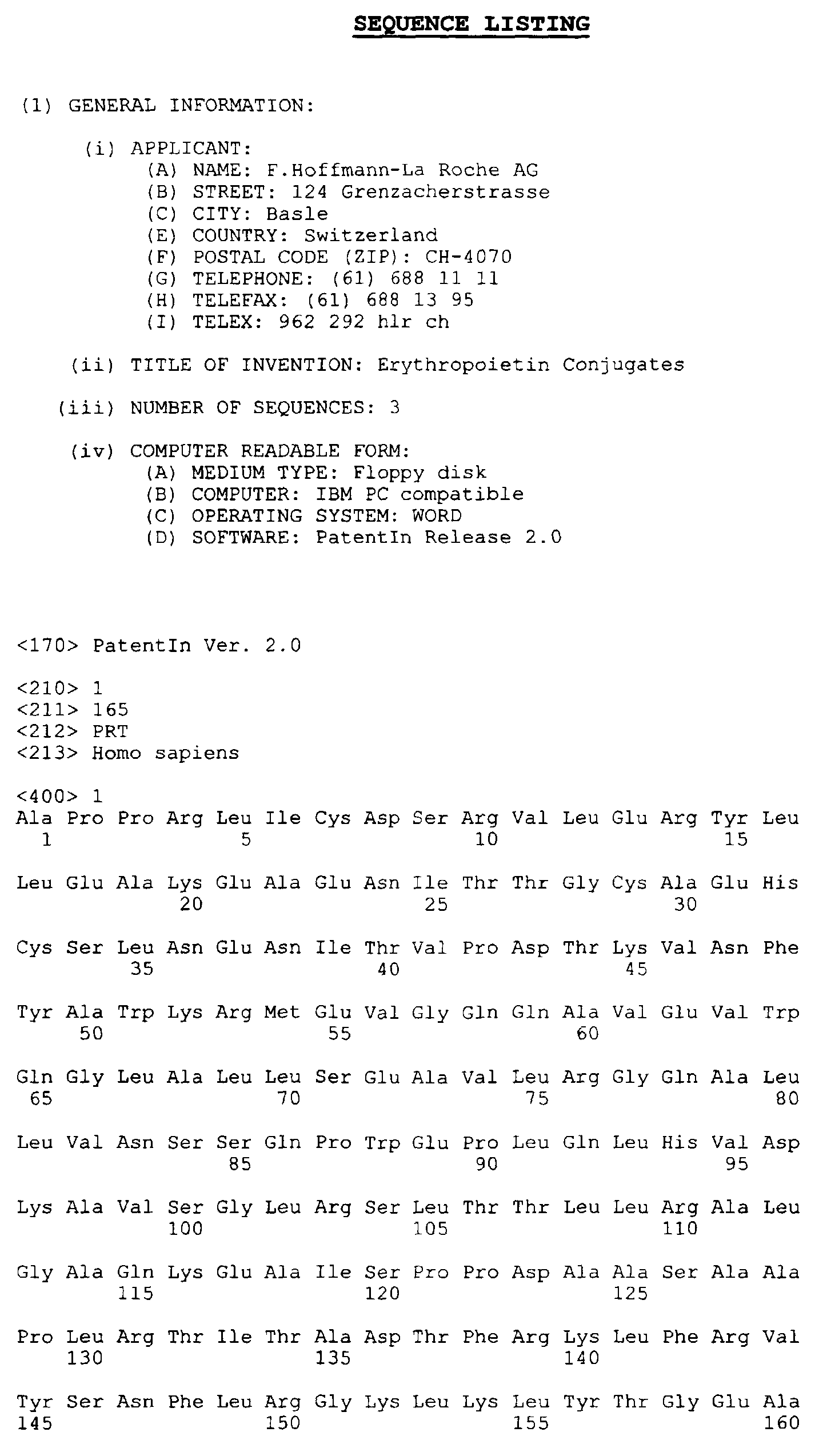
- the primary structure of the predominant, fully processed form of hEPO is illustrated in SEQ ID NO:1.
- the molecular weight of the polypeptide chain of EPO without the sugar moieties is 18,236 Da.
- EPO is used in the treatment of anemia in chronic renal failure patients (CRF) (Eschbach, JW, Egri, JC, Downing, MR et al. (1987) NEJM 316: 73-78; Eschbach, JW, Abdulhadi, MH, Browne, JK et al. (1989) Ann. Intern. Med. 111: 992; Egrie, JC, Eschbach, JW, McGuire, T, Adamson, JW (1988) Kidney Intl.
- CRF chronic renal failure patients
- This invention provides an erythropoietin conjugate, said conjugate comprising an erythropoietin glycoprotein having at least one free amino group and having the in vivo biological activity of causing bone marrow cells to increase production of reticulocytes and red blood cells and selected from the group consisting of human erythropoietin and analogs thereof which have sequence of human erythropoietin modified by the addition of from 1 to 6 glycosylation sites or a rearrangement of at least one glycosylation site; said glycoprotein being covalently linked to "n" poly(ethylene glycol) groups of the formula ⁇ CO ⁇ (CH 2 ) x ⁇ (OCH 2 CH 2 ) m ⁇ OR with the ⁇ CO (i.e.
- the present conjugates Compared to unmodified EPO (i.e., EPO without a PEG attached) and conventional PEG-EPO conjugates, the present conjugates have an increased circulating half-life and plasma residence time, decreased clearance, and increased clinical activity in vivo .
- the conjugates of this invention have the same uses as EPO.
- the conjugates of this invention are useful to treat patients by stimulating the division and differentiation of committed erythroid progenitors in the bone marrow in the same way EPO is used to treat patients.
- conjugates comprising an erythropoietin glycoprotein having at least one free amino group and having the in vivo biological activity of causing bone marrow cells to increase production of reticulocytes and red blood cells and selected from the group consisting of human erythropoietin and analogs thereof which have sequence of human erythropoietin modified by the addition of from 1 to 6 glycosylation sites or a rearrangement of at least one glycosylation site; said glycoprotein being covalently linked to "n" poly(ethylene glycol) groups of the formula ⁇ CO ⁇ (CH 2 ) x ⁇ (OCH 2 CH 2 ) m ⁇ OR with the ⁇ CO (i.e.
- the conjugates of this invention can be used in the same manner as unmodified EPO. However, the conjugates of this invention have an increased circulating half-life and plasma residence time, decreased clearance, and increased clinical activity in vivo . Because of these improved properties, the conjugates of this invention can be administered once weekly instead of the three times weekly for unmodified EPO. Decreased frequency of administration is expected to result in improved patient compliance leading to improved treatment outcomes, as well as improved patient quality of life. Compared to conventional conjugates of EPO linked to poly(ethylene glycol) it has been found that conjugates having the molecular weight and linker structure of the conjugates of this invention have an improved potency, stability, AUC, circulating half-life, and cost of goods profile.
- the conjugates in accordance of this invention can be administered in a therapeutically effective amount to patients in the same way EPO is administered.
- the therapeutically effective amount is that amount of conjugate necessary for the in vivo biological activity of causing bone marrow cells to increase production of reticulocytes and red blood cells.
- the exact amount of conjugate is a matter of preference subject to such factors as the exact type of condition being treated, the condition of the patient being treated, as well as the other ingredients in the composition. For example, 0.01 to 10 ⁇ g per kg body weight, preferably 0.1 to 1 ⁇ g per kg body weight, may be administered e.g. once weekly.
- compositions containing the conjugate may be formulated at a strength effective for administration by various means to a human patient experiencing blood disorders characterized by low or defective red blood cell production. Average therapeutically effective amounts of the conjugate may vary and in particular should be based upon the recommendations and prescription of a qualified physician.
- the erythropoietin glycoprotein products prepared in accordance with this invention may be prepared in pharmaceutical compositions suitable for injection with a pharmaceutically acceptable carrier or vehicle by methods known in the art.
- suitable compositions have been described in WO97/09996, WO97/40850, WO98/58660, and WO99/07401.
- preferred pharmaceutically acceptable carriers for formulating the products of the invention are human serum albumin, human plasma proteins, etc.
- the compounds of the present invention may be formulated in 10 mM sodium/potassium phosphate buffer at pH 7 containing a tonicity agent, e.g. 132 mM sodium chloride.
- the pharmaceutical composition may contain a preservative.
- the pharmaceutical composition may contain different amounts of erythropoietin, e.g. 10 ⁇ 1000 ⁇ g/ml, e.g. 50 ⁇ g or 400 ⁇ g.
- erythropoietin refers to a glycoprotein, having the amino acid sequence set out in (SEQ ID NO: 1) or (SEQ ID NO: 2) or an amino acid sequence substantially homologous thereto, whose biological properties relate to the stimulation of red blood cell production and the stimulation of the division and differentiation of committed erythroid progenitors in the bone marrow.
- these terms include such proteins modified deliberately, as for example, by site directed mutagenesis or accidentally through mutations.
- analogs having from 1 to 6 additional sites for glycosylation analogs having at least one additional amino acid at the carboxy terminal end of the glycoprotein, wherein the additional amino acid includes at least one glycosylation site, and analogs having an amino acid sequence which includes a rearrangement of at least one site for glycosylation.
- analogs having from 1 to 6 additional sites for glycosylation analogs having at least one additional amino acid at the carboxy terminal end of the glycoprotein, wherein the additional amino acid includes at least one glycosylation site, and analogs having an amino acid sequence which includes a rearrangement of at least one site for glycosylation.
- the erythropoietin conjugates of this invention can be represented by Formula 1: P ⁇ [NHCO ⁇ (CH 2 ) x ⁇ (OCH 2 CH 2 ) m ⁇ OR] n wherein x, m, n and R are as above.
- P is the residue of an erythropoietin glycoprotein described herein, (i.e. without the amino group or amino groups which form an amide linkage with the carbonyl shown in Formula I), having the in vivo biological activity of causing bone marrow cells to increase production of reticulocytes and red blood cells.
- R is methyl.
- m is from about 650 to about 750 and n is preferably 1.
- R is methyl
- m is from about 650 to about 750
- n is 1, i.e. the conjugate as defined above having the formula [CH 3 O(CH 2 CH 2 O) m CH 2 CH 2 CH 2 CO-NH] n -P wherein m is from 650 to 750, n is 1 and P is as defined above.
- m has an average of about 680.
- the glycoprotein of the conjugates as defined above is a human erythropoietin.
- Human erythropoietin and analogous proteins as defined above can be expressed by endogenous gene activation.
- Preferred human erythropoietin glycoproteins are those of SEQ ID NO:1 and SEQ ID NO:2, most preferably those of SEQ ID NO:1.
- EPO may be selected from the group consisting of residues of human erythropoietin and analogs thereof having from 1 to 6 additional sites for glycosylation.
- EPO is meant the natural or recombinant protein, preferably human, as obtained from any conventional source such as tissues, protein synthesis, cell culture with natural or recombinant cells. Any protein having the activity of EPO, such as muteins or otherwise modified proteins, is encompassed.
- Recombinant EPO may be prepared via expression in CHO-, BHK- or HeLa cell lines, by recombinant DNA technology or by endogenous gene activation.
- EPO proteins, including EPO, by endogenous gene activation
- the preferred EPO species for the preparation of erythropoietin glycoprotein products are human EPO species. More preferably, the EPO species is the human EPO having the amino acid sequence set out in SEQ ID NO:1 or SEQ ID NO:2, more preferably the amino acid sequence SEQ ID NO:1.
- P may be the residue of a glycoprotein analog having from 1 to 6 additional sites for glycosylation.
- Glycosylation of a protein occurs at specific locations along a polypeptide backbone and greatly affects the physical properties of the protein such as protein stability, secretion, subcellular localization, and biological activity. Glycosylation is usually of two types. O-linked oligosaccharides are attached to serine or threonine residues and N-linked oligosaccharides are attached to asparagine residues.
- oligosaccharide found on both N-linked and O-linked oligosaccharides is N-acetylneuraminic acid (sialic acid), which is a family of amino sugars containing 9 or more carbon atoms.
- Sialic acid is usually the terminal residue on both N-linked and O-linked oligosaccharides and, because it bears a negative charge, confers acidic properties to the glycoprotein.
- Human erythropoietin having 165 amino acids, contains three N-linked and one O-linked oligosaccharide chains which comprise about 40% of the total molecular weight of the glycoprotein.
- N-linked glycosylation occurs at asparagine residues located at positions 24, 38, and 83 and O-linked glycosylation occurs at a serine residue located at position 126.
- the oligosaccharide chains are modified with terminal sialic acid residues. Enzymatic removal of all sialic acid residues from the glycosylated erythropoietin results in loss of in vivo activity but not in vitro activity because sialylation of erythropoietin prevents its binding, and subsequent clearance, by hepatic binding protein.
- glycoproteins of the present invention include analogs of human erythropoietin with one or more changes in the amino acid sequence of human erythropoietin which result in an increase in the number of sites for sialic acid attachment. These glycoprotein analogs may be generated by site-directed mutagenesis having additions, deletions, or substitutions of amino acid residues that increase or alter sites that are available for glycosylation. Glycoprotein analogs having levels of sialic acid greater than those found in human erythropoietin are generated by adding glycosylation sites which do not perturb the secondary or tertiary conformation required for biological activity.
- the glycoproteins of the present invention also include analogs having increased levels of carbohydrate attachment at a glycosylation site which usually involve the substitution of one or more amino acids in close proximity to an N-linked or O-linked site.
- the glycoproteins of the present invention also include analogs having one or more amino acids extending from the carboxy terminal end of erythropoietin and providing at least one additional carbohydrate site.
- the glycoproteins of the present invention also include analogs having an amino acid sequence which includes a rearrangement of at least one site for glycosylation. Such a rearrangement of glycosylation site involves the deletion of one or more glycosylation sites in human erythropoietin and the addition of one or more non-naturally occurring glycosylation sites.
- erythropoietin Increasing the number of carbohydrate chains on erythropoietin, and therefore the number of sialic acids per erythropoietin molecules may confer advantageous properties such as increased solubility, greater resistance to proteolysis, reduced immunogenecity, increased serum half-life, and increased biological activity.
- Erythropoietin analogs with additional glycosylation sites are disclosed in more detail in European Patent Application 640 619, to Elliot published March 1, 1995.
- the glycoproteins of the present invention comprise an amino acid sequence which includes at least one additional site for glycosylation such as, but not limited to, erythropoietins comprising the sequence of human erythropoietin modified by a modification selected from the following:
- the notation used herein for modification of amino acid sequence means that the position(s) of the corresponding unmodified protein (e.g. hEPO of SEQ ID NO:1 or SEQ ID NO:2) indicated by the superscripted number(s) is changed to the amino acid(s) that immediately precede the respective superscripted number(s).
- the glycoprotein may also be an analog having at least one additional amino acid at the carboxy terminal end of the glycoprotein, wherein the additional amino acid includes at least one glycosylation site, i.e. the conjugate as defined above also refers to a compound wherein the glycoprotein has a sequence comprising the sequence of human erythropoietin and a second sequence at the carboxy terminus of the human erythropoietin sequence, wherein the second sequence contains at least one glycosylation site.
- the additional amino acid may comprise a peptide fragment derived from the carboxy terminal end of human chorionic gonadotropin.
- the glycoprotein is an analog selected from the group consisting of (a) human erythropoietin having the amino acid sequence, Ser Ser Ser Ser Ser Lys Ala Pro Pro Pro Ser Leu Pro Ser Pro Ser Arg Leu Pro Gly Pro Ser Asp Thr Pro Ile Leu Pro Gln (SEQ ID NO:3), extending from the carboxy terminus; (b) the analog in (a) further comprising Ser 87 Asn 88 Thr 9 ° EPO; and (c) the analog in (a) further comprising Asn 3 ° Thr 32 Val 87 Asn 88 Thr 9 ° EPO.
- the glycoprotein may also be an analog having an amino acid sequence which includes a rearrangement of at least one site for glycosylation.
- the rearrangement may comprise a deletion of any of the N-linked carbohydrate sites in human erythropoietin and an addition of an N-linked carbohydrate site at position 88 of the amino acid sequence of human erythropoietin.
- the glycoprotein is an analog selected from the group consisting of Gln 24 Ser 87 Asn 88 Thr 9 ° EPO; Gln 38 Ser 87 Asn 88 Thr 9 ° EPO; and Gln 83 Ser 87 Asn 88 Thr 9 ° EPO.
- lower alkyl means a linear or branched alkyl group having from one to six carbon atoms. Examples of lower alkyl groups include methyl, ethyl and isopropyl. In accordance with this invention, R is any lower alkyl. Conjugates in which R is methyl are preferred.
- m represents the number of ethylene oxide residues (OCH 2 CH 2 ) in the poly(ethylene oxide) group.
- a single PEG subunit of ethylene oxide has a molecular weight of about 44 daltons.
- the molecular weight of the conjugate depends on the number "m”.
- "m” is from about 450 to about 900 (corresponding to a molecular weight of about 20 kDa to about 40 kDa), preferably from about 650 to about 750 (corresponding to a molecular weight of about 30 kDa).
- the number m is selected such that the resulting conjugate of this invention has a physiological activity comparable to unmodified EPO, which activity may represent the same as, more than, or a fraction of the corresponding activity of unmodified EPO.
- a molecular weight of "about” a certain number means that it is within a reasonable range of that number as determined by conventional analytical techniques.
- the number "m” is selected so that the molecular weight of each poly(ethylene glycol) group covalently linked to the erythropoietin glycoprotein is from about 20kDa to about 40kDa, and is preferably about 30kDa.
- the number "n is the number of polyethylene glycol groups covalently bound to free amino groups (including ⁇ -amino groups of a lysine amino acid and/or the amino-terminal amino group) of an erythropoietin protein via amide linkage(s).
- a conjugate of this invention may have one, two, or three PEG groups per molecule of EPO.
- "n” is an integer ranging from 1 to 3, preferably "n” is 1 or 2, and more preferably "n” is 1.
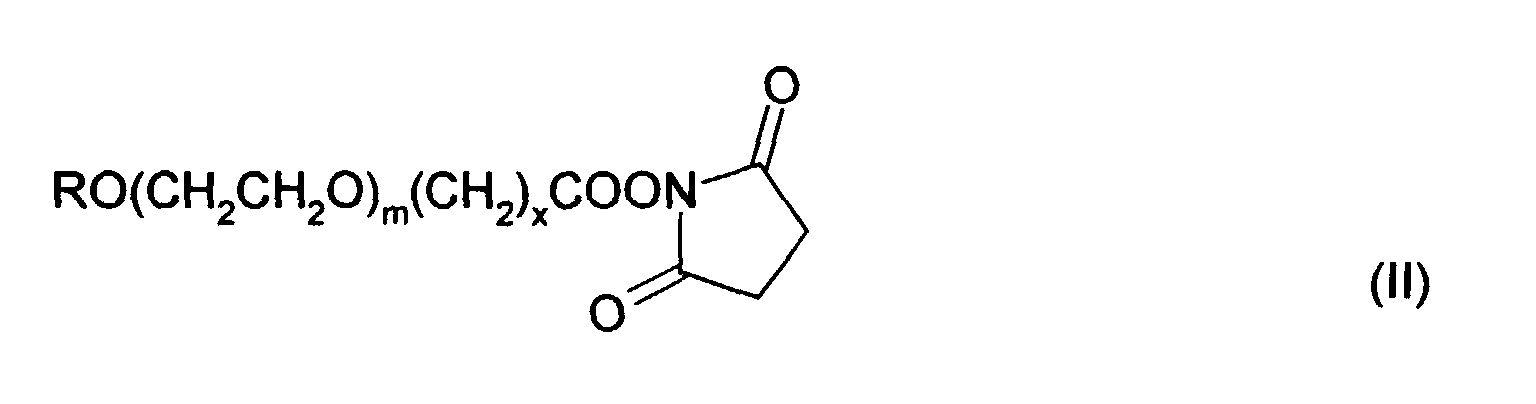
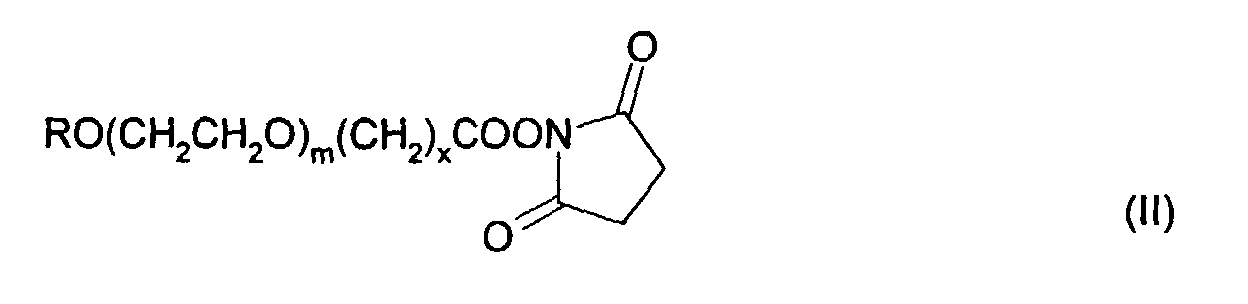
- the compound of Formula I can be prepared from the known polymeric material: in which R and m are as described above, by condensing the compound of Formula II with the erythropoietin glycoprotein.
- Compounds of Formula II in which x is 3 are alpha-lower alkoxy, butyric acid succinimidyl esters of poly(ethylene glycol) (lower alkoxy-PEG-SBA).
- Compounds of Formula II in which x is 2 are alpha-lower alkoxy, propionic acid succinimidyl esters of poly(ethylene glycol) (lower alkoxy-PEG-SPA). Any conventional method of reacting an activated ester with an amine to form an amide can be utilized.
- succinimidyl ester is a leaving group causing the amide formation.
- succinimidyl esters such as the compounds of formula II to produce conjugates with proteins are disclosed in U.S. Patent No. 5,672,662, issued September 30, 1997 (Harris, et al.).
- Human EPO contains nine free amino groups, the amino-terminal amino group plus the ⁇ -amino groups of 8 lysine residues.
- a SBA compound of Formula II When the pegylation reagent was combined with a SBA compound of Formula II, it has been found that at pH 7.5, a protein:PEG ratio of 1:3, and a reaction temperature of from 20-25°C, a mixture of mono-, di-, and trace amounts of the tri-pegylated species were produced.
- the pegylation reagent was a SPA compound of Formula II, at similar conditions except that the protein:PEG ratio was 1:2, primarily the mono-pegylated species is produced.
- the pegylated EPO can be administered as a mixture, or as the cation exchange chromatography separated different pegylated species.
- the reaction conditions e.g., ratio of reagents, pH, temperature, protein concentration, time of reaction etc.
- the relative amounts of the different pegylated species can be varied.
- EPO Human erythropoietin
- Erythropoietin for therapeutic uses maybe produced by recombinant means (EP-B 0 148 605, EP-B 0 209 539 and Egrie, J.C., Strickland, T.W., Lane, J. et al. (1986) Immunobiol. 72: 213-224).
- EP-A 0 267 678 an ion exchange chromatography on S-Sepharose, a preparative reverse phase HPLC on a C 8 column and a gel filtration chromatography are described for the purification of EPO produced in serum-free culture after dialysis.
- the gel filtration chromatography step can be replaced by ion exchange chromatography on S-Sepharose fast flow. It is also proposed that a dye chromatography on a Blue Trisacryl column be carried out before the ion exchange chromatography.
- the specific activity of EPO or EPO conjugates in accordance with this invention can be determined by various assays known in the art.
- the biological activity of the purified EPO proteins of this invention are such that administration of the EPO protein by injection to human patients results in bone marrow cells increasing production of reticulocytes and red blood cells compared to non-injected or control groups of subjects.
- the biological activity of the EPO proteins, or fragments thereof, obtained and purified in accordance with this invention can be tested by methods according to Annable, et al., Bull. Wld. Hlth. Org. (1972) 47: 99-112 and Pharm. Europa Spec. Issue Erythropoietin BRP Bio 1997(2).
- Another biological assay for determining the activity of EPO protein is described in Example 4.
- This invention provides a composition comprised of conjugates as described above.
- a composition containing at least ninety percent mono-PEG conjugates, i.e. in which n is 1, can be prepared as shown in Example 5.
- mono-PEG conjugates of erythropoietin glycoproteins are desirable because they tend to have higher activity than di-PEG conjugates.
- the percentage of mono-PEG conjugates as well as the ratio of mono-and di-PEG species can be controlled by pooling broader fractions around the elution peak to decrease the percentage of mono-PEG or narrower fractions to increase the percentage of mono-PEG in the composition.
- About ninety percent mono-PEG conjugates is a good balance of yield and activity.
- compositions in which, for example, at least ninety-two percent or at least ninety-six percent of the conjugates are mono-PEG species (n equals 1) maybe desired.
- the percentage of conjugates where n is 1 is from ninety percent to ninety-six percent.
- the invention also refers to the corresponding pharmaceutical compositions comprising a conjugate or a composition as described above and a pharmaceutically acceptable excipient.
- conjugates and compositions of the present invention are especially useful for the preparation of medicaments for the treatment or prophylaxis of diseases correlated with anemia in chronic renal failure patients (CRF), AIDS and for the treatment of cancer patients undergoing chemotherapy.
- An additional embodiment of the present invention refers to a method for the prophylactic and/or therapeutic treatment of disorders involving anemia in chronic renal failure patients (CRF), AIDS and cancer patients undergoing chemotherapy comprising the step of administering to a patient a composition as described above.
- the invention relates to a process for the preparation of compounds as described above which process comprising condensing the compound of Formula II with a erythropoietin glycoprotein and in which R, m and x are as defined above.
- the invention refers also to compounds as defined above for the treatment of diseases which are associated with anemia in chronic renal failure patients (CRF), AIDS and cancer patients undergoing chemotherapy.
- CRF chronic renal failure patients
- AIDS AIDS
- cancer patients undergoing chemotherapy are also to compounds as defined above for the treatment of diseases which are associated with anemia in chronic renal failure patients (CRF), AIDS and cancer patients undergoing chemotherapy.
- EPO-producing CHO cell line originating from an EPO-producing CHO cell line (ATCC CRL8695, disclosed in EP 411 678 (Genetics Institute) can be used) is taken from the gas phase of the liquid nitrogen storage tank.
- the cells are transferred into glass spinner flasks and cultivated in a hydrogen carbonate-buffered medium in a humidified CO 2 incubator.
- Typical serum free media used for the inocolum preparation and fermentation are disclosed in European Patent Application 513 738, to Koch published 12 June 1992, or WO 96/35718, to Burg published 14 November 1996, for example contain as medium DMEM/F12 (e.g. JRH Biosciences/Hazleton Biologics, Denver, US, order No.
- 57-736) and additionally sodium hydrogencarbonate, L+glutamine, D+glucose, recombinant insulin, sodium selenite, diaminobutane, hydrocortisone, iron(II) sulfate, asparagine, aspartic acid, serine and a stabilizer for mammalian cells such as e.g. polyvinyl alcohol, methyl cellulose, polydextran, polyethylene glycol, Pluronic F68, plasma expander polygelin (HEMACCEL®) or polyvinyl pyrrolidone (WO 96/35718).
- the cultures are microscopically checked for the absence of contaminating microorganisms, and the cell densities are determined. These tests are performed at each splitting step.
- the cell culture is diluted with fresh medium to the starting cell density and undergoes another growth cycle. This procedure is repeated until a culture volume of approximately 2 l per glass spinner flask has been obtained. After approx. 12 doublings 1 to 5 liter of this culture is available which then is used as inoculum for the 10 l inoculum fermenter.
- the culture in the 10 l fermenter can be used as inoculum for the 100 l inoculum fermenter.
- the culture in the 100 l fermenter can be used as inoculum for the 1000 l production fermenter.
- a batch refeed process is used, i.e. when the desired cell density is reached, approx. 80 % of the culture is harvested. The remaining culture is replenished with fresh culture medium and cultivated until the next harvest.
- One production run consists of a maximum of 10 subsequent harvests: 9 partial harvests and 1 overall harvest at the end of fermentation. Harvesting takes place every 3 - 4 days.
- the determined harvest volume is transferred into a cooled vessel.
- the cells are removed by centrifugation or filtration and discarded.
- the EPO containing supernatant of the centrifugation step is in-line filtered and collected in a second cooled vessel. Each harvest is processed separately during purification.
- Blue Sepharose (Pharmacia) consists of Sepharose beads to the surface of which the Cibacron blue dye is covalently bound. Since EPO binds more strongly to Blue Sepharose than most non-proteinaceous contaminants, some proteinaceous impurities and PVA, EPO can be enriched in this step.
- the elution of the Blue Sepharose column is performed by increasing the salt concentration as well as the pH.
- the column is filled with 80 - 100 l of Blue Sepharose, regenerated with NaOH and equilibrated with equilibration buffer (sodium/ calcium chloride and sodium acetate).
- equilibration buffer sodium/ calcium chloride and sodium acetate.
- the acidified and filtered fermenter supernatant is loaded.
- the column is washed first with a buffer similar to the equilibration buffer containing a higher sodium chloride concentration and consecutively with a Tris-base buffer.
- the product is eluted with a Tris-base buffer and collected in a single fraction in accordance with the master elution profile.
- the Butyl Toyopearl 650 C (Toso Haas) is a polystyrene based matrix to which aliphatic butyl-residues are covalently coupled. Since EPO binds more strongly to this gel than most of the impurities and PVA, it has to be eluted with a buffer containing isopropanol.
- the column is packed with 30 - 40 l of Butyl Toyopearl 650 C, regenerated with NaOH, washed with a Tris-base buffer and equilibrated with a Tris-base buffer containing isopropanol.
- the Blue Sepharose eluate is adjusted to the concentration of isopropanol in the column equilibration buffer and loaded onto the column. Then the column is washed with equilibration buffer with increased isopropanol concentration. The product is eluted with elution buffer (Tris-base buffer with high isopropanol content) and collected in a single fraction in accordance with the master elution profile.
- elution buffer Tris-base buffer with high isopropanol content
- the Hydroxyapatite Ultrogel (Biosepra) consists of hydroxyapatite which is incorporated in an agarose matrix to improve the mechanical properties. EPO has a low affinity to hydroxyapatite and can therefore be eluted at lower phosphate concentrations than protein impurities.
- the column is filled with 30 - 40 l of Hydroxyapatite Ultrogel and regenerated with a potassium phosphate/ calcium chloride buffer and NaOH followed by a Tris-base buffer. Then it is equilibrated with a Tris-base buffer containing a low amount of isopropanol and sodium chloride.
- the EPO containing eluate of the Butyl Toyopearl chromatography is loaded onto the column. Subsequently the column is washed with equilibration buffer and a Tris-base buffer without isopropanol and sodium chloride. The product is eluted with a Tris-base buffer containing a low concentration of potassium phosphate and collected in a single fraction in accordance with the master elution profile.
- Vydac C4 (Vydac)consists of silica gel particles, the surfaces of which carry C4-alkyl chains.
- the separation of EPO from the proteinaceous impurities is based on differences in the strength of hydrophobic interactions. Elution is performed with an acetonitrile gradient in diluted trifluoroacetic acid.
- Preparative HPLC is performed using a stainless steel column (filled with 2.8 to 3.2 liter of Vydac C4 silicagel).
- the Hydroxyapatite Ultrogel eluate is acidified by adding trifluoro-acetic acid and loaded onto the Vydac C4 column.
- an acetonitrile gradient in diluted trifluoroacetic acid is used. Fractions are collected and immediately neutralized with phosphate buffer. The EPO fractions which are within the IPC limits are pooled.
- the DEAE Sepharose (Pharmacia) material consists of diethylaminoethyl (DEAE) - groups which are covalently bound to the surface of Sepharose beads.
- DEAE diethylaminoethyl
- the binding of EPO to the DEAE groups is mediated by ionic interactions. Acetonitrile and trifluoroacetic acid pass through the column without being retained. After these substances have been washed off, trace impurities are removed by washing the column with acetate buffer at a low pH. Then the column is washed with neutral phosphate buffer and EPO is eluted with a buffer with increased ionic strength.
- the column is packed with DEAE Sepharose fast flow.
- the column volume is adjusted to assure an EPO load in the range of 3 - 10 mg EPO/ml gel.
- the column is washed with water and equilibration buffer (sodium/ potassium phosphate).
- the pooled fractions of the HPLC eluate are loaded and the column is washed with equilibration buffer.
- the column is washed with washing buffer (sodium acetate buffer) followed by washing with equilibration buffer.
- EPO is eluted from the column with elution buffer (sodium chloride, sodium/ potassium phosphate) and collected in a single fraction in accordance with the master elution profile.
- the eluate of the DEAE Sepharose column is adjusted to the specified conductivity.
- the resulting drug substance is sterile filtered into Teflon bottles and stored at ⁇ 70 °C.
- EPO purified in accordance with the serum free procedure of Example 1 was homogeneous as determined by analytical methods and showed the typical isoform pattern consisting of 8 isoforms. It had a specific biological activity of 190,000 IU/mg as determined by the normocythaemic mouse assay.
- the pegylation reagent used was a methoxy-PEG-SBA, which is a compound of Formula II in which R is methyl; x is 3; and m is from 650 to 750 (average about 680, corresponding to an average molecular weight of about 30 kDa).
- EPOsf 9.71 ml of a 10.3 mg/ml EPOsf stock, 5.48 ⁇ mol
- 10 ml of 0.1 M potassium phosphate buffer, pH, 7.5 containing 506 mg of 30kDa methoxy-PEG-SBA (16.5 ⁇ mol) obtained from Shearwater Polymers, Inc., Huntsville, Alabama
- the final protein concentration was 5 mg/ml and the protein:PEG reagent ratio was 1:3.
- the reaction was stopped by adjusting the pH to 4.5 with glacial acetic acid and stored at ⁇ 20°C, until ready for purification.
- PEG-EPOsf was synthesized by chemically conjugating a linear PEG molecule with a number average molecular weight of 30 kDa.
- PEG-EPOsf was derived from the reaction between the primary amino groups of EPOsf and the succinimidyl ester derivative of a 30 kDa PEG-butyric acid, resulting in an amide bond.
- Example 2 A different aliquot of the EPOsf used in Example 2 was reacted with 30 kDa methoxy-PEG-SPA (Shearwater Polymers, Inc., Huntsville, Alabama). Reaction was performed at a protein:reagent ratio of 1:2 and purification techniques were in accordance with Example 2. Primarily the mono-pegylated species was produced.
- EXAMPLE 4 In-vivo activity of pegylated EPO determined by the normocythaemic mouse assay
- the normocythaemic mouse bioassay is known in the art (Pharm. Europa Spec. Issue Erythropoietin BRP Bio 1997(2)) and a method in the monography of erythropoietin of Ph. Eur. BRP.
- the samples were diluted with BSA-PBS.
- reticulocyte counts were carried out microfluorometrically in a flow cytometer by analysis of the red fluorescence histogram. The reticulocyte counts were given in terms of absolute figures (per 30,000 blood cells analyzed). For the data presented, each group consisted of 5 mice per day, and the mice were bled only once.
- EPO (Unmodified) 30 kDa SPA PEG Mono 30K SBA Di 30K SBA PEG-EPO SBA Conjugate Mixture Control Buffer 72h 1000 1393 1411 994 1328 857 96h 500 1406 1501 926 1338 697 120h ⁇ 200 1100 1182 791 944 701 144h ⁇ 0 535 607 665 660 708
- the reaction mixture from the previous step was diluted 1:5 with 10 mM sodium acetate, pH 4.5 and applied to 300 ml SP-Sepharose FF (sulfopropyl cation exchange resin) packed into a 4.2 x 19 cm column.
- the column was previously equilibrated with the same buffer.
- Column effluents were monitored at 280 nm with a Gilson UV monitor and recorded with a Kipp and Zonen recorder.
- the column was washed with 300 ml or 1 bed volume of equilibration buffer to remove excess reagents, reaction byproducts and oligomeric PEG-EPO. It was followed by washing with 2 bed volumes of 100 mM NaCl to remove di-PEG-EPO.
- Mono-PEG-EPO was then eluted with 200 mM NaCl. During elution of the mono-PEG-EPO, the first 50 ml of the protein peak was discarded and the mono-PEG-EPO was collected as a 150 ml fraction. Unmodified EPOsf remaining on the column was eluted with 750 mM NaCl. All elution buffers were made in the equilibration buffer. All eluted samples were analyzed by SDS-PAGE and by high performance Size Exclusion Chromatography (SEC).
- SEC Size Exclusion Chromatography
- EPOsf Approximately 75% of EPOsf was pegylated. After purification, total yield was ⁇ 30% mono-PEG-EPO with no detectable unmodified EPOsf and around 25% di-PEG-EPO. Oligomers, and unpegylated EPOsf accounted for the remaining protein.
- the mono-PEG-EPO pool obtained from the 150 ml fraction contained approximately 90% mono-PEG-EPO and approximately 10% di-PEG-EPO.
Landscapes
- Health & Medical Sciences (AREA)
- Chemical & Material Sciences (AREA)
- Life Sciences & Earth Sciences (AREA)
- Organic Chemistry (AREA)
- Medicinal Chemistry (AREA)
- General Health & Medical Sciences (AREA)
- Animal Behavior & Ethology (AREA)
- Veterinary Medicine (AREA)
- Public Health (AREA)
- Pharmacology & Pharmacy (AREA)
- Bioinformatics & Cheminformatics (AREA)
- Engineering & Computer Science (AREA)
- Nuclear Medicine, Radiotherapy & Molecular Imaging (AREA)
- General Chemical & Material Sciences (AREA)
- Chemical Kinetics & Catalysis (AREA)
- Proteomics, Peptides & Aminoacids (AREA)
- Molecular Biology (AREA)
- Biophysics (AREA)
- Biochemistry (AREA)
- Genetics & Genomics (AREA)
- Epidemiology (AREA)
- Gastroenterology & Hepatology (AREA)
- Zoology (AREA)
- Toxicology (AREA)
- Hematology (AREA)
- Communicable Diseases (AREA)
- Oncology (AREA)
- Diabetes (AREA)
- Virology (AREA)
- Immunology (AREA)
- Neurology (AREA)
- Urology & Nephrology (AREA)
- Neurosurgery (AREA)
- Biomedical Technology (AREA)
- Tropical Medicine & Parasitology (AREA)
- AIDS & HIV (AREA)
- Psychiatry (AREA)
- Medicines That Contain Protein Lipid Enzymes And Other Medicines (AREA)
- Peptides Or Proteins (AREA)
- Medicinal Preparation (AREA)
Abstract
Description

| Summary of results of EPOsf pegylation | ||
| Sample | Protein (mg) | Yield (%) |
| Rxn. Mix. | 30 | 100 |
| Mono- | 12.0 | 40 |
| Di- | 11.4 | 38 |
| Unmod. | 6.0 | 20 |
| Conju. Mix. | 23.4 | 78 |
| EPO (Unmodified) | 30 kDa SPA PEG | Mono 30K SBA | Di 30K SBA | PEG-EPO SBA Conjugate Mixture | Control Buffer | |
| 72h | 1000 | 1393 | 1411 | 994 | 1328 | 857 |
| 96h | 500 | 1406 | 1501 | 926 | 1338 | 697 |
| 120h | ∼200 | 1100 | 1182 | 791 | 944 | 701 |
| 144h | ∼0 | 535 | 607 | 665 | 660 | 708 |

Claims (30)
- A conjugate, said conjugate comprising an erythropoietin glycoprotein having at least one free amino group and having the in vivo biological activity of causing bone marrow cells to increase production of reticulocytes and red blood cells and selected from the group consisting of human erythropoietin and analogs thereof which have sequence of human erythropoietin modified by the addition of from 1 to 6 glycosylation sites or a rearrangement of at least one glycosylation site; said glycoprotein being covalently linked to "n" poly(ethylene glycol) groups of the formulaR is lower alkyl;x is 2 or 3;m is from about 450 to about 900;n is from 1 to 3; andn and m are chosen so that the molecular weight of the conjugate minus the erythropoietin glycoprotein is from 20 kilodaltons to 100 kilodaltons.
- The conjugate of claim 1, of the formula:
- The conjugate of any preceding claim, wherein R is methyl.
- The conjugate of any preceding claim, wherein m is from about 650 to about 750.
- The conjugate of any preceding claim, wherein n is 1.
- The conjugate of any preceding claim, wherein R is methyl; m is from about 650 to about 750; and n is 1.
- The conjugate of any preceding claim having the formula
- The conjugate of any preceding claim, wherein the glycoprotein is a human erythropoietin.
- The conjugate according to any of claims 1 to 7, wherein the human erythropoietin glycoprotein is expressed by endogenous gene activation.
- The conjugate according to any of claims 1 to 9, wherein the glycoprotein has the sequence SEQ ID NO:1.
- The conjugate according to any of claims 1 to 8, wherein the glycoprotein has the sequence of human erythropoietin modified by the addition of from 1 to 6 glycosylation sites.
- The conjugate according to any of claims 1 to 11, wherein the glycoprotein has the sequence of human erythropoietin modified by a modification selected from the group consisting of:Asn30Thr32;Asn51Thr53;Asn57Thr59;Asn69;Asn69Thr71;Ser68Asn69Thr71;Val87Asn88Thr9°;Ser87Asn88Thr9°;Ser87Asn88Gly89Thr90;Ser87Asn88Thr9°Thr92;Ser87Asn88Thr9°Ala162;Asn69Thr71Ser87Asn88Thr9°;Asn30Thr32Val87Asn88Thr9°;Asn89Ile90Thr9
1 ;Ser87Asn89Ile9°Thr91;Asn136Thr138;Asn138Thr140;Thr125; andPro124Thr125. - The conjugate according to any of claims 1 to 12, wherein the glycoprotein has a sequence comprising the sequence of human erythropoietin and a second sequence at the carboxy terminus of the human erythropoietin sequence, wherein the second sequence contains at least one glycosylation site.
- The conjugate of claim 13, wherein the second sequences comprises a sequence derived from the carboxy terminal sequence of human chorionic gonadotropin.
- The conjugate of claim 13, wherein the glycoprotein has a sequence selected from the group consisting of:(a) the sequence of human erythropoietin and the sequence SEQ ID NO:3 at the carboxy terminus of the human erythropoietin sequence;(b) the sequence in (a) modified by Ser87 Asn88 Thr90; and(c) the sequence in (a) modified by Asn3° Thr32 Val87 Asn88 Thr9°.
- The conjugate according to any of claims 1 to 7, wherein the glycoprotein has the sequence of human erythropoietin modified by a rearrangement of at least one glycosylation site.
- The conjugate of claim 16, wherein the rearrangement comprises deletion of any of the N-linked glycosylation sites in human erythropoietin and addition of an N-linked glycosylation site at position 88 of the sequence of human erythropoietin.
- The conjugate of claim 17, wherein the glycoprotein has the sequence of human erythropoietin modified by a modification selected from the group consisting of:Gln24 Ser87 Asn88 Thr90;Gln38 Ser87 Asn88 Thr90; andGln83 Ser87 Asn88 Thr90.
- A composition comprising conjugates, each of said conjugates comprising an erythropoietin glycoprotein having at least one free amino group and having the in vivo biological activity of causing bone marrow cells to increase production of reticulocytes and red blood cells and selected from the group consisting of human erythropoietin and analogs thereof which have sequence of human erythropoietin modified by the addition of from 1 to 6 glycosylation sites or a rearrangement of at least one glycosylation site; the glycoprotein in each said conjugate being covalently linked to "n" poly(ethylene glycol) groups of the formula ―CO―(CH2)x―(OCH2CH2)m―OR with the -CO of each poly(ethylene glycol) group forming an amide bond with one of said amino groups; where in each of said conjugates R is lower alkyl; x is 2 or 3; m is from about 450 to about 900; n is from 1 to 3; n and m are chosen so that the molecular weight of each conjugate minus the erythropoietin glycoprotein is from 20 kilodaltons to 100 kilodaltons; the percentage of conjugates where n is 1 is at least ninety percent.
- The composition comprising conjugates as defined in any of claims 1 to 18 wherein the percentage of conjugates where n is 1 is at least ninety percent.
- The composition of according to claims 19 or 20 wherein the percentage of conjugates where n is 1 is at least ninety-two percent.
- The composition of claim 21 wherein the percentage of conjugates where n is 1 is at least ninety-six percent.
- The composition of claim 19 or 20 wherein the percentage of conjugates where n is 1 is from ninety percent to ninety-six percent.
- A pharmaceutical composition comprising a conjugate or a composition according to any of claims 1 to 23 and a pharmaceutically acceptable excipient.
- Use of a conjugate or a composition according to any of claims 1 to 23 for the preparation of medicaments for the treatment or prophylaxis of diseases correlated with anemia in chronic renal failure patients (CRF), AIDS and for the treatment of cancer patients undergoing chemotherapy.
- A method for the prophylactic and/or therapeutic treatment of disorders involving anemia in chronic renal failure patients (CRF), AIDS and cancer patients undergoing chemotherapy comprising the step of administering to a patient a composition as claimed in any one of claims 1 to 23.
- A process for the preparation of compounds according to any of claims 1 to 23 which process comprises condensing the compound of Formula IIwith a erythropoietin glycoprotein and in which R, m and x are as defined in any of claims 1 to 6.
- Compounds according to any of claims 1 to 3, whenever prepared by the process of claim 27.
- Compounds according to any of claims 1 to 23 for the treatment of diseases which are associated with anemia in chronic renal failure patients (CRF), AIDS and cancer patients undergoing chemotherapy.
- The novel compounds, processes and methods as well as the use of such compounds substantially as described hereinbefore.
Priority Applications (2)
| Application Number | Priority Date | Filing Date | Title |
|---|---|---|---|
| SI200030963T SI1064951T1 (en) | 1999-07-02 | 2000-06-28 | Erythropoietin derivatives |
| EP07010693A EP1839676A3 (en) | 1999-07-02 | 2000-06-28 | Erythropoietin derivates |
Applications Claiming Priority (8)
| Application Number | Priority Date | Filing Date | Title |
|---|---|---|---|
| US142254 | 1980-04-21 | ||
| US14225499P | 1999-07-02 | 1999-07-02 | |
| US15022599P | 1999-08-23 | 1999-08-23 | |
| US150225 | 1999-08-23 | ||
| US15154899P | 1999-08-31 | 1999-08-31 | |
| US151548 | 1999-08-31 | ||
| US16615199P | 1999-11-17 | 1999-11-17 | |
| US166151 | 1999-11-17 |
Related Child Applications (1)
| Application Number | Title | Priority Date | Filing Date |
|---|---|---|---|
| EP07010693A Division EP1839676A3 (en) | 1999-07-02 | 2000-06-28 | Erythropoietin derivates |
Publications (3)
| Publication Number | Publication Date |
|---|---|
| EP1064951A2 true EP1064951A2 (en) | 2001-01-03 |
| EP1064951A3 EP1064951A3 (en) | 2002-03-20 |
| EP1064951B1 EP1064951B1 (en) | 2007-08-22 |
Family
ID=27495518
Family Applications (2)
| Application Number | Title | Priority Date | Filing Date |
|---|---|---|---|
| EP00113115A Expired - Lifetime EP1064951B1 (en) | 1999-07-02 | 2000-06-28 | Erythropoietin derivatives |
| EP07010693A Withdrawn EP1839676A3 (en) | 1999-07-02 | 2000-06-28 | Erythropoietin derivates |
Family Applications After (1)
| Application Number | Title | Priority Date | Filing Date |
|---|---|---|---|
| EP07010693A Withdrawn EP1839676A3 (en) | 1999-07-02 | 2000-06-28 | Erythropoietin derivates |
Country Status (51)
Cited By (54)
| Publication number | Priority date | Publication date | Assignee | Title |
|---|---|---|---|---|
| WO2002049673A3 (en) * | 2000-12-20 | 2003-01-23 | Hoffmann La Roche | Conjugates of erythropoietin (pep) with polyethylene glycol (peg) |
| WO2002074344A3 (en) * | 2001-02-23 | 2003-12-04 | Hoffmann La Roche | Peg-conjugates of hgt-nk4 |
| US6818613B2 (en) | 2001-11-07 | 2004-11-16 | Ortho-Mcneil Pharmaceutical, Inc. | Aqueous sustained-release formulations of proteins |
| EP1548031A1 (en) * | 2003-12-22 | 2005-06-29 | Dubai Genetics FZ-LLC | Nature-identical erythropoietin |
| WO2006091871A1 (en) | 2005-02-23 | 2006-08-31 | Halozyme Therapeutics, Inc. | Soluble glycosaminoglycanases and methods of preparing and using soluble glycosaminoglycanases |
| US7129267B2 (en) | 2002-03-11 | 2006-10-31 | Janssen Pharmaceutica N.V. | Methods for SHP1 mediated neuroprotection |
| US7128913B2 (en) | 2000-12-20 | 2006-10-31 | Hoffmann-La Roche Inc. | Erythropoietin conjugates |
| AU2003251713B2 (en) * | 2002-08-29 | 2006-12-21 | F. Hoffmann-La Roche Ag | Use of erythropoietin |
| US7193031B2 (en) | 2002-07-24 | 2007-03-20 | Hoffmann-La Roche Inc. | Polyalkylene glycol acid additives |
| WO2007039436A1 (en) * | 2005-09-28 | 2007-04-12 | F. Hoffmann-La Roche Ag | Treatment of neurodegenerative disorders |
| US7459429B2 (en) | 2003-12-19 | 2008-12-02 | Hoffmann-La Roche Inc. | Method of treating disturbances of iron distribution in inflammatory intestinal diseases |
| US7459436B2 (en) | 2002-11-22 | 2008-12-02 | Hoffmann-La Roche Inc. | Treatment of disturbances of iron distribution |
| EP1333036B1 (en) * | 2000-10-16 | 2009-01-21 | Chugai Seiyaku Kabushiki Kaisha | Peg-modified erythropoietin |
| WO2009010271A3 (en) * | 2007-07-17 | 2009-04-02 | Hoffmann La Roche | Chromatographic methods |
| WO2009010270A3 (en) * | 2007-07-17 | 2009-04-30 | Hoffmann La Roche | Purification of pegylated polypeptides |
| US7553930B2 (en) | 2003-01-06 | 2009-06-30 | Xencor, Inc. | BAFF variants and methods thereof |
| US7587286B2 (en) | 2003-03-31 | 2009-09-08 | Xencor, Inc. | Methods for rational pegylation of proteins |
| US7610156B2 (en) | 2003-03-31 | 2009-10-27 | Xencor, Inc. | Methods for rational pegylation of proteins |
| US7642340B2 (en) | 2003-03-31 | 2010-01-05 | Xencor, Inc. | PEGylated TNF-α variant proteins |
| US7645733B2 (en) | 2003-09-29 | 2010-01-12 | The Kenneth S. Warren Institute, Inc. | Tissue protective cytokines for the treatment and prevention of sepsis and the formation of adhesions |
| WO2011034604A2 (en) | 2009-09-17 | 2011-03-24 | Baxter Healthcare, S.A. | Stable co-formulation of hyaluronidase and immunoglobulin, and methods of use thereof |
| EP2327723A2 (en) | 2003-10-10 | 2011-06-01 | Xencor, Inc. | Protein based tnf-alpha variants for the treatment of tnf-alpha related disorders |
| WO2012012300A2 (en) | 2010-07-20 | 2012-01-26 | Halozyme, Inc. | Adverse side-effects associated with administration of an anti-hyaluronan agent and methods for ameliorating or preventing the side-effects |
| WO2012035037A1 (en) | 2010-09-14 | 2012-03-22 | F. Hoffmann-La Roche Ag | Method for purifying pegylated erythropoietin |
| WO2012109387A1 (en) | 2011-02-08 | 2012-08-16 | Halozyme, Inc. | Composition and lipid formulation of a hyaluronan-degrading enzyme and the use thereof for treatment of benign prostatic hyperplasia |
| US8278418B2 (en) | 2008-09-26 | 2012-10-02 | Ambrx, Inc. | Modified animal erythropoietin polypeptides and their uses |
| US20120264688A1 (en) * | 2009-09-23 | 2012-10-18 | Walter Hinderer | Process for the purification of recombinant human erythropoietin (epo), epo thus purified and pharmaceutical compositions comprising same |
| WO2013063155A2 (en) | 2011-10-24 | 2013-05-02 | Halozyme, Inc. | Companion diagnostic for anti-hyaluronan agent therapy and methods of use thereof |
| WO2013151774A1 (en) | 2012-04-04 | 2013-10-10 | Halozyme, Inc. | Combination therapy with an anti - hyaluronan agent and a tumor - targeted taxane |
| US8618266B2 (en) * | 2002-09-11 | 2013-12-31 | Fresenius Kabi Deutschland Gmbh | Hasylated polypeptides |
| WO2014062856A1 (en) | 2012-10-16 | 2014-04-24 | Halozyme, Inc. | Hypoxia and hyaluronan and markers thereof for diagnosis and monitoring of diseases and conditions and related methods |
| WO2015003167A1 (en) | 2013-07-03 | 2015-01-08 | Halozyme, Inc. | Thermally stable ph20 hyaluronidase variants and uses thereof |
| WO2016033555A1 (en) | 2014-08-28 | 2016-03-03 | Halozyme, Inc. | Combination therapy with a hyaluronan-degrading enzyme and an immune checkpoint inhibitor |
| US9289699B2 (en) | 2009-07-30 | 2016-03-22 | Hoffmann-La Roche Inc. | Moveable chromatography column separator |
| WO2016061286A2 (en) | 2014-10-14 | 2016-04-21 | Halozyme, Inc. | Compositions of adenosine deaminase-2 (ada2), variants thereof and methods of using same |
| EP3037529A1 (en) | 2008-12-09 | 2016-06-29 | Halozyme, Inc. | Extended soluble ph20 polypeptides and uses thereof |
| EP3103880A1 (en) | 2008-02-08 | 2016-12-14 | Ambrx, Inc. | Modified leptin polypeptides and their uses |
| EP3130347A1 (en) | 2011-12-30 | 2017-02-15 | Halozyme, Inc. | Ph20 polypeptide variants, formulations and uses thereof |
| EP1311285B2 (en) † | 2000-05-15 | 2017-04-12 | F. Hoffmann-La Roche AG | Liquid pharmaceutical composition containing an erythropoietin derivative |
| EP3192525A1 (en) | 2008-04-14 | 2017-07-19 | Halozyme, Inc. | Modified hyaluronidases for use in treating hyaluronan-associated diseases and conditions |
| US9775889B2 (en) | 2008-03-06 | 2017-10-03 | Halozyme, Inc. | Methods of treatment of cellulite |
| WO2018011381A1 (en) | 2016-07-15 | 2018-01-18 | F. Hoffmann-La Roche Ag | Method for purifying pegylated erythropoietin |
| WO2018237201A1 (en) | 2017-06-22 | 2018-12-27 | Catalyst Biosciences, Inc. | Modified membrane type serine protease 1 (mtsp-1) polypeptides and methods of use |
| WO2019129877A1 (en) | 2017-12-29 | 2019-07-04 | F. Hoffmann-La Roche Ag | Process for providing pegylated protein composition |
| WO2019129876A1 (en) | 2017-12-29 | 2019-07-04 | F. Hoffmann-La Roche Ag | Process for providing pegylated protein composition |
| WO2019129878A1 (en) | 2017-12-29 | 2019-07-04 | F. Hoffmann-La Roche Ag | Process for providing pegylated protein composition |
| WO2019222435A1 (en) | 2018-05-16 | 2019-11-21 | Halozyme, Inc. | Methods of selecting subjects for combination cancer therapy with a polymer-conjugated soluble ph20 |
| EP3613486A1 (en) * | 2018-08-24 | 2020-02-26 | UGA Biopharma GmbH | Method and installation for the purification of epo and/or an epo derivative |
| US11241638B2 (en) | 2011-02-02 | 2022-02-08 | Hoffmann-La Roche Inc. | Chromatography column support |
| WO2022063082A1 (en) | 2020-09-22 | 2022-03-31 | 美国杰科实验室有限公司 | Glycosylation-modified erythopoietin and use thereof |
| WO2022159414A1 (en) | 2021-01-22 | 2022-07-28 | University Of Rochester | Erythropoietin for gastroinfestinal dysfunction |
| US11613744B2 (en) | 2018-12-28 | 2023-03-28 | Vertex Pharmaceuticals Incorporated | Modified urokinase-type plasminogen activator polypeptides and methods of use |
| US12331334B2 (en) | 2018-12-28 | 2025-06-17 | Vertex Pharmaceuticals, Incorporated | Modified urokinase-type plasminogen activator polypeptides and methods of use |
| WO2025227129A2 (en) | 2024-04-25 | 2025-10-30 | Starrock Pharma Llc | Delivery vehicles comprising proglucagon derived polypeptides and anabolic polypeptides and uses thereof |
Families Citing this family (177)
| Publication number | Priority date | Publication date | Assignee | Title |
|---|---|---|---|---|
| PT1037927E (en) * | 1997-12-08 | 2004-10-29 | Emd Lexigen Res Ct Corp | USEFUL HYPERODODYMMIC PROTEINS FOR SELECTIVE APPROACH IMMUNOTHERAPY AND GENERAL IMMUNOLOGICAL STIMULATION |
| US20030105294A1 (en) * | 1998-02-25 | 2003-06-05 | Stephen Gillies | Enhancing the circulating half life of antibody-based fusion proteins |
| ATE329622T1 (en) * | 1998-04-15 | 2006-07-15 | Lexigen Pharm Corp | ENHANCEMENT OF ANTIBODY-CYTOKINE-FUSION PROTEIN-MEDIATED IMMUNE RESPONSE BY CO-ADMINISTRATION WITH AN ANGIOGENESIS HIBITOR |
| US7304150B1 (en) | 1998-10-23 | 2007-12-04 | Amgen Inc. | Methods and compositions for the prevention and treatment of anemia |
| US7345019B1 (en) * | 1999-04-13 | 2008-03-18 | The Kenneth S. Warren Institute, Inc. | Modulation of excitable tissue function by peripherally administered erythropoietin |
| CZ299516B6 (en) * | 1999-07-02 | 2008-08-20 | F. Hoffmann-La Roche Ag | Erythropoietin glycoprotein conjugate, process for its preparation and use and pharmaceutical composition containing thereof |
| US7067110B1 (en) | 1999-07-21 | 2006-06-27 | Emd Lexigen Research Center Corp. | Fc fusion proteins for enhancing the immunogenicity of protein and peptide antigens |
| SK782002A3 (en) | 1999-07-21 | 2003-08-05 | Lexigen Pharm Corp | FC fusion proteins for enhancing the immunogenicity of protein and peptide antigens |
| BR0013231A (en) * | 1999-08-09 | 2002-07-23 | Lexigen Pharm Corp | Multiple cytokine-antibody complexes |
| US20050202538A1 (en) * | 1999-11-12 | 2005-09-15 | Merck Patent Gmbh | Fc-erythropoietin fusion protein with improved pharmacokinetics |
| EP1228214A2 (en) | 1999-11-12 | 2002-08-07 | MERCK PATENT GmbH | Erythropoietin forms with improved properties |
| JP5179689B2 (en) * | 2000-02-11 | 2013-04-10 | メルク パテント ゲゼルシャフト ミット ベシュレンクテル ハフツング | Enhancing the half-life of antibody-based fusion proteins in the circulation |
| US6586398B1 (en) * | 2000-04-07 | 2003-07-01 | Amgen, Inc. | Chemically modified novel erythropoietin stimulating protein compositions and methods |
| JP5390055B2 (en) * | 2000-06-29 | 2014-01-15 | メルク パテント ゲゼルシャフト ミット ベシュレンクテル ハフツング | Enhancement of antibody-cytokine fusion protein-mediated immune response by combined therapy with immune cytokine uptake enhancer |
| US7767643B2 (en) | 2000-12-29 | 2010-08-03 | The Kenneth S. Warren Institute, Inc. | Protection, restoration, and enhancement of erythropoietin-responsive cells, tissues and organs |
| US20030072737A1 (en) * | 2000-12-29 | 2003-04-17 | Michael Brines | Tissue protective cytokines for the protection, restoration, and enhancement of responsive cells, tissues and organs |
| HUP0303428A2 (en) * | 2001-03-07 | 2004-01-28 | Merck Patent Gmbh. | Expression technology for proteins containing a hybrid isotype antibody moiety |
| DE10112825A1 (en) | 2001-03-16 | 2002-10-02 | Fresenius Kabi De Gmbh | HESylation of active ingredients in aqueous solution |
| WO2002079415A2 (en) * | 2001-03-30 | 2002-10-10 | Lexigen Pharmaceuticals Corp. | Reducing the immunogenicity of fusion proteins |
| KR100900166B1 (en) | 2001-05-03 | 2009-06-02 | 메르크 파텐트 게엠베하 | Recombinant Tumor Specific Antibodies and Uses thereof |
| KR100467751B1 (en) | 2001-12-03 | 2005-01-24 | 씨제이 주식회사 | Fusion protein having the enhanced in vivo erythropoietin activity |
| ATE542137T1 (en) * | 2001-12-04 | 2012-02-15 | Merck Patent Gmbh | IMMUNOCYTOKINE WITH MODULATED SELECTIVITY |
| CN102526045A (en) * | 2001-12-06 | 2012-07-04 | 法布罗根股份有限公司 | Methods of increasing endogenous erythropoietin EPO |
| DE10209822A1 (en) | 2002-03-06 | 2003-09-25 | Biotechnologie Ges Mittelhesse | Coupling of low molecular weight substances to a modified polysaccharide |
| DE10209821A1 (en) | 2002-03-06 | 2003-09-25 | Biotechnologie Ges Mittelhesse | Coupling of proteins to a modified polysaccharide |
| US20040122216A1 (en) * | 2002-07-01 | 2004-06-24 | Jacob Nielsen | Recombinant tissue protective cytokines and encoding nucleic acids thereof for protection, restoration, and enhancement of responsive cells, tissues, and organs |
| US20050176627A1 (en) * | 2002-09-09 | 2005-08-11 | Anthony Cerami | Long acting erythropoietins that maintain tissue protective activity of endogenous erythropoietin |
| CA2498319A1 (en) * | 2002-09-09 | 2004-03-18 | Nautilus Biotech | Rational evolution of cytokines for higher stability, the cytokines and encoding nucleic acid molecules |
| US7388079B2 (en) * | 2002-11-27 | 2008-06-17 | The Regents Of The University Of California | Delivery of pharmaceutical agents via the human insulin receptor |
| CN100432105C (en) * | 2002-12-17 | 2008-11-12 | 默克专利有限公司 | Humanized antibodies (H14.18) of the mouse 14.18 antibody that bind to GD2 and fusions thereof to IL-2 |
| US7279174B2 (en) * | 2003-05-08 | 2007-10-09 | Advanced Cardiovascular Systems, Inc. | Stent coatings comprising hydrophilic additives |
| EP1626983B8 (en) * | 2003-05-12 | 2010-12-22 | Affymax, Inc. | Novel poly (ethylene glycol) modified erythropoietin agonists and uses thereof |
| ES2395413T3 (en) * | 2003-05-12 | 2013-02-12 | Affymax, Inc. | Peptides that bind to the erythropoietin receptor |
| DE602004020610D1 (en) * | 2003-05-12 | 2009-05-28 | Affymax Inc | NEW PEPTIDE BINDING TO THE ERYTHROPOIETIN RECEPTOR |
| JP2007500218A (en) * | 2003-05-12 | 2007-01-11 | アフィーマックス・インコーポレイテッド | New spacer moiety of poly (ethylene glycol) modified peptide compounds |
| EP1641481A4 (en) * | 2003-05-30 | 2008-10-15 | Centocor Inc | Formation of novel erythropoietin conjugates using transglutaminase |
| WO2005011587A2 (en) * | 2003-07-30 | 2005-02-10 | New Century Pharmaceuticls | Chalaropsis lysozyme protein and its method of use in anti-bacterial applications |
| WO2005014655A2 (en) | 2003-08-08 | 2005-02-17 | Fresenius Kabi Deutschland Gmbh | Conjugates of hydroxyalkyl starch and a protein |
| BRPI0417916A (en) * | 2003-12-31 | 2007-04-10 | Merck Patent Gmbh | fc-erythropoietin fusion protein with improved pharmacokinetics |
| AU2005206549B2 (en) * | 2004-01-21 | 2011-09-15 | Nektar Therapeutics | Method of preparing propionic acid-terminated polymers |
| ZA200606216B (en) * | 2004-02-02 | 2007-11-28 | Ambrx Inc | Modified human interferon polypeptides and their uses |
| AR048035A1 (en) | 2004-03-11 | 2006-03-22 | Fresenius Kabi De Gmbh | CONJUGADOS DE ALMIDON DE HIDROXIALQUILO AND A PROTEIN, PREPARED BY REDUCING AMINATION |
| US7588745B2 (en) * | 2004-04-13 | 2009-09-15 | Si Options, Llc | Silicon-containing products |
| US7253650B2 (en) | 2004-05-25 | 2007-08-07 | International Business Machines Corporation | Increase productivity at wafer test using probe retest data analysis |
| WO2006062685A2 (en) * | 2004-11-11 | 2006-06-15 | Affymax, Inc. | Novel peptides that bind to the erythropoietin receptor |
| WO2006060148A2 (en) * | 2004-11-11 | 2006-06-08 | Affymax, Inc. | Novel peptides that bind to the erythropoietin receptor |
| NZ556726A (en) | 2005-01-25 | 2011-04-29 | Cell Therapeutics Inc | Conjugates of biologically active proteins having a modified in vivo half-life |
| EP1848461A2 (en) * | 2005-02-16 | 2007-10-31 | Nektar Therapeutics Al, Corporation | Conjugates of an epo moiety and a polymer |
| US7919461B2 (en) | 2005-06-03 | 2011-04-05 | Affymax, Inc. | Erythropoietin receptor peptide formulations and uses |
| US8324159B2 (en) * | 2005-06-03 | 2012-12-04 | Affymax, Inc. | Erythropoietin receptor peptide formulations and uses |
| US7550433B2 (en) * | 2005-06-03 | 2009-06-23 | Affymax, Inc. | Erythropoietin receptor peptide formulations and uses |
| DK1931704T3 (en) * | 2005-10-04 | 2011-03-14 | Zymogenetics L L C | Generation and Purification of IL-29 |
| US8053569B2 (en) * | 2005-10-07 | 2011-11-08 | Armagen Technologies, Inc. | Nucleic acids encoding and methods of producing fusion proteins |
| US8124095B2 (en) * | 2005-10-07 | 2012-02-28 | Armagen Technologies, Inc. | Fusion proteins for delivery of erythropoietin to the CNS |
| US8741260B2 (en) * | 2005-10-07 | 2014-06-03 | Armagen Technologies, Inc. | Fusion proteins for delivery of GDNF to the CNS |
| US20080171696A1 (en) * | 2005-10-21 | 2008-07-17 | Avigenics, Inc. | Pharmacodynamically enhanced therapeutic proteins |
| AU2006304856A1 (en) * | 2005-10-21 | 2007-04-26 | Synageva Biopharma Corp. | Glycolated and glycosylated poultry derived therapeutic proteins |
| US8178495B2 (en) | 2008-06-27 | 2012-05-15 | Duke University | Therapeutic agents comprising a GLP-1 receptor agonist and elastin-like peptide |
| US8841255B2 (en) | 2005-12-20 | 2014-09-23 | Duke University | Therapeutic agents comprising fusions of vasoactive intestinal peptide and elastic peptides |
| US20130172274A1 (en) * | 2005-12-20 | 2013-07-04 | Duke University | Methods and compositions for delivering active agents with enhanced pharmacological properties |
| EP1988910B1 (en) * | 2006-02-28 | 2017-12-06 | Kodiak Sciences Inc. | Acryloyloxyethylphosphorylcholine containing polymer conjugates and their preparation |
| EP1997505A4 (en) | 2006-03-22 | 2013-02-13 | Chugai Pharmaceutical Co Ltd | PREPARATION OF ERYTHROPOIETIN SOLUTION |
| WO2008019214A1 (en) * | 2006-08-04 | 2008-02-14 | Prolong Pharmaceuticals, Inc. | Modified erythropoietin |
| JP5959795B2 (en) | 2006-08-18 | 2016-08-02 | アーメイゲン・テクノロジーズ・インコーポレイテッドArmagen Technologies, Inc. | Substances for blood-brain barrier delivery |
| EP2120998B1 (en) | 2006-11-28 | 2013-08-07 | HanAll Biopharma Co., Ltd. | Modified erythropoietin polypeptides and uses thereof for treatment |
| AR065083A1 (en) * | 2007-02-02 | 2009-05-13 | Amgen Inc | HEPCIDINE, HEPCIDINE ANTAGONISTS AND METHODS OF USE |
| US20090011040A1 (en) * | 2007-05-02 | 2009-01-08 | Naash Muna I | Use of compacted nucleic acid nanoparticles in non-viral treatments of ocular diseases |
| EP2997976A1 (en) | 2007-07-27 | 2016-03-23 | Armagen Technologies, Inc. | Methods and compositions for increasing alpha-l-iduronidase activity in the cns |
| AU2008304111B2 (en) * | 2007-09-27 | 2014-04-24 | Amgen Inc. | Pharmaceutical formulations |
| EP3381445B1 (en) | 2007-11-15 | 2023-10-25 | Amgen Inc. | Aqueous formulation of antibody stablised by antioxidants for parenteral administration |
| US8101706B2 (en) * | 2008-01-11 | 2012-01-24 | Serina Therapeutics, Inc. | Multifunctional forms of polyoxazoline copolymers and drug compositions comprising the same |
| US8110651B2 (en) | 2008-01-11 | 2012-02-07 | Serina Therapeutics, Inc. | Multifunctional forms of polyoxazoline copolymers and drug compositions comprising the same |
| AU2009206306B2 (en) | 2008-01-25 | 2013-06-06 | Amgen Inc. | Ferroportin antibodies and methods of use |
| JP2011519279A (en) | 2008-05-01 | 2011-07-07 | アムジエン・インコーポレーテツド | Anti-hepcidin antibodies and methods of use |
| EP2349332B1 (en) | 2008-11-13 | 2019-10-23 | The General Hospital Corporation | Methods and compositions for regulating iron homeostasis by modulation bmp-6 |
| US9533055B2 (en) | 2009-03-18 | 2017-01-03 | Armagen Technologies, Inc. | Compositions and methods for blood-brain barrier delivery of IgG-decoy receptor fusion proteins |
| WO2011024025A1 (en) * | 2009-08-28 | 2011-03-03 | Avesthagen Limited | An erythropoietin analogue and a method thereof |
| SI2485761T1 (en) | 2009-10-09 | 2019-05-31 | Armagen, Inc. | Methods and compositions for increasing iduronate 2-sulfatase activity in the cns |
| MX344382B (en) | 2009-10-23 | 2016-12-14 | Amgen Inc * | Vial adapter and system. |
| WO2011075185A1 (en) | 2009-12-18 | 2011-06-23 | Oligasis | Targeted drug phosphorylcholine polymer conjugates |
| RU2588658C2 (en) | 2010-04-27 | 2016-07-10 | ЭсСиАйЭл Текнолоджи ГмбХ | Stable aqueous compositions of protein mia/cd-rap |
| ES2545411T5 (en) | 2010-06-07 | 2024-04-05 | Amgen Inc | drug delivery device |
| CA2831100C (en) | 2011-03-31 | 2020-02-18 | Mark Dominis Holt | Vial adapter and system |
| CA3021845C (en) | 2011-04-20 | 2022-03-29 | Amgen Inc. | Autoinjector apparatus |
| US9993529B2 (en) | 2011-06-17 | 2018-06-12 | Halozyme, Inc. | Stable formulations of a hyaluronan-degrading enzyme |
| LT3045187T (en) | 2011-10-14 | 2019-07-10 | Amgen Inc. | Injector and method of assembly |
| US8486399B2 (en) | 2011-12-02 | 2013-07-16 | Armagen Technologies, Inc. | Methods and compositions for increasing arylsulfatase A activity in the CNS |
| CN102816227A (en) * | 2012-08-30 | 2012-12-12 | 深圳赛保尔生物药业有限公司 | Erythropoietin recovery method |
| SI3081249T1 (en) | 2012-11-21 | 2021-03-31 | Amgen Inc. | Drug delivery device |
| CN105142695B (en) | 2013-03-15 | 2020-06-02 | 安进公司 | Body contour adaptable autoinjector device |
| TWI580451B (en) | 2013-03-15 | 2017-05-01 | 安美基公司 | Cassette for an injector and method of using an autoinjector apparatus having an autoinjector and a cassette |
| EP2968503B1 (en) | 2013-03-15 | 2018-08-15 | Intrinsic LifeSciences LLC | Anti-hepcidin antibodies and uses thereof |
| EP2968775B1 (en) | 2013-03-15 | 2019-12-18 | Amgen Inc. | Drug cassette, autoinjector, and autoinjector system |
| SG11201507878SA (en) | 2013-03-22 | 2015-10-29 | Amgen Inc | Injector and method of assembly |
| WO2015035342A2 (en) | 2013-09-08 | 2015-03-12 | Oligasis Llc | Factor viii zwitterionic polymer conjugates |
| EP3060281B1 (en) | 2013-10-24 | 2019-01-30 | Amgen Inc. | Drug delivery system with temperature-sensitive control |
| EP3421066B1 (en) | 2013-10-24 | 2021-03-03 | Amgen Inc. | Injector and method of assembly |
| WO2015119906A1 (en) | 2014-02-05 | 2015-08-13 | Amgen Inc. | Drug delivery system with electromagnetic field generator |
| JP6640113B2 (en) | 2014-05-07 | 2020-02-05 | アムジエン・インコーポレーテツド | Auto-injector with impact reducing element |
| CN112237662B (en) | 2014-06-03 | 2022-10-21 | 安姆根有限公司 | Drug delivery system and method of use |
| US9840553B2 (en) | 2014-06-28 | 2017-12-12 | Kodiak Sciences Inc. | Dual PDGF/VEGF antagonists |
| WO2016049036A1 (en) | 2014-09-22 | 2016-03-31 | Intrinsic Lifesciences Llc | Humanized anti-hepcidin antibodies and uses thereof |
| WO2016061220A2 (en) | 2014-10-14 | 2016-04-21 | Amgen Inc. | Drug injection device with visual and audio indicators |
| KR20210013299A (en) | 2014-10-17 | 2021-02-03 | 코디악 사이언시스 인코포레이티드 | Butyrylcholinesterase zwitterionic polymer conjugates |
| EP3848072A1 (en) | 2014-12-19 | 2021-07-14 | Amgen Inc. | Drug delivery device with proximity sensor |
| US11357916B2 (en) | 2014-12-19 | 2022-06-14 | Amgen Inc. | Drug delivery device with live button or user interface field |
| US10538589B2 (en) | 2015-01-14 | 2020-01-21 | Armagen Inc. | Methods and compositions for increasing N-acetylglucosaminidase (NAGLU) activity in the CNS using a fusion antibody comprising an anti-human insulin receptor antibody and NAGLU |
| CA2976935C (en) | 2015-02-17 | 2020-03-10 | Amgen Inc. | Drug delivery device with vacuum assisted securement and/or feedback |
| WO2016138434A1 (en) | 2015-02-27 | 2016-09-01 | Amgen Inc. | Drug delivery device having a needle guard mechanism with a tunable threshold of resistance to needle guard movement |
| WO2017039786A1 (en) | 2015-09-02 | 2017-03-09 | Amgen Inc. | Syringe assembly adapter for a syringe |
| ES2755717T3 (en) | 2015-12-09 | 2020-04-23 | Amgen Inc | Autoinjector with signaling cap |
| KR20250057128A (en) | 2015-12-30 | 2025-04-28 | 코디악 사이언시스 인코포레이티드 | Antibodies and conjugates thereof |
| US11154661B2 (en) | 2016-01-06 | 2021-10-26 | Amgen Inc. | Auto-injector with signaling electronics |
| US11200298B2 (en) | 2016-03-15 | 2021-12-14 | Amgen Inc. | Reducing probability of glass breakage in drug delivery devices |
| CN105820232B (en) * | 2016-04-08 | 2019-05-17 | 昂德生物药业有限公司 | The preparation method and its product of mono-modified polyethylene glycol Recombinant Human Erythropoietin and application |
| US11541168B2 (en) | 2016-04-29 | 2023-01-03 | Amgen Inc. | Drug delivery device with messaging label |
| WO2017192287A1 (en) | 2016-05-02 | 2017-11-09 | Amgen Inc. | Syringe adapter and guide for filling an on-body injector |
| EP3455142B1 (en) | 2016-05-13 | 2023-08-09 | Amgen Inc. | Vial sleeve assembly |
| US11238150B2 (en) | 2016-05-16 | 2022-02-01 | Amgen Inc. | Data encryption in medical devices with limited computational capability |
| US11541176B2 (en) | 2016-06-03 | 2023-01-03 | Amgen Inc. | Impact testing apparatuses and methods for drug delivery devices |
| WO2018004842A1 (en) | 2016-07-01 | 2018-01-04 | Amgen Inc. | Drug delivery device having minimized risk of component fracture upon impact events |
| WO2018034784A1 (en) | 2016-08-17 | 2018-02-22 | Amgen Inc. | Drug delivery device with placement detection |
| US20200261643A1 (en) | 2016-10-25 | 2020-08-20 | Amgen Inc. | On-body injector |
| WO2018136398A1 (en) | 2017-01-17 | 2018-07-26 | Amgen Inc. | Injection devices and related methods of use and assembly |
| US11369736B2 (en) | 2017-02-17 | 2022-06-28 | Amgen Inc. | Cannula insertion and retraction mechanisms |
| US11752258B2 (en) | 2017-02-17 | 2023-09-12 | Amgen Inc. | Drug delivery device with sterile fluid flowpath and related method of assembly |
| CA3050927A1 (en) | 2017-03-06 | 2018-09-13 | Brian Stonecipher | Drug delivery device with activation prevention feature |
| KR102627069B1 (en) | 2017-03-07 | 2024-01-18 | 암겐 인코포레이티드 | Needle insertion due to overpressure |
| EP3592404A1 (en) | 2017-03-09 | 2020-01-15 | Amgen Inc. | Insertion mechanism for drug delivery device |
| EP3570871B1 (en) | 2017-03-20 | 2020-11-18 | H. Hoffnabb-La Roche Ag | Method for in vitro glycoengineering of an erythropoiesis stimulating protein |
| KR102651078B1 (en) | 2017-03-28 | 2024-03-22 | 암겐 인코포레이티드 | Plunger rod and syringe assembly system and method |
| JP7200134B2 (en) | 2017-06-08 | 2023-01-06 | アムジエン・インコーポレーテツド | Torque driven drug delivery device |
| US11590294B2 (en) | 2017-06-08 | 2023-02-28 | Amgen Inc. | Syringe assembly for a drug delivery device and method of assembly |
| JP7195276B2 (en) | 2017-06-22 | 2022-12-23 | アムジエン・インコーポレーテツド | Collision/shock reduction due to device activation |
| MA49461A (en) | 2017-06-23 | 2020-04-29 | Amgen Inc | ELECTRONIC DRUG DELIVERY DEVICE INCLUDING A CAP ACTIVATED BY A SWITCH ASSEMBLY |
| MA49562A (en) | 2017-07-14 | 2020-05-20 | Amgen Inc | NEEDLE INSERTION-RETRACTION SYSTEM FEATURING A DOUBLE-TORSION SPRING SYSTEM |
| EP3655063A1 (en) | 2017-07-21 | 2020-05-27 | Amgen Inc. | Gas permeable sealing member for drug container and methods of assembly |
| MA49677A (en) | 2017-07-25 | 2021-04-21 | Amgen Inc | DRUG DELIVERY DEVICE WITH GEAR MODULE AND ASSOCIATED ASSEMBLY PROCESS |
| US11484648B2 (en) | 2017-07-25 | 2022-11-01 | Amgen Inc. | Drug delivery device with container access system and related method of assembly |
| MA49838A (en) | 2017-08-09 | 2020-06-17 | Amgen Inc | DRUG DELIVERY SYSTEM WITH CHAMBER HYDRAULIC-PNEUMATIC PRESSURE |
| WO2019036181A1 (en) | 2017-08-18 | 2019-02-21 | Amgen Inc. | Wearable injector with sterile adhesive patch |
| US11103636B2 (en) | 2017-08-22 | 2021-08-31 | Amgen Inc. | Needle insertion mechanism for drug delivery device |
| WO2019070472A1 (en) | 2017-10-04 | 2019-04-11 | Amgen Inc. | Flow adapter for drug delivery device |
| CN111132711B (en) | 2017-10-06 | 2022-07-01 | 安进公司 | Drug delivery device with interlocking components and related assembly methods |
| MA50348A (en) | 2017-10-09 | 2020-08-19 | Amgen Inc | DRUG ADMINISTRATION DEVICE INCLUDING A TRAINING ASSEMBLY AND ASSOCIATED ASSEMBLY PROCEDURE |
| WO2019090086A1 (en) | 2017-11-03 | 2019-05-09 | Amgen Inc. | Systems and approaches for sterilizing a drug delivery device |
| US20200261648A1 (en) | 2017-11-06 | 2020-08-20 | Amgen Inc. | Drug delivery device with placement and flow sensing |
| IL273664B1 (en) | 2017-11-06 | 2026-02-01 | Amgen Inc | Fill-finish assemblies and related methods |
| IL319987A (en) | 2017-11-10 | 2025-06-01 | Amgen Inc | Pistons for drug delivery devices |
| AU2018368338B2 (en) | 2017-11-16 | 2024-07-25 | Amgen Inc. | Autoinjector with stall and end point detection |
| SG11202003004RA (en) | 2017-11-16 | 2020-04-29 | Amgen Inc | Door latch mechanism for drug delivery device |
| US12071476B2 (en) | 2018-03-02 | 2024-08-27 | Kodiak Sciences Inc. | IL-6 antibodies and fusion constructs and conjugates thereof |
| US10835685B2 (en) | 2018-05-30 | 2020-11-17 | Amgen Inc. | Thermal spring release mechanism for a drug delivery device |
| US11083840B2 (en) | 2018-06-01 | 2021-08-10 | Amgen Inc. | Modular fluid path assemblies for drug delivery devices |
| WO2020023451A1 (en) | 2018-07-24 | 2020-01-30 | Amgen Inc. | Delivery devices for administering drugs |
| WO2020023336A1 (en) | 2018-07-24 | 2020-01-30 | Amgen Inc. | Hybrid drug delivery devices with grip portion |
| WO2020023220A1 (en) | 2018-07-24 | 2020-01-30 | Amgen Inc. | Hybrid drug delivery devices with tacky skin attachment portion and related method of preparation |
| CA3103681A1 (en) | 2018-07-24 | 2020-01-30 | Amgen Inc. | Delivery devices for administering drugs |
| EP3829692A1 (en) | 2018-07-31 | 2021-06-09 | Amgen Inc. | Fluid path assembly for a drug delivery device |
| EP3856284A1 (en) | 2018-09-24 | 2021-08-04 | Amgen Inc. | Interventional dosing systems and methods |
| MA53718A (en) | 2018-09-28 | 2022-01-05 | Amgen Inc | MUSCLE WIRE ESCAPE ACTIVATOR SET FOR DRUG DELIVERY DEVICE |
| MX2021003492A (en) | 2018-10-02 | 2021-06-18 | Amgen Inc | INJECTION SYSTEMS FOR THE ADMINISTRATION OF DRUGS WITH TRANSMISSION OF INTERNAL FORCE. |
| JP7547325B2 (en) | 2018-10-05 | 2024-09-09 | アムジエン・インコーポレーテツド | Drug delivery device having a dosage indicator - Patents.com |
| AU2019359801B2 (en) | 2018-10-15 | 2025-01-02 | Amgen Inc. | Platform assembly process for drug delivery device |
| SG11202103800RA (en) | 2018-10-15 | 2021-05-28 | Amgen Inc | Drug delivery device having damping mechanism |
| TWI831847B (en) | 2018-11-01 | 2024-02-11 | 美商安進公司 | Drug delivery devices with partial needle retraction and methods for operating the same |
| ES3010833T3 (en) | 2018-11-01 | 2025-04-04 | Amgen Inc | Drug delivery devices with partial drug delivery member retraction |
| MA54057A (en) | 2018-11-01 | 2022-02-09 | Amgen Inc | DRUG DELIVERY ELEMENT PARTIAL RETRACTION DRUG DELIVERY DEVICES |
| AU2020263289B2 (en) | 2019-04-24 | 2025-05-22 | Amgen Inc. | Syringe sterilization verification assemblies and methods |
| MX2022002149A (en) | 2019-08-23 | 2022-03-17 | Amgen Inc | Drug delivery device with configurable needle shield engagement components and related methods. |
| AU2020364071A1 (en) | 2019-10-10 | 2022-05-26 | Kodiak Sciences Inc. | Methods of treating an eye disorder |
| TW202309062A (en) | 2021-05-10 | 2023-03-01 | 日商凱依歐姆 生物科學股份有限公司 | Purification method of antibody composition |
| MX2023013640A (en) | 2021-05-21 | 2023-11-30 | Amgen Inc | Method of optimizing a filling recipe for a drug container. |
| WO2023209074A1 (en) | 2022-04-28 | 2023-11-02 | Institut National de la Santé et de la Recherche Médicale | Methods of restoring erythropoiesis in patients suffering from a sf3b1 mutant myelodysplastic syndrome by correcting coasy mis-splicing |
| KR20250099137A (en) | 2022-11-02 | 2025-07-01 | 에프. 호프만-라 로슈 아게 | Method for producing a glycoprotein composition |
| CN116492448A (en) * | 2023-04-12 | 2023-07-28 | 深圳赛保尔生物药业有限公司 | PEG-EPO and mesenchymal stem cell-loaded composition, medicament and preparation method thereof |
| WO2026030152A1 (en) | 2024-07-29 | 2026-02-05 | Amgen Inc. | System and method for assessing transferability of a fill recipe |
Family Cites Families (27)
| Publication number | Priority date | Publication date | Assignee | Title |
|---|---|---|---|---|
| US4179337A (en) | 1973-07-20 | 1979-12-18 | Davis Frank F | Non-immunogenic polypeptides |
| KR850004274A (en) * | 1983-12-13 | 1985-07-11 | 원본미기재 | Method for preparing erythropoietin |
| EP0154316B1 (en) | 1984-03-06 | 1989-09-13 | Takeda Chemical Industries, Ltd. | Chemically modified lymphokine and production thereof |
| JPS6197229A (en) | 1984-10-18 | 1986-05-15 | Chugai Pharmaceut Co Ltd | Stable erythropoietin preparation |
| US4917888A (en) | 1985-06-26 | 1990-04-17 | Cetus Corporation | Solubilization of immunotoxins for pharmaceutical compositions using polymer conjugation |
| US5641663A (en) * | 1985-11-06 | 1997-06-24 | Cangene Corporation | Expression system for the secretion of bioactive human granulocyte macrophage colony stimulating factor (GM-CSF) and other heterologous proteins from steptomyces |
| US4902502A (en) | 1989-01-23 | 1990-02-20 | Cetus Corporation | Preparation of a polymer/interleukin-2 conjugate |
| US5166322A (en) | 1989-04-21 | 1992-11-24 | Genetics Institute | Cysteine added variants of interleukin-3 and chemical modifications thereof |
| US5674534A (en) * | 1992-06-11 | 1997-10-07 | Alkermes, Inc. | Composition for sustained release of non-aggregated erythropoietin |
| NZ250375A (en) | 1992-12-09 | 1995-07-26 | Ortho Pharma Corp | Peg hydrazone and peg oxime linkage forming reagents and protein derivatives |
| US5359030A (en) * | 1993-05-10 | 1994-10-25 | Protein Delivery, Inc. | Conjugation-stabilized polypeptide compositions, therapeutic delivery and diagnostic formulations comprising same, and method of making and using the same |
| US5681811A (en) | 1993-05-10 | 1997-10-28 | Protein Delivery, Inc. | Conjugation-stabilized therapeutic agent compositions, delivery and diagnostic formulations comprising same, and method of making and using the same |
| IL192290A0 (en) * | 1993-08-17 | 2008-12-29 | Kirin Amgen Inc | Erythropoietin analogs |
| US5919455A (en) * | 1993-10-27 | 1999-07-06 | Enzon, Inc. | Non-antigenic branched polymer conjugates |
| US5643575A (en) * | 1993-10-27 | 1997-07-01 | Enzon, Inc. | Non-antigenic branched polymer conjugates |
| US5932462A (en) * | 1995-01-10 | 1999-08-03 | Shearwater Polymers, Inc. | Multiarmed, monofunctional, polymer for coupling to molecules and surfaces |
| DE741187T1 (en) | 1995-05-05 | 1997-04-30 | Hoffmann La Roche | Recombinant Obesity (OB) Proteins |
| US5672662A (en) | 1995-07-07 | 1997-09-30 | Shearwater Polymers, Inc. | Poly(ethylene glycol) and related polymers monosubstituted with propionic or butanoic acids and functional derivatives thereof for biotechnical applications |
| US6025324A (en) * | 1996-05-15 | 2000-02-15 | Hoffmann-La Roche Inc. | Pegylated obese (ob) protein compositions |
| TW517067B (en) * | 1996-05-31 | 2003-01-11 | Hoffmann La Roche | Interferon conjugates |
| DE69726571T2 (en) * | 1997-09-01 | 2004-11-04 | Aventis Pharma Deutschland Gmbh | Recombinant human erythropoietin with an advantageous glycosylation pattern |
| CA2352538A1 (en) | 1998-11-30 | 2000-06-08 | Eli Lilly And Company | Erythropoietic compounds |
| CZ299516B6 (en) * | 1999-07-02 | 2008-08-20 | F. Hoffmann-La Roche Ag | Erythropoietin glycoprotein conjugate, process for its preparation and use and pharmaceutical composition containing thereof |
| JO2291B1 (en) * | 1999-07-02 | 2005-09-12 | اف . هوفمان لاروش ايه جي | Erythopintin derivatives |
| WO2001068141A2 (en) | 2000-03-17 | 2001-09-20 | Maxygen Aps | Dispersions of polypeptide conjugates |
| US6586398B1 (en) | 2000-04-07 | 2003-07-01 | Amgen, Inc. | Chemically modified novel erythropoietin stimulating protein compositions and methods |
| JP3967594B2 (en) * | 2000-05-15 | 2007-08-29 | エフ.ホフマン−ラ ロシュ アーゲー | New pharmaceutical composition |
-
2000
- 2000-06-23 CZ CZ20002386A patent/CZ299516B6/en not_active IP Right Cessation
- 2000-06-27 SK SK987-2000A patent/SK286301B6/en not_active IP Right Cessation
- 2000-06-27 US US09/604,938 patent/US6583272B1/en not_active Expired - Lifetime
- 2000-06-28 CA CA002310536A patent/CA2310536C/en not_active Expired - Lifetime
- 2000-06-28 HR HR20000436A patent/HRP20000436B1/en not_active IP Right Cessation
- 2000-06-28 TR TR2000/01956A patent/TR200001956A2/en unknown
- 2000-06-28 DE DE122007000064C patent/DE122007000064I2/en active Active
- 2000-06-28 NZ NZ505454A patent/NZ505454A/en not_active IP Right Cessation
- 2000-06-28 EP EP00113115A patent/EP1064951B1/en not_active Expired - Lifetime
- 2000-06-28 DK DK00113115T patent/DK1064951T3/en active
- 2000-06-28 IL IL13705600A patent/IL137056A0/en active Protection Beyond IP Right Term
- 2000-06-28 RS YUP-407/00A patent/RS49928B/en unknown
- 2000-06-28 DE DE60036053T patent/DE60036053T2/en not_active Expired - Lifetime
- 2000-06-28 NO NO20003372A patent/NO327043B1/en not_active IP Right Cessation
- 2000-06-28 AU AU42744/00A patent/AU736067B2/en not_active Expired
- 2000-06-28 EP EP07010693A patent/EP1839676A3/en not_active Withdrawn
- 2000-06-28 AT AT00113115T patent/ATE370748T1/en active
- 2000-06-28 PT PT00113115T patent/PT1064951E/en unknown
- 2000-06-28 DO DO2000000030A patent/DOP2000000030A/en unknown
- 2000-06-28 ES ES00113115T patent/ES2289985T3/en not_active Expired - Lifetime
- 2000-06-28 ID IDP20000533D patent/ID26447A/en unknown
- 2000-06-28 PE PE2000000654A patent/PE20010297A1/en not_active IP Right Cessation
- 2000-06-28 SI SI200030963T patent/SI1064951T1/en unknown
- 2000-06-29 SG SG200003658A patent/SG92717A1/en unknown
- 2000-06-29 CN CNB2004100036029A patent/CN1283664C/en not_active Expired - Lifetime
- 2000-06-29 GE GEAP20005430A patent/GEP20022804B/en unknown
- 2000-06-29 GT GT200000109A patent/GT200000109A/en unknown
- 2000-06-29 PA PA20008497801A patent/PA8497801A1/en unknown
- 2000-06-29 CN CNB001078895A patent/CN1184233C/en not_active Expired - Lifetime
- 2000-06-29 CO CO00048963A patent/CO5190661A1/en active IP Right Grant
- 2000-06-29 MY MYPI20002954A patent/MY128500A/en unknown
- 2000-06-29 AR ARP000103318A patent/AR024625A1/en active IP Right Grant
- 2000-06-30 GB GB0400086A patent/GB2393960C/en not_active Expired - Lifetime
- 2000-06-30 HU HU0002553A patent/HU226233B1/en active Protection Beyond IP Right Term
- 2000-06-30 IT IT2000MI001479A patent/IT1318606B1/en active
- 2000-06-30 MA MA26014A patent/MA26746A1/en unknown
- 2000-06-30 OA OA1200000197A patent/OA11442A/en unknown
- 2000-06-30 UY UY26228A patent/UY26228A1/en not_active IP Right Cessation
- 2000-06-30 IS IS5554A patent/IS2492B/en unknown
- 2000-06-30 KR KR1020000036976A patent/KR100593143B1/en not_active Expired - Lifetime
- 2000-06-30 GB GB0016205A patent/GB2353281B/en not_active Expired - Lifetime
- 2000-06-30 SV SV2000000120A patent/SV2002000120A/en active IP Right Grant
- 2000-06-30 MX MXPA00006547A patent/MXPA00006547A/en active IP Right Grant
- 2000-06-30 BG BG104570A patent/BG65449B1/en unknown
- 2000-06-30 DE DE10031839A patent/DE10031839A1/en not_active Ceased
- 2000-06-30 TW TW089112948A patent/TWI235667B/en not_active IP Right Cessation
- 2000-06-30 TN TNTNSN00147A patent/TNSN00147A1/en unknown
- 2000-06-30 ES ES200001625A patent/ES2191511B1/en not_active Expired - Fee Related
- 2000-07-02 GC GCP2000749 patent/GC0000197A/en active
- 2000-07-03 BR BRPI0002276A patent/BRPI0002276B8/en unknown
- 2000-07-03 EA EA200000607A patent/EA003777B1/en not_active IP Right Cessation
- 2000-07-03 PL PL341187A patent/PL202758B1/en not_active IP Right Cessation
- 2000-07-03 FR FR0008609A patent/FR2795734B1/en not_active Expired - Lifetime
- 2000-07-03 BR BR0002276-4A patent/BR0002276A/en not_active IP Right Cessation
- 2000-07-03 JP JP2000201525A patent/JP3727009B2/en not_active Expired - Lifetime
-
2002
- 2002-11-14 US US10/293,551 patent/US20030120045A1/en not_active Abandoned
-
2003
- 2003-12-17 JP JP2003419520A patent/JP2004155787A/en active Pending
-
2006
- 2006-09-25 AR ARP060104175A patent/AR055650A2/en unknown
-
2007
- 2007-08-23 CY CY20071101097T patent/CY1107719T1/en unknown
- 2007-09-05 NL NL300289C patent/NL300289I9/en unknown
- 2007-09-06 CY CY200700021C patent/CY2007021I1/en unknown
- 2007-09-12 LU LU91363C patent/LU91363I2/en unknown
- 2007-10-19 FR FR07C0051C patent/FR07C0051I2/en active Active
-
2009
- 2009-05-05 NO NO2009010C patent/NO2009010I2/en unknown
Cited By (106)
| Publication number | Priority date | Publication date | Assignee | Title |
|---|---|---|---|---|
| EP1311285B2 (en) † | 2000-05-15 | 2017-04-12 | F. Hoffmann-La Roche AG | Liquid pharmaceutical composition containing an erythropoietin derivative |
| US8022191B2 (en) | 2000-10-16 | 2011-09-20 | Chugai Seiyaku Kabushiki Kaisha | PEG-conjugated erythropoietin |
| EP1333036B1 (en) * | 2000-10-16 | 2009-01-21 | Chugai Seiyaku Kabushiki Kaisha | Peg-modified erythropoietin |
| WO2002049673A3 (en) * | 2000-12-20 | 2003-01-23 | Hoffmann La Roche | Conjugates of erythropoietin (pep) with polyethylene glycol (peg) |
| US7128913B2 (en) | 2000-12-20 | 2006-10-31 | Hoffmann-La Roche Inc. | Erythropoietin conjugates |
| WO2002074344A3 (en) * | 2001-02-23 | 2003-12-04 | Hoffmann La Roche | Peg-conjugates of hgt-nk4 |
| US7846896B2 (en) | 2001-02-23 | 2010-12-07 | Hoffman-La Roche Inc. | PEG conjugates of NK4 |
| JP2010174034A (en) * | 2001-02-23 | 2010-08-12 | F Hoffmann La Roche Ag | Peg conjugate of hgt-nk4 |
| CN100339393C (en) * | 2001-02-23 | 2007-09-26 | 霍夫曼-拉罗奇有限公司 | PEG-conjugates of HGF-NK 4 |
| US6818613B2 (en) | 2001-11-07 | 2004-11-16 | Ortho-Mcneil Pharmaceutical, Inc. | Aqueous sustained-release formulations of proteins |
| US7129267B2 (en) | 2002-03-11 | 2006-10-31 | Janssen Pharmaceutica N.V. | Methods for SHP1 mediated neuroprotection |
| US7193031B2 (en) | 2002-07-24 | 2007-03-20 | Hoffmann-La Roche Inc. | Polyalkylene glycol acid additives |
| US7504477B2 (en) | 2002-07-24 | 2009-03-17 | Hoffmann-La Roche Inc. | Polyalkylene glycol acid additives |
| AU2003251713B2 (en) * | 2002-08-29 | 2006-12-21 | F. Hoffmann-La Roche Ag | Use of erythropoietin |
| US7459435B2 (en) | 2002-08-29 | 2008-12-02 | Hoffmann-La Roche Inc. | Treatment of disturbances of iron distribution |
| US8618266B2 (en) * | 2002-09-11 | 2013-12-31 | Fresenius Kabi Deutschland Gmbh | Hasylated polypeptides |
| US7459436B2 (en) | 2002-11-22 | 2008-12-02 | Hoffmann-La Roche Inc. | Treatment of disturbances of iron distribution |
| US7553930B2 (en) | 2003-01-06 | 2009-06-30 | Xencor, Inc. | BAFF variants and methods thereof |
| US7587286B2 (en) | 2003-03-31 | 2009-09-08 | Xencor, Inc. | Methods for rational pegylation of proteins |
| US7610156B2 (en) | 2003-03-31 | 2009-10-27 | Xencor, Inc. | Methods for rational pegylation of proteins |
| US7642340B2 (en) | 2003-03-31 | 2010-01-05 | Xencor, Inc. | PEGylated TNF-α variant proteins |
| US7645733B2 (en) | 2003-09-29 | 2010-01-12 | The Kenneth S. Warren Institute, Inc. | Tissue protective cytokines for the treatment and prevention of sepsis and the formation of adhesions |
| EP2327723A2 (en) | 2003-10-10 | 2011-06-01 | Xencor, Inc. | Protein based tnf-alpha variants for the treatment of tnf-alpha related disorders |
| US7459429B2 (en) | 2003-12-19 | 2008-12-02 | Hoffmann-La Roche Inc. | Method of treating disturbances of iron distribution in inflammatory intestinal diseases |
| WO2005063809A1 (en) * | 2003-12-22 | 2005-07-14 | Dubai Genetics Fz-Llc | Nature-identical erythropoietin |
| EP1548031A1 (en) * | 2003-12-22 | 2005-06-29 | Dubai Genetics FZ-LLC | Nature-identical erythropoietin |
| EP3045472A1 (en) | 2005-02-23 | 2016-07-20 | Halozyme, Inc. | Soluble glycosaminoglycanases and methods of preparing and using soluble glycosaminoglycanases |
| WO2006091871A1 (en) | 2005-02-23 | 2006-08-31 | Halozyme Therapeutics, Inc. | Soluble glycosaminoglycanases and methods of preparing and using soluble glycosaminoglycanases |
| US10588983B2 (en) | 2005-02-23 | 2020-03-17 | Halozyme, Inc. | Soluble glycosaminoglycanases and methods of preparing and using soluble glycosaminoglycanases |
| AU2006298826B2 (en) * | 2005-09-28 | 2010-04-01 | F. Hoffmann-La Roche Ag | Treatment of neurodegenerative disorders |
| TWI380824B (en) * | 2005-09-28 | 2013-01-01 | Hoffmann La Roche | Medicament and kit comprising erythropoietic molecule and use thereof |
| WO2007039436A1 (en) * | 2005-09-28 | 2007-04-12 | F. Hoffmann-La Roche Ag | Treatment of neurodegenerative disorders |
| WO2009010270A3 (en) * | 2007-07-17 | 2009-04-30 | Hoffmann La Roche | Purification of pegylated polypeptides |
| US8889837B2 (en) | 2007-07-17 | 2014-11-18 | Hoffman-La Roche Inc. | Purification of pegylated polypeptides |
| WO2009010271A3 (en) * | 2007-07-17 | 2009-04-02 | Hoffmann La Roche | Chromatographic methods |
| US8795533B2 (en) | 2007-07-17 | 2014-08-05 | Hoffmann-La Roche Inc. | Chromatographic methods |
| US7846336B2 (en) | 2007-07-17 | 2010-12-07 | Hoffmann-La Roche Inc. | Chromatographic methods |
| US8138317B2 (en) | 2007-07-17 | 2012-03-20 | Hoffmann-La Roche Inc. | Purification of pegylated polypeptides |
| CN101889023B (en) * | 2007-07-17 | 2013-03-20 | 弗·哈夫曼-拉罗切有限公司 | Purification of PEGylated polypeptides |
| EP3103880A1 (en) | 2008-02-08 | 2016-12-14 | Ambrx, Inc. | Modified leptin polypeptides and their uses |
| US9775889B2 (en) | 2008-03-06 | 2017-10-03 | Halozyme, Inc. | Methods of treatment of cellulite |
| US9833498B2 (en) | 2008-03-06 | 2017-12-05 | Halozyme, Inc. | Methods of treatment of collagen-mediated diseases and conditions |
| EP3192525A1 (en) | 2008-04-14 | 2017-07-19 | Halozyme, Inc. | Modified hyaluronidases for use in treating hyaluronan-associated diseases and conditions |
| US9644014B2 (en) | 2008-09-26 | 2017-05-09 | Ambrx, Inc. | Modified animal erythropoietin polypeptides and their uses |
| US9156899B2 (en) | 2008-09-26 | 2015-10-13 | Eli Lilly And Company | Modified animal erythropoietin polypeptides and their uses |
| US8569233B2 (en) | 2008-09-26 | 2013-10-29 | Eli Lilly And Company | Modified animal erythropoietin polypeptides and their uses |
| US8278418B2 (en) | 2008-09-26 | 2012-10-02 | Ambrx, Inc. | Modified animal erythropoietin polypeptides and their uses |
| EP3216800A1 (en) | 2008-09-26 | 2017-09-13 | Ambrx, Inc. | Modified animal erythropoietin polypeptides and their uses |
| EP3037529A1 (en) | 2008-12-09 | 2016-06-29 | Halozyme, Inc. | Extended soluble ph20 polypeptides and uses thereof |
| US9289699B2 (en) | 2009-07-30 | 2016-03-22 | Hoffmann-La Roche Inc. | Moveable chromatography column separator |
| US10052567B2 (en) | 2009-07-30 | 2018-08-21 | Hoffmann-La Roche Inc. | Moveable chromatography column separator |
| WO2011034604A2 (en) | 2009-09-17 | 2011-03-24 | Baxter Healthcare, S.A. | Stable co-formulation of hyaluronidase and immunoglobulin, and methods of use thereof |
| US20120264688A1 (en) * | 2009-09-23 | 2012-10-18 | Walter Hinderer | Process for the purification of recombinant human erythropoietin (epo), epo thus purified and pharmaceutical compositions comprising same |
| US9878046B2 (en) | 2010-07-20 | 2018-01-30 | Halozyme, Inc. | Adverse side-effects associated with administration of an anti-hyaluronan agent and methods for ameliorating or preventing the side-effects |
| WO2012012300A2 (en) | 2010-07-20 | 2012-01-26 | Halozyme, Inc. | Adverse side-effects associated with administration of an anti-hyaluronan agent and methods for ameliorating or preventing the side-effects |
| WO2012035037A1 (en) | 2010-09-14 | 2012-03-22 | F. Hoffmann-La Roche Ag | Method for purifying pegylated erythropoietin |
| US11241638B2 (en) | 2011-02-02 | 2022-02-08 | Hoffmann-La Roche Inc. | Chromatography column support |
| EP2907504A1 (en) | 2011-02-08 | 2015-08-19 | Halozyme, Inc. | Composition and lipid formulation of a hyaluronan-degrading enzyme and the use thereof for treatment of benign prostatic hyperplasia |
| WO2012109387A1 (en) | 2011-02-08 | 2012-08-16 | Halozyme, Inc. | Composition and lipid formulation of a hyaluronan-degrading enzyme and the use thereof for treatment of benign prostatic hyperplasia |
| EP2915542A1 (en) | 2011-10-24 | 2015-09-09 | Halozyme, Inc. | Companion diagnostic for anti-hyaluronan agent therapy and methods of use thereof |
| WO2013063155A2 (en) | 2011-10-24 | 2013-05-02 | Halozyme, Inc. | Companion diagnostic for anti-hyaluronan agent therapy and methods of use thereof |
| US12060590B2 (en) | 2011-12-30 | 2024-08-13 | Halozyme, Inc. | PH20 polypeptide variants, formulations and uses thereof |
| US12104185B2 (en) | 2011-12-30 | 2024-10-01 | Halozyme, Inc. | PH20 polypeptide variants, formulations and uses thereof |
| US12371685B2 (en) | 2011-12-30 | 2025-07-29 | Halozyme, Inc. | PH20 polypeptide variants with a modification at position 324 of the PH20 polypeptide and a method of making thereof |
| EP3130347A1 (en) | 2011-12-30 | 2017-02-15 | Halozyme, Inc. | Ph20 polypeptide variants, formulations and uses thereof |
| US12018298B2 (en) | 2011-12-30 | 2024-06-25 | Halozyme, Inc. | PH20 polypeptide variants, formulations and uses thereof |
| US12037618B2 (en) | 2011-12-30 | 2024-07-16 | Halozyme, Inc. | PH20 polypeptide variants, formulations and uses thereof |
| US12264345B1 (en) | 2011-12-30 | 2025-04-01 | Halozyme, Inc. | PH20 polypeptide variants, formulations and uses thereof |
| US12195773B2 (en) | 2011-12-30 | 2025-01-14 | Halozyme, Inc. | PH20 polypeptide variants, formulations and uses thereof |
| US12152262B2 (en) | 2011-12-30 | 2024-11-26 | Halozyme, Inc. | PH20 polypeptide variants, formulations and uses thereof |
| US12123035B2 (en) | 2011-12-30 | 2024-10-22 | Halozyme, Inc. | PH20 polypeptide variants, formulations and uses thereof |
| US12110520B2 (en) | 2011-12-30 | 2024-10-08 | Halozyme, Inc. | PH20 polypeptide variants, formulations and uses thereof |
| US11952600B2 (en) | 2011-12-30 | 2024-04-09 | Halozyme, Inc. | PH20 polypeptide variants, formulations and uses thereof |
| US12049652B2 (en) | 2011-12-30 | 2024-07-30 | Halozyme, Inc. | PH20 polypeptide variants, formulations and uses thereof |
| US12104184B2 (en) | 2011-12-30 | 2024-10-01 | Halozyme, Inc. | PH20 polypeptide variants, formulations and uses thereof |
| US10865400B2 (en) | 2011-12-30 | 2020-12-15 | Halozyme, Inc. | PH20 polypeptide variants, formulations and uses thereof |
| US12091692B2 (en) | 2011-12-30 | 2024-09-17 | Halozyme, Inc. | PH20 polypeptide variants, formulations and uses thereof |
| US11041149B2 (en) | 2011-12-30 | 2021-06-22 | Halozyme, Inc. | PH20 polypeptide variants, formulations and uses thereof |
| US11066656B2 (en) | 2011-12-30 | 2021-07-20 | Halozyme, Inc. | PH20 polypeptide variants, formulations and uses thereof |
| US12077791B2 (en) | 2011-12-30 | 2024-09-03 | Halozyme, Inc. | PH20 polypeptide variants with a modification at position 309 of the PH20 polypeptide and a method of making thereof |
| US12054758B2 (en) | 2011-12-30 | 2024-08-06 | Halozyme, Inc. | PH20 polypeptide variants, formulations and uses thereof |
| WO2013151774A1 (en) | 2012-04-04 | 2013-10-10 | Halozyme, Inc. | Combination therapy with an anti - hyaluronan agent and a tumor - targeted taxane |
| US9913822B2 (en) | 2012-04-04 | 2018-03-13 | Halozyme, Inc. | Combination therapy with an anti-hyaluronan agent and therapeutic agent |
| WO2014062856A1 (en) | 2012-10-16 | 2014-04-24 | Halozyme, Inc. | Hypoxia and hyaluronan and markers thereof for diagnosis and monitoring of diseases and conditions and related methods |
| WO2015003167A1 (en) | 2013-07-03 | 2015-01-08 | Halozyme, Inc. | Thermally stable ph20 hyaluronidase variants and uses thereof |
| WO2016033555A1 (en) | 2014-08-28 | 2016-03-03 | Halozyme, Inc. | Combination therapy with a hyaluronan-degrading enzyme and an immune checkpoint inhibitor |
| US11414489B2 (en) | 2014-08-28 | 2022-08-16 | Halozyme, Inc. | Combination therapy with a hyaluronan-degrading enzyme and an immune checkpoint inhibitor |
| US11584923B2 (en) | 2014-10-14 | 2023-02-21 | Halozyme, Inc. | Compositions of adenosine deaminase-2 (ADA2), variants thereof and methods of using same |
| WO2016061286A2 (en) | 2014-10-14 | 2016-04-21 | Halozyme, Inc. | Compositions of adenosine deaminase-2 (ada2), variants thereof and methods of using same |
| WO2018011381A1 (en) | 2016-07-15 | 2018-01-18 | F. Hoffmann-La Roche Ag | Method for purifying pegylated erythropoietin |
| US12173337B2 (en) | 2017-06-22 | 2024-12-24 | Vertex Pharmaceuticals, Incorporated | Nucleic acid encoding modified membrane type serine protease 1 (MTSP-1) polypeptides and methods of use |
| US11807882B2 (en) | 2017-06-22 | 2023-11-07 | Vertex Pharmaceuticals Incorporated | Modified membrane type serine protease 1 (MTSP-1) polypeptides and methods of use |
| US11401513B2 (en) | 2017-06-22 | 2022-08-02 | Catalyst Biosciences, Inc. | Modified membrane type serine protease 1 (MTSP-1) polypeptides and methods of use |
| US10954501B2 (en) | 2017-06-22 | 2021-03-23 | Catalyst Biosciences, Inc. | Nucleic acid encoding modified membrane type serine protease 1 (MTSP-1) polypeptides and methods of use |
| US10781435B2 (en) | 2017-06-22 | 2020-09-22 | Catalyst Biosciences, Inc. | Modified membrane type serine protease 1 (MTSP-1) polypeptides and methods of use |
| WO2018237201A1 (en) | 2017-06-22 | 2018-12-27 | Catalyst Biosciences, Inc. | Modified membrane type serine protease 1 (mtsp-1) polypeptides and methods of use |
| WO2019129876A1 (en) | 2017-12-29 | 2019-07-04 | F. Hoffmann-La Roche Ag | Process for providing pegylated protein composition |
| WO2019129877A1 (en) | 2017-12-29 | 2019-07-04 | F. Hoffmann-La Roche Ag | Process for providing pegylated protein composition |
| WO2019129878A1 (en) | 2017-12-29 | 2019-07-04 | F. Hoffmann-La Roche Ag | Process for providing pegylated protein composition |
| WO2019222435A1 (en) | 2018-05-16 | 2019-11-21 | Halozyme, Inc. | Methods of selecting subjects for combination cancer therapy with a polymer-conjugated soluble ph20 |
| EP3613486A1 (en) * | 2018-08-24 | 2020-02-26 | UGA Biopharma GmbH | Method and installation for the purification of epo and/or an epo derivative |
| US11613744B2 (en) | 2018-12-28 | 2023-03-28 | Vertex Pharmaceuticals Incorporated | Modified urokinase-type plasminogen activator polypeptides and methods of use |
| US12331334B2 (en) | 2018-12-28 | 2025-06-17 | Vertex Pharmaceuticals, Incorporated | Modified urokinase-type plasminogen activator polypeptides and methods of use |
| WO2022063082A1 (en) | 2020-09-22 | 2022-03-31 | 美国杰科实验室有限公司 | Glycosylation-modified erythopoietin and use thereof |
| WO2022159414A1 (en) | 2021-01-22 | 2022-07-28 | University Of Rochester | Erythropoietin for gastroinfestinal dysfunction |
| WO2025227129A2 (en) | 2024-04-25 | 2025-10-30 | Starrock Pharma Llc | Delivery vehicles comprising proglucagon derived polypeptides and anabolic polypeptides and uses thereof |
Also Published As
Similar Documents
| Publication | Publication Date | Title |
|---|---|---|
| EP1064951B1 (en) | Erythropoietin derivatives | |
| EP1196443B1 (en) | Erythropoietin conjugates with polyethylenglycol | |
| CA2408685C (en) | Liquid pharmaceutical composition containing an erythropoietin derivate | |
| EP1432802B1 (en) | Pegylated and diglycosylated erythropoietin | |
| RU2232163C2 (en) | Conjugates of erythropoietin and polyethylene glycol, pharmaceutical compositions (variants), method for prophylactic and/or therapeutic treatment of disturbances and method for preparing conjugate or composition |
Legal Events
| Date | Code | Title | Description |
|---|---|---|---|
| PUAI | Public reference made under article 153(3) epc to a published international application that has entered the european phase |
Free format text: ORIGINAL CODE: 0009012 |
|
| AK | Designated contracting states |
Kind code of ref document: A2 Designated state(s): AT BE CH CY DE DK ES FI FR GB GR IE IT LI LU MC NL PT SE |
|
| AX | Request for extension of the european patent |
Free format text: AL;LT;LV;MK;RO;SI |
|
| PUAL | Search report despatched |
Free format text: ORIGINAL CODE: 0009013 |
|
| AK | Designated contracting states |
Kind code of ref document: A3 Designated state(s): AT BE CH CY DE DK ES FI FR GB GR IE IT LI LU MC NL PT SE |
|
| AX | Request for extension of the european patent |
Free format text: AL;LT;LV;MK;RO;SI |
|
| 17P | Request for examination filed |
Effective date: 20020920 |
|
| AKX | Designation fees paid |
Free format text: AT BE CH CY DE DK ES FI FR GB GR IE IT LI LU MC NL PT SE |
|
| AXX | Extension fees paid |
Free format text: AL PAYMENT 20020920;LT PAYMENT 20020920;LV PAYMENT 20020920;MK PAYMENT 20020920;RO PAYMENT 20020920;SI PAYMENT 20020920 |
|
| 17Q | First examination report despatched |
Effective date: 20040625 |
|
| GRAP | Despatch of communication of intention to grant a patent |
Free format text: ORIGINAL CODE: EPIDOSNIGR1 |
|
| GRAS | Grant fee paid |
Free format text: ORIGINAL CODE: EPIDOSNIGR3 |
|
| GRAA | (expected) grant |
Free format text: ORIGINAL CODE: 0009210 |
|
| AK | Designated contracting states |
Kind code of ref document: B1 Designated state(s): AT BE CH CY DE DK ES FI FR GB GR IE IT LI LU MC NL PT SE |
|
| AX | Request for extension of the european patent |
Extension state: AL LT LV MK RO SI |
|
| REG | Reference to a national code |
Ref country code: GB Ref legal event code: FG4D |
|
| REG | Reference to a national code |
Ref country code: PT Ref legal event code: SC4A Free format text: AVAILABILITY OF NATIONAL TRANSLATION Effective date: 20070827 |
|
| REG | Reference to a national code |
Ref country code: SE Ref legal event code: TRGR |
|
| REG | Reference to a national code |
Ref country code: CH Ref legal event code: EP |
|
| REG | Reference to a national code |
Ref country code: IE Ref legal event code: FG4D |
|
| REG | Reference to a national code |
Ref country code: GR Ref legal event code: EP Ref document number: 20070402571 Country of ref document: GR Ref country code: SE Ref legal event code: SPCF Free format text: PRODUCT NAME: METOXI-POLYETYLENGLYKOL-EPOETIN BETA; NAT REG. NO/DATE: EG EU/1/07/400/001 20070720; FIRST REG.: EG EU/1/07/400/001 20070720 Spc suppl protection certif: 0790039-2 Filing date: 20070911 |
|
| REG | Reference to a national code |
Ref country code: IE Ref legal event code: SPCF Free format text: SPC034/2007: 20070911 Spc suppl protection certif: SPC034/2007 Filing date: 20070911 |
|
| REF | Corresponds to: |
Ref document number: 60036053 Country of ref document: DE Date of ref document: 20071004 Kind code of ref document: P |
|
| REG | Reference to a national code |
Ref country code: DK Ref legal event code: T3 |
|
| REG | Reference to a national code |
Ref country code: FR Ref legal event code: CP Free format text: PRODUCT NAME: METHOXYPOLYETHYLENE GLYCOL EPOETIN BETA; REGISTRATION NO/DATE: EU/1/07/400/001 20070724 Spc suppl protection certif: 07C0051 Filing date: 20071019 Extension date: 20220724 Ref country code: FR Ref legal event code: CP Free format text: PRODUCT NAME: METHOXYPOLYETHYLENE GLYCOL EPOETIN BETA; NAT. REGISTRATION NO/DATE: EU/07/400/001 20070720; FIRST REGISTRATION: EU/1/07/400/001 20070720 Spc suppl protection certif: 07C0051 Filing date: 20071019 Ref country code: FR Ref legal event code: CP Free format text: PRODUCT NAME: METHOXYPOLYETHYLENE GLYCOL EPOETIN BETA; REGISTRATION NO/DATE: EU/1/07/400/001 20070724 Spc suppl protection certif: 07C0051 Filing date: 20071019 |
|
| REG | Reference to a national code |
Ref country code: FI Ref legal event code: SPCF Spc suppl protection certif: L20070030 |
|
| REG | Reference to a national code |
Ref country code: NL Ref legal event code: AC1 Spc suppl protection certif: 300289 Filing date: 20070905 |
|
| REG | Reference to a national code |
Ref country code: LU Ref legal event code: CCP Free format text: 91363, EXPIRES: 20220720 Spc suppl protection certif: 91363 Expiry date: 20220720 |
|
| ET | Fr: translation filed | ||
| REG | Reference to a national code |
Ref country code: DK Ref legal event code: CTFF Spc suppl protection certif: CA 2007 00053 Filing date: 20071108 Expiry date: 20220720 |
|
| REG | Reference to a national code |
Ref country code: FR Ref legal event code: CR Free format text: PRODUCT NAME: CONJUGUE COMPRENANT UNE GLYCOPROTEINE LIEE DE FACON COVALENTE A AU MOINS UN GROUPE POLY(ETHYLENE GLYCOL) EN PARTICULIER A UN GROUPE LINEAIRE METHOXY POLYETHYLENE GLYCOL (PEG) ET PLUS................. ; REGISTRATION NO/DATE IN FRANCE: EU/1/07/400/001 DU 20070720; REGISTRATION NO/DATE AT EEC: EU/1/07/400/001 DU 20070720 Spc suppl protection certif: 07C0051 Filing date: 20071019 |
|
| REG | Reference to a national code |
Ref country code: LT Ref legal event code: ND9D Free format text: PRODUCT NAME: METHOXY POLYETHYLENE GLYCOL-EPOETINUM BETA; REG. NO/DATE: EU/1/07/400/001-010 20070720 Spc suppl protection certif: PA2007010 Filing date: 20071024 Ref country code: LT Ref legal event code: SPCF Free format text: PRODUCT NAME: METHOXY POLYETHYLENE GLYCOL - EPOETINUM BETA; REGISTRATION NO/DATE: EU/1/07/400/001 - EU/1/07/400/016 20070720 Spc suppl protection certif: PA2007010 Filing date: 20071024 Expiry date: 20200628 |
|
| REG | Reference to a national code |
Ref country code: CH Ref legal event code: SPCF Free format text: PRODUCT NAME: METHOXY POLYETHYLENE GLYCOL-EPOETIN BETA; REGISTRATION NUMBER/DATE: SWISSMEDIC 57860 27.09.2007 Filing date: 20071130 Ref country code: SI Ref legal event code: SPCF Ref document number: 1064951 Country of ref document: SI Kind code of ref document: T1 Free format text: PRODUCT NAME: MIRCERA - METHOXY POLYETHYLENE GLYCOL-EPOETIN BETA; NATIONAL AUTHORISATION NUMBER: EU/1/07/400/001-016; DATE OF NATIONAL AUTHORISATION: 20070720; AUTHORITY FOR NATIONAL AUTHORISATION: EU Spc suppl protection certif: 200740015 Filing date: 20071010 |
|
| REG | Reference to a national code |
Ref country code: GB Ref legal event code: CTFF Free format text: SPC/GB08/003: 20071221 Spc suppl protection certif: SPC/GB08/003 Filing date: 20071221 |
|
| REG | Reference to a national code |
Ref country code: ES Ref legal event code: FG2A Ref document number: 2289985 Country of ref document: ES Kind code of ref document: T3 |
|
| REG | Reference to a national code |
Ref country code: SE Ref legal event code: SPCG Free format text: PRODUCT NAME: METOXI-POLYETYLENGLYKOL-EPOETIN BETA Spc suppl protection certif: 0790039-2 Effective date: 20080318 |
|
| REG | Reference to a national code |
Ref country code: SI Ref legal event code: SPCG Ref document number: 1064951 Country of ref document: SI Kind code of ref document: T1 Free format text: PRODUCT NAME: MIRCERA - METHOXY POLYETHYLENE GLYCOL-EPOETIN BETA; NATIONAL AUTHORISATION NUMBER: EU/1/07/400/001-016; DATE OF NATIONAL AUTHORISATION: 20070720; AUTHORITY FOR NATIONAL AUTHORISATION: EU Spc suppl protection certif: 200740015 Filing date: 20071010 Expiry date: 20200628 Extension date: 20220720 |
|
| REG | Reference to a national code |
Ref country code: FR Ref legal event code: CY Free format text: PRODUCT NAME: CONJUGUE COMPRENANT UNE GLYCOPROTEINE LIEE DE FACON COVALENTE A AU MOINS UN GROUPE POLY(ETHYLENE GLYCOL) EN PARTICULIER A UN GROUPE LINEAIRE METHOXY POLYETHYLENE GLYCOL (PEG) ET PLUS................. ; REGISTRATION NO/DATE IN FRANCE: EU/1/07/400/001 DU 20070720; REGISTRATION NO/DATE AT EEC: EU/1/07/400/001 DU 20070720 Spc suppl protection certif: 07C0051 Filing date: 20071019 Extension date: 20220720 |
|
| REG | Reference to a national code |
Ref country code: FR Ref legal event code: CP |
|
| REG | Reference to a national code |
Ref country code: DK Ref legal event code: CTFG Ref document number: 200700053 Country of ref document: DK Spc suppl protection certif: CA 2007 00053 |
|
| PLBE | No opposition filed within time limit |
Free format text: ORIGINAL CODE: 0009261 |
|
| STAA | Information on the status of an ep patent application or granted ep patent |
Free format text: STATUS: NO OPPOSITION FILED WITHIN TIME LIMIT |
|
| REG | Reference to a national code |
Ref country code: LT Ref legal event code: SPCG Free format text: PRODUCT NAME: METHOXY POLYETHYLENE GLYCOL - EPOETINUM BETA; REGISTRATION NO/DATE: EU/1/07/400/001 - EU/1/07/400/016 20070720 Spc suppl protection certif: PA2007010,C1064951 Filing date: 20071024 Expiry date: 20200628 Extension date: 20220720 |
|
| 26N | No opposition filed |
Effective date: 20080526 |
|
| REG | Reference to a national code |
Ref country code: IE Ref legal event code: SPCG Free format text: SPC034/2007: 20081125, EXPIRES: 20220719 Spc suppl protection certif: SPC034/2007 Filing date: 20081125 Expiry date: 20220719 |
|
| REG | Reference to a national code |
Ref country code: CH Ref legal event code: SPCG Free format text: PRODUCT NAME: METHOXY POLYETHYLENE GLYCOL-EPOETIN BETA; REGISTRATION NUMBER/DATE: SWISSMEDIC 57860 27.09.2007 Spc suppl protection certif: C01064951/01 Filing date: 20071130 Extension date: 20220926 |
|
| REG | Reference to a national code |
Ref country code: NL Ref legal event code: KC1 Spc suppl protection certif: 300289 Expiry date: 20200628 Extension date: 20220719 |
|
| REG | Reference to a national code |
Ref country code: AT Ref legal event code: ESZA Ref document number: 370748 Country of ref document: AT Kind code of ref document: T Free format text: PRODUCT NAME: METHOXY-POLYETHYLENGLYCOL-EPOETIN BETA Spc suppl protection certif: SZ 79/2007 Filing date: 20071221 |
|
| REG | Reference to a national code |
Ref country code: GB Ref legal event code: CTFG Free format text: PRODUCT NAME: METHOXY POLYETHYLENE GLYCOL-EPOETIN BETA; REGISTERED: UK EU/1/07/400/001-016 20070720 Spc suppl protection certif: SPC/GB08/003 Filing date: 20071221 Extension date: 20220719 Effective date: 20110110 |
|
| REG | Reference to a national code |
Ref country code: AT Ref legal event code: EEZF Ref document number: 370748 Country of ref document: AT Kind code of ref document: T Free format text: PRODUCT NAME: METHOXY-POLYETHYLENGLYCOL-EPOETIN BETA Spc suppl protection certif: SZ 79/2007 Filing date: 20071221 Expiry date: 20200628 Extension date: 20220720 Effective date: 20110511 |
|
| REG | Reference to a national code |
Ref country code: FI Ref legal event code: SPCG Spc suppl protection certif: 335 Extension date: 20220720 |
|
| REG | Reference to a national code |
Ref country code: GB Ref legal event code: SPCX Spc suppl protection certif: SPC/GB08/003 Filing date: 20071221 |
|
| REG | Reference to a national code |
Ref country code: FR Ref legal event code: PLFP Year of fee payment: 17 |
|
| REG | Reference to a national code |
Ref country code: DE Ref legal event code: R079 Ref document number: 60036053 Country of ref document: DE Free format text: PREVIOUS MAIN CLASS: A61K0047480000 Ipc: A61K0047500000 |
|
| REG | Reference to a national code |
Ref country code: FR Ref legal event code: PLFP Year of fee payment: 18 |
|
| REG | Reference to a national code |
Ref country code: FR Ref legal event code: PLFP Year of fee payment: 19 |
|
| REG | Reference to a national code |
Ref country code: FI Ref legal event code: SPCX Spc suppl protection certif: 335 Extension date: 20220725 |
|
| REG | Reference to a national code |
Ref country code: SE Ref legal event code: SPCD Free format text: PERIOD OF VALIDITY (FROM - UNTIL): 2020-06-29 - 2022-07-24 Spc suppl protection certif: 0790039-2 |
|
| REG | Reference to a national code |
Ref country code: LT Ref legal event code: SPCD Free format text: PRODUCT NAME: METHOXY POLYETHYLENE GLYCOL - EPOETINUM BETA; REGISTRATION NO/DATE: EU/1/07/400/001 - EU/1/07/400/016 20070720 Spc suppl protection certif: PA2007010,C1064951 Filing date: 20071024 Expiry date: 20200628 Extension date: 20220725 Effective date: 20180710 |
|
| REG | Reference to a national code |
Ref country code: FR Ref legal event code: AV Effective date: 20180706 |
|
| REG | Reference to a national code |
Ref country code: AT Ref legal event code: SPCC Ref document number: 370748 Country of ref document: AT Kind code of ref document: T Free format text: PRODUCT NAME: METHOXY-POLYETHYLENGLYCOL-EPOETIN BETA; REGISTRATION NO/DATE: EU/1/07/400/001-016 20070720 Spc suppl protection certif: 79/2007 Filing date: 20071221 Expiry date: 20200628 Extension date: 20220725 Effective date: 20180915 |
|
| REG | Reference to a national code |
Ref country code: SI Ref legal event code: SPCD Ref document number: 1064951 Country of ref document: SI Kind code of ref document: T1 Free format text: PRODUCT NAME: MIRCERA - METHOXY POLYETHYLENE GLYCOL-EPOETIN BETA; NATIONAL AUTHORISATION NUMBER: EU/1/07/400/001-016; DATE OF NATIONAL AUTHORISATION: 20070720; AUTHORITY FOR NATIONAL AUTHORISATION: EU Spc suppl protection certif: 200740015 Filing date: 20071010 Expiry date: 20200628 Extension date: 20220724 |
|
| REG | Reference to a national code |
Ref country code: RO Ref legal event code: SPCG Free format text: PRODUCT NAME: METOXI-POLIETILENGLICOL EPOETINA BETA; NATIONAL AUTHORISATION NUMBER: RO EU/1/07/400/001 - RO EU/1/07/400/016; DATE OF NATIONAL AUTHORISATION: 20070720; NUMBER OF FIRST AUTHORISATION IN EUROPEAN ECONOMIC AREA (EEA): EU/1/07/400/001 - EU/1/07/400/016; DATE OF FIRST AUTHORISATION IN EEA: 20070720 Spc suppl protection certif: C 2007 096 Extension date: 20220725 Effective date: 20120530 |
|
| PGFP | Annual fee paid to national office [announced via postgrant information from national office to epo] |
Ref country code: IT Payment date: 20190228 Year of fee payment: 20 |
|
| PGFP | Annual fee paid to national office [announced via postgrant information from national office to epo] |
Ref country code: NL Payment date: 20190528 Year of fee payment: 20 |
|
| PGFP | Annual fee paid to national office [announced via postgrant information from national office to epo] |
Ref country code: PT Payment date: 20190527 Year of fee payment: 20 Ref country code: MC Payment date: 20190528 Year of fee payment: 20 Ref country code: LU Payment date: 20190606 Year of fee payment: 20 Ref country code: IE Payment date: 20190524 Year of fee payment: 20 Ref country code: CY Payment date: 20190515 Year of fee payment: 20 Ref country code: DK Payment date: 20190528 Year of fee payment: 20 Ref country code: FI Payment date: 20190524 Year of fee payment: 20 Ref country code: DE Payment date: 20190515 Year of fee payment: 20 |
|
| PGFP | Annual fee paid to national office [announced via postgrant information from national office to epo] |
Ref country code: BE Payment date: 20190516 Year of fee payment: 20 Ref country code: SE Payment date: 20190610 Year of fee payment: 20 Ref country code: FR Payment date: 20190522 Year of fee payment: 20 Ref country code: GR Payment date: 20190524 Year of fee payment: 20 |
|
| PGFP | Annual fee paid to national office [announced via postgrant information from national office to epo] |
Ref country code: CH Payment date: 20190425 Year of fee payment: 20 |
|
| PGFP | Annual fee paid to national office [announced via postgrant information from national office to epo] |
Ref country code: ES Payment date: 20190701 Year of fee payment: 20 Ref country code: AT Payment date: 20190524 Year of fee payment: 20 Ref country code: GB Payment date: 20190524 Year of fee payment: 20 |
|
| REG | Reference to a national code |
Ref country code: FR Ref legal event code: SPAY Free format text: PRODUCT NAME: METHOXYPOLYETHYLENE GLYCOL EPOETIN BETA; REGISTRATION NO/DATE: EU/1/07/400/001 20070724 Spc suppl protection certif: 07C0051 Filing date: 20071019 Year of fee payment: 1 Extension date: 20220724 |
|
| REG | Reference to a national code |
Ref country code: DE Ref legal event code: R071 Ref document number: 60036053 Country of ref document: DE |
|
| REG | Reference to a national code |
Ref country code: DK Ref legal event code: EUP Expiry date: 20200628 |
|
| REG | Reference to a national code |
Ref country code: CH Ref legal event code: PL |
|
| REG | Reference to a national code |
Ref country code: NL Ref legal event code: MK Effective date: 20200627 |
|
| REG | Reference to a national code |
Ref country code: FI Ref legal event code: MAE |
|
| REG | Reference to a national code |
Ref country code: GB Ref legal event code: CTFE Free format text: PRODUCT NAME: METHOXY POLYETHYLENE GLYCOL-EPOETIN BETA; REGISTERED: UK EU/1/07/400/001-016 20070724 Spc suppl protection certif: SPC/GB08/003 Filing date: 20071221 Expiry date: 20200628 Extension date: 20220723 Ref country code: GB Ref legal event code: PE20 Expiry date: 20200627 Ref country code: IE Ref legal event code: MK9A |
|
| REG | Reference to a national code |
Ref country code: SE Ref legal event code: EUG |
|
| REG | Reference to a national code |
Ref country code: AT Ref legal event code: MK07 Ref document number: 370748 Country of ref document: AT Kind code of ref document: T Effective date: 20200628 |
|
| REG | Reference to a national code |
Ref country code: BE Ref legal event code: MK Effective date: 20200628 |
|
| PG25 | Lapsed in a contracting state [announced via postgrant information from national office to epo] |
Ref country code: GB Free format text: LAPSE BECAUSE OF EXPIRATION OF PROTECTION Effective date: 20200627 |
|
| REG | Reference to a national code |
Ref country code: ES Ref legal event code: FD2A Effective date: 20201005 |
|
| PG25 | Lapsed in a contracting state [announced via postgrant information from national office to epo] |
Ref country code: PT Free format text: LAPSE BECAUSE OF EXPIRATION OF PROTECTION Effective date: 20200708 Ref country code: ES Free format text: LAPSE BECAUSE OF EXPIRATION OF PROTECTION Effective date: 20200629 Ref country code: IE Free format text: LAPSE BECAUSE OF EXPIRATION OF PROTECTION Effective date: 20200628 |
|
| REG | Reference to a national code |
Ref country code: FR Ref legal event code: SPAY Free format text: PRODUCT NAME: METHOXYPOLYETHYLENE GLYCOL EPOETIN BETA; REGISTRATION NO/DATE: EU/1/07/400/001 20070724 Spc suppl protection certif: 07C0051 Filing date: 20071019 Year of fee payment: 2 Extension date: 20220724 |
|
| REG | Reference to a national code |
Ref country code: FR Ref legal event code: SPAY Free format text: PRODUCT NAME: METHOXYPOLYETHYLENE GLYCOL EPOETIN BETA; REGISTRATION NO/DATE: EU/1/07/400/001 20070724 Spc suppl protection certif: 07C0051 Filing date: 20071019 Year of fee payment: 3 Extension date: 20220724 |
|
| REG | Reference to a national code |
Ref country code: DE Ref legal event code: R071 Ref document number: 60036053 Country of ref document: DE Free format text: PRODUCT NAME: METHOXY-POLYETHYLENGLYCOL-EPOETIN BETA; REGISTRATION NO/DATE: EU/1/07/400/001-016 20070720 Spc suppl protection certif: 122007000064 Filing date: 20071005 Expiry date: 20200629 Extension date: 20220725 |
|
| REG | Reference to a national code |
Ref country code: NL Ref legal event code: SPCX Free format text: PRODUCT NAME: METHOXYPOLYETHYLEENGLYCOL-EPOETINE BETA; REGISTRATION NO/DATE: EU/1/07/400/001-016 20070725 Spc suppl protection certif: 300289 Filing date: 20070905 Expiry date: 20200627 Extension date: 20220724 |
|
| REG | Reference to a national code |
Ref country code: LT Ref legal event code: SPCX Free format text: PRODUCT NAME: METHOXY POLYETHYLENE GLYCOL - EPOETINUM BETA; REGISTRATION NO/DATE: EU/1/07/400/001 - EU/1/07/400/016 20070720 Spc suppl protection certif: PA2007010,C1064951 Filing date: 20071024 Expiry date: 20200628 Extension date: 20220725 Effective date: 20220725 |
|
| REG | Reference to a national code |
Ref country code: BE Ref legal event code: SPCX Free format text: PRODUCT NAME: METHOXY POLYETHYLENE GLYCOL-EPOETIN BETA; AUTHORISATION NUMBER AND DATE: EU/1/07/400/001 20070725 Spc suppl protection certif: 2007C/049 Extension date: 20220725 Ref country code: GB Ref legal event code: SPCE Free format text: PRODUCT NAME: METHOXY POLYETHYLENE GLYCOL-EPOETIN BETA; REGISTERED: UK EU/1/07/400/001-016 20070724 Spc suppl protection certif: SPC/GB08/003 Filing date: 20071221 Expiry date: 20200628 Extension date: 20220723 |
|
| REG | Reference to a national code |
Ref country code: AT Ref legal event code: SPCX Ref document number: 370748 Country of ref document: AT Kind code of ref document: T Free format text: PRODUCT NAME: METHOXY-POLYETHYLENGLYCOL-EPOETIN BETA; REGISTRATION NO/DATE: EU/1/07/400/001-016 20070720 Spc suppl protection certif: 79/2007 Filing date: 20071221 Expiry date: 20200628 Extension date: 20220725 Effective date: 20220725 |
|
| REG | Reference to a national code |
Ref country code: CH Ref legal event code: SPCL Spc suppl protection certif: C01064951/01 |
|
| P01 | Opt-out of the competence of the unified patent court (upc) registered |
Effective date: 20230524 |