EP1063243A2 - Olefin polymerization process and catalyst system therefor - Google Patents
Olefin polymerization process and catalyst system therefor Download PDFInfo
- Publication number
- EP1063243A2 EP1063243A2 EP00111927A EP00111927A EP1063243A2 EP 1063243 A2 EP1063243 A2 EP 1063243A2 EP 00111927 A EP00111927 A EP 00111927A EP 00111927 A EP00111927 A EP 00111927A EP 1063243 A2 EP1063243 A2 EP 1063243A2
- Authority
- EP
- European Patent Office
- Prior art keywords
- compound
- formula
- range
- integer
- group
- Prior art date
- Legal status (The legal status is an assumption and is not a legal conclusion. Google has not performed a legal analysis and makes no representation as to the accuracy of the status listed.)
- Withdrawn
Links
Images

Classifications
-
- C—CHEMISTRY; METALLURGY
- C08—ORGANIC MACROMOLECULAR COMPOUNDS; THEIR PREPARATION OR CHEMICAL WORKING-UP; COMPOSITIONS BASED THEREON
- C08F—MACROMOLECULAR COMPOUNDS OBTAINED BY REACTIONS ONLY INVOLVING CARBON-TO-CARBON UNSATURATED BONDS
- C08F210/00—Copolymers of unsaturated aliphatic hydrocarbons having only one carbon-to-carbon double bond
- C08F210/16—Copolymers of ethene with alpha-alkenes, e.g. EP rubbers
-
- C—CHEMISTRY; METALLURGY
- C08—ORGANIC MACROMOLECULAR COMPOUNDS; THEIR PREPARATION OR CHEMICAL WORKING-UP; COMPOSITIONS BASED THEREON
- C08F—MACROMOLECULAR COMPOUNDS OBTAINED BY REACTIONS ONLY INVOLVING CARBON-TO-CARBON UNSATURATED BONDS
- C08F210/00—Copolymers of unsaturated aliphatic hydrocarbons having only one carbon-to-carbon double bond
- C08F210/16—Copolymers of ethene with alpha-alkenes, e.g. EP rubbers
- C08F210/18—Copolymers of ethene with alpha-alkenes, e.g. EP rubbers with non-conjugated dienes, e.g. EPT rubbers
-
- C—CHEMISTRY; METALLURGY
- C08—ORGANIC MACROMOLECULAR COMPOUNDS; THEIR PREPARATION OR CHEMICAL WORKING-UP; COMPOSITIONS BASED THEREON
- C08F—MACROMOLECULAR COMPOUNDS OBTAINED BY REACTIONS ONLY INVOLVING CARBON-TO-CARBON UNSATURATED BONDS
- C08F232/00—Copolymers of cyclic compounds containing no unsaturated aliphatic radicals in a side chain, and having one or more carbon-to-carbon double bonds in a carbocyclic ring system
- C08F232/08—Copolymers of cyclic compounds containing no unsaturated aliphatic radicals in a side chain, and having one or more carbon-to-carbon double bonds in a carbocyclic ring system having condensed rings
-
- C—CHEMISTRY; METALLURGY
- C08—ORGANIC MACROMOLECULAR COMPOUNDS; THEIR PREPARATION OR CHEMICAL WORKING-UP; COMPOSITIONS BASED THEREON
- C08F—MACROMOLECULAR COMPOUNDS OBTAINED BY REACTIONS ONLY INVOLVING CARBON-TO-CARBON UNSATURATED BONDS
- C08F236/00—Copolymers of compounds having one or more unsaturated aliphatic radicals, at least one having two or more carbon-to-carbon double bonds
- C08F236/02—Copolymers of compounds having one or more unsaturated aliphatic radicals, at least one having two or more carbon-to-carbon double bonds the radical having only two carbon-to-carbon double bonds
- C08F236/20—Copolymers of compounds having one or more unsaturated aliphatic radicals, at least one having two or more carbon-to-carbon double bonds the radical having only two carbon-to-carbon double bonds unconjugated
Definitions
- the present invention relates to an olefin polymerization process and a catalyst system therefor. More particularly, in one of its aspects, the present invention relates to the preparation of ethylene-propylene-copolymers, optionally containing one ore more diolefins, under slurry polymerization conditions using an alumoxane-free catalyst system comprising cyclopentadiene compounds in combination with dendrimeric compounds as cocatalysts.
- EPM ethylene and propylene
- EPDM non-conjugated diene
- Some applications for the rubber modified plastic, thermoplastic olefins, are automotive bumpers, toys and packaging films.
- Another large segment for high ethylene grades is in extrusion and injection moulding, for example the following automotive applications: weatherstrips, profiles, seals, and high temperature hoses.
- increasing the ethylene content negatively affects the rubber's cold resistance and the compression set.
- Grades of EPDM with low ethylene content are employed in various applications, such as gaskets and building profiles where the rubber should retain high elastic sealing forces over a wide temperature range, and have low compression set.
- the conventional third monomers currently used in the commercial productions of EPDM polymers include: ethylidene norbornene (ENB), 1,4-hexadiene (1,4-HD) and dicyclopentadiene (DCPD).
- ENB ethylidene norbornene
- 1,4-hexadiene 1,4-HD
- DCPD dicyclopentadiene
- the EPDM is precipitated in a non-reacting diluent.
- the reaction medium is essentially formed by an excess of the liquid propylene which acts as a polymerization diluent, and the polymer is formed as a solid precipitant suspended in the liquid phase.
- a slurry process offers a number of advantages over a solution process, namely: no stirring viscosity problems; very homogeneous reaction medium; easier removal of the reaction heat; increased reactor throughput owing to higher concentration of the polymer in the medium; higher polymerization yields; capability of producing very high molecular weight (MW) polymers; energy savings for the recovery of the polymer; lower investment costs and lower production costs.
- the uniqueness of the slurry polymerization technology is the ability to produce very high MW polymers with narrow molecular weight distribution (MWD).
- the very high MW EPDM grade are able to accept large amounts of oil and fillers which improve the rubber processability and give the opportunity for highly filled compounds, i.e., good physical properties at low compound cost.
- very high MW and narrow MWD give good shape retention while hot.
- these EPDM grades provide better physical properties to the end products, such as optimum tear and tensile strength (at room and elevated temperatures), excellent resilience and low compression set.
- the catalysts used for production of high MW EPDM elastomers are soluble catalysts formed from vanadium compounds such as vanadium tetrachloride, vanadyl trichloride, vanadium acetylacetonate, or a vanadyl trialkoxy compound in conjunction with an organoaluminum compound.
- vanadium catalyst systems are sensitive toward overreduction resulting in production of an inactive vanadium species.
- chlorinated hydrocarbon promotors have to be used to achieve reoxidation of vanadium back to an active oxidation state.
- the activity of vanadium compound catalysts are generally low, removal of catalyst residue from the product is needed for certain applications.
- catalysts which are active in olefin polymerization.
- the catalysts are combinations of bis(cyclopentadienyl) compounds (also known as "Ametallocenes@”) of a metal such as titanium, zirconium, and hafnium with alumoxanes.
- United States patent 5,001,205 discloses a process for producing an ethylene/alpha-olefin elastomer in slurry polymerization, utilizing a zirconocene/alumoxane catalyst supported on a silica gel support.
- United States patent 4,871,705 discloses a pre-polymerized catalyst for producing ethylene/propylene elastomers in liquid olefin slurry polymerization, comprising an inorganic support which has been treated with an alumoxane followed by addition of a zirconocene followed by a pre-polymerization treatment with ethylene or an ⁇ -olefin.
- Catalyst systems based on monocyclopentadienyl transition metal compounds activated with alumoxane suitable for the preparation of ethylene/alpha-olefin copolymers of high molecular weight and high ⁇ -olefin content are described in United States patent 5,264,405.
- alumoxanes particularly MAOs
- MAO is a mixture of various aluminiumalkyl-containing species existing in equilibrium with each other, which results in a loss of reproducibility during the polymerization of olefinic compounds.
- MAO is not stable on storage and its composition changes when subjected to thermal loading.
- a further serious disadvantage is the considerable excess of MAO which is necessary for the activation of metallocenes.
- this high MAO/metallocene ratio is a prerequisite for obtaining high catalytic activities. This results in a crucial process disadvantage, however, since aluminum compounds have to be separated from the polymers during work-up.
- MAO is a cost-determining factor for this use of MAO-containing catalyst systems, which means that excesses of MAO are economically disadvantageous.
- catalysts which utilize bis(cyclopentadienyl) or monocyclopentadienyl transition metal compounds, where non-coordinating anion cocatalysts are employed instead of aluminoxane.
- non-coordinating cocatalysts are disclosed in published European patent applications 0,277,003A and 0,277,004A.
- EPM or EPDM elastomers of commercially acceptable properties may be produced, particularly under slurry polymerization conditions, using alumoxane-free catalyst systems based on cyclopentadienyl compounds.
- an EPM or EPDM elastomer should have a Mooney viscosity (ML1+4 at 125°C) no less than 10 and a glass transition temperature below -35°C.
- Mooney viscosity ML1+4 at 125°C
- Other physical properties of the elastomer such as the degree of crystallinity, may be important in certain intended applications of the elastomer.
- the present invention provides a process for production of an olefin polymer comprising the step of polymerizing an olefin monomer in the presence of a catalyst system comprising:
- the present invention provides an olefin monomer polymerization catalyst system comprising:
- a polymerization catalyst system comprising the combination of components (a), (b) and (c) can be used to produce a polymer having desirable physical properties.
- such polymers can be produce while obviating or mitigating the need to use large amounts of alumoxane cocatalysts as contemplated in the prior art.
- the present process is particularly well suited for the production of EPM- and EPDM-type polymers in a slurry system.
- component (a) of the present olefin monomer polymerization catalyst system comprises a transition metal compound of Formula (I): A c MeR d wherein:
- Transition metal compounds of Formula (I) which are particularly suitable are those in which:
- the more preferred transition metal compounds for Formula (I) are those in which:
- the anionic ligand, A can be bridged by a divalent group, such as a divalent group selected from the group consisting of: Me 2 Si, Ph 2 Si, Ph(Me)Si, Me 2 C, Ph 2 C, Ph(Me)C or CH 2 CH 2 .
- suitable transition metal compounds of Formula (I) include those in which:
- Component (b) of the present olelifin monomer polymerization catalyst system preferably comprises organometallic compounds of Formula (II) in which Me* is aluminum.
- suitable such compounds may be selected from the group consisting of trimethylaluminum, triethylaluminum, triisopropylaluminum, tri(n-propyl)aluminum, triisobutylaluminum, tri(n-butyl)aluminum, tri(n-hexyl)aluminum, triisoctylaluminum, tri(n-octyl)aluminum, dimethylaluminum chloride, diethylaluminum chloride, diisopropylaluminum chloride, di(n-propyl)aluminum chloride, diisobutylaluminum chloride, di(n-butyl)aluminum chloride, dimethylaluminum ethoxide, diethylaluminum e
- Component (c) of the present olefin monomer polymerization catalyst system comprises a dendrimeric compound.
- the dendrimeric compound is a carbosilane dendrimeric compound. More preferably, the dendrimeric compound is a compound of Formula (III): R 1 4-i Me 1 [(R 4 ) n X] i wherein:
- Suitable cations in the event that Me 2 -radical carries a negative formal change may be ions of atoms or molecules, such as alkali metal ions, e.g., Li, Na or K, alkaline earth metal ions such as Be 2+ , Mg 2+ , Ca 2+ , Ba 2+ , transition metal ions such as Zn 2+ , Cd 2+ , Mg 2+ , Cu 2+ , Ca 2+ , or organic compounds such as ammonium or phosphonium ions of the NR 4 + or PR 4 + type, preferably Ph-N(CH 3 ) 2 H +, or carbocations of the CR 3 + type, preferably Cph 3 + .
- alkali metal ions e.g., Li, Na or K
- alkaline earth metal ions such as Be 2+ , Mg 2+ , Ca 2+ , Ba 2+
- transition metal ions such as Zn 2+ , Cd 2+ , Mg 2+
- the solubility of these salts in non-polar solvents, such as toluene or xylene, can be improved by, for instance, employing an ammonium cation NR 1 R 3 + in which the substituent group R' is a branched or unbranched long-chain hydrocarbon residue.
- R' is preferably an unbranched alkyl group with 6-40 carbon atoms, special preference being for 8-12 carbon atoms.
- the remaining groups NR'R 3 + , the ligand R can be, independently of one another, hydrogen, C 1-5 alkyl groups; the alkyl or aryl groups may be singly or multiply substituted.
- at least one ligand R in NR'R 3 + is a hydrogen atom.
- Preferred cations include, for instance, dimethylundecylammonium and dodecyldimethylammonium.
- the dendrimeric compound of Formula (III) may comprise one or more cycloalkyl radicals.
- Non-limiting examples of such radicals may be selected from the group consisting of cyclopentyl, cyclohexyl, cycloheptyl and cyclooctyl radicals, condensed cycloaliphatic radicals such as decalin or hydrindene radicals, and bicylcic radicals such as norbornyl radicals. Cyclopentayl, cyclohexyl and norbornyl radicals preferred.
- the preferred alkyl radicals for the dendrimeric compound of Formula (III) are those which comprise 1 to 10 carbon atoms, for example: methyl, ethyl, propyl, n-butyl, pentyl, hexyl, heptyl, octyl, iso-propyl, sec-butyl, tert-butyl or neopentyl; most preferably methyl ethyl, propyl, n-butyl, sec-butyl or tert-butyl.
- Suitable aralkyl radicals are those comprising in the range of from 7 to 20 carbon atoms, preferably the benzyl radical.
- the preferred aryl radicals are those comprising in the range of from 6 to 20 carbon atoms, preferably the benzyl radical.
- the preferred aryl radicals are those comprising in the range of from 6 to 20 carbon atoms, for example: phenyl, toluyl, p-halogenophenyl, mesityl, pentafluorophenyl, bis-(3,5-tri-fluoro-methyl)-phenyl, particularly pentafluorophenyl or bis-(3,5-tri-fluoromethyl)-phenyl, most preferably pentafluorophenyl.
- the preferred aryloxy radicals are those comprising in the range of from 6 to 10 carbon atoms, e.g., phenyloxy radicals.
- Suitable silyloxy radicals may be entities of the -O-SiR 3 type, wherein R represents C 1-10 alkyl radicals or C 6-10 aryl radicals. Silyloxy radicals such as -O-SiMe 3 , -O-SiEt 3 and -O-SiPh 3 are preferred.
- halogens which may be present in the dendrimeric compound of Formula (III) may be selected from the group consisting of fluorine, chlorine and bromine, particularly fluorine and chlorine.
- the R 1 , R 2 , R 3 , R 4 and R y radicals of Formula (III) may be singly- or multiply-substituted, and preferably comprise a single to ten-fold degree of substitution, most preferably a single to five-fold degree of substitution.
- suitable substituents include the aforementioned cycloalkyl, alkyl, aralkyl, aryl, alkoxy, aryloxy, aryloxy and silyoxy radicals, as well as the aforementioned halogens.
- the preferred substituents are halogens, particularly fluorine, alkyls such as methyl and ethyl, perhalogenated alkyls such as CF 3 , or perhalogenated aromatics such as C 6 F 5 .
- Suitable elements of the group 14 of the Periodic Table of the Elements which may be present in the dendrimeric compound of Formula (III) can be selected from the group consisting of Si, Ge, Sn, Pb, preferably Si, Ge, Sn, more preferably Si.
- Suitable elements of the group 13 of the Periodic Table of the Elements which may be present in the dendrimeric compound of Formula (III) can be selected from the group comprising B, Al, In and Ga, preferably B, Al, most preferably B.
- the integer i the compound of Formula (III) preferably is 3 or 4, most preferably 4.
- the integer n in the compound of Formula (III) is preferably in the range of 1 to 10, more preferably in the range of 2 to 5.
- the integer r in the compound of Formula (III) is 0.
- the integer m in the compound of Formula (III) is preferably in the range of 1 to 10, more preferably in the range of 2 to 5. It is also preferred that the integers a and b in the compound of Formula (III) are both 0, and that the integer p is in the range of 1 to 10, more preferably 2 to 5.
- the preferred dendrimeric compounds are those of general Formula (IV) R' 4-i Si[(R 4 ) n X] i wherein:
- Dendrimeric compounds which are quite particularly preferred are those of general Formula (V) R 1 4-i [(CH 2 ) n X] i wherein:
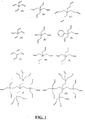
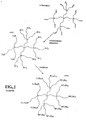
- Non-limiting dendrimeric compounds useful in the present process and catalyst system maybe selected from the following list:
- the cation represented by Cat + is preferably (i) the cation of an alkali metal (e.g., lithium, sodium or potassium); (ii) a carbocation (e.g., triphenylmethylium); or (iii) a doubly or trebly substituted ammonium ion (e.g., N,N -dimethylanilinium, trimethylammonium, triethylammonium, tributylammonium, dimethylundecylammonium, dodecyldimethylammonium, demtheylcatadecylammonium, methyldioctadecylammonium, methyloctadecylammonium or dioctadecylammonium).
- an alkali metal e.g., lithium, sodium or potassium
- a carbocation e.g., triphenylmethylium
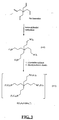
- the dendrimeric compounds of general Formula (III) may produced by a method such as that described in copending German patent application 198 12 881.9 (filed March 24, 1998) which is for U.S. patent practice included by reference. Specifically, the method is characterised in that compounds of general Formula (VI) R 1 4-i Me 1 [(R 7 ) n-2 Y] i wherein:
- the alkaline earth metal is preferably Mg
- the transition metals are preferably selected from the group comprising Zn, Cd, Hg and Cu
- the alkyl metals are preferably selected from the group comprising Li, Na and K, most preferably Li.
- R 8 , R 9 and R 10 radicals selected from hydrogen and C 1 -C 5 alkyl. More preferably, each of R 8 , R 9 and R 10 are hydrogen.
- the compounds which are preferably used as compounds of Formulae (VI), (VII), (VIII) and (IX) are preferably those of general Formulae (VI), (VII), (VIII) and (IX), respectively, as given below: R 1 4-i Si[(CH 2 ) n Y] i wherein:
- the reaction of compounds of general Formula (VI) with compounds of general Formula (VII) preferably is conducted at temperatures in the range of from -100° to 150°C, preferably in the range of from -80° to 100°C, and at a pressure of from normal pressure to 10 bar, preferably at normal pressure.
- the reaction is optionally conducted in the presence of solvents and/or diluents, such as alkanes for example. In many cases, however, this use of solvents and/or diluents can be omitted. This is the situation, for example, when an unsaturated compound of Formula (VI) is reacted with HBCl 2 .
- the HBCl 2 which is used during the reaction can be produced as an intermediate from any one of trialkylsilanes, R 3 Si-H and BCl 3 . This method of preparation is described in J. Org. Chem. 1990, 55, 2274, for example.
- the reaction product obtained from reaction of the compounds of general Formula (VI) and the compounds of general Formula (VII) is reacted further with organic alkali metal, alkaline earth metal or transition metal compounds of Formulae (VIII) or (IX).
- This reaction preferably is conducted at a temperature in the range of from -100° to 200°C, preferably at in the range of from - 100° to 150°C, and at normal pressure.
- the aforementioned solvents and/or diluents in the amounts which were also mentioned above, are suitable as solvents and/or diluents here.
- the preparation of the compounds of Formula (VII) which are employed as starting materials is known, and can be effected analogously to the preparation of carbosilane dendrimers.
- Conditions for the preparation of carbosilane dendrimers are given, for example, in Rubber Chem. Technol. 1992, 65, 303-314; Adv. Mater. 1993, 5, 466-468; Macromolecules 1992, 26, 963-968; J. Chem. Soc., Chem. Commun. 1994, 2575-2576; Organometallics 1994, 13, 2682-2690; Macromolecules 1995, 28, 6657-6661; and Organometallics 1995, 14, 5362-5366.
- an alkenylsilane such as tetravinyl- or tetraallysilane may be reacted with a hydrochlorosilane such as USiCl 3 , MSiMeCl 2 or MSiMe 2 Cl, and the product obtained is reacted further with an alkenylmagnesium compound (i.e., a Grignard reaction).
- a hydrochlorosilane such as USiCl 3 , MSiMeCl 2 or MSiMe 2 Cl
- an alkenylmagnesium compound i.e., a Grignard reaction
- the present catalyst system may be used to produce an olefin polymer.
- ⁇ -olefin polymer is intended to have a broad meaning an encompasses homopolymers, copolymers, terpolymers, etc. which are derived from the polymerization of at least one olefin monomer.
- ⁇ -olefin polymer is intended to have a broad meaning and encompasses ⁇ -olefin monomers, diolefin monomers and monomers containing at least one internal olefin linkage.
- the olefin monomer is ethylene
- the olefin monomer is an ⁇ -olefin monomer
- ⁇ -Olefin monomers are well known in the art and the choice thereof for use in the present process is within the purview of a person skilled in the art.
- the ⁇ -olefin monomer is selected from the group consisting of propylene, butene-1, isobutene, pentene-1, hexene-1, octene-1, branched isomers thereof, styrene, ⁇ -methylstyrene and mixtures thereof.
- the most preferred ⁇ -olefin monomer is propylene.
- the olefin monomer comprises a nonconjugated diolefin monomer.
- Diolefin monomers are well known in the art and the choice thereof for use in the present process is within the purview of a person skilled in the art.
- the nonconjugated diolefin can be straight chain, branched chain or cyclic hydrocarbon dioolefins having from 6 to 15 carbon atoms.
- Illustrative nonlimiting examples are straight chain acyclic diolefins such as 1,4-hexadiene and 1,6-octadiene, the branched chain acyclic diolefins such as 5-methylhexadiene-1,4, 7-methyl-octadiene-1,6 and 7-methyl-octadiene-1,7; single ring alicyclic diolefins such as 1,4-cyclohexadiene and 1,5-cyclooctadiene, and multi ring alicyclic fused and bridged ring dioolefins such as tetrahydroindene, dicyclopentadiene, 5-ethylidene-2-norbornene, 5-vinylidene-2-norbornene and 5-isopropylidene-2-norbornene.
- 1,4-Hexadiene, 7-methyl-1,6-octadiene, dicyclopentadiene and 5-ethylidene-2-norbornene are the preferred nonconjugated diolefins and 5-ethylidene-2-norbornene is the most preferred nonconjugated diolefin.
- the olefin monomer is a mixture of ethylene and at least one ⁇ -olefin (as described hereinabove) which results in the production of a copolymer.
- the preferred such monomer mixture comprises ethylene and propylene.
- the olefin is a mixture of ethylene, at least one ⁇ -olefin (as described hereinabove) and at least one diolefin monomer (as described hereinabove) which results in the production of a terpolymer.
- the preferred such monomer mixture comprises ethylene, propylene and one or both of 5-ethylidene-2-norbornene and 5-vinylidene-2-norbornene.
- the diolefin monomer in an amount such that the elastomer product contains in the range of from 0.5 to 15, more preferably in the range of from 1 to 10, weight percent of the diolefin monomer.
- Polymerization of the olefin monomer(s) using the present catalyst system may be carried out in a polymerization medium containing an inert hydrocarbon which is a solvent at least for the olefin monomer and the catalyst system.
- a polymerization medium containing an inert hydrocarbon which is a solvent at least for the olefin monomer and the catalyst system.
- one of the reactants e.g., the ⁇ -olefin, if used
- a hydrocarbon in which the product polymer is insoluble may be used as the diluent.
- Polymerization of the olefin monomer(s) may be carried out batchwise or in a continuous manner.
- the preferred process involves continuous slurry polymerization in which ethylene, ⁇ -olefin monomer, diolefin monomer (if used) and the catalyst system are continuously supplied to a reaction zone and the product polymer is formed as a slurry in the liquid phase.
- Suitable inert hydrocarbons for use as the polymerization medium are those comprising at least one element comprising selected from the group consisting of C 4 -C 8 aliphatic hydrocarbons, C 5 -C 10 cyclic aliphatic hydrocarbons, C 6 -C 9 aromatic hydrocarbons, C 3 -C 8 monoolefinic hydrocarbons and mixtures thereof.
- Non-limiting examples of such hydrocarbons include: (i) straight and branched chain hydrocarbons such as butane, isobutane, pentane, hexane, octane and the like; (ii) cyclic and alicyclic hydrocarbons such as cyclopentane, cyclohexane, cycloheptane, ethylcyclopentane, methylcyclohexane, methylcycloheptane and the like; (iii) alkyl-substituted aromatic hydrocarbons such as toluene, xylene and the like; and (iv) liquid olefins which may act as monomers or comonomers such as propylene, butene-1 and the like.
- the present process is generally carried out at temperatures in the range of from -40°C to 200°C, preferably from -20° to 100°C, more preferably from 0°C to 80°C, and at a pressure in the range of from 30 kPa to 50 MPa.
- the molar ratio between the organometallic compound of the Formula (II) and the transition metal compound of the Formula (I) is in the range of from 1:1 to 10000 : 1, more preferably in the range of from 1:1 to 1000 : 1, most preferably in the range of from 1:1 to 200 : 1.
- the molar ratio between the dendrimeric compound and the transition metal compound of the Formula (I) is in the range of from 0.01:1 to 10 : 1, more preferably in the range of from 0.02 : 1 to 1 : 1, most preferably in the range of from 0.1:1 to 1 : 1.
- the present process may be carried out by first introducing the hydrocarbon diluent into a stirred tank reactor together with the olefin monomer(s) and adjusting the pressure of the reactor contents so that the temperature of the reactor contents are brought to the desired level.
- Ethylene gas may be introduced either into the vapour phase of the reactor or sparged into the liquid phase as is known in the art.
- a hydrocarbon solution of the vanadium compound containing a desired amount of the activator and a hydrocarbon solution of the aluminum cocatalyst(s) in the desired ratios are introduced in the liquid phase.
- the polymerization occurs substantially in the liquid phase, a slurry of the product polymer being formed in the diluent.
- the rate of polymerization may be controlled by the rate of catalyst addition.
- the reactor temperature and pressure may be controlled through the vaporization of the liquid phase as well as by cooling coils, jackets, etc. If a mixture of olefin monomers is used, the content of any one monomer in the polymer product may be controlled by manipulating the feed rates of the respective olefin monomers to the reactor and by manipulating the concentration of catalyst fed to the reactor.
- the polymer product may be recovered in a conventional manner by flashing off the lower boiling compounds either at reduced pressure or by treatment of the slurry with a mixture of steam and hot water, and by the use of a devolatilizing extruder or by further steam stripping and subsequent dewatering and drying.
- the mean residence time of the catalyst and polymer in the reactor is generally in the range of from 20 minutes to 8 hours, preferably from 30 minutes to 6 hours, more preferably from 30 minutes to 4 hours, most preferably from 30 minutes to 2 hours.
- the polymerization may be carried out using solution polymerization techniques. See, for example, any one of published European patent application 0,044,595A [Evens et al.], published European patent application 0,552,945 [Kawasaki et al.] and published International patent application WO 96/33227 [Schiffino et al.], which are for U.S. patent practice included by reference.
- the polymerization may be carried out using conventional gas phase polymerization techniques. See, for example, any one of United States patent 4,994,534 [Rhee et al.], published International application WO 99/19059 [Haendeler et al.] and published Internation application WO 99/19385 [Herold et al.] which are for U.S. patent practice included by reference.
- organometallic compounds were prepared and handled under a protective argon atmosphere, and with the exclusion of air and moisture (known in the art as the "Schlenk technique"). All the necessary solvents were obtained as absolute solvents before use by boiling for several hours over a suitable drying agent and subsequent distillation under argon. The compounds were characterized by 1 H NMR, 13 C NMR and 11 B NMR. Other, commercially available starting materials were used without further purification. Tetraallysilane was prepared from silicon tetrachloride and allylmagnesium chloride.
- the weight percent ethylene in the EPM and EPDM polymers was determined by FTIR spectroscopy in accordance with ASTM D-3900-95.
- polymeric films were pressed at 150°C and the spectra recorded.
- the ethylene content was determined by integrating the absorbance peaks at 720 cm -1 and 1155 cm - 1 , and performing the calculation using empirically derived relationships.
- the ENB content was measured by FTIR spectroscopy in accordance with ASTM D-6047-96.
- the Mooney viscosity (ML 1+4 @ 125°C) of the polymer products was determined using a Mooney viscometer in accordance with ASTM D-1646.
- Polymerization was conducted in a one liter ZipperClave reactor. As is known to those of skill in the art, this reactor is jacketed and stirred with an explosion proof motor. The reactor was equipped with a series of independent syringe pumps to allow for introduction to the reactor of catalyst and co-catalyst through separate feed streams. The reactor system was interfaced with computer to facilitate direct data acquisition (e.g., polymerization temperature, ethylene flow, etc.).
- direct data acquisition e.g., polymerization temperature, ethylene flow, etc.
- the catalyst used in these Examples was ethylenebis(4,5,6,7-tetrahydro-1-indenyl)zirconiumdichloride (EBTHI).
- EBTHI ethylenebis(4,5,6,7-tetrahydro-1-indenyl)zirconiumdichloride
- TEZABA trityl-tetrakis(pentafluorophenyl)borate
- dendrimer ethylenebis(4,5,6,7-tetrahydro-1-indenyl)zirconiumdichloride
- the ZipperClave reactor was charged with an inert hydrocarbon diluent (350 mL), liquid propylene (200 mL), 5-ethylidene-2-norbornene (ENB, 4 mL), and pressurized with ethylene to a total of 203 psig. After allowing the contents of the reactor to equilibrate to a temperature of 50°C, triisobutylaluminum (TIBA; 4 mL; 0.1 M) and EBTHI (9 mL; 0.16 mM containing TIBA in a molar ratio 1:200 EBTHI:TIBA). After 5 minutes of mixing, the TRIFABA or dendrimer (10 mL; 0.1 mM) was added to the reactor.
- TIBA triisobutylaluminum
- EBTHI 9 mL; 0.16 mM containing TIBA in a molar ratio 1:200 EBTHI:TIBA
- Ethylene was supplied on demand in order to maintain the initial total pressure in the reactor.
- the polymerization was carried out for 60 minutes after which ethanol was added to the reactor and the unreacted monomers were flashed off.
- the polymer was recovered with ethanol and dried in a vacuum oven at 60°C.
- Table 1 sets out the cocatalyst used, the molar ratio of boron (i.e., in the cocatalyst) to the catalyst, the polymerization temperature, the catalyst activity, the weight percent of ethylene in the polymer product, the weight percent of ENB in the polymer product and the Mooney viscosity of the polymer product.
- Examples 4 and 5 illustrates the use of a conventional cocatalyst (i.e., TRIFABA). Accordingly, Examples 4 and 5 are outside the scope of the present invention and are provided for compartive purposes only. The results reported in Table 1 clearly demonstrate one of the advantages accruing from the present process. Specifically, under the slurry conditions and conventional catalyst/cocatalyst system used (i.e., Examples 4 and 5), it was not possible to produce a terpolymer having a measurable Mooney viscosity.
Landscapes
- Chemical & Material Sciences (AREA)
- Health & Medical Sciences (AREA)
- Chemical Kinetics & Catalysis (AREA)
- Medicinal Chemistry (AREA)
- Polymers & Plastics (AREA)
- Organic Chemistry (AREA)
- Transition And Organic Metals Composition Catalysts For Addition Polymerization (AREA)
Abstract
Description
- Me
- denotes a transition metal of
Groups 3 to 10 of the Periodic Table of the Elements (IUPAC nomenclature 1985); - A
- is an anionic ligand which is optionally singly- or multiply-bridged;
- R
- is a C6-10 aryl or C1-10 alkyl which may be optionally singly- or multiply-substituted; and
- c, d
- each represent an integer in the range of from 0 to 6;
- Me*
- represents an element of
Group 2 or 13 of the Periodic Table of the Elements (IUPAC nomenclature 1985); - Y
- can optionally be singly- or multiply-substituted, and is selected from the group consisting of C1-30 alkyl, C5-20 cycloalkyl and C7-40 aryl;
- Z
- is selected from the group consisting of C1-10 alkoxy, C6-40 aryloxy siloxy, halogen and hydrogen;
- e
- is an integer in the range of from 1 to 3;
- f
- is an integer in the range of from 0 to 2; and
- Me
- denotes a transition metal of Groups 3-10 of the Periodic Table of the Elements (IUPAC nomenclature 1985);
- A
- is an anionic ligand which is optionally singly- or multiply-bridged;
- R
- is a C6-10 aryl or C1-10 alkyl which may be optionally singly- or multiply-susbtituted; and
- c, d
- each represent an integer in the range of from 0 to 6;
- Me*
- represents an element of
Group 2 or 13 of the Periodic Table of the Elements (IUPAC nomenclature 1985); - Y
- can optionally be singly- or multiply-substituted, and is selected from the group consisting of C1-30 alkyl, C5-20 cycloalkyl and C7-40 aryl;
- Z
- is selected from the group consisting of C1-10 alkoxy, C6-40 aryloxy siloxy, halogen and hydrogen;
- e
- is an integer in the range of from 1 to 3;
- f
- is an integer in the range of from 0 to 2; and
- Me
- denotes a transition metal of
Groups 3 to 10 of the Periodic Table of the Elements (IUPAC nomenclature 1985); - A
- is an anionic ligand which is optionally singly- or multiply-bridged;
- R
- is a C6-10 aryl or C1-10 alkyl which may be optionally singly- or multiply-substituted; and
- c, d
- each represent an integer in the range of from 0 to 6.
- Me
- is a metal selected from the group consisting of: titanium, zirconium, hafnium, vanadium, niobium and tantalum.
- A
- is selected from the group consisting of: a pyrazolate of formula N2C3R10 3; a pyrazolylborate of formula R11B(N2C3R1°3)3; an alcoholate or phenolate of formula OR11; a siloxane of formula OSiR11 3; a thiolate of formula SR2; an acetylacetonate of formula (R11CO)2CR11; a diimine of formula (R12N-CR11)2; an amidinate of formula R11(NR12 2)2; a cyclooctatetraenyl, a cyclopentadienyl which is optionally singly- or multiply-substituted, an indenyl which is optionally singly- or multiply-substituted, and a fluorenyl which is optionally singly- or multiply-substituted, wherein substituents, if present, may be selected from the group consisting of a C1-C20 alkyl group, a C1-C10 alkoxy group, a C6-C20 aryl group, a C6-C10 aryloxy group, a C7 to C40 arylalkyl group, a C7 to C40 alkylaryl group, and a boranyl, silyl, amino or phosphinyl group which is optionally substituted by C1 to C10 hydrocarbon radicals;
- R
- is selected from the group consisting of hydrogen, fluorine, chlorine, bromine, methyl, benzyl, neopentyl and phenyl;
- c
- is 1 or 2; and
- d
- is 2 or 3;
- Me
- is selected from the group consisting of titanium, zirconium and hafnium;
- A
- is selected from the group consisting of bis(trimethylsilyl)amide, dimethylamide, diethylamide, diisopropylamide, 2,6-di-tert-butyl-4-methyl phenolate, cyclooctatetraenyl, cyclopentadienyl, methylcyclopentadienyl, benzylcyclopentadienyl, n-propylcyclopentadienyl, n-butylcyclopentadienyl, iso-butylcyclopentadienyl, t-butyl-cyclopentadienyl, cyclopentylcyclopentadienyl, octadecylcyclopentadienyl, 1,2-dimethylcyclopentadienyl, 1,3-dimethylcyclopentadienyl, 1,3-di-isopropylcyclopentadienyl, 1,3-di-t-butylcyclopentadienyl, 1-ethyl-2-methyl-cyclopentadienyl, 1-isopropyl-3-methylcyclopentadienyl, 1-(n-butyl)-3-methylcyclopentadienyl, 1-(t-butyl)-3-methylcyclopentadienyl, pentamethylcyclopentadienyl, 1,2,3,4-tetramethylcyclopentadienyl, 1,2,4-trimethylcyclopentadienyl, 1,2,4-triisopropylcyclopentadienyl, 1,2,4-tri(t-butyl)cyclopentadienyl, indenyl, tetrahydroindenyl, 2-methylindenyl, 4,7-dimethylindenyl, 2-methyl-4,5-benzoindenyl, 2-methyl-4-phenylindenyl, fluorinenyl and 9-methyl-fluorenyl;
- R
- is selected from the group consisting of chlorine, methyl and benzyl;
- c
- is 1 or 2 ;and
- d
- is 2 or 3.
- Me
- represents nickel and palladium;
- A
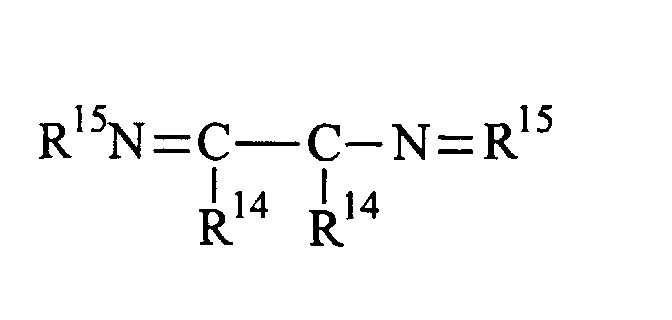
- is a diimine of formula
- c
- represents 1 and d represents 2;
- X
- is Me2R2R3(Ry)r;
- R1, R2, R3, Ry
- are identical or different, can optionally be singly- or multiply-substituted, and are selected from the group comprising hydrogen, C5-C20 cycloalkyl, C1-C30 alkyl, C7-C40 aryl, C1-C10 alkoxy, C6-C40 aryloxy, siloxy and halogen;
- R4
- is optionally a singly- or multiply- C1-C10 alkyl substituted or C1-C10 alkoxyl substituted alkylene-, alkenylene- or alkynylene diradical, optionally substituted in chain by oxygen or sulfur atoms;
- Me1
- represents an element of Group 14 of the Periodic Table of the elements (IUPAC nomenclature 1985);
- Me2
- represents an element of Group 13 of the Periodic Table of the elements (IUPAC nomenclature 1985);
- i
- is an integer in the range of from 2 to 4;
- n
- is an integer in the range of from 1 to 20; and
- r
- can be 0 or 1;
or wherein:
- X
- is M1R5 a[(R4)mMe2R2R3(Ry)r]3-a;
- R5
- has the same meaning as any one of R1, R2, R3 and Ry;
- m
- is identical to or different from n and represents an integer in the range of from 1 to 20; and
- a
- is 0, 1 or 2;
- X
- is Me1R5 a[(R4)mMe1R6 b[(R4)pMe2R2R3(Ry)r]3-b]3-a,
- R6
- has the same meaning as any one of R1, R2, R3, Ry and R5;
- b
- is 0, 1 or 2; and
- p
- is an integer in the range of from 1 to 20.
- X
- represents Me2R2R3(Ry)r, and R1, R2, R3, Ry are identical or different, preferably identical, can optionally be singly- or multiply-substituted, and represent C5-C6 cycloalkyl, C6-C10 aryl, C1-C10 alkyl and/or halogen;
- R4
- is a methylene radical;
- Me2
- is B or Al;
- i
- is an integer in the range of 2 to 4;
- n
- is an integer in the range of 1 to 20; and
- r
- is 0 or 1;
- X
- represents SiR5 a[(R4)m,Me2 R2 R3 (Ry)r]3-a;
- R5
- has the same meaning as the R1, R2, R3 and Ry radicals above;
- m
- is identical to or different from n and each is an integer in the
range 1 to 20; - a
- is 0, 1 or 2;
or wherein:
- X
- represents SiR5 a[(R4)mSiR6 b[(R4)nMe2 R2 R3(Ry)r]3-b]3-a
- R6
- has the same meaning as the aforementioned R2, R3, R4, R5, Ry radicals;
- b
- is 0, 1 or 2; and
- p
- is an integer in the
range 1 to 20.
- X
- represents BR2R3(Ry)r;
- R1, R2, R3, Ry
- are identical or different, preferably identical, can optionally be singly-or multiply-substituted, and each is selected from a C6-C10 aryl or a C1-C10 alkyl;
- i
- is 3 or 4,
- n
- is an integer in the
range 1 to 20; and - r
- is 0 or 1;
- X
- represents SiR5 a[(CH2)mSiR6 b[(CH2)pBR2R3(Ry)r]3-b]3-a;
- R6
- has the same meaning as the aforementioned R1, R2, R3 and Ry radicals;
- b
- is 0, 1 or 2; and
- p
- is an integer in the
range 1 to 20.
- Y
- represents CR8=CR9R10;
- R8, R9 and R10
- are identical or different and each is selected from the group comprising hydrogen, alkyl, aryl or halogen;
- R7
- has the same meaning as the R4 radicals in the compound of Formula (III) above;
- n
- is an integer in the range of 2 to 20; and
or wherein:
- Y
- represents Me1R5 a[(R7)m-2(CR8=CR9R10)]3-a and
- R5
- has the definition given in the compound of Formula (III) above;
- Y
- represents Me1R5 a[(R4)mMe1R6 b[(R7)p-2(CR8=CR9R10)3-b]3-a;
- R4
- has the definition given in the compound of Formula (III);
and wherein all the other radicals cited in the formulae for Y have the aforementioned meanings;
are reacted with compounds of general Formula (VII)
- R11
- is hydrogen or a C1-C30 alkyl; and
and if r = 1, the product obtained therefrom is reacted further with compounds of general Formula (VIII)
- Me3
- is an alkali metal and Ry has the meaning given in the compound of Formula (III) above;
- Me4
- is an alkaline earth metal or a transition metal of group 11 or 12;
- Hal
- is a halogen;
- q
- is 0 or 1; and
- Ry
- has the meaning set forth above.

- Y
- is -CH-CH3;
- i
- is 3 or 4;
- R1
- is a C1-C6 alkyl or C6-C12 aryl radical which is optionally singly- or multiply-substituted; and
- n
- is an integer in the range of 1 to 10;
- Y
- is SiR5 a[(CH2)mCH=CH2]3-a;
- a
- is 0, 1 or 2;
- R5
- has the same meaning as R1; and
- m
- is an integer in the range of 1 to 10;
- Y
- is SiR5 a[(CH2)mSiR6 b[(CH2)pCH=CH2]3-b]3-a;
each of p and m is an integer in the range of 1 to 10;
R2, R3 have the meaning given in for the compound of Formula (III) above;
- Me3
- is Li or Na; and
- Ry
- has the meaning given in the compound of Formula (III) above;
- Hal
- is Cl or Br; and
- Ry
- has the meaning given in the compound of Formula (III) above; and
- q
- is 0 or 1.
- Y
- is -CH=CH2 and
- n
- is 1, 2, 3 or 4;
- Y
- is Si[(CH2)mCH=CH2]3; and
- m
- is 1, 2, 3 or 4;
- Y
- is Si[(CH2)mSi[(CH2)pCH=CH2]3]3
- p
- is 1, 2, 3 or 4; and
- m
- has the above meaning.
- 1H NMR (CDCl3):
- δ=0.52 ppm (m, 2H, Si-CH2), 1.55 PPM (m, 4H, Cl2B-CH2-CH2);
- 13C{1H} NMR:
- δ=15.4ppm (Si-CH2), 20.0 ppm (Si-CH2-CH2); 34.2 ppm (B-CH2); and
| Example | Borate Type | Molar Ratio B/EBTHI | Polymerization Temp (°C) | Wt% Ethylene | Wt% | Mooney Viscosity | |
| 4 | TRIFABA | 1.1 | 49-74 | 57 | - | Tacky | |
| 5 | TRIFABA | 1.1 | 55-70 | 58 | - | Tacky | |
| 6 | Dendrimer | 2.8 | 49-62 | 64 | 7 | 30 | |
| 7 | Dendrimer | 2.8 | 51-71 | 66 | 5 | 25 | |
| 8 | Dendrimer | 1.4 | 51-65 | 61 | 6 | 25 | |
| 9 | Dendrimer | 1.4 | 51-62 | 64 | 6 | 23 | |
| TRIFABA = trityl-tetrakis(pentafluorophenyl)borate |
Claims (14)
- A process for production of an olefin polymer comprising the step of polymerizing an olefin monomer in the presence of a catalyst system comprising:(a) a transition metal compound of Formula (I):
- Me
- denotes a transition metal of Groups 3-10 of the Periodic Table of the Elements (IUPAC nomenclature 1985);
- A
- is an anionic ligand which is optionally singly- or multiply-bridged;
- R
- is a C6-10 aryl or C1-10 alkyl which may be optionally singly- or multiply-substituted; and
- c, d
- each represent an integer in the range of from 0 to 6
(b) an organometallic compound of Formula (II)- Me*
- represents an element of Group 2 or 13 of the Periodic Table of the Elements (IUPAC nomenclature 1985);
- Y
- can optionally be singly- or multiply-substituted, and is selected from the group consisting of C1-30 alkyl, C5-20 cycloalkyl and C7-40 aryl;
- Z
- is selected from the group consisting of C1-10 alkoxy, C6-40 aryloxy siloxy, halogen and hydrogen;
- e
- is an integer in the range of from 1 to 3;
- f
- is an integer in the range of from 0 to 2; and
(c) a dendrimeric compound. - The process defined in claim 1, wherein the dendrimeric compound comprises carbosilane dendrimeric compounds.
- The process defined in claim 1, wherein the dendrimeric compound is a compound of the Formula (III)
X is Me2R2R3(Ry)r;- R1, R2, R3, Ry
- are identical or different, can optionally be singly- or multiply-substituted, and are selected from the group comprising hydrogen, C5-C20 cycloalkyl, C1-C30 alkyl, C7-C40 aryl, C1-C10 alkoxy, C6-C40 aryloxy, siloxy and halogen;
- R4
- is optionally a singly- or multiply-substituted alkylene-, alkenylene- or alkynylene diradical, optionally substituted in chain by hetero atoms;
- Me1
- represents an element of Group 14 of the Periodic Table of the elements (IUPAC nomenclature);
- i
- is an integer from 2 to 4;
- n
- is an integer from 1 to 20; and
- r
- can be 0 or 1;
or wherein:- X
- is Me1R5 a[(R4)mMe2R2R3(Ry)r]3-a;
- R5
- has the same meaning as any one of R1, R2, R3 and Ry;
- m
- is identical to or different from n and represents an integer from 1 to 20; and
- a
- is 0, 1 or 2;
- X
- is Me1R5 a[(R4)mMe1R6 b[(R4)pMe2R2R3(Ry)r]3-b]3-a,
- R6
- has the same meaning as any one of R1, R2, R3, Ry and R5
- b
- is 0, 1 or 2; and
- p
- is an integer from 1 to 20.
- The process defined in any one of claims 1-3, wherein the molar ratio between the organometallic aluminium compound of the Formula (II) and the transition metal compound of the Formula (I) is in the range of from 1:1 to 10000:1.
- The process defined in any one of claims 1-4, wherein the molar ratio between the dendrimeric compound and the transition metal compound of the Formula (I) is in the range of from 0.01:1 to 10:1.
- An olefin monomer polymerization catalyst system comprising:(a) a transition metal compound of Formula (I)
- Me
- denotes a transition metal of Groups 3 to 10 of the Periodic Table of the Elements (IUPAC nomenclature 1985);
- A
- is an anionic ligand which is optionally singly- or multiply-bridged;
- R
- is a C6-10 aryl or C1-10 alkyl which may be optionally singly- or multiply-substituted; and
- c, d
- each represent an integer in the range of from 0 to 6;
(b) an organometallic compound of Formula (II)- Me*
- represents an element of Group 2 or 13 of the Periodic Table of the Elements (IUPAC nomenclature 1985);
- Y
- can optionally be singly- or multiply-substituted, and is selected from the group consisting of C1-30 alkyl, C5-20 cycloalkyl and C7-40 aryl;
- Z
- is selected from the group consisting of C1-10 alkoxy, C6-40 aryloxy siloxy, halogen and hydrogen;
- e
- is an integer in the range of from 1 to 3;
- f
- is an integer in the range of from 0 to 2; and
(c) a dendrimeric compound. - The catalyst system defined in claim 6, wherein the dendrimeric compound comprises carbosilane dendrimeric compounds.
- The catalyst system defined in claim 7, wherein the dendrimeric compound is a compound of the Formula (III)
- X
- is Me2R2R3(Ry)r;
- R1, R2, R3, Ry
- are identical or different, can optionally be singly- or multiply-C1-C10 alkyl substituted or C1-C10 alkoxyl substituted, and are selected from the group consisting of hydrogen, C5-C20 cycloalkyl, C1-C30 alkyl, C7-C40 aryl, C1-C10 alkoxy, C6-C40 aryloxy, siloxy and halogen;
- R4
- is optionally a singly- or multiply-substituted alkylene-, alkenylene- or alkynylene diradical, optionally substituted in chain by oxygen or sulfur atoms;
- Me1
- represents an element of Group 14 of the Periodic Table of the elements (IUPAC nomenclature 1985);
- i
- is an integer in the range of from 2 to 4;
- n
- is an integer in the range of from 1 to 20; and
- r
- can be 0 or 1;
or wherein:- X
- is Me1R5 a[(R4)mMe2R2R3(Ry)r}3-a;
- R5
- has the same meaning as any one of R1, R2, R3 and Ry;
- m
- is identical to or different from n and represents an integer in the range of from 1 to 20; and
- a
- is 0, 1 or 2;
- X
- is Me1R5 a[(R4)mMe1R6 b[(R4)pMe2R2R3(Ry)r]3-b]3-a,
- R6
- has the same meaning as any one of R1, R2, R3, Ry and R5;
- b
- is 0, 1 or 2; and
- p
- is an integer in the range of from 1 to 20.
- The catalyst system defined in any one of claims 6-8, wherein the molar ratio between the compound of the Formula (II) and the transition metal compound of the Formula (I) is in the range of from 1:1 to 10000 : 1.
- The catalyst system defined in any one of claims 6-9, wherein the molar ratio between the dendrimeric compound and the transition metal compound of the Formula (I) is in the range of from 0.01 : 1 to 10 : 1.
- The catalyst system defined in any one of claims 6-10, wherein Me1 comprises silicon.
- The catalyst system defined in any one of claims 6-11, wherein Me2 comprises boron.
- The catalyst system defined in any one of claims 6-12, wherein X comprises Me2R2R3Ry.
- The catalyst system defined in any one of claims 6-13, wherein X comprises Me1R5 a[(R4)mMe2R2R3Ry]3-a.
Applications Claiming Priority (2)
| Application Number | Priority Date | Filing Date | Title |
|---|---|---|---|
| CA2276282 | 1999-06-23 | ||
| CA002276282A CA2276282A1 (en) | 1999-06-23 | 1999-06-23 | Olefin polymerization process and catalyst system therefor |
Publications (2)
| Publication Number | Publication Date |
|---|---|
| EP1063243A2 true EP1063243A2 (en) | 2000-12-27 |
| EP1063243A3 EP1063243A3 (en) | 2001-01-10 |
Family
ID=4163664
Family Applications (1)
| Application Number | Title | Priority Date | Filing Date |
|---|---|---|---|
| EP00111927A Withdrawn EP1063243A3 (en) | 1999-06-23 | 2000-06-15 | Olefin polymerization process and catalyst system therefor |
Country Status (3)
| Country | Link |
|---|---|
| EP (1) | EP1063243A3 (en) |
| JP (1) | JP2001019710A (en) |
| CA (1) | CA2276282A1 (en) |
Families Citing this family (2)
| Publication number | Priority date | Publication date | Assignee | Title |
|---|---|---|---|---|
| JP4595111B2 (en) * | 2005-01-07 | 2010-12-08 | 独立行政法人産業技術総合研究所 | Alpha-glycol-encapsulated dendrimer, process for producing the same, alpha-glycol-type bidentate ligand and Lewis acid catalyst having the coordination structure |
| BR112012001948B1 (en) * | 2009-07-29 | 2019-08-20 | Dow Global Technologies Llc | Chain transfer agent, process for polymerizing at least one addition polymerizable monomer, multi-block copolymer and catalyst composition |
Family Cites Families (2)
| Publication number | Priority date | Publication date | Assignee | Title |
|---|---|---|---|---|
| US6313239B1 (en) * | 1996-03-05 | 2001-11-06 | Bayer Corporation | Olefin polymerization with group 4 metal-containing organosilicon dendrimers |
| DE19812881A1 (en) * | 1998-03-24 | 1999-10-07 | Bayer Ag | New dendrimeric compounds, a process for their preparation and their use as catalysts |
-
1999
- 1999-06-23 CA CA002276282A patent/CA2276282A1/en not_active Abandoned
-
2000
- 2000-06-15 EP EP00111927A patent/EP1063243A3/en not_active Withdrawn
- 2000-06-22 JP JP2000187804A patent/JP2001019710A/en active Pending
Also Published As
| Publication number | Publication date |
|---|---|
| EP1063243A3 (en) | 2001-01-10 |
| JP2001019710A (en) | 2001-01-23 |
| CA2276282A1 (en) | 2000-12-23 |
Similar Documents
| Publication | Publication Date | Title |
|---|---|---|
| JP3274686B2 (en) | Polymerization process for producing polyolefin elastomers, cation-forming cocatalyst for activating metallocene procatalysts, polyolefin elastomers having unique properties and products made therefrom | |
| JP2535249B2 (en) | Group 4 metal coordination complex | |
| US5372980A (en) | Bimetallic metallocene alumoxane catalyst system and its use in the preparation of ethylene-alpha olefin and ethylene-alpha olefin-non-conjugated diolefin elastomers | |
| US6225427B1 (en) | Olefin polymerization process employing metallocene catalyst provided by cocatalyst activation of a metallocene procatalyst | |
| JP6499195B2 (en) | Process for producing polyolefin and polyolefin produced therefrom | |
| US10875951B2 (en) | Propylene-diene copolymer resin having excellent melt tension | |
| KR101850985B1 (en) | Method for preparing supported metallocene catalyst | |
| EP3705503A1 (en) | Olefin-based polymer | |
| KR20220009900A (en) | Transition metal compound and catalyst composition comprising the same | |
| US20030216590A1 (en) | Novel dendrimer compounds, method for the production thereof, use thereof as catalysts | |
| US20200354488A1 (en) | Catalyst Composition and Method for Preparing Olefin Polymer Using Same | |
| EP3670544B1 (en) | Catalyst composition and method for preparing olefin polymer by using same | |
| US6288254B1 (en) | Bimetallic metallocene catalyst for preparing olefin polymer | |
| KR101793823B1 (en) | Preparing method for high melt strength polypropylene resin composition | |
| CA2276282A1 (en) | Olefin polymerization process and catalyst system therefor | |
| KR100505842B1 (en) | Polymerization process for the production of polyolefin elastomers, cationic-producing catalysts for the activation of metallocene procatalysts, polyolefin elastomers with special combinations of physical properties and products made from them | |
| JP3684626B2 (en) | Ethylene-based random copolymer and composition thereof | |
| CA2312118A1 (en) | Olefin polymerization process and catalyst system therefor | |
| CZ287606B6 (en) | Metallic coordination complex, catalytic composition in which this complex is comprised and addition polymerization process |
Legal Events
| Date | Code | Title | Description |
|---|---|---|---|
| PUAI | Public reference made under article 153(3) epc to a published international application that has entered the european phase |
Free format text: ORIGINAL CODE: 0009012 |
|
| PUAL | Search report despatched |
Free format text: ORIGINAL CODE: 0009013 |
|
| AK | Designated contracting states |
Kind code of ref document: A2 Designated state(s): DE FR GB IT NL |
|
| AX | Request for extension of the european patent |
Free format text: AL;LT;LV;MK;RO;SI |
|
| AK | Designated contracting states |
Kind code of ref document: A3 Designated state(s): AT BE CH CY DE DK ES FI FR GB GR IE IT LI LU MC NL PT SE |
|
| AX | Request for extension of the european patent |
Free format text: AL;LT;LV;MK;RO;SI |
|
| 17P | Request for examination filed |
Effective date: 20010710 |
|
| AKX | Designation fees paid |
Free format text: DE FR GB IT NL |
|
| STAA | Information on the status of an ep patent application or granted ep patent |
Free format text: STATUS: THE APPLICATION HAS BEEN WITHDRAWN |
|
| 17Q | First examination report despatched |
Effective date: 20020301 |
|
| 18W | Application withdrawn |
Withdrawal date: 20020306 |