EP1062337B1 - Human n-type calcium channel isoform and uses thereof - Google Patents
Human n-type calcium channel isoform and uses thereof Download PDFInfo
- Publication number
- EP1062337B1 EP1062337B1 EP99911339A EP99911339A EP1062337B1 EP 1062337 B1 EP1062337 B1 EP 1062337B1 EP 99911339 A EP99911339 A EP 99911339A EP 99911339 A EP99911339 A EP 99911339A EP 1062337 B1 EP1062337 B1 EP 1062337B1
- Authority
- EP
- European Patent Office
- Prior art keywords
- human
- calcium channel
- type calcium
- seq
- sfvg subunit
- Prior art date
- Legal status (The legal status is an assumption and is not a legal conclusion. Google has not performed a legal analysis and makes no representation as to the accuracy of the status listed.)
- Expired - Lifetime
Links
- 241000282414 Homo sapiens Species 0.000 title claims abstract description 263
- 102000004129 N-Type Calcium Channels Human genes 0.000 title claims abstract description 238
- 108090000699 N-Type Calcium Channels Proteins 0.000 title claims abstract description 238
- 108010029485 Protein Isoforms Proteins 0.000 title claims abstract description 63
- 102000001708 Protein Isoforms Human genes 0.000 title claims abstract description 63
- 108090000765 processed proteins & peptides Proteins 0.000 claims abstract description 124
- 150000007523 nucleic acids Chemical class 0.000 claims abstract description 121
- 102000004196 processed proteins & peptides Human genes 0.000 claims abstract description 121
- 229920001184 polypeptide Polymers 0.000 claims abstract description 118
- 108020004707 nucleic acids Proteins 0.000 claims abstract description 108
- 102000039446 nucleic acids Human genes 0.000 claims abstract description 108
- 238000000034 method Methods 0.000 claims abstract description 74
- 230000000694 effects Effects 0.000 claims abstract description 15
- 238000011282 treatment Methods 0.000 claims abstract description 12
- 208000037265 diseases, disorders, signs and symptoms Diseases 0.000 claims abstract description 10
- 201000010099 disease Diseases 0.000 claims abstract description 6
- 210000004027 cell Anatomy 0.000 claims description 109
- 239000011575 calcium Substances 0.000 claims description 67
- 230000009460 calcium influx Effects 0.000 claims description 56
- 150000001875 compounds Chemical class 0.000 claims description 47
- 230000001105 regulatory effect Effects 0.000 claims description 33
- 239000002773 nucleotide Substances 0.000 claims description 32
- 125000003729 nucleotide group Chemical group 0.000 claims description 32
- 102000003922 Calcium Channels Human genes 0.000 claims description 29
- 108090000312 Calcium Channels Proteins 0.000 claims description 29
- 239000002831 pharmacologic agent Substances 0.000 claims description 28
- 239000000203 mixture Substances 0.000 claims description 27
- 125000003275 alpha amino acid group Chemical group 0.000 claims description 26
- 239000012528 membrane Substances 0.000 claims description 21
- 229910052791 calcium Inorganic materials 0.000 claims description 18
- OYPRJOBELJOOCE-UHFFFAOYSA-N Calcium Chemical compound [Ca] OYPRJOBELJOOCE-UHFFFAOYSA-N 0.000 claims description 17
- 230000027455 binding Effects 0.000 claims description 17
- 238000009739 binding Methods 0.000 claims description 17
- 239000013604 expression vector Substances 0.000 claims description 16
- 230000001965 increasing effect Effects 0.000 claims description 16
- 238000000338 in vitro Methods 0.000 claims description 12
- 238000012360 testing method Methods 0.000 claims description 11
- 150000002611 lead compounds Chemical class 0.000 claims description 8
- 230000003247 decreasing effect Effects 0.000 claims description 6
- 230000001404 mediated effect Effects 0.000 claims description 6
- 239000003937 drug carrier Substances 0.000 claims description 4
- 210000000170 cell membrane Anatomy 0.000 claims 2
- 108091006146 Channels Proteins 0.000 abstract description 53
- 230000014509 gene expression Effects 0.000 abstract description 47
- 239000012634 fragment Substances 0.000 abstract description 19
- 239000003112 inhibitor Substances 0.000 abstract description 11
- 210000003169 central nervous system Anatomy 0.000 abstract description 6
- 208000002193 Pain Diseases 0.000 abstract description 3
- 208000030886 Traumatic Brain injury Diseases 0.000 abstract description 3
- 208000004296 neuralgia Diseases 0.000 abstract description 3
- 208000021722 neuropathic pain Diseases 0.000 abstract description 3
- 230000009529 traumatic brain injury Effects 0.000 abstract description 3
- 238000003745 diagnosis Methods 0.000 abstract description 2
- 230000002401 inhibitory effect Effects 0.000 abstract 1
- 230000011664 signaling Effects 0.000 abstract 1
- 108090000623 proteins and genes Proteins 0.000 description 42
- 108020004414 DNA Proteins 0.000 description 40
- 230000004913 activation Effects 0.000 description 36
- 241000700159 Rattus Species 0.000 description 29
- 238000003556 assay Methods 0.000 description 29
- 239000013598 vector Substances 0.000 description 26
- 241001465754 Metazoa Species 0.000 description 23
- 108020004999 messenger RNA Proteins 0.000 description 23
- 210000000287 oocyte Anatomy 0.000 description 22
- 239000003795 chemical substances by application Substances 0.000 description 21
- 238000003752 polymerase chain reaction Methods 0.000 description 21
- 210000002569 neuron Anatomy 0.000 description 19
- 241000700157 Rattus norvegicus Species 0.000 description 18
- 210000004556 brain Anatomy 0.000 description 16
- 102000004169 proteins and genes Human genes 0.000 description 15
- 108020004705 Codon Proteins 0.000 description 14
- 235000018102 proteins Nutrition 0.000 description 14
- 230000009261 transgenic effect Effects 0.000 description 14
- 108091028043 Nucleic acid sequence Proteins 0.000 description 13
- 235000001014 amino acid Nutrition 0.000 description 13
- 239000000126 substance Substances 0.000 description 13
- 210000001519 tissue Anatomy 0.000 description 13
- 230000001419 dependent effect Effects 0.000 description 12
- 150000003839 salts Chemical class 0.000 description 12
- 108091032973 (ribonucleotides)n+m Proteins 0.000 description 11
- 241000700605 Viruses Species 0.000 description 11
- 229940024606 amino acid Drugs 0.000 description 11
- 150000001413 amino acids Chemical class 0.000 description 11
- 239000011734 sodium Substances 0.000 description 11
- 230000036982 action potential Effects 0.000 description 10
- 239000003814 drug Substances 0.000 description 10
- 230000002779 inactivation Effects 0.000 description 10
- 239000002502 liposome Substances 0.000 description 10
- 230000028161 membrane depolarization Effects 0.000 description 10
- 239000000243 solution Substances 0.000 description 10
- 239000000758 substrate Substances 0.000 description 10
- 241000269370 Xenopus <genus> Species 0.000 description 9
- 239000002299 complementary DNA Substances 0.000 description 9
- 238000004519 manufacturing process Methods 0.000 description 9
- 238000002360 preparation method Methods 0.000 description 9
- 239000000523 sample Substances 0.000 description 9
- 230000004044 response Effects 0.000 description 8
- 239000007787 solid Substances 0.000 description 8
- 238000013518 transcription Methods 0.000 description 8
- 230000035897 transcription Effects 0.000 description 8
- 241000702421 Dependoparvovirus Species 0.000 description 7
- WHUUTDBJXJRKMK-VKHMYHEASA-N L-glutamic acid Chemical compound OC(=O)[C@@H](N)CCC(O)=O WHUUTDBJXJRKMK-VKHMYHEASA-N 0.000 description 7
- FAPWRFPIFSIZLT-UHFFFAOYSA-M Sodium chloride Chemical compound [Na+].[Cl-] FAPWRFPIFSIZLT-UHFFFAOYSA-M 0.000 description 7
- 238000004458 analytical method Methods 0.000 description 7
- 239000013612 plasmid Substances 0.000 description 7
- 239000000047 product Substances 0.000 description 7
- 241001430294 unidentified retrovirus Species 0.000 description 7
- 108700028369 Alleles Proteins 0.000 description 6
- 239000003153 chemical reaction reagent Substances 0.000 description 6
- 230000000763 evoking effect Effects 0.000 description 6
- 230000006870 function Effects 0.000 description 6
- 229930195712 glutamate Natural products 0.000 description 6
- 238000009396 hybridization Methods 0.000 description 6
- 238000011534 incubation Methods 0.000 description 6
- 230000003834 intracellular effect Effects 0.000 description 6
- 238000002955 isolation Methods 0.000 description 6
- 238000000926 separation method Methods 0.000 description 6
- 230000002889 sympathetic effect Effects 0.000 description 6
- 238000012546 transfer Methods 0.000 description 6
- 230000014616 translation Effects 0.000 description 6
- 230000003612 virological effect Effects 0.000 description 6
- 108091026890 Coding region Proteins 0.000 description 5
- KCXVZYZYPLLWCC-UHFFFAOYSA-N EDTA Chemical compound OC(=O)CN(CC(O)=O)CCN(CC(O)=O)CC(O)=O KCXVZYZYPLLWCC-UHFFFAOYSA-N 0.000 description 5
- 102000006382 Ribonucleases Human genes 0.000 description 5
- 108010083644 Ribonucleases Proteins 0.000 description 5
- 239000011324 bead Substances 0.000 description 5
- 230000001939 inductive effect Effects 0.000 description 5
- 239000002245 particle Substances 0.000 description 5
- 238000012216 screening Methods 0.000 description 5
- 239000002904 solvent Substances 0.000 description 5
- 238000013519 translation Methods 0.000 description 5
- 102000038650 voltage-gated calcium channel activity Human genes 0.000 description 5
- 108091023044 voltage-gated calcium channel activity Proteins 0.000 description 5
- ZHNUHDYFZUAESO-UHFFFAOYSA-N Formamide Chemical compound NC=O ZHNUHDYFZUAESO-UHFFFAOYSA-N 0.000 description 4
- 241000699670 Mus sp. Species 0.000 description 4
- 241000288906 Primates Species 0.000 description 4
- DBMJMQXJHONAFJ-UHFFFAOYSA-M Sodium laurylsulphate Chemical compound [Na+].CCCCCCCCCCCCOS([O-])(=O)=O DBMJMQXJHONAFJ-UHFFFAOYSA-M 0.000 description 4
- 238000002105 Southern blotting Methods 0.000 description 4
- AYFVYJQAPQTCCC-UHFFFAOYSA-N Threonine Natural products CC(O)C(N)C(O)=O AYFVYJQAPQTCCC-UHFFFAOYSA-N 0.000 description 4
- 239000004473 Threonine Substances 0.000 description 4
- 230000003321 amplification Effects 0.000 description 4
- 210000002459 blastocyst Anatomy 0.000 description 4
- 239000000872 buffer Substances 0.000 description 4
- 230000003185 calcium uptake Effects 0.000 description 4
- 230000002950 deficient Effects 0.000 description 4
- 238000001514 detection method Methods 0.000 description 4
- 208000035475 disorder Diseases 0.000 description 4
- 210000001671 embryonic stem cell Anatomy 0.000 description 4
- 210000002257 embryonic structure Anatomy 0.000 description 4
- 239000000284 extract Substances 0.000 description 4
- 230000002068 genetic effect Effects 0.000 description 4
- 238000002347 injection Methods 0.000 description 4
- 239000007924 injection Substances 0.000 description 4
- 238000001990 intravenous administration Methods 0.000 description 4
- 239000003446 ligand Substances 0.000 description 4
- 239000007788 liquid Substances 0.000 description 4
- 210000001161 mammalian embryo Anatomy 0.000 description 4
- 230000003957 neurotransmitter release Effects 0.000 description 4
- 238000003199 nucleic acid amplification method Methods 0.000 description 4
- 239000008194 pharmaceutical composition Substances 0.000 description 4
- 229910052700 potassium Inorganic materials 0.000 description 4
- 230000009467 reduction Effects 0.000 description 4
- 230000010076 replication Effects 0.000 description 4
- 238000002741 site-directed mutagenesis Methods 0.000 description 4
- 229910052708 sodium Inorganic materials 0.000 description 4
- 235000019333 sodium laurylsulphate Nutrition 0.000 description 4
- 238000013268 sustained release Methods 0.000 description 4
- 239000012730 sustained-release form Substances 0.000 description 4
- 210000000331 sympathetic ganglia Anatomy 0.000 description 4
- 230000008685 targeting Effects 0.000 description 4
- 230000001225 therapeutic effect Effects 0.000 description 4
- KNJNGVKTAFTUFL-OCMUWRIYSA-N ω-conotoxin Chemical compound N([C@@H](CO)C(=O)N[C@@H](CCCN=C(N)N)C(=O)N[C@@H](CC(C)C)C(=O)N[C@@H](CCSC)C(=O)N[C@@H](CC=1C=CC(O)=CC=1)C(=O)N[C@@H](CC(O)=O)C(=O)N[C@H]1C(N[C@@H](CSSC1)C(=O)N[C@@H]([C@@H](C)O)C(=O)NCC(=O)N[C@@H](CO)C(=O)N[C@@H]1C(N[C@@H](CCCN=C(N)N)C(=O)N[C@H](CO)C(=O)NCC(=O)N[C@H](CCCCN)C(=O)N[C@H](CSSC1)C(N)=O)=O)=O)C(=O)[C@@H]1CSSC[C@@H](N)C(=O)N[C@H](CCCCN)C(=O)NCC(=O)N[C@H](CCCCN)C(=O)NCC(=O)N[C@H](C)C(=O)N[C@@H](CCCCN)C(=O)N1 KNJNGVKTAFTUFL-OCMUWRIYSA-N 0.000 description 4
- 108091058550 ω-conotoxin Proteins 0.000 description 4
- QTBSBXVTEAMEQO-UHFFFAOYSA-N Acetic acid Chemical compound CC(O)=O QTBSBXVTEAMEQO-UHFFFAOYSA-N 0.000 description 3
- 241000701022 Cytomegalovirus Species 0.000 description 3
- 238000001712 DNA sequencing Methods 0.000 description 3
- LFQSCWFLJHTTHZ-UHFFFAOYSA-N Ethanol Chemical compound CCO LFQSCWFLJHTTHZ-UHFFFAOYSA-N 0.000 description 3
- 241000701044 Human gammaherpesvirus 4 Species 0.000 description 3
- DGAQECJNVWCQMB-PUAWFVPOSA-M Ilexoside XXIX Chemical compound C[C@@H]1CC[C@@]2(CC[C@@]3(C(=CC[C@H]4[C@]3(CC[C@@H]5[C@@]4(CC[C@@H](C5(C)C)OS(=O)(=O)[O-])C)C)[C@@H]2[C@]1(C)O)C)C(=O)O[C@H]6[C@@H]([C@H]([C@@H]([C@H](O6)CO)O)O)O.[Na+] DGAQECJNVWCQMB-PUAWFVPOSA-M 0.000 description 3
- 208000006011 Stroke Diseases 0.000 description 3
- 125000003295 alanine group Chemical group N[C@@H](C)C(=O)* 0.000 description 3
- 230000015572 biosynthetic process Effects 0.000 description 3
- 125000003636 chemical group Chemical group 0.000 description 3
- KRKNYBCHXYNGOX-UHFFFAOYSA-N citric acid Chemical compound OC(=O)CC(O)(C(O)=O)CC(O)=O KRKNYBCHXYNGOX-UHFFFAOYSA-N 0.000 description 3
- 230000003111 delayed effect Effects 0.000 description 3
- 235000013601 eggs Nutrition 0.000 description 3
- 210000003527 eukaryotic cell Anatomy 0.000 description 3
- 108020001507 fusion proteins Proteins 0.000 description 3
- 102000037865 fusion proteins Human genes 0.000 description 3
- 210000001320 hippocampus Anatomy 0.000 description 3
- 238000002744 homologous recombination Methods 0.000 description 3
- 230000006801 homologous recombination Effects 0.000 description 3
- 239000007943 implant Substances 0.000 description 3
- 238000001727 in vivo Methods 0.000 description 3
- 238000010348 incorporation Methods 0.000 description 3
- 230000006698 induction Effects 0.000 description 3
- 230000004941 influx Effects 0.000 description 3
- 238000003780 insertion Methods 0.000 description 3
- 230000037431 insertion Effects 0.000 description 3
- 230000010354 integration Effects 0.000 description 3
- 230000003993 interaction Effects 0.000 description 3
- 238000007918 intramuscular administration Methods 0.000 description 3
- 230000007774 longterm Effects 0.000 description 3
- 239000000463 material Substances 0.000 description 3
- 238000000520 microinjection Methods 0.000 description 3
- 230000001537 neural effect Effects 0.000 description 3
- 210000004940 nucleus Anatomy 0.000 description 3
- 150000002894 organic compounds Chemical class 0.000 description 3
- 239000008177 pharmaceutical agent Substances 0.000 description 3
- 230000002285 radioactive effect Effects 0.000 description 3
- 210000000413 sensory ganglia Anatomy 0.000 description 3
- 238000012163 sequencing technique Methods 0.000 description 3
- 125000003607 serino group Chemical group [H]N([H])[C@]([H])(C(=O)[*])C(O[H])([H])[H] 0.000 description 3
- 239000011780 sodium chloride Substances 0.000 description 3
- 238000003786 synthesis reaction Methods 0.000 description 3
- 238000010361 transduction Methods 0.000 description 3
- 230000026683 transduction Effects 0.000 description 3
- 238000001890 transfection Methods 0.000 description 3
- 241000701161 unidentified adenovirus Species 0.000 description 3
- 239000003981 vehicle Substances 0.000 description 3
- 238000005406 washing Methods 0.000 description 3
- PUPZLCDOIYMWBV-UHFFFAOYSA-N (+/-)-1,3-Butanediol Chemical compound CC(O)CCO PUPZLCDOIYMWBV-UHFFFAOYSA-N 0.000 description 2
- DPNXGBOFZKMJSB-UHFFFAOYSA-N 4-[2-(3,4-dichlorophenoxy)ethyl]-1-pentylpiperidine;hydron;chloride Chemical compound Cl.C1CN(CCCCC)CCC1CCOC1=CC=C(Cl)C(Cl)=C1 DPNXGBOFZKMJSB-UHFFFAOYSA-N 0.000 description 2
- -1 4-trifluoromethyl-phenoxy Chemical group 0.000 description 2
- QOYHHIBFXOOADH-UHFFFAOYSA-N 8-[4,4-bis(4-fluorophenyl)butyl]-1-phenyl-1,3,8-triazaspiro[4.5]decan-4-one Chemical compound C1=CC(F)=CC=C1C(C=1C=CC(F)=CC=1)CCCN1CCC2(C(NCN2C=2C=CC=CC=2)=O)CC1 QOYHHIBFXOOADH-UHFFFAOYSA-N 0.000 description 2
- UKGGPJNBONZZCM-WDSKDSINSA-N Asp-Pro Chemical compound OC(=O)C[C@H](N)C(=O)N1CCC[C@H]1C(O)=O UKGGPJNBONZZCM-WDSKDSINSA-N 0.000 description 2
- 241000283707 Capra Species 0.000 description 2
- 108020004635 Complementary DNA Proteins 0.000 description 2
- 241000237972 Conus geographus Species 0.000 description 2
- 241000237971 Conus magus Species 0.000 description 2
- 102000004190 Enzymes Human genes 0.000 description 2
- 108090000790 Enzymes Proteins 0.000 description 2
- 108700024394 Exon Proteins 0.000 description 2
- 108700039691 Genetic Promoter Regions Proteins 0.000 description 2
- 241000725303 Human immunodeficiency virus Species 0.000 description 2
- 102000018251 Hypoxanthine Phosphoribosyltransferase Human genes 0.000 description 2
- 108010091358 Hypoxanthine Phosphoribosyltransferase Proteins 0.000 description 2
- AYFVYJQAPQTCCC-GBXIJSLDSA-N L-threonine Chemical compound C[C@@H](O)[C@H](N)C(O)=O AYFVYJQAPQTCCC-GBXIJSLDSA-N 0.000 description 2
- AFVFQIVMOAPDHO-UHFFFAOYSA-N Methanesulfonic acid Chemical compound CS(O)(=O)=O AFVFQIVMOAPDHO-UHFFFAOYSA-N 0.000 description 2
- 241000713869 Moloney murine leukemia virus Species 0.000 description 2
- 241001631646 Papillomaviridae Species 0.000 description 2
- NBIIXXVUZAFLBC-UHFFFAOYSA-N Phosphoric acid Chemical compound OP(O)(O)=O NBIIXXVUZAFLBC-UHFFFAOYSA-N 0.000 description 2
- ZLMJMSJWJFRBEC-UHFFFAOYSA-N Potassium Chemical compound [K] ZLMJMSJWJFRBEC-UHFFFAOYSA-N 0.000 description 2
- 241000283984 Rodentia Species 0.000 description 2
- 241000714474 Rous sarcoma virus Species 0.000 description 2
- 238000000692 Student's t-test Methods 0.000 description 2
- 230000001594 aberrant effect Effects 0.000 description 2
- 239000002253 acid Substances 0.000 description 2
- 150000007513 acids Chemical class 0.000 description 2
- 239000004480 active ingredient Substances 0.000 description 2
- 238000007792 addition Methods 0.000 description 2
- 239000000556 agonist Substances 0.000 description 2
- 235000004279 alanine Nutrition 0.000 description 2
- 125000000539 amino acid group Chemical group 0.000 description 2
- 239000005557 antagonist Substances 0.000 description 2
- 210000003050 axon Anatomy 0.000 description 2
- 230000001580 bacterial effect Effects 0.000 description 2
- 239000006172 buffering agent Substances 0.000 description 2
- 239000001506 calcium phosphate Substances 0.000 description 2
- 229910000389 calcium phosphate Inorganic materials 0.000 description 2
- 235000011010 calcium phosphates Nutrition 0.000 description 2
- 230000015556 catabolic process Effects 0.000 description 2
- 238000000423 cell based assay Methods 0.000 description 2
- 108091092356 cellular DNA Proteins 0.000 description 2
- 210000001638 cerebellum Anatomy 0.000 description 2
- 239000002800 charge carrier Substances 0.000 description 2
- OSASVXMJTNOKOY-UHFFFAOYSA-N chlorobutanol Chemical compound CC(C)(O)C(Cl)(Cl)Cl OSASVXMJTNOKOY-UHFFFAOYSA-N 0.000 description 2
- 210000000349 chromosome Anatomy 0.000 description 2
- 238000001246 colloidal dispersion Methods 0.000 description 2
- 238000006731 degradation reaction Methods 0.000 description 2
- 239000003599 detergent Substances 0.000 description 2
- 235000014113 dietary fatty acids Nutrition 0.000 description 2
- 239000003085 diluting agent Substances 0.000 description 2
- 229940079593 drug Drugs 0.000 description 2
- 238000004520 electroporation Methods 0.000 description 2
- 239000000839 emulsion Substances 0.000 description 2
- 230000002708 enhancing effect Effects 0.000 description 2
- 238000002474 experimental method Methods 0.000 description 2
- 229930195729 fatty acid Natural products 0.000 description 2
- 239000000194 fatty acid Substances 0.000 description 2
- 150000004665 fatty acids Chemical class 0.000 description 2
- 229960003532 fluspirilene Drugs 0.000 description 2
- 230000004927 fusion Effects 0.000 description 2
- 238000011331 genomic analysis Methods 0.000 description 2
- 238000013537 high throughput screening Methods 0.000 description 2
- 230000001900 immune effect Effects 0.000 description 2
- 208000015181 infectious disease Diseases 0.000 description 2
- 239000004615 ingredient Substances 0.000 description 2
- 230000000977 initiatory effect Effects 0.000 description 2
- 238000007913 intrathecal administration Methods 0.000 description 2
- 150000002632 lipids Chemical class 0.000 description 2
- 210000004962 mammalian cell Anatomy 0.000 description 2
- 229910052751 metal Inorganic materials 0.000 description 2
- 239000002184 metal Substances 0.000 description 2
- 239000000693 micelle Substances 0.000 description 2
- 238000010369 molecular cloning Methods 0.000 description 2
- 230000035772 mutation Effects 0.000 description 2
- 229930014626 natural product Natural products 0.000 description 2
- 210000000653 nervous system Anatomy 0.000 description 2
- 230000007935 neutral effect Effects 0.000 description 2
- 239000000346 nonvolatile oil Substances 0.000 description 2
- 230000003287 optical effect Effects 0.000 description 2
- 238000004806 packaging method and process Methods 0.000 description 2
- 239000000825 pharmaceutical preparation Substances 0.000 description 2
- 239000011591 potassium Substances 0.000 description 2
- 239000003755 preservative agent Substances 0.000 description 2
- 210000001236 prokaryotic cell Anatomy 0.000 description 2
- 238000000159 protein binding assay Methods 0.000 description 2
- 239000011541 reaction mixture Substances 0.000 description 2
- 230000036390 resting membrane potential Effects 0.000 description 2
- 241000894007 species Species 0.000 description 2
- 230000009870 specific binding Effects 0.000 description 2
- 210000000278 spinal cord Anatomy 0.000 description 2
- 238000010561 standard procedure Methods 0.000 description 2
- 238000007920 subcutaneous administration Methods 0.000 description 2
- 238000006467 substitution reaction Methods 0.000 description 2
- 239000000725 suspension Substances 0.000 description 2
- 230000009885 systemic effect Effects 0.000 description 2
- 210000001103 thalamus Anatomy 0.000 description 2
- QORWJWZARLRLPR-UHFFFAOYSA-H tricalcium bis(phosphate) Chemical compound [Ca+2].[Ca+2].[Ca+2].[O-]P([O-])([O-])=O.[O-]P([O-])([O-])=O QORWJWZARLRLPR-UHFFFAOYSA-H 0.000 description 2
- 239000013603 viral vector Substances 0.000 description 2
- XLYOFNOQVPJJNP-UHFFFAOYSA-N water Substances O XLYOFNOQVPJJNP-UHFFFAOYSA-N 0.000 description 2
- BPKIMPVREBSLAJ-QTBYCLKRSA-N ziconotide Chemical compound C([C@H]1C(=O)N[C@@H](CC(O)=O)C(=O)N[C@@H]2C(=O)N[C@@H]3C(=O)N[C@H](C(=O)NCC(=O)N[C@@H](CO)C(=O)N[C@H](C(N[C@@H](CCCNC(N)=N)C(=O)N[C@@H](CO)C(=O)NCC(=O)N[C@@H](CCCCN)C(=O)N[C@@H](CSSC2)C(N)=O)=O)CSSC[C@H](NC(=O)[C@H](CCCCN)NC(=O)[C@H](C)NC(=O)CNC(=O)[C@H](CCCCN)NC(=O)CNC(=O)[C@H](CCCCN)NC(=O)[C@@H](N)CSSC3)C(=O)N[C@@H](CO)C(=O)N[C@@H](CCCNC(N)=N)C(=O)N[C@@H](CC(C)C)C(=O)N[C@H](C(N1)=O)CCSC)[C@@H](C)O)C1=CC=C(O)C=C1 BPKIMPVREBSLAJ-QTBYCLKRSA-N 0.000 description 2
- DIGQNXIGRZPYDK-WKSCXVIASA-N (2R)-6-amino-2-[[2-[[(2S)-2-[[2-[[(2R)-2-[[(2S)-2-[[(2R,3S)-2-[[2-[[(2S)-2-[[2-[[(2S)-2-[[(2S)-2-[[(2R)-2-[[(2S,3S)-2-[[(2R)-2-[[(2S)-2-[[(2S)-2-[[(2S)-2-[[2-[[(2S)-2-[[(2R)-2-[[2-[[2-[[2-[(2-amino-1-hydroxyethylidene)amino]-3-carboxy-1-hydroxypropylidene]amino]-1-hydroxy-3-sulfanylpropylidene]amino]-1-hydroxyethylidene]amino]-1-hydroxy-3-sulfanylpropylidene]amino]-1,3-dihydroxypropylidene]amino]-1-hydroxyethylidene]amino]-1-hydroxypropylidene]amino]-1,3-dihydroxypropylidene]amino]-1,3-dihydroxypropylidene]amino]-1-hydroxy-3-sulfanylpropylidene]amino]-1,3-dihydroxybutylidene]amino]-1-hydroxy-3-sulfanylpropylidene]amino]-1-hydroxypropylidene]amino]-1,3-dihydroxypropylidene]amino]-1-hydroxyethylidene]amino]-1,5-dihydroxy-5-iminopentylidene]amino]-1-hydroxy-3-sulfanylpropylidene]amino]-1,3-dihydroxybutylidene]amino]-1-hydroxy-3-sulfanylpropylidene]amino]-1,3-dihydroxypropylidene]amino]-1-hydroxyethylidene]amino]-1-hydroxy-3-sulfanylpropylidene]amino]-1-hydroxyethylidene]amino]hexanoic acid Chemical compound C[C@@H]([C@@H](C(=N[C@@H](CS)C(=N[C@@H](C)C(=N[C@@H](CO)C(=NCC(=N[C@@H](CCC(=N)O)C(=NC(CS)C(=N[C@H]([C@H](C)O)C(=N[C@H](CS)C(=N[C@H](CO)C(=NCC(=N[C@H](CS)C(=NCC(=N[C@H](CCCCN)C(=O)O)O)O)O)O)O)O)O)O)O)O)O)O)O)N=C([C@H](CS)N=C([C@H](CO)N=C([C@H](CO)N=C([C@H](C)N=C(CN=C([C@H](CO)N=C([C@H](CS)N=C(CN=C(C(CS)N=C(C(CC(=O)O)N=C(CN)O)O)O)O)O)O)O)O)O)O)O)O DIGQNXIGRZPYDK-WKSCXVIASA-N 0.000 description 1
- WRIDQFICGBMAFQ-UHFFFAOYSA-N (E)-8-Octadecenoic acid Natural products CCCCCCCCCC=CCCCCCCC(O)=O WRIDQFICGBMAFQ-UHFFFAOYSA-N 0.000 description 1
- RUTNWAGOFFGBCZ-UHFFFAOYSA-N 1-(2,5-dimethoxyphenyl)-5-(trifluoromethyl)benzimidazol-2-amine Chemical compound COC1=CC=C(OC)C(N2C3=CC=C(C=C3N=C2N)C(F)(F)F)=C1 RUTNWAGOFFGBCZ-UHFFFAOYSA-N 0.000 description 1
- IHPYMWDTONKSCO-UHFFFAOYSA-N 2,2'-piperazine-1,4-diylbisethanesulfonic acid Chemical compound OS(=O)(=O)CCN1CCN(CCS(O)(=O)=O)CC1 IHPYMWDTONKSCO-UHFFFAOYSA-N 0.000 description 1
- LDGWQMRUWMSZIU-LQDDAWAPSA-M 2,3-bis[(z)-octadec-9-enoxy]propyl-trimethylazanium;chloride Chemical compound [Cl-].CCCCCCCC\C=C/CCCCCCCCOCC(C[N+](C)(C)C)OCCCCCCCC\C=C/CCCCCCCC LDGWQMRUWMSZIU-LQDDAWAPSA-M 0.000 description 1
- VRFYPXYQGMLFJW-UHFFFAOYSA-N 2-(1,2-dihydroacenaphthylen-1-yl)-1-(4-methoxynaphthalen-1-yl)guanidine Chemical compound C12=CC=CC=C2C(OC)=CC=C1NC(=N)NC(C1)C2=C3C1=CC=CC3=CC=C2 VRFYPXYQGMLFJW-UHFFFAOYSA-N 0.000 description 1
- JKMHFZQWWAIEOD-UHFFFAOYSA-N 2-[4-(2-hydroxyethyl)piperazin-1-yl]ethanesulfonic acid Chemical compound OCC[NH+]1CCN(CCS([O-])(=O)=O)CC1 JKMHFZQWWAIEOD-UHFFFAOYSA-N 0.000 description 1
- LQJBNNIYVWPHFW-UHFFFAOYSA-N 20:1omega9c fatty acid Natural products CCCCCCCCCCC=CCCCCCCCC(O)=O LQJBNNIYVWPHFW-UHFFFAOYSA-N 0.000 description 1
- HVCOBJNICQPDBP-UHFFFAOYSA-N 3-[3-[3,5-dihydroxy-6-methyl-4-(3,4,5-trihydroxy-6-methyloxan-2-yl)oxyoxan-2-yl]oxydecanoyloxy]decanoic acid;hydrate Chemical compound O.OC1C(OC(CC(=O)OC(CCCCCCC)CC(O)=O)CCCCCCC)OC(C)C(O)C1OC1C(O)C(O)C(O)C(C)O1 HVCOBJNICQPDBP-UHFFFAOYSA-N 0.000 description 1
- VAJHWBBBDAHYRE-OYNPXDHBSA-N 4-[(3r,4s)-1-butyl-3-[[4-(trifluoromethyl)phenoxy]methyl]piperidin-4-yl]-n,n-dimethylaniline;dihydrochloride Chemical compound Cl.Cl.C([C@@H]1[C@H](CCN(C1)CCCC)C=1C=CC(=CC=1)N(C)C)OC1=CC=C(C(F)(F)F)C=C1 VAJHWBBBDAHYRE-OYNPXDHBSA-N 0.000 description 1
- 101710169336 5'-deoxyadenosine deaminase Proteins 0.000 description 1
- FVFVNNKYKYZTJU-UHFFFAOYSA-N 6-chloro-1,3,5-triazine-2,4-diamine Chemical group NC1=NC(N)=NC(Cl)=N1 FVFVNNKYKYZTJU-UHFFFAOYSA-N 0.000 description 1
- QSBYPNXLFMSGKH-UHFFFAOYSA-N 9-Heptadecensaeure Natural products CCCCCCCC=CCCCCCCCC(O)=O QSBYPNXLFMSGKH-UHFFFAOYSA-N 0.000 description 1
- 241000251468 Actinopterygii Species 0.000 description 1
- 108010085238 Actins Proteins 0.000 description 1
- 102000007469 Actins Human genes 0.000 description 1
- 102000055025 Adenosine deaminases Human genes 0.000 description 1
- 108010088751 Albumins Proteins 0.000 description 1
- 102000009027 Albumins Human genes 0.000 description 1
- 108020005544 Antisense RNA Proteins 0.000 description 1
- 239000004475 Arginine Substances 0.000 description 1
- DCXYFEDJOCDNAF-UHFFFAOYSA-N Asparagine Natural products OC(=O)C(N)CC(N)=O DCXYFEDJOCDNAF-UHFFFAOYSA-N 0.000 description 1
- 206010003497 Asphyxia Diseases 0.000 description 1
- FTEDXVNDVHYDQW-UHFFFAOYSA-N BAPTA Chemical compound OC(=O)CN(CC(O)=O)C1=CC=CC=C1OCCOC1=CC=CC=C1N(CC(O)=O)CC(O)=O FTEDXVNDVHYDQW-UHFFFAOYSA-N 0.000 description 1
- 241000283690 Bos taurus Species 0.000 description 1
- 108091003079 Bovine Serum Albumin Proteins 0.000 description 1
- 206010006187 Breast cancer Diseases 0.000 description 1
- 241000282465 Canis Species 0.000 description 1
- 241000282472 Canis lupus familiaris Species 0.000 description 1
- OKTJSMMVPCPJKN-UHFFFAOYSA-N Carbon Chemical group [C] OKTJSMMVPCPJKN-UHFFFAOYSA-N 0.000 description 1
- 101000594607 Conus magus Omega-conotoxin MVIIA Proteins 0.000 description 1
- 102000053602 DNA Human genes 0.000 description 1
- 108010016626 Dipeptides Proteins 0.000 description 1
- 101710201734 E3 protein Proteins 0.000 description 1
- 241000196324 Embryophyta Species 0.000 description 1
- 108010067770 Endopeptidase K Proteins 0.000 description 1
- 241000991587 Enterovirus C Species 0.000 description 1
- 241000283086 Equidae Species 0.000 description 1
- 241000588724 Escherichia coli Species 0.000 description 1
- 108700039887 Essential Genes Proteins 0.000 description 1
- 241000282326 Felis catus Species 0.000 description 1
- 229920001917 Ficoll Polymers 0.000 description 1
- 108091092584 GDNA Proteins 0.000 description 1
- 108700028146 Genetic Enhancer Elements Proteins 0.000 description 1
- JSIQVRIXMINMTA-ZDLURKLDSA-N Glu-Thr Chemical compound C[C@@H](O)[C@@H](C(O)=O)NC(=O)[C@@H](N)CCC(O)=O JSIQVRIXMINMTA-ZDLURKLDSA-N 0.000 description 1
- 229930186217 Glycolipid Natural products 0.000 description 1
- 239000007995 HEPES buffer Substances 0.000 description 1
- 241000713858 Harvey murine sarcoma virus Species 0.000 description 1
- 102100021519 Hemoglobin subunit beta Human genes 0.000 description 1
- 108091005904 Hemoglobin subunit beta Proteins 0.000 description 1
- 241000238631 Hexapoda Species 0.000 description 1
- 108010001336 Horseradish Peroxidase Proteins 0.000 description 1
- 241000701024 Human betaherpesvirus 5 Species 0.000 description 1
- 102000004310 Ion Channels Human genes 0.000 description 1
- 108090000862 Ion Channels Proteins 0.000 description 1
- ONIBWKKTOPOVIA-BYPYZUCNSA-N L-Proline Chemical compound OC(=O)[C@@H]1CCCN1 ONIBWKKTOPOVIA-BYPYZUCNSA-N 0.000 description 1
- DCXYFEDJOCDNAF-REOHCLBHSA-N L-asparagine Chemical compound OC(=O)[C@@H](N)CC(N)=O DCXYFEDJOCDNAF-REOHCLBHSA-N 0.000 description 1
- AGPKZVBTJJNPAG-WHFBIAKZSA-N L-isoleucine Chemical compound CC[C@H](C)[C@H](N)C(O)=O AGPKZVBTJJNPAG-WHFBIAKZSA-N 0.000 description 1
- 102000003792 Metallothionein Human genes 0.000 description 1
- 108090000157 Metallothionein Proteins 0.000 description 1
- 241000204795 Muraena helena Species 0.000 description 1
- 241001529936 Murinae Species 0.000 description 1
- 241000699666 Mus <mouse, genus> Species 0.000 description 1
- 229930193140 Neomycin Natural products 0.000 description 1
- 206010029350 Neurotoxicity Diseases 0.000 description 1
- 101710163270 Nuclease Proteins 0.000 description 1
- 239000005642 Oleic acid Substances 0.000 description 1
- ZQPPMHVWECSIRJ-UHFFFAOYSA-N Oleic acid Natural products CCCCCCCCC=CCCCCCCCC(O)=O ZQPPMHVWECSIRJ-UHFFFAOYSA-N 0.000 description 1
- 108091034117 Oligonucleotide Proteins 0.000 description 1
- 238000012408 PCR amplification Methods 0.000 description 1
- 239000007990 PIPES buffer Substances 0.000 description 1
- 241001494479 Pecora Species 0.000 description 1
- 102000010292 Peptide Elongation Factor 1 Human genes 0.000 description 1
- 108010077524 Peptide Elongation Factor 1 Proteins 0.000 description 1
- 108010067902 Peptide Library Proteins 0.000 description 1
- 241001505332 Polyomavirus sp. Species 0.000 description 1
- 239000004793 Polystyrene Substances 0.000 description 1
- ONIBWKKTOPOVIA-UHFFFAOYSA-N Proline Natural products OC(=O)C1CCCN1 ONIBWKKTOPOVIA-UHFFFAOYSA-N 0.000 description 1
- 101710185720 Putative ethidium bromide resistance protein Proteins 0.000 description 1
- 102000013009 Pyruvate Kinase Human genes 0.000 description 1
- 108020005115 Pyruvate Kinase Proteins 0.000 description 1
- 241000270934 Rana catesbeiana Species 0.000 description 1
- FTALBRSUTCGOEG-UHFFFAOYSA-N Riluzole Chemical compound C1=C(OC(F)(F)F)C=C2SC(N)=NC2=C1 FTALBRSUTCGOEG-UHFFFAOYSA-N 0.000 description 1
- 240000004808 Saccharomyces cerevisiae Species 0.000 description 1
- 241000700584 Simplexvirus Species 0.000 description 1
- 229930182558 Sterol Natural products 0.000 description 1
- 241000282887 Suidae Species 0.000 description 1
- 206010042566 Superinfection Diseases 0.000 description 1
- 241000282898 Sus scrofa Species 0.000 description 1
- 102000003691 T-Type Calcium Channels Human genes 0.000 description 1
- 108090000030 T-Type Calcium Channels Proteins 0.000 description 1
- 108700026226 TATA Box Proteins 0.000 description 1
- ZMZDMBWJUHKJPS-UHFFFAOYSA-M Thiocyanate anion Chemical compound [S-]C#N ZMZDMBWJUHKJPS-UHFFFAOYSA-M 0.000 description 1
- 102000006601 Thymidine Kinase Human genes 0.000 description 1
- 108020004440 Thymidine kinase Proteins 0.000 description 1
- 206010044221 Toxic encephalopathy Diseases 0.000 description 1
- 108700019146 Transgenes Proteins 0.000 description 1
- 239000007983 Tris buffer Substances 0.000 description 1
- 241000700618 Vaccinia virus Species 0.000 description 1
- 108020000999 Viral RNA Proteins 0.000 description 1
- JLCPHMBAVCMARE-UHFFFAOYSA-N [3-[[3-[[3-[[3-[[3-[[3-[[3-[[3-[[3-[[3-[[3-[[5-(2-amino-6-oxo-1H-purin-9-yl)-3-[[3-[[3-[[3-[[3-[[3-[[5-(2-amino-6-oxo-1H-purin-9-yl)-3-[[5-(2-amino-6-oxo-1H-purin-9-yl)-3-hydroxyoxolan-2-yl]methoxy-hydroxyphosphoryl]oxyoxolan-2-yl]methoxy-hydroxyphosphoryl]oxy-5-(5-methyl-2,4-dioxopyrimidin-1-yl)oxolan-2-yl]methoxy-hydroxyphosphoryl]oxy-5-(6-aminopurin-9-yl)oxolan-2-yl]methoxy-hydroxyphosphoryl]oxy-5-(6-aminopurin-9-yl)oxolan-2-yl]methoxy-hydroxyphosphoryl]oxy-5-(6-aminopurin-9-yl)oxolan-2-yl]methoxy-hydroxyphosphoryl]oxy-5-(6-aminopurin-9-yl)oxolan-2-yl]methoxy-hydroxyphosphoryl]oxyoxolan-2-yl]methoxy-hydroxyphosphoryl]oxy-5-(5-methyl-2,4-dioxopyrimidin-1-yl)oxolan-2-yl]methoxy-hydroxyphosphoryl]oxy-5-(4-amino-2-oxopyrimidin-1-yl)oxolan-2-yl]methoxy-hydroxyphosphoryl]oxy-5-(5-methyl-2,4-dioxopyrimidin-1-yl)oxolan-2-yl]methoxy-hydroxyphosphoryl]oxy-5-(5-methyl-2,4-dioxopyrimidin-1-yl)oxolan-2-yl]methoxy-hydroxyphosphoryl]oxy-5-(6-aminopurin-9-yl)oxolan-2-yl]methoxy-hydroxyphosphoryl]oxy-5-(6-aminopurin-9-yl)oxolan-2-yl]methoxy-hydroxyphosphoryl]oxy-5-(4-amino-2-oxopyrimidin-1-yl)oxolan-2-yl]methoxy-hydroxyphosphoryl]oxy-5-(4-amino-2-oxopyrimidin-1-yl)oxolan-2-yl]methoxy-hydroxyphosphoryl]oxy-5-(4-amino-2-oxopyrimidin-1-yl)oxolan-2-yl]methoxy-hydroxyphosphoryl]oxy-5-(6-aminopurin-9-yl)oxolan-2-yl]methoxy-hydroxyphosphoryl]oxy-5-(4-amino-2-oxopyrimidin-1-yl)oxolan-2-yl]methyl [5-(6-aminopurin-9-yl)-2-(hydroxymethyl)oxolan-3-yl] hydrogen phosphate Polymers Cc1cn(C2CC(OP(O)(=O)OCC3OC(CC3OP(O)(=O)OCC3OC(CC3O)n3cnc4c3nc(N)[nH]c4=O)n3cnc4c3nc(N)[nH]c4=O)C(COP(O)(=O)OC3CC(OC3COP(O)(=O)OC3CC(OC3COP(O)(=O)OC3CC(OC3COP(O)(=O)OC3CC(OC3COP(O)(=O)OC3CC(OC3COP(O)(=O)OC3CC(OC3COP(O)(=O)OC3CC(OC3COP(O)(=O)OC3CC(OC3COP(O)(=O)OC3CC(OC3COP(O)(=O)OC3CC(OC3COP(O)(=O)OC3CC(OC3COP(O)(=O)OC3CC(OC3COP(O)(=O)OC3CC(OC3COP(O)(=O)OC3CC(OC3COP(O)(=O)OC3CC(OC3COP(O)(=O)OC3CC(OC3COP(O)(=O)OC3CC(OC3CO)n3cnc4c(N)ncnc34)n3ccc(N)nc3=O)n3cnc4c(N)ncnc34)n3ccc(N)nc3=O)n3ccc(N)nc3=O)n3ccc(N)nc3=O)n3cnc4c(N)ncnc34)n3cnc4c(N)ncnc34)n3cc(C)c(=O)[nH]c3=O)n3cc(C)c(=O)[nH]c3=O)n3ccc(N)nc3=O)n3cc(C)c(=O)[nH]c3=O)n3cnc4c3nc(N)[nH]c4=O)n3cnc4c(N)ncnc34)n3cnc4c(N)ncnc34)n3cnc4c(N)ncnc34)n3cnc4c(N)ncnc34)O2)c(=O)[nH]c1=O JLCPHMBAVCMARE-UHFFFAOYSA-N 0.000 description 1
- 239000012190 activator Substances 0.000 description 1
- 239000013543 active substance Substances 0.000 description 1
- 230000010933 acylation Effects 0.000 description 1
- 238000005917 acylation reaction Methods 0.000 description 1
- 230000002411 adverse Effects 0.000 description 1
- 238000001042 affinity chromatography Methods 0.000 description 1
- 230000029936 alkylation Effects 0.000 description 1
- 238000005804 alkylation reaction Methods 0.000 description 1
- 229910000147 aluminium phosphate Inorganic materials 0.000 description 1
- 150000001412 amines Chemical class 0.000 description 1
- 238000010171 animal model Methods 0.000 description 1
- 230000000692 anti-sense effect Effects 0.000 description 1
- 239000000427 antigen Substances 0.000 description 1
- 108091007433 antigens Proteins 0.000 description 1
- 102000036639 antigens Human genes 0.000 description 1
- 239000004599 antimicrobial Substances 0.000 description 1
- 238000013459 approach Methods 0.000 description 1
- ODKSFYDXXFIFQN-UHFFFAOYSA-N arginine Natural products OC(=O)C(N)CCCNC(N)=N ODKSFYDXXFIFQN-UHFFFAOYSA-N 0.000 description 1
- 239000000823 artificial membrane Substances 0.000 description 1
- 125000003118 aryl group Chemical group 0.000 description 1
- 229960001230 asparagine Drugs 0.000 description 1
- 235000009582 asparagine Nutrition 0.000 description 1
- 108010093581 aspartyl-proline Proteins 0.000 description 1
- 230000000721 bacterilogical effect Effects 0.000 description 1
- WDIHJSXYQDMJHN-UHFFFAOYSA-L barium chloride Chemical compound [Cl-].[Cl-].[Ba+2] WDIHJSXYQDMJHN-UHFFFAOYSA-L 0.000 description 1
- 229910001626 barium chloride Inorganic materials 0.000 description 1
- 230000008901 benefit Effects 0.000 description 1
- 229960000686 benzalkonium chloride Drugs 0.000 description 1
- CADWTSSKOVRVJC-UHFFFAOYSA-N benzyl(dimethyl)azanium;chloride Chemical compound [Cl-].C[NH+](C)CC1=CC=CC=C1 CADWTSSKOVRVJC-UHFFFAOYSA-N 0.000 description 1
- 238000002799 binding type assay Methods 0.000 description 1
- 230000004071 biological effect Effects 0.000 description 1
- 239000012620 biological material Substances 0.000 description 1
- 229960002685 biotin Drugs 0.000 description 1
- 239000011616 biotin Substances 0.000 description 1
- 210000004369 blood Anatomy 0.000 description 1
- 239000008280 blood Substances 0.000 description 1
- 210000001185 bone marrow Anatomy 0.000 description 1
- 229940098773 bovine serum albumin Drugs 0.000 description 1
- 235000019437 butane-1,3-diol Nutrition 0.000 description 1
- 159000000007 calcium salts Chemical class 0.000 description 1
- 238000004364 calculation method Methods 0.000 description 1
- 239000002775 capsule Substances 0.000 description 1
- 150000001720 carbohydrates Chemical class 0.000 description 1
- 229910052799 carbon Inorganic materials 0.000 description 1
- 125000002915 carbonyl group Chemical group [*:2]C([*:1])=O 0.000 description 1
- 125000003178 carboxy group Chemical group [H]OC(*)=O 0.000 description 1
- 239000000969 carrier Substances 0.000 description 1
- 125000002091 cationic group Chemical group 0.000 description 1
- 230000032823 cell division Effects 0.000 description 1
- 230000004663 cell proliferation Effects 0.000 description 1
- 230000008859 change Effects 0.000 description 1
- 238000007385 chemical modification Methods 0.000 description 1
- 238000006243 chemical reaction Methods 0.000 description 1
- 229960004926 chlorobutanol Drugs 0.000 description 1
- 238000013375 chromatographic separation Methods 0.000 description 1
- 239000012501 chromatography medium Substances 0.000 description 1
- 238000003776 cleavage reaction Methods 0.000 description 1
- 238000010367 cloning Methods 0.000 description 1
- 239000000084 colloidal system Substances 0.000 description 1
- 239000003184 complementary RNA Substances 0.000 description 1
- 108091036078 conserved sequence Proteins 0.000 description 1
- 238000010276 construction Methods 0.000 description 1
- 238000007796 conventional method Methods 0.000 description 1
- 230000002596 correlated effect Effects 0.000 description 1
- 230000000875 corresponding effect Effects 0.000 description 1
- 230000008878 coupling Effects 0.000 description 1
- 238000010168 coupling process Methods 0.000 description 1
- 238000005859 coupling reaction Methods 0.000 description 1
- 238000012258 culturing Methods 0.000 description 1
- 210000001771 cumulus cell Anatomy 0.000 description 1
- 125000004122 cyclic group Chemical group 0.000 description 1
- 230000001351 cycling effect Effects 0.000 description 1
- 230000000120 cytopathologic effect Effects 0.000 description 1
- 210000000805 cytoplasm Anatomy 0.000 description 1
- 238000007405 data analysis Methods 0.000 description 1
- 238000013480 data collection Methods 0.000 description 1
- 230000007812 deficiency Effects 0.000 description 1
- 238000007865 diluting Methods 0.000 description 1
- PSLWZOIUBRXAQW-UHFFFAOYSA-M dimethyl(dioctadecyl)azanium;bromide Chemical compound [Br-].CCCCCCCCCCCCCCCCCC[N+](C)(C)CCCCCCCCCCCCCCCCCC PSLWZOIUBRXAQW-UHFFFAOYSA-M 0.000 description 1
- 229940042399 direct acting antivirals protease inhibitors Drugs 0.000 description 1
- 239000002270 dispersing agent Substances 0.000 description 1
- 238000009826 distribution Methods 0.000 description 1
- 239000002552 dosage form Substances 0.000 description 1
- 230000009977 dual effect Effects 0.000 description 1
- 229960001484 edetic acid Drugs 0.000 description 1
- 230000009881 electrostatic interaction Effects 0.000 description 1
- 238000005538 encapsulation Methods 0.000 description 1
- 238000005516 engineering process Methods 0.000 description 1
- 239000003623 enhancer Substances 0.000 description 1
- 230000032050 esterification Effects 0.000 description 1
- 238000005886 esterification reaction Methods 0.000 description 1
- 230000005284 excitation Effects 0.000 description 1
- 230000001747 exhibiting effect Effects 0.000 description 1
- 239000000945 filler Substances 0.000 description 1
- 239000007850 fluorescent dye Substances 0.000 description 1
- 238000001215 fluorescent labelling Methods 0.000 description 1
- 238000009472 formulation Methods 0.000 description 1
- 230000037433 frameshift Effects 0.000 description 1
- 238000010230 functional analysis Methods 0.000 description 1
- 125000000524 functional group Chemical group 0.000 description 1
- 230000002538 fungal effect Effects 0.000 description 1
- YFHXZQPUBCBNIP-UHFFFAOYSA-N fura-2 Chemical compound CC1=CC=C(N(CC(O)=O)CC(O)=O)C(OCCOC=2C(=CC=3OC(=CC=3C=2)C=2OC(=CN=2)C(O)=O)N(CC(O)=O)CC(O)=O)=C1 YFHXZQPUBCBNIP-UHFFFAOYSA-N 0.000 description 1
- VPSRLGDRGCKUTK-UHFFFAOYSA-N fura-2-acetoxymethyl ester Chemical compound CC(=O)OCOC(=O)CN(CC(=O)OCOC(C)=O)C1=CC=C(C)C=C1OCCOC(C(=C1)N(CC(=O)OCOC(C)=O)CC(=O)OCOC(C)=O)=CC2=C1OC(C=1OC(=CN=1)C(=O)OCOC(C)=O)=C2 VPSRLGDRGCKUTK-UHFFFAOYSA-N 0.000 description 1
- IRSCQMHQWWYFCW-UHFFFAOYSA-N ganciclovir Chemical compound O=C1NC(N)=NC2=C1N=CN2COC(CO)CO IRSCQMHQWWYFCW-UHFFFAOYSA-N 0.000 description 1
- 229960002963 ganciclovir Drugs 0.000 description 1
- 210000000609 ganglia Anatomy 0.000 description 1
- 210000004602 germ cell Anatomy 0.000 description 1
- ZDXPYRJPNDTMRX-UHFFFAOYSA-N glutamine Natural products OC(=O)C(N)CCC(N)=O ZDXPYRJPNDTMRX-UHFFFAOYSA-N 0.000 description 1
- 210000004524 haematopoietic cell Anatomy 0.000 description 1
- 230000036541 health Effects 0.000 description 1
- 125000000623 heterocyclic group Chemical group 0.000 description 1
- 238000004128 high performance liquid chromatography Methods 0.000 description 1
- 210000005260 human cell Anatomy 0.000 description 1
- ZMZDMBWJUHKJPS-UHFFFAOYSA-N hydrogen thiocyanate Natural products SC#N ZMZDMBWJUHKJPS-UHFFFAOYSA-N 0.000 description 1
- 125000002887 hydroxy group Chemical group [H]O* 0.000 description 1
- 210000003016 hypothalamus Anatomy 0.000 description 1
- 238000003018 immunoassay Methods 0.000 description 1
- 238000003317 immunochromatography Methods 0.000 description 1
- 229940127121 immunoconjugate Drugs 0.000 description 1
- 238000002513 implantation Methods 0.000 description 1
- 238000000099 in vitro assay Methods 0.000 description 1
- 230000002458 infectious effect Effects 0.000 description 1
- 238000001802 infusion Methods 0.000 description 1
- 230000005764 inhibitory process Effects 0.000 description 1
- 229940102223 injectable solution Drugs 0.000 description 1
- 229940102213 injectable suspension Drugs 0.000 description 1
- 238000002743 insertional mutagenesis Methods 0.000 description 1
- 230000010189 intracellular transport Effects 0.000 description 1
- 238000004255 ion exchange chromatography Methods 0.000 description 1
- 229960000310 isoleucine Drugs 0.000 description 1
- AGPKZVBTJJNPAG-UHFFFAOYSA-N isoleucine Natural products CCC(C)C(N)C(O)=O AGPKZVBTJJNPAG-UHFFFAOYSA-N 0.000 description 1
- QXJSBBXBKPUZAA-UHFFFAOYSA-N isooleic acid Natural products CCCCCCCC=CCCCCCCCCC(O)=O QXJSBBXBKPUZAA-UHFFFAOYSA-N 0.000 description 1
- 210000003734 kidney Anatomy 0.000 description 1
- 210000004185 liver Anatomy 0.000 description 1
- 239000012160 loading buffer Substances 0.000 description 1
- 238000012153 long-term therapy Methods 0.000 description 1
- 239000007937 lozenge Substances 0.000 description 1
- 238000004020 luminiscence type Methods 0.000 description 1
- 239000006166 lysate Substances 0.000 description 1
- 229920002521 macromolecule Polymers 0.000 description 1
- 238000012423 maintenance Methods 0.000 description 1
- 230000014759 maintenance of location Effects 0.000 description 1
- 210000005171 mammalian brain Anatomy 0.000 description 1
- 239000003550 marker Substances 0.000 description 1
- 238000005259 measurement Methods 0.000 description 1
- 230000007246 mechanism Effects 0.000 description 1
- 238000002483 medication Methods 0.000 description 1
- 239000002609 medium Substances 0.000 description 1
- 229910021645 metal ion Inorganic materials 0.000 description 1
- 229940098779 methanesulfonic acid Drugs 0.000 description 1
- 125000002496 methyl group Chemical group [H]C([H])([H])* 0.000 description 1
- 239000011325 microbead Substances 0.000 description 1
- 238000002703 mutagenesis Methods 0.000 description 1
- 231100000350 mutagenesis Toxicity 0.000 description 1
- ZLDPNFYTUDQDMJ-UHFFFAOYSA-N n-octadecyloctadecan-1-amine;hydrobromide Chemical compound Br.CCCCCCCCCCCCCCCCCCNCCCCCCCCCCCCCCCCCC ZLDPNFYTUDQDMJ-UHFFFAOYSA-N 0.000 description 1
- 239000013642 negative control Substances 0.000 description 1
- 229960004927 neomycin Drugs 0.000 description 1
- 210000001577 neostriatum Anatomy 0.000 description 1
- 230000007135 neurotoxicity Effects 0.000 description 1
- 231100000228 neurotoxicity Toxicity 0.000 description 1
- 231100000252 nontoxic Toxicity 0.000 description 1
- 230000003000 nontoxic effect Effects 0.000 description 1
- 238000007899 nucleic acid hybridization Methods 0.000 description 1
- ZQPPMHVWECSIRJ-KTKRTIGZSA-N oleic acid Chemical compound CCCCCCCC\C=C/CCCCCCCC(O)=O ZQPPMHVWECSIRJ-KTKRTIGZSA-N 0.000 description 1
- 238000005457 optimization Methods 0.000 description 1
- 210000003101 oviduct Anatomy 0.000 description 1
- 210000000496 pancreas Anatomy 0.000 description 1
- 238000007911 parenteral administration Methods 0.000 description 1
- 239000000137 peptide hydrolase inhibitor Substances 0.000 description 1
- 230000002093 peripheral effect Effects 0.000 description 1
- 210000001428 peripheral nervous system Anatomy 0.000 description 1
- 238000002823 phage display Methods 0.000 description 1
- 230000000144 pharmacologic effect Effects 0.000 description 1
- 238000002205 phenol-chloroform extraction Methods 0.000 description 1
- 238000003322 phosphorimaging Methods 0.000 description 1
- 230000035790 physiological processes and functions Effects 0.000 description 1
- OHEDMAIVEXQCOZ-UHFFFAOYSA-N piperidine;dihydrochloride Chemical compound Cl.Cl.C1CCNCC1 OHEDMAIVEXQCOZ-UHFFFAOYSA-N 0.000 description 1
- 210000001778 pluripotent stem cell Anatomy 0.000 description 1
- 229920002401 polyacrylamide Polymers 0.000 description 1
- 229920002223 polystyrene Polymers 0.000 description 1
- 229920000036 polyvinylpyrrolidone Polymers 0.000 description 1
- 239000001267 polyvinylpyrrolidone Substances 0.000 description 1
- 235000013855 polyvinylpyrrolidone Nutrition 0.000 description 1
- 238000011533 pre-incubation Methods 0.000 description 1
- 239000002244 precipitate Substances 0.000 description 1
- 238000001556 precipitation Methods 0.000 description 1
- 230000001566 pro-viral effect Effects 0.000 description 1
- 230000008569 process Effects 0.000 description 1
- 238000011321 prophylaxis Methods 0.000 description 1
- 108020001580 protein domains Proteins 0.000 description 1
- 238000001243 protein synthesis Methods 0.000 description 1
- 150000003212 purines Chemical class 0.000 description 1
- 150000003230 pyrimidines Chemical class 0.000 description 1
- 230000006798 recombination Effects 0.000 description 1
- 238000005215 recombination Methods 0.000 description 1
- 230000002829 reductive effect Effects 0.000 description 1
- 230000022532 regulation of transcription, DNA-dependent Effects 0.000 description 1
- 239000011347 resin Substances 0.000 description 1
- 229920005989 resin Polymers 0.000 description 1
- 210000001995 reticulocyte Anatomy 0.000 description 1
- 230000001177 retroviral effect Effects 0.000 description 1
- 238000010839 reverse transcription Methods 0.000 description 1
- 238000003757 reverse transcription PCR Methods 0.000 description 1
- 229960004181 riluzole Drugs 0.000 description 1
- 230000000630 rising effect Effects 0.000 description 1
- 230000007017 scission Effects 0.000 description 1
- 230000001953 sensory effect Effects 0.000 description 1
- 238000007493 shaping process Methods 0.000 description 1
- 238000004088 simulation Methods 0.000 description 1
- 238000001542 size-exclusion chromatography Methods 0.000 description 1
- 239000001509 sodium citrate Substances 0.000 description 1
- NLJMYIDDQXHKNR-UHFFFAOYSA-K sodium citrate Chemical compound O.O.[Na+].[Na+].[Na+].[O-]C(=O)CC(O)(CC([O-])=O)C([O-])=O NLJMYIDDQXHKNR-UHFFFAOYSA-K 0.000 description 1
- AJPJDKMHJJGVTQ-UHFFFAOYSA-M sodium dihydrogen phosphate Chemical compound [Na+].OP(O)([O-])=O AJPJDKMHJJGVTQ-UHFFFAOYSA-M 0.000 description 1
- 229910000162 sodium phosphate Inorganic materials 0.000 description 1
- 210000003594 spinal ganglia Anatomy 0.000 description 1
- 238000012453 sprague-dawley rat model Methods 0.000 description 1
- 210000000130 stem cell Anatomy 0.000 description 1
- 150000003432 sterols Chemical class 0.000 description 1
- 235000003702 sterols Nutrition 0.000 description 1
- 210000002222 superior cervical ganglion Anatomy 0.000 description 1
- 239000000375 suspending agent Substances 0.000 description 1
- 238000010189 synthetic method Methods 0.000 description 1
- 239000006188 syrup Substances 0.000 description 1
- 235000020357 syrup Nutrition 0.000 description 1
- 238000012353 t test Methods 0.000 description 1
- 239000003826 tablet Substances 0.000 description 1
- 208000001608 teratocarcinoma Diseases 0.000 description 1
- 150000003505 terpenes Chemical class 0.000 description 1
- CBXCPBUEXACCNR-UHFFFAOYSA-N tetraethylammonium Chemical compound CC[N+](CC)(CC)CC CBXCPBUEXACCNR-UHFFFAOYSA-N 0.000 description 1
- 229940124597 therapeutic agent Drugs 0.000 description 1
- 229940126585 therapeutic drug Drugs 0.000 description 1
- 238000002560 therapeutic procedure Methods 0.000 description 1
- RTKIYNMVFMVABJ-UHFFFAOYSA-L thimerosal Chemical compound [Na+].CC[Hg]SC1=CC=CC=C1C([O-])=O RTKIYNMVFMVABJ-UHFFFAOYSA-L 0.000 description 1
- 229940033663 thimerosal Drugs 0.000 description 1
- 239000003104 tissue culture media Substances 0.000 description 1
- 230000000699 topical effect Effects 0.000 description 1
- 230000002103 transcriptional effect Effects 0.000 description 1
- 238000012256 transgenic experiment Methods 0.000 description 1
- 238000011830 transgenic mouse model Methods 0.000 description 1
- 230000032258 transport Effects 0.000 description 1
- 210000000427 trigeminal ganglion Anatomy 0.000 description 1
- LENZDBCJOHFCAS-UHFFFAOYSA-N tris Chemical compound OCC(N)(CO)CO LENZDBCJOHFCAS-UHFFFAOYSA-N 0.000 description 1
- 241000701447 unidentified baculovirus Species 0.000 description 1
- 241001529453 unidentified herpesvirus Species 0.000 description 1
- 239000002691 unilamellar liposome Substances 0.000 description 1
- 238000011144 upstream manufacturing Methods 0.000 description 1
- 210000004291 uterus Anatomy 0.000 description 1
- 230000009385 viral infection Effects 0.000 description 1
- 210000002845 virion Anatomy 0.000 description 1
- 239000000080 wetting agent Substances 0.000 description 1
- 229960002811 ziconotide Drugs 0.000 description 1
Images


Classifications
-
- C—CHEMISTRY; METALLURGY
- C07—ORGANIC CHEMISTRY
- C07K—PEPTIDES
- C07K14/00—Peptides having more than 20 amino acids; Gastrins; Somatostatins; Melanotropins; Derivatives thereof
- C07K14/435—Peptides having more than 20 amino acids; Gastrins; Somatostatins; Melanotropins; Derivatives thereof from animals; from humans
- C07K14/705—Receptors; Cell surface antigens; Cell surface determinants
-
- G—PHYSICS
- G01—MEASURING; TESTING
- G01N—INVESTIGATING OR ANALYSING MATERIALS BY DETERMINING THEIR CHEMICAL OR PHYSICAL PROPERTIES
- G01N33/00—Investigating or analysing materials by specific methods not covered by groups G01N1/00 - G01N31/00
- G01N33/48—Biological material, e.g. blood, urine; Haemocytometers
- G01N33/50—Chemical analysis of biological material, e.g. blood, urine; Testing involving biospecific ligand binding methods; Immunological testing
- G01N33/68—Chemical analysis of biological material, e.g. blood, urine; Testing involving biospecific ligand binding methods; Immunological testing involving proteins, peptides or amino acids
- G01N33/6872—Intracellular protein regulatory factors and their receptors, e.g. including ion channels
-
- A—HUMAN NECESSITIES
- A61—MEDICAL OR VETERINARY SCIENCE; HYGIENE
- A61K—PREPARATIONS FOR MEDICAL, DENTAL OR TOILETRY PURPOSES
- A61K38/00—Medicinal preparations containing peptides
-
- A—HUMAN NECESSITIES
- A61—MEDICAL OR VETERINARY SCIENCE; HYGIENE
- A61K—PREPARATIONS FOR MEDICAL, DENTAL OR TOILETRY PURPOSES
- A61K48/00—Medicinal preparations containing genetic material which is inserted into cells of the living body to treat genetic diseases; Gene therapy
-
- G—PHYSICS
- G01—MEASURING; TESTING
- G01N—INVESTIGATING OR ANALYSING MATERIALS BY DETERMINING THEIR CHEMICAL OR PHYSICAL PROPERTIES
- G01N2500/00—Screening for compounds of potential therapeutic value
-
- G—PHYSICS
- G01—MEASURING; TESTING
- G01N—INVESTIGATING OR ANALYSING MATERIALS BY DETERMINING THEIR CHEMICAL OR PHYSICAL PROPERTIES
- G01N2800/00—Detection or diagnosis of diseases
- G01N2800/28—Neurological disorders
Definitions
- the invention pertains to human N-type calcium channel ⁇ 1B subunit isoforms.
- Voltage gated calcium channels also known as voltage dependent calcium channels (VDCCs) are multisubunit membrane spanning proteins which permit controlled calcium influx from an extracellular environment into the interior of a cell.
- VDCCs voltage dependent calcium channels
- Several types of voltage gated calcium channel have been described in different tissues, including N-type, P/Q-type, L-type and T-type channels.
- a voltage gated calcium channel permits entry into the cell of calcium upon depolarization of the membrane of the cell, which is a lessening of the difference in electrical potential between the outside and the inside of the cell.
- a voltage gated calcium channel contains several proteins, including ⁇ 1 , ⁇ 2 , ⁇ , and ⁇ subunits.
- Subtypes of the calcium channel subunits also are known.
- a, subtypes include ⁇ 1A , ⁇ 1B , ⁇ 1C , ⁇ 1D , ⁇ 1E and ⁇ 1S .
- Each subunit may have one or more isoforms which result from alternative splicing of RNA in the formation of a completed messenger RNA which encodes the subunit.
- At least four isoforms of the rat N-type ⁇ 1B subunit are known (see, e.g., Lin et al., Neuron 18: 153-166,1997 , which is concerned with the expression of variants of the ⁇ 1B subunit of the N-type calcium channel in sympathetic ganglia).
- Isoforms of calcium channel ⁇ 1 subunits may be expressed differently in different tissues (see, e.g., Lin et al., 1997). Differential expression of subunits isoforms raises the possibility of developing therapeutics which are specific for distinct isoforms of the ⁇ 1 subunits, thereby lessening side effects resulting from the use of therapeutics which are effective for more than one calcium channel isoform.
- the invention provides isolated nucleic acid molecules, unique fragments of those molecules, expression vectors containing the foregoing, and host cells transfected with those molecules.
- the invention also provides isolated polypeptides of the foregoing nucleic acids.
- the foregoing can be used in the diagnosis or treatment of conditions characterized by increased or decreased human N-type calcium channel h ⁇ 1B+SFVG subunit activity and can be used in methods in which it is therapeutically useful to increase or decrease human N-type calcium channel h ⁇ 1BSFVG subunit activity such as treatments for stroke, pain (e.g., neuropathic pain), traumatic brain injury and conditions characterized by increased or decreased voltage regulated calcium influx.
- pain e.g., neuropathic pain
- traumatic brain injury characterized by increased or decreased voltage regulated calcium influx.
- we present the identification of a novel human N-type calcium channel ⁇ 1B subunit, h ⁇ 1B+SFVG which plays a role in voltage-gated calcium influx.
- a brain ⁇ 1B calcium channel subunit isoform contains a four amino acid insert relative to published human ⁇ 1B calcium channel isoforms (SEQ ID NO:5 [GenBank accession number M94172], SEQ ID NO:7 [GenBank accession number M94173]).
- this insert SFVG (SEQ ID NO:2, encoded by SEQ ID NO:1), is similar but not identical to an insert found in a rat ⁇ 1B channel (GenBank accession number M92905).
- the SFVG-containing human N-type calcium channel h ⁇ 1B+SFVG subunit also lacks an amino acid sequence, ET, which is present in published human N-type calcium channel h ⁇ 1B+SFVG subunit isoforms (amino acids 1557-1558 of SEQ ID NOs:5 and 7).
- the invention involves in one aspect an isolated human N-type calcium channel ⁇ 1B subunit polypeptide which includes the amino acid sequence of SEQ ID NO:2 (an h ⁇ 1B+SFVG polypeptide).
- the polypeptide comprises the amino acid sequence of SEQ ID NO:4, and preferably consists of the amino acid sequence of SEQ ID NO:4.
- the h ⁇ 1B+SFVG calcium channel polypeptide consists of the amino acid sequence of SEQ ID NO:2.
- an isolated nucleic acid molecule which encodes any of the foregoing human N-type calcium channel h ⁇ 1B+SFVG subunit polypeptide is provided.
- the nucleic acid molecule includes SEQ ID NO:1.
- the human N-type calcium channel h ⁇ 1B+SFVG subunit polypeptides is encoded by a nucleic acid molecule which comprises the nucleotide sequence of SEQ ID NO:3 (Williams et al. sequence +SFVG, -ET), and which preferably consists of the nucleotide sequence of SEQ ID NO:3.
- the nucleic acid is an allele of the nucleic acid sequence of SEQ ID NO:3.
- the invention is an expression vector comprising the human N-type calcium channel h ⁇ 1B+SFVG subunit nucleic acid molecule operably linked to a promoter. Also included within the invention is a host cell transformed or transfected with the expression vector.
- compositions including any of the foregoing polypeptides. or nucleic acids in combination with a pharmaceutically acceptable carrier.
- the human N-type calcium channel h ⁇ 1B+SFVG subunit polypeptides and nucleic acids which encode such polypeptides are useful for increasing the amount of human N-type calcium channel h ⁇ 1B+SFVG subunit polypeptides in a cell.
- Increasing the amount of human N-type calcium channel h ⁇ 1B+SFVG subunit polypeptides in a cell results in increased voltage regulated calcium influx. This is useful where it is desired to increase the amount of voltage regulated calcium influx which is mediated by a human N-type calcium channel.
- an in vitro method for increasing human N-type calcium channel h ⁇ 1B+SFVG subunit expression in a cell involves the step of contacting the cell with a molecule selected from the group consisting of a human N-type calcium channel h ⁇ 1B+SFVG subunit nucleic acid and a human N-type calcium channel h ⁇ 1B+SFVG subunit polypeptide in an amount effective to increase voltage regulated calcium influx in the cell.
- the cell is contacted with one or more human N-type calcium channel non-h ⁇ 1B+SFVG subunits, such as a ⁇ subunit, or nucleic acids encoding such non-h ⁇ 1B+SFVG subunits.
- a composition for increasing calcium channel voltage regulated calcium influx in a subject is provided.
- the composition is to be administered to a subject in need of such treatment a molecule selected from the group consisting of a human N-type calcium channel h ⁇ 1B+SFVC subunit nucleic acid and a human N-type calcium channel h ⁇ 1B+SFVG subunit polypeptide in an amount effective to increase voltage regulated calcium influx in the subject.
- a method for identifying lead compounds for a pharmacological agent useful in the treatment of disease associated with increased or decreased voltage regulated calcium influx mediated by a human N-type calcium channel is provided.
- a cell or other membrane-encapsulated space comprising a human N-type calcium channel h ⁇ 1B+SFVG subunit polypeptide is provided.
- the cell or other membrane-encapsulated space preferably is loaded with a calcium-sensitive compound which is detectable in the presence of calcium.
- the cell or other membrane-encapsulated space is contacted with a candidate pharmacological agent under conditions which, in the absence of the candidate pharmacological agent, cause a first amount of voltage regulated calcium influx into the cell or other membrane-encapsulated space.
- a test amount of voltage regulated calcium influx then is determined. For example, in a preferred embodiment, fluorescence of a calcium-sensitive compound then is detected as a measure of the voltage regulated calcium influx. If the test amount of voltage regulated calcium influx is less than the first amount, then the candidate pharmacological agent is a lead compound for a pharmacological agent which reduces voltage regulated calcium influx. If the test amount of voltage regulated calcium influx is greater than the first amount, then the candidate pharmacological agent is a lead compound for a pharmacological agent which increases voltage regulated calcium influx.
- the method includes providing a first cell or membrane encapsulated space which expresses a human N-type calcium channel h ⁇ 1B+SFVG subunit isoform, and providing a second cell or membrane encapsulated space which expresses a human N-type calcium channel non-h ⁇ 1B+SFVG subunit isoform, wherein the second cell or membrane encapsulated space is identical to the first cell except for the ⁇ 1B isoform expressed.
- the first cell or membrane encapsulated space and the second cell or membrane encapsulated space are contacted with a compound, and the binding of the compound to the first cell or membrane encapsulated space and the second cell or membrane encapsulated space is determined.
- a compound which binds the first cell or membrane encapsulated space but does not bind the second cell or membrane encapsulated space is a compound which selectively binds the human N-type calcium channel h ⁇ 1B+SFVG subunit isoform.
- a compound which binds the first cell or membrane encapsulated space in an amount greater than the compound binds the second cell or membrane encapsulated space is a compound which preferentially binds the human N-type calcium channel h ⁇ 1B+SFVG subunit isoform.
- a human N-type calcium channel h ⁇ 1B+SFVG subunit isoform polypeptide or nucleic acid and a human N-type calcium channel non-h ⁇ 1B+SFVG subunit isoform polypeptide or nucleic acid are provided and contacted with a compound.
- the binding of the compound to the human N-type calcium channel h ⁇ 1B+SFVG subunit isoform polypeptide or nucleic acid and the human N-type calcium channel non-h ⁇ 1B+SFVG subunit isoform polypeptide or nucleic acid then is determined.
- a compound which binds the human N-type calcium channel h ⁇ 1B+SFFVG subunit isoform polypeptide or nucleic acid but does not bind the human N-type calcium channel non-h ⁇ 1B+SFVG subunit isoform polypeptide or nucleic acid is a compound which selectively binds the human N-type calcium channel h ⁇ 1B+SFVG subunit isoform polypeptide or nucleic acid.
- a compound which binds the human N-type calcium channel h ⁇ 1B+SFVG subunit isoform polypeptide or nucleic acid in an amount greater than the human N-type calcium channel non-h ⁇ 1B+SFVG subunit isoform polypeptide or nucleic acid is a compound which preferentially binds the human N-type calcium channel h ⁇ 1B+SFVG subunit isoform polypeptide or nucleic acid. Also included in the invention are compounds identified using the foregoing methods.
- the methods include selecting an agent which binds a calcium channel isoform having or lacking a IVS3-S4 ET exon as described herein, and determining calcium channel activation or activation potential dependent neurotransmitter release in the presence and the absence of the agent.
- candidate compounds may be screened by such methods.
- the methods also can include measurement of these parameters in other calcium channel subunits which manifest such differences in activation kinetics, including subunits in which an NP exon is added or is substituted for the ET exon.
- compositions in the preparation of a medicament, and particularly in the preparation of a medicament for the treatment of stroke, pain (e.g., neuropathic pain), traumatic brain injury, or a condition which results from excessive or insufficient voltage regulated calcium influx, is provided.
- pain e.g., neuropathic pain
- traumatic brain injury e.g., traumatic brain injury
- a condition which results from excessive or insufficient voltage regulated calcium influx is provided.
- the present invention in one aspect involves the identification of a cDNA encoding a novel human isoform of the N-type calcium channel, referred to herein as the human N-type calcium channel h ⁇ 1B+SFVG subunit.
- h ⁇ 1B+SFVG refers to any human N-type calcium channel ⁇ 1B subunit clone that contains the SFVG sequence set forth in SEQ ID NO:2.
- the nucleotide sequence of the human N-type calcium channel h ⁇ 1B+SFVG subunit insert, the IIIS3-S4 "SFVG" site, is presented as SEQ ID NO:1
- the amino acid sequence of the human N-type calcium channel h ⁇ 1B+SFVG subunit insert, the IIIS3-S4 "SFMG” site is presented as SEQ ID NO:2.
- the 12 nucleotides of SEQ ID NO:1 are inserted immediately following nt 3855 in the coding sequence of the human N-type calcium channel ⁇ 1B subunit in the codon encoding amino acid 1237, such that the four amino acids of SEQ ID NO:2 are inserted in the polypeptide after amino acid 1237 (see SEQ ID NO:3).
- the amino acid sequence of the human N-type calcium channel h ⁇ 1B+SFVG subunit differs from the rat amino acid sequence in the SFVG site, which sequence is located in an area of the molecule in which the human and rat amino acid sequences are otherwise 100% identical.
- the invention embraces polypeptides which contain or do not contain an Ala residue immediately following amino acid position 414 of SEQ ID NO:3, or a Glu-Thr insert (ET in single letter code) at amino acid positions 1557-1558 (see, e.g., SEQ ID NO:6), as well as nucleic acid molecules encoding such splice variant polypeptides.
- the h ⁇ 1B+SFVG subunit is a significant portion of the ⁇ 1B calcium channel expressed in human brain, and is differentially distributed in different parts of the brain. This opens the possibility for the selective treatment of disorders which involve those parts of the brain.
- the invention involves in one aspect human N-type calcium channel h ⁇ 1B+SFVG subunit nucleic acids and polypeptides, as well as therapeutics relating thereto.
- the invention also embraces fragments of the foregoing nucleic acids; and molecules which selectively bind the foregoing nucleic acids and polypeptides.
- isolated means a nucleic acid sequence: (i) amplified in vitro by, for example, polymerase chain reaction (PCR); (ii) synthesized by, for example, chemical synthesis; (iii) recombinantly produced by cloning; or (iv) purified, as by cleavage and electrophoretic or chromatographic separation.
- PCR polymerase chain reaction
- isolated means a polypeptide encoded by an isolated nucleic acid sequence, as well as polypeptides synthesized by, for example, chemical synthetic methods, and polypeptides separated from biological materials, and then purified, using conventional protein analytical or preparatory procedures, to an extent that permits them to be used according to the methods described herein.
- a human N-type calcium channel h ⁇ 1B+SFVG subunit nucleic acid refers to an isolated nucleic acid molecule which codes for a human N-type calcium channel h ⁇ 1B+SFVG subunit.
- Human N-type calcium channel h ⁇ 1B+SFVG subunit nucleic acids are those nucleic acid molecules which code for human N-type calcium channel h ⁇ 1B+SFVG subunit polypeptides which include the sequence of SEQ ID NO:2.
- the nucleic acid molecules include the nucleotide sequence of SEQ ID NO:1 and nucleotide sequences which differ from the sequence of SEQ ID NO:1 in codon sequence due to the degeneracy of the genetic code.
- the human N-type calcium channel h ⁇ 1B+SFVG subunit nucleic acids of the invention also include alleles of the foregoing nucleic acids, as well as fragments of the foregoing nucleic acids, provided that the allele or fragment encodes the amino acid sequence of SEQ ID NO:2. Such fragments can be used, for example, as probes in hybridization assays and as primers in a polymerase chain reaction (PCR).
- Preferred human N-type calcium channel h ⁇ 1B+SFVG subunit nucleic acids include the nucleic acid sequence of SEQ ID NO: 1.
- human N-type calcium channel h ⁇ 1B+SFVG subunit activity refers to an ability of a molecule to modulate voltage regulated calcium influx.
- a molecule which inhibits human N-type calcium channel h ⁇ 1B+SFVG subunit activity is one which inhibits voltage regulated calcium influx via this calcium channel and a molecule which increases human N-type calcium channel h ⁇ 1B+SFVG subunit activity (an agonist) is one which increases voltage regulated calcium influx via this calcium channel.
- Changes in human N-type calcium channel h ⁇ 1B+SFVG subunit activity can be measured by changes in voltage regulated calcium influx by in vitro assays such as those disclosed herein, including patch-clamp assays and assays employing calcium sensitive fluorescent compounds such as fura-2.
- Alleles of the human N-type calcium channel h ⁇ 1B+SFVG subunit nucleic acids of the invention can be identified by conventional techniques. For example, alleles of human human N-type calcium channel h ⁇ 1B+SFVG subunit can be isolated by hybridizing a probe which includes SEQ ID NO:1 under stringent conditions with a cDNA library and selecting positive clones.
- an aspect of the invention is those nucleic acid sequences which code for human N-type calcium channel h ⁇ 1B+SFVG subunit polypeptides and which hybridize to a nucleic acid molecule consisting of SEQ ID NO:1 under stringent conditions.
- stringent conditions refers to parameters with which the art is familiar.
- Nucleic acid hybridization parameters may be found in references which compile such methods, e.g. Molecular Cloning: A Laboratory Manual, J. Sambrook, et al., eds., Second Edition, Cold Spring Harbor Laboratory Press, Cold Spring Harbor, New York, 1989 , or Current Protocols in Molecular Biology, F.M. Ausubel, et al., eds., John Wiley & Sons, Inc., New York .
- stringent conditions refers, for example, to hybridization at 65°C in hybridization buffer (3.5 x SSC, 0.02% Ficoll, 0.02% polyvinyl pyrrolidone, 0.02% Bovine Serum Albumin, 2.5mM NaH 2 PO 4 (pH7), 0.5% SDS, 2mM EDTA).
- SSC is 0.15M sodium chloride/0.15M sodium citrate, pH7; SDS is sodium dodecyl sulphate; and EDTA is ethylenediaminetetracetic acid.
- the membrane upon which the DNA is transferred is washed at 2 x SSC at room temperature and then at 0.1 x SSC/0.1 x SDS at temperatures up to 65°C.
- a Southern blot may be performed using the foregoing stringent conditions, together with a radioactive probe. After washing the membrane to which the DNA is finally transferred, the membrane can be placed against X-ray film to detect the radioactive signal.
- the human N-type calcium channel h ⁇ 1B+SFVG subunit nucleic acids of the invention also include degenerate nucleic acids which include alternative codons to those present in the native materials.
- serine residues are encoded by the codons TCA, AGT, TCC, TCG, TCT and AGC.
- Each of the six codons is equivalent for the purposes of encoding a serine residue.
- any of the serine-encoding nucleotide triplets may be employed to direct the protein synthesis apparatus, in vitro or in vivo, to incorporate a serine residue into an elongating human N-type calcium channel h ⁇ 1B+SFVG subunit polypeptide.
- nucleotide sequence triplets which encode other amino acid residues include, but are not limited to: CCA, CCC, CCG and CCT (proline codons); CGA, CGC, CGG, CGT, AGA and AGG (arginine codons); ACA, ACC, ACG and ACT (threonine codons); AAC and AAT (asparagine codons); and ATA, ATC and ATT (isoleucine codons).
- Other amino acid residues may be encoded similarly by multiple nucleotide sequences.
- the invention embraces degenerate nucleic acids that differ from the biologically isolated nucleic acids in codon sequence due to the degeneracy of the genetic code.
- the invention also provides isolated fragments of SEQ ID NO:3 which include the nucleotide sequence of SEQ ID NO:1.
- the fragments can be used as probes in Southern blot assays to identify such nucleic acids, or can be used in amplification assays such as those employing PCR.
- Smaller fragments are those comprising 12, 13, 14, 15, 16, 17, 18, 20, 22, 25, 30, 40, 50, or 75 nucleotides, and every integer therebetween and are useful e.g. as primers for nucleic acid amplification procedures.
- larger probes such as 200, 250, 3 00, 400 or more nucleotides are preferred for certain uses such as Southern blots, while smaller fragments will be preferred for uses such as PCR.
- Fragments also can be used to produce fusion proteins for generating antibodies or determining binding of the polypeptide fragments. Likewise, fragments can be employed to produce non-fused fragments of the human N-type calcium channel h ⁇ 1B+SFVG subunit polypeptides, useful, for example, in the preparation of antibodies, in immunoassays, and the like.
- the foregoing nucleic acid fragments further can be used as antisense molecules to inhibit the expression of human N-type calcium channel h ⁇ 1B+SFVG subunit nucleic acids and polypeptides, particularly for therapeutic purposes as described in greater detail below.
- a human N-type calcium channel h ⁇ 1B+SFVG subunit nucleic acid in one embodiment, is operably linked to a gene expression sequence which directs the expression of the human N-type calcium channel h ⁇ 1B+SFVG subunit nucleic acid within a eukaryotic or prokaryotic cell.
- the "gene expression sequence” is any regulatory nucleotide sequence, such as a promoter sequence or promoter-enhancer combination, which facilitates the efficient transcription and translation of the human N-type calcium channel h ⁇ 1B+SFVG subunit nucleic acid to which it is operably linked.
- the gene expression sequence may, for example, be a mammalian or viral promoter, such as a constitutive or inducible promoter.
- Constitutive mammalian promoters include, but are not limited to, the promoters for the following genes: hypoxanthine phosphoribosyl transferase (HPTR), adenosine deaminase, pyruvate kinase, ⁇ -actin promoter and other constitutive promoters.
- HPTR hypoxanthine phosphoribosyl transferase
- adenosine deaminase pyruvate kinase
- ⁇ -actin promoter ⁇ -actin promoter
- Exemplary viral promoters which function constitutively in eukaryotic cells include, for example, promoters from the simian virus, papilloma virus, adenovirus, human immunodeficiency virus (HIV), Rous sarcoma virus, cytomegalovirus, the long terminal repeats (LTR) of Moloney murine leukemia virus and other retroviruses, and the thymidine kinase promoter of herpes simplex virus.
- Other constitutive promoters are known to those of ordinary skill in the art.
- the promoters useful as gene expression sequences of the invention also include inducible promoters. Inducible promoters are expressed in the presence of an inducing agent. For example, the metallothionein promoter is induced to promote transcription and translation in the presence of certain metal ions. Other inducible promoters are known to those of ordinary skill in the art.
- the gene expression sequence shall include, as necessary, 5' non-transcribing and 5' non-translating sequences involved with the initiation of transcription and translation, respectively, such as a TATA box, capping sequence, CAAT sequence, and the like.
- 5' non-transcribing sequences will include a promoter region which includes a promoter sequence for transcriptional control of the operably joined human N-type calcium channel h ⁇ 1B+SFVG subunit nucleic acid.
- the gene expression sequences optionally includes enhancer sequences or upstream activator sequences as desired.
- the human N-type calcium channel h ⁇ 1B+SFVG subunit nucleic acid sequence and the gene expression sequence are said to be "operably linked" when they are covalently linked in such a way as to place the transcription and/or translation of the human N-type calcium channel h ⁇ 1B+SFVG subunit coding sequence under the influence or control of the gene expression sequence.
- two DNA sequences are said to be operably linked if induction of a promoter in the 5' gene expression sequence results in the transcription of the human N-type calcium channel h ⁇ 1B+SFVG subunit sequence and if the nature of the linkage between the two DNA sequences does not (1) result in the introduction of a frame-shift mutation, (2) interfere with the ability of the promoter region to direct the transcription of the human N-type calcium channel h ⁇ 1B+SFVG subunit sequence, or (3) interfere with the ability of the corresponding RNA transcript to be translated into a protein.
- a gene expression sequence would be operably linked to a human N-type calcium channel h ⁇ 1B+SFVG subunit nucleic acid sequence if the gene expression sequence were capable of effecting transcription of that human N-type calcium channel h ⁇ 1B+SFVG subunit nucleic acid sequence such that the resulting transcript might be translated into the desired protein or polypeptide.
- the human N-type calcium channel h ⁇ 1B+SFVG subunit nucleic acid and the human N-type calcium channel h ⁇ 1B+SFVG subunit polypeptide (including the human N-type calcium channel h ⁇ 1B+SFVG subunit inhibitors described below) of the invention can be delivered to the eukaryotic or prokaryotic cell alone or in association with a vector.
- a "vector" is any vehicle capable of facilitating: (1) delivery of a human N-type calcium channel h ⁇ 1B+SFVG subunit nucleic acid or polypeptide to a target cell or (2) uptake of a human N-type calcium channel h ⁇ 1B+SFVG subunit nucleic acid or polypeptide by a target cell.
- the vectors transport the human N-type calcium channel h ⁇ 1B+SFVG subunit nucleic acid or polypeptide into the target cell with reduced degradation relative to the extent of degradation that would result in the absence of the vector.
- a "targeting ligand" can be attached to the vector to selectively deliver the vector to a cell which expresses on its surface the cognate receptor (e.g. a receptor, an antigen recognized by an antibody) for the targeting ligand.
- the vector containing a human N-type calcium channel h ⁇ 1B+SFVG subunit nucleic acid or a human N-type calcium channel h ⁇ 1B+SFVG subunit polypeptide
- a specific cell e.g. a human N-type calcium channel h ⁇ 1B+SFVG subunit nucleic acid or a human N-type calcium channel h ⁇ 1B+SFVG subunit polypeptide
- the vectors useful in the invention are divided into two classes: biological vectors and chemical/physical vectors.
- Biological vectors are more useful for delivery/uptake of human N-type calcium channel h ⁇ 1B+SFVG subunit nucleic acids to/by a target cell.
- Chemical/physical vectors are more useful for delivery/uptake of human N-type calcium channel h ⁇ 1B+SFVG subunit nucleic acids or human N-type calcium channel h ⁇ 1B+SFVG subunit proteins to/by a target cell.
- Bio vectors include, but are not limited to, plasmids, phagemids, viruses, other vehicles derived from viral or bacterial sources that have been manipulated by the insertion or incorporation of the nucleic acid sequences of the invention, and free nucleic acid fragments which can be attached to the nucleic acid sequences of the invention.
- Viral vectors are a preferred type of biological vector and include, but are not limited to, nucleic acid sequences from the following viruses: retroviruses, such as Moloney murine leukemia virus; Harvey murine sarcoma virus; murine mammary tumor virus; Rous sarcoma virus; adenovirus; adeno-associated virus; SV40-type viruses; polyoma viruses; Epstein-Barr viruses; papilloma viruses; herpes virus; vaccinia virus; and polio virus.
- retroviruses such as Moloney murine leukemia virus; Harvey murine sarcoma virus; murine mammary tumor virus; Rous sarcoma virus; adenovirus; adeno-associated virus; SV40-type viruses; polyoma viruses; Epstein-Barr viruses; papilloma viruses; herpes virus; vaccinia virus; and polio virus.
- Non-cytopathic viral vectors are based on non-cytopathic eukaryotic viruses in which non-essential genes have been replaced with the gene of interest.
- Non-cytopathic viruses include retroviruses, the life cycle of which involves reverse transcription of genomic viral RNA into DNA with subsequent proviral integration into host cellular DNA.
- the retroviruses are replication-deficient (i.e., capable of directing synthesis of the desired proteins, but incapable of manufacturing an infectious particle).
- retroviral expression vectors have general utility for the high-efficiency transduction of genes in vivo.
- the adeno-associated virus can be engineered to be replication-deficient and is capable of infecting a wide range of cell types and species. It further has advantages, such as heat and lipid solvent stability; high transduction frequencies in cells of diverse lineages, including hemopoietic cells; and lack of superinfection inhibition thus allowing multiple series of transductions. Reportedly, the adeno-associated virus can integrate into human cellular DNA in a site-specific manner, thereby minimizing the possibility of insertional mutagenesis and variability of inserted gene expression.
- adeno-associated virus infections have been followed in tissue culture for greater than 100 passages in the absence of selective pressure, implying that the adeno-associated virus genomic integration is a relatively stable event.
- the adeno-associated virus can also function in an extrachromosomal fashion.
- RNA heterologous DNA
- RNA heterologous DNA
- That heterologous DNA (RNA) is placed under operable control of transcriptional elements to permit the expression of the heterologous DNA in the host cell.
- Preferred systems for mRNA expression in mammalian cells are those such as pRc/CMV (available from Invitrogen, Carlsbad, CA) that contain a selectable marker such as a gene that confers G418 resistance (which facilitates the selection of stably transfected cell lines) and the human cytomegalovirus (CMV) enhancer-promoter sequences.
- pRc/CMV available from Invitrogen, Carlsbad, CA
- CMV human cytomegalovirus
- suitable for expression in primate or canine cell lines is the pCEP4 vector (Invitrogen), which contains an Epstein Barr virus (EBV) origin of replication, facilitating the maintenance of plasmid as a multicopy extrachromosomal element.
- EBV Epstein Barr virus
- Another expression vector is the pEF-BOS plasmid containing the promoter of polypeptide Elongation Factor 1 ⁇ , which stimulates efficiently transcription in vitro.
- the plasmid is described by Mishizuma and Nagata (Nuc. Acids Res. 18:5322, 1990 ), and its use in transfection experiments is disclosed by, for example, Demoulin (Mol. Cell. Biol. 16:4710-4716, 1996 ).
- Still another preferred expression vector is an adenovirus, described by Stratford-Perricaudet, which is defective for E1 and E3 proteins ( J. Clin. Invest. 90:626-630, 1992 ).
- chemical/physical vectors may be used to deliver a human N-type calcium channel h ⁇ 1B+SFVG subunit nucleic acid or polypeptide to a target cell and facilitate uptake thereby.
- a "chemical/physical vector” refers to a natural or synthetic molecule, other than those derived from bacteriological or viral sources, capable of delivering the isolated human N-type calcium channel h ⁇ 1B+SFVG subunit nucleic acid or polypeptide to a cell.
- a preferred chemical/physical vector of the invention is a colloidal dispersion system.
- Colloidal dispersion systems include lipid-based systems including oil-in-water emulsions, micelles, mixed micelles, and liposomes.
- a preferred colloidal system of the invention is a liposome. Liposomes are artificial membrane vesicles which are useful as a delivery vector in vivo or in vitro. It has been shown that large unilamellar vesicles (LUV), which range in size from 0.2 - 4.0 ⁇ l can encapsulate large macromolecules.
- LUV large unilamellar vesicles
- RNA, DNA, and intact virions can be encapsulated within the aqueous interior and be delivered to cells in a biologically active form ( Fraley, et al., Trends Biochem. Sci., v. 6, p. 77 (1981 )).
- a liposome In order for a liposome to be an efficient nucleic acid transfer vector, one or more of the following characteristics should be present: (1) encapsulation of the nucleic acid of interest at high efficiency with retention of biological activity; (2) preferential and substantial binding to a target cell in comparison to non-target cells; (3) delivery of the aqueous contents of the vesicle to the target cell cytoplasm at high efficiency; and (4) accurate and effective expression of genetic information.
- Liposomes may be targeted to a particular tissue by coupling the liposome to a specific ligand such as a monoclonal antibody, sugar, glycolipid, or protein. Ligands which may be useful for targeting a liposome to a particular cell will depend on the particular cell or tissue type. Additionally when the vector encapsulates a nucleic acid, the vector may be coupled to a nuclear targeting peptide, which will direct the human N-type calcium channel h ⁇ 1B+SFVG subunit nucleic acid to the nucleus of the host cell.
- a specific ligand such as a monoclonal antibody, sugar, glycolipid, or protein.
- Liposomes are commercially available from Gibco BRL, for example, as LIPOFECTIN TM and LIPOFECTACE TM , which are formed of cationic lipids such as N-[1-(2,3 dioleyloxy)-propyl]-N,N,N-trimethylammonium chloride (DOTMA) and dimethyl dioctadecylammonium bromide (DDAB).
- DOTMA N-[1-(2,3 dioleyloxy)-propyl]-N,N,N-trimethylammonium chloride
- DDAB dimethyl dioctadecylammonium bromide
- compositions that can be used to facilitate uptake by a target cell of the human N-type calcium channel h ⁇ 1B+SFVG subunit nucleic acids include calcium phosphate and other chemical mediators of intracellular transport, microinjection compositions, electroporation and homologous recombination compositions (e. g., for integrating a human N-type calcium channel h ⁇ 1B+SFVG subunit nucleic acid into a preselected location within a target cell chromosome).
- the invention also embraces so-called expression kits, which allow the artisan to prepare a desired expression vector or vectors.
- expression kits include at least separate portions of the previously discussed coding sequences. Other components may be added, as desired, as long as the previously mentioned sequences, which are required, are included.
- the invention embraces the use of the human N-type calcium channel h ⁇ 1B+SFVG subunit cDNA sequences in expression vectors, as well as to transfect host cells and cell lines, be these prokaryotic (e. g., E.coli ), or eukaryotic (e. g., COS cells, yeast expression systems and recombinant baculovirus expression in insect cells).
- prokaryotic e. g., E.coli
- eukaryotic e. g., COS cells, yeast expression systems and recombinant baculovirus expression in insect cells.
- mammalian cells such as human, pig, goat, primate, etc. They may be of a wide variety of tissue types, and include primary cells and cell lines. Specific examples include neuronal cells including PC 12 cells, Xenopus oocytes, bone marrow stem cells and non-human embryonic stem cells.
- the expression vectors require that the pertinent sequence, i. e., those nucleic
- the invention also provides isolated human N-type calcium channel h ⁇ 1B+SFVG subunit polypeptides which include the amino acid sequence of SEQ ID NO:2, encoded by the human N-type calcium channel h ⁇ 1B+SFVG subunit nucleic acids described above.
- the preferred human N-type calcium channel h ⁇ 1B+SFVG subunit polypeptide has the amino acid sequence of SEQ ID NO:4.
- the polypeptide may be purified from cells which naturally produce the polypeptide by chromatographic means or immunological recognition.
- an expression vector may be introduced into cells to cause production of the polypeptide.
- mRNA transcripts may be microinjected or otherwise introduced into cells to cause production of the encoded polypeptide.
- Translation of mRNA in cell-free extracts such as the reticulocyte lysate system also may be used to produce polypeptide.
- Those skilled in the art also can readily follow known methods for isolating human N-type calcium channel h ⁇ 1B+SFVG subunit polypeptides. These include, but are not limited to, immunochromatography, HPLC, size-exclusion chromatography, ion-exchange chromatography and immune-affinity chromatography.
- the invention as described herein has a number of uses, some of which are described elsewhere herein.
- the invention permits isolation of the human N-type calcium channel h ⁇ 1B+SFVG subunit polypeptide molecules containing the amino acid sequence of SEQ ID NO:2 by e.g., expression of a recombinant nucleic acid to produce large quantities of polypeptide which may be isolated using standard protocols.
- the isolation of the human N-type calcium channel h ⁇ 1B+SFVG subunit gene makes it possible for the artisan to diagnose a disorder characterized by loss of expression of human N-type calcium channel h ⁇ 1B+SFVG subunit.
- these methods involve determining expression of the human N-type calcium channel h ⁇ 1B+SFVG subunit nucleic acid, and/or human N-type calcium channel h ⁇ 1B+SFVG subunit polypeptides derived therefrom. In the former situation, such determinations can be carried out via any standard nucleic acid determination assay, including the polymerase chain reaction, or assaying with labeled hybridization probes.
- the human N-type calcium channel h ⁇ 1B+SFVG subunit nucleic acid of the Invention can be used to prepare a non-human transgenic animal.
- a "transgenic animal” is an animal having cells that contain DNA which has been artificially inserted into a cell, which DNA becomes part of the genome of the animal which develops from that cell.
- Preferred transgenic animals are non-human primates, mice, rats, cows, pigs, horses, goats, sheep, dogs and cats.
- Non-human animals suitable for transgenic experiments can be obtained from standard commercial sources such as Charles River (Wilmington, MA), Taconic (Germantown, NY), Harlan Sprague Dawley (Indianapolis, IN), etc.
- Transgenic animals having a particular property associated with a particular disease can be used to study the affects of a variety of drugs and treatment methods on the disease, and thus serve as genetic models for the study of a number of human diseases-
- the invention contemplates the use of human N-types calcium channel h ⁇ 1B+SFVG subunit knockout and non-human transgenic animals as models for the study of disorders involving voltage gated calcium influx.
- DNA can be injected into the pronucleus of a fertilized non-human egg before fusion of the male and female pronuclei, or injected into the nucleus of an embryonic non-human cell (e. g., the nucleus of a two-cell embryo) following the initiation of cell division. See e. g., Brinster et al., Proc Nat.Acad. Sci.
- An alternative method for producing non-human transgenic animals involves the incorporation of the desired gene sequence into a virus which is capable of affecting the cells of a host non-human animal. See e. g., Elbrecht et al., Molec. Cell. Bio/. 7: 1276 (1987 ); Lacey et al., Nature 322: 609 (1986 ); Leopol et al., Cell 51: 885 (1987 ).
- Non-human embryos can be infected with viruses, especially retroviruses, modified to carry the nucleotide sequences of the invention which encode human N-type calcium channel h ⁇ 1B+SFVG subunit proteins or sequences which disrupt the native human N-type calcium channel h ⁇ 1B+SFVG subunit gene to produce a knockout animal.
- viruses especially retroviruses, modified to carry the nucleotide sequences of the invention which encode human N-type calcium channel h ⁇ 1B+SFVG subunit proteins or sequences which disrupt the native human N-type calcium channel h ⁇ 1B+SFVG subunit gene to produce a knockout animal.
- Another method for producing non-human transgenic animals involves the injection of pluripotent non-human embryonic stem cells into a blastocyst of a developing embryo.
- Pluripotent stem cells derived from the inner cell mass of the non-human embryo and stabilized in culture can be manipulated in culture to incorporate nucleotide sequences of the invention.
- a non-human transgenic animal can be produced from such cells through implantation into a blastocyst that is implanted into a foster mother and allowed to come to term. See e.
- transgenic mouse female mice are induced to superovulate. Females are placed with males, and the mated females are sacrificed by CO 2 asphyxiation or cervical dislocation and embryos are recovered from excised oviducts. Surrounding cumulus cells are removed. Pronuclear embryos are then washed and stored until the time of injection. Randomly cycling adult female mice are paired with vasectomized males. Recipient females are mated at the same time as donor females. Embryos then are transferred surgically. The procedure for generating transgenic rats is similar to that of mice. See Hammer et al., Cell, 63: 1099-1112 (1990 ).
- a clone containing the sequence(s) of the invention is co-transfected with a gene encoding resistance.
- the gene encoding neomycin resistance is physically linked to the sequence(s) of the invention.
- Transfection and isolation of desired clones are carried out by any one of several methods well known to those of ordinary skill in the art (E. J. Robertson, supra ).
- DNA molecules introduced into non-human ES cells can also be integrated into the chromosome through the process of homologous recombination.
- Capecchi Science, 244: 1288-1292 (1989 ).
- Methods for positive selection of the recombination event (e.g., neo resistance) and dual positive-negative selection (e.g., neo resistance and gancyclovir resistance) and the subsequent identification of the desired clones by PCR have been described by Capecchi, supra and Joyner et al., Nature, 338: 153-156 (1989 ).
- the final phase of the procedure is to inject targeted non-human ES cells into blastocysts and to transfer the blastocysts into pseudopregnant females.
- the resulting chimeric animals are bred and the offspring are analyzed by Southern blotting to identify individuals that carry the transgene.
- Inactivation or replacement of the endogenous N-type calcium channel h ⁇ 1B+SFVG subunit gene can be achieved by a homologous recombination system using non-human embryonic stem cells.
- the resultant transgenic non-human mammals (preferably primates) having a knockout N-type calcium channel h ⁇ 1B+SFVG subunit characteristic may be made transgenic for the human N-type calcium channel h ⁇ 1B+SFVG subunit and used as a model for screening compounds as modulators (agonists or antagonists/inhibitors) of the human N-type calcium channel h ⁇ 1B+SFVG subunit. In this manner, such therapeutic drugs can be identified.
- a normal or mutant version of human N-type calcium channel h ⁇ 1B+SFVG subunit can be inserted into the mouse (or the animal) germ line to produce non-human transgenic animals which constitutively or inducibly express the normal or mutant form of human N-type calcium channel h ⁇ 1B+SFVG subunit.
- These animals are useful in studies to define the role and function of human N-type calcium channel h ⁇ 1B+SFVG subunit in cells. These studies are particularly useful in animals, which do not normally express human N-type calcium channel h ⁇ 1B+SFVG subunit, such as non-primates.
- a human N-type calcium channel h ⁇ 1B+SFVG subunit polypeptide, or a fragment thereof, also can be used to isolate human N-type calcium channel h ⁇ 1B+SFVG subunit native binding partners, including, e.g., the N-type calcium channel. Isolation of such binding partners may be performed according to well-known methods. For example, isolated human N-type calcium channel h ⁇ 1B+SFVG subunit polypeptides can be attached to a substrate (e.g., chromatographic media, such as polystyrene beads, or a filter), and then a solution suspected of containing the N-type calcium channel may be applied to the substrate.
- a substrate e.g., chromatographic media, such as polystyrene beads, or a filter
- N-type calcium channel which can interact with human N-type calcium channel h ⁇ 1B+SFVG subunit polypeptides is present in the solution, then it will bind to the substrate-bound human N-type calcium channel h ⁇ 1B+SFVG subunit polypeptide.
- the N-type calcium channel then may be isolated.
- Other polypeptides which are binding partners for human N-type calcium channel h ⁇ 1B+SFVG subunit may be isolated by similar methods without undue experimentation.
- compositions of the invention are also useful for therapeutic purposes.
- the invention further provides in vitro methods for increasing human N-type calcium channel h ⁇ 1B+SFVG subunit activity in a cell.
- the invention also encompasses an in vitro method for increasing human N-type calcium channel h ⁇ 1B+SFVG subunit expression in a cell or subject. It is desirable to increase human N-type calcium channel h ⁇ 1B+SFVG subunit in a subject that has a disorder characterized by a deficiency in voltage gated calcium influx.
- the amount of human N-type calcium channel h ⁇ 1B+SFVG subunit can be increased in such cell or subject by contacting the cell with, or administering to the subject, a human N-type calcium channel h ⁇ 1B+SFVG subunit nucleic acid or a human N-type calcium channel h ⁇ 1B+SFVG subunit polypeptide of the invention to the subject in an amount effective to increase voltage gated calcium influx in the cell or the subject.
- An increase in human N-type calcium channel h ⁇ 1B+SFVG subunit activity can be measured by the assays described herein, e.g., assays of calcium influx.
- compositions in the present case are administered in effective amounts.
- An effective amount is that amount of a pharmaceutical preparation that alone, or together with further doses, produces the desired response.
- the desired response is reducing or increasing calcium influx to a level which is within a normal range.
- the change in calcium influx produces a detectable reduction in a physiological function related to the condition, e.g., a reduction in neurotoxicity following stroke.
- the responses can be monitored by routine methods.
- an effective amount is that amount necessary to increase said influx in the target tissue.
- An increase or decrease in neurotransmitter release also could be measured to monitor the response.
- Such amounts will depend, of course, on the particular condition being treated, the severity of the condition, the individual patient parameters including age, physical condition, size and weight, the duration of the treatment, the nature of concurrent therapy (if any), the specific route of administration and like factors within the knowledge and expertise of the health practitioner. It is preferred generally that a maximum dose be used, that is, the highest safe dose according to sound medical judgment. It will be understood by those of ordinary skill in the art, however, that a patient may insist upon a lower dose or tolerable dose for medical reasons, psychological reasons or for virtually any other reasons.
- doses of active compounds would be from about 0.01 mg/kg per day to 1000 mg/kg per day. It is expected that doses ranging from 50-500 mg/kg will be suitable and in one or several administrations per day. Lower doses will result from other forms of administration, such as intravenous administration. In the event that a response in a subject is insufficient at the initial doses applied, higher doses (or effectively higher doses by a different, more localized delivery route) may be employed to the extent that patient tolerance permits. Multiple doses per day are contemplated to achieve appropriate systemic levels of compound, although fewer doses typically will be given when compounds are prepared as slow release or sustained release medications.
- the pharmaceutical preparations of the invention are applied in pharmaceutically-acceptable amounts and in pharmaceutically-acceptably compositions.
- Such preparations may routinely contain salts, buffering agents, preservatives, compatible carriers, and optionally other therapeutic agents.
- the salts should be pharmaceutically acceptable, but non-pharmaceutically acceptable salts may conveniently he used to prepare pharmaceutically-acceptable salts thereof and are not excluded from the scope of the invention.
- Such pharmacologically and pharmaccutically-acceptable salts include, but are not limited to, those prepared from the following acids: hydrochloric, hydrobromic, sulfuric, nitric, phosphoric, maleic, acetic, salicylic, citric, formic, malonic, succinic, and the like.
- pharmaceutically-acceptable salts can be prepared as alkaline metal or alkaline earth salts, such as sodium, potassium or calcium salts.
- the human N-type calcium channel h ⁇ 1B+SFVG subunit nucleic acids and polypeptides useful according to the invention maybe combined, optionally, with a pharmaceutically acceptable carrier.
- pharmaceutically-acceptable carrier means one or more compatible solid or liquid fillers, diluents or encapsulating substances which are suitable for administration into a human.
- carrier denotes an organic or inorganic ingredient, natural or synthetic, with which the active ingredient is combined to facilitate the application.
- the components of the pharmaceutical compositions also are capable of being co-mingled with the molecules of the present invention, and with each other, in a manner such that there is no interaction which would substantially impair the desired pharmaceutical efficacy.
- the pharmaceutical compositions may contain suitable buffering agents, including: acetic acid in a salt; citric acid in a salt; and phosphoric acid in a salt.
- suitable buffering agents including: acetic acid in a salt; citric acid in a salt; and phosphoric acid in a salt.
- compositions also may contain, optionally, suitable preservatives, such as: benzalkonium chloride; chlorobutanol; parabens and thimerosal.
- suitable preservatives such as: benzalkonium chloride; chlorobutanol; parabens and thimerosal.
- a variety of administration routes are available. The particular mode selected will depend, of course, upon the particular compound selected, the severity of the condition being treated and the dosage required for therapeutic efficacy.
- the methods of the invention may be practiced using any mode of administration that is medically acceptable, meaning any mode that produces effective levels of the active compounds without causing clinically unacceptable adverse effects.
- modes of administration include oral, recital, topical, nasal, interdermal, or parenteral routes.
- parenteral includes subcutaneous, intravenous, intrathecal, intramuscular, or infusion. Intravenous or intramuscular routes are not particularly suitable for long-term therapy and prophylaxis.
- compositions may conveniently be presented in unit dosage form and may be prepared by any of the methods well-known in the art of pharmacy. All methods include the step of bringing the active agent into association with a carrier which constitutes one or more accessory ingredients. In general, the compositions are prepared by uniformly and intimately bringing the active compound into association with a liquid carrier, a finely divided solid carrier, or both, and then, if necessary, shaping the product.
- compositions suitable for oral administration may be presented as discrete units, such as capsules, tablets, lozenges, each containing a predetermined amount of the active compound.
- Other compositions include suspensions in aqueous liquids or non-aqueous liquids such as a syrup, elixir or an emulsion.
- compositions suitable for parenteral administration conveniently comprise a sterile aqueous preparation of the human N-type calcium channel h ⁇ 1B+SFVG subunit inhibitor or human N-type calcium channel h ⁇ 1B+SFVG subunit nucleic acids and polypeptides, which is preferably isotonic with the blood of the recipient.
- This aqueous preparation may be formulated according to known methods using suitable dispersing or wetting agents and suspending agents.
- the sterile injectable preparation also may be a sterile injectable solution or suspension in a non-toxic parenterally-acceptable diluent or solvent, for example, as a solution in 1,3-butane diol.
- Suitable vehicles and solvents that may be employed are water, Ringer's solution, and isotonic sodium chloride solution.
- sterile, fixed oils are conventionally employed as a solvent or suspending medium.
- any bland fixed oil may be employed including synthetic mono-or di-glycerides.
- fatty acids such as oleic acid may be used in the preparation of injectables.
- Carrier formulation suitable for oral, subcutaneous, intravenous, intrathecal, intramuscular, etc. administrations can be found in Remington's Pharmaceutical Sciences, Mack Publishing Co., Easton, PA .
- Other delivery systems can include time-release, delayed release or sustained release delivery systems such as the biological/chemical vectors is discussed above. Such systems can avoid repeated administrations of the active compound, increasing convenience to the subject and the physician. Many types of release delivery systems are available and known to those of ordinary skill in the art. Use of a long-term sustained release implant may be desirable. Long-term release, are used herein, means that the implant is constructed and arranged to delivery therapeutic levels of the active ingredient for at least 30 days, and preferably 60 days. Long-term sustained release implants are well-known to those of ordinary skill in the art and include some of the release systems described above.
- the invention further provides efficient methods of identifying pharamcological agents or lead compounds for agents useful in the treatment of conditions associated with aberrant voltage gated cell calcium influx mediated by human N-type calcium channel h ⁇ 1B+SFVG subunit and the compounds and agents so identified.
- the screening methods involve assaying for compounds which inhibit or enhance voltage gated calcium influx through human N-type calcium channels. Such methods are adaptable to automated. high throughput screening of compounds. Examples of such methods are described in US patent 5,429,921 .
- a variety of assays for pharmacological agents arc provided, including, labeled in vitro protein binding assays, Ca 2+ influx assays, etc.
- protein binding screens are used to rapidly examine the binding of candidate pharmacological agents to a human N-type calcium channel h ⁇ 1B+SFVG subunit.
- the candidate pharmacological agents can be derived from, for example, combinatorial peptide libraries. Convenient reagents for such assays are known in the art.
- An exemplary cell-based assay of calcium influx involves contacting a neuronal cell having a human N-type calcium channel h ⁇ 1B+SFVG subunit with a candidate pharmacological agent under conditions whereby the influx of calcium can be stimulated by application of a voltage to the test system, i.e., by membrane depolarization.
- a voltage to the test system i.e., by membrane depolarization.
- Specific conditions are well known in the art and are described in Lin et al., Neuron 18:153-166, 1997 , and in US patent 5,429,921 .
- a reduction in the voltage gated calcium influx in the presence of the candidate pharmacological agent indicates that the candidate pharmacological agent reduces the induction of calcium influx of human N-type calcium channel h ⁇ 1B+SFVG subunit in response to the voltage stimulus.
- An increase in the voltage gated calcium influx in the presence of the candidate pharmacological agent indicates that the candidate pharmacological agent increases the induction of calcium influx of human N-type calcium channel h ⁇ 1B+SFVG subunit in response to the voltage stimulus.
- Methods for determining changes in the intracellular calcium concentration are known in the art and are addressed elsewhere herein.
- Human N-type calcium channel h ⁇ 1B+SFVG subunit used in the methods of the invention can be added to an assay mixture as an isolated polypeptide (where binding of a candidate pharmaceutical agent is to be measured) or as a cell or other membrane-encapsulated space which includes a human N-type calcium channel h ⁇ 1B+SFVG subunit polypeptide.
- the cell or other membrane-encapsulated space can contain the human N-type calcium channel h ⁇ 1B+SFVG subunit as a preloaded polypeptide or as a nucleic acid (e.g. a cell transfected with an expression vector containing a human N-type calcium channel h ⁇ 1B+SFVG subunit).
- the human N-type calcium channel h ⁇ 1B+SFVG subunit polypeptide can be produced recombinantly, or isolated from biological extracts, but preferably is synthesized in vitro.
- Human N-type calcium channel h ⁇ 1B+SFVG subunit polypeptides encompass chimeric proteins comprising a fusion of a human N-type calcium channel h ⁇ 1B+SFVG subunit polypeptide with another polypeptide, e.g., a polypeptide capable of providing or enhancing protein-protein binding, or enhancing stability of the human N-type calcium channel h ⁇ 1B+SFVG subunit polypeptide under assay conditions.
- a polypeptide fused to a human N-type calcium channel h ⁇ 1B+SFVG subunit polypeptide or fragment thereof may also provide means of readily detecting the fusion protein, e.g., by immunological recognition or by fluorescent labeling.
- the assay mixture also comprises a candidate pharmacological agent.
- a candidate pharmacological agent typically, a plurality of assay mixtures are run in parallel with different agent concentrations to obtain a different response to the various concentrations. Typically, one of these concentrations serves as a negative control, i.e., at zero concentration of agent or at a concentration of agent below the limits of assay detection.
- Candidate agents encompass numerous chemical classes, although typically they are organic compounds.
- the candidate pharmacological agents are small organic compounds, i.e., those having a molecular weight of more than 50 yet less than about 2500.
- Candidate agents comprise functional chemical groups necessary for structural interactions with polypeptides, and typically include at least an amine, carbonyl, hydroxyl or carboxyl group, preferably at least two of the functional chemical groups and more preferably at least three of the functional chemical groups.
- the candidate agents can comprise cyclic carbon or heterocyclic structure and/or aromatic or polyaromatic structures substituted with one or more of the above-identified functional groups.
- Candidate agents also can be biomolecules such as peptides, saccharides, fatty acids, sterols, isoprenoids, purines, pyrimidines, derivatives or structural analogs of the above, or combinations thereof and the like.
- the agent is a nucleic acid
- the agent typically is a DNA or RNA molecule, although modified nucleic acids having non-natural bonds or subunits are also contemplated.
- Candidate agents are obtained from a wide variety of sources including libraries of synthetic or natural compounds. For example, numerous means are available for random and directed synthesis of a wide variety of organic compounds and biomolecules, including expression of randomized oligonucleotides, synthetic organic combinatorial libraries, phage display libraries of random peptides, and the like. Alternatively, libraries of natural compounds in the form of bacterial, fungal, plant and animal extracts are available or readily produced. Additionally, natural and synthetically produced libraries and compounds can be readily modified through conventional chemical, physical, and biochemical means. Further, known pharmacological agents may be subjected to directed or random chemical modifications such as acylation, alkylation, esterification, amidification, etc. to produce structural analogs of the agents.
- Candidate agents can be selected randomly or can be based on existing compounds which bind to and/or modulate the function of N-type calcium channels.
- compounds which are known to inhibit N-type calcium channels include fluspirilene, ziconotide (SNX-111), the ⁇ -conotoxin peptides GVIA (SEQ ID NO: 11) and MVIIA (SEQ ID NO: 12), as well as small organic molecule calcium channel inhibitors, such as fluspirilene, NNC 09-0026(-)-trans-l-butyl-4-(4-dimethylaminophenyl)-3-[(4-trifluoromethyl-phenoxy) methyl] piperidinedihydrochloride); SB 201823-A (4-[2-(3,4-dichlorophenoxy)ethyl]-1-pentyl piperidinehydrochloride); NS 649 (2-amino-1-(2,5-dimethoxyphenyl)-5-trifluoromethyl benzimidazo
- a source of candidate agents are libraries of molecules based on the foregoing N-type calcium channel inhibitors, in which the structure of the inhibitor is changed at one or more positions of the molecule to contain more or fewer chemical moieties or different chemical moieties.
- the structural changes made to the molecules in creating the libraries of analog inhibitors can be directed, random, or a combination of both directed and random substitutions and/or additions.
- One of ordinary skill in the art in the preparation of combinatorial libraries can readily prepare such libraries based on the existing N-type calcium channel inhibitors.
- reagents such as salts, buffers, neutral proteins (e.g., albumin), detergents, etc. which may be used to facilitate optimal protein-protein and/or protein-nucleic acid binding. Such a reagent may also reduce non-specific or background interactions of the reaction components.
- reagents that improve the efficiency of the assay such as protease inhibitors, nuclease inhibitors, antimicrobial agents, and the like may also be used.
- the mixture of the foregoing assay materials is incubated under conditions whereby, but for the presence of the candidate pharmacological agent, the human N-type calcium channel h ⁇ 1B+SFVG subunit transduces a control amount of voltage gated calcium influx.
- the mixture is incubated under conditions which permit binding.
- the order of addition of components, incubation temperature, time of incubation, and other parameters of the assay may be readily determined. Such experimentation merely involves optimization of the assay parameters, not the fundamental composition of the assay. Incubation temperatures typically are between 4°C and 40°C. Incubation times preferably arc minimized to facilitate rapid, high throughput screening, and typically are between 1 minute and 10 hours.
- the level of voltage gated calcium influx or the level of specific binding between the human N-type calcium channel h ⁇ 1B+SFVG subunit polypeptide and the candidate pharmaceutical agent is detected by any convenient method available to the user.
- a separation step is often used to separate bound from unbound components.
- the separation step may be accomplished in a variety of ways. Conveniently, at least one of the components is immobilized on a solid substrate, from which the unbound components may be easily separated.
- the solid substrate can be made of a wide variety of materials and in a wide variety of shapes, e.g., microtiter plate, microbead, dipstick, resin particle, etc.
- the substrate preferably is chosen to maximize signal to noise ratios, primarily to minimize background binding, as well as for ease of separation and cost.
- Separation may be effected for example, by removing a bead or dipstick from a reservoir, emptying or diluting a reservoir such as a microtiter plate well, rinsing a bead, particle, chromatographic column or filter with a wash solution or solvent.
- the separation step preferably includes multiple rinses or washes.
- the solid substrate is a microtiter plate
- the wells may be washed several times with a washing solution, which typically includes those components of the incubation mixture that do not participate in specific bindings such as salts, buffer, detergent, non-specific protein, etc.
- the solid substrate is a magnetic bead
- the beads may be washed one or more times with a washing solution and isolated using a magnet.
- Detection may be effected in any convenient way for cell-based assays such as a calcium influx assay.
- the calcium influx resulting from voltage stimulus of the human N-type calcium channel h ⁇ 1B+SFVG subunit polypeptide typically alters a directly or indirectly detectable product, e.g., a calcium sensitive molecule such as fura-2-AM.
- one of the components usually comprises, or is coupled to, a detectable label.
- labels can be used, such as those that provide direct detection (e.g., radioactivity, luminescence, optical or electron density, etc). or indirect detection (e.g., epitope tag such as the FLAG epitope, enzyme tag such as horseradish peroxidase, etc.).
- the label may be bound to a human N-type calcium channel h ⁇ 1B+SFVG subunit polypeptide or the candidate pharmacological agent.
- the label may be detected while bound to the solid substrate or subsequent to separation from the solid substrate.
- Labels may be directly detected through optical or electron density, radioactive emissions, nonradiative energy transfers, etc. or indirectly detected with antibody conjugates, streptavidin-biotin conjugates, etc. Methods for detecting the labels are well known in the art.
- Example 1 Analysis of human brain N-type calcium channel splice variants
- the present human N-type calcium channel ⁇ 1B subunit nucleic acid molecule corresponds to the published nucleotide sequence for human N-type calcium channel ⁇ 1B subunits with the 12 nucleotide insert located after nucleotide 3855 (as numbered in Williams et al., Science 257:389-395, 1992 ).
- the nucleotide sequence of SEQ ID NO:1 supplies the third base of the codon encoding Ser1237, three new codons (Ser1238, Phe1239 and Val1240), and the first two bases of codon Gly1241, as shown in SEQ ID NO:3: tcG AGC TTC GTG GGa (insert in caps).
- This insert thus encodes a four amino acid insert in the protein which is similar to, but surprisingly is not identical to, amino acids 1236-1239 of a rat N-type calcium channel ⁇ 1B subunit (SEQ ID NO:10, GenBank accession number M92905).
- the human N type calcium channel h ⁇ 1B+SFVG subunit was found to make up a significant portion of the N-type calcium channel ⁇ 1B subunits mRNA in human brain. It was also determined that the h ⁇ 1B+SFVG subunit was differentially distributed in different parts of the brain, e.g. in certain portions of the brain h ⁇ 1B+SFVG was more highly expressed than in other portions of the brain.
- Example 2 Construction of human N-type calcium channel h ⁇ 1B+SFVG subunit nucleic acids
- the human N-type calcium channel h ⁇ 1B+SFVG subunit containing the SFVG insert is constructed according to standard procedures described in, e.g., Currerrt Protocols in Molecular Biology (F.M. Ausubel, et al., eds., John Wiley & Sons, Inc., New York ), using PCR primers which contain the nucleotides encoding SFVG (e.g., SEQ ID NO:1) to amplify the published human N-type calcium channel ⁇ 1B subunit nucleic acid. Fragments generated by PCR are then assembled by ligation to prepare a complete cDNA encoding the human h ⁇ 1B+SFVG subunit.
- Currerrt Protocols in Molecular Biology F.M. Ausubel, et al., eds., John Wiley & Sons, Inc., New York
- PCR primers which contain the nucleotides encoding SFVG (e.g., SEQ ID
- Example 3 Function of the human N-type calcium channel h ⁇ 1B+SFVG subunit
- the voltage gated calcium channel activity of the human N-type calcium channel h ⁇ 1B+SFVG subunit is tested using to the methods described in Lin et al. (1997) for a rat N-type calcium channel subunit, and as described in Example 4 below.
- N-type Ca 2+ channel currents were recorded from oocytes using the two microelectrode voltage-clamp recording technique (Warner amplifier; OC-725b).
- a virtual ground circuit eliminated the need for series resistance compensation when recording large currents.
- Micropipettes of 0.8-1.5 M ⁇ and 0.3-0.5M ⁇ resistance when filled with 3 M KCI were used for the voltage and current recording electrodes, respectively.
- Oocytes expressing Ca 2+ channel currents usually had resting membrane potentials between -40 and -50 mV when impaled with two electrodes. A grounded metal shield was placed between the two electrodes to increase the settling time of the clamp.
- Recording solutions contained 5 mM BaCl 2 , 85 mM tetraethylammonium, 5mM KCI, and 5mM HEPES (pH adjusted to 7.4 with methanesulfonic acid).
- the recording temperature was between 19°C and 22°C.
- each mutant construct was assessed by expressing it together with appropriate controls ( ⁇ ET ⁇ 1B and +ET ⁇ 1B ). Each mutant was tested in three separate batches of oocytes and within each batch, recordings were made from at least six oocytes for each mutant construct and control. Recordings from the oocytes expressing the various Ca channel ⁇ 1B constructs were randomized throughout the data collection period.
- Inactivation time constants in the range of 70-800 msec were estimated from currents evoked by the longest depolarization (2.6 s). Activation time constants were best resolved from currents evoked by the shortest depolarizations (26.3 ms; sampled at 25 kHz).
- a one-compartment cell model employing standard compartmental modeling techniques in NEURON Hines & Carnevale, Neural Comput. 9:1179-1209, 1997 ) was used to predict the amount of Ca entering a neuron expressing either m ⁇ 1B-b or m ⁇ 1B-b N-type Ca channel currents.
- the cell had a total membrane area of 1250 ⁇ m 2 , 0.75 ⁇ F/cm 2 specific membrane capacitance and 30 k ⁇ cm 2 specific membrane resistance.
- a fast sodium conductance (g Na ) and a delayed rectifying potassium conductance (g K,DR ) were included ( Mainen & Sejnowski, Science 268:1503-1506, 1995 ) each with densities of 300 pS/ ⁇ m 2 .
- Ca 2+ influx was mediated by a fast calcium conductance (g Ca ; Yamada et al., Multiple channels and calcium dynamics. In Methods in Neuronal Modeling, Koch, C. & Segev, I., Eds. pp 97-134, 1989 ) with a density of 1 pS/ ⁇ m 2 .
- Resultant currents were calculated using conventional Hodgkin-Huxley kinetic schemes according to the formulae given below.
- the resting membrane potential was set at -70 mV and Na and K current reversal potentials at +50 mV and -75 mV, respectively.
- the calcium channel was computed using the Goldman-Hodgkin-Katz equation.
- the time constants and maximal conductances were developed at room temperature and were therefore scaled to 37°C using a Q 10 of 2.3. Formulae used for calculation of various currents were as follows:
- the brain-dominant form, rn ⁇ 1B-d was then modeled by shifting the voltage-dependence of the N-type Ca channel conductance activation variable (m ⁇ , Ca ) by -7 mV, and decreasing the activation time constant ( ⁇ m , Ca ) by 33% (Lin et al., 1997 and see Fig. 1A ).
- 32 P-labeled antisense RNA probes overlapping ET (nt 4379-4836) in rn ⁇ 1B-b and NP (nt4605-4930) in rb ⁇ 1A Starr et al., Proc. Natl. Acad. Sci.
- RNA purified from sympathetic or sensory ganglia or 5 ⁇ g of RNA isolated from various CNS tissues were precipitated with 2 x 10 5 cpm of probe and resuspended in 30 ⁇ l hybridization buffer containing: 60% formamide; 0.4 M NaCl; 10 mM EDTA and 40 mM PIPES at pH 6.4. Samples were denatured at 85°C and allowed to hybridize overnight at 60°C.
- the samples were then digested in a 350 ⁇ l reaction mix containing: 0.3 M NaCl, 5mM EDTA, 3.5 ⁇ l of the RNase Cocktail (Ambion) and 10 mM Tris at pH 7.5, then treated with proteinase K, extracted and precipitated with 10 ⁇ g of tRNA as carrier. After resuspension in 30 ⁇ l formamide loading buffer, the samples wee denatured and separated on a 5% polyacrylamide gel. After exposure to a phosphor imaging plate to quantity relative band intensities (Fuji BAS 1000), the gel was subsequently exposed to film with an intensifying screen for 4-5 days at -80°C.
- Fuji BAS 1000 quantity relative band intensities
- a recombinant PCR-based technique was used to introduce mutations (QT, EA, AT, AA, NP) at the ET site in the IVS3-S4 linker of ⁇ 1B-b .
- a second primer pair contained the desired mutation and directly overlapped the ET site (Bdwmut and Bupmut; see below).
- Two separate PCRs were performed with Bup 3460 and Bdwmut, and Bupmut and Bdw 5623.
- the PCR product then served as template for a second round of PCR using Bup 3460 and Bdw 5623 generating the final mutant PCR fragment that was subsequently subcloned into rn ⁇ 1B-b at the Rsr II and Bgl II sites. Mutants were screened by restriction digest and confirmed by DNA sequencing. All PCR was performed using Expand High Fidelity (Boehringer Mannheim).
- mutagenesis primers used were as follows: ET/AT: Bupmut 5'-gagattgcgGCAACGaacaacttcatc-3': SEQ ID NO: 15 Bdwmut 5'-aagttgttCGTTTCcgcaatctccg-3'; SEQ ID NO: 16 ET/QT: Bupmut 5'-gagattgcgCAGACGaacaacttcatc-3'; SEQ ID NO: 17 Bdwmut 5'-aagttgtCGTCTGcgcaatctccg-3'; SEQ ID NO: 18 ET/EA: Bupmut 5'-gagattgcgGAAGCTaacaacttcatc-3'; SEQ ID NO: 19 Bdwmut 5'-aagttgtAGCTTCcgcaatctccg-3'; SEQ ID NO: 20 ET/AA: Bupmut 5'-gagattgcgGCAGCTaacaactttg
- the IVS3-S4 region of the rat ⁇ 1B and ⁇ 1A genes were analyzed by genomic PCR. Primer paris were directed to the IVS3 and IVS4 membrane spanning regions that were presumed to reside in the 5' and 3' exons flanking the ET and NP insertions of the ⁇ 1B and ⁇ 1A genes, respectively. PCR was performed in a 50 ⁇ l reaction mix containing 250 ng rat liver genomic DNA, 250 ⁇ M of each nucleotide and 0.4 ⁇ M of each primer. After a pre-incubation for 15 min at 92°C, 0.75 ⁇ l enzyme mix was added to start the amplification.
- the resultant gDNA products were gel purified, cloned into pGEM-T (Promega) and sequenced.
- the ⁇ 1B primers generated two bands of ⁇ 11 kb and -900 bases.
- the 11 kb band was derived from the ⁇ 1B gene and contained the desired ET encoding exon in IVS3-S4.
- the 900 base product resulted from amplification of the equivalent site in the ⁇ 1E gene that contained a relatively short -700 bp intron and no intervening exon.
- the ⁇ 1A primers generated a single 9 kb PCR product that was confirmed to be derived from the ⁇ 1A gene by DNA sequencing (Yale University sequencing facility).
- Primers were as follows: ⁇ 1A : Aup4737 5'-tgcctggaacatcttcgactttgtga; SEQ ID NO: 25 Adw4876 5'-cagaggagaatgcggatggtgtaacc; SEQ ID NO: 26 ⁇ 1B : Bup4599 5'-cagagatgcctggaacgtctttgac; SEQ ID NO: 27 Bdw4744 5'-ataacaagatgcggatggtgtagcc; SEQ ID NO: 28
- Rat N-type calcium channel subunits (rn ⁇ 1B-b [ ⁇ /+] and rn ⁇ 1B-d [+/ ⁇ ]) were expressed in Xenopus oocytes and resulting N-type Ca channel currents recorded using 5 mM Ba as the charge carrier ( Fig. 1).
- Fig. 1A shows the averaged, normalized Ca channel current induced by the expression in Xenopus oocytes of four different ⁇ 1B constructs. Currents were evoked by step depolarizations to 0 mV from a holding potential of -80 mV. Each trace represents the average, normalized current calculated from at least 6 oocytes.
- SFMG- containing clones are distinguished from SFMG-lacking clones by thin and thick lines and arrows, respectively.
- Fig. 1B shows a plot of average activation time constants (nat. log) at different test potentials (between -20 and +10 mV) for clones +/+ ( ⁇ ), ⁇ /+ ( ⁇ ), +/ ⁇ ( ⁇ ) and ⁇ / ⁇ ( ⁇ ).
- the presence of SFMG in domain IIIS3-S4 did not affect the rate of channel activation. There was no significant difference in ⁇ activ between clones +/+ and ⁇ /+ or between clones +/A and ⁇ / ⁇ (p>0.1 at all potentials between -20 mV and +10 mV).
- the inactivation time constants of the cloned channels expressed in Xenopus oocytes (rn ⁇ 1B-b , ⁇ /+ and rn ⁇ 1B-d , +/ ⁇ ) were weakly voltage-dependent consistent with studies of native N-type Ca channels of bullfrog sympathetic neurons (Jones & Marks, 1989).
- K and Ca current densities of 300, 300 and 1 pS/ ⁇ F, respectively) expressing either rn ⁇ 1B-b or rn ⁇ 1B-d N-type Ca channel currents A simulated action potential was evoked by a 10 ms, 40 pA current step ( Fig. 2A ); a comparison of the resultant N-type channel current ( Fig. 2B ) and time course of intracellular calcium concentration ( Fig. 2C ) expected in a model neuron expressing either rn ⁇ 1B-b (A/+; solid line) or rn ⁇ - 1B-d (+/ ⁇ ; dashed line)-type channels is shown.
- rn ⁇ 1B-b and rn ⁇ 1B-d differ in composition by 6 amino acids located in two distinct regions of the Ca channel ⁇ 1B subunit (SFMG in domain IIIS3-S4 and ET in domain IVS3-S4).
- SFMG in domain IIIS3-S4 and ET in domain IVS3-S4
- ⁇ SFMG/+ET ⁇ SFMG/+ET
- rn ⁇ 1B-d (+SFMG/ ⁇ ET
- SFMG- containing clones (+/ ⁇ and +/+) activated at potentials that were 2 mV hyperpolarized compared to those that lacked SFMG ( ⁇ /+ and ⁇ / ⁇ ).
- a 2 mV shift in the voltage-dependence of activation was not significant at the 5 % level, in a comparison of V1 ⁇ 2 values from clones ⁇ /+ and +/+, but did reach significance in a comparison of +/ ⁇ and ⁇ / ⁇ (p ⁇ 0.025, students t-test).
- Fig. 1 indicates that alternative splicing of ET within domain IVS3-S4 of the Ca channel ⁇ 1B - subunit accounts for the major functional differences between m ⁇ 1B-b and m ⁇ 1B-A . This prompted a systemic analysis of the expression pattern of the six bases in ⁇ 1B mRNA that encoded ET (gaa acg). It was previously shown that ET-containing ⁇ 1B (+ET ⁇ 1B ) mRNA was in very low abundance in total rat brain extracts (Lin et al., 1997).
- ⁇ 1B ET-lacking ⁇ 1B ( ⁇ ET ⁇ 1B ) mRNA dominated throughout the central nervous system RNA isolated from spinal cord, cerebellum, cortex, hippocampus, hypothalamus, medulla and thalamus of adult rats was analyzed by ribonuclease protection assay. In all regions tested >90% of the ⁇ 1B mRNA expressed in the central nervous system lacked the ET encoding sequence. In contrast, in sympathetic and sensory ganglia the majority of ⁇ 1B mRNA contained the ET encoding sequence. Together these findings suggest that +ET ⁇ 1B subunits are primarily restricted to neurons of the peripheral nervous system. Consistent with this RNA isolated from human brain and trigeminal ganglia was analyzed and analogous patterns of expression were observed: low levels of+ET ⁇ 1B mRNA in brain and high levels (>90%) in ganglia.
- ⁇ 1A mRNA in superior cervical and dorsal root ganglia contained the six bases encoding NP in domain IVS3-S4 of ⁇ 1A .
- the absolute level of ⁇ 1A mRNA expressed in sympathetic neurons was very low as expected from the absence of P-type currents in recordings from rat sympathetic neurons (Mintz et al., 1992).
- Activation time constants were estimated from currents induced by the expression of the various mutant ⁇ 1B constructs (QT, AT, EA, AA, NP) in oocytes and compared to clones ET and ⁇ ET (A). Shifts in the activation time constants of the mutant channels, relative to clones ET and ⁇ ET (100% slow) and ⁇ ET (100% fast) are plotted (B). Each point represents data collected from at least 18 oocytes per mutant (each mutant was tested in three separate batches of oocytes and within each experiment at least 6 oocytes per mutant were analyzed). Values plotted are means ⁇ standard errors from the three data sets. The asterisk indicates a significant slowing of the activation time constant compared to clone ET (P ⁇ 0.05).
- ET is encoded by a six base exon in the IVS3-S4 linker region of the ⁇ 1B gene
- DNA sequencing established the location of exon/intron and intron/exon boundaries and conserved ag-gt splice junction signature sequences immediately 5' and 3' to the putative ET insertion site.
- a six-base cassette exon encoding ET was located 8 kb into the 5' intron and establishes that ET- ⁇ 1B variants are generated by alternative splicing.
- the exon/intron structure in the IVS3-S4 linker region of the closely related rat ⁇ 1A gene was also determined.
- the rat ⁇ 1A gene also contained a long stretch of intron sequence ( ⁇ 8 kb) and ag-gt splice junctions at the 5' (gt) and 3' (at) ends of the intronic segment.
- the ⁇ 1E gene contains a ⁇ 700 bp intron in the IVS3-S4 linker region and no obvious intervening exon.
- the absence of an alternatively spliced cassette exon in the IVS3-S4 linker region of the ⁇ 1E gene is consistent with RNAse protection analysis of ⁇ 1E mRNA from rat brain which revealed no evidence of sequence variations in this IVS3-S4 linker.
Landscapes
- Health & Medical Sciences (AREA)
- Life Sciences & Earth Sciences (AREA)
- Chemical & Material Sciences (AREA)
- Molecular Biology (AREA)
- Immunology (AREA)
- Engineering & Computer Science (AREA)
- Cell Biology (AREA)
- Biomedical Technology (AREA)
- Proteomics, Peptides & Aminoacids (AREA)
- Hematology (AREA)
- Biochemistry (AREA)
- Organic Chemistry (AREA)
- Urology & Nephrology (AREA)
- General Health & Medical Sciences (AREA)
- Medicinal Chemistry (AREA)
- Biotechnology (AREA)
- Analytical Chemistry (AREA)
- Physics & Mathematics (AREA)
- Food Science & Technology (AREA)
- General Physics & Mathematics (AREA)
- Pathology (AREA)
- Toxicology (AREA)
- Zoology (AREA)
- Gastroenterology & Hepatology (AREA)
- Biophysics (AREA)
- Genetics & Genomics (AREA)
- Microbiology (AREA)
- Peptides Or Proteins (AREA)
- Micro-Organisms Or Cultivation Processes Thereof (AREA)
- Medicines That Contain Protein Lipid Enzymes And Other Medicines (AREA)
Abstract
Description
- The invention pertains to human N-type calcium channel α1B subunit isoforms.
- Voltage gated calcium channels, also known as voltage dependent calcium channels (VDCCs) are multisubunit membrane spanning proteins which permit controlled calcium influx from an extracellular environment into the interior of a cell. Several types of voltage gated calcium channel have been described in different tissues, including N-type, P/Q-type, L-type and T-type channels. A voltage gated calcium channel permits entry into the cell of calcium upon depolarization of the membrane of the cell, which is a lessening of the difference in electrical potential between the outside and the inside of the cell.
- A voltage gated calcium channel contains several proteins, including α1, α2, β, and γ subunits. Subtypes of the calcium channel subunits also are known. For instance, a, subtypes include α1A, α1B, α1C, α1D, α1E and α1S. Each subunit may have one or more isoforms which result from alternative splicing of RNA in the formation of a completed messenger RNA which encodes the subunit. For example, at least four isoforms of the rat N-type α1B subunit are known (see, e.g., Lin et al., Neuron 18: 153-166,1997, which is concerned with the expression of variants of the α1B subunit of the N-type calcium channel in sympathetic ganglia).
- Isoforms of calcium channel α1 subunits may be expressed differently in different tissues (see, e.g., Lin et al., 1997). Differential expression of subunits isoforms raises the possibility of developing therapeutics which are specific for distinct isoforms of the α1 subunits, thereby lessening side effects resulting from the use of therapeutics which are effective for more than one calcium channel isoform. Two isoforins of the human N-type calcium channel α1B subunit, α1B-1 and α1B-2, were published by Williams et al in 1992 (Science 257: 389-395), in a paper which is concerned with the structure and functional expression of ω-conotoxin (ω-Cg Tx) sensitive voltage-dependent N-type calcium channels.
- Given the existence of several additional rat isoforms in a highly conserved gene family, it is surprising that additional human isoforms of the N-type calcium channel α1B subunit have not been discovered. Such isoforms would be useful for developing isoform-specific therapeutics.
- The invention provides isolated nucleic acid molecules, unique fragments of those molecules, expression vectors containing the foregoing, and host cells transfected with those molecules. The invention also provides isolated polypeptides of the foregoing nucleic acids. The foregoing can be used in the diagnosis or treatment of conditions characterized by increased or decreased human N-type calcium channel hα1B+SFVG subunit activity and can be used in methods in which it is therapeutically useful to increase or decrease human N-type calcium channel hα1BSFVG subunit activity such as treatments for stroke, pain (e.g., neuropathic pain), traumatic brain injury and conditions characterized by increased or decreased voltage regulated calcium influx. Here, we present the identification of a novel human N-type calcium channel α1B subunit, hα1B+SFVG, which plays a role in voltage-gated calcium influx.
- It was discovered that a brain α1B calcium channel subunit isoform (splice variant) contains a four amino acid insert relative to published human α1B calcium channel isoforms (SEQ ID NO:5 [GenBank accession number M94172], SEQ ID NO:7 [GenBank accession number M94173]). Surprisingly, this insert, SFVG (SEQ ID NO:2, encoded by SEQ ID NO:1), is similar but not identical to an insert found in a rat α1B channel (GenBank accession number M92905). A significant proportion of the human N-type calcium channel α1B subunit mRNA in brain was found to be the hα1B+SFVG sub-type; given the abundance of its expression the isolation of this sub-type so long after the identification of other α1B isoforms is unexpected. The SFVG-containing human N-type calcium channel hα1B+SFVG subunit also lacks an amino acid sequence, ET, which is present in published human N-type calcium channel hα1B+SFVG subunit isoforms (amino acids 1557-1558 of SEQ ID NOs:5 and 7).
- The invention involves in one aspect an isolated human N-type calcium channel α1B subunit polypeptide which includes the amino acid sequence of SEQ ID NO:2 (an hα1B+SFVG polypeptide). In one embodiment, the polypeptide comprises the amino acid sequence of SEQ ID NO:4, and preferably consists of the amino acid sequence of SEQ ID NO:4.
- In another embodiment the hα1B+SFVG calcium channel polypeptide consists of the amino acid sequence of SEQ ID NO:2.
- According to another aspect of the invention, an isolated nucleic acid molecule which encodes any of the foregoing human N-type calcium channel hα1B+SFVG subunit polypeptide is provided. In certain embodiments, the nucleic acid molecule includes SEQ ID NO:1. In one preferred embodiment, the human N-type calcium channel hα1B+SFVG subunit polypeptides is encoded by a nucleic acid molecule which comprises the nucleotide sequence of SEQ ID NO:3 (Williams et al. sequence +SFVG, -ET), and which preferably consists of the nucleotide sequence of SEQ ID NO:3. In another embodiment the nucleic acid is an allele of the nucleic acid sequence of SEQ ID NO:3.
- In another aspect the invention is an expression vector comprising the human N-type calcium channel hα1B+SFVG subunit nucleic acid molecule operably linked to a promoter. Also included within the invention is a host cell transformed or transfected with the expression vector.
- The invention also provides compositions including any of the foregoing polypeptides. or nucleic acids in combination with a pharmaceutically acceptable carrier.
- The human N-type calcium channel hα1B+SFVG subunit polypeptides and nucleic acids which encode such polypeptides are useful for increasing the amount of human N-type calcium channel hα1B+SFVG subunit polypeptides in a cell. Increasing the amount of human N-type calcium channel hα1B+SFVG subunit polypeptides in a cell results in increased voltage regulated calcium influx. This is useful where it is desired to increase the amount of voltage regulated calcium influx which is mediated by a human N-type calcium channel.
- Thus according to another aspect of the invention, an in vitro method for increasing human N-type calcium channel hα1B+SFVG subunit expression in a cell is provided The method involves the step of contacting the cell with a molecule selected from the group consisting of a human N-type calcium channel hα1B+SFVG subunit nucleic acid and a human N-type calcium channel hα1B+SFVG subunit polypeptide in an amount effective to increase voltage regulated calcium influx in the cell. In certain embodiments, the cell is contacted with one or more human N-type calcium channel non-hα1B+SFVG subunits, such as a β subunit, or nucleic acids encoding such non-hα1B+SFVG subunits.
- According to another aspect of the invention, a composition for increasing calcium channel voltage regulated calcium influx in a subject is provided. The composition is to be administered to a subject in need of such treatment a molecule selected from the group consisting of a human N-type calcium channel hα1B+SFVC subunit nucleic acid and a human N-type calcium channel hα1B+SFVG subunit polypeptide in an amount effective to increase voltage regulated calcium influx in the subject.
- According to a further aspect of the invention, a method for identifying lead compounds for a pharmacological agent useful in the treatment of disease associated with increased or decreased voltage regulated calcium influx mediated by a human N-type calcium channel is provided. A cell or other membrane-encapsulated space comprising a human N-type calcium channel hα1B+SFVG subunit polypeptide is provided. The cell or other membrane-encapsulated space preferably is loaded with a calcium-sensitive compound which is detectable in the presence of calcium. The cell or other membrane-encapsulated space is contacted with a candidate pharmacological agent under conditions which, in the absence of the candidate pharmacological agent, cause a first amount of voltage regulated calcium influx into the cell or other membrane-encapsulated space. A test amount of voltage regulated calcium influx then is determined. For example, in a preferred embodiment, fluorescence of a calcium-sensitive compound then is detected as a measure of the voltage regulated calcium influx. If the test amount of voltage regulated calcium influx is less than the first amount, then the candidate pharmacological agent is a lead compound for a pharmacological agent which reduces voltage regulated calcium influx. If the test amount of voltage regulated calcium influx is greater than the first amount, then the candidate pharmacological agent is a lead compound for a pharmacological agent which increases voltage regulated calcium influx.
- In another aspect of the invention, methods for identifying compounds which selectively or preferentially bind a human N-type calcium channel hα1B+SFVC subunit isoform are provided. In one embodiment, the method includes providing a first cell or membrane encapsulated space which expresses a human N-type calcium channel hα1B+SFVG subunit isoform, and providing a second cell or membrane encapsulated space which expresses a human N-type calcium channel non-hα1B+SFVG subunit isoform, wherein the second cell or membrane encapsulated space is identical to the first cell except for the α1B isoform expressed. The first cell or membrane encapsulated space and the second cell or membrane encapsulated space are contacted with a compound, and the binding of the compound to the first cell or membrane encapsulated space and the second cell or membrane encapsulated space is determined. A compound which binds the first cell or membrane encapsulated space but does not bind the second cell or membrane encapsulated space is a compound which selectively binds the human N-type calcium channel hα1B+SFVG subunit isoform. A compound which binds the first cell or membrane encapsulated space in an amount greater than the compound binds the second cell or membrane encapsulated space is a compound which preferentially binds the human N-type calcium channel hα1B+SFVG subunit isoform. In another embodiment of the method, a human N-type calcium channel hα1B+SFVG subunit isoform polypeptide or nucleic acid and a human N-type calcium channel non-hα1B+SFVG subunit isoform polypeptide or nucleic acid are provided and contacted with a compound. The binding of the compound to the human N-type calcium channel hα1B+SFVG subunit isoform polypeptide or nucleic acid and the human N-type calcium channel non-hα1B+SFVG subunit isoform polypeptide or nucleic acid then is determined. A compound which binds the human N-type calcium channel hα1B+SFFVG subunit isoform polypeptide or nucleic acid but does not bind the human N-type calcium channel non-hα1B+SFVG subunit isoform polypeptide or nucleic acid is a compound which selectively binds the human N-type calcium channel hα1B+SFVG subunit isoform polypeptide or nucleic acid. A compound which binds the human N-type calcium channel hα1B+SFVG subunit isoform polypeptide or nucleic acid in an amount greater than the human N-type calcium channel non-hα1B+SFVG subunit isoform polypeptide or nucleic acid is a compound which preferentially binds the human N-type calcium channel hα1B+SFVG subunit isoform polypeptide or nucleic acid. Also included in the invention are compounds identified using the foregoing methods.
- Also presented herein is an identification of characteristics of certain calcium channel subunit isoforms with respect to voltage-dependent activation. It has been discovered, surprisingly, that the presence or absence of an exon comprising the amino acids ET is important for the kinetics of channel activation. Thus, in still other aspects of the invention, a variety of novel assays, screens, recombinant products, model systems (such as animal models) and methods are provided which utilize the unexpected different activation functions between and among the calcium channel subunit isoforms for the identification of novel agents, treatments, etc. useful in the modulation of conditions which arise from or manifest differences in action potential neurotransmitter release, voltage-dependent calcium channel activation, and so on. For example, methods for the identification of agents which alter activation potential dependent neurotransmitter release are provided. The methods include selecting an agent which binds a calcium channel isoform having or lacking a IVS3-S4 ET exon as described herein, and determining calcium channel activation or activation potential dependent neurotransmitter release in the presence and the absence of the agent. In some embodiments, candidate compounds may be screened by such methods. The methods also can include measurement of these parameters in other calcium channel subunits which manifest such differences in activation kinetics, including subunits in which an NP exon is added or is substituted for the ET exon.
- Use of the foregoing compositions in the preparation of a medicament, and particularly in the preparation of a medicament for the treatment of stroke, pain (e.g., neuropathic pain), traumatic brain injury, or a condition which results from excessive or insufficient voltage regulated calcium influx, is provided.
- These and other aspects of the invention are described in greater detail below.
-
-
Fig. 1 shows that the presence of ET in domain IVS3-S4 of α1B slows the rate of N-type Ca channel activation. -
Fig. 2 shows the impact of alternative splicing in the S3-S4 linkers of the α1B subunit on action potential-dependent Ca influx in a model neuron. -
Fig. 3 shows the results of a functional analysis of site-directed mutagenesis of ET splice site in domain IVS3-S4 of the α1B subunit. -
- SEQ ID NO:1 is the nucleotide sequence of the human N-type calcium channel hα1B+SFVG subunit cDNA IIIS3-S4 "SFVG" site.
- SEQ ID NO:2 is the amino acid sequence of the human N-type calcium channel hα1B+SFVG subunit polypeptide IIIS3-S4 "SFVG" site.
- SEQ ID NO:3 is the nucleotide sequence of the human N-type calcium channel hα1B+SFVG subunit cDNA.
- SEQ ID NO:4 is the amino acid sequence of the human N-type calcium channel hα1B+SFVG subunit polypeptide.
- SEQ ID NO:5 is the nucleotide sequence of the coding region of a human α1B calcium channel which lacks the IIIS3-S4 "SFVG" site (Prior art, GenBank accession number M94172).
- SEQ ID NO:6 is the amino acid sequence of a human α1B calcium channel which lacks the IIIS3-S4 "SFVG" site (Prior art, GenBank accession number M94172).
- SEQ ID NO:7 is the nucleotide sequence of the coding region of a human α1B calcium channel which lacks the IIIS3-S4 "SFVG" site (Prior art, GenBank accession number M94173).
- SEQ ID NO:8 is the amino acid sequence of a human α1B calcium channel which lacks the IIIS3-S4 "SFVG" site (Prior art, GenBank accession number M94173).
- SEQ ID NO:9 is the nucleotide sequence of the coding region of a rat α1B calcium channel which contains a SFMG site (Prior art, GenBank accession number M92905).
- SEQ ID NO:10 is the amino acid sequence of a rat α1B calcium channel which contains a SFMG site (Prior art, GenBank accession number M92905).
- SEQ ID NO:11 is the amino acid sequence of an ω-conotoxin peptide from C. geographus.
- SEQ ID NO:12 is the amino acid sequence of ω-conotoxin peptide from C. magus.
- SEQ ID NOS:13-28 are primers for PCR and/or sequencing.
- The present invention in one aspect involves the identification of a cDNA encoding a novel human isoform of the N-type calcium channel, referred to herein as the human N-type calcium channel hα1B+SFVG subunit. As used herein, hα1B+SFVG refers to any human N-type calcium channel α1B subunit clone that contains the SFVG sequence set forth in SEQ ID NO:2. The nucleotide sequence of the human N-type calcium channel hα1B+SFVG subunit insert, the IIIS3-S4 "SFVG" site, is presented as SEQ ID NO:1, and the amino acid sequence of the human N-type calcium channel hα1B+SFVG subunit insert, the IIIS3-S4 "SFMG" site, is presented as SEQ ID NO:2. The 12 nucleotides of SEQ ID NO:1 are inserted immediately following nt 3855 in the coding sequence of the human N-type calcium channel α1B subunit in the codon encoding amino acid 1237, such that the four amino acids of SEQ ID NO:2 are inserted in the polypeptide after amino acid 1237 (see SEQ ID NO:3). The closely related human N-type calcium channel α1B-b subunit, which does not contain the IIIS3-S4 "SFVG" site, was deposited in GenBank under accession numbers M94172 and M94173 (SEQ ID NOs:5 - 8). A related rat N-type calcium channel α1B subunit was deposited in GenBank under accession number M92905 (SEQ ID NOs:9 and 10). Surprisingly, the amino acid sequence of the human N-type calcium channel hα1B+SFVG subunit differs from the rat amino acid sequence in the SFVG site, which sequence is located in an area of the molecule in which the human and rat amino acid sequences are otherwise 100% identical. This species difference in the very highly conserved protein domain of the human N-type calcium channel hα1B+SFVG subunit is entirely unexpected, and permits the screening of compounds which selectively bind to and/or modulate the human N-type calcium channel hα1B+SFVG subunit. Because the present human N-type calcium channel hα1B+SFVG subunit is a splice variant of other human N-type calcium channel all subunits, it is apparent that the invention is meant to embrace human N-type calcium channel α1B subunit variants which vary by alternative splicing of sequences other than the SFVG (SEQ ID NO:2) insert. For example, the invention embraces polypeptides which contain or do not contain an Ala residue immediately following amino acid position 414 of SEQ ID NO:3, or a Glu-Thr insert (ET in single letter code) at amino acid positions 1557-1558 (see, e.g., SEQ ID NO:6), as well as nucleic acid molecules encoding such splice variant polypeptides. As shown in the Examples, the hα1B+SFVG subunit is a significant portion of the α1B calcium channel expressed in human brain, and is differentially distributed in different parts of the brain. This opens the possibility for the selective treatment of disorders which involve those parts of the brain.
- The invention involves in one aspect human N-type calcium channel hα1B+SFVG subunit nucleic acids and polypeptides, as well as therapeutics relating thereto. The invention also embraces fragments of the foregoing nucleic acids; and molecules which selectively bind the foregoing nucleic acids and polypeptides.
- The human N-type calcium channel hα1B+SFVG subunit nucleic acid and polypeptides of the invention are isolated. The term "isolated", as used herein in reference to a nucleic acid molecule, means a nucleic acid sequence: (i) amplified in vitro by, for example, polymerase chain reaction (PCR); (ii) synthesized by, for example, chemical synthesis; (iii) recombinantly produced by cloning; or (iv) purified, as by cleavage and electrophoretic or chromatographic separation. The term "isolated", as used herein in reference to a polypeptide, means a polypeptide encoded by an isolated nucleic acid sequence, as well as polypeptides synthesized by, for example, chemical synthetic methods, and polypeptides separated from biological materials, and then purified, using conventional protein analytical or preparatory procedures, to an extent that permits them to be used according to the methods described herein.
- As used herein a human N-type calcium channel hα1B+SFVG subunit nucleic acid refers to an isolated nucleic acid molecule which codes for a human N-type calcium channel hα1B+SFVG subunit. Human N-type calcium channel hα1B+SFVG subunit nucleic acids are those nucleic acid molecules which code for human N-type calcium channel hα1B+SFVG subunit polypeptides which include the sequence of SEQ ID NO:2. The nucleic acid molecules include the nucleotide sequence of SEQ ID NO:1 and nucleotide sequences which differ from the sequence of SEQ ID NO:1 in codon sequence due to the degeneracy of the genetic code. The human N-type calcium channel hα1B+SFVG subunit nucleic acids of the invention also include alleles of the foregoing nucleic acids, as well as fragments of the foregoing nucleic acids, provided that the allele or fragment encodes the amino acid sequence of SEQ ID NO:2. Such fragments can be used, for example, as probes in hybridization assays and as primers in a polymerase chain reaction (PCR). Preferred human N-type calcium channel hα1B+SFVG subunit nucleic acids include the nucleic acid sequence of SEQ ID NO: 1.
- As used herein "human N-type calcium channel hα1B+SFVG subunit activity" refers to an ability of a molecule to modulate voltage regulated calcium influx. A molecule which inhibits human N-type calcium channel hα1B+SFVG subunit activity (an antagonist) is one which inhibits voltage regulated calcium influx via this calcium channel and a molecule which increases human N-type calcium channel hα1B+SFVG subunit activity (an agonist) is one which increases voltage regulated calcium influx via this calcium channel. Changes in human N-type calcium channel hα1B+SFVG subunit activity can be measured by changes in voltage regulated calcium influx by in vitro assays such as those disclosed herein, including patch-clamp assays and assays employing calcium sensitive fluorescent compounds such as fura-2.
- Alleles of the human N-type calcium channel hα1B+SFVG subunit nucleic acids of the invention can be identified by conventional techniques. For example, alleles of human human N-type calcium channel hα1B+SFVG subunit can be isolated by hybridizing a probe which includes SEQ ID NO:1 under stringent conditions with a cDNA library and selecting positive clones. Thus, an aspect of the invention is those nucleic acid sequences which code for human N-type calcium channel hα1B+SFVG subunit polypeptides and which hybridize to a nucleic acid molecule consisting of SEQ ID NO:1 under stringent conditions. The term "stringent conditions" as used herein refers to parameters with which the art is familiar. Nucleic acid hybridization parameters may be found in references which compile such methods, e.g. Molecular Cloning: A Laboratory Manual, J. Sambrook, et al., eds., Second Edition, Cold Spring Harbor Laboratory Press, Cold Spring Harbor, New York, 1989, or Current Protocols in Molecular Biology, F.M. Ausubel, et al., eds., John Wiley & Sons, Inc., New York. More specifically, stringent conditions, as used herein, refers, for example, to hybridization at 65°C in hybridization buffer (3.5 x SSC, 0.02% Ficoll, 0.02% polyvinyl pyrrolidone, 0.02% Bovine Serum Albumin, 2.5mM NaH2PO4(pH7), 0.5% SDS, 2mM EDTA). SSC is 0.15M sodium chloride/0.15M sodium citrate, pH7; SDS is sodium dodecyl sulphate; and EDTA is ethylenediaminetetracetic acid. After hybridization, the membrane upon which the DNA is transferred is washed at 2 x SSC at room temperature and then at 0.1 x SSC/0.1 x SDS at temperatures up to 65°C.
- There are other conditions, reagents, and so forth which can be used, which result in a similar degree of stringency. The skilled artisan will be familiar with such conditions, and thus they are not given here. It will be understood, however, that the skilled artisan will be able to manipulate the conditions in a manner to permit the clear identification of alleles of human N-type calcium channel hα1B+SFVG subunit nucleic acids of the invention. The skilled artisan also is familiar with the methodology for screening cells and libraries for expression of such molecules which then are routinely isolated, followed by isolation of the pertinent nucleic acid molecule and sequencing.
- In screening for human N-type calcium channel hα1B+SFVG subunit nucleic acids, a Southern blot may be performed using the foregoing stringent conditions, together with a radioactive probe. After washing the membrane to which the DNA is finally transferred, the membrane can be placed against X-ray film to detect the radioactive signal.
- The human N-type calcium channel hα1B+SFVG subunit nucleic acids of the invention also include degenerate nucleic acids which include alternative codons to those present in the native materials. For example, serine residues are encoded by the codons TCA, AGT, TCC, TCG, TCT and AGC. Each of the six codons is equivalent for the purposes of encoding a serine residue. Thus, it will be apparent to one of ordinary skill in the art that any of the serine-encoding nucleotide triplets may be employed to direct the protein synthesis apparatus, in vitro or in vivo, to incorporate a serine residue into an elongating human N-type calcium channel hα1B+SFVG subunit polypeptide. Similarly, nucleotide sequence triplets which encode other amino acid residues include, but are not limited to: CCA, CCC, CCG and CCT (proline codons); CGA, CGC, CGG, CGT, AGA and AGG (arginine codons); ACA, ACC, ACG and ACT (threonine codons); AAC and AAT (asparagine codons); and ATA, ATC and ATT (isoleucine codons). Other amino acid residues may be encoded similarly by multiple nucleotide sequences. Thus, the invention embraces degenerate nucleic acids that differ from the biologically isolated nucleic acids in codon sequence due to the degeneracy of the genetic code.
- The invention also provides isolated fragments of SEQ ID NO:3 which include the nucleotide sequence of SEQ ID NO:1. The fragments can be used as probes in Southern blot assays to identify such nucleic acids, or can be used in amplification assays such as those employing PCR. Smaller fragments are those comprising 12, 13, 14, 15, 16, 17, 18, 20, 22, 25, 30, 40, 50, or 75 nucleotides, and every integer therebetween and are useful e.g. as primers for nucleic acid amplification procedures. As known to those skilled in the art, larger probes such as 200, 250, 3 00, 400 or more nucleotides are preferred for certain uses such as Southern blots, while smaller fragments will be preferred for uses such as PCR. Fragments also can be used to produce fusion proteins for generating antibodies or determining binding of the polypeptide fragments. Likewise, fragments can be employed to produce non-fused fragments of the human N-type calcium channel hα1B+SFVG subunit polypeptides, useful, for example, in the preparation of antibodies, in immunoassays, and the like. The foregoing nucleic acid fragments further can be used as antisense molecules to inhibit the expression of human N-type calcium channel hα1B+SFVG subunit nucleic acids and polypeptides, particularly for therapeutic purposes as described in greater detail below.
- A human N-type calcium channel hα1B+SFVG subunit nucleic acid, in one embodiment, is operably linked to a gene expression sequence which directs the expression of the human N-type calcium channel hα1B+SFVG subunit nucleic acid within a eukaryotic or prokaryotic cell. The "gene expression sequence" is any regulatory nucleotide sequence, such as a promoter sequence or promoter-enhancer combination, which facilitates the efficient transcription and translation of the human N-type calcium channel hα1B+SFVG subunit nucleic acid to which it is operably linked. The gene expression sequence may, for example, be a mammalian or viral promoter, such as a constitutive or inducible promoter. Constitutive mammalian promoters include, but are not limited to, the promoters for the following genes: hypoxanthine phosphoribosyl transferase (HPTR), adenosine deaminase, pyruvate kinase, β-actin promoter and other constitutive promoters. Exemplary viral promoters which function constitutively in eukaryotic cells include, for example, promoters from the simian virus, papilloma virus, adenovirus, human immunodeficiency virus (HIV), Rous sarcoma virus, cytomegalovirus, the long terminal repeats (LTR) of Moloney murine leukemia virus and other retroviruses, and the thymidine kinase promoter of herpes simplex virus. Other constitutive promoters are known to those of ordinary skill in the art. The promoters useful as gene expression sequences of the invention also include inducible promoters. Inducible promoters are expressed in the presence of an inducing agent. For example, the metallothionein promoter is induced to promote transcription and translation in the presence of certain metal ions. Other inducible promoters are known to those of ordinary skill in the art.
- In general, the gene expression sequence shall include, as necessary, 5' non-transcribing and 5' non-translating sequences involved with the initiation of transcription and translation, respectively, such as a TATA box, capping sequence, CAAT sequence, and the like. Especially, such 5' non-transcribing sequences will include a promoter region which includes a promoter sequence for transcriptional control of the operably joined human N-type calcium channel hα1B+SFVG subunit nucleic acid. The gene expression sequences optionally includes enhancer sequences or upstream activator sequences as desired.
- The human N-type calcium channel hα1B+SFVG subunit nucleic acid sequence and the gene expression sequence are said to be "operably linked" when they are covalently linked in such a way as to place the transcription and/or translation of the human N-type calcium channel hα1B+SFVG subunit coding sequence under the influence or control of the gene expression sequence. If it is desired that the human N-type calcium channel hα1B+SFVG subunit sequence be translated into a functional protein, two DNA sequences are said to be operably linked if induction of a promoter in the 5' gene expression sequence results in the transcription of the human N-type calcium channel hα1B+SFVG subunit sequence and if the nature of the linkage between the two DNA sequences does not (1) result in the introduction of a frame-shift mutation, (2) interfere with the ability of the promoter region to direct the transcription of the human N-type calcium channel hα1B+SFVG subunit sequence, or (3) interfere with the ability of the corresponding RNA transcript to be translated into a protein. Thus, a gene expression sequence would be operably linked to a human N-type calcium channel hα1B+SFVG subunit nucleic acid sequence if the gene expression sequence were capable of effecting transcription of that human N-type calcium channel hα1B+SFVG subunit nucleic acid sequence such that the resulting transcript might be translated into the desired protein or polypeptide.
- The human N-type calcium channel hα1B+SFVG subunit nucleic acid and the human N-type calcium channel hα1B+SFVG subunit polypeptide (including the human N-type calcium channel hα1B+SFVG subunit inhibitors described below) of the invention can be delivered to the eukaryotic or prokaryotic cell alone or in association with a vector. In its broadest sense, a "vector" is any vehicle capable of facilitating: (1) delivery of a human N-type calcium channel hα1B+SFVG subunit nucleic acid or polypeptide to a target cell or (2) uptake of a human N-type calcium channel hα1B+SFVG subunit nucleic acid or polypeptide by a target cell. Preferably, the vectors transport the human N-type calcium channel hα1B+SFVG subunit nucleic acid or polypeptide into the target cell with reduced degradation relative to the extent of degradation that would result in the absence of the vector. Optionally, a "targeting ligand" can be attached to the vector to selectively deliver the vector to a cell which expresses on its surface the cognate receptor (e.g. a receptor, an antigen recognized by an antibody) for the targeting ligand. In this manner, the vector (containing a human N-type calcium channel hα1B+SFVG subunit nucleic acid or a human N-type calcium channel hα1B+SFVG subunit polypeptide) can be selectively delivered to a specific cell. In general, the vectors useful in the invention are divided into two classes: biological vectors and chemical/physical vectors. Biological vectors are more useful for delivery/uptake of human N-type calcium channel hα1B+SFVG subunit nucleic acids to/by a target cell. Chemical/physical vectors are more useful for delivery/uptake of human N-type calcium channel hα1B+SFVG subunit nucleic acids or human N-type calcium channel hα1B+SFVG subunit proteins to/by a target cell.
- Biological vectors include, but are not limited to, plasmids, phagemids, viruses, other vehicles derived from viral or bacterial sources that have been manipulated by the insertion or incorporation of the nucleic acid sequences of the invention, and free nucleic acid fragments which can be attached to the nucleic acid sequences of the invention. Viral vectors are a preferred type of biological vector and include, but are not limited to, nucleic acid sequences from the following viruses: retroviruses, such as Moloney murine leukemia virus; Harvey murine sarcoma virus; murine mammary tumor virus; Rous sarcoma virus; adenovirus; adeno-associated virus; SV40-type viruses; polyoma viruses; Epstein-Barr viruses; papilloma viruses; herpes virus; vaccinia virus; and polio virus. One can readily employ other vectors not named but known in the art.
- Preferred viral vectors are based on non-cytopathic eukaryotic viruses in which non-essential genes have been replaced with the gene of interest. Non-cytopathic viruses include retroviruses, the life cycle of which involves reverse transcription of genomic viral RNA into DNA with subsequent proviral integration into host cellular DNA. In .general, the retroviruses are replication-deficient (i.e., capable of directing synthesis of the desired proteins, but incapable of manufacturing an infectious particle). Such genetically altered retroviral expression vectors have general utility for the high-efficiency transduction of genes in vivo. Standard protocols for producing replication-deficient retroviruses (including the steps of incorporation of exogenous genetic material into a plasmid, transfection of a packaging cell line with plasmid, production of recombinant retroviruses by the packaging cell line, collection of viral particles from tissue culture media, and infection of the target cells with viral particles) are provided in Kriegler, M., "Gene Transfer and Expression, A Laboratory Manual, " W.H. Freeman C.O., New York (1990) and Murry, E.J. Ed. "Methods in Molecular Biology, " vol. 7, Humana Press, Inc., Clifton, New Jersey (1991).
- Another preferred virus for certain applications is the adeno-associated virus, a doublestranded DNA virus. The adeno-associated virus can be engineered to be replication-deficient and is capable of infecting a wide range of cell types and species. It further has advantages, such as heat and lipid solvent stability; high transduction frequencies in cells of diverse lineages, including hemopoietic cells; and lack of superinfection inhibition thus allowing multiple series of transductions. Reportedly, the adeno-associated virus can integrate into human cellular DNA in a site-specific manner, thereby minimizing the possibility of insertional mutagenesis and variability of inserted gene expression. In addition, wild-type adeno-associated virus infections have been followed in tissue culture for greater than 100 passages in the absence of selective pressure, implying that the adeno-associated virus genomic integration is a relatively stable event. The adeno-associated virus can also function in an extrachromosomal fashion.
- Expression vectors containing all the necessary elements for expression are commercially available and known to those skilled in the art. See, e.g., Sambrook et al., Molecular Cloning: A Laboratory Manual, Second Edition, Cold Spring Harbor Laboratory Press, 1989. Cells are genetically engineered by the introduction into the cells of heterologous DNA (RNA) encoding a human N-type calcium channel hα1B+SFVG subunit polypeptide or fragment or variant thereof. That heterologous DNA (RNA) is placed under operable control of transcriptional elements to permit the expression of the heterologous DNA in the host cell.
- Preferred systems for mRNA expression in mammalian cells are those such as pRc/CMV (available from Invitrogen, Carlsbad, CA) that contain a selectable marker such as a gene that confers G418 resistance (which facilitates the selection of stably transfected cell lines) and the human cytomegalovirus (CMV) enhancer-promoter sequences. Additionally, suitable for expression in primate or canine cell lines is the pCEP4 vector (Invitrogen), which contains an Epstein Barr virus (EBV) origin of replication, facilitating the maintenance of plasmid as a multicopy extrachromosomal element. Another expression vector is the pEF-BOS plasmid containing the promoter of polypeptide Elongation Factor 1α, which stimulates efficiently transcription in vitro. The plasmid is described by Mishizuma and Nagata (Nuc. Acids Res. 18:5322, 1990), and its use in transfection experiments is disclosed by, for example, Demoulin (Mol. Cell. Biol. 16:4710-4716, 1996). Still another preferred expression vector is an adenovirus, described by Stratford-Perricaudet, which is defective for E1 and E3 proteins (J. Clin. Invest. 90:626-630, 1992).
- In addition to the biological vectors, chemical/physical vectors may be used to deliver a human N-type calcium channel hα1B+SFVG subunit nucleic acid or polypeptide to a target cell and facilitate uptake thereby. As used herein, a "chemical/physical vector" refers to a natural or synthetic molecule, other than those derived from bacteriological or viral sources, capable of delivering the isolated human N-type calcium channel hα1B+SFVG subunit nucleic acid or polypeptide to a cell.
- A preferred chemical/physical vector of the invention is a colloidal dispersion system. Colloidal dispersion systems include lipid-based systems including oil-in-water emulsions, micelles, mixed micelles, and liposomes. A preferred colloidal system of the invention is a liposome. Liposomes are artificial membrane vesicles which are useful as a delivery vector in vivo or in vitro. It has been shown that large unilamellar vesicles (LUV), which range in size from 0.2 - 4.0 µl can encapsulate large macromolecules. RNA, DNA, and intact virions can be encapsulated within the aqueous interior and be delivered to cells in a biologically active form (Fraley, et al., Trends Biochem. Sci., v. 6, p. 77 (1981)). In order for a liposome to be an efficient nucleic acid transfer vector, one or more of the following characteristics should be present: (1) encapsulation of the nucleic acid of interest at high efficiency with retention of biological activity; (2) preferential and substantial binding to a target cell in comparison to non-target cells; (3) delivery of the aqueous contents of the vesicle to the target cell cytoplasm at high efficiency; and (4) accurate and effective expression of genetic information.
- Liposomes may be targeted to a particular tissue by coupling the liposome to a specific ligand such as a monoclonal antibody, sugar, glycolipid, or protein. Ligands which may be useful for targeting a liposome to a particular cell will depend on the particular cell or tissue type. Additionally when the vector encapsulates a nucleic acid, the vector may be coupled to a nuclear targeting peptide, which will direct the human N-type calcium channel hα1B+SFVG subunit nucleic acid to the nucleus of the host cell.
- Liposomes are commercially available from Gibco BRL, for example, as LIPOFECTIN™ and LIPOFECTACE™, which are formed of cationic lipids such as N-[1-(2,3 dioleyloxy)-propyl]-N,N,N-trimethylammonium chloride (DOTMA) and dimethyl dioctadecylammonium bromide (DDAB). Methods for making liposomes are well known in the art and have been described in many publications. Liposomes also have been reviewed by Gregoriadis, G. in Trends in Biotechnology, V. 3, p. 235-241 (1985).
- Other exemplary compositions that can be used to facilitate uptake by a target cell of the human N-type calcium channel hα1B+SFVG subunit nucleic acids include calcium phosphate and other chemical mediators of intracellular transport, microinjection compositions, electroporation and homologous recombination compositions (e. g., for integrating a human N-type calcium channel hα1B+SFVG subunit nucleic acid into a preselected location within a target cell chromosome).
- The invention also embraces so-called expression kits, which allow the artisan to prepare a desired expression vector or vectors. Such expression kits include at least separate portions of the previously discussed coding sequences. Other components may be added, as desired, as long as the previously mentioned sequences, which are required, are included.
- It will also be recognized that the invention embraces the use of the human N-type calcium channel hα1B+SFVG subunit cDNA sequences in expression vectors, as well as to transfect host cells and cell lines, be these prokaryotic (e. g., E.coli), or eukaryotic (e. g., COS cells, yeast expression systems and recombinant baculovirus expression in insect cells). Especially useful are mammalian cells such as human, pig, goat, primate, etc. They may be of a wide variety of tissue types, and include primary cells and cell lines. Specific examples include neuronal
cells including PC 12 cells, Xenopus oocytes, bone marrow stem cells and non-human embryonic stem cells. The expression vectors require that the pertinent sequence, i. e., those nucleic acids described supra, be operably linked to a promoter. - The invention also provides isolated human N-type calcium channel hα1B+SFVG subunit polypeptides which include the amino acid sequence of SEQ ID NO:2, encoded by the human N-type calcium channel hα1B+SFVG subunit nucleic acids described above. The preferred human N-type calcium channel hα1B+SFVG subunit polypeptide has the amino acid sequence of SEQ ID NO:4.
- A variety of methodologies well-known to the skilled practitioner can be utilized to obtain isolated human N-type calcium channel hα1B+SFVG subunit molecules. The polypeptide may be purified from cells which naturally produce the polypeptide by chromatographic means or immunological recognition. Alternatively, an expression vector may be introduced into cells to cause production of the polypeptide. In another method, mRNA transcripts may be microinjected or otherwise introduced into cells to cause production of the encoded polypeptide. Translation of mRNA in cell-free extracts such as the reticulocyte lysate system also may be used to produce polypeptide. Those skilled in the art also can readily follow known methods for isolating human N-type calcium channel hα1B+SFVG subunit polypeptides. These include, but are not limited to, immunochromatography, HPLC, size-exclusion chromatography, ion-exchange chromatography and immune-affinity chromatography.
- The invention as described herein has a number of uses, some of which are described elsewhere herein. For example, the invention permits isolation of the human N-type calcium channel hα1B+SFVG subunit polypeptide molecules containing the amino acid sequence of SEQ ID NO:2 by e.g., expression of a recombinant nucleic acid to produce large quantities of polypeptide which may be isolated using standard protocols. As another example, the isolation of the human N-type calcium channel hα1B+SFVG subunit gene makes it possible for the artisan to diagnose a disorder characterized by loss of expression of human N-type calcium channel hα1B+SFVG subunit. These methods involve determining expression of the human N-type calcium channel hα1B+SFVG subunit nucleic acid, and/or human N-type calcium channel hα1B+SFVG subunit polypeptides derived therefrom. In the former situation, such determinations can be carried out via any standard nucleic acid determination assay, including the polymerase chain reaction, or assaying with labeled hybridization probes.
- The human N-type calcium channel hα1B+SFVG subunit nucleic acid of the Invention can be used to prepare a non-human transgenic animal. A "transgenic animal" is an animal having cells that contain DNA which has been artificially inserted into a cell, which DNA becomes part of the genome of the animal which develops from that cell. Preferred transgenic animals are non-human primates, mice, rats, cows, pigs, horses, goats, sheep, dogs and cats. Non-human animals suitable for transgenic experiments can be obtained from standard commercial sources such as Charles River (Wilmington, MA), Taconic (Germantown, NY), Harlan Sprague Dawley (Indianapolis, IN), etc. Transgenic animals having a particular property associated with a particular disease can be used to study the affects of a variety of drugs and treatment methods on the disease, and thus serve as genetic models for the study of a number of human diseases- The invention, therefore, contemplates the use of human N-types calcium channel hα1B+SFVG subunit knockout and non-human transgenic animals as models for the study of disorders involving voltage gated calcium influx.
- A variety of methods are available for the production of non-human transgenic animals associated with this invention. DNA can be injected into the pronucleus of a fertilized non-human egg before fusion of the male and female pronuclei, or injected into the nucleus of an embryonic non-human cell (e. g., the nucleus of a two-cell embryo) following the initiation of cell division. See e. g., Brinster et al., Proc Nat.Acad. Sci. USA, 82:4438 (1985); Brinster et al., Cell 27: 223(1981); Costantini et al., Nature 294: 982(1981); Harpers et al., Nature 293: 540 (1981); Wagner et al., Proc. Nat Acad. Sci. USA 78: 5016 (1981); Gordon et al., Proc. Nat-Acad. Sci. USA 73: 1260 (1976). The fertilized egg is then implanted into the uterus of the recipient female and allowed to develop into an animal.
- An alternative method for producing non-human transgenic animals involves the incorporation of the desired gene sequence into a virus which is capable of affecting the cells of a host non-human animal. See e. g., Elbrecht et al., Molec. Cell. Bio/. 7: 1276 (1987); Lacey et al., Nature 322: 609 (1986); Leopol et al., Cell 51: 885 (1987). Non-human embryos can be infected with viruses, especially retroviruses, modified to carry the nucleotide sequences of the invention which encode human N-type calcium channel hα1B+SFVG subunit proteins or sequences which disrupt the native human N-type calcium channel hα1B+SFVG subunit gene to produce a knockout animal.
- Another method for producing non-human transgenic animals involves the injection of pluripotent non-human embryonic stem cells into a blastocyst of a developing embryo. Pluripotent stem cells derived from the inner cell mass of the non-human embryo and stabilized in culture can be manipulated in culture to incorporate nucleotide sequences of the invention. A non-human transgenic animal can be produced from such cells through implantation into a blastocyst that is implanted into a foster mother and allowed to come to term. See e. g., Robertson et al., Cold Spring Harbor Conference Cell Proliferation 10: 647 (1983); Bradley et al., Nature 309: 255 (1984); Wagner et al., Cold Spring Harbor Symposium Quantitative Biology 50: 691 (1985).
- The procedures for manipulation of the rodent embryo and for microinjection of DNA into the pronucleus of the zygote are well known to those of ordinary skill in the art (Hogan et al., supra). Microinjection procedures for fish, amphibian eggs and birds are detailed in Houdebine and Chourrout, Experientia, 47: 897-905(1991). Other procedures for introduction of DNA into tissues of animals are described in
U. S. Patent No., 4,945,050 (Sandford et al., July 30, 1990 ). - By way of example only, to prepare a transgenic mouse, female mice are induced to superovulate. Females are placed with males, and the mated females are sacrificed by CO2 asphyxiation or cervical dislocation and embryos are recovered from excised oviducts. Surrounding cumulus cells are removed. Pronuclear embryos are then washed and stored until the time of injection. Randomly cycling adult female mice are paired with vasectomized males. Recipient females are mated at the same time as donor females. Embryos then are transferred surgically. The procedure for generating transgenic rats is similar to that of mice. See Hammer et al., Cell, 63: 1099-1112 (1990).
- Methods for the culturing of non-human embryonic stem (ES) cells and the subsequent production of non-human transgenic animals by the introduction of DNA into non-human ES cells using methods such as electroporation, calcium phosphate/DNA precipitation and direct injection also are well known to those of ordinary skill in the art. See, for example, Teratocarcinomas and Embryonic Stem Cells, A Practical Approach, E. J. Robertson, ed., IRL Press (1987).
- In cases involving random gene integration, a clone containing the sequence(s) of the invention is co-transfected with a gene encoding resistance. Alternatively, the gene encoding neomycin resistance is physically linked to the sequence(s) of the invention. Transfection and isolation of desired clones are carried out by any one of several methods well known to those of ordinary skill in the art (E. J. Robertson, supra).
- DNA molecules introduced into non-human ES cells can also be integrated into the chromosome through the process of homologous recombination. Capecchi, Science, 244: 1288-1292 (1989). Methods for positive selection of the recombination event (e.g., neo resistance) and dual positive-negative selection (e.g., neo resistance and gancyclovir resistance) and the subsequent identification of the desired clones by PCR have been described by Capecchi, supra and Joyner et al., Nature, 338: 153-156 (1989). The final phase of the procedure is to inject targeted non-human ES cells into blastocysts and to transfer the blastocysts into pseudopregnant females. The resulting chimeric animals are bred and the offspring are analyzed by Southern blotting to identify individuals that carry the transgene.
- Procedures for the production of non-rodent mammals and other animals have been discussed by others. See Houdebine and Chourrout, supra; Pursel et al., Science 244: 1281-1288 (1989); and Simms et al., Bio/Technology, 6: 179-183 (1988).
- Inactivation or replacement of the endogenous N-type calcium channel hα1B+SFVG subunit gene can be achieved by a homologous recombination system using non-human embryonic stem cells. The resultant transgenic non-human mammals (preferably primates) having a knockout N-type calcium channel hα1B+SFVG subunit characteristic may be made transgenic for the human N-type calcium channel hα1B+SFVG subunit and used as a model for screening compounds as modulators (agonists or antagonists/inhibitors) of the human N-type calcium channel hα1B+SFVG subunit. In this manner, such therapeutic drugs can be identified.
- Additionally, a normal or mutant version of human N-type calcium channel hα1B+SFVG subunit can be inserted into the mouse (or the animal) germ line to produce non-human transgenic animals which constitutively or inducibly express the normal or mutant form of human N-type calcium channel hα1B+SFVG subunit. These animals are useful in studies to define the role and function of human N-type calcium channel hα1B+SFVG subunit in cells. These studies are particularly useful in animals, which do not normally express human N-type calcium channel hα1B+SFVG subunit, such as non-primates.
- A human N-type calcium channel hα1B+SFVG subunit polypeptide, or a fragment thereof, also can be used to isolate human N-type calcium channel hα1B+SFVG subunit native binding partners, including, e.g., the N-type calcium channel. Isolation of such binding partners may be performed according to well-known methods. For example, isolated human N-type calcium channel hα1B+SFVG subunit polypeptides can be attached to a substrate (e.g., chromatographic media, such as polystyrene beads, or a filter), and then a solution suspected of containing the N-type calcium channel may be applied to the substrate. If a N-type calcium channel which can interact with human N-type calcium channel hα1B+SFVG subunit polypeptides is present in the solution, then it will bind to the substrate-bound human N-type calcium channel hα1B+SFVG subunit polypeptide. The N-type calcium channel then may be isolated. Other polypeptides which are binding partners for human N-type calcium channel hα1B+SFVG subunit may be isolated by similar methods without undue experimentation.
- The compositions of the invention are also useful for therapeutic purposes.
- The invention further provides in vitro methods for increasing human N-type calcium channel hα1B+SFVG subunit activity in a cell.
- The invention also encompasses an in vitro method for increasing human N-type calcium channel hα1B+SFVG subunit expression in a cell or subject. It is desirable to increase human N-type calcium channel hα1B+SFVG subunit in a subject that has a disorder characterized by a deficiency in voltage gated calcium influx. The amount of human N-type calcium channel hα1B+SFVG subunit can be increased in such cell or subject by contacting the cell with, or administering to the subject, a human N-type calcium channel hα1B+SFVG subunit nucleic acid or a human N-type calcium channel hα1B+SFVG subunit polypeptide of the invention to the subject in an amount effective to increase voltage gated calcium influx in the cell or the subject. An increase in human N-type calcium channel hα1B+SFVG subunit activity can be measured by the assays described herein, e.g., assays of calcium influx.
- The compositions in the present case are administered in effective amounts. An effective amount is that amount of a pharmaceutical preparation that alone, or together with further doses, produces the desired response. In the case of treating a condition characterized by aberrant voltage gated calcium influx, the desired response is reducing or increasing calcium influx to a level which is within a normal range. Preferably, the change in calcium influx produces a detectable reduction in a physiological function related to the condition, e.g., a reduction in neurotoxicity following stroke. The responses can be monitored by routine methods. In the case of a condition where an increase in voltage gated calcium influx is desired, an effective amount is that amount necessary to increase said influx in the target tissue. The converse is the case when a reduction in influx is desired. An increase or decrease in neurotransmitter release also could be measured to monitor the response.
- Such amounts will depend, of course, on the particular condition being treated, the severity of the condition, the individual patient parameters including age, physical condition, size and weight, the duration of the treatment, the nature of concurrent therapy (if any), the specific route of administration and like factors within the knowledge and expertise of the health practitioner. It is preferred generally that a maximum dose be used, that is, the highest safe dose according to sound medical judgment. It will be understood by those of ordinary skill in the art, however, that a patient may insist upon a lower dose or tolerable dose for medical reasons, psychological reasons or for virtually any other reasons.
- Generally, doses of active compounds would be from about 0.01 mg/kg per day to 1000 mg/kg per day. It is expected that doses ranging from 50-500 mg/kg will be suitable and in one or several administrations per day. Lower doses will result from other forms of administration, such as intravenous administration. In the event that a response in a subject is insufficient at the initial doses applied, higher doses (or effectively higher doses by a different, more localized delivery route) may be employed to the extent that patient tolerance permits. Multiple doses per day are contemplated to achieve appropriate systemic levels of compound, although fewer doses typically will be given when compounds are prepared as slow release or sustained release medications.
- When administered, the pharmaceutical preparations of the invention are applied in pharmaceutically-acceptable amounts and in pharmaceutically-acceptably compositions. Such preparations may routinely contain salts, buffering agents, preservatives, compatible carriers, and optionally other therapeutic agents. When used in medicine, the salts should be pharmaceutically acceptable, but non-pharmaceutically acceptable salts may conveniently he used to prepare pharmaceutically-acceptable salts thereof and are not excluded from the scope of the invention. Such pharmacologically and pharmaccutically-acceptable salts include, but are not limited to, those prepared from the following acids: hydrochloric, hydrobromic, sulfuric, nitric, phosphoric, maleic, acetic, salicylic, citric, formic, malonic, succinic, and the like. Also, pharmaceutically-acceptable salts can be prepared as alkaline metal or alkaline earth salts, such as sodium, potassium or calcium salts.
- The human N-type calcium channel hα1B+SFVG subunit nucleic acids and polypeptides useful according to the invention maybe combined, optionally, with a pharmaceutically acceptable carrier. The term "pharmaceutically-acceptable carrier" as used herein means one or more compatible solid or liquid fillers, diluents or encapsulating substances which are suitable for administration into a human. The term "carrier" denotes an organic or inorganic ingredient, natural or synthetic, with which the active ingredient is combined to facilitate the application. The components of the pharmaceutical compositions also are capable of being co-mingled with the molecules of the present invention, and with each other, in a manner such that there is no interaction which would substantially impair the desired pharmaceutical efficacy.
- The pharmaceutical compositions may contain suitable buffering agents, including: acetic acid in a salt; citric acid in a salt; and phosphoric acid in a salt.
- The pharmaceutical compositions also may contain, optionally, suitable preservatives, such as: benzalkonium chloride; chlorobutanol; parabens and thimerosal.
- A variety of administration routes are available. The particular mode selected will depend, of course, upon the particular compound selected, the severity of the condition being treated and the dosage required for therapeutic efficacy. The methods of the invention, generally speaking, may be practiced using any mode of administration that is medically acceptable, meaning any mode that produces effective levels of the active compounds without causing clinically unacceptable adverse effects. Such modes of administration include oral, recital, topical, nasal, interdermal, or parenteral routes. The term "parenteral" includes subcutaneous, intravenous, intrathecal, intramuscular, or infusion. Intravenous or intramuscular routes are not particularly suitable for long-term therapy and prophylaxis.
- The pharmaceutical compositions may conveniently be presented in unit dosage form and may be prepared by any of the methods well-known in the art of pharmacy. All methods include the step of bringing the active agent into association with a carrier which constitutes one or more accessory ingredients. In general, the compositions are prepared by uniformly and intimately bringing the active compound into association with a liquid carrier, a finely divided solid carrier, or both, and then, if necessary, shaping the product.
- Compositions suitable for oral administration may be presented as discrete units, such as capsules, tablets, lozenges, each containing a predetermined amount of the active compound. Other compositions include suspensions in aqueous liquids or non-aqueous liquids such as a syrup, elixir or an emulsion.
- Compositions suitable for parenteral administration conveniently comprise a sterile aqueous preparation of the human N-type calcium channel hα1B+SFVG subunit inhibitor or human N-type calcium channel hα1B+SFVG subunit nucleic acids and polypeptides, which is preferably isotonic with the blood of the recipient. This aqueous preparation may be formulated according to known methods using suitable dispersing or wetting agents and suspending agents. The sterile injectable preparation also may be a sterile injectable solution or suspension in a non-toxic parenterally-acceptable diluent or solvent, for example, as a solution in 1,3-butane diol. Among the acceptable vehicles and solvents that may be employed are water, Ringer's solution, and isotonic sodium chloride solution. In addition, sterile, fixed oils are conventionally employed as a solvent or suspending medium. For this purpose any bland fixed oil may be employed including synthetic mono-or di-glycerides. In addition, fatty acids such as oleic acid may be used in the preparation of injectables. Carrier formulation suitable for oral, subcutaneous, intravenous, intrathecal, intramuscular, etc. administrations can be found in Remington's Pharmaceutical Sciences, Mack Publishing Co., Easton, PA.
- Other delivery systems can include time-release, delayed release or sustained release delivery systems such as the biological/chemical vectors is discussed above. Such systems can avoid repeated administrations of the active compound, increasing convenience to the subject and the physician. Many types of release delivery systems are available and known to those of ordinary skill in the art. Use of a long-term sustained release implant may be desirable. Long-term release, are used herein, means that the implant is constructed and arranged to delivery therapeutic levels of the active ingredient for at least 30 days, and preferably 60 days. Long-term sustained release implants are well-known to those of ordinary skill in the art and include some of the release systems described above.
- The invention further provides efficient methods of identifying pharamcological agents or lead compounds for agents useful in the treatment of conditions associated with aberrant voltage gated cell calcium influx mediated by human N-type calcium channel hα1B+SFVG subunit and the compounds and agents so identified. Generally, the screening methods involve assaying for compounds which inhibit or enhance voltage gated calcium influx through human N-type calcium channels. Such methods are adaptable to automated. high throughput screening of compounds. Examples of such methods are described in
US patent 5,429,921 . - A variety of assays for pharmacological agents arc provided, including, labeled in vitro protein binding assays, Ca2+ influx assays, etc. For example, protein binding screens are used to rapidly examine the binding of candidate pharmacological agents to a human N-type calcium channel hα1B+SFVG subunit. The candidate pharmacological agents can be derived from, for example, combinatorial peptide libraries. Convenient reagents for such assays are known in the art. An exemplary cell-based assay of calcium influx involves contacting a neuronal cell having a human N-type calcium channel hα1B+SFVG subunit with a candidate pharmacological agent under conditions whereby the influx of calcium can be stimulated by application of a voltage to the test system, i.e., by membrane depolarization. Specific conditions are well known in the art and are described in Lin et al., Neuron 18:153-166, 1997, and in
US patent 5,429,921 . A reduction in the voltage gated calcium influx in the presence of the candidate pharmacological agent indicates that the candidate pharmacological agent reduces the induction of calcium influx of human N-type calcium channel hα1B+SFVG subunit in response to the voltage stimulus. An increase in the voltage gated calcium influx in the presence of the candidate pharmacological agent indicates that the candidate pharmacological agent increases the induction of calcium influx of human N-type calcium channel hα1B+SFVG subunit in response to the voltage stimulus. Methods for determining changes in the intracellular calcium concentration are known in the art and are addressed elsewhere herein. - Human N-type calcium channel hα1B+SFVG subunit used in the methods of the invention can be added to an assay mixture as an isolated polypeptide (where binding of a candidate pharmaceutical agent is to be measured) or as a cell or other membrane-encapsulated space which includes a human N-type calcium channel hα1B+SFVG subunit polypeptide. In the latter assay configuration, the cell or other membrane-encapsulated space can contain the human N-type calcium channel hα1B+SFVG subunit as a preloaded polypeptide or as a nucleic acid (e.g. a cell transfected with an expression vector containing a human N-type calcium channel hα1B+SFVG subunit). In the assays described herein, the human N-type calcium channel hα1B+SFVG subunit polypeptide can be produced recombinantly, or isolated from biological extracts, but preferably is synthesized in vitro. Human N-type calcium channel hα1B+SFVG subunit polypeptides encompass chimeric proteins comprising a fusion of a human N-type calcium channel hα1B+SFVG subunit polypeptide with another polypeptide, e.g., a polypeptide capable of providing or enhancing protein-protein binding, or enhancing stability of the human N-type calcium channel hα1B+SFVG subunit polypeptide under assay conditions. A polypeptide fused to a human N-type calcium channel hα1B+SFVG subunit polypeptide or fragment thereof may also provide means of readily detecting the fusion protein, e.g., by immunological recognition or by fluorescent labeling.
- The assay mixture also comprises a candidate pharmacological agent. Typically, a plurality of assay mixtures are run in parallel with different agent concentrations to obtain a different response to the various concentrations. Typically, one of these concentrations serves as a negative control, i.e., at zero concentration of agent or at a concentration of agent below the limits of assay detection. Candidate agents encompass numerous chemical classes, although typically they are organic compounds. Preferably, the candidate pharmacological agents are small organic compounds, i.e., those having a molecular weight of more than 50 yet less than about 2500. Candidate agents comprise functional chemical groups necessary for structural interactions with polypeptides, and typically include at least an amine, carbonyl, hydroxyl or carboxyl group, preferably at least two of the functional chemical groups and more preferably at least three of the functional chemical groups. The candidate agents can comprise cyclic carbon or heterocyclic structure and/or aromatic or polyaromatic structures substituted with one or more of the above-identified functional groups. Candidate agents also can be biomolecules such as peptides, saccharides, fatty acids, sterols, isoprenoids, purines, pyrimidines, derivatives or structural analogs of the above, or combinations thereof and the like. Where the agent is a nucleic acid, the agent typically is a DNA or RNA molecule, although modified nucleic acids having non-natural bonds or subunits are also contemplated.
- Candidate agents are obtained from a wide variety of sources including libraries of synthetic or natural compounds. For example, numerous means are available for random and directed synthesis of a wide variety of organic compounds and biomolecules, including expression of randomized oligonucleotides, synthetic organic combinatorial libraries, phage display libraries of random peptides, and the like. Alternatively, libraries of natural compounds in the form of bacterial, fungal, plant and animal extracts are available or readily produced. Additionally, natural and synthetically produced libraries and compounds can be readily modified through conventional chemical, physical, and biochemical means. Further, known pharmacological agents may be subjected to directed or random chemical modifications such as acylation, alkylation, esterification, amidification, etc. to produce structural analogs of the agents. Candidate agents can be selected randomly or can be based on existing compounds which bind to and/or modulate the function of N-type calcium channels. For example, compounds which are known to inhibit N-type calcium channels include fluspirilene, ziconotide (SNX-111), the ω-conotoxin peptides GVIA (SEQ ID NO: 11) and MVIIA (SEQ ID NO: 12), as well as small organic molecule calcium channel inhibitors, such as fluspirilene, NNC 09-0026(-)-trans-l-butyl-4-(4-dimethylaminophenyl)-3-[(4-trifluoromethyl-phenoxy) methyl] piperidinedihydrochloride); SB 201823-A (4-[2-(3,4-dichlorophenoxy)ethyl]-1-pentyl piperidinehydrochloride); NS 649 (2-amino-1-(2,5-dimethoxyphenyl)-5-trifluoromethyl benzimidazole); CNS 1237 (N-acenaphthyl-N'-4-methoxynaphth-1-yl guanidine) and riluzole. Therefore, a source of candidate agents are libraries of molecules based on the foregoing N-type calcium channel inhibitors, in which the structure of the inhibitor is changed at one or more positions of the molecule to contain more or fewer chemical moieties or different chemical moieties. The structural changes made to the molecules in creating the libraries of analog inhibitors can be directed, random, or a combination of both directed and random substitutions and/or additions. One of ordinary skill in the art in the preparation of combinatorial libraries can readily prepare such libraries based on the existing N-type calcium channel inhibitors.
- A variety of other reagents also can be included in the mixture. These include reagents such as salts, buffers, neutral proteins (e.g., albumin), detergents, etc. which may be used to facilitate optimal protein-protein and/or protein-nucleic acid binding. Such a reagent may also reduce non-specific or background interactions of the reaction components. Other reagents that improve the efficiency of the assay such as protease inhibitors, nuclease inhibitors, antimicrobial agents, and the like may also be used.
- The mixture of the foregoing assay materials is incubated under conditions whereby, but for the presence of the candidate pharmacological agent, the human N-type calcium channel hα1B+SFVG subunit transduces a control amount of voltage gated calcium influx. For determining the binding of a candidate pharmaceutical agent to a human N-type calcium channel hα1B+SFVG subunit, the mixture is incubated under conditions which permit binding. The order of addition of components, incubation temperature, time of incubation, and other parameters of the assay may be readily determined. Such experimentation merely involves optimization of the assay parameters, not the fundamental composition of the assay. Incubation temperatures typically are between 4°C and 40°C. Incubation times preferably arc minimized to facilitate rapid, high throughput screening, and typically are between 1 minute and 10 hours.
- After incubation, the level of voltage gated calcium influx or the level of specific binding between the human N-type calcium channel hα1B+SFVG subunit polypeptide and the candidate pharmaceutical agent is detected by any convenient method available to the user. For cell free binding type assays, a separation step is often used to separate bound from unbound components. The separation step may be accomplished in a variety of ways. Conveniently, at least one of the components is immobilized on a solid substrate, from which the unbound components may be easily separated. The solid substrate can be made of a wide variety of materials and in a wide variety of shapes, e.g., microtiter plate, microbead, dipstick, resin particle, etc. The substrate preferably is chosen to maximize signal to noise ratios, primarily to minimize background binding, as well as for ease of separation and cost.
- Separation may be effected for example, by removing a bead or dipstick from a reservoir, emptying or diluting a reservoir such as a microtiter plate well, rinsing a bead, particle, chromatographic column or filter with a wash solution or solvent. The separation step preferably includes multiple rinses or washes. For example, when the solid substrate is a microtiter plate, the wells may be washed several times with a washing solution, which typically includes those components of the incubation mixture that do not participate in specific bindings such as salts, buffer, detergent, non-specific protein, etc. Where the solid substrate is a magnetic bead, the beads may be washed one or more times with a washing solution and isolated using a magnet.
- Detection may be effected in any convenient way for cell-based assays such as a calcium influx assay. The calcium influx resulting from voltage stimulus of the human N-type calcium channel hα1B+SFVG subunit polypeptide typically alters a directly or indirectly detectable product, e.g., a calcium sensitive molecule such as fura-2-AM. For cell free binding assays, one of the components usually comprises, or is coupled to, a detectable label. A wide variety of labels can be used, such as those that provide direct detection (e.g., radioactivity, luminescence, optical or electron density, etc). or indirect detection (e.g., epitope tag such as the FLAG epitope, enzyme tag such as horseradish peroxidase, etc.). The label may be bound to a human N-type calcium channel hα1B+SFVG subunit polypeptide or the candidate pharmacological agent.
- A variety of methods may be used to detect the label, depending on the nature of the label and other assay components. For example, the label may be detected while bound to the solid substrate or subsequent to separation from the solid substrate. Labels may be directly detected through optical or electron density, radioactive emissions, nonradiative energy transfers, etc. or indirectly detected with antibody conjugates, streptavidin-biotin conjugates, etc. Methods for detecting the labels are well known in the art.
- The invention will be more fully understood by reference to the following examples. These examples, however, are merely intended to illustrate the embodiments of the invention and are not to be construed to limit the scope of the invention.
- The abundance of splice variants of N-type calcium channels in human brain was determined using polymerase chain reaction analysis and RNase protection assays as described in Lin et al. (Neuron 18:153-166, 1997). Human N-type calcium channel α1B subunit clones were sequenced by standard methods of nucleotide sequencing and it was determined that one type of clone had a 12 nucleotide insert (SEQ ID NO:1) as compared to previously published human N-type calcium channel α1B subunit sequences. The present human N-type calcium channel α1B subunit nucleic acid molecule (designated hα1B+SFVG) corresponds to the published nucleotide sequence for human N-type calcium channel α1B subunits with the 12 nucleotide insert located after nucleotide 3855 (as numbered in Williams et al., Science 257:389-395, 1992). The nucleotide sequence of SEQ ID NO:1 supplies the third base of the codon encoding Ser1237, three new codons (Ser1238, Phe1239 and Val1240), and the first two bases of codon Gly1241, as shown in SEQ ID NO:3: tcG AGC TTC GTG GGa (insert in caps). This insert thus encodes a four amino acid insert in the protein which is similar to, but surprisingly is not identical to, amino acids 1236-1239 of a rat N-type calcium channel α1B subunit (SEQ ID NO:10, GenBank accession number M92905). The human N type calcium channel hα1B+SFVG subunit was found to make up a significant portion of the N-type calcium channel α1B subunits mRNA in human brain. It was also determined that the hα1B+SFVG subunit was differentially distributed in different parts of the brain, e.g. in certain portions of the brain hα1B+SFVG was more highly expressed than in other portions of the brain.
- The human N-type calcium channel hα1B+SFVG subunit containing the SFVG insert is constructed according to standard procedures described in, e.g., Currerrt Protocols in Molecular Biology (F.M. Ausubel, et al., eds., John Wiley & Sons, Inc., New York), using PCR primers which contain the nucleotides encoding SFVG (e.g., SEQ ID NO:1) to amplify the published human N-type calcium channel α1B subunit nucleic acid. Fragments generated by PCR are then assembled by ligation to prepare a complete cDNA encoding the human hα1B+SFVG subunit.
- The voltage gated calcium channel activity of the human N-type calcium channel hα1B+SFVG subunit is tested using to the methods described in Lin et al. (1997) for a rat N-type calcium channel subunit, and as described in Example 4 below.
- The functional properties of all calcium (Ca) channel α1B cDNA constructs described in this paper were assessed in the Xenopus oocyte expression system. All methods and procedures were essentially the same as described in Lin et al. (1997). cRNAs were in vitro transcribed using the mMESSAGE mMACHINE kit (Ambion) from the various α1B cDNA constructs subcloned into the Xenopus β-globin expression vector (pBSTA; Goldin & Sumikawa et al., Methods Enzymo.l 207:279-297, 1992). 46 nl of a 750ng/µl cRNA solution was injected into defolliculated oocytes using a precision nanoinjector (Drummond). N-type Ca channel currents were recorded 6-7 days after injection. At least 15 minutes prior to recording, oocytes were injected with 46 nl of a 50 mM solution of BAPTA (1,2-bis(o-aminophenoxy)ethane-N,N,N',N'-tetraacetate). This we have found critical to minimize activation of an endogenous Ca2+ -activated Cl- current, even when Ba2+ is the charge carrier (Lin et al., 1997). Cells exhibiting slowly deactivating tail currents, indicative of the presence of Ba2+ -dependent activation of the Ca-activated Cl- current, were excluded from the analysis.
- N-type Ca2+ channel currents were recorded from oocytes using the two microelectrode voltage-clamp recording technique (Warner amplifier; OC-725b). A virtual ground circuit eliminated the need for series resistance compensation when recording large currents. Micropipettes of 0.8-1.5 MΩ and 0.3-0.5MΩ resistance when filled with 3 M KCI were used for the voltage and current recording electrodes, respectively. Oocytes expressing Ca2+ channel currents usually had resting membrane potentials between -40 and -50 mV when impaled with two electrodes. A grounded metal shield was placed between the two electrodes to increase the settling time of the clamp. Recording solutions contained 5 mM BaCl2, 85 mM tetraethylammonium, 5mM KCI, and 5mM HEPES (pH adjusted to 7.4 with methanesulfonic acid). The recording temperature was between 19°C and 22°C.
- The properties of each mutant construct were assessed by expressing it together with appropriate controls (ΔET α1B and +ET α1B). Each mutant was tested in three separate batches of oocytes and within each batch, recordings were made from at least six oocytes for each mutant construct and control. Recordings from the oocytes expressing the various Ca channel α1B constructs were randomized throughout the data collection period.
- Data were acquired on-line and leak subtracted using a P/4 protocol (PClampV6.0; Axon Inst.). Voltage-steps were applied every 10-30 seconds depending on the duration of the step, from a holding potential of -80 mV. Ca channel currents recorded under these conditions showed little run-down over the duration of the recordings. Three sets of current voltage-relationships were obtained from each cell using step depolarizations of 26.3 ms, 650 ms and 2.6 s in duration and digitized at 25 kHz, 10kHz and 250 Hz, respectively. Exponential curves (activation and inactivation) were fit to the data using curve fitting routines in PClamp (Axon Instr.) and Origin (Microcal). Inactivation time constants in the range of 70-800 msec were estimated from currents evoked by the longest depolarization (2.6 s). Activation time constants were best resolved from currents evoked by the shortest depolarizations (26.3 ms; sampled at 25 kHz).
- A one-compartment cell model employing standard compartmental modeling techniques in NEURON (Hines & Carnevale, Neural Comput. 9:1179-1209, 1997) was used to predict the amount of Ca entering a neuron expressing either mα1B-b or mα1B-b N-type Ca channel currents. The cell had a total membrane area of 1250 µm2, 0.75 µF/cm2 specific membrane capacitance and 30 kΩcm2 specific membrane resistance. For action potential simulation a fast sodium conductance (gNa) and a delayed rectifying potassium conductance (gK,DR) were included (Mainen & Sejnowski, Science 268:1503-1506, 1995) each with densities of 300 pS/µm2. Ca2+ influx was mediated by a fast calcium conductance (gCa; Yamada et al., Multiple channels and calcium dynamics. In Methods in Neuronal Modeling, Koch, C. & Segev, I., Eds. pp 97-134, 1989) with a density of 1 pS/µm2. Resultant currents were calculated using conventional Hodgkin-Huxley kinetic schemes according to the formulae given below. The resting membrane potential was set at -70 mV and Na and K current reversal potentials at +50 mV and -75 mV, respectively. The calcium channel was computed using the Goldman-Hodgkin-Katz equation. Extracellular Ca concentration was 2.5 mM and the intracellular Ca concentration computed using entry via ICa and removal via a first order pump d[Ca2+]i/dt=(-1x105.ICa/2F)-([Ca2+]i - [Ca2+]∞)/τR, where
[Ca2+]∞ = 10 nM and τR = 80 ms. The time constants and maximal conductances were developed at room temperature and were therefore scaled to 37°C using a Q10 of 2.3.
Formulae used for calculation of various currents were as follows: - Sodium current (Ina ), m3·h: αm, Na = 0.182·(v + 25)/(I-e(v+25)/9); βm, Na = -0.124·(v+25)/(1-e-(v+25)/9) αh, Na = 0.024·(v + 40)/(l-e-(v+40)/5); βh, Na = -0.0091·(v+65)/(1-e-(v+65)/5); h∞, Na = 1/(1-e-(v+55/6.2)
- Delayed rectifier (IK(DR)), m: αm, K(DR) = 0.02·(v-25)/(1-e-(v+25)/9);
- βm, K(DR) = -0.002-(v - 25)/(1-e(v+25)/9)
- High threshold, N-type calcium current (Ica), m·h: m∞, Ca = 1/(1+e-(v-3)/8);
- τm, Ca = 7.8/(e(v+6)/16); hCa = K/(K+[Ca2+]i) with K = 0.01 mM.
- The brain-dominant form, rnα1B-d, was then modeled by shifting the voltage-dependence of the N-type Ca channel conductance activation variable (m∞,Ca) by -7 mV, and decreasing the activation time constant (τm, Ca) by 33% (Lin et al., 1997 and see
Fig. 1A ). - The procedures are essentially the same as those described in Lin et al. (1997). Total RNA was purified from various neuronal tissue of adult rats using a guanidium thiocyanate and phenol-chloroform extraction protocol (adapted from Chomczynski & Sacchi, Anal. Biochem. 162:156-159, 1987). 32P-labeled antisense RNA probes overlapping ET (nt 4379-4836) in rnα1B-b and NP (nt4605-4930) in rbα1A (Starr et al., Proc. Natl. Acad. Sci. USA, 88:5621-5625,1991) were constructed from linearized plasmids (pGEM-T vector) containing appropriate RT-PCR-derived sub-clones using the Maxi-script kit (Ambion). Probes were gel purified and stored as ethanol precipitates. 1 µg of RNA purified from sympathetic or sensory ganglia or 5 µg of RNA isolated from various CNS tissues were precipitated with 2 x 10⁵ cpm of probe and resuspended in 30 µl hybridization buffer containing: 60% formamide; 0.4 M NaCl; 10 mM EDTA and 40 mM PIPES at pH 6.4. Samples were denatured at 85°C and allowed to hybridize overnight at 60°C. The samples were then digested in a 350 µl reaction mix containing: 0.3 M NaCl, 5mM EDTA, 3.5 µl of the RNase Cocktail (Ambion) and 10 mM Tris at pH 7.5, then treated with proteinase K, extracted and precipitated with 10 µg of tRNA as carrier. After resuspension in 30 µl formamide loading buffer, the samples wee denatured and separated on a 5% polyacrylamide gel. After exposure to a phosphor imaging plate to quantity relative band intensities (Fuji BAS 1000), the gel was subsequently exposed to film with an intensifying screen for 4-5 days at -80°C.
- A recombinant PCR-based technique was used to introduce mutations (QT, EA, AT, AA, NP) at the ET site in the IVS3-S4 linker of α1B-b. A pair of primers 5'- attcttgtggtcatcgccttgag (Bup 3460; SEQ ID NO: 13) and 5'-gacaggcctccaggagcttggtg (Bdw 5623; SEQ ID NO: 14) flanked a region of the clone that contained two restriction sites RsrII (nt3510) and BglII (nt5465) located on either side of ET (nt4674). A second primer pair contained the desired mutation and directly overlapped the ET site (Bdwmut and Bupmut; see below). Two separate PCRs were performed with Bup 3460 and Bdwmut, and Bupmut and Bdw 5623. The PCR product then served as template for a second round of PCR using Bup 3460 and Bdw 5623 generating the final mutant PCR fragment that was subsequently subcloned into rnα1B-b at the Rsr II and Bgl II sites. Mutants were screened by restriction digest and confirmed by DNA sequencing. All PCR was performed using Expand High Fidelity (Boehringer Mannheim). The mutagenesis primers used were as follows:
ET/AT: Bupmut 5'-gagattgcgGCAACGaacaacttcatc-3': SEQ ID NO: 15 Bdwmut 5'-aagttgttCGTTTCcgcaatctccg-3'; SEQ ID NO: 16 ET/QT: Bupmut 5'-gagattgcgCAGACGaacaacttcatc-3'; SEQ ID NO: 17 Bdwmut 5'-aagttgttCGTCTGcgcaatctccg-3'; SEQ ID NO: 18 ET/EA: Bupmut 5'-gagattgcgGAAGCTaacaacttcatc-3'; SEQ ID NO: 19 Bdwmut 5'-aagttgttAGCTTCcgcaatctccg-3'; SEQ ID NO: 20 ET/AA: Bupmut 5'-gagattgcgGCAGCTaacaacttcatc-3'; SEQ ID NO: 21 Bdwmut 5'-aagttgttAGCTGCcgcaatctccg-3'; SEQ ID NO: 22 ET/NP: Bupmut 5'-gagattgcgAACCCTaacaacttcatc-3'; SEQ ID NO: 23 Bdwmut 5'-aagttgttAGGGTTcgcaatctccg-3'; SEQ ID NO: 24 - The IVS3-S4 region of the rat α1B and α1A genes were analyzed by genomic PCR. Primer paris were directed to the IVS3 and IVS4 membrane spanning regions that were presumed to reside in the 5' and 3' exons flanking the ET and NP insertions of the α1B and α1A genes, respectively. PCR was performed in a 50µl reaction mix containing 250 ng rat liver genomic DNA, 250 µM of each nucleotide and 0.4 µM of each primer. After a pre-incubation for 15 min at 92°C, 0.75 µl enzyme mix was added to start the amplification. The resultant gDNA products were gel purified, cloned into pGEM-T (Promega) and sequenced. The α1B primers generated two bands of ~11 kb and -900 bases. The 11 kb band was derived from the α1B gene and contained the desired ET encoding exon in IVS3-S4. The 900 base product resulted from amplification of the equivalent site in the α1E gene that contained a relatively short -700 bp intron and no intervening exon. The α1A primers generated a single 9 kb PCR product that was confirmed to be derived from the α1A gene by DNA sequencing (Yale University sequencing facility). Primers were as follows:
α1A: Aup4737 5'-tgcctggaacatcttcgactttgtga; SEQ ID NO: 25 Adw4876 5'-cagaggagaatgcggatggtgtaacc; SEQ ID NO: 26 α1B: Bup4599 5'-cagagatgcctggaacgtctttgac; SEQ ID NO: 27 Bdw4744 5'-ataacaagatgcggatggtgtagcc; SEQ ID NO: 28 - In a previous study it was shown that rnα1B-b (ΔSFMG/+ET) and rnα1B-d (+SFMG/ΔET) N-type currents differ with respect to their activation kinetics when expressed in Xenopus oocytes (compare Δ/+ and +/Δ in
Fig. 1A ,B; see also Lin et al., 1997). Inactivation kinetics of the two splice variants have not, however, been compared (Lin et al., 1997). In the present study depolarizations of durations of between 26 ms and 2.6 s were employed to permit the resolution of both the time course of Ca channel activation and inactivation. Rat N-type calcium channel subunits (rnα1B-b [Δ/+] and rnα1B-d [+/Δ]) were expressed in Xenopus oocytes and resulting N-type Ca channel currents recorded using 5 mM Ba as the charge carrier (Fig. 1). Fig. 1A shows the averaged, normalized Ca channel current induced by the expression in Xenopus oocytes of four different α1B constructs. Currents were evoked by step depolarizations to 0 mV from a holding potential of -80 mV. Each trace represents the average, normalized current calculated from at least 6 oocytes. SFMG- containing clones are distinguished from SFMG-lacking clones by thin and thick lines and arrows, respectively.Fig. 1B shows a plot of average activation time constants (nat. log) at different test potentials (between -20 and +10 mV) for clones +/+ (□), Δ/+ (●), +/Δ (○) and Δ/Δ (■). The presence of SFMG in domain IIIS3-S4 did not affect the rate of channel activation. There was no significant difference in τactiv between clones +/+ and Δ/+ or between clones +/A and Δ/Δ (p>0.1 at all potentials between -20 mV and +10 mV). The presence of ET in domain IVS3-S4 slowed channel activation kinetics. τactiv values for clones +/+ and Δ/+ were significantly slower compared to +/Δ and Δ/Δ, at all test potentials between -20 mV and +10 mV (p<.05). - N-type Ca channel currents evoked by depolarization to 0 mV or higher, inactivated with a bi-exponential time course (τfast 100-150 ms and τslow 700-800 ms). The inactivation time constants of the cloned channels expressed in Xenopus oocytes (rnα1B-b, Δ/+ and rnα1B-d, +/Δ) were weakly voltage-dependent consistent with studies of native N-type Ca channels of bullfrog sympathetic neurons (Jones & Marks, 1989). The fast and slow inactivation time constants of rnα1B-b and rnα1B-d currents evoked by step depolarizations to between 0 mV and +30 mV were not significantly different. In contrast, the rates of channel activation of the two variants in the same cells were significantly different (
Fig. 1A,B ). On the basis of these observations it was concluded that alternative splicing in domains IIIS3-S4 and IVS3-S4 of the α1B-subunit altered the time course of N-type Ca channel activation but had no effect on inactivation kinetics. These findings are consistent with the close proximity of the S3-S4 linkers to their respective S4 helices that are the putative voltage sensors of the 6 transmembrane family of voltage-gated ion channels. In contrast, the domains of the Ca channels α1B subunit implicated in voltage-dependent inactivation of N-type Ca channels (IS6 and flanking putative extracellular and intracellular linkers; Zhang et al., Nature 372:97-100. 1994) are likely to be more distant from the S3-S4 linker splice sites. - An assumption that motivates the present study is that the differences in the kinetics and voltage-dependence of activation of rnα1B-b and rnα1B-d N-type Ca channel currents are sufficient to influence the magnitude and time course of voltage-dependent calcium entry in native cells. A direct test of this hypothesis, however, is complicated by the inability to manipulate selectively the expression or activity of individual splice variants in their native environment. To date no isoform-specific pharmacological tools or antibodies to target Ca channel α1B S3-S4 splice variants exist. Therefore, the available information was used to estimate the relative effectiveness of rnα1B-b and rnα1B-d N-type currents to support action potential-induced Ca influx in a model neuron (Hines & Carnevale, 1997). A one-compartment model was used to predict the time course and magnitude of calcium entry in a neuron during action potential-induced depolarization. Simulated action potentials with time courses similar to those recorded in native sympathetic neurons (Yamada et al., 1989;
Fig. 2A ) were used to trigger voltage-dependent Ca influx in model neurons (Na. K and Ca current densities of 300, 300 and 1 pS/µF, respectively) expressing either rnα1B-b or rnα1B-d N-type Ca channel currents. A simulated action potential was evoked by a 10 ms, 40 pA current step (Fig. 2A ); a comparison of the resultant N-type channel current (Fig. 2B ) and time course of intracellular calcium concentration (Fig. 2C ) expected in a model neuron expressing either rnα1B-b (A/+; solid line) or rnα-1B-d (+/Δ; dashed line)-type channels is shown. A shift in the voltage-dependence of the N-type Ca channel conductance activation variable (m∞, Ca) by -7 mV, and a decrease in the activation time constrant (τm, Ca) by 33% expected for rnα1B-d (Lin et al., 1997; and seeFig. 1A ), resulted in a total increase in charge transfer and peak intracellular Ca concentration of 49% and 48%, respectively. A -50% increase in the total charge transfer (Fig. 2B ) and peak intracellular Ca concentration (Fig. 2C ) is predicted during an action potential in a neuron expressing rnα1B-d-type Ca channels (dashed line) relative to rnα1B-b (solid line). All other factors being constant, the functional differences between rnα1B-b and rnα1B-d N-type Ca channel currents would be expected to significantly impact the amount of calcium that enters a neuron during action potential-dependent excitation. - rnα1B-b and rnα1B-d differ in composition by 6 amino acids located in two distinct regions of the Ca channel α1B subunit (SFMG in domain IIIS3-S4 and ET in domain IVS3-S4). To separate the relative contribution of SFMG in domain IIIS3-S4 and ET in domain IVS3-S4 to the different gating kinetics observed between rnα1B-b (ΔSFMG/+ET) and rnα1B-d (+SFMG/ΔET) two additional clones, +/+ and Δ/Δ were constructed and the functional properties of all four clones were compared.
Fig. 1 (A and B) demonstrates that the presence of the dipeptide sequence ET in domain IVS3-S4 is directly correlated with the altered activation kinetics of rnα1B-b currents compared to rnα1B-d. Activation time constants measured from N-type Ca channel currents in oocytes expressing clone Δ/+ (rnα1B-b) and +/+ were indistinguishable and 1.5 fold slower on average than those induced by the expression of clones +/A (rnα1B-d) and Δ/Δ (Fig. 1A,B ). The presence of ET in domain IVS3-S4 also influenced the voltage-dependence of channel activation. A comparison of the mid-points of the rising phase of the peak current-voltage plots (V½) generated for the two ET containing clones, Δ/+ (rnα1B; -7.8 ± 0.6 mV, n=6) and +/+ (-9.7 ± 1.0 mV, n=6) shows that they are not significantly different from each other (p>0.05, students' t-test). Likewise, V½ values estimated from two ET-lacking constructs, +/Δ (mα1B-d; -15.4 ± 0.4 mV, n=7) and Δ/Δ (-13.4±0.7, n=6), were not significantly different from each other (p>0.05) and activated at potentials that were, on average, 6 mV more negative compared to ET-containing clones Δ/+ and +/+. While the presence of ET in domain IVS3-S4 dominates in regulating the voltage-dependence of activation, the analysis does reveal a small contribution of SFMG. SFMG- containing clones (+/Δ and +/+) activated at potentials that were 2 mV hyperpolarized compared to those that lacked SFMG (Δ/+ and Δ/Δ). A 2 mV shift in the voltage-dependence of activation was not significant at the 5 % level, in a comparison of V½ values from clones Δ/+ and +/+, but did reach significance in a comparison of +/Δ and Δ/Δ (p<0.025, students t-test). -
Fig. 1 indicates that alternative splicing of ET within domain IVS3-S4 of the Ca channel α1B- subunit accounts for the major functional differences between mα1B-b and mα1B-A. This prompted a systemic analysis of the expression pattern of the six bases in α1B mRNA that encoded ET (gaa acg). It was previously shown that ET-containing α1B (+ET α1B) mRNA was in very low abundance in total rat brain extracts (Lin et al., 1997). To determine whether ET-lacking α1B (ΔET α1B) mRNA dominated throughout the central nervous system RNA isolated from spinal cord, cerebellum, cortex, hippocampus, hypothalamus, medulla and thalamus of adult rats was analyzed by ribonuclease protection assay. In all regions tested >90% of the α1B mRNA expressed in the central nervous system lacked the ET encoding sequence. In contrast, in sympathetic and sensory ganglia the majority of α1B mRNA contained the ET encoding sequence. Together these findings suggest that +ET α1B subunits are primarily restricted to neurons of the peripheral nervous system. Consistent with this RNA isolated from human brain and trigeminal ganglia was analyzed and analogous patterns of expression were observed: low levels of+ET α1B mRNA in brain and high levels (>90%) in ganglia. - Having shown that alternative splicing of the ET encoding sequence in the IVS3-S4 linker of α1B has a significant effect on the kinetics and voltage-dependence of N-type Ca channel gating, the use of site-directed mutagenesis was employed to determine the relative importance of each amino acid, glutamate and threonine. A series of mutants in which ET was replaced with either QT, AT, EA, AA or NP were constructed (
Fig. 3 ) from clone A/+ (m α1B-b) which served as the background structure. The mutant constructs were then expressed in Xenopus oocytes and their properties compared to clones +ET (100% slow;Fig. 3 ) and ΔET (100% fast;Fig. 3 ). All mutants expressed equally well in the Xenopus oocyte expression system. - The role of the glutamate in domain IVS3-S4 was of major interest because it should be negatively charged at neutral pH and consequently might influence the gating machinery of the channel via electrostatic interactions.
Fig. 3 , however, shows that replacing glutamate with glutamine resulted in a channel that activated only slightly faster than +ET α1B (Fig. 3 ; QT). Substituting alanine for glutamate (AT) decreased τact but, consistent with the QT mutant, suggests that the presence of a negative charge in IVS3-S4 (glu) does not underlie the slow gating kinetics of the +ET α1B variant. Similarly, alanine substitution of either threonine alone (EA) or together with glutamate (AA) generated channels with activation kinetics that were intermediate between +ET α1B and ΔET α1B clones. Together, these results suggest that the presence of both glutamate and threonine in the IVS3-S4 linker is necessary to reconstitute the relatively slow channel opening rates characteristic of N-type Ca channel α1B-subunits that dominate in sensory and sympathetic ganglia. - Sequence comparisons of several cDNAs encoding α1-subunits of other voltage-gated Ca channels suggests that alternative splicing in the IVS3-S4 linker could be a general mechanism for regulating voltage-dependent Ca channel gating. This has recently been demonstrated for α1A (Sutton et al., Soc. Neurosci. Abs. 24:21, 1998), a Ca channel subunit that is closely related both structurally and functionally to the N-type Ca channel α1B subunit. A comparison of the IVS3-S4 region of various mammalian α1A cDNAs derived from kidney, pancreas and brain (see also Yu et al., Proc. Natl. Acad. Sci. USA 89:10494-10498, 1992; Ligon et al., J. Biol. Chem. 273:13905-13911, 1998; Sutton et al., 1998) is consistent with alternative splicing of six bases encoding Asp Pro (NP) amino acids in this region. The distribution of +NP α1A and ΔNP α1A mRNAs in different regions of the rat nervous system has not been quantified. Therefore RNase protection analysis was used to determine the expression pattern of the IVS3-S4 splice variants of α1A. Low levels of +NP α1A mRNA were found in rat, spinal cord, striatum and thalamus, a pattern that parallels the low levels of +ET α1B mRNA in the CNS. However, the pattern of NP expression in the cerebellum, cortex and hippocampus did not conform to this picture since mRNA isolated from these tissues contained a significant proportion of+NP α1A mRNAs. In fact, in the hippocampus +NP α1A mRNAs dominated (~60%). Consistent with the abundance of +ET α1B mRNAs in peripheral tissue, the majority of α1A mRNA in superior cervical and dorsal root ganglia contained the six bases encoding NP in domain IVS3-S4 of α1A. The absolute level of α1A mRNA expressed in sympathetic neurons was very low as expected from the absence of P-type currents in recordings from rat sympathetic neurons (Mintz et al., 1992).
- The high degree of sequence homology between α1B and α1A in the IVS3-S4 linker region together with the finding that a 6 base sequence is alternatively spliced at both these sites, suggested that ET and NP share a common functional role. To test this hypothesis the functional impact on N-type Ca channel currents of replacing ET in mα1B-b with NP was studied.
Figure 3 shows that the +NP α1B mutant gives rise to N-type Ca channel currents in oocytes with gating kinetics indistinguishable from wild-type (i.e. +ET α1B). Activation time constants were estimated from currents induced by the expression of the various mutant α1B constructs (QT, AT, EA, AA, NP) in oocytes and compared to clones ET and ΔET (A). Shifts in the activation time constants of the mutant channels, relative to clones ET and ΔET (100% slow) and ΔET (100% fast) are plotted (B). Each point represents data collected from at least 18 oocytes per mutant (each mutant was tested in three separate batches of oocytes and within each experiment at least 6 oocytes per mutant were analyzed). Values plotted are means ± standard errors from the three data sets. The asterisk indicates a significant slowing of the activation time constant compared to clone ET (P<0.05). - The existence of an alternatively spliced exon in the IVS3-S4 region of the rat Ca channel α1B gene has been hypothesized (Lin et al., 1997), but not yet confirmed. Genomic analysis was therefore undertaken to locate the splice junctions in the IVS3-S4 region of the α1B gene and to pinpoint the precise location of the putative six-base, ET encoding exon. PCR amplification from rat genomic DNA using primers designed to hybridize to the transmembrane spanning S3 and S4 helices flanking IVS3-S4 in α1B revealed the presence of a long ~10 kb stretch of intron sequence. DNA sequencing established the location of exon/intron and intron/exon boundaries and conserved ag-gt splice junction signature sequences immediately 5' and 3' to the putative ET insertion site. A six-base cassette exon encoding ET was located 8 kb into the 5' intron and establishes that ET-α1B variants are generated by alternative splicing. The exon/intron structure in the IVS3-S4 linker region of the closely related rat α1A gene was also determined. The rat α1A gene also contained a long stretch of intron sequence (~8 kb) and ag-gt splice junctions at the 5' (gt) and 3' (at) ends of the intronic segment. The precise location of the NP encoding cassette exon in the rat α1A gene has not been determined but conclude that it must reside within the 8 kb of intron sequence in the IVS3-S4 linker region. Tissue-specific alternative splicing of six base cassette exons in the IVS3-S4 linkers of both α1A and α1B explains the presence of splice variants of these subunits in the mammalian brain and underscores the high level of conservation between these two functionally related genes. The genomic structure of the more distantly related rat α1E gene that encodes a pharmacologically and functionally distinct class of Ca channel (Soong et al., Science 260: 1133-1136,1993) also was analyzed. The α1E gene contains a ~700 bp intron in the IVS3-S4 linker region and no obvious intervening exon. The absence of an alternatively spliced cassette exon in the IVS3-S4 linker region of the α1E gene is consistent with RNAse protection analysis of α1E mRNA from rat brain which revealed no evidence of sequence variations in this IVS3-S4 linker.
-
- <110> BROWN UNIVERSITY RESEARCH FOUNDATION
- <120> HUMAN N-TYPE CALCIUM CHANNEL ISOFORM AND USES THEREOF
- <130> B1055/7000WO
- <150>
US 60/077,901
<151> 1998-03-13 - <160> 28
- <170> FastSEQ for Windows Version 3.0
- <210> 1
<211> 12
<212> DNA
<213> Homo sapiens - <400> 1
gagcttcgtg gg 6 - <210> 2
<211> 4
<212> PRT
<213> Homo sapiens - <400> 2

- <210> 3
<211> 7376
<212> DNA
<213> Homo sapiens - <220>
<221> CDS
<222> 146..7174 - <400> 3


- <210> 4
<211> 2343
<212> PRT
<213> Homo sapiens - <400> 4


- <210> 5
<211> 7364
<212> DNA
<213> Homo sapiens - <220>
<221> CDS
<222> 146..7162 - <400> 5


- <210> 6
<211> 2339
<212> PRT
<213> Homo sapiens - <400> 6

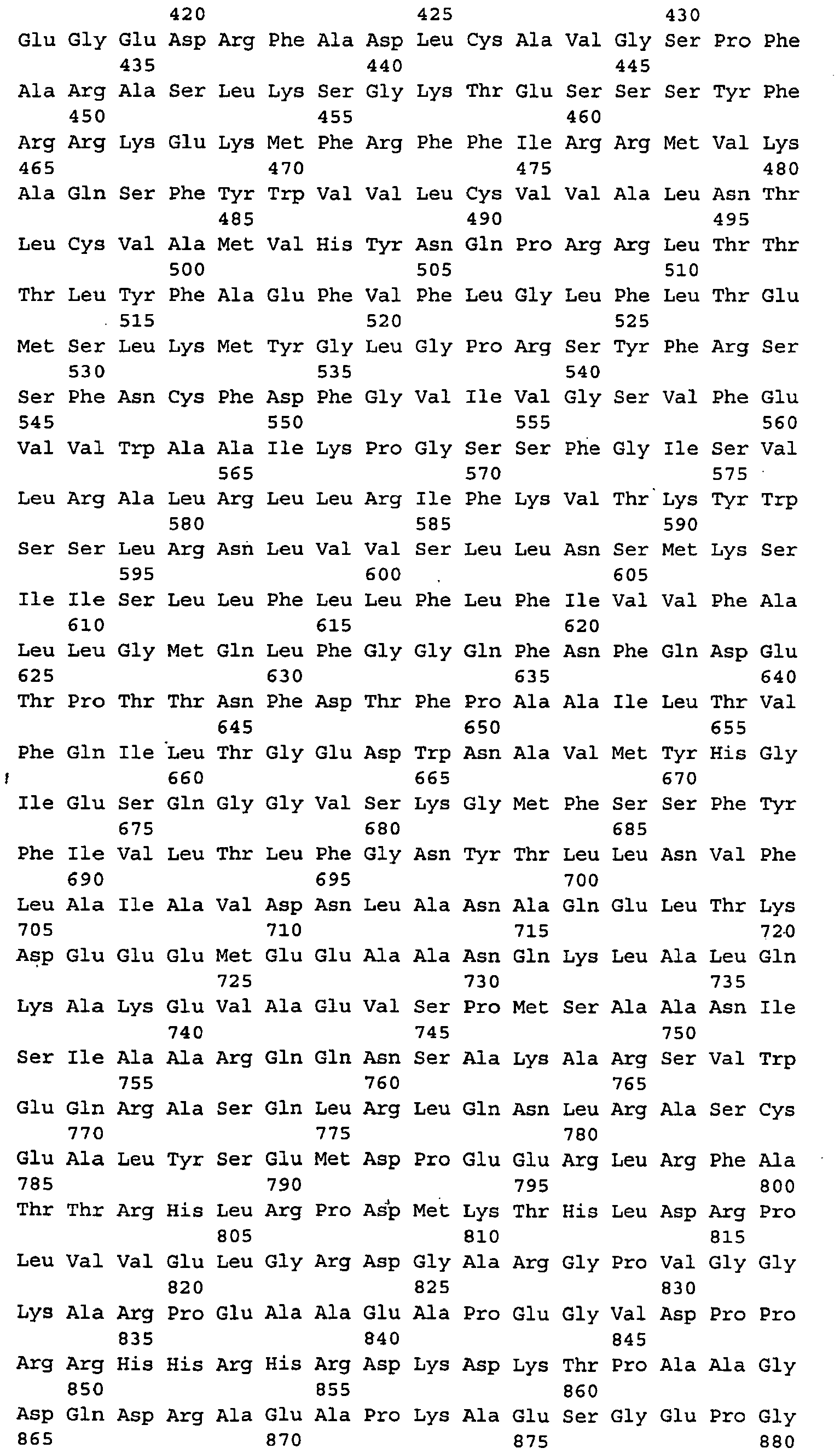


- <210> 7
<211> 7178
<212> DNA
<213> Homo sapiens - <220>
<221> CDS
<222> 146..6856 - <400> 7

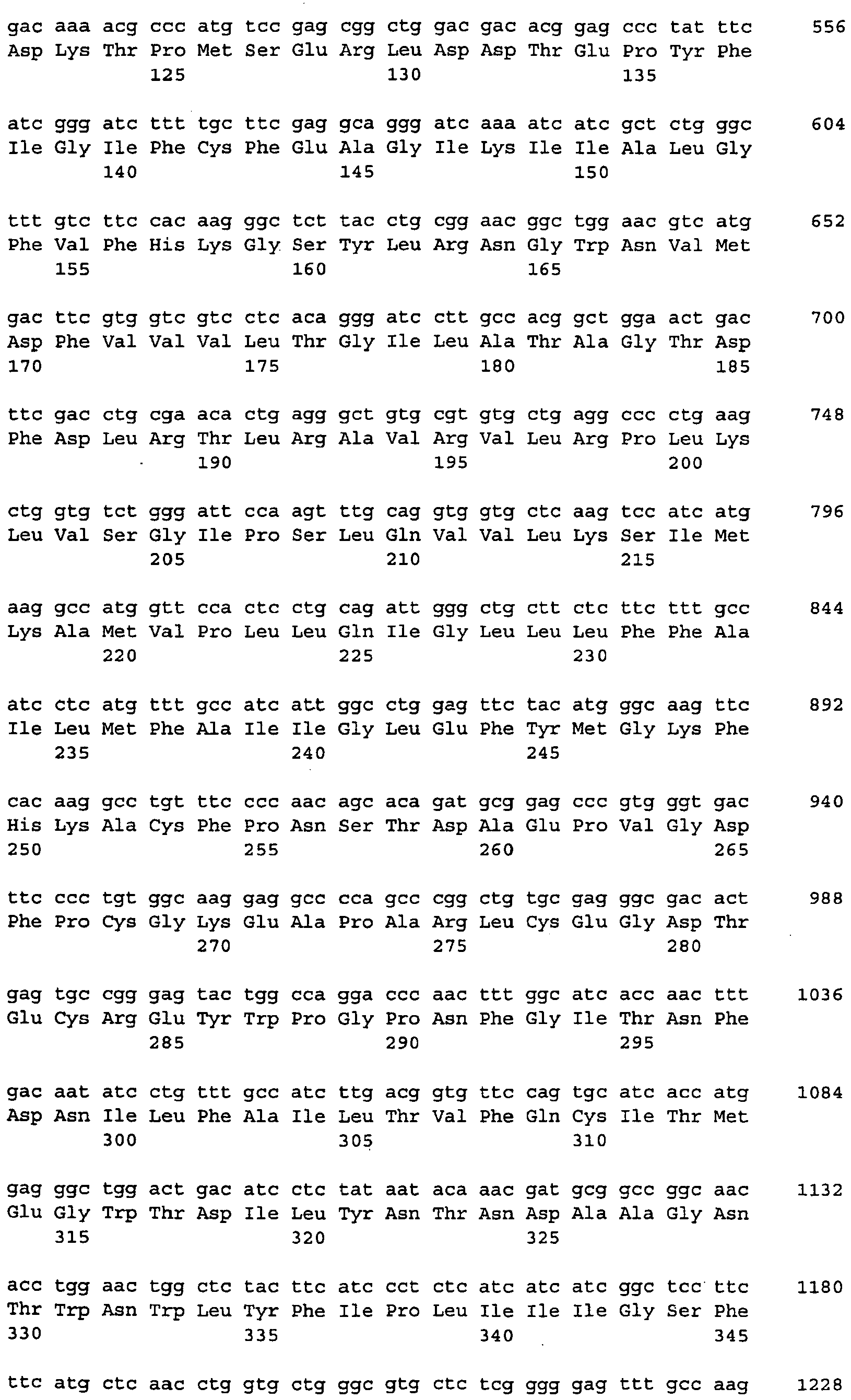


- <210> 8
<211> 2337
<212> PRT
<213> Homo sapiens - <400> 8


- <210> 9
<211> 7011
<212> DNA
<213> Rattus norvegicus - <220>
<221> CDS
<222> 1..7008 - <400> 9


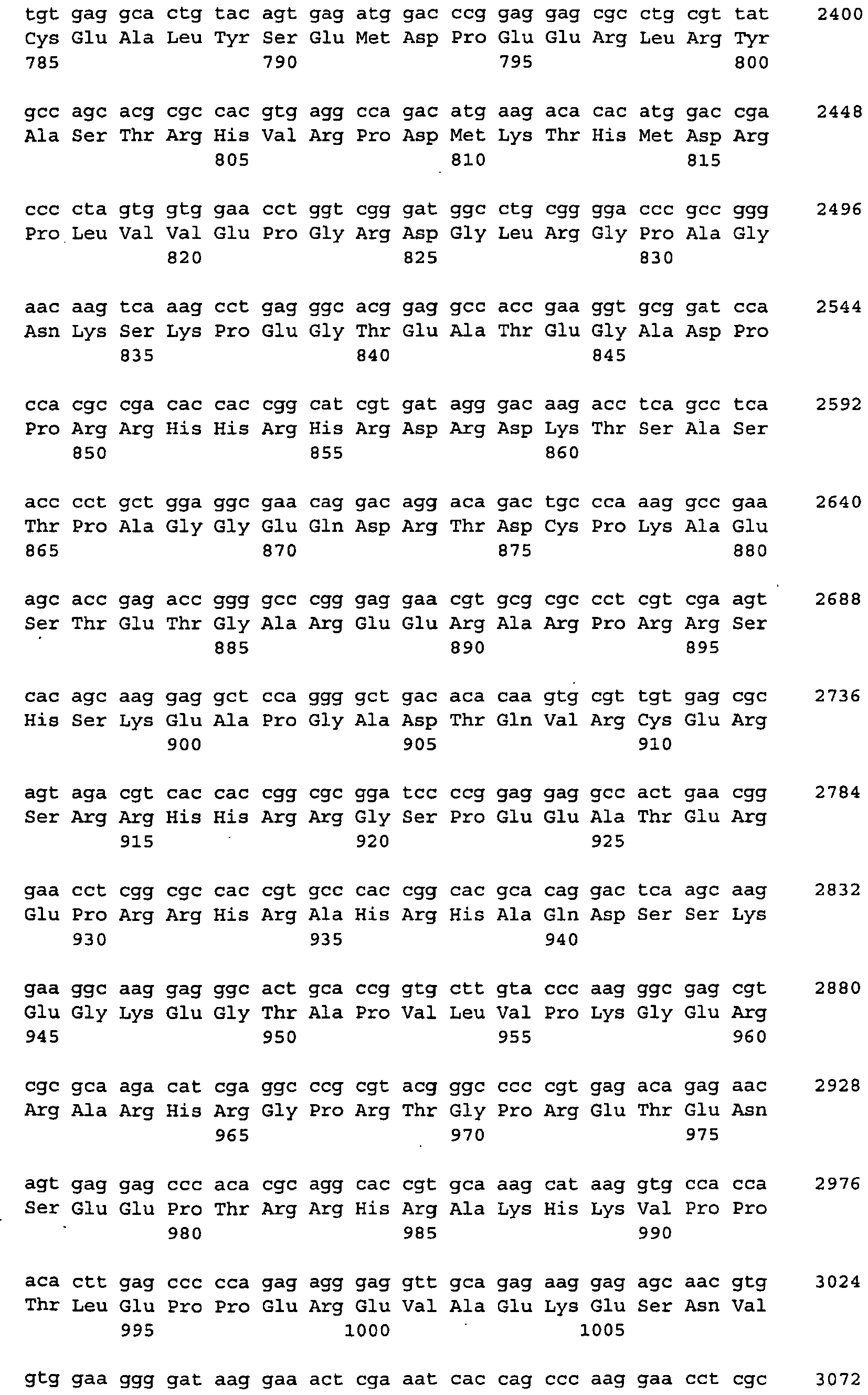


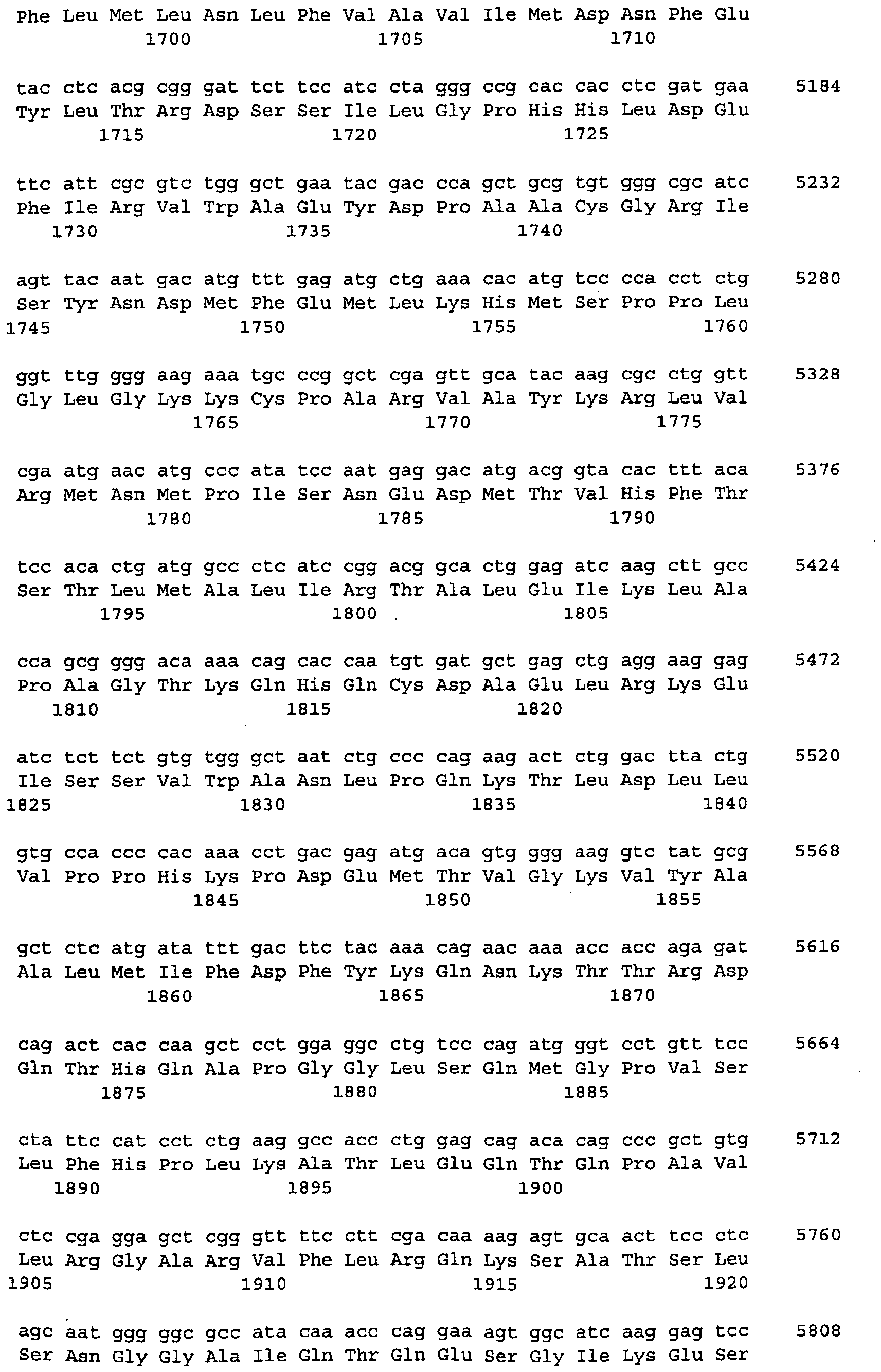


- <210> 10
<211> 2336
<212> PRT
<213> Rattus norvegicus - <400> 10


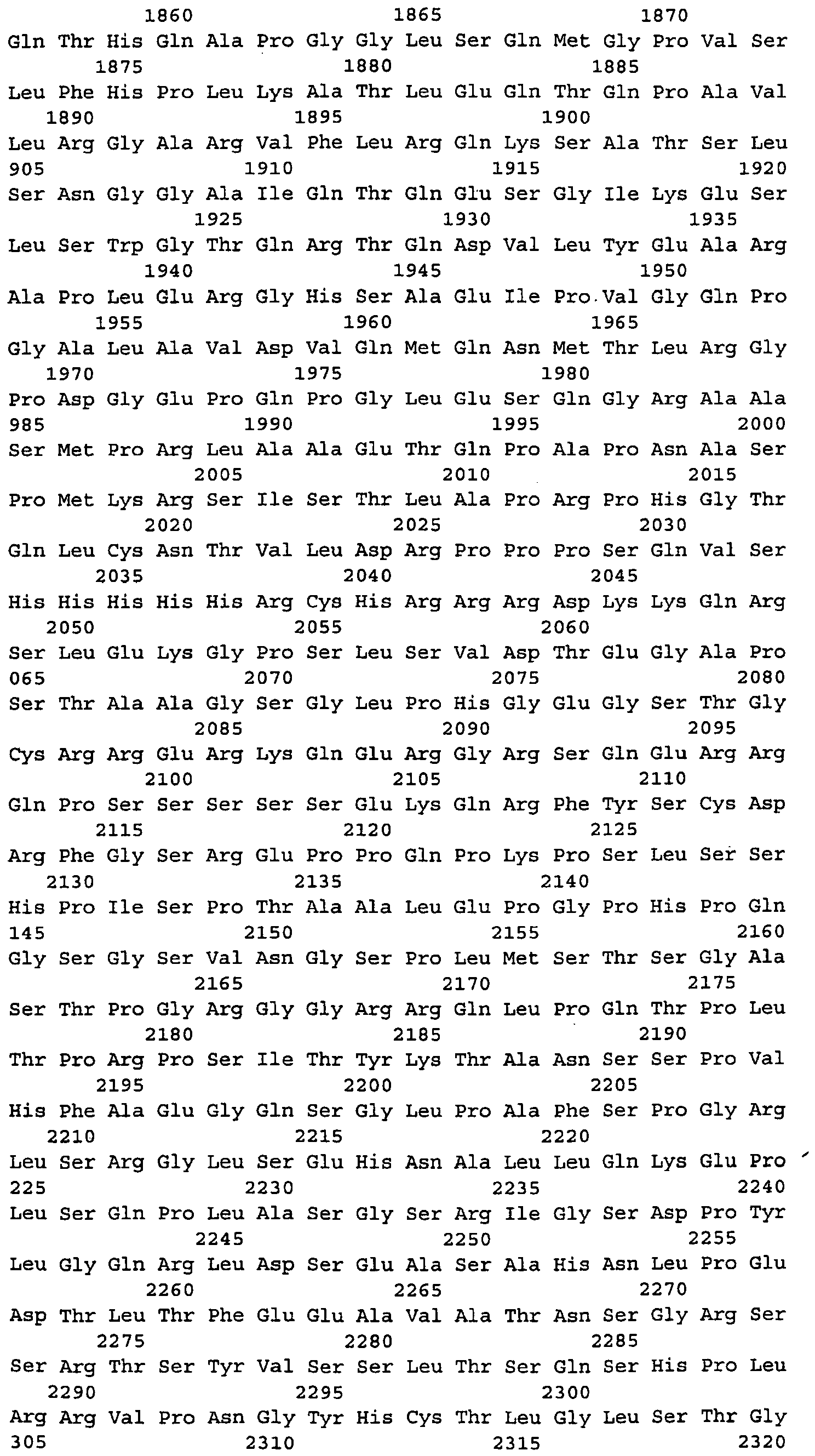

- <210> 11
<211> 4
<212> PRT
<213> Conus geographus - <400> 4

- <210> 12
<211> 5
<212> PRT
<213> Conus magus - <400> 12

- <210> 13
<211> 23
<212> DNA
<213> Rattus norvegicus - <400> 13
attcttgtgg tcatcgcctt gag 23 - <210> 14
<211> 23
<212> DNA
<213> Rattus norvegicus - <400> 14
gacaggcctc caggagcttg gtg 23 - <210> 15
<211> 27
<212> DNA
<213> Rattus norvegicus - <400> 15
gagattgcgg caacgaacaa cttcatc 27 - <210> 16
<211> 25
<212> DNA
<213> Rattus norvegicus - <400> 16
aagttgttcg tttccgcaat ctccg 25 - <210> 17
<211> 27
<212> DNA
<213> Rattus norvegicus - <400> 17
gagattgcgc agacgaacaa cttcatc 27 - <210> 18
<211> 25
<212> DNA
<213> Rattus norvegicus - <400> 18
aagttgttcg tctgcgcaat ctccg 25 - <210> 19
<211> 27
<212> DNA
<213> Rattus norvegicus - <400> 19
gagattgcgg aagctaacaa cttcatc 27 - <210> 20
<211> 25
<212> DNA
<213> Rattus norvegicus - <400> 20
aagttgttag cttccgcaat ctccg 25 - <210> 21
<211> 27
<212> DNA
<213> Rattus norvegicus - <400> 21
gagattgcgg cagctaacaa cttcatc 27 - <210> 22
<211> 25
<212> DNA
<213> Rattus norvegicus - <400> 22
aagttgttag ctgccgcaat ctccg 25 - <210> 23
<211> 27
<212> DNA
<213> Rattus norvegicus - <400> 23
gagattgcga accctaacaa cttcatc 27 - <210> 24
<211> 25
<212> DNA
<213> Rattus norvegicus - <400> 24
aagttgttag ggttcgcaat ctccg 25 - <210> 25
<211> 26
<212> DNA
<213> Rattus norvegicus - <400> 25
tgcctggaac atcttcgact ttgtga 26 - <210> 26
<211> 26
<212> DNA
<213> Rattus norvegicus - <400> 26
cagaggagaa tgcggatggt gtaacc 26 - <210> 27
<211> 25
<212> DNA
<213> Rattus norvegicus - <400> 27
cagagatgcc tggaacgtct ttgac 25 - <210> 28
<211>
<212> DNA
<213> Rattus norvegicus - <400> 28
ataacaagat gcggatggtg tagcc 25
Claims (16)
- A human N-type calcium channel hα1B+SFVG subunit polypeptide, which comprises the amino acid sequence of SEQ ID NO:2.
- A human N-type calcium channel hα1B+SFVG subunit polypeptide of claim 1, wherein the polypeptide comprises the amino acid sequence of SEQ ID NO:4
- A human N-type calcium channel hα1B+SFVG subunit polypeptide of claim 1, wherein the polypeptide consists of the amino acid sequence of SEQ ID NO:4
- A human N-type calcium channel hα1B+SFVG subunit polypeptide consisting of the amino acid sequence of SEQ ID NO:2
- A nucleic acid molecule which encodes a polypeptide as claimed in any of claims 1-3, wherein said nucleic acid molecule comprises the nucleotide sequence of SEQ ID NO:1, or consists of or comprises the nucleotide sequence of SEQ ID NO:3.
- An expression vector comprising a nucleic acid molecule as claimed in claim 5, operably linked to a promoter.
- A host cell transformed, or transfected, with an expression vector as claimed in claim 6.
- A composition comprising a pharmaceutically acceptable carrier and a polypeptide as claimed in claim 1 or a nucleic acid molecule as claimed in claim 5.
- An in vitro method for increasing the amount of a human N-type calcium channel hα1B+SFVG subunit comprising SEQ ID NO:2 in a cell, comprising contacting the cell with a molecule selected from the group consisting of a nucleic acid molecule comprising the nucleotide sequence of SEQ ID NO:1 and a human N-type calcium channel hα1B+SFVG subunit polypeptide comprising SEQ ID NO:2, in an amount effective to increase voltage regulated calcium influx in the cell.
- An in vitro method as claimed in claim 9, further comprising contacting the cell with one or more human N-type calcium channel non-hα1B+SFVG subunits of the human N-type calcium channel or nucleic acids encoding such subunits.
- A composition, for increasing calcium channel voltage regulated calcium influx, comprising a nucleic acid encoding a human N-type calcium channel hα1B+SFVG subunit comprising SEQ ID NO:2, or a human N-type calcium channel hα1B+sFVG subunit polypeptide comprising SEQ ID NO:2.
- A method for identifying lead compounds for a pharmacological agent useful in the treatment of disease associated with increased or decreased voltage regulated calcium influx mediated by a human N-type calcium channel comprising:-
providing a cell or other membrane-encapsulated space, comprising a human N-type calcium channel hα1B+SFVG subunit polypeptide comprising SEQ ID NO:2;
contacting the cell or other membrane-encapsulated space with a candidate pharmacological agent under conditions which, in the absence of the candidate pharmacological agent, cause a first amount of voltage regulated calcium influx into the cell or other membrane-encapsulated space;
determining a test amount of voltage regulated calcium influx as a measure of the effect of the lead compounds for a pharmacological agent on the voltage regulated calcium influx mediated by a human N-type calcium channel, wherein a test amount of voltage regulated calcium influx which is less than the first amount indicates that the candidate pharmacological agent is a lead compound for a pharmacological agent which reduces voltage regulated calcium influx and wherein a test amount of voltage regulated calcium influx which is greater than the first amount indicates that the candidate pharmacological agent is a lead compound for a pharmacological agent which increases voltage regulated calcium influx. - A method as claimed in claim 12, further comprising the step of loading the cell or other membrane-encapsulated space with a calcium-sensitive compound which is detectable in the presence of calcium, wherein the calcium-sensitive compound is detectable as a measure of the voltage regulated calcium influx.
- A method for identifying compounds which preferentially bind a human N-type calcium channel hα1B+SFVG subunit isoform comprising SEQ ID NO:2, comprising:-
providing a human N-type calcium channel hα1B+SFVG subunit isoform polypeptide comprising SEQ ID NO:2 or nucleic acid molecule comprising the nucleotide sequence of SEQ ID NO:1;
providing a human N-type calcium channel non-hα1B+SFVG subunit isoform polypeptide or nucleic acid encoding the human N-type calcium channel non-hα1B+SFVG subunit isoform polypeptide;
contacting the human N-type calcium channel hα1B+SFVG subunit isoform polypeptide comprising SEQ ID NO:2 or nucleic acid molecule comprising the nucleotide sequence of SEQ ID NO:1 and the human N-type calcium channel non-hα1B+SFVG subunit isoform polypeptide or nucleic acid with a compound;
determining the binding of the compound to the human N-type calcium channel hα1B+SFVG subunit isoform polypeptide comprising SEQ ID NO:2 or nucleic acid molecule comprising the nucleotide sequence of SEQ ID NO:1 and the human N-type calcium channel non-hα1B+SFVG subunit isoform polypeptide or nucleic acid encoding the human N-type calcium channel non-hα1B+SFVG subunit isoform polypeptide; wherein a compound which binds the human N-type calcium channel hα1B+SFVG subunit isoform polypeptide comprising SEQ ID NO:2 or a nucleic acid molecule comprising the nucleotide sequence of SEQ ID NO:1 in an amount greater than the human N-type calcium channel non-hα1B+SFVG subunit isoform polypeptide or nucleic acid encoding the human N-type calcium channel non-hα1B+SFVG subunit isoform polypeptide is a compound which preferentially binds the human N-type calcium channel hα1B+SFVG subunit isoform comprising SEQ ID NO:2. - A method as claimed in claim 14, wherein the identified compounds selectively bind a human N-type calcium channel hα1B+SFVG subunit isoform, the method comprising:-
providing a human N-type calcium channel hα1B+SFVG subunit isoform polypeptide comprising SEQ ID NO:2 or a nucleic acid molecule comprising the nucleotide sequence of SEQ ID NO:1;
providing a human N-type calcium channel non-hα1B+SFVG subunit isoform polypeptide or a nucleic acid which encodes the human N-type calcium channel non-hα1B+SFVG subunit isoform polypeptide;
contacting the human N-type calcium channel hα1B+SFVG subunit isoform polypeptide comprising SEQ ID NO:2 or nucleic acid and the human N-type calcium channel non-hα1B+SFVG subunit isoform polypeptide or nucleic acid with a compound;
determining the binding of the compound to the human N-type calcium channel hα1B+SFVG subunit isoform polypeptide comprising SEQ ID NO:2 or nucleic acid and the human N-type calcium channel non-hα1B+SFVG subunit isoform polypeptide or nucleic acid;
wherein a compound which binds the human N-type calcium channel hα1B+SFVG subunit isoform polypeptide comprising SEQ ID NO:2 or nucleic acid but does not bind the human N-type calcium channel non-hα1B+SFVG subunit isoform polypeptide or the nucleic acid is a compound which selectively binds the human N-type calcium channel hα1B+SFVG subunit isoform comprising SEQ ID NO:2. - The method of claim 14 or 15, wherein the human N-type calcium channel hα1B+SFVGsubunit comprising SEQ ID NO:2 is expressed in the cell membrane of a first cell or other membrane-encapsulated space, and the human N-type calcium channel non-hα1B+SFVG subunit is expressed in the cell membrane of a second cell or other membrane encapsulated space.
Applications Claiming Priority (3)
| Application Number | Priority Date | Filing Date | Title |
|---|---|---|---|
| US7790198P | 1998-03-13 | 1998-03-13 | |
| US77901P | 1998-03-13 | ||
| PCT/US1999/005392 WO1999046383A1 (en) | 1998-03-13 | 1999-03-12 | Human n-type calcium channel isoform and uses thereof |
Publications (2)
| Publication Number | Publication Date |
|---|---|
| EP1062337A1 EP1062337A1 (en) | 2000-12-27 |
| EP1062337B1 true EP1062337B1 (en) | 2011-11-09 |
Family
ID=22140691
Family Applications (1)
| Application Number | Title | Priority Date | Filing Date |
|---|---|---|---|
| EP99911339A Expired - Lifetime EP1062337B1 (en) | 1998-03-13 | 1999-03-12 | Human n-type calcium channel isoform and uses thereof |
Country Status (5)
| Country | Link |
|---|---|
| US (3) | US6353091B1 (en) |
| EP (1) | EP1062337B1 (en) |
| AU (2) | AU770018B2 (en) |
| ES (1) | ES2378977T3 (en) |
| WO (1) | WO1999046383A1 (en) |
Families Citing this family (7)
| Publication number | Priority date | Publication date | Assignee | Title |
|---|---|---|---|---|
| EP1062337B1 (en) * | 1998-03-13 | 2011-11-09 | Brown University Research Foundation | Human n-type calcium channel isoform and uses thereof |
| US7067714B1 (en) * | 1999-10-26 | 2006-06-27 | Eisai Research Institute | N-calcium channel knockout animal |
| DK1240823T3 (en) * | 1999-10-26 | 2008-12-08 | Eisai R&D Man Co Ltd | N-calcium channel knockout animals |
| WO2002052003A2 (en) * | 2000-12-26 | 2002-07-04 | Bayer Aktiengesellschaft | Regulation of human calcium channel |
| WO2003079025A2 (en) * | 2002-03-19 | 2003-09-25 | Novartis Ag | Methods for the identification of compounds useful for the suppression of chronic neuropathic pain and compositions thereof |
| US7365050B2 (en) * | 2003-08-08 | 2008-04-29 | The Regents Of The University Of California | Methods for modulating a drug-related effect or behavior |
| WO2005097828A2 (en) * | 2004-04-01 | 2005-10-20 | Board Of Regents, The University Of Texas System | Peptides of cav2.2 that inhibit pain |
Family Cites Families (9)
| Publication number | Priority date | Publication date | Assignee | Title |
|---|---|---|---|---|
| US4945050A (en) | 1984-11-13 | 1990-07-31 | Cornell Research Foundation, Inc. | Method for transporting substances into living cells and tissues and apparatus therefor |
| DE3607835A1 (en) * | 1986-03-10 | 1987-09-24 | Boehringer Ingelheim Int | HYBRID INTERFERONS, THEIR USE AS MEDICINAL PRODUCTS AND AS INTERMEDIATE PRODUCTS FOR THE PRODUCTION OF ANTIBODIES AND THE USE THEREOF AND METHOD FOR THEIR PRODUCTION |
| US5874236A (en) | 1988-04-04 | 1999-02-23 | Sibia Neurosciences. Inc. | DNA encoding human calcium channel α-1A, β1, β-2, and β-4 subunits, and assays using cells that express the subunits |
| US5429921A (en) | 1988-04-04 | 1995-07-04 | The Salk Institute Biotechnology/Industrial Assoc. Inc. | Assays for agonists and antagonists of recombinant human calcium channels |
| US6218364B1 (en) * | 1988-06-20 | 2001-04-17 | Scott L. Harbeson | Fluorinated neurokinin A antagonists |
| EP0992585B1 (en) | 1991-08-15 | 2005-01-12 | Merck & Co., Inc. | Human calcium channel compositions and methods |
| US6040436A (en) * | 1996-09-16 | 2000-03-21 | American Home Products Corporation | Nucleic acid encoding human neuronal calcium channel subunits |
| CN1283228A (en) * | 1997-12-24 | 2001-02-07 | 武田药品工业株式会社 | Polypeptide, their production method and use |
| EP1062337B1 (en) * | 1998-03-13 | 2011-11-09 | Brown University Research Foundation | Human n-type calcium channel isoform and uses thereof |
-
1999
- 1999-03-12 EP EP99911339A patent/EP1062337B1/en not_active Expired - Lifetime
- 1999-03-12 WO PCT/US1999/005392 patent/WO1999046383A1/en not_active Ceased
- 1999-03-12 AU AU30002/99A patent/AU770018B2/en not_active Ceased
- 1999-03-12 ES ES99911339T patent/ES2378977T3/en not_active Expired - Lifetime
- 1999-03-12 US US09/268,163 patent/US6353091B1/en not_active Expired - Lifetime
-
2001
- 2001-12-28 US US10/033,026 patent/US7018832B2/en not_active Expired - Lifetime
-
2004
- 2004-05-12 AU AU2004202022A patent/AU2004202022B2/en not_active Ceased
-
2006
- 2006-02-07 US US11/350,336 patent/US8038995B2/en not_active Expired - Fee Related
Also Published As
| Publication number | Publication date |
|---|---|
| WO1999046383A1 (en) | 1999-09-16 |
| ES2378977T3 (en) | 2012-04-19 |
| US20060135751A1 (en) | 2006-06-22 |
| AU770018B2 (en) | 2004-02-12 |
| US20020147309A1 (en) | 2002-10-10 |
| US6353091B1 (en) | 2002-03-05 |
| US8038995B2 (en) | 2011-10-18 |
| AU2004202022A1 (en) | 2004-06-10 |
| AU3000299A (en) | 1999-09-27 |
| AU2004202022B2 (en) | 2007-11-01 |
| US7018832B2 (en) | 2006-03-28 |
| EP1062337A1 (en) | 2000-12-27 |
Similar Documents
| Publication | Publication Date | Title |
|---|---|---|
| JP2002501083A (en) | Ligand receptors and their uses | |
| US6617450B1 (en) | P-glycoproteins and uses thereof | |
| US8038995B2 (en) | Human N-type calcium channel isoform and uses thereof | |
| US20030219739A1 (en) | Novel nucleic acid and polypeptide molecules | |
| JPWO2003055507A1 (en) | Anorexia nervosa or lifestyle-related disease drug and screening method thereof | |
| HUP0201303A2 (en) | Novel organic anion transport proteins | |
| CA2467206A1 (en) | Genes encoding g-protein coupled receptors and methods of use therefor | |
| US20050153287A1 (en) | Nr3b nmda receptor subunit compositions and related methods | |
| US6753177B1 (en) | P-glycoproteins and uses thereof | |
| JP2000515018A (en) | Melatonin 1a receptor gene regulatory region and use thereof | |
| US6855812B2 (en) | P-glycoproteins and uses thereof | |
| CA2325663A1 (en) | Novel mutations in the freac3 gene for diagnosis and prognosis of glaucoma and anterior segment dysgenesis | |
| WO2001096371A2 (en) | Adipose-related gene | |
| JP2003531637A (en) | Method | |
| AU2004303805A1 (en) | Secreted neural apoptosis inhibiting proteins | |
| JP2006506067A (en) | Novel PTH-responsive gene | |
| EP1501857A2 (en) | Novel pancortin-pablo protein interactions and methods of use thereof | |
| CA2454427A1 (en) | A novel g protein-coupled receptor, gave8 | |
| CA2269192A1 (en) | Novel g protein coupled receptor | |
| ZA200400383B (en) | A novel G protein-coupled receptor, GAVE8. | |
| AU2002316743A1 (en) | A novel G protein-coupled receptor, GAVE8 |
Legal Events
| Date | Code | Title | Description |
|---|---|---|---|
| PUAI | Public reference made under article 153(3) epc to a published international application that has entered the european phase |
Free format text: ORIGINAL CODE: 0009012 |
|
| 17P | Request for examination filed |
Effective date: 20001019 |
|
| AK | Designated contracting states |
Kind code of ref document: A1 Designated state(s): CH DE ES FR GB IT LI SE |
|
| 17Q | First examination report despatched |
Effective date: 20050330 |
|
| 17Q | First examination report despatched |
Effective date: 20050330 |
|
| GRAP | Despatch of communication of intention to grant a patent |
Free format text: ORIGINAL CODE: EPIDOSNIGR1 |
|
| GRAS | Grant fee paid |
Free format text: ORIGINAL CODE: EPIDOSNIGR3 |
|
| GRAA | (expected) grant |
Free format text: ORIGINAL CODE: 0009210 |
|
| AK | Designated contracting states |
Kind code of ref document: B1 Designated state(s): CH DE ES FR GB IT LI SE |
|
| REG | Reference to a national code |
Ref country code: GB Ref legal event code: FG4D |
|
| REG | Reference to a national code |
Ref country code: CH Ref legal event code: EP |
|
| REG | Reference to a national code |
Ref country code: DE Ref legal event code: R096 Ref document number: 69943847 Country of ref document: DE Effective date: 20120209 |
|
| REG | Reference to a national code |
Ref country code: ES Ref legal event code: FG2A Ref document number: 2378977 Country of ref document: ES Kind code of ref document: T3 Effective date: 20120419 |
|
| PG25 | Lapsed in a contracting state [announced via postgrant information from national office to epo] |
Ref country code: SE Free format text: LAPSE BECAUSE OF FAILURE TO SUBMIT A TRANSLATION OF THE DESCRIPTION OR TO PAY THE FEE WITHIN THE PRESCRIBED TIME-LIMIT Effective date: 20111109 |
|
| PLBE | No opposition filed within time limit |
Free format text: ORIGINAL CODE: 0009261 |
|
| STAA | Information on the status of an ep patent application or granted ep patent |
Free format text: STATUS: NO OPPOSITION FILED WITHIN TIME LIMIT |
|
| 26N | No opposition filed |
Effective date: 20120810 |
|
| REG | Reference to a national code |
Ref country code: CH Ref legal event code: PL |
|
| REG | Reference to a national code |
Ref country code: DE Ref legal event code: R097 Ref document number: 69943847 Country of ref document: DE Effective date: 20120810 |
|
| PG25 | Lapsed in a contracting state [announced via postgrant information from national office to epo] |
Ref country code: CH Free format text: LAPSE BECAUSE OF NON-PAYMENT OF DUE FEES Effective date: 20120331 Ref country code: LI Free format text: LAPSE BECAUSE OF NON-PAYMENT OF DUE FEES Effective date: 20120331 |
|
| PGFP | Annual fee paid to national office [announced via postgrant information from national office to epo] |
Ref country code: ES Payment date: 20120326 Year of fee payment: 14 |
|
| PGFP | Annual fee paid to national office [announced via postgrant information from national office to epo] |
Ref country code: GB Payment date: 20130627 Year of fee payment: 15 Ref country code: DE Payment date: 20130627 Year of fee payment: 15 |
|
| PGFP | Annual fee paid to national office [announced via postgrant information from national office to epo] |
Ref country code: IT Payment date: 20130626 Year of fee payment: 15 Ref country code: FR Payment date: 20130702 Year of fee payment: 15 |
|
| REG | Reference to a national code |
Ref country code: DE Ref legal event code: R119 Ref document number: 69943847 Country of ref document: DE |
|
| GBPC | Gb: european patent ceased through non-payment of renewal fee |
Effective date: 20140312 |
|
| REG | Reference to a national code |
Ref country code: FR Ref legal event code: ST Effective date: 20141128 |
|
| REG | Reference to a national code |
Ref country code: DE Ref legal event code: R119 Ref document number: 69943847 Country of ref document: DE Effective date: 20141001 |
|
| PG25 | Lapsed in a contracting state [announced via postgrant information from national office to epo] |
Ref country code: GB Free format text: LAPSE BECAUSE OF NON-PAYMENT OF DUE FEES Effective date: 20140312 Ref country code: DE Free format text: LAPSE BECAUSE OF NON-PAYMENT OF DUE FEES Effective date: 20141001 Ref country code: FR Free format text: LAPSE BECAUSE OF NON-PAYMENT OF DUE FEES Effective date: 20140331 |
|
| PG25 | Lapsed in a contracting state [announced via postgrant information from national office to epo] |
Ref country code: IT Free format text: LAPSE BECAUSE OF NON-PAYMENT OF DUE FEES Effective date: 20140312 |
|
| PG25 | Lapsed in a contracting state [announced via postgrant information from national office to epo] |
Ref country code: ES Free format text: LAPSE BECAUSE OF NON-PAYMENT OF DUE FEES Effective date: 20140313 |