EP1062184B1 - Materiau a base de gypse, procede de fabrication d'un tel materiau et element de construction coupe-feu comprenant ce materiau - Google Patents
Materiau a base de gypse, procede de fabrication d'un tel materiau et element de construction coupe-feu comprenant ce materiau Download PDFInfo
- Publication number
- EP1062184B1 EP1062184B1 EP19990915555 EP99915555A EP1062184B1 EP 1062184 B1 EP1062184 B1 EP 1062184B1 EP 19990915555 EP19990915555 EP 19990915555 EP 99915555 A EP99915555 A EP 99915555A EP 1062184 B1 EP1062184 B1 EP 1062184B1
- Authority
- EP
- European Patent Office
- Prior art keywords
- gypsum
- aggregates
- weight
- plaster
- crystals
- Prior art date
- Legal status (The legal status is an assumption and is not a legal conclusion. Google has not performed a legal analysis and makes no representation as to the accuracy of the status listed.)
- Expired - Lifetime
Links
- 239000010440 gypsum Substances 0.000 title claims abstract description 68
- 229910052602 gypsum Inorganic materials 0.000 title claims abstract description 68
- 239000000463 material Substances 0.000 title claims abstract description 48
- 238000000034 method Methods 0.000 title claims abstract description 45
- VYPSYNLAJGMNEJ-UHFFFAOYSA-N Silicium dioxide Chemical compound O=[Si]=O VYPSYNLAJGMNEJ-UHFFFAOYSA-N 0.000 claims abstract description 36
- 239000013078 crystal Substances 0.000 claims abstract description 34
- 230000008569 process Effects 0.000 claims abstract description 30
- 239000000725 suspension Substances 0.000 claims abstract description 23
- 235000008733 Citrus aurantifolia Nutrition 0.000 claims abstract description 18
- 235000011941 Tilia x europaea Nutrition 0.000 claims abstract description 18
- 239000004571 lime Substances 0.000 claims abstract description 18
- 239000011159 matrix material Substances 0.000 claims abstract description 17
- 239000000377 silicon dioxide Substances 0.000 claims abstract description 14
- 239000000378 calcium silicate Substances 0.000 claims abstract description 12
- 229910052918 calcium silicate Inorganic materials 0.000 claims abstract description 12
- OYACROKNLOSFPA-UHFFFAOYSA-N calcium;dioxido(oxo)silane Chemical compound [Ca+2].[O-][Si]([O-])=O OYACROKNLOSFPA-UHFFFAOYSA-N 0.000 claims abstract description 12
- 238000004519 manufacturing process Methods 0.000 claims abstract description 12
- 238000001027 hydrothermal synthesis Methods 0.000 claims abstract description 10
- 239000000203 mixture Substances 0.000 claims description 52
- XLYOFNOQVPJJNP-UHFFFAOYSA-N water Substances O XLYOFNOQVPJJNP-UHFFFAOYSA-N 0.000 claims description 45
- 239000011505 plaster Substances 0.000 claims description 37
- UGGQKDBXXFIWJD-UHFFFAOYSA-N calcium;dihydroxy(oxo)silane;hydrate Chemical compound O.[Ca].O[Si](O)=O UGGQKDBXXFIWJD-UHFFFAOYSA-N 0.000 claims description 32
- ODINCKMPIJJUCX-UHFFFAOYSA-N Calcium oxide Chemical compound [Ca]=O ODINCKMPIJJUCX-UHFFFAOYSA-N 0.000 claims description 16
- 229920003043 Cellulose fiber Polymers 0.000 claims description 12
- 239000003365 glass fiber Substances 0.000 claims description 10
- 239000000292 calcium oxide Substances 0.000 claims description 8
- 235000012255 calcium oxide Nutrition 0.000 claims description 8
- 238000009413 insulation Methods 0.000 claims description 7
- 238000002360 preparation method Methods 0.000 claims description 7
- 230000036571 hydration Effects 0.000 claims description 6
- 238000006703 hydration reaction Methods 0.000 claims description 6
- 238000002604 ultrasonography Methods 0.000 claims description 6
- QAOWNCQODCNURD-UHFFFAOYSA-L Sulfate Chemical compound [O-]S([O-])(=O)=O QAOWNCQODCNURD-UHFFFAOYSA-L 0.000 claims description 5
- CSNNHWWHGAXBCP-UHFFFAOYSA-L Magnesium sulfate Chemical compound [Mg+2].[O-][S+2]([O-])([O-])[O-] CSNNHWWHGAXBCP-UHFFFAOYSA-L 0.000 claims description 3
- BPQQTUXANYXVAA-UHFFFAOYSA-N Orthosilicate Chemical compound [O-][Si]([O-])([O-])[O-] BPQQTUXANYXVAA-UHFFFAOYSA-N 0.000 claims description 3
- OSGAYBCDTDRGGQ-UHFFFAOYSA-L calcium sulfate Chemical compound [Ca+2].[O-]S([O-])(=O)=O OSGAYBCDTDRGGQ-UHFFFAOYSA-L 0.000 claims description 3
- 238000005192 partition Methods 0.000 claims description 3
- 239000000779 smoke Substances 0.000 claims description 3
- 229910021653 sulphate ion Inorganic materials 0.000 claims description 3
- 238000005054 agglomeration Methods 0.000 claims description 2
- 230000002776 aggregation Effects 0.000 claims description 2
- 239000006185 dispersion Substances 0.000 claims description 2
- 238000000605 extraction Methods 0.000 claims description 2
- 235000019341 magnesium sulphate Nutrition 0.000 claims description 2
- 238000009423 ventilation Methods 0.000 claims description 2
- 230000003014 reinforcing effect Effects 0.000 claims 4
- 239000001175 calcium sulphate Substances 0.000 claims 1
- 235000011132 calcium sulphate Nutrition 0.000 claims 1
- 229910052943 magnesium sulfate Inorganic materials 0.000 claims 1
- 238000010276 construction Methods 0.000 abstract description 16
- 239000002245 particle Substances 0.000 description 27
- 235000012241 calcium silicate Nutrition 0.000 description 19
- 239000000835 fiber Substances 0.000 description 16
- 240000006909 Tilia x europaea Species 0.000 description 12
- 239000007900 aqueous suspension Substances 0.000 description 12
- 239000011575 calcium Substances 0.000 description 11
- 239000004615 ingredient Substances 0.000 description 11
- OYPRJOBELJOOCE-UHFFFAOYSA-N Calcium Chemical compound [Ca] OYPRJOBELJOOCE-UHFFFAOYSA-N 0.000 description 9
- 229910052791 calcium Inorganic materials 0.000 description 9
- 238000009826 distribution Methods 0.000 description 9
- 150000004760 silicates Chemical class 0.000 description 9
- AXCZMVOFGPJBDE-UHFFFAOYSA-L calcium dihydroxide Chemical compound [OH-].[OH-].[Ca+2] AXCZMVOFGPJBDE-UHFFFAOYSA-L 0.000 description 8
- 239000000920 calcium hydroxide Substances 0.000 description 8
- 235000011116 calcium hydroxide Nutrition 0.000 description 8
- 229910001861 calcium hydroxide Inorganic materials 0.000 description 8
- MKTRXTLKNXLULX-UHFFFAOYSA-P pentacalcium;dioxido(oxo)silane;hydron;tetrahydrate Chemical compound [H+].[H+].O.O.O.O.[Ca+2].[Ca+2].[Ca+2].[Ca+2].[Ca+2].[O-][Si]([O-])=O.[O-][Si]([O-])=O.[O-][Si]([O-])=O.[O-][Si]([O-])=O.[O-][Si]([O-])=O.[O-][Si]([O-])=O MKTRXTLKNXLULX-UHFFFAOYSA-P 0.000 description 7
- 239000012783 reinforcing fiber Substances 0.000 description 7
- 239000011163 secondary particle Substances 0.000 description 7
- 239000007787 solid Substances 0.000 description 7
- 230000002787 reinforcement Effects 0.000 description 6
- 230000000694 effects Effects 0.000 description 5
- 239000000047 product Substances 0.000 description 5
- 230000015572 biosynthetic process Effects 0.000 description 4
- 229920002678 cellulose Polymers 0.000 description 4
- 239000001913 cellulose Substances 0.000 description 4
- 238000006243 chemical reaction Methods 0.000 description 4
- 238000005336 cracking Methods 0.000 description 4
- 230000009970 fire resistant effect Effects 0.000 description 4
- 235000012239 silicon dioxide Nutrition 0.000 description 4
- 238000003786 synthesis reaction Methods 0.000 description 4
- 241001639412 Verres Species 0.000 description 3
- 238000013019 agitation Methods 0.000 description 3
- 230000008901 benefit Effects 0.000 description 3
- 230000002902 bimodal effect Effects 0.000 description 3
- 239000000945 filler Substances 0.000 description 3
- 239000006260 foam Substances 0.000 description 3
- 229910052500 inorganic mineral Inorganic materials 0.000 description 3
- 235000010755 mineral Nutrition 0.000 description 3
- 239000011707 mineral Substances 0.000 description 3
- 229910004298 SiO 2 Inorganic materials 0.000 description 2
- 241001441724 Tetraodontidae Species 0.000 description 2
- 230000004888 barrier function Effects 0.000 description 2
- 230000000052 comparative effect Effects 0.000 description 2
- 238000005520 cutting process Methods 0.000 description 2
- 230000018044 dehydration Effects 0.000 description 2
- 238000006297 dehydration reaction Methods 0.000 description 2
- 239000004744 fabric Substances 0.000 description 2
- 239000004088 foaming agent Substances 0.000 description 2
- 239000011521 glass Substances 0.000 description 2
- 239000012535 impurity Substances 0.000 description 2
- 239000010453 quartz Substances 0.000 description 2
- 239000002994 raw material Substances 0.000 description 2
- 239000000523 sample Substances 0.000 description 2
- 230000003068 static effect Effects 0.000 description 2
- DGAQECJNVWCQMB-PUAWFVPOSA-M Ilexoside XXIX Chemical compound C[C@@H]1CC[C@@]2(CC[C@@]3(C(=CC[C@H]4[C@]3(CC[C@@H]5[C@@]4(CC[C@@H](C5(C)C)OS(=O)(=O)[O-])C)C)[C@@H]2[C@]1(C)O)C)C(=O)O[C@H]6[C@@H]([C@H]([C@@H]([C@H](O6)CO)O)O)O.[Na+] DGAQECJNVWCQMB-PUAWFVPOSA-M 0.000 description 1
- 229910000831 Steel Inorganic materials 0.000 description 1
- 238000002441 X-ray diffraction Methods 0.000 description 1
- 239000000654 additive Substances 0.000 description 1
- AZDRQVAHHNSJOQ-UHFFFAOYSA-N alumane Chemical class [AlH3] AZDRQVAHHNSJOQ-UHFFFAOYSA-N 0.000 description 1
- 229910052925 anhydrite Inorganic materials 0.000 description 1
- 238000005452 bending Methods 0.000 description 1
- 239000004566 building material Substances 0.000 description 1
- PASHVRUKOFIRIK-UHFFFAOYSA-L calcium sulfate dihydrate Chemical compound O.O.[Ca+2].[O-]S([O-])(=O)=O PASHVRUKOFIRIK-UHFFFAOYSA-L 0.000 description 1
- 238000003490 calendering Methods 0.000 description 1
- 238000001311 chemical methods and process Methods 0.000 description 1
- 239000007795 chemical reaction product Substances 0.000 description 1
- 239000003795 chemical substances by application Substances 0.000 description 1
- 239000004927 clay Substances 0.000 description 1
- 238000000576 coating method Methods 0.000 description 1
- 230000002542 deteriorative effect Effects 0.000 description 1
- 238000010586 diagram Methods 0.000 description 1
- 239000000975 dye Substances 0.000 description 1
- 238000005516 engineering process Methods 0.000 description 1
- 239000002657 fibrous material Substances 0.000 description 1
- 238000011049 filling Methods 0.000 description 1
- 239000010881 fly ash Substances 0.000 description 1
- 239000012520 frozen sample Substances 0.000 description 1
- 239000007789 gas Substances 0.000 description 1
- 238000010438 heat treatment Methods 0.000 description 1
- 230000006872 improvement Effects 0.000 description 1
- 238000009434 installation Methods 0.000 description 1
- 238000002955 isolation Methods 0.000 description 1
- -1 lime Chemical compound 0.000 description 1
- 238000005259 measurement Methods 0.000 description 1
- 229910052751 metal Inorganic materials 0.000 description 1
- 239000002184 metal Substances 0.000 description 1
- 239000010445 mica Substances 0.000 description 1
- 229910052618 mica group Inorganic materials 0.000 description 1
- 238000002156 mixing Methods 0.000 description 1
- 239000004745 nonwoven fabric Substances 0.000 description 1
- 239000010451 perlite Substances 0.000 description 1
- 235000019362 perlite Nutrition 0.000 description 1
- 239000011148 porous material Substances 0.000 description 1
- 230000009467 reduction Effects 0.000 description 1
- 230000001105 regulatory effect Effects 0.000 description 1
- 239000005871 repellent Substances 0.000 description 1
- 230000002940 repellent Effects 0.000 description 1
- 238000000518 rheometry Methods 0.000 description 1
- 229920006395 saturated elastomer Polymers 0.000 description 1
- 238000000926 separation method Methods 0.000 description 1
- 238000007493 shaping process Methods 0.000 description 1
- 239000000741 silica gel Substances 0.000 description 1
- 229910002027 silica gel Inorganic materials 0.000 description 1
- RMAQACBXLXPBSY-UHFFFAOYSA-N silicic acid Chemical compound O[Si](O)(O)O RMAQACBXLXPBSY-UHFFFAOYSA-N 0.000 description 1
- 229910052710 silicon Inorganic materials 0.000 description 1
- 239000010703 silicon Substances 0.000 description 1
- 239000011734 sodium Substances 0.000 description 1
- 229910052708 sodium Inorganic materials 0.000 description 1
- 239000012798 spherical particle Substances 0.000 description 1
- 239000010959 steel Substances 0.000 description 1
- 150000003467 sulfuric acid derivatives Chemical class 0.000 description 1
- 239000000454 talc Substances 0.000 description 1
- 229910052623 talc Inorganic materials 0.000 description 1
- 238000009210 therapy by ultrasound Methods 0.000 description 1
- 239000002341 toxic gas Substances 0.000 description 1
- 239000010455 vermiculite Substances 0.000 description 1
- 229910052902 vermiculite Inorganic materials 0.000 description 1
- 235000019354 vermiculite Nutrition 0.000 description 1
- 239000010456 wollastonite Substances 0.000 description 1
- 229910052882 wollastonite Inorganic materials 0.000 description 1
- 239000002759 woven fabric Substances 0.000 description 1
Images


Classifications
-
- C—CHEMISTRY; METALLURGY
- C04—CEMENTS; CONCRETE; ARTIFICIAL STONE; CERAMICS; REFRACTORIES
- C04B—LIME, MAGNESIA; SLAG; CEMENTS; COMPOSITIONS THEREOF, e.g. MORTARS, CONCRETE OR LIKE BUILDING MATERIALS; ARTIFICIAL STONE; CERAMICS; REFRACTORIES; TREATMENT OF NATURAL STONE
- C04B14/00—Use of inorganic materials as fillers, e.g. pigments, for mortars, concrete or artificial stone; Treatment of inorganic materials specially adapted to enhance their filling properties in mortars, concrete or artificial stone
- C04B14/02—Granular materials, e.g. microballoons
- C04B14/04—Silica-rich materials; Silicates
- C04B14/043—Alkaline-earth metal silicates, e.g. wollastonite
-
- C—CHEMISTRY; METALLURGY
- C04—CEMENTS; CONCRETE; ARTIFICIAL STONE; CERAMICS; REFRACTORIES
- C04B—LIME, MAGNESIA; SLAG; CEMENTS; COMPOSITIONS THEREOF, e.g. MORTARS, CONCRETE OR LIKE BUILDING MATERIALS; ARTIFICIAL STONE; CERAMICS; REFRACTORIES; TREATMENT OF NATURAL STONE
- C04B18/00—Use of agglomerated or waste materials or refuse as fillers for mortars, concrete or artificial stone; Treatment of agglomerated or waste materials or refuse, specially adapted to enhance their filling properties in mortars, concrete or artificial stone
- C04B18/02—Agglomerated materials, e.g. artificial aggregates
- C04B18/027—Lightweight materials
-
- C—CHEMISTRY; METALLURGY
- C04—CEMENTS; CONCRETE; ARTIFICIAL STONE; CERAMICS; REFRACTORIES
- C04B—LIME, MAGNESIA; SLAG; CEMENTS; COMPOSITIONS THEREOF, e.g. MORTARS, CONCRETE OR LIKE BUILDING MATERIALS; ARTIFICIAL STONE; CERAMICS; REFRACTORIES; TREATMENT OF NATURAL STONE
- C04B2/00—Lime, magnesia or dolomite
- C04B2/02—Lime
- C04B2/04—Slaking
- C04B2/06—Slaking with addition of substances, e.g. hydrophobic agents ; Slaking in the presence of other compounds
-
- C—CHEMISTRY; METALLURGY
- C04—CEMENTS; CONCRETE; ARTIFICIAL STONE; CERAMICS; REFRACTORIES
- C04B—LIME, MAGNESIA; SLAG; CEMENTS; COMPOSITIONS THEREOF, e.g. MORTARS, CONCRETE OR LIKE BUILDING MATERIALS; ARTIFICIAL STONE; CERAMICS; REFRACTORIES; TREATMENT OF NATURAL STONE
- C04B28/00—Compositions of mortars, concrete or artificial stone, containing inorganic binders or the reaction product of an inorganic and an organic binder, e.g. polycarboxylate cements
- C04B28/14—Compositions of mortars, concrete or artificial stone, containing inorganic binders or the reaction product of an inorganic and an organic binder, e.g. polycarboxylate cements containing calcium sulfate cements
-
- C—CHEMISTRY; METALLURGY
- C04—CEMENTS; CONCRETE; ARTIFICIAL STONE; CERAMICS; REFRACTORIES
- C04B—LIME, MAGNESIA; SLAG; CEMENTS; COMPOSITIONS THEREOF, e.g. MORTARS, CONCRETE OR LIKE BUILDING MATERIALS; ARTIFICIAL STONE; CERAMICS; REFRACTORIES; TREATMENT OF NATURAL STONE
- C04B28/00—Compositions of mortars, concrete or artificial stone, containing inorganic binders or the reaction product of an inorganic and an organic binder, e.g. polycarboxylate cements
- C04B28/18—Compositions of mortars, concrete or artificial stone, containing inorganic binders or the reaction product of an inorganic and an organic binder, e.g. polycarboxylate cements containing mixtures of the silica-lime type
-
- C—CHEMISTRY; METALLURGY
- C04—CEMENTS; CONCRETE; ARTIFICIAL STONE; CERAMICS; REFRACTORIES
- C04B—LIME, MAGNESIA; SLAG; CEMENTS; COMPOSITIONS THEREOF, e.g. MORTARS, CONCRETE OR LIKE BUILDING MATERIALS; ARTIFICIAL STONE; CERAMICS; REFRACTORIES; TREATMENT OF NATURAL STONE
- C04B2111/00—Mortars, concrete or artificial stone or mixtures to prepare them, characterised by specific function, property or use
- C04B2111/20—Resistance against chemical, physical or biological attack
- C04B2111/28—Fire resistance, i.e. materials resistant to accidental fires or high temperatures
-
- Y—GENERAL TAGGING OF NEW TECHNOLOGICAL DEVELOPMENTS; GENERAL TAGGING OF CROSS-SECTIONAL TECHNOLOGIES SPANNING OVER SEVERAL SECTIONS OF THE IPC; TECHNICAL SUBJECTS COVERED BY FORMER USPC CROSS-REFERENCE ART COLLECTIONS [XRACs] AND DIGESTS
- Y02—TECHNOLOGIES OR APPLICATIONS FOR MITIGATION OR ADAPTATION AGAINST CLIMATE CHANGE
- Y02P—CLIMATE CHANGE MITIGATION TECHNOLOGIES IN THE PRODUCTION OR PROCESSING OF GOODS
- Y02P40/00—Technologies relating to the processing of minerals
- Y02P40/60—Production of ceramic materials or ceramic elements, e.g. substitution of clay or shale by alternative raw materials, e.g. ashes
-
- Y—GENERAL TAGGING OF NEW TECHNOLOGICAL DEVELOPMENTS; GENERAL TAGGING OF CROSS-SECTIONAL TECHNOLOGIES SPANNING OVER SEVERAL SECTIONS OF THE IPC; TECHNICAL SUBJECTS COVERED BY FORMER USPC CROSS-REFERENCE ART COLLECTIONS [XRACs] AND DIGESTS
- Y02—TECHNOLOGIES OR APPLICATIONS FOR MITIGATION OR ADAPTATION AGAINST CLIMATE CHANGE
- Y02W—CLIMATE CHANGE MITIGATION TECHNOLOGIES RELATED TO WASTEWATER TREATMENT OR WASTE MANAGEMENT
- Y02W30/00—Technologies for solid waste management
- Y02W30/50—Reuse, recycling or recovery technologies
- Y02W30/91—Use of waste materials as fillers for mortars or concrete
Definitions
- the present invention relates to a material for gypsum base useful for applications in the field of fire protection, its method of manufacturing, and fire-rated building components including this material.
- a fire-rated building element must have a satisfactory fire behavior both in terms of reaction to fire of the material used than in terms of fire protection capacity. In addition, he cannot, in the event of a fire, release any corrosive or toxic gases, or at most, a harmless amount of these gases.
- reaction to a material's fire we mean its aptitude to spread or not the fire, which depends on its ability to transmit heat, ignite and burn. Starting a fire will be all the more difficult that the material will be less combustible and less flammable and also not very conductive of heat.
- fire protection capacity or "fire protection” of a building element means its ability to create a fire barrier. It is generally expressed in terms of fire resistance (Rf). Fire resistance of a building element is measured in specialized laboratories where it is subjected to a fire theoretical. The criteria to which the building element must respond during such a test are described in the international standard ISO 834, well known in this field of technique.
- the duration of fire resistance (Rf) of an element of construction is defined as time (expressed in minutes) during which he continues to present the three properties mentioned above.
- gypsum arouses particular interest with regard to its fire resistance. This interest is due not only to the fact that it is noncombustible, but also to the fact that the heating of a gypsum-based construction element exposed to a fire is considerably slowed down thanks to the marked endothermic effect which takes place when this material is subjected to heat.
- the amount of energy consumed during dehydration of gypsum made, in principle, from a product to gypsum base an excellent means of protection against fire for underlying materials.
- loads of gypsum are added to reinforcement, usually in the form of fibers.
- These fibers reinforcement may for example be present under shape of a fabric or a net embedded in the matrix of gypsum, or in the form of individual fibers dispersed in this matrix.
- glass are regularly used as fibers of reinforcement for fire-resistant construction elements gypsum base.
- EP-A-0 451 503 also describes a alternative process in which the foam is, at least partially replaced by non-porous hollow particles not absorbing water, such as spheroids of glass.
- EP-A-585 200 it is also proposed in EP-A-585 200 to replace the foam at least partially with a material of mineral and porous filler, such as perlite expanded or exfoliated vermiculite.
- Special hydrated calcium silicates are xonotlite and tobermorite, which can be obtained by hydrothermal synthesis of a suspension aqueous lime and silica, as described in the patent US 3,501,324.
- Application FR 2,227,241 describes a method of preparation of gypsum molded articles comprising hydrated crystalline calcium silicates such as xonotlite or tobermorite. No secondary structure of these crystals are not mentioned in this document.
- the fire resistance is expressed in this document by physical characteristics of the product (density, resistance flexural, compressive strength, shrinkage linear, and cracking). This document describes only the measurement of criteria relating to dimensional stability of the product. Thermal insulation is however not there taken into account.
- Japanese application No. JP 7-25656 describes a plate including sandwich gypsum matrix between two sheets of paper, this gypsum matrix being lightened with substantially spherical agglomerates (secondary structure) of xonotlite and / or tobermorite. In this case, a particular problem is to lighten the gypsum matrix while not losing the adhesion between this and the two outer sheets of paper.
- xonotlite crystals and / or tobermorite can be in the form of substantially spherical agglomerates (or spheroids) of 10 at 150 microns in which the crystals are loosely tangled.
- Such aggregates or secondary particles are notably marketed by the firm Promat under the name Promaxon®. The preparation of such particles has also described in Belgian patent BE 846.252, and in US Patent 3,679,446.
- US Patent 4,298,386 also describes secondary globular particles of calcium silicates.
- the particles described are hollow and therefore do not contain no crystals in their central part.
- the subject of the present invention is a material for gypsum base useful for application in the field of fire protection and manufacturing processes of this material.
- a composition is prepared hydraulic outlet, containing plaster, water and porous, substantially spherical aggregates of hydrated calcium dispersed in plaster.
- the proportion by weight hydrated calcium silicate aggregates compared to plaster is 1/39 to 1/1, of preferably 1/19 to 3/7, and particularly preferred from 1/19 to 1/4.
- the total amount of water in the composition should in principle be such that the weight ratio water / solid is at least equal to 0.5, and preferably between 0.55 and 2. This composition is then let it take hold.
- the crystals have preferably an acicular form and are preferably xonotlite crystals.
- Said aggregates of crystals advantageously have an average diameter between 40 and 150 microns, preferably between 42 and 60 microns and the layer advantageously has a thickness of between 4 and 10 microns, preferably between 4 and 6 microns.
- hydrated calcium silicate aggregates are likely to be obtained by hydrothermal synthesis in medium stirred from an aqueous suspension of lime previously treated with ultrasound, and silica.
- this aqueous suspension of lime is produced by dispersing a source of calcium in water in a water / solids weight ratio of between 8/1 and 30/1, and even more preferably in a ratio between 10/1 and 15/1.
- a preferred source of calcium is quicklime (CaO), or possibly hydrated lime (Ca (OH) 2 ).
- Lime source treatment includes advantageously two stages.
- the ultrasonic frequency used for the first stage of treatment can be between 19 and 25 kHz, and preferably between 19 and 21 kHz.
- the ultrasonic frequency used for the second processing step can be between 300 and 600 kHz and preferably between 450 and 550 kHz.
- Total processing time is around 30 seconds to 30 minutes.
- the lime suspension is previously obtained by hydration in the presence of 0.2 to 2% by weight sulphate based on the weight of quicklime.
- said sulfate is advantageously chosen from sulfates of calcium, magnesium sulfates and mixtures thereof.
- a silica suspension is mixed with a lime suspension obtained according to one of the two methods of preparation described above in a CaO / SiO 2 molar ratio advantageously between 0.8 and 1 2.
- a preferred water / dry matter ratio is between 11/1 and 15/1.
- Hydrothermal synthesis is carried out under constant agitation (of the order of 32 rpm to 200 rpm depending on reactor dimensions), at a temperature of the order from 196 ° C to 222 ° C and at a water vapor pressure included advantageously between 15 and 25 bars.
- the hydraulic setting composition can have reinforcing fibers therein incorporated.
- reinforcing fibers of the fibrous material capable of reinforce building materials or elements to gypsum base and able to increase fire resistance by limiting or delaying their cracking during a exposure to fire. It can be fibers mineral or organic, natural or synthetic.
- At at least some of these reinforcing fibers are glass fibers.
- the reinforcing fibers can, for at least at least part, be present in the form of fibers individual dispersed in the setting composition hydraulic.
- Such individual fibers can, for example example, have an average length between 2 and 20 mm, preferably between 4 and 12 mm.
- These fibers individual can be present in the composition to hydraulic intake in an amount between 0.3 and 3.0 % by weight relative to plaster, and preferably included between 1.0 and 2.5% by weight relative to the plaster.
- Reinforcement fibers can also, for at least a part, be present in the form of a tablecloth, net or woven or non-woven fabric incorporated in the hydraulic setting composition.
- a combination of reinforcing fibers individual dispersed in the setting composition hydraulic and of a tablecloth, a net or a fabric of reinforcement incorporated in said composition is also possible.
- the reinforcing fibers consist, at least for a part, of cellulose fibers or a mixture of cellulose fibers and glass fibers.
- the cellulose fibers are pre-dispersed in water before being added to the hydraulic composition.
- a particularly advantageous composition contains approximately 1% by weight of cellulose fibers and 2% by weight of glass fibers compared to the total of solids.
- Adding cellulose fibers has the advantage improve the mechanical properties of the element construction without deteriorating its fire-fighting properties. Of the building element no longer exhibits cracks when cellulose fibers have been there incorporated.
- the hydraulic setting composition can also include other ingredients, such as by example of accelerators, retarders or regulators of rheology, as long as they are compatible with the other ingredients and with the application that we will give to the material obtained.
- the aqueous suspension may contain a part or all of the amount of water required for Implementation.
- the silicates hydrated calcium can be xonotlite crystals, tobermorite or possibly other crystals of hydrated calcium silicates or mixtures of these crystals.
- the present invention also relates to a material comprising a gypsum matrix and porous, substantially spherical aggregates of hydrated calcium silicates incorporated in the gypsum matrix, the aggregates of hydrated calcium silicates being present in a proportion by weight relative to with gypsum between 2 and 84%, that is to say that the ratio R [silicates / gypsum] is between 1 39 x M plaster M gypsum and 1 1 x M plaster M gypsum M plaster being the molecular weight of the plaster and M gypsum being the molecular weight of the gypsum.
- the ratio R [silicates / gypsum] in the material is therefore between 1/46 and 1 / 1.2.
- Said aggregates have an internal part in which the crystals are very loosely entangled and an outer layer where the crystals are entangled with tighter than in the internal part.
- the present invention also relates to any material obtained with the process described above.
- the mass of gypsum obtained after hydration may vary slightly. As far as the impurities in the plaster are compatible with the other ingredients of the hydraulic setting composition as well as with the application which it is intended to give to the material obtained, plasters of various origins can be used in the process according to invention.
- the amounts of silicate aggregates of hydrated calcium in the hydraulic setting composition are, in the context of this text, expressed in proportions by weight compared to plaster (R [silicates / plaster]).
- the amounts of hydrated calcium silicate aggregates are, by analogy, expressed in proportions by weight relative to gypsum (R [silicates / gypsum]).
- gypsum gypsum
- fibers of reinforcement may be present in the composition to hydraulic outlet. If, preferably, the amount of fibers present in the starting hydraulic composition is between 0.3 and 3.0% by weight relative to the plaster, the amount of fiber in the finished material gypsum will be between 0.25 (0.3 / 118.6) and 2.53 (3.0 / 118.6)% fiber compared to gypsum, and even more advantageously between 0.84 (1.0 / 118.6) and 2.11 (2.5 / 118.6)% by weight of fiber relative to the gypsum.
- the material according to the invention can also contain other ingredients, such as for example dyes or water repellents, as long as they are compatible with the other ingredients and with the application of said material.
- the material according to the invention finds several applications in the field of protection against the fire.
- the material according to the invention is suitable for fill cavities in structures which one seeks to increase fire resistance.
- the following material the invention is thus useful as a filling material a fire door.
- the material according to the invention finds a important application as a base material for construction elements and more particularly for fire-rated construction elements.
- the present invention also relates to a fire-rated building element comprising material as described above.
- building elements are for example coatings, partitions, screens, sheaths columns, beams, ceiling tiles, manholes, technical ducts, ventilation and smoke extraction, boxes for electric cables, etc.
- Other firewall applications are also possible.
- the process according to the invention makes it possible to manufacture a material as well as elements of gypsum-based construction that combines several sought after properties in the field of protection against fire.
- the following process the invention makes it possible to manufacture elements of fire-resistant construction with simultaneous resistance high fire and reduced density.
- Another advantage of the process according to the invention is that it can be run with known installations.
- Fig. 1 is a photo taken under a microscope xonotlite particle electronics according to the state of the technique.
- Fig. 2 is a photo taken under a microscope next xonotlite particle electronics the invention.
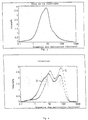
- Fig. 3 is a graph illustrating the size distribution of hydrated lime particles produced according to the state of the art.
- Fig. 4 is a graph illustrating the size distribution of hydrated lime particles produced according to the invention.
- Fig. 5 is an X-ray diffraction diagram of a xonotlite according to the state of the art and according to the invention.
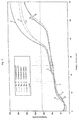
- Fig. 6 is a graph illustrating the evolution of the average temperature measured according to the ISO 834 standard for the unexposed side of fire-rated elements according to the invention and according to the state of the art.
- the proportion of lime and silica is adjusted so as to obtain either xonotlite crystals or tobermorite crystals, a mixture of the two.
- the hydrothermal reaction product is a suspension of xonotlite and / or tobermorite crystals, these crystals (primary structure) being agglomerated in secondary particles which are substantially spherical.
- Figure 1 is a microscopic photo electronics on a cross section cutting secondary particles of xonotlite.
- a photo is obtained by cryo-fracture of a sample of particles that is to say that part of the suspension of silicates of calcium obtained above is drained and then frozen. The frozen sample is then cut using an object cutting and observed under the electron microscope.
- Figure 1 shows agglomerates in section in which xonotlite crystals are oriented in three loose dimensions and intertwined. These agglomerates form thus porous particles containing many microcavities.
- the diameter and apparent density of secondary particles can be controlled especially by adjusting the water / solid matter ratio in the composition of departure.
- Lime source treatment includes two stages, the first has an effect on the dispersion of particles and the second on the agglomeration of particles.
- the ultrasonic frequency used for the first stage of processing is 20.5 kHz.
- the ultrasonic frequency used for the second stage of processing is around 500 kHz.
- the processing time is 10 minutes for the first step and 5 minutes for the second step.
- a aqueous slaked lime suspension comprising particles of calcium hydroxide.
- the bimodal distribution the size of these particles is as shown in the Figure 4, curve 1.
- an aqueous suspension of slaked lime, not treated with ultrasound has a particle size distribution such that shown in Figure 3. You can see in this figure that the distribution is monomodal, and that the majority of particles have dimensions between 2 and 20 microns.
- curve 1 it can be seen that the suspension of lime treated with ultrasound in the manner described above has a bimodal distribution of the size of the particles.
- the Ca (OH) 2 crystals are grouped into two populations of particles whose size distribution is centered around 10 and 60 microns respectively. These particles are agglomerates of crystals.
- a source of silica such as ground quartz is dispersed in water. This can also be treated with ultrasound at a frequency of the order of 20 kHz, preferably.
- the silica suspension is mixed with the lime suspension described above and introduced into a reactor for carrying out the hydrothermal synthesis in a CaO / SiO 2 molar ratio of 0.96.
- the water / solid ratio in the reactor is 13.8.
- Hydrothermal synthesis is carried out under constant agitation (of the order of 32 rpm to 200 rpm depending on reactor dimensions).
- the temperature is gradually brought to 210 ° C in 2 hours. She is maintained at this level for 3 hours, then the reactor is gradually cooled over 4 hours until approximately 50 ° C.
- Figure 2 is a photo taken of the same so that figure 1, that is to say on a sample obtained by cryo-fracture.
- Figure 2 like Figure 1, therefore shows secondary particles in section.
- These aggregates have an average diameter of around 50 microns. They have an internal part made up of xonotlite crystals oriented in three dimensions and loosely entangled, cavities being formed between the crystals.
- Figure 1 shows xonotlite aggregates obtained in a standard way such that described above, i.e. without prior processing lime and possibly silica using ultrasound.
- FIG. 5 shows that for an identical mineral composition, the xonotlite particles according to the invention (FIG. 2) have a higher specific surface (BET) than that of the secondary particles obtained according to the state of the art (FIG. 1 ).
- the specific surface of the particles according to the invention is 51 m 2 / g, while the specific surface of the particles according to the state of the art is only 42 m 2 / g. This increase in the specific surface is attributed to the effect of the microporous wall.
- Quartz is then added to the suspension of hydrated lime. Water can still be added to correct the water / solids ratio.
- aqueous suspension of xonotlite described above As it leaves the reactor, is added a suspension of amorphous silica and cellulose fibers dispersed in water. The whole is introduced into a rotary mixer with other possible additives. The plaster and glass fibers are then added.
- the hydraulic setting composition is poured onto a continuous conveyor belt where it extends.
- the composition is then shaped between said conveyor belt and an upper belt, substantially parallel with the conveyor belt, evolving in the same direction and with substantially the same speed as the conveyor belt.
- the strip conveyor may be subjected to mechanical vibration.
- This shaping can be carried out by a method known for example from EP-A-0 451 503.
- the composition can be poured in static molds according to a well-known technique in plaster technology.
- the conveyor belt or static mold can be subjected to vibration mechanical allowing the hydraulic setting composition to extend in a homogeneous way to arrive at the form desired.
- material or product thus obtained is dried, cut and possibly machined in its final form.
- 100 parts by weight of an aqueous suspension containing 10 parts by weight of xonotlite spheroids obtained according to the first process described above (under I.B.1.) are mixed with 2 parts by weight of silica amorphous of Elkem® type and with 0.86 part of fibers cellulose previously dispersed in 24.6 parts of water.
- the aqueous suspension of xonotlite has a temperature from 35 to 40 ° C when brought into contact with plaster.
- composition contains 116 parts in weight of water per 100 parts by weight of dry matter Total.
- the hydraulic setting composition thus obtained is immediately poured into a mold to make a 20 mm thick plate. After total hydration plaster, the plate is removed from the mold and dried in an oven ventilated at 40 ° C until the weight stabilizes.
- a plate is produced following the process described in Example 1, with the same ingredients, in the same proportions apart from the fact that the suspension aqueous xonotlite is obtained by the chemical process described under I.B.2.
- composition contains 188 parts in weight of water per 100 parts by weight of dry matter Total.
- composition contains 116 parts in weight of water per 100 parts by weight of dry matter Total.
- composition contains 51.9 parts in weight of water per 100 parts by weight of dry matter total.
- each plate is subjected to a fire test according to the standard ISO 834.
- the Rf value is time (expressed in minutes) before the average temperature of the unexposed side reaches 140 ° C above temperature room.
- Thermal shrinkage is measured after a exposure of the plates for 3 hours at 950 ° C.
- Figure 6 shows the evolution of the temperature over time of the plates subjected to the fire test according to ISO 834 standard.
- the thermal shrinkage of the three plates produced according to the invention is improved.
- the improvement is particularly consistent compared to the plate Example 5, carried out with a foaming agent according to the state of technique but is also marked in relation to the plate made with standard xonotlite particles (example 4).
- the invention also improved flexural strength of the plates. Most low flexural strength of the next plate Example 3 is obviously due to its lower density.
- the invention allows for gypsum-based building elements which have a fire resistance suitable for applications like fire-rated construction elements.
- fire resistance is meant the duration during which the plates have, at the same time, a good structural stability, good stability dimensional and good thermal insulation.
Landscapes
- Chemical & Material Sciences (AREA)
- Engineering & Computer Science (AREA)
- Ceramic Engineering (AREA)
- Organic Chemistry (AREA)
- Materials Engineering (AREA)
- Structural Engineering (AREA)
- Civil Engineering (AREA)
- Chemical Kinetics & Catalysis (AREA)
- Inorganic Chemistry (AREA)
- Curing Cements, Concrete, And Artificial Stone (AREA)
- Building Environments (AREA)
- Silicates, Zeolites, And Molecular Sieves (AREA)
- Medicinal Preparation (AREA)
- Pharmaceuticals Containing Other Organic And Inorganic Compounds (AREA)
- Laminated Bodies (AREA)
Description
- stabilité structurelle ("load-bearing capacity"),
- stabilité dimensionnelle et étanchéité aux flammes et à la fumée ("integrity"), et
- isolation thermique ("insulation").
- 200 parties en poids d'une suspension aqueuse contenant 20 parties en poids de sphéroïdes de xonotlite obtenue avec le procédé sonochimique décrit ci-dessus sous I.B.1.,
- 2 parties en poids de silice amorphe,
- 2 parties en poids de fibres de verre coupées,
- 0,86 partie en poids de fibres de cellulose préalablement dispersées dans 24,6 parties d'eau et essorées à 4,8 parties d'eau avant d'être ajoutées au mélange,
- 3,2 parties en poids d'eau, puis
- 75,14 parties en poids de plâtre.
- 100 parties en poids d'une suspension aqueuse contenant 10 parties en poids de sphéroïdes de xonotlite obtenue suivant l'état de la technique,
- 2 parties en poids de silice amorphe,
- 2 parties en poids de fibres de verre coupées,
- 0,86 partie en poids de fibres de cellulose préalablement dispersés dans 24,6 parties d'eau,
- 1,4 partie en poids d'eau, puis
- 85,14 parties en poids de plâtre.
- 0,08 partie en poids de Perlankrol® (agent moussant connu de l'état de la technique),
- 2 parties en poids de silice amorphe,
- 2 parties en poids de fibres de verre coupées,
- 0,86 partie en poids de fibres de cellulose préalablement dispersées dans 24,6 parties d'eau,
- 27,3 parties en poids d'eau, puis
- 95,14 parties en poids de plâtre.


Claims (15)
- Matériau comportant une matrice de gypse et des agrégats poreux, sensiblement sphériques, de cristaux de silicate de calcium hydratés incorporés dans la matrice de gypse, les agrégats de silicates de calcium hydratés étant présents en une proportion en poids par rapport au gypse de 2 à 84 %,
le matériau étant caractérisé en ce que les dits agrégats de silicates comportent une partie interne dans laquelle les cristaux sont lâchement enchevêtrés et une couche externe où les cristaux sont enchevêtrés de manière plus serrée que dans la partie interne. - Matériau suivant la revendication précédente, caractérisé en ce que lesdits agrégats ont un diamètre moyen compris entre 40 et 150 micromètres.
- Matériau suivant l'une quelconque des revendications précédentes, caractérisé en ce que les cristaux de silicate de calcium hydratés sont des cristaux de xonotlite.
- Matériau suivant l'une quelconque des revendications précédentes, caractérisé en ce qu'il comporte des fibres de renforcement incorporées dans la matrice de gypse.
- Matériau suivant la revendication 4, caractérisé en ce qu'au moins une partie de ces fibres de renforcement sont choisies parmi les fibres de verre, les fibres de cellulose ou les mélanges de ces fibres.
- Procédé de fabrication d'un matériau à base de gypse suivant l'une quelconque des revendications précédentes, comportant la préparation et la prise d'une composition à prise hydraulique contenant du plâtre, de l'eau, et des agrégats poreux, sensiblement sphériques, de silicates de calcium hydratés, ces agrégats étant dispersés dans le plâtre en une proportion en poids par rapport au plâtre de 1/39 à 1/1,
le procédé étant caractérisé en ce que les agrégats de silicates de calcium hydratés sont susceptibles d'être obtenus par synthèse hydrothermale en milieu agité à partir d'une suspension aqueuse de chaux préalablement traitée aux ultrasons et de silice. - Procédé suivant la revendication 6, caractérisé en ce que le traitement de la suspension de chaux comporte une étape de dispersion suivie d'une étape d'agglomération.
- Procédé suivant la revendication 7, caractérisé en ce que le traitement de la suspension de chaux est réalisé avec des ultrasons dont la fréquence est comprise entre 19 et 21 kHz pour la première étape et comprise entre 300 et 600 kHz pour la seconde étape.
- Procédé de fabrication d'un matériau à base de gypse suivant l'une quelconque des revendications 1 à 5, comportant la préparation et la prise d'une composition à prise hydraulique contenant du plâtre, de l'eau, et des agrégats poreux, sensiblement sphériques, de silicates de calcium hydratés, ces agrégats étant dispersés dans le plâtre en une proportion en poids par rapport au plâtre de 1/39 à 1/1,
le procédé étant caractérisé en ce que les agrégats de silicates de calcium hydratés sont susceptibles d'être obtenus par synthèse hydrothermale en milieu agité, à partir d'une suspension aqueuse de chaux et de silice, la suspension de chaux étant préalablement obtenue par hydratation en présence de 0,2 à 2 % en poids de sulfate par rapport au poids de chaux vive. - Procédé suivant la revendication 9, caractérisé en ce que ledit sulfate est choisi parmi le sulfate de calcium, le sulfate de magnésium ou leur mélange.
- Procédé suivant l'une quelconque des revendications 6 à 10, caractérisé en ce que la composition à prise hydraulique comporte des fibres de renforcement incorporées dans la composition.
- Procédé suivant la revendication 11, caractérisé en ce qu'au moins une partie de ces fibres de renforcement est choisie parmi les fibres de verre, les fibres de cellulose ou leur mélange.
- Elément de construction coupe-feu, caractérisé en ce qu'il comporte le matériau obtenu par le procédé suivant l'une quelconque des revendications 6 à 12.
- Elément de construction coupe-feu, caractérisé en ce qu'il comporte le matériau suivant l'une quelconque des revendications 1 à 5.
- Elément de construction coupe-feu suivant l'une quelconque des revendications 13 et 14, caractérisé en ce qu'il est choisi parmi le groupe comprenant: revêtements, cloisons, écrans, gaines de colonnes, gaines de poutres, carreaux et éléments de plafond, regards, gaines techniques, conduits et clapets de ventilation et de désenfumage, caissons pour câbles électriques, éléments d'isolation de sol.
Priority Applications (1)
| Application Number | Priority Date | Filing Date | Title |
|---|---|---|---|
| EP19990915555 EP1062184B1 (fr) | 1998-03-10 | 1999-03-05 | Materiau a base de gypse, procede de fabrication d'un tel materiau et element de construction coupe-feu comprenant ce materiau |
Applications Claiming Priority (4)
| Application Number | Priority Date | Filing Date | Title |
|---|---|---|---|
| EP98870050 | 1998-03-10 | ||
| EP19980870050 EP0943590A1 (fr) | 1998-03-10 | 1998-03-10 | Matériau à base de gypse, procédé de fabrication d'un tel matériau et élément de construction coupe-feu comprenant ce matériau |
| EP19990915555 EP1062184B1 (fr) | 1998-03-10 | 1999-03-05 | Materiau a base de gypse, procede de fabrication d'un tel materiau et element de construction coupe-feu comprenant ce materiau |
| PCT/EP1999/001524 WO1999046215A1 (fr) | 1998-03-10 | 1999-03-05 | Materiau a base de gypse, procede de fabrication d'un tel materiau et element de construction coupe-feu comprenant ce materiau |
Publications (2)
| Publication Number | Publication Date |
|---|---|
| EP1062184A1 EP1062184A1 (fr) | 2000-12-27 |
| EP1062184B1 true EP1062184B1 (fr) | 2003-08-20 |
Family
ID=8237008
Family Applications (2)
| Application Number | Title | Priority Date | Filing Date |
|---|---|---|---|
| EP19980870050 Withdrawn EP0943590A1 (fr) | 1998-03-10 | 1998-03-10 | Matériau à base de gypse, procédé de fabrication d'un tel matériau et élément de construction coupe-feu comprenant ce matériau |
| EP19990915555 Expired - Lifetime EP1062184B1 (fr) | 1998-03-10 | 1999-03-05 | Materiau a base de gypse, procede de fabrication d'un tel materiau et element de construction coupe-feu comprenant ce materiau |
Family Applications Before (1)
| Application Number | Title | Priority Date | Filing Date |
|---|---|---|---|
| EP19980870050 Withdrawn EP0943590A1 (fr) | 1998-03-10 | 1998-03-10 | Matériau à base de gypse, procédé de fabrication d'un tel matériau et élément de construction coupe-feu comprenant ce matériau |
Country Status (8)
| Country | Link |
|---|---|
| EP (2) | EP0943590A1 (fr) |
| AT (1) | ATE247610T1 (fr) |
| AU (1) | AU3409799A (fr) |
| DE (1) | DE69910547T2 (fr) |
| DK (1) | DK1062184T3 (fr) |
| ES (1) | ES2205804T3 (fr) |
| PT (1) | PT1062184E (fr) |
| WO (1) | WO1999046215A1 (fr) |
Families Citing this family (16)
| Publication number | Priority date | Publication date | Assignee | Title |
|---|---|---|---|---|
| AU2164702A (en) * | 2000-10-05 | 2002-04-15 | Redco Nv | Fire-proof material |
| GB201019841D0 (en) | 2010-11-23 | 2011-01-05 | Bpb Ltd | Calcium sulphate-bases products and methods for the manufacture thereof |
| FR2968651B1 (fr) * | 2010-12-10 | 2013-01-04 | Univ Toulon | Compositions pour plaque de platre et procedes de preparation |
| BE1021522B1 (fr) | 2012-09-12 | 2015-12-07 | S.A. Lhoist Recherche Et Developpement | Composition de lait de chaux de grande finesse |
| BE1022069B1 (fr) * | 2014-03-11 | 2016-02-15 | Lhoist Recherche Et Developpement Sa | Composition de lait de chaux |
| WO2015135954A1 (fr) | 2014-03-11 | 2015-09-17 | Lhoist Recherche Et Developpement Sa | Composition de lait de chaux |
| CN105399389A (zh) * | 2015-11-17 | 2016-03-16 | 上海隆振建筑工程股份有限公司 | 一种建筑内墙粉刷石膏及其工艺流程 |
| WO2020152335A1 (fr) | 2019-01-25 | 2020-07-30 | Prtc Nv | Matériau de construction |
| WO2020181269A1 (fr) * | 2019-03-07 | 2020-09-10 | The Regents Of The University Of California | Synthèse régulée et efficace d'agents de cimentation composites inorganiques-organiques à aptitude de contrainte améliorée |
| CN111592289A (zh) * | 2020-05-27 | 2020-08-28 | 常州优纳新材料科技有限公司 | 一种介孔材料复合硅酸钙防火板及其制备方法 |
| WO2024003139A1 (fr) | 2022-06-29 | 2024-01-04 | Prtc Nv | Panneaux de silicate de calcium hydraté verts et processus associé |
| EP4345083A1 (fr) * | 2022-09-28 | 2024-04-03 | Etex Services NV | Revêtement à base de xonotlite sur un produit cimentaire et procédé de fabrication |
| EP4617248B1 (fr) * | 2024-03-11 | 2026-05-06 | Uzin Utz SE | Mastic auto-nivellante à haute résistance à l'humidité |
| EP4628478A1 (fr) | 2024-04-03 | 2025-10-08 | Etex Services NV | Procédé de fabrication d'un produit cimentaire et produit cimentaire revêtu |
| EP4628477A1 (fr) | 2024-04-03 | 2025-10-08 | Etex Services NV | Procédé de fabrication d'un produit cimentaire et produit cimentaire revêtu |
| EP4628476A1 (fr) | 2024-04-03 | 2025-10-08 | Etex Services NV | Procédé de fabrication d'un produit cimentaire et produit cimentaire revêtu |
Family Cites Families (6)
| Publication number | Priority date | Publication date | Assignee | Title |
|---|---|---|---|---|
| GB1442484A (en) * | 1973-04-24 | 1976-07-14 | Nippon Synthetic Chem Ind | Process for preparing fire-resisting mouldings |
| JPS55109217A (en) * | 1979-02-09 | 1980-08-22 | Osaka Packing Seizosho:Kk | Calcium silicate and preparing the same |
| JPS5727958A (en) * | 1980-07-24 | 1982-02-15 | Asahi Glass Co Ltd | Gypsum slag hardened body |
| JPS57140351A (en) * | 1981-02-19 | 1982-08-30 | Nippon Synthetic Chem Ind | Manufacture of inorganic refractory moldings |
| JPS5844627B2 (ja) * | 1981-07-23 | 1983-10-04 | 工業技術院長 | 耐火断熱材の製造方法 |
| DE4135416C1 (fr) * | 1991-10-26 | 1993-04-15 | Dmw Schwarze Gmbh & Co Industrietore Kg, 4800 Bielefeld, De |
-
1998
- 1998-03-10 EP EP19980870050 patent/EP0943590A1/fr not_active Withdrawn
-
1999
- 1999-03-05 ES ES99915555T patent/ES2205804T3/es not_active Expired - Lifetime
- 1999-03-05 EP EP19990915555 patent/EP1062184B1/fr not_active Expired - Lifetime
- 1999-03-05 PT PT99915555T patent/PT1062184E/pt unknown
- 1999-03-05 WO PCT/EP1999/001524 patent/WO1999046215A1/fr not_active Ceased
- 1999-03-05 AU AU34097/99A patent/AU3409799A/en not_active Abandoned
- 1999-03-05 AT AT99915555T patent/ATE247610T1/de active
- 1999-03-05 DE DE1999610547 patent/DE69910547T2/de not_active Expired - Lifetime
- 1999-03-05 DK DK99915555T patent/DK1062184T3/da active
Also Published As
| Publication number | Publication date |
|---|---|
| WO1999046215A1 (fr) | 1999-09-16 |
| DE69910547D1 (de) | 2003-09-25 |
| ES2205804T3 (es) | 2004-05-01 |
| PT1062184E (pt) | 2004-01-30 |
| DK1062184T3 (da) | 2003-12-15 |
| EP0943590A1 (fr) | 1999-09-22 |
| ATE247610T1 (de) | 2003-09-15 |
| AU3409799A (en) | 1999-09-27 |
| EP1062184A1 (fr) | 2000-12-27 |
| DE69910547T2 (de) | 2004-06-17 |
Similar Documents
| Publication | Publication Date | Title |
|---|---|---|
| EP0943590A1 (fr) | Matériau à base de gypse, procédé de fabrication d'un tel matériau et élément de construction coupe-feu comprenant ce matériau | |
| EP2401239B1 (fr) | Mortier isolant pulverulent, mortier isolant en couche | |
| CA2893451C (fr) | Composition pour plaques de platre et produits obtenus | |
| EP2731985B1 (fr) | Materiaux d'isolation thermique hautes performances | |
| WO2000047536A1 (fr) | Element de construction prefabrique a base de platre, presentant une resistance a l'eau | |
| EP2093201A2 (fr) | Composition de mousse de chaux pour isolation thermique | |
| WO2002006180A1 (fr) | Composition pour plaque de platre preparation de cette composition et fabrication de plaques de platre | |
| EP2855998B1 (fr) | Produits d'isolation thermique hautes performances | |
| EP1150932B1 (fr) | Element de construction prefabrique a base de platre et en particulier plaque a base de platre presentant une resistance au feu amelioree | |
| EP0470914B1 (fr) | Composition pour coeur de plaque de plâtre | |
| EP2726431B1 (fr) | Matière poreuse à base de silice et de portlandite pour le garnissage de briques d'isolation de structure contrôlée et procédé d'élaboration associé | |
| CA2868442A1 (fr) | Garnissage de brique de construction par une matiere poreuse | |
| EP3914567B1 (fr) | Matériau de construction | |
| EP1641726A2 (fr) | Materiaux d isolation thermique et/ou acoustique a base de s ilice et procedes pour leur obtention | |
| WO2016146934A1 (fr) | Plaque acoustique a base de plâtre | |
| FR2785604A1 (fr) | Composition de beton pret a l'emploi resistant a une temperature de 1 000°c | |
| EP4069654B1 (fr) | Procede d'ignifugation de materiau | |
| FR3104154A1 (fr) | Procédé d’ignifugation de matériau | |
| EP2855389B1 (fr) | Produits d'isolation thermique hautes performances | |
| FR2968651A1 (fr) | Compositions pour plaque de platre et procedes de preparation | |
| FR2580627A1 (fr) | Procede et composition pour la fabrication de plaques d'argile et plaques d'argile ainsi obtenues | |
| BE890933A (fr) | Compositions pour la preparation de corps inorganiques en mousse |
Legal Events
| Date | Code | Title | Description |
|---|---|---|---|
| PUAI | Public reference made under article 153(3) epc to a published international application that has entered the european phase |
Free format text: ORIGINAL CODE: 0009012 |
|
| 17P | Request for examination filed |
Effective date: 20000627 |
|
| AK | Designated contracting states |
Kind code of ref document: A1 Designated state(s): AT BE CH CY DE DK ES FI FR GB GR IE IT LI LU MC NL PT SE |
|
| AX | Request for extension of the european patent |
Free format text: MK PAYMENT 20000627;SI PAYMENT 20000627 |
|
| 17Q | First examination report despatched |
Effective date: 20020710 |
|
| RAP1 | Party data changed (applicant data changed or rights of an application transferred) |
Owner name: PROMAT INTERNATIONAL N.V. |
|
| GRAH | Despatch of communication of intention to grant a patent |
Free format text: ORIGINAL CODE: EPIDOS IGRA |
|
| GRAH | Despatch of communication of intention to grant a patent |
Free format text: ORIGINAL CODE: EPIDOS IGRA |
|
| GRAA | (expected) grant |
Free format text: ORIGINAL CODE: 0009210 |
|
| AK | Designated contracting states |
Designated state(s): AT BE CH CY DE DK ES FI FR GB GR IE IT LI LU MC NL PT SE |
|
| AX | Request for extension of the european patent |
Extension state: MK SI |
|
| PG25 | Lapsed in a contracting state [announced via postgrant information from national office to epo] |
Ref country code: CY Free format text: LAPSE BECAUSE OF FAILURE TO SUBMIT A TRANSLATION OF THE DESCRIPTION OR TO PAY THE FEE WITHIN THE PRESCRIBED TIME-LIMIT Effective date: 20030820 |
|
| REG | Reference to a national code |
Ref country code: GB Ref legal event code: FG4D Free format text: NOT ENGLISH |
|
| REG | Reference to a national code |
Ref country code: CH Ref legal event code: EP |
|
| REG | Reference to a national code |
Ref country code: IE Ref legal event code: FG4D Free format text: FRENCH |
|
| REF | Corresponds to: |
Ref document number: 69910547 Country of ref document: DE Date of ref document: 20030925 Kind code of ref document: P |
|
| PG25 | Lapsed in a contracting state [announced via postgrant information from national office to epo] |
Ref country code: GR Free format text: LAPSE BECAUSE OF FAILURE TO SUBMIT A TRANSLATION OF THE DESCRIPTION OR TO PAY THE FEE WITHIN THE PRESCRIBED TIME-LIMIT Effective date: 20031120 |
|
| REG | Reference to a national code |
Ref country code: SE Ref legal event code: TRGR |
|
| REG | Reference to a national code |
Ref country code: DK Ref legal event code: T3 |
|
| GBT | Gb: translation of ep patent filed (gb section 77(6)(a)/1977) | ||
| PG25 | Lapsed in a contracting state [announced via postgrant information from national office to epo] |
Ref country code: MC Free format text: LAPSE BECAUSE OF NON-PAYMENT OF DUE FEES Effective date: 20040331 |
|
| REG | Reference to a national code |
Ref country code: ES Ref legal event code: FG2A Ref document number: 2205804 Country of ref document: ES Kind code of ref document: T3 |
|
| PLBE | No opposition filed within time limit |
Free format text: ORIGINAL CODE: 0009261 |
|
| STAA | Information on the status of an ep patent application or granted ep patent |
Free format text: STATUS: NO OPPOSITION FILED WITHIN TIME LIMIT |
|
| 26N | No opposition filed |
Effective date: 20040524 |
|
| REG | Reference to a national code |
Ref country code: CH Ref legal event code: PFA Owner name: PROMAT INTERNATIONAL N.V. Free format text: PROMAT INTERNATIONAL N.V.#BORMSTRAAT 24#2830 TISSELT (BE) -TRANSFER TO- PROMAT INTERNATIONAL N.V.#BORMSTRAAT 24#2830 TISSELT (BE) |
|
| REG | Reference to a national code |
Ref country code: CH Ref legal event code: PCAR Free format text: NEW ADDRESS: HOLBEINSTRASSE 36-38, 4051 BASEL (CH) |
|
| REG | Reference to a national code |
Ref country code: FR Ref legal event code: PLFP Year of fee payment: 18 |
|
| REG | Reference to a national code |
Ref country code: FR Ref legal event code: PLFP Year of fee payment: 19 |
|
| REG | Reference to a national code |
Ref country code: FR Ref legal event code: PLFP Year of fee payment: 20 |
|
| PGFP | Annual fee paid to national office [announced via postgrant information from national office to epo] |
Ref country code: LU Payment date: 20180327 Year of fee payment: 20 Ref country code: GB Payment date: 20180327 Year of fee payment: 20 Ref country code: CH Payment date: 20180328 Year of fee payment: 20 Ref country code: DK Payment date: 20180326 Year of fee payment: 20 Ref country code: NL Payment date: 20180326 Year of fee payment: 20 Ref country code: FI Payment date: 20180328 Year of fee payment: 20 |
|
| PGFP | Annual fee paid to national office [announced via postgrant information from national office to epo] |
Ref country code: PT Payment date: 20180221 Year of fee payment: 20 Ref country code: IT Payment date: 20180322 Year of fee payment: 20 Ref country code: BE Payment date: 20180327 Year of fee payment: 20 Ref country code: SE Payment date: 20180328 Year of fee payment: 20 Ref country code: AT Payment date: 20180221 Year of fee payment: 20 Ref country code: IE Payment date: 20180328 Year of fee payment: 20 Ref country code: FR Payment date: 20180326 Year of fee payment: 20 |
|
| PGFP | Annual fee paid to national office [announced via postgrant information from national office to epo] |
Ref country code: ES Payment date: 20180402 Year of fee payment: 20 Ref country code: DE Payment date: 20180328 Year of fee payment: 20 |
|
| REG | Reference to a national code |
Ref country code: DE Ref legal event code: R071 Ref document number: 69910547 Country of ref document: DE |
|
| REG | Reference to a national code |
Ref country code: NL Ref legal event code: MK Effective date: 20190304 |
|
| REG | Reference to a national code |
Ref country code: DK Ref legal event code: EUP Effective date: 20190305 |
|
| REG | Reference to a national code |
Ref country code: CH Ref legal event code: PL |
|
| REG | Reference to a national code |
Ref country code: GB Ref legal event code: PE20 Expiry date: 20190304 |
|
| REG | Reference to a national code |
Ref country code: BE Ref legal event code: MK Effective date: 20190305 |
|
| REG | Reference to a national code |
Ref country code: AT Ref legal event code: MK07 Ref document number: 247610 Country of ref document: AT Kind code of ref document: T Effective date: 20190305 |
|
| REG | Reference to a national code |
Ref country code: IE Ref legal event code: MK9A |
|
| PG25 | Lapsed in a contracting state [announced via postgrant information from national office to epo] |
Ref country code: GB Free format text: LAPSE BECAUSE OF EXPIRATION OF PROTECTION Effective date: 20190304 Ref country code: IE Free format text: LAPSE BECAUSE OF EXPIRATION OF PROTECTION Effective date: 20190305 |
|
| PG25 | Lapsed in a contracting state [announced via postgrant information from national office to epo] |
Ref country code: PT Free format text: LAPSE BECAUSE OF EXPIRATION OF PROTECTION Effective date: 20190314 |
|
| REG | Reference to a national code |
Ref country code: ES Ref legal event code: FD2A Effective date: 20201202 |
|
| PG25 | Lapsed in a contracting state [announced via postgrant information from national office to epo] |
Ref country code: ES Free format text: LAPSE BECAUSE OF EXPIRATION OF PROTECTION Effective date: 20190306 |
|
| P01 | Opt-out of the competence of the unified patent court (upc) registered |
Effective date: 20230524 |