EP1061956B1 - Manganese chelates with high relaxivity in serum - Google Patents
Manganese chelates with high relaxivity in serum Download PDFInfo
- Publication number
- EP1061956B1 EP1061956B1 EP99910335A EP99910335A EP1061956B1 EP 1061956 B1 EP1061956 B1 EP 1061956B1 EP 99910335 A EP99910335 A EP 99910335A EP 99910335 A EP99910335 A EP 99910335A EP 1061956 B1 EP1061956 B1 EP 1061956B1
- Authority
- EP
- European Patent Office
- Prior art keywords
- chelates
- carboxymethyl
- reaction
- give
- deoxy
- Prior art date
- Legal status (The legal status is an assumption and is not a legal conclusion. Google has not performed a legal analysis and makes no representation as to the accuracy of the status listed.)
- Expired - Lifetime
Links
- 239000011572 manganese Substances 0.000 title claims description 44
- PWHULOQIROXLJO-UHFFFAOYSA-N Manganese Chemical compound [Mn] PWHULOQIROXLJO-UHFFFAOYSA-N 0.000 title claims description 40
- 229910052748 manganese Inorganic materials 0.000 title claims description 40
- 210000002966 serum Anatomy 0.000 title description 10
- MBBZMMPHUWSWHV-BDVNFPICSA-N N-methylglucamine Chemical group CNC[C@H](O)[C@@H](O)[C@H](O)[C@H](O)CO MBBZMMPHUWSWHV-BDVNFPICSA-N 0.000 claims description 54
- 150000001875 compounds Chemical class 0.000 claims description 53
- 238000000034 method Methods 0.000 claims description 32
- 239000000203 mixture Substances 0.000 claims description 32
- 238000006243 chemical reaction Methods 0.000 claims description 22
- 229910052757 nitrogen Inorganic materials 0.000 claims description 22
- 125000001495 ethyl group Chemical group [H]C([H])([H])C([H])([H])* 0.000 claims description 21
- 125000004122 cyclic group Chemical group 0.000 claims description 20
- 229910052736 halogen Inorganic materials 0.000 claims description 19
- -1 9-anthracenyl Chemical group 0.000 claims description 17
- 125000000267 glycino group Chemical group [H]N([*])C([H])([H])C(=O)O[H] 0.000 claims description 17
- 239000002253 acid Substances 0.000 claims description 16
- 150000003839 salts Chemical class 0.000 claims description 16
- 229920006395 saturated elastomer Polymers 0.000 claims description 16
- 150000001370 alpha-amino acid derivatives Chemical class 0.000 claims description 15
- 125000003178 carboxy group Chemical group [H]OC(*)=O 0.000 claims description 15
- JGFZNNIVVJXRND-UHFFFAOYSA-N N,N-Diisopropylethylamine (DIPEA) Chemical compound CCN(C(C)C)C(C)C JGFZNNIVVJXRND-UHFFFAOYSA-N 0.000 claims description 14
- 125000003368 amide group Chemical group 0.000 claims description 14
- 150000002148 esters Chemical class 0.000 claims description 14
- 238000009472 formulation Methods 0.000 claims description 14
- 125000003118 aryl group Chemical group 0.000 claims description 13
- 125000002837 carbocyclic group Chemical group 0.000 claims description 13
- 150000002367 halogens Chemical group 0.000 claims description 13
- 125000000623 heterocyclic group Chemical group 0.000 claims description 13
- 239000004472 Lysine Substances 0.000 claims description 12
- 235000008206 alpha-amino acids Nutrition 0.000 claims description 12
- OYPRJOBELJOOCE-UHFFFAOYSA-N Calcium Chemical compound [Ca] OYPRJOBELJOOCE-UHFFFAOYSA-N 0.000 claims description 11
- 239000011575 calcium Substances 0.000 claims description 11
- 150000001768 cations Chemical class 0.000 claims description 11
- 238000002360 preparation method Methods 0.000 claims description 11
- FYYHWMGAXLPEAU-UHFFFAOYSA-N Magnesium Chemical compound [Mg] FYYHWMGAXLPEAU-UHFFFAOYSA-N 0.000 claims description 10
- 229910052791 calcium Inorganic materials 0.000 claims description 10
- 239000011777 magnesium Substances 0.000 claims description 10
- 229910052749 magnesium Inorganic materials 0.000 claims description 10
- 150000007530 organic bases Chemical class 0.000 claims description 10
- DGAQECJNVWCQMB-PUAWFVPOSA-M Ilexoside XXIX Chemical compound C[C@@H]1CC[C@@]2(CC[C@@]3(C(=CC[C@H]4[C@]3(CC[C@@H]5[C@@]4(CC[C@@H](C5(C)C)OS(=O)(=O)[O-])C)C)[C@@H]2[C@]1(C)O)C)C(=O)O[C@H]6[C@@H]([C@H]([C@@H]([C@H](O6)CO)O)O)O.[Na+] DGAQECJNVWCQMB-PUAWFVPOSA-M 0.000 claims description 9
- WAEMQWOKJMHJLA-UHFFFAOYSA-N Manganese(2+) Chemical compound [Mn+2] WAEMQWOKJMHJLA-UHFFFAOYSA-N 0.000 claims description 9
- ZLMJMSJWJFRBEC-UHFFFAOYSA-N Potassium Chemical compound [K] ZLMJMSJWJFRBEC-UHFFFAOYSA-N 0.000 claims description 9
- 229940024606 amino acid Drugs 0.000 claims description 9
- 235000001014 amino acid Nutrition 0.000 claims description 9
- 150000001413 amino acids Chemical class 0.000 claims description 9
- 125000002915 carbonyl group Chemical group [*:2]C([*:1])=O 0.000 claims description 9
- 229910052739 hydrogen Inorganic materials 0.000 claims description 9
- 239000001257 hydrogen Substances 0.000 claims description 9
- 150000007529 inorganic bases Chemical class 0.000 claims description 9
- 229960005190 phenylalanine Drugs 0.000 claims description 9
- 239000011591 potassium Substances 0.000 claims description 9
- 229910052700 potassium Inorganic materials 0.000 claims description 9
- 239000011734 sodium Substances 0.000 claims description 9
- 229910052708 sodium Inorganic materials 0.000 claims description 9
- 150000003512 tertiary amines Chemical class 0.000 claims description 8
- WEVYAHXRMPXWCK-UHFFFAOYSA-N Acetonitrile Chemical compound CC#N WEVYAHXRMPXWCK-UHFFFAOYSA-N 0.000 claims description 7
- UFHFLCQGNIYNRP-UHFFFAOYSA-N Hydrogen Chemical compound [H][H] UFHFLCQGNIYNRP-UHFFFAOYSA-N 0.000 claims description 7
- 229910006069 SO3H Inorganic materials 0.000 claims description 7
- 239000000872 buffer Substances 0.000 claims description 7
- 230000005291 magnetic effect Effects 0.000 claims description 7
- PIICEJLVQHRZGT-UHFFFAOYSA-N Ethylenediamine Chemical compound NCCN PIICEJLVQHRZGT-UHFFFAOYSA-N 0.000 claims description 6
- PCLIMKBDDGJMGD-UHFFFAOYSA-N N-bromosuccinimide Chemical compound BrN1C(=O)CCC1=O PCLIMKBDDGJMGD-UHFFFAOYSA-N 0.000 claims description 6
- 238000002059 diagnostic imaging Methods 0.000 claims description 6
- 125000005843 halogen group Chemical group 0.000 claims description 6
- 239000002904 solvent Substances 0.000 claims description 6
- 239000000126 substance Substances 0.000 claims description 6
- RIOQSEWOXXDEQQ-UHFFFAOYSA-N triphenylphosphine Chemical compound C1=CC=CC=C1P(C=1C=CC=CC=1)C1=CC=CC=C1 RIOQSEWOXXDEQQ-UHFFFAOYSA-N 0.000 claims description 6
- ZHSOTLOTTDYIIK-ZDUSSCGKSA-N (2S)-2-amino-3-[4-(4-hydroxyphenoxy)-3,5-diiodophenyl]propanoic acid Chemical group IC1=CC(C[C@H](N)C(O)=O)=CC(I)=C1OC1=CC=C(O)C=C1 ZHSOTLOTTDYIIK-ZDUSSCGKSA-N 0.000 claims description 5
- 239000003377 acid catalyst Substances 0.000 claims description 5
- 125000001841 imino group Chemical group [H]N=* 0.000 claims description 5
- 150000002696 manganese Chemical class 0.000 claims description 5
- 238000006386 neutralization reaction Methods 0.000 claims description 5
- 210000000056 organ Anatomy 0.000 claims description 5
- RNMSZIWXOVWGMI-VIFPVBQESA-N (2s)-2-(carboxymethylamino)-3-(4-hydroxyphenyl)propanoic acid Chemical compound OC(=O)CN[C@H](C(O)=O)CC1=CC=C(O)C=C1 RNMSZIWXOVWGMI-VIFPVBQESA-N 0.000 claims description 4
- 125000001637 1-naphthyl group Chemical group [H]C1=C([H])C([H])=C2C(*)=C([H])C([H])=C([H])C2=C1[H] 0.000 claims description 4
- IJGRMHOSHXDMSA-UHFFFAOYSA-N Atomic nitrogen Chemical compound N#N IJGRMHOSHXDMSA-UHFFFAOYSA-N 0.000 claims description 4
- SIKJAQJRHWYJAI-UHFFFAOYSA-N Indole Chemical group C1=CC=C2NC=CC2=C1 SIKJAQJRHWYJAI-UHFFFAOYSA-N 0.000 claims description 4
- DTQVDTLACAAQTR-UHFFFAOYSA-N Trifluoroacetic acid Chemical compound OC(=O)C(F)(F)F DTQVDTLACAAQTR-UHFFFAOYSA-N 0.000 claims description 4
- MWPLVEDNUUSJAV-UHFFFAOYSA-N anthracene Chemical group C1=CC=CC2=CC3=CC=CC=C3C=C21 MWPLVEDNUUSJAV-UHFFFAOYSA-N 0.000 claims description 4
- 125000002057 carboxymethyl group Chemical group [H]OC(=O)C([H])([H])[*] 0.000 claims description 4
- 239000002609 medium Substances 0.000 claims description 4
- 125000006239 protecting group Chemical group 0.000 claims description 4
- LPXPTNMVRIOKMN-UHFFFAOYSA-M sodium nitrite Chemical compound [Na+].[O-]N=O LPXPTNMVRIOKMN-UHFFFAOYSA-M 0.000 claims description 4
- PAAZPARNPHGIKF-UHFFFAOYSA-N 1,2-dibromoethane Chemical compound BrCCBr PAAZPARNPHGIKF-UHFFFAOYSA-N 0.000 claims description 3
- BTBUEUYNUDRHOZ-UHFFFAOYSA-N Borate Chemical compound [O-]B([O-])[O-] BTBUEUYNUDRHOZ-UHFFFAOYSA-N 0.000 claims description 3
- 125000000217 alkyl group Chemical group 0.000 claims description 3
- 125000002887 hydroxy group Chemical group [H]O* 0.000 claims description 3
- UFWIBTONFRDIAS-UHFFFAOYSA-N naphthalene-acid Natural products C1=CC=CC2=CC=CC=C21 UFWIBTONFRDIAS-UHFFFAOYSA-N 0.000 claims description 3
- 239000003960 organic solvent Substances 0.000 claims description 3
- ZDYVRSLAEXCVBX-UHFFFAOYSA-N pyridinium p-toluenesulfonate Chemical compound C1=CC=[NH+]C=C1.CC1=CC=C(S([O-])(=O)=O)C=C1 ZDYVRSLAEXCVBX-UHFFFAOYSA-N 0.000 claims description 3
- 125000003837 (C1-C20) alkyl group Chemical group 0.000 claims description 2
- BUDQDWGNQVEFAC-UHFFFAOYSA-N Dihydropyran Chemical compound C1COC=CC1 BUDQDWGNQVEFAC-UHFFFAOYSA-N 0.000 claims description 2
- 230000001476 alcoholic effect Effects 0.000 claims description 2
- 125000003545 alkoxy group Chemical group 0.000 claims description 2
- 150000001408 amides Chemical class 0.000 claims description 2
- 239000012736 aqueous medium Substances 0.000 claims description 2
- 125000001797 benzyl group Chemical group [H]C1=C([H])C([H])=C(C([H])=C1[H])C([H])([H])* 0.000 claims description 2
- 125000000113 cyclohexyl group Chemical group [H]C1([H])C([H])([H])C([H])([H])C([H])(*)C([H])([H])C1([H])[H] 0.000 claims description 2
- 150000004820 halides Chemical class 0.000 claims description 2
- 150000002431 hydrogen Chemical group 0.000 claims description 2
- 125000004435 hydrogen atom Chemical group [H]* 0.000 claims description 2
- 125000004464 hydroxyphenyl group Chemical group 0.000 claims description 2
- PZOUSPYUWWUPPK-UHFFFAOYSA-N indole Chemical group CC1=CC=CC2=C1C=CN2 PZOUSPYUWWUPPK-UHFFFAOYSA-N 0.000 claims description 2
- RKJUIXBNRJVNHR-UHFFFAOYSA-N indolenine Chemical group C1=CC=C2CC=NC2=C1 RKJUIXBNRJVNHR-UHFFFAOYSA-N 0.000 claims description 2
- 125000001997 phenyl group Chemical group [H]C1=C([H])C([H])=C(*)C([H])=C1[H] 0.000 claims description 2
- 125000003367 polycyclic group Chemical group 0.000 claims description 2
- 125000004434 sulfur atom Chemical group 0.000 claims description 2
- 125000002221 trityl group Chemical group [H]C1=C([H])C([H])=C([H])C([H])=C1C([*])(C1=C(C(=C(C(=C1[H])[H])[H])[H])[H])C1=C([H])C([H])=C([H])C([H])=C1[H] 0.000 claims description 2
- 229960004441 tyrosine Drugs 0.000 claims description 2
- 241001465754 Metazoa Species 0.000 claims 2
- 230000031709 bromination Effects 0.000 claims 1
- 238000005893 bromination reaction Methods 0.000 claims 1
- 238000010511 deprotection reaction Methods 0.000 claims 1
- 125000001624 naphthyl group Chemical group 0.000 claims 1
- 239000008363 phosphate buffer Substances 0.000 claims 1
- HEMHJVSKTPXQMS-UHFFFAOYSA-M Sodium hydroxide Chemical compound [OH-].[Na+] HEMHJVSKTPXQMS-UHFFFAOYSA-M 0.000 description 66
- 239000000243 solution Substances 0.000 description 44
- XLYOFNOQVPJJNP-UHFFFAOYSA-N water Substances O XLYOFNOQVPJJNP-UHFFFAOYSA-N 0.000 description 39
- VLKZOEOYAKHREP-UHFFFAOYSA-N n-Hexane Chemical compound CCCCCC VLKZOEOYAKHREP-UHFFFAOYSA-N 0.000 description 32
- 239000000047 product Substances 0.000 description 23
- HEDRZPFGACZZDS-UHFFFAOYSA-N Chloroform Chemical compound ClC(Cl)Cl HEDRZPFGACZZDS-UHFFFAOYSA-N 0.000 description 20
- 239000003446 ligand Substances 0.000 description 18
- OKKJLVBELUTLKV-UHFFFAOYSA-N Methanol Chemical compound OC OKKJLVBELUTLKV-UHFFFAOYSA-N 0.000 description 17
- XEKOWRVHYACXOJ-UHFFFAOYSA-N Ethyl acetate Chemical compound CCOC(C)=O XEKOWRVHYACXOJ-UHFFFAOYSA-N 0.000 description 16
- 0 C*(*)C(*)N(CCN(C*)CC(O)=O)CC(O)=O Chemical compound C*(*)C(*)N(CCN(C*)CC(O)=O)CC(O)=O 0.000 description 13
- 238000004458 analytical method Methods 0.000 description 13
- 239000002872 contrast media Substances 0.000 description 13
- 229910021380 Manganese Chloride Inorganic materials 0.000 description 12
- GLFNIEUTAYBVOC-UHFFFAOYSA-L Manganese chloride Chemical compound Cl[Mn]Cl GLFNIEUTAYBVOC-UHFFFAOYSA-L 0.000 description 12
- 239000011565 manganese chloride Substances 0.000 description 12
- 239000002244 precipitate Substances 0.000 description 12
- 238000004128 high performance liquid chromatography Methods 0.000 description 11
- 238000002329 infrared spectrum Methods 0.000 description 11
- 238000001644 13C nuclear magnetic resonance spectroscopy Methods 0.000 description 10
- 230000005526 G1 to G0 transition Effects 0.000 description 10
- VYPSYNLAJGMNEJ-UHFFFAOYSA-N Silicium dioxide Chemical compound O=[Si]=O VYPSYNLAJGMNEJ-UHFFFAOYSA-N 0.000 description 10
- 239000013065 commercial product Substances 0.000 description 10
- 239000003480 eluent Substances 0.000 description 10
- 239000000741 silica gel Substances 0.000 description 10
- 229910002027 silica gel Inorganic materials 0.000 description 10
- 238000003756 stirring Methods 0.000 description 9
- LFQSCWFLJHTTHZ-UHFFFAOYSA-N Ethanol Chemical compound CCO LFQSCWFLJHTTHZ-UHFFFAOYSA-N 0.000 description 8
- COLNVLDHVKWLRT-QMMMGPOBSA-N L-phenylalanine Chemical compound OC(=O)[C@@H](N)CC1=CC=CC=C1 COLNVLDHVKWLRT-QMMMGPOBSA-N 0.000 description 8
- 239000007864 aqueous solution Substances 0.000 description 8
- 235000019439 ethyl acetate Nutrition 0.000 description 8
- 238000003384 imaging method Methods 0.000 description 8
- 210000004185 liver Anatomy 0.000 description 8
- 230000002378 acidificating effect Effects 0.000 description 7
- 238000005160 1H NMR spectroscopy Methods 0.000 description 6
- UIIMBOGNXHQVGW-UHFFFAOYSA-M Sodium bicarbonate Chemical compound [Na+].OC([O-])=O UIIMBOGNXHQVGW-UHFFFAOYSA-M 0.000 description 6
- BENFPBJLMUIGGD-UHFFFAOYSA-I trisodium;2-[2-[carboxylatomethyl-[[3-hydroxy-2-methyl-5-(phosphonatooxymethyl)pyridin-4-yl]methyl]amino]ethyl-[[3-hydroxy-5-[[hydroxy(oxido)phosphoryl]oxymethyl]-2-methylpyridin-4-yl]methyl]amino]acetate;manganese(2+) Chemical compound [H+].[H+].[H+].[Na+].[Na+].[Na+].[Mn+2].CC1=NC=C(COP([O-])([O-])=O)C(CN(CCN(CC([O-])=O)CC=2C(=C(C)N=CC=2COP([O-])([O-])=O)[O-])CC([O-])=O)=C1[O-] BENFPBJLMUIGGD-UHFFFAOYSA-I 0.000 description 6
- 229910052794 bromium Inorganic materials 0.000 description 5
- 229910052801 chlorine Inorganic materials 0.000 description 5
- 238000001514 detection method Methods 0.000 description 5
- 238000001035 drying Methods 0.000 description 5
- 238000003818 flash chromatography Methods 0.000 description 5
- 239000012286 potassium permanganate Substances 0.000 description 5
- 125000002924 primary amino group Chemical group [H]N([H])* 0.000 description 5
- 125000000999 tert-butyl group Chemical group [H]C([H])([H])C(*)(C([H])([H])[H])C([H])([H])[H] 0.000 description 5
- YMWUJEATGCHHMB-UHFFFAOYSA-N Dichloromethane Chemical compound ClCCl YMWUJEATGCHHMB-UHFFFAOYSA-N 0.000 description 4
- JLVVSXFLKOJNIY-UHFFFAOYSA-N Magnesium ion Chemical compound [Mg+2] JLVVSXFLKOJNIY-UHFFFAOYSA-N 0.000 description 4
- 239000002585 base Substances 0.000 description 4
- WBJINCZRORDGAQ-UHFFFAOYSA-N ethyl formate Chemical compound CCOC=O WBJINCZRORDGAQ-UHFFFAOYSA-N 0.000 description 4
- 229910052740 iodine Inorganic materials 0.000 description 4
- 150000002500 ions Chemical class 0.000 description 4
- 229960003194 meglumine Drugs 0.000 description 4
- 239000012074 organic phase Substances 0.000 description 4
- 210000000496 pancreas Anatomy 0.000 description 4
- 239000011541 reaction mixture Substances 0.000 description 4
- 239000007787 solid Substances 0.000 description 4
- BNWCETAHAJSBFG-UHFFFAOYSA-N tert-butyl 2-bromoacetate Chemical compound CC(C)(C)OC(=O)CBr BNWCETAHAJSBFG-UHFFFAOYSA-N 0.000 description 4
- UBSFJCPIWSELPN-CYBMUJFWSA-N (2r)-2-[2-[bis(carboxymethyl)amino]ethyl-(carboxymethyl)amino]-3-phenylpropanoic acid Chemical compound OC(=O)CN(CC(O)=O)CCN(CC(O)=O)[C@@H](C(O)=O)CC1=CC=CC=C1 UBSFJCPIWSELPN-CYBMUJFWSA-N 0.000 description 3
- BHPQYMZQTOCNFJ-UHFFFAOYSA-N Calcium cation Chemical compound [Ca+2] BHPQYMZQTOCNFJ-UHFFFAOYSA-N 0.000 description 3
- RTZKZFJDLAIYFH-UHFFFAOYSA-N Diethyl ether Chemical compound CCOCC RTZKZFJDLAIYFH-UHFFFAOYSA-N 0.000 description 3
- 229910052688 Gadolinium Inorganic materials 0.000 description 3
- 239000007832 Na2SO4 Substances 0.000 description 3
- PMZURENOXWZQFD-UHFFFAOYSA-L Sodium Sulfate Chemical compound [Na+].[Na+].[O-]S([O-])(=O)=O PMZURENOXWZQFD-UHFFFAOYSA-L 0.000 description 3
- 239000008346 aqueous phase Substances 0.000 description 3
- 229920001429 chelating resin Polymers 0.000 description 3
- UIWYJDYFSGRHKR-UHFFFAOYSA-N gadolinium atom Chemical compound [Gd] UIWYJDYFSGRHKR-UHFFFAOYSA-N 0.000 description 3
- 230000007062 hydrolysis Effects 0.000 description 3
- 238000006460 hydrolysis reaction Methods 0.000 description 3
- 239000002502 liposome Substances 0.000 description 3
- WPBNNNQJVZRUHP-UHFFFAOYSA-L manganese(2+);methyl n-[[2-(methoxycarbonylcarbamothioylamino)phenyl]carbamothioyl]carbamate;n-[2-(sulfidocarbothioylamino)ethyl]carbamodithioate Chemical compound [Mn+2].[S-]C(=S)NCCNC([S-])=S.COC(=O)NC(=S)NC1=CC=CC=C1NC(=S)NC(=O)OC WPBNNNQJVZRUHP-UHFFFAOYSA-L 0.000 description 3
- 229910052751 metal Inorganic materials 0.000 description 3
- 239000002184 metal Substances 0.000 description 3
- 229920005989 resin Polymers 0.000 description 3
- 239000011347 resin Substances 0.000 description 3
- SQGYOTSLMSWVJD-UHFFFAOYSA-N silver(1+) nitrate Chemical compound [Ag+].[O-]N(=O)=O SQGYOTSLMSWVJD-UHFFFAOYSA-N 0.000 description 3
- 229910000030 sodium bicarbonate Inorganic materials 0.000 description 3
- 229910052938 sodium sulfate Inorganic materials 0.000 description 3
- 239000000725 suspension Substances 0.000 description 3
- NWONKYPBYAMBJT-UHFFFAOYSA-L zinc sulfate Chemical compound [Zn+2].[O-]S([O-])(=O)=O NWONKYPBYAMBJT-UHFFFAOYSA-L 0.000 description 3
- 229910000368 zinc sulfate Inorganic materials 0.000 description 3
- 239000011686 zinc sulphate Substances 0.000 description 3
- ZUJBEDJYDZSQSG-YQFADDPSSA-N (2r)-2-(2-aminoethylamino)-3-phenylpropanoic acid;dihydrochloride Chemical compound Cl.Cl.NCCN[C@@H](C(O)=O)CC1=CC=CC=C1 ZUJBEDJYDZSQSG-YQFADDPSSA-N 0.000 description 2
- HZAXFHJVJLSVMW-UHFFFAOYSA-N 2-Aminoethan-1-ol Chemical compound NCCO HZAXFHJVJLSVMW-UHFFFAOYSA-N 0.000 description 2
- QTBSBXVTEAMEQO-UHFFFAOYSA-N Acetic acid Chemical compound CC(O)=O QTBSBXVTEAMEQO-UHFFFAOYSA-N 0.000 description 2
- DHMQDGOQFOQNFH-UHFFFAOYSA-N Glycine Chemical compound NCC(O)=O DHMQDGOQFOQNFH-UHFFFAOYSA-N 0.000 description 2
- VQTUBCCKSQIDNK-UHFFFAOYSA-N Isobutene Chemical compound CC(C)=C VQTUBCCKSQIDNK-UHFFFAOYSA-N 0.000 description 2
- OUYCCCASQSFEME-QMMMGPOBSA-N L-tyrosine Chemical compound OC(=O)[C@@H](N)CC1=CC=C(O)C=C1 OUYCCCASQSFEME-QMMMGPOBSA-N 0.000 description 2
- YNAVUWVOSKDBBP-UHFFFAOYSA-N Morpholine Chemical compound C1COCCN1 YNAVUWVOSKDBBP-UHFFFAOYSA-N 0.000 description 2
- 229910019142 PO4 Inorganic materials 0.000 description 2
- KDLHZDBZIXYQEI-UHFFFAOYSA-N Palladium Chemical compound [Pd] KDLHZDBZIXYQEI-UHFFFAOYSA-N 0.000 description 2
- QAOWNCQODCNURD-UHFFFAOYSA-N Sulfuric acid Chemical compound OS(O)(=O)=O QAOWNCQODCNURD-UHFFFAOYSA-N 0.000 description 2
- 229910052784 alkaline earth metal Inorganic materials 0.000 description 2
- REJFOBQJXSGDSB-UHFFFAOYSA-N anthracene-9-carbonyl chloride Chemical compound C1=CC=C2C(C(=O)Cl)=C(C=CC=C3)C3=CC2=C1 REJFOBQJXSGDSB-UHFFFAOYSA-N 0.000 description 2
- 230000002425 cardiocirculatory effect Effects 0.000 description 2
- 229940079593 drug Drugs 0.000 description 2
- 239000003814 drug Substances 0.000 description 2
- 238000001914 filtration Methods 0.000 description 2
- HZHFFEYYPYZMNU-UHFFFAOYSA-K gadodiamide Chemical compound [Gd+3].CNC(=O)CN(CC([O-])=O)CCN(CC([O-])=O)CCN(CC([O-])=O)CC(=O)NC HZHFFEYYPYZMNU-UHFFFAOYSA-K 0.000 description 2
- DPNNNPAKRZOSMO-UHFFFAOYSA-K gadoteridol Chemical compound [Gd+3].CC(O)CN1CCN(CC([O-])=O)CCN(CC([O-])=O)CCN(CC([O-])=O)CC1 DPNNNPAKRZOSMO-UHFFFAOYSA-K 0.000 description 2
- 210000001035 gastrointestinal tract Anatomy 0.000 description 2
- 210000003734 kidney Anatomy 0.000 description 2
- 229910001437 manganese ion Inorganic materials 0.000 description 2
- 150000002739 metals Chemical class 0.000 description 2
- 230000003647 oxidation Effects 0.000 description 2
- 238000007254 oxidation reaction Methods 0.000 description 2
- 239000008194 pharmaceutical composition Substances 0.000 description 2
- NBIIXXVUZAFLBC-UHFFFAOYSA-K phosphate Chemical compound [O-]P([O-])([O-])=O NBIIXXVUZAFLBC-UHFFFAOYSA-K 0.000 description 2
- 239000010452 phosphate Substances 0.000 description 2
- 239000012047 saturated solution Substances 0.000 description 2
- 238000001228 spectrum Methods 0.000 description 2
- 125000001424 substituent group Chemical group 0.000 description 2
- DIGHFXIWRPMGSA-NSHDSACASA-N tert-butyl (2s)-2-amino-3-(4-hydroxyphenyl)propanoate Chemical compound CC(C)(C)OC(=O)[C@@H](N)CC1=CC=C(O)C=C1 DIGHFXIWRPMGSA-NSHDSACASA-N 0.000 description 2
- FYSNRJHAOHDILO-UHFFFAOYSA-N thionyl chloride Chemical compound ClS(Cl)=O FYSNRJHAOHDILO-UHFFFAOYSA-N 0.000 description 2
- CSRZQMIRAZTJOY-UHFFFAOYSA-N trimethylsilyl iodide Substances C[Si](C)(C)I CSRZQMIRAZTJOY-UHFFFAOYSA-N 0.000 description 2
- 238000005406 washing Methods 0.000 description 2
- CUGDYSSBTWBKII-LXGUWJNJSA-N (2r,3r,4r,5s)-6-(dimethylamino)hexane-1,2,3,4,5-pentol Chemical compound CN(C)C[C@H](O)[C@@H](O)[C@H](O)[C@H](O)CO CUGDYSSBTWBKII-LXGUWJNJSA-N 0.000 description 1
- WSLDOOZREJYCGB-UHFFFAOYSA-N 1,2-Dichloroethane Chemical compound ClCCCl WSLDOOZREJYCGB-UHFFFAOYSA-N 0.000 description 1
- RYHBNJHYFVUHQT-UHFFFAOYSA-N 1,4-Dioxane Chemical compound C1COCCO1 RYHBNJHYFVUHQT-UHFFFAOYSA-N 0.000 description 1
- GCUOLJOTJRUDIZ-UHFFFAOYSA-N 2-(2-bromoethoxy)oxane Chemical compound BrCCOC1CCCCO1 GCUOLJOTJRUDIZ-UHFFFAOYSA-N 0.000 description 1
- LDLCZOVUSADOIV-UHFFFAOYSA-N 2-bromoethanol Chemical compound OCCBr LDLCZOVUSADOIV-UHFFFAOYSA-N 0.000 description 1
- 125000005999 2-bromoethyl group Chemical group 0.000 description 1
- JTVAIENGRBHJPO-UHFFFAOYSA-N 3-(decylamino)propan-1-ol Chemical compound CCCCCCCCCCNCCCO JTVAIENGRBHJPO-UHFFFAOYSA-N 0.000 description 1
- XGWFJBFNAQHLEF-UHFFFAOYSA-N 9-anthroic acid Chemical compound C1=CC=C2C(C(=O)O)=C(C=CC=C3)C3=CC2=C1 XGWFJBFNAQHLEF-UHFFFAOYSA-N 0.000 description 1
- 239000004475 Arginine Substances 0.000 description 1
- JZRBXYOUQYUMOB-UHFFFAOYSA-N CC(C(O)=O)N(CCN(CC(O)=O)C(C)C(O)=O)CC(O)=O Chemical compound CC(C(O)=O)N(CCN(CC(O)=O)C(C)C(O)=O)CC(O)=O JZRBXYOUQYUMOB-UHFFFAOYSA-N 0.000 description 1
- PLKVVXLRLGCGMR-UHFFFAOYSA-O CC(C[NH2+]C)C(C(C(CO)O)O)O Chemical compound CC(C[NH2+]C)C(C(C(CO)O)O)O PLKVVXLRLGCGMR-UHFFFAOYSA-O 0.000 description 1
- XDTMQSROBMDMFD-UHFFFAOYSA-N Cyclohexane Chemical compound C1CCCCC1 XDTMQSROBMDMFD-UHFFFAOYSA-N 0.000 description 1
- XUIIKFGFIJCVMT-GFCCVEGCSA-N D-thyroxine Chemical compound IC1=CC(C[C@@H](N)C(O)=O)=CC(I)=C1OC1=CC(I)=C(O)C(I)=C1 XUIIKFGFIJCVMT-GFCCVEGCSA-N 0.000 description 1
- QXNVGIXVLWOKEQ-UHFFFAOYSA-N Disodium Chemical class [Na][Na] QXNVGIXVLWOKEQ-UHFFFAOYSA-N 0.000 description 1
- 239000004471 Glycine Substances 0.000 description 1
- AHLPHDHHMVZTML-BYPYZUCNSA-N L-Ornithine Chemical compound NCCC[C@H](N)C(O)=O AHLPHDHHMVZTML-BYPYZUCNSA-N 0.000 description 1
- ODKSFYDXXFIFQN-BYPYZUCNSA-P L-argininium(2+) Chemical compound NC(=[NH2+])NCCC[C@H]([NH3+])C(O)=O ODKSFYDXXFIFQN-BYPYZUCNSA-P 0.000 description 1
- KDXKERNSBIXSRK-YFKPBYRVSA-N L-lysine Chemical compound NCCCC[C@H](N)C(O)=O KDXKERNSBIXSRK-YFKPBYRVSA-N 0.000 description 1
- KDXKERNSBIXSRK-UHFFFAOYSA-N Lysine Natural products NCCCCC(N)C(O)=O KDXKERNSBIXSRK-UHFFFAOYSA-N 0.000 description 1
- 241000124008 Mammalia Species 0.000 description 1
- LRHPLDYGYMQRHN-UHFFFAOYSA-N N-Butanol Chemical compound CCCCO LRHPLDYGYMQRHN-UHFFFAOYSA-N 0.000 description 1
- 206010028980 Neoplasm Diseases 0.000 description 1
- DFBICVKEOIFRTF-UHFFFAOYSA-N OC(CN(CCN(CC(O)=O)C(CCCCNC(c1c(cccc2)c2ccc1)=O)C(O)=O)CC(O)=O)=O Chemical compound OC(CN(CCN(CC(O)=O)C(CCCCNC(c1c(cccc2)c2ccc1)=O)C(O)=O)CC(O)=O)=O DFBICVKEOIFRTF-UHFFFAOYSA-N 0.000 description 1
- AHLPHDHHMVZTML-UHFFFAOYSA-N Orn-delta-NH2 Natural products NCCCC(N)C(O)=O AHLPHDHHMVZTML-UHFFFAOYSA-N 0.000 description 1
- UTJLXEIPEHZYQJ-UHFFFAOYSA-N Ornithine Natural products OC(=O)C(C)CCCN UTJLXEIPEHZYQJ-UHFFFAOYSA-N 0.000 description 1
- 241000283973 Oryctolagus cuniculus Species 0.000 description 1
- 206010033645 Pancreatitis Diseases 0.000 description 1
- 229910006124 SOCl2 Inorganic materials 0.000 description 1
- DWAQJAXMDSEUJJ-UHFFFAOYSA-M Sodium bisulfite Chemical compound [Na+].OS([O-])=O DWAQJAXMDSEUJJ-UHFFFAOYSA-M 0.000 description 1
- FAPWRFPIFSIZLT-UHFFFAOYSA-M Sodium chloride Chemical compound [Na+].[Cl-] FAPWRFPIFSIZLT-UHFFFAOYSA-M 0.000 description 1
- 125000006241 alcohol protecting group Chemical group 0.000 description 1
- 239000003513 alkali Substances 0.000 description 1
- 125000002947 alkylene group Chemical group 0.000 description 1
- ODKSFYDXXFIFQN-UHFFFAOYSA-N arginine Natural products OC(=O)C(N)CCCNC(N)=N ODKSFYDXXFIFQN-UHFFFAOYSA-N 0.000 description 1
- 210000003445 biliary tract Anatomy 0.000 description 1
- 230000015572 biosynthetic process Effects 0.000 description 1
- 210000000746 body region Anatomy 0.000 description 1
- 229910001424 calcium ion Inorganic materials 0.000 description 1
- 238000005251 capillar electrophoresis Methods 0.000 description 1
- 230000000747 cardiac effect Effects 0.000 description 1
- 239000003054 catalyst Substances 0.000 description 1
- 238000012512 characterization method Methods 0.000 description 1
- 239000003610 charcoal Substances 0.000 description 1
- 239000013522 chelant Substances 0.000 description 1
- 239000002738 chelating agent Substances 0.000 description 1
- 239000003795 chemical substances by application Substances 0.000 description 1
- 238000004587 chromatography analysis Methods 0.000 description 1
- 238000011097 chromatography purification Methods 0.000 description 1
- 238000004042 decolorization Methods 0.000 description 1
- 238000003745 diagnosis Methods 0.000 description 1
- ZBCBWPMODOFKDW-UHFFFAOYSA-N diethanolamine Chemical compound OCCNCCO ZBCBWPMODOFKDW-UHFFFAOYSA-N 0.000 description 1
- 238000010494 dissociation reaction Methods 0.000 description 1
- 230000005593 dissociations Effects 0.000 description 1
- 238000010828 elution Methods 0.000 description 1
- 239000000284 extract Substances 0.000 description 1
- LGMLJQFQKXPRGA-VPVMAENOSA-K gadopentetate dimeglumine Chemical compound [Gd+3].CNC[C@H](O)[C@@H](O)[C@H](O)[C@H](O)CO.CNC[C@H](O)[C@@H](O)[C@H](O)[C@H](O)CO.OC(=O)CN(CC([O-])=O)CCN(CC([O-])=O)CCN(CC(O)=O)CC([O-])=O LGMLJQFQKXPRGA-VPVMAENOSA-K 0.000 description 1
- RYHQMKVRYNEBNJ-BMWGJIJESA-K gadoterate meglumine Chemical compound [Gd+3].CNC[C@H](O)[C@@H](O)[C@H](O)[C@H](O)CO.OC(=O)CN1CCN(CC([O-])=O)CCN(CC([O-])=O)CCN(CC([O-])=O)CC1 RYHQMKVRYNEBNJ-BMWGJIJESA-K 0.000 description 1
- 229940083124 ganglion-blocking antiadrenergic secondary and tertiary amines Drugs 0.000 description 1
- 230000024924 glomerular filtration Effects 0.000 description 1
- 230000002440 hepatic effect Effects 0.000 description 1
- 238000005984 hydrogenation reaction Methods 0.000 description 1
- 239000005457 ice water Substances 0.000 description 1
- 238000001727 in vivo Methods 0.000 description 1
- 238000001990 intravenous administration Methods 0.000 description 1
- 230000003902 lesion Effects 0.000 description 1
- 150000002632 lipids Chemical class 0.000 description 1
- 231100000053 low toxicity Toxicity 0.000 description 1
- 229910001425 magnesium ion Inorganic materials 0.000 description 1
- 238000002595 magnetic resonance imaging Methods 0.000 description 1
- 229950011347 mangafodipir trisodium Drugs 0.000 description 1
- 239000012528 membrane Substances 0.000 description 1
- 125000002496 methyl group Chemical group [H]C([H])([H])* 0.000 description 1
- 239000010413 mother solution Substances 0.000 description 1
- 210000004165 myocardium Anatomy 0.000 description 1
- NSNPSJGHTQIXDO-UHFFFAOYSA-N naphthalene-1-carbonyl chloride Chemical compound C1=CC=C2C(C(=O)Cl)=CC=CC2=C1 NSNPSJGHTQIXDO-UHFFFAOYSA-N 0.000 description 1
- 229960003104 ornithine Drugs 0.000 description 1
- 229910052760 oxygen Inorganic materials 0.000 description 1
- 201000002094 pancreatic adenocarcinoma Diseases 0.000 description 1
- 230000005298 paramagnetic effect Effects 0.000 description 1
- VLTRZXGMWDSKGL-UHFFFAOYSA-N perchloric acid Chemical compound OCl(=O)(=O)=O VLTRZXGMWDSKGL-UHFFFAOYSA-N 0.000 description 1
- 230000010412 perfusion Effects 0.000 description 1
- 239000012071 phase Substances 0.000 description 1
- 125000002467 phosphate group Chemical group [H]OP(=O)(O[H])O[*] 0.000 description 1
- 150000003141 primary amines Chemical class 0.000 description 1
- 238000000746 purification Methods 0.000 description 1
- 238000001454 recorded image Methods 0.000 description 1
- 229960002920 sorbitol Drugs 0.000 description 1
- 229910052717 sulfur Inorganic materials 0.000 description 1
- 238000003786 synthesis reaction Methods 0.000 description 1
- QOISWWBTZMFUEL-NSHDSACASA-N tert-butyl (2s)-2-amino-3-phenylpropanoate Chemical compound CC(C)(C)OC(=O)[C@@H](N)CC1=CC=CC=C1 QOISWWBTZMFUEL-NSHDSACASA-N 0.000 description 1
- AKFVZALISNAFRA-HNNXBMFYSA-N tert-butyl (2s)-2-amino-6-(phenylmethoxycarbonylamino)hexanoate Chemical compound CC(C)(C)OC(=O)[C@@H](N)CCCCNC(=O)OCC1=CC=CC=C1 AKFVZALISNAFRA-HNNXBMFYSA-N 0.000 description 1
- 229940034208 thyroxine Drugs 0.000 description 1
- XUIIKFGFIJCVMT-UHFFFAOYSA-N thyroxine-binding globulin Natural products IC1=CC(CC([NH3+])C([O-])=O)=CC(I)=C1OC1=CC(I)=C(O)C(I)=C1 XUIIKFGFIJCVMT-UHFFFAOYSA-N 0.000 description 1
- 231100000331 toxic Toxicity 0.000 description 1
- 230000002588 toxic effect Effects 0.000 description 1
- 231100000419 toxicity Toxicity 0.000 description 1
- 230000001988 toxicity Effects 0.000 description 1
- 230000002110 toxicologic effect Effects 0.000 description 1
- 231100000027 toxicology Toxicity 0.000 description 1
- 238000006478 transmetalation reaction Methods 0.000 description 1
- FIQMHBFVRAXMOP-UHFFFAOYSA-N triphenylphosphane oxide Chemical compound C=1C=CC=CC=1P(C=1C=CC=CC=1)(=O)C1=CC=CC=C1 FIQMHBFVRAXMOP-UHFFFAOYSA-N 0.000 description 1
Classifications
-
- C—CHEMISTRY; METALLURGY
- C07—ORGANIC CHEMISTRY
- C07C—ACYCLIC OR CARBOCYCLIC COMPOUNDS
- C07C229/00—Compounds containing amino and carboxyl groups bound to the same carbon skeleton
- C07C229/02—Compounds containing amino and carboxyl groups bound to the same carbon skeleton having amino and carboxyl groups bound to acyclic carbon atoms of the same carbon skeleton
- C07C229/04—Compounds containing amino and carboxyl groups bound to the same carbon skeleton having amino and carboxyl groups bound to acyclic carbon atoms of the same carbon skeleton the carbon skeleton being acyclic and saturated
- C07C229/06—Compounds containing amino and carboxyl groups bound to the same carbon skeleton having amino and carboxyl groups bound to acyclic carbon atoms of the same carbon skeleton the carbon skeleton being acyclic and saturated having only one amino and one carboxyl group bound to the carbon skeleton
- C07C229/10—Compounds containing amino and carboxyl groups bound to the same carbon skeleton having amino and carboxyl groups bound to acyclic carbon atoms of the same carbon skeleton the carbon skeleton being acyclic and saturated having only one amino and one carboxyl group bound to the carbon skeleton the nitrogen atom of the amino group being further bound to acyclic carbon atoms or to carbon atoms of rings other than six-membered aromatic rings
- C07C229/16—Compounds containing amino and carboxyl groups bound to the same carbon skeleton having amino and carboxyl groups bound to acyclic carbon atoms of the same carbon skeleton the carbon skeleton being acyclic and saturated having only one amino and one carboxyl group bound to the carbon skeleton the nitrogen atom of the amino group being further bound to acyclic carbon atoms or to carbon atoms of rings other than six-membered aromatic rings to carbon atoms of hydrocarbon radicals substituted by amino or carboxyl groups, e.g. ethylenediamine-tetra-acetic acid, iminodiacetic acids
-
- A—HUMAN NECESSITIES
- A61—MEDICAL OR VETERINARY SCIENCE; HYGIENE
- A61K—PREPARATIONS FOR MEDICAL, DENTAL OR TOILETRY PURPOSES
- A61K49/00—Preparations for testing in vivo
- A61K49/06—Nuclear magnetic resonance [NMR] contrast preparations; Magnetic resonance imaging [MRI] contrast preparations
-
- C—CHEMISTRY; METALLURGY
- C07—ORGANIC CHEMISTRY
- C07C—ACYCLIC OR CARBOCYCLIC COMPOUNDS
- C07C233/00—Carboxylic acid amides
- C07C233/64—Carboxylic acid amides having carbon atoms of carboxamide groups bound to carbon atoms of six-membered aromatic rings
- C07C233/81—Carboxylic acid amides having carbon atoms of carboxamide groups bound to carbon atoms of six-membered aromatic rings having the nitrogen atom of at least one of the carboxamide groups bound to a carbon atom of a hydrocarbon radical substituted by carboxyl groups
- C07C233/82—Carboxylic acid amides having carbon atoms of carboxamide groups bound to carbon atoms of six-membered aromatic rings having the nitrogen atom of at least one of the carboxamide groups bound to a carbon atom of a hydrocarbon radical substituted by carboxyl groups with the substituted hydrocarbon radical bound to the nitrogen atom of the carboxamide group by an acyclic carbon atom
- C07C233/83—Carboxylic acid amides having carbon atoms of carboxamide groups bound to carbon atoms of six-membered aromatic rings having the nitrogen atom of at least one of the carboxamide groups bound to a carbon atom of a hydrocarbon radical substituted by carboxyl groups with the substituted hydrocarbon radical bound to the nitrogen atom of the carboxamide group by an acyclic carbon atom of an acyclic saturated carbon skeleton
-
- C—CHEMISTRY; METALLURGY
- C07—ORGANIC CHEMISTRY
- C07C—ACYCLIC OR CARBOCYCLIC COMPOUNDS
- C07C2603/00—Systems containing at least three condensed rings
- C07C2603/02—Ortho- or ortho- and peri-condensed systems
- C07C2603/04—Ortho- or ortho- and peri-condensed systems containing three rings
- C07C2603/22—Ortho- or ortho- and peri-condensed systems containing three rings containing only six-membered rings
- C07C2603/24—Anthracenes; Hydrogenated anthracenes
-
- Y—GENERAL TAGGING OF NEW TECHNOLOGICAL DEVELOPMENTS; GENERAL TAGGING OF CROSS-SECTIONAL TECHNOLOGIES SPANNING OVER SEVERAL SECTIONS OF THE IPC; TECHNICAL SUBJECTS COVERED BY FORMER USPC CROSS-REFERENCE ART COLLECTIONS [XRACs] AND DIGESTS
- Y10—TECHNICAL SUBJECTS COVERED BY FORMER USPC
- Y10S—TECHNICAL SUBJECTS COVERED BY FORMER USPC CROSS-REFERENCE ART COLLECTIONS [XRACs] AND DIGESTS
- Y10S977/00—Nanotechnology
- Y10S977/902—Specified use of nanostructure
- Y10S977/904—Specified use of nanostructure for medical, immunological, body treatment, or diagnosis
- Y10S977/915—Therapeutic or pharmaceutical composition
Definitions
- the present invention relates to novel chelating agents and the manganese chelated complex salts thereof, the physiologically compatible salts thereof and the use of these compounds in magnetic resonance imaging (MRI).
- MRI magnetic resonance imaging
- a valuable M.R.I. contrast agent should recognizedly have, in addition to low administration dosages, very good relaxivity, so as to provide a suitable increase in the contrast between lesions and healthy tissue and among the different organs and tissues; high thermodynamic stability; slow transmetallation kinetic, in particular with ions of endogenous metals such as magnesium and calcium; low toxicity and very good tolerability.
- the gadolinium chelated complexes are at present the preferred contrast agents, due to the properties of Gd 3+ ion which has seven discoupled electrons and the highest magnetic moment.
- contrast agents containing gadolinium chelated complexes are: Magnevist (R) (Gd-DTPA meglumine double salt), Dotarem (R) (Gd-DOTA meglumine salt), Omniscan (R) (Gd-DTPA-BMA) and ProHance (R) (Gd-HP-DO3A).
- Mn 2+ ion as an M.R.I. contrast agent
- Mn-TPPS 4 Manganese complexes with porphyrines and derivatives thereof (for example Mn(III)-meso-tetra-(4-sulfonatophenyl)porphyrine, Mn-TPPS 4 ) were proposed as contrast agents specific for tumors (Investigative Radiology, cited ref.).
- contrast agents were evaluated consisting of Mn-EDTA lipohilic derivatives (for example, manganese-EDTA-bis(hydroxypropyldecylamine), Mn-EDTA-DDP) bound to the membranes of small unilamellar liposomes ("memsomes"), which are potentially valuable for hepatic and cardiac perfusion imaging (Journal of Liposome Research 1994, 4(2) , 811-834).
- Mn-EDTA lipohilic derivatives for example, manganese-EDTA-bis(hydroxypropyldecylamine), Mn-EDTA-DDP
- memsomes small unilamellar liposomes
- the same compounds are object of International Patent Application WO 92/21017 and of US 5,312,617, which disclose M.R.I.
- contrast agents based on manganese chelates (II) consisting of EDTA bis-amides where the amide nitrogens are substituted with long chain alkyl residues (C 7 -C 30 ).
- II manganese chelates
- M.R.I. contrast agents comprising manganese chelated complexes are also described in US patents 4,980,148 and 5,246,696.
- Said complexes, in which the ligand is an alkylenediaminotetraacetic acid in which the alkylene chain is interrupted by one or more substituents selected from O, S, CHOH, CHSH, are stated to be particularly useful for imaging of liver, kidneys, pancreas and gastrointestinal tract.
- Teslascan (R) mangafodipir trisodium
- R Teslascan
- This compound was considered useful for M.R.I. diagnosis of pancreas adenocarcinoma and pancreatitis (Investigative Radiology 1995, 30(10) , 611-620).
- Ions of paramagnetic metals are known to be highly toxic. The same applies for Mn 2+ ion at the doses commonly used for diagnostic imaging, altough this is an essential oligoelement, present in all mammal cells.
- Mn-DPDP manganese-DPDP
- Mn-DPDP a recent biodistribution study proved that this complex dissociates, releasing manganese which accumulates in liver, pancreas and kidneys, whereas the undissociated chelate is removed through glomerular filtration.
- the M.R.I. properties of Mn-DPDP would therefore be ascribable mainly to the manganese ion released by the complex, which accumulates in liver and pancreas (Investigative Radiology 1994, 29(2), S249-S250).
- MRM 1996, 35, 14-19 Another recent study gave evidence of the dissociation of Mn-DPDP in liver homogenate, in the presence of calcium and magnesium ions
- the present invention relates to stable manganese chelated complex salts in which said ion is in the oxidation state +2 (Mn(II)).
- Said compounds are ethylenediaminotetraacetic acid (EDTA) derivatives, characterized in having a substituent containing at least one cyclic unit in ⁇ position to the carboxyl of one or two of the four acetic groups.
- EDTA ethylenediaminotetraacetic acid
- the chelates of the present invention have a good stability as well as surprising relaxivity values in human serum.
- chelated complex has a total charge
- this is preferably neutralized with a physiologically compatible counter-ion.
- suitable substances for salifying the compounds of the invention and/or the chelates thereof are, for example:
- N-methylglucamine salts are particularly preferred.
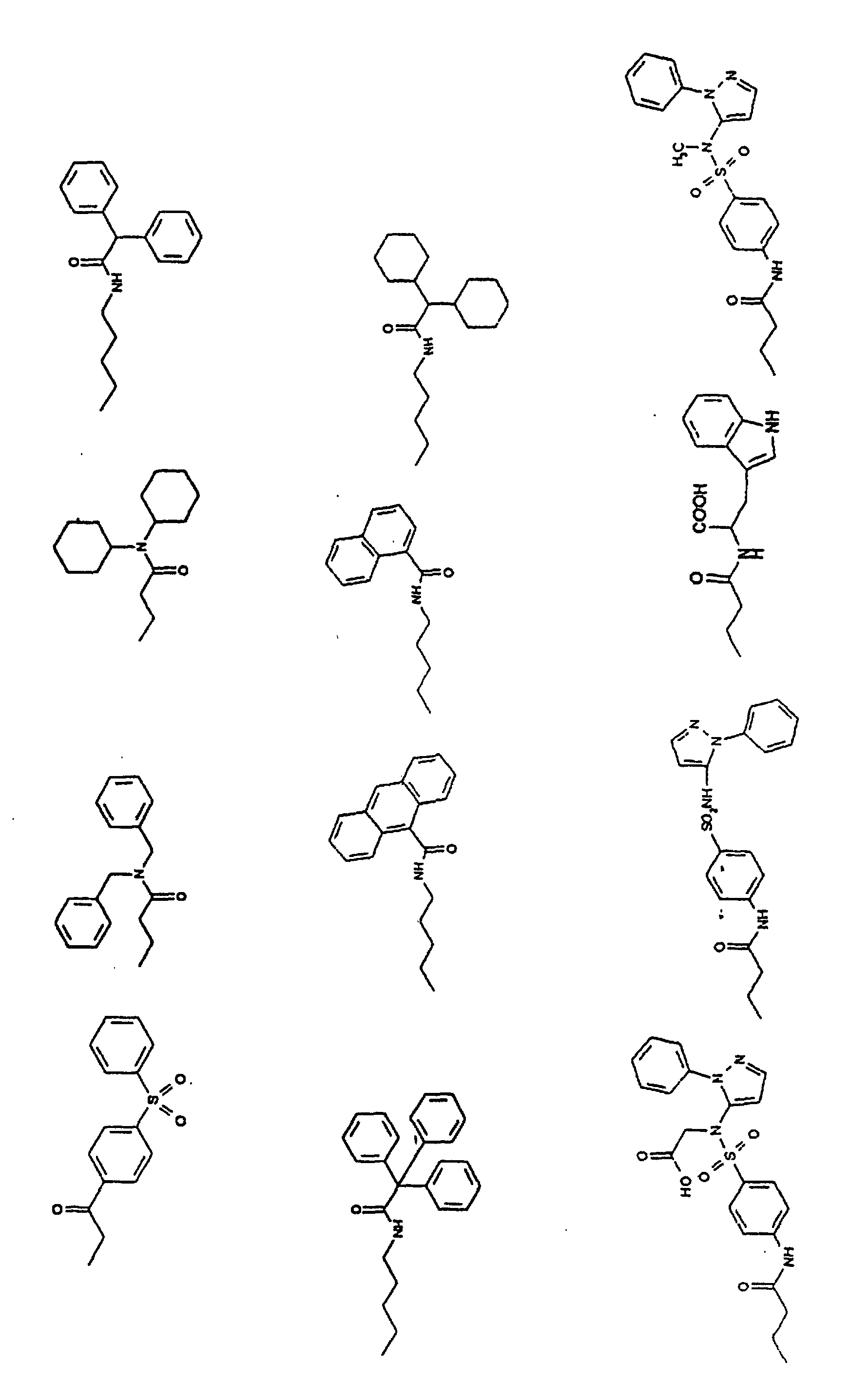
- R 1 and R 2 are the following:
- Particularly preferred classes of compounds within formula (I), are those of formula (II): and of formula (III): wherein:
- Particularly preferred classes of compounds within formula (I), are also those of formula (IV) and of formula (V), respectively, in which:
- particularly preferred compounds are those in which R 7 is cyclohexyl, phenyl, hydroxyphenyl or a 3,5-diiodothyronine residue; within formulae (IV) and (V), particularly preferred compounds are those in which R 9 is naphthalene, anthracene or indole and X is -NHCO.
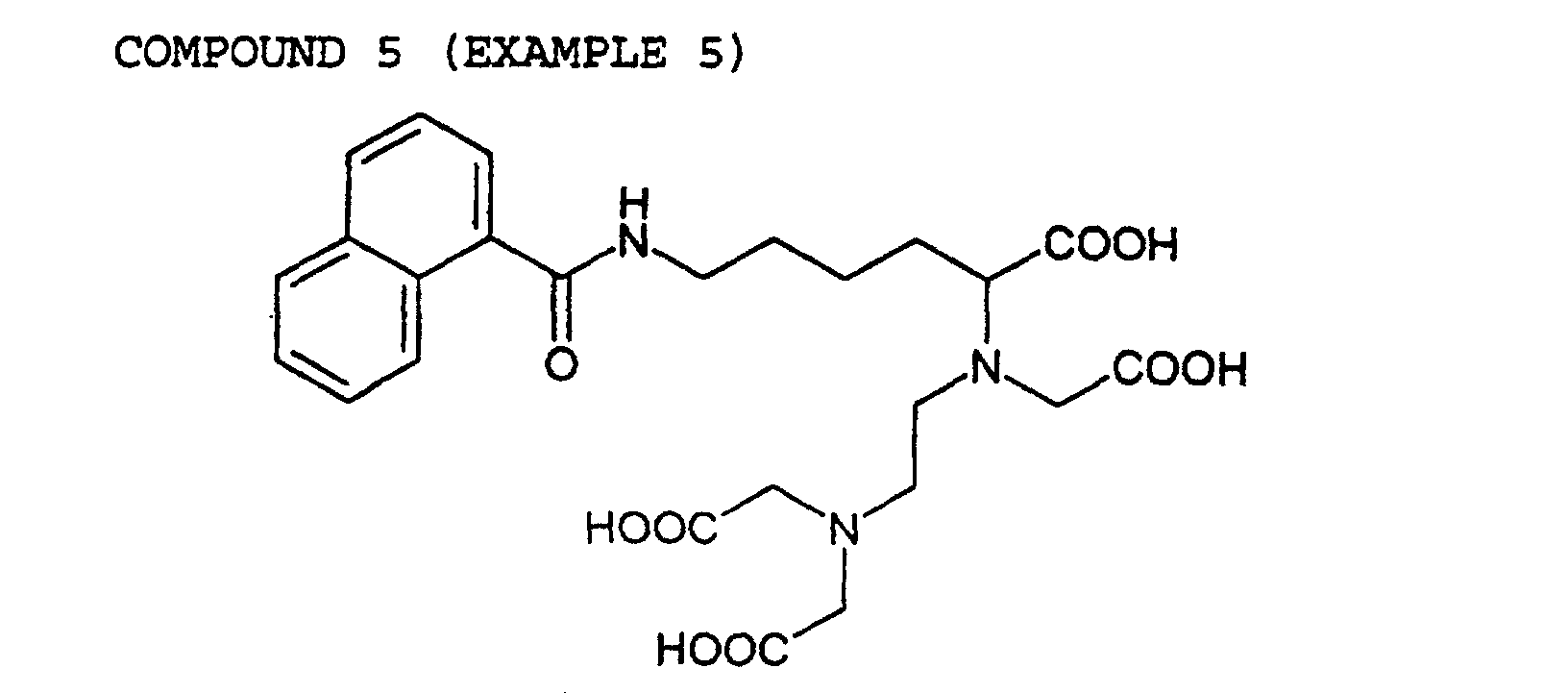
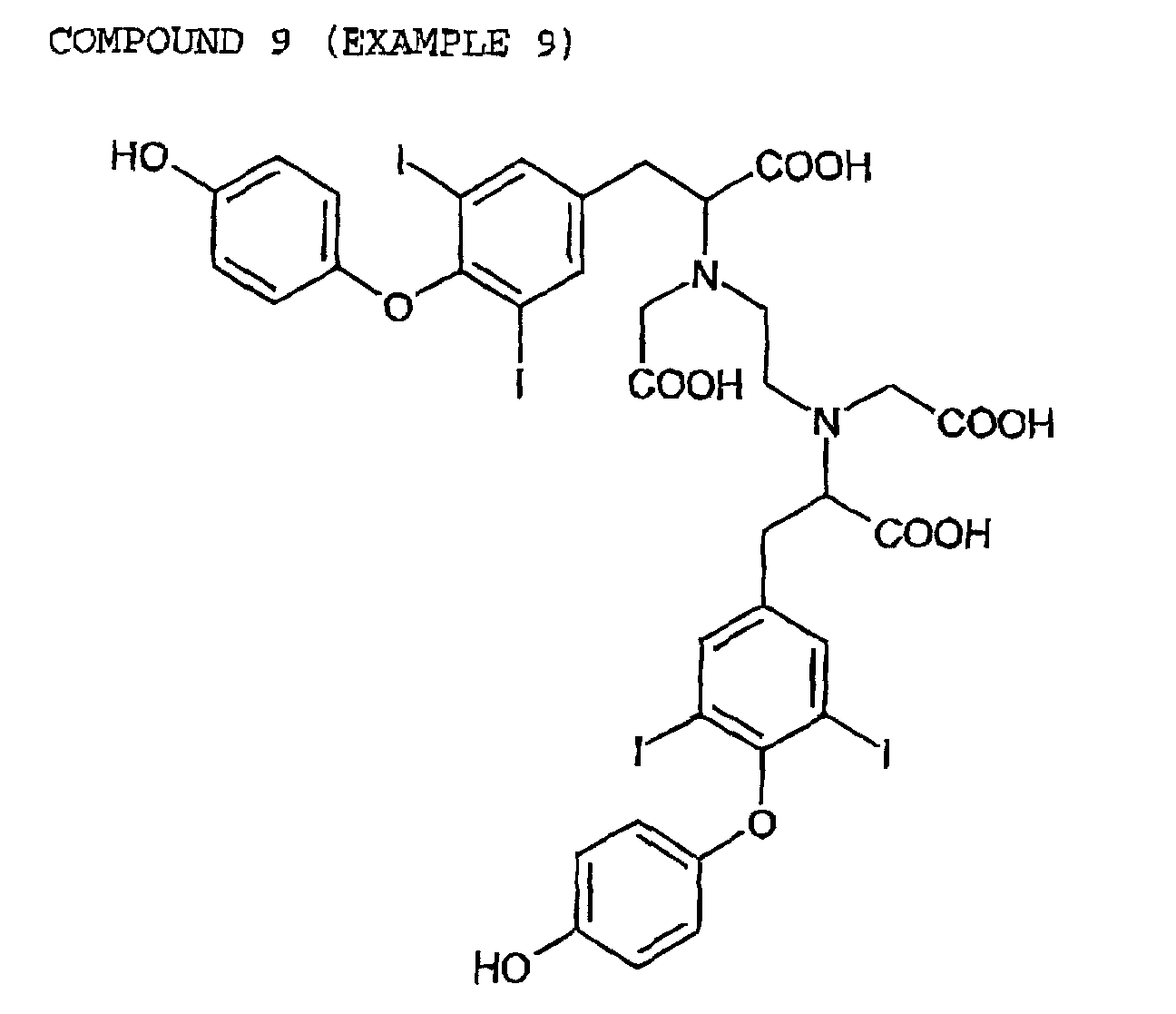
- manganese chelates included within formula (I), most preferred are those having as ligands the compounds shown hereinbelow:
- the present invention also relates to the use of the Mn 2+ chelated complexes of the chelating compounds of formulae (I) to (V) and to the salts thereof, for the preparation of pharmaceutical compositions for diagnostic use, as well as the formulations themselves.
- the chelated complexes of the invention have, in addition to a good stability, surprising relaxivity values in human serum. These characteristics allow to foresee interesting applicative uses thereof, in view of an improvement in the images obtainable using said compounds in the preparation of M.R.I. contrast agents for general use, as well as the possible use thereof in specific formulations for the imaging of the cardiocirculatory system.
- the chelates of the present invention are characterized in having particularly high r 2 values in human serum. This makes them most suitable, and this is a further aspect of the present invention, for use in M.R.I, diagnostic imaging in recording images of organs or tissues, wherein said images are acquired by T 2 weighed sequences. Furthermore, the considerable increase in relaxivity in human serum shown by the compounds of the invention allows the use thereof in diagnostic formulations requiring a low dosage of the contrast agent, said formulations providing good quality images, while assuring a significant improvement from the toxicologic point of view.
- contrastographic formulations containing the chelates of the invention can therefore be formulated with concentrations of contrast agent ranging from 0.001 to 1.0 mmol/mL, preferably from 0.01 to 0.5 mmol/mL; in particular, concentrations lower than 0.25 mmol/mL for the low-dosage formulations.
- Said formulations can be administered to the patient in doses ranging from 0.001 to 0.1 mmol/kg, preferably 0.1 mmol/kg; in particular, doses ranging from 5 to 50 ⁇ mol/kg when administered in low dosages.
- said chelated complexes proved to be particularly suitable also in the preparation of pharmaceutical formulations for M.R.I. diagnostic imaging at low fields, i.e. fields ranging from 0.1 to 0.5 Tesla or, when measuring the intensity of the applied magnetic field in Hertz, fields below 20 MHz (An introduction to Magnetic Resonance in Medicine, Ed. Peter A. Rinck).
- the compounds of the invention thanks to their excellent relaxivity shown even at such low fields, can advantageously be used with apparatuses such as Artroscan (arthrographs which make use of the Magnetic resonance), open apparatuses, apparatuses intended for diagnostic of single regions of the human body (e.g. the shoulder), and generally apparatuses less expensive, easier to handle and increasingly diffused.
- the chelates of the invention have also shown a good applicability in the imaging of the liver and of the biliary tracts, which organs are reached by said chelates, thus confirming their characteristics of stability.
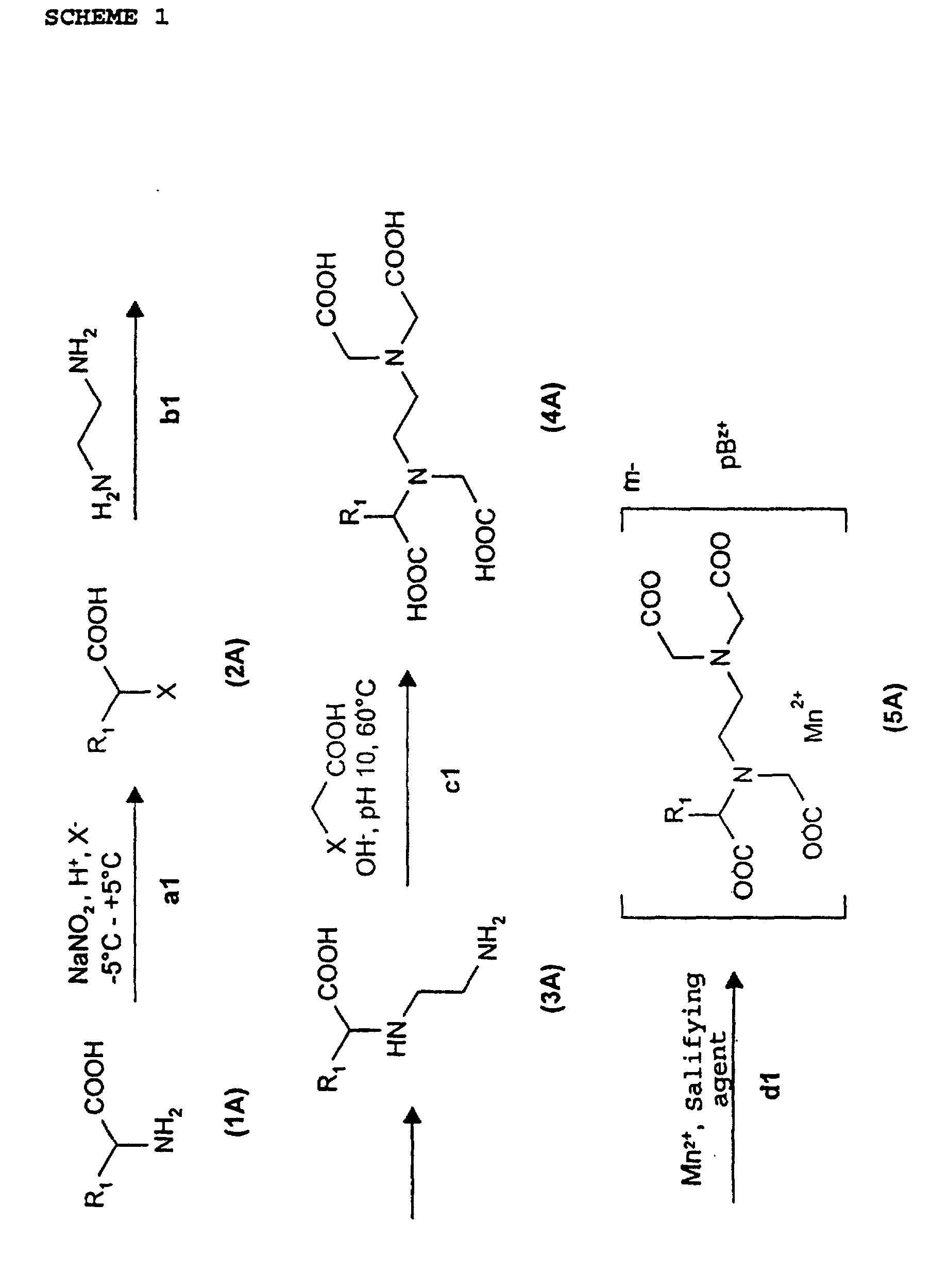
- step (a1) an ⁇ -amino acid (1A), natural or synthetic, is reacted with a suitable halide (e.g. KBr) in acid aqueous medium, in the presence of NaNO 2 and at a temperature which can range from -5 to +5°C.
- a suitable halide e.g. KBr
- the resulting ⁇ -haloacid (2A) is reacted, in step (b1), with 1,2-diaminoethane in aqueous solution, at a temperature from 20 to 40°C.
- the resulting intermediate (3A) is carboxymethylated in step (c1), in basic medium at pH 10 with an ⁇ -haloacetic acid (e.g. bromoacetic acid) at about 60°C, to give the free ligand (4A).
- an ⁇ -haloacetic acid e.g. bromoacetic acid
- step (d1) The latter is reacted in step (d1) with the stoichiometric amount of manganese, as salt, in the presence of the base amount necessary for the neutralization; the reaction is preferably carried out in water or in a suitable water-alcohol mixture, at 25 to 40°C; thereby obtaining the desired chelated complex (5A).
- a suitable ⁇ -amino acid (1B) is reacted with a 1,2-dihaloethane, such as 1,2-dibromoethane (2B) in a suitable solvent (e.g. water/ethanol, water/methanol mixtures), keeping pH at about 9 with a suitable buffer (preferably 2M borate buffer) at a temperature which can range from 60 to 90°C.
- a suitable solvent e.g. water/ethanol, water/methanol mixtures
- a suitable buffer preferably 2M borate buffer
- an ⁇ -haloacid (1B') can be reacted with 1,2-diaminoethane (2B') in aqueous solution at 20 to 60°C.
- the resulting intermediate (3B) is carboxymethylated in step (b2) with an ⁇ -haloacetic acid (e.g.
- Step (d1) comprises the protection of the alcoholic fraction of a 2-haloethanol (preferably 2-bromoethanol) with dihydropyran, to give intermediate (2D).
- the alcohol-protecting group can be, for example, benzyl or trityl.
- the reaction takes place in an organic solvent such as CH 2 Cl 2 , CHCl 3 , CH 2 ClCH 2 Cl, in the presence of 4-toluenesulfonic acid pyridinium salt or of another acid catalyst.
- the leaving group is preferably Br.
- step (d2) the ester (e.g. t-butyl ester) of a natural or synthetic ⁇ -amino acid (1D), either in the racemic or optically active form, is reacted with the intermediate (2D) in the presence of a base, such as diisopropylethylamine, in a solvent such as CH 3 CN, DMF or a chlorinated solvent, to give intermediate (3D).
- a base such as diisopropylethylamine
- step (d3) is reacted, in step (d3), with a bromoacetic acid ester (e.g. t -butyl-bromoacetate) in the presence of a base, such as diisopropylethylamine, to give intermediate (4D) which is reacted, in the subsequent step (d4), with 4-toluenesulfonic acid pyridinium salt or another acid catalyst, in an ethanol/water mixture, at a temperature of 20-60°C, to give intermediate (5D).
- a bromoacetic acid ester e.g. t -butyl-bromoacetate
- a base such as diisopropylethylamine
- step (d5) intermediate (5D) is brominated with N-bromosuccinimide in the presence of triphenylphosphine, to give intermediate (6D), which is reacted, in step (d6), with the ester (e.g. t-butyl ester) of an ⁇ -amino acid (7D), in a suitable solvent (e.g. CH 3 CN/buffer phosphate pH 8), to give intermediate (8D).
- a bromoacetic acid ester e.g. t-butyl-bromoacetate
- a base such as diisopropylethylamine
- step (d8) is deprotected in step (d8) with known methods (e.g. hydrolysis with CF 3 COOH or (CH 3 ) 3 SiI, when the protective group is t -butyl) to give the free ligand (10D), which is subsequently complexed and salified according to the general procedure already described in the above schemes.
- known methods e.g. hydrolysis with CF 3 COOH or (CH 3 ) 3 SiI, when the protective group is t -butyl
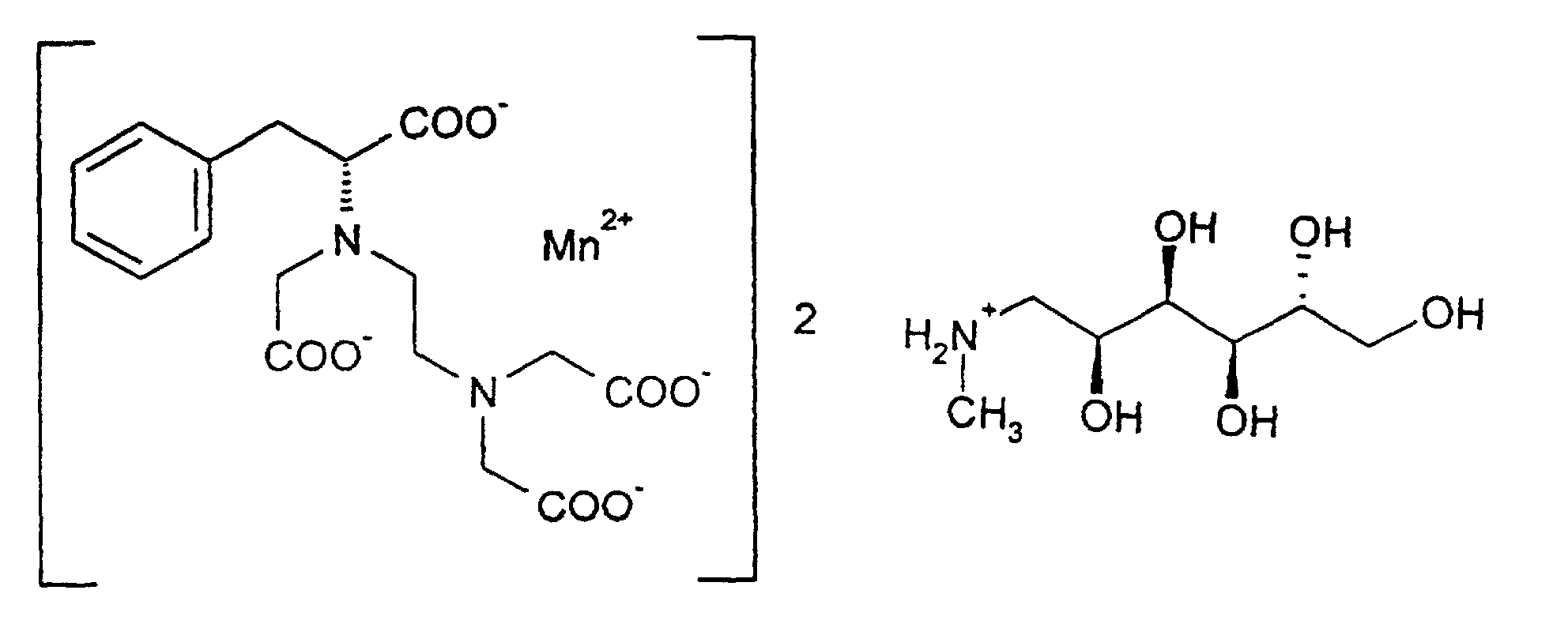
- the free ligand from the previous step (7.45 g; 0.0158 mol) was suspended in H 2 O (35 mL) and solubilised with 1 M 1-deoxy-1-(methylamino)-D-glucitol (24 mL; 0.024 mol) at pH 3.4. Afterwards, an aqueous solution of 0.964 M MnCl 2 (15.56 mL; 0.015 mol) was added in one hour, keeping pH 6 by addition of 1-deoxy-1-(methylamino)-D-glucitol 1 M (35.6 mL; 0.0356 mol).
- the relaxivity of the compounds of the invention was measured both in saline solution and in human serum, reconstituted from Seronorm (R) Human (Nycomed Pharma), lyophilized human serum, and the resulting data are summarized in TABLES 1 and 2.
- TABLE 2 comprises the results obtained from tests carried out under the same experimental conditions as above and in which r 1 and r 2 relaxivities were measured in serum and in aqueous solution at lower fields, precisely at 5 and 10 MHz. Said data evidence the significant increase in relaxivity obtained in serum already at 5 MHz and are indicative of the potential advantageous use of the compounds of the invention in M.R.I. diagnostic imaging at low fields.
Landscapes
- Chemical & Material Sciences (AREA)
- Organic Chemistry (AREA)
- Health & Medical Sciences (AREA)
- Life Sciences & Earth Sciences (AREA)
- Radiology & Medical Imaging (AREA)
- Epidemiology (AREA)
- Nuclear Medicine, Radiotherapy & Molecular Imaging (AREA)
- Animal Behavior & Ethology (AREA)
- General Health & Medical Sciences (AREA)
- Public Health (AREA)
- Veterinary Medicine (AREA)
- Organic Low-Molecular-Weight Compounds And Preparation Thereof (AREA)
- Medicines Containing Antibodies Or Antigens For Use As Internal Diagnostic Agents (AREA)
- Indole Compounds (AREA)
- Investigating Or Analysing Biological Materials (AREA)
Description
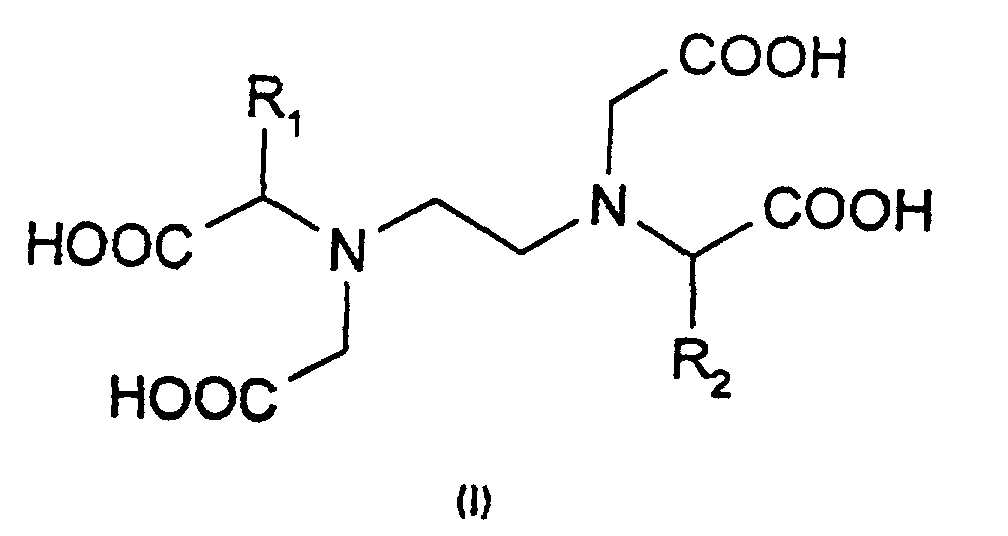
- R1, R2
- are independently a hydrogen atom, or a straight or branched (C1-C20) alkyl chain, saturated or unsaturated, being said chain optionally interrupted by one or more nitrogen or sulfur atoms, as well as by -CO-, -CONH-, -NHCO-, -SO-, -SO2-, -SO2NH- groups, or optionally substituted by one or more NH2, OH, halogen, COOH groups and the respective ester or amide derivatives, said chain being in any case interrupted or substituted by one or more R3 cyclic residues, which are the same or different, non-fused or fused, with the proviso that, when some of the R3 residues are fused together, the maximum number of rings forming the corresponding polycyclic unit is three, wherein
- R3
- is a 5- or 6- membered cyclic unit, carbocyclic or heterocyclic, saturated, unsaturated or aromatic, being said cyclic units unsubstituted or substituted with one or more R4 groups, which are the same or different, wherein
- R4
- is OH, halogen, NHR5, N(R5)2, -O-R5, -S-R5, or
-CO-R5, wherein the R5 groups, which are the same
or different, are a straight or branched (C1-C5)
alkyl, unsubstituted or substituted with one or
more hydroxy and/or alkoxy and/or carboxy groups,
or R4 is a COOH group, or an ester or amido derivative thereof, or a -SO3H group or an amido derivative thereof,
or R4 is a -O-R6 group, wherein R6 is a 5- or 6-membered cyclic unit, carbocyclic or heterocyclic, saturated, unsaturated or aromatic, being said cyclic unit optionally substituted by one or more OH, halogen, -NHR5, -N(R5)2, -O-R5, -S-R5, -CO-R5 groups, wherein R5 has the meanings defined above, or by one or more -COOH groups, or the ester or amido derivatives thereof, or -SO3H or amido derivatives thereof,
as well as the chelates thereof with the manganese ion in the oxidation state +2 (Mn(II)) and the salts thereof with physiologically compatible organic bases selected from primary, secondary, tertiary amines or basic amino acids, or with inorganic bases whose cations are sodium, potassium, magnesium, calcium, or mixtures thereof.
- cations of inorganic bases such as alkali or alkaline-earth metals ions selected from sodium, potassium, magnesium, calcium, or mixtures thereof;
- cations of physiologically compatible organic bases selected from primary, secondary and tertiary amines such as ethanolamine, diethanolamine, morpholine, glucamine, N-methylglucamine, N,N-dimethylglucamine;
- cations of amino acids such as those of lysine, arginine or ornithine.



- R7
- is a 5- or 6- membered cyclic unit, carbocyclic or heterocyclic, saturated, unsaturated or aromatic, optionally substituted by one or more groups selected from OH, halogen, COOH or an ester or amido derivative thereof, -SO3H or an amido derivative thereof, or -R5, -NHR5, -N(R5)2, -O-R5, -S-R5, wherein R5 has the meanings defined above, or from a group selected from -O-R8 and -CH2R8 wherein R8 is a further 5- or 6- membered cyclic unit, carbocyclic or heterocyclic, saturated, unsaturated or aromatic, optionally substituted by one or more groups selected from OH, COOH and halogen;
- n =
- 1-6.


- R9
- is a group comprising 2 or 3 cyclic units, non-fused or fused, which are the same or different, wherein said units can be carbocyclic, heterocyclic, saturated, unsaturated or aromatic;
- n =
- 1-6;
- m =
- 0 or 1;
- X =
- -NHCO, -CONH, -CONH-CH2-.








m.p. : 230°C dec.
Acidic titer (0.1 M NaOH) : 100.9%
Argentometric titer (0.1 M AgNO3) : 100%
HPLC : 100% (% area)The 13C-NMR (D2O), MS and IR spectra are consistent with the indicated structure. [α] 20 / λ(c 2, H2O)
| λ(nm) | 589 | 436 |
| [α] 20 / λ | -8.73° | -25.15° |
| Elementary analysis (%): | |||||
| C | H | N | Cl | H2O | |
| Calculated | 46.99 | 6.45 | 9.96 | 25.22 | |
| Found | 46.76 | 6.65 | 9.93 | 24.82 | <0.1 |
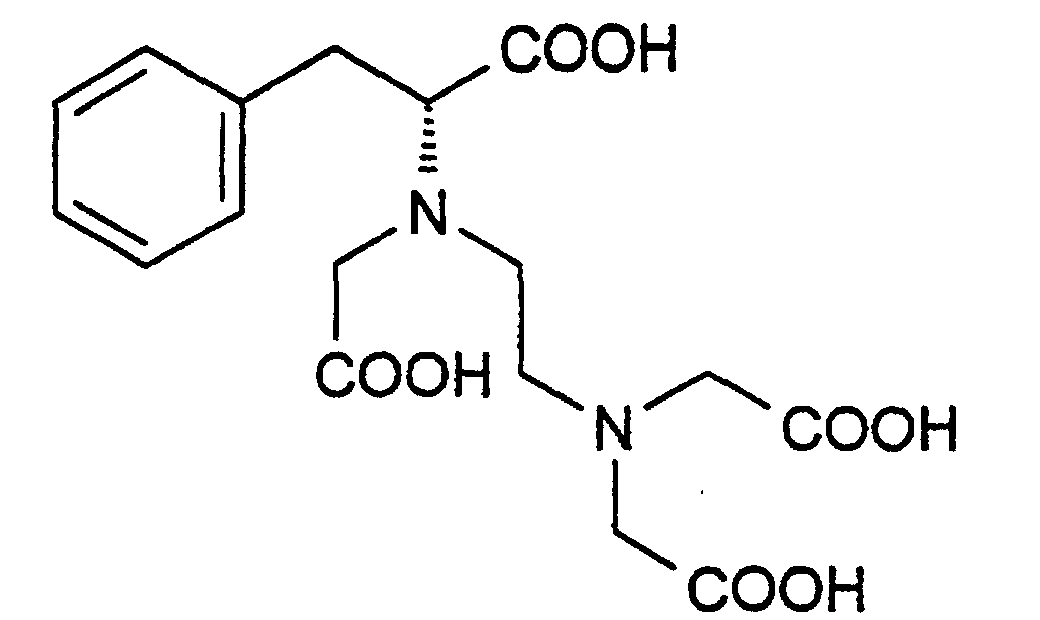
m.p. : 120°C
Acidic titer (0.1 M NaOH): 101 %
Complexometric titer (0.1 M ZnSO4): 96.8%
HPLC : 98% (% area)The 13C-NMR, 1H-NMR and MS spectra are consistent with the indicated structure.
[α] 20 / λ:(c 1, MeOH)
| λ (nm) | 589 | 436 |
| [α] 20 / λ | -33,5° | -65.6° |
| Elementary analysis (%): | ||||||
| C | H | N | Br | Cl | Na | |
| Calculated | 53.40 | 5.80 | 7.32 | |||
| Found | 53.67 | 5.75 | 7.34 | <0.1 | <0.1 | <0.18 on the anhydrous |
m.p.: 110°C
HPLC: 98.4% (% area) -
| Elementary analysis (%): | |||||
| C | H | Mn | N | Cl | |
| Calculated | 45.09 | 6.59 | 6.65 | 6.78 | |
| Found | 45.47 | 6.52 | 6.39 | 6.76 | <0.1 on the anhydrous |

m.p. 260°C dec.
Acidic titer: 104.4%
HPLC: 100% (% area)The 1H-NMR, 13C-NMR, MS and IR spectra are consistent with the indicated structure.
[α]20 (c 1,5; NaOH 0,1 M)
| λ (nm) | 589 | 436 |
| [α]20 | +40.92° | +93.78° |
| Elementary analysis (%): | |||
| C | H | N | |
| Calculated | 67.40 | 6.79 | 7.86 |
| Found | 67.22 | 6.83 | 7.81 |

m.p. : 148-151°C dec.
Acidic titer (0.1 M NaOH): 99%
Complexometric titer (0.1 M ZnSO4) : 97.7%
HPLC: 100% (% area)The 13C-NMR, 1H-NMR, IR and MS spectra are consistent with the indicated structure.
[α] 20 / λ:(c 1,5; NaOH 0,1 M)
| λ(nm) | 589 | 436 |
| [α] 20 / λ | +13.04° | +30.05° |
| Elementary analysis (%): | |||
| C | H | N | |
| Calculated | 61.01 | 5.97 | 5.93 |
| Found | 60.91 | 5.93 | 5.91 on the anhydrous |
m.p.: 105°C
HPCE: 98.7% (% area)
| Elementary analysis (%): | ||||
| C | H | Mn | N | |
| Calculated | 49.83 | 6.60 | 5.99 | 6.12 |
| Found | 49.81 | 6.53 | 6.05 | 6.16 after drying at 90°C |


b.p.: 85 - 90°C at 5.3 Pa
Acidic titer (0.1 N HCl) : 99.7%;
HPLC: 98% (% area)The 1H-NMR, 13C-NMR, MS and IR spectra are consistent with the indicated structure.
[α] 20 / D: + 16,64°(c 5,29; CHCl3)
| Elementary analysis (%): | |||
| C | H | N | |
| Calculated | 70.56 | 8.65 | 6.33 |
| Found | 71.21 | 8.89 | 6.61 |
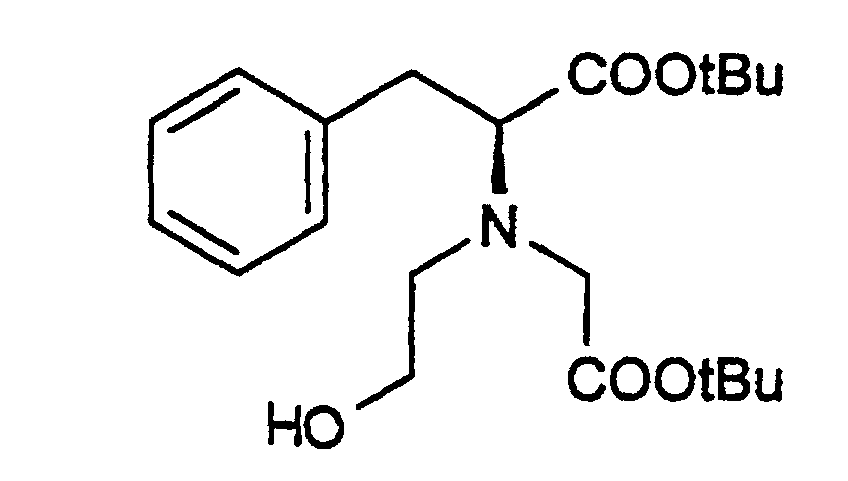
[α] 20 / D: -19,15° (c 5,08; CHCl3)In another preparation the compound was purified by flash chromatography (Stationary phase: silica gel 230-400 mesh Merck KGaA art. 9385. Eluent: n-hexane/EtOAc 4:1) and used for the analytical characterization.
Acidic titer (0.1 N HClO4): 98.6%.
HPLC: 97.4 % (% area)The 1H-NMR, 13C-NMR, MS and IR spectra are consistent with the indicated structure.
| Elementary analysis (%): | |||
| C | H | N | |
| Calculated | 66.46 | 8.76 | 3.69 |
| Found | 66.13 | 9.32 | 3.68 |

Stationary phase: Silica gel plates 60 F254 (Merck KGaA cod. 5715)
Eluent: n-hexane/EtOAc 4:1
Detection: 1% KMnO4 in 1 N NaOH
HPLC: 92% (% area) -
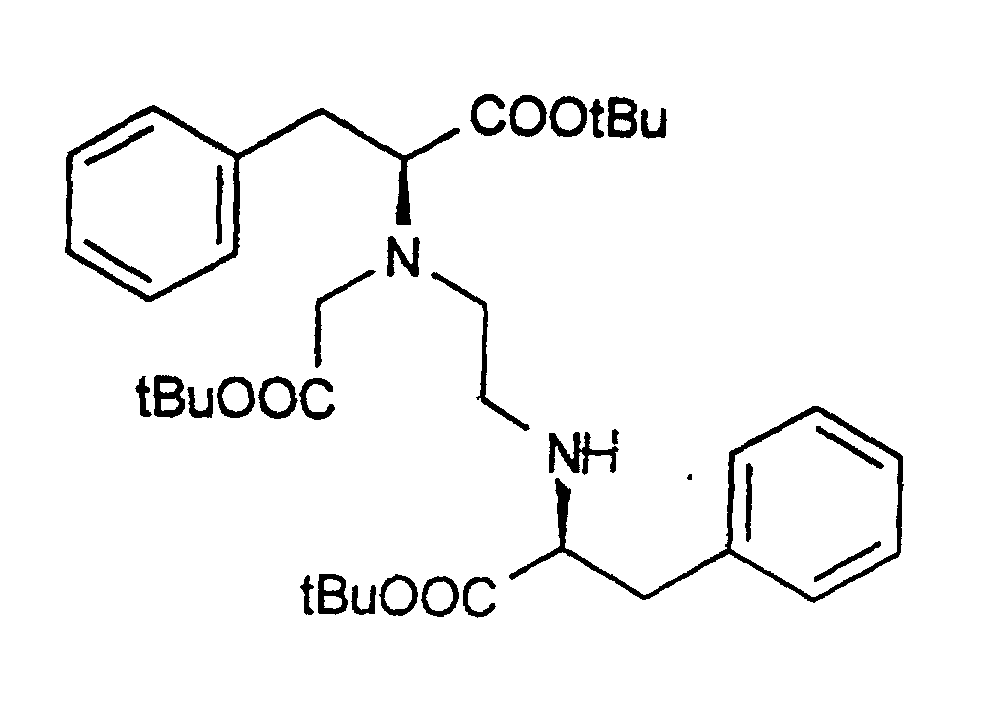
TLC: Rf 0.25
Stationary phase: Silica gel plates 60 F254 (Merck KGaA Cod. 5715)
Eluent: n-hexane/EtOAc 4:1
Detection: 1% KMnO4 in 1 N NaOH
HPLC: 100% (% area) -The 13C-NMR, MS and IR spectra are consistent with the indicated structure.
[α] 20 / 365: +12,82° (c 5, CHCl3)
| Elementary analysis (%): | |||
| C | H | N | |
| Calculated | 70.07 | 8.65 | 4.80 |
| Found | 70.15 | 8.86 | 5.05 |

TLC: Rf 0.6
Stationary phase: Silica gel plates 60 F254 (Merck KGaA Cod. 5715)
Eluent: n-hexane/EtOAc 4:1
Detection: 1% KMnO4 in 1 N NaOH
HPLC: 100% (% area) -The 13C-NMR, MS and IR spectra are consistent with the indicated structure.
[α] 20 / λ (c 5, CHCl3):
| λ (nm) | 365 | 405 | 436 | 546 | 578 | 589 |
| [α] 20 / λ | -94.26° | -68.93° | -56.04° | -32.11° | -28.15° | -26,02° |
| Elementary analysis (%): | |||
| C | H | N | |
| Calculated | 68.94 | 8.68 | 4.02 |
| Found | 69.00 | 9.01 | 4.00 after drying at 80°C |
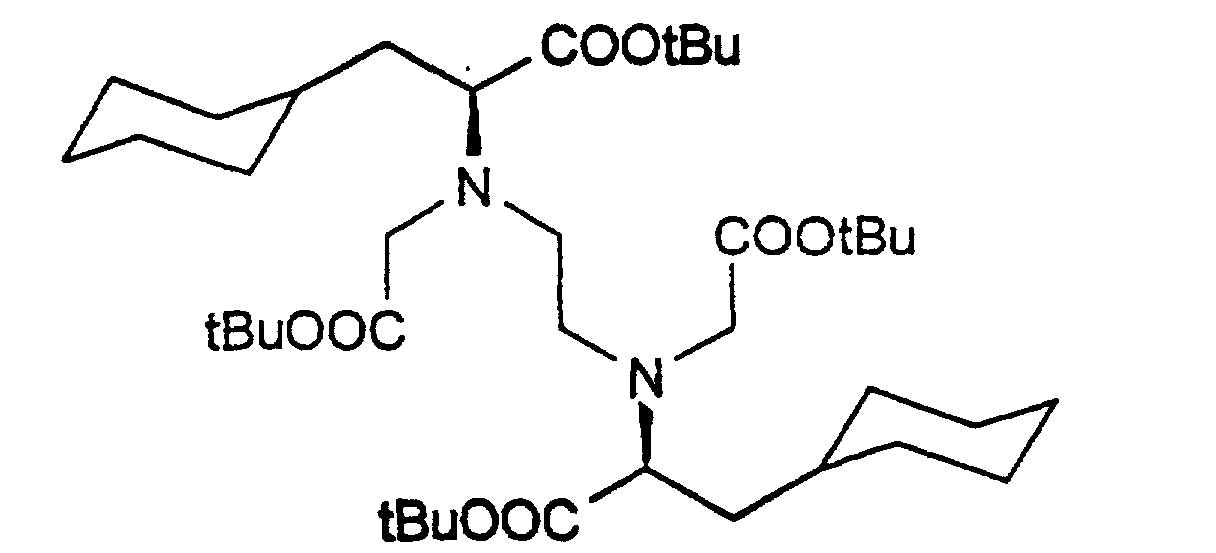
TLC: Rf 0.33
Stationary phase: Silica gel plates 60 F254 (Merck KGaA Cod. 5715)
Eluent: n-hexane/EtOAc 95:5
Detection: 1% KMnO4 in 1 N NaOHThe 13C-NMR, MS and IR spectra are consistent with the indicated structure.
[α] 20 / λ (c 5, CHCl3):
| X | 365 | 405 | 436 | 546 | 578 | 589 |
| [α] 20 / λ | -111.61° | -82.10° | -67.20° | -38.76° | -34.00° | -32.37° |
| Elementary analysis (%) : | |||
| C | H | N | |
| Calculated | 67.76 | 10.24 | 3.95 |
| Found | 67.97 | 10.43 | 3.86 after drying at 80°C |

m.p.: 205°C dec.
Acidic titer: 98%
Complexometric titer (0.1 M ZnSO4): 97%
TLC: Rf 0.66
Stationary phase: Silica gel plates 60 F254 (Merck KGaA cod. 5715)
Eluent: CHCl3/AcOH/H2O 5:5:1
Detection: 1% KMnO4 in 1 N NaOHThe 1H-NMR, 13C-NMR, MS and IR spectra are consistent with the indicated structure.
| Elementary analysis (%): | |||
| C | H | N | |
| Calculated | 59.48 | 8.32 | 5.78 |
| Found | 59.96 | 8.40 | 5.58 on the anhydrous |
m.p.: 98-101%The MS and IR spectra are consistent with the indicated structure.
| Elementary analysis (%): | ||||
| C | H | Mn | N | |
| Calculated | 49.18 | 7.82 | 5.92 | 6.04 |
| Found | 49.44 | 7.99 | 5.93 | 6.01 on the anhydrous |

C.A.S. [21957-42-6]

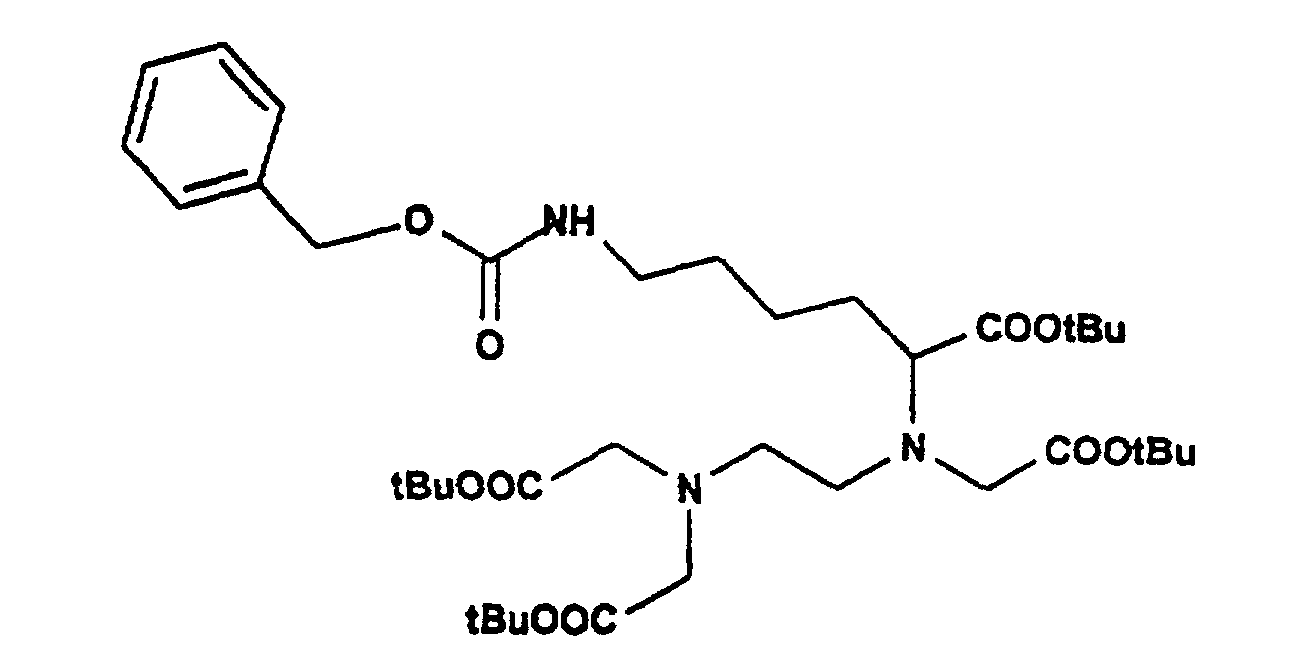


m.p.: 173°C.

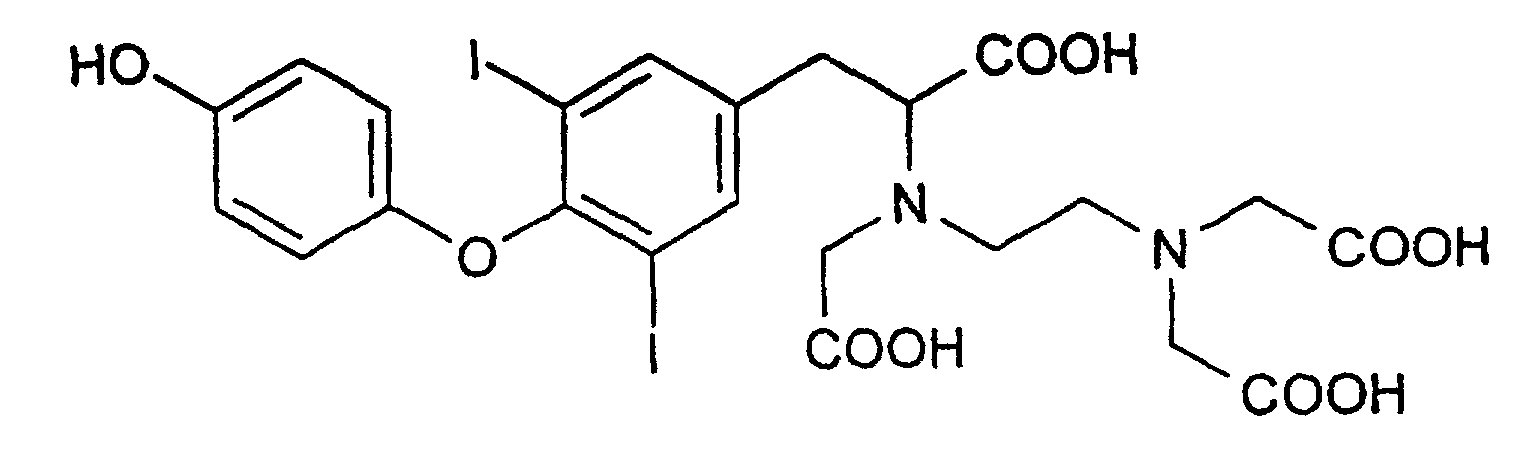


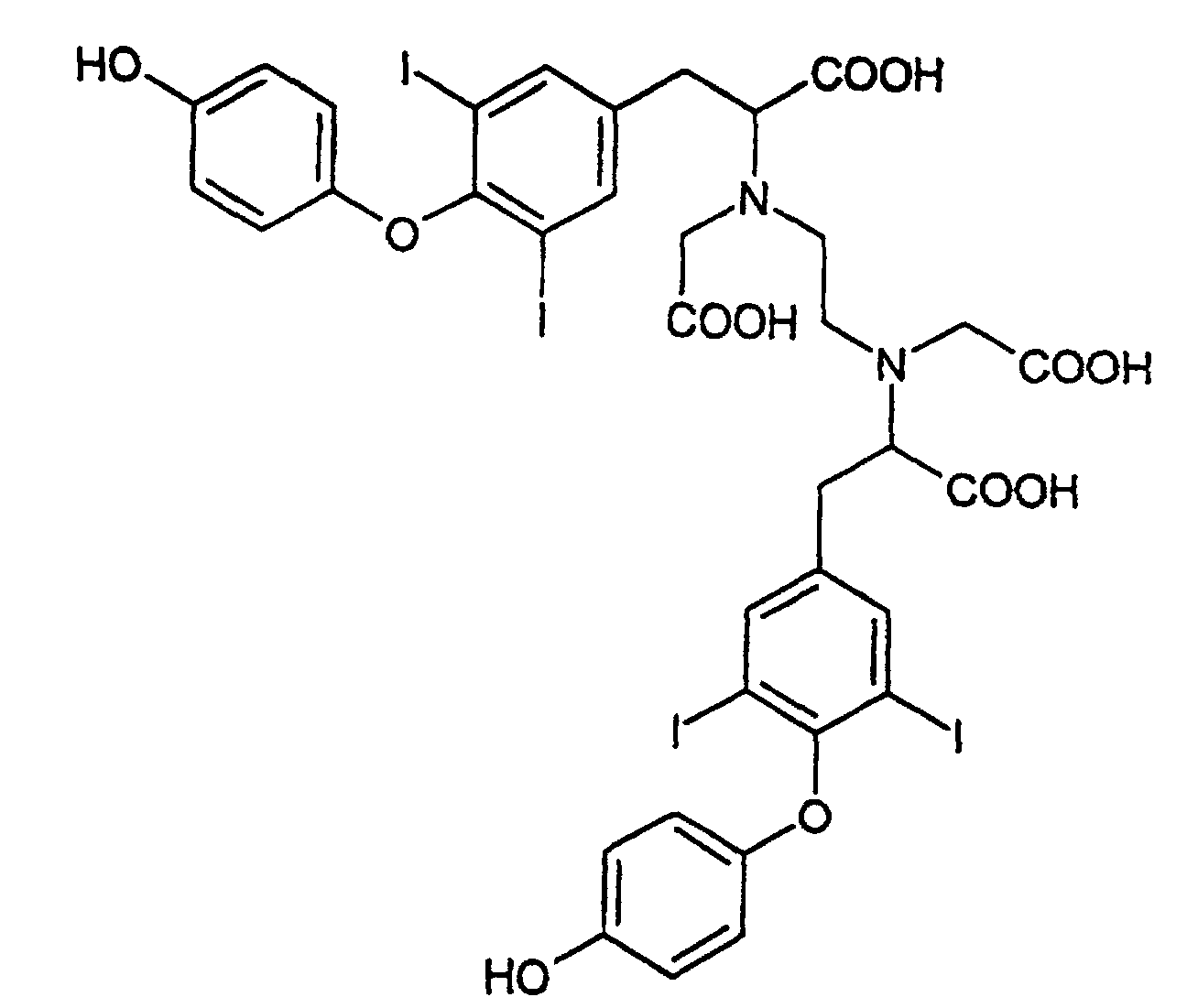


| Compound | Relaxivity (mM-1s-1) | |||
| Aqueous solution | Seronorm™ Human | |||
| r1 | r2 | r1 | r2 | |
| MnCl2 | 6.59 | 39.18 | 53 | 75 |
| Mn-DPDP | 2.8 | 3.7 | ||
| Example 1 | 2.93 | 4.45 | 15 | 19 |
| Example 2 | 3.15 | 4.25 | 27 | 36 |
| Example 3 | 3.52 | 5.09 | 43 | 56 |

Claims (30)
- Chelates of compounds of formula (I) with Mn2+, both in the racemic and optically active forms:wherein:

- R1, R2
- are independently a hydrogen atom, or a straight or branched (C1-C20) alkyl chain, saturated or unsaturated, being said chain optionally interrupted by one or more nitrogen or sulfur atoms, as well as by -CO-, -CONH-, -NHCO-, -SO-, -SO2-, -SO2NH- groups, or optionally substituted by one or more NH2, OH, halogen, COOH groups and the respective ester or amide derivatives, said chain being in any case interrupted or substituted by one or more R3 cyclic residues, which are the same or different, non-fused or fused, with the proviso that, when some of the R3 residues are fused together, the maximum number of rings forming the corresponding polycyclic unit is three, wherein
- R3
- is a 5- or 6- membered cyclic unit, carbocyclic or heterocyclic, saturated, unsaturated or aromatic, being said cyclic units unsubstituted or substituted with one or more R4 groups, which are the same or different, wherein
- R4
- is OH, halogen, NHR5, N(R5)2, -O-R5, -S-R5, or -CO-R5, wherein the
R5 groups, which are the same or different, are a straight or branched
(C1-C5) alkyl, unsubstituted or substituted with one or more hydroxy
and/or alkoxy and/or carboxy groups,
or R4 is a COOH group, or an ester or amido derivative thereof, or a -SO3H group or an amido derivative thereof,
or R4 is a -O-R6 group, wherein R6 is a 5- or 6- membered cyclic unit, carbocyclic or heterocyclic, saturated, unsaturated or aromatic, being said cyclic unit optionally substituted by one or more OH, halogen, -NHR5, -N(R5)2, -O-R5, -S-R5, -CO-R5 groups, wherein R5 has the meanings defined above, or by one or more -COOH groups, or the ester or amido derivatives thereof, or -SO3H or amido derivatives thereof,
as well the salts thereof with physiologically compatible organic bases selected from primary, secondary, tertiary amines or basic amino acids; or with inorganic bases whose cations are sodium, potassium, magnesium, calcium, or mixtures thereof. - Chelates as claimed in claim 1 wherein R1 and R2, when different from H, are selected from:
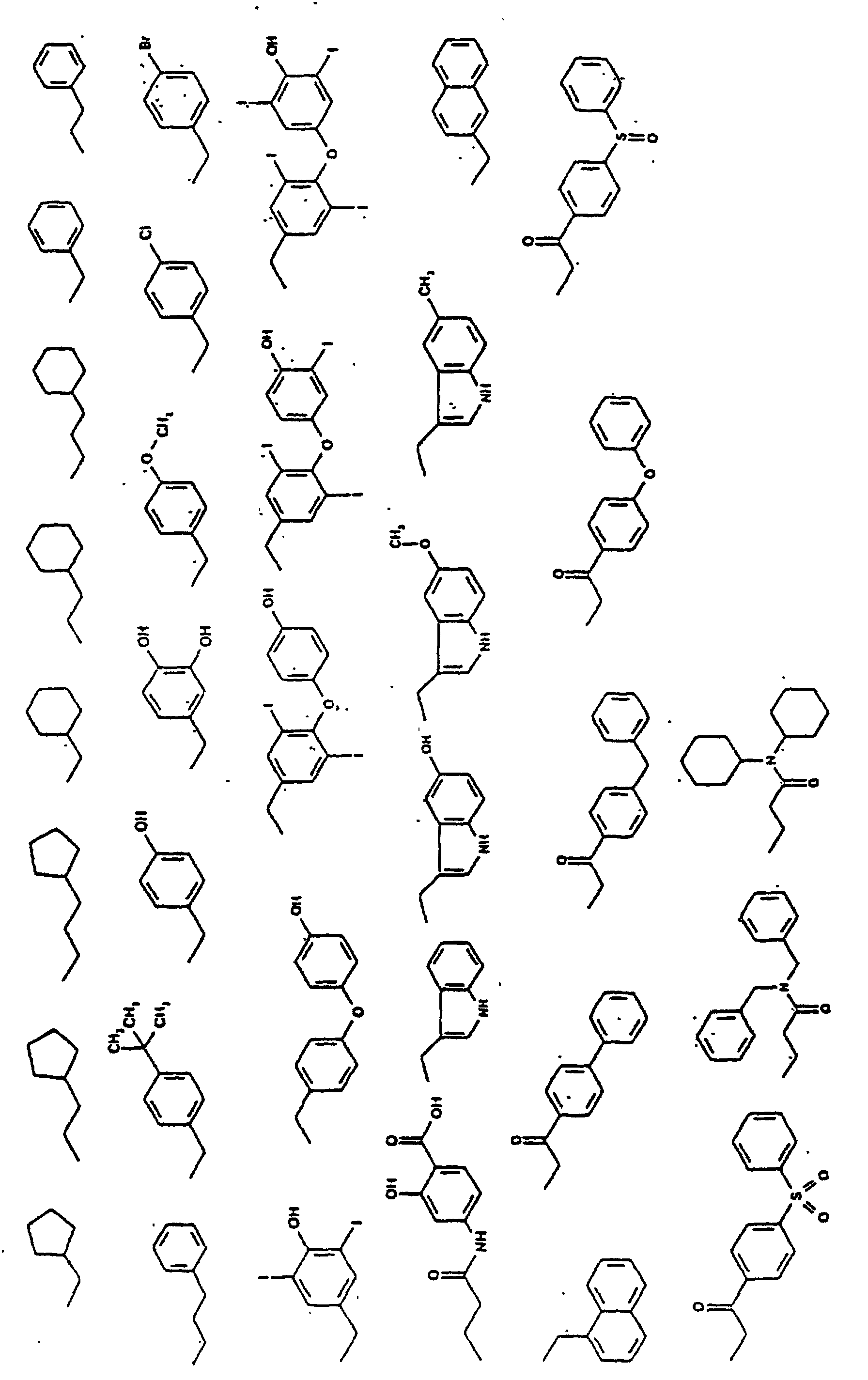
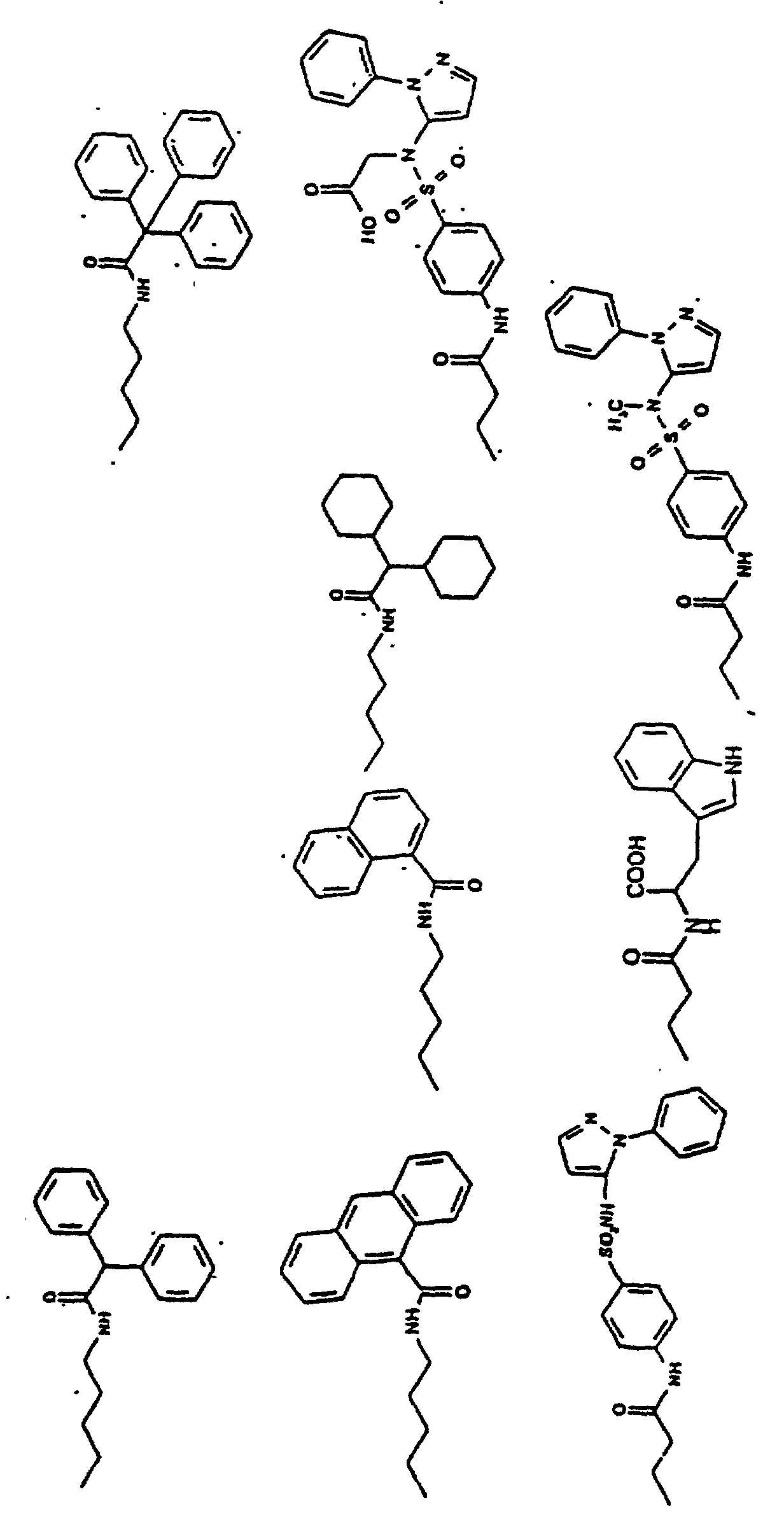
- Chelates according to claims 1 and 2 of compounds (II), both in the racemic and optically active formswherein:

- R7
- is a 5- or 6- membered cyclic unit, carbocyclic or heterocyclic, saturated, unsaturated or aromatic, optionally substituted by one or more groups selected from OH, halogen, COOH or an ester or amido derivative thereof, -SO3H or an amido derivative thereof, or -R5, -NHR5, -N(R5)2, -O-R5, -S-R5, wherein R5 has the meanings defined above, or from a group selected from -O-R8 and -CH2R8 wherein R8 is a further 5- or 6-membered cyclic unit, carbocyclic or heterocyclic, saturated, unsaturated or aromatic, optionally substituted by one or more groups selected from OH, COOH and halogen; and
as well as the salts thereof with physiologically compatible organic bases selected from primary, secondary, tertiary amines or basic amino acids, or with the inorganic bases whose cations are sodium, potassium, magnesium, calcium or mixtures thereof. - Chelates as claimed in claim 1, of compounds (III), both in the racemic and optically active formswherein:

- R7
- is a 5- or 6- membered cyclic unit, carbocyclic or heterocyclic, saturated, unsaturated or aromatic, optionally substituted by one or more groups selected from OH, halogen, COOH or an ester or amido derivative thereof, -SO3H or an amido derivative thereof, or -R5, -NHR5, -N(R5)2, -O-R5, -S-R5, wherein R5 has the meanings defined above, or by a group selected from -O-R8 and -CH2R8 wherein R8 is a further 5- or 6-membered cyclic unit, carbocyclic or heterocyclic, saturated, unsaturated or aromatic, optionally substituted by one or more groups selected from OH, COOH and halogen; and
as well as the salts thereof with physiologically compatible organic bases selected from primary, secondary, tertiary amines or basic amino acids, or with the inorganic bases whose cations are sodium, potassium, magnesium, calcium or mixtures thereof. - Chelates, according to claims 1 and 2, of compounds (IV), both in the racemic and optically active formswherein:
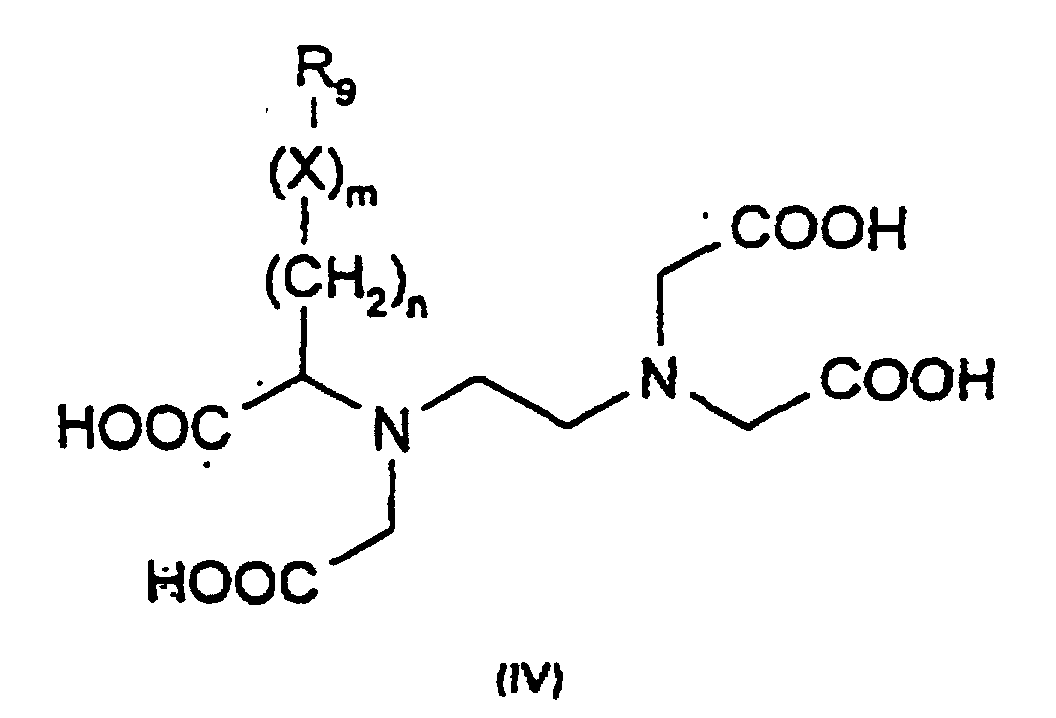
- R9
- is a group comprising 2 or 3 cyclic units, non-fused or fused, which are the same or different, wherein said unit can be carbocyclic, heterocyclic, saturated, unsaturated or aromatic;
m = 0 or 1;
X=-NHCO; -CONH,-CONH-CH2-,
as well as the salts thereof with physiologically compatible organic bases selected from primary, secondary, tertiary amines or basic amino acids, or with the inorganic bases whose cations are sodium, potassium, magnesium, calcium or mixtures thereof. - Chelates, according to claims 1 and 2, of compounds (V), both in the racemic and optically active formswherein:

- R9
- is a group comprising 2 or 3 cyclic units, non-fused or fused, which are the same or different, wherein said units can be carbocyclic, heterocyclic, saturated, unsaturated or aromatic and
m = 0 or 1;
X = -NHCO, -CONH, -CONH-CH2-,
as well as the salts thereof with physiologically compatible, organic bases selected from primary, secondary, tertiary amines or basic amino acids, or with the inorganic bases whose cations are sodium, potassium, magnesium, calcium or mixtures thereof. - Chelates according to claims 3 and 4 wherein R7 is cyclohexyl, phenyl, hydroxyphenyl or a 3,5-diiodothyronine residue, as well as the salts thereof with physiologically compatible, organic bases selected from primary, secondary, tertiary amines or basic amino acids, or with the inorganic bases whose cations are sodium, potassium, magnesium, calcium or mixtures thereof.
- Chelates according to claims 5 and 6 wherein R9 is naphthalene, anthracene or indole and X is -NHCO, as well as the salts thereof with physiologically compatible organic bases selected from primary, secondary, tertiary amines or basic amino acids, or with the inorganic bases whose cations are sodium, potassium, magnesium, calcium or mixtures thereof.
- Chelates according to claims 1 to 8 in which the physiologically compatible organic base is 1-deoxy-1-(methylamino)-d-glucitol.
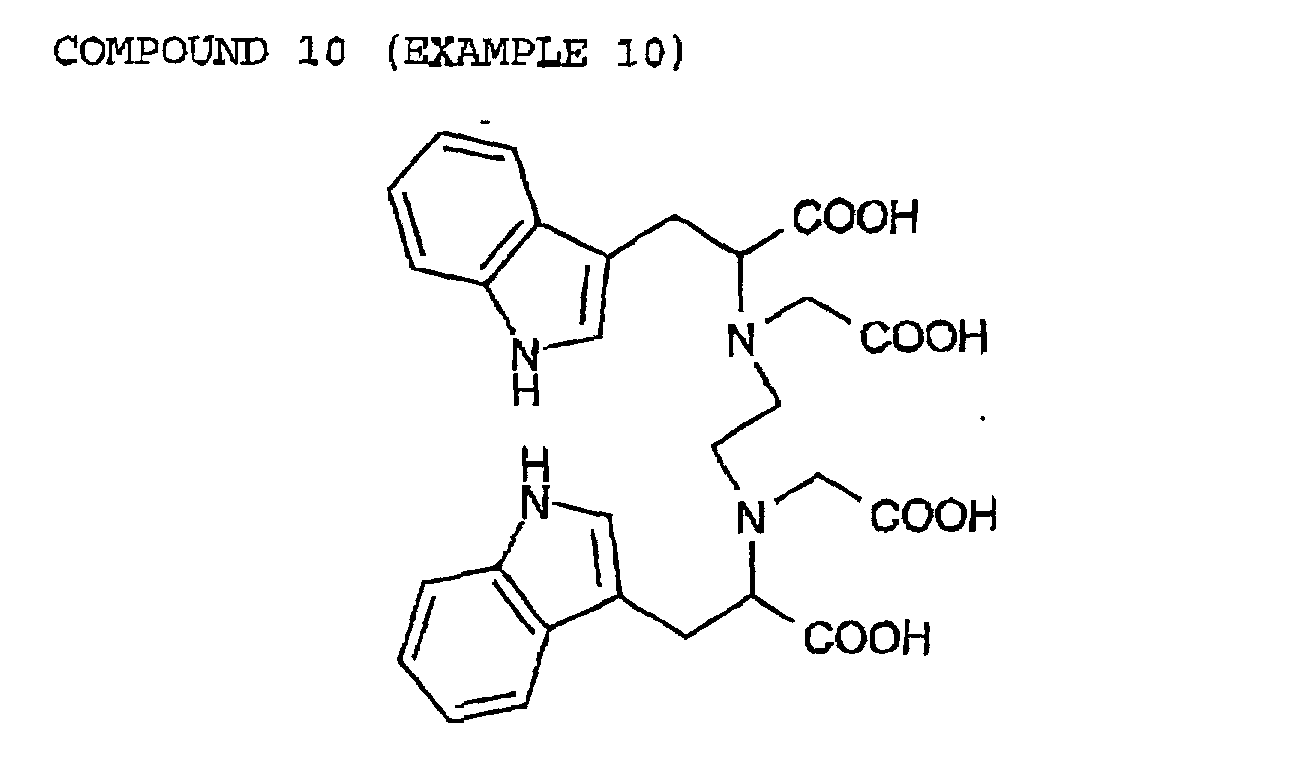
- Chelated complex salts according to claims 1 to 9 selected from:manganese complex of N-[2-[bis(carboxymethyl)amino)ethyl)-N-(carboxymethyl)-D-phenylalanine salified with 1-deoxy-1-(methylamino)-D-glucitol;manganese complex of [N,N'-1,2-ethanediylbis[N-(carboxymethyl)-L-phenylalanine]] salified with 1-deoxy-1-(methylamino)-D-glucitol;manganese complex of [S-(R*,R*)]-α,α'-[1,2-ethane-diylbis-[(carboxymethyl)imino]]bis(cyclohexanepropanoic)acid salified with 1-deoxy-1-(methylamino)-D-glucitol;manganese complex of N2-[2-[bis(carboxymethyl)amino]ethyl]-N2-(carboxymethyl)-N6-[(9-anthracenyl)carbonyl]-L-lysine salified with 1-deoxy-1-(methylamino)-D-glucitol;manganese complex of N2-[2-[bis(carboxymethyl)-amino]ethyl]-N2-(carboxymethyl)-N6-[(1-naphthyl)carbonyl]-L-lysine salified with 1-deoxy-1-(methylamino)-D-glucitol;manganese complex of N-[2-[bis(carboxymethyl)amino]ethyl]-N-(carboxymethyl)-L-tyrosine salified with 1-deoxy-1-(methylamino)-D-glucitol;manganese complex of N-[2-[bis(carboxymethyl)amino]ethyl]-N-(carboxymethyl)-O-(4-hydroxyphenyl)-3,5-di-iodo-L-tyrosine salified with 1-deoxy-1-(methylamino)-D-glucitol;manganese complex of N,N'-1,2-ethanediylbis [N-(carboxymethyl)-L-tyrosine] salified with 1-deoxy-1-(methylamino)-D-glucitol;manganese complex of N,N'-1,2-ethanediylbis [N-(carboxymethyl)-O-(4-hydroxyphenyl)-3,5-diiodo-L-tyrosine] salified with 1-deoxy-1-(methylamino)-D-glucitol;manganese complex of N,N'-1,2-ethanediylbis[N-(carboxymethyl)-L-trypthophan] salified with 1-deoxy-1-(methylamino)-D-glucitol.
- Contrastographic formulation for the M.R.I, diagnostic imaging comprising at least one of the chelates according to claims 1 to 10 or a physiologically compatible salt thereof.
- Contrastographic formulation as claimed in claim 11 for recording images of organs or tissues of human and animal bodies.
- The use of the chelates according to any one of claims 1 to 10 for the preparation of M.R.I. diagnostic formulations wherein said formulations are used in recording images of organs or TISSUES of human or animal bodies.
- The use of chelates as claimed in claim 13 wherein the magnetic field used for recording said images ranges from 0.5 to 2 Tesla.
- The use of the chelates as claimed in claim 13 wherein the magnetic field used for recording said images ranges from 0.1 to 0.5 Tesla.
- The use of the chelates as claimed in claim 13 wherein said images are acquired by T1 weighed sequences or T2 weighed sequences or combinations thereof.
- The use of the chelates as claimed in claim 13 wherein said images are acquired by T2 weighed sequences.
- The use of the chelates as claimed in claim 13 in which the diagnostic formulations contain said chelates in concentrations ranging from 0.001 to 1.0 mmol/mL.
- The use of the chelates as claimed in claim 13 in which the diagnostic formulations contain said chelates in concentrations ranging from 0.01 to 0.5 mmol/mL.
- The use of the chelates as claimed in claim 13 in which the formulations are administered to the patient in doses ranging from 0.001 to 0.1 mmol/kg.
- Process for the preparation of chelates of compounds of formula (I) wherein one of R1 or R2 is hydrogen, which comprises the following steps:wherein m is number of the total charges of the chelated complex, B is a substance suitable for salifying the chelated complex, z is the number of B charges, p is an integer such that the product p*z=m.a) reaction of an alpha-amino acid (1A) with a suitable halide in acid aqueous medium, in the presence of NaNO2 at a temperature ranging from-5°C to +5°C, to give 2A,'wherein R1 is as defined in claim 1 and X is an halogen,
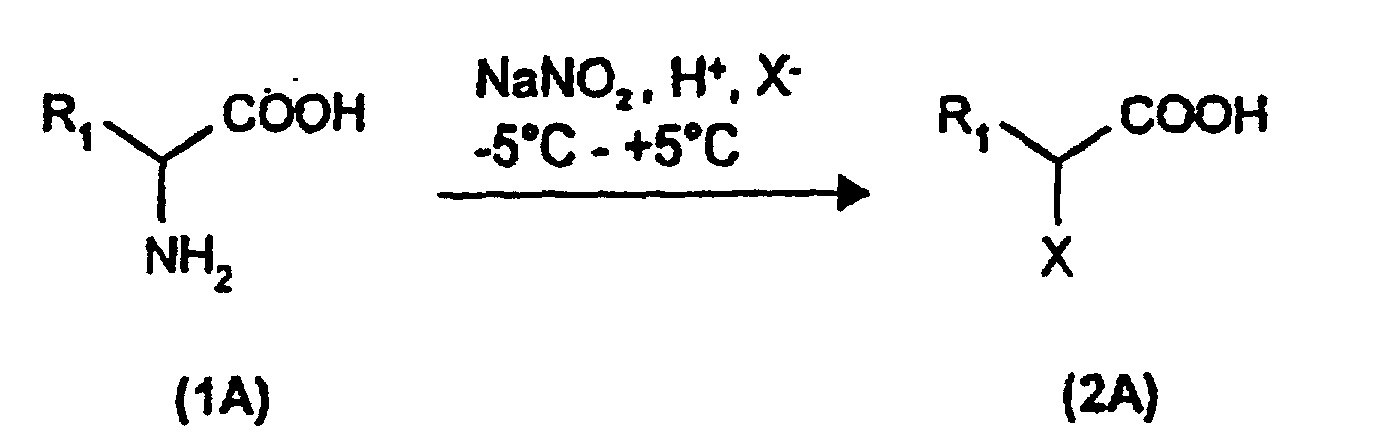 b) reaction of 2A with 1,2-diaminoethane at a temperature from 20°C to 40°C, to give 3A,
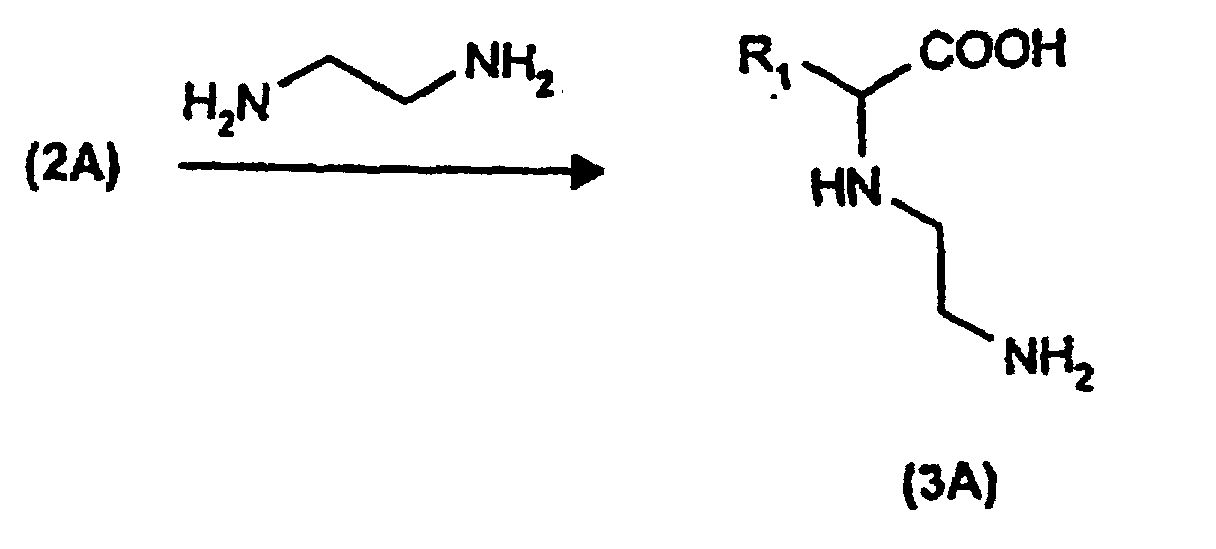 c) carboxymethylation of 3A by reaction with an alpha-haloacetic acid in basic medium at about 60°C, to give 4A,
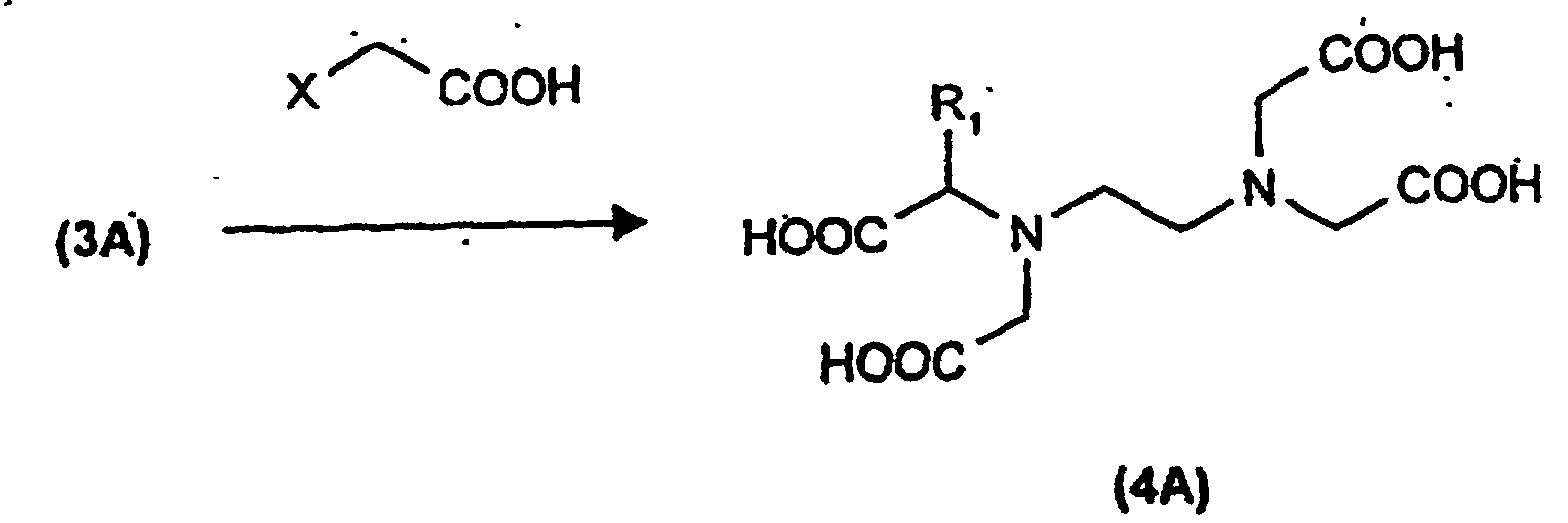 d) reaction of 4A with a stoichiometric amount of a manganese salt, in the presence of a base amount necessary for the neutralisation of the forming chelated complex 5A
- Process for the preparation of Mn2+ chelates of compounds (I) wherein R1 and R2 are the same but different from H, which comprises the following steps:wherein p, B, z and m are as above defined.a) reaction of the alpha-amino acid 1B with a 1,2-dihaloethane (2B), in a hydroalcoholic solvent, keeping the pH at about 9 with a suitable buffer, at a temperature ranging from 60 to 90°C, to give 3Bwherein R1 is as above defined and X is halogen,
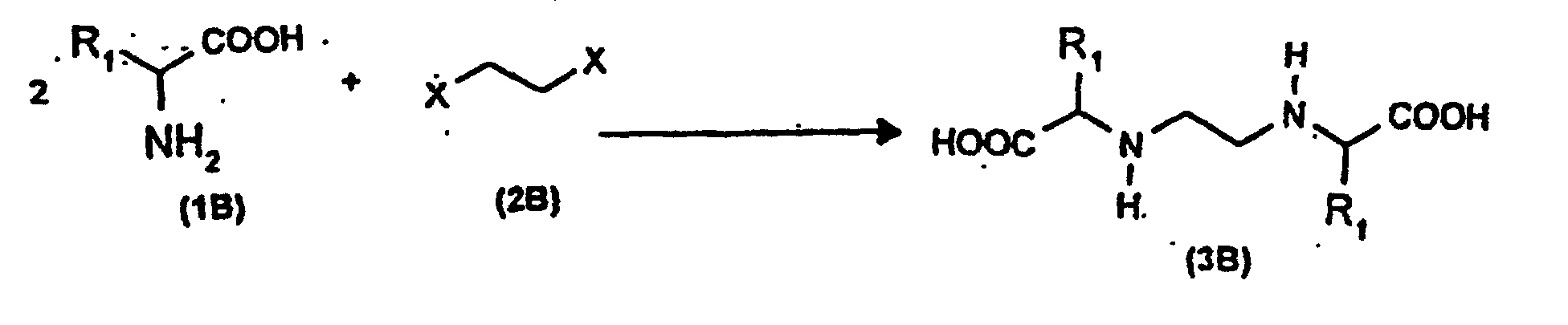 a') as alternative to step a), the reaction of an alpha-haloacid (1B') with 1,2-diaminoethane (2B'), to give 3B
 b) carboxymethylation of 3B with an alpha-haloacetic acid, at basic pH and at a temperature from 40 to 70°C, to give 4B,
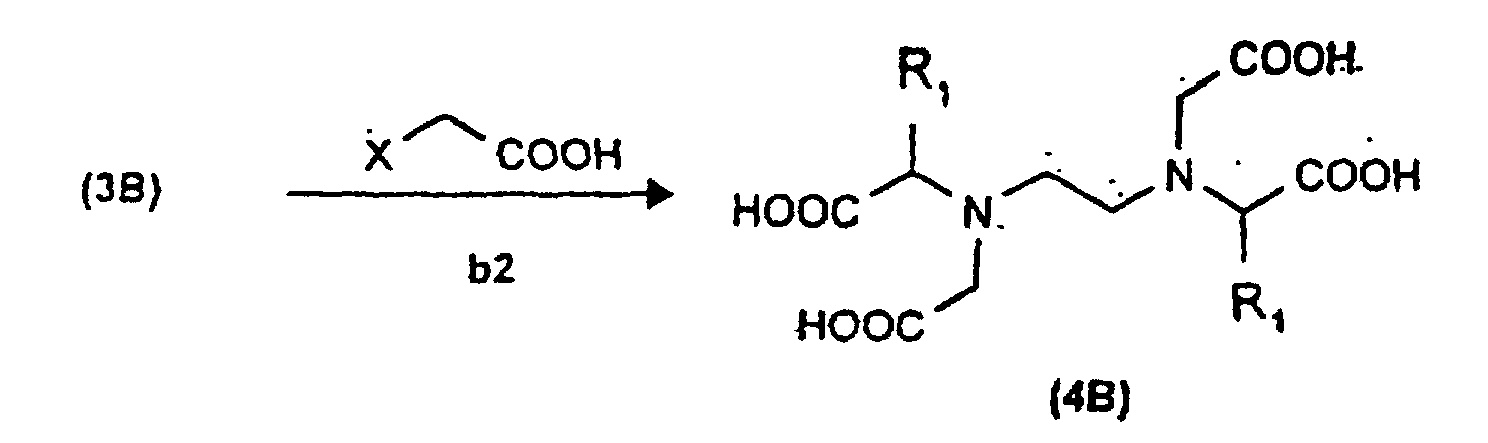 c) reaction of 4B with a stoichiometric amount of a manganese salt, in the presence of a base amount sufficient for the neutralisation of the forming chelated complex 5B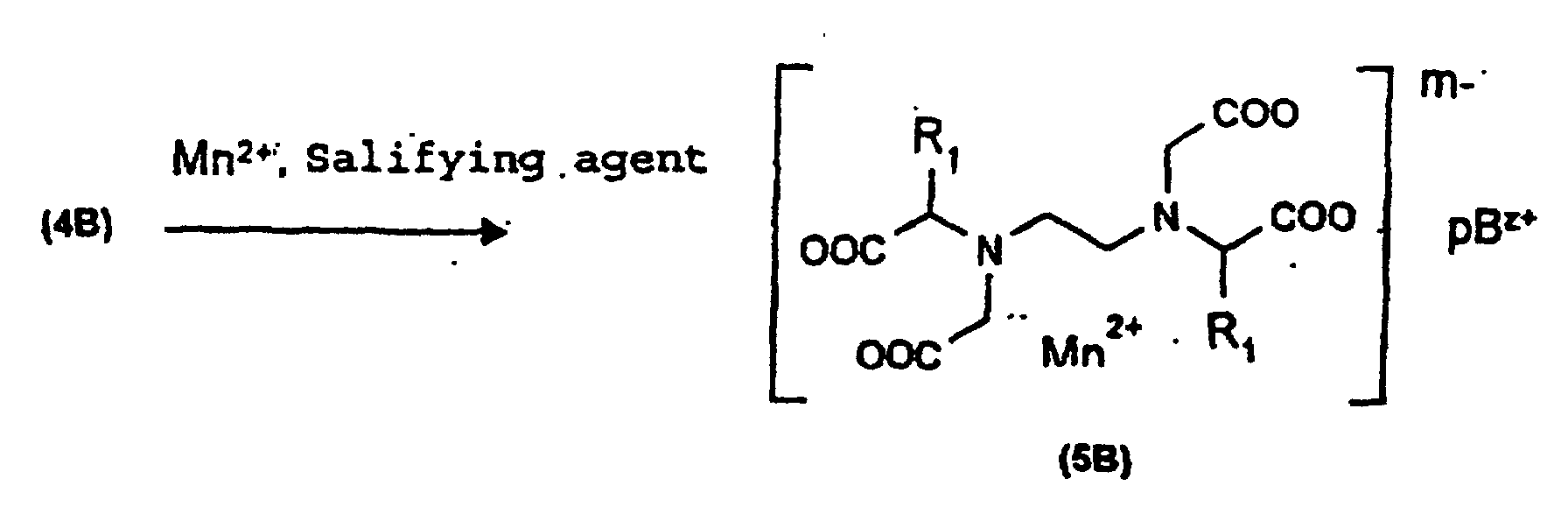
- Process according to claim 22 wherein in step A the alpha-amino acid is reacted with 1,2-dibromoethane and the reaction solution is buffered at pH 9 with a borate buffer.
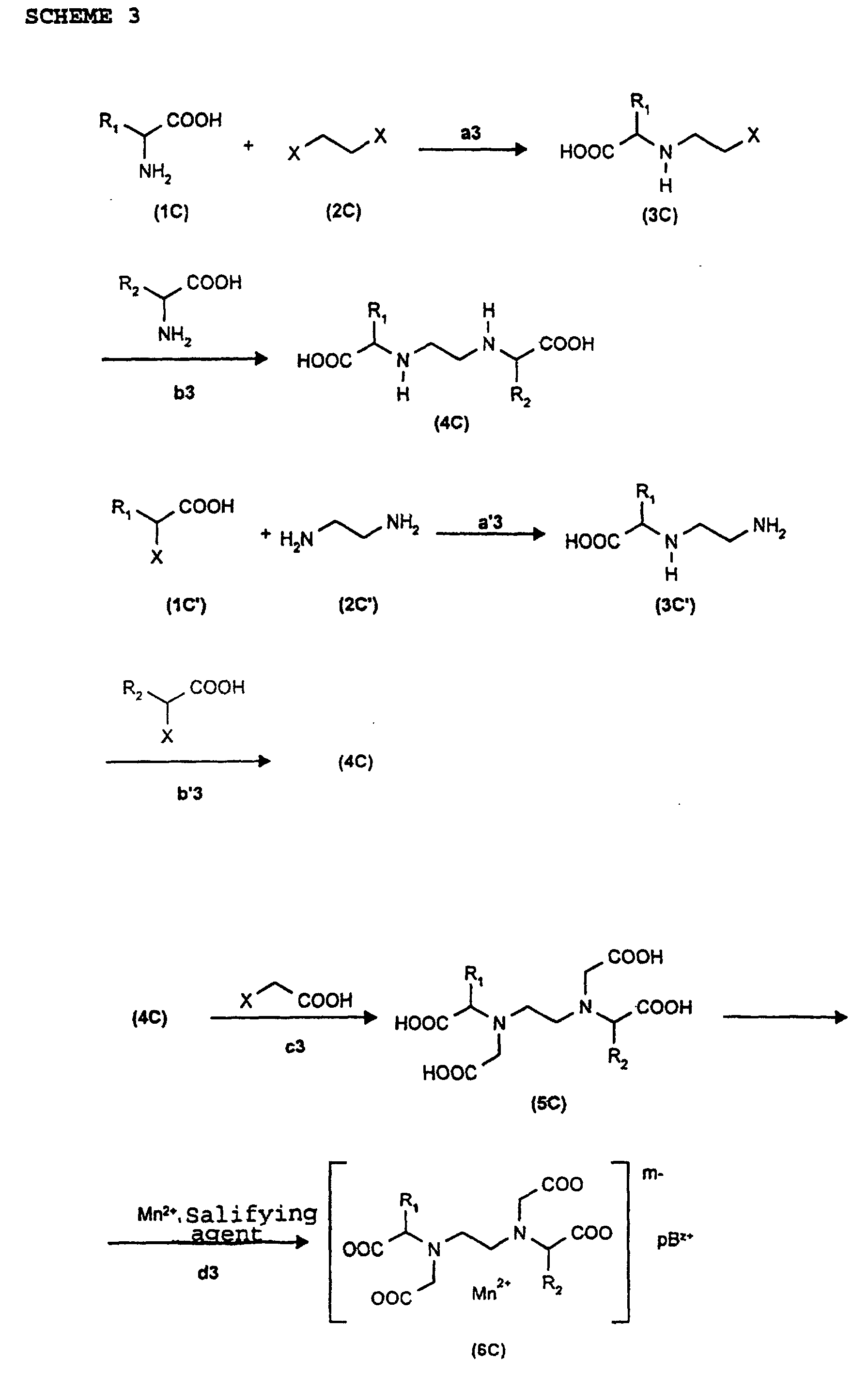
- Process for the preparation of Mn2+ chelates of compounds (I) wherein R1 and R2 are different from hydrogen and from each other, which comprises the following steps:a) reaction of an alpha-amino acid (1C) with a 1,2-dihaloethane in hydroalcoholic solvent at a pH from 8 to 9.5, to give 3C,wherein R1 and X are as above defined,
 b) reaction of 3C with a second alpha-amino acid to give the bicarboxylic intermediate 4Cwherein R2 is as specified in claim 1,
 b') as alternative to steps a) and, b), the reaction of an alpha-haloacid with 1,2-diaminethane and subsequent reaction of the isolated intermediate 3C' with a second alpha-haloacid, to give 4C
 c) carboxymethylation of 4C by reaction with an alpha-haloacetic acid in a basic medium at a temperature from 40 to 70°C, to give 5C,
 d) reaction of 5C with a stoichiometric amount of a manganese salt, in the presence of a base amount sufficient for the neutralisation of the forming chelated complex 6C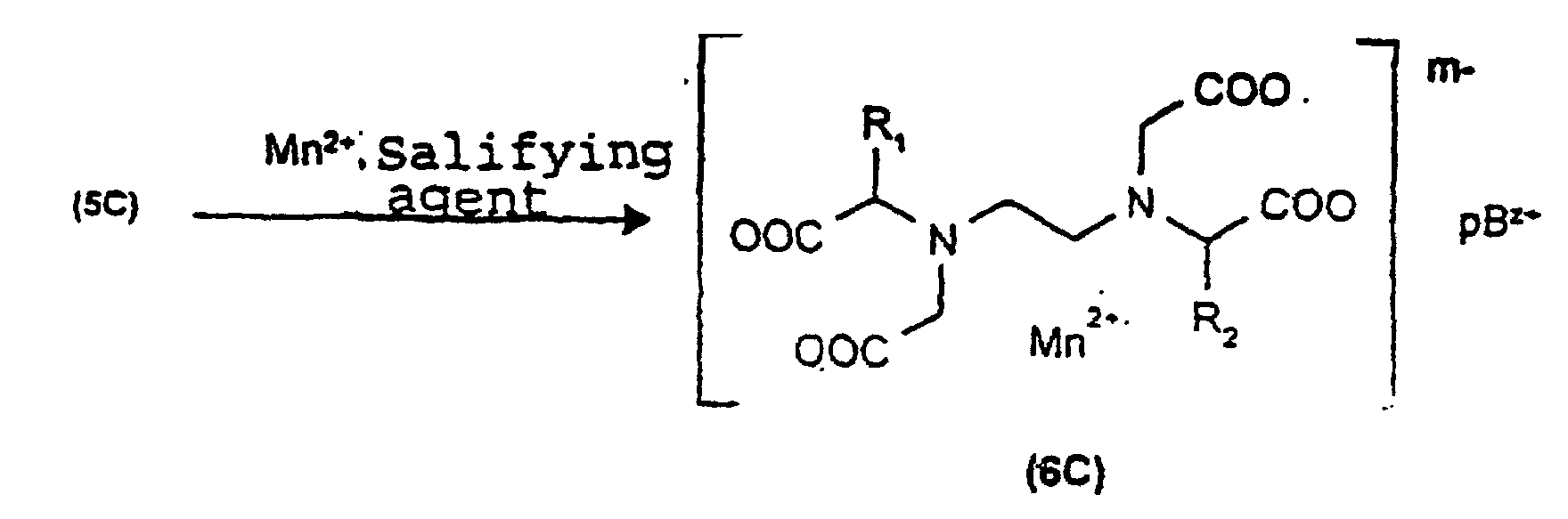
- Process for the preparation of Mn2+ chelates of compounds (I) wherein R1 and R2 are both different from each other and from H, which comprises the following steps:a) protection of the alcoholic hydroxyl of 2-haloethanol in organic solvent in the presence of an acid catalyst, to give 2Dwherein P' is selected from dihydropyran, benzyl and trityl, and Y is an halogen
 b) reaction of 2D with the ester of an alpha-amino acid (1D) in organic solvent and in the presence of a base, to give 3Dwherein R1 is as above defined, Pg is a protective group,
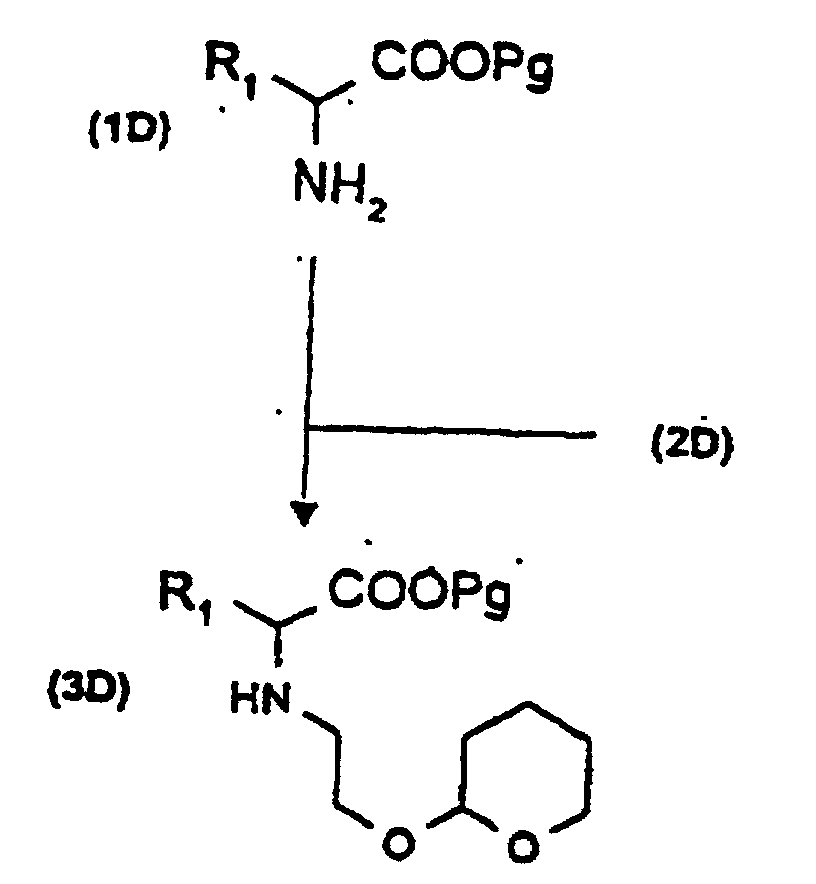 c) reaction of 3D with a bromoacetic ester, in a basic medium to give 4D
 d) treatment of 4D with an acid catalyst in hydroalcoholic solution at a temperature from 20 to 60°C, to give 5D
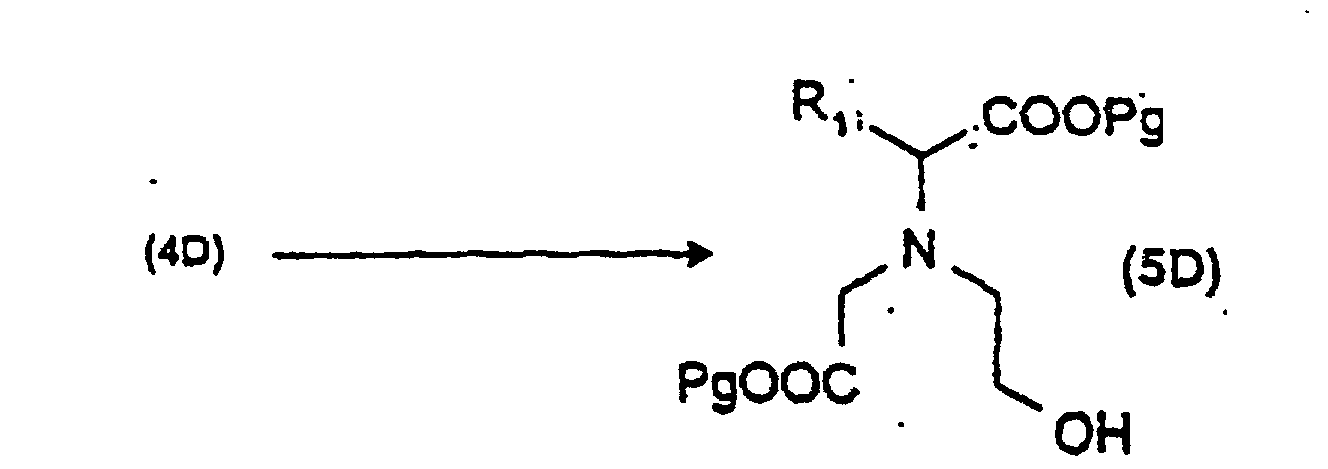 e) bromination of 5D with a N-bromosuccinimide in the presence of triphenylphosphine, to give 6D
 f) reaction of 6D with the ester of an alpha-amino acid (7D), to give 8D
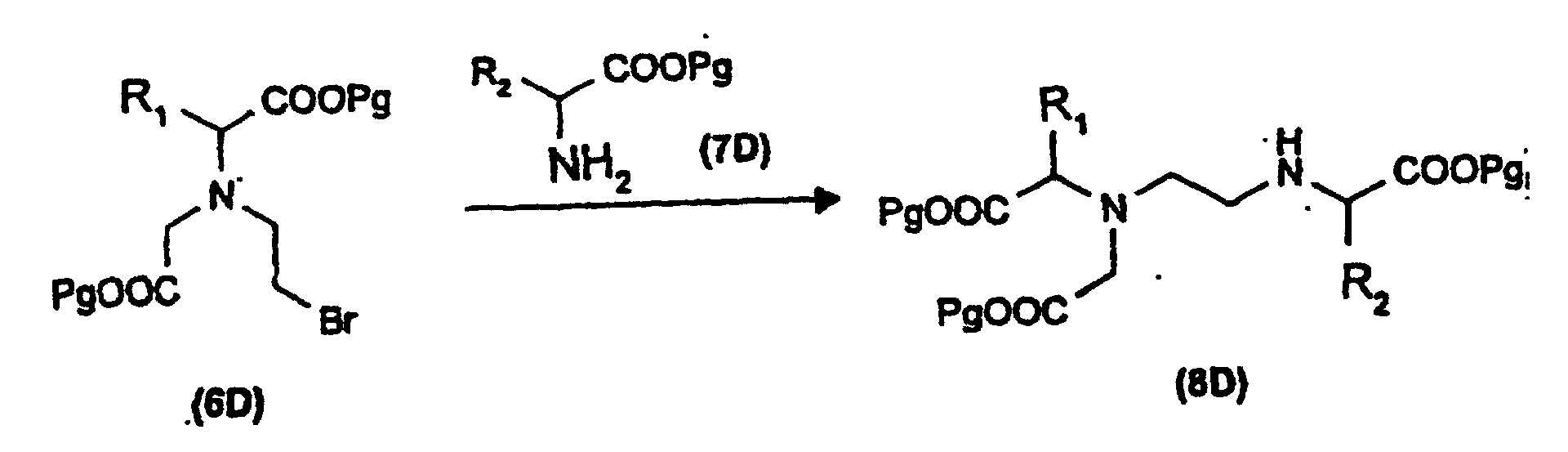 g) reaction of 8D with a bromoacetic acid ester in the presence of a base to give tetraester 9D
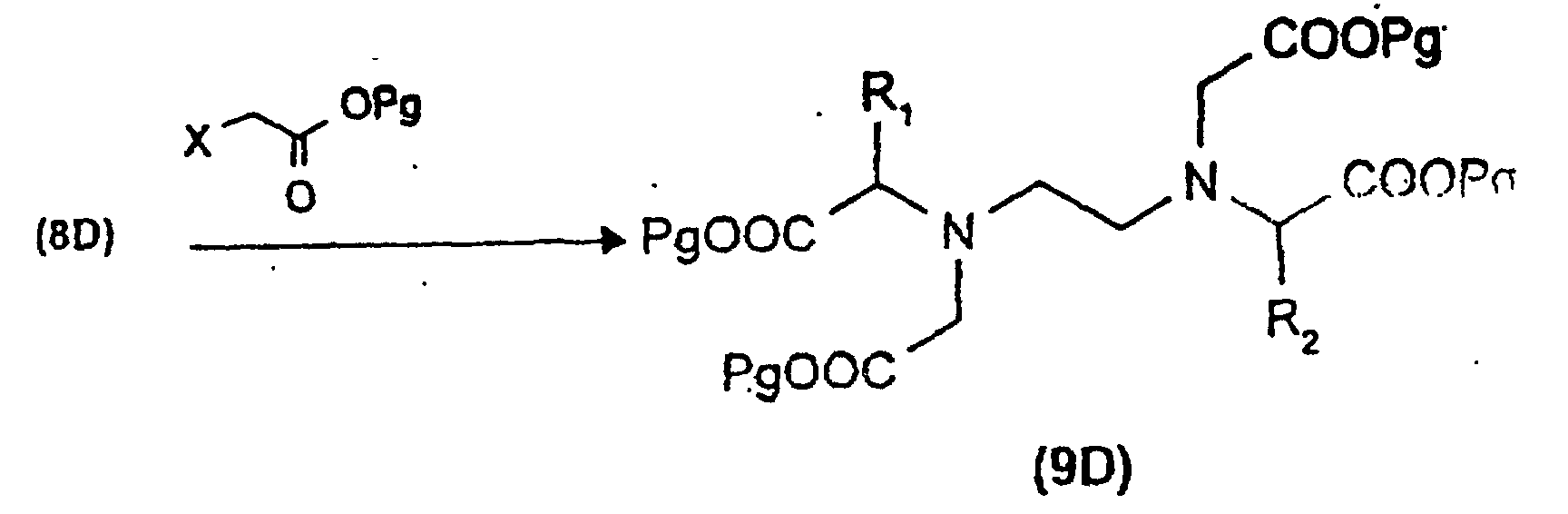 h) deprotection of 9D, to give 10D
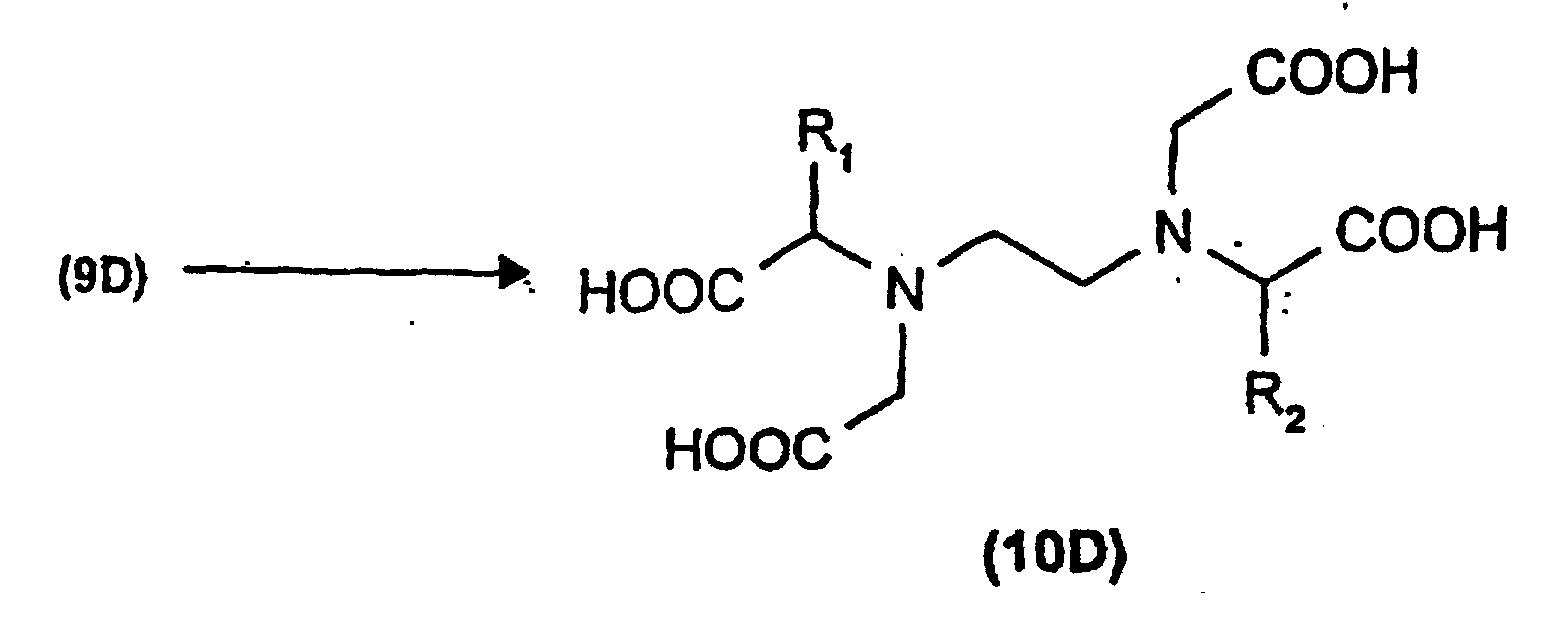 i) reaction of 10D with a stoichiometric amount of a manganese salt, in the presence of a base amount sufficient for the neutralisation of the forming chelated complex.
 - Process according to claim 25 wherein the acid catalyst used in steps (a) and (d) is 4-toluenesulfonic acid pyridinium salt.
- Process according to claim 25 wherein the alpha-amino acid used in step (b) is in optically active or racemic form.
- Process. according to claim 25 wherein the base used in step (b) is diisopropylethylamine.
- Process according to claim 25 wherein step (f) is carried out in CH3CN/phosphate buffer pH 8.
- Process, according to claim 25 step (g) wherein 9D is the terbutyl-ester and it is deprotected by reaction with CF3COOH or (CH3)3Sil.
Applications Claiming Priority (3)
| Application Number | Priority Date | Filing Date | Title |
|---|---|---|---|
| ITMI980476 | 1998-03-10 | ||
| IT98MI000476A IT1298613B1 (en) | 1998-03-10 | 1998-03-10 | HIGH RELAXATION MANGANESE COMPLEX CHELATES IN SERUM |
| PCT/EP1999/001490 WO1999045967A1 (en) | 1998-03-10 | 1999-03-08 | Manganese chelates with high relaxivity in serum |
Publications (2)
| Publication Number | Publication Date |
|---|---|
| EP1061956A1 EP1061956A1 (en) | 2000-12-27 |
| EP1061956B1 true EP1061956B1 (en) | 2002-12-11 |
Family
ID=11379241
Family Applications (1)
| Application Number | Title | Priority Date | Filing Date |
|---|---|---|---|
| EP99910335A Expired - Lifetime EP1061956B1 (en) | 1998-03-10 | 1999-03-08 | Manganese chelates with high relaxivity in serum |
Country Status (6)
| Country | Link |
|---|---|
| US (1) | US6337064B1 (en) |
| EP (1) | EP1061956B1 (en) |
| JP (1) | JP4643824B2 (en) |
| DE (1) | DE69904450T2 (en) |
| IT (1) | IT1298613B1 (en) |
| WO (1) | WO1999045967A1 (en) |
Families Citing this family (3)
| Publication number | Priority date | Publication date | Assignee | Title |
|---|---|---|---|---|
| US9746985B1 (en) | 2008-02-25 | 2017-08-29 | Georgetown University | System and method for detecting, collecting, analyzing, and communicating event-related information |
| GB201403248D0 (en) * | 2014-02-25 | 2014-04-09 | Univ Singapore | Contrast agent and applications thereof |
| CA3096199A1 (en) | 2018-04-04 | 2019-10-10 | Synthonics, Inc. | Metallo-liothyronine |
Family Cites Families (5)
| Publication number | Priority date | Publication date | Assignee | Title |
|---|---|---|---|---|
| US4980148A (en) * | 1985-02-06 | 1990-12-25 | Mallinckrodt, Inc. | Methods for enhancing magnetic resonance imaging |
| IT1213029B (en) | 1986-01-30 | 1989-12-07 | Bracco Ind Chimica Spa | PARAMAGNETIC METAL ION CHELATES. |
| US5057302A (en) * | 1987-02-13 | 1991-10-15 | Abbott Laboratories | Bifunctional chelating agents |
| IT1283651B1 (en) | 1996-08-02 | 1998-04-23 | Bracco Spa | HIGH RELAXATION PARAMAGNETIC CHELATES IN SERUM |
| IT1283650B1 (en) * | 1996-08-02 | 1998-04-23 | Bracco Spa | HIGH RELAXATION PARAMAGNETIC CHELATES IN SERUM |
-
1998
- 1998-03-10 IT IT98MI000476A patent/IT1298613B1/en active IP Right Grant
-
1999
- 1999-03-08 US US09/601,576 patent/US6337064B1/en not_active Expired - Lifetime
- 1999-03-08 DE DE69904450T patent/DE69904450T2/en not_active Expired - Lifetime
- 1999-03-08 JP JP2000535380A patent/JP4643824B2/en not_active Expired - Fee Related
- 1999-03-08 EP EP99910335A patent/EP1061956B1/en not_active Expired - Lifetime
- 1999-03-08 WO PCT/EP1999/001490 patent/WO1999045967A1/en not_active Ceased
Also Published As
| Publication number | Publication date |
|---|---|
| DE69904450T2 (en) | 2003-04-17 |
| JP2002506049A (en) | 2002-02-26 |
| WO1999045967A1 (en) | 1999-09-16 |
| ITMI980476A1 (en) | 1999-09-10 |
| DE69904450D1 (en) | 2003-01-23 |
| IT1298613B1 (en) | 2000-01-12 |
| EP1061956A1 (en) | 2000-12-27 |
| US6337064B1 (en) | 2002-01-08 |
| JP4643824B2 (en) | 2011-03-02 |
Similar Documents
| Publication | Publication Date | Title |
|---|---|---|
| JP3878208B2 (en) | Aromatic amide compounds and their chelates | |
| EP0760683B1 (en) | Bile acid conjugates, derivatives thereof with metal complexes and related uses | |
| RU2743167C2 (en) | Contrast agents | |
| PT97263B (en) | A method for the preparation of DTPA monomers and pharmaceutical compositions containing the same | |
| US5460799A (en) | Lipophilic contrast agents for diagnostic image analysis | |
| ZA200104820B (en) | Blood pool agents for nuclear magnetic resonance diagnostics. | |
| EP0497926A1 (en) | Multi-site metal chelating agents | |
| IL88762A (en) | Macrocyclic chelating agents and chelates thereof process for their preparation and diagnostic compositions containing them | |
| EP0773936B1 (en) | Macrocyclic chelants, their chelates and uses thereof in the diagnostic field | |
| US6254850B1 (en) | Metal complexes, suitable for use in diagnosis and therapy | |
| US20020052354A1 (en) | Paramagnetic DOTA derivatives, pharmaceutical agents that contain the latter, process for their production, and their use for MR imaging of necrosis and infarction | |
| JP4225573B2 (en) | Diagnostic imaging contrast agents with improved serum relaxation | |
| JP2010516643A (en) | Novel cascade polymer complexes, methods for their preparation, and pharmaceutical compositions comprising them | |
| US6458337B1 (en) | Diagnostic imaging contrast agent with improved in serum relaxivity | |
| US6337064B1 (en) | Manganese chelates with high relaxivity in serum | |
| JP4070241B2 (en) | Diagnostic imaging contrast agent with improved serum relaxation (In-Serum-Relaxity) | |
| CZ40597A3 (en) | Dimeric derivatives of diethylenetriaminepentaacetic acid and their metal complexes, pharmaceutical compositions containing the complexes, their application for diagnosis and therapy as well as process for preparing such complexes and pharmaceutical preparations | |
| JP2002506049A5 (en) | ||
| EP0822180B1 (en) | Chelating compounds, their chelates with paramagnetic metal ions, their preparation and use | |
| US6403055B1 (en) | Diagnostic imaging contrast agent with improved in serum relaxivity | |
| EP1061957B1 (en) | Manganese (ii) chelates with high relaxivity in serum | |
| JP3493156B2 (en) | Dipoly chelating agent | |
| EP3386953B1 (en) | Contrast agents |
Legal Events
| Date | Code | Title | Description |
|---|---|---|---|
| PUAI | Public reference made under article 153(3) epc to a published international application that has entered the european phase |
Free format text: ORIGINAL CODE: 0009012 |
|
| 17P | Request for examination filed |
Effective date: 20000907 |
|
| AK | Designated contracting states |
Kind code of ref document: A1 Designated state(s): DE FR GB IT |
|
| GRAG | Despatch of communication of intention to grant |
Free format text: ORIGINAL CODE: EPIDOS AGRA |
|
| 17Q | First examination report despatched |
Effective date: 20020306 |
|
| RAP1 | Party data changed (applicant data changed or rights of an application transferred) |
Owner name: BRACCO IMAGING S.P.A. Owner name: BRACCO S.P.A. |
|
| GRAG | Despatch of communication of intention to grant |
Free format text: ORIGINAL CODE: EPIDOS AGRA |
|
| GRAH | Despatch of communication of intention to grant a patent |
Free format text: ORIGINAL CODE: EPIDOS IGRA |
|
| RAP1 | Party data changed (applicant data changed or rights of an application transferred) |
Owner name: BRACCO IMAGING S.P.A. Owner name: BRACCO S.P.A. |
|
| GRAH | Despatch of communication of intention to grant a patent |
Free format text: ORIGINAL CODE: EPIDOS IGRA |
|
| GRAA | (expected) grant |
Free format text: ORIGINAL CODE: 0009210 |
|
| AK | Designated contracting states |
Kind code of ref document: B1 Designated state(s): DE FR GB IT |
|
| REG | Reference to a national code |
Ref country code: GB Ref legal event code: FG4D |
|
| REF | Corresponds to: |
Ref document number: 69904450 Country of ref document: DE Date of ref document: 20030123 |
|
| ET | Fr: translation filed | ||
| PLBE | No opposition filed within time limit |
Free format text: ORIGINAL CODE: 0009261 |
|
| STAA | Information on the status of an ep patent application or granted ep patent |
Free format text: STATUS: NO OPPOSITION FILED WITHIN TIME LIMIT |
|
| 26N | No opposition filed |
Effective date: 20030912 |
|
| PGFP | Annual fee paid to national office [announced via postgrant information from national office to epo] |
Ref country code: IT Payment date: 20120327 Year of fee payment: 14 |
|
| PGFP | Annual fee paid to national office [announced via postgrant information from national office to epo] |
Ref country code: FR Payment date: 20130405 Year of fee payment: 15 Ref country code: GB Payment date: 20130327 Year of fee payment: 15 Ref country code: DE Payment date: 20130327 Year of fee payment: 15 |
|
| REG | Reference to a national code |
Ref country code: DE Ref legal event code: R119 Ref document number: 69904450 Country of ref document: DE |
|
| GBPC | Gb: european patent ceased through non-payment of renewal fee |
Effective date: 20140308 |
|
| REG | Reference to a national code |
Ref country code: FR Ref legal event code: ST Effective date: 20141128 |
|
| REG | Reference to a national code |
Ref country code: DE Ref legal event code: R119 Ref document number: 69904450 Country of ref document: DE Effective date: 20141001 |
|
| PG25 | Lapsed in a contracting state [announced via postgrant information from national office to epo] |
Ref country code: FR Free format text: LAPSE BECAUSE OF NON-PAYMENT OF DUE FEES Effective date: 20140331 Ref country code: GB Free format text: LAPSE BECAUSE OF NON-PAYMENT OF DUE FEES Effective date: 20140308 Ref country code: DE Free format text: LAPSE BECAUSE OF NON-PAYMENT OF DUE FEES Effective date: 20141001 |
|
| PG25 | Lapsed in a contracting state [announced via postgrant information from national office to epo] |
Ref country code: IT Free format text: LAPSE BECAUSE OF NON-PAYMENT OF DUE FEES Effective date: 20140308 |