EP1061738A2 - Digital broadcasting system and digital video recording/reproducing apparatus - Google Patents
Digital broadcasting system and digital video recording/reproducing apparatus Download PDFInfo
- Publication number
- EP1061738A2 EP1061738A2 EP00305018A EP00305018A EP1061738A2 EP 1061738 A2 EP1061738 A2 EP 1061738A2 EP 00305018 A EP00305018 A EP 00305018A EP 00305018 A EP00305018 A EP 00305018A EP 1061738 A2 EP1061738 A2 EP 1061738A2
- Authority
- EP
- European Patent Office
- Prior art keywords
- stream
- data
- special playback
- accordance
- reproducing
- Prior art date
- Legal status (The legal status is an assumption and is not a legal conclusion. Google has not performed a legal analysis and makes no representation as to the accuracy of the status listed.)
- Withdrawn
Links
Images















Classifications
-
- H—ELECTRICITY
- H04—ELECTRIC COMMUNICATION TECHNIQUE
- H04N—PICTORIAL COMMUNICATION, e.g. TELEVISION
- H04N5/00—Details of television systems
- H04N5/76—Television signal recording
- H04N5/91—Television signal processing therefor
- H04N5/92—Transformation of the television signal for recording, e.g. modulation, frequency changing; Inverse transformation for playback
-
- H—ELECTRICITY
- H04—ELECTRIC COMMUNICATION TECHNIQUE
- H04N—PICTORIAL COMMUNICATION, e.g. TELEVISION
- H04N21/00—Selective content distribution, e.g. interactive television or video on demand [VOD]
- H04N21/40—Client devices specifically adapted for the reception of or interaction with content, e.g. set-top-box [STB]; Operations thereof
- H04N21/41—Structure of client; Structure of client peripherals
- H04N21/422—Input-only peripherals, i.e. input devices connected to specially adapted client devices, e.g. global positioning system [GPS]
- H04N21/42204—User interfaces specially adapted for controlling a client device through a remote control device; Remote control devices therefor
-
- H—ELECTRICITY
- H04—ELECTRIC COMMUNICATION TECHNIQUE
- H04N—PICTORIAL COMMUNICATION, e.g. TELEVISION
- H04N21/00—Selective content distribution, e.g. interactive television or video on demand [VOD]
- H04N21/40—Client devices specifically adapted for the reception of or interaction with content, e.g. set-top-box [STB]; Operations thereof
- H04N21/41—Structure of client; Structure of client peripherals
- H04N21/414—Specialised client platforms, e.g. receiver in car or embedded in a mobile appliance
- H04N21/4147—PVR [Personal Video Recorder]
-
- H—ELECTRICITY
- H04—ELECTRIC COMMUNICATION TECHNIQUE
- H04N—PICTORIAL COMMUNICATION, e.g. TELEVISION
- H04N21/00—Selective content distribution, e.g. interactive television or video on demand [VOD]
- H04N21/40—Client devices specifically adapted for the reception of or interaction with content, e.g. set-top-box [STB]; Operations thereof
- H04N21/41—Structure of client; Structure of client peripherals
- H04N21/426—Internal components of the client ; Characteristics thereof
-
- H—ELECTRICITY
- H04—ELECTRIC COMMUNICATION TECHNIQUE
- H04N—PICTORIAL COMMUNICATION, e.g. TELEVISION
- H04N21/00—Selective content distribution, e.g. interactive television or video on demand [VOD]
- H04N21/40—Client devices specifically adapted for the reception of or interaction with content, e.g. set-top-box [STB]; Operations thereof
- H04N21/43—Processing of content or additional data, e.g. demultiplexing additional data from a digital video stream; Elementary client operations, e.g. monitoring of home network or synchronising decoder's clock; Client middleware
- H04N21/433—Content storage operation, e.g. storage operation in response to a pause request, caching operations
- H04N21/4331—Caching operations, e.g. of an advertisement for later insertion during playback
-
- H—ELECTRICITY
- H04—ELECTRIC COMMUNICATION TECHNIQUE
- H04N—PICTORIAL COMMUNICATION, e.g. TELEVISION
- H04N21/00—Selective content distribution, e.g. interactive television or video on demand [VOD]
- H04N21/40—Client devices specifically adapted for the reception of or interaction with content, e.g. set-top-box [STB]; Operations thereof
- H04N21/43—Processing of content or additional data, e.g. demultiplexing additional data from a digital video stream; Elementary client operations, e.g. monitoring of home network or synchronising decoder's clock; Client middleware
- H04N21/433—Content storage operation, e.g. storage operation in response to a pause request, caching operations
- H04N21/4334—Recording operations
-
- H—ELECTRICITY
- H04—ELECTRIC COMMUNICATION TECHNIQUE
- H04N—PICTORIAL COMMUNICATION, e.g. TELEVISION
- H04N21/00—Selective content distribution, e.g. interactive television or video on demand [VOD]
- H04N21/40—Client devices specifically adapted for the reception of or interaction with content, e.g. set-top-box [STB]; Operations thereof
- H04N21/43—Processing of content or additional data, e.g. demultiplexing additional data from a digital video stream; Elementary client operations, e.g. monitoring of home network or synchronising decoder's clock; Client middleware
- H04N21/434—Disassembling of a multiplex stream, e.g. demultiplexing audio and video streams, extraction of additional data from a video stream; Remultiplexing of multiplex streams; Extraction or processing of SI; Disassembling of packetised elementary stream
-
- H—ELECTRICITY
- H04—ELECTRIC COMMUNICATION TECHNIQUE
- H04N—PICTORIAL COMMUNICATION, e.g. TELEVISION
- H04N21/00—Selective content distribution, e.g. interactive television or video on demand [VOD]
- H04N21/40—Client devices specifically adapted for the reception of or interaction with content, e.g. set-top-box [STB]; Operations thereof
- H04N21/43—Processing of content or additional data, e.g. demultiplexing additional data from a digital video stream; Elementary client operations, e.g. monitoring of home network or synchronising decoder's clock; Client middleware
- H04N21/44—Processing of video elementary streams, e.g. splicing a video clip retrieved from local storage with an incoming video stream or rendering scenes according to encoded video stream scene graphs
- H04N21/4402—Processing of video elementary streams, e.g. splicing a video clip retrieved from local storage with an incoming video stream or rendering scenes according to encoded video stream scene graphs involving reformatting operations of video signals for household redistribution, storage or real-time display
- H04N21/440281—Processing of video elementary streams, e.g. splicing a video clip retrieved from local storage with an incoming video stream or rendering scenes according to encoded video stream scene graphs involving reformatting operations of video signals for household redistribution, storage or real-time display by altering the temporal resolution, e.g. by frame skipping
-
- H—ELECTRICITY
- H04—ELECTRIC COMMUNICATION TECHNIQUE
- H04N—PICTORIAL COMMUNICATION, e.g. TELEVISION
- H04N21/00—Selective content distribution, e.g. interactive television or video on demand [VOD]
- H04N21/40—Client devices specifically adapted for the reception of or interaction with content, e.g. set-top-box [STB]; Operations thereof
- H04N21/45—Management operations performed by the client for facilitating the reception of or the interaction with the content or administrating data related to the end-user or to the client device itself, e.g. learning user preferences for recommending movies, resolving scheduling conflicts
- H04N21/454—Content or additional data filtering, e.g. blocking advertisements
- H04N21/4542—Blocking scenes or portions of the received content, e.g. censoring scenes
-
- H—ELECTRICITY
- H04—ELECTRIC COMMUNICATION TECHNIQUE
- H04N—PICTORIAL COMMUNICATION, e.g. TELEVISION
- H04N21/00—Selective content distribution, e.g. interactive television or video on demand [VOD]
- H04N21/40—Client devices specifically adapted for the reception of or interaction with content, e.g. set-top-box [STB]; Operations thereof
- H04N21/47—End-user applications
- H04N21/472—End-user interface for requesting content, additional data or services; End-user interface for interacting with content, e.g. for content reservation or setting reminders, for requesting event notification, for manipulating displayed content
- H04N21/4722—End-user interface for requesting content, additional data or services; End-user interface for interacting with content, e.g. for content reservation or setting reminders, for requesting event notification, for manipulating displayed content for requesting additional data associated with the content
-
- H—ELECTRICITY
- H04—ELECTRIC COMMUNICATION TECHNIQUE
- H04N—PICTORIAL COMMUNICATION, e.g. TELEVISION
- H04N21/00—Selective content distribution, e.g. interactive television or video on demand [VOD]
- H04N21/40—Client devices specifically adapted for the reception of or interaction with content, e.g. set-top-box [STB]; Operations thereof
- H04N21/47—End-user applications
- H04N21/478—Supplemental services, e.g. displaying phone caller identification, shopping application
-
- H—ELECTRICITY
- H04—ELECTRIC COMMUNICATION TECHNIQUE
- H04N—PICTORIAL COMMUNICATION, e.g. TELEVISION
- H04N21/00—Selective content distribution, e.g. interactive television or video on demand [VOD]
- H04N21/80—Generation or processing of content or additional data by content creator independently of the distribution process; Content per se
- H04N21/85—Assembly of content; Generation of multimedia applications
- H04N21/854—Content authoring
- H04N21/8545—Content authoring for generating interactive applications
-
- H—ELECTRICITY
- H04—ELECTRIC COMMUNICATION TECHNIQUE
- H04N—PICTORIAL COMMUNICATION, e.g. TELEVISION
- H04N5/00—Details of television systems
- H04N5/76—Television signal recording
- H04N5/78—Television signal recording using magnetic recording
- H04N5/782—Television signal recording using magnetic recording on tape
- H04N5/783—Adaptations for reproducing at a rate different from the recording rate
-
- H—ELECTRICITY
- H04—ELECTRIC COMMUNICATION TECHNIQUE
- H04N—PICTORIAL COMMUNICATION, e.g. TELEVISION
- H04N7/00—Television systems
- H04N7/16—Analogue secrecy systems; Analogue subscription systems
-
- H—ELECTRICITY
- H04—ELECTRIC COMMUNICATION TECHNIQUE
- H04N—PICTORIAL COMMUNICATION, e.g. TELEVISION
- H04N5/00—Details of television systems
- H04N5/76—Television signal recording
- H04N5/78—Television signal recording using magnetic recording
- H04N5/782—Television signal recording using magnetic recording on tape
- H04N5/7824—Television signal recording using magnetic recording on tape with rotating magnetic heads
- H04N5/7826—Television signal recording using magnetic recording on tape with rotating magnetic heads involving helical scanning of the magnetic tape
- H04N5/78263—Television signal recording using magnetic recording on tape with rotating magnetic heads involving helical scanning of the magnetic tape for recording on tracks inclined relative to the direction of movement of the tape
-
- H—ELECTRICITY
- H04—ELECTRIC COMMUNICATION TECHNIQUE
- H04N—PICTORIAL COMMUNICATION, e.g. TELEVISION
- H04N9/00—Details of colour television systems
- H04N9/79—Processing of colour television signals in connection with recording
- H04N9/80—Transformation of the television signal for recording, e.g. modulation, frequency changing; Inverse transformation for playback
- H04N9/82—Transformation of the television signal for recording, e.g. modulation, frequency changing; Inverse transformation for playback the individual colour picture signal components being recorded simultaneously only
- H04N9/8205—Transformation of the television signal for recording, e.g. modulation, frequency changing; Inverse transformation for playback the individual colour picture signal components being recorded simultaneously only involving the multiplexing of an additional signal and the colour video signal
- H04N9/8227—Transformation of the television signal for recording, e.g. modulation, frequency changing; Inverse transformation for playback the individual colour picture signal components being recorded simultaneously only involving the multiplexing of an additional signal and the colour video signal the additional signal being at least another television signal
Definitions
- the present invention relates digital video recording/reproducing apparatuses capable of performing playback in cue, review and other operations as well as handling digital broadcasting realizing interactive communications.
- Fig. 1 is a simplified conceptual view showing a state of sending radio waves in satellite broadcasting.
- Radio waves from a ground station 2 are sent to a plurality of ground receivers (not shown) via a broadcasting satellite 4.
- the broadcasting satellite 4 sends out a plural numbers of transport streams TS1, TS2, TS3 and TS4.
- Each transport stream is distinguished from the others by its frequency, plane of polarization and other factors.
- a plurality of services analogous to channels in terrestrial broadcasting SV11, SV12, SV13 and SV14 being packetized are multiplexed in the transport stream TS1 under a time sharing manner.
- services SV21, SV22, SV23 and SV24, and services SV31, SV32, SV33 and SV34 are multiplexed respectively in the transport streams TS2 and TS3.
- Various control data representing indicative of program information, that of current time, control data needed for packetization and the like in addition to video data and audio data of each of the services are sent out to each of the transport streams. While, Fig. 1 shows only three transport streams, mamma more transport streams may be sent out. Furthermore, while Fig. 1 shows a total of four services multiplexed in each transport stream, in actuality many more services may be multiplexed therein.
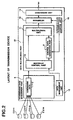
- Fig. 2 is a schematic illustration of a transmitter for generating and transmitting the transport streams described above. While, Fig. 2 shows only the transport stream TS 1 for simplicity, other transport streams TS2 and TS3 are generated thereby in the same manner.
- Video/audio data ES1, ES12, ES13 and ES14 of the services SV11, SV12, SV13 and SV14 are provided to a video/audio data management part 7.
- the Video/audio data Es1, ES12, ES13 and ES14 are compressed by the video/audio data management part 7, and the resulting data are provided to a multiplex control part 9.
- a multiplexing data management part 15 manages multiplexing of services such that which service should be multiplexed to other.
- the multiplex control part 9 provides services to be multiplexed to a multiplexing part 11 under the control of the multiplexing data management part 15.
- a control data generating part 6 generates a plurality of control data such as control data for multiplexing packets, that indicative of program information, that indicative of current time.
- the control data for multiplexing packets are assigned for correctly identifying a video/audio data of a plurality of services being packetized under a time-sharing manner and other purposes.
- the multiplexing part 11 outputs the control data and the video/audio data ES11, ES12, ES13, and ES14 under a time-sharing manner, each consisting of packetized data having a fixed length.
- a scrambler 12 scrambles the outputted packets using a scramble-key provided by a scramble-key control part 16.
- the transport stream TS1 being scrambled is modulated with a modulating part 14 and sent out to audiences via the broadcasting satellite 4.
- the scramble-key used at the scrambler 12 is encrypted with the control data generating part and made to be Entitlement Control (hereinafter referred to as ECM) data.
- ECM data further encrypting the key used for de-scrambling is generated.
- the multiplexing part 11 carries out packetization including the ECM data.
- video data ES (V) 1 and audio data ES (A) 1 of the service SV11 are multiplexed in the transport stream TS1 generated by the transmitter depicted in Fig. 2.
- control data NIT, PAT, PMT1, PMT2, PMT3 and PMT4 are further multiplexed therein. Audio data and video data of the service SV11, SV12, SV13 and SV14 can be separated respectively by using these control data.
- control data for the scramble-key CCM1, ECM2, ECM3 and ECM4 control data indicative of program information EIT1, EIT2, EIT3 and EIT4, and control data for current time TDT and the like are multiplexed therein. Although, none of them are shown in the drawing, more control data are multiplexed in the transport stream.
- Packetization of the control data is carried out in the sequence of a line 18a depicted in Fig. 3.
- packetization of these control data is carried out by the following sequence: the control data NIT, PIT, PMTs EITs, ECMs, video data ESs (V) and audio data ESs (A).
- V video data ESs
- A audio data ESs
- FIG. 4 A basic structure of the packetized data is depicted in Fig. 4. Both the control data and the video/audio data being packetized have the structure as depicted in Fig. 4. PIDs are assigned to the forefront of each packetized data. PIDs are the references, which are uniquely assigned to each of the packetized data to distinguish each packetized data from other packetized data.
- the data representing contents are object data being packetized (e.g. the control data, video/audio data and the like).
- a PID 502 is assigned to video/audio data 500 being packetized, and the video/audio data 50 in the service SV12 being encrypted.
- the video/audio data 500 is sent in a plurality of packets as a result of carrying out time sharing processing.
- a PID 506 is assigned to ECM data 504 being packetized for generating a descramble-key, which descrambles the scramble on the video/audio data 500.
- the packet ID of the video/audio data 500 in the service SV12 and that of the ECM data 504 are recorded in the control data PMT2.
- the packet IDs of the video/audio data 500 in the service SV12 and the ECM data 504 can be identified by obtaining the contents of the control data PMT2.
- a PID 512 is assigned to the control data PMT2 being packetized as well.
- the control data PMT2 is also sent in a plurality of packets as a result of carrying out time sharing processing.
- a packet ID of the control data PMT2 is recorded in the control data PAT.
- the packet ID of the control data PMT2 in the service SV12 can be identified by obtaining the contents of the control data PAT.
- a PID 522 is assigned to the control data PAT being packetized as well.
- Packet IDs of the control data PMT1, PMT2, PMT3 and PMT4 in the services SV11, SV12, SV13 and SV14 multiplexed in the transport stream TS1 are recorded in the control data PAT.
- Control data, video/audio data, each packetized and related one another are sent through transport streams. It is therefore, necessary to obtain the control data PAT in order to identify the services multiplexed in the transport streams. In this way, the packet ID of the control data PAT is previously set at a fixed value such as (0X0000).
- control data NIT Information such as transmission parameters of the transport streams TS1, TS2 and TS3 (their frequencies or the like) and which of the services being multiplexed into which of the transport stream is recorded in the control data NIT (see Fig. 6). In this way, it is possible to identify a specific service is multiplexed into which of the service(s). Packet ID of the control data NIT is recorded in the control data PAT.
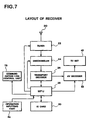
- Fig. 8 outlines configuration of a receiver.
- a desired transport stream is selected by a tuner 22 and scrambled transport stream is descrambled with a descrambler 24, then data concerned with the desired service contained in the descrambled transport stream is separated therefrom with a transport decoder 26.
- the microprocessor (hereinafter referred to as MPU) 28 sends an ECM obtained to an IC card 30 and receives the a scramble-key restored by the IC card30.
- the MPU 28 sets the scramble-key in the descrambler 24.
- the video/audio data ES can thereby de descrambled.
- the MPU 28 sets the packet ID of the video/audio data ES in the desired service into the transport decoder 26.
- the transport decoder 26 thereby outputs the video/audio data ES of the service.
- the control data thus separated is supplied to the MPU 28.
- the MPU 28 controls the transport decoder 26 to obtain the control data NIT (i.e., by setting a PID of the control data NIT into the transport decoder 26).
- the description in the control data tells that the service SV12 is multiplexed in the transport streamTS1 (see Fig. 6).
- the MPU 28 controls the tuner 22 to receive the transport stream TS1. Further, the receiver acquires the PAT and PMT 2 by controlling the transport decoder 26, and the packet IDs of both the video data ES (V) 2 and the audio data ES (A) 2 in the desired service SV12, and packet IDs of their ECMs (see an arrows ⁇ and ⁇ in Fig. 5).
- the video data ES (V) 2 and the audio data ES (A) 2 of the desired service SV12 are outputted from the transport decoder 26 by setting these packet IDs in the transport decoder 26.
- the MPU 28 acquires the scramble-key by sending the ECM obtained from the transport decoder 26 to the IC card 30 and sets this in the descrambler 24. Descrambled video data ES (V) 2 and audio data ES (A) 2 can thereby be obtained. Changeover of the received service is performed as described above.
- control data generating part 6 also generates navigation data, to be described.
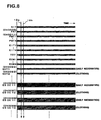
- Fig. 8 shows the data structure of a transport stream that is sent from the transmitter in the broadcasting system realizing interactive operations.
- ES (A) 12 in the service 11 the video data of other services and audio elementary streams for audio data are omitted.
- the difference from the data structure of Fig. 3 is that two (2) video/audio ESs are contained in a single service SV11. Interactive changeover of these two (2) video/audio ESs can be performed by operation of the operator in accordance with the navigation data NVT1 and NVT 2 both forming control data for realizing interactive operations.
- the receiver is designed so as to alter the auxiliary display in an interactive manner by using the navigation data NVT1 and NVT2.
- Fig. 9 shows the contents of control data PMT1 in the service SV11.
- the control data PMT1 describes the packet ID of each content (vide, audio, navigation data) and the packet ID of the ECM data for obtaining the key for descrambling the contents. Furthermore, since all of the video, audio, and navigation data have a plurality of contents, the content that is to be initially outputted is given as entry-contents.
- the packet ID of this control data PMT itself is in "0X0011".
- Fig. 10 shows contents of the control data PAT.
- the control data PAT there are given the packet IDs of the PMTs relating to the services SV11, SV12, SV13 and SV14 these are multiplexed on the transport stream TS1. In this way, it is possible to identify the packet ID of the service SV11 is in "0X0011". It should be noted that the packet ID of the control data PAT itself is fixed as "0X0000".
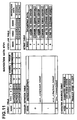
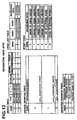
- Figs. 11, and 12 show contents that are recorded in the navigation data NVT1 and NVT2.
- the same contents of this set of navigation data NVT1 and NVT2 are repeatedly sent at predetermined intervals.
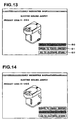
- Interactive alteration of the service contents is performed as shown in Figs. 13 through 16 in response to the operation of operator using the navigation data NVT1 and NVT2.
- FIG. 14 An image depicted in Fig. 14 is displayed when the operator presses a key to move the cursor downward under the display shown in Fig. 13.
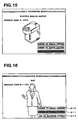
- the reference part on the display "Order to Osaka center” shifts to the display "'Tokyo center”. Further depress of the downward key will shift the reference part on the display to "Go to the clothing store” as depicted in Fig. 15.
- the contents of the service is changed into a Tele-shopping offering clothing items as depicted in Fig. 16 when the operator presses a selection button under the condition.
- Such interactive operations described above are realized in accordance with the navigation data forming control data for interactive operations.
- the services in moving pictures are selected in accordance with the navigation data in the above-described operations
- services in still images can also be selected.
- a desired still image is displayed as a result of selection performed in accidence with the control of the navigation data so as to select the desired still image out of a plurality of still images being sent repeatedly as one complete service.
- the applicant has already proposed a technique by which recording and reproduction are performed while maintaining interactive capability thereof.
- the technique is superior in a view of solving the problems occur when the interactive operations performed in receiving digital broadcasting are also carried out during the recording and reproduction.
- the technique neither pointing out the problems in the interactive operations occurred by confusion therein nor solving the problems.
- bandwidth for recording data for special playback is limited, therefore, it is expected that one of no data for interactive operations are recorded as the data for special playback and only a small amount of data are recorded even data recording is allowed. Under the circumstances, the following problems are observed when digital data for realizing interactive operations are recorded and reproduced.
- time travels on the left to the right hand side thereof.
- a display of "Quiz regarding to lions" forming an image for performing operations is displayed when an image of a lion is displayed on the screen.
- a quiz on lions is displayed on the screen in accordance with the navigation data (the control data for interactive operations) when the operator selects the display of " Quiz regarding to lions" with buttons on the remote controller or the like.
- Similar operations can be carried out upon displaying a display of "Quiz regarding to elephants" forming an image for performing operations as a result of revising its version of the navigation data so as to display an image of an elephant.
- Such operations can be realized not only when the apparatus receives data but also at the time of performing normal playback. Carrying out recording so as to contain the navigation data does this.
- the display of "Quiz regarding to lions" forming the image for performing operations undesirably remains on the screen regardless of sudden change of images when playback is performed in cue because no control data for realizing interactive operations are obtained.
- countermeasures for preventing such undesirable display need to be taken in consideration of performing playback in cue. Similar problems occur during the special playback such as review or the like.
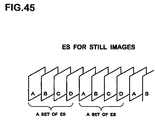
- a service capable of selectively displaying a plurality of still images under interactive basis.
- the creator of the service may control still images in accordance with the control data for performing interactive operations, the still images being displayed on the screen responding to inputs of the operator.
- a control in which a certain still image is displayed can be carried out only when correct answers to the quiz are inputted.
- the object of the present invention is to provide the means for solving the above problems with considerations of not only a process in the playback but also processes in the recording and receiving as well as the process in the transmitting side.
- a term of "receiving means” is referred to as the means having a functionality of receiving the transport stream and is a concept of things receiving transmissions applied to not only to a radio transmission but also a wired transmission.
- a receiver 22 is corresponding to that part.
- a term of "reproducing means” is referred to as the means for reproducing the contents of the services in accordance with the transport stream received or the converted stream played back.
- a CPU36, a nonvolatile memory 52, a de-scrambler 58, an IC card 56, a memory 54, a TS decoder and an AV decoder 32 are corresponding to that part.
- a term of "converting means” is referred to as the means for converting the transport stream into the conversion stream.
- the means such as a TS decoder 50, a conversion stream generator 62 and CPU 58 (especially, in the Step S24 and S25) are corresponding.
- a term of "stream for playback” is referred to as the stream applied some process to the transport stream for recording and is a concept of data streams including not only a stream recorded in the final stage but also a stream generated intermediately.
- the streams include the selected streams such as output from the terminals 50a and 50c of the transport decoder 50.
- both streams for normal playback and special playback are the streams for playback.
- a term of "recording means” is referred to as means for recording on a recording medium.
- a record readout part 66 is corresponding to that part.
- a term of "readout means” is referred to as means for reading from the recording medium.
- a record readout part 66 is corresponding to that part.
- a term of "special playback” is referred to as the playback carried out with the speed and direction different from the normal playback and is a concept including such as fast-forward, rewind and single frame step.
- a term "having an interactivity" is referred to as the characteristic changing the image display and the audio outputs in accordance with the operations of the operator and is a concept including the interactivities not only in the case illustrated in Fig. 13 through 16 but also in the electronic program guide.
- control data for interactive operation is referred to as the data for realizing the interactivity and is a concept including a control command and an image for performing operations.
- the navigation data is corresponding to that part.
- a term of "recording medium recorded a program” is referred to as the recording media recorded the programs such as ROMs, RAMs, flexible disks, CD-ROMs, memory cards and hard disks. It is also a concept including the communication media such as telephone circuits and carrier lines. The concept also includes the recording medium not only the hard disk connected to the CPU and in which the recorded program is directly executed, but also the CD-ROM recording the program being executed after an installation in the hard disk. In addition to the programs described herein, it includes not only directly executable programs but also programs such as source programs, compressed programs and encrypted programs.
- the term "receiving means” represents means for receiving a transport stream and is not restricted to wireless transmissions but is a concept including reception of wired transmissions, a receiver 22 corresponds to the receiving means.
- reproducing means represents means for reproducing contents of services in accordance with one of a transport stream being received and a converted stream.
- a CPU 36 a nonvolatile memory 52, a descrambler 58, an IC card 56, a memory 54, a TS decoder 26 and an AV decoder 32 correspond to the reproducing means.
- converting means represents means for converting the transport stream to a converted transport stream.
- a TS decoder 50, a converted stream generator 62 and a CPU correspond to the converting means, for instance.
- data stream for reproduction represents a concept including a stream being processed in some ways to the transport stream for recording purposes and not restricted to a stream finally recorded but including a stream generated in intermediate phases.
- a selected stream outputted from terminals 50a, 50c of the transport decoder 50 is included in the data stream for reproduction. Both a data stream for normal playback and a data stream for special playback correspond to the data stream for reproduction.
- recording means represents means for recording information on a recording medium.
- a reader 66 corresponds to the recording means.
- special playback represents a playback method different from normal playback in its speed and its directions.
- the phrase "for realizing interactive operations or having interactive capabilities" represents capabilities by which displays on the screen and sounds being outputted are varied in response to inputs of the operator, not only the images depicted Figs. 13 through 16 but including interactive capabilities in an electric program guidance and similar activities.
- data for realizing interactive operations represents data for realizing interactive capabilities and that also represents a concept including a control command, an image for performing operations.
- navigation data correspond to the data.
- program storage medium represents a recording medium such as a ROM, RAM, a flexible disk, a CD-ROM, a memory card, hard disk and the like on which a program(s) is stored. Also, it is a concept including communication media such as telephone lines, carrier channels. It is a concept including not merely recording media such a as hard disk connected to a CPU whereby the program(s) recorded is directly executed, but also recording media such as CD-ROMs on which is recorded a program(s) that is executed after first installing it on the hard disk etc.
- program(s) as referred to herein represents not just a program(s) that is directly executable but also a program(s) in a source form, or a program(s) that has been subjected to compression processing or an encrypted program and the like.
- vigation data in the embodiment include the concept of the term “program(s)”.
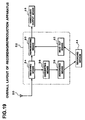
- Fig. 9 shows the overall structure of a recording/reproducing apparatus 32 according to an embodiment of the present invention.
- the radio waves captured with an antenna 20 are demodulated as a single transport stream by a receiving means 34.
- a transport stream from the receiving means 34 is supplied to reproducing means 40.
- the reproducing means 40 selects packets as to a desired service out of the transport stream and reproduces and outputs signals representing contents of services (for example, composite signals such as in NTSC) in accordance with the contents of the selected packets.
- a video/audio output means 46 receives the signals representing contents of services and outputs video/images.
- the transport stream from the receiving means 34 is supplied to converting means 36.
- the converting means 36 converts the transport stream to a packetized data stream being multiplexed suitable for recording and generates a data stream for normal playback.
- the converting means 36 generates a data stream for normal playback by selecting packets as to a desired service out of the transport stream and, of these packets, selecting the packets that are needed for reproduction.
- a data stream for normal playback containing navigation data is generated when the desired service contains the navigation data.
- the converting means 36 also generates a data stream for special playback by selecting packets that are needed for special playback.
- the converting means 36 outputs the data stream for normal playback and the data stream for special playback as a data stream for reproduction.
- Recording means 38 records the data stream for reproduction on a recording medium 44. In this embodiment, navigation data is not contained in the data stream for special playback even when the desired service contains the navigation data.
- the data stream for normal playback is read out from the recording medium 44 with read out means 42.
- the data stream thus read out is supplied to the reproducing means 40.
- the reproducing means 40 reproduces and outputs signals representing contents of services (for example, composite signals such as in NTSC) in accordance with the data stream thus supplied.
- the video/audio output means 46 outputs video/images upon receipt of the signals representing contents of services.
- reproducing means 40 changes the signals representing contents of services being outputted so as to carry out interactive operations based on inputs made through operations handling means 54 in accordance with the navigation data.
- the data stream for normal playback is read out from the recording medium 44 with read out means 42.
- the data stream thus read out is supplied to the reproducing means 40.
- the reproducing means 40 reproduces and outputs signals representing contents of services (for example, composite signals such as in NTSC) in accordance with the data stream thus supplied.
- the video/audio output means 46 outputs video/images upon receipt of the signals representing contents of services.
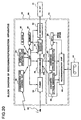
- Fig. 20 shows a block diagram of the recording/reproducing apparatus 32 depicted in Fig. 19 by using a CPU.
- the apparatus 32 comprises a receiving part 68, a recording/reproduction part 70.
- the CPU 58 controls other parts in accordance with a program stored in a memory 60.
- the apparatus can be switched into one of a receive mode, a record mode, a normal playback mode, a special playback mode. Details of each of these modes will be described hereunder.
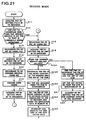
- FIG. 21 is a flowchart of a program stored in the memory 60.
- Operations of the CPU 58 upon receipt of a command for switching the service currently received to the service SV11 in the transport stream TS1 will be described under an assumption that the service SV 13 in the transport stream TS 1 is currently received.
- the command to the CPU 58 is provided through an operation panel or a remote controller.
- An operation inputting part 54 is a photo-sensing part for receiving the command from one of the operation panel and the remote controller.
- the CPU 58 sets a packet ID of a PAT in a register (not shown) for separation of control data of a transport decoder (TS decoder) 50.
- the packet ID of the PAT is determined in fixed manner as "0X0000.
- the TS decoder 50 thereby records (step S11) the contents of the PAT, which is thus separated in the memory 60.
- the PAT contains a table of the services that are multiplexed on the transport stream TS1 that is currently being received (see Fig. 10). In this way, it is possible for the CPU 58 to realize that desired service SV11 is multiplexed on the transport TS1 that is currently being received. That is, the processing of the CPU 28 proceeds to step S18 from step S12.
- step S18 the packet ID of the PMT in the desired service SV11 is acquired using the PAT being obtained. In this case, "0x0011" is acquired (see Fig. 10).
- the CPU 58 sets the packet ID "0x11" of the PMT in the register of the TS decoder 50 that is used for separating the control data. In this way, control data PMT1 in the service SV11 can thereby be separated and its contents is extracted into the memory 60 (step S19).
- control data PMT1 in the service SV11 is depicted in Fig. 9.
- the CPU 58 judges whether or not the service SV11 contains the navigation data NVTs (in other words, whether or not the service is capable of performing interactive operations) in accordance with the control data PMT1 (step S191).
- the contents of the service currently received are outputted when no NVTs are contained therein (steps S20, S21 and S22).
- the CPU 58 recognizes packet IDs of video, audio and the navigation data these form entry-contents as well as that of ECMs for those data when the service contains the NVTs as depicted in Fig. 9 (step S192).
- packet ID "0x0096" of the video data ES (V) 11 packet ID "0x0098” of the audio data ES (A) 11
- the CPU 58 obtains ECM data by setting the packet ID "0x0082" of ECM data in the register of the TS decoder. Further, the ECM data thus obtained is supplied to the IC card 56 and a scramble key reproduced thereby is sent back. The scramble key thus obtained is set to the descrambler 48 (step S193). In this way, the packets of the video data ES (V) 11, ES (V) 12, the audio data ES (A) 11, ES (A) 12 and the navigation data NVT1, NVT2 are thereby put into descrambled condition.
- the CPU 58 sets the packet IDs "0x0096" and "0x0098" of the video data ES (V) 11 and the audio data ES (A) 11 in a register (no shown) of the TS decoder that is used for separation of ESs (step S194).
- the TS decoder outputs the video data ES (V) 11 and the audio data ES (A) 11 both being separated to an AV decoder 52.
- the AV decoder Upon receipt of the separated data, the AV decoder performs decompression (uncompress) of the compressed data and performs D/A (Digital to analog) conversion to generate a video composite signal.
- the signal thus generated is supplied to a TV set 46 and that is reproduced as video and audio thereby.
- moving images for performing a tele-shopping offering daily necessities depicted in Fig. 13 are displayed on the screen.
- Buttons B0, B1 and B3 positioned at lower right of the screen are displayed in accordance with navigation described below, and no data for displaying such buttons is contained in the video data ES (V) 11 and the audio data ES (A) 11.
- the CPU 58 sets the packet ID "0x0092" of the navigation data NVT1 in a register (no shown) of the TS decoder that is used for separation of control data in step S194.
- the navigation data NVT1 is stored in the memory 60 under the temporary basis. Assuming that the navigation data NVT1 depicted in Fig. 11 is stored therein.
- step S195 the navigation data thus stored is interpreted and executed accordingly.
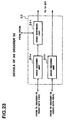
- Fig. 22 shows a flowchart of a program for interpreting and executing the navigation data, the program being stored in the memory 60.
- the CPU 58 reads out information having "0" in object index number from an object table of the navigation data NVT1 depicted in Fig. 11, and displays a button according to the information listed in the table (step S1001).
- bitmap data indicated in the bitmap table is displayed at a position of X co-ordinate "500” and Y co-ordinate "200". This is pre-set so as to display a bitmap of the focus condition in regard to the object of index number "0". Consequently, it is controlled so as to display the data having bitmap index number "1" (highlighted display: "place an order to Osaka center”).
- the CPU 58 supplies the data having bitmap index number "1" (highlighted display: “Place an order to Osaka center") to a video synthesize unit 52c of the AV decoder 52.
- the video synthesize unit 52c generates image data in which the highlighted display "place an order to Osaka center” is superimposed on the video data of ES (V) 11. Consequently, the button B0 is displayed on the screen of the TV set 46 as depicted in Fig. 13.
- the button B1 in Fig. 13 is displayed in accordance with the information of index "1" listed on the object table of the navigation data NVT1 depicted in Fig. 11. In this case, however, data of the bitmap index in the normal condition is displayed for object indexes other than object index "0". In other words, the display processing of "Place an order to Tokyo center", which is not highlighted, is performed (step S1002).
- step S1002 the display processing of the button B2 "Go to the clothing shop” (unhighlighted display) depicted in Fig. 13 is performed in accordance with the information of index "2" on the object table (step S1002).
- buttons B0, B1 and B2 which correspond to the moving images for describing merchandise is obtained.
- the display is effected in a condition with the button B0 "Place an order to Osaka Center" selected.
- the CPU 58 stores the information that objects index "0" is the currently selected object.
- an operation inputting part 54 receives the command and notifies the command to the CPU 58.
- the CPU 58 identifies the input via the operation inputting part (step S1003) and proceeds the process to step S1004 if the input is the "key to move the cursor downwardly".
- step S1004 the number of the currently selected object is incremented in accordance with the object table in the navigation data NVT1 so that the object index "1" is put into the selected condition.
- the bitmap shown in the focus condition column is displayed in respect of the object index "1”, while displaying the bitmap indicating the normal condition for the other object indexes "0" and "2".
- the screen of the TV set 46 is changes as depicted in Fig. 14. That is, the button B1 "Place an order to Tokyo center” is put in the selected condition.
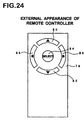
- the screen display is put into a condition in which the button B2 "Go to the clothing shop" is selected when the operator depresses the key that moves the cursor downwardly as depicted in Fig. 15. Also, the screen display returns to the condition depicted in Fig. 14 from the condition depicted in Fig. 15 when a key 80 that moves the cursor upwardly is depressed.
- the CPU 58 proceeds the process to step S1005 from step S1003 when the selection button 78 is depressed under the condition depicted in Fig. 15.
- the CPU 58 acquires a handler index that is given to the handler column of the object index which is currently in the selected condition by referring the navigation data NVT1. Here, it acquires the handler index "2" of the handler column because object index "2" is selected.
- the CPU 58 acquires the script corresponding to the handler "2" and executes accordingly (step S1006).
- it acquires a command "Go to contents (index 1)".
- the command "Go to contents ()” is a command to change over the contents having thew index number within the brackets () displayed in the hyper link table. Consequently, changeover to the contents (tele-shopping for clothing) of hyper link index "1" displayed in the hyper link table is performed.
- the video, audio and navigation data each forming link target, packet IDs "0x0097", “0x0099” and “0x0093” of these data are respectively assigned to the hyper link index "1" of the hyper link table.
- the CPU 58 sets the packet IDs "0x0097” and "0x0099” in the register of the TS decoder that are used for ES separation and sets the packet ID "0x0093" in the register thereof for control data separation.
- the TS decoder 50 outputs video data ES (V) 12 and audio data (A) 12 to the AV decoder.
- the TV set 46 displays the video of tele-shopping for clothing depicted in Fig. 16 and outputs the audio thereof.
- the navigation data NVT2 depicted in Fig. 12 is separated with the TS decoder 50 and stored in the memory 60 in place of the navigation data NVT1.
- the processing depicted in Fig. 22 is performed in regard to the navigation data NVT 2, with the result that buttons B10, B11 and B12 are displayed as depicted in Fig. 16.
- An order placement for a merchandise displayed on the screen can be made when the operator presses the selection button 84 (see Fig. 24) under the condition with the button B10 "Place an order to Osaka center" being selected depicted in Fig. 16. The processing for the operation will be described below.
- the CPU 58 proceeds the process to step S1005 from step S1003 when the selection button 84 is depressed.
- the CPU 58 acquires a handler index that is given to the handler column of the object index which is currently in the selected condition by referring the object table of the navigation data NVT1. Here, it acquires the handler index "0" of the handler column because object index "0" is selected.
- the CPU 58 executes the script corresponding to the handler index "0" in a handler definition table. In other words, it executes "send_string (index 1, index2)". "send_string (A,B) is a command for make a phone call the phone number of index "A" of a string able and to transmit the string of index "B". Consequently, the CPU 58 acquires a phone number "06-636-XXXX” corresponding to string index "0" in the string table and makes a phone call to the number "06-6368-XXXX" by controlling a communication line control unit 76 depicted in Fig. 10. The phone number is the number of the Osaka handling center for this tele-shopping.
- the CPU 58 sends data indicative of "product code: B-133" corresponding to the string index "2" in the string table when the line is connected. At time that time, the CPU 58 acquires ID(s) for specifying the purchaser from the IC card or the memory 60 and sends the ID(s) as well.
- the CPU 58 records whether or not the above communications successfully done in the form of an online log in the memory 60. An example of such record is depicted in Fig. 25. An indication "O” is recorded if the communications successfully done, another indication "X" is written if not.
- the CPU 58 records the time at which communications took place by acquiring control data TDT contained in the transport stream and/or its own calendar or clock or the like.
- Processing in the receive mode is executed as described above.
- the merchandise that are described in video are designed to be changed with time in this embodiment. Consequently, it is designed to transmit navigation data of different contents corresponding thereto (for example, with different product code at index "2" of the string table).
- Fig. 26 shows a program for record mode which is recorded in the memory 60, in the form of a flowchart. Steps S11 through S22 and steps S192 through S195 are the same as in the case of the receive mode.
- Fig. 26 shows processing in the case where a service is recorded that contains navigation data i.e. that recording processing that is performed in parallel with step S195.
- processing proceeds utilizing the information (packet ID) that was acquired in the receive mode.
- it is necessary to acquire the PID of the desired service and that of control data or the like by processing identical with that of the receive mode when the record mode is executed independently from the received mode.
- the CPU 58 sets the packet IDs of the ES, that of the navigation data NVT, that of the NIT, that of the PAT and that of the PMT in the service that is desired to be recorded in the register (not shown) of the TS decoder 50 which is used for separation of recorded data.
- the respective packet IDs depicted in Figs. 25, 26, and 7 are set.
- the packet IDs for both a tele-shopping for daily necessities and that for clothing are set.
- the TS decoder 50 outputs the video and audio data ES (V) 11, ES (V) 12, ES (A) 11, ES (A) 12, the PAT, PMT1 and NIT directly in the packetized condition to the a converted stream generator 62.
- the CPU 58 generates a converted PMT1 for normal playback (step S24) by acquiring the converted PMT1 that is recorded in the memory 60 and selecting, of the information that is given there, only relating to the desired service SV11. For example, the packet ID of the ECM out of the information contained in the converted PMT1 is not needed during reproduction so that the packet ID is eliminated. As a result, the converted PMT1 eliminating unrelated information for recording/reproduction of the desired service SV11 is obtained out of the information contained in the PMT1.
- Fig. 27 shows the converted PMT for normal playback that is thus obtained.
- control data SIT describing information of the services and events (programs) contained in the converted stream being recorded (step S25).
- the CPU 58 supplies the PMT1 and the control data SIT thus generated to an MPU 64.
- the MPU 64 supplies these data to the converted stream generator 62 which generates a converted stream.
- the converted stream generator 62 receives the PAT from the TS decoder 50 and thereby generates a converted PAT containing only information related to the desired service SV11, and replaces the PAT by this converted PAT. At that time, the packet ID of the NIT contained in the PAT is converted to the packet ID of the SIT. The converted PAT is shown in Fig. 28. Also, the PMT from the TS decoder 50 is replaced with the converted PMT received from the MPU 64. Furthermore, the NIT from the TS decoder 50 is substituted by the SIT received from the MPU 64.
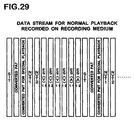
- a converted stream is obtained in which are packet-multiplexed the desired service ES, navigation data NVT, SIT, converted PAT and converted PMT.
- Fig. 29 shows the stream for the normal playback thus obtained in diagrammatic form.
- the CPU 58 generates a converted PMT1 for special playback (step S261) by acquiring the converted PMT1 that is recorded in the memory 60 and further selecting, of the information that is given there, only relating to the desired service SV11. For example, packet IDs of audio that of navigation data and the like contained in the PMT1 are eliminated in this embodiment.
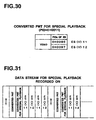
- Fig. 30 shows a converted PMT for special playback that is thus obtained.
- No packet ID of the navigation data is recorded in the conversion PMT for special playback because no interactive control is carried out during the special playback. Similarly, only a packet ID of audio is recorded since no audio is reproduced during the special playback.
- the CPU 58 supplies the conversion PMT for special playback thus generated as described above to the MPU 64 (step S262).
- the MPU 64 supplies the PMT to a converted stream generator 63 for special playback which generates a converted stream for special playback.
- the converted stream generator 63 receives a conversion PMT for normal playback.
- the generator 63 extracts only packets representing video (0x0096, 0x0097) out of the packets contained in the conversion PMT for normal playback and selects data so called "I picture" (data capable of reproducing images in a complete form under independent manner) out of the video packets.
- the generator 63 further selects packets out of the I picture so as to enable the special playback such as cue and review by adjusting the number of the packets for the playback speed thereof.
- the generator 63 eliminates unnecessary packets for carrying out special playback (audio data, most of the video data, navigation data and the like) contained in the data stream for normal playback. In addition, the generator 63 replaces the PMT for normal playback with the PMT for special playback.
- a converted stream for special playback is obtained in which ES of video for special playback, SIT, converted PAT and converted PMT are packet-multiplexed.
- Fig. 31 shows the stream for special playback thus obtained in diagrammatic form.
- the CPU 58 supplies a command for recording to the MPU 64 (step S27).
- the MPU 64 records the data stream for normal playback and the data stream for special playback on a magnetic tape 44 by controlling a recording/readout part 66.
- Fig. 32 is a view illustrating a state of a data stream for reproduction being recorded.
- the recording/readout part 66 records the stream for normal playback on a track TC.
- the recording/readout part 66 is controlled for sequentially recording the stream for special playback on a region TTC extending so as to across a plurality of the track TC.
- the stream recorded on the region TTC is a stream for cue mode.
- a stream for review mode is recorded on a region TTB.
- the CPU 58 supplies the command to the MPU 64 (steps S28 and S29). Upon receipt of the command, the MPU 64 suspends recording performed by the recording/readout part 66.
- Control data and navigation data contained in the stream for special playback being recorded on the magnetic tape 44 are repeatedly packetized and multiplexed even the contents of which are identical with these data being unprocessed. As a consequence, reproduction of the magnetic tape can be performed even starting at a mid-way thereof.
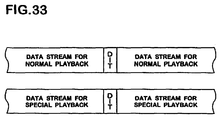
- control data DIT Discontinuity Information Table
- the control data DIT is allocated at the head of the service latter selected and is packet-multiplexed as depicted in Fig. 33. Similarly, DIT is allocated at the head of when totally new recording is started. DIT is also allocated when different program is recorded even in the same service.
- All of the video, audio, navigation data contained in the service SV11 are recorded in the Stream for normal playback regardless of the change in display of the received data (change depicted if Figs 29 through 32) performed in accordance with the navigation data NVT1 and NVT2.
- the generator 62 and the generator 63 are provided in the recording/reproducing part 70 in this embodiment, these generators can be provided in the receiving part 68. By doing that, the recording/reproducing part 70 may simply record a conversion stream outputted from the receiving part 68 as it is.
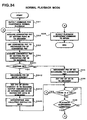
- Fig. 34 shows a program for a normal playback mode which is recorded in the memory 60, in the form of a flowchart.
- the apparatus is turned into the normal playback mode. Description in below is made under an assumption that data recorded during the record mode described above are reproduced.
- the CPU 58 supplies a command for performing normal playback to the MPU 64.
- the MPU 64 controls the recording/readout part 66 so as to read out a stream for normal playback from the magnetic tape.
- the stream thus read out is provided to the TS decoder 50.
- the CPU 58 sets a packet ID "0x0000" of a conversion PAT in a register for separation of control data of TS decoder 50, and the converted PAT in the converted stream is thereby separated and stored in the memory 60 (step S32).
- the packet ID of the converted PMT is recognized from the description of thereof given in this converted PAT (step S33).
- the packet ID "0x0001"of the converted PMT is set in the register for separation of control data of the TS decoder 50, and the converted PMT is thereby separated from the converted stream and stored in the memory 60 (step S34).
- the description of the converted PMT is used to judge whether or not the navigation data NVT is contained in the service that is to be reproduced (step S341).
- step S342 Processing proceeds to step S342 if the navigation data NVT is contained therein.
- step S342 the description of the converted PMT is used to recognize the packet ID of the entry-contents.
- the packet ID s "0x0096", “0x0098” and "0x0092" of the video data ES (V) 11, audio data ES (A) 11 and thew navigation data NVT1 are then recognized (step S342).
- the CPU 58 sets the packet ID s of the video data ES (V) 11 and audio data ES (A) 11 in the register for ES separation of the TS decoder 50, and sets the packet ID of the navigation data NVT 1 in the register for control data separation.
- the TS decoder 50 separates the video data ES (V) 11 and the audio data ES (A) 11 from the converted stream.
- the separated video data ES (V) 11 and the separated audio data ES (A) 11 are then outputted to the AV decoder 52 (step S343).
- the AV decoder 52 Upon receipt of the separated data, the AV decoder 52 performs decompression (uncompress) of the compressed data and performs D/A (Digital to analog) conversion to generate a video composite signal.
- the signal thus generated is supplied to the TV set 46 and that is reproduced as video and audio thereby. In this way, video depicted in Fig. 13 can be obtained.
- the TS decoder 50 separates the navigation data NVT 1 from the converted stream and the navigation data NVT 1 is stored in the memory 60 under the temporary basis (step S343).
- the navigation data NVT1 is then interpreted and executed accordingly (step S345).
- This partial processing is the same as that performed in the flowchart shown in Fig. 22. Consequently, the buttons B0, B1 and B2 are displayed on the screen, with the selected condition as depicted in Fig. 13.
- the selected button is altered as depicted in Figs. 13, 14 and 15 when the buttons 80 and 82 that move the cursor.
- the contents is altered to the contents of the tele-shopping for clothing when the selection button 84 is depressed under the condition depicted in Fig. 15.
- a phone call is made to the Osaka center when the selection button 84 is depressed in the condition where the button B10 depicted in Fig. 16 is selected, and an order placement for a merchandise is carried out.
- An online log storing the success or incomplete communication is also stored in the memory 60 as depicted in. Fig. 25.
- the contents can be interactively altered under the control performed by the operator even in the playback mode, just as in the receive mode.
- step S37 If, the CPU 58 discovers the presence of a DIT in the converted stream during the playback, the process returns to step S32, and performs the following processing of the converted PAT (step S37). This is because the DIT indicates a point of discontinuity of the recorded data.
- the process also stops the display of the image (the button B0 and the like) for control purposes that was displayed in accordance with the navigation data and ensures that interactive processing based on the currently stored navigation data is not performed.
- the CPU 58 supplies the command to the MPU 64 (steps S38 and S39).
- the MPU 64 suspends readout of the stream for normal playback from the magnetic tape 44 performed by the recording/readout part 66 as a result of control there of.
- Fig. 35 shows a program for executing a special playback mode which is recorded in the memory 60, in the form of a flowchart.
- the CPU 58 supplies the command performing normal playback to the MPU 64.
- the MPU 64 controls the recording/readout part 66 so as to read out a stream for special playback from the magnetic tape 44.
- the stream thus read out is provided to the TS decoder 50.
- the CPU 58 sets the packet ID "0x0000" of a conversion PAT in the register for separation of control data of TS decoder 50, and the converted PAT in the converted stream is thereby separated and stored in the memory 60 (step S340).
- the packet ID "0x0011" of the converted PMT for special playback is recognized in accordance with description of the converted PAT (step S330).
- the packet ID "0x0011"of the converted PMT is set in the register for separation of control data of the TS decoder 50, and the converted PMT is thereby separated from the converted stream and stored in the memory 60 (step S340).
- the description of the converted PMT is used to judge whether or not two (2) or more contents (ES) that to be reproduced in special playback are contained in accordance with the description of the converted PMT (step S350).
- the process proceeds to step S360 because there are two (2) of ESs in the PMT as depicted in Fig. 30.
- step 360 the contents being reproduced under normal playback mode at right before the current special playback mode is selected. For example, if the ES (V) 12 (clothing store) was reproduced under normal playback mode, the ES (V) 12 (clothing store) is selected.
- Any contents may be selected if no contents were reproduced under normal playback mode at the right before the current playback.
- the content is selected.
- the CPU 58 sets the packet ID of the video data ES (V) 12 in the register for ES separation of the TS decoder 50.
- the TS decoder 50 separates the video data ES (V) 12 from the converted stream.
- the separated video data ES (V) 12 is then outputted to the AV decoder 52 (step S370).
- the AV decoder 52 Upon receipt of the separated data, the AV decoder 52 performs decompression (uncompress) of the compressed data and performs D/A (Digital to analog) conversion to generate a video composite signal.
- the signal thus generated is supplied to the TV set 46 and that is reproduced as video and audio thereby as video for special playback (cue, review).
- the CPU 58 supplies the command to the MPU 64 (steps S390 and S400).
- the MPU 64 suspends readout of the stream for special playback from the magnetic tape 44 performed by the recording/readout part 66 as a result of control there of.
- the same packets IDs are used for contents corresponding to one another in both normal playback and special playback. In this way, linearity of contents in the case of changing playback mode from normal playback mode to special playback mode even when not two (2) or more contents are contained.
- the image for interactive operation is disappeared with the initiation of the special playback mode.
- the image for performing operations in normal playback mode may be displayed continuously even in special playback mode by storing the image in the video synthesize unit 52c of the AV decoder 52.
- a version upgrade flag (version upgrade information) is included in the data stream for special playback at when upgrade of the navigation data is detected in the record mode. For example, the flag is written in the conversion PAT and the conversion PMT.
- the image for performing operations in the normal playback is displayed as it is, and display of the image is suspended if upgrade of the navigation data is detected as a result of observing the presence of the flag in the conversion PAT and the conversion PMT. In this way, the inconsistencies between images displayed according to special playback and the image for performing operations can be avoided.
- Upgrade of the navigation data may also be detected by recognizing history of the version on the navigation data being recorded instead of the version upgrade flag.
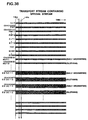
- Figs. 36 and 37 data NV1 and NV2 indicative of the image for performing operations may be included in the stream for special playback as depicted in Figs. 36 and 37.
- packet IDs of the image for performing operations are designed to be the same to that of the navigation data defining the image. This is to the same as the reason for using the same packet IDs for contents corresponding to one another in both normal playback and special playback in the special playback mode.
- an image for performing operations corresponding to video currently displayed is displayed in accordance with the stream for special playback. In this way, the inconsistencies between images displayed according to special playback and the image for performing operations can be avoided.
- no input for operation is handled during the special playback mode.
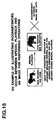
- a warning notice such as "No interactive operations can be performed during the playback is in cue" may be displayed on the screen.
- the layout of a transmitter according to the second, embodiment of the present invention is the same as that of shown in Fig. 2. However, it differs in that the video/audio data management part 7 generates data for the special playback in respect to each of the services.
- the data for the special playback is converted into a special stream and is contained in the transport stream with a data multiplexing part 10.
- Fig. 38 shows the transport stream thus generated.
- Fig. 39 is a view showing the contents of the control data PMT1.
- Special playback ES (V) 11 and ES (V) 12 represent streams for special playback respectively generated in accordance with ES (V) 11 and ES (V) 12.
- the streams are formed in the form further selecting packets from the picture.
- the data NV1 and the NV2 are images for performing operations respectively contained in the navigation data NVT1 and NVT2.
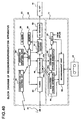
- Fig. 40 is a schematic view illustrating hardware structure of the recording/reproducing apparatus according to the second embodiment.
- the apparatus is designed so as to fetch the special stream from the terminal 50c of the transport decoder 50.
- the generator 63 generates the stream for special playback upon receipt of the special stream.
- the load for the generator 63 can be decreased relative to that in the first embodiment because the special steam contains video further selected for the special playback. As a consequence, processing of the special stream can be carried out quickly.
- the special stream to be recorded is the same as that depicted in Fig. 37. It is, therefore, the image for performing operations is displayed even in the special playback.
- the image for operations is contained in the special stream in the above embodiments, the image may not be contained therein. In that case, the image is not contained in the stream for special playback generated with the recording/reproducing apparatus.
- the apparatus to generate the image for operations and makes the image to contain into the special stream while making the image not to contain into the special stream.
- Hardware structure of the recording/reproducing apparatus according to the present invention is the same as that of shown in Fig. 20.
- the stream for special playback is generated so as to contain the navigation data NVT1 and NVT2 as depicted in Figs. 41 and 42.
- the generator 63 carries out the following processing; thinning video streams, discarding audio streams, and remaining navigation data.
- the navigation data to be recorded in the stream for special playback may be the same as that to be recorded in the stream for normal playback. However, partial recording of the navigation data may also be carried out if the width of the memory area for special playback is in small.
- control with interactive manner can be carried out even in the special playback mode because control commands in the navigation data are recorded in the stream for special playback.
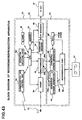
- Fig. 43 is a schematic view illustrating hardware structure of the recording/reproducing apparatus according to the fourth embodiment.
- this embodiment only the stream for normal playback is recorded on the tape 44 and none of the stream for special playback is generated nor recorded thereon.
- the normal playback mode a series of processing is carried out for the normal playback; reading out the stream for normal stream recorded on the tape, providing the stream to the TS decoder 50 under the as-is condition.
- the stream for normal playback thus read out is supplied to the generator 63 through switching of switches 63a, 63b.
- the generator 63 generates streams required for performing special playback and provides the resultant streams to the TS decoder 50.
- the streams required for performing the special playback are generated during the playback in this embodiment. Consequently, the recording volume of the medium can be effectively used while performing the special playback because only the stream for normal playback is recorded on the recording medium.
- the special playback can be carried out even with a recording medium which records only the streams for normal playback.
- the layout of the transmitter is the same as that of shown in Fig. 2. However, it differs in that the video/audio data management part 7 generates data for the special playback in respect to each of the services.
- the data for the special playback is converted into a special stream and is contained in the transport stream with the data multiplexing part 10 similar to the second embodiment.
- the transmitter described in the second embodiment not contains control data in the navigation data into the transport stream, the transmitter according to this embodiment does contain the control data therein.
- the hardware structure of the recording/reproducing apparatus according to the fifth embodiment is similar to that depicted in Fig. 40.
- the apparatus is designed so as to fetch the special stream from the terminal 50c of the transport decoder 50.
- the generator 63 generates the stream for special playback upon receipt of the special stream.
- the stream for special playback to be recorded is the same as that depicted in Fig. 42. Consequently, the image for operations is displayed even in the special playback.
- navigation data (control data) to be contained in the special stream may be the same navigation data to be contained in the normal stream. However, only a part of the navigation data may be contained in the special stream.
- a service ID at the point ⁇ is (see stored, and matching between the service ID at the point ⁇ and a service ID at the point ⁇ is carried out.
- the navigation data obtained at the point ⁇ is used at the point ⁇ If both are matched (see Fig. 44B). If they are not matched, a new navigation data is obtained at the point ⁇ because the service has been changed to another during the special playback (see Fig. 44).
- decision is made depending upon the service IDs in the embodiment described in above, the decision may be made under version of the navigation data itself and the like.
- the layout of a transmitter according to the seventh embodiment of the present invention is the same as that of shown in Fig. 2. However, it differs in that the video/audio data management part 7 makes each of the service so as to contain a version upgrade flag (version upgrade information) whether or not allowing the special playback therein.
- the flag may be written in the PMT.
- a type of broadcasting in which a plurality of still images are repeatedly transmitted, and controlling which of the images is displayed according to the navigation data, and performing the display in an interactive manner in response to inputs made by the operator, is available.
- a quiz program in which asking questions to the operator(s) and make him/her to select the answer, and another questions is displayed only the case if the answer to the question is correct, can be realized.
- Such undesirable display can be banned as to the service (or the event) if a flag for banning the special playback.
- Fig. 46 is a flowchart of a program executed in the record mode.
- the CPU 58 judges whether or not a flag(s) for special playback written in the PMT is in "permit” or "ban". If the flag is in "permit”, a data stream for special playback is generated and the stream is recorded on the recording medium. In the contrary, data stream for special playback is not recorded on the recording medium when the flag is in "ban”. As a consequence, only the stream for normal playback is recorded on the tape 44 when the flag is in "ban”. The flag is recorded under the as-is condition into a converted PMT of the stream for normal playback.
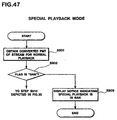
- Fig. 47 is a flowchart of a program executed in the special playback mode.
- the converted PMT of the stream for normal playback is obtained at step S301.
- the CPU 58 judges whether or not the flag(s) for special playback written in the PMT is in "permit” or "ban” (step S302). If the flag is in "permit”, the process proceeds to step S310 in which processing for special playback is performed. In the contrary, a display indicative that the special playback is banned and end the process if the flag is in "ban”.
- the flag for special playback is written to all the services and the events, the flag may be written based on a predetermined period within the event for describing detailed information.
- the stream for special playback is recorded on the tape when the flag is in "ban” in the above embodiment, the stream may be recorded on the tape even when the flag is in "ban” unless the special playback is performed in the playback mode
- the special playback may not be performed when the flag is in "ban".
- Hardware structure of the recording/reproducing apparatus according to the eighth embodiment is the same as that shown in Figs. 20, 40 and 43. Consequently, one of these structures may be applied to the apparatus in this embodiment.
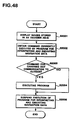
- Fig. 48 is a flowchart of a program executed in a pause mode.
- the CPU 58 controls the AV decoder 52 to maintain the contents currently displaying as it is (step S2001). If the image for operation is displayed on the contents, the display of the image is maintained as well.
- the program interpreting and executing the navigation data depicted in Fig. 22 obtains a command currently being executed (step S2002).
- the CPU 58 judges whether or not the command (for example, the command of "send_string" in Fig. 11) is a command for carrying out communications to the outside (step S2003). If the command is not for carrying out the communication, the CPU 58 suspends the execution of the program (step S2005). The CPU 58 also suspends the execution of the program (step S2005), after executing the program if the judgement at step S2003 is YES (step S2004).
- the apparatus is designed so as to remain the image for operations even in the pause mode in the embodiment described in above, the image may be disappeared.
- the apparatus is designed so as to execute the communication commands even in the pause mode in the embodiment described in above. It is possible to design the apparatus to suspend the execution of all the commands.
- the present invention is applied to digital satellite broadcasting, however, the present invention may also be applied to other type of broadcasting methods such as digital terrestrial broadcasting, wire broadcasting. In addition, the present invention may be applied to a technique for recording and reproducing digital contents in data stream not even in broadcasting.
Landscapes
- Engineering & Computer Science (AREA)
- Multimedia (AREA)
- Signal Processing (AREA)
- Human Computer Interaction (AREA)
- Databases & Information Systems (AREA)
- Computer Security & Cryptography (AREA)
- Television Signal Processing For Recording (AREA)
- Signal Processing For Digital Recording And Reproducing (AREA)
- Two-Way Televisions, Distribution Of Moving Picture Or The Like (AREA)
Abstract
Description
Claims (81)
- A recording/reproducing apparatus receiving digital broadcasting comprising:receiving means for receiving a transport stream containing control data for realizing interactive operations;converting means for generating a data stream for reproduction containing the control data in accordance with packets as to a desired service selected from the transport stream being received;recording means for recording the stream from the converting means on a recording medium;readout means for reading out the stream recorded on the medium;operation handing means for handing operations made by an operator; andreproducing means for reproducing signals representing contents of services by one of receiving a transport stream from the receiving means when the apparatus is in a playback mode and receiving a transport stream from the readout means when the apparatus is in a receive mode, wherein the reproducing means outputs the reproduced signals;
wherein the playback mode includes a normal playback mode and a special playback mode;
and wherein the reproducing means carries out an interactive operation in which the reproducing means outputs an image for performing operations in accordance with control data contained in the transport stream being received and changes the signal representing contents of the services being outputted in accordance with input of the operator when the apparatus is in the receive mode and the normal playback mode;
and wherein the reproducing means not carries out the interactive operation when the apparatus is in the special playback mode. - The apparatus in accordance with claim 1, wherein the converting means generates a data stream for reproduction containing a data stream for the normal playback and a data stream for the special playback;
and wherein the reproducing means reproduces signals representing contents of services reproduced under the normal playback mode in accordance with the data stream for the normal playback when the apparatus is in the normal playback mode;
and wherein the reproducing means reproduces signals representing contents of services reproduced under the special playback mode in accordance with the data stream for the special playback when the apparatus is in the special playback mode. - The apparatus in accordance with claim 2, wherein the converting means generates a data stream for special playback not containing the image for performing operations and a control command, both of the image and the command being used for performing interactive operations;
and wherein the reproducing means not displays the image for performing operations when the apparatus is in the special playback mode. - The apparatus in accordance with claim 2, wherein the converting means generates a data stream for special playback containing the image for performing operations and not contains a control command, both of the image and the command being used for performing interactive operations;
and wherein the reproducing means displays the image for performing operations when the apparatus is in the special playback mode. - The apparatus in accordance with claim 2, wherein the converting means further includes data for detecting whether or not a version of control data for performing the interactive operations is upgraded into the data stream for special playback;
and wherein the reproducing means suspends display of the image for performing operations when upgrade of the control data is detected according to the detecting data during the special playback mode. - The apparatus in accordance with claim 3, wherein the reproducing means outputs a signal for notifying the suspension to the operator when display of the image is suspended thereby.
- The apparatus in accordance with claim 2, wherein the converting means generates a data stream for special playback which contains the image for performing operations and not contains a control command, both of the image and the command being used for performing interactive operations;
and wherein the reproducing means switches whether or not displaying the image for performing operations in accordance with input of the operator when the apparatus is in the special playback mode. - A digital receiving apparatus for outputting data for recording a desired service by receiving a transport stream comprising:
receiving means for receiving the transport stream being packetized containing control data for realizing interactive operations;converting means for generating a data stream for reproduction containing the control data in accordance with packets as to a desired service selected from the transport stream being received; anda recording data output terminal for providing the data stream for reproduction from the converting means to a memory device;
wherein the converting means generates a data stream for reproduction containing a data stream for normal playback and a data stream for special playback, the data stream for special playback not containing a control command used for performing interactive operations. - A digital video recording apparatus for recording a desired service by receiving a transport stream comprising:converting means for generating a data stream for reproduction containing control data for realizing interactive operations by selecting packets as to a desired service selected from the transport stream being received; andrecording means for recording the stream from the converting means on a recording medium;
wherein the converting means generates a data stream for reproduction containing a data stream for normal playback and a data stream for special playback, the data stream for special playback not containing a control command used for performing interactive operations. - The apparatus in accordance with claim 8, wherein the converting means generates a data stream for special playback not containing an image for interactive operations.
- The apparatus in accordance with claim 8, wherein the converting means generates a data stream for special playback containing an image for interactive operations.
- The apparatus in accordance with claim 1, wherein the converting means generates a data stream for reproduction containing a data stream for the normal playback and not containing a data stream for the special playback;
and wherein the reproducing means reproduces signals representing contents of services reproduced under the normal playback mode in accordance with the data stream for the normal playback when the apparatus is in the normal playback mode;
and wherein the reproducing means reproduces signals representing contents of services reproduced under the special playback mode in accordance with the data stream for the special playback when the apparatus is in the special playback mode. - The apparatus in accordance with claim 12, wherein the reproducing means generates a service contents signal for special playback not containing an image and a control command when the apparatus is in a special playback mode, both of the image and the command being used for performing interactive operations;
and wherein the reproducing means not displays the image for performing the interactive operations. - The apparatus in accordance with claim 12, wherein the reproducing means generates a service contents signal for special playback containing an image for interactive operations and not containing a control command for interactive operations when the apparatus is in the special playback mode;
and wherein the reproducing means displays the image. - The apparatus in accordance with claim 12, wherein the reproducing means detects whether or not control data for performing interactive operations is upgraded in the data stream for special playback;
and wherein the reproducing means suspends display of the image for performing the interactive operations when upgrade of the control data is detected. - The apparatus in accordance with claim 13, wherein the reproducing means outputs a signal for notifying the suspension to the operator when display of the image is suspended thereby.
- In a digital transmitting apparatus for transmitting a transport stream containing control data for realizing interactive operations:
wherein the apparatus transmits the transport stream so as to contain a special stream for special playback. - A recording/reproducing apparatus receiving digital broadcasting comprising:receiving means for receiving the transport stream containing control data for realizing interactive operations and a special stream for special playback;converting means for generating a data stream for normal playback containing the control data in accordance with packets as to a desired service selected from the transport stream being received and a data stream for special playback in accordance with the special stream;recording means for recording the data stream and the stream for special playback both from the converting means on a recording medium as a data stream for reproduction;readout means for reading out the stream for reproduction recorded on the medium;operation handing means for handing operations made by an operator; andreproducing means for reproducing a signal representing contents of services by one of receiving a transport stream from the receiving means when the apparatus is in a receive mode and receiving a transport stream from the readout means when the apparatus is in a playback mode, wherein the reproducing means outputs the reproduced signals;
and wherein the reproducing means carries out an interactive operation in which the reproducing means outputs an image for performing operations in accordance with control data contained in the transport stream being received when the apparatus is in the receive mode and the normal playback mode;
and wherein the reproducing means reproduces service contents of the special playback in accordance with the stream for special playback and not carries out the interactive operations when the apparatus is in the special playback mode. - A digital receiving apparatus for outputting data for recording a desired service by receiving a transport stream comprising:receiving means for receiving the transport stream being packetized containing control data for realizing interactive operations and a special stream for special playback;converting means for generating a data stream for normal playback containing the control data in accordance with packets as to a desired service selected from the transport stream being received and a data stream for special playback in accordance with the special stream; anda recording data output terminal for providing the data stream for normal playback and the data stream for special playback both from the converting means to a memory device.
- The apparatus in accordance with claim 17, wherein the special stream contains a control command for performing interactive operations.
- The apparatus in accordance with claim 17, wherein the special stream not contains a control command for performing interactive operations.
- The apparatus in accordance with claim 21, wherein the special stream not contains an image for interactive operations.
- The apparatus in accordance with claim 21, wherein the special stream contains an image for interactive operations.
- The apparatus in accordance with claim 20, wherein the data stream for special playback not contains a control command for performing interactive operations.
- The apparatus in accordance with claim 24, wherein the data stream for special playback stream not contains an image for interactive operations.
- The apparatus in accordance with claim 24, wherein the data stream for special playback contains the control command for performing interactive operations.
- A digital video reproduction apparatus for reproducing services by reading out a stream for reproduction recorded on a recording medium comprising:readout means for reading out the stream for reproduction recorded on the recording medium;operation banding means for handing operations made by an operator; andreproducing means for reproducing a signal representing contents of the services by receiving the stream for reproduction from the readout means, wherein the reproducing means outputs the reproduced signals;
wherein the reproducing means outputs an image for performing operations in accordance with control data for performing interactive operations contained in the stream for reproduction, and performs interactive operations so as to change a signal representing contents of the services responding to an input of the operator when the apparatus is in a normal playback mode;
and wherein the reproducing means not performs the interactive operations when the apparatus is in a special playback mode. - The apparatus in accordance with claim 27, wherein the reproducing means not displays the image for performing operations when the apparatus is in the special playback mode.
- The apparatus in accordance with claim 27, wherein the reproducing means displays the image for performing operations when the apparatus is in the special playback mode.
- The apparatus in accordance with claim 29, wherein the reproducing means suspends display of the image for performing operations when upgrade of the control data is detected during the special playback mode.
- The apparatus in accordance with claim 28, wherein the reproducing means outputs a signal for notifying the suspension to the operator when display of the image is suspended thereby.
- The apparatus in accordance with claim 27, wherein the operator enables to choose whether or not displaying the image for performing operations when the apparatus is in the special playback mode.
- A recording/reproducing apparatus receiving digital broadcasting comprising:receiving means for receiving a transport stream containing control data for realizing interactive operations;converting means for generating a data stream for reproduction containing the control data in accordance with packets as to a desired service selected from the transport stream being received;recording means for recording the stream from the converting means on a recording medium;readout means for reading out the stream recorded on the medium;operation handing means for handing operations made by an operator; andreproducing means for reproducing signals representing contents of services by one of receiving a transport stream from the receiving means when the apparatus is in a receive mode and receiving a transport stream from the readout means when the apparatus is in a playback mode, wherein the reproducing means outputs the reproduced signals;
wherein the playback mode includes a normal playback mode and a special playback mode;
and wherein the reproducing means carries out an interactive operation in which the reproducing means outputs an image for performing operations in accordance with control data contained in the transport stream being received and changes the signal representing contents of the services being outputted in accordance with input of the operator when the apparatus is in the receive mode, the normal playback mode and the special playback mode. - The apparatus in accordance with claim 33, wherein the converting means generates a data stream for reproduction containing a data stream for the normal playback and a data stream for the special playback;
and wherein the reproducing means reproduces signals representing contents of services reproduced under the normal playback mode in accordance with the data stream for the normal playback when the apparatus is in the normal playback mode;
and wherein the reproducing means reproduces signals representing contents of services reproduced under the special playback mode in accordance with the data stream for the special playback when the apparatus is in the special playback mode. - The apparatus in accordance with claim 34, wherein the converting means makes control data for realizing interactive operations equivalent to the data stream for the normal playback so as to include into the data stream for the special playback;
and wherein the reproducing means carries out an interactive operation equivalent to that carried out in the normal playback mode. - The apparatus in accordance with claim 34, wherein the converting means generates the data stream for the special playback by omitting a part of the control data;
and wherein the reproducing means carries out an interactive operation different from that carried out in the normal playback mode when the apparatus is in the special playback mode. - A digital receiving apparatus for outputting data for recording a desired service by receiving a transport stream comprising:receiving means for receiving the transport stream containing control data for realizing interactive operations;converting means for generating a data stream for reproduction containing the control data in accordance with packets as to a desired service selected from the transport stream being received; anda recording data output terminal for providing the data stream for reproduction from the converting means to a memory device;
wherein the converting means generates a data stream for reproduction containing a data stream for normal playback and a data stream for special playback,
and wherein the control data is contained in both the data stream for normal playback and the data stream for special playback. - A digital video recording apparatus for outputting data for recording a desired service by receiving a transport stream comprising:converting means for generating a data stream for reproduction containing control data for realizing interactive operations by selecting packets as to a desired service selected from the transport stream being received; andrecording means for recording the stream from the converting means on a recording medium;
wherein the converting means generates a data stream for reproduction containing a data stream for normal playback and a data stream for special playback,
and wherein the control data is contained in both the data stream for normal playback and the data stream for special playback. - The apparatus in accordance with claim 37, wherein the converting means makes control data for realizing interactive operations equivalent to the data stream for the normal playback so as to include into the data stream for the special playback.
- The apparatus in accordance with claim 37, wherein the converting means generates the data stream for the special playback by omitting a part of the control data.
- The apparatus in accordance with claim 33, wherein the converting means generates a data stream for reproduction containing a data stream for the normal playback and not containing a data stream for the special playback;
and wherein the reproducing means reproduces signals representing contents of services reproduced under the normal playback mode in accordance with the data stream for the normal playback when the apparatus is in the normal playback mode;
and wherein the reproducing means reproduces signals representing contents of services reproduced under the special playback mode in accordance with the data stream for the normal playback when the apparatus is in the special playback mode. - The apparatus in accordance with claim 41, wherein the reproducing means carries out an interactive operation equivalent to that carried out in the normal playback mode.
- The apparatus in accordance with claim 41, wherein the reproducing means carries out an interactive operation different from that carried out in the normal playback mode when the apparatus is in the special playback mode.
- In a digital transmitting apparatus for transmitting a transport stream containing control data for realizing interactive operations:
wherein the apparatus transmits the transport stream so as to contain a special stream for special playback containing a control command for performing interactive operations in addition to a normal stream for normal playback. - A recording/reproducing apparatus receiving digital broadcasting comprising:receiving means for receiving a transport stream containing both a normal stream including control data for realizing interactive operations and a special stream for special playback;converting means for generating a data stream for normal playback containing the control data in accordance with the normal stream as to a desired service selected from the transport stream being received and a data stream for special playback in accordance with the special stream;recording means for recording the data stream and the stream for special playback both from the converting means on a recording medium as a data stream for reproduction;readout means for reading out the stream for reproduction recorded on the medium;operation handing means for handing operations made by an operator; andreproducing means for reproducing a signal representing contents of services by one of receiving a transport stream from the receiving means when the apparatus is in a receive mode and receiving a transport stream from the readout means when the apparatus is in a playback mode, wherein the reproducing means outputs the reproduced signals;
wherein the reproducing means carries out an interactive operation in which the reproducing means outputs an image for performing operations in accordance with control data contained in the transport stream being received when the apparatus is in the receive mode, the normal playback mode and a special playback mode. - A digital receiving apparatus for outputting data for recording a desired service by receiving a transport stream comprising:receiving means for receiving the transport stream containing both a normal stream including control data for realizing interactive operations and a special stream for special playback;converting means for generating a data stream for normal playback containing the control data in accordance with the normal stream as to a desired service selected from the transport stream being received and a data stream for special playback in accordance with the special stream; anda recording data output terminal for providing the data stream for normal playback and the data stream for special playback both from the converting means to a memory device;
wherein the special stream contains a control command for performing interactive operations;
and wherein the data stream for special playback also contains the control command. - The apparatus in accordance with claim 44, wherein the special stream contains control data for performing interactive operations equivalent to that of the normal stream;
and wherein the data stream for special playback also contains control data for performing interactive operations equivalent to that of the normal stream. - The apparatus in accordance with claim 44, wherein the special stream contains control data for performing interactive operations equivalent to that of the normal stream;
and wherein the data stream for special playback contains control data for performing interactive operations in which a part of the control data is omitted. - The apparatus in accordance with claim 44, wherein the special stream contains control data in which a part of the control data included in the normal stream is omitted;
and wherein the data stream for special playback contains control data in which a part of the control data included in the normal stream is omitted. - A digital video reproduction apparatus for reproducing services by reading out a stream for reproduction recorded on a recording medium comprising:readout means for reading out the stream for reproduction recorded on the recording medium;operation handing means for handing operations made by an operator; andreproducing means for reproducing a signal representing contents of the services by receiving the stream for reproduction from the readout means, wherein the reproducing means outputs the reproduced signals;
wherein the reproducing means outputs an image for performing operations in accordance with control data for performing interactive operations contained in the stream for reproduction, and performs interactive operations so as to change a signal representing contents of the services responding to an input of the operator when the apparatus is in a normal playback mode and a special playback mode. - The apparatus in accordance with claim 50, wherein the reproducing means carries out an interactive operation equivalent to that performed in the normal playback mode when the apparatus is in the special playback mode.
- The apparatus in accordance with claim 50, wherein the reproducing means carries out different interactive operations between the normal playback mode and the special playback mode.
- The apparatus in accordance with claim 1, wherein the reproducing means not uses control data for interactive operations obtained at beginning of a special playback mode in a normal playback mode after carrying out the special playback mode if a service identifier at beginning of the special playback mode and a service identifier at end of the special playback mode are not coincide with each other when playback modes are switched to in a sequence of the normal playback mode, the special playback mode and the normal playback mode.
- The apparatus in accordance with claim 1, wherein the reproducing means not uses control data for interactive operations obtained at beginning of a special playback mode in a normal playback mode after carrying out the special playback mode if a version of the control data at beginning of the special playback mode and a version of the control data at end of the special playback mode are not coincide with each other when playback modes are switched to in a sequence of the normal playback mode, the special playback mode and the normal playback mode.
- In a digital transmitting apparatus for transmitting a transport stream containing control data for realizing interactive operations:
wherein the apparatus transmits the transport stream so as to contain information whether or not allowing special playback. - A recording/reproducing apparatus receiving digital broadcasting comprising:receiving means for receiving a transport stream in which information whether or not allowing special playback for a part of or whole of each service is assigned;converting means for generating a data stream for normal playback and a data stream for special playback as a data stream for reproduction containing the control data in accordance with packets as to a desired service selected from the transport stream being received;recording means for recording the data stream for reproduction from the converting means on a recording medium;readout means for reading out the stream recorded on the medium; andreproducing means for reproducing signals representing contents of services by one of receiving a transport stream from the receiving means when the apparatus is in a receive mode, receiving the data stream from the readout means when the apparatus is in a normal playback mode and receiving the data stream foe special playback from the readout means when the apparatus is in a special playback mode, wherein the reproducing means outputs the reproduced signals;
and wherein the converting means carries out one of not generates the data stream for special playback and bans to record the data stream for special playback on the recording medium even the data stream being generated when the information bans to carry out special playback. - A digital video recording apparatus for recording a desired service by receiving a transport stream comprising:converting means for generating a data stream for reproduction containing a data stream for normal playback and a data stream for special playback by selecting packets as to a desired service selected from the transport stream being received; andrecording means for recording the stream from the converting means on a recording medium;
wherein the transport stream contains information whether or not allowing special playback;
and wherein the converting means carries out one of not generates the data stream for special playback and bans to record the data stream for special playback on the recording medium even the data stream being generated when the information contained in the transport stream bans to carry out special playback. - A recording/reproducing apparatus receiving digital broadcasting comprising:receiving means for receiving a transport stream in which information whether or not allowing special playback for a part of or whole of each service is assigned;converting means for generating a data stream for normal playback and a data stream for special playback as a data stream for reproduction containing the control data in accordance with packets as to a desired service selected from the transport stream being received;recording means for recording the data stream for reproduction from the converting means on a recording medium;readout means for reading out the stream recorded on the medium; andreproducing means for reproducing signals representing contents of services by one of receiving a transport stream from the receiving means when the apparatus is in a receive mode, receiving the data stream from the readout means when the apparatus is in a normal playback mode and receiving the data stream foe special playback from the readout means when the apparatus is in a special playback mode, wherein the reproducing means outputs the reproduced signals;
wherein the converting means makes the data stream for special playback so as to contain information whether or not allowing special playback therein;
and wherein the reproducing means not carries out special playback of a part of the service where the information indicative of not allowing special playback even when the apparatus is in the special playback mode. - A digital video recording apparatus for recording a desired service by receiving a transport stream comprising:converting means for generating a data stream for reproduction containing a data stream for normal playback and a data stream for special playback by selecting packets as to a desired service selected from the transport stream being received; andrecording means for recording the stream from the converting means on a recording medium;
wherein the converting means makes the data stream for special playback so as to contain information whether or not allowing special playback therein. - A digital video reproduction apparatus for reproducing services by reading out a stream for reproduction recorded on a recording medium comprising:readout means for reading out the stream for reproduction containing a data stream for normal playback and a data stream for special playback recorded on the recording medium; andreproducing means for reproducing a signal representing contents of the services by receiving the stream for reproduction from the readout means, wherein the reproducing means outputs the reproduced signals;
wherein the transport stream contains information whether or not allowing special playback;
and wherein reproducing means not carries out special playback if the information indicative of not allowing special playback even when the apparatus is in the special playback mode. - A recording/reproducing apparatus receiving digital broadcasting comprising:receiving means for receiving a transport stream in which information whether or not allowing special playback for a part of or whole of each service is assigned;converting means for generating a data stream for reproduction in accordance with packets as to a desired service selected from the transport stream being received;recording means for recording the data stream for reproduction from the converting means on a recording medium;readout means for reading out the stream recorded on the medium; andreproducing means for reproducing signals representing contents of services by one of receiving a transport stream from the receiving means when the apparatus is in a receive mode, receiving the data stream from the readout means when the apparatus is in a normal playback mode and receiving the data stream foe special playback from the readout means when the apparatus is in a special playback mode, wherein the reproducing means outputs the reproduced signals;
wherein the converting means makes the data stream for reproduction so as to contain information whether or not allowing special playback therein;
and wherein the reproducing means not carries out special playback of a part of the service where the information indicative of not allowing special playback when the apparatus is in the special playback mode. - A digital video recording apparatus for recording a desired service by receiving a transport stream comprising:converting means for generating a data stream for reproduction by selecting packets as to a desired service selected from the transport stream being received; andrecording means for recording the stream from the converting means on a recording medium;
wherein the converting means makes the data stream for reproduction so as to contain information whether or not allowing special playback therein. - A digital video reproduction apparatus for reproducing services by reading out a stream for reproduction recorded on a recording medium comprising:readout means for reading out the stream for reproduction recorded on the recording medium; andreproducing means for reproducing a signal representing contents of the services by receiving the stream for reproduction from the readout means, wherein the reproducing means outputs the reproduced signals;
wherein the transport stream contains information whether or not allowing special playback;
and wherein reproducing means not carries out special playback if the information indicative of not allowing special playback even when the apparatus is in the special playback mode. - A recording/reproducing apparatus receiving digital broadcasting comprising:receiving means for receiving a transport stream containing control data for realizing interactive operations;converting means for generating a data stream for reproduction containing the control data in accordance with packets as to a desired service selected from the transport stream being received;recording means for recording the stream from the converting means on a recording medium;readout means for reading out the stream recorded on the medium;operation handing means for handing operations made by an operator; andreproducing means for reproducing signals representing contents of services by one of receiving a transport stream from the receiving means when the apparatus is in a playback mode and receiving a transport stream from the readout means when the apparatus is in a receive mode, wherein the reproducing means outputs the reproduced signals;
wherein the playback mode includes a normal playback mode and a pause mode;
and wherein the reproducing means carries out an interactive operation in which the reproducing means outputs an image for performing operations in accordance with control data contained in the transport stream being received and changes the signal representing contents of the services being outputted in accordance with input of the operator when the apparatus is in the receive mode and the normal playback mode;
and wherein the reproducing means stop carrying out the interactive operation when the apparatus is in the pause mode. - A digital video reproduction apparatus for reproducing services by reading out a stream for reproduction recorded on a recording medium comprising:readout means for reading out the stream for reproduction recorded on the recording medium; andreproducing means for reproducing a signal representing contents of the services by receiving the stream for reproduction from the readout means. wherein the reproducing means outputs the reproduced signals;
wherein the reproducing means outputs an image for performing operations in accordance with control data for performing interactive operations contained in the stream for reproduction, and performs interactive operations so as to change a signal representing contents of the services responding to an input of the operator when the apparatus is in a normal playback mode;
and wherein the reproducing means suspends the interactive operations when the apparatus is in a pause mode. - The apparatus in accordance with claim 64, wherein reproducing means suspends display of the image when the apparatus is in the pause mode.
- The apparatus in accordance with claim 64, wherein the reproducing means keep displaying the image when the apparatus is in the pause mode.
- The apparatus in accordance with claim 64, wherein the reproducing means restarts the interactive operations when the pause mode is released.
- A recording/reproducing apparatus receiving digital broadcasting comprising:receiving means for receiving a transport stream containing control data for realizing interactive operations;converting means for generating a data stream for reproduction containing the control data in accordance with packets as to a desired service selected from the transport stream being received;recording means for recording the stream from the converting means on a recording medium;readout means for reading out the stream recorded on the medium;operation handing means for handing operations made by an operator; andreproducing means for reproducing signals representing contents of services by one of receiving a transport stream from the receiving means when the apparatus is in a playback mode and. receiving a transport stream from the readout means when the apparatus is in a receive mode, wherein the reproducing means outputs the reproduced signals;
wherein the playback mode includes a normal playback mode and a pause mode;
and wherein the reproducing means carries out an interactive operation in which the reproducing means outputs an image for performing operations in accordance with control data contained in the transport stream being received and changes the signal representing contents of the services being outputted in accordance with input of the operator when the apparatus is in the receive mode and the normal playback mode;
and wherein the reproducing means carries out the interactive operation even when the apparatus is in the pause mode. - A digital video reproduction apparatus for reproducing services by reading out a stream for reproduction recorded on a recording medium comprising:readout means for reading out the stream for reproduction recorded on the recording medium;operation handing means for handing operations made by an operator; andreproducing means for reproducing a signal representing contents of the services by receiving the stream for reproduction from the readout means, wherein the reproducing means outputs the reproduced signals;
wherein the reproducing means outputs an image for performing operations in accordance with control data for performing interactive operations contained in the stream for reproduction, and performs interactive operations so as to change a signal representing contents of the services responding to an input of the operator when the apparatus is in a normal playback mode;
and wherein the reproducing means carries out the interactive operation even when the apparatus is in the pause mode. - The apparatus in accordance with claim 69, wherein the reproducing means carries out the interactive operation upon receipt of the input even when the apparatus is in the pause mode.
- The apparatus in accordance with claim 69, wherein the reproducing means completes the operations under the control data being carried out at beginning of the pause mode and not accepts further inputs when the apparatus is in the pause mode.
- The apparatus in accordance with claim 69, wherein the reproducing means not carries out the operation under the control data depending on time when the apparatus is in the pause mode.
- The apparatus in accordance with claim 69, wherein the reproducing means carries out processing for external communications.
- A computer readable program storage medium describing operations of a CPU for realizing any one of the apparatuses in accordance with claim 1 through 75 which comprises:a converting circuit for selecting packets as to a desired service from the transport stream being received and outputting the packets as a stream for reproduction;a recording part for recording the stream from the converting circuit on a recording medium;a readout part for reading out the stream for reproduction recorded on the recording medium;a decoder for fetching a signal representing contents of the services; andthe CPU for at least controlling operations of the decoder.
- A data storage medium reproduced with a digital video reproduction apparatus;
wherein the data storage medium records a stream for reproduction containing a normal stream for normal playback and a special stream, which includes data, selected from the normal stream. - A carrier wave for carrying a transport stream thereon, wherein the transport stream contains a stream for reproduction containing a normal stream for normal playback and a special stream, which includes data, selected from the normal stream.
- A digital video reproduction method for reproducing services by reading out a stream for reproduction recorded on a recording medium, comprising the steps of:reading out the stream for reproduction recorded on the recording medium;carrying out an interactive operation, in which an image for performing operations is outputted in accordance with control data for interactive operation contained in the stream and changing a signal representing contents of the services being outputted in accordance with an input of the operator, in accordance the stream when the signal representing contents of the services is reproduced during a normal playback mode; andnot carrying out the interactive operation when during a special playback mode.
- A digital video reproduction method for reproducing services by reading out a stream for reproduction recorded on a recording medium, comprising the steps of:reading out the stream for reproduction recorded on the recording medium; andcarrying out an interactive operation, in which an image for performing operations is outputted in accordance with control data for interactive operation contained in the transport and changing a signal representing contents of the services being outputted in accordance with an input of the operator, in accordance the stream when the signal representing contents of the services is reproduced and outputted during both a normal playback mode and a special playback mode.
- A digital video reproduction method for reproducing services by reading out a stream for reproduction recorded on a recording medium, comprising the steps of:reading out the stream for reproduction recorded on the recording medium; andcarrying out an interactive operation, in which an image for performing operations is outputted in accordance with control data for interactive operation contained in the stream and changing a signal representing contents of the services being outputted in accordance with an input of the operator, in accordance the stream when the signal representing contents of the services is reproduced and outputted during a normal playback mode; andsuspending the interactive operation during a pause mode.
- A digital video reproduction method for reproducing services by reading out a stream for reproduction recorded on a recording medium. comprising the steps of:reading out the stream for reproduction recorded on the recording medium; andcarrying out an interactive operation, in which an image for performing operations is outputted in accordance with control data for interactive operation contained in the stream and changing a signal representing contents of the services being outputted in accordance with an input of the operator, when the signal representing contents of the services is reproduced and outputted in accordance the stream during a normal playback mode; andcarrying out the interactive operation during a pause mode.
Applications Claiming Priority (2)
| Application Number | Priority Date | Filing Date | Title |
|---|---|---|---|
| JP11167495A JP2000358217A (en) | 1999-06-14 | 1999-06-14 | Digital broadcasting system and digital video recording / reproducing device |
| JP16749599 | 1999-06-14 |
Publications (2)
| Publication Number | Publication Date |
|---|---|
| EP1061738A2 true EP1061738A2 (en) | 2000-12-20 |
| EP1061738A3 EP1061738A3 (en) | 2004-03-03 |
Family
ID=15850750
Family Applications (1)
| Application Number | Title | Priority Date | Filing Date |
|---|---|---|---|
| EP00305018A Withdrawn EP1061738A3 (en) | 1999-06-14 | 2000-06-13 | Digital broadcasting system and digital video recording/reproducing apparatus |
Country Status (5)
| Country | Link |
|---|---|
| US (2) | US7000246B1 (en) |
| EP (1) | EP1061738A3 (en) |
| JP (1) | JP2000358217A (en) |
| KR (1) | KR20010007374A (en) |
| CN (1) | CN1222162C (en) |
Cited By (6)
| Publication number | Priority date | Publication date | Assignee | Title |
|---|---|---|---|---|
| EP1459543A1 (en) * | 2001-12-12 | 2004-09-22 | Koninklijke Philips Electronics N.V. | Playback of interactive television applications |
| WO2007072257A1 (en) * | 2005-12-23 | 2007-06-28 | Koninklijke Philips Electronics N.V. | A device for and a method of processing an encrypted data stream |
| WO2007072242A1 (en) * | 2005-12-23 | 2007-06-28 | Koninklijke Philips Electronics N.V. | A device for and a method of processing an encrypted data stream |
| EP1783771A4 (en) * | 2004-08-19 | 2009-04-08 | Sony Corp | REPRODUCTION DEVICE, REPRODUCTION METHOD, REPRODUCTION PROGRAM, RECORDING MEDIUM, AND DATA STRUCTURE |
| EP1879385A4 (en) * | 2005-12-28 | 2009-04-15 | Sony Corp | REPRODUCTION DEVICE, REPRODUCTION METHOD, RECORDING DEVICE, RECORDING METHOD, PROGRAM, RECORDING MEDIUM, DATA STRUCTURE, AND RECORDING MEDIUM MANUFACTURING METHOD |
| US7672574B2 (en) | 2003-03-11 | 2010-03-02 | Panasonic Corporation | Data broadcast playback control device, data broadcast playback control method data broadcast playback control program, and recording medium recording program thereon |
Families Citing this family (42)
| Publication number | Priority date | Publication date | Assignee | Title |
|---|---|---|---|---|
| JP4620878B2 (en) * | 2001-01-22 | 2011-01-26 | 株式会社日立製作所 | Broadcast method and broadcast receiver |
| JP4485125B2 (en) * | 2001-03-29 | 2010-06-16 | パナソニック株式会社 | AV data recording / reproducing apparatus and method, and disc recorded by the AV data recording / reproducing apparatus or method |
| JP3815597B2 (en) * | 2001-06-11 | 2006-08-30 | ソニー株式会社 | Signal processing device |
| KR100425667B1 (en) * | 2001-12-03 | 2004-04-06 | 엘지전자 주식회사 | Method and apparatus for processing attribute information of data stream |
| KR100892978B1 (en) * | 2002-07-09 | 2009-04-10 | 엘지전자 주식회사 | Real time navigation data record management method of high density optical disc |
| AU2003263489A1 (en) * | 2002-10-10 | 2004-05-04 | Koninklijke Philips Electronics N.V. | Itv trick play over digital interface |
| JP2004179688A (en) * | 2002-11-22 | 2004-06-24 | Canon Inc | Playback device and recording device |
| US7519073B2 (en) * | 2003-03-07 | 2009-04-14 | Siemens Communications, Inc. | System and method for instant messaging control of an integrated communications center |
| US20040177375A1 (en) * | 2003-03-07 | 2004-09-09 | Rami Caspi | System and method for short message service control of an integrated communications center |
| US7761898B2 (en) * | 2003-03-07 | 2010-07-20 | Siemens Enterprise Communications, Inc. | System and method for e-mail control of an integrated communications center |
| US20040174863A1 (en) * | 2003-03-07 | 2004-09-09 | Rami Caspi | System and method for wireless remote control of a digital personal media stream manager |
| US7525975B2 (en) * | 2003-03-07 | 2009-04-28 | Rami Caspi | System and method for integrated audio stream manager |
| US7787749B2 (en) * | 2003-03-07 | 2010-08-31 | Siemens Enterprise Communications, Inc. | System and method for voice portal control of an integrated communications center |
| US20040177371A1 (en) * | 2003-03-07 | 2004-09-09 | Rami Caspi | System and method for integrated communications center |
| US7536708B2 (en) * | 2003-03-07 | 2009-05-19 | Siemens Communications, Inc. | System and method for context-based searching and control of an integrated communications center |
| CN1898949B (en) * | 2003-12-25 | 2011-03-16 | 松下电器产业株式会社 | Television broadcast reception device, television broadcast reception method |
| MX2007005872A (en) | 2004-12-08 | 2007-06-19 | Matsushita Electric Industrial Co Ltd | Digital broadcast recording apparatus. |
| CA2594982A1 (en) | 2005-02-10 | 2006-08-17 | Matsushita Electric Industrial Co., Ltd. | Broadcast recording apparatus |
| US8098582B2 (en) | 2005-03-31 | 2012-01-17 | At&T Intellectual Property I, L.P. | Methods, systems, and computer program products for implementing bandwidth control services |
| US8024438B2 (en) * | 2005-03-31 | 2011-09-20 | At&T Intellectual Property, I, L.P. | Methods, systems, and computer program products for implementing bandwidth management services |
| US7975283B2 (en) | 2005-03-31 | 2011-07-05 | At&T Intellectual Property I, L.P. | Presence detection in a bandwidth management system |
| US8306033B2 (en) | 2005-03-31 | 2012-11-06 | At&T Intellectual Property I, L.P. | Methods, systems, and computer program products for providing traffic control services |
| US8335239B2 (en) * | 2005-03-31 | 2012-12-18 | At&T Intellectual Property I, L.P. | Methods, systems, and devices for bandwidth conservation |
| EP1900206B1 (en) | 2005-05-18 | 2010-09-22 | Panasonic Corporation | Content reproduction apparatus |
| US20060280443A1 (en) * | 2005-05-27 | 2006-12-14 | Matsushita Electric Industrial Co., Ltd. | Broadcast recording and reproduction apparatus and method thereof |
| EP2053852A1 (en) | 2005-05-31 | 2009-04-29 | Panasonic Corporation | Broadcast receiving terminal |
| WO2006129819A1 (en) | 2005-05-31 | 2006-12-07 | Matsushita Electric Industrial Co., Ltd. | Broadcast receiving terminal and program execution method |
| WO2006129813A1 (en) * | 2005-05-31 | 2006-12-07 | Matsushita Electric Industrial Co., Ltd. | Broadcast recording and reproduction apparatus with expiration date management unit |
| WO2006129815A1 (en) * | 2005-05-31 | 2006-12-07 | Matsushita Electric Industrial Co., Ltd. | Recording and reproduction apparatus and recording and reproduction method |
| JP4364176B2 (en) * | 2005-06-20 | 2009-11-11 | シャープ株式会社 | Video data reproducing apparatus and video data generating apparatus |
| CN101204089B (en) * | 2005-06-20 | 2010-05-19 | 夏普株式会社 | Video data reproduction device and video data generation device |
| CA2609827A1 (en) * | 2005-06-23 | 2006-12-28 | Matsushita Electric Industrial Co. Ltd. | Program execution apparatus and execution method |
| BRPI0614065A2 (en) * | 2005-07-06 | 2011-03-09 | Matsushita Electric Industrial Co.,Ltd | recording and playback apparatus |
| US8701148B2 (en) | 2005-09-01 | 2014-04-15 | At&T Intellectual Property I, L.P. | Methods, systems, and devices for bandwidth conservation |
| US8104054B2 (en) | 2005-09-01 | 2012-01-24 | At&T Intellectual Property I, L.P. | Methods, systems, and devices for bandwidth conservation |
| US8136136B2 (en) | 2007-02-09 | 2012-03-13 | Microsoft Corporation | Recording multi-stream interactive television |
| JP2009021885A (en) * | 2007-07-12 | 2009-01-29 | Panasonic Corp | Digital television broadcast recording / reproducing apparatus and reproducing method thereof |
| US8369413B2 (en) * | 2009-04-23 | 2013-02-05 | Mediatek Inc. | Transport stream processing system and related method thereof |
| US9113226B2 (en) * | 2009-12-21 | 2015-08-18 | Bce Inc. | Methods and systems for re-securing a compromised channel in a satellite signal distribution environment |
| PH12017000109B1 (en) * | 2017-03-31 | 2020-02-12 | Gma New Media Inc | Digital broadcast communication system and method with scrambling, descrambling, subscriber management, and maintenance functions |
| CN107104914B (en) * | 2017-04-19 | 2020-01-07 | 中电科(宁波)海洋电子研究院有限公司 | Digitalized phase demodulation method of position indication signal |
| US10200733B1 (en) * | 2018-03-09 | 2019-02-05 | Krishna Adusumilli | Automatic input selection |
Family Cites Families (30)
| Publication number | Priority date | Publication date | Assignee | Title |
|---|---|---|---|---|
| US5583650A (en) | 1992-09-01 | 1996-12-10 | Hitachi America, Ltd. | Digital recording and playback device error correction methods and apparatus for use with trick play data |
| US5623344A (en) | 1992-09-01 | 1997-04-22 | Hitachi America, Ltd. | Digital video recording device with trick play capability |
| US5576902A (en) | 1993-01-13 | 1996-11-19 | Hitachi America, Ltd. | Method and apparatus directed to processing trick play video data to compensate for intentionally omitted data |
| US5778143A (en) | 1993-01-13 | 1998-07-07 | Hitachi America, Ltd. | Method and apparatus for the selection of data for use in VTR trick playback operation in a system using progressive picture refresh |
| US5933567A (en) | 1993-01-13 | 1999-08-03 | Hitachi America, Ltd. | Method and apparatus for controlling the position of the heads of a digital video tape recorder during trick play operation and for recording digital data on a tape |
| JP3261844B2 (en) | 1993-01-13 | 2002-03-04 | 株式会社日立製作所 | Digital video recording device and recording method |
| US6732366B1 (en) * | 1995-02-24 | 2004-05-04 | James Russo | Stored program pay-per-play |
| DE69635707T2 (en) * | 1995-04-21 | 2006-08-17 | Imedia Corp., San Francisco | DIGITAL HOME TV UNIT WITH COMBINED ARCHIVE AND HIGH ACCESS MEMORY |
| US5708961A (en) * | 1995-05-01 | 1998-01-13 | Bell Atlantic Network Services, Inc. | Wireless on-premises video distribution using digital multiplexing |
| JPH0965323A (en) * | 1995-08-28 | 1997-03-07 | Toshiba Corp | Bidirectional transceiver |
| EP0762756B1 (en) * | 1995-09-11 | 2002-03-06 | Matsushita Electric Industrial Co., Ltd. | Video signal recording and reproducing apparatus |
| US6430363B2 (en) | 1995-09-11 | 2002-08-06 | Matsushita Electric Industrial Co., Ltd. | Video signal recording and reproducing apparatus |
| US5886732A (en) * | 1995-11-22 | 1999-03-23 | Samsung Information Systems America | Set-top electronics and network interface unit arrangement |
| JPH09251761A (en) | 1996-03-15 | 1997-09-22 | Pioneer Electron Corp | Information recording medium and its recorder and reproducer |
| US6240555B1 (en) * | 1996-03-29 | 2001-05-29 | Microsoft Corporation | Interactive entertainment system for presenting supplemental interactive content together with continuous video programs |
| JP4059355B2 (en) * | 1996-04-04 | 2008-03-12 | パイオニア株式会社 | Information recording apparatus, information recording method, information reproducing apparatus, and information reproducing method |
| US6757911B1 (en) | 1996-08-30 | 2004-06-29 | Matsushita Electric Industrial Co., Ltd. | Digital broadcasting system, digital broadcasting apparatus, and a reception apparatus for digital broadcasts |
| US5982445A (en) * | 1996-10-21 | 1999-11-09 | General Instrument Corporation | Hypertext markup language protocol for television display and control |
| US5931908A (en) * | 1996-12-23 | 1999-08-03 | The Walt Disney Corporation | Visual object present within live programming as an actionable event for user selection of alternate programming wherein the actionable event is selected by human operator at a head end for distributed data and programming |
| JP3948068B2 (en) * | 1997-03-20 | 2007-07-25 | ソニー株式会社 | Information signal processing apparatus and information signal processing method |
| US6034714A (en) * | 1997-04-11 | 2000-03-07 | Eastman Kodak Company | Method and apparatus for preventing transient oscillations in a focusing beam of scanners |
| KR100243209B1 (en) * | 1997-04-30 | 2000-02-01 | 윤종용 | Apparatus and method of digital recording/reproducing |
| US20030040962A1 (en) * | 1997-06-12 | 2003-02-27 | Lewis William H. | System and data management and on-demand rental and purchase of digital data products |
| KR100248894B1 (en) * | 1997-06-30 | 2000-03-15 | 전주범 | Method for controlling fast reproducing mode in the icatv |
| US20020007493A1 (en) * | 1997-07-29 | 2002-01-17 | Laura J. Butler | Providing enhanced content with broadcast video |
| KR19990013020A (en) * | 1997-07-31 | 1999-02-25 | 배순훈 | How to view tape subtitles during special playback of VSIAL |
| KR100653561B1 (en) * | 1998-07-15 | 2006-12-05 | 소니 가부시끼 가이샤 | Information receiving apparatus, download method , method for displaying a download proceeding situation, and method for selecting an apparatus |
| US6628302B2 (en) * | 1998-11-30 | 2003-09-30 | Microsoft Corporation | Interactive video programming methods |
| US6282713B1 (en) * | 1998-12-21 | 2001-08-28 | Sony Corporation | Method and apparatus for providing on-demand electronic advertising |
| JP2000243029A (en) | 1998-12-24 | 2000-09-08 | Matsushita Electric Ind Co Ltd | Recording and reproducing apparatus and method for digital broadcasting |
-
1999
- 1999-06-14 JP JP11167495A patent/JP2000358217A/en active Pending
-
2000
- 2000-06-13 EP EP00305018A patent/EP1061738A3/en not_active Withdrawn
- 2000-06-14 CN CNB001201638A patent/CN1222162C/en not_active Expired - Fee Related
- 2000-06-14 KR KR1020000032677A patent/KR20010007374A/en not_active Ceased
- 2000-06-14 US US09/593,368 patent/US7000246B1/en not_active Expired - Fee Related
-
2005
- 2005-11-23 US US11/285,165 patent/US20060078296A1/en not_active Abandoned
Cited By (8)
| Publication number | Priority date | Publication date | Assignee | Title |
|---|---|---|---|---|
| EP1459543A1 (en) * | 2001-12-12 | 2004-09-22 | Koninklijke Philips Electronics N.V. | Playback of interactive television applications |
| US7672574B2 (en) | 2003-03-11 | 2010-03-02 | Panasonic Corporation | Data broadcast playback control device, data broadcast playback control method data broadcast playback control program, and recording medium recording program thereon |
| CN1757187B (en) * | 2003-03-11 | 2011-04-27 | 松下电器产业株式会社 | Data broadcast playback control device, data broadcast playback control method |
| EP1783771A4 (en) * | 2004-08-19 | 2009-04-08 | Sony Corp | REPRODUCTION DEVICE, REPRODUCTION METHOD, REPRODUCTION PROGRAM, RECORDING MEDIUM, AND DATA STRUCTURE |
| WO2007072257A1 (en) * | 2005-12-23 | 2007-06-28 | Koninklijke Philips Electronics N.V. | A device for and a method of processing an encrypted data stream |
| WO2007072242A1 (en) * | 2005-12-23 | 2007-06-28 | Koninklijke Philips Electronics N.V. | A device for and a method of processing an encrypted data stream |
| EP1879385A4 (en) * | 2005-12-28 | 2009-04-15 | Sony Corp | REPRODUCTION DEVICE, REPRODUCTION METHOD, RECORDING DEVICE, RECORDING METHOD, PROGRAM, RECORDING MEDIUM, DATA STRUCTURE, AND RECORDING MEDIUM MANUFACTURING METHOD |
| US8224155B2 (en) | 2005-12-28 | 2012-07-17 | Sony Corporation | Techniques for preventing skipping playback of content |
Also Published As
| Publication number | Publication date |
|---|---|
| JP2000358217A (en) | 2000-12-26 |
| CN1279562A (en) | 2001-01-10 |
| US7000246B1 (en) | 2006-02-14 |
| US20060078296A1 (en) | 2006-04-13 |
| CN1222162C (en) | 2005-10-05 |
| EP1061738A3 (en) | 2004-03-03 |
| KR20010007374A (en) | 2001-01-26 |
Similar Documents
| Publication | Publication Date | Title |
|---|---|---|
| EP1061738A2 (en) | Digital broadcasting system and digital video recording/reproducing apparatus | |
| KR100618923B1 (en) | Information processing apparatus, methods and computer readable media | |
| US20090245759A1 (en) | Transmission and reception apparatus, receiver, and reproduction method | |
| US6487720B1 (en) | Apparatus for receiving digital broadcast signal and apparatus for recording and reproducing digital broadcast information included in the digital broadcast signal | |
| US8447167B2 (en) | Recording/reproduction device and method for digital broadcasting | |
| JP2000504527A (en) | Transmission and reception of television programs and additional data services | |
| US20020056099A1 (en) | Information processing apparatus, information processing method as well as broadcasting system and broadcasting method | |
| US20030118322A1 (en) | Method for replaying a broadcast program in a digital broadcast receiver | |
| US20030028706A1 (en) | Information recording/reproducing apparatus | |
| JP3619608B2 (en) | Digital broadcast receiver | |
| EP1119122A2 (en) | Digital broadcast transmission method, broadcast transmitter for transmitting digital broadcast signals and broadcast receiver for receiving said digital broadcast signals | |
| HK1033628A (en) | Digital broadcasting system and digital video recording/reproducing apparatus | |
| US7386220B2 (en) | Apparatus and method for controlling recording operation for video cassette recorder having digital tuner | |
| JPH11284922A (en) | Information processing apparatus and method, and providing medium | |
| JP4282928B2 (en) | Recording / reproducing apparatus and method for digital broadcasting | |
| JP3672019B2 (en) | Movie display system | |
| US20060285820A1 (en) | Digital broadcast method and system for supporting dvd recording and relevant receiving and recording method and device | |
| JP4260534B2 (en) | Recording / reproducing apparatus and method for digital broadcasting | |
| JP2001359090A5 (en) | Broadcasting apparatus, receiving apparatus, broadcasting method | |
| JP2005341219A (en) | Video providing system and scramble method | |
| JP2003061063A (en) | Information transmitter, receiver and transmission/ reception system | |
| JP3442063B2 (en) | Recording and reproducing apparatus and method for digital broadcasting | |
| JPH08125993A (en) | Image display control device, recording / playback device, and image display control method | |
| JP3510776B2 (en) | Digital television broadcast receiver | |
| JP2002238035A (en) | Reproduction control method, transmission / reception system and apparatus |
Legal Events
| Date | Code | Title | Description |
|---|---|---|---|
| PUAI | Public reference made under article 153(3) epc to a published international application that has entered the european phase |
Free format text: ORIGINAL CODE: 0009012 |
|
| AK | Designated contracting states |
Kind code of ref document: A2 Designated state(s): AT BE CH CY DE DK ES FI FR GB GR IE IT LI LU MC NL PT SE |
|
| AX | Request for extension of the european patent |
Free format text: AL;LT;LV;MK;RO;SI |
|
| PUAL | Search report despatched |
Free format text: ORIGINAL CODE: 0009013 |
|
| AK | Designated contracting states |
Kind code of ref document: A3 Designated state(s): AT BE CH CY DE DK ES FI FR GB GR IE IT LI LU MC NL PT SE |
|
| AX | Request for extension of the european patent |
Extension state: AL LT LV MK RO SI |
|
| 17P | Request for examination filed |
Effective date: 20040514 |
|
| AKX | Designation fees paid |
Designated state(s): DE FR GB IT |
|
| STAA | Information on the status of an ep patent application or granted ep patent |
Free format text: STATUS: THE APPLICATION HAS BEEN WITHDRAWN |
|
| 18W | Application withdrawn |
Effective date: 20061116 |
|
| REG | Reference to a national code |
Ref country code: HK Ref legal event code: WD Ref document number: 1033628 Country of ref document: HK |