EP1061004A2 - Packaging system for meal kit - Google Patents
Packaging system for meal kit Download PDFInfo
- Publication number
- EP1061004A2 EP1061004A2 EP00304147A EP00304147A EP1061004A2 EP 1061004 A2 EP1061004 A2 EP 1061004A2 EP 00304147 A EP00304147 A EP 00304147A EP 00304147 A EP00304147 A EP 00304147A EP 1061004 A2 EP1061004 A2 EP 1061004A2
- Authority
- EP
- European Patent Office
- Prior art keywords
- food items
- inner tray
- outer container
- container
- beverage
- Prior art date
- Legal status (The legal status is an assumption and is not a legal conclusion. Google has not performed a legal analysis and makes no representation as to the accuracy of the status listed.)
- Withdrawn
Links
Images



Classifications
-
- B—PERFORMING OPERATIONS; TRANSPORTING
- B65—CONVEYING; PACKING; STORING; HANDLING THIN OR FILAMENTARY MATERIAL
- B65D—CONTAINERS FOR STORAGE OR TRANSPORT OF ARTICLES OR MATERIALS, e.g. BAGS, BARRELS, BOTTLES, BOXES, CANS, CARTONS, CRATES, DRUMS, JARS, TANKS, HOPPERS, FORWARDING CONTAINERS; ACCESSORIES, CLOSURES, OR FITTINGS THEREFOR; PACKAGING ELEMENTS; PACKAGES
- B65D5/00—Rigid or semi-rigid containers of polygonal cross-section, e.g. boxes, cartons or trays, formed by folding or erecting one or more blanks made of paper
- B65D5/42—Details of containers or of foldable or erectable container blanks
-
- B—PERFORMING OPERATIONS; TRANSPORTING
- B65—CONVEYING; PACKING; STORING; HANDLING THIN OR FILAMENTARY MATERIAL
- B65D—CONTAINERS FOR STORAGE OR TRANSPORT OF ARTICLES OR MATERIALS, e.g. BAGS, BARRELS, BOTTLES, BOXES, CANS, CARTONS, CRATES, DRUMS, JARS, TANKS, HOPPERS, FORWARDING CONTAINERS; ACCESSORIES, CLOSURES, OR FITTINGS THEREFOR; PACKAGING ELEMENTS; PACKAGES
- B65D5/00—Rigid or semi-rigid containers of polygonal cross-section, e.g. boxes, cartons or trays, formed by folding or erecting one or more blanks made of paper
- B65D5/20—Rigid or semi-rigid containers of polygonal cross-section, e.g. boxes, cartons or trays, formed by folding or erecting one or more blanks made of paper by folding-up portions connected to a central panel from all sides to form a container body, e.g. of tray-like form
- B65D5/2038—Rigid or semi-rigid containers of polygonal cross-section, e.g. boxes, cartons or trays, formed by folding or erecting one or more blanks made of paper by folding-up portions connected to a central panel from all sides to form a container body, e.g. of tray-like form at least two opposed folded-up portions having a non-rectangular shape
- B65D5/2047—Rigid or semi-rigid containers of polygonal cross-section, e.g. boxes, cartons or trays, formed by folding or erecting one or more blanks made of paper by folding-up portions connected to a central panel from all sides to form a container body, e.g. of tray-like form at least two opposed folded-up portions having a non-rectangular shape trapezoidal, e.g. to form a body with diverging side walls
-
- B—PERFORMING OPERATIONS; TRANSPORTING
- B65—CONVEYING; PACKING; STORING; HANDLING THIN OR FILAMENTARY MATERIAL
- B65D—CONTAINERS FOR STORAGE OR TRANSPORT OF ARTICLES OR MATERIALS, e.g. BAGS, BARRELS, BOTTLES, BOXES, CANS, CARTONS, CRATES, DRUMS, JARS, TANKS, HOPPERS, FORWARDING CONTAINERS; ACCESSORIES, CLOSURES, OR FITTINGS THEREFOR; PACKAGING ELEMENTS; PACKAGES
- B65D5/00—Rigid or semi-rigid containers of polygonal cross-section, e.g. boxes, cartons or trays, formed by folding or erecting one or more blanks made of paper
- B65D5/20—Rigid or semi-rigid containers of polygonal cross-section, e.g. boxes, cartons or trays, formed by folding or erecting one or more blanks made of paper by folding-up portions connected to a central panel from all sides to form a container body, e.g. of tray-like form
- B65D5/28—Rigid or semi-rigid containers of polygonal cross-section, e.g. boxes, cartons or trays, formed by folding or erecting one or more blanks made of paper by folding-up portions connected to a central panel from all sides to form a container body, e.g. of tray-like form with extensions of sides permanently secured to adjacent sides, with sides permanently secured together by adhesive strips, or with sides held in place solely by rigidity of material
-
- B—PERFORMING OPERATIONS; TRANSPORTING
- B65—CONVEYING; PACKING; STORING; HANDLING THIN OR FILAMENTARY MATERIAL
- B65D—CONTAINERS FOR STORAGE OR TRANSPORT OF ARTICLES OR MATERIALS, e.g. BAGS, BARRELS, BOTTLES, BOXES, CANS, CARTONS, CRATES, DRUMS, JARS, TANKS, HOPPERS, FORWARDING CONTAINERS; ACCESSORIES, CLOSURES, OR FITTINGS THEREFOR; PACKAGING ELEMENTS; PACKAGES
- B65D5/00—Rigid or semi-rigid containers of polygonal cross-section, e.g. boxes, cartons or trays, formed by folding or erecting one or more blanks made of paper
- B65D5/42—Details of containers or of foldable or erectable container blanks
- B65D5/44—Integral, inserted or attached portions forming internal or external fittings
- B65D5/50—Internal supporting or protecting elements for contents
- B65D5/5002—Integral elements for containers having tubular body walls
- B65D5/5019—Integral elements for containers having tubular body walls formed by openings in the body walls
-
- B—PERFORMING OPERATIONS; TRANSPORTING
- B65—CONVEYING; PACKING; STORING; HANDLING THIN OR FILAMENTARY MATERIAL
- B65D—CONTAINERS FOR STORAGE OR TRANSPORT OF ARTICLES OR MATERIALS, e.g. BAGS, BARRELS, BOTTLES, BOXES, CANS, CARTONS, CRATES, DRUMS, JARS, TANKS, HOPPERS, FORWARDING CONTAINERS; ACCESSORIES, CLOSURES, OR FITTINGS THEREFOR; PACKAGING ELEMENTS; PACKAGES
- B65D77/00—Packages formed by enclosing articles or materials in preformed containers, e.g. boxes, cartons, sacks or bags
- B65D77/04—Articles or materials enclosed in two or more containers disposed one within another
- B65D77/0413—Articles or materials enclosed in two or more containers disposed one within another the inner and outer containers being rigid or semi-rigid and the outer container being of polygonal cross-section formed by folding or erecting one or more blanks, e.g. carton
-
- B—PERFORMING OPERATIONS; TRANSPORTING
- B65—CONVEYING; PACKING; STORING; HANDLING THIN OR FILAMENTARY MATERIAL
- B65D—CONTAINERS FOR STORAGE OR TRANSPORT OF ARTICLES OR MATERIALS, e.g. BAGS, BARRELS, BOTTLES, BOXES, CANS, CARTONS, CRATES, DRUMS, JARS, TANKS, HOPPERS, FORWARDING CONTAINERS; ACCESSORIES, CLOSURES, OR FITTINGS THEREFOR; PACKAGING ELEMENTS; PACKAGES
- B65D77/00—Packages formed by enclosing articles or materials in preformed containers, e.g. boxes, cartons, sacks or bags
- B65D77/04—Articles or materials enclosed in two or more containers disposed one within another
- B65D77/0413—Articles or materials enclosed in two or more containers disposed one within another the inner and outer containers being rigid or semi-rigid and the outer container being of polygonal cross-section formed by folding or erecting one or more blanks, e.g. carton
- B65D77/042—Articles or materials enclosed in two or more containers disposed one within another the inner and outer containers being rigid or semi-rigid and the outer container being of polygonal cross-section formed by folding or erecting one or more blanks, e.g. carton the inner container being of polygonal cross-section formed by folding or erecting one or more blanks, e.g. carton
-
- B—PERFORMING OPERATIONS; TRANSPORTING
- B65—CONVEYING; PACKING; STORING; HANDLING THIN OR FILAMENTARY MATERIAL
- B65D—CONTAINERS FOR STORAGE OR TRANSPORT OF ARTICLES OR MATERIALS, e.g. BAGS, BARRELS, BOTTLES, BOXES, CANS, CARTONS, CRATES, DRUMS, JARS, TANKS, HOPPERS, FORWARDING CONTAINERS; ACCESSORIES, CLOSURES, OR FITTINGS THEREFOR; PACKAGING ELEMENTS; PACKAGES
- B65D2585/00—Containers, packaging elements or packages specially adapted for particular articles or materials
- B65D2585/30—Containers, packaging elements or packages specially adapted for particular articles or materials for articles particularly sensitive to damage by shock or pressure
- B65D2585/36—Containers, packaging elements or packages specially adapted for particular articles or materials for articles particularly sensitive to damage by shock or pressure for biscuits or other bakery products
- B65D2585/363—Containers, packaging elements or packages specially adapted for particular articles or materials for articles particularly sensitive to damage by shock or pressure for biscuits or other bakery products specific products
- B65D2585/366—Pizza
Definitions
- the present invention relates generally to a packaging system for a meal kit that includes multiple, ready to eat food items and a beverage.
- the invention relates to a container that includes an outer carton and a removable inner carrier tray.
- the invention also relates to a method of assembling and packaging the food items and beverage container of the meal kit.
- Pre-packaged meal kits which include multiple food items that require a minimal amount of consumer preparation and allow for quick assembly of the food items have become increasingly popular.
- a meal kit contains various ready to eat food items to provide an essentially complete meal.
- Typical food items include farinaceous food products, meat products, cheese, sauces or dips, and dessert items.
- the food items may be individually pre-packaged in film wrap, pouches or containers having removable lids.
- the consistency of certain of these food items is more delicate such that the food items may be easily crushed, crumbled or otherwise deformed. For example, chips may crumble into smaller pieces and breadsticks may be deformed by a heavy item placed on it.
- a beverage with the food items.
- Packaging the beverage container which may be larger and heavier than many or all of the food items, in the meal kit may be a problem. If the food items and beverage container are not contained in generally stable positions, the beverage container may damage the food items and may obstruct a consumer's view of the food items in the meal kit container. Thus, it is desirable to isolate the beverage container from the food items. Because of the larger size of the beverage container, it may not be feasible or economical, however, to provide a container having a separate compartment for the beverage container.
- a packaging system for a meal kit that includes multiple, prepackaged food items and a beverage container.
- the packaging system generally comprises an outer container and an inner, carrier tray having a single compartment and disposed within the outer container.
- One or more ready to eat food items are disposed in the inner carrier tray. These food items are arranged in one or more layers.
- a beverage container also is disposed within the outer container adjacent the inner carrier tray between a side wall of the inner carrier tray and an opposing side wall of the outer carton.
- the inner carrier tray mechanically isolates the food items from the beverage container when assembled within the outer container.
- the outer container comprises generally upstanding front, back and first and second side walls
- the inner carrier tray comprises generally upstanding front and back walls and generally upstanding first and second side walls.
- the walls of the inner carrier tray may extend outwardly at an angle.
- the bottom wall of the carrier tray is generally planar and may include one or more cut outs for receiving food items.
- the carrier tray also may include legs or tabs extending downwardly from the bottom wall.
- the front wall, side wall and first side wall of the inner tray engagably contact the front, back and first side wall of the outer container to limit lateral movement of the inner carrier tray within the outer carton.
- the outer container further comprises a lid having at least one opening cut from the lid.
- the inner tray maintains the position of the food items and the beverage container relative to the openings in the lid to allow a consumer to view the food items and beverage container when the lid is in a closed position and the outer carton is sealed closed.
- the invention further relates to a method of assembling a meal kit of ready to eat food and beverage items comprising individually packaging two or more ready to eat food items, assembling the food items in a carrier tray by arranging the food items in one or more layers within the carrier tray, providing an outer container having a lid, assembling a beverage container within the outer container, assembling the carrier tray with food items adjacent the beverage container, where the beverage container is disposed between and engagably contacting a wall of the carrier tray and an opposing wall of the outer container, and sealing the lid of the outer container.
- the present invention generally is embodied in a packaging system 10 for a meal kit 11 of ready to eat food and beverage items.
- the packaging system 10 generally comprises an outer carton 12 and an inner carrier tray 14 removably disposed within the carton 12.
- the outer carton 12 is of a generally rectilinear construction and is formed of paperboard.
- the carton 12 has two side walls 18, front wall 20, back wall 22 and bottom wall 24.
- a lid 16 is pivotably moveable between open and closed positions along the intersection 25 of the lid 16 and the back wall 22.
- the carrier tray 14 of generally rectilinear construction is disposed within the interior 26 of the carton 12 and provides two separate compartments 37 and 38 in the interior 26.
- the open-top carrier tray has a planar bottom wall 28, side walls 30 and 32, and front and back walls 34 and 36.
- the dimensions of the carrier tray are smaller than those of the interior 26 such that when the carrier tray 14 is disposed in the carton 12, the two compartments 37 and 38 result.
- the lengths of the side walls 30 and 32 are approximately the same as the lengths of the side walls 18 of the outer carton 12.
- the lengths of the front and back walls 34 and 36 are shorter than the lengths of the front and back walls 20 and 22 of the carton 12.
- the height of the walls of the carrier tray 14 also is shorter than the height of the walls of the carton 12 to provide clearance at the top of the carrier tray 14 with respect to the lid 16.
- the meal kit 11 generally includes at least two pre-packaged, ready to eat food items 40, 41, 42 and 43 and a beverage container 46.
- the food items may be packaged in pouches, wrapped in a film, contained in a cup having a removable lid or the like.
- the food items may include a farinaceous food, one or more sauces or dips, and a dessert food. Examples of farinaceous foods include bread sticks, pizza crusts, nacho chips and the like. Examples of sauces or dips include cheese sauce, salsa, pizza sauce and the like. Examples of dessert foods include candy pieces, cookies and the like.
- Other pre-packaged food items, such as shredded cheese and proteinaceous items (e.g., meat products), may also be included in the meal kit.
- the beverage container 46 may be a can of any chosen beverage, such as soda, juice or other drink, a box or plastic bottle of the chosen beverage and the like. If desired, other components may also be included in the meal kit. Such other components include, for example, utensils or other implements to assist with assembling the food items, spices, napkins and the like.
- the carrier tray 14 rests on the bottom wall 24 of the carton 12, as does the beverage container 46.
- the food items 40, 41, 42 and 43 are disposed within the carrier tray 14 and are arranged in layers.
- the beverage container 46 is positioned adjacent the carrier tray 14 and is nested between the side wall 32 of the carrier tray 14 and the side wall 18 of the carton 12.
- the carrier tray 14 allows for separation of the food items 40, 41, 42 and 43 from the beverage container 46 within the carton 12. By mechanically isolating the food items 40, 41, 42 and 43 from the much heavier beverage container 46, the integrity of the food items, which typically are lighter and easily deformed or crumbled, may be better maintained.
- Shifting of the prepackaged food items 40, 41, 42 and 43 during shipping and handling of the meal kit 11 is thereby limited, as is rolling or other movement of the beverage container 46.
- the upstanding side wall 32 of the carrier tray 14 between the food items and the beverage container prevents the beverage container from rolling on top of one or more of the food items.
- the lid 16 may be provided with one or more cut outs 48.
- the cut outs 48 may be of any size, shape and orientation to allow a consumer to view at least the top layer of food items and the beverage container through the closed lid 16 without opening the carton 12.
- the carrier tray 14 helps to stabilize the food items and beverage container in position beneath cut outs 48 in the lid 16.
- the carrier tray 14 is offset to one side of the carton 12.
- the front and back walls 34 and 36 of the carrier tray 14 engagably contact the front and back walls 20 and 22 of the carton 12, respectively, to limit transverse lateral movement of the carrier tray 14 within the carton 12.
- one side wall 30 of the carrier tray 14 also engagbly contacts the corresponding side wall 18 of the carton 12.
- the beverage container 46 is disposed between, and engagably contacts, the opposite side wall 32 of the carrier tray 14 and the side wall 18 of the carton 12. Movement of both the carrier tray 14 and the beverage container 46 in a longitudinal direction within the interior 26 is limited.
- the carrier tray 14 also may be used to support and contain the food items during preparation and consumption.
- the carrier tray 14 is removed from the carton 12 upon opening and the food items removed from the carrier tray 14.
- the food items may be assembled and prepared in the carrier tray 14 and may even be heated in a microwave in the carrier tray 14, if desired.
- the carrier tray 14 also serves as a container from which the food may be directly consumed.
- the pizza crust is placed in the tray and the pizza sauce, cheese and other pizza ingredients are assembled on top of the crust.
- the chips are emptied into the carrier tray 14 and the cheese sauce is poured over the chips.
- the food may be heated in the carrier tray 14 using a microwave.
- the carrier tray 14 may be formed from single, unitary paperboard blank 49. To erect the carrier tray 14 from the blank 49, side wall tabs 50 are folded upwardly along fold lines 52. The side walls 30 and 32 are then folded upwardly along fold lines 54. Next, the front and back walls 34 and 36 are folded upwardly along fold lines 56. Finally, the side wall tabs 50 are secured with adhesive or the like to the interior surface 58 of the front and back walls 34 and 36.
- This assembly provides a carrier tray 14 formed of a contiguous surface that will contain the food items, particularly sauces and dips, when the carrier tray 14 is utilized for preparation and eating of the food items.
- the side walls 30 and 32 and the front and back walls 34 and 36 of the carrier tray 14 extend outwardly at an angle of at least about 0° to about 10° and preferably from about 5° to about 7° from a vertical plane. More preferably, the side walls extend at an angle of about 7° and the front and back walls extend at an angle of about 5°.
- at least a portion of the beverage container 46 preferably nests under the outwardly angling side wall 32.
- the angling of the side walls also facilitates stacking (or nesting) of assembled carrier trays 14 within one another during storage prior to use in the meal kit 11.
- the blank from which the carrier tray 14 is formed preferably is comprised of paperboard, and more preferably of solid bleach sulfate paperboard.
- Use of solid bleach sulfate paperboard for the carrier tray 14 limits odors (unpleasant or otherwise) that may result when the carrier tray is subjected to microwave heating.
- the paperboard has a clay coating on one surface, which, when assembled, is the interior surface of the carrier tray 14. The clay coating reduces absorption of moisture by the paperboard and reduces sticking of food items to the paperboard.
- the paperboard preferably has a thickness of between about 0.016 and 0.022 inches (about 0.41 and 0.56 mm), and more preferably of about 0.018 inches (about 0.46 mm).
- the paperboard has a stiffness of at least about 160 Taber-MD or 87 Taber-CD, and more preferably at least about 200 Taber-MD or 108 Taber-CD.
- the basis weight is between about 160 and about 240 pounds per 3000 square feet (about 260.40 and about 390.60 kg per 1000 square meters).
- the lid 16 of the carton 12 preferably is provided with conventional means for retaining the lid 16 in closed position, as well as to facilitate opening.
- the lid 16 also may be provided with conventional features to permit re-closing of the lid 16.
- Such means for closing the carton 12 may include securing flaps 17 on the lid to the walls 18 and 20 of the carton 12 with adhesive.
- Such means for opening may include providing a front flap 19 by which opening may be initiated and perforations along the lid 16 to complete opening.
- a tear strip, pull tab or the like also may be employed to facilitate opening.
- outer carton 12 and carrier tray 14 may be formed of other suitable materials such as a polymeric material or corrugated paperboard or cardboard, such as B flute corrugated.
- the removable carrier tray 14 improves ease of assembly of the food items 40, 41, 42 and 43 and beverage container 46 in the carton 12 by allowing pre-assembly of the food items prior to final assembly of the meal kit 11.
- the food items 40, 41, 42 and 43 are individually pre-packaged.
- the carrier tray 14 is assembled from the unitary paperboard blank 49.
- the outer carton 12 also is assembled.
- the packaged food items are arranged in one or more layers in the carrier tray.
- the food items are arranged with the smaller packages and containers on the bottom layer(s) and the larger package containing the farinaceous food item on the top. This arrangement allows the farinaceous item to be viewed through the cut out 48 in the lid 16, as well as prevents smaller packages of food items from passing through the cut out 48.
- the carrier tray 14 containing the pre-assembled food items is assembled with the beverage container 46 within the outer carton 12.
- the beverage container 46 is deposited in the outer carton 12 prior to, but no later than consecutively with, the carrier tray 14. Because the side walls 30, 32, 34 and 36 of the carrier tray 14 preferably angle outwardly, the carrier tray 14 preferably is positioned above or adjacent to the beverage container 46 as the carrier tray 14 and beverage container 46 are deposited in the outer carton 12. Such positioning prevents the beverage container 46 from catching on the top edge of the side wall 32 of the carrier tray 14.
- the lid 16 of the outer carton 12 is secured in a closed position with adhesive or the like.
- the carrier tray 14 may include additional features.
- the carrier tray 14 may include tab-like legs 60 extending downwardly from the corners (FIGS. 6-8) or from one or more locations along the side walls (FIG. 9).
- the carrier tray 14 with legs 60 provides a raised bottom wall 28 beneath which food items or other components of the meal kit may be disposed.
- the raised bottom wall 28 also may make the food items more visible through the cut outs 48 in the lid 16 and may further secure the uppermost food item against the lid 16 to prevent smaller food items from passing through the cut out 48.
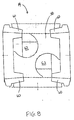
- the carrier tray 14 also may include one or more cut outs 62 at the bottom wall 28 for receiving food items (FIGS. 8-9). These cut outs 62 are configured to correspond to the shape of the packaged food item disposed therein to allow the packaged food item to be placed in the cut out 68.
Landscapes
- Engineering & Computer Science (AREA)
- Mechanical Engineering (AREA)
- Cartons (AREA)
- Packages (AREA)
- Auxiliary Devices For And Details Of Packaging Control (AREA)
Abstract
Description
Claims (15)
- A packaging system for a meal kit of ready to eat food and beverage items comprising:an outer container (12); andan inner tray (14) having one compartment (37) and disposed within said outer container (12),
wherein a plurality of individually packaged ready to eat food items (40, 41, 42, 43) are disposed in said inner tray (14) and a beverage container (46) is disposed within said outer container (12) adjacent said inner tray (14), and
wherein said inner tray (14) mechanically isolates said food items (40, 41, 42, 43) from said beverage container (46) within said outer container (12). - A packaging system according to claim 1, wherein said inner tray (14) limits lateral movement of said food items (40, 41, 42, 43) and said beverage container (46).
- A packaging system according to claim 1 or claim 2, wherein said outer container (12) comprises a generally upstanding front wall (20), a generally upstanding back wall (22) and generally upstanding first and second side walls (18),
wherein said inner tray (14) comprises a generally upstanding front wall (34), a generally upstanding back wall (36), and generally upstanding first and second side walls (30, 32), and
wherein said front wall (34) back side wall (36) and first side wall (30) of said inner tray (14) engagably contact said front wall (20), back wall (22) and first side wall (18) of said outer container (12) to limit lateral movement of said inner tray (14) within said outer container (12). - A packaging system according to claim 3, wherein said side walls (30, 32) of said inner tray (14) are disposed at an angle extending outwardly from a bottom wall (28) of said inner tray (14).
- A packaging system according to claim 4, wherein said angle of said side walls (30, 32) is from about 0° to about 7° outwardly from a vertical plane.
- A packaging system according to any one of claims 1 to 5, wherein said inner tray (14) is removable from said outer container (12) and usable for containing said plurality of food items (40, 41, 42, 43) during assembly and preparation of said food items (40, 41, 42, 43).
- A packaging system according to any one of claims 1 to 6, wherein said plurality of food items (40, 41, 42, 43) are preassembled in said inner tray (14) prior to placing said inner tray (14) within said outer container (12).
- A packaging system according to any one of claims 1 to 7, wherein said outer container (12) further comprises a lid (16) having at least one opening (48) and wherein said inner tray (14) maintains the position of said food items (40, 41, 42, 43) and said beverage container (46) relative to said at least one opening (48) to allow viewing of said food items (40, 41, 42, 43) and beverage container (46) by a consumer when the lid (16) is in a closed position and said outer container (12) is sealed.
- A packaging system according to any one of claims 1 to 8, wherein said inner tray (14) comprises a plurality of legs (60) extending downwardly from said side walls (30, 32).
- A packaging system according to any one of claims 1 to 9, wherein said inner tray (14) further comprises a generally planar bottom wall (28) having at least one opening (62) for receiving a packaged food item (40, 41, 42, 43).
- A packaging system according to any one of claims 1 to 10, wherein said inner tray (14) comprises paperboard.
- A meal kit of ready to eat food and beverage items comprising:an outer container (12);an inner tray (14) having one compartment (37) and disposed within said outer container (12);a plurality of individually packaged ready to eat food items (40, 41, 42, 43) disposed in said inner tray (14); anda beverage container (46) disposed within said outer container (12) adjacent said inner tray (14),
wherein said inner tray (14) mechanically isolates said food items (40, 41, 42, 43) from said beverage container (46) within said outer container (12). - A meal kit according to claim 12, wherein said food items (40, 41, 42, 43) are individually prepackaged and are arranged in layers within the inner tray (14).
- A meal kit according to claim 12 or claim 13, wherein said food items (40, 41, 42, 43) comprise a farinaceous food product.
- A method of assembling a meal kit of ready to eat food and beverage items comprising:individually packaging a plurality of ready to eat food items (40, 41, 42, 43);assembling said plurality of food items (40, 41, 42, 43) in a carrier tray (14) by arranging said food items (40, 41, 42, 43) in one or more layers within said carrier tray (14), said carrier tray (14) having one compartment (37) for receiving said food items (40, 41, 42, 43);providing an outer container (12) having a lid (16) for securing said outer container (12) in a closed condition and for providing access to said food items (40, 41, 42, 43) and said beverage item (46);assembling a beverage container (46) within said outer container (12);assembling said carrier tray (14) containing said food items (40, 41, 42, 43) adjacent said beverage container (46), said beverage container (46) disposed between and engagably contacting a wall (32) of said carrier tray (14) and an opposing wall (18) of said outer container (12); andsecuring said lid (16) of said outer container (12) in a closed position.
Applications Claiming Priority (6)
| Application Number | Priority Date | Filing Date | Title |
|---|---|---|---|
| US13457099P | 1999-05-17 | 1999-05-17 | |
| US13456999P | 1999-05-17 | 1999-05-17 | |
| US134569P | 1999-05-17 | ||
| US134570P | 1999-05-17 | ||
| US499764 | 2000-02-08 | ||
| US09/499,764 US6257403B1 (en) | 2000-02-08 | 2000-02-08 | Packaging system for meal kit |
Publications (2)
| Publication Number | Publication Date |
|---|---|
| EP1061004A2 true EP1061004A2 (en) | 2000-12-20 |
| EP1061004A3 EP1061004A3 (en) | 2002-04-03 |
Family
ID=27384606
Family Applications (1)
| Application Number | Title | Priority Date | Filing Date |
|---|---|---|---|
| EP00304147A Withdrawn EP1061004A3 (en) | 1999-05-17 | 2000-05-17 | Packaging system for meal kit |
Country Status (2)
| Country | Link |
|---|---|
| EP (1) | EP1061004A3 (en) |
| CA (1) | CA2308558A1 (en) |
Cited By (3)
| Publication number | Priority date | Publication date | Assignee | Title |
|---|---|---|---|---|
| WO2004033325A1 (en) * | 2002-10-11 | 2004-04-22 | The Pillsbury Company | Quadrate container for refrigerated and frozen dough intermediates |
| US7102495B2 (en) | 2001-04-12 | 2006-09-05 | Robert Bosch Gmbh | Method for preventing collisions involving motor vehicles |
| WO2012123911A1 (en) * | 2011-03-16 | 2012-09-20 | Sobrero Daniele | Kit for preparing gastronomic menus or the like, in an easy and rapid manner, by the consumer himself/herself |
Family Cites Families (3)
| Publication number | Priority date | Publication date | Assignee | Title |
|---|---|---|---|---|
| US4592914A (en) * | 1983-06-15 | 1986-06-03 | James River-Dixie/Northern, Inc. | Two-blank disposable container for microwave food cooking |
| US4889239A (en) * | 1983-08-25 | 1989-12-26 | Sandish George R | Food and beverage cup package |
| US5496575A (en) * | 1994-11-18 | 1996-03-05 | Newarski; Emil | Single use cereal and milk container |
-
2000
- 2000-05-16 CA CA002308558A patent/CA2308558A1/en not_active Abandoned
- 2000-05-17 EP EP00304147A patent/EP1061004A3/en not_active Withdrawn
Cited By (3)
| Publication number | Priority date | Publication date | Assignee | Title |
|---|---|---|---|---|
| US7102495B2 (en) | 2001-04-12 | 2006-09-05 | Robert Bosch Gmbh | Method for preventing collisions involving motor vehicles |
| WO2004033325A1 (en) * | 2002-10-11 | 2004-04-22 | The Pillsbury Company | Quadrate container for refrigerated and frozen dough intermediates |
| WO2012123911A1 (en) * | 2011-03-16 | 2012-09-20 | Sobrero Daniele | Kit for preparing gastronomic menus or the like, in an easy and rapid manner, by the consumer himself/herself |
Also Published As
| Publication number | Publication date |
|---|---|
| CA2308558A1 (en) | 2000-11-17 |
| EP1061004A3 (en) | 2002-04-03 |
Similar Documents
| Publication | Publication Date | Title |
|---|---|---|
| US6257403B1 (en) | Packaging system for meal kit | |
| US6955028B1 (en) | Food container and methods of forming and using thereof | |
| EP0420429B1 (en) | Compact package for food product | |
| US7757859B1 (en) | Packaging and dispensing system for wrapped product | |
| US5875961A (en) | Non-directional paperboard pour spout | |
| CA3158955C (en) | Stackable cartons, system, and methods of using the same | |
| US4969595A (en) | Convertible distribution and carry-out carton | |
| US6892513B1 (en) | Method of forming and filling an end load carton with a food delivery system | |
| US20150028088A1 (en) | Carton for a food product | |
| US20070000979A1 (en) | Container for sliceable ice cream | |
| EP3227194B1 (en) | A package assembly, a blank and a method of manufacturing a package assembly | |
| US6283364B1 (en) | Positive locking clamshell | |
| US20230365293A1 (en) | Tray With Divider Features | |
| WO2008057490A9 (en) | Removable divider for food container | |
| US20240083628A1 (en) | Multi-compartment containers | |
| US20210179319A1 (en) | Multi-compartment containers | |
| US20100078467A1 (en) | Product container | |
| US20250121978A1 (en) | Container With Liner | |
| CA2308558A1 (en) | Packaging system for meal kit | |
| CA2572778C (en) | Box for bag-in box package with spout location assist port | |
| GB2302532A (en) | Food package | |
| CA2849236C (en) | Container having a foldable support and lid | |
| RU2762461C1 (en) | Fast food packaging, a box for packaging and an insert for this box | |
| US20250313374A1 (en) | Container | |
| CA3154797C (en) | Display ready packaging |
Legal Events
| Date | Code | Title | Description |
|---|---|---|---|
| PUAI | Public reference made under article 153(3) epc to a published international application that has entered the european phase |
Free format text: ORIGINAL CODE: 0009012 |
|
| AK | Designated contracting states |
Kind code of ref document: A2 Designated state(s): AT BE CH CY DE DK ES FI FR GB GR IE IT LI LU MC NL PT SE |
|
| AX | Request for extension of the european patent |
Free format text: AL;LT;LV;MK;RO;SI |
|
| PUAL | Search report despatched |
Free format text: ORIGINAL CODE: 0009013 |
|
| AK | Designated contracting states |
Kind code of ref document: A3 Designated state(s): AT BE CH CY DE DK ES FI FR GB GR IE IT LI LU MC NL PT SE |
|
| AX | Request for extension of the european patent |
Free format text: AL;LT;LV;MK;RO;SI |
|
| RIC1 | Information provided on ipc code assigned before grant |
Free format text: 7B 65D 77/04 A, 7B 65D 5/50 B |
|
| AKX | Designation fees paid | ||
| REG | Reference to a national code |
Ref country code: DE Ref legal event code: 8566 |
|
| STAA | Information on the status of an ep patent application or granted ep patent |
Free format text: STATUS: THE APPLICATION IS DEEMED TO BE WITHDRAWN |
|
| 18D | Application deemed to be withdrawn |
Effective date: 20021004 |