EP1060792A1 - Process for preparing a catalyst for use in production of methacrylic acid and process of preparing methacrylic acid - Google Patents
Process for preparing a catalyst for use in production of methacrylic acid and process of preparing methacrylic acid Download PDFInfo
- Publication number
- EP1060792A1 EP1060792A1 EP00111924A EP00111924A EP1060792A1 EP 1060792 A1 EP1060792 A1 EP 1060792A1 EP 00111924 A EP00111924 A EP 00111924A EP 00111924 A EP00111924 A EP 00111924A EP 1060792 A1 EP1060792 A1 EP 1060792A1
- Authority
- EP
- European Patent Office
- Prior art keywords
- catalyst
- group
- methacrylic acid
- powder
- preparing
- Prior art date
- Legal status (The legal status is an assumption and is not a legal conclusion. Google has not performed a legal analysis and makes no representation as to the accuracy of the status listed.)
- Granted
Links
- 239000003054 catalyst Substances 0.000 title claims abstract description 95
- CERQOIWHTDAKMF-UHFFFAOYSA-N Methacrylic acid Chemical compound CC(=C)C(O)=O CERQOIWHTDAKMF-UHFFFAOYSA-N 0.000 title claims abstract description 36
- 238000004519 manufacturing process Methods 0.000 title claims abstract description 20
- 238000000034 method Methods 0.000 title claims description 39
- 239000000843 powder Substances 0.000 claims abstract description 44
- AMIMRNSIRUDHCM-UHFFFAOYSA-N Isopropylaldehyde Chemical compound CC(C)C=O AMIMRNSIRUDHCM-UHFFFAOYSA-N 0.000 claims abstract description 38
- KQNPFQTWMSNSAP-UHFFFAOYSA-N isobutyric acid Chemical compound CC(C)C(O)=O KQNPFQTWMSNSAP-UHFFFAOYSA-N 0.000 claims abstract description 36
- 239000002994 raw material Substances 0.000 claims abstract description 35
- 230000003647 oxidation Effects 0.000 claims abstract description 33
- 238000007254 oxidation reaction Methods 0.000 claims abstract description 33
- 238000000465 moulding Methods 0.000 claims abstract description 25
- STNJBCKSHOAVAJ-UHFFFAOYSA-N Methacrolein Chemical compound CC(=C)C=O STNJBCKSHOAVAJ-UHFFFAOYSA-N 0.000 claims abstract description 23
- 150000001875 compounds Chemical class 0.000 claims abstract description 21
- 229910052750 molybdenum Inorganic materials 0.000 claims abstract description 19
- 229910052698 phosphorus Inorganic materials 0.000 claims abstract description 19
- ZOKXTWBITQBERF-UHFFFAOYSA-N Molybdenum Chemical compound [Mo] ZOKXTWBITQBERF-UHFFFAOYSA-N 0.000 claims abstract description 16
- OAICVXFJPJFONN-UHFFFAOYSA-N Phosphorus Chemical compound [P] OAICVXFJPJFONN-UHFFFAOYSA-N 0.000 claims abstract description 16
- 239000011733 molybdenum Substances 0.000 claims abstract description 16
- 239000011574 phosphorus Substances 0.000 claims abstract description 16
- 238000005839 oxidative dehydrogenation reaction Methods 0.000 claims abstract description 15
- 239000007789 gas Substances 0.000 claims description 33
- 229910052760 oxygen Inorganic materials 0.000 claims description 10
- MYMOFIZGZYHOMD-UHFFFAOYSA-N Dioxygen Chemical compound O=O MYMOFIZGZYHOMD-UHFFFAOYSA-N 0.000 claims description 9
- 229910001882 dioxygen Inorganic materials 0.000 claims description 9
- 239000000203 mixture Substances 0.000 claims description 9
- 229910052720 vanadium Inorganic materials 0.000 claims description 8
- QVGXLLKOCUKJST-UHFFFAOYSA-N atomic oxygen Chemical compound [O] QVGXLLKOCUKJST-UHFFFAOYSA-N 0.000 claims description 7
- 238000001035 drying Methods 0.000 claims description 7
- 239000001301 oxygen Substances 0.000 claims description 7
- 229910052783 alkali metal Inorganic materials 0.000 claims description 6
- 239000010949 copper Substances 0.000 claims description 6
- 239000002245 particle Substances 0.000 claims description 6
- 229910052684 Cerium Inorganic materials 0.000 claims description 5
- RYGMFSIKBFXOCR-UHFFFAOYSA-N Copper Chemical compound [Cu] RYGMFSIKBFXOCR-UHFFFAOYSA-N 0.000 claims description 5
- BQCADISMDOOEFD-UHFFFAOYSA-N Silver Chemical compound [Ag] BQCADISMDOOEFD-UHFFFAOYSA-N 0.000 claims description 5
- HCHKCACWOHOZIP-UHFFFAOYSA-N Zinc Chemical compound [Zn] HCHKCACWOHOZIP-UHFFFAOYSA-N 0.000 claims description 5
- QCWXUUIWCKQGHC-UHFFFAOYSA-N Zirconium Chemical compound [Zr] QCWXUUIWCKQGHC-UHFFFAOYSA-N 0.000 claims description 5
- 150000001340 alkali metals Chemical class 0.000 claims description 5
- 229910052784 alkaline earth metal Inorganic materials 0.000 claims description 5
- 150000001342 alkaline earth metals Chemical class 0.000 claims description 5
- 229910052787 antimony Inorganic materials 0.000 claims description 5
- WATWJIUSRGPENY-UHFFFAOYSA-N antimony atom Chemical compound [Sb] WATWJIUSRGPENY-UHFFFAOYSA-N 0.000 claims description 5
- 229910052785 arsenic Inorganic materials 0.000 claims description 5
- RQNWIZPPADIBDY-UHFFFAOYSA-N arsenic atom Chemical compound [As] RQNWIZPPADIBDY-UHFFFAOYSA-N 0.000 claims description 5
- ZMIGMASIKSOYAM-UHFFFAOYSA-N cerium Chemical compound [Ce][Ce][Ce][Ce][Ce][Ce][Ce][Ce][Ce][Ce][Ce][Ce][Ce][Ce][Ce][Ce][Ce][Ce][Ce][Ce][Ce][Ce][Ce][Ce][Ce][Ce][Ce][Ce][Ce][Ce][Ce][Ce][Ce][Ce][Ce][Ce][Ce][Ce] ZMIGMASIKSOYAM-UHFFFAOYSA-N 0.000 claims description 5
- 229910052802 copper Inorganic materials 0.000 claims description 5
- 238000010438 heat treatment Methods 0.000 claims description 5
- 239000000314 lubricant Substances 0.000 claims description 5
- 229910052709 silver Inorganic materials 0.000 claims description 5
- 239000004332 silver Substances 0.000 claims description 5
- 229910052725 zinc Inorganic materials 0.000 claims description 5
- 239000011701 zinc Substances 0.000 claims description 5
- 229910052726 zirconium Inorganic materials 0.000 claims description 5
- 238000001354 calcination Methods 0.000 claims description 4
- 229910052799 carbon Inorganic materials 0.000 claims description 4
- 230000002787 reinforcement Effects 0.000 claims description 4
- 238000002036 drum drying Methods 0.000 claims description 3
- 238000001694 spray drying Methods 0.000 claims description 3
- GPPXJZIENCGNKB-UHFFFAOYSA-N vanadium Chemical group [V]#[V] GPPXJZIENCGNKB-UHFFFAOYSA-N 0.000 claims 2
- 239000000463 material Substances 0.000 claims 1
- 238000002360 preparation method Methods 0.000 description 10
- 239000000725 suspension Substances 0.000 description 9
- 238000006243 chemical reaction Methods 0.000 description 8
- IJGRMHOSHXDMSA-UHFFFAOYSA-N Atomic nitrogen Chemical compound N#N IJGRMHOSHXDMSA-UHFFFAOYSA-N 0.000 description 7
- 238000001125 extrusion Methods 0.000 description 6
- 230000000052 comparative effect Effects 0.000 description 5
- 239000011148 porous material Substances 0.000 description 5
- 239000002002 slurry Substances 0.000 description 5
- NBIIXXVUZAFLBC-UHFFFAOYSA-N Phosphoric acid Chemical compound OP(O)(O)=O NBIIXXVUZAFLBC-UHFFFAOYSA-N 0.000 description 4
- 239000002253 acid Substances 0.000 description 4
- 239000011261 inert gas Substances 0.000 description 4
- OKTJSMMVPCPJKN-UHFFFAOYSA-N Carbon Chemical compound [C] OKTJSMMVPCPJKN-UHFFFAOYSA-N 0.000 description 3
- BVKZGUZCCUSVTD-UHFFFAOYSA-L Carbonate Chemical compound [O-]C([O-])=O BVKZGUZCCUSVTD-UHFFFAOYSA-L 0.000 description 3
- VEXZGXHMUGYJMC-UHFFFAOYSA-M Chloride anion Chemical compound [Cl-] VEXZGXHMUGYJMC-UHFFFAOYSA-M 0.000 description 3
- 229910002651 NO3 Inorganic materials 0.000 description 3
- NHNBFGGVMKEFGY-UHFFFAOYSA-N Nitrate Chemical compound [O-][N+]([O-])=O NHNBFGGVMKEFGY-UHFFFAOYSA-N 0.000 description 3
- 150000003863 ammonium salts Chemical class 0.000 description 3
- 238000007796 conventional method Methods 0.000 description 3
- 239000010439 graphite Substances 0.000 description 3
- 229910002804 graphite Inorganic materials 0.000 description 3
- 150000004678 hydrides Chemical class 0.000 description 3
- 229910052757 nitrogen Inorganic materials 0.000 description 3
- QIQXTHQIDYTFRH-UHFFFAOYSA-N octadecanoic acid Chemical compound CCCCCCCCCCCCCCCCCC(O)=O QIQXTHQIDYTFRH-UHFFFAOYSA-N 0.000 description 3
- -1 oxide Chemical class 0.000 description 3
- LEONUFNNVUYDNQ-UHFFFAOYSA-N vanadium atom Chemical compound [V] LEONUFNNVUYDNQ-UHFFFAOYSA-N 0.000 description 3
- XLYOFNOQVPJJNP-UHFFFAOYSA-N water Substances O XLYOFNOQVPJJNP-UHFFFAOYSA-N 0.000 description 3
- 230000004580 weight loss Effects 0.000 description 3
- QGZKDVFQNNGYKY-UHFFFAOYSA-O Ammonium Chemical compound [NH4+] QGZKDVFQNNGYKY-UHFFFAOYSA-O 0.000 description 2
- CURLTUGMZLYLDI-UHFFFAOYSA-N Carbon dioxide Chemical compound O=C=O CURLTUGMZLYLDI-UHFFFAOYSA-N 0.000 description 2
- VQTUBCCKSQIDNK-UHFFFAOYSA-N Isobutene Chemical group CC(C)=C VQTUBCCKSQIDNK-UHFFFAOYSA-N 0.000 description 2
- JUJWROOIHBZHMG-UHFFFAOYSA-N Pyridine Chemical compound C1=CC=NC=C1 JUJWROOIHBZHMG-UHFFFAOYSA-N 0.000 description 2
- SMWDFEZZVXVKRB-UHFFFAOYSA-N Quinoline Chemical compound N1=CC=CC2=CC=CC=C21 SMWDFEZZVXVKRB-UHFFFAOYSA-N 0.000 description 2
- 235000021355 Stearic acid Nutrition 0.000 description 2
- 229910000831 Steel Inorganic materials 0.000 description 2
- DKGAVHZHDRPRBM-UHFFFAOYSA-N Tert-Butanol Chemical compound CC(C)(C)O DKGAVHZHDRPRBM-UHFFFAOYSA-N 0.000 description 2
- 150000007513 acids Chemical class 0.000 description 2
- UNTBPXHCXVWYOI-UHFFFAOYSA-O azanium;oxido(dioxo)vanadium Chemical compound [NH4+].[O-][V](=O)=O UNTBPXHCXVWYOI-UHFFFAOYSA-O 0.000 description 2
- NLSCHDZTHVNDCP-UHFFFAOYSA-N caesium nitrate Chemical compound [Cs+].[O-][N+]([O-])=O NLSCHDZTHVNDCP-UHFFFAOYSA-N 0.000 description 2
- 230000003197 catalytic effect Effects 0.000 description 2
- 239000003085 diluting agent Substances 0.000 description 2
- GNTDGMZSJNCJKK-UHFFFAOYSA-N divanadium pentaoxide Chemical compound O=[V](=O)O[V](=O)=O GNTDGMZSJNCJKK-UHFFFAOYSA-N 0.000 description 2
- 238000001704 evaporation Methods 0.000 description 2
- IPCSVZSSVZVIGE-UHFFFAOYSA-N hexadecanoic acid Chemical compound CCCCCCCCCCCCCCCC(O)=O IPCSVZSSVZVIGE-UHFFFAOYSA-N 0.000 description 2
- 238000005342 ion exchange Methods 0.000 description 2
- JKQOBWVOAYFWKG-UHFFFAOYSA-N molybdenum trioxide Chemical compound O=[Mo](=O)=O JKQOBWVOAYFWKG-UHFFFAOYSA-N 0.000 description 2
- OQCDKBAXFALNLD-UHFFFAOYSA-N octadecanoic acid Natural products CCCCCCCC(C)CCCCCCCCC(O)=O OQCDKBAXFALNLD-UHFFFAOYSA-N 0.000 description 2
- 239000008188 pellet Substances 0.000 description 2
- 235000011007 phosphoric acid Nutrition 0.000 description 2
- 239000008117 stearic acid Substances 0.000 description 2
- 239000010959 steel Substances 0.000 description 2
- 239000000126 substance Substances 0.000 description 2
- DLYUQMMRRRQYAE-UHFFFAOYSA-N tetraphosphorus decaoxide Chemical compound O1P(O2)(=O)OP3(=O)OP1(=O)OP2(=O)O3 DLYUQMMRRRQYAE-UHFFFAOYSA-N 0.000 description 2
- 239000004254 Ammonium phosphate Substances 0.000 description 1
- LFQSCWFLJHTTHZ-UHFFFAOYSA-N Ethanol Chemical compound CCO LFQSCWFLJHTTHZ-UHFFFAOYSA-N 0.000 description 1
- BZLVMXJERCGZMT-UHFFFAOYSA-N Methyl tert-butyl ether Chemical compound COC(C)(C)C BZLVMXJERCGZMT-UHFFFAOYSA-N 0.000 description 1
- 235000021314 Palmitic acid Nutrition 0.000 description 1
- 239000004793 Polystyrene Substances 0.000 description 1
- 239000004372 Polyvinyl alcohol Substances 0.000 description 1
- 229920002472 Starch Polymers 0.000 description 1
- XJXHYBQPRLDJMA-UHFFFAOYSA-N [O-2].[O-2].[O-2].[O-2].[O-2].[O-2].[Fe+2].[Co+2].[Mo+4].[W+4] Chemical compound [O-2].[O-2].[O-2].[O-2].[O-2].[O-2].[Fe+2].[Co+2].[Mo+4].[W+4] XJXHYBQPRLDJMA-UHFFFAOYSA-N 0.000 description 1
- 239000000654 additive Substances 0.000 description 1
- 230000000996 additive effect Effects 0.000 description 1
- 150000001299 aldehydes Chemical class 0.000 description 1
- 229910000147 aluminium phosphate Inorganic materials 0.000 description 1
- 229910000148 ammonium phosphate Inorganic materials 0.000 description 1
- 235000019289 ammonium phosphates Nutrition 0.000 description 1
- 239000006227 byproduct Substances 0.000 description 1
- 229910002092 carbon dioxide Inorganic materials 0.000 description 1
- 239000001569 carbon dioxide Substances 0.000 description 1
- 238000006555 catalytic reaction Methods 0.000 description 1
- 238000000975 co-precipitation Methods 0.000 description 1
- 238000000576 coating method Methods 0.000 description 1
- XTVVROIMIGLXTD-UHFFFAOYSA-N copper(II) nitrate Chemical compound [Cu+2].[O-][N+]([O-])=O.[O-][N+]([O-])=O XTVVROIMIGLXTD-UHFFFAOYSA-N 0.000 description 1
- 238000000354 decomposition reaction Methods 0.000 description 1
- MNNHAPBLZZVQHP-UHFFFAOYSA-N diammonium hydrogen phosphate Chemical compound [NH4+].[NH4+].OP([O-])([O-])=O MNNHAPBLZZVQHP-UHFFFAOYSA-N 0.000 description 1
- 229910001873 dinitrogen Inorganic materials 0.000 description 1
- 230000008020 evaporation Effects 0.000 description 1
- 238000004108 freeze drying Methods 0.000 description 1
- 239000003365 glass fiber Substances 0.000 description 1
- 238000005469 granulation Methods 0.000 description 1
- 230000003179 granulation Effects 0.000 description 1
- 150000002391 heterocyclic compounds Chemical class 0.000 description 1
- 239000012784 inorganic fiber Substances 0.000 description 1
- 238000002156 mixing Methods 0.000 description 1
- VLAPMBHFAWRUQP-UHFFFAOYSA-L molybdic acid Chemical compound O[Mo](O)(=O)=O VLAPMBHFAWRUQP-UHFFFAOYSA-L 0.000 description 1
- 239000000178 monomer Substances 0.000 description 1
- 239000004570 mortar (masonry) Substances 0.000 description 1
- WQEPLUUGTLDZJY-UHFFFAOYSA-N n-Pentadecanoic acid Natural products CCCCCCCCCCCCCCC(O)=O WQEPLUUGTLDZJY-UHFFFAOYSA-N 0.000 description 1
- 229920000620 organic polymer Polymers 0.000 description 1
- 229920003229 poly(methyl methacrylate) Polymers 0.000 description 1
- 239000004926 polymethyl methacrylate Substances 0.000 description 1
- 229920002223 polystyrene Polymers 0.000 description 1
- 229920002451 polyvinyl alcohol Polymers 0.000 description 1
- 238000010298 pulverizing process Methods 0.000 description 1
- UMJSCPRVCHMLSP-UHFFFAOYSA-N pyridine Natural products COC1=CC=CN=C1 UMJSCPRVCHMLSP-UHFFFAOYSA-N 0.000 description 1
- 238000005096 rolling process Methods 0.000 description 1
- 238000012216 screening Methods 0.000 description 1
- 238000005245 sintering Methods 0.000 description 1
- 235000019698 starch Nutrition 0.000 description 1
- 239000008107 starch Substances 0.000 description 1
- 239000000454 talc Substances 0.000 description 1
- 229910052623 talc Inorganic materials 0.000 description 1
- 235000012222 talc Nutrition 0.000 description 1
Classifications
-
- B—PERFORMING OPERATIONS; TRANSPORTING
- B01—PHYSICAL OR CHEMICAL PROCESSES OR APPARATUS IN GENERAL
- B01J—CHEMICAL OR PHYSICAL PROCESSES, e.g. CATALYSIS OR COLLOID CHEMISTRY; THEIR RELEVANT APPARATUS
- B01J27/00—Catalysts comprising the elements or compounds of halogens, sulfur, selenium, tellurium, phosphorus or nitrogen; Catalysts comprising carbon compounds
- B01J27/14—Phosphorus; Compounds thereof
- B01J27/186—Phosphorus; Compounds thereof with arsenic, antimony, bismuth, vanadium, niobium, tantalum, polonium, chromium, molybdenum, tungsten, manganese, technetium or rhenium
- B01J27/188—Phosphorus; Compounds thereof with arsenic, antimony, bismuth, vanadium, niobium, tantalum, polonium, chromium, molybdenum, tungsten, manganese, technetium or rhenium with chromium, molybdenum, tungsten or polonium
- B01J27/19—Molybdenum
-
- B—PERFORMING OPERATIONS; TRANSPORTING
- B01—PHYSICAL OR CHEMICAL PROCESSES OR APPARATUS IN GENERAL
- B01J—CHEMICAL OR PHYSICAL PROCESSES, e.g. CATALYSIS OR COLLOID CHEMISTRY; THEIR RELEVANT APPARATUS
- B01J27/00—Catalysts comprising the elements or compounds of halogens, sulfur, selenium, tellurium, phosphorus or nitrogen; Catalysts comprising carbon compounds
- B01J27/14—Phosphorus; Compounds thereof
- B01J27/186—Phosphorus; Compounds thereof with arsenic, antimony, bismuth, vanadium, niobium, tantalum, polonium, chromium, molybdenum, tungsten, manganese, technetium or rhenium
- B01J27/195—Phosphorus; Compounds thereof with arsenic, antimony, bismuth, vanadium, niobium, tantalum, polonium, chromium, molybdenum, tungsten, manganese, technetium or rhenium with vanadium, niobium or tantalum
- B01J27/198—Vanadium
- B01J27/199—Vanadium with chromium, molybdenum, tungsten or polonium
-
- B—PERFORMING OPERATIONS; TRANSPORTING
- B01—PHYSICAL OR CHEMICAL PROCESSES OR APPARATUS IN GENERAL
- B01J—CHEMICAL OR PHYSICAL PROCESSES, e.g. CATALYSIS OR COLLOID CHEMISTRY; THEIR RELEVANT APPARATUS
- B01J23/00—Catalysts comprising metals or metal oxides or hydroxides, not provided for in group B01J21/00
- B01J23/002—Mixed oxides other than spinels, e.g. perovskite
-
- B—PERFORMING OPERATIONS; TRANSPORTING
- B01—PHYSICAL OR CHEMICAL PROCESSES OR APPARATUS IN GENERAL
- B01J—CHEMICAL OR PHYSICAL PROCESSES, e.g. CATALYSIS OR COLLOID CHEMISTRY; THEIR RELEVANT APPARATUS
- B01J37/00—Processes, in general, for preparing catalysts; Processes, in general, for activation of catalysts
- B01J37/0009—Use of binding agents; Moulding; Pressing; Powdering; Granulating; Addition of materials ameliorating the mechanical properties of the product catalyst
-
- B—PERFORMING OPERATIONS; TRANSPORTING
- B01—PHYSICAL OR CHEMICAL PROCESSES OR APPARATUS IN GENERAL
- B01J—CHEMICAL OR PHYSICAL PROCESSES, e.g. CATALYSIS OR COLLOID CHEMISTRY; THEIR RELEVANT APPARATUS
- B01J37/00—Processes, in general, for preparing catalysts; Processes, in general, for activation of catalysts
- B01J37/08—Heat treatment
-
- C—CHEMISTRY; METALLURGY
- C07—ORGANIC CHEMISTRY
- C07C—ACYCLIC OR CARBOCYCLIC COMPOUNDS
- C07C51/00—Preparation of carboxylic acids or their salts, halides or anhydrides
- C07C51/16—Preparation of carboxylic acids or their salts, halides or anhydrides by oxidation
- C07C51/21—Preparation of carboxylic acids or their salts, halides or anhydrides by oxidation with molecular oxygen
- C07C51/23—Preparation of carboxylic acids or their salts, halides or anhydrides by oxidation with molecular oxygen of oxygen-containing groups to carboxyl groups
- C07C51/235—Preparation of carboxylic acids or their salts, halides or anhydrides by oxidation with molecular oxygen of oxygen-containing groups to carboxyl groups of —CHO groups or primary alcohol groups
-
- C—CHEMISTRY; METALLURGY
- C07—ORGANIC CHEMISTRY
- C07C—ACYCLIC OR CARBOCYCLIC COMPOUNDS
- C07C51/00—Preparation of carboxylic acids or their salts, halides or anhydrides
- C07C51/16—Preparation of carboxylic acids or their salts, halides or anhydrides by oxidation
- C07C51/21—Preparation of carboxylic acids or their salts, halides or anhydrides by oxidation with molecular oxygen
- C07C51/25—Preparation of carboxylic acids or their salts, halides or anhydrides by oxidation with molecular oxygen of unsaturated compounds containing no six-membered aromatic ring
- C07C51/252—Preparation of carboxylic acids or their salts, halides or anhydrides by oxidation with molecular oxygen of unsaturated compounds containing no six-membered aromatic ring of propene, butenes, acrolein or methacrolein
-
- C—CHEMISTRY; METALLURGY
- C07—ORGANIC CHEMISTRY
- C07C—ACYCLIC OR CARBOCYCLIC COMPOUNDS
- C07C51/00—Preparation of carboxylic acids or their salts, halides or anhydrides
- C07C51/347—Preparation of carboxylic acids or their salts, halides or anhydrides by reactions not involving formation of carboxyl groups
- C07C51/377—Preparation of carboxylic acids or their salts, halides or anhydrides by reactions not involving formation of carboxyl groups by splitting-off hydrogen or functional groups; by hydrogenolysis of functional groups
-
- B—PERFORMING OPERATIONS; TRANSPORTING
- B01—PHYSICAL OR CHEMICAL PROCESSES OR APPARATUS IN GENERAL
- B01J—CHEMICAL OR PHYSICAL PROCESSES, e.g. CATALYSIS OR COLLOID CHEMISTRY; THEIR RELEVANT APPARATUS
- B01J23/00—Catalysts comprising metals or metal oxides or hydroxides, not provided for in group B01J21/00
- B01J23/70—Catalysts comprising metals or metal oxides or hydroxides, not provided for in group B01J21/00 of the iron group metals or copper
- B01J23/76—Catalysts comprising metals or metal oxides or hydroxides, not provided for in group B01J21/00 of the iron group metals or copper combined with metals, oxides or hydroxides provided for in groups B01J23/02 - B01J23/36
- B01J23/84—Catalysts comprising metals or metal oxides or hydroxides, not provided for in group B01J21/00 of the iron group metals or copper combined with metals, oxides or hydroxides provided for in groups B01J23/02 - B01J23/36 with arsenic, antimony, bismuth, vanadium, niobium, tantalum, polonium, chromium, molybdenum, tungsten, manganese, technetium or rhenium
- B01J23/85—Chromium, molybdenum or tungsten
- B01J23/888—Tungsten
- B01J23/8885—Tungsten containing also molybdenum
-
- B—PERFORMING OPERATIONS; TRANSPORTING
- B01—PHYSICAL OR CHEMICAL PROCESSES OR APPARATUS IN GENERAL
- B01J—CHEMICAL OR PHYSICAL PROCESSES, e.g. CATALYSIS OR COLLOID CHEMISTRY; THEIR RELEVANT APPARATUS
- B01J2523/00—Constitutive chemical elements of heterogeneous catalysts
Definitions
- This invention relates to a process of preparing a catalyst for use in production of methacrylic acid and the catalyst and also relates to a process of preparing methacrylic acid in the presence of the catalyst, more particularly, to the process of preparing the catalyst and the same which is suitable for preparing methacrylic acid by gas phase oxidation and / or oxidative dehydrogenation of at least one compound selected from the group consisting of methacrolein, isobutyraldehyde and isobutyric acid and the process for preparing methacrylic acid in the presence of the catalyst.
- the preferred specific surface area of a catalyst ranges from 0.01 to 5m 2 /g and 0.01 to 50m 2 /g in Japan Open-Laid No.49-116022 and Japan Open-Laid No.50-37710, respectively.
- this catalyst is not suitable for industrial use because of excessively high reaction temperature and low selectivity.
- Japan Open-Laid No.51-136615 and Japan Open-Laid No.55-73347 propose a catalyst which is achieved by adding organic substances such as multivalent alcohol and polyvinyl alcohol and then curing them.
- organic substances such as multivalent alcohol and polyvinyl alcohol
- the organic substance which is used as additive and has a high decomposition temperature, will bum by heat treatment and thereby cause sintering and reduction of a catalyst and a problem such as low reproducibility of a catalyst still remains.
- Japan Open-Laid No.4-367737 proposed a process, wherein an organic polymer such as polymethylmethacrylate and polystyrene, which decomposes into a monomer and vaporizes at a relatively low temperature, is added, this method is also insufficient in the reproducibility of a catalyst.
- a catalyst for industrial use is generally used as a molded article.
- a molded article is produced by the process such as press molding, extrusion molding, rolling molding, Marumerizer molding, fluidized granulation, centrifuge fluidized coating process and the like.
- press molding process examples using press molding process were disclosed in Japan Open-Laid No.63-315148, Japan Open-Laid No.8-10621, Japan Open-Laid No.10-258233 and Japan Patent Gazette No.3-58776. According to all examples of them, a process of a press molding was not investigated in detail and these disclosures were insufficient from the view point of the reproducibility.
- An object of the invention is to provide a process of preparing a catalyst for use in production of methacrylic acid and the catalyst. Another object of the invention is to provide a process for preparing methacrylic acid in the presence of the catalyst.
- the present inventors found that the above mentioned object can be achieved by molding a raw material including a powder containing phosphorus and molybdenum at the specific range of pressure and have accomplished the invention.
- this invention provides a process for preparing a catalyst and the same for use in production of methacrylic acid by gas phase oxidation and / or oxidative dehydrogenation of at least one compound selected from the group consisting of methacrolein, isobutyraldehyde and isobutyric acid.
- the process comprises:
- the invention also provides a process for preparing methacrylic acid characterized by gas phase oxidation and / or oxidative dehydrogenation of at least one compound selected from the group consisting of methacrolein, isobutyraldehyde and isobutyric acid with molecular oxygen or a gas containing molecular oxygen in the presence of the catalyst produced by a method of the invention.
- the process for preparing the catalyst of the invention is characterized by molding a raw material including a powder containing phosphorus and molybdenum as an essential component at the pressure of 50 to 5000kgf/cm 2 into an article and calcining the molded article to obtain a catalyst.
- the raw material includes a powder containing phosphorus and molybdenum( hereinafter referred as P/Mo containing powder).
- the P/Mo containing powder may contain other elements, for example vanadium, copper, zinc, silver, arsenic, antimony, zirconium, cerium, alkali metal, alkaline earth metal and the like besides phosphorus and molybdenum.
- a weight of the P/Mo containing powder is reducible from 0 to 40%, preferably 2 to 35%, more preferably 4 to 30% by weight with respect to the weight of the P/Mo containing powder while the P/Mo containing powder is heated at 300 °C in the atmosphere or an inert gas.
- the weight of the P/Mo containing powder will be substantially constant after an elapse of 2hours of heat treatment.
- the weight loss of the P/Mo containing powder can be determined at that time if a weight of the P/Mo containing powder will be substantially constant after an elapse of 30mins, or an hour.
- the P/Mo containing powder substantially comprises of particles having a diameter of 150 to 1500 ⁇ m, preferably 250 to 1000 ⁇ m, more preferably 250 to 800 ⁇ m.
- particle size below 150 ⁇ m
- the fluidity of the P/Mo containing powder and runnability of molding conducted by the following molding process deteriorate and the selectivity for COx of the resultant catalyst is liable to increase because a pore size of the molded article becomes smaller.
- the amount of the P/Mo containing powder sucked into the mortar of a molding apparatus is variable and it causes to vary the molding pressure. As a result, mechanical properties of the resultant molded article and performance of the catalyst therefrom are liable to be lower because a pore size of the molded article becomes larger.
- the P/Mo containing powder is prepared by a conventional method for a catalyst known to those of ordinary skill in the art.
- a catalyst known to those of ordinary skill in the art.
- compounds which contain phosphorus and molybdenum respectively are dissolved and dispersed into the medium usually into water to obtain a solution or slurry(hereinafter referred to as suspension).
- the suspension is condensed, dried and calcined where necessary to prepare a powder.
- the suspension can be prepared by a conventional method such as evaporating concentration process , oxide mixing process and coprecipitation process and the like known to those skilled in the art, as long as the composition of the suspension is not remarkably uneven.
- the suspension containing phosphorus and molybdenum can be prepared from the compounds such as oxide, nitrate, carbonate, hydride, chloride and ammonium salt of each element.
- the following compounds can be used for the preparation of the suspension.
- Examples of compounds having molybdenum include molybdenum trioxide, molybdic acid and ammonium paramolybdate and the like.
- Examples of compounds having phosphorus include orthophosphoric acid, phosphorus pentoxide and ammonium phosphate and the like.
- Examples of compounds having vanadium include vanadium pentoxide, ammonium metavanadate and the like.
- Examples of compounds having copper, zinc, silver, arsenic, antimony, zirconium and cerium and the like include oxide, nitrate, carbonate, hydride, chloride, ammonium salt of each element.
- Examples of compounds having alkali metal and alkaline earth metal include nitrate, carbonate, hydride, chloride. Molybdophosphoric acid, molybdovanadophosphoric acid and ammonium salt of these acids and alkali metal salt also can be used.
- the suspension can be dried by a well known methods such as evaporation drying, spray drying, drum drying, flash drying, drying under a reduced pressure, freeze drying and the like.
- Spray drying, drum drying and flash drying are preferable among them because these methods can simplify a process of pulverizing and screening particles with the desired diameter, preferably between 150 to 1500 ⁇ m.
- the raw material used for the invention further comprises a lubricant and / or a reinforcement.
- a lubricant include graphite, talc, starch, palmitic acid, stearic acid and stearate.
- the reinforcement include inorganic fiber such as glass fiber and any type of whisker which are known for improving the mechanical properties of a catalyst and an attrition resistance.
- a lubricant and / or a reinforcement can be mixed with the P/Mo containing powder to obtain the raw material.
- the raw material of the invention is molded at the pressure of 50 to 5000kgf/cm 2 , preferably 200 to 3500kgf/cm 2 , more preferably 600 to 2500kgf/cm 2 into a molded article.
- pressure of 50 to 5000kgf/cm 2 preferably 200 to 3500kgf/cm 2 , more preferably 600 to 2500kgf/cm 2 into a molded article.
- mechanical properties of the resultant molded article falls and performance of the catalyst therefrom is getting lower because a pore size of the catalyst becomes large.
- the selectivity for COx of the resultant catalyst is liable to increase because a pore size thereof becomes too small.
- An excellent performance and a good reproducibility of the catalyst can be achieved by molding at the range of the pressure of 50 to 5000kgf/cm 2 .
- the raw material can be molded into a molded article by any molding apparatus.
- the molded article has no limitation on its shape. Examples of the shape of the molded article include pellet, sphere, ring and tablet.
- the preferred shape of the molded article is a ring, because the shape of a ring expands surface area of a catalyst and thereby enables oxidation more effectively.
- the molded article also has no limitation on its size and usually has the size of 1 to 20mm, preferably 3 to 5mm in the average diameter.
- the molded article is calcined to obtain a catalyst at a temperature preferably between 300 °C to 600 °C, more preferably 350 °C to 500 °C.
- the preparation of the catalyst may be carried out in the presence of a nitrogen containing heterocyclic compound such as pyridine and quinoline. In this case, N containing heterocyclic compound may be removed by heat treatment after molding.
- the catalyst with excellent performance can be produced with good reproducibility.
- the catalyst prepared by the process of the invention has no limitation on its composition, as long as the catalyst contains phosphorus and molybdenum and can be used for preparing methacrylic acid by oxidation and / or oxidative dehydrogenation of at least one compound selected from the group consisting of methacrolein, isobutyraldehyde and isobutyric acid.
- the preferable composition of the catalyst may be shown by the following equation(1).
- P a Mo b V c A d B e C f O x
- P phosphorus
- Mo molybdenum
- V vanadium
- A is at least one element selected from the group consisting of copper, zinc and silver
- B is at least one element selected from the group consisting of arsenic, antimony, zirconium and cerium
- C is at least one element selected from the group consisting of alkali metal and alkaline earth metal
- the process for preparing methacrylic acid by gas phase oxidation and / or oxidative dehydrogenation of at least one compound selected from the group consisting of methacrolein, isobutyraldehyde and isobutyric acid with molecular oxygen or a gas containing molecular oxygen is characterized by the oxidation and oxidative dehydrogenation being carried out in the presence of the catalyst which is produced by the process of the invention.
- the term "preparing methacrylic acid by oxidation and / or oxidative dehydrogenation of at least one compound selected from the group consisting of methacrolein, isobutyraldehyde and isobutyric acid” denotes the general term of preparing methacrylic acid by oxidation of methacrolein, preparing methacrylic acid by oxidation and oxidative dehydrogenation of isobutyraldehyde, preparing methacrylic acid by oxidative dehydrogenation of isobutyric acid and the combination of these processes.
- gas phase oxidation and oxidative dehydrogenation for preparing methacrylic acid of the invention is not restricted in terms of the condition and an apparatus except for using the catalyst of the invention and can be carried out by a conventional method known to those skilled in the art
- a raw material supplied to oxidation and oxidative dehydrogenation (hereinafter referred as a raw material for methacrylic acid) is preferably a mixed gas including at least one compound selected from the group consisting of methacrolein, isobutyraldehyde and isobutyric acid, molecular oxygen and an inert gas as diluent.
- the mixed gas preferably contains 1 to 10 volume % of at least one compound selected from the group consisting of methacrolein, isobutyraldehyde and isobutyric acid.
- the mixed gas contains molecular oxygen and the volume of molecular oxygen is usually 1 to 10 times as much as that of at least one compound selected from the group consisting of methacrolein, isobutyraldehyde and isobutyric acid.
- the mixed gas also contains an inert gas as diluent and examples of an inert gas include nitrogen, carbon dioxide and steam and the like.
- steam is preferable because steam inhibits generation of by-product and is suitable for improving yield of methacrylic acid.
- Gas phase oxidation is carried out by reacting the mixed gas at 200 to 400°C under normal pressure to 10 atm. at the space velocity of 100 to 5000 hr -1 (STP) in the presence of the catalyst of the invention.
- methacrolein When methacrolein is used as a raw material for methacrylic acid, methacrolein is not necessarily pure.
- a gas containing methacrolein which is obtained by contact catalytic reaction of isobutylene, t-butanol and methyl-t-butylether can be used. Especially this gas can be preferably used for the industrial process of preparing methacrylic acid.
- methacrylic acid can be produced in high yield by gas phase oxidation and / or oxidative dehydrogenation of at least one compound selected from the group consisting of methacrolein, isobutyraldehyde and isobutyric acid.
- % conversion 100 ⁇ ( moles of reacted raw materials) / ( moles of raw materials fed)
- % selectivity 100 ⁇ ( moles of produced methacrylic acid) / ( moles of reacted raw materials)
- % single pass yield 100 ⁇ ( moles of produced methacrylic acid) / ( moles of raw materials fed)
- a portion of the suspension was condensed and heated to obtain a slurry.
- the slurry was heated and dried at 130 °C for 15 hours, and then pulverized and screened to obtain 16 to 60 mesh( 250 to 1000 ⁇ m) of a P/Mo containing powder.
- This powder was heated at 300°C in atmosphere to determine the weight loss of the P/Mo containing powder.
- the weight of this powder was reduced by 20 % weight with respect to the P/Mo containing powder.
- a graphite was added into the P/Mo containing powder to obtain a raw material so that the raw material contains a graphite by 3 weight %.
- the raw material was molded at the pressure of 1000kgf/cm 2 into the molded article of a pellet having 5.0mm in diameter and 5.0mm in length by a rotary press VIRGO(Kikusui manufacturing).
- the molded article was calcined at 400 °C for 2 hours in the air subsequently to 400°C for 2 hours in a nitrogen gas to obtain a catalyst (1).
- the composition of the catalyst (1) is shown as follows by the ratio of atom( the ratio of atom except for oxygen, the same applies hereinafter). Mo 12 P 1.09 V 1.09 Cu 0.05 Cs 1.0
- a mixed gas which contains 3.5 volume % of methacrolein, 9 volume % of oxygen and 20 volume % of steam and was prepared by gas phase catalytic oxidation of isobutylene in the presence of a multi-element catalyst such as molybdenum-cobalt-tungsten-iron oxide at 340°C.
- the oxidation of the mixed gas was carried out at 280°C and at space velocity of 1200hr -1 (STP). This result is shown in table 1.
- a catalyst (2) was prepared in the same manner of Example 1 except that the raw material was molded at the pressure of 3000 kgf/cm 2 for the preparation of a catalyst. The oxidation was carried out in the presence of the catalyst (2) in the same manner of Example 1. This result is shown in table 1.
- a catalyst (3) was prepared in the same manner of Example 1 except that the raw material was molded at the pressure of 6000 kgf/cm 2 for the preparation of a catalyst. The oxidation was carried out in the presence of the catalyst (3) in the same manner of Example 1. This result is shown in table 1.
- a catalyst (4) was prepared in the same manner of Example 1 except that the raw material was molded at the pressure of 40 kgf/cm 2 for the preparation of a catalyst. The oxidation was carried out in the presence of the catalyst (4) in the same manner of Example 1. This result is shown in table 1.
- a catalyst (5) was prepared in the same manner of Example 1 except that the raw material was molded by the extrusion molding process instead of molding at the pressure of 1000 kgf/cm 2 for the preparation of a catalyst.
- the oxidation was carried out in the presence of the catalyst (5) in the same manner of Example 1. This result is shown in table 1.
- a catalyst (6) was prepared in the same manner of Example 1 except that a slurry was dried at 250 °C for 15 hours after the slurry was heated and condensed to obtain a P/Mo containing powder.
- the P/Mo containing powder was heated at 300 °C in the atmosphere to determine the weight loss of the powder.
- the weight of the powder was reduced by 7 weight % with respect to the powder.
- the oxidation was carried out in the presence of the catalyst (6) in the same manner of Example 1. This result is shown in table 1.
- a catalyst (7) was prepared in the same manner of Example 1 except that the raw material includes stearic acid powder as a lubricant for the preparation of a catalyst. The oxidation was carried out in the presence of the catalyst (7). The result is shown in table 1.
- a catalyst (8) was prepared in the same manner of Example 1 except that the molded article has the shape of a ring having 5mm in outside diameter and 2mm in internal diameter and 5mm in length for the preparation of a catalyst. The oxidation was carried out in the presence of the catalyst (8). This result is shown in table 1.
- Example 2 The oxidation was carried out in the same manner of Example 1 except that a mixed gas consisting of 4.0 volume % of isobutyraldehyde, 10 volume % of oxygen, 12 volume % of steam and 74 volume % of nitrogen is used as a raw material gas and space velocity was changed into 1000hr -1 . This result is shown in table 2.
- the catalyst of the invention was effective in the case of using isobutyraldehyde as a raw material gas and single pass yield of methacrylic acid prepared in the presence of the catalyst of the invention was higher than that of a catalyst prepared by extrusion molding.
- Example 3 The oxidation was carried out in the same manner of Example 1 except that a mixed gas consisting of 4.5 volume % of isobutyric acid, 12 volume % of oxygen, 12 volume % of steam and 71.5 volume % of nitrogen was used as a raw material gas and space velocity was changed into 1500hr -1 . This result is shown in table 3.
- the catalyst of the invention was effective in the case of using isobutyric acid as a raw material gas and single pass yield of methacrylic acid prepared in the presence of the catalyst of the invention was higher than that of a catalyst prepared by extrusion molding.
Landscapes
- Chemical & Material Sciences (AREA)
- Organic Chemistry (AREA)
- Engineering & Computer Science (AREA)
- Materials Engineering (AREA)
- Chemical Kinetics & Catalysis (AREA)
- Oil, Petroleum & Natural Gas (AREA)
- Physics & Mathematics (AREA)
- Thermal Sciences (AREA)
- Organic Low-Molecular-Weight Compounds And Preparation Thereof (AREA)
- Catalysts (AREA)
- Low-Molecular Organic Synthesis Reactions Using Catalysts (AREA)
Abstract
Description
- This invention relates to a process of preparing a catalyst for use in production of methacrylic acid and the catalyst and also relates to a process of preparing methacrylic acid in the presence of the catalyst, more particularly, to the process of preparing the catalyst and the same which is suitable for preparing methacrylic acid by gas phase oxidation and / or oxidative dehydrogenation of at least one compound selected from the group consisting of methacrolein, isobutyraldehyde and isobutyric acid and the process for preparing methacrylic acid in the presence of the catalyst.
- There have been many proposals concerning a catalyst for preparing methacrylic acid by gas phase oxidation of methacrolein, isobutyraldehyde and unsaturated aldehyde and a process thereof. For example, in the case of using methacrolein, there have been also many proposals about improving a catalyst such as heteropoly-acids. These proposals were divided into two categories. One is concerning a composition of a catalyst and the choice of the composition and another is concerning a regulation of catalyst properties and a process thereof with good reproducibility. According to the latter for example, it is described that the preferred specific surface area of a catalyst ranges from 0.01 to 5m2/g and 0.01 to 50m2/g in Japan Open-Laid No.49-116022 and Japan Open-Laid No.50-37710, respectively. In spite of these specifications, this catalyst is not suitable for industrial use because of excessively high reaction temperature and low selectivity.
- Many proposals concerning the control of pore structure of a catalyst have been done. For example, Japan Open-Laid No.51-136615 and Japan Open-Laid No.55-73347 propose a catalyst which is achieved by adding organic substances such as multivalent alcohol and polyvinyl alcohol and then curing them. However, the organic substance , which is used as additive and has a high decomposition temperature, will bum by heat treatment and thereby cause sintering and reduction of a catalyst and a problem such as low reproducibility of a catalyst still remains. Japan Open-Laid No.4-367737 proposed a process, wherein an organic polymer such as polymethylmethacrylate and polystyrene, which decomposes into a monomer and vaporizes at a relatively low temperature, is added, this method is also insufficient in the reproducibility of a catalyst.
- In addition, a molding process, where a dried powder containing catalytic composition with the particle size adjusted in the range of 1 to 250 µm is used as a raw material, was proposed for the preparation of a catalyst in Japan Open-Laid 8-10621. However this process is insufficient for industrial use, since this process has a problem of low reproducibility and also needs a more complicated drying process.
- A catalyst for industrial use is generally used as a molded article. A molded article is produced by the process such as press molding, extrusion molding, rolling molding, Marumerizer molding, fluidized granulation, centrifuge fluidized coating process and the like. However, it is very hard to mold without lowering performance of a catalyst, and performance of the obtained catalyst is usually insufficient in reproducibility. For example, examples using press molding process were disclosed in Japan Open-Laid No.63-315148, Japan Open-Laid No.8-10621, Japan Open-Laid No.10-258233 and Japan Patent Gazette No.3-58776. According to all examples of them, a process of a press molding was not investigated in detail and these disclosures were insufficient from the view point of the reproducibility.
- An object of the invention is to provide a process of preparing a catalyst for use in production of methacrylic acid and the catalyst. Another object of the invention is to provide a process for preparing methacrylic acid in the presence of the catalyst. The present inventors found that the above mentioned object can be achieved by molding a raw material including a powder containing phosphorus and molybdenum at the specific range of pressure and have accomplished the invention.
- In other words, this invention provides a process for preparing a catalyst and the same for use in production of methacrylic acid by gas phase oxidation and / or oxidative dehydrogenation of at least one compound selected from the group consisting of methacrolein, isobutyraldehyde and isobutyric acid. The process comprises:
- molding a raw material including a powder containing phosphorus and molybdenum at the pressure of 50 kgf/cm2 to 5000 kgf/cm2 into an article; and
- calcining the molded article to obtain a catalyst.
-
- The invention also provides a process for preparing methacrylic acid characterized by gas phase oxidation and / or oxidative dehydrogenation of at least one compound selected from the group consisting of methacrolein, isobutyraldehyde and isobutyric acid with molecular oxygen or a gas containing molecular oxygen in the presence of the catalyst produced by a method of the invention.
- The process for preparing the catalyst of the invention is characterized by molding a raw material including a powder containing phosphorus and molybdenum as an essential component at the pressure of 50 to 5000kgf/cm2 into an article and calcining the molded article to obtain a catalyst.
- First, the raw material used for the invention will be described. The raw material includes a powder containing phosphorus and molybdenum( hereinafter referred as P/Mo containing powder).
- The P/Mo containing powder may contain other elements, for example vanadium, copper, zinc, silver, arsenic, antimony, zirconium, cerium, alkali metal, alkaline earth metal and the like besides phosphorus and molybdenum.
- Preferably, a weight of the P/Mo containing powder is reducible from 0 to 40%, preferably 2 to 35%, more preferably 4 to 30% by weight with respect to the weight of the P/Mo containing powder while the P/Mo containing powder is heated at 300 °C in the atmosphere or an inert gas. The weight of the P/Mo containing powder will be substantially constant after an elapse of 2hours of heat treatment. The weight loss of the P/Mo containing powder can be determined at that time if a weight of the P/Mo containing powder will be substantially constant after an elapse of 30mins, or an hour. When a weight of the P/Mo containing powder is reduced over 40% by weight with respect to the weight of the powder, the fluidity of the powder deteriorates because the powder becomes sticky.
- Preferably the P/Mo containing powder substantially comprises of particles having a diameter of 150 to 1500 µm, preferably 250 to 1000 µm, more preferably 250 to 800 µm. In the case of particle size below 150 µm , the fluidity of the P/Mo containing powder and runnability of molding conducted by the following molding process deteriorate and the selectivity for COx of the resultant catalyst is liable to increase because a pore size of the molded article becomes smaller. On the other hand, in the case of particle size over 1500 µm of the P/Mo containing powder, the amount of the P/Mo containing powder sucked into the mortar of a molding apparatus is variable and it causes to vary the molding pressure. As a result, mechanical properties of the resultant molded article and performance of the catalyst therefrom are liable to be lower because a pore size of the molded article becomes larger.
- The P/Mo containing powder is prepared by a conventional method for a catalyst known to those of ordinary skill in the art. For example, compounds which contain phosphorus and molybdenum respectively are dissolved and dispersed into the medium usually into water to obtain a solution or slurry(hereinafter referred to as suspension).
- The suspension is condensed, dried and calcined where necessary to prepare a powder. The suspension can be prepared by a conventional method such as evaporating concentration process , oxide mixing process and coprecipitation process and the like known to those skilled in the art, as long as the composition of the suspension is not remarkably uneven. Specifically, the suspension containing phosphorus and molybdenum can be prepared from the compounds such as oxide, nitrate, carbonate, hydride, chloride and ammonium salt of each element. For example, the following compounds can be used for the preparation of the suspension. Examples of compounds having molybdenum include molybdenum trioxide, molybdic acid and ammonium paramolybdate and the like. Examples of compounds having phosphorus include orthophosphoric acid, phosphorus pentoxide and ammonium phosphate and the like. Examples of compounds having vanadium include vanadium pentoxide, ammonium metavanadate and the like. Examples of compounds having copper, zinc, silver, arsenic, antimony, zirconium and cerium and the like include oxide, nitrate, carbonate, hydride, chloride, ammonium salt of each element. Examples of compounds having alkali metal and alkaline earth metal include nitrate, carbonate, hydride, chloride. Molybdophosphoric acid, molybdovanadophosphoric acid and ammonium salt of these acids and alkali metal salt also can be used.
- The suspension can be dried by a well known methods such as evaporation drying, spray drying, drum drying, flash drying, drying under a reduced pressure, freeze drying and the like. Spray drying, drum drying and flash drying are preferable among them because these methods can simplify a process of pulverizing and screening particles with the desired diameter, preferably between 150 to 1500 µm.
- In addition to the P/Mo containing powder described above, the raw material used for the invention further comprises a lubricant and / or a reinforcement. Examples of the lubricant include graphite, talc, starch, palmitic acid, stearic acid and stearate. Examples of the reinforcement include inorganic fiber such as glass fiber and any type of whisker which are known for improving the mechanical properties of a catalyst and an attrition resistance. A lubricant and / or a reinforcement can be mixed with the P/Mo containing powder to obtain the raw material.
- The raw material of the invention is molded at the pressure of 50 to 5000kgf/cm2, preferably 200 to 3500kgf/cm2, more preferably 600 to 2500kgf/cm2 into a molded article. In the case of molding below the pressure of 50kgf/cm2, mechanical properties of the resultant molded article falls and performance of the catalyst therefrom is getting lower because a pore size of the catalyst becomes large. In the case of molding over the pressure of 5000kgf/cm2, the selectivity for COx of the resultant catalyst is liable to increase because a pore size thereof becomes too small. An excellent performance and a good reproducibility of the catalyst can be achieved by molding at the range of the pressure of 50 to 5000kgf/cm2.
- The raw material can be molded into a molded article by any molding apparatus. The molded article has no limitation on its shape. Examples of the shape of the molded article include pellet, sphere, ring and tablet. The preferred shape of the molded article is a ring, because the shape of a ring expands surface area of a catalyst and thereby enables oxidation more effectively. The molded article also has no limitation on its size and usually has the size of 1 to 20mm, preferably 3 to 5mm in the average diameter.
- The molded article is calcined to obtain a catalyst at a temperature preferably between 300 °C to 600 °C, more preferably 350 °C to 500 °C. The preparation of the catalyst may be carried out in the presence of a nitrogen containing heterocyclic compound such as pyridine and quinoline. In this case, N containing heterocyclic compound may be removed by heat treatment after molding.
- According to the process of preparing the catalyst of the invention, the catalyst with excellent performance can be produced with good reproducibility. The catalyst prepared by the process of the invention has no limitation on its composition, as long as the catalyst contains phosphorus and molybdenum and can be used for preparing methacrylic acid by oxidation and / or oxidative dehydrogenation of at least one compound selected from the group consisting of methacrolein, isobutyraldehyde and isobutyric acid. The preferable composition of the catalyst may be shown by the following equation(1).
- According to the invention, the process for preparing methacrylic acid by gas phase oxidation and / or oxidative dehydrogenation of at least one compound selected from the group consisting of methacrolein, isobutyraldehyde and isobutyric acid with molecular oxygen or a gas containing molecular oxygen is characterized by the oxidation and oxidative dehydrogenation being carried out in the presence of the catalyst which is produced by the process of the invention.
- In the invention, the term "preparing methacrylic acid by oxidation and / or oxidative dehydrogenation of at least one compound selected from the group consisting of methacrolein, isobutyraldehyde and isobutyric acid" denotes the general term of preparing methacrylic acid by oxidation of methacrolein, preparing methacrylic acid by oxidation and oxidative dehydrogenation of isobutyraldehyde, preparing methacrylic acid by oxidative dehydrogenation of isobutyric acid and the combination of these processes.
- The gas phase oxidation and oxidative dehydrogenation for preparing methacrylic acid of the invention is not restricted in terms of the condition and an apparatus except for using the catalyst of the invention and can be carried out by a conventional method known to those skilled in the art
- A raw material supplied to oxidation and oxidative dehydrogenation (hereinafter referred as a raw material for methacrylic acid) is preferably a mixed gas including at least one compound selected from the group consisting of methacrolein, isobutyraldehyde and isobutyric acid, molecular oxygen and an inert gas as diluent. The mixed gas preferably contains 1 to 10 volume % of at least one compound selected from the group consisting of methacrolein, isobutyraldehyde and isobutyric acid. The mixed gas contains molecular oxygen and the volume of molecular oxygen is usually 1 to 10 times as much as that of at least one compound selected from the group consisting of methacrolein, isobutyraldehyde and isobutyric acid. The mixed gas also contains an inert gas as diluent and examples of an inert gas include nitrogen, carbon dioxide and steam and the like. Especially, steam is preferable because steam inhibits generation of by-product and is suitable for improving yield of methacrylic acid. Gas phase oxidation is carried out by reacting the mixed gas at 200 to 400°C under normal pressure to 10 atm. at the space velocity of 100 to 5000 hr-1(STP) in the presence of the catalyst of the invention. When methacrolein is used as a raw material for methacrylic acid, methacrolein is not necessarily pure. A gas containing methacrolein which is obtained by contact catalytic reaction of isobutylene, t-butanol and methyl-t-butylether can be used. Especially this gas can be preferably used for the industrial process of preparing methacrylic acid.
- According to the process for preparing methacrylic acid of the invention, methacrylic acid can be produced in high yield by gas phase oxidation and / or oxidative dehydrogenation of at least one compound selected from the group consisting of methacrolein, isobutyraldehyde and isobutyric acid.
- The following examples illustrate the invention; however these examples are intended to illustrate the invention and are not to be construed to limit the scope of the invention.
- Conversion, selectivity and single pass yield are defined as follows:
- 1766g of ammonium paramolybdate and 106g of ammonium metavanadate were added to 8 liter( hereinafter abbreviated as L) of heated ion-exchange water and dissolved while agitating to obtain a solution. 105g(85 wt % solution) of phosphoric acid was added into the solution. Then another solution of 162g of cesium nitrate and 10g of copper nitrate being dissolved into 2L of ion-exchange water was added into the solution while agitating and heating the solution to prepare a suspension.
- A portion of the suspension was condensed and heated to obtain a slurry. The slurry was heated and dried at 130 °C for 15 hours, and then pulverized and screened to obtain 16 to 60 mesh( 250 to 1000 µm) of a P/Mo containing powder. This powder was heated at 300°C in atmosphere to determine the weight loss of the P/Mo containing powder. The weight of this powder was reduced by 20 % weight with respect to the P/Mo containing powder. A graphite was added into the P/Mo containing powder to obtain a raw material so that the raw material contains a graphite by 3 weight %. The raw material was molded at the pressure of 1000kgf/cm2 into the molded article of a pellet having 5.0mm in diameter and 5.0mm in length by a rotary press VIRGO(Kikusui manufacturing). The molded article was calcined at 400 °C for 2 hours in the air subsequently to 400°C for 2 hours in a nitrogen gas to obtain a catalyst (1).
- The composition of the catalyst (1) is shown as follows by the ratio of atom( the ratio of atom except for oxygen, the same applies hereinafter).
Mo12 P 1.09 V 1.09 Cu 0.05 Cs 1.0 - 1500ml of the catalyst (1) was charged into a steel reactor with the size of 25.4mm in diameter. To the steel reactor, a mixed gas was supplied, which contains 3.5 volume % of methacrolein, 9 volume % of oxygen and 20 volume % of steam and was prepared by gas phase catalytic oxidation of isobutylene in the presence of a multi-element catalyst such as molybdenum-cobalt-tungsten-iron oxide at 340°C. The oxidation of the mixed gas was carried out at 280°C and at space velocity of 1200hr-1 (STP). This result is shown in table 1.
- A catalyst (2) was prepared in the same manner of Example 1 except that the raw material was molded at the pressure of 3000 kgf/cm2 for the preparation of a catalyst. The oxidation was carried out in the presence of the catalyst (2) in the same manner of Example 1. This result is shown in table 1.
- A catalyst (3) was prepared in the same manner of Example 1 except that the raw material was molded at the pressure of 6000 kgf/cm2 for the preparation of a catalyst. The oxidation was carried out in the presence of the catalyst (3) in the same manner of Example 1. This result is shown in table 1.
- A catalyst (4) was prepared in the same manner of Example 1 except that the raw material was molded at the pressure of 40 kgf/cm2 for the preparation of a catalyst. The oxidation was carried out in the presence of the catalyst (4) in the same manner of Example 1. This result is shown in table 1.
- A catalyst (5) was prepared in the same manner of Example 1 except that the raw material was molded by the extrusion molding process instead of molding at the pressure of 1000 kgf/cm2 for the preparation of a catalyst. The oxidation was carried out in the presence of the catalyst (5) in the same manner of Example 1. This result is shown in table 1.
- A catalyst (6) was prepared in the same manner of Example 1 except that a slurry was dried at 250 °C for 15 hours after the slurry was heated and condensed to obtain a P/Mo containing powder. The P/Mo containing powder was heated at 300 °C in the atmosphere to determine the weight loss of the powder. The weight of the powder was reduced by 7 weight % with respect to the powder. The oxidation was carried out in the presence of the catalyst (6) in the same manner of Example 1. This result is shown in table 1.
- A catalyst (7) was prepared in the same manner of Example 1 except that the raw material includes stearic acid powder as a lubricant for the preparation of a catalyst. The oxidation was carried out in the presence of the catalyst (7). The result is shown in table 1.
- A catalyst (8) was prepared in the same manner of Example 1 except that the molded article has the shape of a ring having 5mm in outside diameter and 2mm in internal diameter and 5mm in length for the preparation of a catalyst. The oxidation was carried out in the presence of the catalyst (8). This result is shown in table 1.
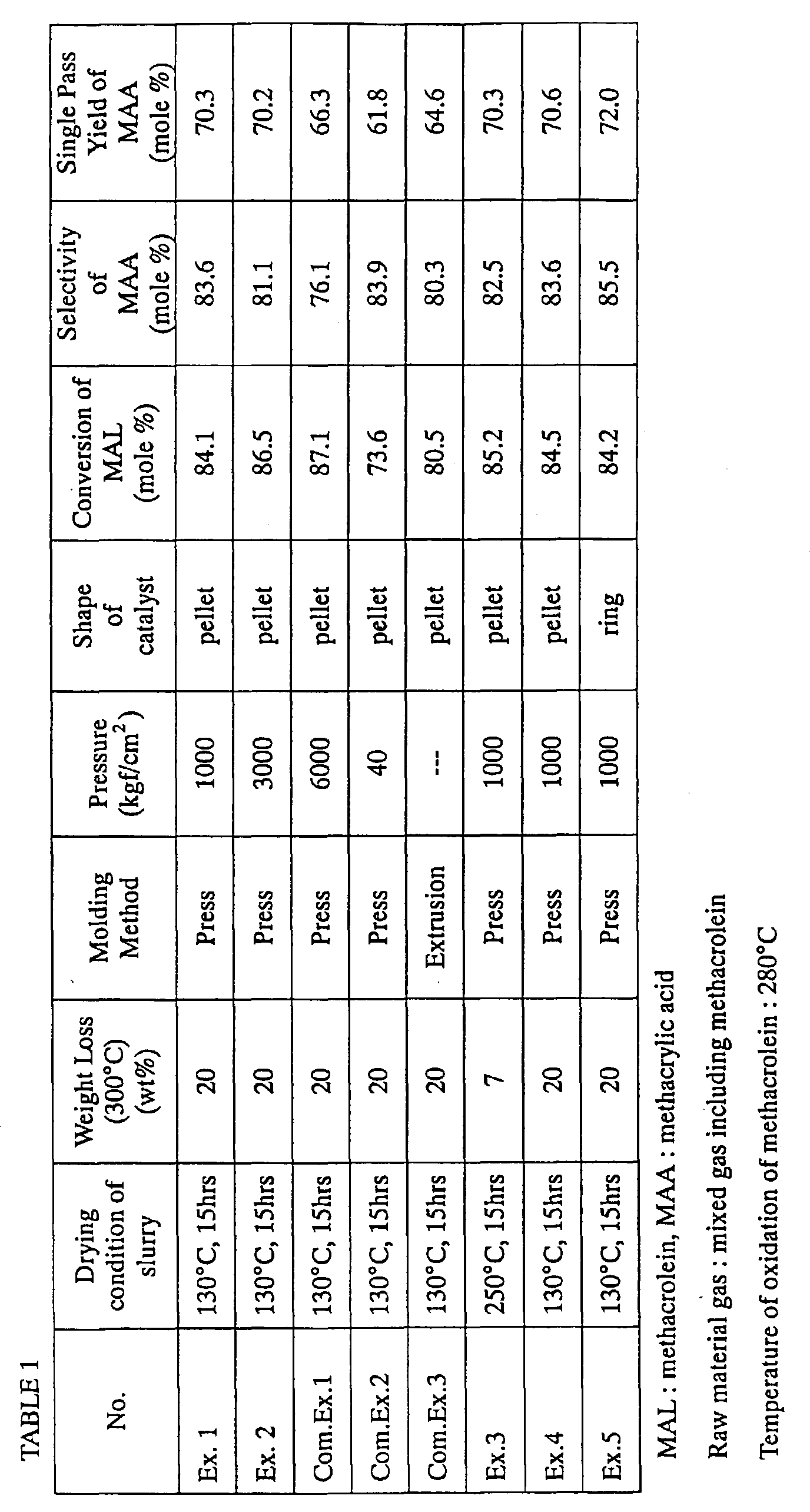
- As shown in table 1, the conversion of methacrolein in the case of molding at the pressure of 1000 to 3000 kgf/cm2 was from 84.1% to 85.2% and stable oxidation of methacrolein was carried out. It has been apparent that single pass yield of methacrylic acid in the case of molding at the range of the pressure of 1000 to 3000kgf/cm2 was higher than that in the case of molding at the pressure of 40 kgf/cm2 and 6000 kgf/cm2, respectively. Single pass yield of methacrylic acid was highest, especially in the case of using the catalyst with the shape of a ring.
- The oxidation was carried out in the same manner of Example 1 except that a mixed gas consisting of 4.0 volume % of isobutyraldehyde, 10 volume % of oxygen, 12 volume % of steam and 74 volume % of nitrogen is used as a raw material gas and space velocity was changed into 1000hr-1. This result is shown in table 2.
- The oxidation was carried out in the same manner of Example 6 except that the catalyst (1) was replaced by the catalyst (5). The result is shown in table 2.
No. Condition of preparing a catalyst Conversion of IBAL (mole %) Selectivity of MAL (mole %) Selectivity of MAA (mole %) Single Pass Yield of MAA (mole %) Ex.6 Press 1000kgf/cm2 100 10.1 68.2 68.2 Com.Ex.4 Extrusion molding 100 12.2 63.5 63.5 IBAL: Isobutyraldehyde, MAL: Methacrolein, MAA: Methacrylic acid
Raw material gas : gas including isobutyraldehyde
Reaction temperature : 280°C - As shown in table 2, the catalyst of the invention was effective in the case of using isobutyraldehyde as a raw material gas and single pass yield of methacrylic acid prepared in the presence of the catalyst of the invention was higher than that of a catalyst prepared by extrusion molding.
- The oxidation was carried out in the same manner of Example 1 except that a mixed gas consisting of 4.5 volume % of isobutyric acid, 12 volume % of oxygen, 12 volume % of steam and 71.5 volume % of nitrogen was used as a raw material gas and space velocity was changed into 1500hr-1. This result is shown in table 3.
- The oxidation was carried out in the same manner of Example 7 except that the catalyst (1) was replaced by the catalyst (5). The result is shown in table 3.
No. Condition of preparing a catalyst Conversion of IBA (mole %) Selectivity of MAA (mole %) Single Pass Yield of MAA (mole %) Ex.7 Press 1000kgf/cm2 99.5 79.6 79.2 Com.Ex.5 Extrusion molding 97.1 77.5 75.3 IBA: Isobutyric acid, MAA: Methacrylic acid
Raw material gas : gas including isobutyric acid
Reaction temperature : 280°C - As shown in table 3, the catalyst of the invention was effective in the case of using isobutyric acid as a raw material gas and single pass yield of methacrylic acid prepared in the presence of the catalyst of the invention was higher than that of a catalyst prepared by extrusion molding.
Claims (10)
- A process for preparing a catalyst for use in production of methacrylic acid by gas phase oxidation and / or oxidative dehydrogenation of at least one compound selected from the group consisting of methacrolein, isobutyraldehyde and isobutyric acid, which comprises:molding a raw material including a powder containing phosphorus and molybdenum at the pressure of 50 kgf/cm2 to 5000 kgf/cm2 into an article; andcalcining the molded article to obtain a catalyst.
- The process of claim 1, wherein a weight of the powder is reducible from 0 to 40 % by weight with respect to the weight of the powder by heating at a temperature of 300 °C.
- The process of claim 1 or 2, wherein the powder comprises particles having a diameter of 150 µm to 1500 µm.
- The process of one or more of claims 1 to 3, wherein the raw material further comprises a lubricant and/or a reinforcement.
- The process of one or more of claims 1 to 4, wherein the molded article has a shape of a ring.
- The process of one or more of claims 1 to 5, wherein the powder is obtained by drying a material containing phosphorus and molybdenum by at least one method selected from the group consisting of spray drying, drum drying and flash drying.
- A catalyst produced by the process of anyone of claims 1 to 6, which comprises the following composition of the formula (1):
- A process for preparing methacrylic acid by gas phase oxidation and / or oxidative dehydrogenation of at least one compound selected from the group consisting of methacrolein, isobutyraldehyde and isobutyric acid with molecular oxygen or a gas containing molecular oxygen in the presence of a catalyst, wherein the catalyst is produced by the process which comprises:molding a raw material including a powder containing phosphorus and molybdenum at the pressure of 50 kgf/cm2 to 5000 kgf/cm2 into an article; andcalcining the molded article to obtain a catalyst.
- The process of claim 8, wherein the molded article has the shape of a ring.
- The process of claim 8 or 9, wherein the catalyst comprises the following composition of the formula(1)
Applications Claiming Priority (2)
| Application Number | Priority Date | Filing Date | Title |
|---|---|---|---|
| JP16761299A JP3702710B2 (en) | 1999-06-15 | 1999-06-15 | Catalyst for producing methacrylic acid and method for producing methacrylic acid |
| JP16761299 | 1999-06-15 |
Publications (2)
| Publication Number | Publication Date |
|---|---|
| EP1060792A1 true EP1060792A1 (en) | 2000-12-20 |
| EP1060792B1 EP1060792B1 (en) | 2004-03-31 |
Family
ID=15853021
Family Applications (1)
| Application Number | Title | Priority Date | Filing Date |
|---|---|---|---|
| EP00111924A Expired - Lifetime EP1060792B1 (en) | 1999-06-15 | 2000-06-14 | Process for preparing a catalyst for use in production of methacrylic acid and process of preparing methacrylic acid |
Country Status (7)
| Country | Link |
|---|---|
| US (2) | US6333293B1 (en) |
| EP (1) | EP1060792B1 (en) |
| JP (1) | JP3702710B2 (en) |
| KR (1) | KR100398451B1 (en) |
| DE (1) | DE60009388T2 (en) |
| SG (1) | SG93241A1 (en) |
| TW (1) | TW590801B (en) |
Cited By (7)
| Publication number | Priority date | Publication date | Assignee | Title |
|---|---|---|---|---|
| DE102007004961A1 (en) | 2007-01-26 | 2008-07-31 | Basf Se | Preparing a catalyst molded body, useful e.g. to prepare catalyst for gas phase partial oxidation of an organic compound, comprises molding a precursor mixture to a desired geometry, using graphite, and thermally treating the molded body |
| DE102008040093A1 (en) | 2008-07-02 | 2008-12-18 | Basf Se | Producing a ring like oxidic mold, useful e.g. in partial gas phase oxidation of e.g. an organic compound, comprising mechanical packing of a powdery material which is brought into the fill space of a die made of a metal compound |
| DE102007028332A1 (en) | 2007-06-15 | 2008-12-18 | Basf Se | A method for feeding a reactor with a fixed catalyst bed comprising at least annular shaped catalyst bodies K. |
| DE102008040094A1 (en) | 2008-07-02 | 2009-01-29 | Basf Se | Production of an oxidic geometric molded body used as a catalyst in a heterogeneously catalyzed partial gas phase oxidation comprises mechanically compressing a powdered material inserted into a filling chamber of a die |
| DE102008054586A1 (en) | 2008-12-12 | 2010-06-17 | Basf Se | Process for the continuous production of geometric shaped catalyst bodies K |
| US8546295B2 (en) | 2007-01-19 | 2013-10-01 | Basf Aktiengesellschaft | Process for preparing shaped catalyst bodies whose active composition is a multielement oxide |
| DE102012012510A1 (en) | 2012-06-22 | 2013-12-24 | Clariant International Ag | Graphite-containing catalyst molding |
Families Citing this family (8)
| Publication number | Priority date | Publication date | Assignee | Title |
|---|---|---|---|---|
| JP4295521B2 (en) | 2003-02-13 | 2009-07-15 | 株式会社日本触媒 | Catalyst for producing acrylic acid and method for producing acrylic acid |
| KR100557640B1 (en) | 2004-01-09 | 2006-03-10 | 주식회사 엘지화학 | Novel heteropolyacid catalyst and preparation method thereof |
| JP2005288365A (en) * | 2004-04-01 | 2005-10-20 | Mitsubishi Rayon Co Ltd | Method for producing a catalyst for methacrylic acid production |
| EP2085376B1 (en) | 2008-01-30 | 2012-09-05 | Evonik Röhm GmbH | Process for preparation of high purity methacrylic acid |
| JP5473744B2 (en) * | 2010-04-21 | 2014-04-16 | 三菱レイヨン株式会社 | Method for producing a catalyst for methacrylic acid production |
| WO2013073691A1 (en) * | 2011-11-17 | 2013-05-23 | 日本化薬株式会社 | Catalyst for production of methacrylic acid and method for producing methacrylic acid using same |
| WO2013163806A1 (en) | 2012-05-03 | 2013-11-07 | Evonik Industries Ag | Process for preparation of highly pure, non-yellowing methacrylic acid |
| SG11201507796VA (en) | 2013-03-18 | 2015-10-29 | Evonik Roehm Gmbh | Process for preparation of methacrylic acid and methacrylic acid esters |
Citations (4)
| Publication number | Priority date | Publication date | Assignee | Title |
|---|---|---|---|---|
| EP0467144A1 (en) * | 1990-07-12 | 1992-01-22 | BASF Aktiengesellschaft | Masses with the general formula |
| EP0510566A1 (en) * | 1991-04-25 | 1992-10-28 | Röhm Gmbh | Molybdenum-phosphorus-vanadium containing oxidation catalysts with channels formed by flammable fibre materials |
| EP0543019A1 (en) * | 1991-06-12 | 1993-05-26 | Mitsubishi Rayon Co., Ltd. | Process for preparing catalyst for producing methacrylic acid |
| EP0639404A1 (en) * | 1992-05-08 | 1995-02-22 | Mitsubishi Rayon Co., Ltd. | Process for producing methacrylic acid synthesis catalyst |
Family Cites Families (14)
| Publication number | Priority date | Publication date | Assignee | Title |
|---|---|---|---|---|
| FR2230616B1 (en) | 1973-03-16 | 1978-01-06 | Asahi Glass Co Ltd | |
| JPS5037710A (en) | 1973-08-15 | 1975-04-08 | ||
| JPS51136615A (en) | 1975-05-23 | 1976-11-26 | Toyo Soda Mfg Co Ltd | Process for preparation of methacrylic acid |
| JPS5927217B2 (en) | 1978-11-28 | 1984-07-04 | 宇部興産株式会社 | Production method of catalyst for methacrylic acid production |
| DE2902986C2 (en) * | 1979-01-26 | 1983-05-11 | Chemische Werke Hüls AG, 4370 Marl | Process for the production of maleic anhydride |
| DE3030243A1 (en) * | 1980-08-09 | 1982-03-18 | Basf Ag, 6700 Ludwigshafen | OXIDATION CATALYST, IN PARTICULAR FOR THE PRODUCTION OF METHACRYLIC ACID BY GAS PHASE OXIDATION OF METHACROLEIN |
| DE3208572A1 (en) | 1982-03-10 | 1983-09-22 | Basf Ag, 6700 Ludwigshafen | METHOD AND CATALYST FOR PRODUCING METHACRYLIC ACID |
| JPS5916850A (en) * | 1982-07-20 | 1984-01-28 | Mitsubishi Chem Ind Ltd | Preparation of methacrylic acid and/or methacrylic acid ester |
| GB2138694B (en) * | 1983-03-24 | 1986-12-10 | Nippon Catalytic Chem Ind | Heteropolyacid-type catalyst composition containing whiskers |
| DE3626256A1 (en) * | 1986-08-02 | 1988-02-11 | Roehm Gmbh | HETEROPOLYMOLYBDAT MIXTURES AND THEIR USE AS CATALYSTS |
| JPH0679666B2 (en) | 1987-06-18 | 1994-10-12 | 株式会社日本触媒 | Catalyst for methacrylic acid synthesis and its production method with excellent reproducibility |
| US5168090A (en) * | 1990-10-04 | 1992-12-01 | Monsanto Company | Shaped oxidation catalyst structures for the production of maleic anhydride |
| JPH0810621A (en) | 1994-06-27 | 1996-01-16 | Mitsubishi Rayon Co Ltd | Method for producing catalyst for producing unsaturated carboxylic acid |
| JP3370548B2 (en) | 1997-03-19 | 2003-01-27 | 三菱レイヨン株式会社 | Method for producing catalyst for synthesis of unsaturated aldehyde and unsaturated carboxylic acid |
-
1999
- 1999-06-15 JP JP16761299A patent/JP3702710B2/en not_active Expired - Fee Related
-
2000
- 2000-06-09 SG SG200003232A patent/SG93241A1/en unknown
- 2000-06-13 TW TW089111481A patent/TW590801B/en not_active IP Right Cessation
- 2000-06-14 KR KR10-2000-0032585A patent/KR100398451B1/en not_active Expired - Fee Related
- 2000-06-14 DE DE60009388T patent/DE60009388T2/en not_active Expired - Lifetime
- 2000-06-14 EP EP00111924A patent/EP1060792B1/en not_active Expired - Lifetime
- 2000-06-15 US US09/593,701 patent/US6333293B1/en not_active Expired - Fee Related
-
2001
- 2001-10-31 US US09/984,792 patent/US6498270B1/en not_active Expired - Fee Related
Patent Citations (4)
| Publication number | Priority date | Publication date | Assignee | Title |
|---|---|---|---|---|
| EP0467144A1 (en) * | 1990-07-12 | 1992-01-22 | BASF Aktiengesellschaft | Masses with the general formula |
| EP0510566A1 (en) * | 1991-04-25 | 1992-10-28 | Röhm Gmbh | Molybdenum-phosphorus-vanadium containing oxidation catalysts with channels formed by flammable fibre materials |
| EP0543019A1 (en) * | 1991-06-12 | 1993-05-26 | Mitsubishi Rayon Co., Ltd. | Process for preparing catalyst for producing methacrylic acid |
| EP0639404A1 (en) * | 1992-05-08 | 1995-02-22 | Mitsubishi Rayon Co., Ltd. | Process for producing methacrylic acid synthesis catalyst |
Cited By (14)
| Publication number | Priority date | Publication date | Assignee | Title |
|---|---|---|---|---|
| US8546295B2 (en) | 2007-01-19 | 2013-10-01 | Basf Aktiengesellschaft | Process for preparing shaped catalyst bodies whose active composition is a multielement oxide |
| DE102007004961A1 (en) | 2007-01-26 | 2008-07-31 | Basf Se | Preparing a catalyst molded body, useful e.g. to prepare catalyst for gas phase partial oxidation of an organic compound, comprises molding a precursor mixture to a desired geometry, using graphite, and thermally treating the molded body |
| DE102007028332A1 (en) | 2007-06-15 | 2008-12-18 | Basf Se | A method for feeding a reactor with a fixed catalyst bed comprising at least annular shaped catalyst bodies K. |
| DE102008040093A1 (en) | 2008-07-02 | 2008-12-18 | Basf Se | Producing a ring like oxidic mold, useful e.g. in partial gas phase oxidation of e.g. an organic compound, comprising mechanical packing of a powdery material which is brought into the fill space of a die made of a metal compound |
| DE102008040094A1 (en) | 2008-07-02 | 2009-01-29 | Basf Se | Production of an oxidic geometric molded body used as a catalyst in a heterogeneously catalyzed partial gas phase oxidation comprises mechanically compressing a powdered material inserted into a filling chamber of a die |
| CN102316978A (en) * | 2008-12-12 | 2012-01-11 | 巴斯夫欧洲公司 | Produce the method for geometry catalyst formed body K continuously |
| WO2010066645A3 (en) * | 2008-12-12 | 2011-06-16 | Basf Se | Method for continuously manufacturing geometric catalyst molded bodies k |
| US8298980B2 (en) | 2008-12-12 | 2012-10-30 | Basf Se | Process for continuously producing geometric shaped catalyst bodies K |
| DE102008054586A1 (en) | 2008-12-12 | 2010-06-17 | Basf Se | Process for the continuous production of geometric shaped catalyst bodies K |
| US8546293B2 (en) | 2008-12-12 | 2013-10-01 | Basf Se | Process for continuously producing geometric shaped catalyst bodies K |
| CN102316978B (en) * | 2008-12-12 | 2014-03-05 | 巴斯夫欧洲公司 | Method for continuously manufacturing geometric catalyst molded bodies K |
| DE102012012510A1 (en) | 2012-06-22 | 2013-12-24 | Clariant International Ag | Graphite-containing catalyst molding |
| WO2013189948A2 (en) | 2012-06-22 | 2013-12-27 | Clariant International Ag | Catalyst molded body containing graphite |
| DE102012012510B4 (en) | 2012-06-22 | 2018-12-06 | Clariant International Ltd. | Graphite-containing shaped catalyst body, its production method and use |
Also Published As
| Publication number | Publication date |
|---|---|
| TW590801B (en) | 2004-06-11 |
| DE60009388T2 (en) | 2005-02-24 |
| KR100398451B1 (en) | 2003-09-19 |
| JP2000355571A (en) | 2000-12-26 |
| US6498270B1 (en) | 2002-12-24 |
| EP1060792B1 (en) | 2004-03-31 |
| US6333293B1 (en) | 2001-12-25 |
| JP3702710B2 (en) | 2005-10-05 |
| DE60009388D1 (en) | 2004-05-06 |
| SG93241A1 (en) | 2002-12-17 |
| KR20010066837A (en) | 2001-07-11 |
Similar Documents
| Publication | Publication Date | Title |
|---|---|---|
| US5177260A (en) | Method for production of acrylic acid | |
| JP3883755B2 (en) | Catalyst production method | |
| RU2377068C2 (en) | Method of producing ring-like solid catalysts | |
| EP1060792B1 (en) | Process for preparing a catalyst for use in production of methacrylic acid and process of preparing methacrylic acid | |
| KR100709055B1 (en) | Catalyst for preparation of unsaturated aldehyde and unsaturated carboxylic acid | |
| KR101579702B1 (en) | Catalyst for oxidation of saturated and unsaturated aldehydes to unsaturated carboxylic acid, method of making and method of using thereof | |
| CN103945938B (en) | Catalyst for producing methacrylic acid and method for producing methacrylic acid using the catalyst | |
| KR100972813B1 (en) | Methacrylic acid production catalyst and its preparation method | |
| JPH08299797A (en) | Catalyst and method for producing the same | |
| KR101722061B1 (en) | Catalyst for oxidation of saturated and unsaturated aldehydes to unsaturated carboxylic acid comprising a heteropoly acid, method of making and method of using thereof | |
| JP2018043197A (en) | Catalyst for manufacturing acrylic acid | |
| GB2138694A (en) | Heteropolyacid-type catalyst composition containing whiskers | |
| KR101419052B1 (en) | Method for regenerating catalyst for methacrylic acid production and method for producing methacrylic acid | |
| KR101208433B1 (en) | Catalyst for producing methacrylic acid and method for preparation thereof | |
| KR20030079685A (en) | Catalytic gas phase oxidation process | |
| KR100865654B1 (en) | Methacrylic acid production catalyst and methacrylic acid production method | |
| JP2005169311A (en) | Production method for complex oxide catalyst | |
| JP2010214217A (en) | Catalyst for producing acrolein and method of producing acrolein and/or acrylic acid using the catalyst | |
| CN114471529B (en) | Catalyst for synthesizing acrylic acid and preparation method thereof | |
| US5380932A (en) | Process for producing methacrylic acid and methacrolein by oxidation of isobutane with molybdenum heteropoly acid catalyst | |
| JPH052375B2 (en) | ||
| JP4629886B2 (en) | Catalyst for producing methacrolein and / or methacrylic acid, method for producing the same, and method for producing methacrolein and / or methacrylic acid | |
| EP0060066B1 (en) | Process for the production of methacrylic acid from isobutyraldehyde employing a catalyst | |
| GB2037604A (en) | Process for producing methacrylic acid | |
| JPS60150834A (en) | Preparation for synthesizing catalyst of methacrylic acid |
Legal Events
| Date | Code | Title | Description |
|---|---|---|---|
| PUAI | Public reference made under article 153(3) epc to a published international application that has entered the european phase |
Free format text: ORIGINAL CODE: 0009012 |
|
| AK | Designated contracting states |
Kind code of ref document: A1 Designated state(s): DE FR |
|
| AX | Request for extension of the european patent |
Free format text: AL;LT;LV;MK;RO;SI |
|
| 17P | Request for examination filed |
Effective date: 20010523 |
|
| AKX | Designation fees paid |
Free format text: DE FR |
|
| 17Q | First examination report despatched |
Effective date: 20030325 |
|
| GRAP | Despatch of communication of intention to grant a patent |
Free format text: ORIGINAL CODE: EPIDOSNIGR1 |
|
| GRAS | Grant fee paid |
Free format text: ORIGINAL CODE: EPIDOSNIGR3 |
|
| RIN1 | Information on inventor provided before grant (corrected) |
Inventor name: KIMURA, NAOMASA Inventor name: ONODERA, HIDEO Inventor name: KASE, YUICHI |
|
| GRAA | (expected) grant |
Free format text: ORIGINAL CODE: 0009210 |
|
| AK | Designated contracting states |
Kind code of ref document: B1 Designated state(s): DE FR |
|
| REF | Corresponds to: |
Ref document number: 60009388 Country of ref document: DE Date of ref document: 20040506 Kind code of ref document: P |
|
| ET | Fr: translation filed | ||
| PLBE | No opposition filed within time limit |
Free format text: ORIGINAL CODE: 0009261 |
|
| STAA | Information on the status of an ep patent application or granted ep patent |
Free format text: STATUS: NO OPPOSITION FILED WITHIN TIME LIMIT |
|
| 26N | No opposition filed |
Effective date: 20050104 |
|
| REG | Reference to a national code |
Ref country code: FR Ref legal event code: TP |
|
| REG | Reference to a national code |
Ref country code: FR Ref legal event code: ST Effective date: 20110228 |
|
| PG25 | Lapsed in a contracting state [announced via postgrant information from national office to epo] |
Ref country code: FR Free format text: LAPSE BECAUSE OF NON-PAYMENT OF DUE FEES Effective date: 20100630 |
|
| PGFP | Annual fee paid to national office [announced via postgrant information from national office to epo] |
Ref country code: DE Payment date: 20120607 Year of fee payment: 13 |
|
| PGFP | Annual fee paid to national office [announced via postgrant information from national office to epo] |
Ref country code: FR Payment date: 20090611 Year of fee payment: 10 |
|
| REG | Reference to a national code |
Ref country code: DE Ref legal event code: R119 Ref document number: 60009388 Country of ref document: DE Effective date: 20140101 |
|
| PG25 | Lapsed in a contracting state [announced via postgrant information from national office to epo] |
Ref country code: DE Free format text: LAPSE BECAUSE OF NON-PAYMENT OF DUE FEES Effective date: 20140101 |