EP1059617A2 - Swept volume model - Google Patents
Swept volume model Download PDFInfo
- Publication number
- EP1059617A2 EP1059617A2 EP00401393A EP00401393A EP1059617A2 EP 1059617 A2 EP1059617 A2 EP 1059617A2 EP 00401393 A EP00401393 A EP 00401393A EP 00401393 A EP00401393 A EP 00401393A EP 1059617 A2 EP1059617 A2 EP 1059617A2
- Authority
- EP
- European Patent Office
- Prior art keywords
- motion
- computer
- swept volume
- free
- edge
- Prior art date
- Legal status (The legal status is an assumption and is not a legal conclusion. Google has not performed a legal analysis and makes no representation as to the accuracy of the status listed.)
- Granted
Links
Images



Classifications
-
- G—PHYSICS
- G06—COMPUTING OR CALCULATING; COUNTING
- G06T—IMAGE DATA PROCESSING OR GENERATION, IN GENERAL
- G06T17/00—Three-dimensional [3D] modelling for computer graphics
- G06T17/10—Constructive solid geometry [CSG] using solid primitives, e.g. cylinders, cubes
-
- Y—GENERAL TAGGING OF NEW TECHNOLOGICAL DEVELOPMENTS; GENERAL TAGGING OF CROSS-SECTIONAL TECHNOLOGIES SPANNING OVER SEVERAL SECTIONS OF THE IPC; TECHNICAL SUBJECTS COVERED BY FORMER USPC CROSS-REFERENCE ART COLLECTIONS [XRACs] AND DIGESTS
- Y02—TECHNOLOGIES OR APPLICATIONS FOR MITIGATION OR ADAPTATION AGAINST CLIMATE CHANGE
- Y02P—CLIMATE CHANGE MITIGATION TECHNOLOGIES IN THE PRODUCTION OR PROCESSING OF GOODS
- Y02P90/00—Enabling technologies with a potential contribution to greenhouse gas [GHG] emissions mitigation
- Y02P90/02—Total factory control, e.g. smart factories, flexible manufacturing systems [FMS] or integrated manufacturing systems [IMS]
Definitions
- the present invention relates to computer software utility programs, and more specifically to a machine and method for producing a swept volume model in computer aided design and computer aided manufacture (CAD/CAM) software systems.
- CAD/CAM computer aided manufacture
- the spatial inclusion of a moving part can be referred to as the swept volume. It is useful to determine the envelope or boundaries of a swept volume in order to design in adequate clearances for a part. Clearances are necessary, for example, to avoid unanticipated contacts of a part in motion with surrounding objects. In addition, accurate modeling of a swept volume allows for efficiency in terms of space cost. It is often useful to design a feature as compact as possible.
- parts in motion can be modeled using multi-instantiation of the moving object.
- This technique produces models of a part at several instants during the part motion. As the number of instantaneous models produced increases the smoother a transition from one model to the next. Acceptable quality using his techniques tends to be processor intensive, requiring the creation of multiple images of the part.
- Another technique uses multi-instantiation of a moving object combined with Boolean operations. This technique improves on the straight multi-instantiation model by allowing for extrapolation from one instantaneous model to another. The extrapolation can smooth the surface representation of the resultant model. However this modeling technique still involves creation of multiple instantaneous models and requires intensive processing.
- the present invention provides a method and apparatus of modeling a swept volume for a computer simulated object.
- the invention includes generating a polyhedral representation of a computer modeled object and representing motion of the object with a set of position matrices.
- a subset of free neighborhood entities can be determined for each matrix and traces of the motion of the free neighborhood entities can be generated.
- a representation of the swept volume from the traces can be constructed.
- Free neighborhood entities can include for example, an edge or a triangle.
- a free neighborhood can be represented by an angular portion for different types of entities comprising the boundary of the polygon.
- Other aspects include a material zone represented by a half sphere containing material of the object and delimited by a plane of a triangle, or a free neighborhood including a tangent zone represented by two portions of a sphere, wherein the two portions of the sphere are delimited by planes of adjacent triangles.
- another aspect includes a polyhedral representation with two triangles representing translational motion of an edge.
- Polyhedral representation can also include four triangles representing translational and rotational motion of an edge.
- an entity comprising an object and moving inside the material path of the object is filtered, allowing efficiency of processing.
- This invention can also embody a computer system, a programmed computer, a computer program residing on a computer-readable medium or a method of interacting with a computer and embodying the concepts described above.
- the computer 100 has a central processor 101 connected to a processor host bus 102 over which it provides data, address and control signals.
- the processors 101 may be any conventional general purpose single-chip or multi-chip microprocessor such as a Pentium® series processor, a K6 processor, a MIPS® processor, a Power PC® processor or an ALPHA® processor.
- the processor 101 may be any conventional special purpose microprocessor such as a digital signal processor or a graphics processor.
- the microprocessor 101 can have conventional address, data, and control lines coupling it to a processor host bus 102.
- the computer 100 can include a system controller 103 having an integrated RAM memory controller 104.
- the system controller 103 can be connected to the host bus 102 and provide an interface to random access memory 105.
- the system controller 103 can also provide host bus to peripheral bus bridging functions.
- the controller 103 can thereby permit signals on the processor host bus 102 to be compatibly exchanged with signals on a primary peripheral bus 110.
- the peripheral bus 110 may be, for example, a Peripheral Component Interconnect (PCI) bus, an Industry Standard Architecture (ISA) bus, or a Micro-Channel bus.
- PCI Peripheral Component Interconnect
- ISA Industry Standard Architecture
- Micro-Channel bus Micro-Channel bus
- the controller 103 can thereby allow, for example, a processor 101 having a 64-bit 66 MHz interface and a 533 Mbytes/second data transfer rate to interface to a PCI bus 110 having a data path differing in data path bit width, clock speed, or data transfer rate.
- Accessory devices including, for example, a hard disk drive control interface 111 coupled to a hard disk drive 114, a video display controller 112 coupled to a video display 115, and a keyboard and mouse controller 113 can be coupled to a peripheral bus 110 and controlled by the processor 101.
- the computer system can include a connection to a computer system network, an intranet or an internet. Data and information may be sent and received over such a connection.
- the computer 100 can also include non-volatile ROM memory 107 to store basic computer software routines.
- ROM 107 may include alterable memory, such as EEPROM (Electronically Erasable Programmable Read Only Memory), to store configuration data.
- BIOS routines 123 can be included in ROM 107 and provide basic computer initialization, systems testing, and input/output (I/O) services.
- the BIOS 123 can also include routines that allow an operating system to be "booted" from the disk 113. Examples of high-level operating systems are, the Microsoft Windows 98TM, Windows NTTM, UNIXTM, LINUX, the Apple MacOS TM operating system, or other operating system.
- An operating system may be fully loaded in the RAM memory 105 or may include portions in RAM memory 105 , disk drive storage 114, or storage at a network location.
- the operating system can provide functionality to execute software applications, software systems and tools of software systems.
- Software functionality can access the video display controller 112 an other resources of the computer system 100 to provide two dimensional (2-D) and three dimensional (3-D) models on the video computer display 115.
- a computer generated model displayed, for example, on a CAD/CAM system can include an object having a polyhedral representation, wherein the object is represented by a set of triangles.
- Motion of the object can be represented by an ordered set of position matrices. Each matrix can contain a set of triangles correlating to similar triangles at a previous and/or next position.
- One model of object motion can assume that the motion is linear between two consecutive matrix positions.
- Polyhedral representation of an edge in motion can be represented by two or four triangles.
- An edge one 201-202 experiencing only translational motion can be represented by two triangles.
- An edge two 203-204 experiencing translational and rotational motion can be represented by four triangles.
- edge one 201 at time t can travel through translation only, to become and edge at time t + ⁇ t 202.
- This translation motion of edge one can be represented by two triangles 211 and 212.
- the direction of the motion can be represented by one arrow 214.
- Motion can also include a combination of translation and rotation.
- Edge two at time t 203 can experience translational and rotational motion until it becomes edge two at time t + ⁇ t 204.
- the polyhedral representation of edge two through the translation and rotation can include four triangles 221-224.
- the direction of the motion can be represented by two arrows 230 and 231.
- Motion can be simulated on a model by selection from a user menu or other interactive device, such as an icon, or a command line entry.
- a user can specify a motion type such as rotation, linear motion, or arced motion, and then select a model object to impart the motion to.
- Another option includes selecting an object and then selecting a motion to impart to the object. Selection can be effected with a pointing device, keyboard, stylus pen, touchscreen or other user entry device.
- motion data can be stored in a database and later referenced to simulate the motion relating to the data.
- Data included in the database can be compiled from actual experiments or other real world collection methods. For example, sensors attached to the wheel of a car can monitor rotational speed and vertical motion as the car is driven. The data collected from the sensors can be stored in a database.
- the database can be referenced by a computer defined model to emulate the motion of the wheel. In this manner, most movements occurring in nature that can be monitored can be emulated by the computer model.
- data can be entered manually through an input device such as a keyboard or otherwise compiled.
- the computer defined model can emulate motion represented by the data.
- the present invention can determine the boundaries of the volume, i.e. a set of surfaces (2-D entities) that close the volume.
- This boundary or envelope can be calculated in a computer defined model.
- a point belonging to a boundary of a moving object belongs to the boundary of its swept volume if its neighborhood with respect to the swept volume is not full, that is if the point is not inside the material of the object.
- the neighborhood of a point with respect to the swept volume can be equal to the swept volume generated by the motion of the neighborhood of the point with respect to the moving object.
- a free neighborhood can be a set of points belonging to the neighborhood of p such that the neighborhood generated from a motion of point p is not full.
- a neighborhood of point p is not full if p remains on the boundary of the swept volume during the motion and does not enter the interior boundary of the material.
- a point moving in its free neighborhood can be equivalent to a point sliding along the surface of the material of the object modeled.
- a boundary of a swept volume can generally be modeled by determining for each time t a subset of points belonging to the boundary of the moving object and sliding along the boundary of the swept volume. This determination can be based on a study of the free neighborhood of the point.
- a trace can be computed and generated by the motion of the point.
- the swept volume can be constructed from representation of multiple traces.
- a triangle 310 representing an edge in a polyhedral representation of an object can be traced through an "elbow" during motion.
- the trace 300 can include multiple instantiations of the triangle 320-325.
- the direction of the motion can be indicated by directional arrows 311 and 312.
- Points can belong to an edge in a 2-D representation, or a triangle in a 3-D representation. Points can have similar neighborhoods and also similar free neighborhoods. Therefore, if one point included in the edge or the triangle entity of the boundary of the moving object is moving inside its free neighborhood, then the entire entity is moving inside its free neighborhood.
- the free neighborhood of a triangle can be represented with a half-sphere containing material and delimited by the plane of the triangle. This type of free neighborhood can be referred to as the material zone.
- the free neighborhood of an edge can be represented by two portions of a sphere, delimited by the planes of the adjacent triangles. This type of neighborhood can be referred to as a tangent zone.
- a polygon 410 can be submitted to a translation.
- a trajectory 420 of the translation can be tracked, for example, from a point such as a center point in each instantiation 410-413 of the polygon.
- a free neighborhood can be represented by an angular portion for different types of entities belonging to the boundary of a polygon.
- a free neighborhood can be based on tangent vectors 531 and 532 of a point 520 with respect to the adjacent edges.
- a free neighborhood or material zone can be based on the normal vector 512.
- Triangles included in the free neighborhood of a 2-D edge can be represented by a half sphere 510 containing material of the object and limited by the plane of the triangle.
- the half sphere 510 can be referred to as a material zone.
- the free neighborhood can be represented by two portions of a sphere 521 and 522.
- the spheres can be delimited by the planes of adjacent triangles 531 and 532.
- the free neighborhood of an edge 521 and 522 can be referred to as a tangent zone.
- motion vectors 611-613 can indicate the translation of different entities included in the polygon object.
- the motion vectors 611-613 can correlate to the trajectory 420 of the polygon object 405.
- Entities can include, for example, an edge 630, or a triangle 620.
- entities remaining on the boundary of the swept volume can be tracked and included in the computation of the polyhedron forming the swept volume.
- Those entities that enter inside the path of the material of the polygon object can be filtered out thereby economizing processor power.
- an edge 720 following a motion vector 721 can travel through a tangent zone 521. Therefore the edge 720 can be tracked and used in a swept volume model.
- triangle 730 translating along vector 731 can travel through a material zone 510. Therefore, triangle 730 can be tracked to determine a swept volume model.
- Filters can be applied to parts travelling through a material path of a polygon. Filtering can reduce computations executed by the computer processor 101. For example, edge 710 translating along vector 711 travels through the material path of polygon 405. Therefore edge 710 can be filtered out of a swept volume computation.
- a set of traces 810-816 tracking a translation of a polygon object 405 can form a swept volume boundary 910 displayed in Fig. 9.
- a logical flow including the steps 1010-1027 can represent a process used to determine the swept volume generated by a motion of a polyhedral object.
- a "Start Swept Volume" command 1010 commencing execution of a Swept Volume program can be issued by a user or called from another program executing on a computer 100.
- a moving body can be selected from a computer generated model display 1011. Selection can be accomplished with a mouse or other pointing device or with an input device such as a keyboard.
- the program can extract an array of triangles and edges 1012. Extraction can reference stored triangle information and insert it into a diagram without modifying the information.
- the motion can be selected through the selection of position matrices 1013.
- a loop can then be set up for each position matrix 1014.
- the loop can call for the program to transform the triangles and edges array 1015.
- a sub-loop can be set up for each edge 1016.
- a test can determine if a current edge is moving in a tangent zone 1017. If a current edge is moving in a tangent zone, the program can compute a trace generated by the edge 1018. In computing the trace generated by the edge 1018, the program can utilize two triangles to represent translation of a polygon and four triangles for motion including translation and rotation of the polygon.
- Transformation of the triangles can include modifying the position of the triangles that make up a part, such as the connecting rod.
- a set order of positions can be defined from select motion position matrices representing the part at different instantiations.
- a triangle on the edge of an array while the connecting rod is at an original position at t0 can have a position X0, Y0, and Z0.
- the top position of the connecting rod can be at X0, Y0, and Z1 where Z is the vertical axis.
- Translation can modify the position of each point of each triangle at each edge.
- the program can add the triangle to a table 1019.
- Triangles stored in the table can later be referenced to model a polyhedron representation of the swept volume.
- the loop can continue for each edge until a last edge has been computed 1020.
- a loop for each triangle 1021 can also process.
- the logical order of the loops is not significant.
- a loop for triangles can precede a loop for edges, or an edge loop may precede a triangle loop.
- the loop for each triangle can test for movement of a triangle in a material zone 1022.
- a triangle moving through a material zone can be added to the table used to compute a polyhedron 1023.
- the loop for each triangle can continue until the last triangle has been tested 1024.
- the matrix loop can continue to transform a triangles and edges array and run edge and triangle sub-loops for each matrix until a last matrix is reached 1025.
- the program can compute a polyhedron from information contained in a table into which the triangles have been stored 1026.
- a swept volume command program can come to an end 1027.
- a swept volume model generated by translation motion of a cylinder is illustrated 1110.
- a swept volume model generated by translation and rotational motion of a cylinder is illustrated in Fig. 12 at 1210.
- Fig. 11 and Fig. 12 illustrate a simple cylinder object experiencing uncomplicated translation and rotational motion patterns.
- FIG. 13 an illustration a slightly more complicated model is shown.
- a piston 1310 is connected to a connecting rod 1320 and a crankshaft 1330 is modeled. Rotation of the crankshaft 1330 can cause translational and rotational movement in the connecting rod 1320 and translational movement in the piston 1310.
- Fig. 14 illustrates a swept volume model 1410 of the piston 1310 experiencing a translational motion.
- a swept volume model 1420 is also illustrated for the translational and rotational motion of the connecting rod 1320. Movement of the crankshaft 1330 has not been modeled.
- a user can select particular objects included in the model and construct a swept volume model for the selected objects only. This select process can provide clarity to the swept volume model in the context of the objects illustrated.
- the invention may be implemented in digital electronic circuitry, or in computer hardware, firmware, software, or in combinations of them.
- Apparatus of the invention may be implemented in a computer program product tangibly embodied in a machine-readable storage device for execution by a programmable processor; and method steps of the invention may be performed by a programmable processor executing a program of instructions to perform functions of the invention by operating on input data and generating output.
- the invention may advantageously be implemented in one or more computer programs that are executable on a programmable system including at least one programmable processor coupled to receive data and instructions from, and to transmit data and instructions to, a data storage system, at least one input device, and at least one output device.
- Each computer program may be implemented in a high-level procedural or object-oriented programming language, or in assembly or machine language if desired; and in any case, the language may be a compiled or interpreted language.
- a processor will receive instructions and data from a read-only memory and/or a random access memory.
- Storage devices suitable for tangibly embodying computer program instructions and data include all forms of non-volatile memory, including by way of example semiconductor memory devices, such as EPROM, EEPROM, and flash memory devices; magnetic disks such as internal hard disks and removable disks; magneto-optical disks; and CD-ROM disks. Any of the foregoing may be supplemented by, or incorporated in, specially-designed ASICs (application-specific integrated circuits).
- ASICs application-specific integrated circuits
Landscapes
- Physics & Mathematics (AREA)
- Geometry (AREA)
- Engineering & Computer Science (AREA)
- Computer Graphics (AREA)
- Software Systems (AREA)
- General Physics & Mathematics (AREA)
- Theoretical Computer Science (AREA)
- Processing Or Creating Images (AREA)
- Image Generation (AREA)
Abstract
Description
- The present invention relates to computer software utility programs, and more specifically to a machine and method for producing a swept volume model in computer aided design and computer aided manufacture (CAD/CAM) software systems.
- While using CAD/CAM applications it is often desirable to model the spatial inclusion or total area a moving part will occupy during travel. The spatial inclusion of a moving part can be referred to as the swept volume. It is useful to determine the envelope or boundaries of a swept volume in order to design in adequate clearances for a part. Clearances are necessary, for example, to avoid unanticipated contacts of a part in motion with surrounding objects. In addition, accurate modeling of a swept volume allows for efficiency in terms of space cost. It is often useful to design a feature as compact as possible.
- In some currently available systems, parts in motion can be modeled using multi-instantiation of the moving object. This technique produces models of a part at several instants during the part motion. As the number of instantaneous models produced increases the smoother a transition from one model to the next. Acceptable quality using his techniques tends to be processor intensive, requiring the creation of multiple images of the part.
- Another technique uses multi-instantiation of a moving object combined with Boolean operations. This technique improves on the straight multi-instantiation model by allowing for extrapolation from one instantaneous model to another. The extrapolation can smooth the surface representation of the resultant model. However this modeling technique still involves creation of multiple instantaneous models and requires intensive processing.
- Other approaches include use of voxel representation of a swept volume or use of a marching cubes algorithm
- Accordingly, the present invention provides a method and apparatus of modeling a swept volume for a computer simulated object.
- In general in one aspect the invention includes generating a polyhedral representation of a computer modeled object and representing motion of the object with a set of position matrices. With this invention a subset of free neighborhood entities can be determined for each matrix and traces of the motion of the free neighborhood entities can be generated. A representation of the swept volume from the traces can be constructed. Free neighborhood entities can include for example, an edge or a triangle.
- In one embodiment, a free neighborhood can be represented by an angular portion for different types of entities comprising the boundary of the polygon. Other aspects include a material zone represented by a half sphere containing material of the object and delimited by a plane of a triangle, or a free neighborhood including a tangent zone represented by two portions of a sphere, wherein the two portions of the sphere are delimited by planes of adjacent triangles.
- Generally, another aspect includes a polyhedral representation with two triangles representing translational motion of an edge. Polyhedral representation can also include four triangles representing translational and rotational motion of an edge.
- In another embodiment, an entity comprising an object and moving inside the material path of the object is filtered, allowing efficiency of processing.
- This invention can also embody a computer system, a programmed computer, a computer program residing on a computer-readable medium or a method of interacting with a computer and embodying the concepts described above.
- The details of one or more embodiments of the invention are set forth in the accompanying drawings and the description below. Implementations can provide advantages such as the capability of efficiently producing a computer model of the spatial inclusion or total area a moving part will occupy during travel. Other features, objects, and advantages of the invention will be apparent from the description, the drawings and the claims.
-
- FIG. 1
- is an illustration of a computer conforming to this invention.
- FIG. 2
- illustrates simple polyhedral representation of an object.
- FIG. 3
- illustrates an edge in a polyhedral representation traced through a bend.
- FIG. 4
- illustrates a polygon submitted to translation.
- FIG. 5
- illustrates Free Neighborhood Tangent and Material zones.
- FIG. 6
- illustrates motion vectors indicating translation of a polygon.
- FIG. 7
- illustrates tracking of Free Neighborhood entities.
- FIG. 8
- illustrates tracking translation of a polygon.
- FIG. 9
- illustrates forming a swept volume boundary from the translation of Fig. 8.
- FIG. 10
- is a flow chart of one embodiment of a process for swept volume generation.
- FIG. 11
- illustrates a swept volume model of a cylinder experiencing translation.
- FIG. 12
- illustrates a swept volume model of a cylinder experiencing translation and rotation.
- FIG. 13
- illustrates a piston, connecting rod and crankshaft at rest.
- FIG. 14
- illustrates a swept volume model of the piston, connecting rod and crankshaft, with the piston and connecting rod showing motion.
- Referring to Fig. 1 physical resources of a
computer system 100 are depicted. Thecomputer 100 has acentral processor 101 connected to a processor host bus 102 over which it provides data, address and control signals. Theprocessors 101 may be any conventional general purpose single-chip or multi-chip microprocessor such as a Pentium® series processor, a K6 processor, a MIPS® processor, a Power PC® processor or an ALPHA® processor. In addition, theprocessor 101 may be any conventional special purpose microprocessor such as a digital signal processor or a graphics processor. Themicroprocessor 101 can have conventional address, data, and control lines coupling it to a processor host bus 102. - The
computer 100 can include asystem controller 103 having an integratedRAM memory controller 104. Thesystem controller 103 can be connected to the host bus 102 and provide an interface torandom access memory 105. Thesystem controller 103 can also provide host bus to peripheral bus bridging functions. Thecontroller 103 can thereby permit signals on the processor host bus 102 to be compatibly exchanged with signals on a primary peripheral bus 110. The peripheral bus 110 may be, for example, a Peripheral Component Interconnect (PCI) bus, an Industry Standard Architecture (ISA) bus, or a Micro-Channel bus. Additionally, thecontroller 103 can provide data buffering and data transfer rate matching between the host bus 102 and peripheral bus 110. Thecontroller 103 can thereby allow, for example, aprocessor 101 having a 64-bit 66 MHz interface and a 533 Mbytes/second data transfer rate to interface to a PCI bus 110 having a data path differing in data path bit width, clock speed, or data transfer rate. - Accessory devices including, for example, a hard disk
drive control interface 111 coupled to ahard disk drive 114, avideo display controller 112 coupled to a video display 115, and a keyboard andmouse controller 113 can be coupled to a peripheral bus 110 and controlled by theprocessor 101. The computer system can include a connection to a computer system network, an intranet or an internet. Data and information may be sent and received over such a connection. - The
computer 100 can also include non-volatile ROM memory 107 to store basic computer software routines. ROM 107 may include alterable memory, such as EEPROM (Electronically Erasable Programmable Read Only Memory), to store configuration data.BIOS routines 123 can be included in ROM 107 and provide basic computer initialization, systems testing, and input/output (I/O) services. TheBIOS 123 can also include routines that allow an operating system to be "booted" from thedisk 113. Examples of high-level operating systems are, the Microsoft Windows 98™, Windows NT™, UNIX™, LINUX, the Apple MacOS ™ operating system, or other operating system. - An operating system may be fully loaded in the
RAM memory 105 or may include portions inRAM memory 105 ,disk drive storage 114, or storage at a network location. The operating system can provide functionality to execute software applications, software systems and tools of software systems. Software functionality can access thevideo display controller 112 an other resources of thecomputer system 100 to provide two dimensional (2-D) and three dimensional (3-D) models on the video computer display 115. - Referring now to Fig. 2 a computer generated model displayed, for example, on a CAD/CAM system, can include an object having a polyhedral representation, wherein the object is represented by a set of triangles. Motion of the object can be represented by an ordered set of position matrices. Each matrix can contain a set of triangles correlating to similar triangles at a previous and/or next position. One model of object motion can assume that the motion is linear between two consecutive matrix positions. Polyhedral representation of an edge in motion can be represented by two or four triangles. An edge one 201-202 experiencing only translational motion can be represented by two triangles. An edge two 203-204 experiencing translational and rotational motion can be represented by four triangles. For example edge one 201 at time t can travel through translation only, to become and edge at time t +
Δt 202. This translation motion of edge one can be represented by twotriangles arrow 214. - Motion can also include a combination of translation and rotation. Edge two at
time t 203 can experience translational and rotational motion until it becomes edge two at time t +Δt 204. The polyhedral representation of edge two through the translation and rotation can include four triangles 221-224. The direction of the motion can be represented by twoarrows 230 and 231. - Motion can be simulated on a model by selection from a user menu or other interactive device, such as an icon, or a command line entry. A user can specify a motion type such as rotation, linear motion, or arced motion, and then select a model object to impart the motion to. Another option includes selecting an object and then selecting a motion to impart to the object. Selection can be effected with a pointing device, keyboard, stylus pen, touchscreen or other user entry device.
- In another embodiment, motion data can be stored in a database and later referenced to simulate the motion relating to the data. Data included in the database can be compiled from actual experiments or other real world collection methods. For example, sensors attached to the wheel of a car can monitor rotational speed and vertical motion as the car is driven. The data collected from the sensors can be stored in a database. The database can be referenced by a computer defined model to emulate the motion of the wheel. In this manner, most movements occurring in nature that can be monitored can be emulated by the computer model. In addition, data can be entered manually through an input device such as a keyboard or otherwise compiled. The computer defined model can emulate motion represented by the data.
- To represent a swept volume the present invention can determine the boundaries of the volume, i.e. a set of surfaces (2-D entities) that close the volume. This boundary or envelope can be calculated in a computer defined model. At a time t, a point belonging to a boundary of a moving object belongs to the boundary of its swept volume if its neighborhood with respect to the swept volume is not full, that is if the point is not inside the material of the object. The neighborhood of a point with respect to the swept volume can be equal to the swept volume generated by the motion of the neighborhood of the point with respect to the moving object. For a point p, a free neighborhood can be a set of points belonging to the neighborhood of p such that the neighborhood generated from a motion of point p is not full. A neighborhood of point p is not full if p remains on the boundary of the swept volume during the motion and does not enter the interior boundary of the material. A point moving in its free neighborhood can be equivalent to a point sliding along the surface of the material of the object modeled.
- A boundary of a swept volume can generally be modeled by determining for each time t a subset of points belonging to the boundary of the moving object and sliding along the boundary of the swept volume. This determination can be based on a study of the free neighborhood of the point. A trace can be computed and generated by the motion of the point. The swept volume can be constructed from representation of multiple traces.
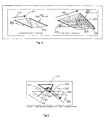
- Referring now to Fig. 3, a
triangle 310 representing an edge in a polyhedral representation of an object can be traced through an "elbow" during motion. The trace 300 can include multiple instantiations of the triangle 320-325. The direction of the motion can be indicated bydirectional arrows - Two types of free neighborhood can be utilized in a swept volume computation. The free neighborhood of a triangle can be represented with a half-sphere containing material and delimited by the plane of the triangle. This type of free neighborhood can be referred to as the material zone.
- The free neighborhood of an edge can be represented by two portions of a sphere, delimited by the planes of the adjacent triangles. This type of neighborhood can be referred to as a tangent zone.
- Referring now to Fig. 4, a
polygon 410 can be submitted to a translation. Atrajectory 420 of the translation can be tracked, for example, from a point such as a center point in each instantiation 410-413 of the polygon. - Referring now to Fig.5, a free neighborhood can be represented by an angular portion for different types of entities belonging to the boundary of a polygon. For example, a free neighborhood can be based on
tangent vectors point 520 with respect to the adjacent edges. In the case of anedge 511, a free neighborhood or material zone can be based on thenormal vector 512. - Triangles included in the free neighborhood of a 2-D edge can be represented by a
half sphere 510 containing material of the object and limited by the plane of the triangle. Thehalf sphere 510 can be referred to as a material zone. In the case of an edge, represented in 2-D by apoint 520, the free neighborhood can be represented by two portions of asphere adjacent triangles edge - Referring now to Fig. 6, motion vectors 611-613 can indicate the translation of different entities included in the polygon object. The motion vectors 611-613 can correlate to the
trajectory 420 of thepolygon object 405. Entities can include, for example, anedge 630, or atriangle 620. - Referring now to Fig. 7, entities remaining on the boundary of the swept volume, can be tracked and included in the computation of the polyhedron forming the swept volume. Those entities that enter inside the path of the material of the polygon object can be filtered out thereby economizing processor power. For example, an
edge 720 following amotion vector 721, can travel through atangent zone 521. Therefore theedge 720 can be tracked and used in a swept volume model. Similarly,triangle 730 translating alongvector 731 can travel through amaterial zone 510. Therefore,triangle 730 can be tracked to determine a swept volume model. - Filters can be applied to parts travelling through a material path of a polygon. Filtering can reduce computations executed by the
computer processor 101. For example,edge 710 translating alongvector 711 travels through the material path ofpolygon 405. Therefore edge 710 can be filtered out of a swept volume computation. - Referring now to Fig. 8, a set of traces 810-816 tracking a translation of a
polygon object 405 can form a sweptvolume boundary 910 displayed in Fig. 9. - Referring now to Fig. 10, in one embodiment, a logical flow including the steps 1010-1027 can represent a process used to determine the swept volume generated by a motion of a polyhedral object. A "Start Swept Volume"
command 1010 commencing execution of a Swept Volume program can be issued by a user or called from another program executing on acomputer 100. A moving body can be selected from a computer generatedmodel display 1011. Selection can be accomplished with a mouse or other pointing device or with an input device such as a keyboard. The program can extract an array of triangles and edges 1012. Extraction can reference stored triangle information and insert it into a diagram without modifying the information. - The motion can be selected through the selection of
position matrices 1013. A loop can then be set up for eachposition matrix 1014. The loop can call for the program to transform the triangles andedges array 1015. A sub-loop can be set up for eachedge 1016. Within the edge sub-loop, a test can determine if a current edge is moving in atangent zone 1017. If a current edge is moving in a tangent zone, the program can compute a trace generated by theedge 1018. In computing the trace generated by theedge 1018, the program can utilize two triangles to represent translation of a polygon and four triangles for motion including translation and rotation of the polygon. - Transformation of the triangles can include modifying the position of the triangles that make up a part, such as the connecting rod. A set order of positions can be defined from select motion position matrices representing the part at different instantiations. In the example of the connecting rod, a triangle on the edge of an array while the connecting rod is at an original position at t0 can have a position X0, Y0, and Z0. With vertical translation only, the top position of the connecting rod can be at X0, Y0, and Z1 where Z is the vertical axis. Translation can modify the position of each point of each triangle at each edge.
- Following computation of a trace generated by the
edge 1018, the program can add the triangle to a table 1019. Triangles stored in the table can later be referenced to model a polyhedron representation of the swept volume. The loop can continue for each edge until a last edge has been computed 1020. - A loop for each
triangle 1021 can also process. The logical order of the loops is not significant. A loop for triangles can precede a loop for edges, or an edge loop may precede a triangle loop. The loop for each triangle can test for movement of a triangle in amaterial zone 1022. A triangle moving through a material zone can be added to the table used to compute apolyhedron 1023. The loop for each triangle can continue until the last triangle has been tested 1024. - The matrix loop can continue to transform a triangles and edges array and run edge and triangle sub-loops for each matrix until a last matrix is reached 1025. When all matrices have been processed, the program can compute a polyhedron from information contained in a table into which the triangles have been stored 1026. Finally, a swept volume command program can come to an
end 1027. - Referring now to Fig. 11, a swept volume model generated by translation motion of a cylinder is illustrated 1110. A swept volume model generated by translation and rotational motion of a cylinder is illustrated in Fig. 12 at 1210. Fig. 11 and Fig. 12 illustrate a simple cylinder object experiencing uncomplicated translation and rotational motion patterns.
- Referring now to Fig. 13, an illustration a slightly more complicated model is shown. A
piston 1310 is connected to a connectingrod 1320 and acrankshaft 1330 is modeled. Rotation of thecrankshaft 1330 can cause translational and rotational movement in the connectingrod 1320 and translational movement in thepiston 1310. Fig. 14 illustrates a sweptvolume model 1410 of thepiston 1310 experiencing a translational motion. A sweptvolume model 1420 is also illustrated for the translational and rotational motion of the connectingrod 1320. Movement of thecrankshaft 1330 has not been modeled. A user can select particular objects included in the model and construct a swept volume model for the selected objects only. This select process can provide clarity to the swept volume model in the context of the objects illustrated. - The invention may be implemented in digital electronic circuitry, or in computer hardware, firmware, software, or in combinations of them. Apparatus of the invention may be implemented in a computer program product tangibly embodied in a machine-readable storage device for execution by a programmable processor; and method steps of the invention may be performed by a programmable processor executing a program of instructions to perform functions of the invention by operating on input data and generating output.
- The invention may advantageously be implemented in one or more computer programs that are executable on a programmable system including at least one programmable processor coupled to receive data and instructions from, and to transmit data and instructions to, a data storage system, at least one input device, and at least one output device. Each computer program may be implemented in a high-level procedural or object-oriented programming language, or in assembly or machine language if desired; and in any case, the language may be a compiled or interpreted language.
- Generally, a processor will receive instructions and data from a read-only memory and/or a random access memory. Storage devices suitable for tangibly embodying computer program instructions and data include all forms of non-volatile memory, including by way of example semiconductor memory devices, such as EPROM, EEPROM, and flash memory devices; magnetic disks such as internal hard disks and removable disks; magneto-optical disks; and CD-ROM disks. Any of the foregoing may be supplemented by, or incorporated in, specially-designed ASICs (application-specific integrated circuits).
- A number of embodiments of the present invention have been described. It will be understood that various modifications may be made without departing from the spirit and scope of the invention. Therefore, other implementations are within the scope of the following claims.
Claims (20)
- A software control method of modeling a swept volume for a computer simulated object comprising:generating a polyhedral representation of a computer modeled object;representing motion of the object with a set of position matrices;determining a subset of free neighborhood entities comprising the object for each matrix;generating traces by the motion of the free neighborhood entities; andconstructing a representation of the swept volume from the traces.
- The software control method of claim 1 wherein the free neighborhood entity is an edge.
- The software control method of claim 1 wherein the free neighborhood entity is a triangle.
- The software control method of claim 1 wherein a free neighborhood is represented by an angular portion for different types of entities comprising the boundary of the polygon.
- The software control method of claim 4 wherein a free neighborhood comprises a material zone represented by a half sphere containing material of object and delimited by a plane of a triangle.
- The software control method of claim 4 wherein the free neighbor hood comprises a tangent zone represented by two portions of a sphere, wherein the two portions of the sphere are delimited by planes of adjacent triangles.
- The software control method of claim 1 wherein the polyhedral representation comprises two triangles representing translational motion of an edge.
- The software control method of claim 1 wherein the polyhedral representation comprises four triangles representing translational and rotational motion of an edge.
- The software control method of claim 1 wherein the motion between two consecutive matrices is assumed to be linear.
- The software control method of claim 1 wherein an entity comprising an object and moving inside the material path of the object are filtered.
- A computer system for controlling generation of a swept volume model the system comprising:a processor operatively interconnected to a memory;a user input device;a display; anda graphical user interface responsive to activation with the user input device by causing the a program stored in the memory to be executed by the processor wherein a polyhedral representation of a computer modeled object is generated;motion of the object is represented with a set of position matrices;a subset of free neighborhood entities comprising the object is determined for each matrix;traces are generated by the motion of the free neighborhood entities; and a representation of the swept volume is constructed from the traces.
- The computer system of claim 11 wherein the position matrices representing motion of the free neighborhood entities are created referencing a database comprising data collected during physical experiments.
- The computer system of claim 11 wherein the position matrices representing motion of the free neighborhood entities are calculated in response to selection of a motion type from a user interactive menu.
- The computer system of claim 11 wherein a free neighborhood entity comprising an edge is determined by testing for movement of the edge through a tangent zone.
- The computer system of claim 11 wherein a free neighborhood entity comprising a triangle is determined by testing for movement through a material zone.
- A computer program residing on a computer-readable medium, the program comprising instructions for causing the computer to:select an object;extract an array of free neighborhood of triangles and edges from the object based on a trajectory;select a position matrix;transform an array of triangles and edges according to the position matrix;compute a trace for an edge comprising the array and moving through a tangent zone and adding the edge to a table or adding a triangle moving through a material zone to the table; andmodeling a polyhedron from data stored in the table.
- A computer program residing on a computer-readable medium, the program comprising instructions for causing the computer to:generate a polyhedral representation of a computer modeled object;represent motion of the object with a set of position matrices;determine a subset of free neighborhood entities comprising the object for each matrix;generate traces by the motion of the free neighborhood entities; andconstruct a representation of the swept volume from the traces.
- The computer program residing on a computer-readable medium of claim 19 wherein an entity comprising an object and moving inside the material path of the object are filtered.
- A method for interacting with a computer so as to model a swept volume comprising the steps of:launching a program that includes a command to generate a swept volume model;selecting an object to model;selecting a motion to be applied to the object; andissuing a command to generate a polyhedron representing a swept volume.
- The method of interacting with a computer of claim 19 wherein the motion selected is translational motion.
Applications Claiming Priority (2)
| Application Number | Priority Date | Filing Date | Title |
|---|---|---|---|
| US09/329,889 US6993461B1 (en) | 1999-06-10 | 1999-06-10 | Swept volume model |
| US329889 | 1999-06-10 |
Publications (3)
| Publication Number | Publication Date |
|---|---|
| EP1059617A2 true EP1059617A2 (en) | 2000-12-13 |
| EP1059617A3 EP1059617A3 (en) | 2004-09-15 |
| EP1059617B1 EP1059617B1 (en) | 2012-10-10 |
Family
ID=23287458
Family Applications (1)
| Application Number | Title | Priority Date | Filing Date |
|---|---|---|---|
| EP00401393A Expired - Lifetime EP1059617B1 (en) | 1999-06-10 | 2000-05-19 | Swept volume model |
Country Status (5)
| Country | Link |
|---|---|
| US (1) | US6993461B1 (en) |
| EP (1) | EP1059617B1 (en) |
| JP (1) | JP3971085B2 (en) |
| CA (1) | CA2305095C (en) |
| DE (1) | DE1059617T1 (en) |
Cited By (1)
| Publication number | Priority date | Publication date | Assignee | Title |
|---|---|---|---|---|
| CN103425838A (en) * | 2013-08-12 | 2013-12-04 | 浪潮电子信息产业股份有限公司 | Path tracking method based on linux |
Families Citing this family (16)
| Publication number | Priority date | Publication date | Assignee | Title |
|---|---|---|---|---|
| WO2002097735A1 (en) * | 2001-05-31 | 2002-12-05 | Kent Ridge Digital Labs | System and method of anatomical modeling |
| US20040009249A1 (en) | 2002-07-09 | 2004-01-15 | Hiroshige Hibasami | Apoptosis inductor extracted from potato, potato foodstuff containing the inductor, and processed product thereof |
| EP2100606A4 (en) * | 2006-12-07 | 2009-12-30 | Daiichi Sankyo Co Ltd | COATED PREPARATION OF A FILM HAVING IMPROVED STABILITY |
| EP2189918A1 (en) | 2008-11-07 | 2010-05-26 | Dassault Systèmes | Computer-implemented method of computing, in a computer aided design system, of a boundary of a modeled object. |
| US8265909B2 (en) | 2009-05-19 | 2012-09-11 | Mitsubishi Electric Research Laboratories, Inc. | Method for reconstructing a distance field of a swept volume at a sample point |
| US8010328B2 (en) * | 2009-05-19 | 2011-08-30 | Mitsubishi Electric Research Laboratories, Inc. | Method for simulating numerically controlled milling using adaptively sampled distance fields |
| US9367930B2 (en) * | 2010-08-31 | 2016-06-14 | University Of Massachusetts | Methods and systems for determining fish catches |
| US9122270B2 (en) | 2012-01-13 | 2015-09-01 | Mitsubishi Electric Research Laboratories, Inc. | Hybrid adaptively sampled distance fields |
| US8935138B2 (en) | 2012-03-28 | 2015-01-13 | Mitsubishi Electric Research Laboratories, Inc. | Analyzing volume removed during machining simulation |
| US9892215B2 (en) | 2013-09-23 | 2018-02-13 | Mitsubishi Electric Research Laboratories, Inc. | System and method for determining feedrates of machining tools |
| EP3018630A3 (en) | 2014-09-15 | 2018-05-16 | Samsung Electronics Co., Ltd. | Display method and apparatus for rendering repeated geometric shapes |
| US10649616B2 (en) * | 2017-07-06 | 2020-05-12 | Google Llc | Volumetric multi-selection interface for selecting multiple objects in 3D space |
| US11810255B2 (en) * | 2021-05-28 | 2023-11-07 | Adobe Inc. | Swept volume determination techniques |
| EP4246451A1 (en) * | 2022-03-14 | 2023-09-20 | Koninklijke Philips N.V. | Method for modelling a joint |
| CN114882170B (en) * | 2022-04-14 | 2025-09-05 | 杭州群核信息技术有限公司 | Method, electronic device and storage medium for constructing three-dimensional model along lofting path |
| CN118838248B (en) * | 2024-06-26 | 2025-11-28 | 上海大学 | Grinding wheel swept body generation method for composite grinding center processing collision detection, electronic equipment and storage medium |
Family Cites Families (13)
| Publication number | Priority date | Publication date | Assignee | Title |
|---|---|---|---|---|
| US4785399A (en) | 1987-03-03 | 1988-11-15 | International Business Machines Corporation | Shaping geometric objects by cumulative translational sweeps |
| US4833617A (en) * | 1987-08-14 | 1989-05-23 | General Electric Company | Solid modeling based adaptive feedrate control for NC machining |
| JPH07107648B2 (en) | 1987-09-09 | 1995-11-15 | インターナシヨナル・ビジネス・マシーンズ・コーポレーシヨン | Inter-object collision detection device |
| EP0405106A3 (en) | 1989-06-16 | 1992-04-08 | International Business Machines Corporation | Construction of minkowski sums and derivative morphological combinations of arbitrary polyhedra in cad/cam systems |
| US5122966A (en) | 1989-09-18 | 1992-06-16 | Northern Research & Engineering | Computer generated tool path interference check method |
| US5044127A (en) | 1990-01-16 | 1991-09-03 | The Gleason Works | Gear-shaped tool and method of generating gears |
| US5116173A (en) | 1991-02-26 | 1992-05-26 | The Gleason Works | Method of generating bevel and hypoid gears |
| EP0503642B1 (en) | 1991-03-15 | 1997-06-11 | Spatial Technology, Inc. | Method and apparatus for solids-based machining |
| US5343385A (en) | 1993-08-17 | 1994-08-30 | International Business Machines Corporation | Interference-free insertion of a solid body into a cavity |
| US5710709A (en) * | 1993-08-19 | 1998-01-20 | Iowa State University Research Foundation, Inc. | NC milling simulation and dimensional verification via dexel representation |
| US5542036A (en) | 1994-07-05 | 1996-07-30 | General Electric Company | Implicit modeling of swept volumes and swept surfaces |
| US6044306A (en) | 1997-10-14 | 2000-03-28 | Vadim Shapiro | Methods and apparatus for shaping moving geometric shapes |
| US6099573A (en) * | 1998-04-17 | 2000-08-08 | Sandia Corporation | Method and apparatus for modeling interactions |
-
1999
- 1999-06-10 US US09/329,889 patent/US6993461B1/en not_active Expired - Lifetime
-
2000
- 2000-04-13 CA CA002305095A patent/CA2305095C/en not_active Expired - Lifetime
- 2000-05-19 EP EP00401393A patent/EP1059617B1/en not_active Expired - Lifetime
- 2000-05-19 DE DE1059617T patent/DE1059617T1/en active Pending
- 2000-06-09 JP JP2000173497A patent/JP3971085B2/en not_active Expired - Lifetime
Non-Patent Citations (1)
| Title |
|---|
| None |
Cited By (1)
| Publication number | Priority date | Publication date | Assignee | Title |
|---|---|---|---|---|
| CN103425838A (en) * | 2013-08-12 | 2013-12-04 | 浪潮电子信息产业股份有限公司 | Path tracking method based on linux |
Also Published As
| Publication number | Publication date |
|---|---|
| EP1059617B1 (en) | 2012-10-10 |
| CA2305095C (en) | 2008-08-26 |
| JP3971085B2 (en) | 2007-09-05 |
| DE1059617T1 (en) | 2002-01-17 |
| US6993461B1 (en) | 2006-01-31 |
| JP2001034654A (en) | 2001-02-09 |
| CA2305095A1 (en) | 2000-12-10 |
| EP1059617A3 (en) | 2004-09-15 |
Similar Documents
| Publication | Publication Date | Title |
|---|---|---|
| EP1059617B1 (en) | Swept volume model | |
| US7676765B2 (en) | Three dimensional graphical manipulator | |
| Lin et al. | Collision and proximity queries | |
| Dionne et al. | Geodesic voxel binding for production character meshes | |
| US6573896B1 (en) | Three-dimensional arrow | |
| US7088367B2 (en) | Methods and system for general skinning via hardware accelerators | |
| US7191104B2 (en) | Method of real-time collision detection between solid geometric models | |
| US7568171B2 (en) | Stroke-based posing of three-dimensional models | |
| US5251160A (en) | System for blending surfaces in geometric modeling | |
| CN110340890A (en) | A Global Collision-Free Trajectory Planning System for Space Manipulator | |
| US20040199367A1 (en) | Apparatus and method for obtaining shape data of analytic surface approximate expression | |
| US6044306A (en) | Methods and apparatus for shaping moving geometric shapes | |
| JPH0350679A (en) | Method for calculating minkowski's sum of general polyhedron | |
| US5760778A (en) | Algorithm for representation of objects to enable robotic recongnition | |
| US20200380751A1 (en) | Modeling method and apparatus and apparatus using fluid animation graph | |
| Chen et al. | Deforming and Animating Discretely Sampled Object Representations. | |
| JP3391657B2 (en) | Inter-object distance calculation device and inter-object distance calculation program storage medium | |
| Peng et al. | Freeform modelling using sweep differential equation with haptic interface | |
| CN113129415B (en) | Animation hybrid space subdivision method, device, equipment and readable medium | |
| Di Giacomo et al. | Control structure and multi-resolution techniques for virtual human representation | |
| Merz et al. | Simplified Definition of Parameter Spaces of a Procedural Model using Sketch-based Interaction. | |
| Turnbull et al. | Computing Distances Between NURBS-de ned Convex Objects | |
| González et al. | BOCST: Branch On-collide Sphere-trees | |
| Ceylan et al. | A Multi-Touch Interface for 3D Mesh Animation | |
| Li et al. | New system for the real-time infrared scene simulator: system architecture and software design |
Legal Events
| Date | Code | Title | Description |
|---|---|---|---|
| PUAI | Public reference made under article 153(3) epc to a published international application that has entered the european phase |
Free format text: ORIGINAL CODE: 0009012 |
|
| AK | Designated contracting states |
Kind code of ref document: A2 Designated state(s): AT BE CH CY DE DK ES FI FR GB GR IE IT LI LU MC NL PT SE |
|
| AX | Request for extension of the european patent |
Free format text: AL;LT;LV;MK;RO;SI |
|
| EL | Fr: translation of claims filed | ||
| DET | De: translation of patent claims | ||
| PUAL | Search report despatched |
Free format text: ORIGINAL CODE: 0009013 |
|
| AK | Designated contracting states |
Kind code of ref document: A3 Designated state(s): AT BE CH CY DE DK ES FI FR GB GR IE IT LI LU MC NL PT SE |
|
| AX | Request for extension of the european patent |
Extension state: AL LT LV MK RO SI |
|
| 17P | Request for examination filed |
Effective date: 20050315 |
|
| AKX | Designation fees paid |
Designated state(s): AT BE CH CY DE DK ES FI FR GB GR IE IT LI LU MC NL PT SE |
|
| 17Q | First examination report despatched |
Effective date: 20071127 |
|
| GRAP | Despatch of communication of intention to grant a patent |
Free format text: ORIGINAL CODE: EPIDOSNIGR1 |
|
| GRAS | Grant fee paid |
Free format text: ORIGINAL CODE: EPIDOSNIGR3 |
|
| GRAA | (expected) grant |
Free format text: ORIGINAL CODE: 0009210 |
|
| AK | Designated contracting states |
Kind code of ref document: B1 Designated state(s): AT BE CH CY DE DK ES FI FR GB GR IE IT LI LU MC NL PT SE |
|
| REG | Reference to a national code |
Ref country code: DE Ref legal event code: R081 Ref document number: 60047560 Country of ref document: DE Owner name: DASSAULT SYSTEMES S.E., FR Free format text: FORMER OWNER: DASSAULT SYSTEMES, SURESNES, FR Ref country code: GB Ref legal event code: FG4D |
|
| REG | Reference to a national code |
Ref country code: AT Ref legal event code: REF Ref document number: 579266 Country of ref document: AT Kind code of ref document: T Effective date: 20121015 Ref country code: CH Ref legal event code: EP |
|
| REG | Reference to a national code |
Ref country code: IE Ref legal event code: FG4D |
|
| REG | Reference to a national code |
Ref country code: DE Ref legal event code: R096 Ref document number: 60047560 Country of ref document: DE Effective date: 20121213 |
|
| REG | Reference to a national code |
Ref country code: SE Ref legal event code: TRGR |
|
| REG | Reference to a national code |
Ref country code: NL Ref legal event code: VDEP Effective date: 20121010 |
|
| REG | Reference to a national code |
Ref country code: AT Ref legal event code: MK05 Ref document number: 579266 Country of ref document: AT Kind code of ref document: T Effective date: 20121010 |
|
| PG25 | Lapsed in a contracting state [announced via postgrant information from national office to epo] |
Ref country code: ES Free format text: LAPSE BECAUSE OF FAILURE TO SUBMIT A TRANSLATION OF THE DESCRIPTION OR TO PAY THE FEE WITHIN THE PRESCRIBED TIME-LIMIT Effective date: 20130121 Ref country code: FI Free format text: LAPSE BECAUSE OF FAILURE TO SUBMIT A TRANSLATION OF THE DESCRIPTION OR TO PAY THE FEE WITHIN THE PRESCRIBED TIME-LIMIT Effective date: 20121010 Ref country code: NL Free format text: LAPSE BECAUSE OF FAILURE TO SUBMIT A TRANSLATION OF THE DESCRIPTION OR TO PAY THE FEE WITHIN THE PRESCRIBED TIME-LIMIT Effective date: 20121010 |
|
| PG25 | Lapsed in a contracting state [announced via postgrant information from national office to epo] |
Ref country code: BE Free format text: LAPSE BECAUSE OF FAILURE TO SUBMIT A TRANSLATION OF THE DESCRIPTION OR TO PAY THE FEE WITHIN THE PRESCRIBED TIME-LIMIT Effective date: 20121010 Ref country code: CY Free format text: LAPSE BECAUSE OF FAILURE TO SUBMIT A TRANSLATION OF THE DESCRIPTION OR TO PAY THE FEE WITHIN THE PRESCRIBED TIME-LIMIT Effective date: 20121010 Ref country code: PT Free format text: LAPSE BECAUSE OF FAILURE TO SUBMIT A TRANSLATION OF THE DESCRIPTION OR TO PAY THE FEE WITHIN THE PRESCRIBED TIME-LIMIT Effective date: 20130211 Ref country code: GR Free format text: LAPSE BECAUSE OF FAILURE TO SUBMIT A TRANSLATION OF THE DESCRIPTION OR TO PAY THE FEE WITHIN THE PRESCRIBED TIME-LIMIT Effective date: 20130111 |
|
| PG25 | Lapsed in a contracting state [announced via postgrant information from national office to epo] |
Ref country code: AT Free format text: LAPSE BECAUSE OF FAILURE TO SUBMIT A TRANSLATION OF THE DESCRIPTION OR TO PAY THE FEE WITHIN THE PRESCRIBED TIME-LIMIT Effective date: 20121010 |
|
| PG25 | Lapsed in a contracting state [announced via postgrant information from national office to epo] |
Ref country code: DK Free format text: LAPSE BECAUSE OF FAILURE TO SUBMIT A TRANSLATION OF THE DESCRIPTION OR TO PAY THE FEE WITHIN THE PRESCRIBED TIME-LIMIT Effective date: 20121010 |
|
| PLBE | No opposition filed within time limit |
Free format text: ORIGINAL CODE: 0009261 |
|
| STAA | Information on the status of an ep patent application or granted ep patent |
Free format text: STATUS: NO OPPOSITION FILED WITHIN TIME LIMIT |
|
| 26N | No opposition filed |
Effective date: 20130711 |
|
| REG | Reference to a national code |
Ref country code: DE Ref legal event code: R097 Ref document number: 60047560 Country of ref document: DE Effective date: 20130711 |
|
| PG25 | Lapsed in a contracting state [announced via postgrant information from national office to epo] |
Ref country code: MC Free format text: LAPSE BECAUSE OF FAILURE TO SUBMIT A TRANSLATION OF THE DESCRIPTION OR TO PAY THE FEE WITHIN THE PRESCRIBED TIME-LIMIT Effective date: 20121010 |
|
| REG | Reference to a national code |
Ref country code: CH Ref legal event code: PL |
|
| PG25 | Lapsed in a contracting state [announced via postgrant information from national office to epo] |
Ref country code: LI Free format text: LAPSE BECAUSE OF NON-PAYMENT OF DUE FEES Effective date: 20130531 Ref country code: CH Free format text: LAPSE BECAUSE OF NON-PAYMENT OF DUE FEES Effective date: 20130531 |
|
| REG | Reference to a national code |
Ref country code: IE Ref legal event code: MM4A |
|
| PG25 | Lapsed in a contracting state [announced via postgrant information from national office to epo] |
Ref country code: IE Free format text: LAPSE BECAUSE OF NON-PAYMENT OF DUE FEES Effective date: 20130519 |
|
| REG | Reference to a national code |
Ref country code: FR Ref legal event code: PLFP Year of fee payment: 16 |
|
| PG25 | Lapsed in a contracting state [announced via postgrant information from national office to epo] |
Ref country code: LU Free format text: LAPSE BECAUSE OF NON-PAYMENT OF DUE FEES Effective date: 20130519 |
|
| REG | Reference to a national code |
Ref country code: FR Ref legal event code: PLFP Year of fee payment: 17 |
|
| REG | Reference to a national code |
Ref country code: FR Ref legal event code: PLFP Year of fee payment: 18 |
|
| REG | Reference to a national code |
Ref country code: DE Ref legal event code: R082 Ref document number: 60047560 Country of ref document: DE Representative=s name: HORN KLEIMANN WAITZHOFER PATENTANWAELTE PARTG , DE Ref country code: DE Ref legal event code: R081 Ref document number: 60047560 Country of ref document: DE Owner name: DASSAULT SYSTEMES S.E., FR Free format text: FORMER OWNER: DASSAULT SYSTEMES, SURESNES, FR |
|
| REG | Reference to a national code |
Ref country code: FR Ref legal event code: PLFP Year of fee payment: 19 |
|
| PGFP | Annual fee paid to national office [announced via postgrant information from national office to epo] |
Ref country code: DE Payment date: 20190521 Year of fee payment: 20 Ref country code: IT Payment date: 20190527 Year of fee payment: 20 |
|
| PGFP | Annual fee paid to national office [announced via postgrant information from national office to epo] |
Ref country code: FR Payment date: 20190522 Year of fee payment: 20 Ref country code: SE Payment date: 20190521 Year of fee payment: 20 |
|
| PGFP | Annual fee paid to national office [announced via postgrant information from national office to epo] |
Ref country code: GB Payment date: 20190521 Year of fee payment: 20 |
|
| REG | Reference to a national code |
Ref country code: DE Ref legal event code: R071 Ref document number: 60047560 Country of ref document: DE |
|
| REG | Reference to a national code |
Ref country code: GB Ref legal event code: PE20 Expiry date: 20200518 |
|
| REG | Reference to a national code |
Ref country code: SE Ref legal event code: EUG |
|
| PG25 | Lapsed in a contracting state [announced via postgrant information from national office to epo] |
Ref country code: GB Free format text: LAPSE BECAUSE OF EXPIRATION OF PROTECTION Effective date: 20200518 |
|
| P01 | Opt-out of the competence of the unified patent court (upc) registered |
Effective date: 20230527 |