EP1059325B1 - Porous sheet - Google Patents
Porous sheet Download PDFInfo
- Publication number
- EP1059325B1 EP1059325B1 EP00111819A EP00111819A EP1059325B1 EP 1059325 B1 EP1059325 B1 EP 1059325B1 EP 00111819 A EP00111819 A EP 00111819A EP 00111819 A EP00111819 A EP 00111819A EP 1059325 B1 EP1059325 B1 EP 1059325B1
- Authority
- EP
- European Patent Office
- Prior art keywords
- porous sheet
- polymer
- porous
- sheet
- fiber
- Prior art date
- Legal status (The legal status is an assumption and is not a legal conclusion. Google has not performed a legal analysis and makes no representation as to the accuracy of the status listed.)
- Expired - Lifetime
Links
Images


Classifications
-
- A—HUMAN NECESSITIES
- A61—MEDICAL OR VETERINARY SCIENCE; HYGIENE
- A61F—FILTERS IMPLANTABLE INTO BLOOD VESSELS; PROSTHESES; DEVICES PROVIDING PATENCY TO, OR PREVENTING COLLAPSING OF, TUBULAR STRUCTURES OF THE BODY, e.g. STENTS; ORTHOPAEDIC, NURSING OR CONTRACEPTIVE DEVICES; FOMENTATION; TREATMENT OR PROTECTION OF EYES OR EARS; BANDAGES, DRESSINGS OR ABSORBENT PADS; FIRST-AID KITS
- A61F13/00—Bandages or dressings; Absorbent pads
-
- C—CHEMISTRY; METALLURGY
- C08—ORGANIC MACROMOLECULAR COMPOUNDS; THEIR PREPARATION OR CHEMICAL WORKING-UP; COMPOSITIONS BASED THEREON
- C08J—WORKING-UP; GENERAL PROCESSES OF COMPOUNDING; AFTER-TREATMENT NOT COVERED BY SUBCLASSES C08B, C08C, C08F, C08G or C08H
- C08J5/00—Manufacture of articles or shaped materials containing macromolecular substances
- C08J5/18—Manufacture of films or sheets
Definitions
- the present invention relates to porous sheets comprising thermoplastic polymer, more particularly porous sheets having specific porous structures on a cross section and roughened network structures on at least one surface of the sheets.
- Non-woven fabrics comprising a collection of fibers have been known. Fibers forming non-woven fabrics are held together by adhesion or fusion at intersectional portions. Although part of fibers have sectional shapes some what deformed by heating, substantial part of fibers in the surface and inside of non-woven fabrics are in collected arrangement retaining their original shapes. Non-woven fabrics made of entangled fibers formed by needle punch entanglement or water jet entanglement instead of bonding fibers by adhesive or heat have been also known. These non-woven fabrics have been used in wide applications of clothing or non-clothing fields due to good flexibility, good air permeability and mellow appearance. However, known non-woven fabrics are unsuitable in some applications, for example, due to fluff formation during their use and requirement for air permeability smaller than usual.
- porous films As air-permeable materials, porous films have been known, which are manufactured by a method where thermoplastic polymer incorporated with a void-forming agent is stretched, a method where a void-forming agent is foamed during film-forming process, a method where a void-forming agent is extracted after film formation to produce porous structure, a method where a solution of a thermoplastic polymer and a void-forming agent is extruded into a coagulation bath to coagulate thermoplastic polymer solution thereby to produce porous structure, etc.
- the fine structures of porous films may be easily controlled in these methods, the selection of suitable void-forming agent is required in addition to relatively complicated production steps.
- thermoplastic polymer incorporated with a void-forming agent in an amount sufficient for obtaining intended air permeability is in some case difficult to be made into films depending on the addition amount, or fails to give films having practically high strength even when it can be made into films.
- conventional substrates of low friction and high abrasion resistance are mainly made of films having poor air permeability.
- holes should be formed in films or porous films should be used.
- films are poor in tactile properties and texture.
- Japanese Utility Model No. 1917955 proposes to use sheets made of polyurethane elastic fibers as the substrates for first-aid sticking plasters.
- the substrates are made of fiber sheet, fluffing occurs due to surface rubbing during their use.
- the fluff formation may be reduced by increasing fiber size and fusing fibers at their intersections, this in turn makes texture excessively roughened.
- an object of the present invention is to provide porous sheets having a moderate air permeability and a soft texture without generating fluffs by rubbing, thereby eliminating the above problems of fluffing in known non-woven fabrics and poor texture of known porous films.
- Fig. 1 is an enlarged cross-sectional illustration showing a porous sheet of the present invention.
- a cross section 1 of the porous sheet is characterized by an empty space not occupied by polymer, a polymer section 2 having a relatively large sectional area and a polymer section 3 having a relatively small sectional area.
- the polymer packing of an arbitrary cross section 1 of porous sheet in the cross direction is 30 to 90%, i.e., the cross section 1 is occupied by the polymer sections 2 and 3 in an area ratio of 30 to 90%.
- the polymer packing is less than 30%, the volume of the empty space is too large and a sheet with such a small polymer packing is likely to have a cross section containing an increased number of polymer sections 3 having a small sectional area, thereby unfavorably lowering the abrasion resistance of the sheet to cause fluff formation.
- a polymer packing exceeding 90% results in failure to achieve an intended air permeability. Therefore, the polymer packing is preferably 30 to 85%, and more preferably 40 to 80%.
- the polymer packing of the cross section of porous sheet was determined by a method described below. In this method, several points were marked at regular intervals in the contours indicating the opposite surfaces of sheet and the points were connected in order to draw respective lines as shown in Fig. 1 by dotted lines. By assuming the lines as the contours defining the cross section of porous sheet, the sectional area of porous sheet was calculated.
- an arbitrary cross section of porous sheet in the cross direction as shown in Fig. 1 contains 3 to 75 isolated polymer sections having a sectional area of 0.001 mm 2 or less per millimeter along the surface of porous sheet.
- the polymer section having a sectional area of 0.001 mm 2 or less referred to herein is the polymer section 3 as shown in Fig. 1 .
- the number of the polymer sections having a sectional area of 0.001 mm 2 or less is larger than 100 per millimeter, the mechanical strength of porous sheet is lowered and the fluff formation by rubbing is likely to occur.
- the number of the polymer sections having a sectional area of 0.001 mm 2 or less is one or less per millimeter, the thickness of porous sheet is reduced to result in poor texture.
- the polymer sections referred to herein include those having a sectional area of at least 0.00001 mm 2 .
- Fig. 2 is a photomicrograph showing a surface of a porous sheet of the present invention.
- a random arrangement of fiber-like bodies on the surface of porous sheet forms a network structure (a) in which the fiber-like bodies are integrally melt-bonded to each other at their intersections by fusion of polymer constituting the fiber-like bodies.
- Fig. 3 is a photomicrograph showing a surface of another porous sheet of the present invention. In Fig. 3 , the melting of the polymer constituting the fiber-like bodies are further progressed as compared with Fig. 2 to cause integral melt-bonding of the fiber-like bodies at additional portions other than their intersections, thereby resulting in a network structure (b) formed by fiber-like protrusions.
- the porous sheets of the present invention exhibit no or minimized fluffing by rubbing and create a soft texture like cloths.
- the weight of porous sheet is not critical in the present invention, and preferably 10 to 200 g/m 2 , more preferably 30 to 150 g/m 2 in view of practical use.
- the thickness of porous sheet may be suitably varied depending on the applications, and preferably 0.03 to 0.5 mm, more preferably 0.05 to 0.4 mm, and most preferably 0.1 to 0.4 mm.
- thermoplastic polymer usable in the present invention is not strictly limited, and various thermoplastic elastomers and resins are usable.
- thermoplastic elastomers include polyolefin elastomers such as ethylene- ⁇ -olefin copolymers, polyurethane elastomers, styrene copolymer elastomers, polyester elastomers, polyamide elastomers, etc.
- thermoplastic resins include polyolefin resins such as polypropylene and polyethylene, ethylene-vinyl alcohol copolymers, etc.
- the thermoplastic elastomers are preferably used as the thermoplastic polymer in view of easiness of melt-bonding.
- an additive such as lubricant may be added to the thermoplastic polymers.
- the surface of net or roll is preferably subjected to treatment for making the release easy.
- the method for producing the porous sheets of the present invention is not particularly limited so long as porous sheets having the sheet structures mentioned above are produced.
- the porous sheets of the present invention may be produced via the production steps shown in Figs. 4 and 5 , in which like reference numerals indicate like parts.
- a molten polymer is extruded from a melt extruder 4 having a line of nozzles (not shown).
- the collecting distance is preferably set at 8 cm or less, more preferably 5 cm or less, and most preferably 4.5 cm or less. Since the molten polymer adheres to the nozzle surface and the sheet formation becomes difficult when the collecting distance is too short, the collecting distance is preferably 1 cm or longer.
- the surface of the net is preferably subjected to treatment for making the release easier such as application of oil or a releasing agent, treatment by teflon, sprinkling of water, etc.
- porous sheets may be formed on the collecting roll, for example, a metal roll 8 as shown in Fig. 5 having a diameter of 5 to 100 cm, and taken up while supported by support rolls 9.
- the collecting roll may be water-cooled and subjected to surface treatment such as teflon coating to make the release of porous sheet easier.
- the collecting roll may be heated to facilitate the sheet formation.
- the surface of the collecting roll may be mirror-polished, and the surface of the collecting device such as a conveyor net and a collecting roll may be patterned to form decorative patterns on the resultant porous sheets.
- the nozzle temperature of the melt extruder is preferred to be set within a range so that the molten polymer being extruded from the nozzles has a melt viscosity of preferably 5 to 50 Pa ⁇ s, more preferably 5 to 30 Pa ⁇ s.
- the temperature of the high-pressure air jetted from the slits is preferably the same or nearly the same as the nozzle temperature.
- the flow rate of air jet per unit length of slit is preferably 0.01 to 0.2 Nm 3 /(cm ⁇ min) in view of producing porous sheets with high quality stably.
- the temperature of the collecting surface is preferably about 100 to 200°C lower than the nozzle temperature.
- a conveyor net may be disposed under the collecting roll 8 in place of the support rolls 9.
- the stable production of sheets may be prevented because sticking of molten polymer dusts to the conveyor net is likely to occur.
- the porous sheets of the present invention produced by the methods described above are good in soft texture and highly resistant to fluff formation by rubbing, and have a moderate air permeability of preferably 0.3 to 100 cc/(cm 2 ⁇ s), more preferably 0.5 to 30 cc/(cm 2 ⁇ s) depending on the production conditions. With such properties, the porous sheets of the present invention may be used alone or as composite materials with another non-woven fabric, etc. in wide applications of clothing or non-clothing fields.
- the porous sheets of the present invention are effective as medical or sanitary materials such as substrates for first-aid sticking plasters, substrates for poultices on which pharmaceuticals are spread, dressings, parts of disposable diapers, etc., and packaging materials for food products and other products.
- a x500 sectional photomicrograph of porous sheet was analyzed by an image analyzer manufactured by Toyobo Co., Ltd. to determine the sectional area of each polymer sections, the total area thereof and the sectional area of the porous sheet. In addition, the number of polymer sections having a sectional area of 0.001 mm 2 or less on the photomicrograph was counted.
- the sectional area of a sheet in a laminated composite structure was calculated in the same manner as above on a sectional photomicrograph of the composite structure.
- Molten thermoplastic polyurethane (Kuramiron U of Kuraray Co., Ltd.) was extruded at a nozzle temperature of 240°C and an extrusion rate of 0.5 g/min per nozzle from a melt extruding apparatus having 400 circular nozzles aligned in a line.
- the nozzles was 0.3 mm in diameter and slits of 1.2 mm width for heated gas jet were disposed on both sides of the array of nozzles.
- Air heated to the same temperature as the nozzle temperature was jetted from the slits at a flow rate of 0.1 Nm 3 /(cm ⁇ min), thereby collecting the thin fiber-like polyurethane on a steel roll with 16 cm diameter disposed under the nozzles at a collecting distance of 2.5 cm.
- the resultant fibrous structure was taken up by a winding device to obtain porous sheet having a basis weight of 64.2 g/m 2 and a thickness of 0.148 mm.
- the polymer packing of the sheet was 76.0% and the number of polymer sections having a sectional area of 0.001 mm 2 or less was 5 per millimeter.
- the observation under scanning electron microscope showed that the surfaces of the sheet were in the network structure (b). No fluff formation occurred by the pilling test.
- the sheet was comfortably used as a substrate for poultices without causing oppressive damp feeling and fluff formation while preventing the pharmaceutics spread thereon from immediate dry.
- Example 2 In the same manner as in Example 1 except for changing the collecting distance to 3.5 cm, a porous sheet having a basis weight of 62.9 g/m 2 and a thickness of 0.135 mm was obtained.
- the polymer packing of the sheet was 70.1% and the number of polymer sections having a sectional area of 0.0001 to 0.001 mm 2 was 35 per millimeter.
- the observation under scanning electron microscope showed that the surfaces of the sheet were, nearly half-and-half, in the network structures (a) and (b). No fluff formation occurred by the pilling test.
- the sheet was comfortably used as a substrate for first-aid sticking plasters without causing oppressive damp feeling and fluff formation.
- Example 2 In the same manner as in Example 2 except for changing the nozzle temperature to 250°C, a porous sheet having a basis weight of 70.2 g/m 2 and a thickness of 0.173 mm was obtained.
- the polymer packing of the sheet was 81.6% and the number of polymer sections having a sectional area of 0.001 mm 2 or less was 3 per millimeter. No fluff formation occurred during the pilling test. The observation under scanning electron microscope showed that the surfaces of the sheet were in the network structure (b).
- Example 2 In the same manner as in Example 1 except for changing the collecting distance to 7.5 cm, a porous sheet having a basis weight of 62.0 g/m 2 and a thickness of 0.137 mm was obtained.
- the polymer packing of the sheet was 47.1% and the number of polymer sections having a sectional area of 0.001 mm 2 or less was 58 per millimeter. No fluff formation occurred during the pilling test.
- Example 2 In the same manner as in Example 2 except for using polyolefin elastomer (Engage manufactured by Du Pont ⁇ Dow Elastomer Co., Ltd.) and changing the nozzle temperature to 310°C and the extrusion rate to 0.45 g/min per nozzle, a porous sheet having a basis weight of 100.1 g/m 2 and a thickness of 0.308 mm was produced.
- the polymer packing of the sheet was 69.3% and the number of polymer sections having a sectional area of 0.001 mm 2 or less was 10 per millimeter. No fluff formation occurred during the pilling test.
- Example 2 In the same manner as in Example 2 except for using polypropylene and changing the nozzle temperature to 310°C and the extrusion rate to 0.3 g/min per nozzle, a porous sheet having a basis weight of 17.9 g/m 2 and a thickness of 0.078 mm was produced.
- the polymer packing of the sheet was 53.3% and the number of polymer sections having a sectional area of 0.001 mm 2 or less was 28 per millimeter. No fluff formation occurred during the pilling test.
- Example 2 In the same manner as in Example 1 except for changing the collecting distance to 15 cm, a porous sheet having a basis weight of 58.8 g/m 2 and a thickness of 0.156 mm was produced.
- the polymer packing of the sheet was 28.9% and the number of polymer sections having a sectional area of 0.001 mm 2 or less was 110 per millimeter.
- a lot of fluff was formed during the pilling test.
- the observation under scanning electron microscope showed that the surfaces of the sheet were in a structure typical for the known non-woven fabrics, i.e., a structure formed by fibers which were merely held together by adhesion at their intersections without being melt-bonded to form integral structure.
- thermoplastic polyurethane was extruded into a film having a basis weight of 20.0 g/m 2 and a thickness of 34 ⁇ m.
- the air permeability of the film was lower than 0.1 cc/(cm 2 ⁇ s).
- a polypropylene porous film (manufactured by 3M Company) having a basis weight of 21.8 g/m 2 and a thickness of 34 ⁇ m was tested.
- the polymer packing was 70% and the air permeability was lower than 0.1 cc/(cm 2 ⁇ s).
- the porous sheets of the present invention have a moderate amount of empty space and show a good soft texture unachievable in known porous films. Additionally, the porous sheets of the present invention is excellent in the air permeability and abrasion resistance.
- porous sheets which are highly resistant to fluff formation by rubbing and good in soft texture and have a moderate air permeability are easily produced.
- a first-aid sticking plaster having a substrate made of the porous sheet of the present invention is used comfortably without causing oppressive damp feeling and fluff formation.
Landscapes
- Chemical & Material Sciences (AREA)
- Engineering & Computer Science (AREA)
- Manufacturing & Machinery (AREA)
- Health & Medical Sciences (AREA)
- Materials Engineering (AREA)
- Chemical Kinetics & Catalysis (AREA)
- Medicinal Chemistry (AREA)
- Polymers & Plastics (AREA)
- Organic Chemistry (AREA)
- Heart & Thoracic Surgery (AREA)
- Biomedical Technology (AREA)
- Vascular Medicine (AREA)
- Life Sciences & Earth Sciences (AREA)
- Animal Behavior & Ethology (AREA)
- General Health & Medical Sciences (AREA)
- Public Health (AREA)
- Veterinary Medicine (AREA)
- Laminated Bodies (AREA)
- Nonwoven Fabrics (AREA)
- Manufacture Of Porous Articles, And Recovery And Treatment Of Waste Products (AREA)
- Addition Polymer Or Copolymer, Post-Treatments, Or Chemical Modifications (AREA)
- Separation Using Semi-Permeable Membranes (AREA)
Abstract
Description
- The present invention relates to porous sheets comprising thermoplastic polymer, more particularly porous sheets having specific porous structures on a cross section and roughened network structures on at least one surface of the sheets.
- Non-woven fabrics comprising a collection of fibers have been known. Fibers forming non-woven fabrics are held together by adhesion or fusion at intersectional portions. Although part of fibers have sectional shapes some what deformed by heating, substantial part of fibers in the surface and inside of non-woven fabrics are in collected arrangement retaining their original shapes. Non-woven fabrics made of entangled fibers formed by needle punch entanglement or water jet entanglement instead of bonding fibers by adhesive or heat have been also known. These non-woven fabrics have been used in wide applications of clothing or non-clothing fields due to good flexibility, good air permeability and mellow appearance. However, known non-woven fabrics are unsuitable in some applications, for example, due to fluff formation during their use and requirement for air permeability smaller than usual.
- As air-permeable materials, porous films have been known, which are manufactured by a method where thermoplastic polymer incorporated with a void-forming agent is stretched, a method where a void-forming agent is foamed during film-forming process, a method where a void-forming agent is extracted after film formation to produce porous structure, a method where a solution of a thermoplastic polymer and a void-forming agent is extruded into a coagulation bath to coagulate thermoplastic polymer solution thereby to produce porous structure, etc. Although the fine structures of porous films may be easily controlled in these methods, the selection of suitable void-forming agent is required in addition to relatively complicated production steps. In addition, thermoplastic polymer incorporated with a void-forming agent in an amount sufficient for obtaining intended air permeability is in some case difficult to be made into films depending on the addition amount, or fails to give films having practically high strength even when it can be made into films.
- As described above, known non-woven fabrics and porous films do not meet the properties required in some application fields.
- For example, in specific application as the substrates of first-aid sticking plasters, conventional substrates of low friction and high abrasion resistance are mainly made of films having poor air permeability. To make the film substrates air-permeable, holes should be formed in films or porous films should be used. However, films are poor in tactile properties and texture.
- To improve the tactile properties and air permeability of films, for example, Japanese Utility Model No.
1917955 - Although the fluff formation may be reduced by increasing fiber size and fusing fibers at their intersections, this in turn makes texture excessively roughened. Alternatively, it is proposed to heat-treat the surface of fiber sheet, this making the production process complicated due to additional step of heat calendar treatment.
- Accordingly, an object of the present invention is to provide porous sheets having a moderate air permeability and a soft texture without generating fluffs by rubbing, thereby eliminating the above problems of fluffing in known non-woven fabrics and poor texture of known porous films.
- The above object has been achieved by a porous sheet according to
claim 1. -
Fig. 1 is an enlarged cross-sectional illustration showing a porous sheet of the present invention; -
Fig. 2 is a photomicrograph showing a surface having the network structure (a) of a porous sheet of the present invention; -
Fig. 3 is a photomicrograph showing a surface having the network structure (b) of another porous sheet of the present invention; -
Fig. 4 is a schematic illustration showing a process of producing porous sheets of the present invention; and -
Fig. 5 is a schematic illustration showing another process of producing porous sheets of the present invention. - Referring to the drawings, the porous sheets of the present invention will be described in more detail.
-
Fig. 1 is an enlarged cross-sectional illustration showing a porous sheet of the present invention. As seen fromFig. 1 , across section 1 of the porous sheet is characterized by an empty space not occupied by polymer, apolymer section 2 having a relatively large sectional area and a polymer section 3 having a relatively small sectional area. - It is critical in the present invention that the polymer packing of an
arbitrary cross section 1 of porous sheet in the cross direction is 30 to 90%, i.e., thecross section 1 is occupied by thepolymer sections 2 and 3 in an area ratio of 30 to 90%. When the polymer packing is less than 30%, the volume of the empty space is too large and a sheet with such a small polymer packing is likely to have a cross section containing an increased number of polymer sections 3 having a small sectional area, thereby unfavorably lowering the abrasion resistance of the sheet to cause fluff formation. A polymer packing exceeding 90% results in failure to achieve an intended air permeability. Therefore, the polymer packing is preferably 30 to 85%, and more preferably 40 to 80%. - The polymer packing of the cross section of porous sheet, referred to herein, was determined by a method described below. In this method, several points were marked at regular intervals in the contours indicating the opposite surfaces of sheet and the points were connected in order to draw respective lines as shown in
Fig. 1 by dotted lines. By assuming the lines as the contours defining the cross section of porous sheet, the sectional area of porous sheet was calculated. - It is also critical in the present invention that an arbitrary cross section of porous sheet in the cross direction as shown in
Fig. 1 contains 3 to 75 isolated polymer sections having a sectional area of 0.001 mm2 or less per millimeter along the surface of porous sheet. The polymer section having a sectional area of 0.001 mm2 or less referred to herein is the polymer section 3 as shown inFig. 1 . When the number of the polymer sections having a sectional area of 0.001 mm2 or less is larger than 100 per millimeter, the mechanical strength of porous sheet is lowered and the fluff formation by rubbing is likely to occur. In contrast, when the number of the polymer sections having a sectional area of 0.001 mm2 or less is one or less per millimeter, the thickness of porous sheet is reduced to result in poor texture. - The polymer sections referred to herein include those having a sectional area of at least 0.00001 mm2.
-
Fig. 2 is a photomicrograph showing a surface of a porous sheet of the present invention. A random arrangement of fiber-like bodies on the surface of porous sheet forms a network structure (a) in which the fiber-like bodies are integrally melt-bonded to each other at their intersections by fusion of polymer constituting the fiber-like bodies.Fig. 3 is a photomicrograph showing a surface of another porous sheet of the present invention. InFig. 3 , the melting of the polymer constituting the fiber-like bodies are further progressed as compared withFig. 2 to cause integral melt-bonding of the fiber-like bodies at additional portions other than their intersections, thereby resulting in a network structure (b) formed by fiber-like protrusions. - With the network structures (a) and/or (b) only on either or both the opposite surfaces of porous sheet, the porous sheets of the present invention exhibit no or minimized fluffing by rubbing and create a soft texture like cloths.
- The weight of porous sheet is not critical in the present invention, and preferably 10 to 200 g/m2, more preferably 30 to 150 g/m2 in view of practical use. The thickness of porous sheet may be suitably varied depending on the applications, and preferably 0.03 to 0.5 mm, more preferably 0.05 to 0.4 mm, and most preferably 0.1 to 0.4 mm.
- The thermoplastic polymer usable in the present invention is not strictly limited, and various thermoplastic elastomers and resins are usable. Examples of the thermoplastic elastomers include polyolefin elastomers such as ethylene-α-olefin copolymers, polyurethane elastomers, styrene copolymer elastomers, polyester elastomers, polyamide elastomers, etc. Examples of the thermoplastic resins include polyolefin resins such as polypropylene and polyethylene, ethylene-vinyl alcohol copolymers, etc. Of the above, the thermoplastic elastomers are preferably used as the thermoplastic polymer in view of easiness of melt-bonding.
- To ensure easy release of porous sheets from the net or roll in the production process described below and prevent the self-adhesion of resultant porous sheets, an additive such as lubricant may be added to the thermoplastic polymers.
- Since porous sheets made of the thermoplastic elastomers are likely difficult to release from net or roll, the surface of net or roll is preferably subjected to treatment for making the release easy.
- The method for producing the porous sheets of the present invention is not particularly limited so long as porous sheets having the sheet structures mentioned above are produced. For example, the porous sheets of the present invention may be produced via the production steps shown in
Figs. 4 and 5 , in which like reference numerals indicate like parts. InFigs. 4 and 5 , a molten polymer is extruded from a melt extruder 4 having a line of nozzles (not shown). Simultaneously, high-temperature, high-pressure air is allowed to jet from slits (not shown) disposed on both the sides of nozzle outlets, thereby making the extruded molten polymer into fine fiber-like bodies which are then collected and stacked on a collecting device such as aconveyor net 5 as shown inFig. 4 and a collecting roll 8 as shown inFig. 5 .Porous sheet 6 thus formed is taken up by awinding device 7. When the distance between the nozzle outlet and the collecting surface (hereinafter referred to as "collecting distance") is too long, the porous sheets of the present invention cannot be obtained because the resultant sheets become non-woven fabrics. - To produce the porous sheets characterized by a cross section having a specific polymer packing and a specific number of particular polymer sections, and further characterized by a particular network structures on either or both the opposite surfaces, the collecting distance is preferably set at 8 cm or less, more preferably 5 cm or less, and most preferably 4.5 cm or less. Since the molten polymer adheres to the nozzle surface and the sheet formation becomes difficult when the collecting distance is too short, the collecting distance is preferably 1 cm or longer.
- When porous sheets formed on the
conveyor net 5 as shown inFig. 4 is difficult to release from the net for taking up, the surface of the net is preferably subjected to treatment for making the release easier such as application of oil or a releasing agent, treatment by teflon, sprinkling of water, etc. - Alternatively, porous sheets may be formed on the collecting roll, for example, a metal roll 8 as shown in
Fig. 5 having a diameter of 5 to 100 cm, and taken up while supported bysupport rolls 9. Like the conveyor net, the collecting roll may be water-cooled and subjected to surface treatment such as teflon coating to make the release of porous sheet easier. In some cases, the collecting roll may be heated to facilitate the sheet formation. - The surface of the collecting roll may be mirror-polished, and the surface of the collecting device such as a conveyor net and a collecting roll may be patterned to form decorative patterns on the resultant porous sheets.
- Although suitably varied depending on the kind of polymer to be used and the intended sheet structure, the nozzle temperature of the melt extruder is preferred to be set within a range so that the molten polymer being extruded from the nozzles has a melt viscosity of preferably 5 to 50 Pa·s, more preferably 5 to 30 Pa·s. The temperature of the high-pressure air jetted from the slits is preferably the same or nearly the same as the nozzle temperature. The flow rate of air jet per unit length of slit is preferably 0.01 to 0.2 Nm3/(cm·min) in view of producing porous sheets with high quality stably. The temperature of the collecting surface is preferably about 100 to 200°C lower than the nozzle temperature.
- In the process shown in
Fig. 5 , a conveyor net may be disposed under the collecting roll 8 in place of the support rolls 9. However, in some cases, the stable production of sheets may be prevented because sticking of molten polymer dusts to the conveyor net is likely to occur. To eliminate this problem, it is preferred to rotate the collecting roll 8 in a direction opposite to the direction shown inFig. 5 and shift the center axis of the collecting roll 8 upstream along the moving direction of sheets by about 1 to 50 mm from a position just under the array of nozzles. - The porous sheets of the present invention produced by the methods described above are good in soft texture and highly resistant to fluff formation by rubbing, and have a moderate air permeability of preferably 0.3 to 100 cc/(cm2·s), more preferably 0.5 to 30 cc/(cm2·s) depending on the production conditions. With such properties, the porous sheets of the present invention may be used alone or as composite materials with another non-woven fabric, etc. in wide applications of clothing or non-clothing fields. Specifically, the porous sheets of the present invention are effective as medical or sanitary materials such as substrates for first-aid sticking plasters, substrates for poultices on which pharmaceuticals are spread, dressings, parts of disposable diapers, etc., and packaging materials for food products and other products.
- The present invention will be explained in more detail by reference to the following example which should not be construed to limit the scope of the present invention.
- A x500 sectional photomicrograph of porous sheet was analyzed by an image analyzer manufactured by Toyobo Co., Ltd. to determine the sectional area of each polymer sections, the total area thereof and the sectional area of the porous sheet. In addition, the number of polymer sections having a sectional area of 0.001 mm2 or less on the photomicrograph was counted.
- On a x500 sectional photomicrograph of porous sheet, a series of points in the contours defining respective opposite surfaces of the sheet were connected in order at intervals of 50 ± 10 µm over a length of one millimeter along the surface. The resultant lines were assumed as the lines defining the opposite surfaces of the sheet and the area between the lines was calculated as the sectional area of the sheet (apparent sectional area).
- The sectional area of a sheet in a laminated composite structure was calculated in the same manner as above on a sectional photomicrograph of the composite structure.
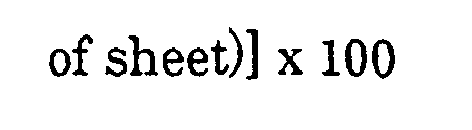
- Calculated from the following formula:

- Fluff formation was examined by pilling test (ART method) according to JIS L 1076.
- Measured by a Frazier air permeability tester (Frazier Precision Instrument Co.) according to JIS L 1096.
- Measured by a tensile tester (Autograph manufactured by Shimadzu Corporation) according to JIS L 1096.
- Molten thermoplastic polyurethane (Kuramiron U of Kuraray Co., Ltd.) was extruded at a nozzle temperature of 240°C and an extrusion rate of 0.5 g/min per nozzle from a melt extruding apparatus having 400 circular nozzles aligned in a line. The nozzles was 0.3 mm in diameter and slits of 1.2 mm width for heated gas jet were disposed on both sides of the array of nozzles. Air heated to the same temperature as the nozzle temperature was jetted from the slits at a flow rate of 0.1 Nm3/(cm · min), thereby collecting the thin fiber-like polyurethane on a steel roll with 16 cm diameter disposed under the nozzles at a collecting distance of 2.5 cm. The resultant fibrous structure was taken up by a winding device to obtain porous sheet having a basis weight of 64.2 g/m2 and a thickness of 0.148 mm.
- The polymer packing of the sheet was 76.0% and the number of polymer sections having a sectional area of 0.001 mm2 or less was 5 per millimeter. The observation under scanning electron microscope showed that the surfaces of the sheet were in the network structure (b). No fluff formation occurred by the pilling test.
- The sheet was comfortably used as a substrate for poultices without causing oppressive damp feeling and fluff formation while preventing the pharmaceutics spread thereon from immediate dry.
- In the same manner as in Example 1 except for changing the collecting distance to 3.5 cm, a porous sheet having a basis weight of 62.9 g/m2 and a thickness of 0.135 mm was obtained.
- The polymer packing of the sheet was 70.1% and the number of polymer sections having a sectional area of 0.0001 to 0.001 mm2 was 35 per millimeter. The observation under scanning electron microscope showed that the surfaces of the sheet were, nearly half-and-half, in the network structures (a) and (b). No fluff formation occurred by the pilling test.
- The sheet was comfortably used as a substrate for first-aid sticking plasters without causing oppressive damp feeling and fluff formation.
- In the same manner as in Example 2 except for changing the nozzle temperature to 250°C, a porous sheet having a basis weight of 70.2 g/m2 and a thickness of 0.173 mm was obtained. The polymer packing of the sheet was 81.6% and the number of polymer sections having a sectional area of 0.001 mm2 or less was 3 per millimeter. No fluff formation occurred during the pilling test. The observation under scanning electron microscope showed that the surfaces of the sheet were in the network structure (b).
- In the same manner as in Example 1 except for changing the collecting distance to 7.5 cm, a porous sheet having a basis weight of 62.0 g/m2 and a thickness of 0.137 mm was obtained. The polymer packing of the sheet was 47.1% and the number of polymer sections having a sectional area of 0.001 mm2 or less was 58 per millimeter. No fluff formation occurred during the pilling test.
- The observation under scanning electron microscope showed that the surfaces of the sheet were substantially in the network structure (a) and partly the network structure (b).
- In the same manner as in Example 2 except for using polyolefin elastomer (Engage manufactured by Du Pont·Dow Elastomer Co., Ltd.) and changing the nozzle temperature to 310°C and the extrusion rate to 0.45 g/min per nozzle, a porous sheet having a basis weight of 100.1 g/m2 and a thickness of 0.308 mm was produced. The polymer packing of the sheet was 69.3% and the number of polymer sections having a sectional area of 0.001 mm2 or less was 10 per millimeter. No fluff formation occurred during the pilling test.
- The observation under scanning electron microscope showed that the surfaces of the sheet were substantially in the network structure (a) and partly the network structure (b).
- In the same manner as in Example 2 except for using polypropylene and changing the nozzle temperature to 310°C and the extrusion rate to 0.3 g/min per nozzle, a porous sheet having a basis weight of 17.9 g/m2 and a thickness of 0.078 mm was produced. The polymer packing of the sheet was 53.3% and the number of polymer sections having a sectional area of 0.001 mm2 or less was 28 per millimeter. No fluff formation occurred during the pilling test.
- The observation under scanning electron microscope showed that the surfaces of the sheet were substantially in the network structure (a) and partly the network structure (b).
- In the same manner as in Example 1 except for changing the collecting distance to 15 cm, a porous sheet having a basis weight of 58.8 g/m2 and a thickness of 0.156 mm was produced. The polymer packing of the sheet was 28.9% and the number of polymer sections having a sectional area of 0.001 mm2 or less was 110 per millimeter. A lot of fluff was formed during the pilling test. The observation under scanning electron microscope showed that the surfaces of the sheet were in a structure typical for the known non-woven fabrics, i.e., a structure formed by fibers which were merely held together by adhesion at their intersections without being melt-bonded to form integral structure.
- The properties of the sheets obtained in the above examples and comparative example are shown in Table 1.
- A thermoplastic polyurethane was extruded into a film having a basis weight of 20.0 g/m2 and a thickness of 34 µm. The air permeability of the film was lower than 0.1 cc/(cm2·s).
- A polypropylene porous film (manufactured by 3M Company) having a basis weight of 21.8 g/m2 and a thickness of 34 µm was tested. The polymer packing was 70% and the air permeability was lower than 0.1 cc/(cm2·s).


- As seen from the results, the porous sheets of the present invention have a moderate amount of empty space and show a good soft texture unachievable in known porous films. Additionally, the porous sheets of the present invention is excellent in the air permeability and abrasion resistance.
- As described above, according to the present invention, porous sheets which are highly resistant to fluff formation by rubbing and good in soft texture and have a moderate air permeability are easily produced. For example, a first-aid sticking plaster having a substrate made of the porous sheet of the present invention is used comfortably without causing oppressive damp feeling and fluff formation.
Claims (7)
- A porous sheet comprising a thermoplastic polymer, a cross section of the porous sheet having a polymer packing of 30 to 90% and containing 3 to 75 polymer sections having a sectional area of 0.001 mm2 or less per millimeter along the surface of the porous sheet in the cross direction, and at least one surface of the porous sheet being in the following net-work structure (a) or (b):(a) net-work structure formed by fiber-like bodies which are integrally bonded to each other at intersections by fusion of polymer constituting the fiber-like bodies;(b) net-work structure formed by fiber-like protrusions, said protrusions being formed by fiber-like bodies integrally melt-bonded at additional portions other than their intersections.
- The porous sheet according to claim 1, having an air permeability of 0.3 to 100 cc(cm2·s) when measured according to JIS L1096.
- The porous sheet according to claim 1 or 2, wherein the thermoplastic polymer is a thermoplastic elastomer.
- A substrate for poultices, which is made of a porous sheet as defined in any one of claims 1 to 3.
- A substrate for first-aid sticking plasters, which is made of a porous sheet as defined in any one of claims 1 to 3.
- Use of the porous sheet as defined in any of claims 1 to 3 as a substrate for poultices.
- Use of the porous sheet as defined in any of claims 1 to 3 as a substrate for first-aid sticking plasters.
Applications Claiming Priority (4)
| Application Number | Priority Date | Filing Date | Title |
|---|---|---|---|
| JP15968099 | 1999-06-07 | ||
| JP15968099 | 1999-06-07 | ||
| JP36255999 | 1999-12-21 | ||
| JP36255999 | 1999-12-21 |
Publications (3)
| Publication Number | Publication Date |
|---|---|
| EP1059325A2 EP1059325A2 (en) | 2000-12-13 |
| EP1059325A3 EP1059325A3 (en) | 2002-08-21 |
| EP1059325B1 true EP1059325B1 (en) | 2009-09-16 |
Family
ID=26486401
Family Applications (1)
| Application Number | Title | Priority Date | Filing Date |
|---|---|---|---|
| EP00111819A Expired - Lifetime EP1059325B1 (en) | 1999-06-07 | 2000-06-06 | Porous sheet |
Country Status (8)
| Country | Link |
|---|---|
| US (1) | US6252128B1 (en) |
| EP (1) | EP1059325B1 (en) |
| KR (1) | KR100694354B1 (en) |
| AT (1) | ATE443097T1 (en) |
| AU (1) | AU758046B2 (en) |
| CA (1) | CA2310910C (en) |
| DE (1) | DE60042951D1 (en) |
| TW (1) | TW565586B (en) |
Cited By (1)
| Publication number | Priority date | Publication date | Assignee | Title |
|---|---|---|---|---|
| EP3943655A4 (en) * | 2019-03-29 | 2022-06-15 | Kaneka Corporation | METHOD FOR MANUFACTURING NONWOVEN FABRIC BY MELT-BLOWN AND NONWOVEN FABRIC MANUFACTURED BY MELT-BLOWN |
Families Citing this family (9)
| Publication number | Priority date | Publication date | Assignee | Title |
|---|---|---|---|---|
| US7176343B2 (en) * | 2004-01-14 | 2007-02-13 | Ed Schlussel | Scab protecting bandage |
| US8758679B2 (en) | 2006-03-31 | 2014-06-24 | The Invention Science Fund I, Llc | Surveying sterilizer methods and systems |
| US7638090B2 (en) * | 2006-03-31 | 2009-12-29 | Searete Llc | Surveying sterilizer methods and systems |
| US8114342B2 (en) * | 2006-03-31 | 2012-02-14 | The Invention Science Fund I, Llc | Methods and systems for monitoring sterilization status |
| US11185604B2 (en) | 2006-03-31 | 2021-11-30 | Deep Science Llc | Methods and systems for monitoring sterilization status |
| US8932535B2 (en) * | 2006-03-31 | 2015-01-13 | The Invention Science Fund I, Llc | Surveying sterilizer methods and systems |
| US20070231192A1 (en) | 2006-03-31 | 2007-10-04 | Searete Llc, A Limited Liability Corporation Of The State Of Delaware | Sterilization methods and systems |
| US8277724B2 (en) * | 2006-03-31 | 2012-10-02 | The Invention Science Fund I, Llc | Sterilization methods and systems |
| US20070286398A1 (en) * | 2006-06-07 | 2007-12-13 | Venkatesan Ramamoorthy | Voice Recognition Dialing For Alphabetic Phone Numbers |
Family Cites Families (4)
| Publication number | Priority date | Publication date | Assignee | Title |
|---|---|---|---|---|
| JPH0726304B2 (en) * | 1987-08-04 | 1995-03-22 | 株式会社クラレ | Polyurethane extra-fine elastic fiber non-woven fabric |
| US5230701A (en) * | 1988-05-13 | 1993-07-27 | Minnesota Mining And Manufacturing Company | Elastomeric adhesive and cohesive materials |
| JP2631520B2 (en) | 1988-08-05 | 1997-07-16 | 株式会社日立製作所 | Molding method for resin-sealed package |
| JPH02242959A (en) * | 1989-03-13 | 1990-09-27 | Kuraray Co Ltd | Bandage of unwoven fabric and production thereof |
-
2000
- 2000-05-30 AU AU37784/00A patent/AU758046B2/en not_active Ceased
- 2000-05-30 TW TW089110483A patent/TW565586B/en not_active IP Right Cessation
- 2000-06-02 CA CA002310910A patent/CA2310910C/en not_active Expired - Fee Related
- 2000-06-06 EP EP00111819A patent/EP1059325B1/en not_active Expired - Lifetime
- 2000-06-06 DE DE60042951T patent/DE60042951D1/en not_active Expired - Lifetime
- 2000-06-06 AT AT00111819T patent/ATE443097T1/en not_active IP Right Cessation
- 2000-06-06 US US09/587,573 patent/US6252128B1/en not_active Expired - Lifetime
- 2000-06-07 KR KR1020000031106A patent/KR100694354B1/en not_active Expired - Lifetime
Cited By (1)
| Publication number | Priority date | Publication date | Assignee | Title |
|---|---|---|---|---|
| EP3943655A4 (en) * | 2019-03-29 | 2022-06-15 | Kaneka Corporation | METHOD FOR MANUFACTURING NONWOVEN FABRIC BY MELT-BLOWN AND NONWOVEN FABRIC MANUFACTURED BY MELT-BLOWN |
Also Published As
| Publication number | Publication date |
|---|---|
| US6252128B1 (en) | 2001-06-26 |
| KR20010039650A (en) | 2001-05-15 |
| DE60042951D1 (en) | 2009-10-29 |
| EP1059325A3 (en) | 2002-08-21 |
| EP1059325A2 (en) | 2000-12-13 |
| KR100694354B1 (en) | 2007-03-12 |
| AU758046B2 (en) | 2003-03-13 |
| AU3778400A (en) | 2000-12-14 |
| CA2310910A1 (en) | 2000-12-07 |
| ATE443097T1 (en) | 2009-10-15 |
| CA2310910C (en) | 2009-05-19 |
| TW565586B (en) | 2003-12-11 |
Similar Documents
| Publication | Publication Date | Title |
|---|---|---|
| US5306545A (en) | Melt-blown non-woven fabric and laminated non-woven fabric material using the same | |
| JP3744856B2 (en) | Multi-component perforated nonwoven | |
| CN1547631B (en) | High-elongation apertured nonwoven web and method for making | |
| US5766737A (en) | Nonwoven fabrics having differential aesthetic properties and processes for producing the same | |
| EP0896081B2 (en) | Fabrics formed of hollow filaments and fibers and methods of making the same | |
| JP4599366B2 (en) | A flexible and extensible nonwoven web containing fibers with high melt flow rate | |
| EP2463428B1 (en) | Mixed fiber spunbond non-woven fabric and method for production and application of the same | |
| EP2341174A1 (en) | Polyethylene-based, soft nonwoven fabric | |
| IL262974A (en) | A non-woven felt fabric containing melt-spun layers | |
| EP3901346B1 (en) | Spunbonded non-woven fabric, sanitary material, and method of manufacturing spunbonded non-woven fabric | |
| NZ216982A (en) | Non-reinforced melt blown embossed medical fabric: 80% of fibres have a diameter of 7 microns or less | |
| EP3187635A1 (en) | Soft nonwoven fabric | |
| KR100361670B1 (en) | Coated nonwoven material, method for preparing same and use of said material in a disposable absorbent hygiene article | |
| AU758046B2 (en) | Porous sheet | |
| WO2019146726A1 (en) | Composite long-fiber non-woven fabric using eccentric sheath/core composite fibers at one or both surfaces | |
| JP2541523B2 (en) | Nonwoven webs with improved softness | |
| JPWO1994024347A1 (en) | Fibers with a network structure, nonwoven fabrics made from these fibers, and their manufacturing methods | |
| JP4316108B2 (en) | Porous sheet | |
| MXPA00005571A (en) | Porous sheet | |
| KR102402951B1 (en) | Multilayer spun-bonded fabric for sanitary material | |
| JP2006002282A (en) | Biodegradable nonwoven fabric and sanitary material using the same | |
| JP2019007112A (en) | Stretchable nonwoven fabric and method for producing the same | |
| JP2002159532A (en) | Absorbent articles | |
| CN1188445A (en) | Nonwoven Protective Laminates | |
| JP2021023677A (en) | Absorbent article |
Legal Events
| Date | Code | Title | Description |
|---|---|---|---|
| PUAI | Public reference made under article 153(3) epc to a published international application that has entered the european phase |
Free format text: ORIGINAL CODE: 0009012 |
|
| AK | Designated contracting states |
Kind code of ref document: A2 Designated state(s): AT BE CH CY DE DK ES FI FR GB GR IE IT LI LU MC NL PT SE |
|
| AX | Request for extension of the european patent |
Free format text: AL;LT;LV;MK;RO;SI |
|
| PUAL | Search report despatched |
Free format text: ORIGINAL CODE: 0009013 |
|
| AK | Designated contracting states |
Kind code of ref document: A3 Designated state(s): AT BE CH CY DE DK ES FI FR GB GR IE IT LI LU MC NL PT SE |
|
| AX | Request for extension of the european patent |
Free format text: AL;LT;LV;MK;RO;SI |
|
| RIC1 | Information provided on ipc code assigned before grant |
Free format text: 7C 08J 5/18 A, 7A 61F 13/02 B, 7D 04H 1/56 B, 7D 04H 1/54 B, 7D 04H 3/16 B, 7D 04H 3/14 B |
|
| 17P | Request for examination filed |
Effective date: 20021126 |
|
| 17Q | First examination report despatched |
Effective date: 20030226 |
|
| AKX | Designation fees paid |
Designated state(s): AT BE CH CY DE DK ES FI FR GB GR IE IT LI LU MC NL PT SE |
|
| 17Q | First examination report despatched |
Effective date: 20030226 |
|
| GRAP | Despatch of communication of intention to grant a patent |
Free format text: ORIGINAL CODE: EPIDOSNIGR1 |
|
| GRAS | Grant fee paid |
Free format text: ORIGINAL CODE: EPIDOSNIGR3 |
|
| GRAA | (expected) grant |
Free format text: ORIGINAL CODE: 0009210 |
|
| AK | Designated contracting states |
Kind code of ref document: B1 Designated state(s): AT BE CH CY DE DK ES FI FR GB GR IE IT LI LU MC NL PT SE |
|
| REG | Reference to a national code |
Ref country code: GB Ref legal event code: FG4D |
|
| REG | Reference to a national code |
Ref country code: CH Ref legal event code: EP |
|
| REG | Reference to a national code |
Ref country code: IE Ref legal event code: FG4D |
|
| REF | Corresponds to: |
Ref document number: 60042951 Country of ref document: DE Date of ref document: 20091029 Kind code of ref document: P |
|
| PG25 | Lapsed in a contracting state [announced via postgrant information from national office to epo] |
Ref country code: FI Free format text: LAPSE BECAUSE OF FAILURE TO SUBMIT A TRANSLATION OF THE DESCRIPTION OR TO PAY THE FEE WITHIN THE PRESCRIBED TIME-LIMIT Effective date: 20090916 Ref country code: SE Free format text: LAPSE BECAUSE OF FAILURE TO SUBMIT A TRANSLATION OF THE DESCRIPTION OR TO PAY THE FEE WITHIN THE PRESCRIBED TIME-LIMIT Effective date: 20090916 |
|
| PG25 | Lapsed in a contracting state [announced via postgrant information from national office to epo] |
Ref country code: NL Free format text: LAPSE BECAUSE OF FAILURE TO SUBMIT A TRANSLATION OF THE DESCRIPTION OR TO PAY THE FEE WITHIN THE PRESCRIBED TIME-LIMIT Effective date: 20090916 |
|
| NLV1 | Nl: lapsed or annulled due to failure to fulfill the requirements of art. 29p and 29m of the patents act | ||
| PG25 | Lapsed in a contracting state [announced via postgrant information from national office to epo] |
Ref country code: CY Free format text: LAPSE BECAUSE OF FAILURE TO SUBMIT A TRANSLATION OF THE DESCRIPTION OR TO PAY THE FEE WITHIN THE PRESCRIBED TIME-LIMIT Effective date: 20090916 |
|
| PG25 | Lapsed in a contracting state [announced via postgrant information from national office to epo] |
Ref country code: PT Free format text: LAPSE BECAUSE OF FAILURE TO SUBMIT A TRANSLATION OF THE DESCRIPTION OR TO PAY THE FEE WITHIN THE PRESCRIBED TIME-LIMIT Effective date: 20100118 Ref country code: ES Free format text: LAPSE BECAUSE OF FAILURE TO SUBMIT A TRANSLATION OF THE DESCRIPTION OR TO PAY THE FEE WITHIN THE PRESCRIBED TIME-LIMIT Effective date: 20091227 |
|
| PG25 | Lapsed in a contracting state [announced via postgrant information from national office to epo] |
Ref country code: AT Free format text: LAPSE BECAUSE OF FAILURE TO SUBMIT A TRANSLATION OF THE DESCRIPTION OR TO PAY THE FEE WITHIN THE PRESCRIBED TIME-LIMIT Effective date: 20090916 Ref country code: BE Free format text: LAPSE BECAUSE OF FAILURE TO SUBMIT A TRANSLATION OF THE DESCRIPTION OR TO PAY THE FEE WITHIN THE PRESCRIBED TIME-LIMIT Effective date: 20090916 |
|
| PLBE | No opposition filed within time limit |
Free format text: ORIGINAL CODE: 0009261 |
|
| STAA | Information on the status of an ep patent application or granted ep patent |
Free format text: STATUS: NO OPPOSITION FILED WITHIN TIME LIMIT |
|
| PG25 | Lapsed in a contracting state [announced via postgrant information from national office to epo] |
Ref country code: DK Free format text: LAPSE BECAUSE OF FAILURE TO SUBMIT A TRANSLATION OF THE DESCRIPTION OR TO PAY THE FEE WITHIN THE PRESCRIBED TIME-LIMIT Effective date: 20090916 |
|
| 26N | No opposition filed |
Effective date: 20100617 |
|
| PG25 | Lapsed in a contracting state [announced via postgrant information from national office to epo] |
Ref country code: GR Free format text: LAPSE BECAUSE OF FAILURE TO SUBMIT A TRANSLATION OF THE DESCRIPTION OR TO PAY THE FEE WITHIN THE PRESCRIBED TIME-LIMIT Effective date: 20091217 |
|
| PG25 | Lapsed in a contracting state [announced via postgrant information from national office to epo] |
Ref country code: MC Free format text: LAPSE BECAUSE OF NON-PAYMENT OF DUE FEES Effective date: 20100630 |
|
| REG | Reference to a national code |
Ref country code: CH Ref legal event code: PL |
|
| PG25 | Lapsed in a contracting state [announced via postgrant information from national office to epo] |
Ref country code: LI Free format text: LAPSE BECAUSE OF NON-PAYMENT OF DUE FEES Effective date: 20100630 Ref country code: CH Free format text: LAPSE BECAUSE OF NON-PAYMENT OF DUE FEES Effective date: 20100630 Ref country code: IE Free format text: LAPSE BECAUSE OF NON-PAYMENT OF DUE FEES Effective date: 20100606 |
|
| PG25 | Lapsed in a contracting state [announced via postgrant information from national office to epo] |
Ref country code: LU Free format text: LAPSE BECAUSE OF NON-PAYMENT OF DUE FEES Effective date: 20100606 |
|
| REG | Reference to a national code |
Ref country code: FR Ref legal event code: PLFP Year of fee payment: 16 |
|
| REG | Reference to a national code |
Ref country code: FR Ref legal event code: PLFP Year of fee payment: 17 |
|
| REG | Reference to a national code |
Ref country code: FR Ref legal event code: PLFP Year of fee payment: 18 |
|
| REG | Reference to a national code |
Ref country code: FR Ref legal event code: PLFP Year of fee payment: 19 |
|
| PGFP | Annual fee paid to national office [announced via postgrant information from national office to epo] |
Ref country code: DE Payment date: 20190521 Year of fee payment: 20 Ref country code: IT Payment date: 20190620 Year of fee payment: 20 |
|
| PGFP | Annual fee paid to national office [announced via postgrant information from national office to epo] |
Ref country code: FR Payment date: 20190510 Year of fee payment: 20 |
|
| PGFP | Annual fee paid to national office [announced via postgrant information from national office to epo] |
Ref country code: GB Payment date: 20190605 Year of fee payment: 20 |
|
| REG | Reference to a national code |
Ref country code: DE Ref legal event code: R071 Ref document number: 60042951 Country of ref document: DE |
|
| REG | Reference to a national code |
Ref country code: GB Ref legal event code: PE20 Expiry date: 20200605 |
|
| PG25 | Lapsed in a contracting state [announced via postgrant information from national office to epo] |
Ref country code: GB Free format text: LAPSE BECAUSE OF EXPIRATION OF PROTECTION Effective date: 20200605 |