EP1059284A1 - Racemization of optically active alkoxyamines - Google Patents
Racemization of optically active alkoxyamines Download PDFInfo
- Publication number
- EP1059284A1 EP1059284A1 EP00111090A EP00111090A EP1059284A1 EP 1059284 A1 EP1059284 A1 EP 1059284A1 EP 00111090 A EP00111090 A EP 00111090A EP 00111090 A EP00111090 A EP 00111090A EP 1059284 A1 EP1059284 A1 EP 1059284A1
- Authority
- EP
- European Patent Office
- Prior art keywords
- catalyst
- hydrogen
- ammonia
- nickel
- enantiomer
- Prior art date
- Legal status (The legal status is an assumption and is not a legal conclusion. Google has not performed a legal analysis and makes no representation as to the accuracy of the status listed.)
- Granted
Links
- 125000005262 alkoxyamine group Chemical group 0.000 title claims abstract description 17
- 230000006340 racemization Effects 0.000 title description 21
- QGZKDVFQNNGYKY-UHFFFAOYSA-N Ammonia Chemical compound N QGZKDVFQNNGYKY-UHFFFAOYSA-N 0.000 claims abstract description 44
- 238000000034 method Methods 0.000 claims abstract description 42
- PXHVJJICTQNCMI-UHFFFAOYSA-N Nickel Chemical compound [Ni] PXHVJJICTQNCMI-UHFFFAOYSA-N 0.000 claims abstract description 29
- 239000003054 catalyst Substances 0.000 claims abstract description 24
- 239000001257 hydrogen Substances 0.000 claims abstract description 23
- 229910052739 hydrogen Inorganic materials 0.000 claims abstract description 23
- 229910021529 ammonia Inorganic materials 0.000 claims abstract description 22
- UFHFLCQGNIYNRP-UHFFFAOYSA-N Hydrogen Chemical compound [H][H] UFHFLCQGNIYNRP-UHFFFAOYSA-N 0.000 claims abstract description 21
- 125000000217 alkyl group Chemical group 0.000 claims abstract description 14
- 229910017052 cobalt Inorganic materials 0.000 claims abstract description 14
- 239000010941 cobalt Substances 0.000 claims abstract description 14
- GUTLYIVDDKVIGB-UHFFFAOYSA-N cobalt atom Chemical compound [Co] GUTLYIVDDKVIGB-UHFFFAOYSA-N 0.000 claims abstract description 14
- 229910052759 nickel Inorganic materials 0.000 claims abstract description 13
- NXMXETCTWNXSFG-UHFFFAOYSA-N 1-methoxypropan-2-amine Chemical compound COCC(C)N NXMXETCTWNXSFG-UHFFFAOYSA-N 0.000 claims description 21
- 238000006243 chemical reaction Methods 0.000 claims description 12
- XLYOFNOQVPJJNP-UHFFFAOYSA-N water Substances O XLYOFNOQVPJJNP-UHFFFAOYSA-N 0.000 claims description 10
- ARXJGSRGQADJSQ-UHFFFAOYSA-N 1-methoxypropan-2-ol Chemical compound COCC(C)O ARXJGSRGQADJSQ-UHFFFAOYSA-N 0.000 claims description 6
- PNEYBMLMFCGWSK-UHFFFAOYSA-N aluminium oxide Inorganic materials [O-2].[O-2].[O-2].[Al+3].[Al+3] PNEYBMLMFCGWSK-UHFFFAOYSA-N 0.000 claims description 5
- 239000007789 gas Substances 0.000 claims description 4
- 239000012808 vapor phase Substances 0.000 claims description 4
- 125000002496 methyl group Chemical group [H]C([H])([H])* 0.000 claims description 3
- 239000000203 mixture Substances 0.000 abstract description 22
- 239000006227 byproduct Substances 0.000 abstract description 8
- 150000001412 amines Chemical class 0.000 description 11
- HBAQYPYDRFILMT-UHFFFAOYSA-N 8-[3-(1-cyclopropylpyrazol-4-yl)-1H-pyrazolo[4,3-d]pyrimidin-5-yl]-3-methyl-3,8-diazabicyclo[3.2.1]octan-2-one Chemical class C1(CC1)N1N=CC(=C1)C1=NNC2=C1N=C(N=C2)N1C2C(N(CC1CC2)C)=O HBAQYPYDRFILMT-UHFFFAOYSA-N 0.000 description 7
- 150000001875 compounds Chemical class 0.000 description 6
- 125000003118 aryl group Chemical group 0.000 description 5
- 238000003556 assay Methods 0.000 description 5
- 150000001414 amino alcohols Chemical class 0.000 description 4
- 125000003710 aryl alkyl group Chemical group 0.000 description 4
- 230000003287 optical effect Effects 0.000 description 4
- 239000007868 Raney catalyst Substances 0.000 description 3
- 229910000564 Raney nickel Inorganic materials 0.000 description 3
- 125000000753 cycloalkyl group Chemical group 0.000 description 3
- 230000000694 effects Effects 0.000 description 3
- 230000007613 environmental effect Effects 0.000 description 3
- 238000004519 manufacturing process Methods 0.000 description 3
- IJGRMHOSHXDMSA-UHFFFAOYSA-N Atomic nitrogen Chemical compound N#N IJGRMHOSHXDMSA-UHFFFAOYSA-N 0.000 description 2
- XEEYBQQBJWHFJM-UHFFFAOYSA-N Iron Chemical compound [Fe] XEEYBQQBJWHFJM-UHFFFAOYSA-N 0.000 description 2
- VYPSYNLAJGMNEJ-UHFFFAOYSA-N Silicium dioxide Chemical compound O=[Si]=O VYPSYNLAJGMNEJ-UHFFFAOYSA-N 0.000 description 2
- 229910052783 alkali metal Inorganic materials 0.000 description 2
- 150000001340 alkali metals Chemical class 0.000 description 2
- 125000003545 alkoxy group Chemical group 0.000 description 2
- 238000005576 amination reaction Methods 0.000 description 2
- 230000015572 biosynthetic process Effects 0.000 description 2
- 229910052799 carbon Inorganic materials 0.000 description 2
- 125000004432 carbon atom Chemical group C* 0.000 description 2
- 230000007423 decrease Effects 0.000 description 2
- 238000004821 distillation Methods 0.000 description 2
- 238000002474 experimental method Methods 0.000 description 2
- 150000002431 hydrogen Chemical class 0.000 description 2
- 125000004435 hydrogen atom Chemical group [H]* 0.000 description 2
- 238000005984 hydrogenation reaction Methods 0.000 description 2
- 229910052751 metal Inorganic materials 0.000 description 2
- 239000002184 metal Substances 0.000 description 2
- 125000001997 phenyl group Chemical group [H]C1=C([H])C([H])=C(*)C([H])=C1[H] 0.000 description 2
- 238000002360 preparation method Methods 0.000 description 2
- 239000010935 stainless steel Substances 0.000 description 2
- 229910001220 stainless steel Inorganic materials 0.000 description 2
- 239000002699 waste material Substances 0.000 description 2
- RYGMFSIKBFXOCR-UHFFFAOYSA-N Copper Chemical compound [Cu] RYGMFSIKBFXOCR-UHFFFAOYSA-N 0.000 description 1
- HCHKCACWOHOZIP-UHFFFAOYSA-N Zinc Chemical compound [Zn] HCHKCACWOHOZIP-UHFFFAOYSA-N 0.000 description 1
- 239000011149 active material Substances 0.000 description 1
- 230000002411 adverse Effects 0.000 description 1
- 229910000573 alkali metal alloy Inorganic materials 0.000 description 1
- 125000004453 alkoxycarbonyl group Chemical group 0.000 description 1
- 238000004458 analytical method Methods 0.000 description 1
- 125000006615 aromatic heterocyclic group Chemical group 0.000 description 1
- 150000003975 aryl alkyl amines Chemical class 0.000 description 1
- 238000011914 asymmetric synthesis Methods 0.000 description 1
- 239000002585 base Substances 0.000 description 1
- 229910052792 caesium Inorganic materials 0.000 description 1
- TVFDJXOCXUVLDH-UHFFFAOYSA-N caesium atom Chemical compound [Cs] TVFDJXOCXUVLDH-UHFFFAOYSA-N 0.000 description 1
- 238000003965 capillary gas chromatography Methods 0.000 description 1
- 239000007859 condensation product Substances 0.000 description 1
- 229910052802 copper Inorganic materials 0.000 description 1
- 239000010949 copper Substances 0.000 description 1
- 229910052593 corundum Inorganic materials 0.000 description 1
- 125000000113 cyclohexyl group Chemical group [H]C1([H])C([H])([H])C([H])([H])C([H])(*)C([H])([H])C1([H])[H] 0.000 description 1
- 125000001495 ethyl group Chemical group [H]C([H])([H])C([H])([H])* 0.000 description 1
- 238000010438 heat treatment Methods 0.000 description 1
- 239000001307 helium Substances 0.000 description 1
- 229910052734 helium Inorganic materials 0.000 description 1
- SWQJXJOGLNCZEY-UHFFFAOYSA-N helium atom Chemical compound [He] SWQJXJOGLNCZEY-UHFFFAOYSA-N 0.000 description 1
- 125000004051 hexyl group Chemical group [H]C([H])([H])C([H])([H])C([H])([H])C([H])([H])C([H])([H])C([H])([H])* 0.000 description 1
- 239000011261 inert gas Substances 0.000 description 1
- 239000000543 intermediate Substances 0.000 description 1
- 229910052742 iron Inorganic materials 0.000 description 1
- 125000001449 isopropyl group Chemical group [H]C([H])([H])C([H])(*)C([H])([H])[H] 0.000 description 1
- 150000002576 ketones Chemical class 0.000 description 1
- 239000007788 liquid Substances 0.000 description 1
- 239000007791 liquid phase Substances 0.000 description 1
- WPBNNNQJVZRUHP-UHFFFAOYSA-L manganese(2+);methyl n-[[2-(methoxycarbonylcarbamothioylamino)phenyl]carbamothioyl]carbamate;n-[2-(sulfidocarbothioylamino)ethyl]carbamodithioate Chemical compound [Mn+2].[S-]C(=S)NCCNC([S-])=S.COC(=O)NC(=S)NC1=CC=CC=C1NC(=S)NC(=O)OC WPBNNNQJVZRUHP-UHFFFAOYSA-L 0.000 description 1
- 229910044991 metal oxide Inorganic materials 0.000 description 1
- 150000004706 metal oxides Chemical class 0.000 description 1
- 125000004108 n-butyl group Chemical group [H]C([H])([H])C([H])([H])C([H])([H])C([H])([H])* 0.000 description 1
- 229910052757 nitrogen Inorganic materials 0.000 description 1
- 229910000510 noble metal Inorganic materials 0.000 description 1
- 125000001147 pentyl group Chemical group C(CCCC)* 0.000 description 1
- 239000000047 product Substances 0.000 description 1
- 125000001436 propyl group Chemical group [H]C([*])([H])C([H])([H])C([H])([H])[H] 0.000 description 1
- 239000000376 reactant Substances 0.000 description 1
- 230000035484 reaction time Effects 0.000 description 1
- 238000011084 recovery Methods 0.000 description 1
- 150000003839 salts Chemical group 0.000 description 1
- 238000000926 separation method Methods 0.000 description 1
- 239000000377 silicon dioxide Substances 0.000 description 1
- 239000007787 solid Substances 0.000 description 1
- 239000000126 substance Substances 0.000 description 1
- 125000000999 tert-butyl group Chemical group [H]C([H])([H])C(*)(C([H])([H])[H])C([H])([H])[H] 0.000 description 1
- 229910001845 yogo sapphire Inorganic materials 0.000 description 1
- 239000011701 zinc Substances 0.000 description 1
- 229910052725 zinc Inorganic materials 0.000 description 1
Classifications
-
- C—CHEMISTRY; METALLURGY
- C07—ORGANIC CHEMISTRY
- C07C—ACYCLIC OR CARBOCYCLIC COMPOUNDS
- C07C213/00—Preparation of compounds containing amino and hydroxy, amino and etherified hydroxy or amino and esterified hydroxy groups bound to the same carbon skeleton
- C07C213/08—Preparation of compounds containing amino and hydroxy, amino and etherified hydroxy or amino and esterified hydroxy groups bound to the same carbon skeleton by reactions not involving the formation of amino groups, hydroxy groups or etherified or esterified hydroxy groups
-
- C—CHEMISTRY; METALLURGY
- C07—ORGANIC CHEMISTRY
- C07B—GENERAL METHODS OF ORGANIC CHEMISTRY; APPARATUS THEREFOR
- C07B2200/00—Indexing scheme relating to specific properties of organic compounds
- C07B2200/07—Optical isomers
Definitions
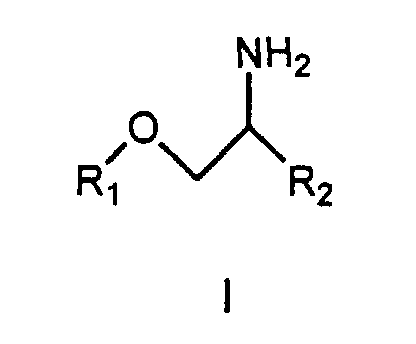
- Alkoxyamines represented by formula I, in which R 1 and R 2 are, independently, C 1 to C 20 alkyl groups, are important intermediates for compounds used in pharmaceutical and agricultural applications. Due to the presence of an asymmetric carbon atom, the above alkoxyamines exist as a mixture of enantiomers or optical isomers.
- optically active amines are produced in the form of racemic mixtures.
- Methods which have been used to obtain the active isomer include asymmetric synthesis, resolution of the enantiomers in racemic mixtures, and selective reaction.
- the inactive enantiomer is recovered along with the active enantiomer. If an outlet cannot be identified for the inactive isomer, it becomes a waste stream.
- a goal in the industry is to maximize production of the active isomer and minimize the environmental impact of an inactive isomeric waste stream. Therefore methods of limiting the amount of inactive isomer produced is of continuing interest.
- U.S. 3,954,870 discloses racemization of optically active ⁇ , ⁇ -diphenylethylanmne by heating the optically active amine at a temperature between 100 °C and the b.p. of the amine in the presence of Raney nickel under an inert gas such as nitrogen, helium or ammonia. Hydrogen is not desired because it promotes reduction of the amines and the formation of by-products. It is reported that by using a dry Raney nickel, a short reaction time is realized and the formation of undesired by-products is prevented.
- U.S. 3,970,700 discloses a method for racemizing optically active amines by contacting optically active amines of the formula below with an alkali metal deposited on a solid carrier, an alkali metal dispersed in a liquid medium or an alkali metal alloy at a temperature of from -10 to 50 °C: wherein *C is an asymmetric carbon atom, R 1 is alkyl, aralkyl or aryl and R 2 is aryl or alkoxycarbonyl, the aryl or aralkyl moiety bearing optionally one or more alkyl or alkoxy groups on the aromatic ring, and R 1 and R 2 are different from each other.
- U.S. 4,096,186 discloses racemization of optically active aminoalcohol compounds having the following formula: wherein R 1 is an alkyl, cycloalkyl, substituted or unsubstituted phenyl, or non-aromatic heterocyclic group, and R 2 is a hydrogen atom or an alkyl or substituted or unsubstituted phenyl group.
- the compounds are contacted with ammonia and hydrogen in the presence of a hydrogenation catalyst such as nickel, cobalt, copper and noble metals; cobalt is preferred, especially cobalt alone or with a small amount of a metal or metal oxide, such as iron, manganese, zinc, and cesium, or the corresponding oxides.
- U.S. 4,990,666 discloses racemization of optically active amino alcohols by subjecting the amino alcohols to hydrogen under moderate temperatures (100 to 175 °C) and pressures (10 to 50 atmospheres) while in contact with Raney cobalt. Ammonia is not required.
- the process can be batch or continuous.
- the amino alcohols have the following general formulas: wherein R 1 is an alkyl group or cycloalkyl group; each R 2 is the same group selected from hydrogen, alkyl group, or cycloalkyl; R 3 is a hydrogen atom or an alkyl group; R 4 is the same groups as R 1 ; and each R 5 is the same group selected from those equal to R 2 .
- U.S. 5,847,215 discloses racemization of optically active arylalkylamines by reaction of the amine with a ketone followed by treatment of the condensation product with a base such as an alcoholate or an amine.
- the present invention is directed to a process for racemizing an enantiomer of an alkoxyamine having the formula I, in which R 1 and R 2 are the same or different C 1 to C 20 alkyl groups.
- an enantiomer of formula I is passed over a nickel or cobalt catalyst in the presence of hydrogen and ammonia to produce a racemic mixture of alkoxyamines containing substantially no by-products.
- the racemic mixture is useful for isolating one of the enantiomers.
- the remaining enantiomer can be recycled to the racemization reaction.
- This process provides economical and environmental advantages by enabling reuse of the inactive alkoxyamine enantiomer to produce a racemic mixture in high selectivity which contains substantially no by-products.
- the present invention is directed to a process of racemizing an alkoxyamine enantiomer having the general formula I: in which R 1 and R 2 are the same or different C 1 to C 20 alkyl groups.
- alkyl groups are methyl, ethyl, propyl, isopropyl, n-butyl, tert-butyl, pentyl, hexyl, and cyclohexyl.
- R 1 and R 2 are preferably C 1 to C 4 alkyl groups; and most preferably, methyl groups.
- Enantiomers belong to a general class of compounds called stereoisomers and are structurally characterized as mirror images of each other; i.e., they cannot be superimposed on one another.
- a racemic mixture contains approximately 50% of each enantiomer.
- the catalyst of this invention is a nickel or cobalt catalyst preferably carried on a support such as alumina or silica.
- the catalyst can contain 20 to 65 wt % nickel or cobalt, preferably, 30 to 55 wt %.
- the cobalt or nickel catalyst can be prepared by various catalyst preparation methods well known in the art.
- the metal catalyst is in a salt form, typically an oxide, after preparation and is reduced to the metallic form prior to use in the racemization reaction.
- Racemization can be performed in the vapor phase or in the liquid phase; however, the vapor phase is preferred.
- the temperature can range between about 125 to 300 °C; preferably 150 to 250 °C.
- Reaction pressure can range from atmospheric pressure to about 3000 psig (101 to 20,786 kPa); preferably 50 to 1000 psig (446 to 6,996 kPa).
- a fixed bed reactor is typically used.
- the catalyst is reduced in hydrogen at elevated temperatures, e.g., 250 to 450 °C.
- Pressure is increased to reaction pressure and temperature reduced to reaction temperature while maintaining hydrogen flow.
- a flow of ammonia is then initiated.
- the alkoxyamine is introduced.
- Ammonia to alkoxyamine mole ratios can be 1/1 to 10/1, preferably 3.5/1 to 7/1.
- Hydrogen to alkoxyamine ratios can be 1/1 to 10/1, preferably 1.5/1 to 4/1.
- the gas hour space velocities (GHSV) can be 500/hr to 10,000/hr, preferably 570/hr to 3000/hr.
- the enantiomeric mixture can be separated from ammonia and any by-products by distillation.
- the most preferred compound of this invention methoxyisopropylamine (MOIPA) may be separated into its enantiomers by any of the previously described methods.
- the recovered enantiomers may be obtained in an anhydrous state or in a mixture with water corresponding to the MOIPA-water azeotropic composition of about 15-20 wt % water.
- the racemization process of this invention can be used to convert the azeotropic mixture of water and R- or S-MOIPA to the racemic mixture.
- the racemic mixture can then be recovered by distillation.
- the azeotropic mixture can be dried using known methods and the dry MOIPA then racemized.
- MOIPA can be produced by amination of methoxyisopropanol. Under the process conditions of this invention, racemization of a single MOIPA enantiomer and amination of methoxyisopropanol can proceed simultaneously. Therefore, the process of this invention can be used to produce a racemic mixture of MOIPA from a feed containing the MOIPA azeotrope and methoxyisopropanol reactant.
- a 1 ⁇ 2-inch stainless steel tubular reactor was charged with 10 cc (8.2 g, -12/+18 mesh) of 42% nickel/alumina catalyst (HSC-102B catalyst supplied by Houdry). The catalyst was reduced in hydrogen at 370 °C for 3 hours. After the reduction was completed, the reactor pressure was increased to 250 psig, hydrogen flow was set to the desired rate, and the reactor temperature was reduced to 190 °C. Ammonia was pumped over the catalyst at 10 cc/hour for 2 hours before starting the S-methoxyisopropylamine (MOIPA) (assay, 97.2%, 100% enantiomeric excess (e.e.)) feed.
- MOIPA S-methoxyisopropylamine
- a tubular reactor (1/2 inch stainless steel) was charged with 10 cc (8.2 g, -12/+18 mesh) of 42% Ni/Al 2 O 3 catalyst (HSC-102B supplied by Houdry).
- the catalyst was reduced in hydrogen at 370 °C for 3 hours.
- the reactor pressure was increased to 250 psig, the hydrogen flow was set to the desired rate, and the reactor temperature was reduced to 185 °C.
- Ammonia was pumped over the catalyst at 10 cc per hour (cc/h) for 2 hours before starting the R-methoxyisopropylamine (R-MOIPA) (assay, 92.0%, 88.4% e.e.) feed.
- R-MOIPA R-methoxyisopropylamine
- Example 2 The procedure of Example 2 was followed except that the temperature was increased to 195 °C. The analytical results showed that the reactor effluent contained 89.2 wt % MOIPA with an R/S ratio of 1.0.
- Example 2 The procedure of Example 2 was followed except that the starting R-MOIPA contained 19.6 wt % water and 80.1 wt % R-MOIPA (100 % e.e.). The flow rates were set as follows: ammonia, 12.5 cc/h; R-MOIPA/water, 9.6 cc/h; and hydrogen, 56 sccm. The racemization was conducted at 175 °C, 185 °C and 190 °C. The results are shown below: Example Temperature, °C wt % MOIPA R/S 4 175 78.5 1.1 5 185 75.1 1.0 6 190 74.4 1.0
- Example 2 The procedure of Example 2 was followed except that the reactor feed was as follows: 11.3 cc/h of ammonia, 8.6 cc/h of a 50:50 (molar) mixture of methoxyisopropanol (MOIPOH):R-MOIPA, and 56 sccm of hydrogen.
- the R-MOIPA contained 19.6% water.
- Reactor temperatures 175 °C, 185 °C, and 190 °C were used. Results are shown in the table below: Example Temperature °C MOIPOH wt % MOIPA wt % R/S 7 175 32.6 47.1 1.0 8 185 23.3 55.4 1.0 9 190 20.7 57.7 1.0
- Examples 10-12 show that, in the absence of ammonia, recovery of MOIPA decreases significantly and racemization effectiveness also decreases.
Landscapes
- Chemical & Material Sciences (AREA)
- Organic Chemistry (AREA)
- Chemical Kinetics & Catalysis (AREA)
- Low-Molecular Organic Synthesis Reactions Using Catalysts (AREA)
- Organic Low-Molecular-Weight Compounds And Preparation Thereof (AREA)
Abstract
Description
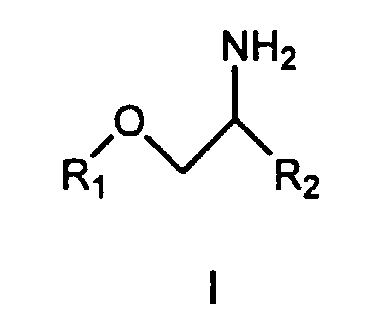
- Alkoxyamines represented by formula I,in which R1 and R2 are, independently, C1 to C20 alkyl groups, are important intermediates for compounds used in pharmaceutical and agricultural applications. Due to the presence of an asymmetric carbon atom, the above alkoxyamines exist as a mixture of enantiomers or optical isomers.
- It is known that for compounds that exist as optical isomers, one isomer is typically more active than the other, and sometimes one isomer is exclusively active, depending on its use. By using essentially the active enantiomer, lower effective amounts are needed; thus making the production of the active material more cost effective. In addition, if the compound is known to have an adverse effect on the environment, the environmental impact of the enantiomer can be reduced by using lower amounts.
- In general, optically active amines are produced in the form of racemic mixtures. Methods which have been used to obtain the active isomer include asymmetric synthesis, resolution of the enantiomers in racemic mixtures, and selective reaction. When the enantiomers are separated by techniques such as selective reaction or resolution, the inactive enantiomer is recovered along with the active enantiomer. If an outlet cannot be identified for the inactive isomer, it becomes a waste stream. A goal in the industry is to maximize production of the active isomer and minimize the environmental impact of an inactive isomeric waste stream. Therefore methods of limiting the amount of inactive isomer produced is of continuing interest. One method of limiting the amount of inactive isomer has been to convert the inactive isomer to the racemic mixture and then recycle the racemic mixture to a separation process. However, one of the problems encountered in producing racemic mixtures is the production of undesirable by-products.
- The following patents provide examples of methods which have been used to produce racemic mixtures of optically active amines.
- U.S. 3,954,870 (Fukumaru et al., 1976) discloses racemization of optically active α, β-diphenylethylanmne by heating the optically active amine at a temperature between 100 °C and the b.p. of the amine in the presence of Raney nickel under an inert gas such as nitrogen, helium or ammonia. Hydrogen is not desired because it promotes reduction of the amines and the formation of by-products. It is reported that by using a dry Raney nickel, a short reaction time is realized and the formation of undesired by-products is prevented.
- U.S. 3,970,700 (Nagase et al., 1976) discloses a method for racemizing optically active amines by contacting optically active amines of the formula below with an alkali metal deposited on a solid carrier, an alkali metal dispersed in a liquid medium or an alkali metal alloy at a temperature of from -10 to 50 °C:wherein *C is an asymmetric carbon atom, R1 is alkyl, aralkyl or aryl and R2is aryl or alkoxycarbonyl, the aryl or aralkyl moiety bearing optionally one or more alkyl or alkoxy groups on the aromatic ring, and R1 and R2 are different from each other.

- U.S. 4,096,186 (Ichikawa et al., 1978) discloses racemization of optically active aminoalcohol compounds having the following formula:wherein R1 is an alkyl, cycloalkyl, substituted or unsubstituted phenyl, or non-aromatic heterocyclic group, and R2 is a hydrogen atom or an alkyl or substituted or unsubstituted phenyl group. The compounds are contacted with ammonia and hydrogen in the presence of a hydrogenation catalyst such as nickel, cobalt, copper and noble metals; cobalt is preferred, especially cobalt alone or with a small amount of a metal or metal oxide, such as iron, manganese, zinc, and cesium, or the corresponding oxides.
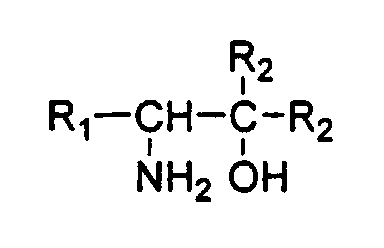
- DE 2,903,589 (Vitt, 1980) (abstracts from Derwent World Patent Index and Chemical Abstracts) discloses racemization of amines having the general formula: R1-CH(NH2)-R2 (where R1 and R2 are different alkyl or aralkyl residues, the aralkyl residue optionally substituted in the aromatic ring with one or more alkyl, fluorinated alkyl, alkoxy or OH). The amines are treated with hydrogen in the presence of a hydrogenation catalyst (preferably Raney cobalt or Raney nickel) at temperatures of 80 to 300 °C.
- U.S. 4,990,666 (Harsy, 1991) discloses racemization of optically active amino alcohols by subjecting the amino alcohols to hydrogen under moderate temperatures (100 to 175 °C) and pressures (10 to 50 atmospheres) while in contact with Raney cobalt. Ammonia is not required. The process can be batch or continuous. The amino alcohols have the following general formulas:wherein R1 is an alkyl group or cycloalkyl group; each R2 is the same group selected from hydrogen, alkyl group, or cycloalkyl; R3 is a hydrogen atom or an alkyl group; R4 is the same groups as R1; and each R5 is the same group selected from those equal to R2.

- U.S. 5,847,215 (Ditrich, 1998) discloses racemization of optically active arylalkylamines by reaction of the amine with a ketone followed by treatment of the condensation product with a base such as an alcoholate or an amine.
- The present invention is directed to a process for racemizing an enantiomer of an alkoxyamine having the formula I,in which R1 and R2 are the same or different C1 to C20 alkyl groups.
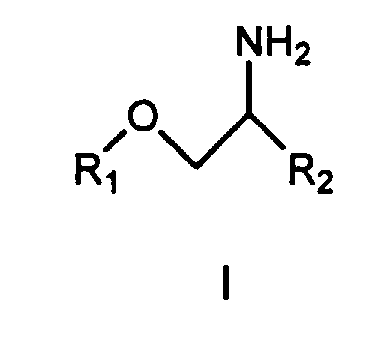
- In this process, an enantiomer of formula I is passed over a nickel or cobalt catalyst in the presence of hydrogen and ammonia to produce a racemic mixture of alkoxyamines containing substantially no by-products. The racemic mixture is useful for isolating one of the enantiomers. Upon removal of the desired enantiomer, the remaining enantiomer can be recycled to the racemization reaction.
- This process provides economical and environmental advantages by enabling reuse of the inactive alkoxyamine enantiomer to produce a racemic mixture in high selectivity which contains substantially no by-products.
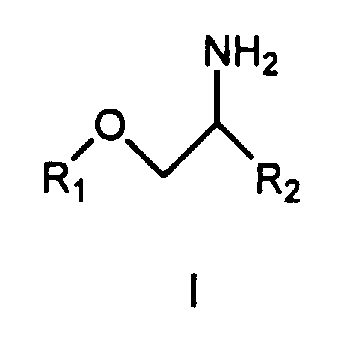
- The present invention is directed to a process of racemizing an alkoxyamine enantiomer having the general formula I:in which R1 and R2 are the same or different C1 to C20 alkyl groups. Examples of alkyl groups are methyl, ethyl, propyl, isopropyl, n-butyl, tert-butyl, pentyl, hexyl, and cyclohexyl. R1 and R2 are preferably C1 to C4 alkyl groups; and most preferably, methyl groups.
- Enantiomers belong to a general class of compounds called stereoisomers and are structurally characterized as mirror images of each other; i.e., they cannot be superimposed on one another. A racemic mixture contains approximately 50% of each enantiomer.
- The catalyst of this invention is a nickel or cobalt catalyst preferably carried on a support such as alumina or silica. The catalyst can contain 20 to 65 wt % nickel or cobalt, preferably, 30 to 55 wt %. The cobalt or nickel catalyst can be prepared by various catalyst preparation methods well known in the art. The metal catalyst is in a salt form, typically an oxide, after preparation and is reduced to the metallic form prior to use in the racemization reaction.
- Racemization can be performed in the vapor phase or in the liquid phase; however, the vapor phase is preferred.
- In the vapor phase reaction, the temperature can range between about 125 to 300 °C; preferably 150 to 250 °C. Reaction pressure can range from atmospheric pressure to about 3000 psig (101 to 20,786 kPa); preferably 50 to 1000 psig (446 to 6,996 kPa).
- In general, the following process can be used for racemization. A fixed bed reactor is typically used. The catalyst is reduced in hydrogen at elevated temperatures, e.g., 250 to 450 °C. Pressure is increased to reaction pressure and temperature reduced to reaction temperature while maintaining hydrogen flow. A flow of ammonia is then initiated. After 1 to 2 hours, the alkoxyamine is introduced. Ammonia to alkoxyamine mole ratios can be 1/1 to 10/1, preferably 3.5/1 to 7/1. Hydrogen to alkoxyamine ratios can be 1/1 to 10/1, preferably 1.5/1 to 4/1. The gas hour space velocities (GHSV) can be 500/hr to 10,000/hr, preferably 570/hr to 3000/hr.
- After racemization, the enantiomeric mixture can be separated from ammonia and any by-products by distillation.
- The most preferred compound of this invention, methoxyisopropylamine (MOIPA), may be separated into its enantiomers by any of the previously described methods. The recovered enantiomers may be obtained in an anhydrous state or in a mixture with water corresponding to the MOIPA-water azeotropic composition of about 15-20 wt % water. The racemization process of this invention can be used to convert the azeotropic mixture of water and R- or S-MOIPA to the racemic mixture. The racemic mixture can then be recovered by distillation. Alternatively, the azeotropic mixture can be dried using known methods and the dry MOIPA then racemized.
- MOIPA can be produced by amination of methoxyisopropanol. Under the process conditions of this invention, racemization of a single MOIPA enantiomer and amination of methoxyisopropanol can proceed simultaneously. Therefore, the process of this invention can be used to produce a racemic mixture of MOIPA from a feed containing the MOIPA azeotrope and methoxyisopropanol reactant.
- The invention will be further clarified by a consideration of the following examples, which are intended to be purely exemplary of the invention.
- A ½-inch stainless steel tubular reactor was charged with 10 cc (8.2 g, -12/+18 mesh) of 42% nickel/alumina catalyst (HSC-102B catalyst supplied by Houdry). The catalyst was reduced in hydrogen at 370 °C for 3 hours. After the reduction was completed, the reactor pressure was increased to 250 psig, hydrogen flow was set to the desired rate, and the reactor temperature was reduced to 190 °C. Ammonia was pumped over the catalyst at 10 cc/hour for 2 hours before starting the S-methoxyisopropylamine (MOIPA) (assay, 97.2%, 100% enantiomeric excess (e.e.)) feed. The ammonia flow was reduced to 8 cc/hour, the hydrogen flow was set at 45 sccm, and the S-methoxyisopropylamine flow was initiated at 6.6 cc/hour. Samples of reactor effluent were collected and analyzed for assay and for optical purity using capillary gas chromatographic (GC) methods. Results of the GC analyses showed that the MOIPA assay was 95.9% and the ratio of S-to R-MOIPA was 1.0.
- A tubular reactor (1/2 inch stainless steel) was charged with 10 cc (8.2 g, -12/+18 mesh) of 42% Ni/Al2O3 catalyst (HSC-102B supplied by Houdry). The catalyst was reduced in hydrogen at 370 °C for 3 hours. After completion of the reduction, the reactor pressure was increased to 250 psig, the hydrogen flow was set to the desired rate, and the reactor temperature was reduced to 185 °C. Ammonia was pumped over the catalyst at 10 cc per hour (cc/h) for 2 hours before starting the R-methoxyisopropylamine (R-MOIPA) (assay, 92.0%, 88.4% e.e.) feed. The ammonia flow was reduced to 10.2 cc/h, the hydrogen flow was set at 56 sccm, and the R-methoxyisopropylamine flow was initiated at 8.4 cc/h. Samples of reactor effluent were collected and analyzed for assay and for optical purity using capillary GC methods. The analytical results showed that the effluent contained 90.0 wt % methoxyisopropylamine which had an R to S ratio of 1.0.
- The procedure of Example 2 was followed except that the temperature was increased to 195 °C. The analytical results showed that the reactor effluent contained 89.2 wt % MOIPA with an R/S ratio of 1.0.
- The procedure of Example 2 was followed except that the starting R-MOIPA contained 19.6 wt % water and 80.1 wt % R-MOIPA (100 % e.e.). The flow rates were set as follows: ammonia, 12.5 cc/h; R-MOIPA/water, 9.6 cc/h; and hydrogen, 56 sccm. The racemization was conducted at 175 °C, 185 °C and 190 °C. The results are shown below:
Example Temperature, °C wt % MOIPA R/S 4 175 78.5 1.1 5 185 75.1 1.0 6 190 74.4 1.0 - The procedure of Example 2 was followed except that the reactor feed was as follows: 11.3 cc/h of ammonia, 8.6 cc/h of a 50:50 (molar) mixture of methoxyisopropanol (MOIPOH):R-MOIPA, and 56 sccm of hydrogen. The R-MOIPA contained 19.6% water. Reactor temperatures of 175 °C, 185 °C, and 190 °C were used. Results are shown in the table below:
Example Temperature °C MOIPOH wt % MOIPA wt % R/S 7 175 32.6 47.1 1.0 8 185 23.3 55.4 1.0 9 190 20.7 57.7 1.0 - The results of Examples 1 through 9 show that a highly selective racemic mixture of MOIPA with very little by-products can be produced using the method of this invention.
- Experiments were conducted to determine the effect of ammonia concentration on methoxyisopropylamine selectivity following the general procedure outlined in Example 2. The reaction temperature for these experiments was 190 °C and the reactor pressure was 250 psig. Other reaction conditions and product yields are shown in the table below:
Example Ammonia cc/h R-MOIPA/water cc/h Hydrogen sccm Wt % MOIPA R/S 10 12.5 9.6 56 67.7 1.0 11 6.5 17.9 108 63.2 1.0 12 0 33.1 122 45.8 1.1 - Examples 10-12 show that, in the absence of ammonia, recovery of MOIPA decreases significantly and racemization effectiveness also decreases.
Claims (16)
- A method for racemizing an enantiomer of an alkoxyamine represented by formula Iwherein R1 and R2 are the same or different C1 to C20 alkyl group, comprising
 contacting a feed comprising said enantiomer with hydrogen and ammonia in the presence of a nickel or cobalt catalyst.
 - The method of claim 1 wherein R1 and R2 are the same or different C1 to C4 alkyl group.
- The method of claim 1 wherein R1 and R2 are each methyl.
- The method of claim 3 wherein the catalyst is carried on a support.
- The method of claim 4 wherein the support is alumina.
- The method of claim 5 wherein the catalyst contains 20 to 65 wt % nickel or cobalt.
- The method of claim 5 wherein the catalyst contains 30 to 55 wt % nickel or cobalt.
- The method of claim 7 wherein the catalyst is nickel.
- The method of claim 4 wherein the reaction is carried out in the vapor phase at a temperature of 125 to 300 °C and a pressure of 0 to 3000 psig (101 to 20,786 kPa).
- The method of claim 9 wherein there is an ammonia to alkoxyamine molar ratio of 1/1 to 10/1, a hydrogen to alkoxyamine molar ratio of 1/1 to 10/1, and a gas hour space velocity of 500/hr to 10,000/hr.
- The process of claim 10 wherein the temperature is 150 to 250 °C and the pressure is 50 to1000 psig (446 to 6996 kPa).
- The process of claim 11 wherein the ammonia to alkoxyamine molar ratio ranges from about 3.5/1 to 7/1, the hydrogen to alkoxyamine molar ratio ranges from about 1.5/1 to 4/1, and the gas hour space velocity ranges about 570/hr to 3000/hr.
- A process for racemizing an enantiomer of methoxyisopropylamine comprising contacting a feed comprising the enantiomer of methoxyisopropylamine with hydrogen and ammonia in the presence of a supported nickel or cobalt catalyst.
- The process of claim 13 wherein the catalyst is nickel on an alumina support.
- The process of claim 14 wherein the feed also contains 15 to 20 wt % water.
- The process of claim 14 wherein the feed also contains methoxyisopropanol.
Applications Claiming Priority (2)
| Application Number | Priority Date | Filing Date | Title |
|---|---|---|---|
| US327656 | 1999-06-08 | ||
| US09/327,656 US6060624A (en) | 1999-06-08 | 1999-06-08 | Racemization of optically active alkoxyamines |
Publications (2)
| Publication Number | Publication Date |
|---|---|
| EP1059284A1 true EP1059284A1 (en) | 2000-12-13 |
| EP1059284B1 EP1059284B1 (en) | 2003-05-07 |
Family
ID=23277466
Family Applications (1)
| Application Number | Title | Priority Date | Filing Date |
|---|---|---|---|
| EP00111090A Expired - Lifetime EP1059284B1 (en) | 1999-06-08 | 2000-06-05 | Racemization of optically active alkoxyamines |
Country Status (3)
| Country | Link |
|---|---|
| US (1) | US6060624A (en) |
| EP (1) | EP1059284B1 (en) |
| DE (1) | DE60002523T2 (en) |
Families Citing this family (2)
| Publication number | Priority date | Publication date | Assignee | Title |
|---|---|---|---|---|
| DE10062729A1 (en) | 2000-12-15 | 2002-06-20 | Basf Ag | Process for the racemization of optically active amines |
| US20130345475A1 (en) | 2012-06-25 | 2013-12-26 | Basf Se | Process for the racemization of optically active arylalkylamines |
Citations (4)
| Publication number | Priority date | Publication date | Assignee | Title |
|---|---|---|---|---|
| US4096186A (en) * | 1974-06-29 | 1978-06-20 | Teijin Limited | Process for racemizing optically active amino compounds |
| US6049007A (en) * | 1999-02-12 | 2000-04-11 | Basf Aktiengesellschaft | Racemization of optically active amines |
| WO2000029357A1 (en) * | 1998-11-13 | 2000-05-25 | Basf Aktiengesellschaft | Method for racemization of optically active amines |
| WO2000047546A1 (en) * | 1999-02-12 | 2000-08-17 | Basf Aktiengesellschaft | Method for the racemization of optically active amines |
Family Cites Families (5)
| Publication number | Priority date | Publication date | Assignee | Title |
|---|---|---|---|---|
| US3954870A (en) * | 1970-05-11 | 1976-05-04 | Sumitomo Chemical Company, Limited | Method of racemization of optically active amines |
| CA1041114A (en) * | 1973-09-07 | 1978-10-24 | Tsuneyuki Nagase | Racemization of optically active amines |
| DE2903589A1 (en) * | 1979-01-31 | 1980-08-14 | Basf Ag | Optically active primary amine cpds. racemisation - by treatment with hydrogen in the presence of a hydrogenation catalyst, giving prods. with e.g. analeptic and appetite suppressant action |
| US4990666A (en) * | 1987-02-04 | 1991-02-05 | W. R. Grace & Co.-Conn. | Racemization of optically active amino alcohols |
| DE19606124A1 (en) * | 1996-02-20 | 1997-08-21 | Basf Ag | Process for the racemization of optically active amines |
-
1999
- 1999-06-08 US US09/327,656 patent/US6060624A/en not_active Expired - Fee Related
-
2000
- 2000-06-05 EP EP00111090A patent/EP1059284B1/en not_active Expired - Lifetime
- 2000-06-05 DE DE60002523T patent/DE60002523T2/en not_active Expired - Lifetime
Patent Citations (4)
| Publication number | Priority date | Publication date | Assignee | Title |
|---|---|---|---|---|
| US4096186A (en) * | 1974-06-29 | 1978-06-20 | Teijin Limited | Process for racemizing optically active amino compounds |
| WO2000029357A1 (en) * | 1998-11-13 | 2000-05-25 | Basf Aktiengesellschaft | Method for racemization of optically active amines |
| US6049007A (en) * | 1999-02-12 | 2000-04-11 | Basf Aktiengesellschaft | Racemization of optically active amines |
| WO2000047546A1 (en) * | 1999-02-12 | 2000-08-17 | Basf Aktiengesellschaft | Method for the racemization of optically active amines |
Also Published As
| Publication number | Publication date |
|---|---|
| EP1059284B1 (en) | 2003-05-07 |
| DE60002523T2 (en) | 2004-03-18 |
| US6060624A (en) | 2000-05-09 |
| DE60002523D1 (en) | 2003-06-12 |
Similar Documents
| Publication | Publication Date | Title |
|---|---|---|
| US10266469B2 (en) | Process for preparing terpinene-4-ol | |
| RU2237655C2 (en) | Method for preparing l-phenylephrine hydrochloride | |
| JP4326147B2 (en) | Process for producing optically active amino alcohols | |
| JPH07196594A (en) | Preparation of diurethane and preparation of diisocyanate | |
| CA2431065C (en) | Process for the preparation of phenethylamine derivatives | |
| US6232500B1 (en) | Process for preparing a ketimine | |
| US4140720A (en) | Cobalt hydrogenation catalyst activation | |
| CA2229312C (en) | Cleavage of optically active amides | |
| JPH04275258A (en) | Racemization of optically active 1-aryl-alkylamine | |
| US6060624A (en) | Racemization of optically active alkoxyamines | |
| EP1642884B1 (en) | Process for producing optically active 1-alkyl-substituted 2,2,2-trifluoroethylamine | |
| EP1020421B1 (en) | Process for producing 1,2-propanediol | |
| US6384263B1 (en) | Process for making 3-hydroxyalkanelnitriles and conversion of the 3-hydroxyalkanelnitrile to an hydroxyaminoalkane | |
| US5637751A (en) | Process for producing 1,4-dicyano-2-butene and catalyst therefor | |
| JP4472059B2 (en) | Amino alcohol production method | |
| JP2006028154A (en) | Method for producing optically active compound | |
| JP2002173472A (en) | Method for producing optically active 1-(trifluoromethyl mono-substituted phenyl) ethylamine | |
| EP0292564B1 (en) | Process for preparing alkoxyalkyl-substituted phenols | |
| US9169193B2 (en) | Method for producing O-Alkylated aminoalcohols | |
| EP1893556B1 (en) | Process for preparing tetrafluorobenzene carbaldehyde alkyl acetal | |
| JP4339074B2 (en) | Process for producing optically active 1,2-bis (3,5-dimethylphenyl) -1,2-ethanediamine | |
| JPH0625111A (en) | Production of 3-aminomethyl-3,5,5-trialkylcyclohexylamine | |
| WO1997021662A1 (en) | Racemisation of amines | |
| JP3778843B2 (en) | Optically active amine derivatives and synthetic methods | |
| JPH04264056A (en) | Preparation of n-methyl alkylamine |
Legal Events
| Date | Code | Title | Description |
|---|---|---|---|
| PUAI | Public reference made under article 153(3) epc to a published international application that has entered the european phase |
Free format text: ORIGINAL CODE: 0009012 |
|
| AK | Designated contracting states |
Kind code of ref document: A1 Designated state(s): DE FR GB IT |
|
| AX | Request for extension of the european patent |
Free format text: AL;LT;LV;MK;RO;SI |
|
| 17P | Request for examination filed |
Effective date: 20010320 |
|
| AKX | Designation fees paid |
Free format text: DE FR GB IT |
|
| 17Q | First examination report despatched |
Effective date: 20020205 |
|
| GRAG | Despatch of communication of intention to grant |
Free format text: ORIGINAL CODE: EPIDOS AGRA |
|
| GRAG | Despatch of communication of intention to grant |
Free format text: ORIGINAL CODE: EPIDOS AGRA |
|
| GRAH | Despatch of communication of intention to grant a patent |
Free format text: ORIGINAL CODE: EPIDOS IGRA |
|
| GRAH | Despatch of communication of intention to grant a patent |
Free format text: ORIGINAL CODE: EPIDOS IGRA |
|
| GRAA | (expected) grant |
Free format text: ORIGINAL CODE: 0009210 |
|
| AK | Designated contracting states |
Designated state(s): DE FR GB IT |
|
| REG | Reference to a national code |
Ref country code: GB Ref legal event code: FG4D |
|
| PGFP | Annual fee paid to national office [announced via postgrant information from national office to epo] |
Ref country code: FR Payment date: 20030523 Year of fee payment: 4 |
|
| REF | Corresponds to: |
Ref document number: 60002523 Country of ref document: DE Date of ref document: 20030612 Kind code of ref document: P |
|
| PGFP | Annual fee paid to national office [announced via postgrant information from national office to epo] |
Ref country code: DE Payment date: 20030630 Year of fee payment: 4 |
|
| PG25 | Lapsed in a contracting state [announced via postgrant information from national office to epo] |
Ref country code: DE Free format text: LAPSE BECAUSE OF THE APPLICANT RENOUNCES Effective date: 20040108 |
|
| ET | Fr: translation filed | ||
| PLBE | No opposition filed within time limit |
Free format text: ORIGINAL CODE: 0009261 |
|
| STAA | Information on the status of an ep patent application or granted ep patent |
Free format text: STATUS: NO OPPOSITION FILED WITHIN TIME LIMIT |
|
| REG | Reference to a national code |
Ref country code: GB Ref legal event code: 729S |
|
| 26N | No opposition filed |
Effective date: 20040210 |
|
| REG | Reference to a national code |
Ref country code: GB Ref legal event code: 729U |
|
| PG25 | Lapsed in a contracting state [announced via postgrant information from national office to epo] |
Ref country code: GB Free format text: LAPSE BECAUSE OF THE APPLICANT RENOUNCES Effective date: 20040922 |
|
| REG | Reference to a national code |
Ref country code: GB Ref legal event code: 729U |
|
| PG25 | Lapsed in a contracting state [announced via postgrant information from national office to epo] |
Ref country code: FR Free format text: LAPSE BECAUSE OF NON-PAYMENT OF DUE FEES Effective date: 20050228 |
|
| REG | Reference to a national code |
Ref country code: FR Ref legal event code: ST |
|
| PG25 | Lapsed in a contracting state [announced via postgrant information from national office to epo] |
Ref country code: IT Free format text: LAPSE BECAUSE OF NON-PAYMENT OF DUE FEES Effective date: 20050605 |