EP1058552B1 - Steroid derived antibiotics - Google Patents
Steroid derived antibiotics Download PDFInfo
- Publication number
- EP1058552B1 EP1058552B1 EP98909028A EP98909028A EP1058552B1 EP 1058552 B1 EP1058552 B1 EP 1058552B1 EP 98909028 A EP98909028 A EP 98909028A EP 98909028 A EP98909028 A EP 98909028A EP 1058552 B1 EP1058552 B1 EP 1058552B1
- Authority
- EP
- European Patent Office
- Prior art keywords
- compound
- mmol
- formula
- nmr
- mhz
- Prior art date
- Legal status (The legal status is an assumption and is not a legal conclusion. Google has not performed a legal analysis and makes no representation as to the accuracy of the status listed.)
- Expired - Lifetime
Links
- 239000003242 anti bacterial agent Substances 0.000 title claims abstract description 39
- 229940088710 antibiotic agent Drugs 0.000 title claims abstract description 30
- 150000003431 steroids Chemical class 0.000 title claims abstract description 30
- 241000894006 Bacteria Species 0.000 claims abstract description 54
- 150000001875 compounds Chemical class 0.000 claims description 157
- 239000000203 mixture Substances 0.000 claims description 95
- 238000000034 method Methods 0.000 claims description 32
- -1 amino, protected amino, carboxy, protected carboxy, cyano, methyl sulfonylamino Chemical group 0.000 claims description 24
- 230000000845 anti-microbial effect Effects 0.000 claims description 23
- 239000000126 substance Substances 0.000 claims description 23
- 239000004599 antimicrobial Substances 0.000 claims description 22
- 125000002887 hydroxy group Chemical group [H]O* 0.000 claims description 20
- 230000003115 biocidal effect Effects 0.000 claims description 19
- 239000012528 membrane Substances 0.000 claims description 19
- 125000000008 (C1-C10) alkyl group Chemical group 0.000 claims description 14
- 230000035699 permeability Effects 0.000 claims description 14
- 125000006239 protecting group Chemical group 0.000 claims description 13
- 125000001424 substituent group Chemical group 0.000 claims description 11
- 208000035143 Bacterial infection Diseases 0.000 claims description 9
- 208000022362 bacterial infectious disease Diseases 0.000 claims description 9
- 208000015181 infectious disease Diseases 0.000 claims description 9
- 230000000813 microbial effect Effects 0.000 claims description 8
- 239000008194 pharmaceutical composition Substances 0.000 claims description 8
- 125000000217 alkyl group Chemical group 0.000 claims description 7
- 125000002431 aminoalkoxy group Chemical group 0.000 claims description 7
- 230000012010 growth Effects 0.000 claims description 7
- 125000001188 haloalkyl group Chemical group 0.000 claims description 7
- 229910052739 hydrogen Inorganic materials 0.000 claims description 7
- GZQKNULLWNGMCW-PWQABINMSA-N lipid A (E. coli) Chemical compound O1[C@H](CO)[C@@H](OP(O)(O)=O)[C@H](OC(=O)C[C@@H](CCCCCCCCCCC)OC(=O)CCCCCCCCCCCCC)[C@@H](NC(=O)C[C@@H](CCCCCCCCCCC)OC(=O)CCCCCCCCCCC)[C@@H]1OC[C@@H]1[C@@H](O)[C@H](OC(=O)C[C@H](O)CCCCCCCCCCC)[C@@H](NC(=O)C[C@H](O)CCCCCCCCCCC)[C@@H](OP(O)(O)=O)O1 GZQKNULLWNGMCW-PWQABINMSA-N 0.000 claims description 7
- 125000002924 primary amino group Chemical group [H]N([H])* 0.000 claims description 7
- 125000004423 acyloxy group Chemical group 0.000 claims description 6
- 125000003545 alkoxy group Chemical group 0.000 claims description 6
- 125000005096 aminoalkylaminocarbonyl group Chemical group 0.000 claims description 6
- 125000005123 aminoalkylcarboxy group Chemical group 0.000 claims description 6
- 125000003118 aryl group Chemical group 0.000 claims description 6
- 125000005416 guanidinoalkyloxy group Chemical group 0.000 claims description 6
- 125000004435 hydrogen atom Chemical class [H]* 0.000 claims description 6
- 125000000449 nitro group Chemical group [O-][N+](*)=O 0.000 claims description 6
- 125000004432 carbon atom Chemical group C* 0.000 claims description 5
- 239000001257 hydrogen Substances 0.000 claims description 5
- 125000005647 linker group Chemical group 0.000 claims description 5
- 229910052698 phosphorus Inorganic materials 0.000 claims description 5
- 150000003839 salts Chemical class 0.000 claims description 5
- 229920006395 saturated elastomer Polymers 0.000 claims description 5
- 125000000882 C2-C6 alkenyl group Chemical group 0.000 claims description 4
- 125000003601 C2-C6 alkynyl group Chemical group 0.000 claims description 4
- 125000004103 aminoalkyl group Chemical group 0.000 claims description 4
- 239000000645 desinfectant Substances 0.000 claims description 4
- 239000003814 drug Substances 0.000 claims description 4
- 125000002768 hydroxyalkyl group Chemical group 0.000 claims description 4
- 125000004043 oxo group Chemical group O=* 0.000 claims description 4
- 150000001413 amino acids Chemical class 0.000 claims description 3
- 229910052799 carbon Inorganic materials 0.000 claims description 3
- 239000003937 drug carrier Substances 0.000 claims description 3
- 208000027096 gram-negative bacterial infections Diseases 0.000 claims description 3
- 231100000331 toxic Toxicity 0.000 claims description 3
- 230000002588 toxic effect Effects 0.000 claims description 3
- 125000003178 carboxy group Chemical group [H]OC(*)=O 0.000 claims description 2
- 230000002708 enhancing effect Effects 0.000 claims description 2
- 230000003068 static effect Effects 0.000 claims description 2
- 238000004519 manufacturing process Methods 0.000 claims 2
- 230000001150 spermicidal effect Effects 0.000 claims 1
- YJQPYGGHQPGBLI-UHFFFAOYSA-N Novobiocin Natural products O1C(C)(C)C(OC)C(OC(N)=O)C(O)C1OC1=CC=C(C(O)=C(NC(=O)C=2C=C(CC=C(C)C)C(O)=CC=2)C(=O)O2)C2=C1C YJQPYGGHQPGBLI-UHFFFAOYSA-N 0.000 abstract description 6
- 229960002950 novobiocin Drugs 0.000 abstract description 6
- YJQPYGGHQPGBLI-KGSXXDOSSA-N novobiocin Chemical compound O1C(C)(C)[C@H](OC)[C@@H](OC(N)=O)[C@@H](O)[C@@H]1OC1=CC=C(C(O)=C(NC(=O)C=2C=C(CC=C(C)C)C(O)=CC=2)C(=O)O2)C2=C1C YJQPYGGHQPGBLI-KGSXXDOSSA-N 0.000 abstract description 6
- HEDRZPFGACZZDS-MICDWDOJSA-N Trichloro(2H)methane Chemical compound [2H]C(Cl)(Cl)Cl HEDRZPFGACZZDS-MICDWDOJSA-N 0.000 description 202
- OKKJLVBELUTLKV-UHFFFAOYSA-N Methanol Chemical compound OC OKKJLVBELUTLKV-UHFFFAOYSA-N 0.000 description 105
- YMWUJEATGCHHMB-UHFFFAOYSA-N Dichloromethane Chemical compound ClCCl YMWUJEATGCHHMB-UHFFFAOYSA-N 0.000 description 102
- XEKOWRVHYACXOJ-UHFFFAOYSA-N Ethyl acetate Chemical compound CCOC(C)=O XEKOWRVHYACXOJ-UHFFFAOYSA-N 0.000 description 98
- VYPSYNLAJGMNEJ-UHFFFAOYSA-N Silicium dioxide Chemical compound O=[Si]=O VYPSYNLAJGMNEJ-UHFFFAOYSA-N 0.000 description 70
- 238000005160 1H NMR spectroscopy Methods 0.000 description 54
- 238000001644 13C nuclear magnetic resonance spectroscopy Methods 0.000 description 53
- 239000007832 Na2SO4 Substances 0.000 description 52
- PMZURENOXWZQFD-UHFFFAOYSA-L Sodium Sulfate Chemical compound [Na+].[Na+].[O-]S([O-])(=O)=O PMZURENOXWZQFD-UHFFFAOYSA-L 0.000 description 52
- 229910052938 sodium sulfate Inorganic materials 0.000 description 52
- 239000000243 solution Substances 0.000 description 51
- 239000012267 brine Substances 0.000 description 49
- 235000019439 ethyl acetate Nutrition 0.000 description 49
- HPALAKNZSZLMCH-UHFFFAOYSA-M sodium;chloride;hydrate Chemical compound O.[Na+].[Cl-] HPALAKNZSZLMCH-UHFFFAOYSA-M 0.000 description 49
- 239000011159 matrix material Substances 0.000 description 48
- PJUIMOJAAPLTRJ-UHFFFAOYSA-N monothioglycerol Chemical compound OCC(O)CS PJUIMOJAAPLTRJ-UHFFFAOYSA-N 0.000 description 48
- VLKZOEOYAKHREP-UHFFFAOYSA-N n-Hexane Chemical class CCCCCC VLKZOEOYAKHREP-UHFFFAOYSA-N 0.000 description 48
- 229940035024 thioglycerol Drugs 0.000 description 48
- 239000000047 product Substances 0.000 description 45
- XLYOFNOQVPJJNP-UHFFFAOYSA-N water Substances O XLYOFNOQVPJJNP-UHFFFAOYSA-N 0.000 description 43
- 229910001868 water Inorganic materials 0.000 description 40
- OKKJLVBELUTLKV-MZCSYVLQSA-N Deuterated methanol Chemical compound [2H]OC([2H])([2H])[2H] OKKJLVBELUTLKV-MZCSYVLQSA-N 0.000 description 38
- HEMHJVSKTPXQMS-UHFFFAOYSA-M Sodium hydroxide Chemical compound [OH-].[Na+] HEMHJVSKTPXQMS-UHFFFAOYSA-M 0.000 description 36
- 239000000284 extract Substances 0.000 description 36
- RTZKZFJDLAIYFH-UHFFFAOYSA-N Diethyl ether Chemical compound CCOCC RTZKZFJDLAIYFH-UHFFFAOYSA-N 0.000 description 33
- 239000000377 silicon dioxide Substances 0.000 description 32
- 239000000725 suspension Substances 0.000 description 32
- 229910052681 coesite Inorganic materials 0.000 description 31
- 229910052906 cristobalite Inorganic materials 0.000 description 31
- 229910052682 stishovite Inorganic materials 0.000 description 31
- 229910052905 tridymite Inorganic materials 0.000 description 31
- 239000002904 solvent Substances 0.000 description 30
- 239000011734 sodium Substances 0.000 description 29
- 238000004587 chromatography analysis Methods 0.000 description 25
- 239000003921 oil Substances 0.000 description 21
- 235000019198 oils Nutrition 0.000 description 21
- VEXZGXHMUGYJMC-UHFFFAOYSA-N Hydrochloric acid Chemical compound Cl VEXZGXHMUGYJMC-UHFFFAOYSA-N 0.000 description 18
- 238000009472 formulation Methods 0.000 description 18
- ULGZDMOVFRHVEP-RWJQBGPGSA-N Erythromycin Chemical compound O([C@@H]1[C@@H](C)C(=O)O[C@@H]([C@@]([C@H](O)[C@@H](C)C(=O)[C@H](C)C[C@@](C)(O)[C@H](O[C@H]2[C@@H]([C@H](C[C@@H](C)O2)N(C)C)O)[C@H]1C)(C)O)CC)[C@H]1C[C@@](C)(OC)[C@@H](O)[C@H](C)O1 ULGZDMOVFRHVEP-RWJQBGPGSA-N 0.000 description 16
- IAZDPXIOMUYVGZ-UHFFFAOYSA-N Dimethylsulphoxide Chemical compound CS(C)=O IAZDPXIOMUYVGZ-UHFFFAOYSA-N 0.000 description 15
- 239000000843 powder Substances 0.000 description 15
- ZMANZCXQSJIPKH-UHFFFAOYSA-N Triethylamine Chemical compound CCN(CC)CC ZMANZCXQSJIPKH-UHFFFAOYSA-N 0.000 description 13
- 210000004027 cell Anatomy 0.000 description 13
- 239000011521 glass Substances 0.000 description 13
- 238000005259 measurement Methods 0.000 description 12
- 206010040047 Sepsis Diseases 0.000 description 11
- 229910010084 LiAlH4 Inorganic materials 0.000 description 10
- 239000004480 active ingredient Substances 0.000 description 10
- 230000000844 anti-bacterial effect Effects 0.000 description 10
- 230000001580 bacterial effect Effects 0.000 description 10
- 239000012280 lithium aluminium hydride Substances 0.000 description 10
- 239000012359 Methanesulfonyl chloride Substances 0.000 description 9
- UIIMBOGNXHQVGW-UHFFFAOYSA-M Sodium bicarbonate Chemical compound [Na+].OC([O-])=O UIIMBOGNXHQVGW-UHFFFAOYSA-M 0.000 description 9
- BHQCQFFYRZLCQQ-OELDTZBJSA-N cholic acid Chemical compound C([C@H]1C[C@H]2O)[C@H](O)CC[C@]1(C)[C@@H]1[C@@H]2[C@@H]2CC[C@H]([C@@H](CCC(O)=O)C)[C@@]2(C)[C@@H](O)C1 BHQCQFFYRZLCQQ-OELDTZBJSA-N 0.000 description 9
- 238000004440 column chromatography Methods 0.000 description 9
- 230000000694 effects Effects 0.000 description 9
- QARBMVPHQWIHKH-UHFFFAOYSA-N methanesulfonyl chloride Chemical compound CS(Cl)(=O)=O QARBMVPHQWIHKH-UHFFFAOYSA-N 0.000 description 9
- RIWRFSMVIUAEBX-UHFFFAOYSA-N n-methyl-1-phenylmethanamine Chemical compound CNCC1=CC=CC=C1 RIWRFSMVIUAEBX-UHFFFAOYSA-N 0.000 description 9
- 239000007787 solid Substances 0.000 description 9
- 208000024891 symptom Diseases 0.000 description 9
- JOXIMZWYDAKGHI-UHFFFAOYSA-N toluene-4-sulfonic acid Chemical compound CC1=CC=C(S(O)(=O)=O)C=C1 JOXIMZWYDAKGHI-UHFFFAOYSA-N 0.000 description 9
- 241000588724 Escherichia coli Species 0.000 description 8
- PXIPVTKHYLBLMZ-UHFFFAOYSA-N Sodium azide Chemical compound [Na+].[N-]=[N+]=[N-] PXIPVTKHYLBLMZ-UHFFFAOYSA-N 0.000 description 8
- 229960003276 erythromycin Drugs 0.000 description 8
- 238000000605 extraction Methods 0.000 description 8
- 230000002401 inhibitory effect Effects 0.000 description 8
- 239000007788 liquid Substances 0.000 description 8
- 238000012360 testing method Methods 0.000 description 8
- BHELZAPQIKSEDF-UHFFFAOYSA-N allyl bromide Chemical compound BrCC=C BHELZAPQIKSEDF-UHFFFAOYSA-N 0.000 description 7
- 239000004615 ingredient Substances 0.000 description 7
- 239000002244 precipitate Substances 0.000 description 7
- FAPWRFPIFSIZLT-UHFFFAOYSA-M Sodium chloride Chemical compound [Na+].[Cl-] FAPWRFPIFSIZLT-UHFFFAOYSA-M 0.000 description 6
- 239000007864 aqueous solution Substances 0.000 description 6
- 238000006243 chemical reaction Methods 0.000 description 6
- 239000002812 cholic acid derivative Substances 0.000 description 6
- 239000012230 colorless oil Substances 0.000 description 6
- 239000002158 endotoxin Substances 0.000 description 6
- 238000011282 treatment Methods 0.000 description 6
- 239000001974 tryptic soy broth Substances 0.000 description 6
- 108010050327 trypticase-soy broth Proteins 0.000 description 6
- 125000004429 atom Chemical group 0.000 description 5
- 230000027455 binding Effects 0.000 description 5
- 239000000460 chlorine Substances 0.000 description 5
- 239000010410 layer Substances 0.000 description 5
- 229920006008 lipopolysaccharide Polymers 0.000 description 5
- 239000002480 mineral oil Substances 0.000 description 5
- 235000010446 mineral oil Nutrition 0.000 description 5
- PSHKMPUSSFXUIA-UHFFFAOYSA-N n,n-dimethylpyridin-2-amine Chemical compound CN(C)C1=CC=CC=N1 PSHKMPUSSFXUIA-UHFFFAOYSA-N 0.000 description 5
- 238000010992 reflux Methods 0.000 description 5
- 239000000741 silica gel Substances 0.000 description 5
- 229910002027 silica gel Inorganic materials 0.000 description 5
- 238000003786 synthesis reaction Methods 0.000 description 5
- 238000002560 therapeutic procedure Methods 0.000 description 5
- RYHBNJHYFVUHQT-UHFFFAOYSA-N 1,4-Dioxane Chemical compound C1COCCO1 RYHBNJHYFVUHQT-UHFFFAOYSA-N 0.000 description 4
- HEDRZPFGACZZDS-UHFFFAOYSA-N Chloroform Chemical compound ClC(Cl)Cl HEDRZPFGACZZDS-UHFFFAOYSA-N 0.000 description 4
- QOSSAOTZNIDXMA-UHFFFAOYSA-N Dicylcohexylcarbodiimide Chemical compound C1CCCCC1N=C=NC1CCCCC1 QOSSAOTZNIDXMA-UHFFFAOYSA-N 0.000 description 4
- WQZGKKKJIJFFOK-GASJEMHNSA-N Glucose Natural products OC[C@H]1OC(O)[C@H](O)[C@@H](O)[C@@H]1O WQZGKKKJIJFFOK-GASJEMHNSA-N 0.000 description 4
- CSNNHWWHGAXBCP-UHFFFAOYSA-L Magnesium sulfate Chemical compound [Mg+2].[O-][S+2]([O-])([O-])[O-] CSNNHWWHGAXBCP-UHFFFAOYSA-L 0.000 description 4
- CBENFWSGALASAD-UHFFFAOYSA-N Ozone Chemical compound [O-][O+]=O CBENFWSGALASAD-UHFFFAOYSA-N 0.000 description 4
- 150000001412 amines Chemical class 0.000 description 4
- 230000003385 bacteriostatic effect Effects 0.000 description 4
- 230000015572 biosynthetic process Effects 0.000 description 4
- 230000001413 cellular effect Effects 0.000 description 4
- 239000003795 chemical substances by application Substances 0.000 description 4
- MYSWGUAQZAJSOK-UHFFFAOYSA-N ciprofloxacin Chemical compound C12=CC(N3CCNCC3)=C(F)C=C2C(=O)C(C(=O)O)=CN1C1CC1 MYSWGUAQZAJSOK-UHFFFAOYSA-N 0.000 description 4
- 239000008121 dextrose Substances 0.000 description 4
- ZRALSGWEFCBTJO-UHFFFAOYSA-N guanidine group Chemical group NC(=N)N ZRALSGWEFCBTJO-UHFFFAOYSA-N 0.000 description 4
- 150000003840 hydrochlorides Chemical class 0.000 description 4
- 239000006072 paste Substances 0.000 description 4
- 239000003755 preservative agent Substances 0.000 description 4
- 230000001225 therapeutic effect Effects 0.000 description 4
- MAKMQGKJURAJEN-RUZDIDTESA-N (2r)-1-benzyl-n-(3-spiro[1h-2-benzofuran-3,4'-piperidine]-1'-ylpropyl)pyrrolidine-2-carboxamide Chemical compound C([C@@H]1C(NCCCN2CCC3(CC2)C2=CC=CC=C2CO3)=O)CCN1CC1=CC=CC=C1 MAKMQGKJURAJEN-RUZDIDTESA-N 0.000 description 3
- BHQCQFFYRZLCQQ-UHFFFAOYSA-N (3alpha,5alpha,7alpha,12alpha)-3,7,12-trihydroxy-cholan-24-oic acid Natural products OC1CC2CC(O)CCC2(C)C2C1C1CCC(C(CCC(O)=O)C)C1(C)C(O)C2 BHQCQFFYRZLCQQ-UHFFFAOYSA-N 0.000 description 3
- KQZLRWGGWXJPOS-NLFPWZOASA-N 1-[(1R)-1-(2,4-dichlorophenyl)ethyl]-6-[(4S,5R)-4-[(2S)-2-(hydroxymethyl)pyrrolidin-1-yl]-5-methylcyclohexen-1-yl]pyrazolo[3,4-b]pyrazine-3-carbonitrile Chemical compound ClC1=C(C=CC(=C1)Cl)[C@@H](C)N1N=C(C=2C1=NC(=CN=2)C1=CC[C@@H]([C@@H](C1)C)N1[C@@H](CCC1)CO)C#N KQZLRWGGWXJPOS-NLFPWZOASA-N 0.000 description 3
- CSCPPACGZOOCGX-UHFFFAOYSA-N Acetone Chemical compound CC(C)=O CSCPPACGZOOCGX-UHFFFAOYSA-N 0.000 description 3
- UHOVQNZJYSORNB-UHFFFAOYSA-N Benzene Chemical compound C1=CC=CC=C1 UHOVQNZJYSORNB-UHFFFAOYSA-N 0.000 description 3
- 229930186147 Cephalosporin Natural products 0.000 description 3
- 239000004380 Cholic acid Substances 0.000 description 3
- 208000037487 Endotoxemia Diseases 0.000 description 3
- LYCAIKOWRPUZTN-UHFFFAOYSA-N Ethylene glycol Chemical compound OCCO LYCAIKOWRPUZTN-UHFFFAOYSA-N 0.000 description 3
- 241000233866 Fungi Species 0.000 description 3
- 229930182555 Penicillin Natural products 0.000 description 3
- JGSARLDLIJGVTE-MBNYWOFBSA-N Penicillin G Chemical compound N([C@H]1[C@H]2SC([C@@H](N2C1=O)C(O)=O)(C)C)C(=O)CC1=CC=CC=C1 JGSARLDLIJGVTE-MBNYWOFBSA-N 0.000 description 3
- DNIAPMSPPWPWGF-UHFFFAOYSA-N Propylene glycol Chemical compound CC(O)CO DNIAPMSPPWPWGF-UHFFFAOYSA-N 0.000 description 3
- 239000004098 Tetracycline Substances 0.000 description 3
- 241000700605 Viruses Species 0.000 description 3
- 235000001014 amino acid Nutrition 0.000 description 3
- 229940024606 amino acid Drugs 0.000 description 3
- 229940126575 aminoglycoside Drugs 0.000 description 3
- 230000002421 anti-septic effect Effects 0.000 description 3
- QVGXLLKOCUKJST-UHFFFAOYSA-N atomic oxygen Chemical compound [O] QVGXLLKOCUKJST-UHFFFAOYSA-N 0.000 description 3
- 230000008901 benefit Effects 0.000 description 3
- 229910052794 bromium Inorganic materials 0.000 description 3
- 239000002775 capsule Substances 0.000 description 3
- 239000000969 carrier Substances 0.000 description 3
- 229940124587 cephalosporin Drugs 0.000 description 3
- 150000001780 cephalosporins Chemical class 0.000 description 3
- 229910052801 chlorine Inorganic materials 0.000 description 3
- 235000019416 cholic acid Nutrition 0.000 description 3
- 229960002471 cholic acid Drugs 0.000 description 3
- 229940125904 compound 1 Drugs 0.000 description 3
- 229940125782 compound 2 Drugs 0.000 description 3
- 229940125877 compound 31 Drugs 0.000 description 3
- 229940125898 compound 5 Drugs 0.000 description 3
- KXGVEGMKQFWNSR-UHFFFAOYSA-N deoxycholic acid Natural products C1CC2CC(O)CCC2(C)C2C1C1CCC(C(CCC(O)=O)C)C1(C)C(O)C2 KXGVEGMKQFWNSR-UHFFFAOYSA-N 0.000 description 3
- 239000003480 eluent Substances 0.000 description 3
- 239000000839 emulsion Substances 0.000 description 3
- 238000004992 fast atom bombardment mass spectroscopy Methods 0.000 description 3
- 238000001914 filtration Methods 0.000 description 3
- 229910052731 fluorine Inorganic materials 0.000 description 3
- 239000008187 granular material Substances 0.000 description 3
- 230000001965 increasing effect Effects 0.000 description 3
- 238000011534 incubation Methods 0.000 description 3
- 239000007924 injection Substances 0.000 description 3
- 238000002347 injection Methods 0.000 description 3
- 230000003993 interaction Effects 0.000 description 3
- 239000000543 intermediate Substances 0.000 description 3
- 229910052740 iodine Inorganic materials 0.000 description 3
- 150000002632 lipids Chemical class 0.000 description 3
- 229920002521 macromolecule Polymers 0.000 description 3
- 229910052760 oxygen Inorganic materials 0.000 description 3
- 239000001301 oxygen Substances 0.000 description 3
- 238000002360 preparation method Methods 0.000 description 3
- 229910000030 sodium bicarbonate Inorganic materials 0.000 description 3
- 239000011780 sodium chloride Substances 0.000 description 3
- 230000002195 synergetic effect Effects 0.000 description 3
- 239000003826 tablet Substances 0.000 description 3
- 235000019364 tetracycline Nutrition 0.000 description 3
- 150000003522 tetracyclines Chemical class 0.000 description 3
- 230000000699 topical effect Effects 0.000 description 3
- SZUVGFMDDVSKSI-WIFOCOSTSA-N (1s,2s,3s,5r)-1-(carboxymethyl)-3,5-bis[(4-phenoxyphenyl)methyl-propylcarbamoyl]cyclopentane-1,2-dicarboxylic acid Chemical compound O=C([C@@H]1[C@@H]([C@](CC(O)=O)([C@H](C(=O)N(CCC)CC=2C=CC(OC=3C=CC=CC=3)=CC=2)C1)C(O)=O)C(O)=O)N(CCC)CC(C=C1)=CC=C1OC1=CC=CC=C1 SZUVGFMDDVSKSI-WIFOCOSTSA-N 0.000 description 2
- YJLIKUSWRSEPSM-WGQQHEPDSA-N (2r,3r,4s,5r)-2-[6-amino-8-[(4-phenylphenyl)methylamino]purin-9-yl]-5-(hydroxymethyl)oxolane-3,4-diol Chemical compound C=1C=C(C=2C=CC=CC=2)C=CC=1CNC1=NC=2C(N)=NC=NC=2N1[C@@H]1O[C@H](CO)[C@@H](O)[C@H]1O YJLIKUSWRSEPSM-WGQQHEPDSA-N 0.000 description 2
- YQOLEILXOBUDMU-KRWDZBQOSA-N (4R)-5-[(6-bromo-3-methyl-2-pyrrolidin-1-ylquinoline-4-carbonyl)amino]-4-(2-chlorophenyl)pentanoic acid Chemical compound CC1=C(C2=C(C=CC(=C2)Br)N=C1N3CCCC3)C(=O)NC[C@H](CCC(=O)O)C4=CC=CC=C4Cl YQOLEILXOBUDMU-KRWDZBQOSA-N 0.000 description 2
- WZZBNLYBHUDSHF-DHLKQENFSA-N 1-[(3s,4s)-4-[8-(2-chloro-4-pyrimidin-2-yloxyphenyl)-7-fluoro-2-methylimidazo[4,5-c]quinolin-1-yl]-3-fluoropiperidin-1-yl]-2-hydroxyethanone Chemical compound CC1=NC2=CN=C3C=C(F)C(C=4C(=CC(OC=5N=CC=CN=5)=CC=4)Cl)=CC3=C2N1[C@H]1CCN(C(=O)CO)C[C@@H]1F WZZBNLYBHUDSHF-DHLKQENFSA-N 0.000 description 2
- AMKGKYQBASDDJB-UHFFFAOYSA-N 9$l^{2}-borabicyclo[3.3.1]nonane Chemical compound C1CCC2CCCC1[B]2 AMKGKYQBASDDJB-UHFFFAOYSA-N 0.000 description 2
- FEJUGLKDZJDVFY-UHFFFAOYSA-N 9-borabicyclo[3.3.1]nonane Substances C1CCC2CCCC1B2 FEJUGLKDZJDVFY-UHFFFAOYSA-N 0.000 description 2
- 210000002925 A-like Anatomy 0.000 description 2
- 229920001817 Agar Polymers 0.000 description 2
- 0 BC(C(*)C(*)(*12)C(*)(C(*)*C3*)C3(*)C(*)C1*=C)C(*)(C(*)C(C(*)*1)*=I)C21[Rn] Chemical compound BC(C(*)C(*)(*12)C(*)(C(*)*C3*)C3(*)C(*)C1*=C)C(*)(C(*)C(C(*)*1)*=I)C21[Rn] 0.000 description 2
- BQXUPNKLZNSUMC-YUQWMIPFSA-N CCN(CCCCCOCC(=O)N[C@H](C(=O)N1C[C@H](O)C[C@H]1C(=O)N[C@@H](C)c1ccc(cc1)-c1scnc1C)C(C)(C)C)CCOc1ccc(cc1)C(=O)c1c(sc2cc(O)ccc12)-c1ccc(O)cc1 Chemical compound CCN(CCCCCOCC(=O)N[C@H](C(=O)N1C[C@H](O)C[C@H]1C(=O)N[C@@H](C)c1ccc(cc1)-c1scnc1C)C(C)(C)C)CCOc1ccc(cc1)C(=O)c1c(sc2cc(O)ccc12)-c1ccc(O)cc1 BQXUPNKLZNSUMC-YUQWMIPFSA-N 0.000 description 2
- OKTJSMMVPCPJKN-UHFFFAOYSA-N Carbon Chemical group [C] OKTJSMMVPCPJKN-UHFFFAOYSA-N 0.000 description 2
- 229940126639 Compound 33 Drugs 0.000 description 2
- QMMFVYPAHWMCMS-UHFFFAOYSA-N Dimethyl sulfide Chemical compound CSC QMMFVYPAHWMCMS-UHFFFAOYSA-N 0.000 description 2
- 229930182566 Gentamicin Natural products 0.000 description 2
- CEAZRRDELHUEMR-URQXQFDESA-N Gentamicin Chemical compound O1[C@H](C(C)NC)CC[C@@H](N)[C@H]1O[C@H]1[C@H](O)[C@@H](O[C@@H]2[C@@H]([C@@H](NC)[C@@](C)(O)CO2)O)[C@H](N)C[C@@H]1N CEAZRRDELHUEMR-URQXQFDESA-N 0.000 description 2
- PEDCQBHIVMGVHV-UHFFFAOYSA-N Glycerine Chemical compound OCC(O)CO PEDCQBHIVMGVHV-UHFFFAOYSA-N 0.000 description 2
- DHMQDGOQFOQNFH-UHFFFAOYSA-N Glycine Chemical compound NCC(O)=O DHMQDGOQFOQNFH-UHFFFAOYSA-N 0.000 description 2
- 206010019663 Hepatic failure Diseases 0.000 description 2
- 241000282412 Homo Species 0.000 description 2
- MHAJPDPJQMAIIY-UHFFFAOYSA-N Hydrogen peroxide Chemical compound OO MHAJPDPJQMAIIY-UHFFFAOYSA-N 0.000 description 2
- 235000010643 Leucaena leucocephala Nutrition 0.000 description 2
- 240000007472 Leucaena leucocephala Species 0.000 description 2
- 108010040201 Polymyxins Proteins 0.000 description 2
- 206010040070 Septic Shock Diseases 0.000 description 2
- PNUZDKCDAWUEGK-CYZMBNFOSA-N Sitafloxacin Chemical compound C([C@H]1N)N(C=2C(=C3C(C(C(C(O)=O)=CN3[C@H]3[C@H](C3)F)=O)=CC=2F)Cl)CC11CC1 PNUZDKCDAWUEGK-CYZMBNFOSA-N 0.000 description 2
- CZMRCDWAGMRECN-UGDNZRGBSA-N Sucrose Chemical compound O[C@H]1[C@H](O)[C@@H](CO)O[C@@]1(CO)O[C@@H]1[C@H](O)[C@@H](O)[C@H](O)[C@@H](CO)O1 CZMRCDWAGMRECN-UGDNZRGBSA-N 0.000 description 2
- 229930006000 Sucrose Natural products 0.000 description 2
- WKDDRNSBRWANNC-UHFFFAOYSA-N Thienamycin Natural products C1C(SCCN)=C(C(O)=O)N2C(=O)C(C(O)C)C21 WKDDRNSBRWANNC-UHFFFAOYSA-N 0.000 description 2
- 239000000654 additive Substances 0.000 description 2
- 239000008272 agar Substances 0.000 description 2
- VSCWAEJMTAWNJL-UHFFFAOYSA-K aluminium trichloride Chemical compound Cl[Al](Cl)Cl VSCWAEJMTAWNJL-UHFFFAOYSA-K 0.000 description 2
- 125000003277 amino group Chemical group 0.000 description 2
- AOPRFYAPABFRPU-UHFFFAOYSA-N amino(imino)methanesulfonic acid Chemical compound NC(=N)S(O)(=O)=O AOPRFYAPABFRPU-UHFFFAOYSA-N 0.000 description 2
- 239000003429 antifungal agent Substances 0.000 description 2
- 229940121375 antifungal agent Drugs 0.000 description 2
- 239000003963 antioxidant agent Substances 0.000 description 2
- 235000006708 antioxidants Nutrition 0.000 description 2
- 239000003443 antiviral agent Substances 0.000 description 2
- 238000003556 assay Methods 0.000 description 2
- 230000004888 barrier function Effects 0.000 description 2
- 239000003637 basic solution Substances 0.000 description 2
- KGNDCEVUMONOKF-UGPLYTSKSA-N benzyl n-[(2r)-1-[(2s,4r)-2-[[(2s)-6-amino-1-(1,3-benzoxazol-2-yl)-1,1-dihydroxyhexan-2-yl]carbamoyl]-4-[(4-methylphenyl)methoxy]pyrrolidin-1-yl]-1-oxo-4-phenylbutan-2-yl]carbamate Chemical compound C1=CC(C)=CC=C1CO[C@H]1CN(C(=O)[C@@H](CCC=2C=CC=CC=2)NC(=O)OCC=2C=CC=CC=2)[C@H](C(=O)N[C@@H](CCCCN)C(O)(O)C=2OC3=CC=CC=C3N=2)C1 KGNDCEVUMONOKF-UGPLYTSKSA-N 0.000 description 2
- WQZGKKKJIJFFOK-VFUOTHLCSA-N beta-D-glucose Chemical compound OC[C@H]1O[C@@H](O)[C@H](O)[C@@H](O)[C@@H]1O WQZGKKKJIJFFOK-VFUOTHLCSA-N 0.000 description 2
- 239000003613 bile acid Substances 0.000 description 2
- 229920002988 biodegradable polymer Polymers 0.000 description 2
- 239000004621 biodegradable polymer Substances 0.000 description 2
- 239000008280 blood Substances 0.000 description 2
- 210000004369 blood Anatomy 0.000 description 2
- 230000003197 catalytic effect Effects 0.000 description 2
- 229960000484 ceftazidime Drugs 0.000 description 2
- ORFOPKXBNMVMKC-DWVKKRMSSA-N ceftazidime Chemical compound S([C@@H]1[C@@H](C(N1C=1C([O-])=O)=O)NC(=O)\C(=N/OC(C)(C)C(O)=O)C=2N=C(N)SC=2)CC=1C[N+]1=CC=CC=C1 ORFOPKXBNMVMKC-DWVKKRMSSA-N 0.000 description 2
- 239000003153 chemical reaction reagent Substances 0.000 description 2
- 229960003405 ciprofloxacin Drugs 0.000 description 2
- 229960002626 clarithromycin Drugs 0.000 description 2
- AGOYDEPGAOXOCK-KCBOHYOISA-N clarithromycin Chemical compound O([C@@H]1[C@@H](C)C(=O)O[C@@H]([C@@]([C@H](O)[C@@H](C)C(=O)[C@H](C)C[C@](C)([C@H](O[C@H]2[C@@H]([C@H](C[C@@H](C)O2)N(C)C)O)[C@H]1C)OC)(C)O)CC)[C@H]1C[C@@](C)(OC)[C@@H](O)[C@H](C)O1 AGOYDEPGAOXOCK-KCBOHYOISA-N 0.000 description 2
- 229940126543 compound 14 Drugs 0.000 description 2
- 229940125833 compound 23 Drugs 0.000 description 2
- 229940125844 compound 46 Drugs 0.000 description 2
- 239000006071 cream Substances 0.000 description 2
- 230000007123 defense Effects 0.000 description 2
- 239000008367 deionised water Substances 0.000 description 2
- 229910021641 deionized water Inorganic materials 0.000 description 2
- 208000037265 diseases, disorders, signs and symptoms Diseases 0.000 description 2
- 208000035475 disorder Diseases 0.000 description 2
- 239000000706 filtrate Substances 0.000 description 2
- 239000000499 gel Substances 0.000 description 2
- 229960002518 gentamicin Drugs 0.000 description 2
- 230000002070 germicidal effect Effects 0.000 description 2
- 229910052736 halogen Inorganic materials 0.000 description 2
- 125000005843 halogen group Chemical group 0.000 description 2
- 150000002367 halogens Chemical class 0.000 description 2
- 229960002182 imipenem Drugs 0.000 description 2
- ZSKVGTPCRGIANV-ZXFLCMHBSA-N imipenem Chemical compound C1C(SCC\N=C\N)=C(C(O)=O)N2C(=O)[C@H]([C@H](O)C)[C@H]21 ZSKVGTPCRGIANV-ZXFLCMHBSA-N 0.000 description 2
- 238000001990 intravenous administration Methods 0.000 description 2
- 208000007903 liver failure Diseases 0.000 description 2
- 231100000835 liver failure Toxicity 0.000 description 2
- 229910052943 magnesium sulfate Inorganic materials 0.000 description 2
- 125000002496 methyl group Chemical group [H]C([H])([H])* 0.000 description 2
- 238000000465 moulding Methods 0.000 description 2
- 239000007922 nasal spray Substances 0.000 description 2
- IOMMMLWIABWRKL-WUTDNEBXSA-N nazartinib Chemical compound C1N(C(=O)/C=C/CN(C)C)CCCC[C@H]1N1C2=C(Cl)C=CC=C2N=C1NC(=O)C1=CC=NC(C)=C1 IOMMMLWIABWRKL-WUTDNEBXSA-N 0.000 description 2
- 238000007911 parenteral administration Methods 0.000 description 2
- 150000002960 penicillins Chemical class 0.000 description 2
- 230000008823 permeabilization Effects 0.000 description 2
- 239000000546 pharmaceutical excipient Substances 0.000 description 2
- 229960002292 piperacillin Drugs 0.000 description 2
- WCMIIGXFCMNQDS-IDYPWDAWSA-M piperacillin sodium Chemical compound [Na+].O=C1C(=O)N(CC)CCN1C(=O)N[C@H](C=1C=CC=CC=1)C(=O)N[C@@H]1C(=O)N2[C@@H](C([O-])=O)C(C)(C)S[C@@H]21 WCMIIGXFCMNQDS-IDYPWDAWSA-M 0.000 description 2
- 239000002243 precursor Substances 0.000 description 2
- VVWRJUBEIPHGQF-UHFFFAOYSA-N propan-2-yl n-propan-2-yloxycarbonyliminocarbamate Chemical compound CC(C)OC(=O)N=NC(=O)OC(C)C VVWRJUBEIPHGQF-UHFFFAOYSA-N 0.000 description 2
- 238000010791 quenching Methods 0.000 description 2
- 230000036303 septic shock Effects 0.000 description 2
- 239000012279 sodium borohydride Substances 0.000 description 2
- 229910000033 sodium borohydride Inorganic materials 0.000 description 2
- JHJLBTNAGRQEKS-UHFFFAOYSA-M sodium bromide Chemical compound [Na+].[Br-] JHJLBTNAGRQEKS-UHFFFAOYSA-M 0.000 description 2
- 239000007858 starting material Substances 0.000 description 2
- 230000001954 sterilising effect Effects 0.000 description 2
- UCSJYZPVAKXKNQ-HZYVHMACSA-N streptomycin Chemical compound CN[C@H]1[C@H](O)[C@@H](O)[C@H](CO)O[C@H]1O[C@@H]1[C@](C=O)(O)[C@H](C)O[C@H]1O[C@@H]1[C@@H](NC(N)=N)[C@H](O)[C@@H](NC(N)=N)[C@H](O)[C@H]1O UCSJYZPVAKXKNQ-HZYVHMACSA-N 0.000 description 2
- 239000005720 sucrose Substances 0.000 description 2
- 229940040944 tetracyclines Drugs 0.000 description 2
- 229960000707 tobramycin Drugs 0.000 description 2
- NLVFBUXFDBBNBW-PBSUHMDJSA-S tobramycin(5+) Chemical compound [NH3+][C@@H]1C[C@H](O)[C@@H](C[NH3+])O[C@@H]1O[C@H]1[C@H](O)[C@@H](O[C@@H]2[C@@H]([C@@H]([NH3+])[C@H](O)[C@@H](CO)O2)O)[C@H]([NH3+])C[C@@H]1[NH3+] NLVFBUXFDBBNBW-PBSUHMDJSA-S 0.000 description 2
- 238000011200 topical administration Methods 0.000 description 2
- RIOQSEWOXXDEQQ-UHFFFAOYSA-N triphenylphosphine Chemical compound C1=CC=CC=C1P(C=1C=CC=CC=1)C1=CC=CC=C1 RIOQSEWOXXDEQQ-UHFFFAOYSA-N 0.000 description 2
- 201000008827 tuberculosis Diseases 0.000 description 2
- 239000003981 vehicle Substances 0.000 description 2
- 230000003612 virological effect Effects 0.000 description 2
- 150000003952 β-lactams Chemical class 0.000 description 2
- ASGMFNBUXDJWJJ-JLCFBVMHSA-N (1R,3R)-3-[[3-bromo-1-[4-(5-methyl-1,3,4-thiadiazol-2-yl)phenyl]pyrazolo[3,4-d]pyrimidin-6-yl]amino]-N,1-dimethylcyclopentane-1-carboxamide Chemical compound BrC1=NN(C2=NC(=NC=C21)N[C@H]1C[C@@](CC1)(C(=O)NC)C)C1=CC=C(C=C1)C=1SC(=NN=1)C ASGMFNBUXDJWJJ-JLCFBVMHSA-N 0.000 description 1
- UAOUIVVJBYDFKD-XKCDOFEDSA-N (1R,9R,10S,11R,12R,15S,18S,21R)-10,11,21-trihydroxy-8,8-dimethyl-14-methylidene-4-(prop-2-enylamino)-20-oxa-5-thia-3-azahexacyclo[9.7.2.112,15.01,9.02,6.012,18]henicosa-2(6),3-dien-13-one Chemical compound C([C@@H]1[C@@H](O)[C@@]23C(C1=C)=O)C[C@H]2[C@]12C(N=C(NCC=C)S4)=C4CC(C)(C)[C@H]1[C@H](O)[C@]3(O)OC2 UAOUIVVJBYDFKD-XKCDOFEDSA-N 0.000 description 1
- AOSZTAHDEDLTLQ-AZKQZHLXSA-N (1S,2S,4R,8S,9S,11S,12R,13S,19S)-6-[(3-chlorophenyl)methyl]-12,19-difluoro-11-hydroxy-8-(2-hydroxyacetyl)-9,13-dimethyl-6-azapentacyclo[10.8.0.02,9.04,8.013,18]icosa-14,17-dien-16-one Chemical compound C([C@@H]1C[C@H]2[C@H]3[C@]([C@]4(C=CC(=O)C=C4[C@@H](F)C3)C)(F)[C@@H](O)C[C@@]2([C@@]1(C1)C(=O)CO)C)N1CC1=CC=CC(Cl)=C1 AOSZTAHDEDLTLQ-AZKQZHLXSA-N 0.000 description 1
- ABJSOROVZZKJGI-OCYUSGCXSA-N (1r,2r,4r)-2-(4-bromophenyl)-n-[(4-chlorophenyl)-(2-fluoropyridin-4-yl)methyl]-4-morpholin-4-ylcyclohexane-1-carboxamide Chemical compound C1=NC(F)=CC(C(NC(=O)[C@H]2[C@@H](C[C@@H](CC2)N2CCOCC2)C=2C=CC(Br)=CC=2)C=2C=CC(Cl)=CC=2)=C1 ABJSOROVZZKJGI-OCYUSGCXSA-N 0.000 description 1
- GHYOCDFICYLMRF-UTIIJYGPSA-N (2S,3R)-N-[(2S)-3-(cyclopenten-1-yl)-1-[(2R)-2-methyloxiran-2-yl]-1-oxopropan-2-yl]-3-hydroxy-3-(4-methoxyphenyl)-2-[[(2S)-2-[(2-morpholin-4-ylacetyl)amino]propanoyl]amino]propanamide Chemical compound C1(=CCCC1)C[C@@H](C(=O)[C@@]1(OC1)C)NC([C@H]([C@@H](C1=CC=C(C=C1)OC)O)NC([C@H](C)NC(CN1CCOCC1)=O)=O)=O GHYOCDFICYLMRF-UTIIJYGPSA-N 0.000 description 1
- IUSARDYWEPUTPN-OZBXUNDUSA-N (2r)-n-[(2s,3r)-4-[[(4s)-6-(2,2-dimethylpropyl)spiro[3,4-dihydropyrano[2,3-b]pyridine-2,1'-cyclobutane]-4-yl]amino]-3-hydroxy-1-[3-(1,3-thiazol-2-yl)phenyl]butan-2-yl]-2-methoxypropanamide Chemical compound C([C@H](NC(=O)[C@@H](C)OC)[C@H](O)CN[C@@H]1C2=CC(CC(C)(C)C)=CN=C2OC2(CCC2)C1)C(C=1)=CC=CC=1C1=NC=CS1 IUSARDYWEPUTPN-OZBXUNDUSA-N 0.000 description 1
- WWTBZEKOSBFBEM-SPWPXUSOSA-N (2s)-2-[[2-benzyl-3-[hydroxy-[(1r)-2-phenyl-1-(phenylmethoxycarbonylamino)ethyl]phosphoryl]propanoyl]amino]-3-(1h-indol-3-yl)propanoic acid Chemical compound N([C@@H](CC=1C2=CC=CC=C2NC=1)C(=O)O)C(=O)C(CP(O)(=O)[C@H](CC=1C=CC=CC=1)NC(=O)OCC=1C=CC=CC=1)CC1=CC=CC=C1 WWTBZEKOSBFBEM-SPWPXUSOSA-N 0.000 description 1
- STBLNCCBQMHSRC-BATDWUPUSA-N (2s)-n-[(3s,4s)-5-acetyl-7-cyano-4-methyl-1-[(2-methylnaphthalen-1-yl)methyl]-2-oxo-3,4-dihydro-1,5-benzodiazepin-3-yl]-2-(methylamino)propanamide Chemical compound O=C1[C@@H](NC(=O)[C@H](C)NC)[C@H](C)N(C(C)=O)C2=CC(C#N)=CC=C2N1CC1=C(C)C=CC2=CC=CC=C12 STBLNCCBQMHSRC-BATDWUPUSA-N 0.000 description 1
- PYHYGIPVYYRJHU-LPGHPFMSSA-N (2s,3r)-2-amino-n-[(2s)-4-amino-1-oxo-1-[[(3s,6s,9s,12s,15s,18s,21s)-6,9,18-tris(2-aminoethyl)-15-benzyl-3-[(1r)-1-hydroxyethyl]-12-(2-methylpropyl)-2,5,8,11,14,17,20-heptaoxo-1,4,7,10,13,16,19-heptazacyclotricos-21-yl]amino]butan-2-yl]-3-hydroxybutanamid Polymers N1C(=O)[C@H](CCN)NC(=O)[C@@H](NC(=O)[C@H](CCN)NC(=O)[C@@H](N)[C@@H](C)O)CCNC(=O)[C@H]([C@@H](C)O)NC(=O)[C@H](CCN)NC(=O)[C@H](CCN)NC(=O)[C@H](CC(C)C)NC(=O)[C@@H]1CC1=CC=CC=C1 PYHYGIPVYYRJHU-LPGHPFMSSA-N 0.000 description 1
- HSINOMROUCMIEA-FGVHQWLLSA-N (2s,4r)-4-[(3r,5s,6r,7r,8s,9s,10s,13r,14s,17r)-6-ethyl-3,7-dihydroxy-10,13-dimethyl-2,3,4,5,6,7,8,9,11,12,14,15,16,17-tetradecahydro-1h-cyclopenta[a]phenanthren-17-yl]-2-methylpentanoic acid Chemical compound C([C@@]12C)C[C@@H](O)C[C@H]1[C@@H](CC)[C@@H](O)[C@@H]1[C@@H]2CC[C@]2(C)[C@@H]([C@H](C)C[C@H](C)C(O)=O)CC[C@H]21 HSINOMROUCMIEA-FGVHQWLLSA-N 0.000 description 1
- QFLWZFQWSBQYPS-AWRAUJHKSA-N (3S)-3-[[(2S)-2-[[(2S)-2-[5-[(3aS,6aR)-2-oxo-1,3,3a,4,6,6a-hexahydrothieno[3,4-d]imidazol-4-yl]pentanoylamino]-3-methylbutanoyl]amino]-3-(4-hydroxyphenyl)propanoyl]amino]-4-[1-bis(4-chlorophenoxy)phosphorylbutylamino]-4-oxobutanoic acid Chemical compound CCCC(NC(=O)[C@H](CC(O)=O)NC(=O)[C@H](Cc1ccc(O)cc1)NC(=O)[C@@H](NC(=O)CCCCC1SC[C@@H]2NC(=O)N[C@H]12)C(C)C)P(=O)(Oc1ccc(Cl)cc1)Oc1ccc(Cl)cc1 QFLWZFQWSBQYPS-AWRAUJHKSA-N 0.000 description 1
- IWZSHWBGHQBIML-ZGGLMWTQSA-N (3S,8S,10R,13S,14S,17S)-17-isoquinolin-7-yl-N,N,10,13-tetramethyl-2,3,4,7,8,9,11,12,14,15,16,17-dodecahydro-1H-cyclopenta[a]phenanthren-3-amine Chemical compound CN(C)[C@H]1CC[C@]2(C)C3CC[C@@]4(C)[C@@H](CC[C@@H]4c4ccc5ccncc5c4)[C@@H]3CC=C2C1 IWZSHWBGHQBIML-ZGGLMWTQSA-N 0.000 description 1
- UDQTXCHQKHIQMH-KYGLGHNPSA-N (3ar,5s,6s,7r,7ar)-5-(difluoromethyl)-2-(ethylamino)-5,6,7,7a-tetrahydro-3ah-pyrano[3,2-d][1,3]thiazole-6,7-diol Chemical compound S1C(NCC)=N[C@H]2[C@@H]1O[C@H](C(F)F)[C@@H](O)[C@@H]2O UDQTXCHQKHIQMH-KYGLGHNPSA-N 0.000 description 1
- HUWSZNZAROKDRZ-RRLWZMAJSA-N (3r,4r)-3-azaniumyl-5-[[(2s,3r)-1-[(2s)-2,3-dicarboxypyrrolidin-1-yl]-3-methyl-1-oxopentan-2-yl]amino]-5-oxo-4-sulfanylpentane-1-sulfonate Chemical compound OS(=O)(=O)CC[C@@H](N)[C@@H](S)C(=O)N[C@@H]([C@H](C)CC)C(=O)N1CCC(C(O)=O)[C@H]1C(O)=O HUWSZNZAROKDRZ-RRLWZMAJSA-N 0.000 description 1
- SGKRLCUYIXIAHR-AKNGSSGZSA-N (4s,4ar,5s,5ar,6r,12ar)-4-(dimethylamino)-1,5,10,11,12a-pentahydroxy-6-methyl-3,12-dioxo-4a,5,5a,6-tetrahydro-4h-tetracene-2-carboxamide Chemical compound C1=CC=C2[C@H](C)[C@@H]([C@H](O)[C@@H]3[C@](C(O)=C(C(N)=O)C(=O)[C@H]3N(C)C)(O)C3=O)C3=C(O)C2=C1O SGKRLCUYIXIAHR-AKNGSSGZSA-N 0.000 description 1
- FFTVPQUHLQBXQZ-KVUCHLLUSA-N (4s,4as,5ar,12ar)-4,7-bis(dimethylamino)-1,10,11,12a-tetrahydroxy-3,12-dioxo-4a,5,5a,6-tetrahydro-4h-tetracene-2-carboxamide Chemical compound C1C2=C(N(C)C)C=CC(O)=C2C(O)=C2[C@@H]1C[C@H]1[C@H](N(C)C)C(=O)C(C(N)=O)=C(O)[C@@]1(O)C2=O FFTVPQUHLQBXQZ-KVUCHLLUSA-N 0.000 description 1
- WDLWHQDACQUCJR-ZAMMOSSLSA-N (6r,7r)-7-[[(2r)-2-azaniumyl-2-(4-hydroxyphenyl)acetyl]amino]-8-oxo-3-[(e)-prop-1-enyl]-5-thia-1-azabicyclo[4.2.0]oct-2-ene-2-carboxylate Chemical compound C1([C@@H](N)C(=O)N[C@H]2[C@@H]3N(C2=O)C(=C(CS3)/C=C/C)C(O)=O)=CC=C(O)C=C1 WDLWHQDACQUCJR-ZAMMOSSLSA-N 0.000 description 1
- MMRINLZOZVAPDZ-LSGRDSQZSA-N (6r,7r)-7-[[(2z)-2-(2-amino-1,3-thiazol-4-yl)-2-methoxyiminoacetyl]amino]-3-[(1-methylpyrrolidin-1-ium-1-yl)methyl]-8-oxo-5-thia-1-azabicyclo[4.2.0]oct-2-ene-2-carboxylic acid;chloride Chemical compound Cl.S([C@@H]1[C@@H](C(N1C=1C([O-])=O)=O)NC(=O)\C(=N/OC)C=2N=C(N)SC=2)CC=1C[N+]1(C)CCCC1 MMRINLZOZVAPDZ-LSGRDSQZSA-N 0.000 description 1
- MINDHVHHQZYEEK-UHFFFAOYSA-N (E)-(2S,3R,4R,5S)-5-[(2S,3S,4S,5S)-2,3-epoxy-5-hydroxy-4-methylhexyl]tetrahydro-3,4-dihydroxy-(beta)-methyl-2H-pyran-2-crotonic acid ester with 9-hydroxynonanoic acid Natural products CC(O)C(C)C1OC1CC1C(O)C(O)C(CC(C)=CC(=O)OCCCCCCCCC(O)=O)OC1 MINDHVHHQZYEEK-UHFFFAOYSA-N 0.000 description 1
- 125000006002 1,1-difluoroethyl group Chemical group 0.000 description 1
- ONBQEOIKXPHGMB-VBSBHUPXSA-N 1-[2-[(2s,3r,4s,5r)-3,4-dihydroxy-5-(hydroxymethyl)oxolan-2-yl]oxy-4,6-dihydroxyphenyl]-3-(4-hydroxyphenyl)propan-1-one Chemical compound O[C@@H]1[C@H](O)[C@@H](CO)O[C@H]1OC1=CC(O)=CC(O)=C1C(=O)CCC1=CC=C(O)C=C1 ONBQEOIKXPHGMB-VBSBHUPXSA-N 0.000 description 1
- UNILWMWFPHPYOR-KXEYIPSPSA-M 1-[6-[2-[3-[3-[3-[2-[2-[3-[[2-[2-[[(2r)-1-[[2-[[(2r)-1-[3-[2-[2-[3-[[2-(2-amino-2-oxoethoxy)acetyl]amino]propoxy]ethoxy]ethoxy]propylamino]-3-hydroxy-1-oxopropan-2-yl]amino]-2-oxoethyl]amino]-3-[(2r)-2,3-di(hexadecanoyloxy)propyl]sulfanyl-1-oxopropan-2-yl Chemical compound O=C1C(SCCC(=O)NCCCOCCOCCOCCCNC(=O)COCC(=O)N[C@@H](CSC[C@@H](COC(=O)CCCCCCCCCCCCCCC)OC(=O)CCCCCCCCCCCCCCC)C(=O)NCC(=O)N[C@H](CO)C(=O)NCCCOCCOCCOCCCNC(=O)COCC(N)=O)CC(=O)N1CCNC(=O)CCCCCN\1C2=CC=C(S([O-])(=O)=O)C=C2CC/1=C/C=C/C=C/C1=[N+](CC)C2=CC=C(S([O-])(=O)=O)C=C2C1 UNILWMWFPHPYOR-KXEYIPSPSA-M 0.000 description 1
- VMKOFRJSULQZRM-UHFFFAOYSA-N 1-bromooctane Chemical compound CCCCCCCCBr VMKOFRJSULQZRM-UHFFFAOYSA-N 0.000 description 1
- VRPJIFMKZZEXLR-UHFFFAOYSA-N 2-[(2-methylpropan-2-yl)oxycarbonylamino]acetic acid Chemical compound CC(C)(C)OC(=O)NCC(O)=O VRPJIFMKZZEXLR-UHFFFAOYSA-N 0.000 description 1
- PYRKKGOKRMZEIT-UHFFFAOYSA-N 2-[6-(2-cyclopropylethoxy)-9-(2-hydroxy-2-methylpropyl)-1h-phenanthro[9,10-d]imidazol-2-yl]-5-fluorobenzene-1,3-dicarbonitrile Chemical compound C1=C2C3=CC(CC(C)(O)C)=CC=C3C=3NC(C=4C(=CC(F)=CC=4C#N)C#N)=NC=3C2=CC=C1OCCC1CC1 PYRKKGOKRMZEIT-UHFFFAOYSA-N 0.000 description 1
- YSUIQYOGTINQIN-UZFYAQMZSA-N 2-amino-9-[(1S,6R,8R,9S,10R,15R,17R,18R)-8-(6-aminopurin-9-yl)-9,18-difluoro-3,12-dihydroxy-3,12-bis(sulfanylidene)-2,4,7,11,13,16-hexaoxa-3lambda5,12lambda5-diphosphatricyclo[13.2.1.06,10]octadecan-17-yl]-1H-purin-6-one Chemical compound NC1=NC2=C(N=CN2[C@@H]2O[C@@H]3COP(S)(=O)O[C@@H]4[C@@H](COP(S)(=O)O[C@@H]2[C@@H]3F)O[C@H]([C@H]4F)N2C=NC3=C2N=CN=C3N)C(=O)N1 YSUIQYOGTINQIN-UZFYAQMZSA-N 0.000 description 1
- TVTJUIAKQFIXCE-HUKYDQBMSA-N 2-amino-9-[(2R,3S,4S,5R)-4-fluoro-3-hydroxy-5-(hydroxymethyl)oxolan-2-yl]-7-prop-2-ynyl-1H-purine-6,8-dione Chemical compound NC=1NC(C=2N(C(N(C=2N=1)[C@@H]1O[C@@H]([C@H]([C@H]1O)F)CO)=O)CC#C)=O TVTJUIAKQFIXCE-HUKYDQBMSA-N 0.000 description 1
- SLAMLWHELXOEJZ-UHFFFAOYSA-M 2-nitrobenzoate Chemical compound [O-]C(=O)C1=CC=CC=C1[N+]([O-])=O SLAMLWHELXOEJZ-UHFFFAOYSA-M 0.000 description 1
- QBWKPGNFQQJGFY-QLFBSQMISA-N 3-[(1r)-1-[(2r,6s)-2,6-dimethylmorpholin-4-yl]ethyl]-n-[6-methyl-3-(1h-pyrazol-4-yl)imidazo[1,2-a]pyrazin-8-yl]-1,2-thiazol-5-amine Chemical compound N1([C@H](C)C2=NSC(NC=3C4=NC=C(N4C=C(C)N=3)C3=CNN=C3)=C2)C[C@H](C)O[C@H](C)C1 QBWKPGNFQQJGFY-QLFBSQMISA-N 0.000 description 1
- WCFJUSRQHZPVKY-UHFFFAOYSA-N 3-[(2-methylpropan-2-yl)oxycarbonylamino]propanoic acid Chemical compound CC(C)(C)OC(=O)NCCC(O)=O WCFJUSRQHZPVKY-UHFFFAOYSA-N 0.000 description 1
- BGAJNPLDJJBRHK-UHFFFAOYSA-N 3-[2-[5-(3-chloro-4-propan-2-yloxyphenyl)-1,3,4-thiadiazol-2-yl]-3-methyl-6,7-dihydro-4h-pyrazolo[4,3-c]pyridin-5-yl]propanoic acid Chemical compound C1=C(Cl)C(OC(C)C)=CC=C1C1=NN=C(N2C(=C3CN(CCC(O)=O)CCC3=N2)C)S1 BGAJNPLDJJBRHK-UHFFFAOYSA-N 0.000 description 1
- OTLNPYWUJOZPPA-UHFFFAOYSA-N 4-nitrobenzoic acid Chemical compound OC(=O)C1=CC=C([N+]([O-])=O)C=C1 OTLNPYWUJOZPPA-UHFFFAOYSA-N 0.000 description 1
- ZCYVEMRRCGMTRW-UHFFFAOYSA-N 7553-56-2 Chemical compound [I] ZCYVEMRRCGMTRW-UHFFFAOYSA-N 0.000 description 1
- GSDSWSVVBLHKDQ-UHFFFAOYSA-N 9-fluoro-3-methyl-10-(4-methylpiperazin-1-yl)-7-oxo-2,3-dihydro-7H-[1,4]oxazino[2,3,4-ij]quinoline-6-carboxylic acid Chemical compound FC1=CC(C(C(C(O)=O)=C2)=O)=C3N2C(C)COC3=C1N1CCN(C)CC1 GSDSWSVVBLHKDQ-UHFFFAOYSA-N 0.000 description 1
- 206010001052 Acute respiratory distress syndrome Diseases 0.000 description 1
- WZPBZJONDBGPKJ-UHFFFAOYSA-N Antibiotic SQ 26917 Natural products O=C1N(S(O)(=O)=O)C(C)C1NC(=O)C(=NOC(C)(C)C(O)=O)C1=CSC(N)=N1 WZPBZJONDBGPKJ-UHFFFAOYSA-N 0.000 description 1
- DCXYFEDJOCDNAF-UHFFFAOYSA-N Asparagine Natural products OC(=O)C(N)CC(N)=O DCXYFEDJOCDNAF-UHFFFAOYSA-N 0.000 description 1
- 241000416162 Astragalus gummifer Species 0.000 description 1
- 206010004053 Bacterial toxaemia Diseases 0.000 description 1
- WKBOTKDWSSQWDR-UHFFFAOYSA-N Bromine atom Chemical compound [Br] WKBOTKDWSSQWDR-UHFFFAOYSA-N 0.000 description 1
- OJRUSAPKCPIVBY-KQYNXXCUSA-N C1=NC2=C(N=C(N=C2N1[C@H]3[C@@H]([C@@H]([C@H](O3)COP(=O)(CP(=O)(O)O)O)O)O)I)N Chemical compound C1=NC2=C(N=C(N=C2N1[C@H]3[C@@H]([C@@H]([C@H](O3)COP(=O)(CP(=O)(O)O)O)O)O)I)N OJRUSAPKCPIVBY-KQYNXXCUSA-N 0.000 description 1
- 125000000041 C6-C10 aryl group Chemical group 0.000 description 1
- 239000004215 Carbon black (E152) Substances 0.000 description 1
- 206010061005 Cardiac myxoma Diseases 0.000 description 1
- 208000005024 Castleman disease Diseases 0.000 description 1
- GNWUOVJNSFPWDD-XMZRARIVSA-M Cefoxitin sodium Chemical compound [Na+].N([C@]1(OC)C(N2C(=C(COC(N)=O)CS[C@@H]21)C([O-])=O)=O)C(=O)CC1=CC=CS1 GNWUOVJNSFPWDD-XMZRARIVSA-M 0.000 description 1
- ZAMOUSCENKQFHK-UHFFFAOYSA-N Chlorine atom Chemical compound [Cl] ZAMOUSCENKQFHK-UHFFFAOYSA-N 0.000 description 1
- DLYVTEULDNMQAR-SRNOMOOLSA-N Cholic Acid Methyl Ester Chemical compound C([C@H]1C[C@H]2O)[C@H](O)CC[C@]1(C)[C@@H]1[C@@H]2[C@@H]2CC[C@H]([C@H](C)CCC(=O)OC)[C@@]2(C)[C@@H](O)C1 DLYVTEULDNMQAR-SRNOMOOLSA-N 0.000 description 1
- 229940126657 Compound 17 Drugs 0.000 description 1
- 229940127007 Compound 39 Drugs 0.000 description 1
- 229920000742 Cotton Polymers 0.000 description 1
- IGXWBGJHJZYPQS-SSDOTTSWSA-N D-Luciferin Chemical compound OC(=O)[C@H]1CSC(C=2SC3=CC=C(O)C=C3N=2)=N1 IGXWBGJHJZYPQS-SSDOTTSWSA-N 0.000 description 1
- 230000004568 DNA-binding Effects 0.000 description 1
- CYCGRDQQIOGCKX-UHFFFAOYSA-N Dehydro-luciferin Natural products OC(=O)C1=CSC(C=2SC3=CC(O)=CC=C3N=2)=N1 CYCGRDQQIOGCKX-UHFFFAOYSA-N 0.000 description 1
- DKMROQRQHGEIOW-UHFFFAOYSA-N Diethyl succinate Chemical compound CCOC(=O)CCC(=O)OCC DKMROQRQHGEIOW-UHFFFAOYSA-N 0.000 description 1
- LVGKNOAMLMIIKO-UHFFFAOYSA-N Elaidinsaeure-aethylester Natural products CCCCCCCCC=CCCCCCCCC(=O)OCC LVGKNOAMLMIIKO-UHFFFAOYSA-N 0.000 description 1
- 241000588697 Enterobacter cloacae Species 0.000 description 1
- 241000192125 Firmicutes Species 0.000 description 1
- BJGNCJDXODQBOB-UHFFFAOYSA-N Fivefly Luciferin Natural products OC(=O)C1CSC(C=2SC3=CC(O)=CC=C3N=2)=N1 BJGNCJDXODQBOB-UHFFFAOYSA-N 0.000 description 1
- PXGOKWXKJXAPGV-UHFFFAOYSA-N Fluorine Chemical compound FF PXGOKWXKJXAPGV-UHFFFAOYSA-N 0.000 description 1
- 238000005033 Fourier transform infrared spectroscopy Methods 0.000 description 1
- 206010017533 Fungal infection Diseases 0.000 description 1
- 108010010803 Gelatin Proteins 0.000 description 1
- 239000004471 Glycine Substances 0.000 description 1
- 108010015899 Glycopeptides Proteins 0.000 description 1
- 102000002068 Glycopeptides Human genes 0.000 description 1
- 208000023329 Gun shot wound Diseases 0.000 description 1
- 241000606768 Haemophilus influenzae Species 0.000 description 1
- UFHFLCQGNIYNRP-UHFFFAOYSA-N Hydrogen Chemical compound [H][H] UFHFLCQGNIYNRP-UHFFFAOYSA-N 0.000 description 1
- DGABKXLVXPYZII-UHFFFAOYSA-N Hyodeoxycholic acid Natural products C1C(O)C2CC(O)CCC2(C)C2C1C1CCC(C(CCC(O)=O)C)C1(C)CC2 DGABKXLVXPYZII-UHFFFAOYSA-N 0.000 description 1
- 208000001953 Hypotension Diseases 0.000 description 1
- 206010061598 Immunodeficiency Diseases 0.000 description 1
- QNAYBMKLOCPYGJ-REOHCLBHSA-N L-alanine Chemical compound C[C@H](N)C(O)=O QNAYBMKLOCPYGJ-REOHCLBHSA-N 0.000 description 1
- DCXYFEDJOCDNAF-REOHCLBHSA-N L-asparagine Chemical compound OC(=O)[C@@H](N)CC(N)=O DCXYFEDJOCDNAF-REOHCLBHSA-N 0.000 description 1
- DDWFXDSYGUXRAY-UHFFFAOYSA-N Luciferin Natural products CCc1c(C)c(CC2NC(=O)C(=C2C=C)C)[nH]c1Cc3[nH]c4C(=C5/NC(CC(=O)O)C(C)C5CC(=O)O)CC(=O)c4c3C DDWFXDSYGUXRAY-UHFFFAOYSA-N 0.000 description 1
- 241001465754 Metazoa Species 0.000 description 1
- RJQXTJLFIWVMTO-TYNCELHUSA-N Methicillin Chemical compound COC1=CC=CC(OC)=C1C(=O)N[C@@H]1C(=O)N2[C@@H](C(O)=O)C(C)(C)S[C@@H]21 RJQXTJLFIWVMTO-TYNCELHUSA-N 0.000 description 1
- 208000034486 Multi-organ failure Diseases 0.000 description 1
- 208000010718 Multiple Organ Failure Diseases 0.000 description 1
- 208000034578 Multiple myelomas Diseases 0.000 description 1
- 241000186359 Mycobacterium Species 0.000 description 1
- 208000031888 Mycoses Diseases 0.000 description 1
- NQTADLQHYWFPDB-UHFFFAOYSA-N N-Hydroxysuccinimide Chemical compound ON1C(=O)CCC1=O NQTADLQHYWFPDB-UHFFFAOYSA-N 0.000 description 1
- 229910004809 Na2 SO4 Inorganic materials 0.000 description 1
- 241000588650 Neisseria meningitidis Species 0.000 description 1
- 206010028980 Neoplasm Diseases 0.000 description 1
- 101100272976 Panax ginseng CYP716A53v2 gene Proteins 0.000 description 1
- 229930195708 Penicillin V Natural products 0.000 description 1
- 206010035226 Plasma cell myeloma Diseases 0.000 description 1
- 239000002202 Polyethylene glycol Substances 0.000 description 1
- 108010093965 Polymyxin B Proteins 0.000 description 1
- 241000589516 Pseudomonas Species 0.000 description 1
- 206010037660 Pyrexia Diseases 0.000 description 1
- 208000001647 Renal Insufficiency Diseases 0.000 description 1
- 208000013616 Respiratory Distress Syndrome Diseases 0.000 description 1
- 240000004808 Saccharomyces cerevisiae Species 0.000 description 1
- 241000607142 Salmonella Species 0.000 description 1
- 241000293869 Salmonella enterica subsp. enterica serovar Typhimurium Species 0.000 description 1
- 206010070834 Sensitisation Diseases 0.000 description 1
- 241000607768 Shigella Species 0.000 description 1
- UIRKNQLZZXALBI-MSVGPLKSSA-N Squalamine Chemical compound C([C@@H]1C[C@H]2O)[C@@H](NCCCNCCCCN)CC[C@]1(C)[C@@H]1[C@@H]2[C@@H]2CC[C@H]([C@H](C)CC[C@H](C(C)C)OS(O)(=O)=O)[C@@]2(C)CC1 UIRKNQLZZXALBI-MSVGPLKSSA-N 0.000 description 1
- UIRKNQLZZXALBI-UHFFFAOYSA-N Squalamine Natural products OC1CC2CC(NCCCNCCCCN)CCC2(C)C2C1C1CCC(C(C)CCC(C(C)C)OS(O)(=O)=O)C1(C)CC2 UIRKNQLZZXALBI-UHFFFAOYSA-N 0.000 description 1
- 241000295644 Staphylococcaceae Species 0.000 description 1
- 241000194017 Streptococcus Species 0.000 description 1
- 108010053950 Teicoplanin Proteins 0.000 description 1
- AYFVYJQAPQTCCC-UHFFFAOYSA-N Threonine Natural products CC(O)C(N)C(O)=O AYFVYJQAPQTCCC-UHFFFAOYSA-N 0.000 description 1
- 239000004473 Threonine Substances 0.000 description 1
- 208000013222 Toxemia Diseases 0.000 description 1
- 229920001615 Tragacanth Polymers 0.000 description 1
- FNYLWPVRPXGIIP-UHFFFAOYSA-N Triamterene Chemical compound NC1=NC2=NC(N)=NC(N)=C2N=C1C1=CC=CC=C1 FNYLWPVRPXGIIP-UHFFFAOYSA-N 0.000 description 1
- 108010059993 Vancomycin Proteins 0.000 description 1
- 206010057680 Venom poisoning Diseases 0.000 description 1
- 208000036142 Viral infection Diseases 0.000 description 1
- 241000607734 Yersinia <bacteria> Species 0.000 description 1
- LJOOWESTVASNOG-UFJKPHDISA-N [(1s,3r,4ar,7s,8s,8as)-3-hydroxy-8-[2-[(4r)-4-hydroxy-6-oxooxan-2-yl]ethyl]-7-methyl-1,2,3,4,4a,7,8,8a-octahydronaphthalen-1-yl] (2s)-2-methylbutanoate Chemical compound C([C@H]1[C@@H](C)C=C[C@H]2C[C@@H](O)C[C@@H]([C@H]12)OC(=O)[C@@H](C)CC)CC1C[C@@H](O)CC(=O)O1 LJOOWESTVASNOG-UFJKPHDISA-N 0.000 description 1
- LNUFLCYMSVYYNW-ZPJMAFJPSA-N [(2r,3r,4s,5r,6r)-2-[(2r,3r,4s,5r,6r)-6-[(2r,3r,4s,5r,6r)-6-[(2r,3r,4s,5r,6r)-6-[[(3s,5s,8r,9s,10s,13r,14s,17r)-10,13-dimethyl-17-[(2r)-6-methylheptan-2-yl]-2,3,4,5,6,7,8,9,11,12,14,15,16,17-tetradecahydro-1h-cyclopenta[a]phenanthren-3-yl]oxy]-4,5-disulfo Chemical compound O([C@@H]1[C@@H](COS(O)(=O)=O)O[C@@H]([C@@H]([C@H]1OS(O)(=O)=O)OS(O)(=O)=O)O[C@@H]1[C@@H](COS(O)(=O)=O)O[C@@H]([C@@H]([C@H]1OS(O)(=O)=O)OS(O)(=O)=O)O[C@@H]1[C@@H](COS(O)(=O)=O)O[C@H]([C@@H]([C@H]1OS(O)(=O)=O)OS(O)(=O)=O)O[C@@H]1C[C@@H]2CC[C@H]3[C@@H]4CC[C@@H]([C@]4(CC[C@@H]3[C@@]2(C)CC1)C)[C@H](C)CCCC(C)C)[C@H]1O[C@H](COS(O)(=O)=O)[C@@H](OS(O)(=O)=O)[C@H](OS(O)(=O)=O)[C@H]1OS(O)(=O)=O LNUFLCYMSVYYNW-ZPJMAFJPSA-N 0.000 description 1
- PSLUFJFHTBIXMW-WYEYVKMPSA-N [(3r,4ar,5s,6s,6as,10s,10ar,10bs)-3-ethenyl-10,10b-dihydroxy-3,4a,7,7,10a-pentamethyl-1-oxo-6-(2-pyridin-2-ylethylcarbamoyloxy)-5,6,6a,8,9,10-hexahydro-2h-benzo[f]chromen-5-yl] acetate Chemical compound O([C@@H]1[C@@H]([C@]2(O[C@](C)(CC(=O)[C@]2(O)[C@@]2(C)[C@@H](O)CCC(C)(C)[C@@H]21)C=C)C)OC(=O)C)C(=O)NCCC1=CC=CC=N1 PSLUFJFHTBIXMW-WYEYVKMPSA-N 0.000 description 1
- SMNRFWMNPDABKZ-WVALLCKVSA-N [[(2R,3S,4R,5S)-5-(2,6-dioxo-3H-pyridin-3-yl)-3,4-dihydroxyoxolan-2-yl]methoxy-hydroxyphosphoryl] [[[(2R,3S,4S,5R,6R)-4-fluoro-3,5-dihydroxy-6-(hydroxymethyl)oxan-2-yl]oxy-hydroxyphosphoryl]oxy-hydroxyphosphoryl] hydrogen phosphate Chemical compound OC[C@H]1O[C@H](OP(O)(=O)OP(O)(=O)OP(O)(=O)OP(O)(=O)OC[C@H]2O[C@H]([C@H](O)[C@@H]2O)C2C=CC(=O)NC2=O)[C@H](O)[C@@H](F)[C@@H]1O SMNRFWMNPDABKZ-WVALLCKVSA-N 0.000 description 1
- 238000010521 absorption reaction Methods 0.000 description 1
- 230000000996 additive effect Effects 0.000 description 1
- 208000011341 adult acute respiratory distress syndrome Diseases 0.000 description 1
- 201000000028 adult respiratory distress syndrome Diseases 0.000 description 1
- 230000002411 adverse Effects 0.000 description 1
- 239000000443 aerosol Substances 0.000 description 1
- 235000004279 alanine Nutrition 0.000 description 1
- 230000001476 alcoholic effect Effects 0.000 description 1
- 230000001668 ameliorated effect Effects 0.000 description 1
- 229960004821 amikacin Drugs 0.000 description 1
- LKCWBDHBTVXHDL-RMDFUYIESA-N amikacin Chemical compound O([C@@H]1[C@@H](N)C[C@H]([C@@H]([C@H]1O)O[C@@H]1[C@@H]([C@@H](N)[C@H](O)[C@@H](CO)O1)O)NC(=O)[C@@H](O)CCN)[C@H]1O[C@H](CN)[C@@H](O)[C@H](O)[C@H]1O LKCWBDHBTVXHDL-RMDFUYIESA-N 0.000 description 1
- 229960003022 amoxicillin Drugs 0.000 description 1
- LSQZJLSUYDQPKJ-NJBDSQKTSA-N amoxicillin Chemical compound C1([C@@H](N)C(=O)N[C@H]2[C@H]3SC([C@@H](N3C2=O)C(O)=O)(C)C)=CC=C(O)C=C1 LSQZJLSUYDQPKJ-NJBDSQKTSA-N 0.000 description 1
- 229960000723 ampicillin Drugs 0.000 description 1
- AVKUERGKIZMTKX-NJBDSQKTSA-N ampicillin Chemical compound C1([C@@H](N)C(=O)N[C@H]2[C@H]3SC([C@@H](N3C2=O)C(O)=O)(C)C)=CC=CC=C1 AVKUERGKIZMTKX-NJBDSQKTSA-N 0.000 description 1
- 239000003708 ampul Substances 0.000 description 1
- 239000005557 antagonist Substances 0.000 description 1
- 230000000840 anti-viral effect Effects 0.000 description 1
- 229940064004 antiseptic throat preparations Drugs 0.000 description 1
- 239000008365 aqueous carrier Substances 0.000 description 1
- 239000003125 aqueous solvent Substances 0.000 description 1
- 235000009582 asparagine Nutrition 0.000 description 1
- 229960001230 asparagine Drugs 0.000 description 1
- XRWSZZJLZRKHHD-WVWIJVSJSA-N asunaprevir Chemical compound O=C([C@@H]1C[C@H](CN1C(=O)[C@@H](NC(=O)OC(C)(C)C)C(C)(C)C)OC1=NC=C(C2=CC=C(Cl)C=C21)OC)N[C@]1(C(=O)NS(=O)(=O)C2CC2)C[C@H]1C=C XRWSZZJLZRKHHD-WVWIJVSJSA-N 0.000 description 1
- 229960004099 azithromycin Drugs 0.000 description 1
- MQTOSJVFKKJCRP-BICOPXKESA-N azithromycin Chemical compound O([C@@H]1[C@@H](C)C(=O)O[C@@H]([C@@]([C@H](O)[C@@H](C)N(C)C[C@H](C)C[C@@](C)(O)[C@H](O[C@H]2[C@@H]([C@H](C[C@@H](C)O2)N(C)C)O)[C@H]1C)(C)O)CC)[C@H]1C[C@@](C)(OC)[C@@H](O)[C@H](C)O1 MQTOSJVFKKJCRP-BICOPXKESA-N 0.000 description 1
- 229960003623 azlocillin Drugs 0.000 description 1
- JTWOMNBEOCYFNV-NFFDBFGFSA-N azlocillin Chemical compound N([C@@H](C(=O)N[C@H]1[C@H]2SC([C@@H](N2C1=O)C(O)=O)(C)C)C=1C=CC=CC=1)C(=O)N1CCNC1=O JTWOMNBEOCYFNV-NFFDBFGFSA-N 0.000 description 1
- WZPBZJONDBGPKJ-VEHQQRBSSA-N aztreonam Chemical compound O=C1N(S([O-])(=O)=O)[C@@H](C)[C@@H]1NC(=O)C(=N/OC(C)(C)C(O)=O)\C1=CSC([NH3+])=N1 WZPBZJONDBGPKJ-VEHQQRBSSA-N 0.000 description 1
- 229960003644 aztreonam Drugs 0.000 description 1
- 244000052616 bacterial pathogen Species 0.000 description 1
- 239000003899 bactericide agent Substances 0.000 description 1
- 239000000022 bacteriostatic agent Substances 0.000 description 1
- 239000002585 base Substances 0.000 description 1
- RWCCWEUUXYIKHB-UHFFFAOYSA-N benzophenone Chemical compound C=1C=CC=CC=1C(=O)C1=CC=CC=C1 RWCCWEUUXYIKHB-UHFFFAOYSA-N 0.000 description 1
- 239000012965 benzophenone Substances 0.000 description 1
- 239000011230 binding agent Substances 0.000 description 1
- 230000004071 biological effect Effects 0.000 description 1
- 230000036765 blood level Effects 0.000 description 1
- GDTBXPJZTBHREO-UHFFFAOYSA-N bromine Substances BrBr GDTBXPJZTBHREO-UHFFFAOYSA-N 0.000 description 1
- 239000000872 buffer Substances 0.000 description 1
- BPKIGYQJPYCAOW-FFJTTWKXSA-I calcium;potassium;disodium;(2s)-2-hydroxypropanoate;dichloride;dihydroxide;hydrate Chemical compound O.[OH-].[OH-].[Na+].[Na+].[Cl-].[Cl-].[K+].[Ca+2].C[C@H](O)C([O-])=O BPKIGYQJPYCAOW-FFJTTWKXSA-I 0.000 description 1
- 229940041011 carbapenems Drugs 0.000 description 1
- 229960003669 carbenicillin Drugs 0.000 description 1
- FPPNZSSZRUTDAP-UWFZAAFLSA-N carbenicillin Chemical compound N([C@H]1[C@H]2SC([C@@H](N2C1=O)C(O)=O)(C)C)C(=O)C(C(O)=O)C1=CC=CC=C1 FPPNZSSZRUTDAP-UWFZAAFLSA-N 0.000 description 1
- 125000002837 carbocyclic group Chemical group 0.000 description 1
- 150000001721 carbon Chemical group 0.000 description 1
- RBHJBMIOOPYDBQ-UHFFFAOYSA-N carbon dioxide;propan-2-one Chemical compound O=C=O.CC(C)=O RBHJBMIOOPYDBQ-UHFFFAOYSA-N 0.000 description 1
- 238000001460 carbon-13 nuclear magnetic resonance spectrum Methods 0.000 description 1
- 150000001767 cationic compounds Chemical class 0.000 description 1
- 150000001768 cations Chemical class 0.000 description 1
- 229960005361 cefaclor Drugs 0.000 description 1
- QYIYFLOTGYLRGG-GPCCPHFNSA-N cefaclor Chemical compound C1([C@H](C(=O)N[C@@H]2C(N3C(=C(Cl)CS[C@@H]32)C(O)=O)=O)N)=CC=CC=C1 QYIYFLOTGYLRGG-GPCCPHFNSA-N 0.000 description 1
- 229960000603 cefalotin Drugs 0.000 description 1
- 229960003012 cefamandole Drugs 0.000 description 1
- OLVCFLKTBJRLHI-AXAPSJFSSA-N cefamandole Chemical compound CN1N=NN=C1SCC1=C(C(O)=O)N2C(=O)[C@@H](NC(=O)[C@H](O)C=3C=CC=CC=3)[C@H]2SC1 OLVCFLKTBJRLHI-AXAPSJFSSA-N 0.000 description 1
- 229960001139 cefazolin Drugs 0.000 description 1
- MLYYVTUWGNIJIB-BXKDBHETSA-N cefazolin Chemical compound S1C(C)=NN=C1SCC1=C(C(O)=O)N2C(=O)[C@@H](NC(=O)CN3N=NN=C3)[C@H]2SC1 MLYYVTUWGNIJIB-BXKDBHETSA-N 0.000 description 1
- 229960002100 cefepime Drugs 0.000 description 1
- 229960004041 cefetamet Drugs 0.000 description 1
- MQLRYUCJDNBWMV-GHXIOONMSA-N cefetamet Chemical compound N([C@@H]1C(N2C(=C(C)CS[C@@H]21)C(O)=O)=O)C(=O)\C(=N/OC)C1=CSC(N)=N1 MQLRYUCJDNBWMV-GHXIOONMSA-N 0.000 description 1
- 229960002129 cefixime Drugs 0.000 description 1
- OKBVVJOGVLARMR-QSWIMTSFSA-N cefixime Chemical compound S1C(N)=NC(C(=N\OCC(O)=O)\C(=O)N[C@@H]2C(N3C(=C(C=C)CS[C@@H]32)C(O)=O)=O)=C1 OKBVVJOGVLARMR-QSWIMTSFSA-N 0.000 description 1
- 229960003585 cefmetazole Drugs 0.000 description 1
- SNBUBQHDYVFSQF-HIFRSBDPSA-N cefmetazole Chemical compound S([C@@H]1[C@@](C(N1C=1C(O)=O)=O)(NC(=O)CSCC#N)OC)CC=1CSC1=NN=NN1C SNBUBQHDYVFSQF-HIFRSBDPSA-N 0.000 description 1
- 229960004489 cefonicid Drugs 0.000 description 1
- DYAIAHUQIPBDIP-AXAPSJFSSA-N cefonicid Chemical compound S([C@@H]1[C@@H](C(N1C=1C(O)=O)=O)NC(=O)[C@H](O)C=2C=CC=CC=2)CC=1CSC1=NN=NN1CS(O)(=O)=O DYAIAHUQIPBDIP-AXAPSJFSSA-N 0.000 description 1
- 229960004682 cefoperazone Drugs 0.000 description 1
- GCFBRXLSHGKWDP-XCGNWRKASA-N cefoperazone Chemical compound O=C1C(=O)N(CC)CCN1C(=O)N[C@H](C=1C=CC(O)=CC=1)C(=O)N[C@@H]1C(=O)N2C(C(O)=O)=C(CSC=3N(N=NN=3)C)CS[C@@H]21 GCFBRXLSHGKWDP-XCGNWRKASA-N 0.000 description 1
- 229960004261 cefotaxime Drugs 0.000 description 1
- AZZMGZXNTDTSME-JUZDKLSSSA-M cefotaxime sodium Chemical compound [Na+].N([C@@H]1C(N2C(=C(COC(C)=O)CS[C@@H]21)C([O-])=O)=O)C(=O)\C(=N/OC)C1=CSC(N)=N1 AZZMGZXNTDTSME-JUZDKLSSSA-M 0.000 description 1
- 229960005495 cefotetan Drugs 0.000 description 1
- SRZNHPXWXCNNDU-RHBCBLIFSA-N cefotetan Chemical compound N([C@]1(OC)C(N2C(=C(CSC=3N(N=NN=3)C)CS[C@@H]21)C(O)=O)=O)C(=O)C1SC(=C(C(N)=O)C(O)=O)S1 SRZNHPXWXCNNDU-RHBCBLIFSA-N 0.000 description 1
- 229960002682 cefoxitin Drugs 0.000 description 1
- 229960005090 cefpodoxime Drugs 0.000 description 1
- WYUSVOMTXWRGEK-HBWVYFAYSA-N cefpodoxime Chemical compound N([C@H]1[C@@H]2N(C1=O)C(=C(CS2)COC)C(O)=O)C(=O)C(=N/OC)\C1=CSC(N)=N1 WYUSVOMTXWRGEK-HBWVYFAYSA-N 0.000 description 1
- 229960002580 cefprozil Drugs 0.000 description 1
- 229960003202 cefsulodin Drugs 0.000 description 1
- SYLKGLMBLAAGSC-QLVMHMETSA-N cefsulodin Chemical compound C1=CC(C(=O)N)=CC=[N+]1CC1=C(C([O-])=O)N2C(=O)[C@@H](NC(=O)[C@@H](C=3C=CC=CC=3)S(O)(=O)=O)[C@H]2SC1 SYLKGLMBLAAGSC-QLVMHMETSA-N 0.000 description 1
- 229960001991 ceftizoxime Drugs 0.000 description 1
- NNULBSISHYWZJU-LLKWHZGFSA-N ceftizoxime Chemical compound N([C@@H]1C(N2C(=CCS[C@@H]21)C(O)=O)=O)C(=O)\C(=N/OC)C1=CSC(N)=N1 NNULBSISHYWZJU-LLKWHZGFSA-N 0.000 description 1
- 229960004755 ceftriaxone Drugs 0.000 description 1
- VAAUVRVFOQPIGI-SPQHTLEESA-N ceftriaxone Chemical compound S([C@@H]1[C@@H](C(N1C=1C(O)=O)=O)NC(=O)\C(=N/OC)C=2N=C(N)SC=2)CC=1CSC1=NC(=O)C(=O)NN1C VAAUVRVFOQPIGI-SPQHTLEESA-N 0.000 description 1
- 229960001668 cefuroxime Drugs 0.000 description 1
- JFPVXVDWJQMJEE-IZRZKJBUSA-N cefuroxime Chemical compound N([C@@H]1C(N2C(=C(COC(N)=O)CS[C@@H]21)C(O)=O)=O)C(=O)\C(=N/OC)C1=CC=CO1 JFPVXVDWJQMJEE-IZRZKJBUSA-N 0.000 description 1
- 230000030833 cell death Effects 0.000 description 1
- VUFGUVLLDPOSBC-XRZFDKQNSA-M cephalothin sodium Chemical compound [Na+].N([C@H]1[C@@H]2N(C1=O)C(=C(CS2)COC(=O)C)C([O-])=O)C(=O)CC1=CC=CS1 VUFGUVLLDPOSBC-XRZFDKQNSA-M 0.000 description 1
- 230000008859 change Effects 0.000 description 1
- 238000012512 characterization method Methods 0.000 description 1
- 238000003115 checkerboard titration Methods 0.000 description 1
- 239000002738 chelating agent Substances 0.000 description 1
- DDTDNCYHLGRFBM-YZEKDTGTSA-N chembl2367892 Chemical compound CC(=O)N[C@H]1[C@@H](O)[C@H](O)[C@H](CO)O[C@H]1O[C@@H]([C@H]1C(N[C@@H](C2=CC(O)=CC(O[C@@H]3[C@H]([C@H](O)[C@H](O)[C@@H](CO)O3)O)=C2C=2C(O)=CC=C(C=2)[C@@H](NC(=O)[C@@H]2NC(=O)[C@@H]3C=4C=C(O)C=C(C=4)OC=4C(O)=CC=C(C=4)[C@@H](N)C(=O)N[C@H](CC=4C=C(Cl)C(O5)=CC=4)C(=O)N3)C(=O)N1)C(O)=O)=O)C(C=C1Cl)=CC=C1OC1=C(O[C@H]3[C@H]([C@@H](O)[C@H](O)[C@H](CO)O3)NC(C)=O)C5=CC2=C1 DDTDNCYHLGRFBM-YZEKDTGTSA-N 0.000 description 1
- 238000002512 chemotherapy Methods 0.000 description 1
- 229960005091 chloramphenicol Drugs 0.000 description 1
- WIIZWVCIJKGZOK-RKDXNWHRSA-N chloramphenicol Chemical compound ClC(Cl)C(=O)N[C@H](CO)[C@H](O)C1=CC=C([N+]([O-])=O)C=C1 WIIZWVCIJKGZOK-RKDXNWHRSA-N 0.000 description 1
- 229960004621 cinoxacin Drugs 0.000 description 1
- VDUWPHTZYNWKRN-UHFFFAOYSA-N cinoxacin Chemical compound C1=C2N(CC)N=C(C(O)=O)C(=O)C2=CC2=C1OCO2 VDUWPHTZYNWKRN-UHFFFAOYSA-N 0.000 description 1
- 229960002227 clindamycin Drugs 0.000 description 1
- KDLRVYVGXIQJDK-AWPVFWJPSA-N clindamycin Chemical compound CN1C[C@H](CCC)C[C@H]1C(=O)N[C@H]([C@H](C)Cl)[C@@H]1[C@H](O)[C@H](O)[C@@H](O)[C@@H](SC)O1 KDLRVYVGXIQJDK-AWPVFWJPSA-N 0.000 description 1
- 229960003326 cloxacillin Drugs 0.000 description 1
- LQOLIRLGBULYKD-JKIFEVAISA-N cloxacillin Chemical compound N([C@@H]1C(N2[C@H](C(C)(C)S[C@@H]21)C(O)=O)=O)C(=O)C1=C(C)ON=C1C1=CC=CC=C1Cl LQOLIRLGBULYKD-JKIFEVAISA-N 0.000 description 1
- 239000011248 coating agent Substances 0.000 description 1
- 238000000576 coating method Methods 0.000 description 1
- 229940110456 cocoa butter Drugs 0.000 description 1
- 235000019868 cocoa butter Nutrition 0.000 description 1
- 230000001332 colony forming effect Effects 0.000 description 1
- 229940125773 compound 10 Drugs 0.000 description 1
- 229940125797 compound 12 Drugs 0.000 description 1
- 229940125758 compound 15 Drugs 0.000 description 1
- 229940126142 compound 16 Drugs 0.000 description 1
- 229940125810 compound 20 Drugs 0.000 description 1
- 229940126208 compound 22 Drugs 0.000 description 1
- 229940125961 compound 24 Drugs 0.000 description 1
- 229940125846 compound 25 Drugs 0.000 description 1
- 229940125851 compound 27 Drugs 0.000 description 1
- 229940127204 compound 29 Drugs 0.000 description 1
- 229940126214 compound 3 Drugs 0.000 description 1
- 229940125878 compound 36 Drugs 0.000 description 1
- 229940125807 compound 37 Drugs 0.000 description 1
- 229940127573 compound 38 Drugs 0.000 description 1
- 229940126540 compound 41 Drugs 0.000 description 1
- 229940125936 compound 42 Drugs 0.000 description 1
- 239000007891 compressed tablet Substances 0.000 description 1
- 238000007906 compression Methods 0.000 description 1
- 230000006835 compression Effects 0.000 description 1
- 239000000470 constituent Substances 0.000 description 1
- 238000011109 contamination Methods 0.000 description 1
- 238000013270 controlled release Methods 0.000 description 1
- 239000013078 crystal Substances 0.000 description 1
- 235000018417 cysteine Nutrition 0.000 description 1
- XUJNEKJLAYXESH-UHFFFAOYSA-N cysteine Natural products SCC(N)C(O)=O XUJNEKJLAYXESH-UHFFFAOYSA-N 0.000 description 1
- 230000034994 death Effects 0.000 description 1
- 238000000354 decomposition reaction Methods 0.000 description 1
- 230000003247 decreasing effect Effects 0.000 description 1
- 230000002939 deleterious effect Effects 0.000 description 1
- 230000001419 dependent effect Effects 0.000 description 1
- 230000000249 desinfective effect Effects 0.000 description 1
- 125000004772 dichloromethyl group Chemical group [H]C(Cl)(Cl)* 0.000 description 1
- YFAGHNZHGGCZAX-JKIFEVAISA-N dicloxacillin Chemical compound N([C@@H]1C(N2[C@H](C(C)(C)S[C@@H]21)C(O)=O)=O)C(=O)C1=C(C)ON=C1C1=C(Cl)C=CC=C1Cl YFAGHNZHGGCZAX-JKIFEVAISA-N 0.000 description 1
- 229960001585 dicloxacillin Drugs 0.000 description 1
- 239000003085 diluting agent Substances 0.000 description 1
- 239000002270 dispersing agent Substances 0.000 description 1
- 208000009190 disseminated intravascular coagulation Diseases 0.000 description 1
- 239000002552 dosage form Substances 0.000 description 1
- 229960003722 doxycycline Drugs 0.000 description 1
- 239000003792 electrolyte Substances 0.000 description 1
- 238000004520 electroporation Methods 0.000 description 1
- 238000005538 encapsulation Methods 0.000 description 1
- 229960002549 enoxacin Drugs 0.000 description 1
- IDYZIJYBMGIQMJ-UHFFFAOYSA-N enoxacin Chemical compound N1=C2N(CC)C=C(C(O)=O)C(=O)C2=CC(F)=C1N1CCNCC1 IDYZIJYBMGIQMJ-UHFFFAOYSA-N 0.000 description 1
- 238000001952 enzyme assay Methods 0.000 description 1
- 229960003203 erythromycin estolate Drugs 0.000 description 1
- AWMFUEJKWXESNL-JZBHMOKNSA-N erythromycin estolate Chemical compound CCCCCCCCCCCCOS(O)(=O)=O.O([C@@H]1[C@@H](C)C(=O)O[C@@H]([C@@]([C@H](O)[C@@H](C)C(=O)[C@H](C)C[C@@](C)(O)[C@H](O[C@H]2[C@@H]([C@H](C[C@@H](C)O2)N(C)C)OC(=O)CC)[C@H]1C)(C)O)CC)[C@H]1C[C@@](C)(OC)[C@@H](O)[C@H](C)O1 AWMFUEJKWXESNL-JZBHMOKNSA-N 0.000 description 1
- 229960000741 erythromycin ethylsuccinate Drugs 0.000 description 1
- 150000002148 esters Chemical class 0.000 description 1
- LVGKNOAMLMIIKO-QXMHVHEDSA-N ethyl oleate Chemical compound CCCCCCCC\C=C/CCCCCCCC(=O)OCC LVGKNOAMLMIIKO-QXMHVHEDSA-N 0.000 description 1
- 229940093471 ethyl oleate Drugs 0.000 description 1
- 230000001747 exhibiting effect Effects 0.000 description 1
- 238000002474 experimental method Methods 0.000 description 1
- 239000000796 flavoring agent Substances 0.000 description 1
- 229960003306 fleroxacin Drugs 0.000 description 1
- XBJBPGROQZJDOJ-UHFFFAOYSA-N fleroxacin Chemical compound C1CN(C)CCN1C1=C(F)C=C2C(=O)C(C(O)=O)=CN(CCF)C2=C1F XBJBPGROQZJDOJ-UHFFFAOYSA-N 0.000 description 1
- 239000012530 fluid Substances 0.000 description 1
- 239000011737 fluorine Substances 0.000 description 1
- 125000004216 fluoromethyl group Chemical group [H]C([H])(F)* 0.000 description 1
- 229940124307 fluoroquinolone Drugs 0.000 description 1
- 239000006260 foam Substances 0.000 description 1
- 235000013373 food additive Nutrition 0.000 description 1
- 239000002778 food additive Substances 0.000 description 1
- 235000013355 food flavoring agent Nutrition 0.000 description 1
- 239000008273 gelatin Substances 0.000 description 1
- 229920000159 gelatin Polymers 0.000 description 1
- 235000019322 gelatine Nutrition 0.000 description 1
- 235000011852 gelatine desserts Nutrition 0.000 description 1
- 235000021472 generally recognized as safe Nutrition 0.000 description 1
- 229960001731 gluceptate Drugs 0.000 description 1
- KWMLJOLKUYYJFJ-VFUOTHLCSA-N glucoheptonic acid Chemical compound OC[C@@H](O)[C@@H](O)[C@H](O)[C@@H](O)[C@@H](O)C(O)=O KWMLJOLKUYYJFJ-VFUOTHLCSA-N 0.000 description 1
- 235000011187 glycerol Nutrition 0.000 description 1
- JAXFJECJQZDFJS-XHEPKHHKSA-N gtpl8555 Chemical compound OC(=O)C[C@H](N)C(=O)N[C@@H](CCC(O)=O)C(=O)N[C@@H](C(C)C)C(=O)N[C@@H](C(C)C)C(=O)N1CCC[C@@H]1C(=O)N[C@H](B1O[C@@]2(C)[C@H]3C[C@H](C3(C)C)C[C@H]2O1)CCC1=CC=C(F)C=C1 JAXFJECJQZDFJS-XHEPKHHKSA-N 0.000 description 1
- 125000002795 guanidino group Chemical group C(N)(=N)N* 0.000 description 1
- 230000003394 haemopoietic effect Effects 0.000 description 1
- 125000000623 heterocyclic group Chemical group 0.000 description 1
- 239000012456 homogeneous solution Substances 0.000 description 1
- 230000003054 hormonal effect Effects 0.000 description 1
- 231100000508 hormonal effect Toxicity 0.000 description 1
- 229930195733 hydrocarbon Natural products 0.000 description 1
- 150000002430 hydrocarbons Chemical class 0.000 description 1
- 230000002209 hydrophobic effect Effects 0.000 description 1
- DGABKXLVXPYZII-SIBKNCMHSA-N hyodeoxycholic acid Chemical compound C([C@H]1[C@@H](O)C2)[C@H](O)CC[C@]1(C)[C@@H]1[C@@H]2[C@@H]2CC[C@H]([C@@H](CCC(O)=O)C)[C@@]2(C)CC1 DGABKXLVXPYZII-SIBKNCMHSA-N 0.000 description 1
- 230000036543 hypotension Effects 0.000 description 1
- 238000000338 in vitro Methods 0.000 description 1
- 238000001727 in vivo Methods 0.000 description 1
- 239000003701 inert diluent Substances 0.000 description 1
- 239000011261 inert gas Substances 0.000 description 1
- 208000037798 influenza B Diseases 0.000 description 1
- 238000002329 infrared spectrum Methods 0.000 description 1
- 238000001802 infusion Methods 0.000 description 1
- 239000003112 inhibitor Substances 0.000 description 1
- 208000014674 injury Diseases 0.000 description 1
- 239000002054 inoculum Substances 0.000 description 1
- 238000007918 intramuscular administration Methods 0.000 description 1
- 239000011630 iodine Substances 0.000 description 1
- 125000000959 isobutyl group Chemical group [H]C([H])([H])C([H])(C([H])([H])[H])C([H])([H])* 0.000 description 1
- 125000004491 isohexyl group Chemical group C(CCC(C)C)* 0.000 description 1
- 125000001972 isopentyl group Chemical group [H]C([H])([H])C([H])(C([H])([H])[H])C([H])([H])C([H])([H])* 0.000 description 1
- 125000001449 isopropyl group Chemical group [H]C([H])([H])C([H])(*)C([H])([H])[H] 0.000 description 1
- ZLVXBBHTMQJRSX-VMGNSXQWSA-N jdtic Chemical compound C1([C@]2(C)CCN(C[C@@H]2C)C[C@H](C(C)C)NC(=O)[C@@H]2NCC3=CC(O)=CC=C3C2)=CC=CC(O)=C1 ZLVXBBHTMQJRSX-VMGNSXQWSA-N 0.000 description 1
- 229960000318 kanamycin Drugs 0.000 description 1
- 229930027917 kanamycin Natural products 0.000 description 1
- SBUJHOSQTJFQJX-NOAMYHISSA-N kanamycin Chemical compound O[C@@H]1[C@@H](O)[C@H](O)[C@@H](CN)O[C@@H]1O[C@H]1[C@H](O)[C@@H](O[C@@H]2[C@@H]([C@@H](N)[C@H](O)[C@@H](CO)O2)O)[C@H](N)C[C@@H]1N SBUJHOSQTJFQJX-NOAMYHISSA-N 0.000 description 1
- 229930182823 kanamycin A Natural products 0.000 description 1
- 201000006370 kidney failure Diseases 0.000 description 1
- 229940099584 lactobionate Drugs 0.000 description 1
- JYTUSYBCFIZPBE-AMTLMPIISA-N lactobionic acid Chemical compound OC(=O)[C@H](O)[C@@H](O)[C@@H]([C@H](O)CO)O[C@@H]1O[C@H](CO)[C@H](O)[C@H](O)[C@H]1O JYTUSYBCFIZPBE-AMTLMPIISA-N 0.000 description 1
- 201000002364 leukopenia Diseases 0.000 description 1
- 231100001022 leukopenia Toxicity 0.000 description 1
- RENRQMCACQEWFC-UGKGYDQZSA-N lnp023 Chemical compound C1([C@H]2N(CC=3C=4C=CNC=4C(C)=CC=3OC)CC[C@@H](C2)OCC)=CC=C(C(O)=O)C=C1 RENRQMCACQEWFC-UGKGYDQZSA-N 0.000 description 1
- 229960002422 lomefloxacin Drugs 0.000 description 1
- ZEKZLJVOYLTDKK-UHFFFAOYSA-N lomefloxacin Chemical compound FC1=C2N(CC)C=C(C(O)=O)C(=O)C2=CC(F)=C1N1CCNC(C)C1 ZEKZLJVOYLTDKK-UHFFFAOYSA-N 0.000 description 1
- 229960001977 loracarbef Drugs 0.000 description 1
- JAPHQRWPEGVNBT-UTUOFQBUSA-N loracarbef Chemical compound C1([C@H](C(=O)N[C@@H]2C(N3C(=C(Cl)CC[C@@H]32)C([O-])=O)=O)[NH3+])=CC=CC=C1 JAPHQRWPEGVNBT-UTUOFQBUSA-N 0.000 description 1
- 239000007937 lozenge Substances 0.000 description 1
- 239000000314 lubricant Substances 0.000 description 1
- 238000004020 luminiscence type Methods 0.000 description 1
- 210000004072 lung Anatomy 0.000 description 1
- 235000010335 lysozyme Nutrition 0.000 description 1
- 239000003120 macrolide antibiotic agent Substances 0.000 description 1
- 229940041033 macrolides Drugs 0.000 description 1
- 239000000463 material Substances 0.000 description 1
- 230000010534 mechanism of action Effects 0.000 description 1
- 230000001404 mediated effect Effects 0.000 description 1
- 229960003085 meticillin Drugs 0.000 description 1
- 229960000198 mezlocillin Drugs 0.000 description 1
- YPBATNHYBCGSSN-VWPFQQQWSA-N mezlocillin Chemical compound N([C@@H](C(=O)N[C@H]1[C@H]2SC([C@@H](N2C1=O)C(O)=O)(C)C)C=1C=CC=CC=1)C(=O)N1CCN(S(C)(=O)=O)C1=O YPBATNHYBCGSSN-VWPFQQQWSA-N 0.000 description 1
- 238000001471 micro-filtration Methods 0.000 description 1
- 239000004005 microsphere Substances 0.000 description 1
- 229960004023 minocycline Drugs 0.000 description 1
- 238000012544 monitoring process Methods 0.000 description 1
- 229940041009 monobactams Drugs 0.000 description 1
- 239000002324 mouth wash Substances 0.000 description 1
- 208000029744 multiple organ dysfunction syndrome Diseases 0.000 description 1
- 229960003128 mupirocin Drugs 0.000 description 1
- 229930187697 mupirocin Natural products 0.000 description 1
- DDHVILIIHBIMQU-YJGQQKNPSA-L mupirocin calcium hydrate Chemical compound O.O.[Ca+2].C[C@H](O)[C@H](C)[C@@H]1O[C@H]1C[C@@H]1[C@@H](O)[C@@H](O)[C@H](C\C(C)=C\C(=O)OCCCCCCCCC([O-])=O)OC1.C[C@H](O)[C@H](C)[C@@H]1O[C@H]1C[C@@H]1[C@@H](O)[C@@H](O)[C@H](C\C(C)=C\C(=O)OCCCCCCCCC([O-])=O)OC1 DDHVILIIHBIMQU-YJGQQKNPSA-L 0.000 description 1
- GPXLMGHLHQJAGZ-JTDSTZFVSA-N nafcillin Chemical compound C1=CC=CC2=C(C(=O)N[C@@H]3C(N4[C@H](C(C)(C)S[C@@H]43)C(O)=O)=O)C(OCC)=CC=C21 GPXLMGHLHQJAGZ-JTDSTZFVSA-N 0.000 description 1
- 229960000515 nafcillin Drugs 0.000 description 1
- 229960000210 nalidixic acid Drugs 0.000 description 1
- MHWLWQUZZRMNGJ-UHFFFAOYSA-N nalidixic acid Chemical compound C1=C(C)N=C2N(CC)C=C(C(O)=O)C(=O)C2=C1 MHWLWQUZZRMNGJ-UHFFFAOYSA-N 0.000 description 1
- 239000007923 nasal drop Substances 0.000 description 1
- 229940100662 nasal drops Drugs 0.000 description 1
- 229940097496 nasal spray Drugs 0.000 description 1
- 230000009826 neoplastic cell growth Effects 0.000 description 1
- 229960000808 netilmicin Drugs 0.000 description 1
- ZBGPYVZLYBDXKO-HILBYHGXSA-N netilmycin Chemical compound O([C@@H]1[C@@H](N)C[C@H]([C@@H]([C@H]1O)O[C@@H]1[C@]([C@H](NC)[C@@H](O)CO1)(C)O)NCC)[C@H]1OC(CN)=CC[C@H]1N ZBGPYVZLYBDXKO-HILBYHGXSA-N 0.000 description 1
- 230000007935 neutral effect Effects 0.000 description 1
- 208000004235 neutropenia Diseases 0.000 description 1
- 229960000564 nitrofurantoin Drugs 0.000 description 1
- NXFQHRVNIOXGAQ-YCRREMRBSA-N nitrofurantoin Chemical compound O1C([N+](=O)[O-])=CC=C1\C=N\N1C(=O)NC(=O)C1 NXFQHRVNIOXGAQ-YCRREMRBSA-N 0.000 description 1
- 239000012457 nonaqueous media Substances 0.000 description 1
- 239000000346 nonvolatile oil Substances 0.000 description 1
- 229960001180 norfloxacin Drugs 0.000 description 1
- OGJPXUAPXNRGGI-UHFFFAOYSA-N norfloxacin Chemical compound C1=C2N(CC)C=C(C(O)=O)C(=O)C2=CC(F)=C1N1CCNCC1 OGJPXUAPXNRGGI-UHFFFAOYSA-N 0.000 description 1
- 150000007523 nucleic acids Chemical class 0.000 description 1
- 102000039446 nucleic acids Human genes 0.000 description 1
- 108020004707 nucleic acids Proteins 0.000 description 1
- 235000015097 nutrients Nutrition 0.000 description 1
- QIQXTHQIDYTFRH-UHFFFAOYSA-N octadecanoic acid Chemical compound CCCCCCCCCCCCCCCCCC(O)=O QIQXTHQIDYTFRH-UHFFFAOYSA-N 0.000 description 1
- 229960001699 ofloxacin Drugs 0.000 description 1
- 239000002674 ointment Substances 0.000 description 1
- 239000004006 olive oil Substances 0.000 description 1
- 235000008390 olive oil Nutrition 0.000 description 1
- PIDFDZJZLOTZTM-KHVQSSSXSA-N ombitasvir Chemical compound COC(=O)N[C@@H](C(C)C)C(=O)N1CCC[C@H]1C(=O)NC1=CC=C([C@H]2N([C@@H](CC2)C=2C=CC(NC(=O)[C@H]3N(CCC3)C(=O)[C@@H](NC(=O)OC)C(C)C)=CC=2)C=2C=CC(=CC=2)C(C)(C)C)C=C1 PIDFDZJZLOTZTM-KHVQSSSXSA-N 0.000 description 1
- 230000003287 optical effect Effects 0.000 description 1
- 150000002895 organic esters Chemical class 0.000 description 1
- 239000012044 organic layer Substances 0.000 description 1
- UWYHMGVUTGAWSP-JKIFEVAISA-N oxacillin Chemical compound N([C@@H]1C(N2[C@H](C(C)(C)S[C@@H]21)C(O)=O)=O)C(=O)C1=C(C)ON=C1C1=CC=CC=C1 UWYHMGVUTGAWSP-JKIFEVAISA-N 0.000 description 1
- 229960001019 oxacillin Drugs 0.000 description 1
- LSQZJLSUYDQPKJ-UHFFFAOYSA-N p-Hydroxyampicillin Natural products O=C1N2C(C(O)=O)C(C)(C)SC2C1NC(=O)C(N)C1=CC=C(O)C=C1 LSQZJLSUYDQPKJ-UHFFFAOYSA-N 0.000 description 1
- 239000002245 particle Substances 0.000 description 1
- 235000010603 pastilles Nutrition 0.000 description 1
- 229940049954 penicillin Drugs 0.000 description 1
- 229940056360 penicillin g Drugs 0.000 description 1
- 229940056367 penicillin v Drugs 0.000 description 1
- BPLBGHOLXOTWMN-MBNYWOFBSA-N phenoxymethylpenicillin Chemical compound N([C@H]1[C@H]2SC([C@@H](N2C1=O)C(O)=O)(C)C)C(=O)COC1=CC=CC=C1 BPLBGHOLXOTWMN-MBNYWOFBSA-N 0.000 description 1
- 230000036470 plasma concentration Effects 0.000 description 1
- 239000004033 plastic Substances 0.000 description 1
- 229920003023 plastic Polymers 0.000 description 1
- 229920001223 polyethylene glycol Polymers 0.000 description 1
- 229920000642 polymer Polymers 0.000 description 1
- 229920000024 polymyxin B Polymers 0.000 description 1
- 108700026839 polymyxin B nonapeptide Proteins 0.000 description 1
- 229960005266 polymyxin b Drugs 0.000 description 1
- 230000002335 preservative effect Effects 0.000 description 1
- 230000008569 process Effects 0.000 description 1
- 108090000765 processed proteins & peptides Proteins 0.000 description 1
- 102000004196 processed proteins & peptides Human genes 0.000 description 1
- 230000001681 protective effect Effects 0.000 description 1
- 238000000425 proton nuclear magnetic resonance spectrum Methods 0.000 description 1
- ZDYVRSLAEXCVBX-UHFFFAOYSA-N pyridinium p-toluenesulfonate Chemical compound C1=CC=[NH+]C=C1.CC1=CC=C(S([O-])(=O)=O)C=C1 ZDYVRSLAEXCVBX-UHFFFAOYSA-N 0.000 description 1
- 150000007660 quinolones Chemical class 0.000 description 1
- 238000011084 recovery Methods 0.000 description 1
- 238000001953 recrystallisation Methods 0.000 description 1
- 230000002829 reductive effect Effects 0.000 description 1
- 235000021067 refined food Nutrition 0.000 description 1
- 238000011160 research Methods 0.000 description 1
- 230000004044 response Effects 0.000 description 1
- 229960001225 rifampicin Drugs 0.000 description 1
- JQXXHWHPUNPDRT-WLSIYKJHSA-N rifampicin Chemical compound O([C@](C1=O)(C)O/C=C/[C@@H]([C@H]([C@@H](OC(C)=O)[C@H](C)[C@H](O)[C@H](C)[C@@H](O)[C@@H](C)\C=C\C=C(C)/C(=O)NC=2C(O)=C3C([O-])=C4C)C)OC)C4=C1C3=C(O)C=2\C=N\N1CC[NH+](C)CC1 JQXXHWHPUNPDRT-WLSIYKJHSA-N 0.000 description 1
- YGSDEFSMJLZEOE-UHFFFAOYSA-M salicylate Chemical compound OC1=CC=CC=C1C([O-])=O YGSDEFSMJLZEOE-UHFFFAOYSA-M 0.000 description 1
- 229960001860 salicylate Drugs 0.000 description 1
- 125000002914 sec-butyl group Chemical group [H]C([H])([H])C([H])([H])C([H])(*)C([H])([H])[H] 0.000 description 1
- 125000003548 sec-pentyl group Chemical group [H]C([H])([H])C([H])([H])C([H])([H])C([H])(*)C([H])([H])[H] 0.000 description 1
- 230000035945 sensitivity Effects 0.000 description 1
- 230000008313 sensitization Effects 0.000 description 1
- 210000002966 serum Anatomy 0.000 description 1
- 238000007493 shaping process Methods 0.000 description 1
- 230000035939 shock Effects 0.000 description 1
- 239000002002 slurry Substances 0.000 description 1
- 241000894007 species Species 0.000 description 1
- 238000001228 spectrum Methods 0.000 description 1
- 239000000934 spermatocidal agent Substances 0.000 description 1
- 239000007921 spray Substances 0.000 description 1
- 229950001248 squalamine Drugs 0.000 description 1
- 230000000087 stabilizing effect Effects 0.000 description 1
- 238000010186 staining Methods 0.000 description 1
- 238000010561 standard procedure Methods 0.000 description 1
- 238000003756 stirring Methods 0.000 description 1
- 229960005322 streptomycin Drugs 0.000 description 1
- 238000007920 subcutaneous administration Methods 0.000 description 1
- 125000000547 substituted alkyl group Chemical group 0.000 description 1
- 229960005404 sulfamethoxazole Drugs 0.000 description 1
- JLKIGFTWXXRPMT-UHFFFAOYSA-N sulphamethoxazole Chemical compound O1C(C)=CC(NS(=O)(=O)C=2C=CC(N)=CC=2)=N1 JLKIGFTWXXRPMT-UHFFFAOYSA-N 0.000 description 1
- 239000000829 suppository Substances 0.000 description 1
- 239000004094 surface-active agent Substances 0.000 description 1
- 239000000375 suspending agent Substances 0.000 description 1
- 238000013268 sustained release Methods 0.000 description 1
- 239000012730 sustained-release form Substances 0.000 description 1
- 230000002194 synthesizing effect Effects 0.000 description 1
- 238000007910 systemic administration Methods 0.000 description 1
- 229960001608 teicoplanin Drugs 0.000 description 1
- 125000000999 tert-butyl group Chemical group [H]C([H])([H])C(*)(C([H])([H])[H])C([H])([H])[H] 0.000 description 1
- 125000001973 tert-pentyl group Chemical group [H]C([H])([H])C([H])([H])C(*)(C([H])([H])[H])C([H])([H])[H] 0.000 description 1
- 229960002180 tetracycline Drugs 0.000 description 1
- 229930101283 tetracycline Natural products 0.000 description 1
- 239000002562 thickening agent Substances 0.000 description 1
- 206010043554 thrombocytopenia Diseases 0.000 description 1
- 229960004659 ticarcillin Drugs 0.000 description 1
- OHKOGUYZJXTSFX-KZFFXBSXSA-N ticarcillin Chemical compound C=1([C@@H](C(O)=O)C(=O)N[C@H]2[C@H]3SC([C@@H](N3C2=O)C(O)=O)(C)C)C=CSC=1 OHKOGUYZJXTSFX-KZFFXBSXSA-N 0.000 description 1
- 239000003860 topical agent Substances 0.000 description 1
- 231100000419 toxicity Toxicity 0.000 description 1
- 230000001988 toxicity Effects 0.000 description 1
- 239000000196 tragacanth Substances 0.000 description 1
- 235000010487 tragacanth Nutrition 0.000 description 1
- 229940116362 tragacanth Drugs 0.000 description 1
- 230000009466 transformation Effects 0.000 description 1
- 238000000844 transformation Methods 0.000 description 1
- 230000001052 transient effect Effects 0.000 description 1
- 230000008733 trauma Effects 0.000 description 1
- ILJSQTXMGCGYMG-UHFFFAOYSA-N triacetic acid Chemical compound CC(=O)CC(=O)CC(O)=O ILJSQTXMGCGYMG-UHFFFAOYSA-N 0.000 description 1
- 125000002023 trifluoromethyl group Chemical group FC(F)(F)* 0.000 description 1
- IEDVJHCEMCRBQM-UHFFFAOYSA-N trimethoprim Chemical compound COC1=C(OC)C(OC)=CC(CC=2C(=NC(N)=NC=2)N)=C1 IEDVJHCEMCRBQM-UHFFFAOYSA-N 0.000 description 1
- 229960001082 trimethoprim Drugs 0.000 description 1
- JBWKIWSBJXDJDT-UHFFFAOYSA-N triphenylmethyl chloride Chemical compound C=1C=CC=CC=1C(C=1C=CC=CC=1)(Cl)C1=CC=CC=C1 JBWKIWSBJXDJDT-UHFFFAOYSA-N 0.000 description 1
- 229960003165 vancomycin Drugs 0.000 description 1
- MYPYJXKWCTUITO-LYRMYLQWSA-N vancomycin Chemical compound O([C@@H]1[C@@H](O)[C@H](O)[C@@H](CO)O[C@H]1OC1=C2C=C3C=C1OC1=CC=C(C=C1Cl)[C@@H](O)[C@H](C(N[C@@H](CC(N)=O)C(=O)N[C@H]3C(=O)N[C@H]1C(=O)N[C@H](C(N[C@@H](C3=CC(O)=CC(O)=C3C=3C(O)=CC=C1C=3)C(O)=O)=O)[C@H](O)C1=CC=C(C(=C1)Cl)O2)=O)NC(=O)[C@@H](CC(C)C)NC)[C@H]1C[C@](C)(N)[C@H](O)[C@H](C)O1 MYPYJXKWCTUITO-LYRMYLQWSA-N 0.000 description 1
- MYPYJXKWCTUITO-UHFFFAOYSA-N vancomycin Natural products O1C(C(=C2)Cl)=CC=C2C(O)C(C(NC(C2=CC(O)=CC(O)=C2C=2C(O)=CC=C3C=2)C(O)=O)=O)NC(=O)C3NC(=O)C2NC(=O)C(CC(N)=O)NC(=O)C(NC(=O)C(CC(C)C)NC)C(O)C(C=C3Cl)=CC=C3OC3=CC2=CC1=C3OC1OC(CO)C(O)C(O)C1OC1CC(C)(N)C(O)C(C)O1 MYPYJXKWCTUITO-UHFFFAOYSA-N 0.000 description 1
- 239000013598 vector Substances 0.000 description 1
- 235000015112 vegetable and seed oil Nutrition 0.000 description 1
- 239000008158 vegetable oil Substances 0.000 description 1
- 239000007762 w/o emulsion Substances 0.000 description 1
- 239000008215 water for injection Substances 0.000 description 1
Classifications
-
- C—CHEMISTRY; METALLURGY
- C07—ORGANIC CHEMISTRY
- C07J—STEROIDS
- C07J41/00—Normal steroids containing one or more nitrogen atoms not belonging to a hetero ring
- C07J41/0033—Normal steroids containing one or more nitrogen atoms not belonging to a hetero ring not covered by C07J41/0005
- C07J41/0055—Normal steroids containing one or more nitrogen atoms not belonging to a hetero ring not covered by C07J41/0005 the 17-beta position being substituted by an uninterrupted chain of at least three carbon atoms which may or may not be branched, e.g. cholane or cholestane derivatives, optionally cyclised, e.g. 17-beta-phenyl or 17-beta-furyl derivatives
-
- A—HUMAN NECESSITIES
- A61—MEDICAL OR VETERINARY SCIENCE; HYGIENE
- A61P—SPECIFIC THERAPEUTIC ACTIVITY OF CHEMICAL COMPOUNDS OR MEDICINAL PREPARATIONS
- A61P31/00—Antiinfectives, i.e. antibiotics, antiseptics, chemotherapeutics
-
- A—HUMAN NECESSITIES
- A61—MEDICAL OR VETERINARY SCIENCE; HYGIENE
- A61P—SPECIFIC THERAPEUTIC ACTIVITY OF CHEMICAL COMPOUNDS OR MEDICINAL PREPARATIONS
- A61P31/00—Antiinfectives, i.e. antibiotics, antiseptics, chemotherapeutics
- A61P31/04—Antibacterial agents
Definitions
- the invention relates to novel steroid derivatives and salts thereof and the processes and intermediates for their preparation.
- Some compounds that associate strongly with the outer membrane of Gram-negative bacteria are known to disrupt the outer membrane and increase permeability.
- the increased permeability can lead directly to cell death or can increase the susceptibility of Gram-negative bacteria to other antibiotics.
- the best studied of this type of compound are the polymyxin antibiotics.
- polymyxin B For an example of a study involving the binding of polymyxin B to the primary constituent of the outer membrane of Gram-negative bacteria (lipid A) see: D. C. Morrison and D. M. Jacobs, Binding of Polymixin B to The Lipid a Portion of Bacterial Lipopolysaccharides , Immunochemistry 1976, vol. 13, 813-819.
- Membranes of Gram-negative bacteria are semipermeable molecular "sieves" which restrict access of antibiotics and host defense molecules to their targets within the bacterial cell.
- cations and polycations which access the self-promoted uptake system are, by virtue of their ability to interact with and break down the outer membrane permeability barrier, capable of increasing the susceptibility of Gram-negative pathogenic bacteria to antibiotics and host defense molecules.
- Hancock and Wong demonstrated that a broad range of peptides could overcome the permeability barrier and coined the name "permeabilizers” to describe them (Hancock and Wong, Antimicrob. Agents Chemother., 26:48, 1984).
- the present invention features compounds of the formula I wherein:
- fused ring used herein can be heterocyclic or carbocyclic, preferably.
- saturated refers to the fused ring of formula I having each atom in the fused ring either hydrogenated or substituted such that the valency of each atom is filled.
- unsaturated refers to the fused ring of formula I where the valency of each atom of the fused ring may not be filled with hydrogen or other substituents.
- adjacent carbon atoms in the fused ring can be doubly bound to each other.
- Unsaturation can also include deleting at least one of the following pairs and completing the valency of the ring carbon atoms at these deleted positions with a double bond; such as R 5 and R 9 ; R 8 and R 10 ; and R 13 and R 14 ⁇
- unsubstituted refers to a moiety having each atom hydrogenated such that the valency of each atom is filled.
- halo refers to a halogen atom such as fluorine, chlorine, bromine, or iodine.
- An alkyl group is a branched or unbranched hydrocarbon that may be substituted or unsubstituted.
- branched alkyl groups include isopropyl, sec-butyl, isobutyl, tert-butyl, sec-pentyl, isopentyl, tert-pentyl, isohexyl.
- Substituted alkyl groups may have one, two, three or more substituents, which may be the same or different, each replacing a hydrogen atom.
- Substituents are halogen (e.g., F, Cl, Br, and I), hydroxyl, protected hydroxyl, amino, protected amino, carboxy, protected carboxy, cyano, methylsulfonylamino, alkoxy, acyloxy, nitro, and lower haloalkyl.
- halogen e.g., F, Cl, Br, and I
- substituted refers to moieties having one, two, three or more substituents, which may be the same or different, each replacing a hydrogen atom.
- substituents include but are not limited to halogen (e.g., F, Cl, Br, and I), hydroxyl, protected hydroxyl, amino, protected amino, carboxy, protected carboxy, cyano, methylsulfonylamino, alkoxy, alkyl, acryl, acyloxy, nitro, and lower haloalkyl.
- An aryl group is a C 6-20 aromatic ring, wherein the ring is made of carbon atoms (e.g., C 6-14 , C 6-10 aryl groups).
- haloalkyl include fluoromethyl, dichloromethyl, trifluoromethyl, 1,1-difluoroethyl, and 2,2-dibromoethyl.
- a protecting group may be substituted for another after substantive synthetic transformations are complete.
- a compound differs from a compound disclosed herein only in that one or more protecting groups of the disclosed compound has been substituted with a different protecting group, that compound is within the invention. Further examples and conditions are found in T.W. Greene, Protective Groups in Organic Chemistry , (1st ed., 1981, 2nd ed., 1991).
- the present invention also includes methods of synthesizing compounds of formula I of the first aspect of the invention where at least two of R 1 through R 14 are independently selected from the group consisting of a substituted or unsubstituted (C1-C10) aminoalkyloxy.
- the method includes the step of contacting a compound of formula IV, where at least two of R 1 through R 14 are hydroxyl, and the remaining moieties on the fused rings A, B, C, and D are defined for formula I, with a protected amino acid to produce a protected amino acid compound of formula IV, wherein at least two of R 1 through R 14 are (P.G.-HN-HC(Q5)-C(O)-O-), where Q5 is H and P.G is an amino protecting group ; and removing the protecting group of the protected amino acid compound to form a compound of formula I.
- the present invention also includes pharmaceutical compositions of matter that are useful as antibacterial agents, sensitizers of bacteria to other antibiotics and disrupters of bacterial membranes.
- the pharmaceutical compositions can be used to treat humans and animals having a bacterial infection.
- the pharmaceutical compositions can include an effective amount of the steroid derivative alone or in combination with other antibacterial agents.
- the steroid derivatives act as bacteriostatic and bactericidal agents by binding to the outer cellular membrane of bacteria.
- the interaction between the steroid derivatives and the bacteria membrane disrupts the integrity of the cellular membrane and results in the death of the bacteria cell.
- compounds of the present invention also act to sensitize bacteria to other antibiotics. At concentrations of the steroid derivatives below the corresponding minimum bacteriostatic concentration, the derivatives cause bacteria to become more susceptible to other antibiotics by increasing the permeability of the outer membrane of the bacteria.
- Measurements used to quantitate the effects of the steroid derivatives on bacteria include: measurement of minimum inhibitory concentrations (MICs), measurement of minimum bactericidal concentrations (MBCs) and the ability of the steroid derivatives to lower the MICs of other antibiotics, e.g., erythromycin and novobiocin.
- MICs minimum inhibitory concentrations
- MMCs minimum bactericidal concentrations
- substitution refers to substituents on the fused steroid having the same stereochemical orientation.
- substituents R 3 , R 7 and R 12 are all ⁇ -substituted or ⁇ -substituted.
- the configuration of the moities R 3 , R 7 , and R 12 substituted on C3, C7, and C12 may be important for interaction with the cellular membrane.
- an effective amount of an anti-microbial composition comprising such a compound can be administered to a host (including a human host) to treat a microbial infection.
- the compound by itself may provide the anti-microbial effect, in which case the amount of the compound administered is sufficient to be anti-microbial.
- an additional anti-microbial substance to be delivered to the microbial cells e.g., an antibiotic
- the compounds can enhance the effectiveness of the additional antimicrobial substance. In some cases the enhancement may be substantial.
- Particularly important target microbes are bacteria (e.g., gram negative bacteria generally or bacteria which have a substantial (>40%) amount of a lipid A or lipid A-like substance in the outer membrane).
- Other microbes including fungi, viruses, and yeast may also be the target organisms.
- the compounds can also be administered in other contexts to enhance cell permeability to introduce any of a large number of different kinds of substances into a cell, particularly the bacterial cells discussed above.
- the invention may be used to introduce other substances such as macromolecules (e.g., vector-less DNA).
- the compounds according to the invention can be used to permeabilize a sperm cell.
- the invention can also be used to make anti-microbial compositions (e.g., disinfectants, antiseptics, antibiotics etc.) which comprise one of the above compounds.
- anti-microbial compositions e.g., disinfectants, antiseptics, antibiotics etc.
- These compositions are not limited to pharmaceuticals, and they may be used topically or in non-therapeutic contexts to control microbial (particularly bacterial) growth. For example, they may be used in applications that kill or control microbes on contact.
- the invention generally features methods of identifying compounds that are effective against a microbe by administering a candidate compound and a compound according to the invention the microbe and determining whether the candidate compound has a static or toxic effect (e.g, an antiseptic, germicidal, disinfectant, or antibiotic effect) on the microbe.
- a static or toxic effect e.g, an antiseptic, germicidal, disinfectant, or antibiotic effect
- bacteria such as those discussed above are preferred.
- This aspect of the invention permits useful testing of an extremely broad range of candidate anti-microbials which are known to have anti-microbial effect in some contexts, but which have not yet been shown to have any effect against certain classes of microbes such as the bacteria discussed above.
- this aspect of the invention permits testing of a broad range of antibiotics currently thought to be ineffective against gram negative or lipid A-like containing bacteria.
- compositions which include one of the above compounds in combination with a substance to be introduced into a cell such as an antimicrobial substance as described in greater detail above.
- the compound and the additional substance may be mixed with a pharmaceutically acceptable carrier.
- the invention encompasses steroid derivatives that can be made by the synthetic routes described herein, and methods of treating a subject having a condition mediated by a bacterial infection by administering an effective amount of a pharmaceutical composition containing a compound disclosed herein to the subject.
- the present invention provides the compounds of formula I described above.
- the preparation methods and the MIC and MBC of compounds of formula I are described.
- the cellular membrane permeability is also measured and described.
- Compounds that are useful in accordance with the invention, as described below, include novel steroid derivatives that exhibit bacteriostatic, bactericidal, and bacterial sensitizer properties. Those skilled in the art will appreciate that the invention extends to other compounds within the formulae given in the claims below, having the described characteristics. These characteristics can be determined for each test compound using the assays detailed below and elsewhere in the literature.
- Known compounds that are used in accordance with the invention and precursors to novel compounds according to the invention can be purchased, e.g., from Sigma Chemical Co., St. Louis; Aldrich, Milwaukee; Steroloids and Research Plus.
- Other compounds according to the invention can be synthesized according to known methods and the methods described below using publicly available precursors.
- the compounds of the present invention include but are not limited by amine or guanidine groups covalently tethered to a steroid backbone, e.g., cholic acid.
- the backbone can be used to orient the amine or guanidine groups on one face of the steroid.
- Other steroid backbones also can be used, e.g., 5 member fused rings.
- the biological activity of the compounds can be determined by standard methods known to those of skill in the art, such as the "minimal inhibitory concentration (MIC)" assay described in the present examples, whereby the lowest concentration at which no change in optical density (OD) is observed for a given period of time is recorded as MIC.
- MIC minimum inhibitory concentration
- OD optical density
- FIC fractional inhibitory concentration
- FICs can be' performed by checkerboard titrations of compounds in one dimension of a microtiter plate, and of antibiotics in the other dimension, for example. The FIC is calculated by looking at the impact of one antibiotic on the MIC of the other and vice versa. An FIC of one indicates that the influence of the compounds is additive and an FIC of less than one indicates synergy. Preferably, an FIC of less than 0.5 is obtained for synergism.
- FIC MIC (compound in combination) MIC (compound alone) + MIC (antibiotic in combination) MIC (antibiotic alone)
- This procedure permits determination of synergystic effects of the compound with other compounds.
- substances that generally may not be sufficiently effective against certain bacteria at safe dosages can be made more effective with the compound of the invention, thus enabling use of the substances against new categories of infections.
- many existing antibiotics are effective against some gram positive bacteria, but are not currently indicated to treat gram negative bacterial infection. In some cases, the antibiotic may be ineffective by itself against gram negative bacteria because it fails to enter the cell.
- Compounds of the invention may increase permeability so as to.render the antibiotics effective against gram negative bacteria.
- fractional inhibitory concentration is also useful for determination of synergy between compounds of the invention in combination with other compounds having unknown anti-bacterial activity or in combination with other compounds, e.g., compounds which have been tested and show anti-bacterial activity.
- compounds of the invention may increase permeability so as to render compounds lacking anti-bacterial activity effective against bacteria.
- the FIC can also be used to test for other types of previously unappreciated activity of substances that will be introduced into the cell by means of permeability enhancing compounds according to the invention.
- one mechanism of action is the lipid A interaction of multiple (usually three) moieties, which under phisiological conditions are positively charged, e.g., guanidino or amino moieties.
- the moieties extend away from the general plane of the remainder of the molecule, thus mimicing certain aspects of the structure of polymixins.
- compounds of the invention will generally be useful in the way that polymixins are useful.
- appropriate toxicity screens that permit selection of compounds that are not toxic at dosages that enhance microbial permeability.
- the invention also involves topical as well as non-therapeutic (antiseptic, germicidal, or disinfecting) applications in which the compounds are contacted with surfaces to be treated.
- contacting preferably refers to exposing the bacteria to the compound so that the compound can effectively inhibit, kill, or lyse bacteria, bind endotoxin (LPS), or permeabilize gram- negative bacterial outer membranes.
- Contacting may be in vitro, for example by adding the compound to a bacterial culture to test for susceptibility of the bacteria to the compound.
- Contacting may be in vivo, for example administering the compound to a subject with a bacterial disorder, such as septic shock.
- “Inhibiting” or “inhibiting effective amount” refers to the amount of compound which is required to cause a bacteriostatic or bactericidal effect.
- bacteria which may be inhibited include E. coli, P. aeruginosa, E. cloacae, S. typhimurium, M. Tuberculosis and S. aureus .
- the method of inhibiting the growth of bacteria may further include the addition of antibiotics for combination or synergistic therapy.
- antibiotics for combination or synergistic therapy.
- the appropriate antibiotic administered will typically depend on the susceptibility of the bacteria such as whether the bacteria is gram negative or gram positive, and will be . easily discernable by one of skill in the art.
- antibiotics to be tested for synergistic therapy with the compounds of the invention include aminoglycosides (e.g., tobramycin), penicillins (e.g.; piperacillin), cephalosporins (e.g., ceftazidime), fluoroquinolones (e.g., ciprofloxacin), carbepenems (e.g., imipenem), tetracyclines and macrolides (e.g., erythromycin and clarithromycin).
- the method of inhibiting the growth of bacteria may further include the addition of antibiotics for combination or synergistic therapy.
- antibiotics include aminoglycosides (amikacin, gentamicin, kanamycin, netilmicin, tobramycin, streptomycin, azithromycin, clarithromycin, erythromycin, erythromycin estolate/ethylsuccinate/ gluceptate/lactobionate/stearate), beta-lactams such as penicillins (e.g., penicillin G, penicillin V, methicillin, nafcillin, oxacillin, cloxacillin, dicloxacillin, ampicillin, amoxicillin, ticarcillin, carbenicillin, mezlocillin, azlocillin and piperacillin), or cephalosporins (e.g., cephalothin, cefazolin,
- antibiotics include carbapenems (e.g., imipenem), monobactams (e.g., aztreonam), quinolones (e.g., fleroxacin, nalidixic acid, norfloxacin, ciprofloxacin, ofloxacin, enoxacin, lomefloxacin and cinoxacin), tetracyclines (e.g., doxycycline, minocycline, tetracycline), and glycopeptides (e.g., vancomycin, teicoplanin), for example.
- Other antibiotics include chloramphenicol, clindamycin, trimethoprim, sulfamethoxazole, nitrofurantoin, rifampin and mupirocin.
- the compounds may be administered to any host, including a human or non-human animal, in an amount effective to inhibit not only growth of a bacterium, but also a virus or fungus. These compounds are useful as antimicrobial agents, antiviral agents, spermicidal agents, and antifungal agents.
- the compounds may be administered to any host, including a human or non-human animal, in an amount effective to inhibit not only growth of a bacterium, but also a virus or fungus. These compounds are useful as antimicrobial agents, antiviral agents, and antifungal agents.
- the compounds of the invention can be administered parenterally by injection or by gradual infusion over time.
- the compounds can be administered topically, intravenously, intraperitoneally, intramuscularly, subcutaneously, intracavity, or transdermally.
- Preferred methods for delivery of the compound include orally, by encapsulation in microspheres or proteinoids, by aerosol delivery to the lungs, or transdermally by iontophoresis or transdermal electroporation. Other methods of administration will be known to those skilled in the art.
- Preparations for parenteral administration of a compound of the invention include sterile aqueous or non-aqueous solutions, suspensions, and emulsions.
- non-aqueous solvents are propylene glycol, polyethylene glycol, vegetable oils such as olive oil, and injectable organic esters such as ethyl oleate.
- Aqueous carriers include water, alcoholic/aqueous solutions, emulsions or suspensions, including saline and buffered media.
- Parenteral vehicles include sodium chloride solution, Ringer's dextrose, dextrose and sodium chloride, lactated Ringer's, or fixed oils.
- Intravenous vehicles include fluid and nutrient replenishers, electrolyte replenishers (such as those based on Ringer's dextrose), and the like. Preservatives and other additives may also be present such as, for example, antimicrobials, anti-oxidants, chelating agents, and inert gases and the like.
- the invention provides a method of treating or ameliorating an endotoxemia or septic shock (sepsis) associated disorder, or one or more of the symptoms of sepsis comprising administering to a subject displaying symptoms of sepsis or at risk for developing sepsis, a therapeutically effective amount of a compound of the invention.
- ameliorate refers to a decrease or lessening of the symptoms of the disorder being treated.
- Such symptoms which may be ameliorated include those associated with a transient increase in the blood level of TNF, such as fever, hypotension, neutropenia, leukopenia, thrombocytopenia, disseminated intravascular coagulation, adult respiratory distress syndrome, shock and multiple organ failure.
- Patients who require such treatment include those at risk for or those suffering from toxemia, such as endotoxemia resulting from a gram-negative bacterial infection, venom poisoning, or hepatic failure, for example.
- patients having a gram-positive bacterial, viral or fungal infection may display symptoms of sepsis and may benefit from such a therapeutic method as described herein.
- Those patients who are more particularly able to benefit from the method of the invention are those suffering from infection by E. coli, Haemophilus influenza B, Neisseria meningitidis, staphylococci, or pneumococci .
- Patients at risk for sepsis include those suffering from gunshot wounds, renal or hepatic failure, trauma, burns, immunocompromised (HIV), hematopoietic neoplasias, multiple myeloma, Castleman's disease or cardiac myxoma.
- HIV immunocompromised
- the compounds may be incorporated into biodegradable polymers allowing for sustained release, the polymers being implanted in the vicinity of where delivery is desired, for example, at the site of an bacterial infection.
- biodegradable polymers and their use are described in detail in Brem et al., J. Neurosurg, 74:441-446 (1991).
- an effective amount of the compound is defined as the amount of the compound which, upon administration to a patient, inhibits growth of bacteria, kills bacteria cells, sensitizes bacteria to other antibiotics, or eliminates the bacterial infection entirely in the treated patient.
- the dosage of the composition will depend on the condition being treated, the particular derivative used, and other clinical factors such as weight and condition of the patient and the route of administration of the compound. However, for oral administration to humans, a dosage of 0.01 to 100 mg/kg/day, preferably 0.01-1 mg/kg/day, is generally sufficient. Effective doses will also vary, as recognized by those skilled in the art, dependent on route of administration, excipient usage, and the possibility of co-usage with other therapeutic treatments including other antibiotic agents.
- the term "therapeutically effective amount” as used herein for treatment of endotoxemia refers to the amount of compound used is of sufficient quantity to decrease the subject's response to LPS and decrease the symptoms of sepsis.
- the term “therapeutically effective” therefore includes that the amount of compound sufficient to prevent, and preferably reduce by at least 50%, and more preferably sufficient to reduce by 90%, a clinically significant increase in the plasma level of TNF.
- the dosage ranges for the administration of compound are those large enough to produce the desired effect. Generally, the dosage will vary with the age, condition, sex, end extent of the infection with bacteria or other agent as described above, in the patient and can be determined by one skilled in the art. The dosage can be adjusted by the individual physician in the event of any contraindications. In any event, the effectiveness of treatment can be determined by monitoring the level of LPS and TNF in a patient. A decrease in serum LPS and TNF levels should correlate with recovery of the patient.
- patients at risk for or exhibiting the symptoms of sepsis can be treated by the method as described above, further comprising administering, substantially simultaneously with the therapeutic administration of compound, an inhibitor of TNF, an antibiotic, or both.
- intervention in the role of TNF in sepsis can prevent or ameliorate the symptoms of sepsis.
- an anti-TNF antibody as an active ingredient, such as a monoclonal antibody with TNF specificity as described by Tracey, et al. ( Nature, 330:662, 1987).
- a patient who exhibits the symptoms of sepsis may be treated with an antibiotic in addition to the treatment with compound.
- Typical antibiotics include an aminoglycoside, such as gentamicin or a beta-lactam such as penicillin, or cephalosporin or any of the antibiotics as previously listed above. Therefore, a preferred therapeutic method of the invention includes administering a therapeutically effective amount of cationic compound substantially simultaneously with administration of a bactericidal amount of an antibiotic.
- administration of compound occurs within about 48 hours and preferably within about 2-8 hours, and most preferably, substantially concurrently with administration of the antibiotic.
- bactericidal amount refers to an amount sufficient to achieve a bacteria-killing blood concentration in the patient receiving the treatment.
- the bactericidal amount of antibiotic generally recognized as safe for administration to a human is well known in the art, and as is known in the art, varies with the specific antibiotic and the type of bacterial infection being treated.
- the compounds of the invention can be utilized as broad spectrum antimicrobial agents directed toward various specific applications. Such applications include use of the compounds as preservatives in processed foods when verified as effective against organisms including Salmonella, Yersinia, Shigella , either alone or in combination with antibacterial food additives such as lysozymes; as a topical agent ( Pseudomonas , Streptococcus ) and to kill odor producing microbes ( Micrococci ).
- the relative effectiveness of the compounds of the invention for the applications described can be readily determined by one of skill in the art by determining the sensitivity of any organism to one of the compounds.
- mycobacterium spp . have a waxy protective outer coating, and compounds of the invention in combination with antibiotics may provide enhanced effectiveness against Mycobaterial infection, including tuberculosis. In that case, the compounds could be administered nasally (aspiration), by any of several known techniques.
- the permeability provided by the compounds may enchance introduction of a great variety of substances into microbes.
- the compounds may be used to enhance introduction of macromolecules such as DNA or RNA into microbes, particularly gram negative bacteria.
- macromolecules such as DNA or RNA
- phages e.g., phages
- the traditional vectors e.g., phages
- Conditions and techniques for introducing such macromolecules into microbes, using the compounds of the invention will in most cases be routine.
- the formulations include those suitable for oral, rectal, nasal, topical (including buccal and sublingual), vaginal or parenteral (including subcutaneous, intramuscular, intravenous, intradermal, intraocular, intratracheal, and epidural) administration.
- the formulations may conveniently be presented in unit dosage form and may be prepared by conventional pharmaceutical techniques. Such techniques include the step of bringing into association the active ingredient and the pharmaceutical carrier(s) or excipient(s). In general, the formulations are prepared by uniformly and intimately bringing into associate the active ingredient with liquid carriers or finely divided solid carriers or both, and then, if necessary, shaping the product.
- Formulations of the present invention suitable for oral administration may be presented as discrete units such as capsules, cachets or tablets each containing a predetermined amount of the active ingredient; as a powder or granules; as a solution or a suspension in an aqueous liquid or a non-aqueous liquid; or as an oil-in-water liquid emulsion or a water-in-oil emulsion and as a bolus, etc.
- a tablet may be made by compression or molding, optionally with one or more accessory ingredients.
- Compressed tablets may be prepared by compressing, in a suitable machine, the active ingredient in a free-flowing form such as a powder or granules, optionally mixed with a binder, lubricant, inert diluent, preservative, surface-active or dispersing agent.
- Molded tables may be made by molding, in a suitable machine, a mixture of the powdered compound moistened with an inert liquid diluent.
- the tablets may optionally coated or scored and may be formulated so as to provide a slow or controlled release of the active ingredient therein.
- Formulations suitable for topical administration in the mouth include lozenges comprising the ingredients in a flavored basis, usually sucrose and acacia or tragacanth; pastilles comprising the active ingredient in an inert basis such as gelatin and glycerin, or sucrose and acacia; and mouthwashes comprising the ingredient to be administered in a suitable liquid carrier.
- Formulations suitable for topical administration to the skin may be presented as ointments, creams, gels and pastes comprising the ingredient to be administered in a pharmaceutical acceptable carrier.
- a preferred topical delivery system is a transdermal patch containing the ingredient to be administered.
- Formulations for rectal administration may be presented as a suppository with a suitable base comprising, for example, cocoa butter or a salicylate.
- Formulations suitable for nasal administration include a coarse powder having a particle size, for example, in the range of 20 to 500 microns which is administered in the manner in which snuff is taken, i.e., by rapid inhalation through the nasal passage from a container of the powder held close up to the nose.
- Suitable formulations, wherein the carrier is a liquid, for administration, as for example, a nasal spray, aerosol, or as nasal drops, include aqueous or oily solutions of the active ingredient.
- Formulations suitable for vaginal administration may be presented as pessaries, tampons, creams, gels, pastes, foams or spray formulations containing in addition to the active ingredient such as carriers as are known in the art to be appropriate.
- Formulations suitable for parenteral administration include aqueous and non-aqueous sterile injection solutions which may contain anti-oxidants, buffers, other bacteriostats and solutes which render the formulation isotonic with the blood of the intended recipient; and aqueous and non-aqueous sterile suspensions which may include suspending agents and thickening agents.
- the formulations may be presented in unit-dose or multi-dose containers, for example, sealed ampules and vials, and may be stored in a freeze-dried (lyophilized) conditions requiring only the addition of the sterile liquid carrier, for example, water for injections, immediately prior to use.
- Extemporaneous injection solutions and suspensions may be prepared from sterile powders, granules and tables of the kind previously described.
- Preferred unit dosage formulations are those containing a daily dose or unit, daily sub-dose, as herein above recited, or an appropriate fraction thereof, of the administered ingredient.
- formulations of this invention may include other agents conventional in the art having regard to the type of formulation in question, for example, those suitable for oral administration may include flavoring agents.
- the carrier in the pharmaceutical composition must be "acceptable” in the sense of being compatible with the active ingredient of the formulation (and preferably, capable of stabilizing it) and not deleterious to the subject to be treated.
- Examples 1-6 represent typical syntheses of compounds 1 through 48 as exemplified in Scheme 1 through 7.
- Example 7 represents MIC and MCB testing.
- Example 8 represents the ability of the compounds of formula I to lower the MIC's of other antibiotics.
- Example 9 represents other compounds of formula I which can be synthesized using known starting materials and reaction schemes that are similar to those described herein. For example, the hydroxyl groups on cholic acid can be converted into amine by the method found in Hsieh et al., Synthesis and DNA Binding Properties of C3-, C12-, and C24- Substituted Amino-Steroids Derived from Bile Acids, Biorganic and Medicinal Chemistry , 1995, vol. 6, 823-838.
- methyl cholate (30.67 g, 72.7 mmol) in dry THF (600 mL) and LiAlH 4 (4.13 g, 109 mmol). After reflux for 48 hours, saturated aqueous Na 2 SO 4 (100 mL) was introduced slowly, and the resulted precipitate was filtered out and washed with hot THF and MeOH. Recrystallization from MeOH gave colorless crystals of 13 (28.0 g, 98% yield). m.p.
- Diisopropyl azodicarboxylate (DIAD) (1.20 mL, 6.08 mmol) was added to triphenylphosphine (1.60 g, 6.08 mmol) in THF (100 mL) at 0°C and was stirred for half an hour during which time the yellow solution became a paste.
- Compound 14 (2.58 g, 4.06 mmol) and p-nitrobenzoic acid (0.81 g, 4.87 mmol) were dissolved in THF (50 mL) and added to the paste. The resulted mixture was stirred at ambient temperature overnight. Water (100 mL) was added and the mixture was made slightly basic by adding NaHCO 3 solution followed by extraction with EtOAc (3 x 50 mL).
- Ozone was bubbled through a solution of 35 (0.551 g, 0.729 mmol) in CH 2 Cl 2 (40 mL) and MeOH (20 mL) at -78°C until the solution turned a deep blue. Excess ozone was blown off with oxygen. Methylsulfide (1 mL) was added followed by the addition of NaBH 4 (0.22 g, 5.80 mmol) in 5% NaOH solution and methanol. The resulted mixture was stirred overnight at room temperature and washed with brine. The brine was then extracted with EtOAc (3 x 20 mL). The combined extracts were dried over Na 2 SO 4 .
- NEt 3 (0.23 mL, 1.66 mmol) was added to a solution of 36 (0.364 g, 0.47 mmol) in dry CH 2 Cl 2 (30 mL) at 0°C under N 2 followed by the introduction of mesyl chloride (0.12 mL, 1.56 mmol). The mixture was stirred for 10 minutes and H 2 O (10 mL) added to quench the reaction, followed by extraction with EtOAc (3 x 30 mL). The combined extracts were washed with brine and dried over anhydrous Na 2 SO 4 . SiO 2 chromatography (EtOAc/hexanes 1:1) gave the desired product (0.411 g, 86% yield) as white glass.
- Compound 41 was prepared following the method reported by D. H. R. Barton, J. Wozniak, S. Z. Zard, A Short And Efficient Degredation of The Bile Acid Side Chain. Some Novel Reactions of Sulphines And A-ketoesters , Tetrahedron, 1989, vol. 45, 3741-3754.
- a mixture of 41 (1.00 g, 2.10 mmol), ethylene glycol (3.52 mL, 63 mmol) and p -TsOH (20 mg, 0.105 mmol) was refluxed in benzene under N 2 for 16 hours. Water formed during the reaction was removed by a Dean-Stark moisture trap.
- Tryptic soy broth was made by dissolving 27.5 grams of tryptic soy broth without dextrose (DIFCO Laboratories) in 1 liter of deionized water and sterilizing at 121°C for 15 minutes.
- Solid agar (TSA) plates were made by dissolving 6.4 grams of tryptic soy broth and 12 grams of agar (purified grade, Fischer Scientific) in 800 mL of deionized water and sterilizing at 121°C for 20 minutes. Aliquots (20 mL) of the homogeneous solution were then poured in sterile plastic petri dishes (100 x 15 mm, Fisher Scientific). Solutions of compounds 1-12 were made by dissolving the HCl salt of the respective compound into an appropriate amount of deionized and sterilized water followed by microfiltration.
- a suspension was prepared of E. coli (ATCC 10798) containing ⁇ 10 6 CFU (colony forming units)/mL from a culture incubated in TSB at 37°C for 24 hours. Aliquots of 1 mL of the suspension were added to test tubes containing 1 mL TSB and incrementally varied concentrations of 1-12 and/or erythromycin or novobiocin. In the sensitization experiments, erythromycin or novobiocin were added 15 minutes later than 1-12. The samples were subjected to stationary incubation at 37°C for 24 hours. Sample turbidity was determined by measuring absorption at 760 nm (HP 8453 UV-Visible Chemstation, Hewlett Packard).
- the stereochemistry of the steroid backbone results in different activity of the cholic acid derivatives (compare 2 and 8, Tables 1, 2, 6 and 7).
- Guanidine groups attached to the steroid provide lower MIC values than compounds containing amine groups (compare 1, 2, 4 and 5, compare Tables 1-8).
- the length of the tether between the amine or guanidine groups and the steroid backbone also influences activity (compare 1-3, Tables 1, 2, 6 and 7).
- Ester tethers between amine groups and the steroid backbone provide compounds with MIC values that are higher than the corresponding compounds containing ether tethers (compare 1, 2, 6 and 7, Tables 1 and 2).
- the group attached to the backbone at C-20 or C-24 also influences the activity of the cholic acid derivatives.
- a long carbon chain attached to the steroid via an ether linkage at C-24 lowers the MIC of the compound as compared to the compound with a hydroxyl group at C-24 (compare 2, 9 and 10, Tables 1, 2, 6 and 7).
- Short chains of carbon or oxygen attached at C-20 decrease the MIC values of the cholic acid derivatives (compare 10 and 11, Tables 1 and 2).
- Covalently linking the cholic acid derivatives increases the activity of the compounds (compare 10 and 12, Tables 1 and 2). Measurement of MIC and MBC values of 1-12 with E.
- Compound MIC ( ⁇ g/mL) MBC ( ⁇ g/mL) 1 2 14 2 1 5 4 1 5 5 1.5 1.5 Measurement of MIC and MBC values of 1-5, 8-12 with P. aureginosa (ATCC 27853).
- Compound MI C ( ⁇ g/mL) MBC ( ⁇ g/mL) 1 15 >50 2 9 40 3 16 4 15 40 5 6 15 8 50 9 8 10 23 Measurement of the concentrations of 1- 5, 8-12 required to lower the MIC of erythromycin from 240 ⁇ g/mL to 5 ⁇ g/mL with P. aureginosa (ATCC 27853).
- Compound MIC ( ⁇ g/mL) MBC ( ⁇ g/mL) 1 8 45 2 4 25 3 6 a 4 5 40 5 3 10 8 40 9 5 10 7 Measurement of the concentrations of 1, 2, 4 and 5 required to lower the MIC of novobiocin from >500 ⁇ g/mL to 1 ⁇ g/mL with P. aureginosa (ATCC 27853).
Landscapes
- Health & Medical Sciences (AREA)
- Chemical & Material Sciences (AREA)
- Organic Chemistry (AREA)
- General Health & Medical Sciences (AREA)
- Life Sciences & Earth Sciences (AREA)
- Veterinary Medicine (AREA)
- Medicinal Chemistry (AREA)
- Nuclear Medicine, Radiotherapy & Molecular Imaging (AREA)
- Oncology (AREA)
- Pharmacology & Pharmacy (AREA)
- General Chemical & Material Sciences (AREA)
- Communicable Diseases (AREA)
- Chemical Kinetics & Catalysis (AREA)
- Public Health (AREA)
- Animal Behavior & Ethology (AREA)
- Steroid Compounds (AREA)
- Pharmaceuticals Containing Other Organic And Inorganic Compounds (AREA)
- Preparation Of Compounds By Using Micro-Organisms (AREA)
- Medicines Containing Material From Animals Or Micro-Organisms (AREA)
Abstract
Description
- The invention relates to novel steroid derivatives and salts thereof and the processes and intermediates for their preparation.
- Some compounds that associate strongly with the outer membrane of Gram-negative bacteria are known to disrupt the outer membrane and increase permeability. The increased permeability can lead directly to cell death or can increase the susceptibility of Gram-negative bacteria to other antibiotics. The best studied of this type of compound are the polymyxin antibiotics. For an example of a study involving the binding of polymyxin B to the primary constituent of the outer membrane of Gram-negative bacteria (lipid A) see: D. C. Morrison and D. M. Jacobs, Binding of Polymixin B to The Lipid a Portion of Bacterial Lipopolysaccharides, Immunochemistry 1976, vol. 13, 813-819. For an example of a study involving the binding of a polymyxin derivative to Gram-negative bacteria see: M. Vaara and P. Viljanen, Binding of Polymyxin B Nonapeptide to Gram-negative Bacteria, Antimicrobial Agents and Chemotherapy, 1985, vol. 27, 548-554.
- Membranes of Gram-negative bacteria are semipermeable molecular "sieves" which restrict access of antibiotics and host defense molecules to their targets within the bacterial cell. Thus, cations and polycations which access the self-promoted uptake system are, by virtue of their ability to interact with and break down the outer membrane permeability barrier, capable of increasing the susceptibility of Gram-negative pathogenic bacteria to antibiotics and host defense molecules. Hancock and Wong demonstrated that a broad range of peptides could overcome the permeability barrier and coined the name "permeabilizers" to describe them (Hancock and Wong, Antimicrob. Agents Chemother., 26:48, 1984).
- US 3, 519, 714 discloses gona-1,3,5 (10)-trienes, their synthesis and their hormonal effects. Jones et al, Steroids, 61 : 565-571, 1996 describes the synthesis and characterisation of analogs of the antimicrobial compound squalamine. The compounds are 6β-hydroxy-3-aminosterols synthesized from hyodeoxycholic acid.
- In a first aspect, the present invention features compounds of the formula Iwherein:

- fused rings A, B, C, and D are independently saturated or fully or partially unsaturated; and
- R1 through R4, R6, R7, R11, R12, R15, R16, and R17 is each independently selected from the group consisting of hydrogen, hydroxyl, (C1-C10) alkyl, (C1-C10) hydroxyalkyl, (C1-C10) alkyloxy-(C1-C10) alkyl, a substituted or unsubstituted (C1-C10) aminoalkyl wherein the substituents are selected from the group consisting of hydroxyl, protected hydroxyl, amino, protected amino, carboxy, protected carboxy, cyano, methylsulfonylamino, alkoxy, alkyl, aryl, N-benzyl, acyloxy, nitro, C1-C10 haloalkyl, C2-C6 alkenyl, C2-C6 alkynyl, oxo, a (C1-C10)alkyloxy-(C1-C10)alkyl linking group attached to a second steroid of formula I, (C1-C10) aminoalkyloxy, (C1-C10) aminoalkylcarboxy, (C1-C10) aminoalkylaminocarbonyl, H2N-HC(Q5)-C(O)-O-, H2N-HC(Q5)-C(O)-N(H)-, (C1-C10) azidoalkyloxy, (C1-C10) cyanoalkyloxy, P.G.-HN-CH(Q5)-C(O)-O-, (C1-C10) guanidinoalkyl oxy, and (C1-C10) guanidinoalkyl carboxy, where Q5 is H, P.G. is an amino protecting group, and
- R5, R8, R9, R10, R13, and R14 is each independently:
- deleted when one of fused rings A, B, C, or D is unsaturated so as to complete the valency of the carbon atom at that site, or
- selected from the group consisting of hydrogen, hydroxyl, (C1-C10) alkyl, (C1-C10) hydroxyalkyl, (C1-C10) alkyloxy-(C1-C10) alkyl, a substituted or unsubstituted (C1-C10) aminoalkyl wherein the substituents are selected from the group consisting of hydroxyl, protected hydroxyl, amino, protected amino, carboxy, protected carboxy, cyano, methylsulfonylamino, alkoxy, alkyl, aryl, N-benzyl, acyloxy, nitro, C1-C10 haloalkyl, C2-C6 alkenyl, C2-C6 alkynyl, oxo, a (C1-C10)alkyloxy-(C1-C10)alkyl linking group attached to a second steroid of formula I, (C1-C10) aminoalkyloxy, (C1-C10) aminoalkylcarboxy, (C1-C10) aminoalkylaminocarbonyl, H2N-HC(Q5)-C(O)-O-, H2N-HC(Q5)-C(O)-N(H)-, (C1-C10) azidoalkyloxy, (C1-C10) cyanoalkyloxy, P.G.-HN-CH(Q5)-C(O)-O-, (C1-C10) guanidinoalkyloxy, and (C1-C10) guanidinoalkylcarboxy, where Q5 is H, P.G. is an amino protecting group, and
- provided that at least two of R1 through R14 are independently selected from the group consisting of (C1-C10) aminoalkyloxy, (C1-C10) aminoalkylcarboxy, (C1-C10) aminoalkylaminocarbonyl, H2N-HC(Q5)-C(O)-O-, H2N-HC(Q5)-C(O)-N(H)-, (C1-C10) azidoalkyloxy, (C1-C10) cyanoalkyloxy, P.G.-HN-CH(Q5)-C(O)-O-, (C1-C10) guanidinoalkyloxy, and (C1-C10) guanidinoalkylcarboxy; or a pharmaceutically acceptable salt thereof. The compound has at least one of the features (a) to (c) as defined in Claim 1.
-
- The term fused ring used herein can be heterocyclic or carbocyclic, preferably.
- The term "saturated" used herein refers to the fused ring of formula I having each atom in the fused ring either hydrogenated or substituted such that the valency of each atom is filled.
- The term "unsaturated" used herein refers to the fused ring of formula I where the valency of each atom of the fused ring may not be filled with hydrogen or other substituents. For example, adjacent carbon atoms in the fused ring can be doubly bound to each other. Unsaturation can also include deleting at least one of the following pairs and completing the valency of the ring carbon atoms at these deleted positions with a double bond; such as R5 and R9; R8 and R10; and R13 and R14·
- The term "unsubstituted" used herein refers to a moiety having each atom hydrogenated such that the valency of each atom is filled.
- The term "halo" used herein refers to a halogen atom such as fluorine, chlorine, bromine, or iodine.
- Examples of amino acid side chains include but are not limited to H (glycine), methyl (alanine), - (CH2-(C=O)-NH2 (asparagine), -CH2-SH (cysteine), and -CH(OH)CH3 (threonine).
- An alkyl group is a branched or unbranched hydrocarbon that may be substituted or unsubstituted. Examples of branched alkyl groups include isopropyl, sec-butyl, isobutyl, tert-butyl, sec-pentyl, isopentyl, tert-pentyl, isohexyl. Substituted alkyl groups may have one, two, three or more substituents, which may be the same or different, each replacing a hydrogen atom. Substituents are halogen (e.g., F, Cl, Br, and I), hydroxyl, protected hydroxyl, amino, protected amino, carboxy, protected carboxy, cyano, methylsulfonylamino, alkoxy, acyloxy, nitro, and lower haloalkyl.
- The term "substituted" used herein refers to moieties having one, two, three or more substituents, which may be the same or different, each replacing a hydrogen atom. Examples of substituents include but are not limited to halogen (e.g., F, Cl, Br, and I), hydroxyl, protected hydroxyl, amino, protected amino, carboxy, protected carboxy, cyano, methylsulfonylamino, alkoxy, alkyl, acryl, acyloxy, nitro, and lower haloalkyl.
- An aryl group is a C6-20 aromatic ring, wherein the ring is made of carbon atoms (e.g., C6-14, C6-10 aryl groups). Examples of haloalkyl include fluoromethyl, dichloromethyl, trifluoromethyl, 1,1-difluoroethyl, and 2,2-dibromoethyl.
- Numerous amino-protecting groups are well-known to those in the art. In general, the species of protecting group is not critical, provided that it is stable to the conditions of any subsequent reaction(s) on other positions of the compound and can be removed at the appropriate point without adversely affecting the remainder of the molecule. In addition, a protecting group may be substituted for another after substantive synthetic transformations are complete. Clearly, where a compound differs from a compound disclosed herein only in that one or more protecting groups of the disclosed compound has been substituted with a different protecting group, that compound is within the invention. Further examples and conditions are found in T.W. Greene, Protective Groups in Organic Chemistry, (1st ed., 1981, 2nd ed., 1991).
- The present invention also includes methods of synthesizing compounds of formula I of the first aspect of the invention where at least two of R1 through R14 are independently selected from the group consisting of a substituted or unsubstituted (C1-C10) aminoalkyloxy. The method includes the step of contacting a compound of formula IV,where at least two of R1 through R14 are hydroxyl, and the remaining moieties on the fused rings A, B, C, and D are defined for formula I, with a protected amino acid to produce a protected amino acid compound of formula IV, wherein at least two of R1 through R14 are (P.G.-HN-HC(Q5)-C(O)-O-), where Q5 is H and P.G is an amino protecting group ; and removing the protecting group of the protected amino acid compound to form a compound of formula I.
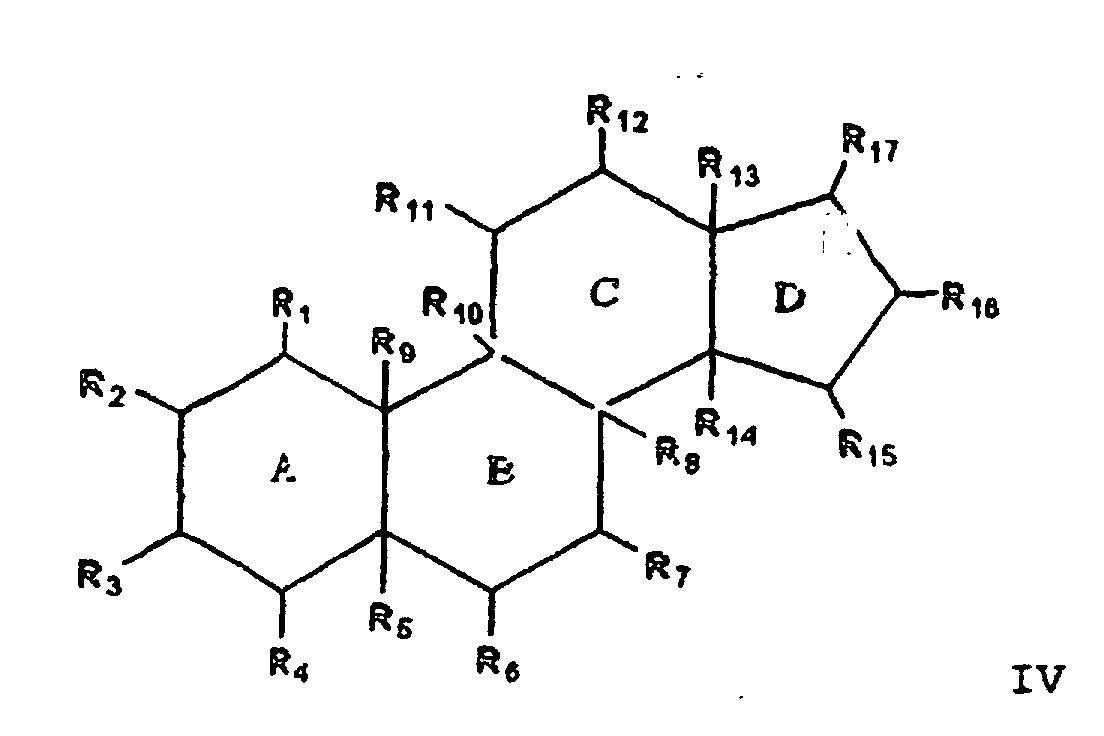
- Further aspects of the invention are defined in Claims 2 to 6.
- The present invention also includes pharmaceutical compositions of matter that are useful as antibacterial agents, sensitizers of bacteria to other antibiotics and disrupters of bacterial membranes. The pharmaceutical compositions can be used to treat humans and animals having a bacterial infection. The pharmaceutical compositions can include an effective amount of the steroid derivative alone or in combination with other antibacterial agents.
- Without wishing to be bound to any particular theory, the steroid derivatives act as bacteriostatic and bactericidal agents by binding to the outer cellular membrane of bacteria. The interaction between the steroid derivatives and the bacteria membrane disrupts the integrity of the cellular membrane and results in the death of the bacteria cell. In addition, compounds of the present invention also act to sensitize bacteria to other antibiotics. At concentrations of the steroid derivatives below the corresponding minimum bacteriostatic concentration, the derivatives cause bacteria to become more susceptible to other antibiotics by increasing the permeability of the outer membrane of the bacteria. Measurements used to quantitate the effects of the steroid derivatives on bacteria include: measurement of minimum inhibitory concentrations (MICs), measurement of minimum bactericidal concentrations (MBCs) and the ability of the steroid derivatives to lower the MICs of other antibiotics, e.g., erythromycin and novobiocin.
- A person of skill will recognize that the compounds described herein preserve certain stereochemical and electronic characteristics found in steroids. The term "same configuration" as used herein refers to substituents on the fused steroid having the same stereochemical orientation. For example substituents R3, R7 and R12 are all β-substituted or α-substituted. The configuration of the moities R3, R7, and R12 substituted on C3, C7, and C12 may be important for interaction with the cellular membrane.
- In another aspect, the invention features several applications of using the above-described compounds. For example, an effective amount of an anti-microbial composition comprising such a compound can be administered to a host (including a human host) to treat a microbial infection. The compound by itself may provide the anti-microbial effect, in which case the amount of the compound administered is sufficient to be anti-microbial. Alternatively, an additional anti-microbial substance to be delivered to the microbial cells (e.g., an antibiotic) is included in the anti-microbial composition. By facilitating delivery to the target cells, the compounds can enhance the effectiveness of the additional antimicrobial substance. In some cases the enhancement may be substantial. Particularly important target microbes are bacteria (e.g., gram negative bacteria generally or bacteria which have a substantial (>40%) amount of a lipid A or lipid A-like substance in the outer membrane). Other microbes including fungi, viruses, and yeast may also be the target organisms.
- The compounds can also be administered in other contexts to enhance cell permeability to introduce any of a large number of different kinds of substances into a cell, particularly the bacterial cells discussed above. In addition to introducing anti-microbial substances, the invention may be used to introduce other substances such as macromolecules (e.g., vector-less DNA). In addition, the compounds according to the invention can be used to permeabilize a sperm cell.
- The invention can also be used to make anti-microbial compositions (e.g., disinfectants, antiseptics, antibiotics etc.) which comprise one of the above compounds. These compositions are not limited to pharmaceuticals, and they may be used topically or in non-therapeutic contexts to control microbial (particularly bacterial) growth. For example, they may be used in applications that kill or control microbes on contact.
- In yet another aspect, the invention generally features methods of identifying compounds that are effective against a microbe by administering a candidate compound and a compound according to the invention the microbe and determining whether the candidate compound has a static or toxic effect (e.g, an antiseptic, germicidal, disinfectant, or antibiotic effect) on the microbe. Again, bacteria such as those discussed above are preferred. This aspect of the invention permits useful testing of an extremely broad range of candidate anti-microbials which are known to have anti-microbial effect in some contexts, but which have not yet been shown to have any effect against certain classes of microbes such as the bacteria discussed above. As described in greater detail below, this aspect of the invention permits testing of a broad range of antibiotics currently thought to be ineffective against gram negative or lipid A-like containing bacteria.
- In yet another aspect the invention features compositions which include one of the above compounds in combination with a substance to be introduced into a cell such as an antimicrobial substance as described in greater detail above. The compound and the additional substance may be mixed with a pharmaceutically acceptable carrier.
- Other features or advantages of the present invention will be apparent from the following detailed description of several embodiments, and also from the appending claims.
- The invention encompasses steroid derivatives that can be made by the synthetic routes described herein, and methods of treating a subject having a condition mediated by a bacterial infection by administering an effective amount of a pharmaceutical composition containing a compound disclosed herein to the subject.
- In general, the present invention provides the compounds of formula I described above. The preparation methods and the MIC and MBC of compounds of formula I are described. The cellular membrane permeability is also measured and described. Compounds that are useful in accordance with the invention, as described below, include novel steroid derivatives that exhibit bacteriostatic, bactericidal, and bacterial sensitizer properties. Those skilled in the art will appreciate that the invention extends to other compounds within the formulae given in the claims below, having the described characteristics. These characteristics can be determined for each test compound using the assays detailed below and elsewhere in the literature.
- Known compounds that are used in accordance with the invention and precursors to novel compounds according to the invention can be purchased, e.g., from Sigma Chemical Co., St. Louis; Aldrich, Milwaukee; Steroloids and Research Plus. Other compounds according to the invention can be synthesized according to known methods and the methods described below using publicly available precursors.
- The compounds of the present invention include but are not limited by amine or guanidine groups covalently tethered to a steroid backbone, e.g., cholic acid. The backbone can be used to orient the amine or guanidine groups on one face of the steroid. Other steroid backbones also can be used, e.g., 5 member fused rings.
- The biological activity of the compounds can be determined by standard methods known to those of skill in the art, such as the "minimal inhibitory concentration (MIC)" assay described in the present examples, whereby the lowest concentration at which no change in optical density (OD) is observed for a given period of time is recorded as MIC. When the compound alone is tested against a control that lacks the compound, the antimicrobial effect of the compound alone is determined.
- Alternatively, "fractional inhibitory concentration (FIC)" is also useful for determination of synergy between the compounds of the invention, or the compounds in combination with known antibiotics. FICs can be' performed by checkerboard titrations of compounds in one dimension of a microtiter plate, and of antibiotics in the other dimension, for example. The FIC is calculated by looking at the impact of one antibiotic on the MIC of the other and vice versa. An FIC of one indicates that the influence of the compounds is additive and an FIC of less than one indicates synergy. Preferably, an FIC of less than 0.5 is obtained for synergism. As used herein, FIC can be determined as follows:
- In addition, fractional inhibitory concentration is also useful for determination of synergy between compounds of the invention in combination with other compounds having unknown anti-bacterial activity or in combination with other compounds, e.g., compounds which have been tested and show anti-bacterial activity. For example, compounds of the invention may increase permeability so as to render compounds lacking anti-bacterial activity effective against bacteria. The FIC can also be used to test for other types of previously unappreciated activity of substances that will be introduced into the cell by means of permeability enhancing compounds according to the invention.
- While we do not wish to be bound to any single specific theory, and such a theory is not necessary to practice the invention, one mechanism of action is the lipid A interaction of multiple (usually three) moieties, which under phisiological conditions are positively charged, e.g., guanidino or amino moieties. The moieties extend away from the general plane of the remainder of the molecule, thus mimicing certain aspects of the structure of polymixins. In this regard, compounds of the invention will generally be useful in the way that polymixins are useful. Moreover, in regard to systemic administration, those skilled in the art will recognize appropriate toxicity screens that permit selection of compounds that are not toxic at dosages that enhance microbial permeability.
- As noted, the invention also involves topical as well as non-therapeutic (antiseptic, germicidal, or disinfecting) applications in which the compounds are contacted with surfaces to be treated. The term "contacting" preferably refers to exposing the bacteria to the compound so that the compound can effectively inhibit, kill, or lyse bacteria, bind endotoxin (LPS), or permeabilize gram- negative bacterial outer membranes. Contacting may be in vitro, for example by adding the compound to a bacterial culture to test for susceptibility of the bacteria to the compound. Contacting may be in vivo, for example administering the compound to a subject with a bacterial disorder, such as septic shock. "Inhibiting" or "inhibiting effective amount" refers to the amount of compound which is required to cause a bacteriostatic or bactericidal effect. Examples of bacteria which may be inhibited include E. coli, P. aeruginosa, E. cloacae, S. typhimurium, M. Tuberculosis and S. aureus.
- The method of inhibiting the growth of bacteria may further include the addition of antibiotics for combination or synergistic therapy. The appropriate antibiotic administered will typically depend on the susceptibility of the bacteria such as whether the bacteria is gram negative or gram positive, and will be . easily discernable by one of skill in the art. Examples of particular classes of antibiotics to be tested for synergistic therapy with the compounds of the invention (as described above) include aminoglycosides (e.g., tobramycin), penicillins (e.g.; piperacillin), cephalosporins (e.g., ceftazidime), fluoroquinolones (e.g., ciprofloxacin), carbepenems (e.g., imipenem), tetracyclines and macrolides (e.g., erythromycin and clarithromycin). The method of inhibiting the growth of bacteria may further include the addition of antibiotics for combination or synergistic therapy. The appropriate antibiotic administered will typically depend on the susceptibility of the bacteria such as whether the bacteria is gram negative or gram positive, and will be easily discernable by one of skill in the art. Further to the antibiotics listed above, typical antibiotics include aminoglycosides (amikacin, gentamicin, kanamycin, netilmicin, tobramycin, streptomycin, azithromycin, clarithromycin, erythromycin, erythromycin estolate/ethylsuccinate/ gluceptate/lactobionate/stearate), beta-lactams such as penicillins (e.g., penicillin G, penicillin V, methicillin, nafcillin, oxacillin, cloxacillin, dicloxacillin, ampicillin, amoxicillin, ticarcillin, carbenicillin, mezlocillin, azlocillin and piperacillin), or cephalosporins (e.g., cephalothin, cefazolin, cefaclor, cefamandole, cefoxitin, cefuroxime, cefonicid, cefmetazole, cefotetan, cefprozil, loracarbef, cefetamet, cefoperazone, cefotaxime, ceftizoxime, ceftriaxone, ceftazidime, cefepime, cefixime, cefpodoxime, and cefsulodin). Other classes of antibiotics include carbapenems (e.g., imipenem), monobactams (e.g., aztreonam), quinolones (e.g., fleroxacin, nalidixic acid, norfloxacin, ciprofloxacin, ofloxacin, enoxacin, lomefloxacin and cinoxacin), tetracyclines (e.g., doxycycline, minocycline, tetracycline), and glycopeptides (e.g., vancomycin, teicoplanin), for example. Other antibiotics include chloramphenicol, clindamycin, trimethoprim, sulfamethoxazole, nitrofurantoin, rifampin and mupirocin.
- The compounds may be administered to any host, including a human or non-human animal, in an amount effective to inhibit not only growth of a bacterium, but also a virus or fungus. These compounds are useful as antimicrobial agents, antiviral agents, spermicidal agents, and antifungal agents. The compounds may be administered to any host, including a human or non-human animal, in an amount effective to inhibit not only growth of a bacterium, but also a virus or fungus. These compounds are useful as antimicrobial agents, antiviral agents, and antifungal agents.
- The compounds of the invention can be administered parenterally by injection or by gradual infusion over time. The compounds can be administered topically, intravenously, intraperitoneally, intramuscularly, subcutaneously, intracavity, or transdermally. Preferred methods for delivery of the compound include orally, by encapsulation in microspheres or proteinoids, by aerosol delivery to the lungs, or transdermally by iontophoresis or transdermal electroporation. Other methods of administration will be known to those skilled in the art.
- Preparations for parenteral administration of a compound of the invention include sterile aqueous or non-aqueous solutions, suspensions, and emulsions. Examples of non-aqueous solvents are propylene glycol, polyethylene glycol, vegetable oils such as olive oil, and injectable organic esters such as ethyl oleate. Aqueous carriers include water, alcoholic/aqueous solutions, emulsions or suspensions, including saline and buffered media. Parenteral vehicles include sodium chloride solution, Ringer's dextrose, dextrose and sodium chloride, lactated Ringer's, or fixed oils. Intravenous vehicles include fluid and nutrient replenishers, electrolyte replenishers (such as those based on Ringer's dextrose), and the like. Preservatives and other additives may also be present such as, for example, antimicrobials, anti-oxidants, chelating agents, and inert gases and the like.
- The invention provides a method of treating or ameliorating an endotoxemia or septic shock (sepsis) associated disorder, or one or more of the symptoms of sepsis comprising administering to a subject displaying symptoms of sepsis or at risk for developing sepsis, a therapeutically effective amount of a compound of the invention. The term "ameliorate" refers to a decrease or lessening of the symptoms of the disorder being treated. Such symptoms which may be ameliorated include those associated with a transient increase in the blood level of TNF, such as fever, hypotension, neutropenia, leukopenia, thrombocytopenia, disseminated intravascular coagulation, adult respiratory distress syndrome, shock and multiple organ failure. Patients who require such treatment include those at risk for or those suffering from toxemia, such as endotoxemia resulting from a gram-negative bacterial infection, venom poisoning, or hepatic failure, for example. In addition, patients having a gram-positive bacterial, viral or fungal infection may display symptoms of sepsis and may benefit from such a therapeutic method as described herein. Those patients who are more particularly able to benefit from the method of the invention are those suffering from infection by E. coli, Haemophilus influenza B, Neisseria meningitidis, staphylococci, or pneumococci. Patients at risk for sepsis include those suffering from gunshot wounds, renal or hepatic failure, trauma, burns, immunocompromised (HIV), hematopoietic neoplasias, multiple myeloma, Castleman's disease or cardiac myxoma.
- In addition, the compounds may be incorporated into biodegradable polymers allowing for sustained release, the polymers being implanted in the vicinity of where delivery is desired, for example, at the site of an bacterial infection. The biodegradable polymers and their use are described in detail in Brem et al., J. Neurosurg, 74:441-446 (1991).
- As mentioned above, the present invention provides a pharmaceutical formulation having an effective amount of a compound of formula I for treating a patient having a bacterial infection. As used herein, an effective amount of the compound is defined as the amount of the compound which, upon administration to a patient, inhibits growth of bacteria, kills bacteria cells, sensitizes bacteria to other antibiotics, or eliminates the bacterial infection entirely in the treated patient. The dosage of the composition will depend on the condition being treated, the particular derivative used, and other clinical factors such as weight and condition of the patient and the route of administration of the compound. However, for oral administration to humans, a dosage of 0.01 to 100 mg/kg/day, preferably 0.01-1 mg/kg/day, is generally sufficient. Effective doses will also vary, as recognized by those skilled in the art, dependent on route of administration, excipient usage, and the possibility of co-usage with other therapeutic treatments including other antibiotic agents.
- For example, the term "therapeutically effective amount" as used herein for treatment of endotoxemia refers to the amount of compound used is of sufficient quantity to decrease the subject's response to LPS and decrease the symptoms of sepsis. The term "therapeutically effective" therefore includes that the amount of compound sufficient to prevent, and preferably reduce by at least 50%, and more preferably sufficient to reduce by 90%, a clinically significant increase in the plasma level of TNF. The dosage ranges for the administration of compound are those large enough to produce the desired effect. Generally, the dosage will vary with the age, condition, sex, end extent of the infection with bacteria or other agent as described above, in the patient and can be determined by one skilled in the art. The dosage can be adjusted by the individual physician in the event of any contraindications. In any event, the effectiveness of treatment can be determined by monitoring the level of LPS and TNF in a patient. A decrease in serum LPS and TNF levels should correlate with recovery of the patient.
- In addition, patients at risk for or exhibiting the symptoms of sepsis can be treated by the method as described above, further comprising administering, substantially simultaneously with the therapeutic administration of compound, an inhibitor of TNF, an antibiotic, or both. For example, intervention in the role of TNF in sepsis, either directly or indirectly, such as by use of an anti-TNF antibody and/or a TNF antagonist, can prevent or ameliorate the symptoms of sepsis. Particularly preferred is the use of an anti-TNF antibody as an active ingredient, such as a monoclonal antibody with TNF specificity as described by Tracey, et al. (Nature, 330:662, 1987).
- A patient who exhibits the symptoms of sepsis may be treated with an antibiotic in addition to the treatment with compound. Typical antibiotics include an aminoglycoside, such as gentamicin or a beta-lactam such as penicillin, or cephalosporin or any of the antibiotics as previously listed above. Therefore, a preferred therapeutic method of the invention includes administering a therapeutically effective amount of cationic compound substantially simultaneously with administration of a bactericidal amount of an antibiotic. Preferably, administration of compound occurs within about 48 hours and preferably within about 2-8 hours, and most preferably, substantially concurrently with administration of the antibiotic.
- The term "bactericidal amount" as used herein refers to an amount sufficient to achieve a bacteria-killing blood concentration in the patient receiving the treatment. The bactericidal amount of antibiotic generally recognized as safe for administration to a human is well known in the art, and as is known in the art, varies with the specific antibiotic and the type of bacterial infection being treated.
- Because of the antibiotic, antimicrobial, and antiviral properties of the compounds, they may also be used as preservatives or sterillants of materials susceptible to microbial or viral contamination. The compounds of the invention can be utilized as broad spectrum antimicrobial agents directed toward various specific applications. Such applications include use of the compounds as preservatives in processed foods when verified as effective against organisms including Salmonella, Yersinia, Shigella, either alone or in combination with antibacterial food additives such as lysozymes; as a topical agent (Pseudomonas, Streptococcus) and to kill odor producing microbes (Micrococci). The relative effectiveness of the compounds of the invention for the applications described can be readily determined by one of skill in the art by determining the sensitivity of any organism to one of the compounds.
- While primarily targeted at classical gram-negative-staining bacteria whose outer capsule contains a substantial amount of lipid A, it may also be effective against other organisms with a hydrophobic outer capsule. For example, mycobacterium spp. have a waxy protective outer coating, and compounds of the invention in combination with antibiotics may provide enhanced effectiveness against Mycobaterial infection, including tuberculosis. In that case, the compounds could be administered nasally (aspiration), by any of several known techniques.
- Apart from anti-microbial action, the permeability provided by the compounds may enchance introduction of a great variety of substances into microbes. For example, the compounds may be used to enhance introduction of macromolecules such as DNA or RNA into microbes, particularly gram negative bacteria. In that case, there may be no need for the traditional vectors (e.g., phages) used to package nucleic acids when transfecting the microbes. Conditions and techniques for introducing such macromolecules into microbes, using the compounds of the invention will in most cases be routine.
- The formulations include those suitable for oral, rectal, nasal, topical (including buccal and sublingual), vaginal or parenteral (including subcutaneous, intramuscular, intravenous, intradermal, intraocular, intratracheal, and epidural) administration. The formulations may conveniently be presented in unit dosage form and may be prepared by conventional pharmaceutical techniques. Such techniques include the step of bringing into association the active ingredient and the pharmaceutical carrier(s) or excipient(s). In general, the formulations are prepared by uniformly and intimately bringing into associate the active ingredient with liquid carriers or finely divided solid carriers or both, and then, if necessary, shaping the product.
- Formulations of the present invention suitable for oral administration may be presented as discrete units such as capsules, cachets or tablets each containing a predetermined amount of the active ingredient; as a powder or granules; as a solution or a suspension in an aqueous liquid or a non-aqueous liquid; or as an oil-in-water liquid emulsion or a water-in-oil emulsion and as a bolus, etc.
- A tablet may be made by compression or molding, optionally with one or more accessory ingredients. Compressed tablets may be prepared by compressing, in a suitable machine, the active ingredient in a free-flowing form such as a powder or granules, optionally mixed with a binder, lubricant, inert diluent, preservative, surface-active or dispersing agent. Molded tables may be made by molding, in a suitable machine, a mixture of the powdered compound moistened with an inert liquid diluent. The tablets may optionally coated or scored and may be formulated so as to provide a slow or controlled release of the active ingredient therein.
- Formulations suitable for topical administration in the mouth include lozenges comprising the ingredients in a flavored basis, usually sucrose and acacia or tragacanth; pastilles comprising the active ingredient in an inert basis such as gelatin and glycerin, or sucrose and acacia; and mouthwashes comprising the ingredient to be administered in a suitable liquid carrier.
- Formulations suitable for topical administration to the skin may be presented as ointments, creams, gels and pastes comprising the ingredient to be administered in a pharmaceutical acceptable carrier. A preferred topical delivery system is a transdermal patch containing the ingredient to be administered.
- Formulations for rectal administration may be presented as a suppository with a suitable base comprising, for example, cocoa butter or a salicylate.
- Formulations suitable for nasal administration, wherein the carrier is a solid, include a coarse powder having a particle size, for example, in the range of 20 to 500 microns which is administered in the manner in which snuff is taken, i.e., by rapid inhalation through the nasal passage from a container of the powder held close up to the nose. Suitable formulations, wherein the carrier is a liquid, for administration, as for example, a nasal spray, aerosol, or as nasal drops, include aqueous or oily solutions of the active ingredient.
- Formulations suitable for vaginal administration may be presented as pessaries, tampons, creams, gels, pastes, foams or spray formulations containing in addition to the active ingredient such as carriers as are known in the art to be appropriate.
- Formulations suitable for parenteral administration include aqueous and non-aqueous sterile injection solutions which may contain anti-oxidants, buffers, other bacteriostats and solutes which render the formulation isotonic with the blood of the intended recipient; and aqueous and non-aqueous sterile suspensions which may include suspending agents and thickening agents. The formulations may be presented in unit-dose or multi-dose containers, for example, sealed ampules and vials, and may be stored in a freeze-dried (lyophilized) conditions requiring only the addition of the sterile liquid carrier, for example, water for injections, immediately prior to use. Extemporaneous injection solutions and suspensions may be prepared from sterile powders, granules and tables of the kind previously described.
- Preferred unit dosage formulations are those containing a daily dose or unit, daily sub-dose, as herein above recited, or an appropriate fraction thereof, of the administered ingredient.
- It should be understood that in addition to the ingredients, particularly mentioned above, the formulations of this invention may include other agents conventional in the art having regard to the type of formulation in question, for example, those suitable for oral administration may include flavoring agents.
- The carrier in the pharmaceutical composition must be "acceptable" in the sense of being compatible with the active ingredient of the formulation (and preferably, capable of stabilizing it) and not deleterious to the subject to be treated.
- Without further elaboration, it is believed that the above description has adequately enabled the present invention. The following specific embodiments are, therefore, to be construed as merely illustrative, and not limitative of the remainder of the disclosure in any way whatsoever.
- Examples 1-6 represent typical syntheses of compounds 1 through 48 as exemplified in Scheme 1 through 7. Example 7 represents MIC and MCB testing. Example 8 represents the ability of the compounds of formula I to lower the MIC's of other antibiotics. Example 9 represents other compounds of formula I which can be synthesized using known starting materials and reaction schemes that are similar to those described herein. For example, the hydroxyl groups on cholic acid can be converted into amine by the method found in Hsieh et al., Synthesis and DNA Binding Properties of C3-, C12-, and C24- Substituted Amino-Steroids Derived from Bile Acids, Biorganic and Medicinal Chemistry, 1995, vol. 6, 823-838.
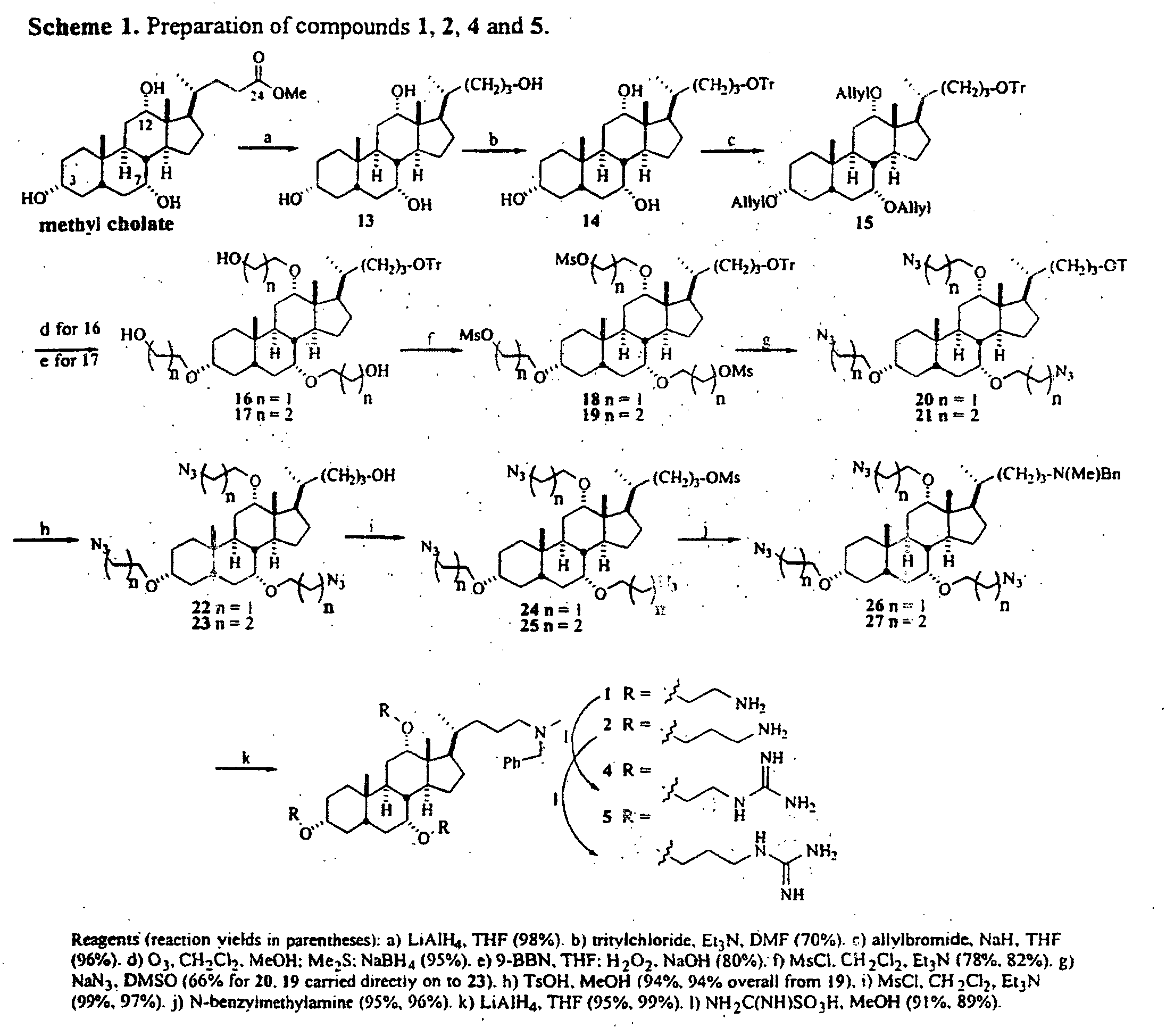
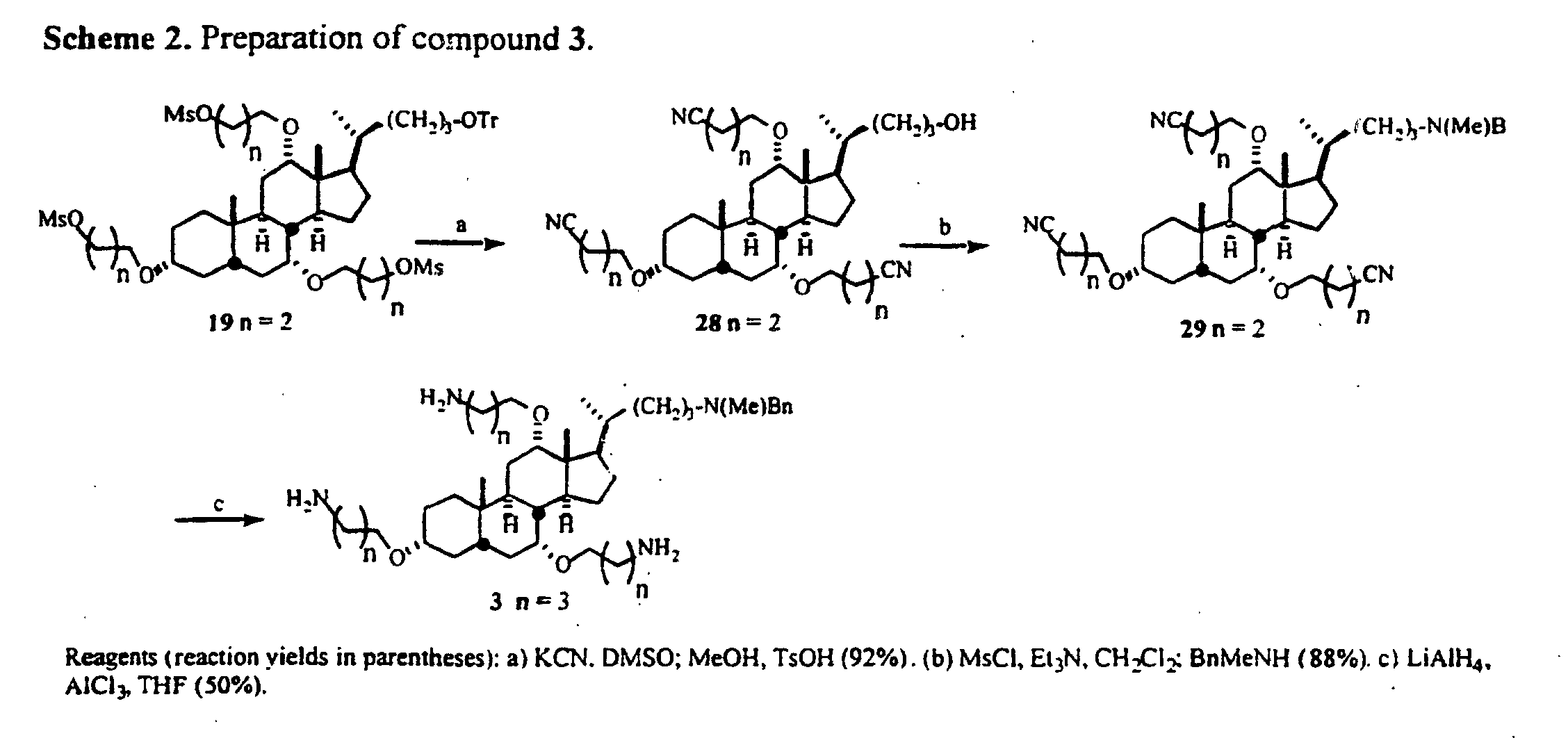
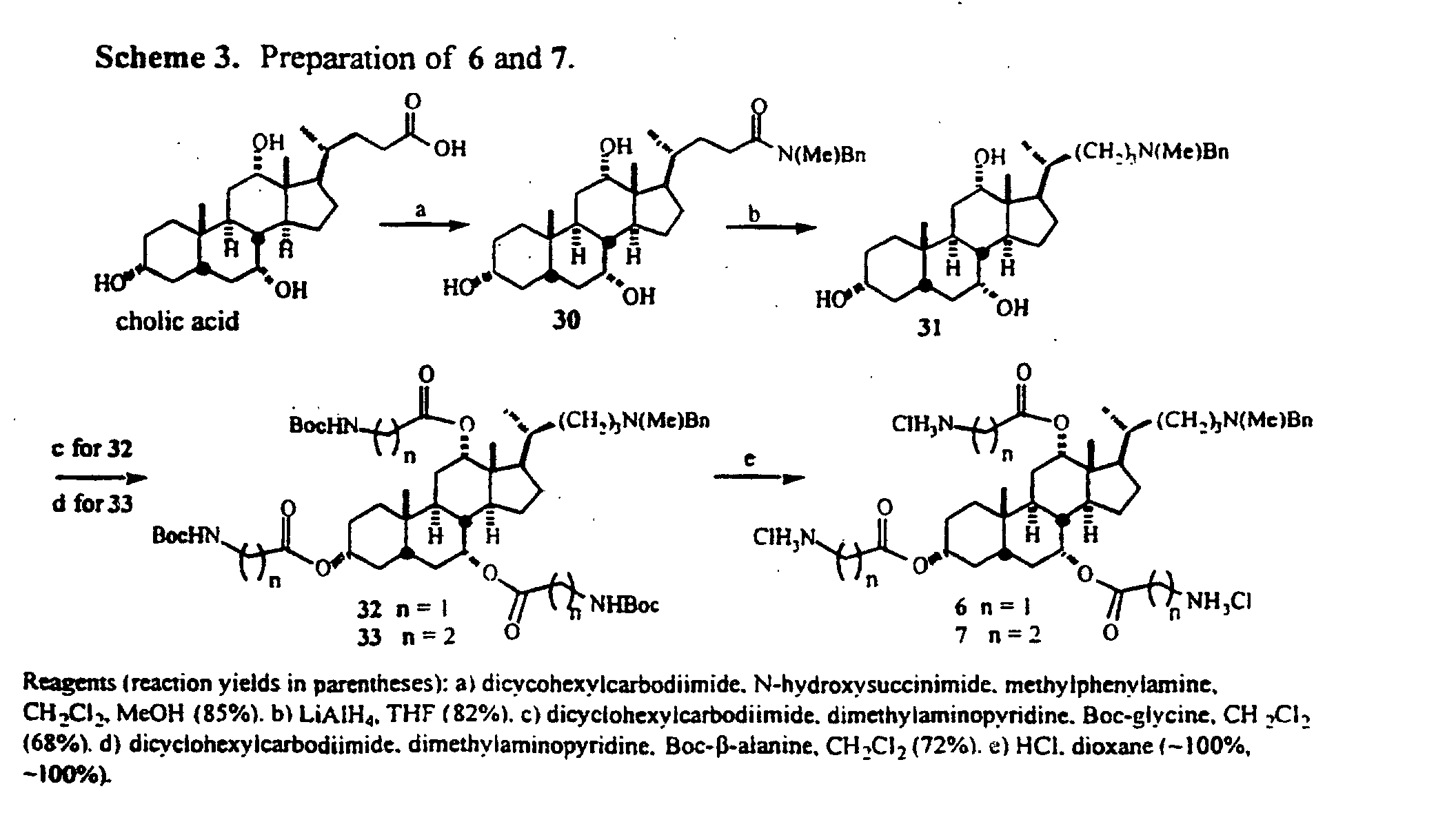
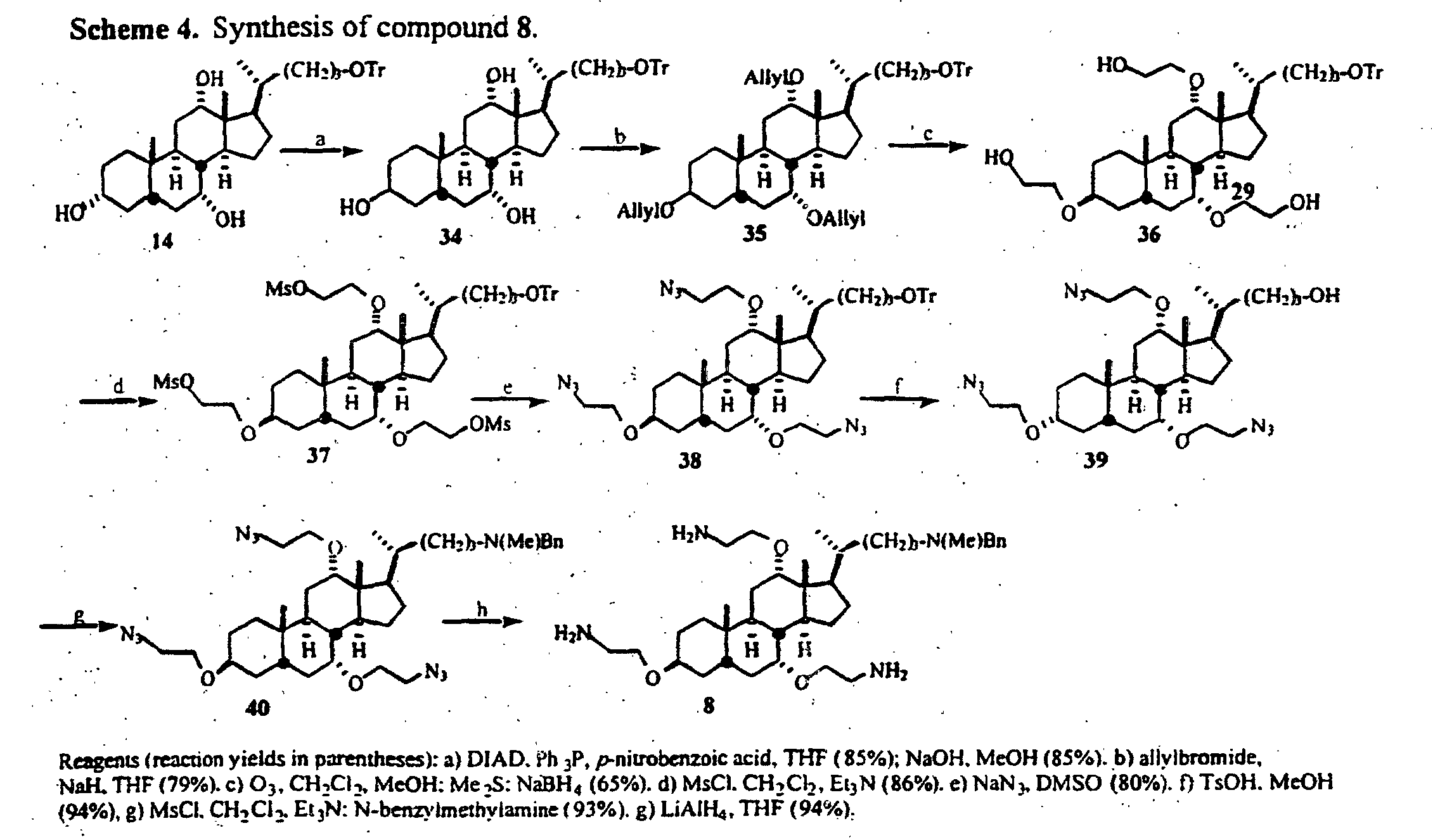
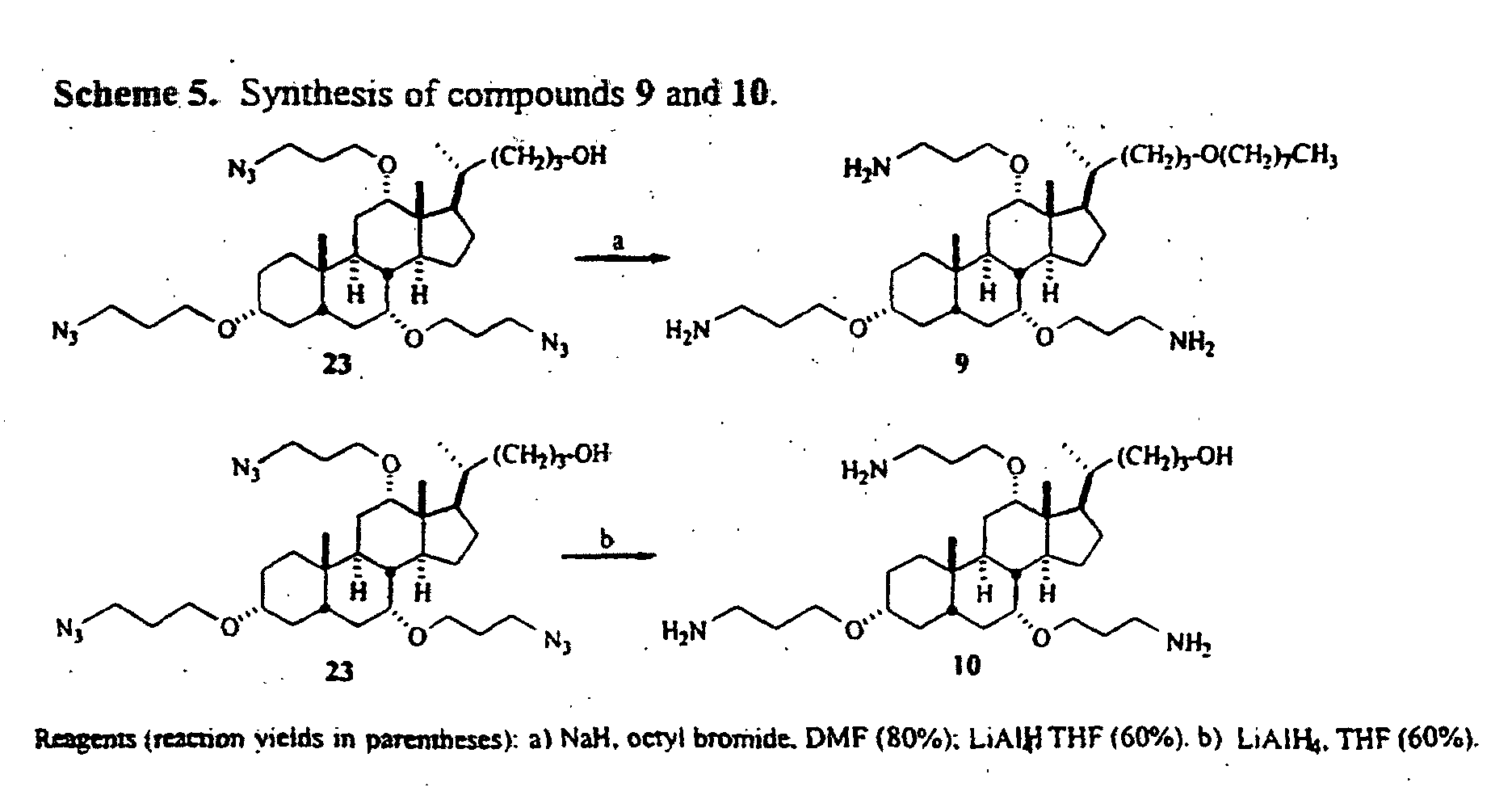
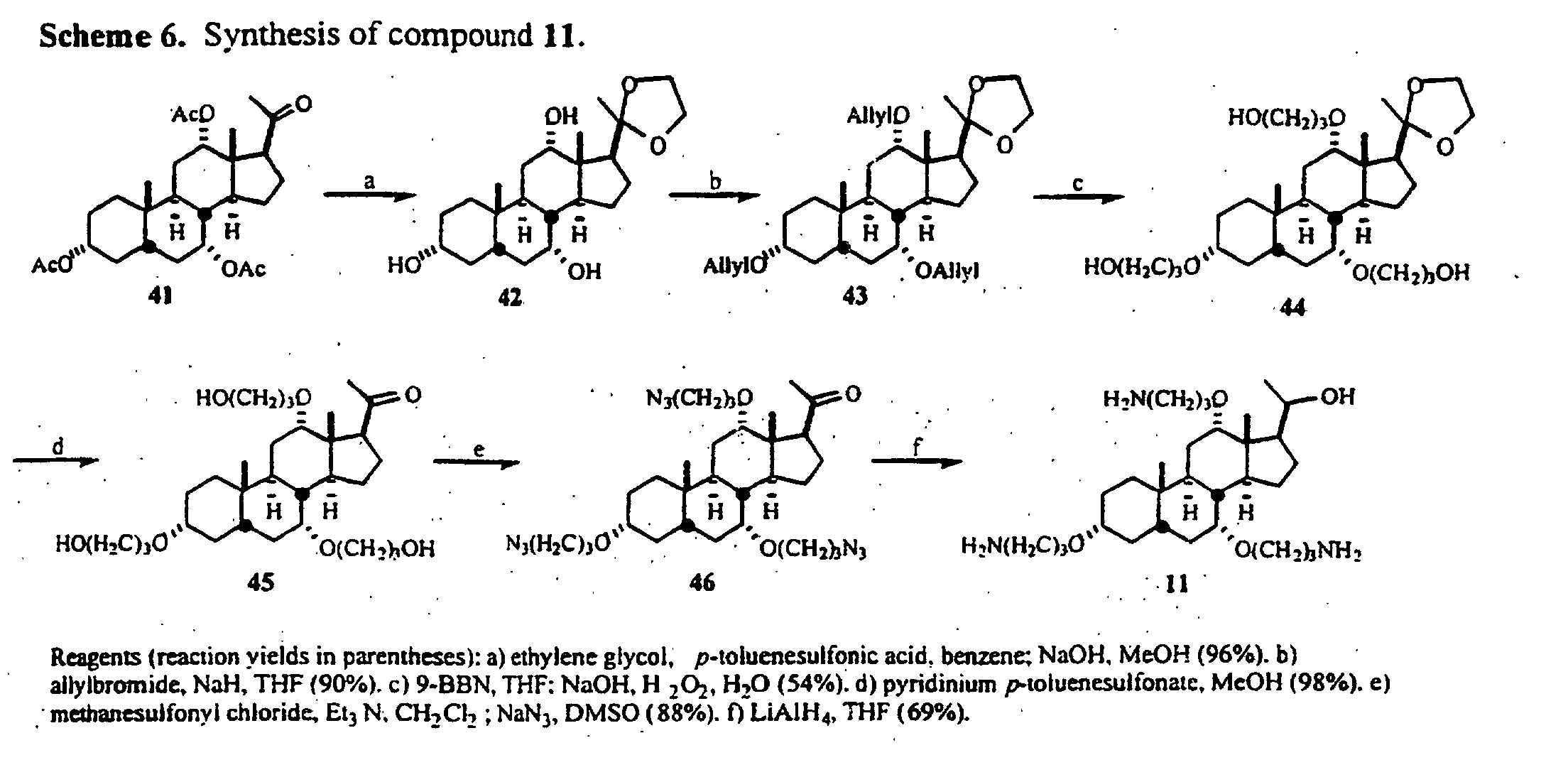

- 1H and 13C NMR spectra were recorded on a Varian Gemini 2000 (200 MHZ) or Varian Unity 300 (300 MHZ) spectrometer and are referenced to CHCl3(1H) or CDCl3(13C). IR spectra were recorded on a Perkin Elmer 1600 FTIR instrument. Mass spectrometric data were obtained on a JOEL SX 102A spectrometer. THF was dried over Na°/benzophenone and CH2Cl2 was dried over CaH2 prior to use. Other reagents and solvents were obtained commercially and were used as received.
- To a 1 L round-bottom flask were added methyl cholate (30.67 g, 72.7 mmol) in dry THF (600 mL) and LiAlH4 (4.13 g, 109 mmol). After reflux for 48 hours, saturated aqueous Na2SO4 (100 mL) was introduced slowly, and the resulted precipitate was filtered out and washed with hot THF and MeOH. Recrystallization from MeOH gave colorless crystals of 13 (28.0 g, 98% yield). m.p. 236.5-238°C; IR (KBr) 3375, 2934, 1373, 1081 cm-1; 1H NMR (CDCl3/MeOH-d4, 200 MHZ) δ 3.98 (bs, 1 H), 3.83 (bs, 1 H), 3.60-3.46 (m, 2 H), 3.38 (bs, 5 H), 2.30-2.10 (m, 2 H), 2.05-1.05 (series of multiplets, 22 H), 1.03 (bs, 3 H), 0.92 (s, 3 H), 0.71 (s, 3 H); 13C NMR (CDCl3/MeOH-d4, 50 MHZ) δ 73.89, 72.44, 68.99, 63.51, 48.05, 47.12, 42.49, 40.37, 39.99, 36.62, 36.12, 35.58, 35.40, 32.77, 30.69, 30.04, 29.02, 28.43, 27.27, 23.96, 23.08, 18.00, 13.02; HRFAB-MS (thioglycerol + Na+ matrix) m/e: ([M+Na]+) 417.2992 (55.3%); cacld. 417.2981.
- To a round-bottom flask were added 13 (28.2 g, 71.7 mmol) in DMF (300 mL), Et3N (20 mL, 143.4 mmol), trityl chloride (25.98g, 93.2 mmol) and DMAP (0.13 g, 1.07 mmol). The mixture was stirred at 50°C under N2 for 30 hours followed by the introduction of water (1000 mL) and extraction with EtOAc (5 x 200 mL). The combined extracts were washed with water and brine and then dried over MgSO4. After removal of solvent in vacuo, the residue was purified using SiO2 chromatography (CH2Cl2, Et2O and MeOH as eluents) to give 14 as a pale yellow solid (31.9 g, 70% yield). m.p. 187°C (decomposition); IR (KBr) 3405, 2935, 1448, 1075 cm-1; 1H NMR (CDCl3, 200 MHZ) δ 7.46-7.42 (m, 6 H), 7.32-7.17 (m, 9 H), 3.97 (bs, 1 H), 3.83 (bs, 1 H), 3.50-3.38 (m, 1 H), 3.01 (bs, 1 H), 2.94 (dd, J = 14.2, 12.2 Hz, 2 H), 2.64 (bs, 1 H), 2.51 (bs, 1 H), 2.36-2.10 (m, 2 H), 2.00-1.05 (series of multiplets, 22 H), 0.96 (d, J = 5.8 Hz, 3 H), 0.87 (s, 3 H), 0.64 (s, 3 H); 13C NMR (CDCl3, 50 MHZ) δ 144.77, 128.93, 127.91, 127.01, 86.43, 73.35, 72.06, 68.66, 64.28, 47.47, 46.53, 41.74, 41.62, 39.64, 35.57, 35.46, 34.91, 34.82, 32.40, 30.55, 28.21, 27.69, 26.80, 26.45, 23.36, 22.59, 17.83, 12.61; HRFAB-MS (thioglycerol + Na+ matrix) m/e: ([M+Na]+) 659.4069 (100%); cacld. 659.4076.
- To a round-bottom flask were added 14 (20.0 g, 31.4 mmol) in dry THF (600 mL) and NaH (60% in mineral oil, 6.3 g, 157.2 mmol). The mixture was refluxed for 30 minutes under N2 followed by addition of allyl bromide (27 mL, 314 mmol). After 60 hours of reflux, additional NaH (3 eq.) and allyl bromide (4 eq.) were added. Following'another 50 hours of reflux, water (20 mL) was introduced slowly followed by addition of 1% HCl until the aqueous layer became neutral. The mixture was then extracted with ether (3 x 100 mL) and the combined extracts were washed with water (100 mL) and brine (2 x 100 mL). The ether solution was dried over anhydrous Na2SO4, and after removal of solvent, the residue was purified using SiO2 chromatography (hexanes and EtOAc/hexanes 1:8 as eluents) to give 15 (22.76 g, 96% yield) as a pale yellow glass. IR (neat) 2930, 1448, 1087 cm-1; 1H NMR (CDCl3, 200 M Hz) δ 7.48-7.30 (m, 6 H) , 7.32-7.14 (m; 9 H), 6.04-5.80 (m, 3 H), 5.36-5.04 (series of multiplets, 6 H), 4.14-3.94 (m, 4 H), 3.74 (td, J = 13.8, 5.8 Hz, 2 H), 3.53 (bs, 1 H) , 3.20-2.94 (m, 3 H) , 3.31 (bs, 1 H), 2.38-1.90 (m, 4 H), 1.90-0.96 (series of multiplets, 20 H), 0.90 (d, J = 5.4 Hz, 3 H), 0.89 (s, 3 H), 0.64 (s, 3 H); 13C NMR (CDCl3, 50 MHZ) δ 144.83, 136.27, 136.08, 128.94, 127.90, 126.98, 116.46, 115.70, 86.42, 80.94, 79.29, 74.98, 69.52, 69.39, 68.86, 64.39, 46.51, 46.42, 42.67, 42.14, 39.92, 35.63, 35.51, 35.13, 32.45, 28.98, 28.09, 27.66, 27.57, 26.72, 23.32, 23.11, 17.92, 12.69; HRFAB-MS (thioglycerol+Na+ matrix) m/e: ([M+Na]+) 779.5013 (86.1%); cacld. 779.5015.
- To a three-necked round bottom flask was added 15 (3.34 g, 4.4 mmol) in CH2Cl2 (200 mL) and methanol (100 mL). Through the cold solution (-78°C) ozone was bubbled through until a blue color persisted. Excess ozone was removed with oxygen flow. The mixture was left in a dry ice-acetone bath for an hour. Methyl sulfide (2.4 mL) was added and 15 minutes later, the mixture was treated with NaBH4 (1.21 g, 32 mmol) in 5% aqueous NaOH solution (10 mL) /methanol (10 mL) and allowed to warm to room temperature. The mixture was washed with brine (3 x 50 mL), and the combined brine wash was extracted with CH2Cl2 (2 x 50 mL). The organic solution was dried over MgSO4. After SiO2 chromatography (MeOH (5%) in CH2Cl2), 3.30 g (95% yield) of 16 was isolated as an oil. IR (neat) 3358, 2934, 1448, 1070 cm-1; 1H NMR (CDCl3, 200 MHZ) δ 7.50-7.42 (m, 6 H), 7.32-7.17 (m, 9 H), 3.80-2.96 (series of multiplets, 20 H), 2.25-0.96 (series of multiplets, 24 H), 0.89 (bs, 6 H), 0.65 (s, 3 H); 13C NMR (CDCl3, 50 MHZ) δ 144.73, 128.88, 127.87, 126.96, 86.38, 81.05, 79.75, 76.59, 70.33, 69.66, 69.30, 64.20, 62.25, 62.16, 62.03, 46.77, 46.36, 42.63, 41.77, 39.60, 35.43, 35.23, 35.05, 34.89, 32.42, 28.91, 27.93, 27.56, 27.15, 26.68, 23.'35, 22.98, 22.85, 18.15, 12.60; HRFAB-MS (thioglycerol+Na+ matrix) m/e: ([M+Na]+) 791.4860 (100%), cacld. 791.4863.
- To a round-bottom flask was added 16 (1.17 g, 1.55 mmol) in dry THF (30 mL) under N2 in ice-bath followed by 9-BBN/THF solution (0.5 M, 10.2 mL, 5.51 mmol). The mixture was stirred at room temperature for 12 hours. Aqueous NaOH (20%) (2 mL) and hydrogen peroxide (30%) (2 mL) were added in sequence. The mixture was refluxed for 1 hour followed by the addition of brine (60 mL) and extraction with EtOAc (4 x 30 mL). The combined extracts were dried over anhydrous Na2SO4. The product (1.01 g, 80% yield) was obtained as a colorless oil after SiO2 chromatograhy (5% MeOH in CH2Cl2). IR (neat) 3396, 2936, 1448, 1365, 1089 cm-1; 1H NMR(CDCl3, 200 MHZ) δ 7.50-7.42 (m, 6 H), 7.34-7.16 (m, 9 H), 3.90-3.56 (m, 13 H), 3.50 (bs, 1 H), 3.40-2.96 (series of multiplets, 6 H), 2.30-0.94 (series of multiplets, 30 H), 0.90 (s, 3 H), 0.88 (d, J = 5.4 Hz, 3 H), 0.64 (s, 3 H); 13C NMR(CDCl3, 50 MHZ) δ 144.73, 128.88, 127.85, 126.94, 86.36, 80.52, 78.90, 76.36, 66.82, 66.18, 65.77, 64.22, 61.53, 61.41, 61.34, 46.89, 46.04, 42.60, 41.59, 39.60, 35.37, 35.27, 34.88, 32.75, 32.44, 32.31, 28.82, 27.65, 27.48, 27.13, 26.77, 23.35, 22.74, 22.38, 18.08, 12.48; HRFAB-MS (thioglycerol+Na+ matrix) m/e: ([M+Na]+) 833.5331 (100%), cacld. 833.5332.
- To a round-bottom flask were added 16 (3.30 g, 4.29 mmol) in CH2Cl2 (150 mL) and NEt3(2.09 mL, 15.01 mmol). The mixture was put in ice-bath under N2 followed by addition of mesyl chloride (1.10 mL, 14.16 mmol). After 30 minutes, water (30 mL) and brine (200 mL) were added. The CH2Cl2 layer was washed with brine (2 x 50 mL) and dried over anhydrous Na2SO4. The combined aqueous mixture was extracted with EtOAc (3 x 100 mL). The combined extracts were washed with brine and dried over anhydrous Na2SO4. The desired product (3.35 g, 78% yield) was isolated as a pale yellow oil after SiO2 chromatography (EtOAc/hexanes 1:1). IR (neat) 2937, 1448, 1352, 1174, 1120, 924 cm-1; 1H NMR (CDCl3, 200 MHZ) δ 7.52-7.40 (m, 6 H), 7.34-7.20, (m, 9 H), 4.42-4.24 (m, 6 H), 3.90-3.64 (m, 4 H), 3.60-3.30 (m, 4 H), 3.24-3.00 (m, 3 H), 3.10 (s, 6 H), 3.05 (s, 3 H), 2.20-1.96 (m, 3 H) 1.96-1.60 (m, 8 H), 1.60-0.94 (series of multiplets, 13 H), 0.91 (bs, 6 H) 0.65 (s, 3 H); 13C NMR (CDCl3, 50 MHz) δ 114.68, 128.85, 127.85, 126.96, 86.37, 81.37, 79.58, 76.58, 69.95, 69.43, 69.34, 66.52, 66.31, 65.59, 64.11, 46.80, 46.20, 42.65, 41.48, 39.35, 37.82, 37.48, 35.36, 34.92, 34.73, 32.37, 28.66, 28.01, 27.44, 27.03, 26.72, 23.17, 22.91, 22.72, 18.13, 12.50; HRFAB-MS (thioglycerol+Na+ matrix) m/e: ([M+Na]+) 1205.4176 (81.5%), cacld. 1205.4189.
- To a round-bottom flask were added 17 (1.01 g, 1.25 mmol) in CH2Cl2 (50 mL) and NEt3 (0.608 mL, 4.36 mmol). The mixture was put in ice-bath under N2 followed by addition of mesyl chloride (0.318 mL, 4.11 mmol). After 30 minutes, water (10 mL) and then brine (80 mL) were added. The CH2Cl2 layer was washed with brine (2 x 20 mL) and dried over anhydrous Na2SO4. The combined aqueous mixture was extracted with EtOAc (3 x 40 mL). The combined extracts were washed with brine and dried over anhydrous Na2SO4. The desired product (1.07 g, 82%) was isolated as a pale yellowish oil after SiO2 chromatography (EtOAc/hexanes 1:1). IR (neat) 2938, 1356, 1176, 1112 cm-1; 1H NMR (CDCl3, 300 MHZ) δ 7.46-7.43, (m, 6 H), 7.32-7.22 (m, 9 H), 4.40-4.31 (m, 6 H), 3.72-3.64 (m, 2 H), 3.55 (dd, J = 6.3, 5.8 Hz, 2 H), 3.51 (bs, 1 H), 3.32-3.14 (m, 3 H), 3.14-2.92 (m, 3 H), 3.01 (s, 3 H), 3.01 (s, 3 H), 3.00 (s, 3 H), 2.10-1.92 (m, 10 H), 1.92-1.58 (m, 8 H), 1.56-0.92 (series of multiplets, 12 H) , 0.90 (s, 3 H), 0.89 (d, J = 5.4 Hz, 3 H), 0.64 (s, 3 H); 13C NMR(CDCl3, 75 MHZ) δ 144.67, 128.85, 127.85, 126.96, 86.42, 81.06, 79.83, 76.81, 68.12, 68.06, 68.02, 64.26, 64.06, 63.42, 46.76, 46.38, 42.73, 41.87, 39.73, 37.44, 37.32, 37.29, 35.52, 35.48, 35.32, 35.06, 32.53, 30.55, 30.28, 30.02, 29.15, 27.96, 27.69, 27.61, 26.75, 23.52, 23.02, 18.17, 12.64; HRFAB-MS (thioglycerol+Na+ matrix) m/e: ([M+Na]+) 1067.4672 (100%), cacld. 1067.4659.
- To a round-bottom flask were added 18 (1.50 g, 1.50 mmol) in dry DMSO (20 mL) and NaN3 (0.976 g, 15 mmol). The mixture was heated to 80°C and stirred under N2 overnight then diluted with water (100 mL). The resulted aqueous mixture was extracted with EtOAc (3 x 50 mL), and the combined extracts washed with brine and dried over anhydrous Na2SO4. The desired product (0.83 g, 66% yield) was isolated as a clear glass after SiO2 chromatography (EtOAc/hexanes 1:5). IR (neat) 2935, 2106, 1448, 130.2, 1114 cm-1; 1H NMR (CDCl3, 200 MHZ) δ 7.50-7.42 (m, 6 H), 7.36-7.20 (m, 9 H), 3.84-3.70 (m, 2 H), 3.65 (t, J = 4.9 Hz, 2 H), 3.55 (bs, 1 H), 3.44-3.08 (m, 10 H), 3.02 (t, J = 6.4 Hz, 2 H), 2.38-0.96 (series of multiplets, 24 H), 0.92 (d, J = 5.6 Hz, 3 H), 0.91 (s, 3 H), 0.65 (s, 3 H); 13C NMR (CDCl3, 50 MHZ) δ 114.84, 128.97, 127.92, 126.99, 86.42, 81.24, 80.12, 76.59, 67.84, 67.29, 66.66, 64.36, 51.67, 51.44, 51.18, 46.53, 46.23, 42.21, 41.93, 39.73, 35.66, 35.36, 35.06, 34.78, 32.40, 28.95, 27.76, 27.39, 26.87, 23.45, 22.98, 22.92, 17.98, 12.53; HRFAB-MS (thioglycerol+Na+ matrix) m/e: ([M+Na]+) 866.5040 (100%), cacld. 866.5057.
- To a round-bottom flask were added 20 (830 mg, 0.984 mmol) in MeOH (30 mL) and CH2Cl2 (30 mL) and p-toluenesulfonic acid (9.35 mg, 0.0492 mmol). The solution was stirred at room temperature for 2.5 hours then saturated aqueous NaHCO3 (10 mL) was introduced. Brine (30 mL) was added, and the mixture was extracted with EtOAc (4 x 20 mL). The combined extracts were dried over anhydrous Na2SO4. The desired product (0.564 g, 95% yield) was isolated as a pale yellowish oil after SiO2 chromatography (EtOAc/hexanes 1:2). IR (neat) 3410, 2934, 2106, 1301, 1112 cm-1; 1H NMR (CDCl3, 200 MHZ) δ 3.80-3.54 (m, 7 H), 3.44-3.20 (m, 10 H), 2.35-0.96 (series of multiplets, 24 H), 0.95 (d, J = 6.4 Hz, 3H), 0.92 (s, 3 H), 0.68 (s, 3 H); 13C NMR (CDCl3, 50 MHZ) δ 81.10, 80.01, 76.60, 67.75, 67.16, 66.56, 63.63, 51.57, 51.34, 51.06, 46.29, 46.12, 42.12, 41.81, 39.60, 35.55, 35.23, 34.94, 34.66, 31.75, 29.48, 28.81, 27.72, 27.66, 27.29, 23.32, 22.86, 22.80, 17.85, 12.39; HRFAB-MS (thioglycerol+Na+ matrix) m/e: ([M+Na]+) 624.3965 (100%), cacld. 624.3962.
- To a round-bottom flask were added 19 (1.07 g, 1.025 mmol) and NaN3 (0.666 g, 10.25 mmol) followed the introduction of dry DMSO (15 mL). The mixture was heated up to 80°C under N2 overnight. After the addition of H2O (100 mL), the mixture was extracted with EtOAc (4 x 40 mL) and the combined extracts were washed with brine (2 x 50 mL) and dried over anhydrous Na2SO4. After removal of solvent, the residue was dissolved in MeOH (15 mL) and CH2Cl2 (15 mL) followed by the addition of catalytic amount of p-toluenesulfonic acid (9.75 mg, 0.051 mmol). The solution was stirred at room temperature for 2.5 hours before the addition of saturated NaHCO3 solution (15 mL). After the addition of brine (60 mL), the mixture was extracted with EtOAc (5 x 30 mL). The combined extracts were washed with brine (50 mL) and dried over anhydrous Na2SO4. The desired product (0.617 g, 94% yield for two steps) was obtained as a yellowish oil after SiO2 chromatography (EtOAc/hexanes 1:2). IR (neat) 3426, 2928, 2094, 1456, 1263, 1107 cm-1; 1H NMR (CDCl3, 300 MHZ) δ 3.68-3.56 (m, 3 H), 3.56-3.34 (series of multiplets, 10 H), 3.28-3.00 (series of multiplets, 4 H), 2.20-2.00 (m, 3 H), 1.98-1.55 (series of multiplets, 15 H), 1.55-0.96 (series of multiplets, 13 H), 0.92 (d, J = 6.6 Hz, 3 H), 0.89 (s, 3 H), 0.66 (s, 3 H); 13C NMR (CDCl3, 75 MHZ) δ 80.63, 79.79, 76.04, 64.99, 64.45, 64.30, 63.72, 49.01, 48.94, 48.74, 46.49, 46.39, 42.70, 41.98, 39.80, 35.65, 35.42, 35.28, 35.08, 31.99, 29.78, 29.75, 29.70, 29.49, 29.06, 27.87, 27.79, 27.65, 23.53, 23.04, 22.85, 18.05, 12.59; HRFAB-MS (thioglycerol+Na matrix) m/e: ([M+Na]+) 666.4415 (100%), cacld. 666.4431.
- To a round-bottom flask were added 22 (0.564 g, 0.938 mmol) in CH2Cl2 (30 mL) and NEt3 (0.20 mL, 1.40 mmol). The mixture was put in ice-bath under N2 followed by addition of mesyl chloride (0.087 mL, 1.13 mmol). After 30 minutes, water (20 mL) and brine (100 mL) were added. The CH2CL2 layer was washed with brine (2 x 20 mL) and dried over anhydrous Na2SO4. The combined aqueous mixture was extracted with EtOAc (3 x 30 mL). The combined extracts were washed with brine and dried over anhydrous Na2SO4. The desired product (0.634 g, 99% yield) was isolated as a pale yellowish oil after SiO2 chromatography (EtOAc/hexanes 1:2). IR (neat) 2935, 2106, 1356, 1175, 1113 cm-1; 1H NMR (CDCl3, 300 MHZ) δ 4.20 (t, J = 6.8 Hz, 2 H), 3.80-3.75 (m, 1 H), 3.70-3.64 (m, 3 H), 3.55 (bs, 1 H), 3.44-3.01 (m, 10 H), 3.00 (s, 3 H) , 2.32-2.17 (m, 3 H) , 2.06-2.03 (m, 1 H), 1.90-0.88 (series of multiplets, 20 H), 0.95 (d, J = 6.6 Hz, 3 H), 0.91 (s, 3 H), 0.68 (s, 3 H); 13C NMR (CDCl3, 75 MHZ) δ 80.90, 79.86, 76.43, 70.78, 67.64, 66.99, 66.48, 51.50, 51.26, 50.97, 46.05, 45.96, 42.08, 41.71, 39.51, 37.33, 35.15, 34.86, 34.60, 31.34, 28.73, 27.62, 27.59, 27.51, 25.68, 23.22, 22.80, 22.70, 17.62, 12.33; HRFAB-MS (thioglycerol+Na+ matrix) m/e: ([M+Na]+) 702.3741 (100%), cacld. 702.3737.
- To a round-bottom flask were added 23 (0.617 g, 0.96 mmol) in CH2Cl2 (30 mL) and NEt3 (0.20 mL, 1.44 mmol). The mixture was put in ice-bath under N2 followed by addition of mesyl chloride (0.089 mL, 1.15 mmol). After 30 minutes, water (20 mL) and brine (120 mL) were added. The CH2Cl2 layer was washed with brine (2 x 20 mL) and dried over anhydrous Na2SO4. The combined aqueous mixture was extracted with EtOAc (3 x 30 mL). The combined extracts were washed with brine and dried over anhydrous Na2SO4. The desired product (0.676 g, 97% yield) was isolated as a pale yellowish oil after removal of solvent. IR (neat) 2934, 2094, 1454, 1360, 1174, 1112 cm-1; 1H NMR (CDCl3, 300 MHZ) δ 4.17 (t, J = 6.6 Hz, 2 H), 3.65-3.28 (series of multiplets, 11 H), 3.64-3.00 (series of multiplets, 4 H), 2.97 (s, 3 H), 2.18-1.96 (series of multiplets, 16 H), 1.54-0.94 (series of multiplets, 11 H), 0.89 (d, J = 6.6 Hz, 3 H), 0.86 (s, 3 H), 0.63 (s, 3 H); 13C NMR (CDCl3, 75 MHZ) δ 80.47, 79.67, 75.92, 70.84, 64.90, 64.37, 64.17, 48.90, 48.86, 48.66, 46.32, 46.26, 42.63, 41.87, 39.70, 37.39, 35.34, 35.28, 35.20, 34.99, 31.61, 29.68, 29.60, 28.96, 27.78, 27.68, 27.57, 25.79, 23.41, 22.95, 22.74, 17.82, 12.50; HRFAB-MS (thioglycerol matrix) m/e: ([M+H]+) 722.4385 (22.1%), cacld. 722.4387.
- To a 50 mL round-bottom flask was added 24 (0.634 g, 0.936 mmol) and N-benzylmethylamine (2 mL). The mixture was heated under N2 at 80°C overnight. Excess N-benzylmethylamine was removed under vacuum, and the residue was subjected to SiO2 chromatography (EtOAc/hexanes 1:2). The desired product (0.6236 g, 95% yield) was isolated as a pale yellow oil. IR (neat) 2935, 2106, 1452, 1302, 1116 cm-1; 1H NMR (CDCl3, 200 MHZ) δ 7.32-7.24 (m, 5 H), 3.80-3.76 (m, 1 H), 3.70-3.60 (m, 3 H), 3.54 (bs, 1 H), 3.47 (s, 2 H), 3.42-3.10 (m, 10 H), 2.38-2.05 (m, 5 H), 2.17 (s, 3 H), 2.02-0.88 (series of multiplets, 21 H), 0.93 (d, J = 7.0 Hz, 3 H), 0.91 (s, 3 H), 0.66 (s, 3 H); 13C NMR (CDCl3, 50 MHz) δ 139.60, 129.34, 128.38, 127.02, 81.22, 80.10, 76.71, 67.85, 67.29, 66.65, 62.45, 58.38, 51.65, 51.44, 51.16, 46.50, 46.21, 42.40, 42.20, 41.93, 39.72, 35.80, 35.34, 35.05, 34.76, 33.65, 28.93, 27082, 27.75, 27.38, 24.10, 23.45, 22.98, 22.91, 18.05, 12.50; HRFAB-MS (thioglycerol+Na+ matrix) m/e: ([M-H]+) 703.4748 (90.2%), cacld. 703.4772; ([M+H]+) 705.4911 (100%), cacld 705.4928; ([M+Na]+) 727.4767 (1.5%), cacld. 727.4748.
- To a 50 mL round-bottom flask was added 25 (0.676 g, 0.937 mmol) and N-benzylmethylamine (2 mL). The mixture was heated under N2 at 80°C overnight. Excess N-benzylmethylamine was removed under vacuum and the residue was subjected to SiO2 chromatography (EtOAc/hexanes 1:2). The desired product (0.672 g, 96% yield) was isolated as a pale yellow oil. IR (neat) 2934, 2096, 1452, 1283, 1107 cm-1; 1H NMR (CDCl3, 300 MHz) δ 7.34-7.20 (m, 5 H), 3.68-3.37 (series of multiplets, 13 H), 3.28-3.04 (m, 4 H), 2.33 (t, J = 7.0 Hz, 2 H), 2.18 (s, 3 H), 2.20-2.00 (m, 3 H), 1.96-1.56 (series of multiplets, 14 H), 1.54-1.12 (m, 10 H), 1.10-0.96 (m, 3 H) , 0.91 (d, J = 8.7 Hz, 3 H) , 0.89 (s, 3 H) , 0.65 (s, 3 H); 13C NMR (CDCl3, 75 MHz) δ 139.48, 129.23, 128.30, 126.96, 80.66, 79.81, 76.08, 65.00, 64.46, 64.34, 62.50, 58.37, 49.02, 48.95, 48.75, 46.65, 46.40, 42.69, 42.43, 42.00, 39.83, 35.86, 35.45, 35.30, 35.10, 33.83, 29.81, 29.78, 29.72, 29.09, 27.88, 27.81, 27.66, 24.19, 23.57, 23.06, 22.87, 18.15, 12.62; HRFAB-MS (thioglycerol matrix) m/e: ([M+H]+) 747.5406 (77.2%), cacld. 747.5398.
- To a round-bottom flask were added 26 (0.684 g, 0.971 mmol) in dry THF (30 mL) and LiAlH4 (113.7 mg, 3.0 mmol) under N2. The mixture was stirred at room temperature for 12 hours, and then Na2SO4·10 H2O powder (10 g) was added slowly. After the grey color disappeared, the mixture was filtered through Celite and washed with dry THF. The product (0.581 g, 95% yield) was obtained as a colorless glass. IR (neat) 3372, 2937, 1558, 1455, 1362, 1102 cm-1; 1H NMR (CDCl3, 300 MHz) δ 7.34-7.20 (m, 5 H), 3.68-3.48 (m, 5 H), 3.47 (s, 2 H), 3.29 (bs, 1 H), 3.22-3.00 (m, 3 H), 2.96-2.80 (m, 6 H), 2.32 (t, J = 6.8, 5.4 Hz, 2 H), 2.17 (s, 3 H), 2.20-2.00 (m, 3 H), 1.96-0.96 (series of multiplets, 27 H), 0.93 (d, J = 6. 8 Hz, 3 H), 0.90, (s, 3 H), 0.67 (s, 3 H); 13C NMR (CDCl3, 75 MHz) δ 139.50, 129.22, 128.31, 126.96, 80.76, 79.85, 76.10, 70.90, 70.33, 70.24, 62.48, 58.27, 46.55, 46.45, 42.72, 42.58, 42.33, 41.99, 39.77, 35.78, 35.37, 35.01, 33.73, 29.07, 27.95, 27.71, 24.06, 23.46, 22.99, 18.14, 12.55; HRFAB-MS (thioglycerol matrix) m/e: ([M+H]+) 627.5211 (100%), cacld. 627.5213.
- Compound 1 was dissolved in a minimum amount of CH2Cl2 and excess HCl in ether was added. Solvent and excess HCl were removed in vacuo and a noncrystalline white powder was obtained. 1H NMR (methanol-d4/ 15% CDCl3, 300 MHz) δ 7.61-7.57 (m, 2 H), 7.50-7.48 (m, 3 H), 4.84 (bs, 10 H), 4.45 (bs, 1 H), 4.30 (bs, 1 H), 3.96-3.82 (m, 2 H), 3.78-3.69 (m, 2 H), 3.66 (bs, 1 H), 3.59-3.32 (series of multiplets, 4 H), 3.28-3.02 (m, 8 H), 2.81 (s, 3 H), 2.36-2.15 (m, 4 H), 2.02-1.68 (m, 8 H), 1.64-0.90 (series of multiplets, 12 H), 1.01 (d, J = 6.35 Hz, 3 H), 0.96 (s, 3 H), 0.73 (s, 3 H); 13C NMR (methanol-d4/15% CDCl3, 75 MHz) δ 132.31, 131.20, 130.92, 130.40, 83.13, 81.09, 78.48, 65.54, 64.98, 64.11, 60.87, 57.66, 47.51, 46.91, 43.52, 43.00, 41.38, 41.19, 41.16, 40.75, 40.30, 36.37, 36.08, 36.00, 35.96, 33.77, 29.68, 29.34, 28.65, 28.37, 24.42, 24.25, 23.33, 21.51, 18.80, 13.04.
- To a round-bottom flask were added 27 (0.82 g, 1.10 mmol) in dry THF (150 mL) and LiAlH4 (125 mg, 3.30 mmol) under N2. The mixture was stirred at room temperature for 12 hours and Na2SO4 10 H2O powder (10 g) was added slowly. After the grey color disappeared, the mixture was filtered through a cotton plug and washed with dry THF. THF was removed in vacuo and the residue dissolved in CH2Cl2 (50 mL). After filtration, the desired product was obtained as a colorless glass (0.73 g, 99% yield). IR (neat) 3362, 2936, 2862, 2786, 1576, 1466, 1363, 1103 cm-1; 1H NMR (CDCl3, 300 MHz) δ 7.32-7.23 (m, 5 H), 3.67-3.63 (m, 1 H), 3.60-3.57 (m, 1 H), 3.53 (t, J = 6.4 Hz, 2 H), 3.47 (s, 2 H), 3.46 (bs, 1 H), 3.24-3.17(m, 2 H), 3.12-2.99 (m, 2 H), 2.83-2.74 (series of multiplets, 6 H), 2.30 (t, J = 7.3 Hz, 2 H), 2.15 (s, 3 H), 2.20-2.00 (m, 3 H), 1.95-1.51 (series of multiplets, 20 H), 1.51-1.08, (series of multiplets, 10 H), 1.06-0.80 (m, 3 H), 0.87 (d, J = 8.1 Hz, 3 H), 0.86 (s, 3 H), 0.61 (s, 3 H); 13C NMR (CDCl3, 75 MHz) δ 139.35, 129.16, 128.22, 126.88, 80.44, 79.29, 75.96, 66.70, 66.52, 66.12, 62.45, 58.26, 46.76, 46.27, 42.69, 42.41, 42.02, 40.68, 40.10, 40.02, 39.82, 35.84, 35.47, 35.30, 35.06, 34.15, 34.09, 34.03, 33.80, 28.96, 27.93, 27.75, 27.71, 24.32, 23.53, 23.03, 22.75, 18.17, 12.58; HRFAB-MS (thioglycerol+Na+ matrix) m/e: ([M+Na]+) 691.5504 (38.5%), cacld. 691.5502.
- Compound 2 was dissolved in a minimum amount of CH2Cl2 and excess HCl in ether was added. Removal of the solvent and excess HCl gave a noncrystalline white powder. 1H NMR (methanol-d4/15% CDCl3, 300 MHz) δ 7.60-7.59 (m, 2 H), 7.50-7.47 (m, 3 H), 4.82 (bs, 10 H), 4.43 (bs, 1 H), 4.32 (bs, 1 H), 3.85-3.79 (m, 1 H), 3.75-3.68 (m, 1 H), 3.64 (t, J = 5.74 Hz, 2 H), 3.57 (bs, 1 H), 3.36-3.28 (m, 2 H), 3.25-3.00 (series of multiplets, 10 H), 2.82 (s, 3 H), 2.14-1.68 (series of multiplets, 19 H), 1.65-1.15 (series of multiplets, 11 H), 0.98 (d, J = 6.6 Hz, 3 H), 0.95 (s, 3 H), 0.72 (s, 3 H); 13C NMR (methanol-d4/15% CDCl3, 75 MHz) δ 132.21, 131.10, 130.58, 130.28, 81.96, 80.72, 77.60, 66.84, 66.58, 66.12, 61.03, 57.60, 44.16, 42.77, 40.62, 39.57, 39.43, 36.28, 36.03, 35.96, 35.78, 33.65, 29.48, 29.27, 29.11, 29.01, 28.61, 28.56, 28.35, 24.25, 23.56, 23.30, 21.17, 18.64, 12.90.
- A suspension of 1 (79.1 mg, 0.126 mmol) and aminoiminomethanesulfonic acid (50.15 mg, 0.404 mmol) in methanol and chlorform was stirred at room temperature for 24 hours, and the suspension became clear. An ether solution of HCl (1 M; 1 mL) was added followed by the removal of solvent with N2 flow. The residue was dissolved in H2O (5 mL) followed by the addition of 20% aqueous NaOH (0.5 mL). The resulting cloudy mixture was extracted with CH2Cl2 (4 x 5 mL). The combined extracts were dried over anhydrous Na2SO4. Removal of solvent gave the desired product (90 mg, 95%) as white powder. m.p. 111-112°C. IR (neat) 3316, 2937, 1667, 1650, 1556, 1454, 1348, 1102 cm-1; 1H NMR (5% methanol-d4/ CDCl3, 300 MHz) δ 7.26-7.22 (m, 5 H), 4.37 (bs, 3 H), 3.71-3.51(series of multiplets, 5 H), 3.44 (s, 2 H), 3.39-3.10 (series of multiplets, 10 H), 2.27 (t, J = 6.83 Hz, 2 H), 2.13 (s, 3 H), 2.02-0.94 (series of multiplets, 33 H), 0.85 (d, J = 5.62 Hz, 3 H), 0.84 (s, 3 H), 0.61 (s, 3 H); 13C NMR (5% methanol-d4/ CDCl3, 75 MHz) δ 158.54, 158.48, 158.43, 138.27, 129.47, 128.32, 127.19, 81.89, 80.30, 77.34, 69.02, 68.46, 67.21, 62.36, 58.00, 47.36, 46.18, 43.26, 43.00, 42.73, 42.18, 41.48, 39.32,35.55, 34.97, 34.89, 34.67, 33.63, 28.93, 28.28, 27.53, 27.16, 23.96, 23.28, 23.16, 22.77, 18.36, 12.58; HRFAB-MS (thioglycerol+Na+ matrix) m/e: ([M+H]+) 753.5858 (100%), cacld. 753.5867.
- Compound 4 was dissolved in minimum amount of CH2Cl2 and MeOH followed by addition of excess HCl in ether. The solvent was removed by N2 flow, and the residue was subjected to high vacuum overnight. The desired product was obtained as noncrystalline white powder. 1H NMR (methanol-d4/20% CDCl3, 300 MHz) δ 7.58 (bs, 2 H), 7.50-7.48 (m, 3 H), 4.76 (bs, 13 H), 4.45 (d, J = 12.9 Hz, 1 H), 4.27 (dd, 1 H, J = 12.9, 5.4 Hz), 3.82-3.00 (series of multiplets, 17 H), 2.81-2.80 (m, 3 H), 2.20-1.02 (series of multiplets, 27 H), 0.98 (d, J = 6.59 Hz, 3 H), 0.95 (s, 3 H), 0.72 (s, 3 H); 13C NMR (methanol-d4/ 20% CDCl3, 75 MHz) δ 158.88, 158.72, 132.00, 131.96, 130.98, 130.15, 82.51, 81.07, 78.05, 68.50, 68.02, 67.94, 67.10, 60.87, 60.53, 57.38, 47.16, 46.91, 43.91, 43.11, 43.01, 42.91, 42.55, 40.28, 39.88, 39.95, 35.90, 35.73, 35.64, 33.53, 29.18, 28.35, 27.99, 24.02, 23.30, 21.35, 18.52, 18.44, 13.06.
- A suspension of 2 (113 mg, 0.169 mmol) and aminoiminomethanesulfonic acid (67.1 mg, 0.541 mmol) in methanol and chlorform was stirred at room temperature for 24 hours. HCl in ether (1 M, 1 mL) was added followed by the removal of solvent with N2 flow. The residue was subject to high vacuum overnight and dissolved in H2O (5 mL) followed by the addition of 20% NaOH solution (1.0 mL). The resulting mixture was extracted with CH2Cl2 (5 x 5 mL). The combined extracts were dried over anhydrous Na2SO4. Removal of solvent gave desired the product (90 mg, 95% yield) as a white solid. m.p. 102-104°C. IR (neat) 3332, 3155, 2939, 2863, 1667, 1651, 1558, 1456, 1350, 1100 cm-1; 1H NMR (5% methanol-d4/CDCl3, 300 MHz) δ 7.35-7.24 (m, 5 H), 3.75-3.64 (m, 1 H), 3.57 (bs, 5 H), 3.50 (s, 2 H), 3.53-3.46 (m, 1 H), 3.40-3.10 (series of multiplets, 14 H), 2.34 (t, J = 7.31 Hz, 2 H), 2.19 (s, 3 H), 2.13-0.96 (series of multiplets, 36 H), 0.91 (bs, 6 H), 0.66 (s, 3 H); 13C NMR (5% methanol-d4/CDCl3, 75 MHz) δ 157.49, 157.31, 157.23, 138.20, 129.52, 128.34, 127.23, 81.17, 79.19, 76.42, 65.63, 65.03, 64.70, 62.36, 58.02, 47.23, 46.24, 42.89, 42.18, 41.45, 39.45, 39.40, 39.30, 38.71, 35.61, 35.55, 35.02, 34.82, 33.69, 29.87, 29.59, 29.42, 28.84, 27.96, 27.56, 23.95, 23.40, 22.82, 22.64, 18.28, 12.54; HRFAB-MS (thioglycerol+Na+ matrix) m/e: ([M+H]+) 795.6356 (84.3%), cacld. 795.6337.
- Compound 5 was dissolved in minimum amount of CH2Cl2 and MeOH followed by the addition of excess HCl in ether. The solvent and excess HCl were removed by N2 flow and the residue was subject to high vacuum overnight. The desired product was obtained as noncrystalline white powder. 1H NMR (methanol-d4/10% CDCl3, 300 MHz) δ 7.62-7.54 (m, 2 H), 7.48-7.44 (m, 3 H), 4.84 (bs, 16 H), 4.46 (d, J = 12.7 Hz, 1 H), 4.26 (dd, J = 12.7, 3.42 Hz, 1 H), 3.78-3.56 (series of multiplets, 5 H), 3.38-3.05 (series of multiplets, 13 H), 2.80 (d, 3 H), 2.19-2.04 (m, 3 H), 2.02-1.04 (series of multiplets, 30 H), 0.98 (d, J = 6.35 Hz, 3 H), 0.95 (s, 3 H), 0.72 (s, 3 H); 13C NMR (methanol-d4/10% CDCl3, 75 MHz) δ 158.75, 158.67, 132.32, 131.24, 130.83, 130.43, 82.49, 81.02, 77.60, 66.47, 65.93, 61.19, 60.85, 57.69, 47.79, 47.60, 44.29, 43.07, 40.86, 40.42, 40.19, 40.09, 39.76, 36.68, 36.50, 36.15, 35.94, 33.91, 30.75, 30.46, 29.74, 29.33, 28.71, 24.41, 24.03, 23.38, 22.21, 22.16, 18.59, 18.52, 13.09.
- A suspension of 19 (0.641 g, 0.614 mmol) and KC (0.40 g, 6.14 mmol) in anhydrous DMSO (5 mL) was stirred under N2 at 80°C overnight followed by the addition of H2O (50 mL). The aqueous mixture was extracted with EtOAc (4 x 20 mL). The combined extracts were washed with brine once, dried over anhydrous Na2SO4 and concentrated in vacuo. The residue was dissolved in CH2Cl2 (3 mL) and MeOH (3 mL) and catalytic amount of p-toluenesulfonic acid (5.84 mg, 0.03 mmol) was added. The solution was stirred at room temperature for 3 hours before the introduction of saturated NaHCO3 solution (10 mL). After the addition of brine (60 mL), the mixture was extracted with EtOAc (4 x 30 mL). The combined extracts were washed with brine once and dried over anhydrous Na2SO4 and concentrated. The residue afforded the desired product (0.342 g, 92% yield) as pale yellowish oil after column chromatography (silica gel, EtOAc/ hexanes 2:1). IR (neat) 3479, 2936, 2864, 2249, 1456, 1445, 1366, 1348, 1108 cm-1; 1H NMR (CDCl3, 300 MHz) δ 3.76-3.53 (m, 7 H), 3.32-3.06 (series of multiplets, 4 H), 2.57-2.46 (m, 6 H), 2.13-1.00 (series of multiplets, 31 H), 0.93 (d, J = 6.35 Hz, 3 H), 0.90 (s, 3 H), 0.67 (s, 3 H); 13C NMR (CDCl3, 75 MHz) δ 119.91, 119.89, 80.75, 79.65, 76.29, 65.83, 65.37, 65.19, 63.63, 46.57, 46.44, 42.77, 41.79, 39.71, 35.63, 35.26, 35.02, 32.00, 29.46, 29.03, 27.96, 27.74, 26.64, 26.42, 26.12, 23.56, 22.98, 22.95, 18.24, 14.65, 14.54, 14.30, 12.60; HRFAB-MS (thioglycerol+Na+ matrix) m/e: ([M+Na]+) 618.4247 (67.8%), cacld. 618.4247.
- To a solution of 28 (0.34 g, 0.57 mmol) in dry CH2Cl2 (15 mL) under N2 at 0°C was added NEt3 (119.5 µL, 0.857 mmol) followed by the addition of mesyl chloride (53.1 µL, 0.686 mmol). The mixture was allowed to stir at 0°C for 30 minutes before the addition of H2O (6 mL). After the introduction of brine (60 mL), the aqueous mixture was extracted with EtOAc (4 x 20 mL). The combined extracts were washed with brine once, dried over anhydrous Na2SO4 and concentrated. To the residue was added N-benzylmethylamine (0.5 mL) and the mixture was stirred under N2 at 80°C overnight. Excess N-benzylmethylamine was removed in vacuo and the residue was subject to column chromatography (silica gel, EtOAc/hexanes 2:1 followed by EtOAc) to afford product (0.35 g, 88% yield) as a pale yellow oil. IR (neat) 2940, 2863, 2785, 2249, 1469, 1453, 1366, 1348, 1108 cm-1; 1H NMR (CDCl3, 300 MHz) δ 7.34-7.21 (m, 5 H), 3.76-3.69 (m, 1 H), 3.64-3.50 (m, 4 H), 3.48 (s, 2 H), 3.31-3.05 (series of multiplets, 4 H), 2.52-2.46 (m, 6 H), 2.33 (t, J = 7.32 H, 2 Hz), 2.18 (s, 3 H), 2.13-0.95 (series of multiplets, 30 H), 0.91 (d, J = 6.80 H, 3 Hz), 0.90 (s, 3 H), 0.66 (s, 3 H); 13C NMR (CDCl3, 75 MHz) δ 139.37, 129.17, 128.26, 126.93, 119.96, 119.91, 80.73, 79.59, 76.26, 65.79, 65.35, 65.13, 62.47, 58.25, 46.74, 46.40, 42.72, 42.38, 41.76, 39.68, 35.78, 35.22, 34.98, 33.79, 28.99, 27.92, 27.71, 26.63, 26.38, 26.09, 24.21, 23.54, 22.96, 22.90, 18.28, 14.62, 14.51, 14.26, 12.58; HRFAB-MS (thioglycerol+Na+ matrix) m/e: ([M+H]+) 699.5226 (100%), cacld. 699.5213.
- A solution of 29 (0.074 g, 0.106 mmol) in anhydrous THF (10 mL) was added dropwise to a mixture of AlCl3 (0.1414 g, 1.06 mmol) and LiAlH4 (0.041 g, 1.06 mmol) in dry THF (10 mL). The suspension was stirred for 24 hours followed by the addition of 20% NaOH aqueous solution (2 mL) at ice-bath temperature. Anhydrous Na2SO4 was added to the aqueous slurry. The solution was filtered and the precipitate washed twice with THF. After removal of solvent, the residue was subject to column chromatography (silica gel, MeOH/ CH2Cl2 1:1 followed by MeOH/CH2Cl2/NH3·H2O 4:4:1) to afford the desired product (0.038 g, 50% yield) as a clear oil. IR (neat) 3362, 2935, 2863, 2782, 1651, 1574, 1568, 1557, 1471, 1455, 1103 cm-1; 1H NMR (CDCl3, 300 MHz) δ 7.32-7.22 (m, 5 H), 3.60-3.02 (series of broad multiplets, 18 H), 2.90-2.70 (m, 5 H), 2.33 (t, J = 7.20 Hz, 2 H), 2.24-2.04 (m, 3 H), 2.18 (s, 3 H), 1.96-0.96 (series of multiplets, 30 H), 0.90 (d, J = 7.57 Hz, 3 H), 0.89 (s, 3 H), 0.64 (s, 3 H); 13C NMR (CDCl3, 75 MHz) δ 139.44, 129.24, 128.31, 126.97, 80.63, 79.65, 75.97, 68.44, 68.00, 67.96, 62.54, 58.40, 46.77, 46.30, 42.73, 42.43, 42.07, 41.92, 41.74, 41.72, 39.81, 35.82, 35.48, 35.07, 33.84, 31.04, 30.30, 30.10, 29.03, 28.11, 27.82, 27.81, 27.74, 27.67, 27.64, 24.31, 23.50, 23.04, 22.93, 18.22, 12.63; HRFAB-MS (thioglycerol+Na+ matrix) m/e: ([M+H]+) 711.6139 (100%), cacld. 711.6152; ([M+Na]+) 733.5974 (46.1%), cacld. 733.5972.
- Cholic acid (3.0 g, 7.3 mmol) was dissolved in CH2Cl2 (50 mL) and methanol (5 mL). Dicyclohexylcarbodiimide (DCC) (1.8 g, 8.8 mmol) was added followed by N-hydroxysuccinimide (∼100 mg) and benzylmethylamine (1.1 g, 8.8 mmol). The mixture was stirred for 2 hours, then filtered. The filtrate was concentrated and chromatographed (SiO2, 3% MeOH in CH2Cl2) to give 3.0 g of a white solid (81% yield). m.p. 184-186°C; IR (neat) 3325, 2984, 1678 cm-1; 1H NMR (CDCl3, 200 MHz) δ 7.21 (m, 5 H), 4.51 (m, 2 H), 3.87 (m, 1 H), 3.74 (m, 2 H), 3.36 (m, 2 H), 2.84 (s, 3 H), 2.48-0.92 (series of multiplets, 28 H), 0.80 (s, 3 H), 0.58 (d, J = 6.5 Hz, 3 H); 13C NMR (CDCl3, 50 MHz) δ 174.30, 173.94, 137.36, 136.63, 128.81, 128.46, 127.85, 127.50, 127.18, 126.28, 72.96, 71.76, 68.35, 53.39, 50.65, 48.77, 46.91, 46.33, 41.44, 39.36, 39.18, 35.76, 35.27, 34.76, 33.87, 31.54, 34.19, 31.07, 30.45, 28.11, 27.63, 26.14, 25.59, 24.92, 23.26, 17.51, 12.41; FAB-MS (thioglycerol+Na+ matrix) m/e: ([M+H]+) 512 (100%), cacld. 512.
- Compound 30 (2.4 g, 4.7 mmol) was added to a suspension of LiAlH4 (0.18 g, 4.7 mmol) in THF (50 mL). The mixture was refluxed for 24 hours, then cooled to 0°C. An aqueous solution of Na2SO4 was carefully added until the grey color of the mixture dissipated. The salts were filtered out, and the filtrate was concentrated in vacuo to yield 2.1 g of a white solid (88%). The product proved to be of sufficient purity for further reactions. m.p. 70-73°C; IR (neat) 3380, 2983, 1502 cm-1 ; 1H NMR (CDCl3, 300 MHz) δ 7.23 (m, 5 H), 3.98 (bs, 2 H), 3.81 (m, 3 H), 3.43 (m, 3 H), 2.74 (m, 2 H), 2.33 (m, 3 H), 2.25 (s, 3 H), 2.10-0.90 (series of multiplets, 24 H), 0.98 (s, 3 H), 0.78 (s, 3 H); 13C NMR (CDCl3, 75 MHz) δ 135.72, 129,63, 128.21, 128.13, 125.28, 72.91, 71.63, 62.05, 60.80, 56.79, 47.00, 46.23, 41.44, 40.81, 39.41, 35.42, 35.24, 34.63, 34.02, 33.22, 31.73, 30.17, 29.33, 29.16, 28.02, 27.49, 26.17, 25.55, 23.10, 22.48, 22.33, 17.54, 12.65; FAB-MS (thioglycerol matrix) m/e: ([M+H]+) 498 (100%), cacld. 498.
- Compound 31 (0.36 g, 0.72 mmol) was dissolved in CH2Cl2 (15 mL) and Bocglycine (0.51 g, 2.89 mmol), DCC (0.67 g, 3.24 mmol) and dimethylaminopyridine (DMAP) (-100 mg) were added. The mixture was stirred under N2 for 4 hours then filtered. After concentration and chromatography (SiO2, 5% MeOH in CH2Cl2), the product was obtained as a 0.47 g of a clear glass (68%). 1H NMR (CDCl3, 300 MHz) δ 7.30 (m, 5 H), 5.19 (bs, 1 H), 5.09 (bs, 3 H), 5.01 (bs, 1 H), 4.75 (m, 1 H), 4.06-3.89 (m, 6 H), 2.33 (m, 2 H), 2.19 (s, 3 H) 2.05-1.01 (series of multiplets, 26 H), 1.47 (s, 9 H), 1.45 (s, 18 H), 0.92 (s, 3 H), 0.80 (d, J = 6.4 Hz, 3 H), 0.72 (s, 3 H). 13C NMR (CDCl3, 75 MHz) δ 170.01, 169.86, 169.69, 155.72, 155.55, 139.90, 129.05, 128.17, 126.88, 79.86, 76.53, 75.09, 72.09, 62, 35, 57.88, 47.78, 45.23, 43.12, 42.79, 42.16, 40.81, 37.94, 35.51, 34.69, 34.57, 34.36, 33.30, 31.31, 29.66, 28.80, 28.34, 27.22, 26.76, 25.61, 24.02, 22.83, 22.47, 17.'93, 12.19; FAB-MS (thioglycerol matrix) m/e: ([M+H]+) 970 (100%), cacld. 970.
- Compound 31 (0.39 g, 0.79 mmol) was dissolved in CH2Cl2 (15 mL) and Boc-β-alanine (0.60 g, 3.17 mmol), DCC (0.73 g, 3.56 mmol) and dimethylaminopyridine (DMAP) (∼100 mg) were added. The mixture was stirred under N2 for 6 hours then filtered. After concentration and chromatography (SiO2, 5% MeOH in CH2Cl2), the product was obtained as a 0.58 g of a clear glass (72%). IR (neat) 3400, 2980, 1705, 1510 cm-1; 1H NMR (CDCl3, 300 MHz) δ 7.27 (m, 5 H), 5.12 (bs, 4 H), 4.93 (bs, 1 H), 4.71 (m, 1 H), 3.40 (m, 12 H), 2.59-2.48 (m, 6 H), 2.28 (m, 2 H), 2.17 (s, 3 H) 2.05-1.01 (series of multiplets, 26 H), 1.40 (s, 27 H), 0.90 (s, 3 H), 0.77 (d, J = 6.1 Hz, 3 H), 0.70 (s, 3 H). 13C NMR (CDCl3, 75 MHz) δ 171.85, 171.50, 171.44, 155.73, 138.62, 129.02, 128.09, 126.87, 79.18, 75.53, 74.00, 70.91, 62.20, 57.67, 47.84, 44.99, 43.28, 41.98, 40.73, 37.67, 36.12, 34.94, 34.65, 34.47, 34.20, 33.29, 31.23, 29.57, 28.74, 28.31, 28.02, 27.86, 27.12, 26.73, 25.46, 24.86, 23.95, 22.77, 22.39, 17.91, 12.14; HRFAB-MS (thioglycerol+Na+ matrix) m/e: ([M+H]+) 1011.6619 (100%), cacld. 1011.6634.
- Compound 32 (0.15 g, 0.15 mmol) was stirred with excess 4 N HCl in dioxane for 40 minutes. The dioxane and HCl were removed in vacuo leaving 0.12 g of a clear glass (-100%). 1H NMR (CD3OD, 300 MHz) δ 7.62 (bs, 2 H), 7.48 (bs, 3 H), 5.30 (bs, 1 H), 5.11 (bs, 1 H), 4.72 (bs, 1 H), 4.46 (m, 1 H), 4.32 (m, 1H) 4.05-3.91 (m, 4 H), 3.10 (m, 2 H), 2.81 (s, 3 H), 2.15-1.13 (series of multiplets, 25 H), 1.00 (s, 3 H), 0.91 (bs, 3 H), 0.82 (s, 3 H). 13C NMR (CD3OD, 125 MHz) δ 166.86, 166.50, 131.09, 130.18, 129.17, 128.55, 76.60, 75.43, 72.61, 72.04, 70.40, 66.22, 60.07, 58.00, 57.90, 54.89, 54.76, 46.44, 44.64, 43.39, 42.22, 38.56, 36.78, 34.14, 33.92, 33.84, 31.82, 30.54, 29.67, 28.79, 27.96, 26.79, 26.00, 24.99, 23.14, 22.05, 21.82, 19.91, 17.27, 11.60; HRFAB-MS (thioglycerol+Na+ matrix) m/e:
([M - 4 Cl - 3 H]+) 669.4576 (100%), cacld. 669.4591. - Compound 33 (0.20 g, 0.20 mmol) was stirred with excess 4 N HCl in dioxane for 40 minutes. The dioxane and HCl were removed in vacuo leaving 0.12 g of a clear glass (∼100%). 1H NMR (CD3OD, 500 MHz) δ 7.58 (bs, 2 H), 7.49 (bs, 3 H), 5.21 (bs, 1 H), 5.02 (bs, 1 H), 4.64 (m, 1 H), 4.44 (m, 1 H), 4.28 (m, 1 H), 3.30-2.84 (m, 14 H), 2.80 (s, 3 H), 2.11-1.09 (series of multiplets, 25 H), 0.99 (s, 3 H), 0.89 (d, J = 4.1 Hz, 3 H), 0.80 (s, 3 H); 13C NMR (CD3OD, 125 MHz) δ 171.92, 171.56, 171.49, 132.44, 131.32, 131.02, 130.51, 78.13, 76.61, 61.45, 57.94, 46.67, 44.80, 42.36, 40.85, 39.33, 37.03, 36.89, 36.12, 36.09, 35.79, 35.63, 33.81, 33.10, 32.92, 32.43, 30.28, 28.43, 28.04, 26.65, 24.02, 22.86, 21.98, 18.70, 12.68; HRFAB-MS (thioglycerol+Na+ matrix) m/e: ([M - 4 Cl - 3 H]+) 711.5069 (43%), cacld. 711.5061.
- Diisopropyl azodicarboxylate (DIAD) (1.20 mL, 6.08 mmol) was added to triphenylphosphine (1.60 g, 6.08 mmol) in THF (100 mL) at 0°C and was stirred for half an hour during which time the yellow solution became a paste. Compound 14 (2.58 g, 4.06 mmol) and p-nitrobenzoic acid (0.81 g, 4.87 mmol) were dissolved in THF (50 mL) and added to the paste. The resulted mixture was stirred at ambient temperature overnight. Water (100 mL) was added and the mixture was made slightly basic by adding NaHCO3 solution followed by extraction with EtOAc (3 x 50 mL). The combined extracts were washed with brine once and dried over anhydrous Na2SO4. The desired product (2.72 g, 85% yield) was obtained as white powder after SiO2 chromatography (Et2O/hexanes 1:2). m.p. 207-209°C; IR (KBr) 3434, 3056, 2940, 2868, 1722, 1608, 1529,1489, 1448, 1345 cm-1; 1H NMR (CDCl3, 300 MHz) δ 8.30-8.26 (m, 2 H), 8.21-8.16 (m, 2 H), 7.46-7.42 (m, 6 H), 7.31-7.18 (m, 9 H)5.33 (bs, 1 H), 4.02 (bs, 1 H), 3.90 (bs, 1 H), 3.09-2.97 (m, 2 H), 2.68 (td, J = 14.95, 2.56 Hz, 1 H), 2.29-2.19 (m, 1 H), 2.07-1.06 (series of multiplets, 24 H), 1.01 (s, 3 H), 0.98 (d, J = 6.6 Hz, 3 H), 0.70 (s, 3 H); 13C NMR (CDCl3, 75 MHz) δ 164.21, 150.56, 144.70, 136.79, 130.77, 128.88, 127.86, 126.98, 123.70, 86.47, 73.24, 73.00, 68.70, 64.22, 47.79, 46.79, 42.15, 39.76, 37.47, 35.52, 35.34, 34.23, 33.79, 32.46, 31.12, 28.74 27.71, 26.85, 26.30, 25.16. 23.41, 17.98, 12.77; HRFAB-MS (thioglycerol+Na+ matrix) m/e: ([M+Na]+) 808.4203 (53.8%), cacld. 808.4189. The nitrobenzoate (2.75 g, 3.5 mmol) was dissolved in CH2Cl2 (40 mL) and MeOH (20 mL) and 20% aqueous NaOH (5 mL) were added. The mixture was heated up to 60°C for 24 hours. Water (100 mL) was introduced and extracted with EtOAc. The combined extracts were washed with brine and dried over anhydrous Na2SO4. The desired product (1.89 g, 85% yield) was obtained as white solid after SiO2 chromatography (3% MeOH in CH2Cl2 as eluent). m.p. 105-106°C; IR (KBr) 3429, 3057, 2936, 1596, 1489, 1447, 1376, 1265, 1034, 704 cm-1; 1H NMR (CDCl3, 300 MHz) δ 7.46-7.42 (m, 6 H), 7.32-7.19 (m, 9 H), 4.06 (bs, 1 H), 3.99 (bs, 1 H), 3.86 (bd, J = 2.44 Hz, 1 H), 3.09-2.97 (m, 2 H), 2.47 (td, J = 14.03, 2.44 Hz, 1 H), 2.20-2.11 (m, 1 H), 2.04-1.04 (series of multiplets, 25 H), 0.97 (d, J = 6.59 Hz, 3 H), 0.94 (s, 3 H), 0.68 (s, 3 H); 13C NMR (CDCl3, 75 MHz) δ 144.70, 128.88, 127.86, 126.97, 86.45, 73.31, 68.84, 67.10, 64.23, 47.71, 46.74, 42.10, 39.70, 36.73, 36.73, 36.15, 35.53, 35.45, 34.45, 32.46, 29.93, 28.67, 27.86, 27.71, 26.87, 26.04, 23.43, 23.16, 17.94, 12.75; HRFAB-MS (thioglycerol+Na+ matrix) m/e: ([M+Na]+) 659.4064 (100%), cacld. 659.4076.
- To a round-bottom flask were added 34 (2.0 g, 3.14 mmol), NaH (60% in mineral oil, 3.8 g, 31.4 mmol) and THF (150 mL). The suspension was refluxed for 2 hours followed by the addition of allyl bromide (2.72 mL, 31.4 mL). After refluxing for 28 hours, another 10 eq. of NaH and allyl bromide were added. After 72 hours, another 10 eq. of NaH and allyl bromide were added. After 115 hours, TLC showed almost no starting material or intermediates. Water (100 mL) was added to the suspension carefully, followed by extraction with EtOAc (5 x 50 mL). The combined extracts were washed with brine and dried over anhydrous Na2SO4. The desired product (1.81 g, 79% yield) was obtained as a yellowish glass after SiO2 chromatography (5% EtOAc/hexanes). IR (neat) 3060, 3020, 2938, 2865, 1645, 1596, 1490, 1448, 1376, 1076, 705 cm-1; 1H NMR (CDCl3, 300 MHz) δ 7.46-7.42 (m, 6 H), 7.31-7.18 (m, 9 H), 6.06-5.85 (m, 3 H), 5.35-5.20 (m, 3 H), 5.15-5.06 (m, 3 H), 4.10-4.00 (m, 2 H), 3.93-3.90 (m, 2 H), 3.85-3.79 (ddt, J = 13.01, 4.88, 1.59 Hz, 1 H), 3.73-3.66 (ddt, J = 13.01, 5.38, 1.46 Hz, 1 H), 3.58 (bs, 1 H), 3.54 (bs, 1 H), 3.32 (d, J = 2.93 Hz, 1 H), 3.07-2.96 (m, 2 H), 2.36 (td, J = 13.67, 2.68 Hz, 1 H), 2.24-2.10 (m, 2 H), 2.03-1.94 (m, 1 H), 1.87-0.86 (series of multiplets, 20 H), 0.91 (s, 3 H), 0.90 (d, J = 6.83 Hz, 3 H), 0.64 (s, 3 H); 13C NMR (CDCl3, 75 MHz) δ 144.77, 136.29, 136.21, 136.13, 128.90, 127.86, 126.94, 116.13, 115.51, 115.42, 86.44, 81.11, 75.65, 73.92, 69.40, 68.81, 64.43, 46.68, 46.54, 42.93, 39.93, 36.98, 35.66, 35.14, 35.14, 32.83, 32.54, 30.48, 28.51, 27.72, 27.64, 26.82, 24.79, 23.65, 23.43, 23.40, 18.07, 12.80; HRFAB-MS (thioglycerol+Na+ matrix) m/e: ([M+H]+) 757.5185 (12.9%), cacld. 757.5196.
- Ozone was bubbled through a solution of 35 (0.551 g, 0.729 mmol) in CH2Cl2 (40 mL) and MeOH (20 mL) at -78°C until the solution turned a deep blue. Excess ozone was blown off with oxygen. Methylsulfide (1 mL) was added followed by the addition of NaBH4 (0.22 g, 5.80 mmol) in 5% NaOH solution and methanol. The resulted mixture was stirred overnight at room temperature and washed with brine. The brine was then extracted with EtOAc (3 x 20 mL). The combined extracts were dried over Na2SO4. The desired product (0.36 g, 65% yield) was obtained as a colorless glass after SiO2 chromatography (5% MeOH/CH2Cl2). IR (neat) 3396, 3056, 2927, 1596, 1492, 1462, 1448, 1379, 1347, 1264, 1071 cm-1; 1H NMR (CDCl3, 300 MHz) δ 7.46-7.42 (m, 6 H), 7.32-7.18 (m, 9 H), 3.77-3.57 (series of multiplets, 10 H), 3.48-3.44 (m, 2 H), 3.36-3.30 (m, 2 H), 3.26-3.20 (m, 1 H), 3.04-2.99 (m, 2 H), 2.37-0.95 (series of multiplets, 27 H), 0.92 (s, 3 H), 0. 91 (d, J = 6. 59 Hz, 3 H), 0.67 (s, 3 H); 13C NMR (CDCl3, 75 MHz) δ 144.69, 128.87, 127.84, 126.94, 86.44, 81.05, 76.86, 74.65, 69.91, 69.22, 68.77, 64.24, 62.44, 62.42, 62.26, 46.92, 46.54, 42.87, 39.73, 36.86, 35.52, 35.13, 32.82, 32.54, 30.36, 28.71, 27.61, 27.44, 26.79, 24.82, 23.51, 23.38, 23.31, 18.28, 12.74; HRFAB-MS (thioglycerol+Na+ matrix) m/e: ([M+Na]+) 791.4844 (96.4%), cacld. 791.4863.
- NEt3 (0.23 mL, 1.66 mmol) was added to a solution of 36 (0.364 g, 0.47 mmol) in dry CH2Cl2 (30 mL) at 0°C under N2 followed by the introduction of mesyl chloride (0.12 mL, 1.56 mmol). The mixture was stirred for 10 minutes and H2O (10 mL) added to quench the reaction, followed by extraction with EtOAc (3 x 30 mL). The combined extracts were washed with brine and dried over anhydrous Na2SO4. SiO2 chromatography (EtOAc/hexanes 1:1) gave the desired product (0.411 g, 86% yield) as white glass. IR (neat) 3058, 3029, 2939, 2868, 1491, 1461, 1448, 1349, 1175, 1109, 1019 cm-1; 1H NMR (CDCl3, 300 MHz) δ 7.46-7.42 (m, 6 H), 7.31-7.19 (m, 9 H), 4.35-4.26 (m, 6 H), 3.84-3.74 (m, 2 H), 3.64-3.56 (m, 4 H), 3.49-3.34 (m, 3 H), 3.06 (s, 3 H), 3.04 (s, 3 H), 3.02 (s, 3 H), 3.09-2.95 (m, 2 H), 2.28 (bt, J = 14.89 Hz, 1 H), 2.09-0.86 (series of multiplets, 21 H), 0.92 (s, 3 H), 0.90 (d, J = 6.78 Hz, 3 H) , 0.66 (s, 3 H); 13C NMR (CDCl3, 75 MHz) δ 144.66, 128.86, 127.86, 126.97, 86.46, 81.28, 77.18, 75.00, 70.14, 69.89, 69.13, 66.49, 65.85, 65.72, 64.22, 47.06, 46.35, 42.77, 39.58, 37.81, 37.64, 37.55, 36.75, 35.48, 35.02, 32.59, 32.52, 30.27, 28.43, 27.56, 27.52, 26.92, 24.62, 23.34, 23.25, 23.10, 18.24, 12.64; HRFAB-MS (thioglycerol+Na+ matrix) m/e: ([M+Na]+) 1025.4207 (100%), cacld. 1025.4189.
- The suspension of 37 (0.227 g, 0.227 mmol) and NaN3 (0.147 g, 2.27 mmol) in dry DMSO (5 mL) was stirred at 80°C overnight, diluted with H2O (50 mL) and extracted with EtOAc (3 x 20 mL). The extracts were washed with brine once and dried over anhydrous Na2SO4. SiO2 chromatography (EtOAc/hexanes 1:8) afforded the desired product (0.153 g, 80% yield) as a yellow oil. IR (neat) 2929, 2866, 2105, 1490, 1466, 1448, 1107, 705 cm-1; 1H NMR (CDCl3, 300 MHz) δ 7.46-7.42 (m, 6 H), 7.32-7.19 (m, 9 H), 3.80-3.74 (m, 1 H), 3.70-3.55 (series of multiplets, 5 H), 3.41-3.19 (series of multiplets, 9 H), 3.04-2.98 (m, 2 H), 2.41 (td, J = 13.1, 2.44 Hz, 1 H), 2.29-2.14 (m, 2 H), 2.04-0.86 (series of multiplets, 20 H), 0.93 (s, 3 H), 0.91 (d, J = 6.60 Hz, 3 H), 0.66 (s, 3 H); 13C NMR (CDCl3, 75 MHz) δ 144.78, 128.93, 127.87, 126.96, 86.46, 81.30, 77.16, 75.21, 67.99, 67.44, 67.03, 64.41, 51.64, 51.57, 51,33, 46.71, 46.30, 42.35, 39.75, 36.72, 35.64, 35.20, 32.52, 32.42, 30.17, 28.63, 27.80, 27.22, 26.90, 24.80, 23.55, 23.30, 23.24, 18.23, 12.65; HRFAB-MS (thioglycerol+Na+ matrix) m/e: ([M+Na]+) 866.5049 (96.9%), cacld. 866.5057.
- p-Toluenesulfonic acid (1.72 mg) was added into the solution of 38 (0.153 g, 0.18 mmol) in CH2Cl2 (5 mL) and MeOH (5 mL), and the mixture was stirred for 2.5 hours. Saturated NaHCO3 solution (5 mL) was introduced followed by the introduction of brine (30 mL). The aqueous mixture was extracted with EtOAc and the combined extracts washed with brine and dried over Na2SO4. The desired product (0.10 g, 92% yield) was obtained as a pale yellowish oil after SiO2 chromatography (EtOAc/hexanes 1:3). IR (neat) 3426, 2926, 2104, 1467, 144.1, 1347, 1107 cm-1; 1H NMR (CDCl3, 300 MHz) δ 3.81-3.74 (m, 1 H), 3.71-3.54 (m, 7 H), 3.41-3.19 (m, 9 H), 2.41 (td, J = 13.61, 2.32 Hz, 1 H), 2.30-2.14 (m, 2 H), 2.07-1.98 (m, 1 H), 1.94-0.95 (series of multiplets, 21 H), 0.95 (d, J = 6.35 Hz, 3 H), 0.93 (s, 3 H), 0.69 (s, 3 H); 13C NMR (CDCl3, 75 MHz) δ 81.22, 77.08, 75.13, 67.94, 67.36, 66.97, 63.76, 51.59, 51.51, 51.26, 46.51, 46.24, 42.31, 39.68, 36.64, 35.58, 35.12, 32.34, 31.92, 30.11, 29.55, 28.54, 27.82, 27.16, 24.75, 23.47, 23.23, 23.18, 18.15, 12.56; HRFAB-MS (thioglycerol+Na+ matrix) m/e: ([M+Na]+) 624.3966 (54.9%), cacld. 624.3962.
- To a solution of 39 (0.10 g, 0.166 mmol) in CH2Cl2 (8 mL) at 0°C was added NEt3 (34.8 µL, 0.25 mmol) under N2 followed by the introduction of mesyl chloride (15.5 µL, 0.199 mmol). The mixture was stirred 15 minutes. Addition of H2O (3 mL) and brine (20 mL) was followed by extraction with EtOAc (4 x 10 mL). The combined extracts were washed with brine once and dried over Na2SO4. After removal of solvent, the residue was mixed with N-benzylmethylamine (0.5 mL) and heated to 80°C under N2 overnight. Excess N-benzylmethylamine was removed in vacuo and the residue was subjected to SiO2 chromatography (EtOAc/hexanes 1:4) to give the product (0.109 g, 93% yield) as a yellow oil. IR (neat) 2936, 2784, 2103, 1467, 1442, 1346, 1302, 1106, 1027 cm-1; 1H NMR (CDCl3, 300 MHz) δ 7.32-7.23 (m, 5 H), 3.81-3.74 (m, 1 H), 3.71-3.55 (m, 5 H), 3.47 (s, 2 H), 3.41-3.19 (m, 9 H), 2.46-2.11 (m, 5 H), 2.18 (s, 3 H), 2.03-0.85 (series of multiplets, 20 H), 0.93 (s, 3 H), 0.93 (d, J = 6.35 Hz, 3 H,), 0.67 (s, 3 H); 13C NMR (CDCl3, 75 MHz) δ 139.54, 129.26, 128.32, 126.97, 81.26, 77.12, 75.17, 67.98, 67.42, 67.00, 62.50, 58.41, 51.61, 51.54, 51.29, 46.66, 46.28, 42.46, 42.32, 39.72, 36.68, 35.76, 35.16, 33.75, 32.38, 30.15, 28.59, 27.85, 27.19, 24.77, 24.15, 23.53, 23.28, 23.22, 18.28, 12.60; HRFAB-MS (thioglycerol+Na+ matrix) m/e: ([M+H]+) 705.4929 (100%), cacld. 705.4928.
- A suspension of 40 (0.109 g, 0.155 mmol) and LiAlH4 (23.5 mg, 0.62 mmol) in THF (20 mL) was stirred under N2 overnight. Na2SO4·10H2O was carefully added and stirred until no grey color persisted. Anhydrous Na2SO4 was added and the white precipitate was filtered out and rinsed with dry THF. After removal of solvent, the residue was dissolved in minimum CH2Cl2 and filtered. The desired product (0.091 g, 94% yield) was obtained as a colorless oil after the solvent was removed. IR (neat) 3371, 3290, 3027, 2938, 2862, 2785, 1586, 1493, 1453, 1377, 1347, 1098 cm-1; 1H NMR (CDCl3, 300 MHz)_δ 7.31-7.21 (m, 5 H), 3.65-3.53 (m, 4 H), 3.47 (s, 2 H), 3.42-3.34 .(m, 2 H), 3.30 (bs, 1 H), 3.26-3.20 (m, 1 H), 3.14-3.09 (m, 1 H), 2.89-2.81 (m, 6 H), 2.39-2.27 (m, 3 H), 2.17 (s, 3 H), 2.15-0.88 (series of multiplets, 29 H), 0.93 (d, J = 6.59 Hz, 3 H) , 0.92 (s, 3 H) , 0.67 (s, 3 H); 13C NMR (CDCl3, 75 MHz) δ 139.34, 129.16, 128.24, 126.90, 80.75, 76.44, 74.29, 70.58, 69.88, 69.75, 62.47, 58.27, 46.66, 46.47, 42.75, 42.63, 42.51, 42.35, 39.77, 36.87, 35.73, 35.04, 33.77, 32.90, 30.38, 28.71, 27.70, 27.32, 24.89, 24.09, 23.53, 23.36, 23.25, 18.24, 12.62; HRFAB-MS (thioglycerol+Na+ matrix) m/e: ([M+H]+) 627.5199 (23.3%), cacld. 627.5213.
- To a solution of 23 (0.18 g, 0.28 mmol) in dry DMF (4 mL) were added NaH (0.224 g, 60% in mineral oil, 5.60 mmol) and 1-bromo octane (0.48 mL, 2.80 mmol). The suspension was stirred under N2 at 65°C overnight followed by the introduction of H2O (60 mL) and extraction with ether (4 x 20 mL). The combined extracts were washed with brine and dried over Na2SO4. SiO2 chromatography (hexanes and 5% EtOAc in hexanes) afforded the desired product (0.169 g, 80% yield) as a pale yellowish oil. IR (neat) 2927, 2865, 2099, 1478, 1462, 1451, 1350, 1264, 1105 cm-1; 1H NMR (CDCl3, 300 MHz) δ 3.69-3.35 (series of multiplets, 15 H), 3.26-3.02 (series of multiplets, 4 H), 2.19-2.02 (m, 3 H), 1.97-1.16 (series of multiplets, 37 H), 1.12-0.99 (m, 2 H), 0.92-0.86 (m, 9 H), 0.65 (s, 3 H) ; 13C NMR (CDCl3, 75 MHz) δ 80.69, 79.84, 76.13, 71.57, 71.15, 65.07, 64.49, 64.39, 49.08, 48.99, 48.80, 46.68, 46.45, 42.72, 42.05, 39.88, 35.74, 35.49, 35.36, 35.14, 32.42, 32.03, 30.01, 29.85, 29.81, 29.76, 29.67, 29.48, 29.14, 27.92, 27.80, 27.70, 26.58, 26.42, 23.59, 23.09, 22.92, 22.86, 18.11, 14.31, 12.65; HRFAB-MS (thioglycerol+Na+ matrix) m/e: ([M+Na]+) 778.5685 (22.1%), cacld. 778 5683. The triazide (0.169 g, 0.224 mmol) and LiAlH4 (0.025 g, 0.67 mmol) were suspended in anhydrous THF (10 mL) and stirred under N2 at room temperature overnight followed by careful introduction of Na2SO4 hydrate. After the grey color disappeared, anhydrous Na2SO4 was added and stirred. The white precipitate was removed by filtration and washed with THF. After removal of solvent, the residue was dissolved in 1 M hydrochloric acid and the aqueous solution was extracted with ether (5 mL) once. The aqueous solution was then made basic by adding 20% aqueous NaOH solution followed by extraction with Et2O (4 x 5 mL). The combined extracts were washed, dried and concentrated. The residue was then subject to SiO2 chromatography (MeOH/CH2Cl2 (1:1) followed by MeOH/CH2Cl2/NH3 ·H2O (4:4:1)) to afford the desired product (0.091 g, 60% yield) as a colorless oil. IR (neat) 3361, 2927, 2855, 1576, 1465, 1351, 1105 cm-1; 1H NMR (CD3OD, 300 MHz) δ 4.86 (bs, 6 H), 3.77-3.72 (m, 1 H), 3.70-3.61 (m, 1 H), 3.57-3.53 (m, 3 H), 3.43-3.38 (m, 4 H), 3.34-3.27 (m, 2 H), 3.18-3.10 (m, 2 H), 2.84-2.71 (m, 6 H), 2.22-2.07 (m, 3 H), 2.00-1.02 (series of multiplets, 39 H), 0.97-0.88 (m, 9 H) , 0.71 (s, 3 H) ; 13C NMR (CD3OD, 75 MHz) δ 82.20, 81.00, 77.62, 72.52, 72.06, 68.00, 67.92, 67.39, 48.20, 47.53, 44.26, 43.40, 41.42, 41.15, 40.84, 40.35, 36.88, 36.73, 36.42, 36.11, 34.24, 34.05, 33.94, 33.67, 33.17, 30.95, 30.72, 30.62, 29.81, 29.35, 28.87, 28.79, 27.51, 24.57, 23.90, 23.83, 23.44, 18.76, 14.62, 13.07; HRFAB-MS (thioglycerol matrix) m/e: ([M+H]+) 678.6133 (100%), cacld. 678.6149.
- A suspension of 23 (0.126 g, 0.196 mmol) and LiAlH4 (0.037 g, 0.98 mmol) in THF (40 mL) was stirred at room temperature under N2 overnight followed by careful addition of Na2SO4·10H2O. After the grey color in the suspension disappeared, anhydrous Na2 SO4 was added and stirred until organic layer became clear. The white precipitate was removed by filtration and washed with twice THF. The THF was removed in vacuo, and the residue was subject to SiO2 chromatography (MeOH/CH2Cl2/NH3·H2O (4:4:1)) to afford the desired product (0.066 g, 60% yield) as a colorless oil. IR (neat) 3365, 2933, 2865, 1651, 1471, 1455, 1339, 1103 cm-1; 1H NMR (CDCl3/30% CD 3 OD, 300 MHz) δ 4.43 (bs, 7 H), 3.74-3.68 (m, 1 H), 3.66-3.60 (m, 1 H), 3.57-3.50 (m, 5 H), 3.34-3.25 (M, 2 H), 3.17-3.06 (M, 2 H), 2.84-2.74 (M, 6 H), 2.19-2.01 (M, 3 H), 1.97-0.96 (series of multiplets, 27 H), 0.94 (d, J = 7.2 Hz, 3 H), 0.92 (s, 3 H), 0.69 (s, 3 H) ; 13C NMR (CDCl3, 75 MHz) δ 80.44, 79.27, 75.77, 66.59, 66.53, 65.86, 62.51, 46.21, 45.84, 42.55, 41.53, 40.09, 39.43, 39.31, 39.02, 35.16, 34.93, 34.86, 34.57, 32.93, 32.71, 31.57, 28.66, 28.33, 27.64, 27.22, 23.04, 22.40, 22.29, 17.60, 11.98; HRFAB-MS (thioglycerol+Na+ matrix) m/e: ([M+H]+) 566.4889 (8.9%), cacld. 566.4897.
- Compound 41 was prepared following the method reported by D. H. R. Barton, J. Wozniak, S. Z. Zard, A Short And Efficient Degredation of The Bile Acid Side Chain. Some Novel Reactions of Sulphines And A-ketoesters, Tetrahedron, 1989, vol. 45, 3741-3754. A mixture of 41 (1.00 g, 2.10 mmol), ethylene glycol (3.52 mL, 63 mmol) and p-TsOH (20 mg, 0.105 mmol) was refluxed in benzene under N2 for 16 hours. Water formed during the reaction was removed by a Dean-Stark moisture trap. The cooled mixture was washed with NaHCO3 solution (50 mL) and extracted with Et2O (50 mL, 2 x 30 mL). The combined extracts were washed with brine and dried over anhydrous Na2SO4. Removal of the solvent gave the product (1.09 g, 100%) as a white glass. IR (neat) 2939, 2876, 1735, 1447, 1377, 1247, 1074, 1057, 1039 cm-1; 1H NMR (CDCl3, 300 MHz) δ 5.10 (t, J = 2.70 Hz, 1 H) , 4.92 (d, J = 2.69 Hz, 1 H), 4.63-4.52 (m, 1 H), 3.98-3.80 (m, 4 H), 2.32 (t, J = 9.51 Hz, 1 H), 2.13 (s, 3 H), 2.08 (s, 3 H), 2.05 (s, 3 H), 2.00-1.40 (series of multiplets, 15 H), 1.34-0.98 (m, 3 H), 1.20 (s, 3 H), 0.92 (s, 3 H), 0.82 (s, 3 H); 13C NMR (CDCl3, 75 MHz) δ 170.69, 170.63, 170.47, 111.38, 75.07, 74.23, 70.85, 64.95, 63.43, 49.85, 44.73, 43.39, 41.11, 37.37, 34.84, 34.80, 34.52, 31.42, 29.18, 27.02, 25.41, 24.16, 22.72, 22.57, 22.44, 21.73, 21.63, 13.40; HRFAB-MS (thioglycerol+Na+ matrix) m/e: ([M+H]+) 521.3106 (38.6%), cacld. 521.3114. The triacetate (1.09 g, 2.10 mmol) was dissolved in MeOH (50 mL). NaOH (0.84 g, 21 mmol) was added to the solution. The suspension was then refluxed under N2 for 24 hours. MeOH was then removed in vacuo and the residue was dissolved in Et2O (100 mL) and washed with H2O, brine, and then dried over anhydrous Na2SO4. The desired product (0.80 g, 96 % yield) was obtained as white solid after removal of solvent. m.p. 199-200°C. IR (neat) 3396, 2932, 1462, 1446, 1371, 1265, 1078, 1055 cm-1; 1H NMR (10 % CD3OD in CDCl3, 300 MHz) δ 4.08-3.83 (series of multiplets, 9 H), 3.44-3.34 (m, 1 H), 2.41 (t, J = 9.28 Hz, 1 H), 2.22-2.10 (m, 2 H), 1.96-1.50 (series of multiplets, 12 H), 1.45-0.96 (series of multiplets, 4 H), 1.32 (s, 3 H), 0.89 (s, 3 H), 0.78 (s, 3 H); 13C NMR (10% CD3OD in CDCl3, 75 MHz) δ 112.11, 72.35, 71.57, 68.09, 64.54, 63.24, 49.36, 45.90, 41.48, 41.45, 39.18, 38.79, 35.29, 34.71, 34.45 29.90, 27.26, 26.60, 23.65, 22.54, 22.44, 22.35, 13.46; HRFAB-MS (thioglycerol+Na+ matrix) m/e: ([M+Na]+) 417.2622 (87.3%), cacld. 417.2617.
- To a round-bottom flask were added 42 (0.80 g, 2.03 mmol) and dry THF (100 mL) followed by the addition of NaH (60% in mineral oil, 0.81 g, 20.3 mmol). The suspension was refluxed under N2 for 30 minutes before the addition of allyl bromide (1.75 mL, 20.3 mmol). After 48 hours of reflux, another 10 eq. of NaH and allyl bromide were added. After another 48 hours, TLC showed no intermediates left. Cold water (50 mL) was added to the cooled suspension. The resulted mixture was extracted with Et2O (60 mL, 2 x 30 mL). The combined extracts were washed with brine and dried over anhydrous Na2SO4. SiO2 column chromatography (6% EtOAc in hexanes) gave the desired product (0.94 g, 90% yield) as a pale yellow oil. IR (neat) 3076, 2933, 2866, 1645, 1446, 1423, 1408, 1368, 1289, 1252, 1226, 1206, 1130, 1080, 1057 cm-1; 1H NMR (CDCl3, 300 MHz) δ 6.02-5.84 (m, 3 H), 5.31-5.04 (m, 6 H), 4.12-4.05 (m, 2 H), 4.01-3.81 (m, 7 H), 3.70 (dd, J = 12.94, 5.62 Hz, 1 H), 3.55 (t, J = 2.56 Hz, 1 H), 3.33 (d, J = 2.93 Hz, 1 H), 3.18-3.08 (m, 1 H), 2.65 (t, J = 10.01 Hz, 1 H), 2.32-2.14 (m, 3 H), 1.84-1.45 (series of multiplets, 10 H), 1.41-1.22 (m, 3 H), 1.27 (s, 3 H), 1.14-0.92 (m, 2 H), 0.89 (s, 3 H), 0.75 (s, 3 H); 13C NMR (CDCl3, 75 MHz) δ 136.38, 136.07, 136.00, 116.31, 115.54, 115.38, 112.34, 80.07, 79.22, 75.05, 69.83, 69.34, 68.82, 65.14, 63.24, 48.80, 45.96, 42.47, 42.15, 39.40, 35.55, 35.16, 35.15, 29.04, 28.22, 27.52, 24.21, 23.38, 23.11, 22.95, 22.58, 13.79; HRFAB-MS (thioglycerol+Na+ matrix) m/e: ([M+Na]+) 537.3549 (100%), cacld. 537.3556.
- To the solution of 43 (0.94 g, 1.83 mmol) in dry THF (50 mL) was added 9-BBN (0.5 M solution in THF, 14.7 mL, 7.34 mmol) and the mixture was stirred under N2 at room temperature for 12 hours before the addition of 20% NaOH solution (4 mL) and 30% H2O2 solution (4 mL). The resulted mixture was then refluxed for an hour followed by the addition of brine (100 mL) and extracted with EtOAc (4 x 30 mL). The combined extracts were dried over anhydrous Na2SO4. After the removal of solvent, the residue was purified by SiO2 column chromatography (EtOAc followed by 10% MeOH in CH2Cl2) to give the product (0.559 g, 54% yield) as a colorless oil. IR (neat) 3410, 2933, 2872, 1471, 1446, 1367, 1252, 1086 cm-1; 1H NMR (CDCl3, 300 MHz) δ 4.02-3.52 (series of multiplets, 17 H), 3.41-3.35 (m, 1 H), 3.29 (d, J = 2.44 Hz, 1 H), 3.22-3.15 (m, 3 H), 2.58 (t, J = 10.01 Hz, 1 H), 2.27-1.95 (m, 3 H), 1.83-1.48 (series of multiplets, 16 H), 1.40-0.93 (series of multiplets, 5 H), 1.27 (s, 3 H), 0.90 (s, 3 H), 0.75 (s, 3 H); 13C NMR (CDCl3, 75 MHz) δ 112.41, 80.09, 79.09, 76.31, 66.70, 66.02, 65.93, 64.80, 63.26, 61.53, 61.25, 60.86, 48.59, 45.80, 42.51, 41.72, 39.10, 35.36, 35.02, 34.98, 32.87, 32.52, 32.40, 28.88, 27.94, 27.21, 24.33, 23.02, 22.84 (2 C's), 22.44, 13.69; HRFAB-MS (thioglycerol+Na+ matrix) m/e: ([M+Na]+) 591.3881 (100%), cacld. 591.3873.
- To a solution of 50 (0.559 g, 0.98 mmol) in acetone (40 mL) and water (4 mL) was added PPTS (0.124 g, 0.49 mmol) and the solution was refluxed under N2 for 16 hours. The solvent was removed under reduced pressure. Water (40 mL) was then added to the residue and the mixture was extracted with EtOAc (40 mL, 2 x 20 mL). The combined extracts were washed with brine, dried and evaporated to dryness. SiO2 column chromatography (8% MeOH in CH2Cl2) of the residue afforded the desired product (0.509 g, 98% yield) as clear oil. IR (neat) 3382, 2941, 2876, 1699, 1449, 1366, 1099 cm-1; 1H NMR (CDCl3, 300 MHz) δ 3.83-3.72 (m, 8 H), 3.66 (t, J = 5.62 Hz, 2 H), 3.54 (bs, 2 H), 3.43-3.28 (m, 4 H), 3.24-3.12 (m, 2 H), 2.26-2.00 (m, 4 H), 2.08 (s, 3 H), 1.98-1.50 (series of multiplets, 15 H), 1.42-0.96 (series of multiplets, 6 H), 0.90 (s, 3 H), 0.62 (s, 3 H); 13C NMR (CDCl3, 75 MHz) δ 210.49, 78.87 (2 C's), 76.30, 66.86, 66.18, 65.69, 61.74, 61.43, 60.71, 55.31, 48.05, 43.02, 41.58, 39.53, 35.28, 35.09, 34.96, 32.77, 32.70, 32.31, 31.12, 28.72, 27.88, 27.14, 23.47, 22.75, 22.47, 22.34, 13.86; HRFAB-MS (thioglycerol+Na+ matrix) m/e: ([M+Na]+) 547.3624 (100%), cacld. 547.3611.
- To a solution of 45 (0.18 g, 0.344 mmol) in dry CH2Cl2 (10 mL) at 0°C was added Et3N (0.168 mL, 1.20 mmol) followed by the addition of mesyl chloride (0.088 mL, 1.13 mmol). After 10 minutes, H2O (3 mL) and brine (30 mL) were added. The mixture was extracted with EtOAc (30 mL, 2 x 10 mL) and the extracts were washed with brine and dried over anhydrous Na2SO4. After removal of solvent, the residue was dissolved in DMSO (5 mL) and NaN3 (0.233 g, 3.44 mmol). The suspension was heated up to 50°C under N2 for 12 hours. H2O (50 mL) was added to the cool suspension and the mixture was extracted with EtOAc (30 mL, 2 x 10 mL) and the extracts were washed with brine and dried over anhydrous Na2SO4. SiO2 column chromatography (EtOAc/hexanes 1:5) afforded the product (0.191 g, 88% yield for two steps) as a pale yellow oil. IR (neat) 2933, 2872, 2096, 1702, 1451, 1363, 1263, 1102 cm-1; 1H NMR (CDCl3, 300 MHz) δ 3.72-3.64 (m, 2 H), 3.55-3.24 (series of multiplets, 11 H), 3.18-3.02 (m, 2 H), 2.22-2.02 (m, 4 H), 2.08 (s, 3 H), 1.95-1.46 (series of multiplets, 15 H), 1.38-0.96 (series of multiplets, 6 H), 0.89 (s, 3 H), 0.62 (s, 3 H); 13C NMR (CDCl3, 75 MHz) δ 210.36, 79.69, 79.22, 75.98, 65.08, 64.80, 64.53, 55.31, 48.93, 48.86, 48.76, 48.06, 43.03, 41.91, 39.66, 35.44, 35.31, 35.12, 31.04, 29.77, 29.69, 29.67, 28.99, 28.10, 27.65, 23.60, 22.99, 22.95, 22.50, 14.00; HRFAB-MS (thioglycerol+Na+ matrix) m/e: ([M+Na]+) 622.3820 (100%), cacld. 622.3805.
- Compound 46 (0.191 g, 0.319 mmol) was dissolved in dry THF (20 mL) followed by the addition of LiAlH4 (60.4 mg, 1.59 mmol). The grey suspension was stirred under N2 at room temperature for 12 hours. Na2SO4·10H2O powder was carefully added. After the grey color in the suspension disappeared, anhydrous Na2SO4 was added and the precipitate was filtered out. After the removal of solvent, the residue was purified by column chromatography (silica gel, MeOH/CH2Cl2/28% NH3·H2O 3:3:1). After most of the solvent was rotavapped off from the fractions collected, 5% HCl solution (2 mL) was added to dissolve the milky residue. The resulted clear solution was then extracted with Et2O (2 x 10 mL). 20% NaOH solution was then added until the solution became strongly basic. CH2Cl2 (20 mL, 2 x 10 mL) was used to extract the basic solution. The combined extracts were dried over anhydrous Na2SO4 and removal of solvent gave the desired product (0.115 g, 69% yield) as a colorless oil. From 1H NMR it appears that this compound was a mixture of two stereoisomers at C20 with a ratio of approximately 9:1. The stereoisomers were not separated, but used as recovered. Spectra for the most abundant isomer: IR (neat) 3353, 2926, 2858, 1574, 1470, 1366, 1102 cm-1; 1H NMR (20% CDCl3 in CD3OD, 300 MHz) δ 4.69 (bs, 7 H), 3.76-3.69 (m, 1 H), 3.63-3.53 (m, 5 H), 3.50-3.40 (m, 1 H), 3.29 (bs, 1 H), 3.18-3.07 (m, 2 H), 2.94-2.83 (m, 1 H), 2.81-2.66 (m, 5 H), 2.23-2.06 (m, 4 H), 1.87-1.50 (series of multiplets, 15 H), 1.39-0.96 (series of multiplets, 6 H), 1.11 (d, J = 6.10 Hz, 3 H), 0.93 (s, 3 H) , 0.75 (s, 3 H); 13C NMR (20% CDCl3 in CD3OD, 75 MHz) δ 81.46, 80.67, 77.32, 70.68, 67.90, 67.66, 67.18, 50.32, 47.17, 43.30, 43.06, 40.74, 40.64, 40.38, 40.26, 36.31, 36.28, 35.93, 34.30, 34.02, 33.29, 29.63, 29.31, 28.43, 26.10, 24.67, 24.09, 23.96, 23.50, 13.30 for the major isomer; HRFAB-MS (thioglycerol+Na+ matrix) m/e: ([M+H]+) 524.4431 (64.2%), cacld. 524.4427.
- To a solution of 23 (0.15 g, 0.233 mmol) in dry CH2Cl2 (15 mL) at 0°C was added Et3N (48.8 µL, 0.35 mmol) followed by the addition of CH3SO2Cl (21.7 µL, 0.28 mmol). The mixture was stirred for 15 minutes before H2O (3 mL) was added. Saturated NaCl solution (20 mL) was then added, and the mixture was extracted with EtOAc (40 mL, 2 x 20 mL). The combined extracts were washed with brine and dried over anhydrous Na2SO4. The solvent was rotovapped off and to the residue were added NaBr (0.12 g, 1.17 mmol) and DMF (10 mL). The suspension was heated up to 80°C under N2 for 2 hours. DMF was removed under vacuum and the residue was chromatographed on silica (EtOAc/hexanes 1:10) to give the desired product (0.191 g, 97% yield) as a pale yellow oil. 1H NMR (CDCl3, 300 MHz) δ 3.69-3.35 (series of multiplets, 13 H), 3.28-3.02 (series of multiplets, 4 H), 2.18-2.04 (m, 3 H), 2.00-1.60 (series of multiplets, 16 H), 1.58-0.96 (series of multiplets, 11 H), 0.92 (d, J = 6.34 Hz, 3 H), 0.89 (s, 3 H), 0.66 (s, 3 H); 13C NMR (CDCl3, 75 MHz) δ 80.62, 79.81, 76.08, 65.07, 64.50, 64.34, 49.03, 48.98, 48.79, 46.49, 46.46, 42.73, 42.02, 39.85, 35.47, 35.34, 35.12, 34.79, 34.72, 29.82, 29.80, 29.74, 29.11, 27.91, 27.78, 27.69, 23.55, 23.07, 22.88, 18.10, 12.62; HRFAB-MS (thioglycerol+Na+ matrix) m/e: ([M-H]+) 706.3609 (63.1%), cacld. 706.3591; 704.3616 (52.8%), cacld. 704.3611.
- Compound 47 (0.191 g, 0.269 mmol) and 23 (0.295 g, 0.459 mmol) was dissolved in DMF (3 mL, distilled over BaO at 6 mm Hg before use) followed by the addition of NaH (0.054 g, 60% in mineral oil). The suspension was stirred under N2 at room temperature for 24 hours. H2O (100 mL) was added to quench excess NaH and the mixture was then extracted with Et2O (40 mL, 3 x 20 mL) and the combined extracts were washed with brine and dried over anhydrous Na2SO4. The desired product (0.177 g, 52% yield based on compound 23) was obtained as a pale yellow oil after SiO2 chromatography (EtOAc/hexanes 1:6, then 1:2). IR (neat) 2940, 2862, 2095, 1472, 1456, 1362, 1263, 1113 cm-1; 1H NMR(CDCl3, 300 MHz) δ 3.68-3.35 (series of multiplets, 26 H), 3.28-3.02 (series of multiplets, 8 H), 2.20-2.04 (m, 6 H), 1.96-1.60 (series of multiplets, 30 H), 1.52-0.98 (series of multiplets, 12 H), 0.91 (d, J = 6.59 Hz, 6 H), 0.89 (s, 6 H), 0.65 (s, 6 H); 13C NMR(CDCl3, 75 MHz) δ 80.68, 79.83, 76.13, 71.71, 65.06, 64.48, 64.39, 49.08, 48.98, 48.80, 46.64, 46.44, 42.71, 42.04, 39.88, 35.73, 35.49, 35.36, 35.14, 32.41, 29.84, 29.81, 29.76, 29.14, 27.92, 27.78, 27.69, 26.58, 23.59, 23.08, 22.92, 18.12, 12.64.
- Compound 48 (0.219 g, 0.173 mmol) was dissolved in dry THF (10 mL) followed by the addition of LiAlH4 (65 mg, 1.73 mmol). The grey suspension was stirred under N2 at room temperature for 12 hours. Na2SO4·10H2O powder was carefully added. After the grey color in the suspension disappeared, anhydrous Na2SO4 was added and the precipitate was filtered out. After the removal of solvent, the residue was purified by column chromatography (silica gel, MeOH/CH2Cl2/28% NH3·H2O 2.5:2.5:1). After most of the solvent was rotavapped off from the fractions collected, 5% HCl solution (2 mL) was added to dissolve the milky residue. The resulted clear solution was then extracted with Et2O (2 x 10 mL). 20% NaOH solution was then added until the solution became strongly basic. CH2Cl2 (20 mL, 2 x 10 mL) was used to extract the basic solution. The combined extracts were dried over anhydrous Na2SO4 and removal of solvent gave the desired product (0.147 g, 76% yield) as a white glass. IR (neat) 3364, 3287, 2934, 2861, 1596, 1464, 1363, 1105 cm-1; 1H NMR (20% CDCl3 in CD3OD, 500 MHz) δ 4.74 (bs, 12 H), 3.75-3.70 (m, 2 H), 3.65-3.61 (m, 2 H), 3.57-3.52 (m, 6 H), 3.40 (t, J = 3.60 Hz, 4 H), 3.30 (bs, 4 H), 3.16-3.10 (m, 4 H), 2.84-2.73 (m, 12 H), 2.18-2.07 (m, 6 H), 1.97-1.61 (series of multiplets, 30 H), 1.58-0.98 (series of multiplets, 24 H), 0.95 (d, J = 6.84 Hz, 6 H), 0.94 (s, 6 H), 0.70 (s, 6 H); 13C NMR (20% CDCl3 in CD3OD, 125 MHz) δ 81.70, 80.52, 77.09, 72.34, 67.75 (2 C's), 67.07, 47.80, 47.13, 43.76, 42.87, 41.20, 40.65, 40.58, 40.14, 36.43, 36.25, 36.08, 35.77, 34.15, 33.87 (2 C's), 33.18, 29.55, 28.92, 28.47, 28.42, 27.25, 24.27, 23.54, 23.41, 18.70, 13.07; HRFAB-MS (thioglycerol+Na+ matrix) m/e: ([M+H]+) 1113.9625 (68.8%), cacld. 1113.9610.
- Tryptic soy broth (TSB) was made by dissolving 27.5 grams of tryptic soy broth without dextrose (DIFCO Laboratories) in 1 liter of deionized water and sterilizing at 121°C for 15 minutes. Solid agar (TSA) plates were made by dissolving 6.4 grams of tryptic soy broth and 12 grams of agar (purified grade, Fischer Scientific) in 800 mL of deionized water and sterilizing at 121°C for 20 minutes. Aliquots (20 mL) of the homogeneous solution were then poured in sterile plastic petri dishes (100 x 15 mm, Fisher Scientific). Solutions of compounds 1-12 were made by dissolving the HCl salt of the respective compound into an appropriate amount of deionized and sterilized water followed by microfiltration.
- A suspension was prepared of E. coli (ATCC 10798) containing ∼106 CFU (colony forming units)/mL from a culture incubated in TSB at 37°C for 24 hours. Aliquots of 1 mL of the suspension were added to test tubes containing 1 mL TSB and incrementally varied concentrations of 1-12 and/or erythromycin or novobiocin. In the sensitization experiments, erythromycin or novobiocin were added 15 minutes later than 1-12. The samples were subjected to stationary incubation at 37°C for 24 hours. Sample turbidity was determined by measuring absorption at 760 nm (HP 8453 UV-Visible Chemstation, Hewlett Packard). Additionally, an alliquot from each of the samples showing no measurable turbidity was subcultured on TSA plates (alliquots were diluted to provide fewer than 300 CFU). Colonies that grew on the subculture after overnight incubation were counted and the number of CFU/mL in the samples were calculated. The calculated values were compared to the number of CFU/mL in the original inoculum. MIC values were determined as the concentrations of the studied compounds at which the number of CFU/mL remained constant or decreased after incubation for 24 hours. The MBC values were determined as the lowest concentrations of the studied compounds that allowed less than 0.1% of the original bacterial suspension to survive.
- The stereochemistry of the steroid backbone results in different activity of the cholic acid derivatives (compare 2 and 8, Tables 1, 2, 6 and 7). Guanidine groups attached to the steroid provide lower MIC values than compounds containing amine groups (compare 1, 2, 4 and 5, compare Tables 1-8). The length of the tether between the amine or guanidine groups and the steroid backbone also influences activity (compare 1-3, Tables 1, 2, 6 and 7). Ester tethers between amine groups and the steroid backbone provide compounds with MIC values that are higher than the corresponding compounds containing ether tethers (compare 1, 2, 6 and 7, Tables 1 and 2). The group attached to the backbone at C-20 or C-24 also influences the activity of the cholic acid derivatives. A long carbon chain attached to the steroid via an ether linkage at C-24 lowers the MIC of the compound as compared to the compound with a hydroxyl group at C-24 (compare 2, 9 and 10, Tables 1, 2, 6 and 7). Short chains of carbon or oxygen attached at C-20 decrease the MIC values of the cholic acid derivatives (compare 10 and 11, Tables 1 and 2). Covalently linking the cholic acid derivatives increases the activity of the compounds (compare 10 and 12, Tables 1 and 2).
Measurement of MIC and MBC values of 1-12 with E. coli (ATCC 10798) Compound MIC (µg/mL) MBC (µg/mL) 1 20 34 2 7 16 3 6 4 5 10 5 2 4 6 65 7 28 8 46 9 3 10 10 36 60 11 140 >160 12 4 4 Measurement of the concentrations of 1-12 required to lower the MIC of erythromycin from 70 µg/mL to 1 µg/mL with E. coli (ATCC 10798). Compound MIC (µg/mL) MBC (µg/mL) 1 2 20 2 1 10 3 1.5 4 1.5 10 5 1 3 6 22 7 2.5 8 10 9 3 3 10 2 50 11 40 >160 12 1.5 2.5 Measurement of the concentrations of 1, 2, 4 and 5 required to lower the MIC of novobiocin from >500 µg/mL to 1 µg/mL with E. coli (ATCC 10798). Compound MIC (µg/mL) MBC (µg/mL) 1 20 34 2 7 16 4 5 10 5 2 4 11 40 140 12 2.5 Measurement of MIC and MBC values of 1, 2, 4 and 5 with E. coli (ATCC 25922). Compound MIC (µg/mL) MBC (µg/mL) 1 25 40 2 10 20 4 6 9 5 2 4 Measurement of the concentrations of 1, 2, 4 and 5 required to lower the MIC of erythromycin from 60 µg/mL to 1 µg/mL with E. coli (ATCC 25922). Compound MIC (µg/mL) MBC (µg/mL) 1 2 14 2 1 5 4 1 5 5 1.5 1.5 Measurement of MIC and MBC values of 1-5, 8-12 with P. aureginosa (ATCC 27853). Compound MI C (µg/mL) MBC (µg/mL) 1 15 >50 2 9 40 3 16 4 15 40 5 6 15 8 50 9 8 10 23 Measurement of the concentrations of 1- 5, 8-12 required to lower the MIC of erythromycin from 240 µg/mL to 5 µg/mL with P. aureginosa (ATCC 27853). Compound MIC (µg/mL) MBC (µg/mL) 1 8 45 2 4 25 3 6 a 4 5 40 5 3 10 8 40 9 5 10 7 Measurement of the concentrations of 1, 2, 4 and 5 required to lower the MIC of novobiocin from >500 µg/mL to 1 µg/mL with P. aureginosa (ATCC 27853). Compound MIC (µg/mL) 1 6 2 4 4 6 5 6 - Using a technique described by J. M. Shupp, S. E. Travis, L. B. Price, R. F. Shand, P. Keim, Rabid Bacterial Permeabilization Reagent Useful For Enzyme Assays, Biotechniques, 1995, vol. 19, 18-20, we have shown that the cholic acid derivatives increase the permeability of the outer membrand of Gram-negative bacteria. The values for half maximum luminescence (indicating permeabilization of the outer membrane allowing luciferin to enter the cell) for 2 is 7 µg/mL and for 10 is 33 µg/mL. These values correspond to the measured MICs of 2 and 10.
-
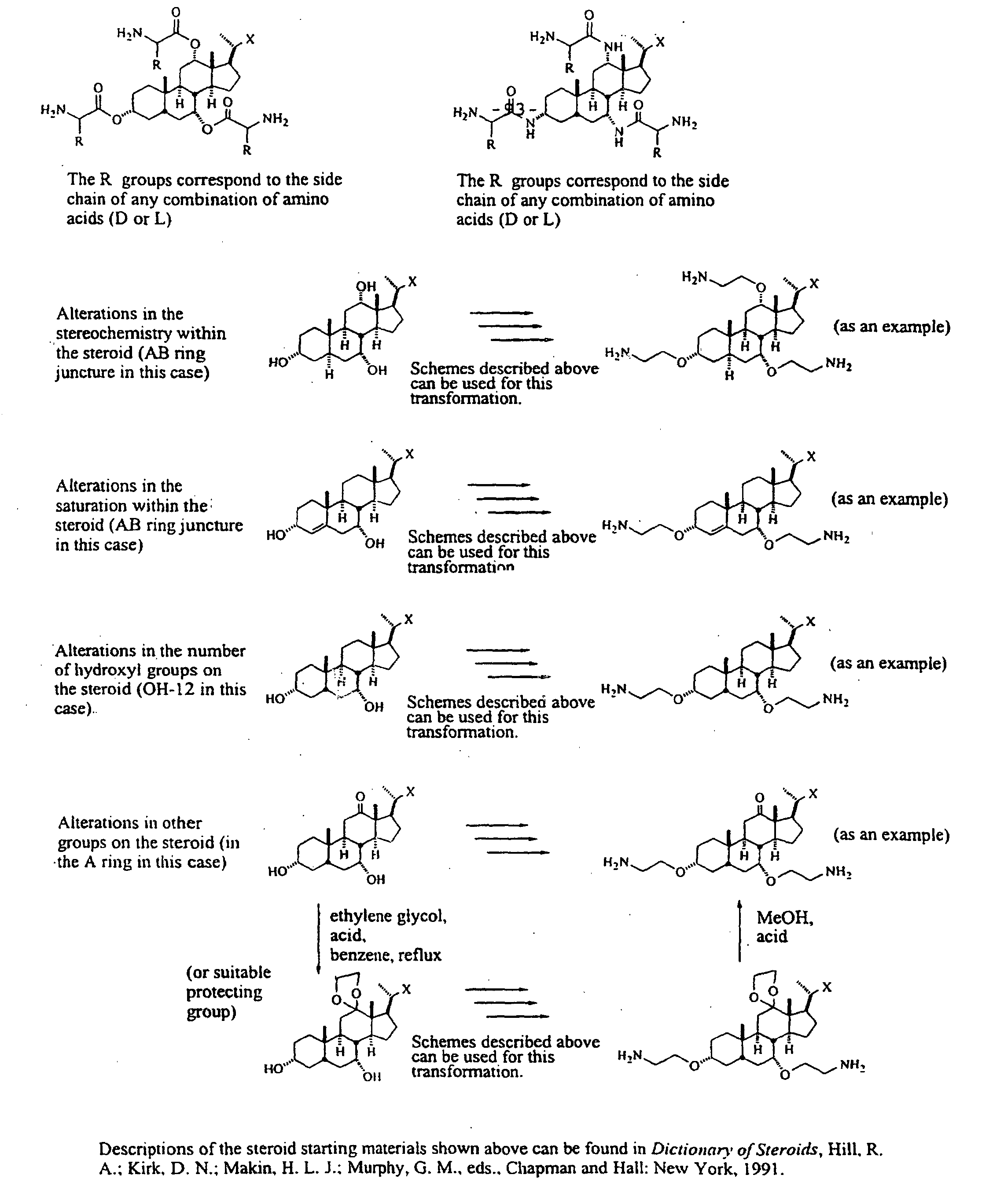
Claims (34)
- A compound according to formula Iwherein:
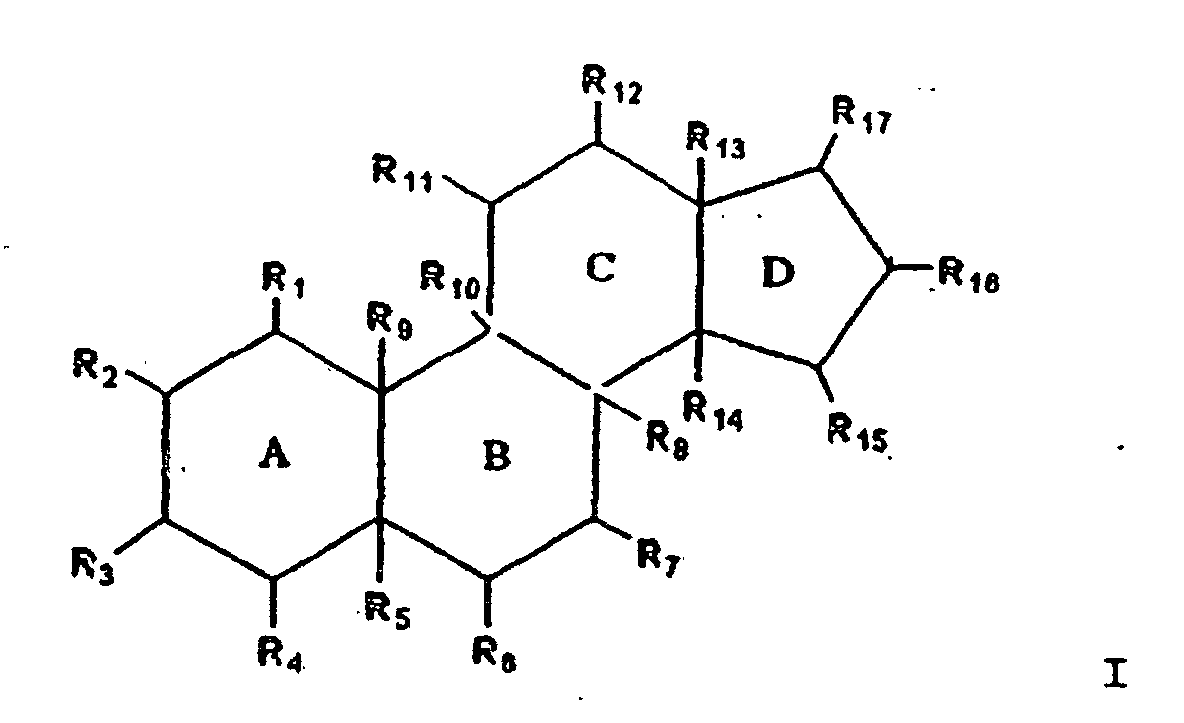 fused rings A, B, C, and D are independently saturated or fully or partially unsaturated; andR1 through R4, R6, R7, R11, R12, R15, R16, and R17 is each independently selected from the group consisting of hydrogen, hydroxyl, (C1-C10) alkyl, (C1-C10) hydroxyalkyl, (C1-C10) alkyloxy-(C1-C10) alkyl, a substituted or unsubstituted (C1-C10) aminoalkyl wherein the substituents are selected from the group consisting of hydroxyl, protected hydroxyl, amino, protected amino, carboxy, protected carboxy, cyano, methyl sulfonylamino, alkoxy, alkyl, aryl, N-benzyl, acyloxy, nitro, C1-C10 haloalkyl, C2-C6 alkenyl, C2-C6 alkynyl, oxo, a (C1-C10)alkyloxy-(C1-C10)alkyl linking group attached to a second steroid of formula I, (C1-C10) aminoalkyloxy, (C1-C10) aminoalkylcarboxy, (C1-C10) aminoalkylaminocarbonyl, H2N-HC(Q5)-C(O)-O-, H2N-HC(Q5)-C(O)-N(H)-, (C1-C10) azidoalkyloxy, (C1-C10) cyanoalkyloxy, P.G.-HN-CH(Q5)-C(O)-O-, (C1-C10) guanidinoalkyl oxy, and (C1-C10) guanidinoalkyl carboxy, where Q5 is H, P.G. is an amino protecting group, andR5, R8, R9, R10, R13, and R14 is each independently:further provided that the compound has at least one of the following features:deleted when one of fused rings A, B, C, or D is unsaturated so as to complete the valency of the carbon atom at that site, orselected from the group consisting of hydrogen, hydroxyl, (C1-C10) alkyl, (C1-C10) hydroxyalkyl, (C1-C10) alkyloxy-(C1-C10) alkyl, a substituted or unsubstituted (C1-C10) aminoalkyl wherein the substituents are selected from the group consisting of hydroxyl, protected hydroxyl, amino, protected amino, carboxy, protected carboxy, cyano, methyl sulfonylamino, alkoxy, alkyl, aryl, N-benzyl, acyloxy, nitro, C1-C10 haloalkyl, C2-C6 alkenyl, C2-C6 alkynyl, oxo, a (C1-C10) alkyloxy-(C1-C10) alkyl, linking group attached to a second steroid of formula I, (C1-C10) aminoalkyloxy, (C1-C10) aminoalkylcarboxy, (C1-C10) aminoalkylaminocarbonyl, H2N-HC(Q5)-C(O)-O-, H2N-HC(Q5)-C(O)-N(H)-, (C1-C10) azidoalkyloxy, (C1-C10) cyanoalkyloxy, P.G.-HN-CH(Q5)-C(O)-O-, (C1-C10) guanidinoalkyloxy, and (C1-C10) guanidinoalkylcarboxy, where Q5 is H, P.G. is an amino protecting group, andprovided that at least two of R1 through R14 are independently selected from the group consisting of (C1-C10) aminoalkyloxy, (C1-C10) aminoalkylcarboxy, (C1-C10) aminoalkylaminocarbonyl, H2N-HC(Q5)-C(O)-O-, H2N-HC(Q5)-C(O)-N(H)-, (C1-C10) azidoalkyloxy, (C1-C10) cyanoalkyloxy, P.G.-HN-CH(Q5)-C(O)-O-, (C1-C10) guanidinoalkyloxy, and (C1-C10) guanidinoalkylcarboxy;(a) at least one of the following pairs is deleted and the valency of the ring carbon atoms at these deleted positions is completed with a double bond: R5 and R9; R8 and R10; and R13 and R14; or (C1-C10)alkyloxy-(C1-C10)alkyl or a pharmaceutically acceptable salt thereof.(b) each of R3, R7, and R12 is independently selected from the group consisting of -O-C(O)-HC(Q5)-NH2, where Q5 is H; or (c) R17 is a (C1-C10)alkyloxy-(C1-C10)alkyl linking group attached to a second steroid and the second steroid is a compound of formula I.
 - A compound having the formula:
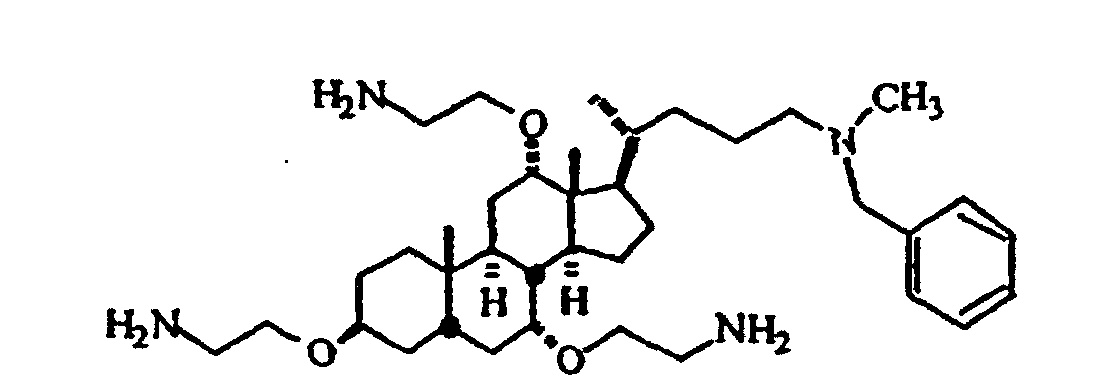
- A compound having the formula:
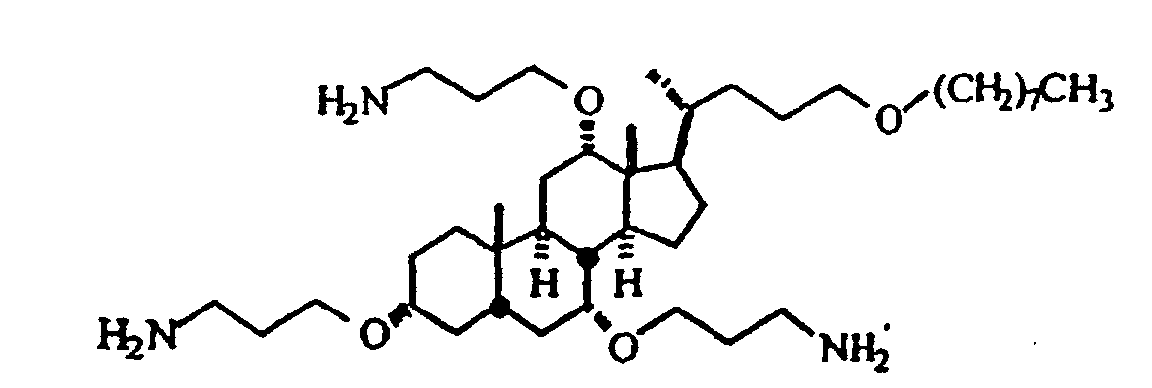
- A compound having the formula:

- A compound having the formula:

- A compound having the formula:

- A method of preparing a compound of formula I as defined in Claim 1 the method comprising:where at least two of R1 through R14 are hydroxyl, and the remaining moieties on the fused rings A, B, C, and D are defined for formula I, with a protected amino acid to produce a protected amino acid compound of formula IV where at least two of R1 through R14 are (P.G.-HN-HC(Q5)-C(O)-O-), where Q5 is H and P.G. is an amino protecting group; and removing the protecting group of the protected amino acid compound to form a compound of formula I.contacting a compound of formula IV,
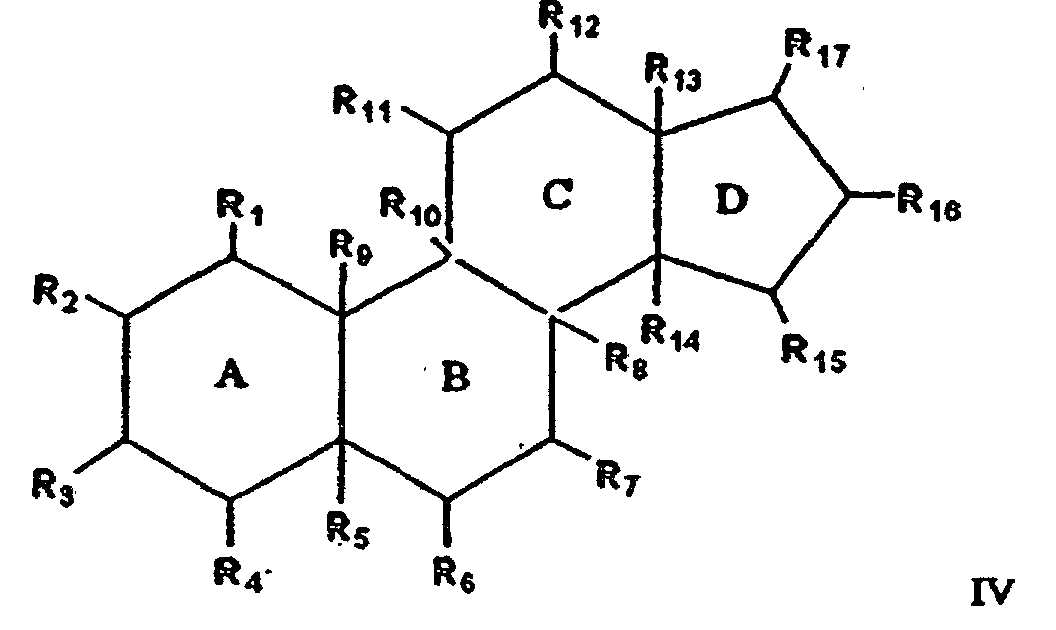
- A pharmaceutical composition comprising an effective amount of a compound of any one of claims 1 to 6.
- The pharmaceutical composition of claim 8, wherein the composition includes additional antibiotics.
- Use of a compound of any one of claims 1 to 6 in the manufacture of a medicament for treating a microbial infection of a host.
- The use of claim 10 in which the host is a human.
- Use as claimed in claim 10 or claim 11 wherein the compound is in the form of an anti-microbial composition which further comprises a second anti-microbial substance to be delivered into a microbial cell.
- Use as claimed in claim 12 in which the second anti-microbial substance is an anti-biotic.
- Use as claimed in any one of claims 10 to 13 in which the infection is a bacterial infection.
- Use as claimed in claim 14 in which the infection is a gram-negative bacterial infection.
- Use as claimed in claim 14 in which the bacterial infection is an infection with a bacterium characterized by an outer membrane comprising a substantial percentage of lipid A.
- Use of a compound of any one of claims 1 to 6 in the manufacture of a medicament for enhancing cell permeability,
- Use as claimed in claim 17, wherein the compound is used together with a substance to be introduced into the cell.
- Use as claimed in claim 17 or claim 18, in which the cell is a bacterium.
- Use as claimed in claim 19 in which the bacterium is a gram-negative bacterium.
- Use as claimed in claim 19 in which the bacterium is characterized by an outer membrane comprising a substantial percentage of lipid A.
- Use as claimed in claim 17 in which the cell is a sperm cell and the compound is part of a spermicidal composition.
- A method of identifying compounds effective against a microbe comprising administering a candidate compound and a compound according to any one of claims 1 to 6 to the microbe and determining whether the candidate compound has a static or toxic effect on the microbe.
- The method of claim 23 in which the microbe is a bacterium.
- The method of claim 24 in which the bacterium is a gram-negative bacterium.
- The method of claim 24 in which the bacterium is characterized by an outer membrane comprising greater than 40% of lipid A.
- A method of microbial growth control comprising contacting a microbe with an effective amount of anti-microbial composition comprising a compound according to any one of claims 1 to 6.
- The method of claim 27 in which the anti-microbial composition further comprises an anti-microbial substance.
- The method of claim 28 in which the antimicrobial substance is a disinfectant, an antibiotic, a disinfectant.
- A composition of matter comprising the compound of any one of claims 1 to 6 in combination with a substance to be introduced into a cell.
- The composition of claim 30 in which the substance to be introduced into a cell is an anti-microbial substance.
- The composition of claim 30 or claim 31 in which the compound and the substance are mixed with a pharmaceutically acceptable carrier.
- The composition of any one of claims 30 to 32 in which the anti-microbial substance is an antibiotic.
- Compound of any one of claims 1 to 6 for use as a medicament.
Applications Claiming Priority (1)
| Application Number | Priority Date | Filing Date | Title |
|---|---|---|---|
| PCT/US1998/004489 WO1999044616A1 (en) | 1998-03-06 | 1998-03-06 | Steroid derived antibiotics |
Publications (3)
| Publication Number | Publication Date |
|---|---|
| EP1058552A1 EP1058552A1 (en) | 2000-12-13 |
| EP1058552A4 EP1058552A4 (en) | 2001-09-19 |
| EP1058552B1 true EP1058552B1 (en) | 2004-06-16 |
Family
ID=22266538
Family Applications (1)
| Application Number | Title | Priority Date | Filing Date |
|---|---|---|---|
| EP98909028A Expired - Lifetime EP1058552B1 (en) | 1998-03-06 | 1998-03-06 | Steroid derived antibiotics |
Country Status (9)
| Country | Link |
|---|---|
| EP (1) | EP1058552B1 (en) |
| JP (1) | JP2002505292A (en) |
| CN (1) | CN100398109C (en) |
| AT (1) | ATE269086T1 (en) |
| AU (1) | AU759333B2 (en) |
| BR (1) | BR9815711B1 (en) |
| CA (1) | CA2322847C (en) |
| DE (1) | DE69824638T2 (en) |
| WO (1) | WO1999044616A1 (en) |
Cited By (7)
| Publication number | Priority date | Publication date | Assignee | Title |
|---|---|---|---|---|
| US10959433B2 (en) | 2017-03-21 | 2021-03-30 | Brigham Young University | Use of cationic steroidal antimicrobials for sporicidal activity |
| US11253634B2 (en) | 2016-03-11 | 2022-02-22 | Brigham Young University | Cationic steroidal antibiotic compositions for the treatment of dermal tissue |
| US11286276B2 (en) | 2014-01-23 | 2022-03-29 | Brigham Young University | Cationic steroidal antimicrobials |
| US11524015B2 (en) | 2013-03-15 | 2022-12-13 | Brigham Young University | Methods for treating inflammation, autoimmune disorders and pain |
| US11690855B2 (en) | 2013-10-17 | 2023-07-04 | Brigham Young University | Methods for treating lung infections and inflammation |
| US11739116B2 (en) | 2013-03-15 | 2023-08-29 | Brigham Young University | Methods for treating inflammation, autoimmune disorders and pain |
| US12186328B2 (en) | 2019-05-23 | 2025-01-07 | Brigham Young University | Use of CSA compounds to stimulate stem cells and hair growth |
Families Citing this family (34)
| Publication number | Priority date | Publication date | Assignee | Title |
|---|---|---|---|---|
| US6350738B1 (en) * | 1998-03-06 | 2002-02-26 | Brigham Young University | Steroid derived antibiotics |
| EP1223941B1 (en) * | 1999-10-25 | 2008-11-05 | Hollis-Eden Pharmaceuticals Inc. | Therapeutic treatments for blood cell deficiencies using sreroids |
| SK15692002A3 (en) | 2000-04-28 | 2003-11-04 | Inflazyme Pharmaceuticals Limited | 3-Nitrogen-6,7-dioxygen steroids and uses related thereto |
| CA2419801C (en) * | 2000-08-15 | 2010-08-10 | Brigham Young University | Steroid derived antibiotics |
| US7141559B2 (en) | 2002-06-19 | 2006-11-28 | Karo Bio Ab | Glucocorticoid receptor ligands for the treatment of metabolic disorders |
| KR100552567B1 (en) * | 2003-08-23 | 2006-02-15 | 한국유나이티드제약 주식회사 | Composition and preparation method for tablets containing cefuroxime axetyl that is stable to moisture absorption and rapidly disintegrates |
| WO2010036427A1 (en) | 2008-06-17 | 2010-04-01 | Brigham Young University | Cationic steroid antimicrobial diagnostic, detection, screening and imaging methods |
| KR20140063616A (en) | 2011-07-20 | 2014-05-27 | 브라이엄 영 유니버시티 | Hydrophobic ceragenin compounds and devices incorporating same |
| US8932614B2 (en) | 2011-08-25 | 2015-01-13 | Paul B. Savage | Incorporation of particulate ceragenins in polymers |
| US9694019B2 (en) | 2011-09-13 | 2017-07-04 | Brigham Young University | Compositions and methods for treating bone diseases and broken bones |
| US9603859B2 (en) | 2011-09-13 | 2017-03-28 | Brigham Young University | Methods and products for increasing the rate of healing of tissue wounds |
| BR112014005914B1 (en) | 2011-09-13 | 2021-11-09 | Brigham Young University | PRODUCTS FOR TISSUE WOUND HEALING |
| EP2755661B1 (en) | 2011-09-13 | 2026-08-05 | Brigham Young University | Compositions for treating bone diseases and broken bones |
| EP3449900A1 (en) * | 2011-12-21 | 2019-03-06 | Brigham Young University | Oral care compositions |
| US9533063B1 (en) | 2012-03-01 | 2017-01-03 | Brigham Young University | Aerosols incorporating ceragenin compounds and methods of use thereof |
| US20130280391A1 (en) * | 2012-04-24 | 2013-10-24 | Brigham Young University | Anti-microbial wash compositions including ceragenin compounds and methods of use for treating non-meat food products |
| CA2872399C (en) | 2012-05-02 | 2021-01-12 | Brigham Young University | Ceragenin particulate materials and methods for making same |
| CA2888259C (en) | 2012-10-17 | 2019-05-28 | Brigham Young University | Treatment and prevention of mastitis |
| AU2014203882B2 (en) | 2013-01-07 | 2016-06-23 | Brigham Young University | Methods for reducing cellular proliferation and treating certain diseases |
| US10568893B2 (en) | 2013-03-15 | 2020-02-25 | Brigham Young University | Methods for treating inflammation, autoimmune disorders and pain |
| US9387215B2 (en) | 2013-04-22 | 2016-07-12 | Brigham Young University | Animal feed including cationic cholesterol additive and related methods |
| CA2844321C (en) | 2014-02-27 | 2021-03-16 | Brigham Young University | Cationic steroidal antimicrobial compounds |
| US9867836B2 (en) | 2014-03-13 | 2018-01-16 | Brigham Young University | Lavage and/or infusion using CSA compounds for increasing fertility in a mammal |
| US10220045B2 (en) | 2014-03-13 | 2019-03-05 | Brigham Young University | Compositions and methods for forming stabilized compositions with reduced CSA agglomeration |
| US9931350B2 (en) | 2014-03-14 | 2018-04-03 | Brigham Young University | Anti-infective and osteogenic compositions and methods of use |
| US9686966B2 (en) | 2014-04-30 | 2017-06-27 | Brigham Young University | Methods and apparatus for cleaning or disinfecting a water delivery system |
| US10238665B2 (en) | 2014-06-26 | 2019-03-26 | Brigham Young University | Methods for treating fungal infections |
| US10441595B2 (en) | 2014-06-26 | 2019-10-15 | Brigham Young University | Methods for treating fungal infections |
| US10227376B2 (en) | 2014-08-22 | 2019-03-12 | Brigham Young University | Radiolabeled cationic steroid antimicrobials and diagnostic methods |
| US10155788B2 (en) | 2014-10-07 | 2018-12-18 | Brigham Young University | Cationic steroidal antimicrobial prodrug compositions and uses thereof |
| US9527883B2 (en) | 2015-04-22 | 2016-12-27 | Brigham Young University | Methods for the synthesis of ceragenins |
| US10370403B2 (en) | 2015-04-22 | 2019-08-06 | Brigham Young University | Methods for the synthesis of ceragenins |
| US9434759B1 (en) | 2015-05-18 | 2016-09-06 | Brigham Young University | Cationic steroidal antimicrobial compounds and methods of manufacturing such compounds |
| JP2017031201A (en) * | 2016-09-30 | 2017-02-09 | ブリガム ヤング ユニバーシティ | Oral care composition |
Family Cites Families (6)
| Publication number | Priority date | Publication date | Assignee | Title |
|---|---|---|---|---|
| US3519714A (en) * | 1966-03-15 | 1970-07-07 | Herchel Smith | Synthesis of gona-1,3,5(10)-trienes |
| US4192871A (en) * | 1976-01-06 | 1980-03-11 | Glaxo Laboratories Limited | Chemical compounds |
| CA2157594A1 (en) * | 1993-03-10 | 1994-09-15 | Leah L. Frye | Steroid derivatives, pharmaceutical compositions containing them, and their use as antibiotics or disinfectants |
| JPH09511486A (en) * | 1994-01-13 | 1997-11-18 | ザ・トラスティーズ・オブ・コランビア・ユニバーシティー・イン・ザ・シティー・オブ・ニューヨーク | Synthetic receptors, libraries and their use |
| DK0749437T3 (en) * | 1994-03-10 | 2002-03-04 | Magainin Pharma | Pharmaceutical use of steroid derivatives |
| US5834453A (en) * | 1995-05-30 | 1998-11-10 | Lehigh University | Methods for the manufacture and use of antimicrobial sterol conjugates |
-
1998
- 1998-03-06 AT AT98909028T patent/ATE269086T1/en not_active IP Right Cessation
- 1998-03-06 CA CA002322847A patent/CA2322847C/en not_active Expired - Lifetime
- 1998-03-06 JP JP2000534218A patent/JP2002505292A/en not_active Withdrawn
- 1998-03-06 WO PCT/US1998/004489 patent/WO1999044616A1/en not_active Ceased
- 1998-03-06 CN CNB988138611A patent/CN100398109C/en not_active Expired - Lifetime
- 1998-03-06 AU AU66911/98A patent/AU759333B2/en not_active Expired
- 1998-03-06 BR BRPI9815711-6A patent/BR9815711B1/en not_active IP Right Cessation
- 1998-03-06 DE DE69824638T patent/DE69824638T2/en not_active Expired - Lifetime
- 1998-03-06 EP EP98909028A patent/EP1058552B1/en not_active Expired - Lifetime
Cited By (8)
| Publication number | Priority date | Publication date | Assignee | Title |
|---|---|---|---|---|
| US11524015B2 (en) | 2013-03-15 | 2022-12-13 | Brigham Young University | Methods for treating inflammation, autoimmune disorders and pain |
| US11739116B2 (en) | 2013-03-15 | 2023-08-29 | Brigham Young University | Methods for treating inflammation, autoimmune disorders and pain |
| US11690855B2 (en) | 2013-10-17 | 2023-07-04 | Brigham Young University | Methods for treating lung infections and inflammation |
| US12653832B2 (en) | 2013-10-17 | 2026-06-16 | Brigham Young University | Methods for treating lung infections and inflammation |
| US11286276B2 (en) | 2014-01-23 | 2022-03-29 | Brigham Young University | Cationic steroidal antimicrobials |
| US11253634B2 (en) | 2016-03-11 | 2022-02-22 | Brigham Young University | Cationic steroidal antibiotic compositions for the treatment of dermal tissue |
| US10959433B2 (en) | 2017-03-21 | 2021-03-30 | Brigham Young University | Use of cationic steroidal antimicrobials for sporicidal activity |
| US12186328B2 (en) | 2019-05-23 | 2025-01-07 | Brigham Young University | Use of CSA compounds to stimulate stem cells and hair growth |
Also Published As
| Publication number | Publication date |
|---|---|
| CA2322847C (en) | 2008-05-13 |
| CN100398109C (en) | 2008-07-02 |
| BR9815711A (en) | 2001-11-13 |
| JP2002505292A (en) | 2002-02-19 |
| CN1294514A (en) | 2001-05-09 |
| CA2322847A1 (en) | 1999-09-10 |
| EP1058552A4 (en) | 2001-09-19 |
| DE69824638T2 (en) | 2005-06-23 |
| AU759333B2 (en) | 2003-04-10 |
| DE69824638D1 (en) | 2004-07-22 |
| AU6691198A (en) | 1999-09-20 |
| BR9815711B1 (en) | 2014-10-29 |
| EP1058552A1 (en) | 2000-12-13 |
| WO1999044616A1 (en) | 1999-09-10 |
| ATE269086T1 (en) | 2004-07-15 |
Similar Documents
| Publication | Publication Date | Title |
|---|---|---|
| CA2322847C (en) | Steroid derived antibiotics | |
| US6486148B2 (en) | Steroid derived antibiotics | |
| EP1311531B1 (en) | Steroid derived antibiotics | |
| US6767904B2 (en) | Steroid derived antibiotics | |
| JP5147814B2 (en) | Steroid-derived antibiotics | |
| US5637691A (en) | Steroid derivatives, pharmaceutical compositions containing them, and their use as antibiotics or disinfectants | |
| CA2185123C (en) | Steroid derivatives, pharmaceutical compositions containing them, and their pharmaceutical uses | |
| US5215980A (en) | 10-AZA-9-deoxo-11-deoxy-erythromycin A and derivatives thereof | |
| US5834453A (en) | Methods for the manufacture and use of antimicrobial sterol conjugates | |
| MXPA00008737A (en) | Steroid derived antibiotics | |
| WO2003087121A1 (en) | Branched polyamine steroid derivatives | |
| AU692766C (en) | Steroid derivatives, pharmaceutical compositions containing them, and their use as antibiotics or disinfectants | |
| JP2025513630A (en) | Antibacterial compounds that eliminate dormant bacterial cells | |
| Li | Development of lipid A binding agents based on cholic acid scaffolding and the synthesis of monoglycosyl ceramides for immunological activity studies |
Legal Events
| Date | Code | Title | Description |
|---|---|---|---|
| PUAI | Public reference made under article 153(3) epc to a published international application that has entered the european phase |
Free format text: ORIGINAL CODE: 0009012 |
|
| 17P | Request for examination filed |
Effective date: 20001005 |
|
| AK | Designated contracting states |
Kind code of ref document: A1 Designated state(s): AT BE CH DE DK ES FI FR GB GR IE IT LI LU MC NL PT SE |
|
| A4 | Supplementary search report drawn up and despatched |
Effective date: 20010806 |
|
| AK | Designated contracting states |
Kind code of ref document: A4 Designated state(s): AT BE CH DE DK ES FI FR GB GR IE IT LI LU MC NL PT SE |
|
| RIC1 | Information provided on ipc code assigned before grant |
Free format text: 7A 61K 31/56 A, 7C 07J 41/00 B, 7A 61K 31/57 B, 7A 61K 31/575 B |
|
| 17Q | First examination report despatched |
Effective date: 20020404 |
|
| GRAP | Despatch of communication of intention to grant a patent |
Free format text: ORIGINAL CODE: EPIDOSNIGR1 |
|
| GRAS | Grant fee paid |
Free format text: ORIGINAL CODE: EPIDOSNIGR3 |
|
| GRAA | (expected) grant |
Free format text: ORIGINAL CODE: 0009210 |
|
| AK | Designated contracting states |
Kind code of ref document: B1 Designated state(s): AT BE CH DE DK ES FI FR GB GR IE IT LI LU MC NL PT SE |
|
| PG25 | Lapsed in a contracting state [announced via postgrant information from national office to epo] |
Ref country code: NL Free format text: LAPSE BECAUSE OF FAILURE TO SUBMIT A TRANSLATION OF THE DESCRIPTION OR TO PAY THE FEE WITHIN THE PRESCRIBED TIME-LIMIT Effective date: 20040616 Ref country code: LI Free format text: LAPSE BECAUSE OF FAILURE TO SUBMIT A TRANSLATION OF THE DESCRIPTION OR TO PAY THE FEE WITHIN THE PRESCRIBED TIME-LIMIT Effective date: 20040616 Ref country code: FI Free format text: LAPSE BECAUSE OF FAILURE TO SUBMIT A TRANSLATION OF THE DESCRIPTION OR TO PAY THE FEE WITHIN THE PRESCRIBED TIME-LIMIT Effective date: 20040616 Ref country code: CH Free format text: LAPSE BECAUSE OF FAILURE TO SUBMIT A TRANSLATION OF THE DESCRIPTION OR TO PAY THE FEE WITHIN THE PRESCRIBED TIME-LIMIT Effective date: 20040616 Ref country code: BE Free format text: LAPSE BECAUSE OF FAILURE TO SUBMIT A TRANSLATION OF THE DESCRIPTION OR TO PAY THE FEE WITHIN THE PRESCRIBED TIME-LIMIT Effective date: 20040616 Ref country code: AT Free format text: LAPSE BECAUSE OF FAILURE TO SUBMIT A TRANSLATION OF THE DESCRIPTION OR TO PAY THE FEE WITHIN THE PRESCRIBED TIME-LIMIT Effective date: 20040616 |
|
| REG | Reference to a national code |
Ref country code: GB Ref legal event code: FG4D |
|
| REG | Reference to a national code |
Ref country code: CH Ref legal event code: EP |
|
| REF | Corresponds to: |
Ref document number: 69824638 Country of ref document: DE Date of ref document: 20040722 Kind code of ref document: P |
|
| REG | Reference to a national code |
Ref country code: IE Ref legal event code: FG4D |
|
| PG25 | Lapsed in a contracting state [announced via postgrant information from national office to epo] |
Ref country code: SE Free format text: LAPSE BECAUSE OF FAILURE TO SUBMIT A TRANSLATION OF THE DESCRIPTION OR TO PAY THE FEE WITHIN THE PRESCRIBED TIME-LIMIT Effective date: 20040916 Ref country code: GR Free format text: LAPSE BECAUSE OF FAILURE TO SUBMIT A TRANSLATION OF THE DESCRIPTION OR TO PAY THE FEE WITHIN THE PRESCRIBED TIME-LIMIT Effective date: 20040916 Ref country code: DK Free format text: LAPSE BECAUSE OF FAILURE TO SUBMIT A TRANSLATION OF THE DESCRIPTION OR TO PAY THE FEE WITHIN THE PRESCRIBED TIME-LIMIT Effective date: 20040916 |
|
| PG25 | Lapsed in a contracting state [announced via postgrant information from national office to epo] |
Ref country code: ES Free format text: LAPSE BECAUSE OF FAILURE TO SUBMIT A TRANSLATION OF THE DESCRIPTION OR TO PAY THE FEE WITHIN THE PRESCRIBED TIME-LIMIT Effective date: 20040927 |
|
| NLV1 | Nl: lapsed or annulled due to failure to fulfill the requirements of art. 29p and 29m of the patents act | ||
| REG | Reference to a national code |
Ref country code: CH Ref legal event code: PL |
|
| ET | Fr: translation filed | ||
| PG25 | Lapsed in a contracting state [announced via postgrant information from national office to epo] |
Ref country code: LU Free format text: LAPSE BECAUSE OF NON-PAYMENT OF DUE FEES Effective date: 20050306 |
|
| PG25 | Lapsed in a contracting state [announced via postgrant information from national office to epo] |
Ref country code: IE Free format text: LAPSE BECAUSE OF NON-PAYMENT OF DUE FEES Effective date: 20050307 |
|
| PG25 | Lapsed in a contracting state [announced via postgrant information from national office to epo] |
Ref country code: MC Free format text: LAPSE BECAUSE OF NON-PAYMENT OF DUE FEES Effective date: 20050331 |
|
| PLBE | No opposition filed within time limit |
Free format text: ORIGINAL CODE: 0009261 |
|
| STAA | Information on the status of an ep patent application or granted ep patent |
Free format text: STATUS: NO OPPOSITION FILED WITHIN TIME LIMIT |
|
| 26N | No opposition filed |
Effective date: 20050317 |
|
| REG | Reference to a national code |
Ref country code: IE Ref legal event code: MM4A |
|
| PG25 | Lapsed in a contracting state [announced via postgrant information from national office to epo] |
Ref country code: PT Free format text: LAPSE BECAUSE OF NON-PAYMENT OF DUE FEES Effective date: 20041116 |
|
| REG | Reference to a national code |
Ref country code: FR Ref legal event code: PLFP Year of fee payment: 19 |
|
| REG | Reference to a national code |
Ref country code: FR Ref legal event code: PLFP Year of fee payment: 20 |
|
| PGFP | Annual fee paid to national office [announced via postgrant information from national office to epo] |
Ref country code: FR Payment date: 20170327 Year of fee payment: 20 |
|
| PGFP | Annual fee paid to national office [announced via postgrant information from national office to epo] |
Ref country code: GB Payment date: 20170327 Year of fee payment: 20 |
|
| PGFP | Annual fee paid to national office [announced via postgrant information from national office to epo] |
Ref country code: IT Payment date: 20170324 Year of fee payment: 20 |
|
| PGFP | Annual fee paid to national office [announced via postgrant information from national office to epo] |
Ref country code: DE Payment date: 20170329 Year of fee payment: 20 |
|
| REG | Reference to a national code |
Ref country code: DE Ref legal event code: R071 Ref document number: 69824638 Country of ref document: DE |
|
| REG | Reference to a national code |
Ref country code: GB Ref legal event code: PE20 Expiry date: 20180305 |
|
| PG25 | Lapsed in a contracting state [announced via postgrant information from national office to epo] |
Ref country code: GB Free format text: LAPSE BECAUSE OF EXPIRATION OF PROTECTION Effective date: 20180305 |