EP1057850A2 - LCP bonding method - Google Patents
LCP bonding method Download PDFInfo
- Publication number
- EP1057850A2 EP1057850A2 EP00304557A EP00304557A EP1057850A2 EP 1057850 A2 EP1057850 A2 EP 1057850A2 EP 00304557 A EP00304557 A EP 00304557A EP 00304557 A EP00304557 A EP 00304557A EP 1057850 A2 EP1057850 A2 EP 1057850A2
- Authority
- EP
- European Patent Office
- Prior art keywords
- lcp
- epoxy resin
- adhesive
- resin
- bonding
- Prior art date
- Legal status (The legal status is an assumption and is not a legal conclusion. Google has not performed a legal analysis and makes no representation as to the accuracy of the status listed.)
- Withdrawn
Links
Classifications
-
- C—CHEMISTRY; METALLURGY
- C08—ORGANIC MACROMOLECULAR COMPOUNDS; THEIR PREPARATION OR CHEMICAL WORKING-UP; COMPOSITIONS BASED THEREON
- C08J—WORKING-UP; GENERAL PROCESSES OF COMPOUNDING; AFTER-TREATMENT NOT COVERED BY SUBCLASSES C08B, C08C, C08F, C08G or C08H
- C08J5/00—Manufacture of articles or shaped materials containing macromolecular substances
- C08J5/12—Bonding of a preformed macromolecular material to the same or other solid material such as metal, glass, leather, e.g. using adhesives
- C08J5/124—Bonding of a preformed macromolecular material to the same or other solid material such as metal, glass, leather, e.g. using adhesives using adhesives based on a macromolecular component
- C08J5/128—Adhesives without diluent
-
- C—CHEMISTRY; METALLURGY
- C08—ORGANIC MACROMOLECULAR COMPOUNDS; THEIR PREPARATION OR CHEMICAL WORKING-UP; COMPOSITIONS BASED THEREON
- C08L—COMPOSITIONS OF MACROMOLECULAR COMPOUNDS
- C08L63/00—Compositions of epoxy resins; Compositions of derivatives of epoxy resins
-
- C—CHEMISTRY; METALLURGY
- C09—DYES; PAINTS; POLISHES; NATURAL RESINS; ADHESIVES; COMPOSITIONS NOT OTHERWISE PROVIDED FOR; APPLICATIONS OF MATERIALS NOT OTHERWISE PROVIDED FOR
- C09J—ADHESIVES; NON-MECHANICAL ASPECTS OF ADHESIVE PROCESSES IN GENERAL; ADHESIVE PROCESSES NOT PROVIDED FOR ELSEWHERE; USE OF MATERIALS AS ADHESIVES
- C09J163/00—Adhesives based on epoxy resins; Adhesives based on derivatives of epoxy resins
-
- C—CHEMISTRY; METALLURGY
- C09—DYES; PAINTS; POLISHES; NATURAL RESINS; ADHESIVES; COMPOSITIONS NOT OTHERWISE PROVIDED FOR; APPLICATIONS OF MATERIALS NOT OTHERWISE PROVIDED FOR
- C09J—ADHESIVES; NON-MECHANICAL ASPECTS OF ADHESIVE PROCESSES IN GENERAL; ADHESIVE PROCESSES NOT PROVIDED FOR ELSEWHERE; USE OF MATERIALS AS ADHESIVES
- C09J179/00—Adhesives based on macromolecular compounds obtained by reactions forming in the main chain of the macromolecule a linkage containing nitrogen, with or without oxygen, or carbon only, not provided for in groups C09J161/00 - C09J177/00
- C09J179/04—Polycondensates having nitrogen-containing heterocyclic rings in the main chain; Polyhydrazides; Polyamide acids or similar polyimide precursors
- C09J179/08—Polyimides; Polyester-imides; Polyamide-imides; Polyamide acids or similar polyimide precursors
-
- C—CHEMISTRY; METALLURGY
- C08—ORGANIC MACROMOLECULAR COMPOUNDS; THEIR PREPARATION OR CHEMICAL WORKING-UP; COMPOSITIONS BASED THEREON
- C08L—COMPOSITIONS OF MACROMOLECULAR COMPOUNDS
- C08L2666/00—Composition of polymers characterized by a further compound in the blend, being organic macromolecular compounds, natural resins, waxes or and bituminous materials, non-macromolecular organic substances, inorganic substances or characterized by their function in the composition
- C08L2666/02—Organic macromolecular compounds, natural resins, waxes or and bituminous materials
- C08L2666/14—Macromolecular compounds according to C08L59/00 - C08L87/00; Derivatives thereof
- C08L2666/20—Macromolecular compounds having nitrogen in the main chain according to C08L75/00 - C08L79/00; Derivatives thereof
-
- H—ELECTRICITY
- H10—SEMICONDUCTOR DEVICES; ELECTRIC SOLID-STATE DEVICES NOT OTHERWISE PROVIDED FOR
- H10W—GENERIC PACKAGES, INTERCONNECTIONS, CONNECTORS OR OTHER CONSTRUCTIONAL DETAILS OF DEVICES COVERED BY CLASS H10
- H10W72/00—Interconnections or connectors in packages
- H10W72/071—Connecting or disconnecting
- H10W72/073—Connecting or disconnecting of die-attach connectors
-
- H—ELECTRICITY
- H10—SEMICONDUCTOR DEVICES; ELECTRIC SOLID-STATE DEVICES NOT OTHERWISE PROVIDED FOR
- H10W—GENERIC PACKAGES, INTERCONNECTIONS, CONNECTORS OR OTHER CONSTRUCTIONAL DETAILS OF DEVICES COVERED BY CLASS H10
- H10W72/00—Interconnections or connectors in packages
- H10W72/071—Connecting or disconnecting
- H10W72/073—Connecting or disconnecting of die-attach connectors
- H10W72/07331—Connecting techniques
- H10W72/07337—Connecting techniques using a polymer adhesive, e.g. an adhesive based on silicone or epoxy
-
- H—ELECTRICITY
- H10—SEMICONDUCTOR DEVICES; ELECTRIC SOLID-STATE DEVICES NOT OTHERWISE PROVIDED FOR
- H10W—GENERIC PACKAGES, INTERCONNECTIONS, CONNECTORS OR OTHER CONSTRUCTIONAL DETAILS OF DEVICES COVERED BY CLASS H10
- H10W72/00—Interconnections or connectors in packages
- H10W72/30—Die-attach connectors
-
- H—ELECTRICITY
- H10—SEMICONDUCTOR DEVICES; ELECTRIC SOLID-STATE DEVICES NOT OTHERWISE PROVIDED FOR
- H10W—GENERIC PACKAGES, INTERCONNECTIONS, CONNECTORS OR OTHER CONSTRUCTIONAL DETAILS OF DEVICES COVERED BY CLASS H10
- H10W72/00—Interconnections or connectors in packages
- H10W72/30—Die-attach connectors
- H10W72/321—Structures or relative sizes of die-attach connectors
- H10W72/325—Die-attach connectors having a filler embedded in a matrix
-
- H—ELECTRICITY
- H10—SEMICONDUCTOR DEVICES; ELECTRIC SOLID-STATE DEVICES NOT OTHERWISE PROVIDED FOR
- H10W—GENERIC PACKAGES, INTERCONNECTIONS, CONNECTORS OR OTHER CONSTRUCTIONAL DETAILS OF DEVICES COVERED BY CLASS H10
- H10W72/00—Interconnections or connectors in packages
- H10W72/30—Die-attach connectors
- H10W72/351—Materials of die-attach connectors
- H10W72/352—Materials of die-attach connectors comprising metals or metalloids, e.g. solders
-
- H—ELECTRICITY
- H10—SEMICONDUCTOR DEVICES; ELECTRIC SOLID-STATE DEVICES NOT OTHERWISE PROVIDED FOR
- H10W—GENERIC PACKAGES, INTERCONNECTIONS, CONNECTORS OR OTHER CONSTRUCTIONAL DETAILS OF DEVICES COVERED BY CLASS H10
- H10W72/00—Interconnections or connectors in packages
- H10W72/30—Die-attach connectors
- H10W72/351—Materials of die-attach connectors
- H10W72/353—Materials of die-attach connectors not comprising solid metals or solid metalloids, e.g. ceramics
-
- H—ELECTRICITY
- H10—SEMICONDUCTOR DEVICES; ELECTRIC SOLID-STATE DEVICES NOT OTHERWISE PROVIDED FOR
- H10W—GENERIC PACKAGES, INTERCONNECTIONS, CONNECTORS OR OTHER CONSTRUCTIONAL DETAILS OF DEVICES COVERED BY CLASS H10
- H10W72/00—Interconnections or connectors in packages
- H10W72/30—Die-attach connectors
- H10W72/351—Materials of die-attach connectors
- H10W72/353—Materials of die-attach connectors not comprising solid metals or solid metalloids, e.g. ceramics
- H10W72/354—Materials of die-attach connectors not comprising solid metals or solid metalloids, e.g. ceramics comprising polymers
-
- H—ELECTRICITY
- H10—SEMICONDUCTOR DEVICES; ELECTRIC SOLID-STATE DEVICES NOT OTHERWISE PROVIDED FOR
- H10W—GENERIC PACKAGES, INTERCONNECTIONS, CONNECTORS OR OTHER CONSTRUCTIONAL DETAILS OF DEVICES COVERED BY CLASS H10
- H10W74/00—Encapsulations, e.g. protective coatings
Definitions
- the present invention relates to a method for bonding LCP and, more specifically, to a method for bonding LCP using an adhesive which has heat resistance and excellent adhesion to an LCP.
- LCP Liquid Crystalline Polymer
- an epoxy resin is widely used as a main raw material in the field of adhesives because a shrinkage of the epoxy resin is small when the epoxy resin is cured and it has excellent adhesion to metals.
- thermosetting adhesive typified by a general-purpose adhesive put on the market has poor adhesion to an LCP.
- an LCP is used as a package material for electronic parts when the parts are mounted on a substrate, there is no thermosetting adhesive having sufficient strength obtained by bonding a substrate to a package. Therefore, its application field is very narrow at the moment.
- the permeation of the adhesive into a molding resin is seen and it is considered that an anchoring effect is exhibited.
- the permeable adhesive is not preferred because it may change the characteristic properties of the LCP resin and the characteristic properties of internal electronic parts packaged with the LCP.
- a method for bonding an LCP using a mechanical unit is also reported (Japanese Patent Application Laid-open No. Hei 5-177716). This method relates to a method in which the LCP is physically bonded by engaging or screwing. However, it is troublesome compared with a method using an adhesive, which is a defect of the method.
- the inventors of the present invention have conducted intensive studies to attain the above object, and have found out that an adhesive having excellent adhesion properties to an LCP can be obtained by adding and mixing a polycarbodiimide resin with an epoxy resin composition comprising an epoxy resin and a curing agent. Then the present invention has been accomplished based on this finding.
- the present invention provides a method for bonding LCPs mutually or an LCP and another material comprising the step of bonding the LCPs mutually or an LCP and another material using an adhesive prepared by adding a polycarbodiimide resin with an epoxy resin composition comprising an epoxy resin and a curing agent.
- the present invention also provides an adhesive for an LCP which is prepared by adding a polycarbodiimide resin with an epoxy resin composition comprising an epoxy resin and a curing agent.
- the method for bonding LCP of the present invention is characterized in that LCPs mutually or an LCP and another material are bonded together using an adhesive prepared by adding a polycarbodiimide resin with an epoxy resin composition comprising an epoxy resin and a curing agent.
- the adhesive used in this method is preferably an adhesive prepared by adding a polycarbodiimide resin with an epoxy resin composition comprising an epoxy resin and a curing agent and is produced without adding water.
- the epoxy resin that can be used in the present invention includes a glycidyl ether type epoxy resin typified by a bisphenol A type epoxy resin, novolak type epoxy resin and cresol-novolak type epoxy resin, and an epoxy resin having at least one epoxy group in the molecule such as an alicyclic epoxy resin, heterocyclic epoxy resin or liquid rubber modified epoxy resin. Any resin called epoxy resin may be used in the present invention.
- the epoxy resin used in the present invention is preferably liquid at room temperature without a solvent, more preferably a bisphenol type epoxy resin.
- Illustrative examples of the curing agent used in the present invention include acid anhydrides such as methyl nadic anhydride, dodecenylsuccinic anhydride, tetrahydrophthalic anhydride, hexahydrophthalic anhydride, methyl endomethylene tetrahydrophthalic anhydride, chlorendic anhydride, ethylene glycol trimellitic anhydride ester, methyl tetrahydrophthalic anhydride and methyl hexahydrophthalic anhydride; imidazole derivatives such as imidazole, 2-methylimidazole, 2-ethyl-4-methylimidazole, 2-phenylimidazole, 2-undecylimidazole, 2-heptadecylimidazole, 1-benzyl-2-methylimidazole, 1-cyanoethyl-2-methylimidazole, 1-cyanoethyl-2-phenylimidazole, 1-cyanoethyl-2
- the amount of the curing agent may be suitably selected according to the type of curing agent used. It is generally 2 to 200 parts by weight based on 100 parts by weight of the epoxy resin. A curing accellorator may be used at this point, which can be easily presumed. They may be used alone or in combination of two or more.
- the polycarbodiimide resin used in the present invention may be produced by a method such as a method disclosed in Japanese Patent Application Laid-open No. Sho 51-61599, the method of L. M. Alberino [J. Appl. Polym. Sci., 21, 1999 (1997)], or methods disclosed in Japanese Patent Application Laid-open No. Hei 2-292316 and Japanese Patent Application Laid-open No. Hei 6-56950. That is, the polycarbodiimide resin can be produced from an organic diisocyanate in the presence of a catalyst for promoting the carbodiimidation of the isocyanate.
- the organic diisocyanate used in the production of the polycarbodiimide resin may be any type of aliphatic, alicyclic, aromatic or aromatic-aliphatic. These organic diisocyanates may be used solely or in combination of two or more.
- organic diisocyanate corresponding to R examples include 2,4-tolylene diisocyanate, 2,6-tolylene diisocyanate, a mixture of 2,4- and 2,6-tolylene diisocyanates, crude tolylene diisocyanate, crude diphenylmethane diisocyanate, 4,4,4''-triphenylmethylene triisocyanate, xylylene diisocyanate, hexamethylene-1,6-diisocyanate, lysine diisocyanate, hydrogenated diphenylmethane diisocyanate, isophorone diisocyanate, tetramethyl xylylene diisocyanate, 4,4'-biphenylene diisocyanate, diphenylmethane diisocyanate, 3,3'-dimethylphenylmethane-4,4'-diisocyanate, 3,3'-dimethyldiphenyl-4,4'-diiso
- the above polycarbodiimide resin may be a polycarbodiimide resin having an isocyanate group itself at a terminal or may be treated by capping the terminal with a compound having one selected from a monoisocyanate, -NH 2 , -NHR (where R is an alkyl group), -COOH, -SH and -OH groups or an acid anhydride to control its molecular weight in compliance with use.
- the polycarbodiimide resin used in the present invention is not particularly limited as described above, but it is preferably a polycarbodiimide resin of being mixed with an epoxy resin easily, particularly preferably a polycarbodiimide resin in the form of a powder or liquid.
- the amount of the polycarbodiimide resin is 0.1 part or more by weight and 10 parts or less by weight based on 100 parts by weight of the epoxy resin composition comprising the epoxy resin and the curing agent. When the amount is 0.1 part or more by weight, a sufficient effect is obtained and when the amount is 10 parts or less by weight, it is easy to control the viscosity and reactivity of the adhesive.
- the adhesive of the present invention may contain a thixotrophy imparting agent, filler or coupling agent as required.
- Well known thixotrophy imparting agents may be used, and examples of these include inorganic fine particles such as powder silica, calcium carbonate and bentonite; and organic materials such as polycarboxylic acid, castor oil derivatives and polyamide-based wax.
- filler is used as a concept, including not only powder fillers but also flame retardants and colorants.
- the powder fillers include crystalline silica, molten silica, calcium carbonate, talc, mica, alumina, aluminum hydroxide, white carbon, carbon black, expanded graphite powders and powdery graphite.
- the flame retardants include powdery organic halogen compounds, red phosphorus and antimony trioxide.
- the colorants include pigments and dyes of various kinds. These fillers may be selected and used according to purpose.
- the coupling agent examples include silane-based coupling agents such as ⁇ -methacryloxypropyl trimethoxysilane, ⁇ -(3,4-epoxycyclohexyl)trimethoxysilane and ⁇ -aminopropyl triethoxysilane; and titanium-based coupling agents such as tetraisopropyl titanate and titanium acylate.
- silane-based coupling agents such as ⁇ -methacryloxypropyl trimethoxysilane, ⁇ -(3,4-epoxycyclohexyl)trimethoxysilane and ⁇ -aminopropyl triethoxysilane
- titanium-based coupling agents such as tetraisopropyl titanate and titanium acylate.
- Water may be adsorbed to the thixotrophy imparting agent or filler, therefore the adhesive of the present invention may contain water. In case that the amount of water is very small, there is no problem. However, to bond an LCP effectively, it is preferred that the content of water in the adhesive should be small and that water should not be added during the production.
- the adhesive is produced without adding water and the content of water is preferably 0.5 wt% or less, more preferably 0.3 wt% or less based on the total weight of the adhesive.
- the polycarbodiimide resin As a method to add the polycarbodiimide resin with an epoxy resin composition comprising an epoxy resin and a curing agent, when the polycarbodiimide resin is solid, it may be illustlated general method to powder them and uniformly disperse with a kneader such as a three-roll mill.
- the epoxy resin composition may be melt and kneaded using a melt kneader such as a Banbury mixer or rubber roll machine.
- the polycarbodiimide resin prepared in the form of a solution using a soluble solvent may be kneaded with the epoxy resin composition and then the solvent may be removed therefrom.
- the polycarbodiimide resin When the polycarbodiimide resin is liquid, it can be directly mixed with and dispersed into the epoxy resin composition.
- the adhesive of the present invention is cured at 130 to 200°C for 1 to 180 minutes, preferably 150 to 180°C for 10 to 30 minutes when dicyandiamide which is a potential curing agent is used. Since the epoxy adhesive has sufficient adhesion strength and reflow soldering heat resistance and further has no metal corrosiveness after curing, it is suitably used for electronic parts to bond LCPs mutually, an LCP and a metal, or an LCP and resin.
- the LCP applicable to the present invention is not particularly limited to, and includes thermotropic LCP and all kinds of conventionally well known LCP.
- the thermotropic LCP include aromatic polyester LCP which are synthesized from a monomer such as an aromatic diol, aromatic carboxylic acid or hydroxycarboxylic acid and which shows liquid crystallinity when molten.
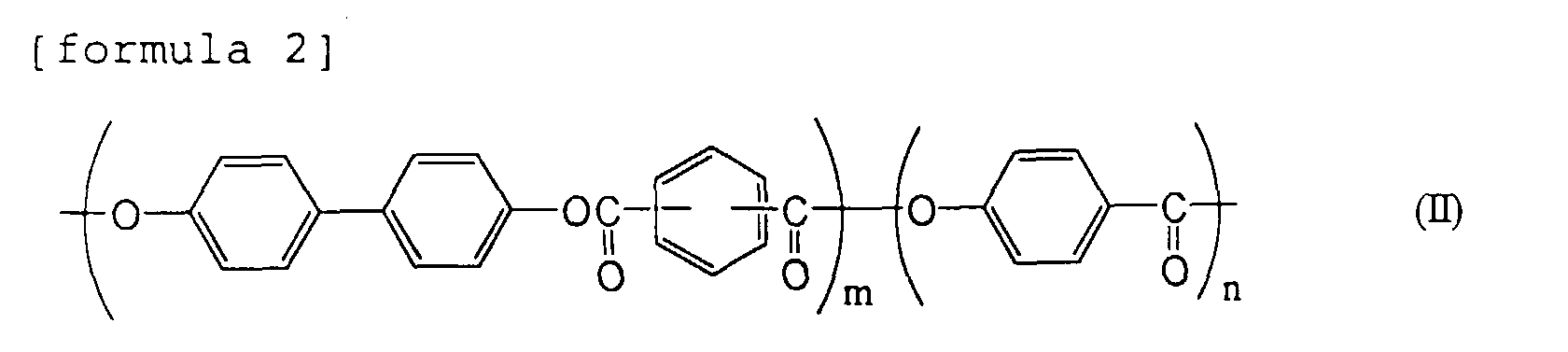
- Typical thermotropic LCP include LCP of a first type which comprises parahydroxybenzoic acid (PHB), terephthalic acid and biphenol (following formula II), LCP of a second type which comprises PHB and 2,6-hydroxynaphthoic acid (following formula III), and LCP of a third type which comprises PHB, terephthalic acid and ethylene glycol (following formula IV).
- LCP may contain a filler such as glass fibers, carbon fibers, silica, alumina, titania or zirconia, flame retardant and plasticizer in suitable amounts.
- a filler such as glass fibers, carbon fibers, silica, alumina, titania or zirconia, flame retardant and plasticizer in suitable amounts.
- Illustrative examples of the LCP in the present invention are enumerated above but the present invention is not limited to these.
- Other materials which can be bonded to the LCP with the adhesive of the present invention include a material which is generally used as an electronic part, such as a metal or resin.
- the metal is exemplified by copper, aluminum, stainless steel, silver or the like.
- the resin is exemplified by an epoxy resin, phenolic resin, polyester resin, polyimide resin, polyamide resin or the like.
- Adhesive composition 2 was obtained in the same manner as in (2) of Example 1 except that 5 parts by weight of the carbodiimide resin 2 was used.
- TXDI tetramethylxylylene diisocyanate
- carbodiimidation catalyst 9.2 g
- Adhesive composition 3 was obtained in the same manner as in (2) of Example 1 except that 3 parts by weight of the carbodiimide resin 3 was used.
- Adhesive composition 4 was obtained in the same manner as in (2) of Example 1 except that a carbodiimide resin was excluded.
- An ASTM1 dumbbell-like molded product of an LCP (Vectora E130 of Polyplastic Co., Ltd.) was divided into two pieces, and the pieces were coated with the adhesive composition obtained by the above method and cured by heating to bond together so as to prepare a test piece.
- the bonding area of the produced test piece was 19.0 x 12.5 mm.
- the heat treatment was carried out at 150°C for 30 minutes.
- test piece was subjected to a tensile shear test and a value obtained by dividing the maximum load value at the time of breaking by the bonding area was taken as tensile shear adhesive force.
- the adhesive can exhibit excellent adhesion to the LCP, which has been difficult to be bonded, and a firm bonding site can be obtained by a simple method. An excellent bonding site can be maintained without improving an LCP itself, thereby preventing deterioration in the physical properties such as heat resistance of the LCP.
- the present invention makes it possible to expand the application field of an LCP, for example, a ceramic substitute.
Landscapes
- Chemical & Material Sciences (AREA)
- Organic Chemistry (AREA)
- Chemical Kinetics & Catalysis (AREA)
- Health & Medical Sciences (AREA)
- Medicinal Chemistry (AREA)
- Polymers & Plastics (AREA)
- Engineering & Computer Science (AREA)
- Manufacturing & Machinery (AREA)
- Materials Engineering (AREA)
- Adhesives Or Adhesive Processes (AREA)
- Manufacture Of Macromolecular Shaped Articles (AREA)
Abstract
Description
-R-N=C=N-


| Adhesive | Tensile shear adhesive strength kgf/cm2 | Breaking mode |
| Example 1 (adhesive composition 1) | 57.5 | Breakage of base material |
| Example 2 (adhesive composition 2) | 63.5 | Breakage of base material |
| Example 3 (adhesive composition 3) | 62.3 | Breakage of base material |
| Comparative Example 1 (adhesive composition 4) | 25 | Breakage of interface |
Claims (5)
- A method for bonding LCPs mutually or an LCP and another material comprising the step of bonding the LCPs or LCP and another material using an adhesive prepared by adding a polycarbodiimide resin with an epoxy resin composition comprising an epoxy resin and a curing agent.
- The method according to claim 1, wherein the amount of the curing agent is 2 to 200 parts by weight based on 100 parts by weight of the epoxy resin.
- The method according to claim 1 or 2, wherein the amount of the polycarbodiimide resin added is 0.1 to 10 parts by weight based on 100 parts by weight of the epoxy resin composition comprising the epoxy resin and the curing agent.
- An adhesive for LCP which is prepared by adding a polycarbodiimide resin with an epoxy resin composition comprising an epoxy resin and a curing agent.
- The adhesive according to claim 4 which has a water content of 0.5 wt% or less.
Applications Claiming Priority (2)
| Application Number | Priority Date | Filing Date | Title |
|---|---|---|---|
| JP11153878A JP2000345132A (en) | 1999-06-01 | 1999-06-01 | LCP joining method |
| JP15387899 | 1999-06-01 |
Publications (2)
| Publication Number | Publication Date |
|---|---|
| EP1057850A2 true EP1057850A2 (en) | 2000-12-06 |
| EP1057850A3 EP1057850A3 (en) | 2000-12-20 |
Family
ID=15572091
Family Applications (1)
| Application Number | Title | Priority Date | Filing Date |
|---|---|---|---|
| EP00304557A Withdrawn EP1057850A3 (en) | 1999-06-01 | 2000-05-30 | LCP bonding method |
Country Status (3)
| Country | Link |
|---|---|
| US (1) | US6331226B1 (en) |
| EP (1) | EP1057850A3 (en) |
| JP (1) | JP2000345132A (en) |
Cited By (3)
| Publication number | Priority date | Publication date | Assignee | Title |
|---|---|---|---|---|
| WO2011090668A3 (en) * | 2009-12-29 | 2011-11-24 | 3M Innovative Properties Company | Epoxy compositions and surfacing films therefrom |
| CN106459704A (en) * | 2014-08-27 | 2017-02-22 | 东洋纺株式会社 | Low dielectric adhesive composition |
| US10432168B2 (en) | 2015-08-31 | 2019-10-01 | General Electric Company | Systems and methods for quartz wafer bonding |
Families Citing this family (8)
| Publication number | Priority date | Publication date | Assignee | Title |
|---|---|---|---|---|
| EP1431325A1 (en) * | 2002-12-17 | 2004-06-23 | Sika Technology AG | Heat-curable epoxy resin composition with improved low-temperatur impact strength |
| US20070212551A1 (en) * | 2006-03-10 | 2007-09-13 | Andrew Collins | Adhesive composition |
| EP1876194A1 (en) * | 2006-06-30 | 2008-01-09 | Sika Technology AG | Heat curing composition usable as an adhesive for coated substrates |
| ATE484547T1 (en) * | 2008-01-30 | 2010-10-15 | Sika Technology Ag | WASH RESISTANT HEAT CURING EPOXY ADHESIVES |
| CN107109182B (en) * | 2015-05-15 | 2019-06-07 | 东洋纺株式会社 | Laminated body containing low dielectric adhesive layer |
| JP6791163B2 (en) * | 2015-11-02 | 2020-11-25 | 東洋紡株式会社 | Low Dielectric Flame Retardant Adhesive Composition |
| CN109476124B (en) * | 2016-08-09 | 2021-06-22 | 东洋纺株式会社 | Laminate containing low dielectric adhesive layer |
| JP6813313B2 (en) * | 2016-09-09 | 2021-01-13 | 旭化成株式会社 | Thermosetting adhesive |
Family Cites Families (9)
| Publication number | Priority date | Publication date | Assignee | Title |
|---|---|---|---|---|
| JP3106618B2 (en) | 1991-11-19 | 2000-11-06 | 東レ株式会社 | Liquid crystal polyester resin composition |
| JP3713283B2 (en) | 1992-02-28 | 2005-11-09 | 日清紡績株式会社 | Heat resistant adhesive composition |
| JPH05320611A (en) * | 1992-05-18 | 1993-12-03 | Nisshinbo Ind Inc | Filmy adhesive composition |
| JPH0860133A (en) | 1994-08-24 | 1996-03-05 | Japan Synthetic Rubber Co Ltd | Reactive hot melt adhesive |
| JP3462664B2 (en) * | 1995-06-06 | 2003-11-05 | 日清紡績株式会社 | Epoxy resin composition and epoxy adhesive |
| JP3562109B2 (en) * | 1996-02-19 | 2004-09-08 | Jsr株式会社 | adhesive |
| JPH1067978A (en) * | 1996-06-14 | 1998-03-10 | Shin Etsu Chem Co Ltd | Adhesive containing polycarbodiimide resin and substrate for flexible printed wiring |
| JPH10163400A (en) * | 1996-11-28 | 1998-06-19 | Nitto Denko Corp | Semiconductor device and two-layer lead frame used therefor |
| JP2000104025A (en) | 1998-09-29 | 2000-04-11 | Nisshinbo Ind Inc | Film for flexible printed wiring boards |
-
1999
- 1999-06-01 JP JP11153878A patent/JP2000345132A/en active Pending
-
2000
- 2000-05-25 US US09/577,395 patent/US6331226B1/en not_active Expired - Fee Related
- 2000-05-30 EP EP00304557A patent/EP1057850A3/en not_active Withdrawn
Cited By (5)
| Publication number | Priority date | Publication date | Assignee | Title |
|---|---|---|---|---|
| WO2011090668A3 (en) * | 2009-12-29 | 2011-11-24 | 3M Innovative Properties Company | Epoxy compositions and surfacing films therefrom |
| JP2013515839A (en) * | 2009-12-29 | 2013-05-09 | スリーエム イノベイティブ プロパティズ カンパニー | Epoxy composition and surface film made of the epoxy composition |
| CN106459704A (en) * | 2014-08-27 | 2017-02-22 | 东洋纺株式会社 | Low dielectric adhesive composition |
| CN106459704B (en) * | 2014-08-27 | 2020-08-25 | 东洋纺株式会社 | Low dielectric adhesive composition |
| US10432168B2 (en) | 2015-08-31 | 2019-10-01 | General Electric Company | Systems and methods for quartz wafer bonding |
Also Published As
| Publication number | Publication date |
|---|---|
| US6331226B1 (en) | 2001-12-18 |
| JP2000345132A (en) | 2000-12-12 |
| EP1057850A3 (en) | 2000-12-20 |
Similar Documents
| Publication | Publication Date | Title |
|---|---|---|
| JP4611588B2 (en) | Underfill material for semiconductor packages | |
| JP5915509B2 (en) | Boron nitride aggregated particles, a composition containing boron nitride aggregated particles, and a three-dimensional integrated circuit having a layer comprising the composition | |
| JP3226550B2 (en) | Phase-separated structure, resin composition containing the structure, molding material for sealing electronic components, and electronic component device | |
| CN106967208B (en) | Coated particles | |
| WO2017080040A1 (en) | Damp-heat-resistant and highly reliable conductive silver epoxy adhesive, method for preparing same, and application thereof | |
| JP6619628B2 (en) | Epoxy resin composition for adhesive film. | |
| JPWO1998015597A1 (en) | Phase-separated structure, resin composition containing the structure, molding material for sealing electronic components, and electronic component device | |
| US6331226B1 (en) | LCP bonding method | |
| US8481612B2 (en) | Latent hardener with improved barrier properties and compatibility | |
| CN111788247A (en) | coated particles | |
| KR20220038387A (en) | Manufacturing method of silver particles, thermosetting resin composition, semiconductor device and electric/electronic component | |
| KR100444409B1 (en) | Epoxy resin composition | |
| JPWO2001059007A1 (en) | Resin composition, adhesive for connecting circuit members using the same, and circuit board | |
| JP3851749B2 (en) | Metal foil with resin | |
| JP3007026B2 (en) | Heat-curable epoxy resin composition | |
| KR101373791B1 (en) | Sealing agent for cof mounting and semiconductor component sealed by using the same | |
| KR101385077B1 (en) | Latent hardener for epoxy compositions | |
| JP3462664B2 (en) | Epoxy resin composition and epoxy adhesive | |
| JP3472156B2 (en) | Film sealant for electronic components | |
| JP2530530B2 (en) | Epoxy resin composition and method for producing the same | |
| EP3786245B1 (en) | Thermoconductive adhesive sheet, production method for thermoconductive adhesive sheet, and semiconductor device | |
| JP2506007B2 (en) | Epoxy resin composition and method for producing the same | |
| JPH09188866A (en) | Adhesive composition for surface mounting | |
| JPH0354988B2 (en) | ||
| JP2002146323A (en) | Adhesive composition and adhesive member using the same and substrate for loading semiconductor and semiconductor device |
Legal Events
| Date | Code | Title | Description |
|---|---|---|---|
| PUAI | Public reference made under article 153(3) epc to a published international application that has entered the european phase |
Free format text: ORIGINAL CODE: 0009012 |
|
| PUAL | Search report despatched |
Free format text: ORIGINAL CODE: 0009013 |
|
| AK | Designated contracting states |
Kind code of ref document: A2 Designated state(s): DE FR GB |
|
| AX | Request for extension of the european patent |
Free format text: AL;LT;LV;MK;RO;SI |
|
| RIC1 | Information provided on ipc code assigned before grant |
Free format text: 7C 08J 5/12 A, 7C 09J 179/00 B, 7C 09J 163/00 B, 7C 08L 67:00 Z |
|
| AK | Designated contracting states |
Kind code of ref document: A3 Designated state(s): AT BE CH CY DE DK ES FI FR GB GR IE IT LI LU MC NL PT SE |
|
| AX | Request for extension of the european patent |
Free format text: AL;LT;LV;MK;RO;SI |
|
| 17P | Request for examination filed |
Effective date: 20010316 |
|
| AKX | Designation fees paid |
Free format text: DE FR GB |
|
| STAA | Information on the status of an ep patent application or granted ep patent |
Free format text: STATUS: THE APPLICATION HAS BEEN WITHDRAWN |
|
| 18W | Application withdrawn |
Effective date: 20040224 |