EP1055585A2 - Garaging-movement aiding system - Google Patents
Garaging-movement aiding system Download PDFInfo
- Publication number
- EP1055585A2 EP1055585A2 EP00110843A EP00110843A EP1055585A2 EP 1055585 A2 EP1055585 A2 EP 1055585A2 EP 00110843 A EP00110843 A EP 00110843A EP 00110843 A EP00110843 A EP 00110843A EP 1055585 A2 EP1055585 A2 EP 1055585A2
- Authority
- EP
- European Patent Office
- Prior art keywords
- movement
- vehicle
- garaging
- vehicle speed
- distance
- Prior art date
- Legal status (The legal status is an assumption and is not a legal conclusion. Google has not performed a legal analysis and makes no representation as to the accuracy of the status listed.)
- Granted
Links
- 230000001133 acceleration Effects 0.000 claims description 23
- 238000010586 diagram Methods 0.000 description 11
- 238000000034 method Methods 0.000 description 4
- 230000003247 decreasing effect Effects 0.000 description 3
- 230000007423 decrease Effects 0.000 description 1
- 230000002452 interceptive effect Effects 0.000 description 1
- 244000144985 peep Species 0.000 description 1
- PVFZKRMYBKEXBN-UHFFFAOYSA-N piperidine;piperidine-1-carbodithioic acid Chemical compound C1CCNCC1.SC(=S)N1CCCCC1 PVFZKRMYBKEXBN-UHFFFAOYSA-N 0.000 description 1
Images





Classifications
-
- B—PERFORMING OPERATIONS; TRANSPORTING
- B62—LAND VEHICLES FOR TRAVELLING OTHERWISE THAN ON RAILS
- B62D—MOTOR VEHICLES; TRAILERS
- B62D15/00—Steering not otherwise provided for
- B62D15/02—Steering position indicators ; Steering position determination; Steering aids
- B62D15/027—Parking aids, e.g. instruction means
- B62D15/028—Guided parking by providing commands to the driver, e.g. acoustically or optically
Definitions
- the invention relates to a garaging-movement aiding system tor alleviating a burden of operation in the garaging of a vehicle carried out by a driver.
- An automatically steering system is known from Japanese Patent Application Laid-open No.10-167104, which is designed so that the garaging of a vehicle can be carried out without need for a driver's steering operation by automatically carrying out a steering operation utilizing an actuator for an electric power steering device mounted on the vehicle.
- a locus of movement of the vehicle from a garaging-movement starting position to a garaging-movement completing position is previously stored as a relationship between a movement distance and a steering angle, so that the vehicle can be garaged with a driver s hand released from a steering wheel by operating the actuator for the electric power steering device based on the relationship.
- the known system suffers from the following problem: In a vehicle including no electric power steering device, it is necessary to provide a special actuator for automatically carrying out the steering operation, resulting in a substantially increased cost.
- a vehicle including an electric power steering device also suffers from a problem that a control means for controlling the operation of the actuator and a steering angle sensor are required, resulting in an increased cost.
- a garaging-movement aiding system for aiding a driving operation for moving a vehicle forwards from a garaging-movement starting position to a movement-direction changing position and then moving the vehicle backwards to a garaging-movement completing position, while turning the vehicle
- the garaging-movement aiding system comprising a memory means which previously stores a reference distance of forward movement of the vehicle from the garaging-movement starting position to the movement-direction changing position, a forward movement distance detecting means for detecting a distance of forward movement of the vehicle from the garaging-movement starting position, a teaching means for teaching a driver to carry out, at the movement-direction changing position, at least one of an operation for stopping the vehicle and an operation for changing the movement direction, and a teaching-timing determining means for determining a teaching timing for operating the teaching means, based on the comparison of the forward movement distance detected by the forward movement distance detecting means with the reference forward movement distance stored in the memory means.
- the teaching means teaches the driver to carry out at least one of the vehicle stopping operation and the movement-direction changing operation, whereby the driver can stop the vehicle correctly at the movement-direction changing position. Therefore, it is possible for the driver to easily and reliably conduct the vehicle to the garaging-movement completing position only by moving the vehicle backwards from the movement-direction changing position. Moreover, an actuator and a steering sensor for automatically carrying out the steering operation for such period of conduction of the vehicle are not required and hence, the increase in cost can be suppressed to the minimum.
- the reference forward movement distance stored in the memory means is a distance of straight forward movement.
- the reference forward movement distance stored in the memory means is the distance of straight forward movement and hence, the driver only need to move the vehicle straight from the garaging-movement starting position to the movement-direction changing position.
- the driving operation is simplified, and also the generation of an error can be suppressed to the minimum.
- the garaging-movement aiding system includes a vehicle speed detecting means for detecting a vehicle speed, and an acceleration detecting means for detecting an acceleration of the vehicle based on the vehicle speed detected by the vehicle speed detecting means, and in a range of vehicle speed lower than a lower limit vehicle speed detectable by the vehicle speed detecting means, the forward movement distance detecting means estimates a distance of forward movement of the vehicle based on the vehicle speed detected by the vehicle speed detecting means and the acceleration detected by the acceleration detecting means in another range of vehicle speed.
- the forward movement distance detecting means estimates the distance of forward movement of the vehicle based on the vehicle speed and the acceleration detected in the other detectable vehicle speed range. Therefore, it is possible to precisely detect the distance of forward movement of the vehicle over the entire region from the garaging-movement starting position to the movement-direction changing position.
- the teaching-timing determining means changes the teaching timing based on the vehicle speed detected by the vehicle speed detecting means.
- the teaching timing is changed based on the vehicle speed detected by the vehicle speed detecting means, and hence, the deviation of the stopping position at the movement-direction changing position caused due to the magnitude of the vehicle speed can be corrected precisely.
- the teaching timing is hastened more, as the vehicle speed is higher.
- the teaching timing is hastened more, as the vehicle speed is higher, the teaching can be conducted earlier during movement of the vehicle at a high vehicle speed at which the vehicle is liable to overrun the movement-direction changing position, thereby previously preventing such overrunning.
- the teaching-timing determining means changes the teaching timing in accordance with the minimum radius of turning movement of the vehicle.
- the teaching timing is changed in accordance with the minimum radius of turning movement of the vehicle. Therefore, the deviation of a stopping position of the vehicle caused at the garaging-movement completing position due to the magnitude of the minimum turning radius can be corrected precisely.
- the teaching timing is hastened more, as the minimum radius of turning movement of the vehicle is smaller.
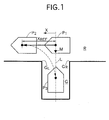
- Fig.1 shows the garaging-movement of a vehicle into a garage G provided adjacent a left side of a road R.
- a driver moves the vehicle straight forwards and once stops the vehicle at a movement-direction changing position P 2 .
- the driver operates a steering wheel leftwards to a limit position; moves the vehicle backwards, while turning the vehicle leftwards, and stops the vehicle at a garaging-movement completing position P 3 within the garage G, thereby finishing the garaging operation.
- a main cause of an unskilled driver failing to conduct the garaging-movement of the vehicle is in that the driver cannot stop the vehicle correctly at the movement-direction changing position P 2 , resulting in a longitudinal disperse in stopping position.
- a vehicle body interferes with a left inlet corner G L of the garage G in the subsequent backward movement to make the garaging of the vehicle impossible.
- the vehicle body interferes with a right inlet corner G R of the garage G in the subsequent backward movement to make the garaging of the vehicle impossible. Therefore, in the embodiment according to the invention, a stopping timing is taught to the driver, so that the vehicle moving forwards from the garaging-movement stating position P 1 can be stopped correctly at the movement-direction changing position P 2 .
- Fig.2 is a block diagram of a garaging-movement aiding system mounted on the vehicle.
- a vehicle speed detecting means S and a teaching means A are connected to an electronic control unit U comprising a microcomputer.
- the vehicle speed detecting means S detects a vehicle speed V, for example, based on a time interval of a pulse output with the rotation of wheels.
- the teaching means A comprises a buzzer and teaches the driver a timing for stopping of the vehicle at the movement-direction changing position P 2 .
- the teaching means A is not limited to the buzzer and may comprise any sound or light emitter such as a chime, a speaker, a lamp and the like.
- the electronic control unit U includes a memory means M1, an acceleration detecting means M2, a forward movement distance detecting means M3, and a teaching-timing determining means M4.
- the vehicle speed detecting means S is connected to the acceleration detecting means M2, the forward movement distance detecting means M3 and the teaching-timing determining means M4, and the teaching means A is connected to the teaching-timing determining means M4.
- the memory means M1 has a reference forward movement distance X REF stored therein, which is a reference distance from the garaging-movement starting position P 1 to the movement-direction changing position P 2 .
- the reference forward movement distance X REF depends on the size of the vehicle body and the minimum radius R MIN of turning movement of the vehicle, and assumes a value peculiar to the type of the vehicle.
- a reference forward movement distance X REF common to various types of the vehicle and minimum radii of turning movement varied for various types of the vehicle may be previously stored in the memory means M1, and the common reference forward movement distance X REF may be corrected by the minimum radius R MIN of turning movement peculiar to each of the types of the vehicle in some cases as will be described hereinafter.
- the acceleration detecting means M2 calculates an acceleration of the vehicle by differentiating the vehicle speed V detected by the vehicle speed detecting means S with time.
- the forward movement distance detecting means M3 detects a distance X of forward movement of the vehicle from the garaging-movement starting position P 1 by integrating the vehicle speed V detected by the vehicle speed detecting means S with time.
- the vehicle speed V is lower than a detectable lower limit value V MIN and cannot be detected immediately after the starting of the vehicle and immediately before the stopping of the vehicle. Therefore, the forward movement distance X in such area is estimated based on the vehicle speed V detected in an intermediate area immediately after the starting and immediately before the stopping, and the acceleration ⁇ calculated from such vehicle speed V.
- a technique for estimating the forward movement distance X will be described hereinafter.
- the teaching-timing determining means M4 is arranged to compare the forward movement distance X detected by the forward movement distance detecting means M3 with the reference forward movement distance X REF stored in the memory means M1, and to determine that the vehicle has reached the movement-direction changing position P 2 at the time when the forward movement distance X has become equal to the reference forward movement distance X REF , thereby operating the teaching means A to teach the driver to stop the vehicle.
- the teaching timing determined by the teaching-timing determining means M4 is corrected in accordance with the vehicle speed V detected by the vehicle speed detecting means S and in accordance with the minimum radius R MIN of turning movement of the vehicle, as described hereinafter.
- the driver drives the vehicle and stops the vehicle at the garaging-movement starting position P 1 adjacent the inlet of the garage G.
- a mark M comprising a sign provided on an inner surface of a door or side mirror on a center line L of the garage G, and to allow the center line of the vehicle body to intersect the center line L of the garage G at substantially right angles.
- the teaching means A emits an intermittent sound (pip pip) to inform the driver that the garaging-movement aiding control has been started.
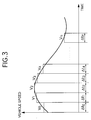
- the vehicle speed detecting means S When the driver moves the vehicle straight forwards from the garaging-movement starting position P 1 toward the movement-direction changing position P 2 , the vehicle speed detecting means S outputs a vehicle speed V with the rotation of the wheels. Therefore, vehicle speeds V 0 , V 1 , V 2 , V 3 --- V n are detected at very short intervals of times ⁇ t 0 , ⁇ t 1 , ⁇ t 2 , ⁇ t 3 , --- ⁇ t n , respectively, as shown in Fig.3, whereby the distance X of forward movement of the vehicle from the garaging-movement starting position P1 can be detected according to V 0 ⁇ ⁇ t 0 + V 1 ⁇ ⁇ t 1 + V 2 ⁇ ⁇ t 2 + V 3 + ⁇ t 3 + --- V n ⁇ ⁇ t n .
- the driver may conduct the steering operation to turn the vehicle round toward an opposite lane in some cases. Even in such case, when the vehicle is to be moved backwards from the movement-direction changing position P 2 toward the garaging-movement completing position P 3 , the garaging operation can be conducted without hindrance by stopping the operation of the steering wheel at a location short of the limit position.
- the outline of a variation in vehicle speed V from the starting of the vehicle at the garaging-movement starting position P 1 to the stopping of the vehicle at the movement-direction changing position P 2 comprises a section (1) where the vehicle speed V is increased from 0 after the starting of the vehicle, a section (2) where the vehicle speed V is constant, and a section (3) where the vehicle speed V is reduced to 0 before the stopping of the vehicle, as shown in Fig.4.
- the distance X of forward movement of the vehicle from the garaging-movement starting position P 1 to the movement-direction changing position P 2 corresponds to a time-integration value (an area of a trapezoid) of the vehicle speed V in the sections (1) to (3).
- the vehicle speed detecting means S cannot detect the vehicle speed V lower than the detectable lower limit value V MIN , as described above, a forward movement distance X in a region A 1 immediately after the starting of the vehicle and a forward movement distance X in a region A 2 immediately before the stopping of the vehicle are incapable of being detected. Therefore, the distances X of forward movement of the vehicle in the two regions A 1 and A 2 (areas of obliquely lined regions) are calculated by a technique which will be described hereinafter, based on the vehicle speed V detected in another region where the vehicle speed V is equal to or higher than the detectable lower limit value V MIN , and the acceleration detected from such vehicle speed V.
- the vehicle speed V cannot be detected in the region A 1 immediately after the starting of the vehicle, and is first detected for the subsequent very short time ⁇ t 0 . It is supposed that such vehicle speed V is V 0 at a start point of the very short time ⁇ t 0 , and V 1 at an end point of the very short time ⁇ t 0 .
- the vehicle speed V cannot be detected in the region A 2 immediately before the stopping of the vehicle, but can be detected lastly for the previous very short time ⁇ t 2 , as shown in Fig.5B. It is supposed that such vehicle speed V is V 3 at a start point of the very short time ⁇ t 2 and V 2 at an end point of the very short time ⁇ t 2 .
- a distance X an area of a triangle shown by oblique lines) of forward movement of the vehicle in the region A 2 immediately before the stopping of the vehicle can be estimated according to the following equation:
- a forward movement distance X is calculated by integrating the vehicle speed V with time, and in the regions (the regions A 1 and A 2 in the trapezoid shown in Fig.4) where the vehicle speed V cannot be detected, forward movement distances X are estimated according to the equations (4) and (8), respectively. By adding these forward movement distances X, a forward movement distance X from the garaging-movement starting position P 1 to the movement-direction changing position P 2 can be detected precisely.
- the teaching means A emits a continuous sound (peep) to inform the driver to carry out a vehicle stopping operation or an operation for changing the movement direction from the forward movement to the backward movement, so that the vehicle can be stopped correctly at the movement-direction changing position P 2 to start the backward movement.
- peep a continuous sound
- the teaching means A is operated at a time point when the vehicle has reached the movement-direction changing position P 2 , there is a possibility that the vehicle could not be stopped immediately and might overrun the movement-direction changing position P 2 . Therefore, it is conceived that the reference forward movement distance X REF is previously set at a small value in anticipation of an amount of overrun of the vehicle. However, the overrun amount is varied in accordance with the magnitude of the vehicle speed V of the vehicle moving forwards and for this reason, it is difficult to expect a good result, only by setting the reference forward movement distance X REF at the small value.
- V 5 km/hr
- the driver can move the vehicle correctly to the garaging-movement completing position P 3 only by moving the vehicle backwards in a state in which the steering wheel has been operated fully leftwards.
- the minimum radius R MIN of turning movement of the vehicle is varied depending on the type of the vehicle. If the reference forward movement distance X REF is set at a value suitable for a vehicle which is turned at a minimum turning radius R MIN of 5.0 m, it may be impossible in some cases to garage a vehicle having a minimum turning radius of R MIN of 4.5 m and capable of a small sharp turn, due to an interference of its vehicle body with the left inlet corner G L of the garage G, as shown in Fig.9. On the other hand, it may be impossible in some cases to garage a vehicle having a minimum turning radius of R MIN of 5.5 m and incapable of a small sharp turn, due to an interference of its vehicle body with the right inlet corner G R of the garage G.
- the teaching means A teaches the driver a timing of stopping the vehicle, based on the comparison of an actual forward movement distance X of the vehicle with the reference forward movement distance X REF . Therefore, it is possible for the driver to stop the vehicle correctly at the movement-direction changing position P 2 . As a result, it is possible for the driver to conduct the vehicle correctly to the garaging-movement completing position P 3 only by moving the vehicle backwards from the movement-direction changing position P 2 , leading to an extremely easy garaging operation.
- the garaging-movement aiding system is also applicable to a vehicle having no actuator for an electric power steering device and a vehicle having no exclusive actuator. Further, a steering angle sensor is not required and hence, the garaging-movement aiding system having a high practicality can be realized at an extremely low cost.
- the garaging conducted by the leftward and backward movement of the vehicle has been illustrated in the embodiment, but the invention is likewise applicable to the garaging conducted by the rightward and backward movement of the vehicle.
- the forward movement distance X has been detected by the integrating the vehicle speed V with time in the embodiment, but may be detected by multiplying a rotational speed of the wheel detected by a wheel rotational speed detecting means by a constant determined depending on the radius of the wheel.
- the invention provides a garaging-movement aiding system at a low cost, wherein the burden of a garaging operation provided by a driver can be alleviated effectively.
- a garaging-movement aiding system aids an operation for moving a vehicle forwards from a garaging-movement starting position P 1 to a movement-direction changing position P 2 and then moving the vehicle backwards to a garaging-movement completing position P 3 , while turning the vehicle.
- the garaging-movement aiding system is designed to teach a stopping timing to the driver by a buzzer or the like so that the vehicle can be stopped precisely, by detecting a distance of forward movement of the vehicle from the garaging-movement starting position P 1 and comparing such distance of forward movement with a previously stored reference forward movement distance. Therefore, it is possible for the driver to conduct the vehicle correctly to the garaging-movement completing position P 3 only by operating a steering wheel to a limit position to move the vehicle backwards from the movement-direction changing position P 2 .
Landscapes
- Engineering & Computer Science (AREA)
- Chemical & Material Sciences (AREA)
- Combustion & Propulsion (AREA)
- Transportation (AREA)
- Mechanical Engineering (AREA)
- Steering Control In Accordance With Driving Conditions (AREA)
Abstract
Description
- The invention relates to a garaging-movement aiding system tor alleviating a burden of operation in the garaging of a vehicle carried out by a driver.
- An automatically steering system is known from Japanese Patent Application Laid-open No.10-167104, which is designed so that the garaging of a vehicle can be carried out without need for a driver's steering operation by automatically carrying out a steering operation utilizing an actuator for an electric power steering device mounted on the vehicle.
- In the above known system, a locus of movement of the vehicle from a garaging-movement starting position to a garaging-movement completing position is previously stored as a relationship between a movement distance and a steering angle, so that the vehicle can be garaged with a driver s hand released from a steering wheel by operating the actuator for the electric power steering device based on the relationship.
- However, the known system suffers from the following problem: In a vehicle including no electric power steering device, it is necessary to provide a special actuator for automatically carrying out the steering operation, resulting in a substantially increased cost. A vehicle including an electric power steering device also suffers from a problem that a control means for controlling the operation of the actuator and a steering angle sensor are required, resulting in an increased cost.
- It is an object of the invention to provide a garaging-movement aiding system at a low cost, wherein the burden of a garaging operation conducted by a driver can be alleviated effectively.
- To achieve the object, there is provided a garaging-movement aiding system for aiding a driving operation for moving a vehicle forwards from a garaging-movement starting position to a movement-direction changing position and then moving the vehicle backwards to a garaging-movement completing position, while turning the vehicle, the garaging-movement aiding system comprising a memory means which previously stores a reference distance of forward movement of the vehicle from the garaging-movement starting position to the movement-direction changing position, a forward movement distance detecting means for detecting a distance of forward movement of the vehicle from the garaging-movement starting position, a teaching means for teaching a driver to carry out, at the movement-direction changing position, at least one of an operation for stopping the vehicle and an operation for changing the movement direction, and a teaching-timing determining means for determining a teaching timing for operating the teaching means, based on the comparison of the forward movement distance detected by the forward movement distance detecting means with the reference forward movement distance stored in the memory means.
- With the above arrangement, when the distance of forward movement of the vehicle has become equal to the previously stored reference forward movement distance during forward movement of the vehicle from the garaging-movement starting position to the movement-direction changing position, the teaching means teaches the driver to carry out at least one of the vehicle stopping operation and the movement-direction changing operation, whereby the driver can stop the vehicle correctly at the movement-direction changing position. Therefore, it is possible for the driver to easily and reliably conduct the vehicle to the garaging-movement completing position only by moving the vehicle backwards from the movement-direction changing position. Moreover, an actuator and a steering sensor for automatically carrying out the steering operation for such period of conduction of the vehicle are not required and hence, the increase in cost can be suppressed to the minimum.
- Preferably, the reference forward movement distance stored in the memory means is a distance of straight forward movement.
- With the above arrangement, the reference forward movement distance stored in the memory means is the distance of straight forward movement and hence, the driver only need to move the vehicle straight from the garaging-movement starting position to the movement-direction changing position. Thus, the driving operation is simplified, and also the generation of an error can be suppressed to the minimum.
- Preferably, the garaging-movement aiding system includes a vehicle speed detecting means for detecting a vehicle speed, and an acceleration detecting means for detecting an acceleration of the vehicle based on the vehicle speed detected by the vehicle speed detecting means, and in a range of vehicle speed lower than a lower limit vehicle speed detectable by the vehicle speed detecting means, the forward movement distance detecting means estimates a distance of forward movement of the vehicle based on the vehicle speed detected by the vehicle speed detecting means and the acceleration detected by the acceleration detecting means in another range of vehicle speed.
- With the above arrangement, in the range of undetectable low vehicle speed, the forward movement distance detecting means estimates the distance of forward movement of the vehicle based on the vehicle speed and the acceleration detected in the other detectable vehicle speed range. Therefore, it is possible to precisely detect the distance of forward movement of the vehicle over the entire region from the garaging-movement starting position to the movement-direction changing position.
- Preferably, the teaching-timing determining means changes the teaching timing based on the vehicle speed detected by the vehicle speed detecting means.
- With the above arrangement, the teaching timing is changed based on the vehicle speed detected by the vehicle speed detecting means, and hence, the deviation of the stopping position at the movement-direction changing position caused due to the magnitude of the vehicle speed can be corrected precisely.
- Preferably, the teaching timing is hastened more, as the vehicle speed is higher.
- With the above arrangement, by ensuring that the teaching timing is hastened more, as the vehicle speed is higher, the teaching can be conducted earlier during movement of the vehicle at a high vehicle speed at which the vehicle is liable to overrun the movement-direction changing position, thereby previously preventing such overrunning.
- Preferably, the teaching-timing determining means changes the teaching timing in accordance with the minimum radius of turning movement of the vehicle.
- With the above arrangement, the teaching timing is changed in accordance with the minimum radius of turning movement of the vehicle. Therefore, the deviation of a stopping position of the vehicle caused at the garaging-movement completing position due to the magnitude of the minimum turning radius can be corrected precisely.
- Preferably, the teaching timing is hastened more, as the minimum radius of turning movement of the vehicle is smaller.
- With the above arrangement, by ensuring that the teaching timing is hastened more, as the minimum radius of turning movement of the vehicle is smaller, it is possible to previously prevent an inner side (as viewed during turning of the vehicle) of the vehicle moving backwards from interfering with an inlet corner of a garage.
- The invention will now be described by way of an embodiment shown in the accompanying drawings.
- Fig.1 is an illustration showing a path of movement of a vehicle for garaging the vehicle;
- Fig.2 is a block diagram of a control system for a garaging-movement aiding system;
- Fig.3 is a diagram for explaining a technique for calculating a distance of forward movement of the vehicle by integrating a vehicle speed;
- Fig.4 is a diagram showing a variation in vehicle speed from a garaging-movement starting position to a movement-direction changing position;
- Figs.5A and 5B are diagrams for explaining a technique for estimating a distance of forward movement immediately after the starting of the vehicle and a distance of forward movement immediately before the stopping of the vehicle;
- Fig.6 is a diagram for explaining the deviation of a stopping position due to the magnitude of vehicle speed;
- Fig.7 is a diagram for explaining the correction of reference forward movement distances at the different magnitudes of vehicle speed;
- Fig.8 is a diagram showing a map for searching a reference forward-movement distance from the vehicle speed;
- Fig.9 is a diagram for explaining the deviation of a stopping position due to the magnitude of the minimum radius of turning movement of the vehicle;
- Fig.10 is a diagram for explaining the correction of reference forward movement distances for vehicles having different minimum radii of turning movement; and
- Fig.11 is a diagram showing a map for searching a reference forward movement distance from the minimum radius of turning movement of the vehicle.
-
- Fig.1 shows the garaging-movement of a vehicle into a garage G provided adjacent a left side of a road R. After stopping the vehicle at a garaging-movement starting position P1 adjacent an inlet of the garage G, a driver moves the vehicle straight forwards and once stops the vehicle at a movement-direction changing position P2. Then, the driver operates a steering wheel leftwards to a limit position; moves the vehicle backwards, while turning the vehicle leftwards, and stops the vehicle at a garaging-movement completing position P3 within the garage G, thereby finishing the garaging operation.
- A main cause of an unskilled driver failing to conduct the garaging-movement of the vehicle is in that the driver cannot stop the vehicle correctly at the movement-direction changing position P2, resulting in a longitudinal disperse in stopping position. For example, when the vehicle has been moved forwards and stopped beyond the movement-direction changing position P2, a vehicle body interferes with a left inlet corner GL of the garage G in the subsequent backward movement to make the garaging of the vehicle impossible. When the vehicle was moved forwards and stopped at a position short of the movement-direction changing position P2, the vehicle body interferes with a right inlet corner GR of the garage G in the subsequent backward movement to make the garaging of the vehicle impossible. Therefore, in the embodiment according to the invention, a stopping timing is taught to the driver, so that the vehicle moving forwards from the garaging-movement stating position P1 can be stopped correctly at the movement-direction changing position P2.
- Fig.2 is a block diagram of a garaging-movement aiding system mounted on the vehicle. A vehicle speed detecting means S and a teaching means A are connected to an electronic control unit U comprising a microcomputer. The vehicle speed detecting means S detects a vehicle speed V, for example, based on a time interval of a pulse output with the rotation of wheels. In the present embodiment, the teaching means A comprises a buzzer and teaches the driver a timing for stopping of the vehicle at the movement-direction changing position P2. The teaching means A is not limited to the buzzer and may comprise any sound or light emitter such as a chime, a speaker, a lamp and the like.
- The electronic control unit U includes a memory means M1, an acceleration detecting means M2, a forward movement distance detecting means M3, and a teaching-timing determining means M4. The vehicle speed detecting means S is connected to the acceleration detecting means M2, the forward movement distance detecting means M3 and the teaching-timing determining means M4, and the teaching means A is connected to the teaching-timing determining means M4.
- The memory means M1 has a reference forward movement distance XREF stored therein, which is a reference distance from the garaging-movement starting position P1 to the movement-direction changing position P2. The reference forward movement distance XREF depends on the size of the vehicle body and the minimum radius RMIN of turning movement of the vehicle, and assumes a value peculiar to the type of the vehicle. A reference forward movement distance XREF common to various types of the vehicle and minimum radii of turning movement varied for various types of the vehicle may be previously stored in the memory means M1, and the common reference forward movement distance XREF may be corrected by the minimum radius RMIN of turning movement peculiar to each of the types of the vehicle in some cases as will be described hereinafter.
- The acceleration detecting means M2 calculates an acceleration of the vehicle by differentiating the vehicle speed V detected by the vehicle speed detecting means S with time. A negative acceleration (deceleration) at which the vehicle speed V decreases, is included in the acceleration α, in addition to a positive acceleration at which the vehicle speed V increases with the passage of time.
- The forward movement distance detecting means M3 detects a distance X of forward movement of the vehicle from the garaging-movement starting position P1 by integrating the vehicle speed V detected by the vehicle speed detecting means S with time. However, the vehicle speed V is lower than a detectable lower limit value VMIN and cannot be detected immediately after the starting of the vehicle and immediately before the stopping of the vehicle. Therefore, the forward movement distance X in such area is estimated based on the vehicle speed V detected in an intermediate area immediately after the starting and immediately before the stopping, and the acceleration α calculated from such vehicle speed V. A technique for estimating the forward movement distance X will be described hereinafter.
- The teaching-timing determining means M4 is arranged to compare the forward movement distance X detected by the forward movement distance detecting means M3 with the reference forward movement distance XREF stored in the memory means M1, and to determine that the vehicle has reached the movement-direction changing position P2 at the time when the forward movement distance X has become equal to the reference forward movement distance XREF, thereby operating the teaching means A to teach the driver to stop the vehicle. At the time, the teaching timing determined by the teaching-timing determining means M4 is corrected in accordance with the vehicle speed V detected by the vehicle speed detecting means S and in accordance with the minimum radius RMIN of turning movement of the vehicle, as described hereinafter.
- The operation of the embodiment of the invention will be described based on a sequence of garaging operations.
- First, as shown in Fig.1, the driver drives the vehicle and stops the vehicle at the garaging-movement starting position P1 adjacent the inlet of the garage G. At this time, it is necessary to locate a mark M comprising a sign provided on an inner surface of a door or side mirror on a center line L of the garage G, and to allow the center line of the vehicle body to intersect the center line L of the garage G at substantially right angles. When the driver turns on a garaging-movement start switch (not shown) connected to the electronic control unit U, after the vehicle has been stopped correctly at the garaging-movement starting position P1 in the above manner, the teaching means A emits an intermittent sound (pip pip) to inform the driver that the garaging-movement aiding control has been started.
- When the driver moves the vehicle straight forwards from the garaging-movement starting position P1 toward the movement-direction changing position P2, the vehicle speed detecting means S outputs a vehicle speed V with the rotation of the wheels. Therefore, vehicle speeds V0, V1, V2, V3 --- Vn are detected at very short intervals of times Δt0, Δt1, Δt2, Δt3, --- Δtn, respectively, as shown in Fig.3, whereby the distance X of forward movement of the vehicle from the garaging-movement starting position P1 can be detected according to
- By moving the vehicle straight forwards from the garaging-movement starting position P1 toward the movement-direction changing position P2, as described above, not only the steering operation conducted by the driver is facilitated, but also the accuracy of the stopping of the vehicle at the movement-direction changing position P2 can be enhanced. While the vehicle is being moved forwards from the garaging-movement starting position P1 toward the movement-direction changing position P2, the driver may conduct the steering operation to turn the vehicle round toward an opposite lane in some cases. Even in such case, when the vehicle is to be moved backwards from the movement-direction changing position P2 toward the garaging-movement completing position P3, the garaging operation can be conducted without hindrance by stopping the operation of the steering wheel at a location short of the limit position.
- The outline of a variation in vehicle speed V from the starting of the vehicle at the garaging-movement starting position P1 to the stopping of the vehicle at the movement-direction changing position P2 comprises a section (1) where the vehicle speed V is increased from 0 after the starting of the vehicle, a section (2) where the vehicle speed V is constant, and a section (3) where the vehicle speed V is reduced to 0 before the stopping of the vehicle, as shown in Fig.4. The distance X of forward movement of the vehicle from the garaging-movement starting position P1 to the movement-direction changing position P2 corresponds to a time-integration value (an area of a trapezoid) of the vehicle speed V in the sections (1) to (3). However, because the vehicle speed detecting means S cannot detect the vehicle speed V lower than the detectable lower limit value VMIN, as described above, a forward movement distance X in a region A1 immediately after the starting of the vehicle and a forward movement distance X in a region A2 immediately before the stopping of the vehicle are incapable of being detected. Therefore, the distances X of forward movement of the vehicle in the two regions A1 and A2 (areas of obliquely lined regions) are calculated by a technique which will be described hereinafter, based on the vehicle speed V detected in another region where the vehicle speed V is equal to or higher than the detectable lower limit value VMIN, and the acceleration detected from such vehicle speed V.
- As shown in Fig.5A, the vehicle speed V cannot be detected in the region A1 immediately after the starting of the vehicle, and is first detected for the subsequent very short time Δt0. It is supposed that such vehicle speed V is V0 at a start point of the very short time Δt0, and V1 at an end point of the very short time Δt0. Thus, an acceleration a of the vehicle for the very short time Δt0 is given according to the following equation:
- The vehicle speed V cannot be detected in the region A2 immediately before the stopping of the vehicle, but can be detected lastly for the previous very short time Δt2, as shown in Fig.5B. It is supposed that such vehicle speed V is V3 at a start point of the very short time Δt2 and V2 at an end point of the very short time Δt2. Thus, an acceleration (a negative acceleration, namely, a deceleration) α of the vehicle for the very short time Δt2 is given according to the following equation (5):
- From the forgoing, in the region (the region A3 in the trapezoid shown in Fig.4) where the vehicle speed V can be detected, a forward movement distance X is calculated by integrating the vehicle speed V with time, and in the regions (the regions A1 and A2 in the trapezoid shown in Fig.4) where the vehicle speed V cannot be detected, forward movement distances X are estimated according to the equations (4) and (8), respectively. By adding these forward movement distances X, a forward movement distance X from the garaging-movement starting position P1 to the movement-direction changing position P2 can be detected precisely.
- When the distance X of forward movement of the vehicle from the garaging-movement starting position P1 has reached the reference forward movement distance XREF previously stored, namely, the vehicle has reached the movement-direction changing position P2, the teaching means A emits a continuous sound (peep) to inform the driver to carry out a vehicle stopping operation or an operation for changing the movement direction from the forward movement to the backward movement, so that the vehicle can be stopped correctly at the movement-direction changing position P2 to start the backward movement.
- Even if the teaching means A is operated at a time point when the vehicle has reached the movement-direction changing position P2, there is a possibility that the vehicle could not be stopped immediately and might overrun the movement-direction changing position P2. Therefore, it is conceived that the reference forward movement distance XREF is previously set at a small value in anticipation of an amount of overrun of the vehicle. However, the overrun amount is varied in accordance with the magnitude of the vehicle speed V of the vehicle moving forwards and for this reason, it is difficult to expect a good result, only by setting the reference forward movement distance XREF at the small value.
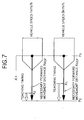
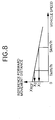
- To solve the above problem, in the present embodiment, the reference forward movement distance XREF is corrected based on the vehicle speed V of the vehicle moving forwards (the vehicle speed V in an intermediate region excluding immediately after the starting of the vehicle and immediately before the stopping of the vehicle). More specifically, as shown in Figs.7 and 8, when at a low vehicle speed (e.g., V = 1 km/hr) which may provide a small overrun amount, a slightly decreased value X2, to which the previously stored reference forward movement distance XREF has been corrected, is employed as a reference forward movement distance XREF, and when at a high vehicle speed (e.g., V = 5 km/hr) which may provide a large overrun amount, a remarkably decreased value X1, to which the previously stored reference forward movement distance XREF has been corrected, is employed as a reference forward movement distance XREF. This ensures that the teaching timing provided by the teaching means A is corrected, and thus, the vehicle can be stopped with a good accuracy at the movement-direction changing position P2 without being influenced by the magnitude of the vehicle speed V.
- When the vehicle is stopped at the movement-direction changing position P2 in the above manner, the driver can move the vehicle correctly to the garaging-movement completing position P3 only by moving the vehicle backwards in a state in which the steering wheel has been operated fully leftwards.
- The minimum radius RMIN of turning movement of the vehicle is varied depending on the type of the vehicle. If the reference forward movement distance XREF is set at a value suitable for a vehicle which is turned at a minimum turning radius RMIN of 5.0 m, it may be impossible in some cases to garage a vehicle having a minimum turning radius of RMIN of 4.5 m and capable of a small sharp turn, due to an interference of its vehicle body with the left inlet corner GL of the garage G, as shown in Fig.9. On the other hand, it may be impossible in some cases to garage a vehicle having a minimum turning radius of RMIN of 5.5 m and incapable of a small sharp turn, due to an interference of its vehicle body with the right inlet corner GR of the garage G.
- To solve the above problem, the reference forward movement distance XREF is corrected based on the minimum turning radius RMIN of the vehicle in this embodiment. More specifically, as shown in Figs.10 and 11, in a vehicle having a small minimum turning radius RMIN (e.g., RMIN = 4.5 m), a decreased value X3, to which the previously stored reference forward movement distance XREF has been corrected, is employed as a reference forward movement distance XREF. In a vehicle having a large minimum turning radius RMIN (e.g., RMIN = 5.5 m), an increased value X4, to which the previously stored reference forward movement distance XREF has been corrected, is employed as a reference forward movement distance XREF. This ensures that the teaching timing provided by the teaching means A is corrected, and thus, the vehicle can be stopped with a good accuracy at the garaging-movement completing position P3 without being influenced by the magnitude of the minimum turning radius RMIN of the vehicle.
- As described above, when the driver is driving the vehicle forwards from the garaging-movement starting position P1 to the movement-direction changing position P2, the teaching means A teaches the driver a timing of stopping the vehicle, based on the comparison of an actual forward movement distance X of the vehicle with the reference forward movement distance XREF. Therefore, it is possible for the driver to stop the vehicle correctly at the movement-direction changing position P2. As a result, it is possible for the driver to conduct the vehicle correctly to the garaging-movement completing position P3 only by moving the vehicle backwards from the movement-direction changing position P2, leading to an extremely easy garaging operation. Moreover, an actuator for automatically conducting the steering operation is not required and hence, the garaging-movement aiding system is also applicable to a vehicle having no actuator for an electric power steering device and a vehicle having no exclusive actuator. Further, a steering angle sensor is not required and hence, the garaging-movement aiding system having a high practicality can be realized at an extremely low cost.
- For example, the garaging conducted by the leftward and backward movement of the vehicle has been illustrated in the embodiment, but the invention is likewise applicable to the garaging conducted by the rightward and backward movement of the vehicle.
- In addition, the forward movement distance X has been detected by the integrating the vehicle speed V with time in the embodiment, but may be detected by multiplying a rotational speed of the wheel detected by a wheel rotational speed detecting means by a constant determined depending on the radius of the wheel.
In summary, the invention provides a garaging-movement aiding system at a low cost, wherein the burden of a garaging operation provided by a driver can be alleviated effectively. To achieve this, a garaging-movement aiding system aids an operation for moving a vehicle forwards from a garaging-movement starting position P1 to a movement-direction changing position P2 and then moving the vehicle backwards to a garaging-movement completing position P3, while turning the vehicle. The garaging-movement aiding system is designed to teach a stopping timing to the driver by a buzzer or the like so that the vehicle can be stopped precisely, by detecting a distance of forward movement of the vehicle from the garaging-movement starting position P1 and comparing such distance of forward movement with a previously stored reference forward movement distance. Therefore, it is possible for the driver to conduct the vehicle correctly to the garaging-movement completing position P3 only by operating a steering wheel to a limit position to move the vehicle backwards from the movement-direction changing position P2.
Claims (7)
- A garaging-movement aiding system for aiding a driving operation for moving a vehicle forwards from a garaging-movement starting position (P1) to a movement-direction changing position (P2) and then moving the vehicle backwards to a garaging-movement completing position (P3), while turning the vehicle, said garaging-movement aiding system comprisinga memory means (M1) which previously stores a reference distance (XREF) of forward movement of the vehicle from said garaging-movement starting position (P1) to said movement-direction changing position (P2),a forward movement distance detecting means (M3) for detecting a distance (X) of forward movement of the vehicle from said garaging-movement starting position (P1),a teaching means (A) for teaching a driver to carry out, at said movement-direction changing position (P2), at least one of an operation for stopping the vehicle and an operation for changing the movement direction, anda teaching-timing determining means (M4) for determining a teaching timing for operating the teaching means (A), based on the comparison of said forward movement distance (X) detected by said forward movement distance detecting means (M3) with said reference forward movement distance (XREF) stored in said memory means (M1).
- A garaging-movement aiding system according to claim 1, wherein said reference forward movement distance (XREF) stored in said memory means (M1) is a distance of straight forward movement.
- A garaging-movement aiding system according to claim 1 or 2, including a vehicle speed detecting means (S) for detecting a vehicle speed (V), and an acceleration detecting means (M2) for detecting an acceleration (α) of the vehicle based on the vehicle speed (V) detected by said vehicle speed detecting means (S), and whereinin a range of vehicle speed lower than a lower limit vehicle speed (VMIN) detectable by the vehicle speed detecting means (S), said forward movement distance detecting means (M3) estimates the distance (X) of forward movement of the vehicle based on the vehicle speed (V) detected by said vehicle speed detecting means (S) and the acceleration (α) detected by said acceleration detecting means (M2) in another range of vehicle speed.
- A garaging-movement aiding system according to any of claims 1 to 3, wherein said teaching-timing determining means (M4) changes the teaching timing based on the vehicle speed (V) detected by said vehicle speed detecting means (S).
- A garaging-movement aiding system according to claim 4, wherein the teaching timing is hastened more, as the vehicle speed (V) is higher.
- A garaging-movement aiding system according to any of claims 1 to 5, wherein said teaching-timing determining means (M4) changes the teaching timing in accordance with the minimum radius (RMIN) of turning movement of the vehicle.
- A garaging-movement aiding system according to claim 6, wherein the teaching timing is hastened more, as the minimum radius (RMIN) of turning movement of the vehicle is smaller
Applications Claiming Priority (2)
| Application Number | Priority Date | Filing Date | Title |
|---|---|---|---|
| JP14714899 | 1999-05-26 | ||
| JP14714899A JP3420530B2 (en) | 1999-05-26 | 1999-05-26 | Garage storage assist device |
Publications (3)
| Publication Number | Publication Date |
|---|---|
| EP1055585A2 true EP1055585A2 (en) | 2000-11-29 |
| EP1055585A3 EP1055585A3 (en) | 2005-03-09 |
| EP1055585B1 EP1055585B1 (en) | 2006-06-28 |
Family
ID=15423678
Family Applications (1)
| Application Number | Title | Priority Date | Filing Date |
|---|---|---|---|
| EP20000110843 Expired - Lifetime EP1055585B1 (en) | 1999-05-26 | 2000-05-22 | Garaging-movement aiding system |
Country Status (3)
| Country | Link |
|---|---|
| EP (1) | EP1055585B1 (en) |
| JP (1) | JP3420530B2 (en) |
| DE (1) | DE60029050T8 (en) |
Families Citing this family (4)
| Publication number | Priority date | Publication date | Assignee | Title |
|---|---|---|---|---|
| JP2002365053A (en) * | 2001-06-07 | 2002-12-18 | Sokkia Co Ltd | Surveying instrument |
| JP4016980B2 (en) * | 2004-10-25 | 2007-12-05 | 株式会社豊田自動織機 | Space-saving parking assistance device |
| JP4386083B2 (en) * | 2007-02-27 | 2009-12-16 | トヨタ自動車株式会社 | Parking assistance device |
| JP2015081056A (en) * | 2013-10-24 | 2015-04-27 | 日産自動車株式会社 | Vehicle notification device and information notification method |
Citations (1)
| Publication number | Priority date | Publication date | Assignee | Title |
|---|---|---|---|---|
| JPH10167104A (en) | 1996-12-17 | 1998-06-23 | Honda Motor Co Ltd | Automatic vehicle steering system |
Family Cites Families (3)
| Publication number | Priority date | Publication date | Assignee | Title |
|---|---|---|---|---|
| US4931930A (en) * | 1988-04-19 | 1990-06-05 | Industrial Technology Research Institute | Automatic parking device for automobile |
| JPH0966841A (en) * | 1995-09-04 | 1997-03-11 | Honda Motor Co Ltd | Vehicle automatic driving device |
| JP3645969B2 (en) * | 1996-10-09 | 2005-05-11 | 本田技研工業株式会社 | Automatic vehicle steering system |
-
1999
- 1999-05-26 JP JP14714899A patent/JP3420530B2/en not_active Expired - Fee Related
-
2000
- 2000-05-22 EP EP20000110843 patent/EP1055585B1/en not_active Expired - Lifetime
- 2000-05-22 DE DE2000629050 patent/DE60029050T8/en not_active Expired - Fee Related
Patent Citations (1)
| Publication number | Priority date | Publication date | Assignee | Title |
|---|---|---|---|---|
| JPH10167104A (en) | 1996-12-17 | 1998-06-23 | Honda Motor Co Ltd | Automatic vehicle steering system |
Also Published As
| Publication number | Publication date |
|---|---|
| EP1055585A3 (en) | 2005-03-09 |
| DE60029050T8 (en) | 2007-02-22 |
| DE60029050D1 (en) | 2006-08-10 |
| JP2000335435A (en) | 2000-12-05 |
| JP3420530B2 (en) | 2003-06-23 |
| EP1055585B1 (en) | 2006-06-28 |
| DE60029050T2 (en) | 2006-11-09 |
Similar Documents
| Publication | Publication Date | Title |
|---|---|---|
| US7487020B2 (en) | Driving assist apparatus and method for vehicle | |
| JP3721973B2 (en) | Vehicle steering device | |
| US6657555B2 (en) | Parking operation aiding system | |
| US6170591B1 (en) | Automatic steering apparatus for vehicles | |
| CN101426670B (en) | Parking assistance device and parking assistance method | |
| US6102147A (en) | Automatic steering system for vehicle | |
| US10793190B2 (en) | Assist device for pulling out of parking spot | |
| EP1270367A2 (en) | Parking assisting device | |
| US20200081446A1 (en) | Parking assistance device | |
| US6186259B1 (en) | Automatic steering device for vehicles | |
| US20070282503A1 (en) | Parking Assistance | |
| US20050269145A1 (en) | Steering assistance method and device for a motor vehicle | |
| US20230286583A1 (en) | Vehicle Control Device, Vehicle Control Method, and Vehicle Control System | |
| EP1055585B1 (en) | Garaging-movement aiding system | |
| JP2006123605A (en) | Automatic guidance device | |
| GB2416901A (en) | Vehicle parking assistant that calculates and displays to the driver the position needed to reverse the steering lock when parallel parking | |
| JP4345355B2 (en) | Steering control device | |
| JP4920393B2 (en) | Vehicle steering control device | |
| JP2004209997A (en) | Parking assistance device | |
| JP3922043B2 (en) | Parking assistance device | |
| JP3580946B2 (en) | Travel control device for self-propelled bogie | |
| JP3899974B2 (en) | Parking assistance device and vehicle with parking assistance device | |
| JP2024145758A (en) | Parking Assistance System | |
| JP2019059376A (en) | Vehicular guiding apparatus | |
| JP2024145757A (en) | Parking Assistance System |
Legal Events
| Date | Code | Title | Description |
|---|---|---|---|
| PUAI | Public reference made under article 153(3) epc to a published international application that has entered the european phase |
Free format text: ORIGINAL CODE: 0009012 |
|
| AK | Designated contracting states |
Kind code of ref document: A2 Designated state(s): AT BE CH CY DE DK ES FI FR GB GR IE IT LI LU MC NL PT SE |
|
| AX | Request for extension of the european patent |
Free format text: AL;LT;LV;MK;RO;SI |
|
| PUAL | Search report despatched |
Free format text: ORIGINAL CODE: 0009013 |
|
| AK | Designated contracting states |
Kind code of ref document: A3 Designated state(s): AT BE CH CY DE DK ES FI FR GB GR IE IT LI LU MC NL PT SE |
|
| AX | Request for extension of the european patent |
Extension state: AL LT LV MK RO SI |
|
| 17P | Request for examination filed |
Effective date: 20050301 |
|
| AKX | Designation fees paid |
Designated state(s): DE FR GB |
|
| GRAP | Despatch of communication of intention to grant a patent |
Free format text: ORIGINAL CODE: EPIDOSNIGR1 |
|
| RBV | Designated contracting states (corrected) |
Designated state(s): DE FR GB |
|
| GRAS | Grant fee paid |
Free format text: ORIGINAL CODE: EPIDOSNIGR3 |
|
| GRAA | (expected) grant |
Free format text: ORIGINAL CODE: 0009210 |
|
| AK | Designated contracting states |
Kind code of ref document: B1 Designated state(s): DE FR GB |
|
| REG | Reference to a national code |
Ref country code: GB Ref legal event code: FG4D |
|
| REF | Corresponds to: |
Ref document number: 60029050 Country of ref document: DE Date of ref document: 20060810 Kind code of ref document: P |
|
| ET | Fr: translation filed | ||
| PLBE | No opposition filed within time limit |
Free format text: ORIGINAL CODE: 0009261 |
|
| STAA | Information on the status of an ep patent application or granted ep patent |
Free format text: STATUS: NO OPPOSITION FILED WITHIN TIME LIMIT |
|
| 26N | No opposition filed |
Effective date: 20070329 |
|
| PGFP | Annual fee paid to national office [announced via postgrant information from national office to epo] |
Ref country code: DE Payment date: 20080529 Year of fee payment: 9 |
|
| PGFP | Annual fee paid to national office [announced via postgrant information from national office to epo] |
Ref country code: GB Payment date: 20080528 Year of fee payment: 9 |
|
| GBPC | Gb: european patent ceased through non-payment of renewal fee |
Effective date: 20090522 |
|
| REG | Reference to a national code |
Ref country code: FR Ref legal event code: ST Effective date: 20100129 |
|
| PG25 | Lapsed in a contracting state [announced via postgrant information from national office to epo] |
Ref country code: FR Free format text: LAPSE BECAUSE OF NON-PAYMENT OF DUE FEES Effective date: 20090602 |
|
| PGFP | Annual fee paid to national office [announced via postgrant information from national office to epo] |
Ref country code: FR Payment date: 20080514 Year of fee payment: 9 |
|
| PG25 | Lapsed in a contracting state [announced via postgrant information from national office to epo] |
Ref country code: GB Free format text: LAPSE BECAUSE OF NON-PAYMENT OF DUE FEES Effective date: 20090522 |
|
| PG25 | Lapsed in a contracting state [announced via postgrant information from national office to epo] |
Ref country code: DE Free format text: LAPSE BECAUSE OF NON-PAYMENT OF DUE FEES Effective date: 20091201 |