EP1054530A2 - Loop prevention in networks - Google Patents
Loop prevention in networks Download PDFInfo
- Publication number
- EP1054530A2 EP1054530A2 EP00303325A EP00303325A EP1054530A2 EP 1054530 A2 EP1054530 A2 EP 1054530A2 EP 00303325 A EP00303325 A EP 00303325A EP 00303325 A EP00303325 A EP 00303325A EP 1054530 A2 EP1054530 A2 EP 1054530A2
- Authority
- EP
- European Patent Office
- Prior art keywords
- nodes
- node
- logically connected
- network
- identifiers
- Prior art date
- Legal status (The legal status is an assumption and is not a legal conclusion. Google has not performed a legal analysis and makes no representation as to the accuracy of the status listed.)
- Granted
Links
Images
Classifications
-
- H—ELECTRICITY
- H04—ELECTRIC COMMUNICATION TECHNIQUE
- H04L—TRANSMISSION OF DIGITAL INFORMATION, e.g. TELEGRAPHIC COMMUNICATION
- H04L45/00—Routing or path finding of packets in data switching networks
- H04L45/18—Loop-free operations
-
- H—ELECTRICITY
- H04—ELECTRIC COMMUNICATION TECHNIQUE
- H04L—TRANSMISSION OF DIGITAL INFORMATION, e.g. TELEGRAPHIC COMMUNICATION
- H04L45/00—Routing or path finding of packets in data switching networks
- H04L45/02—Topology update or discovery
Definitions
- the present invention is relevant to the prevention of loops in a network. It is particularly relevant to provision of a loopless logical network (especially one in which all nodes are connected) from a physical network which contains loops.
- the invention has particular relevance to architectures according to the developing IEEE1394b networking standard.
- the IEEE1394 family of standards relate to a bus architecture with a high degree of dynamic configurability. Information relating to these standards can be obtained from the Institute of Electrical and Electronics Engineers, Inc.
- IEEE1394a it is mandated that the wiring topology should not contain any loops otherwise the bus will not function.
- a loop is defined to be the presence of two or more independent connection paths to a given node via any number of other nodes.
- IEEE1394b it is proposed that there should be a mechanism in place which automatically detects the presence of any loops and logically removes them from the bus topology.
- the invention provides a method for establishing logical connections between nodes in a network, comprising: generation of an identifier by each group of logically connected nodes in the network; exchange of identifiers between physically connected groups of logically connected nodes; and establishment of logical connections between physically connected groups of logically connected nodes for which the exchanged identifiers differ.
- the invention provides method of establishing a network topology without logical loops, comprising: a/ commencing with physical connections, but no logical connections, between nodes; b/ carrying out the method of establishing logical connections as indicated above to provide groups of logically connected modes; and c/ repeatedly carrying out step b/ until all nodes are logically connected.
- a distributed algorithm is described which takes nodes connected in an arbitrary topology (which may initially contain loops) and discovers another topology which is free of loops while ensuring that all nodes are connected together.
- This topology discovery algorithm is 'organic' in the sense that it begins at the individual node level and grows by establishing connections to other nodes providing that a loop is not formed. As loop-less clusters of nodes form (called islands) they themselves grow by coalescing with other nodes or islands again providing that doing so does not form a loop. This process continues until all ports with physical connections on every node have been examined and are either active or disabled.
- An island is defined here as a connected group of nodes that does not contain any logical loops. In the limit an island can consist of a single node
- unique identifier is here used for the best-effort unique identifier (BID) which is generated by each node.
- BID is a number that ideally is unique to each node but practically may be some combination of a random number and other numerical identifiers in a node.
- the island In an island the island itself assumes a BID which is communicated to and common to all nodes and ports in the island
- Soft reset is here used for a reset which invokes the tree ID process without changing the bus topology
- a "Ping" is a special packet that is sent to a node with a specified address on the bus.
- the node specified by the address acknowledges receipt of the packet by replying to the sender
- each node generates a best-effort unique identifier (BID), but that this BID is common to all nodes and ports in an island, that a node can enable or disable any of its ports.
- BID best-effort unique identifier
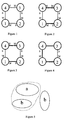
- Figures 1 to 4 illustrate the progress of the algorithm on a four-node network which contains a loop.
- Figure 1 shows a basic four-node topology.
- the physically-connected nodes have exchanged BIDs and master-slave (M, S) port designations have been made according to the algorithm.
- the links between nodes are shown dashed to signify that they have not been logically established - although they are physically present.
- Figure 2 shows the position for the network of Figure 1 after node 1 has arbitrated for and been granted its bus. Node 1 has then requested node 2 (its slave) to arbitrate for the bus which in turn has been successful. Therefore the link between nodes 1 and 2 can now be logically established. The same process takes place between nodes 3 and 4.
- Figure 3 shows the position after the upper and lower pairs of nodes (islands) carry out a soft reset and each island generates a best-effort unique BID. Both islands now attempt to grow their connections: node 1 by examining the link to node 4 and node 2 by examining the link to node 3. Nodes 1 and 2 arbitrate for their bus and for the sake of example assume that node 1 wins and is granted the bus (this inhibits the node 2-node 3 dialogue). The process outlined above in respect of Figure 2 now takes place between nodes 1 and 4.
- Figure 4 shows a position in which the link between nodes 1 and 4 is now established, a soft reset takes place and the enlarged island composed of nodes 1, 2 and 3 assumes a unified BID.
- Node 2 now attempts to establish the link to node 3.
- the BIDs of nodes 2 and 3 are now the same therefore node 2 suspects the presence of a loop and sends a ping packet on its other port.
- the ping packet is received by node 3 and is acknowledged.
- Node 2 is now aware that establishing the node2-node3 link would create a loop and disables that port.
- Figure 5 shows an arrangement in which there are two islands that have assumed the same BID value of 'b' and another island with a different BID value of 'a'.
- the two islands with a BID value of 'b' will remain separate for the reasons outlined in the text.
- This new island - providing it does not assume a BID value of 'b' - can then assimilate the other island.
Landscapes
- Engineering & Computer Science (AREA)
- Computer Networks & Wireless Communication (AREA)
- Signal Processing (AREA)
- Small-Scale Networks (AREA)
- Data Exchanges In Wide-Area Networks (AREA)
Abstract
Description
(note: the master-slave negotiation is based on a BID exchange that is common to all nodes and ports in an island) */


Claims (6)
- A method for establishing logical connections between nodes in a network, comprising:generation of an identifier by each group of logically connected nodes in the network;exchange of identifiers between physically connected groups of logically connected nodes; andestablishment of logical connections between physically connected groups of logically connected nodes for which the exchanged identifiers differ.
- A method according to claim 1, wherein a group of logically connected nodes may comprise a single node.
- A method according to claim 1 or claim 2, further comprising a step of checking for a loop if the exchanged identifiers for a pair of physically connected groups of logically connected nodes are the same.
- A method according to claim 3, wherein if a loop does not exist, the steps of generating identifiers and exchange of identifiers are repeated.
- A method according to claim 3, wherein if a loop does exist, the physical connection between the pair of physically connected groups of logically connected nodes is disabled.
- A method of establishing a network topology without logical loops, comprising:a/ commencing with physical connections, but no logical connections, between nodes;b/ carrying out the method of establishing logical connections as claimed in any of claims 1 to 5 to provide groups of logically connected modes; andc/ repeatedly carrying out step b/ until all nodes are logically connected.
Applications Claiming Priority (2)
| Application Number | Priority Date | Filing Date | Title |
|---|---|---|---|
| GBGB9909626.5A GB9909626D0 (en) | 1999-04-27 | 1999-04-27 | Loop prevention in networks |
| GB9909626 | 1999-04-27 |
Publications (3)
| Publication Number | Publication Date |
|---|---|
| EP1054530A2 true EP1054530A2 (en) | 2000-11-22 |
| EP1054530A3 EP1054530A3 (en) | 2002-12-18 |
| EP1054530B1 EP1054530B1 (en) | 2006-01-11 |
Family
ID=10852322
Family Applications (1)
| Application Number | Title | Priority Date | Filing Date |
|---|---|---|---|
| EP00303325A Expired - Lifetime EP1054530B1 (en) | 1999-04-27 | 2000-04-19 | Loop prevention in networks |
Country Status (5)
| Country | Link |
|---|---|
| US (1) | US6778506B1 (en) |
| EP (1) | EP1054530B1 (en) |
| JP (1) | JP4519261B2 (en) |
| DE (1) | DE60025439T2 (en) |
| GB (1) | GB9909626D0 (en) |
Families Citing this family (4)
| Publication number | Priority date | Publication date | Assignee | Title |
|---|---|---|---|---|
| JP2002314543A (en) * | 2001-04-13 | 2002-10-25 | Matsushita Electric Ind Co Ltd | Topology modification method and communication node |
| US7487339B2 (en) | 2001-10-12 | 2009-02-03 | Mips Technologies, Inc. | Method and apparatus for binding shadow registers to vectored interrupts |
| US7552261B2 (en) * | 2001-10-12 | 2009-06-23 | Mips Technologies, Inc. | Configurable prioritization of core generated interrupts |
| US10361948B2 (en) | 2017-03-02 | 2019-07-23 | Dell Products, L.P. | Communication loop prevention in an information handling system |
Family Cites Families (11)
| Publication number | Priority date | Publication date | Assignee | Title |
|---|---|---|---|---|
| US5315592A (en) * | 1992-04-23 | 1994-05-24 | Xyplex Inc. | Parallel bridging |
| EP0582373B1 (en) | 1992-07-17 | 1999-10-06 | Sun Microsystems, Inc. | Method and apparatus for implementing self-organization in a wireless local area network |
| JPH07200505A (en) * | 1993-12-30 | 1995-08-04 | Hitachi Ltd | Method and apparatus for simultaneous broadcast communication |
| EP0701353A1 (en) | 1994-09-07 | 1996-03-13 | T.R.T. Telecommunications Radioelectriques Et Telephoniques | Data transmission system with adaptive routing |
| JPH0897835A (en) * | 1994-09-28 | 1996-04-12 | Hitachi Cable Ltd | Spanning tree bridge |
| US5740160A (en) * | 1995-03-06 | 1998-04-14 | Nec Corporation | Setting network identifier in wireless local area network |
| US6842430B1 (en) | 1996-10-16 | 2005-01-11 | Koninklijke Philips Electronics N.V. | Method for configuring and routing data within a wireless multihop network and a wireless network for implementing the same |
| JP3938806B2 (en) * | 1997-08-28 | 2007-06-27 | 松下電器産業株式会社 | Topology correction method |
| JPH11345193A (en) * | 1998-05-29 | 1999-12-14 | Canon Inc | Serial bus interface device and bus configuration method, recording medium, serial bus interface system |
| JP3469120B2 (en) * | 1998-06-12 | 2003-11-25 | 矢崎総業株式会社 | Communication network and communication device |
| JP2000101614A (en) * | 1998-09-24 | 2000-04-07 | Matsushita Electric Ind Co Ltd | Bus management method |
-
1999
- 1999-04-27 GB GBGB9909626.5A patent/GB9909626D0/en not_active Ceased
-
2000
- 2000-04-19 DE DE60025439T patent/DE60025439T2/en not_active Expired - Lifetime
- 2000-04-19 EP EP00303325A patent/EP1054530B1/en not_active Expired - Lifetime
- 2000-04-27 JP JP2000126830A patent/JP4519261B2/en not_active Expired - Lifetime
- 2000-04-27 US US09/561,510 patent/US6778506B1/en not_active Expired - Fee Related
Also Published As
| Publication number | Publication date |
|---|---|
| EP1054530A3 (en) | 2002-12-18 |
| EP1054530B1 (en) | 2006-01-11 |
| US6778506B1 (en) | 2004-08-17 |
| JP4519261B2 (en) | 2010-08-04 |
| DE60025439T2 (en) | 2006-07-13 |
| DE60025439D1 (en) | 2006-04-06 |
| GB9909626D0 (en) | 1999-06-23 |
| JP2000341279A (en) | 2000-12-08 |
Similar Documents
| Publication | Publication Date | Title |
|---|---|---|
| EP2472795B1 (en) | Method and system for re-building single ring network topology | |
| US6529963B1 (en) | Methods and apparatus for interconnecting independent fibre channel fabrics | |
| US6058116A (en) | Interconnected trunk cluster arrangement | |
| US6977887B1 (en) | Method and apparatus for loop breaking on a serial bus | |
| US8315188B2 (en) | Topology database synchronization | |
| US7570601B2 (en) | High speed autotrunking | |
| JPH08507623A (en) | Method and apparatus for converting an arbitrary topology collection of nodes into an acyclic directed graph | |
| JPH08505722A (en) | Method and apparatus for unique address assignment, node self-identification and topology mapping for acyclic directed graphs | |
| US20050036500A1 (en) | Method and system for initializing host location information across smart bridge topology changes | |
| US20030021235A1 (en) | Bus optimizing method and communication node | |
| TW202320515A (en) | Loop detection method and loop cancellation method for mesh network | |
| US20050220077A1 (en) | Layer-2 network with virtual private LAN service | |
| US20050163137A1 (en) | Switching mesh with broadcast path redundancy | |
| EP1054530A2 (en) | Loop prevention in networks | |
| US8825902B2 (en) | Configuration validation checker | |
| US7995497B2 (en) | Spontaneous topology discovery in a multi-node computer system | |
| JP3938806B2 (en) | Topology correction method | |
| EP1710958B1 (en) | Method and apparatus for detecting topology of network | |
| WO2002067515A1 (en) | Method and system for generating multiple self-id packets on the 1394 bus using a standard phy chip | |
| EP1547321B1 (en) | Method for determining a parent portal in a wireless network and corresponding portal device | |
| US7457302B1 (en) | Enhancement to loop healing for malconfigured bus prevention | |
| US20080155046A1 (en) | Control Token Based Management Of Daisy-Chain System Topology | |
| EP1116361B1 (en) | Communications network bridge | |
| JPH11177595A (en) | Topology modification method | |
| Salisbury et al. | Multicast control in optical circuit-switched Banyan networks |
Legal Events
| Date | Code | Title | Description |
|---|---|---|---|
| PUAI | Public reference made under article 153(3) epc to a published international application that has entered the european phase |
Free format text: ORIGINAL CODE: 0009012 |
|
| AK | Designated contracting states |
Kind code of ref document: A2 Designated state(s): AT BE CH CY DE DK ES FI FR GB GR IE IT LI LU MC NL PT SE |
|
| AX | Request for extension of the european patent |
Free format text: AL;LT;LV;MK;RO;SI |
|
| 17P | Request for examination filed |
Effective date: 20001222 |
|
| RAP1 | Party data changed (applicant data changed or rights of an application transferred) |
Owner name: HEWLETT-PACKARD COMPANY, A DELAWARE CORPORATION |
|
| PUAL | Search report despatched |
Free format text: ORIGINAL CODE: 0009013 |
|
| AK | Designated contracting states |
Kind code of ref document: A3 Designated state(s): AT BE CH CY DE DK ES FI FR GB GR IE IT LI LU MC NL PT SE |
|
| AX | Request for extension of the european patent |
Free format text: AL;LT;LV;MK;RO;SI |
|
| RIC1 | Information provided on ipc code assigned before grant |
Free format text: 7H 04L 12/40 A, 7H 04L 12/56 B, 7H 04L 29/12 B, 7H 04L 12/46 B, 7H 04L 12/64 B |
|
| AKX | Designation fees paid |
Designated state(s): DE FR GB |
|
| 17Q | First examination report despatched |
Effective date: 20031010 |
|
| GRAP | Despatch of communication of intention to grant a patent |
Free format text: ORIGINAL CODE: EPIDOSNIGR1 |
|
| GRAS | Grant fee paid |
Free format text: ORIGINAL CODE: EPIDOSNIGR3 |
|
| GRAA | (expected) grant |
Free format text: ORIGINAL CODE: 0009210 |
|
| AK | Designated contracting states |
Kind code of ref document: B1 Designated state(s): DE FR GB |
|
| RAP1 | Party data changed (applicant data changed or rights of an application transferred) |
Owner name: HEWLETT-PACKARD COMPANY (A DELAWARE CORPORATION) |
|
| REF | Corresponds to: |
Ref document number: 60025439 Country of ref document: DE Date of ref document: 20060406 Kind code of ref document: P |
|
| ET | Fr: translation filed | ||
| PLBE | No opposition filed within time limit |
Free format text: ORIGINAL CODE: 0009261 |
|
| STAA | Information on the status of an ep patent application or granted ep patent |
Free format text: STATUS: NO OPPOSITION FILED WITHIN TIME LIMIT |
|
| 26N | No opposition filed |
Effective date: 20061012 |
|
| REG | Reference to a national code |
Ref country code: GB Ref legal event code: 732E Free format text: REGISTERED BETWEEN 20120329 AND 20120404 |
|
| REG | Reference to a national code |
Ref country code: FR Ref legal event code: PLFP Year of fee payment: 17 |
|
| REG | Reference to a national code |
Ref country code: DE Ref legal event code: R082 Ref document number: 60025439 Country of ref document: DE Representative=s name: SCHOPPE, ZIMMERMANN, STOECKELER, ZINKLER, SCHE, DE Ref country code: DE Ref legal event code: R081 Ref document number: 60025439 Country of ref document: DE Owner name: HEWLETT PACKARD ENTERPRISE DEVELOPMENT LP, HOU, US Free format text: FORMER OWNER: HEWLETT-PACKARD DEVELOPMENT COMPANY, L.P., HOUSTON, TEX., US |
|
| REG | Reference to a national code |
Ref country code: GB Ref legal event code: 732E Free format text: REGISTERED BETWEEN 20160616 AND 20160622 |
|
| REG | Reference to a national code |
Ref country code: FR Ref legal event code: TP Owner name: HEWLETT PACKARD ENTREPRISE DEVELOPMENT LP, US Effective date: 20160819 |
|
| REG | Reference to a national code |
Ref country code: FR Ref legal event code: PLFP Year of fee payment: 18 |
|
| REG | Reference to a national code |
Ref country code: FR Ref legal event code: PLFP Year of fee payment: 19 |
|
| PGFP | Annual fee paid to national office [announced via postgrant information from national office to epo] |
Ref country code: DE Payment date: 20180320 Year of fee payment: 19 |
|
| REG | Reference to a national code |
Ref country code: FR Ref legal event code: PLFP Year of fee payment: 20 |
|
| PGFP | Annual fee paid to national office [announced via postgrant information from national office to epo] |
Ref country code: GB Payment date: 20190325 Year of fee payment: 20 Ref country code: FR Payment date: 20190325 Year of fee payment: 20 |
|
| REG | Reference to a national code |
Ref country code: DE Ref legal event code: R119 Ref document number: 60025439 Country of ref document: DE |
|
| PG25 | Lapsed in a contracting state [announced via postgrant information from national office to epo] |
Ref country code: DE Free format text: LAPSE BECAUSE OF NON-PAYMENT OF DUE FEES Effective date: 20191101 |
|
| REG | Reference to a national code |
Ref country code: GB Ref legal event code: PE20 Expiry date: 20200418 |
|
| PG25 | Lapsed in a contracting state [announced via postgrant information from national office to epo] |
Ref country code: GB Free format text: LAPSE BECAUSE OF EXPIRATION OF PROTECTION Effective date: 20200418 |