EP1054014A2 - Method for the preparation of organosilicon compounds and the organosilicon compounds prepared thereby - Google Patents

Method for the preparation of organosilicon compounds and the organosilicon compounds prepared thereby Download PDF

Info

Publication number
EP1054014A2
EP1054014A2 EP00109956A EP00109956A EP1054014A2 EP 1054014 A2 EP1054014 A2 EP 1054014A2 EP 00109956 A EP00109956 A EP 00109956A EP 00109956 A EP00109956 A EP 00109956A EP 1054014 A2 EP1054014 A2 EP 1054014A2
Authority
EP
European Patent Office
Prior art keywords
dichlorosilyl
bis
hydrogen
tetrachloro
hydrosilation
Prior art date
Legal status (The legal status is an assumption and is not a legal conclusion. Google has not performed a legal analysis and makes no representation as to the accuracy of the status listed.)
Withdrawn
Application number
EP00109956A
Other languages
German (de)
French (fr)
Other versions
EP1054014A3 (en
Inventor
Il Nam Jung
Bok Ryul Yoo
Joon Soo Han
Weon Cheol Lim
Current Assignee (The listed assignees may be inaccurate. Google has not performed a legal analysis and makes no representation or warranty as to the accuracy of the list.)
Dow Silicones Corp
Original Assignee
Dow Corning Corp
Priority date (The priority date is an assumption and is not a legal conclusion. Google has not performed a legal analysis and makes no representation as to the accuracy of the date listed.)
Filing date
Publication date
Application filed by Dow Corning Corp filed Critical Dow Corning Corp
Publication of EP1054014A2 publication Critical patent/EP1054014A2/en
Publication of EP1054014A3 publication Critical patent/EP1054014A3/en
Withdrawn legal-status Critical Current

Links

Classifications

    • CCHEMISTRY; METALLURGY
    • C07ORGANIC CHEMISTRY
    • C07FACYCLIC, CARBOCYCLIC OR HETEROCYCLIC COMPOUNDS CONTAINING ELEMENTS OTHER THAN CARBON, HYDROGEN, HALOGEN, OXYGEN, NITROGEN, SULFUR, SELENIUM OR TELLURIUM
    • C07F7/00Compounds containing elements of Groups 4 or 14 of the Periodic Table
    • C07F7/02Silicon compounds
    • C07F7/08Compounds having one or more C—Si linkages
    • C07F7/12Organo silicon halides

Definitions

  • hydrosilation has become one of the fundamental methods for synthesizing organosilicon compounds.
  • Si-H bond containing silicon compounds are reacted and added to multiple bonds of organic compounds such as carbon-carbon, carbon-oxygen, carbon-nitrogen, nitrogen-nitrogen and nitrogen oxygen.
  • organosilicon compounds of the present invention are useful for forming silicon carbides by pyrolysis.
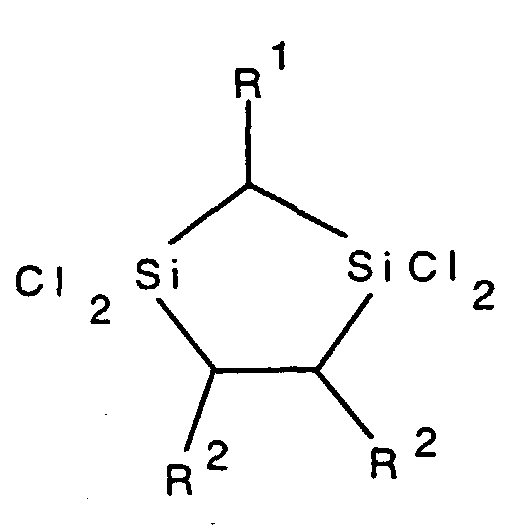
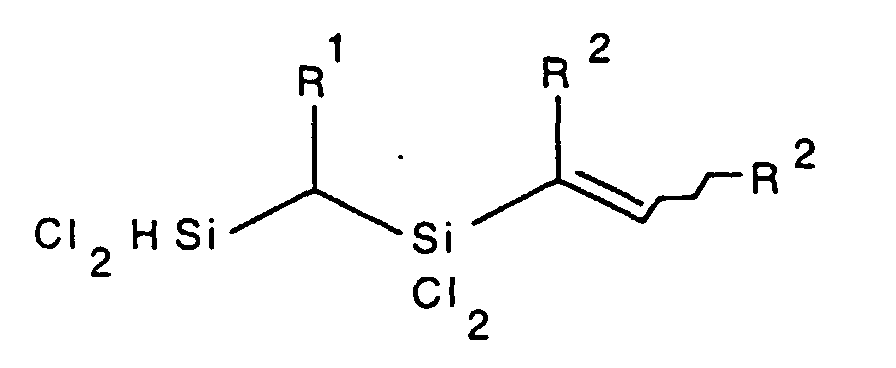
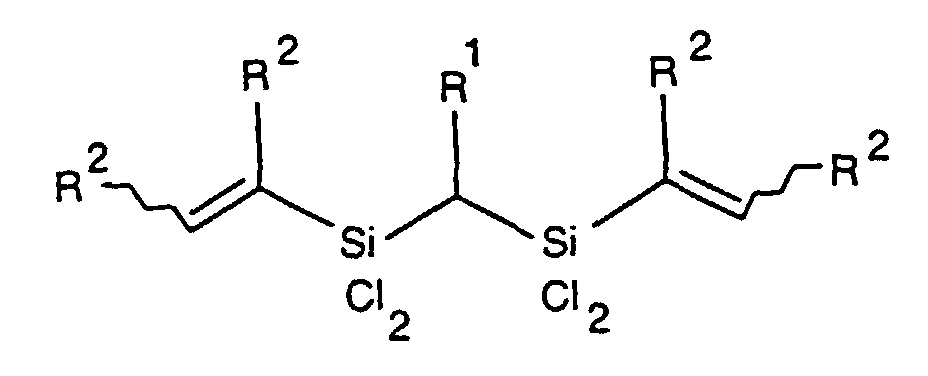
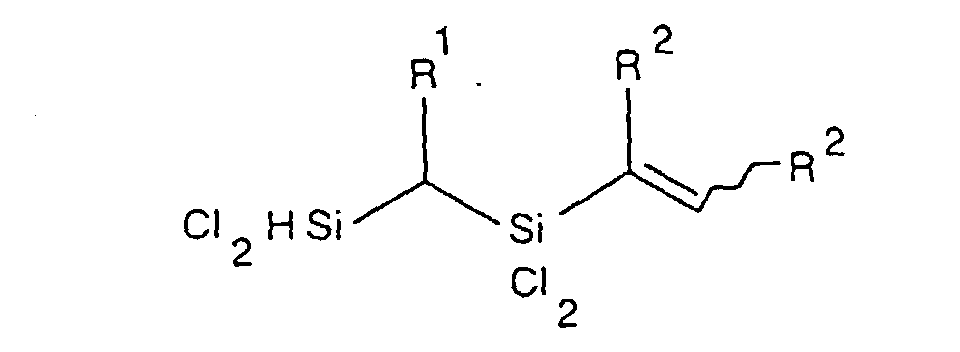
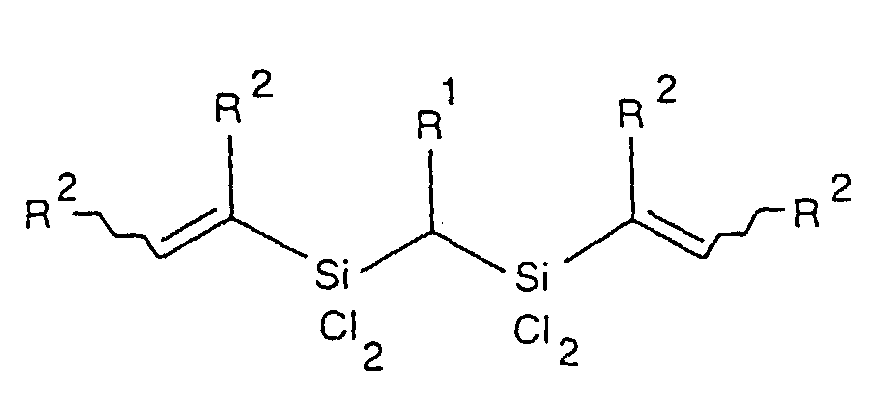
  • the present invention is a method for making cyclic organosilicon compounds described by formulas (1) and (2) and linear organosilicon compounds described by formulas (3) and (4) and mixtures thereof.
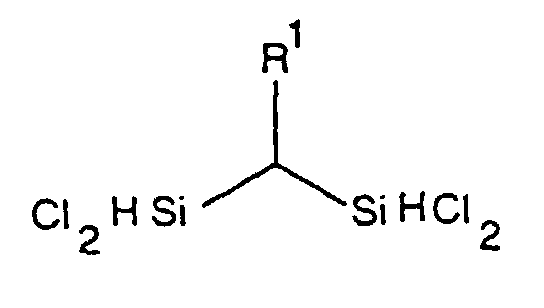
  • the method comprises effecting hydrosilation of a bis(dichlorosilyl)methane described by formula (5) with an alkyne described by formula (6) R 2 -C ⁇ C-R 2 in the presence of an effective amount of metallic hydrosilation catalyst, where R 1 is selected from hydrogen, dichlorosilyl, trichlorosilyl, methyldichlorosilyl, dimethylchlorosilyl or trimethylsilyl, and each R 2 is independently selected from hydrogen, alkyls having one to 6 carbon atoms or aryls.
  • Examples of the bis(dichlorosilyl)methane include bis(dichlorosilyl)methane, bis(dichlorosilyl)trichlorosilylmethane, bis(dichlorosilyl)dichloromethylsilylmethane and tris(dichlorosilyl)methane.
  • Preferred examples of the bis(dichlorosilyl)methane include bis(dichlorosilyl)trichlorosilylmethane and tris(dichlorosilyl)methane.
  • R 2 substituents of the alkyne described by formula (6) can be any of those groups described above for R 2 and can be the same or different. Preferred is when R 2 is selected from hydrogen or phenyl.
  • the alkyne can be, for example, acetylene, phenylacetylene and diphenylacetylene.
  • the mole ratio of the alkyne to the bis(dichlorosilyl)methane can be within a range of 0.1 to 10. It is preferred that the mole ratio of the alkyne to the bis(dichlorosilyl)methane be greater than 0.8, with a mole ratio within a range of 1 to 2 being most preferred.
  • the present method requires the presence of an effective amount of a metallic hydrosilation catalyst.
  • the metallic hydrosilation catalyst can be any such catalyst which is known to catalyze the reaction of silicon-bonded hydrogen atoms with alkyne groups.
  • the preferred metallic hydrosilation catalyst for use in the present method are platinum group metal-containing catalyst.
  • platinum group metal it is meant ruthenium, rhodium, palladium, osmium, iridium and platinum.
  • platinum group metal-containing catalyst which may be useful in the present method are found in, for example, Willing, U.S. Patent 3,419,593; Lee et al., U.S. Patent. 3,989,668; Chang et al., U.S.
  • a preferred platinum group metal is platinum.
  • the preferred platinum group metal catalysts are compounds and complexes of platinum.
  • IPA isopropyl alcohol
  • H 2 PtCl 6 /IPA/PPh 3 solutions H 2 PtCl 6 /THF (tetrahydrofuran) solutions
  • an effective amount of a metallic hydrosilation catalyst be added.
  • an effective amount it is meant an amount of catalyst sufficient to accelerate a reaction between the silicon-bonded hydrogen atoms of the bis(dichlorosilyl)methane and the alkyne.
  • an effective amount of the metallic hydrosilation catalyst is an amount within a range of 1 x 10 -5 to 0.05 moles of metal per mole of the bis(dichlorosilyl)methane.
  • the method of effecting hydrosilation of the bis(dichlorosilyl)methane with the alkyne can be any of those known methods for effecting hydrosilation reactions in the presence of a metallic hydrosilation catalyst.
  • a metallic hydrosilation catalyst In a preferred process an optional organic solvent, the bis(dichlorosilyl)methane and the metallic hydrosilation catalyst are placed in a reactor under an inert atmosphere such as dried nitrogen.
  • the alkyne is then slowly added to the reactor with stirring.
  • the reactor content may be further heated at a temperature from 10°C. to 150°C. for a time sufficient to ensure completion of the hydrosilation reaction. It is preferred to heat the reactor content at a temperature within a range of 20°C.
  • the length of time the reactor content is heated to effect the hydrosilation reaction will depended upon the reactants and the temperature to which the reactor content is heated. Generally a time of 0.5 hours to 20 hours is useful, with a heating time of 1 hour to 5 hours being preferred.
  • Organic solvents which may be useful in the present method include benzene, toluene, xylene, chlorobenzene and anisole.
  • the organic solvent may be added as a diluent in any amount that preferably does not dilute the reactants to a point that detrimentally effects the reaction rate and yield.
  • a further embodiment of this invention is the organosilicon compounds prepared by the above described method.
  • These organosilicon compounds are cyclic organosilicon compounds described by formula (1) and by formula (2) and linear organosilicon compounds described by formula (3) and by formula (4) and mixtures thereof where R 1 is selected from hydrogen, dichlorosilyl, trichlorosilyl, methyldichlorosilyl, dimethylchlorosilyl or trimethylsilyl and each R 2 is independently selected from hydrogen, alkyls having one to 6 carbon atoms and aryls.
  • R 2 can be, for example, hydrogen, methyl, ethyl, propyl, n-butyl, t-butyl, hexyl, phenyl and tolyl. It is preferred that each R 2 be independently selected from hydrogen or methyl. Examples of organosilicon compounds which can be made by the present method are found in the examples provided herein.
  • TCD-GC 1,1,3,3-tetrachloro-2-trichlorosilyl-1,3-disilacyclopent-4-ene
  • TCD-GC gas chromatography using a thermal conductivity detector
  • TCD-GC 1,1,3,3-tetrachloro-2-trichlorosilyl-1,3-disilacyclopentane
  • the solvent was removed at atmospheric pressure and the residue vacuum distilled at 67 Pa.
  • the resulting product was a mixture comprising 5.94 g of 1,1,3,3-tetrachloro-2-trichlorosilyl-4-phenyl-1,3-disilacyclopent-4-ene (TCD-GC area 46.3%) and 3,3,5,5-tetrachloro-4-trichlorosilyl-1,7-diphenyl-3,5-disilahepta-1,6-diene (TCD-GC area 42.3%).
  • 1,1,3,3-Tetrachloro-2-trichlorosilyl-4-phenyl-1,3-disilacyclopent-4-ene 1 H-NMR (CDCl 3 , ppm): 1.68 (s, 1H, SiCHSi), 7.27 (s, 1H, CHCPh), 7.36-7.60 (m, 5H, ArH).
  • 1,1,3,3-Tetrachloro-2-trichlorosilyl-4,5-diphenyl-1,3-disilacyclopentane 1 H-NMR (CDCl 3 , ppm): 1.82 (s, 1H, SiCHSi), 3.35-3.44 (m, 2H, CHPh), 7.06-7.18 (m, 5H, ArH).
  • 1,1,3,3-Tetrachloro-2-dichlorosilyl-4,5-diphenyl-1,3-disilacyclopentane 1 H-NMR (CDCl 3 , ppm): 1.72 (d, 3.4 Hz, 1H, SiCHSi), 3.47-3.53 (m, 2H, CHPh), 5.8 (d, 3.5 Hz, 1H, SiH), 7.15-7.28 (m, 10H, ArH).
  • reaction products were vacuum distilled at 67 Pa to yield a mixture comprising 1.99 g of 1,1,3,3-tetrachloro-1,3-disilacyclopent-4-ene (TCD-GC area 3.6%); 1,1,3,3-tetrachloro-1,3-disilacyclopentane (TCD-GC area 47.4%); 1,1,3,3,6,6,8,8-octachloro-1,3,6,8-tetrasilaoctane (TCD-GC area 17.2%); and 1,1,3,3,6,6,8,8,11,11,13,13-dodecachloro-1,3,6,8,11,13-hexasilatridecane (TCD-GC area 8.6%).

Landscapes

  • Chemical & Material Sciences (AREA)
  • Organic Chemistry (AREA)
  • Low-Molecular Organic Synthesis Reactions Using Catalysts (AREA)

Abstract

The invention is a hydrosilation method for preparing cyclic organosilicon compounds described by formula
Figure 80000001
by formula
Figure 80000002
linear organosilicon compounds described by formula
Figure 80000003
by formula
Figure 80000004
or mixtures thereof, where R1 is selected from hydrogen, dichlorosilyl, trichlorosilyl, methyldichlorosilyl, dimethylchlorosilyl or trimethylsilyl and each R2 is independently selected from hydrogen, alkyls having one to 6 carbon atoms or aryls; and the cyclic organosilicon compounds and linear organosilicon compounds prepared thereby; said method comprising effecting hydrosilation of a bis(dichlorosilyl)methane described by formula
Figure 80010001
with an alkyne described by formula R2-C≡C-R2 in the presence of an effective amount of metallic hydrosilation catalyst.

Description

Since the description of hexachloroplatinic acid as a catalyst for hydrosilation in 1957 by Speier et al., J. Am. Chem. Soc. 1957, 79, 974, hydrosilation has become one of the fundamental methods for synthesizing organosilicon compounds. In the hydrosilation process, Si-H bond containing silicon compounds are reacted and added to multiple bonds of organic compounds such as carbon-carbon, carbon-oxygen, carbon-nitrogen, nitrogen-nitrogen and nitrogen oxygen.
In 1980, Watanabe et al., J. Organomet. Chem. 1980, 195, 363, reported that when hydridosilane is reacted with acetylene in the presence of a metal catalyst such as RuCl2(PPh3)3, PtCl2(PPh3)2, RhCl(PPh3)3, RhH(PPh3)4 or Pt(PPh3)4, vinylsilane is obtained in good yield. The double hydrosilation product of 1,2-bis-silylethane was also obtained as a byproduct.
Polyakova et al., Izv. Akad. Nauk SSSR, Ser. Khim. 1965, 1267, reported that cyclic organosilanes can be obtained by hydrosilation of bis(hydrosilyl) compounds with alkynes.
Tanaka et al., Organometallics 1991, 10, 16, reported platinum complex catalyzed dehydrogenative double silation of unsaturated hydrocarbons with bis(hydrosilane) compounds. Tanaka et al. examined various catalysts such as Pt(CH2=CH2)(PPh3)2, PtCl2(PPh3)2, Ru3(CO)12, Pd(dba)2PPh3, RhCl(PPh3)3, PdCl2(PPh3)2 and Pd(PPh3)4.
Jung et al., U.S. Patent 5,399,740, describe the reaction of silicon metal with a mixture of a dichloromethyl group containing silane and hydrogen chloride to obtain tris(silyl)methanes in moderately high yield.
Han et al., Organometallics 1997, 16, 93, reported the direct synthesis of Si-H containing tris(silyl)methanes by reacting silicon metal with a mixture of chloroform and hydrogen chloride.
Yeon et al., J. Organomet. Chem. 1996, 516, 91, reported the direct synthesis of Si-H containing bis(silyl)methanes by reacting silicon metal with a mixture of methylene chloride and hydrogen chloride.
The organosilicon compounds of the present invention are useful for forming silicon carbides by pyrolysis.
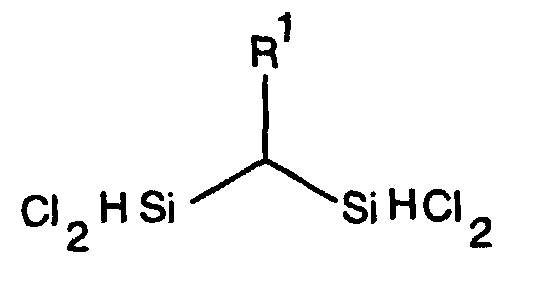
The present invention is a method for making cyclic organosilicon compounds described by formulas (1) and (2) and linear organosilicon compounds described by formulas (3) and (4) and mixtures thereof. The method comprises effecting hydrosilation of a bis(dichlorosilyl)methane described by formula (5)
Figure 00020001
with an alkyne described by formula (6) R2-C≡C-R2 in the presence of an effective amount of metallic hydrosilation catalyst, where R1 is selected from hydrogen, dichlorosilyl, trichlorosilyl, methyldichlorosilyl, dimethylchlorosilyl or trimethylsilyl, and each R2 is independently selected from hydrogen, alkyls having one to 6 carbon atoms or aryls.
Examples of the bis(dichlorosilyl)methane include bis(dichlorosilyl)methane, bis(dichlorosilyl)trichlorosilylmethane, bis(dichlorosilyl)dichloromethylsilylmethane and tris(dichlorosilyl)methane. Preferred examples of the bis(dichlorosilyl)methane include bis(dichlorosilyl)trichlorosilylmethane and tris(dichlorosilyl)methane.
The R2 substituents of the alkyne described by formula (6) can be any of those groups described above for R2 and can be the same or different. Preferred is when R2 is selected from hydrogen or phenyl. The alkyne can be, for example, acetylene, phenylacetylene and diphenylacetylene.
The mole ratio of the alkyne to the bis(dichlorosilyl)methane can be within a range of 0.1 to 10. It is preferred that the mole ratio of the alkyne to the bis(dichlorosilyl)methane be greater than 0.8, with a mole ratio within a range of 1 to 2 being most preferred.
The present method requires the presence of an effective amount of a metallic hydrosilation catalyst. The metallic hydrosilation catalyst can be any such catalyst which is known to catalyze the reaction of silicon-bonded hydrogen atoms with alkyne groups. The preferred metallic hydrosilation catalyst for use in the present method are platinum group metal-containing catalyst. By "platinum group metal", it is meant ruthenium, rhodium, palladium, osmium, iridium and platinum. Examples of platinum group metal-containing catalyst which may be useful in the present method are found in, for example, Willing, U.S. Patent 3,419,593; Lee et al., U.S. Patent. 3,989,668; Chang et al., U.S. Patent 5,036,117; Ashby, U.S. Patent 3,159,601; Lamoreaux, U.S. Patent 3,220,972; Chalk et al., U.S. Patent 3,296,291; Modic, U.S. Patent 3,516,946; Karstedt, U.S. Patent 3,814,730 and Chandra et al., U.S. Patent 3,928,629 all of which show useful platinum group metal-containing catalyst and methods for their preparation. A preferred platinum group metal is platinum. The preferred platinum group metal catalysts are compounds and complexes of platinum. Examples of metallic hydrosilation catalysts which may be useful in the present method include H2PtCl6, H2PtCl6 in solution in isopropyl alcohol (IPA), H2PtCl6/IPA/PPh3 solutions, H2PtCl6/THF (tetrahydrofuran) solutions, H2PtCl6/I2, Pt((CH2=CHSiMe2)2O)2, RhCl(PPh3)3, Pt(CH2=CH)(PPh3)2, Pd(PPh3)4, Pt(PPh3)4 and Ni(PEt3)4, where Et is ethyl and Ph is phenyl.
The present method requires that an effective amount of a metallic hydrosilation catalyst be added. By the term "effective amount", it is meant an amount of catalyst sufficient to accelerate a reaction between the silicon-bonded hydrogen atoms of the bis(dichlorosilyl)methane and the alkyne. Generally, an effective amount of the metallic hydrosilation catalyst is an amount within a range of 1 x 10⁻⁵ to 0.05 moles of metal per mole of the bis(dichlorosilyl)methane.
The method of effecting hydrosilation of the bis(dichlorosilyl)methane with the alkyne can be any of those known methods for effecting hydrosilation reactions in the presence of a metallic hydrosilation catalyst. In a preferred process an optional organic solvent, the bis(dichlorosilyl)methane and the metallic hydrosilation catalyst are placed in a reactor under an inert atmosphere such as dried nitrogen. The alkyne is then slowly added to the reactor with stirring. After addition of the alkyne, the reactor content may be further heated at a temperature from 10°C. to 150°C. for a time sufficient to ensure completion of the hydrosilation reaction. It is preferred to heat the reactor content at a temperature within a range of 20°C. to 150°C., and even more preferred is a temperature of 80°C to 110°C. The length of time the reactor content is heated to effect the hydrosilation reaction will depended upon the reactants and the temperature to which the reactor content is heated. Generally a time of 0.5 hours to 20 hours is useful, with a heating time of 1 hour to 5 hours being preferred.
The use of an organic solvent in the present method is optional. Organic solvents which may be useful in the present method include benzene, toluene, xylene, chlorobenzene and anisole. The organic solvent may be added as a diluent in any amount that preferably does not dilute the reactants to a point that detrimentally effects the reaction rate and yield.
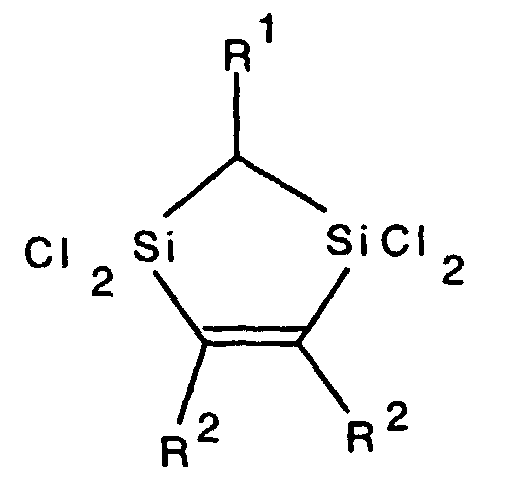
A further embodiment of this invention is the organosilicon compounds prepared by the above described method. These organosilicon compounds are cyclic organosilicon compounds described by formula (1)
Figure 00060001
and by formula (2)
Figure 00060002
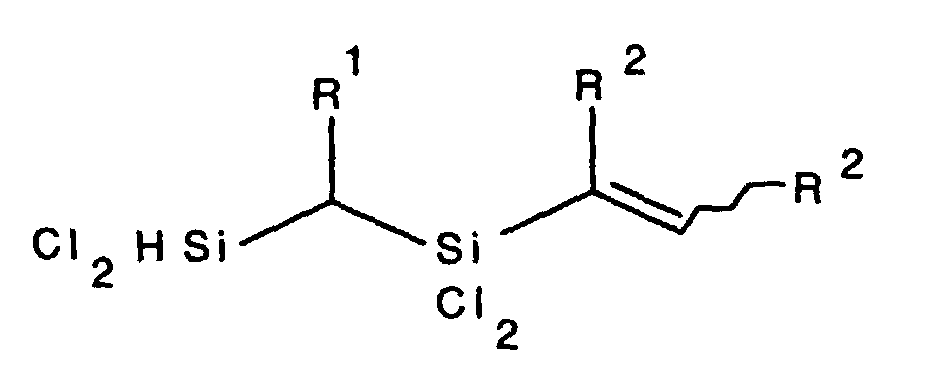
and linear organosilicon compounds described by formula (3)
Figure 00060003
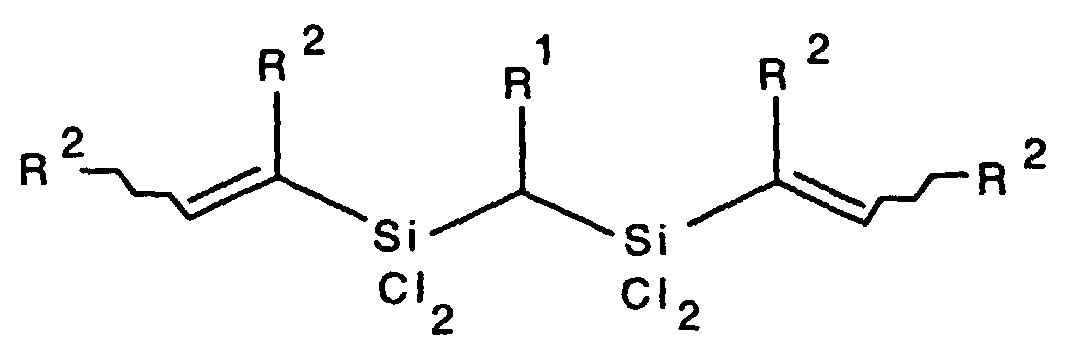
and by formula (4)
Figure 00060004
and mixtures thereof where R1 is selected from hydrogen, dichlorosilyl, trichlorosilyl, methyldichlorosilyl, dimethylchlorosilyl or trimethylsilyl and each R2 is independently selected from hydrogen, alkyls having one to 6 carbon atoms and aryls.
In formulas (1), (2), (3) and (4), R2 can be, for example, hydrogen, methyl, ethyl, propyl, n-butyl, t-butyl, hexyl, phenyl and tolyl. It is preferred that each R2 be independently selected from hydrogen or methyl. Examples of organosilicon compounds which can be made by the present method are found in the examples provided herein.
The following examples are provided to illustrate the present invention. These examples are not intended to limit the scope of the claims herein.
Example 1
Hydrosilation of acetylene with bis(dichlorosilyl)trichlorosilylmethane in the presence of H2PtCl6. To a 50 ml, three-necked, dried, flask equipped with a magnetic stirrer was added 200 µl of a 0.1 M H2PtCl6/isopropyl alcohol (IPA) solution. The flask was placed under dry nitrogen atmosphere and the IPA removed under vacuum. Then, 6.29 g of bis(dichlorosilyl)trichlorosilylmethane and 25 ml of dried benzene were added to the flask forming a solution. The solution was maintained at reflux temperature and acetylene gas fed into the solution at a rate of 90 ml per minute for 10 hours. The resulting products were vacuum distilled at 67 Pa to yield 6.36 g of 1,1,3,3-tetrachloro-2-trichlorosilyl-1,3-disilacyclopent-4-ene (TCD-GC are 81.4%) (TCD-GC = gas chromatography using a thermal conductivity detector) and 1,1,3,3-tetrachloro-2-trichlorosilyl-1,3-disilacyclopentane (TCD-GC 4.2%) as a mixture. The structure of 1,1,3,3-tetrachloro-2-trichlorosilyl-1,3-disilacyclopent-4-ene was confirmed by 1H-NMR (CDCl3, ppm): 1.52 (s, 1H, SiCHSi), 7.42 (s, 2H, CH=CH).
Example 2
Hydrosilation of phenylacetylene with bis(dichlorosilyl)trichlorosilylmethane in the presence of H2PtCl6. Into the same apparatus as described in Example 1 were placed 138 µl of 0.1 M H2PtCl6/IPA and the IPA removed under vacuum. Into the flask were added 4.96 g of bis(dichlorosilyl)trichlorosilylmethane and 25 ml of dried benzene to form a mixture. The mixture was heated to reflux and 2.55 ml of phenylacetylene were added over 20 minutes. The resulting mixture was heated at reflux temperature, with stirring, for another 5 hours. The solvent was removed at atmospheric pressure and the residue vacuum distilled at 67 Pa. The resulting product was a mixture comprising 5.94 g of 1,1,3,3-tetrachloro-2-trichlorosilyl-4-phenyl-1,3-disilacyclopent-4-ene (TCD-GC area 46.3%) and 3,3,5,5-tetrachloro-4-trichlorosilyl-1,7-diphenyl-3,5-disilahepta-1,6-diene (TCD-GC area 42.3%). 1,1,3,3-Tetrachloro-2-trichlorosilyl-4-phenyl-1,3-disilacyclopent-4-ene = 1H-NMR (CDCl3, ppm): 1.68 (s, 1H, SiCHSi), 7.27 (s, 1H, CHCPh), 7.36-7.60 (m, 5H, ArH). 3,3,5,5-Tetrachloro-4-trichlorosilyl-1,7-diphenyl-3,5-disilahepta-1,6-diene = 1H-NMR (CDCl3, ppm): 1.98 (s, 1H, SiCHSi), 6.12 (d, 2.4 Hz, 2H, CH=CHPh), 7.13-7.33 (m, 7H, CH=CHArH).
Example 3
Hydrosilation of diphenylacetylene with bis(dichlorosilyl)trichlorosilylmethane in the presence of H2PtCl6/IPA. Into the same apparatus as described in Example 1 were placed 0.60 g of diphenylacetylene, 1.06 g of bis(dichlorosilyl)trichlorosilylmethane, 31 µl of 0.1 M H2PtCl6/IPA and 25 ml of dried benzene forming a mixture. The resulting mixture, with stirring, was refluxed for 5 hours and then the solvent removed at atmospheric pressure. The residue was vacuum distilled at 67 Pa to yield a mixture comprising 1.42 g of 1,1,3,3-tetrachloro-2-trichlorosilyl-4,5-diphenyl-1,3-disilacyclopentane (TCD-GC area 71.2%) and 3,3,5,5-tetrachloro-4-trichlorosilyl-1,2,6,7-tetraphenyl-3,5-disilahepta-1,6-diene (TCD-GC area 5.9%). 1,1,3,3-Tetrachloro-2-trichlorosilyl-4,5-diphenyl-1,3-disilacyclopentane = 1H-NMR (CDCl3, ppm): 1.82 (s, 1H, SiCHSi), 3.35-3.44 (m, 2H, CHPh), 7.06-7.18 (m, 5H, ArH).
Example 4
Hydrosilation of acetylene with bis(dichlorosilyl)trichlorosilylmethane in the presence of Pt(C2H4)(PPh3)2. Into the same apparatus as described in Example 1 were placed 0.103 g of Pt(C2H4)(PPh3)2, 2.99 g of bis(dichlorosilyl)trichlorosilylmethane and 20 ml of dried benzene forming a mixture. The mixture was brought to reflux and acetylene gas was blown into the mixture at 90 ml per minute for 4 hours. The mixture was vacuum distilled at 67 Pa to yield a mixture comprising 2.02 g of 1,1,3,3-tetrachloro-2-trichlorosilyl-1,3-disilacyclopent-4-ene (TCD-GC area 50.8%).
Example 5
Hydrosilation of phenylacetylene with bis(dichlorosilyl)trichlorosilylmethane in the presence of Pt(C2H4)(PPh3)2. Into the same apparatus as described in Example 1 were add 0.99 g of bis(dichlorosilyl)trichlorosilylmethane, 0.101 g of Pt(C2H4)(PPh3)2 and 25 ml of dried benzene forming a mixture. To this mixture at reflux was added 0.32 ml of phenylacetylene over a 10 minute period. The resulting mixture was stirred for an additional 15 hours at reflux temperature and then the solvent removed. The residue was vacuum distilled at 67 Pa to give a mixture comprising 0.58 g of 1,1,3,3-tetrachloro-2-trichlorosilyl-4-phenyl-1,3-disilacyclopent-4-ene (TCD-GC area 43.9%).
Example 6
Hydrosilation of diphenylacetylene with bis(dichlorosilyl)trichlorosilylmethane in the presence of Pt(C2H4)(PPh3)2. Into the same apparatus as described in Example 1 were added 0.99 g of bis(dichlorosilyl)trichlorosilylmethane, 0.102 g of Pt(C2H4)(PPh3)2 and 25 ml of dried benzene to form a mixture. To this mixture at reflux was added 0.52 g of diphenylacetylene in 10 ml of benzene over a 30 minute period. The resulting mixture was stirred for an additional 18 hours and then the solvent remove at atmospheric pressure. The residue was vacuum distilled at 67 Pa to yield a mixture comprising 0.61 g of 1,1,3,3-tetrachloro-2-trichlorosilyl-4,5-diphenyl-1,3-disilacyclopentane (TCD-GC area 13.8%).
Example 7
Hydrosilation of acetylene with bis(dichlorosilyl)trichlorosilylmethane in the presence of Pd(PPh3)4. Into the same apparatus as described in Example 1 were added 1.01 g of bis(dichlorosilyl)trichlorosilylmethane, 0.103 g of Pd(PPh3)4 and 25 ml of dried benzene to form a mixture. Acetylene gas was blown into the mixture at a rate of 90 ml per minute for 3 hours. The resulting mixture was vacuum distilled at 67 Pa to yield a mixture comprising 0.89 g of 1,1,3,3-tetrachloro-2-trichlorosilyl-1,3-disilacyclopent-4-ene (TCD-GC area 50.3%).
Example 8
Hydrosilation of phenylacetylene with bis(dichlorosilyl)trichlorosilylmethane in the presence of Pd(PPh3)4. Into the same apparatus as described in Example 1 were added 1.0 g of bis(dichlorosilyl)trichlorosilylmethane, 0.102 g of Pd(PPh3)4 and 25 ml of dried benzene to form a mixture. The mixture was brought to reflux temperature and 0.32 ml of phenylacetylene added over a 10 minute period. The mixture was stirred at reflux temperature for an additional 8 hours and then the solvent removed at atmospheric pressure. The residue was vacuum distilled at 67 Pa to yield a mixture comprising 0.348 g of 1,1,3,3-tetrachloro-2-trichlorosilyl-4-phenyl-1,3-disilacyclopent-4-ene (TCD-GC area 43.9%).
Example 9
Hydrosilation of diphenylacetylene with bis(dichlorosilyl)trichlorosilylmethane in the presence of Pd(PPh3)4. Into the same apparatus as described in Example 1 were add 0.98 g of bis(dichlorosilyl)trichlorosilylmethane, 0.101 g of Pd(PPh3)4 and 25 ml of dried benzene to form a mixture. The mixture was brought to reflux temperature and 0.52 g of diphenylacetylene in 10 ml of benzene were added over a 30 minute period. The mixture was stirred at reflux temperature for an additional 18 hours and then the solvent removed at atmospheric pressure. The residue was vacuum distilled to yield a mixture comprising 0.417 g of 1,1,3,3-tetrachloro-2-trichlorosilyl-4,5-diphenyl-1,3-disilacyclopentane (TCD-GC area 25%).
Example 10
Hydrosilation of acetylene with tris(dichlorosilyl)methane in the presence of H2PtCl6. Into the same apparatus as described in Example 1 were placed 220 µl of a 0.1 M H2PtCl6/IPA solution and the flask placed under a dry nitrogen atmosphere. The IPA was removed from the flask under vacuum and 5.31 g of tris(dichlorosilyl)methane and 30 ml of dried benzene added to form a mixture. Acetylene gas was blown into the mixture at a rate of 90 ml per minute for 8 hours. The resulting mixture was vacuum distilled at 67 Pa to yield a mixture comprising 4.51 g of 1,1,3,3-tetrachloro-2-dichlorosilyl-1,3-disilacyclopent-4-ene (TCD-GC area 31.7%) and 3,3,5,5-tetrachloro-4-dichlorosilyl-3,5-disilahepta-1,6-diene (TCD-GC area 8.6%). 1,1,3,3-Tetrachloro-2-dichlorosilyl-1,3-disilacyclopent-4-ene = 1H-NMR (CDCl3, ppm): 1.33 (d, 3.9 Hz, 1H, SiCHSi), 5.73 (d, 3.9 Hz, 1H, SiH), 7.43 (s, 2H, CH=CH).
Example 11
Hydrosilation of diphenylacetylene with tris(dichlorosilyl)methane in the presence of H2PtCl6/IPA. Into the same apparatus as described in Example 1 were placed 3.39 g of diphenylacetylene, 5.91 g of tris(dichlorosilyl)methane, 40 ml of dried benzene and 100 µl of a 0.1 M H2PtCl6/IPA solution to form a mixture. The mixture was stirred for 5 hours at reflux temperature and then the solvent removed at atmospheric pressure. The residue was vacuum distilled at 67 Pa to yield a mixture comprising 7.51 g of 1,1,3,3-tetrachloro-2-dichlorosilyl-4,5-diphenyl-1,3-disilacyclopentane (TCD-GC area of 12.3%) and 1,1,3,3-tetrachloro-2-(1,2-dichloro-2,3-diphenyl-1-sila-2-propenyl)-4,5-diphenyl-1,3-disilacyclopentane (TCD-GC area 74%). 1,1,3,3-Tetrachloro-2-dichlorosilyl-4,5-diphenyl-1,3-disilacyclopentane = 1H-NMR (CDCl3, ppm): 1.72 (d, 3.4 Hz, 1H, SiCHSi), 3.47-3.53 (m, 2H, CHPh), 5.8 (d, 3.5 Hz, 1H, SiH), 7.15-7.28 (m, 10H, ArH). 1,1,3,3-Tetrachloro-2-(1,2-dichloro-2,3-diphenyl-1-sila-2-propenyl)-4,5-diphenyl-1,3-disilacyclopentane = 1H-NMR (CDCl3, ppm): 1.73(s, 1H, SiCHSi), 3.52-3.55 (m, 2H, CHPh), 7.12-7.50 (m, 21H, C=CHPh and ArH).
Example 12
Hydrosilation of acetylene with bis(dichlorosilyl)methane in the presence of H2PtCl6. Into the same apparatus as described in Example 1 were placed 125 µl of a 0.1 M H2PtCl6/IPA solution under a dry nitrogen atmosphere and the IPA removed under vacuum. Into the flask were added 3.01 g of bis(dichlorosilyl)methane and 20 ml of dried benzene. The flask content was heated to reflux temperature and acetylene gas was blown into the content at a rate of 90 ml/min for 3 hours. The reaction products were vacuum distilled at 67 Pa to yield a mixture comprising 1.99 g of 1,1,3,3-tetrachloro-1,3-disilacyclopent-4-ene (TCD-GC area 3.6%); 1,1,3,3-tetrachloro-1,3-disilacyclopentane (TCD-GC area 47.4%); 1,1,3,3,6,6,8,8-octachloro-1,3,6,8-tetrasilaoctane (TCD-GC area 17.2%); and 1,1,3,3,6,6,8,8,11,11,13,13-dodecachloro-1,3,6,8,11,13-hexasilatridecane (TCD-GC area 8.6%). 1,1,3,3-Tetrachloro-1,3-disilacyclopent-4-ene = 1H-NMR (CDCl3, ppm): 1.14 (s, 2H, SiCH2Si), 7.36 (s, 2H, CH=CH); 1,1,3,3-tetrachloro-1,3-disilacyclopentane = 1H-NMR (CDCl3, ppm): 1.12 (s, 2H, SiCH2Si), 1.50 (s, 4H, CH2CH2); and 1,1,3,3,6,6,8,8-octachloro-1,3,6,8-tetrasilaoctane = 1H-NMR (CDCl3, ppm): 1.41-150 (m, 8H, SiCH2SiCH2CH2SiCH2Si), 5.71 (s, 2H, SiH).
Example 13
Hydrosilation of acetylene with bis(dichlorosilyl)methane in the presence of H2PtCl6/PPh3. Into the same apparatus as described in Example 1 were placed 235 µl of 0.1 M H2PtCl6/IPA, the flask was purged with dry nitrogen and the IPA removed under vacuum. Into the flask were added 10 g of bis(dichlorosilyl)methane, 235 µl of 0.1 M PPh3/benzene solution and 20 ml of dried benzene. Acetylene gas was blown into the flask content at a rate of 90 ml/min for 10 hours. The products were vacuum distilled at 67 Pa to yield a mixture comprising 8.35 g of 1,1,3,3-tetrachloro-1,3-disilacyclopent-4-ene (TCD-GC area 22.4%); 1,1,3,3-tetrachloro-1,3-disilacyclopentane (TCD-GC area 27.4%) and 1,1,3,3,6,6,8,8-octachloro-1,3,6,8-tetrasilaoctane (TCD-GC area 22.9%).
Example 14
Hydrosilation of acetylene with bis(dichlorosilyl)methane in the presence of Pt((CH2=CHSiMe2)2O)2. Into the same apparatus as described in Example 1 were placed 18 µl of Pt((CH2=CHSiMe2)2O)2 in 1,1,3,3-tetramethyl-1,3-divinyl-1,3-disiloxane (4 weight percent Pt) and 20 ml of dried benzene. Acetylene gas was blown into the flask at 90 ml/min for 5 hours. The products were vacuum distilled at 0.5 torr to yield a mixture comprising 3.32 g of 1,1,3,3-tetrachloro-1,3-disilacyclopent-4-ene (TCD-GC) area 6.2%); 1,1,3,3-tetrachloro-1,3-disilacyclopentane (TCD-GC area 47.9%) and 1,1,3,3,6,6,8,8-octachloro-1,3,6,8-tetrasilaoctane (TCD-GC area 27.1%).
Example 15
Hydrosilation of acetylene with bis(dichlorosilyl)methane in the presence of RhCl(PPh3)3. Into the same apparatus as described in Example 1 were placed 1.02 g of bis(dichlorosilyl)methane, 0.102 g of RhCl(PPh3)3 and 20 ml of dried benzene. Acetylene gas was blown into the flask at 90 ml/min for 2 hours. The products were vacuum distilled at 67 Pa to yield a mixture comprising 0.61 g of 1,1,3,3-tetrachloro-1,3-disilacyclopent-4-ene (TCD-GC area 3.7%) and 1,1,3,3-tetrachloro-1,3-disilacyclopentane (TCD-GC area 35.6%).
Example 16
Hydrosilation of acetylene with bis(dichlorosilyl)methane in the presence of Pt(CH2=CH)(PPh3)2. Into the same apparatus as described in Example 1 were placed 0.89 g of bis(dichlorosilyl)methane, 0.06 g of Pt(CH2=CH)(PPh3)2 and 20 ml of dried benzene. Acetylene gas was blown into the flask at 90 ml/min for 3 hours. The products were vacuum distilled at 67 Pa to yield a mixture comprising 0.26 g of 1,1,3,3-tetrachloro-1,3-disilacyclopent-4-ene (TCD-GC area 32.1%) and 1,1,3,3-tetrachloro-1,3-disilacyclopentane (TCD-GC area 7.5%).
Example 17
Hydrosilation of acetylene with bis(dichlorosilyl)methane in the presence of Pd(PPh3)4. Into the same apparatus as described in Example 1 were placed 10 g of bis(dichlorosilyl)methane, 0.103 g of Pd(PPh3)4 and 20 ml of dried benzene. Acetylene gas was blown into the flask at 90 ml/min for 3 hours. The products were vacuum distilled at 67 Pa to yield a mixture comprising 8.29 g of 1,1,3,3-tetrachloro-1,3-disilacyclopent-4-ene (TCD-GC area 55.2%); 3,3,5,5-tetrachloro-3,5-disilapent-1-ene (TCD-GC area 12.7%); 1,1,3,3-tetrachloro-1,3-disilacyclopentane (TCD-GC area 5.3%) and 1,1,3,3,6,6,8,8-octachloro-1,3,6,8-tetrasilaoctane (TCD-GC area 0.3%).
Example 18
Hydrosilation of phenylacetylene with bis(dichlorosilyl)methane in the presence of H2PtCl6. Into the same apparatus as described in Example 1 were placed 25 µl of 0.1 M H2PtCl6/IPA under nitrogen and the isopropyl alcohol was removed. Then 4.95 g of bis(dichlorosilyl)methane, 20 ml of dried benzene and 2.5 ml of phenylacetylene were added to the flask and the flask content refluxed for 2 hours. The solvent was removed from the flask at atmospheric pressure and the products distilled at 67 Pa to yield a mixture comprising 3,3,5,5-tetrachloro-1-phenyl-3,5-disilapent-1-ene (TCD-GC area 61.3%) and 3,3,5,5-tetrachloro-1,7-diphenyl-3,5-disilahepta-1,6-diene (TCD-GC area 28.1%). 3,3,5,5-Tetrachloro-1-phenyl-3,5-disilapent-1-ene = 1H-NMR (CDCl3, ppm): 1.45 (s, 2H, SiCH2Si), 5.71 (s, 1H, SiH), 6.45 (d, J=18.8Hz, 2H, SiCH=CHPh), 7.26-7.53 (m, 7H, CHArH); 3,3,5,5-tetrachloro-1,7-diphenyl-3,5-disilahepta-1,6-diene = 1H-NMR (CDCl3, ppm): 1.43 (s, 2H, SiCH2Si), 6.18 (s, 2H, SiCH=CHPh), 7.27-7.47 (m, 7H, CHArH).
Example 19
Hydrosilation of phenylacetylene with bis(dichlorosilyl)methane in the presence of H2PtCl6/THF. Into the same apparatus as described in Example 1 were added 1 g of bis(dichlorosilyl)methane, 20 µl of 0.1 M H2PtCl6 in THF (tetrahydrofuran) solution and 20 ml of dried benzene. The flask content was heated to reflux and 0.52 ml of phenylacetylene was added over a ten minute period. The flask content was refluxed, with stirring, for another 8 hours and then the solvent removed at atmospheric pressure. The products were vacuum distilled at 67 Pa to give a mixture comprising 1.66 g of 3,3,5,5-tetrachloro-1-phenyl-3,5-disilapenta-1-ene (TCD-GC area 27.3%) and 3,3,5,5-tetrachloro-1,7-diphenyl-3,5-disilahepta-1,6-diene (TCD-GC area 26.4%).
Example 20
Hydrosilation of phenylacetylene with bis(dichlorosilyl)methane in the presence of Pt((CH2=CHSiMe2)2O)2. Into the same apparatus as described in Example 1 were added 0.99 g of bis(dichlorosilyl)methane, 20 µl Pt((CH2=CHSiMe2)2O)2 in 1,1,3,3-tetramethyl-1,3-divinyl-1,3-disiloxane (4 weight percent Pt) and 20 ml of dried benzene. The flask content was heated to reflux and 0.52 ml of phenylacetylene was added over a 10 minute period. The flask content was refluxed, with stirring, for another 2 hours and then the solvent removed at atmospheric pressure. The products were vacuum distilled at 67 Pa to give a mixture comprising 1.05 g of 3,3,5,5-tetrachloro-1-phenyl-3,5-disilapent-1-ene (TCD-GC area 18.9%) and 3,3,5,5-tetrachloro-1,7-diphenyl-3,5-disilahepta-1,6-diene (TCD-GC area 74.1%).
Example 21
Hydrosilation of phenylacetylene with bis(dichlorosilyl)methane in the presence of RhCl(PPh3)3. Into the same apparatus as described in Example 1 were added 0.99 g of bis(dichlorosilyl)methane, 0.102 g of RhCl(PPh3)3 and 20 ml of dried benzene. The flask content was heated to reflux and 0.52 ml of phenylacetylene was added over a 10 minute period. The flask content was refluxed, with stirring, for another 2 hours and then the solvent removed at atmospheric pressure. The products were vacuum distilled at 67 Pa to give a mixture comprising 0.9 g of 3,3,5,5-tetrachloro-1-phenyl-3,5-disilapent-1-ene (TCD-GC area 5.5%) and 3,3,5,5-tetrachloro-1,7-diphenyl-3,5-disilahepta-1,6-diene (TCD-GC area 66.5%).
Example 22
Hydrosilation of phenylacetylene with bis(dichlorosilyl)methane in the presence of Pd(PPh3)4. Into the same apparatus as described in Example 1 were added 1 g of bis(dichlorosilyl)methane, 0.101 g of Pd(PPh3)4 and 20 ml of dried benzene. The flask content was heated to reflux and 0.52 ml of phenylacetylene was added over a ten minute period. The flask content was refluxed, with stirring, for another 5 hours and then the solvent removed at atmospheric pressure. The products were vacuum distilled at 67 Pa to give a mixture comprising 0.89 g of 1,1,3,3-tetrachloro-4-phenyl-1,3-disilacyclopent-4-ene (TCD-GC area 48.2%) and 3,3,5,5-tetrachloro-1,7-diphenyl-3,5-disilahepta-1,6-diene (TCD-GC area 6%).
Example 23
Hydrosilation of diphenylacetylene in the presence of H2PtCl6/IPA. Into the same apparatus as described in Example 1 were added 6.1 g of bis(dichlorosilyl)methane, 6.1 g of diphenylacetylene, 28.3 µl of 0.1 M H2PtCl6/IPA and 20 ml of dried benzene. The flask content was refluxed, with stirring, for 12 hours and then the solvent removed at atmospheric pressure. The products were vacuum distilled at 67 Pa to give a crude product mixture. Crystallization from benzene gave 7.83 g of 1,1,3,3-tetrachloro-4,5-diphenyl-1,3-disilacyclopentane (yield 71 %) and 0.7 g of 3,3,5,5-tetrachloro-1,2,6,7-tetraphenyl-3,5-disilahepta-1,6-diene (yield 4%). 1,1,3,3-Tetrachloro-4,5-diphenyl-1,3-disilacyclopentane = 1H-NMR (CDCl3, ppm): 1.51 (s, 2H, SiCH2Si), 3.50 (s, 2H, CHCH), 7.12-7.28 (m, 10H, ArH) and 3,3,5,5-tetrachloro-1,2,6,7-tetraphenyl-3,5-disilahepta-1,6-diene = 1H-NMR (CDCl3, ppm): 1.28 (s, 2H, SiCH2Si), 7.07 (s, 1H, CHPh), 7.16-7.41 (m, 20H, ArH).
Example 24
Hydrosilation of diphenylacetylene with bis(dichlorosilyl)methane in the presence of H2PtCl6/I2. Into the same apparatus as described in Example 1 were added 1 g of bis(dichlorosilyl)methane, 0.84 g of diphenylacetylene, 30 µl of 0.1 M H2PtCl6/THF, 30 µl of 0.1 M I2/THF and 25 ml of dried benzene. The flask content was refluxed, with stirring, for 15 hours and then the solvents removed at atmospheric pressure. The products were distilled at 67 Pa to give a mixture comprising 1.73 g of 1,1,3,3-tetrachloro-4,6-diphenyl-1,3-disilacyclopentane (TCD-GC area 22.7%) and 3,3,5,5-tetrachloro-1,2,6,7-tetraphenyl-3,5-disilahepta-1,6-diene (TCD-GC area 57.9%).
Example 25
Hydrosilation of diphenylacetylene with bis(dichlorosilyl)methane in the presence of Pt((CH2=CHSiMe2)2O)2. Into the same apparatus as described in Example 1 were added 1 g of bis(dichlorosilyl)methane, 0.84 g of diphenylacetylene, 20 µl of Pt((CH2=CHSiMe2)2O)2 in 1,1,3,3-tetramethyl-1,3-divinyl-1,3-disiloxane (4 weight percent Pt) and 20 ml of dried benzene. The flask content was refluxed, with stirring, for 4 hours and then the solvent removed at atmospheric presssure. The products were distilled at 67 Pa to give a mixture comprising 0.73 g of 1,1,3,3-tetrachloro-4,5-diphenyl-1,3-disilacyclopentane (TCD-GC area 73.7%) and 3,3,5,5-tetrachloro-1,2,6,7-tetraphenyl-3,5-disilahepta-1,6-diene (TCD-GC area 13.2%).

Claims (11)

  1. A method for preparing an organosilicon compound comprising effecting hydrosilation of a bis(dichlorosilyl)methane described by formula
    Figure 00220001
    with an alkyne described by formula R2-C≡C-R2 in the presence of an effective amount of metallic hydrosilation catalyst, where R1 is selected from hydrogen, dichlorosilyl, trichlorosilyl, methyldichlorosilyl, dimethylchlorosilyl or trimethylsilyl and each R2 is independently selected from hydrogen, alkyls having one to 6 carbon atoms or aryls.
  2. The method according to Claim 1 for preparing an organosilicon compound selected from cyclic organosilicon compounds described by formulas
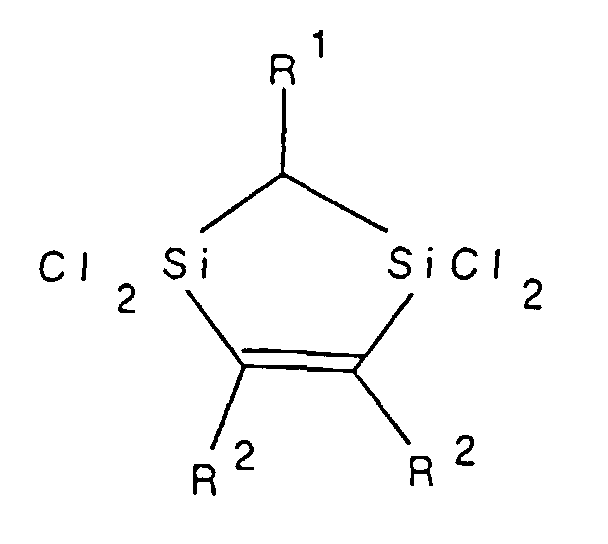
    Figure 00220002
    Figure 00230001
    linear organosilicon compounds described by formulas
    Figure 00230002
    and
    Figure 00230003
    or mixtures thereof.
  3. An organosilicon compound obtainable by the method of Claim 2 and selected from compounds described by formulas
    Figure 00230004
    Figure 00240001
    or mixtures thereof where R1 is selected from hydrogen, dichlorosilyl, trichlorosilyl, methyldichlorosilyl, dimethylchlorosilyl or trimethylsilyl and each R2 is independently selected from hydrogen, alkyls having one to 6 carbon atoms or aryls.
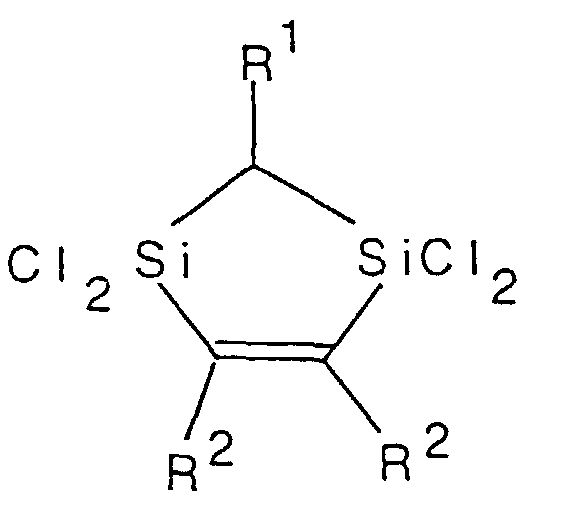
  4. A cyclic organosilicon compound obtainable by the method of Claim 1 and described by formula
    Figure 00240002
    where R1 is selected from hydrogen, dichlorosilyl, trichlorosilyl, methyldichlorosilyl, dimethylchlorosilyl or trimethylsilyl and each R2 is independently selected from hydrogen, alkyls having one to 6 carbon atoms or aryls.
  5. A cyclic organosilicon compound obtainable by the method of Claim 1 and described by formula
    Figure 00250001
    where R1 is selected from hydrogen, dichlorosilyl, trichlorosilyl, methyldichlorosilyl, dimethylchlorosilyl or trimethylsilyl and each R2 is independently selected from hydrogen, alkyls having one to 6 carbon atoms or aryls.
  6. A linear organosilicon compound obtainable by the method of Claim 1 and described by formula
    Figure 00250002
    where R1 is selected from hydrogen, dichlorosilyl, trichlorosilyl, methyldichlorosilyl, dimethylchlorosilyl or trimethylsilyl and each R2 is independently selected from hydrogen, alkyls having one to 6 carbon atoms or aryls.
  7. A linear organosilicon compound obtainable by the method of Claim 1 and described by formula
    Figure 00260001
    where R1 is selected from hydrogen, dichlorosilyl, trichlorosilyl, methyldichlorosilyl, dimethylchlorosilyl or trimethylsilyl and each R2 is independently selected from hydrogen, alkyls having one to 6 carbon atoms or aryls.
  8. Cyclic or linear organosilicon compounds according to Claims 4-7 where R2 is selected from hydrogen or methyl.
  9. A method according to Claims 1-2 where the bis(dichlorosilyl)methane is selected from bis(dichlorosilyl)trichlorosilylmethane or tris(dichlorosilyl)-methane.
  10. A method according to Claims 1-2 and 9 where the alkyne is selected from acetylene, phenylacetylene or diphenylacetylene.
  11. A method according to Claims 1-2 and 9-10 further comprising the presence of an organic solvent.
EP00109956A 1999-05-17 2000-05-11 Method for the preparation of organosilicon compounds and the organosilicon compounds prepared thereby Withdrawn EP1054014A3 (en)

Applications Claiming Priority (2)

Application Number Priority Date Filing Date Title
US09/312,900 US5998649A (en) 1999-05-17 1999-05-17 Organosilicon compounds and method for preparation
US312900 1999-05-17

Publications (2)

Publication Number Publication Date
EP1054014A2 true EP1054014A2 (en) 2000-11-22
EP1054014A3 EP1054014A3 (en) 2003-01-02

Family

ID=23213515

Family Applications (1)

Application Number Title Priority Date Filing Date
EP00109956A Withdrawn EP1054014A3 (en) 1999-05-17 2000-05-11 Method for the preparation of organosilicon compounds and the organosilicon compounds prepared thereby

Country Status (3)

Country Link
US (1) US5998649A (en)
EP (1) EP1054014A3 (en)
JP (1) JP2000351786A (en)

Families Citing this family (6)

* Cited by examiner, † Cited by third party
Publication number Priority date Publication date Assignee Title
US6087521A (en) * 1999-05-17 2000-07-11 Jung; Il Nam Silicon compounds containing silamethylene bonds and method for their preparation
KR101007807B1 (en) 2003-12-13 2011-01-14 삼성전자주식회사 Polyreactive linear siloxane compound, a siloxane polymer prepared from the compound and a method for producing an insulating film using the polymer
US20090005557A1 (en) * 2004-07-21 2009-01-01 Masatoshi Nakagawa Electron-Conjugated Organic Silane Compound and Production Method Thereof
EP1883673A2 (en) * 2005-05-27 2008-02-06 E.I. Dupont De Nemours And Company Resin compositions with a low coefficient of thermal expansion and articles therefrom
KR100928942B1 (en) * 2008-05-26 2009-11-30 제이에스아이실리콘주식회사 Process for producing straight or cyclic trisila alkanes
DE102010043996A1 (en) * 2010-11-16 2012-05-16 Wacker Chemie Ag Process for the preparation of alkoxy-substituted 1,2-bis-silyl-ethane

Family Cites Families (20)

* Cited by examiner, † Cited by third party
Publication number Priority date Publication date Assignee Title
US3220972A (en) * 1962-07-02 1965-11-30 Gen Electric Organosilicon process using a chloroplatinic acid reaction product as the catalyst
US3159601A (en) * 1962-07-02 1964-12-01 Gen Electric Platinum-olefin complex catalyzed addition of hydrogen- and alkenyl-substituted siloxanes
US3296291A (en) * 1962-07-02 1967-01-03 Gen Electric Reaction of silanes with unsaturated olefinic compounds
NL131800C (en) * 1965-05-17
US3527781A (en) * 1967-09-01 1970-09-08 Dow Corning Disilacyclobutanes
US3516946A (en) * 1967-09-29 1970-06-23 Gen Electric Platinum catalyst composition for hydrosilation reactions
US3655713A (en) * 1970-07-13 1972-04-11 Dow Corning Silacyclopentane thiols and thiolates
US3814730A (en) * 1970-08-06 1974-06-04 Gen Electric Platinum complexes of unsaturated siloxanes and platinum containing organopolysiloxanes
DE2131741C3 (en) * 1971-06-25 1975-05-28 Wacker-Chemie Gmbh, 8000 Muenchen Process for the addition of silicon compounds with Si-bonded hydrogen to compounds with aliphatic multiple bonds
GB1476314A (en) * 1973-06-23 1977-06-10 Dow Corning Ltd Coating process
US3989668A (en) * 1975-07-14 1976-11-02 Dow Corning Corporation Method of making a silicone elastomer and the elastomer prepared thereby
US5036117A (en) * 1989-11-03 1991-07-30 Dow Corning Corporation Heat-curable silicone compositions having improved bath life
JP2676001B2 (en) * 1990-03-08 1997-11-12 工業技術院長 Method for producing 1,2-bissilylethylene derivative
KR0141464B1 (en) * 1993-12-01 1998-07-01 김은영 Arylalkylsilane and preparation process thereof
US5399740A (en) * 1993-12-10 1995-03-21 Korea Institute Of Science And Technology Tris(silyl)methanes and their preparation methods
JP2951524B2 (en) * 1993-12-10 1999-09-20 財団法人韓国科学技術研究院 Method for producing trissilylmethane
US5498736A (en) * 1993-12-21 1996-03-12 Shin-Etsu Chemical Co., Ltd. 2,5-reactive substituent group-containing siloles, silole polycondensates and preparation thereof
US5391794A (en) * 1994-01-27 1995-02-21 Korea Institute Of Science And Technology Three-legged silane coupling agents and their preparation methods
KR0142142B1 (en) * 1994-06-24 1998-07-01 김은영 Bis (dichloroorgonosilyl) alkanes and preparation method thereof
US5605991A (en) * 1996-03-21 1997-02-25 Shell Oil Company Multifunctional initiator from divinyl dislane

Also Published As

Publication number Publication date
EP1054014A3 (en) 2003-01-02
US5998649A (en) 1999-12-07
JP2000351786A (en) 2000-12-19

Similar Documents

Publication Publication Date Title
KR101873565B1 (en) Organoaminosilanes and methods for making same
US3296291A (en) Reaction of silanes with unsaturated olefinic compounds
Uchimaru et al. Selective arylation of a silicon-hydrogen bond in o-bis (dimethylsilyl) benzene via carbon-hydrogen bond activation of arenes
KR20020059446A (en) Catalysts for hydrosilylation reactions
US6858746B2 (en) Process for the hydrosilylation of unsaturated aliphatic compounds
EP0232551A2 (en) Novel process for promoting hydrosilation reactions using a second hydrosilane
WO2010016416A1 (en) Catalyst for hydrosilylation reaction, and process for producing organic silicon compound using the catalyst
US5998649A (en) Organosilicon compounds and method for preparation
JP3556642B2 (en) Preparation of secondary aminoisobutylalkoxysilanes
EP0578186B1 (en) Method for the preparation of 1-aza-2-silacyclopentane compounds
US6087521A (en) Silicon compounds containing silamethylene bonds and method for their preparation
CN102459286A (en) Method of hydrosilylation
Ishikawa et al. Synthesis of Chlorosilanes from (Fluoroalkyl) silanes, Bis (silyl) benzenes, and. alpha.,. omega.-Dihydropolysiloxanes
JP7416927B2 (en) Method for preparing siloxane from hydridosilicon compounds
JPH0786117B2 (en) Alkoxy silane
US5281737A (en) 1-aza-2-silacyclobutane compounds and method for their preparation
US5068381A (en) Poly(silvinylene)s and a process for their preparation
JPH0448797B2 (en)
Phan et al. Platinum-catalyzed double silylations of alkynes with bis (dichlorosilyl) methanes
EP2658861B1 (en) New (triorganosilyl)alkynes and their derivatives and a new catalytic method for obtaining new and conventional substituted (triorganosilyl)alkynes and their derivatives
JP4276805B2 (en) Novel silazane compound and method for producing the same, and novel silazane compound polymer and method for producing the same
JP3385355B2 (en) Tetrakis (dialkoxysilyl) benzene and method for producing the same
JP3385354B2 (en) Tetrakis [bis (trifluoromethanesulfonyloxy) silyl] benzene and process for producing the same
JP3670958B2 (en) Method for producing 1,3-dihalogen-1,1,3,3-tetra (organyl) disiloxane
GB2244993A (en) Method of transsilylation

Legal Events

Date Code Title Description
PUAI Public reference made under article 153(3) epc to a published international application that has entered the european phase

Free format text: ORIGINAL CODE: 0009012

AK Designated contracting states

Kind code of ref document: A2

Designated state(s): AT BE CH CY DE DK ES FI FR GB GR IE IT LI LU MC NL PT SE

AX Request for extension of the european patent

Free format text: AL;LT;LV;MK;RO;SI

PUAL Search report despatched

Free format text: ORIGINAL CODE: 0009013

AK Designated contracting states

Kind code of ref document: A3

Designated state(s): AT BE CH CY DE DK ES FI FR GB GR IE IT LI LU MC NL PT SE

AX Request for extension of the european patent

Free format text: AL;LT;LV;MK;RO;SI

STAA Information on the status of an ep patent application or granted ep patent

Free format text: STATUS: THE APPLICATION IS DEEMED TO BE WITHDRAWN

18D Application deemed to be withdrawn

Effective date: 20001201