EP1053990A2 - A method of producing an aromatic ketone and an aromatic ketone composition containing it - Google Patents
A method of producing an aromatic ketone and an aromatic ketone composition containing it Download PDFInfo
- Publication number
- EP1053990A2 EP1053990A2 EP00304071A EP00304071A EP1053990A2 EP 1053990 A2 EP1053990 A2 EP 1053990A2 EP 00304071 A EP00304071 A EP 00304071A EP 00304071 A EP00304071 A EP 00304071A EP 1053990 A2 EP1053990 A2 EP 1053990A2
- Authority
- EP
- European Patent Office
- Prior art keywords
- group
- reaction
- compound
- benzene
- aromatic
- Prior art date
- Legal status (The legal status is an assumption and is not a legal conclusion. Google has not performed a legal analysis and makes no representation as to the accuracy of the status listed.)
- Withdrawn
Links
Classifications
-
- C—CHEMISTRY; METALLURGY
- C07—ORGANIC CHEMISTRY
- C07C—ACYCLIC OR CARBOCYCLIC COMPOUNDS
- C07C45/00—Preparation of compounds having >C = O groups bound only to carbon or hydrogen atoms; Preparation of chelates of such compounds
- C07C45/27—Preparation of compounds having >C = O groups bound only to carbon or hydrogen atoms; Preparation of chelates of such compounds by oxidation
- C07C45/32—Preparation of compounds having >C = O groups bound only to carbon or hydrogen atoms; Preparation of chelates of such compounds by oxidation with molecular oxygen
- C07C45/33—Preparation of compounds having >C = O groups bound only to carbon or hydrogen atoms; Preparation of chelates of such compounds by oxidation with molecular oxygen of CHx-moieties
- C07C45/34—Preparation of compounds having >C = O groups bound only to carbon or hydrogen atoms; Preparation of chelates of such compounds by oxidation with molecular oxygen of CHx-moieties in unsaturated compounds
- C07C45/36—Preparation of compounds having >C = O groups bound only to carbon or hydrogen atoms; Preparation of chelates of such compounds by oxidation with molecular oxygen of CHx-moieties in unsaturated compounds in compounds containing six-membered aromatic rings
-
- C—CHEMISTRY; METALLURGY
- C07—ORGANIC CHEMISTRY
- C07C—ACYCLIC OR CARBOCYCLIC COMPOUNDS
- C07C17/00—Preparation of halogenated hydrocarbons
- C07C17/35—Preparation of halogenated hydrocarbons by reactions not affecting the number of carbon or of halogen atoms in the reaction
- C07C17/354—Preparation of halogenated hydrocarbons by reactions not affecting the number of carbon or of halogen atoms in the reaction by hydrogenation
-
- C—CHEMISTRY; METALLURGY
- C07—ORGANIC CHEMISTRY
- C07C—ACYCLIC OR CARBOCYCLIC COMPOUNDS
- C07C49/00—Ketones; Ketenes; Dimeric ketenes; Ketonic chelates
- C07C49/76—Ketones containing a keto group bound to a six-membered aromatic ring
-
- C—CHEMISTRY; METALLURGY
- C07—ORGANIC CHEMISTRY
- C07C—ACYCLIC OR CARBOCYCLIC COMPOUNDS
- C07C49/00—Ketones; Ketenes; Dimeric ketenes; Ketonic chelates
- C07C49/76—Ketones containing a keto group bound to a six-membered aromatic ring
- C07C49/80—Ketones containing a keto group bound to a six-membered aromatic ring containing halogen
- C07C49/807—Ketones containing a keto group bound to a six-membered aromatic ring containing halogen all halogen atoms bound to the ring
Definitions
- the present invention relates to a method of producing an aromatic ketone, comprising the step of oxidizing an aromatic compound having an R-CH 2 group (R denotes an alkyl, aryl group, allyl group or aralkyl group) by oxygen gas in the presence of a catalyst.
- Aromatic ketones are compounds useful as raw materials of drugs, agricultural chemicals, dyes, perfumes, ultraviolet light absorbers and photographic chemicals.
- JP-A-07-196573 and US-A-4042531 disclose methods of using an imide compound as a catalyst in combination with a co-catalyst for oxidation in the production of an aromatic ketone
- JP-A-09-278675 and JP-A-09-327626 disclose methods of using an imide compound as a catalyst in combination with a co-catalyst for oxidation in the production of an aromatic ketone
- C Journal of Molecular Catalysis A: Vol. 117, p. 159 ⁇ 168 (1997) discloses a method of oxidizing ethylbenzene using an Fe 2 Ni type heteropoly-acid as a catalyst.
- the method (A) is low in selectivity to produce the intended aromatic ketone, and a benzoic acid cleaved at the bond between ⁇ position carbon and ⁇ position carbon of the alkyl group is produced in a large amount. Furthermore, the conversion rate of the reaction raw material is also low.
- the method (B) is insufficient in selectivity to produce the aromatic ketone, and furthermore since an expensive imide compound is used, it is essential to recover the compound for reuse for industrial application of the method. Even if the compound can be recovered for reuse, a complicated recovery process is necessary.
- JP-A-53-053631 discloses a method of producing diacetylbenzene by air oxidation in liquid phase using a molecular oxygen-containing gas in a heterogeneous reaction system consisting of an organic phase containing a reaction substrate and a water phase containing a water soluble catalyst.
- the present invention addresses the problem of providing a method for efficiently converting an aromatic compound with an R-CH 2 group ( R denotes an alkyl group, aryl group, allyl group or aralkyl group) into the corresponding aromatic ketone, using molecular oxygen as an oxidizing agent in the presence of a catalyst.
- R-CH 2 group R denotes an alkyl group, aryl group, allyl group or aralkyl group
- This invention provides, according to one aspect, a method of producing an aromatic ketone by subjecting an aromatic compound having an R-CH 2 group ( R denotes an alkyl group, aryl group, allyl group or aralkyl group) as a reaction raw material to a liquid phase oxidation reaction by an oxygen-containing gas in the presence of a catalyst comprising a heavy metal compound and at least one compound selected from (1) ammonia, (2) organic basic compounds and (3) onium halides while the water produced in the reaction is removed from the reaction system.
- R-CH 2 group R denotes an alkyl group, aryl group, allyl group or aralkyl group
- this invention provides an aromatic ketone composition
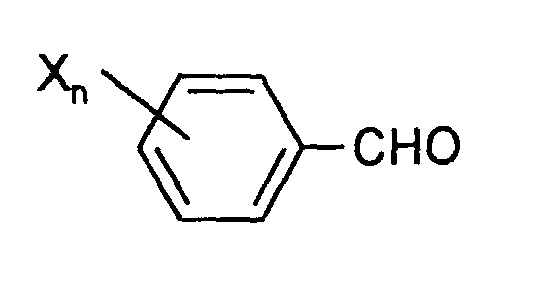
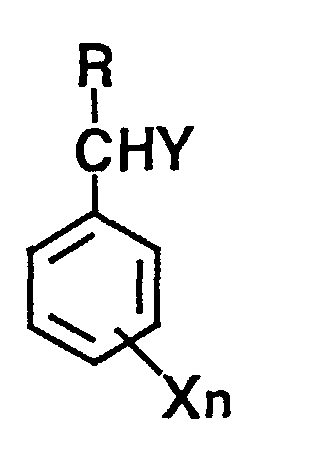
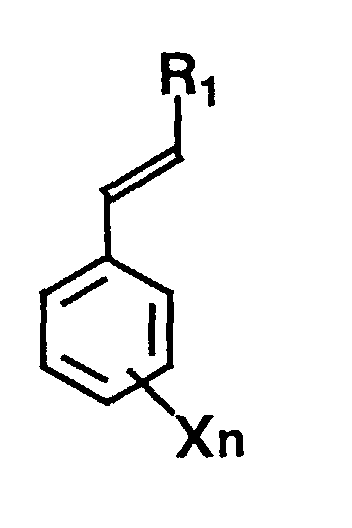
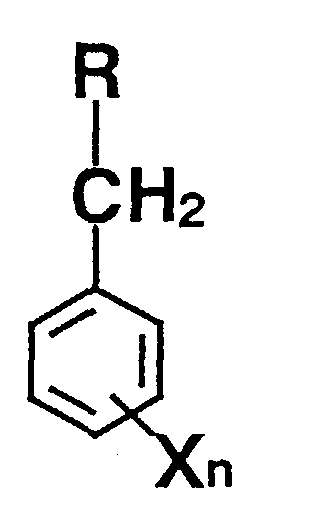
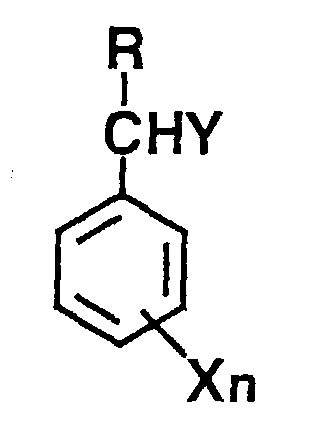
- an aromatic ketone composition comprising an aromatic ketone and at least one compound selected from R-CHY group-substituted benzenes represented by the following formula (II) (where X is a substituent; n is zero or an integer of 1 to 5; Y is a hydroxyl group or halogen group and R is as defined above), vinylbenzenes represented by the following formula (III) (where X is a substituent; n is zero or an integer of 1 to 5; R 1 is a hydrogen atom, alkyl group, aryl group, allyl group or aralkyl group and R is as defined above), and benzaldehydes represented by the following formula (IV) (where X is a substituent; and n is zero or an integer of 1 to 5), each compound of (II), (III) and (IV) present being present individually in an amount of from 10 ppm to 3 wt% by weight of the total weight of the composition.
- An aromatic compound having an R-CH 2 group ( R is an alkyl group, aryl group, allyl group or aralkyl group) which may be used in this invention is an aromatic compound substituted by one R-CH 2 group ( R is an alkyl group, aryl group, allyl group or aralkyl group).
- R of the R-CH 2 group a straight chain alkyl group or branched chain alkyl group with 1 to 8 carbon atoms, allyl group, aryl group with 6 to 15 carbon atoms or aralkyl group with 7 to 16 carbon atoms is preferable. More preferable is alkyl group with 1 to 8 carbon atoms.
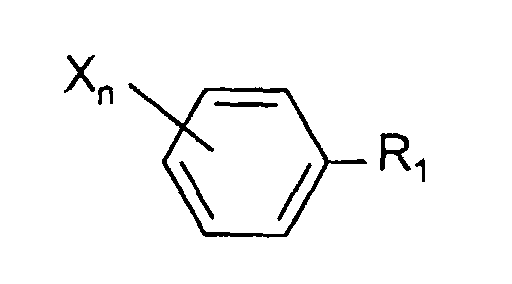
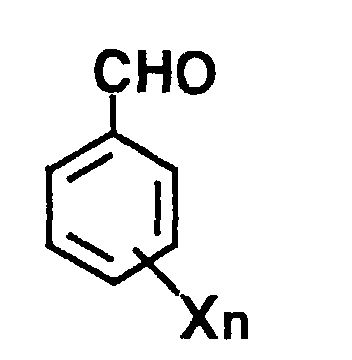
- an aromatic compound represented by the following formula (I) (where X is a substituent; and n is zero or an integer of 1 to 5) can be used.
- the aromatic compounds represented by the formula (I) particularly include (each respective hyphenated group named being substituted on an aromatic nucleus) ethyl-benzene, ethyl-toluene, isopropyl-ethyl-benzene, chloro-ethyl-benzene, dichloro-ethyl-benzene, bromo-ethyl-benzene, dibromo-ethyl-benzene, chloro-methyl-ethyl-benzene, dichloro-methyl-ethyl-benzene, trichloro-methyl-ethyl-benzene, fluoro-methyl-ethyl-benzene, difluoromethyl-ethyl-benzene, trifluoro-methyl-ethyl-benzene, nitro-ethyl-benzene, cyano-ethyl-benzene, amino-ethyl-benzene, amido-eth
- this invention allows an aromatic compound substituted by two or more R-CH 2 groups to be efficiently converted into an aromatic compound having two or more acyl groups.
- the aromatic compounds substituted by two or more R-CH 2 groups include, for example, diethyl-benzene, triethyl-benzene, tetraethyl-benzene, methyl-diethyl-benzene, methyl-triethyl-benzene, methyl-tetraethyl-benzene, chloro-diethyl-benzene, chloro-triethyl-benzene, chloro-tetraethyl-benzene, nitro-diethyl-benzene, nitro-triethyl-benzene, nitro-tetraethyl-benzene, bromo-diethyl-benzene, bromo-triethyl-benzene, bromo-tetraethyl-benzene, ethyl-n-propyl-benzene, diethyl-n-propyl-benzene, ethyl-di-
- any of the above reaction raw materials is oxidized in the presence of catalyst, it is essential to remove the water produced in the reaction from the reaction system. Unless the water produced in the reaction is removed from the reaction system, it hydrates the heavy metal, and since the reaction raw material cannot reach the heavy metal used as a component of the catalyst, the reaction rate greatly decreases. On the other hand, if the water produced in the reaction is removed from the reaction system, the contact between the reaction raw material and the catalyst occurs sufficiently, allowing the reaction rate and the reaction selectivity to be improved. For removing the produced water, any method can be used.
- the reaction temperature is set at higher than the boiling point of water at the reaction pressure, and the water vapor produced by the reaction is condensed by a reflux condenser installed above the reaction solution, and collected to be removed from the reaction system without being allowed to return to the reaction system.
- the heavy metal compound used in this invention contains at least one metal selected from groups 3 to 11 of the periodic table.
- Effective heavy metals include, for example, cobalt, manganese, cerium, vanadium, chromium, tungsten, molybdenum, ruthenium, copper and iron. Especially preferable are cobalt, manganese and cerium.
- the heavy metal compound is not especially limited as far as it contains a heavy metal.
- inorganic salts such as chlorides, bromides and sulfates and organic salts such as acetates, propionates and acetylacetonates can be exemplified. More preferable are chlorides, bromides and acetates.
- the amount of the heavy metal compound used is 0.0001 to 3 wt% as a metal based on the weight of the reaction raw material. A more preferable range is 0.001 to 0.5 wt%. If the amount of the heavy metal compound is 0.0001 wt% or more in the reaction, the oxidation reaction rate can be kept high, and the production selectivity of the intended aromatic ketone can be kept high. If the amount of the heavy metal compound is 3 wt% or less, lowering of the production selectivity of the intended aromatic ketone can be prevented, and no catalyst recovery process is required.
- a catalyst comprising a heavy metal compound and at least one selected from (1) ammonia, (2) organic basic compounds and (3) onium halides is used.
- the organic basic compounds which can be used in this invention refer to organic compounds having a non-shared electron pair and capable of donating it, and include, for example, amine compounds, ether compounds and amide compounds. Among them, amine compounds can be preferably used. Amine compounds can be primary amines, secondary amines and tertiary amines, but tertiary amines are preferable.
- they include methylamine, dimethylamine, trimethylamine, ethylamine, diethylamine, triethylamine, n-propylamine, di-n-propylamine, tri-n-propylamine, isopropylamine, n-butylamine, isobutylamine, sec-butylamine, tert-butylamine, cyclohexylamine, benzylamine, phenylethylamine, ethylenediamine, aniline, toluidine, anisidine, chloroaniline, cumidine, pyridine, nitropyridine, pyridinesulfonic acid, bromopyridine, chloropyridine, picoline, pyrimidine, pyridazine, pyrazine, pyrazoline, triazine, imidazole, imidazoline, oxazole, oxazoline, thiazole, isothiazole, pyrazole, quinoline,
- the onium halides which can be used in this invention include quaternary ammonium halides, quaternary pyridinium halides, oxonium halides, sulfonium halides and quaternary phosphonium halides.
- the quaternary pyridinium compounds include, particularly, hydropyridinium bromide, hydro-4-dimethylaminopyridinium bromide, hydropicoline bromide, hydropyrimidine bromine and corresponding chlorides and iodides.
- the quaternary ammonium compounds include hydroammonium bromide, tetramethylammonium bromide, tetraethylammonium bromide, tetrapropylammonium bromide, tetrabutylammonium bromide, benzyltrimethylammonium bromide, 3-methylazolium bromide and corresponding chlorides and iodides.
- the quaternary phosphonium salts include tetramethylphosphonium bromide, tetraethylphosphonium bromide, tetrapropylphosphonium bromide, tetrabutylphosphonium bromide and corresponding chlorides and iodides.
- the oxonium halides include (C 2 H 5 ) 3 O + BF 4- .
- the sulfonium halides include (CH 3 ) 3 S + I - .
- the total amount of (1) ammonia, (2) organic basic compounds and (3) onium halides used in this invention is 0.01 to 200 molar times the amount of the heavy metal used. A more preferable range is 0.1 to 30 molar times.
- a halogen compound when the reaction is effected in the presence of (1) ammonia or (2) an organic basic compound, it is preferable to use a halogen compound additionally, since the activity of the catalyst can be promoted.
- a bromine compound is especially preferable.
- the bromine compounds which can be used here include inorganic bromine compounds such as hydrogen bromide, alkali metal bromides and ammonium bromide, and organic bromine compounds such as tetrabromoethane, bromoacetic acid and benzyl bromide.
- the amount of the halogen compound used in this invention is in a range of 0.05 to 200 molar times the amount of the heavy metal. A more preferable range is 0.5 to 30 molar times. If the halogen compound is used in this range, the equipment can be prevented from being corroded.
- the reaction system is substantially free from any solvent or if a solvent is used, it is used in an amount of 50 part by weight or less per 100 parts by weight of the reaction raw material. It is more preferable not to use any solvent in the reaction, thereby providing a solvent-less system.
- This enables the following effects to be achieved, namely that since the reactor efficiency is high, production operation can be effected at high productivity, that it is not necessary to recover the solvent, and that since the reaction temperature can be raised up to the boiling point of the reaction raw material, the reaction can be effected at a high temperature to improve the reaction rate. Furthermore, surprisingly it has been found that not only the reaction rate but also the aromatic ketone production selectivity can be improved.
- the solvents which can be used here include, for example, acetic acid, cyclohexane, benzene, chloroform, carbon tetrachloride, dichloromethane, dichloroethane, diethyl ether, dimethoxyethane, tetrahydrofuran, dioxane, acetone, acetonitrile, nitrobenzene, nitromethane, pyridine, dimethylformamide and dimethyl sulfoxide. If a solvent is used, it is preferable to use a solvent with a high boiling point since the reaction can be effected at a high temperature.
- the oxygen-containing gas used in this invention is not required to be pure oxygen, and oxygen diluted, for example, by an inactive gas, such as air can also be used.
- the required amount of oxygen is a theoretical amount, i.e., 1 mole per one equivalent of the R-CH 2 group of the aromatic compound having an R-CH 2 group with which the oxygen is caused to react.
- the gas is usually continuously blown into the reaction system.
- the reaction can be effected under reduced pressure, pressurization or atmospheric pressure. Having regard to reaction efficiency (per unit volume), it is not preferable to execute the reaction at a very low pressure. Furthermore, having regard to economy of equipment such as reactor, it is not preferable either to execute the reaction at a very high pressure.
- a preferable pressure range is 0.01 to 20 MPa, and a more preferable range is 0.05 to 10 MPa. Furthermore, it is preferable that operation is effected to ensure that the oxygen concentration in the exhaust gas from the reactor is kept at lower than the explosion limit concentration.
- the reaction temperature is 50 to 300°C. A more preferable range is 80 to 250°C. If the reaction is effected at a temperature of 50°C or higher, the conversion of the aromatic compound having an R-CH 2 group (R is an alkyl group, aryl group, allyl group or aralkyl group) as the reaction raw material can be kept high. In other words, the decrease of the reaction rate can be prevented to improve the productivity of the reaction product.
- R-CH 2 group R is an alkyl group, aryl group, allyl group or aralkyl group
- reaction temperature is preferable also having regard to the stability of the aromatic compound having an R-CH 2 group (R is an alkyl group, aryl, group, allyl group or aralkyl group) as the reaction raw material, and also having regard to the stability of the produced aromatic ketone. In this case, the reaction selectivity is not lowered.
- any reactor equipped with forced mixing is preferable to a simple bubble tower reactor. That is, in order to promote the dissolution of the oxygen-containing gas into the reaction solution and to smoothly achieve the mutual contact between reacting materials in the reactor, it is preferable to use a reactor with many gas blow-in ports at the lower portion of the reactor for forced stirring by revolving stirring blades, or a reactor with a circulating pump provided outside the reactor for forced circulation.
- a reflux condenser is provided above the reactor, to discharge the exhaust gas through the reflux condenser, for condensing the solvent, reaction raw material, etc. contained in the exhaust gas, for circulation of them in the reactor.
- the water produced in the reaction is separated and discharged outside the reaction system.
- the aromatic ketone obtained according to this invention can be separated and refined by ordinary distillation, crystallization or chromatography, etc. If the unreacted reaction raw material and the 1-hydroxylalkylbenzene as a precursor of the aromatic ketone are recovered, they can also be reused for the oxidation reaction.
- the aromatic ketone obtained according to this method is characterized by containing 10 ppm to 3 wt% of at least one compound selected from R-CHY group substituted benzenes represented by the following formula (II) (where X is a substituent; n is zero or an integer of 1 to 5; and Y is a hydroxyl group or halogen atom), vinylbenzenes represented by the following formula (III) (where X is a substituent group; n is zero or an integer of 1 to 5; and R 1 is a hydrogen atom, alkyl group, aryl group, allyl group or aralkyl group), and benzaldehydes represented by the following formula (IV) (where X is a substituent; and n is zero or an integer or 1 to 5).
- R-CHY group substituted benzenes represented by the following formula (II) (where X is a substituent; n is zero or an integer of 1 to 5; and Y is a hydroxyl
- any such compound present is present in an amount of 50 ppm to 2 wt% by weight of the total composition.
- the substituent X is the same as the substituent X of the reaction raw material.
- Such an impurity is peculiar to the aromatic ketone produced according to the method of this invention. If the method of this invention is used for production, the aromatic ketone obtained contains the impurity.
- the aromatic ketone produced according to any other method does not contain the impurity in the amount as specified above.
- the aromatic ketone produced according to the method of this invention contains a vinylbenzene represented by the formula (III) or a benzaldehyde represented by the above formula (IV) in the amount specified above.
- the heavy metal compounds used as catalysts in the following Examples were cobalt chloride hexahydrate produced by Katayama Kagaku, cobalt acetate tetrahydrate produced by Nacalaitesque and cobalt bromide produced by Katayama Kagaku.
- the tertiary amine used was pyridine produced as a guaranteed reagent by Kishida Kagaku.
- the halogen compound used was hydrobromic acid (47% HBr aqueous solution) produced by Katayama Kagaku.
- the organic acid solvent used was acetic acid produced as a first class reagent by Kanto Kagaku.
- the aromatic compounds having an R-CH 2 group used were m-chloroethylbenzene (mCEB), p-diethylbenzene (pDEB) and m-diethylbenzene (mDEB) respectively produced by Toray Industries, Inc., and m-chloropropylbenzene (mCPB) synthesized as described below.
- mCEB m-chloroethylbenzene
- pDEB p-diethylbenzene
- mDEB m-diethylbenzene
- Meta-CPB was prepared from m-chloropropiophenone (mCPP) by Wolff-Kishner reduction.
- a 10-liter separable flask equipped with an air cooled fractional distillation column, mechanical stirrer and thermometer was charged with 980 g of mCPP (5.8 mol, produced by Avocado), 1.1 kg of diethylene glycol (produced by Katayama Kagaku), 600 g of potassium hydroxide (10.7 mol, produced by Katayama Kagaku) and 600 g of 80% hydrazine hydrate (9.6 mol, produced by Katayama Kagaku), and with stirring, the temperature of the mantle heater was raised to 120°C. After the temperature of the emission gas became stable (production of hydrazone), the temperature was further raised till the temperature of the emission gas reached 110°C. At the temperature, reaction was effected for about 8 hours.
- a glass three-neck flask with a reflux condenser tube and a Dean-Stark device was charged with 80 g of m-chloroethylbenzene (mCEB), and into the flask, 0.0135 g of cobalt chloride hexahydrate and 0.0045 g of pyridine were supplied. With stirring by stirring blades, air was blown in at atmospheric pressure at 150 ml/min. In succession, the flask was heated by an oil bath to 120°C, to initiate reaction. The water produced in the reaction was removed from the reaction solution by the Dean-Stark device. The organic material boiled with the produced water was returned to the reaction solution after completion of reaction.
- mCEB m-chloroethylbenzene
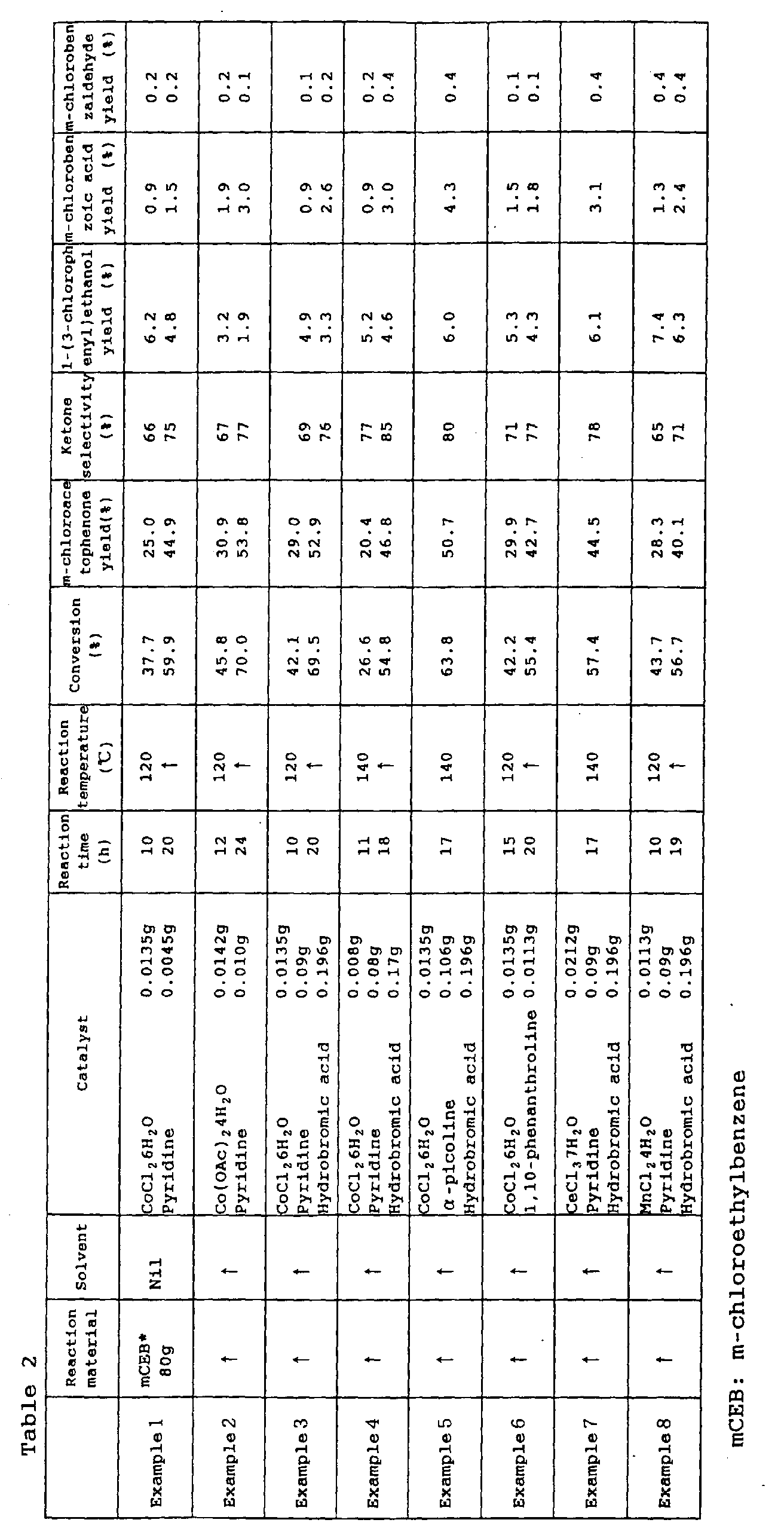
- Example 2 An experiment was performed as described for Example 3, except that the amount of cobalt chloride hexahydrate was changed from 0.0135 to 0.008 g, that the amount of pyridine was changed from 0.09g to 0.08g, that the amount of an aqueous solution of hydrobromic acid (47% HBr) was changed from 0.196g to 0.17g, and that the reaction temperature was changed from 120°C to 140°C.
- the reaction results are shown in Table 2.
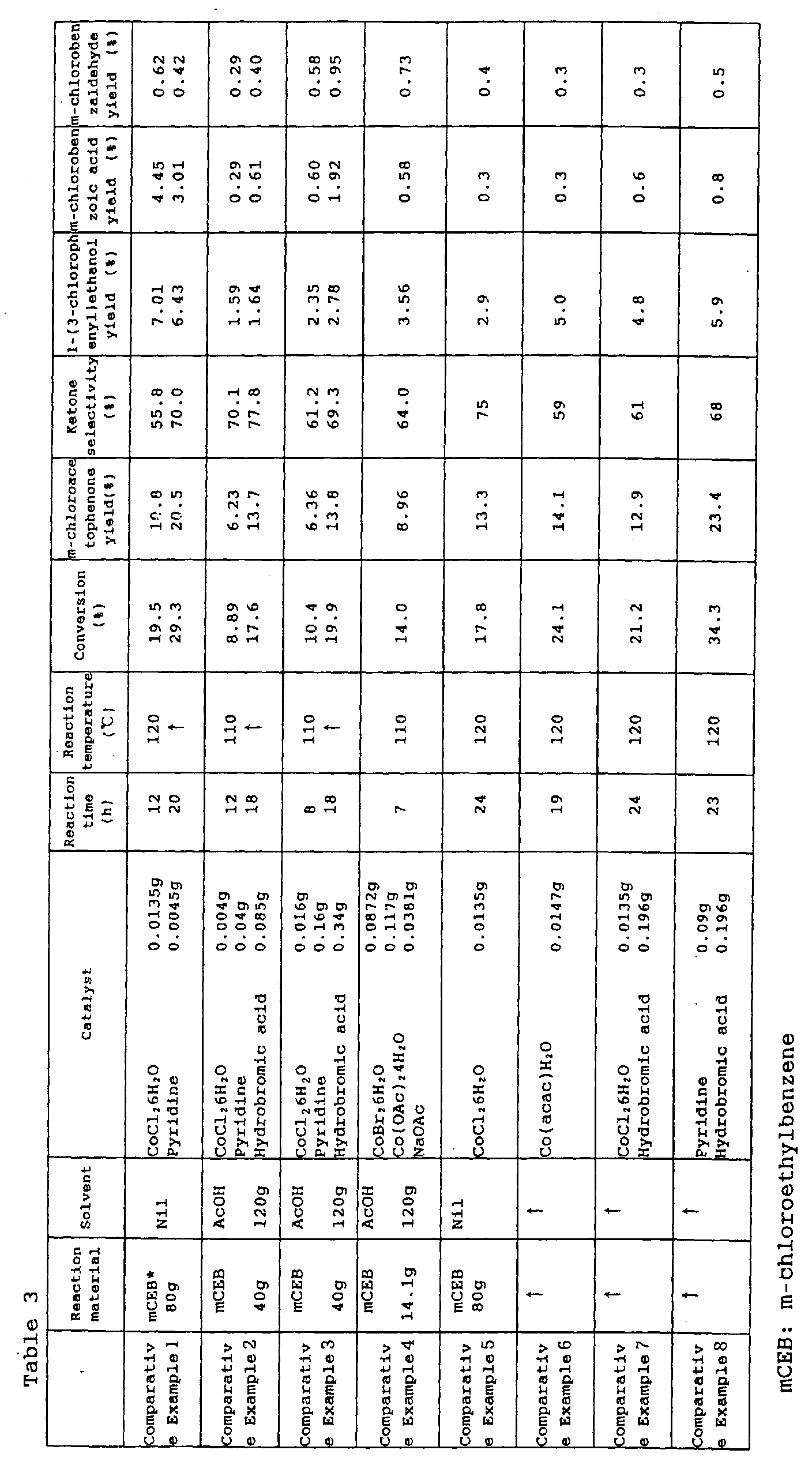
- a glass three-neck flask with a reflux condenser tube but without a Dean-Stark device was charged with 40 g of m-chloroethylbenzene (mCEB) and 120 g of acetic acid, and into the flask, 0.004 g of cobalt chloride hexahydrate, 0.04 g of pyridine and 0.085 g of an aqueous solution of hydrobromic acid were supplied. With stirring by stirring blades, air was blown in at atmospheric pressure at 150 ml/min. In succession, the flask was heated by an oil bath to 110°C, to initiate reaction. After reaction for a predetermined period of time, the reaction solution was analyzed by gas chromatography and high performance liquid chromatography. The results are shown in Table 3.
- mCEB m-chloroethylbenzene
- a glass three-neck flask with a reflux condenser tube without a Dean-Stark device was charged with 14.1 g of m-chloroethylbenzene (mCEB) and 120 g of acetic acid, and into the flask, 0.0872 g of cobalt bromide hexahydrate, 0.117 g of cobalt acetate tetrahydrate and 0.0381 g of sodium acetate were supplied. With stirring by stirring blades, air was blown in at atmospheric pressure at 150 ml/min. In succession, the flask was heated by an oil bath to 110°C, to initiate reaction. After reaction for a predetermined period of time, the reaction solution was analyzed by gas chromatography and high performance liquid chromatography. The results are shown in Table 3.
- mCEB m-chloroethylbenzene
- a glass three-neck flask with a reflux condenser tube and a Dean-Stark device was charged with 80 g of m-chloroethylbenzene (mCEB), and into the flask, 0.0135 g of cobalt chloride hexahydrate was supplied. With stirring by stirring blades, air was blown in at atmospheric pressure at 150 ml/min. In succession, the flask was heated by an oil bath to 120°C, to initiate reaction. The water produced in the reaction was removed from the reaction solution by the Dean-Stark device. The organic material boiled with the produced water was returned to the reaction solution after completion of reaction. After reaction for a predetermined period of time, the reaction solution was analyzed by gas chromatography and high performance liquid chromatography. The results are shown in Table 3.
- the reaction solution obtained in Example 1 was fractionally distilled using a packed reduced pressure fractional distiller to obtain m-chloroacetophenone.
- the obtained m-chloroacetophenone contained, by weight of the total weight of the composition, m-chlorostyrene (0.3%), m-chlorobenzaldehyde (0.3%), 1-(3-chlorophenyl)ethanol (1.0%) and 1-(3-chlorophenyl)-1-chloroethane (0.4%).
- a glass three-neck flask with a reflux condenser and a Dean-Stark device was charged with 80 g of pDEB, and into the flask, 0.0142 g of cobalt chloride hexahydrate, 0.0189 g of pyridine and 0.041 g of 47% hydrogen bromide water were supplied. With stirring by stirring blades, air was blown in at atmospheric pressure at 150 m/min. In succession, the flask was heated by an oil bath to 120°C, to initiate reaction. The water produced in the reaction was removed from the reaction solution using the Dean-Stark device. After reaction for a predetermined period of time, the reaction solution was analyzed by gas chromatography and high speed liquid chromatography.
- p-diethylbenzene conversion (%) (Moles of reacting p-diethylbenzene)/(Moles of p-diethylbenzene in raw materials) x 100
- p-diacetylbenzene yield (%) (Moles of produced p-diacetylbenzene)/(Moles of p-diethylbenzene in raw materials) x 100
- an aromatic compound having an R-CH 2 group ( R denotes an alkyl group, aryl group, allyl group or aralkyl group) can be converted efficiently into the corresponding aromatic ketone, it is very advantageous as an industrial method of producing an aromatic ketone by air oxidation in liquid phase.
Landscapes
- Chemical & Material Sciences (AREA)
- Organic Chemistry (AREA)
- Chemical Kinetics & Catalysis (AREA)
- Organic Low-Molecular-Weight Compounds And Preparation Thereof (AREA)
Abstract

Description
vinylbenzenes represented by the following formula (III)
benzaldehydes represented by the following formula (IV)
Furthermore, it is preferable that operation is effected to ensure that the oxygen concentration in the exhaust gas from the reactor is kept at lower than the explosion limit concentration.

vinylbenzenes represented by the following formula (III)

benzaldehydes represented by the following formula (IV)
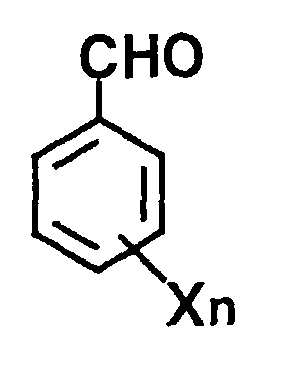
Such an impurity is peculiar to the aromatic ketone produced according to the method of this invention. If the method of this invention is used for production, the aromatic ketone obtained contains the impurity. The aromatic ketone produced according to any other method does not contain the impurity in the amount as specified above. In particular, it is peculiar to the aromatic ketone produced according to the method of this invention that the aromatic ketone contains a vinylbenzene represented by the formula (III) or a benzaldehyde represented by the above formula (IV) in the amount specified above.
| GC analysis conditions | |
| Model | Shimadzu GC-14B |
| Column | NEUTRA BOND-1 produced by GL Science (Capillary Cat. No. AG-1163) 60 m x 0.25 mm, ID 0.4 µm |
| Column temperature (heating pattern) | Initial 100°C (held for 15 min) 3°C/min (up to 250°C, taking 30 min) Final 250°C (held for 25 min) |
| INJ/DET temperature | 250°C |
| Detector | FID |
| Makeup gas | 40 ml/min He |
| Hydrogen | 30 ml/min |
| Air | 400 ml/min |

Claims (16)
- A method of producing an aromatic ketone, comprising subjecting an aromatic compound having an R-CH2 group ( R denotes an alkyl group, aryl group, allyl group or aralkyl group) as a reaction raw material to a liquid phase oxidation reaction using an oxygen-containing gas in the presence of a catalyst comprising a heavy metal compound and at least one compound selected from (1) ammonia, (2) organic basic compounds and (3) onium halides while water produced in the reaction is removed from the reaction system.
- A method according to claim 1, wherein the liquid phase oxidation reaction is effected in a rection system substantially free from any solvent or with 50 parts by weight or less of a solvent per 100 parts by weight of the reaction raw material.
- A method according to claim 2, wherein the liquid phase oxidation reaction is effected in a solvent-less system.
- A method according to any preceding claim, wherein the aromatic compound as the reaction raw material is represented by the following formula (I)(where X is a substituent; n is zero or an integer of 1 to 5 and R is as defined in claim 1).

- A method according to claim 4, wherein the substituent X is at least one moiety selected from alkyl, aryl, aralkyl, allyl, halogen, haloalkyl, cyano, amino, N-alkylamino, N,N-dialkylamino, alkoxyl, sulfonic acid, hydroxyl, hydroxymethyl, formyl, nitro, acyloxy, acyl, amido, SR1, SOR1, SO2R2, CH2OR1, CH(OR1)(OR2), C(OR1)(OR2)(OR3) and COCOR1 (R1, R2 and R3 denote, respectively independently, an alkyl group, aryl group, allyl group or aralkyl group or a hydrogen atom).
- A method according to any one of claims 1 to 3, wherein the aromatic compound as the reaction raw material is an aromatic compound having two or more R-CH2 groups ( R denotes an alkyl group, aryl group, allyl group or aralkyl group).
- A method according to claim 6, wherein the aromatic compound with two or more R-CH2 groups is diethylbenzene.
- A method according to any preceding claim, wherein the reaction is effected in the presence of (1) ammonia or (2) organic basic compound and a halogen compound is additionally present.
- A method according to claim 8, wherein the halogen compound is a bromine compound.
- A method according to any one of claims 1 to 9, wherein the heavy metal compound contains at least one metal selected from cobalt, manganese, cerium, vanadium, chromium, tungsten, molybdenum, ruthenium, copper and iron.
- A method according to any one of claims 1 to 7, wherein the catalyst includes an organic basic compound which is an amine compound.
- A method according to claim 11, wherein the amine compound is a tertiary amine.
- A method according to any one of claims 1 to 7, wherein the catalyst includes an onium halide which is at least one onium halide component selected from ammonium halides, pyridinium halides, oxonium halides, sulfonium halides and phosphonium halides.
- An aromatic ketone composition comprising an aromatic ketone and at least one compound selected from R-CHY group substituted benzenes represented by the following formula (II)(where X is a substituent group; n is zero or an integer of 1 to 5; Y is a hydroxyl group or halogen atom and R is as defined in claim 1),
vinylbenzenes represented by the following formula (III)(where X is a substituent; n is zero or an integer of 1 to 5; and R1 is a hydrogen atom, alkyl group, aryl group, allyl group or aralkyl group), and
benzaldehydes represented by the following formula (IV)(where X is a substituent; n is zero or an integer of 1 to 5), each compound of (II), (III) and (IV) present being present individually in an amount of from 10 ppm to 3 wt% by weight of the total weight of the composition.
- An aromatic ketone composition according to claim 14, wherein a vinylbenzene represented by the formula (III) is present in an amount of 10 ppm to 3 wt%.
- An aromatic ketone composition according to claim 14, wherein a benzaldehyde represented by the formula (IV) is present in an amount of 10 ppm to 3 wt%.
Applications Claiming Priority (2)
| Application Number | Priority Date | Filing Date | Title |
|---|---|---|---|
| JP13429199 | 1999-05-14 | ||
| JP13429199 | 1999-05-14 |
Publications (2)
| Publication Number | Publication Date |
|---|---|
| EP1053990A2 true EP1053990A2 (en) | 2000-11-22 |
| EP1053990A3 EP1053990A3 (en) | 2000-12-20 |
Family
ID=15124859
Family Applications (1)
| Application Number | Title | Priority Date | Filing Date |
|---|---|---|---|
| EP00304071A Withdrawn EP1053990A3 (en) | 1999-05-14 | 2000-05-15 | A method of producing an aromatic ketone and an aromatic ketone composition containing it |
Country Status (1)
| Country | Link |
|---|---|
| EP (1) | EP1053990A3 (en) |
Cited By (1)
| Publication number | Priority date | Publication date | Assignee | Title |
|---|---|---|---|---|
| WO2005085161A1 (en) * | 2004-03-05 | 2005-09-15 | Rütgers Chemicals AG | Method for producing aromatic alkoxy ketones |
Family Cites Families (7)
| Publication number | Priority date | Publication date | Assignee | Title |
|---|---|---|---|---|
| US3714263A (en) * | 1969-10-29 | 1973-01-30 | Universal Oil Prod Co | Selective oxidation of alkyl aromatic compounds |
| US3767704A (en) * | 1972-07-03 | 1973-10-23 | Dow Chemical Co | Oxidation of ethylbenzenes |
| BE823166A (en) * | 1973-12-28 | 1975-04-01 | DIETHYLBENZENE OXIDATION PROCESS | |
| US4471140A (en) * | 1982-08-19 | 1984-09-11 | The Dow Chemical Company | Preparation of aromatic aldehydes |
| SU1740363A1 (en) * | 1989-09-25 | 1992-06-15 | Нижнекамское производственное объединение "Нижнекамскнефтехим" | Method for processing residual of methylphenylcarbinol dehydration into styrene |
| JPH07196573A (en) * | 1993-12-09 | 1995-08-01 | Shell Internatl Res Maatschappij Bv | Acetophenone production method |
| US6242643B1 (en) * | 1996-05-17 | 2001-06-05 | Toray Industries, Inc. | Method for preparing aromatic carboxylic acids, aromatic aldehydes, and aromatic alcohols |
-
2000
- 2000-05-15 EP EP00304071A patent/EP1053990A3/en not_active Withdrawn
Cited By (1)
| Publication number | Priority date | Publication date | Assignee | Title |
|---|---|---|---|---|
| WO2005085161A1 (en) * | 2004-03-05 | 2005-09-15 | Rütgers Chemicals AG | Method for producing aromatic alkoxy ketones |
Also Published As
| Publication number | Publication date |
|---|---|
| EP1053990A3 (en) | 2000-12-20 |
Similar Documents
| Publication | Publication Date | Title |
|---|---|---|
| Soula | Tris (polyoxaalkyl) amines (trident), a new class of solid-liquid phase-transfer catalysts | |
| Dohi et al. | An excellent dual recycling strategy for the hypervalent iodine/nitroxyl radical mediated selective oxidation of alcohols to aldehydes and ketones | |
| Narender et al. | Liquid phase bromination of phenols using potassium bromide and hydrogen peroxide over zeolites | |
| US4418229A (en) | Method for producing fluoronitrobenzene compounds | |
| US4642398A (en) | Preparation of fluoronitrobenzene compounds in dispersion of potassium fluoride | |
| US4642399A (en) | Method for producing fluoronitrobenzene compounds | |
| JP5196341B2 (en) | Method for producing biphenyl derivative | |
| Moayyed et al. | Iodine-catalyzed synthesis of β-uramino crotonic esters as well as oxidative esterification of carboxylic acids in choline chloride/urea: a desirable alternative to organic solvents | |
| US6121480A (en) | Method for producing unsymmetrically substituted biphenyls | |
| JP3373228B2 (en) | Method for producing 2-hydroxyaryl aldehyde | |
| EP2858966B1 (en) | Process for creating carbon-carbon bonds using carbonyl compounds | |
| JP2001514238A (en) | Process for producing fluorine-containing compounds, especially fluorobenzaldehyde and fluorobenzonitrile | |
| WO2012081488A1 (en) | Bis(trifluoromethanesulfonyl)ethyl-bearing compound and acid catalyst, and method for preparing same | |
| Hakala et al. | Microwave-promoted synthesis of polyhydroxydeoxybenzoins in ionic liquids | |
| JP2000103758A (en) | Method for producing aromatic ketone | |
| EP2192087A1 (en) | Alkali metal fluoride dispersion, and process for production of fluorinated organic compound using the same | |
| EP2043970B1 (en) | Iron-copper co-catalyzed process for carbon-carbon or carbon-heteroatom bonding | |
| JPH024580B2 (en) | ||
| JP2001316319A (en) | Method for producing aromatic ketone and aromatic ketone | |
| Kishida et al. | The chloromethylation of biphenyls catalyzed by group 3 and 4 metal triflates | |
| JP2001226307A (en) | Method for producing aromatic compound having two or more acyl groups | |
| JPH04243846A (en) | Process for producing fluorophenol, fluorohalo- phenol, n-acylfluoroaniline and n-acylfluorohalo- aniline | |
| Cativiela et al. | The use of Lewis acids in the synthesis of 5-arylhydantoins | |
| JPS63502182A (en) | Catalytic production method for fluoroaromatic compounds using branched chain alkylpyridinium salts | |
| JPH07196573A (en) | Acetophenone production method |
Legal Events
| Date | Code | Title | Description |
|---|---|---|---|
| PUAI | Public reference made under article 153(3) epc to a published international application that has entered the european phase |
Free format text: ORIGINAL CODE: 0009012 |
|
| PUAL | Search report despatched |
Free format text: ORIGINAL CODE: 0009013 |
|
| AK | Designated contracting states |
Kind code of ref document: A2 Designated state(s): AT BE CH CY DE DK ES FI FR GB GR IE IT LI LU MC NL PT SE |
|
| AX | Request for extension of the european patent |
Free format text: AL;LT;LV;MK;RO;SI |
|
| RIC1 | Information provided on ipc code assigned before grant |
Free format text: 7C 07C 45/32 A, 7C 07C 47/52 B, 7C 07C 45/36 B, 7C 07C 49/76 B, 7C 07C 49/78 B, 7C 07C 49/80 B |
|
| AK | Designated contracting states |
Kind code of ref document: A3 Designated state(s): AT BE CH CY DE DK ES FI FR GB GR IE IT LI LU MC NL PT SE |
|
| AX | Request for extension of the european patent |
Free format text: AL;LT;LV;MK;RO;SI |
|
| 17P | Request for examination filed |
Effective date: 20010509 |
|
| AKX | Designation fees paid |
Free format text: AT BE CH CY DE DK ES FI FR GB GR IE IT LI LU MC NL PT SE |
|
| 17Q | First examination report despatched |
Effective date: 20020307 |
|
| STAA | Information on the status of an ep patent application or granted ep patent |
Free format text: STATUS: THE APPLICATION IS DEEMED TO BE WITHDRAWN |
|
| 18D | Application deemed to be withdrawn |
Effective date: 20020718 |