EP1053988B1 - Trimethylcyclohexane derivatives and melanin-formation inhibitors and perfume-holding agents with the use of the same - Google Patents
Trimethylcyclohexane derivatives and melanin-formation inhibitors and perfume-holding agents with the use of the same Download PDFInfo
- Publication number
- EP1053988B1 EP1053988B1 EP99901929A EP99901929A EP1053988B1 EP 1053988 B1 EP1053988 B1 EP 1053988B1 EP 99901929 A EP99901929 A EP 99901929A EP 99901929 A EP99901929 A EP 99901929A EP 1053988 B1 EP1053988 B1 EP 1053988B1
- Authority
- EP
- European Patent Office
- Prior art keywords
- methyl
- propenyl
- butyl
- compound
- trimethylcyclohexane
- Prior art date
- Legal status (The legal status is an assumption and is not a legal conclusion. Google has not performed a legal analysis and makes no representation as to the accuracy of the status listed.)
- Expired - Lifetime
Links
- MEBONNVPKOBPEA-UHFFFAOYSA-N 1,1,2-trimethylcyclohexane Chemical class CC1CCCCC1(C)C MEBONNVPKOBPEA-UHFFFAOYSA-N 0.000 title claims description 43
- 239000003112 inhibitor Substances 0.000 title claims description 27
- 239000003795 chemical substances by application Substances 0.000 title description 3
- -1 1-ethyl-1-ethenyl Chemical group 0.000 claims description 78
- 239000003205 fragrance Substances 0.000 claims description 63
- 239000000203 mixture Substances 0.000 claims description 52
- 239000000834 fixative Substances 0.000 claims description 47
- 230000008099 melanin synthesis Effects 0.000 claims description 44
- 238000009472 formulation Methods 0.000 claims description 39
- 125000004123 n-propyl group Chemical group [H]C([H])([H])C([H])([H])C([H])([H])* 0.000 claims description 27
- 125000004108 n-butyl group Chemical group [H]C([H])([H])C([H])([H])C([H])([H])C([H])([H])* 0.000 claims description 26
- 229920006395 saturated elastomer Polymers 0.000 claims description 26
- 125000000959 isobutyl group Chemical group [H]C([H])([H])C([H])(C([H])([H])[H])C([H])([H])* 0.000 claims description 23
- 230000002500 effect on skin Effects 0.000 claims description 18
- 230000002401 inhibitory effect Effects 0.000 claims description 18
- 125000004432 carbon atom Chemical group C* 0.000 claims description 17
- 125000006020 2-methyl-1-propenyl group Chemical group 0.000 claims description 12
- 125000003903 2-propenyl group Chemical group [H]C([*])([H])C([H])=C([H])[H] 0.000 claims description 12
- 239000001257 hydrogen Substances 0.000 claims description 12
- 229910052739 hydrogen Inorganic materials 0.000 claims description 12
- 125000001449 isopropyl group Chemical group [H]C([H])([H])C([H])(*)C([H])([H])[H] 0.000 claims description 12
- 125000000999 tert-butyl group Chemical group [H]C([H])([H])C(*)(C([H])([H])[H])C([H])([H])[H] 0.000 claims description 12
- 150000002430 hydrocarbons Chemical group 0.000 claims description 11
- 125000002496 methyl group Chemical group [H]C([H])([H])* 0.000 claims description 11
- 125000004435 hydrogen atom Chemical group [H]* 0.000 claims description 10
- 229930195734 saturated hydrocarbon Natural products 0.000 claims description 10
- 229930195735 unsaturated hydrocarbon Natural products 0.000 claims description 10
- 125000002914 sec-butyl group Chemical group [H]C([H])([H])C([H])([H])C([H])(*)C([H])([H])[H] 0.000 claims description 9
- 125000004973 1-butenyl group Chemical group C(=CCC)* 0.000 claims description 8
- 125000006017 1-propenyl group Chemical group 0.000 claims description 8
- 125000004974 2-butenyl group Chemical group C(C=CC)* 0.000 claims description 8
- 125000004975 3-butenyl group Chemical group C(CC=C)* 0.000 claims description 8
- 125000003136 n-heptyl group Chemical group [H]C([H])([H])C([H])([H])C([H])([H])C([H])([H])C([H])([H])C([H])([H])C([H])([H])* 0.000 claims description 8
- 125000001280 n-hexyl group Chemical group C(CCCCC)* 0.000 claims description 8
- 125000000740 n-pentyl group Chemical group [H]C([H])([H])C([H])([H])C([H])([H])C([H])([H])C([H])([H])* 0.000 claims description 8
- 125000006019 1-methyl-1-propenyl group Chemical group 0.000 claims description 7
- 125000006021 1-methyl-2-propenyl group Chemical group 0.000 claims description 7
- 125000006022 2-methyl-2-propenyl group Chemical group 0.000 claims description 7
- 125000000555 isopropenyl group Chemical group [H]\C([H])=C(\*)C([H])([H])[H] 0.000 claims description 7
- 239000002537 cosmetic Substances 0.000 claims description 4
- 238000004519 manufacturing process Methods 0.000 claims description 3
- 239000003814 drug Substances 0.000 claims 1
- 150000001875 compounds Chemical class 0.000 description 72
- HEDRZPFGACZZDS-MICDWDOJSA-N Trichloro(2H)methane Chemical compound [2H]C(Cl)(Cl)Cl HEDRZPFGACZZDS-MICDWDOJSA-N 0.000 description 30
- OKKJLVBELUTLKV-UHFFFAOYSA-N Methanol Chemical compound OC OKKJLVBELUTLKV-UHFFFAOYSA-N 0.000 description 24
- 229940125904 compound 1 Drugs 0.000 description 18
- 238000006243 chemical reaction Methods 0.000 description 17
- 238000001819 mass spectrum Methods 0.000 description 17
- 238000005160 1H NMR spectroscopy Methods 0.000 description 16
- XLYOFNOQVPJJNP-UHFFFAOYSA-N water Chemical compound O XLYOFNOQVPJJNP-UHFFFAOYSA-N 0.000 description 16
- 230000015572 biosynthetic process Effects 0.000 description 15
- 230000000052 comparative effect Effects 0.000 description 15
- VLKZOEOYAKHREP-UHFFFAOYSA-N n-Hexane Chemical compound CCCCCC VLKZOEOYAKHREP-UHFFFAOYSA-N 0.000 description 15
- 239000003921 oil Substances 0.000 description 15
- 235000019198 oils Nutrition 0.000 description 15
- 238000003786 synthesis reaction Methods 0.000 description 15
- LFQSCWFLJHTTHZ-UHFFFAOYSA-N Ethanol Chemical compound CCO LFQSCWFLJHTTHZ-UHFFFAOYSA-N 0.000 description 14
- SESFRYSPDFLNCH-UHFFFAOYSA-N benzyl benzoate Chemical compound C=1C=CC=CC=1C(=O)OCC1=CC=CC=C1 SESFRYSPDFLNCH-UHFFFAOYSA-N 0.000 description 14
- 238000012360 testing method Methods 0.000 description 14
- 239000002904 solvent Substances 0.000 description 13
- CATSNJVOTSVZJV-UHFFFAOYSA-N heptan-2-one Chemical compound CCCCCC(C)=O CATSNJVOTSVZJV-UHFFFAOYSA-N 0.000 description 12
- 125000001495 ethyl group Chemical group [H]C([H])([H])C([H])([H])* 0.000 description 11
- 230000002829 reductive effect Effects 0.000 description 11
- 239000003054 catalyst Substances 0.000 description 10
- 230000000694 effects Effects 0.000 description 10
- UHOVQNZJYSORNB-UHFFFAOYSA-N Benzene Chemical compound C1=CC=CC=C1 UHOVQNZJYSORNB-UHFFFAOYSA-N 0.000 description 9
- YXFVVABEGXRONW-UHFFFAOYSA-N Toluene Chemical compound CC1=CC=CC=C1 YXFVVABEGXRONW-UHFFFAOYSA-N 0.000 description 9
- 238000011156 evaluation Methods 0.000 description 9
- 238000005984 hydrogenation reaction Methods 0.000 description 9
- 239000000126 substance Substances 0.000 description 9
- 230000002087 whitening effect Effects 0.000 description 9
- XUMBMVFBXHLACL-UHFFFAOYSA-N Melanin Chemical compound O=C1C(=O)C(C2=CNC3=C(C(C(=O)C4=C32)=O)C)=C2C4=CNC2=C1C XUMBMVFBXHLACL-UHFFFAOYSA-N 0.000 description 8
- BJRNKVDFDLYUGJ-RMPHRYRLSA-N hydroquinone O-beta-D-glucopyranoside Chemical compound O[C@@H]1[C@@H](O)[C@H](O)[C@@H](CO)O[C@H]1OC1=CC=C(O)C=C1 BJRNKVDFDLYUGJ-RMPHRYRLSA-N 0.000 description 8
- 238000005882 aldol condensation reaction Methods 0.000 description 7
- 229960002903 benzyl benzoate Drugs 0.000 description 7
- 210000003764 chromatophore Anatomy 0.000 description 7
- 239000001069 triethyl citrate Substances 0.000 description 7
- VMYFZRTXGLUXMZ-UHFFFAOYSA-N triethyl citrate Natural products CCOC(=O)C(O)(C(=O)OCC)C(=O)OCC VMYFZRTXGLUXMZ-UHFFFAOYSA-N 0.000 description 7
- 235000013769 triethyl citrate Nutrition 0.000 description 7
- PUPZLCDOIYMWBV-UHFFFAOYSA-N (+/-)-1,3-Butanediol Chemical compound CC(O)CCO PUPZLCDOIYMWBV-UHFFFAOYSA-N 0.000 description 6
- MPLGIGIOVUTMJA-UHFFFAOYSA-N 2,2,6-trimethylcyclohexane-1-carbaldehyde Chemical compound CC1CCCC(C)(C)C1C=O MPLGIGIOVUTMJA-UHFFFAOYSA-N 0.000 description 6
- RTZKZFJDLAIYFH-UHFFFAOYSA-N Diethyl ether Chemical compound CCOCC RTZKZFJDLAIYFH-UHFFFAOYSA-N 0.000 description 6
- PEDCQBHIVMGVHV-UHFFFAOYSA-N Glycerine Chemical compound OCC(O)CO PEDCQBHIVMGVHV-UHFFFAOYSA-N 0.000 description 6
- IMNFDUFMRHMDMM-UHFFFAOYSA-N N-Heptane Chemical compound CCCCCCC IMNFDUFMRHMDMM-UHFFFAOYSA-N 0.000 description 6
- KWYUFKZDYYNOTN-UHFFFAOYSA-M Potassium hydroxide Chemical compound [OH-].[K+] KWYUFKZDYYNOTN-UHFFFAOYSA-M 0.000 description 6
- HEMHJVSKTPXQMS-UHFFFAOYSA-M Sodium hydroxide Chemical compound [OH-].[Na+] HEMHJVSKTPXQMS-UHFFFAOYSA-M 0.000 description 6
- WQDUMFSSJAZKTM-UHFFFAOYSA-N Sodium methoxide Chemical compound [Na+].[O-]C WQDUMFSSJAZKTM-UHFFFAOYSA-N 0.000 description 6
- WYURNTSHIVDZCO-UHFFFAOYSA-N Tetrahydrofuran Chemical compound C1CCOC1 WYURNTSHIVDZCO-UHFFFAOYSA-N 0.000 description 6
- DOOTYTYQINUNNV-UHFFFAOYSA-N Triethyl citrate Chemical compound CCOC(=O)CC(O)(C(=O)OCC)CC(=O)OCC DOOTYTYQINUNNV-UHFFFAOYSA-N 0.000 description 6
- 150000002576 ketones Chemical class 0.000 description 6
- 239000000758 substrate Substances 0.000 description 6
- PSQYTAPXSHCGMF-BQYQJAHWSA-N β-ionone Chemical compound CC(=O)\C=C\C1=C(C)CCCC1(C)C PSQYTAPXSHCGMF-BQYQJAHWSA-N 0.000 description 6
- SZUVGFMDDVSKSI-WIFOCOSTSA-N (1s,2s,3s,5r)-1-(carboxymethyl)-3,5-bis[(4-phenoxyphenyl)methyl-propylcarbamoyl]cyclopentane-1,2-dicarboxylic acid Chemical compound O=C([C@@H]1[C@@H]([C@](CC(O)=O)([C@H](C(=O)N(CCC)CC=2C=CC(OC=3C=CC=CC=3)=CC=2)C1)C(O)=O)C(O)=O)N(CCC)CC(C=C1)=CC=C1OC1=CC=CC=C1 SZUVGFMDDVSKSI-WIFOCOSTSA-N 0.000 description 5
- 210000004027 cell Anatomy 0.000 description 5
- NEHNMFOYXAPHSD-UHFFFAOYSA-N citronellal Chemical compound O=CCC(C)CCC=C(C)C NEHNMFOYXAPHSD-UHFFFAOYSA-N 0.000 description 5
- KSMVZQYAVGTKIV-UHFFFAOYSA-N decanal Chemical compound CCCCCCCCCC=O KSMVZQYAVGTKIV-UHFFFAOYSA-N 0.000 description 5
- 238000003756 stirring Methods 0.000 description 5
- CIWBSHSKHKDKBQ-JLAZNSOCSA-N Ascorbic acid Chemical compound OC[C@H](O)[C@H]1OC(=O)C(O)=C1O CIWBSHSKHKDKBQ-JLAZNSOCSA-N 0.000 description 4
- 0 CC1C(CCC(*)O)C(C)(C)CCC1 Chemical compound CC1C(CCC(*)O)C(C)(C)CCC1 0.000 description 4
- 230000005856 abnormality Effects 0.000 description 4
- 230000002411 adverse Effects 0.000 description 4
- 229960000271 arbutin Drugs 0.000 description 4
- 239000003638 chemical reducing agent Substances 0.000 description 4
- SZXQTJUDPRGNJN-UHFFFAOYSA-N dipropylene glycol Chemical compound OCCCOCCCO SZXQTJUDPRGNJN-UHFFFAOYSA-N 0.000 description 4
- 239000002552 dosage form Substances 0.000 description 4
- 239000007788 liquid Substances 0.000 description 4
- 239000006210 lotion Substances 0.000 description 4
- 229910052751 metal Inorganic materials 0.000 description 4
- 239000002184 metal Substances 0.000 description 4
- 238000000034 method Methods 0.000 description 4
- QJJDNZGPQDGNDX-UHFFFAOYSA-N oxidized Latia luciferin Chemical compound CC(=O)CCC1=C(C)CCCC1(C)C QJJDNZGPQDGNDX-UHFFFAOYSA-N 0.000 description 4
- BJRNKVDFDLYUGJ-UHFFFAOYSA-N p-hydroxyphenyl beta-D-alloside Natural products OC1C(O)C(O)C(CO)OC1OC1=CC=C(O)C=C1 BJRNKVDFDLYUGJ-UHFFFAOYSA-N 0.000 description 4
- 239000000843 powder Substances 0.000 description 4
- 239000007858 starting material Substances 0.000 description 4
- KYWIYKKSMDLRDC-UHFFFAOYSA-N undecan-2-one Chemical compound CCCCCCCCCC(C)=O KYWIYKKSMDLRDC-UHFFFAOYSA-N 0.000 description 4
- SFEOKXHPFMOVRM-UHFFFAOYSA-N (+)-(S)-gamma-ionone Natural products CC(=O)C=CC1C(=C)CCCC1(C)C SFEOKXHPFMOVRM-UHFFFAOYSA-N 0.000 description 3
- 229940058015 1,3-butylene glycol Drugs 0.000 description 3
- UZWOWEPOVKVMEL-UHFFFAOYSA-N 4-(2,2,6-trimethylcyclohexyl)butan-2-ol Chemical compound CC(O)CCC1C(C)CCCC1(C)C UZWOWEPOVKVMEL-UHFFFAOYSA-N 0.000 description 3
- ZAFNJMIOTHYJRJ-UHFFFAOYSA-N Diisopropyl ether Chemical compound CC(C)OC(C)C ZAFNJMIOTHYJRJ-UHFFFAOYSA-N 0.000 description 3
- XEKOWRVHYACXOJ-UHFFFAOYSA-N Ethyl acetate Chemical compound CCOC(C)=O XEKOWRVHYACXOJ-UHFFFAOYSA-N 0.000 description 3
- CTQNGGLPUBDAKN-UHFFFAOYSA-N O-Xylene Chemical compound CC1=CC=CC=C1C CTQNGGLPUBDAKN-UHFFFAOYSA-N 0.000 description 3
- 150000001298 alcohols Chemical class 0.000 description 3
- 150000001338 aliphatic hydrocarbons Chemical class 0.000 description 3
- 150000004945 aromatic hydrocarbons Chemical class 0.000 description 3
- 235000019437 butane-1,3-diol Nutrition 0.000 description 3
- 239000006071 cream Substances 0.000 description 3
- 230000008021 deposition Effects 0.000 description 3
- 230000008034 disappearance Effects 0.000 description 3
- 239000000839 emulsion Substances 0.000 description 3
- 230000001747 exhibiting effect Effects 0.000 description 3
- 235000011187 glycerol Nutrition 0.000 description 3
- LXCFILQKKLGQFO-UHFFFAOYSA-N methylparaben Chemical compound COC(=O)C1=CC=C(O)C=C1 LXCFILQKKLGQFO-UHFFFAOYSA-N 0.000 description 3
- 239000008213 purified water Substances 0.000 description 3
- 239000011541 reaction mixture Substances 0.000 description 3
- 230000035484 reaction time Effects 0.000 description 3
- 210000003491 skin Anatomy 0.000 description 3
- 239000012279 sodium borohydride Substances 0.000 description 3
- 229910000033 sodium borohydride Inorganic materials 0.000 description 3
- 239000007787 solid Substances 0.000 description 3
- YLQBMQCUIZJEEH-UHFFFAOYSA-N tetrahydrofuran Natural products C=1C=COC=1 YLQBMQCUIZJEEH-UHFFFAOYSA-N 0.000 description 3
- 239000008096 xylene Substances 0.000 description 3
- MPDGHEJMBKOTSU-YKLVYJNSSA-N 18beta-glycyrrhetic acid Chemical compound C([C@H]1C2=CC(=O)[C@H]34)[C@@](C)(C(O)=O)CC[C@]1(C)CC[C@@]2(C)[C@]4(C)CC[C@@H]1[C@]3(C)CC[C@H](O)C1(C)C MPDGHEJMBKOTSU-YKLVYJNSSA-N 0.000 description 2
- MOQGCGNUWBPGTQ-UHFFFAOYSA-N 2,6,6-trimethyl-1-cyclohexene-1-carboxaldehyde Chemical compound CC1=C(C=O)C(C)(C)CCC1 MOQGCGNUWBPGTQ-UHFFFAOYSA-N 0.000 description 2
- WRMNZCZEMHIOCP-UHFFFAOYSA-N 2-phenylethanol Chemical compound OCCC1=CC=CC=C1 WRMNZCZEMHIOCP-UHFFFAOYSA-N 0.000 description 2
- RHLVCLIPMVJYKS-UHFFFAOYSA-N 3-octanone Chemical compound CCCCCC(=O)CC RHLVCLIPMVJYKS-UHFFFAOYSA-N 0.000 description 2
- KCXVZYZYPLLWCC-UHFFFAOYSA-N EDTA Chemical compound OC(=O)CN(CC(O)=O)CCN(CC(O)=O)CC(O)=O KCXVZYZYPLLWCC-UHFFFAOYSA-N 0.000 description 2
- UFHFLCQGNIYNRP-UHFFFAOYSA-N Hydrogen Chemical compound [H][H] UFHFLCQGNIYNRP-UHFFFAOYSA-N 0.000 description 2
- QIGBRXMKCJKVMJ-UHFFFAOYSA-N Hydroquinone Chemical compound OC1=CC=C(O)C=C1 QIGBRXMKCJKVMJ-UHFFFAOYSA-N 0.000 description 2
- 239000006001 Methyl nonyl ketone Substances 0.000 description 2
- PXHVJJICTQNCMI-UHFFFAOYSA-N Nickel Chemical compound [Ni] PXHVJJICTQNCMI-UHFFFAOYSA-N 0.000 description 2
- KDLHZDBZIXYQEI-UHFFFAOYSA-N Palladium Chemical compound [Pd] KDLHZDBZIXYQEI-UHFFFAOYSA-N 0.000 description 2
- CDBYLPFSWZWCQE-UHFFFAOYSA-L Sodium Carbonate Chemical compound [Na+].[Na+].[O-]C([O-])=O CDBYLPFSWZWCQE-UHFFFAOYSA-L 0.000 description 2
- PMZURENOXWZQFD-UHFFFAOYSA-L Sodium Sulfate Chemical compound [Na+].[Na+].[O-]S([O-])(=O)=O PMZURENOXWZQFD-UHFFFAOYSA-L 0.000 description 2
- UIIMBOGNXHQVGW-UHFFFAOYSA-M Sodium bicarbonate Chemical compound [Na+].OC([O-])=O UIIMBOGNXHQVGW-UHFFFAOYSA-M 0.000 description 2
- HVUMOYIDDBPOLL-XWVZOOPGSA-N Sorbitan monostearate Chemical compound CCCCCCCCCCCCCCCCCC(=O)OC[C@@H](O)[C@H]1OC[C@H](O)[C@H]1O HVUMOYIDDBPOLL-XWVZOOPGSA-N 0.000 description 2
- 235000021355 Stearic acid Nutrition 0.000 description 2
- 102000003425 Tyrosinase Human genes 0.000 description 2
- 108060008724 Tyrosinase Proteins 0.000 description 2
- KMPQYAYAQWNLME-UHFFFAOYSA-N Undecanal Natural products CCCCCCCCCCC=O KMPQYAYAQWNLME-UHFFFAOYSA-N 0.000 description 2
- 150000004703 alkoxides Chemical class 0.000 description 2
- XXROGKLTLUQVRX-UHFFFAOYSA-N allyl alcohol Chemical compound OCC=C XXROGKLTLUQVRX-UHFFFAOYSA-N 0.000 description 2
- PNEYBMLMFCGWSK-UHFFFAOYSA-N aluminium oxide Inorganic materials [O-2].[O-2].[O-2].[Al+3].[Al+3] PNEYBMLMFCGWSK-UHFFFAOYSA-N 0.000 description 2
- 239000007864 aqueous solution Substances 0.000 description 2
- 239000012267 brine Substances 0.000 description 2
- 125000000484 butyl group Chemical group [H]C([*])([H])C([H])([H])C([H])([H])C([H])([H])[H] 0.000 description 2
- 235000000983 citronellal Nutrition 0.000 description 2
- 229930003633 citronellal Natural products 0.000 description 2
- FLKPEMZONWLCSK-UHFFFAOYSA-N diethyl phthalate Chemical compound CCOC(=O)C1=CC=CC=C1C(=O)OCC FLKPEMZONWLCSK-UHFFFAOYSA-N 0.000 description 2
- NOPFSRXAKWQILS-UHFFFAOYSA-N docosan-1-ol Chemical compound CCCCCCCCCCCCCCCCCCCCCCO NOPFSRXAKWQILS-UHFFFAOYSA-N 0.000 description 2
- 210000002615 epidermis Anatomy 0.000 description 2
- 150000002148 esters Chemical class 0.000 description 2
- YYZUSRORWSJGET-UHFFFAOYSA-N ethyl octanoate Chemical compound CCCCCCCC(=O)OCC YYZUSRORWSJGET-UHFFFAOYSA-N 0.000 description 2
- 238000001914 filtration Methods 0.000 description 2
- 238000004817 gas chromatography Methods 0.000 description 2
- 239000000499 gel Substances 0.000 description 2
- RWSXRVCMGQZWBV-WDSKDSINSA-N glutathione Chemical compound OC(=O)[C@@H](N)CCC(=O)N[C@@H](CS)C(=O)NCC(O)=O RWSXRVCMGQZWBV-WDSKDSINSA-N 0.000 description 2
- 238000010438 heat treatment Methods 0.000 description 2
- BEJNERDRQOWKJM-UHFFFAOYSA-N kojic acid Chemical compound OCC1=CC(=O)C(O)=CO1 BEJNERDRQOWKJM-UHFFFAOYSA-N 0.000 description 2
- WZNJWVWKTVETCG-UHFFFAOYSA-N kojic acid Natural products OC(=O)C(N)CN1C=CC(=O)C(O)=C1 WZNJWVWKTVETCG-UHFFFAOYSA-N 0.000 description 2
- 229960004705 kojic acid Drugs 0.000 description 2
- 229940057995 liquid paraffin Drugs 0.000 description 2
- ZCSHNCUQKCANBX-UHFFFAOYSA-N lithium diisopropylamide Chemical compound [Li+].CC(C)[N-]C(C)C ZCSHNCUQKCANBX-UHFFFAOYSA-N 0.000 description 2
- 229910052987 metal hydride Inorganic materials 0.000 description 2
- 150000004681 metal hydrides Chemical class 0.000 description 2
- VKCYHJWLYTUGCC-UHFFFAOYSA-N nonan-2-one Chemical compound CCCCCCCC(C)=O VKCYHJWLYTUGCC-UHFFFAOYSA-N 0.000 description 2
- QIQXTHQIDYTFRH-UHFFFAOYSA-N octadecanoic acid Chemical compound CCCCCCCCCCCCCCCCCC(O)=O QIQXTHQIDYTFRH-UHFFFAOYSA-N 0.000 description 2
- OQCDKBAXFALNLD-UHFFFAOYSA-N octadecanoic acid Natural products CCCCCCCC(C)CCCCCCCCC(O)=O OQCDKBAXFALNLD-UHFFFAOYSA-N 0.000 description 2
- NMRPBPVERJPACX-UHFFFAOYSA-N octan-3-ol Chemical compound CCCCCC(O)CC NMRPBPVERJPACX-UHFFFAOYSA-N 0.000 description 2
- 235000019645 odor Nutrition 0.000 description 2
- 230000009965 odorless effect Effects 0.000 description 2
- JNEHELHRDRBJNC-UHFFFAOYSA-N pentan-3-ol Chemical class C[CH]C(O)CC JNEHELHRDRBJNC-UHFFFAOYSA-N 0.000 description 2
- FDPIMTJIUBPUKL-UHFFFAOYSA-N pentan-3-one Chemical class CCC(=O)CC FDPIMTJIUBPUKL-UHFFFAOYSA-N 0.000 description 2
- BASFCYQUMIYNBI-UHFFFAOYSA-N platinum Chemical compound [Pt] BASFCYQUMIYNBI-UHFFFAOYSA-N 0.000 description 2
- 239000001818 polyoxyethylene sorbitan monostearate Substances 0.000 description 2
- 235000010989 polyoxyethylene sorbitan monostearate Nutrition 0.000 description 2
- BDAWXSQJJCIFIK-UHFFFAOYSA-N potassium methoxide Chemical compound [K+].[O-]C BDAWXSQJJCIFIK-UHFFFAOYSA-N 0.000 description 2
- 230000003389 potentiating effect Effects 0.000 description 2
- 239000000047 product Substances 0.000 description 2
- BDERNNFJNOPAEC-UHFFFAOYSA-N propan-1-ol Chemical compound CCCO BDERNNFJNOPAEC-UHFFFAOYSA-N 0.000 description 2
- 238000010791 quenching Methods 0.000 description 2
- 230000000171 quenching effect Effects 0.000 description 2
- 238000010992 reflux Methods 0.000 description 2
- 238000007363 ring formation reaction Methods 0.000 description 2
- 238000000926 separation method Methods 0.000 description 2
- HPALAKNZSZLMCH-UHFFFAOYSA-M sodium;chloride;hydrate Chemical compound O.[Na+].[Cl-] HPALAKNZSZLMCH-UHFFFAOYSA-M 0.000 description 2
- 239000001587 sorbitan monostearate Substances 0.000 description 2
- 235000011076 sorbitan monostearate Nutrition 0.000 description 2
- 229940035048 sorbitan monostearate Drugs 0.000 description 2
- 239000008117 stearic acid Substances 0.000 description 2
- 238000006467 substitution reaction Methods 0.000 description 2
- UHEPJGULSIKKTP-UHFFFAOYSA-N sulcatone Chemical compound CC(C)=CCCC(C)=O UHEPJGULSIKKTP-UHFFFAOYSA-N 0.000 description 2
- 230000002194 synthesizing effect Effects 0.000 description 2
- HDDLVZWGOPWKFW-UHFFFAOYSA-N trimethyl 2-hydroxypropane-1,2,3-tricarboxylate Chemical compound COC(=O)CC(O)(C(=O)OC)CC(=O)OC HDDLVZWGOPWKFW-UHFFFAOYSA-N 0.000 description 2
- QBLFZIBJXUQVRF-UHFFFAOYSA-N (4-bromophenyl)boronic acid Chemical compound OB(O)C1=CC=C(Br)C=C1 QBLFZIBJXUQVRF-UHFFFAOYSA-N 0.000 description 1
- VPKMGDRERYMTJX-CMDGGOBGSA-N 1-(2,6,6-Trimethyl-2-cyclohexen-1-yl)-1-penten-3-one Chemical compound CCC(=O)\C=C\C1C(C)=CCCC1(C)C VPKMGDRERYMTJX-CMDGGOBGSA-N 0.000 description 1
- CRIGTVCBMUKRSL-FNORWQNLSA-N 1-(2,6,6-trimethylcyclohex-2-en-1-yl)but-2-enone Chemical compound C\C=C\C(=O)C1C(C)=CCCC1(C)C CRIGTVCBMUKRSL-FNORWQNLSA-N 0.000 description 1
- KLTVSWGXIAYTHO-UHFFFAOYSA-N 1-Octen-3-one Chemical compound CCCCCC(=O)C=C KLTVSWGXIAYTHO-UHFFFAOYSA-N 0.000 description 1
- 125000006039 1-hexenyl group Chemical group 0.000 description 1
- 125000006023 1-pentenyl group Chemical group 0.000 description 1
- GPWNWKWQOLEVEQ-UHFFFAOYSA-N 2,4-diaminopyrimidine-5-carbaldehyde Chemical compound NC1=NC=C(C=O)C(N)=N1 GPWNWKWQOLEVEQ-UHFFFAOYSA-N 0.000 description 1
- CLYAQFSQLQTVNO-UHFFFAOYSA-N 3-cyclohexylpropan-1-ol Chemical compound OCCCC1CCCCC1 CLYAQFSQLQTVNO-UHFFFAOYSA-N 0.000 description 1
- CSDQQAQKBAQLLE-UHFFFAOYSA-N 4-(4-chlorophenyl)-4,5,6,7-tetrahydrothieno[3,2-c]pyridine Chemical compound C1=CC(Cl)=CC=C1C1C(C=CS2)=C2CCN1 CSDQQAQKBAQLLE-UHFFFAOYSA-N 0.000 description 1
- 125000003119 4-methyl-3-pentenyl group Chemical group [H]\C(=C(/C([H])([H])[H])C([H])([H])[H])C([H])([H])C([H])([H])* 0.000 description 1
- 125000006043 5-hexenyl group Chemical group 0.000 description 1
- DPLGXGDPPMLJHN-UHFFFAOYSA-N 6-Methylheptan-2-one Chemical compound CC(C)CCCC(C)=O DPLGXGDPPMLJHN-UHFFFAOYSA-N 0.000 description 1
- DKPFZGUDAPQIHT-UHFFFAOYSA-N Butyl acetate Natural products CCCCOC(C)=O DKPFZGUDAPQIHT-UHFFFAOYSA-N 0.000 description 1
- OKTJSMMVPCPJKN-UHFFFAOYSA-N Carbon Chemical compound [C] OKTJSMMVPCPJKN-UHFFFAOYSA-N 0.000 description 1
- ZZZCUOFIHGPKAK-UHFFFAOYSA-N D-erythro-ascorbic acid Natural products OCC1OC(=O)C(O)=C1O ZZZCUOFIHGPKAK-UHFFFAOYSA-N 0.000 description 1
- AFSDNFLWKVMVRB-UHFFFAOYSA-N Ellagic acid Chemical compound OC1=C(O)C(OC2=O)=C3C4=C2C=C(O)C(O)=C4OC(=O)C3=C1 AFSDNFLWKVMVRB-UHFFFAOYSA-N 0.000 description 1
- ATJXMQHAMYVHRX-CPCISQLKSA-N Ellagic acid Natural products OC1=C(O)[C@H]2OC(=O)c3cc(O)c(O)c4OC(=O)C(=C1)[C@H]2c34 ATJXMQHAMYVHRX-CPCISQLKSA-N 0.000 description 1
- 229920002079 Ellagic acid Polymers 0.000 description 1
- 206010014970 Ephelides Diseases 0.000 description 1
- 208000001382 Experimental Melanoma Diseases 0.000 description 1
- 108010024636 Glutathione Proteins 0.000 description 1
- MPDGHEJMBKOTSU-UHFFFAOYSA-N Glycyrrhetinsaeure Natural products C12C(=O)C=C3C4CC(C)(C(O)=O)CCC4(C)CCC3(C)C1(C)CCC1C2(C)CCC(O)C1(C)C MPDGHEJMBKOTSU-UHFFFAOYSA-N 0.000 description 1
- QURCVMIEKCOAJU-HWKANZROSA-N Isoferulic acid Natural products COC1=CC=C(\C=C\C(O)=O)C=C1O QURCVMIEKCOAJU-HWKANZROSA-N 0.000 description 1
- XUJNEKJLAYXESH-REOHCLBHSA-N L-Cysteine Chemical compound SC[C@H](N)C(O)=O XUJNEKJLAYXESH-REOHCLBHSA-N 0.000 description 1
- OUYCCCASQSFEME-QMMMGPOBSA-N L-tyrosine Chemical compound OC(=O)[C@@H](N)CC1=CC=C(O)C=C1 OUYCCCASQSFEME-QMMMGPOBSA-N 0.000 description 1
- 239000004166 Lanolin Substances 0.000 description 1
- OYHQOLUKZRVURQ-HZJYTTRNSA-N Linoleic acid Chemical compound CCCCC\C=C/C\C=C/CCCCCCCC(O)=O OYHQOLUKZRVURQ-HZJYTTRNSA-N 0.000 description 1
- 208000003351 Melanosis Diseases 0.000 description 1
- 235000019502 Orange oil Nutrition 0.000 description 1
- 102000004316 Oxidoreductases Human genes 0.000 description 1
- 108090000854 Oxidoreductases Proteins 0.000 description 1
- KJTLSVCANCCWHF-UHFFFAOYSA-N Ruthenium Chemical compound [Ru] KJTLSVCANCCWHF-UHFFFAOYSA-N 0.000 description 1
- VYPSYNLAJGMNEJ-UHFFFAOYSA-N Silicium dioxide Chemical compound O=[Si]=O VYPSYNLAJGMNEJ-UHFFFAOYSA-N 0.000 description 1
- KEAYESYHFKHZAL-UHFFFAOYSA-N Sodium Chemical compound [Na] KEAYESYHFKHZAL-UHFFFAOYSA-N 0.000 description 1
- 206010064127 Solar lentigo Diseases 0.000 description 1
- 206010042496 Sunburn Diseases 0.000 description 1
- 102000004142 Trypsin Human genes 0.000 description 1
- 108090000631 Trypsin Proteins 0.000 description 1
- 229930003268 Vitamin C Natural products 0.000 description 1
- 238000000862 absorption spectrum Methods 0.000 description 1
- 150000001299 aldehydes Chemical class 0.000 description 1
- 229910052784 alkaline earth metal Inorganic materials 0.000 description 1
- 229910001860 alkaline earth metal hydroxide Inorganic materials 0.000 description 1
- 150000001342 alkaline earth metals Chemical class 0.000 description 1
- 150000004808 allyl alcohols Chemical class 0.000 description 1
- CRIGTVCBMUKRSL-UHFFFAOYSA-N alpha-Damascone Natural products CC=CC(=O)C1C(C)=CCCC1(C)C CRIGTVCBMUKRSL-UHFFFAOYSA-N 0.000 description 1
- 150000001408 amides Chemical class 0.000 description 1
- 239000002260 anti-inflammatory agent Substances 0.000 description 1
- 229940121363 anti-inflammatory agent Drugs 0.000 description 1
- 239000003963 antioxidant agent Substances 0.000 description 1
- 235000006708 antioxidants Nutrition 0.000 description 1
- 235000010323 ascorbic acid Nutrition 0.000 description 1
- 239000011668 ascorbic acid Substances 0.000 description 1
- 229960005070 ascorbic acid Drugs 0.000 description 1
- RQPZNWPYLFFXCP-UHFFFAOYSA-L barium dihydroxide Chemical compound [OH-].[OH-].[Ba+2] RQPZNWPYLFFXCP-UHFFFAOYSA-L 0.000 description 1
- 229910001863 barium hydroxide Inorganic materials 0.000 description 1
- 235000013871 bee wax Nutrition 0.000 description 1
- 239000012166 beeswax Substances 0.000 description 1
- 238000004061 bleaching Methods 0.000 description 1
- 239000006227 byproduct Substances 0.000 description 1
- AXCZMVOFGPJBDE-UHFFFAOYSA-L calcium dihydroxide Chemical compound [OH-].[OH-].[Ca+2] AXCZMVOFGPJBDE-UHFFFAOYSA-L 0.000 description 1
- 239000000920 calcium hydroxide Substances 0.000 description 1
- 229910001861 calcium hydroxide Inorganic materials 0.000 description 1
- 150000001721 carbon Chemical group 0.000 description 1
- 229910052799 carbon Inorganic materials 0.000 description 1
- 239000012159 carrier gas Substances 0.000 description 1
- 239000004359 castor oil Substances 0.000 description 1
- 235000019438 castor oil Nutrition 0.000 description 1
- 239000006285 cell suspension Substances 0.000 description 1
- 238000005119 centrifugation Methods 0.000 description 1
- 239000002738 chelating agent Substances 0.000 description 1
- 239000003086 colorant Substances 0.000 description 1
- 238000004040 coloring Methods 0.000 description 1
- 239000000306 component Substances 0.000 description 1
- 229940126543 compound 14 Drugs 0.000 description 1
- 238000007796 conventional method Methods 0.000 description 1
- 238000001816 cooling Methods 0.000 description 1
- 125000000113 cyclohexyl group Chemical group [H]C1([H])C([H])([H])C([H])([H])C([H])(*)C([H])([H])C1([H])[H] 0.000 description 1
- 235000018417 cysteine Nutrition 0.000 description 1
- XUJNEKJLAYXESH-UHFFFAOYSA-N cysteine Natural products SCC(N)C(O)=O XUJNEKJLAYXESH-UHFFFAOYSA-N 0.000 description 1
- 229960002433 cysteine Drugs 0.000 description 1
- 238000011161 development Methods 0.000 description 1
- 229960000735 docosanol Drugs 0.000 description 1
- 229960002852 ellagic acid Drugs 0.000 description 1
- 235000004132 ellagic acid Nutrition 0.000 description 1
- 238000004945 emulsification Methods 0.000 description 1
- 239000003995 emulsifying agent Substances 0.000 description 1
- 230000002708 enhancing effect Effects 0.000 description 1
- 229960003720 enoxolone Drugs 0.000 description 1
- 230000001815 facial effect Effects 0.000 description 1
- 239000012467 final product Substances 0.000 description 1
- 239000000796 flavoring agent Substances 0.000 description 1
- 235000019634 flavors Nutrition 0.000 description 1
- 239000006260 foam Substances 0.000 description 1
- 239000007789 gas Substances 0.000 description 1
- HIGQPQRQIQDZMP-UHFFFAOYSA-N geranil acetate Natural products CC(C)=CCCC(C)=CCOC(C)=O HIGQPQRQIQDZMP-UHFFFAOYSA-N 0.000 description 1
- HIGQPQRQIQDZMP-DHZHZOJOSA-N geranyl acetate Chemical compound CC(C)=CCC\C(C)=C\COC(C)=O HIGQPQRQIQDZMP-DHZHZOJOSA-N 0.000 description 1
- 229960003180 glutathione Drugs 0.000 description 1
- ZEMPKEQAKRGZGQ-XOQCFJPHSA-N glycerol triricinoleate Natural products CCCCCC[C@@H](O)CC=CCCCCCCCC(=O)OC[C@@H](COC(=O)CCCCCCCC=CC[C@@H](O)CCCCCC)OC(=O)CCCCCCCC=CC[C@H](O)CCCCCC ZEMPKEQAKRGZGQ-XOQCFJPHSA-N 0.000 description 1
- 239000001307 helium Substances 0.000 description 1
- 229910052734 helium Inorganic materials 0.000 description 1
- SWQJXJOGLNCZEY-UHFFFAOYSA-N helium atom Chemical compound [He] SWQJXJOGLNCZEY-UHFFFAOYSA-N 0.000 description 1
- FUZZWVXGSFPDMH-UHFFFAOYSA-M hexanoate Chemical compound CCCCCC([O-])=O FUZZWVXGSFPDMH-UHFFFAOYSA-M 0.000 description 1
- 229940088597 hormone Drugs 0.000 description 1
- 239000005556 hormone Substances 0.000 description 1
- 239000003906 humectant Substances 0.000 description 1
- 229960004337 hydroquinone Drugs 0.000 description 1
- 238000010348 incorporation Methods 0.000 description 1
- 239000004615 ingredient Substances 0.000 description 1
- 230000005764 inhibitory process Effects 0.000 description 1
- 230000000977 initiatory effect Effects 0.000 description 1
- 150000002499 ionone derivatives Chemical class 0.000 description 1
- 229910052741 iridium Inorganic materials 0.000 description 1
- GKOZUEZYRPOHIO-UHFFFAOYSA-N iridium atom Chemical compound [Ir] GKOZUEZYRPOHIO-UHFFFAOYSA-N 0.000 description 1
- 230000000622 irritating effect Effects 0.000 description 1
- 125000004491 isohexyl group Chemical group C(CCC(C)C)* 0.000 description 1
- 125000001972 isopentyl group Chemical group [H]C([H])([H])C([H])(C([H])([H])[H])C([H])([H])C([H])([H])* 0.000 description 1
- 235000019388 lanolin Nutrition 0.000 description 1
- 229940039717 lanolin Drugs 0.000 description 1
- 229940069445 licorice extract Drugs 0.000 description 1
- 229960004232 linoleic acid Drugs 0.000 description 1
- 239000012280 lithium aluminium hydride Substances 0.000 description 1
- AFRJJFRNGGLMDW-UHFFFAOYSA-N lithium amide Chemical compound [Li+].[NH2-] AFRJJFRNGGLMDW-UHFFFAOYSA-N 0.000 description 1
- SIAPCJWMELPYOE-UHFFFAOYSA-N lithium hydride Chemical compound [LiH] SIAPCJWMELPYOE-UHFFFAOYSA-N 0.000 description 1
- 229910000103 lithium hydride Inorganic materials 0.000 description 1
- JILPJDVXYVTZDQ-UHFFFAOYSA-N lithium methoxide Chemical compound [Li+].[O-]C JILPJDVXYVTZDQ-UHFFFAOYSA-N 0.000 description 1
- CSNNHWWHGAXBCP-UHFFFAOYSA-L magnesium sulphate Substances [Mg+2].[O-][S+2]([O-])([O-])[O-] CSNNHWWHGAXBCP-UHFFFAOYSA-L 0.000 description 1
- 235000019341 magnesium sulphate Nutrition 0.000 description 1
- 239000000463 material Substances 0.000 description 1
- 229910000000 metal hydroxide Inorganic materials 0.000 description 1
- 150000004692 metal hydroxides Chemical class 0.000 description 1
- FAARLWTXUUQFSN-UHFFFAOYSA-N methylellagic acid Natural products O1C(=O)C2=CC(O)=C(O)C3=C2C2=C1C(OC)=C(O)C=C2C(=O)O3 FAARLWTXUUQFSN-UHFFFAOYSA-N 0.000 description 1
- JPTOCTSNXXKSSN-UHFFFAOYSA-N methylheptenone Chemical compound CCCC=CC(=O)CC JPTOCTSNXXKSSN-UHFFFAOYSA-N 0.000 description 1
- DILRJUIACXKSQE-UHFFFAOYSA-N n',n'-dimethylethane-1,2-diamine Chemical compound CN(C)CCN DILRJUIACXKSQE-UHFFFAOYSA-N 0.000 description 1
- 125000001971 neopentyl group Chemical group [H]C([*])([H])C(C([H])([H])[H])(C([H])([H])[H])C([H])([H])[H] 0.000 description 1
- 229910052759 nickel Inorganic materials 0.000 description 1
- 238000000655 nuclear magnetic resonance spectrum Methods 0.000 description 1
- 235000016709 nutrition Nutrition 0.000 description 1
- 230000035764 nutrition Effects 0.000 description 1
- VSMOENVRRABVKN-UHFFFAOYSA-N oct-1-en-3-ol Chemical compound CCCCCC(O)C=C VSMOENVRRABVKN-UHFFFAOYSA-N 0.000 description 1
- 239000002674 ointment Substances 0.000 description 1
- 230000003287 optical effect Effects 0.000 description 1
- 239000010502 orange oil Substances 0.000 description 1
- 230000001590 oxidative effect Effects 0.000 description 1
- 239000003002 pH adjusting agent Substances 0.000 description 1
- 229910052763 palladium Inorganic materials 0.000 description 1
- 239000008188 pellet Substances 0.000 description 1
- 239000002304 perfume Substances 0.000 description 1
- 229940067107 phenylethyl alcohol Drugs 0.000 description 1
- WJIBZZVTNMAURL-UHFFFAOYSA-N phosphane;rhodium Chemical compound P.[Rh] WJIBZZVTNMAURL-UHFFFAOYSA-N 0.000 description 1
- GTBPUYSGSDIIMM-UHFFFAOYSA-N phosphane;ruthenium Chemical compound P.[Ru] GTBPUYSGSDIIMM-UHFFFAOYSA-N 0.000 description 1
- 239000008363 phosphate buffer Substances 0.000 description 1
- 239000004033 plastic Substances 0.000 description 1
- 229910052697 platinum Inorganic materials 0.000 description 1
- 238000006116 polymerization reaction Methods 0.000 description 1
- NTTOTNSKUYCDAV-UHFFFAOYSA-N potassium hydride Chemical compound [KH] NTTOTNSKUYCDAV-UHFFFAOYSA-N 0.000 description 1
- 229910000105 potassium hydride Inorganic materials 0.000 description 1
- LPNYRYFBWFDTMA-UHFFFAOYSA-N potassium tert-butoxide Chemical compound [K+].CC(C)(C)[O-] LPNYRYFBWFDTMA-UHFFFAOYSA-N 0.000 description 1
- 125000001844 prenyl group Chemical group [H]C([*])([H])C([H])=C(C([H])([H])[H])C([H])([H])[H] 0.000 description 1
- 239000003755 preservative agent Substances 0.000 description 1
- 230000002035 prolonged effect Effects 0.000 description 1
- 230000001737 promoting effect Effects 0.000 description 1
- 239000003223 protective agent Substances 0.000 description 1
- 230000000717 retained effect Effects 0.000 description 1
- 229910052703 rhodium Inorganic materials 0.000 description 1
- 239000010948 rhodium Substances 0.000 description 1
- MHOVAHRLVXNVSD-UHFFFAOYSA-N rhodium atom Chemical compound [Rh] MHOVAHRLVXNVSD-UHFFFAOYSA-N 0.000 description 1
- 229910052707 ruthenium Inorganic materials 0.000 description 1
- 125000003548 sec-pentyl group Chemical group [H]C([H])([H])C([H])([H])C([H])([H])C([H])(*)C([H])([H])[H] 0.000 description 1
- 210000002966 serum Anatomy 0.000 description 1
- 239000000741 silica gel Substances 0.000 description 1
- 229910002027 silica gel Inorganic materials 0.000 description 1
- ODZPKZBBUMBTMG-UHFFFAOYSA-N sodium amide Chemical compound [NH2-].[Na+] ODZPKZBBUMBTMG-UHFFFAOYSA-N 0.000 description 1
- 229910000030 sodium bicarbonate Inorganic materials 0.000 description 1
- 235000017557 sodium bicarbonate Nutrition 0.000 description 1
- 229910000029 sodium carbonate Inorganic materials 0.000 description 1
- 239000012312 sodium hydride Substances 0.000 description 1
- 229910000104 sodium hydride Inorganic materials 0.000 description 1
- 239000000243 solution Substances 0.000 description 1
- 150000005846 sugar alcohols Polymers 0.000 description 1
- OHEFFKYYKJVVOX-UHFFFAOYSA-N sulcatol Natural products CC(O)CCC=C(C)C OHEFFKYYKJVVOX-UHFFFAOYSA-N 0.000 description 1
- 239000013589 supplement Substances 0.000 description 1
- 239000004094 surface-active agent Substances 0.000 description 1
- 150000003505 terpenes Chemical class 0.000 description 1
- 235000007586 terpenes Nutrition 0.000 description 1
- CZDYPVPMEAXLPK-UHFFFAOYSA-N tetramethylsilane Chemical compound C[Si](C)(C)C CZDYPVPMEAXLPK-UHFFFAOYSA-N 0.000 description 1
- 238000004809 thin layer chromatography Methods 0.000 description 1
- 210000001519 tissue Anatomy 0.000 description 1
- QURCVMIEKCOAJU-UHFFFAOYSA-N trans-isoferulic acid Natural products COC1=CC=C(C=CC(O)=O)C=C1O QURCVMIEKCOAJU-UHFFFAOYSA-N 0.000 description 1
- 230000001960 triggered effect Effects 0.000 description 1
- 239000012588 trypsin Substances 0.000 description 1
- OUYCCCASQSFEME-UHFFFAOYSA-N tyrosine Natural products OC(=O)C(N)CC1=CC=C(O)C=C1 OUYCCCASQSFEME-UHFFFAOYSA-N 0.000 description 1
- 229940099259 vaseline Drugs 0.000 description 1
- 235000019154 vitamin C Nutrition 0.000 description 1
- 239000011718 vitamin C Substances 0.000 description 1
- 239000000341 volatile oil Substances 0.000 description 1
- 238000005406 washing Methods 0.000 description 1
Classifications
-
- C—CHEMISTRY; METALLURGY
- C11—ANIMAL OR VEGETABLE OILS, FATS, FATTY SUBSTANCES OR WAXES; FATTY ACIDS THEREFROM; DETERGENTS; CANDLES
- C11B—PRODUCING, e.g. BY PRESSING RAW MATERIALS OR BY EXTRACTION FROM WASTE MATERIALS, REFINING OR PRESERVING FATS, FATTY SUBSTANCES, e.g. LANOLIN, FATTY OILS OR WAXES; ESSENTIAL OILS; PERFUMES
- C11B9/00—Essential oils; Perfumes
- C11B9/0026—Essential oils; Perfumes compounds containing an alicyclic ring not condensed with another ring
- C11B9/0034—Essential oils; Perfumes compounds containing an alicyclic ring not condensed with another ring the ring containing six carbon atoms
-
- A—HUMAN NECESSITIES
- A61—MEDICAL OR VETERINARY SCIENCE; HYGIENE
- A61K—PREPARATIONS FOR MEDICAL, DENTAL OR TOILETRY PURPOSES
- A61K8/00—Cosmetics or similar toiletry preparations
- A61K8/18—Cosmetics or similar toiletry preparations characterised by the composition
- A61K8/30—Cosmetics or similar toiletry preparations characterised by the composition containing organic compounds
- A61K8/33—Cosmetics or similar toiletry preparations characterised by the composition containing organic compounds containing oxygen
- A61K8/34—Alcohols
-
- A—HUMAN NECESSITIES
- A61—MEDICAL OR VETERINARY SCIENCE; HYGIENE
- A61K—PREPARATIONS FOR MEDICAL, DENTAL OR TOILETRY PURPOSES
- A61K8/00—Cosmetics or similar toiletry preparations
- A61K8/18—Cosmetics or similar toiletry preparations characterised by the composition
- A61K8/30—Cosmetics or similar toiletry preparations characterised by the composition containing organic compounds
- A61K8/33—Cosmetics or similar toiletry preparations characterised by the composition containing organic compounds containing oxygen
- A61K8/35—Ketones, e.g. benzophenone
-
- A—HUMAN NECESSITIES
- A61—MEDICAL OR VETERINARY SCIENCE; HYGIENE
- A61Q—SPECIFIC USE OF COSMETICS OR SIMILAR TOILETRY PREPARATIONS
- A61Q13/00—Formulations or additives for perfume preparations
-
- A—HUMAN NECESSITIES
- A61—MEDICAL OR VETERINARY SCIENCE; HYGIENE
- A61Q—SPECIFIC USE OF COSMETICS OR SIMILAR TOILETRY PREPARATIONS
- A61Q19/00—Preparations for care of the skin
- A61Q19/02—Preparations for care of the skin for chemically bleaching or whitening the skin
-
- C—CHEMISTRY; METALLURGY
- C07—ORGANIC CHEMISTRY
- C07C—ACYCLIC OR CARBOCYCLIC COMPOUNDS
- C07C31/00—Saturated compounds having hydroxy or O-metal groups bound to acyclic carbon atoms
- C07C31/13—Monohydroxylic alcohols containing saturated rings
- C07C31/133—Monohydroxylic alcohols containing saturated rings monocyclic
- C07C31/135—Monohydroxylic alcohols containing saturated rings monocyclic with a five or six-membered rings; Naphthenic alcohols
- C07C31/1355—Monohydroxylic alcohols containing saturated rings monocyclic with a five or six-membered rings; Naphthenic alcohols with a six-membered ring
-
- C—CHEMISTRY; METALLURGY
- C07—ORGANIC CHEMISTRY
- C07C—ACYCLIC OR CARBOCYCLIC COMPOUNDS
- C07C33/00—Unsaturated compounds having hydroxy or O-metal groups bound to acyclic carbon atoms
- C07C33/05—Alcohols containing rings other than six-membered aromatic rings
- C07C33/14—Alcohols containing rings other than six-membered aromatic rings containing six-membered rings
-
- C—CHEMISTRY; METALLURGY
- C07—ORGANIC CHEMISTRY
- C07C—ACYCLIC OR CARBOCYCLIC COMPOUNDS
- C07C403/00—Derivatives of cyclohexane or of a cyclohexene or of cyclohexadiene, having a side-chain containing an acyclic unsaturated part of at least four carbon atoms, this part being directly attached to the cyclohexane or cyclohexene or cyclohexadiene rings, e.g. vitamin A, beta-carotene, beta-ionone
- C07C403/06—Derivatives of cyclohexane or of a cyclohexene or of cyclohexadiene, having a side-chain containing an acyclic unsaturated part of at least four carbon atoms, this part being directly attached to the cyclohexane or cyclohexene or cyclohexadiene rings, e.g. vitamin A, beta-carotene, beta-ionone having side-chains substituted by singly-bound oxygen atoms
- C07C403/08—Derivatives of cyclohexane or of a cyclohexene or of cyclohexadiene, having a side-chain containing an acyclic unsaturated part of at least four carbon atoms, this part being directly attached to the cyclohexane or cyclohexene or cyclohexadiene rings, e.g. vitamin A, beta-carotene, beta-ionone having side-chains substituted by singly-bound oxygen atoms by hydroxy groups
-
- C—CHEMISTRY; METALLURGY
- C07—ORGANIC CHEMISTRY
- C07C—ACYCLIC OR CARBOCYCLIC COMPOUNDS
- C07C403/00—Derivatives of cyclohexane or of a cyclohexene or of cyclohexadiene, having a side-chain containing an acyclic unsaturated part of at least four carbon atoms, this part being directly attached to the cyclohexane or cyclohexene or cyclohexadiene rings, e.g. vitamin A, beta-carotene, beta-ionone
- C07C403/14—Derivatives of cyclohexane or of a cyclohexene or of cyclohexadiene, having a side-chain containing an acyclic unsaturated part of at least four carbon atoms, this part being directly attached to the cyclohexane or cyclohexene or cyclohexadiene rings, e.g. vitamin A, beta-carotene, beta-ionone having side-chains substituted by doubly-bound oxygen atoms
- C07C403/16—Derivatives of cyclohexane or of a cyclohexene or of cyclohexadiene, having a side-chain containing an acyclic unsaturated part of at least four carbon atoms, this part being directly attached to the cyclohexane or cyclohexene or cyclohexadiene rings, e.g. vitamin A, beta-carotene, beta-ionone having side-chains substituted by doubly-bound oxygen atoms not being part of —CHO groups
-
- C—CHEMISTRY; METALLURGY
- C07—ORGANIC CHEMISTRY
- C07C—ACYCLIC OR CARBOCYCLIC COMPOUNDS
- C07C49/00—Ketones; Ketenes; Dimeric ketenes; Ketonic chelates
- C07C49/04—Saturated compounds containing keto groups bound to acyclic carbon atoms
- C07C49/105—Saturated compounds containing keto groups bound to acyclic carbon atoms containing rings
- C07C49/11—Saturated compounds containing keto groups bound to acyclic carbon atoms containing rings monocyclic
-
- C—CHEMISTRY; METALLURGY
- C07—ORGANIC CHEMISTRY
- C07C—ACYCLIC OR CARBOCYCLIC COMPOUNDS
- C07C49/00—Ketones; Ketenes; Dimeric ketenes; Ketonic chelates
- C07C49/04—Saturated compounds containing keto groups bound to acyclic carbon atoms
- C07C49/12—Ketones containing more than one keto group
- C07C49/15—Ketones containing more than one keto group containing rings
-
- C—CHEMISTRY; METALLURGY
- C07—ORGANIC CHEMISTRY
- C07C—ACYCLIC OR CARBOCYCLIC COMPOUNDS
- C07C2601/00—Systems containing only non-condensed rings
- C07C2601/12—Systems containing only non-condensed rings with a six-membered ring
- C07C2601/14—The ring being saturated
Definitions
- the present invention relates to a novel trimethylcyclohexane derivative and a melanin production inhibitor and/or a fragrance fixative comprising this trimethylcyclohexane derivative as a main component, as well as a dermal formulation comprising these melanin production inhibitor and/or a fragrance fixative.
- An irradiation of a ray such as UV light to a skin causes a sunburn and a change in the color of the skin tissue into black as a result of the production and the deposition of melanin in a chromatophore which is triggered by a irritative effect of the exposure to the UV or a hormone and the like.
- Freckles and liver spots reflect the fixative and the deposition of melanin throughout the entire layer of a local epidermis.
- Such melanin synthesis in an epidermis is believed to be attributable to a melanin production as a result of an oxidative polymerization of a tyrosine catalyzed by a tyrosinase which is an oxidase biosynthesized in a chromatophore.
- Cyclohexane propanol, 2,2,6-trimethylpropyl is mentioned as a perfume ingredient in bleaching compositions ( US 5 248 434 )
- a compound of Formula (3) is described only as an intermediate or a by-product in synthesizing a fragrance compound, 1-alkyl-substituted-3-(2',2',6'-trimethylcyclohexan-1-yl) propan-1-ol ( JP-B-3-80780 , JP-A-4-226930 ), while a compound of Formula (4) is described only as a fragrance ( JP-A-4-21642 , JP-B-7-25709 ). Since any of the compounds described is an intensely fragrant substance, it can not be used as a fragrance fixative. None of the publications described above contain an inhibitory effect on the melanin production by a viable chromatophore.
- a conventional method for formulating fragrant substances to prepare an excellent fragrance composition involves an incorporation of various fixatives which adjust the aroma profile and the fixative of a fragrant substance into a fragrance for the purpose of sustaining an intended fragrance.
- Compound (1) represented by Formula (1) shown above has a potent inhibitory effect on the melanin production by a viable chromatophore, that a melanin production inhibitor consisting of Compound (1) is excellent in terms of the stability and the safety and can exhibits an extremely higher melanin production inhibiting effect when compared with a conventional product, that Compound (1) has an ability of sustaining the fragrant component of a fragrance for a prolonged period and that a fragrance fixative consisting of Compound (1) can promote the intended aroma characteristics and the fragrance fixative markedly.
- Compound (1) which is odorless itself does not exert any influence on the smell of a dermal formulation containing it and is stable and safe in a formulation or a base, and has an excellent melanin production inhibiting effect and an excellent fragrance fixative effect.
- a novel trimethylcyclohexane derivative (1) represented by the above Formula (1), a melanin production inhibitor and/or a fragrance fixative comprising this compound, and a dermal formulation comprising such melanin production inhibitor and/or a fragrance fixative are shown below.
- R 2 in Compound (1) of the invention may for example be, but not limited to, n-propyl, n-butyl, n-pentyl, n-hexyl, n-heptyl, n-octyl, n-nonyl, n-decyl, isopropyl, isobutyl, sec-butyl, tert-butyl, isopentyl, neopentyl, 4-methylpentyl, 5-methylhexyl, 6-methylheptyl, 7-methyloctyl, 8-methylnonyl, 1-methylbutyl, 1-methylpentyl, 1-methylhexyl, 1-methylheptyl, 1 -methyloctyl, 1-methylnonyl, 2,6-dimethylheptyl, allyl, 1 -propenyl, 1-butenyl, 2-butenyl, 3-butenyl, 4-pentenyl, 5-hex
- R 2 is n-propyl, n-butyl, n-pentyl, n-hexyl, n-heptyl, isopropyl, isobutyl, sec-butyl, tert-butyl, allyl, 1-propenyl, isopropenyl, 1-butenyl, 2-butenyl, 3-butenyl, 2-methyl-1-propenyl, 2-methyl-2-propenyl, 1-ethyl-1-ethenyl, 1-methyl-1-propenyl, 1-methyl-2-propenyl, 2,6-dimethylheptyl, 2,6-dimethyl-1-heptenyl, 2,6-dimethyl-5-heptenyl and 2,6-dimethyl-1,5-heptadienly groups.
- hydrocarbon groups each having 3 to 4 carbon atoms with which the melanin production inhibiting effect becomes especially high, such as n-propyl, n-butyl, isopropyl, isobutyl, sec-butyl, tert-butyl, allyl, 1 -propenyl, isopropenyl, 1-butenyl, 2-butenyl, 3-butenyl, 2-methyl-1-propenyl, 2-methyl-2-propenyl, 1-ethyl-1 -ethenyl, 1-methyl-1 -propenyl, 1-methyl-2-propenyl groups and the like.
- R 2 is n-propyl, n-butyl, isobutyl, sec-butyl, 1-propenyl, 1-butenyl, 2-butenyl, 3-butenyl and 2-methyl-1-propenyl groups.
- R 3 in Compound (2) employed as a melanin production inhibitor according to the invention may for example be, but not limited to, ethyl, n-propyl, n-butyl, isopropyl, isobutyl, sec-butyl, tert-butyl, allyl groups and the like.
- Preferred examples of a compound employed as a melanin production inhibitor and/or a fragrance fixative according to the invention are, but not limited to, the following compounds.
- Compound (1) of the invention can be classified into one of the 4 types represented by the following structures (1)-1, (1)-2, (1)-3 and (1)-4.
- Compound (2) can also be classified into one of the 4 types represented by the following structures (2)-1, (2)-2, (2)-3 and (2)-4.
- Compounds (1)-1, (1)-2, (1)-3 and (1)-4 represented by Formula (1) according to the invention can for example be synthesized as illustrated in the following schemes.
- R 1 represents hydrogen or a methyl group and R 2 represents a straight or branched, saturated or unsaturated hydrocarbon group having 3 to 10 carbon atoms.
- 2,2,6-trimethylcyclohexane carbaldehyde (5) and a corresponding ketone (R 1 -CH 2 -CO-CH 2 -CH 2 -R 2 ) are subjected to an aldol condensation under a known condition to obtain a 1-(2',2',6'-trimethylcyclohexan-1'-yl)pentan-1-en-3-one derivative represented by Formula (1)-1, which is subjected to a reduction using a known reducing agent to obtain a 1-(2',2',6'-trimethylcyclohexan-1'-yl)pentan-1-en-3-ol derivative represented by Formula (1)-2, which is then subjected to a hydrogenation using a known hydrogenation catalyst to obtain a 1-(2',2',6'-trimethylcyclohexan-1'-yl)pentan-3-ol derivative represented by Formula (1)-4.
- a 1-(2',2',6'-trimethylcyclohexan-1'-yl)pentan-1-en-3-one derivative represented by Formula (1)-1 is subjected to a hydrogenation using a known hydrogenation catalyst described above to obtain a 1-(2',2',6'-trimethylcyclohexan-1'-yl)pentan-3-one derivative represented by Formula (1)-3, which is then subjected to a reduction using a known reducing agent described above to obtain a 1-(2',2',6'-trimethylcyclohexan-1'-yl)pentan-3-ol derivative represented by Formula (1)-4.
- a starting material, Compound (5) can be synthesized by a known citronellal cyclization ( JP-A-63-44544 ) or a methoxycitroneral cyclization ( JP-A-4-21642 ). Alternatively, it can also be available by hydrogenating the double bond of cyclocitral.
- a method for synthesizing a compound of Formula (1) of the invention is further detailed below.
- a base employed in this reaction may for example be an alkaline metal hydride, an alkaline earth metal hydride, an alkaline metal hydroxide or alkoxide, an alkaline earth metal hydroxide or alkoxide or an alkaline metal amide.
- Preferably employed are potassium hydride, sodium hydride, lithium hydride, calcium hydride, potassium methoxide, potassium t-butoxide, potassium hydroxide, sodium hydroxide, sodium methoxide, lithium methoxide, calcium hydroxide, barium hydroxide, sodium amide, lithium amide and lithium diisopropylamide. More preferably, potassium hydroxide, potassium methoxide, sodium hydroxide and sodium methoxide are employed.
- the amount of a base used ranges from 1/1000 to 10 parts by mole based on a ketone as a reaction substrate, preferably 1/10 to 5 parts by mole.
- the reaction temperature ranges from 0 to 150°C, preferably 20 to 100°C.
- the reaction time is preferably 1 to 20 hours.
- a solvent is not particularly limited, it is preferably 0 to 20 parts based on a reaction substrate.
- Such solvent may for example be an alcohol such as methanol and ethanol, an aromatic hydrocarbon such as benzene, toluene and xylene, an aliphatic hydrocarbon such as hexane and heptane, an ether such as diisopropylether and tetrahydrofuran.
- a reducing agent may for example be a metal hydride such as sodium borohydride and lithium aluminum hydride.
- the amount of a reducing agent to be used ranges from 1 to 10 parts based on a reaction substrate, preferably 1 to 2 parts.
- the reaction temperature ranges from -50 to 100°C, preferably 0 to 50°C.
- the reaction time is preferably 1 to 20 hours. While the amount of a solvent is not particularly limited, it is 0 to 20 parts based on a reaction substrate, preferably 1 to 10 parts.
- Such solvent may for example be an alcohol such as methanol and ethanol, an aromatic hydrocarbon such as benzene, toluene and xylene, an aliphatic hydrocarbon such as hexane and heptane, an ether such as diisopropylether and tetrahydrofuran.
- an alcohol such as methanol and ethanol
- an aromatic hydrocarbon such as benzene, toluene and xylene
- an aliphatic hydrocarbon such as hexane and heptane
- an ether such as diisopropylether and tetrahydrofuran.
- the hydrogenation of a 1-(2',2',6'-trimethylcyclohexan-1'-yl)pentan-l-en-3-ol derivative represented by Formula (1)-2 or a 1-(2',2',6'-trimethylcyclohexan-1'-yl)pentan-1-en-3-one derivative represented by Formula (1)-1 can be conducted using an ordinary hydrogenation condition as it is.
- a hydrogenation catalyst may for example be a metal powder itself such as nickel, palladium, rhodium, ruthenium, iridium and platinum, a heterogeneous metal catalyst adsorbed on a support such as a carbon powder, an alumina powder or a silica gel powder, or a homogeneous organic metal catalyst such as a rhodium-phosphine catalyst including Wilkinson complex or a ruthenium-phosphine catalyst including an IKARIYA type complex.
- the amount of a catalyst to be used is 0.01 to 20 % by weight based on a reaction substrate, preferably 0.1 to 5 % by weight.
- the reaction temperature is 0 to 200°C, preferably 20 to 100°C.
- the hydrogen pressure is 1 to 200 kg/cm 2 , preferably 1 to 100 kg/cm 2 .
- the reaction time is preferably 1 to 20 hours.
- a solvent is not particularly limited, it is 0 to 20 parts based on a reaction substrate, preferably 1 to 5 parts.
- Such solvent may for example be an alcohol such as methanol and ethanol, an aromatic hydrocarbon such as benzene, toluene and xylene, an aliphatic hydrocarbon such as hexane and heptane, an ether such as diisopropylether and tetrahydrofuran, and an ester such as ethyl acetate and butyl acetate.
- Compound (1) of the invention exists as the (R, S) forms with regard to the 1' position on a cyclohexane ring where a substitution with a side chain occurs and the (R, S) forms with regard to the 6' position where a substitution with a methyl group occurs, as well as the (R, S) forms with regard to the 3 position when a side chain functionality is an alcohol and the (R, S) form with regard to the asymmetric carbon atom as a result of a branching of the side chain, thus presenting two or more isomers including optical isomers, and any of the isomers and the mixtures thereof may be employed in the invention.
- ketones, aldehydes, esters, alcohols, terpenes, naturally occurring essential oils and other customary fragrances may also be combined in a formulation.
- a melanin production inhibitor and/or a fragrance fixative may also be contained in a dosage form to give a dermal formulation.
- a dermal formulation includes a cosmetic, a pharmaceutical and a designated pharmaceutical, and its dosage form may be selected from those employed usually for a cosmetic, a pharmaceutical and a designated pharmaceutical, such as a lotion, a milky lotion, a facial pack, a foundation, a cream, an ointment, a bath salt, a gel and the like.
- concentration of a melanin production inhibitor in a dermal dosage form may vary depending on the type of the base employed, other concomitant melanin production inhibitors, if any, and the purpose of the use, it is preferably 0.00001 to 10 % by weight based on the total amount of the formulation, more preferably 0.0001 to 5 % by weight.
- concentration of a fragrance fixative in a dermal dosage form may vary depending on the type of the base employed, other concomitant fragrance fixatives, if any, and the purpose of the use, it is preferably 0.00001 to 10 % by weight based on the entire amount of the formulation, more preferably 0.0001 to 5 % by weight.
- a base for a dermal formulation may be any known base for a dermal formulation and not particularly be limited provided that it is inert to a compound of the invention, and may be a solid, a liquid, an emulsion, a foam, a gel and the like.
- a dermal formulation of the invention may contain various components employed customarily in a pharmaceutical or a cosmetic such as aqueous components, oily components, powder components, surfactants, humectants, lower or polyhydric alcohols, tackifiers, colorants, flavors, fragrance, antioxidants, pH modifiers, chelating agents, preservatives, UV protecting agents, emulsifiers, anti-inflammatory agents, pharmacologically active components, dermal nutrition supplements and the like, unless the melanin production inhibiting effect, the aroma characteristics and the fragrance fixative of an inventive compound are affected adversely.
- a pharmaceutical or a cosmetic such as aqueous components, oily components, powder components, surfactants, humectants, lower or polyhydric alcohols, tackifiers, colorants, flavors, fragrance, antioxidants, pH modifiers, chelating agents, preservatives, UV protecting agents, emulsifiers, anti-inflammatory agents, pharmacologically active components, dermal nutrition supplements and the like, unless
- one or more other whitening components may be incorporated, such as pantetheine-SEC-sulfonic acid, ISOFERULIC acid, ascorbic acid and derivatives thereof, ARBUTIN, kojic acid, linolic acid, ELLAGIC acid, glycyrrhetinic acid, a licorice extract and the like, for the purpose of further enhancing the effect.
- fragrance fixatives may also be incorporated, and dipropylene glycol, benzyl benzoate, trimethyl citrate and diethyl phthalate may be used concomitantly.
- reaction mixture was poured into a 5 % aqueous HCl (100 ml) for quenching, and then extracted with hexane and washed in a separation funnel with an saturated aqueous solution of sodium carbonate followed by brine and then dried over anhydrous sodium sulfate.
- Example 2 Similarly to Example 1 except for using 6-methyl-2-heptanone instead of 2-heptanone, an aldol condensation was performed. The results are shown below. Yield: 72 % bp: 128 - 129 °C (0.3 mmHg) IR (cm -1 ): 2950, 2920, 2860, 1695, 1670, 1625, 1455, 990.
- Example 2 Similarly to Example 1 except for using 6-methyl-5-hepten-2-one instead of 2-heptanone, an aldol condensation was performed. The results are shown below. Yield: 76 % bp: 121 - 122 °C (0.3 mmHg) IR (cm -1 ): 2950, 2920, 2860, 1695, 1670, 1625, 1455, 990.
- Example 2 Similarly to Example 1 except for using 3-octanone instead of 2-heptanone, an aldol condensation was performed. The results are shown below. Yield: 47 % bp: 130-131 °C (3 mmHg) IR (cm -1 ): 2950, 2920, 2860, 1665, 1455.
- Example 2 Similarly to Example 1 except for using 2-nonanone instead of 2-heptanone, an aldol condensation was performed. The results are shown below. Yield: 73 % bp: 131 °C (0.3 mmHg) IR (cm -1 ): 2950, 2920, 2860, 1965, 1670, 1625, 1455, 990.
- Example 2 Similarly to Example 1 except for using 2-undecanone instead of 2-heptanone, an aldol condensation was performed. The results are shown below. Yield: 70 % bp: 137 °C (0.3 mmHg) IR (cm -1 ): 2950, 2920, 2860, 1965, 1670, 1625, 1455, 990.
- a 500 mL reaction flask received 300 ml of methanol and cooled at -18°C and then received 4.8 g (127 mmol) of sodium borohydride. After sodium borohydride was dissolved completely, 30.0 g (120 mmol) of 1-(2',2',6'-trimethylcyclohexan-1'-yl)octan-1-en-3-one (Compound 1'i) produced in Example 1 was added dropwise from a dropping funnel.
- reaction mixture was poured into a 5 % aqueous HCl (100 ml) for quenching, and then extracted with hexane and washed in a separation funnel with an saturated aqueous solution of sodium hydrogen carbonate followed by brine and then dried over anhydrous sodium sulfate.
- Example 7 Compound (1',l) obtained in Example 3 was reduced. The results are shown below. Yield: 88 % bp: 128-129 °C (0.3 mmHg) IR vmax (cm -1 ): 3345, 2920, 2860, 1455, 1385, 1365, 970.
- Example 7 Compound (1',m) obtained in Example 5 was reduced. The results are shown below. Yield: 90 % bp: 114 °C (0.3 mmHg) IR(cm -1 ): 3345, 2920, 2860, 1455, 1385, 1365, 970. 1 H-NMR (CDCl 3 , ⁇ ppm): 0.72-1.00 (m, 12H), 1.10-1.74 (m, 21H), 4.02-4.12 (m, 1H), 5.28-5.44 (m, 2H). MS: 280 (M + ),262, 247, 219, 221, 207, 181, 163, 155, 138, 125, 109, 95, 81, 69, 55, 41, 28.
- Example 7 Compound (1',o) obtained in Example 6 was reduced. The results are shown below. Yield: 99 % bp: 142 °C (0.3 mmHg) IR (cm -1 ):3345, 2920, 2860, 1455, 1385, 1365, 970. 1 H-NMR (CDCl 3 , ⁇ ppm): 0.72-1.00 (m, 12H), 1.10-1.74 (m, 25H), 4.02-4.12 (m, 1H), 5.28-5.44 (m, 2H). MS: 308 (M + ), 290, 275, 247, 223, 205, 183, 163, 138, 125, 109, 95, 81, 69, 55,41,29.
- a 300 mL autoclave received 58.1 g (230 mmol) of 1-(2',2',6'-trimethylcyclohexan-1'-yl)-octane-1-en-3-ol (Compound 1"i), 60 ml of methanol and 1.45 g (2.5 % wt %) of a rhodium-alumina hydrogenation catalyst, and a hydrogenation was performed at the hydrogen pressure of 100 kg/cm 2 and at the oil bath temperature of 100°C.
- Example 13 Compound (1 '',m) obtained in Example 11 was hydrogenated. The results are shown below. Yield: 95 % bp: 127 °C (0.3 mmHg) IR (cm -1 ): 3345, 2920, 2860, 1463, 1458, 1381, 1371, 1361, 1113, 978.
- Example 13 Compound (1",o) obtained in Example 12 was hydrogenated. The results are shown below. Yield: 94 % bp: 140 °C (0.3 mmHg) IR (cm -1 ): 3345, 2920, 2860, 1463, 1458, 1381, 1371, 1361, 1113, 978.
- a plastic culture flask (25 cm 2 ) was inoculated with 8 ⁇ 10 4 B-16 melanoma cells, which were incubated in a DMEN medium (Nippon Suisan Kaisha, Ltd.) containing 10 % serum in the presence of 5 % CO 2 at 37°C. After 3 days, a test sample diluted with EtOH was added to the medium at the concentration of 0.4, 0.8, 1.6, 3.1 , 6.2 ppm and the culture was continued for further 3 days.
- DMEN medium Natural Suisan Kaisha, Ltd.
- the cells were removed from the flask using a medium containing trypsin and EDTA (ethylenediamine tetraacetic acid) and the cells were recovered from the cell suspension by centrifugation.
- PBS phosphate buffer
- any trimethylcyclohexane derivative which is a compound of the invention was proven to have a marked inhibitory effect on the production of melanin in a chromatophore when compared with the solvent control.
- This inhibitory effect depends evidently on the number of the carbon atoms in the side chain of a compound, and, for example, the maximum activity at 3.1 ppm in the conjugated ketones was observed with the number of the carbon atoms in the side chain of about 5 based on the comparison among samples 1'b, 1'c, 1'i and 1'm, that in the saturated alcohols was observed with the number of the carbon atoms in the side chain of about 5 based on the comparison among samples 1 4 'b, 1 4 'c, 1 4 'i and 1 4 'm, and that among the allylalcohols was observed with the number of the carbon atoms in the side chain of about 3 to 5 based on the comparison among samples 1"b, 1"c, 1"i and 1"m.
- Example 16 the melanin production inhibiting effects of ARBUTIN, tetrahydroionol, ⁇ -ionone, dihydro- ⁇ -ionone and the novel compounds of the invention (1'i, 1"i, 1 4 'i) on a chromatophore were determined. The results are shown in Table 3.
- the compounds of the invention exhibited markedly potent melanin production inhibiting effects even at lower concentrations when compared with ARBUTIN which is a representative melanin production inhibitor having an entirely different structure or with the ionone derivatives having similar structures.
- the compounds of the invention were evaluated organoleptically by 7 trained panelists for the fragrances using scent papers, and the results shown in Table 5 were obtained.
- Example 18 the fragrances of tetrahydroionol, ⁇ -ionone and dihydro- ⁇ -ionone as the comparative compounds were evaluated, and the results shown in Table 5 were obtained.
- the compounds of the invention which are odorless unlike to the comparative compounds having lower molecular weights do not adversely affect the aroma of a fragrance incorporated into a dermal formulation.
- the lotion obtained had a higher whitening effect when compared with a formulation containing no inventive compound and a satisfactory fixative stability.
- each of the oil phase and the water phase shown in the following table were dissolved at room temperature with stirring.
- the water phase was combined with the oil phase and solubilized to form an emulsion.
- the amounts of the components of the oil and water phases are represented by % by weight.
- ⁇ Oil phase 1-(2',2',6'-trimethylcyclohexan-1'-yl) octan-1-en-3-ol (Compound 1"i) 0.1 Stearic acid 2.0 Liquid paraffin 6.0 Squarene 2.0 Sorbitan monostearate 1.5 Polyoxyethylene sorbitan monostearate (20EO) 2.0 Butyl p-oxybenzoate 0.05 Methyl p-oxybenzoate 0.1 Fragrance 0.15 ⁇ Water phase> Glycerin 5.0 1,3-Butylene glycol 5.0 Purified water Balance
- the emulsion obtained had a higher whitening effect when compared with a formulation containing no inventive compound and a satisfactory fixative stability.
- each of the oil phase and the water phase shown in the following table were dissolved at 70°C with stirring.
- the water phase was combined portionwise with the oil phase with stirring to effect a preliminary emulsification and then emulsified uniformly using a homomixer, and then cooled to 30°C with stirring sufficiently, whereby obtaining a cream.
- the amounts of the components of the oil and water phases are represented by % by weight.
- the cream obtained had a higher whitening effect when compared with a formulation containing no inventive compound and a satisfactory fixative stability.
- Each of the neat fragrances A and B was mixed uniformly with each of the three fixatives and Compound (1 ''i) shown in Table 6 in the weight ratio of 1:1 each in the amount of 100 mg, and about 10.0 mg of the mixture was weighed onto a filter paper placed on the bottom of a broad-necked bottle of 40 mm in diameter and 50 mm in height, which was allowed to stand with being closed with a lid for 30 minutes and then used as an evaluation sample.
- Each of the neat fragrances A, B and C was mixed uniformly with each of the three fixatives and Compound (1 ''i) shown in Table 7 in the weight ratio of 1:1 each in the amount of 100 mg similarly to Example 22, and about 10.0 mg of the mixture was weighed onto a filter paper placed on the bottom of a broad-necked bottle of 40 mm in diameter and 50 mm in height, which was allowed to stand without being closed with a lid at room temperature for about 8 hours and then used as an evaluation sample.
- Example 22 The evaluation was conducted similarly to Example 22. 10 trained perfumer panelists compared the intensity of the retained fragrance between the fixative-containing and fixative-free samples, and the following scores were employed to obtain the total of the scores of the 10 panelists which was used as a rating.
- the fragrance compositions including Formulation A, Formulation B, Comparative formulation 1, Comparative formulation 2 and Comparative formulation 3 were prepared and subjected to the expression test and the fixative test.
- each fragrance composition was weighed onto a filter paper placed on the bottom of a broad-necked bottle of 40 mm in diameter and 50 mm in height, which was allowed to stand with being closed with a lid for 30 minutes to obtain an evaluation sample, which was evaluated for the expression immediately after opening the bottle, and then for the fixative after being allowed to stand without being closed with a lid for about 8 hours.
- Table 8 shows the number of the panelists who felt the expression most eminently when compared with Comparative formulation 3.
- the rating "3" assigned to Comparative formulation 3 means that no difference was noted.
- the number of the panelists who felt the fixative most clearly when compared with Comparative formulation 3 is also indicated.
- the rating "3" assigned to Comparative formulation 3 means that no difference was noted.
- a compound of the invention is proven to be excellent in terms of both of the fragrance expression and the fragrance fixative when added also to a formulated fragrance described above, and a combination of the compounds of the invention gave more excellent results.
- a novel trimethylcyclohexane derivative useful as a melanin production inhibitor and a fragrance fixative is provided. Also provided is a novel melanin production inhibitor which has a higher melanin production inhibiting effect and excellent stability and safety without affecting a product fragrance adversely as well as a novel fragrance fixative capable of promoting the expression and the fixative of a fragrance markedly. Also when a melanin production inhibitor is incorporated into a dermal formulation, it exhibits an extremely high stability in a formulation or in a base and is stable, thus providing a dermal formulation having a satisfactory whitening effect.
Landscapes
- Chemical & Material Sciences (AREA)
- Organic Chemistry (AREA)
- Health & Medical Sciences (AREA)
- Life Sciences & Earth Sciences (AREA)
- Veterinary Medicine (AREA)
- Public Health (AREA)
- General Health & Medical Sciences (AREA)
- Animal Behavior & Ethology (AREA)
- Emergency Medicine (AREA)
- Birds (AREA)
- Epidemiology (AREA)
- Wood Science & Technology (AREA)
- Oil, Petroleum & Natural Gas (AREA)
- Chemical Kinetics & Catalysis (AREA)
- Engineering & Computer Science (AREA)
- Dermatology (AREA)
- Organic Low-Molecular-Weight Compounds And Preparation Thereof (AREA)
- Cosmetics (AREA)
- Fats And Perfumes (AREA)
Description
- The present invention relates to a novel trimethylcyclohexane derivative and a melanin production inhibitor and/or a fragrance fixative comprising this trimethylcyclohexane derivative as a main component, as well as a dermal formulation comprising these melanin production inhibitor and/or a fragrance fixative.
- An irradiation of a ray such as UV light to a skin causes a sunburn and a change in the color of the skin tissue into black as a result of the production and the deposition of melanin in a chromatophore which is triggered by a irritative effect of the exposure to the UV or a hormone and the like. Freckles and liver spots reflect the fixative and the deposition of melanin throughout the entire layer of a local epidermis.
- Such melanin synthesis in an epidermis is believed to be attributable to a melanin production as a result of an oxidative polymerization of a tyrosine catalyzed by a tyrosinase which is an oxidase biosynthesized in a chromatophore.
- An inhibition of the process of such melanin production and deposition is an aim of the development of a whitening agent and has been a subject in various studies.
- The effect of vitamin C, cysteine, kojic acid, ARBUTIN, glutathione, hydroquinone or an extract from a naturally occurring material as a substance capable of inhibiting tyrosinase activity and thus suppressing the melanin production and as a substance capable of decoloring and whitening melanin once produced has already been established. Nevertheless, any of these substances is not satisfactory in terms of the stability, the safety and the odor, and has an insufficient whitening effect, and no satisfactory whitening agent has been obtained.
- Other compounds having the melanin production inhibiting effects which have been reported are tetrahydroionol and derivatives thereof (
JP-A-8-73334 JP-A-8-73335 JP-A-8-73336 JP-A-8-73359 JP-A-8-198747 - Also known are the trimethylcyclohexane derivatives represented by Formula (3) and Formula (4):


- Cyclohexane propanol, 2,2,6-trimethylpropyl is mentioned as a perfume ingredient in bleaching compositions (
US 5 248 434 ) A compound of Formula (3) is described only as an intermediate or a by-product in synthesizing a fragrance compound, 1-alkyl-substituted-3-(2',2',6'-trimethylcyclohexan-1-yl) propan-1-ol (JP-B-3-80780 JP-A-4-226930 JP-A-4-21642 JP-B-7-25709 - On the other hand, a conventional method for formulating fragrant substances to prepare an excellent fragrance composition involves an incorporation of various fixatives which adjust the aroma profile and the fixative of a fragrant substance into a fragrance for the purpose of sustaining an intended fragrance.
- Those employed typically are dipropylene glycol, triethyl citrate, benzyl benzoate and the like, but these fixatives did not have satisfactory fixative effects.
- An objective of the invention is to provide a novel trimethylcyclohexane derivative useful as a melanin production inhibitor or as a fragrance fixative. Another object of the invention is to provide a melanin production inhibitor and/or a fragrance fixative comprising this trimethylcyclohexane derivative as a main component. Still another object of the invention is to provide a dermal formulation comprising such melanin production inhibitor and/or fragrance fixative.
- The inventors made an effort to solve the problems encountered currently as discussed above and finally discovered that a novel trimethylcyclohexane derivative represented by Formula (1):

- Thus, the inventors discovered that Compound (1) represented by Formula (1) shown above has a potent inhibitory effect on the melanin production by a viable chromatophore, that a melanin production inhibitor consisting of Compound (1) is excellent in terms of the stability and the safety and can exhibits an extremely higher melanin production inhibiting effect when compared with a conventional product, that Compound (1) has an ability of sustaining the fragrant component of a fragrance for a prolonged period and that a fragrance fixative consisting of Compound (1) can promote the intended aroma characteristics and the fragrance fixative markedly.
- In addition, it was also discovered that Compound (1) which is odorless itself does not exert any influence on the smell of a dermal formulation containing it and is stable and safe in a formulation or a base, and has an excellent melanin production inhibiting effect and an excellent fragrance fixative effect.
- A novel trimethylcyclohexane derivative (1) represented by the above Formula (1), a melanin production inhibitor and/or a fragrance fixative comprising this compound, and a dermal formulation comprising such melanin production inhibitor and/or a fragrance fixative are shown below.
- (1) A trimethylcyclohexane derivative represented by Formula (1):

- (2) A trimethylcyclohexane derivative wherein R2 in Formula (1) according to Section (1) described above is selected from the group consisting of n-propyl, n-butyl, n-pentyl, n-hexyl, n-heptyl, isopropyl, isobutyl, sec-butyl, tert-butyl, allyl, 1-propenyl, isopropenyl, 1-butenyl, 2-butenyl, 3-butenyl, 2-methyl-1-propenyl, 2-methyl-2-propenyl, 1-ethyl-1-ethenyl, 1-methyl-1-propenyl, 1 -methyl-2-propenyl, 2,6-dimethylheptyl, 2,6-dimethyl-1-heptenyl, 2,6-dimethyl-5-heptenyl and 2,6-dimethyl-1,5-heptadienyl groups.
- (3) A trimethylcyclohexane derivative wherein R2 in Formula (1) according to Section (1) described above is selected from the group consisting of n-propyl, n-butyl, isopropyl, isobutyl, sec-butyl, tert-butyl, allyl, 1-propenyl, isopropenyl, 1-butenyl, 2-butenyl, 3-butenyl, 2-methyl-1-propenyl, 2-methyl-2-propenyl, 1-ethyl-1-ethenyl, 1-methyl-1-propenyl and 1-methyl-2-propenyl groups.
- (4) A melanin production inhibitor comprising one or more of trimethylcyclohexane derivatives according to Sections (1) to (3) described above.
- (5) A fragrance fixative comprising one or more of trimethylcyclohexane derivatives according to Sections (1) to (3) described above.
- (6) A dermal formulation comprising one or more melanin production inhibitors and/or fragrance fixatives according to Sections (4) to (5) described above.
- (7) A melanin production inhibitor comprising one or more trimethylcyclohexane derivatives represented by Formula (2):

- (8) A dermal formulation comprising one or more melanin production inhibitors according to Sections (7) described above.
- The present invention is further detailed below.
- R2 in Compound (1) of the invention may for example be, but not limited to, n-propyl, n-butyl, n-pentyl, n-hexyl, n-heptyl, n-octyl, n-nonyl, n-decyl, isopropyl, isobutyl, sec-butyl, tert-butyl, isopentyl, neopentyl, 4-methylpentyl, 5-methylhexyl, 6-methylheptyl, 7-methyloctyl, 8-methylnonyl, 1-methylbutyl, 1-methylpentyl, 1-methylhexyl, 1-methylheptyl, 1 -methyloctyl, 1-methylnonyl, 2,6-dimethylheptyl, allyl, 1 -propenyl, 1-butenyl, 2-butenyl, 3-butenyl, 4-pentenyl, 5-hexenyl, 6-heptenyl, 7-octenyl, 8-nonenyl, 9-decenyl, 1-pentenyl, 1-hexenyl, 1-heptenyl, 1-octenyl, 1-nonenyl, 1-decenyl, isopropenyl, 2-methyl-1-propenyl, 2-methyl-2-propenyl, 1-ethyl-1-ethenyl, 1-methyl-1-propenyl, 1-methyl-2-propenyl, 3-methyl-2-butenyl, 4-methyl-3-pentenyl, 5-methyl-4-hexenyl, 6-methyl-5-heptenyl, 7-methyl-6-octenyl, 8-methyl-7-nonenyl, 2,6-dimethyl-5-heptenyl, 2,6-dimethyl-1-heptenyl, 2,6-dimethyl-1,5-heptadienyl groups and the like.
- Preferably, R2 is n-propyl, n-butyl, n-pentyl, n-hexyl, n-heptyl, isopropyl, isobutyl, sec-butyl, tert-butyl, allyl, 1-propenyl, isopropenyl, 1-butenyl, 2-butenyl, 3-butenyl, 2-methyl-1-propenyl, 2-methyl-2-propenyl, 1-ethyl-1-ethenyl, 1-methyl-1-propenyl, 1-methyl-2-propenyl, 2,6-dimethylheptyl, 2,6-dimethyl-1-heptenyl, 2,6-dimethyl-5-heptenyl and 2,6-dimethyl-1,5-heptadienly groups.
- Those exemplified more preferably are hydrocarbon groups each having 3 to 4 carbon atoms with which the melanin production inhibiting effect becomes especially high, such as n-propyl, n-butyl, isopropyl, isobutyl, sec-butyl, tert-butyl, allyl, 1 -propenyl, isopropenyl, 1-butenyl, 2-butenyl, 3-butenyl, 2-methyl-1-propenyl, 2-methyl-2-propenyl, 1-ethyl-1 -ethenyl, 1-methyl-1 -propenyl, 1-methyl-2-propenyl groups and the like.
- Most preferably, R2 is n-propyl, n-butyl, isobutyl, sec-butyl, 1-propenyl, 1-butenyl, 2-butenyl, 3-butenyl and 2-methyl-1-propenyl groups.
- R3 in Compound (2) employed as a melanin production inhibitor according to the invention may for example be, but not limited to, ethyl, n-propyl, n-butyl, isopropyl, isobutyl, sec-butyl, tert-butyl, allyl groups and the like.
- Preferred examples of a compound employed as a melanin production inhibitor and/or a fragrance fixative according to the invention are, but not limited to, the following compounds.
- Compound (1) of the invention can be classified into one of the 4 types represented by the following structures (1)-1, (1)-2, (1)-3 and (1)-4.


Compound No. Formula type R1 R2 1'i (1)-1 H n-Propyl 1"i (1)-2 H n-Propyl 13'i (1)-3 H n-Propyl 14'i (1)-4 H n-Propyl 1'j (1)-1 H n-Butyl 1"j (1)-2 H n-Butyl 13'j (1)-3 H n-Butyl 14'j (1)-4 H n-Butyl 1'k (1)-1 H 2-Methylpropyl 1"k (1)-2 H 2-Methylpropyl 13'k (1)-3 H 2-Methylpropyl 14'k (1)-4 H 2-Methylpropyl 1'l (1)-1 H 2-Methyl-1-propenyl 1"l (1)-2 H 2-Methyl-1-propenyl 13'l (1)-3 H 2-Methyl-1-propenyl 14'l (1)-4 H 2-Methyl-1-propenyl 1'm (1)-1 H n-Pentyl 1"m (1)-2 H n-Pentyl 13'm (1)-3 H n-Pentyl 14'm (1)-4 H n-Pentyl 1'n (1)-1 H n-Hexyl 1"n (1)-2 H n-Hexyl 13'n (1)-3 H n-Hexyl 14'n (1)-4 H n-Hexyl 1'o (1)-1 H n-Heptyl 1"o (1)-2 H n-Heptyl 13'o (1)-3 H n-Heptyl 14'o (1)-4 H n-Heptyl 1'p (1)-1 H n-Octyl 1"p (1)-2 H n-Octyl 13'p (1)-3 H n-Octyl 14'p (1)-4 H n-Octyl 1'q (1)-1 H n-Nonyl 1"q (1)-2 H n-Nonyl 13'q (1)-3 H n-Nonyl 14'q (1)-4 H n-Nonyl 1'r (1)-1 H n-Decyl 1"r (1)-2 H n-Decyl 13'r (1)-3 H n-Decyl 14'r (1)-4 H n-Decyl 1's (1)-1 H 2,6-Dimethylheptyl 1"s (1)-2 H 2,6-Dimethylheptyl 13's (1)-3 H 2,6-Dimethylheptyl 14's (1)-4 H 2,6-Dimethylheptyl 1't (1)-1 H 2,6-Dimethyl-1,5-heptadienyl 1"t (1)-2 H 2,6-Dimethyl-1,5-heptadienyl 13't (1)-3 H 2,6-Dimethyl-1,5-heptadienyl 14't (1)-4 H 2,6-Dimethyl-1,5-heptadienyl 1'x (1)-1 Me n-Propyl 1"x (1)-2 Me n-Propyl 13'x (1)-3 Me n-Propyl 14'x (1)-4 Me n-Propyl 1'y (1)-1 Me n-Butyl 1"y (1)-2 Me n-Butyl 13'y (1)-3 Me n-Butyl 14'y (1)-4 Me n-Butyl 1'z (1)-1 Me 2-Methylpropyl 1"z (1)-2 Me 2-Methylpropyl 13'z (1)-3 Me 2-Methylpropyl 14'z (1)-4 Me 2-Methylpropyl - In addition to Compound (1) of the invention described above, preferred examples of Compound (2) used as an inventive melanin production inhibitor are, but not limited to, the following compounds.
- Similarly to Compound (1), Compound (2) can also be classified into one of the 4 types represented by the following structures (2)-1, (2)-2, (2)-3 and (2)-4.


Compound No. Formula type R1 R2 1'b (2)-1 H Ethyl 1"b (2)-2 H Ethyl 13'b (2)-3 H Ethyl 14'b (2)-4 H Ethyl 1'c (2)-1 H n-Propyl 1"c (2)-2 H n-Propyl 13'c (2)-3 H n-Propyl 14'c (2)-4 H n-Propyl 1'd (2)-1 H Allyl 1"d (2)-2 H Allyl 13'd (2)-3 H Allyl 14'd (2)-4 H Allyl 1'e (2)-1 H iso-Propyl 1"e (2)-2 H iso-Propyl 13'e (2)-3 H iso-Propyl 14'e (2)-4 H iso-Propyl 1'f (2)-1 H n-Butyl 1"f (2)-2 H n-Butyl 13'f (2)-3 H n-Butyl 14'f (2)-4 H n-Butyl 1'g (2)-1 H iso-Butyl 1"g (2)-2 H iso-Butyl 13'g (2)-3 H iso-Butyl 14'g (2)-4 H iso-Butyl 1'h (2)-1 H tert-Butyl 1"h (2)-2 H tert-Butyl 13'h (2)-3 H tert-Butyl 14'h (2)-4 H tert-Butyl 1'u (2)-1 Me Ethyl 1"u (2)-2 Me Ethyl 13'u (2)-3 Me Ethyl 14'u (2)-4 Me Ethyl 1'v (2)-1 Me n-Propyl 1"v (2)-2 Me n-Propyl 13'v (2)-3 Me n-Propyl 14'v (2)-4 Me n-Propyl 1'w (2)-1 Me n-Butyl 1"w (2)-2 Me n-Butyl 13'w (2)-3 Me n-Butyl 14'w (2)-4 Me n-Butyl - Compounds (1)-1, (1)-2, (1)-3 and (1)-4 represented by Formula (1) according to the invention can for example be synthesized as illustrated in the following schemes.
- In the following schemes, R1 represents hydrogen or a methyl group and R2 represents a straight or branched, saturated or unsaturated hydrocarbon group having 3 to 10 carbon atoms.

- Thus, 2,2,6-trimethylcyclohexane carbaldehyde (5) and a corresponding ketone (R1-CH2-CO-CH2-CH2-R2) are subjected to an aldol condensation under a known condition to obtain a 1-(2',2',6'-trimethylcyclohexan-1'-yl)pentan-1-en-3-one derivative represented by Formula (1)-1, which is subjected to a reduction using a known reducing agent to obtain a 1-(2',2',6'-trimethylcyclohexan-1'-yl)pentan-1-en-3-ol derivative represented by Formula (1)-2, which is then subjected to a hydrogenation using a known hydrogenation catalyst to obtain a 1-(2',2',6'-trimethylcyclohexan-1'-yl)pentan-3-ol derivative represented by Formula (1)-4. Alternatively, a 1-(2',2',6'-trimethylcyclohexan-1'-yl)pentan-1-en-3-one derivative represented by Formula (1)-1 is subjected to a hydrogenation using a known hydrogenation catalyst described above to obtain a 1-(2',2',6'-trimethylcyclohexan-1'-yl)pentan-3-one derivative represented by Formula (1)-3, which is then subjected to a reduction using a known reducing agent described above to obtain a 1-(2',2',6'-trimethylcyclohexan-1'-yl)pentan-3-ol derivative represented by Formula (1)-4.
- A starting material, Compound (5), can be synthesized by a known citronellal cyclization (
JP-A-63-44544 JP-A-4-21642 - A method for synthesizing a compound of Formula (1) of the invention is further detailed below.
- An aldol condensation between 2,2,2-trimethylcyclohexane carbaldehyde (5) and a corresponding ketone (R1-CH2-CO-CH2-CH2-R2) can be conducted using an ordinary condition as it is.
- A base employed in this reaction may for example be an alkaline metal hydride, an alkaline earth metal hydride, an alkaline metal hydroxide or alkoxide, an alkaline earth metal hydroxide or alkoxide or an alkaline metal amide. Preferably employed are potassium hydride, sodium hydride, lithium hydride, calcium hydride, potassium methoxide, potassium t-butoxide, potassium hydroxide, sodium hydroxide, sodium methoxide, lithium methoxide, calcium hydroxide, barium hydroxide, sodium amide, lithium amide and lithium diisopropylamide. More preferably, potassium hydroxide, potassium methoxide, sodium hydroxide and sodium methoxide are employed.
- The amount of a base used ranges from 1/1000 to 10 parts by mole based on a ketone as a reaction substrate, preferably 1/10 to 5 parts by mole.
- The reaction temperature ranges from 0 to 150°C, preferably 20 to 100°C. The reaction time is preferably 1 to 20 hours. While the amount of a solvent is not particularly limited, it is preferably 0 to 20 parts based on a reaction substrate. Such solvent may for example be an alcohol such as methanol and ethanol, an aromatic hydrocarbon such as benzene, toluene and xylene, an aliphatic hydrocarbon such as hexane and heptane, an ether such as diisopropylether and tetrahydrofuran.
- The reduction of a 1-(2',2',6'-trimethylcyclohexan-1'-yl)pentan-1-en-3-one derivative represented by Formula (1)-1 or a 1-(2',2',6'-trimethylcyclohexan-1'-yl)pentan-3-one derivative represented by Formula (1)-3 can be conducted using an ordinary reducing condition as it is.
- A reducing agent may for example be a metal hydride such as sodium borohydride and lithium aluminum hydride. The amount of a reducing agent to be used ranges from 1 to 10 parts based on a reaction substrate, preferably 1 to 2 parts. The reaction temperature ranges from -50 to 100°C, preferably 0 to 50°C. The reaction time is preferably 1 to 20 hours. While the amount of a solvent is not particularly limited, it is 0 to 20 parts based on a reaction substrate, preferably 1 to 10 parts. Such solvent may for example be an alcohol such as methanol and ethanol, an aromatic hydrocarbon such as benzene, toluene and xylene, an aliphatic hydrocarbon such as hexane and heptane, an ether such as diisopropylether and tetrahydrofuran.
- The hydrogenation of a 1-(2',2',6'-trimethylcyclohexan-1'-yl)pentan-l-en-3-ol derivative represented by Formula (1)-2 or a 1-(2',2',6'-trimethylcyclohexan-1'-yl)pentan-1-en-3-one derivative represented by Formula (1)-1 can be conducted using an ordinary hydrogenation condition as it is.
- A hydrogenation catalyst may for example be a metal powder itself such as nickel, palladium, rhodium, ruthenium, iridium and platinum, a heterogeneous metal catalyst adsorbed on a support such as a carbon powder, an alumina powder or a silica gel powder, or a homogeneous organic metal catalyst such as a rhodium-phosphine catalyst including Wilkinson complex or a ruthenium-phosphine catalyst including an IKARIYA type complex. The amount of a catalyst to be used is 0.01 to 20 % by weight based on a reaction substrate, preferably 0.1 to 5 % by weight. The reaction temperature is 0 to 200°C, preferably 20 to 100°C. The hydrogen pressure is 1 to 200 kg/cm2, preferably 1 to 100 kg/cm2. The reaction time is preferably 1 to 20 hours. While the amount of a solvent is not particularly limited, it is 0 to 20 parts based on a reaction substrate, preferably 1 to 5 parts. Such solvent may for example be an alcohol such as methanol and ethanol, an aromatic hydrocarbon such as benzene, toluene and xylene, an aliphatic hydrocarbon such as hexane and heptane, an ether such as diisopropylether and tetrahydrofuran, and an ester such as ethyl acetate and butyl acetate.
- Compound (1) of the invention exists as the (R, S) forms with regard to the 1' position on a cyclohexane ring where a substitution with a side chain occurs and the (R, S) forms with regard to the 6' position where a substitution with a methyl group occurs, as well as the (R, S) forms with regard to the 3 position when a side chain functionality is an alcohol and the (R, S) form with regard to the asymmetric carbon atom as a result of a branching of the side chain, thus presenting two or more isomers including optical isomers, and any of the isomers and the mixtures thereof may be employed in the invention.
- A melanin production inhibitor of the invention contains as an essential component a trimethylcyclohexane derivative which is Compound (1) of the invention represented by Formula (1):


- A fragrance fixative of the invention contains as an essential component a trimethylcyclohexane derivative which is Compound (1) of the invention represented by Formula (1):

- In addition to such essential component, ketones, aldehydes, esters, alcohols, terpenes, naturally occurring essential oils and other customary fragrances may also be combined in a formulation.
- Also by employing a combination of two or more of inventive Compounds (1), the effects of the desirable aroma characteristics and fragrance fixative may further be promoted.
- In the invention, a melanin production inhibitor and/or a fragrance fixative may also be contained in a dosage form to give a dermal formulation.
- A dermal formulation includes a cosmetic, a pharmaceutical and a designated pharmaceutical, and its dosage form may be selected from those employed usually for a cosmetic, a pharmaceutical and a designated pharmaceutical, such as a lotion, a milky lotion, a facial pack, a foundation, a cream, an ointment, a bath salt, a gel and the like.
- While the concentration of a melanin production inhibitor in a dermal dosage form may vary depending on the type of the base employed, other concomitant melanin production inhibitors, if any, and the purpose of the use, it is preferably 0.00001 to 10 % by weight based on the total amount of the formulation, more preferably 0.0001 to 5 % by weight.
- While the concentration of a fragrance fixative in a dermal dosage form may vary depending on the type of the base employed, other concomitant fragrance fixatives, if any, and the purpose of the use, it is preferably 0.00001 to 10 % by weight based on the entire amount of the formulation, more preferably 0.0001 to 5 % by weight.
- A base for a dermal formulation may be any known base for a dermal formulation and not particularly be limited provided that it is inert to a compound of the invention, and may be a solid, a liquid, an emulsion, a foam, a gel and the like.
- A dermal formulation of the invention may contain various components employed customarily in a pharmaceutical or a cosmetic such as aqueous components, oily components, powder components, surfactants, humectants, lower or polyhydric alcohols, tackifiers, colorants, flavors, fragrance, antioxidants, pH modifiers, chelating agents, preservatives, UV protecting agents, emulsifiers, anti-inflammatory agents, pharmacologically active components, dermal nutrition supplements and the like, unless the melanin production inhibiting effect, the aroma characteristics and the fragrance fixative of an inventive compound are affected adversely.
- In addition to these components, one or more other whitening components may be incorporated, such as pantetheine-SEC-sulfonic acid, ISOFERULIC acid, ascorbic acid and derivatives thereof, ARBUTIN, kojic acid, linolic acid, ELLAGIC acid, glycyrrhetinic acid, a licorice extract and the like, for the purpose of further enhancing the effect.
- In addition to these components, one or more other fragrance fixatives may also be incorporated, and dipropylene glycol, benzyl benzoate, trimethyl citrate and diethyl phthalate may be used concomitantly.
- The present invention is further described in the following examples which are not intended to restrict the invention. The instruments and the conditions employed in the examples are as follows.
- (1) Gas chromatograph (Determination of % conversion);
Instrument: HP-5890A (manufactured by Hewlett Packard Inc.)
Column: Chemical bonded column OV-1 (25 m x 0.25 mm) (manufactured by GL SCIENCE CO., LTD.)
Carrier gas: Helium
Column temperature: 100 to 220°C (raised at 10°C/min) - (2) Infrared absorption spectrum (IR);
Instrument: Model IR-810 (manufactured by NIPPON BUNKO KIGYO CO., LTD.)
Method: Film method - (3) 1H nuclear magnetic resonance spectrum (1H-NMR);
Instrument: Model AM-400 (400 MHz) (manufactured by BRUKER Inc.)
Internal standard: Tetramethylsilane - (4) Mass spectrum (MS);
Instrument: M-80B Mass analyzer (Ionization voltage: 20 eV) (manufactured by Hitachi, Ltd.) - 5 g of a 28 % solution of sodium methoxide in methanol was weighed into a 200 mL reaction flask, to which 10 ml of methanol was added and which was fitted with a condenser and heated on an oil bath at 110°C.
- When methanol began to reflux, a mixture of 30.8 g (200 mmol) of 2,2,6-trimethylcyclohexane carbaldehyde and 30.0 g (263 mmol) of 2-heptanone was added dropwise via a dropping funnel over a period of 2 hours.
- The heating under reflux was continued even after completion of the dropping, and the reaction was monitored by a gas chromatography, which revealed the disappearance of 2,2,6-trimethylcyclohexane carbaldehyde which was the starting material by 8 hours after completion of the dropping.
- After cooling, the reaction mixture was poured into a 5 % aqueous HCl (100 ml) for quenching, and then extracted with hexane and washed in a separation funnel with an saturated aqueous solution of sodium carbonate followed by brine and then dried over anhydrous sodium sulfate.
- After filtering the solid, the solvent was distilled off under reduced pressure using a rotary evaporator, and then the resultant liquid was distilled under reduced pressure to obtain 37.5 g (150 mmol) of 1-(2',2',6'-trimethylcyclohexan-1'-yl)octan-1-en-3-one (Compound 1'i). The results are shown below.
Yield: 75 %
bp: 120- 121 °C (0.3 mmHg)
IR (cm-1): 2950, 2920, 2860, 1695, 1670, 1625, 1455, 990.
1H-NMR (CDCl3, δ ppm): 0.74 (d, J = 6.2 Hz, 3H), 0.82 (s, 3H), 0.89 (s, 3H), 0.90 (t, J = 6.9 Hz, 3H), 1.12-1.24 (m, 1H), 1.24-1.70 (m, 12H), 1.70-1.78 (m, 1H), 2.53 (t, J = 7.5 Hz, 2H), 6.04 (d, J = 15.8 Hz, 1H), 6.58 (dd, J = 15.8 Hz, J = 10.0 Hz, 1H).
MS: 250 (M+), 235, 207, 194, 179, 167, 151, 136, 124, 109, 95, 81, 69, 55, 41, 29. - Similarly to Example 1 except for using 6-methyl-2-heptanone instead of 2-heptanone, an aldol condensation was performed. The results are shown below.
Yield: 72 %
bp: 128 - 129 °C (0.3 mmHg)
IR (cm-1): 2950, 2920, 2860, 1695, 1670, 1625, 1455, 990.
1H-NMR (CDCl3, δ ppm): 0.75 (d, J = 6.2 Hz, 3H), 0.82 (s, 3H), 0.88 (d, J = 6.6 Hz, 6H), 0.89 (s, 3H), 1.12-1.24 (m, 3H), 1.38-1.66 (m, 9H), 1.70-1.78 (m, 1H), 2.53 (t, J = 7.5 Hz, 2H), 6.04 (d, J = 15.8 Hz, 1H), 6.58 (dd, J = 15.8 Hz, J = 10.0 Hz, 1H).
MS: 264 (M+), 249, 221, 207, 194, 179, 161, 151, 136, 124, 109,95, 81, 69, 55, 43. - Similarly to Example 1 except for using 6-methyl-5-hepten-2-one instead of 2-heptanone, an aldol condensation was performed. The results are shown below.
Yield: 76 %
bp: 121 - 122 °C (0.3 mmHg)
IR (cm-1): 2950, 2920, 2860, 1695, 1670, 1625, 1455, 990.
1H-NMR (CDCl3, δ ppm): 0.75 (d, J = 6.2 Hz, 3H), 0.82 (s, 3H), 0.85-0.97 (m, 1H), 0.89 (s, 3H), 1.12-1.24 (m, 1H), 1.38-1.60 (m, 5H), 1.62 (br.s, 3H), 1.68 (br.s, 3H), 1.70-1.78 (m, 1H), 2.30 (q, J = 7.4 Hz, 2H), 2.57 (t, J = 7.5 Hz, 2H), 5.08-5.15 (m, 1H), 6.04 (d, J = 15.8 Hz, 1H), 6.58 (dd, J = 15.8 Hz, J = 10.0 Hz, 1H).
MS: 2642 (M+),247, 194, 179, 161, 151, 137, 124, 109, 95, 81, 69, 55, 43. - Similarly to Example 1 except for using 3-octanone instead of 2-heptanone, an aldol condensation was performed. The results are shown below.
Yield: 47 %
bp: 130-131 °C (3 mmHg)
IR (cm-1): 2950, 2920, 2860, 1665, 1455.
1H-NMR (CDCl3, δ ppm): 0.73 (d, J = 6.6 Hz, 3H), 0.80 (s, 3H), 0.90 (t, J = 6.9 Hz, 3H), 0.91 (s, 3H), 1.05-2.55 (m, 17H), 2.65 (dt, J = 7.6, 2.7 Hz, 2H), 6.43 (dd, J = 10.9, 1.3 Hz, 1H).
MS: 264 (M+), 249, 221, 208, 193, 179, 165, 136, 123, 109, 95, 81, 69, 55, 41. - Similarly to Example 1 except for using 2-nonanone instead of 2-heptanone, an aldol condensation was performed. The results are shown below.
Yield: 73 %
bp: 131 °C (0.3 mmHg)
IR (cm-1): 2950, 2920, 2860, 1965, 1670, 1625, 1455, 990.
1H-NMR (CDCl3, δ ppm): 0.74 (d, J = 6.2 Hz, 3H), 0.82 (s, 3H), 0.89 (s, 3H), 0.90 (t, J = 6.9 Hz, 3H), 1.12-1.70 (m, 17H), 1.70-1.78 (m, 1H), 2.53 (t, J = 7.5 Hz, 2H), 6.04 (d, J = 15.8 Hz, 1H), 6.58 (dd, J = 15.8 Hz, J = 10.0 Hz, 1H).
MS: 278 (M+),263, 235, 207, 194, 179, 166, 153, 136, 124,109, 95, 81, 69, 55,41,29. - Similarly to Example 1 except for using 2-undecanone instead of 2-heptanone, an aldol condensation was performed. The results are shown below.
Yield: 70 %
bp: 137 °C (0.3 mmHg)
IR (cm-1): 2950, 2920, 2860, 1965, 1670, 1625, 1455, 990.
1H-NMR(CDCl3, δ ppm): 0.74 (d, J = 6.2 Hz, 3H), 0.82 (s,3H), 0.89 (s, 3H), 0.90 (t, J= 6.9 Hz, 3H), 1.12-1.70 (m, 21H),1.70-1.78(m, 1H), 2.53 (t, J = 7.5 Hz, 2H), 6.04 (d, J = 15.8 Hz, 1H), 6.58 (dd, J = 15.8 Hz, J = 10.0 Hz, 1H).
MS: 306 (M+),291, 263, 235, 207, 194, 179, 166, 153, 136, 124, 109, 95, 81,69,55,41,29. - A 500 mL reaction flask received 300 ml of methanol and cooled at -18°C and then received 4.8 g (127 mmol) of sodium borohydride. After sodium borohydride was dissolved completely, 30.0 g (120 mmol) of 1-(2',2',6'-trimethylcyclohexan-1'-yl)octan-1-en-3-one (Compound 1'i) produced in Example 1 was added dropwise from a dropping funnel.
- After dropping entirely, an ice bath was removed and the mixture was stirred at room temperature for 1 hour and then heated on an oil bath at 40°C.
- The reaction was monitored by a thin layer chromatography, which revealed the disappearance of Compound (1'i) which was the starting material by 2 hours of the heating.
- The reaction mixture was poured into a 5 % aqueous HCl (100 ml) for quenching, and then extracted with hexane and washed in a separation funnel with an saturated aqueous solution of sodium hydrogen carbonate followed by brine and then dried over anhydrous sodium sulfate.
- After filtering the solid, the solvent was distilled off under reduced pressure using a rotary evaporator, and then the resultant liquid was distilled under reduced pressure to obtain 26.7 g (106 mmol) of 1-(2',2',6'-trimethylcyclohexan-1'-yl)octan-1-en-3-ol (Compound 1''i).
Yield: 88 %
bp: 97-98 °C (0.3 mmHg)
IR (cm-1):3345, 2920, 2860, 1455, 1385, 1365, 970.
1H-NMR (CDCl3, δ ppm): 0.72-1.00 (m, 12H), 1.10-1.20 (m, 1H), 1.24-1.64 (m, 15H),1.66-1.74 (m, 1H),4.02-4.12 (m, 1H),5.28-5.44 (m, 2H).
MS: 252 (M+),234, 219, 181, 163, 149, 127, 109, 95, 81, 69, 55, 41, 28. - Similarly to Example 7, Compound (1',k) obtained in Example 2 was reduced. The results are shown below.
Yield: 99 %
bp: 119 - 120 °C (0.3 mmHg)
IR (cm-1): 3345, 2920, 2860, 1455, 1385, 1365, 970.
1H-NMR (CDCl3, δ ppm): 0.72-0.95 (m, 16H), 1.10-1.22 (m, 3H), 1.24-1.62 (m, 11H), 1.66-1.74 (m, 1H), 4.08 (q, J = 6.5 Hz, 1H), 5.28-5.44 (m, 2H).
MS: 266 (M+), 248, 233, 209, 181, 163, 141, 125, 109, 95, 81, 69, 57, 43. - Similarly to Example 7, Compound (1',l) obtained in Example 3 was reduced. The results are shown below.
Yield: 88 %
bp: 128-129 °C (0.3 mmHg)
IR vmax (cm-1): 3345, 2920, 2860, 1455, 1385, 1365, 970.
1H-NMR (CDCl3, δ ppm): 0.72-0.85 (m, 9H), 0.85-0.95 (m, 1H), 1.10-1.20 (m, 1H), 1.38-1.74 (m, 9H), 1.61 (br.s, 3H), 1.69 (br.s, 3H), 2.05 (q, J = 7.4 Hz, 2H), 4.09 (q, J = 6.4 Hz, 1H), 5.10-5.18 (m, 1H), 5.28-5.45 (m, 2H).
MS: 264 (M+), 246, 221, 179, 163, 149, 139, 124, 109, 95, 83, 69, 55, 43. - Similarly to Example 7, Compound (1',x) obtained in Example 4 was reduced. The results are shown below.
Yield: 88 %
bp: 127- 128 °C (3 mmHg)
IR (cm-1): 3350, 2920, 2860, 1455, 1375, 1015.
1H-NMR (CDCl3, δ ppm): 0.72-1.05 (m, 12H), 1.10-2.25 (m, 17H), 1.59 (br.s, 3H), 4.03 (t, J = 6.4 Hz, 1H), 5.12-5.18 (m, 1H).
MS: 266 (M+), 251, 233, 195, 177, 163, 141, 125, 109, 95, 81, 69, 55, 43, 29. - Similarly to Example 7, Compound (1',m) obtained in Example 5 was reduced. The results are shown below.
Yield: 90 %
bp: 114 °C (0.3 mmHg)
IR(cm-1): 3345, 2920, 2860, 1455, 1385, 1365, 970.
1H-NMR (CDCl3, δ ppm): 0.72-1.00 (m, 12H), 1.10-1.74 (m, 21H), 4.02-4.12 (m, 1H), 5.28-5.44 (m, 2H).
MS: 280 (M+),262, 247, 219, 221, 207, 181, 163, 155, 138, 125, 109, 95, 81, 69, 55, 41, 28. - Similarly to Example 7, Compound (1',o) obtained in Example 6 was reduced. The results are shown below.
Yield: 99 %
bp: 142 °C (0.3 mmHg)
IR (cm-1):3345, 2920, 2860, 1455, 1385, 1365, 970.
1H-NMR (CDCl3, δ ppm): 0.72-1.00 (m, 12H), 1.10-1.74 (m, 25H), 4.02-4.12 (m, 1H), 5.28-5.44 (m, 2H).
MS: 308 (M+), 290, 275, 247, 223, 205, 183, 163, 138, 125, 109, 95, 81, 69, 55,41,29. - A 300 mL autoclave received 58.1 g (230 mmol) of 1-(2',2',6'-trimethylcyclohexan-1'-yl)-octane-1-en-3-ol (Compound 1"i), 60 ml of methanol and 1.45 g (2.5 % wt %) of a rhodium-alumina hydrogenation catalyst, and a hydrogenation was performed at the hydrogen pressure of 100 kg/cm2 and at the oil bath temperature of 100°C.
- The reaction was monitored by a gas chromatography, which revealed the disappearance of Compound (1 ''i) which was the starting material by 2 hours after initiation of the reaction.
- The reaction mixture was filtered with suction to remove the catalyst and the solvent was distilled off under reduced pressure using a rotary evaporator and the resultant liquid was distilled under reduced pressure to obtain 57.4 g (226 mmol) of an intended compound, 1-(2'2'6'-trimethylcyclohexan-1-yl)-octan-3-ol (Compound 14'i).
Yield: 96 %
bp: 116 °C (0.3 mmHg)
IR (cm-1): 3345, 2920, 2860, 1463, 1458, 1381, 1371, 1361, 1113, 978.
1H-NMR(CDCl3, δ ppm): 0.50-0.57 (m, 1H), 0.79 (s, 2H), 0.84-0.97 (m, 10H), 0.97-1.23 (m, 2H), 1.23-1.38 (m, 9H), 1.38-1.51 (m, 6H), 1.51-1.65 (m, 3H), 3.55 (brs, 1H).
MS: 254 (M+),236, 221, 207, 193,184, 180, 165, 154, 149, 138, 123, 109, 95, 83, 69, 55, 41, 28. - Similarly to Example 13, Compound (1 '',m) obtained in Example 11 was hydrogenated. The results are shown below.
Yield: 95 %
bp: 127 °C (0.3 mmHg)
IR (cm-1): 3345, 2920, 2860, 1463, 1458, 1381, 1371, 1361, 1113, 978.
1H-NMR (CDCl3, δ ppm): 0.50-0.57 (m, 1H),0.79 (s, 2H), 0.84-0.97 (m, 10H),0.97-1.23 (m, 2H), 1.23-1.38 (m, 13H), 1.38-1.51 (m, 6H), 1.51-1.65 (m, 3H), 3.55 (brs, 1H).
MS: 282 (M+),264, 249, 221, 208, 183, 180, 154, 138, 124, 109, 95, 83, 69, 55, 41, 28. - Similarly to Example 13, Compound (1",o) obtained in Example 12 was hydrogenated. The results are shown below.
Yield: 94 %
bp: 140 °C (0.3 mmHg)
IR (cm-1): 3345, 2920, 2860, 1463, 1458, 1381, 1371, 1361, 1113, 978.
1H-NMR (CDCl3, δ ppm): 0.50-0.57 (m, 1H), 0.79 (s, 2H), 0.84-0.97 (m, 10H), 0.97-1.23 (m, 2H), 1.23-1.38 (m, 17H), 1.38-1.51 (m, 6H), 1.51-1.65 (m, 3H), 3.55 (brs, 1H).
MS: 310 (M+), 292, 277, 249, 236, 221, 207, 154, 138, 124, 109, 95, 83, 69, 55, 41, 28. - A plastic culture flask (25 cm2) was inoculated with 8 ×10⁴ B-16 melanoma cells, which were incubated in a DMEN medium (Nippon Suisan Kaisha, Ltd.) containing 10 % serum in the presence of 5 % CO2 at 37°C. After 3 days, a test sample diluted with EtOH was added to the medium at the concentration of 0.4, 0.8, 1.6, 3.1 , 6.2 ppm and the culture was continued for further 3 days.
- After completion of the culture to remove the culture followed by washing with a phosphate buffer (hereinafter referred to as PBS), the cells were removed from the flask using a medium containing trypsin and EDTA (ethylenediamine tetraacetic acid) and the cells were recovered from the cell suspension by centrifugation.
- The cells thus obtained were washed once with PBS and then the pellets were evaluated visually for their whiteness. The results are shown in Table 1.
Table 1 Sample(compound No.) 1.6 (ppm) 3.1 (ppm) 6.2 (ppm) 1'b + ++ +++ 1"b + ++ +++ 14'b + ++ +++ 1'c + ++ +++ 1"c ++ +++ +++ 14'c + ++ +++ 14'e + ++ +++ 1'g + ++ +++ 1"g +++ +++ +++ 14'g ++ +++ +++ 1'h + ++ +++ 1'i +++ +++ +++ 1"i +++ +++ +++ 14'i ++ +++ +++ 1'k ++ +++ +++ 1"k +++ +++ +++ 1'l + +++ +++ 1"l +++ +++ +++ 1'm + + +++ 1"m + + +++ 14'm + + + 1"u + ++ +++ 1'x + ++ +++ 1"x + ++ +++ -: Equal to solvent control (black)
+: Slightly different from solvent control (dark gray)
++: Markedly different from solvent control (pale gray)
+++: No coloring of cells (white) - As evident from these results, any trimethylcyclohexane derivative which is a compound of the invention was proven to have a marked inhibitory effect on the production of melanin in a chromatophore when compared with the solvent control.
- This inhibitory effect depends evidently on the number of the carbon atoms in the side chain of a compound, and, for example, the maximum activity at 3.1 ppm in the conjugated ketones was observed with the number of the carbon atoms in the side chain of about 5 based on the comparison among samples 1'b, 1'c, 1'i and 1'm, that in the saturated alcohols was observed with the number of the carbon atoms in the side chain of about 5 based on the comparison among samples 14'b, 14'c, 14'i and 14'm, and that among the allylalcohols was observed with the number of the carbon atoms in the side chain of about 3 to 5 based on the comparison among samples 1"b, 1"c, 1"i and 1"m.
- On the bases of the type of the side chain functionality, an allylalcohol, a conjugated ketone and then a saturated alcohol exhibited the higher activity in this order when evaluated visually.
- A part of the data in Table 1 was extracted and represented in Table 2 in terms of the relationship between the inhibitory effect and the number of carbon atoms in the side chain of a compound.
Table 2 Compound Concentration (ppm) Compound No. Dotted line A Number of carbon atoms in side chain 1.6 3.1 6.2 1'b Unsaturated CO C2 + ++ +++ 1"b Unsaturated CH-OH C2 + ++ +++ 14'b Saturated CH-OH C2 + ++ +++ 1'c Unsaturated CO C3 + ++ +++ 1"c Unsaturated CH-OH C3 ++ +++ +++ 14'c Saturated CH-OH C3 + ++ +++ 1'i Unsaturated CO C5 +++ +++ +++ 1"i Unsaturated CH-OH C5 +++ +++ +++ 14'i Saturated CH-OH C5 ++ +++ +++ 1'm Unsaturated CO C7 + + +++ 1"m Unsaturated CH-OH C7 + + +++ 14'm Saturated CH-OH C7 + + + - Similarly to Example 16, the melanin production inhibiting effects of ARBUTIN, tetrahydroionol, β -ionone, dihydro- β -ionone and the novel compounds of the invention (1'i, 1"i, 14'i) on a chromatophore were determined. The results are shown in Table 3.
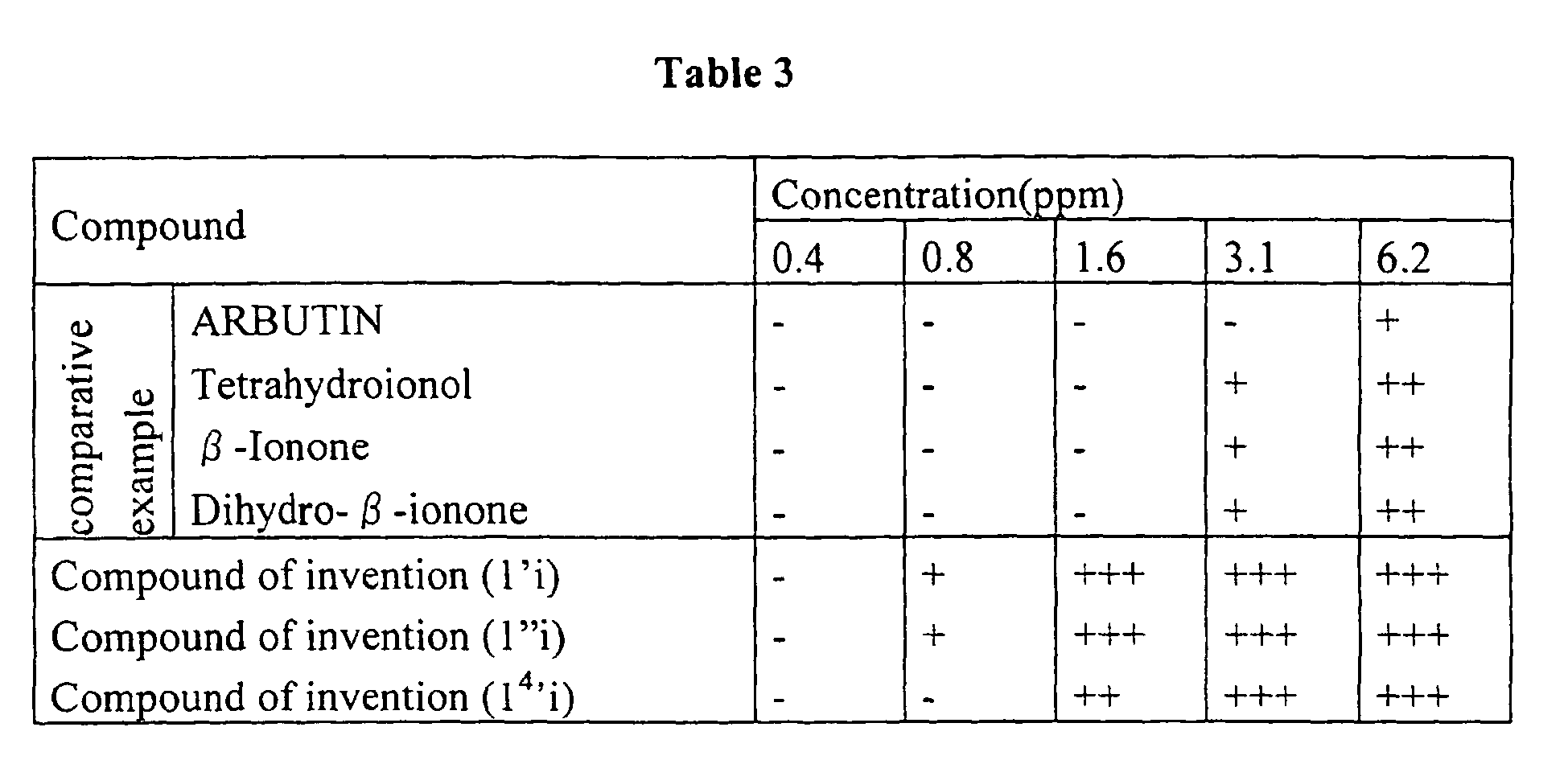
- As evident from these results, the compounds of the invention exhibited markedly potent melanin production inhibiting effects even at lower concentrations when compared with ARBUTIN which is a representative melanin production inhibitor having an entirely different structure or with the ionone derivatives having similar structures.
- 50 mg of a lanolin paste containing 2 % by weight of an inventive compound (1'i, 1 ''i) spread on a surgical tape for patch tests (TORII PHARMACEUTICAL CO., LTD.) was applied to an upper arm of each of 30 panelists in total consisting of males and females in their age of twenties to fifties, and after 24 hours when the surgical tape was peeled off and the further 24 hours thereafter the condition of the skin where the test substance was applied was observed and any abnormality was evaluated for the degree and the number of the panelists exhibiting such abnormality. The results are shown in Table 4.
Table 4 Test substance Number of panelists exhibiting abnormality Number of panelists exhibiting no abnormality 1'i 0 30 1"i 0 30 - The compounds of the invention were evaluated organoleptically by 7 trained panelists for the fragrances using scent papers, and the results shown in Table 5 were obtained.

- Similarly to Example 18, the fragrances of tetrahydroionol, β -ionone and dihydro- β -ionone as the comparative compounds were evaluated, and the results shown in Table 5 were obtained.
- As evident from Table 5, the compounds of the invention which are odorless unlike to the comparative compounds having lower molecular weights do not adversely affect the aroma of a fragrance incorporated into a dermal formulation.
- The components of each of the oil phase and the water phase shown in the following table were dissolved at room temperature with stirring. The water phase was combined with the oil phase and solubilized to form a lotion. The amounts of the components of the oil and water phases are represented by % by weight.
<Oil phase> 1-(2',2',6'-trimethylcyclohexan-1'-yl) octan-1-en-3-one (Compound 1'i) 0.01 Ethanol 20.0 Polyoxyethylene-hardened castor oil (50EO) 0.05 Methyl p-oxybenzoate 0.1 Fragrance 0.1 <Water phase> Glycerin 10.0 1,3-Butylene glycol 5.0 Purified water Balance - The lotion obtained had a higher whitening effect when compared with a formulation containing no inventive compound and a satisfactory fixative stability.
- The components of each of the oil phase and the water phase shown in the following table were dissolved at room temperature with stirring. The water phase was combined with the oil phase and solubilized to form an emulsion. The amounts of the components of the oil and water phases are represented by % by weight.
<Oil phase> 1-(2',2',6'-trimethylcyclohexan-1'-yl) octan-1-en-3-ol (Compound 1"i) 0.1 Stearic acid 2.0 Liquid paraffin 6.0 Squarene 2.0 Sorbitan monostearate 1.5 Polyoxyethylene sorbitan monostearate (20EO) 2.0 Butyl p-oxybenzoate 0.05 Methyl p-oxybenzoate 0.1 Fragrance 0.15 <Water phase> Glycerin 5.0 1,3-Butylene glycol 5.0 Purified water Balance - The emulsion obtained had a higher whitening effect when compared with a formulation containing no inventive compound and a satisfactory fixative stability.
- The components of each of the oil phase and the water phase shown in the following table were dissolved at 70°C with stirring. The water phase was combined portionwise with the oil phase with stirring to effect a preliminary emulsification and then emulsified uniformly using a homomixer, and then cooled to 30°C with stirring sufficiently, whereby obtaining a cream. The amounts of the components of the oil and water phases are represented by % by weight.
<Oil phase> 1-(2',2',6'-trimethylcyclohexan-1'-yl) octan-3-ol (Compound 14'i) 0.1 Stearic acid 2.0 Liquid paraffin 23.0 Vaseline 7.0 Sorbitan monostearate 3.5 Beeswax 2.0 Behenyl alcohol 1.0 Polyoxyethylene sorbitan monostearate (20EO) 2.5 Butyl p-oxybenzoate 0.05 Methyl p-oxybenzoate 0.1 Fragrance 0.15 <Water phase> Glycerin 5.0 1,3-Butylene glycol 5.0 Purified water Balance - The cream obtained had a higher whitening effect when compared with a formulation containing no inventive compound and a satisfactory fixative stability.
- Each of methylnonylketone (A) and n-decylaldehyde (B) was subjected to an expression test.
- Each of the neat fragrances A and B was mixed uniformly with each of the three fixatives and Compound (1 ''i) shown in Table 6 in the weight ratio of 1:1 each in the amount of 100 mg, and about 10.0 mg of the mixture was weighed onto a filter paper placed on the bottom of a broad-necked bottle of 40 mm in diameter and 50 mm in height, which was allowed to stand with being closed with a lid for 30 minutes and then used as an evaluation sample.
- Separately, 5.0 mg of each neat fragrance was weighed to obtain a fixative-free sample for the evaluation.
- 10 trained panelists having the experiences of 5 years or longer evaluated the expression of the fragrance immediately after opening the bottle on the basis of the following evaluation scores, and the total of the scores of the 10 panelists was used as a rating.
- Ratings:
- More intense than fixative-free sample: 2
No difference from fixative-free sample: 1
Less intense than fixative-free sample: 0 - The results are shown in Table 6.
Table 6 Fragrance expression test Evaluation sample Rating Fragrance Retainer Methylnonylketone Dipropylene glycol 8 " Triethyl citrate 8 " Benzyl benzoate 7 " Inventive compound(1"i) 13 n-Decylaldehyde Dipropylene glycol 9 " Triethyl citrate 8 " Benzyl benzoate 8 " Inventive compound(1"i) 12 - Each of methylnonylketone (A), n-decylaldehyde (B) and ethyl octanoate (C) was subjected to a fixative test.
- Each of the neat fragrances A, B and C was mixed uniformly with each of the three fixatives and Compound (1 ''i) shown in Table 7 in the weight ratio of 1:1 each in the amount of 100 mg similarly to Example 22, and about 10.0 mg of the mixture was weighed onto a filter paper placed on the bottom of a broad-necked bottle of 40 mm in diameter and 50 mm in height, which was allowed to stand without being closed with a lid at room temperature for about 8 hours and then used as an evaluation sample.
- Separately, 5.0 mg was weighed to obtain a fixative-free sample for the evaluation.
- The evaluation was conducted similarly to Example 22. 10 trained perfumer panelists compared the intensity of the retained fragrance between the fixative-containing and fixative-free samples, and the following scores were employed to obtain the total of the scores of the 10 panelists which was used as a rating.
- Ratings:
- More intense than fixative-free sample: 2
No difference from fixative-free sample: 1
Less intense than fixative-free sample: 0 - The results are shown in Table 7.
Table 7 Fragrance fixative test Evaluation sample Rating Fragrance Retainer Methylnonylketone Dipropylene glycol 10 " Triethyl citrate 13 " Benzyl benzoate 16 " Inventive compound (1"i) 20 n-Decylaldehyde Dipropylene glycol 7 " Triethyl citrate 8 " Benzyl benzoate 7 " Inventive compound (1"i) 15 Ethyl octanoate Dipropylene glycol 8 " Triethyl citrate 11 " Benzyl benzoate 13 " Inventive compound (1"i) 16 - In accordance with the formulations shown in Table 8, the fragrance compositions including Formulation A, Formulation B, Comparative formulation 1, Comparative formulation 2 and Comparative formulation 3 were prepared and subjected to the expression test and the fixative test.
- About 10.0 mg of each fragrance composition was weighed onto a filter paper placed on the bottom of a broad-necked bottle of 40 mm in diameter and 50 mm in height, which was allowed to stand with being closed with a lid for 30 minutes to obtain an evaluation sample, which was evaluated for the expression immediately after opening the bottle, and then for the fixative after being allowed to stand without being closed with a lid for about 8 hours.
- 10 trained perfumer panelists having the experiences of 5 years or longer evaluated a sample three times repetitively (30 panelists in total) and the intensity relative to Comparative formulation 3 was evaluated.
- The results are shown in Table 8.
- Table 8 shows the number of the panelists who felt the expression most eminently when compared with Comparative formulation 3. The rating "3" assigned to Comparative formulation 3 means that no difference was noted. The number of the panelists who felt the fixative most clearly when compared with Comparative formulation 3 is also indicated. The rating "3" assigned to Comparative formulation 3 means that no difference was noted.
Table 8 Fragrance expression and fixative tests Components Fragrance compositions Formulation A Formulation B Comparative formulation 1 Comparative formulation 2 Comparative formulation 3 n-Decylaldehyde 1 1 1 1 1 Citronellal 6 6 6 6 6 L-Citronellal 15 15 15 15 15 α -DAMASCONE 1 1 1 1 1 Geranyl acetate 6 6 6 6 6 L-Laurinal 20 20 20 20 20 Methylheptenone 1 1 1 1 1 Methylionone 10 10 10 10 10 Orange oil 10 10 10 10 10 Phenylethyl alcohol 25 25 25 25 25 Inventive compound (1"i) 5 2 - - - Inventive compound (1'm) - 1 - - - Inventive compound (14'o) - 1 - - - Triethyl citrate - - 5 - - Dipropylene glycol - - - 5 - Fragrance expression ratings 10 13 1 3 3 Fragrance fixative ratings 9 16 2 0 3 - Based on the results described above, a compound of the invention is proven to be excellent in terms of both of the fragrance expression and the fragrance fixative when added also to a formulated fragrance described above, and a combination of the compounds of the invention gave more excellent results.
- According to the invention, a novel trimethylcyclohexane derivative useful as a melanin production inhibitor and a fragrance fixative is provided. Also provided is a novel melanin production inhibitor which has a higher melanin production inhibiting effect and excellent stability and safety without affecting a product fragrance adversely as well as a novel fragrance fixative capable of promoting the expression and the fixative of a fragrance markedly. Also when a melanin production inhibitor is incorporated into a dermal formulation, it exhibits an extremely high stability in a formulation or in a base and is stable, thus providing a dermal formulation having a satisfactory whitening effect.
Claims (8)
- A trimethylcyclohexane derivative represented by Formula (1):

- A trimethylcyclohexane derivative according to Claim 1 represented by Formula (1):
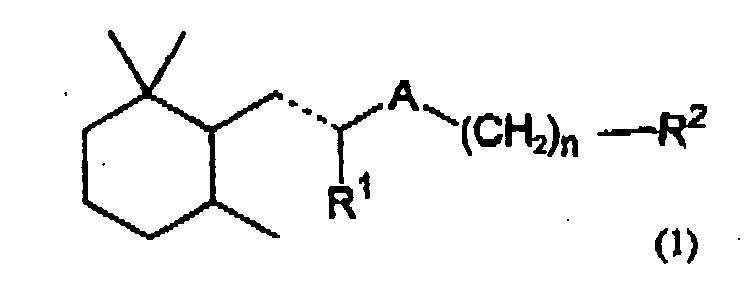
- A trimethylcyclohexane derivative according to Claim 1 represented by Formula (1):

- A melanin production inhibitor comprising one or more of trimethylcyclohexane derivatives according to Claims 1 to 3.
- A fragrance fixative comprising one or more of trimethylcyclohexane derivatives according to Claims 1 to 3.
- A dermal formulation comprising one or more melanin production inhibitors and/or fragrance fixatives according to Claims 4 to 5.
- Use of a composition comprising one or more trimethylcyclohexane derivatives represented by Formula (2):

- Use of a composition comprising one or more trimethylcyclohexane derivatives represented by Formula (2):

Applications Claiming Priority (3)
| Application Number | Priority Date | Filing Date | Title |
|---|---|---|---|
| JP3355098 | 1998-02-02 | ||
| JP3355098 | 1998-02-02 | ||
| PCT/JP1999/000412 WO1999038826A1 (en) | 1998-02-02 | 1999-02-01 | Trimethylcyclohexane derivatives and melanin-formation inhibitors and perfume-holding agents with the use of the same |
Publications (3)
| Publication Number | Publication Date |
|---|---|
| EP1053988A1 EP1053988A1 (en) | 2000-11-22 |
| EP1053988A4 EP1053988A4 (en) | 2007-05-02 |
| EP1053988B1 true EP1053988B1 (en) | 2008-12-31 |
Family
ID=12389674
Family Applications (1)
| Application Number | Title | Priority Date | Filing Date |
|---|---|---|---|
| EP99901929A Expired - Lifetime EP1053988B1 (en) | 1998-02-02 | 1999-02-01 | Trimethylcyclohexane derivatives and melanin-formation inhibitors and perfume-holding agents with the use of the same |
Country Status (4)
| Country | Link |
|---|---|
| US (1) | US6440400B1 (en) |
| EP (1) | EP1053988B1 (en) |
| JP (1) | JP4383656B2 (en) |
| WO (1) | WO1999038826A1 (en) |
Families Citing this family (12)
| Publication number | Priority date | Publication date | Assignee | Title |
|---|---|---|---|---|
| US8594429B2 (en) * | 2005-10-11 | 2013-11-26 | Hewlett-Packard Development Company, L.P. | Method and apparatus for processing a video stream |
| US20090209449A1 (en) * | 2008-02-20 | 2009-08-20 | Muhammed Majeed | Novel woody odorants |
| EP3103431A1 (en) | 2015-06-12 | 2016-12-14 | The Procter and Gamble Company | Fragrance compositions and uses thereof |
| EP3103523B1 (en) | 2015-06-12 | 2025-10-29 | The Procter & Gamble Company | Absorbent article comprising fragrance composition |
| CN107810259A (en) | 2015-06-12 | 2018-03-16 | 宝洁公司 | Perfume composition |
| WO2019156707A1 (en) | 2018-02-07 | 2019-08-15 | Coty Inc. | Fragrance compositions and uses thereof |
| US20230285261A1 (en) | 2020-06-05 | 2023-09-14 | Coty Inc. | Fragrance composition comprising a fragrance componet and a non-odorous fragrance modulator |
| WO2023055916A1 (en) | 2021-09-30 | 2023-04-06 | Coty Inc. | Fragrance compositions based on polyurethane |
| US20250032371A1 (en) | 2021-11-04 | 2025-01-30 | Coty Inc. | Ethanol-free fragrance chassis |
| FR3143998A1 (en) | 2022-12-21 | 2024-06-28 | Coty Inc. | PERFUME COMPOSITIONS AND THEIR USES |
| NL2034750B1 (en) | 2023-05-02 | 2024-11-14 | Coty Inc | Ethanol-free fragrance chassis |
| CN121511070A (en) | 2023-05-05 | 2026-02-10 | 科蒂公司 | Fragrance composition |
Family Cites Families (16)
| Publication number | Priority date | Publication date | Assignee | Title |
|---|---|---|---|---|
| DE2455761C2 (en) * | 1974-11-26 | 1982-04-22 | Haarmann & Reimer Gmbh, 3450 Holzminden | Use of hydrogenated methyl ionones and their derivatives as fragrances, processes for their preparation and new hydrogenated methyl ionone derivatives |
| US4313855A (en) | 1978-02-22 | 1982-02-02 | Dragoco Gerberding & Co. Gmbh | Fixative for perfume compositions |
| DE2807584C3 (en) * | 1978-02-22 | 1981-05-07 | Dragoco Gerberding & Co Gmbh, 3450 Holzminden | Fixator for perfume compositions |
| DE3471092D1 (en) | 1983-03-09 | 1988-06-16 | Firmenich & Cie | Composition essentially consisting of trans-1-(2,6,6-trimethylcyclohexyl)-hexan-3-ol, utilization of same and process for its preparation; cycloaliphatic ketone and alcohol intermediates |
| EP0270124A3 (en) * | 1986-12-05 | 1990-03-21 | The Green Cross Corporation | Cycloalkane derivatives and anti-peptic ulcer compositions containing same |
| US6054426A (en) | 1990-05-16 | 2000-04-25 | Firmenich Sa | Optically active aliphatic alcohols and their use as perfuming ingredients |
| US5250512A (en) * | 1990-05-17 | 1993-10-05 | Takasago International Corporation | Propanol derivatives and perfumes containing the same |
| US5248434A (en) * | 1992-04-20 | 1993-09-28 | The Proctor & Gamble Company | Liquid or gel bleaching composition containing amidoperoxyacid bleach and perfume |
| JPH0725709A (en) | 1993-03-31 | 1995-01-27 | Hodogaya Chem Co Ltd | Herbicide composition |
| JPH0873334A (en) | 1994-09-06 | 1996-03-19 | Pola Chem Ind Inc | Melanogenesis inhibitor and skin external preparation |
| JPH0873335A (en) | 1994-09-06 | 1996-03-19 | Pola Chem Ind Inc | Melanogenesis inhibitor and skin external preparation |
| JPH0873359A (en) | 1994-09-06 | 1996-03-19 | Pola Chem Ind Inc | Melanogenetic inhibitor and external preparation for skin |
| JPH0873336A (en) | 1994-09-06 | 1996-03-19 | Pola Chem Ind Inc | Melanogenesis inhibitor and skin external preparation |
| JPH08198747A (en) | 1995-01-25 | 1996-08-06 | Pola Chem Ind Inc | Melanogeneticity inhibitor and skin preparation for external use |
| JPH08333234A (en) * | 1995-06-07 | 1996-12-17 | Kao Corp | Whitening agent |
| JP3589469B2 (en) * | 1996-09-27 | 2004-11-17 | ユニリーバー・ナームローゼ・ベンノートシヤープ | Skin care compositions containing a combination of compounds having effects similar to those of retinoic acid on the skin |
-
1999
- 1999-02-01 US US09/601,508 patent/US6440400B1/en not_active Expired - Fee Related
- 1999-02-01 JP JP2000530065A patent/JP4383656B2/en not_active Expired - Fee Related
- 1999-02-01 EP EP99901929A patent/EP1053988B1/en not_active Expired - Lifetime
- 1999-02-01 WO PCT/JP1999/000412 patent/WO1999038826A1/en not_active Ceased
Also Published As
| Publication number | Publication date |
|---|---|
| EP1053988A1 (en) | 2000-11-22 |
| EP1053988A4 (en) | 2007-05-02 |
| US6440400B1 (en) | 2002-08-27 |
| JP4383656B2 (en) | 2009-12-16 |
| WO1999038826A1 (en) | 1999-08-05 |
Similar Documents
| Publication | Publication Date | Title |
|---|---|---|
| JP3071030B2 (en) | Composition having a physiological cooling effect and method for producing the composition | |
| KR100246702B1 (en) | Hydrochalcon derivative, cosmetic composition containing hydrochalcon derivative and preparation method thereof | |
| US6440400B1 (en) | Trimethylcylohexane derivatives and melanin-formation inhibitors and perfumeholding agents with the use of the same | |
| JPWO1999038826A1 (en) | Trimethylcyclohexane derivatives, melanin production inhibitors and fragrance fixatives using the same | |
| EP3494103B1 (en) | 1-hydroxymethyl-1,2,2,6-tetramethyl-cyclohexane and derivatives thereof and their use as aroma chemicals | |
| JPH05213729A (en) | Melamine-inhibitor | |
| EP1264594B1 (en) | Melanin production inhibitors and skincare products containing such inhibitors | |
| JP2004517109A (en) | A skin lightening agent containing a glucose-acylated derivative or a sucrose-acylated derivative {Cosmeticforskinwhiteningcontainingacylsubstitutedderivativesofglucoseorsucrose} | |
| JPH11286423A (en) | Composition for suppressing body odor | |
| JP2009196980A (en) | Melanin synthesis inhibitor and whitening cosmetic | |
| JP2013136733A (en) | Cool feeling agent, and trpm8 activator | |
| JP5212969B2 (en) | Chroman compound and process for producing the same | |
| CZ298939B6 (en) | Pharmaceutical compositions and medicaments for lightening skin or reducing the pigmentation of skin or for treating inflammatory disorder or dandruff in a human | |
| JP2000007546A (en) | Pigmentation inhibitor, skin cosmetic and skin external preparation using the same | |
| JP4828046B2 (en) | Melanin production inhibitor and topical skin preparation | |
| JP3071990B2 (en) | External preparation for skin | |
| KR101048477B1 (en) | Skin whitening composition containing indole alkaloid compound | |
| JPH11286425A (en) | Composition for suppressing aged person smell | |
| JP6076832B2 (en) | Menthol derivative, and cooling sensation agent, TRPM8 activator, cooling sensation imparting method and TRPM8 activation method using the same | |
| US7816566B2 (en) | p-Menthan-3-ol alkylated derivatives and their use as refreshing agents | |
| JP3072267B2 (en) | Hydrochalcone derivatives, cosmetics containing the derivatives, and methods for producing them | |
| CN119403779A (en) | Use of cyclohexanol as aroma chemicals | |
| JP2003119128A (en) | Melanin production inhibitor and external preparation for skin | |
| WO2025134879A1 (en) | Melanogenesis inhibitor | |
| EP4189141A1 (en) | Cyclic compounds as aroma chemicals |
Legal Events
| Date | Code | Title | Description |
|---|---|---|---|
| PUAI | Public reference made under article 153(3) epc to a published international application that has entered the european phase |
Free format text: ORIGINAL CODE: 0009012 |
|
| 17P | Request for examination filed |
Effective date: 20000904 |
|
| AK | Designated contracting states |
Kind code of ref document: A1 Designated state(s): FR |
|
| A4 | Supplementary search report drawn up and despatched |
Effective date: 20070316 |
|
| 17Q | First examination report despatched |
Effective date: 20070709 |
|
| GRAP | Despatch of communication of intention to grant a patent |
Free format text: ORIGINAL CODE: EPIDOSNIGR1 |
|
| RIC1 | Information provided on ipc code assigned before grant |
Ipc: C11B 9/00 20060101ALI20080623BHEP Ipc: C07C 49/21 20060101ALI20080623BHEP Ipc: C07C 49/11 20060101ALI20080623BHEP Ipc: C07C 33/14 20060101ALI20080623BHEP Ipc: C07C 31/135 20060101ALI20080623BHEP Ipc: A61K 8/34 20060101ALI20080623BHEP Ipc: A61K 8/33 20060101ALI20080623BHEP Ipc: A61Q 13/00 20060101ALI20080623BHEP Ipc: A61Q 19/02 20060101AFI20080623BHEP |
|
| GRAS | Grant fee paid |
Free format text: ORIGINAL CODE: EPIDOSNIGR3 |
|
| GRAS | Grant fee paid |
Free format text: ORIGINAL CODE: EPIDOSNIGR3 |
|
| GRAA | (expected) grant |
Free format text: ORIGINAL CODE: 0009210 |
|
| AK | Designated contracting states |
Kind code of ref document: B1 Designated state(s): FR |
|
| PLBE | No opposition filed within time limit |
Free format text: ORIGINAL CODE: 0009261 |
|
| STAA | Information on the status of an ep patent application or granted ep patent |
Free format text: STATUS: NO OPPOSITION FILED WITHIN TIME LIMIT |
|
| 26N | No opposition filed |
Effective date: 20091001 |
|
| PGFP | Annual fee paid to national office [announced via postgrant information from national office to epo] |
Ref country code: FR Payment date: 20130301 Year of fee payment: 15 |
|
| REG | Reference to a national code |
Ref country code: FR Ref legal event code: ST Effective date: 20141031 |
|
| PG25 | Lapsed in a contracting state [announced via postgrant information from national office to epo] |
Ref country code: FR Free format text: LAPSE BECAUSE OF NON-PAYMENT OF DUE FEES Effective date: 20140228 |