Technical Field
This invention relates to a sand blasting abrasive material,
a sand blasting method for a wafer using the same and a wafer
processed by means of the sand blasting method.
Background Art
There has been employed a gettering technique in a semiconductor
device fabrication process by which contaminating impurities
mainly including heavy metals are collected to strained sites
produced outside element forming regions of a wafer in a element
forming step, as means suppressing generation of crystal defects
to be otherwise caused by contaminating materials on element
forming surfaces of the regions.
A sand blasting method has been available as the easiest means
for gettering. This method is such that a sand blasting abrasive
material in the form of fine particulate is blown mainly against
a rear surface opposite from an element forming surface of a
wafer to create mechanically induced strain in the wafer. As
the sand blasting method, two methods are adopted: one, in which
natural quartz powder, synthetic quartz powder or the like powder
is blown against a wafer in a powdery state without any
modification thereon (a dry method) and the other, in which such
powder is blown against a wafer in the form of slurry as a mixture
with pure water (a wet method). It should be appreciated that
as abrasive material, natural quartz powder can be used
advantageously over synthetic quartz powder in that a necessary
OSF (Oxidation Induced Stacking Fault) density cannot be obtained
with synthetic quartz powder and in addition the synthetic quartz
powder is more expensive.
As described above, while natural quartz powder is advantageous
in terms of cost and so on, metal ions such as Fe ion, Ni ion,
Cu ion, Zn ion, Al ion and so on, though in only trace amounts,
are included therein. When a slurry is prepared adding pure water
to natural quartz powder containing such metal ions, Cu ion has
a low ionization tendency and is easy to deposit on a wafer surface.
Further, Cu shows a high diffusion coefficient in a typical
semiconductor material Si and therefore intrudes into the
interior of a Si wafer with ease, contributing very unfavorably
to the Si wafer in terms of metal contamination.
When metal contamination arises, various kinds of crystal defects
are induced in heat treatments of a wafer in a device fabrication
process by the above described metal impurities in the bulk of
the wafer. The crystal defects are also generated on a surface
and in the vicinity thereof and therefore, a leakage current
increases in device chips obtained from the wafer, thereby not
only deteriorating device characteristics but reducing a device
yield.
Disclosure of Invention
The invention has been made in light of such problems and it
is accordingly an object of the invention to provide a sand
blasting abrasive material and a sand blasting method for a wafer
using the same, which prevents contamination of the wafer by
a metal ion from occurring.
A sand blasting abrasive material of the invention for achieving
the above object contains a chelating agent.
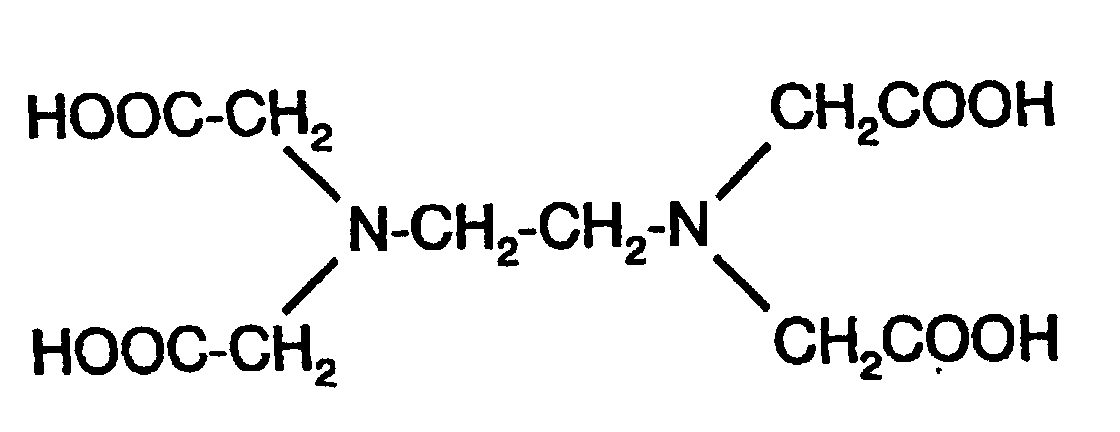
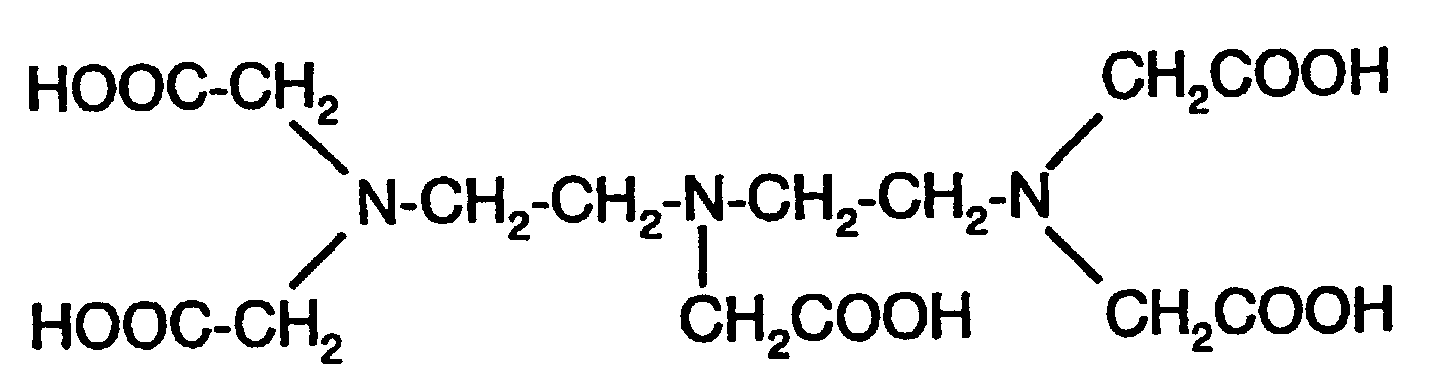
The chelating agent is preferably selected from the group
consisting of the following compounds (1) to (4) and salts
thereof:
A molar concentration of a chelating agent described above is
preferably 4.28 × 10⁻⁴ mol/l or more and more preferably 2.57
× 10-3 mol/l or more.
Further, a sand blasting abrasive material of the invention is
preferably composed of natural quartz powder as a major component
and also preferably a slurry prepared by adding natural quartz
powder into pure water.
A wafer of the invention is one processed with the above described
sand blasting abrasive material.
A sand blasting method for a wafer of the invention is to sand
blast a wafer with the above described sand blasting abrasive
material.
Brief Description of the Drawings
FIG. 1 is a histogram showing measurement results of a Cu
concentration in a silicon wafer after sand blasting, followed
by heat treatment.
Preferred Embodiments of Invention
A sand blasting abrasive material of the invention contains a
chelating agent. The chelating agent forms a complex with a metal
ion and therefore, when sand blasting is performed with a sand
blasting abrasive material containing a chelating agent, it is
prevented from occurring that a metal ion deposits on a wafer
and diffuses into the bulk thereof.
A chelating agent with a high contamination preventive effect
against a metal ion through formation of a stable complex with
the metal ion can be selected from the group consisting of the
following compounds (1) to (4) and salts thereof:
An additive amount of a chelating agent described above is
preferably at molar concentration of 4.28 × 10⁻⁴ mol/l or more
and more preferably 2.57 × 10⁻³ mol/l. If a molar concentration
of a chelating agent is less than 4.28 × 10⁻⁴ mol/l, a preventive
effect against contamination by a metal impurity cannot be
sufficient and therefore, the molar concentration is desirably
equal to or more than the lower limit in order to ensure no residue
of at least Cu ions in a slurry. The molar concentration of a
chelating agent in order to ensure no residue of almost all of
the metal ions including Fe ions in a slurry is desirably 2.57
× 10-3 mol/l or more.
A sand blasting abrasive material of the invention is composed
mainly of natural quartz powder and a chelating agent described
above is added thereto. There can be typically named a sand
blasting abrasive material prepared by adding natural quartz
powder into pure water to form slurry and further adding a
chelating agent above described to the slurry. Natural quartz
powder is mainly composed of SiO2, but as the balance, contains
Al2O3, Fe2O3, Na2O and so on in trace amounts. A grain size of
natural quartz powder is on the order ranging from 1 to 8 µm.
In a case where a slurry is prepared using natural quartz powder,
pure wafer is added to 1.0 kg of natural quartz powder so as
to form a volume of 10.0 liters of a slurry, for example.
In a method in which a wafer is sand blasted with a sand blasting
abrasive material described above, for example, a silicon wafer
is placed on a belt conveyor with a rear surface up and a nozzle
(may be a plurality of nozzles) jetting downward a sand blasting
abrasive material (slurry) described above is provided above
the belt conveyor, wherein the silicon wafer is moved setting
a conveyor travel speed at, say, 1. 0 m/min, a nozzle position
is reciprocated in a direction perpendicular to the travel
direction of the conveyor in a horizontal plane in an amplitude
of a wafer diameter or more at a frequency of the order of 70
cycles/min and the slurry is spurted to the rear surface of the
silicon wafer at a jet pressure ranging from 0.6 to 0.9 kg/cm2.
Example
(Preparation of sand blasting abrasive material)
Pure water was added to natural quartz powder of a chemical
composition shown in Table 1 with a particle size distribution
shown in Table 2 to prepare a slurry with a content of 1.0 kg
of a natural quartz powder in 10 liters of the slurry.
Ethylenediaminetetraacetic acid (hereinafter abbreviated as
EDTA) as a chelating agent is added to five volumes of slurry
each of 80 liters in amounts of 0.01 g, 10 g, 50 g, 60 g and
120 g, respectively, to obtain slurries with different EDTA
concentrations. Residual metal ions were investigated in the
slurries with different EDTA concentrations and one with no EDTA,
which results are shown in Table 3.
| chemical composition (wt %) |
| Al2O3 | 0.004 |
| SiO2 | 99.99 |
| Fe2O3 | 0.002 |
| Na2O | 0.002 |
| grain size (µm) | ratio (%) |
| 1.00 to 1.26 | 0.0 |
| 1.26 to 1.59 | 1.3 |
| 1.59 to 2.00 | 3.0 |
| 2.00 to 2.52 | 10.1 |
| 2.52 to 3.17 | 20.0 |
| 3.17 to 4.00 | 30.3 |
| 4.00 to 5.04 | 27.0 |
| 5.04 to 6.35 | 7.4 |
| 6.35 to 8.00 | 0.9 |
| 8.00 to 10.1 | 0.0 |
| EDTA (mol/l) | residual metal ion concentration in slurry (ppb) |
| | Fe ion | Ni ion | Cu ion | Zn ion | Al ion | Fe ion |
| 0 | 9.59 × 10³ | 2.08 × 10 | 1.49 × 10 | 3.13 × 10 | 2.83 × 10³ | 9.60 × 10³ |
| 4.28 × 10⁻⁷ | 1.75 × 10⁻⁴ | 1.20 × 10⁻¹¹ | 4.09 × 10⁻¹² | 2.32 × 10⁻⁹ | 6.45 × 10⁻⁷ | 0 |
| 4.28 × 10⁻⁴ | 1.04 × 10⁻⁷ | 0 | 0 | 0 | 0 | 0 |
| 2.14 × 10⁻³ | 1.59 × 10⁻⁸ | 0 | 0 | 0 | 0 | 0 |
| 2.57 × 10⁻³ | 0 | 0 | 0 | 0 | 0 | 0 |
| 5.14 × 10⁻³ | 0 | 0 | 0 | 0 | 0 | 0 |
As shown in Table 3, in a case where an additive amount of EDTA
was 10 g (at a molar concentration of 4.28 × 10⁻⁴ mol/liter),
while Fe ion remained, any of other metal ions including Cu ion
was not recognized as residues. Further, in a case where an
additive amount of EDTA was 60 g (at a molar concentration of
2.57 × 10⁻³ mol/liter), none of other metal ions including even
Fe was recognized.
(Example)
EDTA was added to 80 liters of the slurry (before addition of
EDTA) obtained in the preparation of sand blasting abrasive
material in amount of 120 g to prepare an EDTA containing slurry
(of a molar concentration of 5.14 × 10⁻³ mol/liter). Thus obtained
EDTA containing slurry was used to sand blast rear surfaces of
p-type silicon wafers of 200 mm in diameter (the number of the
sample wafers 4) and the wafers sand blasted were subjected to
a heat treatment at 650°C for 20 min.
(Comparative Example)
A slurry with no addition of EDTA obtained in the preparation
of sand blasting abrasive material was used in its original state
for processing wafers (the number of the wafer samples 4) in
the same conditions as in the example.
Cu concentrations were measured on surfaces of the four sample
wafers in the example and in addition, surfaces of the four sample
wafers in the comparative example, which results are shown in
FIG. 1. In a case of sand blasting using the slurry with no EDTA,
Cu contamination was recognized on all the four wafer samples,
but in a case of sand blasting using the slurry with EDTA, all
of Cu contaminant amounts were measured to be equal to or less
than a detection limit: virtually no contamination of Cu was
found. Further, an OSF density which affects a gettering ability
was sufficiently high and electrical characteristics such as
a breakdown voltage of an oxide film were at satisfactory levels.
Industrial Applicability
According to the invention, as described above, metal ion
contamination of a wafer in sand blasting can be prevented from
occurring.